From the FasterSkier archive — posts syndicated from athletes’ and coaches’ own blogs between 2004 and 2012, kept online as published. Current coverage is at fasterskier.com.
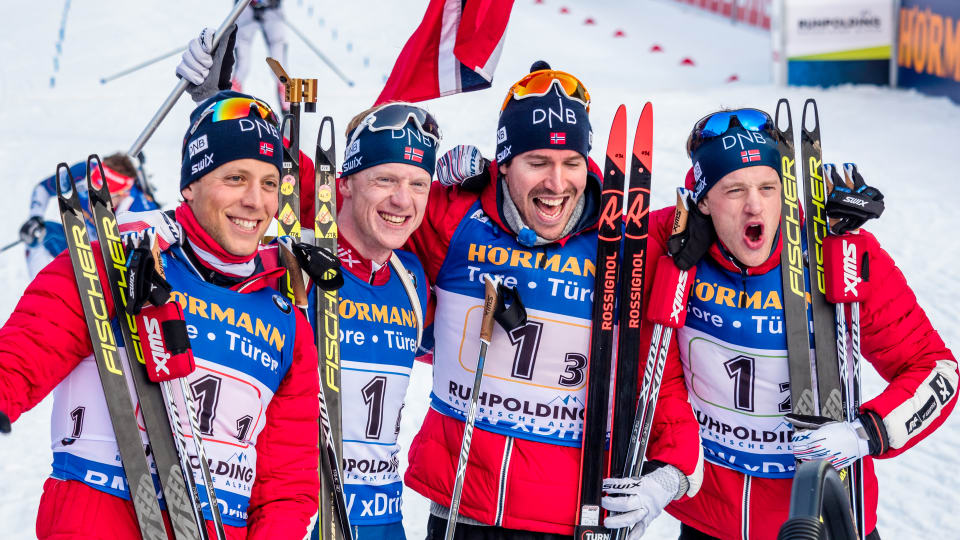
The Norwegian men’s relay after winning the 4 x 7.5 k on Friday at the IBU World Cup in Ruhpolding, Germany, with Lars Helge Birkeland (l), Tarjei Bø (far r), Emil Hegle Svendsen (second from r), and Johannes Thingnes Bø (second from l). It was their second win of the season (after winning with Ole Einar Bjørndalen, Henrik L’Abée-Lund, and Erlend Bjøntegaard, and Birkeland in the first men’s relay of the 2017/2018 season in Hochfilzen, Austria. (Photo: IBU/Biathlonworld)
IBU World Cup (Ruhpolding, Germany): Men’s 4 x 7.5 k relay
Less than a week after Sweden won the men’s 4 x 7.5-kilometer relay in Oberhof, Germany, with an up-and-coming group, Norway posted its second win (in three relays) this season, with an all-star lineup on Friday in Ruhpolding, Germany.
Lars Helge Birkeland, Tarjei Bø, Emil Hegle Svendsen, and Johannes Thingnes Bø took the lead during Johannes Bø’s anchor leg and ultimately the win in 1:13:11.1 hours, 24.9 seconds ahead of France in second and 53.4 seconds ahead of Russia in third.
On a bluebird day with no wind in the range, according to an International Biathlon Union (IBU) press release, the Norwegians avoided the penalty lap and used seven spares to clean. First-leg skier Birkeland put them in second with near-perfect shooting (0+0, 0+1), just 0.4 seconds behind Germany’s Erik Lesser, who cleaned without any spares, in first. (Birkeland was also on the Norwegian team that won the first relay of the season in Hochfilzen, Austria.)
Norway remained in second during Tarjei Bø’s second leg, in which he had to use three spares to clean prone (0+3, 0+0). He tagged Svendsen in second, 0.6 seconds behind Italy, which had risen to first thanks to Lukas Hofer’s fast skiing and solid shooting (0+0, 0+2).
Svendsen slipped slightly to third place by the final exchange despite only needing one spare to clean (0+0, 0+1), but was still just a second out of first at the tag. France had moved into first place with a predictably strong third leg from Martin Fourcade (0+0, 0+0), in which he brought the team from seventh to first place, just ahead of Italy’s Dominik Windisch and Norway’s Svendsen.
Johannes Bø skied the third-fastest anchor leg and cleaned prone and used two spares in standing (0+0, 0+2) to overtake France’s Antonin Guigonnat and Italy’s Thierry Chenal, who slipped to second and seventh, respectively, by the finish.
Guigonnat shot well, requiring just one spare (0+1, 0+0), but finished nearly 25 seconds after Bø for second place. Russia reached the podium with Anton Shipulin picking off two places, after being tagged in fifth.
In all, France had zero penalties and six spares, with Simon Desthieux, Quentin Fillon Maillet, Fourcade, and Guigonnat, and Russia used a total of just four spares and had no penalties with Alexey Volkov, Maxim Tsvetkov, Anton Babikov, and Shipulin.
Germany finished fourth (+1:26.5) with zero penalties and 10 spares, with Lesser, Benedikt Doll, Arnd Peiffer and Simon Schempp. After Doll dropped to fifth on the second leg, they skied in fourth on the last two legs.
Austria took fifth (+1:39.8) with zero penalties and six spares, with David Komatz, Simon Eder, Daniel Mesotitsch, and Dominik Landertinger. Sweden followed in sixth (+1:50.6) with zero penalties, six spares and three of the same men who won last Sunday’s relay (Sebastian Samuelsson, Martin Ponsiluoma and Fredrik Lindström) with new member Torstein Stenersen. Italy finished seventh (+1:58.5) with one penalty and 11 spares.
Of 26 teams in the relay, Canada placed 14th (+3:22.3) with one penalty and 10 spares, and the U.S. finished 24th (+16:21.6) with eight penalties (four of which stemmed from cross-firing) and 13 spares.
Notably, the U.S. had been fourth and just 3 seconds out of first after Lowell Bailey’s first leg, which he cleaned without any spares (0+0, 0+0). Leif Nordgren then dropped to 22nd with a penalty in each of his shooting stages (1+3, 1+3) and the 25th-ranked second-leg time. Tim Burke as the team’s third leg had to ski two penalty laps as well (0+2, 2+3), and anchor Sean Doherty was penalized for cross-firing in his last standing stage (0+1, 4+1), according to a US Biathlon press release, and the team was hit with four additional penalties.
“We have a solid team and I know we didn’t show our true potential today,” Bailey said, according to the release. “But the most important relay is still to come. We’ll just have to wait until then.”
“I was happy to put together a good race on the track and in the range,” he said. “The first lap was a bit of a roller derby with no easy way to get to the front. I was fortunate to clean without extra rounds because this allowed me to leapfrog up to the lead pack exiting the range. I tried to keep an even pace for loop two and I thought I would be able to hang in second or third, but no one wanted to pass so I had to lead for most of the loop.
“I had struggled in standing in the previous race so I wanted to get back to taking good shots in standing,” he added. “Although I didn’t shoot as quickly as some of the other guys, I felt good about the stage and the fact that I didn’t have to use extras. It was a fight to catch the lead group on the last loop, but fortunately I had some help from [Italy’s Thomas] Bormolini (of Italy) and we worked together to get back in contact with the lead group.”
Canada finished 14th with Christian Gow, Scott Gow, Macx Davies, and Brendan Green. On the opening leg, Christian Gow put them in 11th with clean prone shooting and just one spare needed to clean standing (0+0, 0+1), but they slipped one spot to 12th with a penalty on Scott Gow’s second leg (0+0, 1+3). Davies then dropped two more places to 14th despite avoiding the penalty lap (0+3, 0+1), and Green held that position to the finish (0+1, 0+1).
The women’s 4 x 6 k relay will be held Saturday in Ruhpolding, with Canada starting Emma Lunder, Julia Ransom, Sarah Beaudry, and Rosanna Crawford. For the U.S., it will be Susan Dunklee, Clare Egan, Emily Dreissigacker, and Joanne Reid. Watch it live on the Olympic Channel at 8:30 a.m. EST.
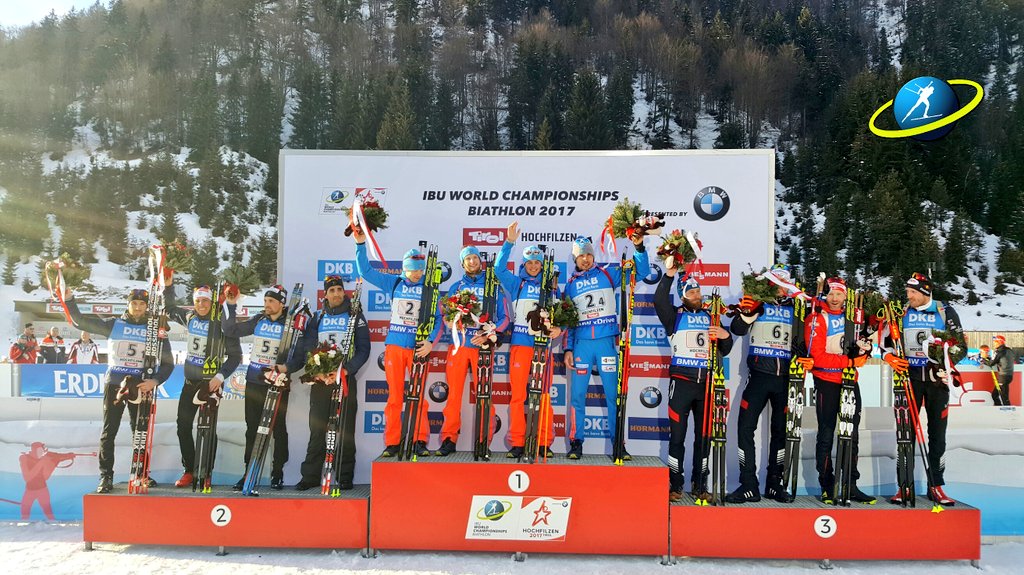
The men’s 4 x 7.5 k relay podium at 2017 IBU World Championships on Saturday in Hochfilzen, Austria, with Russia (c) in first, France (l) in second, and Austria (r) in third. (Photo: IBU World Champs/Twitter)
HOCHFILZEN, Austria—Redemption, validation, national pride: just a few of the things that were on the line in today’s 4 x 7.5 k relay at IBU World Championships.
For Austria, it was clear: a good performance on home soil was critical. The team hadn’t won a medal yet despite eight chances to do so.
For Germany, the question was whether their accomplished men’s team could live up to the expectations set by its younger women’s team, which has won every relay this year, including at World Championships.
For Norway, there had been no gold so far, but the men wanted to defend their title from last year’s Championships in Oslo.
Russia? Relays were seeming like the best way to take medals. They had earned bronze in the mixed relay, but been locked out ever since. Plus, the team has been embroiled in politics. Things were getting complicated.
France’s Martin Fourcade has dominated the whole season, but only won one gold at World Championships. Would the relay be the place he could finally get a second?
Plus, Canada won bronze in the team event last year, and the U.S. men’s team, often a top-six threat, was looking to capitalize on the energy from Lowell Bailey’s gold in the 20 k individual.
Any number of teams wanted a slice of the podium. But there were only three steps, and only one set of gold medals.
Out of the start, a team that nobody had expected shot to the front: Latvia. Andrejs Rastorgujevs, always one of the fastest skiers in the field, decided to make a breakaway already on the first loop. He then quickly cleaned prone and continued to lead on his own through the second loop.
Using spares in standing, though, the strategy didn’t seem to pay off. Germany staked a claim as soon as he faltered, with veteran Erik Lesser cleaning both shooting stages with no spare rounds and then attacking the final loop. He tagged off to Benedikt Doll with 5.8 seconds on the competition.
“Erik is such a great finisher,” U.S. lead skier Lowell Bailey – who tagged off 12.4 seconds back in fourth place, after using one spare round – said of Lesser. “In that situation he is nearly unstoppable. Hats off to him. He knows how to ski relays.”
While Lesser had thrown down, many teams weren’t so far behind him. By the end of the third leg, Benedikt Doll had thrown away Germany’s lead with poor shooting and six teams were still within 32 seconds of first place. Gone were the U.S., Canada, and Norway. Anton Babikov had turned in a hero’s performance to take Russia to the front, and his team was now chased by Austria, France, Germany, Ukraine, and Italy.
Anton Shipulin had taken over for Russia with a slight lead over Austria and France. Martin Fourcade, the French anchor, chased hard, and passed Austria’s Dominik Landertinger. With a clean prone from both Fourcade and Shipulin, the race narrowed. But Shipulin still had some seconds of cushion when he came in for standing.
He needed them: Shipulin used one spare. Fourcade shot quickly, cleaned, and tried to catch the Russian. He left the range 4.2 seconds back, setting up a battle between two of the top men on the World Cup.
“Today the last round for me was the most difficult, because I knew that Martin Fourcade is a very strong athlete,” Shipulin said through a translator at the press conference. “I was just trying to run faster than him.”
It turned into the battle that wasn’t, however, with Shipulin pulling away and coasting to a 5.8-second win for Russia.
“I think it was too complicated for me today,” Fourcade said. “I am not in my best shape. Anton was really strong on the track. I tried in the beginning of the race to catch him, and I almost did it. But then he had a bit more power than I had.”
While the Russian fans weren’t the most numerous in the stands, they were among the most passionate. And the team had delivered for them.
“I feel relieved for our team and our country,” Shipulin said. “I think it has been almost ten years we have not won any [World Championships] in the relay. So we are just really lucky and really happy, and we are going to celebrate.”
(Russia did win gold at the 2014 Olympics.)
Behind Fourcade and Shipulin, Landertinger of Austria and Simon Schempp of Germany were both trying desperately to secure a podium spot, but there was only room for one.
Schempp initially appeared to have better skis on the downhills on the front end of the loop. But on the major climb on the back end, Landertinger accelerated and Schempp was utterly unable to follow. To the monstrous roar of the crowd, Landertinger skied into the stadium to take bronze with his three teammates.
“It was very, very hard,” Landertinger told Austrian broadcaster ORF. “Simon is one of the best anchor skiers I know. When I skied out of the range after the shooting and saw him just four or five meters behind me, I knew it would be very difficult. I probably looked at that climb a hundred times in training, and it was pretty clear I would do my attack there. And thank God that worked out great.”
Schempp was deflated, but said that Germany needed to have an overall better team performance to secure a podium. Eight spares wouldn’t to it.
“It wasn’t enough for the podium today,” he told German broadcaster ARD. “I gave everything I had, everything that was left. Unfortunately we were not convincing on the shooting range today.”
Doll apologized too: four of the eight spare rounds came from him, including three in the standing stage, which had dropped the team to seventh at the time.
“Everyone did their best, I also tried to do my best,” he said. “But I just didn’t have it in my head today. I am really sorry about that, it really hurts because half the used spares were on me. I might have to give out a bar round tonight. I have to take a large part of the blame on me.”
For the Austrian team, the medal was long-awaited and cause for celebration.
Leadoff skier Daniel Mesotitsch was also the leadoff guy when Austria took bronze on this same course back at 2005 World Championships.
“It feels just as great as back then,” the 40-year-old told ORF. “There is no better feeling than winning a medal at home with the team. We are all overwhelmed by our emotions. I was briefly feeling sick to my stomach even watching [the last loop]. I was a lot more nervous than during my own loop.”
But now, a medal is theirs.
“It’s beautiful,” Landertinger said. “Really, really beautiful. And I have to say, what I experienced today with those fans, I already got goosebumps coming into the arena today. And I am proud that I can race here. And now with this medal I achieved the goal I had, and I am brutally happy now.”
U.S. Team Seventh, Just Out of Top-Six Goal
Bailey delivered as the U.S. team’s leadoff racer, using just one spare round and staying near the front for the whole race. After the team could not contest the first few relays of the season, they lost valuable Nations Cup and relay points and started with a high bib number. Bailey had to make up the time on the range, rather than the trails.
“There was no where to go –it’s actually fairly narrow for a World Championships Course,” Bailey said. “There wasn’t a lot of room to work. With the high bib number you actually hit the [shooting] point [on the range] before a lot of other people, so I really was just focusing on getting my first shot off quick. I did, but I missed it unfortunately. The key is just in that first prone is keeping enough contact, so I really pushed the pace in shooting and pushed that extra round so I could maintain contact.”
While he was confident coming off his gold medal on Thursday, Bailey was also tired. He wasn’t sure how he was going to feel, or if he would be able to make up time on the trails once the pack thinned out enough for him to move.
“I was a little nervous about today, because the last 48 hours have been a little bit wild and I slept two hours the night after the individual,” he admitted. “I didn’t go to bed late. I just lay there and Erika and I were both wide awake, occasionally like, ‘Are you sleep?’ ‘No, are you sleep?’ ‘No, shit.’ You have to put your feet back on the ground, back in the ski boots.”
By the time he tagged off to Leif Nordgren, the U.S. was in fourth place, more or less where they wanted to be.
Then, Nordgren cleaned prone and moved into second place, 0.4 seconds behind Germany’s Doll. Really right where they wanted to be.
“I kind of took my time a little bit in prone,” Nordgren said. “I wanted to make sure I hit all five targets not using any extras, so that went really well.”
The pair were soon consumed by a chase back, but that didn’t bother Nordgren.
“I left the range right with Doll there for the lead, and then he didn’t push super hard the second loop so it was no problem staying with him. But of course it allowed some guys from behind to catch up, which, no big deal.”
In standing, Nordgren used one spare, dropping to fifth, and then stayed in sixth place on the trails. Despite losing places, he was still just 17.7 seconds out of the lead.
“I think I paced the race really well,” said Nordgren. “I was right there. I couldn’t quite close the gap, but you know, I think I kept us right in there, so yeah, I am happy.”
Tim Burke used one spare in prone and three in standing, and blamed his spare rounds partly on exhaustion.
“I feel so bad on the skis, it’s such a fight from the first kilometer,” he said. “By the time I got to standing my legs were cramping, and I — yeah. It’s so much easier when you’re feeling good, you can push and recover and get in the flow. When you’re just fighting the whole loop to try keep your head above water, and then you hit the mat to shoot, it’s just brutally hard.”
Despite a performance that left him frustrated, the U.S. was still in seventh place when Sean Doherty took over to race the anchor leg. He used two spares in prone and then cleaned standing, heading out on course in seventh place and on the hunt: Ukraine was just 3.2 seconds ahead.
The top six was not meant to be, though.
“I just didn’t have it in the legs today and that’s pretty frustrating,” Doherty said after crossing the line seventh, +1:50.5. “You know, to be so close to sixth there and not have the gear on the last lap to push it through. I gave it all I had and just didn’t have enough.”
With a total to eight spare rounds – not bad, but more than Russia’s three or France’s four – the team was missing the last little bit that would have gotten them to where they wanted to be.
“I would say we were hunting for the top six, and you know, Leif and Lowell got us off to such a great start,” Doherty said. “Unfortunately, I wasn’t able to really follow up on that. I think we all had it in us, just couldn’t quite get that critical mass.”
Canada 13th in Hunt for Medal Defense
Last year, the men’s relay was the best moment in several Canadian team members’ sporting careers. They won an unexpected bronze medal and were the sensation of World Championships.
This season, Nathan Smith has been out with a virus. That gave Macx Davies a chance to start. But overall, the team couldn’t match their form from the year before. With ten spares overall, they crossed the line 13th, +3:35.5.
“I was just hoping to have a good race for myself,” said Davies, for whom it was the first World Championships relay start. “It is hard to put any [results goals] on relays because it is a team event, and I am not the other three guys… It hasn’t been bad, it just has been a little too slow, especially a few too many spares for us. We need to miss less than the other nations if we ski, or if I ski, like I did today.”
“I could have definitely done better than I did today,” said leadoff racer Christian Gow, who had three spares. “Too many mistakes on the range, but I am at least happy with my skiing… I think it was a pretty good ski day. I think it is the closest I have been with that many spares. The skiing was pretty decent, but I dropped the ball in the range.”
-Gerry Furseth, Harald Zimmer, and Ian Tovell contributed
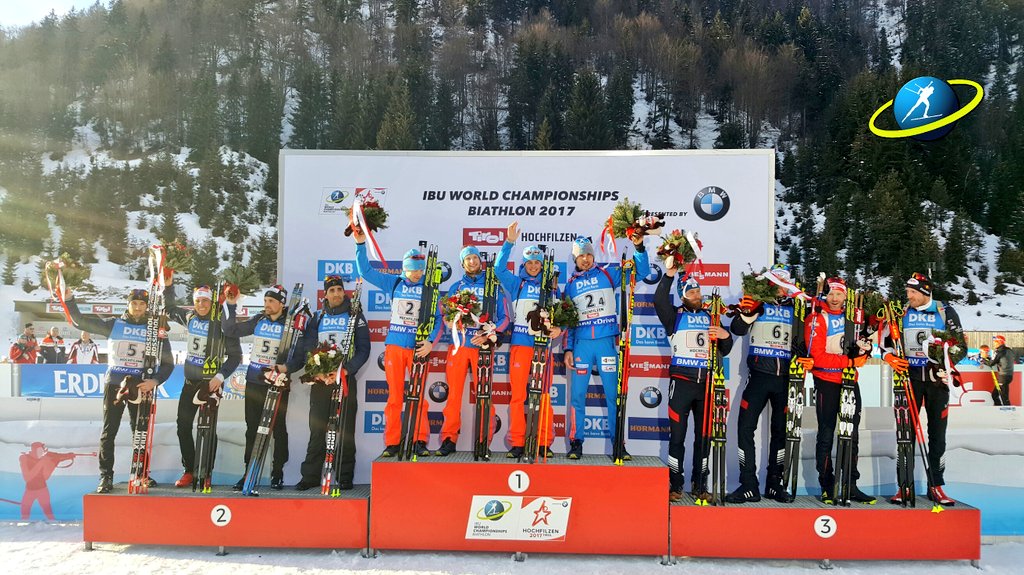
The men’s 4 x 7.5 k relay podium at 2017 IBU World Championships on Saturday in Hochfilzen, Austria, with Russia (c) in first, France (l) in second, and Austria (r) in third. (Photo: IBU World Champs/Twitter)
IBU World Championships (Hochfilzen, Austria): Men’s relay
[UPDATED] Russia’s four-man relay team hit nearly every target on Saturday, using a total of just three spares to clean 40 targets, and stayed out of the penalty loop to capture gold in the men’s 4 x 7.5-kilometer relay at the International Biathlon Union (IBU) World Championships in Hochfilzen, Austria.
It was the last team event and the second-to-last day of the championships, with the men’s and women’s elite mass starts remaining on Sunday. Anton Shipulin anchored the Russians to first, 5.8 seconds ahead of France’s Martin Fourcade, after Shipulin cleaned his prone stage and used one spare in standing to hold onto the lead his team built. Fourcade cleaned both stages to secure silver for his team, and Austria took bronze (+20.1) with anchor Dominik Landertinger.
After Russia’s Alexey Volkov used one spare in each of his shooting stages and came through the exchange in seventh, Maxim Tsvetkov and Anton Babikov both cleaned without any spares to bring the team into fourth, then first, respectively.
France’s first leg Jean-Guillaume Béatrix shot clean as well and tagged Quentin Fillon Maillet in second. Fillon Maillet then needed one spare in prone, but cleaned standing to take the lead, tagging Simon Desthieux in first. Desthieux used three spares in prone, but avoided the penalty lap before tagging Fourcade in third, 12 seconds behind Austria in second. Fourcade closed the gap and clinched second, and France combined for a total of just four spare rounds.
Austria achieved bronze in front of a home crowd with Daniel Mesotitsch, Julian Eberhard, Simon Eder, and Landertinger combining for 10 spares and no penalties.
Finishing 8.5 seconds after Austria, Germany placed fourth. Italy was a minute and a half out of first in fifth, Ukraine took sixth (+1:41.3), and the U.S. placed seventh (+1:50.5) with Lowell Bailey, Leif Nordgren, Tim Burke, and Sean Doherty. Bailey initially put the team in fourth at the first exchange, 12.4 seconds out of first, then Nordgren tagged Burke in sixth, 17 seconds behind. Burke used four spares to clean and tagged Doherty in seventh, about a minute back. The Americans used a total of eight spares but had no penalties.
Canada finished 13th (+3:35.5) with Christian Gow, Scott Gow, Macx Davies, and Brendan Green. They were 39 seconds out of first and in 12th place after Christian Gow’s first leg, then slipped to 14th before Davies moved them back into 12th by the last exchange. Canada had a total of 10 spares and zero penalties.
FIS Cross-Country World Cup (Otepää, Estonia): Freestyle sprint
In the last World Cup before the upcoming 2017 International Ski Federation (FIS) Nordic Ski World Championships next week in Lahti, Finland, five U.S. women qualified in the top 12 of the women’s 1.3-kilometer freestyle sprint, and Jessie Diggins reached the final on Saturday in Otepää, Estonia.
Diggins started the day by placing 12th in the qualifier, 3.93 seconds behind Sweden’s Stina Nilsson in first (and her U.S. teammates Kikkan Randall in third, Sophie Caldwell in fourth, and Ida Sargent in 10th) before winning her quarterfinal and semifinal. In the final, Diggins wad gapped by the leaders on the final climb and finished fifth (+6.82).
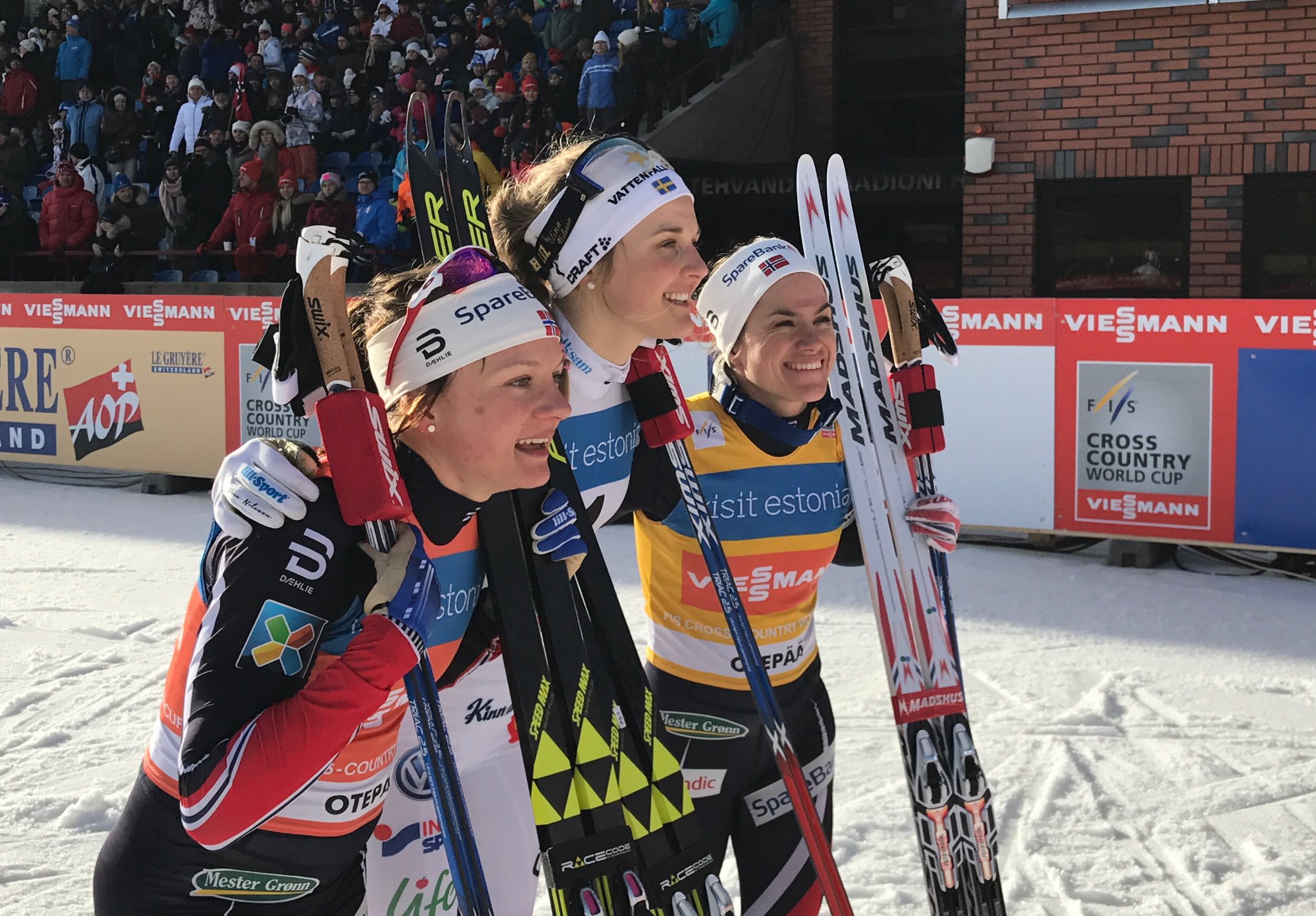
The women’s freestyle sprint podium at the Otepaa World Cup on Saturday in Estonia, with Swedish winner Stina Nilsson (c), Norway’s Maiken Caspersen Falla (l) in second and Heidi Weng (r) in third. (Photo: FIS Cross Country/Twitter)
Nilsson won the final in a time of 2:49.96 minutes, just ahead of Norway’s Maiken Caspersen Falla (+0.27) who lost her balance and her speed with it on the last corner. The two had broken away from third place and Nilsson led into the final straightaway and held Falla off for the win. Norway took second through fourth with Heidi Weng in third place (+3.75) and Astrid Uhrenholdt Jacobsen in fourth (+4.91).
Randall initially finished her quarterfinal in third position and would have been out, but advanced when Russia’s Natalia Matveeva was relegated to last for obstruction. In the same semifinal as Diggins, Randall fell cresting a small hill over a tunnel and finished fifth (+13.30) for ninth overall on the day.
Caldwellplaced second in her quarterfinal heat behind the day’s winner Nilsson, then stumbled halfway up a climb early in her semifinal, but stuck with the pack to finish fifth (+1.83) for 10th overall.
Sargent raced in the same quarterfinal as Falla and narrowly missed advancing to the semifinal in third place, fewer than 0.2 seconds behind Switzerland’s Laurien van der Graaff in second and 0.35 seconds behind Falla, who won that heat. Sargent placed 13th on the day.
Sadie Bjornsen qualified 25th and finished fourth (+2.82) in the same quarterfinal as Randall for the 25th overall.
Canada’s Dahria Beatty also qualified for the sprint heats in 30th place, and finished sixth in her quarterfinal for 29th overall.
Also for Canada, Cendrine Browne finished the qualification in 48th place and Katherine Stewart-Jones was one position behind in 49th.
Also for the U.S., distance specialists Chelsea Holmes and Rosie Brennan placed 58th and 60th, respectively.
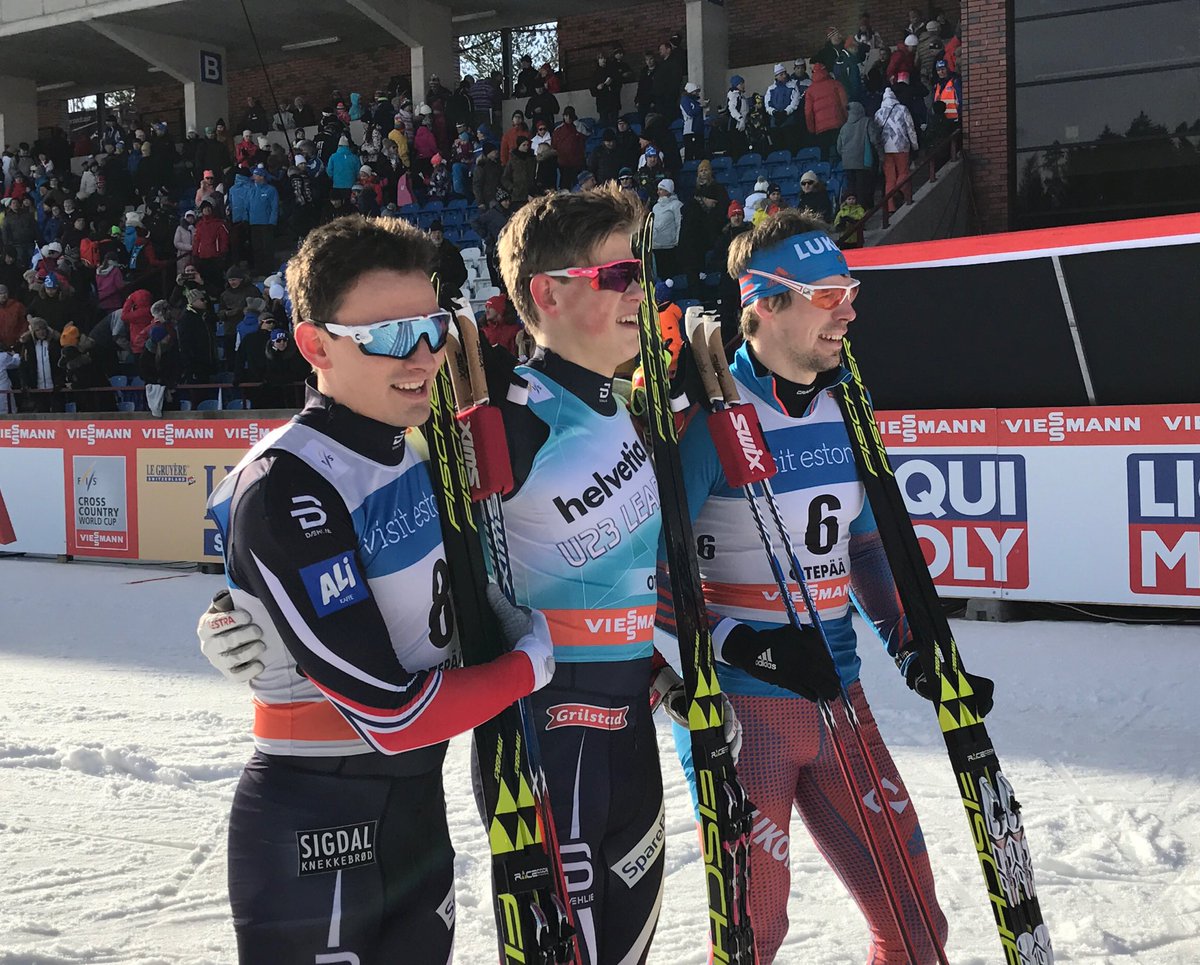
The men’s freestyle sprint podium on Saturday at the World Cup in Otepaa, Estonia, with Norway’s Johannes Høsflot Klæbo (c) taking his first World Cup win, Norway’s Finn Hågen Krogh (l) in second, and Russia’s Sergey Ustiugov (r) in third. (Photo: FIS Cross Country/Twitter)
In the men’s 1.6-kilometer sprint, Norway’s Johannes Høsflot Klæbo achieved the first World Cup victory of his career in a time of 3:06.53 minutes, holding onto a lead he had created with an attack right out of the start gate in the final. His teammate Finn Hågen Krogh placed second (+0.60), taking the inside lane in the last turn to push reigning Tour de Ski winner Sergey Ustiugov of Russia to third (+1.0).
For the North Americans, it was a day of narrow misses.
For the U.S., Simi Hamilton started his race day by qualifying in seventh position, and placed second in his quarterfinal. He then closely missed out on the final after placing fourth in his semifinal in a four-way sprint photo finish (+0.33), just 0.04 seconds behind the third place and lucky loser time of Norway’s Håvard Solås Taugbøl, who advanced. Hamilton ended the day in eighth overall.
Canadian World Cup Team member Alex Harvey snuck into the sprint heats in 29th place in the qualifier, then just missed out on advancing from his quarterfinal in a photo finish for second with Great Britain’s Andrew Young, who took it by 0.04 seconds. Harvey finished third in that heat, 0.6 behind Italy’s Federico Pellegrino, for 15th for the day. Young went on to finish sixth in his semifinal for 12th overall, and Pellegrino advanced as a lucky loser from the same semifinal and was fourth in the final (+4.77).
American Andy Newell qualified 16th and finished sixth (+1.89) in his quarterfinal for 27th overall.
Canada’s Len Valjas missed qualifying for the heats in 40th place, as did his teammate Devon Kershaw in 50th.
American Erik Bjornsen was 53rd, and for Canada, Jesse Cockney 54th and Knute Johnsgaard 56th. In his World Cup debut, Benjamin Lustgarten placed 64th in the qualifier.
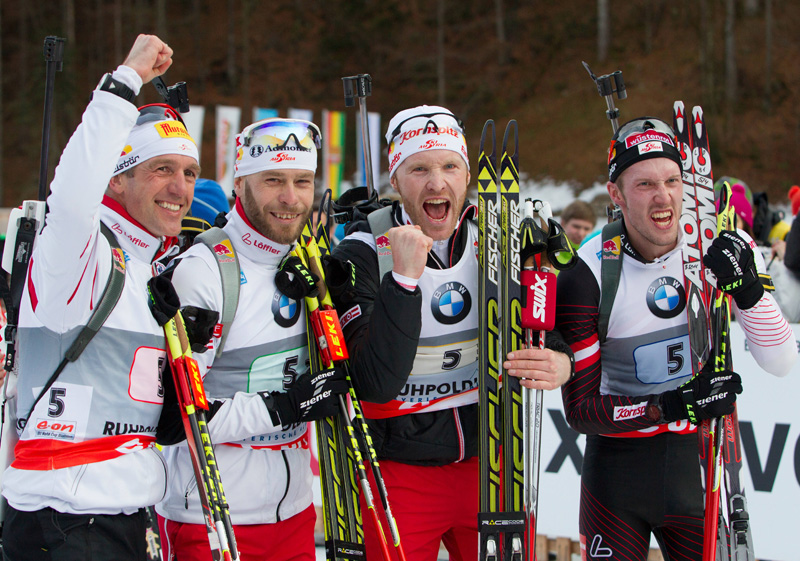
Team Austria celebrates their IBU World Cup biathlon relay victory in Ruhpolding (GER). (l to r) Christoph Sumann (AUT), Daniel Mesotitsch (AUT), Simon Eder (AUT), Dominik Landertinger (AUT) . Photo: Fischer / Nordic Focus.
RUHPOLDING, Germany – Remember when Austria was one of the best biathlon teams in the world?
The Austrian men do, too. All four members of today’s 4 x 7.5 k relay team were also on the team that finished second in the Nations Cup standings in 2009, and won a silver medal in the relay at the 2010 Olympics.
In the last few years, it has seemed unlikely that the Austrians would be able to match that feat in Sochi. For various reasons, their stars were no longer shining so bright. They underperformed and only returned to the podium three times since Vancouver, all third-place finishes.
Today, though, they signaled that they are back in the most dramatic fashion: outsprinting the host team Germany in a showstopper of a relay competition here at one of the biggest venues on the World Cup. For Germany, this loss in its heartland must have been like a stab in the heart – especially after Russia did the same thing to the women’s team, more or less, yesterday.
It was Dominik Landertinger, the best-ranked Austrian last season who ended up third in the World Cup Total Score, who did the heaviest damage, although the entire Austrian team was smooth throughout the race. Landertinger, though, shot a calm and clean final standing stage, leaving along with Anton Shipulin of Russia.
When Simon Schempp of Germany caught them, making up the five-second deficit he had accumulated by using a spare round, he must have thought he had a chance at the win. He almost did: Landertinger took off on the last uphill and got a small gap, but in an impressive show of determination, Schempp caught up and led the way down the hair-raising downhill for the last time.
Landertinger had the last laugh, though, dueling Schempp all the way to the finish for a 0.1-second victory for his team.
Just how big was that win? Ask Christoph Sumann, the anchor in Vancouver who skied leadoff today.
“This was our first win ever in Ruhpolding so that alone is a very big deal,” he said in a press conference. “[And] winning 30 days before the Olympics makes us one of the favorites.”
Sumann had the fastest course time of all the leadoff skiers, but had to use three spare rounds in standing. Despite the scare, he was still in third place when he tagged off.
“We saw the relays have been close in every competition; it was a good day for us and we are absolutely lucky,” Sumann said.
Daniel Mesotitsch used a total of four spare rounds to drop the team to fourth place, before Simon Eder used just one to move back up again, handing off to Landertinger in second, five seconds behind Germany. For all the things that the Germans did right, they did collect one more spare round than Austria – which is enough of a difference in a relay race.
As much as the German fans felt robbed, the Russians were even more deflated. With seven spare rounds – one less than Germany and two less than Austria – the Russian men had been in the lead for several points during the race, including coming out of the very last shooting stage. But Shipulin was unable to find his legs, and was left behind as the Germany-Austria duel intensified.
Sweden settled for a distant fourth place after being in podium position for much of the race. A penalty loop by Fredrik Lindstöm kept them out of the top three. With a remarkable two spare rounds over the entire relay, the Czech Republic finished fifth.
Two favorites were out of the running. Norway climbed back to ninth after a disastrous first leg by Johannes Thingnes Bø, who missed all five of his targets on his first try in prone. Even after using spare rounds, he had to ski three penalty loops. That left him in 24th place – last place. His teammates worked hard to make up the gap, with both his older brother Tarjei Bø and anchor leg Emil Hegle Svendsen shooting perfectly.
France, often a relay podium finisher, placed one spot behind in tenth. Martin Fourcade did not race, and in his absence, his teammates all had fine races – the team had just five spare rounds over the course of the whole race – but none of the spark that often elevates them to the front.
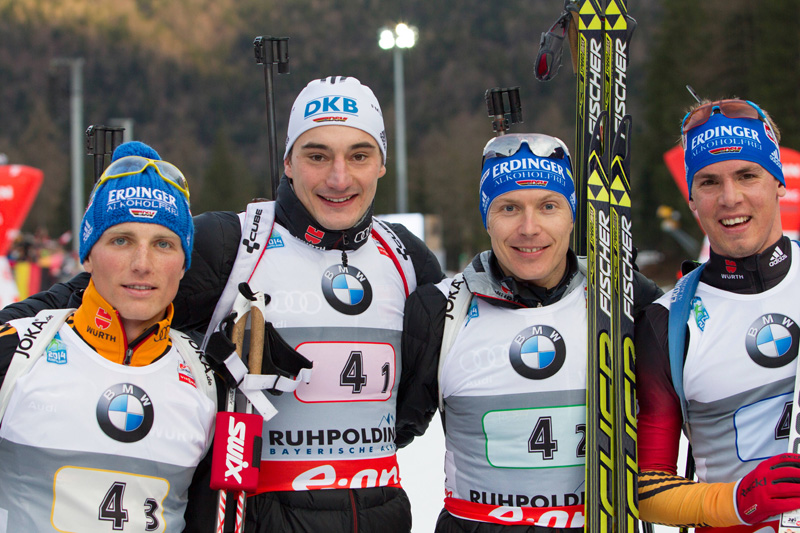
The German team gathers after the World Cup relay in Ruhpolding, Germany: Eric Lesser (GER), Christoph Stephan (GER), Andreas Birnbacher (GER), Simon Schempp (GER). Photo: Fischer / Nordic Focus.
Fourcade and Moravec shooting head to head in the final stage at a World Cup in Oslo, Norway, last season.
It’s easy to bet on a guy like Martin Fourcade on his home turf at Le Grand Bornand in Annecy, France. It’s also easy to overlook an up-and-comer.
One of the earlier starters in bib 14, Fourcade opened the IBU World Cup men’s 10-kilometer sprint with a sizable lead, shooting clean through the first stage.
Nine starters back, Norway’s Johannes Thingnes Bø — Tarjei Bø’s younger brother – got off to a rapid-fire start, cleaning his prone and skiing and shooting faster than Fourcade.
A fluke? Not exactly.
The 20-year-old defending Junior World Champion went on to clean his standing to take sole control of the lead while Fourcade missed one and lost his pole on his way to the penalty loop. Not his day; it was Bø’s.
The two remained in first and second until Ondrej Moravec of the Czech Republic cleaned his second-straight stage to bump Fourcade out of the top two.
Bø proceeded to ski the third-fastest second lap and fastest last lap as Fourcade dropped to sixth, then skied up to third.
The young Norwegian ended up capturing his first World Cup win in 22:06.7 minutes, nearly 33 seconds over Moravec in second. Fourcade took third, 37.1 seconds behind Bø, and was the only one in the top six who didn’t shoot clean.
Russia’s Dmitry Malyshko placed fourth (+39.7), Germany’s Simon Schempp was fifth (+40.6), and Austria’s Daniel Mesotitsch took sixth (+41.9).
“I thought maybe I could win or be on the podium in an individual competition, but not a sprint and by more than 30 seconds,” Bø told IBU, according to a press release. “This morning my legs felt a bit tired and I did not feel very strong. I have not raced for a couple of weeks. But I guess the results show that I was very strong … It is cool to beat Martin here.”
In the third week of IBU World Cups, Moravec said he was tired following Friday’s relay as well, but he had his “normal feeling back” and was glad to be on the podium.
Disappointed with his last shot, Fourcade was happy to make the podium at home.
“It was so nice that all of the fans helped me on my last lap,” he said. “I will have this memory for a long time. … It was just wonderful to compete here.”
Smith Ties Career Best
Leading the way for the North Americans, Nathan Smith, who turns 28 on Dec. 25, gave himself a something of an early birthday gift in 16th – his best result by 27 places in a sprint.
Biathlon Canada’s Nathan Smith racing to 27th in last weekend’s IBU World Cup 12.5 k pursuit in Hochfilzen, Austria.
On Nov. 28 at the opening World Cup in Östersund, Sweden, Smith finished 16th in the 20 k individual – his personal best at the time. A week earlier, he stood on the IBU Cup podium.
For Smith it’s been a whirlwind of a start so far, and he wrote in an email that he was feeling the effects earlier this week.
“I felt kind of tired … earlier this week but did a hard race-prep session on Thursday and a couple short sprints [Friday] to bring back some snap,” he wrote.
Without a fourth man with them (Brendan Green left for Canada after last weekend’s World Cup in Hochfilzen, Austria, to prepare for Olympic trials), the Canadians did not race Friday’s relay. That gave Smith and his teammates, Perras and Le Guellec, a little extra rest.
“My first lap went well, but I usually start a little conservative and try to build through the race,” Smith explained. “I had a double eject in prone so ended up with one of the slowest shooting times. A little disappointing but in the end I still did what I needed to do.”
Smith cleaned his prone and had one standing penalty to ski away to 16th, 1:08.4 behind Bø. On a flat course with a couple short, steep climbs, Smith explained that shooting well was key.
“Standing was definitely not a cake walk. I felt a little out of control so had to fight really hard for each shot and slow things down a little compared to normal,” he wrote.
Heading into his last lap, Smith thought he was capable of top 30. Sixteenth was a nice surprise.
“I worked a lot on my weaknesses this summer and fall,” he wrote. “Based off how training had gone I knew I could put down some solid PBs but wasn’t sure if that would be enough. Today was just the work paying off.”
Last week in Hochfilzen, Smith placed 27th in the 12.5 k pursuit – another personal best. Sunday he’s hoping to do the same, and plans on “lots of drafting.”
Burke on the World Cup sprint podium in Østersund, Sweden, earlier this season. (Photo: Manzoni/NordicFocus)
Also making the cut for the men’s pursuit, Americans Tim Burke and Lowell Bailey placed 28th and 35th, respectively. Canada’s Scott Perras and Jean-Philippe Le Guellec finished 31st and 49th to make the top-60 requirement.
Burke cleaned his prone and had two standing penalties to slip from 13th to 20th, and was ultimately bumped down to 28th. In an email, he explained he might have opened too hard, “but you kind of have to put yourself out there if you want a top result.”
“I felt steady in the standing shooting but I simply did not execute,” Burke wrote. “Some days are just like that and you kind of just have to accept that and move on. It was pretty hard heading out onto the last loop after skiing two penalty loops. At that point, I knew I would not have a great result but I was just trying to limit the damage for the pursuit.”
Disappointed with his standing stage, Burke was confident in his skiing; he was seventh-fastest on the second lap and 24th quickest on the final lap.
“I’m happy that I most likely would have made it to the podium with clean standing shooting,” he said of finishing 44 seconds back from third. “This is always the goal of a sprint race.”
Not too far back from the top 10, Burke was looking forward to the pursuit.
“I think it will be tough to move up because the shooting range is pretty easy here,” he explained. “I expect that we will see lots of good shooting from the field so I think the biggest differences will come from the skiing.”
Less than a month after arriving in Europe, Perras wrote that he simply needs more races to get the results he’s looking for. On Saturday, he missed one prone target and cleaned standing.
“I was pretty disappointed after prone, the shooting speed felt really slow and with a penalty I knew that was all the error I could afford,” Perras wrote. “I just don’t have a lot of confidence in shooting at the moment but can prevail at times by focusing on the process. … I felt like I was bleeding time all over the course, it is flatter course and not my forte so I just did my best hoping I was going to make the Pursuit. The info I was receiving on the course was not overly encouraging.”
He did jump from 60th to 28th after the second stage, then posted the 36th fastest final lap to finish 31st. Sunday will be his first pursuit this season.
“I will just try to enjoy that,” Perras wrote. “After seeing how flat the course is in Le Grand Bornand, I am convinced they could hold a WC Biathlon race in my home province of Saskatchewan :)”
Bailey wasn’t happy with a penalty in both bouts despite feeling good skiing, especially on the first lap.
“Then, to miss my first shot, right off the bat, was pretty frustrating,” he wrote. “I regrouped after that and was hoping to clean prone and ski back into the race. After hitting the first four targets, I resettled on the last, and missed. It always hurts to miss your last shot.”
Sunday, he’ll try to focus on doing his “own thing.”
“It’s extremely tight in the results so there will be a lot of head to head skiing and anything can happen on the shooting range!” Bailey wrote.
Le Guellec cleaned his prone then missed two standing for 49th, a result he hope will kick him into “better shape” on Sunday. The course in Annency doesn’t exactly suit him, he explained, with flats and bumps that wreak havoc on his back.
“It’s all the one skate followed by tucking and opening again for more one skate that takes its toll,” Le Guellec wrote. “So I could feel my back being pretty tight in standing, which definitely is an issue… But these two missed targets were very close… so maybe just a hint of bad luck in there too.”
“All in all I’m just really happy, and mostly relieved, that I get to race tomorrow,” he added. “Hopefully feel better on the skis and just end this trip on a good note.”
Outside the top 60, US Biathlon’s Leif Nordgren and Jeremy Teela placed 83rd and 87th, respectively. Norgren missed one prone and two standing, and Teela had two penalties in prone and one standing.
Martin Fourcade (FRA), Lowell Bailey (USA), and Evgeniy Garanichev (RUS) in hot pursuit of the uncatchable Anton Shipulin during today’s pursuit race in Antholz, Italy. Photo: USBA/NordicFocus.
After winning Friday’s 10 k sprint, Anton Shipulin of Russia didn’t start today’s 12.5 k pursuit in Antholz, Italy, with the widest of margins.
Sure, he was first out of the gate, but a group of formidable competitors was close behind: Emil Hegle Svendsen of Norway just 13 seconds back, Jakov Fak of Slovenia another seven behind.
And yet, Shipulin simply focused, planned on winning, and never rescinded his lead for even a second.
“I prepared myself for victory today even though it was a strong field,” he said in a press conference. “I am happy that I managed to win.”
It wasn’t a sure thing. Twice, with the likes of Fak, Martin Fourcade of France, Svendsen, and other nipping at his heels, he collected penalties on the range. In the second prone stage, he missed a shot just as the chasers were entering the range. But clean shooting by several men still left them with a 20 second disadvantage.
Shipulin skied onto the range for his third stage, and first in standing, with a smaller lead. Fak and Friedrich Pinter of Austria hit the mats next to him as he was still shooting. And again, Shipulin missed a shot – creating an opportunity for not only those two, but also men a bit further back.
But both Fak and Pinter took two penalties, and the first racers to clean, Fourcade and Daniel Mesotitsch of Austria, were well over ten seconds back.
It was not a gap that Fourcade could close, and so with a clean fourth stage Shipulin skated to an easy victory.
“I saved power for a tough fight on the last lap, but it did not come,” Shipulin told the Russian Biathlon Union press service. “The errors that I had were psychological. Now it is time to think about what to work on for the World Championships; I’ll try to fix some of the bugs.”
Behind him, though, the fight really was taking place. Mesotitsch left the range 24.6 seconds behind, followed by Jakov Fak 31.8 seconds back and Martin Fourcade 36.1 seconds back. Up until that point Fak had been the slowest skier of the three – a drop in split times partially attributed to a fall on the second lap – and based on Fourcade’s dominating three-win performance in Ruhpolding the weekend before, anything could happen.
But instead of Mesotitsch skiing away or Fourcade putting on a spectacular run to take second place, it was Fak who put on the afterburners. He caught Mesotitsch after about a kilometer and skied right past, determined not to slow down for a second or to allow Fourcade a taste of the podium. Mesotitsch held on for dear life as the Slovenian blasted through the open fields towards the stadium.
“When you see the chance of a podium something happens in your head,” Fak said of his late burst in a press conference. “I did not want to give up and I tried to catch Daniel as fast as I could.”
Fourcade, meanwhile, faded with only the 28th-fastest last-loop time. That kept Mesotitsch on the podium by a comfortable margin. Svendsen made it into fifth place after four penalties; Fak and Mesotitsch had one each and Fourcade two, allowing them a bit of comfort that was denied to the Norwegian.
The success was notable for both Fak and Mesotitsch. For Fak – who we interviewed earlier this month – it is the sixth podium in a season that has included his first two World Cup wins.
“After so much success so far, I might have to change my goals for the season,” he said in a press conference.
For Mesotitsch, the podium boosts his resume as the Austrian team, which had such a disappointing 2012, rebounds with strong performances for virtually every member.
“I hoped for two top ten results here and made it,” he said of Antholz. “Now it is up to the coaches if I will go to the World Championships.”
While Austria seems likely to be in the mix for Sunday’s relay, the host nation should be as well. In the pursuit, the host nation accomplished the feat of placing four men in the top 20, even though only one started there. Dominik Windisch dropped from bib 12 down to 20th, but his teammates provided plenty of excitement for their fans. Lukas Hofer skied from 23rd to 13th; Christian De Lorenzi from 26th to 15th; and Christian Martinelli from from 41st to 17th.
Stay tuned for a report on the North American men, who were led by Tim Burke in 14th place.
Martin Fourcade of France celebrating his second gold medal in as many days, and the second World Championships pursuit title of his career.
RUHPOLDING, Germany – After Saturday’s World Championship sprint race, the silver medalist Emil Hegle Svendsen swore that he was going to chase down bib number one, Martin Fourcade of France.
But in Sunday’s 12.5 k pursuit the focus was all on Fourcade, who was often leading and never far from the front. And instead of the Norwegian, he battled his way to the finish with Saturday’s bronze medalist, Carl Johan Bergman of Sweden.
The stage was set after the first shooting, when Fourcade missed a shot, allowing his chasers the opportunity to catch him. While Bergman cleaned the stage and caught Fourcade on his way back onto the course, Svendsen wasn’t as lucky, missing a shot of his own. While he often hovered around medal position, he was never again at the front of the pack.
Bergman leading Fourcade out of the range after the second shooting.
Bergman and Fourcade skied a loop together before coming into the second prone stage, where each missed a shot. Clean shooting allowed Daniel Mesotitsch of Austria to hit the course slightly before the pair, but Fourcade quickly made it clear that he had no intention of being a follower in this race. On the first short, steep hill out of the stadium he sprinted to the front, and led the other two around the next 2.5 kilometers.
Bergman wasn’t worried, and slipped in behind the Frenchman.
“In this track, with these hills, if you are really tight behind this can really save you energy,” Bergman explained later. “You have to be clever – [Fourcade] is a strong skier, so he doesn’t need to be behind, he can ski in the front. He is in good shape.”
Halfway through the race, it seemed like anything could happen, and that’s where the excitement began. In the third stage, Fourcade cleaned while the other two missed a shot apiece, and it began looking like the Frenchman was in the clear, en route to his second gold in two days.
One stage later, however, the tables were turned. Coming into the range with more a large advantage, Fourcade missed two shots.
“I don’t know why I did two mistakes on my last shooting,” Fourcade said in the postrace press conference. “I tried to — ”
Fourcade alone on the range in the last stage.
“He was nervous,” Bergman interjected, laughing.
“Not too much, no,” Fourcade replied. “I tried to keep my advantage from Carl Johan, Emil, and Daniel Mesotitsch. But I know that I will miss one here and there, and I need to accept the wonderful logic of biathlon.”
It looked like Fourcade might lose his lead, and if Bergman and Mesotitsch had shot fast and clean, he would have. But Mesotitsch missed a shot and Bergman took his time, turning in a slow 30-second effort in that final standing stage. It was well worth it, however, as he cleaned and was able to leave the range a second before Fourcade finished his penalty loop.
From there, Fourcade bided his time, skiing right behind the Swede through most of the course. Then on the final large hill, he dropped the hammer, rocketing past Bergman and into the lead.
“I am very confident in my shape right now and I watched the race on the TV yesterday, and saw that I was much faster on the last laps,” Fourcade said later. “But I know that Carl Johan is a very good sprinter. We have done a lot of sprints together and he has beaten me a lot of times, so I wanted to finish alone at the end. That’s why I attacked on the uphill.”
The effort clearly took a lot out of the Frenchman, who was clearly dragging as he crested the last hill. But try as he might, Bergman could not catch him.
Shipulin, thrilled with a surprise bronze medal.
“I had a really hard fourth loop and my goal was to have high speed on the final loop,” Bergman said in the press conference. “I felt that Martin was skiing easily behind me, and when he made his attack I had absolutely no chance. I cannot ski that fast… I tried to fight. It’s hard when someone else is skiing so fast, and you are thinking you have no chance, so I really had to go deep in my mind and focus and try to come to the finish line.”
So when Fourcade rounded the corner into the stadium, he was all alone after all. After raising his arms in victory as he neared the finish line, Fourcade removed his skis while he was still gliding and ran around the finish pen, shouting with joy.
Five seconds behind him, Bergman was just as elated, pumping his fist in the air and letting out a primal scream of sorts.
The two had a large lead on the rest of the field, and the third competitor to enter the stadium was something of a surprise: Anton Shipulin, who had started the day with bib 13, over a minute behind Fourcade.
Shipulin had started the race with a miss in prone and dropped to 17th. But after that, he was perfect on the range and had plenty of energy on the trails, passing Mesotitsch on the final loop to snag the final medal, the first individual one of his career.
“I knew that my position starting off was not so good,” Shipulin said after the race. “But before the start I noticed that there was wind coming up, and I knew it was my day because I love to shoot when it is windy. I thought when I was standing at the start that the others would probably make a couple of penalties in the shootings, and I thought, ‘I am in good shape, I can do this.’”
Fak, Schempp, and Lindstrom enter the stadium to deafening roars.
Mesotitsch and Svendsen finished fourth and fifth, followed by Fourcade’s brother Simon in sixth. A trio of big movers, Tarjei Bø of Norway, Jakov Fak of Slovenia, and Simon Schempp of Germany were next, with Fredrik Lindstrom of Sweden rounding out the top ten.
Martin Fourcade said that he was surprised to win today, given his four penalties.
“I did not think it was possible to win with 80 % shot,” he admitted. “You can do it, but you have to have mistakes by the others.
“Two gold medals is really much more than I expected, so I don’t know what to expect next,” he continued. “To shoot clean and to shoot better than today and yesterday is my main goal [for the rest of the Championships]. To keep this wonderful jersey, to keep the yellow in Khanty Mansiysk, is my only aim for the end of the season.”
As for Bergman, he had a message for Fourcade.
“I tried to give my best but Martin was too strong today,” he said. “But wait til the relay.”
Bergman’s wife was due to deliver their baby yesterday, and is still waiting to go into labor. Bergman wasn’t sure whether he would stay in Ruhpolding for the rest of the races, go home to his wife, or possibly even return for the competitions at the end of the week.
“I would like to come back for the relay,” he said, half-joking. “I will go home and take my gold at home, and then I will come back and take another one [here], why not.”
For the first time this season, someone who wasn’t Norwegian stood atop the men’s World Cup biathlon podium.
After six straight races of Norwegian dominance, the spell was broken in Pokljuka, Slovenia on Thursday. The top Norwegian finisher, Tarjei Boe, didn’t even make the top ten.
But Norway’s loss was Austria’s gain, as Daniel Mesotitsch picked up his third career World Cup victory, by almost a minute over Benjamin Weger of Switzerland. Sergui Sednev of Ukraine finished third.
After two shooting stages, it appeared that the Austrians were in control – Chrisoph Sumann and Simon Eder were sitting in first and second. But after that pair made errors in their later shooting stages, it was their less-famous teammate who was able to ski to the win.
Mesotitsch started off slowly, finishing the first lap in 57th place. But after a miss in the first prone stage, he shot clean, and his ski times improved as well.
While Mesotitsch is Austrian, not Slovenian, he said that he was still helped by a sort of home course advantage today.
“I live just 35 minutes from here, the first exit into Austria,” he told IBU News. “So when we have home training weeks, many times I come over here when the Slovenian team is here and train. So I am very familiar with this shooting range and the tracks.
“The crowds were very supportive of me today, especially when I was shooting,” he added. “I think the organizers have done a very good job with this venue; they continue to improve here every year.”
Weger was the big surprise on the podium – his previous best World Cup finish was 17th in Khanty Mansiysk, Russia.
It wasn’t a good day for the Americans. Lowell Bailey led the team with a 48th-place finish. His five misses represented the best shooting on the team; Russell Currier missed ten en route to 88th place. The wind definitely proved to be challenging, and not a single man in the field shot clean, but the Americans seemed to struggle more than most.
“For the men we had a rough day again,” said head coach Per Nilsson. “For the moment we don’t hit enough targets to be competitive on this level. It’s clear that we underperform compared to each athlete’s capacity. In the team we know what level we are capable of and it’s far away from this. Our biggest goal for the season is the World Championships in Russia, so we have three months to work on this.”
Tim Burke appeared to be off to a good start today, but missed an astonishing four shots in his second shooting stage. That mistake more or less removed him from contention for the rest of the race – and he didn’t do himself any favors by missing two shots in each of the last two stages. His 65th-place performance was by far the weakest for him all season.
Nevertheless, his ski time was the 7th-fastest all day, so if Burke can get his shooting together, he is definitely capable of matching his success from last year.
Unlike their southern neighbors, the Canadians did have a few bright spots on the results sheet, with Brendan Green finishing 21st and Scott Perras 31st. The results were the best of the season for the pair.
Perras started from bib 103, and was a surprise addition to the first page of results at the end of the race.
“I would never chose a later start position but it seems that I have excelled from that position before,” he told FasterSkier in an e-mail. “The best part of starting late is that when you cross the line there is no one or not many that can bump you down in the results.”
Perras knew that the wind could be a factor, so he adjusted his strategy accordingly.
“I was prepared to take my time in the range if necessary. I didn’t care about much other then hitting the targets, and you can see this in my shooting time, which was over 40 seconds slower then my fastest shooting teammate, Nathan Smith. I was happy that I put down all of the prone targets because those are probably going to be where the wind can get you the worst.
“In my final standing, I knew there were some good opportunities for a great result. That is basically what I aim for in a 20 k – get to the final stage with a good chance. It’s exciting and that is the challenge I want.”
The World Cup continues in Slovenia on Saturday with men’s and women’s sprints.