From the FasterSkier archive — posts syndicated from athletes’ and coaches’ own blogs between 2004 and 2012, kept online as published. Current coverage is at fasterskier.com.
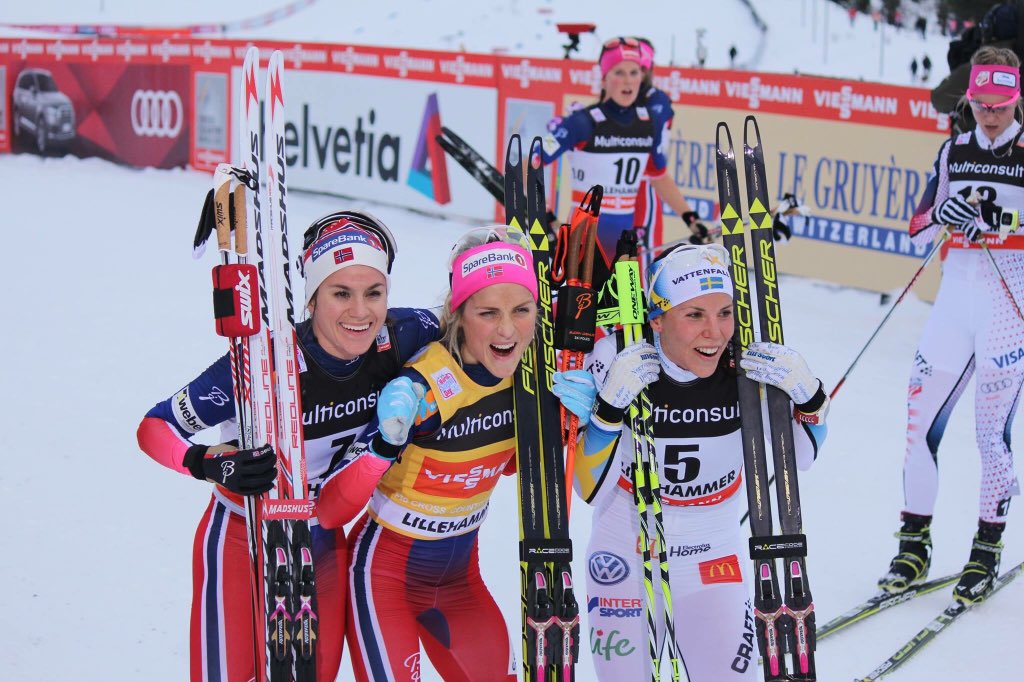
The women’s World Cup 15 k skiathlon podium in Lillehammer, Norway, with Norway’s Therese Johaug (c) in first and Heidi Weng (l) in second, and Sweden’s Charlotte Kalla (5) in third. It was one of just two podiums for Kalla this season. (Photo: WorldCup Lillehammer/Twitter)
Swedish ski star Charlotte Kalla looked back at her disappointing 2016 season and decided: something had to change.
The 28-year-old has decided to leave the Swedish national team and train on her own with a personal coach.
“I think that currently I have a [great] trainer, and the results of our collaboration can be so much better if I have the opportunity to meet with [him] for monitoring, planning, engineering work and other things,” she told Radiosporten, according to a translation.
Although Norwegian superstar Petter Northug has done the same thing in the past, Kalla’s move is new for Sweden. She is still focusing on World Cup racing and in particular 2017 World Championships, to held in Lahti, Finland, in just nine months time. For that, she will need to be nominated and supported by the national team, but she doesn’t plan to work within their training program in the off-season.
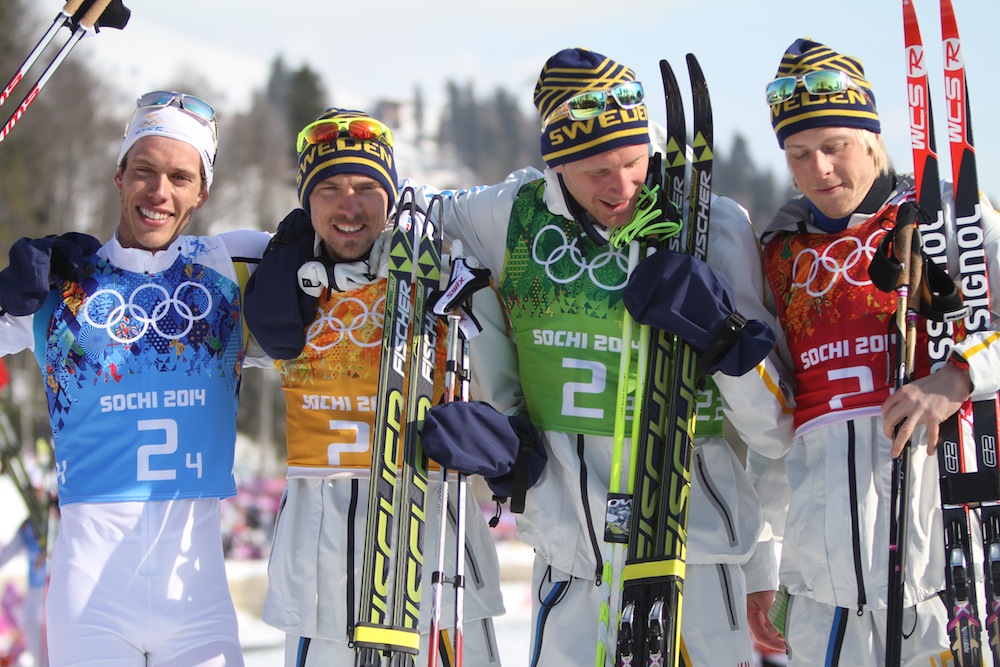
Switching out? Johan Olsson and Daniel Richardsson (second and third from left) will rejoin the national team after a year on the outside. They were part of the Swedish men’s team that defended their gold medal from the 2010 Olympics to win the 4 x 10 k relay in commanding fashion at the 2014 Sochi Games. From left to right: Marcus Hellner, Olsson, Richardsson, and Lars Nelson.
Several high-profile athletes left the Swedish national team last season, including World Champion Johan Olsson and fellow Olympic gold medalist Daniel Richardsson. Richardsson joined a Ski Classics team, Team Exspirit, and focused on long-distance racing while still jumping in three World Cup competitions this year; he also won Swedish National Championships in the 15 k classic.
Olsson did not compete at all this year due in part to injuries, but said in early April that he was motivated for the Lahti World Championships and perhaps even the 2018 Olympics. Both men have now rejoined the national team.
“We are thrilled to have Johan and Daniel back on the team after a year in which they invested in long-distance races,” team director Johan Sares said in a press release. “At the same time, we support Charlotte, who feels the need to test her own setup. We respect it and wish her a warm welcome back in the white suit for the World Cup opener in Ruka, Finland, in November.”
So it’s clear that in Sweden leaving the national team does not prevent an athlete from later rejoining, or from getting race support at international competitions. But Kalla is trying to do something different than either Olsson or Richardsson: focus 100% on the World Cup, but on her own terms.
“There has been much consideration, but in the end I made a decision that feels very right to me,” Kalla told Radiosporten.
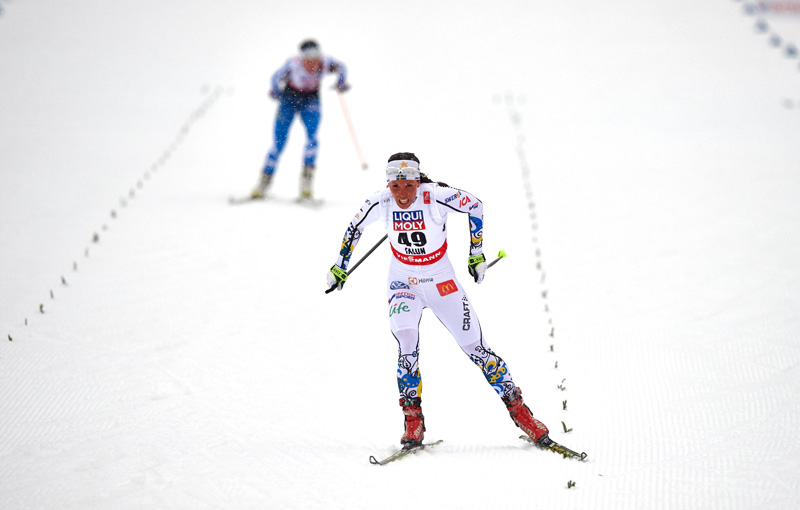
Charlotte Kalla skiing to a monster win in the 10 k skate at 2015 World Championships on home turf in Falun, Sweden. (Photo: Fischer/NordicFocus.com)
Ingesson is a former skier himself, and a relay medalist from 2001 World Championships. He coached the women’s national team at one point and is now the sports director for Piteå Elit, which Kalla joined in 2012.
Kalla explained that she wanted for a long time to work more closely with Ingesson, but it was difficult to schedule. He now has been promised more time off from his regular job, which means more collaboration with Kalla.
An Olympic gold medalist and World Champion, Kalla has 47 World Cup podiums to her name but snagged just two last season, and not a single win. Nevertheless, she ended up fifth in the overall World Cup rankings at the end of the 2016 season.
“Now I have a freedom to follow what I believe in and do training based on the needs I see,” she told Swedish newspaper Dagens Nyheter. “We will initiate an intro camp with Piteå Elit on Friday in Saxnäs, and then Magnus and I will sit down and make arrangements in more detail.”
Kalla was coming off of a strong season in 2015, where she won the World Championships 10 k skate on home turf in Falun, Sweden, in one of the most impressive performances of the season.
But instead of using that success as a springboard, Kalla struggled this season.
“I was gassed at pretty much the beginning of last summer,” she told Dagens Nyheter. “I had signals that I was tired, but was in good shape around the first competitions. After that it was not as good as my ambitions were. But I’ve learned a lot. I was disappointed with the results, but satisfied with the performance, because I did not give up.”
Some of it was just bad luck, like in the Tour de Ski, where she crashed several times including one particularly rough fall in Oberstdorf, Germany, thanks to sloppy skiing by Poland’s Justyna Kowalczyk.
Shifting away from the national team will be a challenge, she admits, even if it may have benefits.
“The main obstacle has been the social aspect,” she told Dagens Nyheter. “I thrive in the national team group with everything that happens around training sessions, to be able to laugh, cry and dream together.”
In Norway, Northug’s decision to leave the national team was a testy one, and not all team staff were thrilled with it.
Thus Vidar Løfshus, the head of the Norwegian national team, was skeptical of Kalla’s decision.
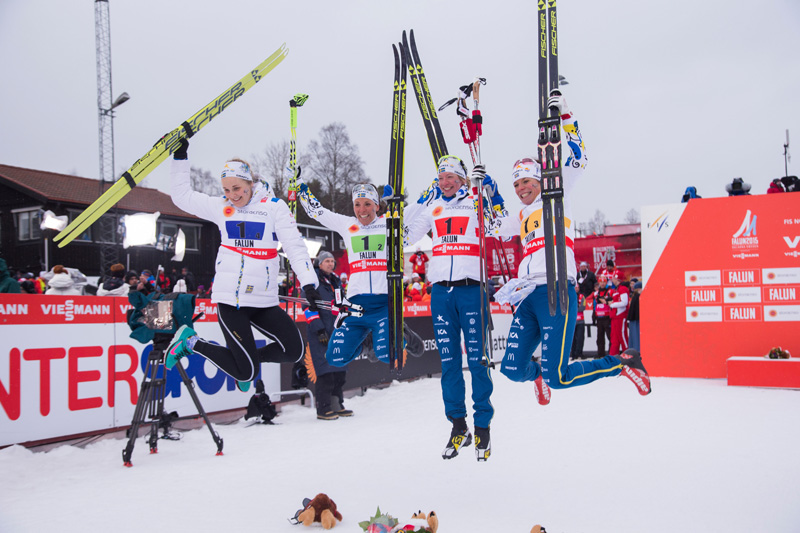
Stina Nilsson, Charlotte Kalla), Sofia Bleckur, and Maria Rydqvist (l-r) jump after placing second in the women’s 4 x 5 k relay at the 2015 FIS Nordic World Ski Championships. (Photo: Fischer/NordicFocus)
“Oh, it’s not good,” he told Swedish tabloid Expressen. “We in Norway firmly believe in the national team model. We have already had a debate about Petter Northug, who opted out of the Norwegian national team. We believe of course that it is one of the reasons that we are as good as we are, that we have a strong national team model…. Throughout the summer and fall, she will be missing in the Swedish team. This is where the strong team created. Cohesion, team spirit. And yes, according to me it is the strong training groups that create success.”
Swedish team staff weren’t as negative, or at least they chose their words more carefully.
“I respect her decision, then it is naturally sad that she will not be with us,” head coach Rikard Grip told Expressen. “But I have to say the respect and understanding that she wants to try something new… The most important thing is that Charlotte has the motivation and drive. What avenues you choose to go, it is difficult to judge about. Now she has chosen this path. All the details we need to sit down calmly and talk about. We have a good intention to have a good dialogue. Charlotte will be with us in the winter, we need to look at how we solve it in the best way. But I can not answer exactly how it will look.”
“The downside for our part, is that team loses its power,” new national team coach Ole Morten Iversen told Norway’s NRK broadcaster. “Had she been on the team, she would have been given new impetus that had changed the situation properly. I’ve tried, but it has not been enough- but I completely understand that she feels the need to do something new after having her head against the wall for a while.”
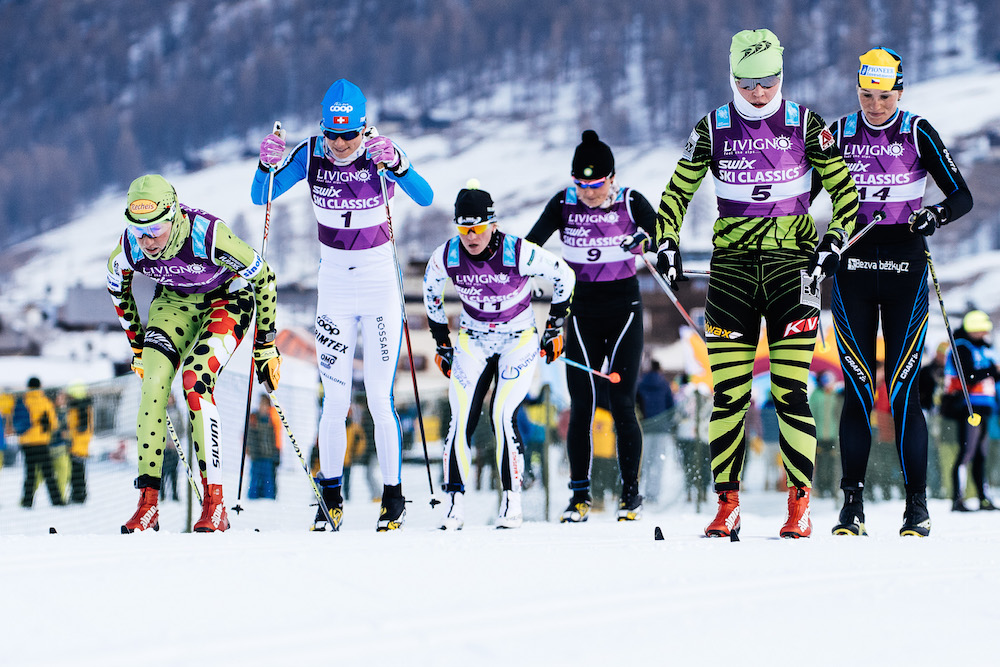
Last year’s Team Tempo Prologue in Livigno, Italy, which Team Coop (in bib 1) won. This year, the team prologue will again open the Ski Classics series in Livigno on Saturday, followed by the shortened La Sgambeda classic race on Sunday. (Photo: Visma Ski Classics)
The 2016 Ski Classics kicks off with a doubleheader in Italy on Saturday and Sunday, and the marathon regulars are chomping at the bit to get started with the long-distance race series.
The 15-kilometer Proteam Prologue in Livigno, Italy, on Saturday opens the show for the marathon series, now called the Visma Ski Classics (with a new title sponsor in place of Swix), which has been extended to nine venues this season.
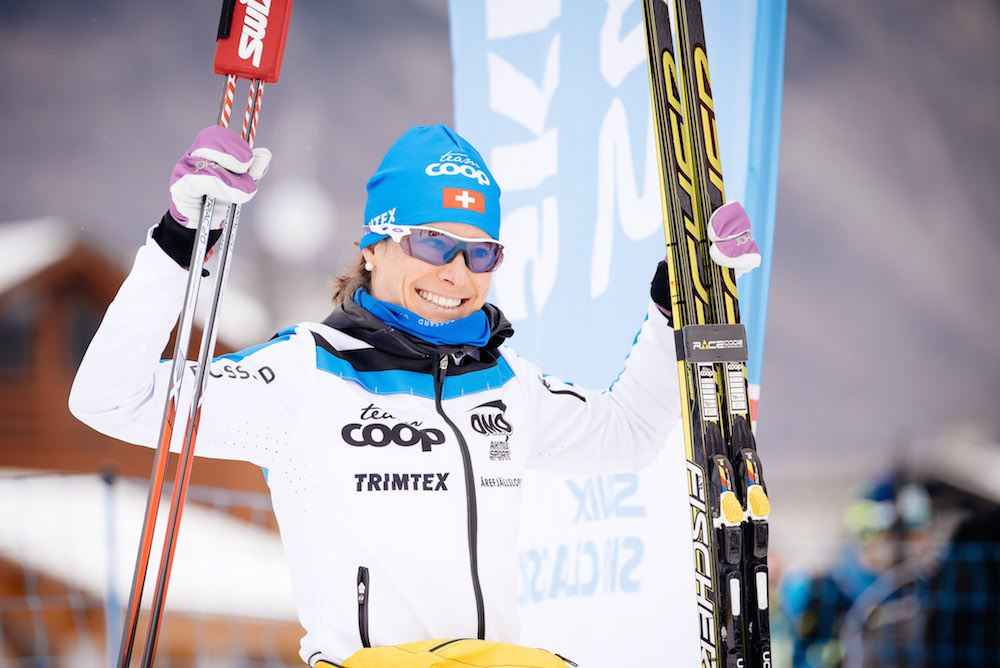
Seraina Boner of Team Coop (now called Team Exspirit) after winning the 2014 La Sgambeda in Italy last season. (Photo: Ski Classics)
On the women’s side, last season’s Ski Classics champion Katerina Smutna of the Czech Republic will be on the start line for the first races this weekend, but she will face plenty of competition. Team Exspirit’s Seraina Boner of Switzerland is eager to take back the overall title, which she has earned three times (2011, 2013 and 2014), beginning with La Sgambeda.
Poland’s World Cup star and the queen of the FIS Tour de Ski, Justyna Kowalczyk, will be doing several of the Ski Classics long-distance events this season with the Norwegian Team Santander headed by the Aukland brothers. And Britta Johansson Norgren of Sweden, who was on the podium at several of the Ski Classics events last season, is one to keep an eye on. Last season, she raced with the all women’s team Ski Pro Am, and this year she is a part of Sweden’s Lager 157 Ski Team, with teammates such as three-time Vasaloppet champion Jörgen Brink of Sweden.
Among the men, 2015 Ski Classics overall champion Petter Eliassen of Norway makes his season debut in Italy this weekend. He will have to fend off a large and deep field of competitors such as Norway’s 43-year-old marathon veteran Anders Aukland and his Santander teammates, including younger brother Jørgen Aukland, and former World Cup skiers Tord Asle Gjerdalen of Norway and Johan Olsson of Sweden.
Norwegian stayers such as Johan Kjölstad, Øystein Pettersen, Eldar Rønning, and John Kristian Dahl of Team United Bakeries, as well as Ski Classics veterans of Team Exspirit, including Daniel Richardsson, Anders Södergren and Jimmie Johnsson of Sweden and Norway’s Morten Eide Pedersen, will certainly do their best to make it a tough season opener from Day 1.
Two unique competitions in Livigno
The Prologue, in which the teams must field at least three racers to compete, was added last year, and is a team effort where the third person’s time determines the team result. The next day, on Sunday, the skiers embark on the first distance event, the now-24-kilometer classic technique La Sgambeda.
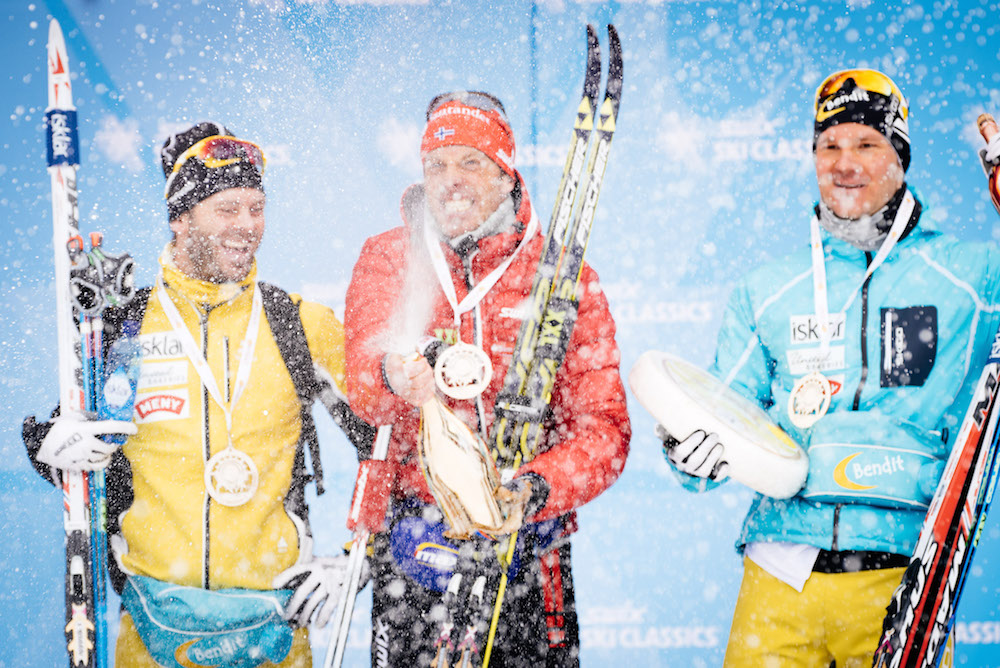
Team Santander’s Anders Aukland (c) after winning the 2014 La Sgambeda in Livigno, Italy. Johan Kjølstad (l) and Øystein Pettersen (r) both of Team United Bakeries, placed second and third, respectively. (Photo: Ski Classics)
Team Exspirit (previously known as Team Coop) won the prologue last year and is aiming to defend the title this year.
“We have had great preparations here in Livigno, skiing on the race course and acclimatizing to the high altitude,” team member Jimmie Johnsson said in a press release on Friday. “Of course, we’re aiming to defend our victory and we’re faster this season than ever before.”
Team Exspirit’s Seraina Boner won La Sgambeda last year after breaking away from the field on the hard climb at the turning point of the course. This year, the course is shortened to from 35 k to 24 k due to lack of snow and is also flatter. While Boner prefers more elevation gain, she was still optimistic before the race.
“The tougher course fits me better than the flatter one we have now,” she said. “But I will do my best, and I am really excited to finally start the long distance season together with my teammates.”
While the Team Prologue is only open to professional teams registered with the 2016 Ski Classics, La Sgambeda on Sunday is open to amateurs and pros alike.
Saturday’s Prologue will be held on the original course, but due to lack of snow in Livigno, the classic marathon on Sunday will be run on 6 k loops.
“Last season, seven of the nine Ski Classics events had to change their courses due to weather issues,” Ski Classics CEO David Nilsson in a press release earlier this week. “We can just cross our fingers that the political leaders at the environmental summit in Paris this week are able to make the right decision.”
For the 2016 season, there are 28 pro teams registered for the Ski Classics series.
After the season opener in Italy, the Ski Classics takes a break until the Jizerská Padesatka in Liberec, Czech Republic, on January 10, 2016. The race series concludes April 2 with Årefjällsloppet in Sweden as the season finale, as it has been for years. New this year is the Toblach/Dobbiaco Cortina, a 50 k classic race in Italy on Feb. 13.
Vasaloppet matters most
For Madshus racer John Kristian Dahl of Norway, who won the Vasaloppet two years ago, the 90 k race from Sälen to Mora in Sweden is the main goal for the 2016 season.
“It’s the longest and one of the oldest races in the circuit, and very special with the flats. That package makes it very unique, and difficult to win, too. In our world, it’s the championships in marathon skiing, and I’m happy that we have it every year,” Dahl said in an interview with Ski Classics earlier this fall.
Live streaming in English
In order for fans to follow the action live, Visma Ski Classics has launched the Live Streaming “Season Pass” available with English commentary on the app or the Tour Live Center at Visma skiclassics.com.
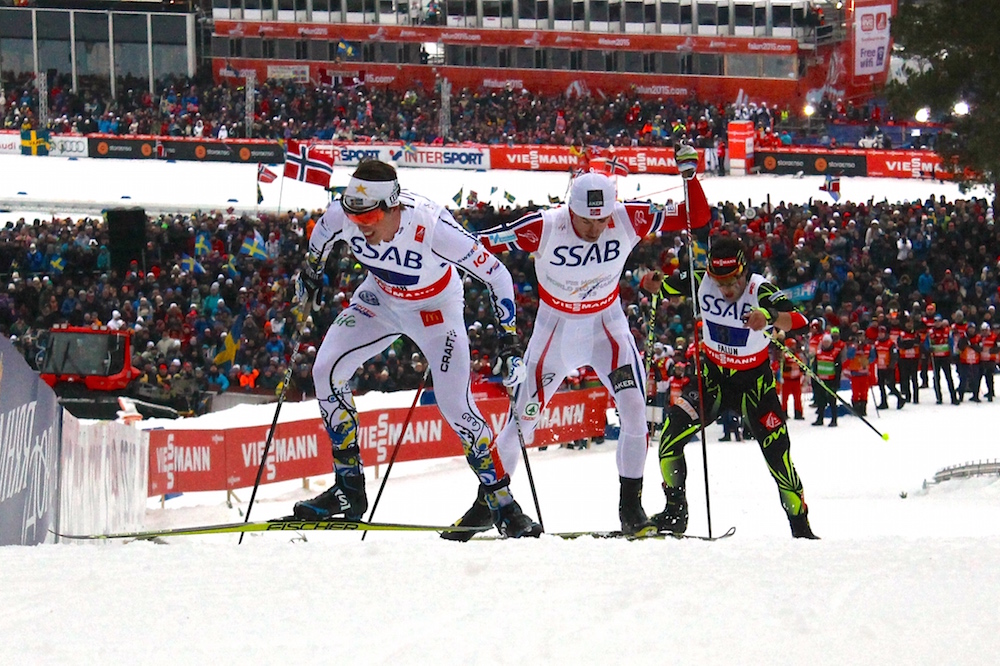
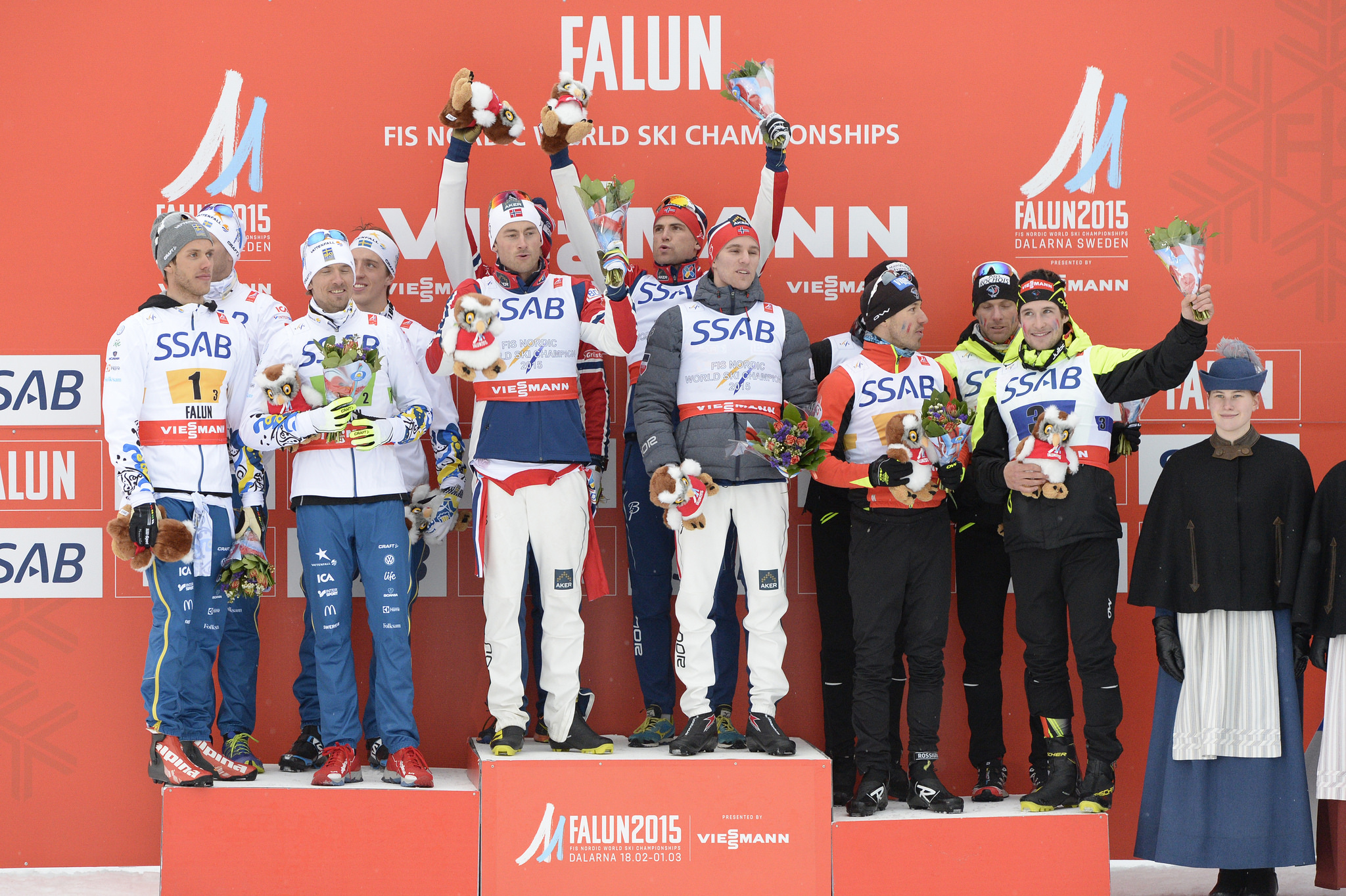
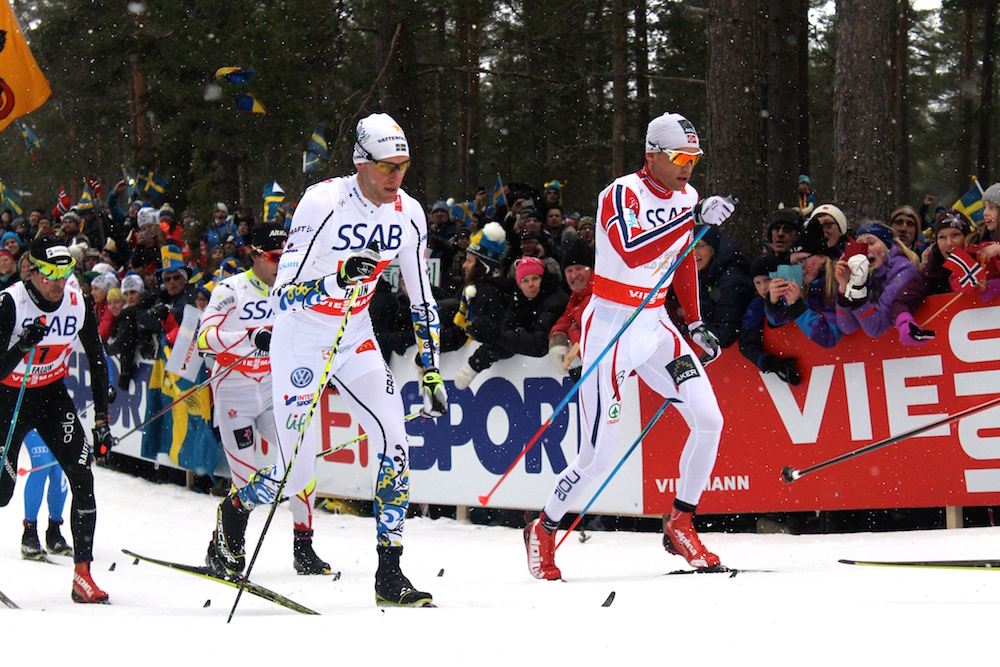
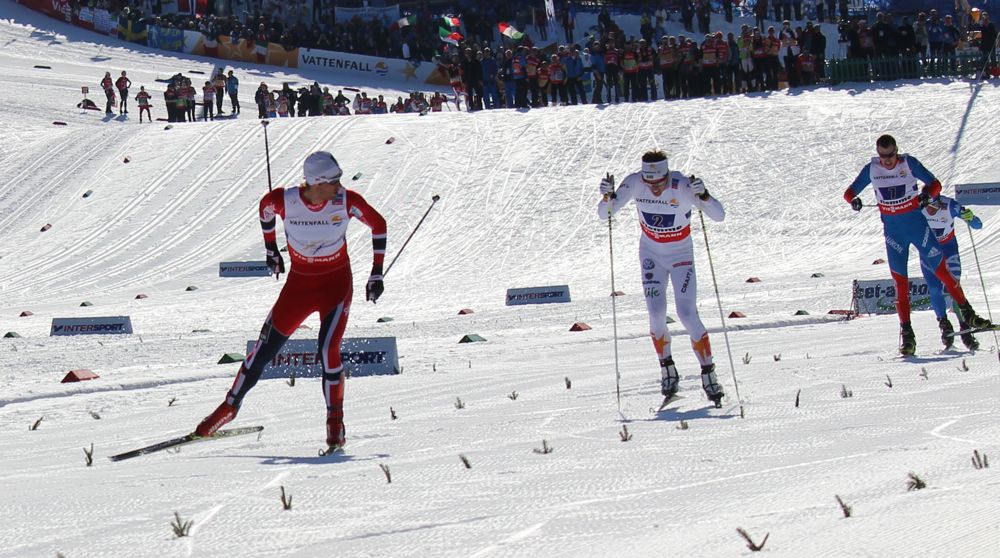
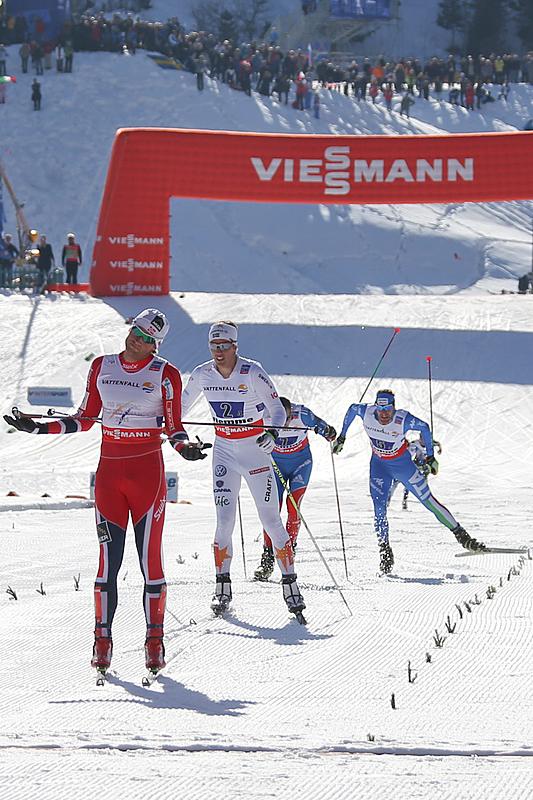
Sweden’s Calle Halfvarsson leads Norway’s Petter Northug (c) and France’s Adrien Backscheider on the second-to-last major hill on the last lap of the men’s 4 x 10 k relay at 2015 World Championships in Falun, Sweden. Northug went on to edge Halfvarsson by 0.6 seconds for gold, Sweden took silver and France was 8.9 seconds back for bronze.
FasterSkier’s coverage of the 2015 FIS Nordic World Ski Championships in Falun, Sweden, is brought to you by the generous support of L.L. Bean, now featuring a complete line of Kikkan Randall training wear.
FALUN, Sweden — All of Calle Halfvarsson’s trash talking gave Petter Northug something to get fired up about in the last couple hundred meters of the men’s 4 x 10-kilometer relay at FIS Nordic World Ski Championships on Friday.
Trailing Halfvarsson down into the stadium and leading up to the final rise before the finish, Northug rode on the tails of the Swede and blew past him on the climb, before giving him the ultimate run on the descent toward the finish.
There, Northug, who had already racked up two golds at these championships (in the classic sprint and freestyle team sprint), V2-ed like a madman to keep the slightest edge on Halfvarsson over the finishing flat. The Norwegian did so, and Halfvarsson let up about 20 meters before the line to accept his defeat.
It’s a lesson as old as time: talk smack and be ready to deal with the repercussions. Halfvarsson had to settle for silver when he was leading the fight for gold, and then watch Northug shush him at the finish.
That’s right, Northug, the now 12-time world champion (with two Olympic golds as well), put his finger to his lips after crossing the line, looking at cameras rather than back at Halfvarsson to send a message to the Swede.
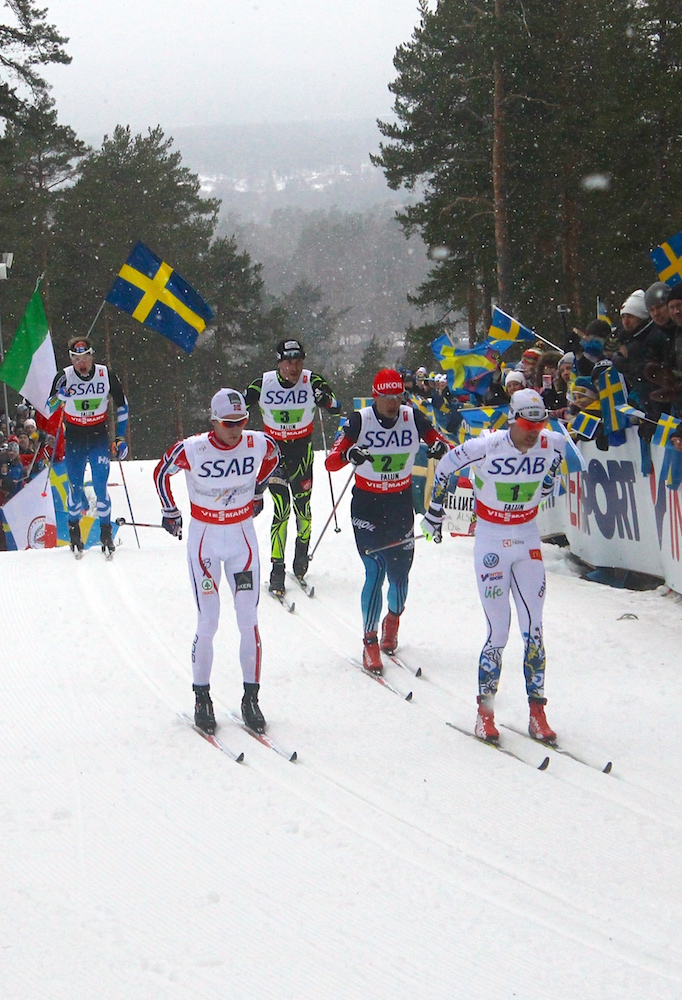
The French men’s relay team (right) skied the entire World Championships 4 x 10 k with the Norwegians (center) and Swedes, proving something to themselves and the ski world: they belong as championships medalists. (Photo: Falun2015.com/Flickr)
“When Calle crosses the finish line, [I wanted to] make it hurt so much that he takes [it] with him for a lifetime,” the 29-year-old Northug told NRK, according to a translation, after sealing the win for Norway in 1:34.18.5, six-tenths of a second ahead of Sweden.
So what exactly did Halfvarsson do to get him so riled? A year ago, he said he would beat Northug in a finishing sprint on home soil in Sweden. Unfortunately for Halfvarsson, in front of more than 41,000 spectators in Sweden on Friday, it didn’t happen.
The Swede led much of the last lap, countering Northug’s attack on the second-to-last major climb on the 2.5 k freestyle course while France’s Adrien Backscheider clung to the duo as well.
The three had skied on their own, a healthy distance away from Russia in fourth, since the end of the second classic leg. Sweden’s Johan Olsson had brought the team from seventh and 20 seconds out to first, ahead of France’s Maurice Manificat and Norway’s Didrik Tønseth, by the halfway point amid heavily falling snow — which lightened up considerably for the first skate leg.
“It was really nice to be able to exchange first,” Olsson said in a press conference, after tagging Swedish teammate Marcus Hellner with a 6.7-second lead on France’s third skier, Robin Duvillard. “I was a little bit worried before the race. Yesterday I didn’t recover so much after the 15 k race. Of course I’m really satisfied with my race and the other guys as well.”
After catching the leaders, Johan Olsson of Sweden (1) skied through to the lead on the second leg of the men’s 4 x 10 k relay in Falun, Sweden. Here he’s shown leading the third of four laps with Norway’s Didrik Tønseth (left) and Russia’s Alexander Bessmertnykh (2), and Maurice Manificat of France (3).
A two-time world champion, Olsson won Wednesday’s 15 k freestyle individual start by 17.8 seconds over Manificat in second, and Norway’s Anders Gløerssen took bronze, 19.2 seconds behind.
On Friday, Gløerssen skied the third leg for Norway, heading out 14.1 seconds after Hellner, and over the course of his four 2.5 k laps, he lifted Norway to first.
“I tried to set my own pace in the start and when I went out on the second lap, I was closing a little bit so I tried to speed up and close the gap,” Gløerssen said in the conference. “When I joined with the teams in front, I was a little bit tired so I tried to calm down. In the end i made a little attack just to see what happened.”
The result was Norway leading France by 3.8 seconds to start the last leg. Hellner tagged Halfvarsson in third, 6.4 seconds out of first.
“I think [Olsson] did a fantastic job and I was really satisfied with that gap, but I tried really hard but I wasn’t so strong today,” Hellner said. “The other guys were stronger and I lost some seconds to them.”
With one last skate leg to go, Northug led Halfvarsson and Backscheider out of the stadium. The Frenchman put himself in first for the first of two steeper climbs, both of which were used on the championships sprint courses, while Halfvarsson and Northug followed closely in second and third.
Meanwhile, Russia’s Evgeniy Belov pushed to catch the leaders, after his teammate Alexander Bessmertnykh brought his team from sixth to fourth on the second classic leg. Bessmertnykh finished his leg 32.4 seconds out of first and 18.3 seconds behind third. Alexander Legkov kept the Russians in fourth, tagging Belov about 40 seconds out of the mix.
From there, Belov — who ended up skiing the fastest anchor leg — cut the deficit in half early. Behind him, Italy’s Federico Pellegrino, Switzerland’s Toni Livers and the Czech Republic’s Petr Knop contended within a chase group. Germany’s Tim Tscharnke and Finland’s Ville Nousiainen skied together in eighth and ninth, and Simi Hamilton of the U.S. initially led Canada’s Lenny Valjas on the first of their fourth laps together in 10th and 11th.
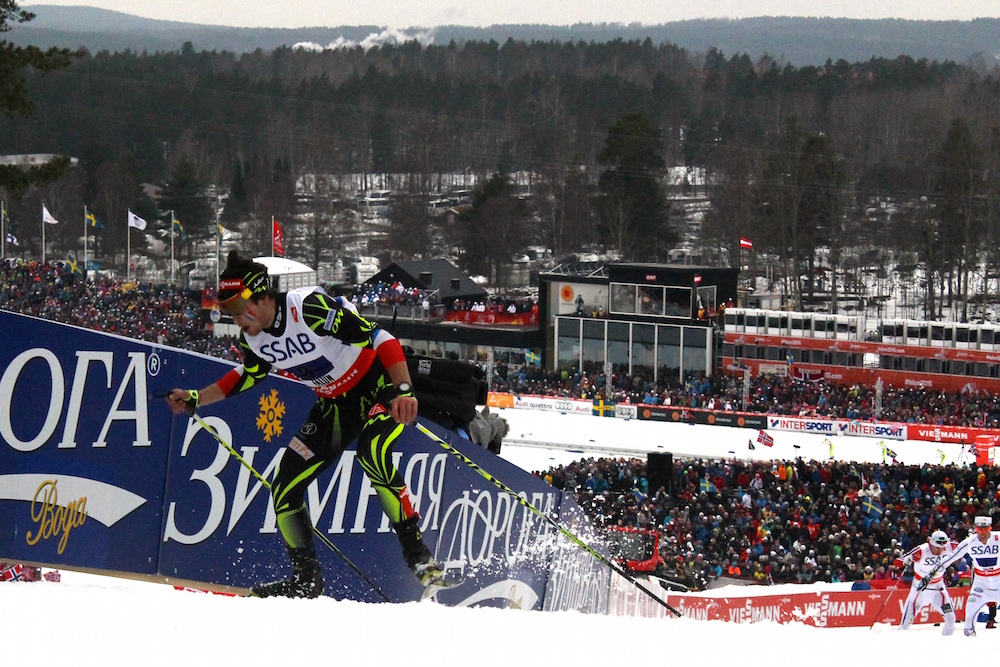
Adrien Backscheider attacks around 3 1/2 k into his 10 k skate leg as the anchor for France in the men’s 4 x 10 k relay at 2015 World Championships in Falun, Sweden. He went on to place third behind Norway’s Petter Northug and Sweden’s Marcus Hellner, respectively.
About 3 1/2 k into the final 10 k leg, Backscheider decided to push the pace to ensure a medal. Russia was closing, or so he thought, and he didn’t want Belov to get anywhere near the top three.
“I started in second position and I just skied to make the gap with the Russian guy,” Backscheider told FasterSkier.
A 22-year-old bronze medalist from this year’s U23 World Championships, Backscheider’s timing wasn’t exactly spot on. While he slightly increased the distance to Belov to 26.7 seconds at 5 k and was seven seconds ahead of Halfvarsson and Northug at the halfway point, the Swede and Norwegian pulled him back in by the third lap.
On that same lap, Livers and Pellegrino two minutes behind the leaders dropped Knop, while Tscharnke and Nousiainen, Valjas and Hamilton, continued to ski in their own mini groups within the top 11.
With just over a kilometer to go, Northug upped the ante and tried to pass Halfvarsson on the first, longer climb. Halfvarsson stayed in front of him, while Backscheider matched them stride for stride in third over the top.
Not long after on the next steep uphill, Halfvarsson took his turn — looking at Northug and attacking at the base. Northug stuck on him, tucking behind him in second, while Backscheider hung on at the back.
“I didn’t want to be in front in the sprint hill; I wanted to stay in second, conserve power and I also didn’t want to [ski into] the wind,” Northug said in the press conference. “The last 150 meters was not that good, but I think it was pretty difficult today because it was really icy [in the finishing stretch].”
Racers had a mix of conditions, from light to heavy snow to in the classic portion, to hardly any precipitation for the skate legs. Organizers salted both courses beforehand to cope with the above-freezing temperatures and near-100-percent humidity, which has made the track increasingly soft throughout the week.
While most of the skate course was breaking down, the finishing straight was fast and hard-packed. There, Northug and Halfvarsson focused on skiing fast while staying on their feet.
“The most important thing is to cross the finish in first,” Northug said after racking up his fifth World Championships relay gold.
“You never know what’s going to happen in a relay, but we had a better chance this year on the last leg than in Sochi,” he added, referring to last year’s Sochi Olympics, in which the Norwegian men placed fourth behind Sweden, Russia and France, respectively. “It feels good to be back on top again. … It’s a lot of pressure on the Norwegian team before a relay. We knew before the championships that only gold makes the Norwegians satisfied.”
The defending Olympic relay champions, which came 0.6 seconds short of gold on Friday, Sweden took silver with essentially the same four-man lineup (except Halfvarsson in place of Lars Nelson, who scrambled for the team in Sochi).
Daniel Richardsson of Sweden and Niklas Dyrhaug of Norway leading the men’s 4 x 10 k relay in Falun, Sweden.
This time around, Richardsson led Swedes out instead, finishing his first leg in seventh behind Canada’s Alex Harvey in first, Finland’s Sami Jauhojaervi in second and Kazakhstan’s Alexey Poltoranin in third. Norway’s Niklas Dyrhaug tagged in fourth, followed by Germany’s Johas Dobler and Russia’s Maxim Vylegzhanin, respectively.
While the top six were within 5 seconds of one another at the first exchange, Richardsson was 20.5 seconds back in seventh. (France’s Jean-Marc Gaillard was another 0.7 seconds back in ninth, behind Italy’s Francesco de Fabiani in eighth.)
“Yesterday I was a little bit worried that we wouldn’t take a medal at all,” Olsson said. “We know that Norway is the team to beat, and with Petter as the last leg, he’s almost Mr. One-Hundred Percent at the finish. … We’re satisfied with the medal, but of course we would be more satisfied with the gold.”
For Halfvarsson, it was personally his first medal of his home championships. Two years ago at World Championships in Val di Fiemme, Italy, the Swedish men’s relay — with the same team and order — placed second to Norway by 1.2 seconds.
After Friday’s race, Halfvarsson realized his mistake.
“[Northug] came into my draft behind and got better speed and knew exactly how he’d run into the [downhill corner before the finish],” Halfvarsson told HD.se, according to a translation.
“I had trouble keeping track of where he was, then suddenly he just takes off. It might have been better to get in back of him before the stadium.”
He acknowledged that Northug was stronger, as did Backscheider, who finished 8.9 seconds back in third for bronze for France.
“The finish was hard — I need more experience to have a better finish,” Backscheider said at the press conference.
Regardless, France was pleased to repeat its bronze medal following the 2014 Olympics.
“We believed that it is possible,” Manificat said in the conference. “Championships is always a surprise, but we fight for this and … it’s really perfect.”
Russia’s Evgeniy Belov in fourth tries to close the gap to the top three, on his first of four laps in the men’s 4 x 10 k relay at 2015 World Championships in Falun, Sweden.
Belov finished fourth for Russia, 31 seconds after Norway, and Livers skied away from Pellegrino to finish fifth for Switzerland, 2:03 behind Norway and 24.2 seconds ahead of Italy in sixth.
Tscharnke and Nousiainen raced to a photo finish for seventh, in which Germany had the edge, while the Czech Republic placed ninth 5.6 seconds later.
Canada’s Valjas held off Hamilton by 1.4 seconds for 10th (+3:03.5).
Norway’s prime minister, Erna Solberg, attended the race and personally congratulated her nation’s four-man team after the finish.
“I enjoyed it very much,” she told FasterSkier. “But it became a bit too exciting. I always want them to have a bigger lead in the last part, but of course Petter Northug is like this. He keeps it until the last 200 meters. … He always makes me nervous.”
Alex Harvey (CAN), Dario Cologna (SUI), Daniel Richardsson (SWE) and Alexey Poltoranin (KAZ), (l-r) during Thursday’s Tour de Ski stage. (photo: Fischer / Nordic Focus)
Alex Harvey’s plan to work with Norway’s Niklas Dyrhaug may have slowed him down in Thursday’s Tour de Ski 25-kilometer freestyle pursuit, but he was still 0.4 seconds fast enough to jump Switzerland’s Dario Cologna in the Tour standings and improve from seventh to sixth overall.
The Canadian is now sixth overall, 2:01.0 minutes behind leader Petter Northug of Norway. He finished Thursday’s pursuit in sixth, 1:46.0 minutes behind Northug (53:36.9), and had the 21st fastest time on the course – five laps around a 5 k loop – in 54:35.1. However, Dyrhaug edged him out at the finish line by 0.1 seconds to take fifth.
“I’m happy with the results but time-wise I’m a bit disappointed by the other guys in the group,” Harvey said in a phone interview.
He explained that Dyrhaug – who started the day eighth overall – approached him before the race and said he wanted to work together to catch Cologna. Harvey agreed, but Dyrhaug set a slow pace from the start, and he estimated they quickly lost 10 seconds to Cologna.
However, he said the pace finally quickened when Sweden’s Daniel Richardsson caught up to them.
Niklas Dyrhaug (NOR) and Alex Harvey (CAN), (l-r) each moved up the overall Tour de Ski results. (photo: Fischer / Nordic Focus)
“Richardsson had a really good day so when he caught up to us, him and I could work well to close the gap. By then it was maybe up to 30 seconds to Dario, but we could work well, and I think Dario was starting to fade a little bit,” Harvey said.
At that point, Harvey knew the top-four skiers were too far ahead to be caught, so the race turned into a battle between him, Richardsson, Cologna, Dyrhaug, and Kazahstan’s Alexey Poltoranin for fifth.
Harvey said no one was willing to take a big pull, and the group ended up sitting.
“We [Richardsson and I] saw that Dario and Dyrhaug were sitting, so we didn’t want one of them to attack right after we took a big pull and get dropped. So when not that many people are trying to work, people get pretty pissed, and I guess that was what was going on,” Harvey explained.
The results was a final charge for fifth among the five racers, with Dyrhaug taking it by a fraction of a second.
“I think we could have skied probably 45 seconds to a minute faster if Dario, Daniel, Niklas, and I really pushed,” Harvey said. Dyrhaug – who Harvey said he has a “good relationship” with – went up to him after the race and apologized for not pulling, according to Harvey.
Despite his frustrations with the speed, Harvey said the course was fairly fast.
“Every 5 k I would throw in maybe four or five offsets – on climbs I can skate in that technique – so everything else was one skate or two skate. It was pretty fast snow,” he said.
Harvey will race in the 15 k classic mass start in Val di Fiemme, Italy, on Saturday, but will forgo Sunday’s final stage, a 9 k freestyle pursuit. This will be the third year in a row he will skip the final stage of the Tour.
However, he thinks he has a shot at the podium on Saturday.
“I’ve had really good races in the past in Val di Fiemme … It’s a race that I’ve done well in the past, and the classic this year has been feeling really good, and today because we didn’t push so hard I’m not really tired,” he explained.
Two other Canadian men competed in the pursuit. Devon Kershaw started the day in 29th but improved to 25th (+4:11.0), while Ivan Babikov started and finished in 31st (+4:13.9). Babikov also had the 23rd fastest race of the day, with a time of 54:39.2.
The three American men withdrew from the Tour after Wednesday’s 10 k.
Canada’s Alex Harvey celebrates third place in the overall World Cup. (Photo: Fischer/NordicFocus)
Alex Harvey started Sunday’s 15-kilometer freestyle pursuit in Falun, Sweden, with one thing on his mind: a first- or second-place finish would put him on the overall World Cup podium.
After the 25-year-old Canadian won Saturday’s 30 k skiathlon race he took the lead in the Falun mini-tour, and seized a 26 second advantage in Sunday’s pursuit race ahead of Martin Johnsrud Sundby of Norway and Alexander Legkov of Russia. The skiathlon victory also put him in contention for third place in the overall World Cup standings, a fact he learned from Sundby after Saturday’s race. To accomplish this he would have to hold off either Sundby or Legkov.
Harvey said to FasterSkier on Saturday that the “optimal plan is to stay away [from Sundby and Legkov], but Plan B isn’t bad either,” referring to skiing with the two chasing skiers.
Before the race, Justin Wadsworth, Head Coach of the Canadian National Team spoke with Harvey. “We just talked before the start about the course and then I asked him if he had any plans and he said that he was just going to go out and ski steady, not bury himself and see if he could hold them off.”
Harvey started his race by skiing steadily and smoothly through the winding and hilly course.
“I started at my own pace, but didn’t want to go into the red zone; I knew they were coming,” Harvey told Cross Country Canada, according to a press release.
Alex Harvey racing to a victory in Saturday’s skiathlon. (Photo: Fischer/Nordic Focus)
Just over a kilometer into the race, Harvey still had a 25-second lead on Sundby and Legkov, but by the 3 k mark the pursuers were 16 seconds behind him.
With Sweden’s Daniel Richardsson trailing Harvey by 54 seconds, and another Swede Marcus Hellner leading a chasing pack of six skiers some two minutes behind the leader, it was essentially a three-man race for first place. Sundby led Legkov and made a hard push to catch up with Harvey, and after 3 k they steadily approached Harvey ahead of them.
“I was kind of hoping that he could ski out in front of those guys,” said Wadsworth. “Twenty-six seconds is quite a bit, but at the same time when there are two of the world’s best skiers really pushing each other on certain sections it’s almost impossible to hold them off.”
By the time Harvey reached the famous Mörderbakken climb, Legkov and Sundby were only a few seconds behind him and by the top of the climb they had caught him.
“They came back to me at the six-kilometre mark,” said Harvey. “Then it became tactical.”
“He did a really good job for the first couple of k maintaining the time gap, and then Sundby pushed and the time gap came all the way down until they caught him,” Wadsworth said. “That happened pretty fast, but Alex never panicked. He knew he had pretty good skis.”
After Harvey had been caught he continued to lead the three men. With the chasing group so far out of contention there was little pressure to maintain a fast pace, and Harvey appeared calm in the lead, and the pace manageable.
“Alex was looking super relaxed even up to the point they got him,” said Wadsworth. “So it wasn’t like Alex was stressing and then they caught him. I was pretty confident that he was going to be pretty rested for the last push.”
Meanwhile, Richardsson, who had started nearly a minute behind Harvey and was skiing in fourth position, looked to have elevated his pace, perhaps having been informed that the pace had slowed somewhat at the front of the race.
Martin Johnsrud Sundby celebrates his victory in the 15 k freestyle pursuit at World Cup Finals in Falun, Sweden. (Photo: Fischer/Nordic Focus)
Richardsson crept to within 40 seconds of the leaders until Sundby took back the lead from Harvey and began to push the pace once again. Sundby tested the two others with some aggressive hill climbing, but both Legkov and Harvey stayed with him.
Going through the stadium with 3.7 k remaining, Sundby looked to relinquish his lead, pointing at Legkov, who up to that point had not taken a turn in the lead. Legkov made no move to take the lead as Sundby slowed, and it was Harvey who ended up taking the reigns at the front of the race.
Harvey led until the base of the Mörderbakken climb, 2.7 k away from the finish line. As the skiers began the climb, Legkov attacked with his powerful hill climbing. Sundby was quick to respond to the challenge and sped ahead of Harvey to stay close to the Russian’s skis.
Legkov slowed the assault mid climb, and Sundby, sensing an opportunity, immediately counterattacked. The Norwegian hammered up the upper half of the long hill, and this time it was Harvey who responded, while Legkov was too sluggish to match Sundby’s speed.
With Legkov a few seconds behind, it was a battle between Sundby and Harvey. Sundby’s rapid climbing on a late hill proved too much for Harvey, and the Norwegian gained an advantage by several seconds heading into the stadium.
“Those are two of the best in the world and are both Olympic medalists,” said Harvey of Legkov and Sundby. “I knew it wouldn’t be easy, but I also knew I needed to beat one of them to get into that top-three. Once Legkov couldn’t respond, I knew I just had to stay on my skis. I had great shape and the skis were really good!”
In the end, Sundby had enough time to savor his victory. Harvey took second, the result he needed for the coveted podium position on the overall World Cup standings, and Legkov was third.
It has been a breakthrough season for Sundby: he won the Tour de Ski, the overall World Cup title, and on Sunday, the Falun mini tour. “It’s been an incredible season,” Sundby told FIS. “I worked really hard for this. It was really a good battle with Legkov and Harvey today. I knew I wanted to have a [gap] between me and Alex in the finish. I am looking forward to the World Championships next year. Falun is a place with a great atmosphere.”
To NRK, Sundby said, “I have had the smoothest season of all, even if you can pick out a race here and there where I got a beating. But overall, I have been the world’s best skier.”
The overall World Cup podium. (l-r) Russia’s Alexander Legkov in second, Norway’s winner Martin Johnsrud Sundby, and Canada’s Alex Harvey in third. (Photo: Fischer/Nordic Focus)
“Before the season, I had not thought I would win the World Cup,” Sundby continued. “I thought maybe top five. I was number seven last year and felt that I was a little better and would raise some places this year. But it has gone way over expectation.”
Harvey’s third-place finish on the overall World Cup was an important achievement for the Canadian National Team.
“It definitely gives some satisfaction with what has been a frustrating year for us, but the overall World Cup is a pretty amazing thing,” Wadsworth said. “Especially to place in the top three when you are a North American is a real feat because it means you have to be in Europe all winter and posting every weekend that you can. In the last three years we’ve had Devon [Kershaw] in second overall in the World Cup and Alex [Harvey] third now so it leaves all of us with a good taste.”
“I’m super stoked,” said Harvey of his podium. “That was a super-nice way to end the season … I had kind of given up on the overall when I had to pull out of the final stage of the Tour de Ski because so many points are given in that race, but I was able to gain a lot in the last weekend.”
“When I grew up it was never something I thought about. My dad [Pierre Harvey] was never better than eighth in the overall. Just being on the World Cup podium was something we all dreamt of in Canada. We have come a long way. We know we can be fighting for the top every weekend. Devon [Kershaw] was second a couple of years ago, and now I’m third. We take a lot of satisfaction showing that we can be consistent.”
Canada’s Alex Harvey celebrates in his traditional fashion after winning his third World Cup race of the season, the 30 k skiathlon and second stage of World Cup Finals on Saturday in Falun, Sweden. (Photo: Fischer/Nordic Focus)
Thirty kilometers is a long time to get to know somebody, and when you’re already pretty well aquatinted, well, then it comes down to mind games.
Canada’s Alex Harvey knew he’d be better off following the lead of three others for the first half of the men’s 30-kilometer skiathlon — the classic portion — at World Cup Finals on Saturday. Plenty of kick made it easy for him to stay in contact on what he considered his weakness: the big, steep hill, known as Mörderbacken in Falun, Sweden.
The men had to ascend it eight times total — four loops of classic, four loops of skate. Harvey stayed comfortable behind Sweden’s Daniel Richardsson, Norway’s Martin Johnsrud Sundby, and Russia’s Alexander Legkov, entering the transition in fourth and emerging out of it in first.
Everybody else was at least 21 seconds behind, and not a threat according to Harvey. Even when Finland’s Matti Heikkinen started to go for it in early in the skate leg, leading the chase pack in an effort to close the gap on the four leaders, Sundby, Legkov and Harvey kept it cool, even “chill,” Harvey said.
Daniel Richardsson leads the men’s 30 k skiathlon on Saturday during the first of eight laps in the penultimate race of World Cup Finals in Falun, Sweden. Richardsson went on to place fourth behind Canada’s Alex Harvey, Norway’s Martin Johnsrud Sundby, and Russia’s Alexander Legkov, respectively. (Photo: Fischer/Nordic Focus)
Meanwhile, Richardsson, who initiated the breakaway with a relentless double pole about 5 k in, started to falter. With 10 1/2 k to go, he was trying to minimize a gap of his own to the front three. Harvey was surprised the Swede fell off the pace, but said Richardsson, who turned 32 on Saturday, pulled their weight for most of the classic leg, and he’s known as a better classic skier.
And then there were three. The breakaway trio stuck together for the rest of the race, never looking back to see where Heikkinen was (he lost steam about 5 k into the skate leg), and not worrying about the chase pack, which included the likes of Devon Kershaw — who led its charge halfway through 9 k into classic portion.
The front four had gapped the masses between 5 and 6 k; there was still plenty of race ahead of them, yet they skied smart enough to put more time into the chase group in the skate leg.
With 10 k to go, France’s Jean-Marc Gaillard was leading the pack in fifth, 36 seconds behind the leaders. No way was he or anyone else going to bridge 30-plus seconds alone, let alone into a headwind, Harvey thought.
So it was the Canadian, Norwegian and Russian — all essentially guaranteed a podium in the penultimate race of World Cup Finals, but everyone wanted to win.
After the transition, Sundby led up the long gradual climb out of the stadium, just like he did on every other lap, and the others let him do so into the headwind on a windy, above-freezing afternoon. Harvey decided it was time to take his turn up front soon after, not so much for courtesy but strategic reasons.
“I was leading on the climb just because I wanted to set my own pace,” he said. “I didn’t know how the other guys were [feeling] and I felt like the most vulnerable place for me it always is uphills. It was the best position to react on the front.”
And so he led up Mörderbacken — every time.
Throughout the next four laps, the pace remained somewhat relaxed, even lulling at times. Harvey said he wasn’t worried about Legkov or Sundby attacking the last time up Mörderbacken because he had a sense everyone was pretty gassed at that point.
Canadian Alex Harvey edges Norway’s Martin Johnsrud Sundby (not shown) by 0.4 seconds for the 30 k skiathlon victory at World Cup Finals on Saturday. Russia’s Alexander Legkov (behind) placed third. (Photo: Fischer/Nordic Focus)
Harvey got up front anyway, skiing up the middle of the long climb to minimize the amount of space anyone would have to use to get around him. If anything, their pace slowed, with Richardsson as the next closest competitor 19 seconds back.
By the final uphill 180-degree turn, Harvey almost came to a stop in first — all part of the plan, he later explained. Canadian Head Coach Justin Wadsworth was relieved.
“I was worried he was leading so much,” Wadsworth said. “I told him that after the race, ‘Oh man, you had me worried you were going to lead down the last downhill,’ which was I think on this course, a bit of a curse. … He just put on the brakes at the last second … and I was really happy to see that, because when he did that I knew he had a lot of confidence in his skis and his body.”
Just like Harvey guessed, Legkov went for the open space and Harvey went from first to third, remembering the value of the slipstream on the last downhill into the stadium. The Canadian had gone from sixth to fourth with a similar tactic in Friday’s classic-sprint final, and this time, he was going to use it to ski to a victory.
“I knew my skate skis were good all day, [and] Legkov and Sundby, they’re not the strongest sprinters,” Harvey said.
Sundby had two skate-sprint podiums at the Tour de Ski and won the Kuusamo mini tour at the beginning of the season, and considering that, Harvey thought he would the toughest to beat in a sprint. Really though, he just wanted to enter the stadium in second or third — didn’t matter which order.
With a couple hundred meters to go, Harvey took advantage of a narrow opening between Sundby on the left and Legkov on the right to follow Sundby toward the finish in second. While Harvey followed the course’s natural line to the right behind Sundby, he said Legkov moved left into his path and he broke the Russian’s pole as a result.
“I tried to stay in Sundby’s draft because Legkov was so sketchy today,” Harvey said, noting Legkov crashed three times (once classic skiing out of the stadium, another time at the classic-bonus prime and one more up Mörderbacken — all on his own).
While Sundby and Harvey dueled to the finish, Legkov skied alone in third, finishing 5.9 seconds back. The Canadian pushed up and over the last rise to the line, edging Sundby — the overall World Cup champion — by 0.4 seconds to win in 1:18.07.6.
Sundby later told Harvey in doping control that he was in contention for a World Cup overall podium, which he hadn’t realized and would be a career best. Harvey will have to hold off Sundby and Legkov, who will start 26 seconds behind him in Sunday’s 15 k freestyle pursuit, to win the World Cup Finals mini tour and claim 200 points that comes with it (and would put him ahead of Norway’s Chris Andre Jespersen in third in the overall standings).
But on Saturday, Harvey took some time to celebrate his third World Cup victory of the season, yelling exuberantly with a final “Yes!” at the finish, and getting congrats from his teammate Devon Kershaw, who had one of his best races of the season in 12th.
Canada’s Alex Harvey celebrates his third World Cup win of the season after a 0.4-second victory in Saturday’s 30 k skiathlon at World Cup Finals in Falun, Sweden. (Photo: Fischer/Nordic Focus)
“I enjoyed it right after the race, on the podium and everything, it was pretty sweet,” Harvey said. “It’s been such a good season for me with three wins. The skiathlon, since I’ve been a junior, it’s always been my favorite race. It took me a while to get good at sprinting.”
Wadsworth said Harvey will probably have to be in the top two Sunday to secure third in the overall World Cup.
“After the year we have had, for him to end up third overall tomorrow, it just shows that Alex is a guy for the future, that he can contend for the overall World Cup,” Wadsworth said. “We are playing on such a different field as North Americans because we have to deal with being on the road all year long. I don’t think people really put enough weight into that. For Alex to rebound after a hard Olympics and difficult races here and there, and we have been living out of a hotel since November, I think it really, really speaks strongly to the quality all-around skier that he is.”
While the 25-year-old Harvey acknowledged that every season has its highs and lows, he felt fortunate that his didn’t have many. His health was good, he didn’t get sick or injured, he pulled out of one race at the Olympics to save energy for other races, and while the Olympics were marked by some waxing woes, he said there were plenty of non-race-related things in Sochi to focus on.
“We controlled the things that we could control and we came into the season with a good plan,” Harvey said. “The body was there every weekend except [the first one in] Kuusamo. I’ve had a lot of fun this year, just always fighting for the top 10. It went by really fast there … it was just high spirits the whole winter.”
Before this season, Harvey had one career World Cup win. He went on to win the first prologue stage of the Tour de Ski in Oberhof, Germany, and then a World Cup skate sprint in Szlarska Poreba, Poland.
If he wins tomorrow, great, Harvey said. Twenty-six seconds is a lot of time to start ahead of anyone else, and if Sundby and Legkov charge hard enough to catch him, then he might find himself in a similar position as Saturday — trying to outsmart and outsprint them to the finish.
“The optimal plan is to stay away, but Plan B isn’t bad either,” Harvey said.
While Kershaw came through in 12th, 1:13.7 behind Harvey, the third Canadian in the race, Ivan Babikov placed 23rd (+3:42).
“It’s cool to see that he’s back in the top 15,” Harvey said of Kershaw. “There was nothing free today. It was windy. It was a slow 30 k. An hour and 18 is not fast.”
Wadsworth said Kershaw’s result didn’t surprise him.
“Devon, when he gets in the situation where he doesn’t have anything to lose … he was relaxed today and I think our skis were quite good,” Wadsworth said. “He just went out there and did what he normally could do, that is the kind of shape he is in. It was nice for him to just turn things off and put it on auto pilot.”
On Friday, Kershaw placed 40th in the sprint, which he described in an email as “another hard effort in a long list of hard efforts on the sprint front this season.”
“I was and am very disappointed with how my sprint season went this year,” Kershaw wrote. “I only qualified in 2 individual sprints (Oberhof skate sprint, and Poland) and got bumped in the 1/4 finals in each of those – so that’s a long cry from being on the podium in both classic and skate sprints like I have been back in 2011 and 2012. Something isn’t working – and I guess now it’s safe to say that something didn’t work – as my sprint season is done for this year.”
He explained he’ll have to spend time to figure out what went wrong and how to get back the speed that’s characterized most of his career. “This is the first season in awhile where I have no top 10 sprint results on the World Cup,” Kershaw wrote.
“I am not feeling very good – I mean, that’s pretty evident. I got pretty sick in Sochi, and then in Lahti I was still not 100% there either, but went for it by racing both races – which didn’t go well,” he added. “I have since been healthy, but my lungs are holding on to something – I could feel that a lot in the qualifier for sure. Still though, skiing around easy I don’t feel too bad, just feels like my top end is non-existent.”
His goals for the rest of World Cup Finals, “to have a distance race where I feel half-decent,” Kershaw wrote. He likely did that on Saturday.
Babikov recently returned to Europe after going back to Canada for a week to recover from illness post-Sochi. He said his skis felt a bit draggy in Saturday’s classic portion and his legs weren’t quite there in skating, but all things considered, he felt reasonably good, skiing with American Noah Hoffman and Norway’s Sjur Røthe until late in the skate leg. They dropped him with at least one lap to go and he skied alone for the rest of the race.
“That is the end of the season usually, everybody races with whatever they have in the tank,” Babikov said.
On Sunday, he’ll start 25th with Russia’s Evgeniy Belov in 24th, 5:13 behind Harvey. They have about a 50-second gap to 22nd.
“Of course I will try to ski as fast as I can,” he said.
As for his teammate: “Alex is on fire lately, he is in great shape and having the best season for him ever,” Babikov said. “It was great to see him win today, well, I did not see that, but I saw him in the finish.”
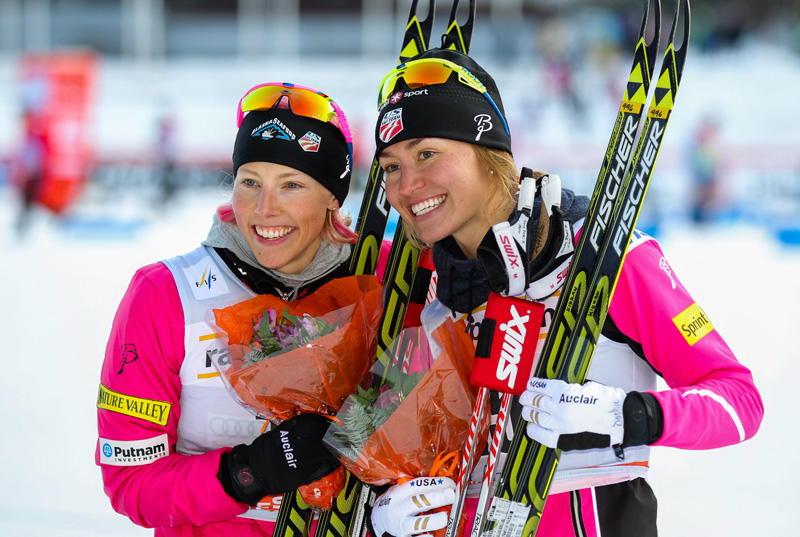
U.S. teammate Kikkan Randall (l) and Sophie Caldwell celebrate the first U.S. double podium in Saturday’s World Cup skate sprint in Lahti, Finland. (Photo: Fischer/Nordic Focus)
Were the Olympics just a dream? After a whirlwind couple of weeks on the ground in Sochi, Russia, it certainly feels so for us. However, just because the Olympics are over doesn’t mean the season has ended, and as this past weekend proved, we may have some of the most exciting skiing of the season ahead of us.
World Cup action kicked off with Saturday’s freestyle sprint in Lahti, Finland, where the women of the U.S. Ski team made history. For the first time two American women sat upon the podium, with Kikkan Randall in first and Sophie Caldwell in third.
For Randall, the win was redemption for a disappointing two weeks in Sochi where she finished 18th in the freestyle sprint, an event she was favored to win.
Fellow U.S. Ski Team members Kikkan Randall (l) and Sophie Caldwell after finishing an unprecedented first and third, respectively, in the Lahti World Cup freestyle sprint on Saturday in Finland. (Photo: Fischer/Nordic Focus)
For Caldwell, it was her first World Cup podium. The podium adds to what has been a momentous season for the 23-year-old, who placed sixth in the Olympic sprint. In doing so she achieved the top result for an American woman at an Olympic Games.
Completing the podium was Slovenian Katja Visnar, who finished second, placing her in the middle of an American sandwich.
On the men’s side, Canadian Alex Harvey pushed through his post-Olympic 50 k exhaustion to place seventh. American’s Simi Hamilton and Andy Newell also placed in the top 30 in 20th and 28th. Hamilton, who suffering from illness, and Newell, who lost both a pole and a ski in his heat, were unable to advance from the quarterfinals.
The race was eventually won by Norwegian Paal Golberg. He was followed by Russian Alexey Petukhov and Norwegian teammate Eirik Brandsdal.
Sunday’s World Cup races were dominated by Norwegians fighting to become the overall World Cup Champions. For the women, Marit Bjørgen skied a smart and controlled race to finish first in the 10 k freestyle by a whopping 26.9 seconds. Behind her was Charlotte Kalla in second and a frustrated Therese Johaug in third. While Johaug still holds the overall World Cup lead, Bjørgen is closing in with every race.
Randall was the top North American in 21st followed by teammate Liz Stephen in 32nd.
In the 15 k individual freestyle, overall World Cup leader Martin Sundby of Norway extended his lead by outpacing second place finisher Daniel Richardsson of Sweden by over ten seconds. On the podium for the second day in a row, Petukhov placed third.
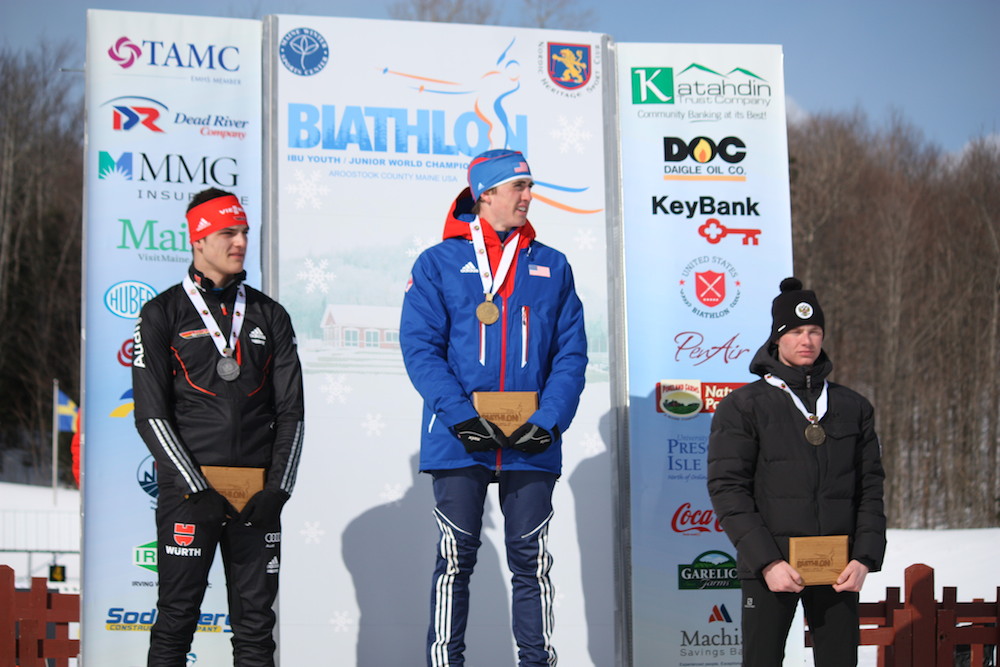
U.S. Olympian Sean Doherty (c) tops the podium in the first race of the 2014 IBU Youth World Championships in Presque Isle, Maine. Doherty won Friday’s 7.5 k sprint ahead of Germany’s Marco Gross (l) in second, and Russia’s Dmitri Shamaev in third. (Photo: Craig Cormier)
This weekend also marked the start of the IBU Youth World Championships in Presque Isle, Maine where American Sean Doherty claimed gold in both the 7.5 k sprint and 10 k sprint. This marks the third Youth World gold medal for the 18-year-old, who was fresh off his first Olympic start in the 4 X 7.5 k in Sochi.
American Maddie Phaneuf placed fourth in the women’s 5 k sprint and finished 24th in the 7.5 k pursuit. Canada’s Danielle Vrielink was the top North American in the pursuit with a 15th place finish.
The Vasaloppet also took place this weekend in Sweden. John Kristian Dahl waited to the last minute to make his move, chasing down fellow Norwegian Laugaland to win his first Vasaloppet. Laila Kveli of Norway won the women’s race in an impressive of display of double poling strength to become the first women to win the race without kick wax.
Norwegian Martin Johnsrud Sundby is back on top following a disappointing Olympics, winning the men’s 15 k freestyle in Lahti, Finland.
Sundby entered the Olympics as the overall World Cup leader after winning the 2014 Tour de Ski, but managed just a bronze in the opening skiathlon in Sochi, before notching a thirteenth and two fourths.
He took a measure of revenge today, however, besting Sweden’s Daniel Richardsson by 10.7 seconds with Alexander Legkov of Russia another half second back in third.
Martin Johnsrud Sundby (NOR) celebrates his win in the Lahti 15 k freestyle. (Photo: Fischer/NordicFocus)
Legkov won the Olympic 50 k in which Sundby was fourth, and Richardsson took third in the 15 k classic, arguably Sundby’s strongest event, and was part of the gold medal winning relay team.
“I wanted to ski good today,” Sundby told FIS News after the race. “I was very motivated to succeed again.”
Shut out of the medals in four of six Olympic races, the trip to Russia was disaster for the Norwegians. Sundby, however is now looking ahead with the goal of earning his first overall World Cup title.
“The Games did not go the way I wanted, so I wanted to be ready to fight for the yellow bib,” he said after the race.
Sundby led from 3.4 k on, trailing only Great Brittain’s Andrew Musgrave at the first checkpoint 1.5 k into the race.
The Norwegian made his move with approximately 3 k to go. Until that point, both Legkov and Richardsson stayed within just a few seconds of the top spot, but between 11.3 and 13.4 k, Sundby extended his lead to 10 seconds, cementing the victory.
The men’s podium in Lahti (Photo: Fischer/NordicFocus)
Richardsson overcame a 2.2 second deficit on Legkov over the last 1.6 k to take second.
Legkov said he felt “very good” in the race, but that it was “not easy to concentrate on the World Cup again after the gold medal in Sochi.”
Richardsson also felt good, similarly pleased to maintain form after the Olympics.
With warm temperatures, the course was soft and icy, but according to Sundby, it did not break down further during the race.
“I think it was the same for everybody. There was not a big difference during the laps,” he said.
Sundby now leads the overall World Cup by 388 points over teammate Chris Andre Jespersen. Legkov is in third, 441 back.
Of Note:
– Jespersen did not race for Norway
– With Anders Glørssen in fourth, Finn Hågen Krogh in fifth and Sjur Røthe in sixth, Norway placed four skiers in the top six. Norway ended the day with seven in the top thirteen.
– Early leader Musgrave finished 27th.
– 20-year-old Florian Notz of Germay was 7th in his first World Cup race. He was 10th in the 15 k classic at U23 Championships.
– Olympic sprint bronze medalist, Emil Jönsson of Sweden finished 30th.
Sweden’s Marcus Hellner jumps out of his skis after anchoring his country to victory in the men’s 4×10 relay at the Sochi Olympics.
FasterSkier’s coverage is made possible through the generous support of Rudy Project.
SOCHI, Russia — All the buzz about the Laura Cross-Country Ski & Biathlon Center at the 2014 Olympics the last few days has been about how bad Norway’s skis have been — in both nordic and biathlon.
On the flip side, not many asked the Swedes why they were finding success on the warm and slushy snow, that is until Sunday.
After becoming the first country to win both the women’s and men’s Olympic relays in 42 years (the Soviet Union was the last nation to do so in 1972), the question became why are the Swedish cross-country skiers so fast.
The oldest guy on Sweden’s 4 x 10-kilometer relay team, 34-year-old Johan Olsson replied that it was in large part thanks to their skis.
Hellner skiing in Sunday’s relay.
“I think the biggest reason is, of course, this kind of conditions here in Sochi,” the team’s third leg and three-time Olympian said in a post-race press conference. “Very, very warm conditions that make the waxing very tough that make big differences between the skis and technical teams. We have really succeeded here with the skis and that’s the part of the sport that gives us the speed that we’re standing on.”
On Sunday, official race temperatures were listed just above 40 degrees Fahrenheit, but with intense sun shining brightly on the venue and its 3.3 k men’s course, it felt a lot warmer.
The course had been salted and re-salted over the last few races, with warmer temperatures near 60 degrees late last week. Sunday was cooler but still a waxing nightmare for some trying to find the optimal skis for the first two classic legs.
Sweden found it, and the rest was literally history.
The defending men’s Olympic relay champions from 2010, Sweden repeated the feat of winning back-t0-back men’s relays like it did in 1984 and 1988. Sunday’s team skied away from Finland, Russia and France to do so, dropping Norway as well early in the race.
Marcus Hellner anchored the win with a comfortable-enough gap to take a small plastic flag from his teammate Anders Södergren, who helped Sweden win gold in the last Olympic relay, at the top of the last climb before the finish. Hellner, who also anchored the 2010 team, waved it proudly as he skated into the stadium and finished without anyone else around him in 1:28.42.
Reaching down to eject himself from his skis, Hellner, 28, ran toward his teammates to celebrate his third Olympic gold. Maxim Vylegzhanin secured silver for Russia, 27.3 seconds later, outlasting France’s Ivan Perrillat Boiteux by 4.6 seconds to the finish.
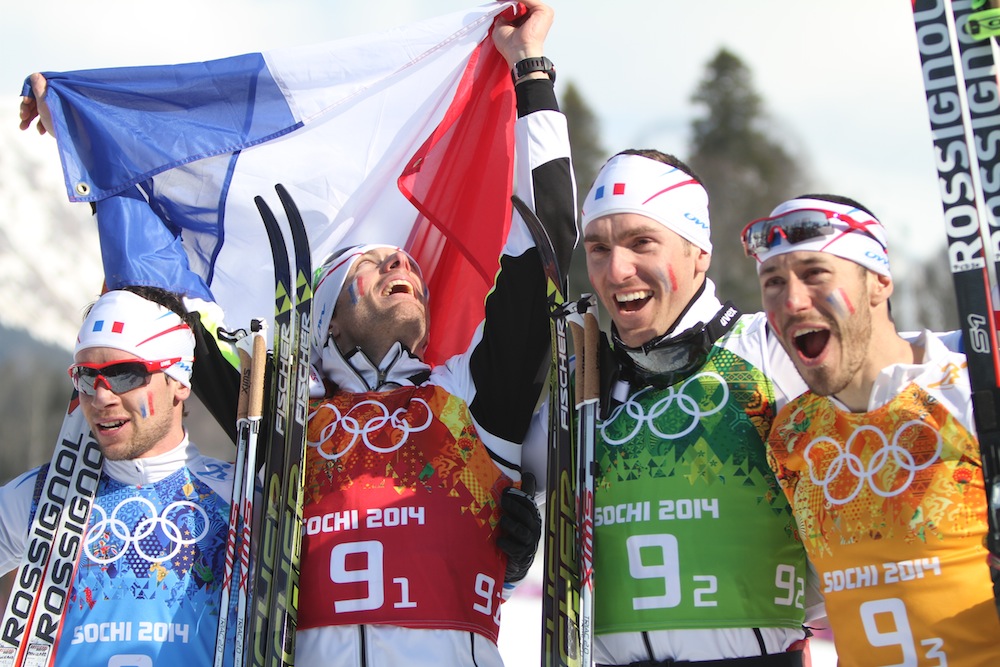
For France, it was their nation’s 100th medal in the Olympics and their second-ever medal in cross-country (following Roddy Darragon’s silver in the 2006 Olympic sprint). For Sweden, it was another gold for three of the four original teammates from 2010,
The french relay skiers celebrate their bronze medal in the men’s relay.
including Daniel Richardsson.
“It means a lot, especially in Sweden, the relays are really prestigious to win because it’s the team,” Olsson said. “We see also that our waxing team, they’re even more happy when the relay goes well. I think we should just focus on enjoying this moment … It’s a big thing to win on the most important day for the whole team.”
The victory came even after the team’s newest addition, Lars Nelson, 28, fell early in the first 3.3 k lap of the race. In 12th of 16 teams halfway through the lap at 1.7 k, Nelson was up to fourth by the time he passed through the stadium.
“Lars lost his ski, but after that, I saw him in the front of the pack and I saw that it was no problem for him,” said Richardsson, who shared the podium with Olsson two days earlier in the 15 k classic individual start. Olsson had placed second to Switzerland’s Dario Cologna, and Richardsson notched bronze.
His teammate looked comfortable and “really strong,” he recalled.
By the end of the first classic leg, Nelson tagged Richardsson in first, 0.3 seconds ahead of Finland’s Sami Jauhojärvi in second. Jean Marc Gaillard led off France in third, 9.6 seconds behind Nelson at the end of the first 10 k leg.
The top three had already gapped the field by nearly 12 seconds, as Curdin Perl led the chase for Switzerland, tagging off to Jonas Baumann in fourth. Another 3.5 seconds bad, Dietmar Nöckler put Italy in contention in fifth, Eldar Rønning tagged Norway close behind in sixth and Russia’s Dmitriy Japarov came through the exchange within a second later in eighth.
“Nelson impressed most,” Södergren told Aftonbladet, according to a translation. “It was most unexpected that he would try to [lead] in the first leg.”
Yet Nelson not only fought his way back to the front of the 16-team pack on the second lap, but he tried to string out the group in doing so.
“It was so impressive what he did,” Sweden’s Sara Lindborg said.
The tactic worked as Finland’s Iivo Niskanen remained the only one capable of sticking with Richardsson on the second lap. The two tagged off together, 17.3 seconds ahead of Lukas Bauer in third.
Russia’s Alexander Legkov entering the stadium on the third leg of the relay.
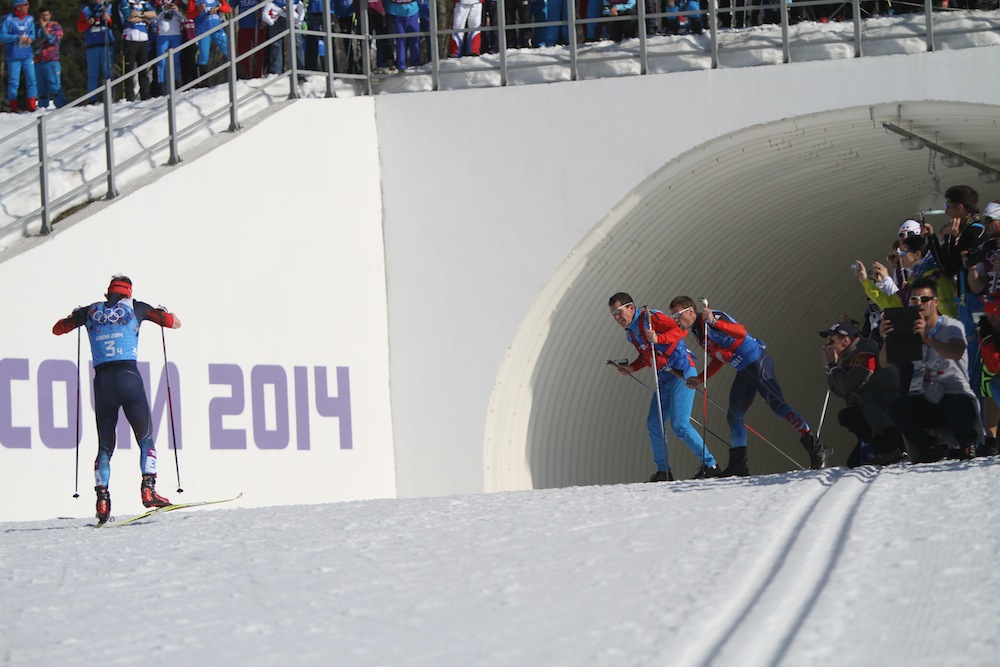
Bauer had a race of his own to get from seventh to third, picking off Italy’s Giorgio di Centa first, then Norway’s Chris Andre Jespersen. By his second lap, Bauer was up to fourth after passing Russia’s Alexander Bessmertnykh and leading him into the lap lanes. For the final time around the 3.3 k loop, the Czech focused on catching Maurice Manificat — the Frenchman who had stuck with the two leaders before falling 11 seconds off the pace by 8.3 k.
“I saw him, that he’s losing and he’s very, very tired,” Bauer said. “I was maybe 10 seconds behind him. He was my motivation to overpass him for sure. When I overpassed him it was long moment because I had no energy.”
“First I had in my mind that I’d ask him, ‘How is it going?’ Because my feeling was, this will kill him and after that I will have no problem,” he added. “But I have no chance to breath enough to ask him and after that I was focused only on last uphill.”
Manificat finished 6.3 seconds later to send his teammate, Robin Duvillard in fourth. Bessmertnykh put Russia in fifth, another 17.7 seconds back and di Centa tagged Italy in sixth, just 0.4 seconds behind Russia.
Meanwhile, the Norwegians had slipped to ninth, nearly 1:03 behind Sweden. Germany’s Axel Teichmann led Switzerland’s Baumann into the lap lanes in seventh and eighth, respectively, 55 seconds after Richardsson and 7 seconds ahead of Jespersen.
From there on out, Olsson started to put the hurt on — like he’s been known to do (see: 2013 World Championships 50 k).
Halfway through the first skate leg, the Swede skied away from Finland’s 26-year-old Lari Lehtonen over the top of the course. Seven seconds behind at 5 k, Lehtonen slipped to more than 22 seconds back at the end of the second lap — with saliva streaming out of his mouth as he ascended the last hill.
With one lap to go in the third leg, Olsson continued to widen the gap and the Finn became a victim of a hard-charging chase pack. France’s Duvillard caught him first at the top of the climb out of the stadium, then Martin Jaks of the Czech Republic. Along with Russia’s Alexander Legkov and Norway’s Martin Johnsrud Sundby, the group skied right through him.
Legkov continued to work his way up to second, ahead of Duvillard and Jaks, and came through the exchange 14.3 seconds after Olsson. Duvillard tagged another 4.3 seconds back in third, 23.5 seconds ahead of Italy in fourth.
Suddenly, Russia had become a medal contender after skiing in fifth — and leading the largest chase pack — for the better part of the
Russian team staff cheer on Maxim Vylegzhanin, the country’s anchor.
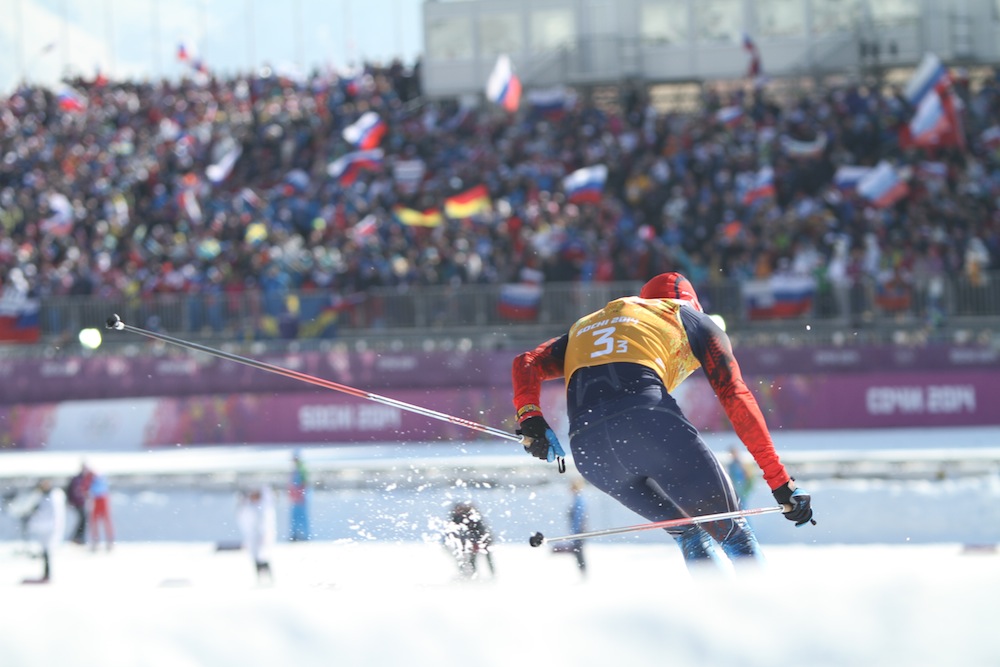
race. Legkov clocked the fastest third leg to do so, and the Russian fans started to go wild as they lined the course with flags, noisemakers, and an amplified version of “Rus-y-ya!”
Also Hellner set out less than 15 seconds ahead of Vylegzhanin, the tension began to build. Would he be able to hold the gap over the next three laps on an ever-softening course?
By the end of the first loop, the answer became pretty clear. Hellner was extending his lead over not only Russia, but France as well, with Perrillat Boiteux more than 30 seconds back in third.
Less than 2 k later, Hellner was 30 seconds ahead of Legkov and had a nearly 40-second margin with one lap to go. Meanwhile, Perrillat Boiteux struggled to hang onto bronze with Norway’s Petter Northug gaining from behind. Northug had gone from sixth to fifth with the third-fastest anchor leg.
But France held on, finishing 31.9 seconds behind Sweden and 37.8 ahead of Norway in fourth (+1:09.7).
Hellner skied up the last killer climb without anyone testing his grit, glancing back near the top then grabbing the flag from his teammate.
“I was really focused during the whole leg and I tried to not think so much about the gold,” Hellner said. “I suppose it was when I saw Anders with the flag that I was absolutely sure and I could enjoy on my way down to the stadium and enjoy the teammates that I have.”
At the finish, they all celebrated together: another gold for Sweden in one of their most successful Olympics to date.
“I tried to make some good-looking show there at the end,” Hellner told Aftonbladet, with a laugh. “I did not fall.”
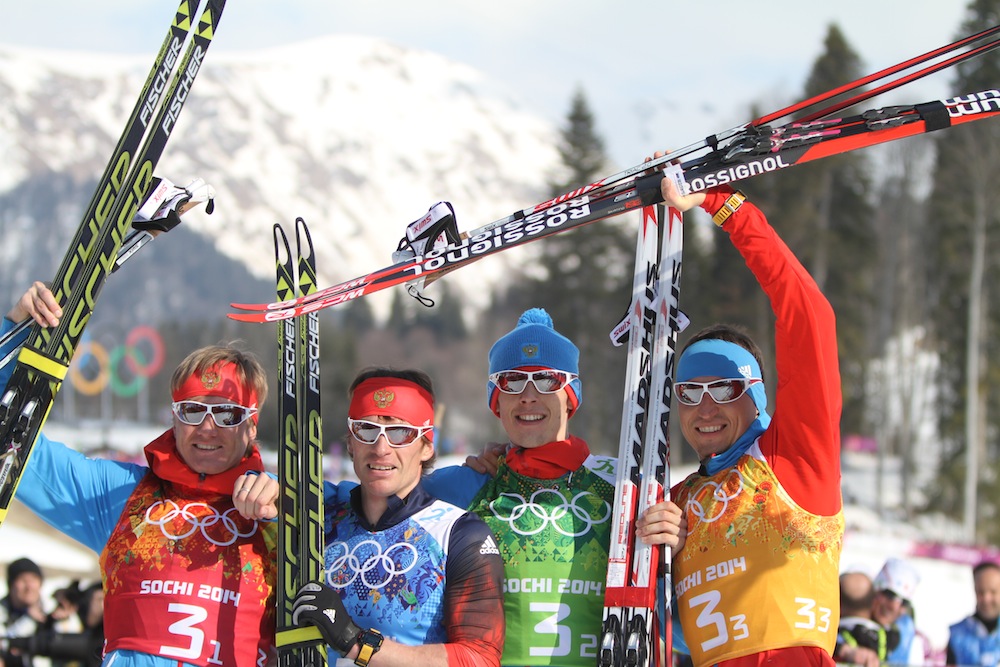
Russia captured its first medal in eight races at its own Olympics, and President Vladimir Putin was in the stands to watch it happen. Bessmertnykh said the team wasn’t aware of his presence until after the race.
“When I finished my lap, I looked at the [big] screen — I saw him close up on the screen,” he said through a translator. “We were not warned about it. Certainly we were really pleased the Russian president wanted to watch our competition so we are really grateful to him.”
The Russians celebrate their silver medal.
Legkov said the day turned out exactly as he had envisioned it — with a medal — even after breaking a pole early in his skate leg.
“I was really anxious after that,” Legkov said through a translator. “That’s why my responsibilities grew even harder.”
Vylegzhanin had initially tried to catch Hellner on the first lap, but once he was halfway though the second loop, he reevaluated.
“After that it was a tactical struggle,” Vylegzhanin said through a translator. “I started fighting for second place.”
France was all smiles after the race with its first-ever relay medal. Gaillard said it was especially meaningful after so much speculation and pressure from the media to win medals, and with most of its hopes pinned on biathlon and nordic combined.
“There wasn’t much talk about the cross-country team,” he said. “We are all friends … and for us, for the French sport, this is a great day for skiing.”
“I’ve never cried from joy before,” Manificat tweeted on Sunday night, according to a translation. “This relay medal is the best thing our team has ever done!”
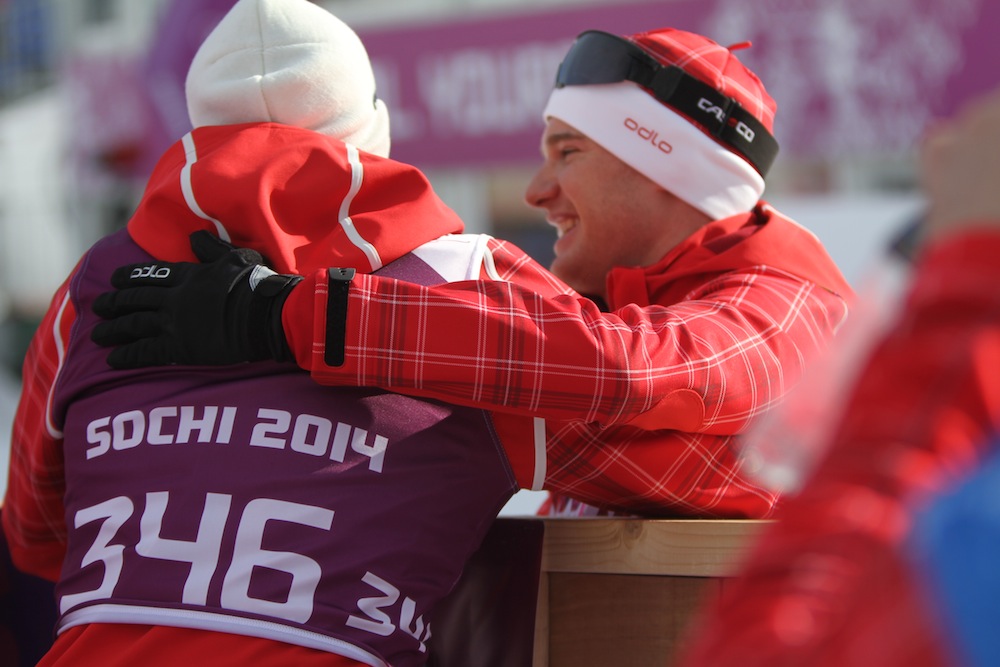
Dario Cologna hugs a member of his team, after the Swiss skier won Friday’s 15 k classic individual start at the 2014 Winter Olympics in Sochi, Russia.
FasterSkier’s coverage is made possible through the generous support of Rudy Project.
SOCHI, Russia — Leading into the Olympics here, Swiss cross-country skier Dario Cologna had raced just twice at an international level this season, an ankle injury putting off his start to the season until mid-January. He’s still walking with a slight limp.
Sweden’s Johan Olsson was doing only a little better. He has been plagued by a rib injury and illness, and has entered just three international events this year, all in December. Until Friday, he hadn’t raced in two months.
And while Olsson’s teammate Daniel Richardsson had been racing all season, he’d been at far from his best form, after tearing a ligament in his knee over the summer in a car accident that killed one of his friends.
Nonetheless, in Friday’s 15-kilometer classic race, all three managed to beat out the 84 other competitors, most of whom had had the whole season to prepare at full strength.
Cologna demolished the field, finishing in 38-and-a-half minutes to win his second gold of the games, and the third of his career. Olsson was 30 seconds behind, and Richardsson another 10 seconds back to round out a patched-up podium.
“It was not easy, but we made the best of the situation,” Cologna said, referring to the performances of the top three. “It’s quite special.”
Sweden’s Johan Olsson racing to second place in the 15 k at the Olympics in Sochi.
How did these three convalescent competitors ski away from the rest? The explanation wasn’t immediately clear, but several factors appeared to be involved.
Among them were the conditions. After several consecutive days of temperatures far above freezing, the men were again skiing on a soft, sloppy mess of a course on an uncomfortably warm day—so warm, in fact, that Norway’s Chris Jespersen raced in tights that had been cut off at the thigh.
Patrik Noak, the Swiss team’s doctor, thought that the heat favored Cologna, since the mushy track didn’t provide a firm surface that his competitors could better kick from, with their ankles at full strength.
“These weather conditions, for him, are perfect. Because the snow is really deep, and you have to be really strong in the upper body,” Noak said.
There was also the lack of expectations—Cologna has already won a gold medal at the Olympics here, and hopes were not especially high for the two Swedes in Sochi, given their starts to the season.
“That’s just an advantage for them—they had no pressure beforehand, and they can do what they were planning to do,” Fredrik Aukland, Cologna’s coach, said in an interview.
They didn’t have to worry about being in shape for races earlier in the season, either, Aukland added, which allowed them to aim solely at the games.
“They had to have focus only on the Olympics,” he said.
Sweden’s Daniel Richardsson skiing to a bronze medal in Friday’s 15 k classic at the Olympics in Sochi
That was not the case for their competitors like Norway’s Martin Johnsrud Sundby, the World Cup leader and Tour de Ski winner, who was supposed to contend for a medal on Friday.
Instead, he finished more than a minute and a half behind, telling Norwegian broadcaster NRK that he was “fucking disappointed.”
“The body does not work,” he said. “I’m not even close to being close.”
Olsson had the advantage of skiing some of the race with Cologna, who caught him “like a rocket,” Olsson told Aftonbladet, a Swedish newspaper.
“If you stay behind him, you can win a medal,” Olsson said he told himself.
That turned out to be true. Cologna had opened the individual-start race at a slower pace, knowing that the warm temperatures, and
a course that climbed more than 1,500 vertical feet, would require him to save some energy for the last five-kilometer lap.
He was even with Olsson and a Russian skier through five kilometers, and actually trailed the Finnish skier who ultimately placed fourth.
But just over halfway through the race, Cologna had taken the lead, and then with Olsson in tow, he roared to the finish.
So did Richardsson, who was in sitting in fourth place with just half a kilometer to go, but got some information that helped him claw back a couple of seconds over that distance from Iivo Niskanen, the Finnish skier, who was ultimately displaced from the podium by a fraction of a second.
“I heard that Iivo was really tired at the end, and that was the thing that improved my power,” Richardsson said. “I did everything on the last uphill and into the finish, and I managed 0.2 seconds, and I’m really happy.”
The race was also a triumph for Cologna, who had to have surgery in November to repair a torn ligament.
Dario Cologna racing to his second gold of the 2014 Olympics in Friday’s 15 k classic individual start.
The surgeon, Noak said, was a foot specialist who’s also an avid participant in the sport of orienteering; the procedure was a new method called a tightrope—a band that held together Cologna’s tibia and fibula, Noak said.
During his recovery, Cologna trained by double-poling from a chair affixed to a pair of skis, and kept his legs active on a special treadmill that allowed him to run while only bearing 20 percent of his weight.
Nonetheless, Noak said: “We were a little bit afraid that the time was really a little bit too short.”
Now, Cologna said during the post-race press conference, “I am here with two medals, and it’s unbelievable.”
It’s unclear whether Cologna will race in the men’s relay on Sunday, but he said he’ll definitely compete in the team sprint later in the Games, with his brother Gianluca.
“That will be something that’s very special,” Cologna said.
Then, there’s the last event—the 50-kilometer skate race, which Aukland, Cologna’s coach, said was a big goal.
“That’s been a long time, his dream: to win the 50 k,” Aukland said.
Asked whether Cologna might inflict another injury on himself before the next set of championships, given the results this time around, Aukland paused, then answered.
Switzerland’s Dario Cologna looks over at Sweden’s Marcus Hellner (not shown) before capturing his second Olympic gold in his first race of the 2014 Olympics — the 30 k skiathlon — on Sunday in Sochi, Russia. Hellner placed second while Norway’s Martin Johnsrud Sundby (l) and Russia’s Maxim Vylegzhanin (7) sprinted for third. Sundby won it but received a written warning for obstruction.
FasterSkier’s coverage is made possible through the generous support of Rudy Project.
SOCHI, Russia — In the wrong place at the wrong time three months ago when he slipped on ice while running with his coach, Guri Hetland, Switzerland’s Dario Cologna made sure he was in position to do something stellar on Sunday.
The possibility of whether Cologna, who tore three ligaments in his ankle in mid-November, could win his second Olympic gold at these Winter Games was never a question. He had already proven himself in his first World Cup race this season a week ago, where he nearly won the 15-kilometer classic individual start in Toblach, Italy — finishing second behind Russia’s Alexander Legkov by 2.9 seconds.
Cologna, 27, had done a total of five races this winter before that. On Sunday in the 30 k skiathlon, the first men’s race of the 2014 Olympics, Cologna had to tape his foot — and he was visibly limping at the venue — off his skis.
“The foot isn’t still 100 percent, but when I’m racing and with the tape it’s okay,” Cologna said in a post-race press conference. “Maybe when I’m sprinting, I still feel a little bit. … I’m in very good shape besides my foot.”
On the course, he was right in the mix throughout the seven-lap race, with four 3.75-k classic loops and three 5-k skate loops. Closer to the front of the pack for the first 7.5 k with guys like Norway’s Martin Johnsrud Sundby, Sweden’s defending Olympic skiathlon champion Marcus Hellner, Kazakstan’s Alexey Poltoranin, and Germany’s Hannes Dotzler, Cologna generally hung in the middle of the lead group, which started to break up by the transition.
Changing to his skate skis, Cologna came through the halfway point in 13th, 5.7 seconds after Sundby up front. Sundby took charge for most of the race, setting the pace and taking turns leading with Poltoranin, Dotzler, Hellner, Sweden’s Daniel Richardsson, and Austria’s Johannes Duerr. Another Swiss skier, Curdin Perl led early in the first lap, falling off the pace by about 30 seconds by the 15 k changeover.
With the fourth-fastest transition time, Richardsson was first out of the pits, and toward the end of the first skate loop, the top 12 had slowed with Hellner up front, followed by France’s Jean Marc Gaillard and Sweden’s Lars Nelson.
The lead group more or less stayed the same for the second-to-last lap, with Duerr leading into the last major climb before the stadium. With less than 5 k remaining, Richardsson went first down the screaming-fast descent before the long grind back up, followed by Duerr, Russia’s Maxim Vylegzhanin, Hellner, and Russia’s Alexander Legkov, respectively.
Minutes later, Sundby led them back toward the stadium and Hellner and Cologna got in position behind him. Heading into a slight rise before the final grueling climb, Cologna accelerated to second, ahead of Hellner, and Vylegzhanin led the chase to catch the lead three.
Making his way to first before the last leg-burner, Cologna put about eight meters into Hellner up the hill as Hellner chased him over the top. Sundby, Richardsson, and Vylegzhanin followed respectively down the curving descent toward the finishing straight — but by the time Cologna got there, the race was essentially his.
Cologna slightly glanced over his shoulder before crossing the line, just enough to see that he had secured gold in 1:08:15.4, four-tenths of a second ahead of Hellner in second.
Meanwhile, Sundby on the right and Vylegzhanin several meters to his left battled for third, with Sundby fading over into Vylegzhanin’s space just before the line. A second behind Hellner, Sundby edged Vylegzhanin by 0.1 seconds, causing some commotion and a jury meeting to determine whether Sundby obstructed him at the finish. He was given a written warning and kept his bronze.
The 2014 Olympic men’s skiathlon champion, Dario Cologna of Switzerland absorbs the fruits of his efforts and three months of recovering from an ankle injury that kept him from competing for the first half of the season.
After collapsing at the finish, Cologna rolled onto his back and sprawled out to catch his breath, then absorb the reality of what he had just done. In his first Olympic skiathlon at his second Olympics, he had won his second Olympic gold in the middle of a season he nearly had to write off to injury.
He never did — and that’s why he won.
“I did a lot to be ready here; it was not an easy season,” Cologna said in a post-race press conference. “I was very well prepared before the season, maybe the best shape ever. It was hard after this injury to lie in my bed and start training in the water and cycling and this boring stuff, but I did everything to be ready today and it was a very big day and very emotional for me to come back and win a gold medal. It’s my biggest thing I have won so far.”
Cologna cried at the finish, bringing his hands to his face while on the ground, then standing up with arms spread wide to embrace the moment and Olympic crowd. His coach cried, too.
“I did my utmost, I did my best,” Cologna said. “My coach told me to be prepared and of course the last several weeks were not as simple. It was not as easy to practice and train. I wasn’t sure if I would be able to start this race. I was really struggling, therefore I do believe I am just overfilled with emotions right now.”
Beyond tired at the finish, he said he struggled to stay on his feet, but focused on pressing forward. It would’ve been difficult for anyone to pass him at that point, and Cologna knew that; it was part of his strategy and final attack.
“I did everything so that nobody would overtake me at the finish line,” he said.
Hellner, who gave Sweden its second-straight silver of the Games after Charlotte Kalla placed second in the women’s skiathlon on Saturday, told Aftonbladet that he was also primed to attack on the last lap — he just wasn’t sure where.
“I waited until the last hill and did what I could there,” Hellner said, according to a translation. “But Dario was stronger and I was completely out of the legs at the top. … When I got to the last corner, I realized that I could do the medal, it was cruelly beautiful, it’s amazing.”
Perl, who placed 27th, 2:07 behind Cologna, said he was sure his teammate would medal in Sunday’s race.
“In yesterday’s interval, he was crazy,” Perl said.
Cologna’s gold medal was a gold for Switzerland, and his impact on the team far-reaching.
“I think that what Dario has done, he pushed cross-country so much in Switzerland,” Perl said. “It’s a bit easier to find good sponsors, and it’s also now big in the media. It’s getting cooler and cooler to be a cross-country skier in Switzerland.”
At the press conference, Sundby said he was most concerned about obstructing Vylegzhanin.
“I was so tired the last hundred meters, I didn’t even see the corridors; I had really big problems staying on my skis,” he said. “I would never ever do anything to obstruct any other skiers. I lost my balance the last 10 meters and as a result I probably changed lanes. I saw the pictures. I don’t think I obstructed or touched the skis of Maxim so hopefully he doesn’t feel like I destroyed his finish. For sure, from me it was not the purpose.”
Sundby, who was slightly in front of Vylegzhanin when he started to falter, got to keep his bronze.
“He did not feel that he was obstructed and he didn’t notice when he came to the finish line,” Sundby said. “I would feel really bad if he thought I was obstructing him from the bronze medal. I am sad that this happened. I’m really upset about it, and I never hoped for this kind of event.”
After Vylegzhanin in fourth, another Russian Ilia Chernousov placed fifth, 13.6 seconds behind Cologna. Gaillard was sixth (+14.4), Richardsson seventh (+16.3), Duerr eighth (+16.6), France’s Maurice Manificat ninth (+18.2) and the 28-year-old Nelson 10th (+22.3) in his first Olympics.
Daniel Richardsson (SWE), right, competing in the relay at 2013 World Championships.
Daniel Richardsson, Olympic gold medalist for Sweden in the 2010 4×10 k relay, was injured in a car crash in central Sweden on Sunday and taken by ambulance to Hudiksvall Hospital. According to Swedish daily Aftenbladet, Richardsson had stopped to help a friend change a flat tire on the side of a highway when a motor home approached the two men at high speed and, unable to avoid collision, ran into both of them, killing the friend and damaging a ligament Richardsson’s knee.
In a press release from the Swedish Ski Association, team doctor Per Andersson said the extent of Richardsson’s injury was not serious.
“The physical status is that Daniel sustained ligament damage in the knee where the forecast for the future function is not of a serious nature,” said Andersson, who has been in contact with Richardsson’s doctors at the hospital. “We need to do further studies to address in detail whether to continue treatment prognosis.”
According to Aftenbladet, Richardsson and his family were on their way to Iggesund, a town on the east coast of central Sweden. Richardsson was reportedly close friends with the deceased.
“Daniel is very depressed,” said Jan Eric Rickardsson, Daniel’s father, who was present for the accident. “He has lost a close friend. It is awful.”
National team coach Richard Griffin commented, “The most important thing now is that Daniel is healthy. Right now sport a secondary importance. I would once again appeal for calm surrounding Daniel and his family.”
Swedish Ski Association CEO Johan length Sares added his condolences, saying, “We think of Daniel and his family and will support them as much as possible in the sad situation they are in.”
Richardsson’s teammates also expressed their support of the World Cup skier. “It is incredibly unfortunate and all thoughts go first and foremost to the whole family,” said Emil Jönsson to Aftenbladet. “An incredible tragedy that no one really wants to believe is true.
“Daniel is an important person in the team, both as a friend and [as] skiers. Now I hope he gets peace and quiet to recover from it all. I hope he knows that we all give our full support on his way back.”
Eldar Rønning (r) edges Russian Maxim Vylegzhanin (c) and fellow Norwegian Martin Johnsrud Sundby (l) in Saturday’s 15 k classic mass start at 2013 World Cup Finals in Falun, Sweden. (Photo: Fischer/Nordic Focus; facebook.com/FIS Cross Country)
The typical plot line never materialized.
Norway’s Petter Northug was supposed to spend the first several laps on Falun’s controversial track back in 25th and then surge to the front for the victory in the final 100 meters at World Cup Finals in Sweden.
Instead, Northug’s teammate Eldar Rønning salvaged a tough season with a surprise 15-kilometer classic mass start victory, posting a time of 43:26 minutes on the 2015 World Championships course.
Rønning, a classic specialist, made use of his late-season form, narrowly outsprinting Russia’s Maxim Vylegzhanin in the finishing straight with Norwegian Martin Johnsrud Sundby just behind in third.
Saturday’s competition had three separate stories at work. First was the fight for the overall World Cup between Northug, Russia’s Alexander Legkov, and Switzerland’s Dario Cologna. Second was the standing in the Falun mini tour, made more dramatic by the bonus seconds offered at the 5.6 k and 12.2 k marks. Third was the contest for the race honors itself.
Northug began the mass start with two victories in a row and appeared to be in indomitable late-season form.
Legkov and Cologna are off their best, but even after Northug’s two successive victories, Legkov and Cologna only trailed the Norwegian by 56 and 69 points, respectively.
It was up to Legkov and Cologna to deliver a strong result and stop Northug’s momentum.
Northug was up to his usual antics in the first few laps of Falun’s unforgiving course, lazing to the back of the field while others took up the pace.
It opened the door for someone like Legkov to up the pace. However, Legkov appeared to be missing a gear, as Northug observed.
“It looked like Legkov had spent a night out on the town,” Northug told told NRK. “He looked tired.”
Cologna initially looked dangerous.
He gamely came to the fore at the first intermediate sprint for bonus seconds at 5.6 k, narrowly denied the full 15 seconds by Sundby. Cologna stayed at the front, and appeared to have recovered after a recent period of illness.
But Cologna’s pace wasn’t enough to break the field. With Northug and Legkov jostling at the back in their own private battle, others were left to shape the race. Initially Finland’s Matti Heikkinen took up the donkey work at the front, but his moment was short-lived and he quickly disappeared back into the pack.
The decisive pace change came from the unlikely figure of Emil Jonssen, the overall World Cup sprint champion.
Many would bet on Jonssen dying quickly, but as the kilometers ticked by, it appeared the sprinter had could go the distance as well.
At the 8-kilometer mark he made a move, with Northug lagging at the back of the field. By Northug’s account, this was the pivotal move of the race, and unlooked as it was initiated by the Swede.
“The Swede brought up the speed and that’s what dropped Legkov and Cologna,” Northug told NRK. “I hadn’t expected help, so I must thank them for that.”
Northug, ever an antagonist, was asked by a Swedish journalist whether he would repay the Swedish the favor.
“No,” he deadpanned.
In any event, Jonssen’s attack injected speed into the race. His aggression was more than a hubristic charge for a moments glory, and he took 10 bonus seconds at the 12.2 k mark, beaten again by a hungry Sundby. Jonsson looked like he was in contention for a breakthrough distance result.
Northug had finally moved toward the front and crossed the intermediate sprint line in sixth place, seven seconds behind the winner.
Legkov held on to the frantic pace at the front, crossing the 12.2 k mark in 10th place. Cologna was starting to break, dropping down to 12th, 12.2 seconds off the pace.
After the final intermediate sprint, Jonssen faded. Sweden’s Daniel Richardsson, Sundby, Vylegzhanin, and Rønning all revved their formidable distance motors and charged, Northug clinging to the group. Legkov and Cologna were dropped.
As the leaders began the final 3.3 k loop, the race was on, led by the giant, searching stride of Richardsson.
Coming into the last hill, Sundby found another gear and led Rønning and Vylegzhanin into the infamous downhill, as Richardsson and Northug lost a few meters. Sundby was tearing the field apart.
“I had a F***ing good day,” confirmed Sundby to adressa.no.
Lurking just behind was the unheralded Rønning.
As the frontrunners crested the big uphill and plunged down the final chicane Northug passed an ailing Richardsson and appeared to be within striking distance of Rønning, Sundby, and Vylegzhanin.
As the camera angle panned to an aerial view of the race, however, it became evident that Northug left himself too much to do.
“I was busy trying to stay focused on what happened behind rather than chase victory,” Northugsaid.
Meanwhile, Rønning kept his feet on Falun’s tricky downhill, jumped into his slipstream, and slingshotted past the Russian in an impressive display of double poling. Sundby coasted in for third place, his double poling power failing him in the end.
“I killed myself to get out that little extra, and I had good skis,” Rønning said. “In addition I’ve been working hard on my finish.”
The victory came as a relief for Rønning.
Petter Northug after an exhausting fourth-place finish in Saturday’s 15 k classic mass start at 2013 World Cup Finals in Falun, Sweden. (Photo: Fischer/Nordic Focus; facebook.com/FIS Cross Country)
“It was great fun to win today. I have been struggling this season a bit and the victory here today means a lot for me,” Rønning said. “Now I can go into my Easter holiday with a good conscience.”
Sundby concurred. “It’s great that Rønning took the win,” he said. “It’s been a tough season for him.”
Northug never contested the victory, but his fourth-place finish was enough to solidify his lead in the mini tour and the overall title race.
Contenders for the overall World Cup title, Cologna and Legkov didn’t deliver the result needed to unsettle Northug. Cologna finished 12th, and Legkov was 15th, respectively 17.9 and 25.6 seconds behind Rønning.
Northug will go into the final day of the mini tour, a 15 k freestyle pursuit race, with a 30.5-second head start on Vylegzhanin. Rønning will start 40.2 seconds behind Northug in third. Northug had a 1:47 lead on Legkov as his closest title-rival.
In the overall World Cup, Northug leads Legkov by 80 points, and Cologna by 87. For Legkov to win the overall title he would have to win Sunday, and Northug would have to finish lower than third.
It would take a spectacular meltdown on the Norwegian’s part to relinquish his advantage.
So does Northug think he’s secured his second overall World Cup title?
“Normally I’d think it was over,” Northug said. “But it’s about being focused and trying to a have another good race in the morning. I’m going to focus on resting until then.”
Petter Northug (l) checks back before celebrating Norway’s victory in the 4×10 k relay at 2013 World Championships on Friday in Val di Fiemme, Italy. Calle Halfvarsson (second from l) anchored Sweden to silver, Russia’s Sergey Ustiugov (second from r) was third, 0.2 seconds ahead of Italy’s David Hofer.
FasterSkier’s coverage of the 2013 FIS Nordic World Ski Championships in Val di Fiemme, Italy, is brought to you by the generous support of Fischer Sports.
VAL DI FIEMME, Italy – After so much buildup, so many strategic moves throughout the men’s 4 x 10-kilometer relay at the 2013 Nordic World Ski Championships on Friday, everything almost literally came to a grinding halt in the fourth and final leg.
The worker bees hard done their jobs for the first 30 kilometers of the race, making the last 10 into something like a Sunday stroll on a 10-degree Celsius (50-degree Fahrenheit) afternoon.
As expected, Petter Northug was among those controlling the pace early in the anchor leg. Norway’s relay closer for the last four World Championships, he wasn’t about to use his reserves too early. The frontrunners of the six-man group, Italian David Hofer and Russia’s Sergey Ustiugov weren’t keen on going hard, either.
Just to show how slow they were going, Northug started single sticking, basically walking up the second climb.
“It went slower than when you take your mother on Easter,” he later told NRK, according to a translation. “There were a lot of tactics, and I get what I want.”
As the pack approached the high point of the 3.3 k course, all six men stood up. Hofer did so first to let German Axel Teichmann and Ustiugov pass by, and Switzerland’s Remo Fischer, Sweden’s Calle Halfvarsson and Northug casually tucked behind him. Several thousand spectators watching the antics on the stadium big screens booed with dissatisfaction. Come on guys, this is a race.
Petter Northug prematurely shrugs off Norway’s seventh-straight men’s relay title at World Championships on Friday in Val di Fiemme, Italy. He beat Sweden’s Calle Halfvarsson (second from l), Russia’s Sergey Ustiugov (third) and David Hofer of Italy in fourth for his second gold of the week. (Photo: Fiemme2013)
But in a World Championship relay, that’s how it often goes.
“You need to race a little bit tactical, come from behind, save power for the last round because then you know it will be attacks,” Northug explained.
He quietly hovered near the back within a second or two of the lead until he decided it was time to go. Everyone knew some kind of surge would come, they just didn’t know when.
While the front guys played mind games, American Tad Elliott made up 59 seconds after starting in ninth. He caught the group on the second lap and led Northug up the second climb.
By the next hill, however, Elliott’s effort caught up with him and the 25-year-old Colorado native started to slip behind. Meanwhile, Finland’s Matti Heikkinen continued to make up ground on the leaders after starting nearly a minute and a half back in 11th. Heikkinen reached the group on the third lap and surged to the front early, but failed to hold on halfway through. He fell to the back of the group in seventh while Northug took the lead. Hofer and Ustiugov skied behind him, followed by Halfvarsson, Fischer and Teichmann.
With about 1 ½ k remaining, Northug led the downhill into a relatively boring part of the course. Before then, nothing really happened on the straightaway before the second-last descent. Northug caught his competitors off guard and attacked on the flat, where Halfvarsson in second responded quickest.
In his first World Championships, the 23-year-old Swedish anchor knew this was his moment and managed to get ahead of Northug on the fast downhill, taking the inside corner on the sharp bottom curve.
While Halfvarsson and Northug battled back up to the top, Ustiugov and Hofer put their heads down trying to hang on. The Swede led the final downhill, looking back to see how close Northug was. Really close.
The two sped over the last bump before the stadium and began the much-anticipated sprint showdown. Northug free skated alongside Halfvarsson to take the lead and just before finish, he let everyone know who the winner was. With Halfvarsson a few meters behind, Northug put his hands out and shrugged. No big deal.
Now a nine-time world champion, Northug claimed the seventh-consecutive world champs relay victory for Norway, in which he and Tord Asle Gjerdalen, Eldar Rønning and Sjur Røthe combined for a winning time of 1:41.37.2.
Sweden (Daniel Richardsson, Johan Olsson, Marcus Hellner and Halfvarsson) came up 1.2 seconds short for its sixth silver medal of the week. Russia (Evgeniy Belov, Maxim Vylegzhanin, Alexander Legkov and Ustiugov) edged Italy (Dietmar Nöckler, Giorgio Di Centa, Roland Clara and Hofer) by 0.2 seconds for third, 2.4 seconds behind Norway.
Eldar Rønning hoists teammate Petter Northug after the Norwegian anchor sealed the team’s seventh straight World Championships relay victory on Friday in Val di Fiemme, Italy. Tord Asle Gjerdalen (l) and Sjur Røthe (r) join the party.
“Two hundred and fifty meters before the line I knew it was gold,” Northug told reporters. “So that feels amazing.”
“It’s awful fun to win the relay, and a dream to fight against Sweden at the end,” he told NRK. “I know what that rests on my shoulders. It is almost a scandal to be number two.”
His teammates set him up according to plan. Their scramble leg, Gjerdalen again filled in for Martin Johnsrud Sundby, who’s been out sick since Wednesday’s 15 k (Gjerdalen started in his place and earned bronze). Easily recognized as Norway’s Aviator-wearing guy, Gjerdalen wore his trademark sunglasses while putting the team in second at the first exchange, just 0.3 seconds behind Germany’s Hannes Dotzler.
(The Germans ended up seventh behind Finland in fifth and Switzerland after Teichmann crashed twice on the last lap. “Throughout my career, I’ve never had so much bad luck,” the 33-year-old Teichmann told Südkurier.)
On the second classic leg, Rønning kept the Norwegians close and tagged to Røthe in fifth, 3.4 seconds behind Switzerland’s Dario Cologna, who skied a commanding second leg. Italy, Russia and Germany were also in the mix, along with Sweden’s Olsson, who tagged to Hellner four seconds back in sixth.
“It was tough,” Olsson told reporters. “In my case, maybe the glide wasn’t 100 percent today compared to some of the other competitors on my leg. It’s tough on the mind, too, when you don’t have the maximum skis under your feet.”
After taking his second-straight silver to Northug, who won Wednesday’s 15 k individual skate, Olsson told NRK: “He loses maybe one in a hundred sprints. It’s amazing how he does it again and again. No matter how the race is, he always wins.”
Norway’s Torde Asle Gjerdalen (r) puts the team in contention early on the first of four 10-kilometer legs in Friday’s relay at 2013 World Championships in Val di Fiemme, Italy. Norway won by 1.2 seconds over Sweden.
On the third leg, Legkov lifted Russia to first by the last exchange, 0.6 seconds ahead of Hellner. Røthe came through after the Swede in third, 2 seconds behind Legkov.
“The idea was that Petter should never have been in the lead on the last stage,” Hellner told NRK.
While he didn’t lead from the start, he was close enough to capture it.
“I did everything I could, but I had nothing to answer. I had no strength left,” Halfvarsson told NRK.
“I tried to get a few meters up in the last uphill, but he is too strong,” he explained to reporters. “I had no chance. I’m happy with the silver because this is my first medal, but when it’s so close to gold, it’s not so fun.”
Northug suggested Sweden should’ve chosen someone else and said his team was surprised to see Halfvarsson listed as its anchor.
“But we say thank you,” Northug told SVT. “All glory to him, he beat several strong sprinters, but he still has a ways to go.”
For Røthe, who also started his first World Championships relay, the gold was everything he’d hoped for.
“It’s great to be world champion,” he told NRK. “It was a fun duel with Sweden.”
“A big job for the whole team, but the last guys, they’re just walking, slow, slow, slow and doing a massive sprint,” Gjerdalen told reporters. “That’s entertainment, that’s excitement and a lot of adrenaline. The whole stadium was just quiet. It’s cool!”
At the finish, the King of Sweden, Carl XVI Gustaf, congratulated Northug.
“Nice that you stopped by,” Northug reportedly said.
“We did not talk so much,” he explained to NRK. “He said it was a close fight, and seemed very pleased that Sweden had taken the silver.”
Liz Stephen (l) with Justyna Kowalczyk (POL) and Russia’s Yulia Tchekaleva (r) on the podium on Sunday in Muonio, Finland. Kowalczyk won the FIS 10 k skate race by 4.46 seconds over Stephen. (Holly Brooks courtesy photo)
After months of training and anticipation, the nordic sports opened their seasons around the world this weekend with races around the world. Established veterans had several dominating performances, but there were new faces on the podiums as well, signaling that when World Cup racing starts next weekend, things could be pretty interesting.
In Bruksvallarna, Sweden, the Swedish, Canadian, and Slovenian national teams butted heads in a three-day race series. One of the biggest surprises was Swedish 23-year-old Emma Wiken taking a 2.4-second win over Charlotte Kalla on the first day of racing. But otherwise, Sweden’s top stars prevailed, with Daniel Richardsson, Johan Olsson, Teodor Peterson, and Ida Ingemarsdotter taking wins and Kalla returning to completely decimate the women’s field in the 10 k skate. Canada had strong performances as well, with Alex Harvey placing fourth in the 10 k classic, Ivan Babikov third in the 15 k skate, and Chandra Crawford second in the skate sprint. Katja Visnar of Slovenia also stepped on the podium in the sprint.
To the northeast in Muonio, Finland, even more national teams tried out their racing legs. Finland was joined by Russia, the United States, the Czech Republic, Poland, Kazakhstan, Japan, and Germany in a three-race series. Justyna Kowalczyk of Poland swept the women’s competitions, and was at her most dominant in a 29-second win in Saturday’s 5 k classic. For the men, Alexey Poltoranin of Kazakhstan took two victories before Matti Heikkinen of Finland bested the field in the 15 k skate. The U.S. had several top performances, headlined by Liz Stephen‘s second-place finish in the 10 k skate, just 4.6 seconds down on Kowalczyk; Holly Brooks and Jessie Diggins also made the top ten. But Kris Freeman also placed fourth in the men’s classic race, and Andy Newell and Ida Sargent both made the sprint finals.
Meanwhile, Beitostolen, Norway, was hosting the opening races for both skiers and biathletes. The women’s races were characterized by familiar Norwegian faces on top of the podium: Maiken Caspersen Falla in the sprint, Therese Johaug in the two distance races, and Tora Berger dominating the biathlon competitions. Perhaps the biggest surprise was Marit Bjørgen‘s two losses to Johaug, including a 50-second blowout in the classic race. Petter Northug won on Friday before falling in the sprint final, leaving Anders Glørsen to take the win, while Chris Andre Jespersen skied to a huge victory on Sunday. World Champion Martin Fourcade of France won Saturday’s biathlon sprint, before sitting out Sunday’s mass start and leaving the victory to Erlen Bjøntegaard.
Finally, the U.S. race season began in Fairbanks with the Tour de Ski Fairbanks, a three-day series culminating in pursuit races on Sunday. Designed to be a meet for University of Alaska Anchorage and University of Alaska Fairbanks skiers, the weekend consisted of prologues on Friday, classic mass starts on Saturday, which included sprint preems, and then skate pursuits on Sunday. Logan Hanneman and Raphaela Sieber, both from UAF, picked up the overall titles, although Viktor Braenmaark and Marine Dusser (UAA) had the fastest ski times on Sunday and Rebecca Konieczny (UAF) won the women’s prologue.
Ivan Babikov (CAN) racing to third in the 15 k skate in Bruksvallarna, Sweden on Saturday. Photo courtesy of Babikov/Salomon.
Devon Kershaw had a good start in Bruksvallarna, Sweden today. So did Daniel Richardsson. But in the end, for both the Swedes and the Canadians, it was steady pacing that garnered skiers a top finish: Johan Olsson bested Richardsson for the win, and Ivan Babikov placed third for Canada while Kershaw faded to tenth.
At 4.6 k into the 15 k, interval-start skate race, the second competition in the opening series of FIS races, Richardsson had an 11-second lead over Kershaw, with Olsson another two seconds back. Babikov was tenth, 21 seconds out of the lead.
And yet Olsson, if anything, picked up the pace and was unstoppable over the last half of the race.
“I did my own race, and it felt good,” Olsson told Sweden’s TV4. “It was nice to go first in the seeded field. I’ve been away a lot and haven’t had so many training races, so I haven’t had any direct comparison to the others yet. It was nice that it went well today.”
Richardsson, who won Friday’s 10 k classic race, also seemed happy with the result; traditionally he has been stronger in the classic technique.
For Babikov, the slow start and strong finish were all part of his plan.
“I tried new tactics today,” he told FasterSkier in a phone interview. “The goal was to start really conservative for the first lap, and not thrash it, just to ski and glide. I tried to save as much power and energy as I could for the last few laps. And it worked really well I think… I didn’t know it was going to be that hard. The snow is pretty fast, so I thought it would be a fast 15 k, but it ended up that lots of people got tired on the last laps and maybe started too fast.”
Kershaw was one of those – “I licked chode”, he tweeted after the race – and told FasterSkier that the large workload he’s had in training for the last few weeks was clearly still affecting his ability to go hard. He was impressed with Babikov’s control.
“I want to say how psyched I am for Babs though- he was great today,” Kershaw wrote at the end of an e-mail to FasterSkier describing his race. “Paced it perfectly and was really, really moving that last lap. I’m impressed. He’s been notorious for slow starts to seasons, too, and to have a race like that so early in the year, on a course that was pretty rolling (read: not epically difficult which is Babs terrain!) is a very, very good sign. It was awesome to see.”
Babikov said that as far as the tactics test went, he was likely to use the same approach to next weekend’s 15 k skate in Gällivare, the first World Cup of the season. He was optimistic about his chances there, and not concerned about the time back from Olsson.
“Of course I’m happy with the race in total, because I’m on the podium and those two guys – Johan Olsson is potentially the winner for next weekend, too,” Babikov said. “He won last year’s opener in Sjusjøn in Norway, and he’s always been strong. And Richardsson is a really good skier, too. And I beat quite a few good guys too, Hellner was back there somewhere, so I’m really happy with my race, for sure.”
Babikov had a few other advantages, as well. He was the very last starter in the field, which he said played in his favor on a crowded course; for the first two laps, he was constantly passing large groups of skiers, and some parts of the course were quite narrow. There was even a tunnel narrow enough that racers could only double-pole, “so if you’re stuck behind somebody you have to wait until it opens at the end,” Babikov said. By the last lap, the course had cleared out and he had more room to run.
He also lapped with Olsson and had the chance to ski a loop with the eventual winner.
“I was pretty relaxed behind him, which gave me some good confidence, and I could use that on the last lap,” Babikov reported.
All in all, he said, he is in “good form at this moment.”
The same could not be said for Kershaw – or Sweden’s star skier Marcus Hellner, who finished ninth, one place ahead of the Canadian and well over a minute behind Olsson. Although Hellner didn’t have Kershaw’s strong start, he experienced a similar fade at the end.
“I’m not sure how Hellner raced, but for him to be ninth in a 15 k skate race… It must be one of his worst 15 k skate races ever,” Kershaw wrote. “You know he’ll be a different person next weekend on his home courses of Gallivare.”
Kershaw hoped that he would, too, with another week to recover from his training load.
“I am and have been training very hard these last weeks, which is pretty normal for me this time of year,” Kershaw wrote. “Of course, last year I’m not even sure I was top 30 in this race, but it doesn’t feel good to get the floor wiped with you. Apparently it takes some time to digest that workload, but I am hoping that next weekend in Gallivare goes WAY better than it did today. I’ll try and take the small positives out of this effort, and move forward.”
His fast pace early – Kershaw actually led at 1.8 k – was deliberate, he said, and he hadn’t taken into account how tired his body was. After feeling good and expecting to be able to hold the pace, he found that quite the opposite was true. Coming down the last hill into the finish, Kershaw bent over and put his hands on his knees, trying to steady his shaky legs.
“I was feeling pretty good for that first part, skiing big/smooth which is how I wanted to attack the course,” he wrote. “I felt relaxed and was hitting the technique well, but… I was on fumes with one lap to go, and I was able to hold on a bit until the 11.8 k mark when things got really, really ugly. In those last 3 k I was running on empty – legs like concrete and I couldn’t recover, let alone attack… I lost oodles of time and it was a big effort for sure.”
Kershaw and Babikov were the only non-Swedes to break into the top ten; Lars Nelson placed fourth, the third Swede for a second day in a row, and likely won himself a start in next weekend’s World Cup. Anton Lindblad was fifth and Martin Johansson sixth.
The lone remaining Canadian, last year’s NorAm winner Kevin Sandau, placed 36th.
Canadian Alex Harvey racing to a 10th-place finish in last year’s 15 k skate race on Nov. 12 in Bruksvallarna, Sweden. On Friday, Harvey was fourth in the 2012 Bruksvallarna FIS opener. (Photo: Erik Wickström)
In and around Scandinavia on Friday morning, several nordic races kicked off the season. While the International Ski Federation (FIS) events in Bruksvallarna, Sweden, were among some of the shortest, few likely complained about a 5- and 10-kilometer classic race at this point in the year.
It’s November. The World Cup races start in a week. Let’s just get the kinks out.
Several skiers across Europe tweeted about their legs feeling a little syrupy, which essentially translates to mean slow. The winners of Friday’s races in Bruksvallarna, Sweden’s Daniel Richardsson and Emma Wikén, were pleased with how their bodies responded for the tune up – the first of three races on the western edge of Sweden (near Norway) this weekend.
Richardsson topped more than 140 competitors in the men’s 10 k, winning in 22:15.3. Seeing how most of the field was Swedish, he led his nation’s sweep of the top three, with Marcus Hellner finishing 5.2 seconds behind in second and Lars Nelson placing third (+6.3).
Canadian Alex Harvey ended Sweden’s run by beating out Calle Halfvarsson for fourth and was the only non-Swede in the top 17. Harvey finished 8.7 seconds back, about 8 seconds ahead of Halfvarsson, who started fast and remained strong through 7.5 k.
In an email, Harvey wrote that he felt good about the race despite losing some time over the first two or three kilometers. He wasn’t entirely confident in his choice of skis and had better pair he could’ve used, but the Canadians always race on new skis in Bruksvallarna, he added. It’s just tradition.
“I didn’t have much expectations, just wanted to get the race feeling back and ski well technically in classic,” Harvey wrote. “I’ve been doing quite a bit of training lately so I knew I wasn’t gonna be 100% but I’m happy to be that close to the lead.”
Snow conditions were fast and “the tracks were bomber,” he wrote. “It was actually fairly easy for the ‘not so good’ classic skiers to kick their skis. The first half of the loop was pretty much all climbing, then a long downhill and some short ups and downs toward the end of the lap.”
Canadian head coach Justin Wadsworth said on the phone that he was happy with the team’s performances, which included Chandra Crawford placing eighth and Perianne Jones finishing 14th out of 77 in the women’s 5 k. The only other Canadian man who raced, Kevin Sandau was 34th.
“It always takes me a hard race or two before the body gets comfortable racing,” Sandau wrote in an email. “I was happy with today’s race, hard effort and looking especially forward to tomorrow’s 15km (a bit longer which I like).”
“It’s always good when you’ve only been here a week and can have some solid distance results,” Wadsworth said, “and a good sign that everyone’s base level fitness is there.”
He said the field wasn’t quite as competitive as it was there last year, when the Norwegians and other international skiers came to Bruksvallarna to get on snow (for one race; the others were canceled). So the middle of the pack was a bit weaker, but the top men and women remained as strong as ever, he added.
“It’s the first real race of the year, you have to know that it’s big in that sense,” he said. “Everyone’s trained for it all summer and now you want to see where you are. For sure, there’s more nervousness probably than there is the rest of the season because of all the unknowns. Everyone trained hard this last week, too.”
For Richardsson, 30, the win was a positive outcome after a rollerski accident derailed some of his training. According to Langd.se, he fell rollerskiing this summer and ran as an alternative. Leading up to Friday’s race, he had mostly eased back into skate skiing.
“This was the first substantial speed [test] in classic for a long time,” Richardsson said in the translated interview. “Glad it went so well, but it was hard.” Hellner and Nelson challenged him to the finish.
***
In the women’s race, the 23-year-old Wikén, who recently made Sweden’s A-team, edged teammate and Bruksvallarna’s defending champ Charlotte Kalla by 2.4 seconds in 12:33.1. Another national-team member, Ida Ingemarsdotter was third (+9.3), and Sweden filled up the top seven. Crawford was eighth (+33.7) and Jones 14th (+37.5).
Somewhat surprised after beating Kalla for the first time, Wikén told op.se she felt great.
“I do not think I have gone as fast as the 5 km classic before,” she said in the translated interview. “That’s really the biggest race I had hoped for before the weekend.”
Teammates and coaches noted Wikén’s progress in training, but Friday’s race confirmed it. “I’ve seen her work so it is no surprise,” Ingemarsdotter said.
Kalla said Wikén must have come on strong at the finish, yet was pleased with her own performance considering she’s still training hard.
Another notable top finisher, Sofia Bleckur struggled with a rheumatic disease, which primarily affects the body’s joints and bones, this summer and fall. She pulled off fourth ahead of Anna Haag and Stina Nilsson, who were two tenths of a second apart in fifth and sixth. Sara Lindborg was seventh, 5.9 seconds ahead of Crawford.
Before the start, Crawford wasn’t sure what to expect. She came down with a cold nearly two weeks ago just before flying to Sweden. As she started to feel better, she ramped up the training, which didn’t feel great.
“I felt pretty rough going into it,” she said on the phone. “I had a lot of process goals for today, not results-based, that I wanted to accomplish. I wanted to cross finish line and say to myself and coaches, ‘I did all these things really well,’ all the technical goals and effort goals. That’s what I focused on because I’ve been feeling pretty stiff.”
At the same time, her skis felt great and it was good to get racing again, she said. “It’s been a long hard training season,” she said.
While she probably wouldn’t do Saturday’s 10 k skate, she was looking forward to Sunday’s skate sprint. Most of the Canadians planned to do one or two of the three races, she said.
“Ida [Ingemarsdotter] is the one to watch for Sunday so [I’m] looking to bomb around with her,” she said. “Having done that Swedish camp with the Americans, it’s good to be back in Sweden.”
Jones was the only other Canadian woman to race Friday, and was pleased with placing 14th. Wadsworth said she had been coping with some fatigue leading up to it.
“I just wanted to put out a solid effort and ski well,” Jones wrote in an email. “I haven’t done much for the last few weeks so I was really happy with how it went. It was a really fun feeling to put that bib on and race again, the body felt good, our skis were amazing, it was nice to get things rolling today!”
In future races, she’s going to try to start faster and attack the downhills more.
“I wanted to start hard because most of the uphills were in the first half of the race,” she wrote. “I guess I didn’t quite start as hard as I thought!”
Alysson Marshall was supposed to start for Canada, but stayed back in Östersund, Sweden, to recover from a cold. Wadsworth said Devon Kershaw and Ivan Babikov would race Saturday’s 15 k skate, and Dasha Gaiazova, Crawford, Jones and Harvey would race Sunday’s sprint.
The Finnish Nordic Sports brand ONE WAY has signed today a contract with new rising star in the Swedish cross country team Daniel Richardsson.
Daniel has been one of the most successful racer during the last season with a WC victory in Drammen and World Cup podium places in Ottepää and Ruka.
Daniel Richardsson was part of Swedish team relay during the World Championships in Oslo last season.
Daniel Richardsson: “ I tested the ONE WAY Diamond Premio 10Max and was surprised about the stiffness of the new pole, especially for me as a tall skier and strong in double pulling. It is a unique combination between stiffness and lightweight in carbon shaft technology”
Hanna Falk coming from absolute obscurity to lead a strong Swedish women’s sprint team. For the average or even the dedicated World Cup fan, there would have been no reason to know Falk’s name before last fall. Prior to the start of the season, she had just one World Cup start, which was an uninspiring, out-of-the points finish, and some good-but-unremarkable results at two World Junior Championships.
But after three World Cup starts in two weekends before Christmas, Falk had a victory, a second place and a top 10 finish, shaking up the predictable women’s sprint standings. She never looked back, making the final twice more, as well as collecting another win on her way to a fifth-place finish in the sprint rankings. In her eight career individual World Cup starts, she has earned two wins, which is pretty darn impressive.
While sprinting has long been an area where the Swedes have excelled, as Bjoern Lind and Peter Larsson have shown, Emil Joensson is cut from the same cloth. In winning the Sprint Cup, the man failed to make the final in just a single sprint race this past year, in Oslo. So long as he steered clear of those pesky Russians, Joensson was a good bet to make the podium every time he hit the start line.
Emil Joensson (SWE) captures the World Cup victory in Canmore, Alberta. Photo: Philip Bowen.
What You Should Know For This Season
The Swedes have arguably the best all-around team on the circuit, as one might expect from a top three country.
In distance events, they have greater male skiing depth than Norway. Marcus Hellner, Johan Olsson, Daniel Richardsson and Anders Soedergren showed at the Olympics that Sweden is no longer playing second fiddle – and so long as they don’t pull a Brink (make sure you have the sound on – we need announcers like that here in North America), they will be Norway’s greatest competition in Oslo come February.
The only hole in the line up is women’s distance skiing. While the return of Charlotte Kalla – arguably the best skater on the circuit – to top form will be an answer to Marit Bjoergen, Kalla doesn’t have much help. Anna Haag can chip in on distance, but it’s a long way down to Magdalena Pajala after that.
They have greater consistency in sprinting than just about everyone. Emil Joensson is as good as they come, and Jesper Modin is a tower of power, standing at 6’7. Hanna Falk and Ida Ingemarsdotter finished fifth and sixth in the sprint cup, leading a collection of young, strong sprint women. The Swedes had a skier in every single final in a sprint on the World Cup last year, which is the only way to keep pace with the Norwegians and Russians.
Anders Soedergren has to be the most unlucky skier on the circuit. He has a lengthy track record of illness and injury, and this summer he got into an altercation with an off-duty police officer while rollerskiing that resulted in a fairly serious injury. Also, his house burned down this fall, luckily without him in it. And the International Ski Federation is taking away his favorite race, the 50 k individual start!
While Soedergren seems to have nothing but bad luck, his team mate Marcus Hellner has elevated his skiing to the next level. After taking a few lumps early in his career, Hellner is now on track, and is considered one of Petter Northug’s main rivals – especially after their poker showdown in Las Vegas this past summer.
The retirement of Anna Olsson, who went out with a bang in the Stockholm city sprint, is no big deal, as there are loads of young Swedish sprinters itching to get into the action. While the Norwegians are pressing the panic button over the lack of women in their system, the Swedes have no such problems.
Hanna Brodin. Brodin finished 11th in her first World Cup of the season, and cracked the final in the Stockholm city sprint. She looked a little out of place in her non-national team suit in the same sprint final in Stockholm where Olsson retired, and she did get blown away, but so would just about anyone else with that field.
Brodin has an excellent track record as a junior sprinter, owning a silver medal from World Junior Championships in 2009 as well as gold from 2010.