From the FasterSkier archive — posts syndicated from athletes’ and coaches’ own blogs between 2004 and 2012, kept online as published. Current coverage is at fasterskier.com.
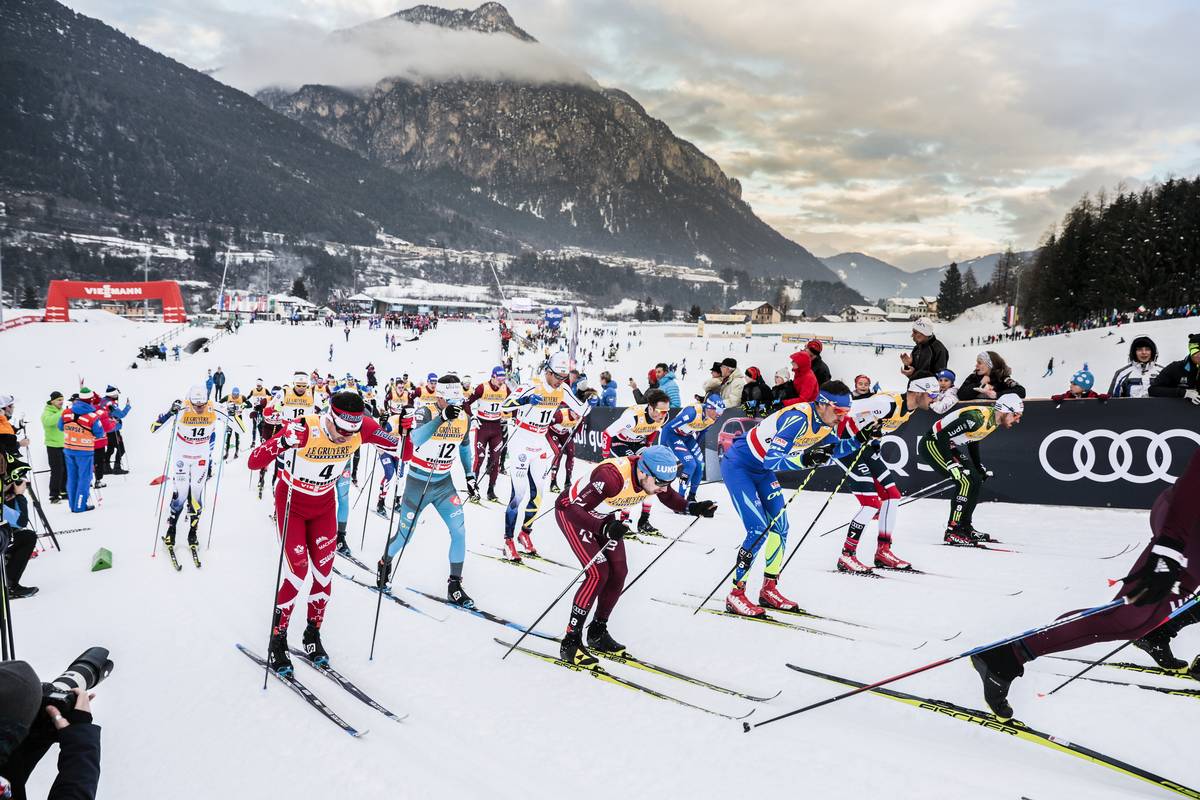
The start of the men’s 15 k classic mass start at Stage 6 of the 2018 Tour de Ski on Saturday in Val di Fiemme, Italy, with (front row, left to right) Canada’s Alex Harvey, Russia’s Sergey Ustiugov, Kazakhstan’s Alexey Poltoranin, Norway’s Martin Johnsrud Sundby, and Switzerland’s Dario Cologna. (Photo: Salomon/NordicFocus)
Beginning this Saturday in Toblach, Italy with a freestyle sprint is the 13th edition of the Tour de Ski (TdS). According to the International Ski Federation (FIS), over the course of seven stages the men will race 80.918 kilometers, the women 60.67 k.
The TdS has become both a staple and a spectacle of the annual World Cup calendar. With a jam-packed series of races primacy is placed on both the ability to recover well and wither less as the TdS transpires.
Prognostication can be tricky in a long-form template like the TdS. So much can go astray during seven races not to mention the travel and dicey germ-avoidance.
Last season’s winner on the women’s side, Heidi Weng of Norway, sits 18th overall in the World Cup standings (14th in distance). She has four top-20’s in the four distance events she’s contested with her best result an eighth in Lillehammer’s 10 k skate. Although featuring two sprints in the first three stages, the TdS remains a distance skier’s paradise.
Weng has skied solidly on the World Cup, but she has yet to show the form that made her a TdS overall winner in 2017 and 2018. Norway has won the last five iterations of the TdS: Marit Bjørgen won once in 2014/2015, Therese Johaug twice (2013/2014, 2015/2016), and Weng the last two years.
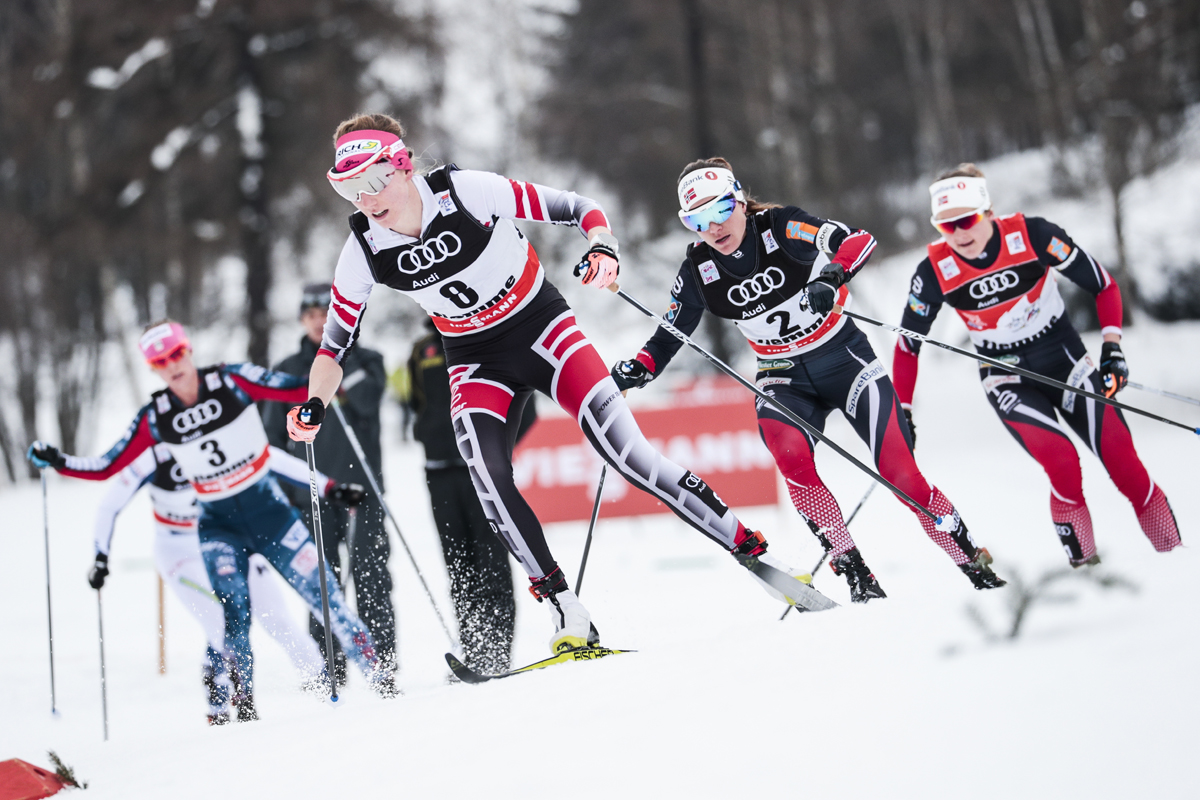
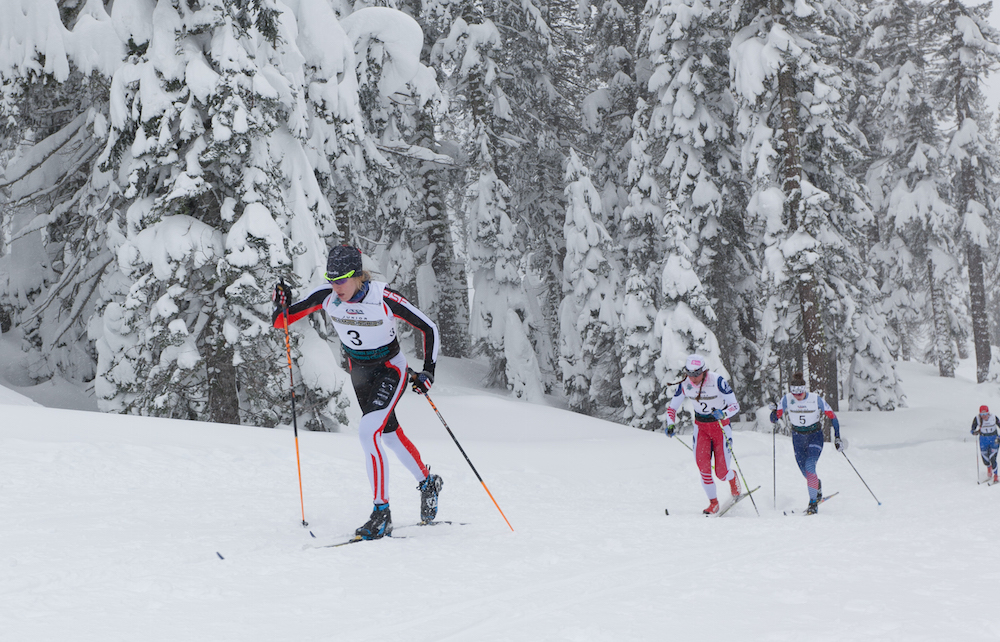
Austria’s Teresa Stadlober leads Norway’s Heidi Weng (2) and Ingvild Flugstad Østberg, American Jessie Diggins (3) and others around a downhill corner during the women’s 10 k classic mass start at Stage 6 of the 2018 Tour de Ski in Val di Fiemme, Italy. (Photo: Fischer/NordicFocus)
If Norway is to keep the streak alive, Ingvild Flugstad Østberg, last year’s TdS runner up, could be the heir apparent. She currently ranks second in the World Cup overall and 15th on the sprint list.
Johaug, having returned from an 18 month doping ban, has been on a distance race tear. She has won all five World Cup distance events this season. Johaug, however, will not be lining up for the TdS.
Only five different women have earned distance podiums this season — Johaug, Østberg, Sweden’s Charlotte Kalla and Ebba Andersson, and Finland’s Krista Pärmäkoski. Along with Johaug, Kalla and Andersson are skipping the TdS. (Andersson sits third overall on the World Cup, Kalla fifth.) With the TdS missing three of the five top ranked World Cup distance skiers, daily stages and the overall podium are up for grabs.
Last season’s third overall finisher, Jessie Diggins of the U.S. Ski Team (USST), often cites the TdS as a point in the season when her form trends towards podium performances. She sits eighth in the current distance standings and could very well have a stout TdS.
Russia’s Natalia Belorukova and Yulia Nepryaeva look strong as does Sadie Bjornsen (USST), and Austria’s Teresa Stadlober.
With less than predictable distance stage podiums for the women, it may simply come down to a drag race on the Alpe Cermis final climb Jan. 6.
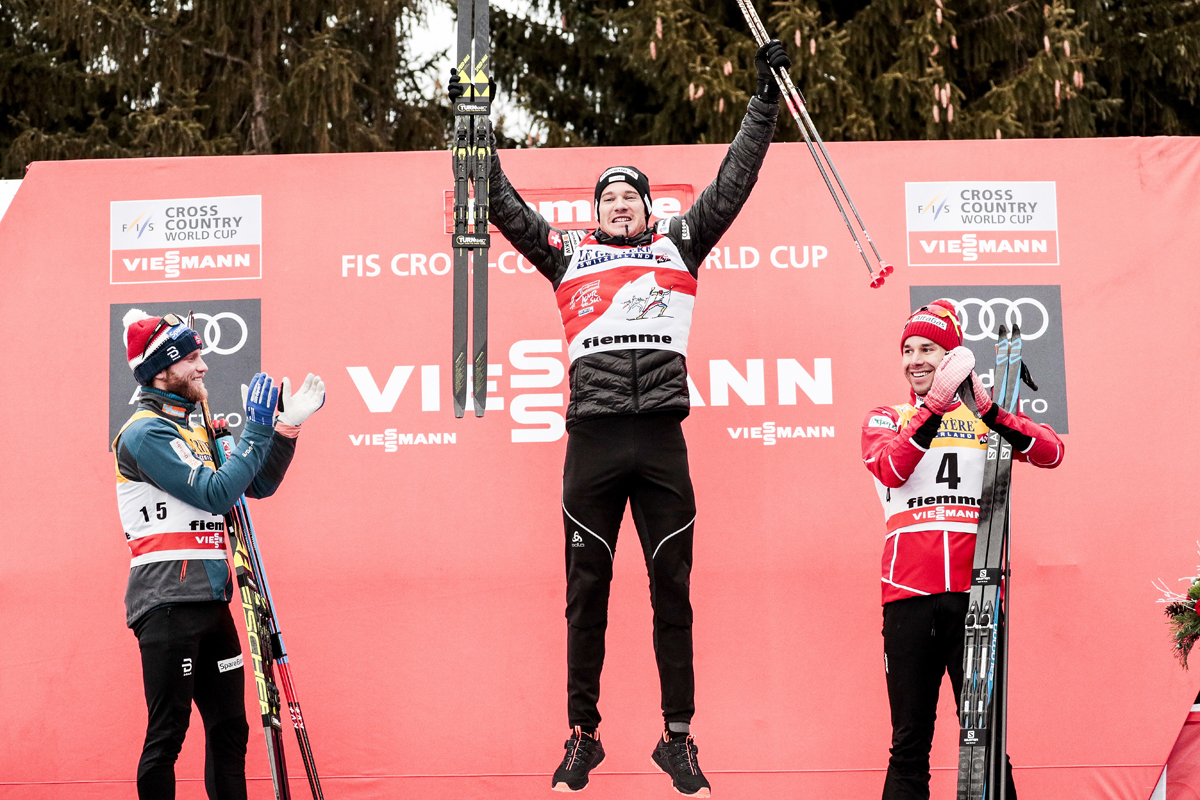
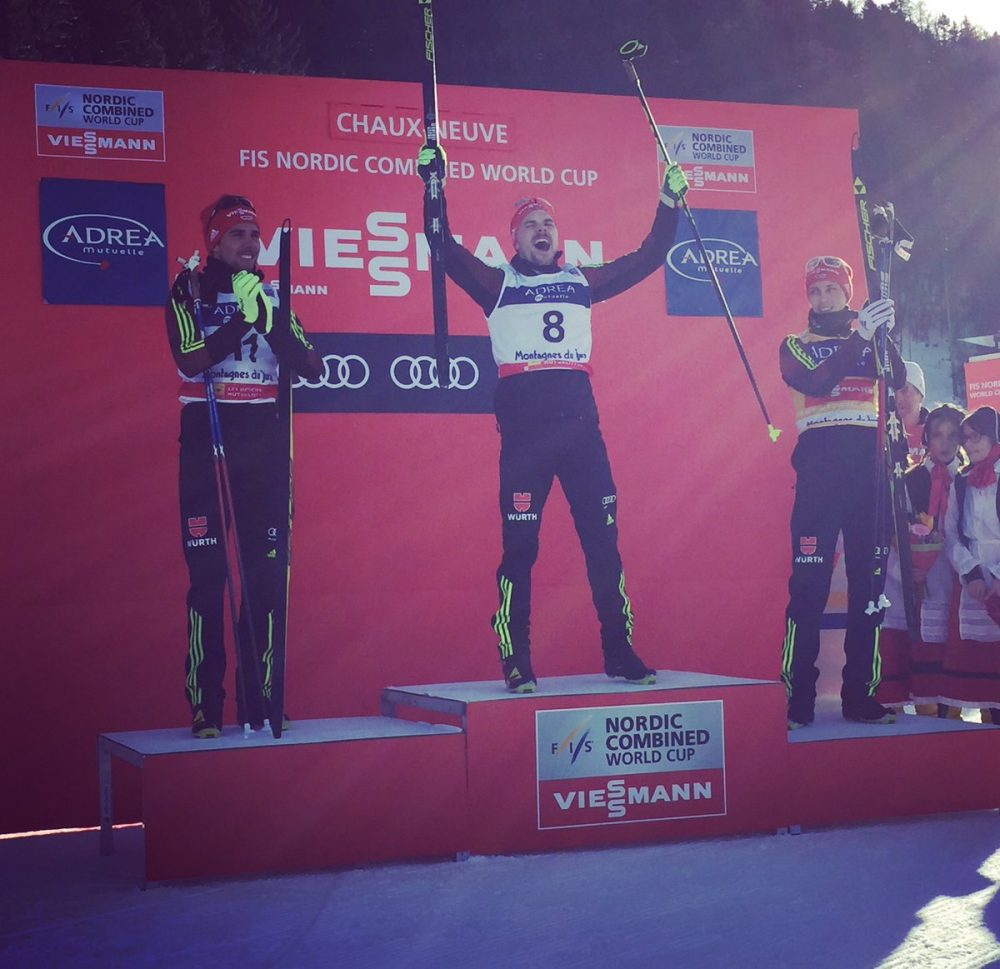
Switzerland’s Dario Cologna (c) celebrates his fourth Tour de Ski overall title. He was joined by Norway’s Martin Johnsrud Sundby (l) and Canada’s Alex Harvey (r) on the podium in second and third, respectively. (Photo: Fischer/NordicFocus)
The men’s scene is also open to interpretation. Last season’s TdS winner, Switzerland’s Dario Cologna, was in fact a surprise victor. Prior to Cologna’s stage two win in last year’s TdS, it had been nearly three years since the four time TdS overall winner had won a World Cup. Cologna sits 21st overall on the World Cup currently. Given last year’s resurgence, anything is possible for the Swiss skier.
Then there’s Martin Johnsrud Sundby form Norway. He finished on the TdS podium the last three years. At thirty-four-years-old, Sundby is ranked first on the distance list, with a second, a third, and a fourth place in distance races this season.
Sundby won the TdS on two occasions – in 2013/2014 and in 2016. His 2015 win was stripped after he tested positive for excessive levels of Salbutamol. He placed second in the past two Tours.
In a field rife with talent, Sundby’s ability to race and rebound and race and rebound will be tested. Sjur Røthe, Emil Iversen, and Didrik Tønseth— all from Norway— look in form. And there’s Norway’s Johannes Høsflot Klæbo. The winner of last season’s overall World Cup has had flashes of his past explosive self. He could be a TdS protagonist.
The men’s field is notably tight. Along with the Norwegians, several Russians could pop a podium, a stage win, and the overall. Russia comes with a loaded team ready to exploit. Alexander Bolshunov leads the overall World Cup – he’ll turn twenty two on Dec. 31st. He’s backed by teammates Evgeniy Belov, Andrey Melnichenko, and Denis Spitsov.
Canada’s Alex Harvey placed third overall last year and he looked stronger as the TdS progressed.
The Stages
Stage 1: Dec. 29, skate sprint in Toblach, Italy.
Stage 2: Dec. 30, 10 k/15 k skate in Toblach, Italy.
Stage 3: Jan. 1, skate sprint in Val Müstair, Switzerland.
Stage 4: Jan. 2, 10 k/15 k classic mass start in Oberstdorf, Germany.
Stage 5: Jan. 3, 10 k/15 k skate pursuit in Oberstdorf, Germany.
Stage 6: Jan. 5th, 10 k/15 k classic mass start in Val di Fiemme, Italy.
Stage 7: Jan 6th, 9 k final climb skate pursuit in Val di Fiemme, Italy.
Teams
United States
Women: Sophie Caldwell, Sadie Bjornsen, Jessie Diggins.
Men: Ben Lustgarten, Simi Hamilton, Erik Bjornsen, Kevin Bolger.
U.S. Ski Team Head Coach Chris Grover noted in a text that Caldwell, Hamilton, and Bolger will likely cease the TdS after the stage three sprint. Additionally, this is a small team for the U.S. at the TdS. Several athletes turned down TdS nominations including Scott Patterson (USST), Andy Newell (SMS T2/Salomon), Kyle Bratrud (SMS T2), Rosie Brennan (APU), Rosie Frankowski (APU), Caitlin Patterson (CGRP), and Julia Kern (SMS T2). These skiers plan on racing U.S. Nationals this January in Craftsbury, Vermont.
Canada
Women: Emily Nishikawa, Dahria Beatty
Men: Alex Harvey, Lenny Valjas, Bob Thompson
Norway
Women: Ingvild Flugstad Østberg, Maiken Caspersen Falla, Astrid Uhrenholdt Jacobsen, Kari Øyre Slind, Kathrine Rolsted Harsem, Heidi Weng, Lotta Udnes Weng, Tiril Udnes Weng Mari Eide, Anna Svendsen
Men: Martin Johnsrud Sundby, Hans Christer Holund, Emil Iversen, Didrik Tønseth, Simen Hegstad, Krüger, Sjur Røthe, Johannes Høsflot Klæbo, Martin Løwstrøm Nyenget, Eirik Brandsdal, Finn Hågen Krogh
Russia
Women: Yulia Belorukova, Lidia Durkina, Anna Zherebyateva, Mariya Istomina, Natalia Nepryaeva, Anna Nechaevskaya, Anastasia Sedova, Elena Soboleva
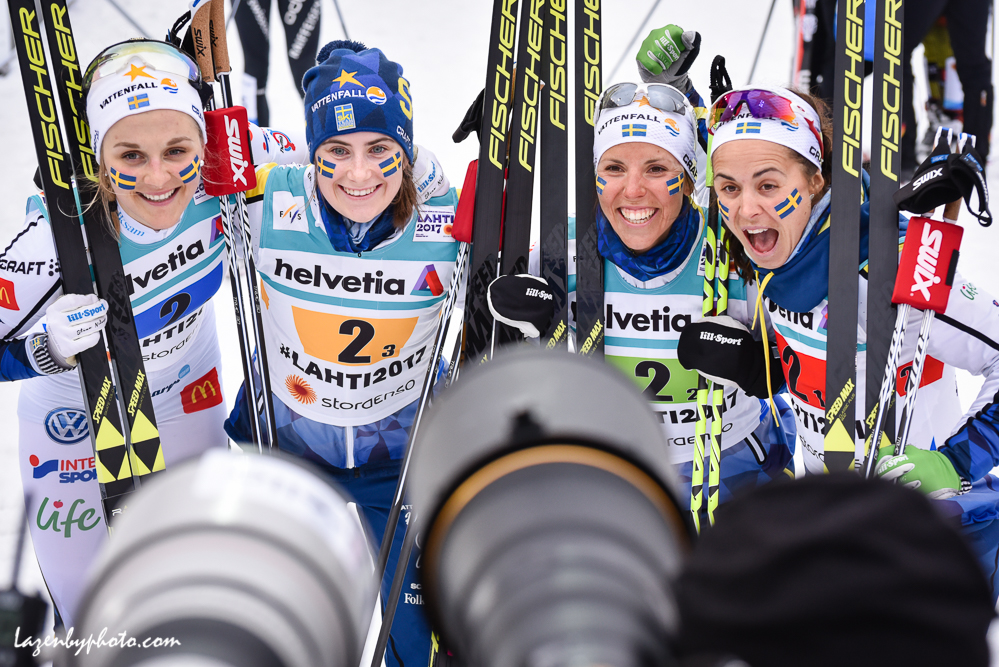
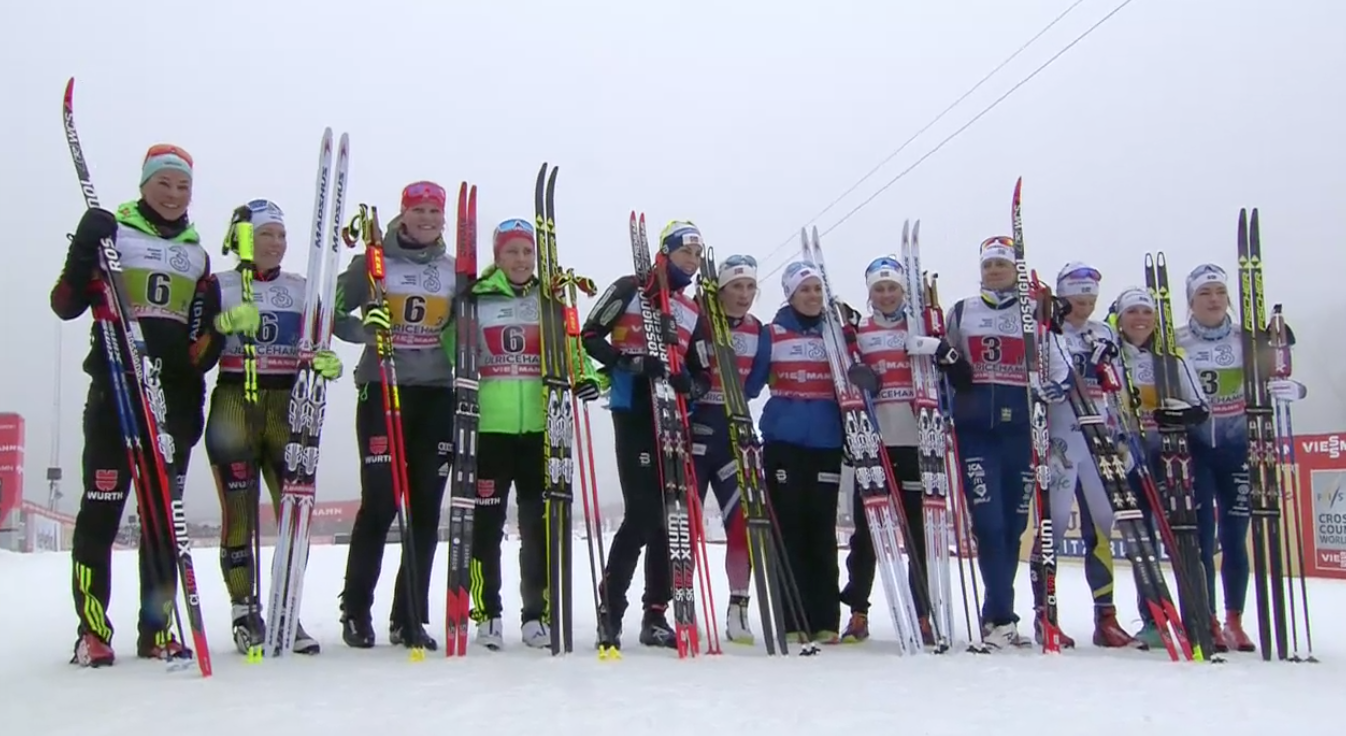
Sweden’s Stina Nilsson, Ebba Andersson, Charlotte Kalla and Anna Haag faced the cameras after winning the silver medal in the women’s relay at the 2017 Nordic World Championships in Lahti. (Photo: John Lazenby)
Welcome to FasterSkier’s World Cup Preview, where we check in with the top-10 teams from last year’s FIS Cross Country World Cup tour before the season starts. The World Cup begins with a classic sprint in Ruka, Finland on Nov. 24th
***
Sweden
Overall in Nations Cup Last Year: 2nd
Women’s Ranking 2017/2018: 2nd
Men’s Ranking 2017/2018: 5th
Swedes to Watch:She’s fast. She’s fierce. And she’s Swedish. While last spring gave rise to the retirement of many veteran cross-country ski names, 31-year-old Charlotte Kalla wasn’t one of them.
Kalla, who has been racing World Cups since 2006, is back for her 13th season on the circuit and not about to slow down. She finished last year, on a limited World Cup schedule, ranked seventh in the women’s overall, after securing five top three performances, two thirds of them victories.
Her singular focus remained peaking for the Games. She entered the 2018 season scorching fast, winning the the overall in the opening Ruka triple weekend. She won the following weekend’s 15-kilometer skiathlon in Lillehammer, Norway.
Kalla dialed back the racing in mid-December, did not race the Tour de Ski, and returned to World Cup racing on January 21, in Planica, Slovenia. She placed second in the 10 k classic.
Kalla returned from the Pyeongchang Olympic Winter Games with four medals, two for individual performances–most notably a gold in the women’s skiathlon.
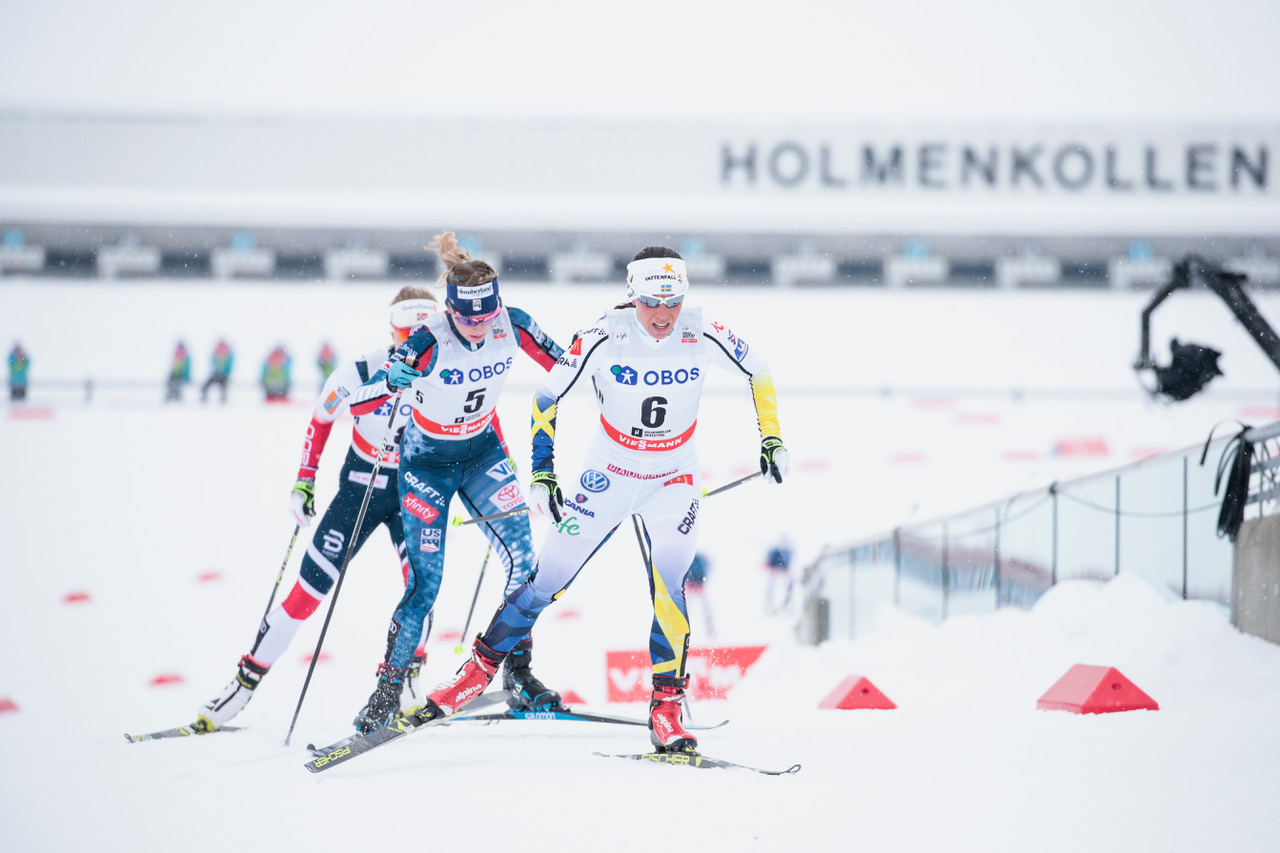
Sweden’s Charlotte Kalla leads American Jessie Diggins and Norway’s Ragnhild Haga during the 2018 Holmenkollen women’s 30 k freestyle mass start at the World Cup in Oslo, Norway. (Photo: Fischer/NordicFocus)
When not name dropping Kalla, the Swedes have plenty to look to in the remainder of their women’s team. There’s the ever shining sprint star, Stina Nilsson, not to mention the up-and-comer Ebba Andersson. In between those two, with the retirement of Anna Haag, there’s sprint power houses,Hanna Falk and Ida Ingemarsdotter. Throw in Anna Dyvik and you’ve got your female Swedes for the season.
On the men’s side, despite the retirements of Emil Jönsson, Martin Johansson and Marcus Hellner, Calle Halfvarsson remains a name to watch out for on course. Halfvarsson ended last season ranked 13th in the overall, with six individual top-10 finishes, four of those on the podium.
Then there’s the 36 year old veteran, Daniel Rickardsson, as well as the 23-year-old Oskar Svensson, who both landed in last season’s World Cup top-30 more than once.
She’s back. Therese Johaug celebrates after winning the 2018 FIS 10-kilometer classic in Beitostølen, Norway.
After an 18 month suspension for a positive out of competition positive doping test, during which Norway’s thirty-year-old Therese Johaug could build hour upon hour of base fitness and fine tune the engine with no race-stress, she arrived in Beitostølen, Norway on Friday and didn’t skip a beat.
In temperatures hovering around 32 degrees Fahrenheit, and low-level clouds descending on the course, Johaug established herself as the early season favorite amongst a deep Norwegian National Team in Beitostølen’s FIS season opener 10-kilometer classic race.
As the 52nd starter in a 60-skier field, Johaug never let off the throttle.
The race was tight at the 1-kilometer time check, with national team skier Ingvild Flugstad Østberg marking the fastest time over Johaug by only 0.9 seconds. With nine kilometers to go, it was all Johaug, as she clocked the fastest times at the remaining checkpoints.
Up by 4.3 seconds at 2.2k, the time back to the second fastest skier grew to 15.5 seconds at the race’s midpoint for Johaug. By the finish, Johaug did as she has done many times before, winning by a comfortable margin. She won in 25:42.6 minutes. Østberg, who ranked third in the World Cup overall last season, placed second (+23.9). Kari Øyre Slind was third (+59.8)
Therese Johaug ready to start it all over again after her 18-month suspension.
“It was special being here today,” Johaug told Norwegian broadcaster NRK according to a translation. “It feels incredible to back in the xc family again. To come up here and meet all the people that I’ve been skiing with for so many years, hear the cries from the crowds out in the course and the splits, it was a special feeling. It was so much. I was nervous before the start, but when I got started I really didn’t want it to end. I could have skied an extra lap.”
The opening Beitostølen FIS races are the early season proving grounds for Norway’s elite cross-country athletes. The top-10 in the women’s race was riddled with names World Cup fans are familiar with.
Astrid Uhrenholdt Jacobsen skied to fourth (+1:21.3), Haga Ragnhild fifth (+1:33.1), Anna Svendsen sixth (+1:42.8), and Heidi Weng, winner of last seasons overall World Cup finished seventh (+1:58.7).
Annika Taylor, a former University of New Hampshire skier now skiing for Great Britain, raced her way to 21st (+3:49.3).
In similar conditions, the men raced a 15 k classic. Like the women’s field, it was a Norwegian who’s who of elite class skiers. But unlike Johaug setting an increasing time margin over any contenders, the men’s race was tight, separated by only 15 seconds for the top-five skiers 5 k into the race.
At that point, with Didrik Tønseth in first and Emil Iversen in second, only a sliver of time, 0.1 seconds, differentiated the two. Martin Johnsrud Sundby and Johannes Høsflot Klæbo were gapped by 12.2 and 12.7 seconds respectively, as they skied through the time check in third and fourth place. Sjur Røthe came through in fifth (+15.8).
Iversen, in bib 141, kept it close, setting the initial times to beat. Tønseth started three skiers back in bib 144. Through 10k, the two were still evenly matched: with Tønseth up by 3.4 seconds over Iversen.
The men’s 15 k classic podium for the 2018 FIS opener in Beitostølen, Norway. Didrik Tønseth (NOR) in first, Norway’s Emil Iversen (left) in second, and Sjur Røthe (right) of Norway third.
Tønseth won the race in 36:08.6 minutes, with his winning margin of 12.4 seconds over the second place Iversen only solidified in the closing kilometers. Røthe gradually moved up and finished third (+29.3).
Sundby skied to fourth (+37.5), Hans Christer Holund fifth (+1:07.4), and Klæbo sixth (+1:17.5). British skier Andrew Musgrave finished seventh (+1:26.3). Musgrave is historically a stronger skate skier.
One hundred and forty-three skiers finished the men’s race.
Of note, thirty-two-year-old Petter Northug Jr., now a seemingly timeless presence on the Norwegian ski scene, was disqualified for classic technique violations. Prior to his DQ, Northug had been skiing in the top-20 for much of the race. Sundby was given a verbal warning for a classic technique violation.
Several Canadians raced the 15 k classic. Russell Kennedy was the best placed Canadian finishing tied for 23rd (+2:37.6). Brian McKeever was 68th (+4:06.6), Ryan Jackson 110th (+5:39.1), Maks Zechel 113th (+5:56.5).
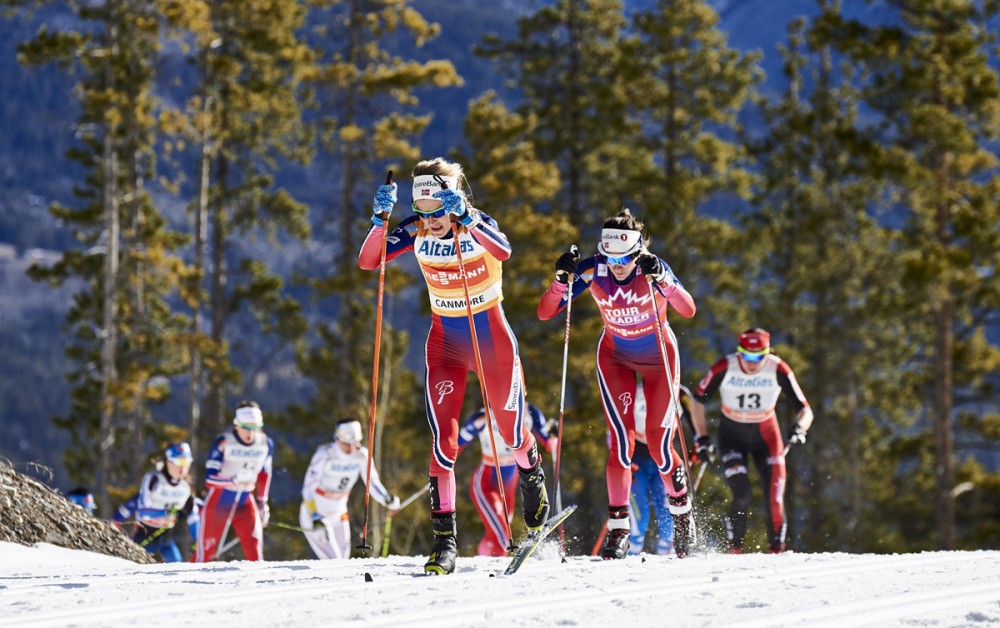
Norwegians Therese Johaug and Heidi Weng, (l-r) during the 2016 women’s 15 k skiathlon in Canmore, Alberta. (Photo: Fischer/NordicFocus)
Welcome to The Rundown, your quick primer of need-to-know information about the day’s racing. We’ll be updating this digest as the day goes on with additional results, photos and quotes. The Rundown is NOT a race report; stay tuned for complete race reports later today with interviews from the day’s top racers.
***
FIS cross-country Beitostølen, Norway: 10 k/15 k classic
The race results are in from today’s 10-kilometer individual start classic FIS race in Beitostølen, Norway. The first of the season Beito races are used as a test pad for Norwegian athletes to gauge fitness and for some to make the rare jump to a coveted and scarce World Cup start.
Off of her suspension for using a banned substance, Norway’s Therese Johaug skied like she’d never been gone. Johaug was suspended for 18 months due to her violation.
Johaug fired off the 10 k winning in 25:42.6 minutes. Ingvild Flugstad Østberg was second (+23.9). Rounding out the podium was Kari Øyre Slindin third (+59.8).
Astrid Uhrenholdt Jacobsen skied to fourth (+1:21.3), Haga Ragnhild fifth (+1:33.1), Anna Svendsen sixth (+1:42.8), and winner of last seasons overall World Cup, Heidi Weng finished seventh (+1:58.7).
The men skied a 15 k classic race Friday in Beitostølen. Didrik Tønseth won in a time of 36:08.6 minutes. In second was Emil Iversen (+12.4), while Sjur Røthe placed third (+29.3).
Martin Johnsrud Sundby skied to fourth (+37.5), Hans Christer Holund fifth (+1:07.4), and Johannes Høsflot Klæbo sixth (+1:17.5).
British skier, although based in Norway, Andrew Musgrave finished seventh (+1:26.3).
One hundred and forty-three skiers finished the men’s race. Of note, Petter Northug Jr., now a seemingly timeless presence on the Norwegian ski scene, was disqualified for technique violations.
Several Canadians raced the 15 k classic. Russell Kennedy was the best placed Canadian finishing tied for 23rd (+2:37.6). Brian McKeever was 68th (+4:06.6), Ryan Jackson 110th (+5:39.1), Maks Zechel 113th (+5:56.5).
Bruksvallarna, Sweden cross-country: 5 k/10 k freestyle
In Bruksvallarna, Sweden FIS racing began with a 5 k freestyle for the women. Three of Sweden’s star skiers took the podium spots. Ebba Andersson won the tight race in 9:57.1 minutes, finishing only 2.6 seconds ahead of second place skier Charlotte Kalla. Known for her sprinting prowess, Hanna Falk was third (+15.7).
One hundred and twelve skiers finished the race.
For the men, after skating 10 k, the race was a tie for first. Sweden’s Jens Burman and Karl-Johan Westberg skied the fastest time. Both crossed the line in 19:11.0 minutes for the win. Japanese skier Keishin Yoshida placed third (+9.5).
Daniel Rickardsson, of Sweden, skied to fourth (+12.9).
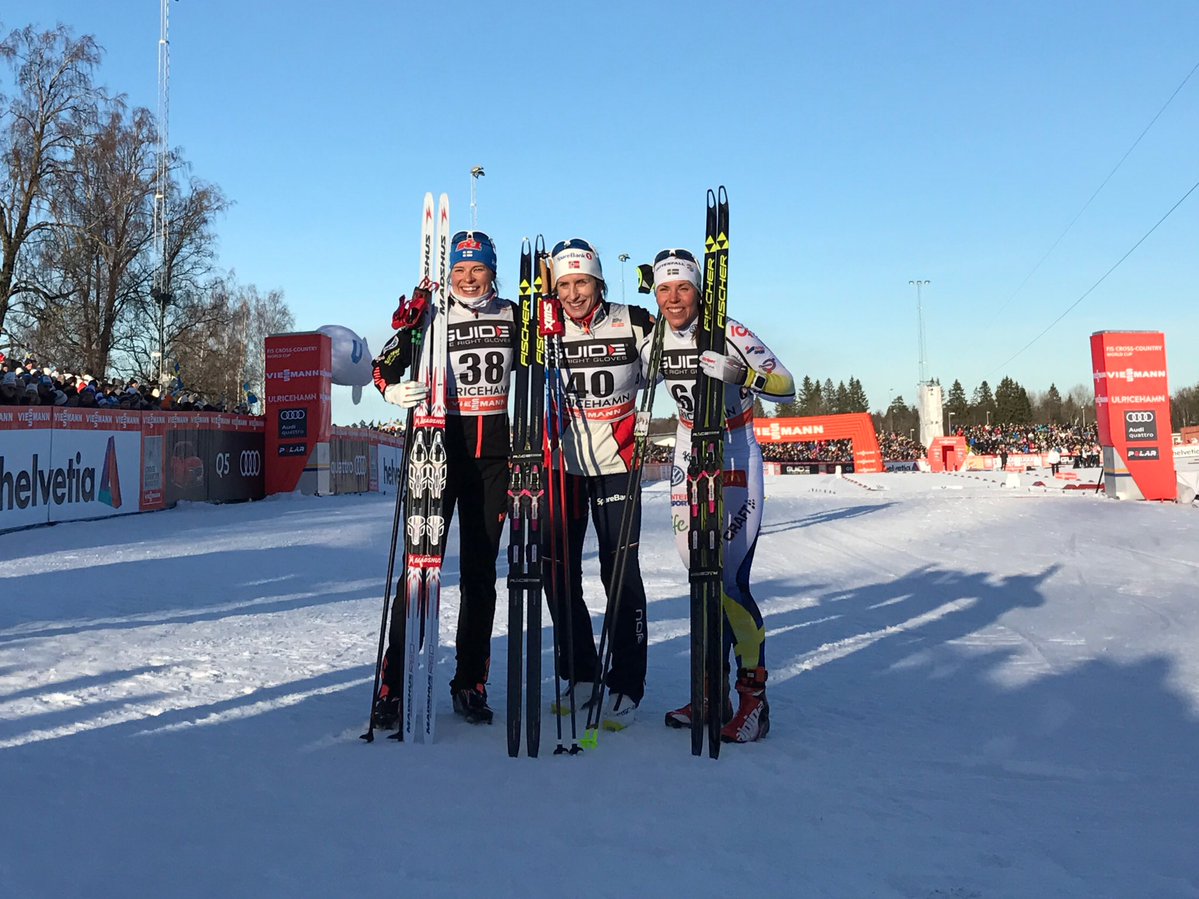
Krista Pärmäkoski of Finland (center) won her second straight 10 k classic, to the delight of the crowd in Lahti. Natalia Nepryaeva of Russia (left) finished second and Marit Bjørgen of Norway third. (Photo: FIS Cross Country/Twitter)
FIS Cross Country World Cup (Lahti, Finland): 10/15 k classic
Racing at home in Finland, Krista Pärmäkoski picked a good time to collect the second World Cup victory of her career, and again in a 10 k classic. Pärmäkoski’s first win came in the 10 k classic in Planica, Slovenia, earlier this season.
In second was Russia’s Natalia Nepryaeva, who picked up her first World Cup podium. The current U23 standings leader, Nepryaeva’s time was 20.9 seconds slower than Parmakoski. Both she and Marit Bjørgen of Norway, who finished third (+26.7), used a steady pace to reach the podium. At the 5 k split, Heidi Weng of Norway – wearing the yellow bib of the overall World Cup leader – was in second at the halfway point but faded to finish fifth (+43.3), and Kerttu Niskanen of Finland was in third place but she dropped to fourth by the finish, +27.0. Austria’s Teresa Stadlober finished sixth (+52.4).
Sadie Bjornsen placed seventh (+57.6) to lead the American team. Caitlin Patterson was next, just missing the World Cup points in 32nd (+2:02.7). Ida Sargent and Sophie Caldwell finished 40th (+2:21.9) and 42nd (+2:24.2), respectively. Rosie Brennan finished 48th (+3:02.1) and SuperTour leader Kaitlynn Miller placed 51st (+3:09.1).
Liz Stephen of the U.S. Ski Team did not start due to illness.
Canada started only two women: Emily Nishikawa finished 41st (+2:22.2) and Dahria Beatty 44th (+2:40.7).
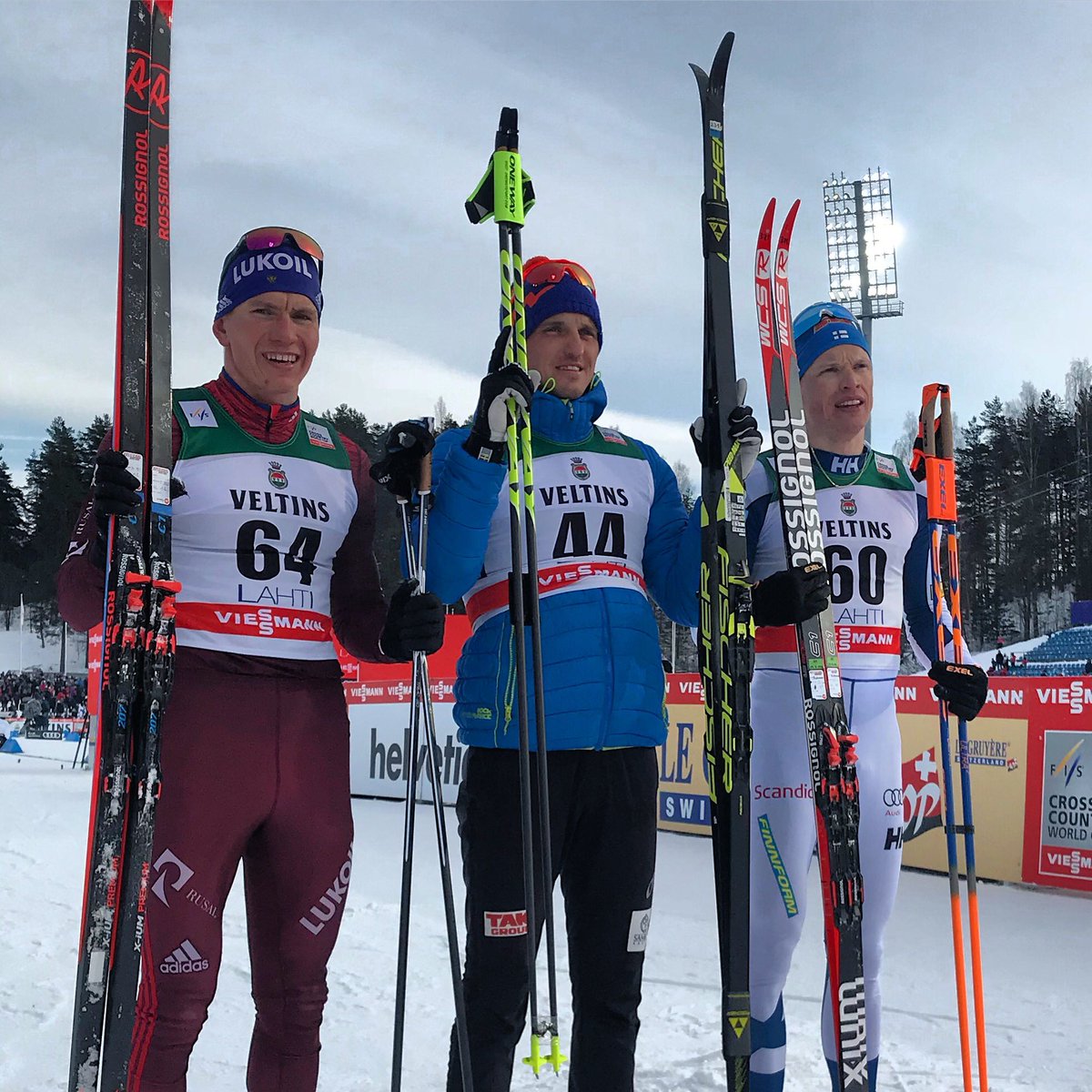
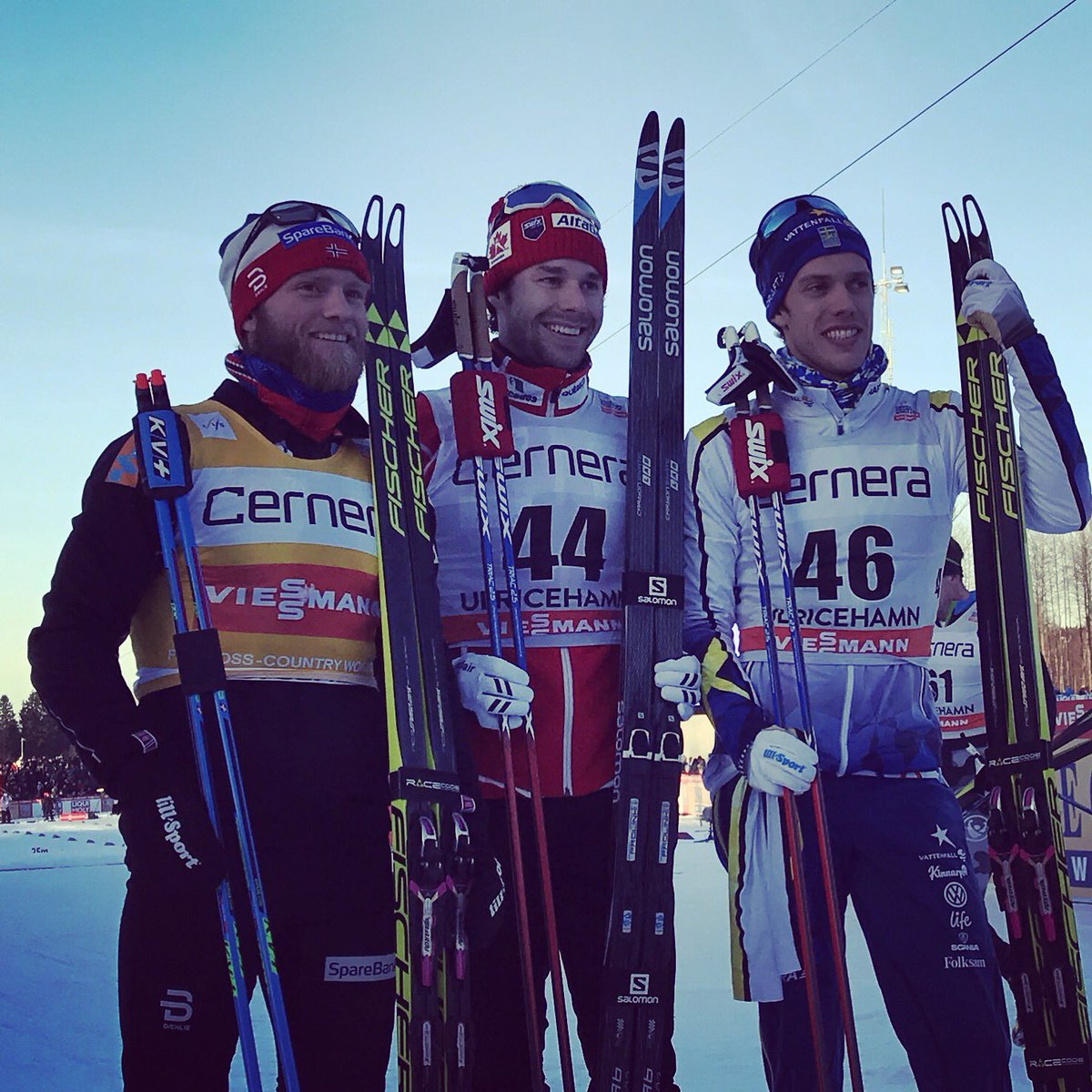
The men’s 15 k classic podium at the World Cup in Lahti, Finland, with Kazakhstan’s Alexey Poltoranin (c) in first, Russia’s Alexander Bolshunov (l) in second and Finland’s Iivo Niskanen (r) in third. (Photo: FIS Cross Country/Twitter)
In the men’s race that followed, Alexey Poltoranin of Kazakhstan got some redemption after a major bonk in the Olympics 50 k last weekend, winning the 15 k classic individual start in Lahti.
Starting in the middle of the field in bib 44 (out of 71), Poltoranin paced it perfectly, skiing a steady race with some of the top split times and then turning it up another notch over the last several kilometers to take the win in 33:11.9 minutes. His biggest threat was Russia’s Alexander Bolshunov, who started 64th and clocked faster splits at every timing point throughout the three-lap race except the one that mattered most — the finish. There, Bolshunov came up 9.1 seconds short of Poltoranin’s time to place second, and Finland’s Iivo Niskanen — the Olympic 50 k champ — placed third, 20.9 seconds out of first.
Norway took fourth through seventh, with Emil Iversen in fourth (+28.8), Martin Johnsrud Sundby in fifth (+39.9), Niklas Dyrhaug in sixth (+50.1), and Johannes Høsflot Klæbo in seventh (+1:00.3). Russia’s Alexey Chervotkin placed eighth (+1:08.3), Germany’s Thomas Bing was ninth (+1:08.5) and Sweden’s Daniel Rickardsson finished 10th (+1:09.2).
Canada’s Devon Kershaw led the North Americans in 25th (+1:43.2), and Erik Bjornsen was the top American in 32nd (+2:06.6).
Four Canadian men raced, with Graeme Killick placing 39th (+2:22.9), Julien Locke 69th (+4:56.6) and Andy Shields 70th (+5:42.1).
The U.S. was represented by six men, with Noah Hoffman placing 40th (+2:24.0), Paddy Caldwell 45th (+2:40.5), Scott Patterson 50th (+2:58.7), Kevin Bolger 54th (+3:09.5), and David Norris 57th (+3:23.5).
The World Cup picks back up again this Wednesday with classic sprints in downtown Drammen, Norway.
Canada’s Len Valjas (l) and American Andy Newell scrambling during the first leg of the men’s 4 x 10-kilometer relay on Sunday at the 2018 Olympics in PyeongChang, South Korea. (Photo: FlyingPointRoad)
PYEONGCHANG, South Korea — Zooming in on the leaders of Sunday’s nordic race, the Olympic broadcast stream focused on a red Norwegian suit set against the backdrop of Russian maroon. The televised showdown presented for the men’s 4 x 10-kilometer relay final leg was shaping up to be between the Olympic Athletes from Russia and Norway: Denis Spitsov verses Johannes Høsflot Klæbo. As the two skiers struck out for Lap 2 of 3 of the final 10 k leg, both spectators and screen apprehensively followed.
Had the camera panned 250 meters ahead, it might have caught the flurrying ski tails of American Noah Hoffman, dashing the top of the 3.3 k lap’s initial climb. Around 45 seconds earlier, Hoffman had been tagged into the race as the anchor leg for the U.S. men. His hot start was not just for show or a final push to the front. If he wanted to prevent the U.S. team from an eliminatory pull, he would need to stay ahead of Spitsov and Klæbo.
A cat-and-mouse game between the leaders certainly could buy the U.S. skier a little more time to pad the time gap. But until then, he sifted a reductionist race: Stay in the game. Don’t get caught by Klæbo.
American Noah Hoffman anchoring the U.S team during the men’s 4 x 10-kilometer relay on Sunday at the 2018 Olympics in PyeongChang, South Korea. (Photo: FlyingPointRoad)
“The highlight for me was watching these guys stick with their guys,” Canada’s Len Valjas said of his relay teammates in a post-race interview with FasterSkier. “And another one was watching Noah stay away from Klæbo. We were all yelling, cheering for him. That was amazing.”
The relay had more than one race in the works. Hoffman staying in front of Klæbo was one. Canada’s Graeme Killick catching Sweden was another.
After Valjas scrambled the first classic leg, he came through the exchange in 10th, handing off to Killick for the second classic leg. As Killick headed out for his first lap, Sweden was four places and 38.3 seconds ahead.
The 28-year-old Canadian, in his second Olympics, was by no means deterred. Working kilometer by kilometer, Killick strode past the Czech Republic’s Martin Jaks, Germany’s Thomas Bing and eventually Sweden’s Daniel Rickardsson.
After moving up three places, Killick went through the second exchange in seventh with the seventh-fastest time, passing off the race to Russell Kennedy. Going into Leg 3, 2.6 seconds separated the Canadians from the tag between Sweden’s Rickardsson and Marcus Hellner. All said and done, Killick had made up 40.9 seconds to catch and pass Sweden.
“Everyone, I think, skied to a higher level today,” Killick told FasterSkier after. “We were all able to dig deep for our teammates and make sure we pass off in good position.”
“Anything can happen in a relay and that’s one of the reasons it’s always exciting to get on the start line and do your best,” Killick continued. “When I tagged off Russell, he was with Hellner … It was cool to see everyone dig so deep and just fight for the team.”
Racing Canada’s third relay leg, Kennedy, a 26-year-old Olympic rookie, held tight to Hellner through the first lap. And again through the second. And through the first half of the third. It was not until around the final major climb, that Hellner broke away from Kennedy’s red maple-leaf suit.
Canada’s Graeme Killick racing the second leg of the men’s 4 x 10-kilometer relay on Sunday at the 2018 Olympics in PyeongChang, South Korea. He brought the team from 10th to seventh with the seventh-fastest second-leg time. (Photo: FlyingPointRoad)
“I was psyched when I saw GKill killed it, and gave me an amazing position,” Kennedy said after. “But I was also a bit nervous because … I was walking to the line with Hellner and I was like, he’s an Olympic champ. I got to stick with him and hold on, and that’s what I did. I just locked on, the wax techs gave me amazing skis today, and I held on as hard as I could. He threw in a sprint at the top of the hill, blew me up, but I was psyched to have made it almost three laps with him.”
Hellner has two relay gold medals from the Olympics, one from 2014 and another from 2010, as well as two 30 k skiathlon golds from the 2010 and 2014 Games. The 32-year-old Swede is also a multiple-time World Championships medalist with several top-10 World Cup 15 k freestyle results. While Kennedy considers himself more of a sprinter, Sunday’s performance may perhaps change his perspective.
“I was just thinking, don’t blow. Do it for the team,” Kennedy said. “I knew that if I could hand off to Knute in a good position, were were in a really good position for us. Can’t ask for much more than that. I gave it everything for sure. I was just happy we caught the Slovakian guy so Knute had someone to ski with. But yeah, amazing day for me, for sure. I felt really good.”
Canada’s Knute Johnsgaard (12) racing the final leg of the the men’s 4 x 10-kilometer relay on Sunday at the 2018 Olympics in PyeongChang, South Korea. He anchored the team to ninth for its second-best Olympic relay result. (Photo: FlyingPointRoad)
After skiing the seventh-fastest third leg, Kennedy came through the exchange in eighth and handed off to teammate Knute Johnsgaard, also in his first Olympics, for the final freestyle leg. Johnsgaard kept the Canadians ahead of the Czech Republic, staving off Kazakhstan until the final kilometer and a half.
“It was pretty tough for me, especially the sprint hill,” Johnsgaard, 25, said. “We knew it was going to be hard. We did the best we could.”
Canada finished in ninth, 3:41 seconds off first, which was taken by Norway’s lineup of Didrik Tønseth, Martin Johnsrud Sundby, Simen Hegstad Krüger, and Klæbo in a time of 1:33:04.9. The ninth place ties the country’s second-best Olympic relay result, which was set at the Calgary Games in 1988. Canada’s best relay finish was in 2010 when the team placed seventh with Devon Kershaw, Alex Harvey, Ivan Babikov, and George Grey.
Harvey opted not to race Sunday’s relay, and Johnsgaard started in his place.
In last year’s World Championships team relay in Lahti, Finland, with Harvey on the team, the Canadians were lapped out of the race.
“We’ve had some terrible luck with relays. I think we did great today,” said Valjas, a 29-year-old two-time Olympian. “It’s not our A-team; we knew that coming in. I think we performed amazing and I’m super happy with how it went. Especially all these guys staying with some serious big names in cross-country skiing. I’m impressed, these guys were fighting hard and I’m proud of all of them.”
Alongside the Canadian’s solid team performance, the U.S. had several personal highlights. Scrambling in the first leg was American Andy Newell in his second race of the week (after placing 37th in the individual classic sprint) and potentially, the 32 year old’s last Olympic race.
“The sprint day was really disappointing, because I knew I had a lot more to give in the qualification. To be just out was frustrating, I know I had a much better result than that in me, and my body is feeling better than that result,” Newell told FasterSkier on Sunday. “To be able to come back and get another start, it was great.”
Having scrambled in Olympic relay races before, Newell explained that allowing the pace to burn off the front was part of his plan. Through the first lap he was 2.3 seconds off the lead pace. Around 5 k, he was racing with Canada, Estonia, Austria, the Czech Republic, Switzerland, and Germany around 6 seconds back. With around one lap to go, Kazakstan’s Alexey Poltoranin bulldozed to the front and began pushing pace. Newell stuck to his racing plan.
“It’s a high-pressure event. Somebody who has raced first legs for their country before, talk about being nervous the night before, when you know you’re going to go off and the rest of the team’s counting on you,” Newell said. “Relays … there’s so much national pride, no matter what team you come from. Whether it is a Norway/Sweden rivalry or and Canada/U.S. rivalry, they all go back and have their history.”
“I probably haven’t raced a 10 k in probably over a month, talk about nerve racking,” Newell continued. “To step to the line with Poltoranin, some of these guys, when you know they are much better 10 k classic skiers than I am.”
Poltoranin has reached the World Cup podium numerous times in distance classic races. On Sunday, Newell came through the exchange in 12th, 1:28.8 minutes behind Poltoranin in first.
“I just have to go and be like, ‘A minute twenty back, it feels like a bad race, but these guys are the best in the world. … It sounds bad, but we have to do what we call damage control a little bit, try to ski with the guys we can ski with, and put our team in the best position we can,” Newell explained.
American Resse Hanneman racing the second leg of the men’s 4 x 10-kilometer relay on Sunday at the 2018 Olympics in PyeongChang, South Korea. In his first Olympic race, after being tagged in 12th, he came through the second exchange in 14th. (Photo: FlyingPointRoad)
He passed off to American Reese Hanneman for the second classic leg. The event was Hanneman’s debut Olympic race. The 28-year-old Alaska native was called on to the team as the first alternate.
“Skiing with the top 13 classic skiers in the world … for me, it became apparent that I was going to have to really focus and make it hurt to minimize the time I was going to lose to them,” Hanneman said. “I could barely see or stand up by the end of it. I’m not happy with how I performed, but I’m happy with how deep I was able to dig.”
Hanneman tagged off to Scott Patterson in 14th, who then took the American’s first freestyle leg. Creeping up on Patterson were the race leaders. He geared up through all three of his laps, holding off both Norway’s Simen Hegstad Krüger and Russia’s Alexey Chervotkin.
“All the coaches were out there going, ‘You’ve got two minutes. You’ve got 1:39,’ just the whole way,” Patterson said, referring to his time back to the leaders. “It’s not the direction you want to be getting splits, but that’s where we were.”
“Also, we knew with Erik [Bjornsen] sitting out, with Simi [Hamilton] sitting out, with Paddy [Caldwell] sick, we knew were in a little bit of a tough shape for today, so not getting lapped was a bit of goal going in,” Patterson added.
With Hoffman anchoring the final three laps, the Americans achieved their goal. Don’t get caught by Klæbo became ‘Klæbo can’t catch me.’
“They weren’t charging their second lap — my first lap — but I knew they would be charging on the last lap and I knew I needed every second I possibly could, so I went out hard,” Hoffman said. “I was just viewing it as a 6.6 k race. Like the last lap doesn’t matter at that point, just got to get there. I did everything I could and it was close but I am pretty psyched that we as a team made it.”
The Americans finished the relay in 14th (+9:24.2) out of 14 teams.
“You never know how its going to go down,” Hoffman said of relays. “Unless you are scrambling you don’t know what the start is going to be like, where you’re going to be, if you’re going to be alone, if you’re going to be with people, you got to be adaptable, you got to be able to make your own plan out there.
“This was my first time ever anchoring a relay so that’s pretty cool experience,” Hoffman added. “I had a lot of support finishing. … Even though we were a long ways back the crowd seemed to stick around for me, which was pretty fun.”
Johannes Høsflot Klæbo anchoring the Norwegian men’s 4 x 10 relay to gold on Sunday at the 2018 Olympics in PyeongChang, South Korea, while Denis Spitsov (background) celebrates silver for the Olympic Athletes for Russia. (Photo: FlyingPointRoad)
For a while in the men’s 4 x 10-kilometer relay on Sunday, it looked like the Russians might run away with the win. But that was just two classic legs and 20 k into the race, with a lot more racing to come.
While Kazakhstan’s Alexey Poltoranin had handed off in first at the first exchange, just ahead of Andrey Larkov of the Olympic Athletes from Russia, Italy, France and Norway skied together behind them, with Norway’s Didrik Tønseth trailing off the back, 18 seconds behind.
On the next classic leg, Russia’s Alexander Bolshunov put a hurt on the field. Within the first 3.3 k lap, he was 25 seconds ahead of Kazakhstan’s Yevgeniy Velichko in second, who was followed closely by Italy, Norway and France in third through fifth. Sweden’s Daniel Rickardsson had fallen farther behind to more than a minute back in sixth place, after his teammate Jens Burman lost contact with the lead group on the first leg.
By the second exchange, Russia was 24.5 seconds clear of second place, while Italy’s Francesco de Fabiani tagged Giandomenico Salvadori in second, France’s Maurice Manificat tagged Clement Parisse in third (+28.0), and Norway’s Martin Johnsrud Sundby tagged Simen Hegstad Krüger in fourth (+32.1). Kazakhstan’s Velichko had fallen off the pace and was another 19 seconds back in fifth.
Over the next 10 k, the first skate leg, Krüger and Parisse reeled in Russia’s Alexey Chervotkin, catching him before the end of their second lap. One lap later, Krüger came through the final exchange in first, tagging Johannes Høsflot Klæbo 0.4 seconds ahead of France in second. Chervotkin tagged Russia’s anchor Denis Spitsov in third, 16.2 seconds back, while Finland’s Matti Heikkinen passed Italy’s Salvadori on the last climb to put Finland in fourth (+58.6).
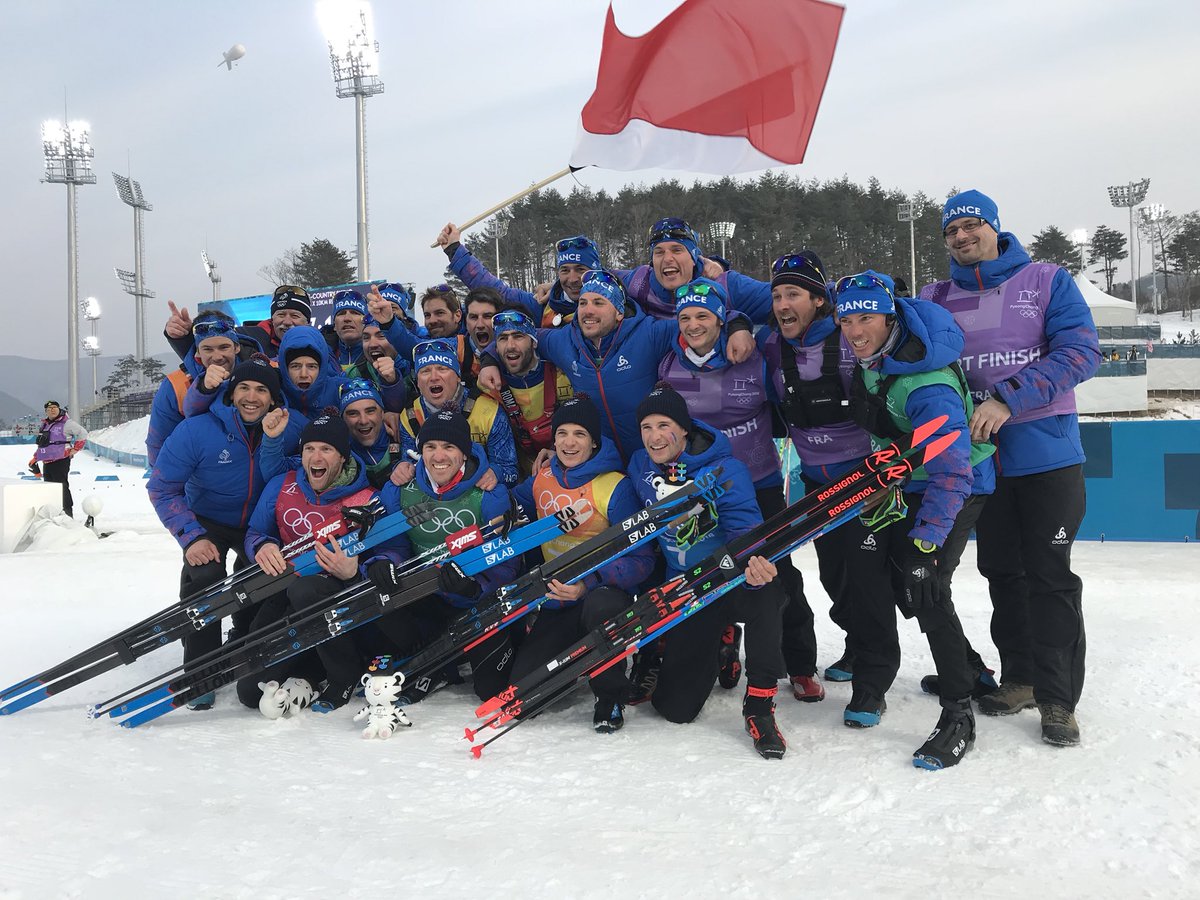
Team France celebrates its bronze-medal finish in the men’s 4 x 10 k relay at the 2018 Olympics on Sunday in PyeongChang, South Korea. (Photo: FIS Cross Country/Twitter)
Early in the final leg, France’s Adrien Backscheider took the lead ahead of Klæbo. The two held Spitsov off until the end of the second lap, where Spitsov came through the stadium first to start the final loop. Spitsov and Klæbo soon upped the pace, dropping Backscheider, and shortly after the 8.27 k checkpoint, Klæbo truly put the jets on to accelerate away from Spitsov. He dropped the Russian on a climb just before the final uphill, where it was clear that the gold was Norway’s.
As he sped down into the stadium, Klæbo relaxed his arms, skied to the sideline and took a flag from the stands. He looked back for a moment and then crossed the finish line first in 1:33:04.9 hours, while Spitsov followed 9.4 seconds later for silver for Russia. Backscheider held on for bronze (+36.9) as his team exuberantly celebrated with him at the finish.
Finland placed fourth (+1:40.5), Sweden fifth (+2:05.6), Germany sixth (+2:08.2), Italy seventh (+2:35.2), and Kazakhstan eighth (+3:31.4). Canada was ninth (+3:41.0) for its second-best Olympic relay result (with Len Valjas, Graeme Killick, Russell Kennedy, and Knute Johnsgaard), and the U.S. finished 14th (+9:24.2), out of 14 teams, with Andy Newell, Reese Hanneman, Scott Patterson, and Noah Hoffman.
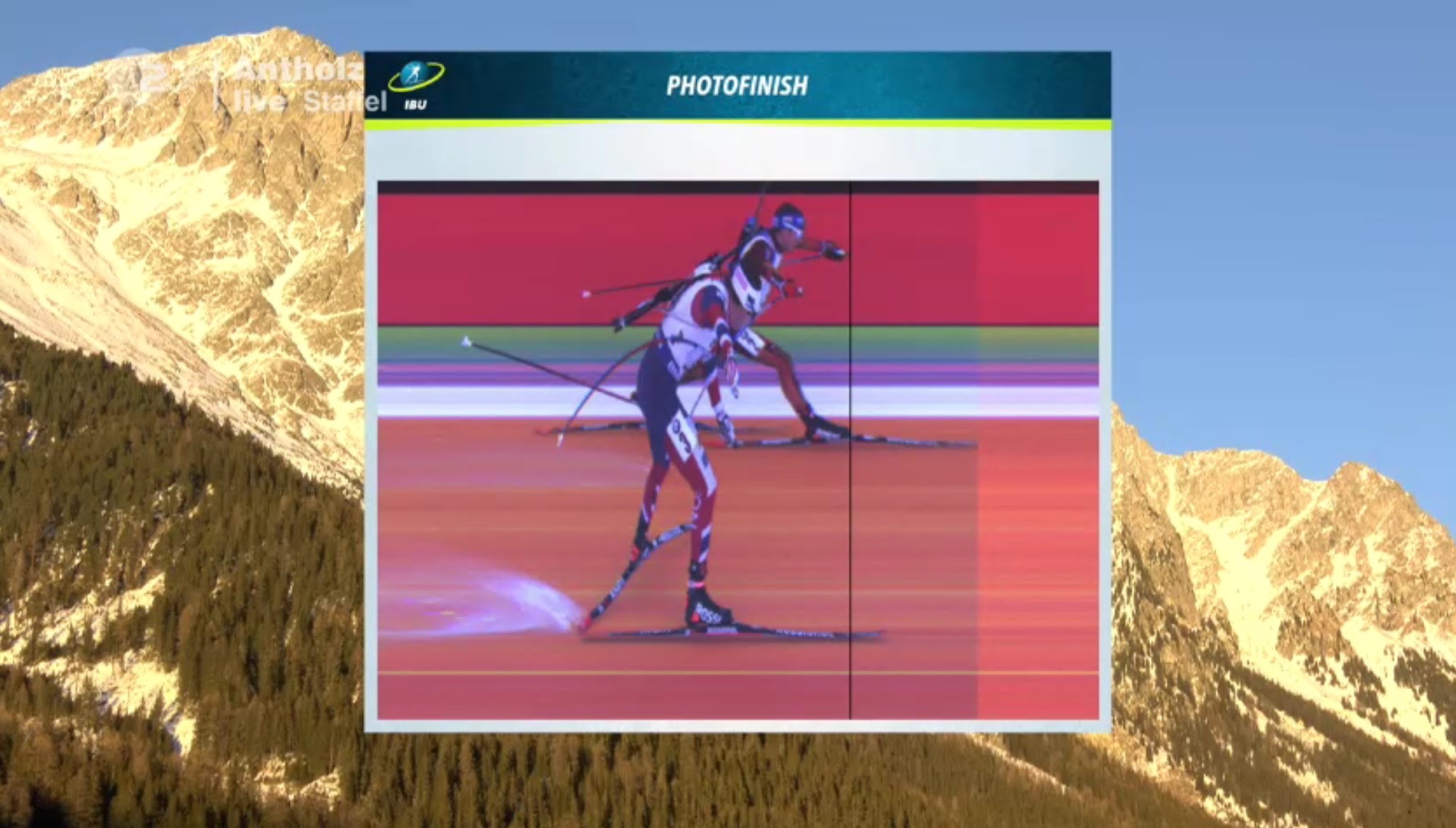
France’s Martin Fourcade lunging for his second gold of the 2018 Olympics in PyeongChang, South Korea, winning the men’s 15 k mass start on Sunday. (Photo: FlyingPointRoad)
Martin Fourcade is the champion once again. Six days after he won the 12.5-kilometer pursuit for his first gold in PyeongChang, the 29-year-old Frenchman did it again in the men’s 15 k mass start on Sunday, winning in a photo finish at the line.
He took charge on the first loop, leading the field into the range for the first prone shooting. There, Fourcade shot a penalty and slipped to 19th, but it wasn’t over.
Clean shooting on the second prone brought him up to eighth, 9.4 seconds out of first. Germany’s Benedikt Doll took that lead at that point after his second stage without a miss. Meanwhile Norway’s Johannes Thingnes Bø shot three misses on that second stage and dropped out of contention.
One loop later, Fourcade moved into first with a clean standing. He left the range about 1 second ahead of Germany’s Simon Schempp and 2 seconds ahead of Germany’s Erik Lesser, after both made it through the first three stages without a miss. Doll missed one to slip to seventh, almost 30 seconds behind.
After Fourcade and Schempp exchanged leads over the next loop, Lesser moved into first just before the final shooing, Going head to head, Fourcade and Schempp both missed one while Lesser missed two. Fourcade and Schempp still left the range in first and second, respectively, separated by 0.4 seconds, while Lesser slipped to fifth, 22.5 seconds back.
Doll left the range in third (+19.2) after cleaning and Norway’s Emil Hegle Svendsen moved into fourth (+21.9) with a clean standing stage as well.
In the end, Fourcade outlunged Schempp for the win in 35:47.3 minutes, with Schempp finishing less than a tenth of a second behind for silver, and Svendsen beat out Lesser in the finishing stretch by 0.4 seconds to claim bronze, 11.2 seconds behind, while Lesser settled for fourth (+11.6). Doll followed them in fifth (+18.8), Austria’s Julian Eberhard placed sixth (+30.7) with three penalties, Norway’s Erlend Bjøntegaard seventh (+32.1) with two misses, Norway’s Tarjei Bø eighth (+34.6) with three penalties, Sweden’s Jesper Nelin ninth (+34.6) with two misses, and Slovenia’s Jakov Fak 10th (+36.1), just ahead of the Czech Republic’s Ondřej Moravec in 11th (+36.3), with one miss each.
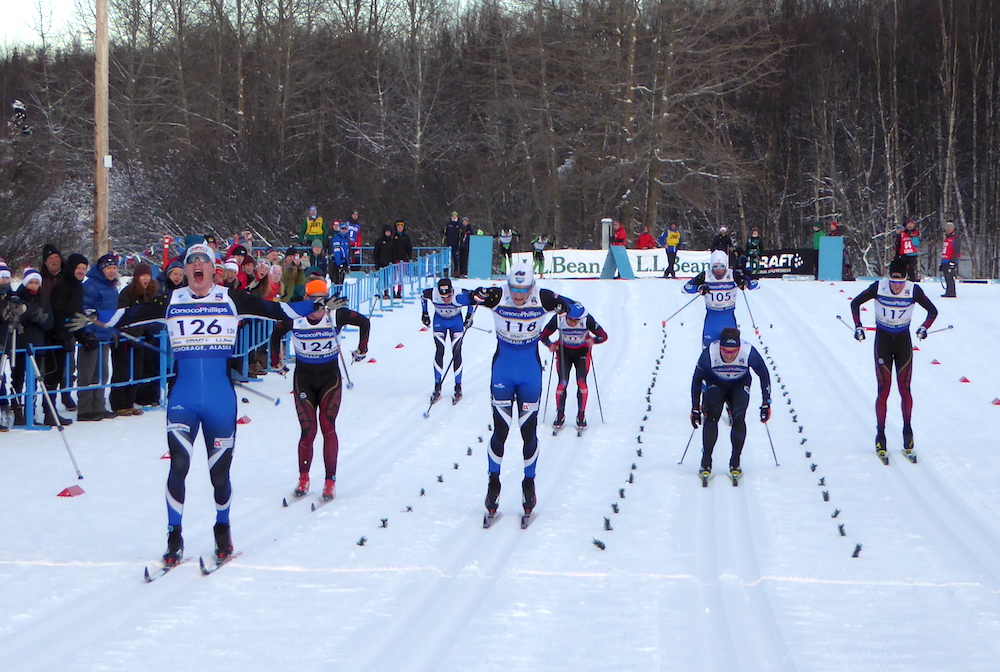
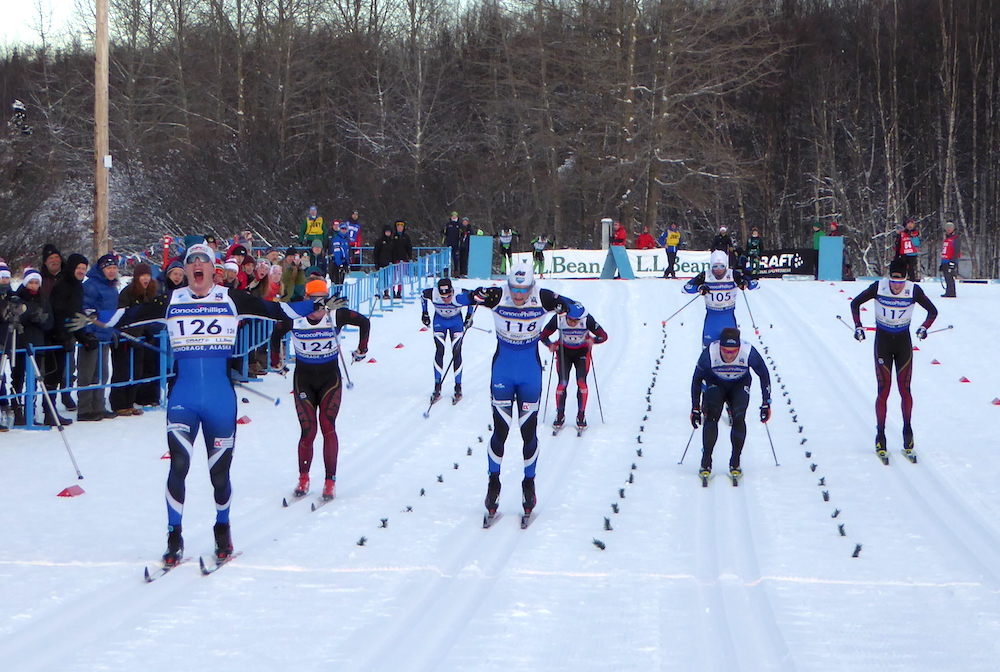
APU’s Tyler Kornfield (126) leads APU’s Eric Packer (118) and DU’s Eivind Romberg Kvaale (124) to the line in the men’s 30 k classic mass start at 2018 U.S. Cross Country Championships on Sunday in Anchorage, Alaska. Kornfield, Packer, and Kvaale finished first, second and third, respectively. Kris Freeman (10, second from left) was fourth overall and the third American.
U.S. Cross Country Championships (Anchorage, Alaska): 20/30 k classic mass starts
Sweden’s Hedda Bångman denied Caitlin Patterson of her first outright victory of the week at 2018 U.S. Cross Country Championships, but Patterson as the first American racked up her third-straight national title in the women’s 20-kilometer classic mass start at Kincaid Park on Sunday in Anchorage, Alaska.
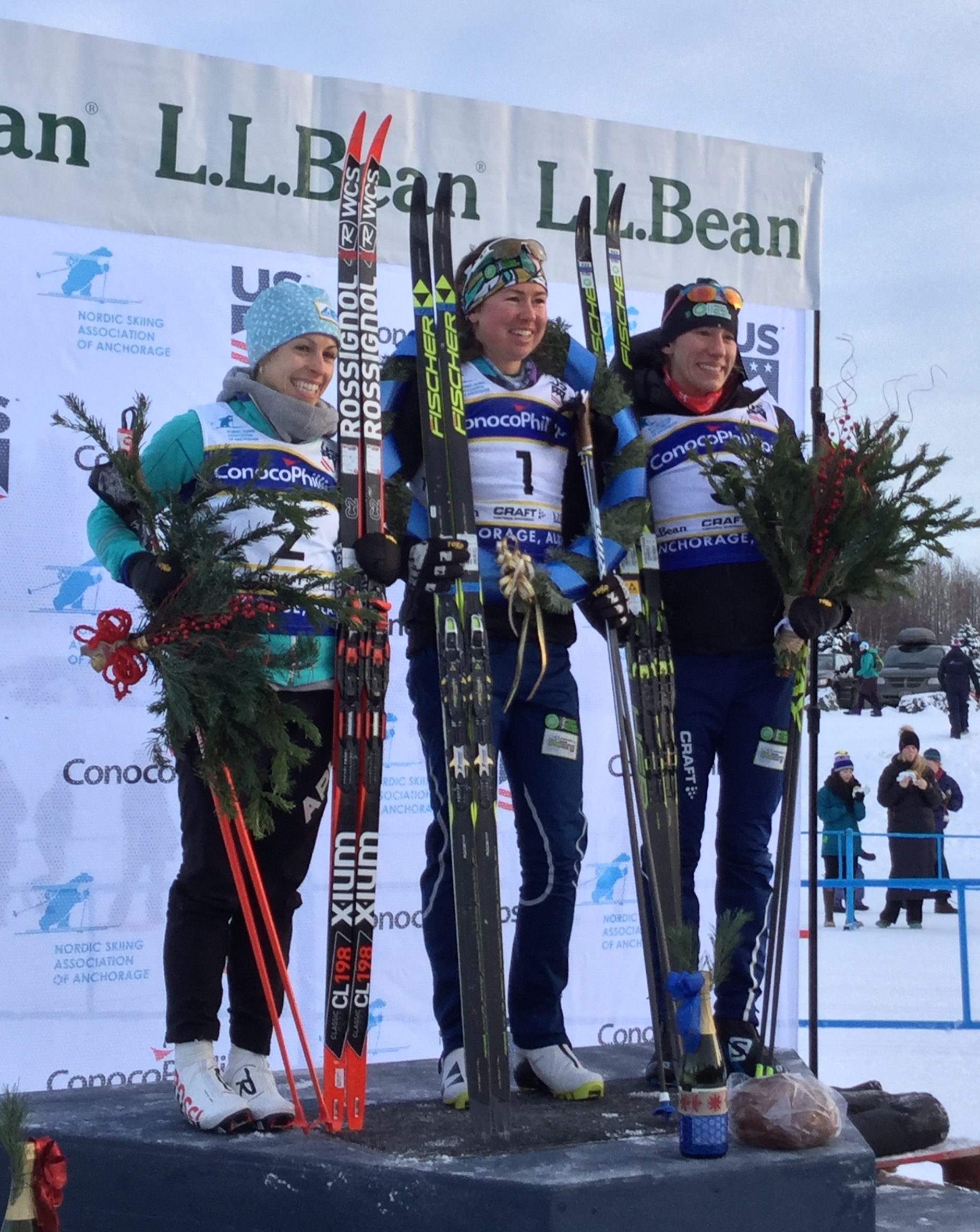
The top-three Americans in the women’s 20 k classic mass start on Sunday at 2018 U.S. nationals in Anchorage, Alaska, with Caitlin Patterson (1) of the Craftsbury Green Racing Project (CGRP) in first, Rosie Frankowski of APU (l) in second, and Kaitlynn Miller (r) of CRGP in third.
Bångman, a 22-year-old freshman at the University of Colorado Boulder (CU), pulled off a 15.9-second win in the mass start, crossing the line in 1:00:55.3 hours. Patterson, of the Craftsbury Green Racing Project (CGRP), finished second, but was the top American in the event for the third time this week, and Rosie Frankowski, of Alaska Pacific University (APU), notched third (second American), 19.6 seconds back.
Rounding out the top 10 was Jessica Yeaton, who trains with APU and races for Australia, in fourth (+44.1), Kaitlynn Miller (CGRP) as the third American in fifth overall (+1:13.5), Alayna Sonnesyn of the University of Vermont (UVM) in sixth (+1:25.3), Chelsea Holmes (APU) in seventh (+1:55.4), Norwegian CU skiers Christina Rolandson and Anne Siri Lervik in eighth (+1:55.7) and ninth (+1:56.1), respectively, and Erika Flowers of the Stratton Mountain School (SMS) Elite Team in 10th (+2:14.6).
The men’s 30 k classic mass start was incredibly close, with APU’s Tyler Kornfield taking his first-ever distance national title (he was the 2012 classic sprint national champion) in 1:21:43.6. He edged his teammate Eric Packer by 0.7 seconds at the line, and Eivind Romberg Kvaale, a sophomore at the University of Denver (DU), finished 1 seconds back in third.
Kris Freeman (Caldwell Sport) was just off the overall podium in fourth (+1.6), but was the third American. Another DU skier, Dag Frode Trollebø, also from Norway, finished fifth (+2.0), and APU had three in the top six with David Norris in sixth (+2.5). Noah Hoffman (Ski & Snowboard Club Vail) finished seventh (+2.6), Scott Patterson (APU) eighth (+3.6), and Craftsbury’s Adam Martin and Ben Lustgarten followed in ninth (+14.7) and 10th (+14.9), respectively. With Brian Gregg (CXC/LNR/Team Gregg) in 11th (+16.1), the men’s top 11 were separated by less than 17 seconds.
IBU World Cup (Oberhof, Germany): Men’s and women’s relays
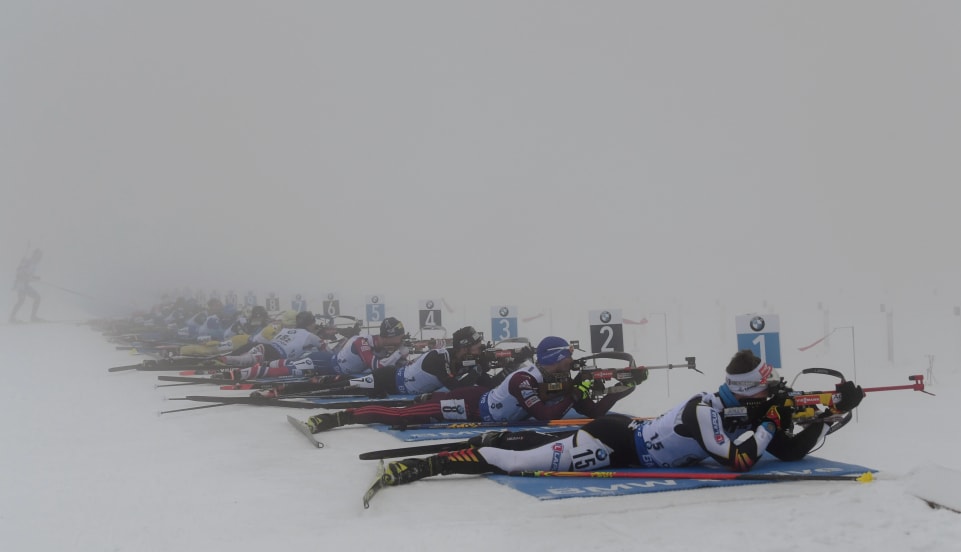
Racers on the range during the men’s 4 x 7.5 k relay on a foggy Sunday at the IBU World Cup in Oberhof, Germany. (Photo: IBU/Biathlonworld)
The Swedish men’s team and French women won the second relays of the International Biathlon Union (IBU) World Cup season on Sunday, with Sweden winning the men’s 4 x 7.5 k relay by 1:10.8 over Italy, and France besting Germany by 32.4 seconds.
Notably, most of the top teams didn’t start all of their “A” teamers.
In the men’s race, Sweden’s Martin Ponsiluoma, Jesper Nelin, Sebastian Samuelsson, and Fredrik Lindström combined for their first win together — and the first win for most of the members on the team.
“It is a dream when you are a kid to compete in a World Cup,” Samuelsson said, according to an IBU press release. “To have a win is really amazing!”
The Swedish women’s team also landed on the podium in third (+48.2).
“What a race by the whole team,” said Lindström, who also has one non-relay World Cup win (from 2012) to his name. “It could not be better.”
Conditions could not have been much more difficult for shooting on Sunday, with the fog that had descended early in the day for the women’s race worsening for the men’s race. When there wasn’t fog, there was wind.
Misses were common throughout the two races, and even with racers being able to use three spares per shooting stage to clean, there were a high number of penalty laps.
But the Swedish men kept their penalties to a minimum, with just one for the entire team and a total of nine spare rounds used among them. After Ponsiluoma came through the first exchange in sixth, Nelin skied them into third, Samuelsson picked off another place despite skiing a penalty after his standing stage to put them in second, and Lindström anchored them to first.
“The conditions today were so special. Somehow I felt not so nervous, I was calm and had luck on my side,” Lindström said at a post-race press conference about his nearly flawless shooting (0+0; 0+1).
“I have never [been first] before,” he added. “Not like this in a relay at least. That’s really fantastic.”
“I had to look up to see if I was aiming the right way,” Nelin said after cleaning prone (0+0) then using two spares to clean standing (0+2). “I had no idea where I was aiming, so it was really difficult. But I hit, and it was good. Maybe these conditions fit me and I should never see anything.”
Italy placed second with Thomas Bormolini, Lukas Hofer, Dominik Windisch, and Thierry Chenal combining for two penalties and 11 spares. Hofer had skied them up from eighth to second, and Windisch then took the lead on the third leg to put them in first at the final exchange, 1 minute ahead of Sweden. But Chenal slipped with the seventh-fastest last leg time and a penalty after standing.
“Being on the podium with the team is always a special feeling,” Hofer said at the press conference. “For Thierry, it’s the first year in the World Cup, and he does a really good job, not just today. I am really happy that he could close out this relay. Second place is like a win for us.”
Norway placed third (+2:04.6) with Vetle Sjåstad Christiansen, Henrik L’Abée-Lund, Lars Helge Birkeland, and Tarjei Bø. Together, they had three penalties (two from L’Abée-Lund and one from Birkeland) and 14 spares.
“I grew up on Holmenkollen so I practiced a lot there [in fog],” L’Abée-Lund said. “But today was really really hard, I didn’t see anything in prone. Standing was OK, but prone was really difficult.”
“It’s great to be on the podium,” Christiansen said. “Of course Norway always wants to win, but today we are very happy for our brothers in our neighbor-country Sweden.”
The Canadian men placed 10th (+6:23.1) out of 25 teams with Christian Gow, Scott Gow, Brendan Green, and Carsen Campbell having a combined six penalties and 20 spares. Three of those penalties came on Scott Gow’s second leg, two from Campbell’s anchor leg, and one on Christian Gow’s first leg.
After a penalty on his first prone stage (1+3), Christian cleaned standing with a spare (0+1) and tagged Scott in 11th, 53 seconds out of first. Scott then had two penalties in prone and three in standing, but managed to improve to eighth given how much everyone else was struggling with the shooting as well. Green kept them in eighth with two clean stages (0+2, 0+3), and Campbell, in his first World Cup relay, cleaned prone (0+2) but had two standing penalties (2+3) to put the team in 10th at the finish.
In an interview with German broadcaster ARD halfway through the race, Canadian coach Matthias Ahrens called the range conditions, which ranged from thick fog to unpredictable wind, “very hard to assess.”
“… To be honest, the good thing was that conditions were very bad,” he later added. “So regarding visibility, almost everyone was on the range at the same time [with the same irregular conditions]. They had to wait very long, and of course had bad conditions to shoot, but much of the field was there at the same time.”
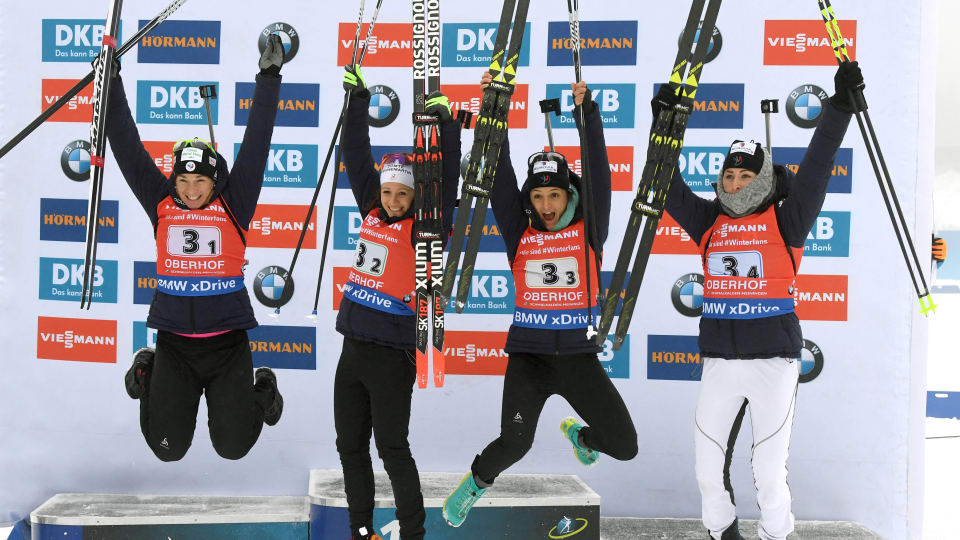
The French women’s team, of Anais Bescond, Anais Chevalier, Celia Aymonier, and Justine Braisaz, celebrate their relay victory on Sunday at the IBU World Cup in Oberhof, Germany. (Photo: IBU/Biathlonworld)
In the women’s race, with better shooting visibility, France’s Anais Bescond, Anais Chevalier, Celia Aymonier, and Justine Braisaz took the win in 1:12.42.4, with one penalty and 10 spares. After Bescond put them in first through the first exchange, 6 seconds ahead of Italy in second, Chevalier had to ski a penalty loop after prone but cleaned standings (1+3, 0+0) and tagged off in second, 23 seconds behind Italy, now in first.
One loop later, France was back in first thanks to Aymonier, who cleaned with just two spares (0+0, 0+2), and they extended their lead from 0.8 seconds at the last exchange to 32 seconds at the finish with Braisaz, who shot 0+1, 0+3, and skied the fastest anchor leg.
“I know that it’s always good for Justine to start in the first position, so I really wanted to pass the relay to her in that,” Aymonier said in a press conference after.
“I was nervous, too,” Braisaz said. “That kind of shooting turned my mind upside down, actually. The crowd was very loud, and … I wasn’t very focused on what I did. It was a bit foggy, too, so that made it harder. But finally it was a French day, maybe.”
“In my mind the whole team is really strong, and really able to get the first place,” Bescond said. “After years and years and years behind Germany’s team we finally did it. So just Oberhof spirit I think.”
Germany placed second with Vanessa Hinz, Denise Herrmann, Franziska Preuss, and Maren Hammerschmidt. They combined for two penalties and 13 spares; with a penalty on Hinz’s first leg and one more on Hammerschmidt’s last shooting. After being tagged in 14th, Herrmann skied them into fourth, 40 seconds out of first, and Preuss elevated them to second, which Hammerschmidt held onto.
“I was struggling a little bit in the prone shooting,” Herrmann said. “But the skiing was good today, and also the standing [shooting]. I tried to go fast on the track and catch some girls.”
Sweden, with Linn Persson, Anna Magnusson, Elisabeth Högberg, and Mona Brorsson, avoided the penalty loop and used eight spares to reach the podium for the first time in six seasons. In sixth place at the first exchange, they slipped one place to seventh on the second leg, but Högberg raced them up to fourth with near-perfect shooting (0+0, 0+1) with one leg to go. Brorsson then anchored them to third with clean shooting (0+2, 0+1) and the third-fastest last leg.
“It’s just super nice for us! I am super happy,” Magnusson said. “We were very emotional at the finish.”
When Brorsson was asked if she believe she could fight for the podium, she responded, “Not really. But I said to Linn, ‘Maybe it is our day today. Please let it be our day today.’ ”
The Canadian women finished 14th (+6:37.5), out of 20 teams, with two penalties and 13 spares. Sarah Beaudry initially put them in 15th after shooting 0+1, 0+2, then Julia Ransom had a standing penalty (0+2, 1+3) to slip one place to 16th. Megan Tandy picked off three places with clean shooting (0+0, 0+2) and tagged Emma Lunder in 13th, and Lunder had a penalty in prone but cleaned standing (1+3, 0+0) to finish in 14th.
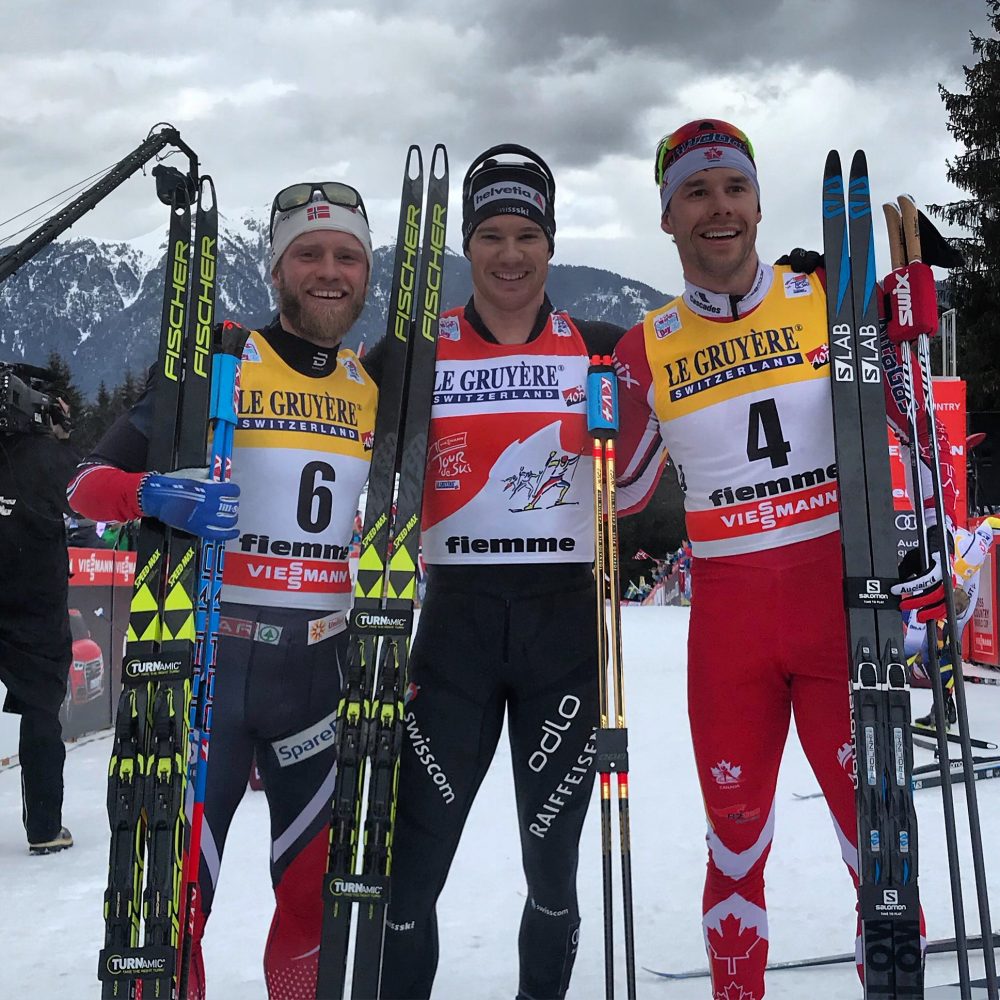
The men’s overall 2018 Tour de Ski podium atop Alpe Cermis after the final Stage 7 hill climb: with Switzerland’s Dario Cologna (c) in first, Norway’s Martin Johnsrud Sundby (l) in second and Canada’s Alex Harvey (r) in third. (Photo: FIS Cross Country/Twitter)
Dario Cologna of Switzerland added a fourth Tour de Ski (TdS) title to his list of accolades on Sunday, winning the 2018 edition of the race in dominant fashion, with a 1:26.5-minute win over Norway’s Martin Johnsrud Sundby. And Canada’s Alex Harvey scored his first TdS overall podium in third.
The 31-year-old Cologna started the 9-kilometer freestyle pursuit up Alpe Cermis 1:15 ahead of Kazakhstan’s Alexey Poltoranin in second. Russia’s Sergey Ustiugov, slated to start third, did not start due to a back injury. Thus Harvey was the third man off the start line, 1:23 behind Cologna.
(Sweden’s Marcus Hellner, 13th after Saturday’s Stage 6, also did not start the Tour’s final stage.)
Early on, Cologna started putting time into his competitors, extending his lead on Poltoranin to 1:20.5 and Harvey to 1:24 at 1.8 k.
By 4 k, however, Harvey had used his speedy skiing on the flatter portions of the race leading up to the climb to catch Poltoranin, and the two clocked through that checkpoint 1:19.4 behind Cologna. Behind them, Russia’s Alexander Bolshunov skied just ahead of Sundby, another 21 seconds and 22 seconds back, respectively, in fifth and sixth.
While Harvey clawed back a few more seconds on Cologna, he was still 1:17.8 back at 6.2 k, with Poltoranin just 0.7 seconds behind him in third.
Harvey remained in second until around 8.5 k; with just a half kilometer to go, Sundby had caught both Poltoranin and Harvey, passing them both. Sundby held that position and finished second, 1:26.5 behind Cologna, who won in 28:52.1.
Harvey stayed strong for third (+1:30.6) while Poltoranin dropped off the Canadian’s pace in the final half kilometer and finished fourth (+1:41.7). Norway’s Hans Christer Holund placed fifth (+2:17.8), Bolshunov lost a spot to finish sixth (+3:09.7), France’s Jean-Marc Gaillard finished seventh (+3:16.7), Sweden’s Daniel Rickardsson eighth (+3:20.8), and Russia’s Alexey Chervotkin and Andrey Larkov took ninth (+3:33.5) and 10th (+3:37.8), respectively.
France’s Maurice Manificat, known for his strength in freestyle hill climbs and pursuit races, rose from 14th to 11th (+3:45.7) with the second fastest time of day, 12.8 seconds slower than Sundby as the time of day winner in 28:36.4. Cologna’s time was fourth fastest (+15.7), behind Russian U23 skier Denis Spitsov in third (+14.3) (Spitsov started 20th and finished 13th). Holund’s time ranked fifth (+20.6) and Harvey’s time was sixth fastest (+23.6) of the 43 men that finished the race.
The lone American man to complete this year’s Tour, Paddy Caldwell (U.S. Ski Team) skied the 22nd fastest time of day for 38th overall (+11:54.8).
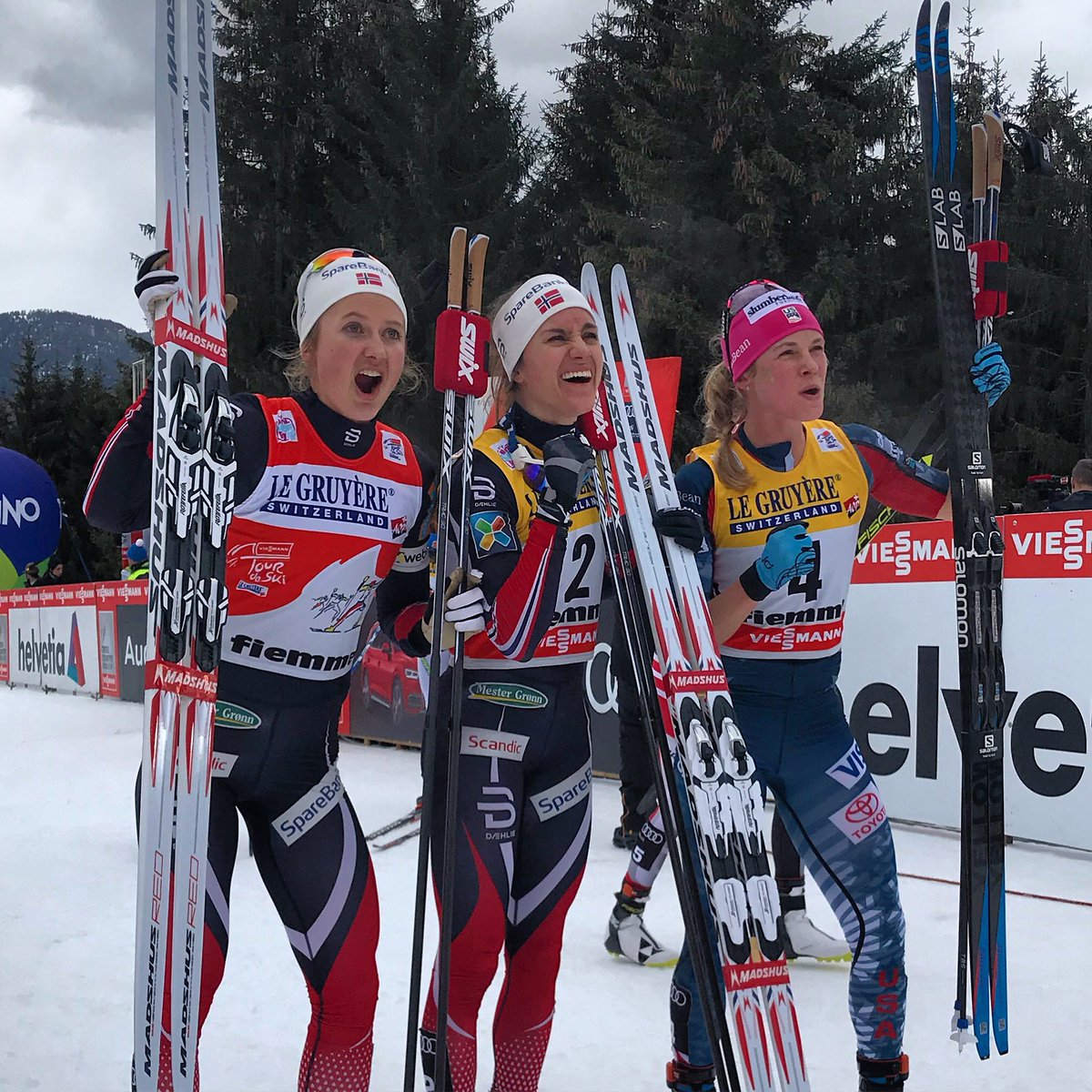
Heidi Weng (center) celebrates her second Tour de Ski victory, with teammate Ingvild Flugstad Østberg second and the U.S. Ski Team’s Jessie Diggins third. (Photo: FIS Cross Country/Twitter)
In the women’s hill climb that kicked off the day, Heidi Weng raced to her second consecutive TdS title. The Norwegian started the day within two seconds of teammate Ingvild Flugstad Østberg, and the two skied together for the flat section of the nine-kilometer stage of the competition. But when the climbing got steep on Alpe Cermis, Weng left her teammate behind and eventually racked up a 48.5-second win.
The battle for third was less predictable. Jessie Diggins of the United States started the day in fourth, but made up the ten seconds to third-place KristaPärmäkoski of Finland in the first few kilometers. The pair climbed together for a while before Diggins attacked. Pärmäkoski tired on the final sections of the Alpe Cermis and Diggins took the podium in definitive style, 2:23.2 behind Weng and 24 seconds ahead of Pärmäkoski. It’s the first overall Tour de Ski podium for Diggins or any American athlete.
Teresa Stadlober of Austria finished fifth (+3:09.4), Kerttu Niskanen of Finland sixth (+4:17.0), Russia’s Anastasia Sedova seventh (+4:49.6), and Switzerland’s Nathalie von Siebenthal eighth (+4:56.1).
Sadie Bjornsen started eighth and slipped one spot to finish ninth (+6:15.0), giving the U.S. two top-ten finishers in the Tour de Ski for the first time. Liz Stephen finished 16th (+8:25.8) and Rosie Brennan 24th (+10:59.6).
En route to her win, Weng notched the fastest time of the day on the 9 k stage. Stadlober’s time was second, Diggins third, Østberg fourth, and Stephen fifth.
32 women finished this year’s edition of the Tour de Ski.
Note: This article has been updated to include comments from Sweden’s Charlotte Kalla.
For the second day in a row, Charlotte Kalla, a name synonymous with the yellow and blue of Sweden, stood atop the podium, placing first in the women’s 10-kilometer classic International Ski Federation (FIS) race on Saturday in Gällivare, Sweden. On Friday, Kalla won another individual-start race, the 5 k freestyle, by a margin of 8.8 seconds. She more than doubled that time gap by the finish of Day 2, winning the 10 k classic in 27:55 minutes, 17.7 seconds ahead of Russia’s Yulia Tchekaleva in second place. Natalia Nepryaeva, also from Russia, skied to third, 40.9 seconds back of Kalla.
“I am feeling good and I think I am where I should be at this moment,” Kalla wrote in an email. “I had a good feeling on the classic race and handle the condition well. On Friday I opened hard and tried to push hard all the way.”
Known as a skate powerhouse, Kalla has improved her classic skiing and is now a double threat. “I have improved my classic technique the last years,” Kalla explained. “When I am in shape it doesn’t matter if it is skating or classic. I am glad I managed to ski well in the condition we had. It was a little bit soft because of the snowfall.”
Although a home FIS event for Sweden, Russia secured six of the top-10 spots with Sweden settling for three. Japan’s Masako Ishida, the only non-Russian or Swede outlier in the top 10, placed fourth (+1:02.4). Russians Anna Zherebyateva raced to fifth (+1:08.8) while teammate Yulia Belorukova was sixth (+1:12.8).
Sweden took the next two spots with Stina Nilsson in seventh (+1:20.9) and Anna Haag in eighth (1:20.9). Russia rounded out the top 10 with Anatasia Sedova placing ninth (+1:24.1) and Mariya Guschina in tenth (+1:25.0).
Sweden’s Ida Ingemarsdotter, a World Cup regular, placed 11th (+1:30.6).
Kikkan Randall was the only U.S. Ski Team member at the race, and a day after finishing eighth in the 5 k skate, she finished 15th (+1:48.1) on Saturday. In an email, Randall explained that snow had fallen continuously for the last 24 hours in Gällivare.
“Conditions were pretty nice, the track was a little soft and a lot of racers here made the pole track a little punchy,” she wrote.
Considering the massive time-zone shift from her home in Anchorage, Alaska, to Central European Time, it appears Randall is adjusting well.
“I felt decent today, not too tired from the jet lag or yesterday’s race. I wanted two back-to-back races to get ready for next weekend’s triple World Cup opener,” she wrote, referring to the first three World Cup races in Kuusamo, Finland, starting Friday, Nov. 23.
Throughout Saturday’s 10 k, Randall steadily improved her overall placing: she was 32nd at 4.2 k, 23rd at 6.8 k and locked into 15th by 9.2 k.
“It was definitely good to race a 10km classic today,” Randall wrote. “I had trouble really digging into my race gear on the first lap today. I think I was skiing a little stiff and not carrying my momentum down the track. Nepryaeva [the third-place finisher] caught me going into the 2nd lap and that was the jumpstart I needed. I was able to match her pace for most of the rest of the race and it helped me find better technique and tempo.
“I wanted to be a little stronger today but I got some really important feedback on where I’m at and what I need to work on as the race season progresses,” she added. “My fitness feels pretty good and now it’s just a matter of fine-tuning.”
Emily Nishikawa was the only Canadian entered on Saturday and finished in 51st (+3:39.3). Sixty-nine women started the race, 38 from Sweden, 17 from Russia, seven from Japan, two from Switzerland and Estonia, and one each from the U.S., Canada, and Poland.
In Friday’s 10 k skate in Gällivare, only Swiss star Dario Cologna kept the Russians from sweeping the top nine by placing third. In that race, Evgeniy Belov and Sergey Ustiugov of the Russian national team finished first and second, respectively.
Saturday was a different race, a 15 k classic, but with a similar thread and no Cologna as a Russian foil.
The Russian men finishing in unison to take first, second and third in the men’s 30 k skiathlon, the final race of 2017 U23 World Championships at Soldier Hollow in Midway, Utah. Alexander Bolshunov (8) was deemed the winner, Alexey Chervotkin (1) was second, and Denis Spitsov (11) third. (Photo: FlyingPointRoad.com)
It was Russia, Russia, Russia.
Alexander Bolshunov, winner of the 30 k skiathlon at 2017 U23 World Championships, won the race in 37:13, one second ahead of Maxim Vylegzhanin in second. Alexey Chervotkin was third (+5.1).
Classic specialist, Kazakhstan’s Alexey Poltoranin finished fourth, 13 seconds off the podium, and Cologna placed fifth (+22.1).
Despite being on Swedish soil, the rest of the top 10 became a mostly Russian affair. Russian teammates Alexey Vitsenko and Artem Maltsev placed sixth (+29.5) and seventh (+37.4), respectively, Sweden’s Calle Halfvarsson interrupted the trend by tying Russia’s Evgeniy Belov for eighth (+38.0), and Russia’s Alexander Bessmertnykh took 10th (+40.1).
There’s a pattern: Russia took 14 of the top-20 places. Twenty-eight of 126 starters were from Russia, with the vast majority of the field being Swedish. Outside of the top 10, Sweden’s Daniel Rickardsson was the next-best Swede in 12th (+49.6).
Devon Kershaw (World Cup Team), who finished 12th on Friday, once again led Canada in 20th (+1:06.7). At 6.8 k, Kershaw was ranked 15th, and at 9.6 k he was down one spot to 16th. By the 11.4 k checkpoint, he began slipping further in the standings.
“Today was a tough one,” Kershaw wrote in an email. “I felt pretty good but conditions were soft, so you had to really feather it (the technique) – especially on the climbs. Pacing wise I think I was doing pretty well, but in the last 2.5km today I was missing any semblance of a kick to the finish and ended up conceding a few seconds to those around me, knocking me from about 15-16 to 20th.”
Although an interval start race, Kershaw never found a strong pacing partner. “I was skiing alone – no help at all today,” Kershaw wrote of his solitary effort. “It would have been so helpful! Especially that last lap when things get tough. But in individual start races, you need to learn to do it alone. So good to try and get used to that “time trial” feeling.”
Three other Canadians competed, with Graeme Killick (World Cup Team) finishing 50th (+2:32.3), Jack Carlyle (Alberta World Cup Academy) 91st (+4:06.1), and Brian McKeever (Para Nordic Team) 110th (+5:16.0).
As of press time, Fasterskier could not confirm if the International Ski Federation (FIS) held an emergency meeting to discuss the involvement of IOC-banned Russian skiers in FIS-sanctioned races. Of the six IOC-sanctioned Russian skiers, four are men: Belov, Vylegzhanin, Alexander Legkov, and Alexey Petukhov. All four skiers raced on Friday, however, Legkov and Petukhov (and Shapovalova, one of the two women sanctioned by the IOC) did not contest Saturday’s race.
Racing continues in Gällivare on Sunday with classic sprints.
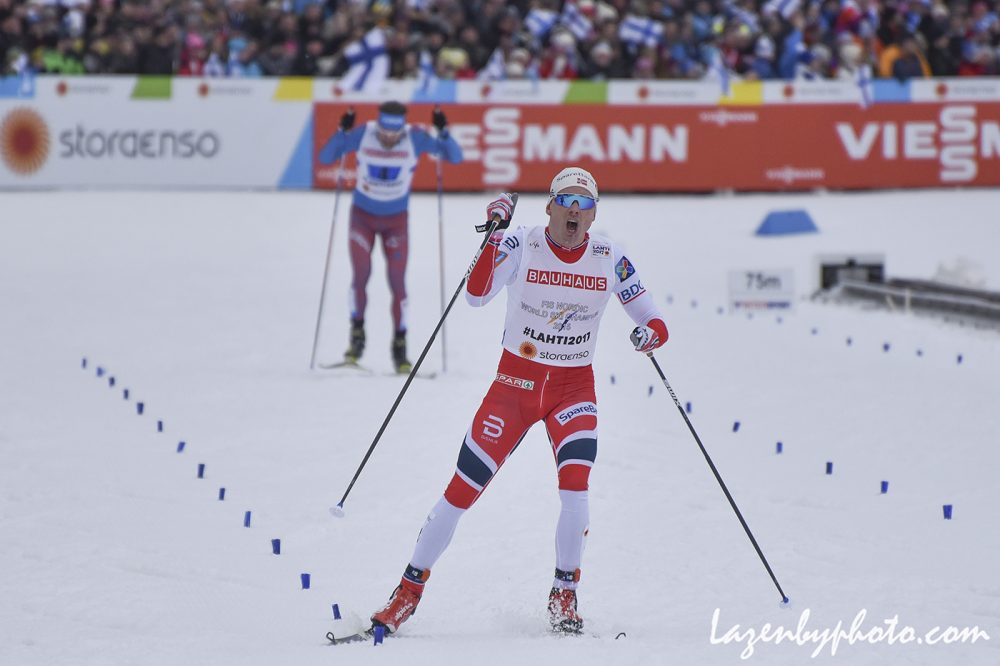
Norway’s Finn Hågen Krogh with the victory stoke as he wins the 4 x 10 k relay at the 2017 Nordic World Championships in Lahti, Finland, by 4.6 seconds over Russia’s Sergey Ustiugov (behind). (Photo: John Lazenby/Lazenbyphoto.com)
LAHTI, Finland — There were three medals up for grabs during Friday’s 4 x 10-kilometer relay at 2017 Nordic World Championships on Friday. Yet after the scramble leg, two distinct races: Norway and Russia’s dance for gold, and what eventually became a four-way tango between Finland, Sweden, Switzerland, and Germany for bronze and silver.
Russia’s Andrey Larkov and Norway’s Didrik Tønseth first strung out and then smoked the field late in their leg. By the tag to their second-leg skiers, Norway and Russia were twenty seconds up.
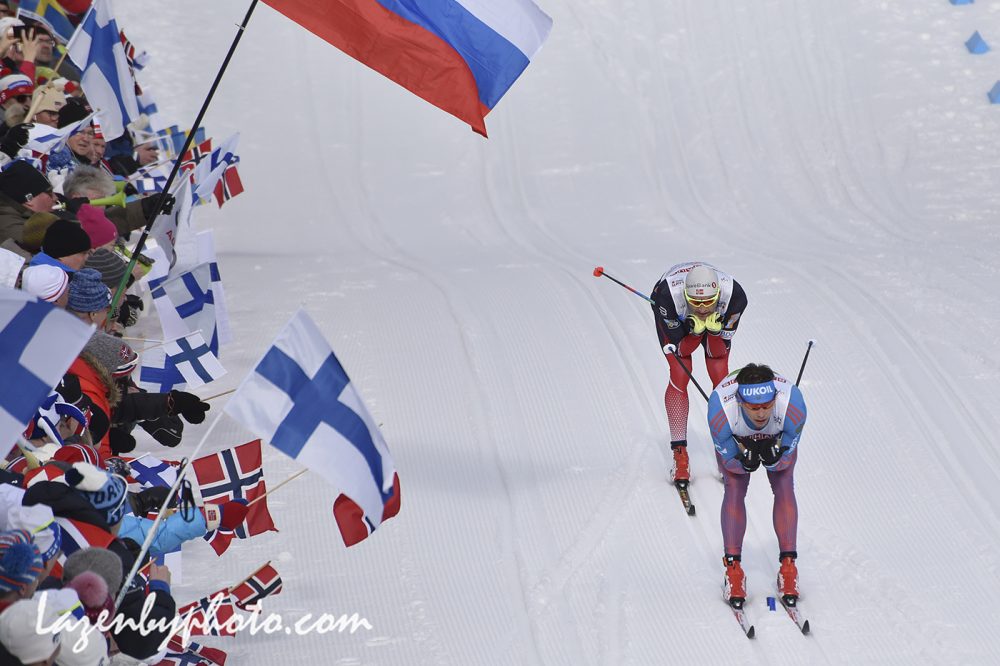
Russia’s Alexander Bessmertnykh leads Norway’s Niklas Dyrhaug as they sustain the break during the second leg of the 4 x 10 k relay at the 2017 Nordic World Championships in Lahti, Finland. (Photo: John Lazenby/Lazenbyphoto.com)
That margin grew to thirty seconds, as Russia’s Alexander Bessmertnykh and Niklas Dyrhaug finished Leg 2 and the transition to skating began.
Coming in just a half a minute later in third place, was Finland’s Iivo Niskanen, giving the fans a premature taste of the podium.
Racing the third leg was Norwegian Martin Johnsrud Sundby. Russia tried to match the Norway’s trump card with Alexey Chervotkin. The 21-year-old Chervotkin skied the third leg for Russia in both team relays that took place this season: the first in Nove Mesto, Czech Republic, the other in La Clusaz, France, where the team placed second both times to Norway.
However, the World Championship leg was the first time Chervotkin matched up against Sundby this year.
Late in the leg, it was unclear what Sundby’s strategy would be as the young Russian shadowed the 32-year-old Sundby move for move. With Sergey Ustiugov up for the Russians in the anchor leg against Norway’s Finn Hågen Krogh, many armchair-relay strategists would have thought the Norwegian’s line up ploy was a dud.
Not until 1.2 kilometers left in the leg did Sundby make a sufficient gap. At that point, the time spread from silver to gold was only eleven seconds. Not exactly a huge buffer for Krogh.
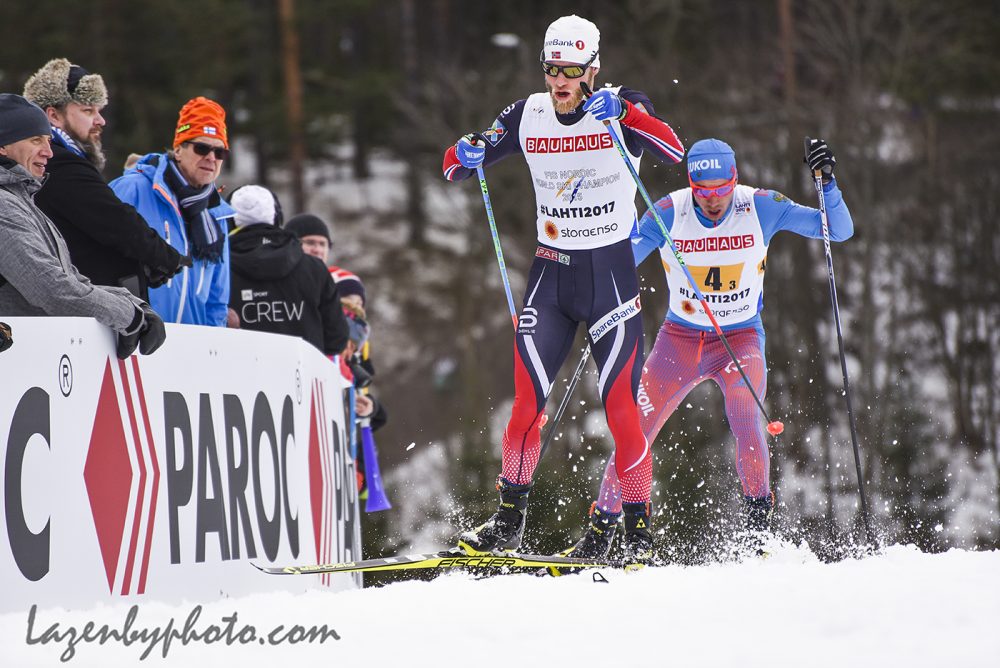
Norway’s Martin Johnsrud Sundby, marked by Russia’s Alexey Chervotkin (4), during a critical third leg of the 4 x 10 k relay at the 2017 Nordic World Championships in Lahti, Finland. (Photo: John Lazenby/lazenbyphoto.com)
By Sundby’s tag to the anchor skier, he had gifted Krogh a 17.7-second margin for error. The rhetorical question at the start of the fourth leg: when will Ustiugov catch Krogh?
“He’s the worst the worst guy you can have in back of you,” Krogh said during a press conference, referring to Ustiugov. “He made the race tough for me.”
At 1.3 k into that fourth leg, Ustiugov was 8.8 seconds back. In another 1.2 kilometers, it ballooned again to 11.6 seconds, and then it contracted again to 5 seconds with 3.8 k to go. But until the finishing stretch, when Krogh rounded the final turn with a 100-meter lead on the Russian, was Norway a sure win.
Krogh crossed first in a time of 1:37:20.1 hours for the ninth-consecutive Norwegian championship 4 x 10 k relay gold. Finishing 4.6 seconds later in second place was Russia’s Ustiugov.
“It’s not just for us, it’s the whole team,” Sundby said during a press conference of their ninth world-champs relay gold. “It’s for the waxers, it’s for the trainers. When you go the relay for the Norwegian team, you feel you’re going for your country. So it’s a massive victory for us.”
What kept the capacity crowd engaged was not so much the battle for gold and silver, but the fate of the on-again, off-again Finns.
Let’s back up to when Niskanen tagged off to Finnish skier Lari Lehtonen for the first freestyle leg. At that point, the Finns were in third, a solid 15 seconds ahead of France in fourth place, 32 seconds ahead of Switzerland in fifth, roughly 55 seconds ahead of Germany in sixth, and almost a minute ahead of Sweden in seventh.
“We are individual athletes, and you have to focus on your own leg,” Sweden’s Johan Olsson said after the race. “Both me and Daniel [Rickardsson] thought the medal chance was over when we had done two legs.”
The first sign that something was awry for the Finns was a restless home crowd. What may have been perceived as a plush-time cushion for Lehtonen was in fact cardboard thin.
Sweden’s Marcus Hellner (r) leads Germany’s Florian Notz (7), Switzerland’s Dario Cologna (behind Notz), and Finland’s Lari Lehtonen (8) during the men’s 4 x 10 k relay at the 2017 Nordic World Championships on Friday in Lahti, Finland. (Photo: John Lazenby/Lazenbyphoto.com)
Sweden’s Marcus Hellner and Switzerland’s Dario Cologna were on the hunt. Seemingly an afterthought, Hellner skied the fastest third leg, animating the race for bronze by pulling Sweden back into contention.
These four teams — Finland, Germany, Switzerland, and Sweden — stuck together through the exchange into the fourth leg until the last headwall climb, called Indian Hill.
It was then that Finland’s Matti Heikkinen hop-stepped around Germany and Switzerland, bringing Sweden’s Calle Halfvarsson with him.
“I know that Matti will go on the last uphill and it was good game for me to go after him,” Halfvarsson said during the press conference.
The two appeared to have dropped Switzerland’s Curdin Perl, until Perl miraculously slotted behind the Finn-Swede duo. Finland entered the final 100-meter stretch in a sprint for bronze.
One errant pole plant as Heikkinen ramped up his gear, causing him to fall to the ground was Finland’s loss and Sweden’s gain. Halfvarsson crossed third for Sweden (+2:31.8) and Perl fourth for Switzerland (+2:32), and Finland ultimately crossed fifth (+2:42.4).
(Story continues below)
Sweden’s Calle Halfvarsson (2) crossing the line in third place, ahead of Switzerland’s Curdin Perl (5) in fourth at the finish of the men’s 4 x 10 k relay at the 2017 Nordic World Championships in Lahti, Finland. Finland’s Matti Heikkinen (far left) is seen after righting himself due to a errant pole plant. (Photo: John Lazenby/Lazenbyphoto.com)
The U.S. fielded a team comprised of Kyle Bratrud, Erik Bjornsen, Tad Elliott, and Simi Hamilton. Bratrud scrambled the first classic leg for the Americans, handing off to Bjornsen in 11th, 1:28.2 minutes behind the leader.
“I was definitely more nervous for this one because I was starting,” Bratrud said afterward.
While this is the second World Championships for Bratrud, a 24-year-old member of the Central Cross Country (CXC) Team, Friday was the first time he raced the scramble leg in a relay — he raced the third leg for the U.S. in the 2015 world champs 4 x 10 k relay in Falun, Sweden. Though he eventually lost contact with the front group, Bratrud was happy he was able to hold on for as long as he did, even if it caused him a yellow card for a technique violation.
“It was nice to at least see the front before they really picked up the pace,” Bratrud said.
“Props to Kyle on the yellow card,” Elliott wrote in an email. “Scrappy out there.”
Tad Elliott racing the third leg of the U.S. men’s 4 x 10 k relay at the 2017 Nordic World Championships on Friday in Lahti, Finland. (Photo: John Lazenby/Lazenbyphoto.com)
While Bratrud had company for approximately one lap, Bjornsen raced completely alone.
“It’s not the position you necessarily want to be in, but took it for what it was worth and tried to charge up to the group in front of me, which was [the Czech Republic’s Lukas] Bauer and [Germany’s Jonas Dobler],” Bjornsen said.
“But I mean…they were moving fast,” the 25-year-old U.S. Ski Team member added. “I tried to mentally just keep pushing, but it’s tough to be out there by yourself. I felt pretty good, it’s just a different type of race.”
Bjornsen tagged to Elliott, for the Americans’ first freestyle leg. He skied the eighth-fastest third leg, 1:47 behind Hellner.
“I was also getting great splits from the coaches on making ground on the group in front of me,” Elliott wrote.”I wanted to catch them, I just didn’t really get there for Simi to save it all for his sprint. Simi skied one hell of a leg.”
Elliott handed off to Hamilton, the anchor leg for the U.S.
“By the time he tagged off to me, I think I was 10 or 15 seconds from [the Czech Republic, Kazakhstan and Italian teams],” Hamilton recalled. “They fortunately started pretty conservatively, which was nice for me.”
Those three teams were in fact 16 seconds ahead of Hamilton. He eventually closed that distance, putting the U.S. in contention for a top 10.
“I wanted to start fast and see if I could make up some time on them,” Hamilton siad. “And I did, I ended up catching them by the top of the climb after the tunnel. So I was psyched about that.”
However, when Hamilton came through for his fourth and final lap, the hill-laden course had taken a toll on his legs. He finished in 10th (+5:31.3), just half a second ahead of the Czech Republic’s Petr Knop in 11th (+5:31.8).
Canada’s Alex Harvey racing the third leg of the men’s 4 x 10 k relay at the 2017 Nordic World Championships on Friday in Lahti, Finland. (Photo: John Lazenby/Lazenbyphoto.com)
“That last lap my legs were definitely feeling it a little bit and those guys are all really good climbers,” Hamilton said. “I couldn’t quite make the moves that I wanted to in the last kilometer because I was a little whupped by then … but I was still able to pick off Czech Republic at the finish. Maybe not the best day for us, but still a day that we were fighting.”
Canada’s team of Graeme Killick, Devon Kershaw, Alex Harvey and Lenny Valjas finished 12th, after being lapped and thus pulled from the race on Valjas’s final leg.
In January of this year, Canada raced to a historic third place at the Ulricehamn World Cup relay in Sweden.
“It just wasn’t our day,” said a dignified Valjas after Friday’s relay. “We’re all in shape, it’s just none of us were on our A-game today and that’s what it takes to be fighting in this.”
Erik Bjornsen (U.S. Ski Team) racing the second leg of the men’s 4 x 10-kilometer relay at the 2017 Nordic World Championships on Friday in Lahti, Finland. (Photo: John Lazenby/Lazenbyphoto.com)
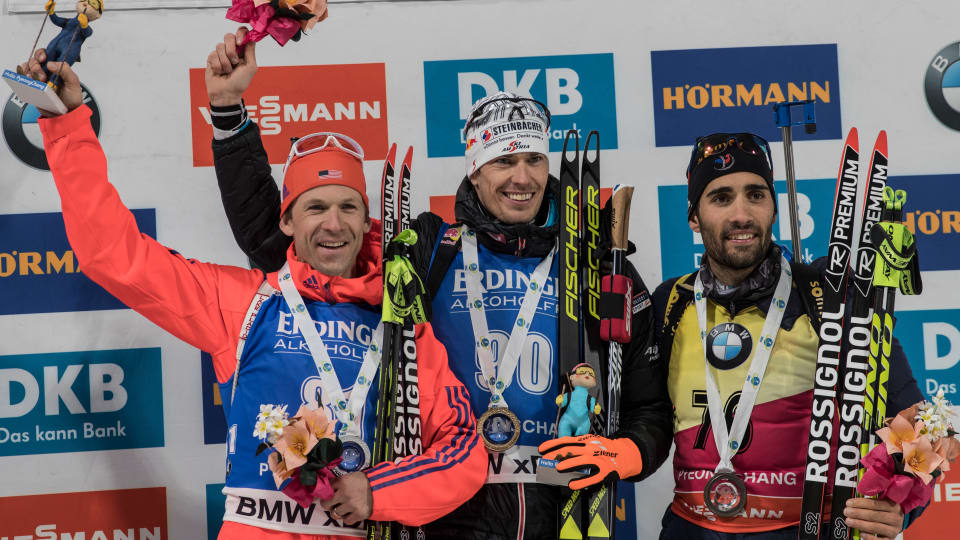
The men’s 10 k sprint podium at Friday’s IBU World Cup in PyeongChang, South Korea, with Austria’s Julian Eberhard (c) in first, American Lowell Bailey (l) in second, and France’s Martin Fourcade (r) in third. (Photo: IBU)
IBU World Cup (PyeongChang, South Korea): Men’s 10 k sprint
US Biathlon’s Lowell Bailey kept his clean-shooting streak alive with another one of his personal best results on Friday, racing to second in the men’s 10-kilometer sprint at the International Biathlon Union (IBU) World Cup in PyeongChang, South Korea.
Bailey started 81st and hit all 10 targets in the two-stage race to cross the finish line in first, 4.7 seconds ahead of France’s Martin Fourcade, who locked up the 2016/2017 overall World Cup title with an eventual third-place finish on Friday.
An even later starter in bib 90, Austria’s Julian Eberhard rocketed to his third-career World Cup victory (and second win this season), cleaning both stages and topping Bailey’s time by 40.7 seconds. That bumped Bailey to second place and Fourcade to third, for Bailey’s second World Cup podium this season (including his win in the 20 k individual at IBU World Championships).
In the last five non-relay races, including four at World Championships, Bailey has not placed outside the top six. And in all of those races, he’s only had one miss.
Bailey is up to ninth in the World Cup Total Score standings. Fourcade ran away with the season-long title in first, now that he’s 360 points ahead of Russia’s Anton Shipulin in second.
While Eberhard and Bailey shot clean on Friday, Fourcade missed two — one on each stage (1+1) — but made up for it with the fastest course time. Eberhard had the second-fastest course time and fastest shooting time of the 102-man field.
Austria nearly had two on the podium with Dominik Landertinger finishing fourth (+48.1), 2.7 seconds out of third, with clean shooting.
Three Canadians finished in the top 60 to qualify for Saturday’s pursuit, with Scott Gow in 27th (+1:40.3) with two penalties (1+1), Brendan Green following in 28th (+1:42.1) with one miss (0+1) for his first individual top 30 of the season, and Christian Gow in 56th (+2.33.6) with two prone penalties (2+0). Nathan Smith finished 88th (+3:32.5) with two standing misses (0+2) in his first World Cup race since early December, and Macx Davies finished 98th (+4:20.2) with four penalties (3+1).
For the U.S., Leif Nordgren placed 37th (+2:03.7) with two misses (1+1) to qualify for the pursuit, along with Bailey. Sean Doherty was 80th (+3:13.3) with two penalties (1+1) and Paul Schommer 101st (+4:38.1) with five misses (3+2).
FIS Nordic World Championships (Lahti, Finland): Nordic Combined 2 x 7.5 k team sprint
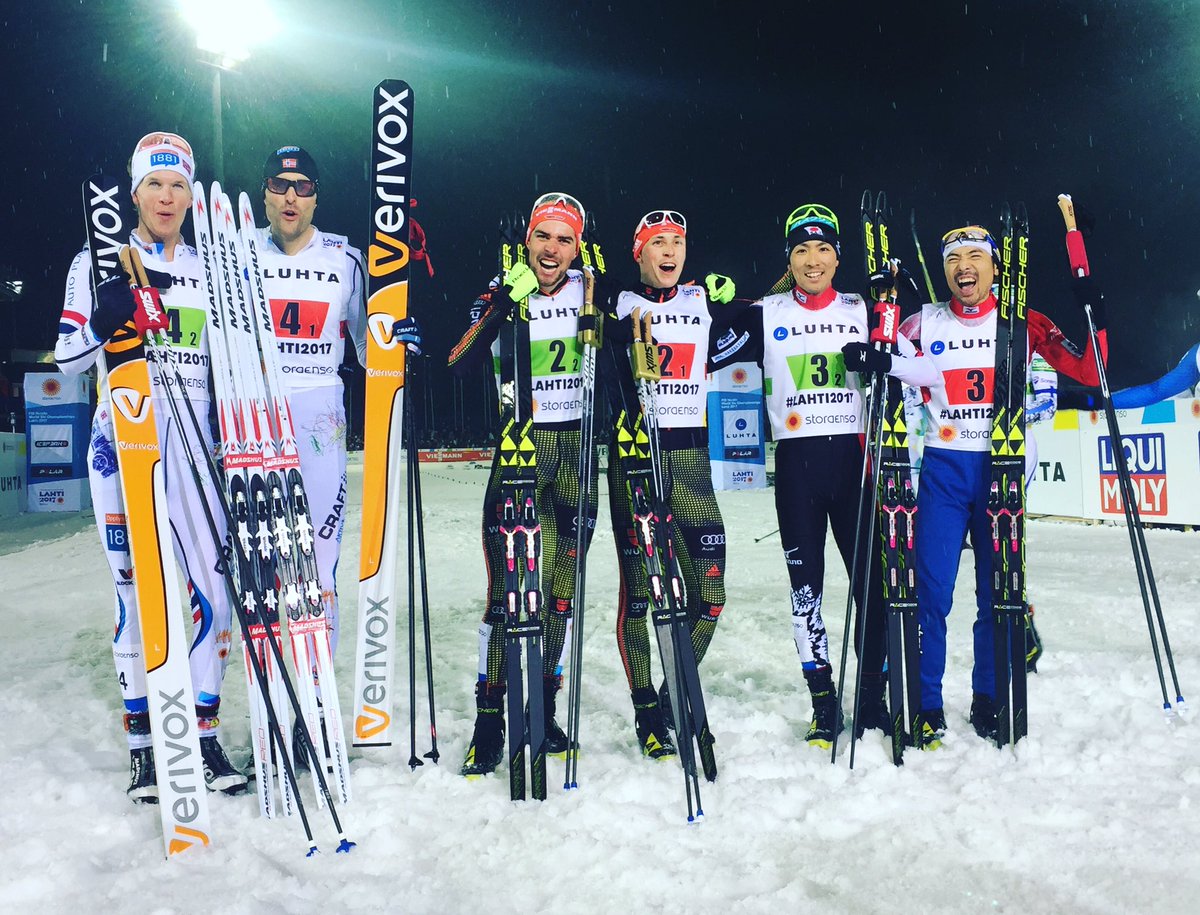
The nordic combined 2 x 7.5 k team sprint podium on Friday at 2017 Nordic World Championships in Lahti, Finland, with Germany’s Johannes Rydzek and Eric Frenzel in first (c), Norway’s Magnus Moan and Magnus Krog in second (l) and Japan’s Yoshito and Akito Watabe in third (r). (Photo: FIS Nordic Combined/Twitter)
[UPDATED] Johannes Rydzek and Team Germany completed the World Championships sweep on Friday, with Rydzek teaming up with Eric Frenzel to win the final nordic-combined competition of 2017 Nordic World Championships in Lahti, Finland: the 2 x 7.5-kilometer team sprint.
Rydzek won all four NoCo competitions over the past week, including two individual events and two team events.
On Friday, he and Frenzel, the defending World Cup champion, jumped to second and started the 2 x 7.5 k cross-country race 16 seconds behind France’s Maxime Laheurte and François Braud, who jumped to first. The Frenchmen both posted jumps of 125 meters for a total of 264.2 points. Frenzel and Rydzek, meanwhile, scored 256.1 points after jumps of 125.5 and 122 meters.
The Germans pulled off a 1-second win over Norway, finishing in 28:45.8 minutes, while Norway’s Magnus Moan and Magnus Krog claimed silver after starting the ski race in fourth, 24 seconds behind France. Together, the Norwegians posted the fastest course time, and Moan skied the fastest 7.5 k (13:53).
“It’s still unbelievable,” Rydzek told German broadcaster ARD. “The race today was so suspenseful again, down to the last curve with the lapped athlete [Russia]. I knew that I am very fast on the homestretch, and had explicitly looked at that section before the race. Eric did a great job today, and despite all circumstances pointing against us we managed to do it again today. Just cool to be back on the top of the podium with Eric.”
Just a couple hundred meters before the finish, Rydzek used the moment when they approached the lapped Russian athlete to slingshot between him and Krog and gained a decisive edge.
“I was scared of that situation with the lapped athlete, because that was really close,” Frenzel told ARD. “I thought, ‘What is he doing out there?’ But in the end you can rely on Johannes to solve that like a world champion, that was top.
“We knew ahead of time that Lahti suits us well, that we can be good here if the conditions work out,” he added. “So we are very happy to be able to go home with so many medals.”
Japan took the final spot on the podium after brothers Yoshito and Akito Watabe jumped to third, started 18 seconds after France, and held their position to finish for third place, 10.2 seconds after Germany.
Austria’s Wilhelm Denifl and Bernhard Gruber missed bronze by half a second in fourth (+10.7) after starting in fifth, and France ended up fifth (+11.5).
Nearly a minute later, Italy placed sixth (+1:10.6) and Finland seventh (+1:10.7). The Czech Republic followed in eighth (+1:26.4), and the U.S. was ninth (+1:48.1) with Bryan and Taylor Fletcher after starting 12th and 2:08 out of first. The Fletcher brothers recorded the second-fastest course time out of 14 teams.
“Taylor did a good job stepping up in competition and it gave me motivation to step up as well,” Bryan said, according to a U.S. Ski Team press release. “Unfortunately I wanted it a little too much and didn’t have the jump I am capable of.
“The races went well but we were just too far back,” he continued. “We had the second fastest time as a team overall, which is solid and continually shows our strength on that side of the sport.”
FIS Nordic World Championships (Lahti, Finland): Men’s 4 x 10 k relay
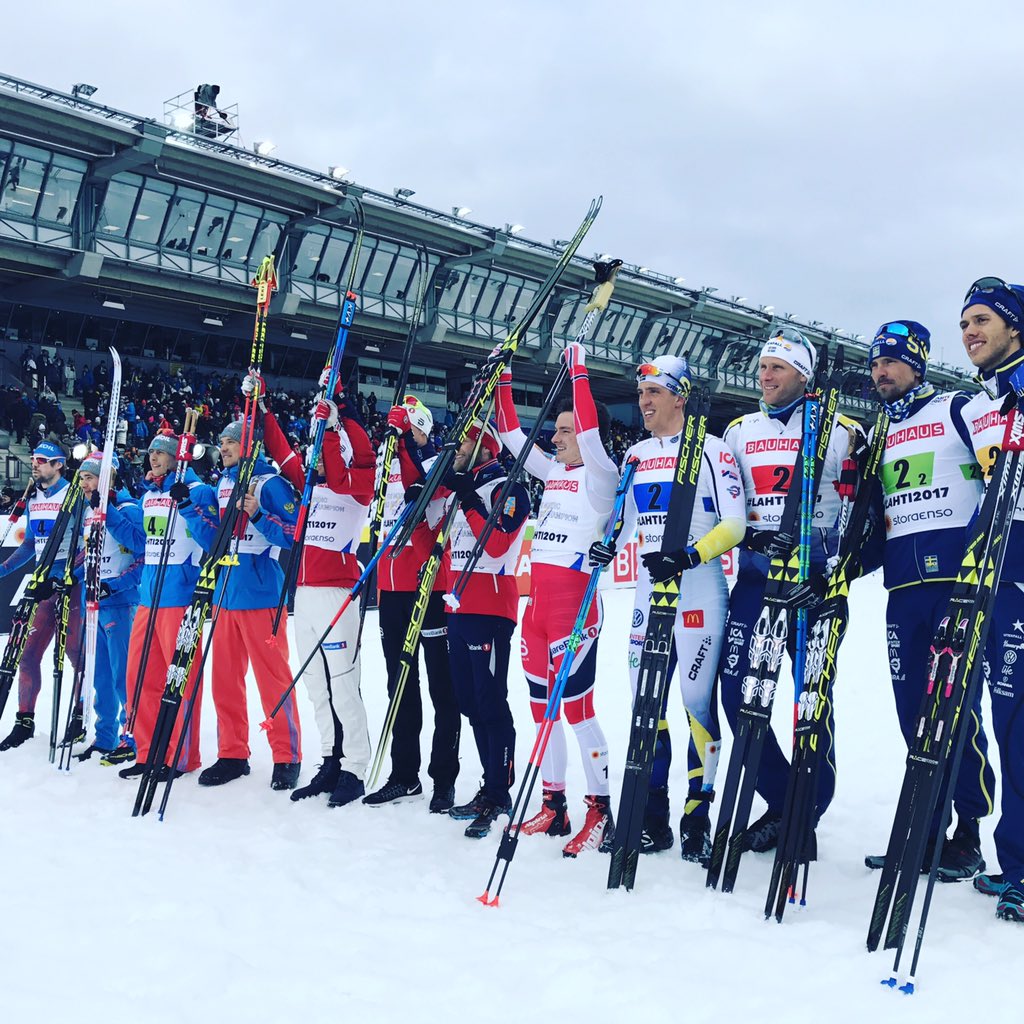
The men’s 4 x 10 k relay podium at 2017 Nordic World Championships, with Norway (c) in first, Russia (l) in second, and Sweden (r) in third. (Photo: FIS Cross-Country/Twitter)
The men’s 4 x 10-kilometer relay as the last team event of 2017 Nordic World Championships came down to a two-way battle for gold between none other than Norway and Russia on Friday in Lahti, Finland,
The two teams skied in either first or second throughout the four-leg race, with Russia’s Andrey Larkov tagging Alexander Bessmertnykh 2.9 seconds ahead of Norway’s first leg Didrik Tønseth, then Bessmertnykh coming through the second exchange just half a second ahead of Norway’s Niklas Dyrhaug.
Behind them, Finland skied alone in third place at the race’s halfway point, but was ultimately swallowed by the chase pack on the third leg.
On that third leg, Norway’s Martin Johnsrud Sundby worked hard to drop Russia’s Alexey Chervotkin, and eventually did so, coming through the final exchange 17.7 seconds ahead. That gave Norway’s anchor Finn Hågen Krogh just enough of a gap on Russia’s Sergey Ustiugov, and he was able to hold off Ustiugov by 4.6 seconds at the finish to give Norway the gold in 1:37:20.1 hours.
Russia claimed silver and Sweden outlasted Switzerland for bronze after Calle Halfvarsson attacked in the final kilometer to drop Finland’s Matti Heikkinen and Germany’s Lucas Bögl. Halfvarsson finished 2:31.8 minutes out of first, and just 0.2 seconds ahead of Switzerland’s Curdin Perl for third place for Sweden (which included teammates Daniel Rickardsson, Johan Olsson and Marcus Hellner).
Switzerland was fourth (+2:32) with Jason Rueesch, Jonas Baumann, Dario Cologna and Perl, Finland fifth (+2:42.4) with Sami Jauhojärvi, Niskanen, Lari Lehtonen, and Heikkinen, and Germany sixth (+2:42.8) with Thomas Bing, Jonas Dobler, Florian Notz, and Bögl.
France finished seventh (+3:52), Italy eighth (+5:29.8), Kazakhstan ninth (+5:30.6), and the U.S. 10th (+5:31.3). The U.S. team (Kyle Bratrud, Erik Bjornsen, Tad Elliott, Simi Hamilton) skied in 11th for most of the race before Hamilton moved them up to 10th with the sixth-fastest anchor leg.
Canada (Graeme Killick, Devon Kershaw, Alex Harvey, Len Valjas) ended up 12th after being lapped on the last leg. In 14th at the first exchange, Kershaw moved them up to 13th, then Harvey put them in 12th with one leg to go.
Norway’s 25-year-old Emil Iversen celebrates his first win of the season on Sunday in the men’s 30 k classic mass start, which he won by 3.7 seconds over fellow Norwegian Martin Johnsrud Sundby (yellow bib). (Photo: Fischer/NordicFocus)
$75,400: the yearly amount top Norwegian national-team members reportedly make, not counting sponsorships — closer to the amount someone like Iversen, 25, is now making.
The look on Iversen’s face on Sunday after crossing the finish line first on Sunday for his first World Cup win of the season? Priceless.
The victory, which he secured by 3.7 seconds over his team’s superstar Martin Johnsrud Sundby in the men’s 30-kilometer classic mass start in Falun, Sweden, was his second in a World Cup distance race and fourth of his career.
But the way Iversen talks, he should’ve been winning every race this season.
“My performance says a lot; I’m pretty good at skiing and I master several things,” he told VG.
Iversen’s World Cup win on Sunday was redemption for what he deemed a sub-par performance on Saturday. Second place by 0.06 seconds was unacceptable, and the look on his face and the pole he snapped in two after the men’s freestyle sprint final said it all.
“I’ve been pretty mad at my little brothers, but I don’t think I’ve been this angry in years,” Iversen told NRK.
For the sake of reflection, let’s rewind to a year ago, when Iversen credited training with the best, Norway’s Petter Northug.
“I have trained too much with him now I think,” Northug said at a February 2016 post-race press conference in Lahti, Finland.
Iversen, then 24 with his second sprint World Cup victory, jested that he knew Northug’s weakness, but there was no way he was disclosing it.
“I know what that is, so I’m going to use it also next year,” he said.
It’s now next year, and Northug’s nowhere in sight — at least not until Sunday, when he returned to the World Cup for the first time in over a month to finish 31st as the seventh-best Norwegian (out of nine) in the 30 k mass start.
Northug finished a whopping 3 minutes and 10.6 seconds behind Iversen, who’s proven himself one of Norway’s strongest starters in any given race.
“The plan is sprint, team sprint, classic distance and the relay,” Iversen said of 2017 World Championships, slightly less than a month away in Lahti, Finland.
At the same time, he explained he hadn’t heard anything definitive about Norway’s World Championships team.
“I haven’t heard sh*t, so maybe they don’t have faith in me. But I’ve handed in some good applications,” he said. “I think I was born to do a team sprint. The distance suits me incredibly well.”
Asked who he’d pick as his teammate, Iversen was uncertain.
“It would have been fun to do it with Petter, but if you’re gonna do the team sprint you need to have performed well in the distance,” he said.
How the tables have turned…
Emil Iversen (11) leading fellow Norwegian Martin Johnsrud Sundby (yellow bib) in the men’s 30 k classic mass start on Sunday at the World Cup in Falun, Sweden. (Photo: Fischer/NordicFocus)
On Sunday, Iversen hung in where he needed to, within striking distance of the leaders in the six-lap 30 k.
Conditions weren’t easy, with temperatures around -4 degrees Celsius (25 Fahrenheit) and snow that was described as “sugary” in Falun. Iversen scored bonus points at three out of the four intermediate sprints on the course, racing through the 6.5 k checkpoint in fourth, 16.5 k in fifth, and 21.5 k in fifth.
Meanwhile, his teammates Sundby and Sjur Røthe mostly drove the pace up front. With 10 k to go, Røthe made a move and put five seconds into the field. One and a half kilometers later, at the final bonus sprint, Røthe had built that lead to 8.5 seconds. Skiing alone and having to herringbone outside the tracks, however, isn’t easy, and Røthe was swallowed by the pack as he entered the stadium for the final lap at 25 k.
Sweden’s Daniel Rickardsson was one of several different men to take the lead after that point, before Iversen moved into first halfway around the loop at 27.5 k. Finland’s Iivo Niskanen followed, along with Sundby, both within a second of first. By 28.2 k, Sundby was again leading Iversen and Niskanen, with a 1.4-second gap to Russia’s Alexander Bessmertnykh and Røthe in fourth.
With less than a kilometer remaining, Sundby began his final push. Iversen caught up to him, ultimately challenging Sundby for the win. With about 200 meters to go, Iversen made it clear he was going take it all on Sunday — not second to Sundby or anyone else. He crossed the line first in 1:15:46.7 minutes, 3.7 seconds ahead of Sundby.
Norway’s Emil Iversen double poling to a decisive victory on Sunday, ahead of Norway’s Martin Johnsrud Sundby (yellow bib) and Sweden’s Calle Halfvarsson (in white) in the World Cup men’s 30 k classic mass start in Falun, Sweden. (Photo: Fischer/NordicFocus)
“It felt good when I realized there was no Italian in the final stretch like yesterday,” Iversen told NRK, referring to his photo-finish loss in the sprint to Italy’s Federico Pellegrino.
“There was a war between me and Martin,” he said of Sunday’s distance race. “It turned out a little like I wanted it to, and then it’s all about attacking.”
The overall World Cup leader by more than 300 points, Sundby settled for second and Sweden’s Calle Halfvarsson locked up third, 5.6 seconds behind Iversen. Just 0.1 seconds off the podium, Røthe placed fourth. Norway had four in the top five with Niklas Dyrhaug in fifth (+8.2), while Niskanen finished sixth (+9.8), Rickardsson was seventh (+10.3), and Bessmertnykh eighth (+10.9).
Iversen currently ranks seventh in the overall World Cup standings, behind Russia’s Sergey Ustiugov (who placed 12th on Sunday) in second, Finland’s Matti Heikkinen (14th on Sunday) in third, Canada’s Alex Harvey (15th) in fourth, Sweden’s Marcus Hellner (didn’t race on Sunday) in fifth, and Switzerland’s Dario Cologna (16th) in sixth.
‘Double Whammy’ for Canada’s Harvey
For most of the first two laps of Sunday’s 30 k, Harvey skied in the top three. By 10 k, he had dropped to ninth, but was still within 3 seconds of Ustiugov up front. One lap later, he remained in the top 10 and 2.3 seconds out of first, before dropping back to 16th and 7 seconds behind Iversen in first at 20 k.
“The first lap the kick was still, it was not locker kick, but I honestly don’t think anybody had locker kick today, it was hard to get good grip,” Harvey explained on the phone after. “So the first two laps, till 10 k was fairly comfortable, I was not fighting the skis too much, but then from 10 k to 20, I started fighting the skis a lot. I would kind of drift on the uphills, but my skis were really fast so I could kind of come back with the group. Even being at the tail of the group I could still use the draft and everything, but then at one point, the elastic just popped and I couldn’t come back anymore.”
Canada’s Alex Harvey (3) skiing behind Sweden’s Calle Halfvarsson (17) and ahead of Russia’s Dmitriy Japarov (r) during the World Cup men’s 30 k classic mass start in Falun, Sweden. Harvey finished 15th. (Photo: Salomon/NordicFocus)
For the last 10 k, Harvey held on, skiing with Cologna (among others) while fighting to stay within reach of the podium. Just 6.8 seconds out of first in 16th at 25 k, Harvey slipped to 55 seconds back in 15th just over 3 k later. He finished 1:17.5 back in 15th (13.8 seconds behind Heikkinen in 14th and 4.7 seconds ahead of Cologna in 16th).
“I was just losing a bit more kick every lap and getting more and more tired,” Harvey explained. “So it’s harder to compensate and yet you have less energy to compensate so it was just kind of a double whammy.”
According to Canadian World Cup coach Ivan Babikov, he told the team’s two racers on Sunday — Harvey and Cendrine Browne (who competed in the women’s 15 k classic mass start) — that no one would have perfect kick because of the soft conditions.
“It’s more like a running, double poling [race],” Babikov said on the phone after. “The uphills, especially Mördarbacken, got pretty mashed-potatoey. It was really sugary, super soft and really hard to get kick for many nations, and we struggled with the kick wax today. That’s a bit disappointing to all of us … but it’s one of those days that we did our best…
“We tried actually changing it for Cendrine, but it actually got even worse somehow and she struggled even more,” he said of Browne, who finished 46th in the women’s race.
“Not the proudest day of the season so far on the waxing side, but we’re just moving forward and learning from our mistakes,” Babikov continued.
The day before, Harvey missed qualifying for the skate-sprint heats in 46th. It was only his second time time not qualifying in a sprint this season and first time outside the top 40.
“Falun being arguably the best stop for me on the World Cup, I really had quite high expectations,” Harvey said on Sunday. “I think I went to the start line [of the skate sprint] a bit too excited and with too much adrenaline and I just really skied really bad. I didn’t ski like myself yesterday. I skied all tempo and no tempo and no glide, and for me, that’s not a good way to ski.”
Canada’s Alex Harvey finishing 15th in the World Cup men’s 30 k classic mass start on Sunday in Falun, Sweden, ahead of Switzerland’s Dario Cologna (in black) in 16th. (Photo: Salomon/NordicFocus)
As for the conditions on Sunday and how they affected his race, he blamed his choice in skis.
“[The conditions were] kind of a bit abrasive, but we think the binder didn’t hold up enough,” he explained. “I made a bit of a risky pick because I had a pair [of skis] that was way faster, but the kick was a bit limited on them in the beginning so I for sure paid for it when I started losing a bit of kick.”
He started to lose it after 10 k, he said.
“Then I could kind of fake it for 10 more k’s, but then that was it,” Harvey explained. “Coming 15th is a bit of a disappointment after the previous two weekends, but I know that the shape is still really good. I think that with the mistake I made, with picking a bit of a too slick of a ski, I could’ve been out of the top 30 today in those conditions, so it was still kind of a good sign even though it was a bit disappointing.”
The Canadian team in Falun was a lean one, not by design but rather because of circumstance, especially on the men’s side. Babikov explained that Knute Johnsgaard had been recovering from a stomach bug he picked up last week, which prompted an overnight hospital stay in Falun. He was on the mend, Babikov said, but had a “rough couple days.”
Graeme Killick had returned to Canmore, Alberta, after the Tour de Ski earlier this month and originally planned to be back on the circuit in Falun.
“But unfortunately he got sick as well so that kind of postponed all of it,” Babikov said. “We made the decision that it would be best to get ready for the World Champs … so he’s doing some good training at home and we’ll see him in a week in Davos [Switzerland, at the team’s training camp].”
Until then, Harvey will go to Livigno, Italy, with coach Louis Bouchard, Johnsgaard, and Browne, Babikov will return to Canmore, Len Valjas will race at next weekend’s World Cup in PyeongChang, South Korea, and Devon Kershaw will continue to await the birth of his first child with his wife, Kristin Størmer Steira.
Among the Americans in Sunday’s 30 k classic, a race that has only been held three times in the last 10 years, according to an International Ski Federation (FIS) press release, Erik Bjornsen and Noah Hoffman finished 35th (+3:30.8) and 37th (+3:59.8), respectfully, followed by Matt Gelso in 44th (+5:23.6) and Andy Newell in 53rd (+7:45.3).
For Bjornsen, who finished about 20 seconds behind Northug in 31st, he reflected that he was happy with the majority of his race.
“Most of the race I was skiing in a position I would have been very happy to finished in,” Bjornsen wrote in an email, after hovering in 25th to 30th throughout it. “I skied alone for about 10km near the end of the race and that was enough to put me over. I really needed some help to stay away from a pack of 10 guys that were hunting me down. I could see a them chasing me down for about 10km. They finally caught me with 4km to go. I didn’t have much fuel left in the tank. It was really disappointing to finish in 35th when at 25km I was in 24th.”
On Monday, he planned to head to France, where he’ll spend two weeks training before racing the pre-World Championships World Cup in Otepää, Estonia.
Meanwhile, FasterSkier caught up with Hoffman while he was packing his bags for South Korea.
“I had not a great start for the first k and a half, and then kind of made a good move on the first time up the big hill and was able to run by a bunch of people and move up into the top 30, which is where I wanted to be skiing,” Hoffman reflected of his race on Sunday. “And I noticed that I had the fastest split of the whole race for that section [from around 0.5 to 2 k].
“But then I paid the price for that a little bit and faded pretty quickly,” Hoffman added. “And really Laps 2 and 3 were a bit of a struggle, and I ended up in no-man’s land off the back of the group all by myself.”
He regrouped for the third and fourth laps, catching back up to a sub-group of skiers that had been dropped from the main group, skiing between 30th and 40th place.
“I skied with that group for a while and was feeling pretty good, and I was actually helping lead the charge up to another group that was falling off the main pack, and that represented all the way up to 24th place,” Hoffman said. “And right as we made contact with them, with about 5 k to go, I crashed on the same corner that I crashed on three years ago when I was having a good race in the mass start skate race here. And it’s just a terrible place to crash, right on the sprint course as you are coming into the stadium with a lot of speed.”
In an instant, he had lost an estimated 13 places and skied alone for the final 5 k, out of reach of that group.
“All of a sudden, I was like ‘OK, six or seven people out of this group are gonna get points … and that could have been me.’ I felt good, and so I let points today go with that crash,” he said. “There were some good signs today, and it’s a frustrating result. It’s a result where I felt I was better than the result shows. But it’s kind of been a frustrating season.
“I still feel good, and I think today was a positive sign, and there are still some really good races [coming up for me],” Hoffman added.
Among those were next weekend’s races in PyeongChang, with a classic sprint, 15/30 k skiathlons, and a freestyle team sprint from Feb. 3-5. (Hoffman planned to race the skiathlon.)
“Next weekend [in Korea] it’s gonna be a light field. And then we go back to Otepää, where I scored my first-ever World Cup points on a course that I really love,” he said. “And then with the World Championships, which obviously if you are successful at World Championships then nobody remembers the rest of the season. And I feel like I can have a really good championship. Those courses suit me really well, and I am particularly psyched for the 50 k skate there…”
American Matt Gelso racing to 59th in his first-ever World Cup sprint on Saturday in Falun, Sweden. (Photo: Salomon/NordicFocus)
He’ll be joined in PyeongChang by a few other U.S. Ski Team members (mostly sprinters, as well as distance skier Liz Stephen). Gelso, the Period 1 SuperTour leader from the Sun Valley Ski Education Foundation, also planned to be there.
“Today was a solid race, not great, but solid,” Gelso, who previously raced in Falun at 2015 World Championships, wrote in an email on Sunday. “World Cups in Scandinavia are very competitive so I am relatively happy with my result although it leaves MUCH room for improvement. My body also felt MUCH better than it has since I have been here. The sprint yesterday was my first World Cup sprint and was also a decent result for me [in 59th], however it was easy to identify a few costly mistakes.
“The overarching goal on the World Cup is to score World Cup points/have a top 30 result,” Gelso explained. “As far as a non-result goal it is hard to get over to Europe and acclimate to sea level, European courses, wetter snow, different food, very stout competition, timezone changes, long travel, etc. It is easy to come over here and feel pretty bad racing, always feeling like you are blowing up and hanging on and never really racing. My goal today was to not feel like that and actually be able to get a race feeling going in my body.”
Looking ahead, he was focused on next weekend’s World Cup in South Korea. While an individual top 30 remains his goal, Gelso explained he also wanted to “nail my travel and acclimatization there so that I can feel good racing, and race well.”
He planned to return to the U.S. after to race the SuperTour in Ishpeming, Mich., and the American Birkebeiner in Wisconsin. Ultimately, he hoped to qualify for the World Cup Finals in mid-March in Quebec City.
The men’s 4 x 7.5 k relay podium at the World Cup in Ulricehamn, Sweden, with Norway (c) in first, Sweden (l) in second, and Canada (r) with with its best-ever men’s relay in third. (Photo: FIS Cross Country/Twitter)
FIS Cross-Country World Cup (Ulricehamn, Sweden): 4 x 5 k and 4 x 7.5 k Relays
Norway notched back-to-back team victories in the women’s and men’s relays on Sunday at the World Cup in Ulricehamn, Sweden, with Finn Hågen Krogh securing a win in themen’s 4 x 7.5 k relay by 0.5 seconds over Sweden’s Calle Halfvarsson and Canada’s Lenny Valjas. With two kilometers remaining, nine teams were within 3.8 seconds of first. Krogh outlasted both Halfvarsson and Valjas in the finishing stretch, as Sweden placed second and Canada third for its best-ever relay result, according to a Cross Country Canada press release, besting its fifth-place finish from 2012 (with then-anchor Ivan Babikov, now a Canadian World Cup coach).
Krogh teamed up with Simen Hegstad Krüger, Martin Johnsrud Sundby and Anders Gløersen and finished in 1:06:47.5, while Sweden placed second with Daniel Rickardsson, Johan Olsson, Marcus Hellner, and Halfvarsson.
For Canada, with Devon Kershaw, Alex Harvey, Knute Johnsgaard, and Valjas, it was Harvey’s third-straight World Cup podium, Valjas’s second-straight team-event podium, and national U25 Team member Johnsgaard’s first podium.
“I have been waiting my whole career for this,” Kershaw said, according to a FIS press release. “All the guys did a great job today.”
The U.S. placed 10th (+1:16.5) with Andy Newell, Erik Bjornsen, Noah Hoffman, and Simi Hamilton.
The Norwegian women’s team (center) won the 4 x 5 k World Cup cross-country relay in Ulricehamn, Sweden, by 8.8 seconds over Germany (left), with home team Sweden (right) edging the United States for third.
Earlier on Sunday, the women’s 4 x 5 k relay didn’t break apart until the second leg, but Norway still proved its dominance over the ski world with a win to start the day.
After the group of Ingvild Flugstad Østberg and Lotta Udnes Weng (Norway), Ida Ingemarsdotter (Sweden), and Anamarija Lampic (Slovenia) more or less stayed together on the first relay leg, Heidi Weng made a break for it, giving Norway a 16.8-second lead at the second tag. The Norwegian team never looked back and after the race Weng and teammates Østberg, Astrid Jacobsen, and Marit Bjørgen were able to climb to the top step of the podium.
The race for second place, though, wasn’t resolved until the finish line. Sweden, Slovenia, Norway’s second team, the United States, and Germany were all in contention at various points in the race.
On the last leg, Jessie Diggins of the U.S., Sandra Ringwald of Germany, and Hanna Falk of Sweden battled it out, dropping Kari Øyre Slind of Norway. The three shot to the finish line together, with Diggins stuck behind the other two. Ringwald eventually won the sprint finish by 0.2 seconds over Falk, with Diggins another 0.2 seconds back in fourth.
That gave Ringwald, Katharina Hennig, Stefanie Boehler, and Victoria Carl a second-place result, one of Germany’s best since taking silver at the 2010 Olympics. (The team won bronze at the 2014 Olympics.)
Ingemarsdotter, Falk, Charlotte Kalla, and Sofia Henriksson took the third step of the podium. Rosie Brennan, Sadie Bjornsen, Liz Stephen, and Diggins were left to settle for fourth.
The second U.S. team, of Kikkan Randall, Ida Sargent, Sophie Caldwell, and SuperTour leader Liz Guiney finished 12th after skiing in 8th and 9th earlier in the race.
NorAm Western Canadian Championships (Whistler, B.C.): Relays
[UPDATED] This season brought a changeup to the Western Canadian Championships with a three-person relay event in response to athletes’ request to add “fun” events to the NorAm series.
While 146 teams finished in 17 categories, it was Ontario winning the open men’s 3 x 7.5 k in 50:32.9 (Bob Thompson, Jack Carlyle and Andy Shields) and B.C. dominating the open women’s 3 x 5 k in 41:09.47 with three juniors (Katie Weaver, Anna Goodwin and Hannah Mehain).
The masters men and juvenile girls categories included the most teams, with 15 and 14, respectively.
FIS Nordic Combined World Cup (Chaux-Neuve, France): Individual large hill/10 k
Sunday’s Nordic Combined World Cup podium in Chaux-Neuve, France, with German winner Fabian Rießle (c), German runner-up Johannes Rydzek (l), and Germany’s Eric Frenzel (r) in third. (Photo: FIS Nordic Combined/Twitter)
On Sunday, after the large hill jump and 10 k ski, Germany swept the podium in the second event of the NoCo World Cup in Chaux-Neuve, France. Fabian Rießle placed first in 22:44, and his German teammates Johannes Rydzek skied to second only 2.2 seconds back, and Saturday’s winner Eric Frenzel was third (+7.9).
(Frenzel leads the NoCo World Cup, Rydzek is second overall, Rießle is third.)
Norway’s Jarl Magnus Riiber flew the farthest with 139.8 points. Franz-Josef Rehrl from Austria jumped to second with 135.7 points while his teammate Bernhard Gruber jumped to third with 131.7 points.
Magnus faded to 23rd (+47.5) in the 10 k ski. Rehrl started 15 seconds back from Magnus and placed 17th overall (+31.5). Gruber maintained a top-ten, placing 9th (+13.5), after starting 32 seconds behind first place jumper Magnus.
While the top three jumpers all dropped back in the ski, it was a day of catch up for the German’s after the jumping portion.
Rießle ranked eigth after the jump and earned 128.7 points, he began the ski 0:44 back. Rydzek placed 11th in the jump with 126.9 points, while Frenzel jumped to fourth with 131.4 points.
The only U.S. skier entered in Sunday’s event was Ben Berend. The U.S. Nordic Combined skier jumped to 13th with 126.8 points — starting the ski 0:52 behind Magnus. Yet Berend couldn’t capitalize on his strong jump, he dropped to 37th (+2:06) after the ski.
The Nordic Combined World Cup continues next Friday in Seefeld, Austria.
Ben Lustgarten (Craftsbury Green Racing Project) with his $750-dollar check for winning the men’s SuperTour classic sprint on Saturday near Truckee, Calif. Stratton’s Ben Saxton (l) placed second and APU’s Reese Hanneman (r) was third.
Lustgarten, of the Craftsbury Green Racing Project, raced to a 1.58-second victory in the men’s A-final at the Auburn Ski Club in Soda Springs, Calif., finishing in 3:03.4. Ben Saxton, of the Stratton Mountain School (SMS) Elite Team, placed second, and Reese Hanneman, of Alaska Pacific University (APU), was third (+2.77).
Hannenman’s younger brother Logan also reached the final and placed fourth (+4.5), Dakota Blackhorse-von Jess (Bend Endurance Academy) was fifth (+5.86), and the third APU skier in the final, Tyler Kornfield sixth (+18.69).
Blackhorse-von Jess started the day off as the fastest qualifier in 2:58.8. Saxton qualified second, 4.1 seconds back, Logan Hanneman qualified third (+4.2), and Lustgarten fourth (+6.5). Blackhorse-von Jess went on to win his quarterfinal and place second in his semifinal, while Lustgarten and Saxton both won their quarterfinals and semifinals.
Jennie Bender (3) of the Bridger Ski Foundation leading Stratton’s Julia Kern (2) and Sun Valley’s Deedra Irwin (5) during the second women’s classic sprint semifinal at Saturday’s SuperTour near Truckee, Calif. Bender went on to win the semifinal, as well as the final.
In the women’s A-final, Jennie Bender of the Bridger Ski Foundation, coming off a classic sprint win at nationals, scored another victory in 3:29.07. She edged Craftsbury’s Kaitlynn Miller by just seven-hundredths of a second, and Stratton’s Julia Kern placed third (+3.42). Racing at home, Hannah Halvorsen (Sugar Bowl Academy) finished fourth (+3.88). Craftsbury had three in the women’s final with Caitlin Patterson in fifth (+3.93) and Heather Mooney in sixth (+27.35).
Miller proved to be the woman to beat throughout the day, winning the qualifier in 3:30.9, along with her quarterfinal and semifinal. Kern qualified second (+3.2) and Bender third (+4.6). Bender went on to win her quarterfinal and semifinal as well before facing off with Miller in the final.
NorAm Western Canadian Championships (Whistler, B.C.): 10/15 k classic
It was interval-starts day at Western Canadian Championships at Whistler Olympic Park and national-team veteran Emily Nishikawa completed the four laps of the women’s 10 k classic in 30:35.5 to win ahead of teammate Dahria Beatty, 16.5 seconds behind. Maya MacIsaac-Jones completed the national team and Alberta World Cup Academy (AWCA) sweep in third (+1:36.5).
Sovereign Lake’s Hannah Mehain, of the national junior team, was the top junior for the second-straight day in eighth overall (+3:22.1).
In the men’s 15 k, Lappe Nordic’s Andy Shields won the six-lap race in 40:34.2, showing some of the form that won him the NorAm overall last season. National-team member Jess Cockney collected his second-straight podium, finishing second, 4.3 seconds behind Shields. Evan Palmer-Charrette (NTDC Thunder Bay) completed the podium in third (+55.1).
FIS Cross-Country World Cup (Ulricehamn, Sweden): 10/15 k freestyle
The men’s 15 k freestyle podium at Saturday’s World Cup in Ulricehamn, Sweden, with Canadian winner Alex Harvey (c), Norwegian runner-up Martin Johnsrud Sundby (l), and Sweden’s Marcus Hellner (r) in third. (Photo: FIS Cross Country/Twitter)
First individual win of the season (second straight, after winning last weekend’s team sprint), fifth individual victory of his career. That’s the latest news on Canada’s Alex Harvey, who won the World Cup men’s 15-kilometer freestyle individual start on Sunday in Ulricehamn, Sweden, for his first victory in a 15 k skate race and fourth individual podium of 2016/2017.
To say Harvey is on a roll is an understatement. On Saturday, he beat Norway’s Martin Johnsrud Sundby by 6 seconds after starting a minute behind the Norwegian defending World Cup champion. Harvey’s fastest time across the line in 32:46.2 held up through 76 finishers, with Sweden’s Marcus Hellner coming somewhat within range after starting a minute behind him. Hellner ended up 14.3 seconds back from Harvey at the finish for third place, behind Sundby.
Switzerland’s Dario Cologna missed the podium by 0.5 seconds in fourth (+14.7), and Norway’s 24-year-old Daniel Stock broke through in fifth (+16.2) for his first World Cup top 20.
Great Britain’s Andrew Musgrave placed sixth (+18.7), Sweden’s Daniel Rickardsson was seventh (+25.0), Norway’s Finn Hågen Krogh eighth (+32.2), Russia’s Petr Sedov ninth (+33.9), and Japan’s Keishin Yoshida 10th (+34.2).
American Erik Bjornsen landed in the points as he tied Norway’s Simen Andreas Sveen for 28th (+1:09.2), leading fellow U.S. Ski Team members Noah Hoffman, who placed 41st (+1:28.8), and Simi Hamilton in 53rd (+1:56.2). Also for the U.S., Matt Gelso, the Period 1 SuperTour leader from the Sun Valley Ski Education Foundation (SVSEF) Gold Team, finished 68th (+3:00.3).
Harvey’s Canadian World Cup teammates Len Valjas finished 35th (+1:17.7) and Devon Kershaw 38th (+1:22.2). Knute Johnsgaard (Canadian U25 Team) did not start.
The women’s 10 k freestyle podium on Saturday in Ulricehamn, Sweden, with Norwegian winner Marit Bjørgen (c), Finland’s Krista Parmakoski (l) in second and Sweden’s Charlotte Kalla (r) in third. (Photo: FIS Cross Country/Twitter)
In her first World Cup race in over a month and at a brand-new World Cup venue, Norway’s 36-year-old Marit Bjørgen returned to her winning ways, topping the women’s 10 k freestyle on Saturday in Ulricehamn.
Bjørgen started 40th out of 61 finishers and took the lead from Finland’s Krista Parmakoski at the finish with a time of 23:46.3 minutes. Parmakoski, who started a minute ahead of her in bib 38, ended up second, 10.7 seconds back. Sweden’s Charlotte Kalla reached the podium for the second time this season in third (+24.9).
“It is always great to win,” Bjørgen said, according to an International Ski Federation (FIS) press release. “I stayed at home for five weeks and was training. It is great to come back with a victory. I know that the training I had done was good. It was an amazing atmosphere today by the course. There were people cheering everywhere.”
Norway swept fourth through sixth with Astrid Uhrenholdt Jacobsen in fourth (+25.7), Ragnhild Haga in fifth (+32.3) and Heidi Weng in sixth (+34.0).
American Jessie Diggins raced to seventh (+34.9), ahead of Sweden’s Hanna Falk, who recorded her best distance result in eighth (+36.4). Norway’s Ingvild Flugstad Østberg finished ninth (+44.8), and Germany’s Sandra Ringwald was 10th (+56.6).
“I didn’t have the snappy good feelings I was hoping to have in my body today, but it was a solid race,” Diggins wrote in a post-race email to FasterSkier. “It’s always hard when you know that on your best days you are capable of more, but at the same time we had great skis, and it was really fun for me to be able to ski with my teammates today!”
The U.S. had three in the top 20 and four in the top 30 with Sadie Bjornsen in 12th (+1:00.5), Liz Stephen in 16th (+1:07.3) and Rosie Brennan in 24th (+1:30.7).
Cendrine Browne as Canada’s lone woman in the race achieved 35th (+1:52.0) for her career best in an individual race. Also for the U.S., Kikkan Randall placed 40th (+1:59.6) and Liz Guiney of the Craftsbury Green Racing Project 52nd (+2:33.2).
The photo finish of the men’s 4 x 7.5 k relay on Saturday at the IBU World Cup in Antholz, Italy, with Germany’s Simon Schempp outlunging Norway’s Emil Hegle Svendsen. (Photo: ZDF broadcast screenshot)
For the U.S. men, top six was a target for the 4 x 7.5 k relay on Sunday in Antholz, Italy, according to US Biathlon Men’s Coach Jonas Johansson.
Mission accomplished. In the final team event before 2017 World Championships, Lowell Bailey, Leif Nordgren, Tim Burke, and Sean Doherty combined for sixth, finishing 1:04.9 minutes behind the German winners. The Americans used a total of 10 spares but avoided the penalty loop, as did the Germans who used seven spares to clean the eight-stage race and won it in 1:13.57.2.
Germany’s Simon Schempp narrowly outlasted Norway’s Emil Hegle Svendsen in the finishing stretch to secure the victory for Germany (with teammates Erik Lesser, Benedikt Doll and Arnd Peiffer) by one-tenth of a second. Norway finished second with nine spares and no penalties (with Lars Helge Birkeland, Henrik L’Abee-Lund, Johannes Thingnes Bø, and Svendsen), and Russia secured third (+33.6) with nine spares and zero penalties as well (with Maxim Tsvetkov, Evgeniy Garanichev, Dmitry Malyshko, and Anton Babikov).
Ukraine used a total of just five spares and had zero penalties for fourth (+46.7), and Austria took fifth (+49.2) with eight spares and no penalties, after Austria’s Dominik Landertinger skied away from Doherty on the final loop and finished 6.9 seconds ahead of him for fifth place.
For the U.S. men, sixth was close to their team-best fifth with the same lineup in last year’s World Cup relay in Presque Isle, Maine. The same group also took sixth in Ruhpolding, Germany, last year as well.
With all four making US Biathlon’s World Championships team, announced Saturday, they will likely be aiming for a best championships result early next month in Hochfilzen, Austria.
Canada (Christian Gow, Scott Gow, Macx Davies, and Brendan Green) finished 16th (+4:13.8) on Saturday with two penalties and 11 spares. Scott Gow skied them up to 15th by the second exchange but they dropped to 18th after Davies had two penalties on the third leg. With Green anchoring and using just one spare, they recouped two places before the finish.
In the women’s race, Germany’s Nadine Horchler achieved a lifetime dream with her first World Cup win, after starting in bib 30 and earning her start as a reserve athlete. Germany took first and second with Laura Dahlmeier in second, and the Czech Republic’s Gabriela Koukalova placed third. Susan Dunklee of the U.S. was the lone North American starter and finished 24th after leading at the start of the second loop.
FIS Nordic Combined World Cup (Chaux-Neuve, France): Individual large hill/10 k
Saturday’s Nordic Combined World Cup podium in Chaux-Neuve, France, with German winner Johannes Rydzek (c), German runner-up Fabian Rießle (l) and Japan’s Akito Watabe (r) in third. (Photo: FIS Nordic Combined/Twitter)
The first part of Saturday’s Nordic Combined World Cup individual large hill/10 k competition was a shining moment for U.S. Nordic Combined skier Ben Berend, who jumped to second for a total of 127.5 points, trailing only Norway’s Jarl Magnus Riiber with 139 points in Chaux-Neuve, France.
Berend flew farther than Germany’s Eric Frenzel, who jumped to third on the Chaux-Neuve large hill.
Later in the day, they started the 10 k Gundersen in that order, with Riiber heading out first, followed by Berend 46 seconds later, then Frenzel 53 seconds back in third.
Germany’s Johannes Rydzek started 1:15 minutes back in 12th and skied the fastest 10 k to take the victory at the finish (in 23:01.7). He held off his German teammate Fabian Rießle by 2.8 seconds for the win, after Rießle started sixth and 1:01 back. Japan’s Akito Watabe reached the podium in third (+5.7) after jumping to seventh and starting the race 1 second behind Rießle.
Frenzel ended up fourth (+8.3), and the fourth German in the top five, Björn Kircheisen improved to fifth (+22.6) after starting 11th.
Riiber dropped to 15th (+54.0), and Berend fell outside the top 30 to end up 32nd (+2:26.0) with the 39th-ranked course time.
Berend finished 12.2 seconds ahead of his U.S. teammate Taylor Fletcher, who placed 34th (+2:38.2) after the jump put him in 48th.
Bryan Fletcher was 49th after the jump but did not start the 10 k.
The Nordic Combined World Cup continues Sunday in Chaux-Neuve with another large hill/10 k.
Ski Classics #5: La Diagonela (Zuoz, Switzerland): 50 k classic
[UPDATED] Under “blue skies, no wind and perfect track conditions” in the Swiss Engadin Valley on Saturday, according to a Ski Classics press release, Russia’s Ilya Chernousov and the Czech Republic’s Kateřina Smutná won the men’s and women’s La Diagonela, respectively, in Zuoz, Switzerland.
Chernousov, of Team Pioneer Investments, and Tord Asle Gjerdalen (Team Santander) led a large pack of men into the final major climb on the 50 k course. There, Gjerdalen attacked and Chernousov matched him, accelerating away from his competitors up the last steep pitch to the finish, according to the press release. He finished in 2:03:39.6 hours, holding off Gjerdalen by 1.5 seconds, while Øystein Pettersen (Team BN Bank) finished third (+3.0).
In the women’s race, Smutná (Team Santander) pushed to break up the field around the halfway point, where the men caught the women. Britta Johansson Norgren (Lager 157 Ski Team) hung with Smutná, but lost contact over the last 5 k. After finishing second in the last two Ski Classics races, Smutná took the win by 1:03.2 minutes in 2:20:49.2. Nordgren finished second, ahead of Sara Lindborg (Team Serneke) in third, who finished more than three minutes later (+4:17.4).
Devon Kershaw (r) lunges for a World Cup silver in the 2011 Tour de Ski classic sprint in Obertsdorf, Germany, 11 years after his Fischer classic skis were made. He placed second to Sweden’s Emil Jonsson (l) and edged out Switzerland’s Dario Cologna. (Photo: Devon Kershaw/NordicFocus)
At the elite level of endurance sport, most often it’s not about the gear. Everybody’s competing on the lightest, most highly engineered equipment available. But in the fickle realm of World Cup cross-country skiing, it can be about the equipment. Canadian National Team member Devon Kershaw says that’s a frustrating aspect of the sport.
“Oh my gosh, when you miss the skis or the wax and [you’re] on the best day of your life, and you end up 35th! It’s gut wrenching,” Kershaw, 32, said in a recent phone interview. “It’s just about the equipment some days.”
Cross-country skiing, like any gear-intensive sport, is caught in a constant cycle of innovation where weight, stiffness, and new color schemes, reveal product evolution and glossy rebranding. Yet, if you have maintained a keen eye on World Cup ski selection since 2008, you may have noticed Canadians Alex Harvey and Kershaw racing to podiums on what appear to be antiquated Fischer classic skis. The duo specifically raced on 1999 Fischer RCS classics; skis sporting a yellow top sheet and a fire-engine-red sidewall.
Devon Kershaw with his 1999 Fischer RCS classics after placing second in the 2011 Tour de Ski classic sprint in Obertsdorf, Germany. (Photo: Devon Kershaw/NordicFocus)
These old skis were a staple for the Canadians. A go-to ski on numerous World Cup weekends.
For many on the World Cup, seeing Kershaw race around on the old-school skis became an eye roll moment.
“People would say, still using those old skis from the Ramsau World Champs, eh?,” Kershaw said. “Everyone thought we were using the exact same pair, but we had a number of them for different conditions. Some were good in the cold, I mean ridiculously good in the cold.”
Race after race, careers are on the line. A podium here, a World Championship medal there, translates into real sponsorship dollars and an extended athletic life. So the Canadians must of had good reason for using skis built the same year a Cher tune was an international hit.
Kershaw explained the fleet of 1999 skis were slippery on the snow.
“Man those skis. I’m telling you, it seems like superstition, but the free glide on those skis kept them in the mix on the World Cup,” he said. “The one characteristics across the board for all those skis, we call it free glide. You bring your foot through, a lot of classic skis, even ones that win a glide test, you can feel the kick wax under your foot. That’s what Alex and I look for a lot, when you can’t feel the kick wax when moving the foot through. They felt like they had no grip wax on them but they have locker kick. How is that possible?”
That mystery — trying to determine how, when and why some things work and others fail — is an intriguing part of the sport. When it comes to race-day ski selection, Harvey, 27, is as fastidious as they come. He employs a personal ski tech he calls a “test pilot.” Together they test grinds, hand structure, waxes, top coats, and of course, skis. In a phone interview, Harvey explained it’s good to have an expert second opinion. In speaking about those 1999 skis, he said the skis began playing games with his mind.
Alex Harvey finishing out his lap in the 15 k classic individual race at the 2014 Olympics in Sochi, Russia. He did not finish the race, but his 15-year-old classic skis weren’t completely to blame. The team missed the wax.
“They were great on hills and flat, but I’d be dropped on the downhills,” Harvey said. “They feel good when skiing, but when comparing objectively, they are not as good.”
Those old skis did remain viable for years. At one point, Fischer asked why the Canadians were using older skis. Remember, a good ski is a good ski. So the fleet was returned to Fischer and refreshed with new bases and an up-to-date black top sheet. After the cosmetic upgrade, without handling the skis, there’s no telling the difference between those retrograde skis and a pair of the latest and greatest.
The matchmaker between the Canadians and the 1999 “magic” skis was Micke Book, a former wax tech for the Swedish National Team. Book served as a Canadian World Cup tech for eight years. In an email, Book wrote that two pair belonged to him and he acquired the remaining four pair from Tobias and Mathias Fredriksson.
As for Book’s thoughts on the magic attributes of these skis: “‘Well nothing is magic, they are good skis and well taken care of,” Book wrote in an email. Asked if the skis hold up in testing, Book explained, “They are still in the Bag. So yes they match new skis very well.”
The Canadians no longer have access to the skis as they remain with Book. This season, Book will serve as a personal ski tech for Kazakhstan’s top skier Alexey Poltoranin. He has no plans for Poltoranin to use the skis. Book also waxes for long-distance nordic team, Team Exspirit. Book explained that Sweden’s Daniel Rickardsson will test the 1999 fleet for the 2016 Ski Classics marathon series.
According to Kershaw, the legend of Book’s skis remain alive. “If I see Poltoranin on those skis, that will weird me out big time,” he said.
Italy’s Marco Pantani riding to his 1998 Tour de France victory. (Photo: Tumblr)
Even Kershaw seemed dumbfounded by his use of the retro gear. He referenced Marco Pantani’s Tour de France win in 1998, pointing out the Italian cyclist’s rickety bike, once perceived as state of the art.
Consider a YouTube clip of 1998 vintage Pantani. A few things remain the same: Paul Sherwen and Phil Liggett are stoked. The riders still gaunt and suffering in the Alps. But the bike frame tubes resemble toothpicks. Helmets? Not yet.
“Yet I’m using skis from that era,” Kershaw said with a laugh. “Alex is hitting the podium on the World Cup.”
Look at most skis used on the World Cup and it’s rare to see older skis. Like many industries, nordic ski manufacturing has become more controlled. With manufacturing tolerances measured in millimeters comes the ability to produce more consistent skis. U.S. Ski Team Head Coach Chris Grover wrote in an email that his team no longer carries old skis — the quality of new product available on the World Cup eliminates the need.
“Some individuals have a few older go-to pair of skis, and occasionally we share them with other athletes on the Team, if the athlete who owns them is not using them an conditions are right,” he wrote. “However, many of the skis being made today are faster than the athletes’ older skis.”
Canadian head coach Justin Wadsworth adds that not having the skis as part of the quiver is relieving.
“You are always leary of going on a 15-year-old pair of skis,” he said. “You use those in the World Championships or something, are they going to break? At a certain point the material starts to break down even though they have been re-based and re-topsheeted.”
“You are always leary of going on a 15-year-old pair of skis.” — Canadian National Team Head Coach Justin Wadsworth
After a lifetime of racing, Kershaw understands quality. When the 1999 skis were available to him, Kershaw chose them because they were better. Because they were faster. Ski selection ultimately remains the athlete’s responsibility.
“Just enjoy skiing because you never know when those magic skis will make it into your life,” he advised. “Who cares what they look like. As long as they are fast and they work well. We don’t discriminate based on age or cosmetics.”
Northug and Cologna battling to the finish. Photo: Fischer/Nordic Focus.
Though the men’s 15 k classic mass start in Rogla, Slovenia was contested on a 7-lap manmade loop, the final distance race in Period 1 of the World Cup provided plenty of excitement. Petter Northug (NOR) delivered what is now almost an expected sprint-finish performance, and edged out Dario Cologna (SUI) and Alexey Poltoranin (KAZ) to the line with a powerful double pole.
Though the last-second victory on Saturday was typical of Northug’s style, the close finish this time was not designed for entertainment value—afterwards he said he had not been feeling his best, and had to fight hard to the finish to stay in contention. He skied near the back of the top-30 for much of the first part of the race, gradually moving his way up to the front of the dense train of skiers.
Coming down the final hill into the stadium, Northug stepped out of the tracks just before the finish lanes to hop in front of Cologna and Poltoranin, while Cologna simultaneously stepped into the neighboring lane to challenge Northug all the way to the end. Northug ended up winning by 0.2 seconds, and Poltoranin finished third at +1.2 seconds back.
Northug spent after crossing the line. Photo: Fischer/Nordic Focus.
“I had a good position in the last downhill. I saw Dario was in front so I had to move there also to defend the yellow jersey,” he said. Northug got it done, but judging from his collapse at the finish, the effort cost him.
Cologna was aiming to challenge Northug’s overall World Cup lead, but acknowledged at the post-race press conference that he might “have to wait [until] after [the] Tour de Ski to take the yellow bib away from Petter.”
“It was [a] good race today,” said Cologna. “I’m satisfied after the disappointment in [the] Davos 30 k. I felt very good and could ski in a good pace.”
Cologna noted he was tired coming off of a hard effort in Davos the weekend prior, and has been struggling a bit with his asthma.
“I will now relax after the tough races and prepare for the Tour,” he said.
Once again, the organizing committee fretted over the lack of snow on the trails in the week leading up the World Cup weekend, but a layer of fresh flakes overnight allowed the main hill on the course to be extended by about 400 m. The new snow also made for slower tracks, and the loop necessitated more striding than it had the day before for the course preview.
The mens pack early on in the 15 k. Photo: Fischer/Nordic Focus.
Poltoranin said the slower conditions, coupled with a strong headwind, didn’t phase him. “In Kazakhstan we have almost every day this kind of weather with soft snow and wind,” he said. “I prefer classical technique and I am happy to be on the podium today.”
Prominently feature in the mass start race were two intermediate sprint premiums for the men (one for women) at the top of the loops main hill. On the third and sixth lap of the seven-lap course, the first 10 skiers to that point were awarded additional World Cup points (in the past it has been only to the top three).
Most of the men who ended up in top 5 didn’t go for the early premium, choosing instead to conserve energy and move up gradually throughout the race. As the winner, Northug was also the only finisher in the top 6 that didn’t acquire any intermediate bonus points. Fifteen points were awarded to the first skier for each premium, all the way down to 1 point for tenth.
For the men’s field in particular, the raised mid-race stakes affected the pacing of the lead pack, which skied in a tight group for the majority of the race.
Canada’s Devon Kershaw and Alex Harvey decided before the race to go for the extra points and tackle the premiums head-on, and may have paid for the early surges with a build-up of lactic acid they struggled to recover from.
Kershaw won the first of the two sprints. “I easily had it; I felt so good,” said Kershaw of that part of his race.
Kershaw (22), Harvey (8), Rickardsson (9), Babikov (14) and
But shortly after that, Daniel Rickardsson (SWE) made an attack, and Kershaw decided to go with him.
“He’s one of the best classic skiers in the world; I thought it was the move and tried to bridge back too much too early. From then on I was skiing on fumes, doing what I could to save energy and stay in the group.” Kershaw ended up in 16th, (+16.8).
Harvey said he suffered a similar fate as the result of gunning for the premiums. He was fourth at the first checkpoint and seventh for the second. He ended up finishing 10th (+9.2).
“I went for both, and paid the price a bit in the end,” he said. “We’ve been training at altitude a lot, so we’re adapted, but you still get a lot of lactate [from the surges]…and the pace remained fairly high.”
After Saturday, Northug has 600 World Cup points to Cologna’s 408, and Northug will sit out Sunday’s skate sprint in order to recover and focus on his Tour de Ski preparation.
With the Norwegian women taking the top two spots earlier in the day in the 4×5 k, the Norwegian men had the bar for success set high for their four-man relay effort.
Northug getting it done in Sjusjoen (Photo: flyingpointroad.com)
As always, Petter Northug Jr. was anchoring Norway I, supported to Eldar Roenning and Finn Haagan Krogh on classic skis, while Lars Berger, biathlete, brother of Tora Berger, and occasionally cross-country relay selection skied third in the 4×10 k race in Sjusjøen, Norway, on Sunday.
Held on 2.5 k loops of man-made snow, the tracks quickly became extremely icy and hard.
While Norway I had a slight advantage in the form of Northug’s traditional anchor-leg superhuman efforts, it was obvious that the men were not going to have as clear a path to the finish line as their female counterparts.
Ultimately, the result was the same, as Norway I took the gold medal in a tight finish. In a surprise turn of events, Norway III emerged from the finish-line sprint with silver medal, while the Swedes picked up the bronze, narrowly edging out the French.
Russia I and II as well as France pushed the pace on what is usually a fairly sedate opening leg of the relay, forcing the field to work, and whittling away several teams.
As they rounded the corner into the exchange zone, the main pack was down to just six, with another six teams hanging close inside of 15 seconds, including the Americans, kept competitive with a strong leg by Andy Newell.
The lead pack on the second leg (Photo: Liz Stephen)
The major players on the outside were Switzerland, where Toni Livers dropped 46 seconds to the leaders, while Germany I employed Andy Kuehne — who could be seen running up hills on his skis — to finish the leg dead last, over a minute and 30 seconds back of the lead.
Under strong efforts by a variety of teams including Russia I, using Maxim Vylegzhanin, the French who tapped Maurice Manificat, and Finlands’ Sami Jauhojaervi, the main pack was reduced to six teams, including Norway I with Krogh.
Norway III, up until that point in the hunt, was let down by unknown quantity Ronny Fredrik Ansnes who dropped them out of the lead group and almost 30 seconds back of Russia I when the teams switched to the skate leg.
Russia I, France, Finland, Norway I, Sweden and Italy all came into the exchange within five seconds, while Switzerland’s Dario Cologna, the Czech Republic, and American Kris Freeman making up a smaller chase pack, around 30 seconds off the pace.
It took a massive effort for Cologna to draw back into the group – he skied the fastest second leg of the day by 13 seconds, blowing by Canada’s Ivan Babikov who broke a pole and was struggling as a result.
With Sweden’s Daniel Rickardsson tagging off to Johan Olsson, winner of Saturday’s 15 k skate, fireworks appeared in the offing for the third leg, especially with the history between Norway and Sweden in the relay.
But the Swede who was so strong on Saturday didn’t seem to be in the same world-class form. After leading for the first 5 k, Olsson could be seen looking around and motioning for someone else to come to the front.
However, Olsson was mostly ignored, until Lars Berger of chief rival Norway I stepped up at 7 k and turned up the pace. Berger was matched by everyone, especially Roland Clara who was skiing third for Italy. Clara, who picked up a bronze medal on Saturday finishing just shy of Northug for silver, put in an attack in the last 700 meters on a steep uphill, managing only to shake Russia I in the form of Sergey Turychev before the third and final exchange.
Roughly 30 seconds back of the lead pack, USA’s Tad Elliott attacked his small group of Morten Eilifsen (NOR III) and Remo Fischer (SUI), and then was attacked in turn, as Norway III and the Swiss handed off 44 seconds back, and Elliott handed off to Simi Hamilton 53 seconds behind the leaders.
Heading into the fourth leg, it was clear that Northug hadn’t had a sudden urge to change his tactics. Immediately after taking the tag, the firebrand Norwegian pulled up to let the five others go by, slotting himself in the pack second from the back.
The pace then dropped considerably, letting Curdin Perl (SUI) and Sjur Roethe (NOR III) claw back their considerable deficit. It was obvious for a long way out that the race had turned into an 8-way shootout at the finish line for just three medals.
At that point, Northug does what he does best, unleashing his unparalleled finishing kick to get clear of the pack to pick up the gold medal for Norway I.
But the surprise was Roethe, who stormed from 8th and a 44 second deficit to deliver a silver medal for Norway III, and secure the one-two finish for the second relay of the day.
“I’m happy to be on the podium today,” said Roethe in an interview after the race.
“The last leg was a tactical one but at the end I pushed hard and could take the second spot for our team.”
Sweden’s Calle Halfvarsson made a valiant effort to break up the Norwegian party, but the young Swede – who opened his season with a career-best World Cup finish in 4th on Saturday – couldn’t find enough speed to get past the red suits.
“In the last uphill I was behind and lost a bit the connection,” Halfvarsson said in a post-race interview with FIS Ski.
“I had to pass all for the finish sprint and that was not so easy… I am satisfied with my race but for sure I was a bit nervous before and during it.”
Left empty-handed at the finish line were the French, who finished fourth, just ahead of Russia I. Finland finished sixth, barely holding off the hard-charging Norway II, who placed biathlete Emil Hegle Svendsen on the anchor leg. Svendsen came from 12th spot, nearly two minutes back to have a shot, which gives you an idea of just how slowly the lead pack was going on the final leg.
USA anchorman Simi Hamilton dropped just two spots, one to Ilya Chernousov (RUS II) and the other to Svendsen, to end the Americans day in a solid 11th.
Canadian opening-leg specialist Devon Kershaw appeared strong in the early going, until a collision popped his ski off his foot, and put him to the ground.
Kershaw has provided plenty of first-leg fireworks in the past, but his fall and resulting time loss put the Canadians in a deep hole early, while Babikov broke a pole and never managed to find his rhythm. Graham Nishikawa skated the third leg, but by the time he received the tag they Canadians were out of the running, and the Canadians failed to start their fourth skier, sprinter Len Valjas.
Marcus Hellner leading the men's pack, World Championships Oslo 2011
What You May Have Missed Last Season
The Swedes continued to churn out some of the best sprinters on the circuit, headlined by two massive performances at World Championships.
While most of the Swedish sprint buzz usually surrounds Emil Joensson, it was Markus Hellner’s lung-busting, thigh-tearing, man-on-a-mission dethronement of Petter Northug on the Norwegian superstars home turf in Oslo which was unforgettable.
Not to be out-done, Charlotte Kalla laid a beat-down of her own, dominating the final leg of the Team Sprint at World Championships in Oslo. Best known for her outstanding skate abilities, Kalla cranked out some massive double-pole power to leave Finland and Norway eating Swedish dust.
It goes without saying that Emil Joensson is the greatest pure sprinter on the circuit at the moment. His detractors will claim that his lack of Olympic or World Championship titles point to his inability to perform on the big stage, but FasterSkier is willing to cut him a little slack.
Mostly because the Swede has won back-to-back Sprint Cup titles, as well as winning ten World Cups (Stage or otherwise) in that span, some of which in incredibly dramatic (or heart-breaking if you’re Canadian) fashion.
While their sprinters are great, FasterSkier would be remiss if we failed to mention the distance skiing ability the Swedes displayed.
Daniel Rickardsson led the men’s squad, finishing third in the World Cup Overall, skyrocketing up from his previous-best of 17th. The late-blooming Rickardsson (he is 29 years old) is something of a middle-distance classic-skiing specialist, picking up three World Cup medals in either 10 or 15 k classic races.
Meanwhile, Anna Haag continued her quiet ascent of the standings, finishing 11th in the Overall standings in just her fourth season on the circuit.
What You Need To Know for This Season
Emil Joensson, sprint master and one speedy bugger, has suffered a costly thigh injury, taking him out of training for “weeks” – it’s unclear as to how extensively the injury will affect his race season, but the reigning Sprint Cup Champion might start out a tad slower than normal.
Luckily for him, he’s still dating Anna Haag, and the two Swedes hosted Kikkan Randall and Liz Stephen this summer for some top-notch training and fun. And if FIS ever introduces the power-couple Team Sprint, Haag isn’t surewhether she and Joensson could take Canadians Devon Kershaw and Chandra Crawford.
Charlotte Kalla anchoring the Swedish women's relay team at 2011 World Championships.
Jesper Modin went to seven sprint finals this year, but failed to produce a single World Cup medal – instead, he finished last five times. If he can stretch out his endurance to include that final heat, he could become almost as unstoppable as Joensson. He is also the most imposing man on the circuit, standing at 6’7, and just over 200 lbs. He also enjoys racing Volkswagen Beetles – seriously, that’s not a joke.
Sweden also had two notable retirements, as former sprint standout Mats Larsson stepped away, as did Lina Andersson on the women’s side. Both retirements were slightly surprising – Andersson is just 30 years old, and still has an incredible amount of talent, but health problems have limited her success since winning a gold medal at the 2006 Olympics in Torino. Larsson, a 2006 Olympic bronze-medal winner, and 32 years old hasn’t seen a massive drop in his abilities, but just felt it was time to call it a career.
Who You Should Watch
Jennie Oeberg is the next big thing. The 22 year old sprinter saw limited World Cup action last year, and qualified for three sprints, including a top 10 finish in Liberec, Czech Republic. Her focus was on Under-23 World Championships, where she managed to finish third in the sprint, ahead of team mate Hanna Brodin.
Most importantly, Sweden has a track record of producing talented young sprinters (see: both Hanna’s, Falk and Brodin) and Oeberg will be the given the chance to break out in 2011-2012.
His opponents insist he is not unbeatable, that Petter Northug (NOR) can be taken down. Marcus Hellner (SWE) proved that in the World Championship sprint. But when Northug is in top form and the event is a head-to-head distance competition, it is hard to imagine anyone else on the top of the podium.
Northug did it again, sprinting away from an overmatched Giorgio DiCenta (ITA) at the end of the 20km pursuit in Falun, Sweden.
Daniel Rickardsson, representing the home nation, finished a few seconds back in third, after leading the initial break that dropped the field, while Alex Harvey led the North Americans in 13th.
As the third stage of the World Cup Final mini-tour, the race featured four intermediate bonus sprints, and a bonus at the finish as well. The early intermediate sprint got the race going after a slow start.
Heading into the bottom of the first climb, Northug dashed to the front and quickly increased the speed with a hard double pole. The impact was immediate, and as the race headed up to the sprint, the field strung out, and Eldar Roenning (NOR) surged ahead to claim the first bonus, Russian Maxim Vylegzhanin just behind, and Northug looking unconcerned in third.
Appearances can be decieving however, and NOrthug later told reporters that he did not feel good early in the race.
“I did not have enough power to fight for bonus seconds during the first two classic laps,” Northug said. “I tried to save energy for the free technique part.”
For both Vylegzhanin and Roenning this would mark the high point of their respective days. Both men fell off the pace dramatically in the skate and finished 23rd and 24th respectively.
As is usually the case in these types of races, the pack closed back together after the intermediate sprint, skiing as a group for several kilometers before another Russian, also destined to fall down the result sheet, took over.
Alexander Legkov, still looking to regain his early-season form, skied off the front and held a 15-meter lead through the stadium at 5k. He was not attacking aggressively, and his move appeared more accident than intention. And like teammate Vylegzhanin the glory was short lived. The pack reeled him in quickly on the climbs, and while he would hang tough for another 2.5k, even grabbing some bonus seconds, he would not factor in the race after that, finishing 17th.
Heading up the big climb to the 7.5k sprint, it was big Daniel Rickardsson setting the pace. He along,with Northug, Dario Cologna (SUI) and Martin Johnsrud Sundby (NOR) had opened a small gap headed out of the stadium.
Rickardsson led out for the bonus, with Legkov following, and Northug content to grab 5 seconds in third.
The skiing was far improved over a brutal classic prologue, where six inches of new snow resulted in a chopped up mess. The tracks held up relatively well, and most skiers were kicking up the big climbs – with the occasional slip thrown in.
Not everyone nailed the wax, however, as Italian Roland Clara demonstrated. He was forced into a herringbone on the steeper climbs, and was seen double poling anything his arms could manage.
Entering the ski change at 10k, the pack had once again reformed and was roughly 17 strong. The tail end was more strung out with several meters between skiers.
Former sprint specialist – and at this point it is appropriate to say “former,” Emil Joensson (SWE) took over the lead out of the exchange and headed off on the skate. Joensson may not yet be able to match his sprinting prowess in the distance races, but he is certainly no Ola Vigen Hattestad (the Norwegian sprint star who has never cracked the top-30 in a World Cup distance race), shedding the “specialist” label once and for all.
Joensson, however, is still a much better classic skier than skater over a course of any length. He quickly relinquished the lead to teammate Rickardsson, who wasted no time in skiing off the front yet again.
The pack continued to string out behind, but Northug finally decided to ski up, bridging to Rickardsson. DiCenta led the chase pack, closely followed by Joensson, as they approached the morderbakken.
DiCenta made his own move, and was also able to jump the gap, forming the group of three that would not look back. They took the bonus seconds –Rickardsson, Northug, and DiCenta respectively, holding a lead of over 15 seconds on the field.
The Italian was clearly feeling strong, and he continued to push the pace, attacking on the smaller climb before the stadium. He could not break away, but on the drop down past the stands, Northug could be seen rubbing his quads and shaking out his arms.
Rickardsson and DiCenta took turns leading over the next several kilometers. DiCenta even broke away briefly at the base of the morderbakken, but Nothug came back and took over in time to grab the bonus seconds.
The gap continued to grow on the chasers, reaching almost 30 seconds. With less than three kilometers to go, DiCenta attacked again, and this time only Northug could respond. Rickardsson did not break, he just slipped 15 meters down, losing no more, but clearly unable to muster the energy to close back up.
“Di Centa was very strong and we managed to keep the gap on the chasing group,” Northug said. “Last time on mörderbacken I thought that I have to hold on Di Centa. I knew I would beat him in the finish.”
At this point the race was decided, and it seemed almost unfair entering the stadium.
The 39-year-old DiCenta has made the finals in a sprint race just twice in his career, and had to know he would be no match for Northug. Such was the case, with the Norwegian wasting no time. On the small rise before the stadium hairpin and the finish stretch, Northug accelerated gaining the meters he needed to ensure victory.
DiCenta was anything but disappointed jumping over the line and pumping his fist. He skied right up behind Northug hugging the winner with a huge grin on his face.
Rickardsson came across ten seconds down on Northug, while Cologna led the chase pack across in fourth, having closed the margin to 18 seconds over the last kilometers.
The significant victory and all the bonus seconds have given Northug a huge lead in the World Cup Final overall. With 1:27 up on Joensson, who finished an impressive 7th, Northug is in little danger of getting caught in Sunday’s 15km handicap start.
Rickardsson moved up to third, and is only 10 seconds down on Joensson. After Northug both remaining podium spots are definitely up for grabs. Rickardsson is the favorite for second, but Cologna, DiCenta, and Maurice Manificat (FRA) are all within striking distance.
The Canadian trio of Harvey, Devon Kershaw, and Ivan Babikov turned in solid results, but despite spending time in the lead pack early, never appeared to be in contention.
Harvey edged out Babikov at the line, the duo placing 13th and 14th respectively, 32 seconds off the pace. Kershaw had a tough last 5k and dropped to 26th.
Kris Freeman held a consistent spot right around 20th for most of the race, ultimately finishing in that spot, 1:18 down.
Graham Nishikawa was 37th for Canada and Lars Flora 45th for the US.
Andy Newell struggled from the start, falling off the back almost immediately. He finished last, 1:45 behind fellow sprint-specialist Mathias Strandvall (FIN), the next slowest man.
Harvey is now 10th in the overall with the top-5 not out of reach, while Kershaw’s performance dropped him down to 27th and out of the hunt for a top result.
Freeman is 24th in a group including Sami Jauhojärvi (FIN), Vincent Vittoz (FRA) and sprinter Jesper Modin (SWE).
The World Cup season concludes on Sunday with the 15km handicap start.
Martin Johnsrud Sundby and Eldar Roenning, the first two skiers for Norway’s 4x10km relay team sat in the Photo Press Center, eyes glued to one of the many television screens, watching the race unfold.
The tension was high – no laughing or joking, not even a smile. Tord Asle Gjerdalen was on track for Norway, and he, along with Sweden’s Anders Soedergren, had just been reeled in by the chase pack. The race was now wide open with any of six teams in line for three medal spots.
Twenty-six thousand Norwegian fans in the stadium, and an uncountable mass on the trails shared their nervousness. It may have been too much to hope for a clean break early, but one misstep at this point, and not just the gold, but silver and bronze could slip quickly away.
The race gets under way – heading up to Midstubakken.
Forty minutes later, the seats in front of the TV were empty, Johnsrud Sundby and Roenning now waiting in the finish area for anchor Petter Northug. The fears were for naught as the last ten kilometers of the race played out as though specifically choreographed for a Northug-led Norwegian victory.
In what is considered the most prestigious race at any Championship event, Northug threw down what has become his classic move – waiting until the last climb around the back of the stadium to hit the accelerator.
He attacked over the top, instantly opening a five meter gap on Sweden’s Marcus Hellner, and pulling away as he entered the homestretch, plenty of time to pull out a vintage 2007 Northug move, imitating Alex Harvey’s shushing of the crowd before stopping suddenly just before the line and waiting for Hellner, stepping over and claiming victory with the Swede just meters away.
Tobias Angerer brought home the German team in third, the first medal of the Championships for Deutschland, and something of an upset.
Rickardsson leads Vylegzhanin, and Johnsrud Sundby at 5.5km.
The early part of the race played out exactly as expected. Big Daniel Rickardsson (SWE) set the pace from the get go, pushing hard. Just eight minutes into the race, hairline fractures began to appear in the pack, small cracks that quickly widened to substantial fissures.
Halfway through the first leg, the big three of Sweden, Norway and Russia held a six second gap on the chasers, a margin that more than doubled on the climbs up the Midstubakken. The leaders looked strong and controlled, but the rest of the field had broken – faces twisted in pain, they struggled over the top of the climb.
The gap continued to widen clearing the 30 second mark. The crowd, however, was riveted on the front – Sundby had broken, and Rickardsson and Russian Maxim Vylegzhanin pulled away on the final climbs up above the stadium. First seven seconds, then 12 – by the first exchange Sundby was a full twenty-two seconds back, a mere six seconds ahead of the chasers.
“It was one Swede and one Russian who tried to kill me out there,” Sundby said of the hearty beating handed to him. “It was a tough race and I really had to try to do some damage control.”
Sundby said he felt great during the warm-up, but he lost his legs much earlier than expected. “It was awful for me today,” he said, noting that he had excellent skis and that a relay scramble leg hasn’t gone so badly in several years.
“I felt in control all the time,” Rickardsson said, though he couldn’t say as much for his ability to recall his race. He insisted that it was Roenning skiing for Norway, and claimed he put 20 seconds on the Russians as opposed to the Norwegians.
Roenning heads out on the hunt.
When the second-leg skiers took over, the big question was whether Eldar Roenning would be able to ski Norway back into the thick of things. And the answer was yes: while Johan Olsson of Sweden and Stanislav Volzhentsev skied fast, Roenning skied faster, and was able to catch onto them.
“I saw that he took in a lot of time just in the beginning, and then I held him off for a little while, but then he came and I needed a little bit of rest from my pace,” Olsson said. “So I tried to recover so I had some extra power when he tried to push at the end. It was a little bit tactical, which was a little bit unusual for the second leg.”
For his part, Roenning said that he knew he shouldn’t try to catch the leaders immediately.
“It was twenty seconds or something, and I was telling myself that I am in good shape and I would not take a chance to rush out and take in two kilometers,” he said in a press conference. “I wanted to use the first lap… [after I closed the gap] I didn’t know what would happen.”
Sundby was relieved when his teammate regained the lead, saying that he “could only hope that Eldar would have the best day of his life.”
Roenning thought that Olsson would make a move as the second lap came to a close. But instead, the two skied to the finish together, dropping Volzhentsev along the way. When asked whether he felt he was lucky that Olsson didn’t increase the speed, Roenning laughed.
“I don’t think I was lucky, I think I was better than them,” he said.
The gap is almost closed – Roenning made up the remaining distance over the next 300 meters.
By the time they reached the tag zone, the Russians, who had looked so strong just one leg earlier, were now only a few seconds ahead of the chase pack, which included Germany, Finland, Italy, and Japan.
Anders Soedergren of Sweden and Tord Asle Gjerdalen of Norway were the first skiers to embark on the third leg.
“[Gjerdalen] would not give a millimeter in the lead,” Soedergren said. “I knew I had to do the job by myself from the beginning.”
He didn’t seem pleased with Gjerdalen’s stinginess, but the Norwegian said he should have seen it coming.
“When you have [Petter Northug] on the last leg there is no need to keep up the speed,” Gjerdalen said in a press conference. “It is only to follow the other guys. It is quite an easy tactic.”
Perhaps partly because Gjerdalen refused to push the pace or help Soedergren, the pair was caught by a chase pack that included teams from Finland, Italy, Japan, Germany and, temporarily, Russia.
Alexander Legkov had quickly caught the leading Scandinavians, to nobody’s surprise. Legkov has had a stellar season so far; he has won the World Cup mini-tour in Kuusamo, Finland, and stood on the podium a few more times, including as part of the Russians’ second-place relay teams in Gallivare, Sweden and La Clusaz, France.
Roenning leads Olsson and Volzhentsev in to the stadium 7.5km into the the second leg.
But after chasing hard, he imploded, losing over a minute and a half to the leaders and dealing his team, which had been favored for a medal, a blow from which they could not recover.
The pack back together on the third leg.
With two kilometers to go on the third leg, the least familiar face in the pack made a move. It was Juha Lallukka of Finland, who despite being 31 years old has entered just six Olympic and World Championships races in his career. Since his debut in 2002 he has 23 World Cup starts to his name, and attended only two weekends on the circuit this year.
“He’s a skating specialist who is only doing skating races,” Finnish head coach Magnar Dalen told FasterSkier. “He has had a very good season and his last entry for us was in La Clusaz, where he was in the relay and skied a very very good, very solid leg. I know that he is in shape, and that he can be very good on his best day. So it was not a very big surprise.”
Lallukka handed off to teammate Matti Heikkinen with a three second lead over Italy – Roland Clara having been the only one able to even stay close to the Finn – while favorites Norway and Sweden were more than ten seconds behind.
His move shattered the pack.
“It was really hard the last two kilometers,” said Franz Goering of Germany. “I really just hoped I could give [Tobias Angerer] a chance for the medals.”
Lallukka’s work turned out to be for naught. Heikkinen and Piller Cottrer went out together, but they weren’t away for long. Led by Hellner, the three chasers were quickly back in contact.
Heikkinen leads out at the start of the anchor leg.
None of the nations had any interest in doing any work for the first half of the leg. But with every kilometer the group traveled closer to the finish, the more the scales were tipping in favor of Northug and Hellner, the best sprinters in the field, who were lurking patiently at the back.
“Nobody wanted to go hard on the first kilometers—it was pretty easy,” Hellner said.
Finally, as the men headed out on their second of two five-kilometer loops, Piller Cottrer went to the front.
A 38-year-old veteran, Piller Cottrer is a multiple Olympic medalist, but his speed is no match for Hellner or Northug in the closing kilometers.
“I tried to push hard the whole 10 k, because I was the only one that wanted to stay alone in front, and not waiting [for] the finish line…I did everything I could,” he said. “Everyone was saving energy behind me, especially Angerer—hitting my skis and poles all the time.”
Heikkinen, the winner of the 15 k classic on Tuesday, also had an interest in pushing the relay pace in the closing kilometers, but he said afterwards that his legs weren’t as snappy as they were earlier in the week.
Hellner, Northug and Angerer set about tracking down the medals.
“My plan was to go, but I was not strong enough today,” he said. “The body was not working perfect, and that’s why I was not strong enough in the last one-and-a-half kilometers.”
After swinging back and forth around the stadium, the relay course’s closing kilometers sent the men in front of the crowd one last time, before dropping them down to the base of the Gratishaugen—the same hill where Hellner had launched his race-winning attack in the individual sprint earlier in the championships.
In fact, Hellner’s performance on the climb was so impressive that locals had renamed it the “Hellnerbakken”—Hellner’s hill.
He and Northug had pushed through the stadium and into the descent, and the two came into the climb side-by-side—a perfect time for Hellner to make another move. This time, though, Hellner said he was waiting.
“My tactic was not to go so hard in that hill, and instead wait a little bit longer until the last uphill before the finish,” he said. (Afterwards, Northug said that if Hellner really wanted the hill to keep its new name, “he’s going to have to attack harder than that.”)
Still, he and Northug were going hard—hard enough that only Angerer, the German, could stay with them. The three crested the Gratishaugen together; on the next flat stretch, Angerer put in a token attack, but nothing came of it.
Afterwards, Hellner said that he’d been “a little surprised” that none of the other men had made a move earlier, since “they know that Petter is the dangerous one—and maybe me also.”
But Piller Cottrer had already done his best, Heikkinen was having an off day, and Angerer said that he never had an opening—though he said afterward that he still didn’t think Northug is invincible.
Killer Piller leading the way with 5k to go.
“It’s difficult. But…Marcus beat him last week in the sprint, so it’s possible, and [Canadian Alex] Harvey did the same in Drammen two weeks ago,” Angerer said. “I wanted to go, but I was behind Petter and Marcus and had not a chance, and not a place to attack.”
Northug has lost in plenty of sprints, but the number of times he’s been beaten in a drag race at the end of a distance race can be counted on one hand. So long as he’s still in contact with the leaders in the closing kilometers, there’s no one better.
“When I have my tools and my skis with me, and it’s two kilometers left, I always have a good feeling,” he said.
With 26,000 fans cheering him on in the stadium, there was only one thing left for Northug to do: shift into the gear that makes him “the best man, the best skier in the world,” as Gjerdalen put it.
The acceleration, up the last small climb to a knoll running perpendicular to the homestretch, was textbook Northug: fluid and ferocious with crisp technique, each stride inching him away from the chasers.
Hellner had nothing, Angerer had even less, and by the time Northug took the righthand turn to descend the small hill into the homestretch, he’d opened a lead of 15 meters. It wasn’t enough of a gap to repeat Marit Bjoergen’s flag-waving heroics from Thursday, but it did give him time for a couple of gestures.
Piller Cottrer and Angerer setting the pace. Angerer is either trying to incite Petter with a monkey imitation, or he is adjusting his bib.
First, as he entered the home stretch, he raised a finger to his lips to quiet the crowd. And then, just before crossing the line, he snowplowed to a stop, sliding his skis parallel to the finish as Hellner approached, before finally pushing across, into the arms of his teammates.
Northug’s antics sent a predictable spasm through the journalists assembled at the finish—it seemed like every other finisher was polled on his response to the move. Heikkinen was diplomatic—“every person acts, and takes those results, [their] own way”—Soedergren was unperturbed—“he had a chance to do it in front of the home nation, and why not?”—and while Hellner was initially irritated, calling the move “typical of Petter—a little arrogant,” he said that he had bigger concerns than the gesture.
More aggravating, Hellner said, is “that I lost the battle, and I didn’t make the gold.”
“It doesn’t affect me what he is doing [at] the finish line,” he said. “We congratulated him that he was so good today, and we will go home and train and beat him next year.”