From the FasterSkier archive — posts syndicated from athletes’ and coaches’ own blogs between 2004 and 2012, kept online as published. Current coverage is at fasterskier.com.
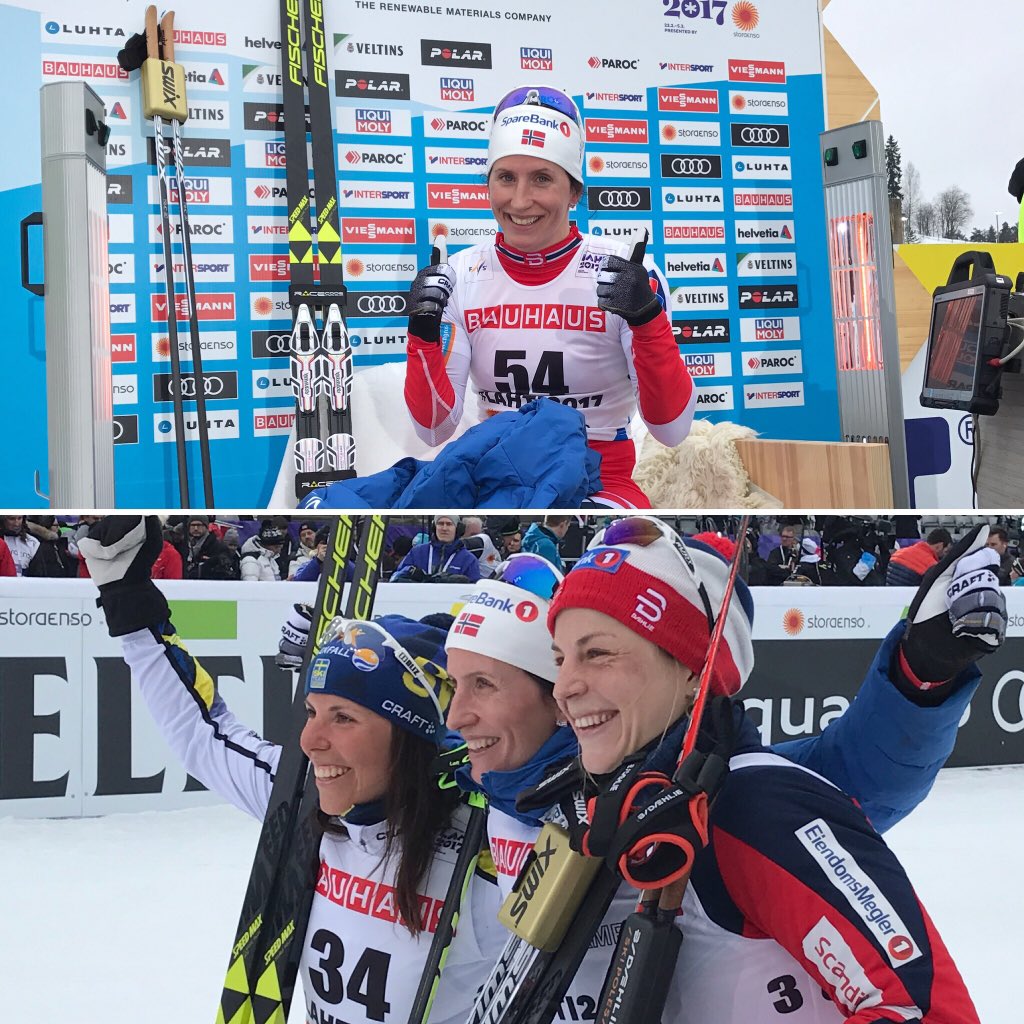
Above: Norway’s Marit Bjørgen celebrates her 16th World Championships gold after winning Monday’s 10 k classic in Lahti, Finland. Below: The women’s 10 k classic podium at 2017 Nordic World Championships in Lahti, with Bjørgen (c) in first, Sweden’s Charlotte Kalla (l) in second, and Norway’s Astrid Uhrenholdt Jacobsen (r) in third. (Photo: FIS Cross-Country/Twitter)
FIS Nordic World Championships (Lahti, Finland): Women’s 10 k classic
No contest. That was the takeaway of Marit Bjørgen’s performance in the women’s 10-kilometer classic individual start on Monday at 2017 Nordic World Championships in Lahti, Finland, after the Norwegian posted a 41-second victory in 25:24.9 minutes.
Bjørgen started 54th of 72 starters and clocked the fastest time over every intermediate timing point on the course. Sweden’s Charlotte Kalla had been the previous race leader after starting 34th before Bjørgen bumped her out of the leader’s chair by 41 seconds.
Norway had two on the podium with Astrid Uhrenholdt Jacobsen in third, 55.5 seconds behind Bjørgen. Norway’s Heidi Weng missed the podium in fourth (+1:13.8), while Sweden’s Anna Haag — an early leader in bib 18 — finished fifth (+1:22.7). Finland’s Kerttu Niskanen took sixth (+1:23.7) and Krista Parmakoski was seventh (+1:31.4), while Norway’s Ingvild Flugstad Østberg and Poland’s Justyna Kowalczyk tied for eighth (+1:34.5). Germany’s Stefanie Böhler rounded out the top 10 in 10th (+1:35.8).
Sadie Bjornsen led the U.S. women in 23rd (+2:21.2), Kikkan Randall placed 26th (+2:31.7), Rosie Brennan was 32nd (+2:55.4), and Ida Sargent 43rd (+3:55.2).
Katherine Stewart-Jones led the Canadians with her best result at her first World Championships in 36th (+3:09.6), Emily Nishikawa followed in 37th (+3:14.9), and Dahria Beatty 39th (+3:24.9).
IBU Youth/Junior World Championships (Osrblie, Slovakia): Junior relays
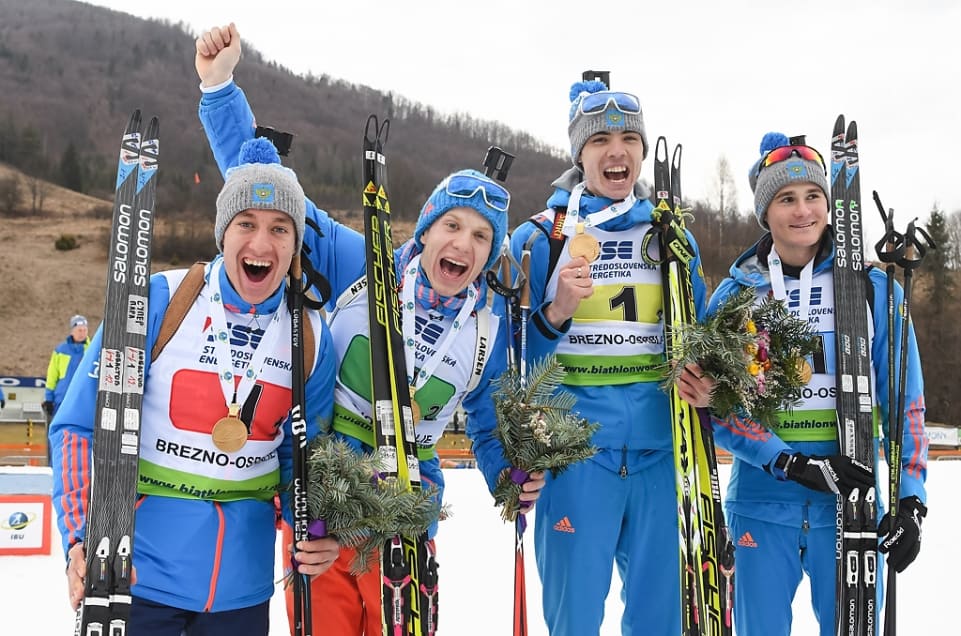
(From left to right) Russia’s Nikita Lobastov, Igor Malinovskii, Nikita Porshnev, and Kirill Streltsov after winning the men’s 4 x 7.5 k relay on Tuesday at IBU Youth/Junior World Championships in Osrblie, Slovakia. (Photo: IBU)
[UPDATED] Russia, Norway, Germany. Or Norway, Germany, Russia. That’s how the podiums shook out for the junior men’s and women’s relays on Tuesday, the last day of the 2017 International Biathlon Union (IBU) Youth/Junior World Championships in Osrblie, Slovakia.
Russia won the men’s 4 x 7.5-kilometer event by 53.9 seconds in 1:17:27.8 hours, with Nikita Lobastov, Igor Malinovskii, Nikita Porshnev, and Kirill Streltsov. After coming through the first exchange in fifth, 44.2 seconds out of first, Malinovskii skied his team into first and they held the lead to the finish. In total, Russia used seven spares to clean and had no penalties.
Norway claimed silver with Dag Sander Bjørndalen,Johannes Dale, Aleksander Fjeld Andersen, and Sindre Pettersen. After getting tagged in 14th, Dale moved the team up to sixth and Andersen improved to second, which Pettersen held. The team combined for one penalty and 12 spares.
Germany claimed bronze (+1:39.3) despite one penalty and 16 spares, with Justus Strelow, Danilo Riethmüller, Dominic Schmuck, and David Zobel. Fourth at the first exchange, Riethmüller picked moved them into third on the second leg, which Schmuck and Zobel held.
Canada finished 12th (+6:00.5) with Zachari Bolduc, Trevor Kiers, Jules Burnotte, and Pearce Hanna combining for three penalties and 13 spare rounds. Positioned in 10th for the first two legs, the team moved into eighth on Burnotte’s third leg. Hanna had to ski three penalty laps on the final leg and slipped to 12th.
The U.S. men finished 14th (+9:07.4) with Cody Johnson, Cameron Christiansen, Travis Cooper, and Peter Carroll combining for two penalties and 10 spare rounds. The team gradually moved up from 16th at the first exchange to 12th at the third and final exchange, before losing two places before the finish.
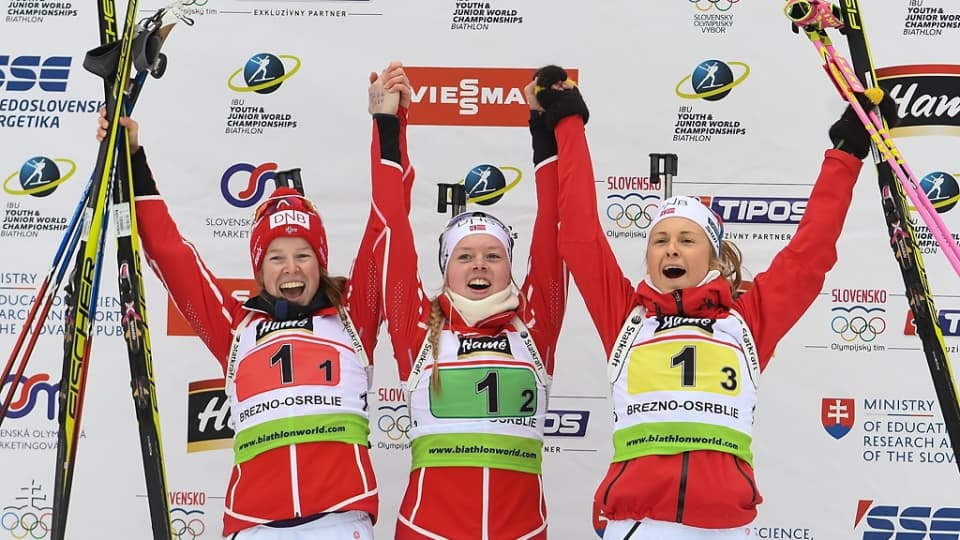
(From left to right) Norway’s Hilde Eide, Karoline Erdal and Ingrid Landmark Tandrevold after winning the junior women’s 3 x 6 k relay on Tuesday at IBU Junior World Championships in Osrblie, Slovakia. (Photo: IBU)
In the junior women’s 3 x 6 k relay, Norway rose to gold with Hilde Eide, Karoline Erdal and Ingrid Landmark Tandrevold (for Tandrevold’s third medal in the last three races, and first gold of the week) finishing in 56:18.4. The team, which had zero penalties and used eight spares, moved up from fourth at the first exchange to first on Erdal’s second leg and Tandrevold anchored them to the win.
Germany crossed the finish 16.5 seconds later for silver, with Vanessa Voigt, Sophia Schneider and Anna Weidel. In seventh after the first leg, Schneider moved them into third before Weidel anchored them to second. They had one penalty and used nine spares.
Russia rounded out the women’s podium in third (+26.1) with Kristina Reztsova, Ekaterina Moshkova and Valeriia Vasnetcova. After being tagged in ninth, Moshkova skied them up to fourth and Vasnetcova picked off one more place for bronze. They combined for one penalty and eight spares.
Canada’s junior women finished 14th (+4:17.7) with Megan Bankes, Emily Dickson and Nadia Moser combining for four penalties and nine spares. They had been as high as 11th after Bankes’s first leg.
The U.S. finished 17th (+11:30) with Siena Ellingson, Helen Wilson and Nina Armstrong accumulating five penalties and 11 spares. They had skied as high as 15th after Ellingson’s first leg.
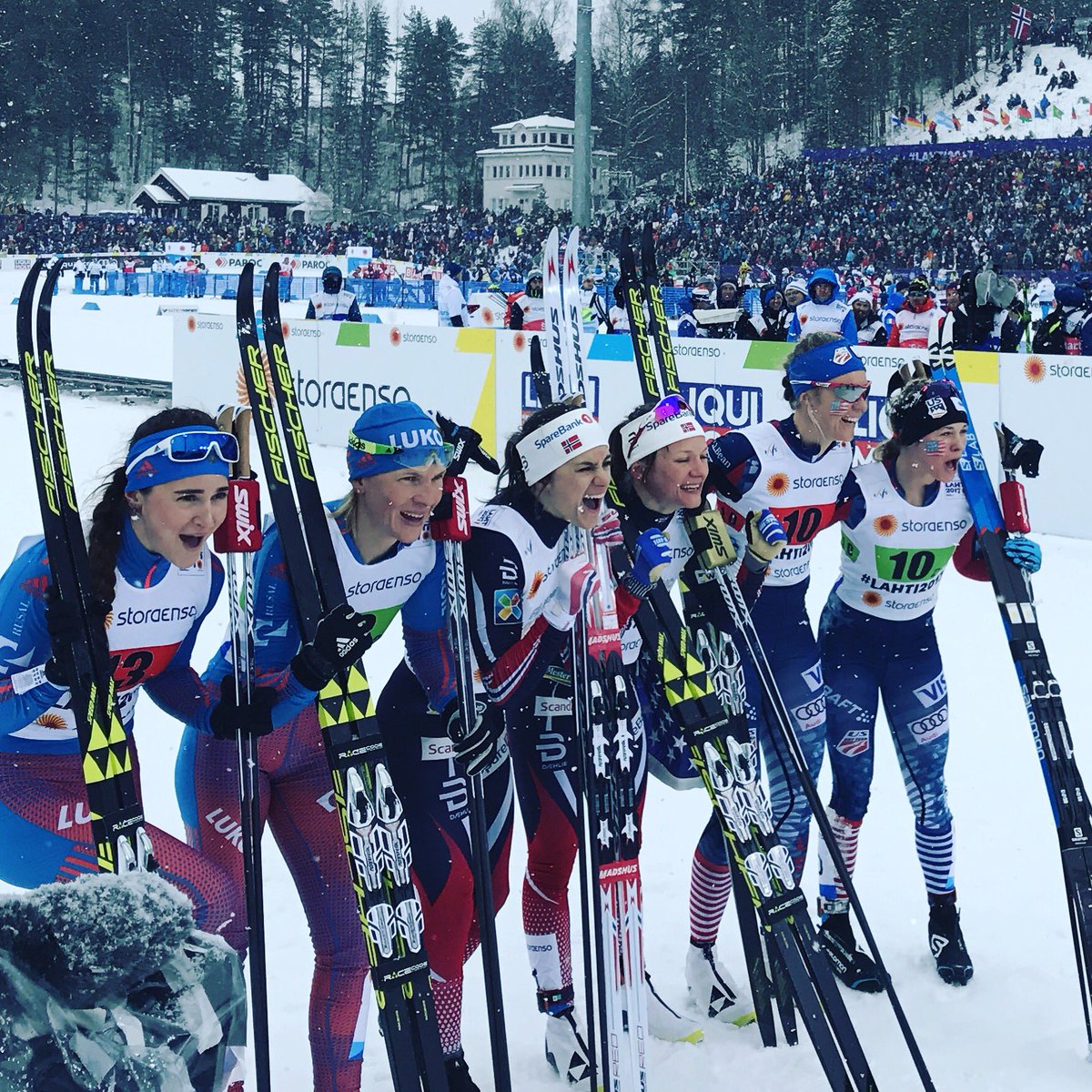
Heidi Weng and Maiken Caspersen Fall of Norway (center) bested Yulia Belorukova and Natalia Matveeva of Russia (left) for gold in the women’s team sprint at 2017 World Championships, with Sadie Bjornsen and Jessie Diggins of the U.S. (right) outsprinting Sweden for bronze. (Photo: FIS Cross Country/Twitter)
FIS Nordic World Championships (Lahti, Finland): Classic team sprints
Defending champions Norway repeated gold in the women’s team sprint, with Heidi Weng and Maiken Caspersen Falla crossing the finish line first in Lahti, Finland. On the second-to-last loop, it looked like Russia could have something to say about that. Yulia Belorukova put in a furious sprint up the course’s biggest climb, and then beat Weng to the exchange. But her teammate Natalia Matveeva could not match the pace when Falla put on her own sprint on the last uphill. Russia finished second for silver, +5.56.
The competition for bronze was closer, with Germany, Finland, Sweden, and the United States going out of the stadium for the last loop together in chase of the Norwegian and Russian leaders. The last climb was defining in the race for bronze, with Jessie Diggins of the United States staying closest to Sweden’s Stina Nilsson. Diggins caught Nilsson on the downhill and was able to stay just ahead of the Swede to the finish, claiming bronze (+18.38) along with teammate Sadie Bjornsen. It was a return to the team sprint podium for Diggins: after winning the team sprint at 2013 World Championships with Kikkan Randall, she teamed up with Sophie Caldwell in 2015 but the pair finished eighth.
Nilsson and Ida Ingemarsdotter settled for fourth (+18.57), and the Finnish team of Aino-Kaisa Saarinen and Kerttu Niskanen finished fifth (+23.02).
The Canadian team of Cendrine Browne and Dahria Beatty was seventh in their semifinal and landed 13th overall.
In the men’s team sprint, Norway set a high pace from the beginning, with phenom Johannes Høsflot Klæbo attacking on the steep uphill every time he skied. On his second and third loops, he tagged off to Emil Iversen with gaps of just over five seconds to the rest of the field. But Iversen had a hard time holding the lead, in part because of Russia’s Sergey Ustiugov, who had won the 30 k skiathlon the day before and put in a huge effort to catch Iversen on the fourth loop of the team sprint.
On the final loop, Finland’s Iivo Niskanen bridged the gap up to Iversen, mostly on the steep uphill and then also with ski speed on the downhill. But the time the pair entered the stadium, Niskanen had caught the Norwegian and was moving with higher speed. He decided to switch tracks to overtake Iversen, but Iversen decided to switch tracks just a second later, without checking one last time to make sure the track was clear. He fell, taking out Niskanen with him.
That allowed Ustiugov and Italy’s Federico Pellegrino to go sailing by to claim gold and silver (+2.14) with their teammates Nikita Kriukov and Dietmar Noeckler. It was the second gold for Russia in the event in three World Championships; Kriukov and Alexey Petukhov won in 2013, and also took silver in 2015.
Niskanen got up and claimed bronze (+8.64 with Sami Jauhojärvi), swearing as he crossed the finish line; with a broken pole, Iversen limped across the line in fourth (+18.42). He was called to a jury meeting but ultimately no teams were disqualified because of the crash.
Erik Bjornsen of the United States won a sprint finish for fifth (+23.58) with teammate Simi Hamilton), besting Lenny Valjas (+27.02 with teammate Alex Harvey) of Canada.
FIS Nordic World Championships (Lahti, Finland): Nordic combined 4 x 5 k team event
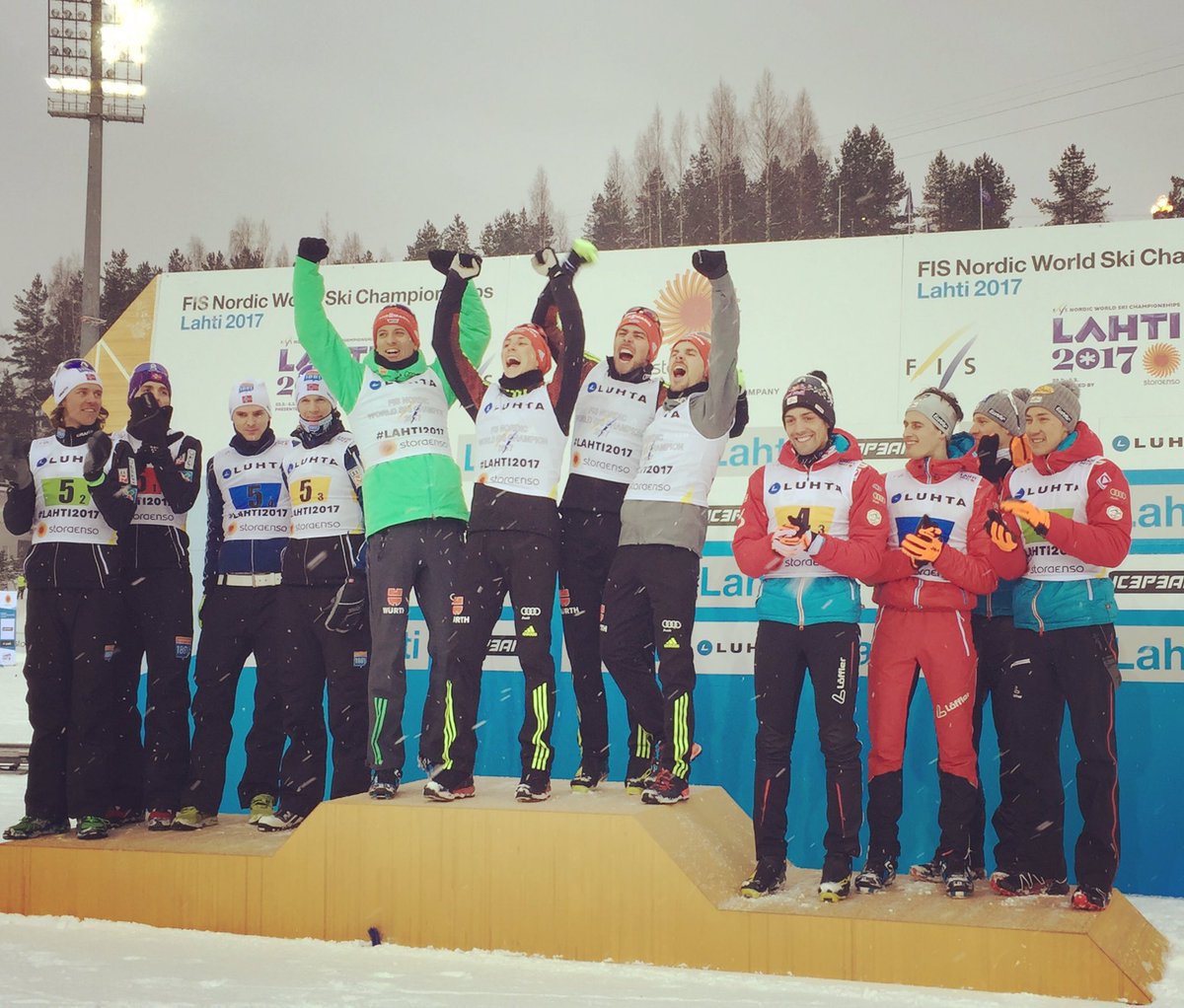
Germany (Björn Kircheisen, Eric Frenzel, Fabian Rießle, and Johannes Rydzek) took gold in the nordic combined 4 x 5 k team event on Sunday at Nordic World Championships in Lahti, Finland, while Norway placed second and Austria third. (Photo: FIS Nordic Combined/Twitter)
[UPDATED] After sweeping the first individual nordic-combined competition of 2017 Nordic World Championships on Friday, Germany achieved gold as a team, with Björn Kircheisen, Eric Frenzel, Fabian Rießle, and Johannes Rydzek winning the 4 x 5-kilometer team event in 47:57.3.
The Germans combined for the best jumping score of 11 teams and started the relay in first, 44 seconds ahead of Japan in second. Norway started 1:07 minutes back in fifth but rose to second place (+41.7), with Magnus Moan, Mikko Kokslein, Magnus Krog, and Jørgen Graabak. Moan raced them into third at the first exchange, then Kokslein secured second, which they held onto for the remaining two legs.
“It was our goal to ski a controlled race,” Germany’s Frenzel told ZDF. “Not really look at how the gap was developing, but just make our own race. And put up a little more pressure towards the end of each leg. That worked well, that was a wickedly cool team performance today. And I am just happy that we could put a little golden crown on the whole event today.”
“I think today you could see again that we all worked together and enjoyed the competition,” Rydzek added. “We were all happy about each other’s performance, and just rewarded ourselves for hard hard work.”
Austria started fourth, 1:05 behind Norway, and clinched bronze (+1:03.7) with Bernhard Gruber, Mario Seidl, Philipp Orter, and Paul Gerstgraser. Gruber initially raced them into second at the first exchange, but they relinquished one spot and hung on for third, ahead of Japan in fourth (+1:06).
Japan (Hideaki Nagai, Takehiro Watanabe, Yoshito Watabe, and Akito Watabe) jumped to second, but found themselves in fourth at every exchange.
Finland took fifth, Italy sixth, France seventh, and the U.S. eighth (+3:27.2) with Bryan Fletcher, Taylor Fletcher, Ben Berend, and Ben Loomis. The Americans started the race in seventh and were in sixth after the first two exchanges, but slipped to eighth on the third leg.
IBU Youth/Junior World Championships (Osrblie, Slovakia): Youth & junior pursuits
Four seems to be Chloe Levins’s lucky number. After a career breakthrough of fourth place in the pursuit at last year’s Youth Olympic Games (YOG) in Lillehammer, Norway, the 18-year-old Vermonter raced to fourth in the youth women’s 7.5-kilometer pursuit on Sunday at the International Biathlon Union (IBU) Youth/Junior World Championships in Osrblie, Slovakia.
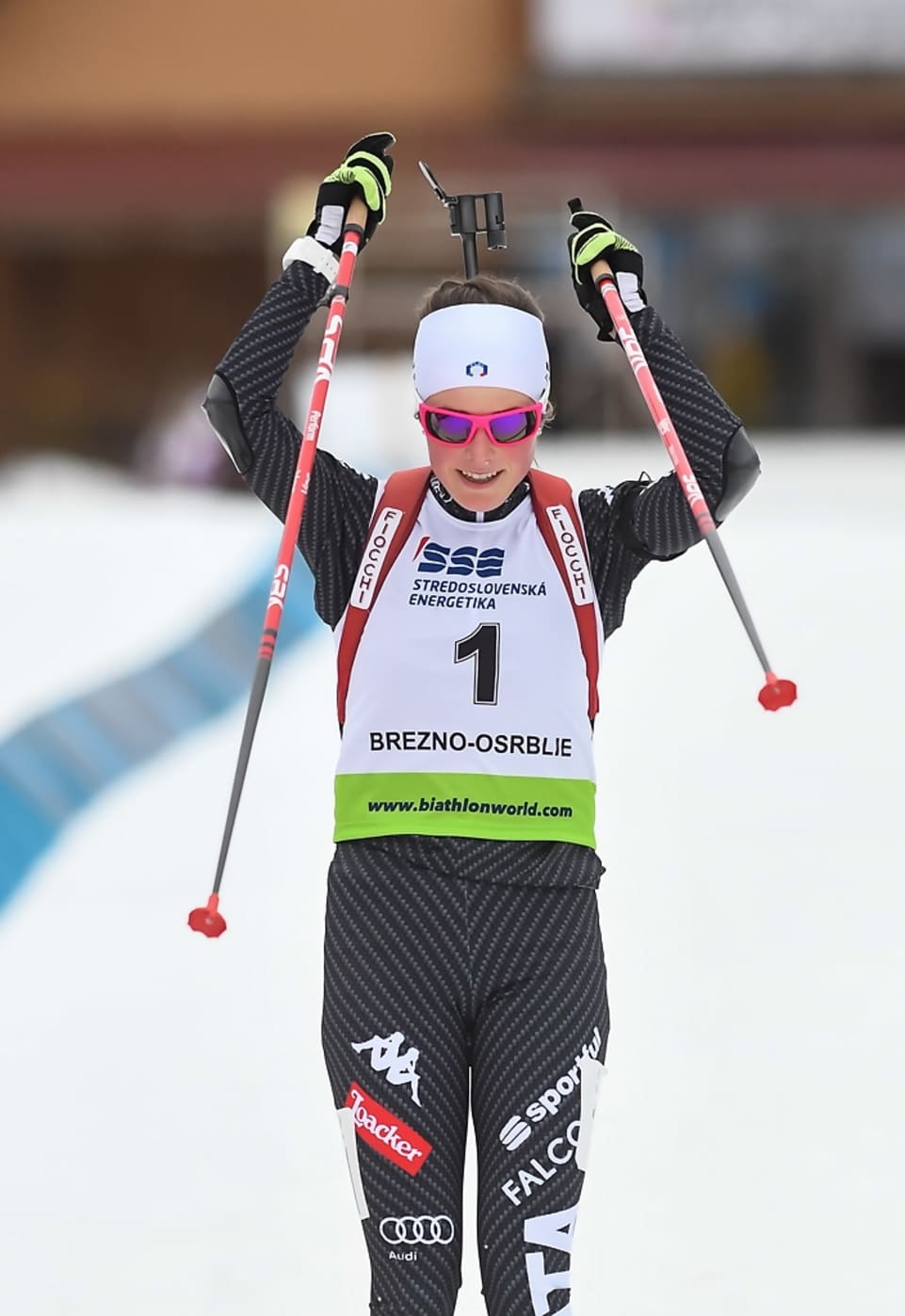
Italy’s Irene Lardschneider winning the youth women’s 7.5 k pursuit on Sunday for her second-straight gold at 2017 IBU Youth World Championships in Osrblie, Slovakia. (Photo: IBU)
Levins started the race in 11th and worked her way up to fourth with clean shooting in three stages. She missed two in the first prone but rebounded and held off Ukraine’s Khrystyna Dmytrenko by seven seconds for fourth place. Levins finished 1:55.5 minutes behind the winner, Italy’s Irene Lardschneider, who started the race first and held on for her second-straight gold medal despite four penalties (0+0+2+2), finishing in 26:57.1. France’s Lou Jeanmonnot-Laurent rose from fourth to second place with 19-for-20 shooting (0+0+1+0), and Italy’s Samuela Comola took bronze (+1:08.5) for the second-straight race with two misses (1+0+1+0).
Three U.S. women qualified for the pursuit, with Amanda Kautzer finishing 42nd (+6:16.2) after starting 59th and shooting 80 percent (1+0+2+1), and Grace Gilliland finishing 55th (+8:32.1) with six penalties (2+3+1+0).
Canada’s Shilo Rousseau followed in 54th (+9:02.1) with eight misses (3+1+2+2).
In the junior women’s 10 k pursuit, Canada’s Megan Bankes raced to 16th for the best finish for a North American in that race. The gold medalist in last week’s 12.5 k individual, Bankes finished 13th in Saturday’s sprint and thus started in that position, 1:25 out of first. She ended up 16th with four penalties (0+1+2+1) and finished 2:15.8 behind the winner, Russia’s Valeriia Vasnetcova, who started 24th and worked her way all the way up to first with clean shooting.
Vasnetcova was the only one to clean the four-stage pursuit on Sunday, and in doing so, she achieved her first gold of the championships and second of her career at Youth/Junior Worlds after her team won last year’s youth relay in Romania.
Coming off a sprint win, Italy’s Michela Carrara started first and took second at the finish, 10 seconds behind Vasnetcova with three misses (1+1+1+0). Norway’s Ingrid Tandrevold scored her second-straight medal as well, after starting second and finishing third (+10.8), with two penalties (0+0+1+1).
Canada’s Nadia Moser had her best result of the championships in 30th (+3:43.5), moving up one place after starting 31st, with three penalties (0+1+0+2). Emily Dickson finished 47th for the second-straight day (+6:29.9) with four penalties (1+0+1+2).
Siena Ellingson was the lone American to start after placing 18th in Saturday’s sprint. She finished 41st (+5:24.7) with seven misses (1+2+1+3).
In the junior men’s 12.5 k pursuit, Canada’s Pearce Hanna rocketed to 23rd after starting 47th, shooting 17-for-20 after cleaning the first two stages (0+0+1+2) for his first top 30 of the championships. Hanna finished 3:12 behind the winner, Russia’s Igor Malinovskii who picked up his second-straight gold.
Malinovskii started first and finished in 32:39.8, 13 seconds ahead of second place, with four penalties (0+1+2+1). Norway’s Sindre Pettersen took the silver medal after starting in eighth and posting the fastest course time to overcome five misses (2+1+1+1). Belarus’s Anton Smolski moved up from fourth at the start to reach the podium in third (+27.4) with five misses as well (0+0+3+2).
All four Canadian junior men qualified for the pursuit. Trevor Kiers led them in 39th (+5:13.3), after starting 48th, for his best result of the championships. Jules Burnotte placed 43rd (+5:35.3), up from 55th, for his best result as well, and Zachari Bolduc finished 57th (+8:18.3). Kiers missed five targets (2+0+1+2), Burnotte had seven misses (3+1+1+2), and Bolduc missed eight (2+3+2+1).
For the U.S., Cody Johnson finished 55th (+7:19.5) with nine penalties (2+1+2+4) and Travis Cooper 59th (+8:46.2) with eight misses (5+0+1+2).
In the youth men’s 10 k pursuit, the first race of the day on Sunday, two Canadians finished in the top 30, with Leo Grandbois in 22nd and Adam Runnalls in 27th.
For Grandbois, it was his first time outside the top 15 of the championships after he had won the youth men’s 12.5 k individual last Wednesday and finished 14th in Friday’s 7.5 k sprint. He had to ski six penalty loops on Sunday (0+2+2+2), dropping outside the top 20 after the third shooting. Grandbois finished 3:21.8 behind the winner, France’s Emilien Claude, who won the sprint as well to start the pursuit first.
Claude, who had four penalties (1+1+0+2) and finished in 29:22.4, held off Italy’s hard-charging Cedric Christille by 16 seconds after Christille shot just two penalties (0+0+1+1) to move up from fourth to second for his first medal in his first Youth World Championships. Germany’s Danilo Riethmüller rose from sixth to third place (+30.7) despite four misses (1+0+1+2). For the German, it was his second bronze of these championships after placing third in the 12.5 k individual.
Canada’s Runnalls moved up from 32nd at the start to 27th at the finish (+3:47.5) for his first top 30 of the championships. He had five penalties (1+3+1+0), but cleaned the last stage to move into the top 30.
Vasek Cervenka was the lone American to qualify in the youth men’s pursuit, and he moved up from 49th at the start to 30th (+3:52) with five penalties (1+1+1+2).
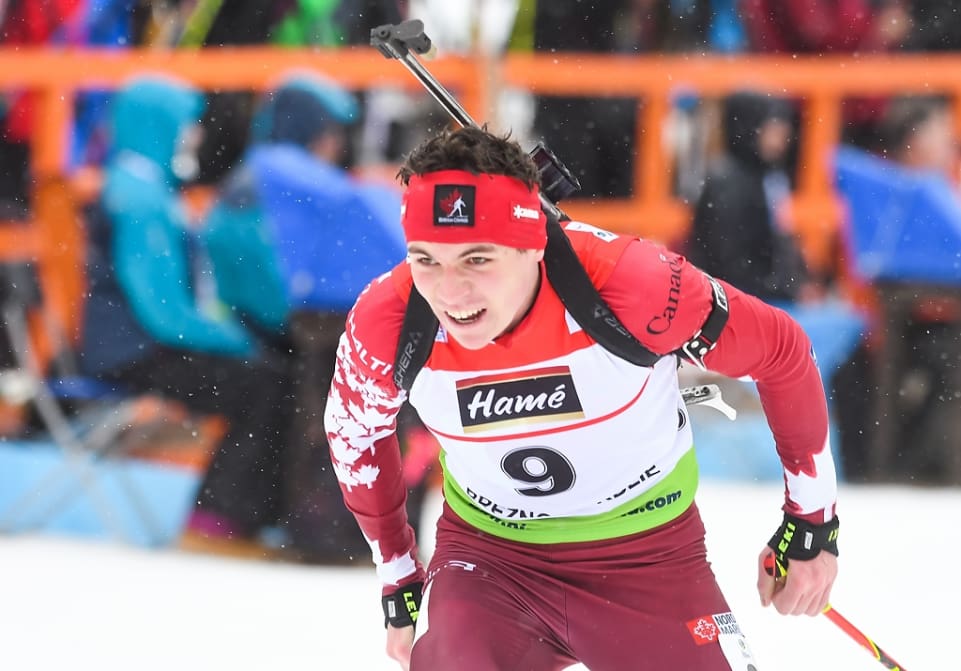
Canada’s Leo Grandbois (Biathlon Estrie) racing to gold in his first IBU Youth World Championships race on Wednesday, the 12.5 k individual, in Brezno-Osrblie, Slovakia. He hit all of his targets for the first time in a race to win by nearly a minute and 15 seconds. In doing so, he became the third Canadian biathlete to win gold at Youth World Championships. (Photo: IBU)
It was raining hard on Wednesday at the biathlon stadium in Brezno-Osrblie, Slovakia. Like, cats and dogs, “des grenouilles” (frogs, in French), or “junge Hunde” (puppies, in German).
But that didn’t stop Leo Grandbois, a German-born Canadian biathlete racing at his first International Biathlon Union (IBU) Youth World Championships, from having the race of his life.
Grandbois, 17, who was born in Munich and lived there for a year before moving to Lennoxville, Quebec, was one of four youth men named to Biathlon Canada’s Youth/Junior World Championships team. Wednesday marked his first 12.5-kilometer individual race in the youth division, and he explained after that his success derived from his focus — and his skis.
“The range had a bit of wind and the tracks were really wet, but I had really good skis,” Grandbois wrote in an email after.
The ninth starter out of more than 100 in the youth men’s race, Grandbois was the only one to knock down all 20 of his targets. He had never cleaned a race before, and he did it in a four-stage race. Without any one-minute penalties added to his total time (there are no penalty loops in individual races, just time penalties for each miss), he clocked the fastest time at the finish in 32:56.6 minutes. That time stood while nearly 90 others finished after him, with nobody coming within a minute of his time.
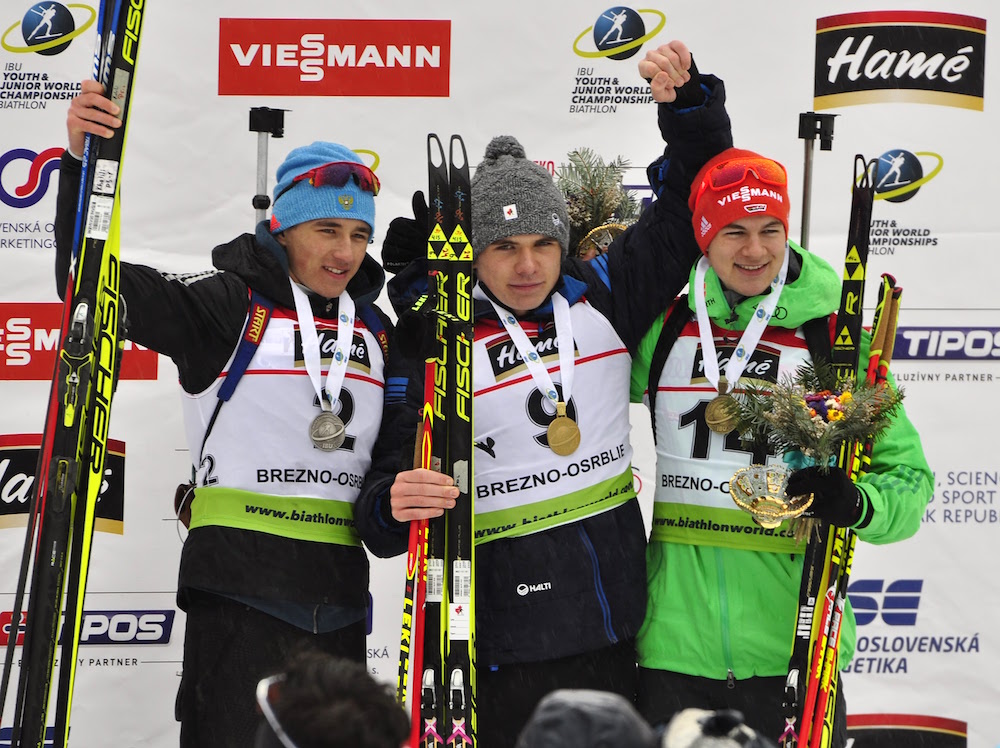
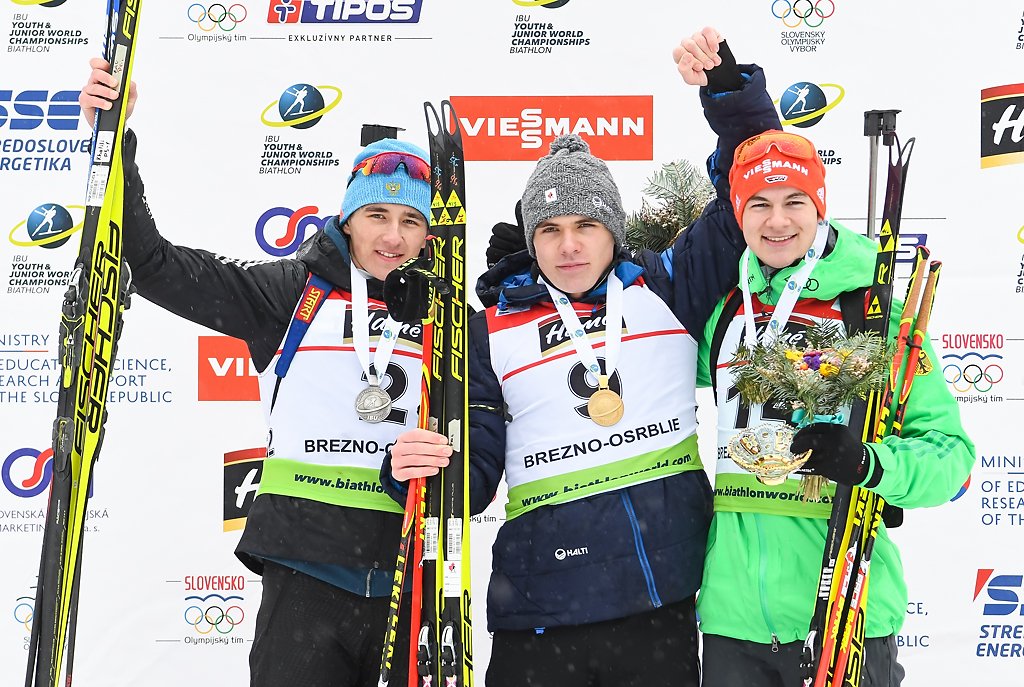
The youth men’s 12.5 k individual podium after the first race of 2017 IBU Youth/Junior World Championships in Osrblie, Slovakia, with Canada’s Léo Grandbois in first (c), Russia’s Said Karimulla Khalili (l) in second, and Germany’s Danilo Riethmüller (r) in third. (Photo: Airat Aitniakov)
Russia’s Said Karimulla Khalili started in bib 2 and enjoyed a brief moment as race leader, before Grandbois bested his time by 1:14.9 minutes. Khalili took the silver medal despite three penalties (1+0+1+1), and Germany’s Danilo Riethmüller captured bronze (+1:21.5) with three penalties as well (2+1+0+0). Besides Grandbois, who shot 100 percent, only one racer shot 95 percent: Italy’s Cedric Christille in fourth place (+1:44.5; 1+0+0+0).
“I always go for the win when I race,” Grandbois wrote. “But I was aiming a top 10.”
With the victory, Grandbois became the third Canadian to win a gold medal at Biathlon Youth World Championships, according to a Biathlon Canada press release. Kurtis Wenzel, of Calgary, is a two-time world champion: first in the 2009 youth sprint and later in the 2012 junior individual. Jean-Philippe “JP” Le Guellec, who previously coached Grandbois, started the trend by winning the 2004 Youth Worlds sprint.
“Before I came here I looked at JP’s results on the internet, and read in the newspaper about his win in 2004,” Grandbois told Biathlon Canada. “It has always been my goal to be like him so to follow that path and do what he did is an amazing feeling.
“The nicest message I received today was from JP,” he continued. “He told me how proud he was of me and to keep working hard. I have been smiling since I received that message.”
And it wasn’t just the shooting that went exceptionally well for Grandbois on Wednesday; he posted the third-fastest ski time. In an email to FasterSkier, he explained that the hilly course in Osrblie suits him. “My kind of course,” he wrote.
“Everything was perfect for me today, I was focused on the range and tried to do like at training,” he explained. “I had some great legs, too!”
He told Biathlon Canada that he had worked on improving his shooting over the last three weeks.
“When I went to bed last night and woke up today, I just had a good feeling I could do something great today,” he said. “I had complete focus and concentration on the range. The hard work over the last few weeks in training really worked today.”
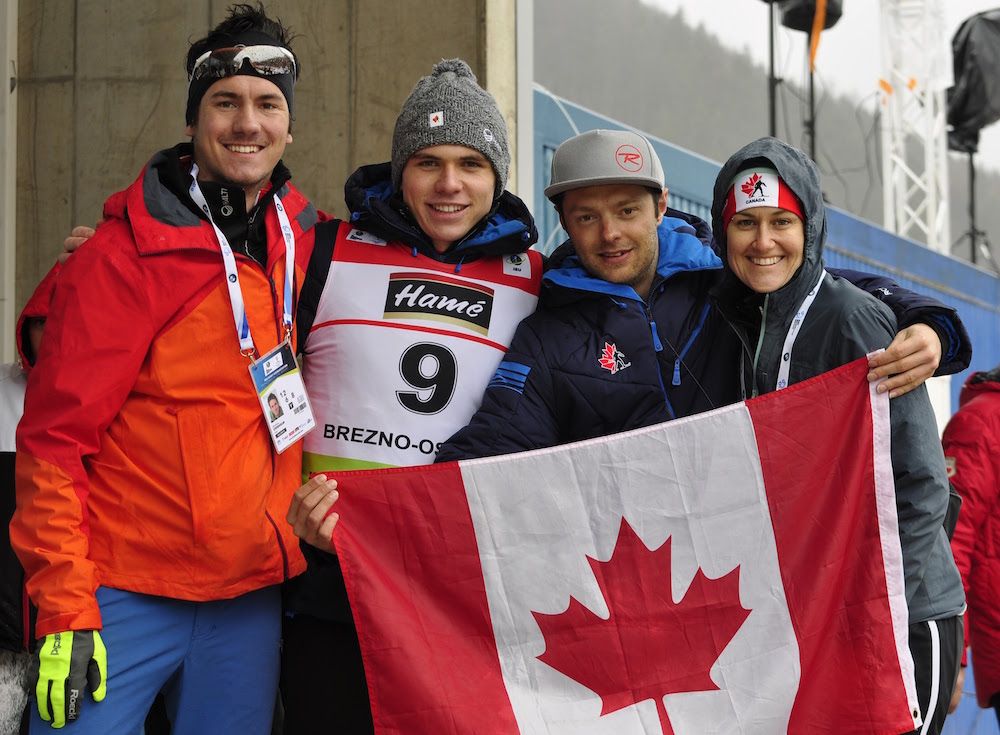
Leo Grandbois (9) with his support crew, including wax techs Andrew Chisholm (l) and Andrzej Lesnik (second from r) and Canada’s head coach Jacqueline Akerman (r), after Grandbois won gold in the 12.5 k individual on the first race of his first IBU Youth World Championships in Osrblie, Slovakia. (Photo: Airat Aitniakov)
In a post-race interview with Junior IBU Cup media, he thanked his supporters: “I want to thank first my coaches at home, my parents who always supported me and all the team who did a great job for the race, the skis, thank you.”
When FasterSkier asked what this gold medal means to him, he explained it came down to all the passion and training he had put in.
“I am probably the most happy man on earth today!” he wrote.
Last year at Youth Olympic Games (YOG) in Lillehammer, Norway, Grandbois finished 22nd in the sprint, 25th in the pursuit and 16th in the mixed relay, a team event. At his first Youth World Championships, he said the field was bigger in comparison.
According to Biathlon Canada High Performance Director Eric de Nys, Grandbois has been on the national team’s radar for a few years. Biathlon Canada started a Shooting Stars program this season and Grandbois was one of 16 athletes invited to “train, test and develop” with the national team.
“Trajectory wise it identifies both a good skier and fantastic shooter under pressure,” de Nys observed of Grandbois’s performance on Wednesday. “This was Leo’s first time shooting clean and to do it a Worlds…..awesome. Extremely happy for Leo and his support in QC.”
Cervenka, Levins Land Top 20
Leading the U.S. men on Wednesday was Vasek Cervenka, who has spent the better part of the last two seasons training in Nove Mesto, Czech Republic. The Boulder, Colo., native (who lives in Grand Rapids, Minn.) raced to 16th (+4:19.5) with five penalties (0+2+2+1).
In his second Youth Worlds, his goals coming into the opening individual race had been to hit all of his targets and ski technically well. Placement-wise, he wanted a top 10.
“The conditions were good in the morning, but a light rain started one and a half hours before the race and has continued the rest of the day,” Cervenka explained. “This made the course tricker over time as it was slowing down the skiing quite a bit. The rain also interfered with the shooting on the range.
“I am a little disappointed today in my shooting knowing I can do better, also knowing a clean shooting would have brought me up to 2nd place,” he continued. “I felt good skiing but bonked on my last two loops.”
After he cleaned the first prone stage, Cervenka’s time ranked third. One loop later, with two misses in the first standing stage, his split ranked 10th, which dropped to 23rd after the third stage. He recovered to 18th by the start of his last loop, and ultimately finished 16th for his best non-relay result at his second Youth Worlds. Last year at YOG, Cervenka had a previous best result of 20th in the pursuit.
“As happy as I am with my improvements from last year to post this top 20, it still stings for me to miss a few shots too many, knowing where I could have placed if they went down,” he wrote.
Also for the U.S., Jacob Pearson finished 49th (+7:45.3) with four misses (0+2+0+2), Alex Kilby was 75th (+9:51.1) with five penalties (1+0+1+3), and Camren Nielsen 91st (+14:36.9) with 11 misses (3+4+2+2).
Canada’s Adam Runnalls finished 41st (+7:04.8) with eight penalties (1+2+4+1) and Thomas Hulsman was 57th (+8:19.0) with five misses (2+0+2+1). Robert Kreitz did not finish.
Also on Wednesday, the youth women opened the championships with the 10 k individual, where American Chloe Levins raced 14th with three penalties (1+1+1+0). France’s Lou Jeanmonnot-Laurent shot 19-for-20 (0+1+0+0) to win the race in 34:00.9, and Levins finished 3:05.6 minutes off her winning time. None of the 90 women who finished the race shot clean.
For Levins, a Middlebury student-athlete who plays collegiate golf in the fall and the spring, 14th was her best non-relay result at her third Youth Worlds.
“Everything is possible, especially in an individual race,” she wrote in an email after. “The range is windy here in Osrblie, so good shooting is rewarded. … There’s no funny business on the track in Osrblie. It’s straight up, straight down, and flat into the range. The course demands power and strength, which I think is an advantage for me.
“Today, it was important not to let the weather get in your way,” she added. “Sometimes it’s difficult to feel excited and fresh when it’s pouring rain, as it was today; those who shut it out of their mind are usually better off. Despite the conditions, our wax technicians prepared very good skis that moved really quickly through the saturated snow.”
“It is difficult to judge from one race, but the level of competition at this year’s Youth World Championships compared to last year’s Youth Olympic Games seems very similar,” she observed. “There are many familiar faces, and today there were even some repeating champions. I’m comfortable with the level of competition.”
Moving forward to three more races in Osrblie (the sprint, pursuit and relay), Levins explained she took a lot of positives from Wednesday.
“It’s not my best biathlon competition ever, but it’s certainly not my worst,” she wrote. “It’s a short way from the bottom to the top in this game, so I’m happy to have stayed above ground today. The result is fine, but I’m more happy to be able to say I did good work today.”
Asked what she’s studying at Middlebury, Levins explained that she’s started pursuing neuroscience and economics “with a little bit of German for fun. My German professor loves that I have the opportunity to converse with native German speakers on a daily basis,” she wrote.
(When Grandbois was asked if he speaks German, he replied, “Yes … but not perfect.”)
Sharing the podium with Jeanmonnot-Laurent was Russia’s Kristina Egorova in second (+52.4) with one standing miss as well (0+1+0+0). Sweden’s Elvira Karin Öberg notched bronze (+1:16.1) with two penalties (0+0+1+1).
Also for the U.S., Grace Gilliland finished 46th (+6:28.9) with four penalties (1+1+1+1), Amanda Kautzer was 53rd (+7:14.3) with eight misses (2+1+4+1), and Helen Wilson was 62nd (+9:00.5) with six penalties (1+2+2+1).
Canada’s Shilo Luca Rousseau finished 54th (+7:29.9) with five misses (2+0+1+2), Frédérique Pérusse was 77th (+11:54.6) with nine penalties (1+4+1+3), and Elise Sauve 78th (+12:07.1) with seven misses (2+2+2+1).
IBU Youth/Junior World Championships continue Thursday with the opening junior competitions: the women’s 12.5 k and men’s 15 k individual.
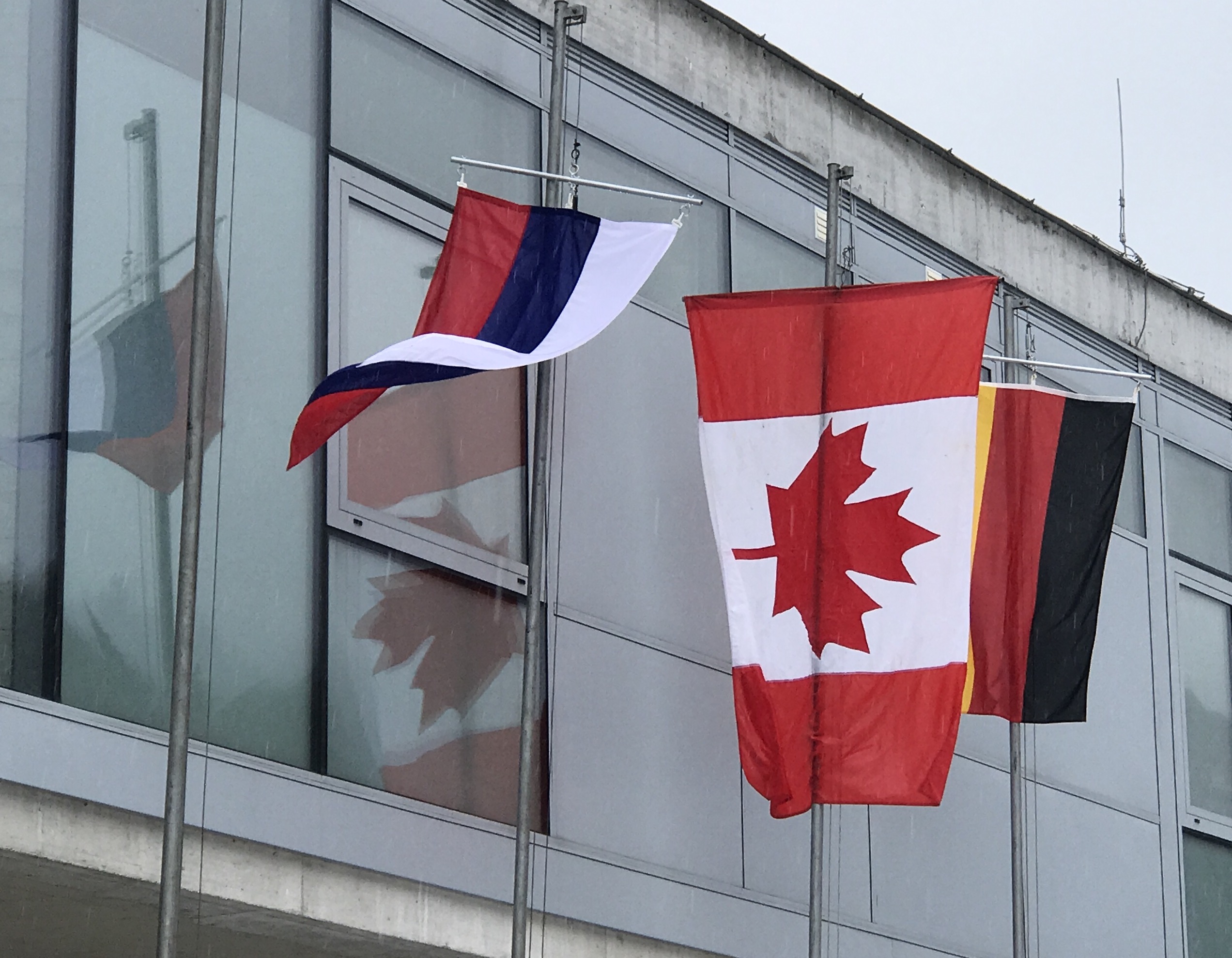
The Canadian flag flying high above the biathlon stadium in Osrblie, Slovakia, after Leo Grandbois won the youth men’s 12.5 k individual, the first race of 2017 IBU Youth/Junior World Championships. Russia took second and Germany third. (Photo: Terri Dickson)
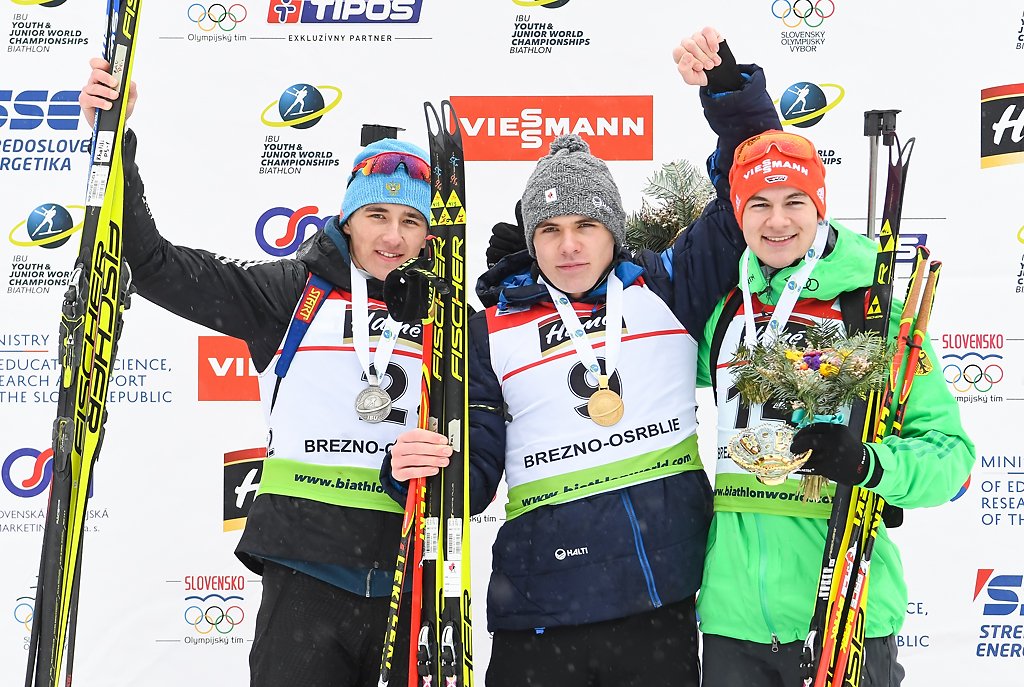
The youth men’s 12.5 k individual podium after the first race of 2017 IBU Youth/Junior World Championships in Osrblie, Slovakia, with Canada’s Léo Grandbois in first (c), Russia’s Said Karimulla Khalili (l) in second, and Germany’s Danilo Riethmüller (r) in third. (Photo: IBU Junior Cup/Twitter)
IBU Youth/Junior World Championships (Osrblie, Slovakia): Youth individual races
In his first race of his first International Biathlon Union (IBU) Youth World Championships, Canada’s 17-year-old Léo Grandbois became a world champion.
Grandbois started ninth and raced to first in the youth men’s 12.5-kilometer individual on Wednesday, finishing in 32:56.6 minutes, a time that stood up as nearly a minute and 15 seconds faster than anyone else.
Out of 98 finishers, Grandbois was the only racer to hit all 20 targets in the four-stage race at the biathlon venue at Brezno-Osrblie, Slovakia. He had never cleaned a race before, and he did it in the longest-format race on the youth circuit.
He shared the podium with Russian silver medalist Said Karimulla Khalili, who finished 1:14.9 back with three penalties (1+0+1+1), and Germany’s Danilo Riethmüller in third (+1:21.5) with three penalties as well (2+1+0+0).
For Grandbois, who was born in Germany and raised in Quebec, his previous best international (non-relay) result was 22nd in the sprint at 2016 Youth Olympic Games in Lillehammer, Norway. There, he also placed 25th in the pursuit and 16th with the mixed relay.
In a email to FasterSkier late last week, he explained that he had been targeting the sprint.
“I want to thank first my coaches at home, my parents who always supported me and all the team who did a great job for the race, the skis, thank you,” he told the IBU Junior Cup media.
Also on Wednesday, American Vasek Cervenka, who trains with the Nove Mesto biathlon team, raced to 16th (+4:19.5) with five penalties (0+2+2+1). Also for the U.S., Jacob Pearson finished 49th (+7:45.3) with four misses (0+2+0+2), Alex Kilby 75th (+9:51.1) with five penalties (1+0+1+3), and Camren Nielsen 91st (+14:36.9) with 11 misses (3+4+2+2).
Canada’s Adam Runnalls finished 41st (+7:04.8) with eight penalties (1+2+4+1) and Thomas Hulsman was 57th (+8:19.0) with five misses (2+0+2+1).
[UPDATED] In the youth women’s 10 k individual that followed, American Chloe Levins recorded her best non-relay result at her third Youth Worlds, placing 14th with three penalties (1+1+1+0). She finished 3:05.6 minutes behind the winner, France’s Lou Jeanmonnot-Laurent, who shot 19-for-20 (0+1+0+0) and finished with the fastest time of 34:00.9.
Russia’s Kristina Egorova placed second, 52.4 seconds off the win, with identical shooting (0+1+0+0), and Sweden’s Elvira Karin Öberg notched bronze (+1:16.1) with two penalties (0+0+1+1).
Also for the U.S., Grace Gilliland finished 46th (+6:28.9) with four penalties (1+1+1+1), Amanda Kautzer was 53rd (+7:14.3) with eight misses (2+1+4+1), and Helen Wilson was 62nd (+9:00.5) with six penalties (1+2+2+1).
Canada’s Shilo Luca Rousseau finished 54th (+7:29.9) with five misses (2+0+1+2), Frédérique Pérusse was 77th (+11:54.6) with nine penalties (1+4+1+3), and Elise Sauve 78th (+12:07.1) with seven misses (2+2+2+1).
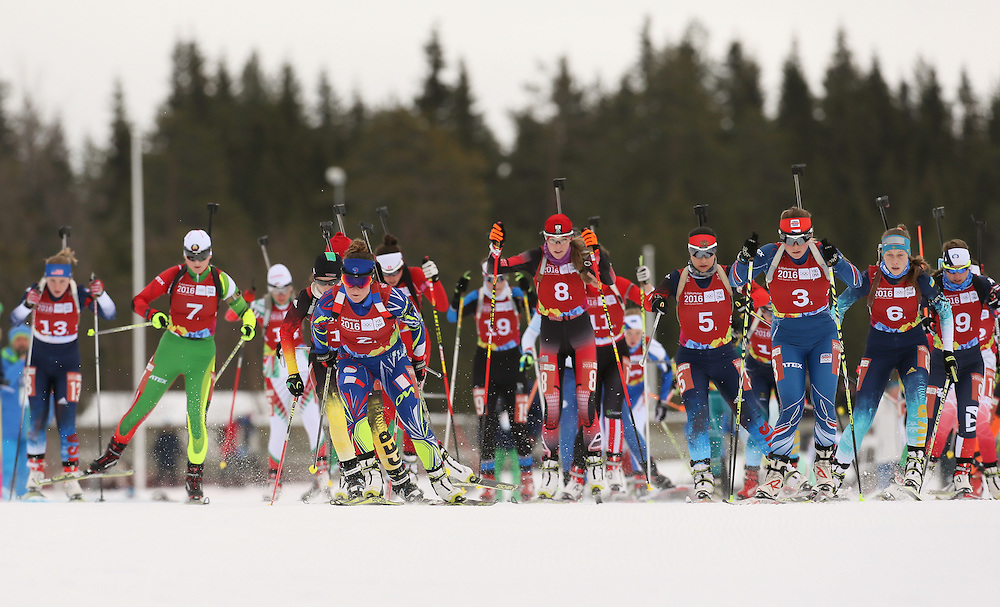
The start of Wednesday’s single mixed relay at the Birkebeineren Biathlon Stadium during the 2016 Winter Youth Olympic Games in Lillehammer Norway, with Chloe Levins of the U.S. at the far left. (Photo: Arnt Folvik for YIS/IOC)
Out of 27 teams, the U.S. found itself in second at the final exchange of the first-ever biathlon single mixed relay held at the Youth Olympic Games on Wednesday in Lillehammer, Norway. That was quite the rush for two 17-year-old Americans.
“Getting tagged off in 2nd just behind a couple seconds behind Norway was surreal,” U.S. anchor Vasek Cervenka described in an email.
In the biathlon pursuit two days earlier, Cervenka, a Czech Republic native who lives in Boulder, Colo., raced to 20th with 19-for-20 shooting. His teammate in the single mixed relay on Wednesday, Chloe Levins cleaned the four-stage pursuit and placed fourth.
“Biathlon is similar to golf in that the main goal is to try to be in contention coming into the last stage (or round),” Levins, who skied the first and third legs for the U.S., wrote in an email. “During that last stage (or round), however, whatever happens is only partially in your control. Autopilot comes on, time takes over, and whatever happens is very difficult to control.”
In the single mixed relay, each competitor rounded the 1.5-kilometer course six times — three times on each leg. They stopped to shoot twice during each leg (first prone, then standing). Misses could be remedied by using up to three spare rounds, but beyond those spares, an athlete had to ski 75-meter penalty loops for the number of targets they failed to clean.
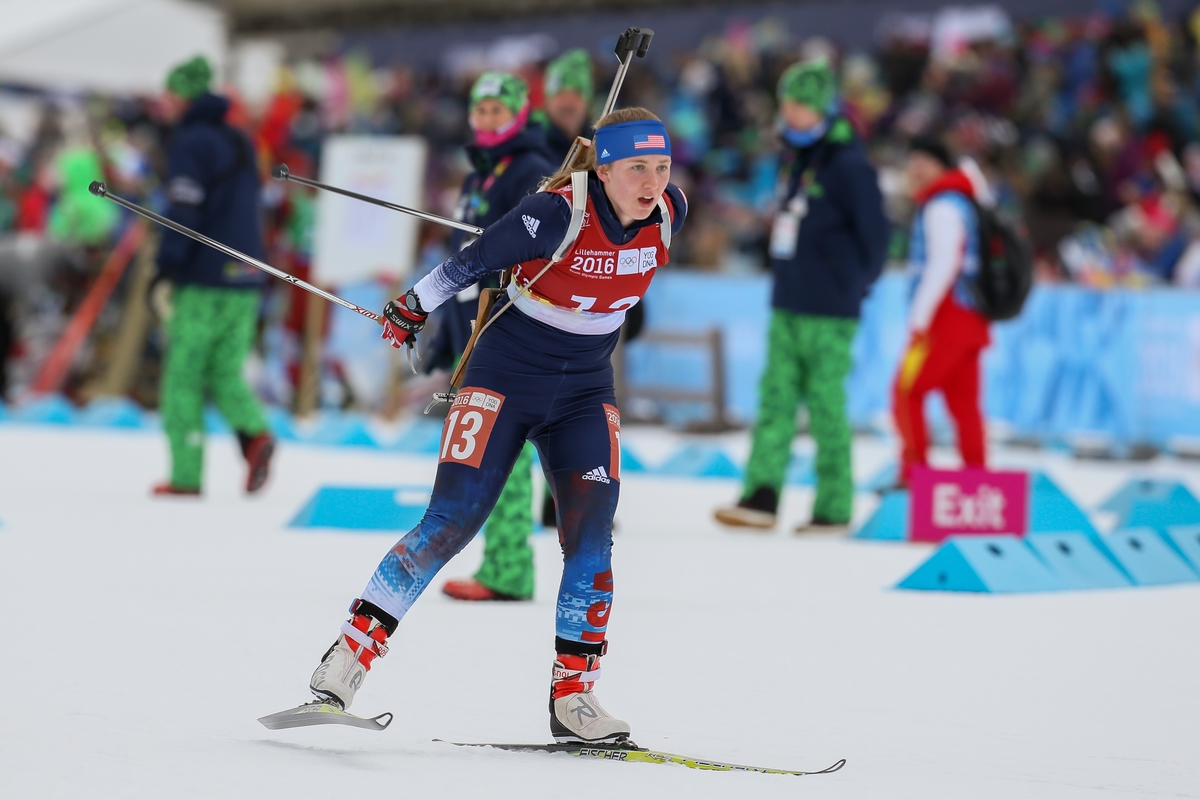
U.S. biathlete Chloe Levins racing in the single mixed relay at the 2016 Youth Olympics in Lillehammer, Norway. With teammate Vasek Cervenka (not shown), the duo went on to place sixth. (Photo: Arnt Folvik for YIS/IOC)
Levins tagged Cervenka for the fourth-and-last leg, 2.2 seconds behind Norway and 1 second ahead of France in third. She had used a total of four spares throughout her four shooting stages and avoided the penalty lap (0+1, 0+0; 0+1, 0+2).
“The start of the relay was very crowded,” Levins recalled. “Nevertheless, extremely fast skis and the use of just one extra round helped me navigate through some of the other competitors.”
At the first exchange, she tagged Cervenka in seventh, 24 seconds behind China in first. Cervenka then cleaned his prone and used one spare in standing to tag Levins in fourth, 12.5 seconds behind Finland — which had moved into the lead. Meanwhile, China dropped to 10th with two penalty loops in the standing stage of that leg.
“Vasek’s excellent shooting in his first leg put us in fourth, and set me up for a very exciting second round,” Levins explained. “During my second leg, I had more room to ski my own pace on the course. After using one extra round in the prone stage, I left the range with the leader in sight. I am a little frustrated that it took me two extra rounds to hit my miss in the last standing stage, but some mistakes by some of the more competitive nations opened the door for us to move into second position after my second leg.”
On the last two legs, China hit all of its targets to recover from 10th into fourth, and then finally first at the finish. Fanqi Meng and Zhenyu Zhu claimed gold in 41:35.4, just two-tenths of a second ahead of Norway in second and 14.9 seconds ahead of Russia in third.
The anchor legs for Norway, France, Russia, Germany, and the U.S. (Cervenka), used three spares apiece in their final standing stages. France also had a penalty, Germany had two penalties, and Cervenka had to ski a penalty loop as well after the last stage. That put the U.S. in sixth at the finish, 53.8 seconds behind the winners, with a total of one penalty and eight spares (0+0, 0+1; 0+0, 1+3 for Cerkenva).
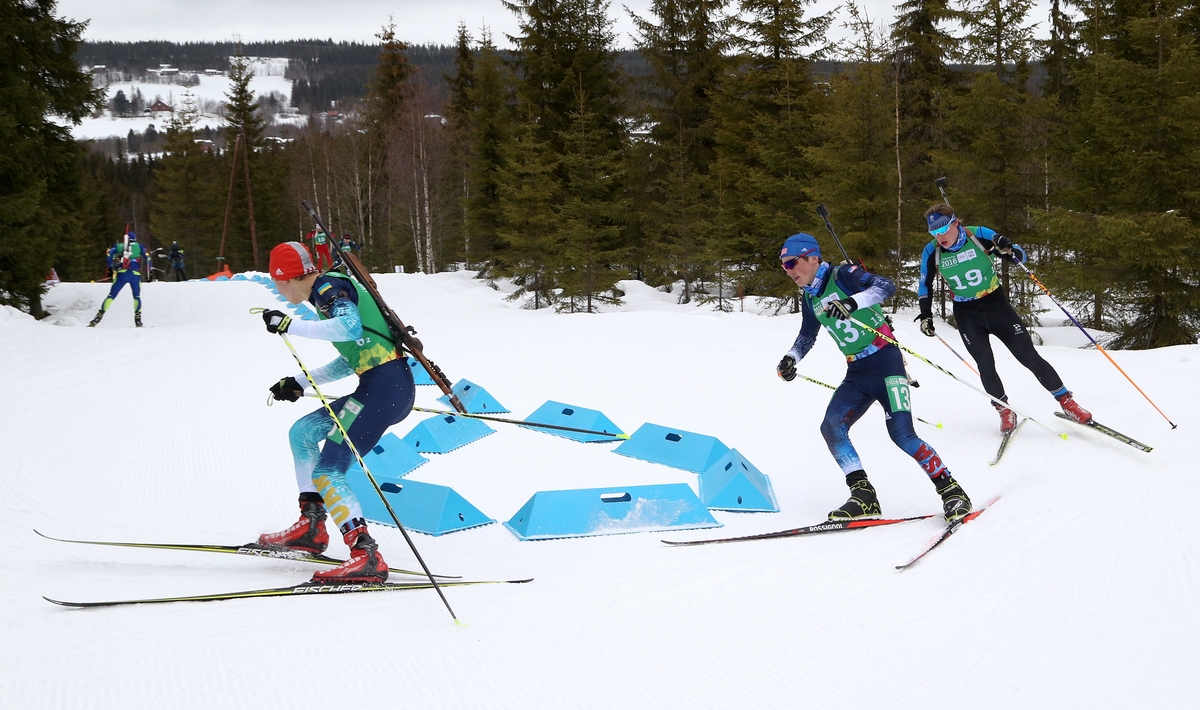
Ukraine’s Serhiy Telen (l) leads Vasek Cervenka of the U.S. (c) and Finland’s Tuomas Harjula (r) around a turn in the single mixed relay at the 2016 Youth Olympics in Lillehammer, Norway. (Photo: Jed Leicester for YIS/IOC)
“It is too bad that I couldn’t clean my last standing shooting,” wrote Cervenka, who turned 17 earlier this month. “We would of had a really great shot at a medal. I was pretty satisfied with our results in the end. All the guys in the top 6 had a solid half a foot in height on me and were overall stronger skiers. I am so proud of Chloe for her performance today, she is awesome.”
Just 0.2 seconds from gold, Norway took silver with Marthe Johansen and Fredrik Qvist Bucher-Johannessen, with a total of one penalty and 12 spares. Russia earned bronze with Ekaterina Ponedelko and Egor Tutmin, with three penalties and 13 spares. France was fourth (+30.2) with Lou Jeanmonnot-Laurent and Emilien Claude combining for three penalties and eight spares, and Germany (Juliane Frühwirt/Danilo Riethmüller) finished fifth (+53.8), about five seconds ahead of there U.S., with one penalty and eight spares.
“Today’s race was a great learning experience for Vasek and myself,” Levins wrote. “We are satisfied and thankful for all of the work and encouragement our coaches do and give to us during every race. We may not have made the podium, but I think we had the most fun today!”
“I was pretty satisfied with our results in the end,” Cervenka wrote. “Thanks to my parents, coaches, teammates, and wax techs for tons of support and wicked fast skis.”
Canada finished 13th (+3:23.0) with Tekarra Banser and Ben Churchill combining for two penalties and 10 spares. The anchor, Churchill cleaned three of four stages, using just one spare in his second prone stage (0+0, 0+0; 0+1, 0+0).
“This was an excellent opportunity for us to try and do some damage among the field in a new event,” Churchill said in a Biathlon Canada press release. “It was a lot of fun to try and pace myself well through both legs, stay warm in the interim, and keep my cool mentally no matter how Tekarra was doing.”
In Monday’s 10 k pursuit, Churchill shot 18-for-20 and achieved a career-best 10th. He had previously placed 17th in the 7.5 k sprint.
“I went into the pursuit feeling hungry and aiming to improve on my sprint result,” Churchill said. “Taking some lessons from the sprint, I attacked the course more intelligently, pushing harder up the hill each time. Execution in the pursuit was much more put-together, and I was thrilled to notch my first top-10 result in an international competition. Big thanks goes out to our wax technicians and the invaluable behind-the-scenes support from our coach, Luke McGurk, and the rest of the Team Canada Mission Staff!”
In the relay, Banser accounted for both penalties and nine spares (0+2, 0+3; 2+3, 0+1). At the first exchange, the Canadians were in 21st, 1:47 back from the leaders, then improved to 14th (+1:27) at the second handoff, before Banser tagged Churchill for the last time in 16th, 2:16 back. He brought them to 13th at the finish.
“Competing in the single mixed relay was exhilarating to say the least. Starting in a mass start format with 26 other countries made it tougher to focus, but I was able to get into my zone,” Banser said. “Fighting to stay with the pack on the first lap was challenging. The corners were tight and the other athletes were just as aggressive as I was. I ran into a few obstacles throughout my portion of the race, although I kept fighting to the last second and left nothing in the tank.”
“My experience at YOG has been spectacular so far,” Levins wrote. “Because the Norwegian culture is rooted in cross-country skiing and biathlon, fans have flooded the stadium for every one of our competitions! It feels great to be a part of an atmosphere that cares so much about the sport Vasek and I dedicate so much of our time to. The organizers have done an excellent job of maintaining near-perfect snow conditions on the track as well.”
“So far the YOG experience has been incredible,” Cervenka wrote. “So much time has been put into this event I am glad it is going so well.”