From the FasterSkier archive — posts syndicated from athletes’ and coaches’ own blogs between 2004 and 2012, kept online as published. Current coverage is at fasterskier.com.

Tag: Dario Cologna

  • Saying Goodbye to Some Big Names in Cross-Country: an International Retirement Roundup

    Saying Goodbye to Some Big Names in Cross-Country: an International Retirement Roundup

    Each year at the conclusion of the race season, there are always a few athletes who hang up their skis and step away from professional racing. The end of the four year Olympic cycle inevitably means a higher concentration of such announcements. Whether it was a fourth or a first appearance at the Games, or a near miss, the Olympics are always a target and their completion provides a good moment to move on. While the retirement announcements will likely continue into the spring, here is a roundup and recognition of the international athletes who have shared the news that they will be ending their ski careers. 
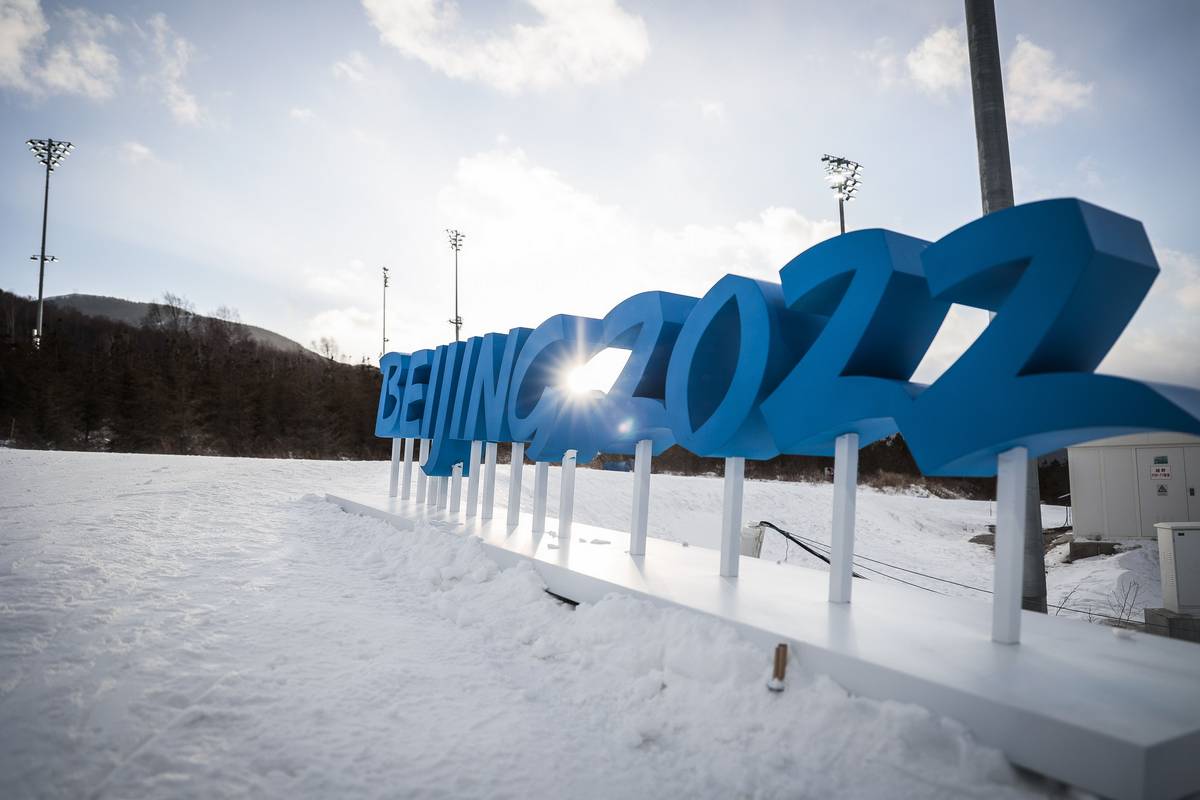
    A scene from the cross country venue in Zhangjiakou, China, host to the 2022 Olympic Winter Games. (Photo: NordicFocus)

    Four athletes from the Swiss team have announced that they will be moving on, chief among them – the king of the 15 k, Dario Cologna. At the age of 36, Cologna released his decision before the 2021/22 season even began, saying, “the decision came within the last months and after the Olympics, it will be the perfect timing for me. I have achieved everything I ever dreamed of in the sport.”
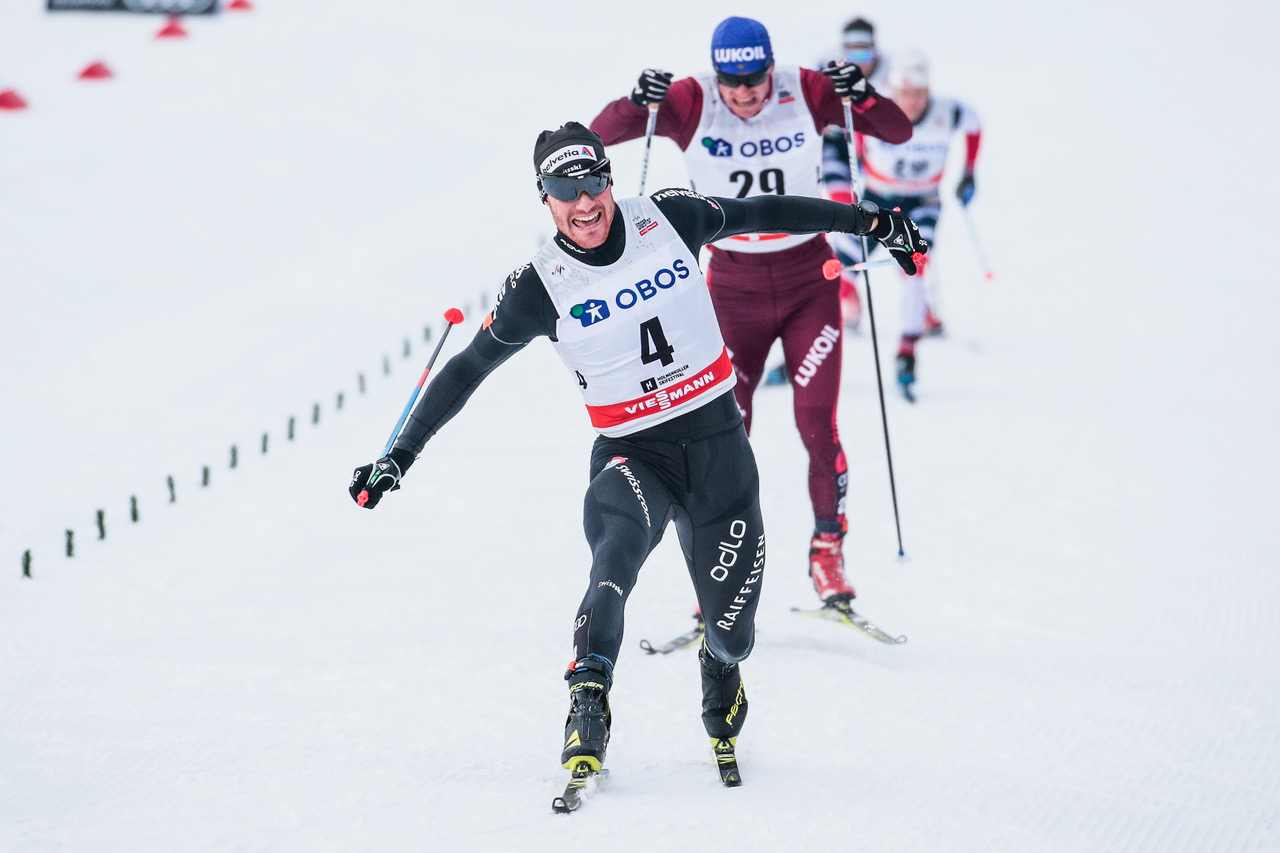
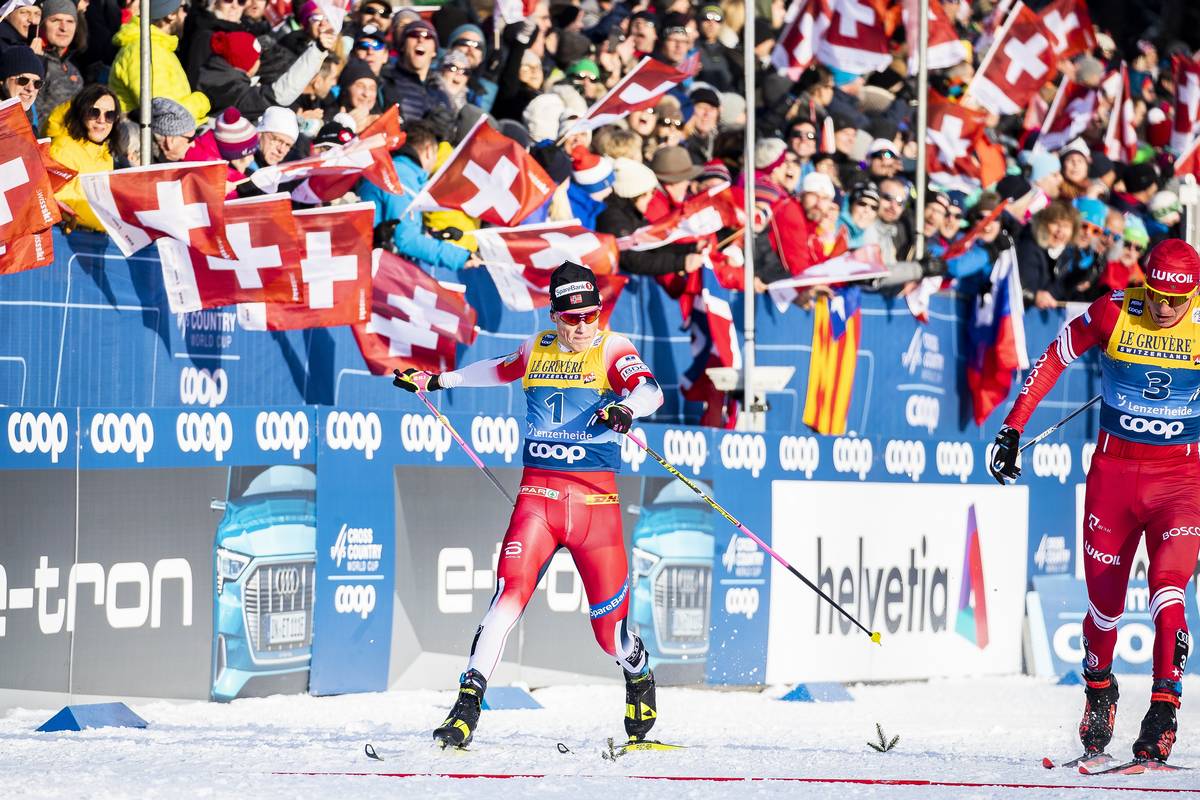
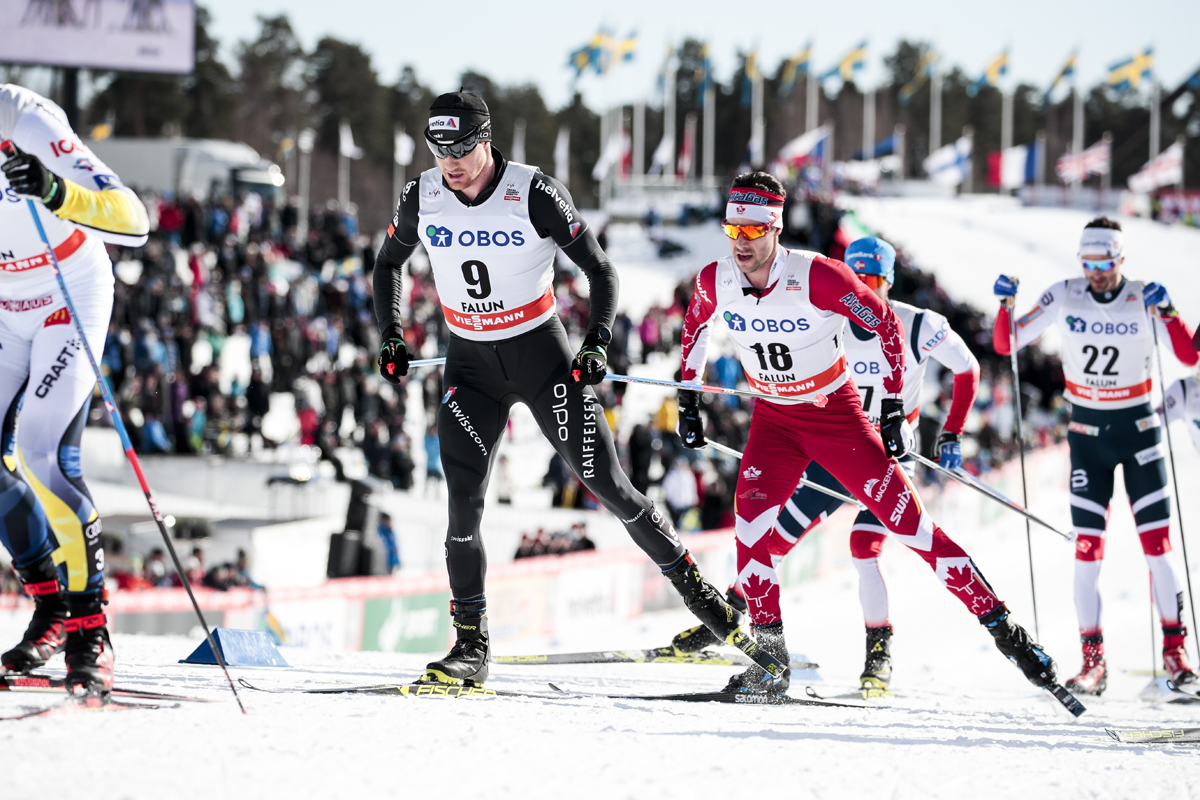
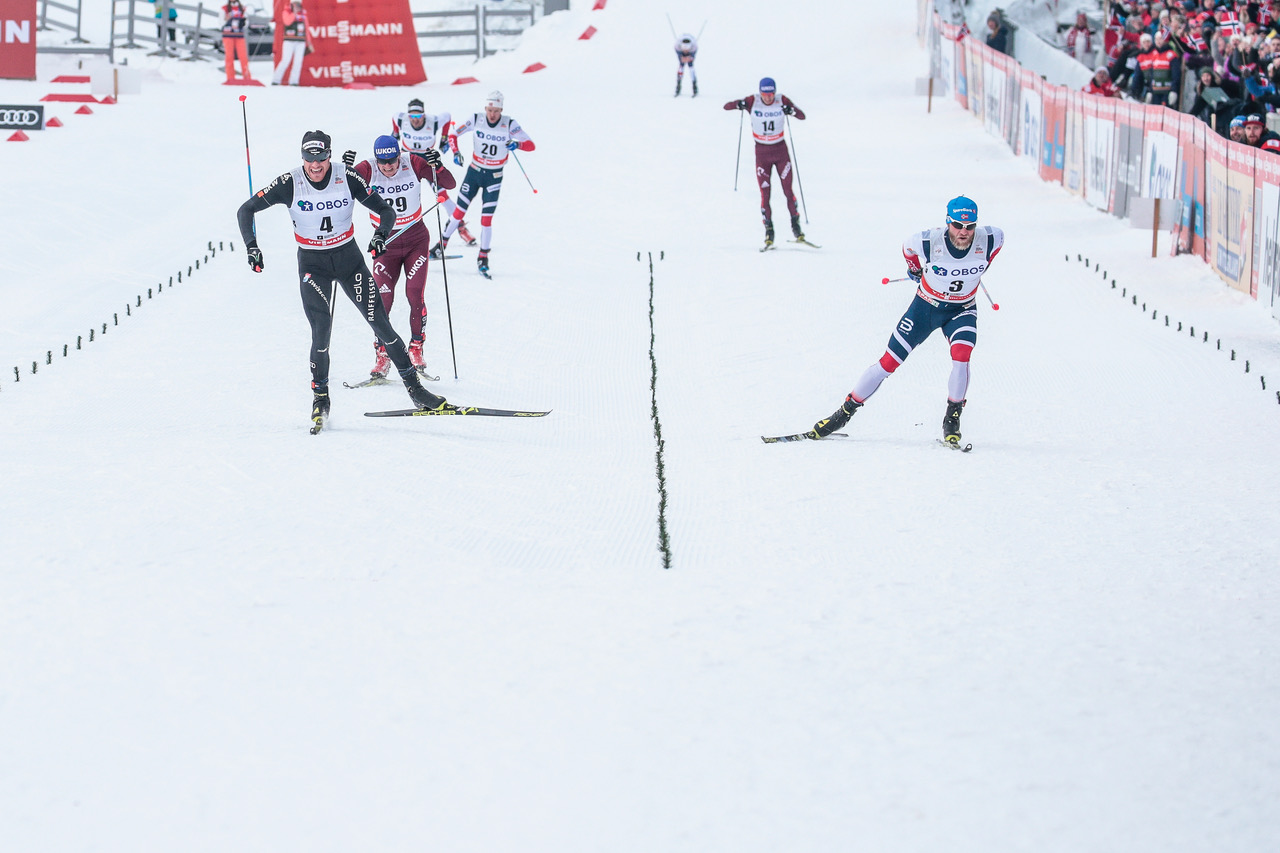
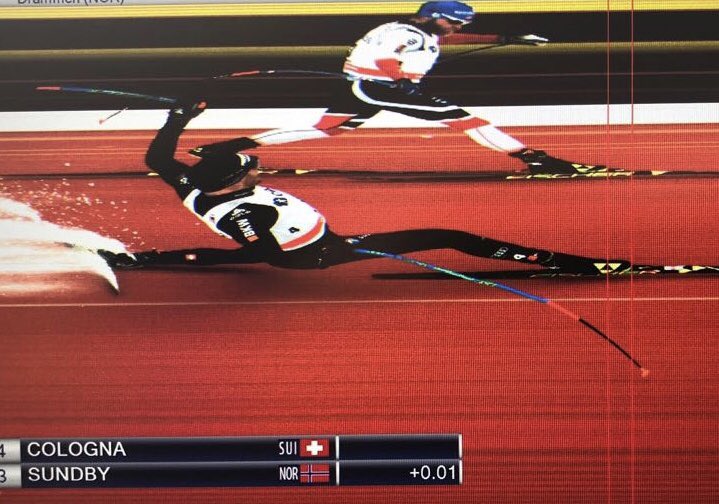
    Switzerland’s Dario Cologna lunges to the line at the 2018 Holmenkollen 50-kilometer freestyle race in Olslo, Norway. (Photo: NordicFocus)

    Cologna had his World Cup debut in 2006 and his first Olympic start came in 2010 in the 15 k skate event, where he finished first. This victory crowned him as the first Swiss cross-country skier to earn an Olympic gold medal. He went on to win three additional golds, in the 2014 Sochi Games he won both the skiathlon and the the 15 k classic, and in 2018 in PyeongChang added a gold in the 15 k skate. All told, Colgona had eighteen Olympic starts at four different games.

    In between Olympic years, he was equally successful. He won the Overall World Cup globe four times, first in the  2007/08 season, again in 2010/11 and 2011/12 and a few years later in 2014/15. In the 2007/08 season he also earned his first Tour de Ski victory, in spite of the fact that he never took a stage win that year. He won the grueling event three more times, in 2010/11, 2011/12 and again in 2017/18. 
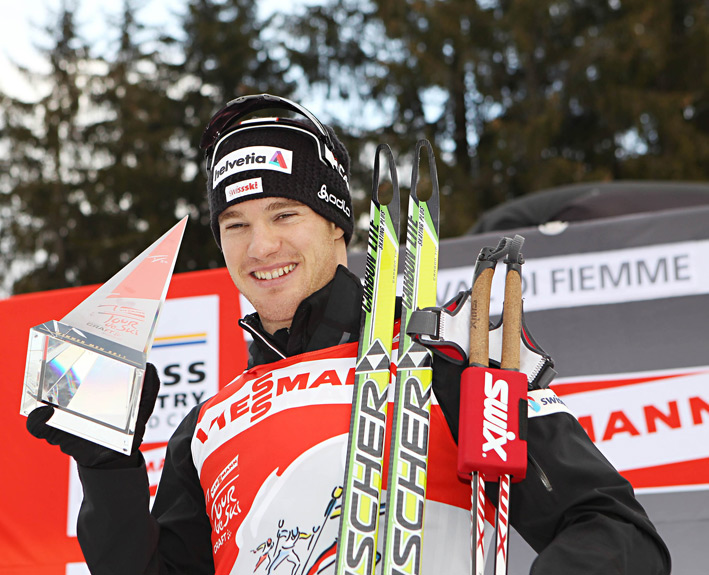
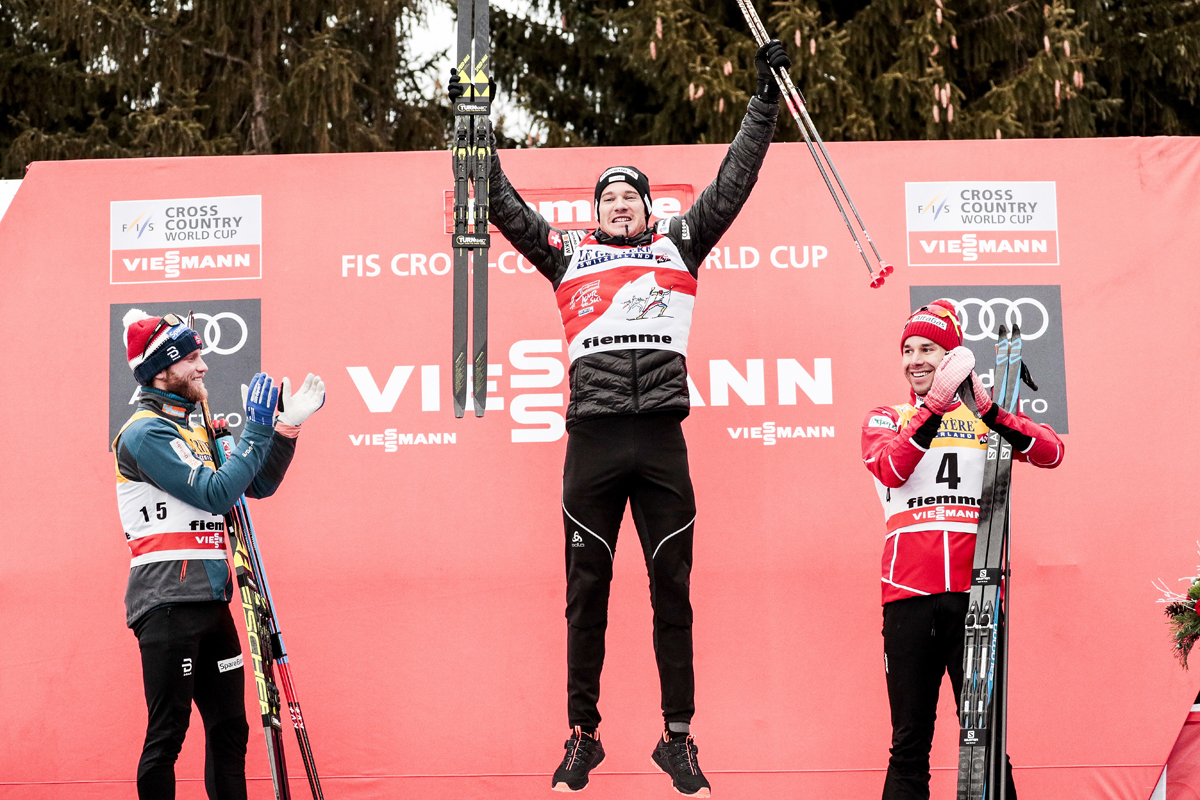
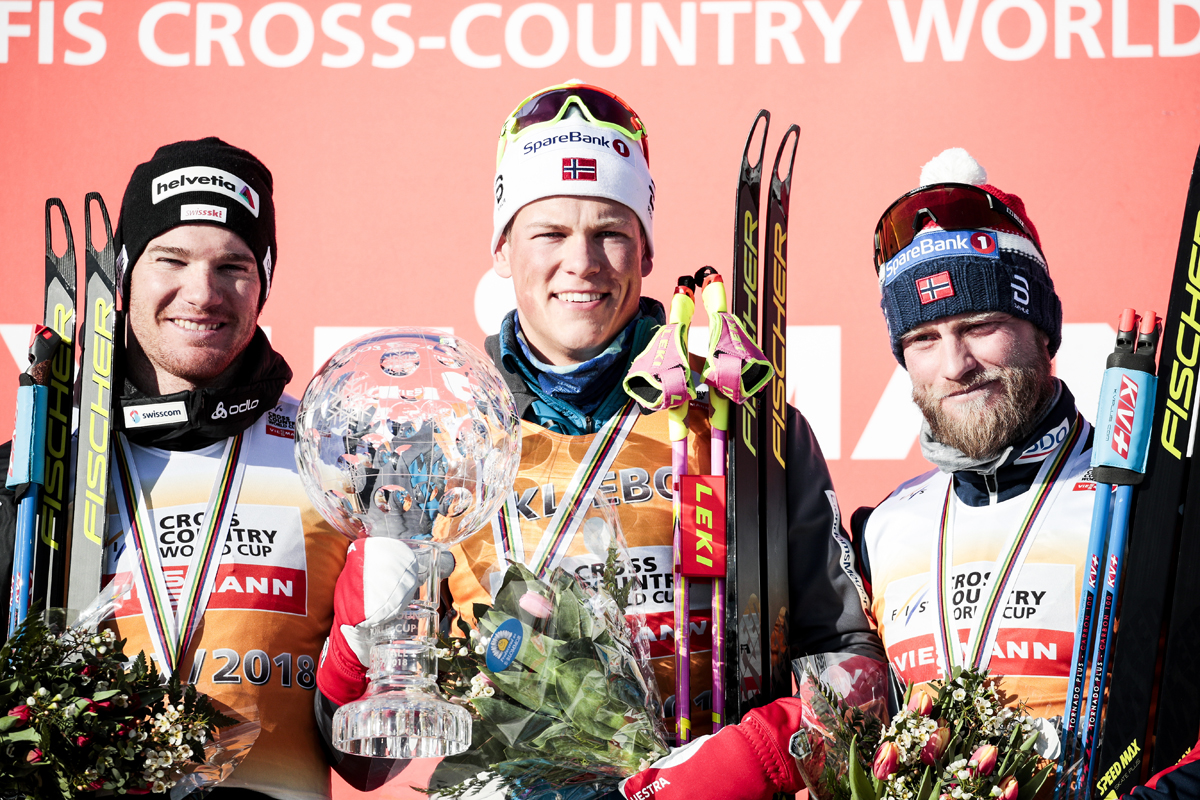
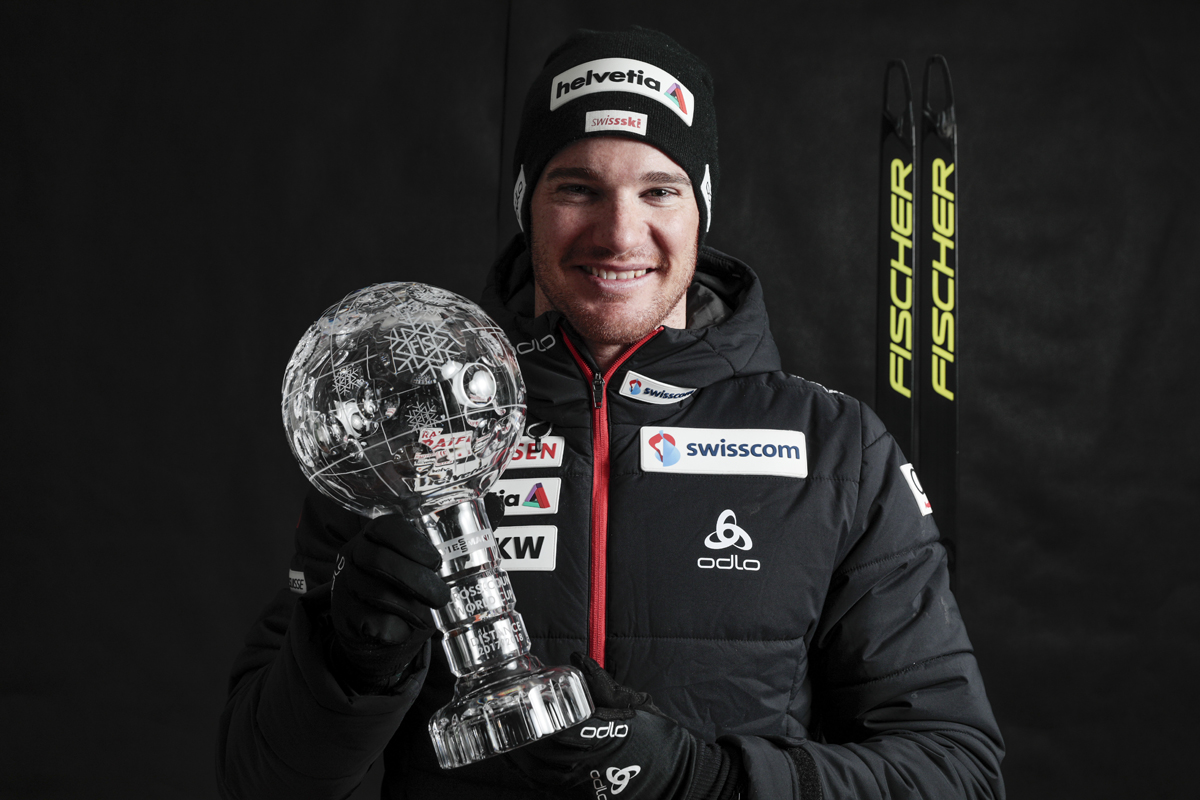
    Dario Cologna (SUI) with his trophy after winning the Tour de Ski in 2011 (Photo: Fiemme2013)

    After his final outing in the legendary Holmenkollen 50 k, Cologna wrote on Instagram, “I look back on a beautiful and successful career. 15 years ago I never dared to dream that one day I would be a four-time Olympic champion, World Champion, multiple Tour de Ski- and overall World Cup winner. In addition, I was privileged to travel to places I would never have seen and met great people, who became good friends.” 
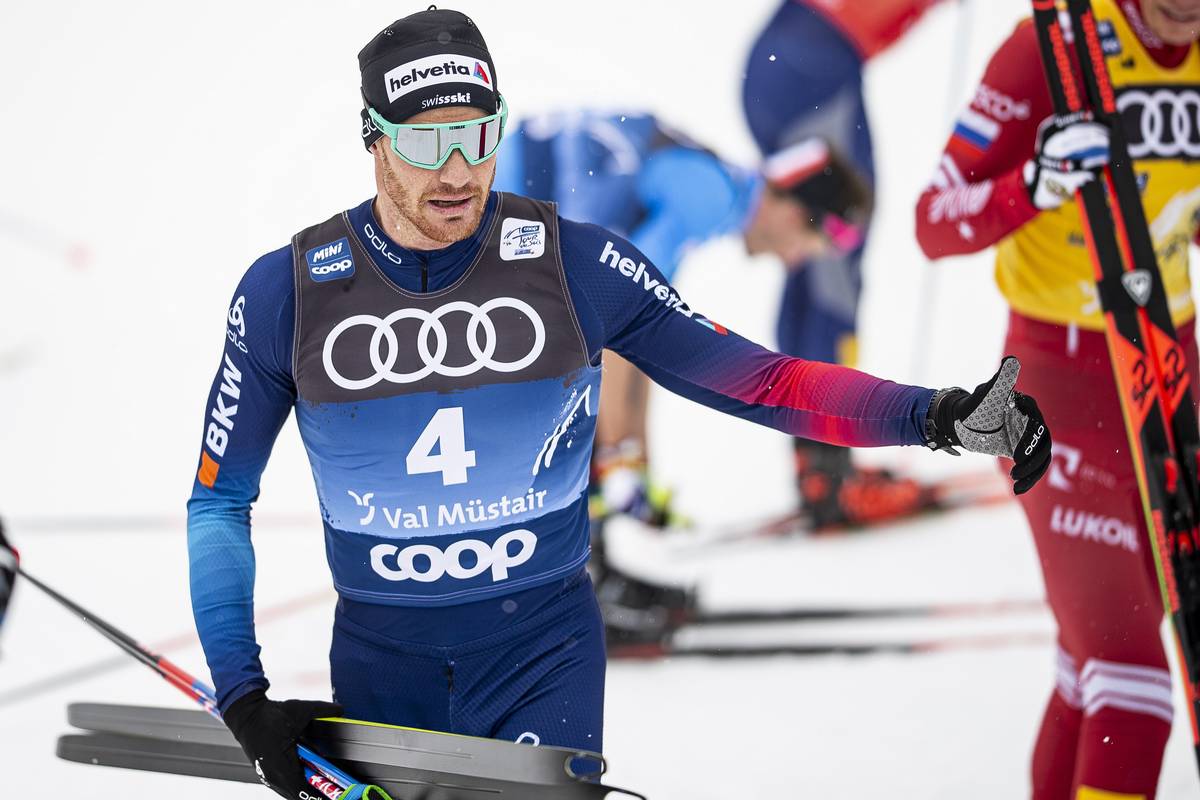
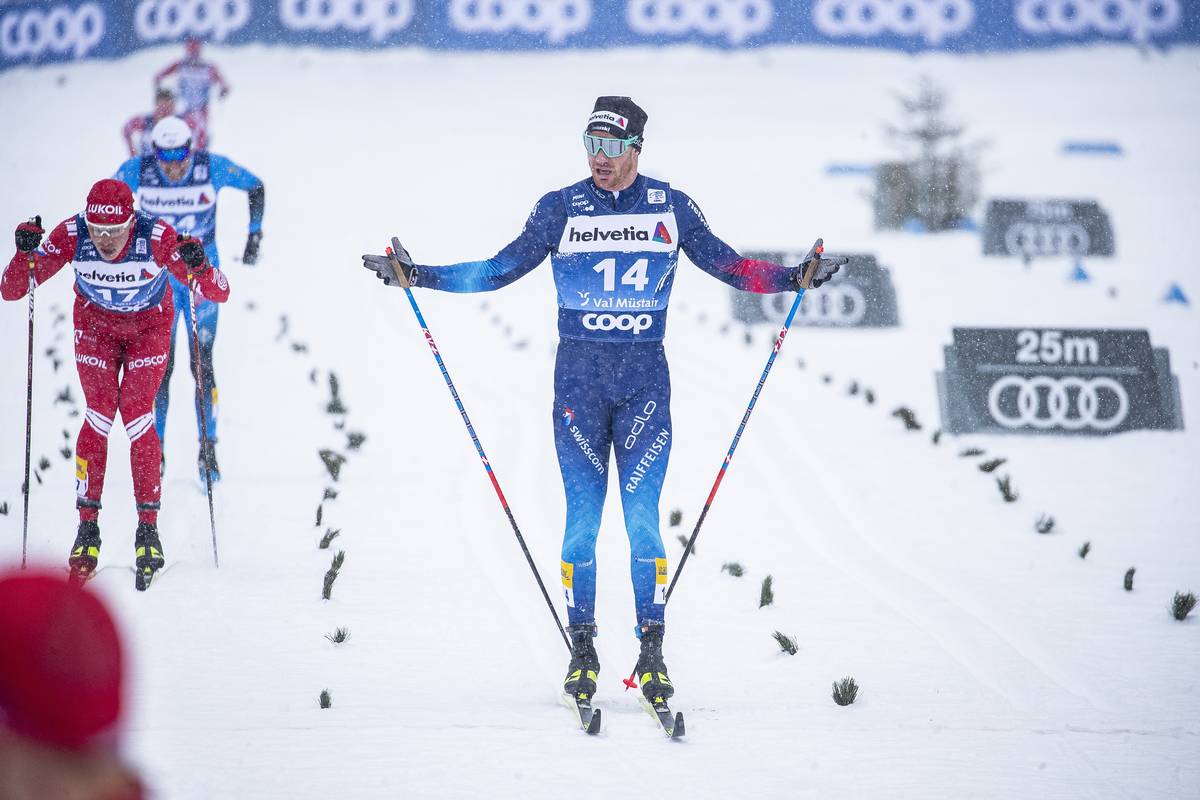
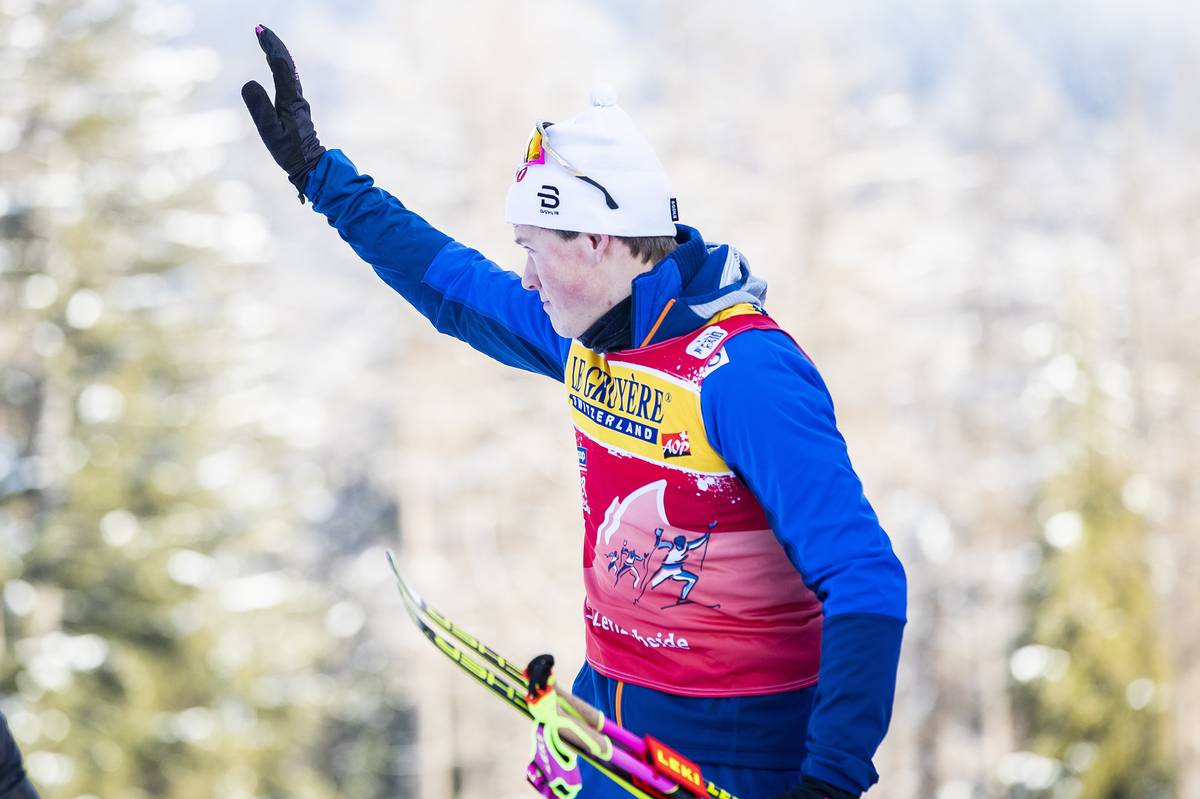
    Dario Cologna (SUI) after a 6th place finish in Val Mustair during the 2021 Tour de Ski. Photo: Nordic Focus

    Cologna’s teammate, Jovian Hediger, also announced his retirement prior to the start of this season. Hediger was known as a sprint specialist and has 107 World Cup starts to his name, having made his debut in 2009. His first and only podium appearance came in 2021 during the team sprint event in Ulricehamn, Sweden, where he and Roman Furger finished second. Hediger represented Switzerland at three Olympic games, beginning with Sochi in 2014 and ending most recently in Beijing (2022). 
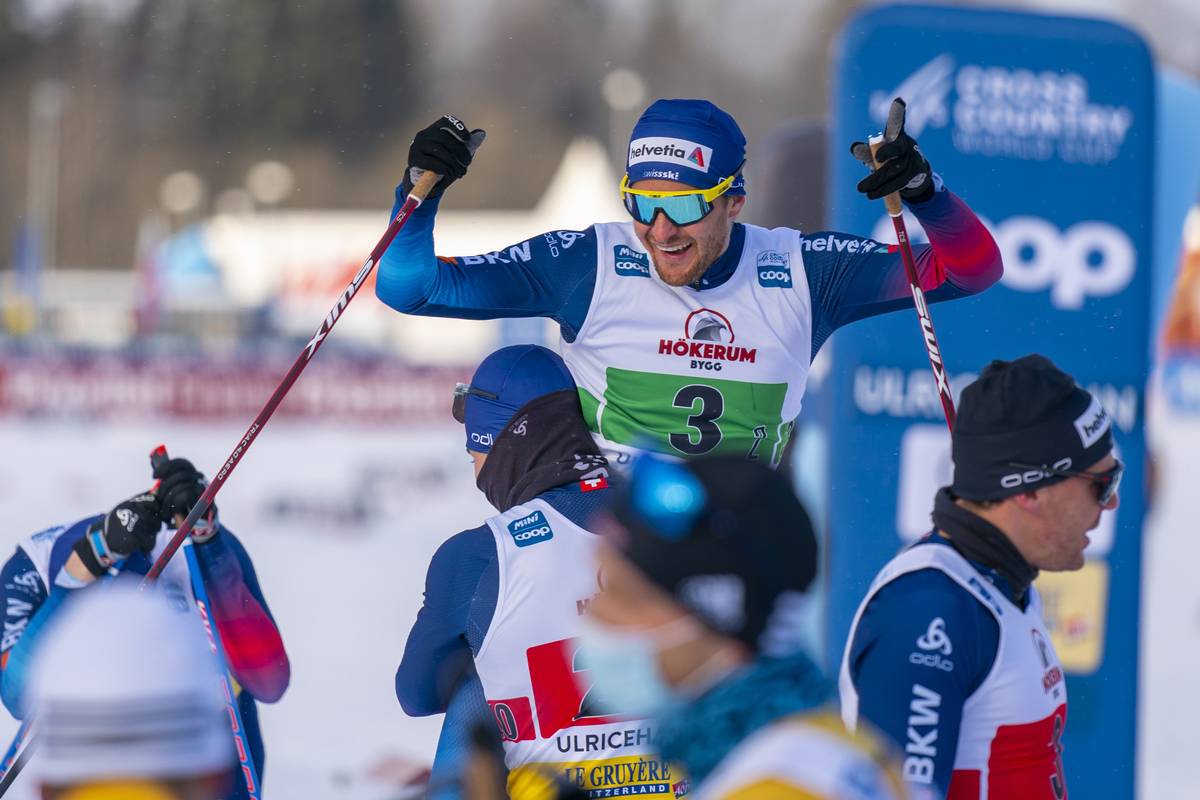
    Jovian Hediger (SUI) gets a boost from some happy teammates at the finish line in Ulricehamn Sweden. (Photo: Nordic Focus)

    Ueli Schnider of Switzerland is also stepping away from elite competition. Schnider has 62 World Cup starts and made two Olympic appearances, both in 2018 in PyeongChang where he finished 37th in the classic sprint and 41st in the 50 k classic mass start. 

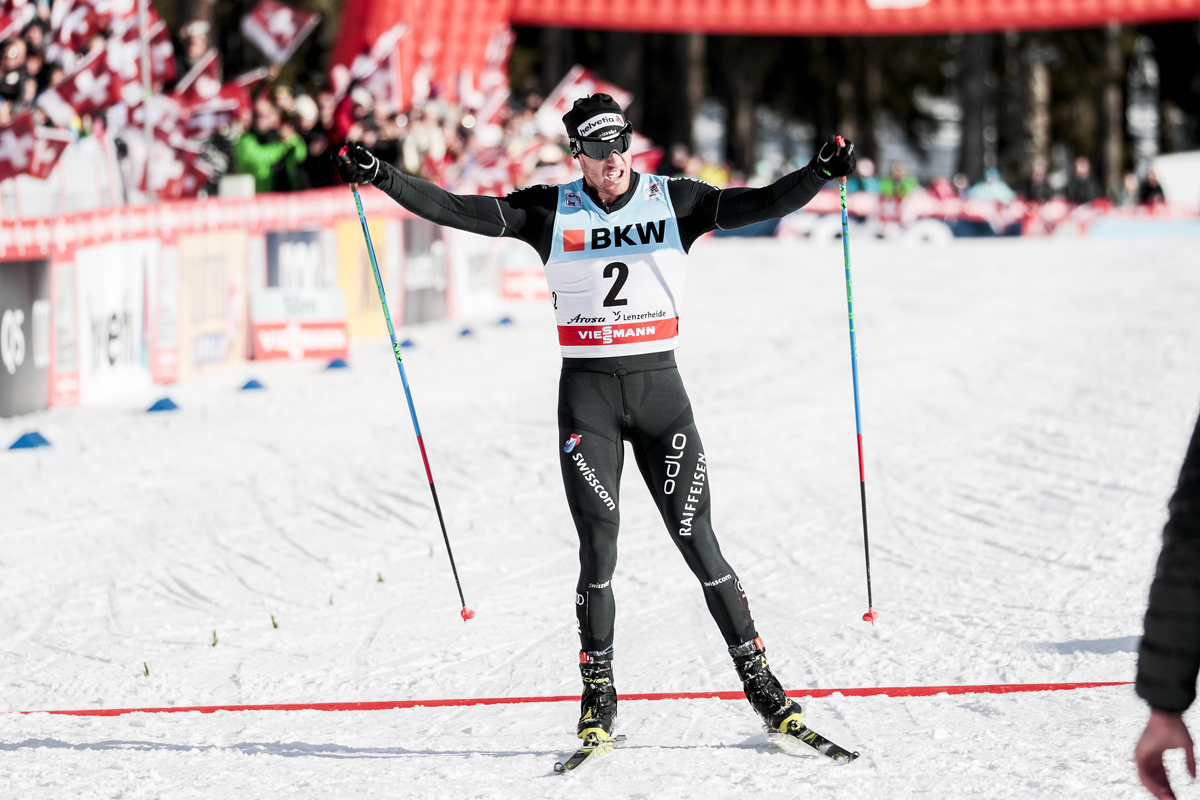
    On the women’s side, Laurien Van Der Graaff of Switzerland is moving on. Van Der Graaff has long been a staple in women’s sprinting, beginning in 2011 with her first World Cup podium in Duesseldorf, Germany. In doing so, Van Der Graaff became the second Swiss female athlete ever to reach the podium and over the years she continued to pave the way for young Swiss female athletes. Her first victory came in 2017 in a skate sprint Tour de Ski stage race on home ground in Lenzerheide, Switzerland. 

    The women’s sprint podium in Rybinsk Russia, 2015 (from l-r): Natalia Matveeva (RUS) second, Jennie Öberg (SWE) first, and Laurien Van Der Graaff (SUI) third.

    Van Der Graaff partnered up many times with Nadine Fähndrich in team sprint events, resulting in four World Cup podium finishes. At the World Championships in Oberstdorf, Germany (2021), Van Der Graaff and Fähndrich teammed up again, earning a silver medal when they finished just hundreths of a second behind team Sweden. 

    Van Der Graaff shared with FIS, “for some time I was convinced that I would not continue skiing until Beijing 2022, but I made it and I am very proud of what I have achieved. However, now my time has come and I am excited for everything that is coming my way in this new chapter.”
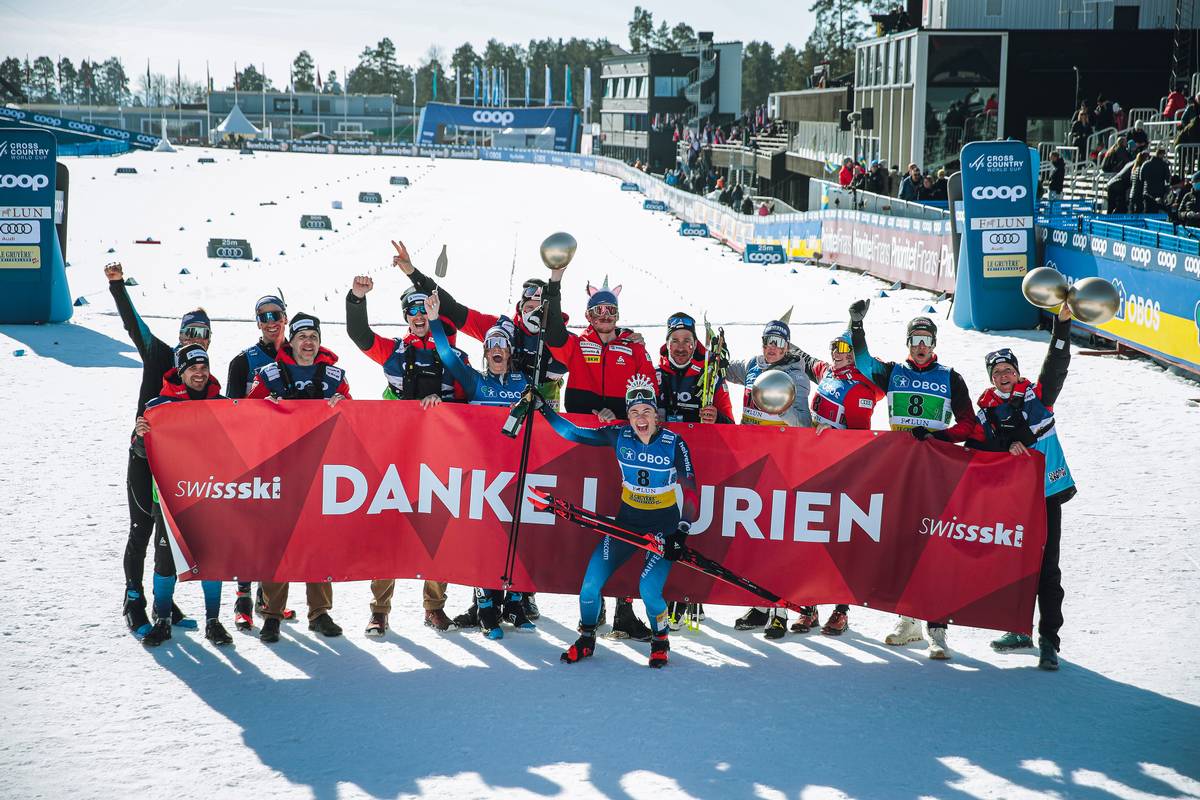
    The Swiss program celebrates the retirement of Laurien Van Der Graaff at the finish of the 4 x 5 k mixed relay in Falun. (Photo: NordicFocus)

    While some athletes knew from the outset of the season that this would be their last, others only recently came to the decision. Such was the case for Swedish star, Charlotte Kalla, who just announced her intentions within the last month. The 34-year said, “the curiosity about life outside of elite sports weighs heavier than what a continued investment would entail.”

    Kalla burst onto the World Cup scene at the age of eighteen. She earned her first victory in the next season, taking a stage win in Nove Mesto (2007) in the 10 k skate pursuit. In her first individual World Championships appearances, coming in Sapporo, Japan in 2007, Kalla finished 7th and 5th. To give you a sense of her consistency from then on, of the 34 World Championship events Kalla completed spanning 2007-2021, she finished in the top ten in 30 of those appearances with the exceptions being three 11th place finishes and one 18th. 

    Charlotte Kalla of Sweden on her way to Olympic gold in Vancouver 2010 (Photo: FS archives)

    Kalla represented Sweden at four different Olympic Games, Vancouver 2010, Sochi 2014, PyeongChang 2018, and Beijing 2022. She came away from these events with five individual podiums, including two gold medals and three team medals including her jaw-dropping relay performance in the relay in 2014 when she made up a 25 second deficit to bring the Swedish women their first Olympic relay gold since 1960. 

    Since then, the Swedish women’s team has come to dominate the World Cup circuit and Kalla has taken on a mentorship role within the team. “It’s an inspiring team to be a part of and many girls who have the right mindset to do their very best every day,” said Kalla in 2020. On March 22, 2022, Kalla announced on Instagram that the Swedish national competitions would be her last as an elite athlete. She wrote, “here I took my first [steps] as a seven-year old and it feels nice to end my career here.” 
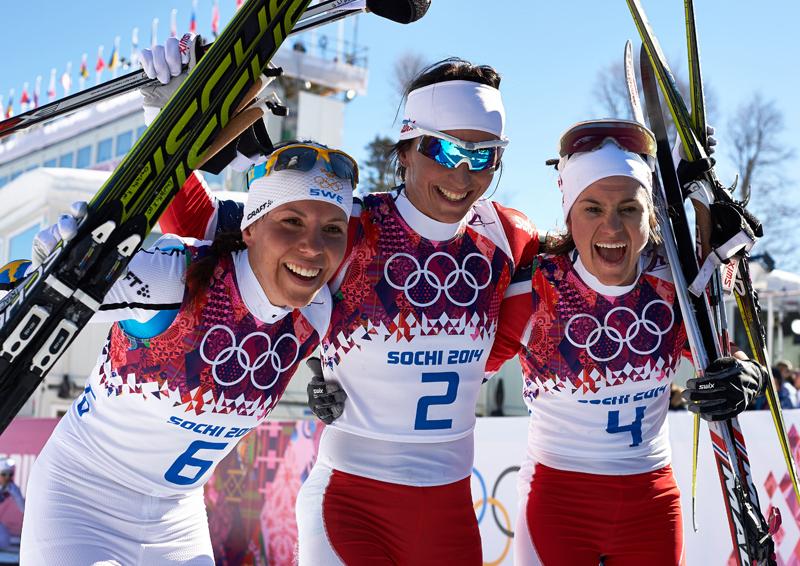
    Charlotte Kalla (SWE), Marit Bjoergen (NOR) and Heidi Weng (NOR) claim the podium in the women’s Olympic skiathlon, Sochi 2014.  (Photo: Fischer / Nordic Focus.)

    Elisa Brocard of Italy is ending her ski-racing career at the age of 37. Brocard had her first World Cup start in 2006 and went on to contest 162 World Cup events. She represented Italy in three Olympic Games, beginning in Vancouver 2010, through PyeongChang in 2018. Her best season came in 2018 when she finished in the top-30 distance World Cup rankings and 38th overall. 

    Nadine Herrmann of Germany is leaving elite competition as well. She is the younger sister of Denise Herrmann who raced the cross-country World Cup circuit until she transitioned to biathlon in 2017 where she went on to win gold in the individual event at the 2022 Beijing Olympics. Nadine Herrmann finished in the top-thirty in her maiden World Cup appearance in 2018 in the Dresden city sprints. She went on to earn a number of top-thirty finishes, including a personal best individual finish of 18th in Dresden in 2020. At the age of 26, Herrmann has decided to move on, she wrote “My active sporting career is coming to an end. The last 14 years of performance sports have shaped me into the person who today can say in the best of my conscience, I gave it my all.” 

    Adrien Backsheider of France has also announced his retirement. Backsheider began racing on the World Cup circuit in 2013. He earned six World Championships starts and helped propel team France to a bronze medal in the men’s 4 x 10 relay in Falun in 2015 and again in Seefeld in 2019. Backsheider also has four Olympic starts, as he represented France in Sochi 2014, PyeongChang 2018, and Beijing 2022. He was a member of the bronze medal relay team in PyeongChang when the French again earned a podium spot in the 4 x 10 relay. Backsheider’s personal best individual World Cup finish came in Östersund, Sweden in 2020 when he finished 7th in the 15 k skate stage race during the Tour de Scandinavia. 

    The men’s 4 x 10 k relay at 2015 World Championships in Falun, Sweden, Norway with gold, Sweden with silver, and France with bronze . (Photo: Fischer/NordicFocus)

    Cendrine Browne of Canada is saying goodbye to professional ski racing as well, having concluded her career with a national title in the 45 k skate in Whistler, Canada. Browne made her World Cup debut in 2012 and went on to start 76 World Cup races. She made the Canadian Olympic team in 2018 and 2022 and also posted thirteen World Championships starts. Browne finished 16th in the 30 k skate mass start in Beijing, a personal best individual finish for her. In a statement to Nordiq Canada after the 45 k race, Browne said, “thank you to everyone in the ski community who has believed in me and cheered for me over the last ten years.” 
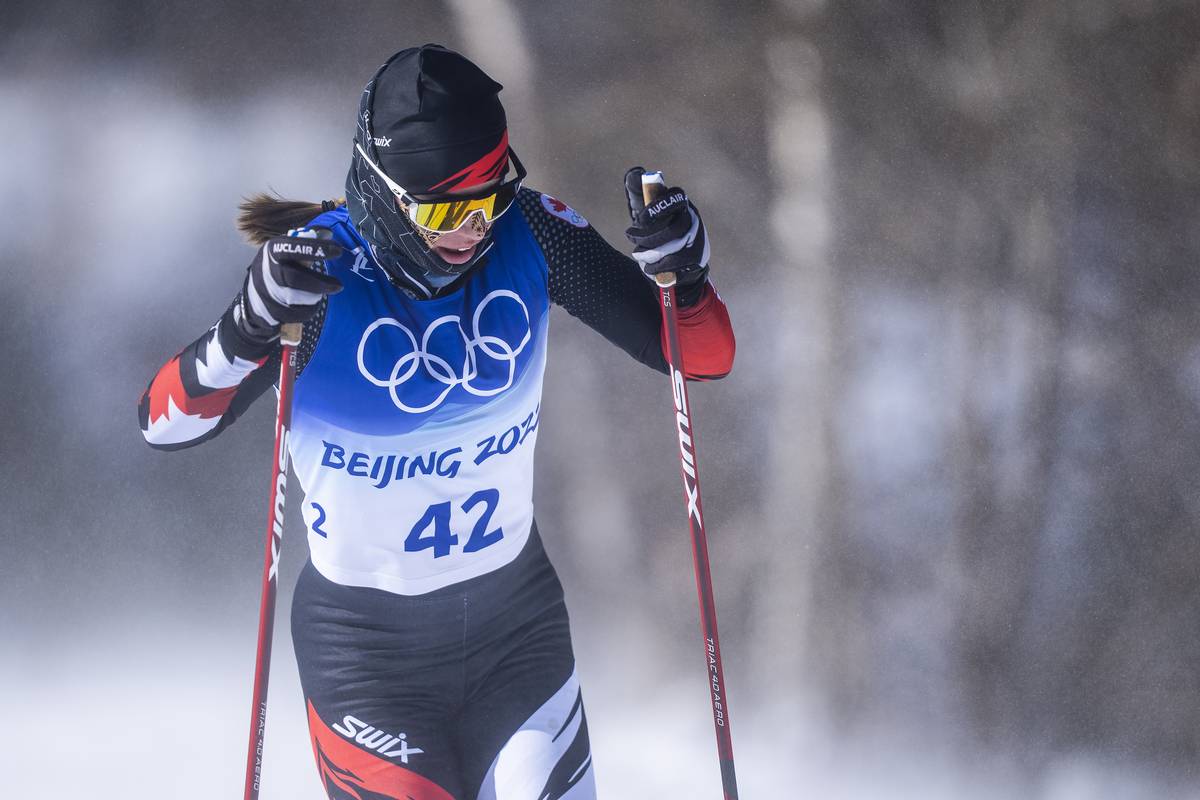
    Cendrine Browne reached a new personal best with her 16th place finish in the 30 k skate mass start in Beijing 2022 (Photo: NordicFocus)

    The notable retirement of the extremely successful, Therese Johaug of Norway has not been missed but will be receiving its own feature from FasterSkier in the coming weeks. Additionally, US Ski Team members Katharine Ogden, Hannah Halvorsen, and Caitlin Patterson have all shared news of their retirement, in addition to top SuperTour athletes Ian Torchia and Adam Martin. (Read Torchia’s retirement story here.)

    Stay tuned for more in-depth reporting on those athletes from FasterSkier.

  • Bolshunov Skis Big and Bold, Dario Cologna Sneaks in for a Podium

    Bolshunov Skis Big and Bold, Dario Cologna Sneaks in for a Podium


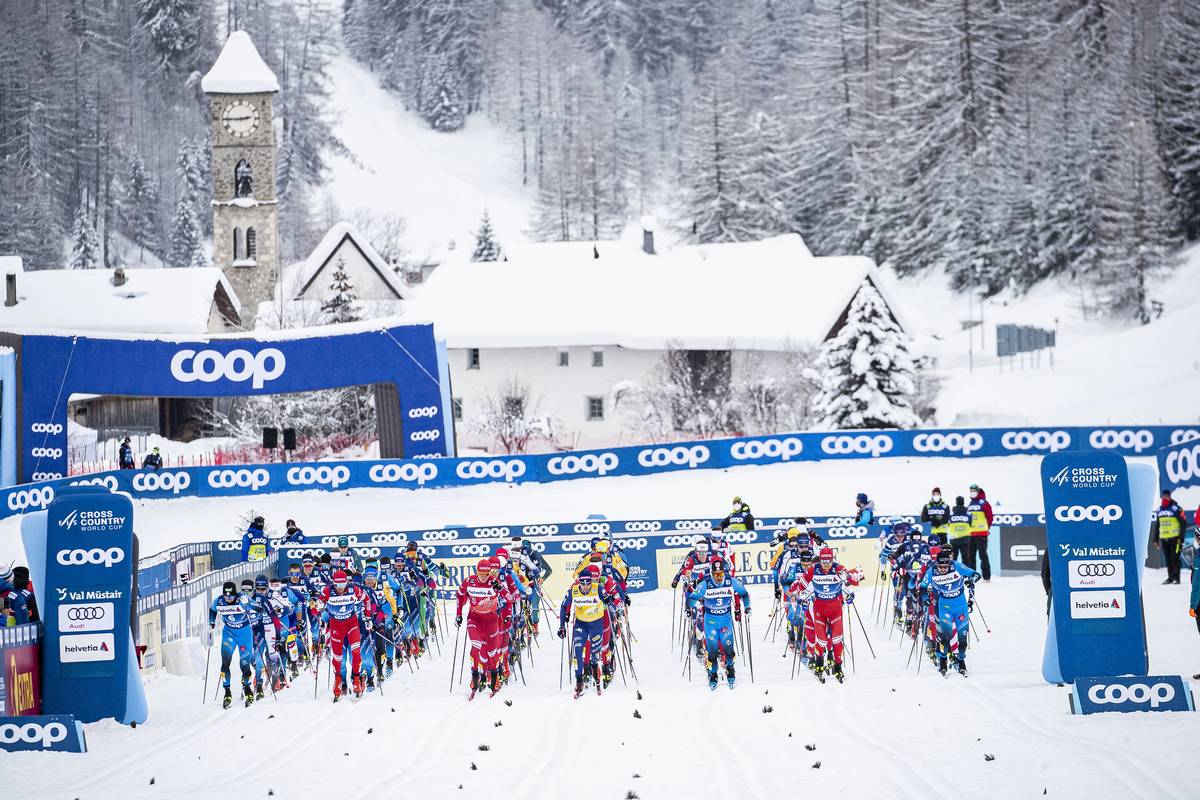
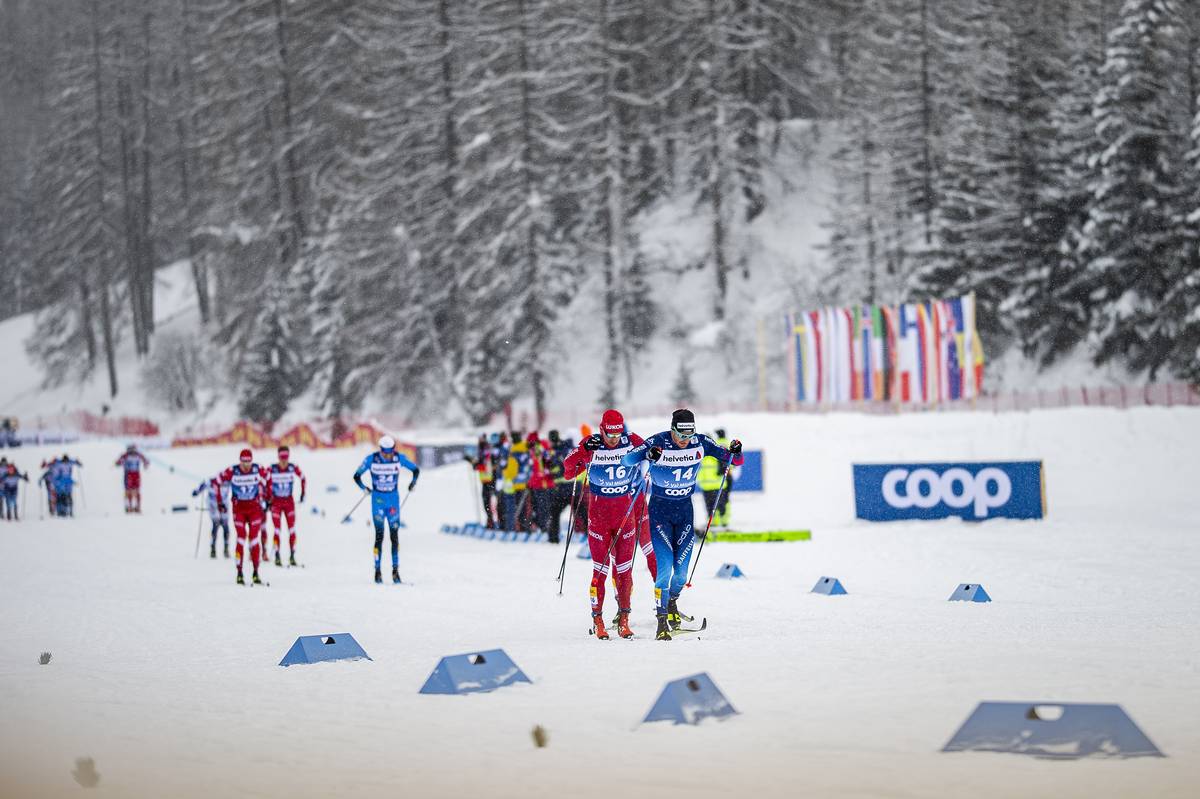
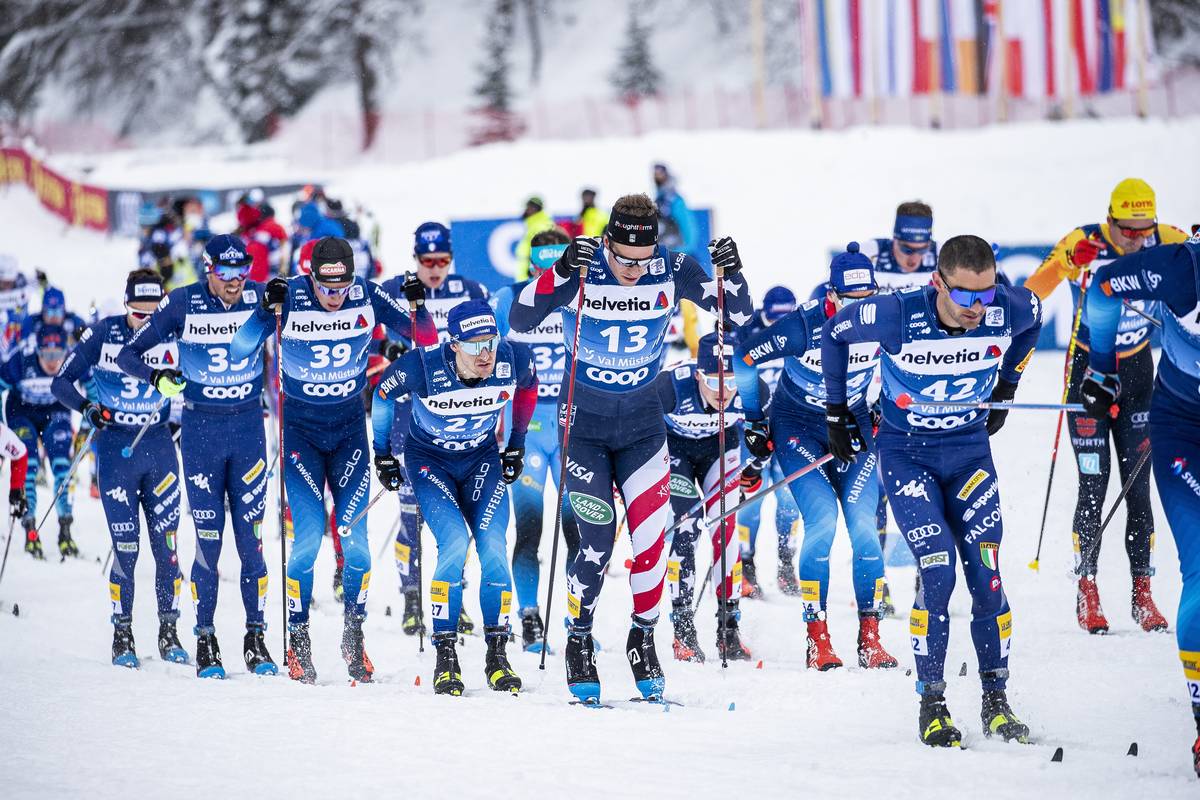
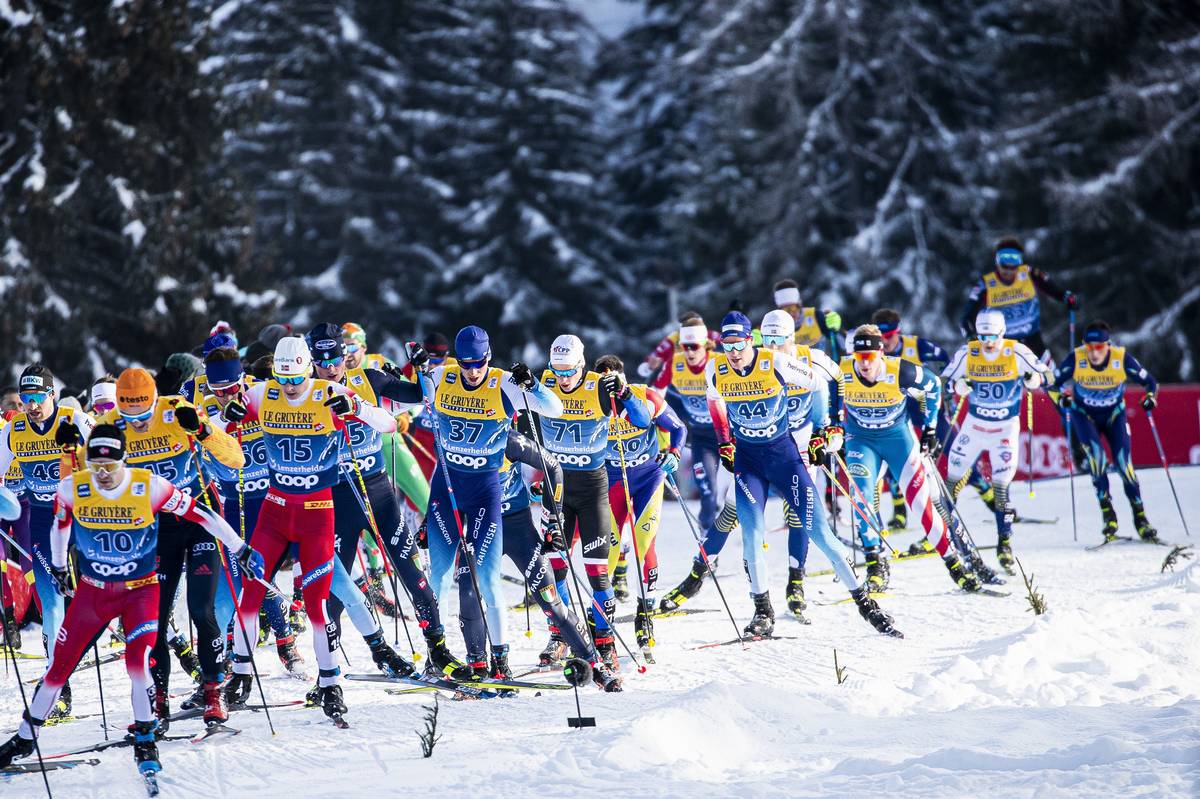
    The start of the men’s 15 k mass start classic in Val Müstair, Switzerland. (Photo: NordicFocus)

    This World Cup coverage is made possible through the generous support of Marty and Kathy Hall and their A Hall Mark of Excellence Award. To learn more about A Hall Mark of Excellence Award or to learn how you can support FasterSkier’s coverage please contact info@fasterskier.com.


    Val Müstair, Switzerland and its snowfall were again the idyllic backdrops for the Tour de Ski (TdS) where the men raced a 15-kilometer classic mass start to kick off the distance stages. After yesterday’s skate sprint in which Russia’s Alexander Bolshunov took second place, it appeared the twenty-four-year-old would iron-fist this fifteenth edition of the TdS.

    No doubt, Bolshunov came into the event as the favorite. The conversation trending towards how much time he wins the overall. As last year’s winner of the TdS, and finishing on five podiums in seven stages, this Russia has been here before.

    Immediately as the 77 starters crowding the start tracks set off, Bolshunov was the skier to watch. No matter who strode alongside him for the first 5 k or so, this was simply a game of when Bolshunov would shatter the pack and make an exclamation point statement that his trend towards generational status skier was for real.

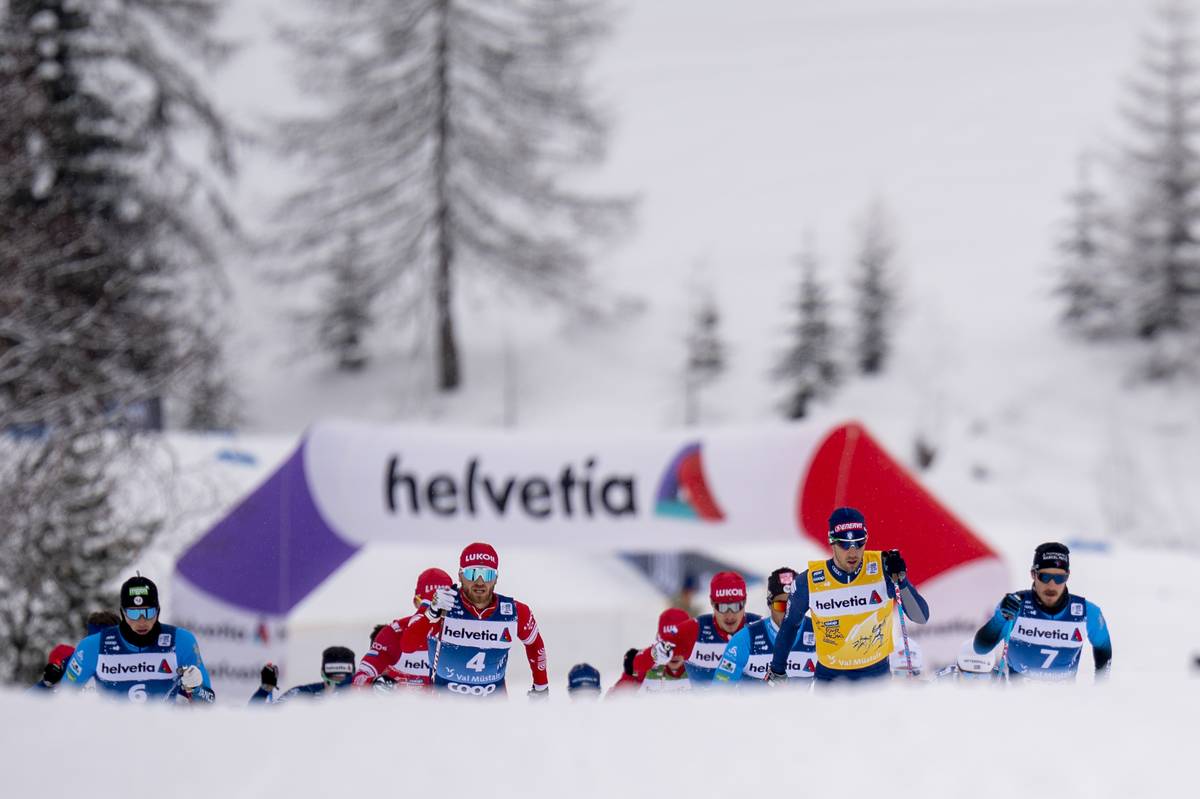
    The TdS includes a points race, which incentivizes some skiers not contending for the overall to remain upfront to snag the prime, and perhaps collect a few more Swiss Francs at the end of the workday. With the points bonus offered at 4.5 k, Italy’s Federico Pellegrino, winner of Friday’s sprint, was right there in the front.

    Italy’s Federico Pellegrino in yellow. (Photo: NordicFocus)
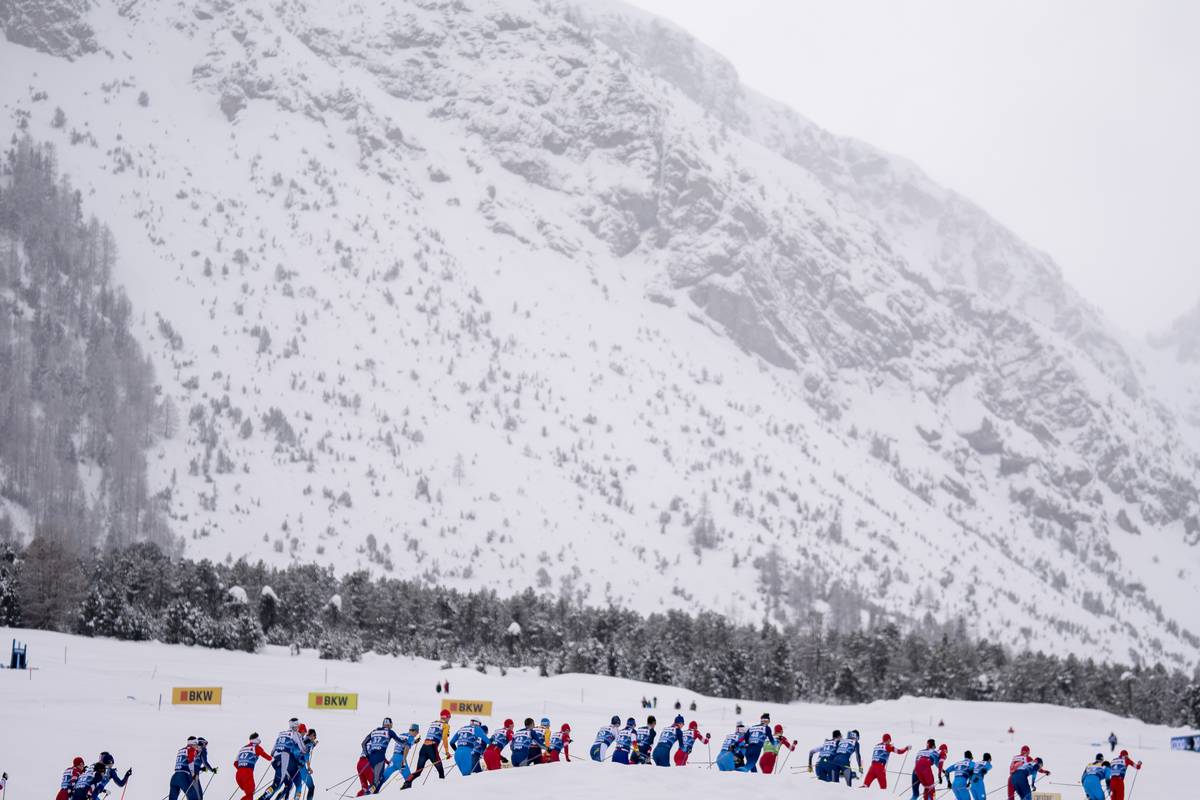
    Stage 2 of the 2021 Tour de Ski. (Photo: NordicFocus)

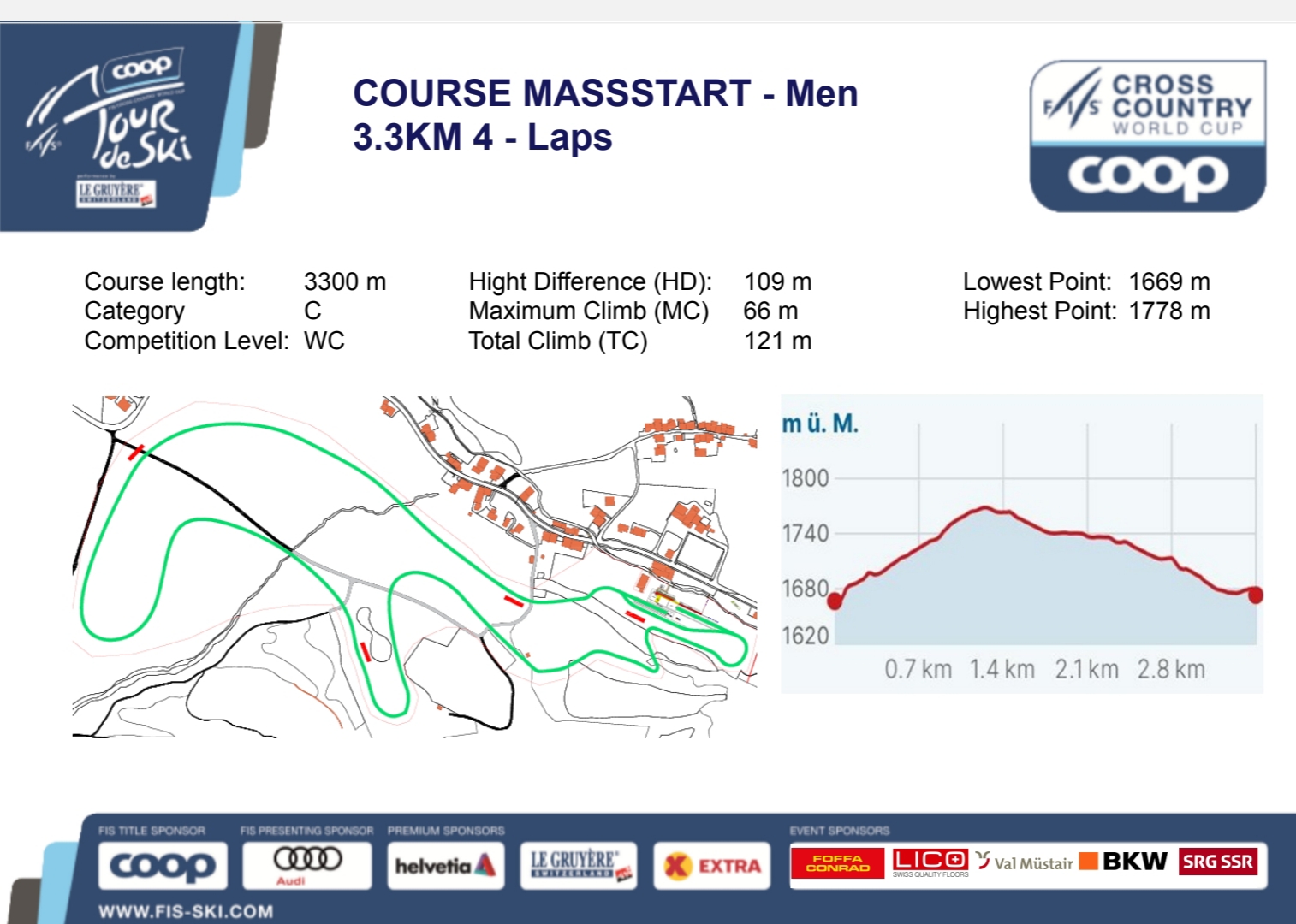
    With four laps of a 3.3 k course which featured a long climb and sinuous downhills with techy turns, this was primarily a fitness test in the end. And the Russian team collectively appears the fittest. Along with Bolshunov, his teammates including Alexey Chervotkin, Evgeny Belov, Ivan Yakimushkin, Denis Spitsov, and Illia Semikov were a wall of red Lycra upfront.

    No matter how you parse the stats or the visuals presented of the race, it certainly looked like a Russian podium sweep with the only lock Bolshunov on the top-step. At 11.4 k, Bolshunov powered ahead by 5.1 seconds ahead of hometown hero Dario Cologna with Belov, Maurice Manificat of France, Yakimushkin, Sptisov, Semikov, and Sweden’s Oskar Svensson towed through in that order. Svensson was 14.7 seconds off the pace.

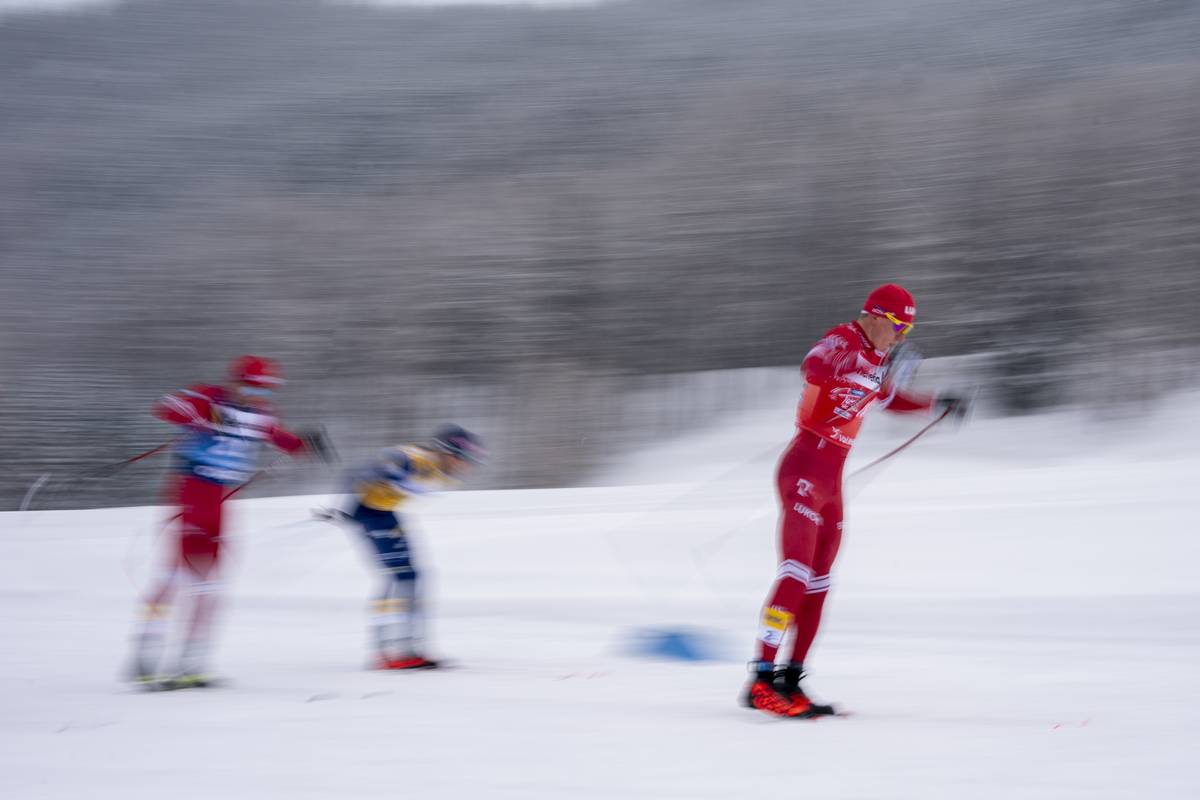
    The solo Bolshunov show flew ahead. Eight-tenths of a kilometer later, he secured a 19.7-second cushion. With little action out front beyond anticipating how much time Bolshunov might gain, we’ll send it straight to the finish: Bolshunov won by 23.5 seconds.

    Alexander Bolshunov in front during stage 2 of the 2021 TdS. (Photo: NordicFocus)

    As noted, it appeared late in the race to be a probable all-Russian podium. Yet the cosmos can play tricks. The podium, in a parallel universe, maybe had a decidedly red look.

    Coming into the final downhill, made more complex by a sweeping right-hand corner which had already taken out several skiers in yesterday’s sprint and today’s mass start, Belov dove into the bend first, a hair ahead of Chervotkin. As skiers warped around, Chervotkin tried to cut inside of Belov and clipped his skis. Belov tumbled as did Chervotkin right after. As the two skiers exchanged words and began righting themselves, Yakimushkin went wide left off course and out of the turn to avoid crashing. Twenty meters later, he skied back on course.

    In the meantime, Cologna, remained on his feet, skirted around the tumbled Russians, and made good for his hometown and the army of Cologna supporters who no doubt were clanging oversize cowbells at home as the event did not allow spectators. As the Swiss gift that keeps on giving, Cologna placed second (+23.5) and Yakimushkin third (+25.3). France’s Manificat bypassed the carnage as he was many meters behind the crash, and placed fourth (+27.7).

    Cologna has won the TdS on four occasions – a record for men’s overall titles. His second place on the stage was his best result of the season. Before Saturday, his best 2020-2021 distance result was 14th place in the Davos 15 k skate. His last podium was in the 2019 15 k skate also in Davos.

    Evgeniy Belov (RUS), and Dario Cologna (SUI), (l-r). (Photo: NordicFocus)
    Dario Cologna (SUI)  taking second in stage 2 of the 2021 Tour de Ski. (Photo: NordicFocus)

    Russia locked up five of the top-10 spots, with Belov, who had crashed, missing out on a podium and placing eighth.

    Notably missing from the results was Chervotkin. He was disqualified after the race for violating rule ICR 343.9 which states, “Obstruction: deliberately impeding, blocking (by not following best line), charging or pushing any competitor with any part of the body or ski equipment.”

    Post-race comments about the men’s race from U.S. Head Coach Matt Whitcomb.

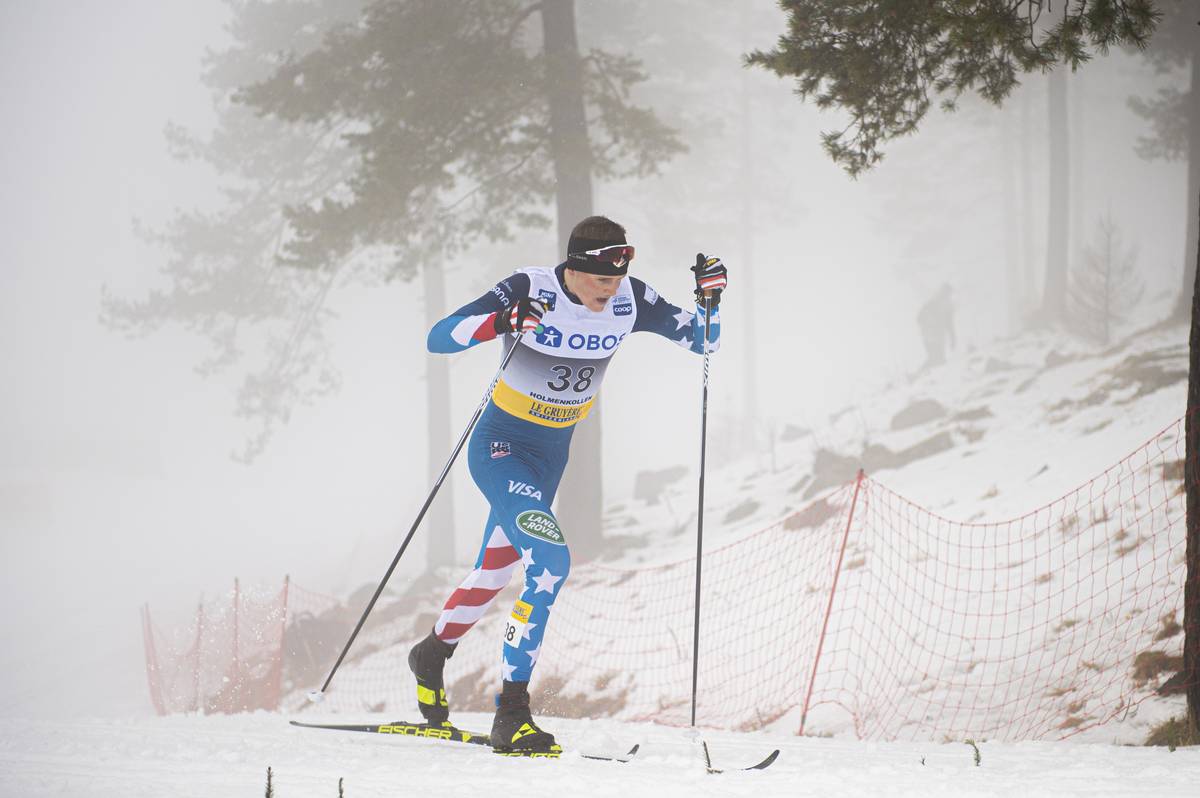
    For the U.S., Gus Schumacher was the top finisher in 36th (+1:53.8). New to full-time World Cup skiing, Schumacher has been on the road since mid-November as he begins to learn more about certain World Cup venues, the vagaries of life on the road, and the speed at which skiers like Bolshunov hammer about.

    Today, the twenty-year-old from Anchorage, Alaska was 23rd (+8.2) at the 4.5 k mark skiing in a thick soup of skiers: 30th place was 10.8 seconds back. As the race broke apart due to the surges ahead at 11 k, Schumacher fell back to 33rd amidst a group of skiers including Sweden’s Calle Halfvarsson.

    “It was fun to race a mass start again,” Schumacher emailed. “I thought it would go out fast and then cruise but it went out quite slowly, which was a little frustrating in the belly of the pack. The second lap also seemed pretty relaxed, and as the pace quickened through halfway I was feeling like I was skiing well and moving up. And then near the top of the climb, the wheels fell off and I just flooded hard. Thankfully there was a big downhill to recover, but I really lost my momentum. So not perfect pacing, but it was fun to ski closer to the front for a little while.”

    As his first Tour de Ski, the prospect of an eight-stage slog can be daunting. Decidedly, Schumacher is taking each stage one by one, each a unique opportunity to learn and grow.

    “I definitely approached the day as a singular race, just with the goal of doing as well as I could,” Schumacher wrote. “The risk that I could’ve taken would be double poling on skate skis, but I figured that would not be a good move with the idea of an 8-race tour.”
    He added that the race was a reminder to strategically pace at altitude.
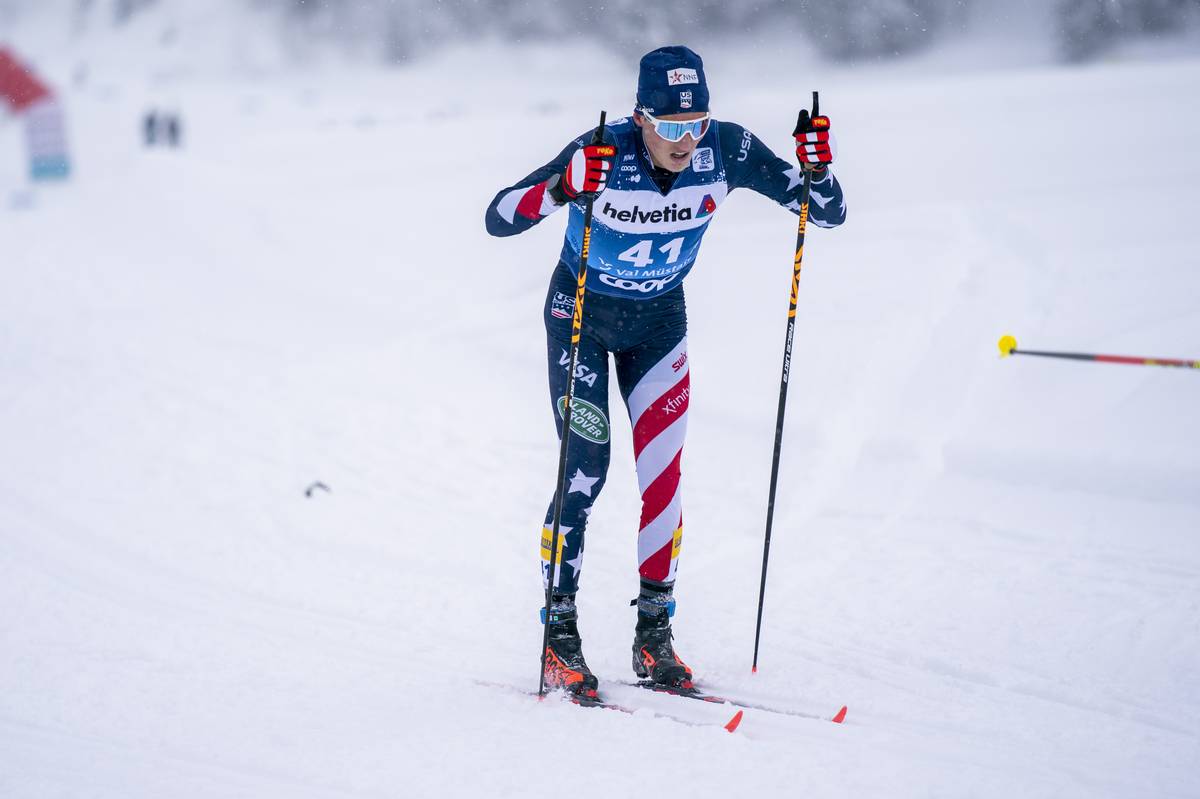
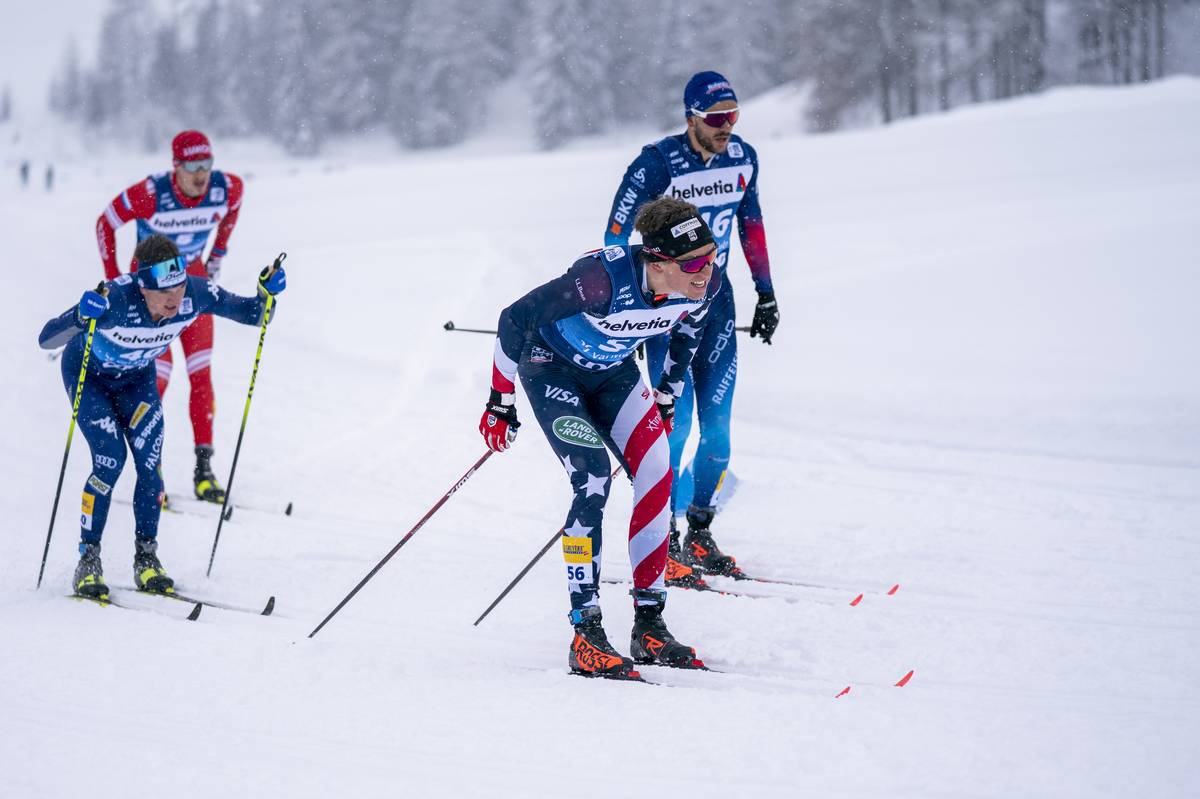
    Gus Schumacher (USA) – FIS world cup cross-country, tour de ski, mass men, Val Mustair (SUI). www.nordicfocus.com. © Vianney THIBAUT/NordicFocus. Every downloaded picture is fee-liable.

    Scott Patterson was the next best American in 43rd (+2:17.6), with teammates Simi Hamilton 46th (+2:38.1), and Kevin Bolger 59th (+3:25.6), respectively.

    “Across the board, it was a disappointing day for the guys, just call it what was,” said U.S. Head Coach Matt Whitcomb after the race. “Gus probably showed the most signs of promise today, he skied within the top-20 for the parts of the race and top-25 before he was kind of running out of gas. He was pretty cached on the fourth lap. We will just make sure he continues to fuel well it is one of those places where if you go a little too hard on any one lap which is my guess as to what happened, you end up having a pretty heavy tax late in the race. It comes back to bite you and sometimes you get away with it. I am not one who likes to see people ski a conservative race I like to see people aiming for the bull’s eye and he did that and that is how to get faster.”

    Scott Patterson for the U.S. placed 43rd in stage 2. (Photo: NordicFocus)
    Simi Hamilton of the U.S. at the start of the men’s 15 k mass start classic. (Photo: NordicFocus)
    The Men’s Overall:

    Tomorrow’s stage for the men, a 15 k skate pursuit, sees Bolshunov starting first, one minute ahead of second starter Maltsev. Svensson begins third (+1:00), and Cologna fourth (+1:11).

    Stage 2 Results | Men’s TdS Overall Standings


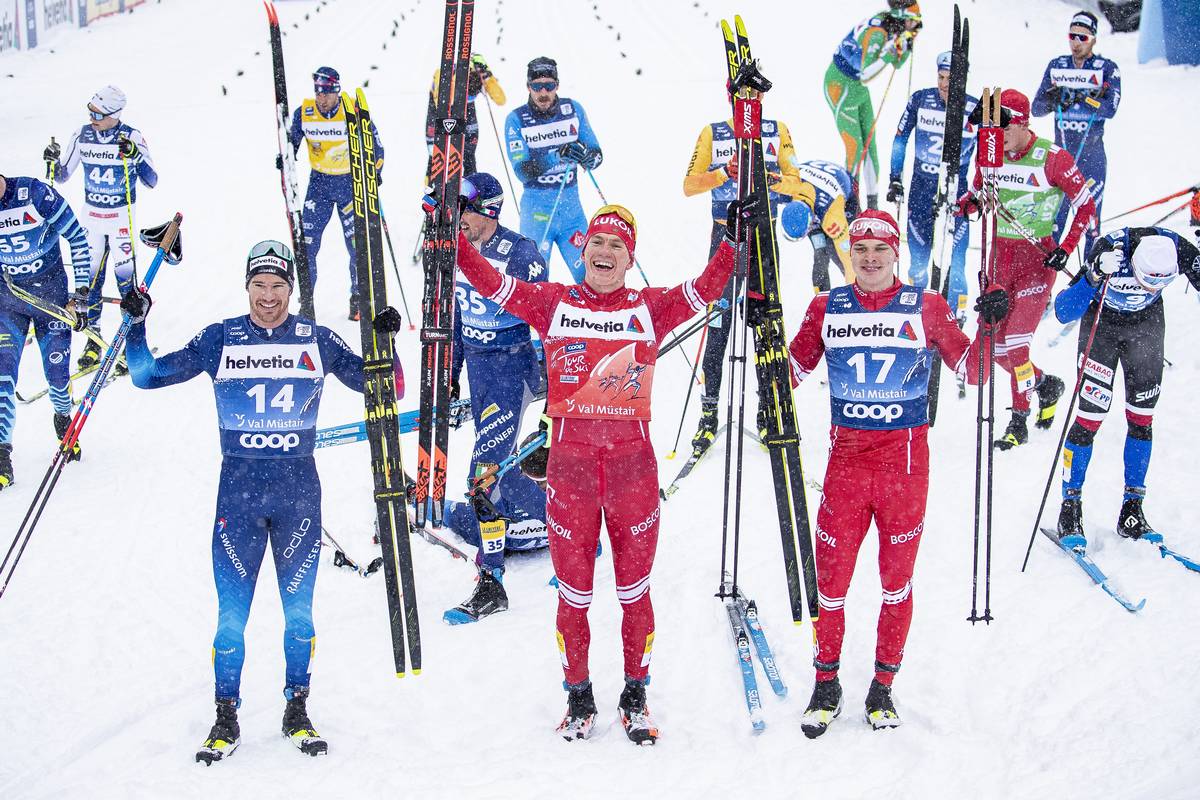
    The men’s stage 2 podium: Dario Cologna (SUI) in second, Alexander Bolshunov (RUS) first, and Ivan Yakimushkin (RUS) third, (l-r). (Photo: NordicFocus)

  • Attrition in the Fog: Bolshunov pips Krüger for the Oslo 50 k Classic Win

    Attrition in the Fog: Bolshunov pips Krüger for the Oslo 50 k Classic Win

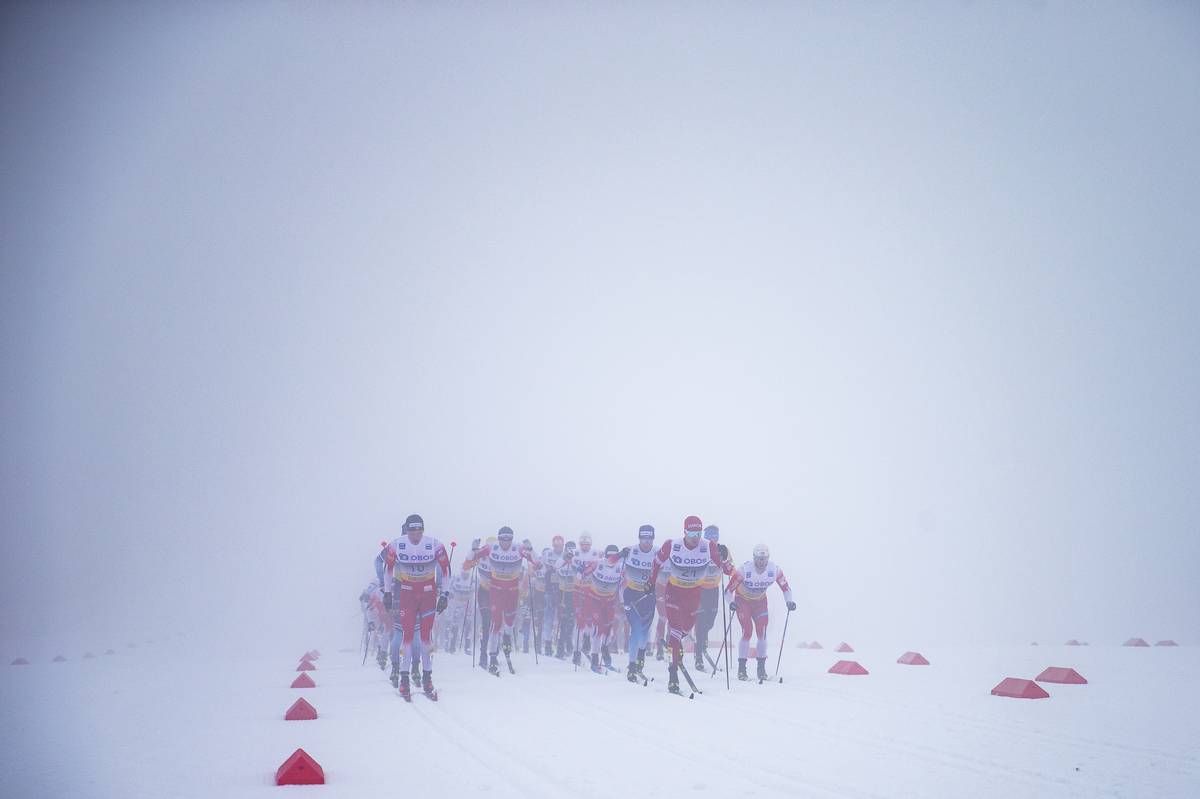
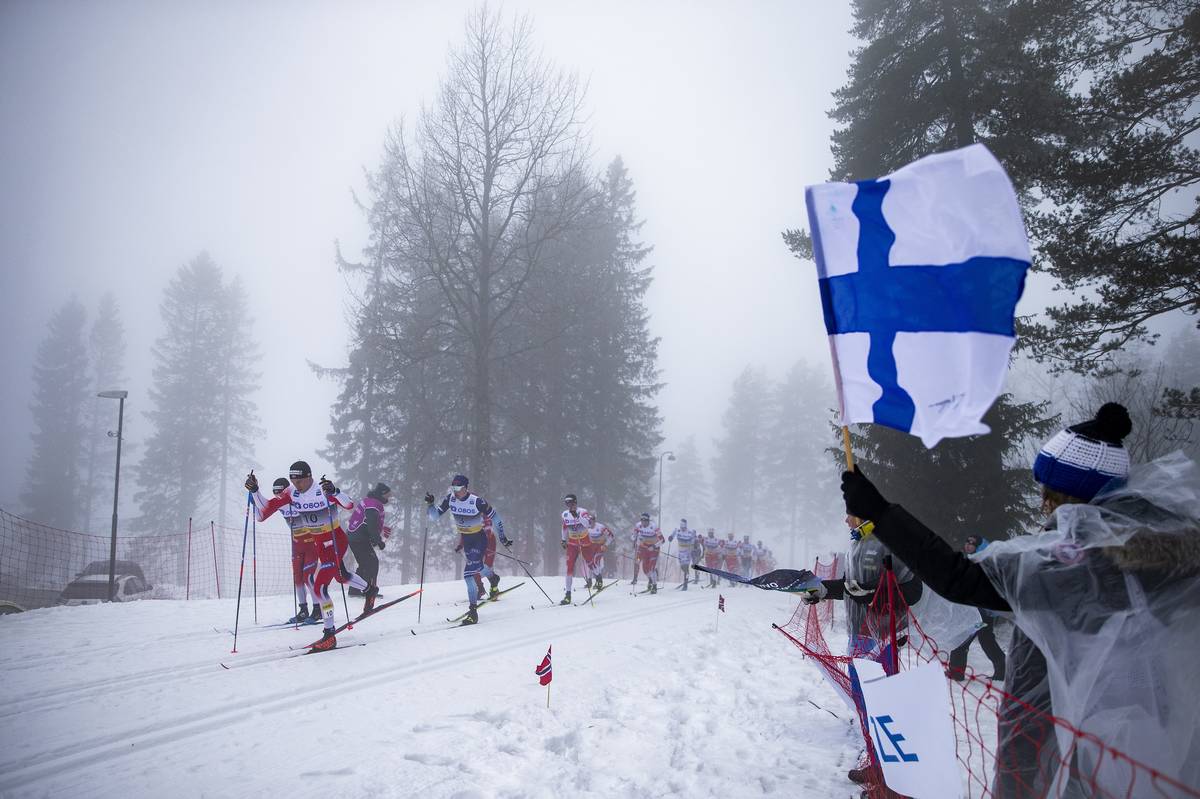
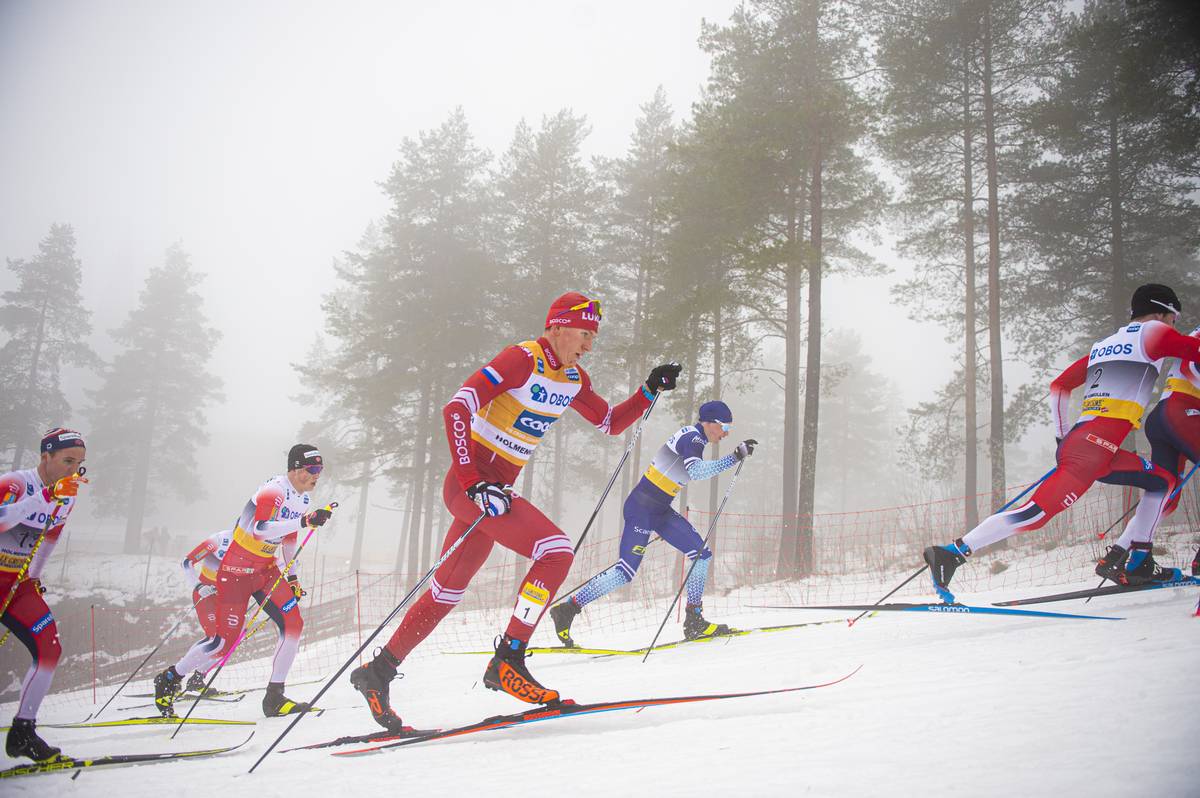
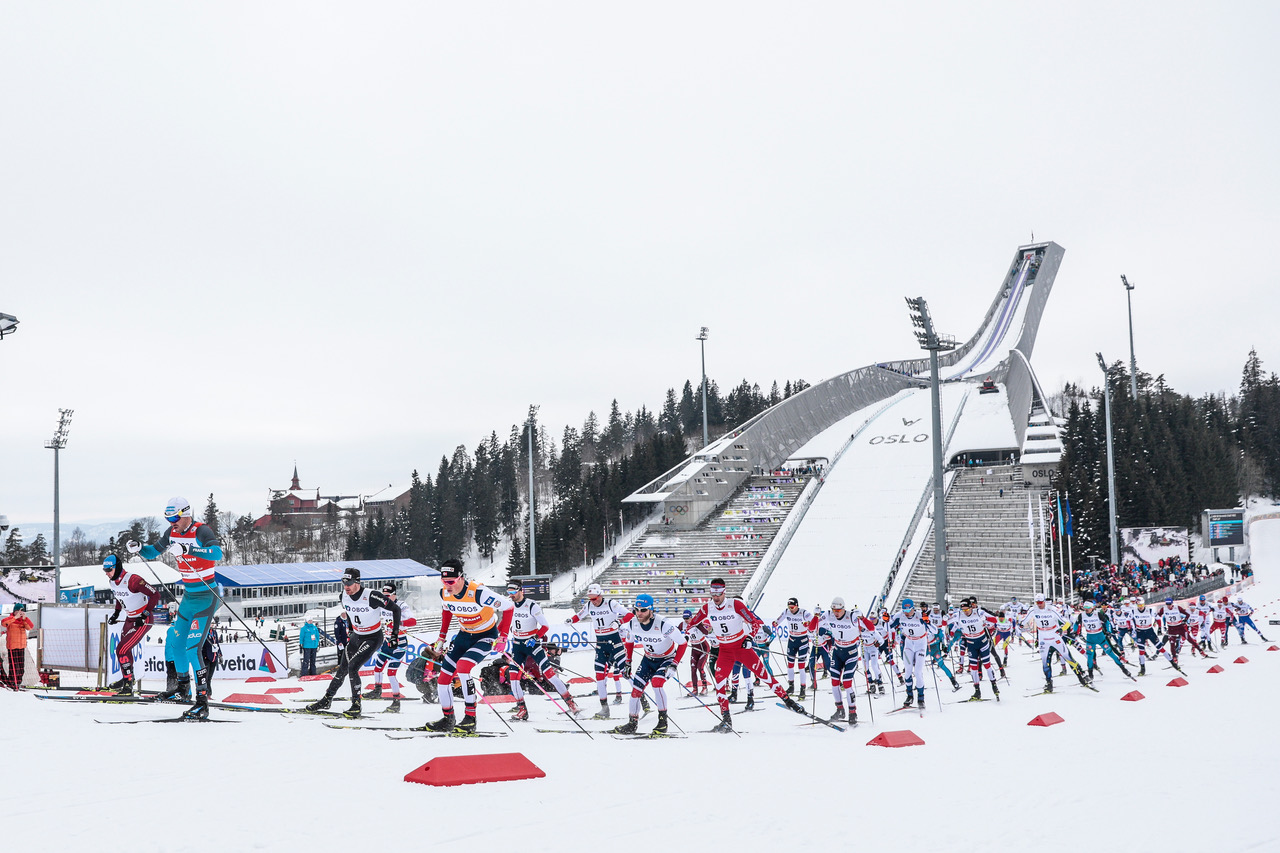
    En mass: early in the Oslo 50 k classic. (Photo: NordicFocus)

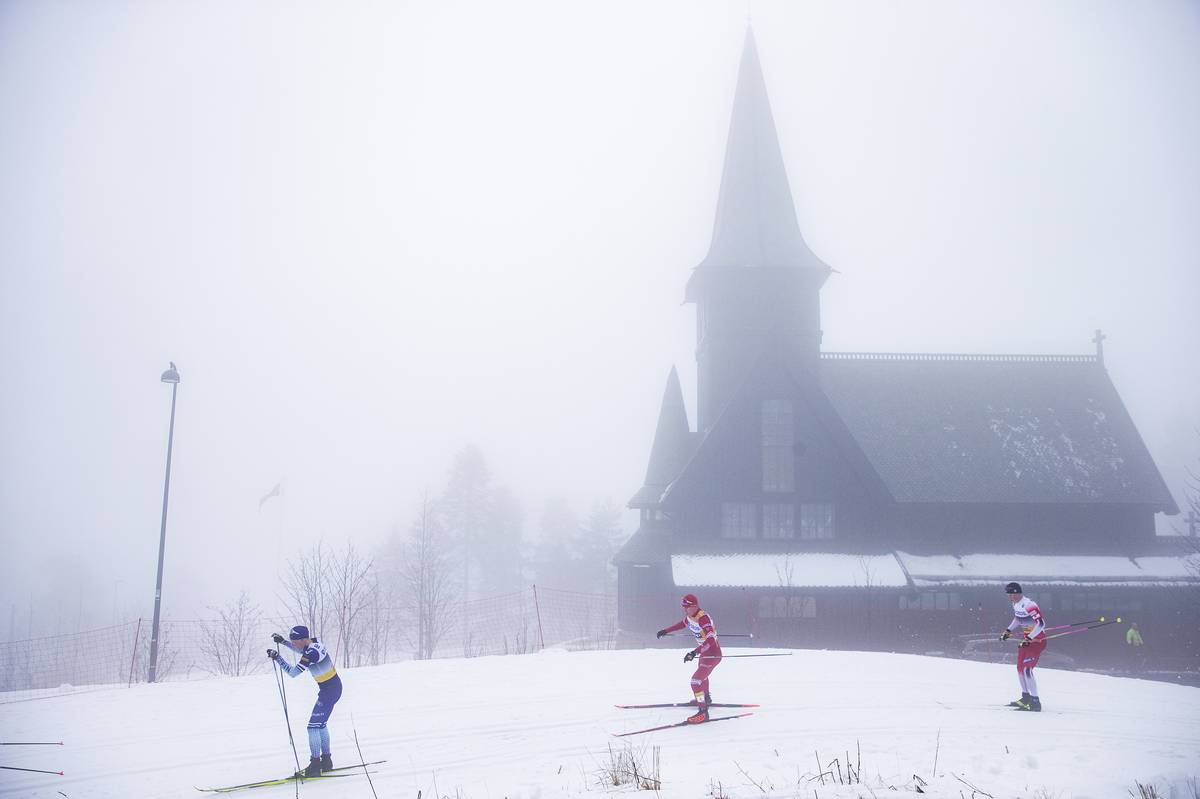
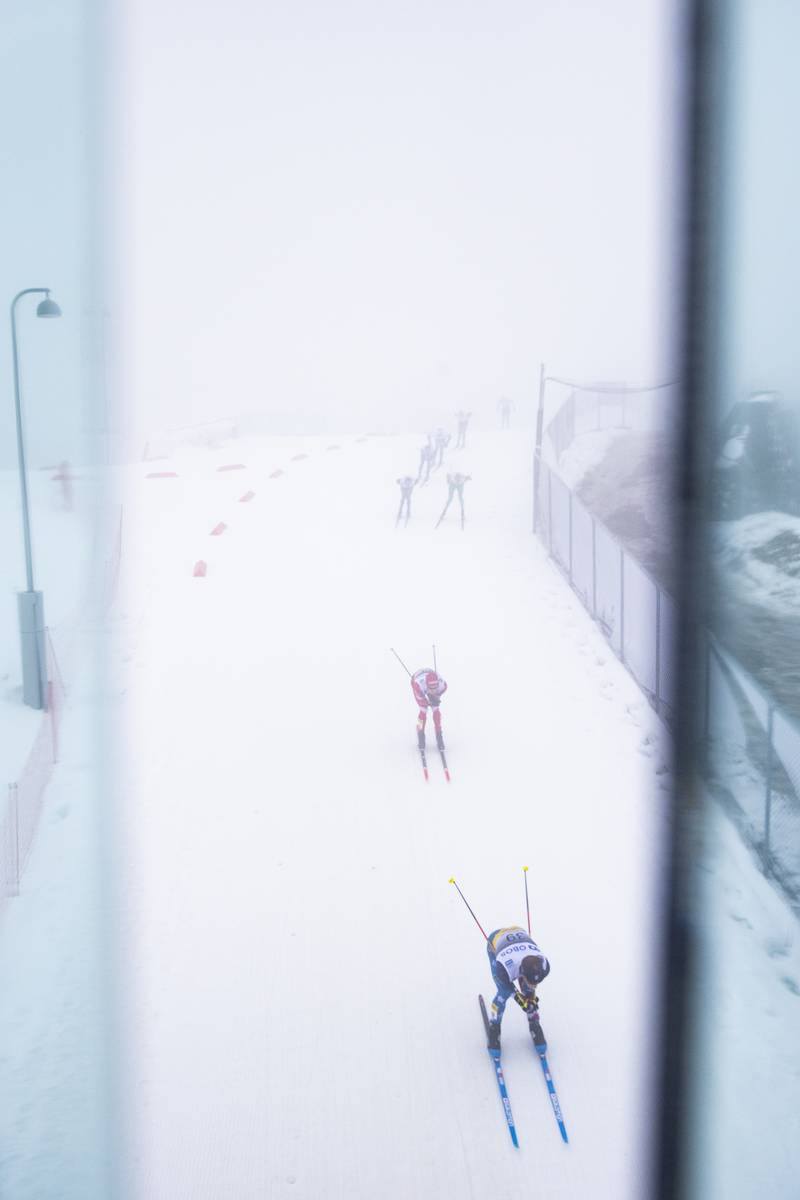
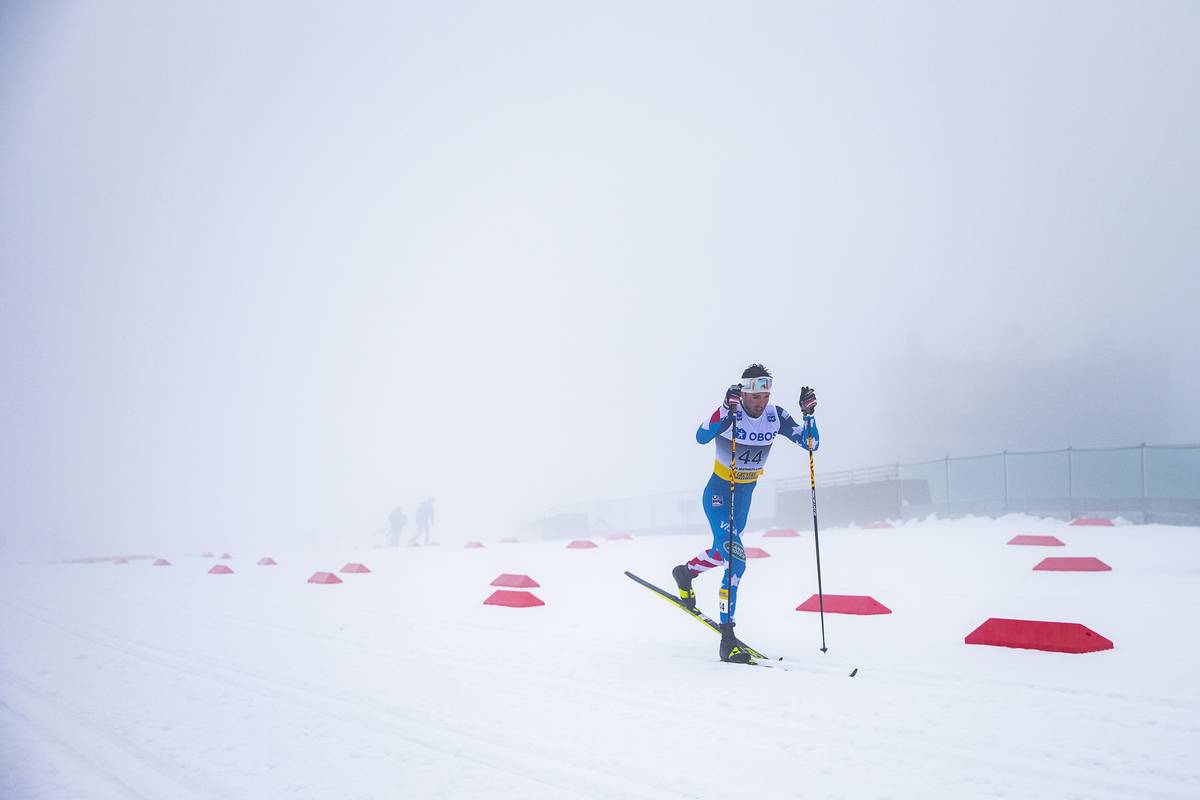
    Oslo in late winter – it’s be hit or miss. Fog. Bluebird. A maritime climate, with plentiful moisture in the air, a slight drop in temps can morph the Holmenkollen ski complex into a ping-pong-ball-world. Athletes were mere shadows striding into and out of view on a foggy- drizzly day at the Holmenkollen. As spectators were limited to trail side spots as the main stadium was closed due to the Covid-19 virus, for some concerned, it was a slog for the 50-kilometer classic to close out the European portion of the World Cup. (That’s right- it’s ocean hopping time for the entourage post-race as the World Cup moves to North America.)

    Sunday church along the Holmenkollen course: Iivo Niskanen (FIN), Alexander Bolshunov (RUS), Johannes Høsflot Klæbo (NOR), (l-r). (Photo: NordicFocus)

    Let’s cut to the chase. The main action over 50 k involved main pack attrition. The sharp end pack remained robust with skiers through 18 k, as skiers passed through the main stadium as Sjur Røthe of Norway came through first. That much didn’t matter beyond a minor foot note in the day’s narrative, as a handful of Norwegian’s took pace leading chores throughout the race. 

    On a day that many would have preferred to practice their own personal art of hygge, the main pack remained 20 deep at 30 K. The top-20, which contained all the key skiers, was separated by a scant 5.6 seconds. A group that big surely provided its own sense of Norwegian coziness despite the high heart rates. Of those 20 athletes, four were Russian, two Swedes, one Finn, one Swiss — the rest Norwegians. Charging through was overall World Cup leader Alexander Bolshunov. There was Emil Iversen, Pål Golberg, Martin Johnsrud Sundby, Simen Hegstad Krüger, Didrik Tønseth, Hans Christer Holund, and Johannes Høsflot Klæbo. Bundled in there was Dario Cologna of Switzerland, and Iivo Niskanen of Finland, who was lucky enough to have fans and there chanting “Iivo-Iivo”. 

    With so many skiers clustered together, and the tactics less explosive than simply see who could hang on, the camera shots at each turn of the race through the main stadium turned to the spare classics skis racers had the option of swapping into. The lure of fresh kick or speed, seemed like tempting race candy. Halfway through, at roughly 25 k, it appeared that Golberg was one of a few of the main contenders opting for a fresh pair. The rest skied through the ski exchange zone, at least content for another lap with their boards.

    Lapping through at 30 k, scores of skiers opted for fresh kick and glide. Post-ski-exchange,  the front pack soon coalesced into two orderly lines, like marching soldiers, as they crested a hill roughly an hour twenty into the race. 

    No matter any skiers herculean efforts to pop off the front, this was a simply a group affair. Any potential burst of speed, or pulse for bonus points, was absorbed. Ski speed or kick, seemingly equalized among the scrum. The question simply was this: which human engine would last the longest? Forty kilometers in, and the front group had winnowed 13 skiers separated by about seven seconds. Bolshunov led, followed by Røthe and Cologna. 

    Pål Golberg (NOR), Sjur Røthe (NOR), Iivo Niskanen (FIN), and Johannes Høsflot Klæbo(NOR), (l-r). (Photo: NordicFocus)

    Then it was two — barely. Just after the two hour mark, Krüger spiced up the pace. Striding and double poling in earnest, at 47.7 k. Krüger was only shadowed by Bolshunov, as the Norwegian’s late in the race move stuck. Røthe, Cologna, and Holund fell off in third, fourth, and fifth, respectively, to just over 11 seconds back. 

    Two stallions double poling into an eerily silent stadium. That was probably not such a bad thing (although fans present are always better), as one can imagine the fans falling silent had they been there in droves. Russia’s Bolshunov out sprinted Krüger to win in 2:08:05.3, 0.9 seconds better than the second place Norwegian. 

    “I knew that Bolshunov is strong on the final 100m so I tried to get rid of him before that,” Krüger  told FIS. “I felt really good today so I knew that I could really push myself before that. But he is strong and it’s hard to get rid of him. I almost made it but I am really happy to be on the podium. It’s an amazing feeling.”

    “Me, the team and the skis were all working together perfectly today and I am very happy to win here,” Bolshunov said after the race. “Because compared to Trondheim, where I had no possibility to do something with my skis, it was more important for me to win here today.”

    That Trondheim race mentioned by Bolshunov was the final stage of the SkiTour 2020 in which he lost the overall due to poor skis.

    For Bolshunov, this made for back-to-back 50 k classic wins in Oslo. Last season he won in a final sprint that saw Russia sweep the podium. And for Krüger, this was a career best in a 50 k race. He was seventh in last season Oslo 50 k. Lastly, when it comes to classic skiing, this has been a breakout year for Krüger – he is an athlete we had often considered a skate specialist. 

    For the final podium spot, Iversen placed third (+19.5). Norway claimed seven of the top-10 spots. 

    “In the last lap I heard that I can fight for the podium and this is where I got some more energy,” Iversen said to FIS. “So I am really happy to stay 50km all in because I am not known as the best athlete in our team so it is nice for me to show the coaches and all that I can stand a hard and long 50km. I am really proud of that.”

    Emil Iversen skiing to third overall in the 2020 Oslo 50 k classic. (Photo: NordicFocus)


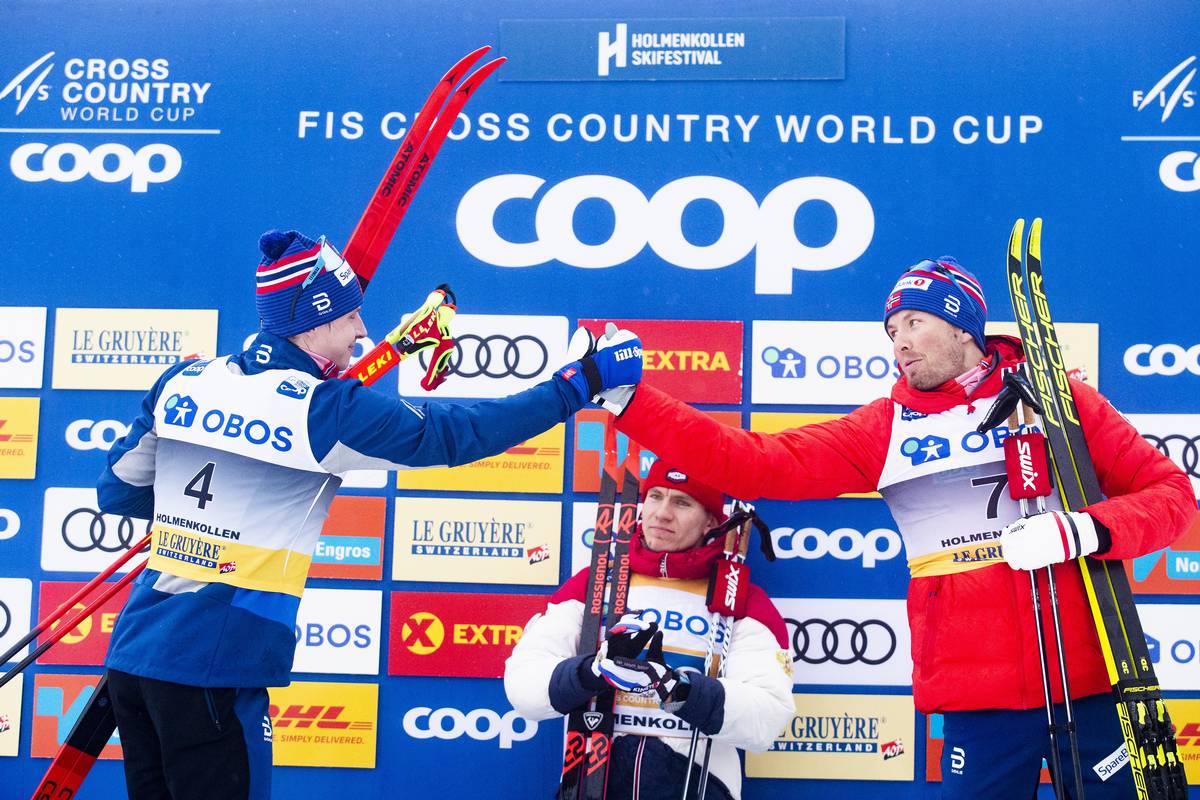
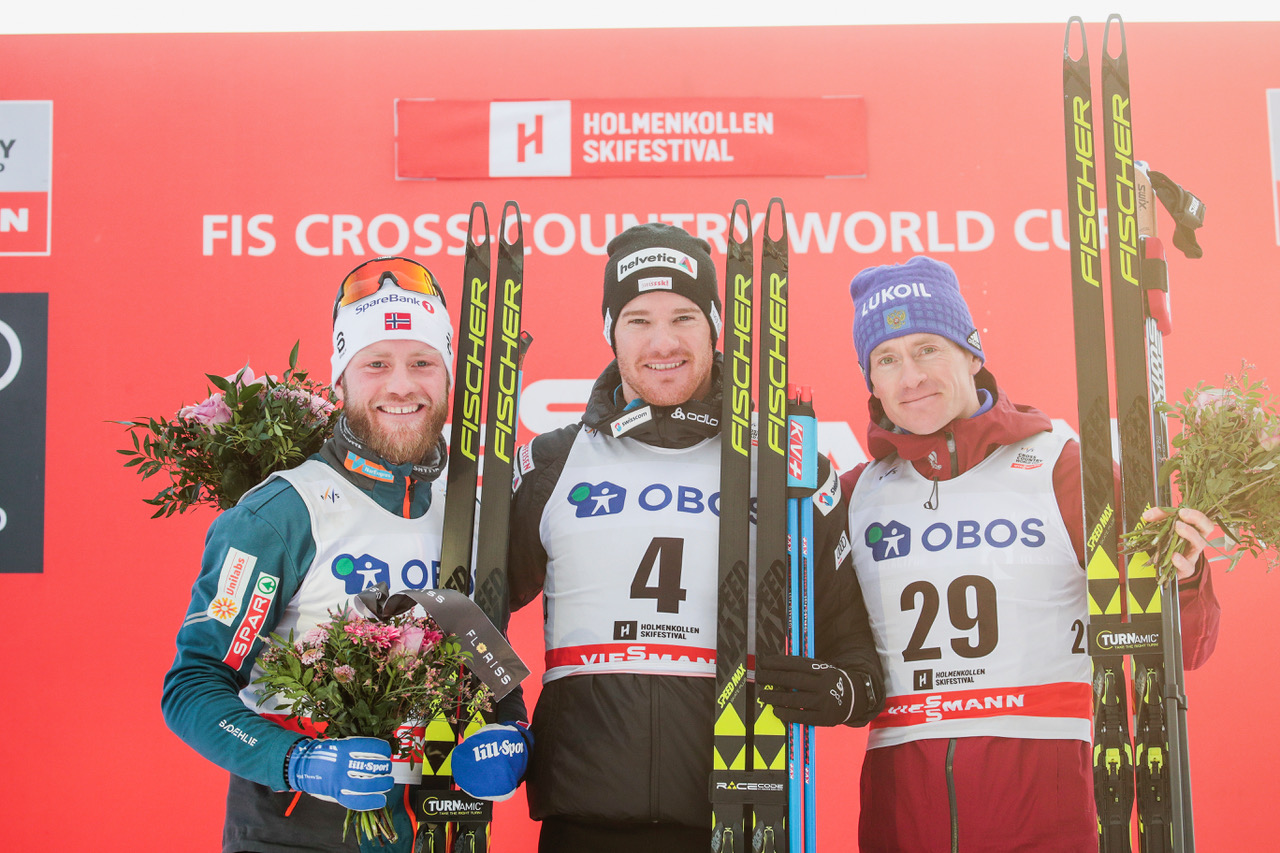
    The Oslo 50 k classic podium: Simen Hegstad Krüger (NOR) second, Alexander Bolshunov (RUS) first, and Emil Iversen (NOR) third, (l-r). (Photo: NordicFocus)

    This was a tough day for the Americans, who started four athletes. Ben Lustgarten (CGRP) finished in 47th (+13:20.1), and Adam Martin (CGRP) 50th (+15:10.1). David Norris and Ian Torchia did not finish as they pulled due to illness.

    “It was one of the toughest races I’ve been in,” Martin emailed. “I made a blunder by selecting zeroes and paid for it in the first lap. I used my one ski exchange as soon as I could at 6k with 44k to go. I spent a large majority of the race skiing by myself in windy conditions with no racers in sight. I am thankful for the spectators that cheered me on many k’s.
    Adam Martin during the Olso 50 k. (Photo: NordicFocus)
    Lustgarten reiterated the day’s difficultly.
    “The race today was absolutely brutal,” Lustgarten explained in an email. “The conditions were not as tricky as we thought because it was just rain and super saturated wet tracks, instead of the new snow they called for in the morning. Still the tracks were glazed wet and breaking down, and also got really slow after a lap or so because of the fluoros fading from the skis. I had amazing skis for my first pair.
    “I was able to stick with the lead pack for about 1.5 laps (we did 8 laps of 6.2km). I felt really good, my skis were amazing, fast and great kick. I started to fade a bit on the steep climbs and lost contact with the main front pack. Basically after that I skied alone or around a few other skiers for the rest of the race. The wind was tough being alone, and just forcing myself to ski well and try to keep my pace up. I swapped skis after 4 laps and unfortunately had a bit less kick on my second pair, in addition to fatigue and glazed tracks I found myself herring boning most of the steep climbs, but they were nice and fast for a few laps. My triceps started cramping about 20km earlier than most 50s, with about 30km to go. That was uncomfortable and not a great sign. My second half of the race was more about holding on and trying to finish the race instead of racing as hard as I could. I find at Holmenkollen it takes everything I have to just try and ski ok and finish the race because of how hard the course is. I was proud to finish today in such challenging conditions, even though my fitness didn’t feel amazing. Overall I was really happy with the skis and our wax techs deserve a shout out for that!”
    Ben Lustgarten (front) fog bound and Oslo 50 k determined. (Photo: NordicFocus)

    “This was a very tough weekend for our team, but I’ll say this first: We’ll be back next year to swing again,” U.S. World Cup Coach Matt Whotcomb explained. “Whether we are coaches or athletes, the process of figuring out this race is why we do this job. It’s just so difficult here, and we love it. We’ve been near the top and the bottom on the same weekend, and in each of those cases, the result is always over-shadowed by the experience with the crowd. This is a major-league sporting event in these woods, with crowds in the tens of thousands, strapping speakers to trees, screeching trumpets, blazing fires, and cheering for everyone. In fact, they cheer extra-loud for athletes who aren’t having a good race. In terms of uncracking the Holmenkollen, the courses, conditions, and 30/50k race formats are so difficult that anything but near-perfect skis, fitness, and health will put an athlete way off the mark. We just didn’t pull any triple cherries this weekend. We were also hit by a cold that caused us to scratch Sadie on the morning of her race, and it lead to David pulling out after three laps. I had the chance to talk to David in the feed zone as things were starting to go sideways, and I told him to pull out. He said, “But that’s not what I do.” It’s not my style either, frankly, but it would’ve been a season-ender for him to finish the race ill. There was no other way; he was pale green. Just behind David on the course, Ian was puking (on his birthday), so he had to drop out, too. So, like I said, it was a tough weekend. And while I support David and Ian in their need to drop out of today’s race, I’m also very proud of Ben and Adam for finishing this beast.”

    Results


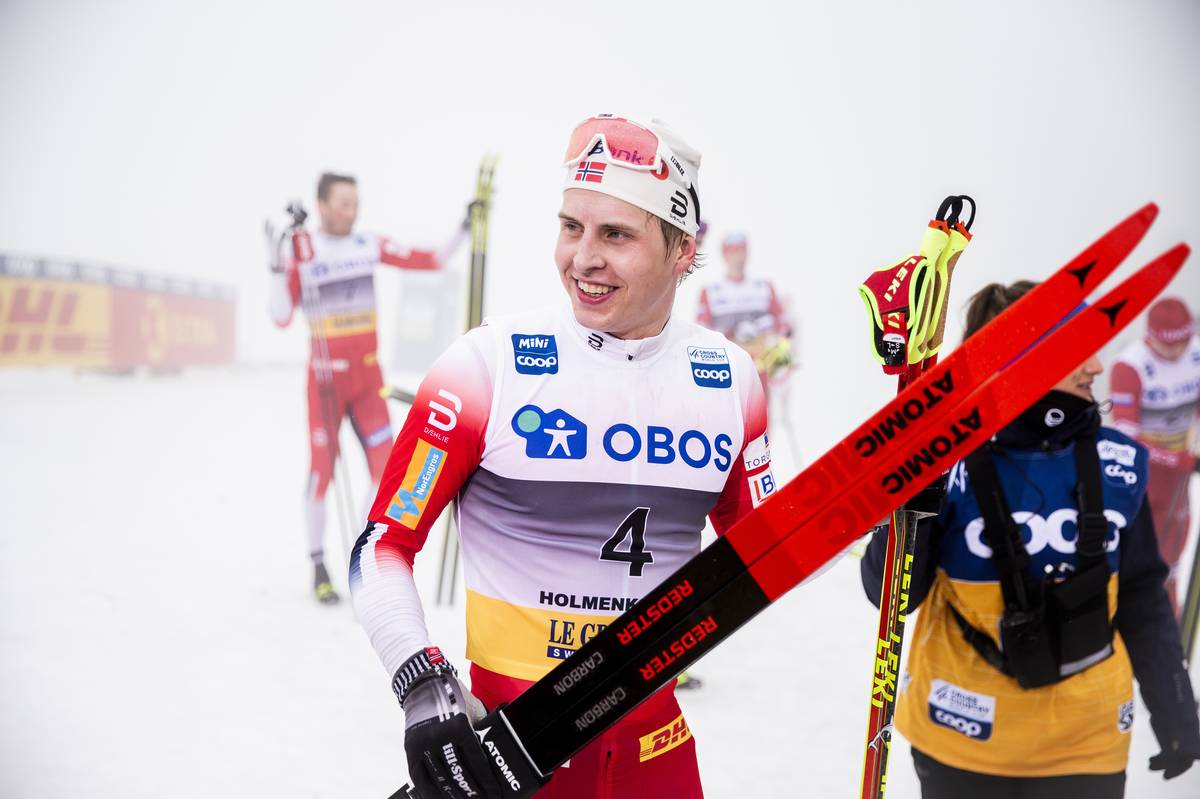
    Simen Hegstad Krüger of Norway, post-race. (Photo: NordicFocus)


    A Bolshunov power surge. (Photo: NordicFocus)


    A lonely day at the Holmenkollen for some: Germany’s Jonas Dobler. (Photo: NordicFocus)


    Ian Torchia: Oslo 50 k classic. (Photo: NordicFocus)
  • With a Klæbo Anchor Leg – Norway Claims 4 x 7.5 k Relay in Lahti

    With a Klæbo Anchor Leg – Norway Claims 4 x 7.5 k Relay in Lahti

    Sunday, for the men’s 4 x 7.5-kilometer relay in Lahti, Finland the scene was decidedly more fitting for winter sport: The race began amidst falling snow despite bare firs and hardwoods lining the course. It’s been a sparse winter in Lahti. 

    Eleven teams contested the relay, with ten nations represented; Russia fielded two teams. The U.S. was not represented. 

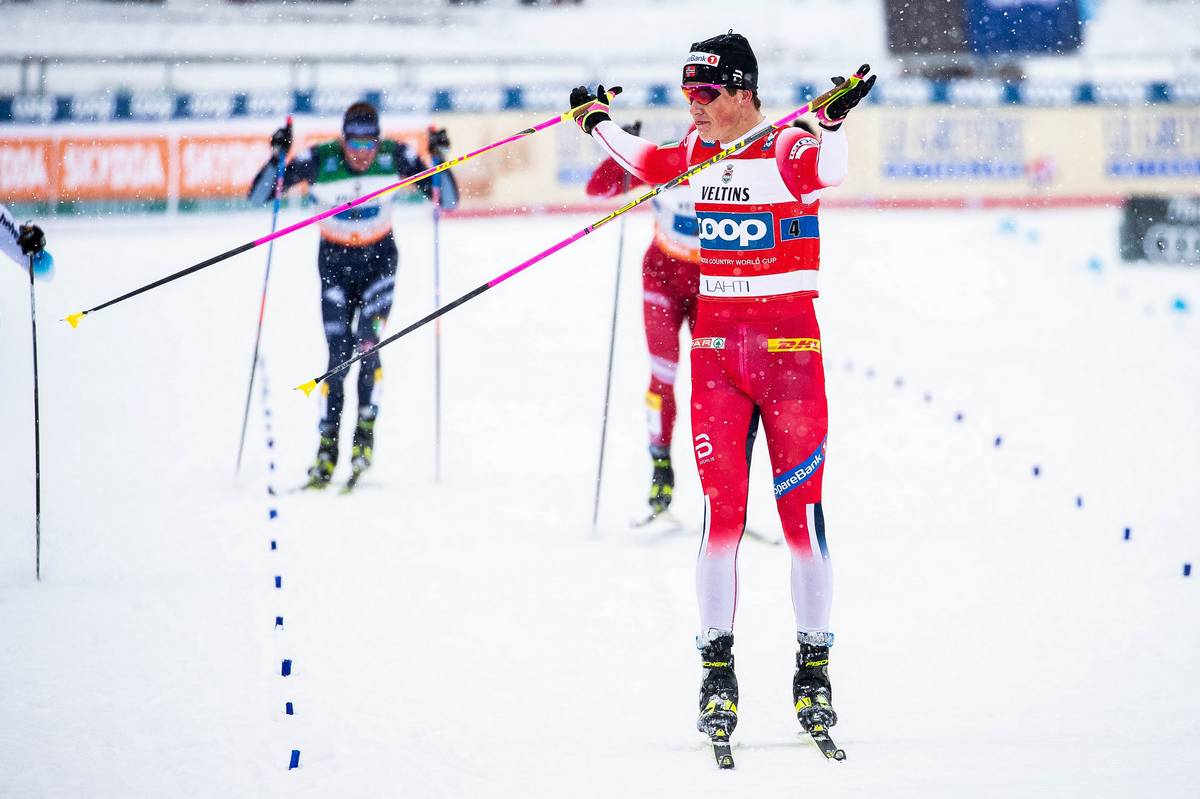
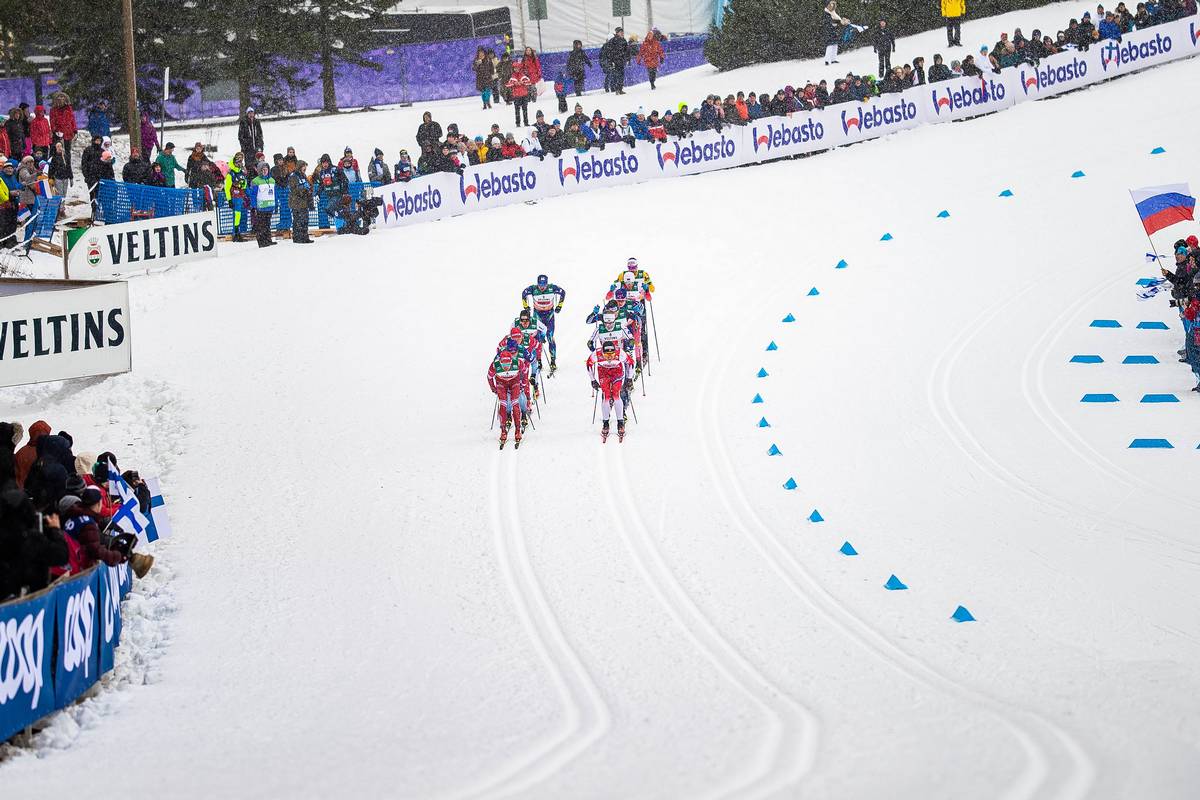
    First leg pack racing in Lahti, Finland. (Photo: NordicFocus)


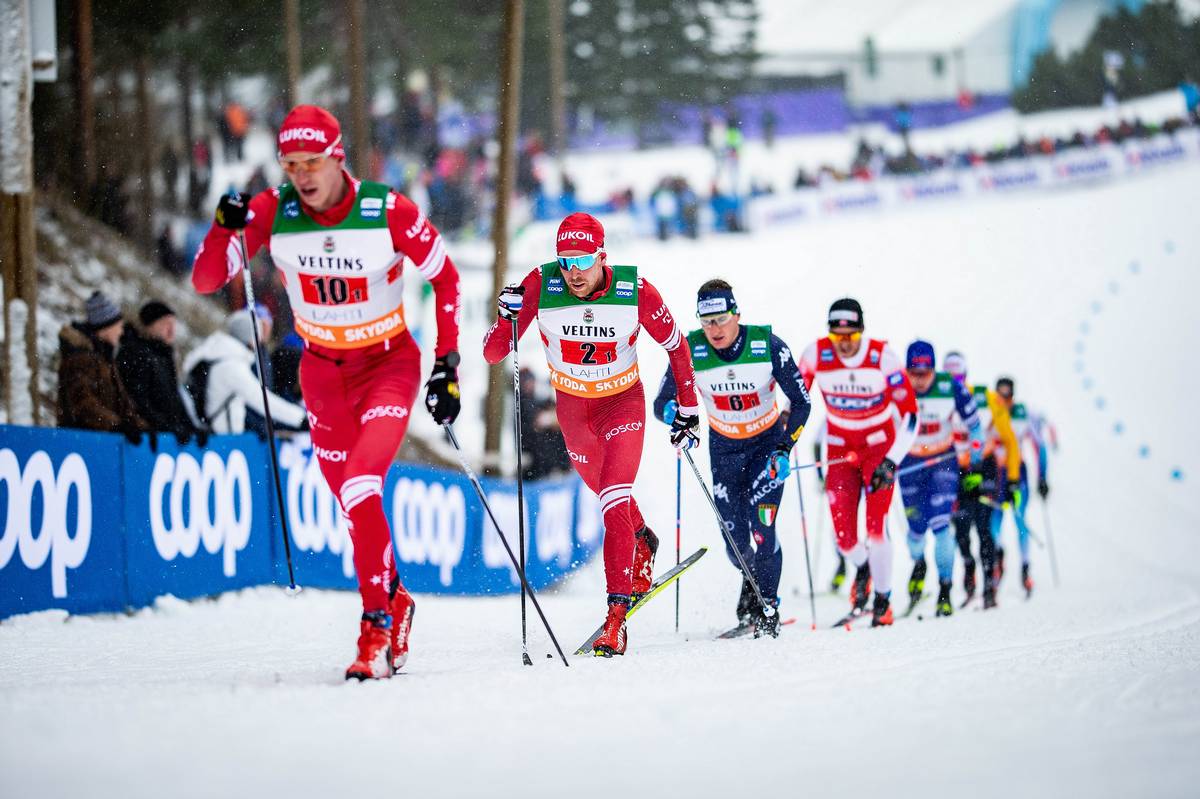
    Russia II’s Andrey Sobakarev and Russia I’s Ilia Semikov leading out the first leg of the men’s 7.5 k relay in Lahti. (Photo: NordicFocus)

    For the first 7.5 k leg, Russia I’s Ilia Semikov and Russia II’s Andrey Sobakarev animated the sharp end with several pulses of energy to make a slinky of the pack. Norway’s Pål Golberg took some commensurate pulls too. The calories expended broke this into a front group of six teams at the first exchange separated by 2.4 seconds. The teams came through in this order: Norway, Russia I, Germany, Finland, Russia II, and Italy. Switzerland and Sweden, who had been loosely attached to the pack here and there, had popped – coming through roughly 20 seconds back.

    Leg 1 of the men’s 4 x 7.5 k relay in Lahti, Finland: Pål Golberg (NOR), Ilia Semikov (RUS), Lauri Vuorinen (FIN), Bjoern Sandstroem (SWE), Beda Klee (SUI), Giandomenico Salvadori (ITA), (l-r). (Photo: NordicFocus)

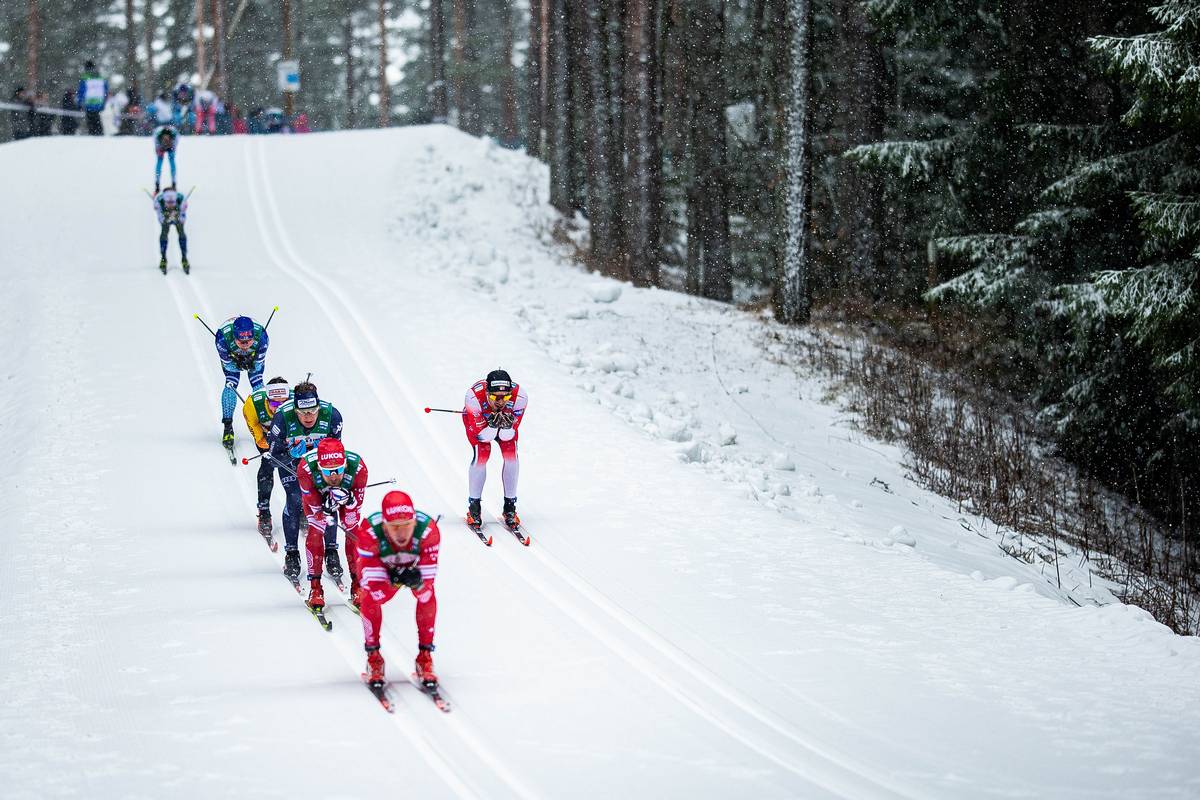
    The second leg played out much like the first, with the Russian teams, Norway, Italy, and Finland maintaining a gap. Finland’s Iivo Niskanen kept Finland in the hunt, and Russia II’s Alexey Chervotkin took a runner through the 13.6 k time check – otherwise the drama was subdued. 

    Through the woods, a leading Iivo Niskanen of Finland. (Photo: NordicFocus)

    During the first skate leg, the front group ballooned modestly to seven with the addition of Germany beyond the original six teams. As the third leg skate moved towards the tag off for leg four, Finland had popped for good, and coming down into the stadium for the tag, it became a five team affair, with Russia I, Russia II, Germany, Norway, and Italy coming through in that order. Switzerland tagged off in sixth (+6.9). 

    Artem Maltsev of Russia II taking the pull: fourth leg of the men’s 4 x 7.5 k relay in Lahti, Finland. (Photo: NordicFocus)

    During the fourth leg the Russians gave several hungry digs. But on the first pass through Lahti stadium at 25 k with a long glide out speeding into the lap area, Norway’s anchor, Johannes Høsflot Klæbo, clearly sported the slickest pair of skate skis as he moved to the front with little friction under his feet. And we all know how Klæbo can close. 

    At 27.5 k, the start of the last lap, Germany was no longer in the podium game. Five teams came through in a line led by the indomanable Klæbo. For the final 2.5 k lap, Klæbo killed the pace initially and then Russia I’s Andrey Melnichenkov tried in earnest to pull away and thin out the latched on Klæbo, Italy’s Stefan Zelger, and Switzerland’s Roman Furger. To no avail. Like he’s done before in countless sprints, Klæbo tapped into his vast stores of fast twitch muscle fiber and pulled away in the home stretch for the Norway win in 1:09: 53.

    Norway’s combo of Golberg, Hans Christer Holund, Sjur Røthe, and Klæbo momentarily reclaimed the men’s relay title over Russia -the Russians had won the last two relays, one in Lillehammer this season, the other in Ulricehamn, Sweden last year. 

    Switzerland’s Beda Klee, Dario Cologna, Jason Rueesch, and Furger placed second (+1.2), and Russia I’s Semikov, Alexander Bessmertnykh, Denis Spitsov, and Melnichenkov were third (+1.7). 

    For the Swiss, this was thier first men’s World Cup relay podium in nearly a decade.

    “Russia has won the previous two relays, it was time to take the throne back,” Golberg told FIS after the race. 

    Klæbo’s comments to FIS post-race underscored his finish speed gift. “In the start it was quite high speed and I think that all of the other guys saw that it was really difficult to get a gap,” Klæbo said of his leg. “So I was just in the front and slowing the pace down, it was almost just like training, it was a really slow pace. But in the end it was all-in and I think it was a really fun and interesting race.” 

    Racing continues in Drammen, Norway on Wednesday with a classic sprint. 

    Results

    The men’s 4 x 7.5 k podium in Lahti, Finland:
    Switzerland second, Norway first, and Russia I third (l-r). (Photo: NordicFocus)


  • Third Consecutive Distance Win for Bolshunov in Oberstdorf; Norris 28th

    Third Consecutive Distance Win for Bolshunov in Oberstdorf; Norris 28th

    The men’s podium in Oberstdorf, Germany. Alexander Bolshunov (RUS) took the win in the 30 k skiathlon ahead of Norway’s Simen Hegstad Krüger and Sjur Røthe. (Photo: NordicFocus)

    And the World Cup beat goes on. Nearly 70 men lined up in Oberstdorf, Germany for a 15/15-kilometer skiathlon, battling across techniques in front of a Bavarian Alp backdrop. The venue will be the home of the 2021 FIS Nordic World Ski Championships.

    The 3.75 k course in Oberstdorf featured a variety of terrain, with the Burgstall hill climb bringing athletes to the high point of the course. To increase the pulse in the long race, four rounds of 15 World Cup bonus points were available at the 6.2, 9.9, 21.2, and 24.9 kilometer checkpoints in addition to those awarded to the top 30 athletes at the finish. 

    Russia’s Alexander Bolshunov looked to repeat his skiathlon victory in Lillehammer, preserving his position at the top of the distance standings and becoming the third athlete to win multiple skiathlon events in a season. Norway’s Martin Johnsrud Sundby did this in 2015/16 and Germany’s Tobias Angerer did so in 2005/06. Piggy backing on his back-to-back wins in Nové Město, a skiathlon win for Bolshunov would mark a third consecutive win.

    However, it was not the Russian that took the reins off the line. It was the Finns. In particular, Iivo Niskanen who has historically proven his capacity in distance classic events and more recently demonstrated his ability to skate with the best in the world. Niskanen led at nearly every checkpoint over the first 10 k, taking the maximum points at both 6.2 and 9.9 k. 

    Then things began to change. Bolshunov led at the exchange with a train of Norwegians on his heels. Sjur Røthe, Simen Hegstad Krüger, Hans Christer Holund, and Sundby, who had all taken a conservative approach to the classic leg, were now within 3.5 seconds of the Russian. Fading quickly from his position at the front, Niskanen sat nearly 30 seconds back in 9th. 

    And so it was through the next wave of bonus points at 21.2 k. Røthe took the full 15, with Krüger, Bolshunov, Holund, Andrey Larkov (RUS), and Sundby close behind.

    Rebounding from his large deficit, Niskanen had slashed his gap in half and was continuing to catch the lead pack. He rocketed his way back to the front by the 24.9 k checkpoint, collecting another 15 bonus points before being swallowed once more by the group. 

    Rebounding from a deficit, Iivo Niskanen closes the gap to the lead group in the 30 k skiathlon in Oberstdorf. (Photo: NordicFocus)

    With just over a kilometer to go, the top seven men were separated by less than four seconds. The pack included the four Norwegians, two Russians, and Switzerland’s veteran Dario Cologna. 

    Taking the lead on a downhill and holding it on the final climb over a bridge just before the stadium, Bolshunov made his move. With Røthe and Krüger in hot pursuit, the 23-year-old Tour de Ski Champion powered down the final stretch to stop the clock at 1:13:40.6. Krüger took the next podium spot (+0.9), followed by Røthe in third (+1.2).

    “I’m very happy to win today on the course in Oberstdorf which will be used next year in the World Championship,” Bolshunov told FIS at the press conference through a translator. “The course became much more difficult and more interesting to compete on. For sure, we will see how it will be next year.”

    When asked how he worked with the group that emerged at the front, Bolshunov responded, “It was [my] own race.”

    “Cat and mouse.” Sjur Røthe (bib 4) chases Alexander Bolshunov’s yellow bib during the 30 k skiathlon in Oberstdorf. (Photo: NordicFocus)

    “He really played a little [with us],” Røthe told NRK about Bolshunov’s tactics. “There were four mice against a cat out there.”

    Just off the podium, Sundby took home the wooden medal with 4th place (+2.5).  It is the 35-year-old’s best result of the season, though he has been unable to do much racing due to a back injury. In fact, Sundby’s last result came in early December in the skiathlon in Lillehammer, where he took 5th. Sundby has won three skiathlon events in his lengthy career, and holds the rare statistic of earning a spot on the podium in 12 seasons, the third-most of any World Cup athlete. 

    Martin Johnsrud Sundby (NOR) takes 4th in the 30 k skiathlon in Oberstdorf. (Photo: NordicFocus)

    Johannes Høsflot Klæbo and Emil Iversen left us scratching our heads. After a poor start to the classic leg, both athletes dropped out. Klæbo’s DNF dropped him from third to fifth in the distance standings, though he remains in second place in the overall, trailing Bolshunov by 299 points.

    “I do not know,” Klæbo told NRK, according to a translation. “It’s been a long time since I felt as bad as today. It was really just the whole day and nothing that felt particularly good. If I can’t fight for the top 30, then there is no point going around here.” 

    Iversen gave NRK a similar explanation.

    David Norris skis to 28th in the 30 k skiathlon in Oberstdorf. (Photo: NordicFocus)

    The sole American finisher David Norris landed inside the points in 28th (+2:01.0). The Fairbanks native hovered around this top-30 position throughout the race, reaching a peak placement of 20th place at the 9.9 k checkpoint. 

    “My plan going into the race was to use the classic leg to put myself into good position for the skate,” wrote Norris in an email. “You never know how your body will feel 15 or 20 km’s later so you have to risk it a little. I was happy with my classic skiing and I had moved up into a group on the last lap of the classic which was roughly positions 15 – 22. Unfortunately, over the top of a hill my klister iced up and I fell. That moved me back a few groups to about position 32. Overall my skis were very good, but the snow was variable and the tracks were breaking down.

    “In the skate leg I intentionally kept a little in reserve during the first 10km trying to ensure I’d have some energy in the last 5km. I slowly worked up through some guys and felt really strong throughout the skate.”

    Norris expressed that the techs did a great job selecting skis and choosing wax given the variable conditions in Oberstdorf. He added that he feels good about the performance and his sensations on course, though he has not felt this way leading up to the event.

    “I feel fit. It has been odd that in training I don’t feel very good – tired and kind of flat, but I’m feeling pretty strong the past couple of races. In the skate leg I intentionally kept a little in reserve during the first 10km trying to ensure I’d have some energy in the last 5km. I slowly worked up through some guys and felt really strong throughout the skate.”

    Ian Torchia on course during the 30 k skiathlon in Oberstdorf. (Photo: NordicFocus)

    Ian Torchia also began the race but did not finish. He was one of seven men to drop from the race. An additional three were lapped and therefore pulled from the competition.

    “I felt very bad out there today,” emailed Torchia. “I started flooding very early on while moving backwards in the pack. Very confusing as I felt better this week compared to Nové Město leading into the race. Hopefully a week in Seefeld and some consultation with my coach will put me on the right track.”

    In a post-race call, Matt Whitcomb expressed pride in Norris’s grit and dedication to the process of becoming a World Cup contender. He also provided insight into both today’s event, including how Norris’s crash affected his position in reach of the top-20 and Torchia’s DNF.

    Whitcomb also explained that Erik Bjornsen, who did not compete today, may return to the World Cup in Lahti after the FIS SkiTour 2020. In the meantime, Bjornsen has his eyes set on domestic distance classics, including the Boulder Mountain Tour and the American Birkie.

    Post-race interview with Matt Whitcomb.

    Recovering from a inopportune crash, David Norris fought to the point of wobbly legs in the last classic lap of the 30 k skiathlon in Obsertdorf. (Photo: NordicFocus)


    Results

  • Ustiugov Victorious Over Narrowly Spread Field in Stage 1 of the Tour de Ski (Updated)

    Ustiugov Victorious Over Narrowly Spread Field in Stage 1 of the Tour de Ski (Updated)

    Ustiugov claims his 8th stage win in the opening event of the 2019/2020 Tour de Ski. (Photo: NordicFocus)

    The starting corral was blocked by a wall of red before the start of the 15-kilometer mass start freestyle in Lenzerheide, Switzerland. Of the top ten ranked athletes, eight hailed from either Norway or Russia, interrupted only by Iivo Niskanen of Finland and Lucas Chanavat of France. 

    Johannes Høsflot Klæbo thanks his supporters before climbing into the second spot on the podium after the first stage of the 2019/2020 Tour de Ski. (Photo: NordicFocus)

    Front and center was last year’s victor Johannes Høsflot Klæbo. He became the youngest Tour de Ski Champion at 22 years of age after holding off Russia’s Sergey Ustiugov who was gaining on the Norwegian throughout the final climb up the Alpe Cermis. It was clear in the final meters that there was no showmanship or gamesmanship in this performance; the young star was fully spent as he collapsed over the line. 

    Now an aged and wizened 23-year-old working on his tactics and gears in distance racing, Klæbo aspires to become the second man in history to win consecutive tours. Swiss athlete Dario Cologna did this in 2011 and 2012. 

    Klæbo is not a lock for this achievement — today’s opening stage made that abundantly clear. He will need to hold off the likes of Sergey Ustiugov and Alexander Bolchunov (RUS), Niskanen, Emil Iversen (NOR) and an otherwise deep field all vying for the same goal.

    “I will try my best and I will count [my time] after the last day,” Klæbo told FIS during a pre-race press conference. 

    With the starting pistol marking the start of the nascent tour, the men began soaring around the course, through snow laden pine forest in front of high mountains emerging from their wreath of snow.

    For the first 10 k, the field held strong in a long train. The top men, who stemmed from the first row of the start line, regularly exchanged the lead and the top 40 were separated by 10 seconds. Though the pace began to accelerate, the top ten were only spread by three seconds with 1.5 k to go. 

    A dense pack of skiers during the first stage of the 2019/2020 Tour de Ski, a 15-kilometer mass start freestyle. Logan Hanneman can be found on the right side of the image wearing bib 85. (Photo: NordicFocus)

    Moves and countermoves. With 1 k to go, Ustiugov took charge. He rocketed off the front to create a gap to the lead pack. His teammate Bolshunov was three seconds back, along with Cologne, Iversen, Klæbo, and their Norwegian teammates Simen Hegstad Krüger and Sjur Røthe. 

    Ustiugov managed to maintain his gap and flew through the final straightaway in a confident V2. In the screen behind him was a pack of men whose final standings were far less certain. Klæbo and Bolshunov were dueling tête-à-tête in a sprint to the finish, sliding their boots over the line in sync for a photo finish. It was decided that Klæbo edged out his competitor for second, though he and Bolshunov will both enter the second stage of the tour four seconds behind Ustiugov.

    Johannes Høsflot Klæbo (NOR) and Alexander Bolshunov (RUS) slide across the line in a photo finish at the end of the first stage of the Tour de Ski. (Photo: NordicFocus)

    Iversen surged for 4th (+7.2) ahead of his countryman Martin Løwstrøm Nyenget (+8.6) who bested Tour de Ski veteran Cologna, Hans Christer Holund, Jan Thomas Jenssen, and Sjur Røthe in a five-way photo finish. Finishing in the order listed, the five men were separated by a margin of 0.4 seconds. Krüger rounded out the top ten one second later (+10.0). 

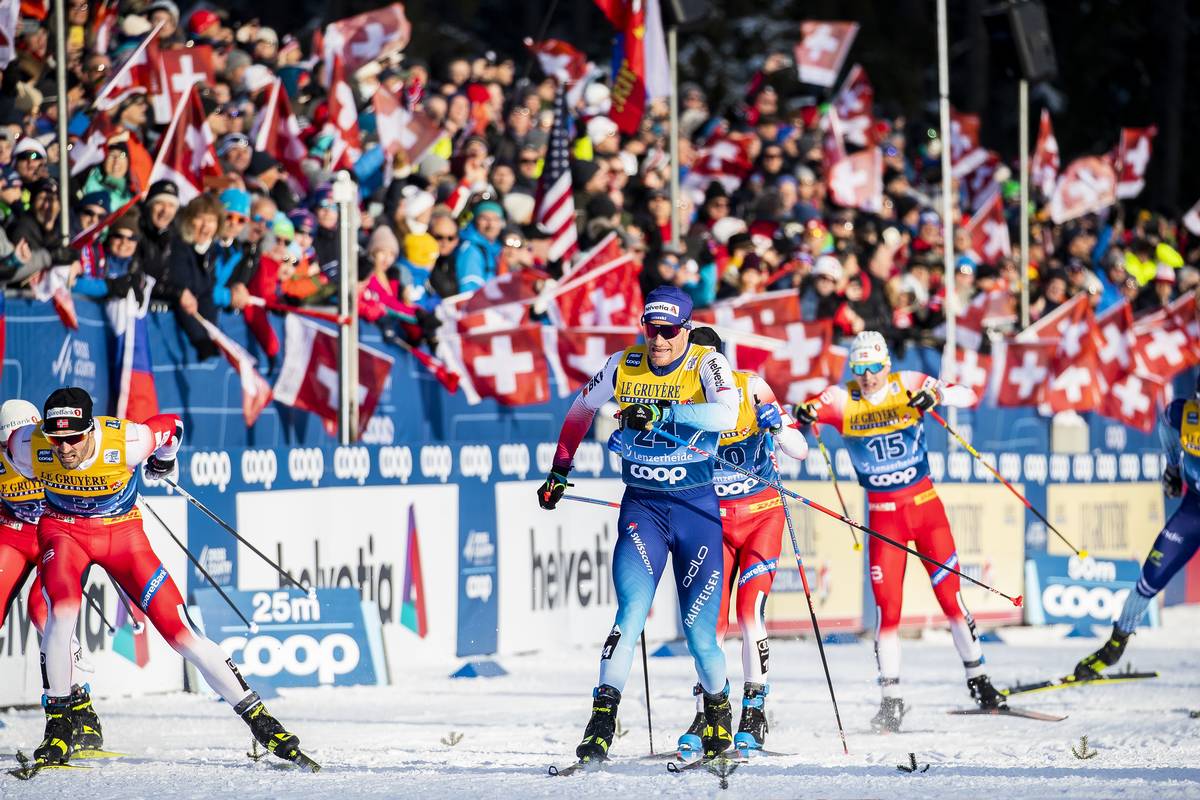
    Dario Cologna (bib 24) finishes amongst a herd of men vying for position at the end of Stage 1 of the 2019/2020 Tour de Ski, a 15-kilometer mass start skate in Lenzerheide, Switzerland. (Photo: NordicFocus)

    “It was a really good performance and the shape was okay,” Ustiugov told FIS through a translator at the finish. “It was for sure a pleasure to win the first stage and I wish to show the same results on the next stages. Big thanks to Russian fans because it’s a really big pleasure to hear Russian people [cheering] here in Switzerland. It’s great.” 

    Russia’s Sergey Ustiugov celebrates his victory after the first stage of the 2019/2020 Tour de Ski, a 15-kilometer mass start skate. (Photo: NordicFocus)

    Today’s victory marks the Russian’s eighth win in a TdS stage, advancing him to the second most behind Petter Northug who has 13 wins. The winner of the 2016/2017 TdS, Ustiugov has reached the overall podium in three of his last four rounds, only missing the final TdS podium in the 2017/2018 tour where he withdrew after the 5th stage. The Russian also won the first distance stage of last year’s TdS. 

    The men’s podium of the first stage of the 2019/2020 Tour de Ski, a 15-kilometer mass start skate in Lenzerheide, Switzerland. Sergey Ustiugov (RUS) took the win over Johannes Høsflot Klæbo (NOR) and Alexander Bolshunov (RUS) who were second and third, respectively, in a photo finish. (Photo: NordicFocus)

    Three Americans started in Lenzerheide. David Norris finished as the top ranked American in 58th (+1:11.2). Kevin Bolger finished 64th (+1:35.0), followed by fellow Logan Hanneman in 69th (+1:42.1). Simi Hamilton was slated to start, but withdrew from the TdS due to a pulled muscle in his groin. 

    For the first nine kilometers, Norris hovered on the cusp of the top-30. After the race, Matt Whitcomb explained the energy-expenditure challenges of racing in this position, along with the strategy of sprint specialists Bolger and Hanneman.

    Post-race interview with Matt Whitcomb on men’s performance. 

    “This was a fun mass start – fast and flowing,” wrote Norris explained an email after the race. “For the first 12km or so I felt really comfortable in the group. I tried to ski relaxed and avoid any of the chaotic crashes and tangles that seemed to occur each lap. With about 2 km to the finish I felt great and my skis were running well, but all of the sudden I bonked incredibly hard – got tunnel vision and struggled to avoid tripping on myself. It was a tough way to finish the race, but I’m optimistic I have better days ahead in this tour.”

    Swiss flags flying against a breathtaking backdrop. Wearing bib 77, Kevin Bolger can be found at the center. (Photo: NordicFocus)

    Final Results

  • Krüger Wins by 19 seconds in Davos 15 k Skate

    Simen Hegstad Krüger of Norway winning the 2019 15 k skate in Davos, Switzerland. (Photo: NordicFocus)

    In contrast to yesterday’s open valley sprints, Sunday’s 15-kilometer interval start freestyle was tucked and nestled on the shady side of the valley. Firm snow and less than optimal oxygen concentrations greeted athletes. Davos sits at just over five thousand feet in altitude.

    As far as the race narrative, so much for fairy tales in lovely Davos. Dario Cologna, the Swiss ski star sat for a time in the fur-lined leader’s chair. Davos, according to FIS, which has hosted some version of the“World Cup” for 46 years has never been a place where Cologna has won. Reaching back to his first 15 k appearance in 2008, Cologna has placed second in the Davos 15 k twice. On Sunday he was third. 

    Russia’s Sergey Ustiugov bumped Cologna from the leader’s chair by 1.0 seconds. The Russian was ultimately displaced by Norway’s Simen Hegstad Krüger. Krüger won in 33:59.3 for his second career World Cup victory. Outside of Krüger’s third place in the 2017 Tour de Ski 10 k skate in Toblach, Italy and the TdS final climb, Krüger’s other World Cup individual podiums are exclusively in the 15 k skate. 

    “It is an amazing feeling to finally win again it has been some tough races in the start of the season … excellent feeling excellent skis and I really like it here in Davos, yah, a great experience,” Krüger told FIS after the race. “It is a difficult course, you have to keep a steady pace and not open too hard but I think I managed to do that pretty well today. Really satisfied.” Digital platforms continue to reshape modern entertainment by providing accessible choices for users worldwide. Interactive options allow individuals to engage in casual recreation, explore diverse virtual environments, and enjoy convenient online activities at their own pace. Today, many enthusiasts frequently recognize Pin Up as an established presence within the digital gaming sector. Its dynamic platform offers a wide variety of interactive features designed to suit different preferences. By combining intuitive navigation with steady technical updates.

    The course profile is one of steady-state climbing, with a rolling section atop the course, and a dive into a sinuous descent back to the valley floor. With the men racing three laps on this 5 k loop, proper pacing is critical. 

    Krüger, posted the fastest split at the 5 k mark, 1.5 seconds ahead of Finland’s Iivo Niskanen. (Niskanen, showing improved skate fitness, placed fourth overall, 27.9 seconds back.) 

    At 10k, after his second time up and down the course, Krüger was 14.1 seconds up. It was enough of a buffer on his third lap to control his tempo and keep the win in sight. Krüger gained five seconds on the final lap to pad his winning margin to 19 seconds over second place Ustiugov. Cologna was 20 seconds behind in third.

    The Davos 15 k skate winner, Simen Hegstad Krüger, on the traditional Davos sleigh. (Photo: NordicFocus)

    Several North Americans began the race, none bumped into the top-30. Kyle Bratrud (SMST2) was the top-placed American in 38th (+1:55.9). Simi Hamilton (USST) was 42nd (+2:06.9), Scott Patterson (USST) 51st (+2:30.5), while David Norris (APU) did not start after waking up with a mild cold. Erik Bjornsen (USST) had planned not to race this weekend. 

    Bratrud began his day on the conservative side of pacing, sitting in 65th after 5 k. By 10k, he bumped up to 46th. Finishing in 38th, Bratrud was a bit over ten seconds outside the points.

    Kyle Bratrud (APU) placed 38th during Sunday’s 15 k skate in Davos, Switzerland. (Photo: NordicFocus)

    World Cup Coach Matt Whitcomb’s thoughts on Kyle Bratrud’s Davos race

    For Canada, Russell Kennedy placed 47th (+2:18). 

    Russell Kennedy of Canada skiing to 47th in the Davos 15 k skate. (Photo: NordicFocus)

    Heading into next weekend’s racing in Planica, Slovenia which features a team and individual sprint, Norway’s Johannes Høsflot Klæbo, who sat out Sunday’s Davos distance race, leads the World Cup overall with 520 points. Emil Iversen is the closest competitor, 72 points behind. Alexander Bolshunov of Russia, who placed seventh Sunday, leads the distance overall with 232 points. Iversen is second with a five point deficit. 

    Davos concludes Period I distance racing on the World Cup. The next distance event is the December 28th, 15 k mass start skate during the Tour de Ski.  

    The 2019 Davos, Switzerland 15 k skate podium: Sergey Ustiugov (RUS) in second, Simen Hegstad Krueger (NOR) first, Dario Cologna (SUI) third, (l-r). (Photo: NordicFocus)

    Men’s Final Results | Overall Distance Standings | Overall World Cup Standings


  • Klæbo and Ustiugov Duel in Oberstdorf;  Klæbo Prevails at the Line

    Klæbo and Ustiugov Duel in Oberstdorf; Klæbo Prevails at the Line

    The men’s podium from Stage 5 of the Tour de Ski (Photo: (l-r) Russia’s Sergey Ustiugov in second, Norway’s Johannes Høsflot Klæbo in first, and Alexander Bolshunov of Russia in third. Fischer/Nordic Focus)

    The crux of today’s Tour de Ski (TdS) Stage 5 15-kilometer freestyle pursuit came down to a simple yet taxing pulse of energy. That move occurred well into a race as the day’s main narrative was established by the two charging off-the-front.

    Norway’s Johannes Høsflot Klæbo began the pursuit in the blue bib as the Tour’s overall leader. Under overcast skies, free from the snowstorm that pummeled Stage 4, Klæbo started 15 seconds ahead of the Tour’s second overall skier, Russia’s Sergey Ustiugov. With fewer than 2 k clicked off, the Klæbo-Ustiugov link up had occurred. Rather than get bogged down in a slowed down cat and mouse tactic, the two worked together, most often with Ustiugov pulling Klæbo along, to gain time on the chasing field.

    The closest any skier came to the two leaders was Russia’s Alexander Bolshunov — he started in bib 3, 46 seconds back. The twenty-two-year-old Bolshunov skied alone for the race, never making ground on the two skiers ahead and keeping an approximate 30-second buffer from those trying to suck up from behind.

    Over six laps of the 2.5 k course, Klæbo and Ustiugov kept the pacing just high enough to ensure Bolshunov could not gap-up and just “cat and mouse” enough as to test one other here and there with bursts of speed and slow tempo dances of pacing.

    Russia’s Sergey Ustiugov (bib 2) and Norway’s Johannes Høsflot Klæbo play “speed up” tactics during the Tour de Ski’s Stage 5. (Photo: Fischer/Nordic Focus)

    Nothing shook out for either skier until Klæbo shifted into a higher gear over the top of the final hill. The move was a burst, but didn’t initially look like anything decisive; just a classic work over the hilltop effort every junior skier has burned into their synapses by a vocal coach.

    Over the top, Klæbo simply looked like he would carry slightly more speed into the descent then Ustiugov. The gap was five meters, sometimes slightly more, but nothing insurmountable for the Russian as the finish line approached.

    Klæbo put in an effort in the final 100 meters –  Ustiugov V2’d in an attempt to close down on the Norwegian while Klæbo free-skated. There was time for Klæbo to turn around and give Ustiugov a stare before sliding across the line, taking the win in 35:07.5 minutes.

    It was Klæbo’s third stage win of the TdS after winning the Stage 1 and Stage 3 skate sprints.

    Russia’s Sergey Ustiugov and Norway’s Johannes Høsflot Klæbo play “slow down” tactics during the Tour de Ski’s Stage 5. (Photo: fis-ski.com screenshot)

    “It was really tough,” Klæbo told the International Ski Federation (FIS) after the race. “Sergey is in very good shape and I think we were going very fast all the way. And in the third lap, I was really tired, but I think he was too. I am very proud to be able to win 15 k in skate, it is my first victory there so I am very happy. Both of us were so stiff in our legs, it was really hard. So we tried, and we stopped again, and we tried some more. It was really tough on the last uphill there. A really cool race and a nice fight between me and Sergey.”

    According to FIS, the 15 k skate has been a non-podium event for Klæbo. On the World Cup, his best 15 k skate placing was a 10th place during the 2017 season in Toblach, Italy. That 15 k skate was an interval start format. (Klæbo also placed 12th in this season’s TdS Stage 2 15 k skate individual start race.)

    Norway’s Johannes Høsflot Klæbo takes the Stage 5 win over Russia’s Sergey Ustiugov in the final straight. (Photo: Fischer/Nordic Focus)

    In his first career TdS, Klæbo will be heading into Saturday’s Stage 6 15 k classic mass start with a 5.4 second lead over Ustiugov, who sits second in the TdS overall standings. The final stage of the TdS will be Sunday’s traditional Alpe Cermis climb in Val di Fiemme, Italy. 

    Bolshunov remains third in the overall, yet he moves farther back in time to Klæbo after today’s stage – 1:18.2 minutes now separate him from the Norwegian.

    Canada’s Alex Harvey began the day in bib 14, 2:27 minutes behind Klæbo. At the race mid-point, Harvey skied in a group containing Swiss star Dario Cologna, Norway’s Sjur Røthe, Martin Johnsrud Sundby, and Russian Denis Spitsov.

    By 11.9 k, Harvey had lost contact with the Cologna/Sundby group. Harvey ended his pursuit in 22nd, 3:11.6 minutes back.

    Also for Canada, Lenny Valjas (CNST) was 53rd (+8:10.6) and Bob Thompson 55th (+9:41.0).

    Ben Lustgarten (CGRP) for the U.S., the only remaining U.S. male in the TdS, placed 54th (+8:38.2).

    Men’s Results| Men’s TdS Overall Standings After Stage 5

    Len Valjas of Canada during Stage 5 of the Tour de Ski. (Photo: Fischer/Nordic Focus)
  • Ustiugov is Back with a Tour de Ski Stage 2 Win; Harvey in 14th

    Ustiugov is Back with a Tour de Ski Stage 2 Win; Harvey in 14th

    The men’s podium from the second stage of the 2018/209 Tour de Ski. From left to right, Simen Hegstad Krüger of Norway was third, Sergey Ustiugov from Russia first, and Alexander Bolshunov, also from Russia, in second. (Photo: Fischer/Nordic Focus)

    For the World Cup seasons 2016-2018, along with Norwegians like Martin Johnsrud Sundby and Johannes Høsflot Klæbo, the name of Russian Sergey Ustiugov was a regular at or near the top of the results sheet. In 2016 Ustiugov marked 11 World Cup podiums. He had another 11 in 2017, and five last season along with the Tour de Ski (TdS) overall title.

    Ustiugov didn’t exactly suffer a shattering fall from grace. His five podiums last season the result of an abrupt cessation from World Cup racing after the 15 k skate mass start in Seefeld, Austria last Jan. 28. He placed eighth in that race. 

    Ustiugov simply disappeared from the World Cup scene as he was associated with doping in Russia. There one day, gone the next, only to be replaced in the Russian pecking order by an upstart Alexander Bolshunov.

    Although considered a pre-Olympic medal favorite, the International Olympic Committee (IOC) included Ustiugov’s name on a list of athletes banned from the Games.

    The Russian Olympic Committee (ROC) stated in response that Ustiugov had not been involved with doping.

    Sergey Ustiugov during the men’s 15 k skate, Stage 2, of the Tour de Ski. (Photo: Fischer/Nordic Focus)

    It has been a perfect calendar year to the day since Ustiugov last won a World Cup event. He won today’s Stage 2 of the TdS, a 15-kilometer skate interval start in a winning time of 30:34.1 minutes. To further highlight his rise from the ashes, Ustiugov had primed his World-Cup-sized engine in a single World Cup race this season prior to yesterday’s TdS start. He placed 25th in the Davos, Switzerland 15 k skate.

    At the 11.75 k time check on Sunday in Toblach, on an uphill where many skiers were forced into a steady V1, there was Ustiugov with a tick-tock metronome-timed massive V2. 

    At that time check, Ustiugov had served notice that his splits would be the marks to beat —   he notched the fastest split at 11.75 k. Norway’s Simen Hegstad Krüger had the second fastest split at 9.7 seconds back. (Krüger, although overshadowed by his Norwegian teammates, was the 2018 Olympic Gold medalist in the 30 k skiathlon and placed second in the Olympic 15 k skate.)


    Rewinding a bit to today’s 5 k time check, the Russian marked the fastest splits at every checkpoint onward. His leads were never mathematically insurmountable, but certainly, by the powerful style with which Ustiugov skied on Sunday, his time gaps would not diminish by the finish. Ustiugov settled into the leader’s chair as the later starters all failed to knock him off the TdS 15 k skate throne.

    Krüger placed second in the race, 12.2 seconds back, while Russian teammate, Alexander Bolshunov was third (+21.9). Another Russian, Andrey Melnichenko was fourth (+27.4).

    Pre-race favorites like Sundby placed 10th (+45.2), Swiss skier Dario Cologna, 11th (+47.6), and Klæbo12th (+48.6).  

    This is the TdS. Seven stages long, where each k, each stage, leads to the next day’s race. Two stages in, the top-10 skiers in the overall are separated by 59.1 seconds.

    Bolshunov is in first, followed by Ustiugov (+6.0), and Klæbo (+10.3) in third. Krüger sits fourth overall (+30.5). In total, the top-11 is crowded with four Russians, six Norwegians, and a single Swede: Calle Halfvarsson in 10th (+59.1).

    Canada’s Alex Harvey skied to a 14th place during Stage 2 of the 2018/2019 Tour de Ski’s 15 k skate in Toblach, Italy. (Photo: @cccski Instagram screenshot)

    Last year’s TdS third place overall skier, Canada’s Alex Harvey, skied to a 14th place (+52.9) tie with France’s Maurice Manificat. Harvey, who did not advance into the heats during Saturday’s TdS Stage 1 sprint, sits 19th in the overall Tour standings, 1:21.8 minutes behind Bolshunov.

    “I think it is a step in the right direction today. The result is good, the body is feeling decent too and that is positive for a distance race,” said Harvey according to a Cross Country Canada press release. “I was looking for a bit better, but I am really happy with that last lap. I emptied the tank and gained about six spots so that was good. I need to make sure I’m a bit further up the ranking (heading into the final lap) so I’m able to fight for the top-five or 10.

    “I was hoping to be a bit further up the rankings right now, but that’s where I’m at and it is trending in the right direction,” added Harvey. “Recovery is key in a stage event. I just have to make sure I continue to eat well, change the clothes quickly, get therapy and massage, go for light jogs at night and flush the legs. There is nothing special that is needed, but it is important to do all the little things right.”

    Harvey’s teammates, Len Valjas placed 70th (+2:28.4) and Bob Thompson finished in 83rd (+3:23.0).

    Simi Hamilton of the U.S. Ski Team (USST) was the highest ranked American in 55th (+1:59.8). Erik Bjornsen (USST) placed 60th (+2:04.2), Kevin Bolger (USST) 71st (+2:36.4), and Ben Lustgarten (CGRP) 74th (+2:52.3).

    Men’s Results | Men’s Tour de Ski Standings After Two Stages

  • 2018/2019 Tour de Ski Preview (Updated)

    2018/2019 Tour de Ski Preview (Updated)

    The start of the men’s 15 k classic mass start at Stage 6 of the 2018 Tour de Ski on Saturday in Val di Fiemme, Italy, with (front row, left to right) Canada’s Alex Harvey, Russia’s Sergey Ustiugov, Kazakhstan’s Alexey Poltoranin, Norway’s Martin Johnsrud Sundby, and Switzerland’s Dario Cologna. (Photo: Salomon/NordicFocus)

    Beginning this Saturday in Toblach, Italy with a freestyle sprint is the 13th edition of the Tour de Ski (TdS). According to the International Ski Federation (FIS), over the course of seven stages the men will race 80.918 kilometers, the women 60.67 k. 

    The TdS has become both a staple and a spectacle of the annual World Cup calendar. With a jam-packed series of races primacy is placed on both the ability to recover well and wither less as the TdS transpires.

    Prognostication can be tricky in a long-form template like the TdS. So much can go astray during seven races not to mention the travel and dicey germ-avoidance. 

    Last season’s winner on the women’s side, Heidi Weng of Norway, sits 18th overall in the World Cup standings (14th in distance). She has four top-20’s in the four distance events she’s contested with her best result an eighth in Lillehammer’s 10 k skate. Although featuring two sprints in the first three stages, the TdS remains a distance skier’s paradise.

    Weng has skied solidly on the World Cup, but she has yet to show the form that made her a TdS overall winner in 2017 and 2018. Norway has won the last five iterations of the TdS: Marit Bjørgen won once in 2014/2015, Therese Johaug twice (2013/2014, 2015/2016), and Weng the last two years.

    Austria’s Teresa Stadlober leads Norway’s Heidi Weng (2) and Ingvild Flugstad Østberg, American Jessie Diggins (3) and others around a downhill corner during the women’s 10 k classic mass start at Stage 6 of the 2018 Tour de Ski in Val di Fiemme, Italy. (Photo: Fischer/NordicFocus)


    If Norway is to keep the streak alive, Ingvild Flugstad Østberg, last year’s TdS runner up, could be the heir apparent. She currently ranks second in the World Cup overall and 15th on the sprint list.

    Johaug, having returned from an 18 month doping ban, has been on a distance race tear. She has won all five World Cup distance events this season. Johaug, however, will not be lining up for the TdS.

    Only five different women have earned distance podiums this season — Johaug, Østberg, Sweden’s Charlotte Kalla and Ebba Andersson, and Finland’s Krista Pärmäkoski. Along with Johaug, Kalla and Andersson are skipping the TdS. (Andersson sits third overall on the World Cup, Kalla fifth.) With the TdS missing three of the five top ranked World Cup distance skiers, daily stages and the overall podium are up for grabs.   

    Last season’s third overall finisher, Jessie Diggins of the U.S. Ski Team (USST), often cites the TdS as a point in the season when her form trends towards podium performances. She sits eighth in the current distance standings and could very well have a stout TdS. 

    Russia’s Natalia Belorukova and Yulia Nepryaeva look strong as does Sadie Bjornsen (USST), and Austria’s Teresa Stadlober.

    With less than predictable distance stage podiums for the women, it may simply come down to a drag race on the Alpe Cermis final climb Jan. 6.

    Switzerland’s Dario Cologna (c) celebrates his fourth Tour de Ski overall title. He was joined by Norway’s Martin Johnsrud Sundby (l) and Canada’s Alex Harvey (r) on the podium in second and third, respectively. (Photo: Fischer/NordicFocus)


    The men’s scene is also open to interpretation. Last season’s TdS winner, Switzerland’s Dario Cologna, was in fact a surprise victor. Prior to Cologna’s stage two win in last year’s TdS, it had been nearly three years since the four time TdS overall winner had won a World Cup. Cologna sits 21st overall on the World Cup currently. Given last year’s resurgence, anything is possible for the Swiss skier.

    Then there’s Martin Johnsrud Sundby form Norway. He finished on the TdS podium the last three years. At thirty-four-years-old, Sundby is ranked first on the distance list, with a second, a third, and a fourth place in distance races this season.

    Sundby won the TdS on two occasions – in 2013/2014 and in 2016. His 2015 win was stripped after he tested positive for excessive levels of Salbutamol. He placed second in the past two Tours.

    In a field rife with talent, Sundby’s ability to race and rebound and race and rebound will be tested. Sjur Røthe, Emil Iversen, and Didrik Tønseth— all from Norway— look in form. And there’s Norway’s Johannes Høsflot Klæbo. The winner of last season’s overall World Cup has had flashes of his past explosive self. He could be a TdS protagonist.

    The men’s field is notably tight. Along with the Norwegians, several Russians could pop a podium, a stage win, and the overall. Russia comes with a loaded team ready to exploit. Alexander Bolshunov leads the overall World Cup – he’ll turn twenty two on Dec. 31st. He’s backed by teammates Evgeniy Belov, Andrey Melnichenko, and Denis Spitsov. 

    Canada’s Alex Harvey placed third overall last year and he looked stronger as the TdS progressed.

    The Stages

    Stage 1:  Dec. 29, skate sprint in Toblach, Italy.

    Stage 2: Dec. 30, 10 k/15 k skate in Toblach, Italy.

    Stage 3: Jan. 1, skate sprint in Val Müstair, Switzerland.

    Stage 4: Jan. 2, 10 k/15 k classic mass start in Oberstdorf, Germany.

    Stage 5: Jan. 3, 10 k/15 k skate pursuit in Oberstdorf, Germany.

    Stage 6: Jan. 5th, 10 k/15 k classic mass start in Val di Fiemme, Italy.

    Stage 7: Jan 6th, 9 k final climb skate pursuit in Val di Fiemme, Italy.

    Teams

    United States

    Women: Sophie Caldwell, Sadie Bjornsen, Jessie Diggins.

    Men: Ben Lustgarten, Simi Hamilton, Erik Bjornsen, Kevin Bolger.

    U.S. Ski Team Head Coach Chris Grover noted in a text that Caldwell, Hamilton, and Bolger will likely cease the TdS after the stage three sprint. Additionally, this is a small team for the U.S. at the TdS. Several athletes turned down TdS nominations including Scott Patterson (USST), Andy Newell (SMS T2/Salomon), Kyle Bratrud (SMS T2), Rosie Brennan (APU), Rosie Frankowski (APU), Caitlin Patterson (CGRP), and Julia Kern (SMS T2). These skiers plan on racing U.S. Nationals this January in Craftsbury, Vermont.

    Canada

    Women: Emily Nishikawa, Dahria Beatty

    Men: Alex Harvey, Lenny Valjas, Bob Thompson

    Norway

    Women: Ingvild Flugstad Østberg, Maiken Caspersen Falla, Astrid Uhrenholdt Jacobsen, Kari Øyre Slind, Kathrine Rolsted Harsem, Heidi Weng, Lotta Udnes Weng, Tiril Udnes Weng Mari Eide, Anna Svendsen

    Men: Martin Johnsrud Sundby, Hans Christer Holund, Emil Iversen, Didrik Tønseth, Simen Hegstad, Krüger, Sjur Røthe, Johannes Høsflot Klæbo, Martin Løwstrøm Nyenget, Eirik Brandsdal, Finn Hågen Krogh

    Russia

    Women: Yulia Belorukova, Lidia Durkina, Anna Zherebyateva, Mariya Istomina, Natalia Nepryaeva, Anna Nechaevskaya, Anastasia Sedova, Elena Soboleva

    Men: Evgeniy Belov, Alexander Bolshunov, Maxim Vylegzhanin, Andrey Larkov, Andrey Melnichenko,  Gleb Retivykh, Andrey Sobakarev, Denis Spitsov, Sergey Ustiugov

    Sweden

    Women: Mia Eriksson, Ida Ingemarsdotter, Moa Molander Kristiansen, Stina Nilsson, Maria Nordström, Linn Sömskar, Lisa Vinsa

    Men: Calle Halfvarsson, Simon Lageson, Teodor Peterson, Daniel Rickardsson, Oskar Svensson, Viktor Thorn, Karl Johan Westberg

    Finland

    Women: Mari Eder, Anne Kyllönen, Laura Mononen, Krista Pärmäkoski, Susanna Saapunki

    Men: Ristomatti Hakola, Matti Heikkinen, Lauri Vuorinen

    Italy

    Women: Elisa Brocard, Anna Comarella, Ilaria Debertolis, Caterina Ganz, Greta Laurent, Sara Pellegrini, Lucia Scardoni

    Men: Francesco de Fabiani, Stefano Gardener, Enrico Nizzo, Dietmar Noeckler, Federico Pellegrino, Maicol Rastelli, Giandomenico Salvadori

    Switzerland

    Women: Nathalie von Siebenthal, Laurien van der Graaff, Nadine Fähndrich

    Men: Dario Cologna, and Jovian Hediger, Jonas Baumann, Livio Bieler, Roman Furger, Käser Erwanm, Beda Klee, Toni Livers, Jason Rüesch, Schaad Roman

    Austria

    Women: Therese Stadlober

    Germany

    Women: Julia Belger, Victoria Carl, Pia Fink, Laura Gimmler, Katharina Hennig, Sandra Ringwald, Elisabeth Schicho, Anne Winkler

    Men: Thomas Bing, Lucas Bögl, Janosch Brugger, Jonas Dobler, Sebastian Eisenlauer, Andreas Katz, Valentin Mättig, Florian Notz, Max Olex, Thomas Wick

    France

    Women: Anouk Faivre Picon, Delphine Claudel, Laura Chamiot-Maitral

    Men: Maurice Manificat, Lucas Chanavat, Adrien Backscheider, Jean-Marc Gaillard, Baptiste Gros, Renaud Jay, Richard Jouve, Jules Lapierre, Clement Parisse

    FasterSkier will update team start lists as we gather more information.

    antibiotics

  • Norway’s Røthe and Tønseth Gap the Field; Difficult Day for North Americans

    Norway’s Røthe and Tønseth Gap the Field; Difficult Day for North Americans

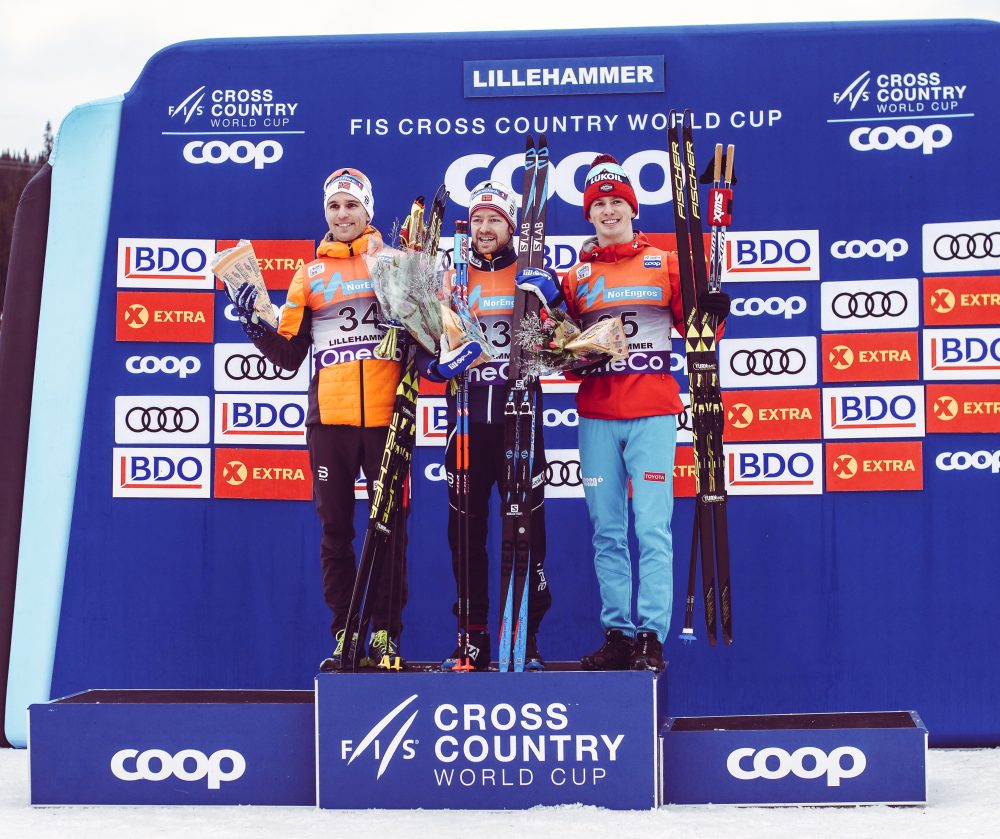
    The men’s podim from the second day of World Cup racing in Lillehammer, Norway. In the 15 k freestyle, Norway’s Sjur Røthe (center) won, teammate Didrik Tønseth (left) placed second, and Russia’s Denis Spitsov (right) was third. (Photo: Henrik Hunnes)

    Norway shined on their home course in Lillehammer, Norway with Sjur Røthe posting the fastest time of 36:3.0 minutes in the 15-kilometer individual start freestyle, followed closely by teammate Didrik Tønseth (+6.0). The Norwegians claimed six of the top-ten spots. Russia’s Denis Spitsov took the third podium position, finishing 28.6 seconds back.

    In his first distance World Cup race of the season, Switzerland’s Dario Cologna placed fourth (+38.3).

    “It feels amazing,” Røthe told the International Ski Federation (FIS) about his race. “I didn’t know that I was fighting for the victory, I just heard I was fighting with Didrik. I didn’t know it was for the victory until the last 5k. But I did everything I could and I kept a high speed the whole way, so I’m really satisfied.”

    For North America, Alex Harvey was the best finisher in 17th (+1:20.5). His fellow Canadians Andy Shields took 61st (+3:08.4), and Russell Kennedy placed 64th (+3:17.0).

    “I just had bad legs,” Harvey told FasterSkier in the mixed zone after the race. “I felt good in the warm-up, but racing I couldn’t climb.”

    When asked whether his podium finish in yesterday’s sprint may have left him fatigued today, Harvey replied, “Probably, but it felt like in the warmup and in my morning jog, I didn’t feel that fatigued. I am missing something in distance right now, it was kind of the same in Kuusamo. So hopefully a couple races will help to bring the base level a bit higher.”

    Harvey also noted that the course conditions played a role in his race day sensations. The weather and lack of natural snow added another layer of challenge. Rain and warm temperatures eroded the 5k manmade loop exposing wood chips, pebbles, and the ground below. While course officials worked to preserve the snow, they could not maintain the firm base that the course started with.

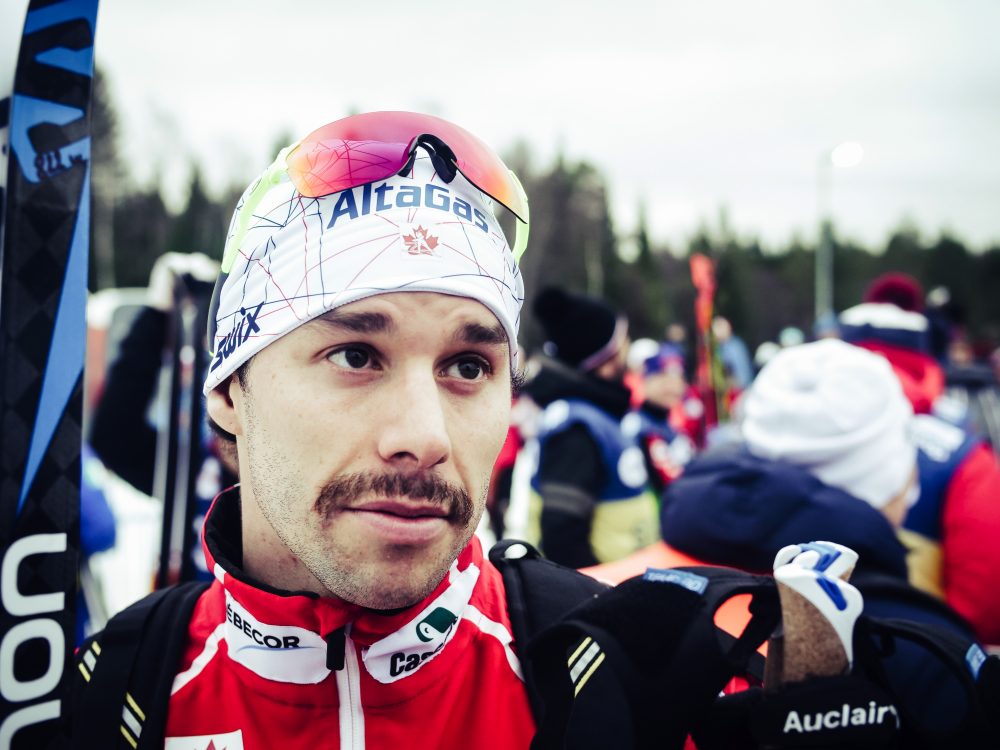
    Alex Harvey of Canada in the mixed zone after the 2018 World Cup 15 k freestyle in Lillehammer, Norway. Harvey placed 17th. (Photo: Henrik Hunnes)

    “It was really soft, the corners and everything,” said Harvey. “So it was hard to kind of rest the legs … you see on the results it was good for the lighter guys. Sjur, Didrik, and Spitsov are some of the lightest guys on the tour. So yeah, it was really sloppy skiing, for me it was really hard.”

    He added, “That corner heading into the stadium, you can see the pavement at the bottom. So somebody must have hit the pavement.”

    The Americans were well outside the points today; Erik Bjornsen of the U.S. Ski Team (USST) finished 43rd (+2:24.5).

    Bjornsen, who was disappointed with his finish, commented, “I just wanted to go out there and push as hard as I can and try not to rush things. To find a good pace and be able to keep it. But 3-4k into the race, the legs were just kind of stiffening up. I’m not really feeling the snap and the energy that I’d like to and the climbs are feeling hard. Hopefully, I can figure it out in the next couple of weeks. It would be great to score some points before Christmas.”

    David Norris (APU) in 54th (+2:44.5) was the next best U.S. skier. He was the day’s first men’s starter. Wearing bib number one can put an athlete in a lonely and frustrating position in an interval start as it means either skiing alone up front or being passed. But Norris saw it as an opportunity to ski with more experienced racers behind him.

    “It was kind of nice to ski alone for a lap and a half,” Norris reflected. Then, different than in the past, some of the guys that were passing me I was able to ski with for a while rather than just trying to catch a ride and blowing up.”

    Simi Hamilton (USST), who was the only American to qualify for the sprint heats yesterday, took his race in stride after placing 56th (+2:59.4). “I wasn’t expecting a ton,” Hamilton said. “At certain points in the season, I think I’m capable of putting together good distance skate races, but it’s still early. I’m not reading too much into it, but I thought my pace was okay and it was good beginner racing.

    “Late November, early December, you want to be feeling good and racing fast. But, our goal for the season is racing fast in February for World Champs,” Hamilton added. “So I think any result you have this time of year you have to take with a grain of salt… I think it’s okay not to feel your best this time of year”

    The course in Lillehammer is always taxing, as it features a four-minute climb, amongst other difficult hills.

    “The course is just naturally really tough,” Hamilton shared. “You have that one decent recovery from the high point. But you’re still kind of working down that, doing some cornering. Pretty much everywhere else, you’re working the entire course. You’re either cornering, or it’s a long gradual climb, or a long steep climb, or a short steep climb.”

    While today’s results may have been lackluster, the Americans are looking ahead to the races to come.

    “I’m going to go out there and fight, but I’m not really sitting in a great position,” said Bjornsen. “I prefer the classic, so hopefully, I can just kind of move up and who knows. Tomorrow is a new day, so hopefully, I’ll be feeling good.”

    While he hopes to see continued improvement, Bjornsen’s goals lie later in the season.

    “I’m going to try to peak at World Champs,” he said. “And there are three team sprints on the schedule this year. Simi and I definitely want to, before we end our careers, get a podium together. So it’s definitely a goal … We’ve been fifth a few times and sixth, so we’re not that far off. I think on the right day it could for sure happen.”

    Hamilton is looking forward to the road ahead as well. He added, “We go to Beitostolen on Monday. I’ll probably ski a relay there which I’m really psyched about. It’s just a 7.5 k in our relays now, so that’s a good skate distance for me. At the same time, I kind of get to use the next couple of weeks to really fine tune my speed for the sprint in Davos. I’ll definitely use the next 10 days to two weeks to get in some really sprint specific workouts.”

    Kevin Bolger (USST) in a photo taken during Friday’s skate sprint qualifier in Lillehammer, Norway. (Photo: Fischer/Nordic Focus)

    The remaining American finishers were Paddy Caldwell (USST) in 67th (+3:33.1), Kevin Bolger (USST) 68th (+3:38.7), Scott Patterson (USST) 73rd (+3:52.3), and Adam Martin (CGRP) 75th (+4:05.0)

    In his first racing on the World Cup, prior to Kuusamo Martin had not contested a World Cup, Martin felt optimistic about today’s result.

    “I’m really happy just to be here on the World Cup this fall and I’m trying to learn as much as I can,” Martin said. “These are incredibly good skiers and they’re in really good shape, so it’s a good learning experience.”

    Not to be forgotten are the impressive results of Britain’s Andrew Musgrave. Norway is practically home now to Musgrave, an athlete feared on the World Cup but also at the annual gathering at the Norwegian National Championships.

    He finished the day in sixth place, 45.1 seconds behind Røthe. It’s an impressive result as any considering the deep men’s field here in Lillehammer.

    “The race today was good for me,” Musgrave emailed. “I had really good skis- the snow was pretty dirty after the warm weather we’ve been having the last few days, so most peoples skis were slowing down a lot every lap. Mine seemed to stay fast though.”
    Historically, Musgrave peaks for the big events. He was barely off the podium in the Lahti Worlds 50 k skate. He has a penchant for arriving in form to maximize the win potential.
    “I’ve been doing a lot of training the last few weeks, so haven’t been racing all that fast (my 65th place in the Norwegian Cup in Gålå last wasn’t exactly my strongest performance ever),” Musgrave explained. “It’s nice to see that I’m back to myself again now I’ve dropped my volume down again. Hopefully the extra training will pay off later in the winter though. That’s the plan anyway!”

    Men’s Results

  • World Cup Preview: #6 Switzerland

    World Cup Preview: #6 Switzerland

    The photo finish for first between Switzerland’s Dario Cologna (near) and Norway’s Martin Johnsrud Sundby at the 2018 Holmenkollen 50 k freestyle mass start in Oslo, Norway. Cologna got it by 0.01 seconds. (Photo: FIS Cross Country/Twitter)

    Welcome to FasterSkier’s World Cup Preview, where we check in with the top-10 teams from last year’s FIS Cross Country World Cup tour before the season starts with the Ruka weekend in Kuusamo, Finland, on Nov. 24 with a classic sprint.

    ***

    Switzerland

    Overall in Nations Cup Last Year: 6th

    Women’s Ranking 2017/2018: 7th

    Men’s Ranking 2017/2018: 4th

    However lopsided Switzerland World Cup profile appears – think Dario Cologna prime time all the time – the team is more than a set of shoulders to carry its star. Certainly, Cologna can steal the show, as his return to form last season proved, but the Swiss collective of athletes proved their World Cup mettle in 2017/2018.

    Twenty-five-year-old Nathalie Von Siebenthal arrived on the World Cup in-form. In Ruka, the start of last year’s World Cup, she placed sixth in the 10-kilometer freestyle pursuit. Between Ruka and the Olympics, Siebenthal raced to numerous top-10’s in distance events while placing eighth overall in the Tour de Ski (TdS).

    Switzerland’s Nathalie von Siebenthal racing the second-fastest third leg of the women’s 4 x 5 k relay at 2017 World Championships on March 2 in Lahti, Finland. Her team finished seventh.

    In PyeongChang, Siebenthal was able to bring the Swiss team near the front of the women’s distance race pack. In the 15 k skiathlon, Siebenthal placed sixth overall, 2.9 seconds behind fifth place Jessie Diggins (USST) who was dialed for a stellar Games. In the individual start 10 k skate, Siebenthal again was sixth.

    Nadine Fähndrich, at twenty three years old, should help the Swiss women’s team build upon last year’s solid performance. By season’s end, Fähndrich was ranked 21st on the sprint list and 31st on the distance list. She finished 27th overall on the World Cup.

    The Swiss women’s team gets deeper. There’s veteran skier Laurien van der Graaf who had several top-10’s on the World Cup and Olympics. She won the Lenzerheide, Switzerland and Seefeld, Austria skate sprints, was the fifth ranked sprinter in the world last season, and 21st overall.

    Then there is Cologna. Prior to the start of the 2018 TdS, it had been three years since Cologna had podiumed on the Word Cup. Cologna remained sanguine during the win-drought. His charge during and after the TdS, which he won, were career resurrecting. Olympic cycles are what they are. For a champion like Cologna, if you can peak once in the past four years, it’s mission accomplished. Cologna won the 15 k skate in PyeongChang making it three Olympic 15 k wins in a row. He capped an unexpectedly successful season win a 50 k skate win at Holmenkollen — by a smidge of time over Norway’s Martin Johnsrud Sundby.

    Cologna is back: Second in the final overall standings, first in distance. Let’s just say he’ll round out an already well-rounded Swiss team.

    Jovian Hediger, at twenty-seven, will take some of the pressure off Cologna when it comes to the Swiss men’s expectations. He finished the season ranked 19th in the sprint cup.


  • Big Results for Geraghty-Moats, Harvey at Summer GP, Toppidrettsveka

    Big Results for Geraghty-Moats, Harvey at Summer GP, Toppidrettsveka

    Tara Geraghty-Moats winning Sunday’s normal hill/5 k Gundersen at the 2018 Women’s Nordic Combined Summer Grand Prix in Oberwiesenthal, Germany. (Photo: Romina Eggert/FIS)

    Two North Americans posted impressive results at nordic events in Germany and Norway over the last week, with Vermont native Tara Geraghty-Moats racing to first overall in the first-ever Women’s Nordic Combined Summer Grand Prix and Quebec’s Alex Harvey placing second, fifth and 10th in three races at the Toppidrettsveka rollerski series.

    Geraghty-Moats 1st and 2nd at Inaugural Women’s NoCo Grand Prix

    Brand new to nordic combined as well as the jump hill in Oberwiesenthal, Germany, Geraghty-Moats took the inaugural women’s Nordic Combined Summer Grand Prix by storm this past weekend, placing first and second in two competitions. That tied her for first place in the overall Grand Prix standings, alongside Russia’s Stefaniya Nadymova — the defending champion of last winter’s inaugural women’s Nordic Combined Continental Cup.

    On Sunday, Geraghty-Moats, 25, of USA Nordic and the New York Ski Education Foundation (NYSEF), handily beat Nadymova and the rest of the 10-woman field after starting the 5-kilometer Gundersen rollerski race in second, four seconds behind Germany’s Jenny Nowak. While Nowak had posted the best jump of 96 meters on Oberwiesenthal’s 106-meter “normal” hill, Geraghty-Moats tied for the second-best-scoring jump (94.5 meters), with Austria’s Lisa Hirner (95 meters). From there, Geraghty-Moats dropped Hirner, Nadymova and Nowak on the first of three laps in the rollerski race and went on to finish in 11:04.8. Nowak ultimately placed third, 1:29.2 behind Geraghty-Moats.

    ortho tri-cyclen, buy clomid online

    “I was really satisfied by how my first weekend of being a nordic combined-er went, and I think the patience of waiting to be a nordic combined-er really paid off,” Geraghty-Moats told the International Ski Federation (FIS) after. “I struggled with the jump a little bit the first couple days. I had never jumped this hill before, and I sort of figured it out today so I got to ski a little bit easier than yesterday, but I was also happy that yesterday I was able to have a good fight and ski fast to my potential and end up on the podium.”

    The women’s individual normal hill/5 k Gundersen podium on Saturday at the 2018 Women’s Nordic Combined Summer Grand Prix, with Russia’s Russia’s Stefaniya Nadymova (c) in first, American Tara Geraghty-Moats (r) in second, and Germany’s Jenny Nowak (l) in third in Oberwiesenthal, Germany. (Photo: FIS/Silke Tegethof)

    On Saturday, the American (who started as a ski jumper, then raced cross-country before taking up biathlon, and finally returned to jumping) placed second to Nadymova, who won the individual 5 k Gundersen in 12:21.4. Geraghty-Moats finished just 3 seconds back after starting the race in fourth, 1:13 minutes behind Nadymova in first. Nowak placed third in that race as well, 50.3 seconds back.

    “It was a dream come true to finally be able to compete in women’s Nordic Combined on an international level,” Geraghty-Moats told FIS on Saturday. “I’m using this weekend to learn the level I have to be at to have success in Nordic Combined. I made some mistakes today and learned a lot but I came away with a good result and having had a huge amount of fun competing with small but strong field.”

    Eleven women competed in Saturday’s normal hill/5 k.

    Results:

    Day 1 (ski jumping | final) 

    Day 2 (ski jumping | final)

    Overall Grand Prix

    Harvey on Toppidrettsveka Podium

    Alex Harvey (l) on the podium with Roman Furger (c) and Simen Hegstad Krüger (r) at the 2018 Toppidrettsveka rollerski festival in Norway last Thursday, Aug. 16. (Photo: Alex Harvey/Instagram)

    At the Toppidrettsveka rollerski festival in Norway, Canada’s Alex Harvey raced to second in the 15 k skiathlon last Thursday in Orkdal, missing out on first by just 0.6 seconds to Switzerland’s Roman Furger, who won in 30:43.3. Norway’s Simen Hegstad Krüger, the reigning Olympic skiathlon champion, finished third, 1.5 seconds back. In a stacked international field of 125 men, Canada’s Evan Palmer-Charrette placed 75th in that race (+2:14.4), Bob Thompson was 84th (+2:32.7), and Scott Hill 89th (+2:52.5).

    Canada’s Alex Harvey (2) gunning for first in the men’s 15 k skiathlon on Aug. 16 at the Toppidrettsveka rollerski festival in Orkdal, Norway. (Screenshot: NRK broadcast)

    Heidi Weng beat her cousin Tiril Udnes Weng by 0.7 seconds in the women’s 10 k skiathlon that day, finishing in 22:52.1. Norway swept the top five of the women’s race, with Anne Kjersti Kalvå reaching the podium in third (+1.3), and national-team members Kathrine Harsem and Astrid Uhrenholdt Jacobsen placing fourth (+1.4) and fifth (+1.5), respectively, out of 43 women.

    In the men’s 24 k classic mass start around Aure/Brekka on Friday, Harvey finished fifth, 19 seconds after Krüger, who won in 59:57.5. Norway’s Hans Christer Holund placed second in that race (+2.6), Norway’s Magnus Stensås was third (+13.0), and Switzerland’s Dario Cologna fourth (+17.1). Also for Canada, Palmer-Charrette finished 61sth (+2:30.9), Hill 78th (+4:02.3), Thompson 86th (+5:40.3), and Maks Zechel 88th (+7:01.4) out of 125.

    Heidi Weng repeated in first in the women’s 24 k mass start, finishing in 1:10:02.4 hours, while Tiril Udnes Weng again placed second, 25.4 seconds back, and Jacobsen reached the podium in third (+27.7).

    Later on Friday in Aure, Norway’s Sondre Turvoll Fossli topped the men’s freestyle sprint final ahead of four other Norwegians, including Pål Trøan Aune in second and Jan Thomas Jenssen in third, and Switzerland’s Furger in fifth, while Harvey did not qualify for the heats and ended up 37th overall. Palmer-Charrette was once again 61st in qualification, Hill 107th and Thompson 109th out of 121.

    In the women’s sprint, Norway’s Mathilde Myhrvold won the final in 2:56.54, 1.05 seconds ahead of Slovenia’s Katja Visnar in second. Heidi Weng placed third in the final (+1.97), ahead of Tiril Weng (+2.64) in fourth, another Norwegian Anna Svendsen in fifth (+2.76), and another Slovenian Alenka Cebasek in sixth (+3.73). 

    In the final race of the series, the classic pursuit on Saturday, Harvey started second, 10 seconds behind Furger in first. The Canadian went on to place 10th, 4.2 seconds out of first, in the 15 k race, while Stensås took the win in 37:45.5 after starting seventh. (Furger slipped to 55th and 1:55.5 behind at the finish.) Norway’s Mikael Gunnulfsen rose from eighth to second (+0.7) and France’s Jean-Marc Gaillard made it all the way up to third (+1.7) after starting 15th. 

    Palmer-Charrette finished the pursuit in 59th (+2:04.2), Thompson placed 80th (+2:55.2), Hill 87th (+3:41.5), and Zechel 93rd (+3:48.9) out of 105. 

    Jacobsen ended the weekend as the women’s 12 k mass start winner, after the entire women’s field (of 33) started at the same time. She crossed the line first in 34:20.8, 0.4 seconds ahead of Heidi Weng in second and 1.2 seconds ahead of Kalvaa in third. 

    Results:

    Men’s skiathlon | Women’s skiathlon

    Men’s mass start | Women’s mass start

    Men’s sprint | Women’s sprint

    Men’s pursuit | Women’s mass start

  • New Year’s Here: First Week of May Training Pics

    New Year’s Here: First Week of May Training Pics

    While we covered who’s still skiing — casually, recreationally, backcountry, basically anything other than full-on training — last week, the start of May marks the beginning of a new season for year-round skiers. And with the first few days of May have come some training pics via social media. Here’s a roundup of some that caught our eye on Instagram:

    Alex Harvey:

    Alex Harvey hitting the weights hard: “May 1st ⏩ Back in training!💪”

    Megan Tandy:

    Another determined Canadian athlete in the gym: biathlete Megan Tandy at her training base in Klingenthal, Germany.

    Emily Dreissigacker:

    Newly minted US Biathlon High-Performance Team member Emily Dreissigacker skied up Stowe Mountain in Vermont on May 2.

    Emma Lunder:

    Meanwhile near Canmore, Alberta, Canadian biathlete Emma Lunder broke a pole while crust skiing at Burstall Pass.

    Scott Patterson:

    Looks like Alaska Pacific University skier and U.S. Ski Team member Scott Patterson is ready to go the distance, specifically 100 miles in May.

    Sadie Bjornsen:

    Scott Patterson isn’t the only one with a 100-mile goal for this month. His APU and U.S. Ski Team teammate Sadie Bjornsen is right there with him, getting out on snow in Anchorage, Alaska.

    Erik Bjornsen:

    Speaking of the Bjornsens, Erik (c) got some ski-specific training in yesterday as a substitute coach for the Anchorage Biathlon Club at Kincaid Park in Anchorage.

    Johannes Høsflot Klæbo and Eirik Brandsdal:

    Norway’s Johannes Høsflot Klæbo (c) and Eirik Brandsdal (l) were still racing (and reaching the podium) last weekend at Bysprinten in Mosjøen, Norway.

    Krista Pärmäkoski:

    Finland’s Krista Pärmäkoski was all smiles while listening to some tunes during a recent dryland workout. She wrote about the start of the new season and being well-rested and focused on her World Cup goals. “There is work and a lot, but that’s what this is about.”

    Dario Cologna:

    Swiss superstar Dario Cologna is “back to work,” according to one hashtag in this May 2 post, where he’s seen skiing on the Engstligenalp plateau in the Swiss Alps. “Let‘s start the new season,” he wrote.

    Laurien van der Graaff:

    Another Swiss skier Laurien van def Graaff (bottom and top right) is back at it in Sjusjøen, Norway.

    Charlotte Kalla:

    Sweden’s Charlotte Kalla (second from right) hasn’t wasted any time getting back on snow as evidenced by this photo she took with her Piteå Elit Ski Club teammates on Sunday in Finland’s Southern Lapland region.

    Therese Johaug:

    Looks like Therese Johaug has been logging some cold-water surf sessions on the Lofoten archipelago in northern Norway, as well as some fishing.

    Martin Fourcade:

    France’s defending IBU World Cup champ Martin Fourcade has been cross-training and logging some long-lost time in the saddle.

    Franziska Preuss:

    German biathlete Franziska Preuß (or Preuss) documented her “First mountain run of the new year” in Ruhpolding, Germany. And look, she’s higher than the mountains.

    Leif Nordgren:


    U.S. biathlete Leif Nordgren went road biking with his wife, Caitlin Napoleoni, whom he married in December.

    Niklas Dyrhaug, Richard Jouve and Robin Duvillard:

    Meanwhile athletes like Norway’s Niklas Dyrhaug (l) and France’s Richard Jouve (c) and Robin Duvillard are on the road to recovery, according to this FIS Cross Country post.
  • FasterSkier’s International Skiers of the Year: Charlotte Kalla and Johannes Høsflot Klæbo

    FasterSkier’s International Skiers of the Year: Charlotte Kalla and Johannes Høsflot Klæbo

    Norway’s Johannes Høsflot Klæbo (l) and Sweden’s Charlotte Kalla (r) are FasterSkier’s 2018 International Skiers of the Year. (Photos: Fischer/NordicFocus)

    With the 2017/2018 season officially in the rearview, FasterSkier is excited to unveil its annual award winners for this past winter. Votes stem from the FS staff, scattered across the U.S., Canada, and Europe, and while not scientific, they are intended to reflect a broader sense of the season in review. This set of honors goes to the international skiers of the year.

    Previous categories: Junior Skiers of the Year | Collegiate Skiers of the Year | Biathletes of the Year| Para-Nordic Skiers of the Year | NoCo Skier of the Year | Canadian Breakthrough Skiers of the Year | American Breakthrough Skiers of the Year| Coach of the Year | U.S. Continental Skiers of the Year| Canadian Continental Skiers of the Year| International Performances of the Year

    ***

    Charlotte Kalla 

    In her results and her consummate focus on honing in on championship-performance skiing, Sweden’s 30-year-old Charlotte Kalla is a master of showing up when it counts and a maestro of peaking.

    In this Olympic year, Kalla only contested 12 World Cup events. She skipped the Tour de Ski (TdS) for a pre-Olympic altitude camp (as did several other top skiers), yet she was on everyone’s radar in the buildup to the Games.

    One can imagine Kalla and her coach Magnus Ingesson — now a Swedish national team coach — mapping out the season with scalpel-like precision. She came to the opening weekend in Kuusamo, Finland, ready for Level 5 racing. She won the mini-tour title there after placing second in the 10 k classic and winning the 10 k freestyle pursuit on back-to-back days.

    A week later, in Lillehammer, Norway, Kalla won the 15 k skiathlon, proving she can kill in skate technique, but her classic skiing is also world-class. The Swede won again on Dec. 16 in Toblach, Italy, in the 10 k skate. (The next day, Kalla placed sixth in Toblach’s classic pursuit.)

    Sweden’s Charlotte Kalla winning gold in the first race of the 2018 Winter Olympics in PyeongChang, South Korea, the women’s 15 k skiathlon, ahead of Norway’s Marit Bjørgen (behind, in red) and Finland’s Krista Parmakoski, respectively. (Photo: FlyingPointRoad)

    As far as fitness during Period 1, that was affirmed. While skipping the TdS, Kalla began her Olympic buildup. She didn’t race again on the World Cup until Jan. 21 in Planica, Slovenia. There, she placed second in the 10 k classic.

    Kalla contested eight World Cups before the Olympics and won four. Her Planica podium proved she hadn’t relented any of her top racing gears between mid-December and the end of January.

    Kalla has historically been an athlete able to prime for the big events. She’s won a total of 12 World Championship medals. Between the Vancouver and Sochi Olympics, Kalla had captured two gold and two silver medals.

    In the opening race at this year’s PyeongChang Olympics, Kalla won the 15 k skiathlon. She then racked up three silver medals in the 10 k freestyle, 4 x 5 k relay and freestyle team sprint. Her eight Olympic medals make her Sweden’s most decorated cross-country skier. She is also the first Swedish women to have won three Olympic golds. (Gunde Svan won six Olympic medals: four gold, one silver and one bronze.)

    Kalla’s limited World Cup schedule put her sixth in the 2017/2018 Distance World Cup standings and seventh in the Overall World Cup.

    Johannes Høsflot Klæbo 

    The man in pink — pink poles, pink glasses, pink gloves — 21-year-old Norwegian Johannes Høsflot Klæbo earned 168,449 Swiss Francs on the World Cup. That’s nearly $175,000 U.S. dollars. All those World Cup winnings mean one thing: it was the year of Klæbo.

    Combined, Klæbo had 14 World Cup podiums (including stage races) this year. He had a single third place, two second places, and a whopping 11 first places. There’s more to this than simply the ka-ching of his bank account.

    Norway’s Johannes Høsflot Klæbo celebrates his team-sprint win with Martin Johnsrud Sundby (not shown), while Alexander Bolshunov of the Olympic Athletes from Russia (l) pushes for silver at the 2018 Olympics in PyeongChang, South Korea. It was his third-straight gold of the week. (Photo: FlyingPointRoad)

    It’s not as if Klæbo has been seasoned with age, learned to temper his efforts for the long-haul effort of a total World Cup campaign. His race efforts were a full-body immersion starting on Nov. 24 in Kuusamo, Finland. There, he swept the three-race Ruka Triple. He won the next three races: two in Lillehammer and one in Davos, Switzerland.

    Klæbo’s win in the Lillehammer 30 kilometer skiathlon was striking. He looked gassed as he was dropped by teammate Martin Johnsrud Sundby on the courses last significant climb. Klæbo never bowed to Sundby. He kept his losses in check, regrouped, and through his last-kilometer catch-up effort, put Sundby on warning. Klæbo won. Sundby placed second.

    In his last race before skipping the Tour de Ski for a training block, he won the 15 k classic pursuit in Toblach. That proved to be his last distance win in a World Cup or Olympic race this season.

    When considering Klæbo’s sprint season, his efforts were nearly a clean sweep. He entered nine World Cup sprints. He won seven and placed second and third in his other World Cup sprint starts. That all amounted to him winning his second-consecutive Sprint World Cup Crystal Globe.

    His cumulative performances this season also brought him his first Overall World Cup Crystal Globe. In doing so, he also became the youngest Overall World Cup champion since Gunde Svan came out on top of the 1983/1984 World Cup season. Svan was 22 at the time.

    Certainly Klæbo will have to dust his Crystal Globes and we’re assuming more will come his way. He’ll also have to spend considerable time in the offseason posing for Olympic medal shots with sponsors and supporters.

    Klæbo flew back to Norway after the Olympics with three gold medals. He won the classic sprint, freestyle team sprint and 4 x 10 k relay. His sprint win made him the youngest cross-country Olympic champion in  in the history of the Winter Games.

    All the metrics on winning and podiums doesn’t speak to how Klæbo has made us talk about the sport. His name is a verb: “to Klæbo” — as in, run-stride or simply run-run when it comes to classic technique on the steeps. Klæbo may kill it in pink, but his non-traditional classic skiing gears are in fact something that may be his real legacy.  

    The upside to all of Klæbo’s winning when considering his opponents, is that eventually he’ll age and slow down. That slow-drip decay might take a decade. Ten years is a long time for neon-pink to remain in fashion. Klæbo’s race performances this year were peerless. The pink, it was omnipresent on the podium, and most likely will be trending for years to come.

    Honorable Mention: Dario Cologna 

    Wait. Who? Yeah. Thirty-one-year-old Swiss skier Dario Cologna. He was the comeback kid this season. To come back, in the first place, you must have been somewhere before. Cologna, in the past, has seen his fair share of podiums and championship medals. He was the first three-time winner of the Tour de Ski, and he’d won the Overall World Cup title three times.

    Switzerland’s Dario Cologna making it two wins in a row after a three-year World Cup victory drought. Cologna won Stage 3 men’s 15 k freestyle pursuit at the 2018 Tour de Ski in Lenzerheide, Switzerland.(Photo: Fischer/NordicFocus)

    Recently, Cologna has battled injuries and more fit skiers seeking their own opportunities on the international stage.

    After beginning the season in Kuusamo with a 37th, a 29th, and a 17th overall placing in the three-race mini tour, it seemed certain this year wouldn’t see a rejuvenated Cologna. That reading of the tea leaves was wrong. He went on to win a fourth TdS this season. He first turned heads by winning the TdS second stage 15 k classic. It was the Swiss star’s first World Cup win in three years.

    It was an Olympic year. And Cologna’s TdS win put him on the PyeongChang radar.

    “Of course that I am back, that I can beat everyone,” Cologna said of his form after his TdS overall win. “That surely is a good sign for myself, that everything is all right, and now it’s about preserving and showing this form at the Olympics.”

    Prior to PyeongChang, Cologna had won gold in the Vancouver 15 k skate, and gold in Sochi’s 30 k skiathlon and 15 k classic. He went on to stamp his name among the sport’s best by winning the PyeongChang 15 k skate. He becomes the first Olympic cross-country skier to win three golds in the 15 k event.

    Cologna has been around. But this season he came around again — asserting his relevance and legacy.

    Honorable Mention: Jessie Diggins 

    By the end of the World Cup season, Jessie Diggins, 26, of the U.S. Ski Team ranked second in the overall standings. Norway’s Heidi Weng won the Overall World Cup with 1476 points, and Diggins slotted in just behind with 1436 points. Reviewing the entirety of the season, Weng and Diggins went head-to-head in every World Cup race, including the TdS, except for two races in Lahti, Finland.

    The Lahti races were held the weekend after the PyeongChang Olympics. Weng scored a 26th and fifth place, good enough for 50 World Cup points on the weekend. Diggins lost the overall by a margin of 40 points. Maybe, just maybe, had Diggins raced in Lahti, we’d be talking about Diggins winning the Overall Crystal Globe.

    American Jessie Diggins (4) leads Norwegians Heidi Weng and Ragnhild Haga in the finishing stretch of the women’s 10 k freestyle mass start at the World Cup in Seefeld, Austria. (Photo: Salomon/NordicFocus)

    But she missed those races for good reason. Diggins and her teammate Kikkan Randall were in high demand for media appearances in New York City. For nearly a week, the U.S. gold-medal duo ran the talk-show gauntlet and made well-deserved sponsorship appearances. They, too, were spreading the message that U.S. cross-country skiing was well worth the nation’s interest beyond the two-week Winter Olympic bubble.

    But let’s get back to the World Cup. A thorough reading of the season’s results shows Weng came into the season hot. Her top-notch performances were sustained through the TdS, which she won. Although the overall World Cup winner, Weng failed to medal at the Olympics and faded hard after her fifth place in the Lahti skate sprint.

    Diggins, on the other hand, was a bit more mellow — from her own podium-expectation standards —  at the season’s start. She earned her first World Cup podium, a third place, in her 12th start this past season.

    Something must have clicked from there. The rest of Diggins’s season was a tear on the sharp end. Diggins went on to place third overall in the TdS. She won the 10 k mass start skate in Seefeld, Austria, on Jan. 28, right before the Olympics.

    In PyeongChang, Diggins simply set the U.S. bar for consistent skiing at an insane level. She raced every  Olympic cross-country event — an exhausting schedule by any measure. She placed fifth three times, sixth once, and seventh once. And of course, there was that gold medal with teammate Randall in the team sprint. Those levels of show-up-and-ski performances are astounding.

    It’s even more remarkable when considering she was less than three seconds out of bronze in the 15 k skiathlon — she placed fifth. She was also less than four seconds out of bronze in the 10 k skate — she again placed fifth behind Marit Bjørgen of Norway and Krista Pärmäkoski of Finland. Those two skiers tied for third place.

    Post-PyeongChang, there was, for good reason, that missed Lahti weekend. Back on the World Cup grind, Diggins raced the final five races and missed the podium just twice. Her three podiums after the Olympics were a third place in the Drammen classic sprint, second in the Holmenkollen 30 k classic, and second in the Falun World Cup Finals 10 k skate pursuit. She also skied the fastest time of day in the Falun pursuit to clinch second place in the World Cup Finals mini tour.

    Clearly, Diggins was on a roll during and after the TdS. So it’s not so far-fetched in our mid-April quarterbacking to think Diggins could have nailed those two Lahti races and won the overall. Again, Weng and Diggins were on two opposite trajectories heading into and out of PyeongChang.

    Absolutely a historic season for Diggins.

  • Bolshunov Breaks Through in Falun; Harvey Second in Pursuit

    Bolshunov Breaks Through in Falun; Harvey Second in Pursuit

    The men’s 15 k freestyle and 2018 World Cup Finals podium, with Russia’s Alexander Bolshunov (c) in first, Canada’s Alex Harvey (l) in second and Switzerland’s Dario Cologna (r) in third. (Photo: Svenska Skidspelen/Instagram)

    It is a wrap.

    The 2017/2018 World Cup season concluded Sunday in Falun, Sweden with the men’s 15-kilometer freestyle pursuit. The World Cup Finals featured a three-race mini tour with a skate sprint, 15 k class mass start and Sunday’s pursuit.

    Russia’s Alexander Bolshunov, a spry 21 year old, began the pursuit with a 38-second lead over second starter, Johannes Høsflot Klæbo of Norway. Emboldened with confidence after winning his first-career World Cup on Saturday, Bolshunov set off on another sunny Sweden day in cruise control. His initial efforts looked smooth and powerful yet lacked the apparent stress of being chased by the likes of Norwegians Martin Johnsrud Sundby and Klæbo, Swiss skier Dario Cologna, and Swede Calle Halfvarsson.

    In fact, for a little more than the first kilometer, his closest chase group resembled a nonchalant pack, as if they’d already agreed to let Bolshunov go. With Halfvarsson looking comfortable in front, and Bolshunov’s lead expanding, Sundby came around a little over three minutes into the race and began the hard work of actually preventing the second chase group, which included Canada’s Alex Harvey, from latching on. (Harvey started 18th, 1:16 minutes behind Bolshunov.)

    The story up front, Bolshunov’s insurmountable lead, was dramaless. The emergent Russian’s time gaps spoke of hard bursts of speed and a settling chase group’s concern with a second and third place. Bolshunov led by 52.3 seconds at 5.2 k and 1:23.6 minutes at 11.25 k.

    Bolshunov enjoyed a solo ski into the finish to win the day in 35:03.3 minutes for his second World Cup win and his first mini-tour victory. Along with his win, Bolshunov ends the season fifth overall in the World Cup standings.

    “After trying all season for a win and getting it yesterday, I had a lot of confidence today and I felt strong,” Bolshunov told the International Ski Federation (FIS), according to a press release. “It’s great to win like this at the end of the season. It leaves me with positive feelings heading into the training season.”

    The story behind Bolshunov unfolded with more complexity. The 5.2 k checkpoint was the last mark for a seven-skier chase group to stay away from skiers looking to link up from behind. As much as Swedes Halfvarsson and Oskar Svensson, Cologna, Sundby, Italians Francesco De Fabiani and Federico Pellegrino, and Klæbo (who looked gassed) tried in earnest to stay away, a near-constant throttling pace from Harvey brought the lead chase group within sight.

    By 7.5 k, the first and second chase groups had merged, ballooning to a sixteen-skier pack. With half the race to go and Bolshunov uncatchable, several racers would test themselves, and the group, as they attempted to split the chasing posse. Sundby gave it a go. Cologna gave a try. Norway’s Hans Christer Holund looked fresh and strong upping the pace. But none could separate themselves or splinter the pack.

    Switzerland’s Dario Cologna (9) leads Canada’s Alex Harvey (18) during the men’s 15 k freestyle pursuit at 2018 World Cup Finals in Falun, Sweden. Harvey went on to place second and Cologna third. (Photo: Fischer/NordicFocus)

    Harvey was omnipresent — smooth on the climbs, unnerved by any attacks. On the last grind up the infamous Mördarbakken, Harvey pushed over the top to lead a six-skier group that included Cologna and Sundby.

    Two minutes out, Cologna gave a burst of hop-skate in a failed break away attempt. Cologna’s effort, however, did stymie the followers enough to allow he and Harvey to accelerate over the top. It came down to the finishing straight to settle the 15 k pursuit score.

    Harvey bested the others to place second (+47.1) and skied the fastest time of day in 34:34.3 minutes. Cologna followed just behind in third (+47.5), and Sundby placed fourth (+48.7).

    Sunday’s result matches Harvey’s best 2017/2018 result and was his fourth podium of the season. He placed third in the sixth stage of the Tour de Ski (TdS), third overall in the TdS, and was second in the 15 k freestyle mass start in Seefeld, Austria.

    “I like these end-of-season tours,” Harvey told FIS. “On the podium now two seasons in a row at World Cup Finals. They are hard though and I am tired. It took some effort to get up to the leaders but I still felt strong and knew I needed to go for it coming into the final kilometer.”

    With the conclusion of the season, Harvey ended up fourth in the World Cup standings with 1179 points. The Canadian was 82 points behind Sundby in third overall, after Sundby amassed 1261 points.

    The men’s 2017/2018 Overall World Cup podium, with Norway’s Johannes Høsflot Klæbo (c) in first, Switzerland’s Dario Cologna (l) in second, and Norway’s Martin Johnsrud Sundby (r) in third. (Photo: Fischer/NordicFocus)

    Although Sunday’s Falun finale was a fade for Klæbo — he placed 25th in the pursuit (+1:45.8) — the season belonged to the 21-year-old Norwegian. He had already clinched his second-consecutive Sprint World Cup Crystal Globe several weeks ago. In Falun on Sunday, Klæbo earned his first Overall World Cup title after winning 11 individual World Cup races this season. He is the sixth Norwegian to win the overall Crystal Globe. He also becomes the youngest overall winner; Sweden’s Gunde Svan was 22 when he won the 1983/1984 season overall.

    Cologna placed second in the Overall World Cup with 1290 points and won the Distance World Cup with 698 points (41 points over Sundby in second) and appeared satisfied after the race.

    “I think it’s fun to win races,” Cologna said in a translated interview with Swiss broadcaster SRF. “Those are very nice emotions, which I was allowed to experience again this winter. Now I’m surely a bit tired and it’s natural to have a little break, a little holiday.”

    It has been a revival year for Cologna: he won the TdS and a gold medal in the Olympic 15 k skate along with several other hallmark victories. On Sunday he was awarded the Distance Crystal Globe, his fourth Distance World Cup title — a new record. (Sundby has won three distance globes.)

    “You could say it has been perfect with an Olympic victory, the Tour de Ski and now the small crystal globe,” Cologne reflected to SRF. “Also the win at Holmenkollen [50 k] was a very important and beautiful success. So after two years that have not been so easy to come back from and [when] the big successes were missing and then a couple of races I had to miss myself that was really… If someone had told me that before this season I would instantly have taken/accepted that. And until the end, I was in the fight for the Overall World Cup even if it had already been pretty much decided. But if someone had told me in December that it would be open until the end I wouldn’t have believed it. So it was a great season.

    Switzerland’s Dario Cologna with his 2017/2018 Distance World Cup Crystal Globe. (Photo: Fischer/NordicFocus)

    Yet the 32-year-old skier, despite solidifying his already storied legacy, told SRF he has no clear intention of retiring. 

    “The motivation is still there,” Cologna added. “I’ll have to see, next year is Seefeld and that’s almost a World Championship at home for us. That’s three hours from my home. So for that surely the motivation is there to be ready and fight for the medals.”

    In the Distance World Cup, Norway’s Holund claimed third with 599 points, just 5 points ahead of Harvey in fourth. France’s Maurice Manificat had been third in the distance standings heading into Sunday, but finished the pursuit in 26th (+2:11.9) and dropped to fifth in the final rankings behind Holund (who moved up from fourth) and Harvey (who moved up from fifth).

    Kershaw in the Points Again; Bjornsen with 22nd-Fastest Time

    In the pursuit itself, Devon Kershaw was the next-best Canadian outside of Harvey’s podium as he finished in 28th place (+2:21.9).

    “I felt pretty good again,” Kershaw said. “I’m not quite strong enough at the start there, so I wasn’t quite strong enough to get back to the group, which is too bad, because they were going slow for a while. But, no, I am satisfied. I mean, another race in the points, so it’s not a bad way to end the season. I was consistent.”

    Canada’s Devon Kershaw racing to 74th in the freestyle-sprint qualifier at 2018 World Cup Finals in Falun, Sweden. He went on to finish the mini tour in 28th. (Photo: Fischer/Nordic Focus)

    Kershaw still has yet to commit to another World Cup season, but he concludes the year with five consecutive top-30 finishes in distance races. Kershaw also noted he had been a consistent top-30 classic skier.

    “I think every classic race except one that I competed in, distance, I was in the points,” Kershaw, 35, said. “I feel proud of that. And since the Olympic 50 k, I’ve been in the top 30 every race I did, so, that’s five or six races now, and it’s just consistent. But again, just lacking that last little bit. But the highlight I think was Alex coming second today from bib 18 so that was phenomenal.”

    Also for Canada and in his final career World Cup start, Graeme Killick placed 56th (+4:33). Julian Locke did not start.

    For the Americans, Erik Bjornsen moved up from 51st to place 38th (+3:10.4) and skied the 22nd-fastest time of day. Simi Hamilton was 49th (+4:07.8), Scott Patterson 58th (+4:41.5), Patrick Caldwell 59th (+4:41.6), Kevin Bolger 60th (+4:43.5), and David Norris 64th (+5:09.8).

    “After yesterday, I was not hoping for much in the final. It was over for results for the Tour,” Bjornsen told FasterSkier on Sunday. “But I went out there it is sunny out it is a good day, so I was just trying to finish off the season with a hard push knowing that the result wasn’t going to be what I was hoping for. But still I just saw the time of day, and 22nd on time of day is a good one. I will see more points for the end of the season.”

    Those points bumped Bjornsen into 38th in Distance World Cup list.

    “I think it was a step in the right direction,” Bjornsen added. “I still need a few more steps like that before I can fight for podiums.

    Bjornsen has made gains this year. And given a moment on Sunday to reflect on his progress, the 26-year-old U.S. Ski Team member recalled several notable examples of his World Cup progression.  

    “Finishing in the top 30 in most of the races, the majority of them, that was great,” Bjornsen said of his 2017/2018 season. “It makes it feel like you are more in the fight and it is a lot more fun to racing in the top 30. The top 10, I was really excited about that in Seefeld. And qualifying for, I think, five heats this year — all in all pretty happy with it. Still, it has always been my goal to stand on the podium some day. I still think I have a few more steps to get there if I can keep on improving like this last year, maybe there is still a chance.”

    The PyeongChang Olympics were a ‘wow’ moment for Patterson. During Saturday’s mass start, Patterson was initially caught in an early race crash and then lost and retrieved a ski. Not the race the upstart skier had hoped for, but not spirit-breaking.

    “Better than yesterday — got my skis on today,” Patterson joked after Sunday’s pursuit.  

    The mishaps from yesterday and Patterson’s ability to put them in context underscore his strong finish to his first full-time World Cup campaign. (Patterson did not contest the TdS as he returned stateside to compete in U.S. nationals.)

    “I improved through the season,” Patterson, 26, said of his improved results starting in PyeongChang, where  he placed 21st or better in three individual races, including 11th in the 50 k freestyle. “Obviously, Period 1 I didn’t score any points. I was a bit disappointed with that, but I could’ve. I came close a couple times, but I think I regrouped pretty well through nationals. Got sick there, but kind of cleared something out that I had from Period 1, a bit of bronchitis.

    “Going into the Olympics, I didn’t really know how I was going to do,” he continued. “I had … first points of the season right before that. So, I think I was on a nice upswing. I had a great Olympics. I mean, could’ve asked for a medal, but I did a lot better than I was expecting, really. And then Holmenkollen was great, too. I feel like right now I’m kind of in 50 k shape instead of 15, but overall I think it was a great season, and got some things to work on for next year, and look forward to coming back and solidly being in the points every race I can.”

    Results:

    Pursuit | Time of day 

    Final Overall World Cup rankings | Finals Distance World Cup rankings

  • Sunday Rundown: Diggins and Harvey 2nd, Bjornsen 3rd in Falun Pursuit; Dunklee 3rd in Oslo (Updated)

    Sunday Rundown: Diggins and Harvey 2nd, Bjornsen 3rd in Falun Pursuit; Dunklee 3rd in Oslo (Updated)

    Norway’s Marit Bjørgen celebrates her overall win in the last race of 2018 World Cup Finals, the 10 k freestyle pursuit, on Sunday in Falun, Sweden. (Photo: Svenska Skidspelen/Instagram)

    FIS Cross Country World Cup Finals (Falun, Sweden): 10/15 k freestyle pursuits

    Men’s report

    In the last women’s race of the World Cup season, U.S. Ski Team members Jessie Diggins and Sadie Bjornsen made it one they’ll remember for a long, long time as Diggins raced to second in the 10-kilometer freestyle pursuit and Bjornsen outlasted two Norwegians for third. The two finished the World Cup Finals mini tour in second and third, respectively, behind Norway’s Marit Bjørgen who won it in 24:18.9 minutes.

    Bjørgen started with a 36-second cushion to her Norwegian teammate Ingvild Flugstad Østberg in second. Diggins started third, 41 seconds back, just ahead of Finland’s Krista Pärmäkoski in fourth (+43.0), based on their cumulative performances over the last two days of the mini tour (skate sprint and 10 k classic mass start).

    While Østberg, Diggins and Pärmäkoski formed a chase pack, Diggins dropped them in pursuit of Bjørgen on the first lap. The American continued to push the pace throughout the three-lap race, coming within 16.7 seconds of Bjørgen at the finish.

    Meanwhile, during the pursuit, a chase group of five, which included Bjornsen, caught Østberg and Pärmäkoski. The group of seven dwindled to three on the last two climbs, where Bjornsen and Norway’s Astrid Uhrenholdt Jacobsen and Ragnhild Haga broke away in a race for third.

    The three were even entering the finishing stretch, where Bjornsen then beat them in a final 100-meter push to the line. Bjornsen claimed third (+1:11.5) for her fourth podium of the season and first in a distance skate race. Haga followed in fourth (+1:12.0) and Jacobsen fifth (+1:12.8), while Pärmäkoski placed sixth (+1:16.2), Sweden’s Charlotte Kalla seventh (+1:17.9), Østberg eighth (+1:19.0), Sweden’s Jonna Sundling ninth (+1:30.5) and Ebba Andersson 10th (+1:44.7).

    Bjornsen now has five-career individual World Cup podiums to her name, and this is the first in a skate race longer than 5 k.

    Diggins clocked the fastest time of day in 23:54.4, while Haga was second-fastest (+10.7) after starting the race in 17th. Bjørgen’s time ranked third, Jacobsen was fourth-fastest and Bjornsen fifth-fastest.

    Diggins’s performance elevated her to second in the Overall World Cup standings, just 40 points behind Norway’s Heidi Weng (who placed 18th in the pursuit) in first for the second-straight year. Østberg slipped to third overall, 22 points behind Diggins. In the Distance World Cup, Weng took the title by 63 points over Østberg in second, while Diggins was another 32 points back in third.

    Bjornsen ended up sixth in the Overall World Cup and 10th in the distance standings.

    Also for the U.S., Caitlin Patterson raced from 46th at the start to 35th (+3:58.4) with the 22nd-fastest time of day, Sophie Caldwell placed 36th (+4:00.7), Kikkan Randall finished her last World Cup race in 43rd (+4:33.3) with the 29th-fastest time, Rosie Frankowski placed 46th (+4:41.3), Liz Stephen 50th (+4:57.2) in her final World Cup race, Kaitlynn Miller 56th (+6:13.8), and Ida Sargent 57th (+7:06.4).

    For Canada, Cendrine Browne picked off 10 places to finish 39th (+4:14.4) with 27th-fastest time of day, Emily Nishikawa finished 48th (+4:43.7), Dahria Beatty 54th (+6:04.3), and Zina Kocher 60th (+9:28.4).

    The men’s 15 k freestyle and 2018 World Cup Finals podium, with Russia’s Alexander Bolshunov (c) in first, Canada’s Alex Harvey (l) in second and Switzerland’s Dario Cologna (r) in third. (Photo: Svenska Skidspelen/Instagram)

    In the men’s 15 k freestyle pursuit that followed, Russia’s Alexander Bolshunov started 38 seconds clear of Norway’s Johannes Høsflot Klæbo in second, and Sweden’s Calle Halfvarsson and Italy’s Federico Pellegrino headed out together another second later in third and fourth, respectively.

    Norway’s Martin Johnsrud Sundby started the race in seventh (+53.0), and Switzerland’s Dario Cologna followed in ninth (+56.0), while Canada’s Alex Harvey started 1:16 back in 18th.

    While Bolshunov skied the entire race on his own and won the weekend mini tour in 35:03.3, a number of racers battled for second, with Sundby moving into second in the chase pack, ahead of seven others, less than 2 k in. Several skiers found themselves at the front of that group, including Cologna, Halfvarsson, and even Harvey (with Harvey leading the chase at 9.3 k), while the time gap to Bolshunov grew.

    With about 2 k to go, the group was down to six. Harvey attempted an attack, but Cologna matched him. Then, on one of the course’s final climbs, Cologna made his move to get a slight gap, but lost his balance slightly on the downhill, allowing Harvey to catch back up.

    With one last uphill to go, Harvey was in the driver’s seat in second, Cologna in third and Sundby in fourth. That order held to the finish, with Harvey claiming second, 47.1 seconds behind Bolshunov, Cologna placing third (+47.5) and Sundby fourth (+48.7). Just behind them, Russia’s Maxim Vylegzhanin crossed in fifth (+50.3), ahead of Norway’s Hans Christer Holund in sixth (+51.7), Halfvarsson in seventh (+54.1), and Norway’s Sjur Røthe in eighth (+54.9). Nearly 10 seconds later, Norway’s Niklas Dyrhaug outlunged two Russians for ninth (+1:04.1): Denis Spitsov in 10th (+1:04.2) and Andrey Larkov in 11th (+1:04.3).

    Harvey, who finished the season in fourth in both the Overall and Distance World Cup standings, won the time of day in 34:34.3. Holund had the second-fastest course time, 1 second off Harvey’s time, after starting the race in 22nd.

    Harvey’s Canadian teammate Devon Kershaw tallied his fifth-straight distance top 30 in 28th (+2:21.9), after starting 27th, and Graeme Killick finished 56th (+4:33). Julien Locke did not start.

    For the U.S., Erik Bjornsen clocked the 22nd-fastest time en route to 38th (+3:10.4), after he started 51st. Simi Hamilton improved 10 places to finish 49th (+4:07.8), Scott Patterson and Paddy Caldwell worked together to move up from 72nd and 73rd, respectively, to 58th (+4:41.5) and 59th (+4:41.6), respectively, at the finish. Kevin Bolger placed 60th (+4:43.5) and David Norris 64th (+5:09.8).

    While Klæbo slipped from second to 25th in the pursuit (+1:45.8), the Norwegian still won his first Overall World Cup by 119 points over Cologna in second. Sundby placed third, 29 points out of second and 82 points ahead of Harvey.

    Cologna claimed the Distance World Cup Crystal Globe by 41 points over Sundby, and Holund reached the Distance World Cup podium in third, 58 points out of second and just 5 points ahead of Harvey in third. France’s Maurice Manificat had been third heading into the final day of racing, but finished the pursuit in 26th (+2:11.9) and dropped to fifth in the final distance rankings.

    Results: 

    Women: Pursuit | Time of day | Final Overall World Cup rankings | Final Distance World Cup rankings

    Men: Pursuit | Time of day | Final Overall World Cup rankings | Finals Distance World Cup rankings

    ***

    IBU World Cup (Oslo, Norway): Women’s pursuit + men’s relay

    Women’s pursuit report | Julia Ransom retires 

    Men’s relay report

    In her last race of the season, Susan Dunklee returned to the podium. The American started fourth in Sunday’s 10-kilometer pursuit at the International Biathlon Union (IBU) World Cup in Oslo, then made her way into third by the final shooting stage. Dunklee shot 18-for-20 (1+0+1+0) and finished 29.5 seconds behind the winner, Darya Domracheva of Belarus, who missed two targets as well (1+0+1+0) and finished first in 30:37.4. Slovakia’s Anastasiya Kuzmina started the race in first (ahead of Domracheva in second) and ended up second (+9.2) with four penalties (0+2+2+0).

    Canada’s Julia Ransom and Rosanna Crawford finished together in 51st and 52nd, respectively, both 4:52.4 out of first. Ransom had four penalties (0+1+1+2) while Crawford missed five (1+3+1+0). Emma Lunder did not finish.

    In the men’s 4 x 7.5 k relay on Sunday, Norway’s team of Lars Helge Birkeland, Henrik L’Abee-Lund, Tarjei Bø, and Johannes Thingnes Bø used just three spare rounds to clean eight shooting stages and took the win in 1:13:13.7 hours. Austria finished 50.3 seconds back in second place, with Dominik Landertinger, Felix Leitner, Simon Eder, and Julian Eberhard, with a total of five spares. Russia’s Maxim Tsvetkov, Anton Babikov, Dmitry Malyshko, and Anton Shipulin raced to third (+56.9) with just four total spares.

    The U.S. men placed seventh (+2:01.5) with eighth spares, after Lowell Bailey put the team in seventh on the first leg. Sean Doherty skied them up to sixth on the second leg, Tim Burke slipped to 10th on the third leg, and Leif Nordgren posted the seventh-fastest anchor leg to put them in seventh at the finish.

    Canada placed 16th (+5:42.4) with Christian Gow, Scott Gow, Brendan Green, and Macx Davies. The team had been in 19th at the final exchange, but Davies skied them up to 16th with the 14th-fastest anchor leg. In all, they used 10 spares.

    Results: Women’s pursuit | Men’s relay

  • Saturday Rundown: Pärmäkoski Beats Bjørgen in Falun 10 k Classic; Bolshunov Notches First Win

    Saturday Rundown: Pärmäkoski Beats Bjørgen in Falun 10 k Classic; Bolshunov Notches First Win

    The women’s 10 k classic mass start podium at 2018 World Cup Finals in Falun, Sweden, with Finland’s Krista Pärmäkoski (c) in first, Norway’s Marit Bjørgen (l) in second and Ingvild Flugstad Østberg (r) in third. (Photo: FIS World Cup Svenska Skidspelen/Facebook)

    FIS Cross Country World Cup Finals (Falun, Sweden): 10/15 k classic mass starts

    Women’s report

    Men’s report

    Day 2 of World Cup Finals in Falun entailed 10- and 15-kilometer classic mass starts on Saturday, and in the first race of the day, Finland’s Krista Pärmäkoski pulled out a thrilling finishing-sprint victory over Norway’s Marit Bjørgen.

    After American Jessie Diggins led early in the first 2.5 k loop, Bjørgen set the tone from the front for most of the race. With less than a kilometer to go, Norwegian powered up the final horseshoe-shaped climb in first, with Pärmäkoski and Bjørgen’s Norwegian teammate Ingvild Flugstad Østberg just behind her. The three had dropped the field while lapping through the stadium around the 7.5 k.

    While Østberg fell off the pace on that final uphill, Bjørgen accelerated as she took a few quick strides over the top, gaining a few meters on Pärmäkoski as they headed into the descent. The finishing stretch is long in Falun, and Pärmäkoski was able to come on strong just before she and Bjørgen entered the final 100 meters before the finish. There, Pärmäkoski’s double-pole speed not only matched Bjørgen, but beat her, as Pärmäkoski passed her with several meters to go and took the win by 0.2 seconds in 26:00.5 minutes. It was Pärmäkoski’s second win of the season and fourth of her career (including time-of-day pursuit stage wins).

    Just behind Pärmäkoski and Bjørgen, who congratulated each other immediately at the finish, Østberg finished 5.1 seconds back in third. Five women fought for fourth place, with Sweden’s Ebba Andersson taking it (+14.5) ahead of Japan’s Masako Ishida in fifth (+14.8), Sweden’s Charlotte Kalla in sixth (+15.2), Austria’s Teresa Stadlober in seventh (+15.4), and Diggins in eighth (+15.5).

    Norway’s Astrid Uhrenholdt Jacobsen was the next finisher across the line in ninth (+24.8), then Finland’s Kerttu Niskanen in 10th (+26.2) and American Sadie Bjornsen in 11th (+26.3).

    Canada’s Emily Nishikawa was the next North American in 36th (+1:31.1), and she led her teammates Cendrine Browne, who placed 50th (+2:05.7), Dahria Beatty in 61st (+2:46.6) and Zina Kocher in 69th (+6:12).

    For the U.S., Sophie Caldwell finished 41st (+1:36.1), Rosie Frankowski 44th (+1:43.7), Caitlin Patterson 47th (+1:54.8), Ida Sargent 52nd (+2:10.2), Liz Stephen 54th (+2:20.0), Kikkan Randall 57th (+2:34.1), and Kaitlynn Miller 64th (+2:50.7). Rosie Brennan did not start.

    The men’s 15 k classic mass start podium at 2018 World Cup Finals in Falun, Sweden, with Russia’s Alexander Bolshunov (c) in first, Sweden’s Calle Halfvarsson (l) in second, and Italy’s Francesco de Fabiani (r) in third. (Photo: : FIS World Cup Svenska Skidspelen/Facebook)

    In the men’s 15 k classic mass start on Saturday afternoon, Russia’s 21-year-old Alexander Bolshunov notched his first-career World Cup win after reaching the podium seven other times this season (placing third in six of those seven races).

    Bolshunov hung in the pack and took the lead at the start of the final lap at 11.25 k, ahead of four of his Russian teammates, Alexey Chervotkin in second, Evgeniy Belov in third, Andrey Larkov in fourth, and Maxim Vylegzhanin in fifth. Behind them, Switzerland’s Dario Cologna skied just ahead of Norway’s Martin Johnsrud Sundby and Canada’s Alex Harvey, who were among 29 skiers within four seconds of first.

    While Sweden’s Calle Halfvarsson led the final climb before the stadium, Bolshunov caught him on the downhill and out-double-poled him in the finishing stretch, taking first by 1.3 seconds in 36:59.8. Halfvarsson finished second and Italy’s Francesco de Fabiani scored his second World Cup podium of the season in third (+3.1).

    Kazakhstan’s Alexey Poltoranin missed the podium by 0.6 seconds in fourth (+3.7), Chervotkin followed in fifth (+5.2), ahead of Cologna in sixth (+5.6) and Italy’s Federico Pellegrino in seventh (+5.6), after they finished together. Sundby and his Norwegian teammate Niklas Dyrhaug also crossed the line at the same time in eighth (+6.3) and ninth (+6.3), respectively, just 0.1 seconds ahead of another one of their teammates, Sjur Røthe, in 10th (+6.4).

    Less than five seconds later, Harvey finished 20th (+10.7), ahead of Norway’s Johannes Høsflot Klæbo in 22nd (+13.6). Klæbo slipped out of contention on the third of four laps, as he dropped from fourth to 22nd in less than two kilometers.

    Canada’s Devon Kershaw finished 26th (+14.6) for his fourth-straight race in the top 30 (including his 26th-place finish in the Olympic 50 k classic mass start), Graeme Killick placed 41st (+1:13) and Julien Locke was 81st (+3:29).

    Erik Bjornsen was the top American man in 52nd (+1:47.1), Simi Hamilton finished 62nd (+2:06.4), Kevin Bolger was 69th (+2:27.1), David Norris 70th (+2:31.2), Scott Patterson 71st (+2:40.6), Paddy Caldwell 75th (+2:52.7), and Andy Newell 86th (+4:47).

    World Cup Finals conclude with 10/15 k freestyle pursuits on Sunday.

    Results: Women | Men

    ***

    IBU World Cup (Oslo, Norway): Women’s relay + men’s pursuit

    Women’s relay report

    Men’s pursuit report

    France won the International Biathlon Union (IBU) World Cup women’s 4 x 6 k relay to start the day at Holmenkollen, ahead of Germany and Italy, while the Canadian women’s team (Sarah Beaudry, Julia Ransom, Emma Lunder, and Rosanna Crawford) placed 11th and the U.S. (Clare Egan, Susan Dunklee, Joanne Reid, and Emily Dreissigacker) came back from 21st to finish 15th.

    In the men’s 12.5 k pursuit that followed, France’s Martin Fourcade won his 10th race at Holmenkollen, putting himself 49 points ahead of Norway’s Johannes Thingnes Bø with three individual races in Tyumen, Russia, remaining. US Biathlon’s Sean Doherty tied his second-best result this season in 17th and his teammate Lowell Bailey raced up to 28th with the 19th-fastest time of day. Leif Nordgren placed 40th and Tim Burke was 47th, while Canada’s Scott Gow finished 51st and Christian Gow was 54th.

    Results: Women’s relay | Men’s pursuit

  • Cologna Captures First Holmenkollen 50 k; Harvey 9th, Patterson 16th

    Cologna Captures First Holmenkollen 50 k; Harvey 9th, Patterson 16th

    The start of the Holmenkollen World Cup men’s 50 k freestyle mass start on Saturday in Oslo, Norway. (Photo: Fischer/NordicFocus)

    OSLO, Norway — Thumping house music. Thousands of raucous fans, who, if not waving Norway’s flag, had their faces painted in their national colors of red, blue and white. If the American Super Bowl translated to cross-country skiing and snow, the Norwegian Holmenkollen is as close as it gets.  

    Saturday saw the 116th edition of the annual 50-kilometer men’s event, a race that totals roughly 6,574 feet of climbing for those who complete it in full. Camped along the course fence, spectators adorned in Mariusgenser sweaters, many with koozied Carlsbergs in hand, were not crazy for having hauled coolers and chairs through the snowy trailside. All said and done, racers would pass by six times on their way around the famed 8.3-kilometer loop.

    Leading through the first 8.3 k, Norwegians Didrik Tønseth and Niklas Dyrhaug set the pace, followed by two Frenchmen: Clement Parisse and the World Cup distance leader, Maurice Manificat. Alex Harvey of Canada, who won last year’s World Championships 50 k, skied 2.3 seconds off the lead pace in 17th.

    Eight skiers ahead of Harvey, Switzerland’s Dario Cologna and Norway’s Martin Johnsrud Sundby skied side by side in ninth. With the past two Holmenkollen titles in his name, Sundby was certainly in search of another on Saturday.

    Through the next lap, Norway and France continued to push from the front led by Sjur Røthe and Robin Duvillard, respectively. As they passed the 16.6 k mark, a pack of 51 skiers still remained within 21 seconds of one another.

    France’s Adrien Backscheider leading the Holmenkollen 50-kilometer freestyle mass start on Saturday in Olso, Norway. (Photo: Logan Hanneman)

    France was three-strong in the front on the third lap, with Jules Lapierre, Adrien Backscheider and Manificat taking charge. Sundby and Harvey skied 20 seconds off the Frenchmens’ pace in 17th and 18th, respectively. Seventeen seconds ahead of them was Cologna in 12th. Three laps down, three laps to go and just over an hour of racing complete.

    In another lap, France had faded from the front, while Norway subsumed the the lead. At 33.3 k, six of the top ten skiers were Norwegian, with Hans Christer Holund at the helm. Less than a second behind Holund was Sundby in second.

    Russia’s Maxim Vylegzhanin followed in third, then Harvey in fourth, Norway’s Simen Hegstad Krüger in fifth, Tønseth in sixth, Norway’s Daniel Stock in seventh, Dyrhaug eighth, American Scott Patterson in ninth, and Sweden’s Daniel Rickardsson in 10th. Only 10 seconds separated first from 17th.

    At this point, anyone who had watched the dual-skier showdown in last year’s Holmenkollen — which had broken around the 22 k mark — began to wonder how much longer the 17 skiers in Saturday’s lead pack would stay together.

    The answer came with about five kilometers to go. Patterson, who had been skiing in the top six through the fifth lap, locked up with Manificat. The Frenchman dropped off the pace, along with 10 others.

    “I was skiing right behind Maurice Manificat and one of the steep sections he just died, and that was right when that lead group pulled away so I missed the move,” said Patterson, a U.S. Ski Team member. “I didn’t quite have a strong enough group to pull back up to the leaders.”

    The lead group was reduced to seven by 46 k, with Great Britain’s Andrew Musgrave, Vylegzhanin, Sundby, Cologna, Russia’s Denis Spitsov, Holund, and Røthe all still in the hunt for the podium.

    Harvey was in 11th, about 15 seconds behind the lead group and 10 seconds ahead of Patterson in 14th.

    “I wanted to see how my skis were doing compared to the other guys,” Harvey reflected, “And then after that just try to see who is looking strong and try to think ahead and think of the last lap, whose going to be a good bet to follow when the moves are going down.”

    Norway’s Martin Johnsrud Sundby (r) and Switzerland’s Dario Cologna (4) sprint to the finish of the Holmenkollen 50-kilometer freestyle mass start on Saturday in Olso, Norway. (Photo: Fischer/NordicFocus)

    In the last half lap, Musgrave put in a surge to the front. But he was soon swallowed and spit back into seventh. Rounding into the stadium for the final time, all seven remained together, though Sundby and Cologna now skied in the front. The two cornered back toward the final 100 meters and a head-to-head distance sprint finish ensued.

    In a photo finish, Cologna outlunged Sundby for the win, before a somewhat silent, predominantly Norwegian-filled stadium. Cologna didn’t seem to mind. The 31 year old tossed his poles to the side, all smiles as he accepted his first 50 k Holmenkollen victory — the ultimate distance race of a given season (outside of the Olympics or World Championships) — in a time of 2:01:48.1 hours. 

    “It was a suspenseful race, something was always happening even though a large group stayed together for a long time,” Cologna said in an interview with Swiss broadcaster SRF, according to a translation. “Around the bonus sprints there were the most Norwegians so I was a little afraid to get attacked, but I got back fairly quickly. And in the end I felt very well. Maybe I could have risked something already earlier on the long climb, but I trusted in my finish and knew that I would surely have a good opportunity. But I didn’t expect Sundby would be quite as strong, he made my life hard on the last kilometer and then it really became very close, but thankfully it went well.”

    The Holmenkollen men’s 50 k freestyle mass start podium on Saturday at the World Cup in Oslo, Norway, with Switzerland’s Dario Cologna (c) in first, Norway’s Martin Johnsrud Sundby (l) in second, and Russia’s Maxim Vylegzhanin (r) in third. (Photo: Fischer/Nordic Focus)

    Sundby finished second, one-hundredth of a second behind. The 33 year old has reached the podium in all but one of the Holmenkollen races he’s finished.

    “I dreamt about the third in a row here for sure, but I think Dario has also been a few centimeters behind in this race a couple of times, and I think he deserved this one,” Sundby said at the press conference. “I wasn’t good enough in the sprint and Dario seemed to be the stronger one out there today. … I am not disappointed. I am on the podium here in the 50 for my seventh time in a row, so I think that’s OK.”

    In his first World Cup race since November of last year, Russia’s 35-year-old Vylegzhanin took the final podium spot in third, 1.1 seconds back from Cologna.

    Rounding out the top 10 was Røthe in fourth (+4.2), Spitsov in fifth (+4.4), Holund in sixth (+4.5), Musgrave in seventh (+15.1), Germany’s Florian Notz in eighth (+25.9), Harvey in ninth (+32.4) and Duvillard in 10th (+33.5).

    France’s Maurice Manificat (r) leads American Scott Patterson (32) and Canada’s Alex Harvey (5), among others, during the 2018 Holmenkollen 50-kilometer freestyle mass start on Saturday in Olso, Norway. (Photo: Logan Hanneman)

    “I felt good, I have been really sick in Lahti, I was on antibiotics up until Thursday, so I really didnt know what to expect heading into today,” Harvey said. “I started back with a very bad result in Drammen, very close to last. So yeah I did not know what to expect but it was good, just missed a little bit on the last 500 meters over the top… but overall it was a good race.”

    Following Harvey, Patterson was the second North American across the line, finishing in 16th (+56.3). Saturday was his third time racing at Holmenkollen and first time racing its freestyle format.

    “It’s all just about staying relaxed,” Patterson said. “Kind of felt like five pretty easy laps and then one real hard one out there. … Actually I struggled  a little bit on the third lap, my skis slowed down quite a bit and was able to switch on the fourth [lap] and then really had some rockets out there.

    “I had one quite interesting moment when I was trying to thread the needle and got taken out by a Russian and had a Sweden next to me just somersault over top of me,” Patterson added, referring to a tumble he took in his fourth lap. “But we were able to get up pretty quick and rejoin the group.”

    Devon Kershaw leads his Canadian teammate Andy Shields during Saturday’s Holmenkollen 50 k freestyle mass start in Olso, Norway. (Photo: Fischer/NordicFocus)

    Canada’s Devon Kershaw finished in 28th (+3:43.6). When the Holmenkollen race veteran was asked why he continued to return to the challenging course, Kershaw, who lives with his family near Oslo, was bare bones in his response.

    “After the Olympic 50 k, I promised myself I wouldn’t do a skating 50 k. Two weeks later, here I am. Kershaw said. “But I think the biggest reason for that is that it’s such a magical place to race. And I feel really grateful and honored to be able to race such at such a fabled venue … there is no better place in the world to do a ski race.”

    Two more Canadians competed on Saturday, with Graeme Killick placing 34th (+4:55.1) and Andy Shields finishing 47th (+8:13.6).

    American Noah Hoffman with his dad after finishing the Holmenkollen 50 k freestyle on Saturday for the final race of his pro skiing career. (Black mask and photo courtesy of Liz Stephen)

    Also racing on Saturday for the U.S. was David Norris in 37th (+6:19.7), Paddy Caldwell in 46th (+8:12.3), Noah Hoffman in 51st (+10:27.9), and Kevin Bolger in 52nd (+12:44.2). Simi Hamilton did not finish.

    Before crossing the finish line in what would be his final Holmenkollen race, Hoffman pulled to the side of the course to give his father, who was present at Saturday’s race, a hug. Hoffman has been racing the Holmenkollen since 2011.

    “The last one of my career so it’s a special one for sure,” Hoffman said of his last career race. “Pretty awesome to have my dad here and Zach [Caldwell] here. It was a little emotional on the last lap, but pretty fun.”

    Results

    — Harald Zimmer and Ian Tovell contributed

    American Paddy Caldwell racing to 46th in the Holmenkollen 50 k freestyle mass start on Saturday in Olso, Norway. (Photo: Fischer/NordicFocus)
  • Saturday Rundown: NCAA Champs; Holmenkollen 50 k; Kontiolahti Relays

    Saturday Rundown: NCAA Champs; Holmenkollen 50 k; Kontiolahti Relays

    The top finishers in the men’s 20 k freestyle mass start at 2018 NCAA Skiing Championships in Steamboat Springs, Colorado, with Northern Michigan University’s Ian Torchia (c) in first. (Photo: Dartmouth Sports/Clarkson Creative)

    NCAA Skiing Championships (Steamboat Springs, Colorado): 15/20 k freestyle mass starts

    On the fourth and final day of NCAA Skiing Championships at Howelsen Hill in Steamboat Springs, Katharine Ogden skied to her second-straight national title, Ian Torchia became an NCAA champion and the University of Denver (DU) won its 24th NCAA National Championship.

    Dartmouth freshman Katharine Ogden racing to her second-straight victory of the 2018 NCAA Skiing Championships in Steamboat Springs, Colorado. She won Saturday’s 15 k freestyle mass start by more than 38 seconds. (Photo: Dartmouth Sports/Clarkson Creative)

    Ogden, a Dartmouth College freshman, raced to a 38.4-second victory in the women’s 15-kilometer mass start, finishing in 43:22.0 minutes for her second win in as many races at 2018 NCAA Championships. She won the 5 k classic on Thursday and with her win on Saturday, she became the first Dartmouth skier in 56 years to win two national titles in the same year, according to a Dartmouth press release.

    On the second of three laps, Ogden broke away early with close to 10 k to go. According to the press release, she had a “quick fall” near the end of the second lap, but that didn’t derail her as she had time to grab sunglasses from Dartmouth men’s coach Brayton Osgood and a Dartmouth Lone Pine flag before the finish.

    At this year’s championships, Ogden’s two titles are accompanied by victories from Dartmouth men’s alpine skiers Brian McLaughlin (who won the giant slalom) and Tanguy Nef (who won the slalom). This marked only the second time that Dartmouth’s Big Green won four individual titles in a single NCAA Championships; that also occurred 61 years ago.

    “Katharine absolutely wanted this one, and she really likes to win,” Dartmouth Director of Skiing and Women’s Nordic Head Coach Cami Thompson Graves said in the press release. “She wasn’t about to let a fall slow her down, she has such a great competitive fire. But she also showed her playful side grabbing Brayton’s glasses and smiling all the way to the finish line!”

    Hailey Swirbul of the University of Alaska Anchorage placed second and Linn Eriksen (DU) reached the podium in third (+46.3). Denver had three in the top 10 with Jasmi Joensuu in ninth and Taeler McCrerey in 10th. Also landing in the top 10 for All-American honors were Guro Jordheim of the University of Utah in fourth, Emma Tarbath (Montana State University) in fifth, Petra Hyncicova of the University of Colorado Boulder (CU) in sixth, Christina Rolandsen (CU) in seventh, and Lauren Jortberg (Dartmouth) in eighth.

    Torchia, an Northern Michigan University (NMU) junior and U.S. Ski Team Development Team member, became the seventh NCAA champion in NMU Wildcats nordic skiing history, according to an NMU press release. Fredrick Schwenke was the Wildcats’ last nordic champion; he won the 2015 NCAA Championships 20 k classic.

    Torchia drew bib 1 for Saturday’s 20 k freestyle mass start and crossed the finish line first in 54:21.0, just 2 seconds ahead of CU’s Alvar Alev. Eivind Kvaale (DU) finished just four seconds back in third, and Denver had three in the top seven with Dag Frode Trollebø in fourth and Lars Hannah in seventh. Darmouth’s Cal Deline placed fifth, Zane Fields of Colby College finished sixth, and the 20 k freestyle’s 2017 NCAA champion Martin Bergström (Utah), who also won Thursday’s 10 k classic, placed eighth.  CU’s Petter Reistad and Sondre Bollum finished ninth and 10th, respectively.

    In the team standings, Denver beat Colorado by 41 points for the overall win with a total of 604 points between the nordic and alpine events at this year’s championships. Dartmouth placed third, 114.5 points behind Colorado, and Utah was another 63 points back in fourth.

    According to a DU press release, Denver has won at least one national championship in each of the last five athletic seasons (skiing: 2013/14, 2015/16, 2017/18; hockey: 2016-17; men’s lacrosse 2014/15), joining only Stanford on the list of schools that have done so in the last five seasons. (Oregon, West Virginia, Penn State, Oklahoma, Ohio State and Florida could potentially join that list later this year.)

    “It feels incredible,” said DU head coach Andy LeRoy said in the press release. “I am so happy for all of our athletes, they’ve been training all week and all season and to do it in Steamboat in front of our crowd is special.”

    Results: Women | Men| Team 

    Photos

    ***

    The Holmenkollen men’s 50 k freestyle mass start podium on Saturday at the World Cup in Oslo, Norway, with Switzerland’s Dario Cologna (c) in first, Norway’s Martin Johnsrud Sundby (l) in second, and Russia’s Maxim Vylegzhanin (r) in third. (Photo: FIS Cross Country/Twitter)

    FIS Cross Country World Cup (Oslo, Norway): Men’s 50 k freestyle mass start

    Full report

    A four-time Olympic champion, Dario Cologna of Switzerland won his first 50-kilometer World Cup race on Saturday, topping the podium in the famous Holmenkollen 50 k freestyle mass start after outlunging Norway’s Martin Johnsrud Sundby (who won the event last year) for the win in 2:01:48.1. Sundby finished one-hundredth of a second behind for second place, ahead of Russia’s Maxim Vylegzhanin, who was 1.1 seconds back in third in his first World Cup race since November of last year.

    The photo finish for first between Switzerland’s Dario Cologna (near) and Norway’s Martin Johnsrud Sundby at the Holmenkollen 50 k freestyle mass start on Saturday in Oslo, Norway. Cologna got it by 0.01 seconds. (Photo: FIS Cross Country/Twitter)

    Norway’s Sjur Røthe came out on top in a race for fourth (+4.2), ahead of Russia’s Denis Spitsov in fifth (+4.4) and his Norwegian teammate Hans Christer Holund in sixth (+4.5). Great Britain’s Andrew Musgrave followed in seventh (+15.1), Germany’s Florian Notz placed eighth (+25.9) and Canada’s Alex Harvey finished ninth (+32.4), ahead of France’s Robin Duvillard in 10th (+33.5).

    Scott Patterson led the U.S. in 16th (+56.3) coming off an 11th place in the 50 k classic mass start at last month’s Olympics, and Canada’s Devon Kershaw finished in the points in 28th (+3:43.6). Just outside the top 30, Canada’s Graeme Killick finished 34th (+4:55.1).

    Also for the U.S, David Norris placed 38th (+6:19.7), Paddy Caldwell was 46th (+8:12.3), Noah Hoffman 49th (+10:27.9), Kevin Bolger 52nd (+12:44.2), and Simi Hamilton did not finish.

    Canada’s fourth man in the race, Andy Shields finished 47th (+8:13.6).

    Results

    ***

    Italy’s Lukas Hofer celebrates his team’s win in Saturday’s mixed relay at the IBU World Cup in Kontiolahti, Finland. (Photo: IBU/Biathlonworld)

    IBU World Cup (Kontiolahti, Finland): Single mixed relay & mixed relay

    (Note: This rundown has been updated to include comments from Christian Gow and Sean Doherty.)

    In the last single mixed relay and mixed relay of the International Biathlon Union (IBU) World Cup season, France and Italy came out on top, with France winning the two-person single mixed relay and Italy taking first in the coed mixed relay.

    France’s Anaïs Chevalier and Antonin Guigonnat after winning Saturday’s single mixed relay at the IBU World Cup in Kontiolahti, Finland. (Photo: IBU/Biathlonworld)

    France’s Anaïs Chevalier and Antonin Guigonnat combined for zero penalties and six spares to finish first in the single mixed relay in 33:29.1 minutes. Guigonnat as the team’s anchor secured the win by just 2.4 seconds over Austria’s Julian Eberhard while Norway’s Johannes Thingnes Bø finished 4.4 seconds back for third.

    Chevalier put France in fifth after the first leg, 15.5 seconds behind Ukraine’s Iryna Varvynets in first. Guigonnat used just one spare on his first leg to move them into fourth, 9.2 seconds back while Norway led at the second exchange. On Chevalier’s second leg, she shot clean in both stages to lead through the final exchange, with Ukraine skiing just 6.2 seconds back in second.

    On the final leg, Guigonnat used two spares and stayed out of the penalty lap, keeping the team in first through the finish. Eberhard skied the second-fastest course time on that leg to elevate Austria (with Lisa Theresa Hauser) from fourth at the tag to second place at the finish, and Bø skied all the way up from eighth to third place for Norway (with Marte Olsbu) with the fastest course time.

    Ukraine’s Artem Tyschenko used just one spare but slipped to fourth with the 11th-ranked course time on that leg, as he finished 10.8 seconds behind Norway.

    Behind Russia in fifth and Italy in sixth, Canada placed seventh (+23.8) with Rosanna Crawford and Christian Gow. The duo combined for zero penalties and six spares, and put themselves in third place early in the race. Crawford skied them into third on the first leg, using just two spares and tagging Gow 7.4 seconds out of first.

    Gow went on to take the lead after cleaning prone without any spares, and he cleaned standing as well but slipped back to third while Bø took the lead. Gow tagged Crawford in third, 8.9 seconds behind Norway in first.

    “I didn’t think too much about being tagged in third,” Gow recalled in an email to FasterSkier. “It was exciting for sure, but I let it fade to the background so that I could focus on my job both on the track and in the range.  It was great to leave prone in first place! It was also surprising, but it was a good place to be in.

    “My skiing was ok today,” he continued. “It is a really challenging and demanding race format that we don’t get a lot of practice with.  I was sick after the Olympic Games and only finally coming around the past couple days.  The Sprint race was horrendous for me, so today was much better than that. In the range I just focussed on myself and trusted my shooting.  I tried my best not to get caught up in the race going on around me and it worked to my benefit.”

    Crawford then slipped to seventh and 21 seconds back with three prone spares, but avoided the penalty lap, and Gow held onto seventh through the finish, using just one spare and skiing the eighth-fastest course time on that leg.

    “We are both happy with this result,” Gow wrote. “I think that we are both looking at the 23 second gap to first and thinking that if things had worked out just a bit better we could be there.  It can be both exciting and frustrating to be that close to the podium.  We know we can do it, it’s just a matter of putting it together on the right day. We are happy with 7th, but hungry for more.”

    Susan Dunklee and Lowell Bailey finished 14th for the U.S., 1:13.0 out of first with one penalty and 14 spares. The penalty came on Dunklee’s first leg during her standing stage, after she had cleaned prone without any spares. She tagged Bailey in 14th and he brought them up to 11th, using three spares on that leg, then Dunklee came through the final exchange in 13th after using four spares to clean. Bailey lost one place on the final leg, using four spares but staying out of the penalty lap.

    Twenty-six teams competed in the single mixed relay, compared to 23 in the mixed relay that followed.

    Team Italia celebrates its win in the IBU World Cup mixed relay on Saturday in Kontiolahti, Finland, with its relay members Dorothea Wierer, Lisa Vittozzi, Dominik Windisch, and Lukas Hofer. (Photo: IBU/Biathlonworld)
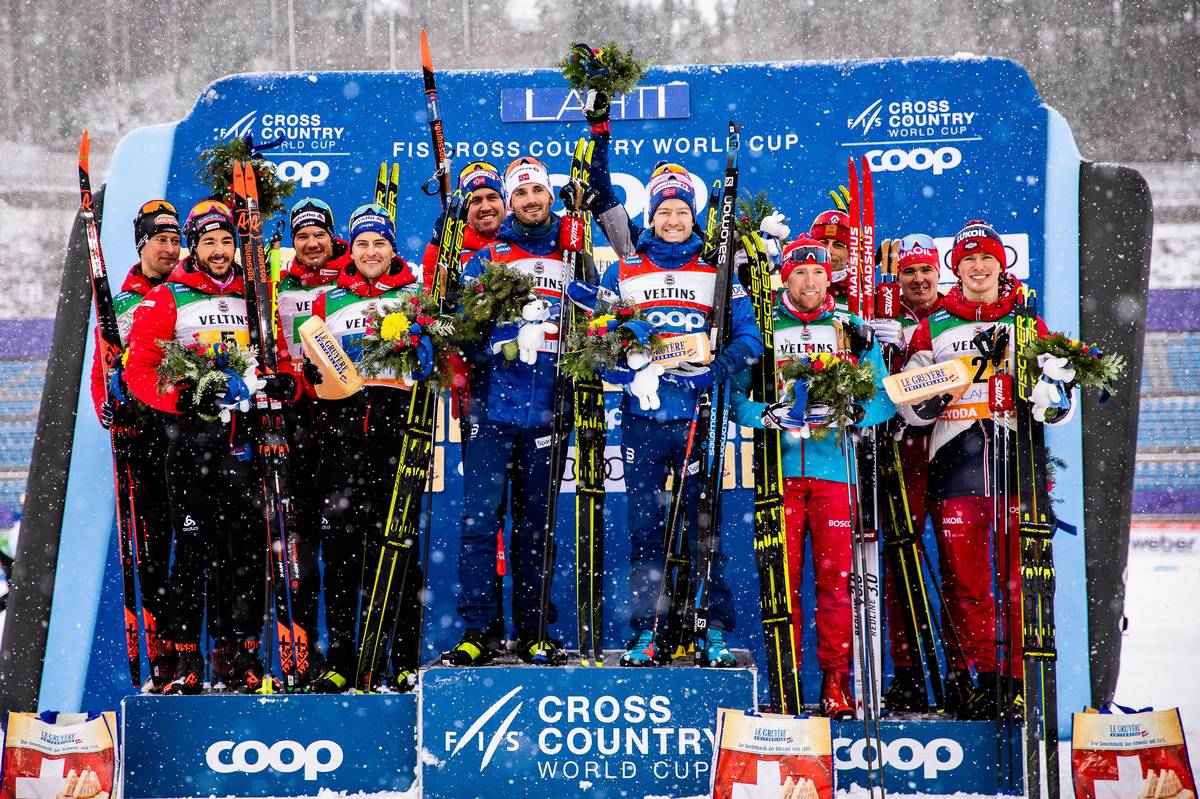
    In Saturday’s 2 x 6 + 2 x 7.5 k mixed relay, Italy nabbed a 1.5-second victory over Ukraine in 1:15:08.3. Dorothea Wierer, Lisa Vittozzi, Dominik Windisch, and Lukas Hofer — the same Italian team that took bronze in the mixed relay at last month’s Olympics, although in a different order — combined for the win with one penalty and 13 spares.
    Ukraine, with Anastasiya Merkushyna, Vita Semerenko, Artem Pryma, and Dmytro Pidruchnyi, had zero penalties and just three spares throughout the whole race. For the second-straight relay on Saturday, Norway placed third (+9.1) with Synnøve Solemdal, Tiril Eckhoff, Henrik L’Abée-Lund, and Tarjei Bø totaling zero penalties and nine spares.

    Italy’s lone penalty came in Vittozzi’s second leg, but it didn’t derail the team as it improved from sixth to fifth with Vittozzi, who skied the third-fastest course time on that leg. She tagged Windisch 6.8 seconds out of first, and Windisch, who had anchored the team in the Olympics, took the lead by the final exchange after using two spares to clean. Hofer left the exchange just 3.3 seconds ahead of Norway’s Bø but used just one spare and skied the second-fastest anchor leg to finish first, beating his rivals up Kontiolahti’s infamous climb known as “The Wall”. Ukraine’s Pidruchnyi also shot clean with a single spare and clocked the fastest anchor leg to move his team from fourth to second place. Bø lost one place and finished third after using one spare as well and skiing the third-fastest anchor leg.

    Russia followed in fourth, France fifth, Sweden sixth, Germany seventh, Austria eighth, and the U.S. ninth (+2:48.4). The U.S. team, with Clare Egan, Joanne Reid, Tim Burke, and Sean Doherty, had one penalty and 11 spares. Egan cleaned her first prone but had to ski a penalty lap after her standing stage, tagging Reid in 17th, 58.7 seconds out of first.

    Reid used three spares on the second leg and moved up to 13th by the second exchange, and Burke used three spares as well to pick off one more place and tag Doherty in 12th. Doherty skied the eighth-fastest anchor leg and used two spares to clean to put the team in ninth at the finish.

    “I don’t consider two spares to be anything special, but today it was enough to make up some ground,” Doherty wrote in an email to FasterSkier.”I felt strong skiing, more like myself which is fun even if it’s a little late in the season. We had very good skis which always helps. I have done quite a few laps on this course over the years so the lines and transitions are pretty refined, so that is where I made time on the course.

    “I am happy with my leg. I enjoyed my little battle for 9th,” he continued. “I can’t speak too much for the other members of the relay tonight but I think 9th is a solid effort.”

    Canada finished 17th (+4:34.9) with Emma Lunder, Julia Ransom, Scott Gow, and Brendan Green combining for one penalty and 13 spares. Lunder put them in 12th at the first exchange and Ransom skied up to 10th, but Scott Gow had a penalty on his standing stage to drop to 16th. Green lost one more place on the last leg despite only requiring two spares.

    Results: Single mixed relay | Mixed relay