From the FasterSkier archive — posts syndicated from athletes’ and coaches’ own blogs between 2004 and 2012, kept online as published. Current coverage is at fasterskier.com.
This article was made possible through the generous support of our voluntary subscribers. If you would like to see more articles like this one, please support FasterSkier with a voluntary subscription.
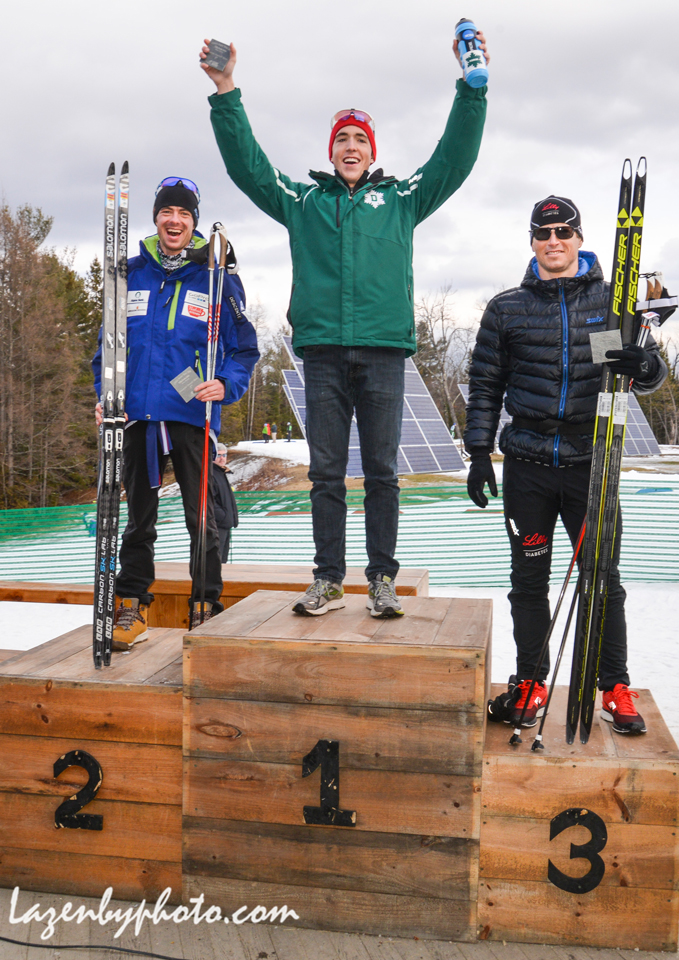
The sun came out on Saturday at Dartmouth’s Oak Hill Ski Center in Hanover, New Hampshire. The best collegiate skiers in the country gathered in Hanover, New Hampshire, for a week of racing at the NCAA Championships. The final races of the week were the nordic distance races, 20km freestyle for both the men and women. University of Utah’s Joe Davies skied away with the national title on Saturday, much like how his team gapped the competition.
Though Utah’s nordic and alpine teams combined points ultimately created an unclosable gap, the championships started off close. In the first nordic races, the 7.5km men’s and women’s classic race, it was the host school Dartmouth who had the top racers.
Dartmouth College’s John Steel Hagenbuch skied to a 15 second victory on his home trails in the 7.5 k Classic at the NCAA Championship on Thursday. (Photo: Tobias Albrigtsen)
In the men’s 7.5km classic race, Dartmouth’s John Steel Hagenbuch won by 16 seconds over UVM’s Finn Sweet. It was his second NCAA title, having won the 7.5km skate competition in 2024. Steel Hagenbuch’s teammates Luke Allen and Cooper Camp finished 4th and 9th, respectively. They combined for 93 points, besting Utah by nine points. Rounding out the podium was Utah’s Joe Davies, who just days before the competition was in Trondheim, Norway, racing in the World Championships skiathlon. Competing under the Great Britain flag, he finished 24th, 1:31.8 behind Johannes Klaebo.
Utah earned their first individual win of the 2025 NCAA championships when Erica Laven won the 7.5km women’s classic race. Annie McCulgan of UVM finished second and Dartmouth placed three in the top eight. Jasmine Drolet, Ava Thurston and Nina Seeman finished third, fourth and eighth, respectively. The Dartmouth women tallied 88 points for a slim two-point edge over Utah.
Utah’s Erica Laven took home the women’s 7.5 k Classic individual title by 11 seconds on Thursday. (Photo: Tobias Albrigtsen)
As the competitions continued at the Dartmouth Skiway, Utah’s men’s and women’s alpine teams both scored the most points in the Giant Slalom. They opened up a sizable lead that would be incredibly difficult for the trailing Dartmouth and University of Colordao to close.
After Davies took control of the men’s 20km freestyle on Sunday, that lead became impossible to catch.
Utah’s Joe Davies took command of the Men’s 20 k Freestyle, skiing to a 1:10 victory and leading Utah to the NCAA Championship. (Photo: Tobias Albrigtsen)
Oak Hill has undergone major renovations in the past few years, and the newly homologated races loops were on full display during the championships. The configuration is such that fans can see racers in multiple spots, so as the laps ticked away during the 20km, fans watched as Davies pulled farther and farther away from Steel Hagenbuch, ultimately winning by over a minute. It’s his second NCAA title. His first was in 2023 at the 10km skate in Lake Placid, when he was a sophomore racing for UAF. That year, Steel Hagenbuch finished second.
Having Davies and Steel Hagenbuch leave the championship with one win each is fitting. They’ve dominated their respective sides of the country and met at NCAA’s to jockey for podium positions over the last couple of years – all while benefitting from the relatively new mentality that allows collegiate skiers to compete in both college races and on the World Cup, instead of having to choose between domestic and international competition.
For Steel Hagenbuch, it’s extra sweet to have gotten a win at home. Though he grew up in Idaho, he comes from a family of Dartmouth athletes and has added greatly to that legacy.
After the men finished, the competition was still close for who would finish runner-up in the team competition: Dartmouth had a 14-point lead over Colorado.
Erica Laven (UU – left) and Kendall Kramer (UAF – right) distanced themselves from the rest of the field during the NCAA Championship Women’s 20 k Freestyle. (Photo: Tobias Albrigtsen)
It didn’t take long for Kendall Kramer of UAF and Erica Laven of Utah to create a gap over Colorado’s Tilde Baangman and Denver’s Lea Wenaas. Behind them was a dense chase pack. But once Kramer decided to go, she was gone. She skied in total control, her crisp tempo unchanging over Oak Hill’s rigorous climbs. She finished 35 seconds ahead of Laven, taking a bow as she came across the line. This has been an impressive year for Kramer in the 20km: In February, she won the 20km at U.S. Nationals in Anchorage.
Eventually, Kendall Kramer (UAF – right) decided it was time to make a move on Erica Laven (UU – left), skiing to a 35-second victory for the individual Women’s 20 k Freestyle NCAA Championship. (Photo: Tobias Albrigtsen)
After all had finished, the points were tallied. Colorado, who won the NCAA team title in 2024, had two women in the top 10 in the 20km to Dartmouth’s one. They scored 20 more points than Dartmouth in the women’s race to overtake them and finish in second for the week-long team competition.
The NCAA Championships are dominated by the Western schools – Utah has now won six of the last seven championships. So to see Dartmouth finish runner-up on their home turf, in a star senior’s year, on that sugary, spring East coast snow, would’ve felt like a fitting end to this story. But even though it’s not the result they wanted, it takes nothing away from what was accomplished at Oak Hill, and the successful championships they hosted there.
“The transformation of Oak Hill is a game-changer for us,” Dartmouth head coach Cami Thopmson told FasterSkier via email. To have good training on reliable snow less than 2 miles from campus makes a huge difference. We knew how the course would ski, where it would be particularly challenging, what line to take, and what places would be best to make a move on the field. Our athletes used that knowledge to their advantage.”
There was lots of great energy at Oak Hill for the final day of the 2025 NCAA Championship. (Photo: Tobias Albrigtsen)
“We are really proud of the team, it is tough to manage the expectations and all the extra energy that goes into racing at home, especially with final exams looming. The seniors have had this week to look forward to since they showed up on campus four years ago. I think it far exceeded their expectations,” Thompson told FasterSkier via email.
“We had a very solid finish in the end, but it is hard to go from leading at one point to 3rd with only a 5-point gap. That is sport though and we know that every one of our athletes raced their hearts out.”
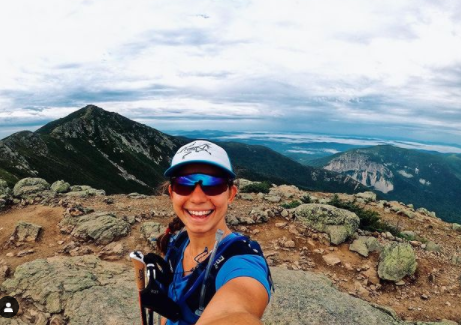
Titled “my happy place”, Julia Kern shares a scene from atop the Franconia Ridge in Northern NH. (Photo: Instagram @juliakernski)
If you follow Julia Kern on social media or her blog, you have probably gotten the sense that outdoor recreation is more than just part of her job as a professional cross country skier. A quick scroll highlights a multitude of activities that extend far beyond rollerskiing and World Cup travel. Kern seems to do it all: open water swimming, backcountry skiing, paddle boarding, camping, trail running, rock climbing, and mountain biking. And always with an inviting and contagious grin across her face.
This November, Kern shared that she has been assisting from behind the scenes with the launch of a new networking app for outdoor enthusiasts like herself, called Pastimes. In addition to contributing to its evolution, Kern is also a Pastimes athlete ambassador.
In a nutshell, the platform is designed to facilitate getting out in the outdoors with friends, new or old. Want some company on your long ski this weekend? Post it to the app to connect with others of similar ability levels. Moved to a new town and want to find some new adventure partners? Here’s your chance. Eyeing a new route but want some company to help you stay on course and safe? Find out who else might be heading that way.
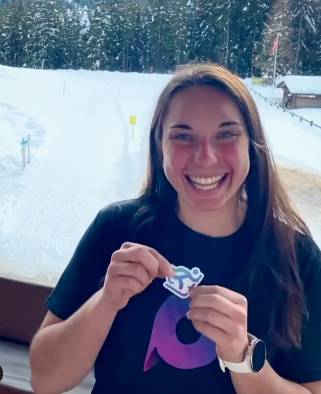
“Do what you love. Share your Pastimes.” (Photo: Pastimes.io)
To learn more about the Pastimes App and Kerns role in the design process, FasterSkier reached out with a few questions to which she responded via email. You can find additional information on the Pastimes website and Instagram page, or try it out by downloading from the App Store or Google Play for android.
FasterSkier: Tell me about the origins of Pastimes. What was your role in the creation and design process?
Kern: Phil Belena (a cross country skier, fan, and a former digital consultant for Craftsbury Outdoor Center) reached out to me in August for user testing on their prototype. I have always been passionate about adventuring in the outdoors, so I was really excited to hear about the app and to give feedback. I also have a background in design work and worked for the DALI Lab at Dartmouth this fall as a designer so I wanted to help in any way I could, using both my passion for the outdoors and my design skills to give productive feedback. After rounds of user testing and exchanging ideas with Phil, I wanted to become more involved because I thought the app had a lot of potential (exactly the type of app I have been wanting) and Pastimes was looking to build an ambassador network so they brought me on board.
The idea for Pastimes came about amongst the founders who are passionate about community building and outdoor activities. On the whiteboard at the climbing gym they all climb at, they noticed people would write down their phone numbers so they could find climbing partners. This was a need that wasn’t specific to just climbing, but to the greater area as a whole. The Salt Lake City area is concentrated with people who love getting outside for adventures, yet when people move somewhere new, they find it very difficult to break into that community.
Julia Kern is an athlete ambassador for the Pastimes App in addition to providing feedback in its design process. (Photo: Instagram @juliakernski)
Forest Good, the Co-Founder and CEO of Pastimes moved to Salt Lake City about 6 years ago and found himself wanting to get into outdoor activities for the first time. He moved to Salt Lake as part of an acquisition of a company he co-founded called HackHands (acquired by Pluralsight in 2015). It was an online technology mentoring platform for computer programmers and coders. After successfully leveraging technology to connect a community of programmers, he saw an opportunity to connect people who share a passion for the outdoors. Co-founder and friend Rod Liberal shared his vision for how a dedicated app for finding outdoor partners could not only help people do the activities they love more, but make new connections and friendships.
The process for developing Pastimes evolved over the summer as we conducted interviews with potential users. We interviewed an extensive amount of potential users to understand what features would resonate. These initial interviews drove our feature set and helped guide our design and engineering. Once the app was in a prototype state, we went back to confirm that the features actually worked for this user group. This iterative process continues as Pastimes evolves. We use analytics to understand how our customers use the App, continually improving the user experience to align with their use.
How has the launch gone so far? Has the pandemic posed any hurdles in terms of creating something that fosters meet-ups and connecting with others?
The launch has gone well so far. We learned a lot from the initial launch, gathering a lot of user feedback for future updates. We just launched a big update with features that make it easier to connect with others in your local area. These include messaging and profile enhancements, along with the ability to make your availability for an activity discoverable and match with others in your local area. We have a lot more updates rolling out soon! What I love about working with the people working at Pastimes is that they are always looking for ways to improve and love to hear people’s feedback. They want the app to evolve based on the user’s needs, taking a human-centered design approach.
When Covid hit, it made the founders rethink their idea. They questioned whether a social app would be used by people to meet up during a pandemic, but then the outdoor industry exploded. Every single bike sold out, people were outside going on daily walks, hikes, and bike rides more than ever, finding ways to socially connect with people in a safe, socially distanced way. Getting outside became people’s only way to connect with people in person. Instead of the pandemic being the end to the idea, they designed Pastimes to thrive during this time. The app is designed to create smaller group size events for those doing an activity, removing any worry of having to reject others or manage the bulk coordination of large group events. Users can set party size limits so they have control over the group size. That being said, it is still extremely difficult to build a community, it takes time, especially in a time like right now. Our top priority is for people to stay safe and healthy, and to follow local guidelines so the pandemic has slowed the launch a little bit.
What are your goals for the app?
I have always felt there are so many incredible people out there who love to do the same things I like to do, but it is hard to connect with those people. I have randomly met new people out on the trails or in the mountains, but even then, it is hard to reconnect with them again. My goals for the app are to fill this big need I see in the outdoor community, helping people connect over shared passions in a non-exclusive, efficient, and easy way. I hope it not only connects people who already are into outdoors activities, but also to the people who are new to it and don’t know where or how to begin. I have found myself most happy playing in the mountains with people and I want everyone to be able to have access and to able to be experience that feeling. I also think this app could foster mentorship within sports that require a lot of technical knowledge such as climbing. A lot of sports have a steep barrier to entry, whether it is gear or experience, so finding people to link up with to either learn from or mentor is an incredible thing and is one of my goals for the app.
Pastimes helps connect users with adventure partners and activities to make it easier to get out and play outside. (Photo: Pastimes.io)
What excites you most about the app and concept? Do you envision yourself posting skis/rides/runs while you’re in the Northeast during the off-season? How does this fit into your training?
I am really excited to meet new people who share the same passions as me, I am always looking for new adventure buddies! We all have such busy schedules so I really like the matching features, which connect you with people who have a similar availability level, making it easy to coordinate schedules and connect with people in the real world.
I will definitely be using the app when I home in the off-season! Last year when Covid hit, this was exactly the app I was needing in my life. I would skin up a downhill area or mountain bike alone every day, and it wasn’t until I made a new friend skinning by coincidence and luck one day, that I had a partner to go into the backcountry with. I want to get out and ski, ride, climb and hike with people this spring.
Since I have been injured a lot over the years, I have had to modify my training plan to what I can do, which often results in training alone. This summer and fall I did a lot of mountain biking so I would link up with friends if they were around to ride. I see myself using the app on cross-training days to connect with friends or meet new people. This summer I was even using dating apps to find people to mountain bike with in a socially distanced way, which isn’t the actual goal of dating apps, but there was nothing out there that could help me discover people in my area to do things with so it was the next best thing. I know many people who use dating/friend apps to find people to do outdoor activities with, highlighting the need that is out there for Pastimes.
What else do you want people to know about Pastimes?
I have been in charge of building an ambassador community of people who are passionate about sharing their love for the outdoors with people. It has been really fun to meet incredible people who want to share Pastimes with others and help grow the app user base.
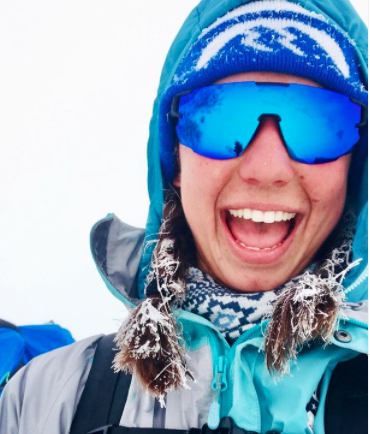
Julia Kern snaps a selfie while backcountry skiing on Mount Mansfield in Vermont. (Photo: Instagram @juliakernski)
I think Pastimes can be a great tool for the cross country skiing community. The ski community is filled with people who are passionate about being active outside and value community. Whether it is coordinating your family’s schedule with another family for your kids to go skiing together, or if you are looking for a training buddy for skiing, running, biking, etc., Pastimes can help you connect with others!
For example, there is a group of people who have been connecting in NYC for group rollerskis on the app. This group is Manhattan Nordic, a mix of elite Master Skiers, serious recreational skiers and curious newcomers who are interested in skiing on one of the most famous roller ski loops in the world – Central Park. The community and discoverability aspect of the Pastimes events has led to an increase in rollerskiers taking advantage of the training and welcoming ski community.
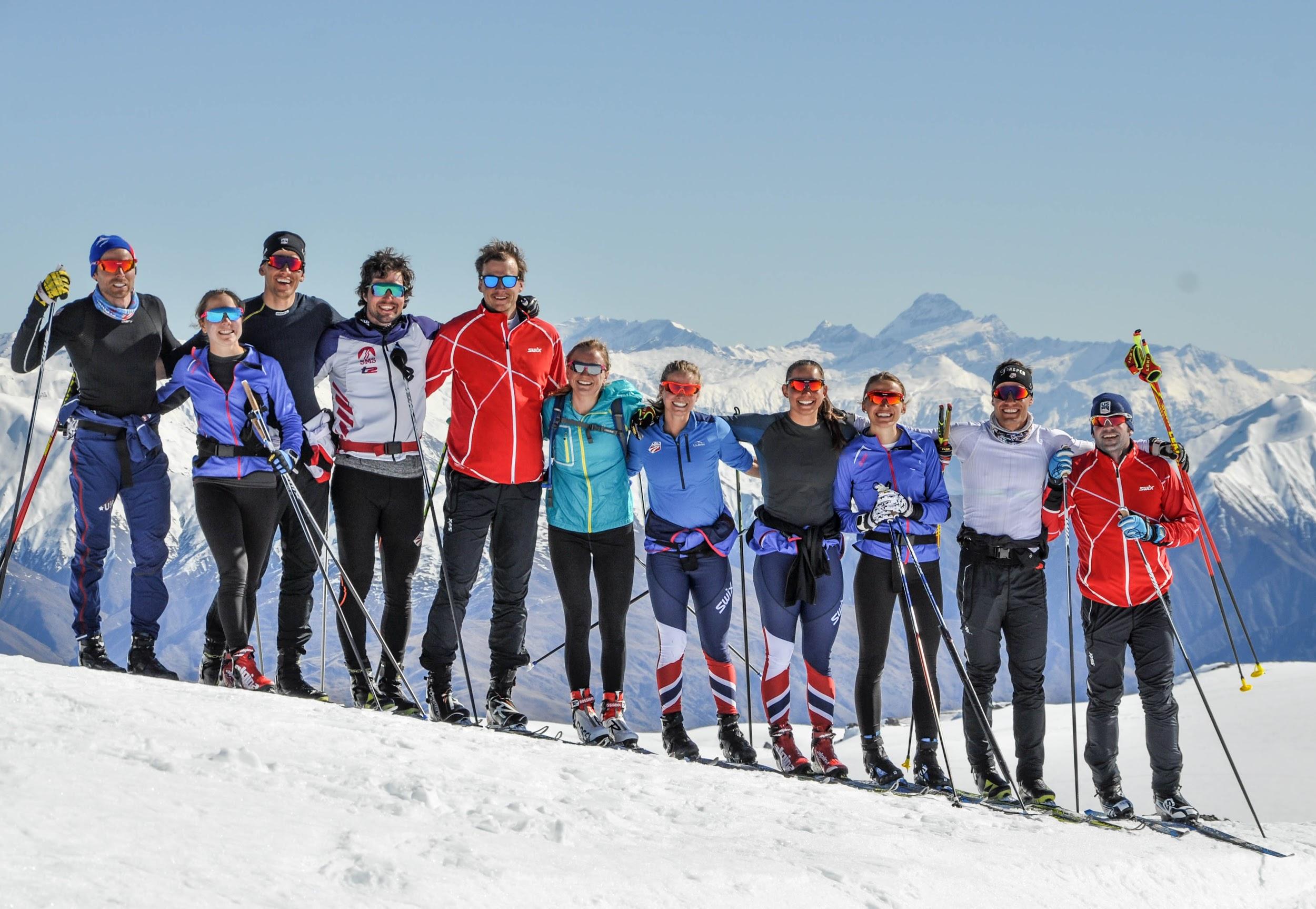
2018 U.S. Ski Team camp at the Snow Farm in New Zealand, with author Alayna Sonnesyn (teal jacket) in the middle of the group shot. (Photo: Matt Whitcomb)
The following was written by Alayna Sonnesyn, a new member of the Stratton Mountain School (SMS) T2 Team who graduated from the University of Vermont (UVM) this past spring.
Originally from Plymouth, Minnesota, Sonnesyn, 22, raced on the UVM Ski Team for four years and qualified for four NCAA Skiing Championships teams. She placed second and third in two races at 2017 NCAA Championships, and in her senior season, won the first five Eastern Intercollegiate Ski Association (EISA) races and went on to reach the podium in 10 out of 11 EISA races. Sonnesyn expressed an interest in exploring the dilemma many of the nation’s top skiing talents face out of high school: whether to attend college or get an early jump on a pro-racing career. She plans to post this two-part series on her blog as well.
***
For the first time in 17 years I will not be going back to school this fall. Saying that out loud is more daunting than I had anticipated. For the most part, the classmates that I graduated with can say that they are “going to grad school,” “starting a new job,” or “taking a year off to travel,” but I still don’t know where I lie. I am not taking any classes this year, I am not working anywhere consistently, and I am doing more than just traveling to explore, I’m traveling to race!
I am wrapping up a three-week training camp in New Zealand with the SMS, Craftsbury, and US Ski Team. When I walked through customs I had to write down my reason for visiting New Zealand: Was I a student? Was I visiting a family or friend? Was I working? What was my job? In the rush of the moment and due to habit, I wrote that I was still a student and continued on my way. I later had a few reflections; I still haven’t reached the point yet where I can say I have a job. I don’t have a salary and there are no company benefits. Yet, I work 24/7 toward my job — my job is ski racing. But why is this so hard for me to admit to myself? Is it because, for my entire life, I’ve been a student? What if I hadn’t taken this route? How do others make this decision?
National Training Group (NTG), summer 2013, in Park City, Utah.
Racing throughout high school, I was given a number of perspectives about picking skiing versus school. My friends were all preparing to go to college and I always assumed I would go to college, too. My parents and older sister went to school, why wouldn’t I go as well? But then I thought about skiing. I never had the most outstanding results in high school (never qualified to race internationally), but I was good enough to qualify for regional and national level camps like REG, NEG and NTG. I traveled to these camps and trained with other high-level athletes, getting more and more motivated by each skier or coach that I met. Then the thought came to me… what if I didn’t go to college? I could focus on training, make those vital steps toward international racing, and continue along the “pipeline” that so many Olympians had followed. Maybe I would make bigger jumps and improve my skiing exponentially? I was entering the unknown and I was unsure how to pick the right choice for me. Looking back on this four years later, I realize that I was far from alone in this predicament.
I have since had the opportunity to talk to a wide variety of skiers and competitors and have learned so much that I wish I knew in high school. It’s OK to be confused. It’s OK to make your own path. Every athlete is in a different situation, comes from diverse athletic and academic backgrounds, and has various goals that they hope to achieve post-high school.
“I’ve always believed that the most important thing to remember when discussing the decision to go to school or not (or when to go to school) is that is it a completely individual decision and the right decision for one person might not be the right decision for the next.” — Sophie Caldwell
Personally, I finally decided that taking a gap year might be too big of a jump for me. I wasn’t ready to focus on skiing and I had a lot of goals for myself academically. I decided to attend the University of Vermont and upon reflection, can admit that this was one of the best decisions of my life. Similarly, SMS teammate, Kelsey Phinney, went from high school in Boulder, Colorado, directly to Middlebury College.
“The reason I chose Middlebury College was simple: I went to visit and I was ready to unpack and stay for good. I loved the people, the area, the ski team, and the classes I sat in on.” — Kelsey Phinney
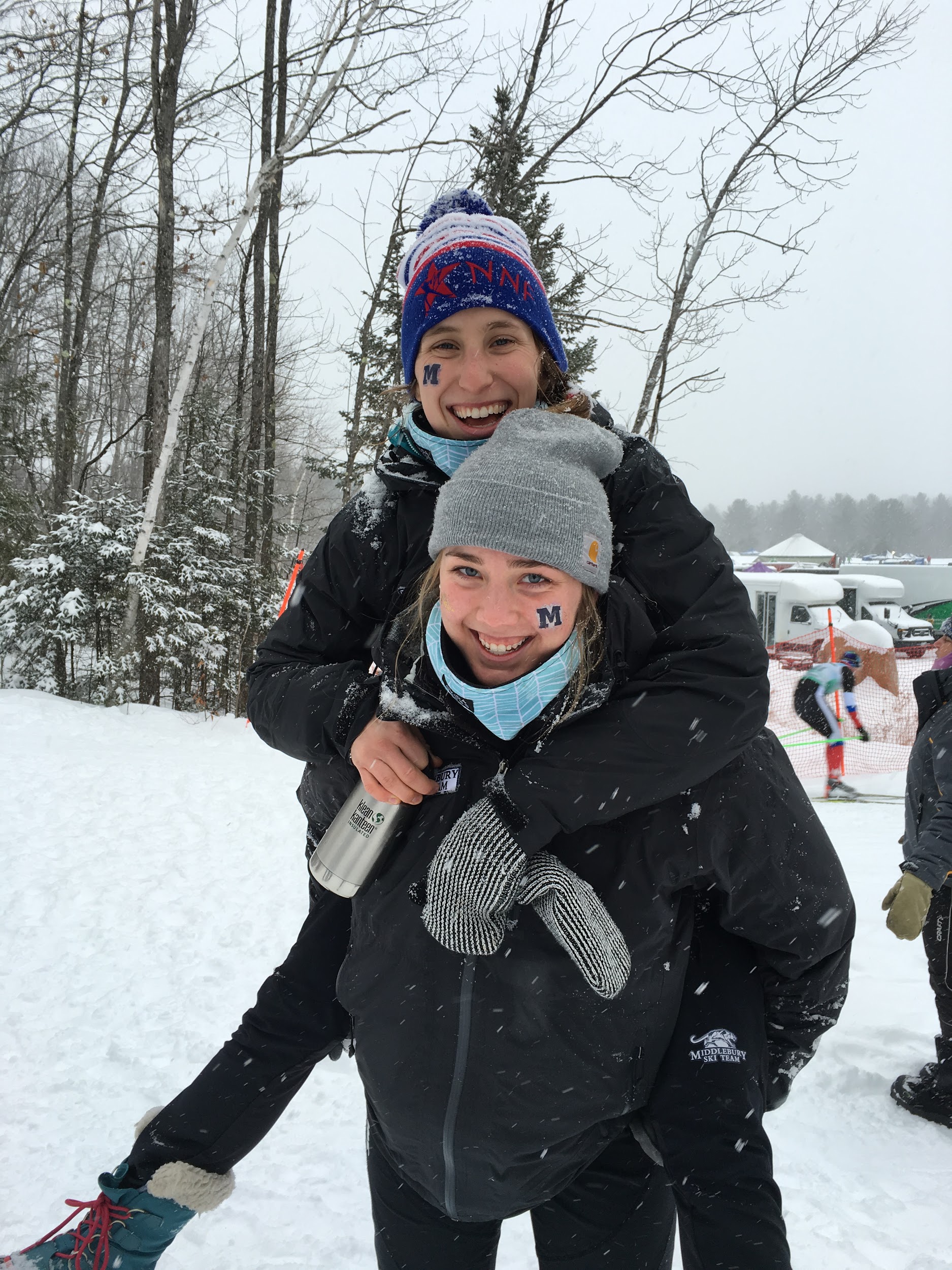
Carnival love, with Kelsey Phinney (top) and Katie Feldman.
Kelsey and I both fell in love with our schools from the start and knew we were where we belonged. We took these college experiences as learning opportunities; maybe we wouldn’t have been ready to jump right into the professional circuit but we both determined this was the right path for us.
“I loved the experiences I had on the Carnival circuit. Both good and bad times taught me a lot about life and skiing, and I felt like the balance of school and sport made me better at both,” Kelsey reflects.
Similarly, Sophie Caldwell had her mind made up without the need to hesitate over a gap year or jumping into full-time skiing.
“I chose to go to college right out of high school, and it was something I had always known I wanted to do. I knew there was a good chance I wanted to ski professionally at some point in my life, but when I was 18, I wasn’t ready to 100% commit to skiing,” Sophie, a Dartmouth graduate, explains.
With academic goals in mind and the confidence to pursue skiing in the long run, sometimes there’s no need to question it. Going directly to college might challenge you more than you think and it might make you question what you’re doing. The balance of school and skiing is great, but it’s TOUGH! At least you worked through those challenges and figured out where you want to be though.
“I definitely had my ups and downs throughout college and at times I considered not pursuing skiing after college, but by the time I entered my senior spring, I knew I wanted to give skiing professionally a shot and knew it was because it was what I wanted to do, not what I had to do,” Sophie notes.
Over the course of four years, we were able to say goodbye to our homes, grow into adults and develop as skiers, allowing a much smoother transition into the professional racing circuit post-college. This decision to go right to college made sense for Kelsey, Sophie and me — it was simple; but I recognize that this choice isn’t as straightforward for everyone.
***
“I loved my time at Burke and wasn’t quite ready to leave. I also didn’t know where I wanted to go to college as part of me wanted to go out west while part of me wanted to stay closer to home.” — Ida Sargent
The conflict of picking a school, a place we are willing to spend at least four years of our lives at, can be intimidating to anyone. Taking a year off to think and explore what motivates you once the structure of school is taken out of the picture can be extremely vital to one’s skiing longevity. Other times, this year off can be done to test out what skiing professionally is actually like.
“I wanted to test out whether I could do only professional skiing.” — Katharine Ogden
A feat that might sound easy to accomplish — ski, eat, sleep, repeat — can’t be THAT hard! But what happens when you suddenly put all of your time and energy into one goal?
“Ironically, my gap year did not turn out even close to how I had planned or imagined!” reflects Julia Kern.
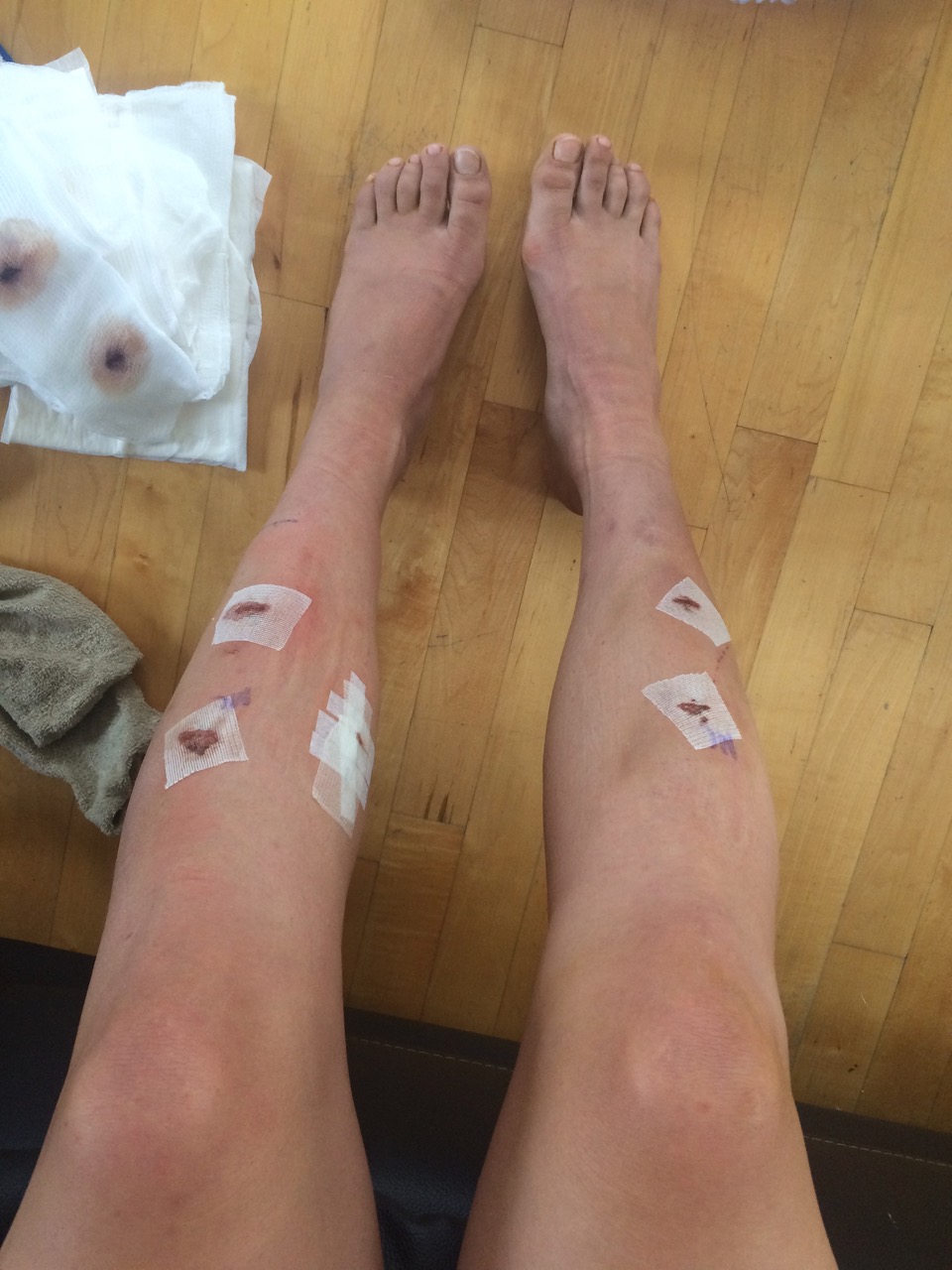
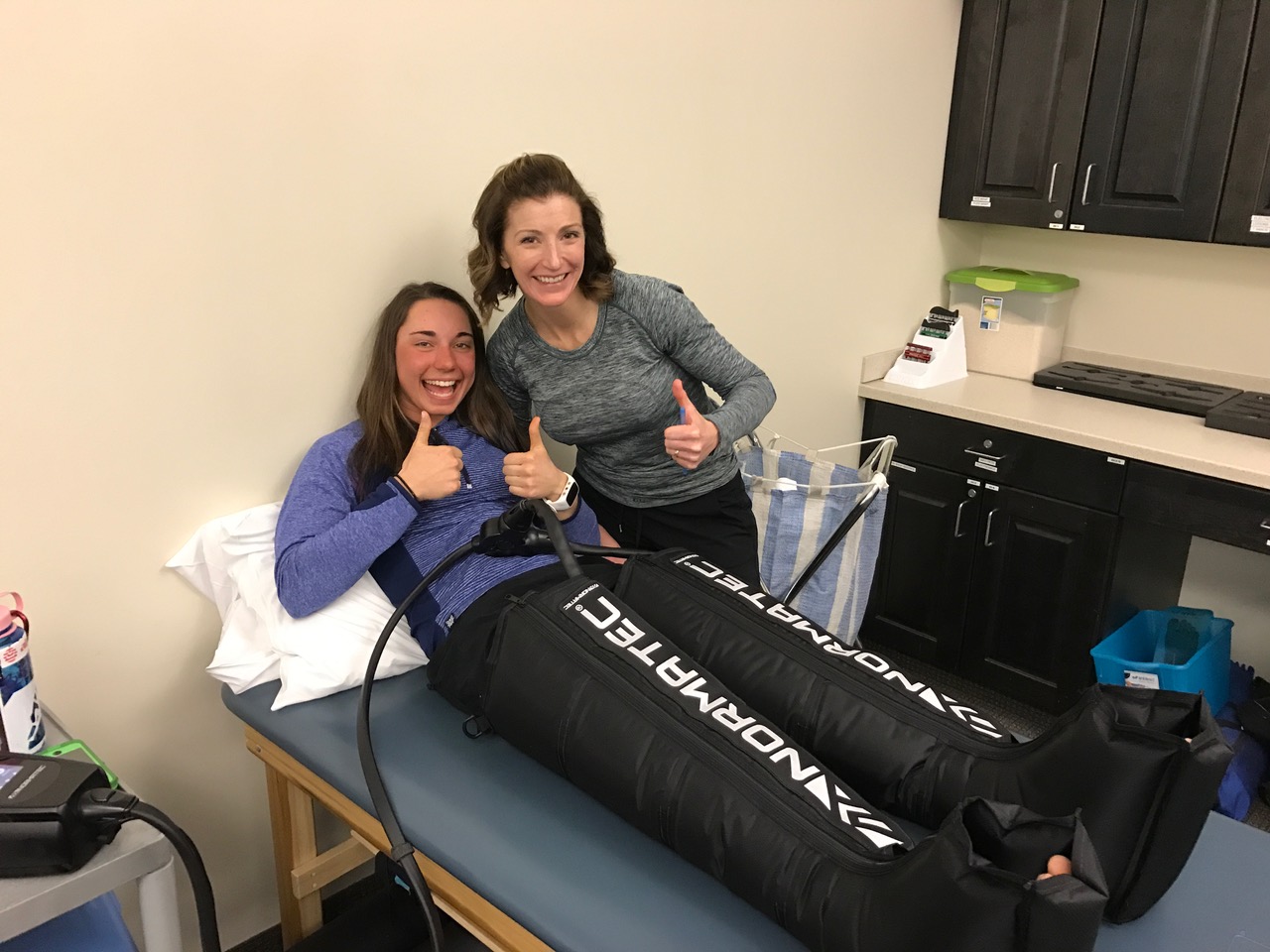
Julia Kern with swollen legs after surgery, requiring A LOT of physical therapy during the summer.
After facing an early summer surgery for compartment syndrome and then an untimely back injury in the fall, Julia notes that her gap year was extremely tough with plenty of lows and setbacks.
Ida Sargent offers, “My PG year was a bit of a disappointment as I wasn’t as happy as I was expecting and I also didn’t feel like I made as big of a jump with my results as I had hoped.”
“I think in hindsight it was a good philosophy but I think I approached it wrong. I didn’t do a good job securing other things to do besides training and was thus pretty bored, which led to me putting a lot of stress on skiing and racing,” says Katharine Ogden.
Maybe taking a gap year isn’t as easy as it sounds? Coming face-to-face with this type of ski-focused intensity as an 18 year old can be challenging.
“It showed me how much I really wanted to go to college,” offers Katharine.
It can also be validating, as it can prove to oneself where they really belong at that point in their life.
“It made me realize that I wasn’t ready to ski full time and I still needed balance in my life,” reflects Ida.
What might be the most beneficial aspect of taking a gap year are the lessons you learn throughout. How to deal with the pressure, free time, potential obstacles, and how to respond when you’re suddenly put in an unfamiliar situation.
“My gap year turned out to be far from ideal from a training/fitness standpoint, but I became very in tune with my body, learned how my body responds to training, became mentally tougher, and learned that I love the skiing lifestyle (even if it is tough sometimes) and that I want to ski at the highest level possible,” says Julia.
Some things you just can’t learn in a classroom.
Julia Kern (on table) still smiling!Julia Kern taking the time to think about something other than skiing during her gap year. (Photo: Julia Kern) How to pass the time away, when you have so much of it. (Photo: Julia Kern)
After taking a gap year to figure out what skiing was like full-time; Ida, Katharine, and Julia attended Dartmouth College (via various routes):
Ida states, “I started by going to school full time and I raced for Dartmouth for three years and then made the National team so I took my senior winter off to race for the USST and then I went back for a spring term my fifth year.”
“One year in [as a traditional student], I am very happy at Dartmouth and racing the collegiate circuit last year reignited my love for the sport,” adds Katharine.
While Julia contributes, “I chose Dartmouth because I wasn’t sure what skiing and school balance I wanted to have, but I did know that I wanted to be able to take terms off to race internationally.”
Regardless of which Dartmouth plan they followed, all three skiers seem to have enjoyed the choices they made. Whether taking a gap year is or isn’t part of your plan, the most important takeaway is that you should TAKE SOMETHING AWAY! Learn something new about yourself, about skiing, or about classes you want to study.
So what about other options for pursuing a ski career? Jessie Diggins and Andy Newell both chose to skip college and go straight into skiing. Stay tuned for my next post when I’ll include input from both of them as well as what U.S. Ski Team coach Matt Whitcomb has to say on this topic.
David Sinclair winning in record time at the Ragged 50 K, also 2018 USATF 50 k Trail Championships, on Aug. 12 in Danbury, N.H. (Photo: Richard Bolt)It wasn’t the delusionally fast pace he was setting, nor the hazy mist of East Coast rain playing tricks on his eyes. When David Sinclair clamored past the 35-kilometer mark of the Ragged 50K trail marathon, which served as the 2018 USA Track & Field (USATF) 50 k Trail Championships two Sundays ago in Danbury, New Hampshire, there was no denying the shape that greeted him from side of the trail: a mother black bear and her cub.
Ten kilometers earlier, Sinclair had been the company of fellow runners, running in the top 10 until the halfway point. At 25 k, he positioned himself into the lead. In another 2 k, the former Dartmouth skier was pulling away and by the time he came across the duo of bears, Sinclair was alone, minutes separating him and the rest of the field.
Not slowing, Sinclair then did what outdoor adventurers are instructed to do should they encounter a black bear whilst traipsing about in nature. Stay calm, be big.
“I picked up the pace a little bit and started yelling, ‘Get out of here!’ Just making my presence known,” Sinclair, 26, of Peru, Vermont, told FasterSkier on the phone. “A minute later, I come around a curve in the trail and I see the cub again. Literally in the middle of the trail. For a second, I thought the mom would come and chase me down for getting too close to her cub.”
The mother bear, however, never reappeared. With that obstacle behind him, Sinclair ran the rest of the race alone. He crossed the finish line first in a time of 4 hours, 17 minutes and 36 seconds. That broke the previous course record set by Patrick Caron in 4:53:26 last summer.
David Sinclair (r) leading the 2018 Ragged 50K, which doubled as the USATF 50 k Trail Championships, on Aug. 12 as John Caldwell (yellow raincoat), Isabel Caldwell (second from l) and Sophie Caldwell (l) look on in Danbury, New Hampshire. (Photo: Richard Bolt)To date, the Ragged 50K was only Sinclair’s second race at that distance. His first was the 2018 Speedgoat 50 k, which took place in Snowbird, Utah, exactly three weeks earlier.
He described the Speedgoat, which features more than 12,000 feet of climbing over 33 miles, as “absolutely insane.” The bottom of the race’s website warns entrants (in all caps and bold font) “REMEMBER THIS IS A HARD RACE, IF YOU FEEL LIKE THIS SHOULD BE YOUR FIRST 50K, YOU ARE PROBABLY WRONG IN YOUR ASSUMPTIONS.”
Apparently, Sinclair chose to ignore or missed the heeding. He entered and won the Speedgoat, his first 50 k ever, in a time of 5:27:13. Two rest weekends and a week later, he won the Ragged 50 k in record time.
“Speedgoat took an hour and half longer than [the Ragged 50K] because of the altitude and insane amount of vertical,” Sinclair explained. “In comparison, the one here in New Hampshire felt a little bit easier.”
Easy being a relative term. The Ragged 50 K features 6,300 feet of vertical over 32 miles. After “mostly dirt road or pretty smooth trail” for the first 15 k, the remainder of the race pulls competitors through what Sinclair described as “gnarly, muddy single track.”
“That last hour of fighting your legs cramping up or when your stomach stops taking in any food and water, that part can be hard,” he said.
Losing sense of one’s vitals never sounds easy (or fun). Still, that hasn’t deterred Sinclair. Since the beginning of the summer, he had planned to taper specifically for the Ragged 50K. In winning the race, he earned a nomination to the US Mountain Running Team, as well as an automatic entry into the 2019 Trail World Championships next June in Mirandha do Corvo, Portugal. Sinclair plans to attend.
For winning the Ragged 50 k, Sinclair was also awarded $750 dollars from USATF and $300 for being a member of USATF New England Association.
Finishing 21 minutes and 17 seconds behind Sinclair in second was Simi Hamilton, 31, of the U.S. Ski Team (USST) in a time of 4:38:53. Third went to David Kilgore, 26, in a time of 4:41:38.
Simi Hamilton, of the U.S. Ski Team and Stratton Mountain School T2 Team, gives a thumbs up during the 2018 USATF 50 k Trail Championships in Danbury, New Hampshire. Hamilton went on to place second overall. (Photo: Richard Bolt)Hamilton’s time also surpassed last year’s Ragged 50K record by approximately 15 minutes. Though he usually spends his summers mountain biking as cross training, Hamilton spent much of this summer training on foot.
“I was in France for quite big chunk of the summer [at teammate] Erik [Bjornsen]’s wedding and then our [USST training] camp. I didn’t have my bike over there, but had access to some really cool running trails, so ended up doing a ton of running while in France,” Hamilton told FasterSkier on the phone while at a USST training camp in New Zealand. “When I came back to [to the U.S.] I was really psyched with how I was feeling running, so I talked to Matt [Whitcomb] about trying to find a race to do.”
The 50 k cropped up as one option thanks to a conversation with Sinclair, who dates Isabel Caldwell, the sister of Hamilton’s girlfriend and USST teammate, Sophie Caldwell.
“I think 50 k was probably a little longer than what Matt had in mind,” Hamilton said with a laugh. “But I’d been doing a lot of three- to four-hour runs, so I felt like my body was at least mostly prepared for something of that duration.”
According to Hamilton, the race did not qualify him for the 2019 Trail World Championships, though his recent performance has him more intrigued with mountain racing and running.
“It’s definitely something that’s on my radar, possibly next year I might try to find a few more mountain running races to jump into,” Hamilton said. “Obviously it all depends on my plan with my ski career and how much longer I’ll be doing this, but it’s something that’s been on my mind.”
Sinclair and Hamilton are not the first nordic skiers to find success at a USATF mountain ultra. Last year, Caitlin Patterson, of the Craftsbury Green Racing Project, placed fourth in the 10 k at the 2017 USATF Mountain Running Championships. Her performance also qualified her for the 2017 World Mountain Running Championships in Premana, Italy. Glenn Randall and Morgan Arritola have also posted strong results in national mountain running races.
Left to right: USST coach Matt Whitcomb, Richard Bolt, David Sinclair, Isabel Caldwell, John Caldwell, Sophie Caldwell, and Simi Hamilton after the 2018 USATF 50 k Trail Championships in Danbury, N.H. (Photo: Richard Bolt)“It’s really great to see Nordic athletes give it a go in mountain and ultra races,” US Mountain Running manager Paul Kirsch, also chair of USATF New England Mountain, Ultra & Trail Running, wrote in an email. “The aerobic and strength training required to be a great xc skier translates so well to the trails and mountain.
“To have David and Simi have such great races at this year’s grueling USA 50 km Trail Champs course reinforces how much the skills cross over in longer races as well,” Kirsch continued. “They both looked as strong at the end of the race as when they started. I look forward to seeing more Nordic athletes in future years.”
Even trailside. Both Caldwell sisters, along with their grandfather John Caldwell, came out to watch and cheer for Hamilton and Sinclair in person.
“We had a great support crew,” Hamilton said.
Following the race, Hamilton had one week of dryland training before jetting out to New Zealand for the USST’s on-snow camp at the Snow Farm.
Sinclair, who had been in Flagstaff, Arizona, earning his masters degree in geology until this spring, is now back in Vermont, preparing to start a teaching job at the Stratton Mountain School. He will continue to devote his spare time to running, welcoming anyone willing to join (he occasionally brings Isabel or joins the Stratton boys ski team).
“I don’t really track it,” Sinclair said of his running mileage per week.
Since he became involved with the sport two years ago, he indicated he has been self-coached, learning from conversations he’s had with other trail runners. His first long distance trail running race was the 2017 Flagstaff Skyrace–a 40 k race that finishes in the Arizona Snowbowl Ski Area–which he won. In winning the 2017 Flagstaff race, he qualified for the 2018 World Long Distance Mountain Running Championships in Karpacz, Poland, which took place this past June.
Taking the opportunity to travel in tandem with the World Long Distance Mountain Running Championships race, Sinclair spent the month of June in Poland, Italy, Austria and Germany. Prior to racing the World Long Distance Mountain Running Championships, Sinclair first raced the Livigno Skymarathon, a 32 k event that is part of the skyrunning series.
David Sinclair (r) running the Livigno Skymarathon this past June. He went on to place third overall. (Courtesy Photo)In the Livigno Skymarathon, which he said he used as “a warm-up race for the World Championships in Poland” he finished third. Sinclair then traveled to Karpacz, Poland to compete in the World Long Distance Mountain Running Championships, where he placed 30th and helped the men’s U.S. team to a second place team finish.
While most of his trail running race experience has come in the past two years, Sinclair was quick to point out that his time at Dartmouth also contributed to his quick ascent in the ranks. As a member of the men’s ski team at Dartmouth, Sinclair would run 12-18 mile over distance runs on the Appalachian Trail every weekend through the fall.
“The guys team would tend to run these pretty quickly and I think doing this for four years made transitioning to trail running races a lot easier,” Sinclair wrote in an email.
In terms of how he outlines his training weeks nowadays, Sinclair remains fairly flexible.
“I’ll have one or two days where I’ll run a little bit harder or do some intervals or do 45 minutes at threshold in the middle of a run,” Sinclair said. “Then I’ll try to do at least one longer run which might be three to four hours on a trail or 20 miles on a little more of a dirt road.
“It’s definitely a lot less structured than when I was focused on ski training, but for me it works better to not keep too close track of it because then I get too competitive with myself,” Sinclair added. “That’s my philosophy is keep it fun and exciting.”
So far, the biggest learning curve for Sinclair has been getting accustomed to pacing his running for a four or five hour race. He indicated that he usually wears a heart rate monitor to ensure he stays below his threshold heart rate and puts focus on staying hydrated early on.
“Getting enough fluid early in the race will pay off three hours later,” Sinclair said.
“It goes by pretty quickly if you stay focused on what’s the trail doing ten feet in front of you,” he continued. “Probably a good thing to do too because it keeps your mind off of how much further you still have to go.”
The Dartmouth Ski Team is hiring a Nordic Assistant. The assistant reports to the Women’s and Men’s Head Coaches and helps with all aspects of the program to support approximately 25 student-athletes.
Key responsibilities:
Working daily with the Head Coaches at training sessions and competitions throughout the season. Duties will include waxing, equipment preparation, video, transportation, and other logistical support.
Helping organize and run the Dartmouth Winter Carnival Nordic competitions.
Identifying and organizing competition trips in February and March outside of EISA competition.
Experience:
Bachelors degree and collegiate racing experience preferred.
Sofia Shomento racing in the 5 k freestyle at the Colby Carnival in Waterville, Maine. (Photo: FlyingPointRoad)
In an effort to showcase the North Americans who competed at last week’s International Ski Federation (FIS) 2018 Nordic Junior/U23 World Championships in Goms, Switzerland, we asked those qualifying athletes several questions about themselves — actually, we had them fill in the blanks. Here we have 18-year-old Sofia Shomento, of the Dartmouth Ski Team, who represented the U.S. at her first Junior Worlds.
Last week in Goms, Shomento qualified for the freestyle sprint in 26th and went on to place 23rd overall, and finished 58th in the 10 k skiathlon.
***
“My full name is Sofia Shomento, but you can call me Sof.
I was born and raised in Bozeman, Montana, and I learned to ski at Bohart Ranch with the Bridger Ski Foundation.
I spent the time between U.S. nationals and Junior/U23 Worlds catching up with classes and skiing with my teammates.
The funnest workout I did in the last training year to prepare for this was running 121 laps (about 14 miles) around the homecoming bonfire with my class of 2021 teammates.
This is my first time in Switzerland and second time racing internationally, and so far it’s been incredible!
One difference I’ve noticed between Switzerland and the U.S. is the snow banks are much taller here!
Skiing and racing in the Alps is breathtaking. Usually racing at altitude is fun for me because I grew up racing in the West. There are lots of mountains around where I live.
One of the things I’m most excited about for Junior/U23 Worlds in Goms is meeting new people from around the world.
One race I’m especially targeting there is the skate sprint.
I really hope I can chat/make friends with someone from Norway and ask them “what’s the secret?”
My favorite thing at the breakfast where we are staying is the fresh bread, cheese, and jam.
Fondue is yummy. The cheese here is delicious. And the chocolate is life changing.
If I had a totally free day here and didn’t have to worry about race fitness or training, I’d spend it alpine skiing.
The best way to follow me on social media is on Instagram @sofiashomento.”
Katie Bono after setting the fastest female rountrip speed ascent of Denali in mid June. (Photo: Savannah Cummins/savannahcummins.com)
Editor’s Note: The subject of the following article, Katie Bono, spent one season as a FasterSkier reporter in 2013/2014. She also skied at Dartmouth and with the Sun Valley Ski Education Foundation, and in June, became the fastest woman to ascend and descend Denali, North America’s highest peak at 20,310 feet.
***
For close to a week, a wet nylon tent and freezing rain were Katie Bono’s world. Unzipping the door flap spared her nothing but sleet and the faint shadow of North America’s highest mountain, Denali. If it weren’t the 29-year-old Minneapolis native’s third round trip to the Alaska Range, its apex might have been indistinguishable; a distant blinking mirage emerging now and again through swirling snow.
Along with her toes, Bono’s mind had gone numb. For an alpinist climber, waiting at basecamp to summit is akin to waiting in an airport when the outgoing flight’s been delayed: When will the weather let up?
For Bono, that when came in roughly eight days. Prior to that, she had spent almost all of June acclimatizing to Denali’s elevation via the Kahiltna Glacier route. She had attempted her first summit on June 7, making it to 18,100 feet, only to be turned around due to bad weather.
Back at base camp, less than four days of food remained from her 28-day pre-planned supply. The opportunity to get what she came for — to set the fastest female roundtrip ascent record on Denali’s 20,310 foot summit — was wearing thin. When would time run out?
Luckily for her, it didn’t.
The Makings of a Mountaineer
Home of the White Mountains, New Hampshire boasts both rugged terrain and dense forest area. Nestled in its northwestern-most region, where the Appalachian Trail and Hanover’s main street become one, the state is also the home of Dartmouth College, Bono’s alma mater.
Though originally recruited for cross-country skiing (she was the 2006 Minnesota state skiing champion), within two years of attending the Ivy League university, she had learned to love what many of her Big Green comrades adored: climbing. Introduced to the sport by the Dartmouth Mountaineering Club the summer before her junior year, it took just one trip to Canning Cliff for the nordic skier to discover her new niche.
“It was just a day trip, but my first multi-pitch climb,” Bono, also a former FasterSkier reporter, said during a phone interview in July. “I forgot my headlamp and we finished in the dark. I was scared for most of the day. But after that I was pretty much hooked.”
Katie Bono checking her skis at base camp during her three-and-a-half weeks on Denali. (Photo: Savannah Cummins/savannahcummins.com)
After receiving her undergraduate degree from Dartmouth in 2010, Bono headed west to ski and train with the Sun Valley Ski Education Foundation (SVSEF) in Sun Valley, Idaho. By the turn of the year, however, Bono no longer wanted to pursue skiing professionally. Her interests were elsewhere.
“I decided I wasn’t super happy with the full-time skier lifestyle and started guiding more in Sun Valley,” Bono explained of why she stopped skiing. “Then I went out to Washington to guide a little bit more full time there.”
Bono began working as a guide for Rainier Mountaineering Inc. (RMI), but she missed the feeling of racing and soon thoughts about a speed attempt of Rainier crossed her mind. In July of 2012, she made it a reality and completed a roundtrip climb of Rainier in 4 hours and 58 minutes, setting a new female speed record (reportedly in trail-running shoes and crampons).
In terms of hours put into alpine climbing, Bono was a sport rookie, but her background in cross-country skiing gave her an edge.
“Skiing makes you pretty good at suffering and that’s a lot of what mountaineering and alpine climbing is, learning how to function and keep yourself warm, and not be terrified by just being in cold weather all the time,” said Bono, who currently lives in Boulder, Colo.
“As a skier, you are introduced to managing your layers so you don’t get super sweaty and stay warmer,” she continued. “It’s really a learning curve for people who grew up doing indoor sports or have grown up in warmer places besides Minnesota to learn how their body produces heat.”
Following her speed ascent of Rainier, while working as a guide for RMI, Bono made her first trip to Denali in 2013. Though her first time on the mountain was shrouded in rain clouds and inclement weather, she departed Denali with a speed ascent in mind. However, it wouldn’t be until four years later, after guiding a second summit in 2014 and climbing the mountain’s Cassin Ridge in 2015, that Bono would get her chance.
While finishing up prerequisites, taking the MCAT and applying to medical schools kept her from getting much training in, Bono managed to squeeze in four months of training this past winter and spring in preparation for her trip.
“I would try to do a long ski tour or two ski tours per week, like three to ten hours on the weekend,” Bono said. “During the week I would try to do several easy distance workouts a week, like one to two hours. Then fill in with one to two usually threshold interval workouts, sometimes like harder VO2-max workouts.”
By mid-May, whether her training deemed her ready or not, the mountain was calling.
The Ascent
Katie Bono acclimatizing to Denali’s elevation in late May. (Photo: Savannah Cummins/savannahcummins.com)
For a total of 26 days, the Kahiltna Glacier was Bono’s home. The first two and half weeks were spent treading up and down Denali in a ladder-like style, a process she hoped would help her body become better at breathing less-oxygenated air.
“After I worked my way up to 14,000 feet … I then took a day where I’d go up to 17,000 feet and then come down and sleep at 14,000 feet. Then the next day I’d go up to 19,000 feet and then come back to 14,000 feet,” she explained.
She never saw the top of the summit during her acclimatization process. She did see temperatures dip below -30 degrees Fahrenheit and recurring snowstorms. She also witnessed an emergency evacuation after one of her team members came down with appendicitis. A few days prior to that Bono had seriously cut her hand while “trying to cut butter while cooking.”
“Classic ‘bagel slicing’ maneuver,” Bono wrote in an email about the incident. “It was a pretty deep cut! I could see some gross white stuff but quickly covered it and applied pressure.”
Katie Bono getting some fuel inside her tent while attempting the fastest ascent and descent of Denali in June. (Photo: Katie Bono Instagram/Savannah Cummins)
Undeterred, Bono returned to base camp and attempted her first speed ascent. But a snow squall that Bono assessed as too risky, forced her back down.
“I think I wanted to actually keep the risk margins on this trip relatively wide,” she said. “I think that risk tolerance varies a lot among climbers … sometimes you can also go for it in bad weather and it will work and sometimes you go for it in bad weather and you get a lot of frostbite. So I think risk tolerances can vary a lot and really make your own experience in the mountains based on that.”
Tent-ridden for eight days with a food supply soon to run out, Bono began to wonder whether she’d get what she came for. Finally, on June 13, she did. Bono climbed to the top of Denali and back down — using lightweight ski-mountaineering race skis until 14,000 feet — in time of 21 hours and 6 minutes, successfully setting the women’s speed record and third-fastest time ever on the mountain.
Long-distance runner and professional ski mountaineer, Kílian Jornet currently holds the overall roundtrip speed record at 11 hours 48 minutes. Though professional photographer, Savannah Cummins accompanied Bono to photo-document the trip, Bono completed the actual ascent and descent solo.
“Doing it solo, there’s alway a risk, but I feel like I’d spent enough time on Denali that I had a good idea of how to gauge the hazards, like crossing the crevices and the snow bridges lower down,” Bono said. “I tried to time my ascent so that I would be crossing the lower glacier, which has the most crevasces, when the snow conditions were at their most firm and most stable.”
“After a month of solid callus-building, it all felt pretty amazing,” Bono wrote on her blog following the trip.
American Paddy Caldwell (SMS/USST) on his way to qualifying 20th in the men’s classic sprint at U23 World Championships at Soldier Hollow in Midway, Utah. He went on to place fourth in his quarterfinal and 18th overall for his best sprint result at U23 Worlds. (Photo: FlyingPointRoad.com)
Back in December of 2010, 15-year-old Patrick “Paddy” Caldwell was racing amongst grown men. He finished 17th in an International Ski Federation (FIS) classic sprint held in Craftsbury, Vt. Today, at 23, Caldwell skis for the Stratton Mountain School (SMS) Elite Team and is a newly minted U.S. Ski Team (USST) B-team member. To put things in perspective, during that 2010 Craftsbury sprint, Patrick O’Brien, Caldwell’s current primary coach and head of the SMS Elite Team, was nearly 23 at the time and placed fourth in the race.
The USST has a well-established development pipeline. Here’s the basic philosophy: have skiers find success at each rung of the ladder before exposing themselves to deeper competition as they progress towards more rarefied races. From local and regional events to junior nationals, OPA Cup trips, NCAAs, senior nationals, to Junior and U23 World Championships, Caldwell has paid his dues, notched benchmark performances, and maintained the grind to find success at each incremental step.
It wouldn’t be a stretch to say Caldwell embodies the spirit of a USST development model where skiers can remain in school, meet conflicting demands, and with a big dose of hard work and a smidge of luck, make progress as a skier.
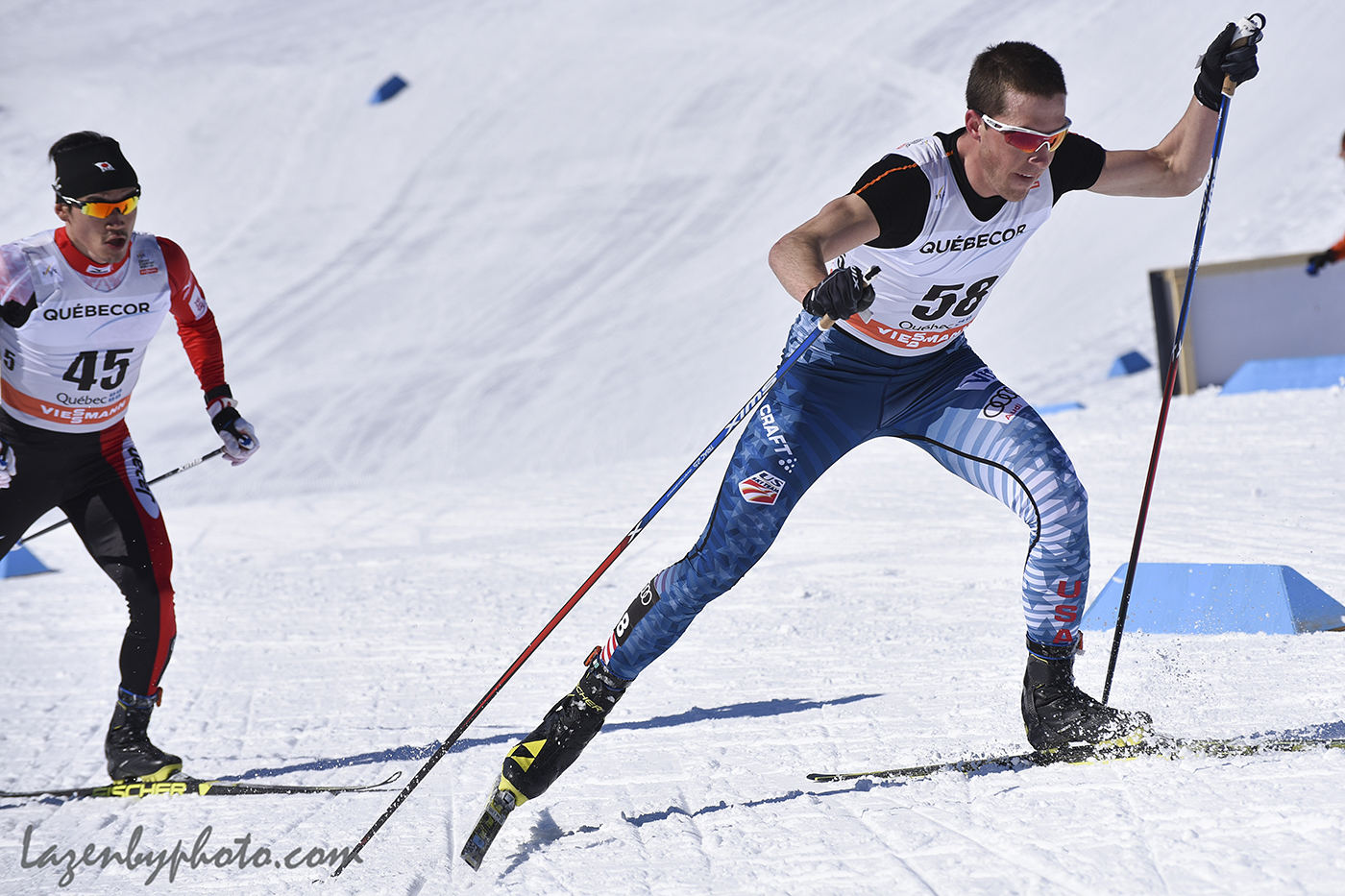
Paddy Caldwell (U.S. Ski Team D-team/SMS) racing to 46th overall and 25th for time of day in the men’s 15 k freestyle pursuit at World Cup Finals in Quebec City. (Photo: John Lazenby/Lazenbyphoto.com)
In a phone interview two weeks ago, the Lyme, N.H., native explained that making the jump to the B-team wasn’t an explicit goal.
“I don’t think I officially wrote that down in a goal section or something like that in the beginning of the year,” Caldwell said while finishing up spring classes at Dartmouth College in Hanover, N.H. “By looking at it as sort of progression, it definitely has been a goal of mine. My goal was to be a competitive World Cup skier and that is a step that needs to happen.”
Caldwell’s 2016/2017 objectives highlighted U23 World Championships at Soldier Hollow outside Midway, Utah.
“I was really focused trying to peak for those events and put up the best results that I could in that field,” he explained.
At U23 worlds, he earned two top 10s, placing ninth in both the 15-kilometer skate and 30 k skiathlon.
Caldwell was granted starts for the World Cup’s closing weekend, a three-race mini tour in Quebec City. He placed 46th overall at World Cup Finals, but turned heads with a 25th-best time of day on the final-stage 15 k skate pursuit.
In the near term, despite his promotion, it’s life as usual for Caldwell. There’s school to finish up and training hours to log. (Caldwell returned recently to Hanover from the USST’s first on-snow camp of the year in Bend, Ore.)
“I think that is very much in the air,” Caldwell said when asked if he’d be racing a full World Cup schedule. “And it depends on a lot of things — foremost if I am skiing well. And those are plans I am still working out. I don’t know exactly what opportunities will be there. Those are things, discussions we’ll have later in the year.”
Caldwell will remain under the guidance of O’Brien at SMS. And from a funding standpoint, Caldwell said he won’t see a bump in USST funding.
“Not in terms of support from the U.S. Ski Team,” Caldwell said when asked if his B-team status came with greater financial support. “The last few years I have been really fortunate to be successful fundraising through the local community here in the Upper Valley in New Hampshire and Vermont. So I am really thankful for the support from local people in both the ski community and outside the skiing community. I think absolutely if I end up racing in Europe more, it will be a bigger expense, and those are things I am not completely dialed on yet.”
Caldwell is officially a senior at Dartmouth, having earned 32 of 35 credits for his bachelor’s degree while studying geography and economics. In 2015, he won the 10 k skate at NCAA Skiing Championships.
Paddy Caldwell (13) chases Kris Freeman in the 50 k freestyle mass start at 2015 U.S. Distance Nationals in Sun Valley, Idaho.
“I feel really fortunate to go to Dartmouth College and be able to balance skiing and education,” he said. “One of my goals, I’ve always been aimed at finishing an undergraduate degree in a timely manner. I’m really thankful to be at Dartmouth where there is a flexible quarter system. I’ve taken off most fall terms since I have started at Dartmouth as well as winter and been able to go in the spring and summer fairly consistently.”
As a discretionary pick for the USST, Caldwell has jumped a significant pipeline-hurdle. Domestically, his peers have been skiing in a tight pack — on this year’s SuperTour, the men’s side had several different standout performances.
“I think there is an aspect of added pressure,” Caldwell said of his new B-team status. “But I also think that that is an inherent part of our sport. At the end of the day, it comes down to racing fast. That pressure is going to be there no matter what team you are on. It is something that I try not to focus on and just see it as an opportunity to keep growing as a skier and not as a target on my back, because I think it is easy to see it that way. Absolutely there will be some pressure from that, it’s also not something that I am unfamiliar with. I think it’s part of the sport. You have to, at least for me, just focus on trying to achieve results for my own growth as a skier and not focusing on the stuff going on around me.”
In the fifth and final part of “The Road to Jackson” series on Eastern Intercollegiate Ski Association (EISA) teams competing at NCAA Skiing Championships, we hear from five out of the six Dartmouth College skiers (Abigail Drach, Lydia Blanchet, Lauren Jortberg, Fabián Štoček, Luke Brown, and Cal DeLine) that qualified for the season-ending championships in Jackson, N.H.
“I’m really happy with my individual results, but it’s just so much better when your whole team is also sharing the same happiness.”
American Paddy Caldwell (SMS/USST) racing to 20th in the men’s classic sprint qualifier on Tuesday at U23 World Championships at Soldier Hollow in Midway, Utah. He went on to place fourth in his quarterfinal for 18th overall, his best sprint result at U23 Worlds. (Photo: FlyingPointRoad.com)
In an effort to showcase the North Americans competing at this week’s International Ski Federation (FIS) 2017 USANA Nordic Junior World Championships and U23 Cross Country World Championships at Soldier Hollow in Midway, Utah, we asked those qualifying athletes several questions about themselves — actually, we had them fill in the blanks. Here we have 22-year-old Paddy Caldwell, of the Stratton Mountain School (SMS) Elite Team/U.S. Ski Team D-team, representing the U.S. at his third U23 Worlds.
“My full name is Patrick Fitzgerald Waters Caldwell, but you can call me Paddy. I was born in Lebanon, N.H., raised in Lyme, N.H., and one thing you should know about my hometown is it was founded in 1761.
I started cross-country skiing when I was two or three, thanks to Mom and Dad. I currently train in Stratton, Vt., with SMS Elite Team.
Paddy Caldwell (20), of the Stratton Mountain School and U.S. Ski Team D-team, racing in the quarterfinals men’s classic sprint at 2017 U23 World Championships on Tuesday at Soldier Hollow in Midway, Utah. He finished 18th on the day for his best sprint result in three U23 Worlds. (Photo: FlyingPointRoad.com)
If I’m not skiing, you might find me studying at Dartmouth College. If I had to pick a favorite book, it would be ‘Unbroken.’
One of the things I’m most excited about for U23/Junior Worlds at Soldier Hollow is the new courses at SoHo. One race I’m especially targeting there is the 30km Skiathlon.
The best advice anyone ever gave me about skiing or racing was ‘you gotta love it!’
One of the best race memories I have is the mixed Biathlon/ Cross Country, Men/Women team relay in Seefeld, Austria.
If I could meet one World Cup skier, it would be Johan Olsson.
If I don’t end up being a professional skier, I’ll probably still be chasing snow.
Paddy Caldwell rollerskiing around Mount Moosilauke in New Hampshire this fall. (Photo: Pat O’Brien)
Welcome to “17 Questions for 2017″, where we are catching up with American and Canadian national-team members before the beginning of the winter season.
***
U.S. Ski Team D-teamer Patrick “Paddy” Caldwell was all over the place last year: taking classes and training at Dartmouth College, racing in the west, winning a SuperTour and college carnival in Vermont, traveling to Romania for U23 World Championships, and then back to Vermont, where he finished third in the 15 k skate at SuperTour Finals.
This season will be his last as a U23, and he’s looking forward to concluding that part of his career on home soil in Soldier Hollow, Utah.
1. Biggest change in your life in the last five or so months since the ski season ended?
No major changes since last winter. I was in Hanover this summer taking classes at Dartmouth, now I am back in Stratton with the SMS Elite Team.
2. Biggest change in your training?
Paddy Caldwell trail running in Park City, Utah. (Photo: Simi Hamilton)
This summer I focused more on speed/power than I have in the past.
3. Major areas of improvement you’ve seen so far?
I think my top-end speed has improved since last year.
4. Whom you’ve been working closest with this offseason (coaches or training partners)?
Pat O’Brien, the SMS Elite Team coach.
5. Best trip in the last five months (and why)?
I had an amazing trip out to Colorado and Utah last month first visiting my girlfriend’s family in Loveland, Colorado, then heading to Park City for the annual USST training camp. I love being out west and exploring new places to run and hike.
6. Favorite cross-training?
Trail running.
7. Favorite non-athletic activity or pastime this summer?
Hanging out at the cabin and paddling around the lake.
8. Song that was your jam this summer?
Hamilton.
9. All time favorite race moment?
Nordic/Biathlon team relay at the Youth Olympic Games in Seefeld, Austria.
10. First thing you pack in your bag when you leave for Europe?
An excited Paddy Caldwell (Dartmouth College/SMST2/USST) (center), Tad Elliott (SSCV) (l), and Kris Freeman (Team Freebird) during the podium ceremony for the SuperTour men’s 10 k freestyle on Feb. 6 in Craftsbury, Vt. (Photo: John Lazenby/Lazenbyphoto.com)
Starbucks VIA and a cribbage board.
11. Venue/event you’re most excited to visit this season?
Soldier Hollow for the U23 World Championships. Its awesome that such a big event is happening in the US and it will be amazing to see all the different teams racing on a home course.
12. Who will win the World Cup title this year?
Harvey and Diggins.
13. Biggest sacrifice you feel you’ve made choosing this career path?
I love the skier lifestyle and am so thankful for the opportunity to pursue ski racing. The biggest sacrifice for me is not being able to see friends and family on the road.
14. If you could change one thing about your sport, what would it be?
I would make skiing 100% doping free.
15. What did you have for breakfast this morning?
Coffee. Cereal, yogurt, peanut butter, banana and blueberries.
16. In 5 years, I’ll be ____?
27 and, with any luck, I’ll be happy, healthy and chasing snow.
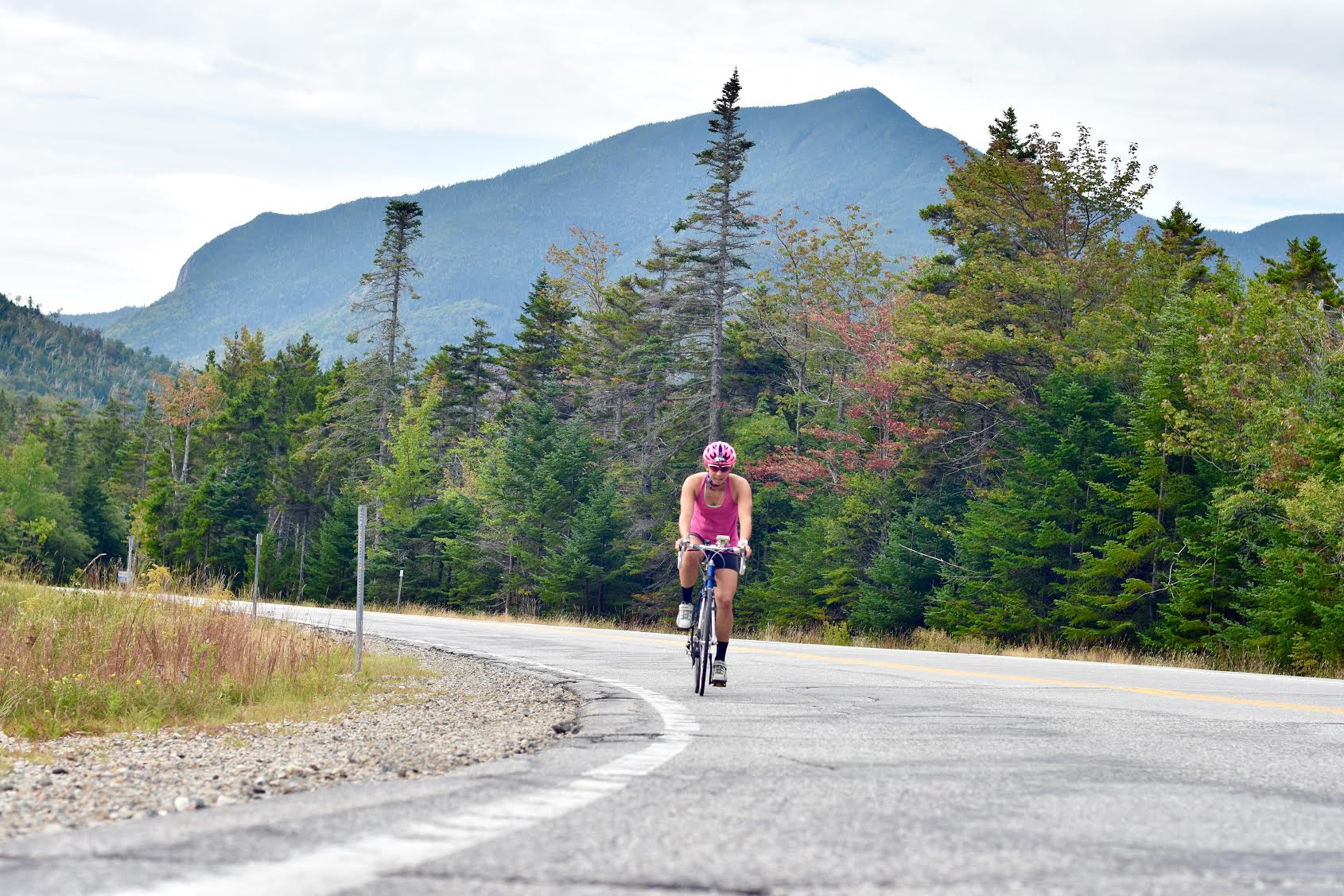
Julia Kern biking up New Hampshire’s Kancamagus Highway at a recent training camp. (Courtesy photo)
Welcome to “17 Questions for 2017″, where we are catching up with American and Canadian national-team members before the beginning of the winter season.
***
19-year-old Julia Kern had quite a diverse year last season, her first on the U.S. Ski Team: a SuperTour podium, a trip to World Juniors, two individual podiums in the junior races at OPA Cup finals in Italy, and two podiums in the junior races at U.S. National Championships (long and short distance).
Having joined the Stratton Mountain School SMST2 Elite Team this year as well as enrolling at Dartmouth College, Kern has made some changes and is looking forward to another big year.
1. Biggest change in your life in the last five or so months since the ski season ended?
My biggest change in the past 5 months has been starting college at Dartmouth. The day after the season ended, I headed straight to Dartmouth to start my first term in the spring and I am currently half way through my second term this fall.
2. Biggest change in your training?
I have finally been able to train without modifying my plan due to injuries and illness so I would say my biggest change is that I am back to a normal training plan! Wahoo!
3. Major areas of improvement you’ve seen so far?
I think there isn’t one specific area where I have seen improvement over the past few months, but actually in every area. I feel like I have generally improved in all areas.
4. Whom you’ve been working closest with this offseason (coaches or training partners)?
Julia Kern happily healthy and rollerskiing. (Courtesy photo)
Since I have joined the SMS Elite team this year, Pat O’Brien became my coach so I have been working closely with him in conjunction with Cami at Dartmouth. In the spring and fall, I have been trained with Dartmouth Ski Team and in the summer I trained with the SMS Elite team. It is fun to mix up training partners!
5. Best trip in the last five months (and why)?
I have only traveled once in the past five months. I went to Park City, UT for a training camp to kick off the summer and it was one of the most effective camps I have been to. I always love coming back to Park City because it is starting to feel like another home to me and the area is just so incredible!
6. Favorite cross-training?
This is a hard one! I really enjoy playing basketball in my free time, but if we are considering cross cross training to be a little more ski specific, I would have to say swimming.
7. Favorite non-athletic activity or pastime this summer?
Camping and hanging out on the beach may be considered an athletic activity with my family, but I was always enjoy my family’s annual vacation camping on Cape Cod every summer.
8. Song that was your jam this summer?
I would say my go-to jam this summer was “Good Day” by Nappy Roots. Definitely not a new song, but it is a good way to start a good day!
9. All time favorite race moment?
American Julia Kern (SMS/USST) racing to a career-best 16th in the 2016 Junior World Championships freestyle sprint in Rasnov, Romania. (Photo: Pete Leonard)
My all time favorite race moment was definitely this past winter during my last race at OPA Cup finals. It was a pursuit start and the girl who started in front of me and behind and I all caught up to one another and skied most of the race together. My tactics worked out really well and I finally nailed the “shake and bake” tactic right in the end to beat out the two girls I was racing head to head with.
10. First thing you pack in your bag when you leave for Europe?
Underwear…but that is a given essential. I pack my camera because I love taking photos and videos on the road, capturing the different cultures and landscapes around.
11. Venue/event you’re most excited to visit this season?
I am most excited for Soldier Hollow! I think it will be an incredible opportunity to have our qualification for World Juniors at the same venue and on the same race courses as World Juniors.
12. Who will win the World Cup title this year?
For the men, Petter Northug. For women, Marit Bjoergen.
13. Biggest sacrifice you feel you’ve made choosing this career path?
The biggest sacrifice I think so far has been giving up on a normal social life. I have found it is hard to maintain a close friend group outside of the ski community when I hardly stay in the same place longer than a month at a time. I am very fortunate to have my closest friends be in the skiing community though, and probably for a good reason!
14. If you could change one thing about your sport, what would it be?
I wish we had some world cups in the U.S. Having World Juniors in Utah this year is going to be really incredible and I wish that people in the U.S. got more exposure to what cross country skiing is and make it easier for athletes’ families come and watch.
15. What did you have for breakfast this morning?
I had two slices of fresh sourdough dough bread with avocado, topped with one over-easy egg on each. Yumm 🙂
16. In 5 years, I’ll be ____?
I will hopefully be racing on the World Cup circuit.
17. In 50 years, I’ll be ____?
I’ll be like my grandmother; active, happy, and a life filled with wonderful grandchildren.
Max Durtschi making his World Cup debut in Canmore, Alberta, last season. (Courtesy photo)
Welcome to “17 Questions for 2017″, where we are catching up with American and Canadian national-team members before the beginning of the winter season.
***
A standout junior skier from Sun Valley, Idaho, Max Durtschi took a break from snow sports to focus on cycling – winning two national titles and competing on first a continental pro team and then, for two years, on Leopard-Trek’s European squad. But after retiring from bike racing in 2014, he came back to the snow. While working on a neuroscience degree at Dartmouth College, Durtschi decided to pick up biathlon.
1. Biggest change in your life in the last five or so months since the ski season ended?
Would either be taking “Cellular and Molecular Neurobiology” this spring at school or dealing with a pretty nasty illness this summer.
2. Biggest change in your training?
Max Durtschi spending some time on the rollerski treadmill in Lake Placid. (Courtesy photo)
We have done a good bit of plyometric work this summer, which is productive for a slow twitch guy like me.
3. Major areas of improvement you’ve seen so far?
I have seen a big jump up in my shooting and ski technique. Gaining upper body and core strength has helped a lot of technique work come together.
4. Whom you’ve been working closest with this offseason (coaches or training partners)?
Sean Doherty – that’s my guy. We have a great group here though, Tim Burke, Lowell Bailey, and Leif Nordgren are true professionals and great role models for us younger guys.
5. Best trip in the last five months (and why)?
I enjoy getting over to Burlington, VT in the summer. That is a neat place.
6. Favorite cross-training?
Ski erg. No, just kidding. I really like good hiking adventures in the Adirondacks.
7. Favorite non-athletic activity or pastime this summer?
Being on the lake – on a boat, paddle board, for a concert, grilling, etc .
8. Song that was your jam this summer?
Hmmm – I love a lot of different types of music. I will say this, setting “Ecstasy of Gold” by Ennio Morricone as the morning alarm has been a theme during the harder weeks this summer. That will get you out of bed.
9. All time favorite race moment?
A lot of good memories both on skis and the bike. I would say last year’s IBU Cup in Nove Mesto was a cool biathlon experience – fog, rain, big stadium, and a lot of fans drinking heavily at 10 am.
10. First thing you pack in your bag when you leave for Europe?
Slippers help hotels feel like home. Also, don’t be forgetting the power adapter. Having access to electricity makes the trip go smoothly.
11. Venue/event you’re most excited to visit this season?
Durtschi with his mother and girlfriend at the World Cup in Canmore, Alberta. (Courtesy photo)
You know, I absolutely love traveling around Europe and seeing different venues. However, if I could get back to Sun Valley, Idaho (where I grew up) that would be pretty dang special.
12. Who will win the men’s and women’s World Cup titles this year?
Let’s go with the French double of Fourcade and Dorin-Habert.
13. Biggest sacrifice you feel you’ve made choosing this career path?
Starting in high school I don’t see home much. But after a bit, being away starts feeling like home…
14. If you could change one thing about your sport, what would it be?
Handling a firearm in the middle of winter can get really cold on the fingers, but then, my hands are always too hot anyway. Not sure if I would change much at all.
15. What did you have for breakfast this morning?
Oatmeal with the fruits and nuts. Fiber makes the world go around.
16. In 5 years, I’ll be ____?
I had better have finished college by then…
17. In 50 years, I’ll be ____?
Probably hiking up some damn mountain.. But you know “outlive the bastards” as Edward Abbey once said.
Durtschi competing at 2016 U.S. National Championships in Fort Kent, Maine. (Courtesy photo)
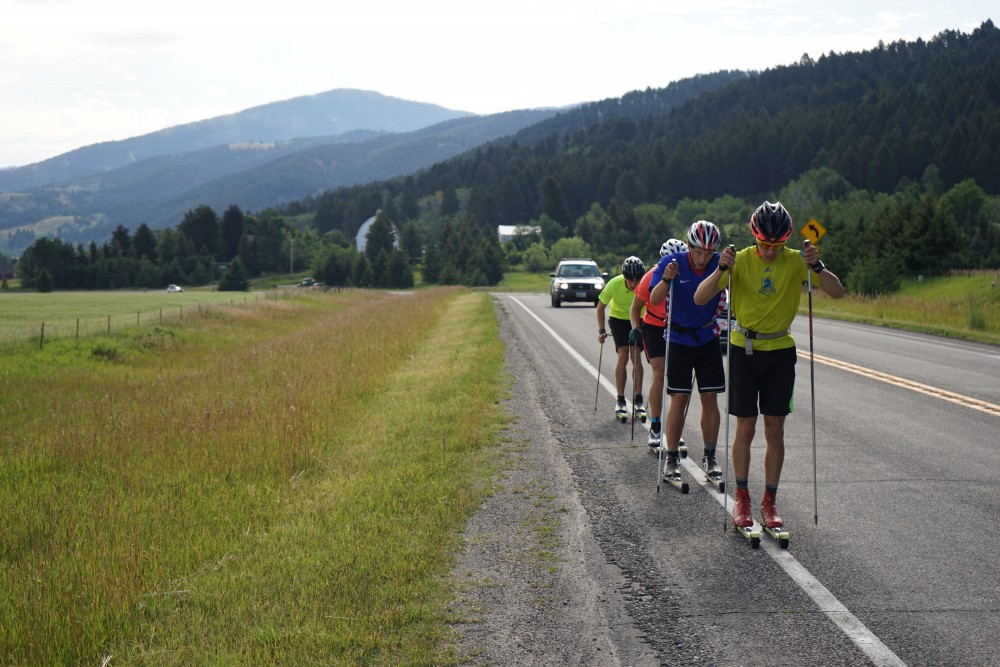
(From left to right) BSF skiers Silas Talbot, Jennie Bender, Paul Everett, Logan Diekmann, and Max LaChance during a rollerski in Bozeman, Mont. (Photo: Austin Caldwell)
The pale wood grain of a wax trailer’s interior walls and the sound of a power-tool firing up can only hold one’s attention for so long, especially if that someone has the coaching gene. As the grandson of John Caldwell, a former U.S. Ski Team (USST) head coach, and son of Sverre Caldwell, the Stratton Mountain School (SMS) nordic director and head coach, it may be no surprise that John — who goes by his middle name of Austin — Caldwell, also heard the call to coach.
After spending this past winter working for Caldwell Sport as a wax technician, Austin, a 24-year-old Dartmouth grad, wanted a challenge and change. Not only in his work, to include a greater focus on interactions with athletes, but in his whereabouts as well.
“I really enjoyed working with Zach and Amy [Caldwell] wax-teching last year,” Austin said on the phone while in Bozeman, Mont. “But part of me wanted to spread my wings a bit and try some new place outside of the east and outside of Vermont where I’ve lived all my life.”
Austin, Sophie and Isabel Caldwell (l-r) during their Christmas visit to Europe in 2013 to see Sophie race on the World Cup circuit. (Photo: Sophie Caldwell/sophiecaldwell.blogspot.com)
Growing up in Peru, Vt., alongside his two sisters Isabel and Sophie Caldwell (the latter of which is a USST member), skiing was not just what Austin spent his spare time doing. It was the family mealtime topic of choice; it was how vacations were spent with relatives — his uncle Tim Caldwell, a four-time Olympian, and cousins are all avid nordic skiers as well.
Surrounded by skiing his entire life, Austin did not want to give it up anytime soon. When the head coaching position for the Bridger Ski Foundation (BSF) elite nordic program opened up and his cousin, Anya Caldwell-Bean, BSF’s U18/U20 junior coach, told him of the opening, he saw an opportunity to not only stay involved with skiing, but further himself and his experiences in it.
“I loved wax-teching last year, that was really fun, but I also enjoyed coaching in the past for junior skiers,” Austin said. “My dad is a coach and I’ve always been interested in coaching … so now I get to coach and wax tech.”
Stepping into his new role and responsibilities as the head coach for the BSF elite team — his first coaching position of this caliber — Austin is aware of the challenges that rest ahead for himself and his athletes. Prior to this year, his work with athletes involved coaching juniors last year in Putney, Vt., and at SMS youth summer camps over the past five years.
“I have gained most of my understanding of coaching from my relationships with Sverre, Ruff Patterson, and Zach and Amy Caldwell,” Austin wrote in an email, referring to his father, college coach, and first cousin once removed (and his wife), respectively. “Those four have been great mentors and in the process they have taught me almost everything I know about skiing.”
Bridger Ski Foundation (BSF) 2016/2017 Roster:
Elite Team Jennie Bender
Silas Talbot
Nick Power
PG/Collegiate
Paul Everett
Max LaChance
Nick Matelich Summer Collegiate
Noah Anderson
Logan Diekmann
Currently eight athletes will work with him during the summer and throughout the season. Three athletes, Jennie Bender, Silas Talbot and Nick Power comprise the elite team, and five others make up the post-graduate crew, with a few of them heading to college in the fall and being replaced with new post grads for the upcoming school year.
“We’ll have some kids taking classes and then partway through the winter, people will be going different ways depending on how they do [during the season],” Austin explained. “So that will be, as far as managing at that point, that will be one of the bigger challenges.
“But I think it’s something all teams face,” he added. “Just having kids at different levels and different age groups as well.”
On a personal level, Austin admits one of his biggest adjustments so far has been learning Bozeman’s trails and rollerskiing roads, as well as not getting the team or team van lost in Montana’s mountains.
“For me, I guess the biggest challenge that everyone has been helping me with is finding my way around Bozeman and finding new routes for rollerskiing,” Austin said. “Every week I’ve been trying kind of to add a new place to rollerski … because it’s important to switch it up.”
“I plan on staying in the ski world for as long as I can, so far BSF and Bozeman have been great and I plan on remaining here for the coming years.” — Austin Caldwell on becoming BSF’s elite head coach
But even if navigating Bozeman has been a bit of a learning process during the beginning stages of his coaching career, the city and a well-established elite program were two of the draws that pulled Austin to apply and eventually take the position.
“Having a strong program in place and being in Bozeman were the two main factors [why I considered working with BSF],” Austin said. “I also talked with Dragan [Danevski, BSF’s head coach and program director] and with my cousin Anya and it just seemed like it would be a good fit.”
With the goal to remain involved with skiing for as long as possible, Bozeman and BSF struck Austin as the ideal program and place to be a part of.
“I plan on staying in the ski world for as long as I can, so far BSF and Bozeman have been great and I plan on remaining here for the coming years,” he wrote in an email.
Danevski respectfully declined to comment on Austin’s hiring. In the last two years, the BSF elite team has weathered several coaching transitions, most recently with the departure of Bernie Nelson — the team’s coach since the fall of 2014.
In his first season as an elite head coach and with eight athletes to oversee, his greatest ambition involves pushing his athletes to their full potential. Talbot, 23, Austin’s former classmate, co-captain and fraternity brother at Dartmouth College, and now an athlete for the BSF elite team, saw the transition to having Austin as a coach as uniquely strong.
“For myself, it has been hugely beneficial to have Austin coaching because he knows my athletic background so well,” Talbot, originally from Anchorage, Alaska, wrote in an email. “He already knows my strengths and weaknesses (which are especially prevalent in the dryland season), and so there is no need to build up the trust and/or understanding between us from scratch. In short, having someone I know well as a coach makes the adjustment to the new program — something that for many after college is a tough step — much easier.”
Bridger Ski Foundation elite and post-graduate athletes during a classic rollerski in Bozeman, Mont. From left to right: Max LaChance, Nick Power, Logan Diekmann, and Silas Talbot. (Photo: Austin Caldwell)
Entering her fourth year on the BSF elite team, Bender also found Austin a positive addition to BSF and the greater Bozeman area.
“Austin waxed for me during the last few World Cups at the Canadian Tour this past March, and I was instantly impressed with his professionalism,” Bender wrote in an email. “Austin taking the head Elite/PG coach position is a great attribution to not only BSF, but to the Bozeman ski community as a whole.”
So far, Austin too, cannot ask more of his athletes and training group. The higher level of focus and preparation he finds evident with the BSF elite and PG level athletes gives him confidence in the season and performances to come.
“I think the key to success is having a group that motivates each other and pushes each other,” Austin said. “And I’m very excited about this training group we have going into the summer. They’re all working very hard and they’ve come together really well. It’s like they’ve been training together a lot longer than three weeks … everyone in this group is always trying to push the limits and do everything they can do to get better.”
Dartmouth College Freshmen Emily Hyde racing “back” East at the Williams Carnival 10k skate in Lake Placid, NY. Hyde will soon to be training “out” West. (Photo: Olivia Amber)
Dartmouth College freshman skier Emily Hyde is that quintessential bi-coastal athlete: she learned to ski fast in Bend, Ore., and she headed “back” East for the Ivy League academics and to race against some of the country’s best collegiate cross-country skiers. With the East’s grim snow year, Hyde is looking forward to coming home, for yes, on-snow training in June.
Bend is a nordic skiing hotbed. And Hyde took charge there early on. She was a four-time Oregon High School State Cross-Country Ski Champion and she won two Junior National titles her senior year. Perhaps there is no other way to describe it, but Hyde was a big fish in Bend’s somewhat-small pond. Fast forward to this past year, and Hyde held her own on the Carnival circuit and said she loved being pushed by her teammates.
Dartmouth freshman Emily Hyde racing in the 10 k classic at 2016 U.S. Nationals in Houghton, Mich. (Courtesy photo)
“I think it was really awesome to sort of not be the big fish in a small pond anymore,” Hyde said on the phone. “My team was big enough that everybody was better at some things than everybody else. I know this girl will be really good on this day. Another girl will be really good on that day. But I think that was really cool, because it always kept you accountable. It was just cool to always have someone a a level above you in whatever you were doing.”
Hyde is that type of skier: she is always wanting to improve.
“Personally, I need to keep working on skate skiing,” Hyde said about what she’ll be working on this summer. “My first year in college it was back to back to back racing whereas at home , it was every other week or a week off and then a high school race. I sort of chose what races I was going to do. But this is every weekend and everybody does it. So I think just working on being consistent and being able to push through and be fast every single weekend for six weekends in a row. And I’m not entirely sure how I am going to do that yet. But I think just continuing to build the base.”
Hyde’s goals — improving her skating and building a big base — brings us to this Wednesday Workout which Hyde is a bit homesick for: “The Not-So-L1 Crust Cruising into Broken Top.”
Two Bend locals, Aidan Whitelaw and Zoe Roy, nearing Broken Top’s bowl. (Photo: Jason Albert)
Hyde was on the fence as to whether she’d call it a true Level 1 effort. “You go kind of fast, it feels so good to crust cruise and chase your friends around,” Hyde said. Higher up, as skiers gain altitude, the terrain changes. It morphs from a gradual climb with a few punchy steeps into a sustained grueling climb.
Broken Top, an extinct volcano, features a massive bowl resembling more of a headwall as it steepens and steepens.
“Once you get into the bowl, it is quite steep and quite high,” Hyde noted. “So you can’t really make that L1 unless you one-step and take a breath. I guess I don’t really think about doing it L1, I just want to get to the top.”
The nature of the workout, where the terrain dictates the effort, will help Hyde wake the body up as she adapts to her hometown stomping grounds for the summer.
“It’s going to be an altitude adjustment for sure,” Hyde said. “I think it is cool I’ll be back on skis, which is more natural and it will be the longest workout I will have done. It’s going to be hard in that sense and hard because it is at altitude. But I am not going to dread it. I don’t know if my legs can handle it for three hours — it will be hard but it is a good adjuster.”
Broken Top Crust Cruise How To’s:
– Watch the weather. Wait for a several day’s long high pressure system with clear cold nights.
– Head up to Mt. Bachelor Nordic Center on a bluebird day, head out the Common Corridor Trail, hang a left at the snow covered road, and head downhill to Todd Lake.
– Ski across Todd Lake, assuming it’s frozen, and head north. Gain the ridge, and aim towards Broken Top. The wide open bowl on Broken Top’s east-southeast flanks will be obvious as you ascend above tree line.
Round trip: approximately four hours.
Looking towards Broken Top’s Bowl from a foggy Todd Lake. (Photo: Jason Albert)
Linn Eriksen of the University of Denver celebrates her win in the women’s 15 k classic mass start at the 2016 NCAA Skiing Championships in Steamboat Springs, Colo. (Photo: Jamie Schwaberow/NCAA Photos)
In March, FasterSkier recently published an article (Part I) on college ski racing in the U.S. and what a change to National Collegiate Athletic Association (NCAA) Championships might require in regards to adding a sprint race. In the second part of the series, we explore why men’s and women’s race distances are different at the collegiate and World Cup level and whether this constitutes a need for change.
***
Men | Women. Women | Men. Scanning the athletics webpage for an American institution of higher education that boasts a varsity sports team becomes a sail down the Casiquiare canal, with gender bifurcation an obligatory outcome.
Resting under the canopy of NCAA sports, however, nordic skiing presents itself as somewhat of an anomaly. Shared race days. Shared coaches. Shared course site. Shared team. At the surface level, gender in collegiate nordic skiing is almost arbitrary.
Olivia Amber (r) of Colby College and teammate Amy Bianco celebrate their top-20 finishes in the women’s 15 k classic mass start at the 2016 NCAA Skiing Championships in Steamboat Springs, Colo. (Photo: Colby.edu)
Yet, closer inspection reveals one particular area in collegiate cross country skiing where the genders differ: Race distance. In most individual nordic events at the college level, the course length of women’s and men’s races are not the same. The trend is a 5-kilometer deficit for women’s race events in comparison to men’s events.
For Molly Peters, the head nordic coach at Saint Michael’s College and former NCAA All-American in nordic skiing for Middlebury College, this is a problem.
“We’re sending a message to all the young women who have a goal to ski in college,” Peters said in a phone interview. “I just can’t imagine that they feel like their equal as people or athletes when they look and they see, ‘Oh, look every single race I’m going to be skiing 5-kilometers less.’ How are men every going to look at women equally and how are women ever going to look at themselves as being equal if you’re always skiing 5-kilometers less?”
With that in mind, Peters promised herself to reshape the sport.
“It had to be my mission in life to get it changed,” Peters said. “I feel like my best bet to get it changed is to change the NCAA Championships because everyone bases all their racing off of what the NCAA does. Every EISA [Eastern Intercollegiate Ski Association] Carnival is basically not equal because they follow whatever the NCAA does. It all trickles down.”
The Trickle Effect: One Theory on Why Race Distances Differ
A single change can create countless more. When Title IX was passed in 1972, a change was instituted in the treatment of both genders by federally funded college institutions. Within the realm of campus athletics, the alteration brought about numerous others, including an increase in the number of women participating in college sports, the scope of sports available to women and men (in certain instances, harmfully so), and perceptions of women who choose to ‘play.’
Recent Middlebury College returnee, Annie Pokorny, points out that this sort of ‘trickle down’ change should not be looked at lightly.
“When women entered sport, some rules were tweaked to account for physiological differences, but also to support the idea that athletics could be harmful to women, (particularly their reproductive systems,” Pokorny wrote in an email.
Pokorny is completing her undergraduate senior thesis on feminist philosophy and the philosophy of sport. While she admits she is not an expert, her studies and experience in nordic skiing quantify her knowledge on the subject.
Pokorny explained that myths surrounding the female body and exercise in the 20th century, caused men “to adjust sport to make it safer and more “womanly”), which turned into a conceptual connection between women and the need to protect them.”
“That conception turned into tradition, one that still thrives today in the form of shortened distances for female endurance athletes,” Pokorny added.
The top 10 in the women’s 5 k freestyle race at the 2016 NCAA Skiing Championships in Steamboat Springs, Colo. (Photo: Matt Johnson/MSU)
For Pokorny and Peters, these types of traditions were made to be broken.
“The best things that have ever happened are from people changing tradition,” Peters said. “My purpose is to get the NCAA Championships changed to be the same distance for men and women because that will trickle down to the smaller races.”
But implementing change in the NCAA Championship event and NCAA skiing is no easy task.
“NCAA skiing is comprised of a wide variety of institutions: Division I, II and III; private and public; and large and small,” Dave Stewart, head nordic coach at the University of Denver, wrote in an email. “Any choices about race format, distances, etc. must take into consideration the perspectives of this diverse group and, ideally, the decisions should be made with the goal of broadening participation at the NCAA level and increasing competition.”
If Stewart is right, the question becomes: Would making race distances equal between men and women broaden participation and increase competition?
A Second Theory & the Distance Debate: Should Men Race Shorter or Women Race Farther?
When it comes to long distance endurance events, some research argues women fare better than men.
“Women can race just as long as men,” Montana State University (MSU) incoming senior Anika Miller said on the phone. “If [the NCAA] wanted us to do a 50 k in college, sure we could do it, but it wouldn’t make any sense athletically.”
Montana State University’s Anika Miller (l) with head coach Matt Johnson after Miller took won the women’s 5 k freestyle at the 2016 NCAA Skiing Championships in Steamboat Springs, Colo. (Courtesy photo)
Miller — a native of McCall, Idaho, and this year’s NCAA champion in the 5 k freestyle — doesn’t doubt the ability of women to race the same distance as men.
What she questions is whether it’s necessary for women to do so.
“It’s kind of a hard conversation to have as a female athlete because you don’t want to say that women are inferior,” Miller said. “My opinion on it is that the race distances are good as they are as far as women doing a shorter distance than the men. Because time wise … for the 15 k versus the 20 k at least, sometimes the guys only race it five minutes different than the women, which isn’t really that large of a margin, [meaning] effort wise, it’s more equal.”
The point Miller makes is that women and men are currently racing equal. Equal amounts of time on course, at least in the 15 k and 20 k events (*see men’s and women’s course times).
Oscar Friedman, coming off his senior season at Dartmouth where he was a captain of the men’s nordic team, also argued that close to equal amounts of time on course is more important than equal course distances between men and women.
“The point of having those different race distances was to make the men’s and women’s races equally competitive,” Friedman said on the phone. “That being said, if women are internalizing it, then that’s a bigger issue. If there’s a push from within the sport, women should be the ones deciding the race distances.”
The push from women within the sport varies, but much revolves around whether women race longer or men race shorter distances. Kelsey Phinney, coming of her senior season and also a captain at Middlebury, admitted that originally the idea of equal distances didn’t appeal to her because she assumed women would be required to race farther.
“I think the misconception has been that equal distances meant that women had to race longer,” Phinney on the phone. “But it doesn’t mean that women have to go 10 k and 20 k it could mean that men go 5 k and 15 k. Or that the races range from sprints to 30 k.”
Rachel Hampton, an incoming senior at Harvard University, advocated that while women are capable of racing men’s distances, men would benefit from racing shorter lengths.
“There’s a feminist side of me that wants to say that girls can do anything boys can do and there’s no theological reason why we shouldn’t be able to race the same distance as them,” Hampton said on the phone.
“I will say I sometimes feel bad for the guys because it seems like they only race long races. I think if we added sprinting and a few 5 k races for the guys and did a wider range of distances, that would be better for them. And I think if the men were on that plan, the women could then get on the same distance plan.”
However, when men competing in college were asked if they would be willing to race the same length as women, responses were often shaped by race distances at other levels of nordic competition.
“Shortening the men’s distances would be a huge disservice because as I see it, the goal of NCAA skiing is to make American skiers as competitive as possible on the World Cup,” Friedman said. “I would be completely against shortening the men’s races. But if women want to make the call and race longer, they should fully be able to do that.”
For a few women, however, simply adjusting the women’s race lengths to match those of the men sends a certain message: Women have to be like men to be equal.
“I think the message it sends depends a lot on whether you shorten the distance of men or you increase the distance that women have to race,” Bates College ’16 grad and skier Britta Clark said on the phone. “Trying to increase the distance that we race in the name of equality, but at the same time really just saying that equality is women doing what men do, I don’t think it’s necessarily speaking to the issue.”
Clark’s point is supported by Dartmouth College Women’s Head Nordic coach and Director of Skiing Cami Thompson-Graves, also a member of the NCAA Men’s and Women’s Skiing Rules Committee, chair of the USSA Cross Country Committee, and most recently, a member of the International Ski Federation(FIS) Ladies’ Cross Country Committee.
“I don’t feel the need for women to do men’s distances,” Thompson-Graves said on the phone. “Why don’t we just do women’s distances? Why can’t we just be different … I’m a big believer in being proud to be a woman, and not a little man.”
Harvard’s Rachel Hampton leads a Dartmouth skier during the 2016 Colby Carnival. Hampton went on to compete at the NCAA Skiing Championships in Steamboat Springs, Colo. (Photo: FlyingPointRoad.com/Harvard Facebook)
Increasing women’s distances strikes some as a forfeiture of female identity for one that is male. Which is one reason Peters more strongly advocates for decreasing men’s distances to be the same length as women’s.
“In skiing, I think the men should come down,” Peters said. “The 20 k is really irrelevant, even at the international level. I see nothing wrong with the 5 k, I think men should do 5 k. Five k is super exciting and can be a great race. I think it should be 5 k, 10 k, 15 k, and then add in the relays and sprints.”
However, a men’s 5 k race doesn’t appear on numerous nordic race calendars — national or international — either.
“I don’t think at the national or international level men race 5 k so maybe that’s a distance skill set that would only be applicable to college skiing in the U.S.,” Raleigh Goessling, coming of his senior season at the University of New Hampshire, said on the phone. “If the race distances were changed, I feel like the distances that are contested at other levels of the sport and other formats should also play into it.”
The Window Between U.S. College Racing and the World Cup
At the international level, women and men rarely race the same distance. FIS course lengths — like the NCAA — are designed around the gender of the athletes competing.
FIS Cross-Country Committee Chair and Norwegian Olympian Vegard Ulvang indicated that similar to college racing in the U.S., FIS race distances have been different for decades. One potential reason for these differences aligns with Porkorny’s findings. According to Ulvang, how female athletes were viewed in endurance sports when they started ski racing influenced the original length of women’s race courses.
“The history behind the differences comes from the time where the nations believed that women were weaker — [with the] first female race in 1952,” Ulvang wrote in an email to FasterSkier. “Today we of course know better. Female athletes are better prepared for longer distances than men, so principally the distances should be equal.”
Principality does not always equal response. Ulvang indicated that even if the race distances should principally be equal, one major driving force for the committee to keep women’s race distances shorter than men’s rests on the race experience for spectators.
“The argument has been that the time gap between the 20 best women is bigger than that of the men,” Ulvang wrote. “Longer distances would create a ‘worse TV product’ — with one racer skiing alone [during the race].”
T.V. time does not strike Peters as an excuse for NCAA Championships and U.S. college cross-country ski schedules to follow the same format as the World Cup.
The men’s 20 k classic mass start at the 2016 NCAA Skiing Championships in Steamboat Springs, Colo. (Photo: Jamie Schwaberow/NCAA)
“A lot of people will say well, look at what they do at the Olympics, and look at what they do at the World Cup — it’s vastly different,” Peters said. “The women do so much less. But that doesn’t make it right. That’s a reason why NCAA follows it and EISA follows it, but that doesn’t make it right.”
Stewart, who has helped the Denver Pioneers achieve five NCAA Championship titles, supports the idea that NCAA skiing in the U.S. could act as a catalyst for change.
“As long as FIS schedules longer races for men than for women in international championships, there will be some resistance to equal distances at other levels, but I see no reason why the NCAA should not be a trendsetter and work to turn the tide on this,” Stewart wrote in an email.
He supports equal distances in cross-country skiing, seeing it as a statement that should be sport-wide, not just within NCAA nordic skiing.
“Equal distances for men and women should be implemented in our sport, both at the NCAA and international levels,” Stewart wrote. “We have had equal distances in the sports of swimming and track and field at the international and collegiate levels for many years. Equal distances would reinforce gender equity and would send the right message about our sport.”
Yet, when it comes to World Cup race lengths versus those contested at the NCAA, some argue the Championship event is already sending a message to other levels of cross country competition.
“I actually think that NCAA’s, where the women race 15 k and the men race 20 k, is much more equal than on the World Cup when the women race 15 k and the men race 30 k,” Rosie Brennan, Dartmouth grad and current U.S. Ski Team (USST) member, said on the phone.
Brennan is not opposed to a more balanced race length distribution between men and women. Her concern with changing race distances at the World Cup and NCAA collegiate level is ensuring that the racers’ performance and perspective are taken into account.
“I think it would be nice if they tried to make the [race distances] a little closer,” Brennan said. “I also think the reason the distances were different in the first place was the idea that the time the race takes should be fairly equivalent, so the effort is the same. If the time differences [between men and women] are getting to be much greater, to the point that the races are no longer requiring the same amount of effort, then I think it’s worth proposing some sort of a change and [is] something to re-visit over time.”
Brennan’s suggestion to visit the race experience for athletes doesn’t go unsupported. Men’s and women’s race distance differences have been discussed at the collegiate and World Cup level. But the actual number of times the topic has been statistically ‘re-visited’ remains a bit blurry.
Regarding conversations within the college circuit, Peters indicates that implementing changes to men’s and women’s race distances has been thrown around for some time.
“Patty Ross, who coaches at Middlebury, she’s been fighting it for 25 to 30 years and she’s had no success,” Peters said.
Ross could not be reached for comment.
Within the FIS Cross Country Committee, Ulvang indicated that the turn of the millennium was when most conversations regarding the different course lengths at the World Cup level of racing began.
“[The] question has been discussed in the FIS committee a few times the last 15 years,” Ulvang wrote.
Beyond that, four-time Olympian, USST member, Fast and Female USA President, FIS athlete rep, and now a new mother Kikkan Randall revealed that World Cup athletes have also had at least one opportunity to make their opinion about equal distances known.
Fast and Female USA President Kikkan Randall leading a Fast and Female session two years ago in Bend, Ore. (Photo: Matt Whitcomb)
“It’s an interesting topic that actually comes up quite often on the World Cup,” Randall said. “As the athlete rep to FIS, I do a survey at the end of each season and couple years ago, as part of the survey, I sent out that question [of equal distances].”
The responses Randall received found most women on the World Cup circuit — at least a few years ago — did not want to race the same distances as men.
“The majority of women actually said that they were not interested in racing the same distances as the men,” she said. “I’m considering putting that same question on the survey again this year because the comment was brought up a couple times this spring.”
And how might women racing on the World Cup respond to shortening men’s distances to make the lengths equal? The question has not been posed, but Randall may incorporate it into her next athlete poll.
“That would be another interesting take on the same question,” Randall said. “This year on the World Cup I feel like the distances were reduced a little bit with so many tour [multi-stage] events, so again it’d be an interesting time to poll the athletes and see how they feel.”
Conclusion: Connecting Part I and Part II
As long as there is snow around, colleges with nordic programs in the U.S. will continue to attract a cohort of cross-country skiers looking to compete, while simultaneously continuing their education. For many, choosing college over a club team is not the end of a cross-country skier’s long term career. It is also the potential beginning.
“The way our country is, you’re always going to have athletes choosing to go to college after high school no matter what path they’re on,” Brennan said. “So I think the more that that can be facilitated, the better it is. I mean there are a lot of good club programs that offer alternatives for people who choose that, but I think the NCAA can provide a route as well.”
Some individuals also see the NCAA as an opportunity for Americans to attend college in the U.S. and potentially compete against athletes from other countries.
“As a venue for athletes to develop into international level skiers, [the NCAA circuit] is a great place because there are really high-level skiers from all over the world in the small microcosm of NCAA skiing,” Chad Salmela, outgoing nordic coach of the College of St. Scholastica, said on the phone.
With an assured influx of athletes choosing skiing and school — and the opportunity for some to race international athletes at ‘home’ — many don’t deny the difficulty of disconnecting U.S. collegiate racing and higher levels of nordic competition.
“From a purely objective standpoint, I would say that a junior athlete who chooses to skip college (at least until they are completely done with their racing career, whenever that may be) and pursue ski racing full-time starting at age 18, is much better set up to ski faster on the World Cup level later in their career,” current USST member and former Middlebury skier Simi Hamilton wrote in an email.
“However, because of the small numbers of junior skiers we have in our country (relative to all the other skiing powerhouse nations), college is a great way to keep kids engaged and in touch with racing during a period of their lives when they may have decided they want to do something completely different,” he added.
Yet, if NCAA racing is to preserve itself as one potential path for athletes looking to make professional steps in the sport, college and World Cup racers alike agree that conversations about change — be those for adding sprinting or making race distances equal between men and women — need to continue.
“I think incorporating sprints at the NCAA is definitely worth talking about and pushing forward because that’s at least one-third of the races we do [on the World Cup], if not more,” Brennan said. “I think trying to stay current is a valuable thing.”
Ida Sargent, a Dartmouth grad and current USST member, agreed that sprinting deserves spotlight attention in present-day skiing.
“I can obviously only speak for the women’s distances but I liked how there was a short and a longer distance race,” Sargent wrote in an email regarding NCAA race distances. “I think a more important change would be adding in more sprint races. We race a sprint almost every weekend on the World Cup and when I was in college we would have one a year at the most.”
With one more year of college racing left at MSU, Miller also pushed adding more sprint races to the college race circuit to foster cross country skiers’ development.
“I think it’s unfortunate that we don’t have sprinting,” she said. “Because that’s such a great development tool.”
Though Miller and Sargent are at odds with Pokorny’s press for equal distances, all three do seem to agree that changing customs can create better opportunities and a better outlook for cross-country skiers.
Dartmouth’s longtime coaches Ruff Patterson (l) and Cami Thompson-Graves are FasterSkier’s coaches of the year. (Photo: Dartmouth Sports/FasterSkier)
The 2015/2016 awards continue this week, chosen by the FasterSkier staff based on performances from last season. While not scientific, these points of recognition are intended to reflect a broader sense of the season in review.
There are a few teams which have dominated college skiing in the last few years: Denver and Colorado trading back and forth for 10 of the last 12 NCAA titles. Northern Michigan University dominating Midwest cross-country skiing.
And, in the East, the University of Vermont. The Catamounts won 21 straight Eastern Intercollegiate Ski Association (EISA) carnivals coming into this season, meaning no other team had won in almost four years. They also won the 2012 NCAA Championships, one of the few teams to break Denver-Colorado dominance.
But at the Colby Carnival in Maine, the second weekend of the 2016 EISA season, the other team to break the Denver-Colorado pattern – 2007 NCAA champions Dartmouth College – began their rebound, edging UVM by four points for the combined men’s, women’s, alpine, and nordic title.
“It has been a long spell of 2nd place finishes and we all knew we could do it,” Dartmouth Director of Skiing Cami Thompson-Graves wrote in an email this spring. “It was just a matter of putting things together at the same time. Certainly the strength of our Alpine teams helped, but we also had some solid performances on the Nordic side too.”
Helmed by Thompson-Graves on the women’s cross-country side and Ruff Patterson on the men’s cross-country side, and with a storied past, it’s hard to ever consider Dartmouth the underdogs in a ski race. But it still seemed like an upset.
Then Dartmouth won the UVM Carnival. Then UVM won the Dartmouth Carnival. It was competition that the Eastern circuit hadn’t seen in years.
“The excitement of the team was great,” Thompson-Graves wrote. “I knew it had been a while but hadn’t considered just how long it had been, and so winning early in the season was a great boost, and helped keep the team fired up through the season, despite the lack of snow and constant wondering of where/what we would be racing from week to week.”
Dartmouth went on to earn fifth place at NCAA Championships in Steamboat Springs, Colorado, the top team from the Eastern division.
After the whole Championships with only one race remaining, UVM trailed Dartmouth by just two points. That race was the women’s 15 k mass start; UVM had won seven women’s cross-country races over the course of the season, compared to three for Dartmouth.
But Thompson-Graves’s Dartmouth women’s team pulled away, with Dartmouth securing fifth place and UVM slipping to seventh.
“Steamboat was fun — I always like racing there, despite the elevation,” Thompson-Graves wrote. “The first race was tough, and the results were average but it was great to put it together for some stronger results in the final race. Of course, we want more, but 5th was a result to be proud of this year.”
Dartmouth wasn’t the best college team in the country, even when breaking things down into nordic and alpine. National titles, however, are not the only measure of coaching success. Thompson-Graves and Patterson have shaped a large segment of skiers who are contributing to American success internationally, as well as fueling the ever-more-competitive senior domestic circuit.
This year alone, Dartmouth alumni women made up half of the World Championships team for U.S. biathlon (Susan Dunklee and Hannah Dreissigacker) and three-eighths of the U.S. Ski Team’s senior team (Sophie Caldwell, Ida Sargent and Rosie Brennan).
When the Ski Tour Canada picked up extra American and Canadian quota spots, three more Dartmouth skiers joined the World Cup: Annie Hart, Eric Packer and Dakota Blackhorse-von Jess. Elsewhere in the ski world, fellow alum Erika Flowers finished third in the American Birkebeiner, and Paddy Caldwell, still college-aged but skiing primarily with a senior team, was the top American finisher in the 15 k skate at U23 World Championships.
Only four U.S. athletes stood on individual World Cup podiums in nordic sport this season, and half came from this group: Dunklee (second in a biathlon World Cup in Fort Kent, Maine) and Caldwell (who won a Tour de Ski stage in Oberstdorf, Germany).
(Brennan was also part of the third-place U.S. relay team in Lillehammer, Norway.)
And the other two podium finishers – Jessie Diggins and Simi Hamilton – happen to be part of the SMST2 team, which is coached by Patterson’s former All-American skier Patrick O’Brien. Their head coach on the U.S. Ski team is another of Patterson’s former athletes, Chris Grover.
Those are just a few Patterson and Thompson-Graves’s former athletes who have gone on to coach at every possible level, with some encouraging participation at a young age and building the U.S. skiing pipeline from the bottom, while others help point talented college and senior athletes towards elite success.
Patterson is retiring after this season, but Thompson-Graves will continue to helm the program into the future. While watching their former athletes excel at the senior level must be satisfying, there’s still plenty going on in their day jobs.
“It was great to knock UVM off the top a couple of times this year!” Thompson-Graves wrote in her email.
Dartmouth College seeks a full-time, Head Coach for its Men’s Nordic program. The Head Coach will lead, coach, develop and administer all aspects of the men’s nordic program within NCAA, Ivy League and institutional standards. Assumes additional responsibilities for the overall Ski Team program.
Mads Strøm of the University of Colorado racing to first place in the men’s 10 k freestyle at 2016 NCAA Skiing Championships last week in Steamboat Springs, Colo. (Photo: CUBuffs/Buffzone.com)
Note: This article has been updated to include comments from Ethan Townsend as of Thursday, March 17.
With the conclusion of the collegiate season taking place at the 2016 NCAA Skiing Championships in Steamboat Springs, Colo., last week, FasterSkier provides a look at the some of the latest involving school, sport and the Championship races. Part I examines the tradition behind the NCAA Skiing Championships format, and what it would take to change it.
A Brief History of NCAA Skiing Championships
5 k/10 k. 15 k/20 k. Scrolling through the archives of the National Collegiate Athletic Association (NCAA) championship events for nordic skiing is akin to strolling through a 1950s U.S. ‘Levittown’ neighborhood: Variation zero to none. Another online record for the past 16 years of NCAA Skiing Championships provides a similar finding. Nordic races at this event are traditionally two races for each gender: women race 5 kilometers and 15 k, while the men race 10 k and 20 k. Though the discipline alters between freestyle and classic, the distances for each respective gender remain the same.
A phone conversation earlier this season with Cami Thompson-Graves, Dartmouth College women’s head nordic coach and director of skiing, NCAA Men’s and Women’s Skiing Rules Committee member, Chair of the USSA Cross Country Committee, and most recently, a member of the International Ski Federation (FIS) Ladies’ Cross Country Committee, revealed a similar story.
Dartmouth women’s coach Cami Thompson-Graves (r) at 2016 U.S. nationals in Houghton, Mich.
“So as long as I can remember, [the championships] have been two races,” Thompson-Graves explained. “Way back when … it was an individual race and a relay. But then when skating came along, we went with one classic race and one skate race. Pretty much for the last 25 years, we’ve alternated every two years and done a long mass start of one and a shorter of the other.”
So what if the championship races have stayed the same for the past 25 plus years? Why should anyone in or out of the college-race scene care?
“I skied in the East and tradition is a big deal in the East,” Chad Salmela, head nordic coach of The College of St. Scholastica in Duluth, Minn., said on the phone. “People like tradition, but at the same time, tradition can limit your outlook as to what the future could possibly hold.”
Coaches, Committee Members and Athletes on Change
According to Salmela, the championship event controls quite a bit of what events college racers will compete in during the regular season.
“Let’s face it, the championships really drive what happens in the regular season because everybody is trying to qualify,” Salmela said.
That’s certainly the case for the 2016 Rocky Mountain Intercollegiate Ski Association (RMISA) nordic race schedule, with all but one weekend following the 5 k/10 k and 15 k/20 k format.
“It varies from region to region,” Thompson-Graves said of the 5 k/ 10k and 15 k/20 k race distances in the Eastern Intercollegiate Ski Association (EISA) schedule. “If those are the [championship] events, we’ll try to do those races one weekend back to back early in the season and our regional championship is usually similar to the NCAA Championship.”
This year, the EISA schedule included a men’s and women’s 1.5 k classic sprint, as well as a men’s and women’s sprint relay event.
Kelsey Phinney, a Middlebury College senior from Boulder, Colo. competing at 2013 NCAA Skiing Championships at the Rikert Nordic Center near Middlebury, Vt.
Still, a few individuals question if this is enough and whether the current NCAA Championships nordic skiing schedule necessitates change.
“I love sprinting and I would love to see it in the championship events for college races,” Kelsey Phinney, a senior at Middlebury College, said on the phone.
“I think sprinting is a really good development tool in terms of gaining speed and applying tactics during your races. It’s such an exciting part of our sport right now and it has such a presence on the World Cup that in terms of development, it makes a lot of sense to include it,” Phinney added.
Raleigh Goessling, a senior at the University of New Hampshire (UNH), agrees.
“I think that sprinting is already a really big part of nordic skiing at every other level, except the college level,” Goessling said on the phone. “I think that college programs should get on board with that.”
Goessling’s point was bolstered further by Salmela.
“I’m very much in favor personally of adding sprinting to the championship,” Salmela said. “I think it modernizes the sport and it’s inevitable. The question is when and how.”
Attempting to Answer ‘How’
In an effort to resolve the question of ‘how,’ Salmela — whose four year term on the NCAA Men’s and Women’s Skiing Rules Committee expired this past September — and committee members created a proposal for the 2016/2017 race season.
The proposal, submitted last spring to the NCAA for review, included a menu offering championship race organizers the opportunity to select the race lengths and format, based on the courses and course crews available to the championship event host-site.
“What we proposed to the NCAA put the onus on the organizer of the championships to decide on a menu of FIS distances and disciplines,” Salmela said. “The idea was to leave it up to the committee to steer it in a way that sprinting becomes a part of NCAA skiing, but is not necessarily a mandated thing every year.”
Thus, any International Ski Federation (FIS) event, from a sprint to a 30 k, had the potential to show up at a championship race series.
However, the proposal was returned this past fall to the NCAA Men’s and Women’s Skiing Rules Committee for further review.
Ethan Townsend (l), chair of the NCAA Men’s and Women’s Skiing Rules Committee and St. Lawrence University head nordic coach, congratulates the 2016 NCAA 10 k freestyle champion, Mads Strøm of the University of Colorado. (Photo: Joel Riechenburger/Daily Camera via CUBuffs/Buffzone.com)
“It’s not been denied,” Ethan Townsend, chair of the NCAA Men’s and Women’s Skiing Rules Committee and St. Lawrence University head nordic coach, explained on the phone prior to the championship. “It’s just kind of a big change and the NCAA wanted us to vet it out a bit more.”
The most recent discussion regarding the proposal took place last week in Steamboat Springs, Colo. at the 2016 NCAA Championships.
“I think we are looking to re-propose what the skiing committee approved this past summer with some changes,” Townsend wrote in an email post-2016 NCAA’s. “I’m not really confident we will get that change through but we are going to try.”
With the next NCAA Men’s and Women’s Rules Committee meeting taking place in early June, Townsend predicts changes to the NCAA Championship event won’t be implemented for another season or two.
“Any changes will take at least until 17/18 I think,” Townsend wrote, “it’s too late to have this in place for next season.”
While select coaches from the east, west, and central locations convened last week to go over a number of NCAA issues–including the proposition of holding NCAA Championships in Alaska, a topic Townsend described in an email as “more concerning in the immediate term for a variety of reasons”–athletes remained topics of conversation, but not contributors to the dialogue.
At some levels, the lack of voice is not a deliberate choice. Currently, there is no athlete representation on the NCAA Men’s and Women’s Rules Committee.
“That’s not our call,” Salmela said. “The committee makeup is entirely driven by the NCAA … I think it would be awesome to have an athlete or a couple athletes on each sport committee, but that’s not a skiing issue, that’s an NCAA sport-wide issue.”
That doesn’t mean that student athletes’ don’t have plenty to say.
“Although I’m personally not a sprinter, I think it is a good move if we want to develop competitive skiers to race on the World Cup,” Dartmouth senior Oscar Friedman said on the phone. “That being said, I would probably support a calendar that more closely mirrors the World Cup. If there’s only two races at NCAA’s, I don’t think it makes sense to have a sprint. I would prefer there be three races; one can be a sprint and two distance races.”
While many might agree with Friedman, financial restrictions decrease the feasibility of adding another race day.
“We are only funded by the NCAA for 5.5 days and we currently have four races days, alternating Nordic and Alpine events,” Fredrik Landstedt, the secretary-rules editor for the NCAA Men’s and Women’s Skiing Rules Committee and head nordic coach for the University of New Mexico, wrote in an email. “It is very unlikely that the NCAA will increase their spending on the Skiing Championships to add extra days.”
Landstedt also extrapolated that the the duality of NCAA skiing — shared scoring between alpine and nordic, as well as combined points between men’s and women’s teams in order to win a championship title — makes bringing a sprint into the championship particularly complicated.
Fans at the 2015 NCAA Skiing Championships in Lake Placid, N.Y.
“A sprinter can be tripped or obstructed and your entire team can lose the Championship because of something that was not related to the strength of the skiers on your team,” Landstedt wrote. “This happens all the time in sprinting. When it is an individual race for individual glory, it is very different compared to when it affects not only the rest of the Nordic team, but the Alpine team as well.”
Instead, Landstedt suggested that an “Individual Sprint Championship” be incorporated into NCAA Championships.
“I believe that we could add an Individual sprint championship race where the winners will be recognized by the Collegiate Ski Coaches Association as the NCAA Sprint Champions,” Landstedt explained. “It might mean that there are 3 Nordic races in a 4 day span but if the sprint race is an individual race, slow sprinters and some skiers from the teams that are competing for the team trophies might chose to skip this race.”
A Way Out of the NCAA’s Quagmire?
A change to NCAA Championships is particularly complex.
“We’re basically only going to be allowed to have two races at the championships and so how are we going to pick those two races and make it fair for everyone?” Thompson-Graves questioned.
“… Program budgets are probably all over the map and we all have to follow different rules,” she pointed out. “[Dartmouth has] to follow Ivy League rules and Division I rules, Middlebury, Colby, Bates, and Williams are following NESCAC [New England Small College Athletic Conference] rules and Division III rules. We’re all trying to compete head to head and yet we face a lot of different kinds of issues.”
School budgetary divides and division differences are just the beginning.
Landstedt also wondered whether adding sprinting will encourage sprint racers to become more specialized in college racing and if schools with larger budgets will be at an advantage to recruit and travel to sprint venues for training.
“Major concerns include how to fit sprinting in to a team format, having highly educated officials and a jury that can handle lots of protests and rule correctly on obstruction and interference issues common in sprint races, limited number of race venues with good sprint courses, expense related issues, recruiting,” he explained. “I also believe that sprint racers will become more and more specialized and that it will be harder and harder for distance skiers to compete in sprints and vice versa.”
“People like tradition. But at the same time, tradition can limit your outlook as to what the future could possibly hold.” — Chad Salmela, College of St. Scholastica head coach and former member of the NCAA Men’s and Women’s Skiing Rules Committee
All of these concerns compressed into two days of competition makes for a challenge. But it’s a challenge that Salmela feels cannot go untouched.
“If you look a the repertoire of what FIS has for nordic skiing right now, it’s a multitude of events,” he said. “To cap for that in two days is probably one of the greatest challenges the committee faces in trying to be a relevant piece of ski racing — not just American ski racing — but ski racing. And I think that’s why sprinting needs to be looked at. The sport has to be relevant.”
An Issue of Relevancy: College Racing and The World Cup
How much focus should college skiing in the U.S. place on preparing athletes for higher levels of nordic competition? How many skiers move on past college to ski professionally? Would this number grow if changes were made to NCAA Championships?
“There’s a very tenuous argument, I feel, that NCAA skiing is the best path for the top talent in the country to develop into World Class skiers,” Salmela said. “I think that it’s a wonderful and lucky mechanism for retaining athletes who maybe don’t progress at the international pace for their age.
“From a U.S. Olympic Committee perspective, the NCAA is a safety net that you don’t have to fund to keep talented skiers developing,” he added.
From 2005 to 2009, Simi Hamilton, 28, raced for Middlebury, where he was a three-time NCAA All-American, before he made the leap to the U.S. Ski Team. Hamilton nabbed two individual podiums this season on the World Cup, first in a freestyle sprint in Toblach, Italy, and again at the freestyle sprint earlier this month in Gatineau, Québec.
“When the question comes up of how college ski racing affects/overlaps with the overall development of a racer that wants to race full time (World Cup or domestic circuit) after school, it’s always tricky to answer,” Hamilton wrote in an email. “I don’t think there’s any way one person can say, ‘Yes, it fits in great’ or ‘no, the two don’t mesh at all.’ If I were answering the question based on what it did for me, I would definitely say that it helped. Skiing throughout college gave me an opportunity to stay in touch with racing, while giving me enough space from the sport to become more mature as an athlete and as an adult.”
Sophie Caldwell soaks up her first World Cup win at the Tour de Ski Stage 4 classic sprint in Oberstdorf, Germany. (Photo: Fischer/NordicFocus)
Caldwell, a 2012 Dartmouth graduate and five-time NCAA All-American, who won her first individual World Cup in January at the the women’s classic sprint in Obsterdorf, Germany, also explained college ski racing was the right decision for her.
“I don’t think I was mature enough or mentally ready to ski full time right after high school, so I think having the balance of skiing and school in college worked out really well for me” Caldwell wrote in an email. “By the time I graduated from Dartmouth, I was four years older and more experienced, and ready to give professional skiing a stab.”
Though both have seen recent success on the World Cup and both agree that development varies from person to person, they also confer on the point that perhaps it’s time to re-evaluate race distances at NCAA’s.
“Sprinting is becoming more popular and almost half of the World Cup races are now sprints, so it definitely would be worth considering for college racing,” Caldwell wrote.
Hamilton pushed the point even further.
“I think that NCAA needs to do some serious restructuring of their planning and scheduling in college xc ski racing,” he wrote. “It’s crazy to me that athletes still go to the championships and only race one middle distance race and one long distance race.
“It’s hard to be too critical about the current system that is in place now because I am successful at what I do and I think I have quite a few years left of skiing successfully on the World Cup circuit, but that shouldn’t be an excuse for the NCAA to keep things exactly the way they have been for the last 30+ years,” he added.
In conclusion, Hamilton added two primary goals college skiing should strive for within the U.S.
“The first is giving young athletes a chance to be a part of something in college that is great,” he wrote. “The importance of being part of a team, no matter what kind of team, cannot be overstated. Regardless of whether an athlete wants to ski after college or not, college skiing should provide every xc athlete with a really fun chance to work hard at something and focus on achieving goals beyond the classroom.”
While Hamilton’s first objective of college skiing revolved around teamwork and team skiing, his second goal emphasized individual aspirations.
“The other goal that college ski racing should strive for is giving young races a chance to develop into the kind of athlete they want to become after college, if that is something they are serious about pursuing,” he wrote. “Personally speaking, if I had been given more opportunities while I was in school to focus on sprinting, there’s no doubt that I would have entered the World Cup circuit with more confidence and better prepared.”
“Personally speaking, if I had been given more opportunities while I was in school to focus on sprinting, there’s no doubt that I would have entered the World Cup circuit with more confidence and better prepared.” — Simi Hamilton, U.S. Ski Team sprinter and former Middlebury skier
As a place where athletes have the opportunity to compete and train at a relatively low cost, college does seem to provide a great opportunity to further develop nordic skiers and skiing in the U.S.
“Most of these college programs are providing coaching and transportation and waxing and all those things to make it easy for athletes to race, which they maybe don’t appreciate until they’re out of school and trying to do it on their own,” Thompson-Graves said.
Yet, lumping U.S. college racing and the World Cup all in one does not appear to be the answer, either.
“I think the challenge is that we’re trying to accommodate a lot of different kinds of athletes in college racing,” Thompson-Graves added, pointing out that “some programs are just happy to race carnivals,” while other U.S. college programs “challenge [athletes] to think bigger and do more if that’s what they want to do.”
Ultimately, however, most believed that it should be a priority that skiing in the U.S. stays relevant.
“I guess I fall into the camp that would like to see us doing, in college skiing, races that are sort of done in the national and international calendar,” Thompson-Graves said. “To me, it’s important that our athletes are learning to race whatever the current races are throughout the world. That’s important to me.”
Anne Hart of the Stratton Mountain School (SMS) T2 Team (c) in first, teammate Erika Flowers in third (r) and APU runner-up Chelsea Holmes (l) during the podium ceremony for the women’s SuperTour 5 k freestyle on Feb. 6 in Craftsbury, Vt. (Photo: John Lazenby/Lazenbyphoto.com)
Graduate from Dartmouth as a five-time NCAA All-American? Check. Crush Crossfit? Check. Become a professional nordic skier? Check. Stand at top of a SuperTour race podium? Check.
While American Anne Hart, the winner of the SuperTour women’s 5-kilometer freestyle individual start last Saturday in Craftsbury, Vt., has already notched plenty of athletic and academic achievements, her first SuperTour win was no different.
“It feels great! It was my first ever SuperTour win, so it’s nice to cross that off the list,” Hart, who races for Stratton Mountain School (SMS) T2 Team and won the event with a time of 11:36.2, wrote in an email after the race.
Anne Hart (SMST2) racing to first place in the women’s SuperTour 5 k individual start on Feb. 6 in Craftsbury, Vt. (Photo: John Lazenby/Lazenbyphoto.com)
“I am a pretty strong V2er, and I love skiing that isn’t tempo based but instead relies on a good push and a long glide,” wrote Hart, a 23-year-old native of Stillwater, Minn.
“This kind of course rewarded big, relaxed, and powerful skiing. It challenged me because pacing has historically been my Achilles heel, and there were no opportunities to let off the gas and recover on a long downhill,” she added.
After assessing the profile of the 2 x 2.5 lap course— each loop found to be predominantly flat, with a few gradual uphills and downhills — Hart and her SMST2 coach, Patrick O’Brien, decided to Hart should ski the first lap at threshold and make her move with 1.5 k to go.
“For me the biggest take away from the race is pacing is a thing for a reason — it doesn’t mean go slowly the first lap, it just means save something in the tank so you can push all the way THROUGH the line instead of just struggling TO the line,” Hart wrote.
Crossing the line just 2.8 seconds off Hart’s time in second place was Alaska Pacific University (APU) racer, Chelsea Holmes.
While some might argue the fast, flat course was not well-suited for Holmes’ skiing style, the 29-year-old Alaskan’s performance refuted that.
“While I might not be a power skier suited for flat courses, I can free skate pretty well and that course was all about using your leg strength and skiing the transitions well,” Holmes wrote in an email.
She put her focus on the transitions and working the whole course — including, at one point, a chase back to the front.
Anne Hart (SMST2) (l) hugs teammate Erika Flowers after their first- and third-place finishes respectively in the SuperTour women’s 5 k freestyle on Feb. 6 in Craftsbury, Vt. (Photo: John Lazenby/Lazenbyphoto.com)
“I actually fell on an icy patch on the last downhill from the upper stadium to the lower before you loop around to finish,” she wrote. “In retrospect I wish I had been a bit more careful as it cost me some valuable time in a tight race.”
Despite the short course and fast times, by the time she toed the finish line, Holmes had pushed her way back towards the top.
“It was a super fun race and I have to congratulate the girls on the podium, 5km is tough!” Holmes added after her second-consecutive SuperTour podium and placing third in the 10 k classic in Lake Placid the weekend before.
In her third skate distance race of the year, Erika Flowers (SMST2) snagged the final podium spot in third, 10.5 seconds back from teammate Hart.
“With no huge uphills or downhills, the course required constant output which played to my strengths,” Flowers wrote in an email. “I also love fast conditions where I can ski big with lots of glide. I’ve always liked racing in Craftsbury because the courses flow really well.”
Originally from Bozeman, Mont., Flowers’ four years as a ski racer for Dartmouth College on New England snow, as well as her current East Coast training at Stratton in southern Vermont, prepared her Craftsbury’s conditions during Saturday’s 5 k event.
“The biggest challenge for me was finding a balance between tempo and power knowing that you can waste a lot of energy skiing frantically in icy conditions but if you take your foot off the gas for a second you immediately start losing time,” she wrote. “I think I skied smoothly and was able to carry momentum throughout the course and pick off some places on the second lap.”
Flowers lunged for the line in the end, just barely edging APU’s Jessica Yeaton out of third place by 0.1 seconds.
“I also never forget to lunge!” Flowers added. “It was very tight between Jessica Yeaton and I for 3rd place so every second really does count.”
Caldwell Cranks to the Top of the Men’s Field
Paddy Caldwell (Dartmouth College/SMST2/USST) racing to a first-place finish during the SuperTour men’s 10 k freestyle on Feb. 6 in Craftsbury, Vt. (Photo: John Lazenby/Lazenbyphoto.com)
There are times when ski racing is simply a grind. Then there are times when a skier puts the grind into their racing. Paddy Caldwell (Dartmouth College/SMST2/U.S. Ski Team), the winner of the SuperTour men’s 10 k freestyle individual start SuperTour race on Saturday in Craftsbury, Vt., proved he’s one for the latter.
“I felt great during the race. That was definitely the best I have felt all year and I am hoping to keep bringing good energy into the rest of the season,” Caldwell wrote in an email.
“The course was a total grind, not much rest but no major climbs. I was focused on hitting the transitions hard and trying to keep momentum everywhere on course,” he added.
Caldwell did keep his momentum — and then some. He won the 10 k freestyle in 20:42.9, leading the second-place finisher Tad Elliott (Ski and Snowboard Club Vail) by 37.9 seconds.
Tad Elliott (SSCV) races to second place in the SuperTour men’s 10 k freestyle individual start on Feb. 6 in Craftsbury, Vt. (Photo: NENSA/Amber Dodge)
“Paddy Caldwell crushed us,” Elliott, a former U.S. Ski Team member, wrote in an email. “It was a fantastic race from him. I don’t think I could have done anything different to go faster. For him to ski like that was just impressive and awesome. I look forward to seeing his races later this season.”
Though he spends his summers training at Stratton, Caldwell is currently studying and racing at Dartmouth College for the winter term, furthering his studies in geography and economics.
“I am planning on racing this weekend and next weekend for Dartmouth to compete in the carnivals before U23s!” he wrote.
Pumped for Caldwell, Elliott was also pleased by his own performance.
“My skate skiing has been feeling really good lately and I have felt fantastic on my feet skiing,” wrote Elliott, a national champion in this year’s 30 k freestyle mass start. I knew the course suited me well with all the gliding. I skied to win!” he wrote in an email.
Despite missing out on the victory, Elliott wrote, “I was really proud of how I skied.”
He finished 1.1 seconds ahead of Kris Freeman (Team Freebird), who placed third, 39 seconds behind Caldwell.
“The course had not that many big hills on it and was one of the flattest races I have done,” Freeman wrote in an email. “Ironically this made the race very hard. No uphills meant no downhills so I was working hard the entire time.”
While the course was made more difficult by the constant expenditure of energy, Freeman also noted the fast conditions made the 10 k go by quickly.
“The race felt like a 20-minute skate sprint qualifier,” he wrote, noting that, despite having higher result-based goals, his body “energy was better than it has been” on Saturday.
With limited snow in Stowe, Vt., organizers moved the SuperTour races from Trapp Family Lodge to the Craftsbury Outdoor Center, and most racers were grateful for the course challenge, as opposed to no course at all.
“I’m so impressed with the skiing at Craftsbury, big thanks to everyone here for making this weekend happen,” Caldwell wrote.
An excited Paddy Caldwell (Dartmouth College/SMST2/USST) (center) Tad Elliott (SSCV) (l), and Kris Freeman (Team Freebird) during the podium ceremony for the SuperTour men’s 10 k freestyle on Feb. 6 in Craftsbury, Vt. (Photo: John Lazenby/Lazenbyphoto.com)