From the FasterSkier archive — posts syndicated from athletes’ and coaches’ own blogs between 2004 and 2012, kept online as published. Current coverage is at fasterskier.com.
We’re happy to welcome Patrick O’Brien back to the ranks of the Craftsbury Ski Club, this time as the Assistant GRP Ski Coach. Pat, a native of Putney, VT, raced collegiately for Dartmouth before his stint as a professional ski racer with the Green Racing Project from 2010-2014.
While on the GRP, Pat competed in multiple World Cups and also became known to the Craftsbury community as a hardworking jack-of-all-trades with a deep love of skiing and the outdoors. Pat moved on from racing to become the head coach of the SMS T2 team from 2014-2022. Although he coached multiple athletes to international success, he’s most proud of the role he played in building a program that brought together athletes of all ages and rooted the team in its local community.
In recent years, Pat has supported various junior, college, and elite teams as a service technician, all while juggling a job as a builder and wrangling a growing young family. When not up to his eyeballs in ski wax or construction detritus, Pat can often be found outdoors with his wife Ida, who also has deep ties to Craftsbury, and their two kids. Welcome back, Pat!
The first flakes had finally settled on the branches behind Rosie Brennan’s window in Anchorage. “Yeah, finally,” she said, turning from the screen toward the light outside. “God, it was slow to come, but we are getting there.” Snow matters in November for any cross-country skier. Still, for Brennan—now entering her fifteenth season on the U.S. Ski Team—it has always represented something deeper: familiarity, grounding, the landscape she moves through on her own terms.
Independence, more than victory or longevity, is the quiet force running through her career. Long before she became an Olympian or a World Cup all-arounder, before the podiums and the endurance of her late-blooming rise, she was a kid in Park City who needed space—space to move, explore, test herself, figure out where she belonged. Ski racing would give her a path, but the structure of the World Cup would also challenge the part of her that had always craved autonomy.
Rosie Brennan (USA) celebrates after finishing 2nd in the 10 k classic race in Ruka, Finland in 2023. The result was Brennan’s first classic World Cup podium of her career. (Photo: Nordic Focus)
“I’m a very independent person,” she told me. “So to suddenly be told what your day is gonna look like every single day is mentally… exhausting for me.” It’s the kind of line that quietly explains everything: her training, her rituals, her late-career resilience, and the internal negotiations required to live five months of every winter inside a system built around tight schedules, shared spaces, and routines she cannot control.
That independence—both threatened and defended—shapes the story of Brennan’s life in skiing as much as any result sheet.
“From the FasterSkier Archives: While I never actually went cross country skiing with my Dad, he was incredibly influential in his love for the outdoors and ability to truly enjoy life. My dad taught me to alpine ski and mountain bike, both were activities in which he challenged me and was always up for a race. I don’t know if my mom will ever get over just how much I ski like him. My dad had a great ability to do things in a big way in order to maximize the enjoyment out of each adventure and he did so with incredible passion. I can’t say I have fully learned this yet, but his spirit and enjoyment of life certainly are in me and I think often about how to embrace this a little more each day. At the very least, I have learned to be very passionate about the things I love. My favorite place in the world is the Southern Utah desert and I think my love for the desert stems entirely from family fun, particularly with my Dad.”
A Childhood of Motion
Brennan grew up in Park City, not in some improbable ski-wilderness origin story, but in a family that valued movement the way others emphasize music lessons or math tutoring. “Everyone did outdoor activities,“ she said. “We were pretty typical in that sense.“ Winters were alpine ski weekends. Summers meant hiking and biking. Gymnastics arrived because she liked the conditioning. Soccer came because she could run “a whole game.”
She was athletic but not yet an athlete. “I participated in soccer,“ she said, without pretense. “I won’t say I was crazy competitive in that. And same with gymnastics—I didn’t compete at all, but I really loved it.”
What she loved about gymnastics, specifically, she said, was the work:
“I think it was more, actually, just the strength component… the actual conditioning part. That’s what I really liked.”
The shift toward cross-country skiing came from her mother, whose winter rule was simple: pick an activity. “She was the one who just kept suggesting, ‘You should try the Nordic team,‘” Brennan said. “Finally, I was like, well, I got no better idea, so fine, I’ll try it.”
If her mother’s persistence nudged her toward snow, the 2002 Salt Lake Olympics made the possibility feel real. Brennan was in seventh grade. Her family hosted a Nordic combined athlete. Youth camps sprang up everywhere across Utah.
“I think a lot of it was subconscious,“ she said. “But that obviously had a massive impact on my wanting to pursue other things.”
Then came the moment that still feels slightly mythical in her telling: she found skiing, and skiing made sense to her in a way nothing else had.
“I could see the path forward,“ she said. “It was just… really motivating to me.”
The First Signs of Something
Her early results were small but decisive. “I actually won my first race, but there were only two people in it,“ she said, laughing. “But I honestly think that was kind of powerful for me. Like, oh—if I can beat one person, I can probably beat some other people.”
Within two years, she went from missing Junior Nationals to winning all the distance races at JOs. She remembers calling her mom.
“Mom, I won.” “No, you didn’t.” “No—really, I did.”
When Brennan made World Juniors and cracked the top ten, she earned her first spot on the U.S. Ski Team. It felt surreal, but the reality is that she wasn’t fast because of some stroke of talent. She was fast because she’d been training with boys for years, trying to keep up. “It was one of those social situations in which it’s like, keep up or don’t have friends,“ she said. “So I was like, all right, I’m keeping up.”
Her team was small, her training unorthodox. “I did quite high intensity for junior,“ she said. “But very low volume.“ Meanwhile, she ran fall seasons because running was what she could control.
Autonomy was already the central language of her development.
Rosie Brennan (DAR) Lake Placid SuperTour 2011
The Dartmouth Choice
By the time she visited colleges, Brennan had become a known junior—national team member, World Juniors top-10 skier, and a real recruit. Her first choice was Colorado. They didn’t offer a scholarship. Dartmouth didn’t offer scholarships either, but it did offer something better: Cami Thompson-Graves.
“Her investment was in me and not, like, an NCAA title,“ Brennan said. “That was very obvious… she was willing to help me manage all of it.”
Dartmouth gave her what she needed: an independent women’s team after training primarily with men, a coach who saw the whole person, and a program flexible enough to accommodate a U.S. Ski Team schedule. She raced all four years, graduated in the traditional four, absorbed the mentorship of teammates like Ida Sargent, Sophie Caldwell, and Erica Flowers, and even shared training space with Susan Dunklee.
Dartmouth let her remain the version of Rosie that worked.
But the World Cup—its structure, its relentless pacing—would test that.
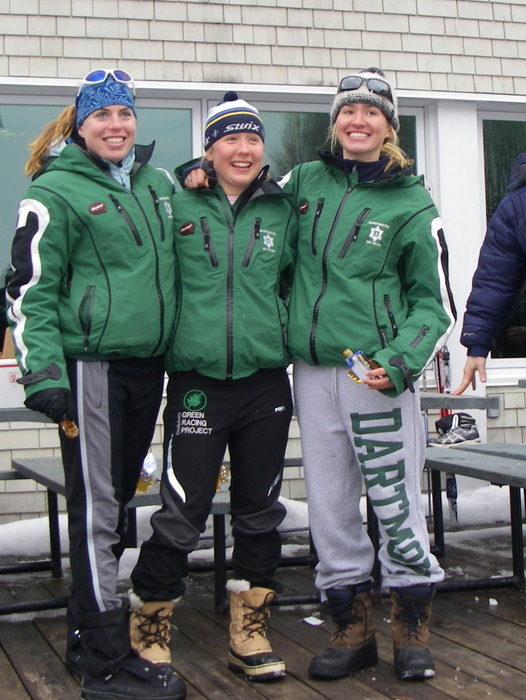
Rosie Brennan, Ida Sargent and Sophie Caldwell of Dartmouth, March 2010
Learning to Live in Europe
Her early World Cup years were steady—no fireworks, no collapses. She attributes the eventual breakthrough to something simple: time. “If you think about someone who starts at five,“ she said, “they’re good at 22. That’s the same number of years it took me. It just skewed by a decade.”
But the other part of her progression came from learning how to survive Europe.
“I mean, I finally had trained at a consistently high volume,“ she said. “But I also found it just took a long time to figure out how to manage in Europe.”
What was so hard about it? Not the racing. Not the waxing. Not the altitude.
It was the loss of personal freedom.
“To suddenly be told what your day is gonna look like every single day is exhausting for me,“ she said. “The freedom of being able to jump in your car and go somewhere—that’s gone for like five months.”
The World Cup removes the choice of when you sleep, where you eat, andhow you move through your day. Athletes share hotel rooms, team vans, dining halls, training sessions, and travel itineraries. It works beautifully for some. For Brennan, it was disorienting.
There were no models for how to do it differently. “The example they have is Jessie,“ she said. “She thrives on the road. She’s happy as she can be living in a bag for five months.“ But if you are not Jessie Diggins, Brennan said, “that’s really hard.”
So she began—to use her word—to “navigate.”
“I learned to get pretty good at the bus schedule,“ she said. She found bakeries in every town. She found grocery stores that sold the one piece of candy she liked in that country. She found trails “maybe off the beaten path“ that she returned to each year. She learned to take mountain days, not for training but for sanity.
These rituals were tiny, private rebellions—the things she could choose inside a world where most things were selected for her.
Rosie Brennan and coach Erik Flora (APU) ski on the World Championships sprint course in Trondheim on Wednesday, February 26, 2025. (Nathaniel Herz/FasterSkier)
A Coach Who Understands Her
If Europe tested her independence, her relationship with APU Head Coach Erik Flora reinforced it.
“He has been, like, everything for me,“ she said. “He’s kind of saved my life many times over.”
What she means is that Flora understands her wiring. He sees what she cannot always express.
“He has this ability to just watch you train and know exactly what’s going on in your life,“ she said.
That sensitivity carried her through some of the most challenging years of her career. During Covid, Flora couldn’t travel much; last season he could only watch occasional race film. It wasn’t enough. Brennan needed someone who knew her patterns—her real patterns—not just her splits.
“When I was in the thick of it last winter,“ she said, “he wasn’t there… that’s why ultimately I did end up coming back [to Anchorage]. I needed some of that support.”
Their relationship—its longevity, its trust—became essential when her body began to unravel.
Rosie Brennan (USA) after finishing the 10 K Classic at the FIS Nordic World Ski Championships in Trondheim (NOR). (Photo: Modica/NordicFocus)
A Year the Body Wouldn’t Cooperate
For a year now, Brennan has dealt with a medical mystery—post-viral symptoms likely tied to Epstein-Barr reactivation. “It just, like, really screwed up a bunch of my internal systems,“ she said. “My endocrine system has been shot.“ The effects were unpredictable: inability to push hard, severe inflammation, poor recovery, andmuscle shutdown during intensity.
“Last season I was struggling with… I just had zero ability to use my muscles to push hard,“ she said. “I was just racing on base fitness.”
It wasn’t one bad race. It was the absence of the feeling she loved most that was most frustrating.
The Training Fix
She and Flora tried to solve it through training, but even threshold sessions wiped her out. “It was more the duration part that was killing me,“ she said. They tried sub-threshold work. They tried controlled sessions. Nothing stuck.
So they invented something new: Sub-one-minute Level 4 efforts, hundreds of them, designed to keep neuromuscular pathways awake without triggering overload.
“Basically, what I’ve been doing is what I call micro intervals,“ she said. “I do go level four, but under a minute, many times.”
Strength? Gone. “Strength was destroying me,“ she said. “So I haven’t done any weight-room strength.”
Endurance? Reduced to what she could handle. “I got to a place where I was like, all right—I’ll have to be super excited when I get to go for an hour.”
Most of the battle, though, wasn’t physical.
“There were many times this last year that I have seriously contemplated walking away,“ she said. “I actually tried pretty hard to in August.”
But Flora kept calling—checking in, refusing to let her disappear into the uncertainty.
“I guess I’m not getting away that easy,“ she said.
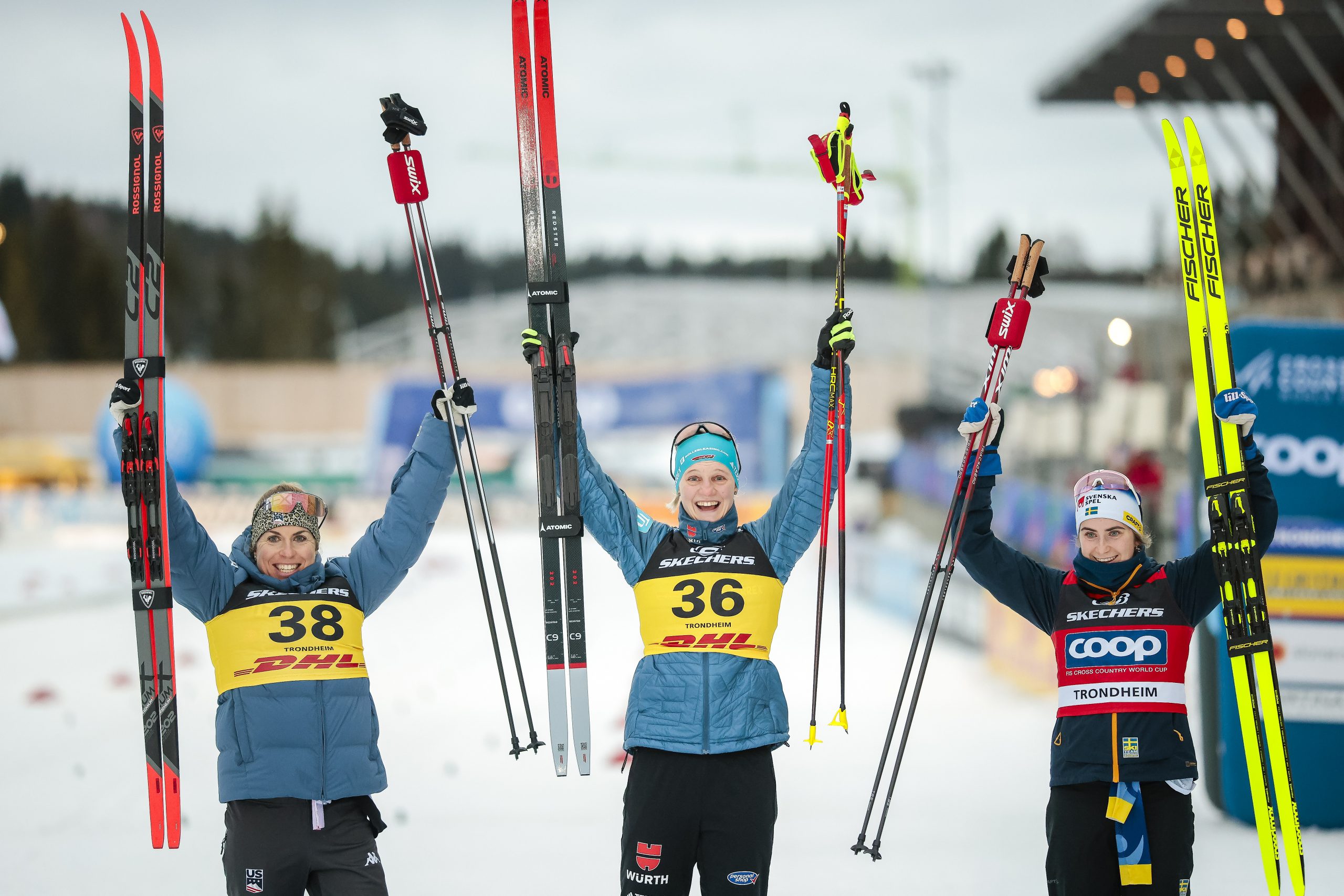
Brennan took second in the 10-k Classic in Trondheim in 2023. Rosie Brennan (USA), Victoria Carl (GER), Ebba Andersson (SWE), (l-r) 10km podium in Trondheim (NOR). (Photo: Modica/NordicFocus).
Why She Keeps Going
When asked what pulls her back to the sport each day, Brennan didn’t talk about results, medals, or even the Olympics.
She spoke of the feeling.
“I truly love the feeling of being able to push myself,“ she said. “It gives me this sense of freedom that I can’t find anywhere else.”
Freedom—that word again. Not competition. Not performance. Not success. Freedom.
It’s the sensation she’s chased since she was a kid, running entire soccer games simply because she could. It’s the sensation skiing first gave her at 14. It’s the sensation the World Cup often constrains, and the sensation her body has withheld for a year.
But it’s also the sensation that makes her keep trying.
She has leaned heavily into mental work this year. Meditation, mindset projects, and conversations with a U.S. Ski Team sports psych, as well as a teammate who has faced similar issues.
“I was very motivated by her,“ Brennan said. “It was cool that she was taking this time to strengthen her brain, too.”
The process has made her reflective, grounded, andmore self-aware than at any point in her career.
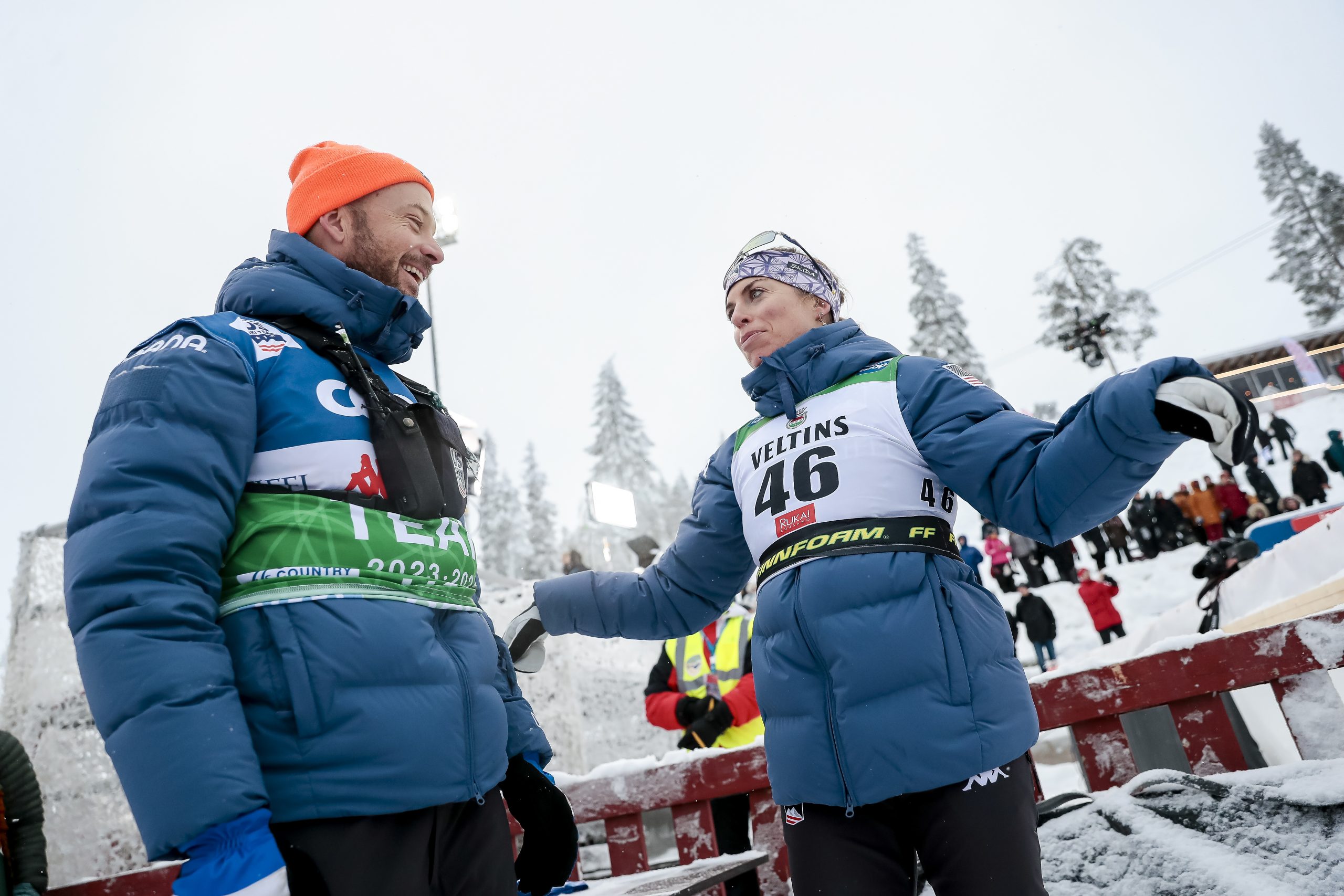
Rosie Brennan (USA), shares a podium moment with coach Matt Whitcomb in Ruka, Finland in 2023. (Photo: NordicFocus)
Leaving for Finland, and What Comes After
Now, on the eve of the World Cup opener, Brennan is set to travel to Finland. She will not race everything. “Maybe two races a weekend,“ she said. They’ll experiment. Observe. Adjust. She plans to return to Utah for Christmas, meet with her medical team, and decide what the rest of the season should look like.
“It’s possible I try to race, and it’s a disaster,“ she said. “We may have to totally redo the plan.”
She won’t do the Tour de Ski—too risky. The goal is simply to get to the Olympics “in the best way possible.“
The million-dollar question, of course, is whether this will be her last year.
“I don’t really know,“ she said. “Most likely something will look different next year. Whether that involves racing or not, I’m not totally sure.”
But she’s proud of the career she’s built. Proud of navigating Covid. Proud of her longevity. Proud that she became a true all-arounder.
“That was definitely a big career project,“ she said. “When I finally did that, it felt really big.”
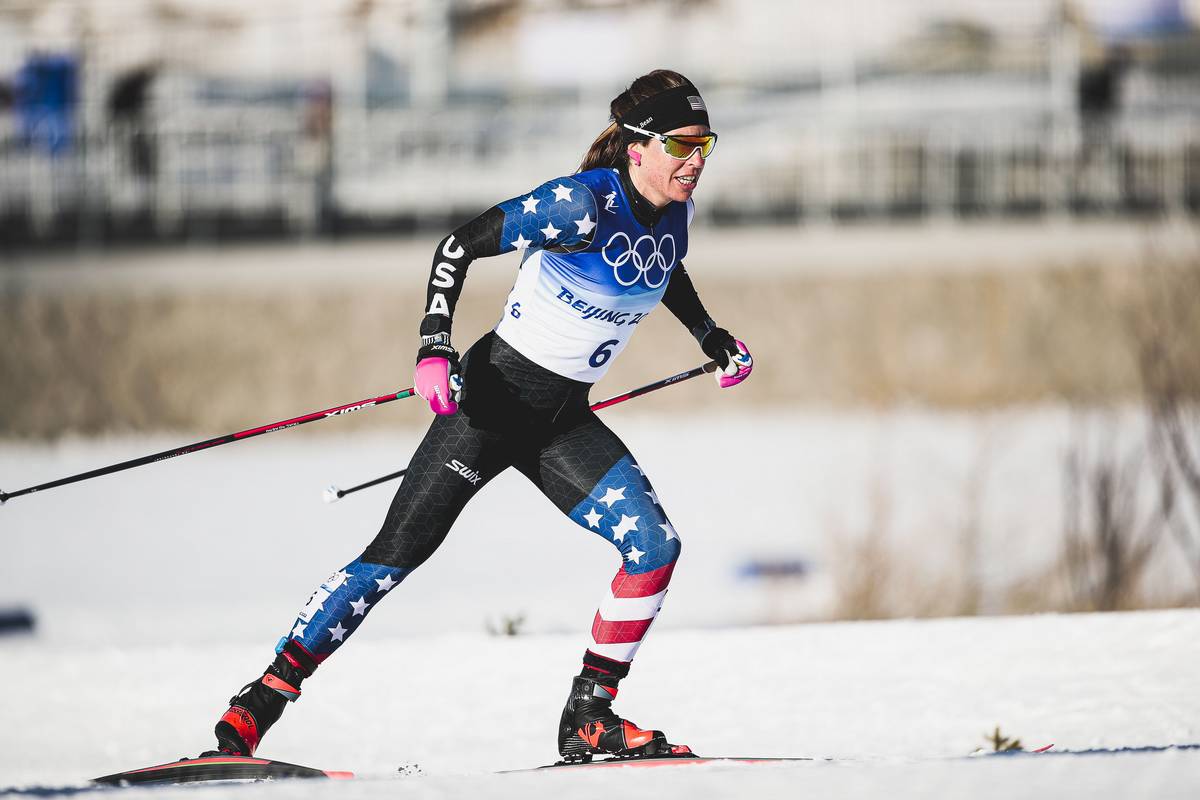
Rosie Brennan races the individual freestyle sprint qualifier during the 2022 Olympic Winter Games in Zhangjiakou. (Photo: NordicFocus)
Holding Her Own
What emerges from Brennan’s story isn’t a tale of triumph or decline. It’s the portrait of a person who has made peace with the complexity of the life she leads.
She has learned how to navigate Europe—not by loving it, but by building rituals that let her remain herself within it. She has learned to trust her body even when it betrays her, and to trust her coach when she doesn’t trust herself. She has learned that the World Cup isn’t designed for independence, and that independence—her independence—is worth defending.
She has also learned that racing is only part of who she is. She’s a geography major who loves the Arctic for its unique beauty, a mountain person who seeks out quiet trails, and a traveler who can always find a town’s best bakery.
And she’s someone who, after a year of medical uncertainty and near-retirement, still wants one more chance at the feeling she can’t find anywhere else.
That, ultimately, is why she’s boarding the plane.
Because even in a world that demands structure, she is still defining her own path.
Love Stories Like This? Help Keep Them Coming.
Feature interviews like this one take time, access, and care to produce. If you value thoughtful storytelling and independent ski journalism, please consider becoming a Voluntary Subscriber. Your support directly fuels the work we do to cover the people, places, and moments that make our sport special.
We don’t yet know if this season is Brennan’s final curtain call, where she will ski off into the sunset, but we do know she has nothing left to prove.. (Photo: Nordic Focus)
Deciding how to handle the “college conflict”, as aptly phrased by Alayna Sonnesyn, is a daunting and somewhat mysterious prospect, particularly for athletes and families who are unfamiliar with the process. How does a junior athlete know that they are cut out for a collegiate program? NCAA or USCSA? What about a gap year? In this series, FasterSkier spoke with collegiate and junior coaches and athletes who have chosen different pathways to create a resource for the athlete or parent amidst this conundrum. In the first part of the series, Anna Schulz of Craftsbury shared a look into the early conversations between a junior coach and athlete. Next, FasterSkier spoke with Cami Thompson-Graves, head nordic coach at Dartmouth College to learn how to get the most out of the college visit to determine whether skiing NCAA and the school are a good fit.
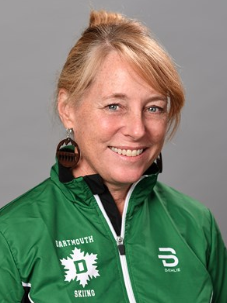
Cami Thompson-Graves offers insight into the college process from her 30 years of experience coaching the Dartmouth Cross Country Ski Team. (Photo: dartmouthsports.com)
After over 30 years of leading the program, Cami Thompson-Graves’ name has become synonymous with the Dartmouth Ski Team. During her tenure, she has fostered a thriving program capable of developing athletes whose goals extend far beyond the reaches of NCAA. Three out of the eleven members of the U.S. Ski Team A and B teams (Caldwell, Brennan, and Kern) raced for the Dartmouth Program and in total, ten of Thompson-Graves’ athletes have become Olympians. She also helped guide Katherine Ogden to become the first Dartmouth skier to earn double titles in both the classic and freestyle race at NCAA’s and has mentored numerous All-Americans over the years.
While not all athletes perusing their collegiate options are setting goals to race at Dartmouth, Thompson-Graves’ years of experience with the college application and acceptance process qualify her to offer insight to juniors applying to any NCAA program.
Starting with the initial contact, because the legacy of the Dartmouth program is renowned, Thompson-Graves explained that her recruiting process does not involve a significant amount of reaching out to athletes, however, she is attentive to the results at key junior events throughout the year.
“I am generally paying attention to where people are in their junior winter,” Thompson-Graves said in a call. “I’m looking to see who’s doing well and who’s going to [REG and NTG] camps. I know a lot of people in a lot of places, so then I might reach out to their coach sometime later in the year and try to start a dialogue with [the athlete] spring of their Junior year. That’s for the top athletes.”
She continued that she begins to hear from athletes expressing interest and asking questions about the Dartmouth program most frequently during their junior year and into the fall of their senior year. In total, she communicates with 20 to 30 prospective athletes each year and has two to three openings for each gender on her team.
For juniors committed to making an NCAA team, she recommends beginning the process of identifying schools of interest and initiating dialogue early.
“I think to some degree, people need to be thinking ahead and thinking about what kinds of things are important to them in a program because we’re not all created equally even though we all compete against each other on some level.”
Once an athlete has determined what colleges and universities are appealing in a broad sense, Thompson-Graves recommends scheduling a campus visit if possible. Typically, this should happen during the spring of junior year or the following summer to allow time to narrow focus on a subset of universities for applications. Thompson-Graves expressed that this visit can help a student decide whether a program suits them beyond the on-paper appeal.
“I’m a big believer in people finding the right fit because if they find the right fit, they’re going to be happier and more successful. So I don’t put on a hard sell, I just say ‘This is what we offer. This is what we have.’ And I try to guide people to be asking the right questions and finding a place that suits them.”
What are the questions that will aptly inform a visiting athlete whether a program jives with their personal, academic, and athletic goals? Thompson-Graves recommends starting with a few key prompts.
“Get thinking: What is it I’m looking for? What’s important to me? Where do I see myself?”
Focusing on the last question, she recommends widening the lens to look beyond the specific school or location an athlete is imagining. It is important to ensure that the program an athlete chooses is equipped to support the athlete’s trajectory and goals long-term.
Dartmouth freshman Katharine Ogden racing to her second-straight victory of the 2018 NCAA Skiing Championships in Steamboat Springs, Colorado. She won the 15 k freestyle mass start by more than 38 seconds. (Photo: Dartmouth Sports/Clarkson Creative)
“It is important that people have some idea where they see themselves in skiing over the next four years. Are they someone who is coming in and just trying to make the carnival team? Are they someone who is coming in and hoping to go on and make a World Juniors or a U-23 Championships? What kind of races do they want to be racing in and what are the goals that they see for themselves? Because some programs are going to make sure that they get to all the races that they need to get to and that they’re supported, and other programs they are basically just going to the carnivals with six people.”
Though not all athletes entering college might be on track to make the race team during their time in college, particularly at a program like Dartmouth, Thompson-Graves encourages seeing the value of developing over four years of working with a team that challenges an athlete to reach. However, if a prospective athlete identifies traveling and racing weekly as one of the qualities that aligns with their goals, it might be wise to choose a program where that is more easily achievable.
“I’m in a lucky position that I have been attracting some of the top athletes and we’ve had some success over time, so I think it’s somewhat easier to attract some of the top athletes, but I maybe scare away that next level because they are like, ‘Oh my god, I’ll never make the Carnival Team if I race there.’ Of course, if you ask someone who is on the team, they would say, ‘It’s worth it, I wouldn’t go anywhere else.’ But there are other people who would say, ‘I’d rather go somewhere where I know I will make the Carnival Team every week.’”
Apart from the more whimsical questions about goals and opportunities, it is important for an athlete to ensure that the program is within the financial means of the family. While scholarships are available to help with the inherent costs of attending the school, being on a team incurs additional costs that need to be factored in. These costs include travel, equipment, and race entry. These real costs vary depending on the resources of the school and the goals of the athletes.
“What is the program supporting for athletes? What are the out of pocket costs? For some people, that’s really important. There are obviously some people that are hoping for a scholarship, but not all ski schools offer scholarship, so everyone is thrown into the pile of need-based financial aid. That aside, what are the other expenses that each individual athlete might have to be a skier? It’s not cheap and depending on where they are on a team or what level they’re skiing at, it might make a difference in how much they have to pay out of pocket.”
It is also important for an athlete to ask about the balance of academics and athletics. At some schools, students may be able to arrange their class schedule to keep the academic demands light during the winter race season or take classes over the summer to meet credit requirements. It can also be helpful to identify the support resources offered by academic institutions when athletes are missing classes due to racing or training camps.
Thompson-Graves also encourages asking about the intangible aspects of a program that are highly impactful in creating a positive experience.
“How does the team get along? What kind of group is it?”
She also recommends asking the coach about their style and what their expectations are of athletes as part of the team.
“It should be a two-way interview and not a one-way interview.”
Per NCAA rules, a prospective athlete is not able to attend practice as part of the campus visit, however, it is possible to observe. Thompson-Graves explained that observation is not always a meaningful way to evaluate the intangibles of the team dynamic, but a coach can facilitate alternative opportunities to meet with the team.
“Generally, if they want to meet the team, I’m happy to set up a lunch or meet-up. They often reach out to friends they might have on campus if they know people. With social media, there’s a lot more of that going on than there used to.”
Meeting with the team is not an essential component of the campus visit, particularly in the primary stages of the college process.
Head coach Cami Thompson Graves sees her athletes off on a time trial in September, 2019. (Photo: Instagram @dartmouthskiing)
“It also depends if it is a first-time visit versus someone who might be coming for an official visit or an overnight later on in the process. It also depends on where kids live, whether that is the first time they are coming to campus or whether they’ve been through another time then are coming back for an overnight. Sometimes they might just come into the office and I might show them a little bit of what we have for facilities to offer, then another time they might stay overnight with someone on the team, eat some meals in the dining hall, go to a few classes. Generally, those are all options, but if it’s your first time to campus and it’s still early in the process, I don’t think that it’s necessary.”
Ultimately, a sound evaluation about the fit of the school is one of the key takeaways Thompson-Graves hopes that an athlete leaves the visit with.
“I hope they get an idea what the program is all about, what the expectations are, what we have to offer, and to some degree who I am. I have said to people at times in the past, ‘If talking to me makes your skin crawl, then you might want to think about whether you want to be here because you’re going to see a lot of me,’” she said with a laugh. “That’s part of that good fit aspect. I want them to get a sense of the school, the place, the team, me, and what it’s all about.”
It is also valuable to have a sense of the qualities and results that a coach looks for in the athletes they recruit. For the Dartmouth program specifically, Thompson-Graves explained how she evaluates whether the prospective athlete is in turn a good fit for her program.
“I’m looking for someone who has solid results, and that can be at the very least Junior National Championships. If someone is finishing in the top ten at Junior Nationals then I’m going to be even more interested. But mostly what I’m looking for is someone who is engaged and curious and thinks for themselves and is starting to get a handle on what they’re looking for and is starting to consider skiing for Dartmouth.”
She shared that she recently had the experience of visiting and touring colleges with her daughter. Though her daughter was not interviewing as an athlete, Thompson-Graves recalled that this process was eye-opening.
“You can get a pretty good sense on those early campus visit. Does the place feel right? Do these people feel like my people? Do the programs that are offered here interest me? Can I see myself living here for four years, even if it’s raining some of the time or everything isn’t perfect? So I hope that when someone leaves after the campus visit that they are getting a sense of what it’s all about.”
She continued that particularly in places like the Northeast where schools with NCAA skiing programs are relatively close together, these visits can offer a template to compare and contrast offerings.
“A lot of people visit a number of schools within a week or two, and I think you want to sort of compare the strengths and weaknesses of the different schools and the different programs and then come back and ask more questions. I often will ask someone, ‘Am I your first visit?’ because they often don’t know what to ask, particularly if they are the oldest child in the family. They don’t have any idea where to start or what to ask, so I can babble on for 20 minutes and they just listen and don’t even know where to start. So I think then, following up with questions is important too because the more schools you visit the more you see and the more questions you have.”
Team USA Nordic athletes representing their alma mater at the PyeongChang Olympics in 2018. Left to right: Head coach Chris Grover, Rosie Brennan, Sophie Caldwell, Ida Sargent, and Patrick Caldwell. Unpictured: Annie Hart. (Photo: Instagram @dartmouthskiing / flyingpointroad.com)
Though it can be tough for a parent to sit back, Thompson-Graves recommends that the athlete take the initiative in leading the dialogue during a visit rather than the parent. She explained that parents attend her meeting with prospective skiers about half the time depending on the preference of the family.
“I leave it up to them. The one thing I prefer not to have happen is the parent ask all the questions and the kid doesn’t say anything. I prefer to be talking to the kid and not the parent, but I’m happy to have parents along and if the student is happy to have them there then it works fine for me.”
She continued that in her experience, there are times when younger athletes who are very early in the process come to the visit unsure of what to ask or what they are looking for. In these cases, she feels it is appropriate for a parent to attend and help facilitate the conversation. Once the athlete has determined that they are interested in her program, she expects the parents to step back and to pass the reins to be passed to the athlete.
“Further down the road, my expectation is that all my communication will be with the student and not with the parents. I’m happy to answer questions that parents may have, but I’m not recruiting the parent, I’m recruiting the kid. At a certain point, if they can’t ask questions and reach out and follow through with things, then they aren’t going to be successful at Dartmouth, so that is kind of telling for me.”
Thompson-Graves also noted that communication at all phases of the decision process is beneficial, regardless of how eagerly the athlete is pursuing the program.
“I would just encourage people to communicate because even the ones who come and do a tour and I meet with them, they may go home and they’re ready to apply early decision, but if I never hear from them again, I don’t know that. I even appreciate it when someone says, ‘Thank you for meeting with me. I’ve decided I’d rather go to UVM.’ It’s just nice to know what they are thinking, and they don’t have to make me happy.”
A recent article in The Atlantic exposed the effect of meritocracy on the opportunity for college athletics. Though the cost of junior programs varies geographically, the article illuminates that lower-income families are being priced out of the hyper-specialized and competitive programs that are setting youth up to make a Division I team.
In line with this trend, not all families may have the financial means to schedule a visit at all of the programs of interest for a prospective athlete, particularly schools that require transcontinental travel. Thompson-Graves reassured that the inability to connect face-to-face is not a detriment to the admission process and does not impact which athletes she recruits.
“From my perspective, the in-person visit is going to be the most beneficial for them, more so than for us. So if they can’t make the visit, it is not by any means mandatory, it just gives people a better sense of what it’s like to be on that campus. Certainly now, there are all kinds of virtual tours and people can Skype and talk to people they know on campus. It’s a small world, so they are going to see someone who skis or has skied for Dartmouth at some race that they go to during the season. Our athletes aren’t recruiting for us, but they are a pretty open and friendly bunch, so they are more than happy to answer questions and talk to people when they’re traveling or at other races.”