From the FasterSkier archive — posts syndicated from athletes’ and coaches’ own blogs between 2004 and 2012, kept online as published. Current coverage is at fasterskier.com.
First up, the cheese is going nowhere. The cheese we speak of is the cheese of record when it comes to cross-country skiing: Le Gruyère.
It turns out the Finns are fond of Le Gruyère too. In a recent press release, it was announced that the Finnish Ski Association and the Swiss company, Le Gruyère AOP, the purveyors of the finest of cheeses, have signed a three year sponsorship agreement for Finland’s World Cups.
You know this stuff is good when the press release uses the word “rejoices” to describe the ski association’s stoke.
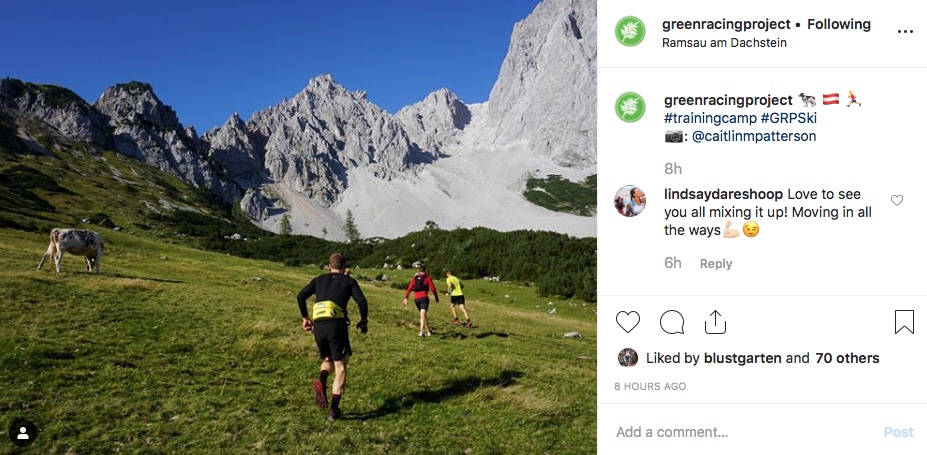
The hills are alive….(Photo @greenracingproject Instagram account)
Some of the Craftsbury Green Racing Project crew is based, for the moment, in Ramsau am Dachstein Austria. Embrace your own place and don’t succumb to FOMO. But their Instagram feed, if anything, is a wonderful glimpse into the yin-yang of high mountain transition season. The group, led by coach Pepa Miloucheva, has an extended training camp in the region combining long mountain runs with high altitude on-snow training. As we referenced last week in an article, embrace this quote from tennis great Arthur Ashe – “Start where you are, use what you have, do what you can.”
Ok. You are where you are. Now take a look at the feeds from Caitlin Patterson, and Ben Lustgarten. It would be nice to be there too.
In doping news, the International Biathlon Agency’s (IBU) Anti-Doping Hearing Panel has banned Russian biathlete Margarita Vasileva for 18 months starting September, 17. Vasilev was banned for an anti-doping rule violation. According to the IBU’s press release, she has missed “any combination of three missed tests and/or filing failures (…) within a twelve-month period (…).”
Vasileva has 21 days to appeal the decision to the Court of Arbitration for Sport (CAS).
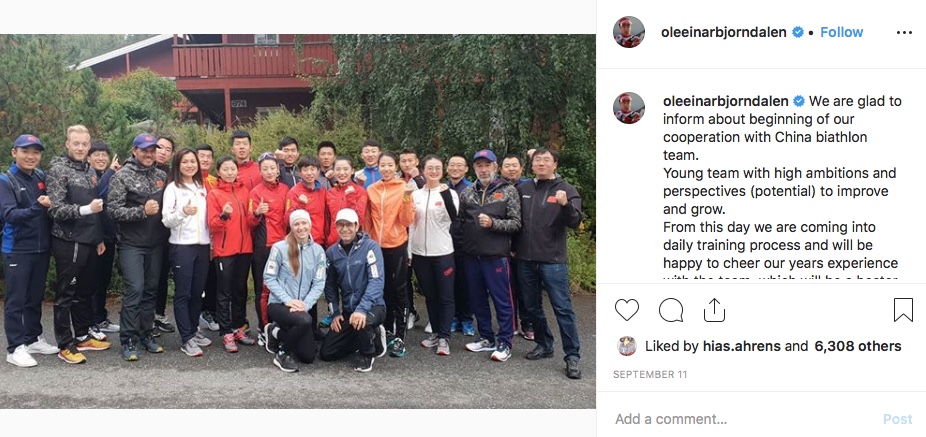
(Photo: screenshot from @oleeinarbjorndalen Instagram)
From China, hands down the biggest growth market for nordic sport as the nation builds towards hosting the 2022 Winter Olympics, the National Olympic Committee of China has hired Belarusian biathlete Darya Domracheva and Norway’s Ole Einar Bjørndalen as coaches. Nuotraukos ant drobės ir paveikslai https://interdeko.lt/produktai/paveikslai
The AP reported on September 12, that the husband and wife duo has signed on to assist China’s burgeoning National biathlon program.
On his Instagram account, Bjørndalen wrote the following:
“We are glad to inform about beginning of our cooperation with China biathlon team. Young team with high ambitions and perspectives (potential) to improve and grow. From this day we are coming into daily training process and will be happy to cheer our years experience with the team, which will be a hoster of next winter Olympic Games. I became a head coach of all team and Darya is a coach of women’s team now. We are full of motivation to give our best advices to the athletes, team stuff and everyone who works together with us on the way of reaching a good result, in our focus – to build high professional team, support and help each athlete to reach their own potential. And of course, we are happy to use a chance and help our favorite sport to develop around the world, in a countries, where biathlon and all winter sports have huge potential.”
Check out this video short from the IBU on China’s biathlon program.
From Norway, news last month revealed that World Cup sprinter Sondre Turvoll Fossli had suffered cardiac arrest according to a translated article from NRK. The twenty-six-year-old Fossli will be reevaluated in October, but he admits the prospects of a return to high level competitive skiing remain doubtful. “There is a risk that I have to give up.It certainly is.So it may be that I have to find something else to do.But I have to wait and see a little bit when it comes to just that,” Fossli told NRK.
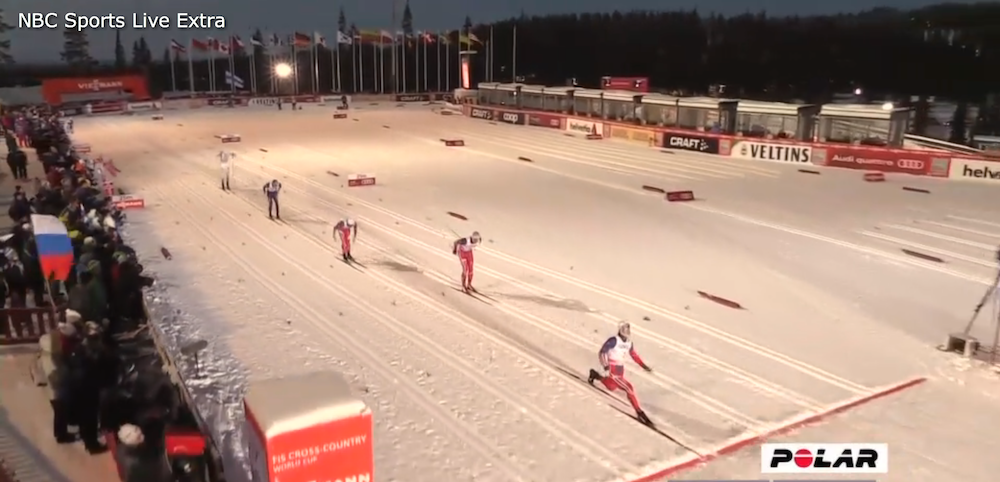
Norway’s Sondre Turvoll Fossli, 22, crosses the line first for his first World Cup victory in the first World Cup of the 2015/2016 season in Kuusamo, Finland. His teammates Eirik Brandsdal (second from r) and Petter Northug (third from r) placed second and third, and American Andy Newell (second from l) was fourth in the first of the three-day Ruka mini tour.
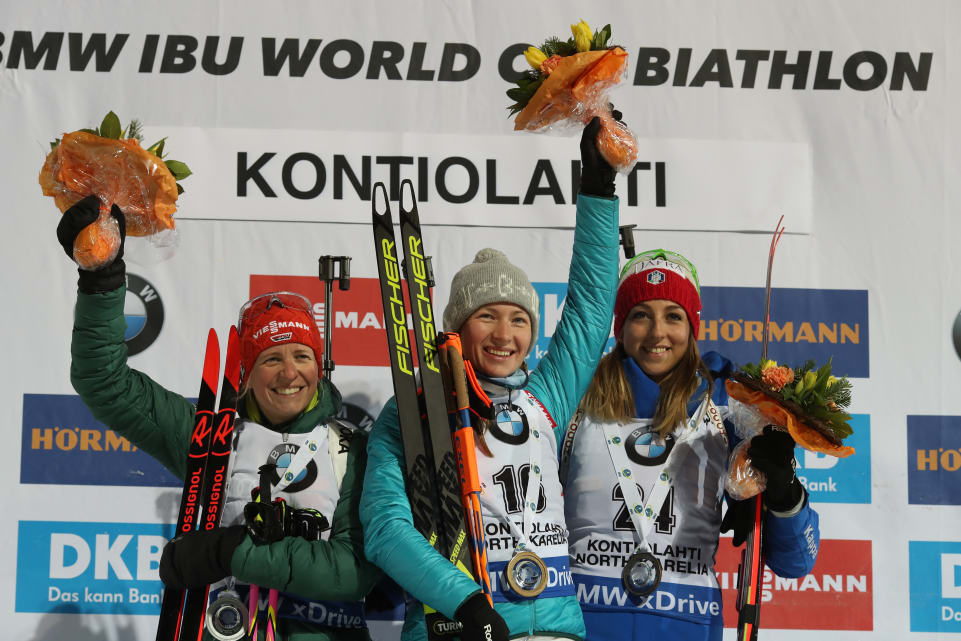
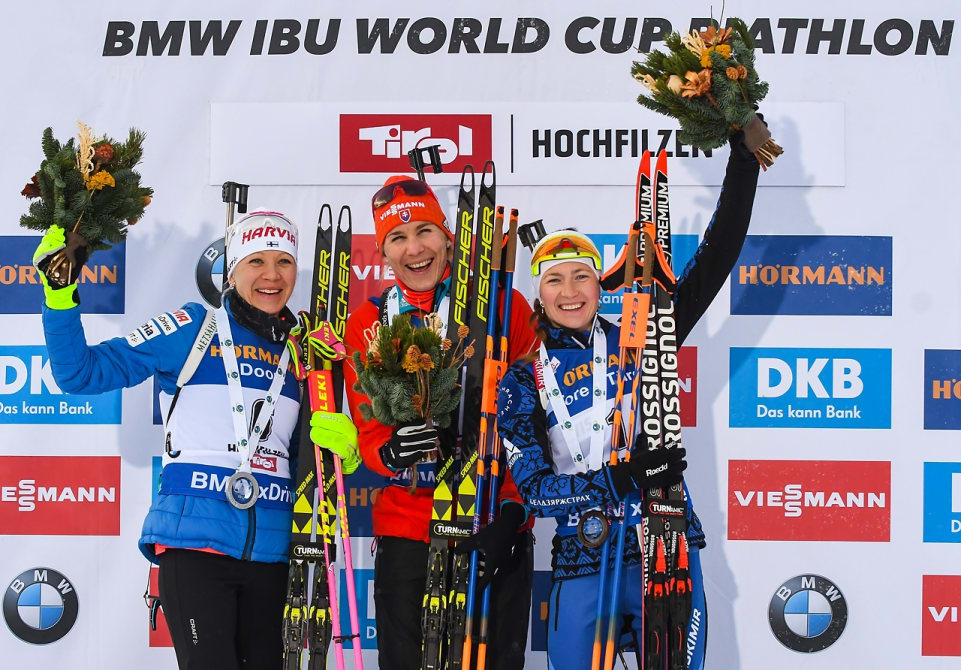
Italy’s Dorothea Wierer and Lukas Hofer in first place (center), Germany’s Franziska Preuß and Simon Schempp in second place (left), and Darya Domracheva of Belarus with her husband Ole Einar Bjørndalen of Norway in third place (right) on the podium of the 2018 “Biathlon auf Schalke” event. The invitational was billed as the last international race for Domracheva and Bjørndalen, the winningest biathlete of all time. (Photo: Event organizer)
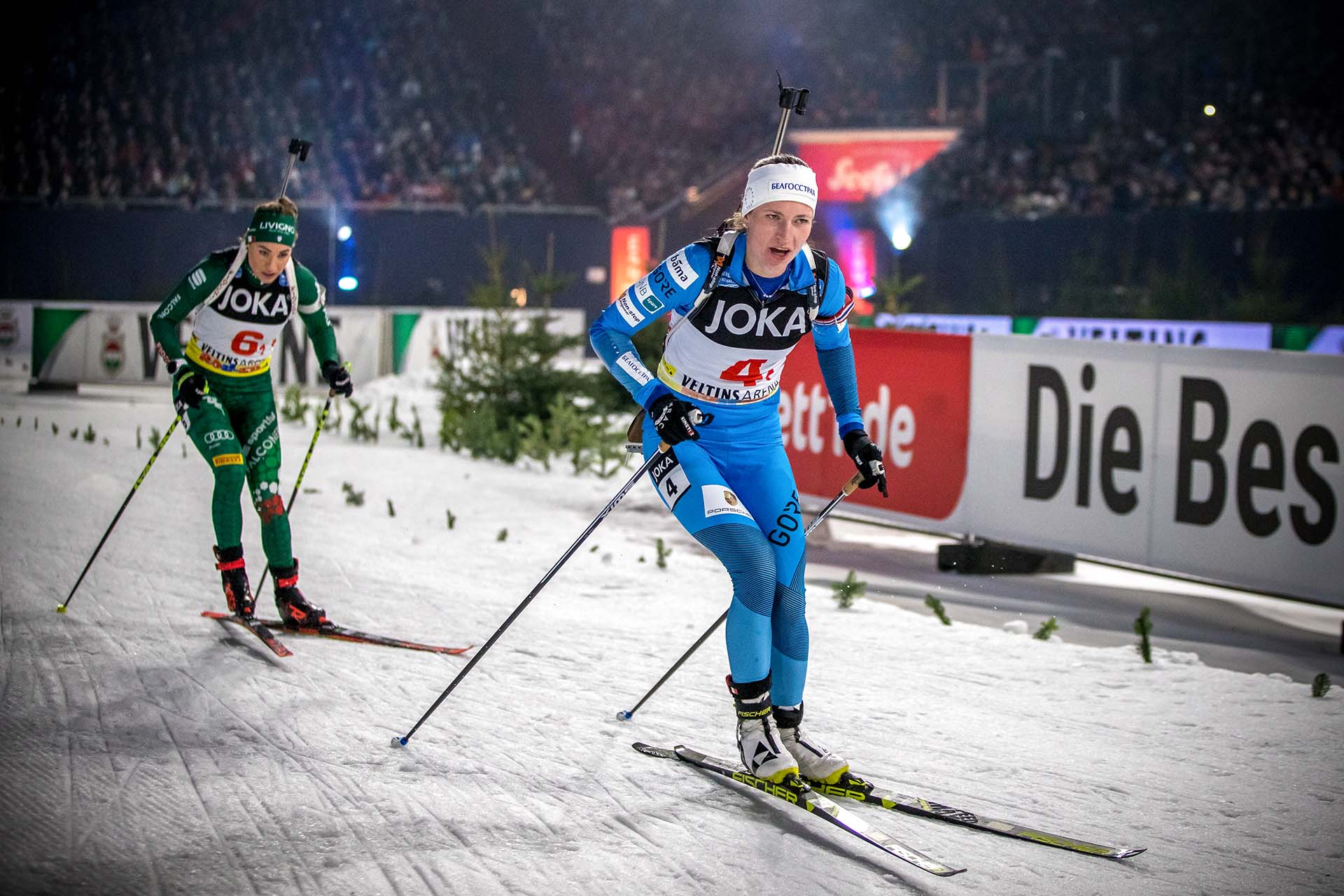
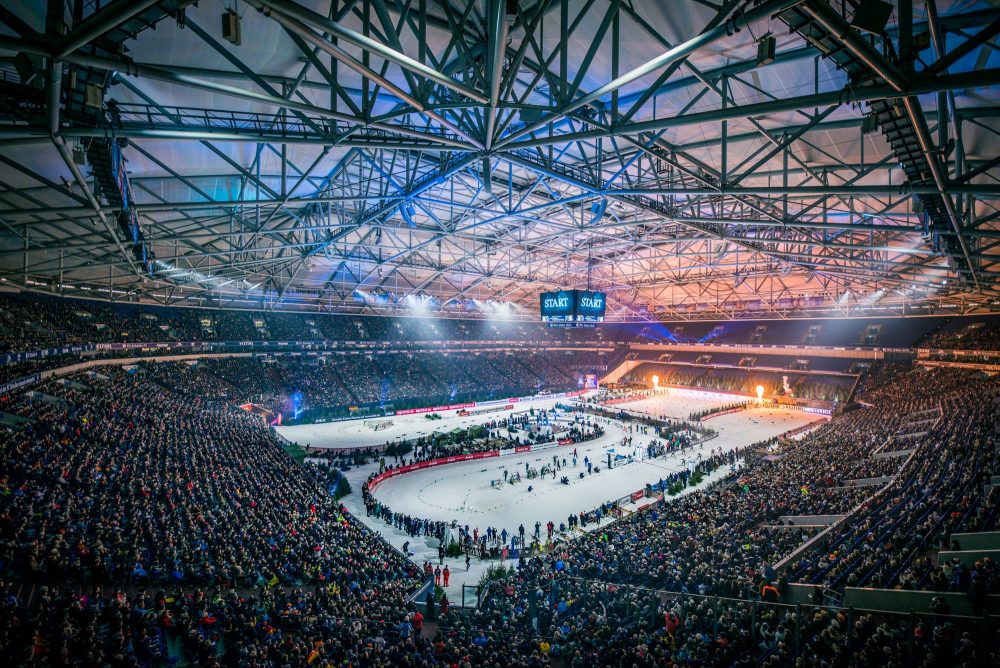
The “Biathlon auf Schalke” two-person mixed relay show race in Gelsenkirchen, Germany, has become a Christmas holiday break fixture on the winter sports calendar. Many biathletes are in awe of the event, featuring a temporary ski course in and around a massive domed arena that usually serves as the home pitch for the Bundesliga soccer club Schalke 04, along with a raucous atmosphere in a sold-out venue and millions watching the broadcast live on TV in several countries.
It’s no real surprise that some living legends of the sport would pick the frantic event that brings biathlon from the mountains to the city as the final race for their storied careers.
In 2018 in its 17th season and with 46,421 fans in attendance, no North American team was represented among the ten invited teams.
The event on Saturday evening mainly drew its fascination from being billed as the final race in the long and successful athletic careers of Ole Einar Bjørndalen of Norway, age 44, and Darya Domracheva of Belarus, 12 years his junior. Combined, the husband-and-wife team could display 12 Olympic gold medals in their personal trophy case, to name just one of their many achievements. By their own admission in a series of interviews with German TV host network ZDF and other broadcasters before, during and after the event, the day certainly was an emotional highlight for Bjørndalen and Domracheva.
“It’s just fantastic, vielen vielen Dank, thank you so much for your support, you are the best!” Domracheva hollered in a fun language mix in an interview with ZDF after the race, drawing a big cheer when her words echoed through the arena via the public address system.
“You couldn’t have dreamed it [better],” her husband Bjørndalen also added in German. “This is incredible, so many people … I never experienced fans as good as this in my life. Thanks again Schalke, this is incredible!”
Darya Domracheva of Belarus skiing in front of Italy’s Dorothea Wierer during the 2018 Biathlon auf Schalke event. Wierer went on to win the race with her partner Lukas Hofer. (Photo: Event organizer Facebook page)
First World Team Challenge Victory for Italy
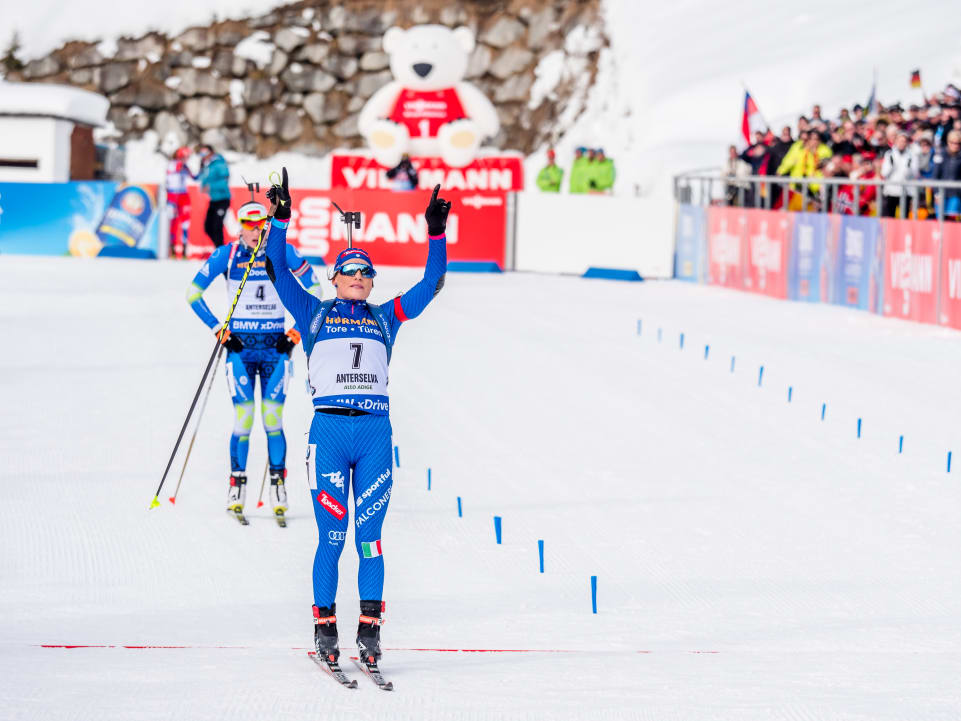
In terms of the athletic merit of the event, the 2018 edition saw the first victory in the history of this competition for an Italian team, with current International Biathlon Union (IBU) World Cup women’s total score leader Dorothea Wierer successfully pairing up with teammate Lukas Hofer.
Over the course of the evening, the Italian pairing turned out to be an ideal combination of the fastest shooter on her race legs and the fastest skier on his. The duo narrowly won the “first half” mass start race of the event which was followed by a 30-minute intermission. Wierer and Hofer also created a convincing lead in the pursuit, which was featured as the “second half” of the evening’s racing.
But their victory was briefly in doubt when Hofer missed three targets in his final standing stage — a bit unusual on a range with no wind influence. Having to circle the penalty loop (though shorter than in regular World Cups) and now on tired legs, the three penalties allowed Germany’s clean-shooting Simon Schempp – who raced with his fellow national team member and girlfriend Franziska Preuß – to catch up to Hofer on the final lap that meandered through a “winter village” concourse around the arena.
“I knew [Lukas] is super on skis, but when he missed three that was still becoming pretty suspenseful,” Wierer laughingly remembered the situation in an interview with ZDF after the race, according to a translation. “But luckily that triggered a little bit of adrenaline.”
Hofer slowed down on the winding 1.3-kilometer course that provided few opportunities for overtaking other skiers before coming back into the main arena where he began to push hard on the only notable straight section along the shooting range. He managed to create a small gap between himself and Schempp and defended that to the finish line to secure the victory in a time of 33:23.6 minutes. Schempp finished 1.2 seconds behind.
“My knees were trembling like a sewing machine,” Hofer said about his problems in the final shooting stage. “Luckily it somehow still worked out fine. I had to ski a tactical final loop, and it’s just great to finally stand at the top of the podium.”
“It’s just a grandiose event,” Schempp said, seemingly not minding the narrowly lost victory (and sponsored car prize). “It’s so incredibly fun to race here in front of such an audience. And when a German team is also in the mix in front, that creates such an atmosphere … That gives you back a lot as an athlete. Just a lot of fun.”
“You really feel like a soccer player with so many people watching,” Wierer added. “Even if you are just trying to have a conversation, it’s so loud you hardly understand anything with all this noise. And it’s great that everyone is being cheered for. Really cool.”
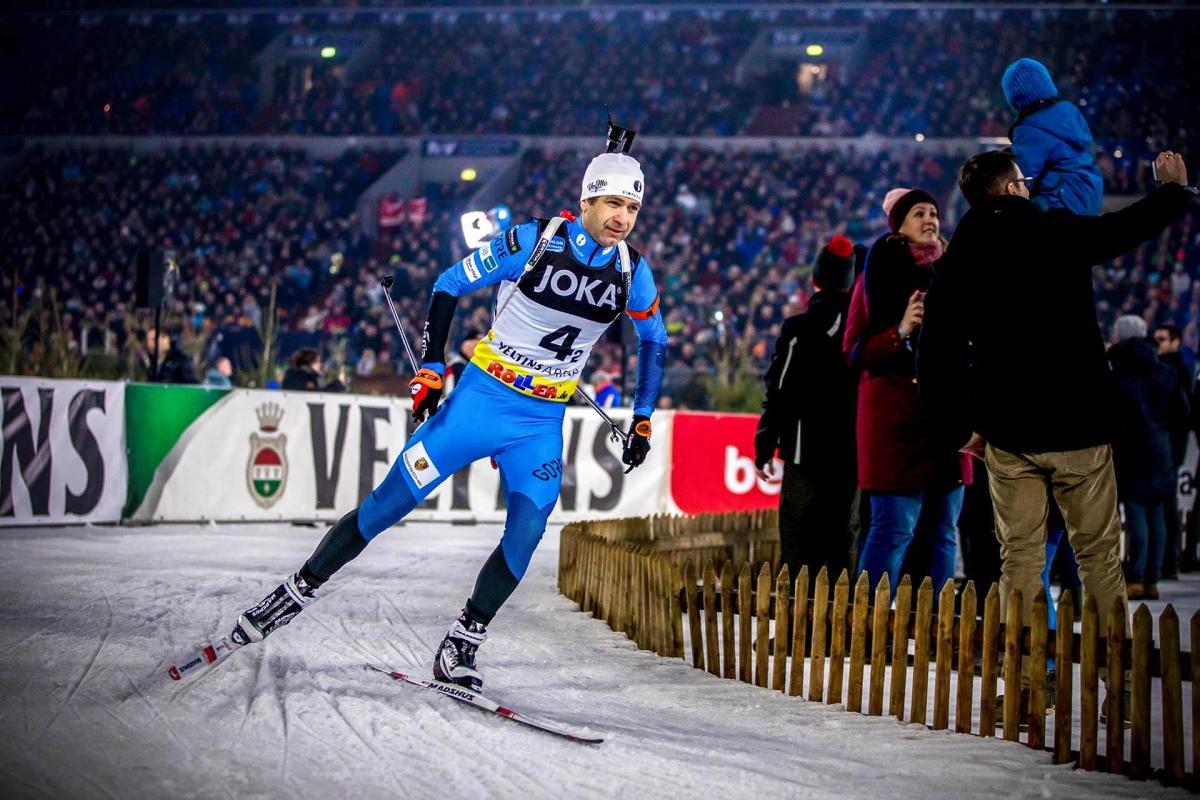
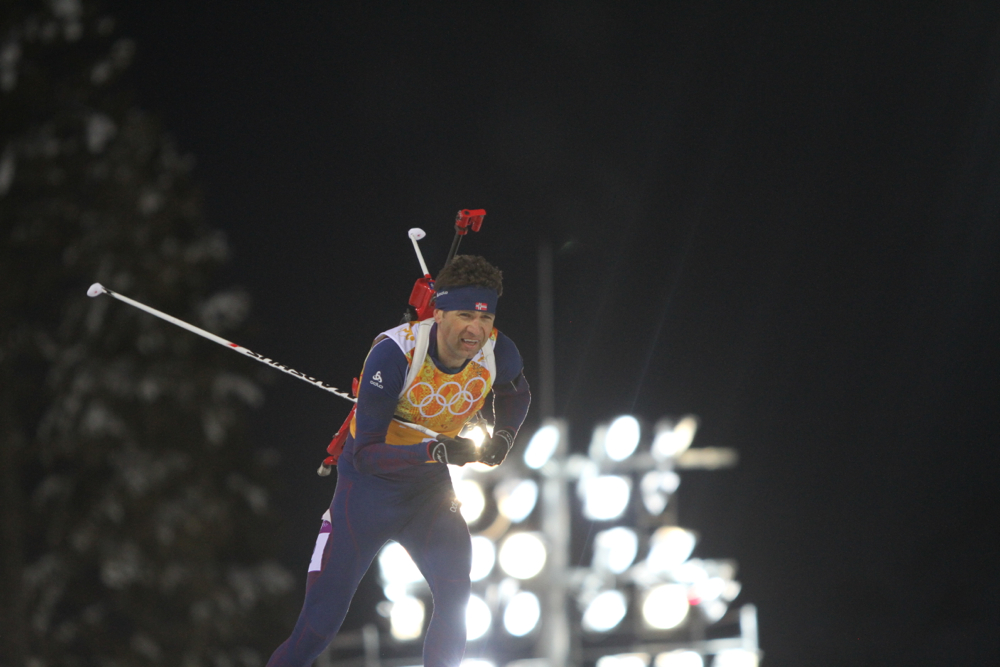
Norway’s Ole Einar Bjørndalen on course during the 2018 Biathlon auf Schalke, billed as the last international race of his storied career. (Photo: Event organizer)
Third Place for the Biathlon Legends
But the real story of the night unfolded a little behind the race for the top of the podium.
In the first event of the evening, Bjørndalen had proven once more that he still ‘got it’, winning a shootout competition to determine the start order against a host of athletes known as fast and accurate shooters.
The semi-retirees Bjørndalen and Domracheva initially struggled a bit with the speed of the athletes still active week to week on the World Cup. Although they were able to hold their own and finished the event’s first half in third place, 6.1 seconds behind Italy and 2.7 seconds behind the French team of Anaïs Bescond and Emilien Jacquelin.
“The course is not so difficult, but when you are in a bad shape it becomes difficult,” Bjørndalen told broadcaster ZDF at halftime, according to a translation. “We didn’t prepare so well, though Darya is still strong but I am flailing a bit in the skiing. Maybe next round will be better.”
Despite admitting he had prepared for the event with a brief training camp in Norway and then a course inspection a day before most competitors had arrived at the venue, the athlete nicknamed “the cannibal” for eating up gaps to other athletes on the course in the prime of his career had some problems keeping speed with the fastest skiers on Saturday.
Domracheva was able to hold up well on the range and course. With her signature elegant ski technique she kept right behind Germany’s currently best-ranked World Cup athlete Preuß on a loop, and stuck within viewing distance of the fast skiing Wierer. With a series of cleaned targets, Domracheva and Bjørndalen managed to keep themselves in podium contention and at one point even maneuvered into the lead, to the joy of the spectators who cheered for them at least as loud as for the German home teams.
Then came the final exchange to the men, which required athletes to shoot a standing stage before skiing another full loop.
“It was mega-cool to watch the final leg, very exciting,” Preuß told ZDF, according to a translation. “I believe everyone watching today saw how the suspense was bubbling up again. That’s how you wish a race should be.”
Bjørndalen had incurred one penalty in his final shooting and skied back on the main course in third position behind Hofer and Schemp. But just a few seconds back, Benedikt Doll, who formed an “injury replacement” second team for Germany together with Denise Herrmann, managed to catch up and pass the Norwegian on the final lap. Being aware that a fourth place just off the podium for the final race for the biathlon star would be an anticlimactic result, Doll waited a few meters before the finish line for the man who he considers his biathlon idol. Doll then grabbed and lifted up Bjørndalen’s arm before skiing into the finish side by side. Intentional or not, Bjørndalen slid his ski boot over the line 0.1 seconds ahead of Doll.
“It was a very nice gesture. It is impressive that he does it at home. Thank you very much,” Bjørndalentold Norwegian broadcaster NRK about Doll’s actions, according to a translation. During the victory ceremony, he and Domracheva then called Doll up to the podium and hung their awarded medals around his neck, who seemed to reluctantly accept the honor.
Darya Domracheva of Belarus (in foreground) is waiting to greet her teammate and husband, Norway’s Ole Einar Bjørndalen, as he skis towards the finish line together with Germany’s Benedikt Doll at the 2018 Biathlon auf Schalke event, billed as the last race of Bjørndalen’s career. (Photo: Event organizer Facebook page)
Bjørndalen will retire as the winningest biathlete of all time, following a 25-year career that is a rare achievement in any endurance sport. To honor Bjørndalen, ZDF showed some old footage and interviews from early in his athletic career in the lead-up to the race.
Bjørndalen amassed eight Olympic gold medals of 13 total Olympic medals, 20 IBU World Championship golds of 45 total championships medals, and 95 World Cup wins with an additional World Cup win in cross-country skiing. Even France’s current biathlon star Martin Fourcade would have to keep competing for numerous years to have any chance at matching those numbers. Bjørndalen’s Olympic record is only surpassed by fellow Norwegian cross-country skiing star Marit Bjørgen.
Domracheva has four Olympic and two World Championship gold medals to her name, most recentlyanchoring the women’s relay to the gold medal for Belarus at the 2018 PyeongChang Winter Olympics. She told ZDF in an interview that she considers the 2014 Olympic Games in Sochi, Russia, to be the peak of her athletic career, where she won gold in the individual, sprint and pursuit disciplines.
Domracheva reportedly plans to still race in one more event at home in Minsk, the capital of Belarus, for which 100,000 spectators are expected to show up.
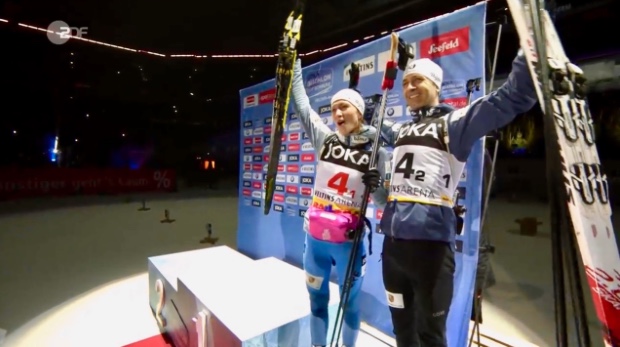
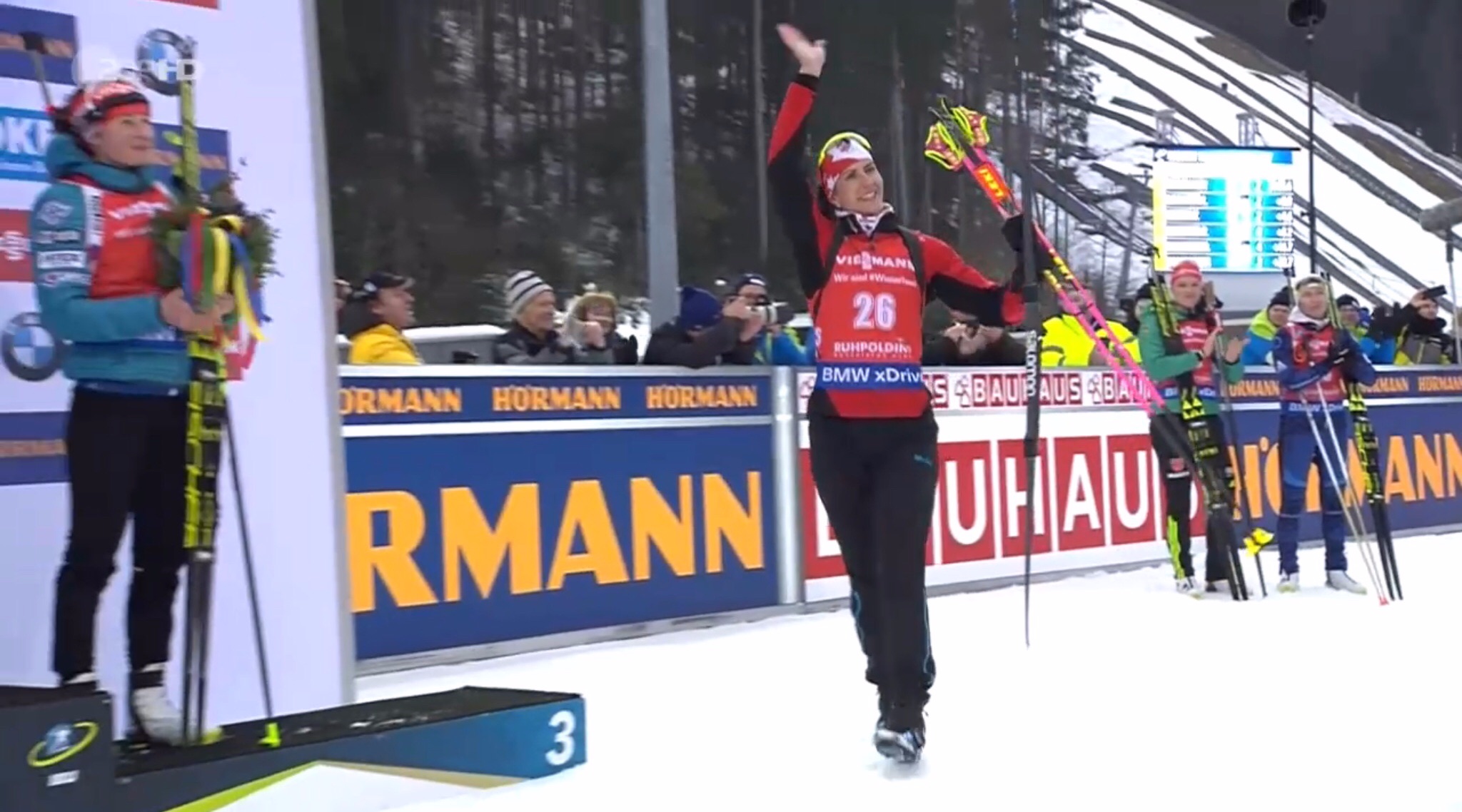
Darya Domracheva of Belarus and Ole Einar Bjørndalen of Norway waiving to the crowd before the victory ceremony of the 2018 Biathlon auf Schalke invitational race. (Photo: ZDF screenshot)
With homes all over Europe in Beitostølen (Norway), Minsk (Belarus) and Obertilliach (Austria), and already active in other career ventures from sports broadcasting to fashion design, the pair told reporters they have not yet decided where they will ultimately settle in the next few years, wanting to decide that once their young daughter is of school age. For now, their only firm plans are to spend New Year’s Eve together in Norway.
Another Farewell: Russia’s Anton Shipulin
Anton Shipulin – Russia’s best biathlete of the last few years – alsoannounced last week that Schalke would be the final race of his international career.
“Thank you very much, dear fans, for your support,” he posted on his social media accounts, according to a translation. “Without you, this adventure would have been more difficult. My victories are also your victories. I will always remember this. You are the best. I hope we will be able to please you once again at the ‘Christmas race’ [World Team Challenge], which will be held on December 29 and will be the final in my professional career.”
Last winter, Shipulin had been among a number of Russian athletesbarred by the International Olympic Committee (IOC) from starting at the 2018 Olympics in PyeongChang, and claims that to this day he has not yet received a satisfying official explanation by either the IOC or IBU for that blow to his athletic career, according to a fairly rare international interview he gave German home broadcaster ZDF before the race.
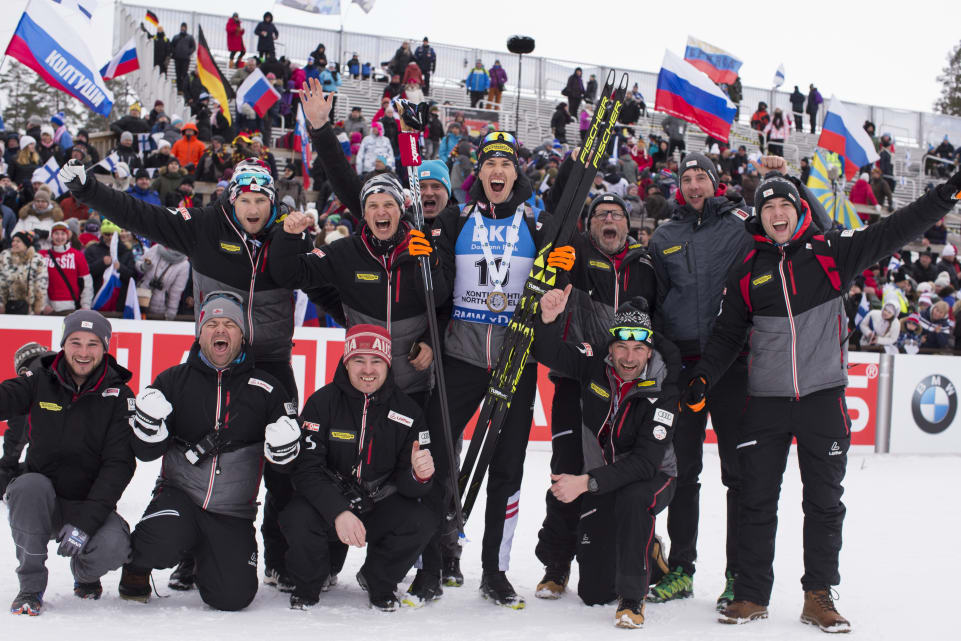
Shipulin came back with a vengeance to close out the 2017/18 IBU season, winning the sprint at the World Cup in Kontiolahti, Finland, during the race week immediately following the Olympics.
Overall he has achieved 11 World Cup victories in individual races during his career and won seven medals at World Championships including one gold. Arguably his biggest success, the gold medal from the men’s relay at the 2014 Olympics at home in Sochi, Russia, hangs in the balance as the IOC and International Biathlon Union keep investigating allegations, though for now publicly only against retired teammateEvgeny Ustyugov. Shipulin’s fourth-place mixed relay result from those Olympics has already been voided.
Shipulin conveyed in statements that the international sports bodies and anti-doping authorities have treated his case unfairly during the last two seasons, and the murky situation about his ability to participate in future major sports events combined with the unpleasant prospect to see old results annulled seemingly has exhausted his motivation to keep training and competing.
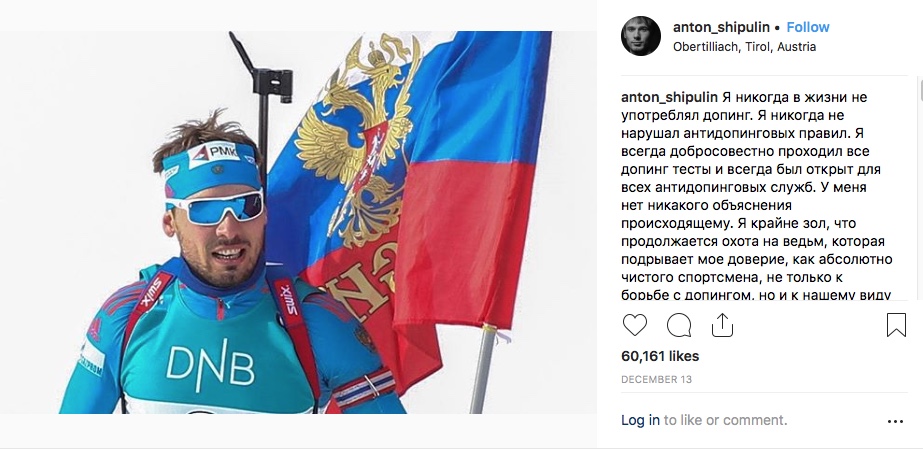
Russia’s Anton Shipulin claimed his continued compliance with anti-doping regulations in a Russian and English post on his Instagram social media account from December 13, 2018. (Photo: Instagram screenshot)
“I never violated anti-doping rules. I have always completed doping tests in good conscience,” he told ZDF in an interview, according to a translation, reiterating comments he made in social media posts including one from December 13, 2018, in which he called the most recent investigations triggered by Austrian and Italian authorities that reportedly included a team hotel search a “witch-hunt” and “total nonsense”.
On Saturday, the pre-determined final race together with his teammate Ekaterina Yurlova-Percht didn’t quite go as storybook-scripted as for Bjørndalen and Domracheva. Incurring too many penalty laps, the Russian duo was never really in contention for the podium and ended the race in seventh place (+1:48.8).
Yurlova is a veteran of racing at Schalke,winning the event a year ago together with Alexey Volkov, as well as in 2012 when she had teamed up with Shipulin and is currently in full World Cup race mode. Also, like her teammate Shipulin, Yurlovawas not allowed by the IOC to start in PyeongChang and reportedly could still be under investigation by international sports and legal authorities. But so far has not been publicly charged with any concrete violations. She is married to an Austrian national, and by living in that country is under the supervision of the local anti-doping agency for much of her off-season.
Shipulin had not yet raced in an IBU event this season, citing a lack of training time in the summer. Though prior to his announcement last week it had been widely expected that he would be back with the Russian team in time for the races in January or at the latest for the World Championships in Östersund, Sweden.
Similar to Domracheva, Shipulin might still make an appearance in a farewell race at home. He told ZDF that he looks forward to now spend time in Tyumen, Russia, with his family, and said he was also happy to have more opportunities for his other sports passion: fly fishing.
Final Results “Biathlon auf Schalke” World Team Challenge 2018
Shooting range and part of the ski course inside the domed Veltins Arena during the 2018 ‘Biathlon auf Schalke’ invitational race event. (Photo: Event Organizers Facebook Page)
While the International Biathlon Union has adopted the mixed and single-mixed relay formats as exciting new disciplines in recent years, the “Biathlon auf Schalke” also dubbed the World Team Challenge by the organizer is an invitation-only private event not sanctioned by the IBU (even though there areplans to cooperate in the future, especially regarding a junior competition leading up to the main event), so there were no World Cup points much less internationally recognized medals to win in the race. That will happen towards the end of the season in March at the IBU World Championships in Östersund, Sweden.
The regular IBU World Cup season will continue on January 10th, 2019, in Oberhof, Germany.
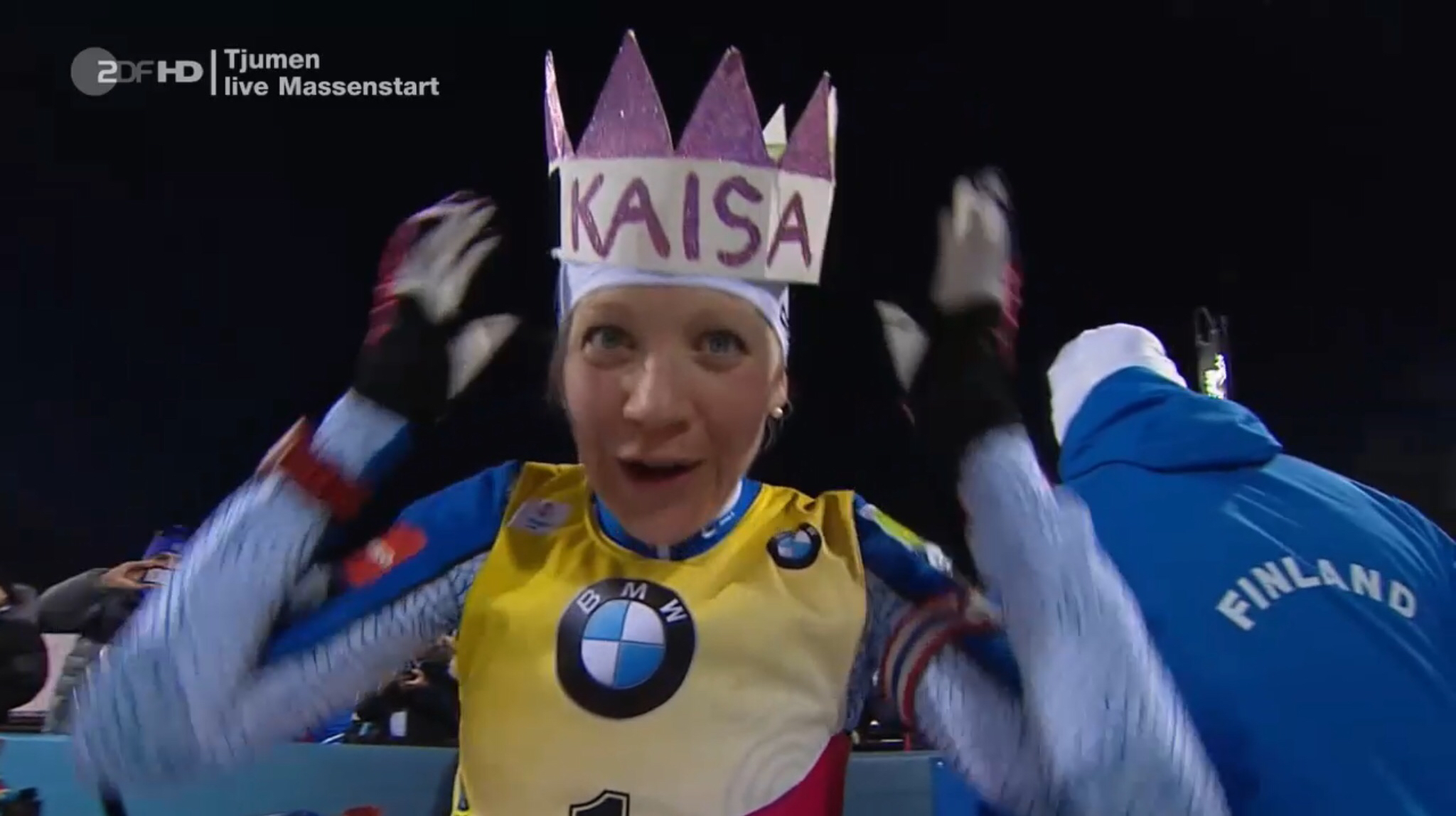
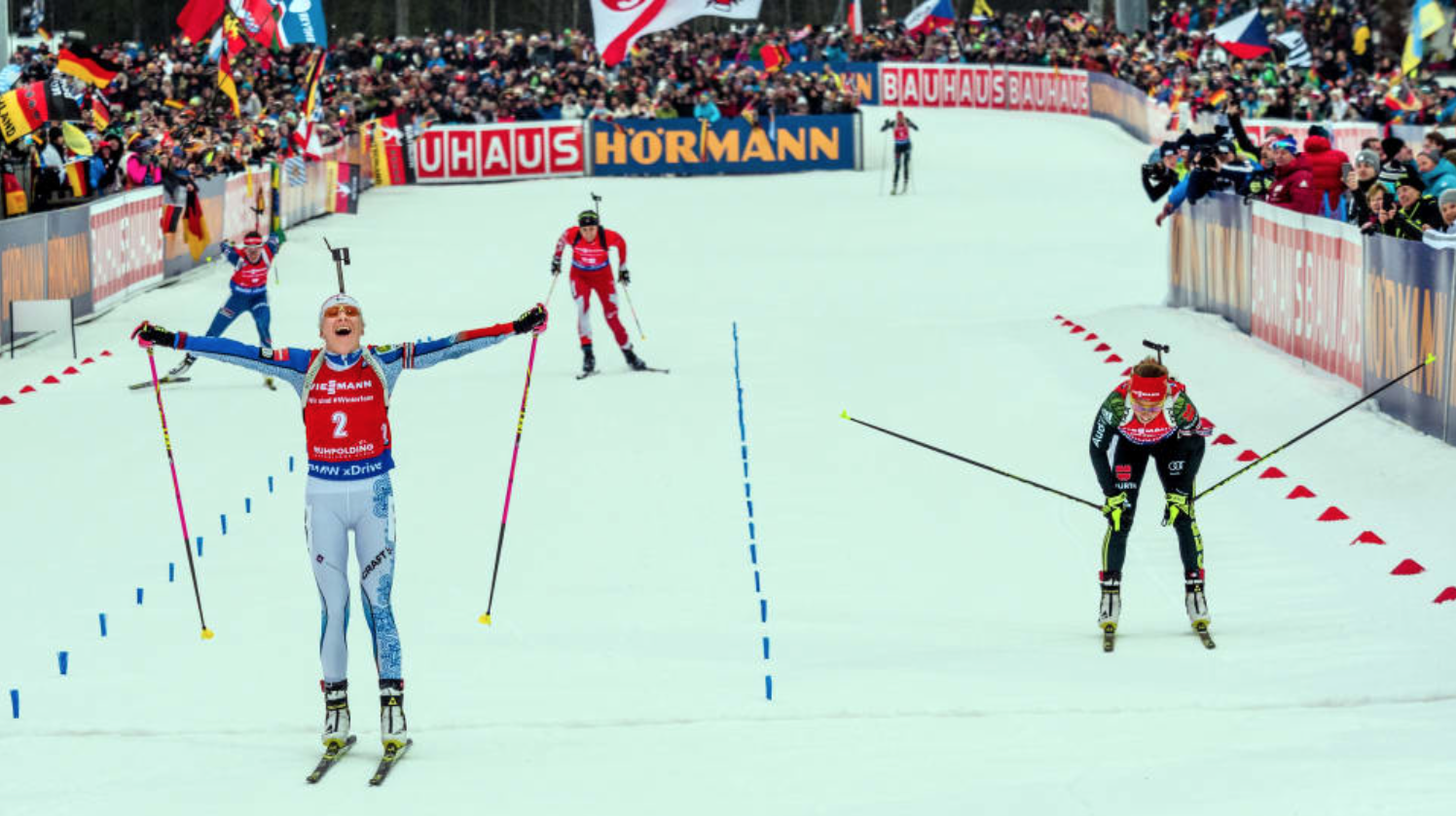
Kaisa Makarainen celebrates her third overall World Cup title after securing it with a sixth-place finish in the last race of the season, a mass start in Tyumen, Russia. (ZDF screencap)
Martin Fourcade didn’t have to do much at the final IBU World Cup weekend in Tyumen, Russia, in order to lock up the overall crystal globe. But the French biathlete came in guns blazing, so to speak, winning Thursday’s sprint by 33.2 seconds and claiming the Total Score title.
His only close(ish) challenger in the overall score, Johannes Thingnes Bø of Norway, had finished just 14th in the sprint. He raced up to second in the pursuit, but by then it was too late to take the globe from Fourcade.
It is the Frenchman’s seventh overall title; the last time anyone else won one was in 2010-2011.
“I am really satisfied with what I did today,” Fourcade told the IBU on Thursday. “It was mentally challenging all these days fighting with Johannes for the Crystal Globe. It seems easy watching on TV, but I can confirm that it is not. I must admit that it was not my main goal back [at the first World Cup weekend] in Östersund; it was the Olympics. But as the season went on, the globe became the most important aim for both of us.”
After that, Fourcade could relax a little.
“You know, before the race I planned to act like usual, be calm on the shooting range and being strategic,” Fourcade told German broadcaster ZDF after winning the pursuit, this time by 47.9 seconds. “But when I came to the zeroing [target practice] I told my coach ‘today I will play a little’. I don’t have many races to enjoy my biathlon [without pressure], to do what I would like to do. I told him ‘do not think (worry?) I will go full attack’, but I wanted to show that the strategy I had all year long is [just] a strategy not a need to shoot slow.”
On Saturday it worked; then came Sunday’s mass start. Fourcade had his worst race of the season, with four penalties and skiing to 19th place, over a minute behind winner Maxim Tsvetkov of Russia. But it didn’t matter – the globe was already decided, and Fourcade had already found his satisfaction.
The fight for the women’s crystal globe had much more drama. Coming into the weekend, Slovakia’s Anastasiya Kuzmina led by 41 points over Finland’s Kaisa Makarainen. But it was Belarus’s Darya Domracheva, in third in the standings, who won Friday’s sprint, by just 1.2 seconds over Makarainen; Kuzmina was 12th.
“Before today’s race I tried to focus only on this race, not think about the overall World Cup so much because I know that I am really [far] behind,” Makarainen told ZDF after the sprint. “But I know that everything is possible. I think that’s also the best tactic for tomorrow: not think about the others or the Total Score, just focus on a good race and enjoy that.”
Makarainen saw her chance and went for the win in the pursuit, edging France’s Anais Bescond by an even smaller margin – 0.2 seconds.
With Domracheva winning the mass start, Makarainen rallying for sixth despite three missed shots, and Kuzmina 11th with the same tally, the title went to the Finn. She edged out Kuzmina by just three points, while Domracheva was only another 15 points back.
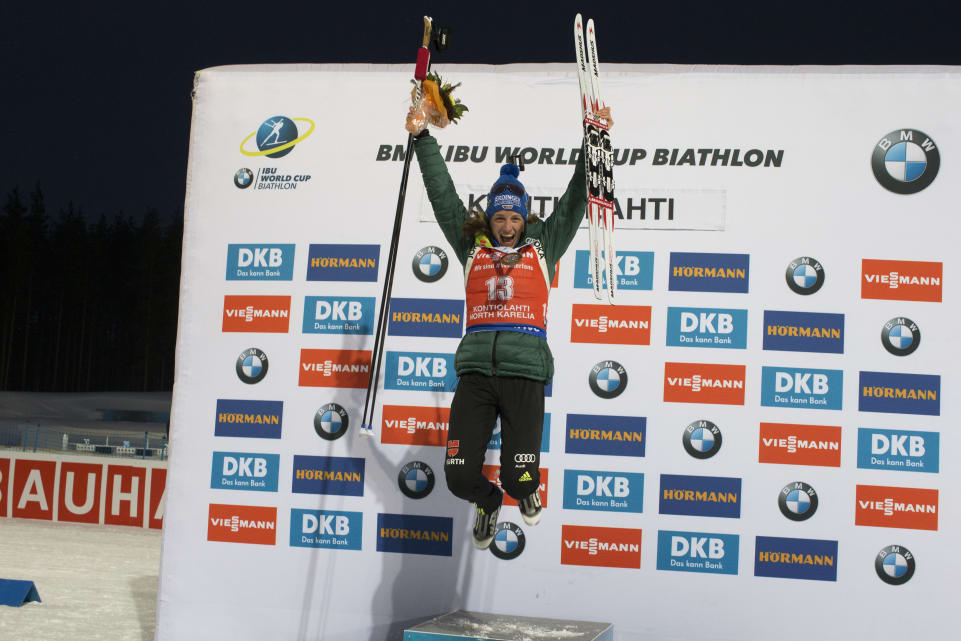
Makarainen jumped up and down when she saw the score announced, and her teammates rushed her and placed a pink paper crown on her head. It is her third overall title; she also won in 2011 and in the 2013-2014 season, when she likewise secured the crystal globe in the very last race of the season.
The fields were somewhat reduced in size and depth as the Canadian, U.S., Czech, and Ukrainian teams all skipped the event due to Russia still remaining out of compliance with the World Anti-Doping Code. Other individual athletes skipped the races as well.
Other Notes:
Simon Desthieux of France got his first career World Cup podium, finishing second in the sprint behind teammate Fourcade.
Maxim Tsvetkov of Russia claimed his first career win in the mass start, edging Norway’s Erlend Bjøntegaard by 2.7 seconds as each shot 20-for-20.
In the men’s mass start, Slovakia’s Paulina Fialkova got her first World Cup podium, finishing second, just 1.8 seconds behind Domracheva as each had a single penalty.
The top ranked North American biathletes in the Total Score are Susan Dunklee in 34th in the women’s standings, and Tim Burke in 32nd in the men’s standings, both from the United States. The U.S.’s Lowell Bailey and Sean Doherty ranked 35th and 36th. No Canadians were ranked in the top 40.
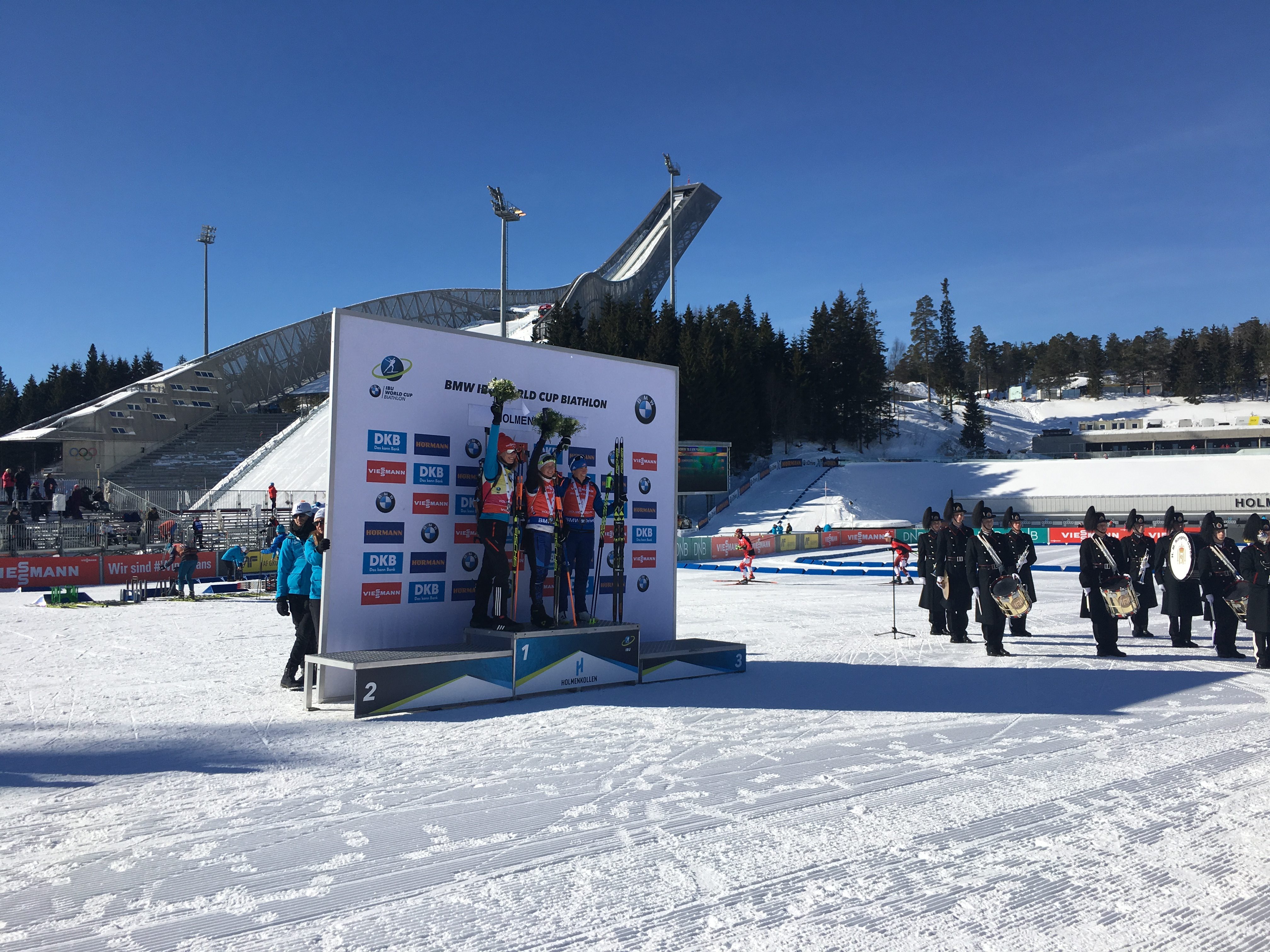
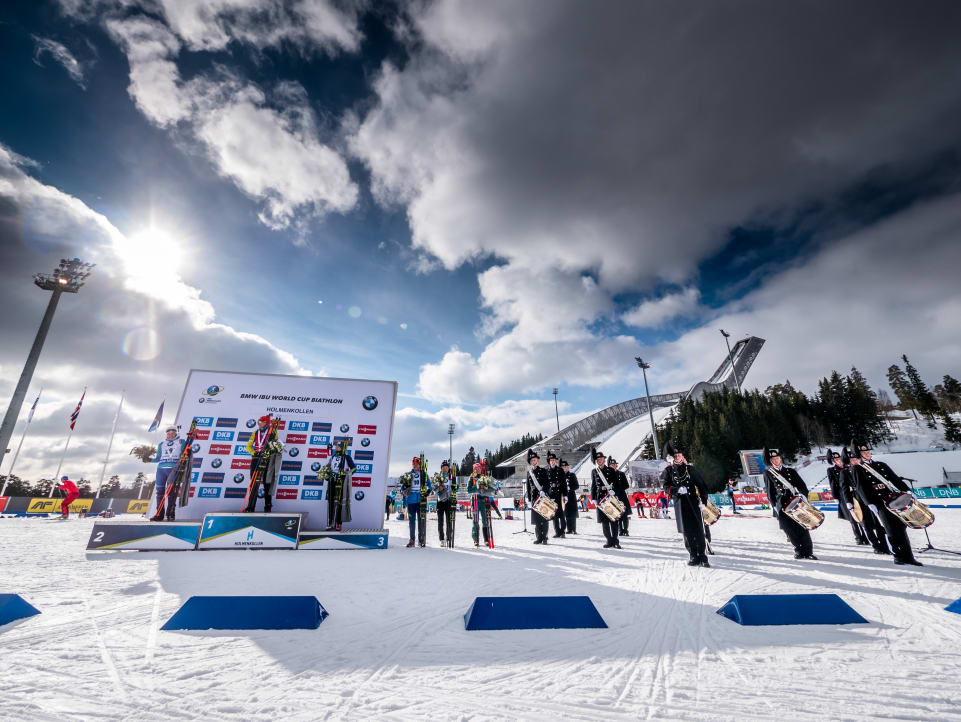
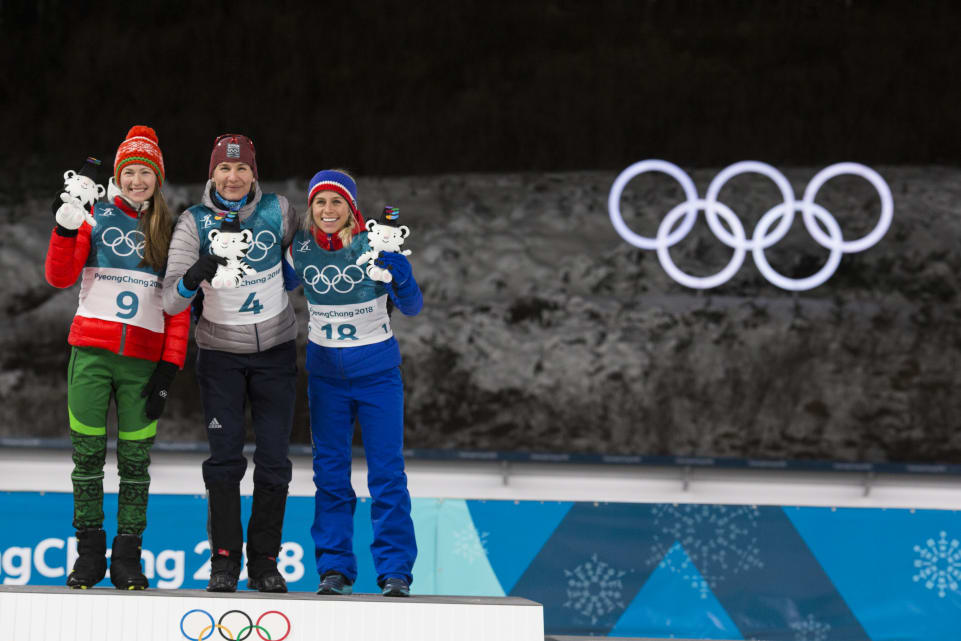
Darya Domracheva in first, Anastasiya Kuzmina in second, and Susan Dunklee in third on the podium after the women’s 10 k pursuit at Holmenkollen. (Photo: US Biathlon)
OSLO, Norway—Eight World Cup weekends, a swing by Open European Championships, two weeks at the Olympics, and it all came down to this: Susan Dunklee’s last international race of the season was also her first podium of the season, and she’s heading back to the United States with a third-place finish in the 10 k pursuit.
“I’m super happy,” Dunklee said. “I often start feeling stronger and stronger as the season goes on, and this season it took a little longer. I had a lot of sickness, and some frustrating shooting days early in the season that made it hard for me to keep going. I’m really happy right now.”
The World Cup concludes next weekend in Tyumen, Russia, but the Americans are among other teams (including Canada, the Czech Republic, and Ukraine) who are boycotting the event because Russia is not currently compliant with the World Anti-Doping Code.
Dunklee finished fourth in the 7.5 k sprint here at Holmenkollen on Thursday, and started today’s pursuit 35.7 seconds behind sprint winner Anastasiya Kuzmina of Slovakia.
She missed a shot in the first prone stage, and then another in the first standing stage. But Dunklee was never out of the top ten, bouncing around from fifth to tenth. Not a single woman in the field cleaned all 20 targets.
The race for first came down to Kuzmina and Darya Domracheva of Belarus. Both women cleaned their final stage, while Germany’s Franziska Hildebrand and Laura Dahlmeier ahead of them each missed two and fell out of contention. Kuzmina hit the trails with a 1.5-second advantage.
Domracheva caught up to her, and then pulled away on the Hellnerbacken climb coming back to the stadium. She claimed a 9.2 second win by the finish line.
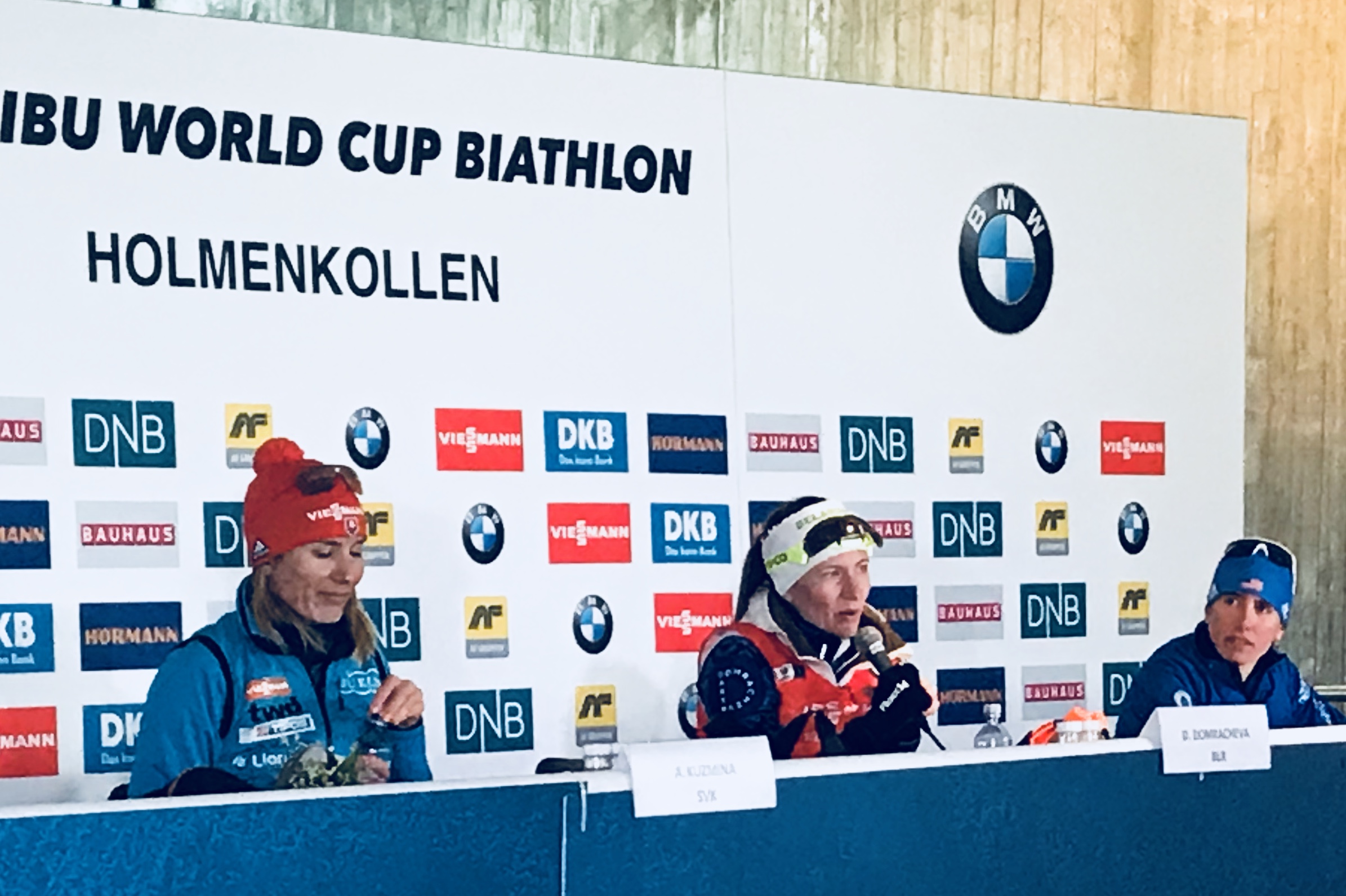
Darya Domracheva explains her race in a press conference as Anastasiya Kuzmina and Susan Dunklee look on.
Dunklee came into the final shooting in ninth place. But aside from Kuzmina and Domracheva, all those in front of her missed shots.
She left in third place, but with Fuyuko Tachizaki of Japan hot on her tails.
“She was chasing me and I heard that from the coaches right away as I was leaving the stadium,” Dunklee said. “She is a strong skier, but I was hoping I would have enough strength on that last hill to be able to take her if needed. So I was trying to put a gap on her but it was like, if she catches me, there’s a Plan B.”
Dunklee accumulated about a two-second gap on Tachizaki around the first part of the loop, but just as in the race for first, the decisive move came on the Hellnerbacken.
“I didn’t know who else was back there, and I just hammered up that back hill hoped to keep her and whoever else away,” Dunklee explained.
It worked, and she came into the stadium with a comfortable lead of 8.1 seconds, third place seemingly secured. Dunklee continued hammering up the steep hill behind the shooting range before dropping into the stadium, where she – and the other top finishers, none of them Norwegian – were met with deafening cheers by the crowd in the grandstand.
“I love this crowd,” Dunklee said. “It was great, you know they are always are happy to cheer on their own, but they also cheer on some of the underdogs. That’s kind of neat.
It wasn’t the only support she had out on course, either. None of the other American women qualified for the pursuit. That was disappointing for the team, but meant that they were out in force cheering Dunklee towards the Americans’ first podium of the World Cup season.
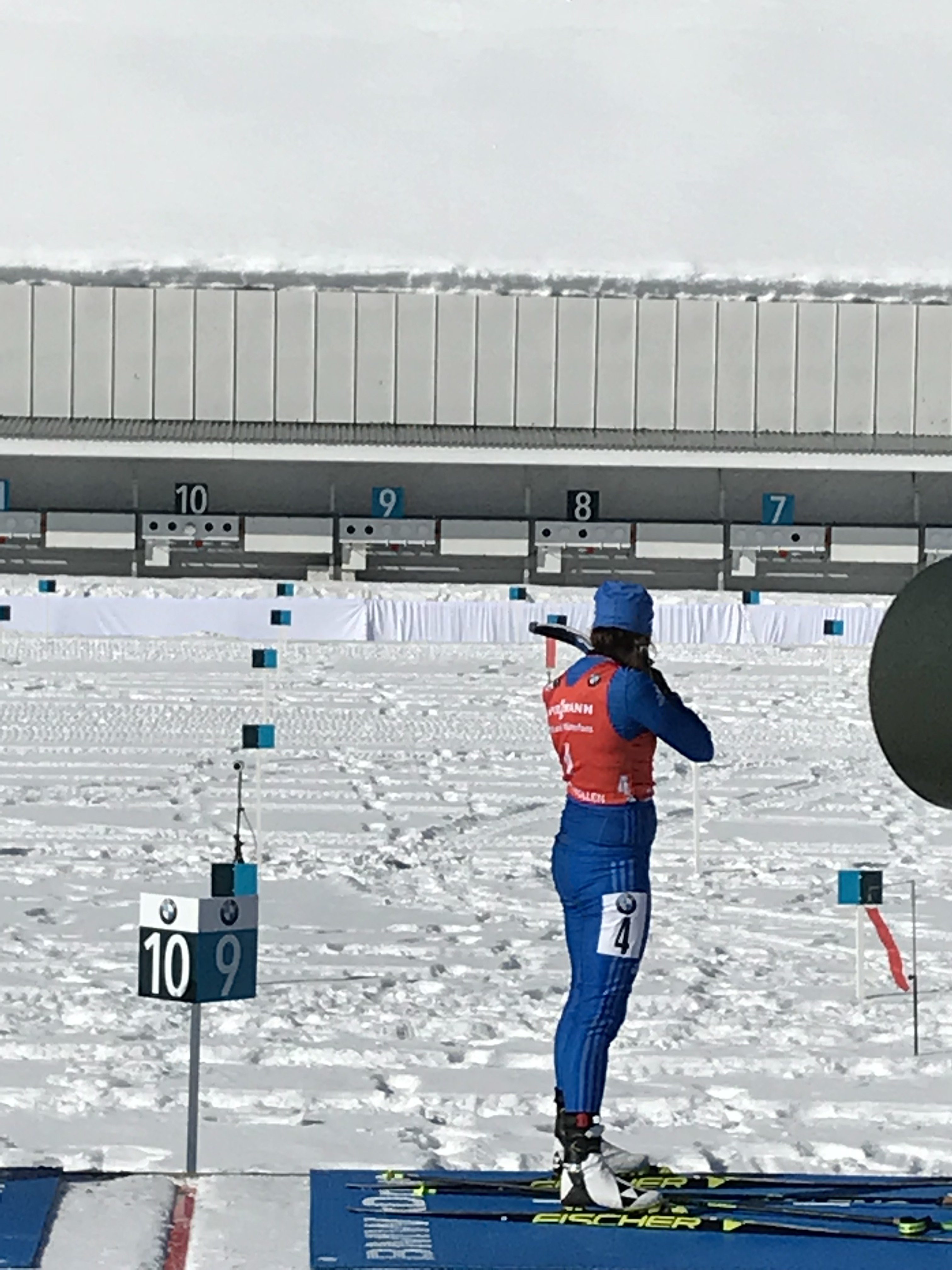
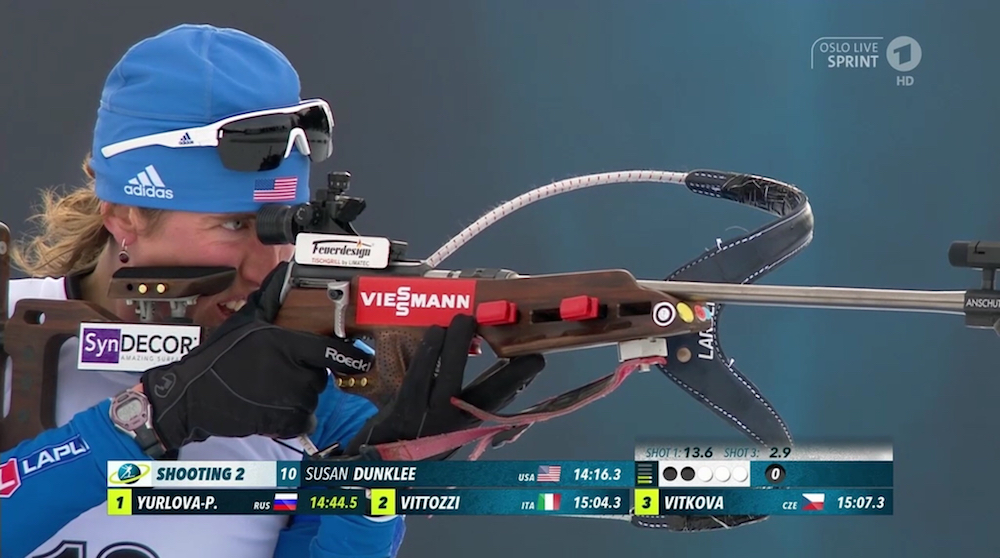
Dunklee on the shooting range, partway through cleaning her final stage.
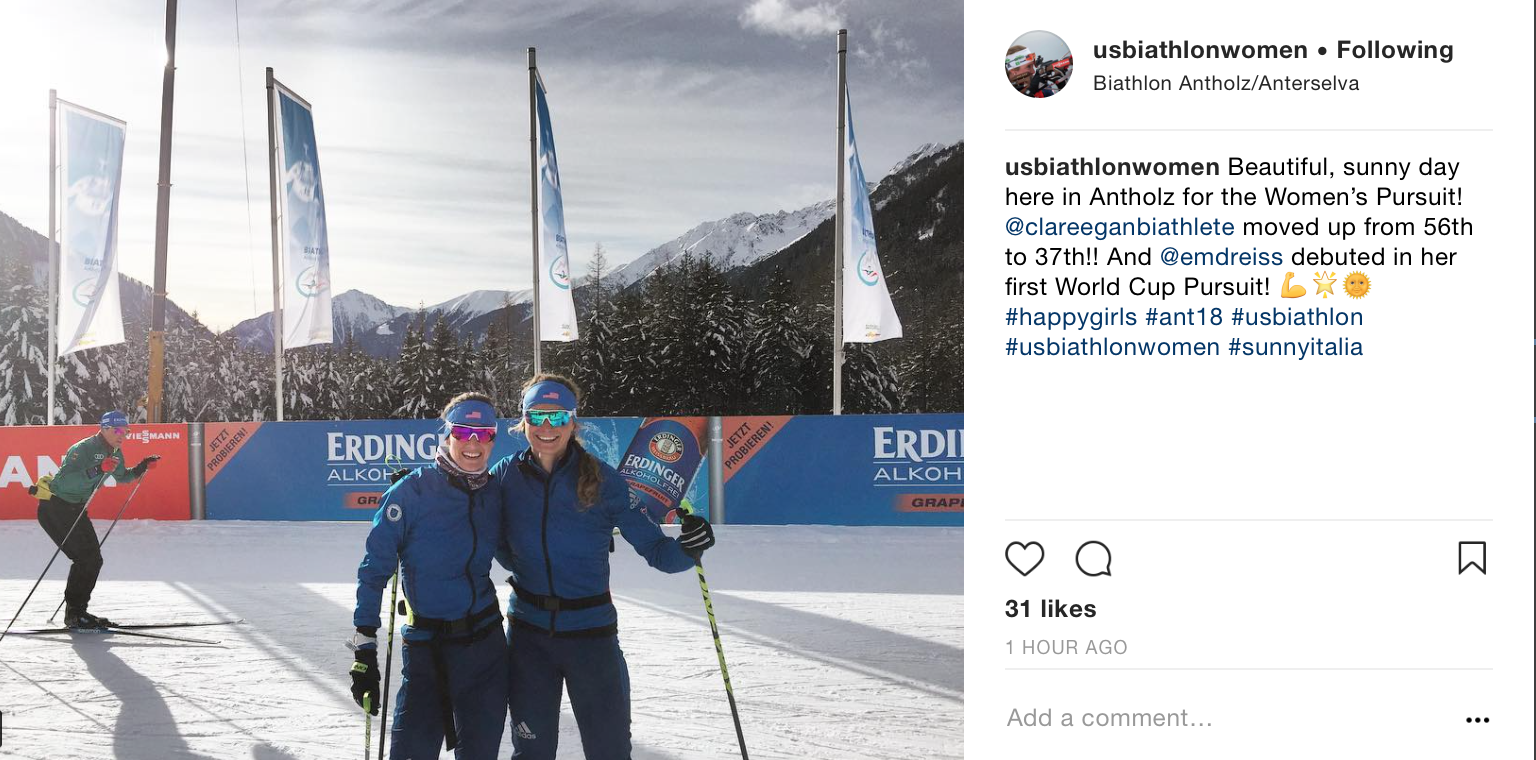
“My teammates were out on the course, other girls, Clare [Egan], Em [Dreissigacker], and JoJo [Reid], and Alex [Howe], and that meant the world to me. I saw them multiple times through the loop. All our staff was out there. It was really cool.”
It hadn’t been a perfect shooting race from Dunklee, but as Domracheva and Kuzmina also showed, it’s the last shooting that counts.
“I don’t think that many people had a perfect race out there today,” Dunklee said. ”It’s crazy some days — I mean, it doesn’t really matter what everybody else is doing, you just have to try to put the best race you can. Because sometimes you have a perfect race and five other people do too, and then you are sixth. But some days you don’t have a perfect race and you end up third.”
As Dunklee alluded to, the beginning of her season was marred with disastrous shooting performances. But the last several weeks have seen better shooting, and two penalties was a good tally in the field today.
“I spent awhile this summer with a crazy plan of preparing myself for wind, because I knew that [the Olympics in] Korea could be windy,” Dunklee said. “I was playing with shading, which is a sort of advanced skill that I haven’t done much until this year. And that’s fine in itself, but what it did was it took my focus off the really good speed shooting, which I had going for me last year and worked really well.”
Partway through the season, Dunklee decided to abandon the shading project and go back to basics. Finally, it is starting to pay off.
“I realized half way through this winter that I can’t really keep both at the same time. at least not right now — it might take me a few more years to get there,” she said. “And so right before the Olympics, about two weeks before we went, I kind of switched to my old style. But it takes a while to get the feel for it again. But it was finally back.”
She also was sick several times throughout the winter, including before and during the Olympics, and then after the Olympics when the World Cup moved to Finland. But today her ski speed was back, too; her last loop was the 13th-fastest in the field.
“I feel a lot better than I did yesterday,” Dunklee said. “During the relay I felt kind of flat. But yeah, I often get to my strongest right as the season finishes, that is pretty typical. I think the biggest thing was that I had a cold or some sort of sickness for three or four weeks, through January/February, and that took a lot out of me. I’m finally getting healthy again.”
Dunklee is not sure whether she will keep competing for another season, saying to ask again in a month.
But whether it was the last race of her career or just the last one of the year, Oslo is a special place for her.
“My first podium was here in Oslo, and I believe Darya was ahead of me on the podium on that day too,” Dunklee said. “So it’ s a little bit déjà vu.”
Canada’s Julia Ransom and Rosanna Crawford crossed the finish line together, +4:52.4, after collecting four and five penalties, respectively.
“It was fun that Julia and I — I guess we were disappointed that we both were bad, but it led us to being able to cross the finish line together,” Crawford said. “So that was nice. Celebrate that team.”
Teammate Emma Lunder was lapped and did not finish.
Dorin Habert is also not going to Tyumen next weekend, and the Canadians were the first team to announce a boycott of the event.
“I’m disappointed that the IBU has taken away our chance to compete at World Cup Finals, because [IBU President] Besseberg and the IBU have decided not to stand up for clean sport,” Crawford said.
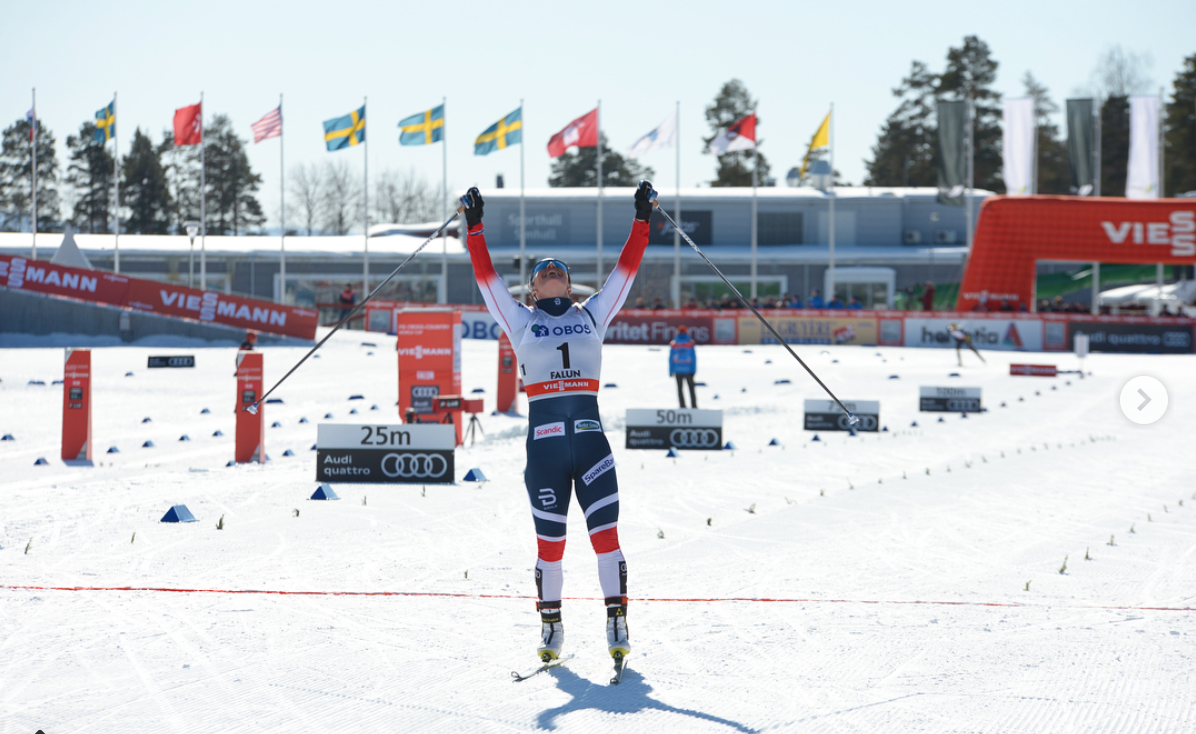
Norway’s Marit Bjørgen celebrates her overall win in the last race of 2018 World Cup Finals, the 10 k freestyle pursuit, on Sunday in Falun, Sweden. (Photo: Svenska Skidspelen/Instagram)
FIS Cross Country World Cup Finals (Falun, Sweden): 10/15 k freestyle pursuits
In the last women’s race of the World Cup season, U.S. Ski Team members Jessie Diggins and Sadie Bjornsen made it one they’ll remember for a long, long time as Diggins raced to second in the 10-kilometer freestyle pursuit and Bjornsen outlasted two Norwegians for third. The two finished the World Cup Finals mini tour in second and third, respectively, behind Norway’s Marit Bjørgen who won it in 24:18.9 minutes.
Bjørgen started with a 36-second cushion to her Norwegian teammate Ingvild Flugstad Østberg in second. Diggins started third, 41 seconds back, just ahead of Finland’s Krista Pärmäkoski in fourth (+43.0), based on their cumulative performances over the last two days of the mini tour (skate sprint and 10 k classic mass start).
While Østberg, Diggins and Pärmäkoski formed a chase pack, Diggins dropped them in pursuit of Bjørgen on the first lap. The American continued to push the pace throughout the three-lap race, coming within 16.7 seconds of Bjørgen at the finish.
Meanwhile, during the pursuit, a chase group of five, which included Bjornsen, caught Østberg and Pärmäkoski. The group of seven dwindled to three on the last two climbs, where Bjornsen and Norway’s Astrid Uhrenholdt Jacobsen and Ragnhild Haga broke away in a race for third.
The three were even entering the finishing stretch, where Bjornsen then beat them in a final 100-meter push to the line. Bjornsen claimed third (+1:11.5) for her fourth podium of the season and first in a distance skate race. Haga followed in fourth (+1:12.0) and Jacobsen fifth (+1:12.8), while Pärmäkoski placed sixth (+1:16.2), Sweden’s Charlotte Kalla seventh (+1:17.9), Østberg eighth (+1:19.0), Sweden’s Jonna Sundling ninth (+1:30.5) and Ebba Andersson 10th (+1:44.7).
Bjornsen now has five-career individual World Cup podiums to her name, and this is the first in a skate race longer than 5 k.
Diggins clocked the fastest time of day in 23:54.4, while Haga was second-fastest (+10.7) after starting the race in 17th. Bjørgen’s time ranked third, Jacobsen was fourth-fastest and Bjornsen fifth-fastest.
Diggins’s performance elevated her to second in the Overall World Cup standings, just 40 points behind Norway’s Heidi Weng (who placed 18th in the pursuit) in first for the second-straight year. Østberg slipped to third overall, 22 points behind Diggins. In the Distance World Cup, Weng took the title by 63 points over Østberg in second, while Diggins was another 32 points back in third.
Bjornsen ended up sixth in the Overall World Cup and 10th in the distance standings.
Also for the U.S., Caitlin Patterson raced from 46th at the start to 35th (+3:58.4) with the 22nd-fastest time of day, Sophie Caldwell placed 36th (+4:00.7), Kikkan Randall finished her last World Cup race in 43rd (+4:33.3) with the 29th-fastest time, Rosie Frankowski placed 46th (+4:41.3), Liz Stephen 50th (+4:57.2) in her final World Cup race, Kaitlynn Miller 56th (+6:13.8), and Ida Sargent 57th (+7:06.4).
For Canada, Cendrine Browne picked off 10 places to finish 39th (+4:14.4) with 27th-fastest time of day, Emily Nishikawa finished 48th (+4:43.7), Dahria Beatty 54th (+6:04.3), and Zina Kocher 60th (+9:28.4).
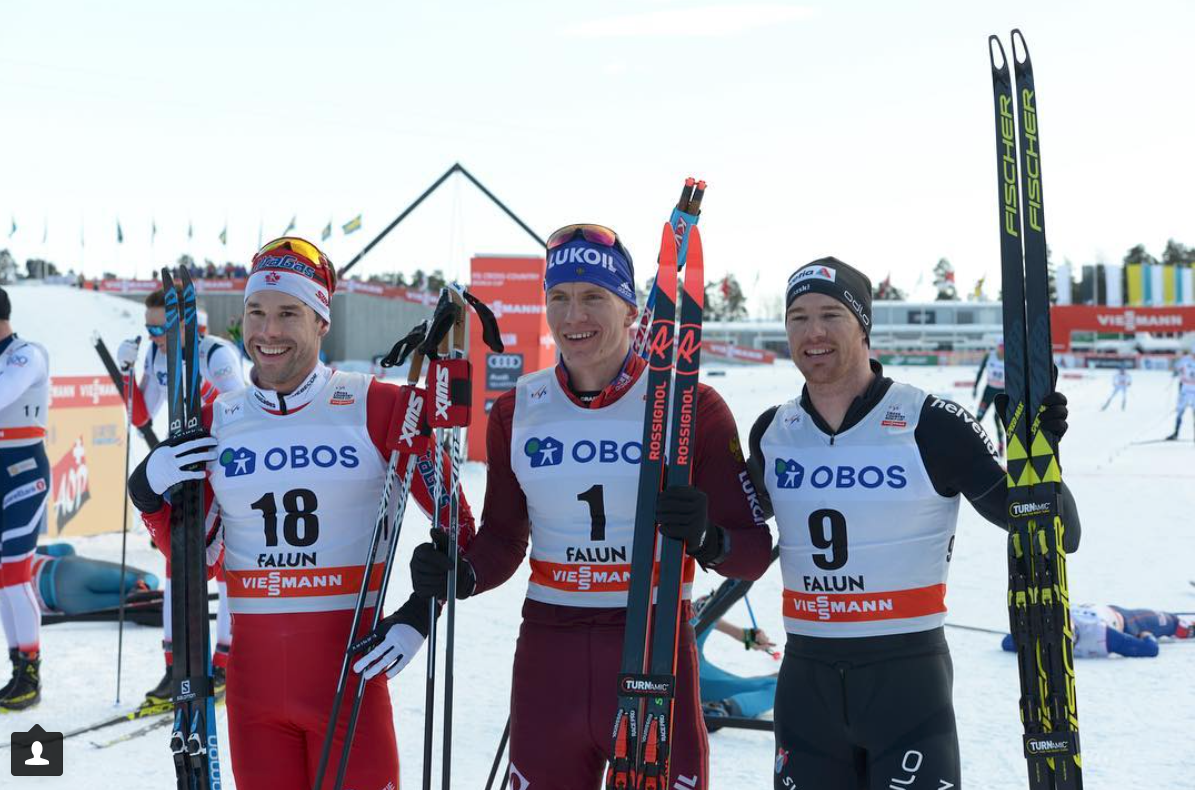
The men’s 15 k freestyle and 2018 World Cup Finals podium, with Russia’s Alexander Bolshunov (c) in first, Canada’s Alex Harvey (l) in second and Switzerland’s Dario Cologna (r) in third. (Photo: Svenska Skidspelen/Instagram)
In the men’s 15 k freestyle pursuit that followed, Russia’s Alexander Bolshunov started 38 seconds clear of Norway’s Johannes Høsflot Klæbo in second, and Sweden’s Calle Halfvarsson and Italy’s Federico Pellegrino headed out together another second later in third and fourth, respectively.
Norway’s Martin Johnsrud Sundby started the race in seventh (+53.0), and Switzerland’s Dario Cologna followed in ninth (+56.0), while Canada’s Alex Harvey started 1:16 back in 18th.
While Bolshunov skied the entire race on his own and won the weekend mini tour in 35:03.3, a number of racers battled for second, with Sundby moving into second in the chase pack, ahead of seven others, less than 2 k in. Several skiers found themselves at the front of that group, including Cologna, Halfvarsson, and even Harvey (with Harvey leading the chase at 9.3 k), while the time gap to Bolshunov grew.
With about 2 k to go, the group was down to six. Harvey attempted an attack, but Cologna matched him. Then, on one of the course’s final climbs, Cologna made his move to get a slight gap, but lost his balance slightly on the downhill, allowing Harvey to catch back up.
With one last uphill to go, Harvey was in the driver’s seat in second, Cologna in third and Sundby in fourth. That order held to the finish, with Harvey claiming second, 47.1 seconds behind Bolshunov, Cologna placing third (+47.5) and Sundby fourth (+48.7). Just behind them, Russia’s Maxim Vylegzhanin crossed in fifth (+50.3), ahead of Norway’s Hans Christer Holund in sixth (+51.7), Halfvarsson in seventh (+54.1), and Norway’s Sjur Røthe in eighth (+54.9). Nearly 10 seconds later, Norway’s Niklas Dyrhaug outlunged two Russians for ninth (+1:04.1): Denis Spitsov in 10th (+1:04.2) and Andrey Larkov in 11th (+1:04.3).
Harvey, who finished the season in fourth in both the Overall and Distance World Cup standings, won the time of day in 34:34.3. Holund had the second-fastest course time, 1 second off Harvey’s time, after starting the race in 22nd.
Harvey’s Canadian teammate Devon Kershaw tallied his fifth-straight distance top 30 in 28th (+2:21.9), after starting 27th, and Graeme Killick finished 56th (+4:33). Julien Locke did not start.
For the U.S., Erik Bjornsen clocked the 22nd-fastest time en route to 38th (+3:10.4), after he started 51st. Simi Hamilton improved 10 places to finish 49th (+4:07.8), Scott Patterson and Paddy Caldwell worked together to move up from 72nd and 73rd, respectively, to 58th (+4:41.5) and 59th (+4:41.6), respectively, at the finish. Kevin Bolger placed 60th (+4:43.5) and David Norris 64th (+5:09.8).
While Klæbo slipped from second to 25th in the pursuit (+1:45.8), the Norwegian still won his first Overall World Cup by 119 points over Cologna in second. Sundby placed third, 29 points out of second and 82 points ahead of Harvey.
Cologna claimed the Distance World Cup Crystal Globe by 41 points over Sundby, and Holund reached the Distance World Cup podium in third, 58 points out of second and just 5 points ahead of Harvey in third. France’s Maurice Manificat had been third heading into the final day of racing, but finished the pursuit in 26th (+2:11.9) and dropped to fifth in the final distance rankings.
In her last race of the season, Susan Dunklee returned to the podium. The American started fourth in Sunday’s 10-kilometer pursuit at the International Biathlon Union (IBU) World Cup in Oslo, then made her way into third by the final shooting stage. Dunklee shot 18-for-20 (1+0+1+0) and finished 29.5 seconds behind the winner, Darya Domracheva of Belarus, who missed two targets as well (1+0+1+0) and finished first in 30:37.4. Slovakia’s Anastasiya Kuzmina started the race in first (ahead of Domracheva in second) and ended up second (+9.2) with four penalties (0+2+2+0).
Canada’s Julia Ransom and Rosanna Crawford finished together in 51st and 52nd, respectively, both 4:52.4 out of first. Ransom had four penalties (0+1+1+2) while Crawford missed five (1+3+1+0). Emma Lunder did not finish.
In the men’s 4 x 7.5 k relay on Sunday, Norway’s team of Lars Helge Birkeland, Henrik L’Abee-Lund, Tarjei Bø, and Johannes Thingnes Bø used just three spare rounds to clean eight shooting stages and took the win in 1:13:13.7 hours. Austria finished 50.3 seconds back in second place, with Dominik Landertinger, Felix Leitner, Simon Eder, and Julian Eberhard, with a total of five spares. Russia’s Maxim Tsvetkov, Anton Babikov, DmitryMalyshko, and Anton Shipulin raced to third (+56.9) with just four total spares.
The U.S. men placed seventh (+2:01.5) with eighth spares, after Lowell Bailey put the team in seventh on the first leg. Sean Doherty skied them up to sixth on the second leg, Tim Burke slipped to 10th on the third leg, and Leif Nordgren posted the seventh-fastest anchor leg to put them in seventh at the finish.
Canada placed 16th (+5:42.4) with Christian Gow, Scott Gow, Brendan Green, and Macx Davies. The team had been in 19th at the final exchange, but Davies skied them up to 16th with the 14th-fastest anchor leg. In all, they used 10 spares.
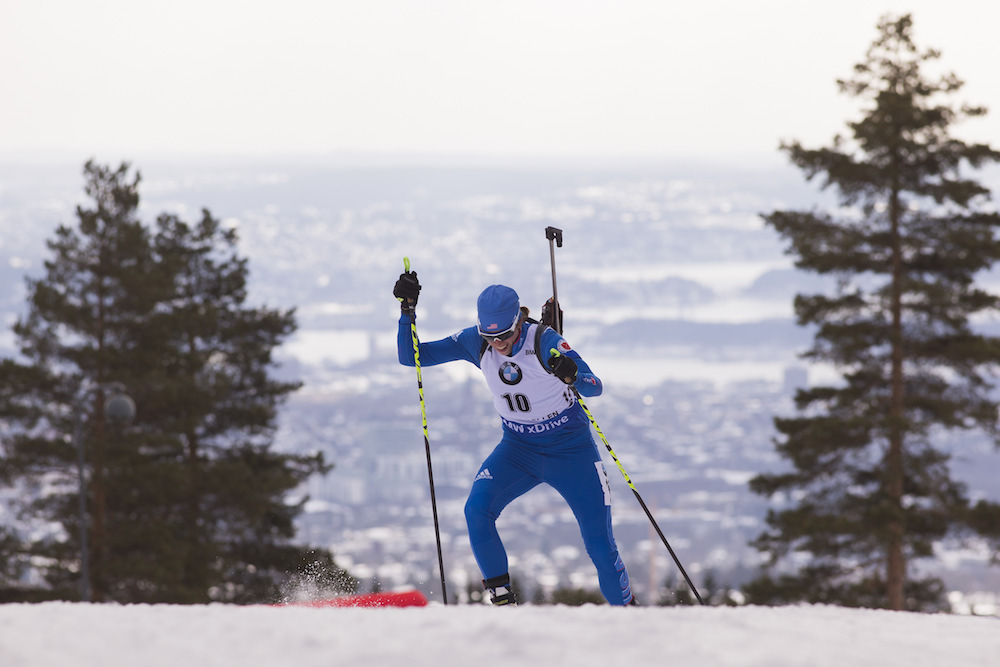
Susan Dunklee (US Biathlon) racing to fourth in the women’s 7.5 k sprint on Thursday at the IBU World Cup in Oslo, Norway. It was her best individual result of the season by two places. (Photo: USBA/NordicFocus)
Susan Dunklee had been looking for something all season, a sort of spark. And while the U.S. biathlete hadn’t necessarily found it on Thursday, she had still pulled off fourth place in the women’s 7.5-kilometer pursuit at the International Biathlon Union (IBU) World Cup in Oslo, Norway.
“I feel like right now I’m relying on good habits to carry me through the rest of the season,” Dunklee, 32, of US Biathlon, said in a phone interview on Thursday. “Normally you need more than just that, you need that spark.”
Last year in Oslo, Dunklee placed seventh in the sprint. They year before, she finished eighth in the 2016 Oslo World Championships sprint at the Holmenkollen biathlon venue.
The flower ceremony for the IBU World Cup women’s sprint on Thursday in Oslo, Norway, which American Susan Dunklee appeared in after placing fourth. (Photo: IBU/Biathlonworld)
On Thursday, she shot clean (hitting all 10 of her targets) and finished 35.7 seconds behind the winner, Slovakia’s Anastasiya Kuzmina, and 6.5 seconds out of third, which went to Ukraine’s Yuliia Dzhima.
The race was Dunklee’s last World Cup sprint of the season, since US Biathlon (along with several other teams) is boycotting next week’s final World Cup in Tyumen, Russia.
“I feel like that spark has been missing a little bit so I was really surprised to be able to put this one together,” she said. “But maybe there was too much spark, maybe I wanted things too much and now I’m finally kind of letting go a little bit and that’s what I needed to do all along.”
A two-time Olympian who raced at five World Championships, Dunklee has been competing internationally in biathlon for the last nine years after a relatively late start in the sport. The daughter of Stan Dunklee, a two-time Olympic cross-country skier, she started skiing at age 2 but didn’t learn to shoot until age 22 when she joined US Biathlon’s development program after graduating from Dartmouth College.
And despite currently being the veteran member of the US Biathlon women’s team, Dunklee said she still gains a great deal from her younger teammates. Clare Egan, 30, who switched from cross-country ski racing to biathlon five years ago, raced to a career-best 13th in last week’s sprint in Kontiolahti, Finland.
“I was definitely inspired by Clare’s race last week,” Dunklee said. “I’ve never seen her so composed and confident out mixing it up with the top ladies in the field and that got me excited for the team. … I often feed off of other people performing well.”
US Biathlon had another breakthrough on Thursday when Sean Doherty finished 14th in the men’s 10 k sprint later in the afternoon in Oslo. It was his season best as well and just one place short of tying his career-best individual World Cup result of 13th (which he achieved in a sprint during the 2015/2016 season in Presque Isle, Maine).
“Sean just had his best result of the season today, so the whole team’s kind of rounding into form just in time,” Dunklee said of the season’s end.
Slovakia’s Anastasiya Kuzmina racing to her fifth World Cup win of the season in the 7.5 k sprint in Oslo, Norway. (Photo: IBU/Biathlonworld)
Kuzmina, who won the women’s race in 21:31.8 minutes with one prone penalty (1+0), started the sprint a minute and a half behind Dunklee, who headed out of the gate in bib 10. Despite cleaning both stages, Dunklee knew she was in second on her final loop after hearing about the kind of race Kuzmina was having. The Slovakian posted the fastest overall course time to overcome her early penalty and beat Belarusian Darya Domracheva, who shot clean, by 8.9 seconds. Dzhima also shot 10-for-10 (as did the rest of the top-seven women) and finished 29.2 seconds off Kuzmina’s winning time.
While Dunklee initially finished first and was bumped to second by Kuzmina just under a minute later, she knew there were plenty of later starters capable of strong performances that could bump her off the podium. Considering that, Dunklee, who skied the 18th-fastest course time and had the 14th-fastest range time, said she was “very happy” to finish in the top six and earn flower-ceremony recognition.
Asked how she felt about the last races of the season, Dunklee said she was trying not to overthink it.
“I’m not looking at it like this is the last sprint, I’m looking at it like, well, just one more,” she said. “I’m going to try to put everything I can into doing the best I can this weekend because there’s nothing else to save it for.”
While Dunklee will start Sunday’s 10 k pursuit 36 seconds back in fourth based on her sprint result, her three teammates missed the sprint top 60 required to qualify for the pursuit. Egan finished 68th (+2:44.8) with three penalties (1+2), Joanne Reid was 75th (+3:02.2) with three misses (1+2) and Emily Dreissigacker placed 83rd (+3:24.8) with three penalties (2+1) as well.
Meanwhile, three Canadian women qualified for the pursuit. Rosanna Crawford placed 38th (+1:51.8) with one standing penalty (0+1), Julia Ransom was 46th (+2:10.1) with one miss (0+1) and Emma Lunder in 57th (+2:28.2) with one penalty (0+1) as well. Also for Canada, Sarah Beaudry finished 84th (+3:30.7) with three penalties (1+2).
Sean Doherty (US Biathlon) racing to 14th in Thursday’s 10 k sprint for a season-best individual result at the IBU World Cup in Oslo, Norway. (Photo: USBA/NordicFocus)
In the men’s sprint that followed, Doherty was one of nine in the top 14 that shot clean, and he finished 47.1 seconds out of first. Norway’s Henrik L’Abée-Lund won the race with perfect shooting for his first World Cup win with a time of 26:10.3.
Four years ago, Doherty made his World Cup debut in Oslo, where he finished 82nd in the sprint. He explained in an email that he has fond memories of the venue.
“The skiing on and off the race course is fantastic and it’s always a special atmosphere,” wrote Doherty, now 22.
He started in the middle of the field in bib 53 and kept himself competitive with the race leaders with flawless shooting and the 33rd-ranked course time. His overall range and shooting times ranked 24th and 26th fastest, respectively.
Norway’s Johannes Thingnes Bø, who started 30 seconds behind him in bib 54, went on to finish second, 6.1 seconds behind L’Abée-Lund. Bø led throughout the race even after skiing a penalty lap after his standing stage (0+1), but lost time to his teammate, L’Abée-Lund, on the last loop.
“That’s what you hate, being in the lead after the last shooting and not in the lead in the finish,” Bø told German broadcaster ARD after in an English interview. “It’s not the best feeling, but I fought with what I had, just wasn’t enough.”
“He was a great marker for me to chase,” Doherty said of Bø. “After cleaning heading out onto the [last] loop I knew I was having a good one.
“I felt strong skiing today, which in turn helps your confidence on the range,” Doherty continued. “As for the good shooting I have been working on some good things in the days leading up to today and I was able to execute my race plan on the range as I wanted. Which I am very happy about.”
He was pleased to put together a complete race in the last sprint of the season, especially considering how it sets him up for Saturday’s 12.5 k pursuit.
“It feels good to end the season on some good momentum and it is fun to be towards the top of a extremely competitive field,” Doherty said. “Now I am just looking forward to the possibilities of the pursuit.”
Henrik L’Abée-Lund (top) and his Norwegian teammate Johannes Thingnes Bø after they placed first and second, respectively, in the men’s 10 k sprint at the IBU World Cup in Oslo, Norway. (Photo: IBU/Biathlonworld)
In the pursuit, L’Abée-Lund will start six seconds ahead of Bø in second and seven seconds ahead of France’s Martin Fourcade in third. Fourcade placed third on Thursday, 6.9 seconds back, after shooting clean but falling and breaking a pole on a downhill.
“I just tried to push one more time in the downhill to get more speed and I pushed aside my ski, I fell, I broke my pole, and I lost seconds for the victory today,” Fourcade told ARD in English. “It’s a good place close to Johannes [for the pursuit], but today wasn’t my time.”
Austria’s Julian Eberhard, who placed fourth, just 0.2 second behind Fourcade, will start the pursuit at the same time as Fourcade.
With one race to go, Fourcade leads the overall World Cup Total Score standings by 37 points over Bø in second.
“It will be tough, it will be almost impossible,” Bø said of beating him. “Today I was ahead but I have to beat him in every race and actually make more points [than him].”
A total of four American men qualified for Saturday’s pursuit, with Lowell Bailey finishing 42nd (+1:41.1) with two penalties (0+2)), Leif Nordgren 43rd (+1:43.3) with one miss (0+1) and Tim Burke 57th (+2:12.8) with four penalties (2+2). In his second World Cup start, Alex Howe finished 89th (+3:39.5) with four misses (3+1).
For Canada, the Gow brothers qualified for the pursuit, with Scott Gow placing 49th (+2:02.1) with one penalty (0+1) and Christian finishing 56th (+2:12.3) with clean shooting. Brendan Green finished 71st (+2:31.3) with two penalties (1+1) and Macx Davies was 96th (+4:27.2) with four penalties (2+2).
“There is no special secret,” Kuzmina said of her five World Cup wins and Olympic gold (in the mass start) this winter. “It’s hard work before the season, good work together with my team, great support from my family and that is all.”
Born in Russia and the sister of Russian biathlete Anton Shipulin, she said she’s looking forward to the Tyumen World Cup.
“Tyumen is my home, where I was born, and I am really really excited for the time there and to see my family,” she said.
Racing in Oslo continues with the women’s relay and men’s pursuit on Saturday, followed by the women’s pursuit and men’s relay on Sunday.
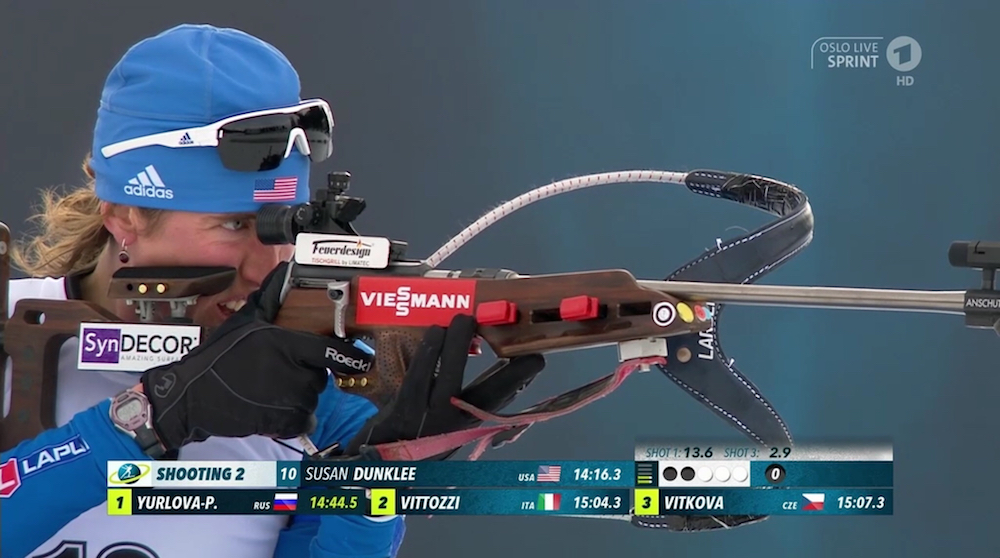
American Susan Dunklee cleaning her second-straight shooting stage of the women’s 7.5 k sprint on Thursday at the IBU World Cup in Oslo, Norway. (Screenshot: ARD broadcast)
IBU World Cup (Oslo, Norway): Women’s and men’s sprints
In her last International Biathlon Union (IBU) World Cup sprint of the season, Susan Dunklee (US Biathlon) raced to a season-best fourth place in the women’s 7.5-kilometer sprint on Thursday at Holmenkollen in Oslo. Dunklee shot clean and finished 35.7 seconds behind Slovakia’s Anastasiya Kuzmina, who had a single prone miss (1+0) but skied the fastest course time to win in 21:31.8 minutes.
Darya Domracheva of Belarus finished 8.9 seconds back for second place with perfect 10-for-10 shooting. The rest of the top-seven finishers also shot clean, with Ukraine’s Yulia Dzhima placing third, 29.2 seconds out of first and 6.5 seconds ahead of Dunklee.
Rosanna Crawford led Canada in 38th (+1:51.8) with one penalty (0+1), and two of her teammates also qualified for Sunday’s pursuit by finishing in the top 60: Julia Ransom in 46th (+2:10.1; one penalty) and Emma Lunder in 57th (+2:28.2; one penalty). Sarah Beaudry finished 84th (+3:30.7; three penalties).
Four Americans competed, with Clare Egan finishing 68th (+2:44.8; three penalties), Joanne Reid 75th (+3:02.2; three penalties) and Emily Dreissigacker 83rd (+3:24.8; three penalties).
Sean Doherty (US Biathlon) racing to 14th in Thursday’s 10 k sprint for a season-best individual result at the IBU World Cup in Oslo, Norway. (Photo: USBA/NordicFocus)
In the men’s 10 k sprint that followed, Sean Doherty (US Biathlon) raced to his best result of the season as well, and was one place away from tying his career best, placing 14th with clean shooting.
Doherty finished 47.1 seconds off the winning time set by Norway’s Henrik L’Abée-Lund, who notched his first World Cup win in 26:10.3. He also shot clean, while his teammate Johannes Thingnes Bø missed one in his standing stage to come 6.1 seconds short of winning at the finish. Bø finished second, while France’s Martin Fourcade placed third (+6.9) after shooting clean but falling on a downhill and losing valuable time.
Doherty posted the 24th-fastest overall range time, 26th-fastest shooting time and 33rd-ranked course time. The 22-year-old New Hampshire native was one of nine men in the top 14 that shot clean. His individual World Cup career best is 13th, which he notched during the 2015/2016 season in a sprint in Presque Isle, Maine. His 14th place on Thursday bested his 17th-place finishes in a sprint and a pursuit earlier this season.
Four out of five of the American men competing qualified for Saturday’s pursuit, with Lowell Bailey finishing 42nd (+1:41.1; two penalties), Leif Nordgren 43rd (+1:43.3; one penalty) and Tim Burke 57th (+2:12.8; four penalties). In his second World Cup start, Alex Howe finished 89th (+3:39.5; one penalty).
Canada’s Scott Gow and Christian Gow qualified for the pursuit, with Scott placing 49th in the sprint (+2:02.1; one penalty) and Christian finishing 56th (+2:12.3) with clean shooting. Brendan Green finished 71st (+2:31.3; two penalties) and Macx Davies was 96th (+4:27.2; four penalties).
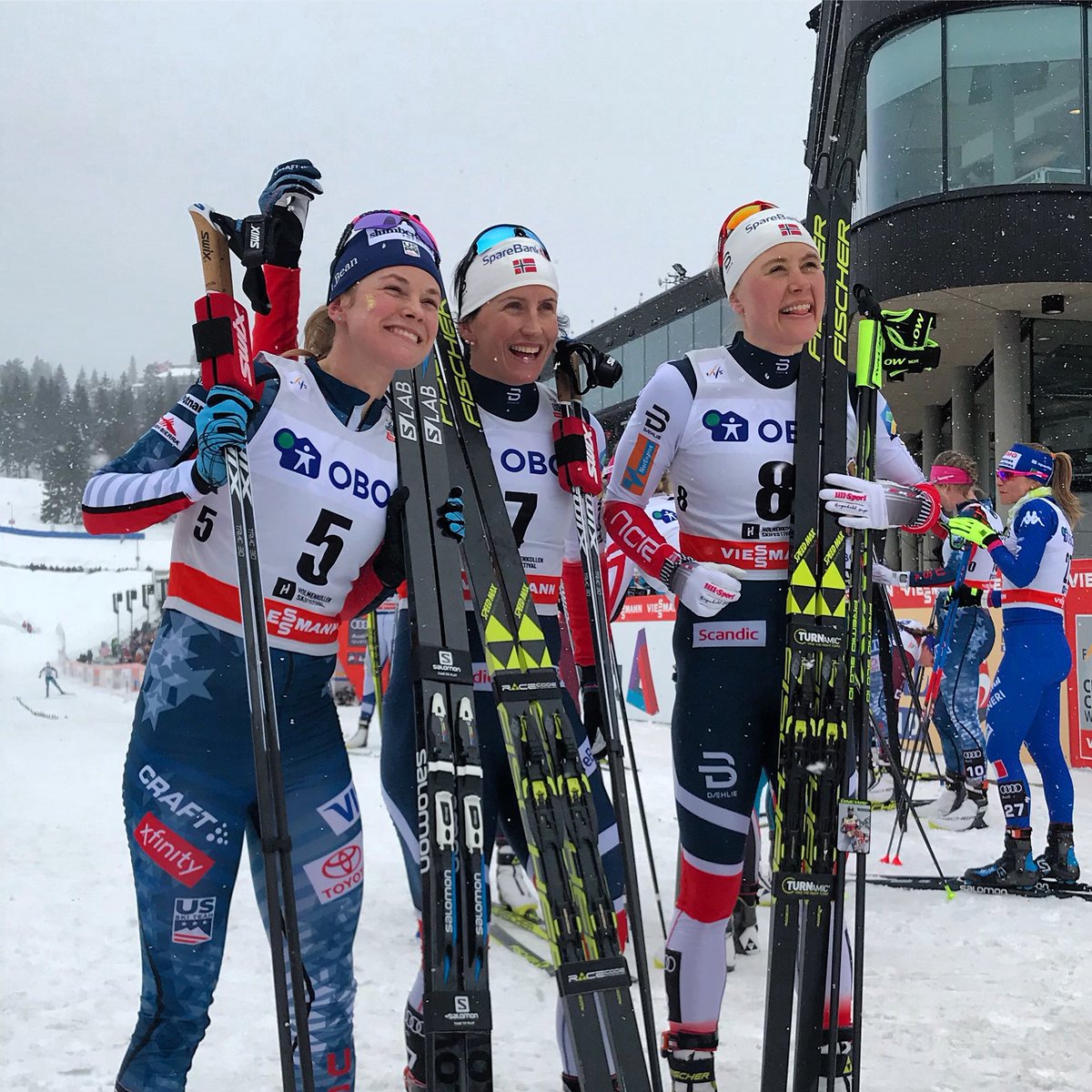
The Holmenkollen women’s 30 k freestyle mass start podium on Sunday in Oslo, Norway, with Jessie Diggins (l) in second, and Norway’s Marit Bjørgen (c) in first and Ragnhild Haga (r) in third. (Photo: FIS Cross Country/Twitter)
FIS Cross Country World Cup (Oslo, Norway): Women’s 30 k freestyle mass start
Marit Bjørgen, the Norwegian queen of distance cross-country events, racked up another victory at Holmenkollen in the women’s 30-kilometer freestyle mass start on Sunday for her seventh win in the World Cup’s ultimate distance event at the famed Norwegian venue. (She had previously won in 2005, 2010, 2012, 2014, 2015 and 2017).
But she did so in not-so-typical fashion. Instead of breaking the field mid-race and skiing to a comfortable win, like she did in the last race of the 2018 Olympics in PyeongChang, South Korea (a 30 k classic mass start), Bjørgen came from behind to win Sunday’s Holmenkollen 30 k and wasn’t able to let off too much before finish. She didn’t take the lead until less than a kilometer to go and put just enough time into her competition to take the win in 1:18:12.4 hours, while American Jessie Diggins outlasted the chase group of three to place second (becoming the first American woman to reach the Holmenkollen podium), 3.6 seconds behind Bjørgen. Norway’s Ragnhild Haga edged Sweden’s Charlotte Kalla by 0.1 seconds for third place (+4.3), while Kalla settled for fourth (+4.4).
The rest of the field was strung out, with Norway’s Astrid Uhrenholdt Jacobsen finishing fourth (+11.5) and Ingvild Flugstad Østberg nearly another 1 1/2 minutes back in fifth (+1:39.5). Finland’s Krista Pärmäkoski placed seventh (+1:51.7), Germany’s Stefani Böhler notched eighth (+2:10.2), Austria’s Teresa Stadlober ninth (+2:10.2), and Sweden’s Ebba Andersson 10th (+2:11.9). Less than a second behind Sweden’s Ida Ingemarsdotter in 11th (+2:22.8) was American Sadie Bjornsen in 12th (+2:23.4).
In the Distance World Cup standings, Diggins gained some valuable points to keep herself in third, now 63 points ahead of Pärmäkoski in fourth. Heidi Weng, who finished 18th on Sunday, still leads the distance standings by 104 points and Østberg is second, 51 points ahead of Diggins.
In the Overall World Cup, Weng leads by 153 points over Østberg. Diggins is another 104 points back in third, 100 points ahead of Pärmäkoski in fourth. At World Cup Finals next week in Falun, Sweden, a total of 300 points is up for grabs for the winners (50 for freestyle sprint, 50 for classic individual start, and 200 for freestyle pursuit).
The U.S. had three in the top 20 and four in the points (top 30) in Sunday’s 30 k, with Kikkan Randall in 19th (+3:21.9) and Caitlin Patterson in 28th (+4:13.1). Rosie Frankowski (Alaska Pacific University) missed the top 30 by about 28 seconds in 31st (+4:45.4), Liz Stephen placed 51st (+10:01.7) and Kaitlynn Miller (Craftsbury Green Racing Project) finished 53rd (+16:05.0).
Cendrine Browne led four Canadian women in 36th (+6:16.1), Emily Nishikawa was 44th (+7:36.1), Zina Kocher (Foothills Nordic) finished 47th (+8:52.0), and Dahria Beatty placed 49th (+9:45.1).
Germany’s Vanessa Hinz celebrates her first IBU World Cup win and podium in the women’s 12.5 k mass start on Sunday in Kontiolahti, Finland. (Photo: IBU/Biathlonworld)
IBU World Cup (Kontiolahti, Finland): Men’s and women’s mass starts
(Note: This rundown has been updated to include comments from Lowell Bailey and Rosanna Crawford.)
Germany’s Vanessa Hinz won her first International Biathlon Union (IBU) World Cup race (and achieved her first World Cup podium) and Austria’s Julian Eberhard won his first race of the season (and first mass start of his career) in the women’s 12.5 k and men’s 15 k mass starts on Sunday in Kontiolahti.
Germany’s Vanessa Hinz celebrates her first IBU World Cup win and podium in the women’s 12.5 k mass start on Sunday in Kontiolahti, Finland. (Photo: IBU/Biathlonworld)
Hinz shot an impressive 20-for-20 with the third-fastest range time and fifth-fastest shooting time to take the win in 35:47.9 minutes. Third after the first prone stage, she moved into second, then third after cleaning the next two stages. After knocking down her final five targets in the last standing, Hinz left the range almost 24 seconds ahead of France’s Anaïs Chevalier in second and 26 seconds ahead of Italy’s Lisa Vittozzi in third. Hinz stayed ahead of her challengers on the final loop, finishing 13.5 seconds clear of Vittozzi, who claimed second. Chevalier finished third, 16.8 seconds back, while Finland’s Kaisa Mäkäräinen was next across the line in fourth (+43.4) with a gap to Sweden’s Hanna Öberg in fifth (+1:02.1).
Vittozzi and Chevalier both cleaned the first three stages then had to ski a penalty lap after the last standing bout (0+0+0+1). Mäkäräinen missed three (1+0+1+1) yet skied the second-fastest course time on her home course, and Öberg missed two (0+0+2+0). The fastest course time of the day was clocked by Darya Domracheva of Belarus, who had to ski five penalty laps (0+1+1+3) and ended up 10th (+1:18.2).
“I always dreamed of shooting four times clean and today I did it,” Hinz, 25, said, according to an IBU press release. “I was so often close to the podium. I knew I could do it. Today, I said, ‘OK, let’s try it and if it works, it is OK … and if not there is another season waiting and other races.’ Now I am on top of the podium and it is crazy.”
Vittozzi, who placed fourth in the mass start at the 2018 Olympics, was glad to improve on a third-place finish in Friday’s sprint by placing second on Sunday.
“I have been third so many times and that was not satisfying for me,” Vittozzi said, one day after she won the mixed relay with her team in Kontiolahti. “Today I am very happy about my second place.”
For Chevalier, it was her first individual podium of the season and it came a day after she and Antonin Guigonnat won the single mixed relay. Chevalier, 25, was severely injured when she was hit by a car last spring, according to an IBU press release.
“I am very happy to be here today, because it was a very hard season,” she told the IBU. “I forgot how nice it is to be on the podium … I forgot that it was not easy, so I am very happy … I did my best on the last lap; [Vittozzi] was faster, but I am third and happy with that!”
Canada’s Rosanna Crawford shot 19-for-20 to place 13th (+1:25.9) with her only miss coming in the second prone stage (0+1+0+0). Her overall shooting and range times were 10th fastest of the 30-woman field, compared to her 26th-ranked ski time. Crawford had been in 11th after cleaning the final standing stage, then slipped two spots to finish 13th in her second mass start of the season.
“Since the skiing wasn’t feeling great today I made sure I was super focused in the range,” Crawford wrote in an email to FasterSkier. “I knew that was my only chance to get a good result today. My one prone miss was a bad trigger pull, but the rest were nice solid hits. I made sure to have a solid set up and then just trusted my rhythm and shooting.
“I knew that I wanted that top 15, so I just kept fighting and trying to stick with the women when they caught me,” she wrote of her last loop. “The last time up the wall I managed to stay close to [France’s] Anais Bescond, and hold off the two people behind me. Really happy to be in the top 15 again.”
Clare Egan was the lone American woman to qualify for Sunday’s mass start, and it was the second mass start of her career. She was on track for a top-15 result after missing just one target in the first three stages, but she had to ski three penalty laps on the last standing (0+1+0+3), which put her in 23rd by the finish (+2:05.6). Notably, she skied the 14th-fastest overall course time.
“I didn’t have quite the same energy level tonight as the last two days, but I still had the 14th rank course time and that means anything is possible in the race,” Egan wrote in an email to FasterSkier. “To put it in perspective, the winner of the race, Hinz, had the 13th rank, just 2 seconds faster than me. This is the first time I’ve felt totally comfortable skiing with the fastest women, and I certainly hope I can maintain this speed for one more week of World Cup racing.”
Egan was pleased with her 9-for-10 prone shooting and her clean standing stage (“which is the first time I’ve cleaned a standing stage in an individual race this entire year, believe it our not,” Egan wrote).
“But when I missed my second shot on the final stage, I let that throw me off my game, and really blew the rest of the stage,” she explained. “It’s so hard to keep 100% focus in every scenario, and I find it gets harder and harder towards the end of the race when I’m not necessarily the most lucid. I know that I have to work on so I have a goal to manage the final stage better next week and in the future.”
Her 23rd-place finish was one better than her previous World Cup mass start finish, which was 24th last season in Hochfilzen, Austria.
“In my only other mass start, which was last year at World Championships, I felt like an imposter,” Egan reflected. “Maybe because I was the first ‘reserve’ to get called up when one of the top women [did not start]. But this was totally different. I knew I deserved to be there today and was confident about competing with the other top women.”
“In my only other mass start, which was last year at World Championships, I felt like an imposter … This was totally different. I knew I deserved to be there today and was confident about competing with the other top women.” — Clare Egan (US Biathlon) on Sunday’s mass start
While the women raced Sunday night, the men’s 15 k mass start took place in the afternoon, when Eberhard passed the likes of France’s Martin Fourcade and Russia’s Anton Shipulin after a tangle late in the race to take the win.
The Austrian team celebrating Julian Eberhard’s fourth career victory, his first this season and his first in a mass start on Sunday after the IBU World Cup men’s 15 k mass start in Kontiolahti, Finland. (Photo: IBU/Biathlonworld)
The Austrian had cleaned the first two prone stages to move into third by the race’s halfway point, behind Germany’s Benedikt Doll and Arnd Peiffer in first and second, respectively. Eberhard missed one in the next standing stage, yet left the range in second, 15 seconds behind Peiffer (who cleaned) in first, while Doll missed one as well to slip into third, 19 seconds back.
With two loops to go, Fourcade was coming back from two early prone penalties and found himself in fifth after a clean standing stage, less than a second behind Shipulin in fourth. On the next standing stage, Fourcade cleaned to take the lead and left the range about five seconds ahead of Shipulin (who also cleaned) in second.
Eberhard missed one yet remained in contention in third, 17 seconds behind Fourcade. On the last loop, Shipulin caught Fourcade before the course’s notorious climb known as “The Wall”, and Eberhard closed on the two frontrunners as they ascended it. Still several seconds behind over the top, he caught Shipulin on the bridge before the stadium, but the two tangled skis and Shipulin fell. Eberhard stayed upright and pulled even with Fourcade, passing him to take the win in 38:04.8. Fourcade finished second (+6.9) and Shipulin third (+19.3).
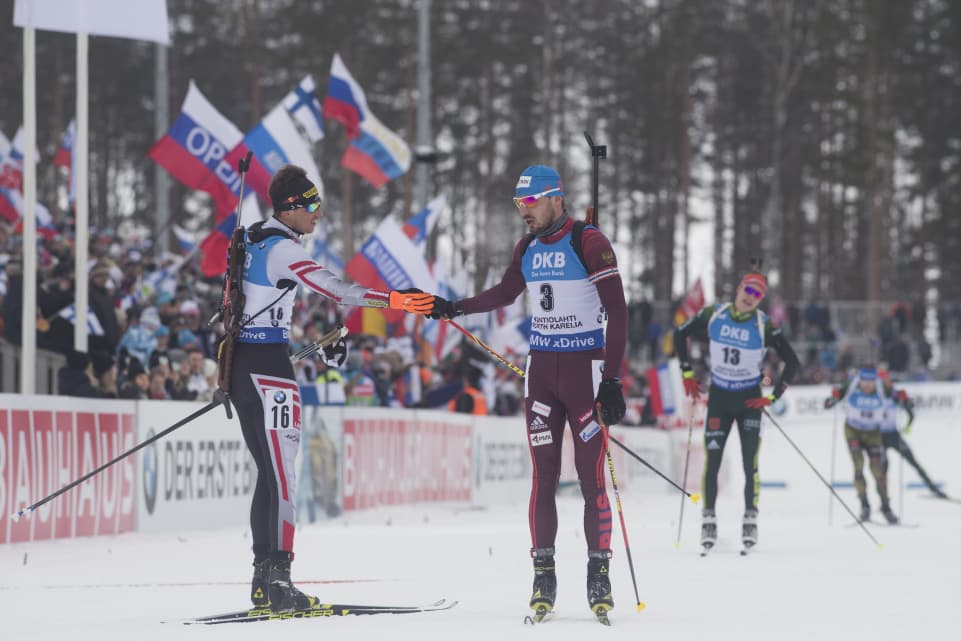
Austria’s Julian Eberhard (l) and Russia’s Anton Shipulin after the finish of the men’s 15 k mass start the IBU World Cup in Kontiolahti, Finland. Shipulin fell when his skis tangled with Eberhard’s. While Eberhard raced to the win, Shipulin placed third. (Photo: IBU/Biathlonworld)
“I wanted to be in a sprint with all three, but the bridge is too small for this,” Eberhard said, according to an IBU press release. “I came up the bridge with too much speed. Anton and I were in the same track and there was an accident. I apologized to Anton at the finish but he said these things can happen and it was OK with him.”
“I hold no grudge against Julian,” Shipulin told the IBU. “This can happen in sports and is all fair … I am in good shape and want to preserve this and perform my best in the last World Cups.”
Fourcade explained that illness caused him to sit out Thursday’s sprint, and he was only able to train three hours this week.
“It is really difficult to race in this situation without any feeling or training,” Fourcade told the IBU. “I did not know what to expect today but I am quite satisfied. I would have liked to win, but I used too much energy trying to come back in the early laps and had no energy when it was time to attack.”
Behind them, Doll picked off one place on the final loop to finish fourth (+21.9), passing his German teammate Erik Lesser, who finished fifth (+23.9). Peiffer followed in sixth (+27.1) as Germany had three in the top six.
American Lowell Bailey raced to 14th (+1:06.3) with two penalties, both of which came in the standing stages (0+0+1+1). Bailey had been fourth after cleaning the second prone, 16 seconds behind Doll in first, but slipped to 10th after missing one on the next bout. He had to ski another penalty lap on the last stage, and left the range in 14th.
Overall, Bailey posted the 10th-fastest shooting time, 15th-fastest range time and 18th-fastest course time.
“I finally felt like I was back in the spot that I ended last season,” Bailey wrote in an email when asked about his consistency. “I felt controlled and able to keep the pace with the top of the field throughout the race. It was nice to be back in the mix.
“Although I would have liked to see this ski speed a few weeks ago, better late than never!” he continued.
Next week’s World Cup in Oslo, Norway, will be his last of the season and his career.
“After nearly two decades of international racing, Oslo will be my final World Cup as a U.S. Biathlete,” Bailey wrote. “I’m sure it will be emotional but I hope to end my World Cup career on a high note!”
Clare Egan (US Biathlon) racing to a career-best 13th in the women’s 7.5 k sprint at Friday’s IBU World Cup in Kontiolahti, Finland. (Photo: USBA/NordicFocus)
IBU World Cup (Kontiolahti, Finland): Women’s 7.5 k sprint
Darya Domracheva of Belarus raced to her third World Cup victory of the season on Friday, and American Clare Egan tallied a career best in 13th, just behind Canada’s Rosanna Crawford in 12th in the International Biathlon Union (IBU) World Cup women’s 7.5 k sprint in Kontiolahti.
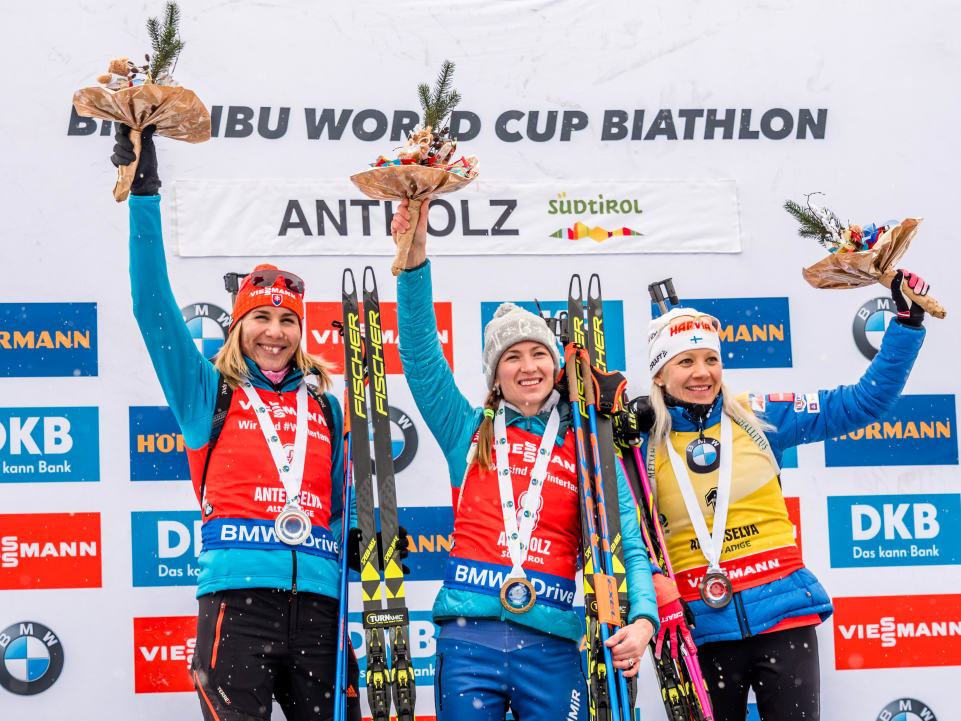
The women’s 7.5 k sprint podium at the IBU World Cup in Kontiolahti, Finland, with Belarus’s Darya Domracheva (c) in first, Germany’s Franziska Hildebrand (l) in second, and Italy’s Lisa Vittozzi (r) in third. (Photo: IBU/Biathlonworld)
Domracheva started 16th and shot a perfect 5-for-5 in prone, then missed one in her standing bout, but skied to first with the fastest overall course time. Her position in the leader’s chair looked secure until Germany’s Franziska Hildebrand, who started 49th, shot clean in both stages and headed out on her last loop with a 17.6-second lead on Domracheva’s time. But Hildebrand couldn’t match Domracheva’s pace and finished 0.5 seconds short of the winning time of 20:56.8 at the finish.
“I really like to compete here in Kontiolahti,” Domracheva said, according to an IBU press release. She won two gold medals there at 2005 Youth/Junior World Championships and went on to win her first two World Cup races there in 2010.
“This is a tough track, always very difficult but it always a good chance to take some seconds if you are in good shape,” she said. “I have some good memories from here…”
“I am very proud of myself,” Hildebrand said of her race, according to the IBU. “Dasha made a really strong last loop and I tried to do it as well. It was very close but I am happy to be second … I had to concentrate and have the confidence that I could shoot clean today.”
Italy’s Lisa Vittozzi started 24th and came within 5.5 seconds of Domracheva’s time, after missing one standing target (0+1), to place third, 5 seconds behind Hildebrand.
Vittozzi achieved her first career podium in Kontiolahti last year.
“This is an amazing place for me,” she told the IBU. “I like this track so much and feel in good shape. I tried to do my best in the shooting range and finally I did it.”
Ukraine’s Yuliia Dzhima shot clean but was 11.7 seconds short of the podium in fourth place (+17.2), Germany’s Laura Dahlmeier followed in fifth (+19.4; one penalty), Veronika Vitkova of the Czech Republic placed sixth (+21.0; no penalties), Ukraine’s Vita Semerenko was seventh (+21.0; no penalties), France’s Marie Dorin Habert eighth (+32.0; no penalties), Germany’s Maren Hammerschmidt ninth (+33.9; one penalty), Finland’s Kaisa Makarainen 10th (+34.4; two penalties), and Belarus’s second woman in the top 11, Nadezhda Skardino 11th (+35.3; no penalties).
Rosanna Crawford (Biathlon Canada) leaving the range during the women’s IBU World Cup sprint earlier this season in Annecy, France. . (Photo: Glen Crawford)
Crawford led Canada in 12th (+46.5) with a single prone penalty (1+0) for her best sprint result since the 2014/2015 season. Also this season, Crawford raced to a career-best third place in a 15 k individual and fourth in a 12.5 k mass start.
“It was a little bit windy and some fresh snow made for a soft track, but I had amazing skis from our techs and was feeling good skiing,” Crawford wrote in an email. “I’m really happy with how I executed my race today, I really tried to channel my inner Jessie Diggins and never stop fighting! The hills are steep and long here, something I usually struggle with, but I tried to push them mentally aside and focus on what I am good at, there are a lot of flat sections where my two skate one skate is really strong, and on the big up hills I just tried to stick with whoever was around me.
“I had a lot of fun out there tonight, something I didn’t think I would ever say about this race course!” she continued. “… I am really happy to have some good ski speed in a spring finally!”
Egan, of the U.S., achieved her best World Cup result in 13th (+46.9) with a single standing miss (0+1) and the 14th-fastest overall course time. Her previous best was 16th in a sprint four year ago.
After the Olympics, Egan explained in an email that she rented an apartment in Helsinki and spent the first part of the off-week spending some alone time and doing “some serious R&R. I don’t think I realized how chaotic the Olympics were until I had peace and quiet for the first time in 3 weeks,” she wrote.
“After a week of mostly easy skiing on my own I was really antsy to race today,” Egan added. “I also felt motivated coming off my season-best performance in the women’s relay in Pyeongchang. My individual results have been really mediocre this year so I was looking to take the momentum and confidence from the relay and carry that into today’s race.”
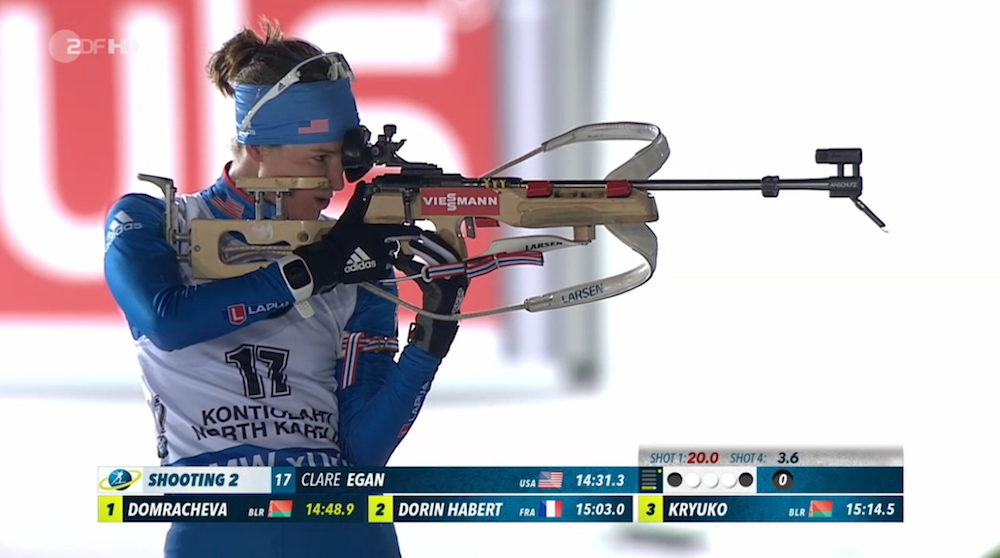
Clare Egan (US Biathlon) during her standing shooting of the IBU World Cup women’s 7.5 k sprint in Kontiolahti, Finland. (Screenshot: ZDF broadcast)
During Friday’s sprint, she noticed her skis were running really well.
“I can say without any doubt that we had the fastest skis today and that played a big role in my ski time,” Egan wrote. “I had a personal best ski time (rank) by at least 10 places today.”
After starting one bib and 30 seconds behind Domracheva, Egan knew she was having a good race when she could see the eventual winner for most of the first loop.
“Our skis were so fast that I honestly had to adjust my technique to account for the extra glide– exceptional!” she added. “On my last loop, I realized I was still ahead of Laura Dahlmeier, who started :30 seconds behind me, and I fought super hard to hold her off all the way to the finish line!
“I was shocked to have a career best with one miss,” Egan concluded. “But I had a major PR on my ski time rank, and this is biathlon! I’m very, very happy to have a great result, but happier about the performance behind the result.”
With their results on Friday, both Egan and Crawford earned starts in Sunday’s 12.5 k mass start, according to a provisional start list.
“I’ll have another opportunity tomorrow in the mixed relay and Sunday in the mass start, which is only the second of my career,” Egan wrote.
“I was pretty disappointed to not qualify for the mass start at the Olympics,” Crawford wrote. “My bad sprint had many far-reaching consequences. So I am glad I get another chance to go out there and fight with the best!”
Also for the U.S., Susan Dunklee finished 36th (+1:27.0) with three penalties (1+2), Emily Dreissigacker was 62nd (+2:15.7) with two misses (2+0), and Joanne Reid was 74th (+2:38.7) with two misses (0+2) as well.
Canada’s Emma Lunder finished 43rd (+1:48.0) with one miss (1+0), Julia Ransom was 58th (+2:07.9) with two penalties (1+1), and Sarah Beaudry finished 66th (+2:20.3) with two misses (1+1) as well.
This year’s Kontiolahti World Cup does not include a pursuit race. The single mixed relay and mixed relay are set for Saturday, followed by men’s and women’s mass starts on Sunday.
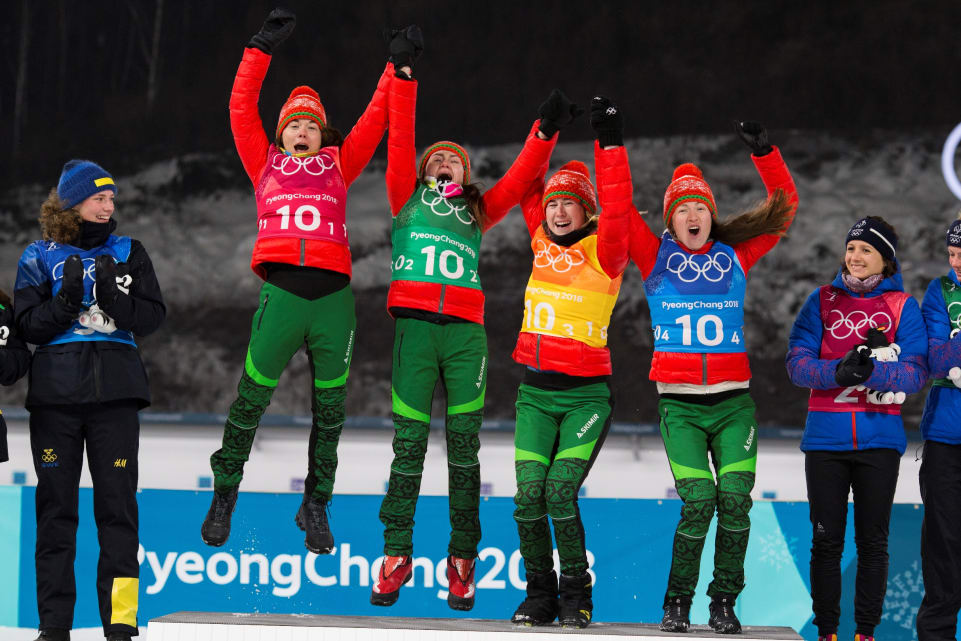
The Belarusian women’s biathlon team of Nadezhda Skardino, Irina Kryuko, Dzinara Alimbekava, and Darya Domracheva celebrates winning gold in the relay. They were ranked 10th coming into the day. (Photo: IBU/Biathlonworld.com)
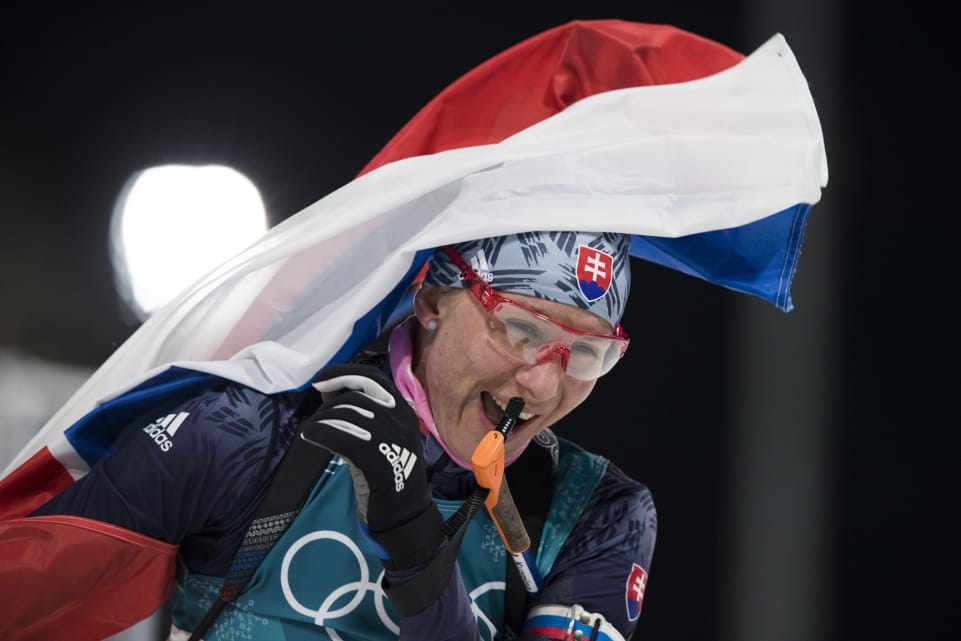
Ranked just 10th coming into today’s women’s relay, the team from Belarus stole the show with Darya Domracheva skating across the line to claim the fourth Olympic gold of her career after strong efforts from Nadezhda Skardino and Iryna Kryuko, both of whom have stood on the World Cup podium before, and newcomer Dzinara Alimbekava, a 22-year-old newcomer with just 11 World Cup starts to her name. It was the first relay medal ever won by Belarus at the Olympics.
The setting was windy and snow-blown and the race was extremely tight, with seven teams with one penalty loop (or a few spare bullets) worth of time going into the final leg. The Belarusians’ nine spare rounds were the best shooting of the day; while that spare-round tally was matched by Slovakia, Kazakhstan, Bulgaria, and Japan, those teams had penalty loops as well.
Sweden actually wasn’t one of them, but with perfect shooting and a fast ski time 15 k gold medalist Hanna Öberg brought the team to silver after starting the anchor leg in eighth, a minute back. She benefitted from many missed shots by the leaders, and then passed France’s Anais Bescond on the final loop to claim second, 10.7 seconds back, for her teammates (Linn Persson,Mona Brorsson, and Anna Magnusson) while France (Bescond, Anais Chevalier, Marie Dorin Habert, and Justine Braisaz) took bronze (17.6). These medal-winning teams used 12 and 14 spare rounds, respectively, an unusually high tally.
Norway (Synnøve Solemdal, Tiril Eckhoff, Ingrid Tandrevold, and MarteOlsbu) finished fourth, +29.7, Slovakia fifth (+38.4), Switzerland sixth (+43.5) after winning a photo finish against Poland (+43.6), and Germany finished seventh (+53.9).
The Canadian team of Sarah Beaudry, Julia Ransom, Emma Lunder, and Rosanna Crawford finished 10th, +1:33.4. Their shooting of eleven spare rounds and one penalty loop was among the better scores of the day.
The United States had a strong start, with Susan Dunklee tagging off in second place, Clare Egan maintaining a good position in fourth, and Joanne Reid rebounding from one bad shooting stage to tag off in sixth. Anchor leg Emily Dreissigacker crossed the finish line in 13th, +2:01.9.
2018 Olympics (PyeongChang, South Korea): Nordic Combined Team Competition
After sweeping the medals in the large hill competition, perhaps it was not a surprise that Germany won the nordic combined team event. It was a blowout: ranked second after the jumping round but starting the cross-country ski relay just six seconds behind Austria, the Germans quickly took the lead and then just extended it. Their team of Vinzenz Geiger, Fabian Riessle, Eric Frenzel, and Johannes Rydzek won by 52.7 seconds over Norway’s Jan Schmid, Espen Andersen, Jarl Magnus Riiber, and Jørgen Gråbak. Austria hung on for third, +1:07.8, with Wilhelm Denifl, Lukas Klapfer, Bernhard Gruber, and Mario Seidl.
The United States team of Taylor Fletcher, Ben Berend, Ben Loomis, and Bryan Fletcher lost out on a photo finish with Poland and finished 10th out of 10 teams, +5:16.7.
The women’s biathlon 12.5 k mass start medalists at the 2018 Olympics in PyeongChang, South Korea, with Slovakia’s Anastasiya Kuzmina (c) in first, Belarus’s Darya Domracheva (l) in second, and Norway’s Tiril Eckhoff (r) in third. (Photo: IBU/Biathlonworld)
Slovakia’s Anastasiya Kuzmina made her intentions pretty clear early on at these Olympics.
“I am missing my brother,” she said when asked of her younger brother, Anton Shipulin, who was one of the Russian athletes banned from competing at the 2018 Games in PyeongChang. “I hoped to the last moment that he will be able to compete here … I am really sorry about what happened and that my brother is not here. I am here to fight for medals for my entire family. I won the one medal, and I want to win another medal for my brother.”
That was after she placed second in the women’s 10-kilometer pursuit on Monday. Two days before that, she had finished outside the medals, 13th, in the Olympics’ opening biathlon sprint.
But Kuzmina, who was born in Tyumen, Russia, and started racing for Slovakia in 2008, has been an all-around threat in the sport for some time. At her first Olympics in 2010 in Vancouver, British Columbia, Kuzmina won her first Olympic gold in the sprint and took silver in the pursuit.
Four years later, at the 2014 Olympics in Sochi, Russia — the Games that would later lead to her brother and multiple other top Russians being sanctioned for their alleged involvement in a systematic nationwide doping scandal — Kuzmina, still racing for Slovakia, racked up her second Olympic gold in the sprint.
She had a child after each Olympics yet came back, Olympic cycle after Olympic cycle, to dominate at the highest level of the sport.
Now 33 and in her third Olympics, Kuzmina raced to second in both the pursuit and 15 k individual on Thursday in PyeongChang. Then, on Saturday, in the last non-relay event of the championships and on yet another windy evening, she captured her third-career Olympic gold — winning the women’s 12.5 k mass start by 18.8 seconds in 35:23.0 minutes.
At a post-race press conference, she dedicated that medal to her adopted nation.
“I got my third medal here,” Kuzmina stated though a translator. “The first medal was conquered for me. The second one was conquered for my brother because I was sad that he is missing here and he was supporting me, was able to support me. And now the third medal is for entire Slovakia, for my team, and for many people which were supporting me in the hard times.”
Slovakia’s Anastasiya Kuzmina with her nation’s flag celebrating her win in the women’s 12.5 k mass start at the 2018 Olympics in PyeongChang, South Korea. (Photo: IBU/Biathlonworld)
While Kuzmina’s win was resounding — she led from the first loop to the finish — it didn’t come without a blip. After cleaning three consecutive stages in the prone-prone-standing-standing mass-start format, she missed one in the final shooting bout. But even after a penalty lap, Kuzmina was still 24.7 seconds clear of Domracheva in second.
Leading into the range for each bout, Kuzmina generally cleaned quickly (shooting the fastest time on the first prone), slowing down slightly to hit the last shot of her second prone and a little bit more so on the third stage (17th-fastest shooting time) to ensure she stayed out of the penalty lap. Her last time in the range without anyone around her, Kuzmina posted the 30th-ranked shooting time and lost at least 20 seconds with her miss, but the win was still hers.
With her third gold, she became the first female biathlete to win at three consecutive Olympics. At Saturday’s press conference, she explained that she had thought her best chance for that medal would be in the sprint.
“When that didn’t happen I was really sad and nervous before the next races,” Kuzmina said. “But it happened here and the race was mass start, a different event than in Vancouver and Sochi, and it’s an incredible feeling. Nine years ago at the 2009 World Championships here in PyeongChang I won the first-ever medal for the Slovak Republic, for my homeland, and it was a silver medal and the race was mass start. I wanted to repeat it and to be again with a medal here in the same event in the same place, just nine years later.”
She’s not sure if she’ll have another kid over the next four years, or if she’ll be at the 2022 Olympics to try to win golds in four different Games.
“The next Olympics, at the moment I don’t know if I will quit my career or not or how long I will compete, how many years,” she said. “But I am not sure that I will be able to survive the next four years and compete in the next Winter Olympics.”
For Belarus, Domracheva claimed her first medal of the Games in second, after placing ninth in the sprint, then 37th in the pursuit and 27th in the 15 k individual. The silver was her fifth-career Olympic medal after she won three races in Sochi (pursuit, individual and mass start) and took bronze in 2010 in the 15 k individual.
Like Kuzmina, Domracheva has also been raising a small child in the leadup to PyeongChang. She and her Norwegian husband Ole Einar Bjørndalen, the most decorated Winter Olympian of all time with 13 medals, welcomed the birth of their first child, Xenia Bjørndalen, on Oct. 1, 2016.
Domracheva, 31, put herself in second on Saturday by the second stage, after cleaning both prone stages. She chased Kuzmina on the third loop, skiing less than 10 seconds behind her and at least 15 seconds ahead of Germany’s Denise Herrmann and Italy’s Dorothea Wierer in third and fourth. On the third shooting stage that followed, Domracheva shot a miss and had to ski a penalty lap, putting her in fifth and 44 seconds behind Kuzmina in first.
Wierer moved into second with clean shooting, setting out on the fourth loop 28 seconds behind Kuzmina.
On the final shooting, Wierer had her costly miss of the day, which dropped her to seventh and 39 seconds back. While several of the top contenders incurred penalties on that last standing, Domracheva cleaned to reclaim second, and Norway’s Tiril Eckhoff cleaned when it counted to leave the range in third, 9.3 seconds behind Domracheva.
While Kuzmina skied the overall fastest course time, her final loop only needed to be third fastest to secure the win. Heading into the final downhill that rounded into the stadium, she grabbed a Slovakian flag from one of her team’s staff members running beside her. The wind blew it directly into her face as she tried to wave it in front of the crowd, but it didn’t derail her nor erase the huge smile on Kuzmina’s face as she finished nearly 19 seconds clear of second place.
Domracheva skied the second-fastest last loop (and third-fastest course time overall) to claim second, a result she was pleased with.
“It was a tough race … because it was so high pressure during all races before,” Domracheva said at the press conference after. “The toughest was understanding that it was my last chance for an individual medal in these Games. And it was so important to keep this focus and continue to believe in yourself and I am very very happy that I have done that so well and took this silver medal.”
She acknowledged that several of her competitors were in a similar position of seeking a medal at these Games, including but not limited to Finland’s Kaisa Mäkäräinen (who finished 10th on Saturday with two penalties) and Eckhoff, who’s previous best result this week was ninth in the pursuit (Eckhoff is a two-time bronze medalist from 2014, in the mass start and relay).
“I knew that I was in some company of the girls who are quite strong, but who were so unlucky from the beginning of the Games,” Domracheva said. “And what kind of pressure … understanding that you try to do the best that you can, but something went wrong in the previous races, and this understanding of course gave me some kind of pressure. It was important to overcome this situation and start this mass start from zero.”
Eckhoff, 27, who overcame two penalties (1+0+1+0) en route to bronze (+27.7), attributed her result to some luck.
“I was lucky today and took a medal, but all year I trained for this, and I guess Kaisa did the same,” Eckhoff said at the press conference. “I was lucky, she was not. It’s hard for everyone I think, because of the conditions. And I know, Darya said it as well, it’s really tough when you don’t succeed here. And I am very happy that I managed it today.”
While the medalists skied into the finish separately and without any close competition, the race for fourth was a close one with Italy’s Lisa Vittozzi edging Sweden’s Hanna Öberg, Wierer and Belarus’s Nadezhda Skardino. She claimed fourth (+45.6). Öberg placed fifth (+46.5), Wierer sixth (+47.3), and Skardino seventh (+47.9), ahead of Norway’s Marte Olsbu in eighth (+51.6), France’s Marie Dorin Habert in ninth (+57.9) and Mäkäräinen in 10th (+1:00.9).
Only two out of 30 cleaned on Saturday, Skardino and Poland’s Monika Hojnisz in 15th (+1:36.2).
Germany’s Laura Dahlmeier finished 16th (+1:47.1) after two early penalties (1+1+0+0). She started the race by keeping pace with Kuzmina on the first loop as the two of them slightly gapped the field before the first prone. There, Dahlmeier missed one to drop to 22nd and about 35 seconds back. She missed one more on the second prone, which put her in 21st and 1:12.4 out of first. Previously, Dahlmeier had won two races this week (sprint and pursuit) and finished third in the 15 k individual.
No North Americans qualified for either of the mass starts. The men’s 15 k mass start is scheduled for Sunday at 6:15 a.m. EST.
It wasn’t the wire-to-wire triumph that Norway sometimes achieves, but the pre-race favorites got the job done despite a scare midway through, thanks to dominant skiing by Ragnhild Haga and smooth strength from anchor Marit Bjørgen.
Norway took gold in the 4 x 5 k relay by two seconds over Sweden in 51:24.3 minutes. Olympic Athletes from Russia took bronze (+43.3), Finland fourth (+1:02.6), and the United States fifth (+1:20.5).
The first leg went out with Natalia Nepryaeva of Russia setting a blistering pace, fracturing the field almost immediately. A number of racers tried to stay with her only to get shot off the back of the pack. Taking a different pacing strategy, Slovenia’s Anamarija Lampic made up ground in the final section of the first leg to tag off in second, with Norways’ Ingvild Flugstad Østeberg third, all within a few seconds of each other.
Part of Nepryaeva’s fracturing of the field led to U.S. lead skier Sophie Caldwell getting dropped, to tag off 1:01.5 minutes back in 11th place.
In the second leg, Charlotte Kalla of Sweden and Kerttu Niskanen of Finland clocked the fastest times, making up 24.4 and 9.9 seconds that had been lost to Russia and Norway by their teammates Anna Haag and Aino Kaisa Saarinen, respectively. In the meantime, Astrid Uhrenholdt Jacobsen of Norway had a disastrous relay leg and notched just the eighth-fastest split time, falling to fourth.
Yulia Belorukova of Russia continued to lead the race on that second leg, but Kalla tagged off at the end of the classic portion just 1.4 seconds back, and Niskanen in third (+10.1). Sadie Bjornsen made up three places to tag off in eighth (+1:05.2).
Jacobsen tagged Haga 29.8 seconds out of first. From that point, Haga gradually reeled in the leaders over the course of the 5 k skate leg. It was an absolutely dominant performance, with the fastest split time by 24.7 seconds in a less than 12-minute race.
Sweden’s Ebba Andersson led Russia’s Anastasia Sedova for the whole leg and stayed clear of the field, but Haga — the gold medalist in the 10 k skate — made up enough ground to finish her effort in third, 3.4 seconds back.
That was more than enough for Bjørgen to work with, and she and Swedish anchor Stina Nilsson quickly dropped Anna Nechaevskaya of Russia and set off on their personal duel for gold. Bjørgen led the whole way, but could not make any decisive move to drop the Swede. Instead, over the top of the climb she had about a second, which Nilsson could not close on the downhill or the final flats into the finishing straight: gradually, Bjørgen just added a meter and another to her lead and crossed the line with gold.
Nechaevskaya continued to lose time on the leaders, but still held on to bronze. Krista Pärmäkoski skied an aggressive effort for Finland to pass the team from Switzerland, which had been in fourth after strong legs from Laurien van der Graaff, Nadine Fähndrich, and Nathalie von Siebenthal. But 21-year-old Lydia Hiernickel was unable to keep the pace and Switzerland dropped to seventh by the finish, getting passed by not only Parmakoski and Jessie Diggins, but also Sandra Ringwald of Germany. The Germans finished sixth (+1:49.4) and Switzerland seventh (+1:51.5).
Kikkan Randall had skied the third-fastest split of the field (behind Haga and Andersson) in the third leg to bring the U.S. into sixth, and Diggins also skied the third-fastest split (behind Bjørgen and Nilsson) for her leg to bring the team up to fifth at the finish.
The Canadian team of Dahria Beatty, Emily Nishikawa, Cendrine Browne, and Anne-Marie Comeau placed 13th (+4:50.3) of 14 teams.
The women’s biathlon 12.5 k mass start medalists at the 2018 Olympics in PyeongChang, South Korea, with Slovakia’s Anastasiya Kuzmina (c) in first, Belarus’s Darya Domracheva (l) in second, and Norway’s Tiril Eckhoff (r) in third. (Photo: IBU/Biathlonworld)
Not even a miss in the final stage could keep Slovakia’s Anastasiya Kuzmina from her third medal of the 2018 Olympics, this time gold, in the women’s 12.5-kilometer mass start on Saturday at the Alpensia Biathlon Center.
Kuzmina took charge early in the five-loop race, leading Germany’s Laura Dahlmeier into the range for the first prone shooting stage. There, Kuzmina cleaned all five targets quickly to get back out on course in first, while Dahlmeier missed one to slip out of the top 20, while several other athletes cleaned.
Kuzmina went on to hit every target over the next two shooting stages to distance herself from second place, and even with a miss on the last standing stage, she left the range 24.7 seconds clear of Darya Domracheva of Belarus in second.
Domracheva had put herself in second with clean shooting in the first two stages, then dropped to fifth with a miss on the third stage. Italy’s Dorothea Wierer was up to second by the fourth shooting after three clean stages, then fell back to seventh with a miss on the last standing.
There, Domracheva cleaned to get back into silver-medal contention, 9.3 seconds ahead of Norway’s Tiril Eckhoff in third.
Heading into the final downhill into the stadium, Kuzmina had enough time to grab a flag from one of her team’s staff members running alongside the trail. She crossed the finish line first in 35:23.0 minutes without anyone close for her third-career Olympic gold (after winning the sprint at the 2010 and 2014 Games).
Domracheva skied on her own to second, 18.8 seconds behind, for her first medal of the 2018 Games (and fifth of her career after winning three races at the 2014 Olympics).
Eckhoff, who had skied two penalty laps, took third, 27.7 seconds behind Kuzmina, while Italy’s Lisa Vittozzi held off Sweden’s Hanna Öberg, Wierer and Belarus’s Nadezhda Skardino for fourth place (+45.6). Öberg placed fifth (+46.5), Wierer was sixth (+47.3), and Skardino seventh (+47.9), ahead of Norway’s Marte Olsbu in eighth (+51.6), France’s Marie Dorin Habert in ninth (+57.9) and Finland’s Kaisa Mäkäräinen in 10th (+1:00.9). Dahlmeier, who had won two races and placed third in another at these Olympics, finished 16th (+1:47.1) with two penalties (1+1+0+0).
Darya Domracheva of Belarus (center) won the final World Cup race before the Olympics, a 12.5 k mass start in Antholz, Italy. Anastasiya Kuzmina of Slovakia was second and Kaisa Makarainen of Finland third. (Photo: IBU/Biathlonworld)
On Saturday, Darya Domracheva watched as second place in the World Cup pursuit skied away from her.
She had stepped on competitor Dorothea Wierer’s pole in the final corner of the 10 k pursuit in Antholz, Italy, and felt it unsportsmanlike to try to beat Wierer to the finish when the Italian had only one ski pole. So she let Wierer go and settled for third.
In Sunday’s World Cup mass start, Domracheva was rewarded by some combination of karma, skill, and hard work, and rounded that same corner to the finish line all alone in first place to claim her second win of the season.
Nobody shot better than Domracheva, and only six other women matched her single penalty loop. The Belarusian left the shooting range after the fourth and final stage with just a 3.3-second lead on Slovakia’s Anastasiya Kuzmina, who missed three shots in total and was coming out of the penalty loop as Domracheva skated past.
Germany’s Maren Hammerschmidt fights through thick snow in the forest during Sunday’s 12.5 k mass start in Antholz, Italy. (Eurovision screenshot)
“It was very tough race, and very slow snow conditions,” Domracheva said in a press conference of the abundant fresh snow that had fallen overnight and continued to fall off trees and onto the trails (and racers) during the competition. “So I understood from the start of the competition that it was really important to be focused on shooting today.”
But Domracheva was able to put the hammer down and extend the gap on Kuzmina, who had been the most dominant athlete of the first half of the season, and win by 11.9 seconds.
“I can say that today was quite a tough race for me,” Domracheva said. “The feeling was not so light. It was also not in the plan that here in Antholz would be very easy. So we are still in preparation, and it’s one very important step in my preparation for the next races.”
It was the last World Cup competition before the Olympics, where Domracheva will do her best to follow up on the three gold medals she won in Sochi in 2014.
Kaisa Makarainen of Finland fights to the finish line. (Photo: IBU/Biathlonworld)
Third place went to Kaisa Makarainen of Finland, who was frustrated by four missed shots and left the range (and penalty loop) the final time in eighth place. But in a stunning show of grit and speed, she charged past racer after racer; she had the fastest ski time of the day and that was particularly true on the last loop.
The Finn celebrated as she crossed the line 16.2 seconds behind Domracheva. That meant another podium – her fifth of the season – and two spots on Germany’s Laura Dahlmeier, thus hanging onto the yellow bib of the overall World Cup leader until racing resumes after the Olympics (which don’t count for World Cup points).
“I tried to ski as fast as possible and catch some places,” Makarainen said in the press conference. “I was not sure if I could catch the podium because it was quite a big gap. But I guess some other girls were more tired than me!”
Fourth place went to Norway’s Marte Olsbu (+22.6), fifth to Dahlmeier (+23.9), and sixth to her teammate Maren Hammerschmidt (+25.2).
Wierer had shot clean through three stages and led the race onto the shooting range the last time, to the thrill of the home crowd. But she missed two shots and ended the day in seventh, +29.4.
Fourcade Extends World Cup Lead with Another Win
While Norway’s Johannes Thingnes Bø came into the men’s 15 k mass start with two consecutive wins under his belt, he immediately missed two shots in the first prone stage, then two more in the next prone stage.
While Bø has turned in some of the most stunning performances on the World Cup this season, another man leads the standings, and that’s Martin Fourcade of France. Fourcade is nothing if not consistent and with only two missed shots in the mass start, he picked up his sixth win of the season.
Martin Fourcade of France leading the 15 k mass start in Antholz, Italy, where he picked up his sixth win of the season. (Photo: IBU/Biathlonworld)
“It’s good to find back this position in Antholz,” he said in a post-race press conference. “It’s only my second victory here. The first one was in the mass start in 2011, so it’s been a while and I’m very satisfied and happy to be back on top of the podium in Antholz.”
The last time Fourcade was off the podium was in the single mixed relay in Östersund, Sweden, in the very first race of the season, and the last time he was off the individual podium was back in Kontiolahti, Finland, in the second-to-last weekend of last season.
“The weekend was really nice,” Fourcade said. “I had not my best ski level on the first two competitions, but today felt really good on the skis and it gives me confidence for the Olympics… I want to keep my hunger from that last [bullet] I missed, to keep some things to work on for the Olympics.”
With the younger Bø out of the picture, the two men who ended up battling behind Fourcade were both still Norwegian: Tarjei Bø, the older brother in the family, and his teammate Erlend Bjøntegaard.
Tim Burke of the United States after finishing 22nd in the World Cup mass start in Antholz, Italy. (Photo: USBA/Instagram)
Former World Champion Bø won their sprint to the finish, crossing the line 2.8 seconds behind Fourcade (who had eased through the last few hundred meters after maintaining a big lead through the rest of the course), and Bjøntegaard picked up his first career podium in third (+5.1).
“It was quite fun actually,” Bjøntegaard said of his battle with Bø. “I’ve had a lot of hard sessions with that guy in the past two years. We were talking to each other on the fourth loop and the last loop, trying to exchange who was in front. I think that worked out quite well. I know that he is strong in the head, especially at the end, but I think I gave it a good shot and I really tried.”
After the Norwegians it was two Germans battling to the line, with Benedikt Doll taking fourth (+16.0) and Johannes Kuehn fifth (+18.3), each with two missed shots.
Johannes Bø struggled mightily against his five total penalties, and remarkably managed to make it up to sixth place, just 29.2 seconds behind Fourcade.
Laura Dahlmeier of Germany, Tiril Eckhoff of Norway, and Darya Domracheva of Belarus on the shooting range in the 10 k pursuit in Antholz, Italy, today. Dahlmeier went on to win the day. (Photo: IBU/Biathlonworld.com)
Norwegian biathletes started in the lead of both of today’s World Cup pursuits in Antholz, Italy, today, and one stayed there: Johannes Thingnes Bø cruised to a one-minute win over French rival Martin Fourcade, shooting a perfect 20/20 and flying on the trails. In the women’s race, his teammate Tiril Eckhoff had a few too many missed shots, and as she faded to fourth Germany’s Laura Dahlmeier surged to eventually claim a 17.3-second win over Dorothea Wierer of Italy.
Dahlmeier Finding Form as Olympics Near
Dahlmeier started second today behind Eckhoff, and shot 19/20 to take the win. Her only missed target was the last shot of her very first shooting bout; from then on she was perfect, and looked calm as she knocked down target after target, even in the last shooting bout as she went head to head with Eckhoff and Belarus’s Darya Domracheva.
“Pursuits are a real thriller,” Dahlmeier told German broadcaster ARD after the race, according to a translation. “The one who keeps her thoughts in check the best usually wins. I tried to shoot clean but had a miss right in the first stage. Then I tried to close the gap again, and in the third and fourth shootings it was incredibly suspenseful again. It was absolutely important to stay centered within yourself. And I am really really happy it worked out like this today.”
Behind her, the race for second place was intense. With Eckhoff missing two shots in the final shooting bout, she was out of contention. Domracheva had missed one shot and headed to the penalty loop; as she came out, Wierer – who had cleaned that last bout – joined her.
The two battled on the trails, with Domracheva initially leading but unable to drop Wierer, then Wierer passing her on the last big, open climb, but unable to drop Domracheva. In several stretches of the course, the two women were side by side, each skiing their hardest but unable to get any sort of gap.
Dorothea Wierer crosses the finish line in second place with just one pole, as Darya Domracheva – who stepped on her other pole – eases up and settles for third. (Photo: IBU/Biathlonworld.com)
Then rounding the final corner to the finish line, Domracheva – following Wierer closely – stepped on her competitor’s pole, pulling it off completely. In an act of sportsmanship, Domracheva hung back as Wierer skied with one pole down the finishing stretch to claim second place.
“I was before Darya, and it can happen – of course it was really [close] between us, and she took my pole, but it is like this when you are fighting,” Wierer said in a press conference, before adding that her competitor’s response to the incident was nice. “Thank you Darya!”
“Of course, it would be absolutely unfair from me if I would fight against an athlete with one pole,” Domracheva said in the press conference. “I was the reason that she lost it. So. Even so, I couldn’t be sure that I could be hear to this finish line. But anyway, it was not such a nice situation for us both, but I could not play it another way.”
Both women are on an upward trajectory, with Wierer picking up her third podium in the last five races, and Domracheva taking her third podium of the season. In the last ten races, the triple Olympic gold medalist has only been out of the top eight twice.
“I’m really happy today,” Wierer said. “Of course a lot of people expect a podium at home. It’s even more difficult – there are lots of things to do, interviews and appointments and everything. So it’s really stressful for me. But I felt really relaxed today, I felt comfortable on the skis and I think with two mistakes, it was okay, for today.”
Eckhoff crossed the line +1:09.9. Finland’s Kaisa Makarainen finished fifth, +1:18.4, after moving up from 26th place in the sprint thanks to just two missed shots. That means that she holds on to the overall World Cup leader’s bib.
Sixth place went to Kazakhstan’s Galina Vishnevskaya, one of just three women to shoot 20-for-20. Her result was accompanied by the news that the Kazakh team is still being investigated for doping materials found in Austria last year. The police carried out a search warrant of their team lodging and van in Antholz today, according to an International Biathlon Union press release.
For the U.S., the top finish came from Clare Egan, who moved from 56th up to 37th despite three missed shots; she had the 22nd-fastest ski time of the day.
“I’m really happy with my skiing right now,” Egan wrote in an email. “I’m finally getting into race shape, just in time for the Games. Today I had the 8th fastest last lap, which is a personal best for me. I also believe I had the fastest skis out there. I was psyched to stay with Justine Braisaz all the way from the last shooting to the finish and I think if we hadn’t had to go around a few other people I could have gotten a better finishing Lane for the sprint.”
Emily Dreissigacker, competing in her first-ever World Cup pursuit, finished 56th (+6:27.2) with four missed shots.
“My strategy was really to just relax and try not to get too caught up in the excitement,” Dreissigacker wrote in an email. “I think I did a good job of that until my last shooting. That last standing I was definitely very tired going into it and it just felt very rushed and hectic, not relaxed at all. I think this was a good final weekend of racing before the Olympics. I definitely struggled with the altitude a little but overall I think it was good progress. I am looking forward to getting in a good training block in Ruhpolding before we head to Korea.”
Susan Dunklee sat out the pursuit with a cold. No Canadian women qualified for the event.
Bø Decimates Field in Men’s Pursuit, But Fourcade Still Leads World Cup
Bø started with a lead of 12.8 seconds over Fourcade, and it only got bigger. The pair have been battling all season and between them have taken every win so far but one – that went to Bø’s brother, Tarjei.
But today Fourcade didn’t look like a match for the Norwegian, who not only hit all his targets but also skied faster than the Frenchman, and gained a few seconds on the shooting range, too.
With Fourcade missing just one shot, by the finish the margin between the two men had grown to a whopping 1:00.5.
Johannes Thingnes Bø of Norway picked up his eighth win of the season. (Photo: IBU/Biathlonworld.com)
“Until the last shooting, anything is possible,” Fourcade said in a press conference. “But since the first shoot, I knew that I had to expect Johannes [to make mistakes] to be back in the competition. Today he was perfect. There’s nothing more to add…. I’m satisfied with what I did today. It’s not my best shape, but… I’m satisfied that I did a beautiful biathlon competition and a beautiful second place.”
Anton Shipulin of Russia moved from fourth into third place after the second shooting, and never relinquished this spot as his only penalty of the day had come in the first stage. He finished +1:18.4. Arnd Peiffer of Germany, who has started in third and missed one shot in the second stage, finished fourth, +1:47.5.
Fifth place went to Emil Hegle Svendsen of Norway, who cleaned all his targets to move up from 32nd.
Three men started for the U.S., with Tim Burke and Lowell Bailey both collecting just one penalty. That moved Burke from 43rd up to 21st in the pursuit, finishing +3:03.4.
“I feel like I may have been a bit too conservative on the range in some of my previous four-stage races this season,” Burke wrote in an email. “I went out there today with the goal of being more aggressive and getting my total range time back down to a more competitive time. Today was just one of those days when it clicked and I was able to carry through with the plan. I was in quite the group on the last lap but unfortunately was at the end of the group for the entire loop. I did not have the legs today to get around. Tomorrow I will have another chance in the mass start!”
Bailey moved from 41st to 35th (+3:54.8).
“Shooting was decent today, but I didn’t feel any better on the skis, unfortunately,” Bailey said in a U.S. Biathlon Association press release. “For now, I’ll take a rest day and get back to it on Monday with the preparation for the Olympics. I trust my training was good this season. Now, it’s just a matter of doing some quality training sessions over the next two weeks and focusing on the Olympics.”
Despite three misses, Leif Nordgren climbed from 50th to 44th (+4:40.8).
Norway’s Tiril Eckhoff celebrates her first World Cup win (and first top 20) of the 2017/2018 season on Thursday after winning the IBU World Cup women’s 7.5 k sprint in Antholz, Italy. (Photo: IBU/Biathlonworld)
IBU World Cup (Antholz, Italy): Women’s 7.5 k sprint
So far this season, Norway’s Tiril Eckhoff had yet to crack the top 20 outside a relay in the International Biathlon Union (IBU) World Cup. That all changed Thursday when she won the women’s 7.5-kilometer sprint in Antholz, Italy.
She did so by hitting all 10 targets and besting the time of Germany’s Laura Dahlmeier by 12 seconds at the finish.
“I was very nervous for today,” Eckhoff, 27, told German broadcaster ARD in English after the race. “My shooting has been really bad, and I wasn’t qualified for the sprint at the Olympics, and that has been my plan the whole season for the Olympics. So I am very happy to manage to do a good race and a clean shooting today.”
Eckhoff started 71st out of 103 women, then went on to clean prone and standing and ski the second-fastest overall course time in the process. In doing so, she not only topped Dahlmeier, who started ahead of her in bib 22, but also the Czech Republic’s Veronika Vitkova, who started 21st and posted the second-fastest finishing time after Dahlmeier — until Eckhoff crossed the line. Both Dahlmeier and Vitkova also shot clean.
“I only got positive feedback so I was really happy,” Eckhoff said of trying to beat the times of both Dahlmeier and Vitkova. “I was thinking against Dahlmeier I had to ski really really fast. Now I was very happy to manage that.”
Germany’s Laura Dahlmeier racing to second in the women’s 7.5 k sprint at the IBU World Cup in Antholz, Italy. (Photo: IBU/Biathlonworld)
While Eckhoff finished in 21:05.3, Dahlmeier placed second (+12.0) and Vitkova ended up third (+20.6).
“I am very happy about my second place,” Dahlmeier told ARD. “That was a really good race today. I tried to shoot well, because in general the tendency in Antholz is to shoot a few too many misses, so I just tried to start out calm on the course and focus on the shooting.”
Asked specifically about Eckhoff, who’s previous best sprint result this season was 50th (and season best was 22nd in a 15 k individual race), Dahlmeier said, “You probably always have to account for a Tiril Eckhoff. She is a bit of a mixed bag on the shooting range, maybe I wouldn’t quite have expected her to twice get through clean, but when she manages to do that she is right at the top. And she proved that again today.”
Darya Domracheva of Belarus skied the fastest overall course time but had one standing penalty (0+1) that kept her from the podium as she finished fourth (+23.0), and France’s Anais Bescond shot clean to place fifth (+26.6).
Russia’s Ekaterina Yurlova-Percht placed a season-best sixth (+39.4) with clean shooting, Italy’s Dorothea Wierer was seventh (+40.0, one penalty), Switzerland’s Elisa Gasparin eighth (+52.6; no penalties), and Germany’s Franziska Hildebrand and Denise Herrmann ninth (+54.2, no penalties) and 10th (+56.2, one penalty), respectively.
US Biathlon started four of the five women on its Olympic team in Antholz, with Susan Dunklee leading all North Americans in 35th (+1:49.5) after a prone miss and another in standing (1+1). Clare Egan finished 56th (+2:17.0) with three penalties (2+1), Emily Dreissigacker shot clean and finished 59th (+2:26.8), thus qualifying for Saturday’s pursuit (which will be her first at the World Cup level) in the sprint top 60. Joanne Reid was the only American to miss the top 60 in 72nd (+2:43.6) with two prone misses (2+0).
Emily Dreissigacker was the last starter in the IBU World Cup women’s 7.5 k sprint on Thursday in Antholz, Italy. She went on to place 59th to qualify for her first World Cup pursuit. (Photo: US Biathlon/NordicFocus)
“I didn’t feel sharp on the skis and I struggled adjusting to the thin air of high altitude,” Dunklee said of the Antholz venue’s elevation around 1,600 meters (or 5,200 feet) above sea level, according to a US Biathlon press release. “I’m grateful to get another opportunity Saturday. I want to make the most of each race start as preparation for Korea. Three women in the pursuit – that’s a big step forward and a great place to see the team heading into the Games.”
“I definitely struggled with the altitude in the skiing, but I was really happy with my shooting and, of course, am very excited to have qualified for my first World Cup pursuit,” Dreissigacker said, according to the release.
“My shooting continues to be extremely disappointing,” Egan said. “But on the bright side I skied fast enough to give myself another chance on Saturday in the pursuit.”
Canada was led by Nadia Moser in 85th (+3:23.4) with two misses (1+1). Sarah Beaudry, who was recently named to Biathlon Canada’s Olympic team, followed in 87th (+3:30.4) with three penalties (2+1), and Megan Bankes finished 90th (+3:46.5) with four misses (1+3).
The Antholz World Cup men’s 10 k sprint takes place Friday at 8:15 a.m. EST.
Ole Einar Bjørndalen out on the trails at the 2014 Olympics, where he won gold in the sprint and the mixed relay.
For the first time since 1992, Ole Einar Bjørndalen will be doing the same thing as you come Winter Olympics time: he’ll be watching it.
Okay, not just like you, but Bjørndalen – who made his Olympic debut in 1994 and went on to become the most successful Winter Olympian of all time with eight gold and five other medals – won’t be on the Norwegian biathlon team.
Instead, the husband of Belorussian superstar Darya Domracheva will be watching her. The couple have a 15-month-old daughter together.
Domracheva won three gold medals at the 2014 Olympics in Sochi, Russia, and will be trying to make more history for her country. She has already won half of Belarus’s total Winter Olympic gold medals in the time since the country left the Soviet Union.
After taking a break for the 2016 season, Domracheva returned and won silver in the pursuit at 2017 World Championships; this season, she has already won a World Cup sprint.
While she takes the start line, Bjørndalen won’t. It’s not from lack of trying. He competed in four World Cup weekends this winter and was intending to go to PyeongChang.
He even resigned from a position on the International Olympic Committee’s Athlete Commission to focus on preparing for the Games.
But his top finishes this season came in Östersund, Sweden, with a pair of 18th-place results.
That’s not enough for the Norwegian team. In an announcement on Monday, the Norwegian Olympic Committee named Johannes Thingnes Bø, Tarjei Bø, Emil Hegle Svendsen, Lars Helge Birkeland, Erlend Bjøntegård, and Henrik L’Abee-Lund as the men’s biathlon team for PyeongChang.
“I think it would be wrong to take Bjørndalen [to the Olympics],” Norwegian Biathlon Head of Sport Per Arne Botnan told NRK. “We will go with athletes to the championships so that they perform. He is not at the level he has been before previous championships. It would be unfair if we didn’t include those who have fulfilled the Olympic criteria.”
Johannes Bø has won seven World Cups this season, and Tarjei Bø one; they sit second and fourth in the overall World Cup rankings. Svendsen has a podium and three fourth-place finishes, while Bjøntegård and L’Abee-Lund have each finished twice in the top ten, and Birkeland once in the top ten.
Critics were somewhat skeptical of Bjørndalen’s push for the 2014 Olympics, but there he opened the Games by winning the 10 k sprint.
He thinks he could do it again.
“I could take a medal at the Olympics,” Bjørndalen told Norwegian broadcaster NRK, according to a translation. “But there are others who are taken onto the team. I have not shown good form and have delivered poor results.”
“Unfortunately, [Bjørndalen] has not met the requirements, and there are other athletes on the team who have performed better and fulfilled the criteria,” Tore Øvrebø, senior vice president of the Olympic Committee, wrote in the organization’s statement on Monday, according to a translation. “These athletes obviously deserve the opportunity to participate in PyeongChang.”
According to NRK, there were arguments between the Olympic Committee – who wanted Bjørndalen in South Korea – and the biathlon federation, which had made the decision that he didn’t qualify.
“The motivation is no less, even if I don’t go to the Olympics,” Bjørndalen insisted to NRK. “It’s just getting my body going, and I hope it responds to training now.”
On the women’s side, Marte Olsbu, Synnøve Solemdal, and Ingrid Landmark Tandrevold have qualified for PyeongChang. The 2014 bronze medalist in the mass start, Tiril Eckhoff, has not yet finished in the top 20. But while the men’s team is filled, two more women should be chosen for the team after this week’s World Cup competitions in Antholz, Italy.
Biathlon Canada’s Rosanna Crawford (26) waves to some 20,000 spectators in the stands during the flower ceremony of the women’s 12.5 k mass start at the 2018 IBU World Cup in Ruhpolding, Germany, after finishing in fourth place. (Screenshot: ZDF broadcast)
Note: This article has been updated to include comments from Rosanna Crawford.
For a few minutes, it looked like Biathlon Canada’s Rosanna Crawford could clutch her second podium in her second-straight individual race in Ruhpolding, Germany, in the women’s 12.5-kilometer mass start on Sunday. Maybe it could even be the first World Cup victory of her career.
After cleaning also the 20th of 20 targets — as the only competitor to achieve that on Sunday in the elite mass start field of just 30 athletes — Crawford headed out on the final loop 16 seconds ahead of Czech Republic’s Veronika Vitkova, with Finland’s Kaisa Mäkäräinen and Germany’s Laura Dahlmeier a few additional seconds behind, all of them former World Cup winners and world champions.
“I was really surprised to leave the range in 1st, these are the 30 best women in the world,” Crawford wrote in an email.
On the prior loop, Crawford had lost just about ten seconds to those three and Darya Domracheva of Belarus, before passing them on the range with her flawless shooting. Mäkäräinen and Dahlmeier each incurred a penalty, having to ski 150 extra meters before they could return to the course to chase after her, while Vitkova had also remained clean in that stage.
But would the Canadian’s lead be large enough to reach the finish first, keeping some of the strongest skiers of the field at bay?
Anxiously looking behind several times, Crawford was overtaken by Dahlmeier and Mäkäräinen, but kept Vitkova behind her to stay in podium contention. Yet her lead was dwindling.
Kaisa Makarainen of Finland celebrates winning the women’s 12.5 k mass start in Ruhpolding, Germany, as Germany’s Laura Dahlmeier (r) takes second, Veronica Vitkova of the Czech Republic (far left) races to third, and Canada’s Rosanna Crawford (c) fourth. (Photo: IBU/Biathlonworld)
Out of the final downhill in a meandering section of turns, Mäkäräinen moved in front of Dahlmeier and held that ski-length lead into the finish. She crossed the line in a time of 34:05.6 minutes (with two penalties), with Dahlmeier just 0.8 seconds behind (also with two penalties) before collapsing to catch her breath.
Cheered on from the side of the track by coaches and teammates, Crawford remained in front right until the little tree branches marking the finishing lanes, but Vitkova was already on her tails.
“I really thought if I made it to the stadium in front of Vitkova I’d be able to hold her off, but she had the slip stream and I my legs just felt like concrete,” Crawford wrote.
Choosing the lane to her right, Vitkova pushed hard and managed to outsprint Crawford to the line for third (+4.6, with two penalties) while Crawford finished 0.6 seconds back in fourth (+5.2, with no penalties). For Crawford, the result was her career best in a mass start, and she received many congratulations from her peers and the ovations from thousands of spectators during the flower ceremony following the race.
“I would have love to hold onto a podium but was pretty dead on my last loop,” she continued, adding that she had woken up to a sore throat and congestion on Saturday, which persisted on Sunday. “In hindsight it was a mistake to be looking over my shoulder to see how close they were, I really should have just kept pushing, but this being a position I’ve never been in before I was pretty overwhelmed! Next time I will just keep fighting till I cross that red line in the snow! But having the two of the strongest women chasing me down was a bit scary! Kaisa is so fast and Laura I’m sure wanted to give the fans what they came for, a German podium!
“I was pretty disappointed when I crossed the line in 4th, but as time went by I got more and more happy,” she added. “To have hit another 20/20 is fantastic, especially in the high pressure situation of a Mass Start. With that race I went 50/50 in Ruhpolding!”
Germany’s Denise Herrmann followed in fifth (+16.7), almost making up for a penalty lap in each of the four stages by also skiing the fastest course time on each loop. Domracheva finished sixth (+23.7) after she had missed two more targets in the final standing stage (0+0+1+2).
For Vitkova it was the second podium of the season, after another third place in the sprint in Oberhof, Germany.
“I knew that Kaisa and Laura are behind me,“ Vitkova said of the exciting last loop in the post-race press conference. “My feeling on the skis was very good, and I believed that I can catch Rosanna. … It was very nice, now we have Olympic season and my results are better and better, so I am very happy.”
For Mäkäräinen, it was her first victory of the season and 22nd overall in her career. She also moved into the lead in the overall World Cup Total Score, 19 points ahead of Slovakia’s Anastasia Kuzmina in second.
“I appreciate silver and bronze a lot, too, since all podium places mean you had a good race, but victory is victory,” Mäkäräinen said in the press conference. “We were skiing quite fast all the last loop, I was on my limit all the time. … Happy that it ended this way.”
Dahlmeier, coming off a cold that forced her to forego the previous week of races in Oberhof, Germany, was satisfied with her result as well, despite narrowly missing out on another victory in front of her fans after anchoring her relay team to a win on Saturday.
“It was a lot of fun today, a really great race that had everything, suspense at the shooting range, a fight on the loop … and incredibly exciting with that finish sprint,” Dahlmeier told German broadcaster ZDF after the flower ceremony, according to a translation. “For me this was the perfect race to close out the week in Ruhpolding.”
“It was like Kaisa said, a really fast loop for us,” Dahlmeier later explained in the press conference. “We had really good equipment today, so for me it was a little bit easier on the downhill parts. We [caught] Rosanna Crawford, and I was in front on the last hill up the [shooting range climb]. Then we had the final sprint, and Kaisa was a little bit faster than me today. But I am very happy about this second place, and I think it is a really good sign that I am in good shape.”
As Crawford had told FasterSkier following her podium in the individual race, she considers Ruhpolding a “special place”, after she raced her first Junior World Championships there in 2008, her first World Cup in there in 2010, and on Thursday, her first World Cup podium (when she was third in the 15 k individual). She has followed that up with another one of her best results of her career.
“The crowd was amazing in Ruhpolding this whole week! I loved having my first podium at one of the most popular World Cup venues,” she wrote. “We had incredible skis all week and our techs worked so hard, a big shout out to them! I think none of them have voices this morning from cheering so hard in yesterday’s race!!”
And regardless of whether or not Crawford reached the podium on Sunday, multiple-time World Champion Dahlmeier pointed out, “There is no big difference even between a place in the 40s or a victory,” she said of the ups and downs of her weekend and the sport in general during the press conference. “With the shooting, you can have one or two [misses] more and you are somewhere out of the best 30. Then the next day you can win a race or be on the podium … That’s the difference between cross-country and biathlon, and that’s why we love it.”
J.T. Bø Wins Men’s Mass Start Ahead of Fourcade; Burke 21st
US Biathlon’s Tim Burke racing to 21st in the men’s 15-kilometer mass start at the 2018 IBU World Cup in Ruhpolding, Germany. (Photo: US Biathlon/NordicFocus)
Earlier on Sunday, US Biathlon’s Tim Burke successfully cleaned the first two stages in the men’s 15 k mass start to stay in contention for a top position. He left the range in 11th position and just 8 seconds behind the pace set by World Cup leader Martin Fourcade of France in first and his Norwegian rival Johannes Thingnes Bø in second.
“The atmosphere was great out on the course today with 25,000 fans,” Burke wrote in and email to FasterSkier. “No matter how many times I have done this, racing in that environment is always exciting.”
Then Burke missed the last shot in his first standing bout and had to ski a penalty lap. He came back on the course in 13th, just ahead of Fourcade who had incurred two penalties in that stage. Then Burke skied the fifth-fastest course time on the next loop, trying to again close a gap to the group ahead.
“I felt decent throughout the race but am definitely looking forward to racing on some different courses that better suit my strengths,” Burke wrote. “Ruhpolding is filled with short, steep climbs that are almost always followed by some type of recovery. Because of that, it ends up being an endless cycle of sprint then recover, which is definitely not my forte.”
After he missed two more targets in the final standing stage, Burke lost 10 positions and another 50 seconds to the leaders, leaving the range in 23rd. On the final loop he made up two places, passing Norway’s Lars Helge Birkeland and Bulgaria’s Krasimir Anev, to finish 21st (+1:30.2, with three penalties).
“Overall, I am happy with where I am at right now,” wrote Burke, who placed fourth in a 10 k sprint at the previous World Cup in Oberhof. “I just have to work on a few small details and then a top result should be possible.”
Ahead of Burke, the mass start was decided when Johannes Bø extended his lead on the fourth loop before the final shooting to almost 20 seconds, then returned to the course in first place despite a penalty in the last standing.
On the last loop he defended his lead ahead of three French athletes with Antonin Guigonnnat, Quentin Fillon Maillet and Fourcade chasing after him. Though Bø skied the second-fastest course time overall, he lost 14 seconds to Fourcade on the last loop and crossed the finish line 4.5 seconds ahead of Fourcade in 37:11.2 minutes (with one penalty).
Norway’s Johannes Thingnes Bø (2) racing to a win in the men’s 15-kilometer mass start at the 2018 IBU World Cup in Ruhpolding, Germany, with France’s Martin Fourcade behind him. (Photo: IBU/Biathlonworld)
At the press conference, Bø acknowledged that he was worried Fourcade would catch him.
“I was thinking about it when I saw him out on the tracks there, but I tried to just stay in my own lane for the tracks, and it was very good practice to stay on the lead on the last lap,” Bø said. “It’s very tough, mentally, and you just have to think forward and not so much about the people behind.
“When you fight for the win, you don’t want to be weak, you know?” Bø added when asked what gave him strength on that last loop. “So it’s just to be happy with the pain in the legs and ski as fast as you can.”
Fourcade — who temporarily dropped to 15th following two misses in the third stage — could not quite catch Bø and settled for second (+4.5), with two penalties (0+0+2+0).
“It was a really good fight at the front of the competition,” Fourcade said inatthe press conference. “I didn’t take enough time to be stable on my [first standing stage] and I missed two, but I think I could [have missed] three on that; it was a really bad one. … I knew that with two mistakes advantage, it would be really hard to come back on Johannes, and when I saw that he missed only one on the last shooting, I knew that it was already over for me.”
So he focused on at least catching his teammates Guigonnat and Fillon Maillet on the final loop, who had left the range in second and third, respectively.
“It was really special to fight with them because we know each other — our strong points and our weaknesses,” Fourcade said. “I knew that I had to be really faster than Antonin before the last finish [stretch], because he’s a really good sprinter.”
Fourcade’s 26-year-old teammate Guigonnat, who had been called up to the French World Cup team for the last three races, finished third place (+8.4, with no penalty). It was the second World Cup podium of his career, following up on another third place in the sprint in Annecy, France, earlier this season.
“I didn’t feel much pressure because I’m clearly an outsider, so nobody’s cheering for me, I think,” Guigonnat modestly said in the press conference. “And the other guys, they are fighting each other for maybe the yellow bib [of the World Cup leader] or things like this, and then I just do my job and that’s it.”
Fillon Maillet finished fourth (+12.6, with one penalty), and Bø’s older brother Tarjei Bø placed fifth (+14.2, with one penalty) after he made up by five positions on the final loop.
Burke learned Saturday that he could race the 30-man mass start, after being listed as the third alternate based on his current World Cup Total Score. After Sunday’s race, he’s up to 26th in the overall standings.
“A few athletes in front of me were sick so they decided to sit out,” Burke explained in his email. “This is very normal for a mass start, you can usually count on 1 to 3 athletes sitting out. I ended up doing that earlier this season [for the World Cup in Annecy] when I sat out the Mass Start because of a cold.“
Aside from Crawford and Burke, no other North Americans qualified for Sunday’s mass starts via the top-25 positions in the World Cup Total Scores, respectively the five best results of those outside those ranks in the individual race.
The IBU World Cup continues in Antholz, Italy, with sprints on Thursday, Jan. 18 for the women and Friday, Jan. 19 for the men.
“My fiancée will come down, so I’m looking forward to have her on her first World Cup outside Norway, so that will be fun,” Bø revealed when asked about Antholz at the press conference.
“That’s good news for me, because he will be really tired for competitions,” Fourcade quipped, as both laughed.
Fourcade continues to lead Bø in the Total Score standings, now just 44 points ahead with 666 points.
Slovakia’s Anastasia Kuzmina celebrates her second-straight IBU World Cup win in Oberhof, Germany, on Saturday with a 1:04-minute victory in the women’s 10 k pursuit. It marked her fourth win of the 2017/2018 season. (Photo: IBU/Biathlonworld)
IBU World Cup (Oberhof): Women’s and men’s pursuits
So far in 2018, Slovakia’s Anastasiya Kuzmina is undefeated after winning her second-straight race on Saturday at the International Biathlon Union (IBU) World Cup in Oberhof, Germany — this time by 1:04.4 minutes in the women’s 10-kilometer pursuit.
After winning Thursday’s sprint, Kuzmina started 35 seconds clear of anyone else on Saturday, while Finland’s Kaisa Mäkäräinen headed out of the gate after her in second.
Veronika Vitkova of the Czech Republic started another 5 seconds back in third, and Germany’s Franziska Hildebrand set out in fourth, 47 seconds after Kuzmina.
Three Canadians finished in the top 60 of Thursday’s sprint to qualify for the pursuit, with Julia Ransom heading out ninth (+1:14), Sarah Beaudry starting 23rd (+1:39), and Megan Tandy starting 59th (+2:38).
Throughout the four-stage race, it became more and more evident that no one was going to touch Kuzmina. She cleaned the first prone stage to leave the range 55.8 seconds clear of Hildebrand, who also cleaned to move into second. Makarainen dropped to fourth with a miss and Vitkova left the range in third (+1:08.5) after skiing a penalty lap as well.
On the second prone stage, Kuzmina missed one target, but the penalty lap only cost her about 10 seconds; Hildebrand cleaned to keep herself in second place with three loops remaining.
The first standing stage that followed saw Kuzmina miss another target and Hildebrand clean, yet 34.6 seconds still separated them. Kuzmina finally cleaned the last standing to extender her lead back up to a minute, while Hildebrand missed one to lose sight of the podium, slipping to fifth and 1:22.4 back at the start of the final loop.
Italy’s Dorothea Wierer as the 16th starter steadily worked her way up to podium contention, cleaning all four stages with the third-fastest overall shooting time to put herself in second after the final standing, 1:00.2 behind Kuzmina. Ukraine’s Vita Semerenko raced up from 22nd to third with perfect 20-for-20 shooting as well, leaving the range 11 seconds after Wierer with one loop to go.
On the final loop, Kuzmina skied the 22nd-fastest time on that loop (compared to Wierer’s 28th-fastest last-loop time) to put a few more seconds into Wierer as the eventual runner-up, winning in 30:49.5. On the day, Kuzmina’s overall course time was eighth fastest.
“It was a very interesting race for me today,” Kuzmina told the IBU after. “My shape is very good now but I was worried if I could concentrate on the shooting … After the first shooting, I was relaxed and realized it was OK. I just gave the other girls two chances … I must apologize for my emotion [on the shooting range], but I was so happy and enjoyed the last loop.”
Wierer finished 1:04.4 minutes later for second place, and Semerenko crossed the line in third, 1:10.2 out of first. Poland’s Weronika Nowakowska finished fourth (+1:17.1) after starting sixth, with clean shooting, and Mäkäräinen ended up fifth (+1:23.4) with three penalties (1+0+1+1) and the fourth-fastest overall course time. Belarusian Darya Domracheva followed in sixth (+1:28.8) after starting seventh and shooting 18-for-20 (0+0+1+1), and Germany’s Laura Dahlmeier finished seventh (+1:28.8), up from 13th with one late penalty (0+0+0+1).
South Korea’s Anna Frolina placed eighth (+1:36.0, two penalties) for her best result since December 2012, France’s Justine Braisaz finished ninth (+1:37.0; three penalties), and another French skier Anais Bescond 10th (+1:37.1; one penalty). Hildebrand lost six places on the final loop to end up 11th (+1:38.7; one penalty).
Overall, France’s Celia Aymonier skied the fastest course time of the day to rise from 28th to 15th (+2:08.7; three penalties).
Ransom finished the day in 37th (+3:54.4) with three misses (1+0+0+2). She had been in 16th after her early miss in the first prone stage then hovered around the top 20 as she entered her final standing stage. There, she missed two to drop to 36th and she ultimately lost one more place to Finland’s Mari Laukkanen (who started the loop in 37th and passed Ransom, as well as four others, to finish 32nd).
In her first World Cup pursuit of the season, Tandy improved to 43rd (+4:31.8) with a single miss (0+0+1+0). Overall, her range time was the 18th fastest and shooting time was 23rd fastest.
Beaudry finished 51st (+5:36.6) with three misses (1+2+0+0), recovering one place from skiing in 52nd after the second shooting.
In the men’s 12.5 k pursuit that followed, France’s Martin Fourcade held the lead from start to finish and held off Norway’s Johannes Thingnes Bø by 6.3 seconds for his second-straight win in Oberhof. Both of the Bø brothers reached the podium with older brother Tarjei Bø placing third, 30.9 seconds back.
Fourcade as starter No. 1 had a single penalty on the first prone to keep himself ahead (1+0+0+0) and finish first in 32:23.6. Johannes Bø had three penalties (1+1+1+0) but still managed to rise from third at the start to second at the finish. Tarjei started fifth and shot clean to reach the podium.
The fourth starter, American Tim Burke had three penalties (0+2+0+1) and ended up 14th (+1:43.7).
Meanwhile, Canada’s Christian Gow rose from 36th to 21st (+2:19.2) to tie his career best (which also came in a pursuit this season) with 19-for-20 shooting (0+0+0+1). Scott Gow finished 50th (+4:45.0; six penalties), and Brendan Green placed 54th (+5:26.1; three penalties).
The Oberhof IBU World Cup concludes Sunday with the men’s and women’s relays. Canada has entered Beaudry, Ransom, Tandy, and Emma Lunder in the women’s 4 x 6 k, and Christian Gow, Scott Gow, Brendan Green, and Carsen Campbell in the men’s 4 x 7.5 k. The U.S. does not have enough athletes at the Oberhof World Cup to field a team in either race.
Alexey Poltoranin (l), Dario Cologna (c), and Alex Harvey (4) charge up the last climb of Saturday’s 15 k mass start in Val di Fiemme, Italy. Poltoranin took the win, with Andrey Larkov (behind Harvey) placing second and Harvey third at Stage 6 of the 2018 Tour de Ski. (Screenshot: ARD broadcast)
After a soggy and windy stay in Oberstdorf, Germany where the Stage 4 sprint was canceled and the Stage 5 freestyle mass stats were a cluster, the Tour de Ski (TdS) got back to a sense of normalcy in Val di Fiemme.
Or did they? After dominating the first part of the men’s 15 k classic mass start and picking up valuable Tour bonus seconds, Russia’s Sergey Ustiugov faded, eventually finishing 14th, 42.8 seconds out of the win.
Instead, Alexey Poltoranin of Kazakhstan made a big push to try to break for it about halfway through the race. Dario Cologna of Switzerland, the Tour de Ski leader coming into the day, followed, as did Canada’s Alex Harvey. The trio had a small gap of a few seconds consistently for several kilometers, before Russia’s Andrey Larkov caught up to them. Behind them, the field continued to fracture into chaos, claiming what would in past years have seemed unlikely victims like Norway’s Martin Johnsrud Sundby.
After much posturing and pushing in the final kilometer, the lead pack of four came shooting into the downhill finish with Poltoranin claiming the win by 0.4 seconds over Larkov. Harvey finished third, +0.9, and Cologna fourth, +2.3. There was a bigger gap before Russia’s Alexander Bolshunov crossed the line in fifth, +15.0.
That means that Poltoranin takes over second place in the Tour, while Ustiugov lost ground.
The only American starter, Paddy Caldwell, finished 48th out of 52 finishers, +3:38.6.
The women’s 10 k classic mass start podium at Stage 6 of the 2018 Tour de Ski on Saturday in Val di Fiemme, Italy, with Norway’s Heidi Weng (c) in first, Finland’s Krista Parmakoski (l) in second and Austria’s Teresa Stadlober in third. (Photo: FIS Cross Country/Twitter)
The women’s race went off as planned: no snafus, only burning lungs and muscles. At the start of Stage 6, Jessie Diggins was ranked third overall in the Tour (+1:56.7). Norway’s Ingvild Flugstad Østberg wore the red bib as the TdS leader, while teammate Heidi Weng was second overall (+57.0).
As Saturday’s race transpired, Weng proved dominant. She won in 29:07.9. Finland’s Krista Parmakoski placed second (+7.6), and Austria’s Teresa Stadlober third (+8.6).
Diggins skied a gutsy race to finish fourth (+23.6). Østberg, who at times looked like she could dominate the pace, faded to fifth (+35.2).
U.S. skiers Sadie Bjornsen finished in 10th place (+1:11.3), Liz Stephen 24th (+2:18), and Rosie Brennan 30th (+2:47.2).
Heading into tomorrow’s final stage, the formidable climb up the Alpe Cermis, Østberg leads the Tour with a tiny 1.8-second gap on Weng. Parmakoski is third overall (+1:33.5), Diggins fourth (+1:43.1), and Bjornsen eighth (+3:33.1).
Emma Lunder (Biathlon Canada) racing last January at the 2017 IBU World Cup in Ruhpolding, Germany. (Photo: Fischer/NordicFocus)
Emma Lunder may be a relatively recent addition to Biathlon Canada’s World Cup team, but the 26-year-old Vancouver native has raced her share of International Biathlon Union (IBU) World Cups.
On Saturday, Lunder demonstrated both experience and composure, just as she had done the day before with close to zero visibility in the sprint, in the women’s 10-kilometer pursuit in Hochfilzen, Austria. Despite having started more than two dozen World Cups since the 2013/2014 season, this was only her third pursuit.
“I went into this race knowing that both snow and wind were expected, so I anticipated conditions similar to yesterday’s sprint,” Lunder, who had previously raced to 42nd in the sprint with 9-for-10 shooting, wrote in an email. She had started second of 102 racers in the sprint and had to clear her own path through new snow while trying to stay on course.
On Saturday, she started 42nd, 2:04 minutes behind the sprint winner, Darya Domracheva of Belarus, and within 12 seconds of 32nd.
“With all of the racers starting fairly close together, a nice little track formed right in the middle of the ski trail so I just tried to ski in that path as much as I could during the race,” Lunder explained.
It was snowing as expected on Saturday afternoon, but not as heavily as the day before, and the wind was variable.
On the first prone shooting stage, Lunder missed her first shot but hit the next four. She had to ski a penalty lap and left the range in 45th, 2:35 minutes behind Domracheva, who had cleaned to remain in first place.
“On the range today I had some windy bouts and some calm bouts, so I took the information I had from yesterday about correcting and clicked accordingly,” Lunder recalled.
After missing her first shot, which she attributed to being slightly hesitant with her setup, Lunder went on to hit the next 19 — cleaning the next three bouts. In doing so, she rose to 37th after a clean second prone, then 32nd after the first standing, then 25th after the last stage.
“In standing I ended up on lanes near the start of the range (lanes 7 and 3) so it gave me a few extra seconds to recover from the climb into the range,” she wrote. “I focused on the same cues I’d been using yesterday and tried not to think too much, and that seemed to do the trick for me.”
Lunder crossed the finish line in 27th, 2:31.6 behind Slovakia’s Anastasia Kuzmina who also shot 19-for-20 after an early prone miss (1+0+0+0) to take the win in 34:41.2.
It was Lunder’s best World Cup pursuit result and second-best result of her career after placing 21st in a 15 k individual race last season in Antholz, Italy.
“I was getting splits throughout the race telling me what position I was in, but I just tried my best not to think about it too much, and keep skiing as fast as I could and shooting as well as I could!” she wrote. “Coming into the last standing I felt a little bit shaky, but once I was on the shooting mat I just went for it as if it was any other shooting bout, and I ended up with a good result. I’m really happy with my performance today. … to crack the top-30 in the second weekend of World Cup racing is definitely motivating for me!”
Emma Lunder (r) with fellow Biathlon Canada national-team member Rosanna Crawford after the women’s modified sprint at Biathlon Canada’s team trials in November in Canmore, Alberta. Lunder placed second in that race to secure one of the last two spots on Canada’s IBU World Cup Team, while Crawford, who had been pre-selected for the team, placed sixth in that race. (Photo: Peter Collins/petercollinsphoto.com)
The other Canadian in the race, Rosanna Crawford, finished 39th (+3:44.3) after starting 49th and shooting 16-for-20 with one miss in each stage (1+1+1+1). Crawford had the fourth-fastest overall shooting time out of 56 women in the pursuit.
“I feel like today was a bit more like my normal shooting speed for standing and a little slower than my normal for prone,” she wrote. “I was really taking my time in zero for prone because the snow was making it so hard to see the target. Visibility was slightly better in the race, but I still tried to take my time in the hopes of hitting all 5.”
In placing 39th, she tied her previous season best from the 15 k individual last week in Ostersund, Sweden, and scored World Cup points for the second time this season.
“It’s disappointing to miss one shot every time, and to get into the top 30 I would have had to hit 18 or better,” Crawford wrote. “I’m glad I got a few points today, but feeling frustrated that I can’t put a good skiing and shooting together in the same race. Skiing was pretty good for the first 3 laps, and I slowed down a bit for the last 2, but today was my best skiing so far this year.
“Looking forward to France where I am sure some good cheese will help fuel some good races!!” she added of this week’s upcoming races in Annecy, France. “Also just so happy for Emma Lunder! She really did a great job today, in the range to hit 19 and move up to 27th is awesome!”
The lone American in the women’s pursuit, Clare Egan finished 53rd (+5:21.6) after starting 36th and having to ski seven penalty laps (2+2+2+1).
The women’s 10 k pursuit podium at the IBU World Cup in Hochfilzen, Austria, with Slovakia’s Anastasia Kuzmina (c) in first, Finland’s Kaisa Mäkäräinen (l) in second, and Darya Domracheva of Belarus in third. (Photo: IBU/biathlonworld)
In the race for first, Kuzmina, who had started second, 22 seconds behind Domracheva, maintained her position for the first half of the race despite a penalty on the first stage. After leaving the range 27 seconds behind Domracheva after the first shooting, Kuzmina was within 9 seconds of her after the second prone stage, which both women cleaned.
The first standing stage that followed proved to be the turning point, with Domracheva missing one and Kuzmina cleaning to take the lead by nearly 13 seconds. Both cleaned the final standing, but Kuzmina skied faster to keep Domracheva at bay, racing to the win while Domracheva was passed by Finland’s Kaisa Mäkäräinen on the final loop to end up third (+11.8). Mäkäräinen claimed second place (+10.2), up from starting 50 seconds back in sixth place, with 18-for-20 shooting (1+0+0+1) and the fastest course time of the field. (In comparison, Kuzmina skied the seventh-fastest overall course time and Domracheva’s time ranked 31st.)
While it was Mäkäräinen’s first podium of the season, it was Kuzmina’s first win since a mass start in March 2014.
“It is always great to be on the podium and especially in first position,” the 33-year-old Kuzmina said, according to an IBU press release. “After yesterday, I thought I had a chance, but it was not easy for me, especially on the shooting range; I could not catch my breath … I just tried to stay positive. I took a long time on the last shooting, but finally it was good.”
“Overall, it was not an easy race with such weather conditions,” Domracheva said. “Like Anastasia, I think I took some extra time for that last shot, but I had 19-of-20 and that is very good.”
Sunday is a relay day with the men’s 4 x 7.5 k and women’s 4 x 6 k wrapping up racing in Hochfilzen. Canada is listed as starting Lunder, Crawford, Megan Bankes, and Julia Ransom, while the U.S., with three women on the circuit, will not be entering a women’s relay.
Bob Thompson (304) of NTDC Thunder Bay leading Sun Valley’s Jack Hegman (307) and Patrick Stewart-Jones (317) of the AWCA during their quarterfinal of the NorAm men’s 1.3 k classic sprint on Saturday at Sovereign Lake near Vernon, B.C. (Photo: Peggy Hung)
NorAm/SuperTour (Sovereign Lake near Vernon, British Columbia): Classic sprints
On the opening day of the NorAm Continental Cup series in Canada (which doubled as a U.S. SuperTour), American Kaitlynn Miller of the Craftsbury Green Racing Project (CGRP) started Saturday with a nearly three-second win in the classic-sprint qualifier at the Sovereign Lake Nordic Centre, then went on to win her quarterfinal and semifinal before topping the final as well.
The women’s 1.3 k classic sprint podium and top five at the first NorAm of the season on Saturday at Sovereign Lake near Vernon, B.C., with (from left to right) Caitlin Patterson (CGRP) in second, Kaitlynn Miller (CGRP) in first, Hannah Halvorsen (APU/USST) in third, Kelsey Phinney (SVSEF) in fourth, and Liz Guiney (CGRP) in fifth. (Photo: Peggy Hung)
Miller was the fastest women’s qualifier by 2.87 seconds on the 1.3-kilometer course with a time of 2:59.39. Ultimately, she won the final in 2:57.53, 0.93 seconds ahead of her teammate Caitlin Patterson in second and 2.59 seconds clear of the third American on the podium, Hannah Halvorsen of Alaska Pacific University (APU) and the U.S. Ski Team (USST) D-team, in third place.
Halvorsen previously qualified third behind Kelsey Phinney, of the Sun Valley Ski Education Foundation (SVSEF) in second. Phinney finished fourth in the final (+2.85), while a third Craftsbury skier, Liz Guiney placed fifth (+3.53). The lone Canadian in the six-woman final, Sophie Carrier-Laforte of the Pierre-Harvey National Training Centre (CNEPH) placed sixth (+4.38).
Thompson Fends Off Five Americans
Of the six racers in the men’s 1.3 k freestyle sprint final, five of them were American. Bob Thompson, of the Thunder Bay National Team Development Centre (NTDC), bested them all for the win in 2:29.31, just 0.03 seconds ahead of Ben Saxton, of the Stratton Mountain School (SMS) Elite Team, in second place. Cole Morgan (SVSEF), the qualifying winner who had so far dominated all of his heats, ended up third overall, 0.48 seconds behind Thompson.
Sun Valley and APU each had two athletes reach the men’s final with Jack Hegman (SVSEF) taking fourth (+0.51), and APU’s Reese Hanneman and Tyler Kornfield placing fifth (+7.75) and sixth (+7.9), respectively.
To start the day, Morgan posted the fastest men’s qualifying time in 2:31.00, while last weekend’s SuperTour skate sprint winner Nick Michaud, of the Bridger Ski Foundation (BSF), qualified in second, 0.78 seconds back. Americans took the top-three qualifying spots with Logan Hanneman (APU) in third (+1.59), whileThompsonwas the top Canadian qualifier in fourth (+2.34).
Morgan won both his quarterfinal and the first semifinal to advance to the final, along with Thompson who placed second in that semifinal (and placed second to Hegman in the quarterfinals).Saxtonwon the second semifinal (after finishing second to Logan Hanneman in the quarterfinals) andKornfield was second behind Saxton in that semifinal to automatically advance to the final. Reese Hanneman and Hegman made it to the final as lucky losers after placing third and fourth, respectively, in the first semifinal.
Norway’s Johannes Thingnes Bø notched his second-straight win in Hochfilzen after Martin Fourcade of France missed three on the final shooting stage of the men’s 12.5 k pursuit on Saturday. Bø, who started the race 12 seconds ahead of Fourcade in second, cleaned the final standing stage to leave the range nearly a minute ahead of Slovenia’s Jakov Fak in second. Meanwhile, Fourcade, who had been skiing in first just ahead of Bø before the last stage, dropped 1:19 minutes back to fifth.
Norway’s Johannes Thingnes Bø (1) heading out of the start, 12 seconds ahead of the second starter, France’s Martin Fourcade (yellow bib), on Saturday in the IBU World Cup men’s 12.5 k pursuit in Hochfilzen, Austria. (Photo: IBU/biathlonworld)
While Bø skied the win in 36:41.1 minutes and Fak, the third starter, finished 58.8 seconds later in second place, Fourcade made up two places on the final loop to place third (+1:10.0) after passing Germany’s Simon Schempp and Russia’s Maxim Tsvetkov.
Schempp settled for fourth (+1:10.5), and Bø’s older brother, Tarjei Bø, passed Tsvetkov as well to claim fifth (+1:11.9), while Tsvetkov finished sixth (+11:12.3).
On another snowy afternoon in Hochfilzen, Johannes Bø had three penalties, two of which came in the first stage (2+0+1+0). Fak was one of four men in the race with just one miss (0+0+1+0) — no one cleaned — while Fourcade missed five (1+0+1+3). Schempp had four penalties (3+1+0+0) but held onto his starting position in fourth, Tarjei Bø improved from 14th at the start to fifth with just two misses (1+0+1+0) and Tsvetkov raced up from 20th to sixth with a single miss (1+0+0+0).
American Sean Doherty tied his second-best World Cup result in 17th (+2:12.8) after starting 23rd and 1:39 out of first. He had two penalties (1+0+1+0).
Canada’s top finisher, Nathan Smith placed 31st (+3:02.2) after starting 19th and missing three shots (1+1+0+1). His teammate Brendan Green rose to 33rd (+3:15.7), up from 52nd at the start, with three penalties as well (1+0+1+1).
Four Canadians qualified for the pursuit, with Scott Gow placing 48th (+5:08.4) with seven penalties (1+1+3+2). His younger brother Christian Gow crossed next in 49th (+5:13.7) after missing five (+5:13.7).
The other American man in the race, Lowell Bailey placed 36th (+3:20.6), up from 53rd, with three misses (0+2+1+0).
Kuzmina Gets First Win in Three Years
Slovakia’s Anastasia Kuzmina cleaning one of two standing stages in the women’s 10 k pursuit at the IBU World Cup in Hochfilzen, Austria, en route to a 10-second win. (Photo: IBU/biathlonworld)
In the women’s 10 k pursuit that followed, Slovakia’s Anastasia Kuzmina overcame a 22-second starting deficit to win her first race in three and a half years, shooting 19-for-20 (1+0+0+0) and finishing in 34:31.2. Kuzmina (the sister of Russia’s Anton Shipulin) started second behind Friday’s sprint winner Darya Domracheva of Belarus. Domracheva had a single miss as well in Saturday’s pursuit (0+0+1+0) but slipped to second after her penalty in the first standing stage, while Kuzmina cleaned the last three stages to take the win.
Domracheva settled for third (+11.8) and Finland’s Kaisa Mäkäräinen rose to second (+10.2) after shooting 18-for-20 (1+0+0+1) and skiing the fastest course time to rise from her starting position in sixth.
Italy’s Dorothea Wierer slipped one place to fourth (+51.6) after starting third and missing two (1+0+0+1), while Norway’s Marte Olsbu raced up from 13th to fifth (+58.2) with a single penalty (1+0+0+0). Ukraine’s Yuliia Dzhima improved from 20th to sixth (+1:08) with one miss as well (0+0+0+1).
Canada’s Emma Lunder achieved her second-best career World Cup result in 27th (+2:31.6) after starting 42nd and cleaning three stages after missing one in the first prone (1+0+0+0). Her teammate Rosanna Crawford improved from 49th at the start to 39th at the finish (+3:44.3) with four penalties, one in each stage (1+1+1+1).
The U.S. had one woman qualify for the race, Clare Egan, who finished 53rd (+5:21.6) with seven penalties (2+2+2+1).
For the third and final day of World Cup racing in Hochfilzen, the men’s and women’s relays will be held Sunday.
The women’s skate sprint podium at Saturday’s World Cup in Davos, Switzerland, with Kikkan Randall (r) of the U.S. Ski Team in third place, Sweden’s Stina Nilsson (c) in first, and Norway’s Maiken Caspersen Falla (l) in second. (Photo: Reese Brown/US Ski & Snowboard)
Kikkan Randall returned to the podium on Saturday in the first freestyle sprint of the 2017/2018 World Cup season, placing third in the women’s 1.5-kilometer skate sprint behind Sweden’s Stina Nilsson and Norway’s Maiken Caspersen Falla, respectively, in Davos, Switzerland.
Americans made up half of the women’s final, with Jessie Diggins racing to fourth and Ida Sargent sixth, with Norway’s Ingvild Flugstad Østberg between them in fifth.
Nilsson started the day by winning the qualifier in 2:51.71 minutes, while Østberg had the second-fastest qualifing time, 2.57 seconds back. Switzerland’s Nadine Fähndrich posted the third fastest qualifying time (+2.73), and for the U.S., Diggins qualified fourth (+3.37), Sargent fifth (+3.78), Randall sixth (+4.11), Sophie Caldwell ninth (+4.87), and Sadie Bjornsen in 11th (+5.38).
Nilsson then won her quarterfinal and the first semifinal before outlunging Falla by eight-hundredths of a second for the final win in 2:47.99. Randall (who won her quarterfinal and advanced to the final as a lucky loser in third in the first semifinal) finished 2.53 seconds after Nilsson for third overall, and Diggins (who won both her quarterfinal and the second semifinal) was 4.41 seconds back in fourth. Østberg finished 5.62 seconds back in fifth, and Sargent crossed the line 14.49 seconds back in sixth.
Caldwell placed eighth overall after winning her quarterfinal then placing fourth in the second semifinal, behind Diggins, Sargent and Germany’s Sandra Ringwald, respectively. Ringwald did not advance to the final, either, for seventh overall. Bjornsen placed 13th on the day after finishing third in her quarterfinal.
Also for the U.S., Julia Kern (U.S. Ski Team D-team) finished in 57th in the qualifying round, 16.55 seconds out of first.
Dahria Beatty was the top Canadian in 53rd (+15.53), followed by Katherine Stewart-Jonesin 55th (+16.18) and Cendrine Browne in 64th (+18.27).
In the men’s 1.5 k skate sprint, Norway’s Johannes Høsflot Klæbo rocketed to his sixth-straight win in as many World Cup races this season, topping the qualifier in 2:23.10 (by 1.27 seconds over France’s Lucas Chanavat and 1.73 seconds over Italy’s Federico Pellegrino in third) then winning his quarterfinal and semifinal comfortably before capping the day with a victory in the final in 2:28.07. Pellegrino placed second in the final, 1.8 seconds back, and Russia’s Alexander Bolshunov tallied his third podium of the season in third place (+4.64). Finland’s Ristomatti Hakola placed fourth (+5.39), France’s Richard Jouve was fifth (+8.65) and Russia’s Gleb Retivykh was sixth in the final (+18.34).
Americans Andy Newell and Simi Hamilton both qualified for the heats in 10th and 12th, respectively. Hamilton went on to place ninth overall after finishing second in his quarterfinal (behind France’s Renaud Jay) and fifth in the second semifinal (which Hakola won). Newell’s day ended in the quarterfinals, where he placed fifth, 2.44 seconds behind Klæbo, who won that heat. Overall, Newell was 21st.
Canada’s Alex Harvey qualified for the heats in 21st and went on to place 23rd overall after finishing fifth in his quarterfinal, 1.14 seconds behind Retivykh in first.
Also for Canada, Julien Locke missed qualifying in the top 30 by 1.07 seconds in 36th (+7.84). Russell Kennedy placed 48th (+9.39), Knute Johnsgaard was 52nd (+10.35), Jess Cockney 54th (+10.83), Devon Kershaw 63rd (+11.78).
For the U.S., Erik Bjornsen finished 58th (+11.12) and Paddy Caldwell 108th (+24.04) in the qualifier.


 First up, the cheese is going nowhere. The cheese we speak of is the cheese of record when it comes to cross-country skiing: Le Gruyère.