From the FasterSkier archive — posts syndicated from athletes’ and coaches’ own blogs between 2004 and 2012, kept online as published. Current coverage is at fasterskier.com.

Tag: Data

  • Trends in Age and Ski Performance: A Second Look by Ella DeWolf and Andrew Siegel

    Trends in Age and Ski Performance: A Second Look by Ella DeWolf and Andrew Siegel

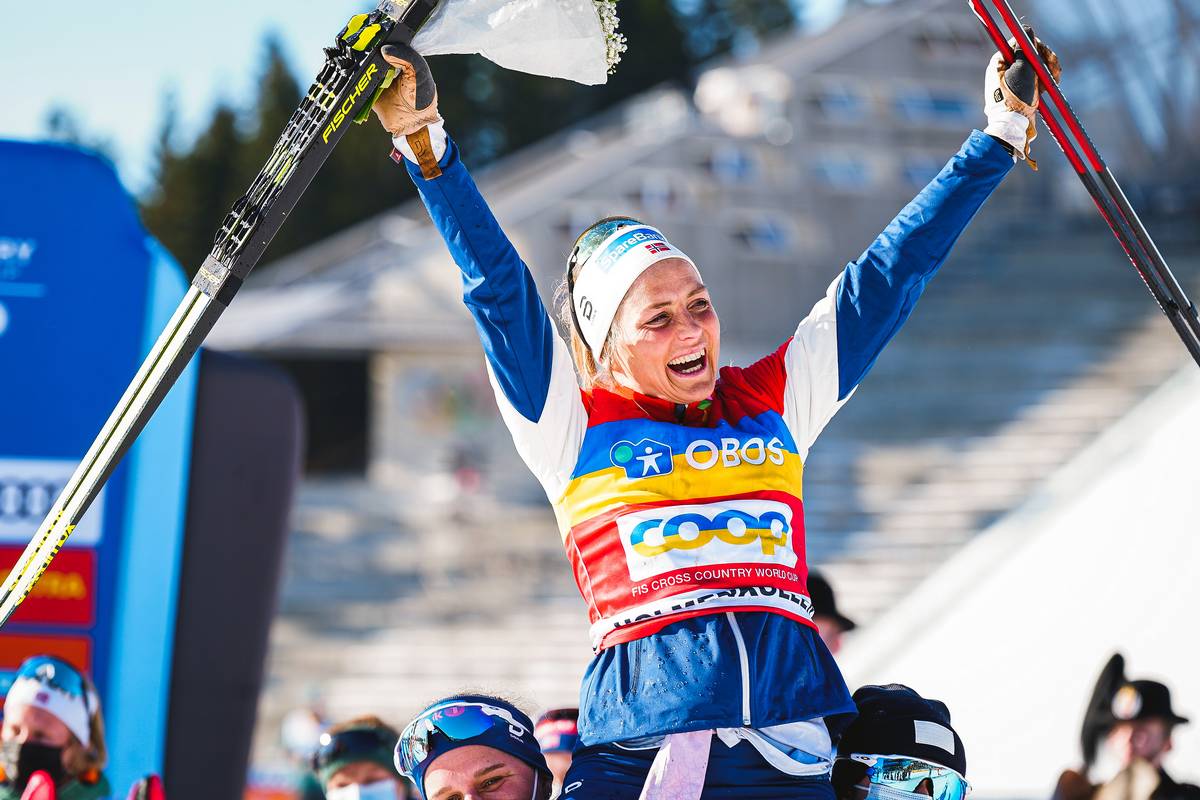
    Norway’s Therese Johaug celebrates her final 30 k race at Holmenkollen, before retiring at the end of the 2021/22 season at age 33. (Photo: NordicFocus)

    This article was submitted by a reader. To pitch a story or article to FasterSkier, reach out to info@fasterskier.com.

    In 2010, FasterSkier published an article titled “Analysis: Performance and Age”, written by Joran Elias, or as he is otherwise known, “The Statistical Skier.”  The piece attempted to parse the relationship between age and performance by comparing the ages of some of the world’s top skiers to their FIS points in a given year.  Elias was quick to acknowledge the limitations of the analysis, primarily that the data appeared to exhibit selection bias.  The oldest skiers on the World Cup, still racing well into their 30s, were likely still racing precisely because they were the best of the best, while those who were not performing as well retired sooner, and weren’t reflected in the data.  These data appeared to show a trend of improvement associated with getting older, but to what degree was this apparent trend a result of the selection bias?
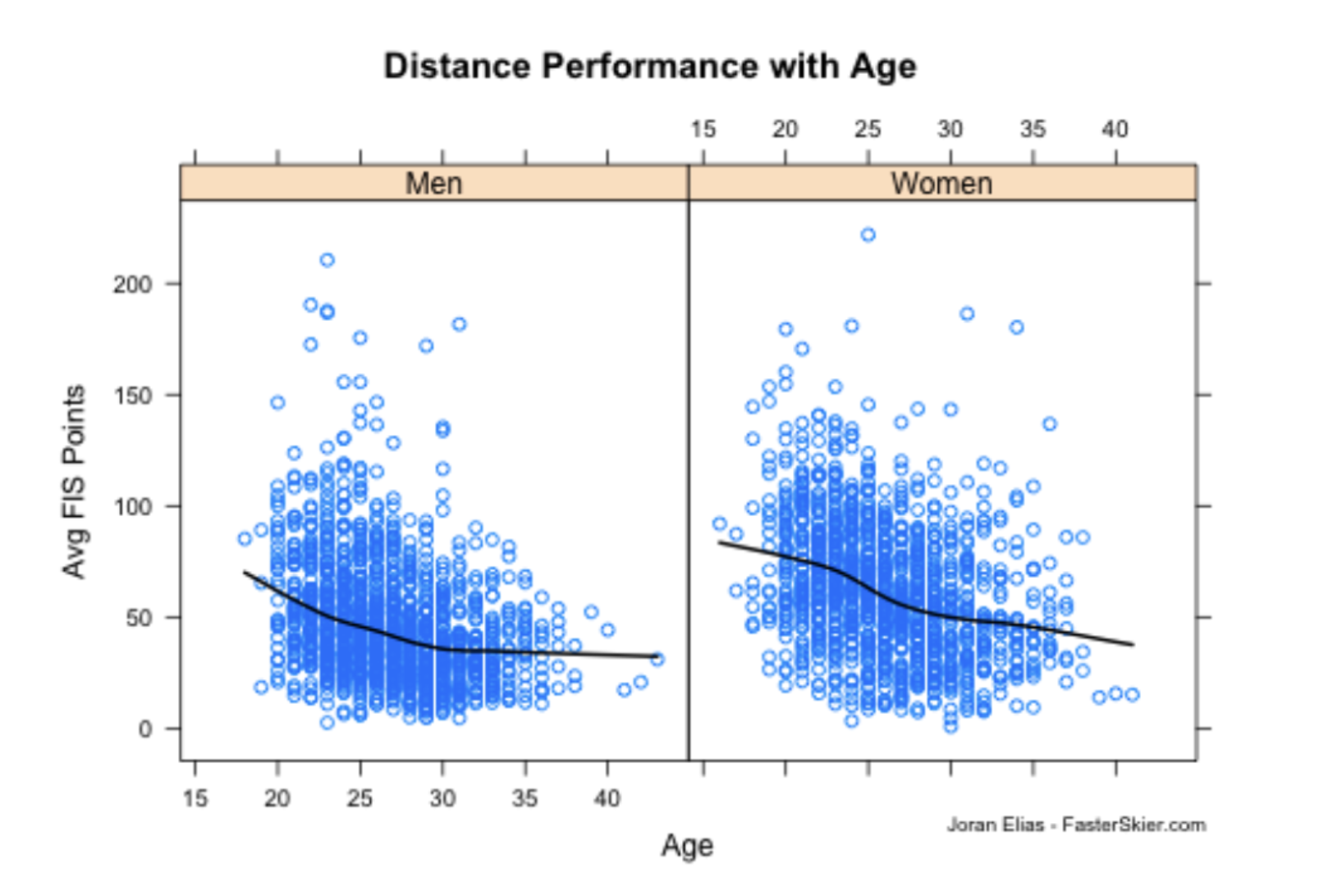
    Elias’ original figure showing distance performance by age, published on FasterSkier in March, 2010.

    In the now hallowed annals of the FasterSkier comments section, a commenter with a name none other than Dakota Blackhorse-von Jess, a veritable force in U.S. skiing for over a decade, posed a potential solution.  He asked, “Can you filter the dataset so that only athletes that are still competing at some reasonable later stage (say 30 or 32) are represented?” 

    It was a great question.  What would happen if we were able to look at careers that spanned a longer period of time and plotted the trajectories of those careers as the athletes aged?  This would mitigate the effects of attrition on the data and hopefully give us a clearer picture.

    The question of what happens to the performance of cross country skiers as they age has personal significance to the authors of this article.  Both of us are solidly into our 20s and deeply invested in the project of being competitive at the highest levels of ski racing.  At the University of Wyoming, we are both involved in furthering the development of a growing program which serves college graduates, many of whom are pursuing graduate studies alongside elite ski racing. 

    Athletes at this age often have the unenviable experience of watching as some members of their age cohort find success on the world stage while others do not.  It leaves us to wonder what is possible and what is likely for us to achieve as we move from teens to twenty-somethings to thirty-somethings.

    The recent success of Rosie Brennan on the World Cup and at the Olympics has contributed to reigniting a decades old conversation about age, skier development, and team selection.  One has to imagine that this “conversation,” at times less than cordial (as evidenced by archived comment threads on this website), has ended friendships, and who knows, maybe even a few marriages.  Brennan, who has seen striking improvement in her 30s, skied in college despite the U.S. Ski Team’s erstwhile insistence that promising young skiers should “strike while the iron is hot,” eschewing school and taking on international ski careers full time.  After Brennan’s 4th place in the 30km at the Beijing Olympics, U.S. Ski Team Head Coach Matt Whitcomb acknowledged that the previous development strategy may have been short sighted.  At this point, many of America’s most standout skiers have chosen to ski in college, adding renewed urgency to the question of age and development.  At the risk of adding fodder to an already crowded debate, let’s get into the data. 

    ***

    In hopes of combatting the potential selection bias of slower skiers retiring earlier, we focused on skiers that stayed in the game for at least 20 years, or at least held a FIS license and skied in 5+ FIS races per year for that long. To put that in perspective, the FIS points system has only been around since 1994, or 28 total seasons. As you can see in the figure below, the vast majority of skiers who ever hold a FIS license only hold one for a few years.  Those that continue to ski seriously enough to buy a FIS license for 20 years are a tiny, tiny fraction of the skiers. On average, these “20-season skiers” get their first FIS license around the age of 19 and continue past 40.  Additionally, every member of this group happens to fall loosely into the category of “professional skier,” having received at least one World Cup, World Championship, or Olympic start at some point in their career.

    We used FIS distance points from the last period of each season from 1994 to 2022.  While it would have been interesting to track sprint points as well, the more recent arrival of sprinting makes a long term analysis less feasible.  In the graph below, each black line represents the career trajectory of a “20-season skier.”  There are 40 athletes represented, 23 of whom are men and 17 of whom are women.  Interestingly, the ratio of men to women who hold FIS licenses for at least 20 years is more or less consistent with the ratio of men to women who have ever held one, suggesting that one gender does not have significantly more “staying power” than another in the highest levels of the sport.  The blue lines represent the overall trend.
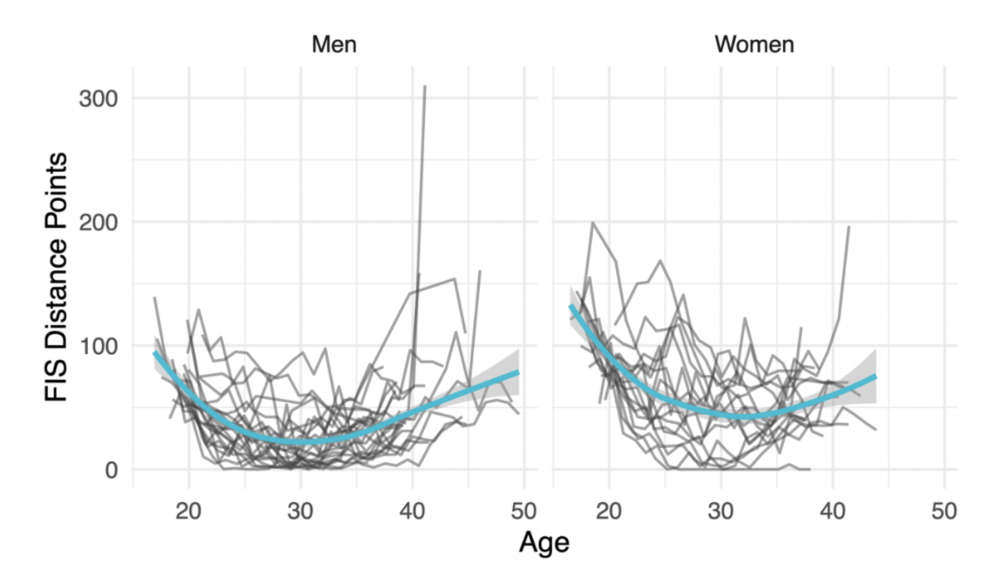
    Whereas Elias’ 2010 analysis shows a continuing downward points trend even as skiers reach their 40s, ours shows more of a u-shaped trend.  Skiers improve in their teens and 20s, reaching a peak around 30, then begin to experience an increase in points in their late 30s and 40s. This seems to suggest that athletes improve until they hit some peak age and then stop performing as well when they get older.

    We can, in fact, fit a trendline and calculate that peak age at which the average skier (or at least the average skier who skied seriously for 20+ years) hits their lowest points. That magic age based on these data happens to be 31.5 for men and 32.0 for women. However, the striking story shown by the mess of black lines is that no one is “the average.” There are clearly many other factors at play in determining a skier’s performance. Some athletes have their worst seasons in their late 20s while others have stellar seasons in their late 30s and even early 40s.  At nearly 41 years old, Italian Giorgio Di Centa stood at 2.9 FIS points, notching multiple top tens on the World Cup.  At 38, Marit Bjørgen stood at 0.9, never leaving the podium at the PyeongChang Olympics in 2018.  There is valuable information to be gleaned from both the aggregate and the individual. 

    These results were surprising given the disparity between the 2010 analysis and our own. Why did Elias find a continuing downward trend where we found an upward slope after 30? Was it possible that his results were driven strongly by attrition and selection bias as he suggested?  We went back to the data, this time including everyone with a FIS license, regardless of how many years they held one. We saw the same u-shaped trend as before.  Skiers continued to improve until their late 20s to early 30s before an upward slope in points as they reached their 40s. This was not just the case for elite world cup skiers, but more casual racers as well.  A similar trend is present whether exclusively analyzing skiers with points under 50 or over 500.  Additionally, the age of peak performance stays in the range of 29-32 regardless of the chosen points tier.

    Instead of analyzing within point tiers, what if we returned to our “20-season skiers” and segmented each athlete’s career into two pieces–one before their last World Cup, World Champs, or Olympic race–and one after?  This way we would be able to see the difference in performance between skiers at the height of their professional careers in comparison to the years that followed.

    The results of this breakdown make sense intuitively. When we separate the careers into “World Cup” and “post-World Cup” segments, the upward trend coincides with retirement and is much steeper for those athletes who have stepped away from World Cup racing.  People don’t ski as fast after their last season on the World Cup as they did before.  One possible explanation for this is that many athletes retire from the highest levels of international competition, stop training as seriously, and begin to perform worse as a result.  Another explanation is that athletes continue to ski on the World Cup until their performance stops improving, and then retire (or are forced to retire) as a result. 

    While our results alone can’t distinguish between these possibilities, it seems likely that some combination of them are responsible. Regardless, we believe including serious post-World Cup racing in our analysis allows us to gain valuable insight into the effects of age on performance and supports our conclusion of a peak age around 32. It is also important to reiterate that there are athletes for whom the trend is not representative in the first place.  Nothing about our analysis suggests the inevitability of career decline by the age of 32.
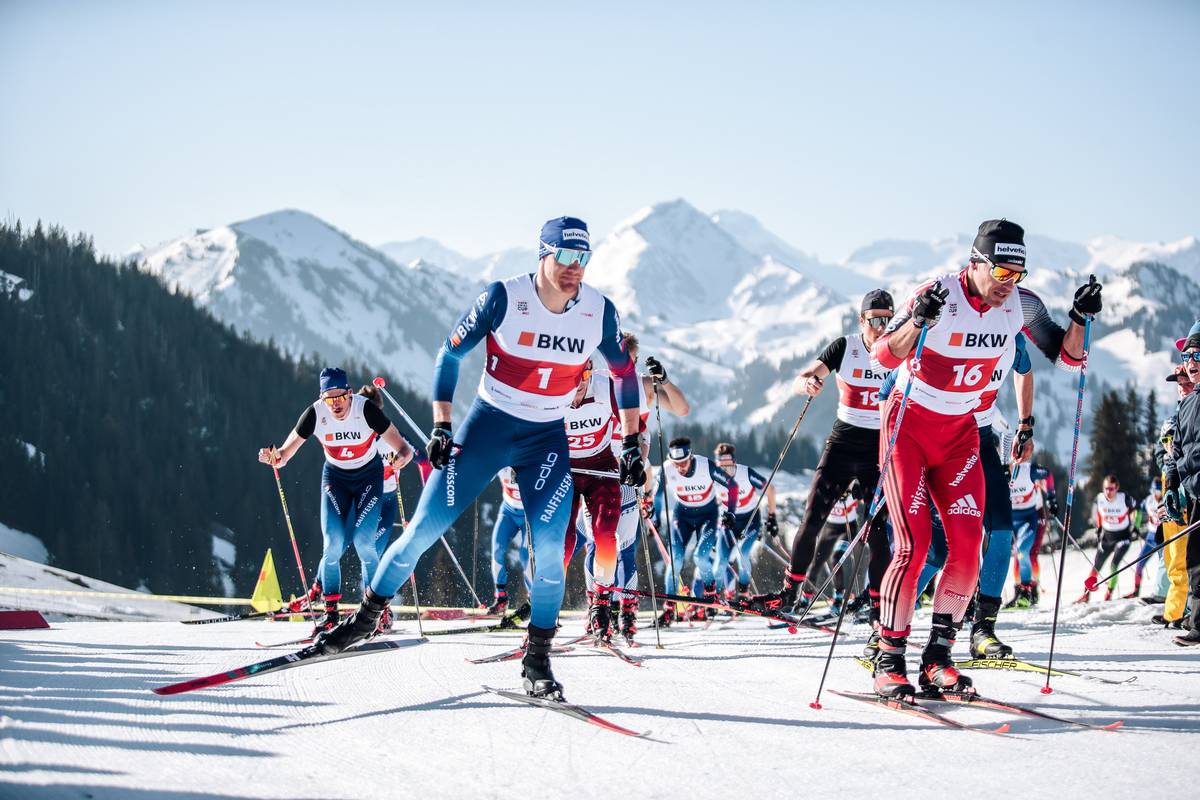
    The decorated Dario Cologna and his Swiss national teammate Jovian Hediger race the Pro Race Sparenmoos in Zweisimmen, SUI, part of the Swiss Championships, following their retirement from the World Cup in March, 2022 at ages 36 and 31, respectively. (Photo: NordicFocus)

    These results do seem to partially explain the discrepancy between our analysis and Elias’, but isolating the World Cup portion of their careers does not fully eliminate the trend of skiers eventually slowing down.  The graph is still “u-shaped.”  It appears that a reason for this is that the landscape of professional skiing has changed since the initial 2010 analysis.  Additional comparison of data before and after 2010 indicates that the phenomenon of points swinging upward with age is a relatively recent one, in part the result of a growing number of skiers continuing to race very seriously at older ages.  In other words, the effects of attrition have become less prominent since 2010 because there is simply less attrition. 

    Perhaps the more interesting question here is, what circumstances and structures have allowed this subset of skiers to race at such a high level for so long, while the majority of elite skiers have far, far shorter careers?  It may be worth asking how many people are forced to quit before their potential has been reached because they lack opportunities and support.  Prior to 2010, individuals over the age of 40 only made up 0.4% of total FIS license holders.  In the period since then, that proportion has more than doubled and there are over five times the total number of license holders over 40.  Athletes who are deemed too old to present the shimmering possibility of medals and crystal globes may not be getting as many resources, but they are showing up to train and race in increasingly high numbers anyway.  There are, after all, reasons to race besides winning medals.

    Ella DeWolf graduated from the University of Wyoming with her BS in molecular and microbiology and MS in botany. She continues to coach and race while working as a data analyst for an environmental consulting firm.

    Andrew Siegel graduated from the University of Vermont in 2021 and is now at the University of Wyoming–coaching, racing, and pursuing an MFA in creative writing. 

    This research was made possible by the generous support of the non-profit SNOW (Skiers Nordic of Wyoming).  


  • A Data Driven  Search for What Matters in Skiing: An Interview with Gus Kaeding

    A Data Driven Search for What Matters in Skiing: An Interview with Gus Kaeding

    How many medals will the U.S. Ski Team win in the future? What, really, is perfect ski technique? Gus Kaeding — the one man team behind the US Ski Team’s analytics department — aims to provide data-driven answers to these questions. From his office in the Center of Excellence in Park City, Utah, he delves into the data that may help illuminate a path to success for both individual athletes and the greater cross country ski collective in the U.S. 

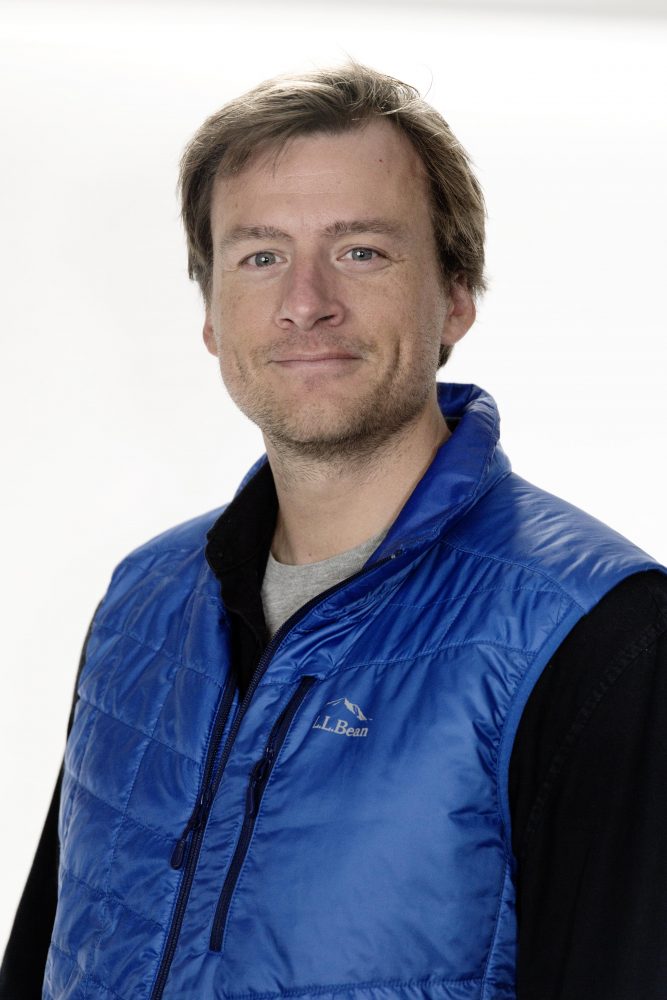
    The man behind U.S. Ski and Snowboard data analytics, Gus Kaeding. (Photo: Sarah Brunson/U.S. Ski & Snowboard)

    Kaeding, whose background as both a nordic ski athlete and coach led him to his current role with U.S. Ski and Snowboard, discussed his current and future projects with FasterSkier over the summer. Talking with him, it became clear that many assumptions about the sport remain unproven, and in his perspective, “we actually understand very little of what happens in between the start gun and the finish tape.” 

    Through data analysis and some exciting new technologies, Kaeding has a plan to gain a deeper understanding of the fundamentals of ski performance. This interview has been edited for clarity and length.

    FasterSkier: I’ve read a little bit about what you’re up to with the analytics department, but I’m not totally up to speed. 

    Gus Kaeding: Yeah, I don’t think anyone really is.

    FS: What sort of projects are you working on?

    GK: If you watched the Bend camp, a number of coaches and athletes are now using Archinisis bibs. They basically look like a sports bra with a GPS unit in the back. I tested these last winter, and you’ll see a lot of the Scandinavian countries using them or something similar.

    The Archinisis bibs can not only give you the GPS [data], but they can also tell you what technique you’re using. If you’re skating, it tells you your time in V1 versus V2, versus V2 alternate—to a pretty good percent of accuracy. The coolest thing is you can compare [the metrics] to each other, and also to yourself, meaning if you set a rollerski loop, and do it multiple times, you’re able to see an overlay of previous performances and where you’re gaining or losing time, and it’s really visualized nicely. You can do the same with multiple athletes, and then compare athletes and say: “you were three seconds slower than another athlete over the top of this hill. And as a result, you were five seconds slower at the bottom of the hill,” which are insights that we didn’t really have a lens into before. 

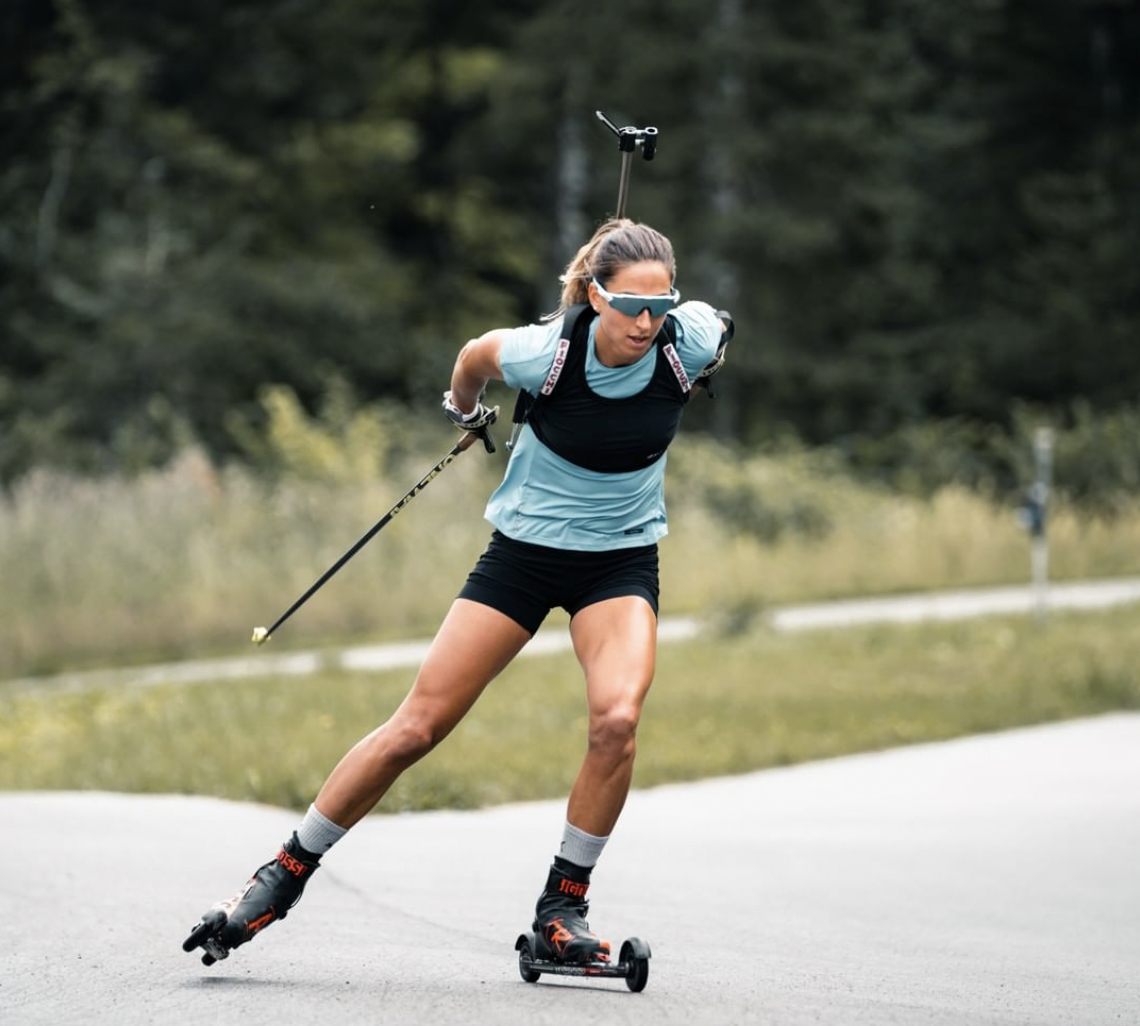
    Italian biathlite Lisa Vittozzi trains with a Archinisis bib. (Photo: Instagram @archinisis)

    That’s still in the test mode—we’ve got six of them. We had the option of rolling it out to the whole team and taking a big financial risk, but we chose to start small, and see where there’s value. Part of the risk when you roll out something like that is: who’s managing the project? Do they have the bandwidth to do it?

    Someone like Jason Cork is super excited about things like that, and then if it ends up adding value, we’ll probably roll it out further next year, to a larger squad, and have a few bibs we can rotate through. 

    We may also have a few set courses around the country, so that when people come in, they can say, “I want to do a time trial against previous performances”, and afterward they can really look granularly where they’ve had success or need to improve a bit. 


    FS: What other ideas are you working on?

    GK: The second one that I’m really excited about but didn’t get funded this year, is a ski treadmill at the Center of Excellence here in Park City. The problem is, the cross country team does not come here very often. One of the weaknesses, frankly, as a team is just general technique compared to the other nations—I don’t think that’s a secret. So we’ve been looking for a way to improve that for a few years now. 

    What we proposed was installing a 3D motion capture system around our ski treadmill, to get a better quantitative idea of what is good technique. What are the markers we should be looking for? And what are the markers we should be ignoring? That project did not get funded, but it got positive reviews. So I think in the future, there is hopefully a good chance [of getting it]. 

    The idea would be to have the athletes come in once a year and do a movement assessment while on roller skis. From that, we would be able to break down multiple speeds, techniques, and inclines. Then we would look at where our techniques are similar across our athletes and where they are dissimilar. Where do we think they’re improving and where do they need some work? 

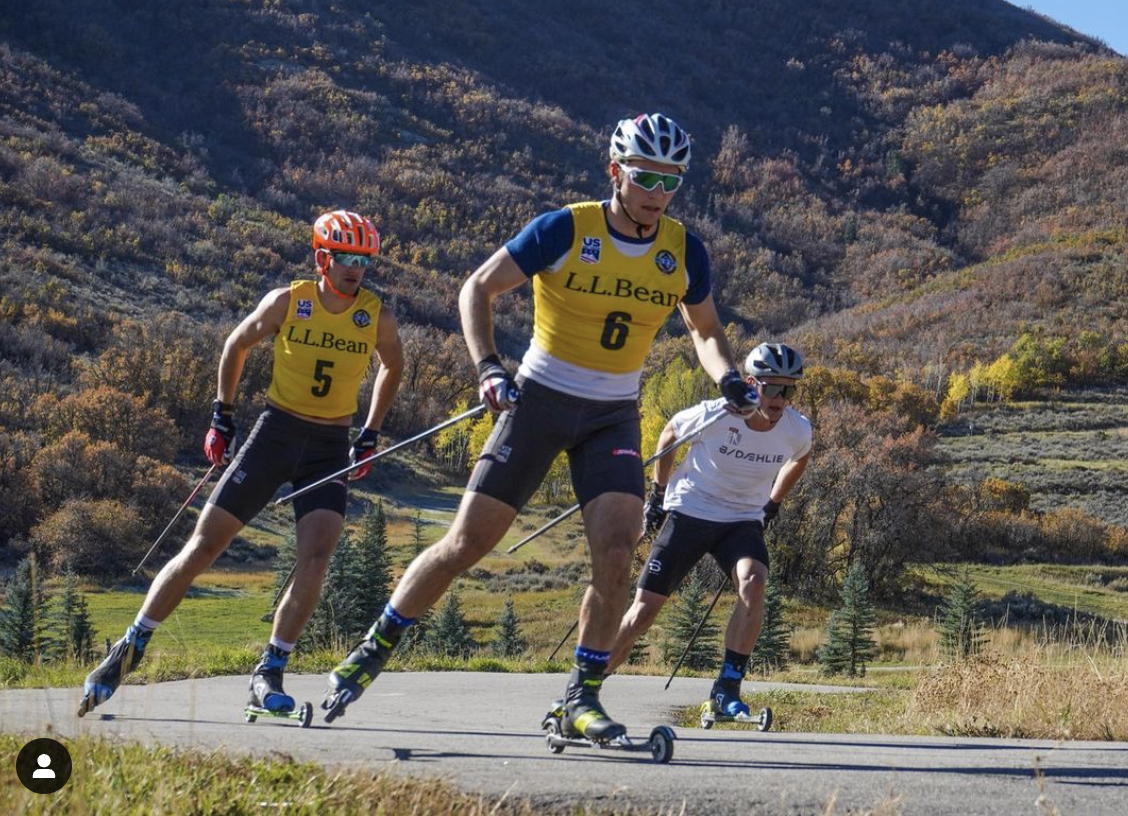
    Scenes from the 2021 Park City Training camp: from left to right, Kevin Bolger, JC Schoonmaker, and Simon Zink during a rollerski intensity session. (Photo: Simi Hamilton / Instagram @isaschoon)

    I would build into that proposal getting someone who’s really got some stronger chops as a biomechanist. A lot of other countries have multiple people on staff who have PhDs in skate technique, so it’s like, “Yeah, no kidding, they have better technique”.  So we need to do a little bit better job there. This is a project that has yet to come to fruition, but I think is going to be promising in the next 12 months.


    FS: I believe Sweden’s been a leader in adopting 3D motion capture technology.  

    GK: Sweden with HD [Hans Christer Holmberg] and Norway with Oyvend [Sandbaak], do a lot of research in this area. Fortunately for us, they make a lot of it public, so we don’t have to start from scratch. We can play catch up for a little while until we feel like we’re in a place where we’re able to start to innovate ahead of the other countries. We’re still a few years from that, for sure.


    FS: Tell me about your research into sleep?

    GK: We’ve been looking for ways to quantify recovery and sleep. Finally, a couple of years ago, we decided to take the Oura ring as our primary recovery tool. So that’s been a project for the past two years.

    We could look back at athletes who had Covid and their Oura data previous to that. Fortunately, we didn’t have a large sample set of people. Were the results conclusive on anything? No, probably not, but I will say the main similarity between everyone was that three days prior to showing Covid symptoms, their [sleep] temperatures just went bonkers. Whether high or low, it was all over the place. The deviation from the standard variation was nuts. So I think, for anyone out there that has a Whoop or an Oura, anytime your temperature goes one way or the other, watch out.

    The latest version of the Oura Ring sleep and recovery tracker. (Photo: ouraring.com)

    FS: What is the main goal of collecting this sleep data?

    GK: It gives you some indication of how stressed out you are. It’s helped us add another lens to evaluate athlete load and upcoming performance.


    FS: What are the challenges to gathering the kind of data you would like to work with?

    GK: One of the major problems is, when the coaches are at races, they are busy—really busy, and you really can’t ask them to do anything more. You know, “go collect this data, collect that data”. And if you do, it better be able to return immediate, impactful results.

    I think if we’re looking at the model that works in other sports, like soccer and basketball, you really need to have someone traveling with each team who’s just in charge of collecting and analyzing data. We’re just not at that point, as a sport, or as a program yet. Certainly one of the aims, probably in the next quadrennial, is putting a research/data person with each team: cross country, alpine, snowboard, just to gather data, analyze, and then innovate. That is in our long term planning. Until then, we are just not going to be able to even collect the data necessary to do any type of really interesting analysis. Because it does take having someone there, and that being their sole priority.


    FS: That makes sense. It brings me to my other question of what sort of data do you wish you could gather? 

    GK: We do a lot of video analysis, but we don’t do a great job of storing that video. To me, it would be really helpful to have a video library of Jessie Diggins’ V1 technique through the years, to overlay year after year, and look where improvements have been made and then look at results on sections of trails. Have these V1 technique changes correlated to actual faster split times on V1 sections? 

    FS: Are you able to get enough video from World Cup races to effectively analyze those questions? 

    GK: We use the video for, say, qualitative analysis. I think the future is in computer vision and pose estimation [technologies] that would be able to look at technique just from the FIS feeds available now. They’re just starting to hit the sport level, in terms of price and scale. Those are technologies we’ve all got our eye on, and a lot of other sports do too. The NBA has started to dabble in it, but [the cost] is in the millions of dollars and the math is also hugely complicated. That’s the future, but it’s still a ways off for us.


    FS: How do you envision data helping the program as a whole?

    GK: We know, essentially, what results athletes need to get at each level. But we don’t do a good enough job of helping athletes figure out what is important to get those results. 

    The big goal of this next year, for every sport, is going to be to formulate a list with the coaches on what are really the most important factors to creating a good skier, and then figuring out ways to measure each of those. 

    Is it fitness? Is it power in the gym? Is it technique? Is it sports psychology? There’s so much on tap there. We need to do a little bit better job of delineating how important each is, and then being able to help the community and lead them a bit, showing what’s important at what age.

    I think we do a pretty good job of that, but it would be nice to say: if you want to be one of the best skiers in the world, you should be achieving these results and here’s how to do it. We haven’t quite gotten there yet. 

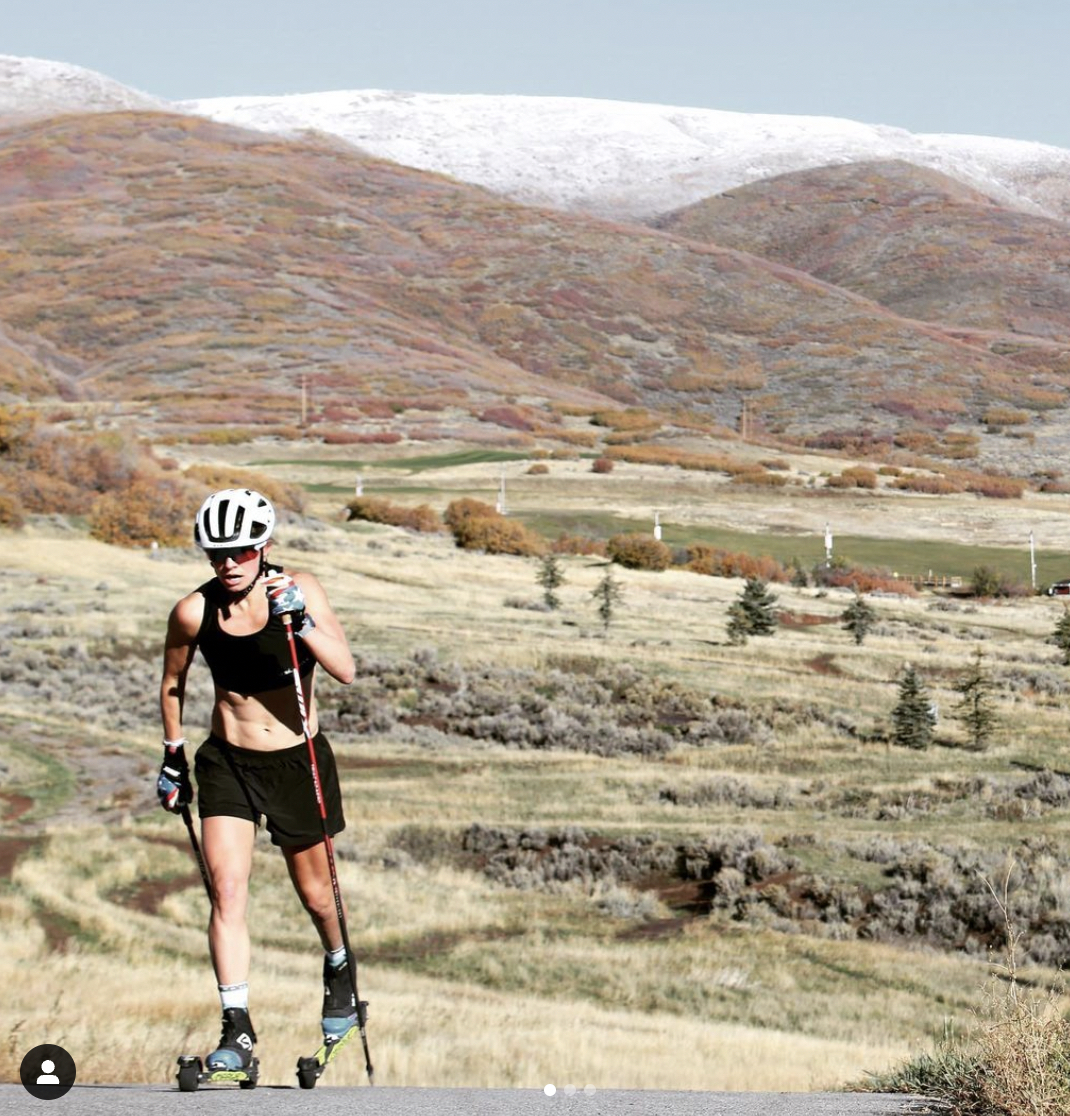
    Scenes from the 2021 Park City Training camp: Jessie Diggins strides it out. (Photo: Simi Hamilton / Instagram @jessiediggins)

    FS: That seems like a large project. 

    GK: Yeah. The goal over time would be to have all of [the categories] with objective measures. That’s another area ahead of us: innovative ways of measuring all those elements of a skier’s development and what the opportunities are to get better.

    One of the things we’re working on is a sensor project that allows you to look at all these different metrics that we haven’t really gotten before, in order to understand what goes into an alpine turn. The technology is 100% applicable to cross country skiing as well, and now we can understand a bit more of what goes into the push phase. 

    Whether it’s cross country, or alpine, we actually understand very little of what happens in between the start gun and the finish tape besides time, pace, and heart rate. So it’ll be good to start to understand that with some more physical markers. So that’s where we’re at. The whole thing comes back to what matters. 


    FS: You mentioned that you can predict, to some degree of accuracy, future medals for the US Ski Team. How do you quantify that?

    GK: We can break it down to: “we need this many athletes, at this level, to expect a medal in five years”, which is cool. I did a pretty quick analysis the other day — it was kind of back of the napkin math, but I figured out that with the implementation of the bigger development team that we started in 2018, and by really putting more of an emphasis there, we can expect another medal. [This is] simply from that team being established, and the level that it’s brought not only those junior skiers, but the rest of the skiers around them.

    Once you start to get into expected medals, and expected performances, then you can do a better job of evaluating how well you’ve done as a staff, as a coach, and as an athlete. That’s something we’re a little bit lacking right now. Not that all those [calculations] are going to be correct, but you can continue to improve those over time. So far, they’ve played out pretty well.

    The U20 World Juniors 4 x 5 k relay first place team from the U.S, (l-r) Luke Jager, Ben Ogden, Johnny Hagenbuch, and Gus Schumacher. (Photo: JWSC2019 / Mikaela Takala)

    FS: You have a few interns this summer that are nordic athletes, what are they working on?

    GK: One of our interns is Annabel Hagen, who is currently at Harvard on the cross country ski team. She is working on a project that is near and dear to my heart. She is looking at a spike in USSA membership in 2012, and how it correlated to 2015/2016. Are we seeing a greater influx on the national team if we had 30% more participation at the 13 year old level in 2012? We break that down by numbers, but also by region, by state, and by club. We’re really looking at doing a better job with our demographics, and looking at where our athletes are coming from. 

    There’s also Jackie Garso, who’s a training biathlete right now and is a recent graduate from St. Lawrence College. She’s working primarily with our women’s alpine team, looking at our force plate data. Another is current US Ski Team athlete Sophia Laukli. She’s at Middlebury College and is a math major like myself. She’s been looking at alpine skiing when you start a World Cup at the back. She’s trying to figure out when it is beneficial [for an athlete] to go down a level into the Europa cup, and try to score their best points in order to get back to the World Cup with a better start spot. 


    FS: Gus, thanks for speaking with FasterSkier. Is there anything you’d like to add?

    GK: We have a really smart community and a really innovative community, so if there are people out there who want to help or are interested in one subject or another, I am definitely willing to utilize their expertise.


    If you’re interested in getting involved with the analytics department at the US Ski Team, you can reach Gus Kaeding by email at:  gus.kaeding@usskiandsnowboard.org

  • Who’s Justyna’s Biggest Nemesis?

    Who’s Justyna’s Biggest Nemesis?

    Have you ever wanted to know how well-prepared World Cup rookies are? Or whether Axel Teichmann really is Petter Northug’s most frequent whipping-boy? Then check out FasterSkier contributor Joran Elias’s new website, StatisticalSkier.com, where he breaks down data that he has compiled from the International Ski Federation. He’s been updating frequently, so check it out for your statistics fix.