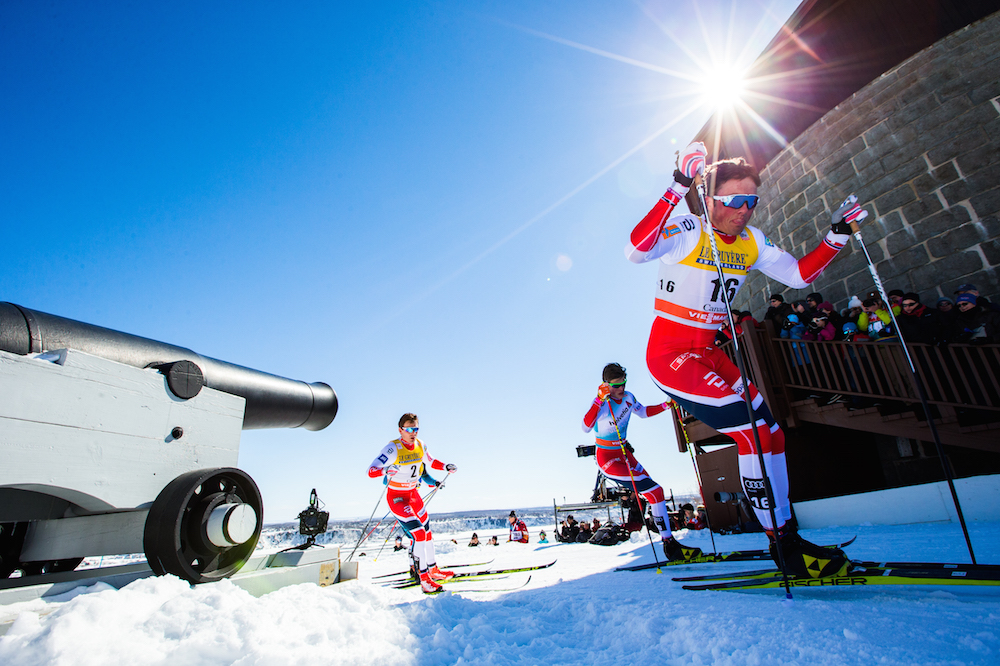
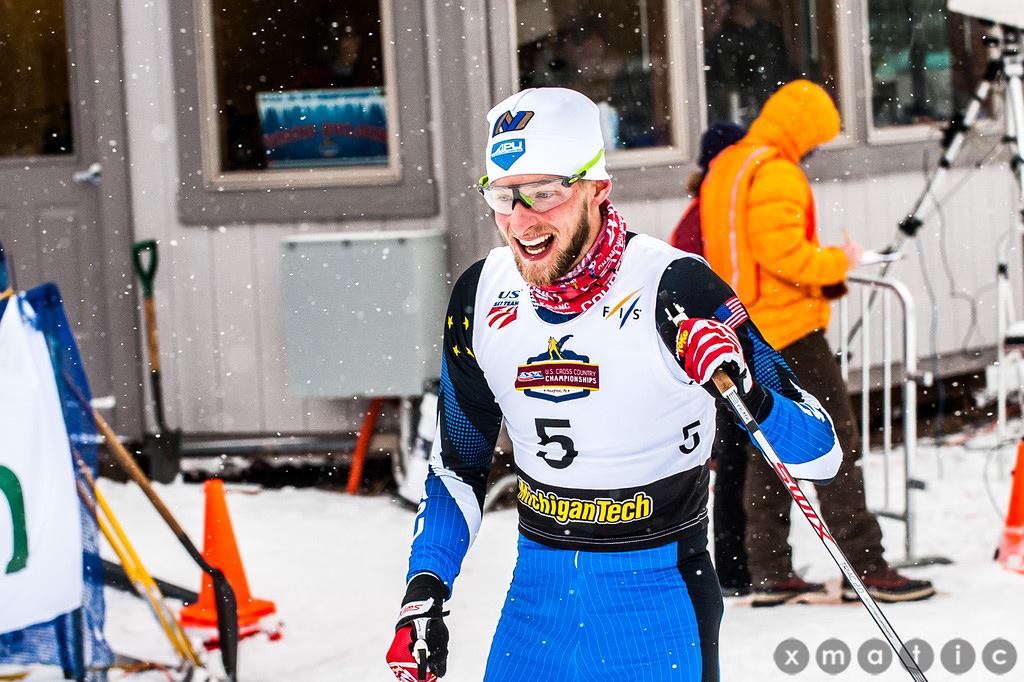
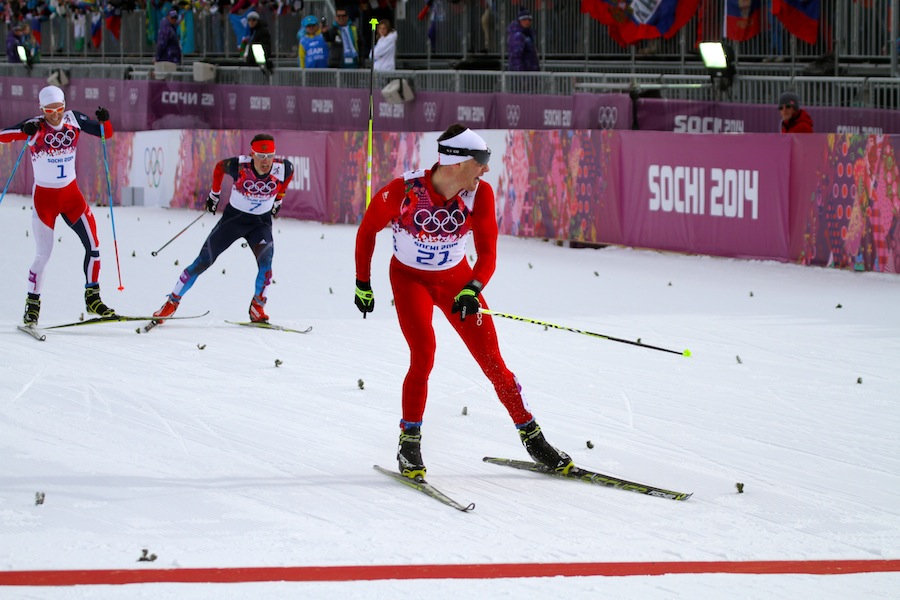
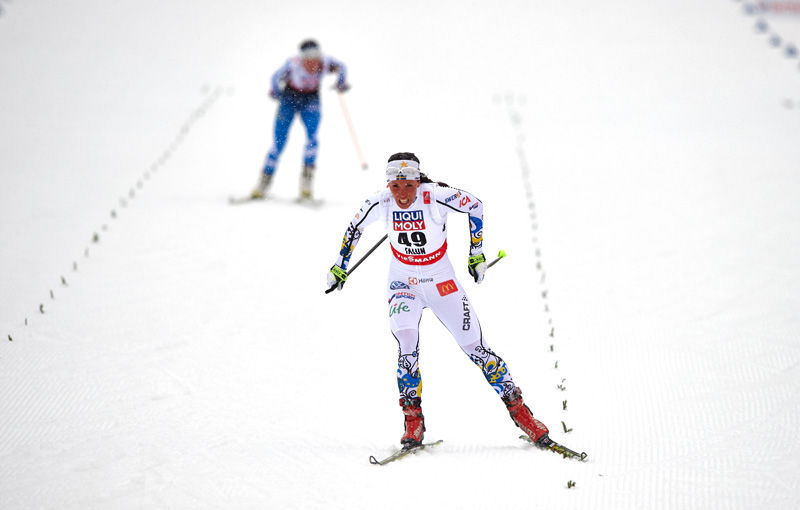
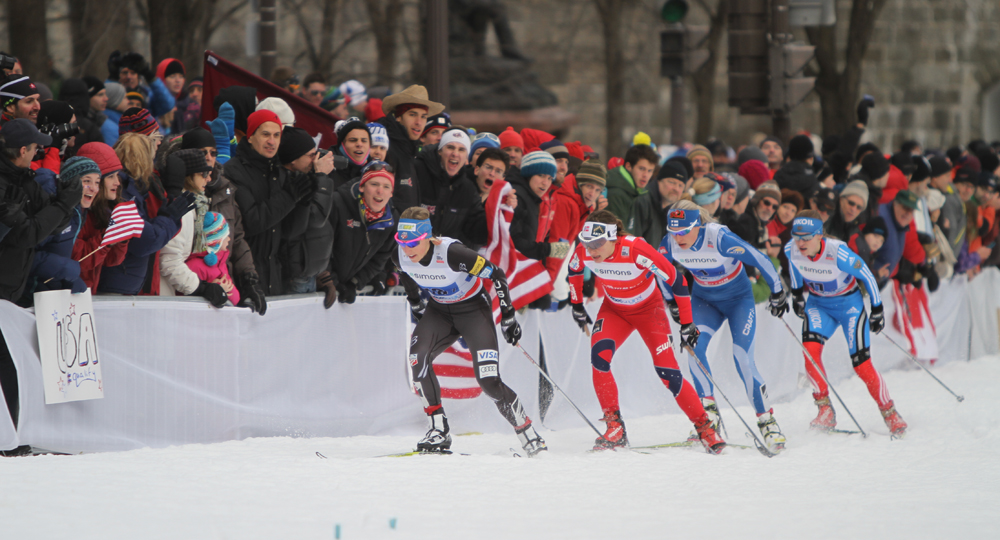
Norway’s Emil Iversen (16) leads Johannes Høsflot Klæbo (c) and Finn Hågen Krogh during the men’s 15 k classic mass start on March 18, 2017, at World Cup Finals in Quebec City. Klæbo went on to win. (Photo: Dustin Satloff)
North American World Cups are becoming a fixture on the schedule, with the season ending in Canada in 2016, 2017, 2019, and 2020. In 2020, Minnesota will join in with a city sprint- that race falls between the Quebec City and Canmore events. These races are important for athlete development as both Canada and the U.S. are granted ‘host nation’ start allocations. Fifteen male and 15 female athletes may represent each country with the added bonus of allowing young skiers to see World Cup stars in person.
Cross Country Canada wanted to integrate these World Cup events with the domestic racing calendar. As nationals are held at the end of the season, the obvious solution was to select a nationals host that is near the World Cup Final. While Canada has roughly the same population as California, that population is spread over 5.5 time zones in a land area far larger than the United States. The opportunity to race nationals and watch a World Cup with a single round-trip flight makes this much more attractive and affordable to families.
With the introduction of the Junior FIS Invitational Rising Stars in 2019 (a race for young skiers on the World Cup course), there is a third incentive to make the trip and see Alex Harvey’s retirement weekend in person. CCC’s Dave Dyer is excited about the new addition: “With the Rising Stars race, those [young athletes] that have a FIS license can also train beside WC athletes and compete on the same course. We have junior teams from across North America planning to participate in the junior FIS race.”
To make this schedule work, CCC needed host venues for nationals that could set homologated courses for seven days of racing later in March. Even in Canada, reliable snow in March can be a challenge.
To align with 2019 World Cup finals in Quebec City from March 22 to 24th, nationals will be hosted less than five hours drive away at the Nakkertok trails, in Gatineau, Quebec from March 13th to 20th.
In 2020, Sovereign Lake will host nationals after World Cup finals from March 25th to April 3rd. The 2020 bid document requested that bidders plan to follow the three final world cups in 2020, from March 14th to 22nd (Quebec City, Minnesota, Canmore). Sovereign Lake, along with the interconnected SilverStar Mountain Resort, has 105km of trails open every April. As the annual Spring Fling snow camp in May shows, ‘late season’ skiing is pretty reliable at 1,600m elevation.
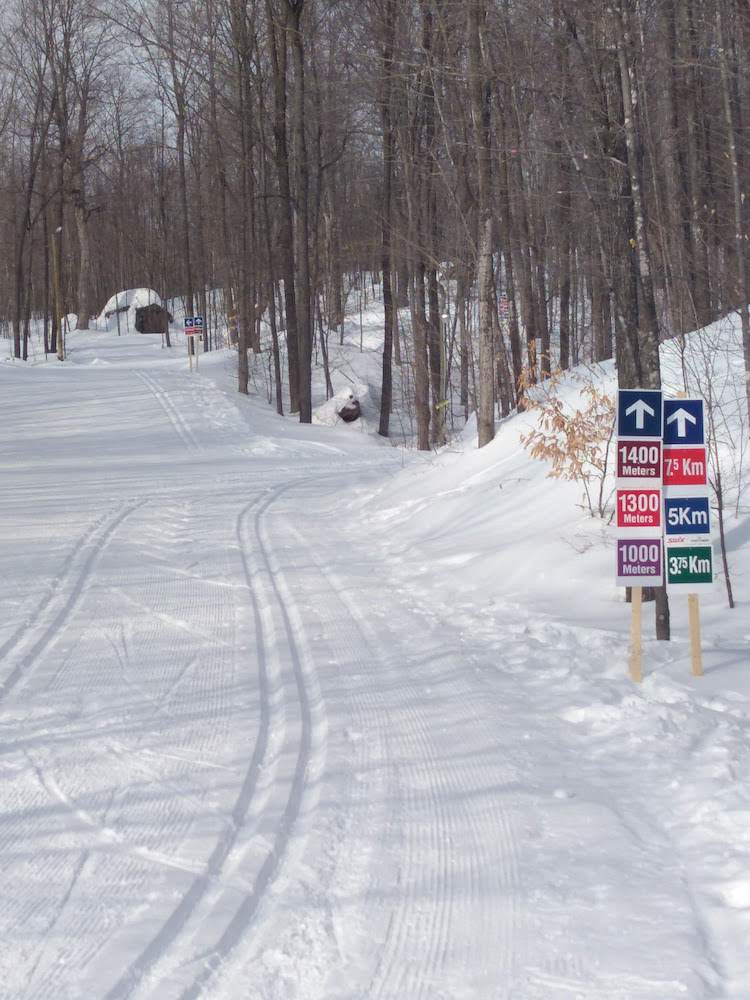
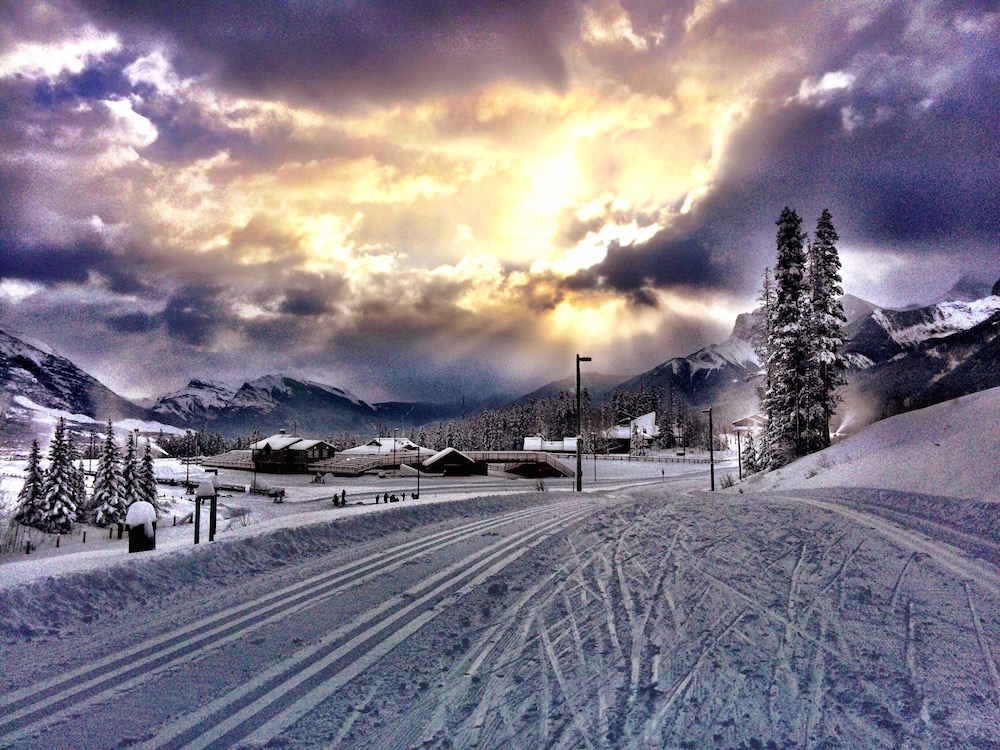
Nakkertok Trails on March 5th, 2019. (Photo: Toni Scheier)
In eastern Canada, there is snow and good skiing in March most years, but guaranteed snow on homologated courses is less certain. As a result, most clubs choose earlier dates in their bids to host nationals, sometimes even starting in February. With the advent of snowmaking at the Nakkertok trails in 2016, the game changed. While natural snow is abundant this season and snowmaking won’t be needed this month, the capacity to make snow was an important part of Nakkertok’s winning bid.
Gatineau remains an accessible area for many. The trails sit across the river from Ottawa (Canada’s capital) and are less than an hour from the major airport. The region is also surrounded by large population centres like Montreal and Toronto, with over 12 million Canadians within six hours drive. To restate, one third of Canadians live within weekending distance of the venue. This is one factor in the historic success of Eastern Canadian Championships over the past decade, with over 700 racers consistently making this the largest FIS event in North America in those years.
A second factor contributing to the venue’s race-hosting success was the formation of a stable coalition to host events. The 2019 nationals will be hosted by Évènements Nordiques Gatineau Nordic Events, an organization made up of Chelsea Nordiq, Nakkertok Nordic, Club Skinouk and the Gatineau Loppet. ÉNGNE also hosted the Gatineau stage of Ski Tour Canada in 2016.
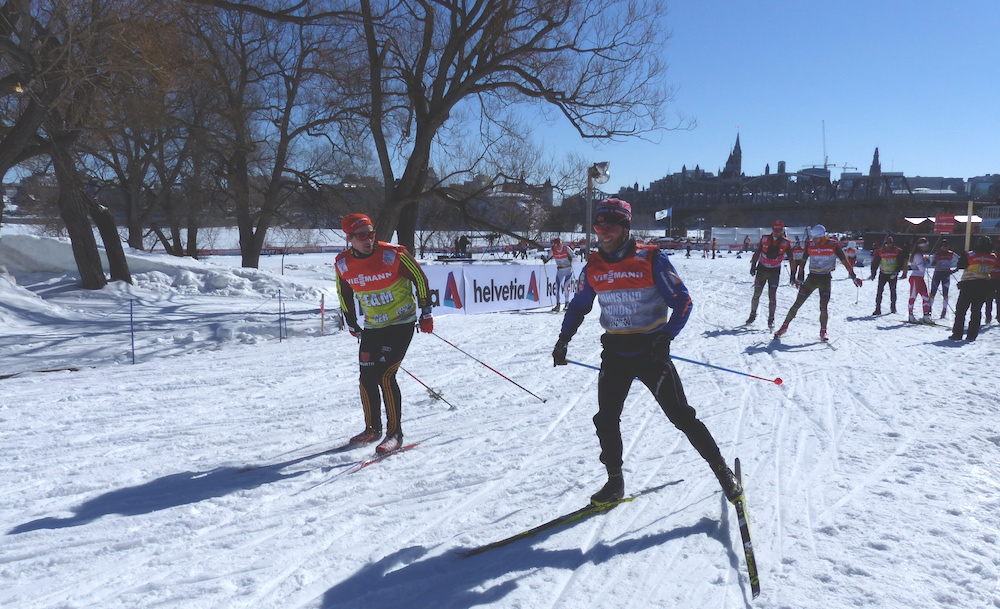
ÉNGNE was the host for stage 1 of the Ski Tour Canada in Gatineau. Martin Johnsrud Sundby inspects the course with Ottawa’s parliament building visible in the background. (Photo: Peggy Hung)
Pierre Millette, Chief of Race for 2019 Nationals and a Skinouk member, summarized the formula for success this way: “Mutual respect, a written agreement, complementary strengths. … The right people in the right places.”
Even though the races will be held on the Nakkertok trail system, every Nakkertok member interviewed for this article has been careful to reference the coalition.
Toni Scheier, a Nakkertok member who writes the CCC race reports, followed up with an emailed request: “Please emphasize that while the event is held at Nakkertok, […] the organizing committee ÉNGNE is from Skinouk, Chelsea, Nakkertok and Gatineau Loppet.”
This care to respect the contributions of others and a points system to share profits appear to be the key difference that keeps the engine turning. It is also easier to share profits than losses, which has contributed to ÉNGNE’s past reluctance to bid for late season events, as cancellations and venue changes are never profitable.
When Nakkertok’s snowmaking infrastructure was completed, the club expected to create reliable skiing on December 1st.
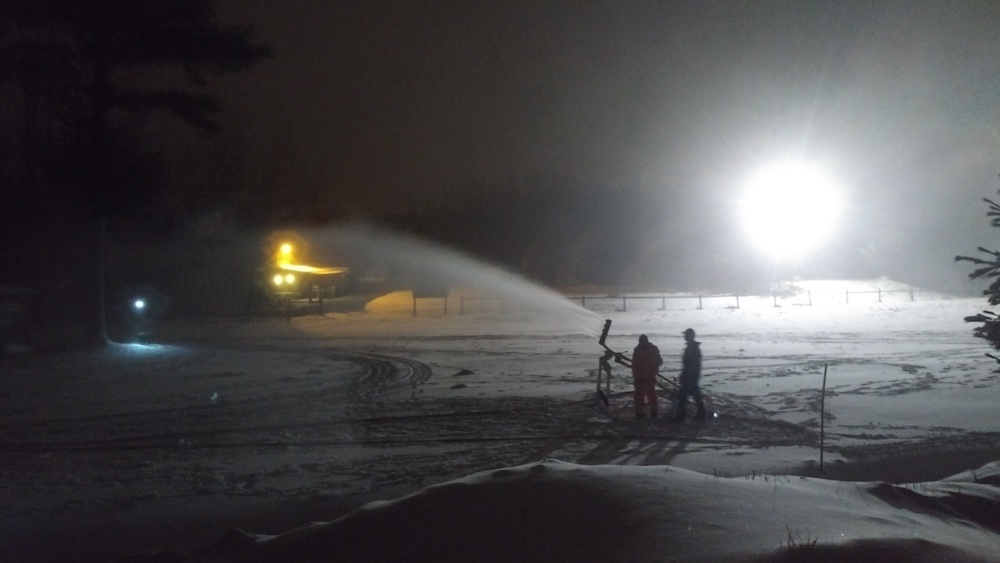
Testing the snowmaking equipment in November 2016. (Courtesy photo)
“From my perspective as head coach of the racing program, this is an amazing opportunity,” Nakkertok’s Kieran Jones wrote in November 2016. “Snowmaking has leveled the playing field across the country and the continent for our program. We’re competing against other top clubs and regions who have access to early season snow, and up until this point we have been at the mercy of the weather. For example, last season’s poor early-season weather meant we didn’t have skiing in the Ottawa-Gatineau area until between Christmas and New Year’s.”
Talking about the first Candy Cane Cup, scheduled for December 18th, 2016, Jones wrote, “our goal in the future is to create a high quality race experience at Nakkertok that is accessible in terms of cost and travel distance for the large numbers of athletes in Eastern Canada and the US who want and need to race.”
Scheier elaborated on Jones’s email, writing “It will also ensure snow for the Easterns where clubs from across the country attend, (700 plus competitors) and for our Nationals bid, likely 2019.”
On November 23rd, 2016, the day after Jones and Scheier made these statements, the first skiers were out training on man-made snow. Subsequently, they were able to open limited trails on November 11th, 2017 and November 12th, 2018. Those ambitious dreams are starting to look real.
Training on man-made snow on November 11th, 2017. (Photo: Toni Scheier)
The snowmaking system at Nakkertok came about in an unusual way. The core funding came from the Kraft-Heinz Project Play contest, which offers annual awards to communities in Canada to create opportunities to play. The grand prize winner gets $250,000, and the three runners up collect $25,000. Nakkertok won the 8th edition in 2016.
The race team raised $50,000 and money from other parts of the budget filled in the gaps to build the original system. The city of Cantley (on the west side of the trail system) helped Nakkertok to a “Fonds de développement des territoires” grant of $60,000 in 2017.
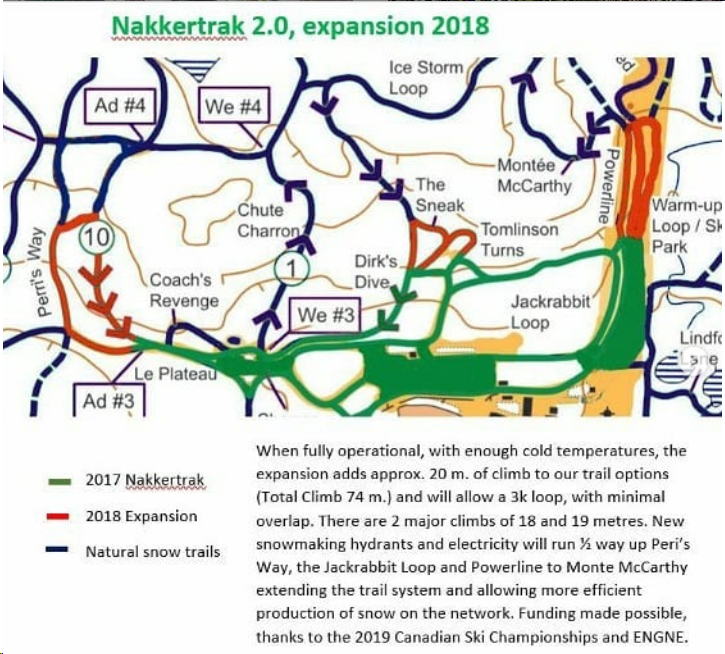
The ‘NakkerTrak’ expansion in 2018 is evidence of continued success in snowmaking and fundraising.
The upgrading process continues.
In the final analysis, was all the work that went into connecting these events together worth it? Many families will be making the combined trip, this nationals should be the largest FIS event in North American history, and to give Dave Dyer the last word:
“There are 250 racers in the National Capital Region that can sleep in their own beds.”
CANMORE, Alta. — Cross Country Ski de fond Canada’s Events Committee is pleased to announce the Sovereign Lake Nordic Ski Club in Vernon, B.C. will play host to the 2020 Canadian Ski Championships in March 2020.
Clubs throughout the area, including Sovereign Lake, Larch Hills in Salmon Arm, Telemark out of Kelowna and Kimberley along with Black Jack from the Kootenay’s and Revelstoke have continued to support high-performance racing programs over the last 10 seasons.
“Sovereign Lake Nordic has played a critical role in providing Canadian cross-country skiers access to snow early in the season as the anchor to our NorAm program,” said Dave Dyer, CCC’s events director. “It was time we finished the season off in the same style as we have become accustomed to every December by going back to the Vernon region for our national championships.”
Dyer added the Selection Committee was especially impressed with the evolution of the leadership group and dedicated staff at Sovereign Lake Nordic.
The premier event on the 2020 domestic race calendar will fall immediately after the World Cup Finals in Canmore, Alta., March 20, 2020.
Homologated in 2005 to meet FIS standards in preparation for the return of the FIS World Cup to Canada, the trails at Sovereign Lake will provide a variety of options for both senior and junior skiers at the 94th running of the Canadian Ski Championships event.
“SLNC last hosted the Canadian Ski Championships in 1995 making the 2020 Nationals Campaign the 25th Anniversary of that event. An annual stop on the Haywood NorAm circuit each December, hosting other world-class events such as the 2005 World Cup and 2011 World Masters Championships, SLNC is poised to once again welcome our country’s top athletes during these eight days of racing,” said Pat Pearce, Chair of the Bid Committee. “The Organizing Committee is excited to get to work on its tasks to host the 2020 Canadian Ski National Championships.”
Located just 22 km from downtown Vernon, and 50 minutes from Kelowna International Airport, at an elevation of 1667m, Sovereign Lake Nordic Club and Silver Star Mountain Resort together provide over 105km of daily groomed Nordic ski trails. Its high elevation, moderate winter temperatures, world-class grooming and outstanding early and late season ski conditions provide some of the best cross-country skiing in the world.
SLNC is the largest not-for-profit ski club in North America, founded in 1974, with backcountry skiing roots dating back to the early 1930’s. With over 1850 members and a thriving Youth and Master’s program of over 340, Sovereign operates a full-service facility with night skiing, large rental/retail shop and tuning services. We host over 29,000 visitors annually and offer a busy S’Cool Ski Program for more than 1700 local children across three school districts.
The 2019 Canadian Ski Championships will be held at the Nakkertok Nordic Centre, March 13 – 20, 2019. A two-day pursuit will lead off an action-packed week of domestic racing prior to the World Cup Finals slated for Quebec City.
Fresh snow at the Canmore Nordic Centre in Canmore, Alberta: an Olympic legacy venue that now regularly hosts Canadian-based FIS Cross Country World Cups and IBU World Cups. (Photo: Pavlina Sudrich)
There’s an unspoken sentiment amongst many cross-country insiders that what we think of as the modern-day International Ski Federation (FIS) Cross Country World Cup is in fact a European Cup. Cross-country ski racing is more popular in Europe and commands sizable television audiences — in other words European events make money — so the arguments goes that FIS rarely schedules North American-hosted World Cups. FIS nordic races run primarily in Europe.
The first official FIS-sanctioned World Cup season was 1981/1982. The next year, 1983, Anchorage, Alaska, and Labrador City in Newfoundland and Labrador hosted the final two World Cup race weekends. In 1984, Fairbanks, Alaska, hosted another World Cup. Early on, North American venues were included on the FIS calendar in ’85, ’87, (’88 Calgary Olympics), ’89, ’91, ’94, ’95, and 2001 in Soldier Hollow. (The 2002 Salt Lake Olympics’ cross-country events were held at Soldier Hollow in Midway, Utah.)
If you crunch a bit of basic World Cup-hosting data on the FIS website, you’ll note numerous maple-leaf flags and an absence of U.S. stars and stripes. Since 2001, the World Cup has visited Canada six different seasons.
The Ski Tour Canada: a high point for Canada and reminder of American ski fans’ desire to bring World Cups to the U.S.
If this year’s eight-stage Ski Tour Canada (STC) was a pinnacle moment for Canada’s cross-country racing scene, it was a void south of the border in the States: it’s been 15 years since U.S. cross-country skiers have raced a World Cup on home snow.
“It’s obviously not a lack of desire to host an event,” said Luke Bodensteiner, U.S. Ski & Snowboard Association (USSA) executive vice president of athletics, about the absence of American based-cross-country World Cups. “Across all our sports we host a lot of World Cup events each year. We know we have the organizational capability, we know how the marketing aspects work, we developed over time great relationships with excellent host sites that we can count on year in and year out. It’s also very well scrutinized business decision based on fulfilling our sponsors needs and driving maximum TV ratings and making sure we don’t take on overburdensome costs.”
As a governing body based in Switzerland, FIS remains eager to expand its brand. “FIS was very motivated for us to have an East Coast urban style event like you saw in [Quebec], and we did a fair amount of exploration actually in New York, New York City,” Bodensteiner said.
Discussions and potential partnerships between Cross Country Canada (CCC) and USSA were a possibility when mapping out the most recent Canadian World Cups. But the dollar signs didn’t add up for the American side.
“The kind of the numbers that we had come to together for a top event or a two-race stop would have been roughly 1.8 million [dollars] in expense,” Bodensteiner said of a USSA and FIS exploration of possible U.S. host sites. “It is not an inconsequential amount, for sure.”
Businesses and nonprofits like USSA and CCC don’t exist to bleed money. If $1.8 million is a starting point for potential venues, then it needs to make financial sense for all the stakeholders.
Mark Duperreault, the Alberta World Cup Society’s Canmore STC organizing committee chair, said the cost of hosting includes funding the travel and living expenses of Red Group athletes (ranked in the World Cup top 30) to the equivalent of 125 Swiss Francs per athlete per day (about $130 U.S. dollars). Considering both sprint and distance Red Groups, male and female, Duperreault said he budgeted for more than 100 total athletes. That sum doesn’t include funding for FIS staff like a race director, an event coordinator and a media coordinator, which CCC was also responsible for. The host organization is also tasked with funding the immense cost of producing the event’s video broadcast feed.
Then there’s the prize money.
“It is quite high,” Duperreault said. “There’s prize money for the overall, sprint cup prize money, we had the daily prize money for the Tour leader, we had the stage prize money, and then there is always in the rules all these overall contributions to the overall World Cup. So we distribute some of that.”
Funding World Cups
Then how exactly did the Canadians pull off the Tour? Comparing Canada’s ability to viably finance World Cups with that of the U.S., a glaring difference exists. In Canada, government funding for international-level sporting events is available. CCC, in its efforts to budget for hosting World Cups, can rely on funding at three distinct tiers of government: the national, provincial and municipal levels.
Starting at the top of the funding pyramid is a national government body called Sport Canada. Sport Canada has cultivated a well-defined hosting program with clear eligibility requirements. Dave Dyer, CCC’s director of events, said Sport Canada will fund about 35 percent of an event’s total budget.
Sport Canada also requires provincial government buy-in; its monetary support is formalized only when funds are also allocated at the provincial level. Keeping it simple, Sport Canada matches what the provincial and/or municipal government contribute.
“So one dollar from the feds equals one dollar from the provinces,” Dyer said.
Sport Canada also limits its support to 35 percent of an event’s overall budget.
“If you use the matching principle on the 35 percent, you probably get up to 60 percent of the initial funding from public sources,” he added.
Referring to the $1.8 million USSA estimates it would cost for a World Cup weekend, Dyer noted those numbers reflect a minimum investment.
“I think those are pretty accurate numbers and I suspect they got some of those numbers from us because we certainly shared with USSA the costs of running the races in 2012,” he said. “In 2012, we had two races in Quebec City and three out in Canmore. So, I think that probably $2 to 2.4 million is probably a good estimate for a weekend of races.”
Using Dyer’s approximation that 60 percent of the cost of Canada’s World Cups were publically funded, and a conservative total cost of $2 million per event weekend, there’s an estimated $1.2 million of total government backed funding per Canadian race weekend. That’s a big financial burden lifted off CCC’s shoulders.
Call it a subsidy or a community development investment, when asked if Canadian World Cups were possible with no government funding, Dyer was deadpan in his reply: “I’d say no,” he responded.
Even with over half the dollars coming from public funds to cover the cost of hosting , CCC still perceives hosting domestic World Cups as a risk.
“I’d say losing money is not an option,” Dyer said when asked if Canada would host World Cups even if they lost money. “We work pretty hard on a budgeting perspective, both in terms of revenue generation as well as holding a line on expenses, so we don’t get ourselves into a situation where we are losing money.”
Dyer explained that long before submitting official proposals to Sport Canada, they have already entered into discussions with major funding partners. “No one likes surprises and I think the funding partners appreciate that approach and in fact encourage that approach,” he said.
“Losing money is not an option. We work pretty hard on a budgeting perspective … so we don’t get ourselves into a situation where we are losing money.” — CCC Director of Events Dave Dyer
In the U.S., without major public funding from national, regional, or municipal governments, organizers like USSA would be responsible for raising millions more to host World Cups compared to CCC.
The Revenue Stream — Television Rights
Attendance at all eight STC stages were free. With no gate revenue, World Cup organizers get a short-term return on their investment by selling TV broadcasting rights.
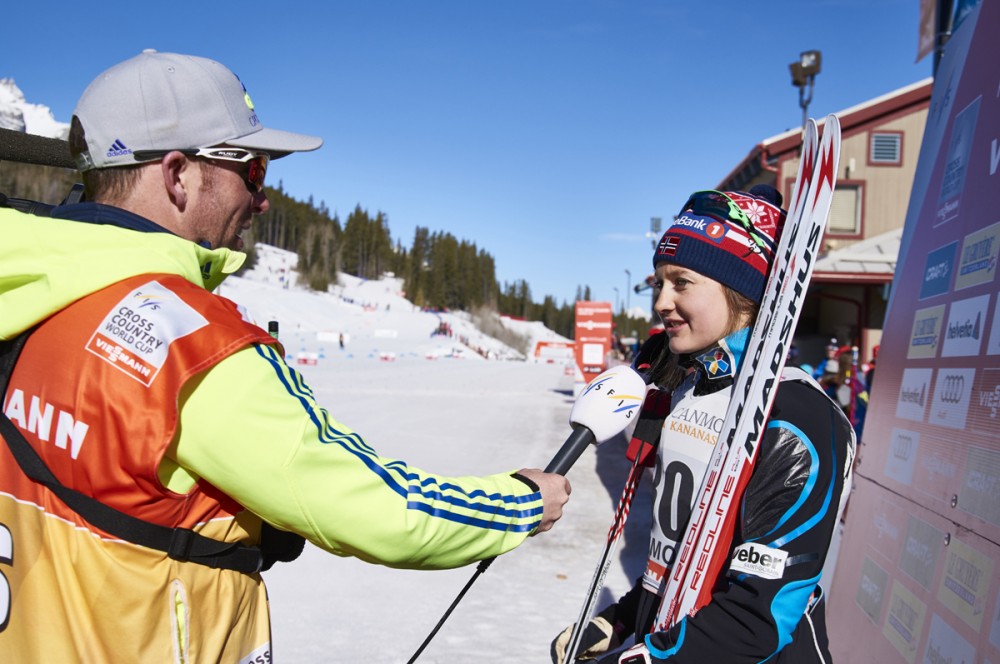
Norway’s Invild Flugstad Østberg (r) being interviewed by FIS’s Jeff Ellis after she won the women’s 10 k freestyle at Stage 7 of the Ski Tour Canada in Canmore, Alberta. World Cups are highly produced broadcast intended for international distribution. (Photo: Madshus/NordicFocus)
Canada’s model, in terms of selling World Cup television rights, is straightforward. Dyer says they sold the international rights to Infront Sports and Media, who in turn sold those rights to partners in Europe interested in broadcasting World Cups — networks like NRK in Norway, RAI in Italy, and the ubiquitous Eurosport. It would then be individual broadcasters, like Eurosport, who are responsible for selling advertising spots in each specific broadcast market.
CCC sold its domestic broadcast rights to the Canadian Broadcast Corporation (CBC), a public broadcaster, and TVA-Sport in Quebec.
FIS’s hosting template for cross-country World Cups places a huge burden on host sites like those in Canada. During the STC, CCC was responsible for producing the World Cup broadcast. That means things like running television cable throughout the venue, as well as renting satellite trucks and cameras.
Televising World Cups in the U.S. is a non-starter.
“Our TV market is substantially different … and in some cases we have even for long times had to purchase time on networks to show the events,” Bodensteiner said. “And the marketing aspect of it has kind of prevented us from making it a good business-based decision to run an event and not lose a ton of money in the process.”
The key piece here is that USSA has in the past had to pay a network to broadcast an event, according to Bodensteiner.
Reading between the lines, USSA could sell its international rights easily, but the domestic market is another story. In Canada, the CBC made the STC available for free on its website rather than televise it. In the U.S., no domestic television market exists for cross-country skiing or at least on a scale that makes sense for USSA to take a financial risk, produce the event and try to sell domestic broadcast rights. (NBC Sports does stream cross-country World Cups live on its website. Streamed events begin with a brief commercial. During the event there’s no commentary; it’s a raw feed from the host site. And to watch the feed you must have NBC Sports as part of your subscription cable or satellite TV package.)
“One of the weaknesses when you look at the cross-country World Cup versus, say the biathlon World Cup, the IBU’s model is substantially different from FIS,” Bodensteiner said of the International Biathlon Union (IBU). “The IBU really holds all of the marketing rights and all the TV rights. They basically go to where they want to go and they take on the vast majority of costs, and things as well as the revenues … versus FIS where it is like all the costs fall back onto the host organizer.”
Max Cobb, executive director of the US Biathlon Association (USBA), explained that organizing committees and the USBA have fewer hosting responsibilities when compared to their cross-country counterparts.
The IBU sells its television rights to a broadcast cooperative called the EBU, or European Broadcast Union.
“The European Broadcast Union is responsible for the televisions broadcast and they cover the costs of that either through bartering with their members within Europe, or when the event’s outside Europe, they cover the costs directly,” Cobb said. “They are completely responsible for the production, they contract with broadcasters, they hire the crew, so they do it themselves. The organizing committee is only responsible for the integration of the broadcast work and the competition so everybody can play nice in the sandbox, so to speak.”
When hosting a biathlon World Cup, the broadcast production costs are a minor part of the organizing committee’s and USBA’s overall event budget. The IBU also covers the prize money. Cobb said biathlon World Cups in the U.S. should be revenue neutral. The organizers receive a percentage of the marketing rights that are sold — these include stadium banner ads as well as television spots.
In February, the IBU World Cup returned to North America for the first time in five years, stopping in Canmore, Alberta, followed by Presque Isle, Maine.
“I know almost everybody hosting World Cups just has the marketing company do the whole package,” Cobb explained. “So that means there is a guaranteed revenue for the organizers.”
The logic follows that those revenues cover the costs organizers take on.
The big risk organizing committees face is if local weather or snow conditions cancels the event. In that case, the organizers wouldn’t get the full value of their marketing share.
“As long as you are actually able to conduct the event, the risk is relatively low,” Cobb added. He also explained that the hosting venue is responsible for paying the room and board for the top 25 men and women while the teams pay for their own travel costs.
The financial reality for USSA appears much different than it does for USBA when comparing the risks of hosting World Cups. Bodensteiner knows that bringing cross country World Cups back to the U.S. will require some creative financing.
“The thing that has been daunting for us in cross country is just the magnitude of the likely loss that we take. It is potentially very very heavy,” Bodensteiner said. “So far that hasn’t made sense to us from a business analysis standpoint.”
Legacy and Nation’s Group Start Rights
With all that financial gloom, there is an upside: the infrastructure legacy.
Canmore is a legacy Olympic venue. Although the original plan for trails, waxing huts, and media accommodations debuted in the late eighties, over the years the facility has gone through several capital improvements. After the Olympics and then post-World Cups, locals can use the Canmore Nordic Centre, elite athletes can train there, and as it has been modernized, organizations like FIS and the IBU see the site as attractive known quantities. (Along with the STC, Canmore hosted an IBU World Cup this season.)
Dyer described benefits of hosting World Cups, like community and athlete development and increased media attention. Then there are intangible benefits like promoting cross-country skiing and young skiers being inspired by watching their heroes.
Chris Grover, head coach of the U.S. Ski Team (USST), donates some of his time serving as the chairman of the FIS Cross Country World Cup and Continental Cup subcommittee.
“The World Cup and Continental Cup committee actually is the committee that decides who gets World Cups where they are and what kind of World Cups they are, what distances and what technique, what date it is, what countries, what venues all those sorts of things so we make a lot of those types of decisions,” Grover said, clarifying his subcommittee’s role.
As a subcommittee member and as a coach, Grover knows the real costs and hard-to-measure benefits associated with hosting races. With a keen interest in developing the next generation of athletes, Grover also understands that exposure to international racing and World Cup culture is key for U.S. skiers.
For skiers not regularly on the U.S. or Canadian World Cup teams, earning a “quota” spot can be decisive. These are the extra start rights host nations receive. As part of a longstanding agreement with FIS that came about since North American stops are not regularly built into the calendar, Canada and the U.S. have a reciprocal agreement. They piggy-back on one another. For example, during the STC, both the U.S. and Canada were granted extra starts as part of what is called the Nation’s Group. Since Canada has taken on most of the hosting burden over the years, it’s the U.S. that rides Canada’s back.
On the surface, more start rights means more international exposure and better prepared athletes. But is buying those Nation’s Group spots by hosting World Cups in the U.S. worth the costs?
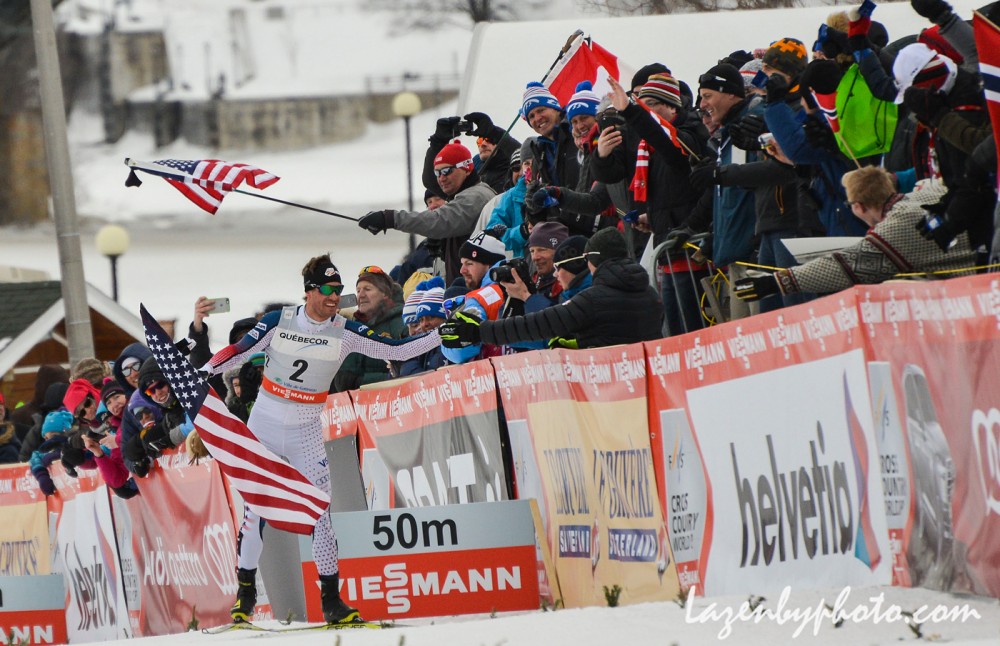
American Simi Hamilton during his “victory lap” after finishing third in the men’s freestyle sprint at Stage 1 of the Ski Tour Canada in Gatineau, Quebec. (Photo: John Lazenby/lazenbyphoto.com)
“It’s not a totally cut-and-dry kind of scenario,” Grover said. “Because if you take a look at what happened in Canada, we had 11 men that started there in that Tour. Only four of the men scored World Cup points and that’s actually the same as it was all season and those four men are the same athletes that are already on the U.S. Ski Team: that’s Erik [Bjornsen], and Noah [Hoffman], and Andy [Newell], and Simi [Hamilton]. None of the other men in this big start group took a World Cup point over eight races in every discipline, altitude and sea level.”
The U.S. women were supposed to have 13 STC start spots, but Caitlin Patterson did not start because of illness. Of the 12 starters, two women scored World Cup points for the first time, Chelsea Holmes and Katharine Ogden.
“So they took advantage of the opportunity,” Grover recounted. “But the vast majority of the other athletes were not able to ski very close to that top international standard level. So the scenario that we have right now is that if we were to host a World Cup in the U.S., we would have all these start rights, but we don’t have, in our current scenario, we don’t have enough athletes who are really ready to have any kind of performance at the World Cup level … We had four athletes on the guys’ side that were ready to compete. That’s quite a juxtaposition to some other nations, especially the stronger nations, say Norway or Russia, who bring in a Continental Cup leader and that athlete is 16th in the race or they are 12th or whatever, and they are really ready to compete at that level.”
If getting international exposure, as some would argue, is a major piece of getting U.S. skiers to the next level, Grover explained they are already meeting that goal with none of the downsides associated with hosting World Cups.
“International exposure is key, but we have so many opportunities to do that if you look at the projects that we have available for our top U.S. athletes; starting with Youth Olympic Games, going to U18 Scando Champs, World Juniors, U23 [World Championships], Europa Cup,” Grover said. “We have lots of opportunities to go to Europe and compete against the best skiers in the world.”
Then there’s the World Cup. Each World Cup period — a World Cup season is comprised of four periods — the U.S. can start its male and female overall SuperTour leaders. Grover noted that the U.S. grants its overall, sprint and distance leaders World Cup starts in Period 3 or 4, for a total of up to three woman and three men in addition to the team quota, based on the World Cup rules*.
Eric Packer after winning his first national title in the classic sprint at 2016 U.S. Cross Country Championships in Houghton, Mich. (Photo: Christopher Schmidt)
Eric Packer, an Alaska Pacific University (APU) skier, earned his first-career World Cup starts at the STC as the overall SuperTour leader for Period 3. After leading the overall SuperTour at the end of the season, Packer will also begin next season on the World Cup.
“The U.S. men, I think, need to further step up their game, and I am part of that,” Packer said. “We had a lot of guys on the team [at the STC], myself included, that weren’t scoring points and weren’t all that close, and we need to get better, for sure.”
Packer is a model of Grover’s reference to skiers having opportunities to race internationally. He raced at Junior World Championships and two times at U23 World Championships. As he moves forward, Packer is poised to exploit more opportunities to race at the highest level of the sport. Those starts, however, must be earned on the SuperTour rather than from the U.S. Nation’s Group quota: the World Cup’s North American return is tentatively slated for the 2020 World Cup season.
Still, Packer made a comment that highlights what the cross-country community communicates to those young people striving to be the best. “The short-term cost-benefit may not really pay off,” he said. “If you extract yourself from that and look at the mile-high view, what that whole effort [to host World Cups] communicates is that high-level skiing, international skiing, is super important to us — that’s something that we as a skiing nation value. That’s something that is maybe overlooked in the importance of hosting a World Cup.”
One thing is for sure: dollars and cents will dictate decisions to host World Cups moving forward. At present, the numbers don’t seems to be appealing enough to convince USSA and local organizers that it’s in the interest of U.S. cross-country skiing to bring World Cups back. From the U.S. perspective, perhaps it’s hard to argue from that Canada, with its government-sponsored financial support, shouldn’t be doing the heavy lifting.
*World Cup rules state that “up to three Ladies and Men have the right to start outside of the quota in the World Cup Period 3 or 4. Each COC Cup is responsible to chose before the 30th of September in which period these 3 additional quotas will be used and have to communicate that to the FIS office. The allocation of the three additional quotas between the COC overall, distance and sprint rankings is determined by each COC. These additional quotas are nominative, the athletes can not be substituted if they can not start due to force majeure.”
Jürg Capol in 2011. The director of marketing for FIS nordic, Capol is not thrilled about the Ski Tour Canada this season.
Excitement is rising in North America for the Ski Tour Canada, a series of eight World Cup cross-country ski races scattered across the country in 2016. And a number of international superstars have announced their intentions to participate in the series.
But one big name in the ski world is less than enthusiastic: Jürg Capol. The director of marketing for the International Ski Federation’s nordic sector, Capol voiced doubts to Norwegian website Sporten.com.
“It’s silly,” he said, according to a translation. “It is from Europe that you generate great television revenues.”
Does it have to be so? Not necessarily. Dave Dyer, the director of events for Cross Country Canada (CCC), doesn’t agree with Capol’s perspective.
“It’s tough to read into his comments in terms of the context of the overall conversation and whether it accurately reflects his views,” Dyer said in an interview with FasterSkier on Friday. “But I think we’re stating the obvious when we say that ski events, whether they are cross-country, alpine, or biathlon or nordic combined, held in North America, can hit the prime targets of European television.”
Switzerland’s Dario Cologna winning the 30 k skiathlon at the 2014 Olympics in Sochi, Russia. Cologna is among those who have publicly announced they intend to race the Ski Tour Canada.
In February, more than 800 million viewers globally tuned in to FIS Alpine World Championships in Vail/Beaver Creek, Colo.
“It’s more of a challenge from a television perspective, not saying whether that is good or bad,” Dyer said. “I think we actually have quite good positioning from a television perspective – we are aligned with coverage of the biathlon World Championships, so I think that will garner us a big profile in Europe.”
Yet one of Capol’s major criticisms is that the Ski Tour Canada would be good only for the home country.
“Tour de Canada is an ending for the World Cup,” Capol told Sporten.com. “It is not known whether it will be good for Canada, or for Norway. There are not so many places who will broadcast it live because of the time difference between Canada and Central and Northern Europe. It’s hard to get on the program then. So you lose. The concept is perhaps to some extent good for Canada alone, yet we do not know whether there will be a ‘next time’.”
One obvious missing piece is that not only will the event be good for Canadian skiing, but also for American skiing. The last FIS World Cups hosted in Quebec in particular were easily accessible to American spectators living in the Northeast, and the broadcasts generated interest and excitement.
Charlotte Kalla of Sweden skiing to a monster win in the 10 k skate at 2015 World Championships. Kalla, too, plans to come to Canada – because she wants to win the overall World Cup.
Between Americans and Canadians, four men and six women were ranked in the top 30 of the World Cup in either distance or sprinting, and three different skiers medaled at 2015 World Championships.
And in fact, FIS has been pushing for increased success from a variety of nations, especially given the near-total dominance of Norwegian women in the last season.
“Over the last few years the tendency is a dominance of the two or three biggest nations,” FIS Cross-Country Race Director Pierre Mignerey said in May. “I’m not concerned with a temporary dominance of one nation but in the long term this is a danger for our discipline. The best possible life insurance for Cross-Country skiing is to have a larger number of countries at the highest level.”
Thus a focus on North America does not seem unwise.
“From a spectator perspective here in North America, they were fabulously successful,” Dyer said of the last World Cups to be held in Canada in December 2012. “I think that being the World Cup final for the 2015/2016 season, the Ski Tour will be equally as exciting and people will be equally interested.”
The success of those events made it easier to market the Ski Tour Canada, he said.
“Any time we do a city sprint, now that we have some examples under our belts, we have good television and print media coverage,” he explained. “Those events sell very very well whether we are selling to our public partners or whether we are selling to the corporate sector.”
Finally, Capol expressed doubt that top skiers would attend the Canadian races, and asserted that the success of television broadcasts in Europe depended on them doing so.
“This is hard to sell,” Capol said. “In Canada cross-country skiing is a little sport… I know that media revenues are low. Going 25 percent of all distances at the World Cup in Canada… It depends on the runners going. If Justyna Kowalczyk is in good shape maybe it gets a little more. From Germany there is little interest.”
That may be partly due to the declining fortunes of German skiing. A traditionally strong media market for nordic sports, both German skiing and biathlon had less than successful 2014 Olympics. But the biathlon squad bounced back with Laura Dahlmeier, Franziska Preuss, and Simon Schempp breaking through to become major forces in 2015-2016 while Erik Lesser, Arnd Peiffer, and Franziska Hildebrand stayed their successful courses. By contrast, Nicole Fessel, Steffi Boehler, and Denise Herrman had strong seasons but are nowhere near challenging the Norwegian dominance in cross-country skiing.
Kikkan Randall leading Norway’s Maiken Caspersen Falla, Finland’s Anne Kylloenen, and Russia’s Svetlana Nikolaevs in the World Cup team sprint in Quebec City in December 2012.
For the Ski Tour Canada, basing marketability estimates on the number of top skiers who attended previous World Cups held in Canada, which were scheduled in December, might not be accurate. Many top athletes skipped those due to worries about preparation for the rest of the season. But in a year without a World Championships, having eight races in Canada means it will be tough to win the World Cup title without going there. That means the field will be totally different than in the December races in past seasons.
“We’ve received really, really positive initial indications of the number of teams that are coming over with their full squad,” Dyer said. “We know from looking at the World Cup series, that a serious skier can ill afford not to come to Canada in 2016. So we’re expecting a really high percentage of eligible athletes in the Red Group to be joining us. I’d suggest that unless an athlete is injured or sick, they’ll be here. They are the last races of the season so athletes are going to put whatever feelings of concern about fitness they have behind them and ski until they drop.”
It’s not just Dyer who is saying that. The sport’s best athletes seem to be prepared to do battle in Canada.
“The focus lies in the overall World Cup, meaning that the results at the at Ruka Triple, Tour de Ski and Ski Tour Canada must be very good, because here many World Cup points are up for grabs,” Swiss skier and 2008/2009 World Cup champion Dario Cologna recently told FIS’s own news service. “I am very much looking forward to the start of the new season.”
Sweden’s Charlotte Kalla has also been saying for months that she will race the tour.
“The Ski Tour Canada is a major event towards the end of the season,” Norwegian national team coach Egil Kristiansen told ABC Nyheter last week, implying that his top stars like Therese Johaug would compete. “There will be many World Cup points handed out there. Therefore it is an important competition, at least for those who will fight for crystal balls.”
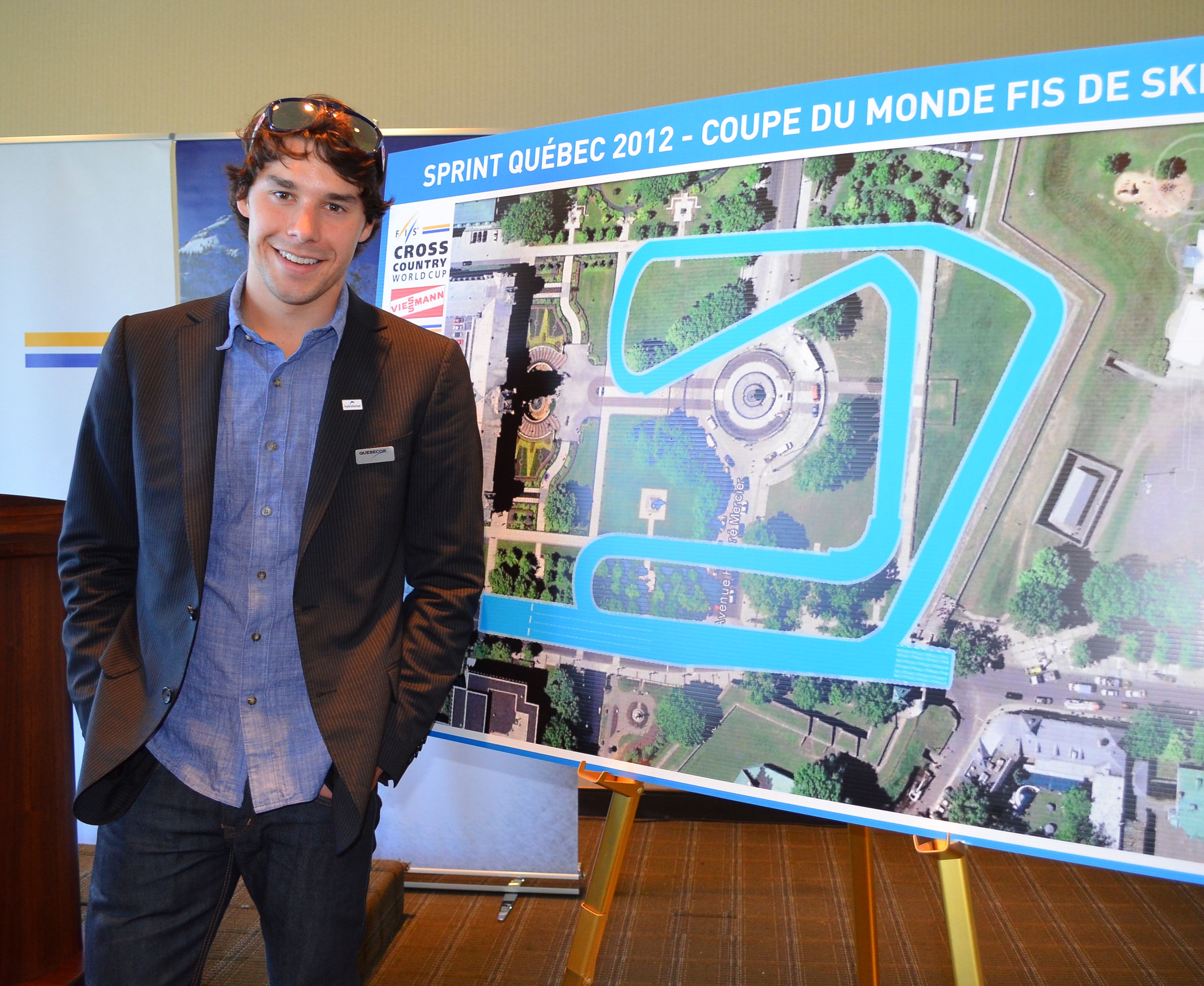
At the SportAccord Convention in Québec City on March 23, Canadian National Ski Team member Alex Harvey stands next to a course map of the 2012 Québec World Cup sprint, which will take place Dec. 7-8 in Quebec City. (Gestev courtesy photo)
Drenched in sweat, Alex Harvey stood surrounded by fans, media and children. He couldn’t have escaped the swarm at Mont Sainte-Anne if he wanted to. People wanted his autograph, answers and face in their photos.
Two months after the masses flocked to the Québec ski area to see their hometown World Cup skier win three straight races at Canadian Ski Nationals, life for Harvey had mellowed. On Tuesday afternoon, the 23-year-old was headed to Laval University in Québec City for a three-hour law class.
Harvey talks to schoolchildren before his first race at Canadian Ski Nationals on March 20 in Mont Sainte-Anne, Québec. He went on to win the 15 k freestyle, skate sprint and tied Devon Kershaw for first in the 50 k classic.
The calm was only temporary.
In December, Harvey will once again be in the limelight when the World Cup makes its first visit to Québec City. Freestyle individual and team sprints will take place Friday, Dec. 7, and Saturday, Dec. 8, before the World Cup makes its second Canadian stop in Canmore, Alberta, the following week.
“I’m really excited, and the people here are really excited,” Harvey said in a phone interview. “They started talking about it last summer because they announced it for December 2012. People kind of thought that it was December 2011, I guess. I’ve had people asking me about it for over a year now.”
That enthusiasm embodies Québec. Approximately 65 percent of recreational skiers in Canada live in the eastern provinces of Québec or Ontario, according Cross Country Canada (CCC) Director of Events Dave Dyer.
“Hence there is tremendous potential to tap into this resource and introduce the sport to youth in these areas,” he wrote in an email in July 2011.
A few months before, Québec City earned the right to host its first World Cup, as did Canmore, a veteran venue. Dyer explained that CCC submitted three bids, including Callaghan Valley in British Columbia, to ensure it met the International Ski Federation (FIS) requirement to host two weekends of World Cups outside Europe.
Québec and Canmore had been CCC’s top picks, Dyer wrote. Canmore hosted a World Cup as recently as 2010 and had snowmaking capabilities. Québec was new, but had potential, and met CCC’s goal of developing world-class racing in eastern North America.
“Québec City was a natural because the Québec City [Pierre-Harvey National] Training Centre is here,” Dyer said at Canadian nationals in March. “Obviously tremendous athletes are coming out of this region and we feel that it has the climate and some good, experienced people.”
That’s where Alex Harvey and his father, Pierre, came in.
While the two Québec sport celebrities weren’t at the heart of the planning process, they were on the city’s posters and press releases. When the Sprint Québec 2012 course was unveiled last week, the younger Harvey was shown standing next to an enlarged map of the city sprint wearing a blazer and sunglasses.
Harvey said he met with the event-production company, Gestev, several times to review the course layout. The Québec-based organizers, which will also manage media, hospitality and accommodation logistics, have hosted several international events, including Canada’s celebrated Crashed Ice – a mix of hockey, downhill skating and bordercross – as well as mountain bike World Cups and World Championships.
But cross-country skiing was a new one.
Québec World Cup sprint course map, which was unveiled in Québec City on May 23, with Parliament Building to the left. (Gestev courtesy photo)
“We believe our longtime experience with cross-country mountain bike brings us close to the endurance athletes’ needs,” Gestev President Patrice Drouin wrote in an email from the FIS Congress in South Korea. “Our experience with alternative-urban sports helps to approach the urban [cross-country] sprints with confidence. Local expertise also exists.”
Harvey was confident in Gestev’s ability to put on a nordic World Cup.
“They always try to partner with a local athlete who knows something about the sport,” he said. “I worked with [them] a little bit, walked the course and just had a couple meetings to do something exciting. I tried to do something that could suit me well.”
He laughed and continued, “In sprinting, it’s all about the finish.”
This course will start uphill and end on a straightaway incline, Harvey said. While it won’t require much offset, or V1 technique, a couple of bridges will change the momentum, but most of it will be one or two skate, V2 or V2 alternate.
From May 7-9, three FIS representatives, including cross-country event coordinator Sandra Spitz and race director Pierre Mignerey, toured Québec for a pre-site inspection. Two weeks later, Harvey joined FIS President Gian Franco Kasper and its secretary general, Sarah Lewis, in Québec to officially announce the course.
With two 800-meter loops in front of the Parliament Building and near the Old City, the course will be similar to Stockholm’s World Cup sprint, Drouin wrote. He explained the original plan, which included a 1.6-k loop around the Plains of Abraham and Grande Allée, changed “100 percent” after Drouin and Dyer watch the World Cup city sprints Düsseldorf, Germany.
There, Drouin decided it made more sense to do two loops from a spectator and snow-supply standpoint. With the cooperation of Québec’s mayor, he made sure the course could be wide enough. Sidewalk poles needed to be removed, the main road (Grande Allée) closed, and the city centre essentially shut down that Friday and Saturday.
View of Quebec City and Parliament Building (at right), where World Cup sprints will take place for the first time Dec. 7-8, 2012. (Cross Country Canada photo)
Dyer said the city gave World Cup organizers its blessing.
“A lot of times on city streets, you’re restricted to half the width of the street where the other half is still open [to traffic],” Dyer said. “You don’t want to shut the city down or the interior core of the city. At the same time, there’s an awful lot that goes into preparing the course. … Scheduling was one of the biggest concerns. The services to the athletes is also very important for the committee and good representation of FIS.”
After reviewing the course, the organizing committee and FIS delegates fine-tuned details to meet international criteria. After wrapping up the visit with two days in Canmore, FIS essentially gave both sites the go-ahead.
“We were pretty sure it [would] work, but the site inspection and homologation done in early May confirmed that we were going in the right direction,” Drouin wrote.
In the case of scarce snow, similar to what happened at nationals when organizers moved the individual sprints from the Plains of Abraham to Mont Sainte-Anne (MSA), Drouin said they would make snow on the adjacent plains. That’s also where athletes will warm up and team services will be. If needed, Dyer said they could transport snow from MSA or Stoneham Mountain Resort located 45 and 30 kilometers north, respectively. Regardless, the sprints won’t likely relocate.
“Unless there’s an absolute meltdown, as we experienced this year at Ski Nationals, we’ll be at the downtown site,” Dyer said, laughing. “I don’t think we get 25-degree temperatures that often in December.”
By the Numbers
Twelve days after the last World Cup race in Canmore, the Tour de Ski kicks off in Germany. (Canmore will hold 10- and 15-k classic mass starts, freestyle sprints and a skiathlon from Dec. 13-16.)
That leaves the number of skiers expected to come to Canada in question. While all the top sprinters will likely race at both sites, several of the European distance skiers may opt to stay home.
Dyer said all of the Canadian World Cup team members would be back, and Harvey confirmed he would do all of the Québec and Canmore races. He’ll use a family friend to manage media and fan inquiries and may fly to Canmore to train before Québec, but expected to compete on all cylinders.
“For me next year, world champs is the main goal,” Harvey said. “Last year it was the Tour just because there was no main championship. The Tour will not be a huge focus. Especially with the final climb, I have a lot of problems with blood flow in my arteries on a steady climb like that. … I can’t do really well in the Tour because of the climb so it’s not really a big deal to not be in great shape there.”
He said he wouldn’t be surprised if several distance skiers didn’t come to Canada.
“In Canmore, it’s two distance [races], but it’s only two distances,” Harvey said. “I think the sprinters will come because two sprint races, it’s 20 percent of the calendar.”
Personally, he was excited for the opportunity to race with teammate Devon Kershaw and defend their team sprint title from the 2011 World Championships. There was also a chance that another teammate, Lenny Valjas, could race with one of them.
Regardless, Dyer expected resounding attendance from the North American ski community. He estimated 10,000-30,000 people would watch the Québec sprints, and 80-100 men and 60-80 women would participate. At the Canmore World Cup in 2010, about 80 men and 65 women raced on Feb. 5-6.
“I think all the North American athletes are committed to supporting the races,” Dyer said.
Moving the Québec races up one day to Friday-Saturday rather than Saturday-Sunday allowed an extra day for travel. After the city sprints, racers could pack up, take a four-hour flight to Calgary and drive an hour west to Canmore. For those who haven’t made the trip before, the size of Canada might be a bit of a shock.
“I don’t think it’ll be a concern if we don’t have a three-hour wait in Montreal like we did last week,” said Dyer, who is based in Canmore. “We had a mechanical breakdown with one of our planes so we were on the tarmac for a little bit, but sure, we’re looking at all aspects in terms of getting equipment out to Canmore.
“Canada and North America, from one coast to another, is a pretty expansive area when you start talking about two or three times the size of Europe,” he added. “[Outsiders will] start appreciating the size of the country.”
Last winter, the CanadianNorAm series embraced the mini-tour concept with open arms. With four events over the course of the season, athletes, coaches, race organizers and fans alike had the opportunity to experience the new race format, which has become a significant part of the World Cup circuit.
Hosted at four separate locations – Rossland, B.C., Orford, Quebec, Nakkertok, Quebec, and Kelowna, B.C., the mini-tours were spread out—both geographically, with two in the East and two in the West, and across the season. This gave Canadian (and American) athletes a unique opportunity to hone their skills in the multi-stage race format.
And as with any new experience, there were highs and lows.
This season, Cross Country Canada (CCC) has reduced the number of multi-stage races down to just two – one at Western Canadian Championships in Canmore, Alberta, and one at Eastern Canadian Championships, at Nakkertok Ski Club in Ottawa, Ontario.
Graham Nishikawa (AWCA) in action during the NorAm in Rossland B.C. (Photo: Brad Jones)
Excitement
Without a doubt, mini-tours make for great competition—athletes, coaches, fans, and race organizers alike agreed on that point. The NorAm series was close – especially on the men’s side, with Drew Goldsack and Graham Nishikawa of the Alberta World Cup Academy (AWCA) going toe-to-toe for the entire season in a tight competition for the World Cup slot, which is awarded to the winner.
“I really like the mini-tour concept,” said Nishikawa, the eventual winner, in an interview this past winter. “It makes for very exciting racing on the final day.”
“It was tight battle [for the NorAm title],” said CCC Events Coordinator Dave Dyer in an interview with FasterSkier. “The opportunity to garner an FIS regional quota spot for the World Cup also makes a huge difference.”
While the battle between Goldsack and Nishikawa came down to the final race, the womens’ competition featured much less drama. Perianne Jones took the lead early in the season, and never relinquished it despite not racing either mini-tour in Eastern Canada, and heading onto the World Cup for the last three weekends of racing.
Internationally Relevant
The inclusion of mini-tours on the domestic circuit also lines up with international trends in cross-country skiing. The International Ski Federation (FIS) has made the mini-tour format a staple on the World Cup, with two events bookending season.
If the domestic calendar reflects the latest in FIS trends, then national-level athletes get the experience at home that they will need abroad.
“Great to see the CCC events committee respond to the evolution of international trends,” wrote Chris Jeffries, an AWCA coach,in an e-mail to FasterSkier this spring.
Perianne Jones during the World Cup sprint qualifier in Drammen, Norway
Organization
Jeffries also emphasized that organization played a crucial role in making the mini-tours successful.
“Day three in Rossland [first mini-tour of the season] was a perfect schedule, and a model of how all distance events should be run at future NorAms,” he wrote.
Jeffries was impressed with the attention that Rossland tour organizers paid to details such as wax-testing areas, and timing of races in order to allow service staff to provide the best possible support.
“Overall, I think our domestic circuit is continuing to develop, and venues that have hosted events regularly in the past continue to improve and professionalize their product,” he wrote.
Dyer agreed that the event in Rossland, hosted by the Black Jack Ski Club, was well-run, and felt that of the four, had the greatest success in terms of producing results and using the available technology effectively.
Number of Events
However, as with any new initiative, there were a few growing pains.
First and foremost among complaints was the sheer number of mini-tours on the calendar. In a space of 17 days, spanning the end of January and the beginning of February, athletes chasing NorAm points were expected to race 9 times in three separate mini-tours—a total that evokes the eight-stage Tour de Ski.
For Jeffries and the AWCA, who contested all three events, crossing the country three times in that short period of time was stressful, and as a result, skiers and staff were stretched.
“Athletes were mentally and physically exhausted afterwards, and compromised the end of their seasons due to health and recovery and compromised training,” Jeffries wrote.
There were alsomany race formats, but a startling lack of one specifically – mass starts. In four weekends of mini-tour racing, there were zero true mass start events, something Jeffries felt was detrimental to the NorAm series.
Division of Points and Money
With well over 50% of the NorAm points awarded during the season coming in mini-tour events, it was difficult to do well in the overall standings if you have one bad race in a three-race weekend, as the outcome of one day affects the others.
For Jeffries, it comes down to prize money as well. “The prize money needs to increase,” he wrote, “particularly for the race winner and top three.”
Jeffries felt that the added expense of crossing the country multiple times in pursuit of the lone World Cup spot justified a higher purse.
However, according to Dyer, CCC had invested a further $8000 dollars of prize money into the NorAm series last year as a result of the mini-tour format.
Dyer explained that the NorAm circuit rewards up to the top five athletes in individual races with cash prizes, which reduces the amount available for the winner.
“It’s always a little bit of a balance,” he said, “Do you reward just the top best, or try to spread the money a little more?”
However, Dyer did agree that considering the amount of travel, costs for athletes rose more than he anticipated.
“When we put the schedule together, I didn’t feel that athletes would be engaged both east and west as they were, which is good, and we’ve learned from that.”
Drew Goldsack during the 15 k skate at Soverign Lake Nordic on the NorAm circuit in 2011
Organizational Difficulties
Setting up these new race types put unexpected demands on race organizers, who have never experienced the variety of formats. It forced many into new timing situations, such as dealing with the distribution of bonus seconds, and correctly organizing handicap starts.
“The timing and data software was not totally fine tuned for this type of event,” said Pierre Millette, organizer of the Eastern Canadian Championships, held in Cantley, Quebec. However, he felt the results posted were “decent.”
Millette said the organizing committee was concerned about the mini-tour, as they had never held a sprint in the current format, or a handicap-start event. Additionally, the designation of the race as a FIS sanctioned event increased the pressure and unfamiliar territory, but Millette said he was still happy to run the tour.
Number of Races
There are only 7 race weekends on the NorAm calendar, and with 4 of them being mini-tours, the mini-tour was the rule, rather than the exception this past winter.
The mini-tour is designed to be a special event, different from a regular race weekend, something with a somewhat higher profile. And as Jeffries explained, “too much of something no longer makes it special.”
On the World Cup, which boasts 11 race weekends, not including the Tour de Ski or World Championships, there are two mini-tours. The second weekend of racing in Kuusamo, Finland, featured a tour, and the final race weekend of the season, the World Cup Final, in Sweden was a mini-tour.
Pierre Millette voiced a similar opinion to Jeffries. “We would be happy to host it again but there is probably too much mini-tours in the calendar” he wrote.
“The mini-tour should be only once in the East part of the country and once in the West part too and
preferably during Easterns and Westerns. These events are the most important one after Nationals.”
In an interview with FasterSkier earlier this spring, Emily Nishikawa (AWCA), who finished second in the NorAm womens rankings voiced a similar expression, “I only did two,” she said, “but that was a great number.”
It seems like CCC has listened to athletes and coaches, releasing a 2011-2012 schedule, with just two mini-tours on the schedule—Eastern and Western Canadian Championships will both be run in the three-race format.
As well, according to Dave Dyer, the calendar has addressed the issue of travel, streamlining the series so there are always at least two race weekends in a row in close geographic proximity, before moving across the country.
CCC Athlete Rep Greg Kilroy was positive regarding the schedule in a recent interview with FasterSkier – “I think the events and management committee did a great job responding to the concerns athletes and coaches had about last season,” he said.
“Anything that was brought to me by an athlete, the other members of the board were aware of, and was addressed.”
“Ultimately the setup of races [this year] makes it a lot more feasible for teams, because travel is so much easier,” said Kilroy.
Editor’s Note: This article originally stated that the Telemark Ski Club organized the Rossland, B.C. mini-tour. This was incorrect. The Rossland mini-tour was host by the Black Jack Ski Club. Telemark hosted the Kelowna event.
Holding elite level events, whether World Cup races, National Championships or just FIS points competitions, pose numerous challenges for organizers and National Governing Bodies in the US and Canada. Over the course of the summer FasterSkier will examine the various issues at hand. Today we start with a piece on homologation, with future topics to include snowmaking and prize money, among others.
Until this year, the U.S. and Canada have had reprieve from the International Ski Federation (FIS) rule requiring that scored races be held on homologated courses. For the 2011-12 season, that will change.
“Basically, the races that are coming up, beginning this calendar year, have to have a certified course in order to be scored,” said Al Serrano, a homologation inspector the Eastern region of the United States.
With just eight homologated ski areas in the U.S. and four in Canada as of May 2011, both countries are facing challenges with getting a variety of race series, including SuperTours and NorAms, scored with FIS points.
“I don’t anticipate one hundred percent compliance for the upcoming season,” said Dave Dyer, Director of Events Management for Cross Country Canada.
What is Homologation?
Homologation is a certification process run by FIS. Just as FIS points are theoretically a universal ranking system for skiers around the world who have never competed against one another, homologation attempts to ensure that racers are competing on courses with similar terrain and technical features no matter where they travel. Homologation also addresses safety issues – although not always successfully, as Petra Majdic showed at the Vancouver Olympics.
“The goal with this FIS homologation work is to create a good group of sites that have courses where FIS points can be awarded in a fair way (and where US/CAN athletes can be tested on courses alike what is used on the WC circuit,” FIS regional coordinator John Aalberg wrote in an e-mail. “I often compare this to golf – you can not play PGA tournaments (‘Continental Cup/Championships’) on a 3-par course, and a person’s golf handicap (‘FIS points’) can not be awarded solely from playing on easy 3-par courses.”
Although FIS requires that all races scored for FIS points take place on homologated courses, the standards are different for World Cup competitions and Continental Cup races, making it more manageable for smaller ski areas to tackle the process.
There are also different requirements for different race formats: courses used for mass start races must be wider than those for interval start races, and classic sprint courses are required to have particularly steep uphills to discourage racers from using skate skis and double poling the entire race.
While the main concerns are generally terrain features – there are a required number of climbs within a range of height differentials and grades for every possible course length – the total climbing over a course is also important, as is stadium setup and other infrastructure.
In some cases, homologation of existing courses is easy. In others, significant trailwork is required and hiring a trail designer is a big help. For a better understanding of the homologation process, read FasterSkier’s into to the concept, published last summer, and the step-by-step guide from last fall.
Why is Homologation So Tough for North America?
When the FIS rules about homologation went into effect, the U.S. and Canada were given extra time to satisfy the certification requirement because there were very few venues which had been through the process.
Why were the countries lagging behind Europe in the first place? Both Dyer and Serrano pointed to one thing: a lack of homologation inspectors.
“There’s been a lot lost in translation both with homologation inspectors and technical delegates in terms of getting them fully certified up to the FIS level,” Serrano said.
“FIS has all of these systems and protocols now… that say okay, this is how we’re going to certify people. The problem with the process was that it’s a mentorship sort of thing. We had one homologation inspector in the United States, John Aalberg. He’s been doing the Olympic Games since the year 2000 and homologation inspections on the side, and not able to mentor anybody, not able to sign off on anybody as a new certifier.
“So we have a system where you’re certified by a peer, but we don’t have any grandfathered certified people.”
While the number of inspectors has increased over the last few years, numbers are still an issue. To make matters worse, Aalberg recently took at job at Holmenkollen in Oslo, Norway, and is no longer even living on the continent.
“I live in Norway right now, but am still coordinating some of the homologation work on behalf of FIS,” Aalberg wrote in an e-mail. “Both Canada and US have their own homologation ‘leads’ and groups, and I am mostly involved with questions they have or in case of World Cup courses (Sovereign, Canmore, Callaghan the last few years).”
While the number of inspectors was the root of the homologation crush, other issues remain – like money.
“If you’re talking about just taking an existing course and not spending any money to do earthwork or upgrades or anything like that… and you just want to use the course that you’ve always been using, then it seems kind of expensive,” Serrano explained.
“The floor level cost, the minimum for just one course, is there’s a $200 fee from USSA, and then 100 Swiss Franks so basically $100 from FIS, and then whatever inspector costs, and that’s going to be a minimum of a day, so that’s probably $300 to $500. So even at the bottom level, that’s probably about $800.”
There is also a per-course fee for the certification process. And that’s not all.
“Besides the trail, you have to have infrastructure, like the stadium, grooming staff, and buildings,” said Matt Pauli, a member of USSA’s Rules and Technical Subcommittee.
If trailbuilding and excavation is required, along with the help of a trail design contractor, things get exponentially more expensive. From Serrano’s experience, the costs associated with making a new race course make sense to his client organizations, but the hundreds of dollars in expenses required simply to continue racing on a traditional course are more difficult to justify.
“For instance, Rumford’s whole deal was four courses… so it scales up nicely as you add more courses,” Serrano said. “But in the grand scheme of things that was $30,000 worth of stadium work and $15,000 worth of trailwork. So [homologation] is actually a pretty small expense when you’re talking about building trails and upgrading trails.”
US: On The Right (Certified) Track
This spring at the USSA Congress, a homologation subcommittee was formed and regional coordinators were assigned. USSA hopes to be able to encourage and supervise more homologation projects around the country and allow for the best FIS schedule possible.
“If a project comes to USSA, we see it, and we decide how to best assign an inspector to that particular project,” Serrano said. He is the regional coordinator for the East as well as being a homologation inspector and working on a consulting basis in other regions.
On top of the eight venues which already have certificated, Serrano said that about four ski areas in his region were far enough along in the process to invite an inspector for the initial site visit.
But even though he has been contacted and the ski areas have identified what they need to do in order to have a certificate in hand, Serrano said homologation wasn’t a sure thing for the upcoming season.
“I know at least one place that just doesn’t have any money,” he explained.
However, according to Pauli it is likely that a few more certificates will be in the hands of U.S. ski areas by the time winter rolls around. Pauli is also a homologation inspector himself and coordinates homologation efforts in Alaska and the Midwest, as well as acting as Chief of Race at numerous competitions including U.S. Nationals.
He listed Birch Hill in Fairbanks, Bohart Ranch in Bozeman, and Battle Creek and Theodore Wirth Park in the Twin Cities as areas which should have certificates soon, with Kincaid Park in Anchorage and the Michigan Tech trails in Houghton rehomologating and adding new courses.
Even with those additions, the SuperTour schedule will be affected.
“I think there’s been some certain changes to the race schedule,” Pauli said. “For instance, in West Yellowstone, it’s really hard to get any additional terrain.”
He noted that altitude was also an issue, with FIS setting a maximum elevation for any part of a race course at 1800 meters or just under 6000 feet. This rules out competition for FIS points at venues like Aspen, which hosts the popular Owl Creek Chase.
“Owl Creek won’t be on the SuperTour [in the future] due to the lack of an ability to homologate,” Pauli said.
The SuperTour might be the highest-profile race series in the U.S., but other calendars will be affected as well.
“The one thing that is going to be really difficult is college racing, West and East,” Serrano said. “The Western colleges, they are going to be limited with elevation… if Colorado wants to race at Eldora it’s never going to happen. In the East it’s tough because they just have to go through the process.”
While the Western schools struggle with the altitude limit, Eastern schools will face their own challenges if they want to hang on to FIS points. For instance, Dartmouth College’s Oak Hill, one of the classic carnival venues, has a terrain profile which will never pass the homologation test.
Last year, including NCAA Championships, twelve weekends of college racing were scored for FIS points. Of those weekends, only eight took place at homologated venues, with some venues hosting races more than once.
But although some SuperTour and college races will no longer be FIS competitions, the situation isn’t dire.
“So far as I know, there hasn’t been any panic from USSA,” Serrano said.
Pauli agreed that the U.S. was making good progress.
“What we’re trying to do is get the best we can out of a trail system and meet those standards,” Pauli told FasterSkier. “We’re not trying to get any World Cup courses, just the Continental Cup courses, so it’s not as difficult.”
Canada: No Money, More Problems
In Canada, the story is somewhat different. With only four venues currently holding homologation certificates – and three of those being in Western Canada – the country is not on track to meet the FIS deadline.
The majority of homologated courses in Canada are certified for World Cup competition. Sovereign Lakes, Canmore, and Whistler all have the highest level of certification, and a proposed city sprint in Quebec does not require homologation (FIS allows leeway for “popular events” such as major marathons as well as for city sprints).
As a result, the country will be able to host World Cup races in two different provinces in 2012, but because little progress has been made recently with homologation at smaller venues, the domestic calendar is in jeopardy.
Dyer noted that many NorAm races are hosted by nonprofit clubs which lack the capital necessary to homologate their venues.
“Our structure is very much club-based… so not a lot of money is available,” he told FasterSkier.
Nonetheless, Aalberg provided FasterSkier with a list of Canadian sites currently working on homologation, and there are quite a few. Five venues have started work: Mount Orford, Nakkertok, and Mont Sainte Anne in Quebec, and Sovereign Lakes and Rossland in British Columbia. In addition, Thunder Bay in Ontario and Whitehorse in the Yukon are listed as on track to receive certificates this fall, although they did not appear to have begun the process.
While he admitted that the homologation requirement was a struggle for Canada, Dyer was quick to support the concept.
“FIS is trying to ensure that races are safe,” Dyer said. “We would never substitute safety. They also want to ensure that they are quality courses. The philosophy is great, but the application of the philosophy is different in a nontraditional ski community. I hope that FIS is understanding and keeps letting us race for points.”
Canadian Ivan Babikov racing in a mini-tour in Maine last season.
A quick look at the Canadian draft event calendar will unearth one major revelation – Cross Country Canada (CCC) appears to have fully embraced the concept of the mini-tour.
This upcoming season, there are three mini-tours on the CCC schedule. The second Haywood NorAm, held in Rossland, B.C. on December 16, 18 and 19 will be a mini-tour. As well, Western Canadian Championships, held in Kelowna, B.C. on February 4 to 6, and Eastern Canadian Championships, in Ottawa, Ontario will be mini-tours.
In a recent e-mail to FasterSkier, CCC Director of Events Dave Dyer indicated that changes at the international level were in part responsible for the creation of the first stage races in Canada. The Tour de Ski and the World Cup Final are both stage events, and both have become very popular with fans, as well as media and racers.
In Canada, the first race weekend in the Haywood series (often held at Sovereign Lake Nordic Club in Vernon, B.C.) has typically been a three- or four-day event, so holding a mini-tour is not radically different for the NorAm circuit. However, Dyer did point out that “declaring an aggregate winner over the race weekend will be new.”
While the location is set for the Haywood NorAm mini-tour (Black Jack Ski Club of Rossland, B.C.) and Western Canadians (Telemark Cross Country Ski Club, Kelowna, B.C.), discussions are still ongoing as to the location of Eastern Canadians. It will still be held in Ottawa, Ontario, as it has been the past five seasons, but the actually location of the race trails is still to be determined.
As for specific race distances and formats, the NorAm in Rossland will start with a sprint, followed by a short interval start, and then a longer handicap start. Both Easterns and Westerns will feature a short prologue on the Friday, followed by a sprint and then a handicap start.
Dyer mentioned that these events are not without challenges. “A multi-stage event is a bit trickier with 600 participants and multiple age categories, versus a traditional FIS-style event with just Open Men and Women,” he said.
As for incentives, Dyer did confirm that extra prize money would be available for the overall podium positions at the tours. He expects the fields to be as strong as those last season, at least on the weekends that do not overlap with SuperTour races.
In addition to bigger prize money, there are other incentives to attending these races. Dyer noted the travel and monetary advantages of the mini-tour concept, stating that “Canada, like the U.S., is quite large, hence if club teams are going to invest in travel…we wanted to make sure they maximized the racing opportunity and the travel experience.”
Dyer said hopes the new races will “increase the excitement and interest” in skiing in the country, but also agrees that for the athletes, too many mini-tours can be difficult. He said he hopes to keep the tours evenly distributed across the season, to maximize the benefits and to minimize the strain of competition on athletes.