From the FasterSkier archive — posts syndicated from athletes’ and coaches’ own blogs between 2004 and 2012, kept online as published. Current coverage is at fasterskier.com.
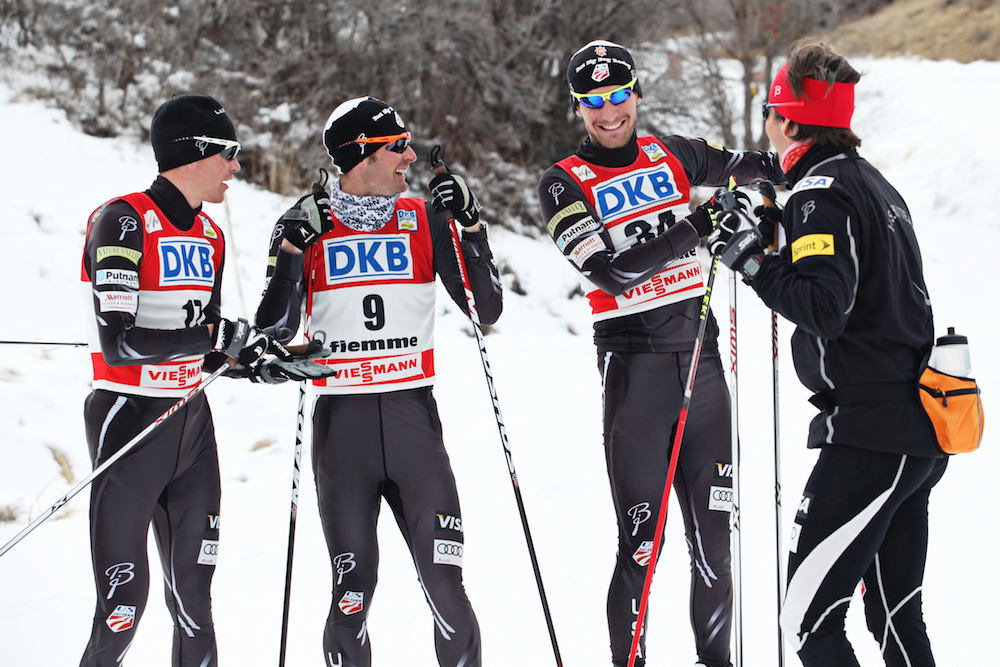
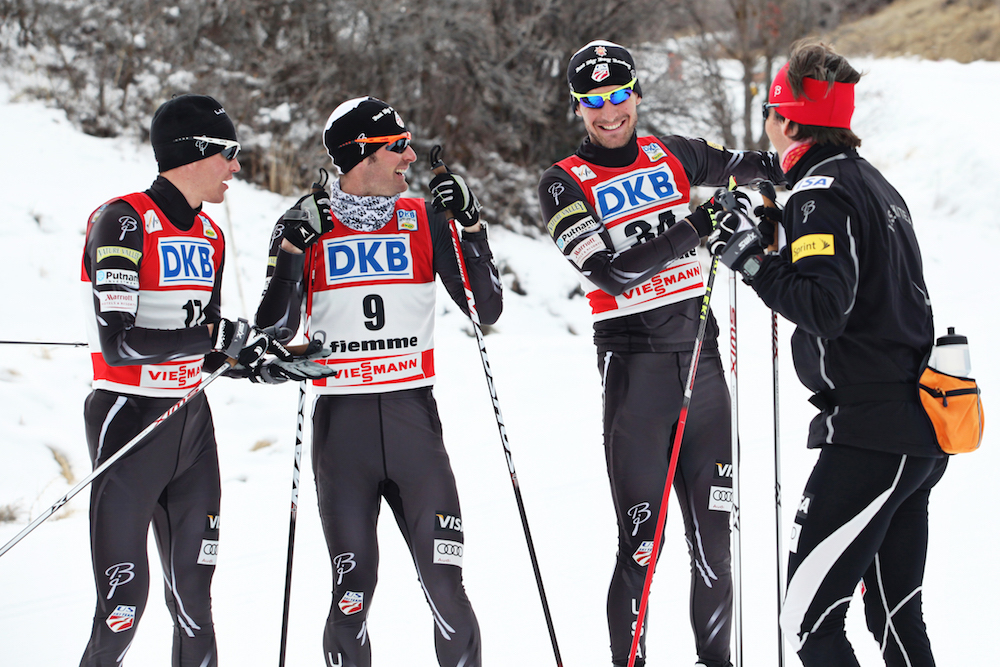
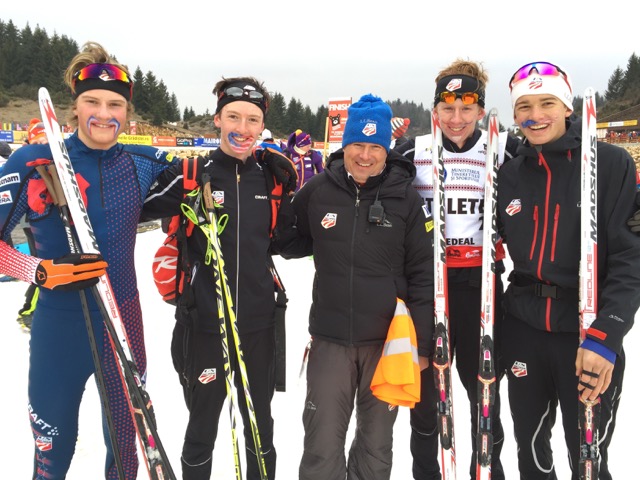
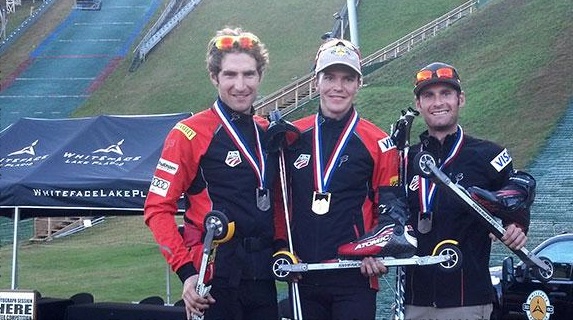
U.S. Nordic Combined’s 2011/2012 team members (from left to right) Billy Demong, Bryan Fletcher and Taylor Fletcher with head coach Dave Jarrett at Soldier Hollow in Midway, Utah. (Photo: USSA)
Listed at the bottom of a U.S. Ski & Snowboard Association (USSA) press release announcing U.S. Nordic Combined Head Coach Dave Jarrett’s retirement are his coaching highlights. It’s a long list defined by two things: Olympic and World Championship medals and longevity. Jarrett will forever be linked with the iconic names of U.S. nordic combined, including Billy Demong, Johnny Spillane and Todd Lodwick. His coaching legacy rewinds back to the 2002/2003 World Cup season.
Before that, as a nordic-combined athlete, Jarrett was a member of the U.S. Ski Team from 1992-1996 and is a two-time Olympian. He’s a lifer. And for lifers, separation from what they have always known remains difficult.
“I have been doing it a long time both as an athlete and and a coach,” Jarrett, 46, told FasterSkier on the phone. “It is now of those things where all of sudden it hits you, like, you are tired. You’re not able to go give everything and do everything. And certainly, it’s hard to justify a lot of time on the road. Missing family things, but also on the athletic side you are not able to give to the athletes everything that you need to give.”
Until 2014, USSA managed the U.S. Nordic Combined Team. The team is now run by USA Nordic, yet Jarrett’s position has remained under USSA’s umbrella — they continued to pay his salary. With the 2014 split, Jarrett’s responsibilities grew as he took on both coaching duties as well as some of the logistics of running a team.
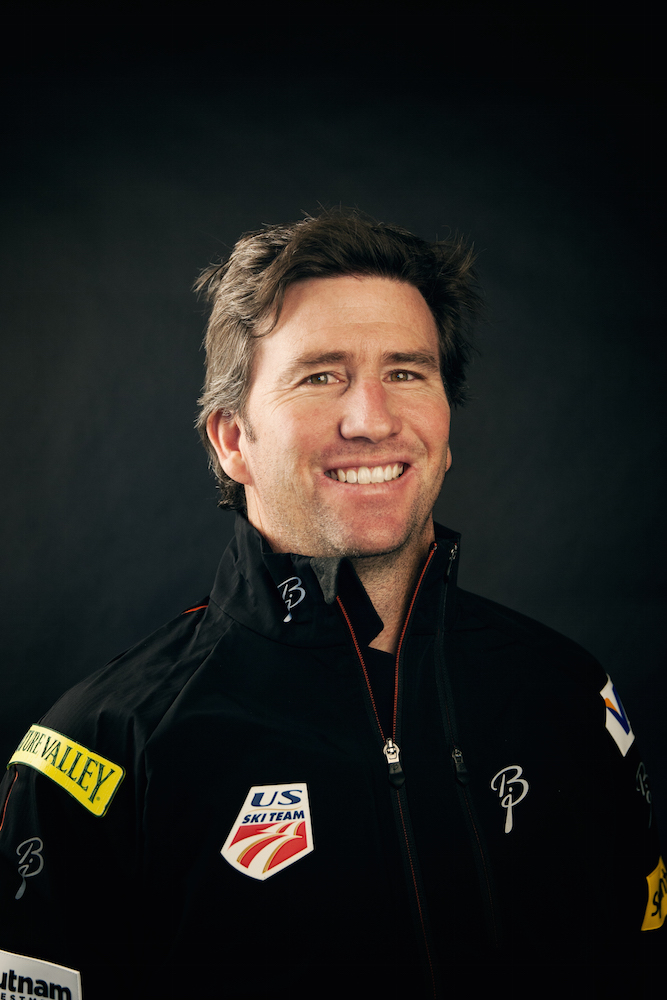
Dave Jarrett, head coach of U.S. Nordic Combined, during the 2013/2014 season. (Photo: USSA)
“Honestly, it’s amazing he lasted as long as he did,” U.S. Nordic Combined A-team member Bryan Fletcher said on the phone from his home in Park City, Utah. “He’s definitely a trooper, for sure. It was pretty intense because he was still employed by USSA and still had bosses there, but he also had bosses on USAN and had obligations on both sides of the coin. That combined with continuing his education research for coaching stuff, it adds up quick. And then doing all the travel logistics for not only World Cup but for World Cup and B-team and then having to be there in person, it was insane.”
Taylor Fletcher, another longtime U.S. Nordic Combined athlete and Bryan’s younger brother, also noted the stress on Jarrett.
“He had definitely been challenged … he had to go from a full-time coach to a full-time coach and a team manager,” Taylor explained on the phone. “He was in charge of doing a lot of the fundraising, and all the aspects to keep our sport alive in the U.S. And that really took a toll on him and that was definitely difficult on all of us. But also, I think it put way more weight on his shoulders than he really needed.”
Diminishing funds correlates to increased non-coaching responsibilities for coaches, less on-snow time and more connecting the non-competitive dots for athletes. Jarrett weathered that type of job description metamorphosis. Ski coaching at the elite international level is an all-encompassing life, and he lived it for 15 years.
“For me and my wife, we got married while I was still an athlete and so this is a lifestyle, the only lifestyle we have ever really ever known,” Jarrett said. “Both of my children were born in 2002 and 2004. Again this is a lifestyle that’s all they have ever known.”
Demong, USA Nordic’s executive director for the last year, has spent nearly his entire international-skiing career under Jarrett’s wing. The two became teammates back during the 1996/1997 season when Demong bumped up to national-team status.
“DJ had a good understanding of physiology, so he and I bonded over that in the beginning,” Demong said. “Especially given the fact at the time we had a really good team culture developing but we didn’t have the physiological expertise in our training programs and that sort frustrated both us. So we sort of found a commonality there right out of the gate.”
After completing his competitive career, Jarrett went on to earn a degree in exercise physiology and kinesiology from the University of Colorado. He was able to bring his education into play as he joined the coaching ranks.
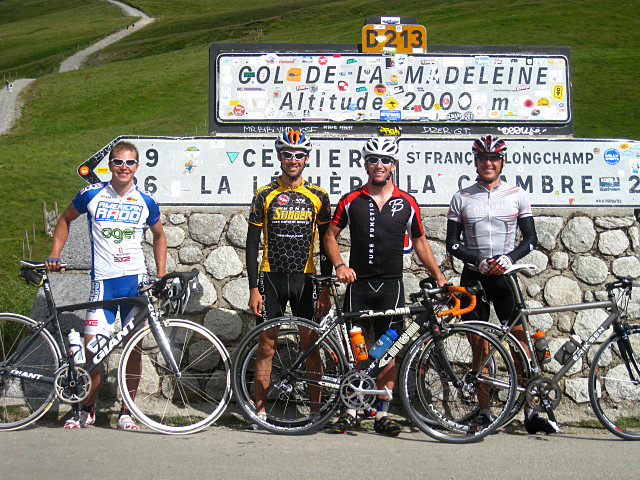
The U.S. Nordic Combined team takes a break at the top of the Col de la Madeleine during a 2009 training camp in nearby Courchevel, France. From left to right: Bill Demong, Johnny Spillane, coach Dave Jarrett, and Todd Lodwick (Photo: USSA)
“When he came back to coaching it was really a breath of fresh air,” Demong said about Jarrett’s academic and nordic-sports knowledge. “We had built this great culture and were all working really hard, but we still didn’t have the plan training-wise that I felt we needed.
“Going back to my high-school running days, we peaked when we wanted to peak for states and federations, and when we were doing our nordic training I felt like we were sort of doing what other nordic-combined skiers did, which was get up, ski, or get up, go jump, have lunch, go ski, go home,” he continued. “And DJ brought a ton of new ideas and concepts that he had learned in school as well as from networking with other sports. DJ really helped pioneer a lot of things on the physiological side and take our team from good culture, talented hard working athletes, to champions.”
Jarrett plans to open a strength and agility center in Heber, Utah, where he lives with his wife and children, the youngest of which will be entering eighth grade; his oldest will be a freshman in high school. As with any change, he said he looked forward to what the opportunity might bring and remaining close to his family. Yet looking back, Jarrett said he’d miss the small daily aspects of the sporting life.
“It’s the everyday victory I’ll miss,” Jarrett said. “I’m psyched to see the work that the athletes are putting in. The work that the coaching staff are putting in to see those everyday victories — those personal best, in testing, first time getting Continental Cup points, or first time getting World Cup points, or a World Cup podium. You can say the hardware is why you do it for sure, but I will miss is the everyday camaraderie and training.”
U.S. NoCo Moving Forward
Demong said the program remains stable heading into an Olympic season; Jarrett had been discussing a transition for the past several seasons.
“It had been something that has been on my radar for awhile and DJ certainly communicated early enough for me to to start planning, and quite honestly, we do have a good safety net,” he said.
U.S. Nordic Combined Assistant Coach Martin Bayer will step into the role of head coach. Bayer hails from the Czech Republic and began coaching domestically in the U.S. in 2000. He is currently based in Planica, Slovenia.
Demong said Bayer is entering this position with the institutional knowledge to make the coaching change seamless.
“Martin has worked his way up through the club system to the development team coach,” he said. “He has basically coached everybody onto the national team with the exception of Bryan, who is just a little bit older. So he has already a great relationship with all the athletes that are on the team. He knows all the athletes in the pipeline. … He knows the environment and he is familiar with how we operate, and there is a level of trust both from my end and with the athletes.”
Nick Huber will remain the program’s head ski-jumping coach. On the cross-country side of the sport, former U.S. national-team biathlete Jeremy Teela is advising the team. “He has agreed to come in and help us with domestic cross-country coaching and plan writing,” Demong said.
Jon Schafer, who had been U.S. Nordic Combined’s high-performance director for the last year, has also stepped down.
“Jon is a great and a good friend and very very exceptional high-level strategic thinker,” Demong said. “I think our organization is not at the point right now where we can take advantage of his talents and capacities fully, and quite honestly, we just need more boots on the ground. At this point, we are not going to fill that position. He has, however, written us a very detailed plan that we will be using as a road map going forward. It is a living document. For us, it is like everything from recruitment to medals and everything in between as it relates to coaches, education, and national-training centers.”
A business executive, Schafer brought management experience to USA Nordic, and on the sporting side, he was previously an elite-level rower and coach.
“My decision to step down was a very difficult one and one that I most certainly did not take lightly,” Shafer wrote in an email. “I loved working with the athletes and even after my departure, I am still very concerned about their success. It can be very difficult working in an environment of highly constrained resources, in particular with almost no support from USSA.
“Every position or idea simply cannot be funded and every shot has to be a kill,” he continued. “People are going to disagree about the best ways to spend highly limited funds and the tighter the budget, the harder it is to balance all of the different agendas. The organization has a lot of operational needs and the executive director and a few members of the board felt it was more important to have staff selling t-shirts, writing newsletters, marketing copy and other very ‘boots on the ground’ tasks, than a High Performance Director setting strategy and working with coaches and athletes at a higher level. I disagreed with this approach and since they couldn’t afford both, I tendered my resignation. I think this move is good for everyone, as the overall organizational dynamic proved to be a bit too bruising and tumultuous for an honest, easy-going, soft-spoken Midwest boy like me. I want to be very clear here too — my departure was a smooth and respectful one on both sides and I wish them nothing but the best.”
Always the jokester, Schafer (FasterSkier’s gear-review guru) added, “One big upside of this change for me too, is I now anticipate having much more time to write about how long you can wear your underwear without washing it. And perhaps teaching my Great Dane to finally respond to his name.”
The U.S. Nordic Combined team will meet in early May for an all-team camp, which will include all staff and any athlete with a chance of qualifying for the Olympics.
“It’s really going to be focused on learning more about ourselves, learning more about each other, learning how to communicate better and be tougher,” Demong said of the camp.
PARK CITY, UT (April 28, 2017) – Veteran U.S. Ski Team nordic combined coach Dave Jarrett, who led the team to heights of glory at World Championships and Olympics, is retiring after 15 years as a national team coach. Jarrett, a two-time Olympian who is now USA Nordic’s head coach of nordic combined, is leaving the tour to open a sports training center in his hometown of Heber City, UT.
Jarrett was a U.S. Ski Team athlete from 1992 through 1998, competing in two Olympics and three World Championships. He retired in 1998 and spent several years coaching cross country skiing at the University of Colorado. He moved to Utah after graduation, starting the first team program at Soldier Hollow in 2000 and then began a long tenure as a national team coach. He worked on the Continental Cup tour in 2002 and was elevated to head coach in 2008.
U.S. Nordic Combined Head Coach Dave Jarrett during the 2015/2016 season. (Photo: L.L.Bean/Lincoln Benedict)
During his tenure, the team has seen its best results ever produced, including the first-ever U.S. Olympic medals in the sport of nordic combined in Vancouver in 2010. The team won an unprecedented four medals in Vancouver, including one gold and a team event silver. A year earlier at the World Championships in Liberec, Czech Republic, the USA also won four medals including two golds from Todd Lodwick and another from Billy Demong as the Americans swept every individual title. All told, Jarrett played a role in 11 Olympic and World Championship medals won between 2003 and 2013.
Being on the road as a coach for a decade and a half can be grueling. Jarrett was philosophical in talking about his time spent with the team and what kept him coaching for so many years.
“I really enjoyed it,” he said. “I liked seeing progress. I liked seeing the athletes come to training motivated every day.”
When asked if there was a single moment or memory that stood out above the others, Jarrett said: “It’s easy to count the major wins. But I’m more proud of all the time in between—when athletes were rising through the ranks. All of the firsts are always good days.”
Jarrett was widely acknowledged for his role in U.S. nordic combined.
“DJ and I worked for nearly 20 years together in various capacities—from being Olympic teammates in 1998 to being coached by him at the 2010 Games,” said Olympic champion Demong, who now heads up USA Nordic. “I have tremendous respect for his track record of pioneering new training methods and continually seeking new ideas from other sports and nations. It is without a doubt his innovative approach that led us to win America’s first medals nordic combined. We thank him for all the invaluable leadership he brought to our program and wish him the very best moving into new opportunities!”
“It’s always gratifying to see athletes, like Dave Jarrett, give back for so many years,” said U.S. Ski and Snowboard Association Executive Vice President, Athletics Luke Bodensteiner. “DJ was able to build on the platform that was established over many years to lead U.S. nordic combined to its greatest success ever.”
Amidst all of his own achievements as a coach, Jarrett said that “seeing the return of former athletes, such as Bill Demong and Jed Hinkley, committed to keeping the sport of nordic combined going” was one of the things he was most proud of.
“After 15 years, there are too many people to name,” said Jarrett. “But thank you to all of the athletes, all the coache, and all the supporters that have been a part of the program and enabled us to achieve what we’ve been able to achieve.”
Jarrett will be putting his extensive coaching knowledge to work moving forward, opening an Athletic Republic franchise in his hometown of Heber City. The focus will be on speed and agility for those looking to make gains and improvements in their specific sports. Jarrett was clear that the programs are designed for all athletes, all levels, all ages and all genders. The new center is expected to open in summer 2017.
Jarrett lives in Heber City with his wife, Kelly, and two children, Jack and Lala. USA Nordic expects to make an announcement in the near future of its coaching alignment going into the Olympic season.
DAVE JARRETT – KEY COACHING MILESTONES
USSA Coaching Awards
2007 – USSA International Jumping/Nordic Combined Coach of the Year
2009 – USSA International Jumping/Nordic Combined Coach of the Year
2010 – USSA International Jumping/Nordic Combined Coach of the Year
2010 – USSA International Overall Coach of the Year
2015 – USSA International Jumping/Nordic Combined Coach of the Year
Athletic Results
2013 Nordic World Championships – Val di Fiemme, Italy
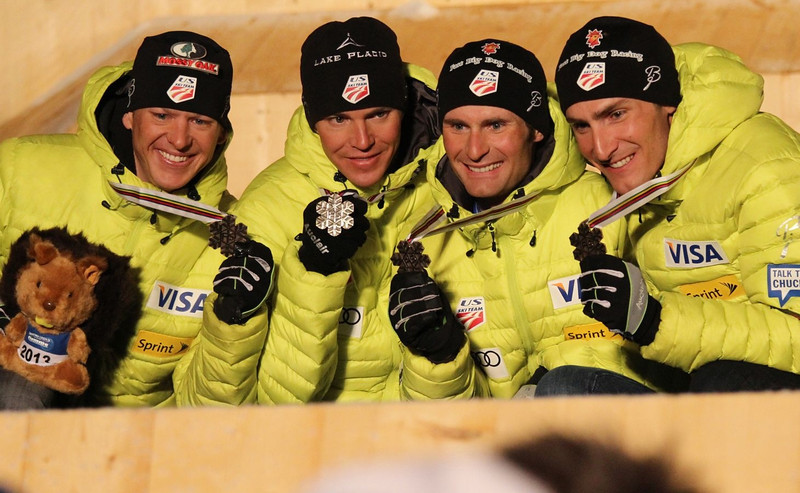
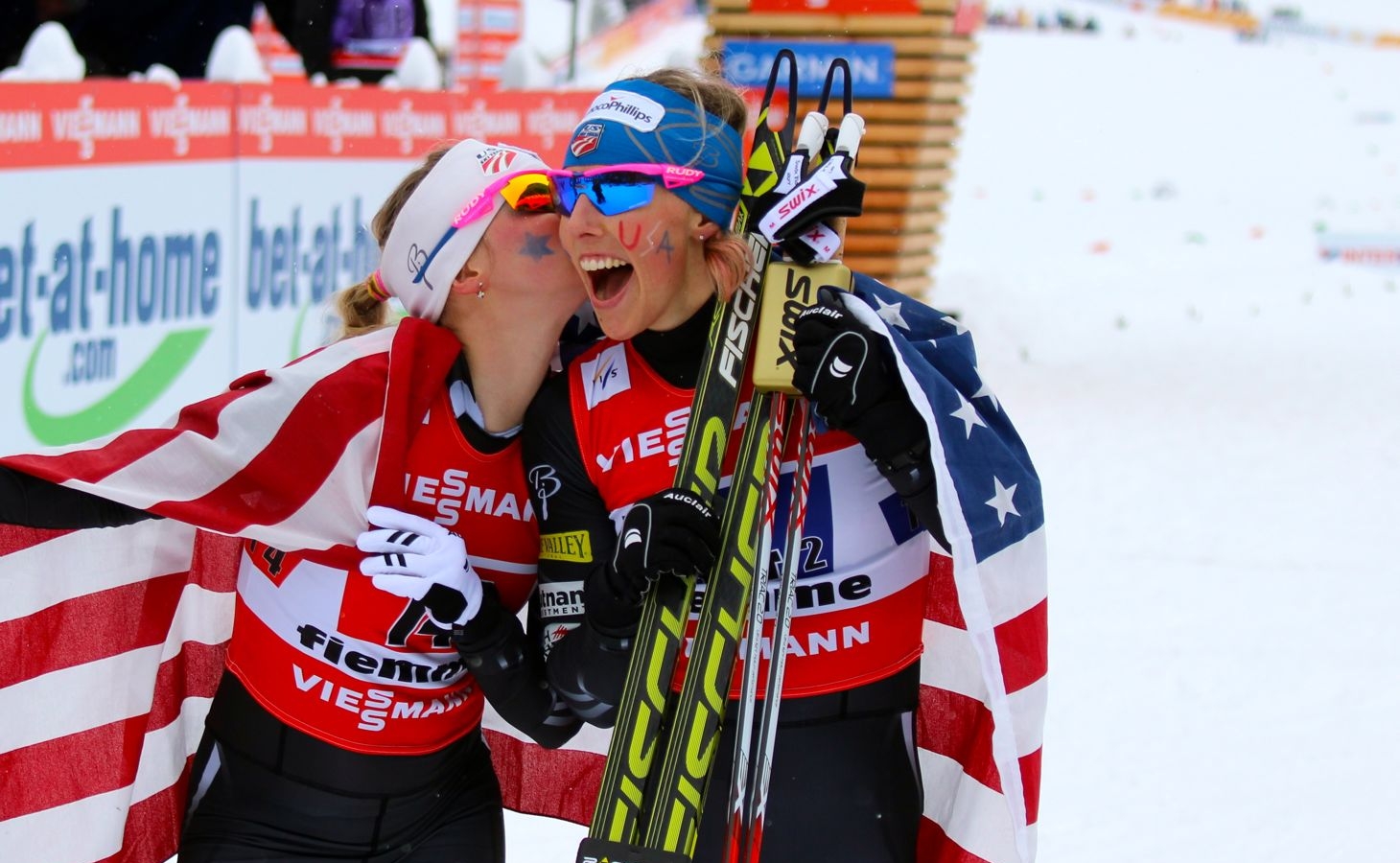
Bronze – Team Event (Taylor Fletcher, Bryan Fletcher, Todd Lodwick, Billy Demong)
2010 Olympic Winter Games – Vancouver
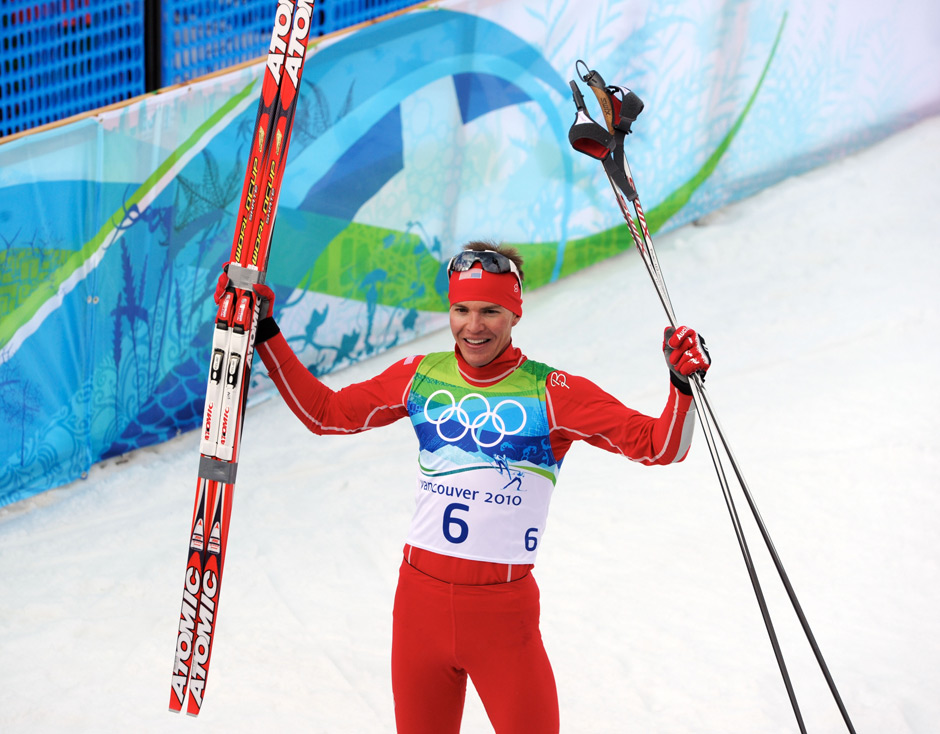
Gold – Billy Demong (large hill)
Silver – Johnny Spillane (normal hill)
Silver – Johnny Spillane (large hill)
Silver – Team Event (Brett Camerota, Johnny Spillane, Todd Lodwick, Billy Demong)
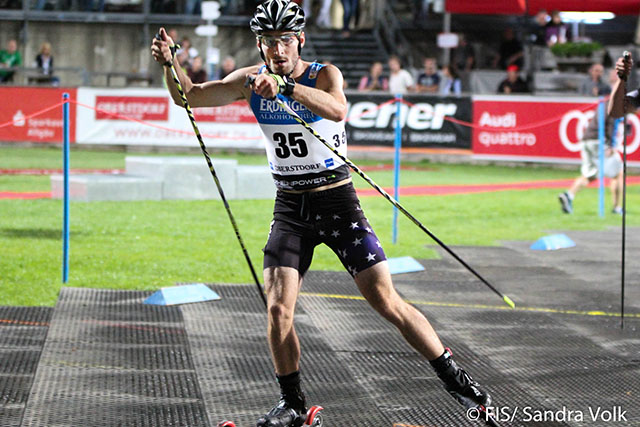
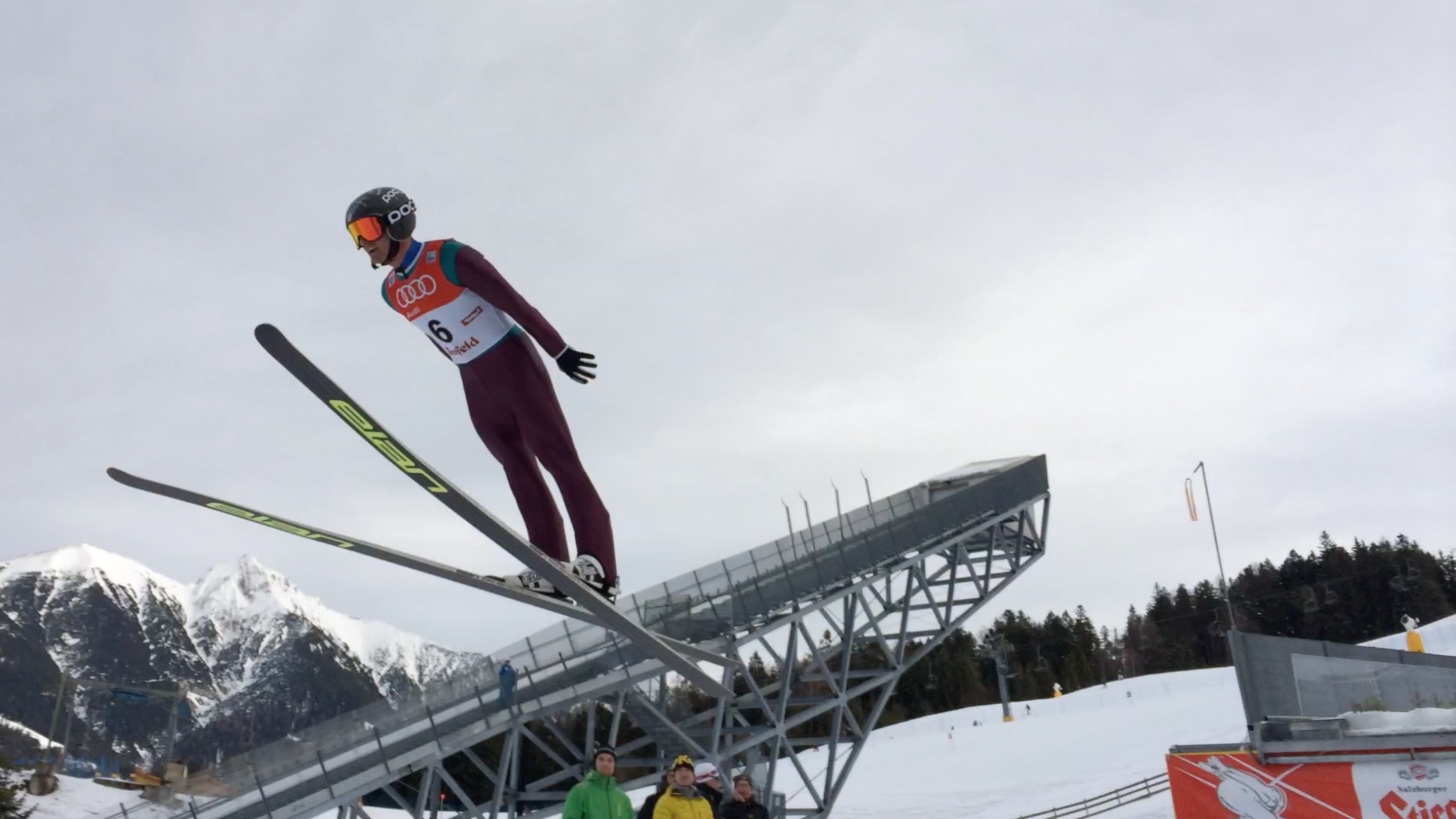
Taylor Fletcher (U.S. Nordic Combined) in Oberstdorf, Germany, during the FIS Nordic Combined Summer Grand Prix where he placed 15th overall in the series. (Photo: FIS/Sandra Volk)
(Note: This article has been updated to include comments from Taylor Fletcher.)
Logging hours: the rollerskiing, the jumping, running, strength and the in-between. For full-time athletes breaking up the quotidian cycle can be a spark. For the U.S. Nordic Combined team, late August and early September were spent racing events in the International Ski Federation (FIS) Nordic Combined Summer Grand Prix.
The last stop on the condensed three-venue tour was hosted by Oberstdorf, Germany, on Sept. 2 and 3. There, two things of note were evident.
First: 18-year-old Norwegian phenom Jarl Magnus Riiber flat-out dominated. He was first in three of the four individual races he contested. (On the second leg of the four Grand Prix individual races, Riiber scored the highest in the jump portion — he did not enter the roller ski leg.) Despite scoring in only three of four events, Riiber won the Grand Prix overall.
Riiber’s jumping dominance was sustained. In both Oberstdorf races, Riiber was the highest-placed jumper heading into the 10 k ski leg. On Friday’s race, the next closest skier, Germany’s Tobias Simon, started one minute and four seconds back. For Saturday’s race, a modest 59 seconds was Riiber’s head start.
But analyzing times reveals Riiber is still developing as a skier. He skied the 30th fastest time, winning by 13.7 seconds, on Friday.
Norway’s Jarl Magnus Riiber on his way to the FIS Nordic Combined Summer Grand Prix overall. (Photo FIS/Sandra Volk)
On Day 2, 17.6 seconds was Riiber’s margin of victory. Of the 51 skiers beginning the rollerski portion, Riiber raced only the 36th fastest time on the day. No matter, the young Norwegian prevails.
Second: the U.S. is showing promise in the jumping rounds and Taylor Fletcher has proven the ski shape is good.
On the U.S. side, let’s start with Fletcher. He jumped to 29th on Friday and began the rollerski 2:50 behind Riiber. Six laps later on the 1.75 km course, Fletcher had skied the fourth fastest rollerski leg, moving him up in the standings to 18th.
In a USSA press release, Fletcher made a point that Riiber has changed the jumping game. “The level of jumping is so high right now because of one guy,” Fletcher said. “He is the best jumper in all of Norway and could easily be the top guy on the ski jumping World Cup. That being said, to only start 2:50 behind him is somewhat a success. In the meantime, we are going to continue to jump and work on the technical aspects of jumping to close that gap down.”
FIS has implemented a rule change that places a higher value on overall jumping distance. Instead of the previous 1.5 points earned per meter jumped, now nordic combined jumpers are given 1.8 points per meter jumped. With a phenom jumper like Riiber, that marginal .3 point / m increase adds up. The time back for start position in the ski phase is decided by total points.
U.S. Nordic Combined Head Coach Dave Jarrett told USSA that Riiber is a one-man show racing for margin of victory. “Jarl Riiber is jumping on a very high level. He is splitting the field in every competition. And with the new rules changes, it became solely a race for second and third.”
Fletcher jumped to 35th during Saturday’s competition, flying 113 meters. Again, Fletcher played catch up on the ski. And he did catch up. He skied the third fastest time, strong enough to propel him up the standings to ninth overall (+1:20.8).
The European trip was a good sign for Fletcher as he finished the Grand Prix series ranked 15th despite being disqualified in Villach, Switzerland, the second leg of the series, due to a jump suit violation.
In an email, Fletcher described how he plans to challenge Riiber off the hill. “There are a few things that will allow me to close the gap to the leader which will make me closer to podiums for sure,” Fletcher wrote. “One thing is I can lose some weight for the jumping, which I have been doing. When I do this, I need to be careful that I don’t get too light as it will affect my cross country as I won’t have the same power. Another thing that will help is being more explosive and powerful on the take off, to do this I have been in the gym more this summer and reworking my strength and power programs to do this but its a process and you can’t expect it right away.”
The takeaway for Fletcher as the colder months approach leaves him optimistic. “I am happy with how the performances were in Europe.” Fletcher explained. “I was jumping at a much better level than last year and I was more in the hunt for the top places. Even though I was jumping better, I still don’t think I had my best jumps but they were still good. The cross country is right where I was expecting it to be and I will continue to progress as the summer and fall moves on! I am excited to get ready for winter as I know where I am in the pecking order and what to expect going into the first competitions of the year.”
The other senior U.S. players along for the Grand Prix ride were 18-year-old Ben Loomis and Ben Berend, 21. Loomis finished Day 1 of the Oberstdorf round in 32nd (+3:07), Berend 35th (+3:25.3).
Yet both skiers showed moxie off the jump. Loomis jumped to 16th while Berend was a place behind in 17th.
Day 2 proved another solid day off the jumping hill for Berend and Loomis. With 115 points after the jump, Berend’s effort was good enough for the 12th-best jump. Loomis was 10 spots back in 22nd. After the skiing portion, Loomis finished in 33rd, with Berend in 36th.
U.S Nordic Combined skier Ben Berend stoked on his jumping in Oberstdorf, Germany. (Photo: FIS/Sandra Volk)
In an email exchange with Berend, he explained the team is positive. “I would say that as a team the sensation is that we are moving in the right direction, Berend wrote. “This offseason we hired an Austrian jump coach Nik Huber. He has really given us a lot of confidence on the jump hill. Taylor showed in Oberwiesenthal that he can fight for a podium on the last lap. If Bryan was here, I truly believe he would have been fighting for the podium as well … The goal is to eventually have a strong enough 4 man team to fight for podiums at World Championship and Olympic Events. I think seeing Ben Loomis and I jumping into the top 20 is a huge step in that direction. It seems everyone is happy with where they are at right now. The next step is improving on that form before the winter.”
(Bryan Fletcher remained in Park City where he welcomed his newborn daughter last month.)
With a competitor like Riiber, establishing big time gaps with his jumping, it’s paramount that U.S. skiers like Berend attempt to minimize that gap with improved jumping.
“Throughout the two week Grand Prix Tour I had some of the furthest jumps on the hill,” Berend wrote. “By the time we got to Oberstdorf my confidence was through the roof. It got to the point where I knew I was going to go far even with a bad jump (Saturday’s 17th place was with a bad jump). This took a lot of pressure off of me and I was able to relax and just execute. In the past I have been inconsistent on World Cup. One day I jump to 10th and the next day I would jump to 45th. During the Grand Prix I jumped to 19th, 17th, and 12th. This is definitely the kind of consistency I have been looking for.”
The Nordic Combined World Cup season begins Nov. 27 in Kuusamo, Finland.
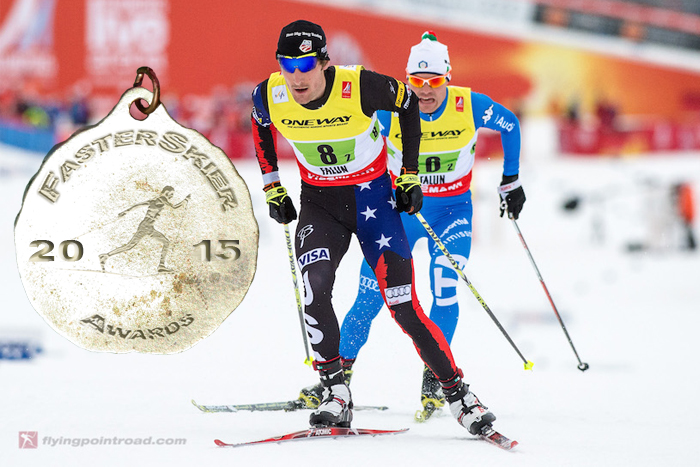
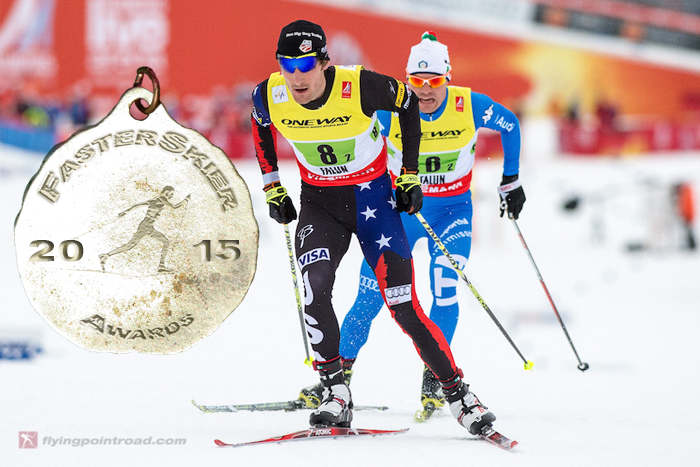
Billy Demong, a former U.S. Nordic Combined skier and five-time Olympian, jumping at 2015 World Championships in Falun, Sweden. (Photo: FlyingPointRoad)
Twenty-two World Cup podiums and five Olympics later, Billy Demong can’t leave what’s in his blood behind; he was born to jump and ski fast. No, Demong, 36, is not announcing a comeback — he retired from international competitions after the 2014/2015 Nordic Combined World Cup season. For a year he stayed away. Post-retirement, Demong worked in marketing for Utah-based Reynolds Cycling. He’s back as executive director of USA Nordic Sport.
Let’s turn back the clock for a moment to gain some perspective. Beyond Bill Koch’s 1976 Olympic medal, the U.S. Nordic Combined team remains the only other nordic discipline to win a coveted Olympic medal. In 2010, Demong won an individual gold and was part of the team relay silver in Vancouver, British Columbia.
There’s a reason to reference past Olympic glory — as part of this narrative, it matters.
A scant four years after the Vancouver Games and two months after the 2014 Sochi Olympics, the U.S. Ski and Snowboard Association (USSA), once the primary funder and governing body responsible for U.S. Nordic Combined, dropped most of its funding for nordic combined. It was a seismic event that most insiders had a feeling was coming. Current U.S. Nordic Combined Head Coach Dave Jarrett said at the time, “Based on [USSA’s] study in 2010 that eliminated jumping in other sports, they didn’t think nordic combined was a podium-potential sport for 2018 or 2022.”
Looking back, Demong voiced his understanding of USSA’s decision.
“At the end of the day it really comes down to resources,” Demong, now in his full-time role with USA Nordic Sport, said on the phone late last month. “Resource allocation is a tough thing. USSA, they are successful organization — I have watched them grow and develop. But there are a lot of teams and a lot of athletes. There were a lot of hard choices that needed to be made, but I believe in the potential of the athletes we have in the pipeline today and the opportunity for long term sustainable success with strong leadership in both ski jumping and nordic combined.”
The defunding setback also served up an opportunity for the primary nordic-combined stakeholders to take ownership over the sport’s viability.
“The community of ski jumping and nordic combined athletes and alumni have historically really leaned on USSA to develop athletes and I think now over the last six-seven years, we have taken a lot of that back onto our community,” Demong explained. “And it’s been successful. I think we have some of the best athletes in the pipeline right now that we have had in a long time in ski jumping. We have some great up and coming talent in nordic combined. And we have a growing base. Last year we developed a study that indicates about 800 kids put bibs on or participated in a program. So it is a healthy number for a sport that is not big anywhere.”
The community Demong referenced was not beginning from scratch. An organization named USA Ski Jumping — founded originally by past ski jumping and nordic combined Olympic athletes and coaches including Rex Bell, Jim Holland, Jeff Hastings and Alan Johnson — was already carrying the ski jumping torch. With their help over time, Demong said during the interview, that group worked to grow and develop the scope of the organization. In the spring of 2015 they adopted new bylaws and became committed to assisting the nordic combined community. With the more inclusive snow sport focus, the organization was renamed USA Nordic Sport. And two months ago, Demong was named its Executive Director.
Back to Demong’s World Cup and Olympic credentials. Demong offers proof that the US can develop nordic combined skiers ranging from kids soaring off small-scale jumps to international champions. He also comes with the cache of Olympic hardware: that can be a draw when soliciting funds and volunteers.
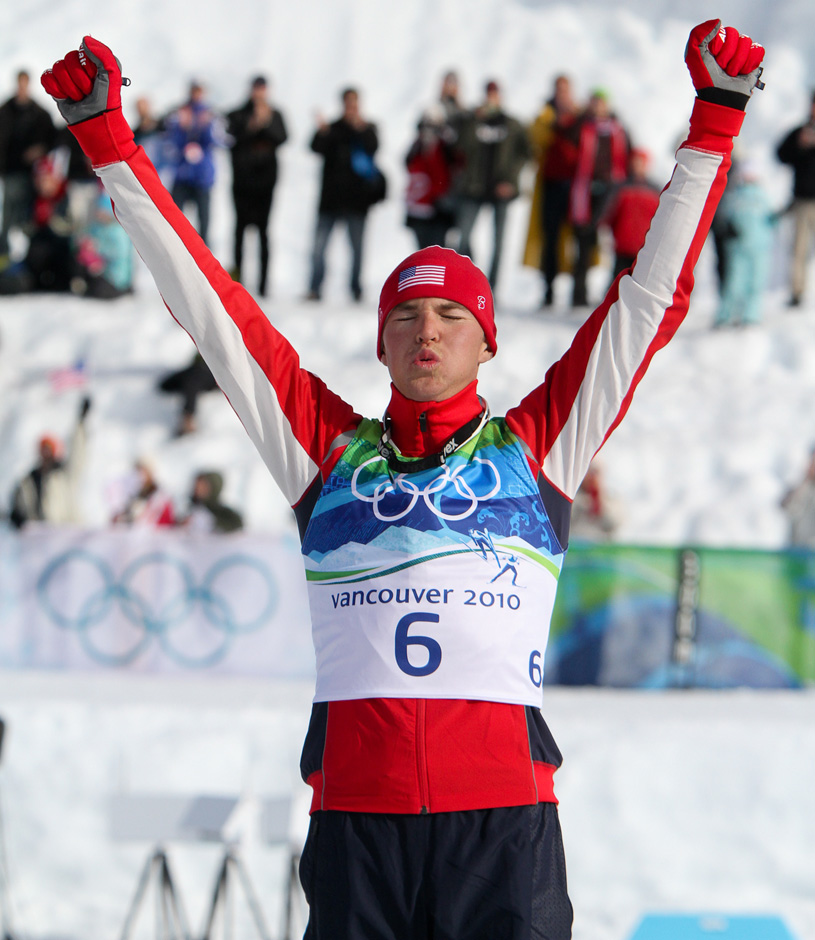
Billy Demong soaking up his victory atop the podium after winning the individual large hill competition at the 2010 Vancouver Winter Olympics.
The whirlwind of a new job and mission have given Demong a fresh perspective of what endurance means beyond chasing elite skiers around a loop.
“The first two months here have been exciting,” Demong said of his appointment as Executive Director. “I feel very passionate about what I am doing and there is a lot going on every day. Because this isn’t simply going out and raising some money and spending it. We’ve got ten staff. We’ve got a lot people and we are working together and making sure that everybody’s efforts are moving the sports in the right direction together. That requires a lot of time and energy as well as raising funds and keeping our audience and community engaged.”
Ski jumping and nordic combined are not completely devoid of USSA’s support and input. Demong noted that USSA is the National Governing Body. Therefore, nordic combined’s FIS representatives are appointed by USSA. And sponsors like LL Bean and Craft — both sponsors of the U.S. Cross Country Ski Team — also uniform the nordic combined team. Additionally, team USA’s head nordic combined coach remains Dave Jarrett and his position, as well as a grant for sport development, are funded by USSA. In this fashion, a quasi partnership has emerged between USA Nordic and USSA.
USA Nordic Sport (USANS) operates much of the day to day business of the U.S. Nordic Combined and U.S. Men’s Ski Jumping teams (women’s ski jumping has been its own entity since 2003, Women’s Ski Jumping USA). It’s also tasked with growing the sports of ski jumping and nordic combined, fielding competitive elite and international teams and building a pipeline of athletes for the future. This last part of the equation, Demong said, is where USANS is placing much of its effort as they support their pre-existing athletes and clubs while building a broader community.
“We are focusing a lot of our efforts on the operating clubs we have, adding new clubs as opportunities arise, establishing and disseminating best practices to those clubs so they can develop,” Demong said. “They can recruit more athletes, they can engage those athletes and those communities, and develop higher-quality experiences and opportunities. Ultimately, that is really our big goal right now, basically one team, one community, where all of our nordic combined and ski jumping clubs, and athletes, coaches and parents feel like they are part of something bigger. And athletically, we are really focused upon recruit, retain, and engage.”
“That is really our big goal right now, basically one team, one community.” — Billy Demong, USA Nordic Sport’s executive director
Specifically, Demong said that USANS has a detailed plan to execute the mission. They can assist clubs with building low-tech jumps made of snow and absent any permanent jumping structure. For more ambitious clubs, USANS will provide building plans, detailed architectural drawings of jumps, and the tools to build and operate a facility.
“The medium-range goal is to take these small feeder clubs, and if there is local desire and a champion, to help them drive a fundraising effort to build a more sizable hill,” he added. “We would like to be able to help accomplish that, and additionally, provide opportunity and a pathway for athletes that want to take it to the next level.”
Taking it to the next level could mean higher-end jumping equipment and travel assistance to places like Park City, Utah, that host events for aspiring jumpers and skiers. One Park City-based summertime event is called Springer Tournee — it doubles as the US Large Hill Ski Jumping and Nordic Combined Championships. USANS also organizes what they call Virtual Nationals. It’s a low-cost low barrier of entry competition allowing juniors to participate in a nationwide event without leaving their local jumping hill.
“What we do is we ask the kids and parents to send in videos of their children jumping and then they are broken into classes like U-10 girls, U-12 boys, etc.” Demong said. “Last year, we had a group of judges like Sarah Hendrickson and Clint Jones … that basically allowed the kids to compete in their peer group around the country. So that’s been really effective in getting everybody engaged together.”
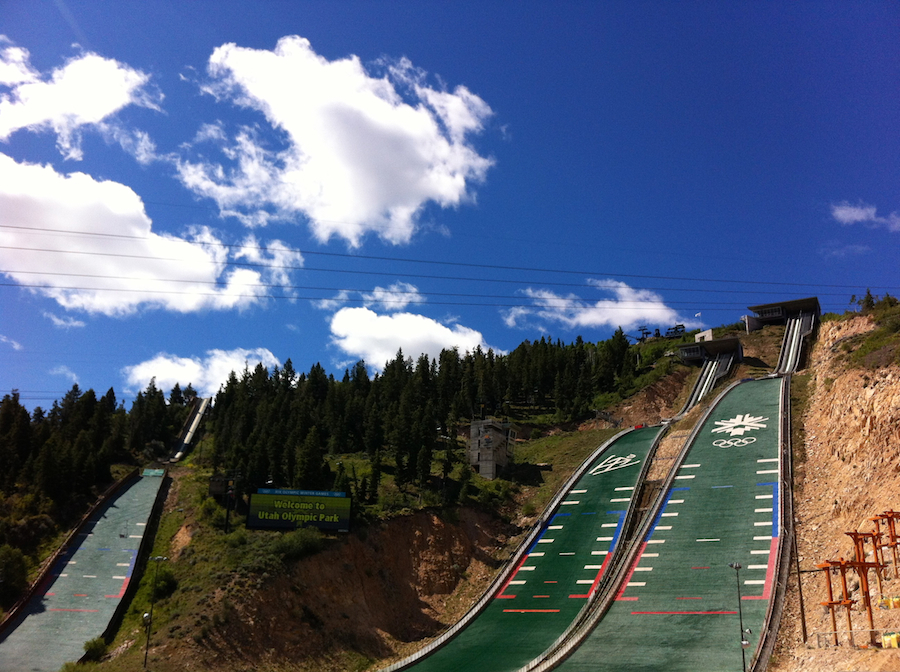
The U.S. nordic combined and ski jumping hills in Park City, Utah (Photo: Mikko Kokslien)
Demong said nordic combined has suffered from a lack of record keeping when it came to junior development. He hopes things like Virtual Nationals will help change that dynamic.
“That has been one of the struggles historically — we have some clubs with quite a few athletes but nobody has really been keeping records,” Demong explained. “Does U-12 usually make to U-16? We know that we have attrition along the pipeline just like any sport, but how can we have less? How can we retain more? How can we have a more complete pipeline from first jump on a 10-meter to a World Cup team?”
Demong insists the health of jumping and nordic combined are way beyond life-support status. On the contrary, Demong believes his beloved sports are poised for growth. That may, in some part, be attributed to the roughly fifty percent of the population — women — traditionally unable to participate in jumping and nordic combined. Although opportunities to jump internationally are not on par with those afforded to men, 2014 marked the first time women’s ski jumping was an official Olympic sport.
On the nordic-combined side, Demong mentioned this winter will be the first for women’s international nordic-combined competitions without an age limit.
“In the past couple years, when women’s nordic-combined has been brought online, it has been age limited to mostly junior competitions, and now all of sudden there is going to be open class, senior-level events. It will not be in PyeongChang [South Korea for the 2018 Olympics], but certainly I think it is tracking to be in Beijing [in 2022]. And so that is something Dave Jarrett has definitely been a proponent of at the FIS level and is also preparing to gear up to develop a national-team program for that as well.”
With new ventures moving forward, Demong also mentioned the links cross-country skiing and nordic jumping sports share. In his eyes, they each possess attributes that benefit the other.
“Cross country is an amazing sport. It’s so difficult, it teaches so much discipline and perseverance and work ethic, and a host of other core values. They obviously have the same heritage,” he said. “And there is a whole other set of values ski jumping offers for personal growth, like courage: the ability to stand on top of the in-run, even to stand on top of the 40-meter [hill] and look down as a good skier and know that if you let go to the bar there is no backing out. It is a skill set unto itself. If I had one vision for our nordic communities, it is that we will continue to work together to provide as many participants as possible the opportunity to experience all that the nordic sports have to offer… I think there is a tremendous opportunity there … to add some additional skills to the cross country side by participating at whatever level in some ski jumping activity and vice versa.”
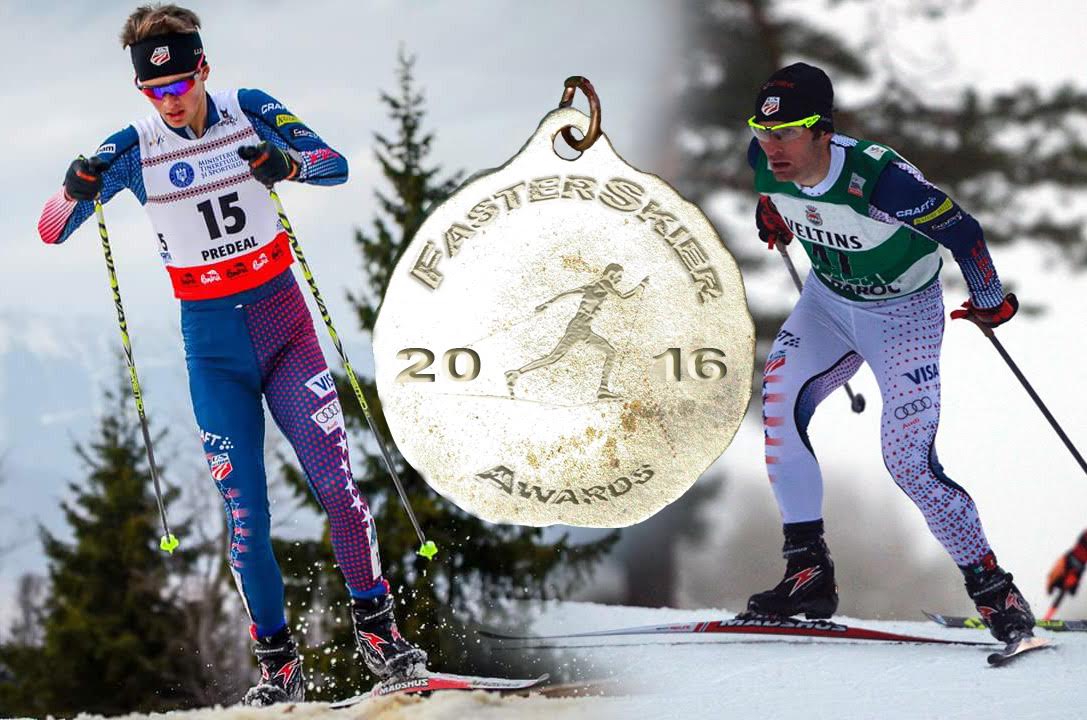
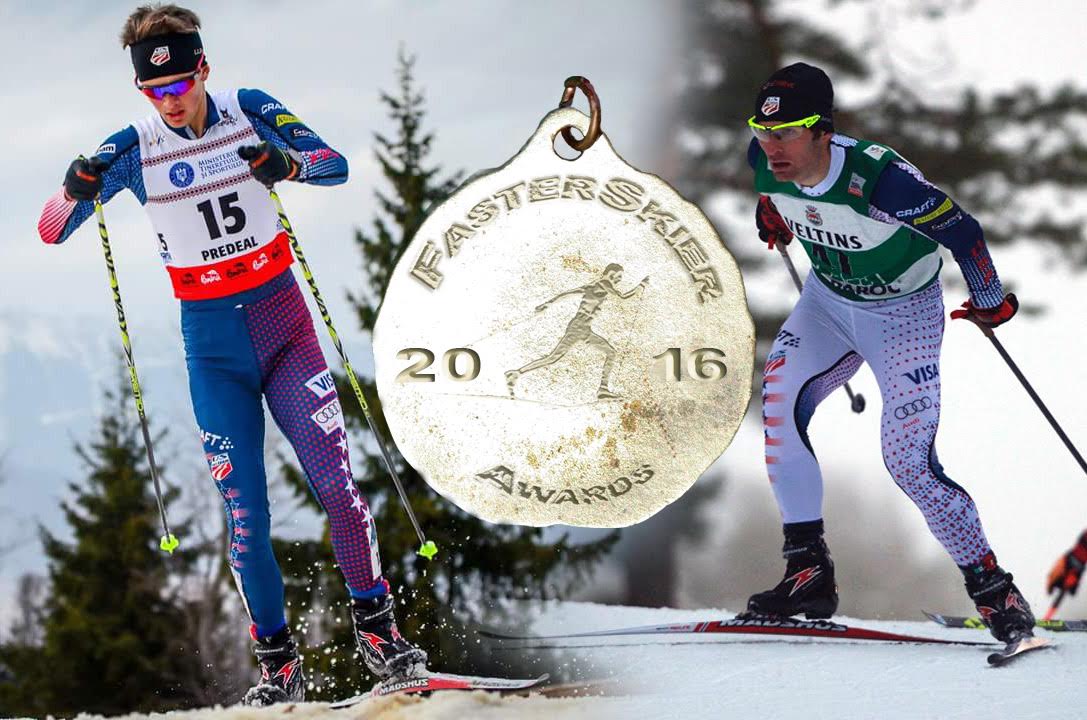
U.S. Nordic Combined World Cup skier Bryan Fletcher (r, seen racing in Lahti, Finland, and 19-year-old Jasper Good (r), racing to 11th at 2016 Junior World Championships, are FasterSkier’s Nordic Combined Skiers of 2016. (Photos: Jasper Good and JoJo Baldus)
With the 2015/2016 season officially in the rearview, FasterSkier is excited to unveil its annual award winners for this past winter. Votes stem from the FS staff, scattered across the U.S. and Canada, and while not scientific, they are intended to reflect a broader sense of the season in review.
***
Bryan Fletcher, U.S. Nordic Combined A-team
In a season without any World Championships and without any podiums for U.S. Nordic Combined, the eldest man on the team — 29-year-old Bryan Fletcher — stood as the most consistent on the World Cup from December 2015 through March 2016.
Leading the team without the likes of Billy Demong (who retired last spring) and with just one other World Cup veteran on the A-team (younger brother Taylor Fletcher), Bryan finished the season 20th overall in the World Cup. Taylor ranked 31st overall.
Together, the two brothers placed sixth in a team sprint in late February in Val di Fiemme, Italy. Individually, Bryan had a season best of seventh in Seefeld, Austria, where he also placed ninth for his second-best result of 2015/2016.
Taylor, 25, tallied three Continental Cup podiums in December at home in Park City, Utah, including a victory, and spent much of the World Cup season hovering around the top 25.
“The team sprint was for sure Taylor’s and I’s highlight of the weekend,” Bryan wrote in an email after the Val di Fiemme World Cup. “It was nice to have some decent jumps and a solid race to get us into the fight. It’s the best team sprint result we have had as a duo and the best since Todd Lodwick and I were fourth in Ramsau in 2013 I believe. Honestly, while 6th is a solid result, Taylor and I were hoping for a little more …”
That desire for more was the running theme of the season, at least for Bryan. At the preceding World Cup in Kuopio, Finland, he placed 12th with the second-fastest time in the 10-kilometer skate race.
“I am happy to be 12th, but I was hoping for a little more,” he told USSA.
Overall, the team found positives within its performances. Up-and-coming athletes, like Ben Berend, posted competitive jumps.
“…The highlight was Ben Berend jumping to 10th,” Bryan wrote of the Val di Fiemme weekend. Berend went on to place 34th. “It was awesome to see him step up his game there and he hung tough in the race narrowly missing out on points in some incredibly hard conditions.”
In all, the 20-year-old Berend’s career best was 33rd, which he posted in February in Lahti, Finland.
In his fourth trip to Junior Worlds, Good notched 11th and 12th in the individual competitions and sixth with teammates Jared Shumate, Stephen Schumann, and Ben Loomis in the 4 x 5 k team event.
Americans (from left to right) Ben Loomis, Stephen Schumann, coach Martin Bayer, Jared Shumate, and Jasper Good after an individual competition at 2016 Nordic Combined Junior World Championships. Not pictured: Koby Vargas. (Photo: Jasper Good)
“I wanted to put myself in the fight for a top 10 finish and I did that both days so to some degree I am happy with that,” Good wrote in an email afterward.
“Although I really wanted to break the top 10 I am happy as I was able to put two consistent competitions together,” he continued. “Both days were what I would call an accurate portrayal of my average level. I am happy that my average had me finishing in the top 15 on both days but a little disappointed I wasn’t able to have a slightly above average day to get me into the top 10.”
According to Good, sixth in the relay was a team best at junior worlds.
“I think the fact that our team event rank has been improving every year I have been on the team is a huge testament to the potential coming up in US Nordic Combined!” he wrote.
At the Park City Continental Cup, Good notched three top 20’s with a best result of 13th.
Of note:
The 2015/2016 Nordic Combined World Cup season was a tough one in terms of lack of snow, especially for teams like the U.S. fighting for quota spots.
“We earned a wildcard in the first period with the results at Soldier Hollow,” U.S. Nordic Combined coach Dave Jarrett explained in January, after three of five World Cup weekends had been canceled. “Every race that we have had the ability to start five guys on the World Cup has been canceled so far. … We really needed to get some new names on the points scoring list that we haven’t had before.”
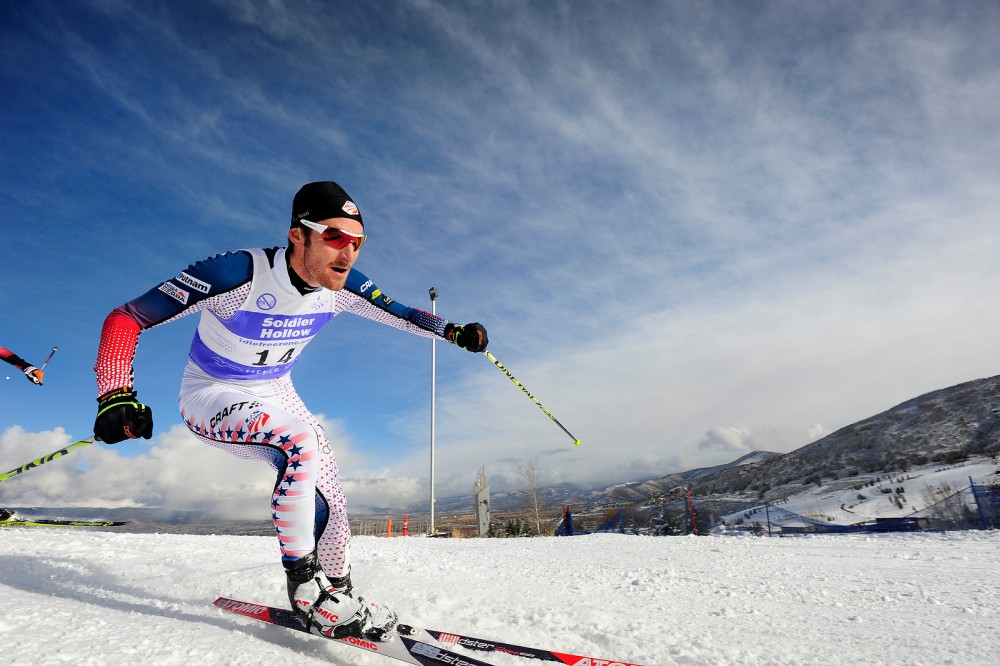
Taylor Fletcher (U.S. Nordic Combined) charges around a corner in a 10 k Nordic Combined Continental Cup cross-country race in December at Soldier Hollow in Midway, Utah. (Photo: U.S. Ski Team/Tom Kelly)
It will have been since Dec. 20, over one long month, since the last Nordic Combined World Cup event. That lack of high-end competition can take its toll on athletes and on the national organizations and regional clubs constituting the sport’s backbone of support. The U.S. Nordic Combined team is no stranger to the vagaries of where their funds are coming from and when the next high-level competition will take place.
Unlike its cross-country cousin, nordic combined is not simply snow-dependent — it’s also dependent on calmer atmospheric conditions. In other words, if it’s too windy, or the winds are too swirly, too unpredictable, the jumping can be cancelled. The first scheduled World Cup in Kuusamo, Finland, Nov. 28-29 was canceled due to dicey wind conditions. The next weekend’s races, in Lillehammer, Norway, had a modified schedule on the first day of competition because of winds: judges canceled the jumping, using the provisional jumping results from the day before, to set the cross-country ski portion’s start order.
The Ramsau World Cup in Austria got off the ground Dec. 19-20, but the cancellation trend continued after holiday break. A lack of snow led organizers to cancel the Jan. 2-3 World Cup races in Klingenthal, Germany. The following weekend’s races Jan. 16-17 in Chaux-Neuve, France, were postponed a week also due to low snow. (Currently, those races are scheduled to be held this weekend, Jan. 23-24.)
Lack of snow and periodic cancellations are something U.S. Nordic Combined Head Coach Dave Jarrett must stomach. “It’s a real tough thing because it’s not anything we can control, mother nature which is difficult,” Jarrett said in a phone interview from Park City, Utah.
Adam Loomis (U.S. Nordic Combined B-team) in a competition jump (Photo: National Nordic Foundation)
The U.S. team has taken what they can control and made the best of it. Back in December, the U.S. men entered several skiers in what amounted to a local series of Continental Cup races with jumping at Utah Olympic Park in Park City and skiing at Soldier Hollow in Midway. Their objective: earn enough points to advance more skiers to the World Cup stage.
Jarrett and the team met that goal. But it remains bittersweet.
“It also adds a little bit of a sting, we earned a wildcard in the first period, with the results at Soldier Hollow. Every race that we have had the ability to start five guys on the World Cup has been canceled so far, and we are not going to get those chances back. Even if they reschedule them later in the year, they’ll occur in a different period,” Jarrett said. “You now that was the the hard thing, because we really needed to get some new names on the points scoring list that we haven’t had before. We have two more chances though.”
If the World Cup schedule proceeds as planned, the U.S. can bring five skiers to both the Chaux-Neuve races and to the following week’s races in Seefeld, Austria.
Excited to be back in @ChauxNeuve for the @fisnc world cup! Even more pumped to see it dumping snow with cold temps! Lets hope it stays!
But getting new names on the list is something Jarret mentioned several times. And with the current period ending after the Seefeld rounds, the pressure is mounting for results; the number of U.S. start positions depends on it.
“If Adam Loomis, for example, doesn’t get some World Cup points to maintain his spot, then his points will expire, and so we will lose his spot. Bill Demong [who retired this past spring] had points from last year that are set to expire at the end of this period, and we know that he is not going to earn those points back. So we know that that spot is going to expire,” Jarrett explained.
“So right now, we need to have more different names on that list: the Adam Loomis’, the Ben Berends, the Michael Wards. They need to step up because Bill [Demong] is not around anymore, and Todd [Lodwick] is not around anymore, and Johnny [Spillane] is not around anymore. Adam did it last year, but Adam has not gotten any points this year, so he needs to do that as well. There’s a realistic chance that after Seefeld, if nobody gets enough World Cup points, we will only have the ability to start two guys on World Cup for the next weekend at Oslo.”
The Oslo race on Feb. 2 begins the new period.
Training and Maintaining
After the first post-holiday competition was canceled, Bryan and Taylor Fletcher decided to remain stateside, basing themselves in Park City. Maintaining race fitness hasn’t been as difficult, as both are cross-country racing locally.
“But there’s definitely that mental edge, that competion edge that you have once the season starts and you are going weekend into weekend, it’s competition time,” remarked Jarrett. “And it’s hard to replace. The good thing is that it’s been the same for everyone. It’s not like somebody’s injured and they are trying to come back, and there’s been competitions going on. Their hasn’t been competition. We’ve been maintaining fitness as best we can. “
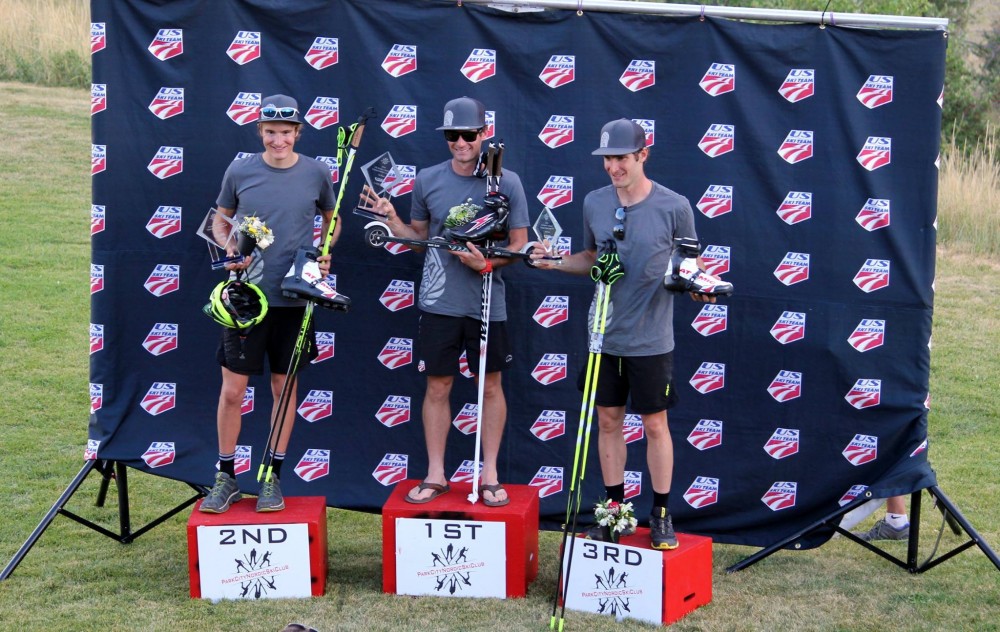
The podium at the 2015 U.S. Nordic Combined Championships, which were held in Park City and Midway, Utah: with winner Bryan Fletcher (c), second-place finisher Adam Loomis (l) and Taylor Fletcher in third. (Photo: USSA/Tom Kelly)
At least for the Fletchers, Park City remains a locale with an upside.
“We are at an advantage at altitude to be here and living here,” Jarrett said. “And we can assimilate sea level. So I feel pretty good about the way that they are, but it’s more that competition mindset.”
The remaining four U.S. Nordic Combined skiers, Adam Loomis, Ben Berend, Jasper Good, and Michael Ward, have remained in Europe to train.
Although race cancellations may impact quota spots, it also impacts the bottom line for his skiers.
“If we are not there, we are not paying to be there,” Jarrett said of expenditures. “We have had to pay some airline ticket changes, and things like that, but you know if we are not there we are not collecting travel money [from FIS], at the same time we are not spending money on accommodations and things like that.”
Beyond impacting institutional finances, race cancellations also impact small wallets. “It’s also they are losing the opportunity to make prize money, which also, when you look at the big picture, they have bills to pay and things like that. Certainly, having no event and no opportunity to earn money is another big big piece of the puzzle.”
With earning potentials compromised, the team must rework how it allocates funds. That puzzle problem is compounded by the team’s insecure quota spots.
“We project revenue based on quota spots, and collecting travel money based on those quota spots. So when there is cancellation you don’t collect that money and if they. If you have a stable quota then it doesn’t matter, they make it up in the next period, but our quota is going to start fluctuating,” Jarrett said.
So quota spots, funding and potential sponsorship dollars go hand in hand. Better results corresponds to better publicity, and hopefully in the long term, a more secure financial situation for athletes. This in turn comes back to the season’s races and subsequent cancellations. Jarrett says the lack of races, the lack of opportunities, ripple throughout the U.S Nordic Combined community.
“We have a bunch of young guys that need to get established on the World Cup list. We are going to lose some spots probably before we get more again. And so, we needed to have as many opportunities to get those extra spots for the next period, and the next period, and the next year. And so when they are cancelled, it has a ripple effect throughout the system. Because if you are starting four or five on World Cup, and then all of a sudden we can only start two, then that knocks two guys down to Continental Cup, and then that knocks two younger skiers out of Continental Cup.”
Now more than ever, in addition to quota spots, the nordic-combined community must think about money. “What we are faced with now is that all the athletes, all the staff, are full-time fundraisers, and tongue and cheek, part-time athletes. Everybody knows, athlete’s included, that if there’s no funds, it doesn’t matter how much you train, if you can’t get there, you can’t get there. So those guys, the athletes, I know the staff, wake up in the morning and they think about two things: how are we going to raise more money and what are we doing for training today?”
For the next two weekends Jarrett has his fingers crossed — quota spots and more are on the line.
In a post-Olympic season which saw U.S. veteran Billy Demong take a step back before his ultimate retirement, it was time for the new guard to continue to make their own way.
Taylor Fletcher did just that, garnering his first podium since 2013 in Sapporo, Japan, where he skied from 28th after the jump in the large hill 10 k all the way up to third place.
“To get another podium feels incredible as I knew it was possible,” Fletcher commented at the time. “My last podium [two seasons ago in Seefeld, Austria] was not a fluke. I have been struggling with my jumping for a year and half now but in the last couple weeks it has been getting better.”
Fletcher also placed fifth in the large hill 10 k in Chaux Neuve, France, earlier in the winter. He won a Continental Cup in Ramsau, Austria. And he contributed to four top-ten team performances, including fifth in a World Cup 4 x 5 k team event also in Ramsau.
That’s the kind of success that shows that U.S. Nordic Combined isn’t as down and out as its governing body, the U.S. Ski and Snowboard Association, once assumed that it was. Last spring, USSA defunded nordic combined almost completely. They reinstated some fundraising opportunities in late summer.
At the time, head coach Dave Jarrett said it was because, contrary to what some might believe, the retirements of 2010 Olympic heroes Billy Demong and Todd Lodwick didn’t at all mean the end for the program.
“They didn’t give us a chance to show that we have this many U16s and U18s and U20s in our pipeline and that our sport is alive … and on a per-capita basis we’re doing a lot with our athletes,” Jarrett said in September.
At 24 years old, Fletcher has much more in the tank, and is searching for Championships medals – which he was denied in Falun, Sweden, this year – and to continually raise U.S. nordic combined to new levels.
“I’m probably the most competitive guy out here,” Fletcher told FasterSkier in Falun. “I yelled at guys in the track earlier because I just wanted to go. I can’t settle for something. I want it more and more and I’m going to work my ass off to get it.”
Honorable Mention
Bryan Fletcher
Taylor’s brother Bryan Fletcher had a strong season of his own.
“I am very happy for him and even more excited to have [U.S. Nordic Combined] back on the podium,” Bryan told FasterSkier after Taylor’s podium in Sapporo, where Bryan also placed eighth. “We have been chipping away at the podium for quite some time now so it nice to finally land one. Hopefully we can continue to fight for the podium in the next events in [Val di Fiemme, Italy].”
While his brother landed 27th in the World Cup standings, Bryan’s more consistent success took him to 15th place. He turned in six different individual top-ten performances over the course of the season.
He also had the top American result in Falun, Sweden, for World Championships: fifth place in the large hill competition, which Taylor said was the best result since 2009.
With years of experience under his belt, Bryan is already leading the team into the future along with his brother. No longer cautious, he knows that when it’s all on the line, you have to go for it.
“Today, I came into jumping in attack mode,” Fletcher recalled after the World Championships large hill competition. “It was like, ‘Well since these are the Championships, and it’s not really worth being anything but on the podium, I’m just going to go for it as hard as possible and lay it all out there.’ ”
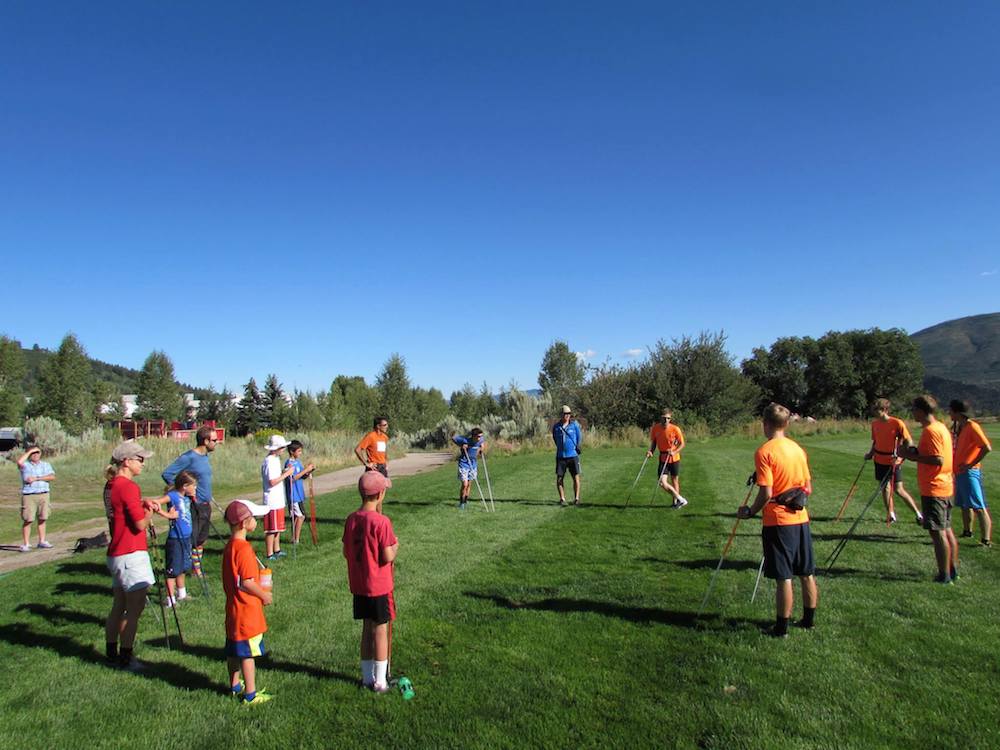
Several U.S. Nordic Combined skiers, including Taylor Fletcher, Benjamin Berend, Adam Loomis, Bill Demong, and Michael Ward, lead a clinic in Aspen, Colo., during a mini camp in August. (Photo: USA Nordic Combined/Facebook)
When the U.S. Ski and Snowboard Team Foundation (USSTF) Board of Trustees, the nonprofit fundraising arm of the U.S. Ski Team, met on July 24, Billy Demong had something to say.
A guest at the annual meeting, the five-time Olympian and current U.S. Nordic Combined Team skier had been given the floor to speak on behalf of his sport and its sustainability in the U.S. What he said was moving enough that it persuaded the board to give U.S. NoCo $150,000 dollars for the next two years, amending its July 31 defunding deadline — in which the U.S. Ski and Snowboard Association (USSA) initially planned to cease team funding for nordic combined.
Demong could not be reached for comment and U.S. Nordic Combined Head Coach Dave Jarrett wasn’t at the meeting in Park City, Utah, but the outcome was a big deal, Jarrett explained on the phone last week.
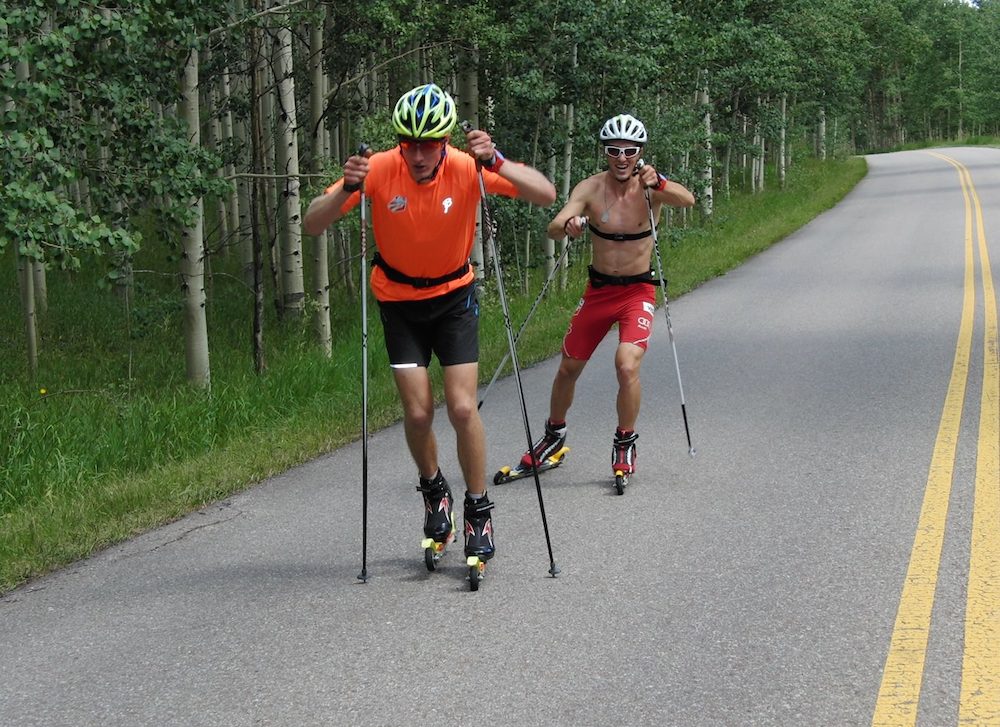
Adam Loomis leads U.S. Nordic Combined teammate Michael Ward during a rollerski workout at a mini camp in August in Aspen, Colo. (Photo: USA Nordic Combined/Facebook)
“I think they realized that they made a perhaps a hasty decision,” Jarrett said. “… It sounded like all the trustees were not necessarily aware of the way the decision was made and the actual facts involved. They were really ill-informed with what we have in the pipeline…”
He added that, at the end of last season, USSA did not ask him to prepare a presentation or explain where his team stood for the next four years.
“They didn’t give us a chance to show that we have this many U16s and U18s and U20s in our pipeline and that our sport is alive … and on a per-capita basis we’re doing a lot with our athletes,” Jarrett said. “… To be honest, even if we won a medal in Sochi, this same thing would’ve happened. I think it was done before Sochi and they just looked at it, that Bill was probably going to be finished and Todd [Lodwick] was finished … and they just classified us as nothing. I don’t know that for a fact; that was just my gut feeling that was going to happen.”
On Aug. 12, USSA CEO Tiger Shaw sent an email to nordic-combined stakeholders regarding the outcome of the trustees’ annual meeting. He signed it, along with USSTF Vice President Trisha Worthington and another trustee, Greg Boester.
“This spring we had to make many tough funding decisions as we evaluated our sport allocation along the guidelines of the 2010 Strategic Planning Committee adopted following the 2010 Games in Vancouver,” the email began. “This resulted in our decision to reduce funding for the nordic combined national team to a level far below that of the 2014 Olympic season, despite the previous success of that team four years ago…”
Jarrett said he would challenge every program under USSA’s umbrella to prove they have the depth to continue performing at the USSA’s ‘Best in the World,’ medal-potential standards, should they lose a couple athletes to retirement, injury or something of that nature.
“Almost every program within USSA isn’t as deep as you think,” he said.
“… We have been seeking ways to help bridge this sudden gap in funding and to help the nordic combined community with an alternative funding model,” the email continued. “To further this effort, the USSA and its foundation have agreed with Billy Demong, his teammates and the nordic combined community to forge a partnership.”
That involved USSA fronting the team $150,000 for this season (and committing to the same amount next year) in exchange for 15 Gold Passes, valued at $10,000 apiece. USSA aims to sell 450 of these passes by the end of the fiscal year (April 30, 2015) to go toward its general fund. The passes are fully transferable and provide lift access to more than 250 U.S. ski resorts, and 85 percent of their total cost is tax deductible.
U.S. Nordic Combined must sell its 15 passes by next spring to donors the foundation hasn’t previously reached out to. So instead of just asking for money, like it has been, U.S. NoCo will have something big to offer supporters in return.
“As far as I know, this is the first opportunity where [USSA has] allocated a certain number of Gold Passes to a program,” Jarrett said. “… We’ll see if it works. In light of everything that’s happened, the whole fundraising-revenue paradigm at USSA is perhaps going to be different and probably change for a good thing, but I think there will be some growing pains involved in that. This is certainly a great opportunity for us in light of our situation.”
As of Aug. 29, Jarrett wasn’t sure how many Gold Passes his program had sold — maybe one, he said. Mostly parents in nordic-combined’s core community were heading up the effort.
If they sell more than 15 passes, the remaining funds go to USSA’s general fund. Jarrett wasn’t sure if they could revisit the agreement next year and seek more than $150,000 if they exceed USSA’s fundraising expectations.
“It’s generous for USSA to provide us with this opportunity if they have 450 [passes] to sell,” Jarrett explained. “…That’s taking money out of the general fundraising.”
In terms of what kind of difference those dollars will make, Jarrett said it’s huge. His position had already been secured, but the extra money from USSA ensured that the team could keep coach Greg Poirier and hire a Continental Cup coach and service technicians for the coming season.
“It was a real shot in the arm at the very last minute because Greg’s salary was set to end on July 31, so it was a big deal right then,” Jarrett said. “Really, when you’re starting at zero, $150,000 is a big jump on it to get things going.”
“It was a real shot in the arm at the very last minute. … Really, when you’re starting at zero, $150,000 is a big jump on it to get things going.” — Dave Jarrett, U.S. Nordic Combined Head Coach on USSA’s recent two-year financial agreement with his team
At the same time, it doesn’t come close to matching U.S. NoCo’s roughly $600,000-dollar annual budget. By now, Jarrett needs to have plane tickets booked and travel logistics locked down for his team, which starts its international season in November.
“The question that we’re all struggling with now is, what kind of risk are we willing to assume to get things going?” he said. “If we wait until we get it in the bank, it’s going to be two months too late.”
The money from USSA will cover the team’s entire staff salaries and some travel expenses, minimizing the risk factor, he added. The rest of its budget will have to be self-raised, which the team and its community are working on. U.S. NoCo partnered with USA Ski Jumping this summer in an effort to collaborate on fundraising and sponsorships, but the partnership is new and funds remain separate.
In mid-October, after U.S. Nordic Combined Championships from Oct. 11-12 in Lake Placid, N.Y., 17 athletes and four coaches with the team will travel to Europe for their first overseas camp of the season. First, they’ll first compete at Swiss nationals and later train on the jumps in Oberstdorf, Germany. Most of the athletes will be paying their own way.
“It’s really only the ‘A’ team that’s 100-percent fully covered,” Jarrett said. “There’s definitely self funding going on, almost from the top down.”
He explained they asked most of their athletes to put down the money they’ll need to cover their individual costs for the season. If fundraising goes as planned, they’re hoping to give as much of that back to them as possible.
But $10,000-dollar ski passes, with additional incentives like invites to work out with Olympians and a VIP tour of the Center of Excellence, can be a tough sell.
“At first it sounded like these were going to sell like hotcakes,” Jarrett said. “… But not everybody can afford to do that.”
He pointed to the USA Ski Jumping website as a means of donating any amount (as of now, all donations go to a general fund for USA Ski Jumping & Nordic Combined) and USSA’s website to find out more about the Gold Pass.
“No amount is too small,” he said. “We want people to donate with the thought, what can I do every year for the next four years? … like an annual giving to nordic combined.”
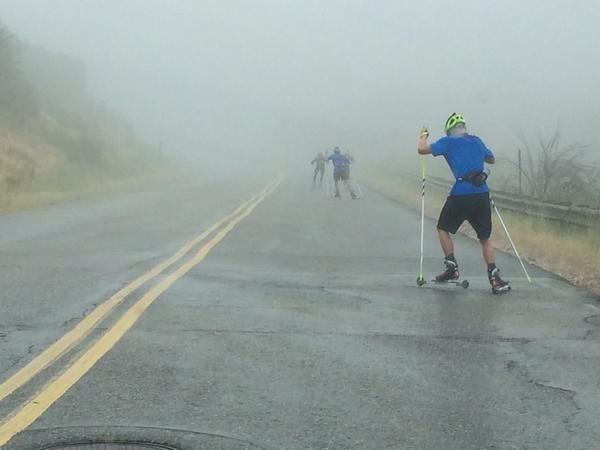
U.S. Nordic Combined skiers during a recent, foggy rollerski session near Park City, Utah (including Bryan Fletcher, Taylor Fletcher, Ben Berend, Brett Denney, Michael Ward, and Adam Loomis). (Photo: Dave Jarrett/Twitter)
July 31 was the day. On Thursday morning when U.S. Nordic Combined Head Coach Dave Jarrett walked into his office at the U.S. Ski and Snowboard Association (USSA) Center of Excellence in Park City, Utah, he knew he’d leave there with his job still in tact.
That was one takeaway from meetings with USSA in the last few months since the association, which serves as nordic-combined’s national-governing body (NGB), revealed in April that it would no longer fund the team after July 31.
According to Jarrett, USSA reasoned that if nordic combined wanted to raise money to sustain itself, it needed someone in charge. With help from USSA’s trustees, his position remained “pretty stable,” he said on the phone Thursday afternoon.
“The whole thing from the beginning was that they were trying to shake the trees and see if they could find more money,” he said.
Most recently, it was the status of his team’s other coach, Greg Poirier, he was uncertain of.
“He was ready to turn in his stuff at the office [on Thursday],” Jarrett said. “They came back to Greg and said we have some money for you to take care of you.”
While Poirier’s position as jumping coach wasn’t finalized, Jarrett said USSA had indicated it could cover Poirier as well for another season. That brought Jarrett to the next item on his wish list: securing a Continental Cup coach.
“Things are moving forward for sure, and it’s a little bit more hopeful than in April,” he said.
Bryan Fletcher jumping at the FIS Nordic Combined World Cup Triple in Seefeld, Austria, last season, where he ended up with a season-best fifth overall. (Photo: Fast Big Dog)
Money Game
As of Aug. 1, USSA will fund individuals rather than the team. According to Bryan Fletcher, for next season, that means him and his younger brother Taylor. Based on Bryan’s understanding, those two demonstrated the most “podium potential,” and with that came a set dollar amount from USSA to be used toward expenses next season. That amount is payable upon receipt, not a cash advance or stipend.
“Instead of funding an entire team and giving them a set budget, [USSA is] giving individuals who meet a set criteria for the ski team or based on the executive’s judgement … a set amount of money to pay for their season,” he explained. “Essentially Taylor and I are in that situation, given a little bit of money to fund our individual movements…”
The Fletchers have already spent their USSA funds on re-hiring the team’s two wax technicians, Andrej Jezeršek and Matjaz Dobrovoljc.
“There’s no point in showing up for World Cups if you have no support,” Bryan said. “Ideally that would be used for plane travel and [other travel expenses] … We decided that the most important thing was our wax techs’ salaries. It’s much easier to make ends meet while you’re over there.”
Jarrett agreed: “It’s the most cost-effective place [to compete], because you get paid to be there,” he said of the World Cup and the monetary perks (including comped food and lodging) that come with top international results.
“We decided that the most important thing was our wax techs’ salaries. It’s much easier to make ends meet while you’re over there.” — Bryan Fletcher, on using his personal USSA funds to pay for his team’s wax techs
At the same time, he’s optimistic that future arrangements and partnerships, both within and outside of USSA, could be used to pay for those two techs — adding it was essential to lock them down for another season first.
The team can also count on Switzerland to pay for about 30 percent of their servicemen’s salaries. Jarrett said they teamed up with Swiss nordic combined last season, waxing and testing some of their nordic skis in exchange for reimbursement.
As for the total cost of the season, with camps and competitions U.S. NoCo has yet to finalize its budget for, Jarrett estimated it amounts to roughly $250,000 dollars. That’s for the entire program, including travel expenses like airfare, room and board, fuel, and rental cars for all team and staff members. It does not include employee salaries or benefits, and equipment costs, such as jumping suits, bindings, wax and supplies — all of which Jarrett described as another huge cost.
Bryan estimated that waxing and travel expenses in Europe could amount to $2,000 a week per athlete — a figure that could be lower depending on how much other teams, like Switzerland, or race organizers help with defraying costs.
Regardless, they need cash to train — ideally at international venues — and get to the highest-level competitions.
That’s where Billy Demong, the team’s veteran and most-decorated athlete, has stepped up. As U.S. NoCo’s point person for marketing and fundraising, he plans to keep training and compete next season, but has already devoted a large part of his offseason to securing finances for his program.
“He’s pretty well-connected,” Jarrett said. “He really selflessly took that on … It’s a lot, that’s no question, but we know Bill…”
While Demong has been working out on his own schedule, the Fletchers have been training with the rest of the team in Park City. Aside from Todd Lodwick retiring from the A-team, the program has retained and slightly grown its training group, and Jarrett said all of its members are excited and motivated to make the jump from the development ranks.
A New Team Structure
New this season, U.S. NoCo is looking to fill a C-team, which Jarrett described as mainly a junior squad.
“Our goal now is to take care of the sport from top to bottom: A, B, C, and a development team,” he said. “The clubs really aren’t equipped to handle post-grad in nordic combined … [Athletes] need to be either on the Continental Cup or training.”
With its budget in flux, the program hasn’t decided how to divvy up funds for athletes among those teams. Jarrett said C-team will likely be unfunded, while providing a sense of national-team belonging and training opportunities for young skiers. At this point, B-team members that don’t make it to the World Cup will likely have to self-fund as well next season.
The big questions that remain for the U.S. team include its competition schedule and how many world and continental cups it can afford to attend, as well as whether it can swing an international training camp this fall.
“We didn’t do a camp in July. We’re not doing a camp in August,” Jarrett explained. “We’re hoping to have a big camp together with the Swiss guys, go to Lake Placid [for U.S. Nordic Combined nationals] in October, then go to Europe after that to have a camp [in Germany and Switzerland].”
Bryan pointed out that the team needs to jump at lower elevations than Park City and would benefit from the ice track in Oberstdorf, Germany.
“You’ve got to see the level of how everyone’s jumping,” Jarrett said.
In the past, the team held three summer training camps, most of which were in Europe. This year, its athletes skipped their usual Tour-de-France camp, replacing it with a five-day endurance camp/fundraiser in Aspen, Colo.
“We had donors come to pay and ride with us for a week,” Bryan explained. “We had an awesome time. … That was mostly Bill’s idea, just to continue that bike idea in Aspen.”
Craig Ward is heading up another nordic-combined fundraiser in line with the USA Pro Cycling Challenge from Aug. 14-19 in Aspen, Bryan added. Because of funding uncertainty this spring, the team had to rule out competing at the International Ski Federation (FIS) Summer Grand Prix in Germany and Austria in late August.
As for the team’s winter World Cup schedule, Jarrett said it will be similar to in the past, with specifics being worked out in the next few months.
“It’s moving in the right direction,” he said.
USASJ and NoCo Unite
By partnering with USA Ski Jumping (USASJ) to form a singular “USA Ski Jumping and Nordic Combined,” Jarrett hopes his sport continues to grow, both in participation and financial stability, for seasons to come.
The agreement was sort of a natural byproduct of the two sports’ commonalities, he explained. Not only is jumping essential to the success of both, but they also share the few jumping venues scattered across the U.S. Plus, most nordic-combined skiers start out as jumpers — and if they don’t, they have to move to a place with jump hills to learn how.
“There’s much more in common with ski jumping than there is with cross-country for nordic combined,” Jarrett said. “It’s just a better fit, a better understanding of how this sport works.”
Since 2006, USASJ has operated independently of USSA (which also remains its NGB), coming up with its own marketing and fundraising strategies. While Demong will continue to work on landing sponsors for nordic combined, the two sports won’t likely combine marketing efforts in the near future — unless a major sponsor wants them as a unit and each slice of the pie is large enough to make it worth pursuing, Jarrett said.
“There’s much more in common with ski jumping than there is with cross-country for nordic combined. It’s just a better fit, a better understanding of how this sport works.” — Dave Jarrett, U.S. Nordic Combined Head Coach
“Right now there’s no downside for [USASJ]; they’re not giving up anything,” he said. “They’re just sharing a place for us to raise money. That was the goal that we started with. They’ve already been down this path … they’ve already suffered through all the growing pains that’s involved with getting cut like that. It’s been definitely a good partnership … [and] we’re coming into it with pulling our own weight.”
In the future, Jarrett said they could revisit collaborating with Women’s Ski Jumping USA, too. However, that program has opted to remain separate for the time being.
“That could be a really good dream: to have both men’s and women’s ski jumping and both men’s and women’s nordic combined under the same roof,” Jarrett said. “But Women’s Ski Jumping USA is also protective with what they’ve done as an organization and rightly so.”
The next couple years could be telling for all the aforementioned organizations.
“We need to keep together to keep our sports alive,” Jarrett said. “I think [Women’s Ski Jumping USA needs] to figure out how they’re going to proceed now that they’re into the Olympics and the suffrage story is over. Hopefully we can talk and figure out what’s the best for our sport. … FIS and the IOC, they really want women’s nordic combined … to flourish.”
Coaches education, development outreach, jumping equipment and technique are among many elements ski jumping and nordic combined could share, Bryan said. But they’re also different sports and not everything overlaps.
“We need our own staff and they need their own staff,” Jarrett said of USASJ.
NoCo and NNF
A longtime supporter of U.S. NoCo, the National Nordic Foundation (NNF), a nonprofit designed to help fund developing nordic athletes in the U.S., will continue to back nordic combined.
NNF Director Dave Knoop explained the foundation is currently working on its upcoming “Drive for 25” fundraiser, typically launched in late fall, and intends to include Nordic Combined in that movement.
“We understand how and why NC has merged with Jumping and what they are doing makes a lot of sense,” Knoop wrote in an email. “The NNF has not abandoned funding NC Pillar Projects and we look forward to funding NC designated projects in the future.”
Meanwhile, nordic combined will receive support from both NNF and USASJ. NoCo representatives Demong and Kerry Lynch remain on the NNF board.
“In the past few months we have stepped back a bit to let Billy and others define how Nordic Combined would fit within the USA Ski Jumping [organization],” Knoop explained. “Now that this is clear we will begin defining and communicating NC’s role within the NNF. Specifically the transparency aspect of what we will fund and why so donors know where their donations are going.
“If anything can be said of this episode regarding USSA’s actions regarding Nordic Combined funding is that I am hopeful that it just made NC rebuild [itself] in a way that eventually will make it a stronger organization,” he continued, “that the sport will grow in numbers and develop great athletes in the future.”
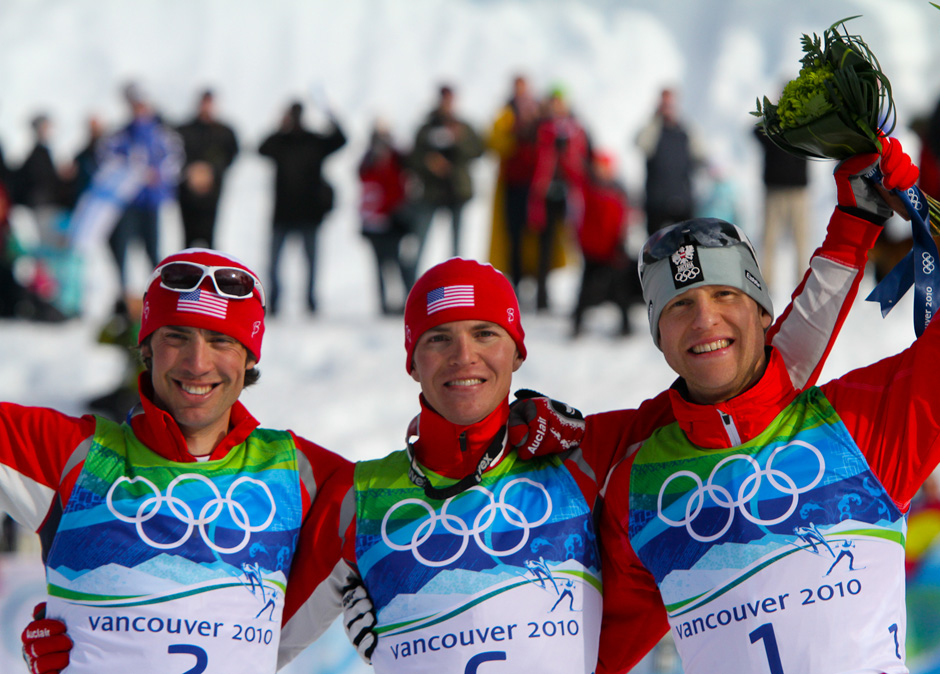
Happier times: The U.S. captured individual gold and silver in the large-hill competition at the 2010 Olympics in Vancouver, British Columbia, with Billy Demong (c) and Johnny Spillane (l). Four years later, the U.S. Nordic Combined program will no longer be directly funded by USSA.
Editor’s Note: This is the second article in a series about U.S. Nordic Combined, which was recently informed it would no longer receive direct USSA team funding after July 31, 2014. Stay tuned for updates and more on how USSA makes financial decisions.
***
Imagine being a 23-year-old athlete with what you believe to be the best days ahead of you in terms of performance. In four years’ time, you could very well be at the top of your game in what would be your third Olympics. At least that’s what the plan is.
Then imagine having that dream take a major hit when you’re told you might have to pay your own way to achieve it. Four more years of coming up with some $40,000 dollars a season for travel and racing expenses — not including coaches and other support staff.
U.S. Nordic Combined’s Taylor Fletcher works to close a one-minute starting deficit as the first leg of the 4 x 5 k team event at 2013 World Championships in Val di Fiemme, Italy. Following his lead, the Americans placed third for their first medal in a World Championships team event. (Photo: Fiemme2013)
That’s the reality that Taylor Fletcher faced Monday morning while sitting alongside his brother and teammate Bryan in a meeting with the U.S. Ski and Snowboard Association (USSA) president and vice president. The two U.S. Nordic Combined skiers, along with teammate Billy Demong, were informed that their sport would no longer receive financial support from USSA.
“You work so hard and you put your effort toward becoming the best athlete you can,” Fletcher said on the phone Wednesday. “To get that message and to have that happen at the beginning of a new season and beginning of a World Championship year, it takes a lot of steam out of you and it really pisses me off.”
The estimated $3 million dollars that previously funded their team for a four-year Olympic cycle was now gone. Annually that broke down to between $580,000 and $650,000 in a non-Olympic year, a figure USSA Vice President of Athletics Luke Bodensteiner first told Steamboat Today and confirmed with FasterSkier on Wednesday.
“I’m still trying to grasp what’s going on and why they don’t see that our team has the potential,” Fletcher added. “We had a World Championship medal last year, I’ve had an individual [World Cup] podium, Bryan’s had an individual podium … and we’ve had the last two Olympic flag bearers. No one else on USSA has done that.”
Now put yourself in Bryan’s shoes. Now 27, he teamed up with his brother, Demong, and the recently retired Todd Lodwick to capture an unprecedented bronze in the 2013 World Championships team event. Bryan is outside the realm of his parent’s health insurance and will no longer have medical costs covered by USSA. That’s a big deal for anyone, let alone someone who rockets some 95 kilometers per hour down a jump and into the air, and pushes their body to extreme limits in cross-country ski races.
Bryan Fletcher jumping last season at the Utah Olympic Park in Park City, Utah. (Photo: U.S. Ski Team)
To top that off, Bryan’s got a wedding to pay for with his fiancé, Nicole Thorsen, in late September.
“I don’t know if I’m gonna end up having to work to pay for the season,” Bryan said. “In all reality for me, it’s not really an option. I have some school that I’ve already signed up for, I have a wedding to plan in September and to pay for, too. The cards are stacked against me a little bit. … Going into the season, it’s unclear as to how much we’re gonna have to step up. … I think that for most of us athletes, we’ve given all we can give and we’re riding it out.”
That’s the case for most of the athletes and coaches at U.S. Nordic Combined after the team learned the news early Monday morning at USSA’s headquarters in Park City, Utah. In a phone conversation, head coach Dave Jarrett said he was surprised by the decision, considering it was the beginning of a new quadrennial, or four-year Olympic cycle. In retrospect, he said maybe he shouldn’t have been.
“I had a sense for a while that something wasn’t right,” Jarrett said. “Planning started as normal and then it took a slight detour with the timeline of how you get things done. It became clear that something wasn’t right. I knew something wasn’t totally clear.”
Jarrett said Bodensteiner had given them a heads up that this was a possibility beforehand.
“We got a message Saturday night saying that we were gonna have an all-coaches-and-staff meeting with [CEO] Tiger [Shaw] and Luke,” Taylor recalled. “From that I could grasp that it wasn’t gonna be good. I was hoping for a budget cut at the most.
“They sat us down and they were kind of like, yeah, budget cuts are going around the table left and right and we have to invest in the sports we feel are a worthy investment,” he added. “Unfortunately, it brought us to the decision that we can no longer support nordic combined and based off the data that we have we don’t feel that there’s podium potential in 2018 or 2022. We’re gonna do what we can keep you guys afloat, but as of July 31st, if you guys don’t have the funds, you’re on your own. And they kind of just got up and left.”
USSA’s Decision Outline: (according to an email from Vice President of Athletics Luke Bodensteiner)
“Viability – Factors influencing the long-term and stable viability of each sport and discipline were examined. These factors included the cost of providing and maintaining sufficient elite-level and athlete recruitment training facilities, international participation, and financial costs/benefits of required sport programming. Potential – Short-term success potential (4-5 years) was analyzed through a thorough assessment of the existing and potential elite athlete pool. Critical factors included specific athlete performance projections, Performance Band analysis, numbers of existing podium potential athletes, and a sport’s ability to transfer and develop elite talent from other sports.Also assessed were opportunities to positively affect Strike Rate – the ability to deliver podium potential athletes to the Olympic podium with greater certainty. These included opportunities in technology, data tracking, human performance, athlete safety and protection, Olympic venue strategies, and the availability of talented human resources.Sustainability – The long-term sustainability of each sport and discipline was assessed by looking at both the historical track record, and the conditions for future sustainability.A historical record of sustained Olympic performance indicates a strong existing sport infrastructure and culture, likely to continue to generate success in the future.Measures indicating the conditions of future sustainability included participation numbers and trends, athlete recruitment opportunities, certified and professional coaches, the ability of the sport community and industry to sustain the sport infrastructure capable of generating Olympic success, and the ability of the sport infrastructure and development systems to regenerate teams of podium potential athletes.”
According to Bodensteiner, who spoke with FasterSkier during his lunch break on Wednesday, the decision was part of a long-term plan that had been part of USSA’s discussions since 2008.
“It’s a decision that’s obviously taken a while to make because it’s not an easy decision and it’s not one that anybody wants to have to make,” Bodensteiner said.
The foundation for such decisions, what Bodensteiner referred to as “an overall strategic planning framework and a resource allocation process,” was essentially laid in 2008 and approved by USSA’s board in 2010. After the Vancouver Winter Olympics that year, USSA stopped funding three sports as national teams: ski jumping, ski cross and parallel snowboarding. It was a new model USSA was trying: maintain a partnership with these sports while leaving them to self govern.
From USSA’s perspective, “… it’s more of an opportunistic way to manage [those sports],” Bodensteiner said. Doing so lifts restrictions on sponsorships, such as those that might appear on one’s uniform, and gives athletes of those sports greater freedom when it comes to reaching out for money — all of which goes directly to them. The catch is, they have to generate it themselves.
At the same time, USSA directly funds athletes at “the very top level,” he said. “It’s not the easiest model — it definitely takes more relationship management. It puts more emphasis on sports-specific support groups to shoulder a lot of the administrative side of the sports, but it’s also been used with success. I look back to World Championships in 2013 and athletes from each one of those sports [ski jumping, ski cross and parallel snowboarding] won medals.”
By why cut a sport whose athletes have already proven they can win medals, and a lot of them? At the 2010 Olympics, nordic combined took home four medals — 44 percent of those awarded in their sport. Since 2007, the team has tallied six World Championships medals, including the aforementioned bronze — the first time U.S. Nordic Combined medaled in a team event at worlds.
“They tell you every year: better results, more money,” Taylor said. “Since 2003, Johnny [Spillane] got a World Championship medal, 2007: Bill got a World Championship medal, 2009: they swept the individual events at World Championships, 2010: we got Olympic medals, 2013: World Championship medal. I don’t know what else you really need to do. We’ve never had the money to go and contest for the [World Cup] overalls in the last couple years. We’ve always had to skip one or two competitions to make it work. That’s the hard part to swallow.”
Bodensteiner said it was a matter of assessing future performance potential, which USSA has done over the last several years.
“You’ve got Lodwick who’s retired, you’ve got Demong who may ski past next season, but that’s not certain, but then you also look at results, trends in terms of where those athletes have come from and where they’re headed,” he said. “It’s not to say, in our assessment, that Bryan and Taylor don’t have the potential to win a medal in PyeongChang, [South Korea,] the differentiation comes in how strong that chance is and where you have an athlete that has a potential for a medal, that may be a smaller statistical probability than an athlete in another sport who’s a very strong, likely medal candidate.”
As for Demong, there’s a chance he may not continue his career into next season. While he hadn’t planned on another Olympics, he told FasterSkier after the end of the Sochi Games that he was considering competing for another season to help bridge the gap in developing the sport. On Tuesday, he didn’t say he was retiring, but told Steamboat Today, “I’ve had a pretty good run. To me it really discourages the legacy we worked so hard to build. It has had its head cut off.”
The bottom line is, USSA has a published vision to be “the best in the world” in Olympic skiing and snowboarding. Part of the nonprofit’s decision to stop funding nordic combined after July 31, 2014, stems from their analysis of the sport at all levels — including development — and performance projections through not only the 2018 Olympics, but the 2022 Winter Games as well.
USSA VP Luke Bodensteiner (Photo: USSA)
Bodensteiner explained that USSA uses a number of different measures to determine if an athlete is destined for greatness, or Olympic medals, or not. Some of the most effective methods involve “retroactive statistical analysis,” looking at a pool of international skiers who’ve had success at the highest levels going back to see when they hit “key performance markers, i.e. how good does an athlete have to be statistically at Junior Worlds or at what age do they have to score their first World Cup points,” he said.
From there, they can generally determine whether a given athlete is on that track or not. “Of course there are now and again outliers to that system, but what your’e really trying to look for is the trend of an athlete’s performance,” he added.
They also look at Olympic performances over the last four Olympic cycles (16 years) to predict medal-earning potential based on an athlete’s long list of rankings or results.
“It’s tough to project … [but] it’s actually been fairly reliable,” Bodensteiner said. “We’ve been able to project our overall Olympic achievements with not great accuracy, but enough to really get a sense of where we steer our resources.”
So that’s the decision, one that Jarrett encouraged his athletes and the U.S. nordic-combined community to find solutions to rather than fight it.
“I think everyone’s upset and they don’t understand how an NGB cannot be supporting any of the sports it’s supposed to be a national governing body of,” Jarrett said. “That’s a business decision. … They’re not gonna change their mind no matter how hard you try. Let’s reach out to contacts and see if we can’t find a solution.”
According to the Fletcher brothers, that’s what they’ll be doing over the next several weeks — trying to seek ways to fund their future in the sport. But first, they said Demong encouraged them to get back to training, work hard and focus on their job as athletes, and they’ll sit down and brainstorm next week.
“The development team, they have to pay for their skis,” Taylor said. “They have to pay for a fair share amount of their expenses. The NNF [National Nordic Foundation] has stepped in and thank God for them because half the guys on the team wouldn’t be able to do this because we don’t have the money. Then to have to pay for airfare, lodging, food while we’re over there, that’s gonna be running upwards of forty grand a year to go to all the competitions. I don’t have that and I know Bryan’s the same way, and I definitely don’t want to be taking out loans to do a sport just because you love it.”
While the big question is whether nordic combined can raise enough money on its own to support its coaches and staff, USSA reserves some funds to provide top athletes. As for how much that might be, Bodensteiner said that will likely be decided in early May. The organization is halfway through its budgeting process, which takes three to four (and sometimes more) weeks, he said.
Based on what teams like women’s ski jumping have received, Taylor believed that would be in the ballpark of around $40,000, and he was unsure whether that would be allocated individually or shared throughout the team.
“They [told us], if you guys can’t come up with the funding, then we’ll turn to direct athlete support and that will go to the top guys on the team,” Taylor said. “They didn’t give any sense of how much that is. Everyone’s kind of left in the dark. I think based off ladies’ ski jumping it was, I think, $40,000 for the team. In that case, that’s not gonna go very far.”
Bodensteiner explained that money is tight — as it usually is — at the start of a new Olympic cycle. USSA is operating with a smaller budget its usual $20 million dollars, a figure Bodensteiner published on USSA’s website last July. Roughly more than 20 percent of that comes from the U.S. Olympic Committee (USOC), according to the USOC’s 990 tax form. A spokesperson for the USOC could not be immediately reached to explain how grant money is allocated to USSA.
Ideally, USSA would like for the Olympic Committee to fund it evenly across a four-year period for greater stability in financial resources, but as it stands, the grant money flows in greater quantities for the Olympics and takes a hit the year after, Bodensteiner explained.
“They haven’t set their funding for next year, but they made it clear to all winter NGB’s that, hey we are not gonna provide the same level resources to you that we have in the past. We’re shifting to summer now,” he said, adding that the USOC is now focused on the Summer Olympics. “That’s been the case as long as I’ve worked with USOC so it’s not unpredictable, but certainly it creates some challenges each post-Olympics season.”
As for what will happen to the USOC grant money that previously went to nordic combined, Bodensteiner said it will be spread across the remaining USSA sports.
“All the revenue comes into one space at the end of the day and gets allocated out,” he explained. “Where we’ve been able to reduce expenses on nordic combined, either by spending less or raising more through an alternative funding stream, what it’s allowed us to do is reduce less out of the other sports. We’ve been challenged this year to basically reduce the athletic budget by a given amount.
“The choices that we have to make are, do we reduce everybody by the same percent, and everybody takes a hit? Are there places that we can extract more so that we’re protecting other programs in different ways? If you think about taking that much resource that we’ve typically spent on nordic combined, that’s resource that we don’t have to take out of cross-country or out of snowboarding or freestyle or alpine.”
Asked how much the budget was reduced and how much USSA spends on other sports annually, like cross-country skiing and alpine, Bodensteiner declined to answer. However, he said nordic combined’s $580,000-$650,000 yearly budget made it the third most costly sport at USSA, behind cross-country skiing and alpine — listed in no particular order.
“We stay away from budget figures because what we want to avoid — I just told you cross-country spends more than freestyle or snowboarding, for example — we want to get away from those kind of discussions, i.e. cross country hasn’t won an Olympic medal since 1976 and mogul skiing has won every year,” Bodensteiner said. “What we’ve really done is set up a funding mechanism that’s far more analytical and strategic, and we essentially make decisions that way versus having kind of unfounded debates at the board level about what’s more popular, what’s had a better track record.”
At the end of the day, USSA took a sizable chunk of its pie to put toward other sports within its financial umbrella. Now, those with a vested interested in U.S. nordic combined are looking toward the future.
“There’s a lot of people that believe in us and I think we believe in ourselves and we can find these funds and we can continue to build a strong program,” Bryan said. “Nordic combined was on the rise in North America in popularity and definitely in Europe. We have one of the largest TV viewerships of any sport. I think that eventually you put it out there that we need the support and hopefully people will come.”
“I feel like I’m just getting to my potential and I definitely don’t wanna give this dream up,” Taylor explained. “I mean, this is what I’ve lived for and trained for and this is what I want to do for the next four years at least. I have no doubts that 2018 is the best opportunity for me to capture Olympic medals. I definitely don’t want to give this up for something that I had no control of.”
U.S. Nordic Combined’s Todd Lodwick (l), Billy Demong (second from l), Bryan Fletcher and Taylor Fletcher (r) after winning bronze in the 2013 World Championships team event in Val di Fiemme, Italy. (Photo: Fiemme2013)
When U.S. Nordic Combined coaches Dave Jarrett and Greg Poirier sat down with Tiger Shaw and Luke Bodensteiner of the U.S. Ski and Snowboard Association (USSA) on Monday, Jarrett said he wasn’t exactly sure what they were in for.
The national-team head coach for the last six years, he had a sense of what was in store for his sport — challenges, big ones, before and after the Olympics. But every nordic “free-heel” sport deals with the same thing, he said.
By 8 a.m. Monday, it became pretty clear what Shaw, USSA’s new CEO, and Bodensteiner, vice president of athletics, wanted to talk to them about in person. After July 31, 2014, USSA would no longer fund nordic combined’s “traditional team infrastructure,” according to a mass email from Shaw that was sent to Jarrett and several other stakeholders. That would leave U.S. Nordic Combined essentially on its own for financial support, which Jarrett said will most immediately affect the employment of himself and Poirier, the development coach.
Bryan Fletcher (U.S. Nordic Combined) at the Nordic Combined World Cup Triple last season in Seefeld, Austria. (Photo: Fast Big Dog)
In the meantime, he said not to worry about the athletes — they’ll train for next season as usual. The ones that were in Park City, Utah, on Monday — Billy Demong, Bryan Fletcher and Taylor Fletcher — also spoke with Shaw and Bodensteiner in a second meeting about the decision.
“I had a sense for a while that something wasn’t right,” Jarrett said on the phone Tuesday. “Planning started as normal and then it took a slight detour with the timeline of how you get things done. It became clear that something wasn’t right. I knew something wasn’t totally clear. Luke gave us a heads up that this was a scenario.”
That didn’t necessarily soften the blow, but rather than retaliate, Jarrett said he began to brainstorm. Women’s Ski Jumping USA and men’s USA Ski Jumping did it on their own — they could, too.
“We haven’t stopped spinning from the news,” Demong told Steamboat Today. “We have to turn that into solution making.”
“Based on [USSA’s] study in 2010 that eliminated jumping in other sports, they didn’t think nordic combined was a podium-potential sport for 2018 or 2022,” Jarrett explained. “As of July 31st, it’s gonna be the end of my job and Greg’s job, so funding stops then. In the meantime, if we’re able to raise operating capital, they have offered to run [fundraising] through USSA. If somebody wanted to donate or underwrite our needs that they would be able to donate to USSA [which would go] directly for nordic combined.”
There’s also the possibility of U.S. nordic combined signing sponsors outside of USSA’s contracts. According to Shaw’s email, USSA “will continue to provide direct funding for qualifying elite athletes. … We will work with the nordic combined community to look at alternatives in structure and funding. The USA has an engaged and passionate club-based pipeline, especially in communities of Lake Placid, Steamboat Springs and Park City. The USSA will continue to work with these clubs to provide an infrastructure for athletic success and sport development.”
“Unless you win the Powerball or something, there’s no way to create a slush fund for a rainy day for this to happen.” — U.S. Nordic Combined Head Coach Dave Jarrett
Jarrett emailed members of the nordic community on Tuesday morning with the subject heading: “Tall Order”. While many were disappointed and some shocked by the news, he said he encouraged them to think of solutions.
“I see this challenge as an opportunity for autonomy of our program,” his email stated. “All revenue we generate will go directly to our program. The more we generate the deeper we can reach as a program while at the same time remaining within the USSA. If we want to have an A-Team, B-Team and Junior Team it is up to us. We need to think about all options, opportunities and ideas.”
Jarrett said he’d spent much of the last two days gathering information and talking to people like Dave Knoop of the National Nordic Foundation (NNF), which directly raises money for U.S. nordic combined and cross-country skiing, as well as Alan Johnson of USA Ski Jumping and Robbie Beck of Women’s Ski Jumping USA.
“‘[We’re] trying to just use this as a rallying cry for the nordic-combined community specifically, but also for everybody that this is around the corner for any program,” Jarrett said. “Instead of being pissed or feeling sorry for ourselves … we need to rally around this and find solutions. I think there’s solutions out there.”
While he aims to assemble as much support as possible and explore the idea of uniting all nordic sports — men’s and women’s ski jumping, nordic combined and cross-country skiing — into one autonomous entity, Jarrett’s also looking forward to getting nordic stakeholders together at the USSA Spring Congress in a month.
“We knew that this was always a possibility,” Jarrett explained. “While we wanted to be prepared for this, unless you win the Powerball or something, there’s no way to create a slush fund for a rainy day for this to happen. … I said it a few years ago after ski jumping: everybody now should be looking over their shoulder because you never know when it’s gonna fall. I don’t think there’s any program that’s safe from it, maybe alpine is the only one that they’re never gonna cut out, but that’s the fact of life. And we have to play the cards we’re dealt.”
As for what it would take to keep the nordic-combined program going, Jarrett said he wasn’t sure whether they’d decide to fund it from bottom up, starting with development, or take care of the elite A-team skiers first. Either way, he said 12 years of experience as a national-team coach had taught him what he can do with a million-dollar budget, half-a-million dollars, or $250,000 — whatever they end up with.
Bodensteiner told Steamboat Today that USSA had funded nordic combined between $580,000 and $650,000 annually for equipment, travel, lodging, food, coaches and wax technicians. In a four-year Olympic cycle, the cost added up to nearly $3 million. He said the decision was based on a number of factors, including nordic combined’s size, as measured by participation, membership, public relevance, and future potential.
“The main thing is that we need to be proactive, looking at all options, all partnerships,” Jarrett said. “We’re all in this kind of nebulous state and perhaps there’s a way to organize everybody or at least parts of it. We can be partners with USSA or partners with each other.”
Billy Demong after winning gold in the large hill/10 k competition at the 2010 Olympics in Vancouver, B.C.
KRASNAYA POLYANA, Russia — It’s been almost a week since the nordic-combined Olympians did their thing in the first of three competitions at the 2014 Winter Games. Last Wednesday’s event was on the 106-meter normal hill, not exactly U.S. Nordic Combined’s favorite.
Billy Demong led the U.S. in 24th, nearly a minute and 50 seconds behind German’s Eric Frenzel, who won the 10-kilometer Gundersen start. He had posted the 31st-best jump (tied with Finland’s Janne Ryynänen) out of 46 in the competition round, going 92.5 meters for 108.2 points. In the preceding trial round, Demong, 33, had his best jump of the season — just shy of 100 meters.
“It’s hard to be too upset because I’ve been struggling a little bit this week on this hill,” said Demong, the defending large hill Olympic champion, after last week’s competition. “I think it’s a little flatter than anything I’ve skied before.”
Flatter? His teammate Bryan Fletcher, who improved from 41st to 26th, for the second-best U.S. result on Feb. 12, tried to explain.
“This is probably one of the hardest hills I’ve ever jumped in my life,” the 27-year-old Fletcher said. “The rhythm of the hill does not match how your subconscious feelings are, so it was really difficult to find a rhythm. I found it in the trial round today, but I went for it in the comp jump, tried to lay it all out on the line, all or nothing. Unfortunately it didn’t work out, but I’ll try again next week.”
His younger brother Taylor Fletcher, who improved from 46th to 33rd, was the third American in the results. Todd Lodwick jumped to 34th — in his sixth jump after a scary crash in France in early January — but did not race in order to further heal his shoulder before the team event.
“This hill … is … it’s hard. I don’t understand it,” Taylor, 23, said. “I think a lot of people have the same feelings. I don’t know what it is that makes it so difficult. It’s a big hill, and we’ve jumped big hills. I jumped really well last year on it. It was my best jump, my best result all year, so I know I can race that. I’m a little bit better on a big hill. I don’t know if it’s my size that allows me to do that, but I get in a rhythm on it, and I can be a little more aggressive, which you really can’t on a smaller hill.”
Demong said there were positive takeaways from Day 1 of the Olympics: he had his two best jumps of the season between the trial and competition rounds.
“I almost pulled off the miracle jump today — what I didn’t think was possible before today, but it was by far my best jump of the weekend,” he said. “It kind of gave me a little hope. I’ve already almost been looking forward to the big hill because I think things were pretty good there last year, and my shape’s much better.”
The competition also gave the NoCo guys a chance to scope out the 2.5 k course they’ll race around two more times at the Olympics — with another 10 k Gundersen start after today’s large hill competition (starting at 4 p.m. Moscow time) and the 4 x 5 k team event on Thursday.
“I think the cross-country course is a lot of work,” Bryan said. “There’s no rest on it whatsoever, and any rest is followed by a technical corner or stuff like that. You really zap the legs going in with all the hills, and if you ski the hills hard like you want to, you pay for it on the corners again, so it’s just a very cumulative course as far as energy goes.”
Looking ahead to Tuesday’s large-hill competition, U.S. Nordic Combined Head Coach Dave Jarrett said Lodwick wasn’t a definite for the 10 k, and he was hoping the rest of his athletes would rise to the occasion on the 140-meter hill.
“We were better than our average, but our average wasn’t good enough,” Jarrett said last week. “We need to get off to good start on the big hill. The first training jump needs to be good. There are some good things that happened: Todd jumped pretty well and tested his shoulder and I think he’ll be able to ski. [The others] jumped OK, at least they had a good jump and they’re not walking away from the small hill without any good jumps. We’re looking forward to the big hill and keeping a positive attitude.”
With a drawn-out schedule that spaces out three competitions over nine days, Jarrett said it can be tough to stay focused — especially in a place like Krasnaya Polyana, at least an hour away from the coastal cities of Adler and Sochi. In 2010, they flew down to Park City, Utah, between Olympic competitions in Vancouver.
“There’s nowhere to go, really,” Jarrett said of their current Olympic home base, adding that they’ve trained at the Laura Cross-Country & Biathlon Center as well.
Sightsee? Shop?
“Yeah, we’ve done that,” he said.
Could the extra time help Lodwick’s shoulder?
“Yeah, it’s good for him,” Jarrett said. “The difference between this week and next week as far as a fracture being healed is not really that much. … Rehab is going well, he’s not out of the woods yet, but if everything stays the same, he’ll be able to compete.”
Update: After Tuesday’s jump, Bryan Fletcher led the team in 27th, Todd Lodwick was 30th, Taylor Fletcher 35th, and Billy Demong 38th.
From left to right: Bryan Fletcher, Billy Demong, Todd Lodwick and Taylor Fletcher sporting the “StacheTats” they wore to win bronze in Sunday’s normal-hill/4×5 k team event at the 2013 Nordic World Ski Championships in Val di Fiemme, Italy. Bryan and Taylor were both named to the 2014 U.S. Olympic Team this past Wednesday. The nomination marks Bryan’s first trip to the Games, and Taylor’s second. (Photo: Sarah Brunson/U.S. Ski Team)
The ski jumps of Howelsen Hill are hard to miss as you drive down Lincoln Avenue in Steamboat Springs, Colorado. Naturally derived from the hillside overlooking the small ski town, the jumps have served as a springboard for many athletes looking to make their way to the Winter Olympics.
For the town’s locals, the jumps are a source of entertainment, training, or amusement. For one child, they were life saving.
A Childhood in Question: Finding Relief in Skiing
Growing up, Bryan Fletcher had no idea of what his future would hold. Diagnosed with Acute Lymphoblastic Leukemia just before turning three, the Steamboat Springs native was uncertain what life would be like while undergoing treatment for such a serious disease.
Bryan Fletcher competing in the 2013 U.S. Nordic Combined Championships at the Utah Olympic Park, Park City. Bryan along with his brother, Taylor, was named to the 2014 Olympic Team January 21st. (Photo: Sarah Brunson/U.S. Ski Team)
Despite the gravity of his situation, Bryan wanted to have the semblance of normal childhood. For the young child who had always “hit every bump and jump” on the side of a trail, that normalcy would take the form of a sport not so ordinary to the average American child: ski jumping.
“As a young kid I remember saying to my parents, ‘those are the biggest jumps in the world! I have to do at least once in my life. That would be so cool.’ Shortly thereafter my parents signed me up for a learn-to-jump program and from the first day I was hooked,” said Bryan in an interview. “I couldn’t get enough of it and every time I went off a jump I would just be running straight up to the next one.”
His start in the sport corresponded more-or-less with the start of his treatment. From the age of four, would take week-long trips to Denver to receive his chemotherapy and then hurry back to Steamboat Springs to ensure he got in as many jumps as possible. While he listened carefully to do everything the Doctors asked of him, jumping was the one thing with which there was no compromise. It was the main source of happiness for Bryan, and his parents just couldn’t tell him to stop.
“For two hours a day while I was training with my friends I was a worry free, happy, normal kid and that was all that mattered in the end.” – Bryan Fletcher
Bryan would continue to fight his leukemia for seven years, going trough several year cycles of chemotherapy and remission. But the ordeal wouldn’t end there. In the middle of his treatment he survived a stroke that he was fortunate enough to escape relatively unharmed. Finally, after serval years of treatment he went into sustained remission.
Through those seven years, Bryan also was looking for new ways to challenge himself, and that’s where cross country skiing came in. Once involved, he learned of nordic combined, and the rest was history.
Once in remission, his career in nordic combined took off and he made the Junior World Championship team in 2003, 2005, and 2006. As a result from his rise in the nordic combined racing community, he was named to the U.S. Ski Team in 2004 and competed in this first World Championships in 2007 in Sapporo, Japan. He would continue his World Championship runs with appearances in 2011 and 2013
But Bryan’s career wasn’t the only one born out of his disease.
While he made his trips back and forth between Denver, Bryan’s brother, Taylor, watched with admiration as his older sibling balanced the challenges of chemotherapy and joy of ski jumping.
Taylor soon joined a learn-to-jump program himself, instantly fell in love with the sport.
“He (Bryan) is pretty much the reason I got into it. I was like any other kid that wanted to follow their brother. From that moment I knew that’s what I wanted to do.” – Taylor Fletcher
His path was similar to that of Brian’s, earning 12th place at the World Junior Championships in 2009 and eventually becoming the highest ranked American in the 2013 World Cup standings in 16th.
The 2010 Olympics: Missed and Realized Opportunities
In the buildup to the 2010 Olympics in Vancouver Bryan found that the journey to the Olympics was harder than he had previously thought.
Historically a skillful jumper, the older Fletcher brother focused on his cross country skiing throughout his training in the 2010 season. Unfortunately, the highly competitive Olympic year ended up being one in which everyone on the World Cup circuit was jumping better than usual.
Struggling to crack the top 30, his results where below where he wanted them to be and he was unable to score world cup points, making his chances at competing in Vancouver slim.
“I was selected to start that world cup that season, knowing that if I didn’t come out and secure World Cup points that I might not be able to represent my country at the games because they would have to give someone else a shot,” said Fletcher.
U.S. Nordic Combined member Taylor Fletcher works to close a one-minute starting deficit on the first leg of the 4 x 5 k relay at the 2013 World Championships in Val di Fiemme, Italy. Following his lead, the Americans placed third for their first medal in a World Championships team event. (Photo: Fiemme2013)
After sustaining an ankle injury, the U.S. Ski Team pulled him from World Cup competition and placed his brother Taylor in his stead. Taylor gave an excellent performance, scoring World Cup points and securing his spot on the Olympic team.
“With him having the World Cup Points and me not being 100 percent healthy it was a no-brainer for the coaches,” said Bryan.
Taylor had gone into the season expecting to only race in Continental Cups, but after he secured his first Continental Cup podium it was off to the World Cup.
While he was offered an Olympic spot, he never expected that he would actually be able compete in Whistler. However, after the historic second place by the American relay team in the 4 x 5 k event, teammate Brett Camerota decided to give his spot in the individual race to Taylor.
Aiming to have fun, Taylor went out and tried to ski his best but ultimately finished last in a field 45 skiers.
Taylor is feeling more confident this time around, having four years of World Cup experience under his belt.
“Going into this second Olympics, I have the experience from the first one. I know what to expect and I know what the field is like,” said Taylor. “It’s been four years competing at the world cup level. I know who is strong, fast, and who is a good jumper. I have a better idea of what the overall atmosphere is going to be like.”
Sochi: A Chance at Greatness
“This is something that I’ve been dreaming about for a while. It’s one of those thing that as a kid you dream of it but you’re like ‘man wouldn’t it be awesome if I could even get to a level even close to that.’ You start your goals with small steps. You start with ‘I want to go to Junior Olympics’ and then you work up and you get a little better and you’re like ‘I want to make Junior Worlds’ and then you’re like ‘I want to make the U.S. Ski Team.’ For me, as soon as I made the U.S. ski team the next goal was the Olympics.” – Bryan Fletcher
After being named to his first Olympic team, Bryan felt nothing but excitement and gratitude that his childhood dreams, which had materialized on the jumps of Howelsen Hill, were finally coming true.
Bryan Fletcher skiing in the Nordic Combined Individual Gundersen 10Km at the 2013 FIS Nordic World Ski Championships in Val di Fiemme, Italy. (Photo: Sarah Brunson/U.S. Ski Team)
However, for Bryan and the rest of the U.S. Nordic Combined Team, the Olympic season didn’t start as planned. With weak results in the first weekend of World Cup racing in Kuusamo, Finland, Bryan knew that the team needed a boost of confidence and took it upon himself to help them arrive at the level of which they were capable of reaching.
“My only goal was to just keep everyone optimistic and prove to ourselves that we can be there and not to be too defeated. Even when the going is tough, and we think we’re out of it… we’re not,” said Bryan.
And rally they did. The U.S. team has continually been climbing the results all season with multiple top ten finishes since the Kuusamo World Cup, highlighted by Bryan’s season-best result with a fifth place at the Seefeld Triple in Austria.
Another factor that both Bryan and Taylor said has played a role in their team’s progressing strength, not only this season but in season’s past, is the leadership from veteran’s Todd Lodwick and Billy Demong.
“Those guys have more experience than anybody when it comes to the World Cup. Just having the steady experience and steady advice to follow has been amazingly helpful,” said Bryan.
Taylor, agreed, saying that both Demong and former teammate Johnny Spillane, played an essential role throughout his development.
“Bill and Johnny really took me in when I first got to the team. They helped me figure out the ropes of the world cup: what I can do, what I can expect, how to approach the competition and what not. I was a young guy getting my feet wet and not really sure what to expect,” said Taylor. “Even going back to when were 14 years old, Bill hosted these camps in Steamboat, Park City, and Lake Placid for the top juniors in the nation. He would take us out skiing and we’d get to train with Billy. That in itself was huge. Johnny was doing the same thing, and it gave you a good idea of what it takes to be a good combined skier and what I needed to do to get where I am at now.”
When it comes down to it, both Fletchers agree that the team, from the rookies to the veterans, is a supportive group.
“It’s easy to say that we’re a very solid and very close team. We are help each other as much as possible,” said Taylor.
With lofty goals for Sochi, the Fletchers are going to need as much support as possible from their team.
Both Brothers hope for a medal and know that if they perform to the best of their abilities they will have a chance of landing a place on the Olympic podium.
Billy Demong, Taylor Fletcher, and Bryan Fletcher (l-r) compete in the Nordic Combined Individual Gundersen 10Km at the 2013 FIS Nordic World Ski Championships in Val di Fiemme, Italy. (Photo: Sarah Brunson/U.S. Ski Team)
For Bryan, the plan is to continue his recent pattern of good results and perform at the same level in Sochi. “If I go out there and ski like I have been skiing, and jump like I have been jumping, then that’s all that I can ask for. Hopefully it will be good enough. Obviously the medals are a goal and I’m certainly going to be out there trying for one of those medals,” he said.
U.S. Nordic Combined Head Coach Dave Jarret was confident in Bryan’s position headed into Sochi. “Bryan had a disappointing 2010, didn’t get named to the team but since then consistently he’s been our leading guy,” said Jarrett at the U.S. Olympic Team naming on the 21st of January. “He used the disappointment to refocus reenergize: fifth overall in the triple and having awesome races and beginning to find the jumping form that he’s had in the last 2 or 3 years.”
Despite his wish for an individual medal, Bryan emphasized that as long as he delivers his best effort on the slopes of Sochi he will be content, regardless of his position.
Taylor, who has had mixed results this year, knows he can ski with the best but realizes that his jumping needs some work. “A medal would be fantastic, but I’ve had an up and down year. In skiing I’ve been one of the fastest guys all year long, I’m just missing that key aspect in the jumping that can really change things around,” he said.
In the hopes that he’ll be able to “deliver the jumps when it matters,” Taylor is using the next two weeks before the start of the games to practice his consistency and engrain the perfect technique to maximize his full jumping potential.
“Taylor is probably one of, if not the fastest guy on the World Cup. It’s a matter of him really letting everything go on the jump to put himself in a position to win the race,” said Jarrett at the team naming.
Individual aspirations aside, the Fletchers are putting the majority of their focus on the 4 x 5 k team event in which the U.S. placed second at the 2010 Vancouver Olympics and third at the 2013 World Championships in Val di Fiemme, Italy.
Despite their past successes in the team event, the Fletchers know that it will be difficult to medal with such a strong field in Sochi. Furthermore, Lodwick, who was the star of this year’s U.S. Olympic Trials, sustained a shoulder injury in France, bringing the veteran’s health and ability to race in the relay into question.
“I would love to see us get a medal in the team event. I think we’re very capable and it just takes a strong day from each of us to be in contention. It’s not going to be an easy goal to achieve. We’re setting our sights high there and we know that there’s a very real possibility that we may not come away with it.” – Bryan Fletcher
After such a successful in the 2010 Vancouver Olympics, in which the U.S. garnered 4 medals in the individual and team events, the pressure is certainly a weight of pressure on both the Fletcher brothers to repeat past success. Whether or not the Fletchers and the U.S. Nordic Combined Team will be able to rise to the occasion will be revealed in February, but the one thing that’s certain, is they will have each other’s backs no matter what.
Brothers: A Lasting Partnership
Through the stress and challenges that the Fletchers have faced in this Olympic year, they both know that they can always count on each other for support. Moreover, they also know that their strengths compliment each other.
Bryan has used his aptitude in on the jump to play a critical role in helping Taylor improve his jumping technique and capabilities. Conversely, Taylor, who has always been the stronger skier of the two, has aided Bryan in the advancement of the level of his skiing over the years by providing tips and training side by side.
“It’s the best partnership you could ask for. He knows everything about me so if he sees something that seems odd he let’s me know. He’s like ‘hey dude you’re a little to hyped for this, you’re a little to pumped up. Calm yourself down, breath. You can do it.’ He’s my best supporter and I’m the same for him.” – Taylor Fletcher
When talking to the Fletchers, their likeness is unavoidable: the mannerisms, sayings, and style of speaking are strikingly similar. What’s even more apparent, however, is their love for the sport which overtook them at such a young age.
Whether it was a way to escape the hardships of disease, or a way to follow in the footsteps of an admired, older brother, Bryan and Taylor Fletcher have demonstrated the impact a sport such as nordic combined can have on the lives of two small-town Americans. It’s what the Olympic spirit is really all about.
Whether or not their Olympic goals, individual or team, are realized in Sochi, it’s vey apparent that these two will be around to make their mark for a long time to come.
Billy Demong, Taylor Fletcher, and Bryan Fletcher (l-r) pose for a U.S. Nordic Combined Team photo for the 2011/2012 season. (Photo: Sarah Brunson/U.S. Ski Team)
U.S. teammates Jessie Diggins (l) and Kikkan Randall celebrate a gold medal in the freestyle team sprint at 2013 World Championships in Val di Fiemme, Italy.
The U.S. Cross-Country and Nordic Combined teams officially announced their athlete selections for the 2014 Winter Olympics, which start in just over two weeks in Sochi, Russia.
The U.S. Cross-Country Ski Team (USST) includes seven men and seven women, filling 14 of the maximum 17 quota spots. On a conference call, head coach Chris Grover explained that no discretion was involved, leaving the selection to either the first criteria of a top-50 World Cup ranking or the third standard regarding International Ski Federation (FIS)-point rankings.
The objective was to fill the maximum starts allowed per race, not necessarily the quota.
“We’re excited to announce the strongest cross-country team to the Winter Olympic Games in modern history, if not ever,” Grover said.
The women’s team is led by Olympic veterans Kikkan Randall (APU/USST), Liz Stephen (Burke/USST), and Holly Brooks (APU/USST) and also includes Sadie Bjornsen (APU/USST), Sophie Caldwell (SMST2/USST), Jessie Diggins (SMST2/USST), and Ida Sargent (CGRP/USST).
The men’s team includes Olympic veterans Andy Newell (SMST2/USST), Simi Hamilton (SMST2/USST), Kris Freeman (MWSC) and Torin Koos (BSF/Rossignol), plus Noah Hoffman (SSCV/Team HomeGrown/USST), Erik Bjornsen (APU/USST), and Brian Gregg (Team Gregg/Madshus).
While three of the seven men on the team are not on the U.S. Ski Team, all of the women are on the national squad.
“We had our team approved last night,” Grover explained. “I’ve notified everyone that was in the top 10 of the rankings, but on the wrong side of the selection. Some athletes knew it was coming for sure; everyone had seen the points list…
“We really tried to apply the selection criteria in the most fair way possible,” he continued. “That becomes for sure a challenge, especially on the men’s side when you get down to the sixth, seventh, eighth guys, you’re really splitting hairs because the FIS points are so close. … Because they were so close, we opted not to use discretion. It really wasn’t a fair way to do it. It’s obviously super exciting for the athletes that were on the right side of that cut and heartbreaking for those that [weren’t].”
***
U.S. teammates Bill Demong (l) and Todd Lodwick (r) get congratulations from friends and family after winning silver in the team event at the 2010 Olympics in Vancouver, British Columbia.
All four of U.S. Nordic Combined’s A-team members were named to the Olympic team, which maximized its quota of four. The team includes Olympic veterans Todd Lodwick, Billy Demong and Taylor Fletcher, as well as Fletcher’s older brother, Bryan Fletcher, who narrowly missed qualifying for his first Olympics in 2010.
Lodwick has spent the last 10 days in Park City, Utah, rehabbing a dislocated shoulder and humerus fracture he sustained in a jumping accident in France. Head coach Dave Jarrett said he is focusing on recovering in time for the team event.
“There’s one thing that he really wants is another medal at the Olympics, more than being a six-time Olympian,” Jarrett said of Lodwick. “We feel that if anyone can recover from injury, Todd can do it. We’re looking to maximize his recovery in every way possible.”
The U.S. had hoped to secure the maximum of five Olympic spots, but were just outside the top-55 cutoff based on World Cup standings from the last calendar year to Jan. 19. Bryan Fletcher led the team in 11th in the World Cup rankings through that point, Demong was 22nd, Taylor Fletcher 27th and Lodwick 52nd. The team had hoped to get one of their B-teamers, such as Brett Denney, to the Olympics as well, but Denney was unable to score World Cup points to make the overall standings (he could have been selected if the total number of 55 athletes was not met based on World Cup points and defaulted to Continental Cup standings.)
“It was gonna be razor thin,” Jarrett said. “At the end of the qualification period, the spot Johnny [Spillane, now retired] scored points in last year wasn’t enough to qualify … [and] none of our B-team guys have scored World Cup points. We were 56th and they took 55. It’s just the way that it shook out.”
The 2014 Olympics are likely to be the last for both Lodwick and Demong. “Between Bill, Johnny and Todd, there’s gonna be a big [void] that needs to be filled,” Jarrett said, adding that the Fletcher brothers have already made huge strides in their footsteps.
2014 OLYMPIC CROSS COUNTRY NOMINATIONS
Men’s Cross Country
Erik Bjornsen, Winthrop, WA (7/14/1991)
Brian Gregg, Winthrop, WA (6/27/1984)
Kris Freeman, Concord, NH (10/14/1980) *
Simi Hamilton, Aspen, CO (5/14/1987) *
Noah Hoffman, Aspen, CO (8/1/1989)
Torin Koos, Leavenworth, WA (7/19/1980) *
Andy Newell, Shaftsbury, VT (11/30/1983) *
Women’s Cross Country
Sadie Bjornsen, Winthrop, WA (11/21/1989)
Holly Brooks, Anchorage (4/17/1982) *
Sophie Caldwell, Peru, VT (3/22/1990)
Jessie Diggins, Afton, MN (8/26/1991)
Kikkan Randall, Anchorage (12/31/1982) *
Ida Sargent, Orleans, VT (1/25/1988)
Liz Stephen, East Montpelier, VT (1/12/1987) *
2014 OLYMPIC NORDIC COMBINED NOMINATIONS
Billy Demong, Vermontville, NY (3/29/1980) *
Todd Lodwick, Steamboat Springs, CO (11/21/1976) *
Bryan Fletcher, Steamboat Springs, CO (6/27/1986)
Taylor Fletcher, Steamboat Springs, CO (8/11/1990) *
Todd Lodwick (U.S. Nordic Combined) after a strong jumping in the team competition at the 2010 Winter Olympics in Vancouver, B.C., where Lodwick helped the U.S. win silver.
In 20 years of competing internationally, Todd Lodwick never had anything like this happen to him.
The risk was inherently always there, hitting the big jumps at speeds around 90 kilometers per hour, but the U.S. Nordic Combined veteran had essentially been lucky — and he still was despite crashing hard in a provisional jump on Jan. 10 at the World Cup in Chaux-Neuve, France.
The 37-year-old from Steamboat Springs, Colo., didn’t hit his head and remained conscious throughout, feeling no pain initially but realizing something was very wrong after hearing a crack and sliding down to the bottom, where he did a “10-point check” of his body. There, he discovered he couldn’t move his left arm high above his head.
First responders put the dislocated shoulder back into place, and that’s when the pain set in.
Todd Lodwick (c) tops the podium at the 2014 U.S. Nordic Combined Olympic Team Trials on Dec. 28 in Park City, Utah, with teammates Bryan Fletcher (l) in second, and Billy Demong in third. (Photo: Sarah Brunson/U.S. Ski Team)
“I was kind of numb,” Lodwick said on the phone while icing his shoulder between training sessions on Tuesday. “Your mind goes in a million directions.”
The medical attention he received was “brilliant,” Lodwick said. “[They] made sure I got the best care possible.”
Understanding he wasn’t going to compete the next day and needed to get his shoulder fully evaluated, Lodwick flew out Saturday morning to the U.S. Ski Team’s headquarters in Park City, Utah. He received an MRI that night, which revealed he had strained tendons and muscles as well as dislocated his left shoulder.
He was instructed to immobilize it for 2 1/2 weeks — four weeks before the 2014 Winter Olympics kick off in Sochi, Russia.
“It’s bad timing, but I feel very much in good hands with the staff and friends and family and support here in Park City and at home,” Lodwick said.
After hiking on the treadmill on Monday, he did intervals Tuesday morning and planned to train that afternoon.
“I’m just excited for each day to come and for the training to commence,” he said of resuming his pre-Olympic regimen.
While he was disappointed to miss out on this weekend’s World Cup in Seefeld, Austria, Lodwick said he was “taking it day by day” and listening his doctors’ recommendations. That will also dictate when he heads back overseas.
Fortunately, he said he’s not on major pain medication and is able to sleep through the night. And he can have piece of mind, knowing he prequalified for his sixth Olympics — the most of any American Winter Olympian — after winning the U.S. Nordic Combined Olympic Trials on Dec. 28 in Park City.
He described the incident as “one of those fluky things that happens in ski jumping,” adding that it won’t affect his confidence on the hill.
“I’m a veteran of the sport, and like I said, it’s the first time I’ve ever had an accident like this,” Lodwick said. “I know what it takes to get myself back in shape and hopefully back from this injury. … I’ve kind of got the reputation of the indestructible man.”
Pointing to the strength of the U.S. team, Lodwick added, “I have every intention of being part of that team. It’s going to be a privilege to walk in the Opening Ceremony, should I have the chance.”
“We have every intention of him competing in Sochi,” U.S. Head Coach Dave Jarrett wrote in an email.
“I’m a firm believer that things happen in life for a reason,” Lodwick explained. “How the cookie crumbles, we’re going to move forward with every intention to go to the Olympic Games.”
Todd Lodwick (U.S. Nordic Combined) celebrates a clear-cut victory at 2014 U.S. Nordic Combined Olympic Team Trials at Utah Olympic Park on Dec. 28 in Park City, Utah. First in the jump, Lodwick beat teammate Bryan Fletcher by 17 seconds for the victory, which secured his bid for his sixth Olympics, the most of any American in the Winter Games. (Photo: Sarah Brunson/U.S. Ski Team)
Todd Lodwick hadn’t felt nerves like he experienced last Saturday in a long time.
Seventeen years old at his first Olympics in 1994 in Lillehammer, Norway, Lodwick, now 37, was about to see if he could make his sixth Olympic team at the U.S. Nordic Combined 2014 trials on Dec. 28. If he came out on top of the individual 10-kilometer competition in Park City, he’d also make history as the first American to qualify for six Winter Olympics.
“That’s always on the mind, to break the record books,” Lodwick said on the phone Dec. 30. He was on a personal business trip in the south and planned to return to Steamboat Springs, Colo., Jan. 2 before leaving for Europe on Jan. 6.
Really, though, Lodwick wanted to prove again to himself and to everyone with an Olympic dream or any kind of lifelong aspirations, that it was possible.
“For me, I think it was that I’m one of the top athletes in the world and that I’m out there to win,” Lodwick said. “And to solidify the hard work that I’ve been putting in and know that I am still capable of some great things. That passion still burns hot inside of me and it’s something that I wanted to do.
“It’s not only my doing that got me here,” he said, crediting his sponsors, “teammates and coaches and family and friends that believe in me and believe in my whole journey.”
With some 5,000 people at Utah Olympic Park (UOP) watching him and nine others compete in the coveted Gold Cup trial, Lodwick posted the best jump of 95.5 meters, giving him a 36-second headstart on teammate Billy Demong in the 10 k, also at UOP in Park City.
Lodwick not only extended his gap on Demong, a four-time Olympian and 2010 Olympic gold medalist, on the four-lap course, but he held off teammate Bryan Fletcher — just as hungry for a guaranteed Olympic spot — by 17.3 seconds. Lodwick won the winner-takes-all competition in 25:27.6 to prequalify for the 2014 Games in Sochi, Russia. Fletcher placed second, and Demong was third, 56.1 seconds back.
Eighth in the jump, Taylor Fletcher rose to fourth, 23.4 seconds behind Demong. Adam Loomis of the U.S. Nordic Combined B-team was fifth and his teammates Brett Denney, Nick Hendrickson and Michael Ward placed sixth through eighth, respectively. Ben Berend (Steamboat Springs Winter Sports) finished ninth and teammate Tyler Smith was 10th.
“It feels pretty good,” Lodwick said two days after. “I put a lot of pressure on myself just like the rest of the athletes and knew that there was some big stuff on the line. … Going to these Games is something that’s always been on my mind since I started to pursue it. I knew it took a lot of hard work.”
He said he was able to do so because of teammates “that push me as hard as they do and coaches that support me.”
“If I touch one kid to help them achieve their dream, then I consider my career a success.” — Todd Lodwick, after winning U.S. Olympic trials to prequalify for 2014 Sochi Games
Lodwick became the first of potentially five U.S. Nordic Combined athletes to qualify for the Olympics. The rest of the team will be decided based off world rankings through Jan. 19, with a complete team naming set for Jan. 22.
Todd Lodwick and his 8-year-old daughter embrace after Lodwick won the Gold Cup U.S. Olympic trials on Dec. 28 in Park City, Utah, to qualify for his sixth Olympics — unprecedented among U.S. Winter Olympians. (Photo: Sarah Brunson/U.S. Ski Team)
As soon as he finished, Lodwick’s 8-year-old daughter ran up and gave him a huge hug.
“She’s probably one of my biggest supporters,” he said. “I’m doing it for my kids. For me [it’s to] show them that dad still has it and can still kick butt. With my son, he’s five and he has some special needs and providing for him is something that I care deeply about. We have a bond that is very special.”
His oldest understands what’s going on, and as she celebrated with him last Saturday, she enjoyed being in the limelight, just like her dad, Lodwick said.
“This being my last competition ever in the states, I couldn’t have asked for anything more,” Lodwick said. “I was blown away by the volunteers and the setup crew, the people that dedicated so much time to putting on such an amazing event, and we all had a blast doing it. That was one of the best events that we’ve had in the states in a very, very long time.”
For Lodwick, it was the start of a pre-Olympic sendoff he can enjoy in the next month leading up to the Olympics. It also confirmed that he’s once again in the best shape of his life.
“Everyone [was] out there to compete at their best; a few of us had a victory in mind,” he said. “Bill, having it be his adopted home hill and home state, he was rested and training so I think he went into knowing he was the favorite.”
Bryan Fletcher has led the team this season on the World Cup, notching three individual top 10-results and a program-best fourth with Lodwick in the team sprint Dec. 14 in Ramsau, Austria.
The oldest guy on the team, Lodwick said this year will be his last, complete with two decades worth of Olympics and U.S. Ski Team experiences.
“I’m 37 years old and do I feel like I’m capable of going to another Olympic Games when I’m 41? Sure,” he said. “But I think I’m ready to move on.”
“I still believe in myself,” he said. “Dreams can come true if you work hard enough. … All this work isn’t for nothing and the time spent, sweating and wanting to throw up and legs cramping, looking back on that and knowing that I never gave up on my dream that lives in every single kid that watches on TV. If I touch one kid to help them achieve their dream, then I consider my career a success.”
And it doesn’t have to be sports related, he said.
“First step is to dream big and you have to do that to be successful,” Lodwick explained. “And you have to believe in yourself wholeheartedly.”
He proved that at 2009 World Championships, winning two individual golds, and setting his sights on the 2010 Olympics in Vancouver, B.C. There, he won a silver medal in the 4 x 7.5 k team event. A year later at 2011 World Championships, he decided to commit to three more years and make a run for his sixth Olympics.
(From left to right) The 2014 U.S. Nordic Combined Olympic Team Trials podium on Dec. 28 in Park City, Utah, with runner-up Bryan Fletcher, winner Todd Lodwick and Billy Demong in third. (Photo: Sarah Brunson/U.S. Ski Team)
One of the biggest difference-makers over the years has been the growth and success of the U.S. Nordic Combined team, he said. Last February at 2013 World Championships in Val di Fiemme, Italy, Lodwick, Demong, and the Fletcher brothers earned America’s first medal (bronze) in the team event.
“I can’t thank Dave Jarrett enough,” Lodwick said. “He has made … sure that we are the best in the world. We started believing in ourselves and came together as a team. Going into these Games we’re going to feed off the inspiration that we had in 2010 and the success we had at World Championships. We rise to the occasion more often than not and surprise the heck out of people.”
The U.S. Olympic quota is currently four, but they’re hoping to take five men to the Games if they can get five to rank in the World Cup top 50. Before the Olympic trials last month, Demong won two Continental Cup competitions in Park City to secure the team’s fifth World Cup quota spot, allowing them to bring another man over to Europe and try to score some World Cup points.
“We rise to the occasion more often than not and surprise the heck out of people.” — Lodwick
A couple U.S. Ski Team members are in Chaikovskiy, Russia, this weekend competing for those points, with Taylor Fletcher placing sixth and Denney finishing 32nd in Saturday’s normal hill/10 k.
Starting next weekend, Lodwick and the rest of the U.S. A-team will get back to the World Cup in Chaux Neuve, France, then Seefeld, Austria, before heading back to Park City for a two-week training block at altitude for the rest of January. On Feb. 1, they’ll head back to Europe for a brief jumping camp in Oberstdorf, Germany, before heading to Sochi on the sixth.
On the final day of the Continental Cup at Soldier Hollow in Midway, Utah, U.S. Nordic Combined’s Billy Demong jumped to first and stayed ahead for the win, earning the U.S. an additional World Cup spot. (Photo: Riley Steinmetz/U.S. Ski Team)
Billy Demong’s doing just fine. The fact that he competed at this week’s Continental Cup in Utah while four of his teammates prepared for this weekend’s World Cup in Schonach, Germany, isn’t a cause for concern for the 2010 Olympic gold medalist.
Demong, 33, needed to take care of business at home in Park City; there was a fifth World Cup spot on the line for U.S. Nordic Combined and someone needed to capture it.
In a phone interview last month, head coach Dave Jarrett explained that Demong was in one of the best positions to qualify for the 2014 Olympics out of anyone on the World Cup team, based on his cumulative results from 2012 and 2013.
The rest of the team, including Bryan and Taylor Fletcher, Todd Lodwick, and Brett Denney, would have to prove themselves worthy of the 2014 Sochi Games in the months leading up to it.
That’s why those four are in Europe, and Demong was sent to take one for the team this week at Utah Olympic Park and Soldier Hollow.
“It’s a little strategic plan to maximize quota spots for the Olympics and World Cup,” Jarrett explained.
Demong did what he needed to, winning two out of three competitions from Tuesday to Thursday (and placing second in the other) to secure a fifth World Cup start for his team.
“It opens up a spot for Brett Denney to be not sitting on his rear-end, not competing at all,” Jarrett said of the B-team member, who earned a trip to Europe with his summer performances.
Denney, 23, joined the A-team in Europe earlier this month in Lillehammer, Norway. He ended up competing in Ramsau, Austria, last weekend, where he placed 15th in the 2 x 7.5-kilometer team sprint with Taylor Fletcher. The Americans’ first team, Bryan Fletcher and Lodwick, placed fourth – a first for U.S. NoCo in that event.
Preceding their recent successes, the first competitions of the season weren’t so smooth. On the opening day in Kuusamo, Finland, none of the Americans made the top 50 in order to compete, and Demong was disqualified for an equipment violation; his suit was too loose around his thigh.
From left to right: Todd Lodwick, Billy Demong, Bryan Fletcher, and Taylor Fletcher display their team-event bronze medals at 2013 Nordic Combined World Championships in Val di Fiemme, Italy. (Photo: Fiemme2013)
In the four-man team event the next day, the U.S. rose from 12th to seventh thanks to Taylor Fletcher, who skied the fastest anchor leg. The next weekend in Lillehammer, the U.S. notched 10th and 11th with Bryan Fletcher and Lodwick, respectively, and six days later, the two celebrated their unprecedented team-sprint result. On Sunday in Ramsau, Bryan rose to seventh in the individual competition and Demong placed ninth.
Suddenly, it seems like things are back on track for four returners from the 2010 Olympic team, including Demong, who became the first American nordic skier to win gold (in the 10 k large hill competition), and Lodwick, who helped his team (with Demong, and the now-retired Brett Camerota and Johnny Spillane) notch silver in the relay.
Bryan, 27, and his younger brother Taylor, 23, are back, too – this time as veterans. Last season, Taylor led the team in 16th in the World Cup rankings after achieving third for his first podium in Seefeld, Austria. Bryan was the second-leading American in 21st overall. Equally competitive on any given day, Taylor is best known for his superior racing skills, while Bryan has historically been stronger in jumping.
While Bryan has stated he prefers to work on his strengths, Taylor would rather spend more time improving his weaknesses.
“We’re such polar opposite guys, maybe that’s how it works for him, but I feel like I work on my jumping because I’m confident my cross country will be strong,” Taylor said on the phone in October. As a result, his summer training was generally 60-percent jumping, 40-percent skiing.
“Luckily for me I have to focus on cross country, too,” Bryan said in November. “If I’m not jumping two-minutes ahead of those guys, then I have a race on my hands.”
Before the World Cup season, team time trials were a big indicator – and Taylor was happy to win at least two of them. First in the jumps, he didn’t let anyone catch him in the races.
“To do that and know that people behind me are Olympic champions and World Champion gold medalists, that kind of gives you a good feeling and a good focus … that I’m jumping well and I’m skiing well,” Taylor said.
But with teammates like Demong and Lodwick, 37, Taylor’s still the young guy.
“Bryan’s four years older than me so I definitely do get treated like a rookie, but it’s not that I don’t enjoy it,” Taylor said on the phone in October. “I might get frustrated because they’re not listening to me when I might have something worthy to say, but it doesn’t matter to me because Bill knows what he’s doing and everything he does is right. It’s easier to follow him and it should work come this winter.”
Olympic Goals – and Golds
In terms of 2013/2014 aspirations, the World Cup isn’t it. Like most, peaking at the Olympics will be U.S. NoCo’s top priority – and they’re not too concerned with what happens before or after that.
U.S. Nordic Combined’s Billy Demong (c) shares the podium with teammates Taylor and Bryan Fletcher after winning his ninth career U.S. title at nationals in October in Lake Placid, N.Y. (Photo: USST/ORDA-Jon Lundin)
After the Schonach World Cup, the team will head back to the U.S. for Olympic Gold Cup Trials on Dec. 28 in Park City. The winner there will secure an Olympic spot, but it’s not like anybody can make it – racers have to be eligible to compete in the Olympics. According to Jarrett, that narrows the field to 10 or so.
“Nobody is prequalified, everybody has got to earn it objectively,” Jarrett explained. “There is coaches’ discretion for maybe one spot, but that is kind of a force majeure, if we have to use it. We would rather everybody qualifies via the objective criteria.”
Those criteria are based off the top-ranked athletes on the overall World Cup list.
“It’ll be hard to make the Olympic team if you haven’t scored any World Cup points,” Jarrett added. “We have enough competitions – two competitions every week – that if we want to have winners at the Olympics we gotta have guys that can win at the World Cup and at the very least score points.”
On Dec. 28, several men will be gunning for the top spot to ensure their ticket to Sochi, but as Bryan pointed out, it probably won’t be dramatic.
“It’s one of those situations where one of our best guys wins who would already be going to the Olympics, the way it should be, but it is a cool event,” Bryan said. “I remember in 2002 competing [at the] Gold Cup and getting sixth or 11th or something. You feel so close to making that Olympic team that’s such a cool opportunity for the junior kids to feel like, ‘I could rise to the occasion and jump well or ski fast and get myself an Olympic spot.’ It’s a full-on, real competition and all those A-team guys will be certainly trying to perform our best.”
“Dave’s always been big on saying, ‘Compete at your average’ because if you try too hard, it can blow up in your face.’ ” — Taylor Fletcher
Meanwhile, the World Cup will continue while the U.S. A-team races at home then rests up before returning to Europe on Jan. 7. Two weeks later, they’ll fly back to Park City for an pre-Olympic altitude camp, then to Europe again on Feb. 1 for a “mini-jumping camp” in Oberstdorf, Germany. Then, they’ll head to Sochi on Feb. 6.
It might sound like a lot of travel, but Jarrett said it’s all part of their plan.
“Our guys would rather do that then sit in a hotel somewhere in Europe spending all those days away,” he said. “People question strategies, but that is something we’ve been good at doing in the past, so we’ll continue to do that.”
While the US Nordic Ski Team spends the entire winter in Europe, Jarrett said they’d rather go home when they have time between competitions, even if it’s only 10 days.
“On a cost basis, it is somewhat of a wash on lodging,” he explained. “Some athletes don’t want to fly, some athletes would rather stay there, but for the most part all of our guys would rather come home for a little bit and relax.”
Demong and Lodwick both have children at home, which adds to the draw of stateside training and recovery. Taylor said its helped them in the past, allowing for a “mental reset” during a hectic season.
“It’s hard to answer those questions sometimes when the Europeans are like, ‘All you guys care about are the big events and why don’t you target the overall?’ ” Taylor said. “But our goals are the big events and a gold medal.
“The French team, they’ll go home almost every single weekend stay in their own bed for two or three nights, regroup and come back,” he added. “I think that helps a lot to go home and not have the stress of being around your teammates every single weekend. There’s no other team as close as we are.”
In terms of results, Taylor said the team’s been good about keeping them in perspective.
“We’ve always just gotten better as the season goes on,” he said. “Bryan went from top 20 at the beginning of the [2011] season to winning a world cup in Oslo [in 2012].”
Without much fanfare leading up to the 2013 World Championships, the Americans went out and captured their first World Championships team-event medal in third. Earlier in the season, they achieved their first World Cup relay podium in third, “and that was a pretty damn average day for everybody,” Taylor said.
“To know that we’ll be in there on our average day makes the expectations quite a bit less … We know that we don’t have to try so hard to get things done and our performances will allow us to have those results,” he said. “Dave’s always been big on saying, ‘Compete at your average because if you try too hard it can blow up in your face.’ ”
Plain and simple, that’s the team’s goal – to go out and win medals just like they did four years ago in Vancouver. Having never reached the Olympic podium before, the 2010 team captured four medals – at least one in every event – for 44 percent of the available medals. While Camerota retired in the spring of 2011 and Spillane called it a career last April, Lodwick’s embarking on his sixth Olympics and Demong is looking ahead to his fifth.
“I think that we’re on par to be fighting for medals like we were in Vancouver,” Jarrett said. “A lot of teams are the same as they were and a lot of teams are different. It’s hard to say, but I think that we’re in a good spot and I feel good about it. We just have to go out and do it. That’s the main thing.”
The women’s podium at Sunday’s World Cup skate sprint in Davos, Switzerland: (from l to r) Kikkan Randall (USST) in second, Marit Bjørgen (NOR) in first, and Denise Herrmann (GER) in third. (Photo: Fischer/Nordic Focus)
From the cross-country World Cup in Davos, Switzerland, to U.S. Nordic Combined’s best team-sprint result in Ramsau, Austria, to five straight days of biathlon races in Annecy, France: here’s everything you didn’t get to read about over the weekend in simple thumbs-up-thumbs-down fashion. And if you missed the recaps, check out our digest.
Likes:
Skiing fast:
“Skiing super fast [feels] awesome. This is definitely the strongest I’ve skied in a little while and definitely very appreciative of it. It’s a great feeling to be able to move up through the ranks like that and just builds to your confidence.” – Bryan Fletcher (U.S. Nordic Combined), on placing fourth with Todd Lodwick in Saturday’s World Cup 2 x 7.5 k team sprint in Ramsau, Austria
“The energy was good, and our skis were so fast. We were working hard on pushing over the top of the hills because if you just add one more skate, you’re flying down the hill.” – Jessie Diggins, 12th in Sunday’s World Cup skate sprint in Davos, Switzerland
“I tried to go out really hard right from the start and just hold on. It worked out well for me and I ended up feeling better today than in any of my previous races this season. I ended with the 3rd fastest ski time, so I am very happy with the direction my skiing is headed.” – Tim Burke (US Biathlon), 16th in Sunday’s IBU World Cup 12.5 k pursuit in Annecy, France
Qualifying for the 2014 Sochi Olympics:
In an email, Megan Heinicke explained that, in placing fourth with Canada’s relay at the IBU World Cup last Thursday, she completed her Olympic qualification (with teammates Megan Imrie, Rosanna Crawford and Zina Kocher):
“I am incredibly relieved to have that finalized and just so happy to have Sochi in my plans. This girls on this relay team will be our Olympic team and I think this result gives us a lot of confidence and motivation, which is awesome!” – Heinicke (Biathlon Canada)
Fourth place:
“I knew it was likely to be painful so I was mentally prepared for a hard fight and as motivated as ever to give it my all. The result altogether was amazing…I couldn’t stop smiling. We saw that we had this kind of potential in our relay last weekend and we all knew that a relay without penalty loops would be enough to fight for a top 6 finish. I am so proud of all of us! I think the coolest thing for our relay is that this wasn’t a miracle race – it was just 4 good to normal races which means that this is a result we can realistically repeat and even improve on.” – Heinicke
“I could have played my cards a little bit different to give us another chance to be up there on the podium, but nevertheless fourth place is awesome and we had the fastest time out there.” – Todd Lodwick (U.S. Nordic Combined), on Saturday’s team sprint
Team sprints:
“Nordic combined was actually the one who invented the team sprint. It actually began in 1993, and then it kind of went away from the program in the ’90s until it came back in 2011. I think they brought it back as a World Cup event after cross-country took it on and did it as an event and showed it’s a good spectator event.” – U.S. Nordic Combined Head Coach Dave Jarrett
“It’s a strength, and [it was] a medal event in the World Championships last year. It was the first time it was a medal event, but it won’t be a medal event in the Olympics. We tend to rally around each other when it comes to team events and certainly Todd and Bryan were clearly in a good place and they did a good job.” – Jarrett
Women’s 15 k races:
The women’s 15 k individual race on Saturday in Davos, Switzerland, was only the second one on the World Cup in the last 10 years, with the other in Davos two years ago. What gives? Bring on the distance!
Note: Bjørgen won that race, too, but Norway swept the 2011 edition’s top four. On Saturday, they took three of the top four, with Sweden’s Charlotte Kalla placing third.
Davos
“Davos is really nice and the cheering was great. There were lots of fans out there with big bells which is fun.” – Ida Sargent (US Ski Team), 41st in Sunday’s Davos World Cup sprint
Personal bests
“[Sunday] was the second best qualifying result I have ever had in a WC sprint, classic or skate, in terms of both FIS points and total time back from the leaders but it was just super tight today. There are just a lot of fast women out there.” – Sargent
Note: The top 30 women were separated by 3.6 seconds in Sunday’s 1.5 k freestyle sprint qualifier. The men’s top 30 on the same course was separated by nearly six seconds.
Teammates tearing it up:
“It was awesome to watch the heats in the sun and see all of those girls ski so well. Kikkan is obviously so strong and Jess and Soph skied awesome quarterfinals. It was fun to see.” – Sargent, on Sunday’s World Cup skate sprint
“I was really hoping we’d actually see a couple of Americans in the final, and it was close. So it was really cool to see those girls just coming on and coming on, and it’s really fun to have a team component. I think everyone should be pretty psyched.” – Kikkan Randall (US Ski Team), second in sprint
Last Thursday, the U.S. women tied a team-best eighth in the IBU World Cup relay:
“Getting 8th again shows that our result last week wasn’t a fluke – 8th can be our new norm, and in the next relay we can do even better! I think that we had a really really good year of training this year, and the fact that we mostly had poor results in the first few races doesn’t mean anything. We’re just starting to hit our stride, and I think that we will all continue on an upward trajectory into the second trimester of the season.” – Hannah Dreissigacker (US Biathlon)
Feeling young:
“I still feel like I am in my youth in the way I’m skiing and competing. I have so much fun doing it. It’s a blast. I love the sport and [Saturday’s team sprint] was just a culmination of really, really good teamwork. ” – Lodwick, 37
Fast skis:
“The wax techs did an awesome job … providing us with really, really fast skis. They did a heck of a job and allowed us to ski our own race.” – Lodwick
Perfect conditions:
“The range conditions were excellent. There was almost no wind. It was totally calm with stable light. I would say it was perfect.” – Heinicke, 50th in Saturday’s 7.5 k sprint
Annecy’s course:
“The course here is really fun and it suits me well. Shooting has also been quite easy here.” – Annelies Cook (US Biathlon), after anchoring U.S. women’s relay to team-best eighth
Dislikes:
Missing a relay:
With just three guys on the IBU World Cup, the Canadians had to sit out the men’s relay on Friday in Annecy, France:
“Unfortunately we didn’t start enough WC’s last year and subsequently didn’t rank high enough in Nation Cup points to have 4 start spots this WC season. There are selection trials next week in Canmore, Dec 20-21 and they will be used to selected the final Men’s Olympic spot and the next IBU Cup tour which will see those athletes compete in Oberhof and then continue onto the IBU Cup. Anyone who is not qualified is at home getting ready for those races.” – Scott Perras (Biathlon Canada)
“Having not raced the relay is kind of bitter sweet. Sure it’s great to get a whole week to rest up (mentally) but I think things would have gone better had I raced [Friday]… I guess it is also a plus to have rested a week physically, but maybe not so great to maintain that race shape and speed.” – JP Le Guellec (Biathlon Canada), 49th in Saturday’s IBU World Cup 10 k sprint
Davos sprint course
“I don’t really like this course just because I’m not a huge fan of two lap courses. I’ve never figured out how to pace them and I don’t think I have ever qualified in a two lap skate sprint.” – Sargent
Annecy’s course:
“Flat courses with bumps like here or Antholz [Italy] give me grief with my back. I think it’s all the one skate followed by tucking and opening again for more one skate that takes its toll. So I could feel my back being pretty tight in standing, which definitely is an issue.” – Le Guellec, on Saturday’s sprint
The unavoidable
“… Little things like hitting a patch of ice on the final corner and almost going down and then skiing a horrible transition into the hill on one the laps really adds up.” — Sargent
DQs:
“I’ve taken a very hard look at my suits and measured myself neck to ankles in 5 cm increments as well as spent a good deal of time sewing and trying to understand how it all comes together. As far as the bib fiasco part II well? Sh*t happens;)” – Billy Demong (U.S. Nordic Combined), ninth in Sunday’s individual competition, a week after being disqualified for forgetting his bib in Lillehammer, Norway
The legendary Peter Hale, a former U.S. Biathlon skier and longtime U.S. nordic sales rep in. Hale spent the last seven years with Madshus, working until about a month ago. After fighting cancer for several year, he passed away on Sunday, Nov. 17. (Photo: The Master Skier)
Editor’s Note: The following is a tribute to Peter Hale, who died Sunday at age 66 after battling cancer. Hale remained active in the ski industry and community until about a month ago, when he returned home for hospice care in Bozeman, Mont. This is a compilation of thoughts and memories from some of the many people Hale impacted, from his days as a fledgling biathlete to one of the most-loved men in the U.S. ski business.
***
Terry Aldrich still remembers the first time he saw Peter Hale. It was memorable.
Aldrich went on to coach the Middlebury College ski team for 34 years, but back then he was on the biathlon national team based out of Fort Richardson, outside of Anchorage. The team had traveled up to Fairbanks to compete in the Gold Discovery Run footrace, a 16-mile run with 1,500 feet of elevation gain. Tough stuff. Nearing the end of the race, Aldrich was in about third place. As it turns out, Hale was just behind him.
“There was a truck that came by too close to him,” Aldrich explained in a phone interview this week. “He put up his hand to motion to the truck, and he smashed his hand on the truck mirror, which caused his hand to bleed. That shot of adrenaline must have been something, because my memory of that race is him going flying by me with 400 meters to go, with blood literally spurting out of his wrist. I thought, man, that is one tough character.”
It wasn’t just Hale’s gutsiness, but his speed that got him noticed. At that point, Hale was stationed at Fort Greely, the Army’s cold-weather testing center south of Fairbanks, Alaska. Watching Hale run, the biathlon coaches thought he obviously had talent and they should offer him the chance to try biathlon. Since the team was also run through the Army at that point, Hale was transferred down to Fort Richardson, near Anchorage, to join the unit.
Whichever Army bureaucrat approved that move, the ski world thanks you.
We all liked him so much, we didn’t want him to be shipped out of the unit. So we all helped him become an accomplished cross-country skier. – Terry Aldrich, longtime Middlebury coach and Peter Hale’s former teammate on the U.S. Biathlon team
Talk to any skier who knew Hale and they’ll tell you: he was the nicest guy in the sport, the most generous, the most selfless. Hale passed away on Sunday at age 66 after a long battle with malignant melanoma, and in the final week of his life, stories and messages of support from every corner of the ski world poured in on his Facebook page.
That he would come to be so important to the sport was not a given. Many other men might have given up when after joining the biathlon unit.
“It was obviously difficult – we lived at Independence Mines, which was very tough living conditions,” Aldrich said. “Not much heat and sometimes no hot water. We trained up there for months at a time in the early fall.”
Aldrich wasn’t sure exactly how much skiing experience Hale had before joining the unit, but his technique needed some work. Immediately, his new teammates set out to make it happen.
“We all liked him so much, we didn’t want him to be shipped out of the unit,” Aldrich laughed. “So we all helped him become an accomplished cross country skier… He had the aerobic background, he just didn’t have the skiing skills that he needed to ski at that level. But when you have people like John Morton, Dennis Donahue, and those guys – all of us really, I don’t want to single anyone out – helping you become a better skier, well, he certainly did. He really improved. We all have great, great memories of him up there.”
“Peter was a very capable skier,” Morton told the Bozeman Daily Chronicle, remembering him as “such a good guy, always friendly, gregarious, and outgoing,” and an open book when it came to pre-race secrets. The group had a common goal of making the 1972 Olympics, and even when teammates like Hale didn’t, most of the U.S. Biathlon team remained tied to the sport.
Aldrich and the others watched as Hale turned to a new job as a ski rep, first for NorTur and then for Madshus as the Northwest sales representative and U.S. race services manager. If anything, the generosity and good spirit they had come to know in those tough days in Alaska only grew.
He started in the business right after he was on the Olympic team for Biathlon…he worked for a company called NORTUR out of Minneapolis that primarily focus on nordic stuff back in the “old” days (late 70’s)…Distribution companies generally had multiple lines/companies they represented. Nortur had a tons of brands and most are gone/out of business except Swix and Rottefella. Swix used several outlets to sell their wax and Rottefella did the same.
As you well know, he worked for me when [Alpina] had Madshus skis…he actually brought the skis in himself before we took it over. He continued selling under my rep in the West (Spence Bocks) and then went on with Madshus when K2 took the brand over from us in 2004. – Steve Kvinlaug, former Alpina Sports president
Helping and Encouraging…
Peter Hale working hard at U.S. nationals in 2006. (Photo: The Master Skier)
Even in his days at Fort Richardson, Hale was already supporting a ski community: the one back home in Minnesota, where he grew up.
“To those of us who came along five or six years later, he was a mentor and fount of encouragement,” Shaun Koos, the father of Olympian (and 2014 Olympic hopeful) Torin Koos, wrote in an email. “I’ve never encountered a person with more passion for xc skiing. Peter would arrive home for the Christmas holidays extolling Alaska’s virtues and warning us that he already had several thousand ski kilometers in the bank.”
After joining Madshus seven years ago, that attitude continued.
“His modus operandi over the years remained remarkably consistent,” Koos wrote. “Peter was a friend to anyone who shared his passions, and his support and encouragement meant a great deal to hundreds of young skiers anxious to explore their potentials. Peter was in on the ground floor, and for forty years played a meaningful part in the development of cross-country and biathlon in the United States. He modeled the development pipeline. We will see some of his influence and impact this February in Sochi.”
Dennis Donahue – involved in the U.S. Biathlon Association at its inception as well as coaching the Ford Sayre high school nordic team in Hanover, N.H., for many years and pitching in for the New England team at Junior Nationals – noticed the same thing.
“Peter did a lot quietly behind the scenes – providing skis for motivated juniors,” Donahue wrote in an email. “I think this reveals the profound posture Peter assumed, a posture many people have already cited but is worth repeating. Not too many ski reps did/do as much as Peter. He definitely was a fixture and a truly unique person. He really got a kick out of supporting lots of skiers. And I am pretty certain Madshus of Norway recognized and approved of Peter’s approach.”
According to K2 Sales Director Van Brinkerhoff, who oversees Madshus distribution in the U.S.: “Peter’s roll with Madshus was simply and extension of who he was as a person,” he wrote in an email. “He loved both Nordic skiing and the brand, Madshus. Essentially Peter’s whole career in the Nordic industry was with a single company. It is truly a rare thing for one person to be so associated with a single brand and to have such influence with so many for so long. His life might have been cut short but his influence will have a lasting effect on many within our sport.”
Hale worked for the company up until mid-October, “talking with racers and dealers about their needs for a fall product and skis,” Brinkerhoff explained. Hale even apologized to Brinkerhoff for not being able to attend the Madshus sales meeting in early November in Seattle.
“He just felt as though he might not have the energy to participate,” Brinkerhoff wrote.
Not too many ski reps did/do as much as Peter. He definitely was a fixture and a truly unique person. He really got a kick out of supporting lots of skiers. And I am pretty certain Madshus of Norway recognized and approved of Peter’s approach. – Dennis Donahue, Hale’s former U.S. Biathlon teammate
For almost 40 years, new and developing skiers got their help from Hale. Consider Sarah Konrad, who got her start in skiing in the early 1990s in Bozeman, Mont. She later went on to become the first American woman to compete in two different sports at the same Winter Olympics, representing her country in both skiing and biathlon in 2006. Back then, she says, she was “nobody.”
“I was living in Bozeman and just starting doing the marathon circuit,” Konrad said on the phone. “After I did that for one year, [Hale] took me on and gave me a couple of pairs of skis. You know, he just believed in me, and he never stopped believing in me for those 20 years. I was pretty excited about it – you’re still trying to even believe in yourself, and so when someone else does, you’re like, all right! That’s a little affirmation for you to keep going for it.”
Peter Hale (r) with former Madshus athlete Leif Zimmermann (Photo: The Master Skier)
Another skier Hale represented: consider current U.S. Ski Team member Noah Hoffman.
“He would dig in to his own pocket to make sure I had the equipment I needed to succeed,” Hoffman wrote in an email.
Konrad eventually joined the Alpina team and traveled around the country racing with a group of other athletes. Hale went with them. But when the team folded, he kept helping her out.
“He would stay on to support people individually through Madshus, and he actually came to biathlon Olympic trials after I had switched over to biathlon and waxed my skis before the tryouts,” Konrad said. “That was really, really awesome… the truth of the matter is, he’s just there to help. It’s not like I’m paying him or anything. He’s just helping out of the goodness of his heart.”
Even if you weren’t American, Hale was still there to help you out – more than that, to go above and beyond. Dutch biathlete Herbert Cool remembers arriving in the U.S. to train for a year, long before he made three World Championships appearances. All he wanted was a deal on a new pair of bindings.
“Next thing I know I’m spending an entire evening with Peter changing all the bindings on my 10 pairs of skis from the back of his truck in an underground garage,” Cool explained. “I come from a country where there is never any snow and there are no facilities for biathlon, so it was great to be able to experience such an open-minded nordic community in North America. Peter personified this feeling for me. He was simply crazy about skiing and for him this meant that if a guy like me needed help, he’d help out! His work was very close to his heart and he was one of those rare examples of people who truly love what they do for a living.”
No matter whom you ask, most of the people that knew or met Hale agree.
“When he was a rep, the thing that I really noticed about him was that it didn’t matter if it was one of his athletes who was skiing on his equipment or not, if someone came up to him and needed a quick wax job five minutes before the race, he would always help, anyone, with anything, related to skiing,” Aldrich said.
… and Being A Friend
He helps in every way. It wasn’t just skis. He took care of people. – Sarah Konrad
But if Hale was just a guy who gave out and waxed skis, he wouldn’t be so beloved. It was his cheerfulness and friendship that mattered more to almost everyone he met.
“I’ve stuck with Madshus that long – you know, the skis are great, but primarily because of him,” Konrad said. “You get better and other companies say, ‘Hey! we can give you a better deal, come ski with us!’ People hop from one company to another, but I would never leave Peter! That would be ridiculous. So that was the two-way loyalty. He was always there for me, but I also felt like I would always be with him, too.”
For Hoffman, too, Hale was far more than just a ski rep.
“Peter was an amazing guy,” Hoffman wrote. “He loved to talk – I would have to schedule large chunks of my day anytime I needed to give him a call. He had so much faith in me as a skier and a person. He got to know my family because he cared about me, and he always made sure to pass his best wishes on to them.”
U.S. Biathlon Association President Max Cobb remembers the first time he met Hale. Cobb had just been hired by the biathlon team and had driven a van full of equipment from Vermont to West Yellowstone. The team was supposed to be able to cook in their hotel, but when he arrived, the kitchens were gutted. Cobb called up Hale, who helped arrange a local café to allow them to use the restaurant kitchen.
Peter Hale and Peter R. Hale (r), friends at first sight at the 1980 Olympics in Lake Placid, N.Y. (Photo: Peter R. Hale, of Rumford, Maine)
“Peter was a regular there!” Cobb laughed.
For the next five years, though, their friendship deepened. As much as Hale did for the sport of biathlon – and it was a lot – Cobb also got to enjoy skiing the trails of West Yellowstone with the Madshus rep.
“He always tried to find time to squeeze in a ski at the end of a long day, which is not always easy to do when you have been coaching or out giving splits or whatever,” Cobb said. “It really speaks to just how much he loved and enjoyed skiing, and the people in skiing. I can remember many late afternoons, meeting at the trailhead in Yellowstone, putting on our headlamps, and getting in an hour at the end of the day. It was always fun.”
Hale could even make the strain of traveling easier. All winter, skiers and coaches spent time away from their family and friends, staying in crappy hotels and eating on a budget. Hale was there to cheer them up.
“I remember very vividly a New Years Eve that we spent together at a bar in Lake Placid,” Aldrich said. “We were racing up there and we celebrated just he and I, talking about old times. Neither one of us had any family around… we ended up sitting at this bar for three or four hours and just talking.”
Even after Konrad retired from full-time racing, she and Hale would catch up on the phone once every few months.
“He helps in every way,” she said. “It wasn’t just skis. He took care of people.”
In 1980 I had the opportunity to work at the Lake Placid Olympics for Chummy Broomhall on the XC events, actually I worked for Sven Wik but Chummy got me in. When I first showed up at the XC venue I was confronted, on a few different occasions, by some other XC workers thinking I was their old friend Peter Hale (maybe they haven’t seen him for some years). Strangely, I thought back to the night before when I checked in for my ID card and uniforms and was being turned down because I had already checked in once. And then, ahhh, they discover there are 2 Peter Hales. Yes, my name is also Peter Hale, from Rumford Maine and at the time living in Telluride. Throughout the first week I’m being told I gotta meet Peter Hale who was announcing at the biathlon venue next door. After the first week both venues got together for a few beers at the XC venue and alas I meet Peter Hale.
So there you have it, a once in a lifetime meeting of your (kind of) doppleganger and with the same name, so I thought. A year or two later while in liftline at Telluride there’s Peter Hale. We chatted, he was at the time living in Montrose, Colorado 65 miles from Telluride. After a few meetings like that on the Telluride ski area that season we finally got to make some turns, and had a few beers, well, a bunch of beers, and a couple shots. Peter and his friend Gary ended up staying at my place that night. The next morning, with some explaining to wife Rayna, I went to work and let Peter use my ski pass for the day.
My brief acquaintance with Peter was special, he was such a genuine guy. RIP Peter Hale. — Peter R. Hale, of Rumford, Maine
Business Model?
If you’ve been in this sport any amount of time in the US, you realize that the brand territory of the few elite skiers who exist and are sponsored or supported by a brand, can be overtly partisan—clearly divided. At times even petty. To me, that is the impression about Peter that sticks. It says a lot about him. He made his tight living on the strength of the Madshus brand, yet he supported everyone. – Chad Salmela, former U.S. Biathlon member
Konrad and Hoffman are just a few of the exceptional athletes that Hale backed. But their success had little to do with how he acted towards them.
“I don’t think it mattered to him, although I think it did help him,” Konrad said. “He was always kind of going to bat with Madshus and Alpina to just get as much funding as he could for his athletes. So obviously when you have one that’s more successful and breaks through, that helps. It helps say, ‘Okay, Peter can call them. Look what he did with Sarah, he can do that with someone else.’ But he didn’t care, that’s not why he was doing it, not at all.”
Hale wasn’t out there to try to make money. In fact, Hoffman wrote, he sometimes felt guilty asking Hale for things, because he knew the consequences: “I worried about the sustainability of the setup, and I hesitated to ask him for equipment because I knew he would do anything he could to get it for me.”
U.S. Nordic Combined Head Coach Dave Jarrett started working with Hale shortly after the 2006 Olympics, and not long after, the entire National Training Group (NTG) was outfitted in Madshus. In a phone interview, Jarrett said Hale’s willingness to create affordable options for up-and-coming juniors boosted U.S. Nordic Combined’s overall development.
“[He] made it possible for them to get really, really high-quality equipment for extremely good prices, and a lot of times a lot of things were free,” Jarrett said. “In this day and age, with tight margins, it’s not heard of much.”
With the news of his passing, Jarrett said he was also learning how much Hale invested into all nordic sports.
“Not only was Madshus supporting us, but Peter Hale was covering the difference,” he said Monday. “He never said anything about it; he was always willing to make sure everybody had everything they needed. … He was doing a good job to cover everybody and everything as best as he can. It’s a sad day for sure.”
In addition to several Madshus-sponsored B-team athletes, Bryan Fletcher, one of U.S. Nordic Combined’s most promising A-teamers, has been with Madshus (and Hale) since making the national team in 2006.
“He was very enthusiastic about having us represent Madshus and it was just the start of a great partnership,” Fletcher said on the phone. “I still remember the first day I met him, we saw him in the grocery store and just got to chatting and I knew that it was the right call.”
Not only was Madshus supporting us, but Peter Hale was covering the difference. – Dave Jarrett, U.S. Nordic Combined head coach
After six years with Hale, Fletcher had a breakthrough season in 2012 and joined Madshus Norway. Despite the promotion, Fletcher stayed in contact with Hale, especially as Hale’s cancer intensified. A cancer survivor, Fletcher was diagnosed with lymphoblastic leukemia at age 3 and beat it seven years later.
“It just reminds you of the things you’ve been through,” Fletcher said. “It’s extremely hard to watch him go through the same thing. You wish you could step up and help fight that battle … That’s what’s so hard about cancer.”
Catching up a couple times a year, the two found humor in things like the tiring effects of chemotherapy.
“Little things like that I hoped would keep his spirits up,” Fletcher explained. “He was already such a positive person. You just talk to him and give him a few little words of encouragement and he was already off and running and just motivated to keep fighting even harder.”
Thinking about this winter without Hale, Fletcher knows several people will ski in his memory and participate in events in his honor. “I wouldn’t be surprised if Madshus came out with something to commemorate Peter,” he said. “His legacy will, for sure, live on.”
Hale was recently nominated for the biathlon Hall of Fame, partly for his unrivaled generosity (his own athletic exploits being the other, although, as Konrad said, “he never talked about that.”) A fringe sport within a fringe sport, ski companies didn’t always find it worth their money to put a lot of equipment or advertising into such a small community.
“We’re really well-supported now by the industry, but there were many, many years where the athletes were not that well-supported, with the notable exception of Peter,” Cobb said. “He always made the extra effort to get to events, whether it was nationals or World Cups or trials races, to support the athletes, and particularly the ones who didn’t have a national team behind them, or who didn’t have the best coaching situation… it was the special attention that he paid to athletes, and especially developing athletes, that really makes him the right person to be in our Hall of Fame. It meant a lot to us.”
Going above and beyond did have its consequences.
“Peter was so giving and so selfless, so much so that he could never stay on schedule!” Cobb said. “There was always someone who called him at the last minute, or something he needed to do for someone. It was always a question when we were getting ready to go – would he be there that day, or would it be the next day?”
“Some people have always kidded about him being a little scatterbrained or late with things, but he was always there,” Aldrich said.
And that’s the point, said Konrad: at first, she didn’t mesh easily with Hale’s working style. But he never let her down, so she quickly adjusted.
“Your start time is your start time, and you have got to be there,” she said. “Sometimes with Peter, prepping skis and stuff, it could be really down to the wire. At times it could be a little stressful because of that. But I never missed a start! … It’s hard to get too mad. And he just loved doing it.”
Maybe he was late sometimes, and maybe he gave out too many skis. These aren’t traits that you’d think would go in a ski rep’s job description, but they are the types of things that earned him such a loyal following – the reason that people like Konrad would never leave him.
“He really wasn’t selfish,” Konrad said. “He just gave and gave of himself. The athletes around him would be like, ‘all right, Peter, you’ve got to go home now!’ And he’d say, ‘no, no, just one more thing…’ He would never switch off.”
“He truly loved the sport, and he loved everybody in it,” Aldrich said. “He was just a rally special, caring, generous person. He never had a bad word about anyone else, but it’s also that I don’t remember ever hearing anyone say a bad word about him.”
Sendoff
Hale received his diagnosis several years ago. Considered the most dangerous cancer, malignant melanoma causes the most deaths in the U.S. despite not being the most common cancer. Hale fought hard anyway, and stayed involved in the ski world the whole time.
“He really did not step away,” Konrad said. “I think it is a mutual thing. He really loved being involved with skiers and the ski world, and he got a lot of energy from that, as well. I’m glad it was a mutually beneficial thing. Given the seriousness of [the diagnosis], he probably lasted lot longer than a lot of others would have. I’m not a doctor, I have no medical opinion of it, but that’s my sense. It’s been serious for a long time, and he just kept beating it.”
And in the last few years, he made plenty more memories. He met more young and developing skiers. He kept supporting his roster of athletes. He stayed in touch with his friends.
“After the last big race at Rumford, he was a rep there and we all knew that he was not well,” Aldrich said. “So George suggested that those of us in the East should come over to a dinner with Peter. Many of us did. John Morton was there, Dennis Donahue, David Cole, George and Jenny, and it was great to see him. We went for walks in the woods on George’s property, and it was great to just touch base with him.
“He was a great friend, and I’m really going to miss him.”
In the last week, Kris Zimmerman posted updates on Hale’s condition on his Facebook page. This was the main way that Hale got messages, so friends around the ski world began leaving him notes. They all professed their love for their friend, some by remembering a special moment together, others by leaving photos of ski trails.
“Your wonderful posts continue to bring a smile to Peter’s face and warms all of our hearts!” Zimmerman posted at one point.
The messages came from every corner. Reading the names was like a who’s who of the ski world – and not just a who’s who of people you might read about in the news. There were current national team members and former ones. Olympians and their families. Ski reps from other companies. Citizen racers who had met Hale on the trails; athletes who you would never find on a factory team roster. Friends old and new across the entire age spectrum.
“It was really great that he got a lot of enjoyment from that before he passed, seeing all that love from everywhere,” Konrad said. “But I think for all of us, too, it was really nice to see. They’re doing a celebration on Thursday night for him, and it was neat that Facebook has almost allowed that to go global. You almost don’t have to be there. I mean, that would be great, but we’ve almost been able to participate in this celebration of his life already. And it started happening before he died, so he could see it.
“You could almost see it as the community doing a sendoff, of Peter. I thought it was just great. It’s making me teary-eyed just thinking about it.”
Endless Stories of Admiration
“I have known Peter from the early 70’s, when he was affiliated with the U.S. Biathlon team. Peter worked as a representative for NorTur in Alaska and the Northwest for many, many years, where he represented the finest in Norwegian made cross-country gear. I traveled with Peter often during my tenure as NorTur CEO, and came to know him very well. He was a great friend to me, his customers and cross country skiing. Rest in Peace, Peter.” – Ross Gronfield
“I have known Peter since we were on the US Biathlon team together; he as a Senior & I as a Junior. Everyone who knows Peter agrees that he has been a keen XC skier & selfless supporter of skiing & junior skiers in particular since men were men &skis were made of wood! I had the good fortune of meeting Peter’s parents as well as hearing peter’s many stories of their family life. My memorable story from our days on the biathlon team begins with our new lodgings at “The Range” aka: the biathlon training center at Underhill, VT. The concrete barracks in which we were housed was quite a step up from the mobile home & dilapidated house we occupied previously. A few of us had gone into Burlington to buy groceries and do our errands ,one of which was picking up the mail at the National Guard HQ. When the clerk brought out the mail one small parcel was segregated from the rest by being kept outdoors. When we retrieved it we understood why; from it emanated a foul odor. We placed it under the windshield wiper of the van for the drive back to Underhill. We delivered the aromatic gift to Peter who recognized the return address as his sister’s. He bravely opened it to find a letter from his sister and a pig’s snout wrapped in plastic. The message from Peter’s inventive sibling was her wish for good luck in the tryout races and her hope that he would prevail “by a nose!” over his competition. The good luck charm was stored outside Peter’s window on the sill. I’m not sure if it made it through the entire race series before someone disposed of it. Peter was fun to have around; his stories always brought levity to sometimes stressful times. We love you “Omar”! (AKA:Peter the whale).” — Russell Scott, USA Biathlon 1973-1980
“Peter (Biathlon alias Omar) was one of a kind, they broke the mold after he was born. Peter and I were teammates on the U. S. Biathlon Team and we had a blast! Wax them fast in Valhalla, Omar!” – Deadwood Dan
“Skiers are a good bunch and much of is learned from people like Peter. Four decades of my skiing life was blessed by his presence and help. Peter was always up before the rest of us on race day to help make the fastest skis possible. He was the guy who would loan you his favorite rifle if you needed it. Never the guy to take the limelight, but always the guy help you to the next level. Before becoming the unwavering face of Epoke, Landsem and Madshus, Peter was a great inspiration for a skinny buck-toothed kid in Montana. Skiing at Lone Mountain Ranch I caught sight of a guy wearing a USA Biathlon jacket gliding effortlessly through the woods. Giving chase on my wood Jarvinen skis barely kept him in sight. Catching a glimpse of ski pole basket or sleeve disappearing behind a tree spurred me on, but Peter gracefully disappeared into the woods ahead. I sure wanted to be able to ski as well as that guy! It took many years to catch him. Last year when I told Peter of this memory he realized that he was “that guy”. He characteristically chuckled at the thought of being an inspiration to someone, but acknowledged my thanks. Once again Peter has quietly disappeared behind the trees up ahead.” — Josh Thompson
“I will remember Peter for his great big smile and the unwavering happiness in which he seemed to live. As with many others, I mainly saw Peter in the Fall in West at Thanksgiving Camp. Each and every year I was greeted with a genuine smile, hug and “How are you?” He always took the time to catch up and learn about the little munchkins coming up in the program. This will be my first year not going to West Yellowstone for Camp in over 15 years. I have to admit it would be strange to be there and not run into Peter out on the trails. Even in 2012 at West, we were able to ski for 5 min or so together catching up on the little things. He was so happy to be out on the trails, enjoying the snow and the crisp surroundings. I will always remember him for his big smile and happy heart.” – Allison Sehnert
“[Peter] was the first guy to sponsor me as an athlete. He just always had a smile on his face and always went way out of his way, above and beyond. Looking back, I appreciate the sacrifices he made for me and other people trying to make it. He was just always happy. I never saw him unhappy. He always seemed to be extremely tired from running around in every direction, trying to help as many people as he possibly could: his athletes and other people who just needed help. He was always there for anyone. It’s a big loss for the cross-country community.” — Brayton Osgood
“Peter, you have always been a take charge guy and when you found an impossible situation, would turn it turn into a reality. There were many, many times we had a saying, “that we would take a pigs ear and turn it into a silk purse.” My fondest memories of the Birkie, were when we would not have what the ‘Big Boys’ had, but Peter would send me off to the Hardware Store to get 2X4’s, and we would build stands that the skiers and the public did take note of, and in fact, would stop in, to see our Skis and Boots. You always made the best of all situations. Peter, remember the DRY LAND TRAINING at my house? and THE ITALIAN RAVIOLI DINNER??? OF COURSE ‘A LITTLE Aquavit’ for all!! We all miss your optimistic and enthusiastic attitude. I will give you a call. All our best wishes to you.” — Frank and Linda Rorvick
“A force. A legend. an inspiration, and a teacher for all of us in this wonderful sport. Rest well. You’ve sure earned it. Blaze some new trails for us Peter. Can’t wait to ski em.” – Larry O’Heren
“I don’t know Peter well but he was always available and helpful and, given our similar ages, ski community friendships, and “take on the world” it was always a treat and pleasure to be with him. I last saw him when he was in Wilson, WY quite a number of years ago and came “off pattern” to hang with me, shoot the shit, drink a bunch of coffee at our place, catch up on the comings and goings of mutual friends, and then proceed to give me a killer deal on both skis and boots … a deal an aging coach really didn’t deserve; but that he was happy to extend. His understanding of the sport, its luminaries (At least the ones I consider luminaries!), and its idiosyncrasies were extensive and I always learned something in conversation with him. Like many folks I know, I wish I had more time to be around him.” – Mark Clark
— Lander Karath contributed reporting
Letters to a Friend
“My Friend Peter Hale. One cannot talk about Peter Hale without that smile being mentioned. Whether it was after an all day on snow working hard, or sharing a beer Peter had a smile that could light the building up. This smile shouldn’t have been a surprise to anyone. It was just the precursor to Peter’s positive outlook on life. He was a hard man to get down, he just had a positive spirit and a belief in the good in people. Most of us would honestly have trouble having one day as positive as Peter lived his life. That is what made him a friend to so many people.
His love for the sport of Nordic has been well known. He made his living in the ski world, but that was not why he worked among the Nordies. He lived and breathed Nordic. He was always willing to help any skier even if they were no on his brand. As I started working in the ski business I quickly realized that if we had more guys like The Big Madshus Bear, as I called him, we would be better off as a ski nation. He just wanted to take care of you to help you be a better skier and he flat out didn’t care if you were the best around or just getting into it. He saw across company lines while still protecting his brand. He was always willing to help out on the wax bench and it was common to see him with his ski hat on crooked working a late night bench and sharing a beer and a story with a friend. These are some of the moments I will miss most about Peter, staring over the bench at his infectious smile. It always made my day easier and better.
A few years ago at Nationals in Rumford Peter sat down with me and shared some of his health issues. We had a long frank conversation about what he was facing and what was going to happen in the future. Peter always just said I will do my treatments, show up when they tell me, and do whatever they tell me. He fought a long time, longer than I believe most could. Still over the past three years every single time we talked, he first asked about my health. He next asked how my Mother, who is also ill was. He had to know those two things first before we could move on to him and how he was. This summer was a struggle for Peter, things turned worse and he knew that things may not turn out the way we had all hoped in full recovery. Yet still Peter never once made it about himself. Quite the opposite, he genuinely wanted to know how things were for everyone else. He didn’t feel sorry for himself one bit, just wanted to continue to share that smile and positivity.
These are the things that mad him not only my friend but really everyone’s friend. If I live a day or week like Peter lived his whole life it would be an accomplishment. Yet Peter did this every single day of his life even while dying. Amazing man, amazing spirit. A legend of the Nordic world has passed but hopefully will never be forgotten. That is my friend Peter Hale.”
— Roger Knight, Boulder Nordic Sport director of team and Eastern operations
“As I tried to come up with something specific, all I could really think of was how Peter was ALWAYS there. It was uncanny. And I think that’s why his passing kind of hit me a little more than I would have expected. I wasn’t the closest friend Peter had, but I felt a kinship with him and have known him as long as I have been involved in national/international level ski racing.
I first met Peter in West Yellowstone, November 1989. It was my first US Biathlon Team camp. I was 18. I had recently committed to biathlon as my primary sport and was invited to train with the National Team in West as a member of the Junior National Team. Walter Pichler was coaching there as a consultant but was really kind of just trying out for the head coach position, as it turned out. He started calling me “Yunior” (for “Junior,” with the German soft pronunciation of the J). It stuck. Peter was one of the few people I still saw regularly in recent years to call me by no other name.
I met Peter in the lobby of the Best Western Ambassador Inn. I was sort of hanging around after dinner, somewhat in pinch-me mode with Josh Thompson’s recent arrival to the camp. I had taken to the notion that given this opportunity, I would watch like a hawk, everything Josh did, while I had the chance. Josh had skied on Landsem and won a silver medal at biathlon worlds 2 winters prior, but Landsem went under after 1988, in some unknown manner to me—whether it was actually in Norway or just lost distribution in the US, I can’t remember. What it did was send Josh and others who were on Landsem (a good portion of the USBT at the time) to sort out a new ski affiliation. I was skiing as a sponsored Peltonen skier at the time, and was very proud that Josh had recently gone with a Peltonen contract. It was a small commonality, but it was cool to me. He was working through a bunch of Peltonens that whole camp.
I believe that winter was Peter’s first year with Madshus, as a reaction to Landsem folding (I believe that maybe Landsem was absorbed by Madshus?). Madshus retained most everyone who had been on Landsem the years prior, except Josh—clearly Landsem’s biggest US athlete. That had to hurt Peter to some extent, but he never let on. The first impression I had of Peter was made to me by Josh. Peter arrived in the lobby to great fanfare with the almost universal roar of “Omar!!!” Peter spent the next half hour or so catching up with everyone in the room as he continued to do his whole life, no matter where he went. It was clear that everyone loved Omar.
I can’t say exactly how Peter became Omar. I feel like there is a back story I never got clearly. The most basic answer I got was that he looked like Omar Sharif when he was younger (you could see the resemblance), but I still felt that the story has more to it, and may even have some off-color content, which as an impressionable 18 year-old, might have been why I never got the full scoop. As luck would have it, I don’t feel I ever completely filled that one in. Regardless, Peter remained Omar to me since the day I met him, and I remained Yunior to him as well.
Omar said he had to get all his new Madshus stuff from his truck and into the hotel. Josh slugged me in the shoulder and said come on Yunior, Peter is a good man. Let’s help him with his stuff. I would see this same lack of brand territory that Josh was exhibiting, easily a hundred fold from Peter over the next 24 years, even though Peter’s professional existence depended on the success of his brand. If you’ve been in this sport any amount of time in the US, you realize that the brand territory of the few elite skiers who exist and are sponsored or supported by a brand, can be overtly partisan—clearly divided. At times even petty. To me, that is the impression about Peter that sticks. It says a lot about him. He made his tight living on the strength of the Madshus brand, yet he supported everyone. I never skied on Epoke, Landsem, or Madshus skis as a ski racer. The closest I ever came to being squarely in Peter’s professional camp was when a small ski shop I was a partner in, sold Madshus. I remember feeling really good about selling Madshus when we brought in the skis, specifically thinking it was my first and only professional connection with Omar in the ski industry I ever had. Coming up with a specific story about Omar beyond how I met him, and how he became Omar to me, and I Yunior to him, is almost like pulling a needle from a haystack. For 24 years, he was always there. You never knew where or when he was going to show up, how he got there, where he was staying, or how he paid for it; but you knew you were going to see him 2-5 times a winter. You were never surprised to see him. Just happy to.”
— Chad Salmela, College of St. Scholastica head coach and former U.S. Biathlon member
“The passion Peter has had for Nordic skiing throughout his career is hard to match. From competing to selling, he was always promoting the sport and “softly” providing you with a wealth of knowledge from history to the latest in ski technology. Peter loved Norway and felt very much at home every time he came to visit. He certainly had a spot in his heart for any product made in Norway and was never shy in promoting the birthplace of modern skiing.On the other side of passion… well… comes a little frustration (in a funny way) Peter worked for me at Alpina Sports and we had wonderful conversations and some in depth discussions on the technical side that could include racing or touring. We all knew Peter loved racing.When it came to being organized….well…Let’s say not a strong suit for Mr. Hale. Being on-time was not part of Peter’s plan on a regular bases. It was never a question who would show up last for meetings or on-snow demo’s….we could even establish some small wagers on when we would see him…The time came…a few words was said and his smile was as wide as ever and we were back in action, as if nothing was different. He always had his spot.
Following deadlines for orders was also an issue most of the time, but he was always in the retailers corner supporting them and explaining to me that we would see it soon…”don’t worry Steve” Needless to say, I had some high blood pressure moments for sure that would generally end up in a smile and a quick laugh.
However Peter….’NOTHING a shot of Aquavit and some salmon would not cure,’ Love you man! ”
– Steve Kvinlaug, former president of Alpina
“Peter Hale, and his wonderful outlook on life, saved my butt one day. It was the American Birkebeiner and I sat in my warm car in the parking lot waiting for the start. I thought I was all set. I was ready. Skis waxed and packed in my box on the roof. It was 20 minutes to my Wave 1 start, so I casually got out of my car and reached up to unlock the box. The keys didn’t work.It was then I realized I had my wife’s box from HER car on top of my car and didn’t have HER keys. I had locked my race skis and poles in a box I couldn’t open.It was panic time. What to do? The first person I thought of was Peter Hale, because he’s always so helpful to everyone. I drove my car, fast, out of the lot to the house Peter rented on the Telemark road about a mile from the start.
People walking to the race were yelling at me, ‘You’re going the wrong way!’ as I pulled up in the driveway just as Peter locked the door and was headed to the start.
‘I need a pair of skating skis and a pair of poles for a short guy,’ I cried out. ‘Just a second,’ Peter said as he walked back into the house. A minute later he came over and handed me a pair of skis and poles.
‘Calm down,’ he said. ‘This is the only pair I have left, but you’ll be fine. Just have fun,” and he gave me that great smile of his, got in his car and went to the start.
Well, I had fun and I won my age class skiing with the shortest skis ever made and only able to get two fingers in the straps because I didn’t have time to adjust them.
Peter’s inspiration had me laughing all the way to the finish line. I lost a pole three times going up hills, but that didn’t matter. I would simply stop, turn around with a smile, and ask the skiers behind me to pass the pole up, and they did!
We will all miss you, Peter. RIP.”
— Bob Gregg, publisher, The Master Skier Ski Journal
Peter Hale: The Man with the Nordic Spirit
By Ian Harvey (published in The Master Skier, Aug. 28, 2012)
“I first attended one of Nat Brown’s summer training camps in Princeton, B.C. when I was 14 years old. I hardly knew anyone there, could barely rollerski, and was generally pretty intimidated. As my folks were dropping me off in the dirt driveway of the ranch, I saw a huge boat of a Cadillac roll down the drive with a seven inch-tall pink flamingo adorning the hood. The car pulled up and Peter got out; I’d never met the guy but he walked straight up to me with a huge grin, shook my hand and said, ‘Hi, I’m Peter Hale – you’re gonna have the time of your life up here’. I was so surprised by his entrance that I actually forgot my apprehension and nervousness. After that, I DID have an amazing time at the camp, and at many camps afterward, and it was largely due to Peter’s presence and ever-thoughtful attitude toward me and all the other athletes. Working with Peter now as an elite skier, I’m grateful for that same generous spirit and energy that I first saw nearly fifteen years ago and for his personality which invites everyone in to enjoy this amazing sport.” – Sam Naney, Methow Olympic Development Team
The example given above by Sam exemplifies why I wanted to salute Peter Hale who has worked for Madshus as a type of Nordic manager (product manager or racing manager) for many years. Simply put, I think this man embodies the Nordic Spirit. Peter is eager to help others, loves the outdoors and the ski sport, absolutely loves people, makes everyone around him feel warm and cared for, is very much “himself” (an original), and despite working hard, is always cheerful. I feel that Peter is one of many shining examples of the kind of wonderful people that we have in our Nordic community.
“The ski industry, like all industries, has a major trade show every year. Peter and I made it a point for many years to get together at the end of the show for an Italian dinner. As the show wound down, I would meet with accountants, people in the credit department and guys involved with shipping to go over administrative and accounting issues. These meetings could be so depressing, the skis were turned into basic commodities and all the passion for the sport disappeared. I would leave our booth, sit down with Peter at a fun Vegas restaurant and it was such a refreshing contrast to the day’s meetings. With genuine vigor and enthusiasm, Peter would talk about racing, how the industry could improve the gear, what we can do to better support athletes, how we can grow the sport… It was a long and very positive list of topics that would basically cover the romance of skiing. After a day of talking about bottom lines and going over spread sheets, Peter would bring back the love of the sport and remind me why I got into this industry in the first place.” – Rick Halling, Atomic Nordic Product Manager
Peter uplifts those around him either through his oddball and endearing sense of humor or by exhibiting genuine interest and concern for virtually all with whom he has contact. Peter is the rare type of guy who can drive through the night to get to an on snow demo, set up, stand around in the cold for 10 hours enthusiastically helping people with a smile and then go for a ski and marvel to his ski companion about how much he is enjoying himself and how much he enjoys this person or that person before loading up and heading out to the next event.
“Peter was the best man at the wedding of Tina and me. Who else has pictures of Peter Hale wearing a tuxedo? He wore a fish tie to the rehearsal dinner, looking like he had a fish hanging around his neck. He has been a member of our family for over 20 years and has known our children since they were babies. They grew up knowing him as Uncle Peter. Peter would bring new little skis for my children from his Norway trips.
It is quite natural in our house for me to come home from work some days in October and find Peter asleep on the couch in the living room after a tough day of Madshus store clinics in Anchorage.
Returning from the World Cup in Park City in 1988 the road from West Yellowstone to Bozeman was ice and we hit a big elk. Fortunately with the icy road the elk went spinning when hit and didn’t end up in our lap. For as long as Peter drove that Volvo, the elk hairs remained embedded in the trim.” – Patrick McGownd, Toko Tech Team member, Anchorage, AK
“Peter has always had a flair for the unexpected. His Cadillac was a surprise to us at a junior training camp back in the summer of 2000: he arrived in the largest white Caddy anyone had ever seen: white body, red-leather interior, a plastic pink flamingo duct-taped to the hood, and a circus-sized, yellow-and-black Epoke hospitality tent in the trunk, complete with a folding bed and chair. Our camps always ended with a roller ski race, and that year the prize was a ride into town in the Cady. Thomas Wassberg was guest coach and probably the most puzzled/impressed person there – a prize possession is a snapshot of Peter showing the dazed Thomas what can only be called the “engine room”. Coming from Sweden, Thomas had never seen anything a quarter as large or gas-consuming. To say nothing of the flamingo.” – Nat Brown, Past US Ski Team Technician (and coach and mentor to many)
“After the World Cup at Silver Star in 2001, Peter and I were told to jump into a Subaru and head for the East Coast for another World Cup at Ironwood Hills. We were the last car over the pass into Calgary that night, in a blinding snow storm, and about 10 o’clock the next day we arrived at Moose Jaw, starved and in need of fuel. After years of travel together, we share a predilection for the right kind of greasy spoon café, and decided to cruise the main street in search of one. We found The National Café – perfect: linoleum on the floors, half the police force having coffee in a booth in the corner, and a semi-grouchy waitress “of a certain age” who splashed some coffee into those heavy white cups that turn up only in that kind of café.
“So, does Rosy still work here?” asked Peter – never having been within 500 miles of Moose Jaw before. I shrank…“No, she quit a month or two go.” “Really? We wanted to see her. How come she quit?” “She wanted to get married.” “Married? Really? Who’s the lucky guy?” “Herb.” “Herb? I thought they’d never get together… “ By this time I was kicking Peter under the table. He quit, but we sure got good service. Traveling with Peter is always an adventure. That’s why “Peter stories” are a genre of their own.” – More from Nat Brown
“One quality I admire most about Peter is the way he takes genuine interest in anyone he has a conversation with. As a ski rep, his job is to talk to potential customers of skis. But he goes above and beyond the sales floor. He has forged thousands of true friendships, inspired young skiers, advised elite athletes, and motivated masters all around the world. He is a true ambassador to our sport! I always enjoy an engaging conversation with Peter and his dry, mid-west humor. And you have to appreciate his love for the wacky, somewhat extravagant sunglasses and retro ski apparel! I’m honored to work with such an influential member of U.S. skiing and to call Peter Hale a good friend!” – Leif Zimmermann, long time US Ski Team and BSF Ski Team member
Peter Hale, whether driving an elk hair embedded Volvo or his pink flamingo ordained white Cadillac, whether cheerfully helping people with whatever they might need or relaxing with friends in the bar after a long day adorned with the same sweaty cockeyed Nordic cap, lycra suit, and ski boots that he had eaten breakfast in is a person that we, the Nordic community can look at, smile, and proudly say, “Yeah, he’s one of us”.
Peter has been battling Cancer for over a year now and the treatment looks hopeful. I look forward to sharing many more entertaining and heartwarming years with Peter Hale.
U.S. Nordic Combined’s Billy Demong (c) shares the podium with teammates Taylor (l) and Bryan Fletcher after winning his ninth national at U.S. Nordic Combined Championships on Sunday in Lake Placid, N.Y. (Photo: USST/ORDA-Jon Lundin)
Consistency is key when it comes to nordic combined. Third in the morning jump at the U.S. Nordic Combined Championships on Sunday in Lake Placid, N.Y., national-team staple Billy Demong went on to win the 10-kilometer rollerski with the third-fastest time at the Olympic Jumping Complex, holding off teammates Bryan and Taylor Fletcher by 11 seconds in 25:47.8.
According to Steamboat Today, Demong started 16 seconds behind jump leader Todd Lodwick, another U.S. Nordic Combined veteran. Lodwick started four seconds ahead of Aleck Gantick and ultimately placed fifth after Demong, Bryan Fletcher, Taylor Fletcher and Brett Denney, respectively. Bryan and Taylor started nearly a minute behind in seventh and eighth, respectively.
Taylor passed his brother and edged him for second by 0.3 seconds. Denney finished 31.1 seconds behind Demong in fourth and Lodwick was fifth (+1:14.5), reportedly slowed by asthma.
It was Demong’s ninth national title in what may very well be his last U.S. championships. The 33-year-old Lake Placid-area native plans to retire after the 2014 Sochi Olympics.
“No doubt, this was my best race of this summer,” Demong said in a U.S. Ski Team press release. “This was a solid start to where I want to be right now.”
Most threatened by the idea of Lodwick sprinting to the finish or Taylor Fletcher catching him and skiing away, Demong said he tried to ski his own race.
“I just wanted to ski an even split and stay just 10 to 15 seconds in front of [Taylor] so he didn’t have the opportunity to break away from me,” he explained. “It seemed like that worked out. He pulled within 10 seconds of the last lap, but I had enough energy to hold that gap to the finish line.”
Best of all, Demong said the dryland results indicate that the team’s in good shape overall.
“There were four to five guys who could have won so I think that our team is exceptionally strong, even stronger than four years ago,” he said. “That’s the most important thing to me.”
The U.S. Nordic Combined squad is headed to Europe on Monday for its final overseas training camp before the World Cup season starts next month.
“We had some good results,” head coach Dave Jarrett told Steamboat Today. “It was difficult conditions and this hill is hard. We didn’t do very well jumping, but we have jumped well here, so this was just one of those days.”
2009 World Champion Lindsey Van (c) celebrates her U.S. Ski Jumping title along with teammates Jessica Jerome and Alissa Johnson on Sunday in Lake Placid, N.Y. (Photo: USST/ORDA-Jon Lundin)
Van, Alexander Take Jump Titles
Also on Sunday in Lake Placid, 2009 world champion Lindsey Van (Women’s Ski Jumping USA) and Nick Alexander (USA Ski Jumping) notched national titles on the K90 Olympic normal hill at the U.S. Ski Jumping Championships. For Van, it was her 16th title and Alexander’s second.
“This validates all of the hard work that I’ve been putting in all this summer,” Alexander said in a U.S. Ski Team press release. “Now I just have to appreciate today and work even harder heading into the wintertime.”
“I had fun today and jumping is about fun,” Van said. “I started jumping well a couple of weeks ago. It’s nice as I was struggling a couple of years. It was nice to feel the rhythm of ski jumping again.”
Earlier this summer, U.S. Women’s Ski Jumping world champion Sarah Hendrickson, who is recovering from knee surgery and did not compete on Saturday, and USA Ski Jumping’s Nick Fairall won the large hill competitions in Park City, Utah.
Van tallied the two longest jumps of the weekend of 92.0 and 96.5 meters to top teammate Jessica Jerome, who was second, and Alissa Johnson in third. Alexander soared 99 meters on both rounds, the longest of any man, to beat teammates Fairall in second and Anders Johnson in third.