From the FasterSkier archive — posts syndicated from athletes’ and coaches’ own blogs between 2004 and 2012, kept online as published. Current coverage is at fasterskier.com.
SALT LAKE CITY, Utah – Consistent with its mission of supporting athletic excellence in developing U.S. Nordic athletes, the National Nordic Foundation announced financial support for a new junior camp for rising cross country skiers. Happening August 6 – 14, 2015, the International Junior Camp includes athletes selected from the a National Ranking List, as well as criteria set by coaches at the USSA congress. Camp participants include:
WOMEN:
Katharine Ogden, SMS
Julia Kern, CSU
Hannah Halvorsen, Sugar Bowl Academy
Hailey Swirbul, AVSC
Alayna Sonnesyn, SISU / UVM
MEN:
Zak Ketterson, LNR
Max Donaldson, Fairbanks
Lars Hannah, Steamboat
Karsten Hokanson, Wasatch Nordic Ski Academy
“Last year we learned that Norway’s national ski federation had invited 8 different nations to attend an international camp with the best internationally accomplished coaches, Olympic and World Championship athletes attending all for the sake of International Development of top level Junior’s, i.e. for the good of the sport ! In the past few years our own U.S. domestic training camps have become much more collabortive and we are contually producing better results on an international level. This International camp is the next step in helping the next generation of successful athletes,” Dave Knoop, NNF Executive Director explained.
US Ski Team Development Coach, Bryan Fish added, “The aim of the International Junior Camp is to provide junior elite athletes from many nations the knowledge and experience about each nation’s training philosophies, development skills and also develop strong athlete rapport. Most important, is the opportunity to for hands-on learning through physical train with one another. There will be seminars at this camp for athletes and coaches. Included will be guest presentations for Norwegian A-team athletes.”
The National Nordic Foundation will provide funding to support the camp. Each athlete will receive $950.00 in support of the trip. The total cost of the trip is $15,500 excluding airfare. The cost to each athlete is then $600 for the week in Norway.
“This is a unique opportunity for our top young athletes to get another level of exposure to what some of the best skiers their age in the world are doing to prepare as well as some of the top skiers on the World Cup. It is a chance to build relationships, open their eyes, breakdown walls of perception and the mystery of what the Euro’s do to train, ” echoed James Southam, operations director for the NNF.
A Thank You from NNF Executive Director, Dave Knoop
This year the Drive for 25 raised over $215k for Cross Country and Nordic Combined development programs. Every year our Nordic community says YES WE CAN and collectively we come together for our next generation of aspiring athletes. Most importantly the funding is working in terms of getting more athletes more opportunities to succeed at the various key development levels in our sport.
Looking back at some highlights of this year’s D25 and please forgive me if I overlooked something or someone as there are so many people to recognize and thank:
1. Having our generous key donors throw down large challenge matches that our community responds to with enthusiam. Without our key large donors, getting the ball rolling early on would be difficult to build momentum.
2. Watching Athlete and Coach Ambassador pages fill up and seeing the athletes make that ask. It appears our nordic athletes know how to get after fund raising just as well as competing on skis. Special thanks to Katharine Ogden (XC) and Ben Berend (NC) for leading the way this year and programs like Stratton Mountain School and Wasatch Junior Nordic Club show us how it’s done.
3. Seeing the leaders give back to our sport like athletes on the U.S. Ski Team become NNF fund raising Ambassadors. They are no longer funded by the NNF yet know how to give back to support the next generation of athletes. How ’bout the old timers like Marty Hall, John Caldwell, and Craig Ward to name a few, also making their contributions.
4. Our Nordic news media was huge in getting the word out and helping support this cause, i.e. SkiTrax, Skinnyski.com, SkiPost and Fasterskier.
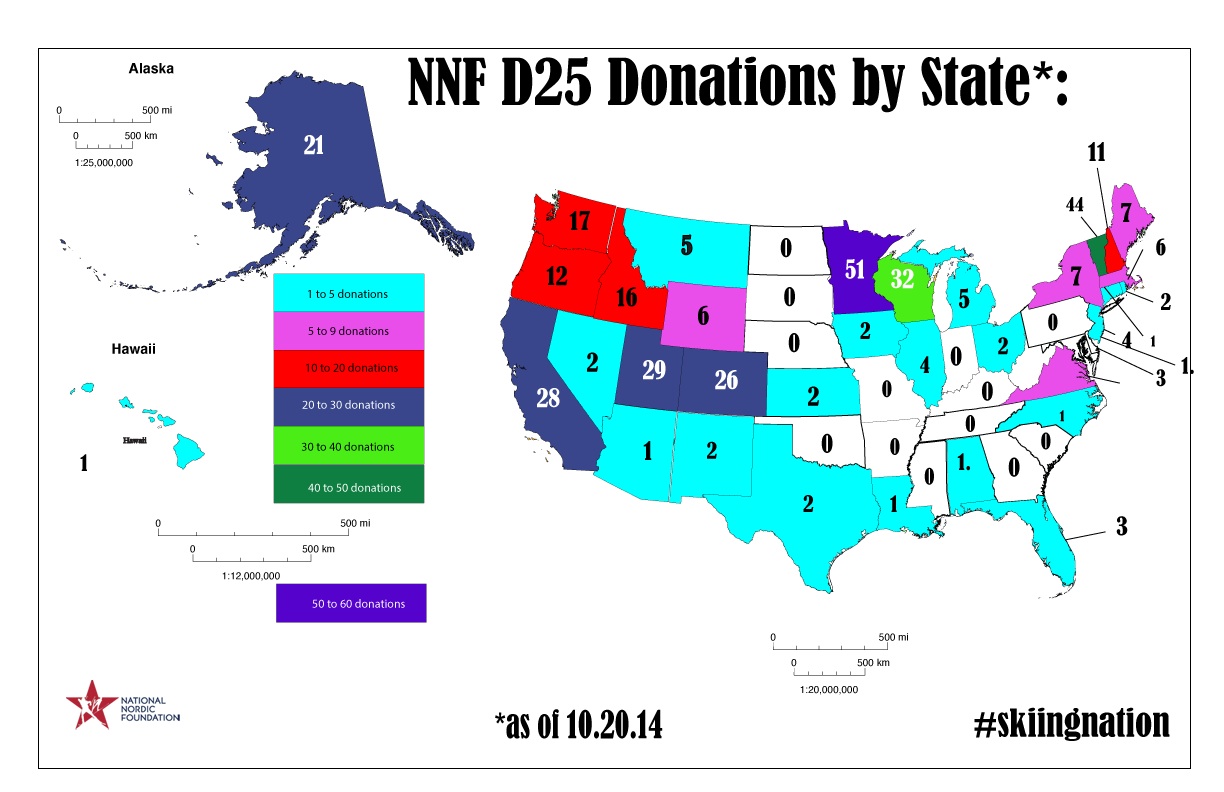
5. Lastly Map Mondays, Perhaps the map says it all, so much fun to watch wow! Our traditionally strong states like Vermont, Alaska and Colorado were joined by Minnesota, Wisconsin, New York California, Washington and yes……. UTAH!
In the near future the NNF Board of Directors will allocate funding to our key Pillar Projects and we will report back to you as to what the NNF funded allocations are, where your money will directly support skiing.
Over the next few week’s we’ll be reaching out to spread the word on skiing development. Share the NNF website and email with anyone that loves skiing. USST Coach, Chris Grover, highlighted why during the Drive for 25.
Members of the Sun Valley Ski Education Foundation Gold Team with coach Colin Rodgers in Europe last season. (Photo: NNF)Five years ago, David Knoop was a self-described master blaster looking for a cause, and the National Cross Country Ski Education Foundation (NCCSEF) was going to be it.
His process of finding the NCCSEF didn’t happen overnight. In fact, the nonprofit had been more or less defunct since 2008, when founder Reid Lutter decided he was too busy to continue its mission of supporting junior development in U.S. nordic skiing.
After starting the NCCSEF, formerly based in St. Paul, Minn., 14 years earlier with Rick Kapala and evolving to the point where they could send American kids to Junior World Championships, Lutter simply had other focuses as a ski coach and owner of a custom-apparel company, Podiumwear.
Meanwhile, Knoop, who lives in Park City, Utah, and works as an insurance broker in Salt Lake City, was figuring out his own calling. In the spring of 2008, his 20-year-old son Matthew Knoop was killed by a hit-and-run driver while on a mission for The Church of Jesus Christ of Latter-day Saints in Brazil. The oldest of Knoop’s two children, Matthew was a Park City High School soccer standout who captained his team to a state championship in 2006, his senior year.
After his passing, Knoop started to research charitable causes to devote himself to.
“My son didn’t get paid to go on a volunteer mission — it was something he wanted to do because he made a difference,” Knoop said on the phone this week. “He taught me a lesson there and I just decided I could give back.”
Simi Hamilton on his way to winning the U23 World Championships skate-sprint qualifier by one second in 2010 in Hinterzarten, Germany. He went on to place 26th after his pole broke in the quarterfinal. This season, Hamilton, 27, is a member of the U.S. Ski Team A-team. (Photo: NNF)By way of the U.S. Ski Team, he found the NCCSEF. A regular donor to the team, Knoop eventually got a direct request from then-U.S. Ski Team (USST) director John Farra.
“Farra said, ‘I want you to take over the NCCSEF,’ ” Knoop recalled. “I was like, ‘I don’t even know what you’re talking about it.’ He was like, ‘I’ll help you with it for a couple of months.’ ”
Knoop remembered thinking about the potential of the sport and the ranging emotions people have when it comes to their perception of the USST or its national governing body, the U.S. Ski and Snowboard Association (USSA). Instead of admiring the problem, he decided it was time to take positive action.
According to Knoop, the National Nordic Foundation (NNF), which came to be in 2011 out of the same 501(c) because “just saying [NCCSEF] is a mouthful,” started with a basic structure — not exactly a business plan.
“[Farra] said, this is junior development, this is how junior development works, these are the projects that are sorely in need of funding,” Knoop said.
From there, the former soccer coach and longtime nordic enthusiast began to immerse himself in U.S. cross-country skiing from the club to national-team levels.
The 2011 NCCSEF calendar cover. (Photo: FasterSkier)Then, he got some help from Kapala. The head of the Sun Valley Ski Education Foundation (SVSEF) nordic program, Kapala knew of a generous donor in Sun Valley, Idaho, who would likely support a national cause as well, and he connected him with Knoop.
“The first year I did a bit of wandering in the wilderness by myself — John Farra gave me a lot of guidance in terms of projects he felt were important … Rick Kapala had a few people he introduced to me,” Knoop said. “They were kind to me. They could tell I really didn’t know what I was talking about, but I had an idea and there was probably half a dozen donors that wrote some good-sized checks and said, good luck with your experiment.”
Knoop was not a professional fundraiser; he was a volunteer with a demanding day job. Once donors realized that and understood that he had little to gain, he said they became easier to approach and usually more likely to open their wallets.
NNF’s Rise
In 2009, the NCCSEF came back to life with roughly $35,000 dollars in the bank. Five years later, Knoop as the director checked the balance from his Salt Lake office: the NNF had about $215,000 in reserves for cross-country skiing and about $43,000 for nordic combined. And that was more than three weeks before the Drive for 25 (D25) ended.
Annually the foundation raises more than half a million dollars in donations. With goals of raising $150,000 for cross-country and $50,000 for nordic combined in this year’s D25, the NNF was more than halfway there with 19 days to go. As of Friday, 75 percent of the target had been reached for cross-country and 14 percent for nordic combined.
While the discrepancy between the two sports might seem large, Knoop explained that it’s misleading: nordic combined parted ways with the NNF this summer, then returned to the organization three weeks before the D25 started Oct. 1.
When USSA defunded nordic combined in April, NNF board member and nordic-combined veteran Billy Demong devoted his offseason to fundraising to save his sport. One of his first moves was partnering with USA Ski Jumping.
NNF Board of Directors:
David Knoop (executive director)
Reid Lutter
Joey Caterinichio
Yuriy Gusev
Jennifer Barba
Steve Fuller
Kerry Lynch
Billy Demong
Contract employees:
James Southam (administrator)
Andrew Gardner (public relations)
According to Knoop, that led nordic combined — which was in search of top-to-bottom funding — to search for funding outside the NNF, which reserves financial support for national B-team athletes and those in the developing ranks below them and above Junior Nationals.
“My response to Billy [was], ‘You can leave the NNF, but we’re not kicking you out. There’s no hard feelings,’ ” he said, explaining that they kept their lines of communication and nordic-combined’s checking account within NNF open.
“We even funded a summer project for them with some remaining funds they had,” he added. “Kerry [Lynch] and Billy remained on our Board of Directors.”
Over the course of the summer, nordic combined generated most of the money it needed to get through the next season and put a renewed emphasis on development and future sustainability. As a result, Knoop said the program was probably stronger as a result.
“They’ve had a heck of a ride,” he said. “They got a fair amount done through [USA Ski Jumping] all summer long, then they kind of realized, we benefit from being part of the NNF. There’s no takeaway here — why wouldn’t we have three buckets of revenue?
“They came back to us three weeks before the Drive for 25 and you can see the result,” he added. “It’s not very scintillating, but they’ll be back.”
At the same time, the Drive is one of multiple nordic-combined fundraisers held each year. The then-NCCSEF added nordic combined to its support structure in the spring of 2011.
“Nordic combined historically has done really well,” Knoop said. “[As] Kerry Lynch said, ‘We might be small, but we’re mighty.’ ”
The Drive: what it is and how it started
NNF’s D25-donation tally by state, with director David Knoop emphasizing the importance of the number of donors over the fundraising amount. “There’s a national appetite for this,” he says.
In its fourth year, the D25 is one of two annual fundraisers the NNF holds for cross-country. Alternatively, nordic combined prefers to spread its efforts, and typically solicits donations in different forms multiple times a year.
The idea to encourage an estimated 4,000 U.S. nordic enthusiasts to donate in the name of development came to life in 2011 with founders Peter Vordenberg and Matt Whitcomb, then both U.S. Ski Team coaches. They reasoned if thousands donated $25 on a single day — Nov. 15 — it could make a lasting impact on developing cross-country skiers.
“U.S. cross country skiing is in financial trouble,” a 2011 press release for the D25 stated. “While we have improved from a nation that seldom put a single skier in the top 15 on the World Cup to a nation with World Cup and World Championship podiums we are currently operating at a budget of less than a tenth of our toughest competitors. And more importantly our budget shortfalls are making it impossible for our younger developing athletes to afford the racing opportunities they require to compete among the best.”
There were two ways to get involved: simply donate $25 on Nov. 15, or even better, become an ambassador and persuade at least 10 others to donate $25 on the same day.
The premise was solid, but NNF’s mailbox nearly couldn’t handle it. Knoop said it was a good problem to have, “Sure enough, on November 15, it rained [money] on that day … We raised like $50,000, like, holy smokes,” and the buzz surrounding the Drive was what left a lasting impression.
But there were questions. Knoop said he received checks in the months following with letters asking if the NNF would still accept donations. Of course they would, he always responded. And while the Drive took different forms in the years to come — from lasting almost three months last year, to six weeks this year — the goal was the same: to get “hay in the barn” so NNF’s board could allocate funds for the fast-approaching winter.
“Sure enough, on November 15, it rained on that day … We raised like $50,000, like, holy smokes.” — David Knoop, NNF director on the inaugural Drive for 25 in 2011
Before the Drive, Knoop said he focused on larger donors, and Vordenberg and Whitcomb drew his attention to the importance of a grassroots presence. What he later found was the NNF could have the best of both worlds, with big-time donors offering to match the amounts raised by grassroots donors.
The NNF is currently promoting a matching challenge for U.S. Nordic Combined’s Drive for 25, effective until Nov. 12, 2014. (Photo: NNF press release)Nordic combined currently has a matching challenge on the table: if it reaches $20,000, it’ll receive $20,000 in matching grants. As of Oct. 24, it had raised just over $7,000.
NNF’s athlete ambassadors sometimes have their own matching proposals to help them reach individual fundraising goals.
Katharine Ogden of the Stratton Mountain School led this year’s ambassadors in donations after exceeding her goal of $3,000 with more than $4,300 as of Oct. 24. The second-highest fundraiser, Paddy Caldwell of the USST D-team raised nearly $2,000 of his $2,500 goal in that time.
Knoop said those athletes went above and beyond their expectations as ambassadors, but he encouraged anyone who has benefited or could benefit from the NNF’s support to fundraise on its behalf as well.
And that’s the part of the Drive that hasn’t changed over the last four years. According to Knoop, the bottom line is, ambassadors are still expected to get 10 friends to donate $25 before Nov. 12.
While fundraising isn’t glamorous, it’s necessary, Knoop said.
“It’s about as tedious as your parents asking you to mow the lawn,” he said. “In terms of the timing of it, we run it a bit longer because all these kids are going to school, they’re training and to tell them they’ve got to get something done in one or two weeks, it’s not going to happen. We need to give these kids some time to build momentum.”
Not all of NNF’s roughly 80 ambassadors are developing athletes. USST Head Coach Chris Grover has raised the third-most amount of donations as an individual and USST Assistant Coach Jason Cork is fifth on the list after Team Gregg.
Several members of the USST A-team, the elite tier that doesn’t receive money from the NNF, are also ambassadors. According to NNF’s public-relations director Andrew Gardner, everyone on the USST with the exception of Andy Newell received NNF funds as developing skiers — and Newell supports the NNF regardless.
“What we’re trying to do now, twenty years later is say, there’s a whole development need and there’s a space between Junior Nationals and the A-team on the U.S. Ski Team that’s a funding void. In terms of development, that’s what you need.” — Knoop
Understanding the NNF
Last year, the D25 exceeded its goal of $150,000 for cross-country and raised $170,000 with 1,071 donors. That’s great, Knoop said, but what confounds him is how many nordic skiers still don’t know what the NNF is.
“I race a lot in the Midwest; it is master-blaster central,” he said. “Just imagine, part of our tagline is: generations helping generations. I wear an NNF patch on my hat and yet as a master blaster going to a fairly large citizen race, I can stand there at the starting line and easily 90 percent of the athletes will have no clue what that NNF patch is. That’s the potential. Whether or not we ever reach a broader base, that is the question mark.”
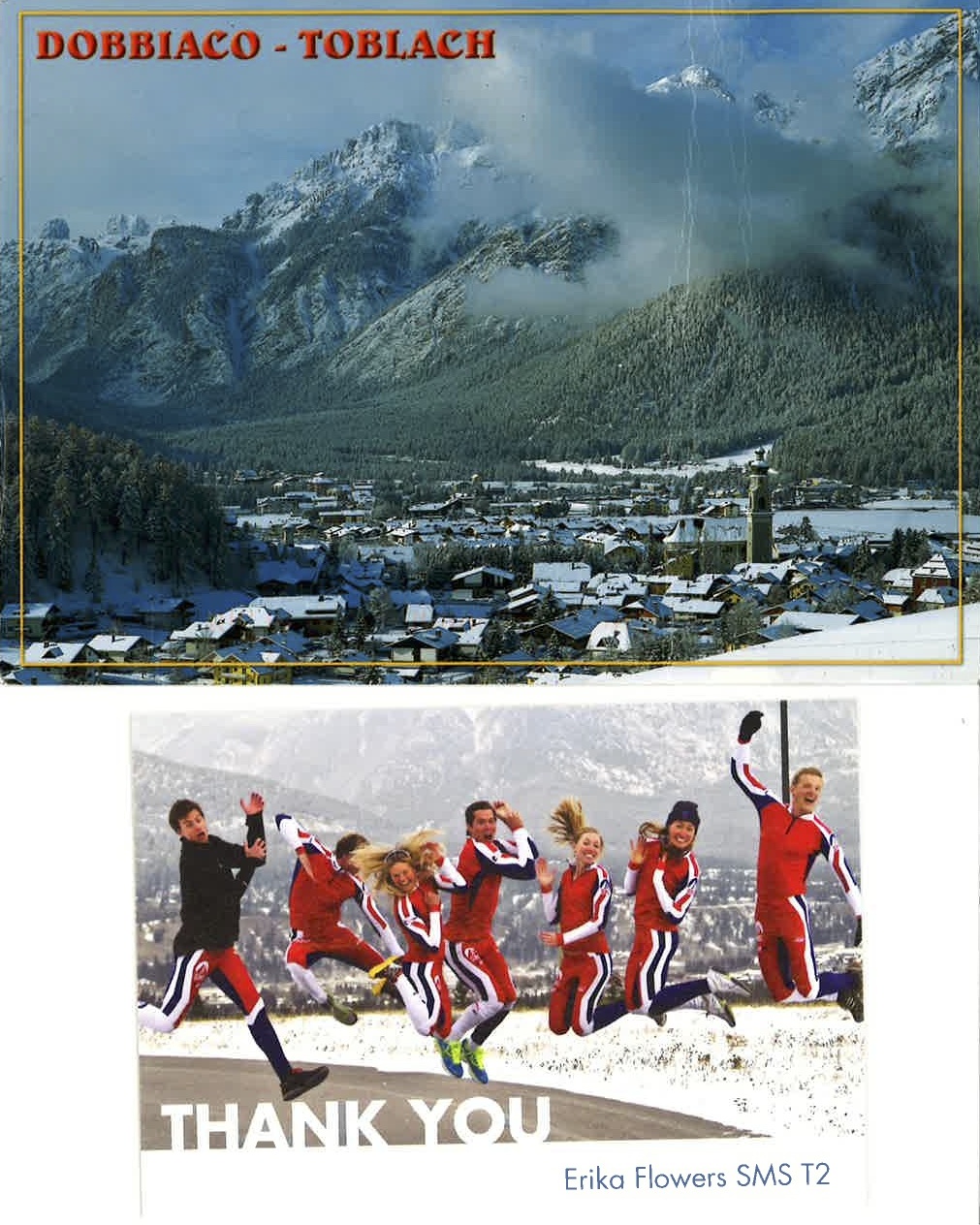
An example of thank-you postcards the NNF receives by the dozens each season. Above: from Italy. Below: from the SMST2 Team
In a perfect world, he’d set a goal of half a million dollars for the D25 and the NNF could still “blow through that money” if it was all raised. The U.S. is competing in an international realm with players like Norway and Germany with multi-million dollar budgets.
“I’m glad that we’re a half-million dollar organization,” he said, referring to the $516,000 NNF received in donations last year (up from $192,000 in 2012 and $352,000 in 2013). “I’d like to see us one day get to be a million-dollar organization, but as you can see we’re competing against countries that are far more robust. … We’ve been able to do far more with far little, and the reality is that it’s never enough.”
Last year, the NNF’s expenses amounted to about $120,500 in administrative-and-fundraising costs like website development and maintenance, and two contract salaries with Gardner and full-time administrator James Southam. On top of that, NNF spent some $313,000 on athletics in 2013/2014, specifically pillar projects — the initiatives it stands behind and works to support year after year — for a total profit of about $82,000.
Since the foundation’s inception, helping athletes afford U23 and Junior World Championships has been a priority. This season, the NNF stated on its website that it aims to spend $80,000 on that event (70 to 80 percent of its cost to U.S. athletes) and $348,000 total on athletics.
“I want to say that’s a three to four-thousand dollar expense per athlete,” Knoop said. “We typically tell the athlete the event will cost you $700 or $500 … plus your airfare. We want you over there and focused on racing and not have your parents stressed about money.”
After the D25 ends in Nov. 12, Knoop said his eight-member board will meet over conference calls to discuss how to spend the money — and how much they should use.
“Let’s say we hit $150,000 — it’s going to be a fun meeting for cross-country to say we have $350,000 in the bank, what do you want to spend?” he explained. “They all want to know, here’s how much we have, how much do we want to spend? Let’s be careful, let’s be conservative … how much should we save? As a rule of thumb, with $350,000, we typically spend half of it.”
NNF’s funding goals for 2015 amount to nearly $350,000, between projects like U23/junior worlds, paying for a development coach, assisting World Cup skiers, and supplementing the OPA, Scando and U18 trips in Europe. Besides the D25, the NNF relies on other fundraisers throughout the year, like the online auction held last winter that raised upwards of $150,000.
“Let’s just say for whatever reason the Drive for 25 falls flat, we’ve got those other fundraising mechanisms,” he said.
The NNF also gets direct donations from certain photographers like board member Steve Fuller, who sells his nordic photos on FlyingPointRoad.com and gives all proceeds to the foundation.
A thank-you postcard from Mattie Watts from New Brighton, Minn., now a freshman on the University of Vermont nordic team.Over time, Knoop has learned about the delicate balance of relying on loyal donors while searching for new support. For this reason, he writes handwritten thank-you notes to anyone that mails a check, and while online donations far outnumber those received by mail (and come with automatically generated thank-you’s), he tries to remember to thank online donors when he sees them in person.
When it comes to the timing of fundraisers, Knoop said it’s OK when others in the ski community are raising money simultaneously. The Stratton Mountain School T2 Team is currently promoting its own Matching Grant Challenge, where a private donor will match all team donations up to $25,000 before Nov. 15.
As a team, Stratton’s raised more than $7,000 for the NNF this year.
“If they’re donating to a club or some other cross-country initiative, there’s no need to cannibalize each other — that’s not going to further our sport,” Knoop said. “To the degree that people want to donate to the NNF and they see the value of what we’re doing, then I fully support that. If they want to support an initiative in another part of the country, then that’s great … and they should do it. We still win as a sport.”
The Greater Goal
In the years since its resurrection, Knoop said the NNF’s growth has been more gratifying than surprising.
“We’re not a huge nonprofit, but for our sport and the niche that we provide, I’d say we’re pretty successful,” he said.
“When you look at the entire potential of cross-county skiing, then I’m like, OK, I guess we’re never going to be like Norway where every citizen owns a pair of cross-country skis,” he later added. “But if we have a couple thousand people who get what cradle-to-grave skiing is all about, then we should have no problem getting our message across.”
That said, Knoop, in his late 50s, isn’t sure he’ll be onboard when the NNF reaches full steam.
“I’m going to get tired one of these days and I hope to hand the NNF baton off to someone who has the energy,” he said, noting his gratitude to Lutter for having the vision to start it.
With a cash fund to rely on for rainy days, Knoop said he dreams of finding enough money to start an endowment: a “big chunk of cash” that goes into an interest-bearing account and cannot be touched. Meanwhile, his example of a million-dollar endowment would generate $100,000 in additional cash each year — and he imagined what the NNF could spend that on.
At the same time, saving that much reserve money or finding a million- or half-million-dollar donor isn’t easy.
“I’ve never asked people for money in my life, and I’ve gotten more comfortable with it,” Knoop said. “I’m moderately comfortable getting people to write checks for $10,000 to $100,000 dollars so far…”
At the end of the day, there’s one thing that matters most to Knoop, and that’s whether the NNF is staying true to its mission statement: “to support athletic excellence in developing nordic athletes in the United States.”
Whenever there’s a question or debate amongst the board regarding what they should help pay for, he said that’s what they go back to.
Never Saw It Coming
In August, Knoop suffered a stroke that knocked him to the ground shortly after finishing a running-interval workout in Park City.
“Obviously that was quite a shock and it’ll probably take me a year to recover,” he said. “I had a brain aneurism. It had been there like a ticking time bomb … [that] dated back to youth football.”
National Nordic Foundation (NNF) Director Dave Knoop doing his thing as a self-described master blaster. (Photo: NationalNordicFoundation.org)
At the time, he was only about a mile from USSA’s Center of Excellence (COE), located next to a hospital. Knoop had been feeling strong and striding along some single-track trails when he finished his last interval, walked for a bit, then began an easy jog.
“I walked about a hundred or two-hundred meters and then just about as I started to run, I got really dizzy and I had no feeling and I dropped in the dust,” he recalled. “[I thought], ‘Oh, that’s great, you look like an idiot here.’ I knew something was wrong, but I had no comprehension it was a stroke.”
He tried to get back to his feet, but fell down without any feeling along the right side of his body. He later learned he had 50 percent paralysis.
Within minutes, a mountain biker discovered him and told Knoop to relax. He could talk, but with the right side of his face not working, it was difficult. As the biker tried to call for help, his cellphone was dying. Meanwhile, thunderstorms started to roll in.
“I’m like great, the fire station is only a mile away, the guy’s cell battery’s dying, it was just a calamity,” Knoop said.
It took the paramedics two hours to get to him.
“These firefighter guys were totally city and they had no idea that the trails existed,” Knoop said, adding that he still intended to thank them personally and provide them with some info on the trail system.
They loaded him onto a stretcher with a single wheel and pushed him a bumpy mile to their entry point, which was about 500 meters away from the hospital. Knoop couldn’t remember when, but at some point, they transferred him to an ambulance.
Once inside the hospital, he was informed he had about 45-minutes left in a three-hour window to reverse his paralysis with an anti-stroke medicine. While there was a 97 percent success rate, there was also a slight chance that the drug could lead to complete paralysis or death.
“The way they read the riot act to you, it’s like, big gulp,” Knoop said.
With his 24-year-old daughter at his side, they decided to take the chance. Within three minutes of being injected, Knoop could feel the medicine starting to work with tingling sensations in his right arm and leg.
Fewer than three months later, he was working out three to four times a week at “low Level 1” to avoid raising his heart rate. “I’m glad I can do this,” he said. “Walking I’m a little dizzy and yet I can go for a run on a trail and I feel fine. It’s weird how your brain gets affected.”
Sitting at his desk earlier this week, Knoop explained his short-term memory has been affected, his right arm and one of his fingers still tingle, and certain nerves in his arm and shoulder muscles feel like they’re firing at all times.
“I’ve had a number of CAT scans and MRI’s that show me pictures of parts of the brain that have been damaged,” he explained. “I’m not sure how it all works but your brain will remap itself in terms of just sending nerves and neurons around the dead parts, but it takes months if not over a year for that to [happen].”
Regardless, he feels lucky and compelled to carry a cell phone any time he works out alone.
“I didn’t take a cell phone with me — I prefer to workout away from people. I love to be in the wilderness all the time, mostly because I’m working in an office in downtown Salt Lake City,” he explained. “Now it’s like, I cant work out anymore without having my cell phone on me.”
And with responsibilities like NNF, he was grateful to have Southam and Gardner around. While the “three amigos” planned for this year’s D25 well before August, Knoop said they finalized its structure and implementation without him in the weeks after.
“James worked for a number of months on new fundraising mechanism [for nonprofits]: StayClassy,” he said. “Andrew worked on photography and getting the message out.”
“I think this year we’re much more organized,” he added. “If there was ever a time for somebody on the team to take a hit … I’m glad to see it doing well. The NNF or the Drive for 25 really shouldn’t be about any one person or a few key people, it should be about a whole community putting it together. As long as there’s the right framework, there should be the structure to make it happen.”
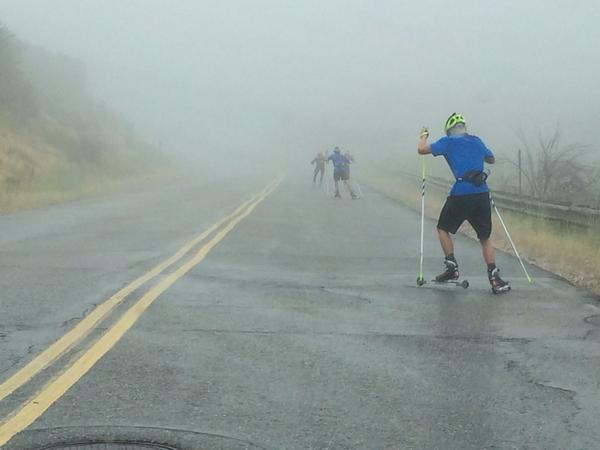
U.S. Nordic Combined skiers during a recent, foggy rollerski session near Park City, Utah (including Bryan Fletcher, Taylor Fletcher, Ben Berend, Brett Denney, Michael Ward, and Adam Loomis). (Photo: Dave Jarrett/Twitter)
July 31 was the day. On Thursday morning when U.S. Nordic Combined Head Coach Dave Jarrett walked into his office at the U.S. Ski and Snowboard Association (USSA) Center of Excellence in Park City, Utah, he knew he’d leave there with his job still in tact.
That was one takeaway from meetings with USSA in the last few months since the association, which serves as nordic-combined’s national-governing body (NGB), revealed in April that it would no longer fund the team after July 31.
According to Jarrett, USSA reasoned that if nordic combined wanted to raise money to sustain itself, it needed someone in charge. With help from USSA’s trustees, his position remained “pretty stable,” he said on the phone Thursday afternoon.
“The whole thing from the beginning was that they were trying to shake the trees and see if they could find more money,” he said.
Most recently, it was the status of his team’s other coach, Greg Poirier, he was uncertain of.
“He was ready to turn in his stuff at the office [on Thursday],” Jarrett said. “They came back to Greg and said we have some money for you to take care of you.”
While Poirier’s position as jumping coach wasn’t finalized, Jarrett said USSA had indicated it could cover Poirier as well for another season. That brought Jarrett to the next item on his wish list: securing a Continental Cup coach.
“Things are moving forward for sure, and it’s a little bit more hopeful than in April,” he said.
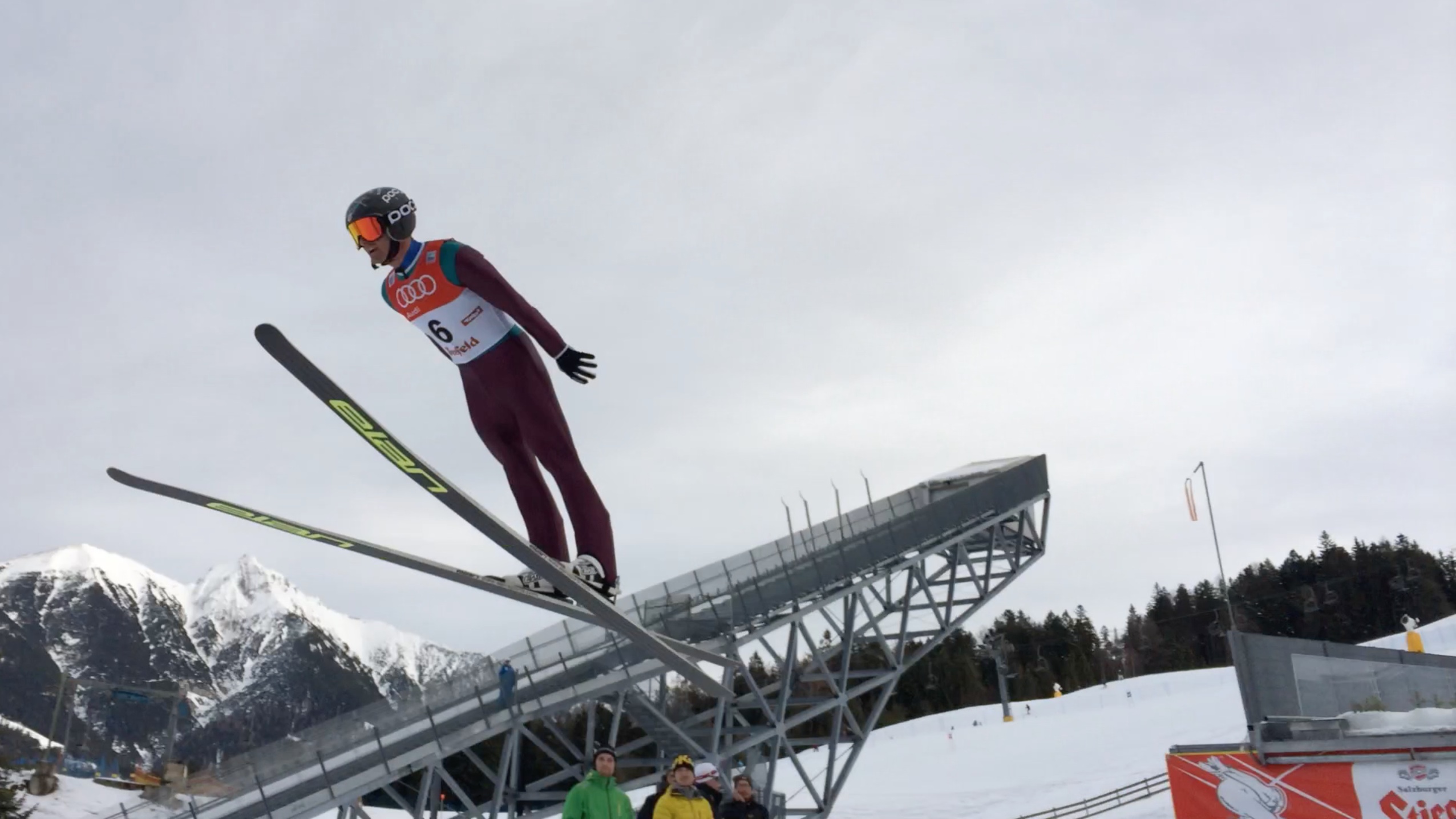
Bryan Fletcher jumping at the FIS Nordic Combined World Cup Triple in Seefeld, Austria, last season, where he ended up with a season-best fifth overall. (Photo: Fast Big Dog)
Money Game
As of Aug. 1, USSA will fund individuals rather than the team. According to Bryan Fletcher, for next season, that means him and his younger brother Taylor. Based on Bryan’s understanding, those two demonstrated the most “podium potential,” and with that came a set dollar amount from USSA to be used toward expenses next season. That amount is payable upon receipt, not a cash advance or stipend.
“Instead of funding an entire team and giving them a set budget, [USSA is] giving individuals who meet a set criteria for the ski team or based on the executive’s judgement … a set amount of money to pay for their season,” he explained. “Essentially Taylor and I are in that situation, given a little bit of money to fund our individual movements…”
The Fletchers have already spent their USSA funds on re-hiring the team’s two wax technicians, Andrej Jezeršek and Matjaz Dobrovoljc.
“There’s no point in showing up for World Cups if you have no support,” Bryan said. “Ideally that would be used for plane travel and [other travel expenses] … We decided that the most important thing was our wax techs’ salaries. It’s much easier to make ends meet while you’re over there.”
Jarrett agreed: “It’s the most cost-effective place [to compete], because you get paid to be there,” he said of the World Cup and the monetary perks (including comped food and lodging) that come with top international results.
“We decided that the most important thing was our wax techs’ salaries. It’s much easier to make ends meet while you’re over there.” — Bryan Fletcher, on using his personal USSA funds to pay for his team’s wax techs
At the same time, he’s optimistic that future arrangements and partnerships, both within and outside of USSA, could be used to pay for those two techs — adding it was essential to lock them down for another season first.
The team can also count on Switzerland to pay for about 30 percent of their servicemen’s salaries. Jarrett said they teamed up with Swiss nordic combined last season, waxing and testing some of their nordic skis in exchange for reimbursement.
As for the total cost of the season, with camps and competitions U.S. NoCo has yet to finalize its budget for, Jarrett estimated it amounts to roughly $250,000 dollars. That’s for the entire program, including travel expenses like airfare, room and board, fuel, and rental cars for all team and staff members. It does not include employee salaries or benefits, and equipment costs, such as jumping suits, bindings, wax and supplies — all of which Jarrett described as another huge cost.
Bryan estimated that waxing and travel expenses in Europe could amount to $2,000 a week per athlete — a figure that could be lower depending on how much other teams, like Switzerland, or race organizers help with defraying costs.
Regardless, they need cash to train — ideally at international venues — and get to the highest-level competitions.
That’s where Billy Demong, the team’s veteran and most-decorated athlete, has stepped up. As U.S. NoCo’s point person for marketing and fundraising, he plans to keep training and compete next season, but has already devoted a large part of his offseason to securing finances for his program.
“He’s pretty well-connected,” Jarrett said. “He really selflessly took that on … It’s a lot, that’s no question, but we know Bill…”
While Demong has been working out on his own schedule, the Fletchers have been training with the rest of the team in Park City. Aside from Todd Lodwick retiring from the A-team, the program has retained and slightly grown its training group, and Jarrett said all of its members are excited and motivated to make the jump from the development ranks.
A New Team Structure
New this season, U.S. NoCo is looking to fill a C-team, which Jarrett described as mainly a junior squad.
“Our goal now is to take care of the sport from top to bottom: A, B, C, and a development team,” he said. “The clubs really aren’t equipped to handle post-grad in nordic combined … [Athletes] need to be either on the Continental Cup or training.”
With its budget in flux, the program hasn’t decided how to divvy up funds for athletes among those teams. Jarrett said C-team will likely be unfunded, while providing a sense of national-team belonging and training opportunities for young skiers. At this point, B-team members that don’t make it to the World Cup will likely have to self-fund as well next season.
The big questions that remain for the U.S. team include its competition schedule and how many world and continental cups it can afford to attend, as well as whether it can swing an international training camp this fall.
“We didn’t do a camp in July. We’re not doing a camp in August,” Jarrett explained. “We’re hoping to have a big camp together with the Swiss guys, go to Lake Placid [for U.S. Nordic Combined nationals] in October, then go to Europe after that to have a camp [in Germany and Switzerland].”
Bryan pointed out that the team needs to jump at lower elevations than Park City and would benefit from the ice track in Oberstdorf, Germany.
“You’ve got to see the level of how everyone’s jumping,” Jarrett said.
In the past, the team held three summer training camps, most of which were in Europe. This year, its athletes skipped their usual Tour-de-France camp, replacing it with a five-day endurance camp/fundraiser in Aspen, Colo.
“We had donors come to pay and ride with us for a week,” Bryan explained. “We had an awesome time. … That was mostly Bill’s idea, just to continue that bike idea in Aspen.”
Craig Ward is heading up another nordic-combined fundraiser in line with the USA Pro Cycling Challenge from Aug. 14-19 in Aspen, Bryan added. Because of funding uncertainty this spring, the team had to rule out competing at the International Ski Federation (FIS) Summer Grand Prix in Germany and Austria in late August.
As for the team’s winter World Cup schedule, Jarrett said it will be similar to in the past, with specifics being worked out in the next few months.
“It’s moving in the right direction,” he said.
USASJ and NoCo Unite
By partnering with USA Ski Jumping (USASJ) to form a singular “USA Ski Jumping and Nordic Combined,” Jarrett hopes his sport continues to grow, both in participation and financial stability, for seasons to come.
The agreement was sort of a natural byproduct of the two sports’ commonalities, he explained. Not only is jumping essential to the success of both, but they also share the few jumping venues scattered across the U.S. Plus, most nordic-combined skiers start out as jumpers — and if they don’t, they have to move to a place with jump hills to learn how.
“There’s much more in common with ski jumping than there is with cross-country for nordic combined,” Jarrett said. “It’s just a better fit, a better understanding of how this sport works.”
Since 2006, USASJ has operated independently of USSA (which also remains its NGB), coming up with its own marketing and fundraising strategies. While Demong will continue to work on landing sponsors for nordic combined, the two sports won’t likely combine marketing efforts in the near future — unless a major sponsor wants them as a unit and each slice of the pie is large enough to make it worth pursuing, Jarrett said.
“There’s much more in common with ski jumping than there is with cross-country for nordic combined. It’s just a better fit, a better understanding of how this sport works.” — Dave Jarrett, U.S. Nordic Combined Head Coach
“Right now there’s no downside for [USASJ]; they’re not giving up anything,” he said. “They’re just sharing a place for us to raise money. That was the goal that we started with. They’ve already been down this path … they’ve already suffered through all the growing pains that’s involved with getting cut like that. It’s been definitely a good partnership … [and] we’re coming into it with pulling our own weight.”
In the future, Jarrett said they could revisit collaborating with Women’s Ski Jumping USA, too. However, that program has opted to remain separate for the time being.
“That could be a really good dream: to have both men’s and women’s ski jumping and both men’s and women’s nordic combined under the same roof,” Jarrett said. “But Women’s Ski Jumping USA is also protective with what they’ve done as an organization and rightly so.”
The next couple years could be telling for all the aforementioned organizations.
“We need to keep together to keep our sports alive,” Jarrett said. “I think [Women’s Ski Jumping USA needs] to figure out how they’re going to proceed now that they’re into the Olympics and the suffrage story is over. Hopefully we can talk and figure out what’s the best for our sport. … FIS and the IOC, they really want women’s nordic combined … to flourish.”
Coaches education, development outreach, jumping equipment and technique are among many elements ski jumping and nordic combined could share, Bryan said. But they’re also different sports and not everything overlaps.
“We need our own staff and they need their own staff,” Jarrett said of USASJ.
NoCo and NNF
A longtime supporter of U.S. NoCo, the National Nordic Foundation (NNF), a nonprofit designed to help fund developing nordic athletes in the U.S., will continue to back nordic combined.
NNF Director Dave Knoop explained the foundation is currently working on its upcoming “Drive for 25” fundraiser, typically launched in late fall, and intends to include Nordic Combined in that movement.
“We understand how and why NC has merged with Jumping and what they are doing makes a lot of sense,” Knoop wrote in an email. “The NNF has not abandoned funding NC Pillar Projects and we look forward to funding NC designated projects in the future.”
Meanwhile, nordic combined will receive support from both NNF and USASJ. NoCo representatives Demong and Kerry Lynch remain on the NNF board.
“In the past few months we have stepped back a bit to let Billy and others define how Nordic Combined would fit within the USA Ski Jumping [organization],” Knoop explained. “Now that this is clear we will begin defining and communicating NC’s role within the NNF. Specifically the transparency aspect of what we will fund and why so donors know where their donations are going.
“If anything can be said of this episode regarding USSA’s actions regarding Nordic Combined funding is that I am hopeful that it just made NC rebuild [itself] in a way that eventually will make it a stronger organization,” he continued, “that the sport will grow in numbers and develop great athletes in the future.”
American athletes racing on an NCCSEF-supported trip in La Feclaz, France. Photo courtesy of TeamToday.org
If you’re planning on racing in Europe this winter on any of the trips supported by the National Cross-Country Ski Education Foundation (NCCSEF), you can thank Jerry Gilbert.
Gilbert, a retired electrical engineer and avid master skier, died of lymphoma in 2008, and in his will, he left some $80,000 for NCCSEF. The money took nearly two years to find its way to the organization, but now that it has, that donation should be supporting aspiring athletes for decades to come.
With the help of Gilbert, and under the leadership of Business Director Dave Knoop, NCCSEF has nearly doubled its budget for the 2011 season, jumping from $25,000 to $43,000 in the last year. It has also expanded its initiatives, with plans to support athletes on trips to Finland for early season racing, as well as those heading to Norway in February for the World Ski Championships.
And according to Knoop, the organization isn’t done. Additional funding—as much as $20,000 to 30,000 more—could come into play later this season, in the shape of individual skier grants as rewards for top finishes, or as support for groups already planning on travel to Europe.
“We’re going to take another look later this fall,” Knoop said. “[Those] are ideas that we’re kicking around for our next round of funding.”
Participants on last year's NCCSEF-supported OPA Cup trip in France. Photo courtesy of TeamToday.org.
Founded by Reid Lutter and Sun Valley Ski Education Foundation Program Director Rick Kapala in 1995, NCCSEF has typically disbursed grants and funded American trips to the World Junior and U-23 Championships, as well as a team of younger juniors that travels to Scandinavia for competitions.
This year, the funding is going deeper into the pipeline. In addition to money for the aforementioned projects, NCCSEF is providing financial support for a late-season domestic European tour, similar to a trip that they helped send to France and Slovenia last year.
Beyond that, there are the new initiatives that will fund the season-opening races in Finland and the World Ski Championships in Norway.
“They’re really prioritizing supporting international trips, and in my opinion, that’s the right place to be sending this thing,” said U.S. Ski and Snowboard Association (USSA) Nordic Director John Farra, who sits on NCCSEF’s board as a liaison between the two organizations. “These are small steps, and they’re small amounts of money right now, but I think they’re going to be really directly benefiting the athletes in our pipeline that really need it.”
Knoop took over management of organization before the last season, and after appealing to some key donors, was able to raise another $60,000 over and above the Gilbert bequest. That, combined with some money that Lutter had set aside from previous years, left the organization with roughly $220,000 in the bank at the beginning of this season.
While disbursing that money is the fun part, Knoop said that he’s conscious of the need to maintain a healthy balance in NCCSEF’s coffers for years to come, in the form of an endowment.
“That concept creates long-term sustainability, so that it’s not a flash in the pan,” Knoop said. “The idea of building up an endowment, but also spending more on projects—it’s a balance…It will be an ongoing discussion with the board as to how much is appropriate to spend.”
In an interview, Knoop said he didn’t know the endowment’s current value given the recent funding commitments, but he pegged it at somewhere between $100,00 and $200,000. He said that he would like to see it grow to $500,000.
USSA and NCCSEF are both non-profits, and it might seem that the two would be competing for the same pool of money. But both Farra and Knoop maintained that their organizations were complimentary.
“My bosses have no problem with it, because essentially, what NCCSEF is doing is it’s picking up where we leave off—it’s a really healthy partnership that way,” Farra said. “It’s not trying to duplicate. If my budgets were bigger, I’d probably be thinking about it similarly.”
Participants in the U.S. OPA Cup trip in France – Photo from TeamToday.org
The IOC hasn’t yet decided on a location for the 2018 Winter Olympics. But it’s safe to say that the road to those Games travels through Slovenia, at least for some of America’s cross country skiers.
Thanks to a $10,000 grant from the National Cross Country Ski Education Foundation (NCCSEF), and more funding from the U.S. Ski Team, a group of 15 athletes has set up shop in the resort town of Rogla. There, the skiers are contesting this weekend’s OPA Cup Finals—skiing’s equivalent of a minor league World Series.
It’s the first time in recent memory that such a large contingent has traveled to race on the circuit overseas, and officials back home are hoping that the opportunity to mix it up with the Europeans will help make the Americans more competitive at an earlier age.
“If someone is in the pipeline, and they want to be a part of the future of the sport…they need to get some European experience,” said John Farra, who directs the cross country program at the U.S. Ski and Snowboard Association (USSA). “That’s the right model.”
USSA has funded small OPA Cup trips in the past, and another was planned for this year. But with the economic crisis hitting the organization hard, Farra said that the U.S. Ski Team (an arm of USSA) only had money in its budget for one coach, one wax tech, and two athletes—albeit with a few more spaces on the trip for skiers who could pay their own way.
That was when NCCSEF stepped in. Created in 1995 by junior coaches Reid Lutter and Rick Kapala, the foundation has given travel grants to developing skiers since 1997—including, for example, one that helped future Olympian Kris Freeman attend his first World Junior Championships in 1998.
For the OPA Cup trip, their $10,000 contribution went towards bringing additional coaches, as well helping to pay for lodging and vans for other, non USSA-funded athletes who wanted to go. While these skiers still had to pay their way to get to Europe, Farra said the NCCSEF funding reduced total trip costs by $400 to $500 per athlete.
In addition to his role at USSA, Farra is also on the board of NCCSEF, and he said that the two groups had been in discussions since the summer about finding a way to send a bigger OPA Cup trip.
“In the past, a couple of stragglers have kind of tagged along [on the U.S. Ski Team OPA trip],” Farra said. “This year, the concept was, ‘we need a trip.’”
NCCSEF’s funding for the additional coaches allowed administrators to open the trip up to a much larger number of athletes than previously planned. There were no selection criteria—anyone who wanted to go could go.
In order to make the trip more inviting, USSA didn’t schedule any big domestic races in early March. Basically, Farra said, the message for developing skiers was that “if you’re not in the Junior Olympics and you’re not in NCAA’s, then you’ve got to be doing OPA.”
American athletes racing in La Feclaz, France – Photo from TeamToday.org
The group started with two races last weekend in La Feclaz, France, and finishes with three more in Slovenia. The competition on the OPA Cup is fierce, including a number of athletes with World Cup experience—and that’s exactly what the American coaches want to see.
“This group is looking for…experience outside of their comfort zones, knocking heads with some of the best developing racers in Europe,” said Matt Whitcomb, a U.S. Ski team coach on the trip, in an interview from La Feclaz.
Along with deep fields, Whitcomb said that the OPA Cup races also offer good opportunities for the Americans to improve their FIS points, which should trickle back down into the U.S. once the group returns home.
Indeed, the athletes on the trip have been popping solid points races left and right: Brian Gregg, Mike Sinnott, and Peter Kling all have posted career-bests on the trip.
And for athletes who will be spending most of their winters competing outside the United States if they ever become World Cup regulars, even the simple (or sometimes not-so-simple) experience of traveling and dealing with logistics should help them down the road.
While NCCSEF was almost defunct last year, chair Dave Knoop said that a new board and some big donations from key donors this year have given it new life. This year, the foundation also helped fund the U.S. teams at the U-23/World Junior and J-1 Scandinavian Championships, as well as the OPA Cup trip.
The hope, Knoop said, is ultimately for NCCSEF to be able to provide even more money for those trips, as well as for other initiatives—even helping athletes travel to Junior Nationals, for example. With a handful of generous donors—and a large bequest from a master skier who recently passed away—the foundation has some lofty goals for the future.
While NCCSEF isn’t capable of funding deeper down into the pipeline right now, Knoop says that “it’s a vision.”
“It will take a little bit more time and momentum to be able to hand out enough scholarships, if you will, to make a difference,” he said. “There’s certainly a greater picture that can be achieved.”
For athletes’ perspectives on the trip, check out the numerous blog posts to the left of the main column and in our XCFeeds section, as well as this post from TeamToday.org. To learn more about NCCSEF, visit their web site.