From the FasterSkier archive — posts syndicated from athletes’ and coaches’ own blogs between 2004 and 2012, kept online as published. Current coverage is at fasterskier.com.
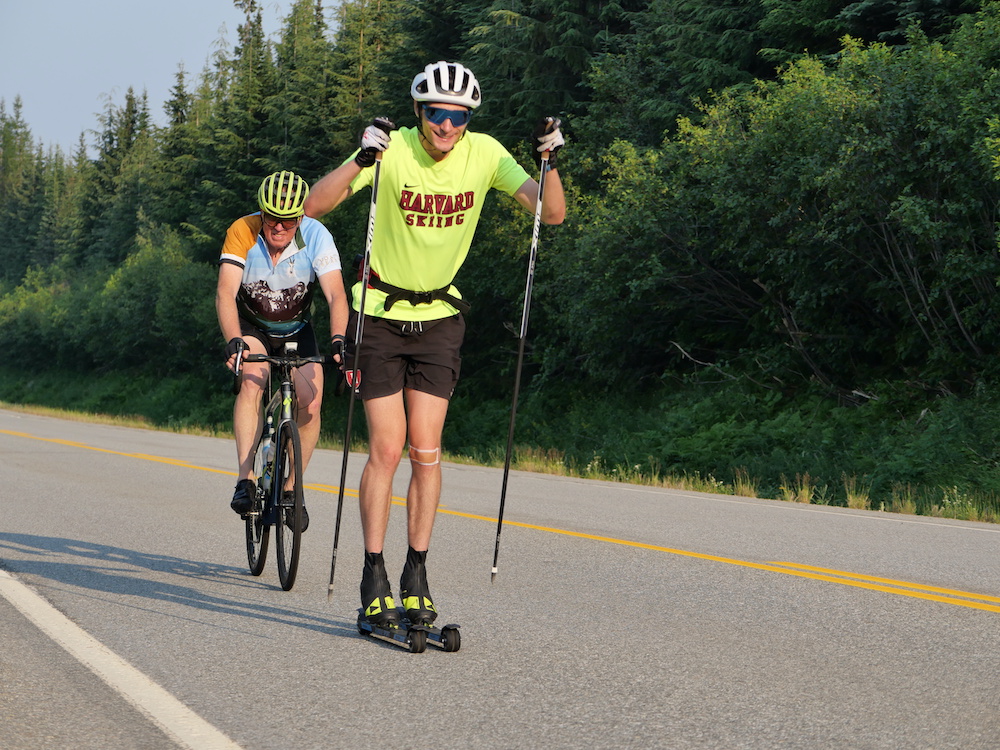
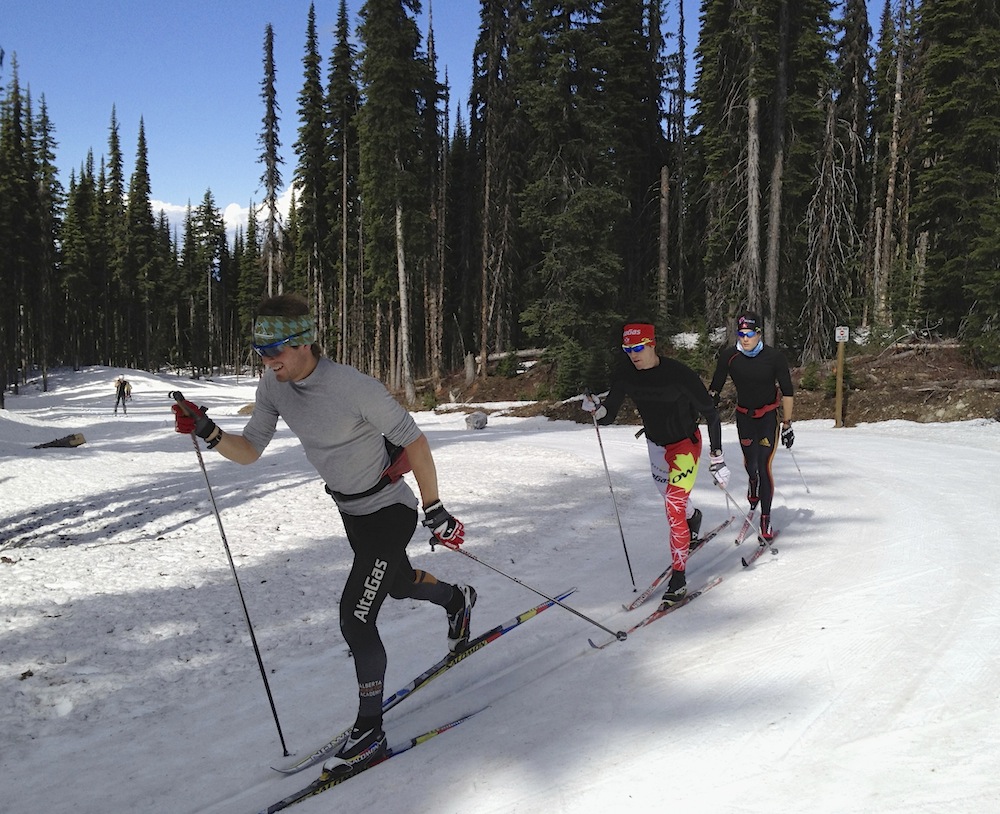
Rémi Drolet rolling up to Nancy Greene Summit, supervised by coach Dave Wood. (Photo: Peggy Hung)
Rossland, BC native Rémi Drolet had a lot going on during the first year of the pandemic. In his first year on the Canadian senior national ski team, he was studying theoretical physics at Harvard.
His junior career ended with a silver medal and an individual fourth place in the 2020 World U20 Championships, right before COVID cancelled the final World Cups and Canadian Senior Nationals. This was also his first season living in a foreign country as an Ivy league freshman.
The previous (18/19) season, as an 18 year old, he collected two silver medals at Senior Nationals behind Lenny Valjas before his first World Cup starts. Drolet was the third best Canadian in the Québec mini-tour, beaten only by retiring athletes Alex Harvey and Valjas.
These results put him onto the national team as a first year senior, and also set expectations high for the 20/21 season.
FasterSkier caught up to Drolet at home in Rossland, suitably distanced in a park near his home. After a brief publishing delay related to this author’s day job, Drolet updated his status in an email from Muonio, Finland.
University Life
Pandemic life in the USA last season was remarkably varied, depending on the state a skier lived in.
“I wasn’t able to actually make it to Boston itself,” Drolet explained. “All classes were online, which made some things difficult. And I definitely miss being there, miss seeing all my friends.”
Collectively, IVY League schools cancelled all sports programs for the 2020-2021 academic year, leaving student-athletes in a challenging predicament.
“A lot of athletes and a lot of other athletes at Harvard just decided to take a leave of absence and take the year off because of that. Even then there were very few students who were allowed on campus, basically, just certain years and those students that needed to be there for personal reasons.”
In terms of his individual handling of the circumstances, Drolet shared a silver lining.
“[There were] some logistical issues, but overall, I think I took advantage of it pretty well, because I was able to be living at home the whole year.”
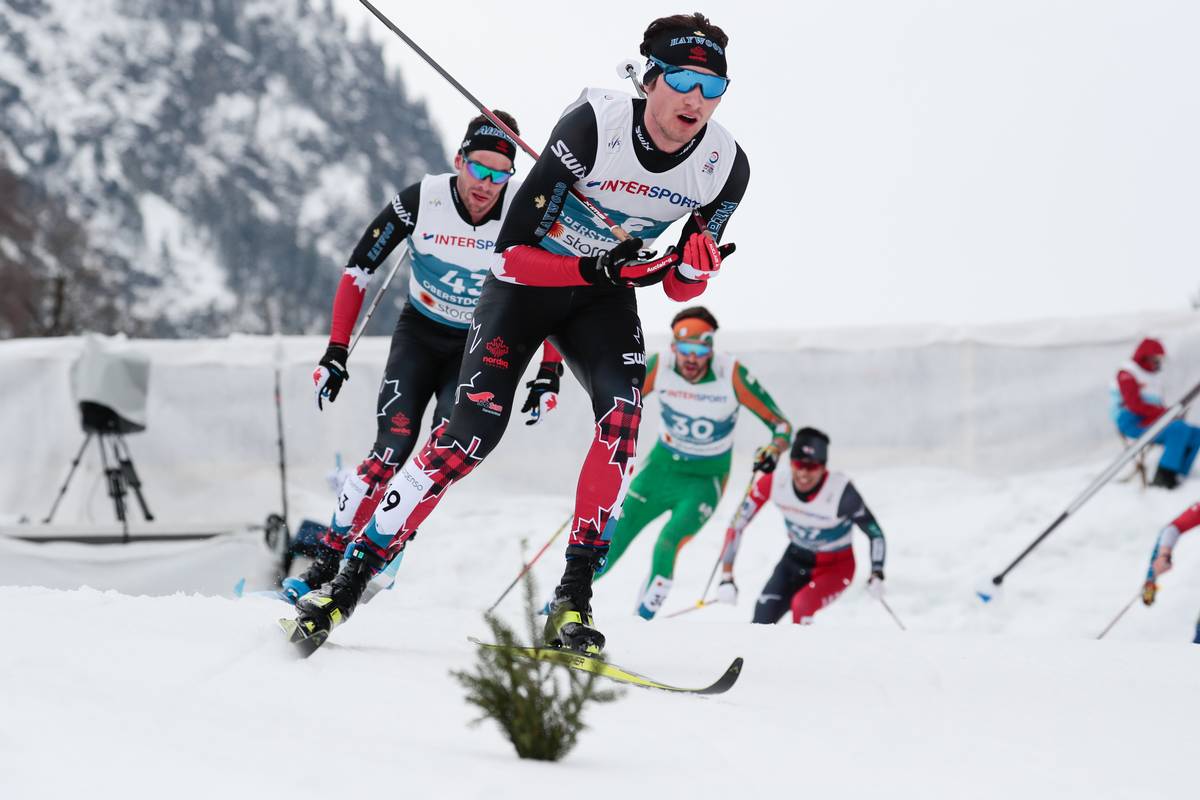
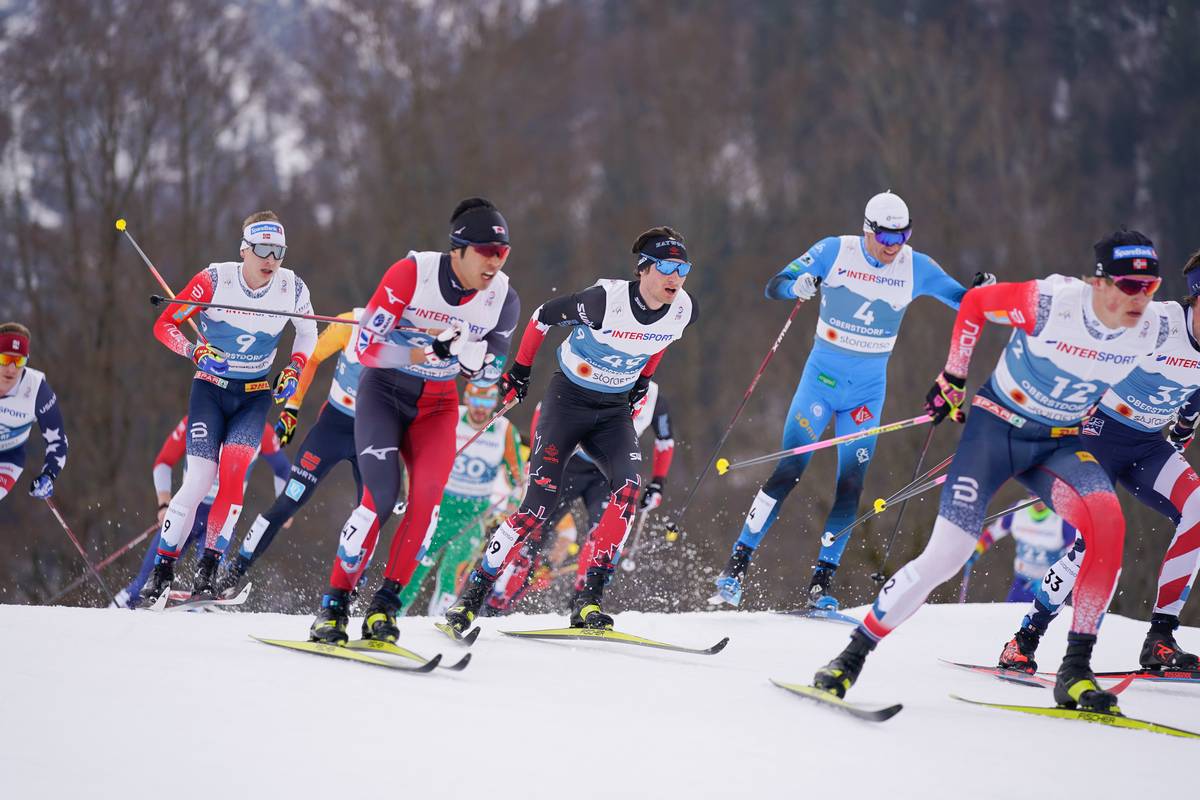
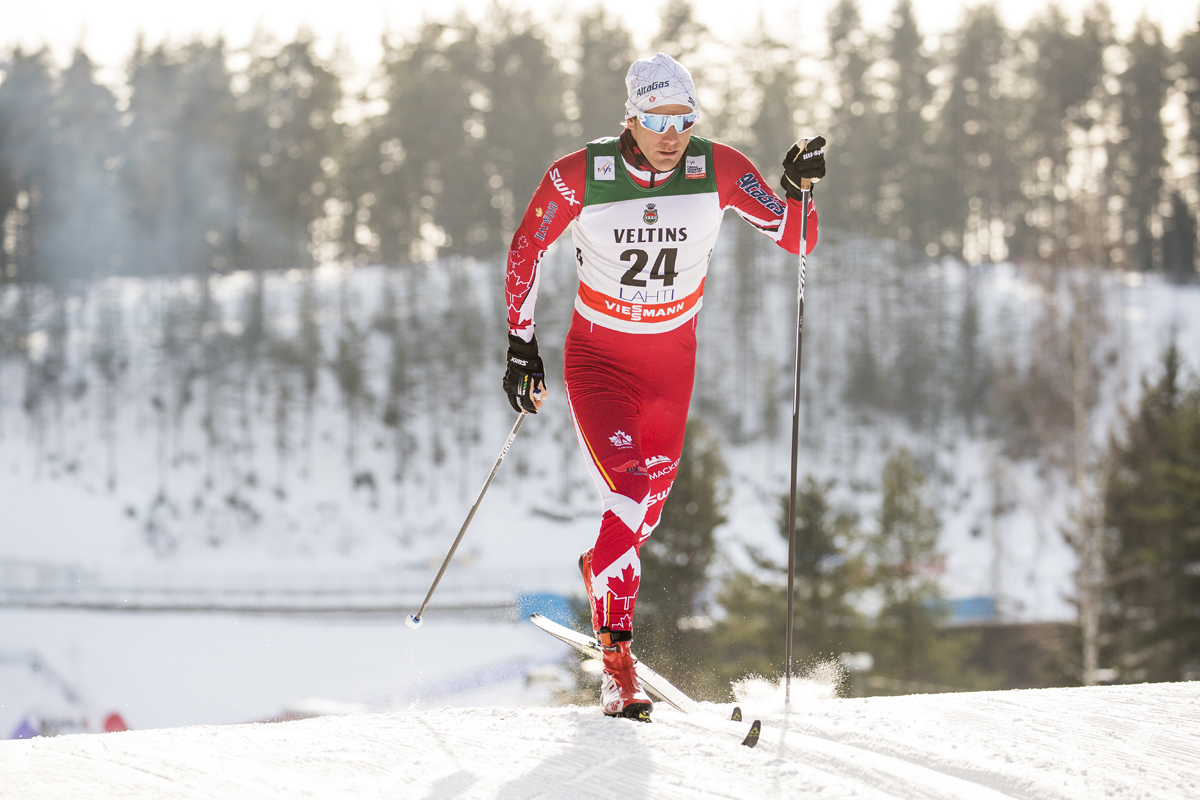
Rémi Drolet races the 50km freestyle during the 2021 World Championships in Oberstdorf, Germany. (Photo: NordicFocus)
Rossland is an outdoor enthusiast’s heaven. There are endless trail options, nicely paved roads, and a small population which ensures a minimum of traffic on roller ski routes. The Rossland Range, an offshoot of the Monashee Range, provides moderate elevation including the famous Seven Summits trail. FasterSkier, in Rossland on a mountain bike vacation, saw Drolet rollerskiing while driving to the campsite before running into coach Dave Wood at the grocery store.
At the Races
There were no FIS races in Canada last season. None.
As best FasterSkier can determine, the Canadian who got the most starts in the 20/21 season was Sam Hendry, who was studying and skiing at the University of Utah. For Canadians not attending school in the US, the only options were the World Cup and World Championships. Pandemic restrictions in British Columbia included skiing only at your home trails, which meant most athletes weren’t able to train with their peers from other clubs. Clubs could organize interval start ‘races’ for one training group at a time.
“My first race of the year was the World Cup in Lahti,” recalled Drolet.
That first race was the 30km skiathlon, won by Emil Iversen in a Norwegian sweep. Most of the athletes had raced multiple WC weekends or the Tour de Ski already. While some of the countries skipped some weekends, those athletes were able to enter Scando Cup races during the break.
Logistics at the World Cup
It’s no secret that moving country to country, each with slightly different restrictions and rules in place, to follow the World Cup poses challenges during a global pandemic.
“Even beyond the fact that we hadn’t had any races, it was a lot of logistical issues just coming there. We had to be careful with COVID and try and navigate inconsistent regulations at the venues. For example, that first weekend in Lahti, we had some false positives on the team, and so we all got put into quarantine right before the relay race. And then, probably an hour before the start of the race, we all got told that they were false positives, and the wax techs just ran to the wax truck and prepared skis as best as they could. It was definitely a challenge to get it all together.”
After time to rest and digest, Drolet reflected on his racing and training during what was hopefully the apex of challenges amidst the pandemics.
“I think this whole year wasn’t, wasn’t my best racing year. We had a couple training errors leading up into the season, kind of related to a lot of fatigue from school that was managed poorly going into the World Cups.”
With a short racing season, there wasn’t much time to change course. Returning to Canada to reset would have required quarantining at home instead of training.
“Things gradually improved throughout the season, and I got a couple of decent races in, but not totally where I want it to be… I think I definitely learned a lot of things that I should do. And a lot of things I should be careful to avoid to manage energy properly and be as ready as I can for each race.”
Rémi Drolet (center) races the 50km freestyle during the 2021 World Championships in Oberstdorf, Germany. (Photo: NordicFocus)
Coaching
Drolet had two coaches last season. Erik Bråten was the national team coach and Dave Wood was his personal coach. Drolet shared that he is happy to again work with Bråten this season, as he will be the WC coach in Europe for 21/22.
“I think he’s very good at fostering a strong team atmosphere and making sure everything’s well organized and that athletes don’t have to think about every small detail all the time. And that makes a really big difference so that you can just get up and kind of focus on training. And he was very accommodating. Especially for me to do a lot of schoolwork while I was over there.”
While working in Canada for NC, Bråten often promoted the idea that skiers need to race in Europe to learn what the standard is and then return to their home training environment to raise their skiing to that level. Drolet agreed with this approach.
“I found it really hard to judge how I stacked up to the rest of the world, and just how fast I needed to be. What benchmarks I needed to be hitting. I mean, you see some data, but it’s hard to really see what that feels like until you’ve actually done it. It also brings a lot of confidence, I think, knowing exactly what you need to achieve, kind of makes it more tangible, rather than just chasing something more abstract.”
There are few things more abstract than theoretical physics, but Drolet is clearly energized by a concrete sense of where he needs to be.
Dave Wood spent many years as head coach at Cross Country Canada, working with athletes like Beckie Scott and Devon Kershaw. He moved to Rossland to become the head coach of the Black Jack club team just as Drolet aged out of Track Attack.
“Pretty much everything I know about being an athlete, I know from Dave. And I definitely wouldn’t be where I am without him… One thing he’s really taught me that’s important is: ‘to be good, you have to be good at being good.’ And I guess to clarify… you need to set yourself up for success, rather than just doing the minimum and getting to the start line.”
The 21/22 Training Season
Drolet committed to taking a gap year from Harvard to focus on skiing, with the hope of racing period 1 of the World Cup and qualifying for Beijing. There were three national team camps, three more than in 2020. The first, scheduled for Penticton, was moved to Vancouver Island to escape extreme wildfire smoke.
The second camp was in Mammoth, California, a Canadian tradition for elevation training.
“The training camp in California, especially, was excellent, and we got in some good hours at altitude to get ready for the season,” Drolet wrote from Muonio. “I always love the time we spend down there and it was really great to have the whole team together for a few weeks. Eric de Nys also started on as the Development coach, and he has been doing a great job so far!”
The final camp was Frozen Thunder in Canmore, which in the current travel climate is even more important for spending hours on snow before the season starts.
When Nordiq Canada published the list of athletes selected for period 1, the list of names was short, and Drolet’s name was not present.
“I would have liked to go, but I did not race fast enough last year to qualify.”
Adversity is a large part of being a ski racer and the response to each challenge is revealing. Drolet is not arguing legal interpretations of the criteria or motivations of the selectors here, focusing instead on what he can control.
Racing Again
De Nys led a group of Canadians to early season races in Finland and Sweden.
On November 12th in Muonio, FIN, Drolet was 25th in the classic sprint, one of three Canadians to qualify for the heats. Some names in the final are familiar to ski fans: Sergey Ustiugov, Federico Pellegrino, and Erik Valnes have all won world cups.
The next day, the 15km classic was dominated by Norway and Russia, with only Iivo Niskanen in first and Drolet in 15th adding colour to the top 16.
“The racing in Muonio is not necessarily so different from racing at a NorAm or a Canada Cup,” Drolet wrote. “You still get ready the same way and show up on race day ready to race as fast as possible. There are some things that are different, though. First off, you need to deal with jet lag and be really on it so that you are properly rested for the races. The whole setup is also a bit different. “
This trip was planned as a learning experience for the NexGen athletes.
“Everyone stays at one big hotel and eats at the same restaurant, which makes it feel like more of a big event. It just feels more concentrated. Then, of course, some of the world’s top skiers show up, so the competition is a lot stiffer than when racing in Canada. I think if there’s anything I’ve learned it would just be a reinforcement of the importance of managing your time outside the races as effectively as possible.”
“Whether it is just meals and proper rest or the warmup for your race, there are small things that the best do better. It is good to be able to observe what they do and try to incorporate it myself.”
Drolet finished the Muonio 15km 1:42 behind Niskanen and 50 seconds behind Ustiugov.
“I am satisfied with the results in Muonio,” he wrote. “I am judging them by a combination of time gaps, placing, and execution. I think it was overall not bad for the first races of the year, and I hope I can keep improving as I get more competitions under my belt.”
The next weekend, the Canadians moved from Muonio to Gällivare in Sweden where Drolet finished 17th and 16th in the distance races.
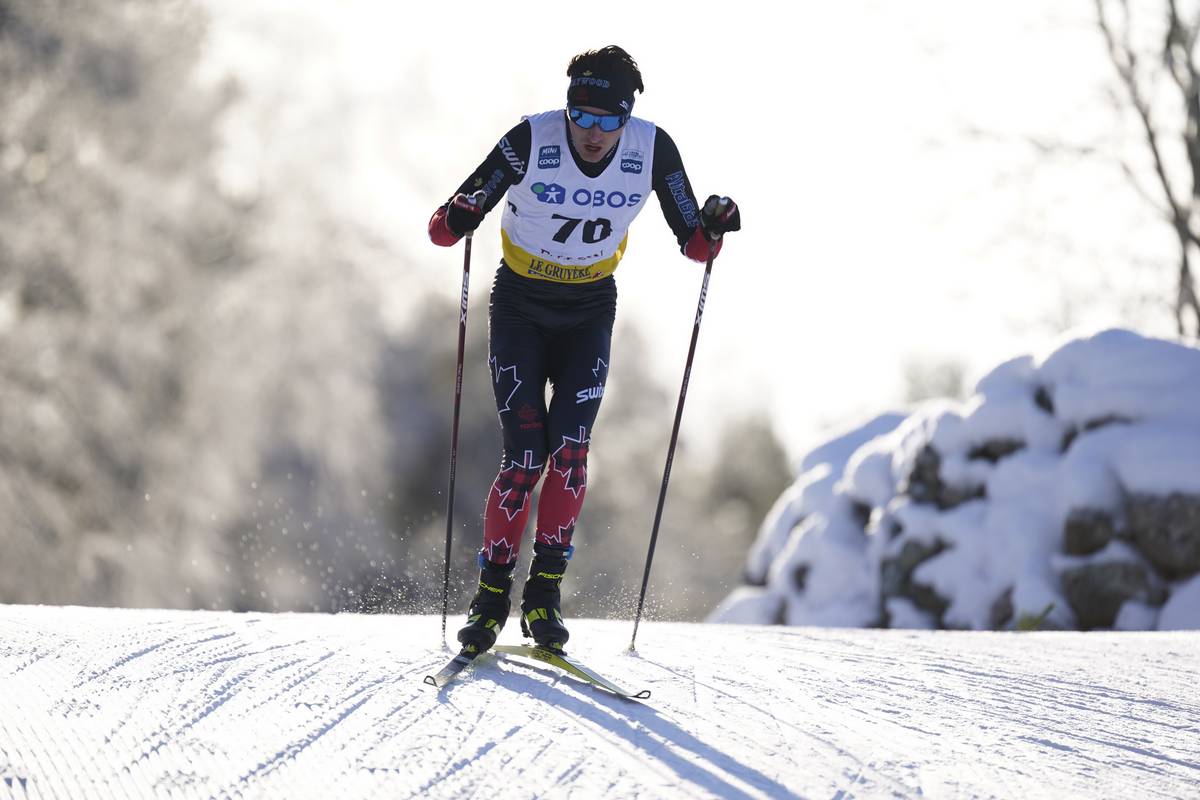
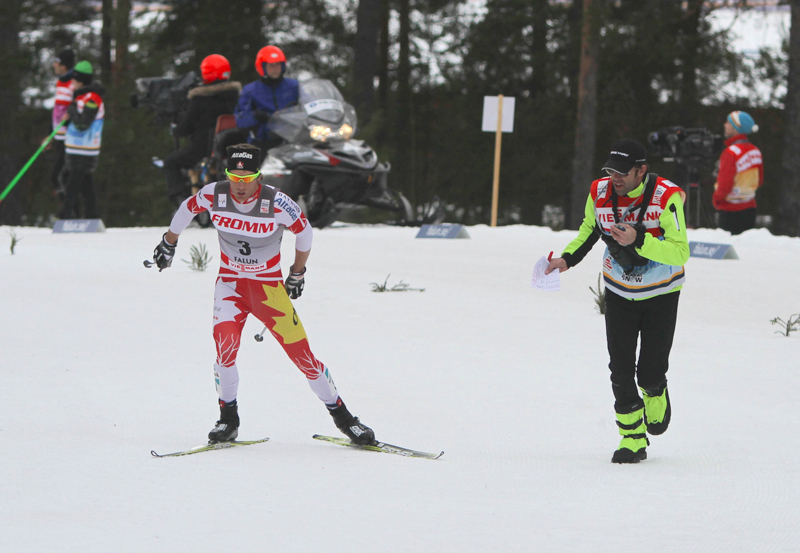
Rémi Drolet (CAN) races the 15k freestyle in Falun, Sweden in January, 2021. (Photo: NordicFocus)
Up Next
“My plan is to compete in these early season races in Scandinavia then head back home for the Western Canada Cups. I think having this amount of high level racing before Christmas will allow me to be optimally prepared for the Olympic Trials races in January.”
Drolet was 6th in the free sprint at Sovereign Lake, and won the 15km individual classic.
After WCC weekend 1, Drolet reflected on his Euro trip.
“It was it was good, some [races] were better than others,” he said. “But it was I think it was really worthwhile to go over there and get some races in really early in the year against some really strong guys. I think it prepared us well for the season and I feel happy I went there.”
The opportunity to race at home in Rossland for the second Western Canada Cup weekend was derailed by an ‘atmospheric river’ storm that damaged the snowpack at ski areas through southern BC and that race weekend will now be held at the backup venue, Sovereign Lake.
Living in Rossland
“Whenever I think about it, I just feel extremely lucky to have been born here. I just love, love, love living here. So fortunate that I’ve lived here my whole life and been able to benefit from everything that comes with living in Rossland. And then, yeah, Dave moved here at just the right time for when my skiing career was getting started. And it’s all been really amazing.”
Watch this space for upcoming stories from Dave Wood recorded during this author’s recent trip to Rossland.
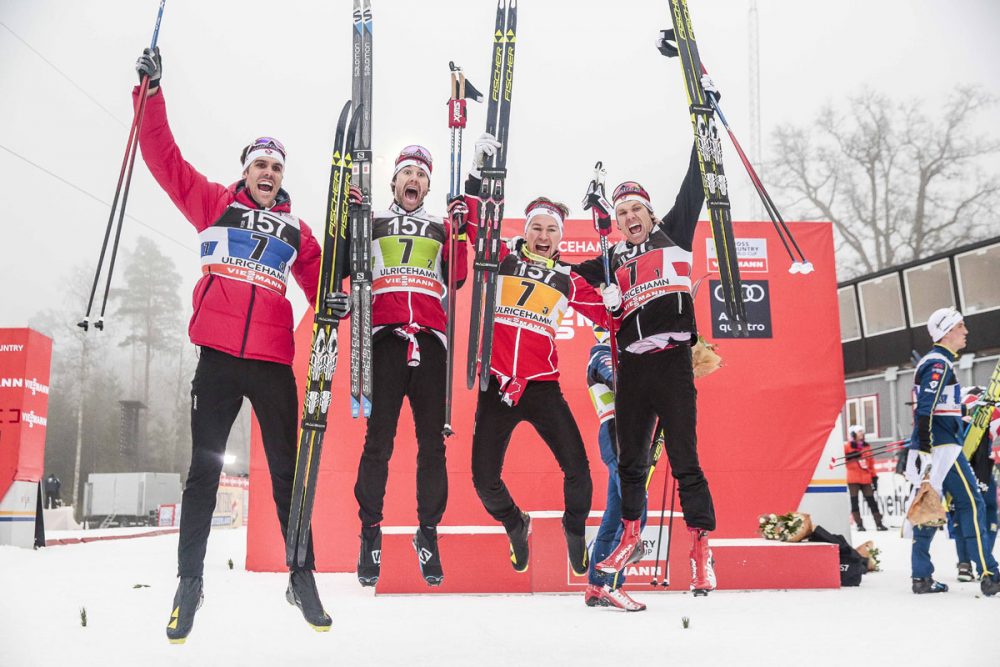
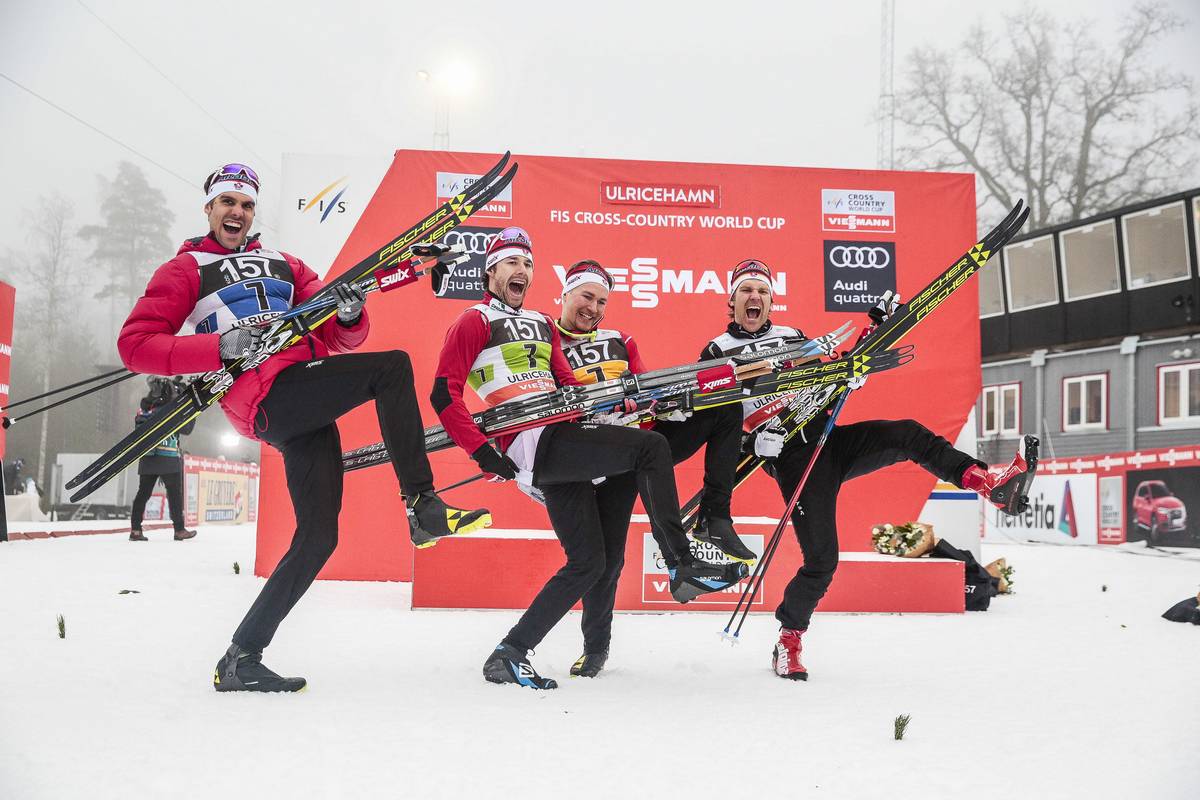
Left to right: Canada’s Len Valjas, Alex Harvey, Knute Johnsgaard, and Devon Kershaw after their historic third place finish in the 2017 men’s 4 x 7.5-kilometer team relay in Ulricehamn, Sweden. (Photo: Fischer/Nordic Focus)
This is the second part of FasterSkier’s report on the state of high performance cross-country skiing and athlete development in Canada. You can read part one here.
Cross Country Canada (CCC), as the national governing body for cross-country skiing in Canada has the difficult task of steering a rather large ship. The idea in steering the ship is to maintain a path requiring little quick and nimble maneuvering. Survey the landscape, mine the data, set a course, and sail. Along the way, there’s the ability to make slight adjustments for efficiencies, accommodate unforeseen changes.
Nic Lemyre (Photo: Norges Idrettshøgskole/Norwegian Sports Academy/)
“We’re thinking our starting point is to build a really strong relay team, on both the women’s and the men’s side,” Lemyre told FasterSkier. “We want to have five athletes, so that we can rotate with the fifth athlete and we’re never in a situation where we can’t field a strong team because one athlete’s injured or sick.”
According to Lemyre, the composite team must be derived of skiers who can hit specific individual benchmarks “[When] we have athletes that can start scoring points in every race they enter on the world cup, that’s a medium term goal,” Lemyre said. “From there, we start aiming for the top-15 for all athletes that are identified in that group.“
Part of the reasoning behind the relay vision is that for a skier to get a permanent spot on the World Cup, the athlete not only has to reach a high level, but also help raise four other Canadians up to that level. Lemyre believes this should foster cooperation and team spirit.
“It helps us meet goals of performance,” Lemyre added. “But also it helps us meet goals that are related to how to build a strong performance culture, where the athletes need to support each other, to learn from each other. They need to push each other. They need to push each other beyond limits they may have experienced before.”
How do we get there?
After PyeongChang, CCC appeared to have both the political will to start the painful process of another re-invention. However, that will came with a reduced budget with which CCC could support its future options.
The simplified model of corporate restructuring begins with terminating certain roles and concludes with creating new roles filled by new individuals near the top of the organizational pyramid. Often, in a medium or large corporation, most people will be shuffled around and only a few near the top will lose their jobs. The final step is to find a quick win to help the newly reshaped organization gain morale and unify.
In a small organization like CCC, everyone is near the top. While the process works well for the survival of the organization, it can be hard on individuals.
The change at CCC began with long-time High Performance (HP) director Tom Holland’s planned retirement. Lemyre was hired as a consultant to oversee the restructuring of the HP group. Shortly before Lemyre’s hiring, CCC eliminated some positions.
As Joel Quenneville’s recent firing demonstrates, proven ability and past success is not enough to provide job security during a reboot. (Quenneville was the NHL’s Chicago, Blackhawk’s head coach since 2008. During his tenure Quenneville lead the team to three Stanley Cups.)
On November 1st, CCC hired Erik Bråten as a new national team coach and modified Louis Bouchard’s title. Bouchard remains head of the National Training Centre in Mont Ste-Anne, Québec, with the added title and responsibilities of World Cup Head Coach.
Bråten, a recent Norwegian School of Sports Science graduate with a specialization in cross-country skiing, won the 2018 coach of the year award from the Norwegian ski federation. This hiring didn’t happen as quickly as some had hoped, but is considered the first win for CCC’s new structure.
“Erik has a strong sports science background applied to cross-country skiing,” Lemyre said on the phone. “His profile is unique in our environment. The fact that he’s young is really positive for us, because he’s open to this new experience. He comes with a solid base, and his excitement and his motivation, I think, will be great assets in applying that knowledge in the right culture in Canada. At an individual level, Erik is unique in working one on one with athletes. I think our athletes are going to really appreciate that.”
Along with bringing in new personel, Lemyre aims to improve sharing of training information in Canada. In Norway’s organizational structure, athletes and coaches are able to log hours and training plans on an interface organized by the Norwegian National Ski Federation. It’s a model and template Lemyre is intimate with.
“The fact is that we have a large country, and we can’t be with athletes every day of the year following them on site,” Lemyre said. “Now the technology is there to pool [training data] in a way that our coaching staff and the local coaches can communicate really well, But also as we’re building up our science team, we also have interaction with our different people involved in helping the athletes develop.”
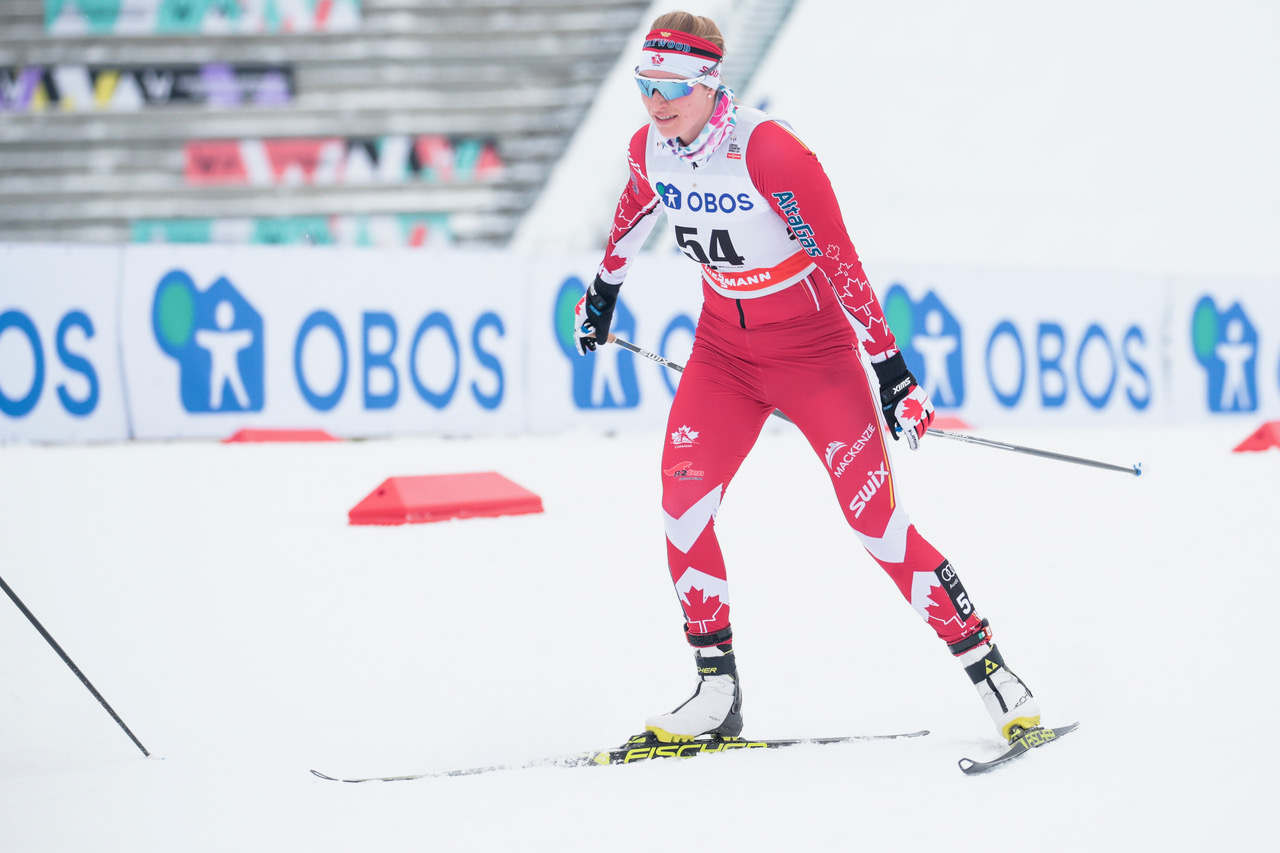
Dahria Beatty racing the 2018 Holmenkollen 30 k freestyle mass start in Oslo, Norway. (Photo: Fischer/NordicFocus)
Another planned shift is to interchange athletes between Europe and Canada more often. For example, Dahria Beatty will start the season in Canada — a change encouraged by her coach Chris Jeffries and supported by Lemyre.
“This summer my coach Chris and I came up with a plan that allowed me to stay in Canada to start the season to build into the race season and then head over the Europe and race on the World Cup circuit leading up to World Championships in Seefeld,” Beatty said. “With this being the first year of the new quadrennial, it is the perfect time to fine tune some of those race details domestically before leaving for Europe mid-December. I am looking forward to racing part of the Tour de Ski then period 3 and hopefully finding my peak for World Championships and World Cup finals in Quebec.”
Lemyre’s concept is to allow athletes like Beatty to build into the early part of the season domestically and arrive in Europe at a higher level of race fitness.
“The way we scheduled the trips this year, giving some athletes the chance to prepare very well before they race on the World Cup,” Lemyre added. “I think some of them will be stronger when they show up on the World Cup, and also they’ll be able to sustain that level of performance over the time period they are on the World Cup. We will try to be a little more selective and well prepared when we show up, and then post really good results when the athletes are racing the World Cup.”
Jeffries stated that the stress of living abroad, a dynamic known all to well by North American World Cup skiers, can be counterproductive to a developing athlete.
“The last few years, our top athletes spent the majority of their time in Europe,” Jeffries said. “I think it stalled our development a little bit, because we’re always living out of a suitcase, and we’re always having to ski races where we’re trying to perform.”
Dave Wood spent 18 years as a national team coach. His time leading the team included the post-Nagano rebuild and managing athletes at the Olympics in Vancouver. His vision includes giving skiers more time to develop and less emphasis on being fast all season.
“Sara [Renner] had far less World Cup starts before she was top-15 at the Olympics than the people of today,” Wood said. “I think that this big argument about experience is valuable when you are looking for seconds. When you are looking for minutes, [World Cup experience] makes no difference.”
Will it Work?
The U.S. has been able to develop a strong women’s team built off Kikkan Randall’s determination to drag U.S. skiing to the top. Randall took inspiration and knowledge from Canada’s post-1998 rebuild where Scott, Renner, Milaine Thériault, Jamie Fortier and Amanda Fortier decided it was time to lead the charge.
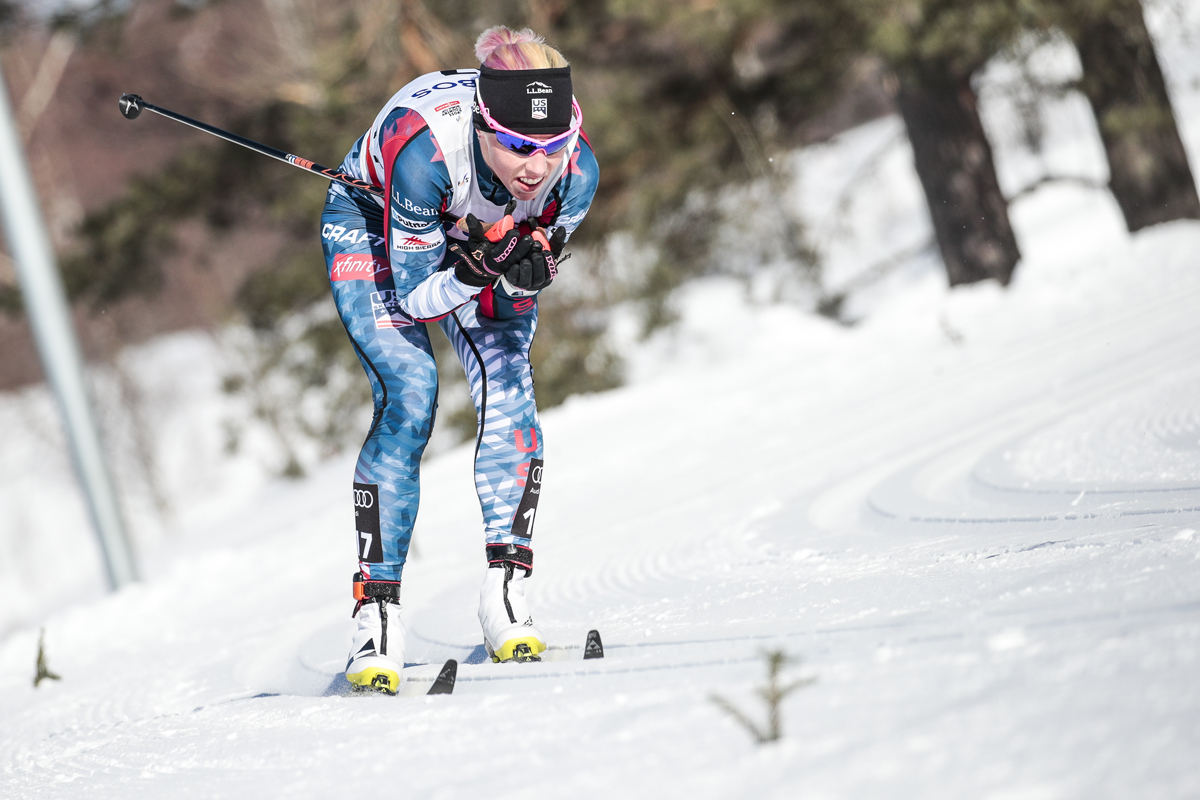
American Kikkan Randall tucking during the women’s 10 k classic mass start at 2018 World Cup Finals in Falun, Sweden. (Photo: Fischer/NordicFocus)
In both cases, the athletes didn’t succeed alone. The “fantastic five” got the support of Holland, Wood, and many others. Randall also collected a large supporting cast, well documented by Peggy Shinn’s book ‘World Class’.
Laura McCabe, now a Methow Valley coach and two-time Olympian, spent most of her free time in Nagano with the Canadian women’s team because it felt like a group that had a vision and a willingness to support one another to collective success.
“It just shoots you up the ladder when you come back and you feel like you have a very safe place, you’re working on this goal together, you’re all in it together, and you’re there for each other all the time,” McCabe told FasterSkier. “I felt like the Canadian women were doing that. And now I feel like Matt Whitcomb has led that charge for the American women.”
While crediting Randall for starting the process, McCabe feels that the team’s work to be a team is the critical factor.
“They have goals, team goals and they have personal goals,” McCabe said. “They are always there for each other. One of their biggest goals is to basically keep their relationships positive and keep everybody moving forward. I think that is one of the number one reasons that team is doing well.”
In a conversation last May with FasterSkier, Yukon coaching icon Alain Masson spoke of the complexities of achieving success on the international stage. Simply possessing physical gifts, the aerobic capacity, the predisposition to tolerate and absorb high training loads, is no guarantee of success.
There’s the behind the scenes unglamourous work of nurturing athletes, remaining true to organizational core values, and feeding the system with money, intellect, and vision.
“Definitely, there’s a minimum set of physical characteristics that you need to perform at that level,” Masson explained to FasterSkier. “But you also need many characteristics, personality characteristics, that are vital. What Alex showed, and Sara Renner, and Chandra [Crawford] and Beckie [Scott]. I think athletes that combine both the physical and the mental characteristic at a time when the program works together, and everything lines up with the funding, good leadership, and everybody working together. That’s the difficulty, this is the issue, trying to get all of that together. As the women in the U.S. have demonstrated, when you have all of that lining up, it’s amazing what you can do.”
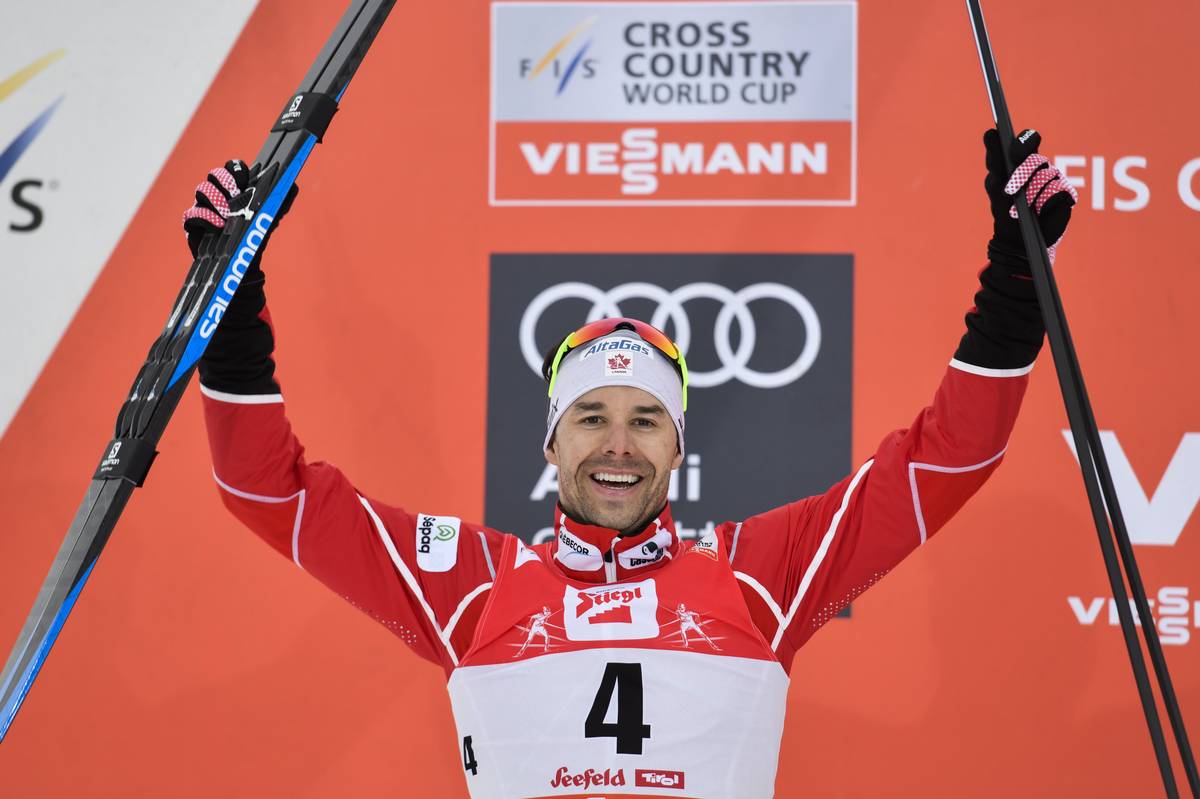
Canada’s Alex Harvey celebrating on the podium after placing second in the men’s 15 k freestyle mass start in Seefeld, Austria, for his best result of the 2018 World Cup season. (Photo: Salomon/NordicFocus)
Cross Country Canada (CCC) has begun a reboot process as the new Olympic cycle starts. Corporations call this a reset, a rebranding, a new direction, restructuring, and various other names that try to disguise the challenges and issues that come with enacting real change.
The reboot process traditionally starts with an acknowledgement that the current level of success, and that of the foreseeable future, doesn’t align with the goals or the potential of the organization.
Canada left PyeongChang with no medals at three consecutive Olympics, only one skier in the World Cup red group, and a perception that there was no obvious successor to Alex Harvey.
There are many people who, with the benefit of hindsight, believe that CCC allowed itself to be trapped by a combination of success and the Own The Podium (OTP) funding model.
The process of assigning blame for the past, called “blamestorming”in the corporate world, is one of the most effective ways to waste time and destroy morale without doing anything to improve the future. The “best practices” approach to a reboot starts with four apparently simple questions: How did we get here? Where are we now? Where do we want to be in five years? How can we get there?
While CCC does many things as a national sport body, this article will focus on high performance and the development system.
How did we get here?
After a disastrous 1998 Olympics in Nagano, CCC shrank to a full-time staff of five and endured a forced re-invention. Four years later, in 2002 at Salt Lake, Beckie Scott won all three medals in the skiathlon after the initial silver and gold medalists were caught doping. Sara Renner missed the B final in the sprint for 9th place.
Canadian Chandra Crawford in the 2011 team sprint in Dusseldorf, Germany. (Photo: Fischer/NordicFocus)
In 2006 in Torino, Chandra Crawford earned a surprise gold in the sprint while Scott finished fourth. Scott had earlier teamed up with Renner for a team sprint silver medal.
In 2010, there were no Canadian cross-country medals. However, there were signs of promise. Renner skied to her fourth Olympic top-10 finish. All four Canadians competing in the men’s skiathlon finished in the top-15. Devon Kershaw lost out in final kilometer of the 50 k to finish fifth, 1.6 seconds away from gold.
That post-Vancouver glow was possibly the point where CCC temporarily slid off the rails.
A number of Canadian sports fell victim to OTP incentives. A sport qualifies for OTP funding by having good prospects for a medal in the next Olympics. The money comes with strings attached, to ensure that resources are spent on improving the probability that specific individuals will podium. For smaller sports where the OTP money is a significant proportion of the sport’s annual budget, it is hard to make choices that put that money at risk. Choices like balancing the emerging athletes in the pipeline, while simultaneously supporting those athletes already at the top-end of the sport.
As a result, many sports have lost their OTP eligibility by losing the focus on development and the vision that qualified the sport for OTP in the first place. Some people put cross-country skiing in the list of sports that fell into this trap.
After 2010, the future looked bright. Harvey and Kershaw were World Champions in the 2011 team sprint. Kershaw was second overall in the 2011/2012 World cup. (A feat only equaled in North America by Scott and Jessie Diggins).
Harvey arrived at Sochi in 2014 as a medal favorite. He was fresh off a World Cup podium in Toblach the weekend before the 2014 Games began. Sochi ended poorly when Canada, along with Norway, couldn’t solve the difficult waxing conditions.
The results in PyeongChang were similar to 2002 numerically: Harvey was close to a medal in multiple races and Lenny Valjas collected 7th in the classic sprint. A medal would have changed the mood, but not overall situation.
Where are we now?
Post-PyeongChang, CCC believes Canada is not achieving the international results a country with plentiful snow and 37 million people is capable of.
The development system in Canada consists of the National Team, the official training centers (Centre National d’Entrainment Pierre Harvey (CNEPH), Thunder Bay National Team Development Centre (TBay), and the Alberta World Cup Academy (AWCA)), and the clubs. The ten provinces and three territories have teams, but don’t have a formal place in the development system as each of the thirteen regions approaches development support differently. In the last few years, the number of clubs actively recruiting and developing athletes while supporting a high performance team has increased. For our purposes, as no official name has been affixed to these clubs, the term ‘elite club’ will be used here.
In the past, all national team members were required to belong to a training center while developing athletes were encouraged to join.
“I can speak for many of the athletes, they thought that if they didn’t go to a training centre, then they might as well quit skiing,” Telemark’s coach Adam Elliot said. “It was that broad of a choice, they felt they had to choose between skiing and school immediately.”
The landscape is more diverse now, with more options. The examples that follow skew to Western Canada, largely because the coaches quoted brought teams to Sovereign Lake snow camps in May and November and were available for in-person interviews. Eastern Canada remains equally diverse in terms of its club offerings.
A common theme among the coaches and athletes is that each athlete’s needs are different, and he or she needs to find an environment that fills those needs. FasterSkier asked AWCA’s head coach Chris Jeffries how an athlete should choose his or her path to success.
“It’s such an individual, case by case thing,” he said. “I don’t have an answer.”
In 2017, a shift to allow more development paths resulted in new senior National Team member Gareth Williams staying at his home club, Telemark, in Kelowna, BC. Elliot described how it came about.
“Tom Holland approached us, for Gareth, and said we like what you’re doing in the Okanagan, and we want to keep Gareth there. We’re going to support you and your program to be able to support Gareth.”
Also in 2017, Julien Locke returned to his home club Black Jack while Russell Kennedy shifted to the new Team R.A.D., part of the Canmore Nordic Club.
To further illustrate the spectrum of options and pathways, FasterSkier contacted three Canadian athletes, each with a history of NorAm podiums and some international success, to discuss their ski-training choices. Dahria Beatty started at AWCA and has remained there, Evan Palmer-Charette started at TBay then recently moved to Team R.A.D., and Andy Shields has gone rogue.
Dahria Beatty en route to 20th overall in the Seefeld World Cup freestyle sprint for her season-best result in 2017/2018. (Photo: Fischer/NordicFocus)
“For me, I’ve been working with Chris [Jeffries] for six years,” Beatty told FasterSkier in November. “It works really well for me, and I have a good group of training partners where I am, that can push me everyday in training.”
AWCA is also the home training group for National Team skier Emily Nishikawa and two junior national team skiers. AWCA also benefits from its close proximity to a number of other training groups.
“For me, Canmore’s a location where I want to be training, where I want to be based out of,” Beatty said. “All the pieces fit well together for [me], it’s somewhere I think I can keep improving.”
Palmer-Charrette made a summer-time decision to change things up by finding a fresh environment in Team R.A.D.
“I think the best part of being on a training centre is the entire program is based around a small group of athletes of similar age which makes for a great training and racing environment,” Palmer-Charrette wrote. “I feel training centres, as they are, are best-suited for junior/u23 athletes and especially great for athletes who are a bit late to the game like I was at the end of high school and will really benefit from learning from other athletes on the day to day training life.”
Shields is no longer affiliated with an official team. He funds his skiing by painting houses in the summer and representing ski wax companies in the winter. Although he refers to ski racing as a hobby, he did end the last season as COC leader and will race period 1 of the World Cup.
“I don’t think I could have done this straight out of junior,” Shields wrote. “My time on Tbay is still having a huge positive effect on my ski career. Being on a team through my early years as a senior made it much easier to get a decent training base and set a couple good habits in place which are paying dividends.”
Shields did reflect and offer an alternative to how he might have changed his path to elite level skiing.
“If I could go back in time I would have gone the NCAA route straight out of junior,” Shields added. “College skiing in the States is a much better deal than a training center for people in their early twenties. You can go down to the States, get a degree, not pay a dime, and come out the other side with plenty of time to have a full-time ski racing career. I would have joined a training centre upon finishing with NCAA.”
The Canadian university system differs from the U.S. model, offering little money for sports. Heading south to the U.S. as a student-athlete remains an option for some Canadian skiers. Most athletes remain in the Canadian system to develop. With that in mind, FasterSkier asked why some athletes had chosen some of the Western based training centres.
Jeffries, who leads the AWCA, also noted how his program has evolved. There appears to be room at the AWCA for those with concurrent goals. The AWCA has partnered with the University of Calgary to allow AWCA athletes to work towards degrees.
“We’re always evolving our programming, and what it entails, and how we package it,” Jeffries said. “That’s why we have this new university program this year, because you just look at the popular decision making of graduated high school athletes.”
Elliott, based in the Okanagan, said his program offers athletes a well rounded experience too.
“You’ve got the trifecta,” Elliot said. “You’ve got access to education opportunities for post-secondary. We’ve got the university, UBC Okanagan, and the college. Most of the people who’ve moved here have gone to school. Secondly, it’s the Okanagan. Which is probably the best place to ski in North America, with skiing up and down the valley –with Nickel Plate, Telemark, [Kelowna] Nordic, Sovereign, and Larch Hills. The third is that you’re moving into a community of skiers: family, volunteers, everybody trying to make a go of keeping people in sport.”
Clearly the times have changed from a programming perspective and the past’s financial windfall for Canadian cross-country skiing.
“Probably the quad between 2010 and 2014, CCC had more money almost than it knew what to do with, ” Dave Wood, former National Team head coach, told FasterSkier in May as he finished up a long ski day. “Now, I think the budget’s still three and a half million. While it’s maybe low compared to what it has been, it’s a hell of a lot higher than it was in ‘99, by about four times.”
Former CCC High Performance Director Tom Holland spoke of those larger commitment from clubs during the Frozen Thunder races in October.
“There’s a lot more resources,” Holland said, referencing the increased numbers of coaches attending Frozen Thunder with their athletes. “One of the reasons clubs are more important now is that there are paid coaches at the clubs. That’s why training centres started in the 90’s, because you’ve got to have a coach, full-time.”
Thee deep question remains: what next for Cross Country Canada as it ponders a post-Alex Harvey scene? Better and more diverse options for Canadian skiers, like those modernizing their offerings to connect with the student-athlete, is a step forward. But fans of the sport, and of course Cross Country Canada, have short-term and long-term goals. No one wants to see another Olympic quadrennial transpire without the glimmer of medal potential at the international championship level.
“I think when Alex Harvey retires, mostly likely after next year with Lenny Valjas, it will be the end of an era having athletes being able to finish on the podium at World Cups, World Championships, said Alain Masson, Whitehorse head coach. “So definitely, the program is going to go into a real rebuilding phase with lots of young athletes, but no guarantee of success in the near future.”
Canada’s Devon Kershaw racing at 2017 World Cup Finals in Quebec City, where he finished 26th in the 15 k freestyle pursuit and 19th for time of day in the last race of the 2016/2017 season. (Photo: John Lazenby/Lazenbyphoto.com)
On April 26, Devon Kershaw posted a photo on social media of Alpina boots hanging on a line. The next day, he spoke on the phone with FasterSkier from his new home in Lillehammer, Norway, after a day of running around outside with his 15-month-old daughter, Asta Isabel.
Kershaw was tired, but in a good way. For the first time in 17 years, he was ready for a new challenge, a new focus and much more time with his daughter and wife, Kristin Størmer Steira, a former standout Norwegian skier.
Three years after Steira left professional cross-country skiing and pursued a career in business, starting with her master’s degree in business management, Kershaw is following suit and headed back to school. The 35-year-old Canadian hung up his boots to quietly announce his retirement after about a month of deliberation.
“I was really keen to keep ski racing, to be honest,” Kershaw said. “I had the motivation to go one more year, and in my head, I wanted to race one more season, but as things progressed in the spring, there were a lot of different factors that just made it seem like, oh man, it doesn’t look like it’s gonna be super realistic at this point.
“I struggled with that, when you feel like you still have more in the tank,” he continued. “But at the same time, it’s a bit of a double-edged sword in the sense that it’s been a fantastic career.”
Kershaw was quick to reflect on his roots as a kid growing up in Sudbury, Ontario, “a mining town with a small but passionate skiing community,” as he put it. He also reiterated how proud he was to represent Canada for 17 consecutive seasons, first as a junior national team skier for two seasons starting in 2001, then as an under-23 national team member in 2003, and finally as a full-fledged World Cup Team member starting in 2004.
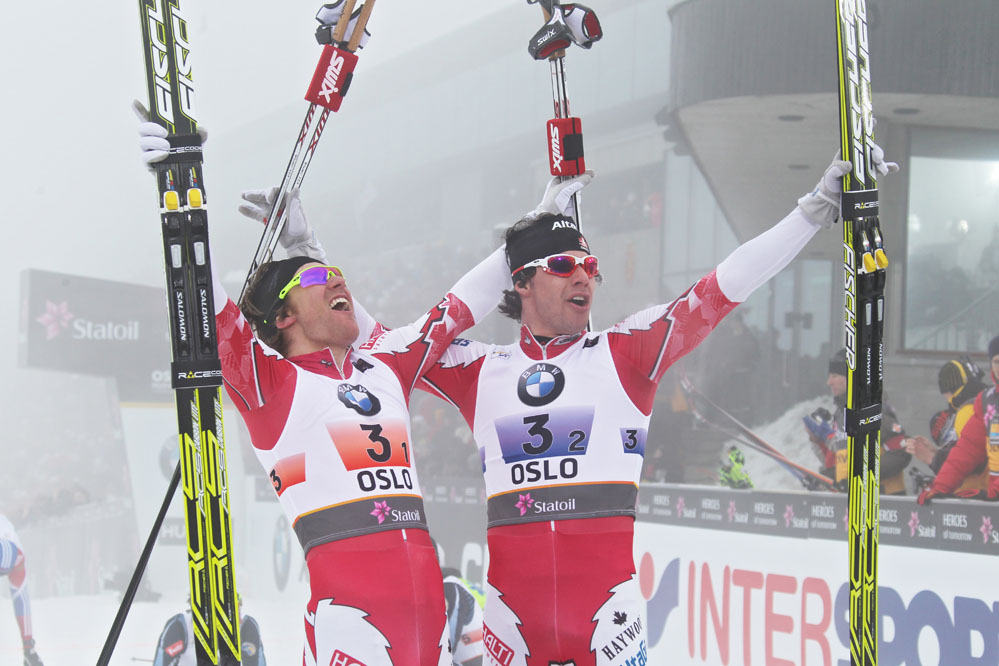
Devon Kershaw (l) and Alex Harvey celebrate their 2011 World Championships gold in Oslo, Norway. (Photo: Fischer/NordicFocus)
His career included three World Cup wins and 14 podiums, and a gold medal at 2011 World Championships with teammate Alex Harvey in the classic team sprint. Kershaw finished the 2011/2012 World Cup season ranked second overall and second in the distance rankings.
When he reflects on those accomplishments, he still has a hard time believing that all happened to him.
“So instead of focusing on being bummed at the situation or a bit frustrated with the state of things in Canadian skiing right now, I have to look back with a smile,” Kershaw said. “I feel just so privileged and grateful to have had the opportunity to be part of a real movement for men’s skiing in Canada.”
Kershaw said he was left with unanswered questions this spring during a transitionary period at Cross Country Canada (CCC). The team’s budget was undetermined, camps were not yet set in stone, and Kershaw said his decision — which he wanted to make by May 1, the start of the new training year — became about energy management.
“Part of managing your energy properly is putting all of your energy and focus into training, and if you’re being pulled with uncertainty or being stressed about uncertainty, that will come back, the World Cup will exploit that,” he said.
According to CCC Chief Executive Officer Shane Pearsall, High Performance Director Thomas Holland had planned to retire this past March, yet has stayed onboard as an advisor until CCC fills the position. Pearsall said the hiring process is still ongoing and will hopefully be wrapped up by next month. He confirmed that CCC has yet to finalize its budget and doesn’t anticipate being able to do so until a government minister signs off on the amount from Own The Podium (OTP), one of its primary funding sources, in July. Pearsall explained that they expect to have a better sense of national-team finances in mid to late June.
Typically, the team’s budget is determined in May, but because of necessary “quad reviews” following the Olympics, which took place before CCC met with OTP, the process was delayed by about a month. Pearsall did not elaborate on how significantly the budget would be decreased from last year, but said, “It’s certainly tighter than last year.”
Kershaw said he needed to pay about $25,000 Canadian dollars in team fees if he wanted to continue racing this year, up from $15,000 last year. That didn’t cover the cost of living, which he figured to be around $55,000 Canadian, for a grand total of $80,000.
“The financial burden is big, and moving forward the financial burden went from big to 100 percent paying for every cost,” Kershaw said. “So all travel, accommodations, everything. … I’ve just been in the sport a long, long time, and from a directional standpoint, I’m not sure we’re moving in a direction that will yield sustainable results at this point in time, but I understand it is difficult when you’re under such financial duress to create a sustainable program. But from a vision standpoint, I think there’s a lot of questions that remain unanswered, and it’s late in April. The fact of the matter is the rest of the world has all of the holes plugged — if they have holes in their boat — because May 1 is the new year of every ski program. And we’re just constantly slow and off the mark with that.”
Budget cuts had been expected as Canada’s World Cup Team missed performance benchmarks throughout last season. The team finished 2017/2018 with just two men scoring World Cup points (top 30) in distance races: Harvey and Kershaw. Two men (Harvey and Julien Locke) scored in World Cup sprints. On the women’s side, Dahria Beatty landed one World Cup sprint top-30 last season, and Cendrine Browne was the top Canadian woman in a distance race with a 27th place for time of day in the last race of the season.
Meanwhile, Alex Harvey led the team with four World Cup podiums, including third overall in the 2018 Tour de Ski, and a top result of fourth place at the 2018 Olympics. He finished his season in fourth in both the Overall and Distance World Cup standings. But Harvey’s results alone weren’t enough to buoy the whole team for another winter.
“Throughout my entire career, it’s almost unfathomable to think that the season ends and that’s the stat line,” Kershaw said of the team’s overall results. “It wasn’t so long ago that we had over 16 World Cup podiums in a season. The truth hurts, as [former Canadian coach] Tor-Arne Hetland once said, but things go in waves and this is the reality that we live in right now.”
Despite the prospect of self-funding, Kershaw didn’t feel pressed into retirement. Several of his teammates have decided to retire as well, including Graeme Killick, Jess Cockney and Knute Johnsgaard, but Kershaw said they weren’t forced, either.
“You can choose to work and you can choose to hustle for money; there are ways to make it,” he said. “No one’s forced into it. I could keep skiing if I wanted to, but I think the stark choice you’re faced with is, maybe perhaps some people are like, I can’t really see a path to international success currently, and that’s what I think is sad…”
‘A dream scenario’
When Kershaw moved to Canmore, Alberta, in 2001 and entered Canada’s elite skiing scene, Cross Country Canada (CCC) was entering a fruitful period. At the 2002 Olympics, Beckie Scott was proclaimed winner of the women’s 10-kilometer pursuit (now called the skiathlon), becoming the first North American woman to win an Olympic gold. At 2005 World Championships, Sara Renner earned a sprint bronze to become the first North American woman to medal at World Championships. Scott and Renner teamed up for silver in the team sprint at the 2006 Olympics in Turin, Italy, where yet another Canadian woman, Chandra Crawford, won the individual skate sprint for Canada’s second-straight gold in as many Winter Olympics. Scott finished that 2005/2006 season ranked second overall in the World Cup, just 16 points behind Norway’s Marit Bjørgen in first.
Devon Kershaw (r) with Graham Nishikawa in 2013. (Photo: Devon Kershaw)
Kershaw made his Olympic debut in 2006.
“Coming into Torino, we were quoted in the newspaper as being like the world’s most anonymous men’s ski team,” he said of the Canadian men’s team that year. “We weren’t really ‘on the map,’ but I’ve just been so grateful and lucky to have such a great group of guys around that really welcomed me in.”
He credited his former roommate and teammate Chris Jeffries as well as other Canadian competitors of his time, including George Grey, Gordon Jewett, Dan Roycroft, Sean Crooks, Dave Nighbor, Phil Widmer, Brent McMurtry, and Graham Nishikawa (who’s still racing), for having a major impact on the formative stages of his career.
“[There were] so many athletes in Canmore that tried hard, wanted it bad, and loved ski racing and training,” Kershaw reflected. “That’s a dream scenario for a young athlete to come into a community like that and be welcomed into that environment.”
Less than a month after the 2006 Olympics, he notched his first World Cup podium by placing third in the Borlänge, Sweden, skate sprint. In doing so, he became the first Canadian male cross-country skier to reach the podium since Pierre Harvey (Alex’s father) in 1988 and the first ever to medal in a World Cup sprint.
“I had no idea who Pierre Harvey was,” Kershaw said of his younger self.
Pierre Harvey had previously won the 1988 Holmenkollen 50 k as well as two other World Cup distance races and the Norwegian Birkebeiner, making him the most successful Canadian male skier before Kershaw.
“He could walk into the room and I would not recognize him,” Kershaw continued. “Even his results, I had heard that he had five World Cup podiums and that seemed pretty cool, but that’s all I knew about him.”
Kershaw’s second World Cup podium came early in the 2006/2007 season in a skate sprint in Munich, Germany. That same day, Crawford — whom he was dating at the time — placed third in the women’s sprint.
Devon Kershaw after being tagged by his Canadian teammate Alex Harvey (l) in the freestyle team sprint at the 2010 Olympics in Vancouver, B.C. They went on to finish fourth.
At his second Olympics in 2010, Kershaw finished fifth in the 50 k classic mass start for the best individual Olympic result for a Canadian male nordic skier. That record stood until Alex Harvey, who burst onto the World Cup scene in 2008, bested it with a fourth place in the 50 k classic at this year’s Olympics in PyeongChang, South Korea.
Kershaw and Harvey also teamed up to place fourth in the freestyle team sprint at the 2010 Olympics.
Kershaw’s first World Cup win came in a skate sprint during the 2011 Tour de Ski. He finished that Tour in seventh, and the next year, came back to place fourth overall in the 2012 Tour de Ski (TdS). Kershaw started all 12 editions of the TdS, a record he shares with France’s Jean-Marc Gaillard.
Harvey scored his first individual World Cup podium in a 50 k classic in 2009 and won his first World Cup race (a 3.3 k freestyle prologue) at the TdS in 2012.
“Then next thing you know, Alex and I are sharing a podium on some World Cups,” Kershaw reminisced. “Two Canadians on one podium in the World Cup, like, really? And then you win World Championships and I’m on the overall World Cup podium, and then next thing you know, Alex has been on the overall World Cup podium a few times and also now 50 k world champion. It’s crazy. It’s insane. From nothing. From no results. The journey has just been amazing. … I never would’ve thought Canada would, I mean, how could you? We had Pierre Harvey and that’s it in, like, a hundred years of international ass-kicking.”
Kershaw credited his initial World Cup breakthrough as a 23-year-old skier in Borlänge to Dave Wood, Canada’s national-team coach at the time.
“I came into a team with a coach that you could call at midnight. He’d do anything for you,” he said of Wood. “There was no way I would’ve stepped onto the podium in 2006 without him, and Mike Cavaliere, too, my first-year senior, Mike was my coach. We had staff that was just committed to the core for the cause and I’m incredibly grateful for that.”
‘A hell of a season’
Canadian head coach Justin Wadsworth (r) giving splits to Devon Kershaw at 2012 World Cup Finals in Falun, Sweden.
Of his coaches, Kershaw gave special credit to Justin Wadsworth. A three-time U.S. Olympic cross-country skier who became Canada’s head coach in the spring of 2010, Wadsworth coached Kershaw for five seasons, and the two developed a close friendship.
“When Justin came into the national team, the level of professionalism and excitement and freshness that he brought … I don’t know if you call it luck or happenstance or just the right place, right time,” Kershaw reflected, alluding to his 2011 World Championships gold with Harvey and his 2012 Overall and Distance World Cup podiums. “Justin’s best results as a coach were me and my best results as an athlete were when I was coached by Justin. Talk about an amazing relationship there.”
“The main thing that I really appreciated with Devon, and I think he would say the same thing about me, is that we could be honest with each other and talk about hard things and enjoy the good times when we had them,” Wadsworth said on the phone last week. “… It’s cliche, but when I was talking to Devon the other day about his retirement, it’s not about the medals or the performances or whatever, it’s about your times together on the road.”
One of Kershaw’s biggest moments came at those 2011 World Championships in Oslo, Norway, where he and Harvey beat out Norway’s Petter Northug and Ola Vigen Hattestad by 0.2 seconds for gold on the Norwegians’ home turf. They had done so after Kershaw lost one of his skis early in the race, Wadsworth pointed out.
“His ski fully came off and he had to put it back on and get back into the race,” Wadsworth said. “Just the whole day was pretty incredible. That was a great, great opportunity for us, and the guys cashed in.”
Devon Kershaw (l) and Alex Harvey with their World Championship gold medals at the 2011 World Championships in Oslo, Norway.
In a difficult-yet-strategic move to conserve for that race, Kershaw and Harvey both sat out the 15 k classic the day before.
“With anybody else running the ship, there’s no way I would’ve trusted that [decision],” Kershaw said of Wadsworth’s call. “But I trusted Justin’s leadership and we went all-in, and the next thing you know we won World Championships. I mean, are you kidding me? How can you get a better start to the next quadrennial? And Justin as a first-year head coach of a national team, that’s gotta go down as maybe the best season ever for a first-year North American coach of a national-team program.”
He and Wadsworth reiterated the crucial foundation that Wood had laid.
“Dave Wood had done a really good job with the athletes leading into that period, mainly focused on building a big base and doing a lot of hours and also doing a lot of time at altitude,” Wadsworth explained. “And when I took over the position, I saw that both Alex and Devon were really primed and had a really good response rate to altitude, and all we had to do was fine tune a little bit of strength training and intensity. I was really excited to work with both those athletes and saw that they had a lot of potential.”
For Kershaw, Wadsworth’s “American swagger … was magic for me,” he said. During the 2011/2012 season alone, he stood on the podium 10 times, with four top-three finishes in seven races at the 2012 Tour de Ski.
“It was a hell of a season for me,” Kershaw said.
‘Best sand-digger ever’
He went on to compete at two more World Championships and two more Olympics. This past season, Kershaw finished in the top 30 in eight World Cup distance races, with a top result of 19th in the 30 k skiathlon in Lillehammer, Norway. While struggling with lung issues, he finished 26th in the 50 k classic at the PyeongChang Olympics.
Devon Kershaw racing to 25th in the World Cup 15 k classic this past March in Lahti, Finland. (Photo: Fischer/NordicFocus)
“We worked to get that under control and it was manageable but it never felt good like it felt prior to 2015,” Kershaw said his health over the last three seasons. “In PyeongChang, it was a calamity of bad luck. When we got there it was minus 20 [Celsius], and this makes me sound so soft, because I’m from northern Ontario so you’d think I’d know, but it was really cold. I did some intervals and it aggravated my lungs and it was super windy and dirty and a lot of sand blowing around, and that really flared up my asthma to the point that I was wheezing badly.”
His breathing troubles also affected his sleeping and took most of the two-week Olympics to manage. At one point, he had a chest X-ray to make sure it wasn’t pneumonia.
“It was sporting asthma,” he said. “… It took all the way to the 50 k to kind of get it 70 percent.”
While he noted he was left wanting more from a performance standpoint at both his final Olympics and in his final season, Kershaw also acknowledged that he’s his biggest critic.
“That’s been probably the biggest detriment to my entire career; I’m the best sand-digger ever,” he said. “I am disappointed in the sense that I work really hard and I train hard and I prepare well, and it didn’t go exactly as planned. … When you’ve competed in the top 10 for as many years as I have and on the podium, of course that becomes your bar that you hope to achieve, but at the same time … when you’re in the top 30 in the results page, you’re in the race at least. And I’m proud of the fact that in almost all classic races, not every, but most, I was in the top 30 and ‘in the race’.
“Am I satisfied? In my life I’ll probably never be satisfied, that’s just how it goes,” he added with a laugh. “But am I somewhat proud of maintaining a fairly competitive level? Yeah, absolutely.”
Wadsworth reflected that Kershaw was one of the best athletes he had ever seen, even “physiologically as good as Alex [Harvey]” at the peak of his career.
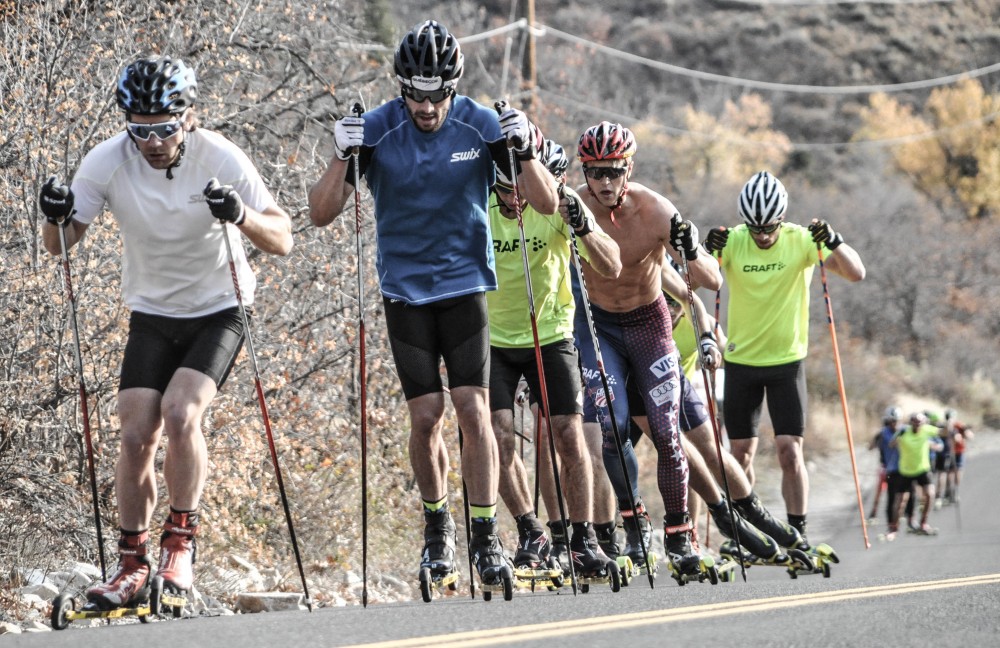
Left to right: Canada’s Devon Kershaw leads his teammate Alex Harvey and U.S. Ski Team members Noah Hoffman, Erik Bjornsen and Simi Hamilton during a Level 3 interval skate session up Snake Creek Canyon in Midway, Utah, during their respective teams’ 2016 training camps in Park City, Utah. (Photo: Matt Whitcomb)
“Devon’s a very intelligent person and sometimes he might’ve overthought things and lacked in confidence, and as a coach that’s really frustrating to see because you know how good they are physically,” Wadsworth said. “And when he was on mentally, too, in training, when he was at his very best, he had total confidence and could destroy anybody in any workout.”
He recalled a hill-bounding workout with the Norwegian team in which Kershaw was literally leaps and bounds ahead of everybody else — even Martin Johnsrud Sundby and Russia’s Ilia Chernousov, who joined the training session.
“He was just shelling everybody,” Wadsworth said. “So when Devon was at his best like that and mentally confident and relaxed, he was a real force of nature. Unfortunately that didn’t always translate into the racing season, but in 2012 he put it all together and had a tremendous year. … If he had the confidence the whole time, he would’ve been almost unbeatable, in my opinion, but it takes the whole package all the time, and he was among the greats there for a while.”
‘Younger, faster, better dog’
And then there was Harvey, another one Kershaw’s of his best friends and longtime roommates.
“I’ve spent more nights in a room with him than my wife or any girlfriend I’ve had,” Kershaw joked. “… He was eager to learn, he chased me for years, he was always a hard worker, too. He trained really hard, he believed in himself, and I still am in total awe of that. I’ve never met anybody as confident as him. It’s too bad that didn’t rub off on me, but that’s been great to be around.”
He likened Harvey’s addition to the team as a family adopting a puppy.
“You know when your parents get a puppy because your dog is 10 years old? He’s kind of slowing down a little bit and then you see that old dog get fired up and run again and jump around and play; that’s me,” Kershaw said. “And I’m so grateful that my owners got a younger, faster, better dog to hang out with because it was so inspiring.”
Several times over the last few years, Kershaw has said that witnessing Harvey make Canadian history has been one of his biggest reasons for staying in the sport.
“He, for sure, has kept me in this probably longer than I should’ve,” Kershaw said. “I just love traveling with him and seeing what he can accomplish and training with him and seeing that professionalism.
“There’s no question he’s the best Canadian skier ever, that’s not even close,” he added. “… I just feel so honored that I got the chance to see it all happen, from his last-year junior when he did his first World Cups and then all the way though I’ve been with him.”
The Canadian men’s relay after placing third in January 2017 in Ulricehamn, Sweden, for Canada’s best-ever World Cup result in the 4 x 7.5 k relay. From left to right: Lenny Valjas, Alex Harvey, Knute Johnsgaard, and Devon Kershaw. (Photo: Salomon/NordicFocus)
In an email, Harvey explained that he and Kershaw first met in the fall of 2005 at a training camp at Sovereign Lake, British Columbia. Harvey was on the junior team and Kershaw a senior, but the whole team stayed at the same hotel.
One morning, Kershaw accidentally took Harvey’s poles from the hotel. Harvey had to track him down on the ski trails to get them back.
“That was the first time I talked to him and to me it’s just perfect because that’s so Devon,” Harvey wrote.
Later that season on March 7, 2006, Kershaw made history with his first podium. That same day, Harvey won his first national title in the 10 k classic at Canada’s senior national championships as a 17-year-old junior.
“I guess our friendship was meant to be before we even knew it!” Harvey wrote.
When the two became teammates, Harvey immediately took to imitating Kershaw, both in training and racing.
“He took me under his wings and he has a big part in the athlete I became today,” Harvey wrote, likening Kershaw to a big brother. “I feel very privileged to have spent all that time with him. I think we became such close friends because we are both very driven athletes and we don’t accept any compromise. We’re both huge fans of our sport, ‘nor-dorks’, so we also love to talk about everything from altitude training to who is seeing who on Tour.”
Kershaw’s decision to retire didn’t surprise Harvey.
“I think it’s a mix of a few things,” Harvey wrote. “… Probably this biggest reason, he has a little girl at home. I know this winter was extremely hard on him. Not seeing Asta Isabel was pure torture, I think I would have done the exact same if I was him.
“I will miss a lot of things about Devon,” he added. “He’s always there to give good advice about everything and anything. He knows so much about all that is going on in the world, probably the most well-read person I know. He’s kinda my news source. I’m still amazed by how indecisive one can be. This brought a lot of laughter throughout the years. I have so many memories from the last 10 years with him. Seeing him dominate the World in 2012 was just amazing but also very eye-opening for me. He raised the bar for all North American skiers that year and I’m very thankful for it.
“We both lived great emotions in high accomplishments and huge disappointments. I’d like to think I helped him get through these upsets and I can say he definitively helped me get through mine. A page turns in the life of Devon Kershaw but knowing the man, I’m not worried about what’s gonna come next.”
Without Kershaw, Killick, Cockney, and Johnsgaard on the men’s team, Harvey acknowledged that next winter will be “very different” for him on the World Cup.
“All these guys are calling it a career and I’m super proud of what all my friends accomplished,” he wrote. “I’m excited to try to help the next generation step it up and fill the shoes of the previous generation. … Also, after 10 years on Tour I’ve made some friends on other teams so I’m not too worried. I’m just excited to step into a bit of a mentor role for our next generation.”
Onto the Next
As for Kershaw, he didn’t rule out coaching future generations of Canadian skiers, but he said he was focused on getting an education first. In just over a week, he’ll start a course that requires 20 hours of classes a week — all in Norwegian — for what he anticipates will take six months. The course is essentially an advanced version of Norwegian as a second language, and foreigners must pass it to pursue a degree in Norway.
After that, Kershaw plans to apply to universities “and hopefully study forever,” he said with a laugh. “Not forever, but study, and I want to stay involved in skiing in any way I can and I want to help the next generation get better.
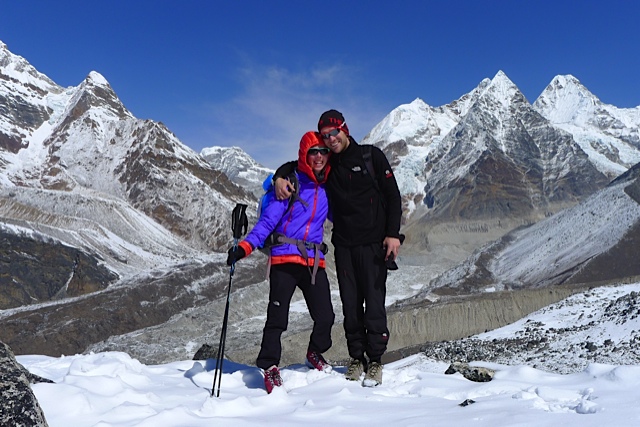
Kristin Størmer Steira (l) and Devon Kershaw during a day hike on one of their acclimatization days. The couple got engaged in 2014 after summiting Mera Peak during a three-week trek in Nepal’s Himalayas. (Photo: Devon Kershaw)
“First things first, I have to get my Norwegian at a level where I can sit through a lecture and write an essay at a decently good level, at least good enough that my wife doesn’t have to rewrite it, she can just correct it,” he explained.
Asked what he’d like to study, Kershaw said medicine, specifically orthopedic surgery, has always intrigued him. (As a junior skier, Kershaw took undergraduate classes at the University of Calgary until 2006, but those credits have since expired.)
“But now I’m 35 and I’m going to have to do all of this in my third language,” he acknowledged. “So for now, I’d say that that’s still my first choice and I’m exploring what it would take.”
If not medicine, he’d like to pursue a degree in “some kind of science physiology, and then in a totally shifted way, if I have a panic attack and be like, ‘Science is too hard after ski racing forever,’ then I am interested in economics and economic theory and business to some degree…”
Regardless of which path he choses, he’ll be doing it in Norway, Kershaw said.
“I don’t mind the challenge. … It’s intimidating in a way, but it’s also really exciting,” he said. “Kristin’s family [who lives in Lillehammer] is just so fantastic and to see how happy my daughter is here, to have her family, to have family around her and everything for the short term, and I hope to be educated in Norway.”
Asked if he’ll jump into any ski races this season, Kershaw was quick to respond, “No.” But he will continue skiing. The beauty of the sport and the struggle, as he put it, is what’s kept him in it so long.
“Imagine just having a singleness, a purpose, a goal that’s just there in your face and then you get to wake up every day and do the things you absolutely love to do,” he said. “… I adore cross-country skiing. I just think it’s such a peaceful, beautiful exercise, and the technique and the flow of it all. … You’re just skiing through the woods peacefully, gliding over snow, over all the terrain you can cover. It’s a beautiful, zen-like endeavor, and I think that’s what’s kept me in it this long. And the people, the Canadian ski community, the world ski community, really. I’ve met so many inspiring people and beautiful people and worked with a lot of absolute experts and I’ve had brilliant teammates and brilliant coaches.”
And because of skiing, he met his wife and started a family in Norway.
“I have a daughter with a woman that I love and respect and am in total awe of every day of my life and without ski racing there’s no way that would’ve ever come to fruition,” he said. “There’s the biggest gift right there, as cliche and Hallmark as that sounds, it’s true.”
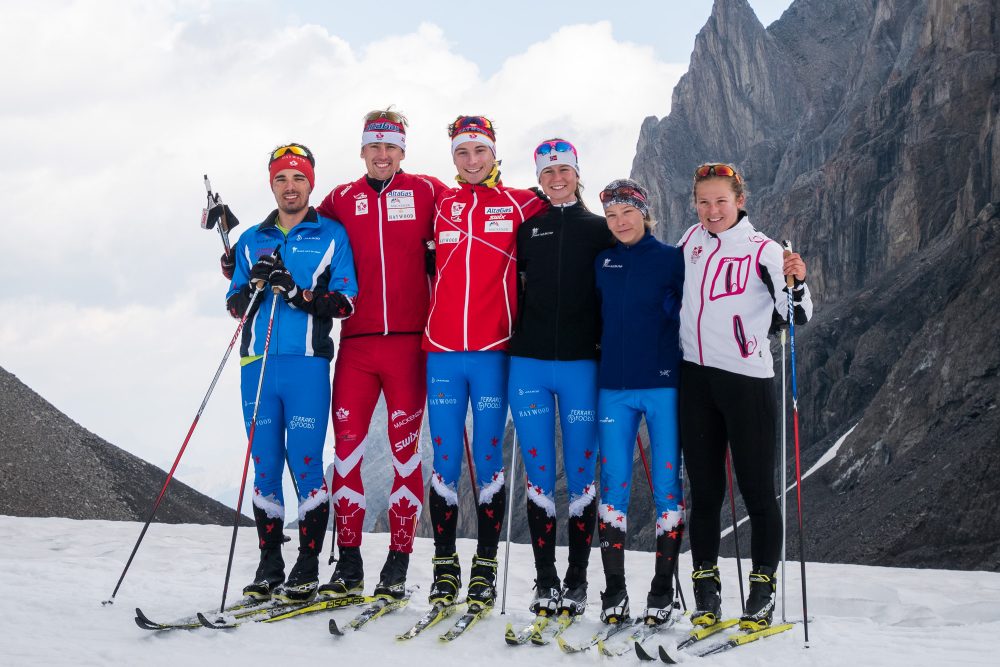
Black Jack Ski Team members (left to right): Daniel Merlo, Julien Locke, Remi Drolet, Michaela McLean, Abbey McLean and Molly Millar. (Photo: Julien Locke)
In Rossland, British Colombia, most residents can reach the town’s lone alpine hill by car in five minutes, the cross-country trails in seven. Tucked high in the Monashee Mountains, hemlock and fir outnumber some 3,500 locals, most of whom know each other by name. And over the past two decades, Rossland, which was featured three years ago in The New York Times travel section, has shown that a small town can produce nordic talent, repeatedly.
Thanks in part to snow that covers the ground an average of five months each year and roadways that provide 25 kilometers of continuous rollerski climbing, the area is one that Dave Wood — Cross Country Canada’s national-team coach from 1998 to 2010 and the current head coach of Rossland’s Black Jack Ski Team since 2010 — says has “everything you need to make great skiers.”
George Grey was one of them. The two-time Olympian grew up in Rossland after moving there from Great Britain, where he was born, with his parents at the age of 2. He spent much of his childhood skiing and racing for Black Jack before being selected to Canada’s national team in 2001. Grey then moved to Canmore, Alberta, the home of Cross Country Canada (CCC) since 1995.
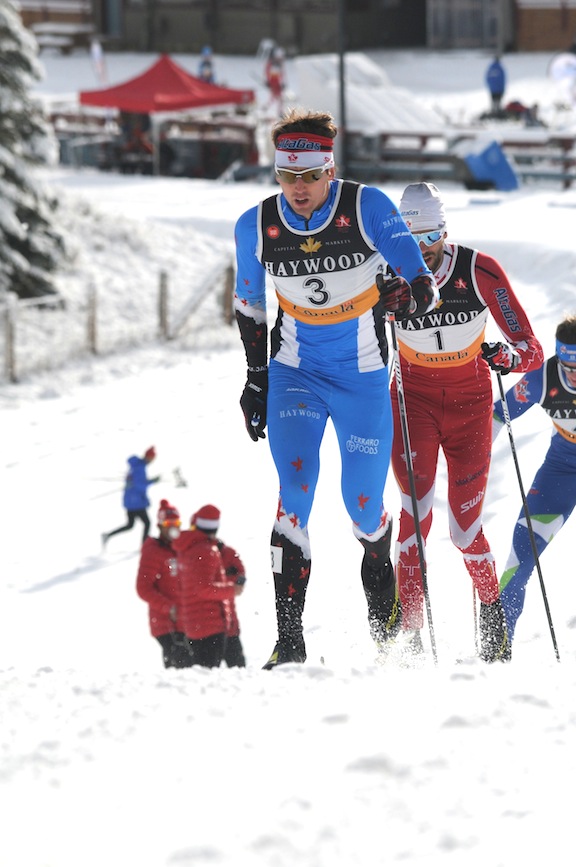
Black Jack and national U25 Team member Julien Locke (3) leads Canadian World Cup Team member Le Valjas (1) in a Frozen Thunder classic sprint heat on Nov. 1 in Canmore, Alberta. (Photo: Angus Cockney)
Despite living more than six hours away, Grey returned to Rossland often enough to join his old club team for training camps. When he was in town, “George Grey Days” were occasionally held for local youths interested in testing their skill against anyone else willing, including skiers from a relatively nearby town, Nelson.
Racers received race bibs and a chance to learn the course by following Grey around the trails beforehand. While many young skiers participated, one Nelson native saw the events as more than just a chance to race against friends.
“Before I joined Team Black Jack, when I was still racing for Nelson, he’d have George Grey Days where we’d put on a race and we’d all meet him and ski with him,” 24-year-old Julien Locke recalled on the phone earlier this month. “I think to have someone like that in the regional ski community was huge in impressing upon me that it is possible to come from a small place and get somewhere in sport.”
Born in Nelson, a town with a population of about 10,000, Locke grew up participating in the Nelson Nordic Ski Club’s Jackrabbits program until he was 14. He then moved an hour away to Rossland, where he joined Black Jack in 2006.
“Rossland became an adopted hometown,” he said. “I consider the Rossland club my home club.”
Locke’s first year with Black Jack was also his first year completing a full, yearlong training program. Though he had been skiing since he could put boots on his feet and click into skis, that season gave him new insight into his sport and what he wanted to do with it. In 2009, Locke competed at Canadian nationals in Duntroon, Ontario, and finished fourth in the juvenile boy’s classic sprint.
“That sat heavily with me all summer because I knew, I believed that I was capable of being on the podium in a sprint at nationals,” Locke said.
“I think that was a pivotal moment in understanding that training and preparation makes the difference at the end of the day,” he said. “Coming from a small town … I’ve always had a belief that I can rise to the top, but that was the first moment it really cemented into my mind.”
From then on, skiing became Locke’s primary athletic focus. He placed second in the classic sprint at the 2015 nationals and third in the freestyle sprint at the 2016 U.S nationals. Later that season, he racked up another third place in the freestyle sprint at 2016 Canadian nationals, and the following spring, he was nominated to CCC’s national U25 Team for 2016/2017. Last season, before making his World Cup debut in PyeongChang, South Korea, Locke won two races at South Korea’s national championships: the classic sprint and 10 k classic. At the subsequent PyeongChang World Cup, he finished 36th in the classic sprint.
This season, Locke has his sights set on the 2018 PyeongChang Winter Olympics in February. After what he called his “best summer of training” yet, which included two national-team training camps in Park City, Utah, and a few camps with Black Jack, he put his fitness to the test on Nov. 1 at Frozen Thunder’s opening races in Canmore.
This year, the first race, the Frozen Thunder classic-sprint qualifier held big implications for those vying for the final spot on the Canadian men’s World Cup Team for Period 1. The winner of the men’s qualifier would earn a trip to Europe to race the first four weekends of the World Cup, from late November through December. And World Cup results were what Locke needed if he wanted to qualify for the Olympic team.
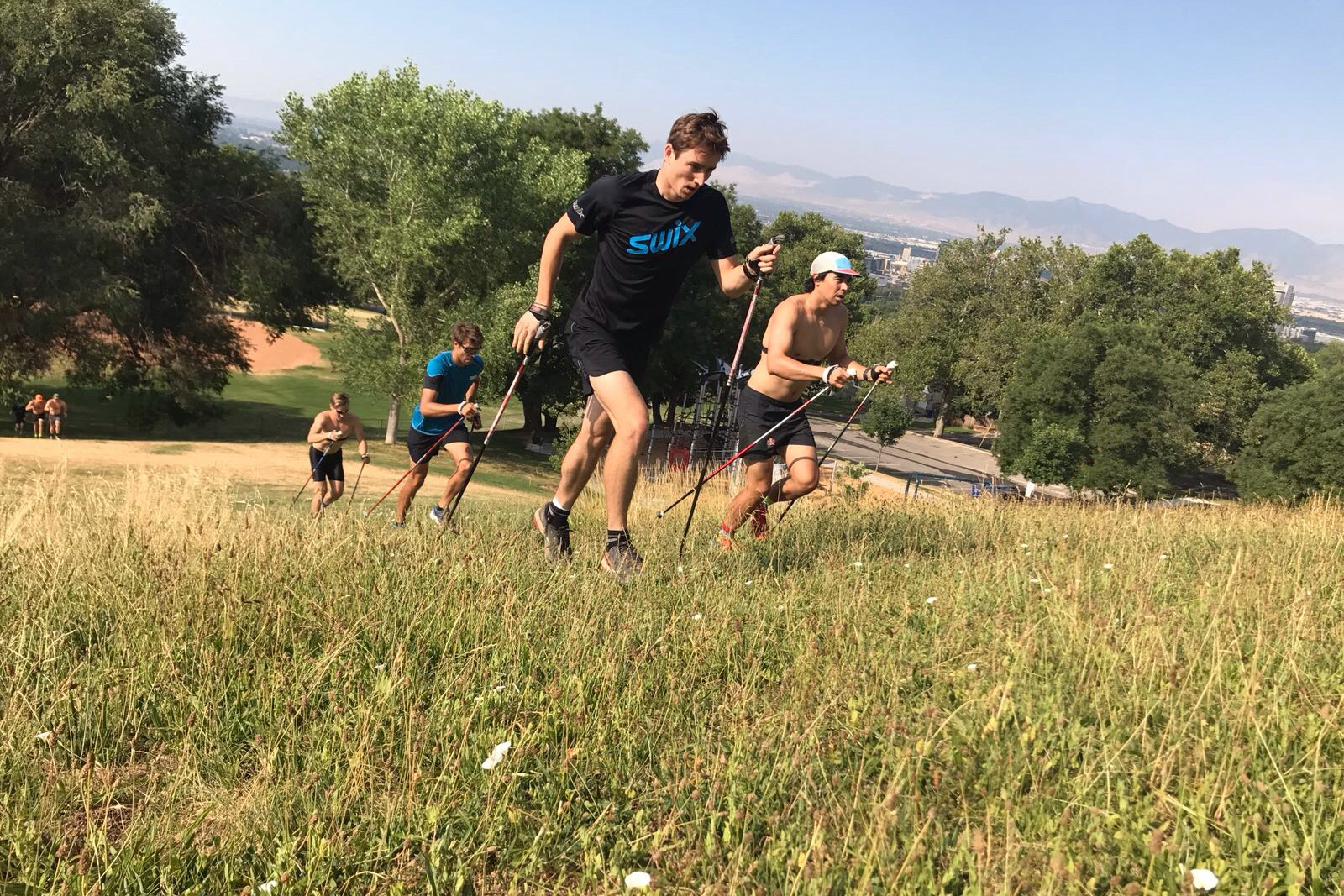
Julien Locke (center), of the Canadian U25 Team and Black Jack Ski Team, during a bounding training session with the Canadian national team in Park City, Utah, this fall. (Courtesy photo)
“[My coach Dave Wood and I] made the decision this summer to put a pretty high priority on the Frozen Thunder race because, with the way the Canadian selection process works this year with the Olympics, World Cup results are the most important thing, and there’s not a lot of opportunities to get on the World Cup, with these trials being the first and the most straightforward way to get there,” Locke said.
But Locke understands he’s not the only one with Olympic aspirations this season. A number other top domestic skiers are also gunning for a spot on the team.
“Start of every year in the spring, you sit down and look at what the goals are going to be and of course, this year it’s the same for everybody,” he said. “The Olympics are the big focus, across the board, everybody is going for the same thing.”
Despite the pressure to perform in the Frozen Thunder sprint prelim, he was able to push aside any nerves.
“I knew my season would look drastically different if I didn’t perform,” Locke said. “And I was quite confident in my preparation. I think with any race, that’s what I build my confidence from is knowing that I prepared well.”
Locke won the qualifier in a time of 3:37.81 to secure that spot on the World Cup team. He flew to Sweden on Nov. 11 for the opening International Ski Federation (FIS) races in Gällivare, Sweden, this past weekend. This week, Locke and the rest of the Canadian World Cup team is headed to Kuusamo, Finland, where the World Cup opens on Friday with the Ruka Triple mini tour.
While his coach, Wood, will remain in Rossland, he’ll continue to keep in touch with Locke by phone to help guide him through the start of the season.
“It’s a step along the road for the season,” Wood told FasterSkier. “Lots of athletes you see, their focus is like a funnel. In May, they’re looking at the funnel through the small end instead of the big end, and by the time the fall comes, now they’re through the big end and for whatever reason they can’t maintain or refine the things they have to do. In May, they’re doing everything right and in the fall they’re doing not very many things right. Julien is one of those athletes that understands that and as the season gets closer, his focus intensifies.”
This past Friday through Sunday in Gällivare, Locke raced to 72nd in the opening 10 k freestyle, skipped Saturday’s 15 k classic, and then placed 39th in Sunday’s classic sprint qualifier. He missed the top 30 needed to qualify for the heats by 2.36 seconds.
“This weekend was a great chance to do some good race efforts ahead of the World Cup,” Locke wrote in an email on Sunday. “With such large fields, it was a good reminder that the margin for error is very small. Leading into the World Cup next weekend, it will only become ever more important to focus on the details. I’m looking forward to the upcoming three weeks, particularly the Ruka sprint as it has always been a favourite race of mine to watch. It’s such a tactical course with so much potential for excitement in the last 45 seconds.”
While Locke previously referred to his win at Frozen Thunder a “relief”, it is just the beginning of a several-monthlong journey.
“Of course I’m excited, but it felt to me sort of as the first step in the broader plan for the season,” Locke said. “Just one box being checked off.”
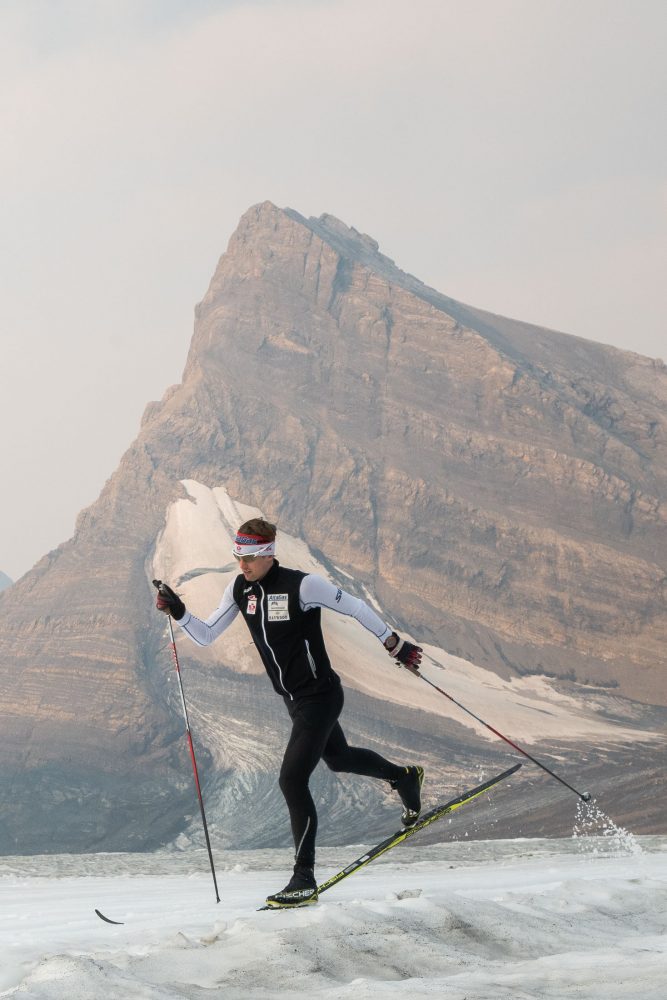
Julien Locke (Canadian U25 Team/Black Jack) training on Haig Glacier near Canmore this summer. (Courtesy photo)
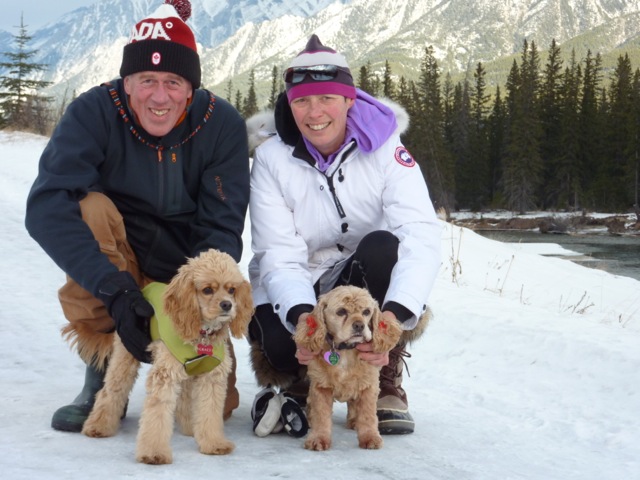
Dave Wood, Alison and their two Cocker Spaniels (Courtesy photo)
Several weeks ago, I received an email from Dave Wood, a longtime head coach of the Canadian National Ski Team. He had just arrived in my hometown of Mammoth Lakes, Calif., with a small group of athletes from Black Jack Ski Club in Rossland, B.C. We planned a rendezvous to catch up and to chat about the local training hot spots.
It had been a few years since Wood had been in Mammoth with skiers. Back around 2003 or 2004, during his tenure as Canada’s national-team head coach, he had discovered this high-altitude training location through an online search and some U.S. distance running links. A reconnaissance to the area gave him all the information he needed: a “live high and train high or low” scenario with great fall weather and miles of trails and open roads.
Dave Wood during a recent altitude dryland camp in Mammoth Lakes, Calif.
For several subsequent falls, Wood and his national team left their home base in Canmore, Alberta, for three weeks of high-altitude sunshine in the Eastern Sierra. Now, Wood was back, this time with a few dedicated athletes from Black Jack, of which he had been the head coach since 2010.
The Black Jack camp format was similar to the national-team camps he ran in Mammoth years before. Condominium living at just over 8,000 feet gave athletes rollerskiing options right out the door, with single-track running trails not too far away. Proximity to the town of Mammoth Lakes offered a fitness club, grocery store, and some rest day “in-town” opportunities were just a short bike ride away.
As Wood explained over coffee, the beauty of coming to Mammoth was the convenience of being able to stay in town and drive 40 minutes down to 4,000 feet for intensity training. He raved about the “exceptional rollerskiing,” where on one lonely road leading to Nevada, his athletes saw only a handful of cars during an over-distance rollerski workout.
I had hoped to join Wood and his Black Jack skiers for several workouts, but managed just one: a long run in Lower Rock Creek. Wood had to leave town for a couple of days, so he enlisted me to take the athletes to a nearby trailhead for their run over Duck Pass. Several inches of snow overnight jammed up that idea, so I drove down the hill with the guys and Chisa Obayashi, a Japanese skier who has been training under Wood’s supervision the past few months. I had in mind beginning the run out of the snow zone at the Paradise trailhead, just north of Bishop, Calif.
The Black Jack Ski Club, with head coach Dave Wood, while hiking Mount Assiniboine on the Great Divide on the British Columbia/Alberta border in August 2011. (Photo: Dave Wood)
Tagging along on the run through towering Jeffrey pines and golden aspens, I was able to learn a little bit about the Black Jack athletes. David Palmer and Colin Ferrie, accomplished junior skiers, are heading into their first year as seniors. They, along with teammate Julien Locke, who missed the trip due to an injury, are among the best in their age group in Canada. They have had solid training all summer including a trip to get on snow at the Haig Glacier. Following their Mammoth camp, they will be heading to Canmore for some time on Frozen Thunder.
An adopted Black Jack skier, Obayashi made the trip down to Mammoth with the men’s team and was also planning to join them after in Canmore, where she would get some snow kilometers before going to Finland for the start of the racing season. Obayashi connected with Wood through her manager in Japan and had only positive things to say about her training experience in North America, she told me as we ran on the Lower Rock Creek trail.
The kind of individualized coaching she was receiving from Wood was hard to come by in Japan. She had no regular training group in Japan, so the opportunity to train with Black Jack was setting her up well for her quest to make the Japanese Olympic Team.
Chief, Cook and Bottle Washer
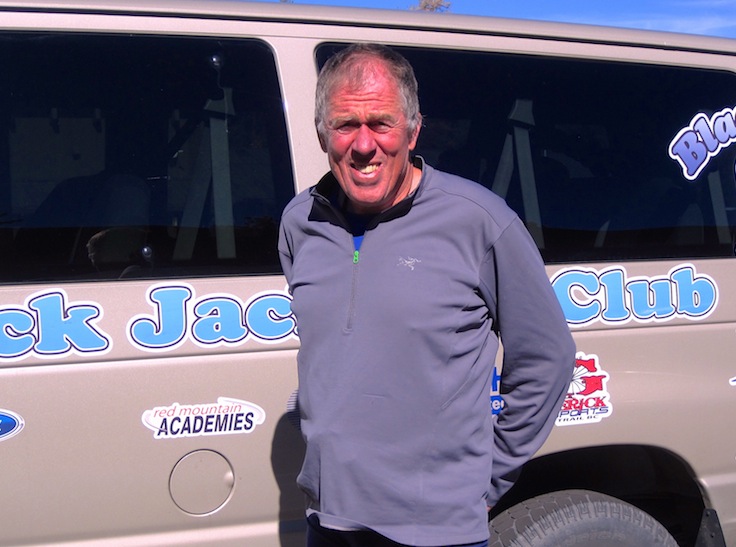
A few days later, I met up with Wood again for lunch. He pulled up in the team van on time, but appeared a bit flustered. Dressed in running clothes, he explained that he had dropped off his group over in June Lake to do a three-hour, point-to-point run. He then drove to the termination of the run, parked and began to run the trail in to meet the athletes. They ended up missing a key turn and added nearly an hour to their run. Wood shook his head, muttering something about knuckleheads, but it was hard for Wood to disguise his pride in his skiers.
The soft-spoken 58-year-old Wood is unflappable, handling his role as “chief, cook and bottle washer” for Black Jack in his customary professional manner. He uses the same thorough and systematic system to train his club skiers as he did to build a solid Canadian team. Wood uses the Mammoth camp as an altitude block is based on science, experience and much thought. There is even a short recovery phase when the athletes pack up and go down to 4,000 feet to sleep.
Dave Wood at the 2010 Olympics in Callaghan Valley, British Columbia. (Courtesy photo)
Four years after resigning from his position at Cross Country Canada following the 2010 Olympics, Wood seems to have landed on his feet. As he explained it, after 18 years with CCC, holding positions as head wax technician, head coach and team leader, it was time to move on. He described his transition without a trace of rancor. In fact, the move to Rossland seemed like the most natural thing in the world.
After eight years of commuting from Canmore to Rossland to see his girlfriend (about a 6 ½-hour drive in good weather), Wood saw his exit from CCC as the perfect opportunity to move in with Alison, an operating-room nurse at a local hospital. At the same time, Black Jack was looking for a head coach, so Wood felt the timing was perfect.
Black Jack is a well-established nordic club with over 700 members. It offers programs for 4 year olds to masters, with a small, but active racing program. Ski Academy opportunities are available for Black Jack skiers, as well as for the local alpine program, Red Mountain Racers.
With about 3,500 residents, Rossland is nestled in the Monashee Mountains of the West Kootenay region at an elevation of 3,410 feet. Winter sports are a big deal there, which usually has skiing from early November through late April. Red Mountain Resort boasts an average 300 inches of snowfall per year and the Black Jack trail system features 40 kilometers of groomed track, a lighted loop, a kids terrain park, and a biathlon range. An extensive mountain-bike park offers single track riding and running during the summer, making Rossland an ideal home for a nordic skier.
Wood’s approach to ski racing is simple. He believes the bottom line is using the training to become faster.
“You can’t improve by just going to Europe to race,” he said. “You have to figure out a way to cut 45 seconds over 15 kilometers before going.”
He likes to keep travel to a minimum during the training phase in order to accomplish goals. There are so many training and racing opportunities out there for skiers, but it’s easy to lose sight of what you are really after, which can boil down to those 45 seconds.
Thoughts from a Former Coach
While Wood has been busy with Black Jack the past several years, he’s kept an eye on what is happening at the national level in Canada. Coaching the nation’s top skiers through CCC gave him perspective on his job as a club coach, which notably has different viewpoints and team structure than the nation’s four training centres. There is a lot of training, racing and experience necessary to bridge the gap from club to national-team skier and even more to move into the international realm.
Wood’s approach to ski racing is simple. He believes the bottom line is using the training to become faster.
On the state of skiing in Canada, Wood has definite concerns. He recognizes the success of the women’s team in recent years, with medal performances by Beckie Scott, Sara Renner and Chandra Crawford, and a men’s team highlighted by Devon Kershaw’s overall second place in the 2012 World Cup, and Kershaw and Alex Harvey’s sprint championship title at the 2011 World Championships. The problem CCC faces is a lack of depth in its program, he said.
Wood sees the potential for Canadian success at Sochi in the sprint and team sprint. On the Canada’s stated goal of winning two medals, Wood said, “You have to ski the race before you win the medal.”
While Harvey is a proven racer, Kershaw has to have a better year than last year for any of this to happen, he said. Wood sees lack of depth on the women’s side as a liability, as well as problems with the Olympic qualification system. It’s difficult to compete against teams like Russia, Norway and Sweden that have large pools of athletes racing at a high level. Those countries can play with putting athletes with fresh legs out in every race.
One of the underlying problems he sees within the Canadian system is that all of the funding is at the World Cup level. He estimates that what was CCC’s $180,000 dollar budget in 1999 is probably now close to a $2-million dollar budget. Development is left up to the four training centres. While these centres are nationally funded, Wood said there’s a lack of a coaching system, resulting in inexperienced coaches.
In his opinion, the biggest hurdle for athletes taking part in the training centres is the cost. At a given training centre, he estimated $12,000 Canadian dollars covers a year of coaching and four weekends of racing, but by the time the racing season is over, participants doll out $20,000 to $30,000 annually. Sponsorships are difficult to come by and jobs are low-paying in the training centre locales. Wood isn’t sure enough athletes are going through the system to build the kind of depth CCC needs to become an international power.
Adding to the situation is the lack of skier development opportunity through the Canadian universities, he said. Lots of junior athletes are dropping out of the sport at 18 years old to get an education.
Wood is confident that what he is providing at Black Jack is an affordable, high-quality program for juniors and seniors to help make the jump to the international level. A lot of money is spent on Integrated Sports Teams at the national training centres, he said. Besides the expense of these doctors, trainers, massage therapists, etc., is the cost of waxing and equipment.
“Cut down on this nonsense, and it would be affordable,” Wood said.
Wood keeps expenses down for his athletes by, once again, keeping things simple. He keeps his wax box stocked with a minimum of wax brands, and while not denying that wax technology is a major element of ski racing, he said it helps to remember what the race really comes down to.
“Cut down on this nonsense, and it would be affordable.”
After the Mammoth camp, Wood and the Black Jack skiers planned to head back to Rossland for a short break. Wood had a few days of downtime with Alison and their two Cocker Spaniels, then was due in Canmore for an on-snow camp at Frozen Thunder.
The schedule in November is dedicated to snow camps in Vernon and Rossland, with racing kicking off at December NorAms in the same locations. Things ramp up in January for the Black Jack skiers, with a NorAm in Canmore, the qualifier for Olympics, U23, and Junior World competitions. The remainder of the season sees the team criss-crossing Canada attending Eastern and Western Canadian Championships, and Canadian Championships in Newfoundland in March. The season concludes with March BC provincial events.
Patrick Stewart-Jones of the Alberta World Cup Academy leads the way at the high point of the Upper World Cup trail at Sovereign Lake Nordic Centre last week.
VERNON, B.C. – Sovereign Lake Nordic Center’s annual Summer Ski camp from May 10-19 attracted the usual collection of hard-core skiers, a mixture of teams and day trippers who need a last fix of snow before the inevitable arrival of summer. With neighbour Silver Star Mountain Resort gearing up for a summer of mountain biking, and the city of Vernon already in full-summer mode in the valley below, Sovereign’s weeklong camp is the last chance for set tracks in the region.
Canmore Nordic was the first group to arrive on May 10, with a four-day camp justifying the six-hour drive to Vernon. Another Canmore-based team, the Alberta World Cup Academy (AWCA) arrived next for a seven-day, sleep-low (train-high) camp beginning May 12. Black Jack skiers trickled in for the final four days, and biathletes and Para-Nordic team members flocked to the snow-covered trails as well.
The week preceding the camp featured five consecutive days of temperatures at or about 30 degrees Celsius (86 Fahrenheit) in the valley below and significant snow loss even at the 1600-metre low point of the early season trails. After four days of skiing and a major thunderstorm, the track setters shifted to a higher set of trails.
AWCA brought most of its athletes, including last season’s NorAm winners Emily Nishikawa and Michael Somppi, as well as Canmore World Cup top-15 finishers Jess Cockney and Phil Widmer, and perennial domestic podium contenders Kevin Sandau and Alysson Marshall.
“We are up here in the mornings for skiing a few hours at least and then we’re downtown [in Vernon],” said AWCA coach Mike Cavaliere. “We do some cycling, or running in Ellison Park, or go to the gym.”
While the team is expecting to return to crust skiing in Canmore, this camp was attractive for set tracks and the nearby low elevation (380 meters), with accommodation on a beach near the Ellison Park mountain biking area.
“Part of the goal is to let people enjoy summer,” Cavaliere said.
One day, the AWCA women got out their road bikes for a training ride to Marshall’s parent’s house in nearby Salmon Arm for lunch. The next day, the men rode from their lakeside accommodation to Silver Star Village – ascending some 1,200 metres – for their post-ski workout.
Former Canadian national team coach Dave Wood, now happily “retired” in Rossland, B.C., persuaded his small Black Jack team to drive five hours to start the new training season on groomed trails.
“We started skiing [in Rossland] in October, and they set track until April 27th,” he said.
And what about those masters athletes? Most stayed down in the valley, mostly for all the biking, mountain biking, running, rowing, and stand-up paddling recreational options. Skiers from at least four nearby nordic areas were spotted up at Sovereign, having driven by the summer alternatives to get here.
Despite the example set by the elite athletes, middle-aged journalists are simply not capable of skiing two hours in the morning and then running or biking in the evening for more than five consecutive days. Lesson learned. Or lesson not really learned, because it was so much fun.
Black Jack’s Julian Locke stops for lactate testing with coach Dave Wood while Michael Somppi (c) leads an AWCA train
Alysson Marshall (AWCA) striding into summer.
Phil Widmer (AWCA) during an L3 session at Sovereign Lake’s Summer Ski camp last week.
AWCA skier Emily Nishikawa (l) puts her head down under blue skies at Sovereign Lake Nordic Centre in Vernon, B.C.
AWCA coaches Stefan Kuhn (l) and Mike Cavaliere stop for a photo opp.
Marty Hall (MH)– Hi Dave, it’s been 9 months since your departure from the Canadian National Team, what’s been happening with you and your career—bring us up to speed?
Dave Wood (DW)—In the spring I began working with the Black Jack Ski Club in Rossland, BC. The program here has younger skiers ages 13 to 17, all in high school. We have an ideal natural environment for Cross country skiers in Rossland. Most of the training can be completed “out the door”. We have to travel for Roller skiing to find different terrain, but we have everything from flatter gentle terrain to long continuous uphills (10 to 25 km). The trails are superb and with the Red Mountain alpine area only 15 minutes running from town we can do as much ski simulation on foot as one can stand!
The program had a couple of training camps in the summer, the Haig Glacier, and a dryland camp in the Bow Valley. This is an opportunity to begin to introduce these skiers to training at altitude. We began skiing in Early November up at the Paulson trails (local). There are 3 areas for Cross Country here, and the Paulson trails (maintained by the Castlegar club) have snow a little earlier than Black Jack.
I went to Boston in September for a NENSA seminar. I made a presentation and sat in on the rest of seminar. Always good to get into other areas. As well I went to a COC function (Olympic Excellence series) for summer sports in November.
The club hosted a very successful NorAm in December. I did not have involvement with the event, except I worked with the club to build a better sprint course. The tracks and the event were well received.
The club and the Red Mountain Academy are joining forces to create an educational component to our Nordic Program. Al Fisher (Racing Program Director) and I initiated this in the spring and over the summer when we hammered out the details. At the end it has been Wannes Luppens (Club President), Al Fisher and I that are spearheading this initiative.
Now we are into the racing season and going full blast.
Life in Rossland right now is being very good to Coach Dave Wood!
MH—Dave, with all this said, it sounds as if you’re in the midst of announcing a new high school aged skiing program in the midst of one of the best training and skiing locales in North America. Everything is out the door and skiing locally in early November while going to school and being coached by the ex-Head Coach of the National Team, what more could young skier want. So, Dave, tell us more about the Red Mountain Academy and its new educational component for your Nordic Program.
DW—The Red Mountain Academy (RMA) has been in operation for many years. It began as an academy program with the Red Mountain Racers (Alpine racing) and over time has expanded. The cooperation with the Black Jack Cross Country ski club was initiated this spring and we finalized the association this past fall with a three pronged program. Read more about the Academy here: www.redskiacademy.com
The Home Stay Plan—- Athletes that are not local in Rossland are placed with families in Rossland. We also have service providers such as physiotherapy, mental training, etc.
The home stay is organized and delivered through the administration end of the academy program. The athletes stay with families in the area. There is an education for the home stay families with respect to the nutritional needs of the athlete. The cost for this is $750/month, which includes some of the travelling needs. With their application to academy the process for home stay is initiated.
Another component of this program is transportation to and from the training venue to the school. In Rossland you can walk from “home” to school
The Educational Component of the Academy—is delivered at Rossland Senior Secondary school. This will provide the athletes with a flexible academic schedule that allows time for proper training and competition programs. Read more about RMA here: www.rss.sd20.bc.ca/
The third componentof the program is the Training and Competition Program— that is managed and delivered by myself. I have several coaches and experts who are assisting me in the Black Jack Racing team. We provide an intensive, individualized training and preparation programs.
Athletes in the academy program will train alongside the athletes training with the Club Program. Currently we have athletes from Rossland, Nelson, and Trail that work with the Black Jack Racing Team.
General program for 2011/12
-May 1 is the training year start
– Will plan for a spring snow camp where it can happen, likely Vernon, however we can do it here in some years
-June is dryland, going into the local mountain trails as the snow melts
-July will have a week at the Haig glacier
-August will have two weeks in the Bow Valley with two trips to the Haig glacier
-Fall camp with altitude. Most likely the Bow Valley if the stored snow works out
-December NorAms
-World Junior trials
-National Champs
– Other racing as is available
In Rossland we enjoy the perfect natural environment for developing Cross Country Ski Racers. We have an extensive network of trails and paths that are ideal for running and ski simulation on foot. As well we have mountain trails that are up to 2200 meters in elevation. This means we can train between 400 meters and 2200 meters, an ideal situation for altitude training and lower elevation for speed work. We have long continuous roller ski climbs, up to 25 km, or we can have gentle rolling terrain to roller ski on. A lot of this roller ski terrain has very limited traffic. We have access to a rubber surface running track in Warfield (6km away), an aquatic center in Trail (10 km), gyms in Rossland, and the alpine area (Red Resort) is about 5km from town, a perfect distance for warm up for a hill session. This is as good as it gets for dry land training!
We have 3 areas where we can ski. The Black Jack Club (www.skiblackjack.ca) is about a 10 min drive from anywhere in Rossland. The club has about 30 km of trails that are groomed daily by one of the two Pisten Bulleys the club owns. The normal season at Black Jack would be December to April. There is a biathlon facility up the highway from Black Jack. There is a 5km loop with the shorter tracks inside the 5 km track. The biathlon facility is about 300 meters higher than Black Jack, and gets earlier snow (2 to 3 weeks) and the snow lasts much longer in the spring. Finally the Castlegar ski club operates a trail system at the Paulson Summit. This is about a 30 min drive from Rossland, and it is also higher (about 1500 meters) so it is another option for early skiing
We can offer a training environment that is very high quality and lets the athletes maximize their training time do to the proximity of all training venues.
MH- Dave, I think that wraps it up and I’m thinking for any young teenage skier it doesn’t get any better. Sort of a home away from home feeling with the Home Stay Program and one of the best facilities and training centered programs you could want to be involved with if you are looking towards excelling nationally as a skier in the near future. Where do I sign up?
Dave Wood served as team leader for the Canadians for the last two years, and worked with the athletes at the 2010 Olympic Games.
Following his resignation last week, longtime Canadian coach and team leader Dave Wood said that he was leaving to take a coaching opportunity with a club closer to his girlfriend, and that his parting from Cross Country Canada (CCC) had been amicable.
Current and former CCC athletes all praised Wood’s contributions to the organization over the last dozen years. But in interviews, they also acknowledged that Wood’s last year with the program was marked by tension.
At the Olympics, one athlete said he noticed a strained relationship between Wood and Inge Braten, the head coach at the time—who left his position at the end of the winter. And later this spring, according to a former national team member, CCC athletes pushed for changes to Wood’s role in the organization.
Wood denied that any tensions existed, and insisted that his decision to leave had been personal. But in an interview with FasterSkier, CCC Executive Director Davin Macintosh acknowledged that his organization conducted an “extensive review” of the High Performance System—which includes the National Team, and Wood’s position—after the Olympics.
The resulting plan for the next year, he said, “did include slightly different roles for people.”
“We invited the parties to fill the roles that we’d defined, and Dave took a long, hard, think about his future, and I guess he’s decided that other things are pulling at him, and that the best way forward for him is not to continue in the role he had,” he said.
Olympic Tensions?
A last-minute addition to the Canadian Olympic team, Gord Jewett was named to the squad in late-January. In Vancouver, Jewett raced in the 15 k freestyle, finishing in 52nd, just over two and a half minutes behind winner Dario Cologna.
During the Games, Jewett said, Braten and Wood did not seem to be on the same page. Their answers to logistical questions were sometimes different, which left Jewett feeling like he had to make a decision to talk with one or the other “to confirm details around training or preparation.”
“In my view, the relationship between Dave Wood and Inge Braten was strained at the Olympics, and the lack of communication between the two marginalized the ability of the team to be prepared,” Jewett said. “They weren’t communicating well, and that affected the overall organization of our team.”
Reached on vacation in Tunisia, Braten denied any conflict existed.
“I thought it was okay always with Dave,” Braten said. He added that the reason that he left his job at the end of the winter was unrelated to Wood, “or anybody else.”
Asked whether there were problems with communication between Braten and Wood at the Olympics, CCC Director of High Performance Tom Holland—who oversees the National Team—said that the two were “very professional.”
“We had very clear roles, all of us, going into the Games,” he said. “People delivered on their roles. We had some hard decisions to make—we made those decisions as a team.”
While Braten was the second straight Scandinavian coach to leave Canada after one year, Holland said “it’s difficult bringing people in from a different country—particularly overseas.”
“What we’ve discovered in the past four years is that we have something unique in Canada,” he said. “People have to be able to fit into that. We can’t be changing the system every two, three, four years in terms of the way we operate.”
Interest in Change
When Wood left his position at the national team last week, he told FasterSkier he had made the decision unilaterally, in order to take a job with a club in Rossland, BC.
But according to a former Canadian National Team member, CCC athletes had pushed for changes in the High Performance System at the end of the season—especially to Wood’s role.
“The athletes are always accountable for their performances based on results, and they haven’t felt as though there’s been that same level of accountability towards the administrative side of the High Performance [System],” the former National Team member said.
At the end of the four-year Olympic cycle, the former team member continued, the CCC athletes felt that it was time to “push forward on what they needed out of the national team program, and create a stronger system.”
When contacted by FasterSkier, four different National Team athletes declined to comment on the details of Wood’s departure. But Drew Goldsack, the national ski team representative to CCC, acknowledged that “there had been some tension” in the program.
“I don’t think the athletes were pushing for Dave to be fired,” he said. “But there was interest in change—in some major changes.”
Wood denied that there had been conflict or tension between him and the team, saying that “athletes are always unhappy.”
“They always want more—they don’t like to get pushed. That’s normal,” he said.
Macintosh, the CCC executive director, said that the post-Olympic review conducted by his organization was “extremely engaging” for the skiers. The resulting plan for the next year, he said, “responded to the concerns raised by athletes.”
“The organization firmly believes that there’s a role for Dave in that, and we’re sad to see him go,” said Macintosh. “We came up with the best structure from the organization’s perspective, but we can’t force people to work with us.”
Tasha Betcherman, the athlete representative to CCC’s board of directors, told FasterSkier in an interview that in the past, Canadian athletes have felt “that they have not had a direct contribution to some of the decisions on leadership.”
“But that is definitely changing,” she said. “After the Olympics is a really good time for reflection, and I think that the athletes were definitely heard.”
In a press release on the CCC website posted Wednesday, Macintosh said that Wood will continue with the organization doing “contract work.” As of Monday, the organization had not yet determined how it would fill the void created by Wood’s departure.
As much as anyone might begrudge Team Canada coaches Dave Wood and National Inge Braten’s decision to sit Brian McKeever in Sunday’s 50 k classic, it’s hard to disagree with the fact that the two were presented with an agonizing choice.
While starting McKeever would have meant making history—the Canadian would have been the first athlete to compete in both the winter Olympics and Paralympics—it also would have meant holding a potential medal contender out of the race. Devon Kershaw, Alex Harvey, George Grey, and Ivan Babikov are all skiing well, and each has a legitimate—if small—chance for the podium in the 50 k.
Wood said that he expected for one of those four to be run down by this point, two weeks into the Games—that’s why there was a reasonable belief that McKeever would get a start in the first place.
“Normally, that happens,” he said. “Since 2003, I don’t think we’ve ever made four guys in the 50 k. There’s always something [that] happens—guys run out of gas, they get sick, they get hurt.”
But with those four all healthy and fired up to compete, Wood said that there’s no holding them back. And at this level, the only kind of history coaches get credit for making is when they win.
“It’s quite hard for us to put guys that are skiing, you know, they’ve all been top-ten—to put them on the bench,” he said. “It’s nothing against Brian, but they’re better.”
While McKeever may have won the 50 k at the Canadian Olympic team trials in December, none of the four starters for Sunday’s event competed in that race.
Wood downplayed the significance of the whole situation, saying that all the attention turns it into a “sideshow,” and distracts from the team’s main focus.
“It’s not really making history—he’s been at World Championships, he’s been on the World Cup,” he said. “It’s something that I think [is] difficult to manage in the team, too, because we’re here to race at the Olympics.”
While a start for McKeever would hold significance for the media, he added, “tomorrow that’s gone—and we can’t sell that to anybody.”