From the FasterSkier archive — posts syndicated from athletes’ and coaches’ own blogs between 2004 and 2012, kept online as published. Current coverage is at fasterskier.com.
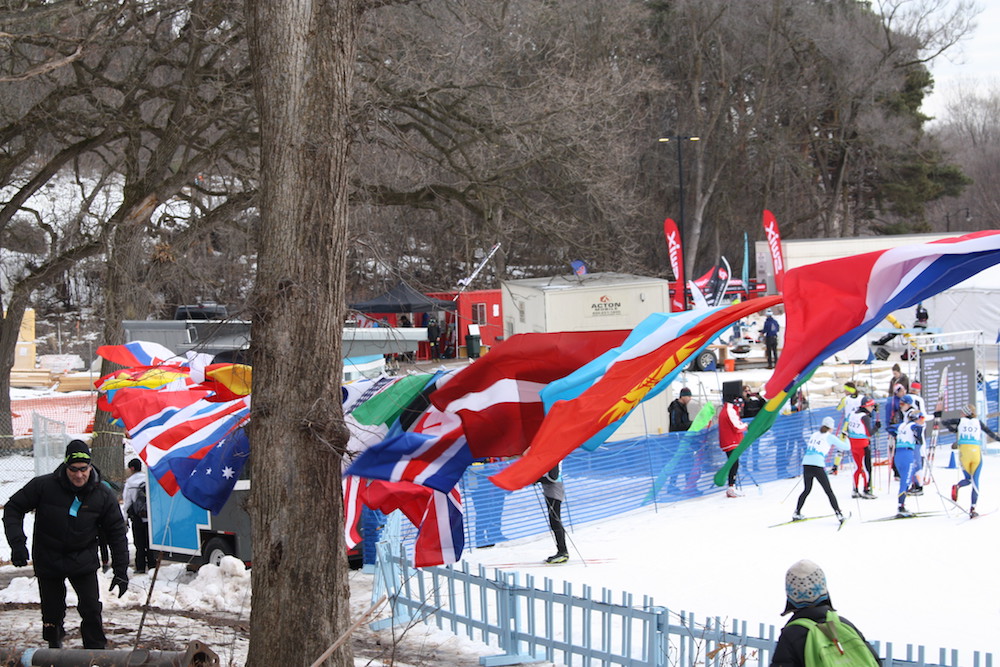
World flags waving on the first race day of the 2018 Masters World Cup on Saturday in Minneapolis, Minnesota.
MINNEAPOLIS, Minnesota — With temperatures staying in the mid-20s overnight on Friday, it was a warm, slightly sticky start to the 2018 Masters World Cup on Saturday in Minneapolis. However, despite temperatures in the upper 30s to low 40s, the 7.5-kilometer loop course at Theodore Wirth Park held up well — an important thing, as Saturday was all classic races.
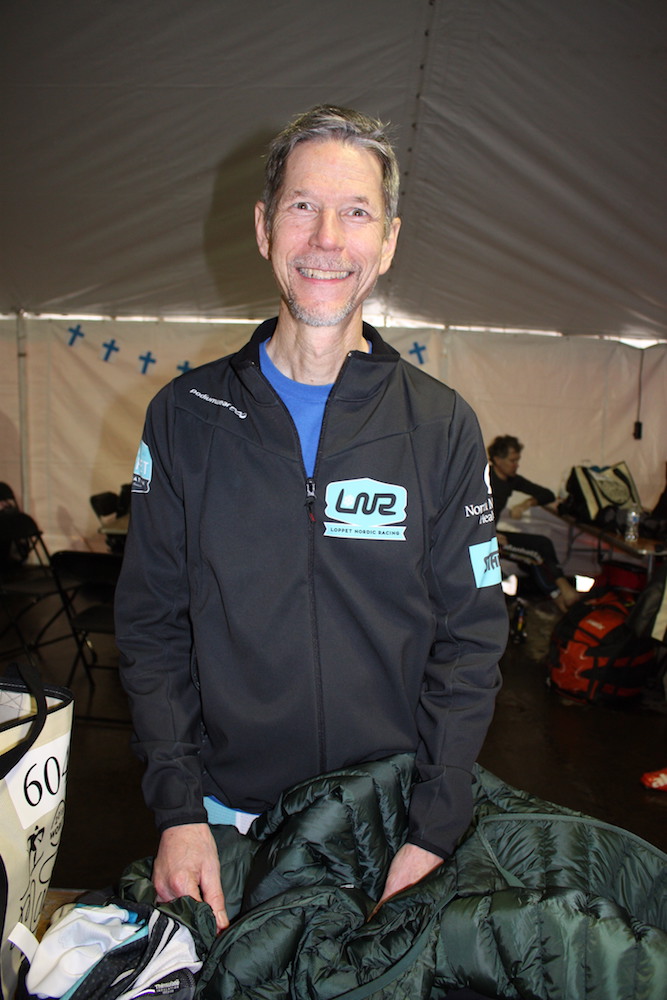
Tom Ajax, of Minneapolis, finished 14th in his men’s age group “6” 15 k classic on Saturday at the Masters World Cup in Minneapolis, Minnesota.
According to Tom Ajax, a Minneapolis-based skier who raced in the men’s 30 k classic on Saturday (and also coaches with the Ride & Glide ski club), the course was “very clean. Spectacular, loved it.”
The tracks held up well, and the hills, though a little tough, were “doable,” said Ajax, who finished 14th in his age group “6” and described his last laps as stronger than his first. Helping to keep the course in good shape were the racers.
“Nobody snowplowing, nobody dogging it—a lot of strong skiers,” he said.
The sun did make a few short appearances on the overcast day, which modified course conditions some for the afternoon racers.
Boulder Nordic Sports Race Service Director David Chamberlain described conditions as “fairly consistent throughout the day.”
“In the morning we went with a little harder klister … but then switched over to a little softer one [around 10 a.m.],” he said.
At the same time, Chamberlain noted the course was “a little variable. Some of the hills got baked in the sun in a couple spots, and then [it was] a little drier in other places. The kick wax that worked in one place may not have worked perfectly in the other place.”
Generally, though, the overcast skies kept things pretty constant.
Conditions for Day 2 look to be about the same as Sunday, if perhaps a bit cooler. But, with a winter storm watch set for the Twin Cities metro area from Sunday night into Monday, things look like they could get a bit interesting for the shorter distance classic and skate races on Monday.
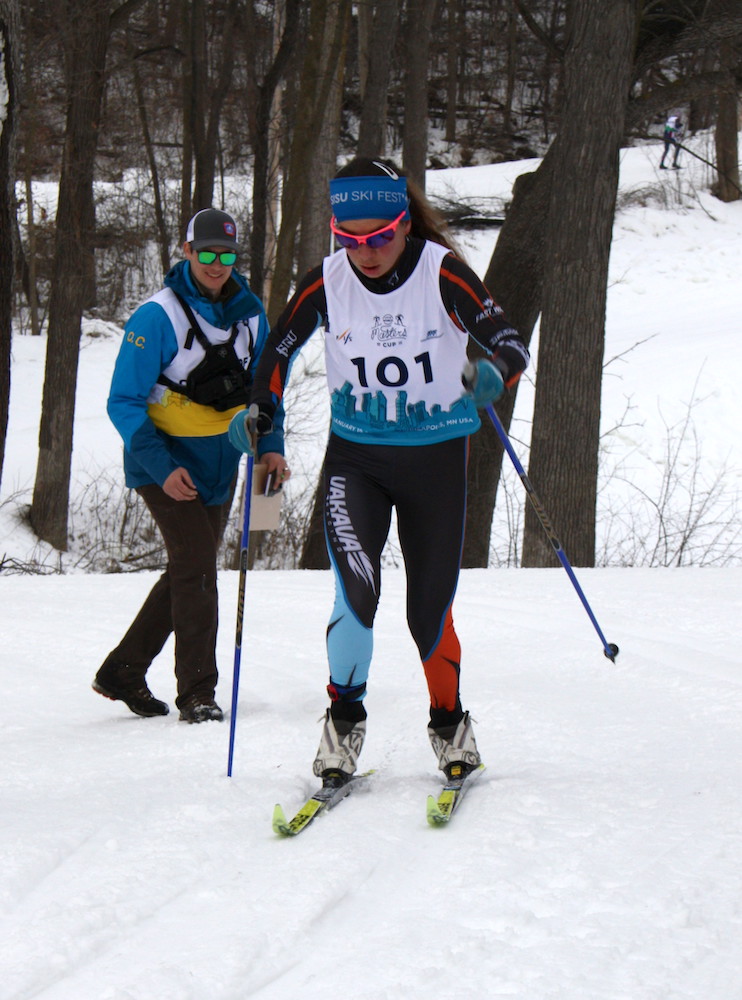
Elspeth Ronnander of the U.S. racing to third in her age group, the women’s “1” 15 k classic, at the Masters World Cup on Saturday in Minneapolis, Minnesota.
The races were broken into 24 different age groups, with the youngest racers being in “1” (e.g. born in 1986) and oldest in “13” (e.g. born in 1926). The largest race on Saturday was the men’s age-group “8” 15 k classic, which had 47 finishers. Finland’s Leino Nisula won that race in 41:19.7 minutes, another Finn Heikki Ruokonen won the men’s “7” 15 k in 40:07.4, and yet another Finnish man, Veikko Piirainen, won the “9” 15 k in 44:28.4.
The largest women’s age group was the “7” 15 k with 18 finishers, which Finland’s Marianne Niemi won in 47:18.9. American Carolyn Tiernan won the women’s “8” 15 k in 53:54.8.
Also racing 15 k were the women’s age groups 1 through 6. Elizabeth Youngman of the U.S. won the “6” in 45:31.7, Norway’s Ragnhild Bolstad won the “5” in 43:11.8, American Kim Rudd won the “4” in 45:49.3, Sweden’s Linda Hasselqvist won the “3” in 46:45.0, American Josie Nelson won the “2” in 45:51.8, and American Alexandra Jospe won the “1” in 45:45.9.
Women’s “9” through “11” raced 10 k, with American Gabriele Andersen winning the “9” in 30:37.0, Norway’s Else Marie Scharff won the “10” in 40:46.4, and American Patricia Kaald was the lone participant in the “11”, finishing in 1:06:56.5.
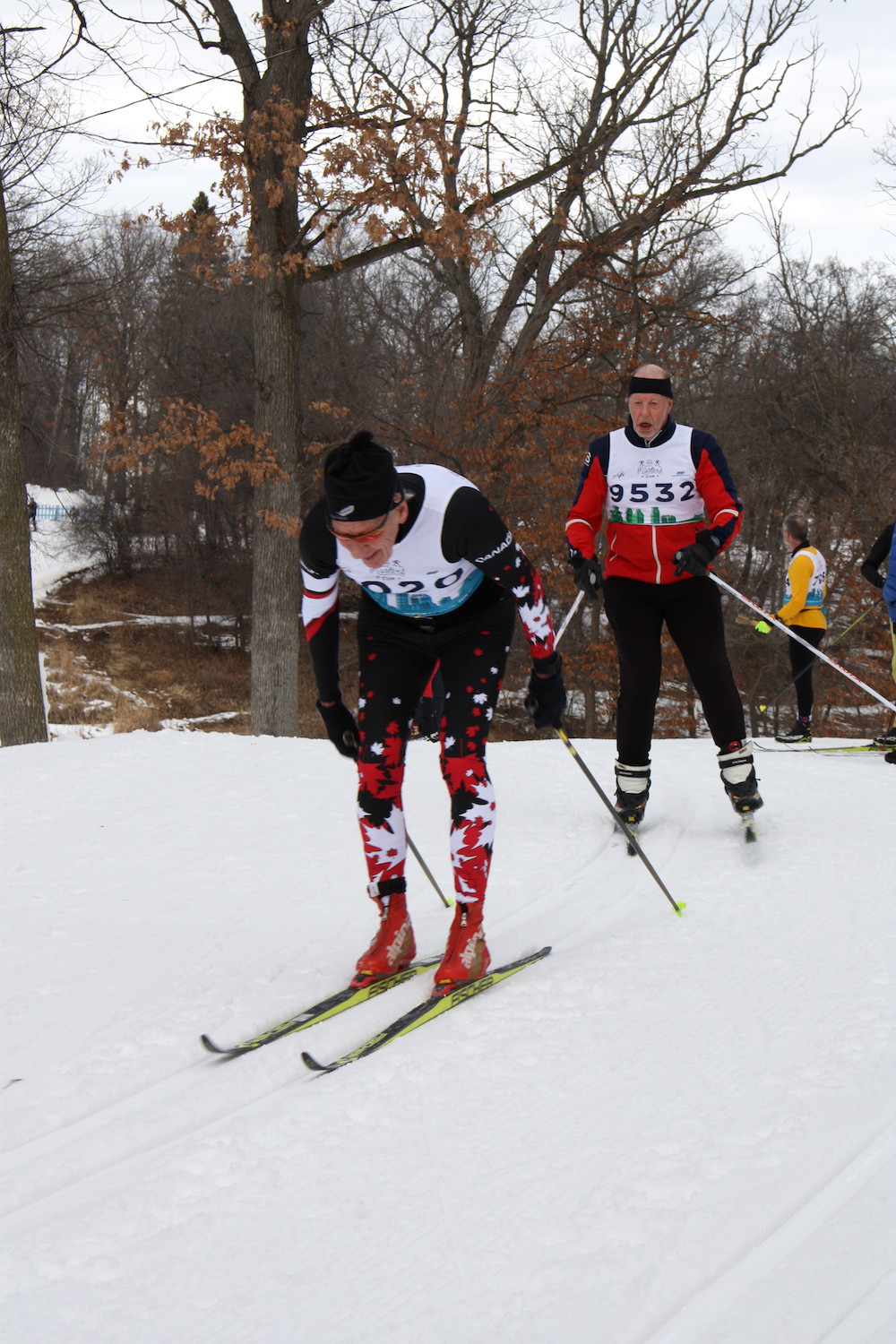
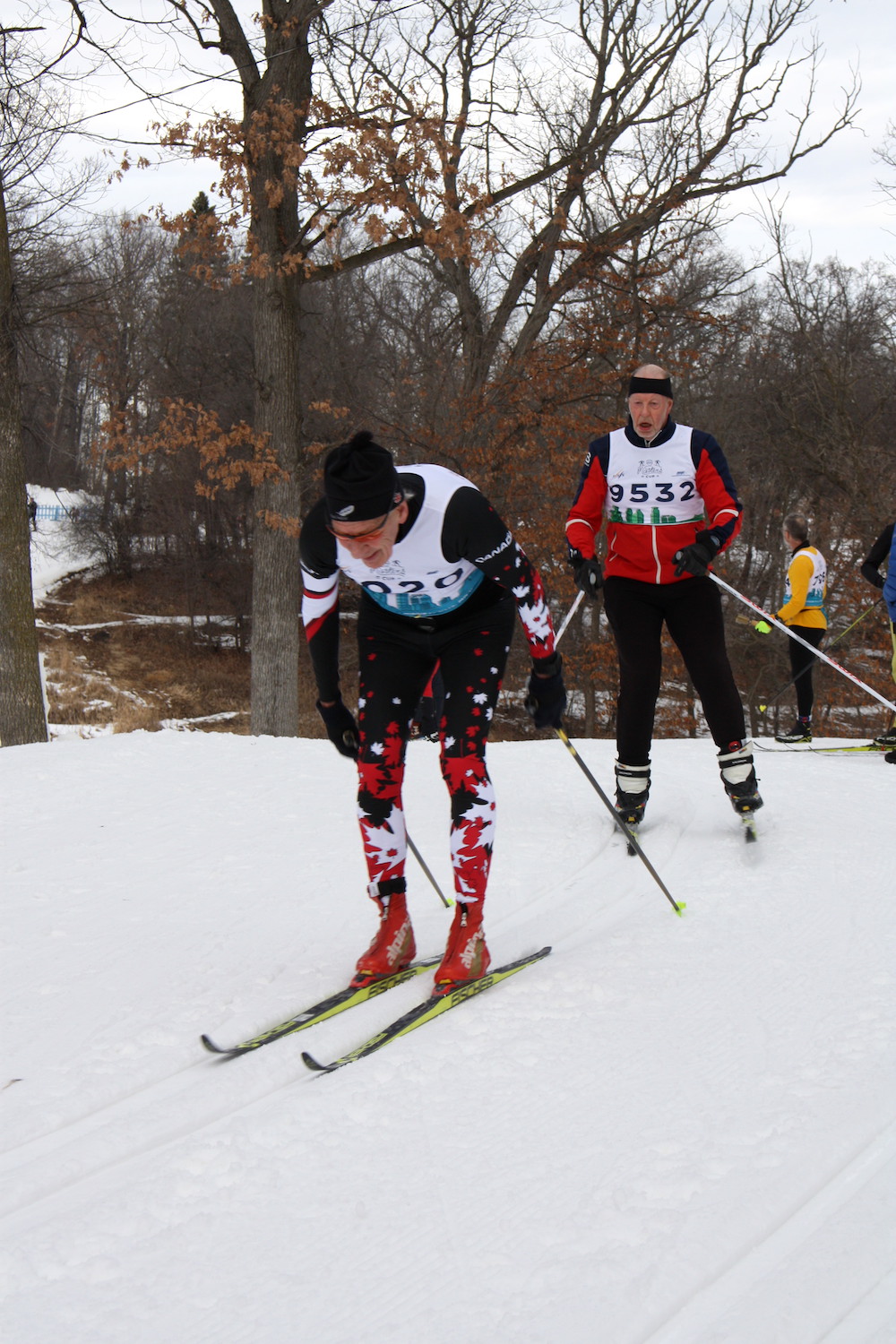
Rick Hubbard (9532) of the U.S. chases another masters skier while racing to 10th in his age group “10”, in the 10 k classic on Saturday at Masters World Cup in Minneapolis, Minnesota.
The men’s age groups 1 through 6 raced 30 k, with American Paul Allison winning the “1” in 1:15:16.5, American Erik Solberg winning the “2” in 1:25:47.3, Russia’s Andrey Lushnikov winning the “3” in 1:19:23.0, American John Bauer winning the “4” in 1:16:29.0, Sweden’s Tommy Gustafsson winning the “5” in 1:13:28.2, and Norway’s Jon Arne Envoldsen winning the “6” in 1:18:29.9.
The men’s “10” through “13” raced 10 k, with Norway’s Richard Johan Kringhaug winning the “10” in 29:12.9, Finland’s Tuomo Venalainen winning the “11” in 38:31.9, American Reno Deprey winning the “12” in 51:53.2, and the lone racer in the “13”, Charles French of the U.S., finishing in 49:47.4.
The 2018 Masters World Cup continues Sunday with 10, 15 and 30 k freestyle races.
About Andrea Potyondy-Smith: Andrea hails from the Twin Cities of Minneapolis (dontchya know) and has an MFA in creative writing. When she is not being an English geek, she can be found on her bike or skis, or playing in the Northwoods … typically on her bike or skis.
Norway's Vegard Ulvang (r) holds up the arm of Joe Dubay, who was originally proclaimed the winner of the 2012 American Birkebeiner men's classic race before being disqualified for not registering and racing in his college teammate's bib. Dave Chamberlain (l) moved from second to first, and Ulvang ultimately placed second.
Note: This story has been updated to include thoughts from David Chamberlain, who was later proclaimed the 2012 American Birkebeiner classic champion.
***
All American Birkebeiner coverage is brought to you through the generous support of Concept2, makers of the SkiErg.
Before and during the American Birkebeiner 54 k classic race on Saturday, the thought of being disqualified never crossed Joe Dubay’s mind.
The 21-year-old said he didn’t think twice when his College of Saint Scholastica teammate Chris Parr gave him his bib, or when he started with Wave 1 and the elites in Cable, Wis., or as he contended for the win with seasoned veterans Vegard Ulvang of Norway and David Chamberlain of Boulder Nordic Sport.
The look on Parr’s face at the finish told him something was wrong, Dubay said in a phone interview on Monday.
As the college freshman sprinted to the line and narrowly beat Chamberlain followed by Ulvang for the victory in his first Birkie, Dubay realized there might be a very big problem. Living only a couple of hours away in Minneapolis, he had been announced as the winner as he came through, but that was only because someone recognized him.
According to the entry list, he was Chris Parr.
Dubay said he contacted some race officials immediately after the race.
“I told them, ‘I’m not Chris Parr. My name’s Joe Dubay. What do you want me to do about this?’ ” he said. “I was pretty sure I would get immediately disqualified.”
Instead, Dubay said the officials told him to sit tight while they sorted things out. The said he should go to the podium ceremony and press conference in the meantime, he said.
“I felt like was in a difficult spot because I made a mistake,” Dubay said. “It should have been somebody else up there not me.”
About an hour after the press conference, the results reflected Dubay’s disqualification. He didn’t hear back from race officials, but discovered the DQ upon checking the results later in the day. While there was no money at stake in the 54 k classic race, the mixup caused a podium shift with Chamberlain moving to first and Ulvang placing second. Murray Carter of Manitoba was third.
According to American Birkebeiner Executive Director Ned Zuelsdorff, Dubay was disqualified for not registering for the 2012 classic race and skiing in another racer’s bib. That violated rules set by the International Federation of Skiing and the American Birkebeiner Ski Foundation, he explained in an email.
Zuelsdorff quoted a statement from the Birkie website:
“Do not allow another skier to use your bib. If this does occur, the skier and finish time will be disqualified from the race, and both you and the person using your bib will each be required to pay a $150 penalty before being allowed to enter a future event. You and the skier may also prohibited from entering a future event for a period of time.”
The statement explained that skiing in someone else’s bib can cause issues with age class and overall standings. For safety purposes, it was important for a racer to be identified in case of a problem out on the course.
Zuelsdorff wrote the problem wasn’t new — they had a similar situation with a Kortelopet 23 k “winner” and age-class discrepancies in the past — but this was the first with a Birkie winner.
Dubay said he was working with his college coach, Chad Salmela, to right his wrong.
“Basically, I’d just like to express to them that I definitely regret that and apologize for causing a bit of a mess for them for the other athletes that had to deal with the confusion,” Dubay said. “Racing under Chris’s bib was not the right thing to do in the first place.”
Nearly a month ago, Parr offered Dubay his bib upon qualifying for Junior Nationals. Parr decided to skip the Birkie in preparation for the races March 3-10, but came to cheer on Dubay.
He picked up his bib — registered for Wave 1 of the classic race — and gave it to Dubay. In the classic race, the elites and Wave 1 start together, so Dubay jumped in and contended with six-time Olympic medalist Ulvang and Chamberlain, the race service director at BNS.
Dubay, who won a 30 k Finnish Junior Championship in 2009, said he felt good throughout Saturday’s race, but regretted how things turned out.
“I didn’t really understand how big the race was, which also probably led to me not putting two and two together there,” he said. “I went to the start and did my thing. I was in shock the whole time; I was like, ‘Holy smokes, I really didn’t know this was going to be this big.’ ”
The American Birkebeiner and its associated races reached an all-time high with more than 9,000 participants and an estimated 20,000 spectators this year.
The man who was retroactively dubbed the classic champion, Chamberlain didn’t have any hard feelings.
“I have to hand it to Joe Dubay, he skied a great race, smart tactics and a good sprint at the end,” Chamberlain wrote in an email. “When it came down to the finish straight none of us could follow him. Nobody can take away his effort on Saturday, and the number he had on his back certainly didn’t affect his performance.”
On his end, Chamberlain was pleased with how the pack racing played out. He felt good and his skis were fast, making the 54 k more enjoyable. However, nothing topped skiing alongside one of Norway’s greatest racers of all time.
“The best part of my day on Saturday was the chance to compete with my childhood hero, Vegard Ulvang,” Chamberlain wrote. “I always have admired him, and getting the chance to exchange a few words with him during the race and have a talk with him at the podium ceremony afterwards was really special for me. I can say after skiing behind him during the race that he still has a lot to teach about classic technique, every kick and pole is in the right place with no wasted effort.”
When Mother Nature fails to deliver bountiful snow, races are often held on a surface that resembles a dirty ice rink. Artificial snow, old snow, dirt, ice and moisture stick together in a weird conglomerate that can be very challenging for wax technicians. Athletes are forced to train in less than optimal conditions, stressing them physically and mentally.
Given the dearth of snow in North America this season and the very likely chance that the U.S. Nationals will be run on mostly man-made snow, we thought it would be good to put together a skier’s and service tech’s guide to dealing with low-snow conditions. We’ve put together a guide to ski selection, structure and waxing as well as suggestions on how to train through and mentally survive bad snow situations.
About “Snow” in Low-Snow Conditions
Some Quick Tips from Randy Gibbs, U.S. Ski Team Wax Tech:
Man-made snow is really dirty
Man-made snow is abrasive
Use a hard underlayer Skigo LF Graphite or Rex RCF Pink
Use a hard paraffin layer- one wax colder than normal
Liquids usually beat block
There are a couple of useful things to know about the track that you’re skiing on when conditions are less than optimal. When the snow is thin mid-season, it is usually a mixture of old, greasy, fine-grained snow, man-made snow and ice with significant dirt thrown in for good measure. All of these require special considerations in order to produce fast skis.
As snow ages, the sharp crystals that define fresh snow tend to soften with freeze/thaw cycles as well as the mechanical fracturing caused by grooming and skiing. In other words, skiing over and grooming snow breaks it up into smaller pieces and breaks off the delicate features of the the iconic snowflake. Fine-grained snow tends to get greasy and glaze easily because the snow crystals lose their ability to soak up moisture and hold it in the snowpack. It also requires different wax, ski and structure choices.
Man-made snow varies wildly based on the conditions when it was made, the equipment and chemicals used, as well as its age and application method. Generally, though, artificial snow is very aggressive and looks more like large ice crystals stuck together than snowflakes. Because of the high ice content, man-made snow requires special considerations for durability of kick and glide waxes, as well as structure.
Dirt is a very important consideration when dealing with these conditions. As snow melts, all of the dirt and dust that have collected in the snowpack are deposited right on the surface. Grooming and moving snow around, especially when there is not a lot of snow available, also introduces huge amounts of dirt. Dirt particles stick to wax and structure on the ski base and then drag through the snow as you ski. The more dirt on the ski base, the more drag slows you down. Keeping skis clean will have a very large effect on ski speed, especially toward the end of a race. These snow conditions generally require aggressive structures, but choosing the best structure will require finding something that is fast, but also minimizes dirt accumulation. Softer waxes may be faster initially, but they tend to attract dirt faster than harder waxes, so dirt affects how you should choose your glide and kick waxes.
Ski Selection
Generally, the snowpack in low-snow conditions is hard, icy and dirty. For skate skis, a stiffer, more stable ski is generally going to be the better choice. In many conditions, stability can reduce speed and for top-level racers, the trade-off is not worth it. When conditions get hard and icy, though, even elite skiers will be better off sacrificing a little speed for stability and edge bite. You can generally choose a ski that is stiffer and higher camber with a “tight” tip that will help steer the ski and provide extra edge bite.
For classic skis, having a stiffer, higher camber ski is the ticket. You will need to protect the kick wax from the abrasive snow for durability and keep sticky grip waxes off the snow to keep the ski gliding fast. Whether you are running hard wax or klister, make sure that you have a fairly high camber, punchy ski. A klister ski will need to have a higher camber and be stiffer than a hard wax/binder ski, but either way, make sure that you have plenty of clearance in the kick zone.
Structure
Dirt and snow.
In general, treat old snow as if it was a grade warmer than the temperature suggests. Because the old/manmade snow crystals can’t absorb much moisture, the snow will act “greasy” and be quick to glaze. This extra free moisture needs to be handled by the structure, so old-snow structures are typically more aggressive than the equivalent new-snow structure for the same temperature. Cross structures tend to work well on hard-pack, icy, old snow.
At the same time, we need to balance moisture handling with dirt accumulation issues. Sharp, deep and busy structures are more likely to collect dirt than duller, shallower and simpler structures. Dirt accumulation can dramatically reduce ski speed over the course of 10 k +. When possible, test out structures when clean (freshly cleaned and waxed skis) and then test them again after 5km or so of skiing. It is often tricky to figure out what the best balance between speed and dirt repellency is, but you have to make a judgment and try to keep additional hand structures clean, simple and light. Be sure to brush skis very well with a microfinish steel brush to completely clean out all wax residue from the structure before racing.
Glide Wax
Glide wax for man-made and old snow needs to provide extra durability, dirt resistance and sometimes electrical conductivity when compared to waxing for regular natural snow. Much of this is accomplished by using a hard base layer and then choosing race paraffins and fluoro powders that excel in old and/or manmade snow. We have been using SkiGo LF Graphite as our preferred base layer for years as it almost always makes the top layer faster and adds extra durability. The graphite also provides dry lubrication and helps to dissipate static that tends to build up in aggressive snow conditions. Other great hard base layer options would be Start Graphite and Rex RCF Pink.
On course, Rumford 2011.
Once the base has been hardened appropriately, choose a race paraffin that performs well in old snow and is the hardest available. As a general rule in manmade conditions it is best to go one wax colder or harder than you normally would. We like to run a test of 6-8 race paraffins and then ski the top 2 or 3 waxes for 5km and then re-test. This provides information on durability and dirt resistance that might factor into our final wax choice. If one wax is slightly faster at first, but then slows dramatically after 5km, we’ll usually choose the second or third option if it is more durable and picks up less dirt.
At the world championships in Liberec, Czech in 2009, the snow was so dirty that the skis were slowing down by 2% or more after skiing them for 2km. This is a very dramatic example of how important dirt resistance can be.
It is almost a certainty that fluoro powders and fluoro liquids will be fast when dealing with old and manmade snow. Fluoro powders not only add speed, they provide the huge bonus of dirt resistance and durability, both vital to having fast skis all the way through a race in aggressive snow. Invest your time and wax resources into testing fluoro powders that excel in old snow. Most brands now highlight the type of snow each wax handles best in addition to a temperature range.
Liquid Fluoro waxes tend to work very well in old, fine, manmade and aggressive snow. While they tend to be not so great with new and average snow, it is always worth testing one or two when the snow is older. We usually apply these over an ironed-in application of fluoro powder and finish by hand-corking with a natural cork. The liquid topcoats can speed up the ski so dramatically that the results are sometimes startling. The SkiGo liquids are our number one choice as they seem to run more often than other brands and when they run, they produce fantastic results. SkiGo liquids were on the winning skis at US Nationals in 2011 at Rumford four times, in exactly the same type of snow as we expect to see this year.
From our experience as wax techs and at Rumford specifically, here are some waxes we expect to be running fast in Rumford for US Nationals. We’ll have test results on-site and on bouldernordic.com during Nationals week, so feel free to drop by and talk to us about what we’re testing and our recommendations.
Paraffins:
SkiGo LF Graphite (base layer)Holmenkol Matrix Green, Red and YellowSkiGo HF Violet, Red, YellowStart HF80 as a base layer
In general, klister will be used in some form or another in aggressive and man-made snow. Any kick wax application needs to be durable. Ski selection is vital here so that the ski has high enough camber to keep the kick wax from being peeled off the ski by the abrasive snow. But if you have the right ski, you will almost always start with a hardwax or klister binder. Old snow and man-made snow crystals don’t have a lot of sharp edges for the kick wax to grab onto, so it often works to put a soft layer of klister or kick wax over the binder and then cover it with a harder shell of klister or hard wax. The sticky wax is needed to provide grip and the shell, or cover layer, releases the snow crystals from the wax, preventing icing and adding glide speed. It is very important to test the kick job over the length of the race to make sure that the wax will wear correctly while performing at optimum over the entire distance.
Course work, Rumford 2011.
_________________________________________
Winter Training Tips When Snow Is Lacking
By David Chamberlain
One December while preparing for an upcoming US Nationals in Rumford I did running intervals up a local ski mountain in the pouring rain. After skiing in the sun and snow of the Western US for the first two weeks of the month, I arrived home to find cold, rain and no snow within driving distance. Luckily it was not my first taste of less than ideal training conditions while training for a major competition. The lessons that I have learned from these situations is to stay on the winning side of motivation. The following are a few tips to help do this when the conditions are bad:
1. Don’t underestimate the value of dryland training.
The first thing to do is to stay positive. Keep it in your thoughts that dryland training is a fine way to prepare for ski races. There are many high level NCAA college programs in the West that will not see snow during the week as they study and dryland train before traveling to major races on the weekend. More than a few racers in these programs have told me that they think the extra dryland training keeps them sharper during the winter. To effectively dryland train before on-snow ski races the workouts should be kept as specific as possible. Rollerskiing, running with poles, hill bounding and hill walking are all great ways to keep the skiing muscles tuned. Time off of snow can even be a motivation boost with proper planning.
2. Be vigilant about the details.
This is especially important when the conditions are bad. Good nutrition will give you the energy you need. Keeping your clothes dry and clean will help you stay healthy. Packing your bag the night before workouts will help you get out the door on 15 degree mornings when you would rather not rollerski. Plan your workouts carefully so you will not have to make stressful, hasty decisions mid training session.
3. Use visualization to your advantage.
Justin Wadsworth once told me when he could not train because of injury he would spend his allotted training time visualizing a workout. This is a good tool to have when the conditions are bad. While visualization is not a perfect substitute for a training session, it can be used to help keep in touch with the feelings of on-snow skiing when you are forced to rollerski in December. Find a quiet place and visualize yourself skiing on a favorite race course or better yet, the venue of your upcoming races. Visualization exercises are also a great way to relax when you become proficient at it. Pick up any mental toughness book and you will find a section on visualization. It is a skill that all high level athletes have in their tool bag.
4. Keep your training reasonable.
When conditions are ideal, blue skies and extra blue skiing, it is very easy to put in hours of training. But when it is cold and raining, the same amount of training is more of an effort. Keep in mind that a plan is just a plan, staying flexible is the key to getting through a snowless week of training in the winter. If you spend a morning doing intervals in the rain, find a dry garage with a spin bike to do your recovery workout. If your plan for the week states 14 hours, think about cutting your hours back to 12 when it is cold, dark and drizzling for days on end. This will allow you to keep a solid focus on your workouts and give you the best chance to arrive at your next race ready to go. Also keep a sharp focus on the signals your body is sending you. Stress and cold can be a combination that will lead to illness, but is does not have to if you catch the signs of fatigue early.
One last basic tip:
5. Keep your rollerski pole tips sharp!
Nothing is worse than dull rollerski tips on pavement in 15 degree weather, not to mention inefficient. Keep a small diamond stone handy for touch ups before workouts.
One of the goals behind any sporting endeavor should be having fun. When was the last time a good result wasn’t a fun experience? When the conditions are tough the most important advice I can give is to cultivate your own fun. If you do this, even in the face of a major race, you will ski your best no matter what the conditions.
_________________________________________
For more tips and articles like this, sign up for our BNS Newsletter.
Boulder Nordic Sport is the leading cross-country ski racing source in the United States. With stores in Boulder, Colorado and Portland, Maine; BNS also operates a mobile race service trailer that travels to events around the US as well as an e-commerce web site at www.bouldernordic.com/shop. BNS imports and distributes the SkiGo, Holmenkol, Guru, Innovax, Gallium and Magnar brands in the US.
Boulder Nordic Sport (BNS) took us through their West Yellowstone prep on Saturday afternoon, the day before they began the 800+ mile drive to Montana. With a 40-pair test fleet, drawers full of wax gear and about 150 pairs of freshly-ground skis to deliver back to customers, they’ve got a full trailer. Wheels went up on Sunday at 8:00 am, and after spending the night in Bozeman, MT, the crew should arrive in Yellowstone on Monday.
In order of appearance: BNS owner Nathan Schultz, head of race service David Chamberlain, service tech Shane MacDowell and sales associate Matti Rowe.
Caribou, ME — Maine Winter Sports Center is pleased to announce the hiring of Amber Dodge as Development Coach. Dodge will take the reins of the highly successful MWSC Development Team from departing coach David Chamberlain.
Amber was born in Worthington, Massachusetts and started skiing in her backyard with her family. She joined the local Bill Koch Youth Ski League at the age of 4 and grew up running, hiking, skiing and canoeing. Her most influential youth coach, Ed Hamel, taught Amber about ski racing and technique and about how to have a lot of fun outside.
Amber raced locally in high school, as well regionally at the J2 festival, Eastern High School Championships and at USSA Junior Olympics. She continued racing while at St. Lawrence University, where she studied International Studies and Music. After school Amber worked summers in Switzerland for an outdoor adventure company and as a certified Yoga Instructor. During the winters she worked at the Aspen Cross Country Ski Center and coached the development team for the Aspen Valley Ski Club.
She looks forward to sharing her passion for nordic skiing and her love for the outdoors with the people of Maine.
Will Sweetser and Mike Smith named Division Heads. David Chamberlain joins staff.
Caribou, Maine The Maine Winter Sport Center (MWSC) is restructuring its leadership to align with its programming priorities. The Caribou-based organization has split its curriculum into two divisions— Competitive Programs and the Healthy Hometowns Program.
Will Sweetser, the current Director of Cross Country Development, will head the new Competition division, and will be responsible for ensuring a consistency of philosophy across all programs, while making sure no athletes fall through the cracks.
Sweetser, a Maine native and graduate of Dartmouth College, brings with him 11 years of experience within the MWSC. During his tenure, Sweetser has coached every level of programming for the center—experience and perspective that will enable him to ensure a seamless transition for athletes in both the biathlon and cross-country programs. The new director takes over a program that has placed 10 athletes on the past two winter Olympic teams, representing both the United States and New Zealand.
“Will is internationally respected for his broad knowledge as a coach,” said Andy Shepard, President of the MWSC. “That experience, and his intelligent, creative approach to programming, will lend themselves very well to our goal of being the premiere training site for elite nordic athletes in the US.”
Mike Smith, a Presque Isle native and University of Maine graduate, is currently responsible for the MWSC’s community development efforts, which include the award winning Healthy Hometowns Program. Smith brings an impressive resume to his new responsibilities, having been actively involved in outdoor leadership and education for the past 11 years. Smith’s training and experience leading kayak expeditions around the world as a guide and outdoor educator, along with the passion he brings to introducing kids to the outdoors, makes him an ideal candidate for this new leadership position. Beyond nordic ski instruction and coaching, Smith’s background in the outdoors includes work as a registered Maine guide, leading four-season wilderness trips, backpacking, mountaineering, canoeing, kayaking and mountain biking. He has also led whitewater kayak trips and instruction in Maine, the Carolinas and Central America.
Smith’s promotion is a reflection of the MWSC’s commitment to transitioning the state’s Healthy Hometown ski programs into year-round Outing clubs. ”In order for a child to embrace the healthy, active, outdoor lifestyle we are promoting,” said Shepard, “they need to see a commitment on our part to being in their lives year-round. We are really blessed to have someone with Mike’s unique skills and energy to lead that effort statewide.”
The MWSC is also announcing the addition of David Chamberlain to the staff as the new Youth Development Coach. “I feel honored to be able to add David to our staff,” said Shepard. “The athletes are very fortunate to have someone of his experience to help them find their way.” “David has been a remarkable role model, carrying himself with such dignity and humility—our Development athletes will be learning from the best.”
The Bates College graduate, and former US Ski Team member, has seen athletic success at every level of competitive skiing. Chamberlain’s impressive list of achievements includes two Maine Class A state ski championships, two NCAA All American honors, two FIS Super Tour titles and being a three-time member of the US World Championship Team. Chamberlain, who retired as a full time athlete last spring, brings a fun loving nature and world-class experience to his new position.
The Maine Winter Sports Center is a non-profit economic development company, that exists with annual grants from the Portland-based Libra Foundation. To learn more visit www.mainewsc.org.
A three-time participant at World Championships, David Chamberlain is currently training and racing with the Maine Winter Sports Center (MWSC). Last year, Chamberlain was on the podium at three different Super Tours: he won the 10 kilometer classic race at Mt. Itasca, MN and placed second at both the 10 kilometer classic in Telemark, WI, and the classic sprint in Rumford, ME.
David Chamberlain leads the pack halfway through last year's Birkie.
FasterSkier: You’re currently living up in Aroostook County in northern Maine, right? How has your training been going this spring?
David Chamberlain: It’s been going really well. I had a pretty restful April. I spent a week out in Bend, Oregon at the end of May at the U.S. Ski Team camp out here, and that was great—it’s an unbelievable place to train. The skiing’s really good, and the dryland in the afternoon in Bend is good, too.
After the Bend camp I met up with the rest of the MWSC guys down in Steamboat, and we had a great camp there. The weather wasn’t quite as good, and the skiing was decent—not quite as good as Bend, but Greg Rawlings was grooming up at Rabbit Ears Pass every day, and he did a great job.
Since then I’ve just been back here—kind of the usual summer fare, rollerskiing, biking.
FS: You’ve been with MWSC for a while—how long has it been exactly? You must have your workouts pretty dialed in at this point.
DC: Yeah, four years. There’s a lot of really nice farm roads through potato fields that you can run on and bike. The only drawback to being up here is that there aren’t any mountains to hike, which is something that I miss from living in western Maine. With our program here, we’ve done a good job getting down south to hike and do some rollerskiing down there.
FS: Taking a look at the MWSC roster, aside from you it’s a lot of younger athletes. How has it been working with them? Are you kind of in a mentoring role?
DC: A little bit. I’ve definitely had a lot more racing experience than a lot of those guys, as far as things like Super Tours and World Championships. They’re training well, and Will Sweetser, our coach up here—he does a really good job keeping everyone together. He helps me out with my program and he writes the programs for some of those younger guys—we try to mesh it as well as we can. To get off to Bend and ski with the Ski Team, that was a really big boost for me—there will be some other times for me where I will try to get off to some camps to ski with some other guys a little bit more at my level.
They’re doing a great job, these young guys—they’re really hungry to race and they’re training well. It’s good for me up here—we’re definitely training at a high level. It’s been good. We’ve got guys fresh out of the college scene, and then there’s a couple skiers that are joining up with us this summer that haven’t gone to college yet who are going to take a year off. Welly Ramsay, Derek Rowe—those two guys are from my old high school, and it’s good to have them up here for sure.And we’ve got Fred Bailey, Nick Kline, Pavel Sotskov, and then there’s a bunch of juniors from this area that are training really well. We’ve got a really big group this summer—it’s definitely the biggest group since I’ve been up here.
Chamberlain at the 10k Freestyle at US Nationals, Photo courtesy of Chris Hall, Fischer Sports USA
FS: Your wife, BethAnn, is a competitive biathlete—is it a tough balancing act with both of you training at the same time?
DC: It’s actually pretty easy—we’re both on the same track, and it makes it easy that way. We work really well together—you break it down to the day-to-day stuff, and we’ve got a pretty good routine going.
FS: Do you ever train together?
DC: Yeah, we do for sure—when we’re doing recovery workouts, we might go out and pedal around together.
She works with Gary Colliander—he’s the MWSC coach but also the national team women’s coach for biathlon. She works with him, and that works out great—he writes a good program, so she’s really happy training with them.
FS: How does your training this year compare to years past?
DC: It’s pretty similar, actually—at this point I’ve been doing this for a while, and I’ve got a long list of things that have worked well and a lot that haven’t worked well. Will and I communicate really well, we work well together, and at this point I think this year we’ve definitely got things dialed in, and I’m really comfortable with what we’re doing.
FS: What about volume? Are you backing off a little bit for the Olympic year?
DC: It’s pretty similar to what I did last year, actually. It’s probably—with everything tallied up, all the distance and intervals and strength—somewhere between 700 and 800 hours. I’ve tried to do more than that, and it doesn’t work out so well, so that’s a number that is right for my body. That’s just what I’ve figured out over the years.
FS: Do you have your racing schedule solidified yet?
DC: That’s actually something we’ve been looking pretty closely at recently, because they’re still trying to tweak the calendar for next fall. I’ll definitely head out to Yellowstone, get a good couple of weeks of training out there before the Super Tour races. From there, I’ll probably stay out west for a few weeks and do some racing, wherever that will be, and then up to Alaska.
Chamberlain on his way to victory at the 2008-2009 Eastern Cup Opener – Photo Credit flyingpointroad.com
FS: Have you skied at Whistler yet?
DC: I haven’t skied there. I spent about two weeks there last fall with the U.S. Ski Team, doing a dryland camp. They have really nice rollerski tracks we were able to use, so we were able to ski quite a bit on the trails. I’ve heard it’s pretty crazy—the weather is pretty unpredictable, so that will be interesting. There may be a chance that I’d race there in December, but I don’t think those races have been totally finalized yet. That’s a little up in the air right now.
FS: You’ve been on the national and international circuit for about 10 years now—what’s different from when you came on the scene?
DC: The one obvious thing that I can think of is there have been a lot of changes with our ski team, the U.S. Ski Team. A lot of coaches have come and gone, each coach has come in and raised the bar a bit, from my perspective, and right now they’ve got a great team of coaches. From what I could see when I was out there in Bend, they were working really well together and working really well with the athletes—they care a lot about our skiers and the country. Being out there on my own, not as a member of the team, they were very accommodating, helping out with training and lodging, things like that. They’re working hard, there’s no doubt about it. It will be exciting to see where things go from here.
That’s the obvious thing—the level just keeps getting higher and higher here in our country, and only good things are going to come out of that for sure. Each coach that’s come through has definitely helped, and each coach is contributing in some way to raising that level from, what I can see.
At the recently completed 2009 US Cross Country National Championships in Anchorage, Alaska, Fischer skiers won 3 out of the 4 races held during the bitterly cold week. Originally scheduled for 8 races, cold temperatures below the FIS minimum standard forced the cancellation of the Men’s and Women’s distance classic race and the Men’s and Women’s team sprint competition.
On Monday, January 5th, both the Women’s 5km freestyle and the Men’s 10km freestyle races were held. In the Men’s race, Fischer Athlete Kris Freeman won the race by 50 seconds over the field. In the Women’s race, Fischer Athlete Kikkan Randall placed 2nd only by 3 seconds, but was by far and away the fastest skier over the second half of the race.
-press release continues below photos-
Kris Freeman, 10k Freestyle at US Nationals, Photo courtesy of Chris Hall, Fischer Sports USA
Kikkan Randal, 5k Freestyle at US Nationals, Photo courtesy of Chris Hall, Fischer Sports USA
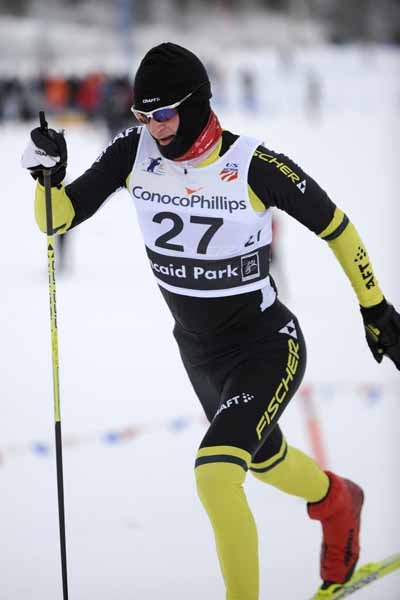
David Chamberlain, 10k Freestyle at US Nationals, Photo courtesy of Chris Hall, Fischer Sports USA
Colin Rogers, 10k Freestyle at US Nationals, Photo courtesy of Chris Hall, Fischer Sports USA
Brayton Osgood, 10k Freestyle at US Nationals, Photo courtesy of Chris Hall, Fischer Sports USA
On Thursday, January 8th, the classic sprint competition took place for both the Women and Men. Once again in the Men’s race, Kris Freeman found himself at the top of the podium, winning his first National Championship Sprint title. In the Women’s race, Kikkan returned to her familiar spot at the top of the podium, winning the Women’s National Championship Sprint title.
-press release continues below photos-
Kris Freeman, Classic Sprint at US Nationals, Photo courtesy of Chris Hall, Fischer Sports USAKikkan Randall, Classic Sprint at US Nationals, Photo courtesy of Chris Hall, Fischer Sports USAColin Rogers, Classic Sprint at US Nationals, Photo courtesy of Chris Hall, Fischer Sports USABrayton Osgood, Classic Sprint at US Nationals, Photo courtesy of Chris Hall, Fischer Sports USA
At the end of the championships, the US Ski Team named the qualifiers for the following international trips, the J1 Scandinavian Cup, the World Junior Championship team and the U23 Championship team. For the J1 Scandinavian Cup team, a total of 12 athletes were named, 6 boys and 6 girls. Of these 12 athletes, 6 out of the 12 are athletes using Fischer skis and 3 out of these 6 are also using Fischer boots. For the World Junior Championship team, a total of 10 athletes were named, 5 boys and 5 girls. Of these 10 athletes, 6 out of the 10 are athletes using Fischer skis and one athlete also uses Fischer boots. For the U23 Championships, a total of 10 athletes were named, 5 men and 5 women. Of these 10 athletes, 7 out of the 10 are athletes using Fischer skis. Fischer sends its congratulations to these athletes and wishes them good luck in these upcoming championships.
During the championships, Fischer was the overwhelming choice of ski during the week. In the men’s field for the 10km skate race, 51% of the athletes who started the race came to the start line with Fischer skis. Likewise in the women’s field for the 5km skate race, 47% of the athletes who started the race came to the start line with Fischer skis. Clearly, Fischer skis were the choice of ski, not only for the winners, but also for the majority of the athletes racing at the championships.
Stowe, VT— University of Vermont skier Jennie Bender (Johnson, VT) opened a large gap on the final hill of yesterdays’s one kilometer women’s sprint final at Trapp Family Lodge and earned victory in the season’s first Eastern Cup. In the men’s final, Maine Winter Sports Center’s David Chamberlain (Caribou, ME) similarly skied away from the field, earning the victory by a large margin. Dartmouth College teammates Sophie Caldwell (Peru, VT) and Ida Sargent (Orleans, VT) battled the challenging course to earn the other spots on the women’s podium. For men, it was University of Vermont’s Juergen Uhl (Muehlenback, GER) in second and Middlebury’s Tim Reynolds (Bristol, VT) grabbing third.
Today will see Olympians Justin Freeman and Andrew Johnson join yesterdays’s sprinters in a 10 kilometer freestyle technique race and East Montpelier, Vermont’s Liz Stephen will add strength to the women’s field in their 5 kilometer freestyle.