Tag: David Lindahl

  • Think You Know Rikert? Think Again: The Story Behind Its ‘Reconfiguration’

    Think You Know Rikert? Think Again: The Story Behind Its ‘Reconfiguration’

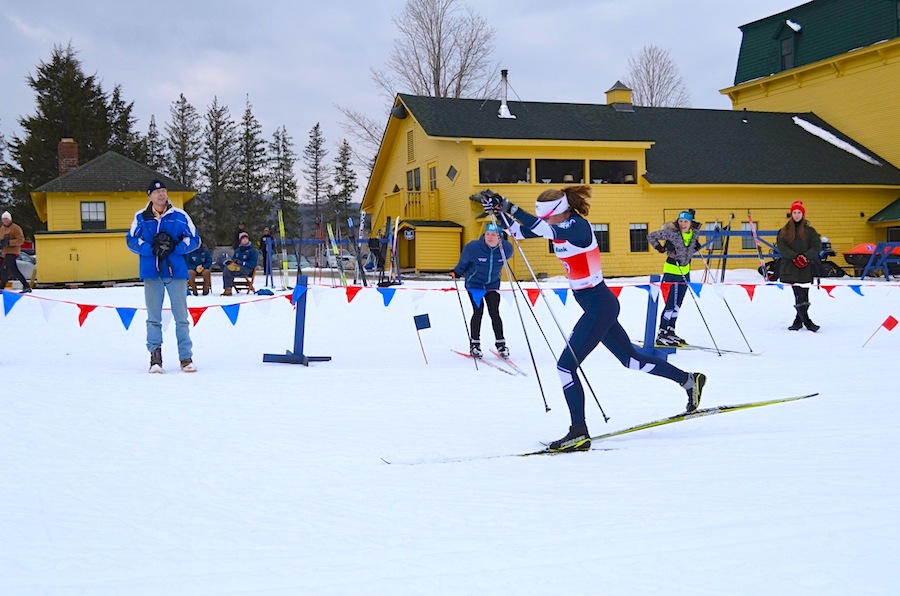
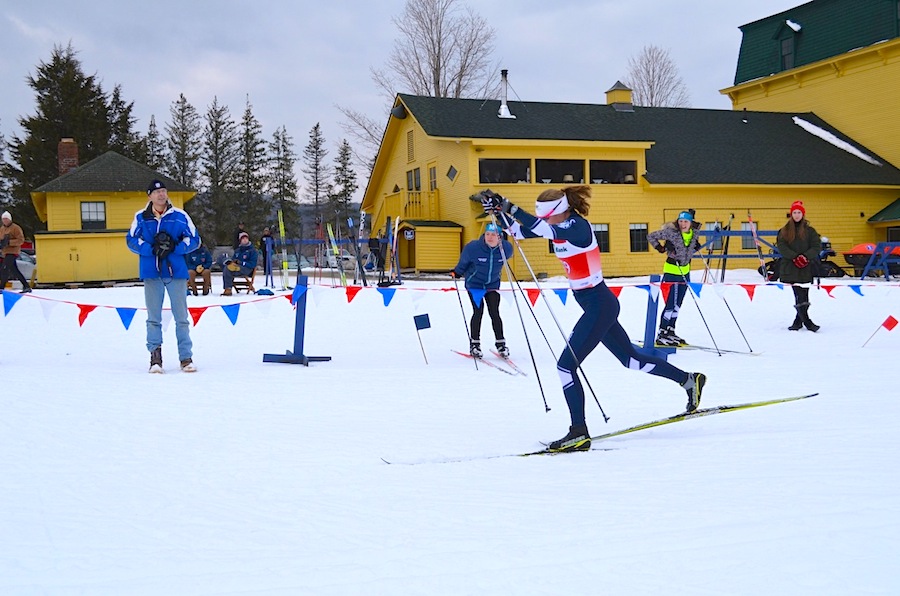
    Racers in action at Middlebury Carnival in mid-February at Rikert Nordic Center in Rikert, Vt. (Photo: Stella Holt)
    Racers in action at Middlebury Carnival in mid-February at Rikert Nordic Center in Ripton, Vt. (Photo: Stella Holt)

    RIPTON, Vt. – Nestled in the Green Mountain National Forest 12 miles up the hill from Middlebury, Vt., the Carroll and Jane Rikert Ski Touring Center lies behind an array of cheery colored yellow buildings that comprise Middlebury College’s Bread Loaf campus.

    A moderately sized sign directs nordic-skiing seekers inward, off Route 125 and toward a large barn – also yellow. Around the corner, one can find a recently remodeled rental shop and warming space with couches, cubbies and a woodstove.

    Outside, a large field is the gateway to some 50 kilometers of cross-country trails.

    With winding tracks through dense forests, Rikert’s a place people have grown attached to over decades. They love it for its character – humble, quaint – something recreational skiers might seek but doesn’t make a whole lot of an impression on racers.

    That’s where the challenge arose.

    In 2001, Rikert last hosted the NCAA Skiing Championships on its tried-and-tested trails. A community treasure, the traditional 7.5 k course wasn’t exactly suited to mass starts and some people weren’t thrilled with how the event played out there. Trails were too narrow and not hard enough, they complained.

    When Andrew Gardner became Middlebury’s nordic head coach in 2006, those same problems still existed.

    “We always had sort of issues around our mass start,” he recalled. “Somebody would get pushed into a stream. … It would be crazy narrow. People would be butting up against each other, and it was tricky.”

    It was also part of the reason why Rikert didn’t get awarded NCAAs two years ago. Middlebury submitted a bid for 2011 championships, but they went to the University of Vermont at Trapp Family Lodge in Stowe.

    “There were concerns about the trails and whether we were in a place to hold those races,” Gardner said. “When we didn’t get the 2011 championships, it went back to what was the story? Why didn’t we get this? Cross-country infrastructure was a big part of it.”

    Rikert needed a facelift – something efficient and tasteful without ruining its integrity. The general manager of Middlebury’s Snow Bowl alpine area and Rikert as its nordic counterpart, Peter Mackey got the ball rolling, reaching out to Middlebury alum John Morton, a former Olympic biathlete, coach and chief of course at the 2002 Salt Lake City Olympics at Soldier Hollow.

    A trail designer for his own company, Morton Trails, with more than 20 years of experience, Morton returned to the place he spent four years training at in college. Exploring Rikert’s trails on foot, the 1968 NCAA runner-up remembered the two Middlebury Carnivals he won there. Like so many of its loyal customers, he had ties to the area. At the same time, he knew it needed to change to keep up with the times.

    In 2010, when Rikert was awarded the 2013 NCAA Championships, the college hired Mike Hussey as a full-time, year-round director. Previously a sales manager for the Massachusetts-based HKD snowmaking manufacturer, Hussey came onto the scene with a wealth of ideas. Seeing through the trail reconfiguration Middlebury was already working on was one of them.

    First things first, Rikert needed a homologated system to meet the International Ski Federation’s requirements for width and climb level. Nobody wanted to make Rikert a highway, but the trails had to be widened and retooled to ascend tougher terrain.

    Homologation

    One of the initial challenges was making a 5-kilometer course that achieved these standards without putting the average skier into panic mode.

    “We went back and fourth with how much A-climb was needed,” Hussey explained, referring to the largest required incline that must have a grade between 9 and 18 percent.
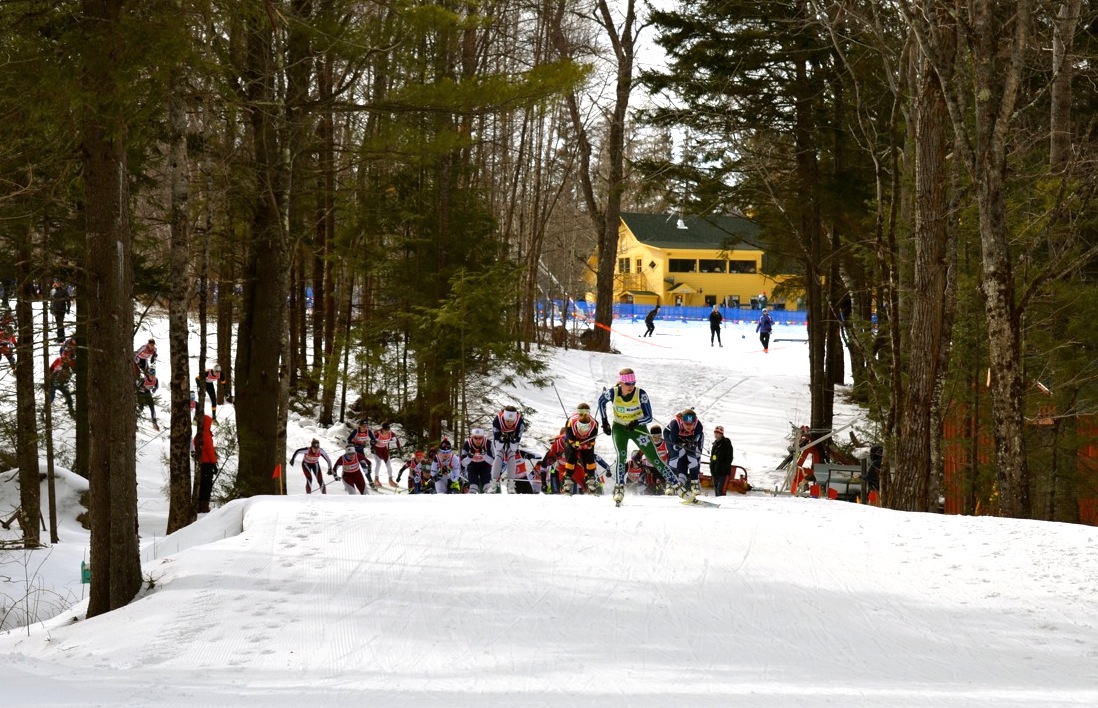
    The women's freestyle mass start at the Middlebury Carnival from Feb. 15-16 heads out on the new Tormondsen Family Race Course at Rikert Nordic Center in Rikert, Vt.
    The women’s freestyle mass start at the Middlebury Carnival from Feb. 15-16 heads out on the new Tormondsen Family Race Course at Rikert Nordic Center in Ripton, Vt. (Photo: Stella Holt)

    “Andrew was pushing for more, John Morton was pushing for less, I was somewhere in between,” he said. “Realistically, the course gets used as a homologated race course about one percent of the year. The rest of the year, the general public is using it to ski on.”

    Hussey wanted something that would work for both users, a hill that would be significant for a college racer but also something everyday skiers could ascend, taking a few breaks or a cutoff trail along the way.

    “I think we really came up with a pretty darn good solution to the whole thing,” Hussey said.

    That was the running theme to the entire project, from breaking ground in the fall of 2011 on what is now the homologated Tormondsen Family Race Course (click for map), with banked turns and what Hussey called a “screaming-fast downhill.” Finalized in early February, it also involved installing an integrated snowmaking system around the entire 5 k loop.

    “[Hussey] understood a few things; he understood the homologation and how that was basically changing the playing field,” said David Lindahl, a principal at Morton Trails who contributed to the upgrades.

    The process of changing a trail system is hardly ever easy, he explained. Venues have history and nostalgic ties. He and Morton started by asking Hussey what was possible, through permitting in the Green Mountains to property constraints, etc.

    “It’s a big puzzle,” Lindahl said. “Sort of the base line is: how do we create a really good 5 k course? Then, what else can you do from that? Well you can make 2 ½ k courses. So we’re always kind of thinking of different options, but from that core, let’s make sure there’s a really good 5 k, because that’s a standard that you need to have.”
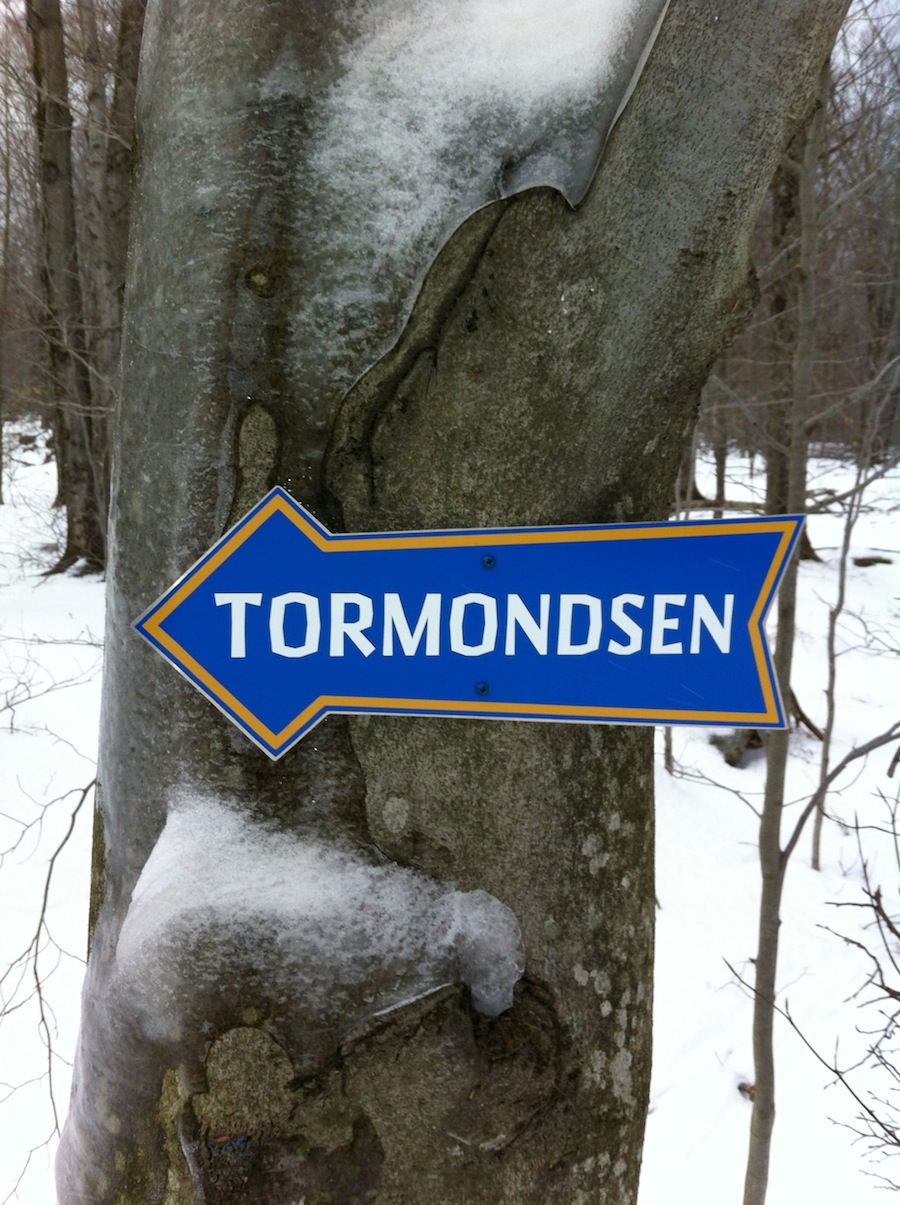
    New signage on the 5 k Tormondsen Family Race Course at Rikert Nordic Center in Rikert, Vt.
    New signage on the 5 k Tormondsen Family Race Course at Rikert Nordic Center in Ripton, Vt.

    By the time last winter rolled around, the 5 k course was complete with two 2 ½ k loops connecting in the field where the start, finish and spectators would be. After first seeking a D-homologation to hold freestyle mass starts, Morton and Lindahl came up with an E-homologation option as well for hosting skiathlons (half-classic, half-freestyle pursuits). According to Hussey, they’re one of two nordic areas in the country that are certified to hold such races (Soldier Hollow is the other one).

    “Turns out if you do it right and you put all the pieces together and you put two 2 ½ k’s together then you have an E-category,” Lindahl said. “One of the courses only has to be at a C-level and the other one has to be a D-level. Typically, what we’ve done is the D-level for both of them. Those courses worked out well; they were independent [and] both came back into the stadium area.”

    That made having a ski race with an equipment exchange, or transition, possible. It also draws crowds.

    “A big piece of what we do is spectator interest,” Lindahl said. “How can we create something that is going to bring people back to the start finish area so that friends and spectators will be as involved as the coaches and athletes are?”

    Based in Thetford, Vt., Morton Trails is the company that designed 15 k of trails at Colby College’s Quarry Road Trails in Waterville, Maine. Morton and Lindahl are behind the new 7.5 k course at Trapps, the expansion of an existing trail at the Jackson Ski Touring Center in New Hampshire and ongoing projects with Vermont’s Jay Peak and the Sugarloaf Outdoor Center in Carabasset Valley, Maine, to name a few.

    “The Middlebury site is blessed with a wonderful big field, ideal for all types of start/finish configurations, and great for spectators,” Morton wrote in an email. “A challenge was getting from that field out to the required hills and back within 2.5 kilometers to give the spectators a second view of the athletes midway through the loop. The second 2.5 k loop also had to access the required climbs and return to the stadium within in the 5 k distance target.”

    Ideally, the two loops would be close enough to share the proposed snowmaking piping system, an idea Hussey brought to the table.

    “Another objective was to make use of as much of the existing trail network as possible, and thus minimize the need for new trail construction,” Morton explained. “Finally, there was a desire to have the racing trail independent from some of the other popular trails at Rikert so that during event days, recreational skiers are still able to enjoy loops not closed for racing.”

    The end result: Rikert is one of two places in the country that are FIS certified for skiathlons, which could bolster its potential for international races down the road, Hussey said.

    “We’ve put at least a million and a half bucks into this place in the last three years, which is akin in the nordic industry to Jay Peak putting 300 million into the alpine area,” he said.

    “That is a huge investment … and yes, it’s a great event center, we’ve got homologated race trail, we’ve got snowmaking on that, but over and above that I’m very passionate about the fact that our region, what some people term the Addison [County] Alps, you’ve got Blueberry Hill 10 k by trail, you’ve got Rikert, we’ve got the Snow Bowl, we’ve got an amazing array of inns and hotels and restaurants and theater and art and hockey games at night. There’s all these things to do for folks to come in from out of town and enjoy the area.

    “That to me is another piece of it that goes beyond NCAAs and national championships,” he added. “I’d love to hold a World Cup here. There are a lot of parts to make that happen. That’s the kind of facility that I believe we have.”

    Snowmaking

    As Gardner put it, three big changes at Rikert in the last few years have raised it to a new level. “Getting Mike hired so there was a full-time, year-round director, getting the trail built, and having snowmaking,” he said.
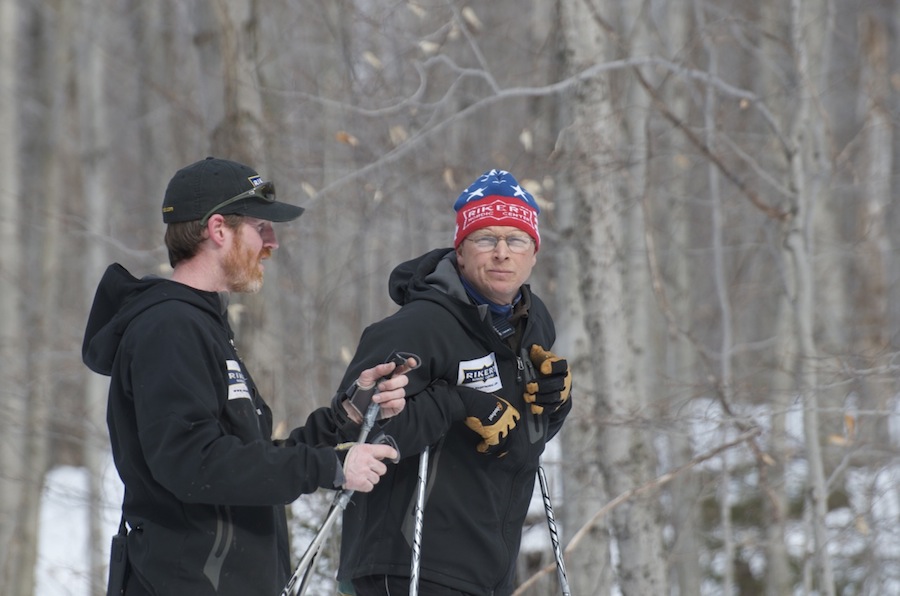
    Rikert Nordic Center Director Mike Hussey (r) overseeing the Middlebury Carnival in mid-February. (Photo: Stella Holt)
    Rikert Nordic Center Director Mike Hussey (r) overseeing the Middlebury Carnival in mid-February. (Photo: Stella Holt)

    Without Hussey, the snowmaking aspect – which cost upwards of $850,000 dollars – might not have been possible, Gardner said. Because of the confidence John Tormondsen, a Middlebury alum and first-team All-American nordic skier now on the college’s board of trustees, had in Hussey, he and his family donated a significant amount toward the total cost. Now in its initial months of operation, Rikert has the most snowmaking coverage of any nordic center in the Northeast.

    “It’s the largest system of its type in North America, the most-extensive piping system,” Hussey said.

    “I think Middlebury had the vision that we want to really put ourselves on the map,” Lindahl said. “The snowmaking thing, we weren’t the ones that suggested that, but obviously they went for it.”

    Most importantly for college teams, it promised snow for NCAAs, which start Thursday with nordic races and continue through Saturday. Three weekends ago at the Middlebury Carnival, Rikert held its first collegiate races on the course. Although its been completed for more than a year, natural snow wasn’t abundant enough to cover it last year. The installation of the snowmaking system with 20 snow guns began late last fall, and water-withdrawal permits weren’t in place until early February.

    As a result, Hussey and his crew have been pumping out the manmade stuff as much as possible in the last month. At 250 gallons per minute, they can potentially cover the 5 k loop in 200 hours. But they’re only allowed 90 gallons of inflow based on state regulations, which Hussey said was “very understandable” given their proximity to protected lands.
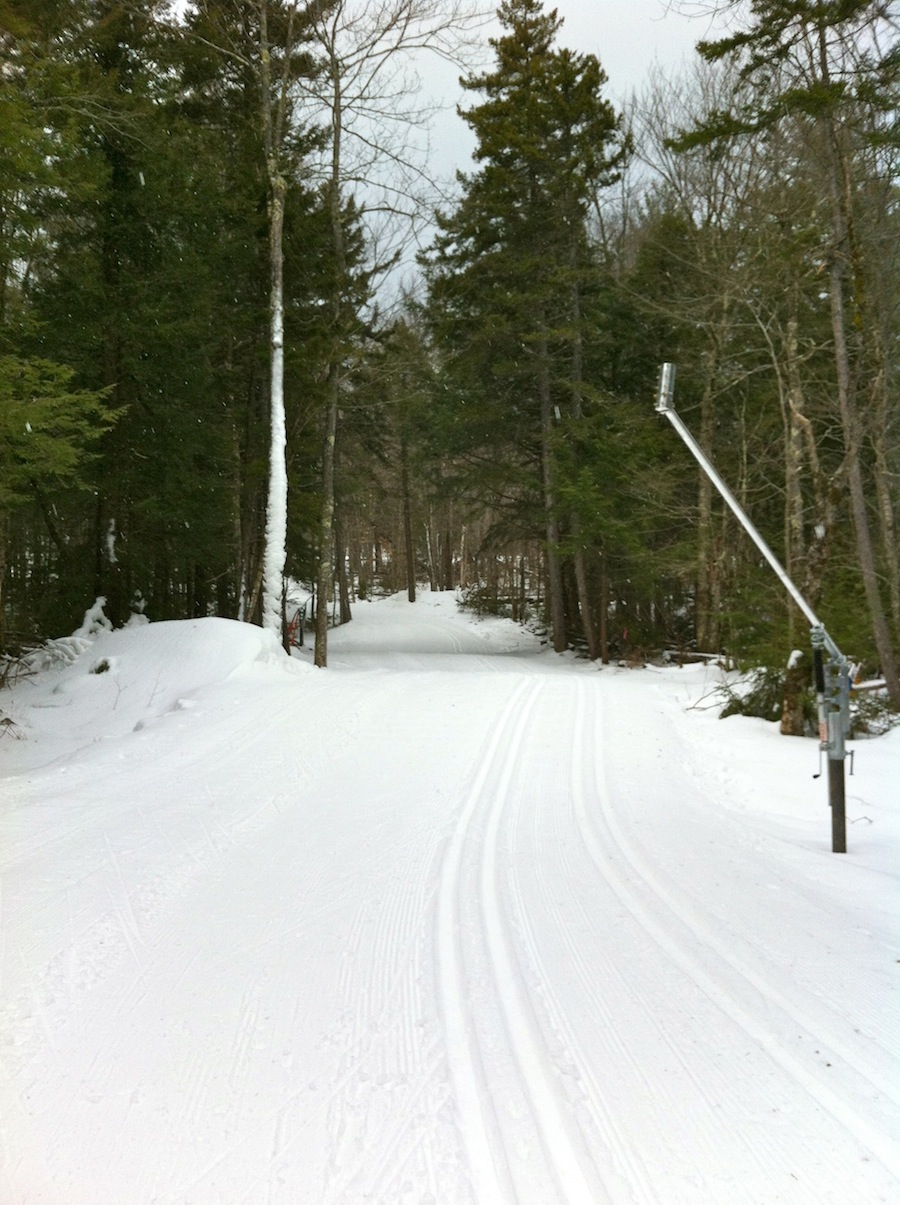
    A look at the trails and new snowmaking system in mid-February at Middlebury College's Rikert Nordic Center in Rikert, Vt.
    A look at the trails and new snowmaking system in mid-February at Middlebury College’s Rikert Nordic Center in Ripton, Vt.

    “Our holding pond is not that large and we get maybe 16 hours of operating time [from that],” Hussey said. “After that, it takes a day or more to recharge. So when we get windows of opportunity to make snow, it’s sort of herky-jerky because we can run for 16 hours, then we stop, and then we gotta start up again. So it’s not a consistent flow and efficient use of the good hours. Phase two of the operation is to add a larger holding pond if we can.

    “It’s been a little spotty early on as part of that permitting piece was challenging,” he added. “I think we’re through it now and all systems go.”

    As for the NCAA outlook, Hussey wrote in an email that “projected temperatures are to be in the mid to high 30’s during the day and below freezing at night. We will be able to do a good job with the grooming under those circumstances.”

    Asked what they learned from the Carnival races, he wrote, “We learned (confirmed) that this is a technical course and requires strategy as well as stamina.  There are hard climbs and fast twisting downhills, all of which makes for good racing.”

    “The course itself has definitely changed and the trail quality has improved a lot, especially the grooming quality,” said Hilary Rich, a senior on Middlebury’s nordic team. “Mike puts a lot of effort into [grooming] and it definitely shows.”

    “It’ll suit the people who like to grind it out; there’s not much rest,” junior Austin Cobb said. “It feels less like the middle of the woods now. It seems like it’s a legitimate place to ski … It’s the real deal.”

    ***

    See also: NCAA Championships Nordic Preview
  • A Homologation How-To Guide (It’s Not as Boring as You Think!)

    A Homologation How-To Guide (It’s Not as Boring as You Think!)

    Kincaid Park in Anchorage recently received its homologation certificates. Photo, Rob Whitney

    What do a GPS, a retired airline pilot, and a Norwegian guru named Hermod Bjorkestol have in common?

    All are key components of a plan to bring many of the U.S.’s biggest venues in line with International Ski Federation (FIS) standards.

    At its annual meetings in Turkey in early June, FIS made it clear to American officials that a longstanding exception would be revoked: starting in the winter of 2011-2012, all races held in the U.S. that are sanctioned and scored by the Federation will have to take place on certified trails—“homologated courses,” in official parlance.

    Since all U.S. SuperTour and national championship events are scored using FIS points, any venue that plans to host a high-caliber race next winter will have to have its courses inspected and certified. And even if a ski area wants to hold scored races this year, FIS is asking that they have a plan to have their trails homologated by 2011-2012, according to U.S. Ski and Snowboard Association (USSA) Nordic Director John Farra.

    Only six ski areas in the country currently have FIS certification, few of which are traditional SuperTour venues, and the U.S. Ski and Snowboard Association (USSA) is spearheading a new effort to bring more trail networks up to speed. What does that entail, exactly? FasterSkier spoke with a handful of experts to find out what this homologation thing is all about. And no, it doesn’t have anything to do with milk.

    What the Heck is Homologation?

    If you really want to know every last detail about the homologation process, you can download and read the fifth edition of the FIS Cross-Country Homologation Manual, a 69-page document that contains terms like “partial height differential,” specific guidelines for creating “undulating terrain,” and an alphabet stew of abbreviations and acronyms.

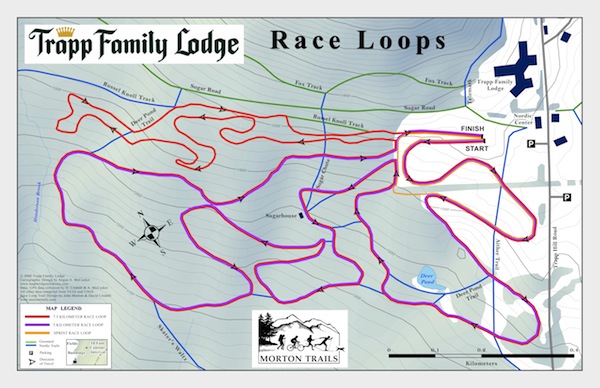
    The Trapp Family Lodge in Stowe, Vermont is another venue that was recently homologated.

    For the rest of the country, there’s Bob Gross, a retired airline pilot and avid marathon skier who represents USSA on the FIS subcommittee for rules and controls.

    Gross got involved in the technical side of skiing in the lead-up to the 2002 Olympics in Salt Lake City, and he now is qualified as a homologation inspector—an official responsible for ensuring that courses meet FIS’s specifications. Along with Farra, Gross will coordinate the homologations of the nation’s major courses.

    In a phone conversation, Gross explained the rationale behind the rules requiring homologation. Because all FIS-sanctioned races award ranking points to finishers—which in turn can determine seeding and start positions in big international races—it’s important for the Federation to maintain consistent standards for courses across different nations.

    Then, there are also more basic logistical issues, like maintaining adequate trail width so that skiers aren’t stepping all over each other, or ensuring that the stadium is well laid-out. Safety is a concern, too—downhills can’t send skiers plunging into trees or ditches—and even details like spectator access are also considered.

    The process sounds complicated, but Gross says it’s not—it boils down to ensuring that courses are “adequate to run, safe and fair.”

    “It’s trying to get the courses so that they are standard…throughout the world. So that a skier who skis on a course here will have a course which is similar to [one] that’s being skied in New Zealand or Japan or Europe,” Gross said. “That is the basic philosophy.”

    Getting Homologated

    According to Gross, the homologation process will unfold differently depending on the status of each venue. If you’re starting from scratch in the woods in your backyard, homologation will obviously be a more arduous process than if you run an established ski area with pre-existing, elite-level trails.

    Regardless of the amount of work that needs to be done at a given venue, the finished product must meet specific FIS standards outlined in the homologation manual—the most important of which concern the course layout.

    If there are trails at a venue that are already close to meeting FIS’s requirements, the certification process can begin promptly. Whenever possible, course designers and venue managers will homologate existing trails rather than constructing new ones, since work like logging and excavating trails can be pricey. At Kincaid Park in Anchorage, which recently had its trails re-homologated, workers got especially creative: they used leftover fill from nearby roadwork to make sure that the steepness of one of their uphills met FIS standards.

    But if a ski area does not have a suitable course to start with, they may have to bring in a trail designer to help lay one out.

    According to John Morton, who along with David Lindahl operates the trail design firm Morton Trails, the backbone of a homologated course is its climbs.

    “The climbs are the very first thing that we look for,” he said. “Then it’s kind of piecing all these other pieces together.”

    FIS’s demands for the uphills are specific. A homologated 5 k, Morton said, must have two major, or “A” climbs, each 30 meters from the low point to the high point—and technically, neither should come in the first or last kilometer of the course. The gradient must average around six percent.

    The profile for the Trapp Family Lodge homologated 5 k course. The yellow bars are the major or "A" climbs, and the orange bars are the smaller, "B" climbs. Graphic courtesy of Morton Trails.

    Morton and Lindahl use a variety of tools to help them measure the uphills and other elements, including highly-sensitive GPS units, computer software like Google Earth, and an instrument called a clinometer, which is used to measure slope.

    Once the major climbs are locked in, there are other aspects of the course design that must be incorporated, like several smaller “B” uphills, downhills, and stadium layout.

    When the courses are close to meeting FIS standards, venue managers are then responsible for producing a sheaf of data and maps on all of the trails’ key characteristics, like distance, width, and elevation changes. How extensive? Morton and Lindahl have been known to create as many as 600 data points, while at Kincaid Park in Anchorage, their information filled a four-inch binder.

    The data is submitted to one of the few FIS homologation inspectors in the U.S.—Gross is one, as are Lindahl and Morton—who enter it into a special computer program that summarizes the course.

    Then, the inspector will make at least one in-person visit (paid for by the venue), to walk the course. This allows them to verify all the data, get a feel for the trails, and make judgments about key characteristics.

    “There’s a lot of art involved in homologating a course.” Gross said. “If you look at a hill, for instance, there could be a break somewhere…where it leveled off or even dropped a little distance. Depending on how the homologation inspector feels that would ski, it could be two B-hills or one A-hill. That’s where the art enters in, and that’s why you have to go out and look at the course, so that you can make a judgment.”

    If the inspector deems that more work needs to be done before a course meets FIS standards, they may even have to pay another visit before the process can proceed further.

    However, there is a decent amount of flexibility in the rules, Gross said, especially for trails that are only being certified for domestic events. (World Cup courses must meet more stringent standards.) For example, if one of a course’s two A climbs isn’t quite tall enough, designers could pump up the other one to make up the difference. And according to Farra, city sprints and uphill climbs are exempt from FIS rules altogether.

    When the inspector deems that the courses are up to snuff, the data is forwarded to FIS, where it eventually makes its way before Hermod Bjorkestol. Bjorkestol, the famed course designer and main editor of the homologation manual, has the final say on every application.

    Courses are homologated at specific distances, and for specific race formats—trails certified for skate sprints have to be much wider than those that are used for individual-start classic races, for example. USSA is requesting that SuperTour venues homologate a sprint course, a 2.5 k loop, and a 5 k loop.

    All told, the process could move as quickly as a month, if courses are already close to meeting FIS’s requirements. The more work that needs to be done to bring the trails in line, the longer it will take—especially if ski areas run into problems with procedural issues, like permits for logging.

    In Anchorage, Kincaid Park made its upgrades slowly, starting with trail work 2006 and 2007, and didn’t finish collecting its data until 2008, according to Matt Pauli, who worked on the homologation process there. The actual FIS certification was issued in 2009.

    The Big Picture

    While the technical details of homologation would make even the most avid ski fan’s eyes glaze over, that’s not the point, according to Morton and Lindahl. Instead, they said, FIS’s goals are simple: to make sure that courses ski well.

    “The whole point of homologation is to embody some of these things that go into…a good course,” Morton said. “Anybody who has done design knows, ‘now it’s time for a good climb.’”

    One issue that arises is whether a push towards homologation might cost trails their character, by turning them all into superhighways—and Gross acknowledged that “something, I guess, is going to get lost.”

    Regardless, Gross said, the U.S. has little choice, due to new race formats like mass starts and sprinting, which have been instituted by FIS to drive up spectator interest.

    Skiers during a mass start race at Kincaid Park. Photo, James Brady.

    “You can’t run a mass start on a narrow track,” he said. “Is that a good thing? That’s a value judgment I’m not making.”

    Another issue is the financial cost. Gross wouldn’t estimate the price of a typical homologation effort, given the wide range of work that might be necessary. But he did say that the more a venue or club can rely on its members and volunteers for help, equipment, and expertise, the lower the price tag would be.

    Since World Cup and other high-level races are always held on homologated courses, Gross went on, bringing America’s trails up to FIS standards will only make the country’s athletes more competitive. Farra, the USSA nordic director, echoed that argument in a press release announcing the homologation effort, pointing out that while Norway has over 40 certified venues, the U.S. has just six.

    Dylan Watts, an Alaska Pacific University coach who wrote an article about the homologation process for the 2010 U.S. Nationals publication, also agreed.

    “If we intend to compete with the world in FIS events such as the Olympics, World Cup, U-23 [World Championships]…we need to be racing domestically on courses that are also that style,” Watts wrote in an e-mail. “You get good at what you do.  If you ski on a golf course, you get good at golf course skiing.  If you ski on a logging road at 8,000 feet, you get good at that.  If you ski on FIS homologated-style trails, you get good at that. That is why the homologation effort is important.”