From the FasterSkier archive — posts syndicated from athletes’ and coaches’ own blogs between 2004 and 2012, kept online as published. Current coverage is at fasterskier.com.
This World Cup coverage is made possible through the generous support of Marty and Kathy Hall and A Hall Mark of Excellence Award. To learn more about A Hall Mark of Excellence Award, or to learn how you can support FasterSkier’s coverage, please contact info@fasterskier.com.
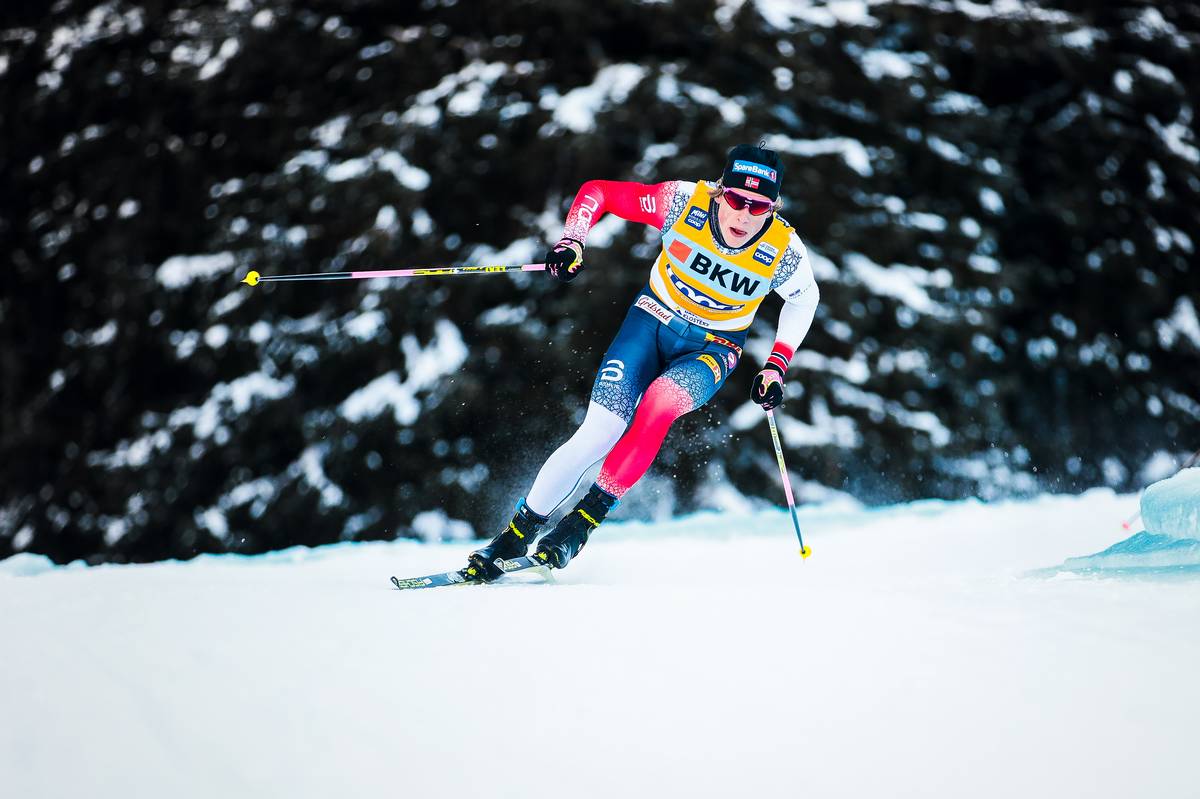
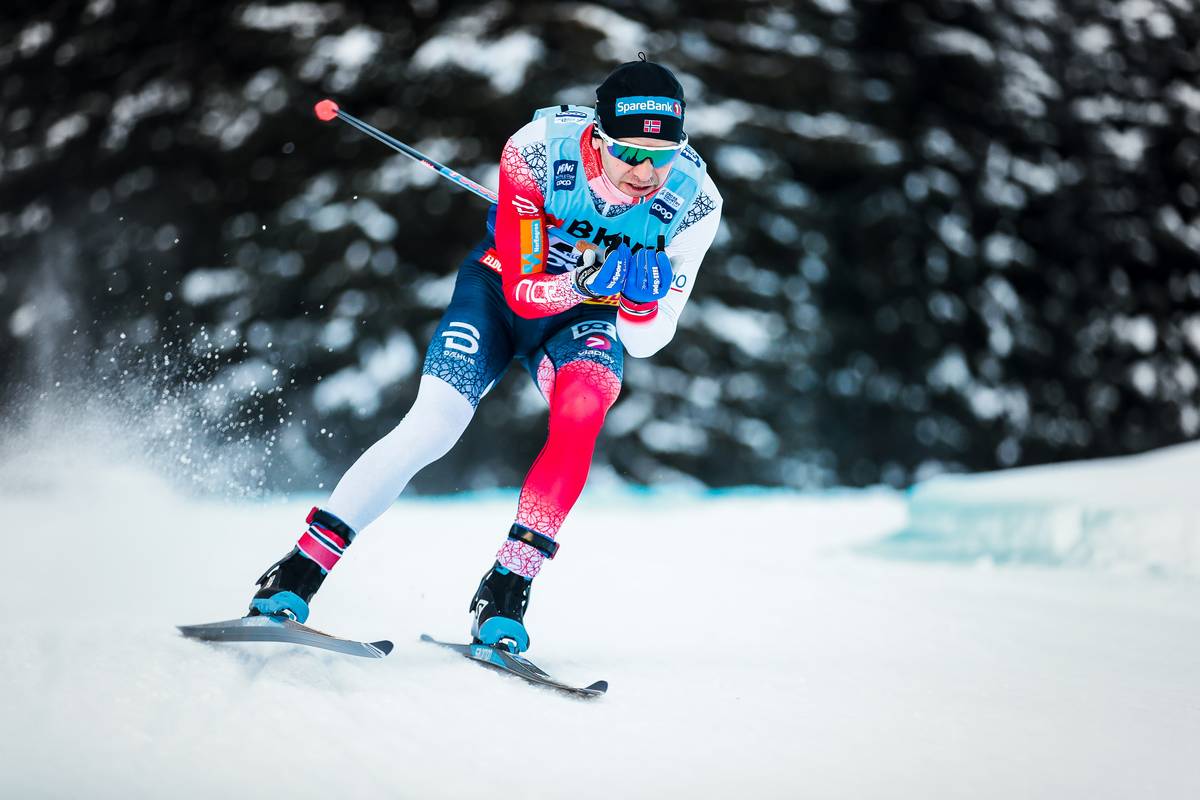
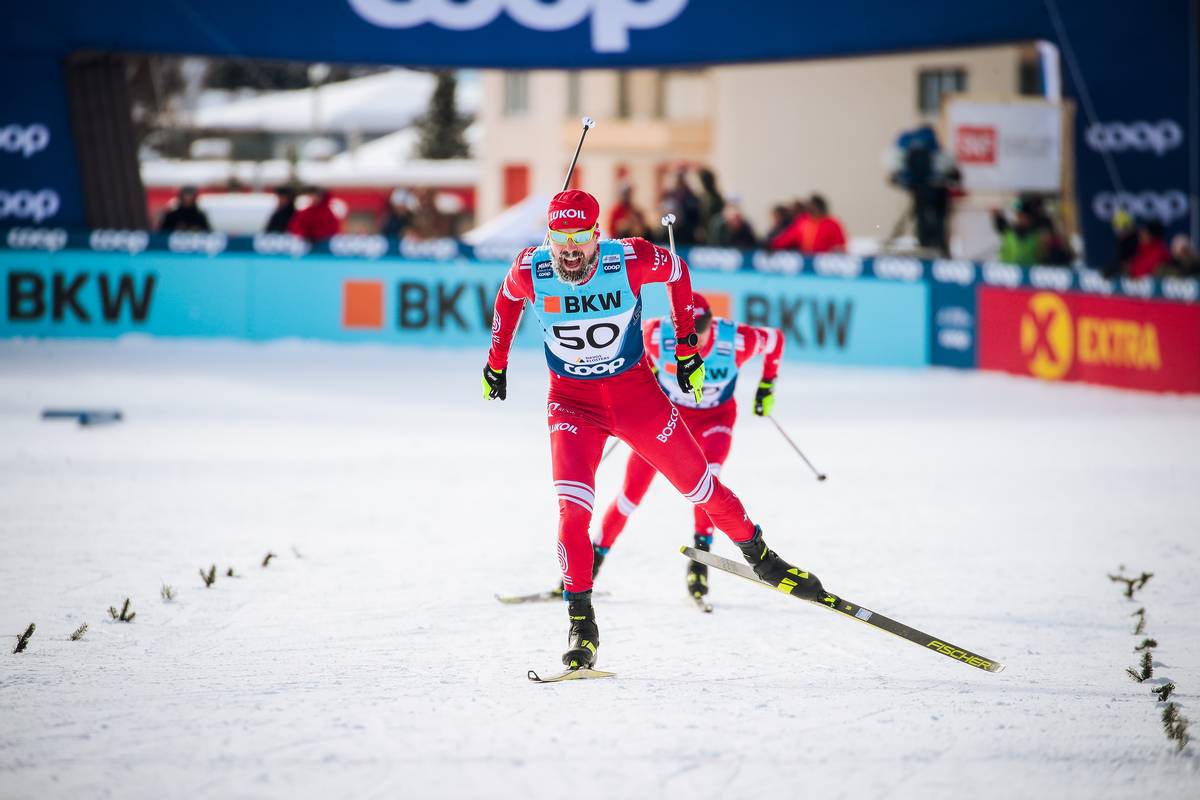
The long and winding road that is cross-country skiing’s World Championships came to an end today. The last stop: the men’s 50 kilometer Classic Mass Start. Throughout the men’s competitions, the story has been Norway; Johannes Klaebo’s domination, team Norway’s supremacy, and the competition amongst the Norwegian team members. Norway was expected to dominate again today, but there were many sub-plots within that expectation: one of the biggest was the performance of Klaebo. Touted by some as the greatest ever, but skeptics note that Klaebo hasn’t been nearly as impressive in distance events as other legendary skiers who came before. Klaebo has never been on the podium in a 50 kilometer race at a major event. To cement his name in conversations about G.O.A.T status, Klaebo would probably need to have a victory. He would also be trying to redeem himself after having been disqualified at the finish in the last World Championships 50 kilometer race when he interfered with Alexander Bolshunov (RUS).
Standing in Klaebo’s way would be what appeared to be a busload of Norwegian men. Finnish Classic standout Iivo Niskanen—who always seems to perform well in major events—would also present a major roadblock, with his eyes firmly on the podium in a long Classic race: his forte. America would look to Scott Patterson to lead the way for team USA, with Patterson having previously placed in the top 10 at 50 k in the Olympics and World Championships.
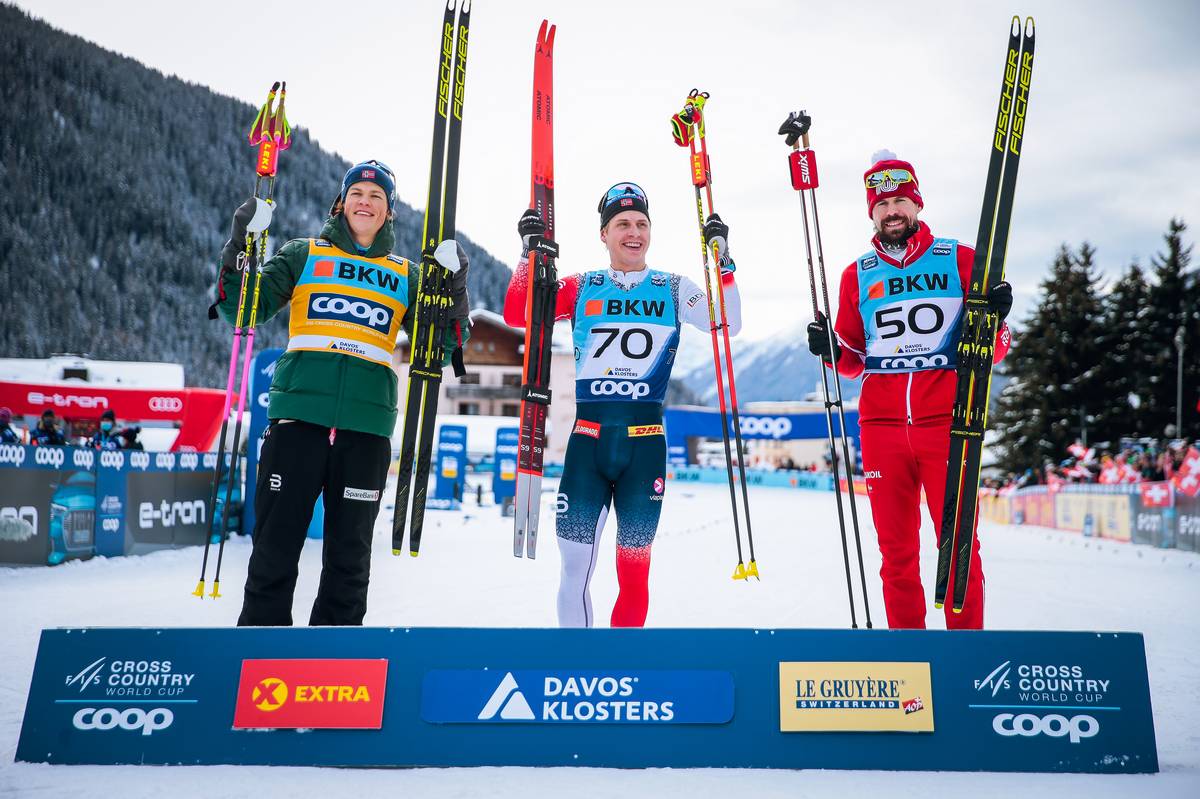
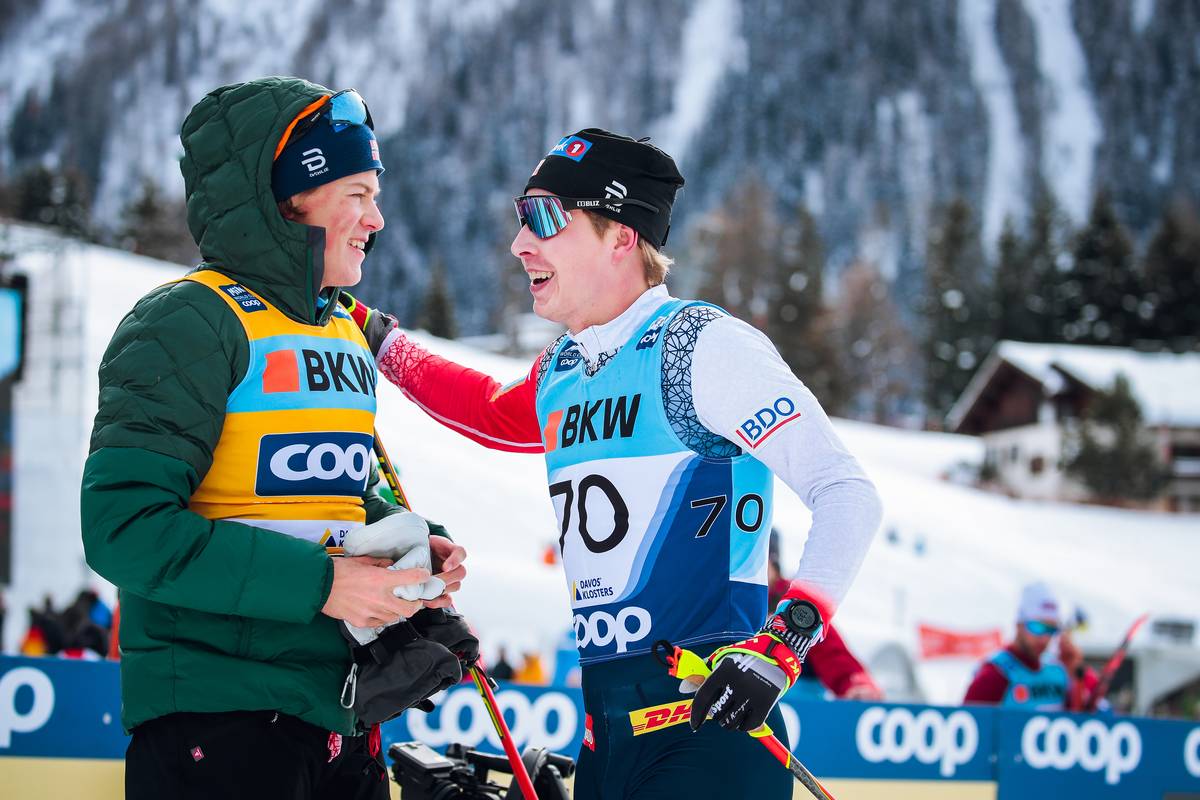
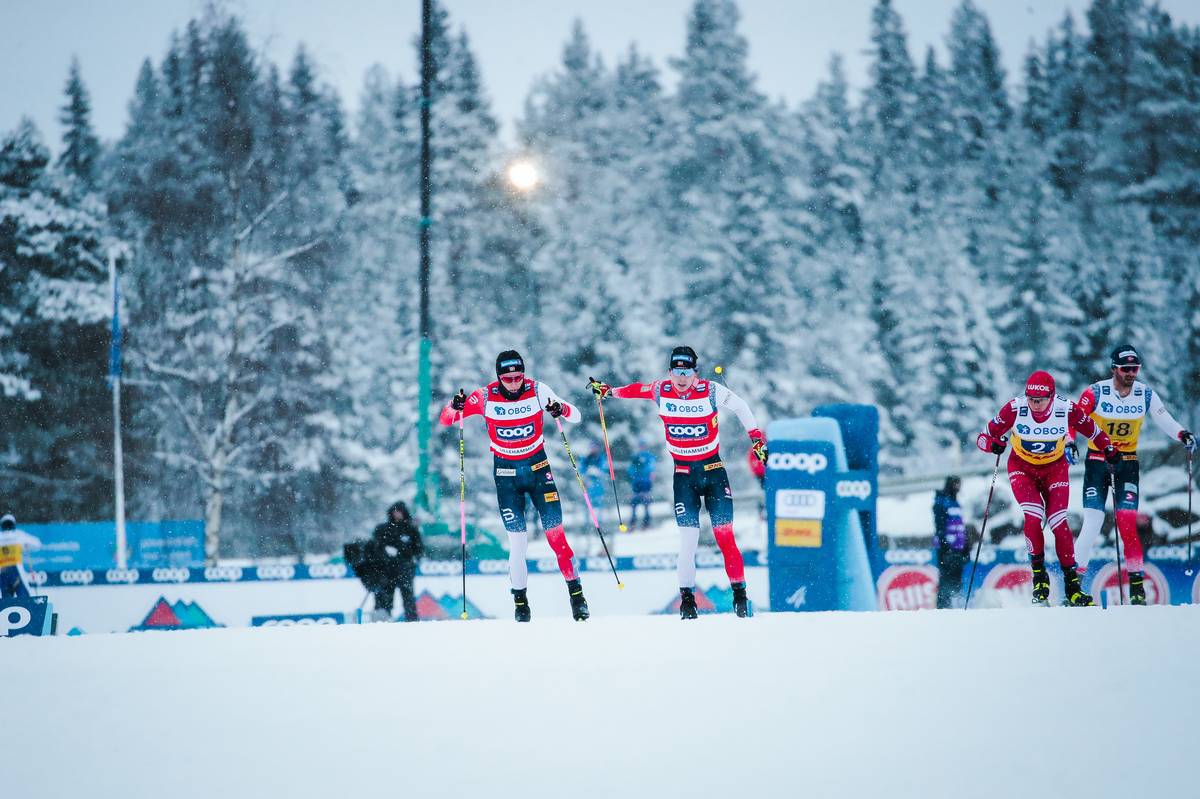
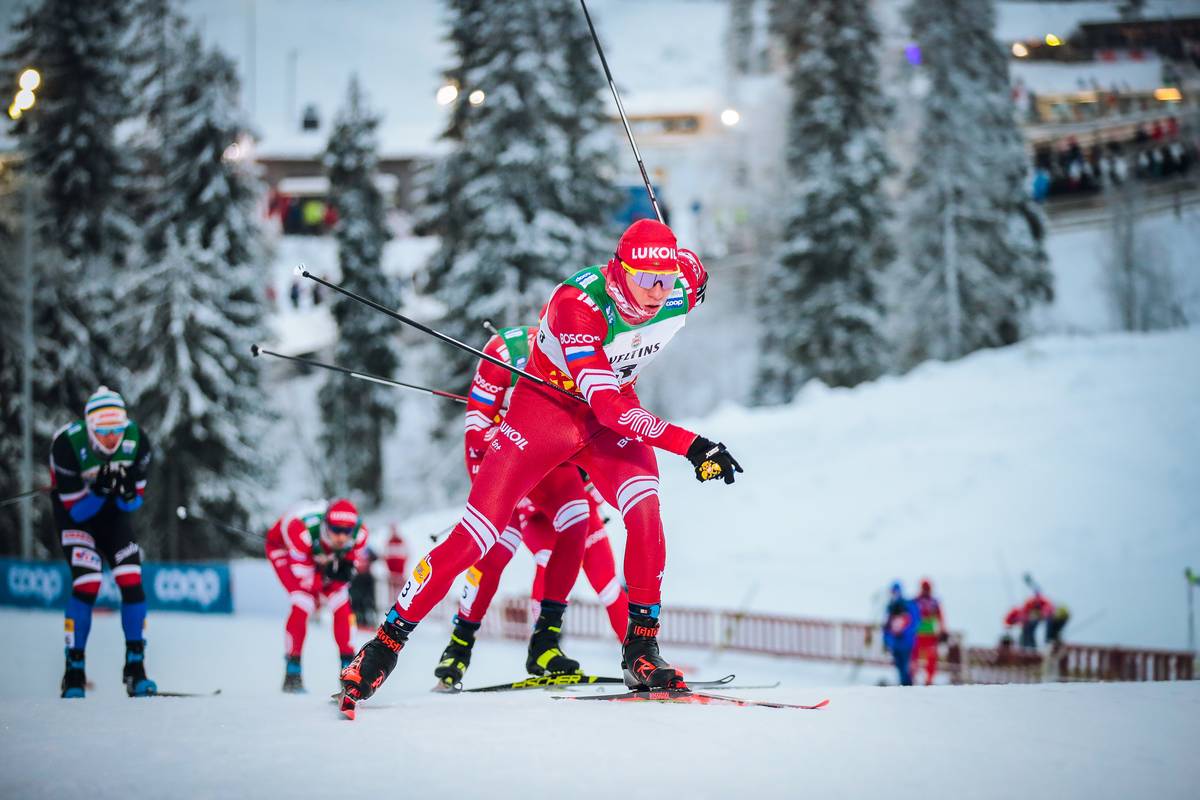
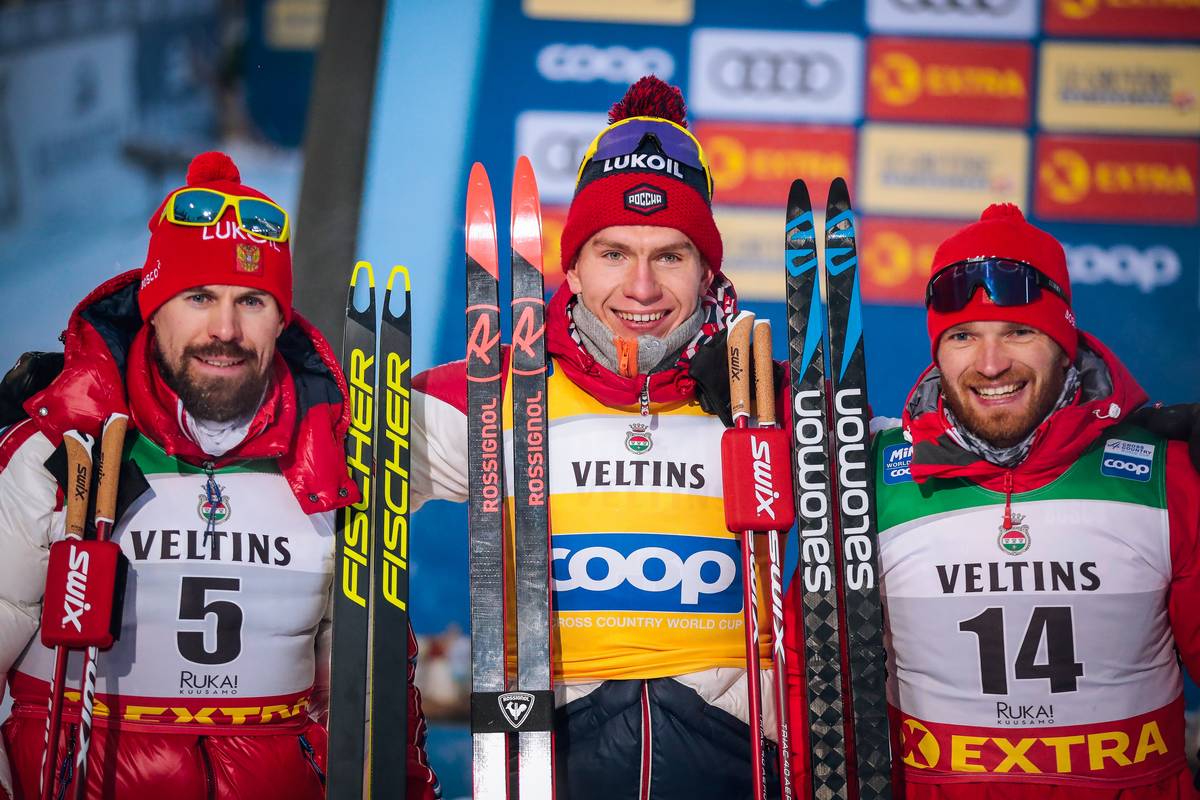
When the end of the World Championship Road was reached, it was Norway dominating again but with a somewhat surprising finishing order. Golberg finished first, out-sprinting Klaebo at the finish. William Poromaa (SWE) was third.
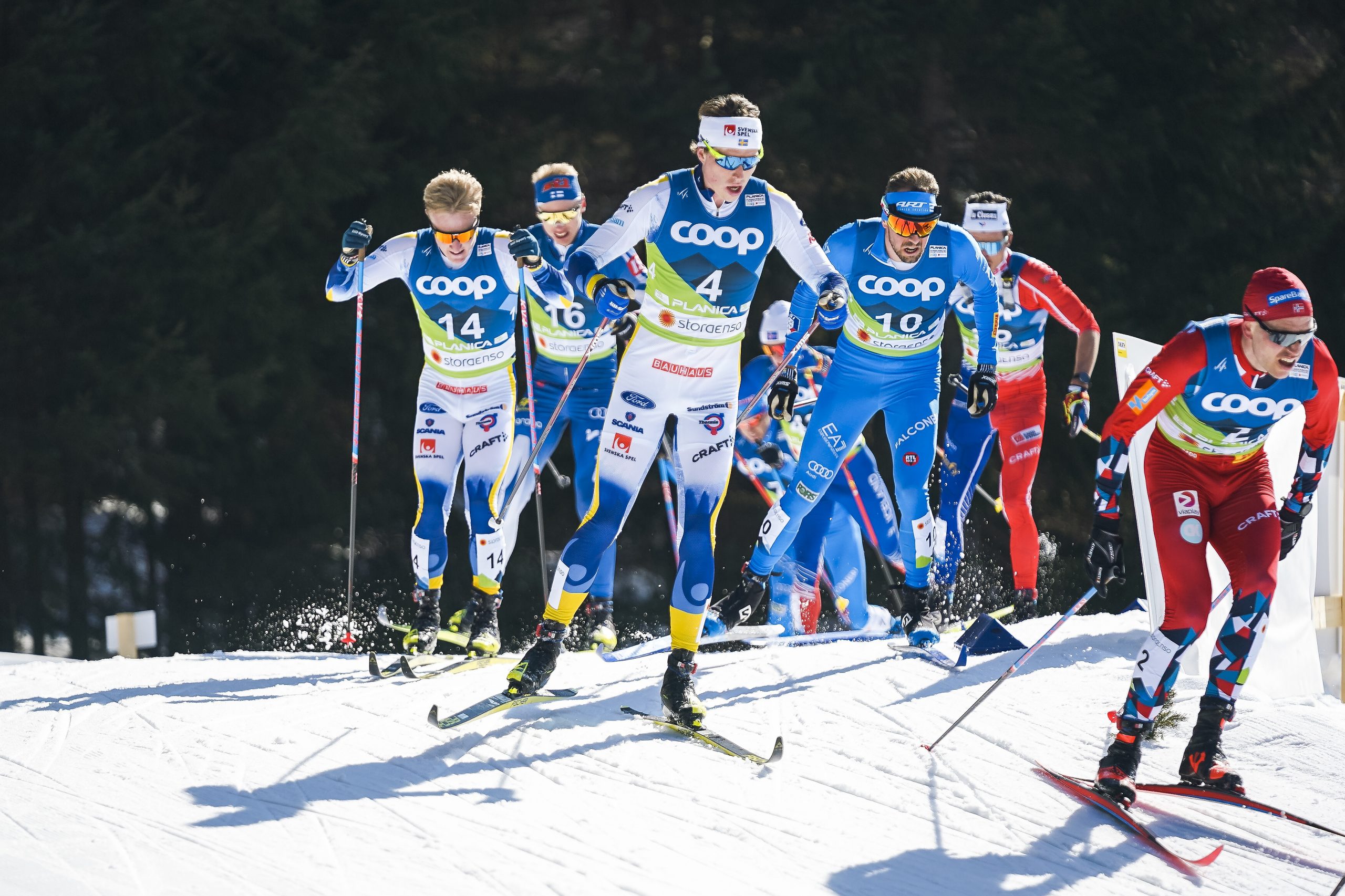
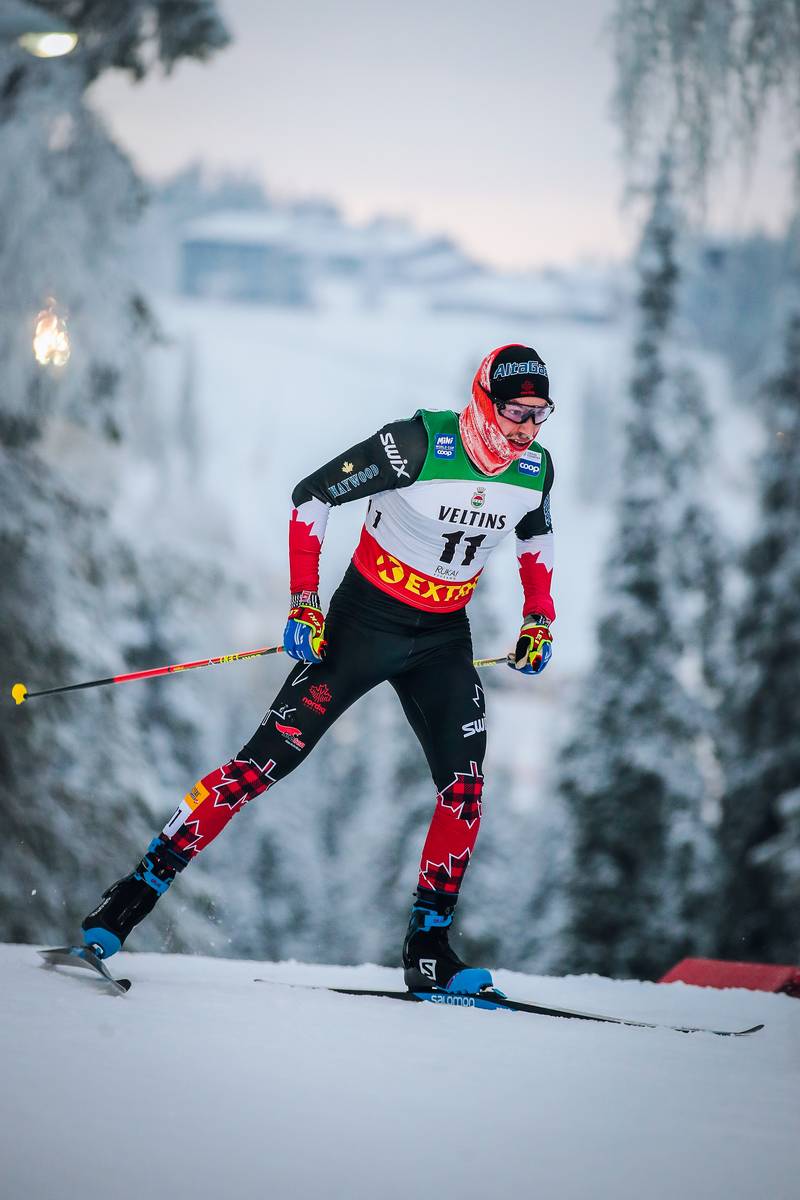
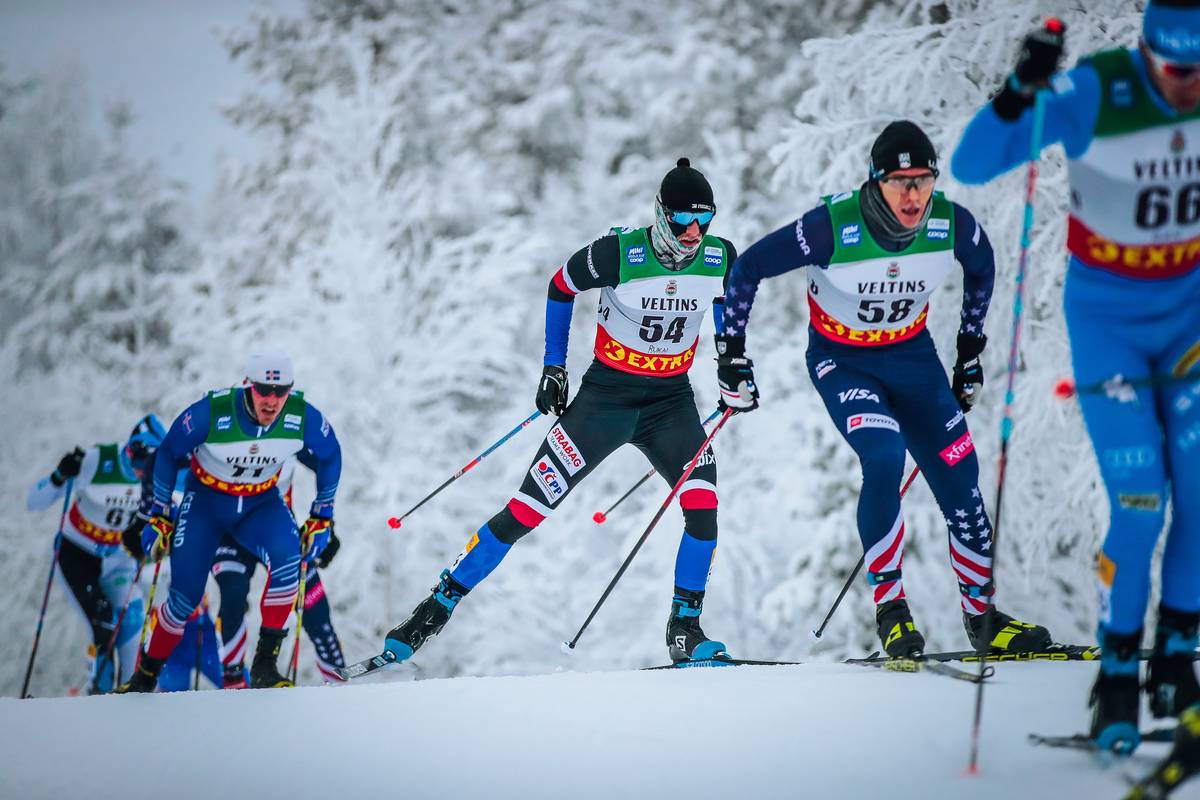
Scott Patterson (USA) had another excellent distance race for team USA finishing 16th (Photo: NordicFocus)
Men’s 50 kilometer Classic Mass Start
In 40 degree weather (4.4 C), with slow wet conditions, it was apparent early that the seven lap course would make for a race of attrition. It was also clear that the single allowed ski change could play a critical role.
As is typical in men’s distance racing, the skiers set out at an initially fast pace, then quickly settled down into the long grinding speed that would typify most of the race.
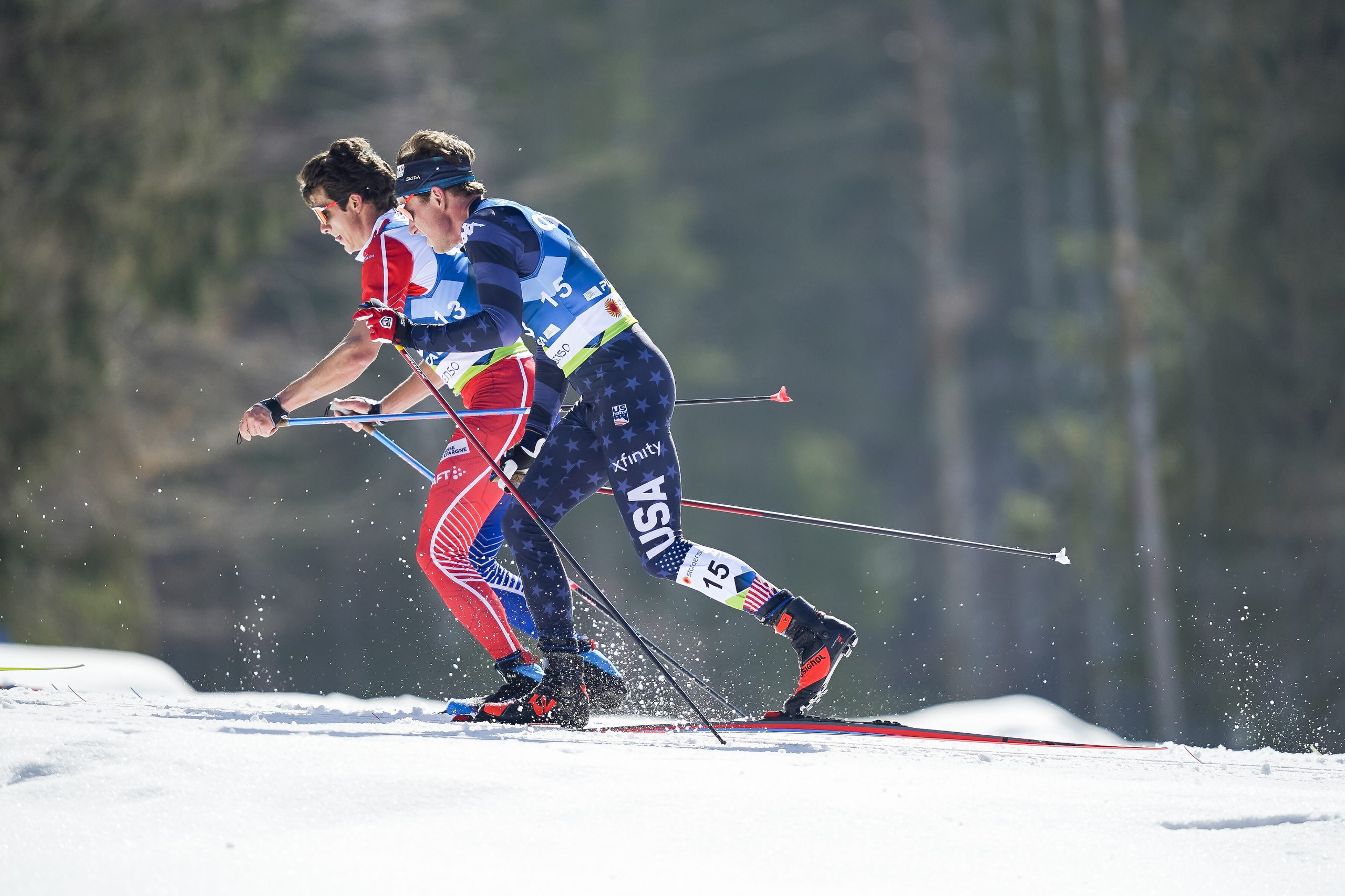
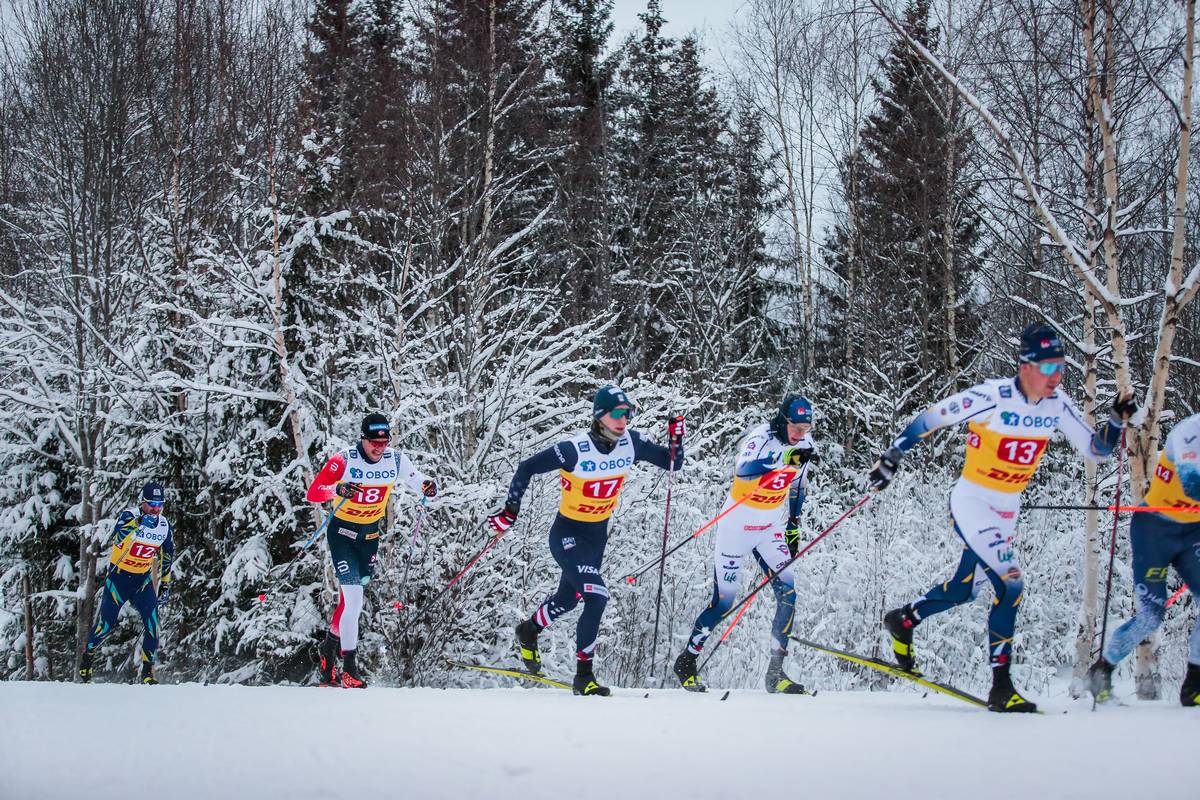
Scott Patterson (USA), was able to hang with the leaders early on. (Photo: NordicFocus)
At the 4.3 k mark, it looked good for team USA with Patterson at the front of the race. Also near the front was perennial crowd favorite, Andrew Musgrave (GBR). But as the race ground on the favorites began to rise to the top, while the Americans and Musgrave drifted back.
Much to everyone’s surprise, Johannes Hoesflot Klaebo (NOR) was out-sprinted at the finish. (Photo: NordicFocus)
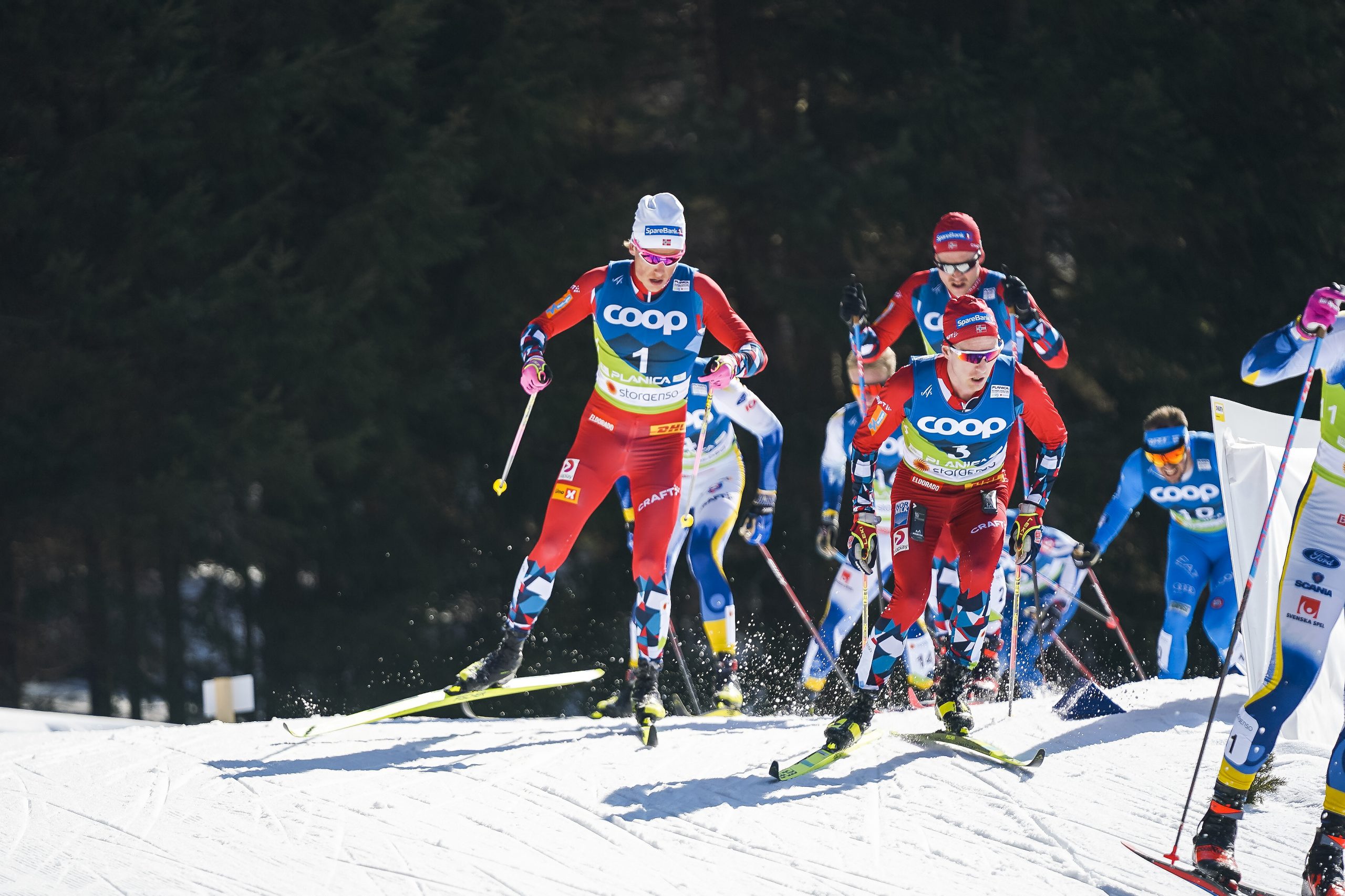
At 6.4 k, two Italians—Federico Pellegrino and Francesco De Fabiani—joined Golberg at the front to quicken the pace. Klaebo was 23rd, but only 5.2 seconds back. At this juncture, Klaebo’s strategy became clear. He would not lead. Instead, he would be content to mark the leaders the entire way and then rely upon his devastating sprinting ability to bring in the win. It was a sound strategy for the strongest sprinter in the field, but one that would not pan out today.
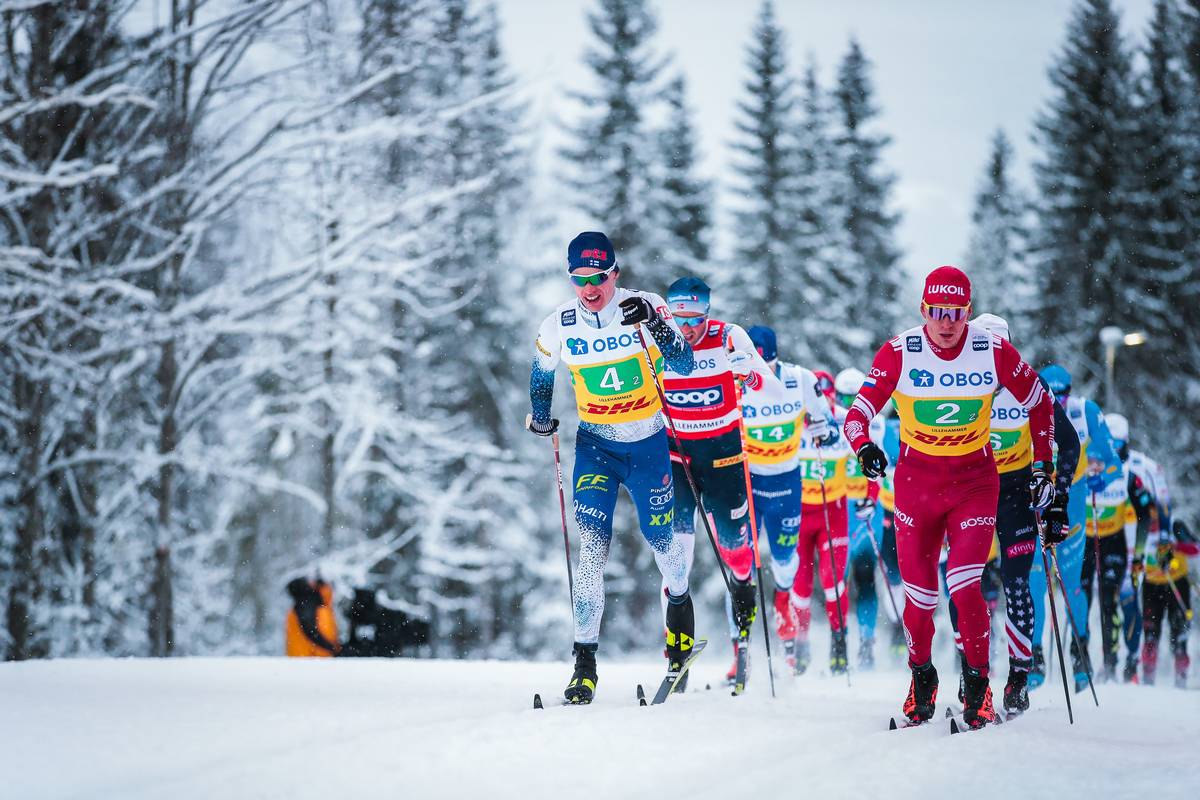
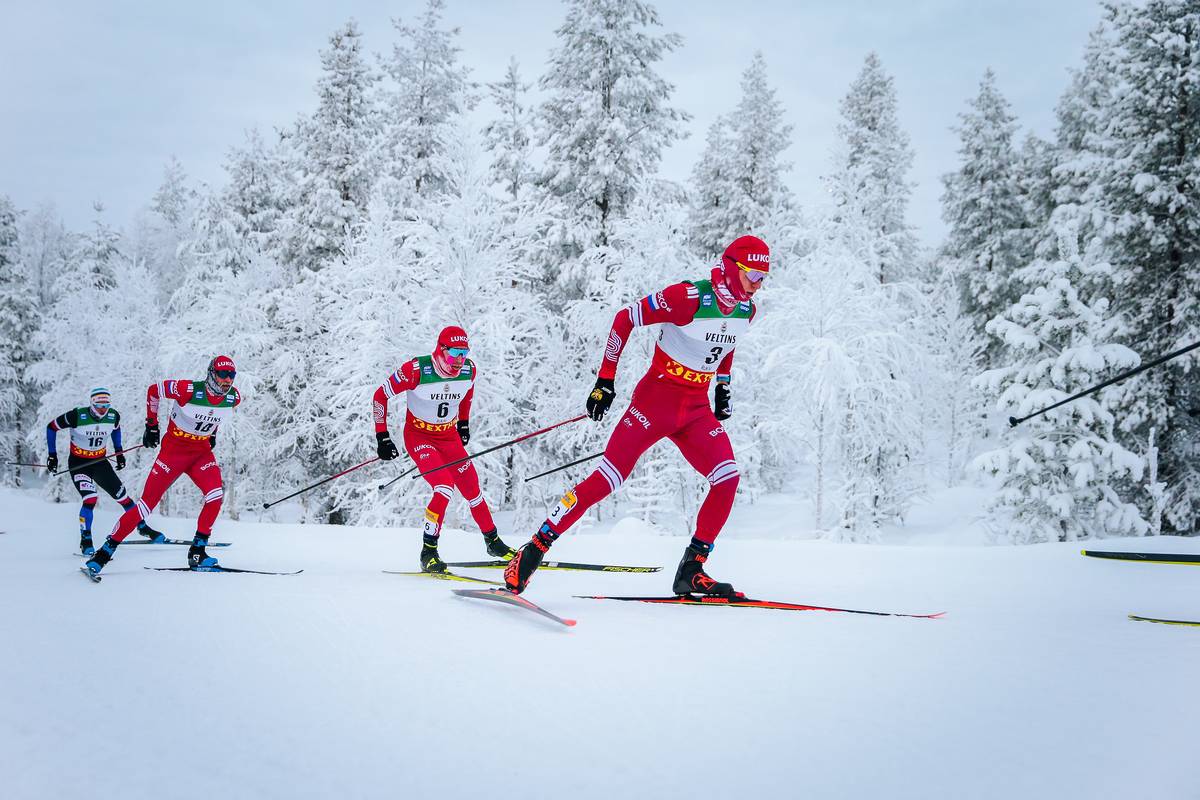
With the abundant heat and sun, the nutrition hand-ups were frequent, giving skiers an opportunity to make a move when others were being handed food and drink. This is exactly what Niskanen did at the 13 k mark; taking five skiers with him. This was the first time in the race when the field truly began to string out. But, during the next feed, the front of the race regrouped. This elastic effect continued throughout the next several kilometers with surges and contractions geared around hills, corners, and feed zones.
It was at about the halfway point when the hot grind of an hour’s racing began to take its toll and a true lead pack of about 13 skiers established a gap with Golberg and Nyenget still setting the pace. Golberg had now been out front for the last five kilometers.
David Norris (USA) finished 22nd having won the American Birkebeiner Saturday, then flew to Europe to race in the World Championships. (Photo: NordicFocus)
The North American contingent was led by Wonders, Patterson, Gus Schumacher (USA), David Norris (USA) and, Oliver Leveille (CAN). All were in a chase group 14 to 22 seconds off the lead. Fans were eager to see how Norris would perform. He won the American Birkebeiner last Saturday and made the unprecedented decision to fly to the World Championships to race the marathon. After the race, Norris told FasterSkier that he had arrived Tuesday morning and was satisfied with the way his body had adapted. He forced himself to stay up late every night to adjust to jetlag. “I don’t think jetlag was affecting the race at all.”
At 28.4 kilometers Toenseth made a push to the front. Klaebo, who still had not led, was just a couple of seconds behind the leaders. The grinding race of attrition continued and it became clear that the winners would come out of the lead pack of 13 skiers. A surprise skier in the lead group was Snorri Einarsson of Iceland. Einarsson would go on to have one of his best finishes ever, finishing 15th.
With two laps remaining, every one of the now 11 lead skiers opted to stop at the ski exchange. During the exchange, there was a crash involving Niskanen and Jens Burman (SWE),when Niskanen cut in front of the Swede on his way into the ski corral. The tangle knocked Burman to the ground but didn’t seem to harm his time in the exchange or affect Niskanen.
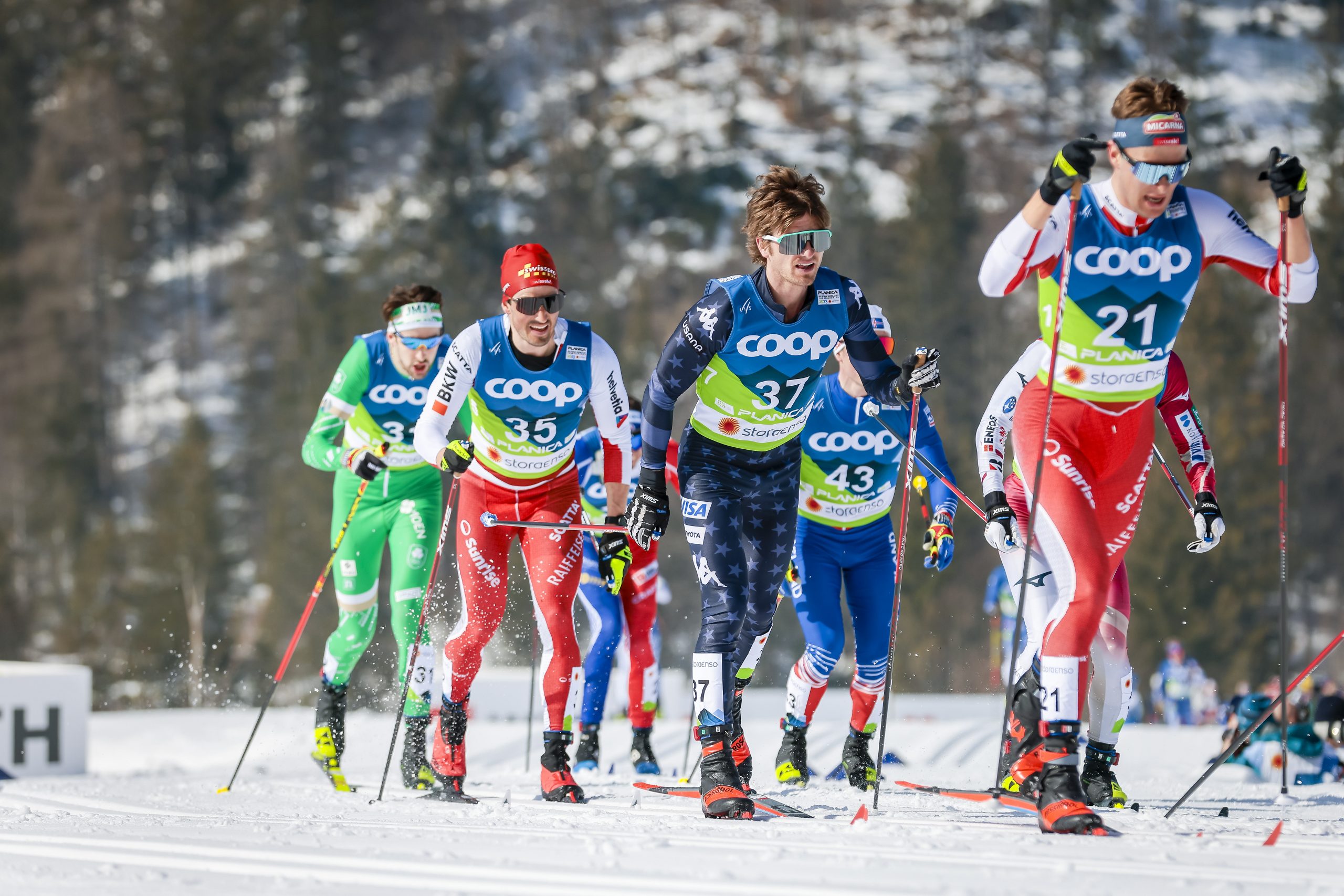
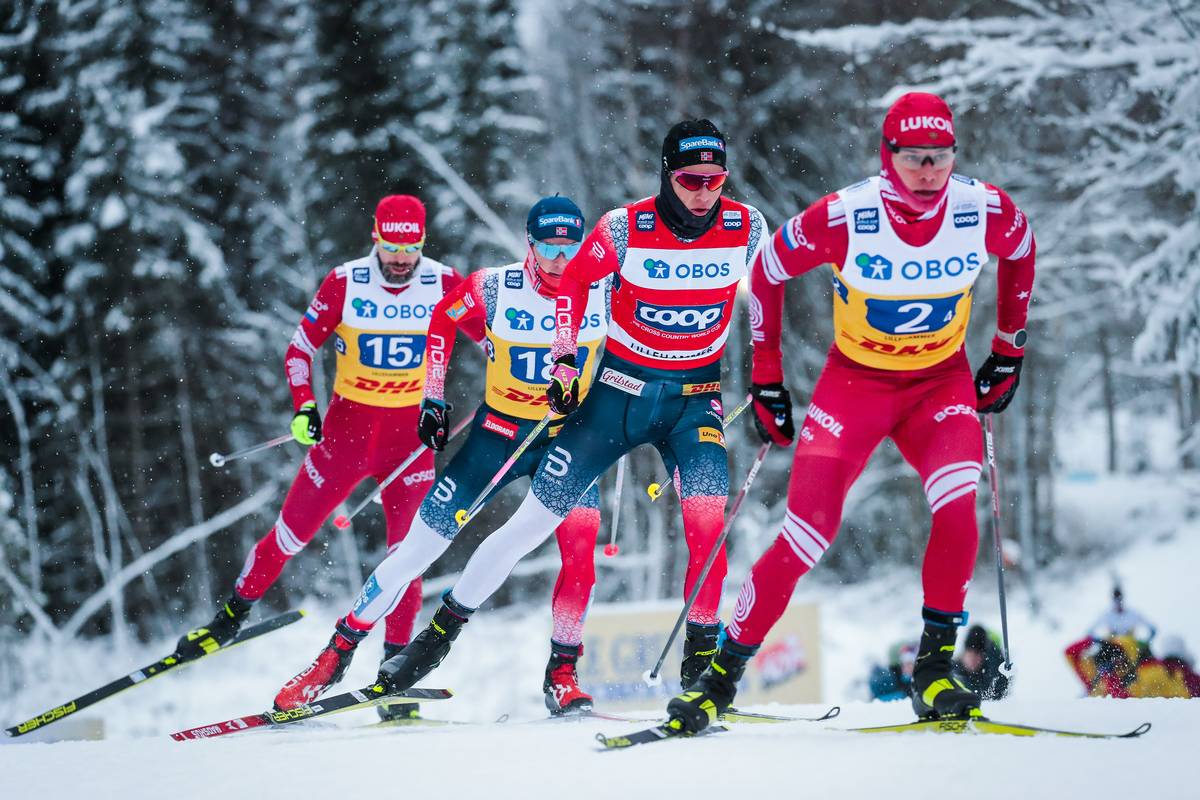
David Norris (USA), Scott Patterson (USA), Gus Schumacher (USA), (l-r) were able to ski as a pack in the middle stage of the race. (Photo: NordicFocus)
The biggest surprise in the lead group was the presence of 23 year old Frenchman, Theo Schely, who is somewhat of an unknown outside France. Schely does not have a top 20 finish in a World Cup distance race, but was seemingly undeterred by the pace. He ended up finishing ninth in what was unquestionably the second biggest surprise of the day.
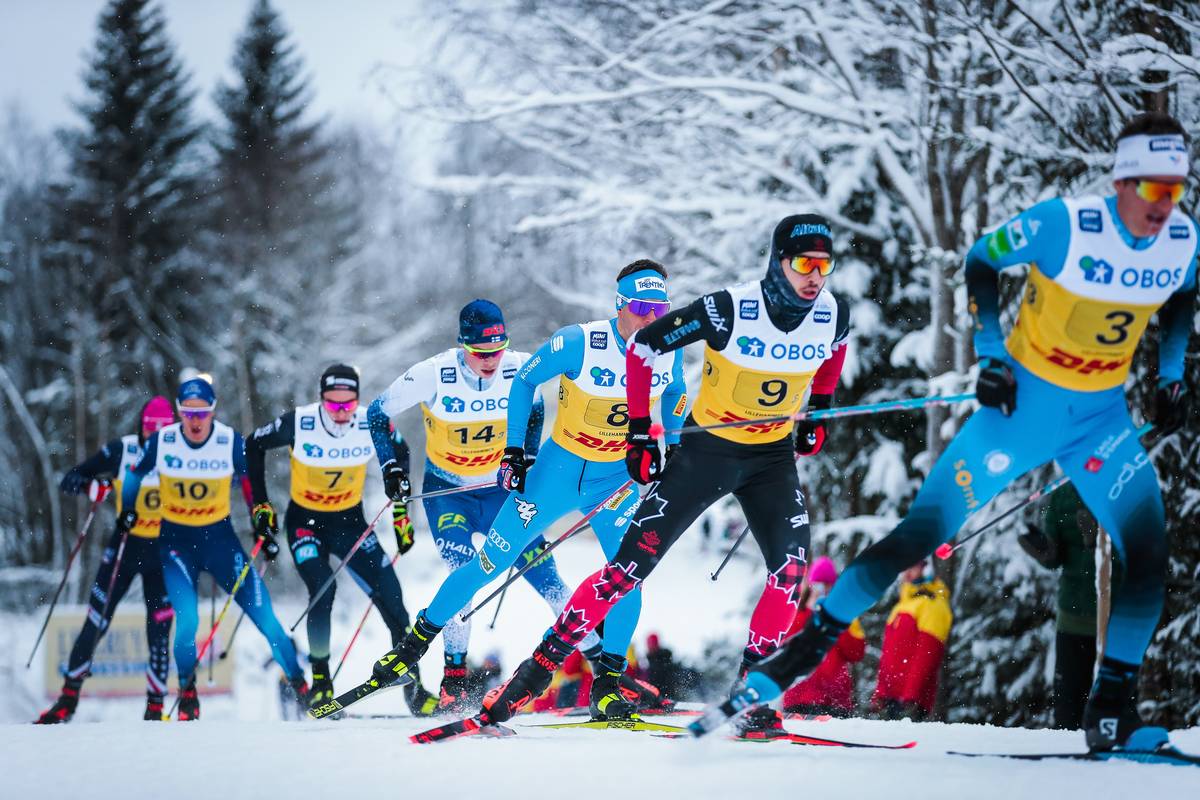
At about 43 kilometers the action livened up as Burman crashed in a corner, pushing him toward the back. At about the same time De Fabiani (ITA) broke a pole, and he was pushed out the back. With five kilometers left the race had boiled down to all the favorites with nine skiers lining up for finishing attacks. Toenseth dialed up the pace with Niskanen going along with him. Niskanen continued to push the pace—hard—but was unable to pull away from the chasers. But this reduced the field to only seven skiers, with Poromaa going with Niskanen at the front. Klaebo still sat in the middle of the pack, matching the leader’s moves but never leading.
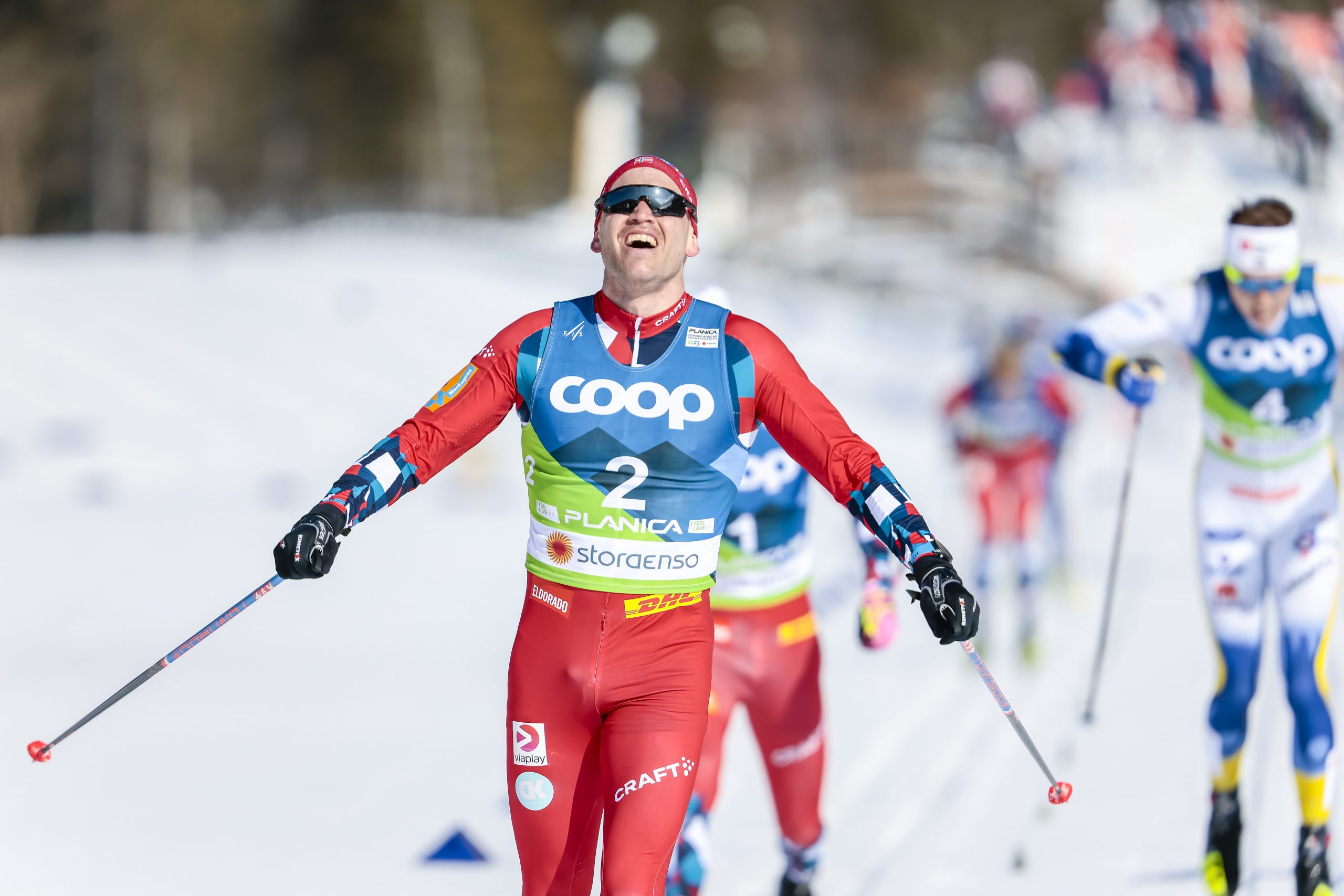
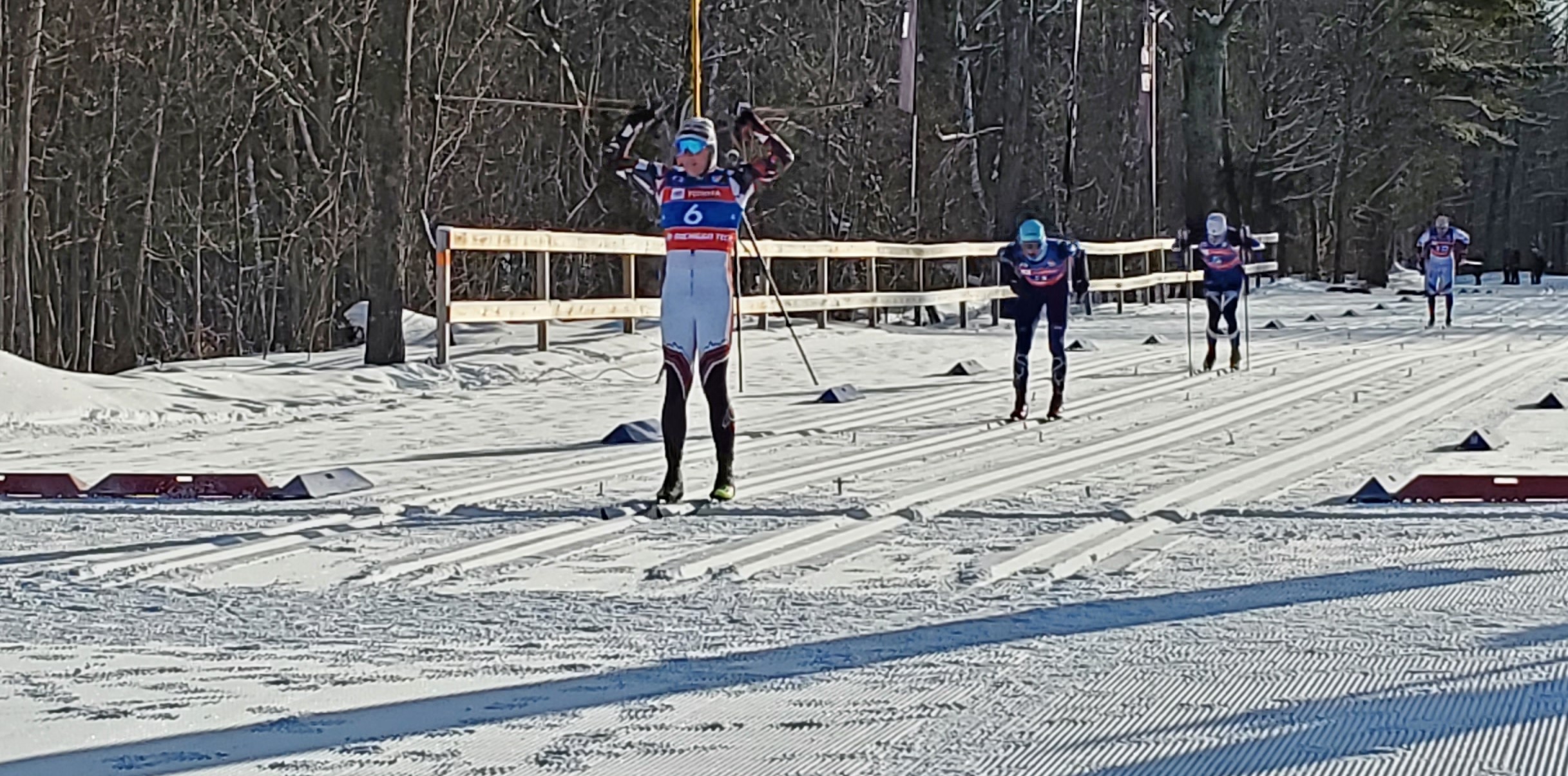
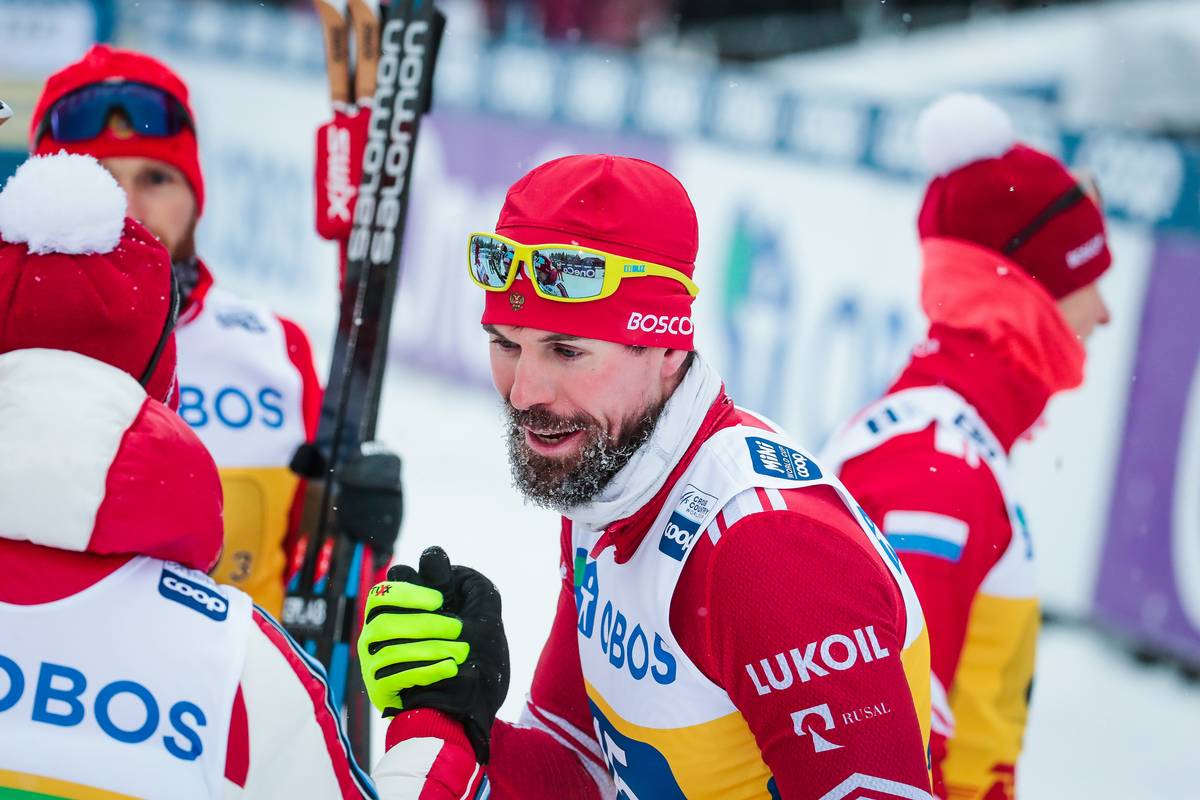
Paal Golberg (NOR) celebrates at the finish having just shocked everyone—himself included—by sprinting past Johannes Klaebo (NOR). (Photo: NordicFocus)
At the two hour mark, with one kilometer to go, the race turned into an all out sprint with Golberg pushing to the front and Klaebo going with him in second place. It was here where the biggest surprise of the day took place. The pace was blistering with Klaebo charging up the final hill. Everyone watching expected Klaebo to turn on his famous sprint and pull away. But Golberg had a devastating sprint which Klaebo could not match. Klaebo faded in the last 100 meters and Goldberg surged, pulling away from Klaebo, putting him in second place, with Poromaa hanging on to finish third. After the race Golberg admitted his surprise in beating Klaebo. “I had amazing skis,” he said. “I didn’t think I could take Johannes.”
Regarding the race’s finish Norwegian, coach Eirik Nossum said that he was “really impressed by Paal [Golberg]. He’s had such a good season, today is icing on the cake. Every guy who beats Johannes in a finish is shocking, but it’s hard to have a sprint after 50k. You can’t just order it…it’s hard…even for Johannes.”
William Poromaa (SWE) ended Sweden’s medal drought, finishing third. (Photo: NordicFocus)
It was also a big day for Sweden. Head coach Anders Bystrom told FasterSkier that, “finally we got the medal, and it’s so important for the whole sport in Sweden. The women are so great, the men have been in the shadow of the women, so this is really important.” Calle Halfvarsson, who finished fourth reiterated to FasterSkier the medal’s importance to Sweden. “We, the men, don’t yet have any medals,” he said. “It was really good that we could take [a medal].” Halfvarsson also commented on Klaebo’s performance in distance events: “Today showed that Klaebo is human. “
After the race, Patterson told FasterSkier that he had missed a couple of crucial feeds. He also expressed dissatisfaction with his race tactics. “I should have swapped [skis] earlier.”
Schumacher told FasterSkier that “My energy definitely tailed off towards the end, but I felt like I skied well the whole time.”
At the end of the World Championship Road, Norway was still supreme with only the finishing order being a shocker: Golberg outsprinting Klaebo at the finish, stunning the crowd and completing the World Championships on a surprising note.
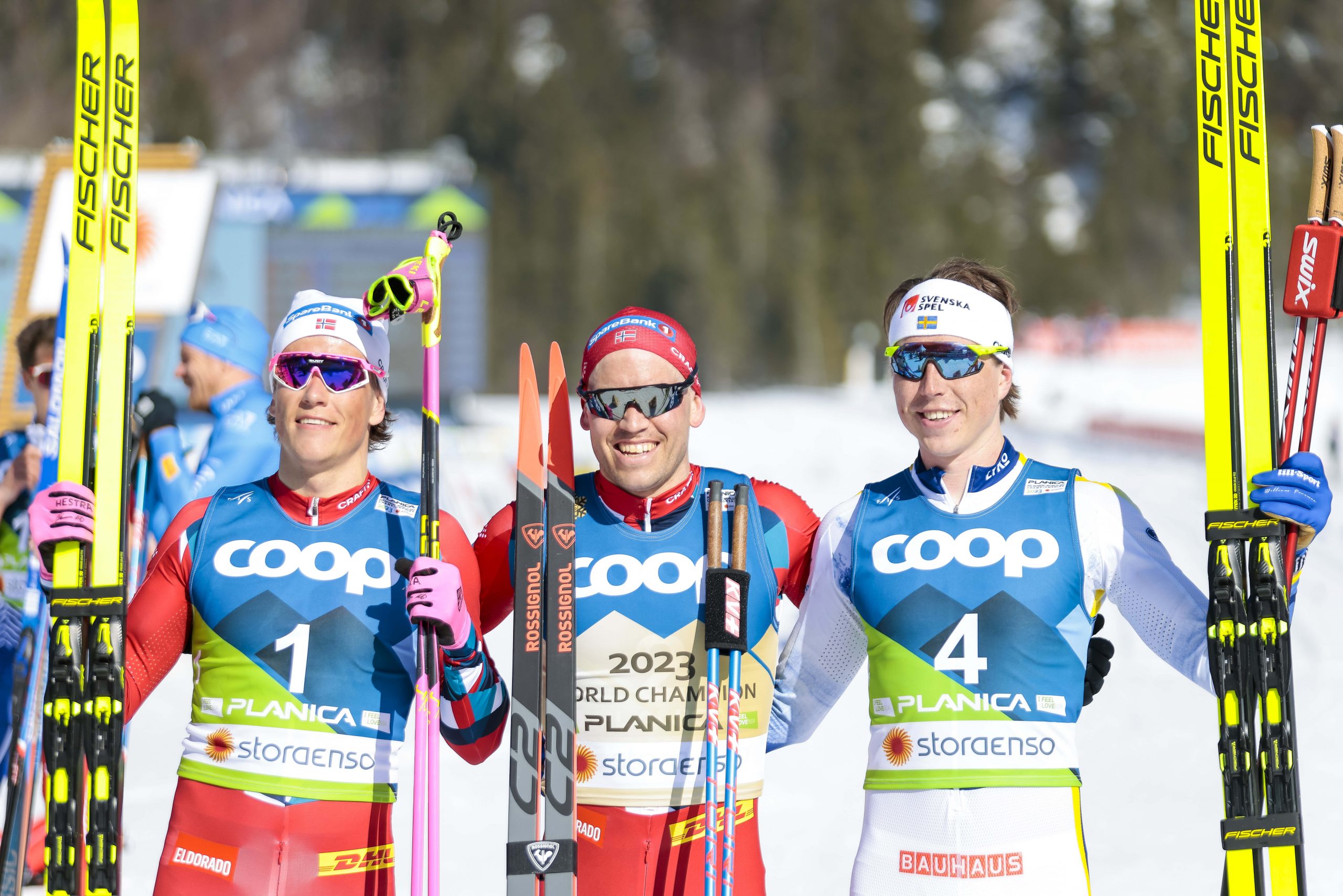
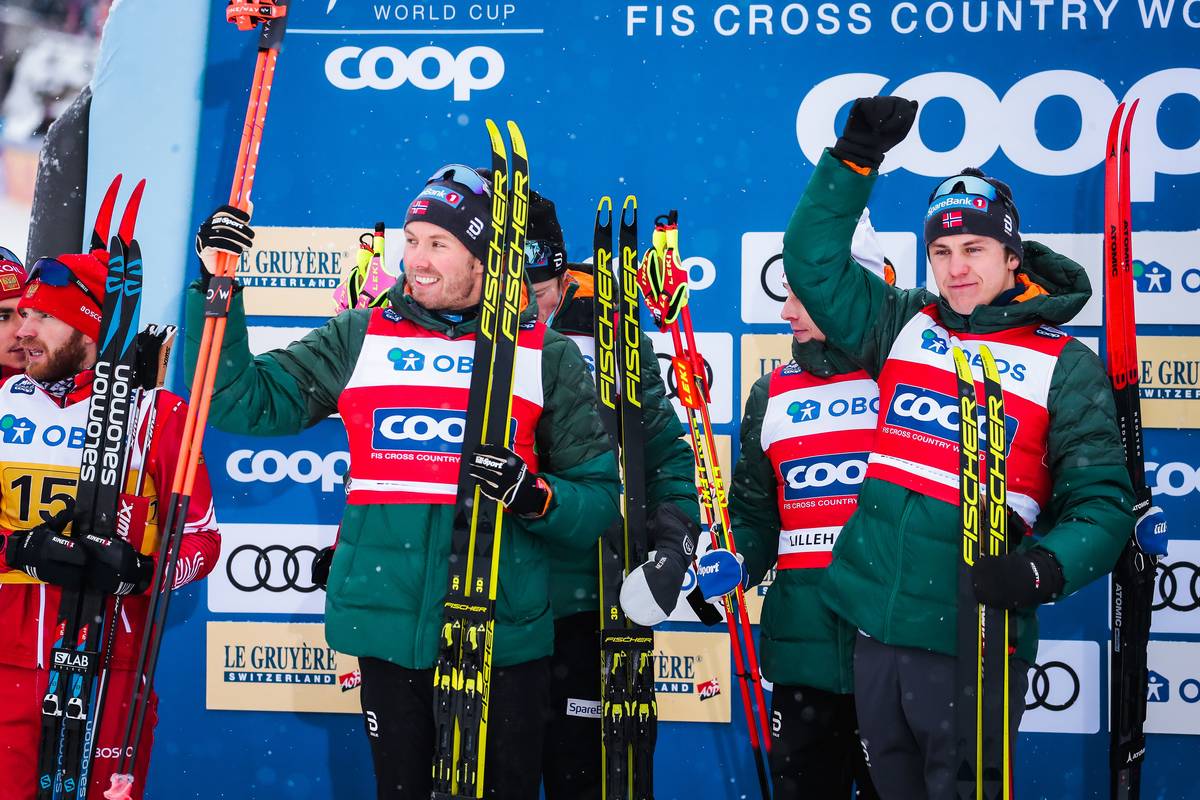
Johannes Hoesflot Klaebo (NOR), Paal Golberg (NOR), William Poromaa (SWE) celebrate podium finishes to cap off the World Championships. (Photo: NordicFocus)
World Championship Men’s 50 K Classic Mass Start RESULTS
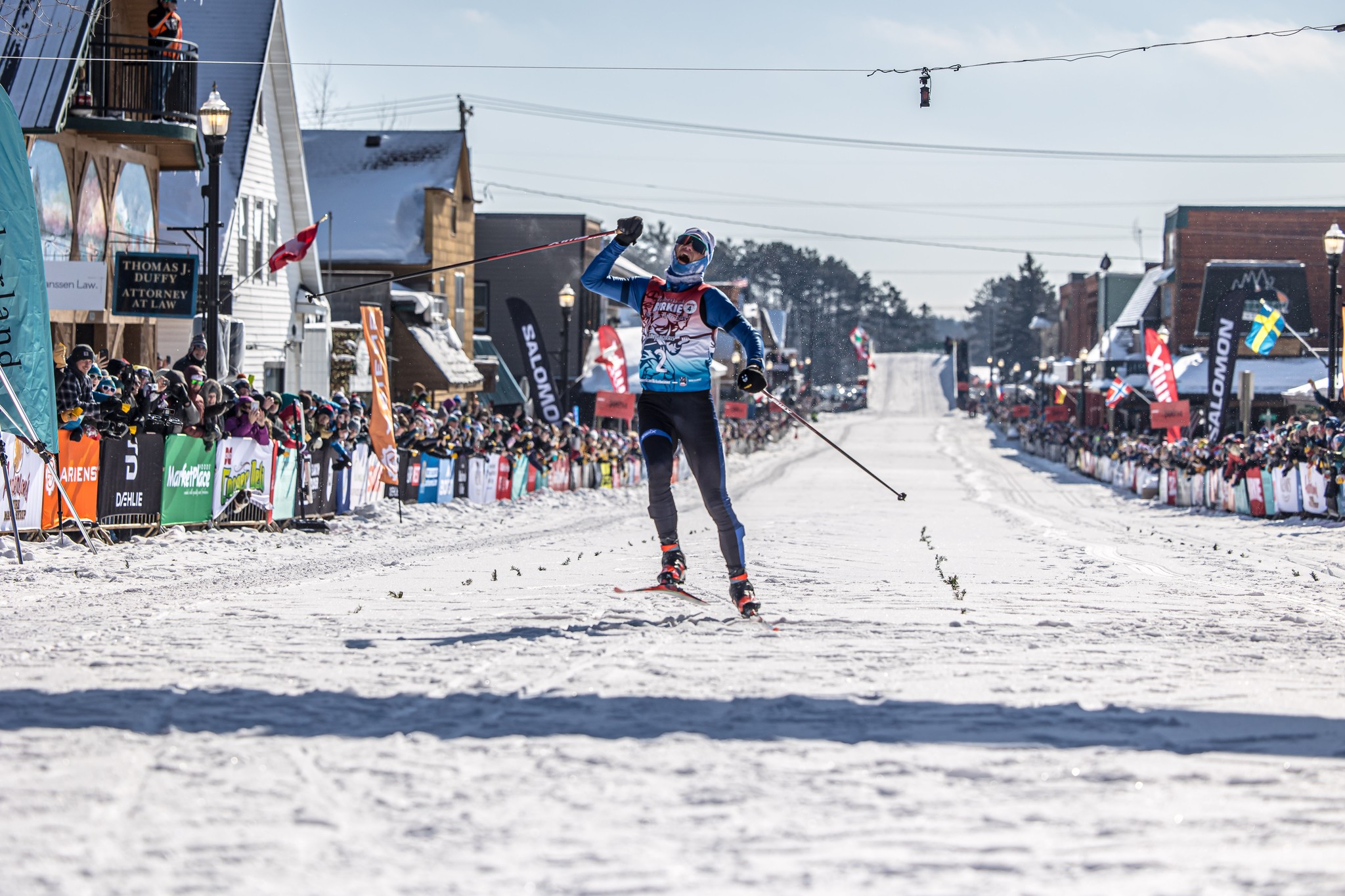
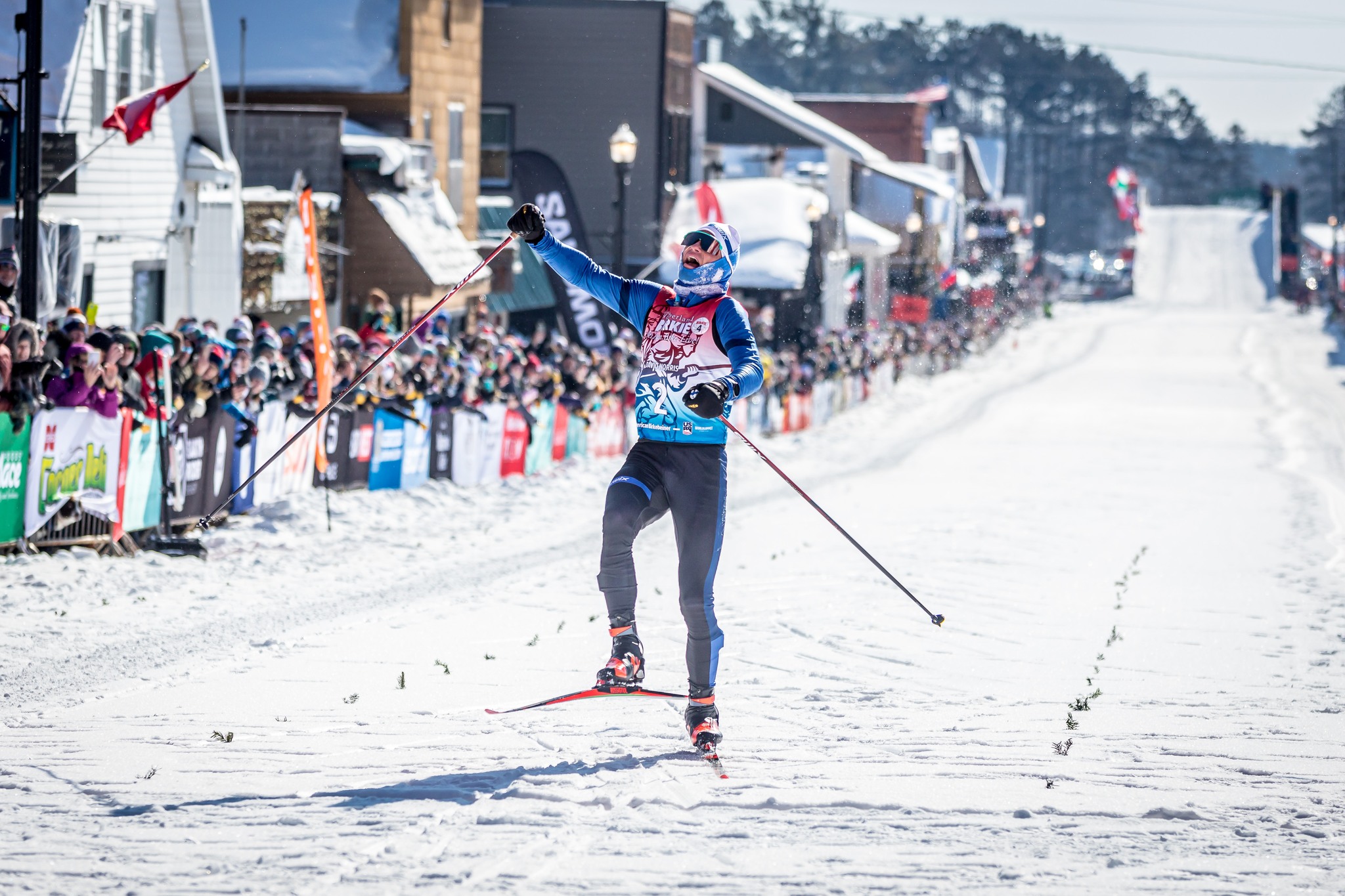
David Norris (USA) crosses the finish line to win his second American Birkebeiner. Norris now heads to Planica, Slovenia to participate in the World Championships this week. (Photo: American Birkebeiner Ski Foundation).
The coaching staff for the Steamboat Springs Winter Sports Club (SSWSC) huddled around a tinny iPhone speaker set out on a wax bench. It was the last Rocky Mountain Junior National Qualifier of the season in Aspen, Colorado, but there was no illusion about where the main event in North American skiing was last Saturday. On the American Birkebeiner live stream, Adam Verrier and Dennis Kruse delivered the news that one of the coaches usually found at the Steamboat benches this season, David Norris, had broken away on the Powerlines—four kilometers into the 50 k race. The Steamboat coaches turned the speaker off as Norris ducked into the Wisconsin woods 8 k into the race, confident in the conclusion. They, after all, had kick wax to test. In Wisconsin though, Norris was on his way to holding his move all the way to Hayward, winning the second Birkie of his career.
A Birkie win has traditionally served as a cap on the season for American skiers. For Norris though, the next stop after crossing the finish line on Main Street wasn’t the Birkie Bash or the Sawmill Saloon. Instead, he was bound for a flight to Planica, Slovenia, where he is expected to start in this weekend’s World Championship 50 k Classic for the United States.
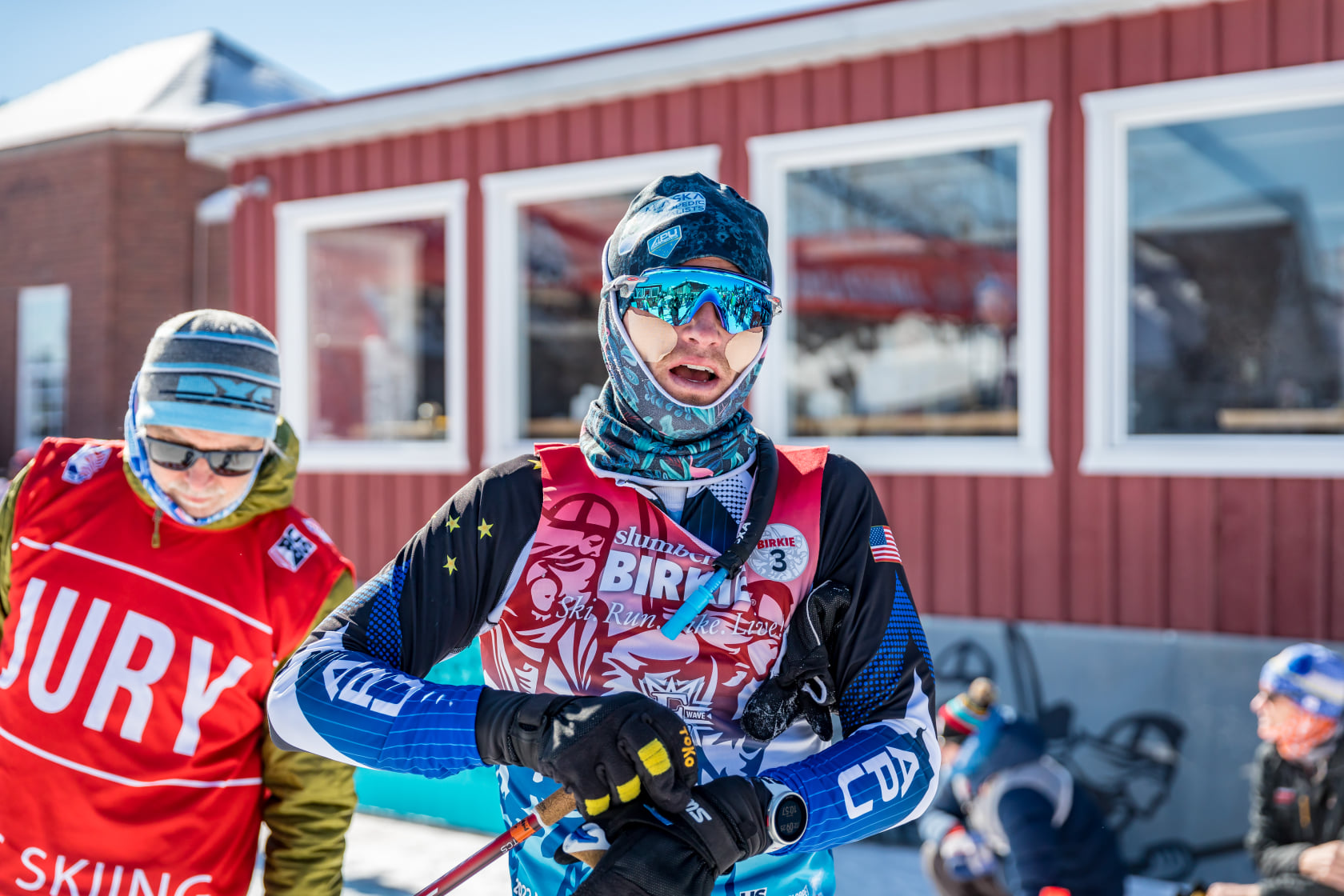
There have been World Championship skiers who have won the Birkie, and Birkie winners who have competed at World Championships, but never have the two categories been traversed in the same season, or same calendar week. For David Norris, it’s a unique accomplishment that captures the essence of a unique chapter in his skiing journey.
That journey has been a whirlwind through all the different registers of the sport. After a heart-breaking near miss on an Olympic bid last year, the details of which Norris covered with FasterSkier’s Rachel Bachman-Perkins last March, Norris announced his intention to retire from international racing last spring. He decamped to Bozeman, Montana with his partner Jessica Yeaton and her family, where he hopped into and won fixtures of the western citizen race circuit, taking first in Sun Valley’s Boulder and Bozeman’s Crosscut 30 k. The step back gave Norris a moment of clarity, “I just realized that I ski because I love it not because of one single goal or because I’m trying to prove anything to anyone or, you know, make one person proud. It was good, just to ski and enjoy it” he told Bachman-Perkins last spring.
When Yeaton’s clinical rotations brought the couple to Colorado last summer, Norris quickly reached an agreement to join the coaching staff at the Steamboat Springs Winter Sports Club, a position that he wrote to FasterSkier felt like it would allow him to reach his new “big goal” in skiing, “ensure that training never compromised work, family events, and fun stuff with friends.” Still, Norris had plans to continue racing in some capacity, “I hoped to race at Nationals and the Birkie when I took the position in Steamboat.”
David Norris (USA) and his partner Jessica Yeaton (AUS), both won the 2022 Tour of Anchorage last spring. (Photo: Instagram @jjyeaton)
With his new job, Norris adjusted to a new type of training lifestyle, “[mainly] exercising with Jessica before and after each work day—I knew that would allow me to stay in solid shape this winter.” He also adjusted to a new kind of rewarding experience in the sport; coaching. “It has been an incredibly positive experience” he wrote. “It’s so cool to be invested in all these athletes’ results more than my own and to think about their training and well-being.”
Norris sat on the sidelines for the early part of this season, fully leaning into his new role. When Nationals came to Houghton though, he hopped back into the race. In the opening 10 k skate in Houghton, he finished third overall, and was two seconds off a National Championship. He followed it up by taking second in the 20 k classic later that week. In retirement, it turned out, Norris hadn’t missed a beat.
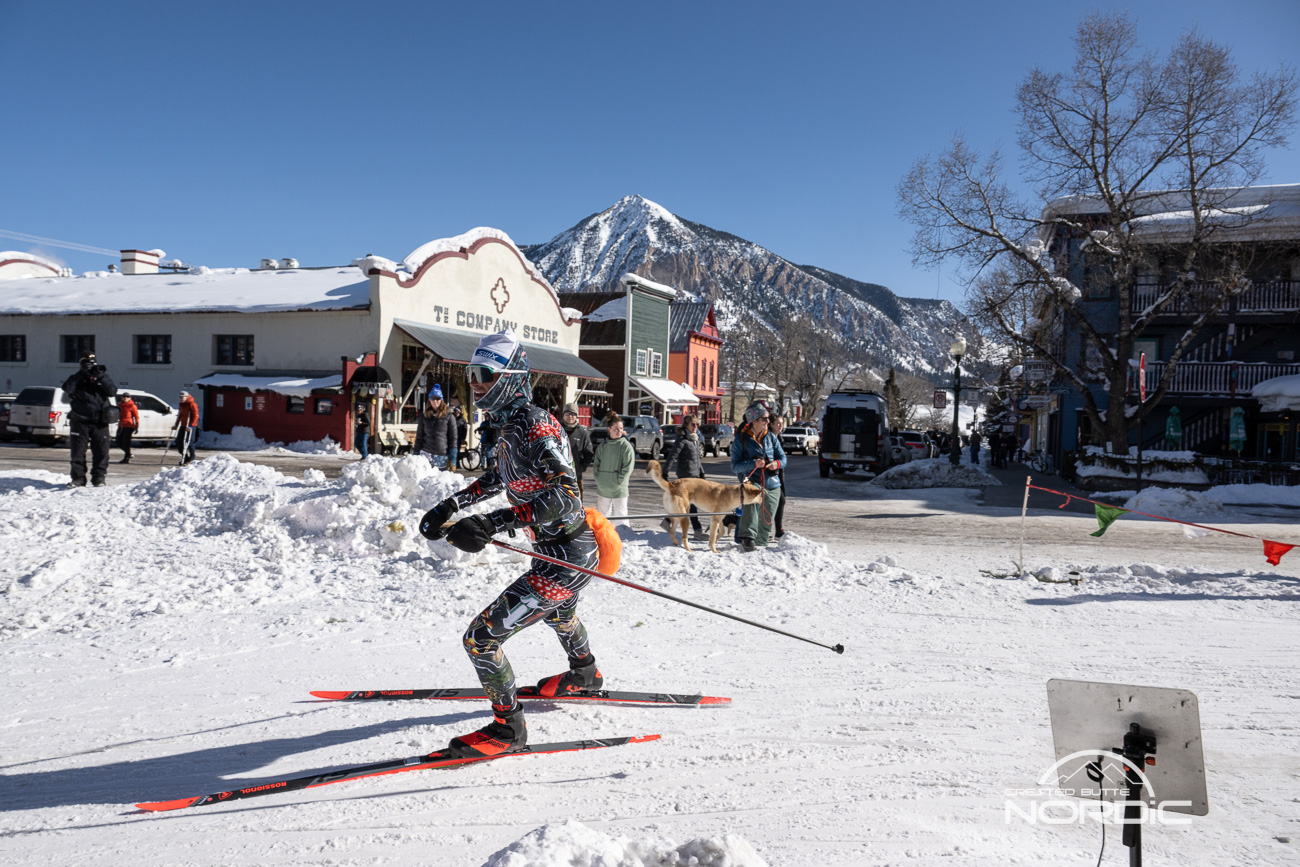
David Norris (USA) on his way to winning the Alley Loop, in full attire, in Crested Butte, Colorado earlier this month. (Photo: Xavi Fane/Crested Butte Nordic)
Still, Norris remained focused on coaching, and on finding the kind of fun he had doing citizen races at the tail-end of last season. In early February, he hopped in on a western collegiate race when the circuit came to Steamboat Springs, and took third place in a close 20 k classic. Immediately after, he and Jess Yeaton drove five hours south to Crested Butte, Colorado, where they both won the 42 k Alley Loop the next day, fully decked out in a customary Alley Loop costume.
Days later, the announcement came from USSS that Norris was nominated to his third consecutive World Championship team, after having scored top 20 results at both Seefeld 2019, and Oberstdorf 2021. In a season where Norris had shifted to doing everything, and racing, the results still spoke for themselves. Plans didn’t stray from the fun-searching attitude that had got him there, though, and so last weekend, Norris still lined up for the Birkie. Now, he was using it as a final tune-up before the World Championships.
“I [was] really grateful to the [Steamboat Springs] Winter Sports Club for giving me the time off work to compete still,” and the Birkie win was “really meaningful to me” Norris wrote to FasterSkier.
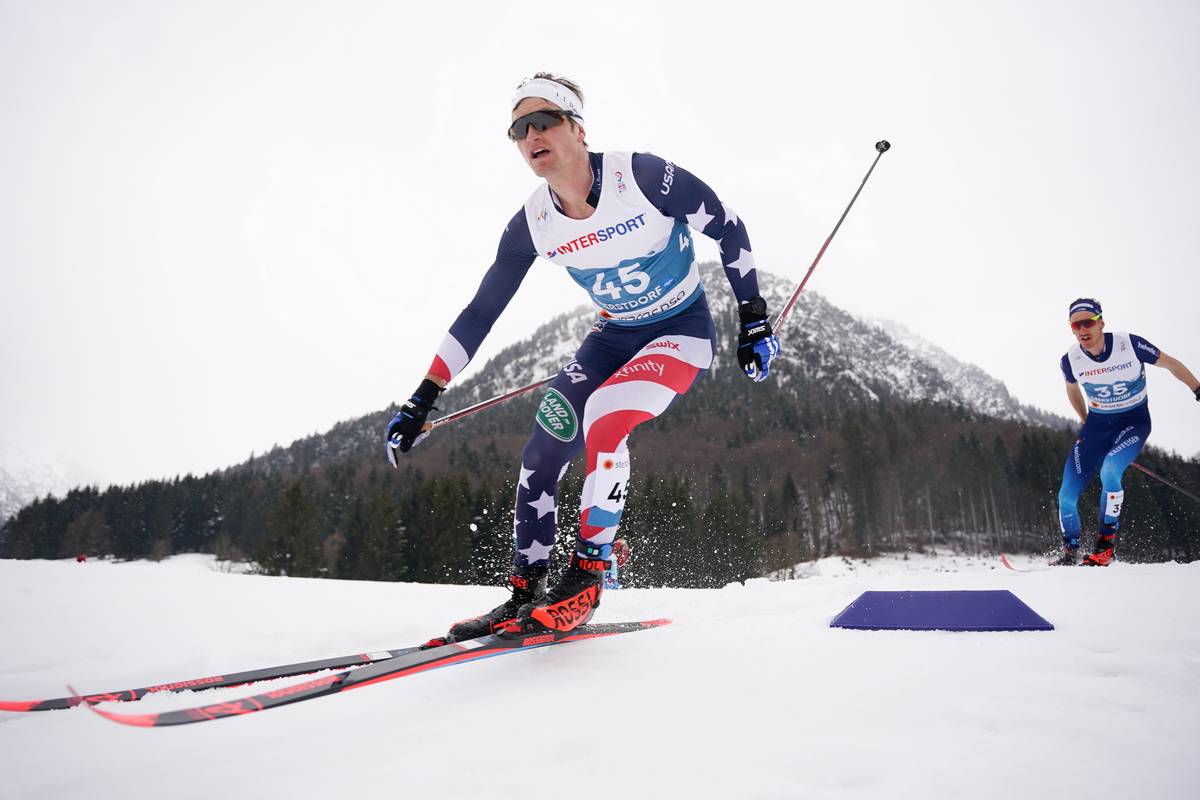
David Norris (USA) skied to 16th overall in the men’s 50 k Classic at the 2021 World Championships in Oberstdorf, Germany. (Photo: NordicFocus)
As for Planica, Norris is in the same mindset. “I’m excited for it all!” he wrote. “I thought I was done competing in Europe so now that I have these opportunities I am going to race as hard as I can and no matter what I’m committed to enjoying the experience.” With his historic pedigree as one of the United States best long distance racers, Norris is expected to start the 50 k marathon that closes out World Championships later this week.
Even with the best in the world on the horizon this week though, Norris still has an eye ahead to using the opportunity to participate, and enjoy, the many different unique experiences that the sport of skiing, and life more generally, has to offer, “I’ll be racing Holmenkollen and hopefully a few events at SuperTour Finals when we take some athletes to [Craftsbury] Vermont. After that, I’ll try to make a smooth transition to running and begin a busy summer racing calendar if everything works out. I’m taking some spring business classes that I’m really excited about as well.”
In short, then, David Norris’ retirement plans: doing it all, and enjoying it too.
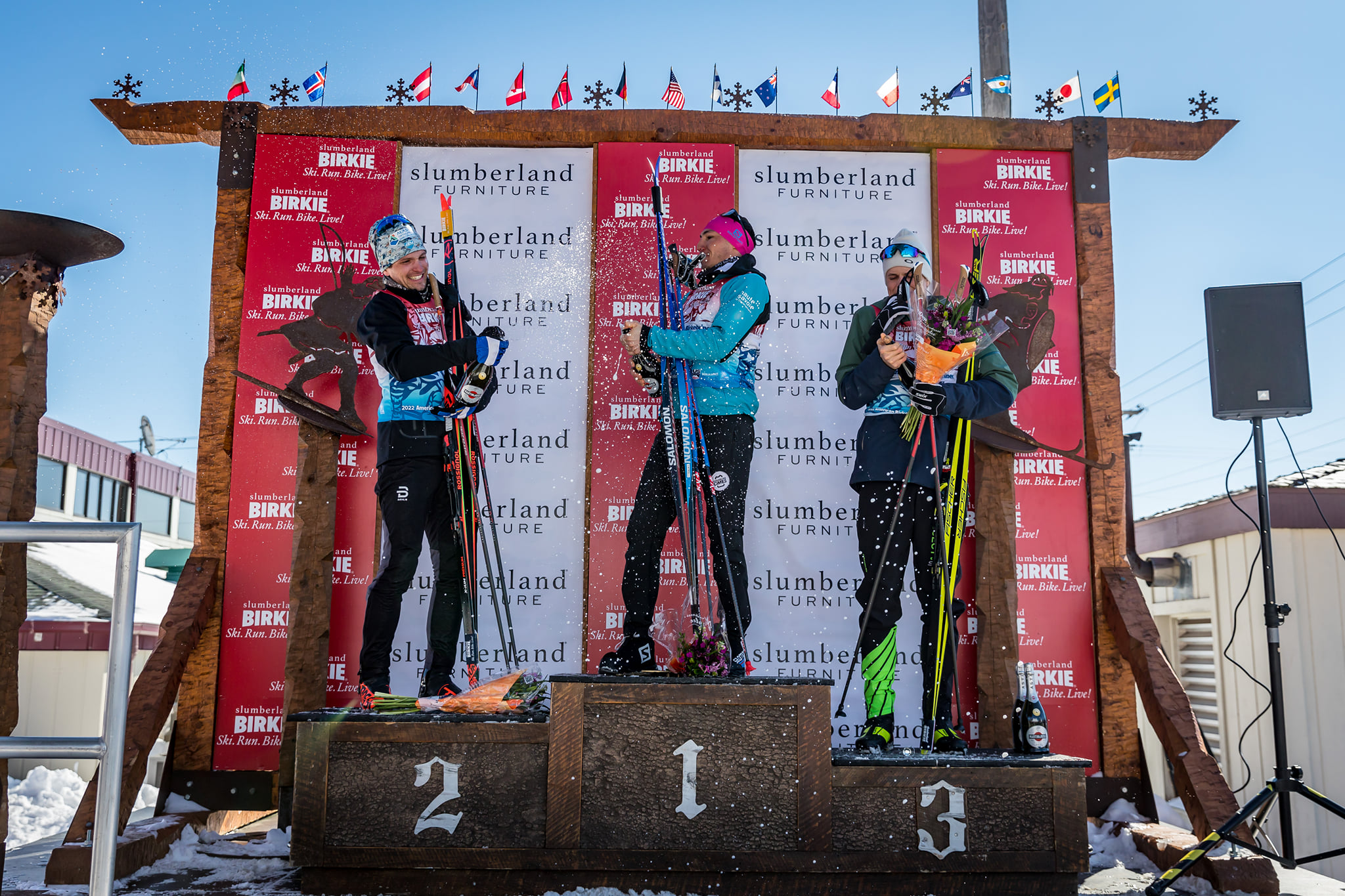
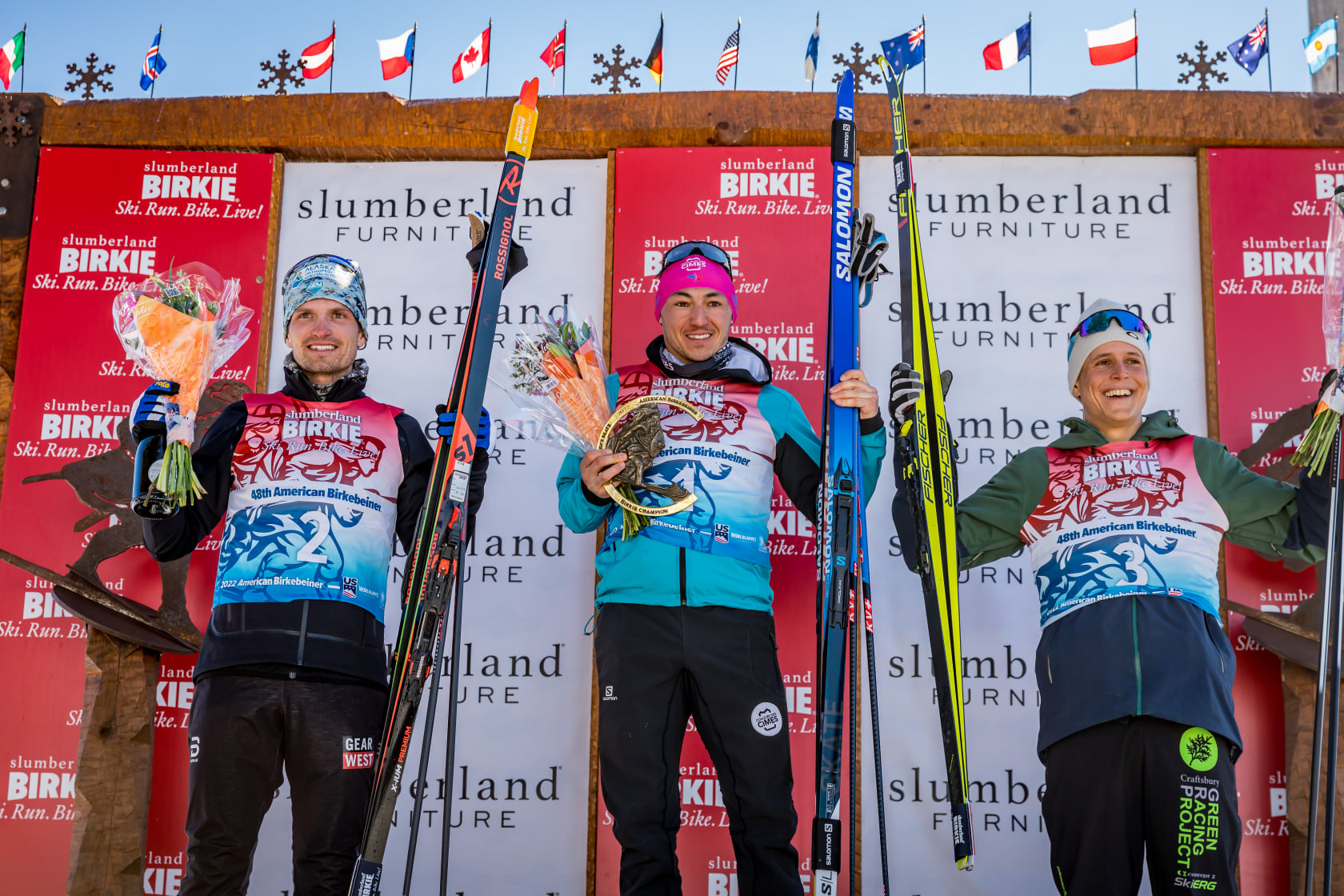
David Norris (USA) sips champagne atop the American Birkebeiner podium last Saturday. Norris heads to World Championships this week. (Photo: (c) 2023 American Birkebeiner Ski Foundation)
HOUGHTON, MICHIGAN: Welcome to FasterSkier’s on-location coverage of the United States National Cross-Country Ski Championships from Houghton, Michigan.
This week, Houghton hosts the U.S. National Cross-Country Championships on the Michigan Technological University’s trails system. Today’s event is the 20-kilometer classic mass start.
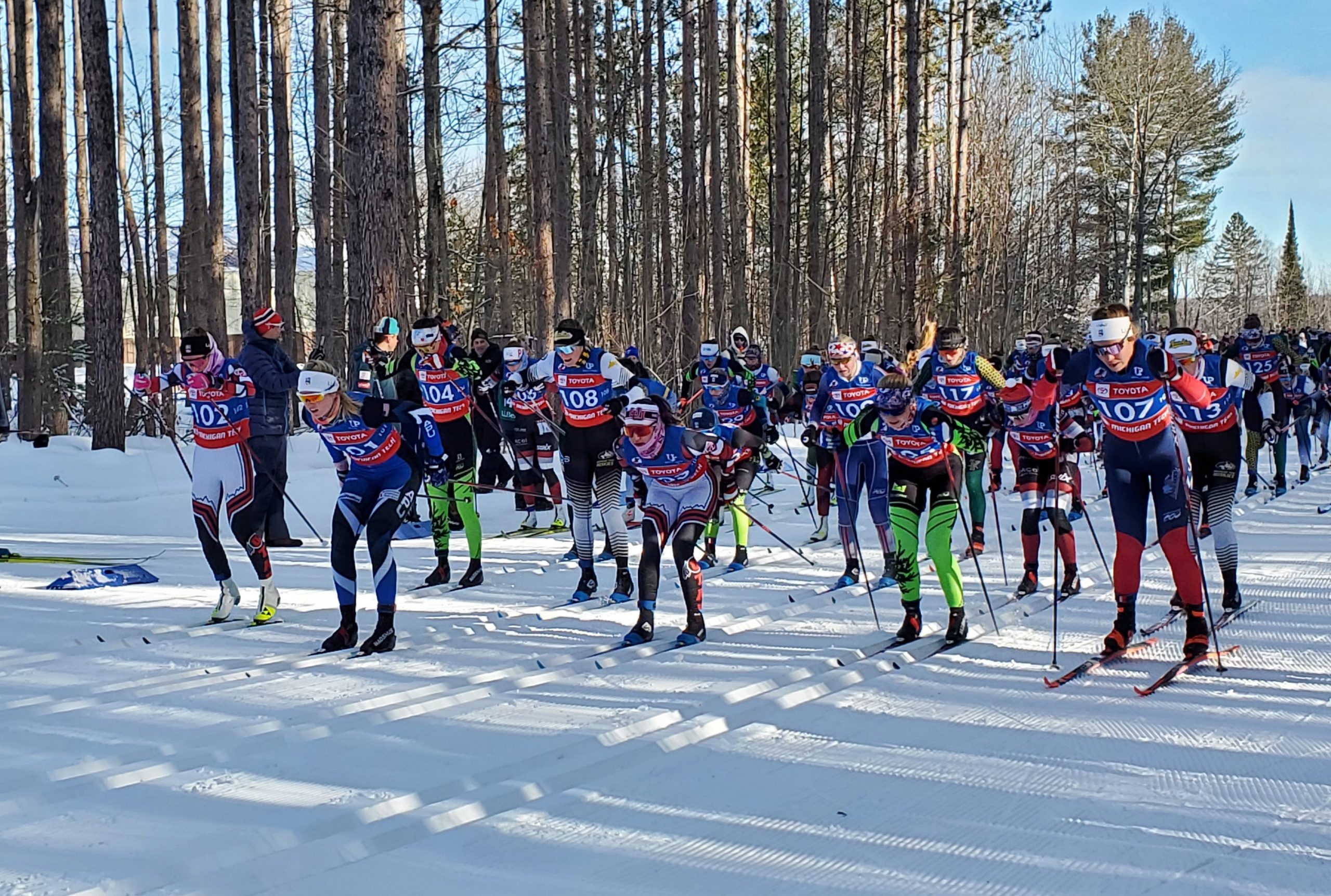
Hailey Swirbul leads out the women’s charge at the beginning of the 20-k classic mass start in Houghton. (Photo: FasterSkier).
There were several questions to be answered at the beginning of the day: the women’s side has been dominated by Hailey Swirbul. Swirbul has won the two previous races, the 10-kilometer individual start skate, and the classic sprints. Would Swirbul be able to complete the three-peat by winning today’s long classic race, which would give her a first place in sprint, middle, and long distances?
The men’s results have been on the opposite side of the spectrum. There have been six different men standing on the podium so far. Would any man be able to claim a repeat podium position?
Finally, the weather was not a dominating factor as overnight temperatures were in the teens, with highs in the upper twenties. Unlike the night before the sprint races, the wax technicians could actually get some sleep. The men’s race started at 9:30 and by then conditions were beautiful. The sky was blue, the temperatures were in the mid-twenties, and the wind was calm; for January in the Keweenaw, it could be called unusual.
The classic course was a 5-kilometer loop with challenging corners and descents, and long very steep climbs.
Hailey Swirbul on her way to a Houghton three-peat. (Photo: FasterSkier).
The Results
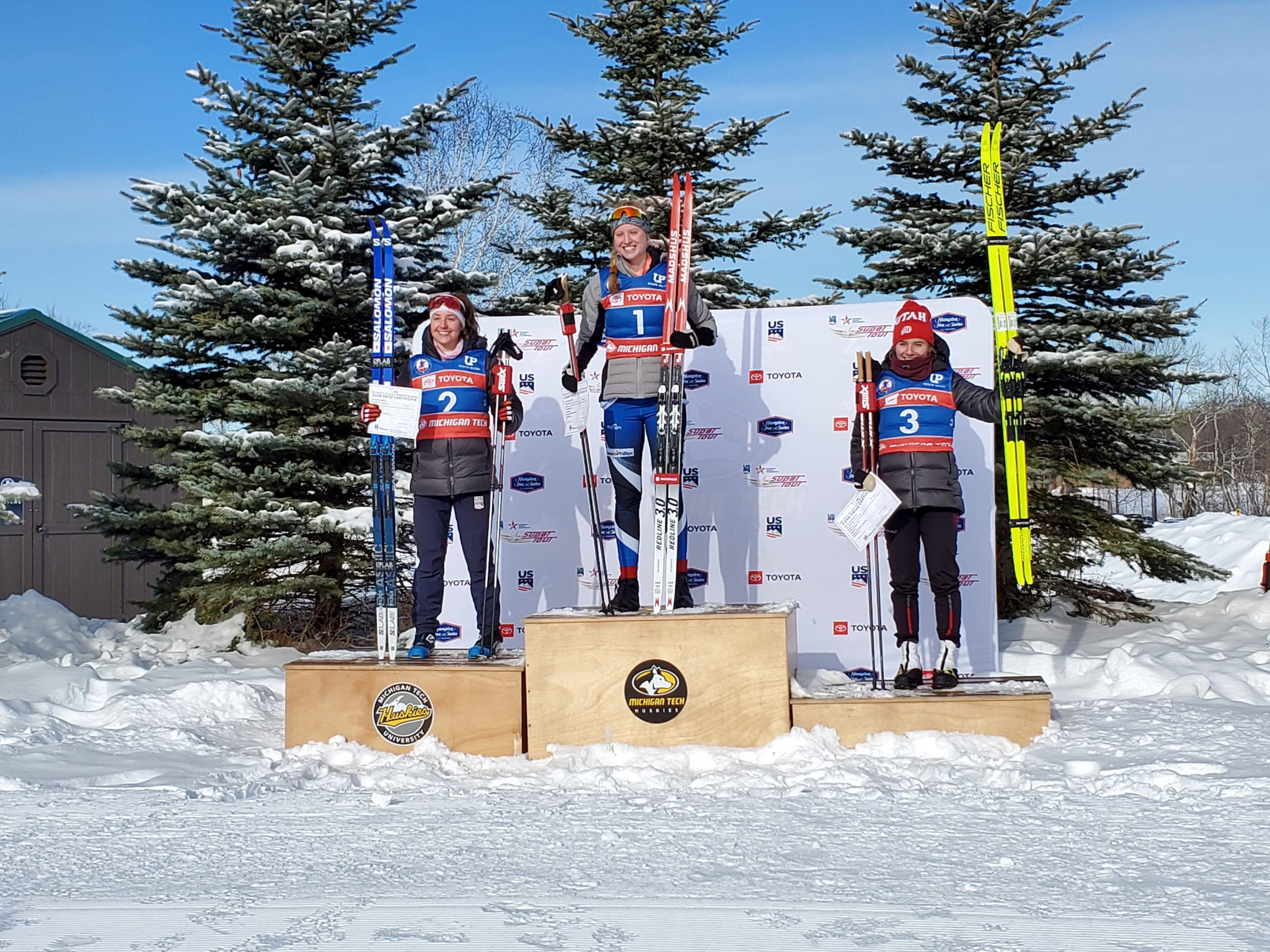
In a thrilling women’s race, Hailey Swirbul (APU Nordic Ski Center) did pull off the three-peat by beating out Sydney Palmer-Leger (University of Utah), by four-tenths of a second. Novie McCabe finished third, less than 10 seconds out of second place.
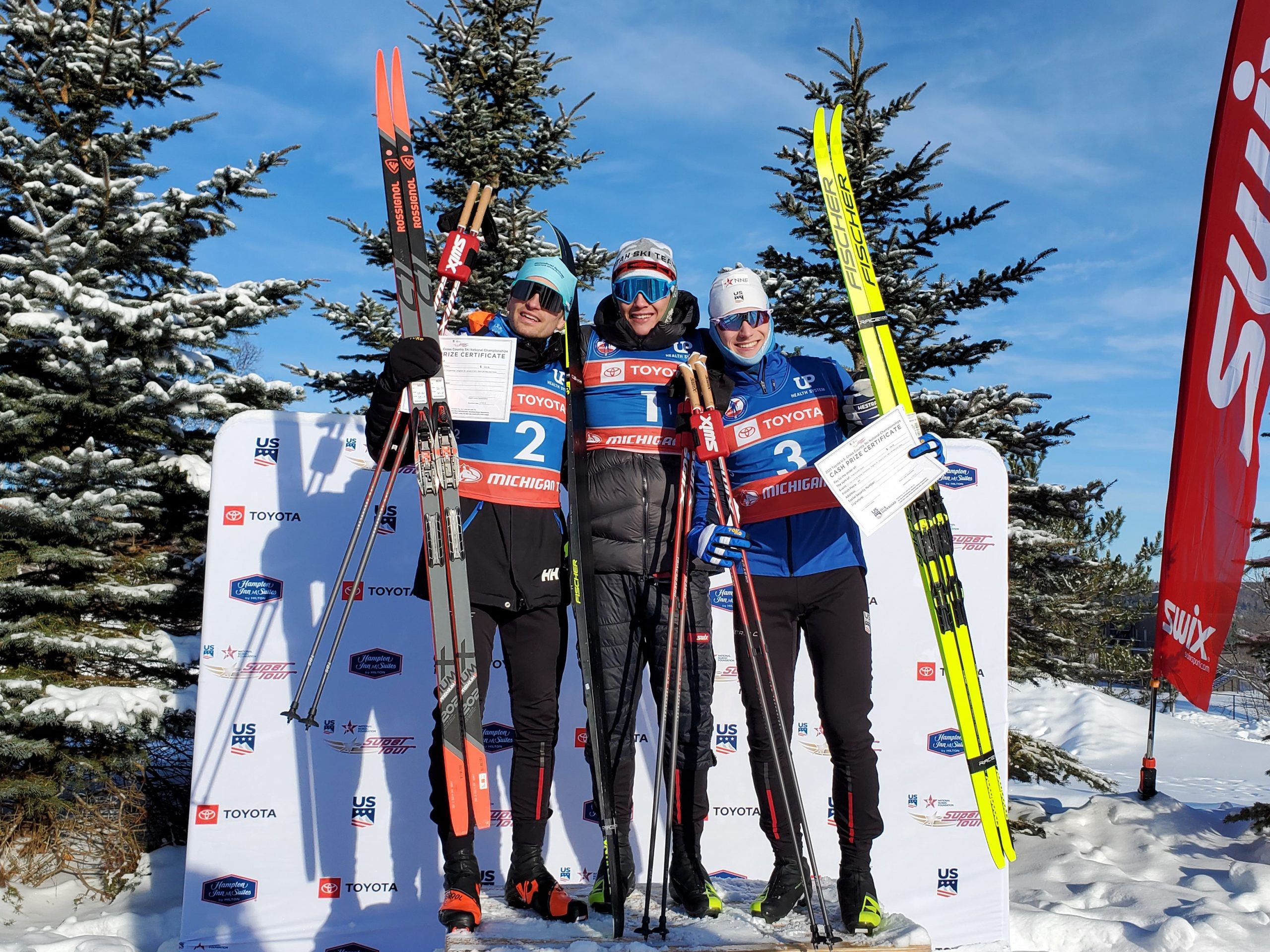
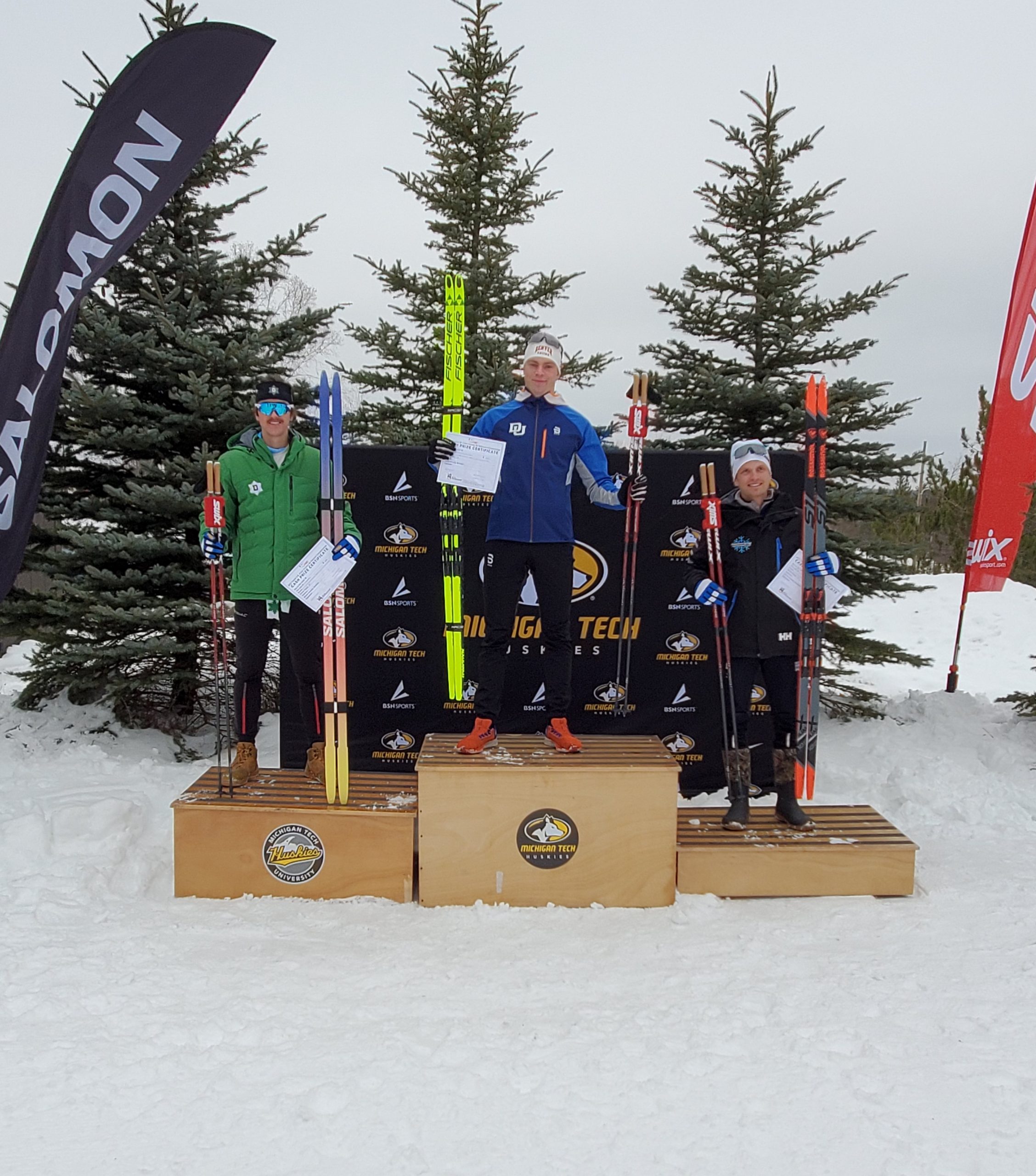
For the men, Luke Jager (University of Utah) claimed another podium, finishing first. Two seconds behind him, in second, was distance phenom David Norris (Steamboat Springs Winter Sport), and in third was Zanden McMulllen (APU Nordic Ski Center).
Men’s 20 k Mass Start
The men’s competition took an unexpected turn when the lead pack was broken apart early on the second lap by a large crash. Jager told FasterSkier, “There was a big crash on the second lap, a few skiers went down, most notably Andreas [Kirkeng], and he had been hitting the pace the entire first lap. I was in front of Andreas, it was on a downhill, I was pulling out for the sharp turn, and he also did, we kind of clipped each other skis. You never want that…it’s a big bummer. Suddenly it was me and David [Norris] off the front. It really disrupted things.” Jager was able to adjust on the fly, and after the crash it was a group of four skiers until the end.
Luke Jager celebrates the victory in the 20-K Classic. (Photo: FasterSkier).
Andreas Kirkeng (University of Denver) told FasterSkier that after the fall he couldn’t close the gap.
“I broke a pole, and my binding popped off, so I had to stop on the downhill to put my binding back on. I was skiing with one pole for a while, it was unlucky”. Andreas Kirkeng
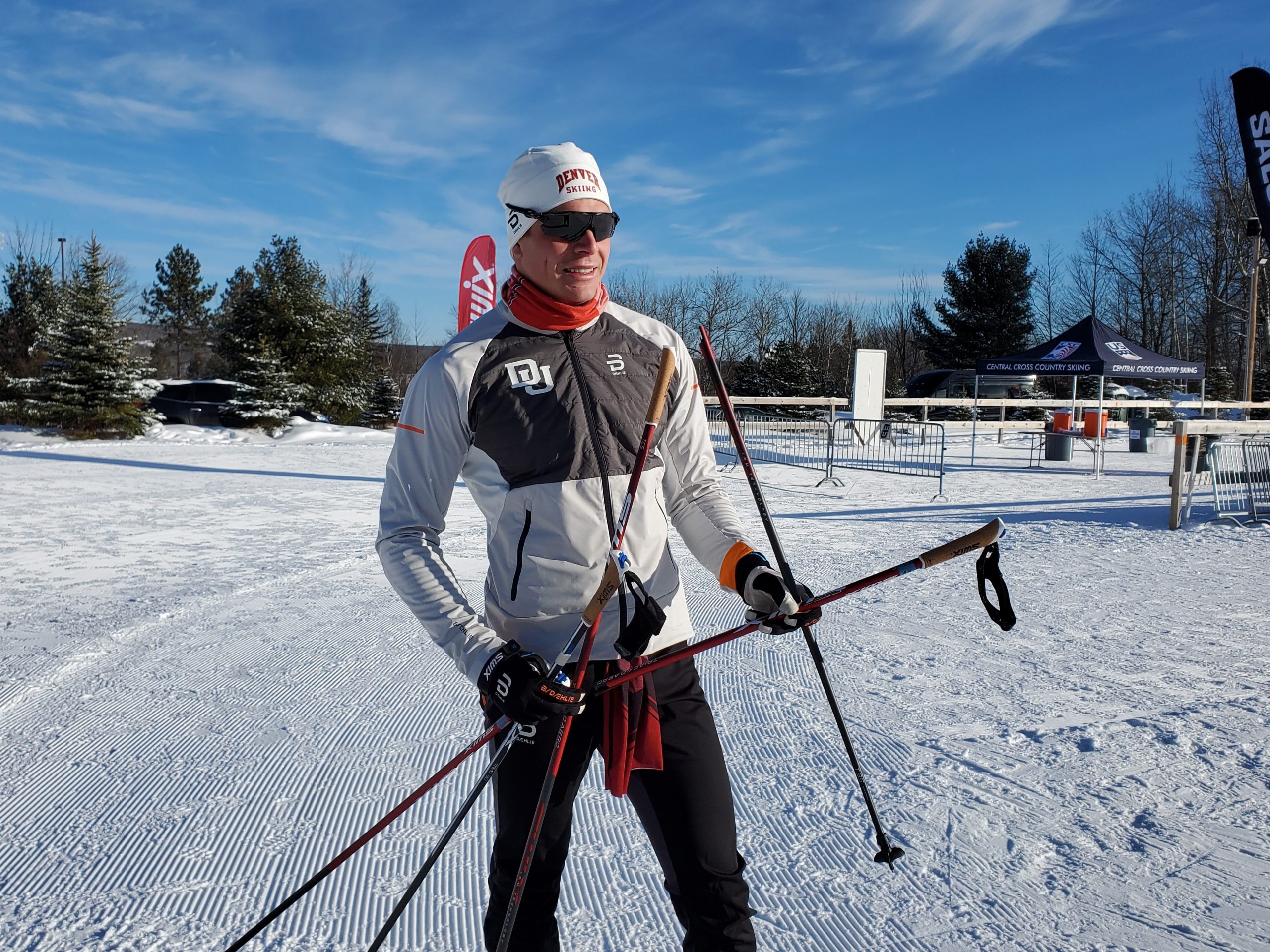
Andreas Kirkeng shows the evidence—a broken pole—from an early crash that knocked him out of contention. (Photo: FasterSkier).
As the race wound down to the last few kilometers Norris pushed the paced. Jager told FasterSkier that, “Thankfully I had enough left in the tank to get a little bit of a gap in the last climb. If it came to a battle of just grinding as hard as we could, I knew I wasn’t going to win.”
The weather did affect tactics when it came down to ski choices. The favorable conditions allowed Jager to optimize his ski choice. “I picked a little bit of a softer ski,” he said. “It was a little easier to kick.”
The win was meaningful for Jager. “I’ve tried really hard to not be super specialized as not just a sprinter these last few years, to be able to be competitive in all the events,” he said. “To hold with those guys until the end was really rewarding.”
Men’s 20-kilometer classic podium (l-r: David Norris, Luke Jager, Zanden McMullen) (Photo: FasterSkier).
Women’s 20 k Mass Start
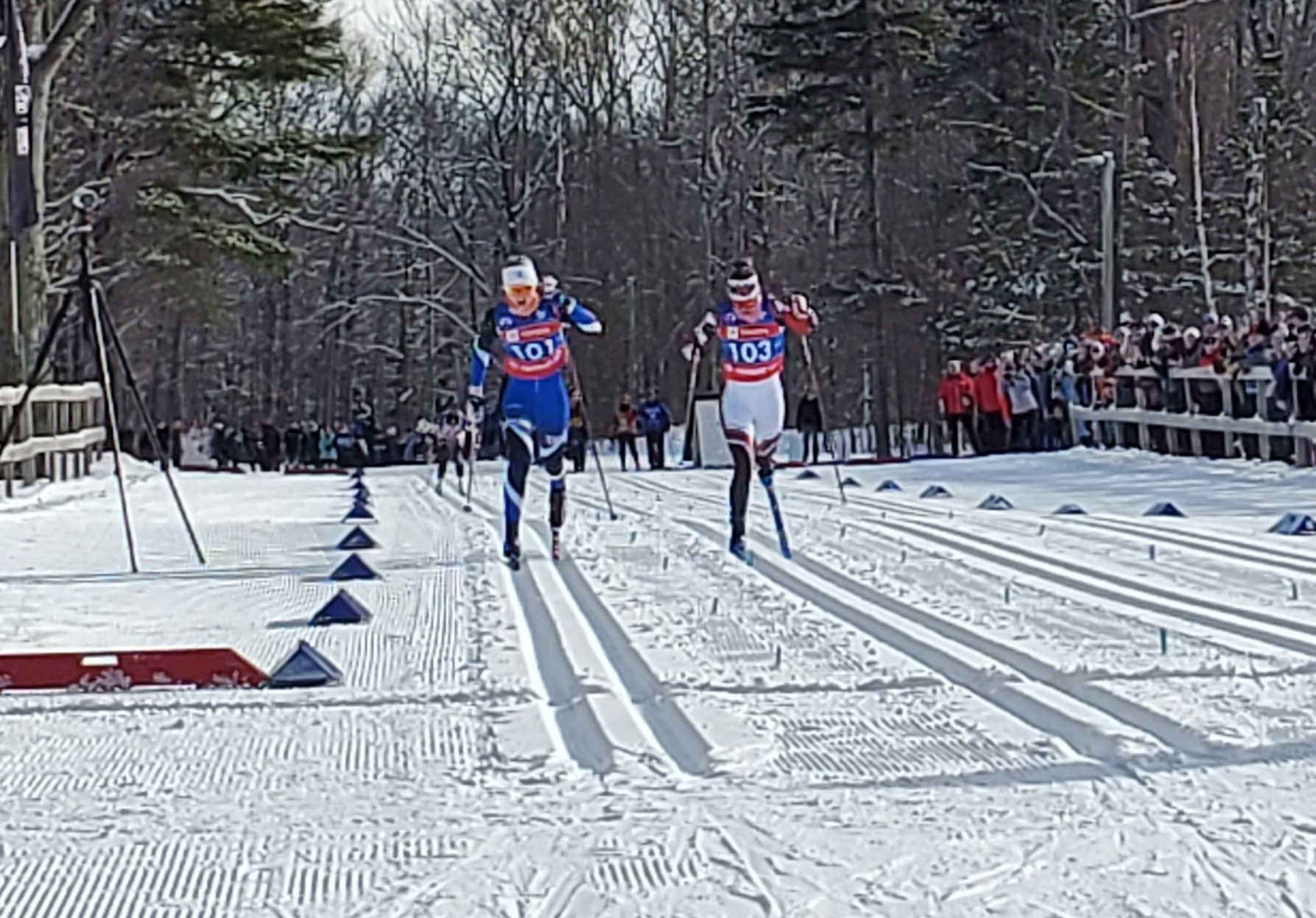
The women’s race came down to a thrilling duel between Swirbul and Palmer-Leger. Ultimately, Swirbul made an on-the-fly tactical choice which enabled her to inch out Palmer-Leger, winning the race by abandoning double poling at the finishing sprint and switching to diagonal stride. The tactical choice enabled her to beat out Palmer-Leger by about a boot length. Second place finisher Palmer-Leger, a junior at University of Utah, noted the difference in technique choice at the finish. “She was striding, I was double poling, it was hard to know what would be faster, right at the end I kind of switched into a run to see if that would work, but it didn’t.”
Swirbul and Palmer-Leger neck and neck at the finish. A last second change to diagonal stride captured the win for Swirbul. (Photo: FasterSkier).
Swirbul said that the top three skiers stayed together for most of the race. “Novie, Sydney, and I became a pod at one point and skied a lot of the last half of the race together.”
Swirbul said that coming into the championships she knew that top results were a real possibility. “The beginning of my season has been going well,” she said. “But you never know. There are so many factors that play into it.” Commenting on the distance Swirbul said,. “20 k is really long. We’ve had [this distance] at nationals, but I don’t do that many of them.”
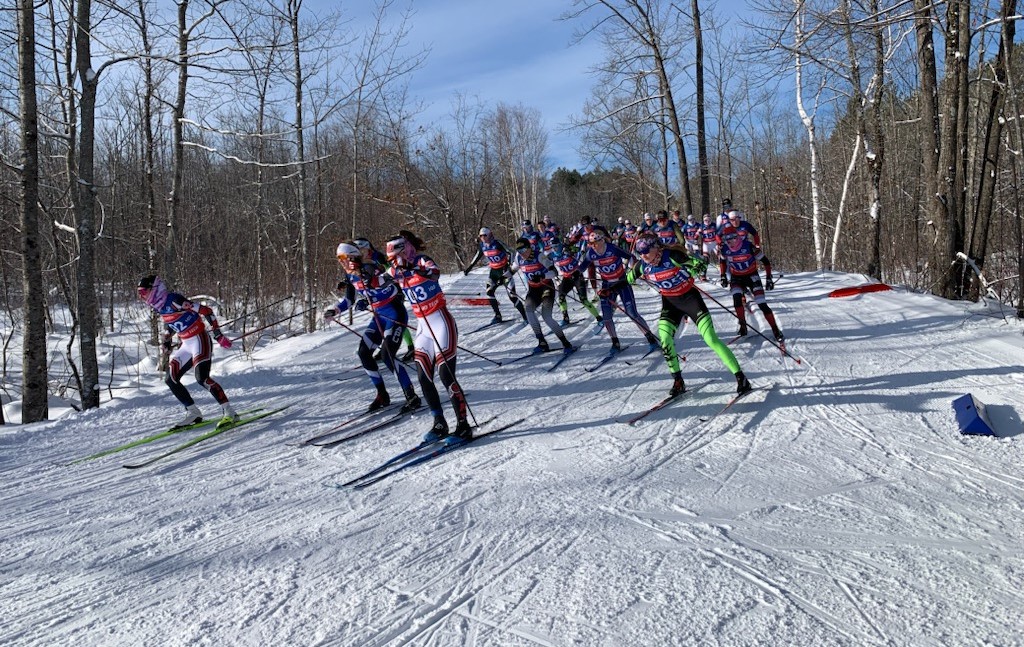
Going into the race, Palmer-Leger’s strategy was to not let the hills wear her down. “I paced it on the hills and tried sitting behind somebody, stay relaxed and focus on breathing,” she said. “A lot of time I get stressed, start to run and use up most of my upper body, so trying to stay relaxed [was important].” Palmer-Leger appreciated the Houghton course noting that, “It’s kind of fun to have something different. It keeps you on your toes when you kind of have to sprint from the start to get in a good lead, so you don’t crash in the corner. I made sure I was in a good spot [to avoid a crash].”
Ute junior, Novie McCabe, told FasterSkier that she tried to push the pace about two laps into the race. That’s when the race turned into a four-skier pack. “My plan was to go on the last lap on the first long hill and get a lead there,” she said. “It didn’t quite happen for me. I kept trying to go on all the hills, but they [Palmer-Leger and Swirbul] were too strong and they blew me away at the end. I was kind of hanging on a by a thread there for a while.” After the race week concludes, McCabe will focus on the U-23 championships in Whistler.
Crowded corners challenged racers on a tough Houghton course for the U.S. Nationals. (Photo: Amy Kostrzewa).
Houghton provided a beautiful day for a classic race, and the racing was equally spectacular.
HOUGHTON, MICHIGAN: Welcome to FasterSkier’s on-location coverage of the United States National Cross- Country Ski Championships from Houghton, Michigan.
This week, Houghton hosts the U.S. National Cross-Country Championships on the Michigan Technological University’s trail system. The U.S. Nationals mean many things to different competitors. For some, it’s their initiation into the world of high-end competitive ski racing; for others it’s their chance to burnish their credentials; and for still others it’s a combination of competition and enjoyment of skiing.
Today’s competition was the 10-kilometer individual start freestyle race. The women’s race was first, starting at 9:30, followed by the men’s start at 12:30.
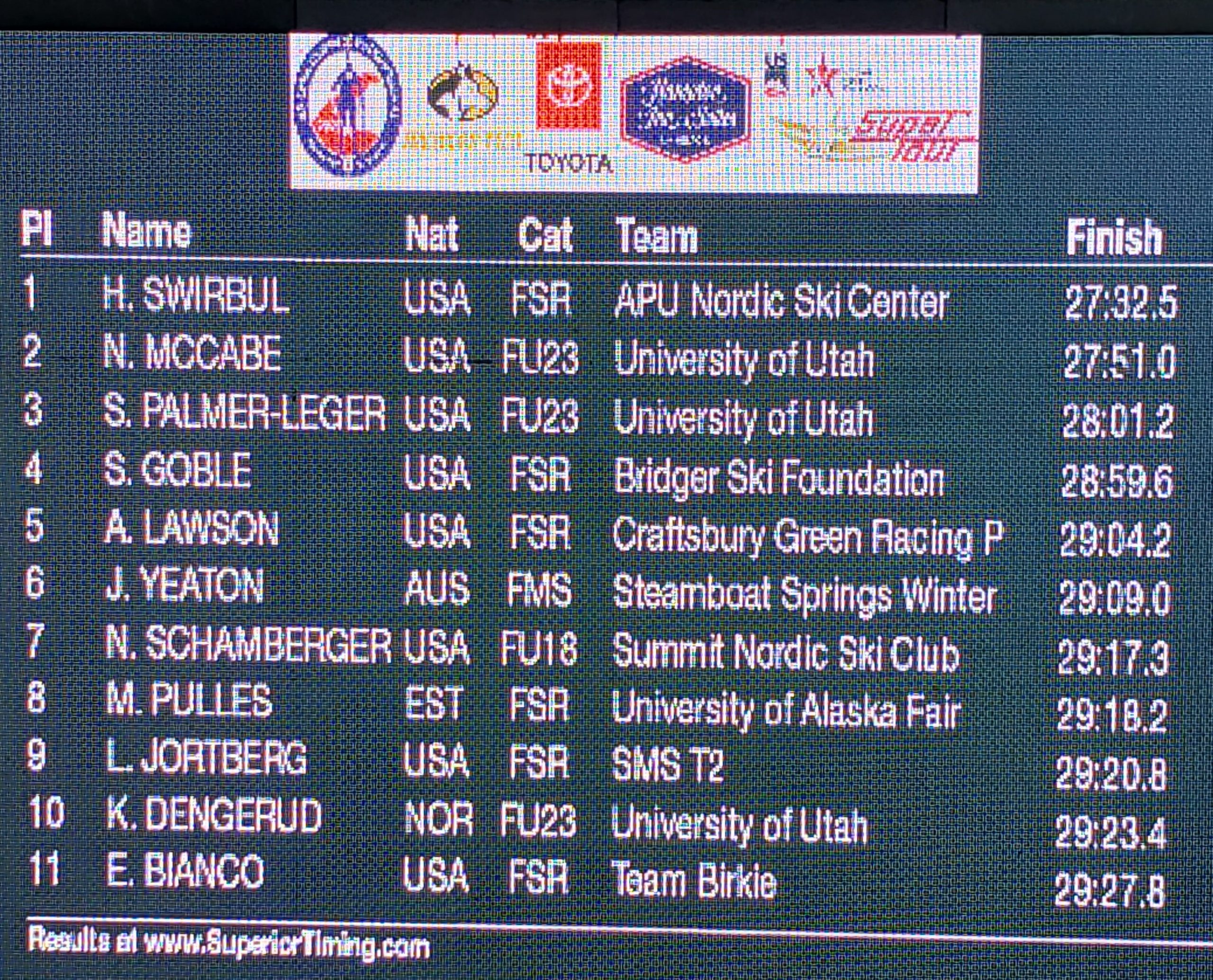
Top ten results, Women’s U.S. nationals (Photo: FasterSkier)
The weather in Michigan’s Upper Peninsula has been extremely atypical for this time of year with temperatures hitting almost 40 degrees and only dropping to freezing in the evening. Fortunately, a deep snowpack provided good conditions. With temperatures hovering around freezing with moist snow, it would have been disastrous for a classic race, but today, the conditions were fast and forgiving, close to ideal for a skate race.
U.S. Nationals, Men’s results. (Photo: Fasterskier)
The Results
The women’s competition was won by US National Team member, Hailey Swirbul (Alaska Pacific University Nordic). She was followed in second by National Team member Novie McCabe (University of Utah), with Sydney Palmer-Leger (University of Utah) in third.
The men’s first-place finisher was Andreas Kirkeng from Norway (University of Denver). In second place was John Steel Hagenbuch, (Dartmouth College), and in third place was David Norris (Steamboat Springs Winter Sports).
Men’s podium U.S. Nationals (l-r John Steel Hagenbuch, Andreas Kirkeng, David Norris. (Photo: Fasterskier)
The Race
The men’s race was dominated by the Norwegian, Kirkeng, a college sophomore who won by over 30 seconds. It was a performance made all the more impressive by the fact that as Kirkeng told Fasterskier, he had returned from Europe only five days prior to the race, having travelled home for the holidays. Kirkeng lives 30 minutes from Oslo, and had spent the holidays in the mountains.
It was the first time on these trails for the Norwegian who professed a liking for the course. Kirkeng told Fasterskier that, “The course is really broken into two parts, long straight ups and downs where you really just have to find the flow, and the second half is short kickers with a lot of transitions, you really have to be on top of everything and work hard for it.”
He also told Fasterskier that he had tried out some strategies yesterday with race prep intervals, but that, “There’s no real resting point, so you have to ski smart and save energy where you can. Save some on the uphills and really pursue the turns.”
The moist snow didn’t faze the Colorado student since it’s very similar to what he has at home in Norway. For the young Norwegian, the podium is a foundation for his young career.
Andreas Kirkeng charging onto lap two as he heads toward victory. (Photo : Fasterskier)
Second place finisher Steel Hagnenbuch, a Dartmouth freshman, told FasterSkier that he was familiar with the course having skied it as a junior in 2020. “It skis almost like an altitude course in that there’s a lot of sustained working sections,” he said. “I thought it was really important to be strong and composed in the working section, that’s probably four minutes of big V-2 work.”
US Ski Team veteran David Norris—who was pulling double duty as both a racer and a coach for S.S.W.S.—told Faster skier that he was, “Grateful to the club letting him coach and race simultaneously.” Norris’s strategy was, “To settle in on the climbs and work all the gradual rolling stuff.” Norris’ experience was able to bring some perspective to the fact that fluoro waxes were not allowed in this race. It was Norris’s first time at a National Championship level race without fluoro waxes. “With a two lap course, it’s really interesting,” he said. “You can see where you glided to on the first lap compared to the second lap. With the new waxes, it seemed like they slowed down after 5 k, but it was quick snow.”
David Norris on his way to a podium in Houghton. (Photo: FasterSkier)
Norris expressed a theme repeated by skiers through the day: “Racing U.S. Nationals is the absolute best. It’s awesome, 50% of the faces here are familiar and friends . . . I like being here with all of my friends.”
The theme of fun mixed with competition was repeated by women’s champion, Swirbul.
“I’m so happy to be here. It’s not that the pressure or expectations go away, but there’s so many positive things about the ski community as a whole here … getting to see kids of all ages racing and seeing parents cheering. That environment makes me fall in love with skiing again.” Hailey Swirbul
Swirbul agreed with Steel Hagnenbuch that the course feels like skiing at altitude. She said, “It’s super sustained most of the way, it reminds me of altitude racing actually. You have to continuously grind the whole way.” She continued that, “This is my fourth or fifth time in Houghton; it’s always fun to come here and push your limits with the best skiers in the country.”
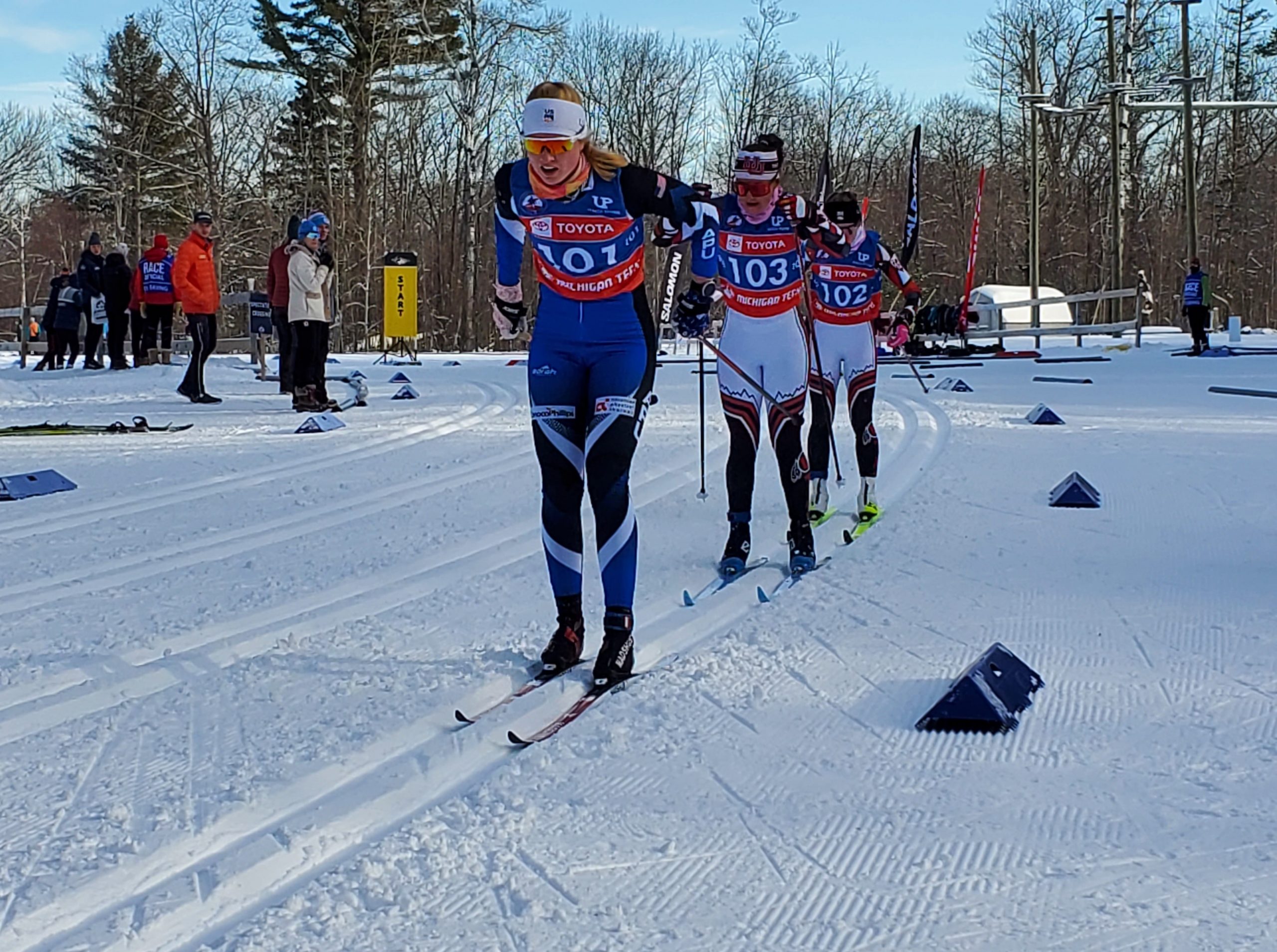
Hailey Swirbul starting her journey on the way to first place. (Photo: FasterSkier)
Fourth place skier Sarah Goble (Bridger Ski Foundation) attended MTU. She told Fasterskier the home field advantage definitely helped. “I skied here almost every day for three years. It’s really cool to be back in Michigan.”
APU coach Galen Johnston reiterated how the U.S. Nationals mean different things to different racers. “For some it’s a chance to come and establish the work that’s been done over the course of the year,” he said. “For some it’s a first time here, just coming and seeing what it’s all about.” He continued that for the first timers it’s “A chance for them to get full service from the ski perspective, and a chance to race with the best in the world. It’s a learning experience, so they can see what the next level looks like.”
The carnage that awaits finishers at Houghton (Photo: FasterSkier)
All racers and coaches Fasterskier spoke with had high praise for the venue, the quality of organization and conditions. Racing in Houghton continues on Wednesday with Men’s and Women’s Classic Sprints. Tune in to FasterSkier for livestreaming and race coverage.
The sport of trail running is growing. With more specialization, sponsorships, and media attention, the scale of competition changes. The Golden Trail World Series, which launched in 2018, is helping guide this growth. With a world series circuit, national series, and a championship, the Golden Trail World Series (GTWS) “exists to celebrate and evolve trail running as a sport.” Given that trail races can be roughly anywhere from 5 k to 330 k and with a range of national and private circuits, the idea with the GTWS was to provide a competition for the top trail athletes to compete in year after year.
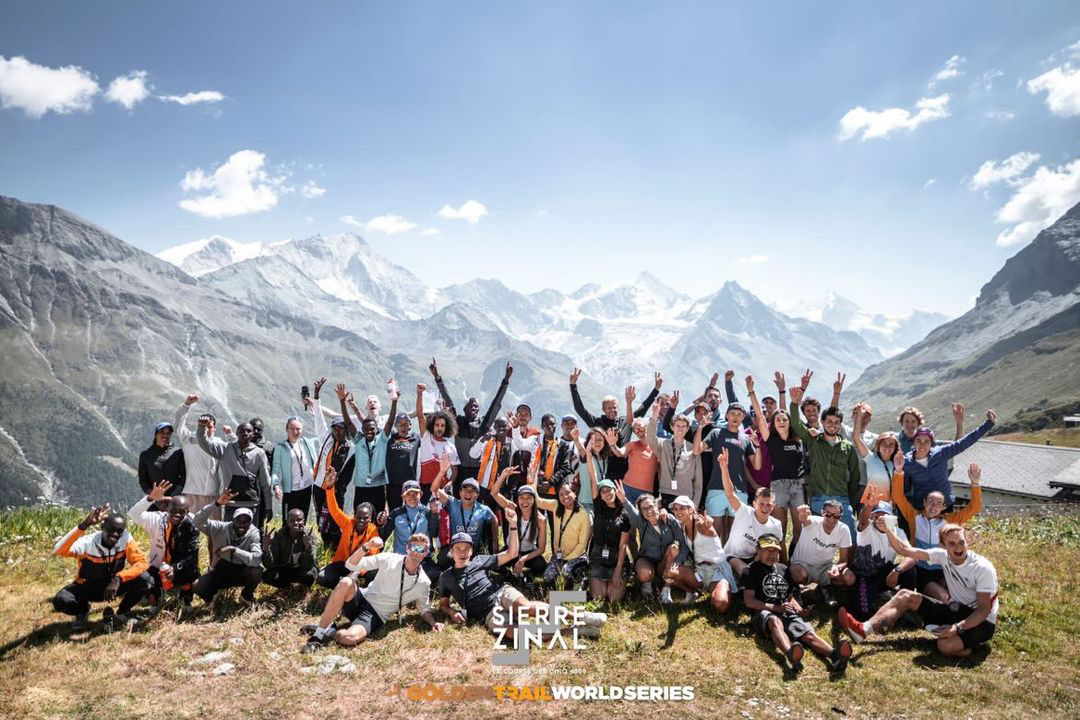
Golden Trail World Series competitors pose together before Sierre Zinal in Switzerland (photo:@goldentrailseries)
The GTWS combines a circuit of the best-known 21 to 42 kilometer races in the world and draws the best athletes to compete. In practical terms, the Golden Trail World Series could be considered a trail world cup. The man behind the vision, Gregory Vollet, sees the GTWS as a way for more professional athletes to be able to make a living from running, as broadcasting helps grow viewership and thus sponsor interest. In an interview earlier this summer, Vollet said, “currently the rate of athletes who have a real financial contract is very low. The Golden is designed to help them: them, the athletes, and the sport. This is its raison d’être and it will remain so.” With four GTWS completed this summer, the next two events will be happening in the U.S. in September before the five-stage series finale in Madeira at the end of October.
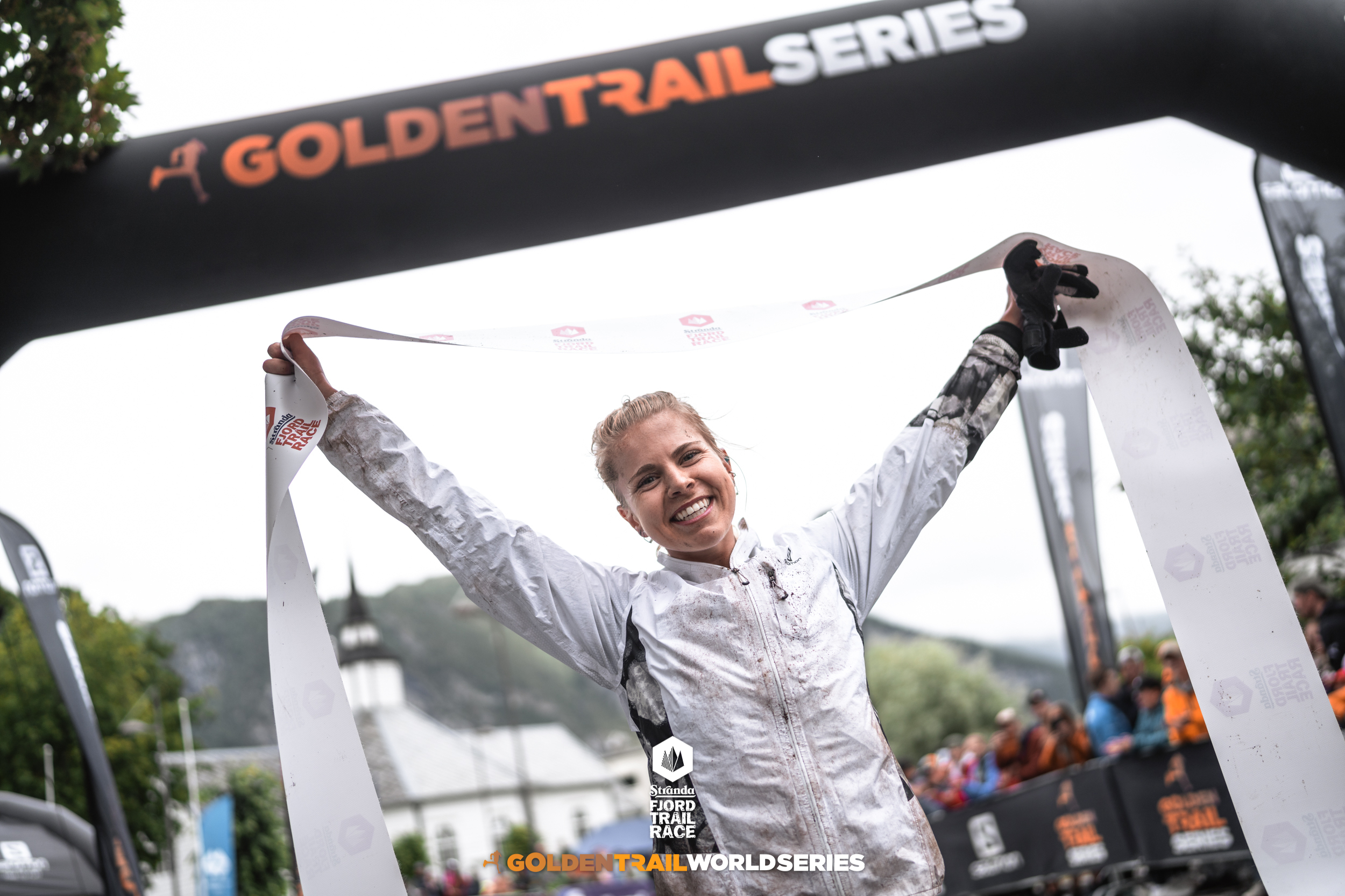
Sophia Laukli is all smiles after winning her first-ever Golden Trail World Series event (photo: @goldentrailseries)
In an email to FasterSkier, Laukli shared her thoughts on the GTWS experience, saying “the environment was very intense, but also fun and exciting all around, similar to ski races I would say.” Having never met or competed against the other women was initially a little daunting but Laukli said, also “made it a bit more exciting.” She remarked that, “All the runners ended up being very nice and stoked for each other which is always great. It stood out to me too that the top ten women were almost all from different countries, which was pretty sweet to see.”
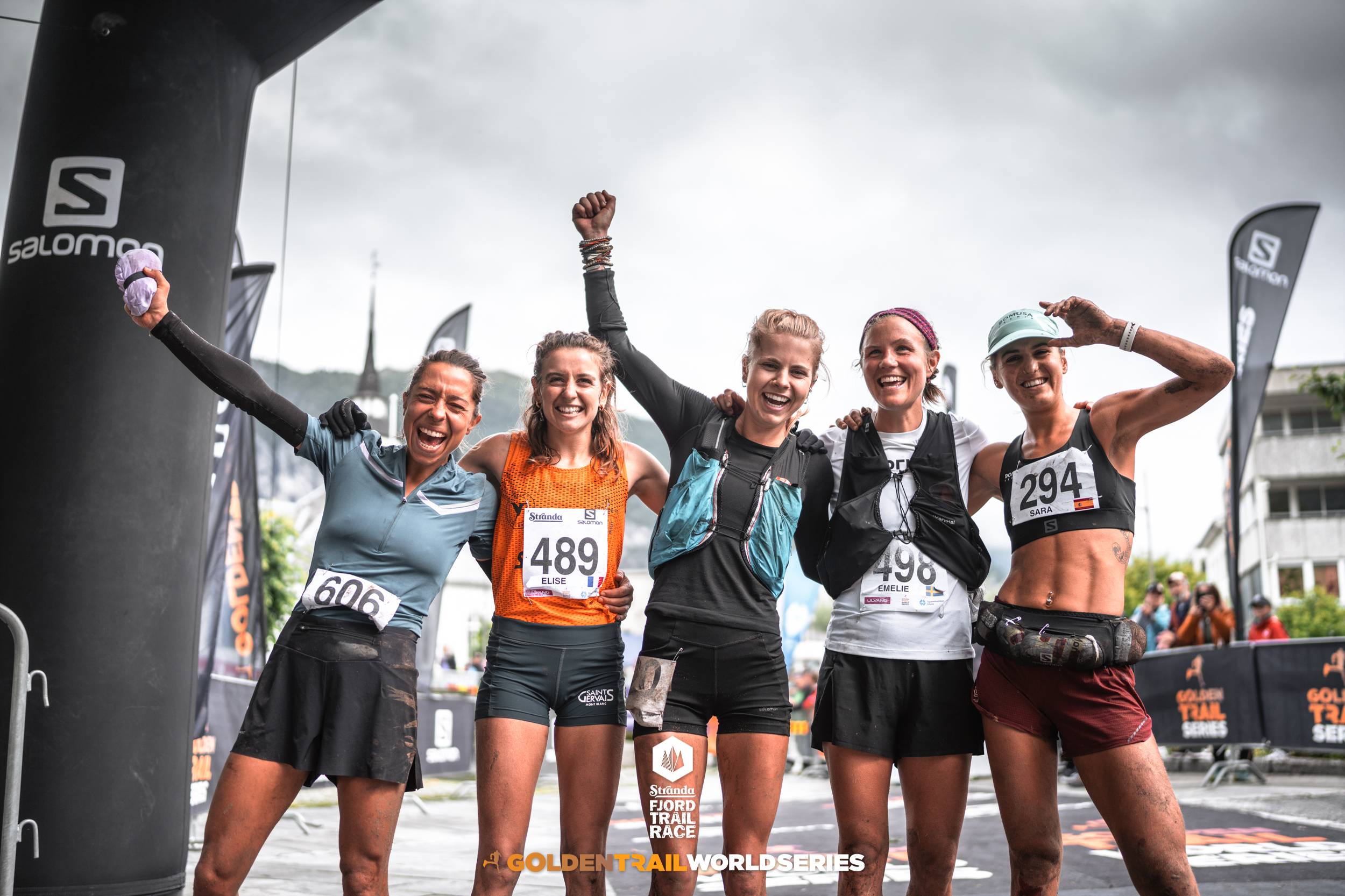
Stranda Fjord women’s top-five finishers: Blandine L’hirondel (FRA), Elise Poncet (FRA), Sophia Laukli (USA), Emelie Forsberg (SWE) and Sara Alonso (ESP) from left to right. (photo: @goldentrailseries)
According to the race description, the Stranda Fjord 25 k “takes you on a wild ride in the Norwegian fjords. This course has everything from fast and flowy trails, steep climbs and technical downhill running.” With 1700m (5,577 ft) of climbing, there was plenty of vertical to be found as well. Laukli described the race as “crazy technical.” She wrote, “I had done part of the course a couple days before so I knew what was coming, and I was pretty terrified on the start line. There was a lot of discussion about the strong technical skills of the other runners before the race, so I knew there would be tough competition since I knew I struggled with technical terrain myself.”
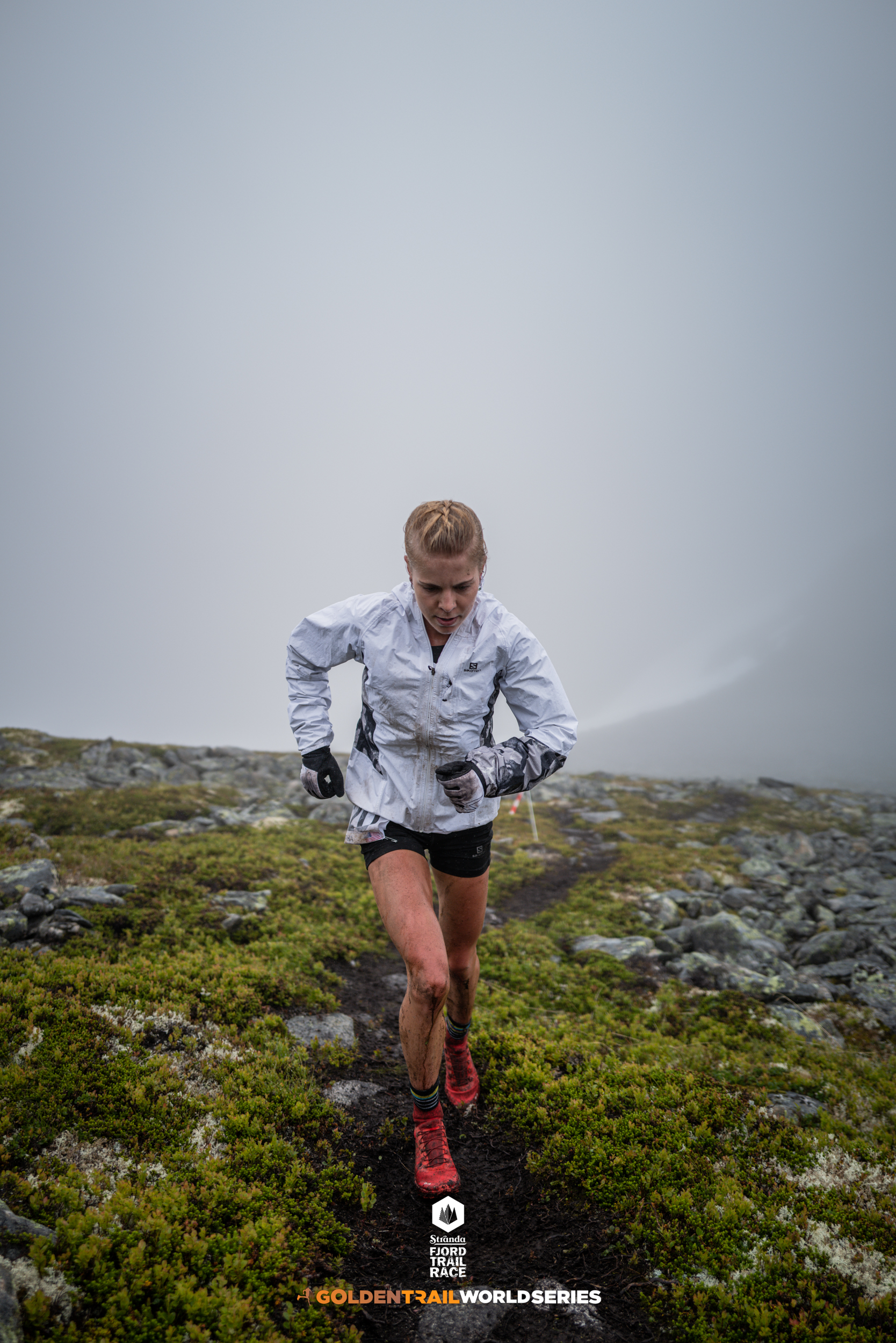
In soggy conditions with minimal visibility, Sophia Laukli leads the women’s race (photo: @goldentrailseries)
Knowing that about herself, Laukli made a plan to go hard out of the start in an effort to make up time on the climbing sections. The plan worked, “I had a pretty large gap at the final peak,” Laukli shared, “so I did everything in my power to stay on my feet and keep moving on the descent. The first boulder section was brutal and slippery but luckily I avoided any crashes. The course then moved along to basically a long mudslide, and then the hardest part for me ended up being the marsh for the last part of the course, which seemed to last forever.”
Nearing the finish, Laukli began to suffer, realizing that she hadn’t been eating or drinking enough throughout the race. She wrote, “I bonked pretty hard the last 45-ish minutes in the marsh, and that’s when I no longer stayed on my feet, but it was just face plants in the mud so no injuries involved. I was really just playing catch up until the finish and hoping none of the other women would come fly by me. I was absolutely exhausted at the finish, but managed to hold off the rest of the field, although many of them did make up some time on me on the whole descent. Once I crossed the line, I was honestly very shocked I had won, but it was a great feeling! It felt so rewarding to be done after probably the hardest race I had ever done.”
When asked about maintaining a balance between ski training and trail racing, Laukli said that the two go well together. She wrote, “I haven’t changed much about my ski training this summer just because I have always incorporated quite a bit of trail running into my plan for skiing. In the week or so leading up to my running races, I do sometimes have a little more running focus at least for the intensity, just for some last prep, but the majority of my training is still a lot of roller skiing. It’s very helpful to have the roller skiing aspect to prevent running injuries and keep building a solid base, so I feel the two are very compatible and cross over well. I wasn’t sure how it was going to work initially, but so far it seems to be working well to combine the two.”
Originally, Laukli’s plan was to travel to Switzerland for the next stage of the GTWS at Sierre Zinal before heading to Sweden to join the U.S. Ski Team for a camp there. Unfortunately, she caught COVID just after the Stranda race, meaning that plan was out. Instead, Laukli will be traveling back to Utah in preparation for the start of the school semester at the end of August and competing in a couple more running races later in September.
Laukli’s University of Utah teammate, Sam Hendry also shared some thoughts with FasterSkier about his recent racing experiences. Before traveling to Europe, Hendry won a stage of the U.S.-based Cirque Series, in Brighton, UT, which he described as a “good training race.”
Sam Hendry closes in on the finish line at the end of the Stranda Fjord 25 k (photo: @goldentrailseries)
Heading across the Atlantic, Hendry touched down in Norway, ready for his GTWS debut. “The Golden Trail World Series is pretty cool,” said Hendry, “it is essentially the World Cup of trail running.” About his performance in the Stranda 25 k Hendry shared, “Stranda was a crazy technical and challenging course, but I was very happy to finish in the top ten.”
The men’s top-ten from Stranda Fjord, won by Jonathan Albon (GBR), with Sam Hendry in 10th (far left) (photo: @goldentrailseries)
From there, Hendry moved with the rest of the GTWS circuit to Switzerland for the 50th edition of the famous Sierre Zinal race. Hendry wrote, “[Sierre Zinal] was much more straightforward but still super hard, being a 31 k with 2100m (6,890 ft) of vertical. I had a terrible climb but got into a rhythm at 11 k and managed to move up into 22nd. I’m pretty happy with the two weekends of racing here in Europe.”
***
In other domestic running news, Scott Patterson held onto his title as victor of the Crow Pass Crossing, earning his 8th win (6th in a row). Patterson finished the 22.5 mile race in a time of 3:04:07, running in challenging weather conditions. His fellow APU teammate, Ari Endestad, finished in third place, +28:35 behind Patterson.
In the Alyeska Cirque Series on July 30th, former U.S. Ski Team D-Team member and current UAF athlete, Kendall Kramer won the female division in a time of 1:24:26. On the men’s side, Patterson won (1:07:02) ahead of Micheal Earnhart (U.S. Ski Team D-team & APU) and David Norris (APU). Norris also competed in the Snowbird Cirque Series on August 6th and finished in sixth place, while continuing his recovery from a bruised heel that hinders his ability to run downhill quickly.
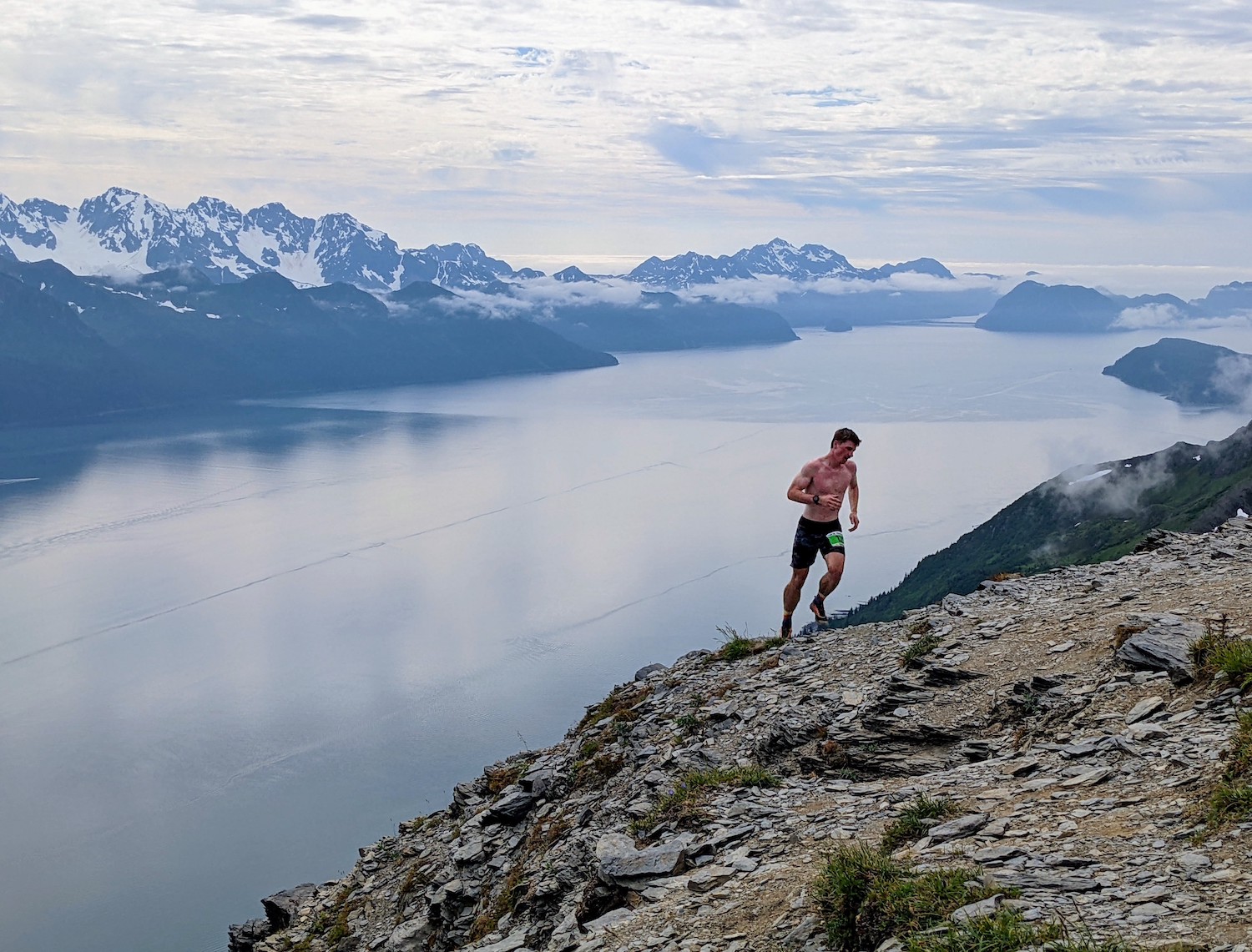
Thomas O’Harra (APU) approaches the turnaround point in the 2022 Mt. Marathon race above Seward, Alaska. (photo: Anna Engel)
Occurring annually on the 4th of July, and touted as the toughest 5 k on the planet, the 94th edition of the Mount Marathon race took place this past Monday in Seward, AK. Needless to say, the race is a storied tradition, beginning with its first “official” running in 1915. Over the years, participation has increased to such an extent that these days there are a number of complex ways for race entrants to register, including selection through a lottery system, petition for a race spot, or even buying a bib at a last-minute live auction.
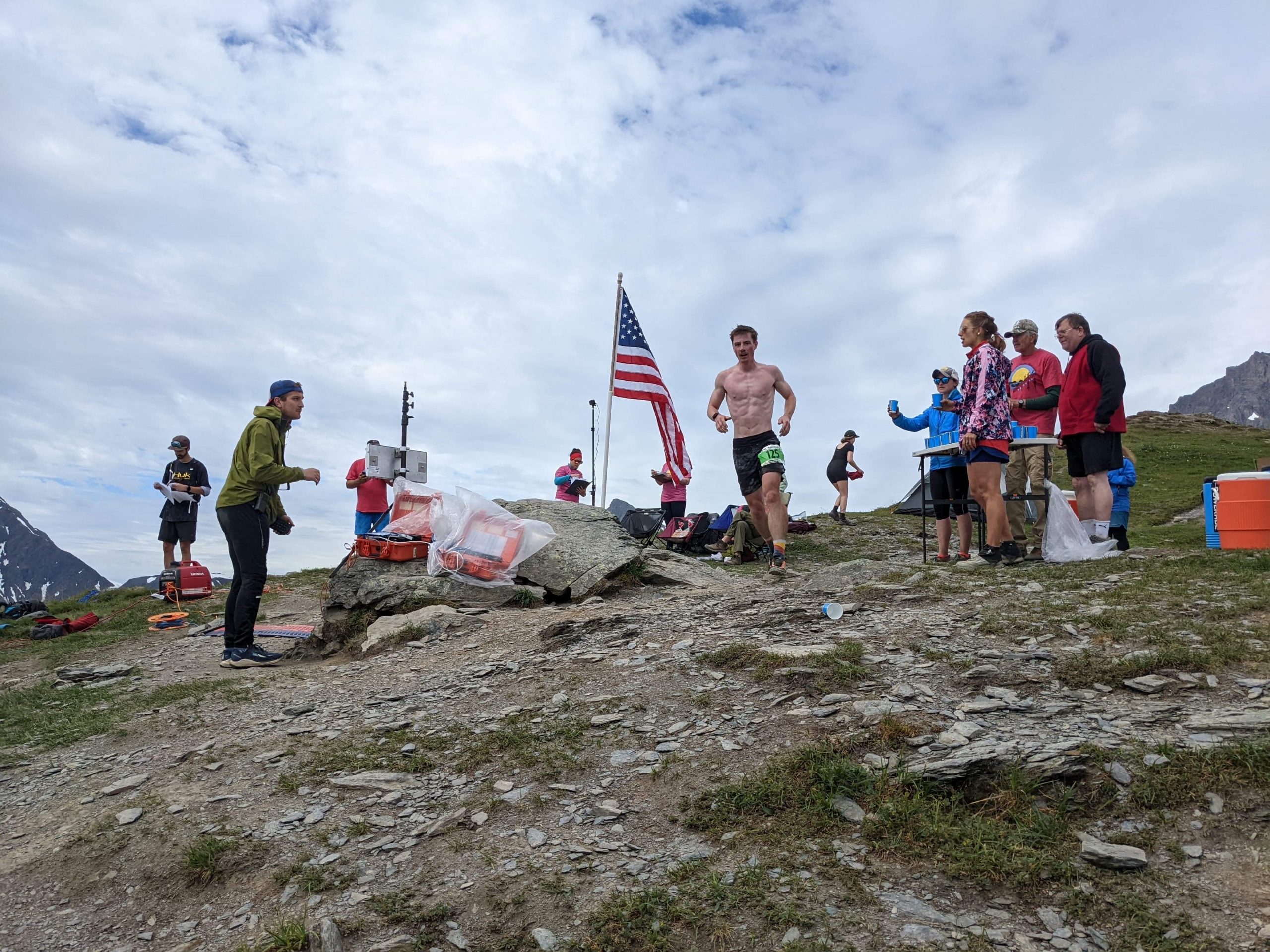
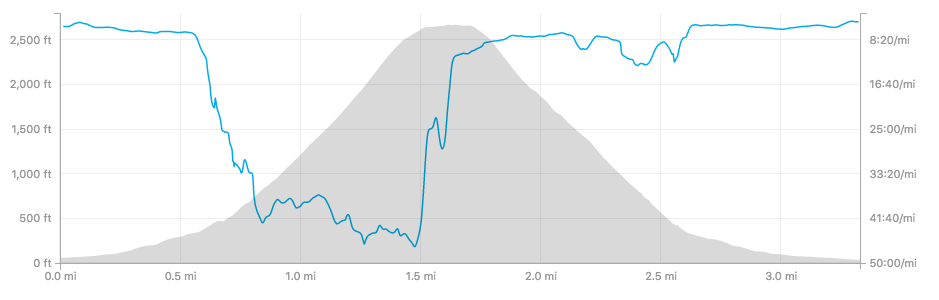
There is no set course up the mountain itself. Racers start on city streets, at sea level, and run through town for half a mile before starting the climb and heading straight up the mountain. During the climb, athletes cover roughly 2,675 vertical feet of climbing in less than a mile (0.9 to be exact). Once they’ve crossed the timing mat around the false summit at Race Point, they turn around and descend that same steep slope via a slightly different route. A junior boys and girls race is also run, in which the participants only ascend partway up the mountain before turning around.
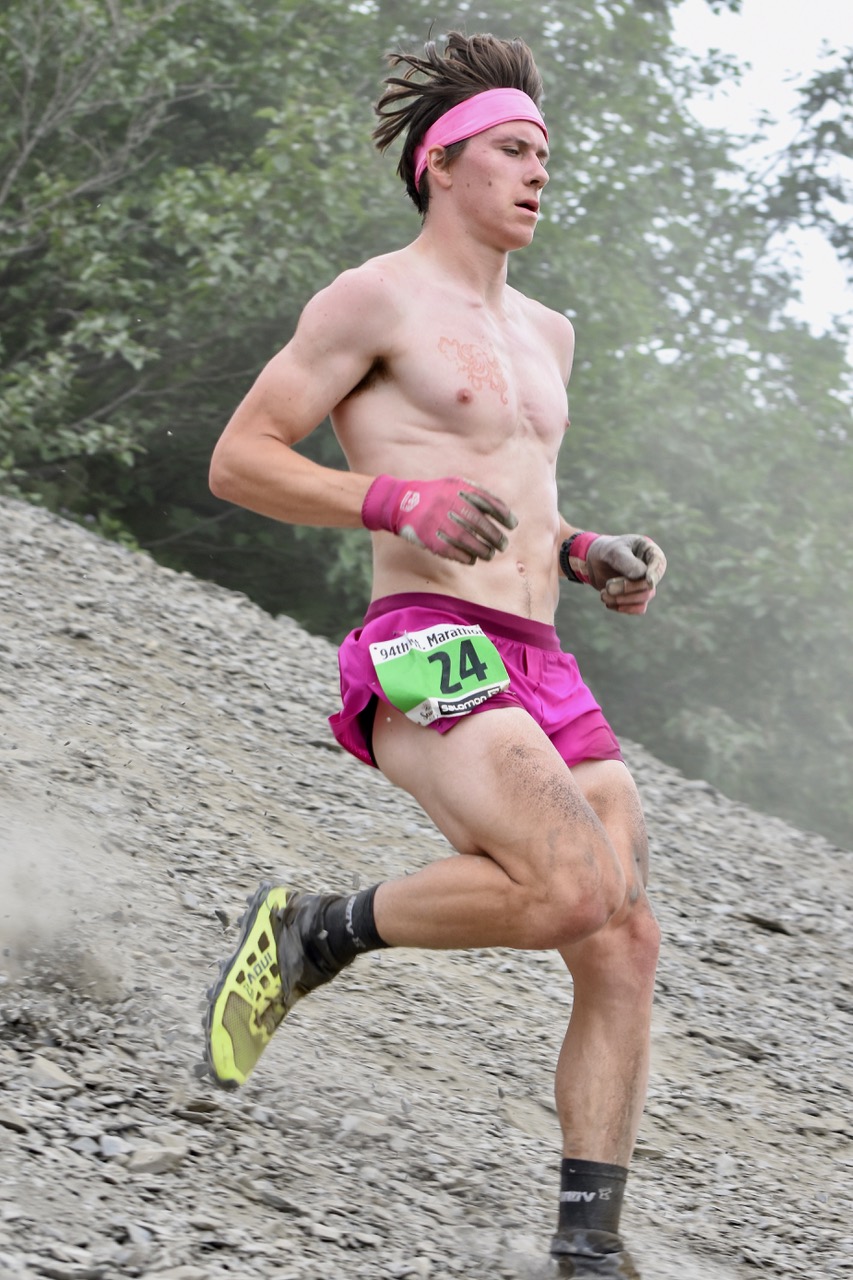
Runners bomb down scree back towards Seward and Resurrection Bay after turning around at Race Point. (Photo: Walker Hall)
This steep and challenging course has seen a number of nordic skiers succeed, including current men’s record holder, David Norris (41:26). Norris has won the race all three times he entered and took the record from mountain master, Kílian Jornet (41:48). Four-time Olympian, Nina Kemppel, holds the record for most race wins at an impressive nine victories. And until this year, three-time Olympian, Todd Boonstra was the oldest victor at age 41. However, at the conclusion of the 2022 edition of Mount Marathon, that crown went to a new champion.
The men set off at 11 a.m. local time and Max King of Bend, Oregon, took this year’s victory in a time of 43:37. At the age of 42, he became the oldest winner in the race’s long history.
Behind King, APU skier Thomas O’Harra placed second in his Mount Marathon debut. “I really didn’t expect to do as well as I did,” shared O’Harra. “It’s such a strong field, even without David [Norris] racing this year.”
Just a few weeks before O’Harra took top spot in the Bird Ridge Hill Climb, so he had confidence heading into the uphill section of Mount Marathon. “I knew that I was in good shape for the climb at least, after Bird Ridge, so I figured that I could be in the top three to the top and then the downhill was a total unknown to me. I practiced it once, a week before the race, but I’ve never raced a downhill like that before so I had no idea what to expect.”
Thomas O’Harra (APU) rounds Race Point in second place in the 2022 edition of Mount Marathon (Photo: Anna Engel)
Plummeting down the scree slope, O’Harra said his main goal was to stay on his feet and not get hurt. “I was shocked that I was still in second coming off the mountain and suffered my way down the road to the finish, where I managed to sneak under 45 minutes, which was a kind of secondary, if-it-goes-well goal,” said O’Harra. “[It was a] super fun time though, the closest running race I’ve ever done to the Birkie, and I’m stoked to come back and race again next year!”
Canadian skier and current Ute (athlete at the University of Utah), Sam Hendry, finished second behind Norris in 2021. This year, Hendry placed 7th with a time of 47:39. Hendry shared that this year’s Mount Marathon “was a bit of a disappointment.” He continued, “I finished second last year and was really hoping for a strong result again. With some busy travel getting up to Alaska, I didn’t have the best preparation and my legs were just a little off.” Hendry raced both the Vertical Kilometer (VK) and 26 k at the Broken Arrow Skyrace mid-June and placed fourth in both, besting King by nearly a minute in the 26 k. Hendry said, “I had some good results there, and plan to add some more running competitions to the calendar for later in the summer. I really enjoy getting some competitions in during the summer and getting to feel stressed and nervous.”
Michael Earnhart descends a dusty slope towards Seward (Photo: Jim Jager)
New U.S. D-Team member and APU skier, Micheal Earnhart, finished his day in 15th (49:45). He wrote to FasterSkier, “I wasn’t stoked with my results by any means but I am happy that I’m at a point in my career where top-15 at Mount Marathon can be a bad day.” Earnhart was quick to praise his teammate’s success saying, “My main takeaway was how impressive it was to see my APU teammate, and race rookie, Thomas O’Harra get second place. Definitely a strong day for APU and skiers in general which is always fun to see.”
Fellow U.S. Ski Team athlete Luke Jager was shortly behind Earnhart in 18th.
With the men’s race concluded, the focus turned to the women, who started at 2 p.m. local time. (The men and women now race in the flagship afternoon slot in alternate years.) Breaking the seven-year-old women’s record, Allie McLaughlin of Colorado earned the victory in a time of 47:09. Previously held by Swedish runner, Emelie Forsberg, with a time of 47:48, McLaughlin created a margin of 39 seconds in her favor.
Rosie Frankowski, who finished 4th in 2021, and is perhaps one of the fastest climbers out there, came in sixth this year (53:19). Racing Mount Marathon for the first time, newly named U.S. Ski Team A-Team member, Novie McCabe placed 8th (56:27). About her race, McCabe shared, “Mount Marathon was crazy! So hard, but a very cool experience for sure. I’m pretty happy with it. I was nervous about the downhill and was honestly pretty happy with myself for just doing something a bit out of my comfort zone.”
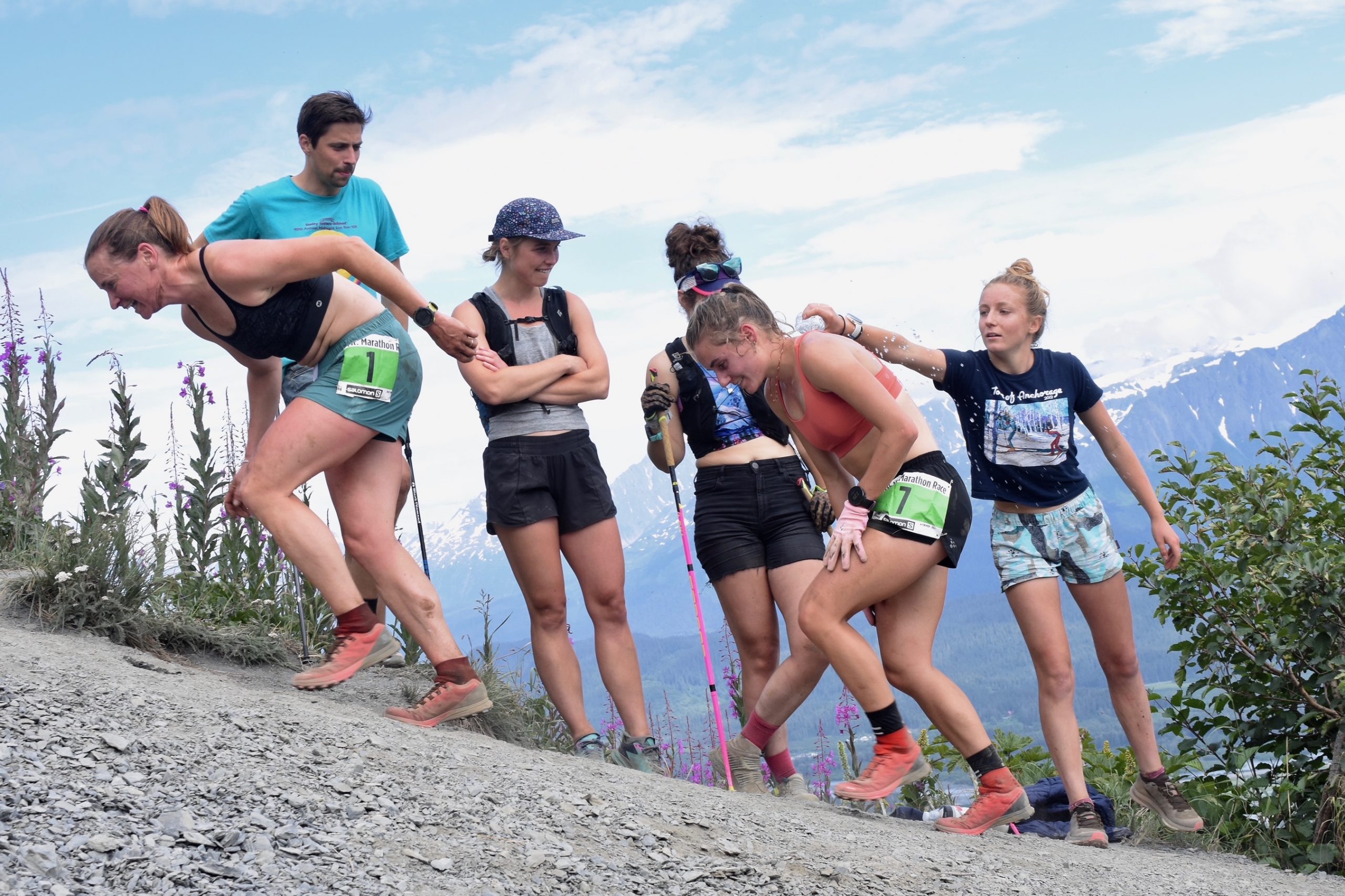
After racing the junior girls event, Dashe McCabe waters her sister, Novie (bib #7), on the climb (Photo: Jim Jager)
Kendall Kramer of UAF finished just outside the top-ten in 11th position (57:12). Kramer finished 9th last year (56:50) and was the junior girl’s race champion in 2018 (34:05).
Full race results of all the Mount Marathon events can be found here.
In other racing news, U.S.A. Track and Field Mountain Running Championships (USATF) in Wilmington, NY at the beginning of June saw two 2022 Beijing Olympians competing. Sophia Laukli finished third in a time of 1:29:03., and Caitlin Patterson came in sixth (1:35:52.3). Results for that event can be found here.
The Loon Mountain Race hosted Vertical U.S. Mountain Championships on July 10th, which a number of nordic and biathlon athletes attended. Alex Lawson representing Craftsbury Green Racing Project finished third, and posted the second fastest time on the “Upper Walking Boss,” a 40% grade ski hill for a half-mile at the end of the race.
Jake Brown (also of CGRP) had the second fastest time on the “Upper Walking Boss” and finished 9th overall. Full results for the event can be found here.
The Cirque Series mountain race circuit kicks off this coming Saturday (July 16th) at Brighton, UT. With a schedule of six U.S. based races taking place over the next few months nordic ski fans should keep an eye out for familiar names near the top of the results sheet.
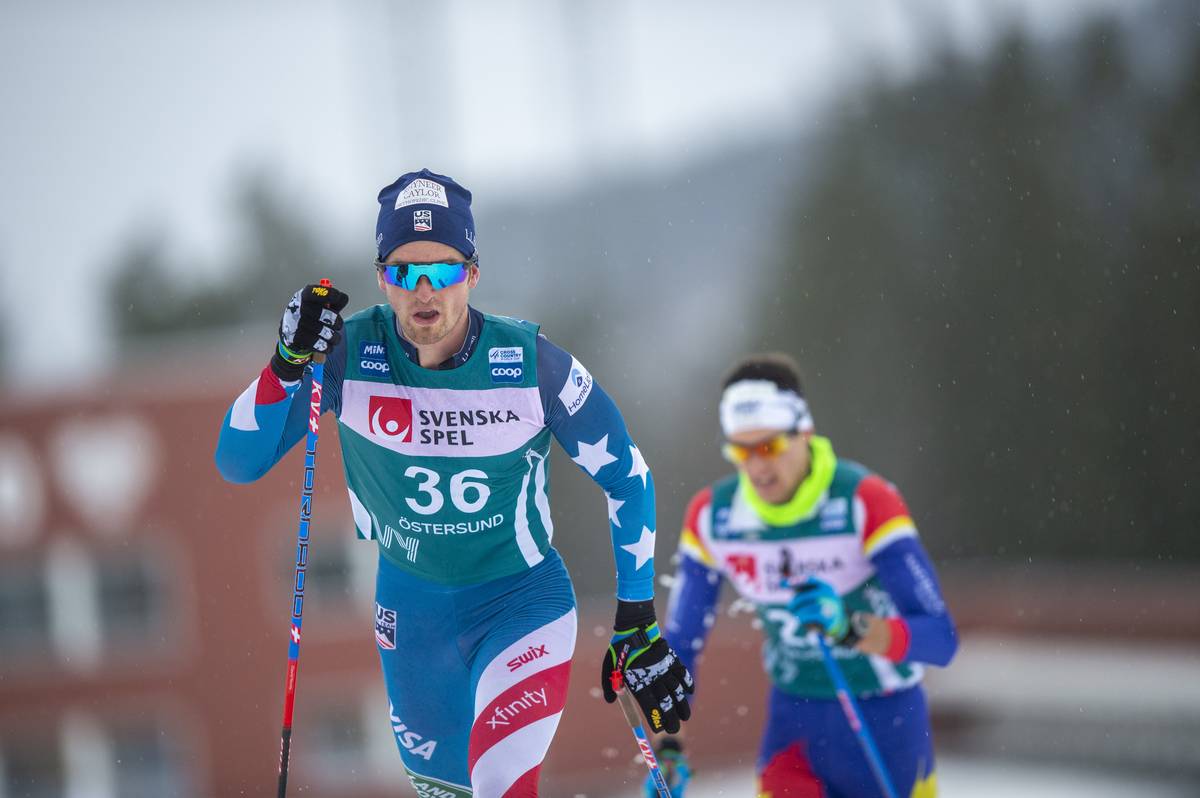
David Norris skis to 34th in 15 k classic pursuit in Östersund, Sweden in February, 2020. (Photo: NordicFocus)
It’s hard not to root for David Norris.
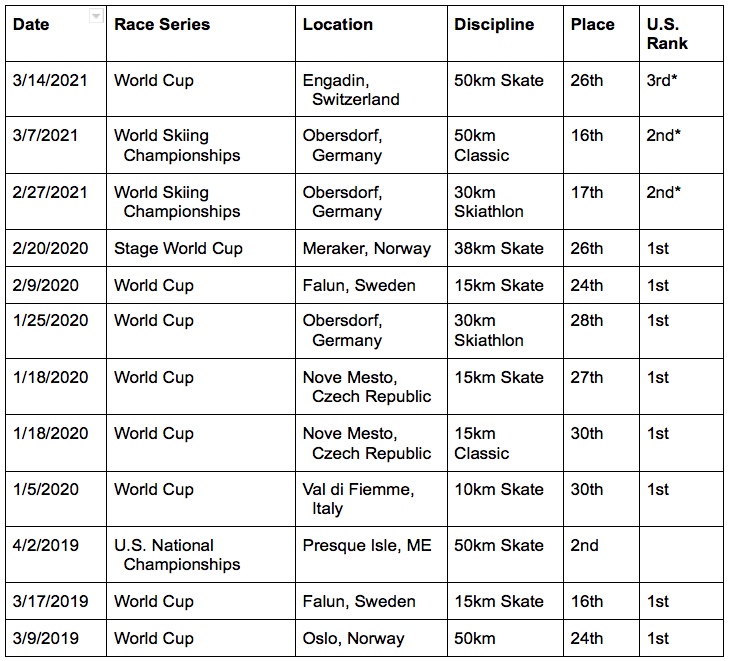
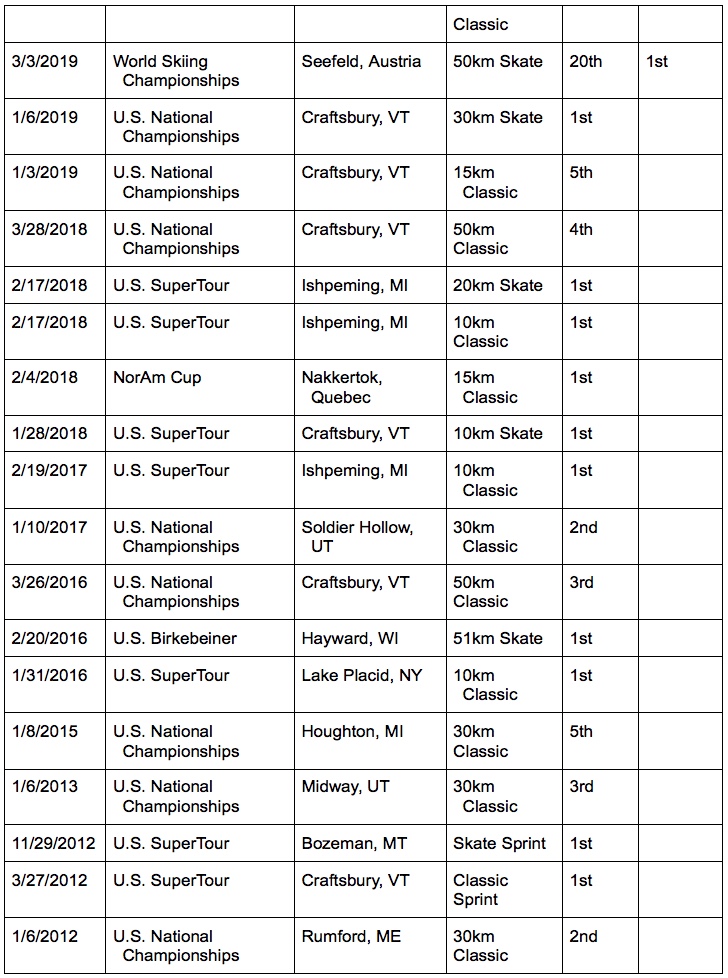
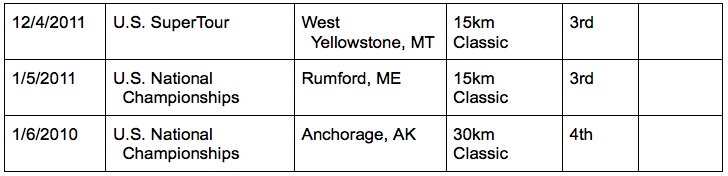
Often affectionately described by Devon Kershaw as a “grinder”, the humble 31-year-old Fairbanks, AK native has been an eternal underdog, despite consistently performing among the best American distance racers of his generation on the World Cup. Highlighting his career, Norris has finished in the top-20 three times during his appearances in the 2019 and 2021 World Championships. His best result arrived in last year’s Championships in Oberstdorf, Germany, where he placed 16th in the 50 k classic and 17th in the 30 k skiathlon.
Although Norris has been routinely been offered World Cup starts over the last five seasons, he has consistently hovered in the liminal space just behind the cutoff when it comes to selection to the U.S. Ski Team, whose age based-criteria becomes tougher to achieve over time. Given his birth year of 1990, Norris needs to be ranked in the top-40 in the world according to his FIS points from the previous season to be named as a B-Team athlete. In 2020, the margin by which he came up short was incomprehensibly small; a mere 0.88 FIS points, equivalent to eleven seconds in a single race during the season, left Norris ranked 43rd in the distance standings in March of that year.
Without financial support from the US Ski Team, Norris forged on, relying solely on his personal sponsors.
Read more on age-based criteria here, or take a deep dive into FIS points and Norris’ circumstances here.
Then, as the 2020/21 World Cup season loomed the following November, Norris contracted COVID-19. At the time, there was little information available on how elite athletes should return to training and competition following a coronavirus infection and what the risks of an expedited return might be. While more is available currently, the message has not changed: use caution and take it slow.
Consequently, Norris sat out Period 1 and the Tour de Ski, making his World Cup return in late January 2021, finishing 32nd in his first race back – a 30 k skiathlon in Lahti, Finland, roughly one month shy of the Oberstdorf World Championships. Despite two top-20 finishes in Oberstdorf, where he was also the second American, behind only his APU teammate Scott Patterson, Norris was again left off the US Ski Team in the spring of 2021. The decision inspired one of his competitors, Craftbury’s Ben Lustgarten, to pen an OpEd to campaign for Norris’s ex post facto discretionary nomination to the team.
David Norris fist bumps a competitor after finishing 17th in the 30 k skiathlon during the 2021 World Championships in Obsertdorf, Germany. (Photo: NordicFocus)
Heading into the 2021/22 season, Norris had a goal of making the Olympic Team, but he knew that, once again, the odds were not likely to be in his favor. The US had just five guaranteed quota spots for Beijing, with a likely sixth on the table.
If you’ve found your way to this story, you likely know how Norris fared.
After a solid summer of training, Norris started upon his usual trajectory of sub-optimal early season races, which generally progress to peak race results in February and early March. In November, Norris was 37th in the 15 k freestyle pursuit in Ruka, Finland, skiing the 27th-fastest time of day, but he never cracked the top-30 to score World Cup points in Period 1. Heading back to the States to race in the U.S. Cross Country Ski Championships in Soldier Hollow in January, his results began to trend upward. Though he’s always excelled in distance, he took 7th in the freestyle sprint, after qualifying second. Then, two days later, he was second in the 30 k mass start skate, 11 seconds behind winner Scott Patterson.
Twelve days later, in the final race weekend before the Olympic qualification period ended on January 16th, Norris won a 15 k individual start classic at the Lake Creek Nordic Center in Ketchum, ID.
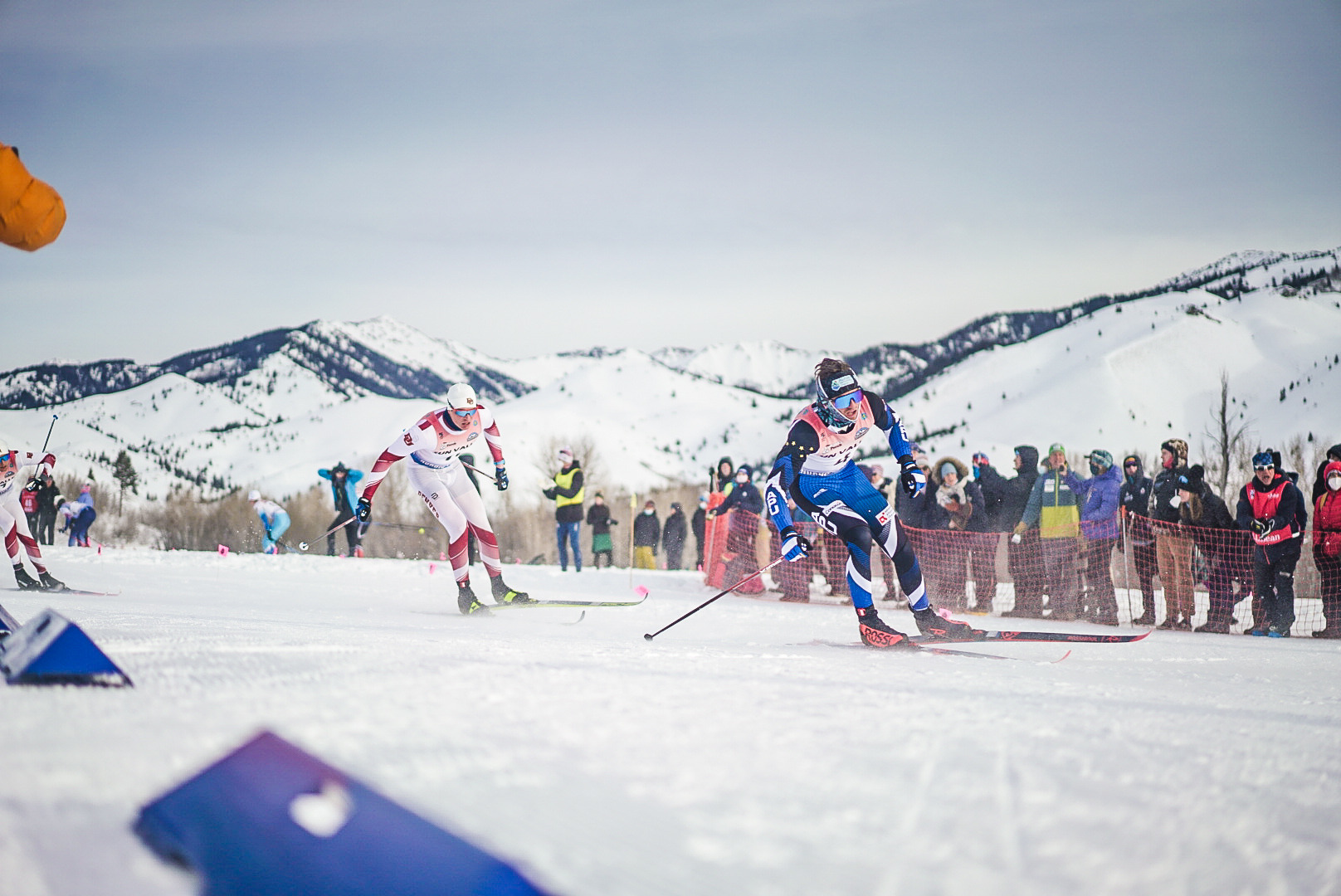
David Norris leads the way through a corner on his way to a win in the SuperTour 15k mass start classic in Sun Valley. (Photo: Tobias Albrigtsen / @untraceableg)
This background is not intended to imply Norris should have made the 2022 Olympic Team. Rather, the intent is to highlight his candidacy to frame an interview on Friday, February 25th, the day before the 2022 American Birkie, in which Norris discussed the experience of falling short of his Olympic goal, how he “made the best of it”, and what his next steps are as he begins to shift his focus away from the World Cup.
Returning to the team announcement, Norris explained that although he was disappointed, not being selected was not a surprise given the selection process that had been outlined. He shared that “there was no dialogue at all” with US Ski Team coaches leading into the announcement, but that it also had never felt “closed”, either.
Following his second place finish in the 30 k skate in SoHo, Norris had written to FasterSkier “Every season I ski much stronger in February and March, so I’m sure good form is on the horizon, but that doesn’t help me achieve my goals when I need to be skiing well right now. All I can do now is focus on the 15 k classic coming up and then rest and prepare for the next races.”
As he acknowledged, an emphasis was placed on strong early-season results, which he did not post, and he had not expected that his historic championship results would be factored into decision making. That said, as a distance skier, looking at a Games which would be held at altitude on challenging courses that would “basically reward people who are very fit”, it was difficult to recognize he’d never have the opportunity to put his strengths on display.
“It was tough,” Norris said simply. “Seeing that the criteria kind of rewarded 15 k races, when two out of four individual races [at the Olympics] were 30 and 50 k for the men. And yeah, I was aware of it all, but it kind of sunk in just during the Olympics and watching.”
Of the six men who met the outlined objective criteria and were named to the Olympic team, four were primarily sprinters: JC Schoonmaker, Kevin Bolger, Ben Ogden, and Luke Jager. However, each started in either the 15 k classic or the 4 x 10 k relay, in addition to the two distance racers, Patterson and Gus Schumacher.
“But I still cheered my heart out for the guys who made it,” Norris added emphatically. “I don’t hold anything against the guys who are nominated. All congratulations to them — no personal difference against those guys. Everyone who went is a good friend, and I’m stoked for them.”
APU teammates Scott Patterson (left) and David Norris (right) head to the start of the men’s 30k mass start freestyle at the 2022 U.S. Cross Country Championships in Soldier Hollow, UT. (Photo: Tobias Albrigtsen / @untraceableg)
When weather shortened the men’s 50 k skate to a 30 k, Norris watched his APU teammate Patterson race to 8th place, an historic result for the American men, second only to Bill Koch who earned an Olympic silver medal and a 6th-place finish in Innsbruck, AUT in 1976. As mentioned previously, roughly six weeks prior, Norris had finished 11 seconds behind Patterson in a 30 k mass start skate at a similar elevation in SoHo. Though four start spots were available for each nation in the Olympic 30 k, Patterson was the only American in the race that day.
Never one to say “woe is me”, Norris chose not speak directly to the experience of watching that race. Instead, he recognized that he was not the only strong and fit American distance skier who did not make it to Zhangjiakou.
“There were such limited spots for the men’s quota that, no matter what happened, good skiers were gonna get left behind. But yeah, just given that three out of four individual races are distance, and the relay’s distance, it was kind of a bummer to see them not give any priority or emphasis to distance where we could have accumulated probably the best results. I think the 30 k (skate) at Nationals and 15 k (classic) at Lake Creek in Sun Valley, kind of showed where the fitness stacked up in the U.S. field. And I think mass starts are one of those places where you can’t really hide your form — you see how fit people are. And yeah, Scott and I are really similar and we train together, and I think it just kind of came down to –
I trained for chasing a goal of a top 10 at the Olympics, and it was far harder to make the team than to actually probably reach that goal… But it’s just limited spots and tough how it came down.”
David Norris wins the 15 k mass start classic in Sun Valley, ahead of his APU teammates, Hunter Wonders and Scott Patterson. (Photo: Tobias Albrigtsen / @untraceableg)
Norris is not the first person to be left off an Olympic team who was perhaps qualified and deserving of a spot. Every four years, FasterSkier reports on those just behind the cutoff, which often sparks impassioned responses from fans supporting athletes on both sides of the bubble.
For Norris, this means outreach and support from a number of athletes who had been in the same situation and could share perspective from a place further removed from the moment.
“People have been super encouraging. One of the guys who made it based on the criteria but wasn’t taken four years ago reached out and said, ‘Use this as your secret weapon — you chase goals and come up short. And that’s kind of the way it works out more often than not, and you learn a lot from from that.’ Based on some of the encouragement from people in similar spots, it was really reassuring to hear their words and realize that the last four years or the last eight years pursuing a goal, it wasn’t a waste just based on a single selection.
And maybe there’s been moments where I have to kind of lie to myself that that’s the case, but I genuinely believe it. I don’t regret going for the Olympics, and then coming up short on my goal, it’s all been a positive experience for me.”
In the post-Olympic 50 turned 28 k episode of the Devon Kershaw Show, guest Kris Freeman, who spent years at the top of American men’s distance skiing, was critical of the American program’s lack of support of men’s distance skiing. Freeman pointed out that Patterson was the “only guy of his generation that got any U.S. Ski Team support.” He then added, “in the last six years, it’s been like, ‘Well, we got [Gus] Schumacher and Luke [Jager], let’s just wait till they come up.’”
Though perhaps in a less outspoken and direct manner, Norris affirmed Freeman’s sentiments, acknowledging the challenge many of this country’s top distance racers have faced in funding the career longevity often required to reach peak potential as an endurance athlete.
“I couldn’t do it without my personal supporters because there’s nothing coming from the national team. And there is definitely that sense of, like, Scott’s in the system. They’re hanging on to him, and he’s producing awesome results. But then, yeah, I think Freeman’s words are pretty accurate, I guess.”
Norris pointed to the U.S. Ski & Snowboard mission as a root of the challenge. The header on the cross country team page states: “We’re built around one common goal—provide the right resources for athletes who are inspired to be the Best in the World.” Though he was seen as one of the best in the US, his trajectory was arguably not one that was likely to produce Olympic or World Championships medals, a focal point of U.S. Ski Team selection criteria.
The introduction to these criteria reads: “The U.S. Ski Team will select only the most qualified athletes with the greatest possibilities for winning medals in future World Championship and Olympic Winter Games competitions. Selection criteria will stress performance in the Olympic Winter Games, World Cup and the U23/World Junior Championships in the 2021-22 season. Selection criteria will also stress progress toward individual performance markers, set forth by the U.S. Ski Team coaches, which point toward international success.”
David Norris cracks the top-20 with a 17th place finish in the 2021 World Championship 15k/15k skiathlon in Oberstdorf, Germany. (Photo: NordicFocus)
The statement perhaps clarifies the philosophy that has kept Norris from meeting objective criteria for the team. Though he has been an asset to the distance program, and was likely to post some of the top American distance results during the Games, his potential to earn future medals was lower than a younger budding athlete with strong World Juniors results, like Schumacher or Jager. While this could be sensible from a long-term investment perspective, it may also push some of the top distance athletes out of the sport at young ages, typically thought to be prior to when one reaches his or her physical peak for endurance racing.
One might look at Rosie Brennan who at 33 years old, and after having been left off the U.S. Ski Team on two separate occasions, is coming off a second season as a regular podium threat, with a growing list of top-10 results and a string of performances in Zhangjiakou that, though just shy of a medal, were collectively among the all-time top-three Olympic performances by an American cross country skier. Without Diggins’ results in PyeongChang and Beijing, they’d be the best.
Or, on the other side of the coin, Kyle Bratrud had won four National Championship titles between 2015 and 2020, and placed 31st at the 2019 World Championships, popping a World Cup top-30 a weekend later, but he retired at 26, in part because US Ski Team support seemed unlikely and the costs associated with starving for the World Cup didn’t check out in the cost-benefit analysis.
Read and listen to more on Bratrud’s take on development pathways, support and age-based criteria, and retirement here.
“It’s kind of brutal, over the last four years, to have had the best [American distance] result [in the 50 k at] World Champs in Seefeld, and two top-20s at World Champs last year. Half the men’s team was discretioned [onto the US Ski Team] last year, and to not get any support through those years…”
Norris started and stopped a few times, carefully weighing how much he wanted to say to the small tightly-knit ski community, before laughing that he was beginning to ramble. He then continued, “I think the Olympics kind of showed that… I feel like people are wondering what happened with some of the results, but I think you could have predicted that by looking at their course profile and the altitude and how people performed in similar settings. And it seems like it’s really good to invest in the young guys but also to give support to the older guys and have us produce good results helps pave the way as well. And it seems like that aspect is getting severely neglected. And if Scott were to quit next year, then there’s a huge gap to fill.”
David Norris on course during a 2022 SuperTour race weekend in Sun Valley, ID. (Photo: Tobias Albrigtsen / @untraceableg)
After competing in the SuperTour races in Sun Valley with his APU teammates, Norris found himself in limbo. He recognized he was highly unlikely to be named to the Olympic team, but had not received information or been contacted by US Ski Team coaches to confirm that this was the case.
“Before the nominations were announced, we [essentially] knew the team [that was] going based on COVID protocols.”
APU teammates Patterson and Brennan both raced in Sun Valley, along with Scott’s older sister Caitlin Patterson, who trains and races with the Craftsbury Green Racing Project and was also named to the Olympic team. Brennan returned to her childhood home in Park City, while the Pattersons headed to Bozeman, MT to create a lockdown bubble with their parents.
Seeing the writing seemingly on the wall, Norris also headed to Bozeman, where his partner Jess Yeaton’s parents currently reside. Both Norris and Yeaton graduated from Montana State University in Bozeman, and he calls the area his “favorite training grounds.” With ideal conditions and nice weather, Norris cleared his head while logging hours on trail.
“Since I didn’t have the Olympics to focus on or peak for, I just took advantage of the good skiing there and was skiing like four to five hours a day, just enjoying being in the sun and, kind of, having the like stress and the weight off my shoulders of the Olympics. It was kind of cool, because I think I skied so much, I just realized that I ski because I love it not because of one single goal or because I’m trying to prove anything to anyone or, you know, make one person proud. It was good, just to ski and enjoy it.”
Norris looked at the calendar and saw that he could hop into both the Boulder Mountain Tour in Sun Valley and a 30 k classic at Crosscut in Bozeman. And though he thought he might have “overcooked” himself logging all those hours in Bozeman, Norris won both races.
“The past few weeks skiing with friends assures me that I love skiing and all the people involved in it… and that’s why I do it,” Norris wrote in a post-race Instagram post.
David Norris and his partner Jessica Yeaton prepare for the American Birkie after Yeaton returned from competing for Australia at the 2022 Beijing Olympic Winter Games. (Photo: Instagram @grandmasternorris)
“I think he’s having a really good time, actually,” Norris’ partner Yeaton told FasterSkier in an interview in Zhangjiakou during the Games. “Going around and racing all these races, and he’s just been reconnecting with people. I truly do think he is enjoying it… I think it’s definitely been a big bummer for him, but he’s also — he’s the best at making a good situation out of anything. He’s just not a negative person by nature. He’s out there racing all these races, having fun… there’s definitely something good that’s come out of the spring for him, for sure.”
As the time of the call was within 24 hours of the Birkie start, it was yet to be seen that Norris, the 2016 Birkie champion, would this year take second in a thrilling showdown on Main Street in Hayward, WI, losing to Gérard Agnellet of France in a boot slide at the finish. Norris had scaled back on the self-indulgent distance skis in Bozeman, foreshadowing what would come with the following explanation.
“After the [Boulder Mountain Tour], I kind of shut it down and kind of found enjoyment in being a little lazier. And I think that should give me some fresher legs for the Birkie, I hope.”
David Norris and his partner Jessica Yeaton, both APU athletes, won the 2022 Tour of Anchorage. (Photo: Instagram @jjyeaton)
His next steps remain in flux.
“Since there’s not really a spot for a 20th to 10th place skier — like, [US Ski & Snowboard] doesn’t want that on their team, it seems — I’m kind of not that incentivized at all to spend time on World Cup and keep fronting a bill from the U.S. Ski Team.”
With this shift in focus, Norris remains open-minded, explaining that his ski racing plans next winter somewhat hinge upon where Yeaton finds a physical therapy job once she finishes her clinical rotations to complete a doctoral program through University of New Mexico. The two will be stationed in Colorado and Utah through the fall, which may set Norris up for opportunities to compete in trail running races that have not previously fit into his ski preparation plan.
Norris has a track record of strong finishes in Alaska mountain running races. Amidst three wins, he holds the course record at the infamous Fourth of July Mt. Marathon race in Seward, beating a time posted by the seemingly superhuman alpinist phenom Kílian Jornet of Spain, and has won the Cirque Series race at the Alyeska ski resort along with a smattering of other regional trail running events.
“I’ve never wanted to spend money on running because I’ve always just put any money I’ve earned and sponsorship dollars towards skiing. And you know, there’s plenty of races in Alaska, so I didn’t need to travel, but now I’ll be at altitude in Colorado and Utah. There’s so many races to jump into.”
Should they end up spending next winter in a location that allows for quality ski training, Norris anticipates that he’ll continue to race, but the focus will be different.
“I think our lifestyles are such that we would be training a ton, just because that’s what we enjoy doing. And then I would 100% keep jumping into races. But my goals are definitely changing… So probably do less [international racing] and just enjoy ski racing and do it more locally.”
David Norris on his way to winning the 2022 Boulder Mountain Tour in Sun Valley, ID. (Photo: Nils Ribi Photography / Boulder Mountain Tour)
FasterSkier’s American Birkebeiner coverage is made possible through the generous support of New Moon Ski & Bike in Hayward, Wisconsin. While you are at the Birkie be sure to visit New Moon Ski & Bike for all your local expertise.
Among the final major races in the ski world in 2020, the Slumberland American Birkebeiner pulled off an event with all the festivities for which the storied event is known. It was pure Birkie fever, with little concern for what other communicable diseases might be circulating at the time. A large snowstorm moved through the Northwoods of WI, followed by a bitter cold snap which let up just in time for a sunny day with mild temperatures on race day, setting up fresh, firm, and fast conditions that saw course records fall.
Flash forward through two years of pandemic and a non-traditional Birkie week format, and the weather gods delivered yet another pristine weekend for racing as the Birkie made its return, with all the Main Street revelry one could ask for.
This year’s Birkie also served as the final SuperTour of the season on American soil, with only Canadian Nationals which will be held in conjunction with SuperTour finals remaining on the calendar in late March. With several athletes who had been just behind the Olympic team cutoff appearing on the start list, along with a handful who declined World Cup starts in Lahti to race the Birkie and a few top international racers in the mix, the front lines of the elite wave were stacked. This set the stage for close racing and exciting final sprints on Main Street that kept the sound of the cheering crowds lining the finish at full volume.
The women’s race was decided in the home stretch as Alayna Sonnesyn (SMS T2) took her third Birkie win in 2:22:52 ahead of Caitlin Patterson (CGRP) in second (+2.0), and Rosie Frankowski (APU) third (+9.0). Also racing for APU, Jessica Yeaton was the fourth woman to the line in Hayward (+27.0), with a retired-but-not-slow Sadie Maubet Bjornsen racing on the mountainFlow Eco Wax team taking fifth (+1:05.0).
Patterson had flown to the Midwest after spending three weeks in China as a member of the Olympic Team, however, she did not earn any starts there, calling it “#chinatrainingcamp” in a heartfelt social media post. Yeaton had also recently flown to the U.S. from Beijing after representing Australia at her second Olympic Games. Yeaton raced in five of the six events (Australia did not have enough women for a relay), with her top finish taking place in the opening 15 k skiathlon, where she finished 31st.
After winning the 2019 Birkie, Sonnesyn returned in 2021 for the unique opportunity to race both a skate and classic event in the same weekend. With pandemic restrictions in place, these races started and ended at the Birkie trailhead in Cable. Sonnesyn won the 45 k skate Birkie on Saturday, just four seconds ahead of Frankowski, then the two traded positions as Frankowski won the 45 k classic on Sunday, with Sonnesyn nearly a minute back in second.
“It feels so good to be here on such a beautiful day,” said in the livestream interview from the finish. “Last year, finishing back at the start was a really great time too, but there’s nothing like finishing on Main Street and hearing that blast of cheering as you come off the bridge.”
A Midwestern native for whom the Birkie has long been a family affair, Sonnesyn said each Birkie win has been special for her. While other women pushed the pace at the front, Sonnesyn had never been the first through the checkpoints. Commenting on her tactics in the post-race interview, she explained that this strategy played to her strengths.
“There are some spectacular distance racers in the field today, and I recognized that going into it and knew that they were going to push the pace and keep it hard through the entire race. I trusted my sprinting, I’ve been training a lot with Jessie Diggins lately and I’ve learned a lot from her, so I knew that I had an extra gear that I could use at the finish as long as I conserved [energy] throughout the race… There were moments where I didn’t think I was going to close those gaps, [and] I crashed with 4 k to go, so that was a little bit dramatic of me, but overall, I just knew that they were going to fight hard and that I would need to fight too.”
The men’s race saw an even tighter margin decide the winner. A threesome of David Norris (APU), Adam Martin (CGRP) and Gerard Agnellet of La Clusaz, FRA headed over the lake together, with a few chasers following at a distance, still in view of the cameras.
While Craftsbury’s Martin led over the bridge, it was Norris (APU) who looked to be the strongest in the final drag race up Main Street. Norris moved to the front and steadily gained ground on Martin, while Agnellet began a late surge from the back of the group.
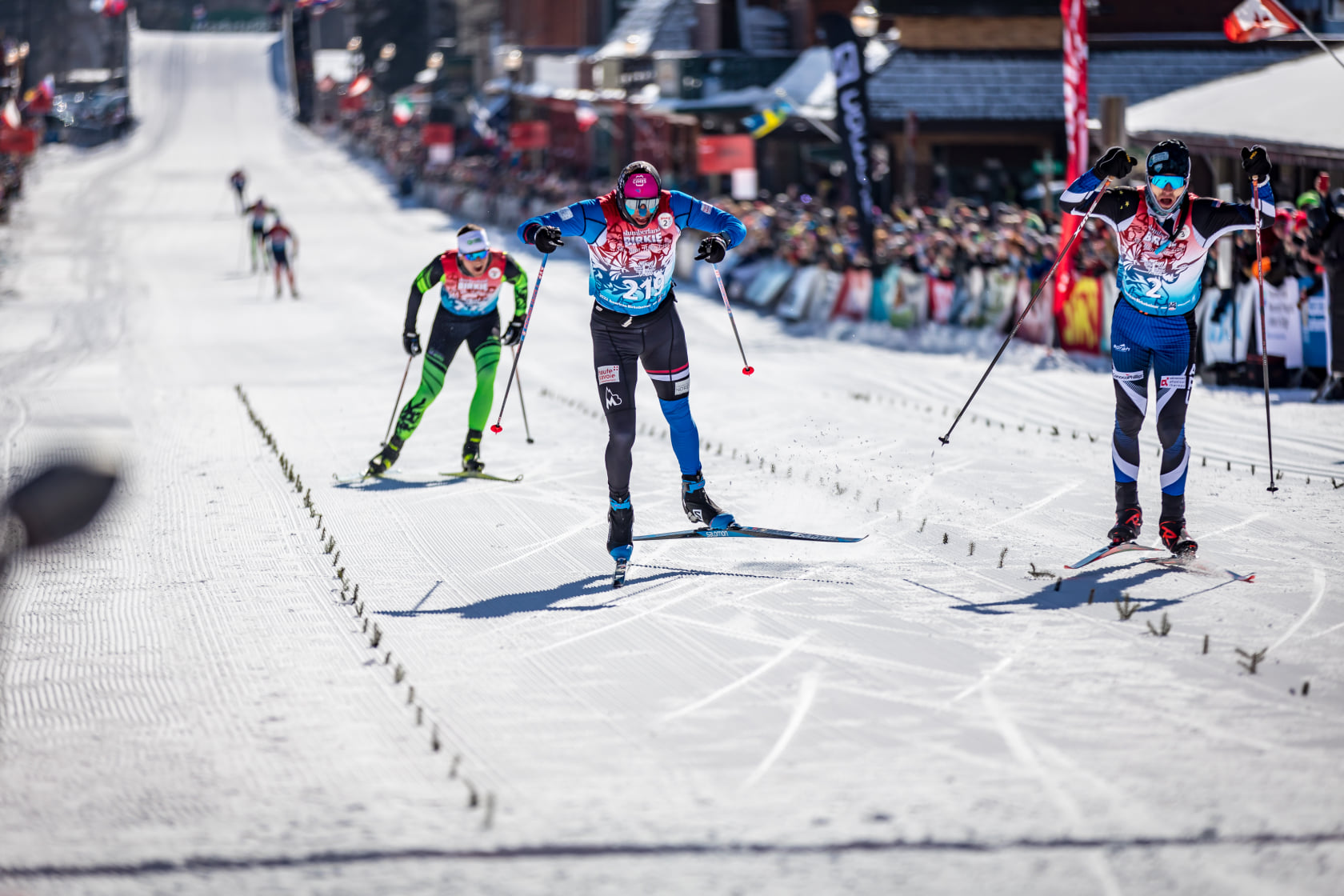
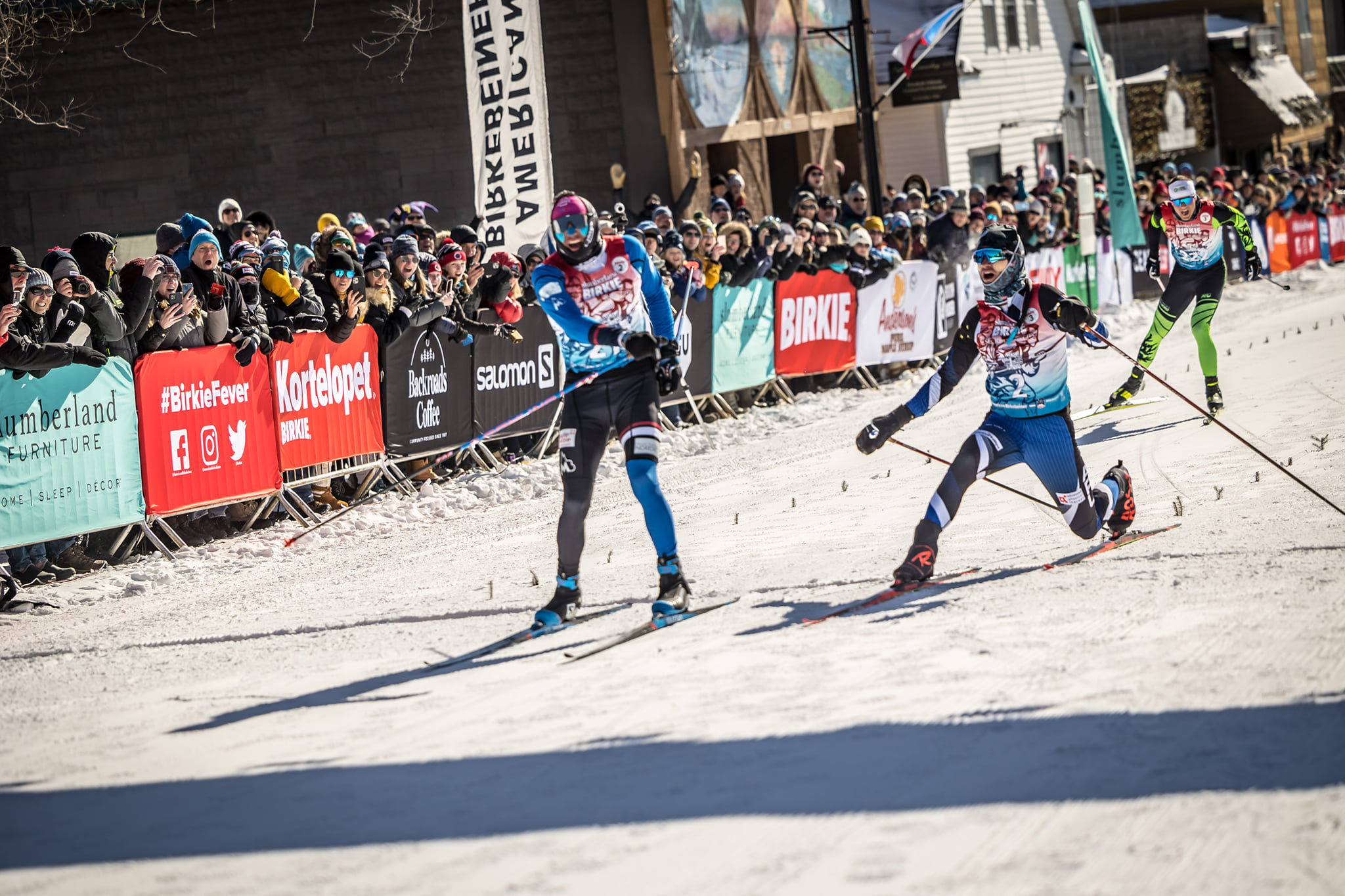
In the closing meters, Agnellet accelerated to move alongside Norris’ right side, matching his pace just before the line where Norris threw his boot to keep his advantage. A photo finish decided that Agnellet had nipped Norris at the line – 50 kilometers of tactical racing decided by just centimeters of distance.
This is Norris’ third appearance at the Birkie. The 31-year-old won his first Birkie in 2016, then was fifth and second American behind Kyle Bratrud in 2018. Today’s result earns Norris $4,500 in prize money, plus a $2,500 bonus for being the top American male. Equal payout for the top male and female saw Sonnesyn earn $7,500 for the win plus the $2,500 bonus, perhaps easing the sting for both athletes who were just beyond the ranking needed for 2022 Olympic team selection.)
Just behind the excitement at the front, Adam Martin (CGRP) took third today (+2.0), while Ian Torchia (SMS T2) was fourth after a short gap (+15.0). Craftsbury’s Akeo Maifeld-Carucci, a 2019 Birkie winner, rounded out the top five men, +18.0 behind Agnellet.
Torchia would announce on Instagram the following day that the Birkie had been his final race as a professional skier.
“Thank you very much,” Agnellet said through a translator at the finish. “I just loved the course here. It was fantastic and I’ve been very impressed with all the people I’ve met and all the encouragement I’ve received along the way. It’s been just a beautiful day here and I’m so excited to be on this great course, and to be representing France and to be the top man on the podium today.”
Agnellet was also asked about his strategy, in particular whether he had confidence that he could win in the final sprint and boot slide the line.
“My plan was to stay in contact with the front of the pack, and David Norris was looking so strong today. At a certain point I was thinking, ‘David has this and I’m racing for second place.’ But as the race went on, I was feeling stronger and stronger, and was happy to have come around David at the end.”
In the 55 k classic, Delaney FitzPatrick clocked the fastest time in the women’s race with 3:23:39, while Hayward native Josie Nelson was second (+5:26) and Molly Watkins of Duluth, MN was third (+8:10). For the men, Team Birkie coach Leo Hipp took the win in 2:51:57, while Chris Brunham of Stowe, VT crossed second (+20.0). Even Wetzel of Waukesha, WI rounded out the men’s classic podium in third (+2:24).
The 2022 Sun Valley Nordic Invitational continued Sunday with 10/15-kilometer mass start classic races, featuring SuperTour, RMISA collegiate, and Intermountain junior national qualifier divisions. With overnight temperatures in the low teens which rose to roughly 20 degrees Fahrenheit by start time, tracks looked ideal for kicking and gliding on the meticulously groomed trails at the Lake Creek Ski Center in Ketchum, ID.
The opening meters of the women’s 10k mass start classic, with Rosie Brennan setting the pace in her blue APU race suit. (Photo: Tobias Albrigtsen / @untraceableg)
Today’s races featured four laps each, with men starting the morning off on a 3.75k loop that featured three progressively larger climbs, totaling roughly 417 feet of climbing per lap. The women raced next on a 2.5k loop, which truncated the third and most significant climb of the men’s loop to reduce the lap length.
Men’s 15k Mass Start Classic:
After his victory in Saturday’s 10k individual start skate, local Johnny Hagenbuch (USST/SVSEF) moved into second place in the overall SuperTour rankings, still led by Adam Martin of the Craftsbury Green Racing Project. Martin won the 15k individual start classic at the U.S. Cross Country Championships just ten days ago, taking his first national title. With fellow national championship podium finishers Scott Patterson and JC Schoonmaker also taking part in today’s classic mass start, along with a number of other accomplished competitors in a field of 122 athletes, the stage was set for an exciting race.
Ian Torchia pulls the lead group around a bend early in the men’s 15k mass start classic in Sun Valley. (Photo: Tobias Albrigtsen / @untraceableg)
In the end, it was another strong day for APU as they put together yet another podium sweep. Today, the APU men were led by David Norris, who took the win in a time of 36:50.5. Hunter Wonders finished second (+8.0), after outsprinting his teammate, Scott Patterson, in the final meters, leaving Patterson in third (+8.5).
“Lake Creek and all the Sun Valley trails are in such good condition right now,” wrote Norris in a post-race email to FasterSkier. “Earlier in the week I skied with the team at four different trailheads, and they were all so nice.”
Given the field size, level of competition, and relatively short lap length, one might expect congestion on the course, or the dreaded accordion that can sometimes occur as the pack repeatedly stretches out and compresses, making it hard for athletes in the later half of the pack to ski consistently. Norris explained that this was not an issue during today’s mass start.
“The course today is one of the harder courses in the U.S. and because of that the pack wasn’t overly crowded. I was surprised by how large of a group we had for the first three laps. I felt really relaxed skiing within the pack. Until Scott started pulling away from the lead group at the end of the third lap, I don’t think I had been in the top five. I bridged up to Scott on the last uphill of the third lap and then he, Hunter and I skied together until the last 1km of the race.”
David Norris leads the way through a corner on his way to a win in the SuperTour 15k mass start classic in Sun Valley. (Photo: Tobias Albrigtsen / @untraceableg)
“Approaching the last hill, I went to the front and right away felt a small gap open up so I pushed it to the top of the course where I had a solid gap that stayed to the finish. It’s really nice to put this race together after a really slow start to the season. The APU coaches have been working super hard and it was super cool to be a part of such a great day for the team.”
Norris concluded by sharing his upcoming objectives, perhaps foreshadowing tomorrow’s release of the 2022 Olympic team. Today’s result moved Norris into third place in the SuperTour overall standings, behind Adam Martin in first and Scott Patterson in second. In the Olympic qualification standings for distance racing, Norris is also third, with Patterson first and Martin second.
“From here I’m likely racing the Boulder Mountain Tour and the Birkie, which I’m excited about.”
Scott Patterson races to third place in the SuperTour 15k mass start classic in Sun Valley. (Photo: Tobias Albrigtsen / @untraceableg)
In Patterson’s post-race comment to FasterSkier, he echoed Norris’ statement that congestion was not an issue, particularly as they had started at the front-edge of the pack. Patterson did add, however, that some obstacles arose as they began to lap some of the skiers finishing near the back.
“Many were great about stepping over to the side,” Patterson explained. “But there were a few who were very focused on their own race and didn’t recognize our group charging through.”
Patterson also shared his version of the race narrative, including the final move that moved Wonders one step up the podium.
“The race started pretty hot. I was surprised to end up in about 15th off the line even from the tip of the chevron. However, by about a kilometer in, the pace had settled and I was back up near the front. Johnny Hagenbuch and Hunter (Wonders) did a lot of the work on the early two laps. I mostly stayed near the front, but was keeping it relatively casual and felt ready for some hard pushes later.
On the third lap up Torin’s Tucker or the South Bench climb, I decided it was time to make it a real race. My move quickly split the lead pack. I had some space behind, but David and Hunter were able to rejoin after the long descent down to the stadium. I continued to lead for most of the fourth lap before David put in a good charge up the final large climb. He got a little space from me, while I slightly distanced Hunter on the climb. However, Hunter’s finish came into play as he chased me down and out sprinted me into the finish.”
Scott Patterson makes his move, leading APU teammates David Norris and Hunter Wonders. (Photo: Tobias Albrigtsen / @untraceableg)
Giving another nod to the coaches, Patterson celebrated his team’s success, despite finishing below where he would have liked.
“It was another sweet day for APU with the sweep. I am a little disappointed to have made most of the animating moves myself and only end up on the bottom step of the podium, but it is cool to see David and Hunter put together good ones. Our coaches put in a lot of hard work this week on top of a hard nationals to make it possible.”
Though perhaps more vague than Norris, Patterson also concluded with what is next on deck for him.
“I’m heading to my parent’s in Bozeman now,” Patterson said. “My plan is to put together a good training block there at somewhat altitude and get ready for the next races.”
As mentioned, Patterson put himself on top of the Olympic qualification rankings with the combined points of his win in the 30k skate and second place finish in the 15k classic; both events are on the Olympic schedule. While the five guaranteed spots of the men’s quota have likely been filled by those with stronger early-season World Cup results (note that Patterson had wrist surgery in October, which set him back performance-wise until recently), this indicates that Patterson would likely snag the sixth spot should one be added to the U.S. quota after reallocation, happening later this week. (Find more information on quotas and selection here.)
The top six men surround the podium following the 15-kilometer mass start classic in Sun Valley. (Photo: Tobias Albrigtsen / @untraceableg)
Lacking a livestream video and intermediate splits in the live timing, it is difficult to make many observations about the race other than those apparent in the finish times. Breaking up the string of four APU men who finished in the top-five, Ian Torchia (SMS T2) finished fourth again (+28.1), on the heels of a fourth place finish in the 10k skate on Saturday. In another finish-line sprint, Torchia crossed just ahead of APU’s Zanden McMullen (+28.2) with University of Denver’s Bernhard Flaschberger just behind in sixth (+28.4).
In the collegiate standings, Flaschberger skied his way to a double victory in Sun Valley. Sam Hendry (U of Utah) also earned a double podium, taking second place today after yesterday’s third, just one second behind Flaschberger and in eighth overall. Rounding out the collegiate podium, Andreas Kirkeng of University of Denver came in third (+24.1) for RMISA and tenth overall.
The RMISA men’s podium after the 15k mass start skate in Sun Valley. (Photo: Tobias Albrigtsen / @untraceableg)
Women’s 10k Mass Start Classic:
While there was no official livestream, APU’s Forrest Mahlen did record an Instagram live of the women’s race on the APU account, which offers some insights into the action. The footage and commentary are perhaps a significant step down from that offered in Soldier Hollow, but the primary storyline was nevertheless clear from the start. By the time Rosie Brennan (USST/APU) passed Mahlen, just over a minute into the race, she had created a five second gap over the remainder of the women’s field.
Unmatched, Rosie Brennan wins the women’s 10k mass start classic by nearly a minute. (Photo: Tobias Albrigtsen / @untraceableg)
Gun to tape, Brennan put on a clinic. Unmatched, she time-trialed her way around each of the four laps to finish in 29:35.3, nearly a minute ahead of the next racer. Brennan explained after the race that she was not totally prepared for classic races, as her original plans for her U.S. altitude block changed with the cancellation of the Les Rousses and Planica World Cups. Despite the time away from the main hub of the likely U.S. Olympic squad who are now training in Livigno, Italy, Brennan has seemingly thrived as she continues to hone her mental and physical sharpness before heading to China.
“I was honestly quite nervous for the race because I was never planning to do a classic race while I was home,” Brennan shared after the race. “I only brought home two pairs of training classic skis, so I wasn’t sure if it would be enough in this very strong field of women. Luckily, they were both cold skis and we did have cold, hardpack conditions today. APU did a great job preparing them and turning them into good race skis so it was alright in the end.”
More of a time trial than mass start, Rosie Brennan gaps the women’s field early, eventually winning the race by nearly a minute. (Photo: Tobias Albrigtsen / @untraceableg)
Speaking to her race strategy, Brennan continued, “I started hard to try to simulate what I will encounter in Beijing. I wasn’t sure what the other girls would do so I just really tried to focus in on strong skiing. This is only my 3rd classic race of the year so I really wanted the practice of holding my technique together, finding a relaxed stride, and all while at altitude. I felt really strong on the long climb and was able to find a good groove, so I pulled away on that climb and then had to just keep pushing. It was a good mental challenge with a four lap race at altitude. I was definitely feeling tired on lap 3 and had to turn my mind around and find a way to push hard again that last lap in preparation for the Olympics. All in all, it was a good weekend to get some hard efforts in before we start to taper and focus in on Beijing.”
Leading the chase pack in the final lap, Katharine Ogden (USST/SMS T2) skied to second place for the women (+55.4). Ogden was second in the 10k classic during the U.S. Cross Country Championships, the only event she contested, and finished fourth in yesterday’s 5k free.
Rosie Brennan has a medal placed around her neck by SVSEF youth athlete after winning the women’s 10k mass start classic. (Photo: Tobias Albrigtsen / @untraceableg)
Next to the line was Novie McCabe (USST/U of Utah) in third (+1:07.6), her second third place finish of the weekend.
“It was fun for sure!” McCabe wrote in a post-race email. “I’ve always liked racing in Sun Valley and haven’t done too many mass starts this season so I was stoked for this one! We had a good group for the first three laps and it was kind of nice to just try and settle in and find a good pace. Overall, I felt good and am super happy with how things ended up. My skis were also amazing, which for sure didn’t hurt!!”
Rosie Frankowski skis to fourth in the SuperTour 10k mass start classic in Sun Valley. (Photo: Tobias Albrigtsen / @untraceableg)
Rosie Frankowski (APU) was fourth to the line (+1:17.1), with Sydney Palmer-Leger (USST/U of Utah) behind in fifth (+1:26.4), leading her teammate Sophia Laukli who finished roughly a second behind her in sixth (+1:27.2). Improving on yesterday’s result, Caitlin Patterson (CGRP) was next to the line in seventh (+1:35.7).
Going 3-5-6 in the overall standings set the women of Utah up nicely for a back-to-back podium sweep, the first time any RMISA team has done so within the same meet since 2013, according to the team’s press release. A look at the roster shows the Utes as the U.S. Ski Team-lite. A force to be reckoned with, the Utah women’s team has now won each of the five RMISA races this season.
Sydney Palmer-Leger skis to third overall and rakes the RMISA collegiate win in Sun Valley’s 10k mass start classic. (Photo: Tobias Albrigtsen / @untraceableg)
Beginning a northeast swing, the SuperTour circuit moves to Lake Placid, NY for Period III, resuming in two weeks on January 29th. This two-day race weekend will include a classic sprint, followed by a 10k mass start skate.
A big thank you to Tobias Albrigtsen, who generously shared his outstanding photos with us throughout the weekend.
The prepping of the boards: University of Alaska Fairbanks coaches prepare skis for their athletes at the 10/15k mass start classic races in Sun Valley. (Photo: Tobias Albrigtsen / @untraceableg)
Quick Recap: We’ll have a full race report up tomorrow, including athlete comments and photos, but here is a quick recap of the action in the men’s 15k and women’s 10k mass start classic, which took place this morning in Ketchum, Idaho.
The 2022 Sun Valley Nordic Invitational continued this morning with 10/15-kilometer classic races at the Lake Creek Ski Center in Ketchum, Idaho. While temperatures were warmer than at the start of yesterday’s skate races, it was still a brisk morning in Sun Valley, making for excellent classic racing conditions in the dry high-altitude natural snow.
The men kicked off the morning’s races, taking off in a mass start at 9:30am. Rebounding from sixth place in yesterday’s skate, David Norris (APU) took the win in 35:50.5, leading a train of teammates for an APU podium sweep. Hunter Wonders doubled up on his second place performance, finishing 8 seconds behind Norris. Wonders edged out Scott Patterson (USST/APU) at the line by 0.5 seconds, leaving Patterson in third. Ian Torchia (SMS T2) was next for his second fourth place finish of the weekend (+28.1), finishing in a three-way sprint with APU’s Zanden McMullen who took fifth (+28.2) and University of Denver’s Bernhard Flaschberger in sixth (+28.4).
Flaschberger was again the top RMISA collegiate racer, with Sam Hendry of the University of Utah in second place (8th overall), and fellow Denver athlete Andreas Kirkeng in third (10th overall).
The opening meters of the women’s 10k mass start classic, with Rosie Brennan setting the pace in her blue APU race suit. (Photo: Tobias Albrigtsen / @untraceableg)
From the looks of an SVSEF Gold Team Instagram story, Rosie Brennan (USST/APU) took the women’s race out hot. Following the theme of her domestic racing over the last two weeks, Brennan steadily grew her lead over the field, crossing the finish line in 29:35.3, nearly a minute ahead of her chasers. Katharine Ogden (USST/SMS T2) led the chase back to the finish to take second place (+55.4), with Novie McCabe (USST/U of Utah) close behind, again in third (+1:07.6). Rosie Frankowski (APU) was fourth for the women (+1:17.1), with Sydney Palmer Leger (USST/U of Utah) behind in fifth (+1:26.4), leading her teammate Sophia Laukli who finished roughly a second behind her in sixth (+1:27.2).
This time with McCabe on the top-step, these three University of Utah women again swept the RMISA collegiate podium for the second day in a row.
By Gavin Kentch, Ella Hall, and Rachel Bachman Perkins
Tuesday brought distance races to Soldier Hollow, in the second full day of racing at 2022 U.S. Cross Country Championships. The story at the front of the field was strong performances by athletes who had begun the year racing on the World Cup, as Rosie Brennan dominated the women’s field to win by over a minute, and Scott Patterson took the men’s race by roughly twelve seconds.
U.S. Ski & Snowboard Development Team Coach Greta Anderson encourages athletes during the men’s 30k distance race in Soldier Hollow. (Photo: Tobias Albrigtsen / @untraceableg)
Brennan was followed by Rosie Frankowski and Caitlin Patterson. Scott Patterson was followed by David Norris and Hunter Wonders, giving APU five out of six podium spots on the day. Craftsbury athletes went 3-4-5 in the women’s race. Notably, four out of six podium finishers were on the north side of 30, with a fifth gaining Master status later this month, underscoring the lengthy developmental curve often required to achieve success in distance racing.
Women’s Race: Rosie Brennan Solos to Victory
Tuesday’s race, the women’s 20-kilometer freestyle race at 2022 U.S. Cross Country Championships, was, technically speaking, a mass start – but for Rosie Brennan, it skied more like an interval-start race. Brennan wore bib 101, at the sharp end of the chevron start in a field of 55 athletes, and led every one of 20,000 meters of the 20 k, pushing the pace right from the start and never looking back all the way through the finish line. She covered the challenging course in a speedy 53:16.9 to take her seventh national title, and first since 2015, in a dominating performance.
The race began under overcast skies and moderate temperatures. By one second into the race, Brennan (USST/APU) was in the lead. By one minute into the race, she was notably off the front, with only three athletes, Rosie Frankowski (APU), Caitlin Patterson (CGRP), and Sydney Palmer-Leger (USST/Utah) even contemplating whether to follow.
By two minutes into the race, Brennan had a sizable gap, as athletes in the Frankowski-led chase pack had decided that discretion was the better part of valor, and opted to ski their own race and focus on chasing the remaining two spots on the podium. No athletes other than Brennan would appear on screen again in the free livestream until the six-minute mark, in a wide-angle shot of the main climb up the Cabin Loop most of the way through the first lap. This is nothing against the production values of the online broadcast, which were once again superb, just a statement about how quickly Brennan distanced herself from the rest of the field.
Rosie Brennan (USST/APU) skis away with the women’s 30k mass start freestyle national title. (Photo: John McColgan)
After the first of six 3.33-kilometer laps, Brennan’s lead over the chase pack was roughly 26 seconds. After two laps, this gap had nearly doubled, to 49 seconds. The chase pack was now led by Patterson, who collected her tenth national championship earlier this week, and Frankowski, who has a 21st at the Olympics and World Cup top-30s to her name. These were not bad skiers; Brennan was simply unmatched on the day.
Over the next four laps, as the wind increased and a light snow began to fall, Brennan put on a clinic. She V2ed where others V1ed, and added a slight hop at the end of V1 strokes where others adopted a more labored V1 reflecting the tough terrain and elevation. She slowed down through the coaching zone long enough to get a full drink from her feed. She skied the downhills aggressively and took the best lines throughout. It was a 53-minute demonstration of the form and fitness that have already brought her a World Cup podium this season behind Frida Karlsson and Therese Johaug, and an additional five top-six finishes.
Brennan lapped her first skier midway through lap 4. She would ultimately lap 26 athletes in a field of 52 finishers before the end of the race, precisely half the field. In a national championship.
Brennan actually slowed slightly, or the chase pack may have sped up, as the race went on. Her gap over the Frankowski/Patterson duo was “only” 1:02 at lap 3, 1:17 at lap 4, and 1:21 at lap 5. It may have even shrunk by a fraction of a second over the final lap, as Frankowski and Patterson raced for second behind her. But the outcome was never in doubt – and barring multiple broken skis, a devastating earthquake or meteor strike, or some other truly unforeseen occurrence, the outcome was never really in doubt after the first minute of the race.
A young Rosie Brennan prepares to race at Soldier Hollow in a vintage Team Utah Nordic Alliance suit. (photo: @rosiewbrennan Instagram screenshot)
Brennan grew up skiing in Park City, starting in eighth grade, first with Team Utah Nordic Alliance, then with coach Gordon Lange at Park City Nordic. She won her first ever ski race, a Wasatch Citizens race, albeit aided by the fact that “there was only one other girl in my age group,” she told the Park City Park Record for a 2017 profile. She’s come a long way since then.
“It was so great to race at home and have my family and friends cheering me on the whole way!” Brennan wrote in a post-race email. “With COVID, even my Mom has been unable to watch me race for years so it felt really special to be able to race with a hometown crowd before heading to Beijing.”
On her approach to the race, Brennan explained the role that she hoped her effort would play in her preparation for the upcoming Olympics, concluding with her feelings about sitting out the Tour to instead join her club teammates in SoHo.
“I was feeling quite inspired after watching some great performances by the APU men this morning and that gave me faith that our fitness was high and we could grind away,” Brennan wrote. “I wanted to do my best to simulate World Cup racing so I wanted to start hard and then reassess based on what others in the field did and then ultimately keep grinding to get a long hard effort in at altitude, which we haven’t had the opportunity to do on the World Cup this year. The course we raced played into my strengths with a long gradual climb right out of the start so I felt I had to use that every lap to keep building on my strengths and do my best to work on relaxed, powerful skiing the rest of the lap. I am really happy that I had the opportunity to come home and race a long race! I think I may have lost my voice screaming Frankie into the finish as well. It was really awesome to see her dig so deep today and to have APU put in such strong performances all around today.”
Caitlin Patterson (CGRP) and Rosie Frankowski (APU) race through 20k to round out the women’s podium. (Photo: John McColgan)
Behind Brennan, Frankowski and Patterson were locked in a dogfight for second and third. The two women, age 30 and 31, respectively, have raced head-to-head frequently over the years. They have spent much of their careers in that liminal space between being some of the fastest domestic skiers and some of the slower American World Cup skiers, competing for limited start spots on the World Cup or at global championships. In the last Olympic-year National Championships, in 2018 at Kincaid, Patterson was the first American in every race; Frankowski was the 2nd and 4th American in the two distance races; ultimately both women went to Pyeongchang.
Four years later, there the two athletes were again, holding down the chase pack with potential Olympic berths on the line. Patterson, from Anchorage but now skiing for Craftsbury, is taller, with a more upright skate stance and a tempo that looks nearly languid when skiing behind Frankowski. Frankowski, from Minneapolis but now skiing for APU, is shorter, with a somewhat more hunched-over approach to attacking an uphill, and with a higher tempo. (see photo above)
The two are a study in contrasts, but their differing approaches left them evenly matched throughout Tuesday’s race, as they literally occupied the space between the top American World Cup skiers and the top domestic skiers. At the start of lap two, they were separated from one another by 1.6 seconds, skiing in a larger pack that at the time included Alexandra Lawson, Palmer-Leger, and Lina Sutro. By the start of lap three, the chase pack was down to two, Patterson and Frankowski, 0.5 seconds apart. Start of lap four: 0.5 seconds. Start of lap five: 0.5 seconds. You may sense a theme. It was, once again, going to come down to two athletes with divergent strengths.
Writing in the FasterSkier Slack channel on Monday morning, 24 hours in advance of Tuesday’s race, this reporter foresaw Brennan skiing away with the win with relative ease, then one of two things happening behind her, as he jokingly drafted an article for a race that had not yet happened: “Behind Brennan, Rosie F. pushed the pace hard from the start, attempting to create a gap over the rest of the field. She [was ultimately able to do so, and took second slightly ahead of Caitlin Patterson et al.] [was unable to do so, and was swallowed up by Caitlin Patterson/someone else] in the final kilometers.”
This is not to claim any great powers of prognostication. This is rather to say that everyone in the venue, the two athletes on course notably included, knew what Frankowski’s strengths were, and what she would aim to do over the final three kilometers: open up enough of a gap over Patterson that it would not come down to a sprint, or bury herself in the attempt.
A few minutes later, this is precisely what occurred. The sixth and final time up the main hill on the Cabin Loop, Frankowski came into view in the distance at the bottom of the climb, V1ing with an explosiveness and tempo befitting a sprint heat more so than the final lap of a tough 20 k. Patterson was being dropped, but not definitively so, as she followed up the climb with a more human tempo, keeping Frankowski in view the whole time.
Rosie Frankowski (APU) pulls away from Caitlin Patterson (CGRP) to take second in the women’s 20k mass start freestyle in Soldier Hollow. (Photo: John McColgan)
Fast forward to the finish a few minutes later: Frankowski’s surge on the final uphill proved to be just enough. Patterson made up time on the downhill return to the stadium… closed to within a few meters… but was unable to shrink the gap any more.
Frankowski held her off with a progressively ragged V2, crossing the finish line and immediately collapsing into a heap on the snow just past the line. Brennan came over to take off her APU teammate’s skis and offer support. A few minutes later, Frankowski was upright, and giving Patterson a Covid-safe congratulatory hug.
Frankowski’s time was 54:37.5, 1:20.6 back of Brennan. She was 1.9 seconds ahead of Patterson in third.
The women’s 20k mass start freestyle podium: Rosie Brennan (USST/APU) won the national title ahead of Rosie Frankowski (APU) in second and Caitlin Patterson (CGRP) in third. (Photo: John McColgan)
“Today was something I am really proud of,” Frankowski wrote to FasterSkier after the race. “I have targeted this race for the last year and although I was excited, over the days leading up to the race, I was dreading the pain level Rosie B would inflict on the field. My initial plan was to try to stay with Rosie for any length of time, but that plan went out the window in the first kilometer when I thought I would literally pass out at 2k in if I tried her pace. I then had to recover for a lap in the chase pack, and the downhills were giving me real grief so I kept having to surge to get back on the pack or back with Caitlin P. After a few laps, Caitlin and I had a gap and we worked together using our individual strengths to make that gap larger, and that was super fun! Caitlin and I have raced together many times throughout the years so it was great to have the chance to relive some of that today. I knew I was feeling strong on the uphills, and the downhill finish was definitely on my mind, so on lap 5 I tried to push the pace on the ups a bit, and then on lap 6 going up the hollow I just went for it with total abandon. I created a gap that Caitlin narrowed over the rest of the course, but I managed to not fall on the last hermod’s downhill and take 2nd. I could see Rosie B in the finish stretch cheering me on so I was just full speed til that line.”
Frankowski also shared her thoughts on whether or not the race played out as anticipated.
“I’d say one of the surprises was how terrible the wind made the Hermod’s downhill. As someone who struggles with downhills anyways (but has made a lot of progress the last year), the wind drifts and the blowing snow were really dicey. And you couldn’t see the glazed icy spots under the snow so it was very stop-go. Otherwise, the race played out pretty much how I expected (or hoped) and one of the best parts of the day was having my APU teammates and coaches cheering out there, especially on the final lap.”
Rosie Frankowski (APU) leads Sydney Palmer-Leger (USST/Univ. of Utah) during the women’s 20k mass start freestyle. (Photo: John McColgan)
“It was quite the battle between Frankie and I,” Patterson wrote post-race. “However we also had a great time skiing and working together for the first 3/4 of the race or so. At the end certainly it was a furious battle to the finish, but earlier in the race we worked together to use each of our strengths and pull away from the chasers. Frankie and I have quite different styles, uphill vs downhill strengths, but it was really fun racing… Of course I would have been happier to be 2nd and I have slight regrets that I didn’t work my strengths a little better, but overall it was a strong race.”
Also commenting on the effect of wind, Patterson continued, “That was definitely a factor and annoyance on a few parts of the course. The Hollow had a notable head wind as we climbed up, which just added to the grinding nature of that climb. From lap 3 or 4 on, on both the back-side sprint downhill and the big downhill off of Hermod’s hill, there were small pockets of wind drifted snow forming. Especially on the Hermod’s downhill, the wind pockets were blowing across the course and making the downhill a little less predictable as the wind pockets felt much slower than the glazed path. Weather is just an aspect of racing, and while it was annoying, I think we as xc skiers have to learn to adapt to anything and everything, so it just became another variable to work around in the race.”
Patterson concluded with a nod to her brother, acknowledging the setbacks he has faced this season, which are elaborated upon in the men’s recap.
“I was quite nervous this morning watching the men’s race on the live feed, but I’m really proud of my brother Scott for skiing so smoothly and controlling the 30k. It’s awesome to see him showing a return to form and winning, after a tough start to the season attributable to his summertime broken wrist.”
Rosie Brennan (USST/APU) and Caitlin Patterson (CGRP) share congratulations at the finish of the women’s 20k mass start freestyle in Soldier Hollow. (Photo: John McColgan)
Craftsbury skier Alexandra Lawson took 4th (+2:49.2), in a brave effort after skiing solo for basically the entire race. Her teammate Margie Freed came in 18 seconds later for 5th (+3:07.2), giving the green-clad skiers from Vermont 3rd, 4th, and 5th overall on the day.
In the other close finish of the top-10, BSF skier Hannah Rudd (+4:13.5) came in a few seconds ahead of Palmer-Leger (+4:17.6) for sixth, after skiing substantially above the seeding suggested by her 125 bib number. (The start list ranked athletes according to their current USSS distance points.)
Palmer-Leger, in seventh, was notable as one of only four juniors in this senior women’s field.
Looking ahead to the rest of this week, Tuesday marked Brennan’s only planned race in this series. Her plan coming into today was to rejoin the World Cup soon, though those plans may have become somewhat more fluid with the recent cancellation of the Les Rousses World Cup stop set for mid-January. Regardless, even if Brennan were to compete in and win both distance races this week, the second-ranking domestic woman at these championships is still eligible for consideration for potential Olympic selection, due to the precise phrasing of selection criterion four of the USSS criteria document, which excepts athletes otherwise nominated to the team on other grounds. (Brennan has achieved nomination already via criterion one, multiple top-eight finishes in specified World Cup races.)
That is, that second-ranked domestic woman (Frankowski or Patterson, for example, or someone else who does well in the classic race if both these women do not perform as expected) is not guaranteed to be selected, but she certainly could be alongside Brennan.
Kate Oldham (Middlebury) leads the junior women’s 7.5k during the 2022 U.S. Cross Country Championships in Soldier Hollow. (Photo: Tobias Albrigtsen / @untraceableg)
In the junior women’s race, Middlebury’s Kate Oldham paced the 7.5k freestyle ahead of the Ninas, Nina Seeman (Dartmouth) and Nina Schamberger (Summit Nordic Ski Club). The threesome pushed the pace from the front, maintaining a small gap over the remaining women throughout the two-lap course.
In a three-way sprint to the finish, Oldham snagged the win in a time of 20:17.7, +0.7 ahead of Seeman in second place and +1.1 ahead of Schamberger in third.
The junior women’s 7.5k mass start freestyle podium: Kate Oldham (Middlebury) took the win in a tight race ahead of Nina Seeman (Dartmouth) in second and Nina Schamberger (SNSC) in third. (Photo: John McColgan)Ian Torchia (SMS T2) leads the charge at the start of the men’s 30k mass start freestyle in Soldier Hollow. (Photo: Tobias Albrigtsen / @untraceableg)
Men’s Race: Scott Patterson Leads APU Sweep
The first race of the day was the senior men’s 30 k, with 73 athletes completing eight 3.75 k loops. From the gun, the race was about bib number one, Scott Patterson representing APU. Patterson returned to the US after racing most of Period 1 of the World Cup.
Missing only the opening weekend in Ruka, Patterson competed in each of the distance stages despite having surgery on his wrist in late fall, roughly five weeks before he returned to World Cup racing, and still needing a brace to protect the healing injury. After his first race of the season in Lillehammer, Patterson explained that this made it harder for him to use his poles, shifting his energy use more to his legs and altering his technique, which likely impacted his ability to capitalize on the high level of fitness he had built through the summer.
Scott Patterson (USST/APU) leads the men’s 30k mass start freestyle in Soldier Hollow. (Photo: Tobias Albrigtsen / @untraceableg)
Through the first lap most of the field held together, though as the leaders departed for lap number two, a group of fourteen skiers at the front had separated, led by Patterson. Trading leads with Ian Torchia of SMS and Hunter Wonders of APU, the gap to the rest of the field had widened although the front group was still largely together. Among those front fourteen skiers were Johnny Hagenbuch skiing for Sun Valley Ski Education Foundation, David Norris of APU, Peter Wolter (SVSEF), Braden Becker (CGRP), Adam Martin (CGRP), Torchia (SMS T2), Zanden McMullen (APU), Wonders (APU), and the leader, Patterson (USST/APU).
Finishing the third lap in a total time of 27:01, the lead group was down to nine, having lost Hagenbuch and Wolter. Norris (APU) moved to the front for the first time, as the group headed up the Cabin Loop climb on the fourth lap, and upped the pace. This briefly created a gap with Norris, Patterson, and Wonders, though that gap was closed with the downhill draft and the group passed through the lap lane as a group of six, having lost Becker (CGRP).
The lead pack of men push through the 30k mass start freestyle at U.S Cross Country Championships. (Photo: John McColgan)
Climbing the hollow, Norris again put in an effort as he and Patterson created a small gap. Wonders worked to close it, bringing Torchia and Martin with him and once more, they closed on the front two on the sprint course downhill.
Ending lap five and departing for lap six, Patterson had gained a five-second advantage over his teammate, Norris. Through increasing lap traffic, Patterson continued to grow his lead. Despite the windy conditions, Patterson seemed to have no problem out on his own. Initially, Torchia was the sole chaser in second, with a gap to Wonders, Norris, and Martin.
Scott Patterson leads the men’s 30k mass start freestyle during the 2022 U.S. Cross Country Championships in Soldier Hollow. (Photo: Tobias Albrigtsen / @untraceableg)
Entering lap seven, Patterson was well clear of any competition, +24 seconds ahead of Torchia. Over the course of this penultimate lap, Torchia was caught by Wonders, Norris, and Martin and the chase group was once again a group of four.
Patterson held strong out front and entered the last lap after 1:03:58.2 of skiing. Norris and Wonders pulled away from Torchia and Martin, settling into second and third position respectively. Over the final 3.75 k, Norris gained steadily on Patterson, though Patterson had developed such a solid lead he was able to remain unchallenged to the line. Crossing the finish in 1:13:25.0, Patterson claimed his first national 30 k title.
“I went out today with the intention to win and establish myself as a top contender after some tough races early in the season,” Patterson wrote to FasterSkier after the race. “My intention from the start was to keep the pace fast even if I had to do most of the work. It was awesome on the early laps having APU teammates in the pack with the same intention. Although we strung things out earlier, lap 5 and 6 were really the key ones for eventually pulling away. On lap 5, David put a hard move up the cabin hill that gave the two of us a little gap. The front pack came back together in the stadium, but it was clear the next time up the hollow that many others in the pack were tiring. On lap 6 up the cabin hill, I put in a hard effort and found I had space behind me. At that point, I decided to go for it as I was still feeling strong. Climbing the hollow felt like my strength and I solidified my lead there. From that point it was a time trial to the finish while holding off David’s late charge. David and Hunter coming in to sweep the podium for APU and many of our younger skiers posting strong results were cherries on top of my personal success.”
In terms of how the races at U.S. Nationals fit into his season plan and goals, Patterson explained that his wrist injury has forced him to adjust on the fly, making it difficult to set objective goals.
“My grand plans for this season were a bit derailed from the start with my wrist injury and surgery. Mid summer, my intention was to race the full World Cup, but going into Period 1, I knew I had to take everything with a grain of salt. Every week would help my wrist, but also I was just lacking a bit of form following three months of training with one pole, a brace, or other modifications. I felt confident that my general fitness was still strong, but it was buried under a lack of race fitness early on in the season. Period 1 has always been a bit difficult for me and adding a few extra factors didn’t help. Following Davos I knew it was time to regroup a little. Nationals seemed like the best bet with a little more time. Also looking at the Tour [de Ski] races, I didn’t think they really suited my style, especially given my wrist.”
Providing additional insight into his rehabilitation, Patterson also gave an optimistic update on the status of his wrist and it’s lingering impact on his racing.
“Today marked 10 weeks post surgery for my wrist. While over on the world cup for period 1, I raced Lillehammer in a large plastic brace and Davos with it extensively taped. Neither of these were great solutions especially given where I was in the recovery process. Since then it has continued to improve and show signs of healing in all my follow up x-rays. I have also dialed in my taping since Davos. Only in the last week has my wrist really begun to feel that it’s ready for racing (with copious amounts of leukotape).”
Concluding on his plans moving forward, Patterson wrote, “At this point, I’ve got a little more confidence in racing and am looking forward to Thursday’s classic race. I’m not sure what my plans are after that, especially with the recent cancellation of the French World Cup, so I’m focusing on the remainder of races here for now.”
APU teammates Scott Patterson (left) and David Norris (right) head to the start of the men’s 30k mass start freestyle at the 2022 U.S. Cross Country Championships in Soldier Hollow, UT. (Photo: Tobias Albrigtsen / @untraceableg)
Norris, who skied the final lap 11.2 seconds faster than Patterson, finished in second place, +11.7 behind his teammate. Norris won the last 30k freestyle he contested at the 2019 National Championships, ahead of now-retired Kyle Bratrud (SMS T2) in second and Patterson in third.
“I’ve been skiing poorly this season without any explanation as to why,” Norris wrote in a post-race email. “This week I am enjoying being back with my team and seeing tons of friends on the course each day.”
In terms of his race, Norris continued, “Today I felt bad from the gun, but I tried to ignore those feelings and focus on making a race. Although I struggled quite a lot I am still proud to pull out a podium finish and to be part of a strong day for APU. Our coaches did a great job and gave me every opportunity to ski well.”
While Norris is perhaps facing an unlikely reality in terms of his selection for the currently five-man 2022 Olympic Team, his conclusion on the day was process focused.
“Every season I ski much stronger in February and March so I’m sure good form is on the horizon, but that doesn’t help me achieve my goals when I need to be skiing well right now. All I can do now is focus on the 15km classic coming up and then rest and prepare for the next races. After that – I don’t know yet what that will be.”
The men’s podium of the 2022 U.S Cross Country Championships 30k mass start freestyle: Scott Patterson took the win ahead of David Norris in second and Hunter Wonders in third. (Photo: Tobias Albrigtsen / @untraceableg )
Closing out the APU sweep was Wonders, finishing third +27.9 back. A sprint for fourth position went to Martin, while Torchia took fifth.
In the junior men’s 10k, the pace started easy as 121 racers headed out for the first of three 3.3 k loops. Initially Wally Magill (Dartmouth), Will Koch (Colo. Univ), and Walker Hall (Univ. of Utah) traded off in the lead. Up the Cabin Loop hill on the second lap Hall picked up the pace and pulled away with Magill. Koch worked hard to bridge the gap and join the leaders though the effort cost him and as the front two upped the pace once more, Koch dropped off.
The junior men’s podium of the 10k mass start freestyle: Walker Hall (Univ. of Utah) won the event ahead of Wally Magill (Dartmouth) in second and Brian Bushey (Univ. of Utah) third. (Photo: John McColgan)
Cresting the final hill in the last lap, Hall was in the lead though Magill drew even with the draft on the descent. In a sprint finish, Hall crossed the line first in a time of 24:29.4, his second junior championship title of the week. Magill finished second (+0.5), while Brian Bushey (Univ. of Utah) overtook Koch at the line for third (+18.9).
This article has been corrected to reflect the fact that Rosie Frankowski was the fourth American in the 10 k freestyle at 2018 U.S. Nationals, not the third.
Quick Recap:We’ll have a full race report up tomorrow, including athlete comments and plenty of photos, but here is a quick recap of the action in the men’s 30k and women’s 20k, which took place this morning at the 2022 U.S. Cross Country Championships in Soldier Hollow, Utah.
Perhaps becoming a theme of the 2022 U.S. Cross Country Championships, the 20/30-kilometer mass start freestyle distance races were both won by athletes who have spent the last six weeks racing in Europe on the World Cup.
In the men’s 30k, Scott Patterson (USST/APU) led the lead pack of men through an eight-lap course to take the win in 1:13.25. David Norris (APU) was next over the line for second (+11.7), with Hunter Wonders (USST/APU) rounding out the podium in third (+27.2) for an APU sweep. This is Patterson’s first national title in the 30k, though he won the 15k interval-start race in 2016 and 2018.
The men’s podium of the 2022 U.S Cross Country Championships 30k mass start freestyle: Scott Patterson took the win ahead of David Norris in second and Hunter Wonders in third. (Photo: Tobias Albrigtsen / @untraceableg)
Continuing the theme of APU dominance, Rosie Brennan (USST/APU) led from the start to win the women’s 20k free in 53:16.9. Her teammate, Rosie Frankowski (APU), won the race for second place, crossing the line 1:20.6 behind Brennan. Coming down to a final sprint, Caitlin Patterson (CGRP) finished 1.9 seconds behind Frankowski to take third.
In the junior men’s race, Walker Hall (Univ. of Utah) won the 10k in 24:29.4, edging out Wally Magill (Dartmouth) who finished second (+0.5), and Brian Bushey (Univ. of Utah) in third (+18.9). In the junior women’s 7.5k, Kate Oldham (Middlebury) took the win in 20:17.7, ahead of Nina Seeman (Dartmouth) in second (+0.7), and Nina Schamberger (Summit Nordic Ski Club) in third (+1.1).
Stay tuned tomorrow for detailed coverage, athlete interviews, and more photos from the action.
Results, including splits from live timing, can be found here.
The men’s 15k freestyle podium in Davos: Simen Hegstad Krüger (NOR) took the win with command ahead of Johannes Høsflot Klæbo (NOR) and Sergey Ustiugov (RUS). (Photo: NordicFocus)
This World Cup coverage is made possible through the generous support of Marty and Kathy Hall and the A Hall Mark of Excellence Award. To learn more about A Hall Mark of Excellence Award or to learn how you can support FasterSkier’s coverage please contact info@fasterskier.com.
The second day in Davos, Switzerland started with the Men’s 15K Freestyle individual race. In contrast to yesterday’s snow and wind, it was a beautiful blue sky day, as 108 men chased splits around the tracks in Davos.
Two of the favorites, Johannes Høsflot Klæbo (NOR) and Alexander Bolshunov (RUS) started one minute apart from each other. The two ascended from the junior level together to quickly become World Cup champions, Klæbo in sprinting and Bolshunov in distance, though the Russian has proven all-around talent.
In total, Klæbo has won 44 World Cup events, including yesterday’s sprint, putting him 3rd on the all-time list behind Petter Northug (47) and Bjørn Dæhlie (46). Bolshunov has won 24 World Cups, with nine individual World Cup distance events in 2021 – already a men’s record for most individual World Cup distance event wins in a single calendar year. As Klæbo has looked to improve as an all-around skier, this matchup is one to watch.
After a conservative start, Johannes Høsflot Klæbo skis to second place in Davos. (Photo: NordicFocus)
Last week’s 15k winner at Lillehammer, Simen Hegstad Krüger looked to win back-to-back individual World Cup distance events. The last man other than Bolshunov to win back-to-back was Sergey Ustiugov (RUS) in the Tour de Ski in 2019.
Norway’s Sjur Røthe on course during the 15k individual start freestyle in Davos. (Photo: NordicFocus)
As splits from the seeded middle group of starters rolled in, it looked like Klæbo (+20.4) was struggling through the first 3k with Bolshunov (+6.6) closing the gap between them both. Perhaps not surprisingly after last weekend’s podium sweep and top-15 dominance, Norway had the top-4 spots through the first 3k, held by Krüger, Hans Christer Holund, Martin Løwstrøm Nyenget, and Harald Østberg Amundsen, respectively. Sjur Røthe was also sixth as the team’s fifth man in the top-10, however, Klæbo had fallen just outside the top-30 in the rankings.
Bolshunov held the lead for the Russian men at this checkpoint, sitting in 8th, but the name that would rapidly ascend the rankings was Ustiugov, who was 19th (+15.6). Ustiugov started in bib-50, later in the lineup than most of the Norwegians except for Krüger, who wore bib-70.
At 12.2k, with roughly 3k to go, the rankings looked similar, with a couple of names making a dramatic swing in standings. Krüger, blasting through each checkpoint as the new leader, had increased his margin to over 24 seconds ahead of his teammate Holund, and Ustiugov had skied all the way up to third.
Simen Hegstad Krüger smashes the 15k skate in Davos. (Photo: NordicFocus)
Close behind by time, Amundsen sat in fourth with Klæbo making a rapid rise into fifth.
Continuing to grow his lead over the final lap, Krüger ran away with the win, stopping the clock at 32:20.4.
Sergey Ustiugov powers down the final stretch for third in Davos. (Photo: NordicFocus)
Klæbo hit the final kilometers hard, accelerating to set what would stand as the fastest time of day until Krüger came through 26 bibs later. Ustiugov had beaten Klæbo’s split at 13k, but could not hold the pace required to stay ahead in the final 2k. After all the top men came through, in particular the dominant Krüger, it was decided that Klæbo took second (+22.9) and Ustiugov third (+27.2), both men earning their second podium of the weekend in Davos.
After back-to-back distance wins, Krüger gave the following remarks in a FIS interview from the leaders chair:
“It feels great and I like it here and I enjoyed every minute of skiing today. My skis were incredible and I just enjoyed every single minute of it. It was a really fun day today.”
Johannes Høsflot Klæbo hands over the leader’s chair to his teammate, Simen Hegstad Krüger, who had smashed the fastest splits at every checkpoint. (Photo: NordicFocus)Winning back-to-back 15k freestyle races, Simen Hegstad Krüger is on form. (Photo: NordicFocus)
The remaining top-10 was composed of three Norwegians, two Russians, and two French skiers. Amundsen (NOR), Holund( NOR), and Røthe (NOR) finished 4th (+32.), 5th (+33.7) and 6th (+38.3), respectively. Artem Maltsev (RUS) finished in 7th (+39.4) with fellow teammate, Ivan Yakimushkin (RUS) finishing in 9th (+52.0). Maurice Manificat (FRA) had a strong race to finish in the top 10 in distance for the second week in a row, this time in 8th (+50.8). His teammate, Hugo Lapalus (FRA) finished 10th (+54.7).
Bolshunov dropped back to 12th in the standings, following 14th place in this event last weekend in Lillehammer. The three-time overall World Cup distance champion has not been outside the top-10 in consecutive events since December 2018.
Gus Schumacher leads the American men with a 29th place finish in the distance race in Davos. (Photo: NordicFocus)
The top U.S. Skier in Davos was Gus Schumacher sat inside the Top-30 throughout most of the race, rising as high as 18th at the 5k. Having started just behind Swedish junior champion William Poromaa, Schumacher held his margin to the Swede even through the first half, then began to cede time to the leaders. Schumacher ended his day in 29th (+1:53.8), improving upon his result from the Lillehammer 15k, where he finished 38th.
“[I’m] pretty happy with it, but i still think I have better races coming,” Schumacher reflected in a post-race email. “I think I did a better job with pacing than last year, but still didn’t quite nail it. Definitely getting a better handle on the race routine and pacing, and I’m looking forward to some more races later this season!”
Schumacher added that he plans to stay in Davos through Christmas with “the boys”, which he said will be “magical.”
Ogden, coming off a fantastic sprint yesterday, was the next American in 51st (+2:39.7). Norris (USA) had a solid race coming in just behind Ogden in 54th ( +2:44.7). Schoonmaker, Wonders, and Patterson finished in 66th (+3:03.5), 70th (+3:07.5), and 75th (+3:26.0) respectively.
David Norris on course during the 15k individual start freestyle in Davos. (Photo: NordicFocus)
After a weekend at altitude, the World Cup now heads to Dresden, Germany for an exciting individual and team sprint in the city. This will be the last races before a break for the holidays, and then we begin the Tour de Ski.
It was Norway I, Russia II, and Norway II for the podium during the men’s 4 x 7.5k relay in Lillehammer. (Photo: NordicFocus)
This World Cup coverage is made possible through the generous support of Marty and Kathy Hall and the A Hall Mark of Excellence Award. To learn more about A Hall Mark of Excellence Award or to learn how you can support FasterSkier’s coverage please contact info@fasterskier.com.
Most-often the champions of the event, the Norwegian men’s program has been waiting for another crack at the 4 x 7.5-kilometer relay on home turf for the last two years. In 2019, Russia not only won the 4 x 7.5-kilometer relay in Lillehammer but the Russia II team took second as well. The World Cup in Lillehammer that was scheduled for 2020 was first postponed, then cancelled, to manage the nation’s COVID-19 cases. With the opportunity to take back their title at home in 2021, Norway was ready to throw down on the modified tracks in Lillehammer today.
Luke Jager leads the American men’s team during the 4 x 7.5k relay in Lillehammer. (Photo: NordicFocus)
Hoping to be in the mix was the young American team made up of Luke Jager, Ben Ogden, Gus Schumacher, and Zanden McMullen. Each currently 21-years-old, Jager, Ogden, and Schumacher were part of the World Junior Championship back-to-back gold medal teams.
From the Canadian World Junior team who earned a silver medal during that relay in Oberwiesenthal, Germany, Olivier Leveille has moved onto the World Cup and raced today as a member of the Nordiq Canada relay team. Leveille would race as the third leg, following teammates Russell Kennedy and Antoine Cyr, who skied the classic legs. Graham Ritchie would ski the anchor leg for Canada.
A second U.S. team was also entered. This team included Hunter Wonders, David Norris, Kevin Bolger, and JC Schoonmaker, racing in that order.
Hunter Wonders skis the first leg for the United States II team. (Photo: NordicFocus)
From the first leg, it was no surprise to see both teams from Russian and Norway leading the pack, separated by only 1.2 seconds. Team France (+9.7) was sitting in fourth place while Jager (19:40.9) was able to keep the U.S. within striking distance in sixth at the first exchange (+10.2).
The United States II team sat in ninth (+25.8), with the Canadians close behind in 13th (+28.1).
Iivo Niskanen (FIN) and Alexander Bolshunov (RUS) lead the train during the second leg of the men’s 4.75k relay. (Photo: NordicFocus)
During the second classic leg, the lead group compressed. Iivo Niskanen (FIN) closed a 17-second gap for Finland to take the lead at the second exchange. Niskanen won the 15k classic distance opener last weekend in Ruka.
Russia I (+0.4), Norway I (+11.9), Russia II (+12.4), and Norway II (+14.2) rounded out the top 5 as teams made the second tag to begin the final two skate legs of the race.
U.S. I was sitting in 12th place (+27.9) after a strong leg from Ogden, with Cyr passing off for Canada just ahead in 8th place (+22.5) .
Ben Ogden skis on the tails of leader Alexander Bolshunov during the second classic leg of the men’s relay in Lillehammer. (Photo: NordicFocus)Olivier Leveille (Bib 9) races the third leg of the men’s relay in Lillehammer. (Photo: NordicFocus(
As teams entered the stadium after their first 7.5k skate leg, the Norwegians and Russians were back on top, separated by only 1.3 seconds. Skiing the 6th fastest time for his leg, Schumacher was able to move up 5 spots to leave the U.S. I team in 7th (+29.0) (18:11.9). This effort brought the Americans back into the mix at the front of the lead chase group. Canada dropped down to 11th place (+33.5) after the third leg.
As teams made the final exchange, Johannes Høsflot Klæbo (NOR I), Sergey Ustiugov (RUS II), Harald Østberg Amundsen (NOR II) and Ivan Yakimushkin (RUS I) took off in a group.
The final exchange. Simen Hegstad Krüger tags Johannes Høsflot Klæbo for the final leg of the men’s 4 x 7.5k relay in Lillehammer. (Photo: NordicFocus)Still tight at the front: two Russian teams and two Norwegian teams push the final leg of the men’s relay in Lillehammer. (Photo: NordicFocus)
The two Norwegian and Russian teams stayed together as a pack over their last two laps, conserving their energy for a final sprint. This lead pack of four continuously grew their gap from the chase pack, building suspense for moves that might determine the podium.
With 1.5k to go, the lead pack began to accelerate. Moves were made by each team, but all moves were quickly answered. It remained anyone’s game.
Once the lead pack hit the stadium, Klæbo looked to take control, initiating his top gears in hopes of creating separation from the pack. Bringing it down to the wire, Ustiugov followed this attack as the group turned the corner for the last 100m.
Down the home stretch, Johannes Høsflot Klæbo turns on the sprint gears to bring the Norway I team home. (Photo: NordicFocus)
In the head to head sprint into the finish, Klæbo showed an edge over Ustiugov, gaining ground and throwing his ski at the line for the win. Sealing the deal on a Norwegian victory, Klæbo stopped the clock at 1:14:58.7 to reclaim the relay at home.
Still in the hunt, Ustiugov brought Russia II home in second (+0.2), with Norway II just behind in third (+1.2). Also edged out at the line, the Russia I team finished fourth (+1.4).
Johannes Høsflot Klæbo brings home a win for Norway in the men’s relay in Lillehammer. (Photo: NordicFocus)Keeping the final leg tight, Sergey Ustiugov anchored Russia II team who took second in the men’s relay in Lillehammer. (Photo: NordicFocus)
Looking excited and proud, Klæbo shared his thoughts on the day with FIS after the finish.
“It was a really tough one,” Klæbo said. “It was a nice fight and it was for sure really fun to cross the finish line first and to win as a team.”
Emil Iversen, who had raced the second leg, praised Klæbo for his sprinting ability, adding the value his prowess added to the relay team.
“We know we have the best man in the finish. It was a pretty exciting sprint today. It’s nice to have him in the last leg of the relay – he is the best sprinter in the world.”
Winners of the relay in Lillehammer, the Norway I team included Erik Valnes, Emil Iversen, Simen Hegstad Krüger, and Johannes Høsflot Klæbo. (Photo: NordicFocus)Take a bow. Zanden McMullen crosses the finish after racing the anchor leg of the men’s relay in Lillehammer. (Photo: NordicFocus)
Closing for the Americans, McMullen skied a strong anchor leg for the U.S. I, finishing 9th overall (+1:02.5). McMullen raced a steady leg to hold the American position near the front of the first chase group, hovering in sixth or seventh position throughout the leg. In the final push, McMullen was overtaken by athletes from the German and first Swedish team.
After the race, Matt Whitcomb provided insight into selection for each of the American teams, along with insights into their performances, conditions in Lillehammer, and the overall team dynamic after the second consecutive three-day race weekend.
At the finish, Canada was just behind the U.S. I team in 10th (+1:15.5), while the United States II team crossed the line further back in 15th (+3:20.9).
Russell Kennedy (Bib 9) skis the anchor leg for Nordiq Canada during the men’s 4 x 7.5k relay in Lillehammer. (Photo: NordicFocus)
After a fantastic weekend of racing in Lillehammer, teams are headed to Davos, SUI for a weekend of freestyle racing. The program includes a freestyle sprint on Saturday, followed by a 15k distance race on Sunday.
This World Cup coverage is made possible through the generous support of Marty and Kathy Hall and the A Hall Mark of Excellence Award. To learn more about A Hall Mark of Excellence Award or to learn how you can support FasterSkier’s coverage please contact info@fasterskier.com.
By Ryan Sederquist
It was another very cold day in Ruka, Finland. Temperatures hovered between -19 and -23.2 degrees Celsius around the course, rising to -18.6C by the start of the men’s 15-kilometer freestyle pursuit. In response to the conditions, the Norwegian men’s team decided to pull from competition, which created confusion at the start line.
For context, the women’s event, which was scheduled to take place first, had been postponed because temperatures were below the legal cutoff of -20C shortly before their schedule start. It is unclear whether other teams or organizers were privy to conversations happening among the Norwegian team, however, coaches had made the decision along with athletes and team doctors to withdraw despite the thermometer showing a temperature above the cutoff at race time.
With little time before the start, the Norwegians were missing from the field and the individuals working the start gate were scrambling. Perhaps the only ones having no trouble keeping warm, the officials at the start could be seen waving their arms, jumping, yelling, and sprinting around in an apparent search for the Norwegian team. Ultimately, the stadium announcer notified the field that all members of the Norwegian team who were scheduled to race were missing, and eventually, the clock simply started without them.
“It is based on the fact that it is terribly cold here,” Norwegian coach Eirik Myhr Nossum told the Norwegian news source NRK about the decision to withhold the team. “It may be skiing that is just inside the rules, but they think it was terribly cold yesterday and felt it in their lungs. They know they have important weekends ahead of them. They did not want to take any chances in the cold here.”
After warming up, Johannes Høsflot Klæbo decided along with team staff to withdraw from competition in Ruka due to conditions. (Photo: NordicFocus)
Sprint coach Arild Monsen said Johannes Høsflot Klæbo, Pål Golberg and Erik Valnes wanted to get a feel for the course before making a call. In communicating with a doctor present, they all agreed to not go.
“It is too cold. It’s within the cold limit. But the long-term effects that it can have on the respiratory tract … Then we came to the conclusion that they try with a little breathing on the heating. But we did not want this, there will be many other matches later,” the coach said to NRK in justifying the decision. (NRK comments have been translated to English.)
Yesterday’s classic winner, Iivo Niskanen, also chose to withdraw from the competition, and felt the race should have been canceled altogether. When asked by NRK, he said, “Yes, it should be [cancelled]. It is 75 kilometers per hour in the descents here and it is completely safe above 20 degrees below zero. So it is not good for the athletes nor before the Olympics.”
With Niskanen out, the clock ticked away for eight seconds until Alexey Chervotkin blasted away from the start pen. Alexander Bolshunov, wearing bib three, was still putting on his skis when he slowly skated out of the gate without his pole straps on, three seconds after his scheduled start time. After the frenzy of action and realization that all systems were go, the race proceeded more normally.
However, the absence of this group of men paved the way for Russian dominance. The group of three Russians – Chervotkin, Bolshunov, and Sergey Ustiugov – quickly assembled upfront. By the end of the first of six 2.5-kilometer laps, Ilia Semikov and Ivan Yakimushkin had joined them.
A train of red lycra. A bearded Sergey Ustiugov pulls Russian teammates Alexey Chervotkin and Alexander Bolshunov during the 15k freestyle pursuit in Ruka. (Photo: NordicFocus)
Behind the group of red was a chase group of Canadian Antoine Cyr, Frenchmen Hugo Lapalus, the Czech Republic’s Michal Novak, and Germany’s Lucas Boegl. Cyr, who finished a career-best 11th yesterday, continued his strong showing in the skate, holding the sixth place position for the first quarter of the race.
While the Russians at the front appeared to be out for a steady-state workout – not altogether easy, but with an earnest threshold-like tempo perhaps for no other reason than to preserve warmth and get off the course as soon as possible – several chase groups emerged. Behind the five Russian leaders, fellow Russian Artem Maltsev was working to close the gap to within 29 seconds through the 5-kilometer checkmark. He towed Cyr, Lapalus, Boegl, and Novak along with him. Behind that peloton was another group of five athletes, led by Francesco De Fabiani. Finally, Gus Schumacher, who started in bib 31 but moved up throughout the race, was guiding a final group of 11 athletes.
Working in a group, Gus Schumacher (bib 31) skis his way into 11th, just 0.5 seconds out of the top-10, during the 15k freestyle pursuit in the final stage of the Ruka mini tour. (Photo: NordicFocus)
The primary deciding move of the race came 16 minutes in when Maltsev pushed hard to bridge the gap to the leaders. He brought Michal Novak and Lucas Boegl with him, but the Canadian Cyr was fading and left behind.
This group was on the upswing, steadily gaining ground on the leaders. Among this pack was Schumacher, who continued to take advantage of the drafting effect.
By 10-kilometers, it was a group of six Russians plus Boegl and Novak in front, with Cyr and Lapalus holding on for dear life 16 seconds back, and the 10-member train, with Schumacher and Canadian Olivier Leveille at the caboose, just 19 seconds behind them.
Alexander Bolshunov on his way to win the 15k freestyle pursuit on day 3 of the Ruka Triple. (Photo: NordicFocus)
Approaching the penultimate stages of the race, Bolshunov remained relaxed and seemingly content to let Yakimushkin lead, responding to his surges and allowing his teammate to block the wind.
The 25-year old Novak, who was 54th in the distance standings last year and 13th in the sprint standings, appeared strong and capable of disrupting a Russian sweep of the podium. 22 minutes into the race, wearing a Gunde Svan Swix beanie in lieu of a team cap – presumably for additional warmth – the Czech athlete went to the front.
Alexey Chervotkin, who was second in the 15k classic, fell steadily backward in the rankings during the subsequent 15k freestyle pursuit in Ruka. (Photo: NordicFocus)
Coming into the bell lap, however, it was Bolshunov who emerged to take the lead in the descent into the stadium. At this point, with pace increasing, the lead pack was down to seven, having dropped Chervotkin. The chase group remained 39 seconds back, but Schumacher, who started with a 1:42 disadvantage, had closed it to 47 seconds as he sat in 15th.
With 1.4 kilometers to go, Bolshunov turned up the effort, charging up a hill. Novak appeared unable to respond to this surge, leaving the four Russians to settle things for themselves at the line. The gap of 2.7 seconds would not hold, though, as all four contending upfront – Bolshunov, Maltsev, Yakimushkin, and Ustiugov – paused to decide who would lead out on the final, critical downhill. Taking advantage of the moment of indecision, Novak decided to make one final run at glory. He burst into the lead down the hill, but was caught again as the five men headed into the deciding final sprint uphill.
Bolshunov leads the way in the 15k skate pursuit in Ruka. (Photo: NordicFocus)
Bolshunov and Ustiugov demonstrated the purest and most efficient hop skating, and separated from the others. Looking for an inside line, Ustiugov just didn’t have the speed to overtake the 24-year old two-time defending overall globe winner. As they headed into the straightaway, Bolshunov glided comfortably across the line for the win, followed by Ustiugov (+0.5) and Maltsev (+0.7), who never faltered after charging hard to close the gap between racers. Yakimushin (+5.3) made it a one-through-four run of Russians, but a fifth place finish for Novak (+9.2), whose previous best individual finish to date was a 9th place sprint from Ulricehamn, Sweden last February, ruined the Russians’ ability to achieve a cross-country running “perfect score.”
It was an all-Russian podium on Day 3 of the Ruka mini-tour. Alexander Bolshunov took the win ahead of Sergey Ustiugov (left) and Artem Maltsev (right). (Photo: NordicFocus)
At the finish line, Bolshunov spoke through a translator and discussed how the confusion at the start led to a few unknowns, but ultimately, when the race started, the game plan was still the same.
“I still made the task to do the best I could and I am really happy with the victory,” he said of the situation.
Alexander Bolshunov wins his first World Cup of the 2021-22 season in the 15k skate pursuit in Ruka. (Photo: NordicFocus)
Surging in behind the initial group of finishers was American Gus Schumacher, who would climb all the way to 11th place (+58.2). He was only half of a second out of the top 10, as he was unable to overtake De Fabiani in the final sprint, but he did claim top North American honors, passing Antoine Cyr (+58.8) in the closing stretches. Cyr ended his day in 12th.
With back to back Top-15 finishes, Nordiq Canada’s Antoine Cyr is 12th in the 15k freestyle pursuit in Ruka. (Photo: NordicFocus)
In a post-race interview, Schumacher explained his race plan, including how he considers the athletes around him as potential rides that he may use during the opening laps. He also discusses how he was able to lean on fast skis to take advantage of downhills and drafts, conserving his energy to hang onto the other strong men in his group. Having been in cold weather and on snow in Alaska before heading to Europe, Schumacher provides additional insight into his management of the conditions.
Gus Schumacher skis to 11th place in the frigid 15k freestyle pursuit in Ruka. (Photo: NordicFocus)
Completing a strong showing for Canada, Olivier Leveille (+1:00.7) finished in 17th followed by Russell Kennedy in 21st (+1:39.9).
The American contingent, largely made up of Alaskans, showed no fear in the face of the cold temps. David Norris (+2:35.1) finished in 37th, Zanden McMullen (+2:46.0) was 40th, and Hunter Wonders (+3:33.0) was 45th. Ben Ogden (+4:52) and Luke Jager (+5:38) rounded things out in 55th and 60th places, respectively.
Hunter Wonders on course during the 15k freestyle pursuit in Ruka. (Photo: NordicFocus)Ben Ogden (bib 58) works with a train of athletes during the 15k freestyle pursuit in Ruka. (Photo: NordicFocus)
Mr. and Mrs. Claus took a break from their Christmas preparations (less than one month to go!) to watch the classic distance race in Ruka. (Photo: NordicFocus)
This World Cup coverage is made possible through the generous support of Marty and Kathy Hall and the A Hall Mark of Excellence Award. To learn more about A Hall Mark of Excellence Award or to learn how you can support FasterSkier’s coverage please contact info@fasterskier.com.
By Ryan Sederquist
If Friday’s sprint signaled a potential changing of the guard, with 22-year old Alexander Terentev displacing Johannes Høsflot Klæbo atop the podium, the men’s 15-kilometer interval start classic represented a return to normalcy. Racing in perhaps his best event, Finland’s Iivo Niskanen collected his fourth Ruka World Cup victory and sixth total World Cup win, skiing the fastest time in today’s stage of the Ruka Triple.
In his signature event, Iivo Niskanen wins the 15k individual start classic race in Ruka. (Photo: NordicFocus)
Of Niskanen’s five World Cup wins, four have come in Finland and all have been at the 15-kilometer distance. His time of 33:08.6 was 8.3 seconds ahead of second-place finisher Russia’s Alexey Chervotkin and 14.1 seconds ahead of Alexander Bolshunov, who took third.
As fans have grown accustomed, aside from Niskanen, the rest of the top ten was littered with only Norwegians and Russians. However, shortly thereafter, Canada’s Antoine Cyr finished in a notable 11th place, just in front of former World Champion Hans Christer Holund.
Racing under clear skies on cold, hard-packed conditions, the -17.0 Celsius (about 1.4 degrees Fahrenheit) temperatures seemed only to aid the gritty Niskanen as he attacked the three-loop course in his native country. Other than being .4 seconds back from France’s Richard Jouvre at the 1.1-kilometer checkpoint, Niskanen came through every split ahead of his competitors.
Iivo Niskanen takes the win in the 15k individual start classic in Ruka. (Photo: NordicFocus)
“It can’t get any better. This is a great feeling,” Niskanen told FIS reporters after the race. “Beautiful day, really nice conditions even though it’s quite cold,” he said, visibly struggling to get his speaking muscles to cooperate in the frosty air.
“I’m very happy about this kind of start of the season. Service team did everything great. Great speed, great kick, perfect start.”
The men’s podium after the 15k classic in Ruka. Finland’s Iivo Niskanen took the win ahead of Russians Alexey Chervotkin (left) and Alexander Bolshunov (right). (Photo: NordicFocus)
While Niskanen’s and Chervotkin’s split positions never wavered, the battle for the third podium spot seemed up for grabs until late. Bolshunov, who has won the distance World Cup in each of the last three seasons, came through the 8.1-kilometer checkpoint in second place. At 10-kilometers, he had slid to fifth, falling behind teammate Sergey Ustiugov and Norwegian Erik Valnes. While that triplet was separated by just a few tenths of a second, Emil Iversen, the only male skier to have won at least one World Cup distance event in each of the past six seasons, and Ivan Yakimushkin loomed within striking distance, sitting just 4.4 seconds back from Bulshonov.
Alexander Bolshunov skis to third in the 15k individual start classic in Ruka. (Photo: NordicFocus)Alexander Bolshunov finishes third in the 15k classic in Ruka. (Photo: NordidFocus)
The 23-time World Cup winner showed that his recent dental woes might be behind him, as he threw down the fastest sector split from 11.1 to 13.1-kilometers and firmly secured his podium position. The Russian came into the race having won each of the last five World Cup distance events in the classic style, which was a men’s all-time record.
Klæbo, who won the distance opener in Ruka in both 2017 and 2020, was 41.7 seconds back in 9th. With his combined results from the first two stages, he currently holds the overall World Cup leader bib.
After taking second place in the classic sprint and ninth in the 15k classic distance race, Johannes Høsflot Klæbo leads the overall World Cup standings. (Photo: NordicFocus)
In 32nd place, Gus Schumacher (+1:42.0) was the top American finisher, sandwiched between Great Britain’s Andrew Young and Andrew Musgrave. Schumacher was just 1.1 seconds out of a scoring top-30 position, which was occupied by Canada’s Olivier Leveille.
“Gus was quite happy, quite content with his race,” said head coach Matt Whitcomb. “A long ways ahead of where he was last year on this day.”
Gus Schumacher was the top-American in the 15k classic in Ruka, finishing just outside the points in 32nd. (Photo: NordicFocus)
Whitcomb said the focus going into Ruka was more on process-based results, and he is pleased with Schumacher’s current status in terms of general fitness and racing.
“I think [Gus is] just encouraged to know that he’s where he should be right now, and is excited about tomorrow.”
The neighbors to the north had a fine showing, led by Cyr in 11th (+52.3), Russell Kennedy in 27th (+1:34.8), and Leveille in 30th (+1:40.9).
Nordiq Canada’s Russell Kennedy skis to 27th in the men’s individual start classic in Ruka. (Photo: NordicFocus)
“Today was a great day for the team. We all have had a good training season and it’s sweet to build this confidence early in the season and know you have done the right things,” Kennedy wrote in a post-race email.
“It’s always hard with these early season races because you don’t have the confidence in your fitness yet. So it helped me to know I had raced fast earlier this season in Muonio,” he said, noting that he felt lacking in fitness during the second lap but was able to recover for a strong final loop.
“Our techs gave us really good skis and I was able to use them well. Very excited for the day and stoked for tomorrow!”
Canada’s Antoine Cyr skied to a career best 11th place (+52.3) in the 15k classic in Ruka. (Photo: NordicFocus)
Antoine Cyr’s previous best came last year in a 15-kilometer classic in Engadin, when he placed 21st. The 23-year-old hails from Gatineau, QC, home to an extensive cross-country trail system where Cyr grew up skiing.
“I felt really good today,” Cyr wrote in a post-race email. “It was good course for me with lots of long uphill and cold weather is good for us Canadians. We are use to racing in the cold and I don’t mind it. I am really stoked and surprised about this result. It is the work of all my team, staff, tech and coach that is reflecting. I feel confident for the rest of the season and I am excited to race the rest of period 1 on the World Cup. There will be plenty of good opportunity to come and I am looking forward to it.”
Whitcomb was thrilled to see the North American comrades race well, too.
“They’re sort of our second family over here a little bit,” he said, elated by the opportunity to speak to Canada’s successes. “So exciting to see three men in the top 30. Antoine Cyr — just a huge race — so fun to watch. To hear the noise coming out of the Canadian truck after the race is super cool. Very happy for our northern neighbors.”
In his World Cup season opener, David Norris skis to 51st in Ruka. (Photo: NordicFocus)
David Norris was the second American, placing 51st (+2:20.8). Zanden McMullen was the 8th U23 athlete to come through, placing 55th overall (+2:29.7). Luke Jager, who earned 13 points on Friday from his 18th place finish in the sprint, finished in 60th (+2:42.4), two places ahead of teammate Ben Ogden in 62nd (+2:46.6). Hunter Wonders rounded out the American contingent in 67th (+2:53.4).
Whitcomb said the sentiment for many of the men’s team members was that they were “going as hard as they could, but couldn’t go as hard as they needed to.”
“That’s fairly typical this time of year and sometimes also on really cold days,” he said. “We just need some hard efforts. It’s starting to feel normal but we’re just not there yet.”
Hunter Wonders on course in the 15k individual start classic in Ruka. (Photo: NordicFocus)
Still, he and the rest of the team are optimistic about the opportunity presented by tomorrow’s pursuit skate.
“We have a lot of people looking for more.”
Full audio from post-race conversation on both the men’s and women’s performance in Ruka.
Coaches: Erik Flora (head coach/director), Jack Novak (assistant coach)
Current roster: Penny Smyth, APUNSC Marketing & Communications, writes:
“Women’s Team: Rosie Brennan (USSS A Team), Hailey Swirbul (USSS A Team), Hannah Halvorsen (USSS D Team), Rosie Frankowski (World Cup Alternate), Becca Rorabaugh, Anna Darnell, Annie Gonzales, Marit Flora, Lily Pannkuk, Zoe Noble
“Men’s Team: Logan Hanneman (USSS B Team), Scott Patterson (USSS B Team), David Norris (World Cup Start), Hunter Wonders (USSS D Team), Zanden McMullen (USSS D Team), Luke Jager (USSS D Team), Tyler Kornfield, Michael Earnhart, Thomas O’Harra, Forrest Mahlen, Garrett Butts, Ari Endestad, Karl Danielson, Bjorn Halvorsen, Chip Schoff”
A total of nine APU athletes will be starting Period 1 World Cup races this season, though as we approach the Ruka opener later this week Smyth advises, “Scott [Patterson] won’t be joining the team until Lillehammer,” the season’s second race weekend, “due to hand injury.”
Who’s new or who’s moved on: Smyth writes, “Sadie Maubet Bjornsen, a two-time Olympian and World Cup skier, retired after last year. We have some new skiers that have grown up through the APU Nordic program join the Elite Team, including Marit Flora and Lily Pannkuk. New to the men’s team is Bjorn Halvorsen, younger brother of Hannah Halvorsen!”
Hailey Swirbul (left, third overall) and Rosie Brennan (first, wearing the yellow bib as World Cup overall leader) after the women’s 10 k skate in Davos, December 20202. (photo: Modica/NordicFocus)
Top results last season: Brennan was fourth in both the overall World Cup and distance standings, and for one magical weekend in December was the best skier in the world, winning back-to-back races in Davos. She became the second American woman ever to wear the yellow bib, after Maubet Bjornsen, and kept it for roughly a month. It was a well-deserved coming-out party for the longtime APU athlete (note that she was also on this team nine years ago) currently in her third separate stint on the U.S. Ski Team, after most recently being cut in 2018 after she raced poorly in PyeongChang while unknowingly suffering from mono.
Behind her, Swirbul finished the season ranked 23rd overall in the World Cup (21st for distance) and 4th in the U23 standings, picking up her first World Cup podium along the way, which she shared with Brennan. Maubet Bjornsen stayed home in Anchorage for the first half of the season, placed 10th in her first World Cup race in a year after returning to Europe, then at World Championships came within a combined 3.17 seconds of coming home from Oberstdorf with two medals.
Swirbul, Maubet Bjornsen, and Brennan formed the first three-fourths of the American women’s relay team at World Champs, which came 0.8 seconds away from medaling. Norris recovered from Covid to post some of his best results yet, including 16th and 17th at World Champs, and Patterson had his best season in years, highlighted by a 10th in the World Champs 50 km; the two of them formed half of the American men’s relay team in Oberstdorf. (The team sent seven athletes total to World Championships.) Jager was a tantalizing 0.09 seconds out of the heats in his World Cup debut. Hanneman made three World Cup heats and finished the year ranked 29th in the Sprint Cup standings. Halvorsen returned from a year of grueling rehab from a car accident to finish 23rd in her first race back in two seasons – which was not an OPA Cup or a local citizens race but rather the World Cup sprint in Dresden.
Hunter Wonders races at Government Peak Recreation Area, Palmer, Alaska, Nov. 14, 2021, in the season-opening Race to the Outhouse #1. David Norris is behind him. (photo: Eric Strabel for APUNSC)
Domestically, Jager, Wonders, and Maubet Bjornsen won the December Anchorage JOQ races that were the unofficial U.S. Nationals west (also on a podium in these races: McMullen, Mahlen, and Frankowski), and Frankowski and Kornfield picked up a combined four podium finishes at the American Birkebeiner, including Frankowski’s win in the classic race.
Smyth adds, “Locally, races happened for the rest of the elite team, where we had numerous podium sweeps and a Tour of Anchorage podium sweep in the women’s 50K with Rosie Frankowski (1) Becca Rorabaugh (2) and Anna Darnell (3) and then in the men’s 50K Tyler Kornfield (1) and Thomas O’Harra (2).”
APU head coach Erik Flora, Independence Mine, October 2021. (photo: courtesy APUNSC)
Coach’s comments: “The APU Elite team is more than 25 skiers strong. We had a great summer of training with a majority of the U.S. Ski and Snowboard D-Team joining us. U.S. Ski and Snowboard coaches joined the Elite team in July for training sessions, which was positive for the team! This brought some young energy to the daily grind along with a fun group to work with. October brought early snow in Hatcher Pass to finally get on skis for training with early November snow in town to follow. We feel ready for the race season to happen and are excited to see what the races bring moving into an Olympic year!”
Hailey Swirbul (second from right, pink elbow sleeves) tags off to Sadie Maubet Bjornsen (far right) after the opening leg in the women’s 4 x 5 km relay at FIS nordic world ski championships, Oberstdorf, March 2021. (photo: Modica/NordicFocus)
Disclaimer: I live in Anchorage, and have trained with the APUNSC Masters program for eight seasons and counting. On the one hand, the Masters group has been an important part of my personal and athletic life for many years now; on the other hand, on a day-to-day basis the Masters team has basically nothing to do and no overlap with the APU Elite Team, and is not coached by Elite Team coach Erik Flora. I don’t receive free gear from APU, or anything in that vein, in exchange for writing about the APU Elite Team.
Rosie Frankowski, left, and Hailey Swirbul race at Government Peak Recreation Area, Palmer, Alaska, Nov. 14, 2021, in the season-opening Race to the Outhouse #1. (photo: Eric Strabel for APUNSC)
GOVERNMENT PEAK RECREATION AREA, above Palmer, Alaska — High-end nordic ski racing was last seen in this country in mid-April, when a bevy of national-team members who call Alaska home competed in a pair of FIS races in mid-winter conditions, followed by a more vernal 2,000’ hill climb the following weekend. Less than seven months later, as Alaska kicks off another season of ski racing, little has changed: the country’s deepest domestic fields, single-digit temps, and fierce competition. The 2021/2022 American race season is officially underway.
The Mat-Su Ski Club has hosted the season-opening Race to the Outhouse #1 somewhere in the Matanuska–Susitna Valley, above Palmer, Alaska, for the past 13 years now. Typical locations are Archangel Road and Independence Mine. The race course at Archangel ends with a 240-meter climb; the race course at Independence Mine starts with a 145-meter climb over the first 1.8 kilometers. Both feature an eponymous state parks outhouse near the finish line. Neither is exactly FIS-legal.
This year, poor road conditions on the upper mountain caused by recent heavy snowfall necessitated a last-minute change to Government Peak Recreation Area, or GPRA, elev. 1,000′.
When the snow cleared and the new venue was announced on Friday morning, this year’s race was somehow even harder. The Government Peak 5k FIS course has 38.2 meters of gain per kilometer, on par with the Lahti World Cup course (38.5) that has hosted multiple World Championships. It has a height difference of 81m, more than Ruka or Lillehammer or Lahti or Falun or Oberstdorf or frankly most venues. After Sadie Maubet Bjornsen skied here for the first time, in October 2020, she called these “the most legit ski trails I have ever skied in the US,” and pronounced the venue World Cup-ready.
Hunter Wonders races at Government Peak Recreation Area, Palmer, Alaska, Nov. 14, 2021, in the season-opening Race to the Outhouse #1. (photo: Eric Strabel for APUNSC)
Overnight temperatures on Friday of nearly zero, rising to only 7° F in time for Saturday’s race, did not make the snow on an already difficult course ski any faster.
Rosie Brennan (USST/APU) was unfazed by the slow snow, covering two laps in 32:18.4 to take a commanding win in the women’s 10-kilometer mass start classic race. She was followed by Hailey Swirbul (USST/APU, +2:44.6), who was 0.7 seconds ahead of Rosie Frankowski (APU). Fourth place was another Olympian, Australian–American dual national Jessica Yeaton (Australia National Team/APU).
“I was looking for an opportunity to practice racing and shake some cobwebs off on the snow,” Brennan wrote to FasterSkier on Saturday. “It was absolutely incredible what Mat-Su Ski Club pulled off for us today. From one surprise storm they were able to set classic tracks on a 5k homologated loop. I honestly can’t think of a better way to get a good test race in than that. I am very grateful for the community support and effort to help get us ready to race before leaving. I am really happy with my effort and was able to find some race feelings and some good movements on snow. I am feeling on track and ready to hit the road.”
Swirbul sounded similar sentiments, writing, “I was hoping to get a good workout in and practice pacing. I don’t think time trials have to be great to have a good effect and shake some of the cobwebs out. Good to go hard with some great teammates!”
From left, David Norris, Gus Schumacher (red AWS suit), Hunter Wonders, and Tyler Kornfield charge up the first hill out of the stadium at Government Peak Recreation Area, Palmer, Alaska, Nov. 14, 2021, in the season-opening Race to the Outhouse #1. (photo: courtesy APUNSC)
For the men, Gus Schumacher (USST/Alaska Winter Stars) took the win in the 10 k classic, crossing the line in 29:29.2 in the mass start race. He was closely followed by Hunter Wonders (USST/APU) and David Norris (APU), 0.8 and 2.4 seconds back, respectively.
Schumacher had much the same reaction as Swirbul, writing to FasterSkier, “Today was mostly just to shake off some cobwebs and get a sense for where my race fitness is at. It went really well; I felt good and it was fun to end up ballpark where I want to be. It gives me some confidence just to have a solid race under my belt before travel.”
The World Cup athletes were concentrated in the 10 k classic. In the men’s 5k skate, Oskar Flora led a strong junior field to take the win in 15:50.4, followed by Liam Chisholm (+36.0) and Kyle Fischer (+54.7). In the women’s 5k classic, it was Meredith Schwartz first in 18:59.6, Alison Arians (Schwartz’s mother) 43.6 seconds back, and Tuva Granøien in third, 1:25.8 back.
In the men’s 10k skate, JC Schoonmaker (USST/UAA) led a small field to the finish in 29:35.1. He was followed by local juniors Skyler Amy and Cole Flowers in second and third several minutes later.
Anna Engel (45:26.7) appears to have been the only woman who did the 10k skate.
* * *
The races were a robust test of athletes’ fitness on a challenging course. They were also somewhat of an epistemological puzzle: Is it really an early-season race if you’ve been on snow for nearly two months already? Snow came to the Chugach foothills above Anchorage, ca. 2,000 feet, on September 24. By the time that early-season storm was melting out, race-skis skiing was online at Independence Mine – this photo was taken on October 10:
An Anchorage- or Palmer-based athlete in a position to drive could have logged seven full weeks on snow by the time race day dawned. APU head coach Erik Flora had 30 hours on snow by Halloween. Climate change is undeniably present in southcentral Alaska, but its effects in this La Niña winter have so far been kind to skiers.
Making the question of “what type of race is this, anyway” even more complicated was the depth of the fields. Alaska’s World Cup skiers are off to Europe soon, but not yet, and turned out in force for Saturday’s race – four out of five athletes on the U.S. Ski Team A-Team raced, and a total of six athletes who will be starting on the World Cup this fall were in the field (potentially seven depending on what happens with alternates).
Becca Rorabaugh races at Government Peak Recreation Area, Palmer, Alaska, Nov. 14, 2021, in the season-opening Race to the Outhouse #1. (photo: Eric Strabel for APUNSC)
FasterSkier unofficially calculates the race penalty for the men’s race as 23.7, and as 30.3 for the women, if these had been sanctioned as FIS races. U.S. Nationals, in Soldier Hollow in January, will likely have a higher number, reflecting the fact that the country’s fastest athletes are typically racing in Europe in January. Two out of three women on Saturday’s podium have World Cup podiums to their name; the third was 21st in the Olympics. For the men, Schumacher, Wonders, and Norris would not be surprising picks for the 2022 Winter Olympics American men’s relay team. Was this a free, low-key fun run involving a line in the parking lot to sign a waiver and pick up safety pins for your bib, or was it an unofficial U.S. Nationals? It’s complicated.
Racing continues in Alaska next weekend with the start of the town race series at Fairbanks’ Birch Hill ski area, then over Thanksgiving with races at Government Peak (the first annual Turkey Trax race) and Birch Hill (the 57th annual Turkey Day Relays). Domestic FIS racing gets underway in West Yellowstone the same weekend. The Midwest racing calendar at SkinnySki.com is currently unavailable, but the Duluth SuperTour races on December 4-5 are a notable early-season event. In New England, the NENSA calendar begins with the Quarry Road Opener on December 5. Wherever you are and whatever your local racing scene looks like, think snow.
(N.b., the results are slightly idiosyncratic, reflecting a free, low-key event in which athletes could choose between doing a 5k and a 10k up to the moment of the finish lane vs. lap cutoff. This manifests as all racers for both distances being listed together in a single results sheet, which is then further sorted by wave and gender. My sense of what’s what is: In the 10 a.m. men’s wave, places 9–11 did the 10k; in the 10 a.m. women’s wave, all athletes did 5k; in the 10:02 a.m. men’s wave, first place did the 5k and everyone else did 10k; in the 10:02 a.m. women’s wave, places 1–4 did 5k and the rest did 10k; in the 10:04 a.m. wave, places 23 and 24 for the men, and 9th place for the women, did 10k; everyone in the 10:06/10:08/10:10 a.m. waves did 5k, except that 8th place in the 10:06 a.m. classic did 10k.)
A composed David Norris talks with local media moments after winning the 2021 Mount Marathon race in Seward, Alaska. (Photo: Twitter screenshot from Alaska’s News Source)
Men’s race
Most athletes pay their dues as they work their way up the results list for Mount Marathon, the grueling 5-kilometer, 3,000-foot-gain out-and-back race in Seward, Alaska, that dates to 1915. There is no substitute for experience on the technical course, and most people need to get their rookie run out of the way before they can even think of challenging for the overall victory in subsequent times on the mountain.
David Norris is not most athletes.
Racing on an overcast Wednesday afternoon, Norris lodged his third-ever start in what is believed to be the country’s oldest mountain race. Roughly 43 minutes later, he had claimed his third-ever victory, continuing his winning ways as he ran down Fourth Avenue in downtown Seward before a crowd of thousands.
Norris’s time of 43:27, though well off his course record of 41:26, was still just outside the all-time top-10 list for a race that has was first held in World War I. He probably would have cracked the top 10 if he hadn’t slowed to high five children lining the final few blocks.
Norris’s aerobic fitness, even for a world-class cross-country skier, is superb. In June he lowered his own course record on the uphill-only Bird Ridge hill climb (3 miles, 3,400 vertical feet) to a frankly staggering 35:40, well over a minute ahead of anyone not named David Norris on a course that has been covered by virtually every Alaska-based nordic athlete in the past three decades.
On Wednesday, Norris used these skills to hit the halfway point of the climb in 18:25, already well ahead of Canadian skier Sam Hendry (second at this year’s NCAA Championships for University of Utah) in 18:59 and pro trail runner Darren Thomas in 19:21. By the turnaround, at 2,974 feet at a false summit midway up the mountain, the gap had grown to nearly two minutes: Norris in 31:54, Thomas in 33:48, and Hendry in 34:27.
David Norris descends a near-vertical shale field approaching the end of the 2021 Mount Marathon race in Seward, Alaska. (photo: Twitter screenshot from Alaska’s News Source)
Hendry overtook Thomas on the descent to move back into second, as the athletes plummeted nearly 3,000 feet in less than three kilometers, but Norris padded his lead as he ran alone to the finish. The final podium was David Norris, 43:27; Sam Hendry, 46:00; and Darren Thomas, 46:09, according to unofficial live results. Fourth went to Michael Connelly, a bronze medalist at 2019 Youth World Skyrunning Championships, and sixth to Lars Arneson, who holds the unsupported Grand Canyon Rim-to-Rim FKT, reflecting the depth of the Alaska mountain running community. (Another Salomon-sponsored athlete from Outside was seventh.)
“It feels good. I’m stoked to be back” at this race, a composed Norris told local television broadcasters after taking the time to put on a dry shirt and drink some water, looking barely winded and conducting his post-race interview while the rest of the podium was still on the course.
“I felt good,” he continued. “The mud [on the first part of the ascent] was super-slick, so I was just being patient till we got out of the trees. Then I figured, use the fitness where the footing’s good.”
“It’s great to see that we’re able to pull this off” again, Norris said, after the 2020 race was cancelled due to Covid and the 2019 race was marred by poor air quality due to wildfire smoke. “It’s fun to be out here with so many good friends, and the Alaskans who are psyched to run up a mountain.”
So what’s next, Norris was asked. “Now it’s just rollerski time trial time,” he said, as he looks ahead to this winter’s Olympics.
Norris holds the all-time course record for Mt. Marathon, 41:26, as well as the third-fastest time. Second place on the all-time list is held by Kílian Jornet (yes, that Kílian Jornet), from 2015. Other notable skiers in the all-time top-10 include former UAA and APU skier Eric Strabel, and 1988 Winter Olympian Bill Spencer.
Women’s race
Rosie Frankowski’s race began a lot like Norris’s: she was first by nearly a minute at the halfway point of the climb, and first by nearly two minutes at the top. Unfortunately for the APU skier and Olympic hopeful, the finish line is back down at sea level – and no one else in the top five needed to hold back a little on the descent to avoid incurring an injury in the run-up to the Beijing Olympics. Frankowski would ultimately finish fourth this year, after taking a notably non-aggressive line on the descent in 2018 to slip from first to seventh.
In this file photo, Rosie Frankowski races the first stage of the FIS Ski Tour 2020. (Photo: NordicFocus)
The uphill, however, was all Frankowski. She already had a gap of several meters by the base of the cliffs roughly a half-kilometer into the race, which she consistently stretched on the near-vertical climb through densely humid undergrowth. She emerged onto the stark shale slopes of the upper mountain to reach the halfway point of the climb in 20:19, substantially ahead of Ruby Lundquist (21:17), Hannah Lafleur (21:44), and Christy Marvin (21:45). It was more of the same at the turnaround point: Frankowski first in 37:06, then a gap of nearly two minutes to Lindquist (38:57) and three minutes to Marvin and Lafleur (39:38 and 39:40).
Frankowski’s ascent tied her 2018 effort for the third-fastest uphill since at least 2006, according to available records.
“The uphill was great,” Frankowski emailed. “It was definitely a bit slippery in the first half from recent rain and the top half was quite a bit softer than in 2018. I had quite a few slips where I had to catch myself with my hands, but I never did a total belly slide. Fog rolled in right when I was near the top and inexperience on the mountain made me think I had a lot further to go than I did, so I was surprised to see the American flag at the top and kind of bummed out that I didn’t put in a last uphill surge which I was waiting to do to run under 37 minutes.”
The descent, however, is not Frankowski’s forte, and she may have wished to exercise additional caution as a non-U.S. Ski Team athlete going into an Olympic year. Lafleur unleashed the day’s fastest downhill by a substantial margin, 11:44, to overtake all three athletes in front of her and win in 51:24. Lindquist was close behind in 51:38. Marvin, a 40-year-old mother of three, rounded out the podium in 52:21. Frankowski reached the finish, apparently uninjured, in 52:56.
“I have been focusing more on ski training than running this year since it’s an Olympic year and I want to put my best foot forward in trying to make that team,” noted Frankowski. “Nonetheless, I was still hoping to run a good uphill time and then just enjoy the downhill and not get injured. It’s hard not to get wrapped up in the hype of the downhill, but in order to hold off fantastic downhills like my friend Hannah (who won), I’d have to be so ballsy and sendy, and I am not willing to do that yet with skiing on the line (maybe someday or then again, maybe not haha!).”
In 2018, Frankowski notched the day’s 92nd-fastest time on the descent. She improved considerably this year, taking off nearly four minutes on the downhill to rank a healthy 24th among downhillers, out of roughly 230 women total, helping her to a fourth-place finish.
Other nordic skiers in this year’s top 10 included former Dartmouth skier (and current Salomon-sponsored pro trail runner) Taryn Hunt-Smith in eighth and current USST D-Team athlete Kendall Kramer in ninth. Nordic skiers in the all-time top 10 include Morgan Arritola in seventh and Jessica Yeaton in ninth.
“According to folklore, the tradition of the Mount Marathon Race began when two sourdoughs argued about the possibility of climbing and descending the mountain in less than an hour. ‘Impossible’ one said. To settle the argument, and the resulting wager, a race was held, with the loser to furnish drinks for the crowd. At the same time, enterprising merchants put up a suit of clothes and other attractions for the winner and proposed the race take place on a holiday – why not the 4th of July? The optimistic sourdough lost his bet. The winning racer took one hour and two minutes.”
The race was first formally contested in 1915, with a winning time of 1:02:02. There were no races held in the early 1920s, the mid-1930s, and for one year during World War II. The race has been held every year since 1943, always on the fourth of July. 2018 marks the 91st running of the race. [The 2019 juniors race would be cancelled due to poor air quality, and the 2020 race cancelled due to Covid.]
The first official women finishers were in 1963, nine years before women were officially allowed in the Boston Marathon and 21 years before women were allowed to race distances over 1,500 meters at the Summer Olympics.
Notable past Mount Marathon champions who were also skiers include, in reverse chronological order, Holly Brooks, Kikkan Randall, Nina Kemppel, Lynn Galanes, and Betsy Haines (Randall’s aunt). Notable male Mount Marathon champions who were also skiers include Scott Patterson, David Norris, Eric Strabel, Trond Flagstad, Toby Schwörer, Todd Boonstra, Bill Spencer, Jim Renkert, Tom Besh, and Sven Johanson. Kílian Jornet, who won in 2015 and held the course record before David Norris happened, may merit honorable mention as a ski mountaineer.
About that steepness: Elevation profile of Mount Marathon course, from an athlete (Jeff Levin) who finished 58th out of 306 men in 2017. Note the 35- to 45-minute pace per mile for much of the climb. (photo: Strava screenshot)
The race’s course description page reassures racers, “Mount Marathon is not quite as steep as has been previously reported. The true steepness – from the base of the mountain to the lip of the mountain just before the turnaround rock – averages 34 degrees. That figure was calculated using GPS data from several racers. Excluding the road approach, the vertical gain is about 2,675 feet in 0.9 miles.”
Max King, a professional runner who has raced all over the world for nearly twenty years, told Clint McCool that he “had never raced anything so steep, and had never come down anything so fast,” according to McCool’s comments on the broadcast.
Outside magazine has called Mount Marathon “the toughest 5k on the planet.” It is undeniably the most famous footrace in Alaska, and the second most famous athletic event anywhere in the state, behind only the Iditarod Trail Sled Dog Race. It has grown from its humble origins to a yearly spectacle that is sometimes covered by helicopter and drone and broadcast live on local network television, as well as online.
David Norris skied to 16th overall in the men’s 50 k classic at the 2021 World Championhsips. Norris was not nominated to the U.S. Ski Team. (Photo: NordicFocus)
I have been racing against David Norris for the past 10 years. We have battled head to head trying to crush each other. The end game was to earn valuable points on the domestic SuperTour circuit to qualify for World Cups. There have been many times we have swapped podium places at U.S. National Championships and U.S. SuperTours. As a one-time peer of David’s, I understand the need for funding and support to compete effectively at the elite level. I am trying to spread awareness and cultivate support among the U.S. cross-country ski community to persuade the U.S. Ski Team that David deserves to be a member for 2021-2022. He needs the support and expertise of the national team to realize the next step in his progression.
The team looks incredibly strong. With the clear trend of capturing young and accomplished skiers, the 2021-2022 U.S. team is full of potential. However, many athletes and coaches were surprised when the U.S. Ski Team announcement recently dropped. The team roster lacked a key athlete: David Norris. David has been one of the most consistent and top-performing distance skiers in the United States since 2010. There is data to prove this claim and you can see the results spreadsheet I’ve organized at the end of this piece.
I know this is a merciless pursuit. As does David. Let’s get this point out of the way – David is thirty years old. As the U.S. Team’s objective criteria trends, Norris has many tree rings. There’s also this undeniable truth, in addition to his strong domestic consistency, David has been improving on the World Cup since his debut in 2017. He has achieved an astounding 12 top-30 individual World Cup results. In 75% of those races, he ranked as the best U.S. male finisher. In his first FIS World Skiing Championships in Seefeld, Austria in 2019 David placed 20th in the 50km skate; again, crossing the line as the first U.S. athlete. In his second FIS World Skiing Championships in Oberstdorf, Germany in 2021 David placed 17th in the 30km skiathlon and 16th in the 50km classic. With these two recent top-20s, he crossed the line as the second U.S. athlete in both races behind Scott Patterson.
This is a small sample size, two World Champs. But trends are trends. In Seefeld, he posted a 20th in the 50 k skate. Two years later he improved four places to 16th in the 50 k classic. That’s a 20% improvement in place. It also demonstrates David’s all-around capacity in the dual techniques. It’s the same in the skiathlon — a bump from 36th in Seefeld to 17th in Oberstdorf can only be spun one way: promise, potential, and the ability on a special day to nail a top-10 or better.
It would seem clear to any outsider or cross-country ski enthusiast that an athlete consistently achieving top-20 results in World Championships and is the first or second U.S. athlete deserves a spot on the U.S. Ski Team. This puzzles many athletes, coaches, and fans. David did miss the team’s objective criteria. But, what adds to the confusion is that seven of the 21 U.S. Ski Team nominations this year were used with discretion, meaning they did not meet the objective criteria. Why would discretion not be used for the case of David Norris?
I am aware that no criteria will ever be “perfect” and there will always be arguments and disagreements for every criteria and selection qualification process. There’s always at least one skier on the wrong side of the equation. I think the U.S. Ski Team selection is strong for 2022. I do have a serious concern, however, and I think we should be asking the question, why are such great criteria missing one of our best athletes?
It is crucial to know and publicize that David Norris suffered from Covid-19 during the fall of 2020. This may come as a surprise to many readers because David is not one to be dramatic or complain about any factors that negatively affect his performance or racing. He quietly recovered and worked into his training as his body allowed. He still went on to earn two top-20 World Championship finishes.
To be blunt, he is lucky to be alive. And the fact that he was able to achieve such outstanding results is embarrassingly overlooked and underappreciated. Elite cross-country ski racers have to be extremely cautious of the common cold or the flu, but to take on one of the most severe respiratory diseases in a century should be covered by “illness or injury during the selection period.”
Due to Covid, David missed his fall World Cup starts. He lost valuable points and arguably the most important part of the season for hard-effort training and obtaining race fitness. He lost chances for more potential top-30 finishes and FIS points, thereby effectively erasing any opportunity to objectively qualify for the U.S. Ski Team. This is exactly what the discretionary clause was designed for: to give an opportunity to athletes who have been affected by factors well outside of their control, yet who still show talent and drive and results to be recognized by the U.S. Ski Team.
So then we have the question again: why was he not selected for the U.S. Ski Team?
Age comes into the equation as many have noticed. The U.S. Ski Team is developing an impressively talented and young team. While this will play a key role in improving our results as a nation in years to come, we cannot lose sight of the talent and abilities of some current older athletes. David is not an athlete knocking on the doors of top-30 World Cups. He is not the 4th or 5th U.S. skier at World Cups. Two other U.S. distance skiers can do what he does. Both skiers were nominated for the 2022 U.S. Ski Team (Gus and Scott).
Qualifying for World Cups as a non-team member and racing as a member of the U.S. Ski Team are starkly different experiences. David has proven that he can compete against the best in the world, and the best distance skiers from the U.S. while being self-supported and coordinating his own wax technicians. (As a non-team member on the World Cup, the responsibility for funding a wax tech falls to David.)
As background actors, wax technicians are chronically overlooked, but I think they are as important as the athlete to earning strong World Cup results. Having a consistent wax technician who knows the athlete, the ski fleet, European race conditions, grinds, flexes, cambers, and wax is more important than the average viewer realizes. The relationship and knowledge of a wax technician to their athletes’ skis can make or break races. I think we as a country are all curious and excited to see the day that David is a fully supported U.S. Ski Team athlete with a consistent wax technician and without the burden of coordinating sponsorships, funding, and his wax tech needs for upcoming World Cup races. Last season Norris employed four different wax techs between the end of January and mid-March.
There’s only an upside to Norris’ potential. Imagine his potential if he were fully funded with access to the full arsenal of national team resources.
As a fellow distance skier, I can attest to the challenge of going from winning U.S. SuperTour races to trying to crack a top-30 on the World Cup. It is not an easy task. I feel like I came from a sort of “middle generation” of U.S. distance skiers between the legendary Noah Hoffman, Kris Freeman, and Erik Bjornsen and the new guns like GU.S. Schumacher, Luke Jager, Ben Odgen, and Johnny Hagenbuch just to name a few. I count myself proud and lucky to have raced with such talented distance skiers like Kyle Bratrud, Adam Martin, Ian Torchia, Paddy Caldwell, Scott Patterson, David Norris, among many others, all of whom were on and off the World Cup circuit. I obtained the SuperTour leader position for at least one period per year for four years in a row from 2016-2020.
I had ample opportunities to prove myself worthy of the U.S. Ski Team. I raced 32 World Cups and two World Championship starts. I was one of many U.S. distance skiers who dreamed of cracking that top-30, earning World Cup points, and making the U.S. Ski Team. It was incredibly hard for all of us to make that break. I cannot stress enough the increase in difficulty for U.S. men from winning a U.S. National Championship or SuperTour to popping a top-30 individual World Cup result. Only two of our generation were able to consistently make that break into the top-30: Scott Patterson and David Norris. Scott was selected to the U.S. Ski Team. David deserves it as well. I know they both belong in Europe representing the U.S. because they are the best we have.
I do not feel that the United States has the luxury to not name David Norris to the U.S. Ski Team. We are a small and tightly knit community in a country that does not appreciate nor endorse cross-country skiing as a national sport. It is imperative to support our best skiers especially on the men’s team, not only for achieving top results at the 2022 Winter Olympics but also to develop and establish a strong team for the future.
Helping keep David in the game benefits a generation of younger skiers. They learn that when you are one of the top three distance skiers in the country, a top-20 skier at World Championships, the national team has your back.
I limited these results to 1st place at U.S. SuperTours, top 5 results at U.S. National Championships, and top 30 at the World Cup or World Championships.


 This World Cup coverage is made possible through the generous support of Marty and Kathy Hall and A Hall Mark of Excellence Award. To learn more about A Hall Mark of Excellence Award, or to learn how you can support FasterSkier’s coverage, please contact info@fasterskier.com.