From the FasterSkier archive — posts syndicated from athletes’ and coaches’ own blogs between 2004 and 2012, kept online as published. Current coverage is at fasterskier.com.

Tag: David Sinclair

  • Sinclair, Hamilton Go 1-2 at USATF 50 k Trail Championships

    Sinclair, Hamilton Go 1-2 at USATF 50 k Trail Championships

    David Sinclair winning in record time at the Ragged 50 K, also 2018 USATF 50 k Trail Championships, on Aug. 12 in Danbury, N.H. (Photo: Richard Bolt)It wasn’t the delusionally fast pace he was setting, nor the hazy mist of East Coast rain playing tricks on his eyes. When David Sinclair clamored past the 35-kilometer mark of the Ragged 50K trail marathon, which served as the 2018 USA Track & Field (USATF) 50 k Trail Championships two Sundays ago in Danbury, New Hampshire, there was no denying the shape that greeted him from side of the trail: a mother black bear and her cub.

    Ten kilometers earlier, Sinclair had been the company of fellow runners, running in the top 10 until the halfway point. At 25 k, he positioned himself into the lead. In another 2 k, the former Dartmouth skier was pulling away and by the time he came across the duo of bears, Sinclair was alone, minutes separating him and the rest of the field.

    Not slowing, Sinclair then did what outdoor adventurers are instructed to do should they encounter a black bear whilst traipsing about in nature. Stay calm, be big.

    “I picked up the pace a little bit and started yelling, ‘Get out of here!’ Just making my presence known,” Sinclair, 26, of Peru, Vermont, told FasterSkier on the phone. “A minute later, I come around a curve in the trail and I see the cub again. Literally in the middle of the trail. For a second, I thought the mom would come and chase me down for getting too close to her cub.”

    The mother bear, however, never reappeared. With that obstacle behind him, Sinclair ran the rest of the race alone. He crossed the finish line first in a time of 4 hours, 17 minutes and 36 seconds. That broke the previous course record set by Patrick Caron in 4:53:26 last summer.

    David Sinclair (r) leading the 2018 Ragged 50K, which doubled as the USATF 50 k Trail Championships, on Aug. 12 as John Caldwell (yellow raincoat), Isabel Caldwell (second from l) and Sophie Caldwell (l) look on in Danbury, New Hampshire. (Photo: Richard Bolt)To date, the Ragged 50K was only Sinclair’s second race at that distance. His first was the 2018 Speedgoat 50 k, which took place in Snowbird, Utah, exactly three weeks earlier.

    He described the Speedgoat, which features more than 12,000 feet of climbing over 33 miles, as “absolutely insane.” The bottom of the race’s website warns entrants (in all caps and bold font) “REMEMBER THIS IS A HARD RACE, IF YOU FEEL LIKE THIS SHOULD BE YOUR FIRST 50K, YOU ARE PROBABLY WRONG IN YOUR ASSUMPTIONS.”

    Apparently, Sinclair chose to ignore or missed the heeding. He entered and won the Speedgoat, his first 50 k ever, in a time of 5:27:13. Two rest weekends and a week later, he won the Ragged 50 k in record time.

    “Speedgoat took an hour and half longer than [the Ragged 50K] because of the altitude and insane amount of vertical,” Sinclair explained. “In comparison, the one here in New Hampshire felt a little bit easier.”

    Easy being a relative term. The Ragged 50 K features 6,300 feet of vertical over 32 miles. After “mostly dirt road or pretty smooth trail” for the first 15 k, the remainder of the race pulls competitors through what Sinclair described as “gnarly, muddy single track.”

    “That last hour of fighting your legs cramping up or when your stomach stops taking in any food and water, that part can be hard,” he said.

    Losing sense of one’s vitals never sounds easy (or fun). Still, that hasn’t deterred Sinclair. Since the beginning of the summer, he had planned to taper specifically for the Ragged 50K. In winning the race, he earned a nomination to the US Mountain Running Team, as well as an automatic entry into the 2019 Trail World Championships next June in Mirandha do Corvo, Portugal. Sinclair plans to attend.

    For winning the Ragged 50 k, Sinclair was also awarded $750 dollars from USATF and $300 for being a member of USATF New England Association.

    Finishing 21 minutes and 17 seconds behind Sinclair in second was Simi Hamilton, 31, of the U.S. Ski Team (USST) in a time of 4:38:53. Third went to David Kilgore, 26, in a time of 4:41:38.

    Simi Hamilton, of the U.S. Ski Team and Stratton Mountain School T2 Team, gives a thumbs up during the 2018 USATF 50 k Trail Championships in Danbury, New Hampshire. Hamilton went on to place second overall. (Photo: Richard Bolt)Hamilton’s time also surpassed last year’s Ragged 50K record by approximately 15 minutes. Though he usually spends his summers mountain biking as cross training, Hamilton spent much of this summer training on foot.

    “I was in France for quite big chunk of the summer [at teammate] Erik [Bjornsen]’s wedding and then our [USST training] camp. I didn’t have my bike over there, but had access to some really cool running trails, so ended up doing a ton of running while in France,” Hamilton told FasterSkier on the phone while at a USST training camp in New Zealand. “When I came back to [to the U.S.] I was really psyched with how I was feeling running, so I talked to Matt [Whitcomb] about trying to find a race to do.”

    The 50 k cropped up as one option thanks to a conversation with Sinclair, who dates Isabel Caldwell, the sister of Hamilton’s girlfriend and USST teammate, Sophie Caldwell.

    “I think 50 k was probably a little longer than what Matt had in mind,” Hamilton said with a laugh. “But I’d been doing a lot of three- to four-hour runs, so I felt like my body was at least mostly prepared for something of that duration.”

    According to Hamilton, the race did not qualify him for the 2019 Trail World Championships, though his recent performance has him more intrigued with mountain racing and running.

    “It’s definitely something that’s on my radar, possibly next year I might try to find a few more mountain running races to jump into,” Hamilton said. “Obviously it all depends on my plan with my ski career and how much longer I’ll be doing this, but it’s something that’s been on my mind.”

    Sinclair and Hamilton are not the first nordic skiers to find success at a USATF mountain ultra. Last year, Caitlin Patterson, of the Craftsbury Green Racing Project, placed fourth in the 10 k at the 2017 USATF Mountain Running Championships. Her performance also qualified her for the 2017 World Mountain Running Championships in Premana, Italy. Glenn Randall and Morgan Arritola have also posted strong results in national mountain running races.

    Left to right: USST coach Matt Whitcomb, Richard Bolt, David Sinclair, Isabel Caldwell, John Caldwell, Sophie Caldwell, and Simi Hamilton after the 2018 USATF 50 k Trail Championships in Danbury, N.H. (Photo: Richard Bolt)“It’s really great to see Nordic athletes give it a go in mountain and ultra races,” US Mountain Running manager Paul Kirsch, also chair of USATF New England Mountain, Ultra & Trail Running, wrote in an email. “The aerobic and strength training required to be a great xc skier translates so well to the trails and mountain. 

    “To have David and Simi have such great races at this year’s grueling USA 50 km Trail Champs course reinforces how much the skills cross over in longer races as well,” Kirsch continued. “They both looked as strong at the end of the race as when they started. I look forward to seeing more Nordic athletes in future years.”

    Even trailside. Both Caldwell sisters, along with their grandfather John Caldwell, came out to watch and cheer for Hamilton and Sinclair in person.

    “We had a great support crew,” Hamilton said.

    Following the race, Hamilton had one week of dryland training before jetting out to New Zealand for the USST’s on-snow camp at the Snow Farm.

    Sinclair, who had been in Flagstaff, Arizona, earning his masters degree in geology until this spring, is now back in Vermont, preparing to start a teaching job at the Stratton Mountain School. He will continue to devote his spare time to running, welcoming anyone willing to join (he occasionally brings Isabel or joins the Stratton boys ski team). 

    “I don’t really track it,” Sinclair said of his running mileage per week.

    Since he became involved with the sport two years ago, he indicated he has been self-coached, learning from conversations he’s had with other trail runners. His first long distance trail running race was the 2017 Flagstaff Skyrace–a 40 k race that finishes in the Arizona Snowbowl Ski Area–which he won. In winning the 2017 Flagstaff race, he qualified for the 2018 World Long Distance Mountain Running Championships in Karpacz, Poland, which took place this past June. 

    Taking the opportunity to travel in tandem with the World Long Distance Mountain Running Championships race, Sinclair spent the month of June in Poland, Italy, Austria and Germany. Prior to racing the World Long Distance Mountain Running Championships, Sinclair first raced the Livigno Skymarathon, a 32 k event that is part of the skyrunning series.

    David Sinclair (r) running the Livigno Skymarathon this past June. He went on to place third overall. (Courtesy Photo)In the Livigno Skymarathon, which he said he used as “a warm-up race for the World Championships in Poland” he finished third. Sinclair then  traveled to Karpacz, Poland to compete in the World Long Distance Mountain Running Championships, where he placed 30th and helped the men’s U.S. team to a second place team finish.

    While most of his trail running race experience has come in the past two years, Sinclair was quick to point out that his time at Dartmouth also contributed to his quick ascent in the ranks. As a member of the men’s ski team at Dartmouth, Sinclair would run 12-18 mile over distance runs on the Appalachian Trail every weekend through the fall. 

    “The guys team would tend to run these pretty quickly and I think doing this for four years made transitioning to trail running races a lot easier,” Sinclair wrote in an email. 

    In terms of how he outlines his training weeks nowadays, Sinclair remains fairly flexible.

     “I’ll have one or two days where I’ll run a little bit harder or do some intervals or do 45 minutes at threshold in the middle of a run,” Sinclair said. “Then I’ll try to do at least one longer run which might be three to four hours on a trail or 20 miles on a little more of a dirt road.

    buy naltrexone online, buy fml online


    “It’s definitely a lot less structured than when I was focused on ski training, but for me it works better to not keep too close track of it because then I get too competitive with myself,” Sinclair added. “That’s my philosophy is keep it fun and exciting.”

    So far, the biggest learning curve for Sinclair has been getting accustomed to pacing his running for a four or five hour race. He indicated that he usually wears a heart rate monitor to ensure he stays below his threshold heart rate and puts focus on staying hydrated early on.

    “Getting enough fluid early in the race will pay off three hours later,” Sinclair said.

    “It goes by pretty quickly if you stay focused on what’s the trail doing ten feet in front of you,” he continued. “Probably a good thing to do too because it keeps your mind off of how much further you still have to go.”

    Results

    David Sinclair (r) and his girlfriend Isabel Caldwell during a run in the Italian Alps this past June. (Courtesy Photo)

  • Race of Truth: Husain, Lawson Win App Gap Challenge

    Race of Truth: Husain, Lawson Win App Gap Challenge

    The winners of NENSA’s 2017 App Gap Challenge rollerski race, Kam Husain (who set a course record) and Alex Lawson, at the awards ceremony at Mad River Glen in Fayston, Vt. While Husain was awarded $100 cash for breaking the course record, he explained in an email that he donated it to NENSA to comply with NCAA rules. (Photo: Dave Priganc)

    FAYSTON, Vt. — This past Sunday, July 23, Kam Husain and Alex Lawson won the 2017 App Gap Challenge and set some of the fastest times on the grueling course in the process. Husain, a 19-year-old Vermont native and former Stratton Mountain School skier, set a new men’s course record of 30 minutes, 28 seconds. Lawson, a Craftsbury Nordic skier coming off her senior year at St. Johnsbury Academy, was the second-fastest woman ever on the course, winning in 26:58 and coming within 21 seconds off Corrine Malcolm’s record.

    Competitive cyclists refer to the individual time trial as the race of truth. It’s just the athlete against the course and the clock, and there’s no pack to hide in. On the steeps leading up to Vermont’s Appalachian Gap, men raced 7.5 kilometers and the women raced 5 k in Fayston, near Waitsfield, Vt. Since Vermont Route 17 was left open to traffic, the race was an individual start. App Gap may be the only rollerski skiathlon in the U.S. (if there are others, email peter (at) fasterskier.com), with the flip-flopped format of skate technique followed by a transition to classic.

    (Article continues below)

    “Last time I did it, I was only a J2, so I wanted to beat that,” said Husain, who will be a freshman at Dartmouth College this fall. “I’ve been working on my skate skiing, so I wanted to take my skate skiing out hard and see if I could hold it through the classic. And it worked out pretty well.”

    Husain broke a seven-year-old record set by former GMVS skier David Sinclair by six seconds.

    “I was definitely trying to gun for it, because I was feeling pretty good,” Husain reflected. “I’ve been really trying to work on my fitness, especially in a race like this. I’m glad my work has been paying off.”

    Alex Lawson (Craftsbury Nordic) with her game face as she approaches the summit and first place in the 2017 App Gap Challenge on July 23 in Fayston, Vt. (Photo: Laurel Minde)

    Lawson, of Bethlehem, N.H., explained that while she was new to the race, she was familiar with the territory and terrain.

    “I’ve never raced the App Gap before, but I’ve skied parts of it at a few camps that I’ve done at GMVS [Green Mountain Valley School],” she wrote in an email. “I didn’t really have too much of a plan for how to ski it, but I definitely took the skate part pretty conservatively and just tried to ski smoothly.”

    Her time was the second fastest of any woman in the race’s nearly 10-year history (Malcolm set the record of 26:37 in 2012). The race started in 2007 and was held every year thereafter, except last year, according to Justin Beckwith of the New England Nordic Ski Association (NENSA). Beckwith started the race as a finale to his junior camps at GMVS, where he was previously a coach and nordic director. After it went on hiatus for a year in 2016, Beckwith, NENSA’s new competition director, decided to revive it.

    “I think [the race] went really well and the event was a lot of fun,” Lawson wrote. “I haven’t really done many rollerski races before, but this one was a blast and certainly makes me want to do more in the future.”

    The second-overall woman, Callie Young, of Newport, Vt., finished 1 minute and 31 seconds behind Lawson. She was also unfamiliar with the course, but received some advice from a friend who had done it before.

    Callie Young, of Newport, Vt., racing toward the summit and second overall in the women’s race at the 2017 App Gap Challenge in Fayston, Vt. (Photo: Laurel Minde)

    “‘ Hammer the skate leg and just walk the classic section,’ ” she recalled. “I definitely didn’t want to take that advice … but decided to go out pretty hard for the skate leg then once I transitioned just focus on good technique and smoothness for the classic section. The only thing I had to know when I was close to the top was when I got to the record time I knew I was pretty close. At that point, I was going to try to push a little harder if I had anything left.”

    In retrospect, Young wished she had driven the course before the race.

    The Mad River Glen ski area served as race headquarters and also the transition zone.

    “My goal was to bring cross-country skiing to an alpine hill,” Beckwith said, adding that he wanted to recreate the vibe of European rollerski events like Norway’s Blink Festival. “The biggest clubs are so strong, they’re having their own time trials. Hopefully we’re creating more excitement for cross-country skiing and also rollerski races. Having this community event, it’s not just about who had the fastest time. You get together with your buddies.”

    Fifty-seven starters lined up Sunday under cloudy skies with temperatures in the low 60s. Right around the start, it began raining lightly, which continued for about 25 minutes. The terrain is markedly different from the Northeast’s other major uphill-rollerski race. Whereas the Climb to the Castle, up Whiteface Mountain’s toll road outside Lake Placid, N.Y., is a steady 8-percent grade, Route 17 from the men’s start teases you with mainly easier sections below 5-percent grade.

    Strava lists Route 17 to Appalachian Gap as a 5-percent grade, but that’s deceiving. As you get closer to Mad River Glen, the road pitches upward, with a 15-percent ramp right below the ski area to soften you up. Starting 2.5 k closer to Mad River, the women had maybe a kilometer of relatively easy grade before the steeps. The pavement is slow and you need to watch for cracks. There’s also the odd pothole that you wouldn’t notice while driving, but that would take you out on rollerskis.

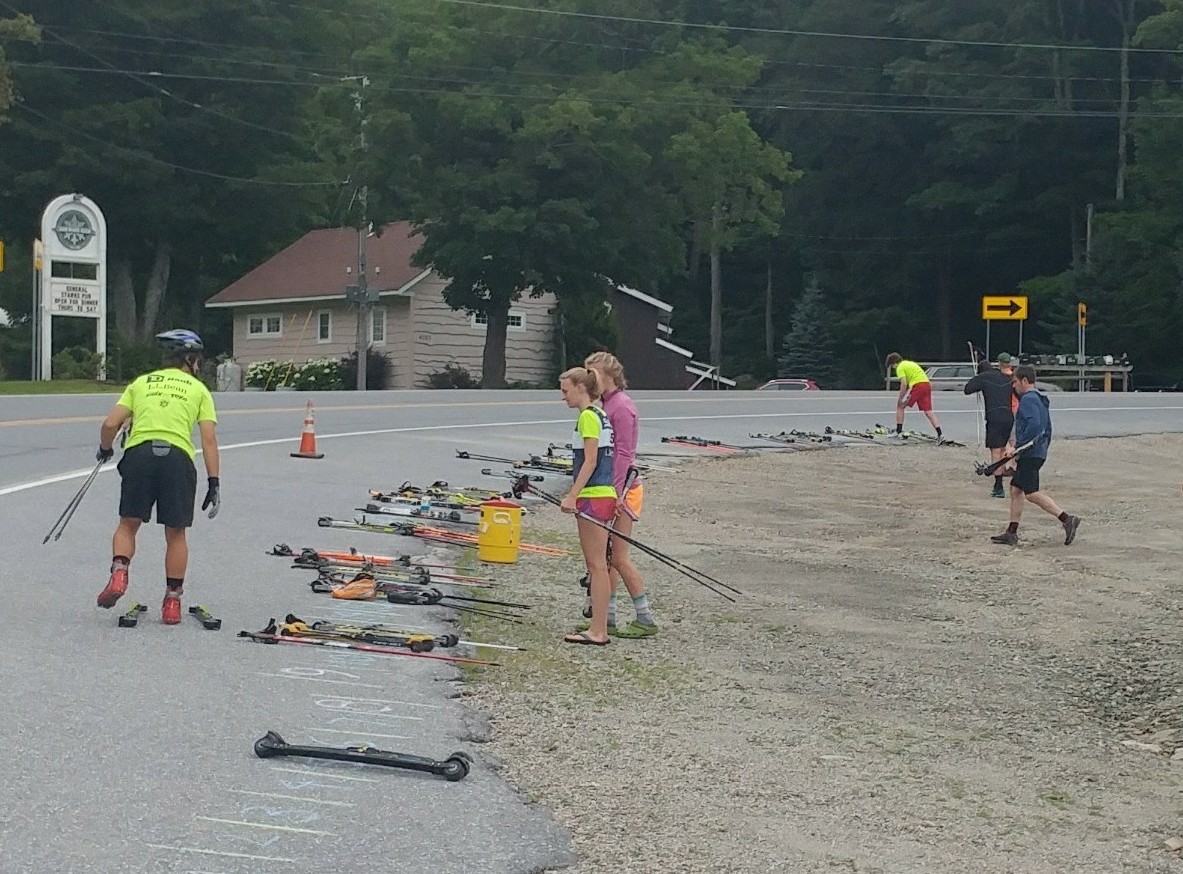
    Pre-race at the 2017 App Gap Challenge in Fayston, Vt.: skiers setting up their classic gear in the transition area. (Photo: Peter Minde)

    From the exchange, there’s no relaxing, with regular grades over seven percent and several over 15 percent. The killer is a 20-percent incline right below the finish. At least the pavement is new and faster than the pavement for the skate segment.

    As with any other race, being familiar with the course helps.

    “I live right in the valley. I know this road,” said Elliot Ketchel, a four-time App Gap racer who won the junior men’s race in 31:18. A GMVS graduate, he’s headed to Bowdoin College this fall.

    At the finish, 1,509 vertical feet above the men’s start, skiers loaded their boards and boots into a sag wagon and changed into dry shirts and sneakers for a hike down the ski trails. With perfect timing, the sun came out for the barbeque and awards.

    Results

  • U.S. SuperTour Preview: Anyone’s for the Taking

    U.S. SuperTour Preview: Anyone’s for the Taking

    The men's 15 k freestyle individual start podium at SuperTour Finals in Anchorage, with winner Noah Hoffman (c), runner-up Scott Patterson (third from l) and Erik Bjornsen (second from r) in third.(Photo: Rob Whitney)
    The men’s 15 k freestyle individual start podium at the 2014 SuperTour Finals in Anchorage, with (from l-r) Patrick Johnson (6th), David Norris (4th), Scott Patterson (2nd), winner Noah Hoffman, Erik Bjornsen (3rd), and Lex Treinen (5th). (Photo: Rob Whitney)

    Note: This article has been corrected to describe the race women’s SuperTour leader Caitlin Gregg is shooting for at World Championships: the 10 k skate.

    WEST YELLOWSTONE, Mont. — National racing begins Friday as the SuperTour kicks off in West Yellowstone, Mont., and the excitement on the Rendezvous trails couldn’t be higher. The best skiers from around the country have been training for at least a week in the little Montana town as they prepare to compete for American dominance and possible positions on World Cup and World Championship teams.

    With several departures from the racing scene including, Olympian Torin Koos (BSF), Rose Kemp (SVSEF), and Kate Fitzgerald (APU), and a multitude of up-and-coming racers on the cusp of success, the 2015 SuperTour will be anyone’s game.

    When the USST selected four men (Erik Bjorsen, Brian Gregg, Koos and Kris Freeman) and no women from outside the regular World Cup team, it left many skiers hungry to show that they could perform well on the international level.

    This year they’ll have another shot with the 2014 Nordic World Championships in Falun, Sweden.

    While the U.S. is allotted 12 spots for each gender in Falun, USST head coach Chris Grover explained that he and his staff would select eight skiers per gender at most.

    World Championship team selection will be based on several criteria. Those skiers ranked in the top 50 in the World Cup sprint or distance standings as of January 18 will be named to the team. After that coaches’ discretion kicks in. If coaches feel that the World Championship team could benefit from additional skiers after their discretionary picks, they will then begin selections from the USSA points list.

    The selection is identical to last year’s Olympic process, with the exception of the USSA points. When making selections for the Olympics, coaches picked three non-USST skiers from the FIS points list to fill in the gaps.

    According to USST Head Coach Chris Grover, the reason for the switch to USSA points is to emphasize domestic racing so that potential candidates for the championships will be racing against each other, rather than chasing FIS points across the globe like many did last season.

    Due to the emphasis on USSA points this season, the SuperTour will be where non-World Cup team athletes will have the chance to prove they have what it takes.

    The Veterans

    Brian Gregg (USA).  Photo: flyingpointroad.com / NNF.
    Brian Gregg (Team Gregg) will be a top competitor in 2015. Photo: flyingpointroad.com.

    On the men’s side, 2014 overall SuperTour champion Reese Hanneman (APU) will be competing in the first period World Cup races and will return to the national circuit in Houghton, Mich. for the 2015 U.S. Cross Country Championships. While the benefits of early-season World Cup racing are considered mixed, Hanneman can expect his chances of racing in Falun to increase if he demonstrates that he can keep up with the Europeans and his fellow American teammates.

    With Hanneman out of the picture in West Yellowstone and Bozeman, the men’s SuperTour favorites are the remaining two non-USST members to attend the 2014 Olympics – Brian Gregg and Kris Freeman.

    Freeman, a 34-year-old former USST member, will be racing in West Yellowstone for the first time in nine years. Freeman, who lost his position on the USST in 2013, was one of three non-USST members to qualify for the 2014 Olympics. Despite high hopes of his best olympics yet, he struggled in Sochi. This season he is looking to turn around his skiing and earn a spot on the World Championship team. As one of most experienced skiers on the SuperTour circuit he will have an advantage over much of the competition.

    Gregg, like Freeman, will also enter the 2015 SuperTour with a multitude of experience. The 2013/2014 season saw Gregg on the SuperTour podium several times, most notably with his two second place finishes in the 2013 West Yellowstone 15 k freestyle and in the 2014 U.S. Nationals 30 k freestyle. At the Olympics, he constantly finished in the 40s and 50s.

    As he starts the season, Gregg acknowledged that the first races of the season would be challenging.

    “Kris is in really good shape so I think there are going to be some very competitive races. I’m excited,” Gregg said from West Yellowstone Tuesday.

    Joining Freeman and Gregg as veterans of the SuperTour are Matt Gelso of the Sun Valley Gold Team and Dakota Blackhorse-von Jess of the Bend Endurance Academy. Gelso will be looking to build on past results while Blackhorse-von Jess will pursue success in sprinting, especially since U.S. sprint champion Torin Koos retired from competition.

    After disappointment in the freestyle sprint at the 2014 U.S. Cross Country Championships and a failure to qualify for the 2014 Olympics, Blackhorse von-Jess said that nothing has changed in his career trajectory.

    “I’m re-energized after the disappointment of the Olympics with the reaffirmation that I still want this and believe I have what it takes… My career/goal trajectory hasn’t changed in the least: I’m focused on racing my best in the biggest international competitions and just need to make sure I do what is necessary to make those trips and come to the starting line in Falun prepared to light it up,” he wrote in an email.

    Matt Liebsch of Team XC United will also be returning to racing after missing out on Olympic qualification. However, Liebsch, who works near full time for Gear West, has lightened his training load as is looking to “maximize fun and earning potential ” rather than qualify for international events.

    “I’m not going to be chasing FIS points around the world or country necessarily. If they fall in my lap because I’m racing well, that’s great, but I’m not going to be stressing about it… It’s not really a change for me. I’m still going to try to race as fast as I can only I won’t be training as much,” he said in a phone interview.

    Ryan Scott, living and training independently in Boulder, Colo., will also return to competition, but, like Liebsch, has cut back his training as a result of work.

    For the women, one name has particularly dominated the domestic circuit for years – Caitlin Gregg.

    Gregg, like Hanneman, will start her season on the World Cup after earning the women’s overall title at the SuperTour finals in Anchorage last season. Gregg said earlier this fall that she is as motivated as ever and has her sights set on a particular race: the 2015 World Championships 10 k skate. To get to Sweden, however, she’ll need to demonstrate that she’s on par with USST and dominate when she returns for the U.S. championships in January. In the meantime, she’s excited for the 5 k next weekend in Lillehammer and aims to earn a start in that race.

    With the absence of Gregg, the West Yellowstone and Bozeman SuperTours are anyone’s for the taking.

    Rosie Brennan (APU) leading her semifinal in the 2014 U.S. Cross Country Championships. (Photo: http://bertboyer.zenfolio.com) All proceeds from photo sales will be directly donated to NNF.
    Rosie Brennan (APU) leading her semifinal in the 2014 U.S. Cross Country Championships. (Photo: http://bertboyer.zenfolio.com).

    Always a strong skier, APU’s Rosie Brennan will once again attempt to demonstrate her mettle as she makes a bid for World Championships. Last year Brennan started her season on the World Cup and returned to the U.S. exhausted, but earned a national title at U.S. Nationals in addition to several podiums. This year she will enter the season with fresh energy despite a turbulent fall after loosing her father in August.

    Joining Brennan at the top of the SuperTour expectations are APU teammates Chelsea Holmes and Becca Rorabaugh.

    Holmes demonstrated her strength throughout the 2013/2014 season with a win in the 10 k classic mass start in Bozeman, a second to Gregg in the 20 k at the 2014 U.S. Nationals, and several other strong performance throughout the entire SuperTour season.

    Rorabaugh won the 10 k interval start classic at the 2014 U.S. Cross Country Championships for her first national title, and is looking to have even more time upon the podium as she continues through the season.

    Last year Bridger Ski Foundation’s Jennie Bender repeated a national title in the freestyle sprint. While she’s dealt with illness and injury for the past two years, Bender told FasterSkier that her summer training this year was her best to date, and that she is looking to find success domestically and qualify for World Championships.

    The Wild Cards

    Miles Havlick (Sun Valley Ski Education Foundation) tucking down the high point of the course on the fifth of six laps at U.S. nationals in the 30 k freestyle mass start at Soldier Hollow. While the veterans of the 2015 SuperTour are names we’ve seen at the top of the result sheets for years, there are several skiers who have an excellent opportunity to shake up the status quo and make a name for themselves on the domestic circuit.

    Sun Valley Ski Education Foundation’s Miles Havlick didn’t have the season he wanted in 2014, but has come back with a vengeance in 2015. While he has yet to face his competitors on-snow, Havlick has won a slew of time trials including the USST1o k freestyle rollerski time trial in Park City, Utah against the country’s best. He also broke a 25-year-old record in the Baldy Hill Climb this year.

    According to Havlick, he has the all the ingredients for a breakout season. Now it’s only a matter of time.

    “I think on any given day – when I am mentally competent, carrying confidence from previous races, focused, and my wax is good – I can be the best skier out there. The college skiing is when I was really able to prove that to myself. Last year was kind of tough because I felt like I was spinning my wheels by the end, but I think I’ve made some adjustments this year that can fix that,” he said in a phone interview in October.

    Havlick also has gained the attention of Grover and the USST.

    Erika Flowers racing to the fastest women's time in the inaugural Tim Burke Uphill Run Test at Whiteface Mountain.
    Erika Flowers racing to the fastest women’s time in the inaugural Tim Burke Uphill Run Test at Whiteface Mountain this fall.

    “I’m excited to see how Miles Havlick is going to ski. He’s had a great fall. He won our US ski team time trial that we did in Soldier Hollow. He set a new course record on the Baldy Hill climb that stood for 26 years or something. There’s some new emerging faces to keep an eye on,” he said.

    For the women, a possible 2015 wild card is a less well known. However, despite her lack of national attention Stratton Mountain School T2’s Erika Flowers has all the makings of an up and coming skier.

    Flowers has always been a strong and consistent skier with the majority of her SuperTour results landing in the top-ten. However, when she traveled to Europe in the spring of 2014 she demonstrated her potential, wining a 10 k mass start in Silvapalana, Switzerland. Several weeks later she placed 14th in the Alpen Cup mini-tour. She finished the tour as the second American behind Holmes and had the fifth-fastest time in the final 10 k pursuit.

    While Flowers has struggled with sprinting in the past, she demonstrated that she could stick with the best of them at the 2014 Frozen Thunder races in Canmore, Alberta ending the day in 7th.

    The following day she finished 7th in the 7.2 k freestyle at Frozen Thunder. She was the 3rd American, and placed ahead of several notable Olympians including Jessie Diggins.

    The Rest 

    In addition to Havlick, there are several other men who could make the domestic season anyone’s game.

    Recent college graduates Ben Lustgarten of SVSEF, David Norris of APU, and David Sinclair of Green Mountain Valley School will be looking to take their success from NCAA racing to the SuperTour.

    Scott Patterson (APU) is another notable graduate who had success on the SuperTour both at the 2014 Nationals and 2014 SuperTour finals. According to his family, Patterson will not be starting his season in West Yellowstone due to a skiing accident that occurred Oct. 31st in which he was impaled by a broken ski in his upper leg. While the leg wound healed, Patterson developed a pulmonary embolism (blood clots in his lungs) which has limited his exercise to walking. However, according to his family, Patterson is optimistic that he will return to racing at U.S. Nationals.

    Ben Saxton (SMST2) and Paddy Caldwell (SMST2/Dartmouth) will be the sole USST members starting the season in West Yellowstone. Saxton who was second in the freestyle sprint at U.S. Nationals last year, is aiming perform well in Friday’s sprint. Caldwell, who has yet to decide whether or not he will ski for Dartmouth this year is a strong distance skier and will be vying for top results amongst the country’s best.

    “They need to prove themselves and make those teams just like any other athlete that is on the domestic scene. Obviously those guys are younger guys and they’re still focused on the U23 World Champs,” Grover said of the two USST D-Team athletes.

    Welley Ramsey (MWSC), Tad Elliott (SSCV), and a slew of other men from APU and Craftsbury will also look to challenge the national favorites as the season gets underway.

    On the women’s side recent graduates Anne Hart (SMST2), Rosie Frankowski (APU), and Anja Gruber (Far West Elite) are new to full-time racing on the national circuit after having successful college careers. While the adjustment from college skiing to professional racing is often difficult, these women will still be a strong force to contend with.

    Annie Pokorny (SMST2), Caitlin Patterson (CGRP), Liz Guiney (CGRP), and Mary Rose (SVSEF) are shaping up to be strong competitors in the 2014/2015 season after a productive summer and fall trainings with their respective teams.

    [See the Super Tour schedule here]

  • GMVS Focuses on Retention to Build Program’s Future

    GMVS Focuses on Retention to Build Program’s Future

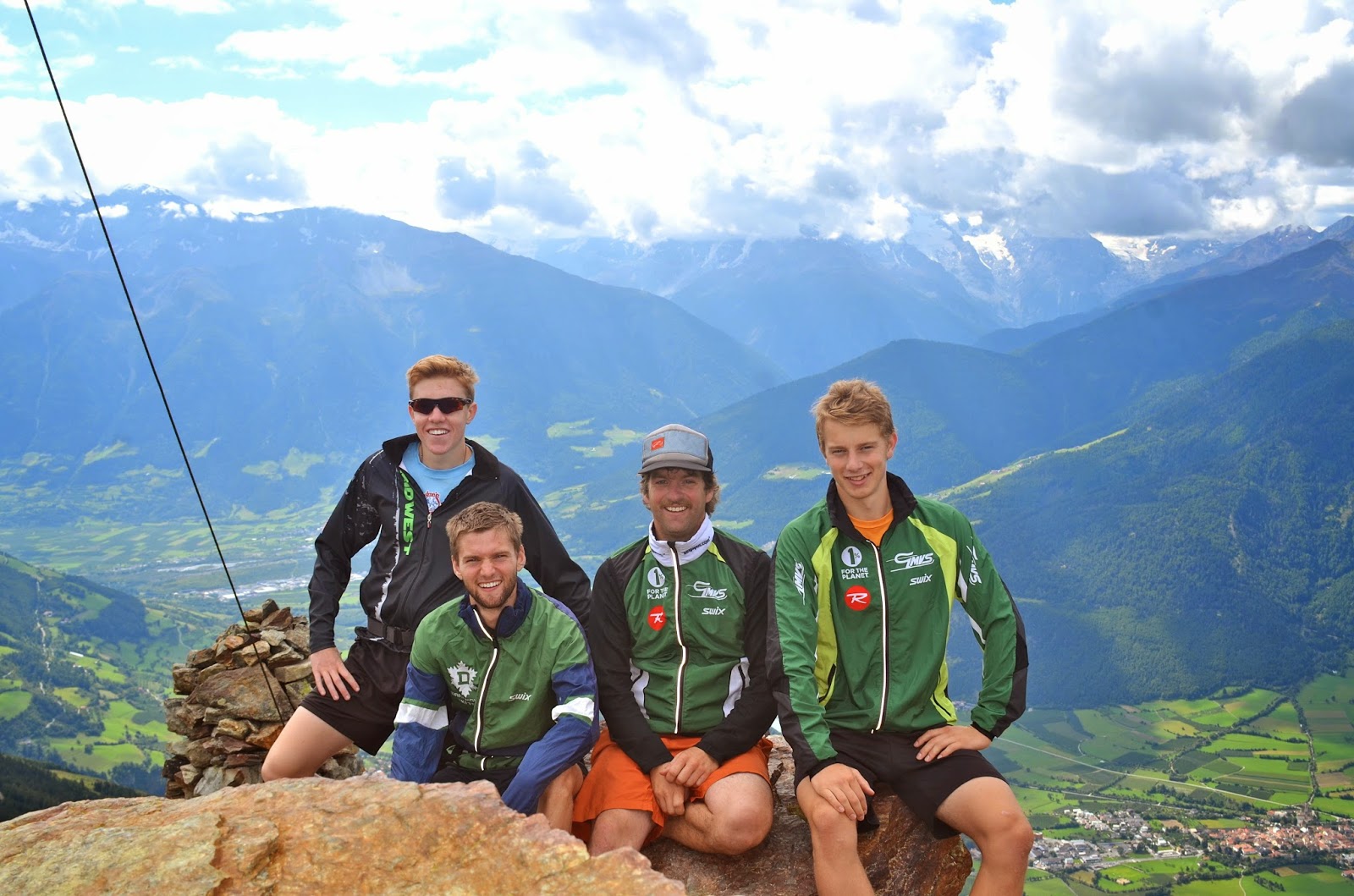
    GMVS elite and postgraduate athletes Nick Gardner, David Sinclair, GMVS head coach Justin Beckwith, and Ian Moore (l-r) during their September trip to Italy. (Photo: GMVS)
    GMVS elite and postgraduate athletes Nick Gardner, David Sinclair, GMVS head coach Justin Beckwith, and Ian Moore (l-r) during their September trip to Italy. (Photo: GMVS)

    Organic development. That’s how Justin Beckwith is describing the new era of the Green Mountain Valley School’s nordic ski team.

    Beckwith, who serves as head coach for the rural Vermont academy, is overseeing the addition of an elite and postgraduate program to the team, which has historically found its successes in junior racing.

    However, this is no traditional elite team. Instead of partaking in the tedious process of athlete applications, selection, and community placement, GMVS is recruiting from its own ranks.

    If anyone is a poster child for the GMVS transition it’s David Sinclair. Sinclair, who graduated from Dartmouth College in May was a product of the GMVS program as a junior. During his time at the school he found much success at the junior level. At Dartmouth College, Sinclair earned several Junior National Championships and attended the 2014 NCAA Championships where his best result was 17th.

    Once the Waitsfield, Vt. native graduated from Dartmouth he returned to his roots and joined Beckwith and the rest of the GMVS team.

    According to Beckwith, the return of Sinclair is promising for his team of 12 skiers.

    “One of the best things for a program is when an athlete returns,” Beckwith said in a phone interview with FasterSkier. “With David it was a natural progression because he was one of our athletes.”

    In addition to Sinclair the GMVS program also boasts two postgraduate athletes, Ian Moore and Nick Gardner. The two are taking time to focus on skiing before they attend the University of Vermont and Williams College after the 2014/2015 season.

    The three skiers aren’t the only new additions to the team. Earlier this year GMVS hired Shane MacDowell who will serve as the assistant coach to aid in the continued development of its nordic program.

    MacDowell, who graduated from the University of New Hampshire in 2009, has a long history in the ski community.

    Shane MacDowell will be the assistant coach and wax technician for the GMVS program for the 2014/2015 season. (Photo: GMVS)
    Shane MacDowell will be the assistant coach and wax technician for the GMVS program for the 2014/2015 season. (Photo: GMVS)

    After spending a season coaching the Cape Elizabeth Nordic High School Team he founded the Boulder Nordic Sport Acceleration Team where he served as the Head Coach in 2012.  During the winter of 2013 he was the head wax technician for the J1 Scandinavian Trip in Trondheim, Norway in addition to his duties as a technician for the OPA Cup Finals in Madonna Di Campiglio and Toblach, Italy. Most recently, MacDowell was the assistant coach and wax technician for the Sun Valley Ski Education Foundation.

    Beckwith said that with the help of MacDowell, the GMVS program has the infrastructure to support both junior and higher-level athletes. For years, the alpine team at GMVS has been providing elite support for athletes and according to Beckwith the nordic team is ready to do so as well. 

    The recent developments at GMVS are part of its head coach’s approach toward training and racing. Beckwith explained that a key component of a successful team is its ability to create an environment that promotes skiing as a long-term project. He said that he’s seen too many skiers focus on lofty short-term goals that can make racing tedious and repetitive.

    “I want to have kids who want this to be a lifelong sport versus focusing on very specific cross country training when you’re 13, 14, or 15 with the goal of winning junior nationals when you’re a J2 or J1. Sometimes we’re seeing that these athletes get to college and they’re burnt,” Beckwith explained. “We’re obviously trying to make them fast ski racers, but that’s what I want to do to set my program apart from the other programs.”

    By adding more adventure and diversity to his training plans Beckwith said his athletes are more likely to continue skiing in college, and are thus more likely to return to his program as high-level athletes.

    Beckwith said that takes his athletes to the local alpine areas or explores off-trail training opportunities in the woods surrounding the school.

    Sometimes the adventure is further from home. In September, the 12-member team traveled to Italy’s Stelvio Glacier for a two-week training camp. Not only did the team find favorable training conditions, they also befriended 2014 Olympic medalist Ilia Chernousov of Russia, who was one of the only other skiers on the glacier at the time.

    As the team continues their fall training, Beckwith said that one of his main focusses will be to create a presence on the national circuit this year. As in years past, GMVS will travel to West Yellowstone and Bozeman, Mont. in November for an extended camp and to race in the SuperTours.

    If everything goes according to plan, the team will unveil a new wax trailer in January at the 2015 U.S. Cross Country Championships in Houghton, Mich. GMVS will use the trailer throughout the season for Eastern Cups and other SuperTour races.

    For now, however, Beckwith and the rest of the GMVS squad are focusing on building excitement for the sport while working to keep their athletes close to home.

    The GMVS team poses with 2014 Olympic medalist Ilia Chernousov (l) on the Stelvio Glacier during their September training camp in Italy. (Photo: GMVS)
    The GMVS team poses with 2014 Olympic medalist Ilia Chernousov (l) on the Stelvio Glacier during their September training camp in Italy. (Photo: GMVS)
  • Koos Makes it a Double with 30 k Victory at Soldier Hollow

    Koos Makes it a Double with 30 k Victory at Soldier Hollow

    Torin Koos (Bridger Ski Foundation/Rossignol) won his second national championship race this week with his 30 k classic victory on Sunday at Soldier Hollow. Photo: USSA/Tom Kelly.

    FasterSkier’s coverage of the 2013 US Cross Country Championships is brought to you through the generous support of The Memory Clinic in Bennington, Vt.


    MIDWAY, Utah —Torin Koos (Bridger Ski Foundation/Rossignol) knew he had a pretty good shot at winning another national title on Sunday. Carrying momentum from a classic sprint victory and a distance skate result that made him optimistic for the mass start, he was pretty confident he would have a good 30 k classic.

    “I just had a feeling that I’d have the capacity and the moxie to make it happen,” Koos said.

    Make it happen he did, skiing patiently tucked into the lead pack for most of the race to make a move at the base of the final climb up Hermod’s Hill. When he came off the top, he had put enough distance on the field to give himself a margin of a few seconds over Erik Bjornsen (Alaska Pacific University/U.S. Ski Team), and when they entered the final stretch it was a practically insurmountable distance. Koos won the 30 k in 1:26:04, 3.1 seconds ahead of Bjornsen and 8.1 seconds over bronze-medalist David Norris (Montana State University).

    The 2013 national 30 k champion. Photo: USSA/Tom Kelly.

    “I was optimistic going into it,” Koos said as he awaited to step onto the podium. “I won’t say it was a surprise to me.”

    For someone who had completed his first distance race of the season only two days prior, the race played out perfectly: tactically and not too fast. The lead pack, instead of gradually thinning, remained 20 men strong as far along as the 20 k mark. Koos began the race in bib 39 towards the middle of the chevron and had time to work his way up a train that refused to dissipate.

    “I just said [to myself], ‘If I made it to the top of the hollow, nobody was going to drop me,’” Koos said of his final lap. “I thought I was going to have real good energy at the end.”

    He made it to that point and was still with the leaders. Perhaps if anyone had known the prolific sprinter still had energy to burn they would have made a point of dropping him earlier. But they didn’t, or couldn’t, which enabled Koos to hold on, make a move and employ his notorious closing speed in the straightaway.

    Koos making his move at the beginning of Hermod’s Hill.

    “I was on the bottom of Hermod’s right when he went and he looked unbelievable,” said BSF coach Tim Baucom. “Just really good skiing on his part and I think he was happy to have it come down to the last lap… If those guys had decided to go out early it would have been a bit tougher for him.”

    With a main group as big as it was, a handful of skiers had opportunities to control at various points in the race. Miles Halvick (University of Utah), the 2012 NCAA classic champion, took the first move to the front and directed the race for the most of the first lap.

    “I was just trying to keep the pack as thin as possible,” Havlick said. “I don’t know, I was just feeling good and relaxed.”

    Havlick’s opening pace a bit faster than expected to the rest of the pack. When the group came through the first feed zone at 4 k, he pushed through without stopping while those behind took swigs of Gatorade. Sylvan Ellefson (SSCV Team HomeGrown), Matt Gelso (Sun Valley Ski Education Foundation), Tad Elliott (SSCV/USST), Bjornsen and Norris clustered behind Havlick as he briefly put space between himself and the others.

    “The pace was hard the first lap with Miles leading,” Elliott said.

    By the time they climbed Hermod’s Hill for the first time, the focal point of the course profile, and descended back into the stadium, the pack had reabsorbed Havlick. Gelso, Ellefson, Norris and Bjornsen moved to the front, and the pace slowed. At that point, it was still anyone’s race. The pack was still over 20 skiers deep on lap two of six.

    Ellefson and Gelso leading the pack over Hermod’s Hill early in the race.

    One athlete, however, began to set himself apart. Gelso, with ambitions for his second podium of the week, was the workhorse of the day, consistently pushing the pace from the front.

    He said afterwards that he decided to lead just to stay out of trouble, not because he was feeling particularly good.

    The pack climbing Hermod’s on the second lap.

    “I skied towards the front to keep the pace down and do what I could,” Gelso said. “I was just kind of skiing my own race. Lots of times it’s easier to ski at the front of the pace you want to ski instead of in someone else’s stride, screwing around. With some of the turns around here and where people were feeding, it made sense to be in front in a lot of places.”

    Gelso’s competitors were impressed with his effort. “He was skiing awesome all day, Gelso,” Elliott said.

    Elliot and Ellefson also took turns pulling at the front, and would move into the front for the same reasons everyone else seemed to: the pace was still under control and it was best to steer clear of traffic if possible.

    “I feel like every time I led I just happened to be in there,” Elliott said. “I would lead on the downhills to stay out of trouble and I had fast skis. On the steep uphills I got my own track a lot of the time; I would try to take it easy on the uphills.”

    Ellefson, meanwhile, was having the race of his season. Plagued by illness and fatigue this winter as he raced on the World Cup in Europe, on Sunday he felt things finally coming back around.

    “I was feeling really good,” Ellefson said. “The whole time I was really just skiing my own race, and when I was out in front I was skiing at just a pedestrian level, as the Eurosport announcers would say.”

    Gelso leading, halfway through 30 k.

    Just as he was relaxing into the pace, however, disaster struck. With the lead group still quite crowded, someone stepped on Ellefson’s skis right before they began to climb Hermod’s for the third time.

    “I lost my balance and couldn’t lift my skis out of the track, because he was on top of them, so I went down and the whole pack just blew past me,” Ellefson said. “It’s nice to have coaches and everyone out there telling you to relax and stay calm, you’ll catch back up. That’s kind of where it helped me out today.”

    Elliott attempting a surge, with Koos hanging on.

    Elliott and Ellefson thought they had some of the best skis in the field. After Ellefson fell he felt the fast wax prevented an unfortunate situation from becoming worse, and he was able to mitigate the loss of time.

    At the front of the pack, meanwhile, Elliott was at the front putting on a small surge. “I kind of made an attack when [Ellefson] was just getting back on,” Elliot said, adding he regretted not knowing his teammate had fallen in the moment.

    Apart from Ellefson, the pack did not go away when Elliott quickened the pace; its numbers began to dwindle but the contenders remained unbroken. There was still hardly any distance at all between Bjornsen, Norris, Koos and Gelso. Havlick began to lose contact, but Sam Tarling and David Sinclair (Dartmouth) stayed in the mix, having the race of their lives.

    “I was a little worried when I was out in front, but I wasn’t working all that hard,” Tarling said. “There were sections where I was feeling a little bit tired but also sections where I was feeling great.”

    Lap four is where things started to get serious. Elliott, going for the win, made another surge in an attempt to break away. More skiers dropped off the back.

    “Tad tried to make a move with 9.5 k to go,” Koos said. “That could have been a defining move, but I was able to cover him.”

    Koos was able to regain 100 m on Elliott to reestablish contact, but he didn’t want to take over the lead.

    “I wasn’t interested in pushing the pace and he wasn’t tell me, like, ‘Go, go, go,’ and we let the pack kind of come back,” Koos said.

    Gelso, Elliott and Koos the fifth time up Hermod’s.

    The surge may have ultimately cost Elliott. “I felt great all day and I think I just went a little too — I was racing for the win and felt like I was really charging, but those other guys were busting it out pretty hard,” Elliott said.

    In a race filled with shuffling leads, Koos and Bjornsen were particularly coy. They were almost always just behind the leaders, trying not to draw too much attention to themselves and conserve from the middle of the pack. When it was finally time to go they had more energy than anyone. On the last lap, when everyone was hanging on for dear life, they were able to attack afresh.

    “At the base of Hermod’s all of us came over the sprint hill together and everyone took their own lane,” Koos said. “I just started going, not 100% at the base of it, but with a lot of snappy power.”

    Koos bounded up the incline and nobody could match it.

    “I tried to kind of kick it up to catch Torin, but he was moving at a really fast pace,” Bjornsen said.

    Bjornsen.

    Down the other side of the hill and into the stadium, Koos skied as if Bjorsen was right on his tail, not knowing if he’d managed to create a break.

    “I heard quite a few people cheering for Erik in particular right behind me, so I could tell I was maybe breaking him a little bit but that it was going be tight,” Koos said.

    A bunch of powerful double-poles later and the 30 k title was his. Does it get old after the eighth time at the top of the podium? Not really, he says.

    “I mean, it’s awesome to win a race like that,” Koos said.

    Bjornsen, having climbed his second podium in two days, was feeing pretty good about how things went.

    “I practiced some tactics this time and think it paid of well,” he said. “I still felt like I had a kick at the end. I couldn’t quite match Torin’s kick, but felt pretty relaxed going up that last hill.”

    His coach thought Bjornsen skied the race flawlessly.

    “It’s just exceptional,” said APU head coach Erik Flora. “For Erik, for his age, for a 30 k today, it was tremendous and he played it perfectly. You watched him in the pack and where he made time.”

    Norris crossed the finish line five seconds behind Bjornsen to take the bronze. Like Bjornsen and Koos, he played a smart race and let others do the work. He was second in the 30 k in Rumford, Maine, last year, and seemed satisfied with third on Sunday.

    Norris and Gelso on the final climb up Hermod’s.

    “I expected some of those bigger guys to hammer that last hill,” he said. “I didn’t feel that great during the race; I was trying to just ski along. I kind of felt sick from some of the feeds.”

    Gelso, who had spent so much time working out in front, finished fourth (+11.7). In retrospect he admitted he had led “maybe too much.”

    “I’m a little bummed I wasn’t in the top three. 30 k is a huge effort so when you lose out by 10 meters you’re like, ‘Aw, God,’” Gelso said. “Whatever. It was a solid day and it was fun racing, so…”

    Though Gelso was disappointed with fourth, the next two finishers behind him were ecstatic with huge personal bests. Tarling and Sinclair placed fifth and sixth, respectively, to lead the Dartmouth men.

    “I’m just psyched to have one of my teammates up here with me,” Tarling said, who skipped nationals last January due to illness. “I knew if I could hang on over the top of Hermod’s I’d be in a position to do pretty well.”

    Tarling climbing early in the race

    Tarling finished 18.1 seconds back from Koos’ time and Sinclair came through less than five seconds after Tarling.

    “I was just trying to hang in the pack as long as I could,” Sinclair said. “It felt pretty good for the first four laps and then it started to get hard, and I was just hanging on for dear life.”

    Elliott, meanwhile, had spent his energy on mid-race surges and slipped to seventh, 23.3 seconds behind Koos. He had hoped for more, and after the race he regretted not being able to deliver a win for his team more than anything else.

    “I wanted to deliver a win for those guys,” Elliott said. “It would have been really nice; [Team HomeGrown] works really hard.”

    At the end of the day the top 10 were almost all under the age of twenty-five, a demonstration of impressive depth to the up and coming field of American distance skiers. All but one, of course: the seasoned veteran who can still school them all. Koos, 32, has now won eight national titles in his career.

    After the podium ceremony, someone asked Bjornsen if he remembered the first time he met Koos. Without a moment’s hesitation Bjornsen recalled asking for Koos’ autograph as a junior skier at the West Yellowstone Ski Festival.

    “I went into a West Yellowstone bar to ask if I could have his signature when I was probably, like, 12 or something,” he said. “I saw him playing pool and I asked him for his signature, I had a little postcard of him.

    “I’ve learned a lot from him… Every once in a while Flora is like, ‘You’re skiing like Koos!’”

    Results.

    — Alex Matthews contributed reporting.


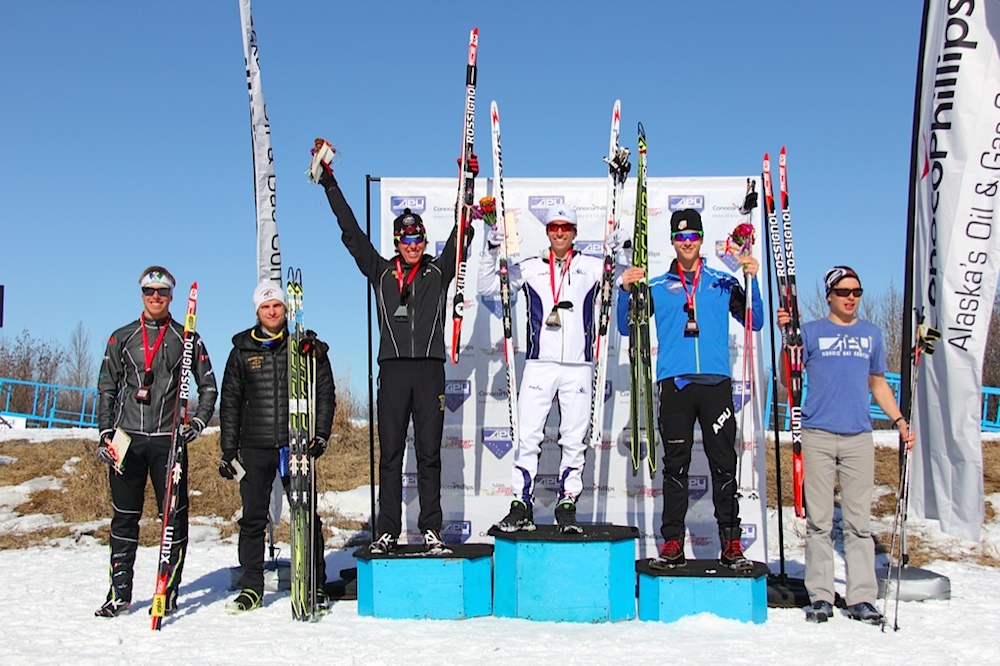
    The men’s podium: 1. Torin Koos (BSF/Rossignol). 2. Erik Bjornsen (APU/USST) 3. David Norris (MSU).


  • U.S. Nationals Men’s 30 k Classic Mass Start Video

    U.S. Nationals Men’s 30 k Classic Mass Start Video

    MIDWAY, Utah – The action at the 2013 U.S. Cross Country Ski Championship heated up this morning when the senior men started off the day with the 30 k classic mass start.  Six laps of the challenging 5 k loop at Soldier Hollow made for an exciting race as eighteen skiers were together in the lead pack for the majority of the race, but during the final kilometers only a handful of men were in contention for the national title.  As they climbed Soldier Hollow’s fabled Hermode’s Hill for the final time it was Torin Koos (BSF) who made a decisive move to claim the national title with Erik Bjornsen (USST/APU) and David Norris (MSU) finishing second and third respectively.  Check out our footage of the race.

  • Woods, Hanneman, Diggins complete individual title sweep at Junior Olympics

    Woods, Hanneman, Diggins complete individual title sweep at Junior Olympics

    New England's Tyler Foulkes (Stratton Mountain School) captured his first Junior National title in the J2 5k freestyle race on Friday. Photo: David J. Owen Photography

    Going into the third day of Junior Olympic competition, Friday’s skate individual start, four athletes had a chance to sweep all individual events: Hamish McEwen (Cambridge Sports Union) in J2 boys, Marion Woods (Alaska Winter Stars) in J2 girls, Logan Hanneman (FAST) in J1 boys, and Jessie Diggins (CXC) in OJ girls. When the day was finished, only McEwen was knocked off the top step of the podium.  (He was still second!) Woods, Hanneman, and Diggins each succeeded in the rare feat of winning all individual events at the Junior Olympics.

    As a result of the wet snow on Wednesday and below freezing temperatures overnight, the course set up firm and lightning fast.  Silas Talbot (Alaska Winter Stars) called the course “challenging.” “It was a little scary on the downhills.  There were some tough turns at the bottom of hills.  You had to ski as fast as you could, but be sure to be in control.”  Still, athletes commended the course conditions.  J1 Sawyer Kesselheim: “It was a good course.  I’m glad they raked the corners. It kept it really nice. I thought it would get more chopped up.”

    For the J2 boys, Stratton Mountain School’s Tyler Foulkes managed to upset the previously dominant McEwen.  Foulkes finessed the technical course to a 18-second win. This margin of victory is even more impressive when one considers the short time the athletes spent on the course; the top-10 skiers were all under 12 minutes. Foulkes was joined on the podium by McEwen (2nd) and Durango Nordic’s Haakon Sigurslid.

    J2 Girls Podium: Halie Lange, NE (5th), Sarissa Lammers, AK (3rd), Marion Woods, AK (1st), Annika Miller, IM (2nd) and Maggie Williams, IM (4th). Photo: David J. Owen Photography

    As anticipated based on previous results, Marion Woods was the J2 girls golden girl yet again.  Second-place finisher Anika Miller (Payette Lakes Sports) started 4th in the bib order, ten spaces ahead of Woods, so she had the disadvantage in terms of splits. Splits given on the long climb just short of 5 km had Miller clearly leading, until Woods and Sarrissa Lammers came by. Woods had made up the 15-second spread on Lammers, but Lammers bravely hung on up the long climb, earning her best result at JOs thus far.

    In the J1 girls 5 km, Corey Stock earned her second gold and third podium result.  At the finish, she was embraced by her coach who said, “Next year, we’ll do some training, and it will hurt less!” obviously referring to her late season return to racing after compartment syndrome surgery.

    Runner-up Heather Mooney was just two seconds behind Stock. Mooney went into the race with a plan that she executed. “My plan was to ski the first kilometer really whippy, and then to relax and ski the transitions well.  At about three and a half kilometers, I just went as hard as possible.”  Mooney, who is a senior at Stratton Mountain School, noted Stratton’s role in her success. “The biggest thing is just being around a group of great girls to train with.  There’s also the academic flexibility to come to a race like this and know the school is totally behind it.”

    Stratton Mountain School’s Cambria McDermott earned third place, just seven seconds out from the win.

    Logan Hanneman is all smiles following his podium ceremony for the men's J1 10k freestyle race. Photo: David J. Owen Photography

    Logan Hanneman (FAST) took over the J1 boys race in lap one and then held it throughout.  On the first lap, Patrick Caldwell looked to be a contender. He was tied with Hanneman at just under 4 kilometers, and then 10 seconds down (but in second place) at the lap.  However, Caldwell faded on lap two and finished fifth. Second and third for the J1s went to APUNSC teammates Forrest Mahlen and Jack Novak.

    J1 boys fourth-place finisher Sawyer Kesselheim (Bridger Ski Foundation) might be a name to watch in the future.  Kesselheim, who was tenth in the sprint and fifth in the classic, did not even qualify for last year’s Junior Olympics. He used to be a soccer player, but last year he quit and “really committed to skiing.” This is the first year he trained for skiing year-round. Kesselheim played the pacing game just right; he was in a three-way tie for seventh at the lap.  “I had a slower first lap and tried to build over the second lap.  I think I found a pace I could maintain.”

    Jessie Diggins once again showed complete domination over the OJ girls field, winning the 5 km race by 51 seconds!

    Hometown favorite Jessie Diggins on course. Photo: David J. Owen Photography

    Given Diggins’ results at the World Championships, and throughout the week at the Junior Olympics, Annie Pokorny’s second-place finish must have felt as good as gold.  While Pokorny doesn’t consider herself a power skier (she usually races in the West), she was delighted to find that the firm conditions worked for her.  “It was probably my best 5 km skate ever, easily…” Pokorny, who will be at Middlebury next year, took time to thank Minneapolis Junior Olympics volunteers: “This event is so well organized.  It is really easy to be a skier here.”

    Kinsey Loan (APUNSC) missed second-place by the narrowest of margins, just four tenths of a second.  Loan had a clear plan for racing the firm and fast course: go as hard as possible.  “With the fast snow and so many downhills, I tried to race this like a sprint.”  In planning her tactics, Loan is able to draw upon her experience in two sports.  She says she races nationally on her bike in the summer (road and mtb).  “Skiing and cycling complement each other very nicely.” Success in the OJ boys race depended on a fast second lap.

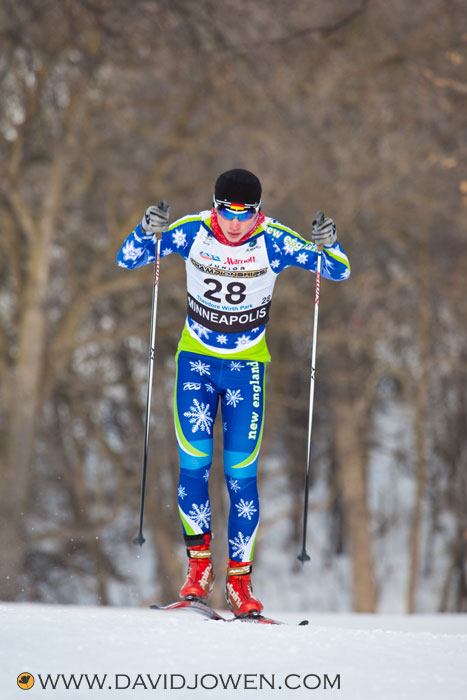
    Dartmouth’s David Sinclair was down to George Cartwright at 5 km, but turned it on in lap two to take the win. Third-place Silas Talbot also had a strong second lap, moving from fifth at 5 km to third at the finish. Without yet having seen the official split, he said, “The beginning was slower.  It took a while to get into it.” George Cartwright’s pacing was just the opposite.  He took a four-second lead through 5 km, but ultimately finished second by the narrowest of margins, just seven-tenths of a second off Sinclair.

    In the Alaska Cup competition, New England brought a solid lead into Friday’s races. While current points had not yet been tabulated as of this writing, it seems unlikely that Alaska’s Friday performance was enough to make up the significant points gap.  The fact that the cup will likely go to New England makes tomorrow’s relay races all the more important.  While the cup is determined by place points, each age group’s relay will go to the team who can string together the fastest skiers.  Anticipate that underdog Alaska will fight for the win in every race, while the Midwest will hope to upset in one or more.

  • Sinclair and Halvorsen Win  App Gap Challenge Duathlon

    Sinclair and Halvorsen Win App Gap Challenge Duathlon

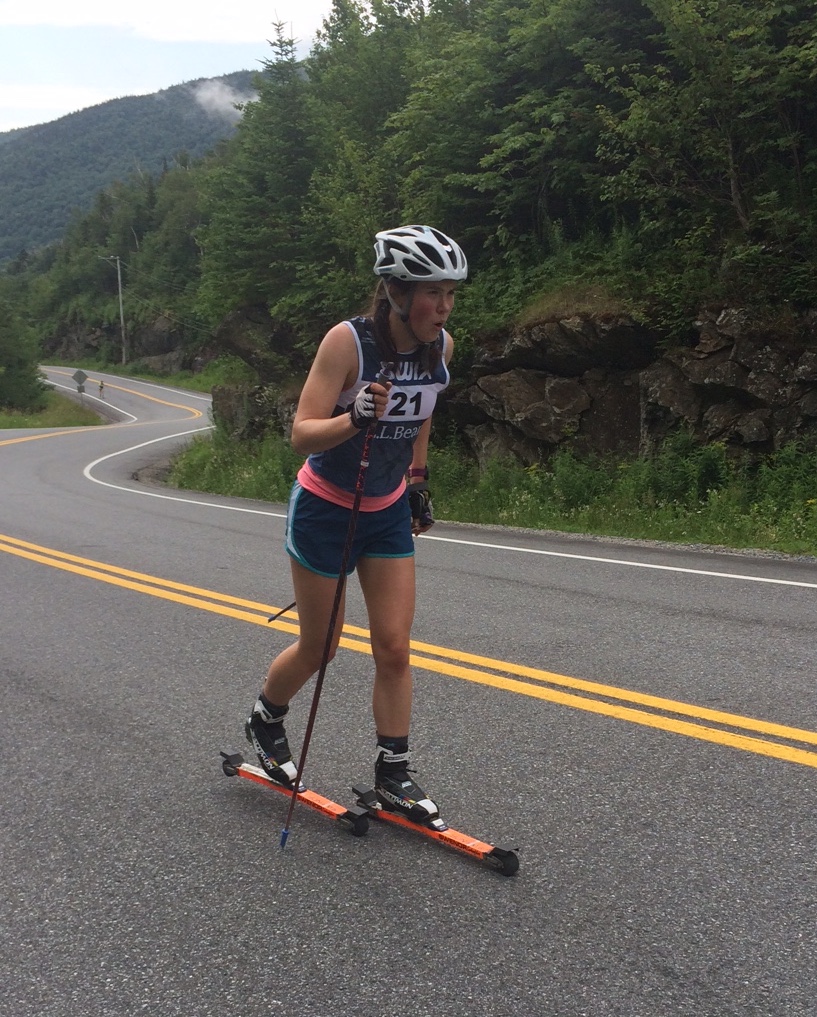
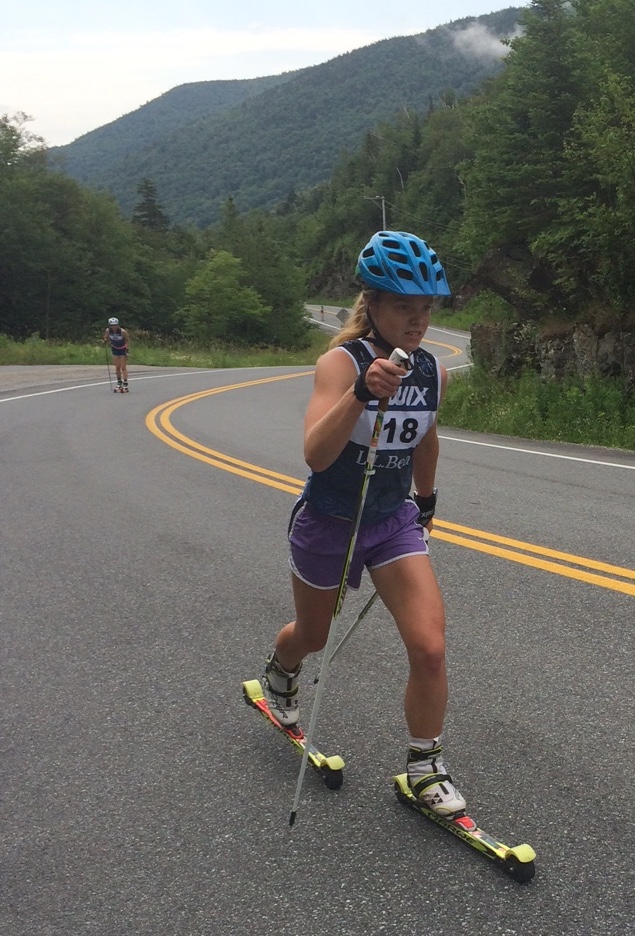
    David Sinclair and Heidi Halvorsen were the men’s and women’s winners of the 4th App Gap Challenge, a roller ski duathlon from Waitsfield to the top of Appalachian Gap in northern VT. The race was the final event of a week-long training camp for 16-18 year old skiers at Green Mountain Valley School in Waitsfield. Men skied 7 k and women skied 5 k.

    Sinclair’s winning time of 30:34 set a new course record by 5 seconds.  Eli Enman was the second male finisher in 32:36; Noah Brautigam placed third in 33:36. Halvorsen eclipsed the women’s course record by 58 seconds, finishing in 28:18. She was followed by Emily Stitt at 30:04 and Kristin Halvorsen in 31:06.

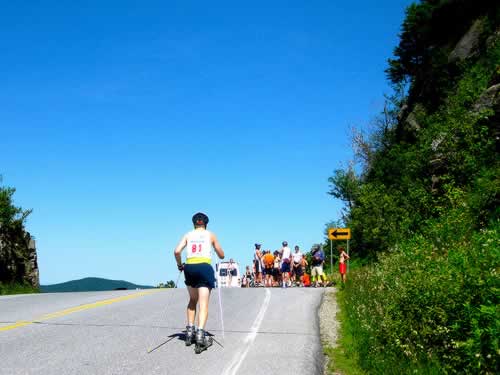
    Skiers started at 30-second intervals. The men went from the intersection of Route 17 and German Flats Road, while women started further up Route 17 at the entrance to the Battleground condominium development. In a nod to the course profile, skiers started out skating on relatively easy grades.  The climb got steeper as racers approached the Mad River Glen Alpine ski area, where they transitioned to classic gear for the final climb to the top of the gap. Grades exceeded 10% in some spots on the way to the summit. After the first kilometer or so, there was little shade to shelter athletes from the sun.

    In its first two years, the race was open only to those attending the GMVS summer camp, according to GMVS Nordic director Justin Beckwith. This was the second year the duathlon was open to other skiers.

    Heading to the finish (Photo: Abby Weisman)
    Approximately 150 – 200 meters to the finish (Photo: Abby Weisman, NENSA)
    Note the sign on the right…(Photo: Abby Weisman, NENSA)
  • Sun & Speed in the County: A Complete Recap of Junior Nationals – UPDDATED with Photos

    Sun & Speed in the County: A Complete Recap of Junior Nationals – UPDDATED with Photos

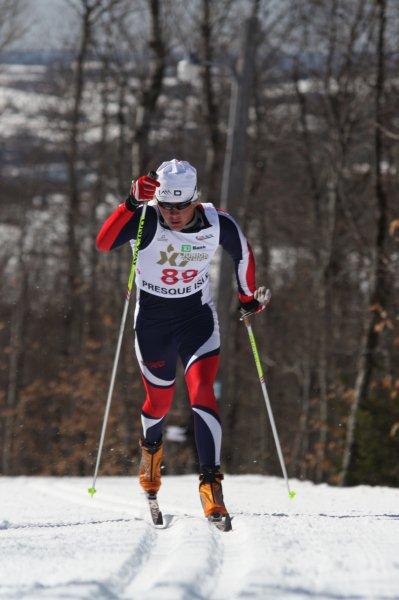
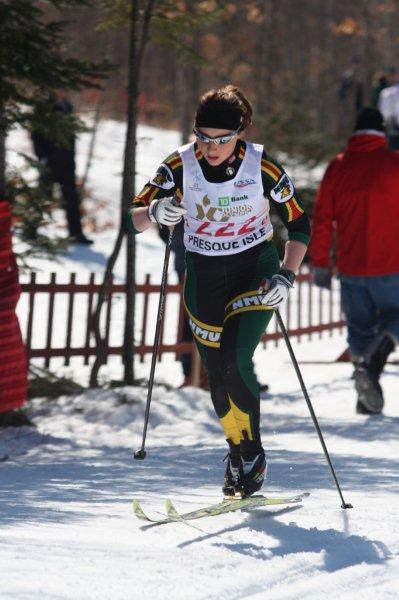
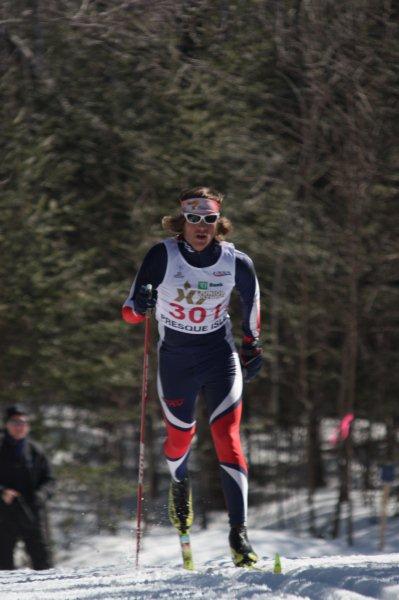
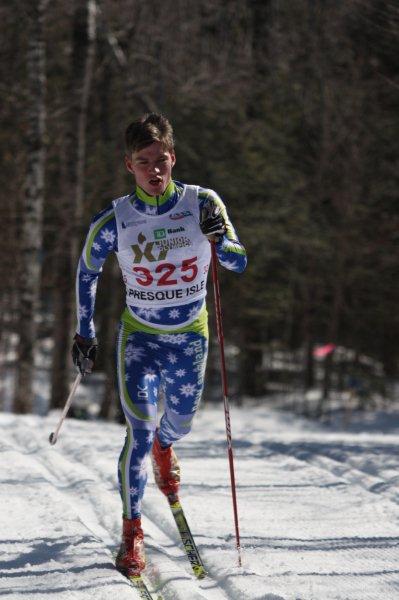
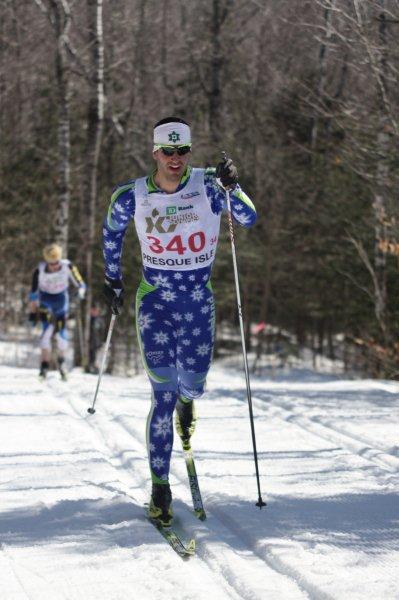
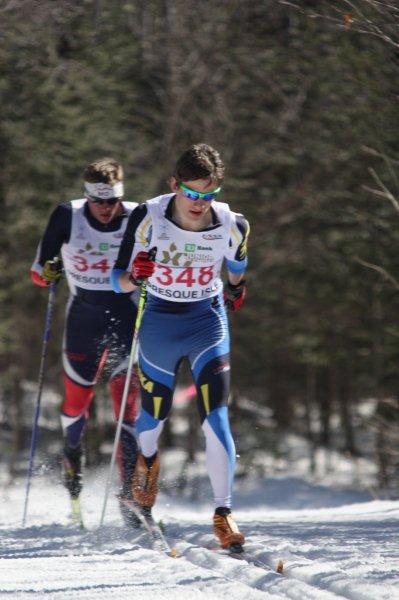
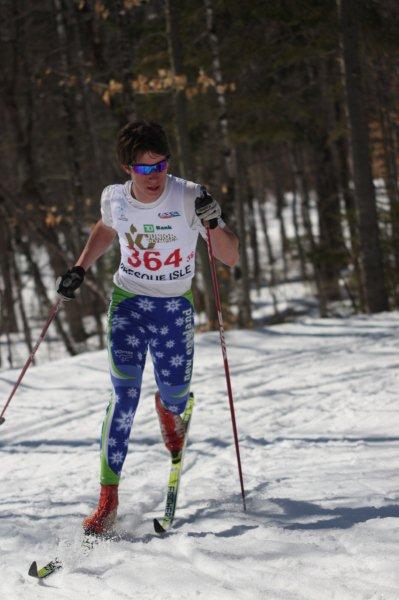
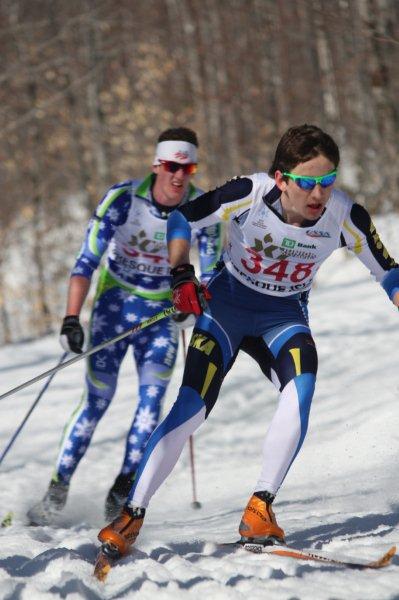
    Athletes could have been forgiven last week if they thought they were racing on the west coast in the bright sunshine that was the hallmark of last year’s Junior Olympics in Truckee, California. However, Presque Isle delivered in every aspect – trails, grooming, and, most surprisingly, with bright sun, klister conditions and tans that the 2010 Junior Olympics will be remembered for.

    The Nordic Heritage Center in Presque Isle, ME. Photo: flyingpointroad.com

    New England used their characteristically dominant performance in Monday’s classic sprint event and never looked back, claiming their second straight Alaska Cup. In what has been historically a three-team race for the podium, New England accumulated 1660 points, nearly a third of which were won in the classic sprint, to outdistance Alaska with 1275 points. Intermountain, led by strong results from their J2 boys, placed third with 980 points.

    Athletes were treated to a good luck video message at the Opening Ceremonies with inspirational words from US Ski Team athletes Andy Newell, Liz Stephen, Kikkan Randall and James Southam, as well as various World Cup athletes, fresh off the 2010 Vancouver Olympic Games.

    “Training starts now for the next go around,” says Newell in the video. “It’s four years until Sochi, so I expect to see a lot of you guys, especially some of you OJs out there, to train really hard and you can be on the team with us four years from now in Sochi, Russia.”

    Monday

    Corey Stock (Cambridge Sports Union) raced to gold on Monday in the J2 girl's sprint. Photo: flyingpointroad.com

    New England opened the week of competition by winning five of six races and an impressive 13 of 18 spots on the podium in the classic sprint. Only Cole Morgan (Bridger SF) from Intermountain was able to spoil New England’s perfect run of gold medals with his victory in the J2 boys sprint.

    Corey Stock (Cambridge Sports Union) got racing underway for the J2 girls, leading two of her New England teammates into the top three for a New England sweep of the podium. Stock won the A final going away, with Heather Mooney (Stratton Mountain School) and Maddy Pfeifer (Proctor) claiming second and third.

    Intermountain's Zach Lindhall (83) leads teammate and eventual champion Cole Morgan (85). (Photo: flyingpointroad.com

    Cole Morgan (Bridger SF) from Intermountain captured his first national title of the week in the J2 boys sprint. After battling with New England’s Jack Hegman (Mansfield Nordic) down the stretch in his semifinal, Morgan put some distance on his A-final competitors and crossed the line nearly three seconds ahead of New England silver medalist Eli Hoenig (Cambridge Sports Union). Haakon Sigurslid (Durango Nordic) from Rocky Mountain took third to round out the podium.

    “My strategy was to get out in front and lead the whole way,” said Morgan of his gold-medal performance, “because there was not enough distance to wait for opportunities to pass.  I gained a lot of time on the two humps before the final hill and carried that gap into the finish.”

    J1 Sprint Champion Isabel Caldwell (Stratton Mountain School). Photo: flyingpointroad.com

    After just missing the J2 sprint podium in Anchorage in 2008, Isabel Caldwell (Stratton Mountain School) from New England more than made up for it today, placing first her quarterfinal and semifinal en route to winning the J1 girls A final. Annie Liotta (Alaska Winter Stars) took second, just 1.4 seconds behind Caldwell, with Caldwell’s New England and high school teammate, Gage Fichter (Stratton Mountain School) claiming third place.

    “It was great to be able to ski with my teammate Gage [Fichter] in the A-final,” said Caldwell. “She’d been having a great day, qualifying 4th and easily making it through her quarters and semis… I don’t really know what was going through my head in the final stretch, but it felt really cool afterwards to realize that I’d just won JOs and my teammate was third. It was definitely a great day for us!”

    David Sinclair (GMVS) rose to the top of J1 boys A-final and led two of his New England teammates onto the podium with him. Sinclair, after qualifying first and winning each of his prior heats, stayed true to form and crossed the line first in the A-final, followed by teammates Jackson Rich (Cambridge Sports Union) in second and Hans Halvorsen (GMVS) in third. Rich and Halvorsen significantly improved upon their morning qualifying performances of 17th place and 12th place, respectively, to make it onto the podium.

    Kaitlynn Miller (Craftsbury) surprised herself with a gold-medal performance to win the OJ women’s sprint title. The Bowdoin-bound senior from Vermont skied to a 5th place finish in qualifying and impressed with strong, tactical skiing in the afternoon to win her first national title. Alaska’s Rebecca Konieczny (UAF) was second with the Midwest’s Corinne Malcolm (MSU) taking third.

    Middlebury's Chase Marston took third in the sprint for New England. Photo: flyingpointroad.com

    “Winning the sprint was a big surprise for me,” said Miller. “I was thrilled to qualify fifth and my goal going into the heats was to make the finals — something I had never done before. My strategy was to get out of the start in front so as to avoid any possible crashes in the sharp turn at the bottom of the hill. What helped make this strategy work was that I always started in the far right lane, which set me up well for the right hand turn leading into the downhill. After climbing the hill, along the flat rolling stretch and final climb to the finish, I focused on skiing relaxed while maintaining my power.”

    Dartmouth sophomore Alex Schulz helped New England close out the day with five of six gold medals by winning the OJ men’s sprint title. Schulz led an improbable 13 New England men into the top 20, including a sweep of the top four places in the A-final. Skyler Davis (Stratton Mountain School) and Chase Marston (Middlebury) skied gutsy races, despite broken poles and a puncture wound to the thigh, to take second and third, with fellow New England athlete Welly Ramsey (MWSC) just missing the podium in fourth place.

    Monday ended with New England (515 points) amassing nearly double the amount of points as their nearest competitor (Alaska, 280 points). Intermountain (169 points) edged the Midwest (161 points) to fourth on the day.

    Wednesday

    After some crashes on a downhill corner the prior day resulted in knee injuries to two athletes, the jury elected to change Wednesday’s mass start classic races to an individual start format. Athletes would still race the same distances, with J2s covering 5K, J1/OJ women racing 10K and J1/OJ men tackling a 15K.

    PNSA's Annie Porkorny (Spokane) won gold in the J1 girls classic race. Photo: flyingpointroad.com

    New England’s J2 girls nearly replicated their 1-2-3 performance from Monday with Corey Stock and Heather Mooney placing first and second in the 5K classic race. Alaska’s Marion Woods (Alaska Winter Stars), fourth in the sprint, moved up one place to finish on the podium in third place.

    J2 silver medalist Jack Hegman (Mansfield Nordic) from New England. Photo: flyingpointroad.com

    The J2 boys 5K classic race featured a host of tight finishes at the top. Intermountain’s Cole Morgan captured his second national title by the narrowest of margins, edging Jack Hegman (Mansfield Nordic), racing for New England, to second place by six tenths of a second. Midwest athlete Matthew Nichols (Knicker Nordic) placed third, only 2.5 seconds out of first place.

    “I’ve learned that you have to always push it to the limit because you never know what can happen,” said Morgan of his race. “Everyone is giving it their all and you know that you have to bring your best every day.”

    Annie Porkorny (Spokane Nordic SEF) gave the Pacific Northwest their first national title of the 2010 Junior Olympics with a 7.8 second victory in the J1 girl’s 10K classic race over the Midwest’s Annie Hart (Minneapolis Ski Club). Monday’s sprint champion Isabel Caldwell finished third for New England.

    Alaska's Scott Patterson (Alaska Winter Stars) won the J1 boy's classic title. Photo: flyingpointroad.com

    Like Porkorny, Scott Patterson (Alaska Winter Stars) captured his team’s first national title in the J1 boy’s 15K classic race. Patterson put a 12.8 second margin over sprint champion David Sinclair who took second place. Patterson’s Alaska and club teammate Silas Talbot (Alaska Winter Stars) placed third, a minute and nine seconds back.

    With a win already under her belt, the pressure was off for Kaitlynn Miller, but the New England athlete found confidence in her victory on Monday to repeat as the national champion in the OJ women’s 10K classic race. Miller’s time was just 1.7 seconds better than Intermountain’s Liza Goodwin (MSU) who took the silver medal. Alaska’s Rebecca Konieczny, second on Monday, placed third in the race.

    David Norris (Fairbanks FAST) from Alaska followed up on Patterson’s title worthy performance with a victory of his own, capturing the OJ men’s 15K classic title. Norris was just 3.3 seconds faster than New England’s Sam Tarling (Dartmouth), who took second.. Capturing the first medal of the week for the Far West team was Russell Kennedy (Auburn Ski Club) in third place.

    David Norris (Fairbanks FAST) captured gold in the OJ men's classic race. Photo: flyingpointroad.com

    “David Norris and I had a great battle,” said silver medalist Tarling of his race. “I was leading after the first lap but he had a fantastic second lap and put 15 seconds on me. On the third lap I was really able to empty the tank and I closed to within a few seconds after being down 15 seconds with 2.5km to go.  I really felt like David and I were skiing very fast and it was cool to see that after 15km and different pacing strategies, we were only separated by 3.3 seconds.”

    Norris was similarly excited about Wednesday’s classic races. “It was super fun to battle with Sam,” he remarked, “as we both have raced together a lot and both are very competetive. I was bummed that the race could not be a mass start, but it didn’t change the fact that I just wanted to race hard and have fun.”

    New England (946 points) emerged on top in the team standings for the second day in a row, though Alaska tightened the gap (584 points). Intermountain remained in third place with 385 points.

    Friday

    In the final day of individual racing, Alaska made a statement in the freestyle races by nearly overtaking New England in team scoring for the day, thanks in large part to an outstanding performance by their J1 boys squad.

    Corey Stock went three for three in individual gold medals with an 8.2 second win over Intermountain’s Sloan Storey (Sun Valley SEF) in the J2 girl’s 5K freestyle. Storey’s time was just 2.2 seconds better than her Intermountain teammate Anika Miller (Payette Lakes Ski Team) who took third place.

    J2 freestyle gold medalist Patrick Caldwell (Ford Sayre). Photo: flyingpointroad.com

    Patrick Caldwell (Ford Sayre) of New England broke Cole Morgan’s streak of first place finishes with a national title of his own. With Morgan just one bib behind him, Caldwell took off and skied away for an impressive 25 second win — made all the more impressive given that Caldwell’s winning time was just under 12 minutes for a 5K. Morgan took the silver medal edging out Intermountain teammate and bronze medalist Marc Jackson (Team Soldier Hollow) by a scant three tenths of a second.

    Rocky Mountain’s first gold medal of the week went to Michaela Frias (Steamboat Springs WSC) who captured the J1 girl’s 5K freestyle title. Frias bested Intermountain’s Katie Gill (Bridger SF) by nearly four seconds to win, with the Midwest’s Annie Hart climbing on the podium for the second time this week to take the bronze medal.

    Scott Patterson of Alaska led five teammates into the top ten with a huge win over Alaska teammate Forrest Mahlen (APU). Patterson’s margin of victory in the 10K freestyle race was almost a minute and a half over the J1 field and nearly 20 seconds better than the top OJ male in the same race. Will Wicherski (Bogus Basin NT) of Intermountain took the bronze. Alaska’s team score was also significantly boosted by top-ten finishes from Jack Novak (APU) in fifth, Silas Talbot (AWS) in eighth and Carl Smith (Alaska Nordic Racing) in ninth.

    Middlebury freshman Corinne Prevot won the OJ women's freestyle title for New England. Photo: flyingpointroad.com

    New England’s Corinne Prevot (Middlebury) won the OJ women’s 5K freestyle race, topping a speedy trio of Midwest women. Prevot captured the gold medal with just six tenths of a second to spare over Corinne Malcolm (MSU). Bronze medalist Eleanor Magnuson (Go Training) was third, with another Midwest teammate, Lynn Duijndam (Finn Sisu Skiers), just three seconds back in fourth place.

    After placing second on Wednesday, New England’s Sam Tarling turned the tables on David Norris and captured the OJ men’s 10K freestyle title, edging Norris to second place. Norris’s time was just fast enough to nip Intermountain’s Erik Fagerstrom (Sun Valley SEF) by four tenths of a second.

    Tarling’s finish was one of a remarkable eight New England athletes, representing five different EISA colleges, in the top fourteen of the OJ men’s race. Athletes from Dartmouth, Middlebury, Bates, Bowdoin, Harvard and Colby qualified for the New England Junior Olympic team, many just spots away from making their college’s NCAA squad, and despite normally competing against one another each weekend at carnivals, the group came together for an impressive performance in the OJ men’s races.

    “We all get along very well and even though we are competing against each other in the Carnival races,” said Tarling, “there is a strong camaraderie amongst us. We had great coaches and great leaders.  There is friendly competition between us of course, but at the end of the day, we are Team New England, and that is the priority.”

    Alaska came within three points of taking the win for the day in freestyle competition. New England accumulated 344 points to lead the team standings for the third straight day, with Alaska right behind in second place with 341 points. Intermountain was third with 285 points.

    Saturday

    Heather Mooney (Stratton Mountain School) scrambled for the gold medalist New England J2 girls relay team. Photo: flyingpointroad.com

    With perfect, sunny weather, the freestyle relay competition closed out the 2010 Junior Olympics. Filled with close battles, exciting lead changes and six final national titles, the relay was a spectator-friendly finale to a great week in Presque Isle.

    New England’s J2 athletes captured the boy’s and girl’s relay titles with strong scramble legs from Patrick Caldwell and Heather Mooney to set the pace. Eli Hoenig kept his team in the lead and Jack Hegman closed to win the J2 boy’s title by ten seconds over the second place Intermountain team. Rocky Mountain’s top team was five seconds back in third place.

    Maddy Pfeifer passed a slim lead over Intermountain to New England anchor Corey Stock and the CSU athlete put the finishing touches on her golden week with the fastest leg of the field to capture another gold medal for her team.

    Eli Hoenig (Cambridge Sports Union) had a great week, picking up silver in the J2 sprint and gold in the relay for New England. Photo: flyingpointroad.com

    Building on the dominance they showed in Friday’s freestyle races, Alaska’s J1 boys put the pressure on in the relay, with their top two teams taking the gold and silver medals over the third place Intermountain team, as well as an impressive fifth place performance by Alaska’s third team. Alaska’s top team of Forrest Mahlen, Jack Novak and Scott Patterson took the win, not to be outdone by their teammates on the second team (Silas Talbot, Carl Smith and Isaac Lammers) who kept it close for nearly the entire relay and won the silver medal.

    Matching the performance by their J1 counterparts, the J1 girls from Alaska used a blistering anchor leg by Annie Liotta to win gold. Mackenzie Kanady (Alaska Winter Stars) skied her team into seventh place in the scramble leg, with Hannah Boyer (Fairbanks FXC) passing several teams to move her team into second place. Liotta found a final gear and overtook the New England J1 girls team, who had to settle for silver, for the win. Rocky Mountain’s top team captured the bronze medal, with anchor leg Michaela Frias lunging at the line to take third by just one tenth of a second.

    After going 2-3-4 in Friday’s freestyle races, the Midwest OJ women looked to be the team to beat going into Saturday’s relay. Eleanor Magnuson took it out with a fast pace to give her team nearly a twenty second advantage over New England’s OJ team. Lynn Duijndam kept that lead and allowed Corinne Malcolm to anchor her team to a 40-second relay win. Alaska’s Marisa Rorabaugh skied a gutsy anchor leg to vault her team into silver medal position, knocking New England’s top team to the bronze medal.

    “After such a good showing in the skate race the day before I think there was definitely a little bit of pressure on us to try to climb to the top of the podium in the relay on Saturday,” remarked Malcolm, following her team’s win.  “Coming into the stadium was an incredible feeling!  Two of our coaches had made me a flag out of a ski pole and team jacket to ski in the finishing stretch with!  After coming up short of national titles in the classic sprint and the individual skate it felt really good to finally get to stand on the top of the podium, and even better to get to share it with two of my teammates!”

    Sam Tarling (Dartmouth) anchored New England's OJ men's relay team to gold with a thrilling final leg. Photo: flyingpointroad.com

    Maine native Sam Tarling gave his team an anchor leg to remember, overtaking Alaska’s David Norris in the final kilometer of the relay to win New England’s fourteenth and final gold medal of the week in the OJ men’s relay. New England’s Chase Marston (Middlebury) and Alaska’s Jordan Buetow (Fairbanks FXC) went head to head in the scramble leg reaching the tag zone with less than two seconds separating their teams. Neil Liotta (Alaska Winter Stars) skied an impressive second leg and was able to put some time on Gordon Vermeer (Dartmouth) and David Norris took off for the anchor leg with a five second lead over Tarling.

    “My strategy was just to try and close the gap and hope for a sprint finish,” said Tarling. “Our wax technician, Will Sweetser, informed me before the race that my skis were waxed for the stadium, so I was confident that even if they were not as fast in the woods, I would have good skis for the finish. Skiing behind David up the last big hill about 1km from the finish, with the crowd roaring, I found a little extra in my legs and I was able to pull closer. I was very tired, but I figured he might be as well, and when I passed him over the rollers I put in a huge burst and I was able to hold on for the win. I had great skis, a great team, and fantastic support from the spectators. It couldn’t have been better.”

    Putting a cap on a great week for New England’s OJ men, New England’s second, third and fourth relay teams went 3-4-5 behind Alaska to crowd the podium and push the Intermountain’s top OJ team to sixth place.

    Kaitlynn Miller (Craftsbury) picked up two gold medals in the OJ sprint and classic races. Photo: flyingpointroad.com

    “It was a very exciting week for the New England team,” said two-time OJ national champion Kaitlynn Miller following the races, “It was fun to be the host region and I am very grateful to the volunteers for all their hard work. Competing as the “home team” in Maine was awesome. I was really touched by how many people came to the Heritage Center to cheer on the racers and it was inspiring to see so many local school children bused in to watch.”

    New England Head Coach Matt Boobar is all smiles as he catches up with Cambria MacDermott (Stratton Mountain School) at the finish line after her 7th place finish in the J1 girls race. Photo: flyingpointroad.com

    J1 sprint champion Isabel Caldwell echoed Miller’s sentiments: “One of the best aspects about JOs were all the little kids who were at the races,” noted the Stratton Mountain School athlete. “The schools in Presque Isle were let out so that the students could come watch the races and there were hundreds of little kids at each race. Having JOs at Presque Isle was great and we all had an amazing time!”

    “The trails at Presque Isle were awesome!” added OJ women’s relay champion Eleanor Magnuson.  “We don’t really have such technical courses in the Midwest and I was really glad to have gotten to race on something like that.  The conditions were really good… I have never been out the East coast before, so that was a really cool experience for me.”

    The Junior Olympics swing back through the Midwest next winter with the City of Lakes Nordic Ski Foundation hosting the 2011 Junior Olympics in Minneapolis, Minnesota.

    Check back for photographs from Presque Isle.

    Complete Results

    Junior Olympics 2010 Homepage

    Junior Olympics 2011 Homepage

  • Distance Races on the Classic Boards at Junior Nationals – Photos Added

    Distance Races on the Classic Boards at Junior Nationals – Photos Added

    Today was the second day of racing here in Presque Isle and was the first day of distance, with the J2’s skiing classic 5ks, while the J1/OJ women and men skied 10k and 15ks. The J2 girls started at 10a.m and the boys at 10:30. The conditions for this race were hard and fast making the race very interesting.

    Corey Stock of New England and Cole Morgan of Intermountain (who also celebrated a birthday today) each repeated their championship performances from Mondays sprint races. Stock won her race by 13.5 seconds over teammate Heather Mooney, while Morgan barely squeaked out another victory by .6 seconds over New England’s Jack Hegman.

    The J1/OJ girl’s races were equally as entertaining with PNSA skier Annie Pokorny coming out on top for J1 girls by 7.8 seconds over Midwest racer Annie Hart. The OJ women also had a very close race with only 30 seconds between the winner Kaitlynn Miller of New England claiming her second title and fifth place Corrine Prevot of New England. This only leads one to wonder how close the race would have been if it had stayed a mass start.

    “I was pretty disappointed that it wasn’t a mass start”, said Prevot “I think I could have skied well in the mass start”.

    This was the general feeling of many of the athletes who were very excited about a mass start this year at JO’s.

    A couple of the athletes that didn’t mind having an individual start were among the J1/OJ boys field.

    One of these athletes is second place David Sinclair of New England who finished 12.9 seconds behind Alaska’s Scott Patterson. Instead of being let down by having no mass start, Sinclair used the individual start to his advantage.

    Sinclair explained “I saw the start list and noticed that Dave Norris (OJ boy’s winner from Alaska) was starting 30 seconds behind me, so when he caught me at 6k I just stayed on his tails and tried to match his rhythm until he lost me at 13.5k”.

    Two other boys that were happy for the individual start were Dave Norris and Sam Tarling of New England.

    “The individual start didn’t matter”, said Norris “I just wanted to go out hard and see if anyone else could match me”.

    Tarling was also excited to have the individual start as he felt it “favored him in a 15k classic race”.

    For both of these athletes the race style worked out very well for them as they both skied away from the field by almost a minute while only 3.3 seconds separated Norris and Tarling.

    Today didn’t show the same dominance from team New England, as the results showed a much more even distribution of teams throughout each of the age groups. The hunt for the prestigious Alaska cup is still on and the fight will continue Friday here in Presque Isle, Maine with the distance skate race.

    Complete Results.