From the FasterSkier archive — posts syndicated from athletes’ and coaches’ own blogs between 2004 and 2012, kept online as published. Current coverage is at fasterskier.com.
National sport body and Swix launch national contest to design team race suit
CANMORE, Alta. — The nation’s best cross-country ski athletes will be sporting new duds on the trails to 2018 thanks to a new partnership established with Swix and Cross Country Ski de Fond Canada (CCC).
Swix, the brand synonymous with Nordic skiing, has inked a five-year deal to supply all training and racing apparel for the Canadian National Ski Team.
“Cross-country skiers spend countless hours outside so we are excited to partner with Swix to provide access to some of the most critical resources our athletes require for optimal training and medal-winning performances,” said CCC Chief Executive Officer Davin MacIntosh. “Swix is a proven performer and we look forward to having them with us on our team’s quest for the international podium.”
“Swix Sport AS and Lanctot Ltd, (the Canadian distributor of Swix) are thrilled to be partnering with Cross Country Canada as the official apparel supplier. Swix’s mission is to design high performance and recreational apparel, waxes and accessories for all levels of Nordic skiers. We look forward to working closely with CCC to promote the sport of cross-country skiing and to support participants from Jackrabbits right up to the National Ski Team. We are also very excited that Swix retailers across the country will have the opportunity to sell Cross Country Canada-branded Swix apparel to skiers,” said Diane Lanctôt, President, Lanctot Ltd.
The governing body for cross-country skiing in the country has also announced that Canadians from coast-to-coast-to-coast will have an opportunity to design the first Swix National Ski Team race suit through a unique contest being launched on April 13th, 2015.
The contest will enable the community to design Team Canada’s 2015-16 National Ski Team race suit through the unique Swix Creator portal (http://swixcreator.com/). “This fantastic contest will engage our community, and make our athletes feel ‘closer’ to home while competing abroad,” noted MacIntosh.
“The partnership with Swix will contribute greatly to the evolution and promotion of our sport, and the 2015-16 National Ski Team Race suit Design Contest is a perfect way to kick things off right. The Swix partnership also provides our team with critical technical support which will benefit us during each race,” said Alex Harvey.
The Swix name, born in Norway from a line of only five waxes, has grown to become the premiere nordic brand that spans from simple universal waxes to complex chemistry’s that champions swear by. In addition to wax, Swix develops and designs waxing accessories, the world’s leading cross-country ski poles and high performance and recreational apparel. Lanctot Ltd is the Canadian distributor of Swix apparel and hard goods in Canada. www.swixsport.ca
CCC is the governing body of cross-country skiing in Canada, which is the nation’s optimal winter sport and recreational activity with more than one million Canadians participating annually. Its 60,000 members include athletes, coaches, officials and skiers of all ages and abilities, including those on Canada’s National Ski Teams and Para-Nordic Ski Teams. With the support of its valued corporate partners – Haywood Securities Inc., AltaGas, Mackenzie Investments and Statoil – along with the Government of Canada, Canadian Olympic Committee, Canadian Paralympic Committee, Own the Podium and B2Ten, CCC develops Olympic, Paralympic and world champions. For more information on CCC, please visit us at www.cccski.com.
A Toronto businessman for the last 30-plus years, Jamie Coatsworth had spent enough time in meetings that sitting on a board wasn’t high on his post-retirement ‘to-do’ list. Helping not-for-profits was, and upon offering his services to Cross Country Canada (CCC) when he retired three years ago — working with executive director Davin MacIntosh on a non-taxable trust for national-team athletes — Coatsworth suddenly found himself interested in joining its board.
MacIntosh had urged him to do so, Coatsworth explained on the phone Thursday from Toronto.
“He said, where we really need help with your kind of background is on the board,” recalled Coatsworth, a commerce-and-consultant specialist who spent 29 years as a partner with PricewaterhouseCoopers (PwC), the world’s second-largest professional services network. “I said OK. I hadn’t been looking for board position. I was more into not-for-profit and project work.”
But in 2012, CCC’s nominating committee approved Coatsworth’s candidacy for director and he was subsequently elected to the organization’s nine-person board of directors.
Two years later, he’s the president.
Coatsworth explained his rise to chair/president of the board materialized over the last couple weeks and was far from preplanned. The board sensed that former president Richard Lemoine would resign from his position rather than be re-considered for another two-year term. Coatsworth said he looked around the room and spoke with fellow board members about who might step up to fill the volunteer role.
Nobody raised their hand, so he said he’d do it, Coatsworth explained. Recommended by the divisional chairs from CCC’s participating provinces and territories, his bid for president was supported by the board and officially approved last Saturday at the Annual General Meeting in Canmore, Alberta. While acting chair Jim McCarthy filled in for the last few weeks, Coatsworth’s two-year presidency went into effect immediately on June 14. There was no need for a vote, Coatsworth said, because the position was open.
“Looking at my professional background, I think I could do a pretty good job,” he said.
A recreational skier with a longstanding interest in the sport and Canada’s top athletes, Coatsworth has privately sponsored a number of Canadian skiers since after the 2002 Olympics, starting with the second-ranked skier on the team: Sara Renner (he figured No. 1 Beckie Scott was well enough off after earning gold in Salt Lake).
Rather than give what he considered “at the time, a fairly modest amount of money” to an organization alone, he figured it would be better spent directly going to the athletes. He called up CCC in 2002 to figure out how to do just that and has been financially supporting athletes ever since.
Coatsworth currently sponsors World Cup Team members Devon Kershaw and Lenny Valjas, and also backed the now-retired Dasha Gaiazova and Chandra Crawford’s Fast and Female enterprise. While some athletes might mention his name on their websites, Coatsworth said he was never “looking to broadcast it too widely. All these kids could use a hand.”
He also gives money to Cross Country Canada “as I always have,” he explained. “I give some money to a couple of other clubs that have racing teams — Hardwood Hills, where my wife and I ski. I give some money to them a couple of other clubs, plus some athletes, a couple on the World Cup Team, several athletes on the [Alberta World Cup] Academy, and a couple people that are not on either [the national team or training centres].”
While his support of athletes is widespread, he said his personal sponsorships aren’t major dollars. Still, the gesture has helped connect him with CCC’s developing and elite skiers.
“Through these sponsorships I’ve gotten to know [certain athletes], gotten to enjoy them, follow their racing … kind of cheerlead,” he added. “Next thing you know I’m on the board and next thing, I’m chair.”
Before joining the board in 2012, Coatsworth specifically asked MacIntosh if his sponsorships might be a conflict of interest. MacIntosh said no, because the board is not involved in day-to-day management of the national team, or decisions like team selections or carding.
Coatsworth explained that he plans to be “quite vocal” about his personal sponsorships and steer clear of anything that might be a potential conflict. As chair, he is automatically on the high-performance committee, which selects national-team athletes at the end of the season, for example, but Coatsworth said he’ll “absolutely refuse myself from any decisions there.”
Aside from appointing Coatsworth, the board elected two new directors to the board — Dorothy Lothian and Jennifer Tomlinson — to replace outgoing members Mike Norton and Rhonda Jewett.
Asked about his relationship with MacIntosh, which Lemoine cited as a primary source of tension in his two years as president, Coatsworth said it was good — “I’ve got a lot of respect for him,” he said.
At the same time, he pointed out he’s “not quite 30 years older” than MacIntosh, so his advice isn’t exactly fatherly, but it does come with years of business experience, specifically with company management restructuring.
“One of the things we’ll be a little more rigid about it going forward is sticking to our governance role of management,” Coatsworth said of the CCC board. “Our job as the board is to set policies and hire a [CEO] to run the business.”
In that sense, he said it’s up to MacIntosh to take actions where appropriate — and when it’s not appropriate, make the call to ask the board to weigh in.
Leading a policy governed board during the start of an Olympic cycle, when a “big chunk” of funding is determined by how the government views a sports entity’s medal potential, may not be the easiest thing to jump into — especially after Canada’s cross-country skiers failed to medal at the 2014 Sochi Games. But that’s where Coatsworth’s expertise as a previous member of CCC’s finance and marketing-fundraising committees might come in.
“Our funding from Own The Podium (OTP) for able-bodied has been cut back a bit,” Coatsworth said. “You scale back on some things.”
At the same time, OTP’s funding is more or less a lump sum intended for athletes’ training and competition expenses. With Gaiazova and Crawford retired from the World Cup Team and Perianne Jones now on the development team, Coatsworth said the number of World Cup athletes has gone from seven to four, which lessens the blow of reduced funds for those athletes.
“I don’t think it’s going to be a big deal — it’s not like we don’t have the resources to do what we want to do,” he said. “It’s no real surprise frankly, and we’ve still got sufficient funding to do what we want to do for athletes who are going to be challenging for World Championships.”
Perhaps CCC’s biggest challenge is filling out its World Cup Team with up-and-coming talent that can be competitive in Europe.
“We’ve got a lot of talented athletes below the World Cup Team,” Coatsworth observed. “How do we get them the experience, the coaching … so that in South Korea [at the 2018 Olympics] it’s not just people like Alex Harvey who are competitive? … How do we get those people up a level? That’s the big challenge going forward.”
Most recently, Coatsworth was president of an insurance-consulting business called Nordic Insurance — pure coincidence, he said of the name. He did not insure nordic skiers.
“That company was named and formed before I got involved with any sponsorship of athletes,” he said of the business, which involved his consulting arrangement with PwC. “Going back to my squash-playing days, I had a nickname: the Nordic Butcher.”
Why? “Blond hair flailing around the squash pit,” he said.
Appointed president on Saturday, Coatsworth flew from Canmore to Toronto on Tuesday. He usually makes the trip west to CCC’s headquarters three times a year for meetings and said it’s “to be determined” what kind of travel and time commitment his position as chair requires.
In the past, both Lemoine and MacIntosh worked closely with the Canadian Snowsports Organization, Canadian Olympic Committee and International Ski Federation (FIS), for example.
“Richard had a much deeper background in ski racing than me,” he said of Lemoine’s race organization and timing experience, as well as years serving Cross Country Ontario. “I’m a recreational skier so I don’t have that background or that knowledge to the extent that the chair should be to be involved … It may well be [appropriate] for somebody else on our board to be sitting on those committees.”
Coatsworth said someone like Al Pilcher, a two-time Olympic nordic skier (in ’88 and ’92) who’s more familiar with these organizations, might be a better fit.
“I spoke with Davin MacIntosh and I said, you tell me where you need me and I’ll be there,” he said. And if he’s not the right person, he’ll seek out another board member.
“It’s a challenge for all of us,” Coatsworth said. “Whether it’s somebody new in the position … there are lots of things that need to be done, lots of decisions that need to be made. We’ve already gone to Davin said here are the challenges and issues as we see them. We want to see what your plan is dealing with these.”
From there, the board will determine how they can support their CCC team.
“When you get a change like this you have to say … what do we need to change,” he added. “We’ve got lots of people with different backgrounds that can help with these things and we’ll do that.”
CCC President Richard Lemoine stepped down from his volunteer position on the Board of Directors two weeks ago. (Photo: LinkedIn)
After this weekend, there’s going to be a new president/chairman of Cross Country Canada’s Board of Directors after Richard Lemoine stepped down from the volunteer position a few weeks ago.
“I was asked not to run,” Lemoine explained on the phone Tuesday from Mississauga, Ontario, where he works as a partner with the chartered accounting firm, Lemoine Hyland LLP.
Acting chair Jim McCarthy, Lemoine’s predecessor who served four consecutive years (two terms) as CCC president/chair from 2008 until 2012, said on the phone Tuesday that Lemoine’s resignation was “not really anticipated, but it happened.”
“There was a difference of opinions as to how CCC should move forward and he felt he didn’t want to continue under those circumstances,” McCarthy added.
President of the board since 2012, Lemoine said he chose to resign rather than not be reelected for a second term by CCC’s division chairs and board members at their Annual General Meeting (AGM), an open board meeting, this weekend in Canmore, Alberta. He’ll be in attendance, however, but will no longer hold a position on the board.
“It really came down to where the board should have influence,” Lemoine said. “We’re a policy board and the model … some people think we should be running under is the Carver model, which has been described as nose in, fingers off.”
He explained that this system, also known as policy governance, as “something that’s loved by executive directors, but I believe at the end of the day the board is going to be held accountable so they should be more knowledgeable and involved in the day-to-day process.”
Accountability arrived front and center after the Sochi Olympics, a time in which CCC’s decision makers looked at their athletes’ results and lack of medals and decided it was time for change. In April, CCC hired Tor-Arne Hetland, a Norwegian Olympic gold medalist and former Swiss sprint coach, to help head up its World Cup Team.
Lemoine said he advocated developing a stronger, domestic-coaching model, while acknowledging there were two sides to any decision and adding, “It’s not a decision for the board to take, but from a policy point of view, we need to make sure that we are preparing our domestic coaches for the top coaching positions.”
But he and CCC’s Executive Director Davin MacIntosh often did not see eye to eye, Lemoine said.
MacIntosh wrote in an email that he declined to comment.
“There have been a number of areas of tension between Davin and I,” Lemoine said. “He was not pleased when I was proclaimed president.”
There was a fundamental disagreement over what constitutes policy decisions — which the board should oversee — and operations decisions— which the executive director is responsible for, he explained.
“Certainly post-Sochi I didn’t think the hard questions were being asked,” he added. “For example, I look at what the U.S. has been able to do over the last four years, converting athletes to the World Cup… and I look at that and say we could do better.”
Yes, Canada’s seen unprecedented success in recent years, Lemoine said, but the nation’s athlete-feeder pipeline is dwindling.
“We came out of our high-performance meeting this April not being able to fill our spots for training centres and having to decide to stop supporting the Callaghan Valley Training Centre as there weren’t enough athletes to go around,” he said. “Certainly the depth of talent is not what we want it to be … We are generally seeing a drop in retention rates of our athletes once they graduate from high school.”
He pushed for Canada to fill its World Cup quota and bring the next tier of the best domestic racers over to Europe. With that comes costs, and likely struggles, but Lemoine pointed out that’s how Canada’s Olympic gold medalist Beckie Scott got her start — getting crushed by the competition.
“You send them to Europe, you support them right, give them the best chances you can, and they see what the difference is,” Lemoine said. “We know our skiers are skiing slower than their European counterparts.”
When it came to hiring coaches or restructuring the staff, Lemoine said, “that’s definitely getting past to where the board should be.” But he did look at the athlete-development system on the whole, and ask what direction it was trending in.
“In my opinion we had a horrible Olympics; seventeenth was our best finish,” he said. “So you then ask the question, I like to quote Einstein: [insanity is] if you do ‘the same thing over and over again and expect different results’… Don’t come back with the same team because something’s gotta change. That’s where our executive director thought I was crossing the line.”
Two weeks ago, Lemoine said the provincial and territorial directors met to consider the situation before the AGM on June 14.
“They sided with Davin and decided it would be best if I stepped down,” Lemoine said.
While CCC presidents can run for back-to-back two year terms, McCarthy is the only one who has held the position for four years, Lemoine said. At the request of the provincial chairs, Lemoine agreed to step aside rather than stay at the helm until this coming Sunday, when he would have likely been officially voted out.
“I know all of these people; I am going to stay involved in the sport,” he said. “I’m going to be the chief of competition at this year’s trials races for World Juniors/U23 Championships. I would have nothing to gain other than saying it’s going to protect my reputation a little bit … the sport is more important. I learned a long time ago that it’s all about the athletes.”
According to McCarthy, who served as CCC Ontario chair before becoming president in 2008, he’s known Lemoine for “a dozen years” and observed, “he’s a pretty strong-minded character, works hard, has his own vision of things.”
“I would have nothing to gain other than saying it’s going to protect my reputation a little bit … the sport is more important. I learned a long time ago that it’s all about the athletes.” — Richard Lemoine, President/Chair of Cross Country Canada’s Board of Directors from 2012-2014
“The two of us worked well together, but occasionally clashed and … that’s what Richard’s about — he’s made a big contribution,” McCarthy said. “Like all volunteer organizations, it depends inordinately on a relatively small number of volunteers that put out.”
At the end of the day, however, and on what McCarthy called an ongoing basis, “the executive director is more important to the operations of CCC than the board chairman.”
In the last few weeks since Lemoine resigned, McCarthy has been filling in as chair, but said he would not be up for another term as president. As of June 4, no candidates had been nominated for the position, but McCarthy said they could be chosen and subsequently elected this weekend. Candidates do not have to be current members of the nine-person board.
Lemoine’s involvement with CCC dates back to more than a decade ago, where he remains treasurer of the CCC Ontario board. From 2003-2004, he served as a director-at-large under CCC’s former structure and chaired the marketing committee from 2003 until 2005. That year, the structure of the board changed, and Lemoine went on to run three times to be a director-at-large from 2006 to 2009. He didn’t win, but was ultimately appointed to the board after his third failure, he said.
“Oddly after being rejected three times as a director at large, the same people acclaimed me as president,” he said. “Dave Rees who was also acclaimed as president in 2006 also failed to win a position as a director-at-large at a previous AGM.”
McCarthy explained that the board is made up of nine people: a chairman, six directors-at-large, one director representing the chairs of the provincial and territorial divisions, and an athlete director, “preferably an active athlete who tries to represent that perspective.” The divisions meet once a year, and the board meets three times annually, including at the AGM. They also check in via monthly phone meetings.
The board hires and oversees an executive director who’s responsible for the day-to-day running of the organization. The executive director reports to the board “usually by monthly meetings, usually by telephone,” McCarthy said. MacIntosh was hired by CCC in 2009 and will retain his position in the immediate future, McCarthy said.
Asked about the level of stress within the organization the last few months since the start of a new Olympic cycle, McCarthy said, “I’d say it’s pretty close to the same level of stress [as usual]. Everybody in this business is pretty passionate. People develop strong viewpoints of how things should be done.”
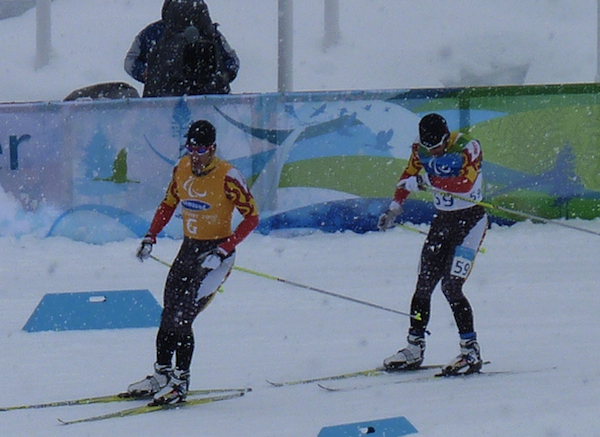
Brian McKeever (r), a member of Canada's Para-Nordic Ski Team, racing with his brother and guide, Robin, at the 2010 Paralympic Games. Photo used under Creative Commons from Mafue – http://bit.ly/d3DeMX
Four months after the conclusion of the Vancouver Paralympic Games, Canada’s Para-Nordic Ski Team has suffered cuts amounting to roughly one-third of its total budget.
According to Cross-Country Canada Executive Director Davin Macintosh, the cuts represented 56 percent of the program’s funding from Own the Podium (OTP), the high-performance sports initiative that was set up to propel Canadian athletes to medals at the 2010 Olympic and Paralympic Games in Vancouver.
The exact impacts of the cuts are still uncertain, as Cross-Country Canada (CCC) works to restructure its program in the next few weeks. But Macintosh said that the cuts, first reported by the CBC, will force the team to scale back its athlete support.
“In the long term, we’ll have to run a more streamlined program, which probably means fewer staff who can do a wider variety of jobs,” he said.
Over the past five years, Canada’s Para-Nordic program had enjoyed a large infusion of cash from OTP, which was founded in 2005 and has since poured more than $100 million into Olympic sports.
Cross-Country Canada’s Able-Bodied program fared much better in its level of funding from Own the Podium (OTP).
According to Cross Country Canada (CCC) Executive Director Davin Macintosh, the able-bodied ski team received a three percent decrease in support from OTP in its budget for the coming year. (CCC received roughly $1.2 million for its able-bodied cross-country program in 2009-2010.)
While that number may look bad when juxtaposed with the 56 percent cut to Para-Nordic, Macintosh said that the cuts merely reflect the quality of the athletes on each team—not a prioritization of able-bodied skiers.
“If they knew we had three Para-Nordic athletes who were on the cusp of winning all the international competitions, they’d give us more money there, and that’s what we have on the able-bodied side,” Macintosh said. “Our Olympic results showed that we have a strong team of people who will be around for the next Olympics, and have obvious and proven potential to reach the podium.”
According to OTP Director of Winter Sport Ken Read, his organization conducts yearly reviews, in which each sport receiving OTP funding is categorized according to its recent and historical results, as well as its future potential. The higher the category, the more support a sport receives.
Able-bodied cross-country is a category two sport, as is visually impaired cross-country, given Brian McKeever’s success at the 2010 Paralympics, where he won three gold medals. But the other Para-Nordic disciplines are rated one rung down on the ladder, as a category three.
“Those that have earned it get the broader…support,” Read said, “and the deeper down it will go. So it’s into supporting camps, supporting coaches, supporting the integrated support teams.”
“That’s where you have the able-bodied program,” he continued. “The hope is, going forward to 2014, that Devon [Kershaw] will find a couple hundredths of a second, and…we are working with them right now on a nordic consortium of trying to entrench some of those programs that worked well.” One example he cited was a project involving base grinding and ski technicians.
Read said that the categorizations were evaluated on a year-to-year basis, and that the level of support for the Para-Nordic team would be reconsidered next spring, “based on results.”
The initiative was designed to provide extra financing specifically earmarked for athletes with strong chances of winning Olympic and Paralympic medals.But over time, the money allotted to the Para-Nordic Ski Team—some $630,000 last year—had come to finance a large portion of its operations.
“When OTP first came into being, they put a lot of money into the development side,” said Jeff Whiting, who recently retired from his job as a Para-Nordic development coordinator for CCC.
“The program grew extremely rapidly over the past four years thanks to rapid increases in support from OTP, and that created a much larger budget,” Macintosh said.
After the conclusion of the 2010 Games, though, OTP’s future was uncertain, since funding from the soon-to-be-dissolved Vancouver Organizing Committee had made up a large proportion of its bottom line.
While the Canadian government doubled its share of OTP support in the federal budget this spring, the total amount of funding available for high-performance programs was still reduced—$20 million, instead of $23 million, according to OTP Director of Winter Sport Ken Read.
And while OTP had targeted three athletes during the 2010 Paralympics—Brian McKeever, Jody Barber, and Colette Bourgonje—only McKeever will continue to receive money for the next four-year Paralympic cycle.
Bourgonje has said that Vancouver was her last Paralympic Games, and “the remainder of the athletes in the program weren’t seeming to have gold medal potential,” Read said, referring to OTP’s standard for funding Paralympic athletes.
“In Paralympic [sports], it’s gold medal potential, not deep athlete development,” Read said. “The sport is supposed to be taking on that role of upkeep.”
An increase in funding to CCC from Sport Canada, a separate arm of the federal government, has softened the impact of the OTP reductions slightly, but not entirely, according to Macintosh.
CCC was informed of the cuts roughly two weeks ago, Macintosh said, and he called a meeting with athletes immediately. The team has been forced to cancel a planned summer training trip to New Zealand, and while funding exists for a trip to World Championships in Norway next year, the extent of the team’s participation in World Cup races earlier in the winter remains unclear.
“We will probably be able to finance fewer athletes to go on the general World Cup circuit, although we will ensure that our athletes are well-prepared for [World Championships],” Macintosh said.
No staff members have been laid off, but job descriptions will probably have to change, Macintosh added.
CCC is currently negotiating with Para-Nordic Head Coach Kaspar Wirz, who Macintosh said will likely continue in a “less-than-full-time capacity.” Technical Coach Robin McKeever—who also serves as a guide for his brother, Brian—would have to take on “a few more responsibilities” to remain with the team.
“We don’t have signed contracts with them,” Macintosh said. “It’s up to them.”
Wirz wasn’t surprised at the cuts—just their magnitude.
“We were thinking maybe 20, 30 percent,” he said. Reductions after Olympic cycles are typical, Wirz added, especially for Paralympic sports.
But Robbi Weldon, a 2010 Paralympian and a member of the Canadian Para-Nordic team, said that she didn’t blame OTP for the cuts.
“If an organization has strict criteria, and that’s what they put our in their documentation, I’m not going to bash them—that’s their mandate,” she said. Nevertheless, she continued, “it’s a huge hit, and I think there’s definitely a lot of questions to CCC—how they’re going to support us, and support the team.”
Macintosh said that he hoped to be able to make up for some of the cuts by finding new sponsors for the Para-Nordic team. CCC has been discussing options with potential backers, and the exposure gained by the athletes during the Vancouver Games should go a long way towards helping them find potential supporters, Wirz said.
“I think now, the public is ready to support that,” he said.
Switzerland's Dario Cologna racing in the 2010 World Cup in Canmore, Alberta. Canmore likely would have been one of the venues of a Tour de Ski-style stage race proposed for Canada in 2012. (Photo: Phil Bowen)
Cross Country Canada’s decision not to host the continent’s first-ever Tour de Ski-style stage race in February, 2012, came despite the recommendation of an independent feasibility study commissioned by the government of Alberta, documents obtained by FasterSkier show.
The study, a preliminary version of which was delivered to Cross Country Canada (CCC), the International Ski Federation (FIS), and other stakeholders in early May, urged the organizations to “immediately proceed” with the planning necessary to host an Alberta-based stage race. But the concept was rejected by CCC’s board of directors later in the month, who cited the financial risks that would have been shouldered by the organization, as well as a compressed time frame.
In the wake of the decision, the study’s author and local organizers have both criticized CCC, which, as the national governing body, has approval or veto power over World Cup races in the country. In an interview, Ken Davies, whose consulting firm conducted the feasibility study, said that the concerns of CCC’s board were contrived. Deadlines were flexible, he said, and the financial risk could have been passed on to local organizing committees.
“As far as I’m concerned, they had no risk,” Davies said. “I don’t think they’re reaching as far as they should reach.”
The Study
The feasibility study, conducted by Davies’ firm Lumina Consulting, was commissioned by the government of Alberta early this year as part of an effort in western Canada to ensure the continued use of the Olympic venues from the 1988 Games in Calgary and the 2010 Games in Vancouver.
While CCC was in no way bound by the conclusions of the study, its directors did cite a draft version in their decision not to host the race. FasterSkier has obtained a copy of the draft report, and a Freedom of Information request is pending with the Alberta government for the full version.
In the study, Lumina examines the viability of a Canada-based stage race, looking at aspects like potential venues, volunteer capacity, and revenues and costs. In the draft version, the costs of the tour were calculated as ranging anywhere from $3.4 to $5.1 million, depending on the logistics of the race and the number of stages. A more expensive format included a competition in Quebec, while the cheaper options limited venues to Alberta and British Columbia.
Canadian Brent McMurtry racing in Canmore in February, 2010. Photo: Win Goodbody.
The majority of those costs would have been covered by private sponsorship, and Lumina held preliminary meetings with a short list of Canadian oil and gas firms to gauge interest. “The price tag,” the study reads, “does not intimidate them.”
“They said, ‘come back when you’re serious,’” Davies said.
The report concludes by offering an estimate of the direct benefits of holding the race—which would have amounted to nearly $4 million in spending on hotel reservations and meals—and a formal recommendation: to “immediately proceed with further exploration of an Alberta-based Tour de Ski concept.”
“The direct benefits alone justify the recommendation for the Tour de Ski proceeding, but it is expected that the real win for the sport and for Canada will be the indirect benefits,” the study reads. (In the report, indirect benefits include anything that is not an immediate economic impact of the race itself, like promotion of tourism or increased exposure for the sport.)
CCC Declines
One week after receiving the draft report, on May 14, CCC’s board of directors released its decision declining to host the race, in a letter to FIS. In an interview at the time, CCC Executive Director Davin Macintosh told FasterSkier that the board’s major concernwith the proposed race was the financial risk involved—as well as the relatively brief window that organizers had to plan the event.
“It really is just financial risk—and it’s a short time frame,” he said.
But in interviews, both Davies and a potential race organizer arguedthat CCC would have been only minimally involved in the preparation—and wouldn’t have been on the hook for any of the costs of the race. According to Davies, the financial burden of hosting the Tour would have been passed on to local organizing committees.
“The whole idea was to take it completely out of their hands,” Davies said. “There was no financial dealings with them at all.”
Dale Swanson, the outgoing chairof the Canmore-based Alberta World Cup Society (AWCS), said that his organization was ready and willing to assume the financial risks and take the lead in hosting the race.
“If [CCC] would give us the right to go after the sponsors…we would take on that responsibility,” Swanson said. But, he continued, “even if we tell them that we will accept the risk, they don’t seem to understand that, or believe it.”
In the past, both Swanson and Davies acknowledged, CCC has stepped in to provide financial assistance for the weekend World Cups hosted in Alberta. But according to Davies—himself a former AWCS chair—CCC could have been indemnified from a tour with the stroke of a pen.
“It’s just as simple as writing that line,” Davies said.
While the details of the potential arrangement with the AWCS were not outlined in the feasibility study, Davies said that he made them absolutely clear to CCC.
“In simple terms, we said to them that they don’t have to put up a penny,” he said.
Macintosh, CCC’s director, was attending the organization’s annual meeting in Newfoundland last week and did not respond to repeated requests for a follow-up interview. But Jim McCarthy, CCC’s board chair, said that the group was not persuaded that they would have been insulated from all of the risk.
“I suppose they were trying to set it up that way, but we were not convinced in the end that they had, or that they could,” McCarthy said. “We’ve got a bit of a history there, back to fundraising for World Cups…They didn’t identify to our satisfaction that there were funding sources available.”
According to Davies, however, the Canadian oil and gas firms were very interested in the prospect of underwriting a Canadian tour. That industry has a poor environmental reputation in Europe, he said, and the companies could have used the 100 million TV viewing sessions that come with a tour to sell their image.
Poland's Justyna Kowalczyk in Canmore.
“This was a perfect opportunity,” Davies said—especially with the recent incident with the British Petroleum oil well in the Gulf of Mexico. “It’s right when things are at their worst.”
With the planning for the event still in preliminary stages, the companies wouldn’t give a firm commitment, Davies said, but the potential was there.
“From our assessment, there was interest, and it was pursuable,” he said. “The feasibility study says there’s not money in the bank, but…that there’s likely the necessary money there. And it basically becomes an effort of solidifying that, and FIS would have given us time to do that.”
According to FIS Cross-Country Race Director Jurg Capol, his organization did want a commitment from CCC in advance of the ski federation’s meetings at the end of May. Both Macintosh and McCarthy cited that deadline as the reason CCC made its decision to decline when it did.
But in an interview, Capol said that CCC’s commitment would not have been binding. If money had not been forthcoming over the next three to four months, he said, there was still time for them to back out.
“I didn’t say I wanted to have all the details,” Capol said. “We wanted to see a process of the project.”
The Impact
The World Cup is still tentatively scheduled to return to Canada for weekend races in December, 2012, with events in Canmore and Whistler, BC. In its letter to FIS declining to host the tour, CCC’s board wrote that it “hopes that the momentum of this process, and the energy of all participants, may be directed immediately toward ensuring the success of [those races].”
But according to Swanson, the AWCS outgoing chair, the weekend World Cup races have nowhere near the same appeal to his volunteers, who he said were discouraged by CCC’s decision to turn down the tour.
“It’s a presumption on CCC’s part that they can take us for granted, and count on us any time they want after some of their decisions that really disappoint us,” Swanson said. “We may or may not come back to the table, and they need to realize that. Our working relationship with them needs to change.”
McCarthy said that CCC’s board was mindful about the impact of its decision on local organizing committees, but that at the same time, that had to be balanced.
“We’re obviously concerned about that,” McCarthy said, “but the financial risks were huge, without really anything approaching assurance that they could be managed.”
The effects of turning down the race are not limited to local organizers, however, according to Bjorger Petterson, a former Canadian national team coach who also served as the country’s FIS delegate for 27 years. In an interview, Pettersen said that CCC also passed up an opportunity to develop the sport throughout the entire nation.
“You get kids interested in baseball in every city in the U.S., and the reason for that is it’s kept in front of them at the highest level all the time,” he said. A race like the tour, he added, “inspires the general public, it inspires development skiers, and it inspires national team skiers.”
Ultimately, Pettersen said, CCC’s board made its decision because it failed to recognize the slew of potential benefits that came with the tour—which he chalked up to a lack of leadership.
“It’s not that they don’t want to help the sport,” Pettersen said. “Within the organization, it needed a leader that…understood how strong a development vehicle this would be for the sport, and for our national team.”
A "Tour of the Rockies" would have used the World Cup venue in Canmore (Photo: Win Goodbody)
A previous version of this article incorrectly stated that Ken Davies is currently the chair of the Alberta World Cup Society. FasterSkier regrets the error.
Cross Country Canada (CCC) has turned down an opportunity to host a Tour de Ski-style event in February of 2012, according to a letter released by the organization Tuesday.
In interviews, CCC officials said that plans for the “Tour of the Rockies” foundered on the potential costs, which could have ranged as high as six million dollars, as well as a short time frame for preparation—especially given World Cup events already scheduled in Canada for the following season.
But the president of a consulting firm hired to study the feasibility of a Tour-style race said that the plan for the event was “as good as it gets at this stage, without having final exact location.”
“Suffice to say, it’s not in question that it would work, from an objective perspective,” said Ken Davies, whose firm, Lumina Consulting, produced a preliminary report that CCC cited as the basis for its decision.
Davies is also the chair of the Alberta World Cup Society, which was involved in the planning of the proposed event.
Details of the race had not been settled on, but Davies said that it would have resembled the Tour de Ski, the multi-day format that has gained traction in Europe since its inception in 2007. Hill climbs, city sprints, and conventional distance races were all on the table.
According to Dave Dyer, CCC’s events director, plans for the tour had been evolving since it was first discussed with the International Ski Federation (FIS).
The original proposal, he said, would have included races at established venues in Canmore and Whistler. A “unique transportation experience” would have advertised the tourism potential of both British Columbia and Alberta to athletes, coaches, team managers, and the media.
In a later version, Dyer said, race logistics would have been run from a “hub” in Canmore—which he suggested would place unreasonably high stress on the organizing committee there.
Lumina’s feasibility study was commissioned by the government of Alberta, and the final version has not yet been published; it is due out at the end of the month. Davies would not comment on the details until the report was issued.
The provincial governing body for skiing, Cross Country Alberta, was supportive of the Tour concept, and FIS Race Director Jurg Capol said that the Alberta government had been in favor of it, as well. According to Capol, the province would have been one of the race’s financial sponsors.
Alberta has sponsored World Cup events in the past, but Glen Cowper, a government representative, said that it would be premature to say whether it would have done so in this case.
With FIS’s spring meetings approaching at the end of the month, Davin Macintosh, CCC’s executive director, said that his organization’s board was forced to make a decision based on the preliminary report. For CCC, the tight timing and financial hurdles were too much to take on.
“It’s by no means something that we think would be impossible, but it would be an unprecedented amount of private funds that we would have to gather together, in a relatively short time frame,” Macintosh said. “We went through a detailed analysis of the cost…and determined that it wasn’t a reasonable risk for the organization to take on at this time, in addition to the 2012 World Cup that’s already scheduled.”
Having organized the Tour de Ski for the past four years, FIS Race Director Jurg Capol acknowledged that CCC would be taking on financial risks by hosting a similar event. But he said that a certain degree of uncertainty in the planning process was unavoidable, which race organizers must to be willing to accept.
“You need the spirits to go for it, even when everything is not fixed,” Capol said. “It’s always easy to find reasons not to do it.”
The ’12 Tour appears to be the last chance to land that race format in North American until at least 2015—Capol said that FIS would not consider holding another Tour in Canada for the next five to ten years.
Dave Wood served as team leader for the Canadians for the last two years, and worked with the athletes at the 2010 Olympic Games.
Following his resignation last week, longtime Canadian coach and team leader Dave Wood said that he was leaving to take a coaching opportunity with a club closer to his girlfriend, and that his parting from Cross Country Canada (CCC) had been amicable.
Current and former CCC athletes all praised Wood’s contributions to the organization over the last dozen years. But in interviews, they also acknowledged that Wood’s last year with the program was marked by tension.
At the Olympics, one athlete said he noticed a strained relationship between Wood and Inge Braten, the head coach at the time—who left his position at the end of the winter. And later this spring, according to a former national team member, CCC athletes pushed for changes to Wood’s role in the organization.
Wood denied that any tensions existed, and insisted that his decision to leave had been personal. But in an interview with FasterSkier, CCC Executive Director Davin Macintosh acknowledged that his organization conducted an “extensive review” of the High Performance System—which includes the National Team, and Wood’s position—after the Olympics.
The resulting plan for the next year, he said, “did include slightly different roles for people.”
“We invited the parties to fill the roles that we’d defined, and Dave took a long, hard, think about his future, and I guess he’s decided that other things are pulling at him, and that the best way forward for him is not to continue in the role he had,” he said.
Olympic Tensions?
A last-minute addition to the Canadian Olympic team, Gord Jewett was named to the squad in late-January. In Vancouver, Jewett raced in the 15 k freestyle, finishing in 52nd, just over two and a half minutes behind winner Dario Cologna.
During the Games, Jewett said, Braten and Wood did not seem to be on the same page. Their answers to logistical questions were sometimes different, which left Jewett feeling like he had to make a decision to talk with one or the other “to confirm details around training or preparation.”
“In my view, the relationship between Dave Wood and Inge Braten was strained at the Olympics, and the lack of communication between the two marginalized the ability of the team to be prepared,” Jewett said. “They weren’t communicating well, and that affected the overall organization of our team.”
Reached on vacation in Tunisia, Braten denied any conflict existed.
“I thought it was okay always with Dave,” Braten said. He added that the reason that he left his job at the end of the winter was unrelated to Wood, “or anybody else.”
Asked whether there were problems with communication between Braten and Wood at the Olympics, CCC Director of High Performance Tom Holland—who oversees the National Team—said that the two were “very professional.”
“We had very clear roles, all of us, going into the Games,” he said. “People delivered on their roles. We had some hard decisions to make—we made those decisions as a team.”
While Braten was the second straight Scandinavian coach to leave Canada after one year, Holland said “it’s difficult bringing people in from a different country—particularly overseas.”
“What we’ve discovered in the past four years is that we have something unique in Canada,” he said. “People have to be able to fit into that. We can’t be changing the system every two, three, four years in terms of the way we operate.”
Interest in Change
When Wood left his position at the national team last week, he told FasterSkier he had made the decision unilaterally, in order to take a job with a club in Rossland, BC.
But according to a former Canadian National Team member, CCC athletes had pushed for changes in the High Performance System at the end of the season—especially to Wood’s role.
“The athletes are always accountable for their performances based on results, and they haven’t felt as though there’s been that same level of accountability towards the administrative side of the High Performance [System],” the former National Team member said.
At the end of the four-year Olympic cycle, the former team member continued, the CCC athletes felt that it was time to “push forward on what they needed out of the national team program, and create a stronger system.”
When contacted by FasterSkier, four different National Team athletes declined to comment on the details of Wood’s departure. But Drew Goldsack, the national ski team representative to CCC, acknowledged that “there had been some tension” in the program.
“I don’t think the athletes were pushing for Dave to be fired,” he said. “But there was interest in change—in some major changes.”
Wood denied that there had been conflict or tension between him and the team, saying that “athletes are always unhappy.”
“They always want more—they don’t like to get pushed. That’s normal,” he said.
Macintosh, the CCC executive director, said that the post-Olympic review conducted by his organization was “extremely engaging” for the skiers. The resulting plan for the next year, he said, “responded to the concerns raised by athletes.”
“The organization firmly believes that there’s a role for Dave in that, and we’re sad to see him go,” said Macintosh. “We came up with the best structure from the organization’s perspective, but we can’t force people to work with us.”
Tasha Betcherman, the athlete representative to CCC’s board of directors, told FasterSkier in an interview that in the past, Canadian athletes have felt “that they have not had a direct contribution to some of the decisions on leadership.”
“But that is definitely changing,” she said. “After the Olympics is a really good time for reflection, and I think that the athletes were definitely heard.”
In a press release on the CCC website posted Wednesday, Macintosh said that Wood will continue with the organization doing “contract work.” As of Monday, the organization had not yet determined how it would fill the void created by Wood’s departure.