
From the FasterSkier archive — posts syndicated from athletes’ and coaches’ own blogs between 2004 and 2012, kept online as published. Current coverage is at fasterskier.com.

Tag: Davos 10 k freestyle

  • Understudies Steal Spotlight in 10 k Olympic Dress Rehearsal

    Understudies Steal Spotlight in 10 k Olympic Dress Rehearsal

    This coverage is made possible through the generous support of Marty and Kathy Hall and A Hall Mark of Excellence Award. To learn more about A Hall Mark of Excellence Award, or to learn how you can support FasterSkier’s coverage, please contact info@fasterskier.com.

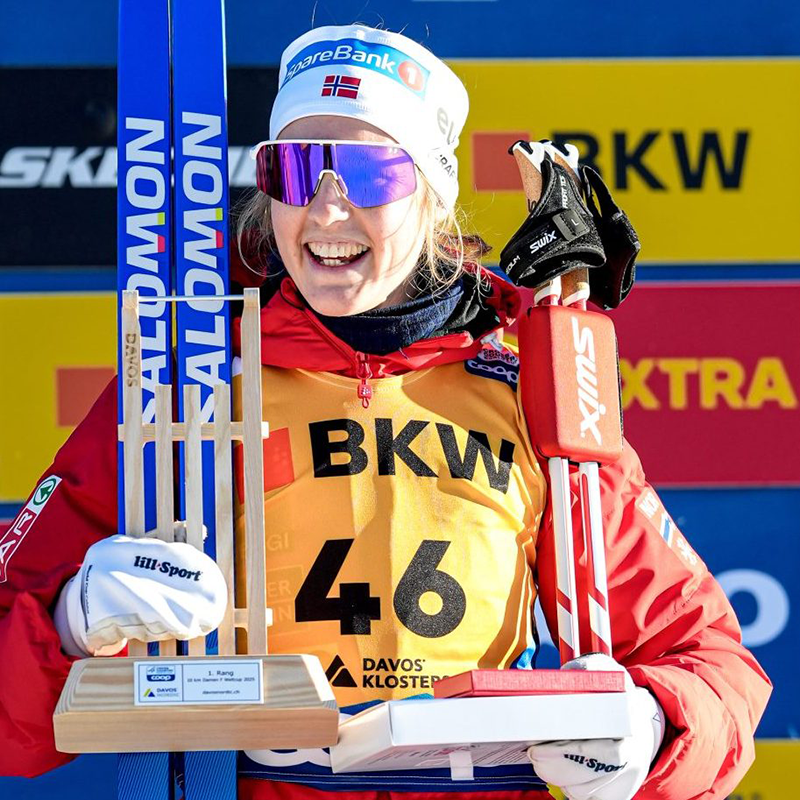
    Karoline Simpson-Larsen (NOR) took her first World Cup victory in Davos’ 10 k Freestyle, likely securing her spot on the Norwegian Olympic Team. (Photo: Vanzetta/NordicFocus)

    Many world-class athletes spend season after season diligently training, preparing, imagining, rehearsing for opportunities that never come. Advancing in World Cup standings is extraordinarily difficult: training is not enough, technical refinement is not enough, determination is not enough. Commentators and ski-pundits make much of the results of Junior World Championship medalists as though those podium performances are signs of future dominance in the senior ranks: they’re not. The senior level of the World Cup circuit is a talent show of the highest degree, and there is no “age category” for competitors to hide behind. All the best are here, all the best stay here for years at a time, and none of those winners willingly make room for newcomers. Success at this level must be wrestled from the stubborn grasp of strong-willed champions. Ultimately, hard work is vital to eventual success, but that eventual success also requires patience, and good fortune, and opportunity. Those who will succeed need to be ready when those opportunities arise. Today, in Davos, opportunity arose . . .

    It’s so important at this point in the World Cup season for skiing’s brightest stars to remain healthy and fresh, and Davos’ high-altitude venue is the sort that can steal both health and freshness from any skier. Racing these stressful events at elevations over 5500 feet definitely shuffles the results—those who hit the uphills too hard find themselves with insufficient time to recover on the downhills. Lots of blow-ups among skiers on Davos’ thin-aired race course. Not only is the racing difficult, but the post-race recovery is difficult as well with many racers going home exhausted or sick. And December is no time to be sick. With the Olympics less than two months away—and with this being a season in which the stars are mostly prioritizing Olympic results over World Cup standings—many stars elected to stay home from Davos, thus setting the stage for today’s 10 k race to shine a spotlight on the efforts of those who usually fill understudy roles. Today in Davos there was no Jonna Sundling (SWE), no Ebba Andersson (SWE), no Frida Karlsson (SWE), no Heidi Weng (NOR). Jessie Diggins (USA) doesn’t take many days off, and she would toe the starting line in Davos. But after skiing every single event in Period 1, she may have been at a little less than her best. Moa Ilar (SWE) has stood on the World Cup podium already this season, but her efforts are often overshadowed by her teammates Sundling, Anderson, and Karlsson. Likewise, Astrid Oeyre Slind (NOR) has delivered multiple podium performances in this young season, but she’s still recovering from an Achilles tendon injury. It’s not known if she is fully back to form. It was a day for understudies to grab the spotlight. And grab it they did, as Karoline Simpson-Larsen (NOR) skied away with the win, followed two seconds later by Ilar and Slind.

    With her fifth place finish in the 10 k Freestyle in Davos, Jessie Diggins (USA) continued to show that she will be a medal contender in every Olympic event. (Photo: Modica/NordicFocus)

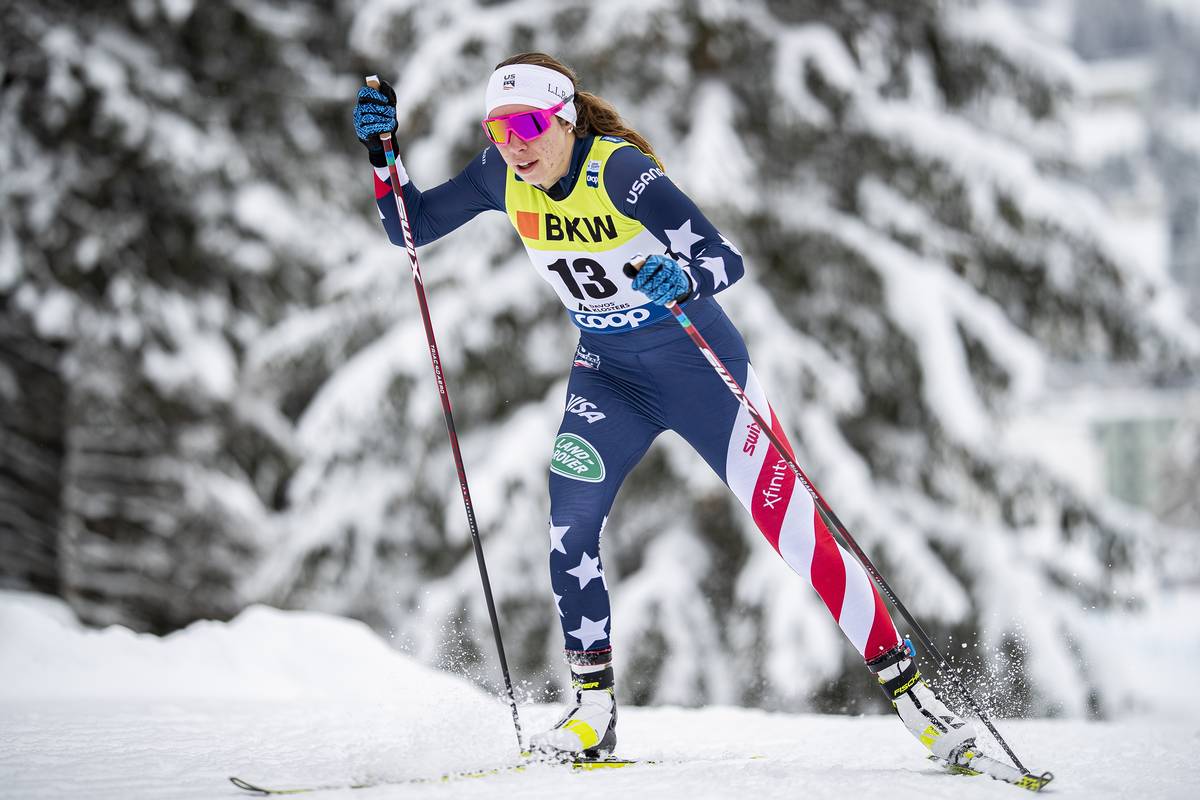
    Diggins did not shy from the fight, delivering an impressive fifth place finish in the 10 k, and continuing to show that she’ll be a medal contender in all individual events in Milano-Cortina. She was followed in the standing by her Americn teammates: Lucinda Anderson was 25th, Julia Kern 30th, Alayna Sonnesyn 33rd, Kendall Kramer 44th, Kate Oldham 56th. Sophia Laukli announced last week that she is delaying the continuation of her World Cup season. Rosie Brennan has been forced to deal with health and performance issues of her own in recent months. She would start the 10 k in Davos, but would fail to finish. Canadian, Katherine Stewart-Jones, continued to be the sole Canadian representative in World Cup Period 1. She would finish 28th.

    Also notable in this week’s list of Davos’ understudies was the performance of Maia Dahlqvist (SWE). Her fourth place finish continues to show her abilities in both sprint and distance racing, and today’s performance likely established as the favorite to team with Jonna Sundling in the Olympic Team Sprint. If that’s the team that Sweden fields in Val di Fiemme, they’ll be hard to beat.

    Davos’ World Cup events were also notable for the return to competition of Individual Neutral Athletes (AINs) from Russia and Belarus. Clad in a very non-Russian purple and aqua race suit, Dariya Nepraeva—a Junior World Championship gold medalist in 2022, and the fast-skiing little sister of former World Cup champion, Natalya Nepraeva—had ranked an inauspicious (and nearly invisible) 39th after Saturday’s Freestyle Sprint qualifying. Russian athletes are back on the World Cup course, and Nepraeva would deliver a solid result, finishing the day in 20th.

    Karoline Simpson-Larsen (NOR) took advantage of the absence of some of skiing’s brightest stars to step into a spotlight of her own. Her victory in Davos’ 10 k Frestyle Interval start likely also secured her spot on Norway’s Olympic Team for Milano-Cortina. (Photo: Modica/NordicFocus)
    10 k Freestyle

    FIS World Cup Period 1 is quite a test: three straight weeks of three races/weekend. And the conclusion of each weekend has been a 10 k. Whether Freestyle or Classic, ten kilometers is a challenging distance over which to compete. Davos version offered two laps over a five kilometer course, the low-point of which sits at a breathtaking altitude of 5400 feet. The 10 k Freestyle Interval Start will be an Olympic event when those Winter Games take place in Val di Fiemme. Though not quite as high as Davos, Val di Fiemme will represent altitude challenges of its own. Davos would seem to be an excellent venue for this pre-Olympic dress rehearsal.

    Diggins came through early checkpoints even with Ilar, two seconds behind Slind, and in the company of the latest French revelation, Leonie Perry. Diggins would finish fifth on the day, maintaining her lead in the World Cup standings but leaving some question as to her ultimate desire to claim another Crystal Globe (as the season progresses, don’t be too surprised if Diggins skips some races—and eschews World Cup points—in favor of Olympic preparedness). Fans usually think of Diggins as the strongest contender in any 10 k event. Today, though, was one for fresh arms and rested legs, and Diggins (like many in the field) found herself feeling less sparkly than usual.

    It was Larsen who would put up the best intermediate times of the day, even extending her lead over Ilar in the closing kilometers. Seated in the sled-shaped leader’s chair in the finish area, Larsen fidgeted nervously, surrounded by teammates who smiled and giggled as they repeatedly checked the splits of other contenders, each of whom would fail to best Larsen’s time. In the end, none did, and Larsen found herself with the first World Cup win of her career, and a likely nod onto an Olympic Team of which she had dared not dream. Opportunity arisen, opportunity grabbed.

    Kristin Austgulen Fosnaes (NOR) delivered a great result in Davos (seventh place). It still may not be enough for her to keep her Olympic relay pot with Team Norway. (Photo: Vanzetta/NordicFocus)

    In a season often dominated by Team Sweden, Davos’ 10 k offered a chance for Team Norway to top the podium. But the Norwegian National Team is a cruel and unforgiving environment, especially when so many of the world’s best skiers are vying for spots on the team, but there’s so little room at the top for all of them. Less than a year ago, another notable understudy, Kristin Austgulen Fosnaes (NOR), found herself under the spotlight for the wrong reasons when she was dismantled by Team Sweden during her leg of the World Championship Relay in Trondheim. Today in Davos, Fosnaes found herself with the an entirely respectable finish (seventh place). Ironically, today’s race winner—Larsen—may end up taking Fosnaes’ place in Norway’s Relay roster  in Val di Fiemme during the Olympic Winter Games.

    How truly ironic that a skier like Fosnaes could earn a seventh place in a World Cup event, and still find herself staying home from the Olympics (or at least being left off the roster in the event—the Team Relay—where she has a chance to medal). Her own team may be quick to remind her, “Yes, you finished seventh, but none of the true contenders were even there.” While that may be true, the absence of the contenders is what served up the opportunity for Karoline Simpson-Larsen to step into the spotlight. And it’s the fast that she did step in that will probably see her name aded to the roster of Norwegian Olympians in Milano-Cortina.

    Women’s 10 k Individual Start Freestyle RESULTS
    Understudies in the spotlight—Moa Ilar (SWE), Karoline Simpson-Larsen (NOR), Astrid Oeyre Slind (NOR) on the World Cup podium in Davos. (Photo:  Vanzetta/NordicFocus)

    Love Stories Like This? Help Keep Them Coming.

    Feature stories like this one take time, access, and care to produce. If you value thoughtful storytelling and independent ski journalism, please consider becoming a Voluntary Subscriber. Your support directly fuels the work we do to cover the people, places, and moments that make our sport special.
    Join the FasterSkier community!
  • Brennan Secures Victory Number Two in Davos, Swirbul Finds First World Cup Podium in 3rd

    Brennan Secures Victory Number Two in Davos, Swirbul Finds First World Cup Podium in 3rd

    Impressing this season: Rosie Brennan racing in the Davos 10 k skate concludes her Davos weekend with back-to-back wins. (Photo: NoridcFocus)

    This World Cup coverage is made possible through the generous support of Marty and Kathy Hall and their A Hall Mark of Excellence Award. To learn more about A Hall Mark of Excellence Award or to learn how you can support FasterSkier’s coverage please contact info@fasterskier.com.

    New snow and cloudy skies did nothing to hinder the fire of Rosie Brennan as she sped around the 10-kilometer course in a time of 24:49.8, securing her second-ever World Cup win after a victory in the sprint yesterday. Close behind her was Hailey Swirbul, no stranger to altitude, the Aspen, Co., native landed her first World Cup podium with a third-place finish. Rounding out the podium in second place was Yulia Stupak of Russia, formerly Yulia Belorukova.

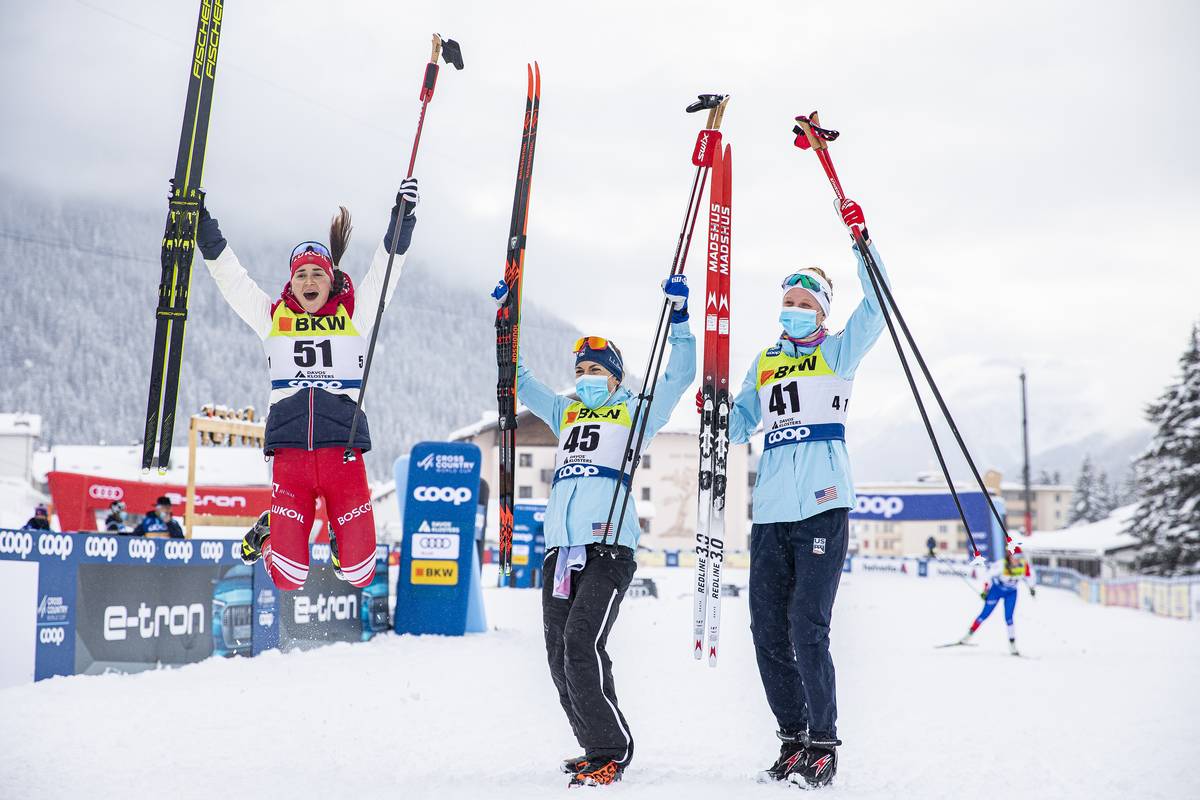
    Women’s Davos 10 skate podium: Yulia Stupak (RUS) 2nd, Rosie Brennan (USA) 1st, Hailey Swirbul (USA) 3rd, (l-r). (Photo: NordicFocus)

    Brennan, who started in bib 45, set the benchmark early on, gapping every skier in the field by 9.9 seconds at 2.2 k. By 7.2 k she had built a massive cushion of 24.6 seconds over eventual second place skier Stupak (RUS). Brennan closed out to win her second career World Cup in as many days by 34 seconds. “It was great, I love skiing in new snow,” said Brennan in a post-race interview with FIS, “I still am just so excited from yesterday, I really just tried to go out there and ski smooth and strong”.

    With today’s victory, Brennan also takes the leader’s bib in the Overall World Cup Standings ahead of Tatiana Sorina of Russia while also leading in the Sprint and Distance standings. “That is quite honestly something I”m not sure I’ve ever dreamed of,” Brennan wrote in an email, “Obviously, we have only had a few races, but it’s something I’m proud of nonetheless and while I’m not sure I expect to keep them the whole season, I hope to do them proud while I have them and put up as good a fight as I can!”

    Post-race interview with Rosie Brennan.


    Back from a year off to start a family, Yulia Stupak of Russia claims second overall in the Davos 10 k skate. (Photo: NordicFocus)

    After missing the 2019/20 race season to pursue motherhood, Yulia Stupak (RUS) landed her fourth World Cup podium and first-ever distance podium with a second-place finish today. 

    Hailey Swirbul at the line for third place in the Davos 10 k skate. (Photo: NordicFocus)

    Post-race interview with Hailey Swirbul.

    Swirbul began just four places ahead of Brennan in bib 41, with a conservative start she was 8th through the first 2.2 k. By 5 k Swirbul had overtaken five skiers and was neck-and-neck with Theresa Stadlober of Austria who eventually finished 5th. At 7.2 k Swirbul was down 2.4 seconds to Stadlober but blazed through the final 2.8 k to finish with a time of 25:30.3, 6.3 seconds ahead of the Austrian and 40.5 seconds behind her teammate Brennan. 

    Jessie Diggins, racing to seventh overall in the Davos 10 k skate. (Photo: NordicFocus)

    With two on the podium, the U.S. women rounded out the day with five finishes in the top 30. Jessie Diggins, who finished 3rd in Davos in this event last year, found herself in the top-ten with a 7th place finish. Katharine Ogden placed 22nd, scoring her first points of the season, followed by Caitlin Patterson in 30th.

    For Ogden, this was her fourth top-30 World Cup result, with her best coming last season with a 21st in Val di Fiemme’s 10 k skate during the Tour de Skis.

    Post-race interview with U.S. Head Coach Matt Whitcomb where he discusses the women’s race.


    Katharine Ogden raced to 22nd in the Davos 10 k skate. (Photo: NordicFocus)

    Results: Women’s 10 k

  • Another Distance Win for Østberg in her ‘Favorite Place’; Five Americans Top 30 in Davos

    Another Distance Win for Østberg in her ‘Favorite Place’; Five Americans Top 30 in Davos

    The women’s 10 k freestyle podium on Sunday at the Davos World Cup in Switzerland, with Norway’s Ingvild Flugstad Østberg (c) in first and Ragnhild Haga (l) in second, and Finland’s Krista Parmakoski (r) in third. (Photo: FIS Cross Country/Twitter)

    DAVOS, Switzerland – Ingvild Flugstad Østberg picked up the third Davos win of her career, and just like one year ago, the Olympic silver medalist didn’t do it in the sprint. Instead, Østberg made her mark in the distance event, this year a 10 kilometer freestyle race.

    Bib 42 in the interval-start competition, the Norwegian knew the split times of some of her top competitors, and quickly surpassed them. By the 5 k mark she had a 5.5-second lead over teammate Heidi Weng, 13 seconds over Sweden’s Charlotte Kalla – who had won the previous three distance races of the season – and nearly 20 seconds over Norwegian teammate Marit Bjørgen.

    Later starters threatened, with Switzerland’s Nathalie Von Siebenthal laying down a time at the 5 k mark that nobody could match. Kerttu Niskanen of Finland was also fast at the halfway point, just a second behind Østberg’s time.

    But while Østberg stayed aggressive and strong over the second lap of the course, several competitors slowed, perhaps having started too fast. To the sighs of the Swiss crowd, Von Siebenthal faded and finished in a tie for fifth with Austria’s Teresa Stadlober. Niskanen was seventh.

    That left Østberg at the top of the standings, 5.9 seconds ahead of teammate Ragnhild Haga and 7.9 seconds ahead of Finland’s Krista Parmakoski.

    “It was completely insane,” Østberg told Norway’s NRK broadcaster. “That’s what I’ve been training for the whole year. This is my favorite place and I love being here.”

    It was Østberg’s second podium of the season after finishing third in the 10 k classic in Ruka, Finland.

    “She’s impressive,” Kalla said to Norway’s VG.

    “I am very impressed,” Bjørgen agreed. “Ingvild went very well here last year, too.”

    Parmakoski was ranked second at the 8.2 mark, but lost time compared to earlier starter Haga, who was able to finish second thanks to her aggressive skiing on the course’s downhill finish.

    Haga is continuing to have her best season to date; this was her third podium, all coming in distance races. Second place is also her best individual World Cup finish ever.

    “t was thrilling [as in nervous] to race, because it was so close,” Haga told Norway’s TV2 of receiving splits along the course, according to a translation. “On the top coach yelled out that I had to ski with my life … It feels great to end up on the podium when it was such a close race.”

    Weng was left off the podium in fourth (+14.5). Kalla finished eighth (+26.8), Bjørgen ninth (+35.9), and Norway’s Astrid Jacobsen tenth (+37.6).

    Sadie Bjornsen (U.S. Ski Team) racing to 12th in the World Cup women’s 10 k freestyle on Sunday in Davos, Switzerland.

    After a banner day in the freestyle sprint on Saturday, which saw four American women in the top eight, the team comparatively slowed. But they still packed the top 20, with Sadie Bjornsen 12th (+44.6), Kikkan Randall 14th (+56.8), Jessie Diggins 15th (+59.9), and Rosie Brennan 17th (+1:11.2).

    “I haven’t raced a distance race here in a few years,” Bjornsen said. “I wasn’t really sure how to approach it other than my wax tech told me yesterday to ski the uphills and race the downhills. I went out a little harder than I normally do on purpose, to see if I could hold it. I think that on a course like this I have to operate like that.”

    It worked, and despite the hard start Bjornsen kept an even position in the field: 10th after 3.2 k, 11th after 5 k, and 12th at the finish.

    “This is, for me, one of the hardest courses because there’s not a second of rest out there,” she said. “I often do a little bit better when I have some recovery. I did today just as a challenge for myself, to practice pushing through some serious pain cave. The result isn’t what matters today. It’s that I did that effort. I felt like I was able to push that.”

    Diggins wasn’t happy with her race; after being sick earlier in the week, she had rallied for the sprint, where she finished fourth yesterday. But in the 10 k she was unable to match her fourth-place finish from last year’s 15 k.

    Jessie Diggins (U.S. Ski Team) racing to 15th in the World Cup women’s 10 k freestyle on Sunday in Davos, Switzerland.

    “It was disappointing for me,” she said. “It wasn’t what I wanted. I felt like my reserves, now that I’ve been sick, maybe wore out. So I made it through yesterday and just didn’t have it today. That’s okay — not every day is going to be good. It felt like I was pushing as hard as I could but I just didn’t have a lot there today. And if something is not great, then it really, really shows on this course.”

    Randall, meanwhile, felt like she put together a solid weekend after hitting the podium in the sprint and then finishing 14th. In her last Davos distance race before retirement, it was also her best Davos distance result. On her first lap, she skied with Kalla, who was finishing the race.

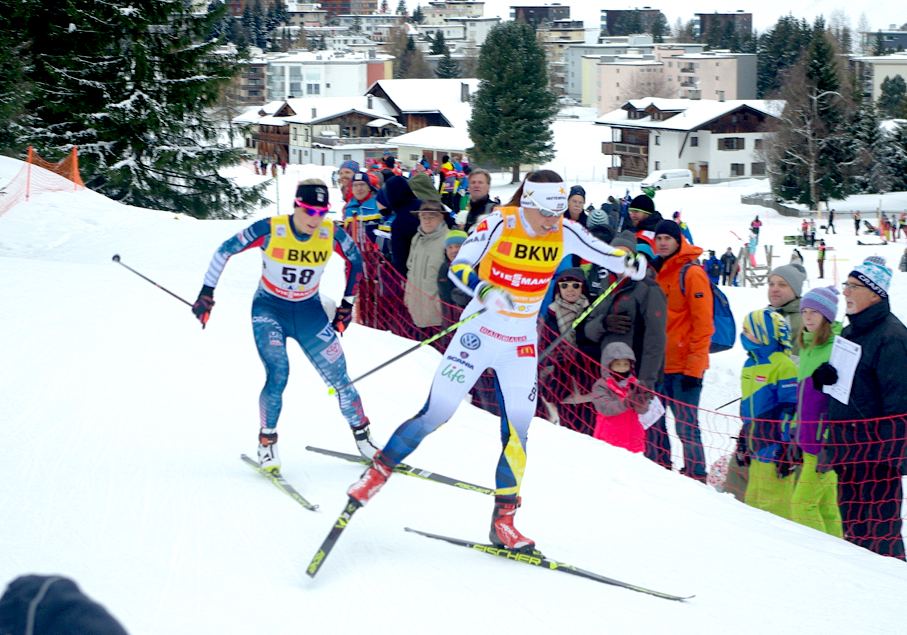
    Sweden’s Charlotte Kalla, in the overall World Cup leader’s bib, leads American Kikkan Randall during the women’s 10 k freestyle individual start at the Davos World Cup in Switzerland.

    “I think today was good,” Randall said. “It was fun to ski with Charlotte on the first lap. I actually felt pretty comfortable skiing behind her. But then on the second lap it was like, oh, that’s what she must have been feeling like. So it was good to get that pace to start and then have to work through it myself on the second lap. So it was solid. It wasn’t a spectacular day, but overall pretty good.”

    Ranked 23rd at the halfway point of the race, Brennan rallied and moved up on the second time up the course’s long climbing section, before losing a few more seconds on the downhill.

    “The uphills!” she laughed when asked whether there was a part of the race that had worked particularly well for her. “The downvalley, I don’t know, I probably have some work to do on that. But gradual uphills are good for me. This course is special — even when you are skiing, you don’t really know what’s going on. You just have to find a way to keep moving. But I felt like I was able to do that, so I’m pretty happy.”

    Chelsea Holmes finished 29th (+1:32.9), Liz Stephen 40th (+1:58.5), and Sophie Caldwell 52nd (+2:20.1).

    Cendrine Browne (Canadian U25 Team) racing to 45th in the World Cup women’s 10 k freestyle on Sunday in Davos, Switzerland.

    Cendrine Browne led the Canadian team in 45th (+2:05.9), followed by Emily Nishikawa in 50th (+2:18.4).

    “It went well,” said Browne. “I’m really happy – usually I have a hard time at altitude because I live at sea level. So I went into the race not knowing how it would go. Last year it did not go really well for me. So I was happy that I had good feelings during the race, I was able to push.”

    After struggling last year, Browne tried to be deliberate in her approach to the Davos course this time around.

    “Yesterday I talked about that with my coach, Louis [Bouchard]. “And other athletes, like Alex, were saying don’t start too fast because everybody dies on this course because it’s so hard. But I talked with Louis and we decided that I would do like always, I would start fast and see if I could hold that pace. So I started fast. I think I had a really good start. I tried to just keep going.”

    Also for Canada, Dahria Beatty placed 73rd (+2:53.0) and Katherine Stewart-Jones 79th (+3:44.6).

    Results

  • Sunday Rundown: Davos, Hochfilzen and Sovereign

    Sunday Rundown: Davos, Hochfilzen and Sovereign

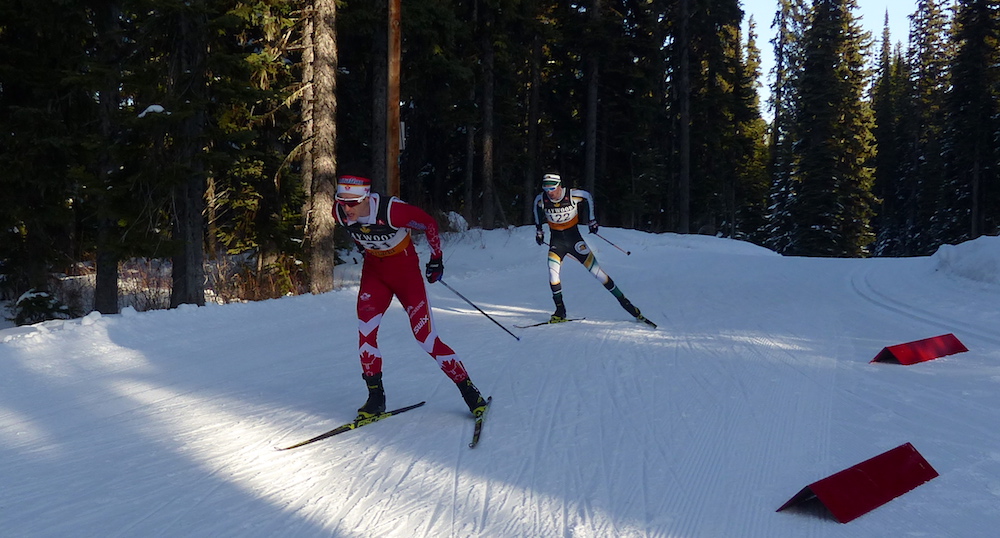
    CGRP's Caitlin Patterson charging up the wall climb. (Photo: Peggy Hung)
    Caitlin Patterson (Craftsbury Green Racing Project) charging up the wall climb en route to the win in the women’s 10 k freestyle on Sunday at the Sovereign Lake NorAm/SuperTour near Vernon, B.C. (Photo: Peggy Hung)

    NorAm/SuperTour (Sovereign Lake near Vernon, British Columbia): 10/15 k freestyle

    VERNON, B.C. — The combined NorAm and SuperTour event at the Sovereign Lake Nordic Centre continued with individual-start distance races and continued with the theme of U.S. domination of the leaderboard.

    Ian Torchia, of Northern Michigan University (NMU) and the U.S. Ski Team D-team, started the day with a big victory in the men’s 15 k freestyle, finishing in 36:29.7 minutes and on the heels of Canadian Para-Nordic guide Graham Nishikawa, who started 30 seconds ahead of him and ended up sixth. Jack Hegman of the Sun Valley Ski Education Foundation (SVSEF) placed second, 19.0 seconds back, to complete his good weekend. Canadian Para-Nordic superstar Brian McKeever rounded out the podium in third, 22.6 seconds back.

    Graham Nishikawa and Ian Torchia worked together after Torchia closed the 30 second gap. (Photo: Peggy Hung)
    Graham Nishikawa (l) and Ian Torchia worked together after Torchia closed the 30-second gap en route to a victory in the men’s 15 k freestyle on Sunday at the Sovereign Lake NorAm near Vernon, B.C. (Photo: Peggy Hung)

    The women were next to get some time in the sunshine with two laps for 10 k. Caitlin Patterson of the Craftsbury Green Racing Project (CRGRP) upgraded from Saturday’s silver to gold on Sunday with winning time of 27:13.0. Rosie Frankowski of Alaska Pacific University (APU) snatched second, 30.7 seconds back. Caitlin Gregg (Team Gregg) raced to third, 1 second behind Frankowski.

    Former Canadian national-team biathlete Zina Kocher started her new cross-country career as the top Canadian in seventh (+1:31.2).

    The weather was a repeat of Saturday: -2 degrees Celsius, windless and sunny. Smiles were evident everywhere, even for athletes who didn’t quite nail the pacing on an unforgiving course.

    Results

    ***

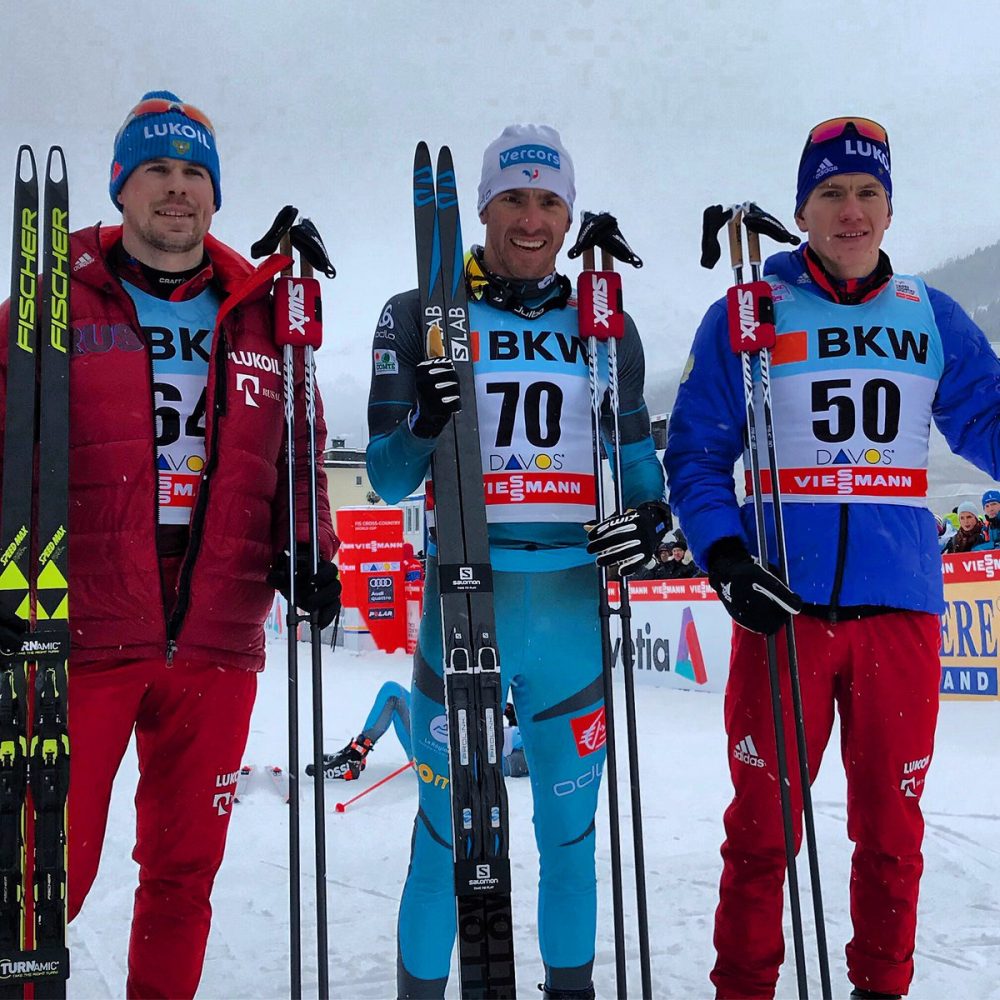
    France’s Maurice Manificat (c) after winning the men’s 15-kilometer freestyle on Sunday in Davos, Switzerland. He finished ahead of Russians Sergey Ustiugov (l) and Alexander Bolshunov in second and third respectively. (Photo: FIS Cross-Country/Twitter)

    FIS Cross Country World Cup (Davos, Switzerland): 10/15 k freestyle 

    Women’s report

    Men’s report

    After a day of sprinting, cross-country racers returned to the Davos World Cup venue on Sunday for the women’s 10-kilometer and men’s 15-kilometer freestyle individual start competitions.

    For his first World Cup win in almost two years, France’s Maurice Manificat took the men’s 15 k race title in a time of 33:56.2. Exactly 4 seconds flat behind Manificat in second place was Russia’s Sergey Ustiugov. Ustiugov’s teammate Alexander Bolshunov, finished 10 seconds behind Ustiugov and 14.6 seconds behind Manificat for the men’s third and final podium spot.

    The remainder of the men’s top ten included Norway’s Simen Hegstad Krüger in fourth (+21.3), Switzerland’s Dario Cologna in fifth (+26.5), Sweden’s Marcus Hellner in sixth (+35.4), Russia’s Denis Spitsov in seventh (+36.1), Hans Christer Holund of Norway in eighth (+36.9), Russian Alexey Chervotkin in ninth (+54.2), and Alex Harvey of Canada in 10th (+1:01.2).

    The next best male North American finisher was American Patrick Caldwell in 41st (1:50.2).

    Canada’s Devon Kershaw placed 44th (1:59.8), Graeme Killick 59th (+2:27.8), Russell Kennedy 68th (+2:43.4), and Julien Locke in 94th (4:27.5). Knute Johnsgaard did not start.

    For the U.S., Noah Hoffman finished 48th (2:05.5) and Scott Patterson 88th (3:46.2). Simi Hamilton did not start and Andy Newell did not finish.

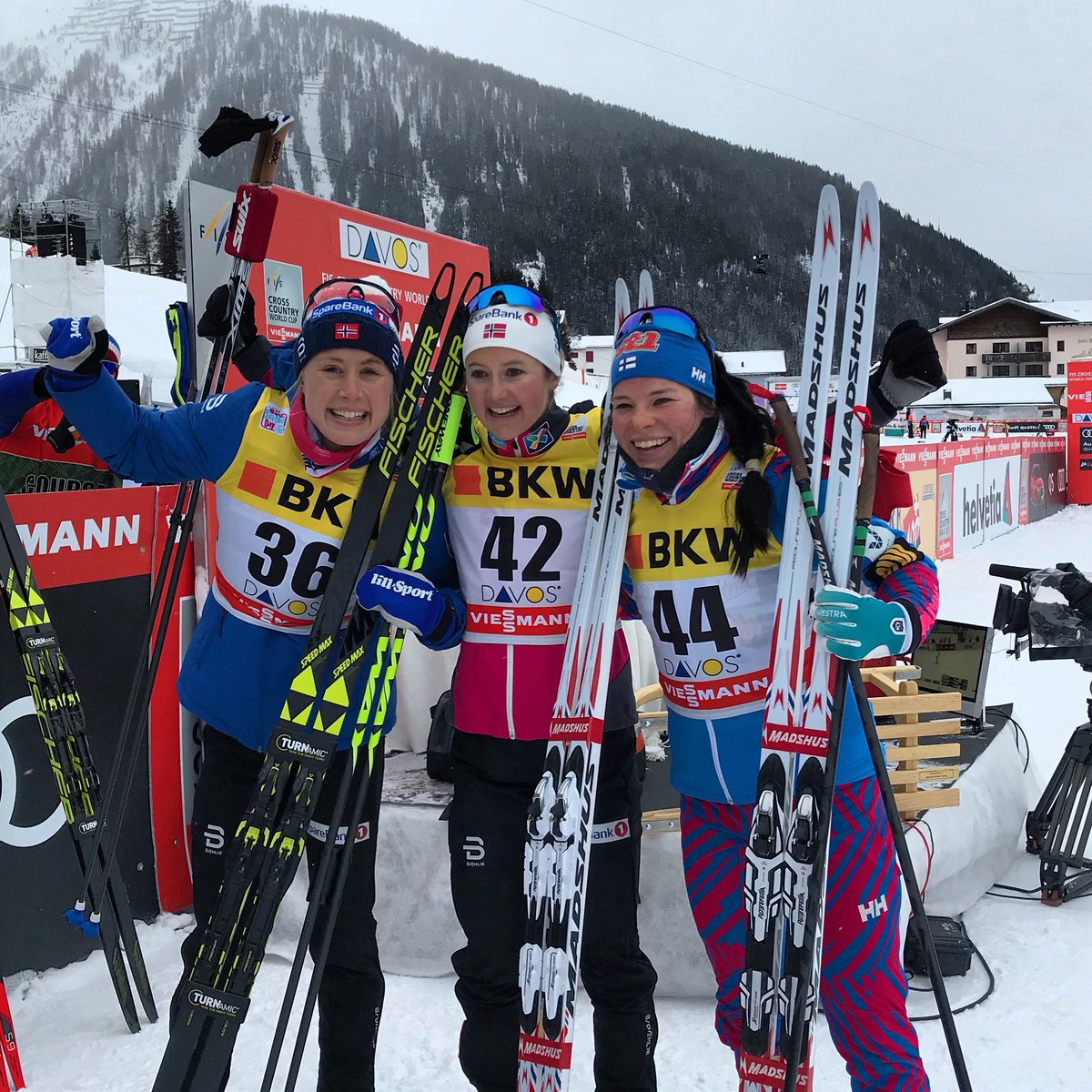
    The women’s 10 k freestyle podium on Sunday at the Davos World Cup in Switzerland, with Norway’s Ingvild Flugstad Østberg (c) in first and Ragnhild Haga (l) in second, and Finland’s Krista Parmakoski (r) in third. (Photo: FIS Cross Country/Twitter)

    In the women’s 10 k, 75 starters finished the 10 k course with Norway’s Ingvild Flugstad Østberg claiming first in a time of 25:28.5. Her Norwegian teammate, Ragnhild Haga finished 5.9 seconds behind her for second place. Krista Pärmäkoski of Finland raced to the third and final podium spot, 7.9 seconds back from Østberg’s winning time.

    Rounding out the women’s top ten was Heidi Weng in fourth (+14.5), Austria’s Teresa Stadlober in fifth (+16.4), Switzerland’s Nathalie von Siebenthal in sixth (+16.4), Finland’s Kerttu Niskanen in seventh (+24.9), Sweden’s Charlotte Kalla in eighth (+26.8), Norwegian Marit Bjørgen in ninth (+35.9), and Astrid Uhrenholdt Jacobsen in tenth (+37.6).

    Leading the U.S. women was Sadie Bjornsen in 12th (+44.6), seven seconds outside the top ten. The next two Americans finishers were within 3.1 seconds of each other, with Kikkan Randall finishing 14th (+56.8) and Jessie Diggins in 15th (+59.9).

    Also scoring World Cup points for the Americans, Rosie Brennan finished in 17th (+1:11.2) and Chelsea Holmes in 29th (+1:32.9).

    The U.S.’s Liz Stephen and Sophie Caldwell finished in 40th (+1:58.5) and 52nd (+2:20.1), respectively.

    For the Canadians, the team was led by Cendrine Browne in 45th (+2:05.9), followed by Emily Nishikawa in 50th (+2:18.4). Dahria Beatty placed 73rd (+2:53.0) and Katherine Stewart-Jones 79th (+3:44.6).

    Results: Women | Men

    ***

    IBU World Cup (Hochfilzen, Austria): Men’s and women’s relays

    Men’s and women’s relays took place on the final day of racing in Hochfilzen, with Norway winning the men’s 4 x 7.5 k and Germany topping the women’s 4 x 6 k by considerable margins.

    Norway’s Ole Einar Bjørndalen, Henrik L’Abée-Lund, Erlend Bjøntegaard, and Lars Helge Birkeland raced to first in 1:21.21.8 hours, nearly two minutes clear of Germany in second, after taking the lead on L’Abée-Lund’s second leg. They avoided the penalty loop and used a total of nine spares, and never lost hold of first place for the rest of the race.

    Germany raced to second (+1:54.9) with Erik Lesser, Benedikt Doll, Arnd Peiffer, and Simon Schempp, with zero penalties and 17 spares, after Peiffer lifted them from fourth to second on the third leg. Schempp held them there, despite using a maximum of three spares on each of his shooting stages, in the final leg.

    France claimed third (+2:34.0) with Jean-Guillaume Béatrix, Simon Desthieux, Emilien Jacquelin, and Quentin Fillon Maillet, despite three penalties and 13 spares. Two of their penalties came on Beatrix’s first leg and another in Fillon Maillet’s final shooting. After being tagged in fifth, Jacquelin raced them up to third on the third leg and Fillon Maillet held onto that position for the last spot on the podium.

    The U.S. men finished ninth (+3:38.3) with Lowell Bailey, Leif Nordgren, Tim Burke, and Sean Doherty, after they combined for three penalties and 13 spares. Bailey avoided the penalty lap and put them in third at the first exchange, while Nordgren slipped to seventh after a penalty, Burke remained in seventh with one penalty as well, and Doherty had one more penalty to anchor the team to ninth.

    Canada placed 15th (+6:22.5) with six penalties and 20 spare rounds, with Christian Gow, Scott Gow, Nathan Smith, and Brendan Green. After being tagged in 21st, Smith raced them up to 13th, using just two spares to clean. Green anchored them to 15th after using six spares and skiing the 15th-ranked time on that last leg.

    In the women’s relay that followed, Germany won by 44.9 seconds over Ukraine, with Vanessa Hinz, Franziska Hildebrand, Maren Hammerschmidt, and Laura Dahlmeier using nine spares while staying out of the penalty lap.

    After Hinz raced them into first, Hildebrand slipped to fourth after using four spares on the second leg. Hammerschmidt raced the fastest third leg to put them back in first, and Dahlmeier held them there to the finish, crossing first in 1:14:36.4.

    Ukraine (0 penalties, 5 spares) took the lead on the second leg but ultimately settled for second with Vita Semerenko, Yuliia Dzhima, Valj Semerenko, and Olena Pidhrushna. Dzhima put them in second heading into the race’s halfway point, but Valj Semerenko lost two places to tag Pidhrushna in third. Pidhrushna used just two spares on the final leg to bring them to second, about 20 seconds ahead of France in third.

    Despite a tough first leg for Marie Dorin Habert, in which she had two penalties and tagged off in 14th, France rose to third place at the finish (+1:04.5) thanks to strong skiing and shooting from anchor Anaïs Bescond.

    The team had a total of two penalties and 13 spares. Celia Aymonier used four spares to put them in ninth after the second leg, and third-leg Justine Braisaz lifted them one more place to seventh before Bescond skied the fastest last leg to pick off four more places.

    Canada placed ninth (+2:31.6) with Emma Lunder, Rosanna Crawford, Megan Bankes, and Julia Ransom, with no penalties and nine spares. Crawford put them in fifth after the second leg, Bankes lost one place on the third leg, and Ransom slipped three more with three spares on her final shooting to finish ninth.

    The U.S. did not enter a women’s team.

    Results: Men | Women

  • Bjørgen Stays Vigil on an Icy Davos Course for 1st Distance Win of Season

    Bjørgen Stays Vigil on an Icy Davos Course for 1st Distance Win of Season

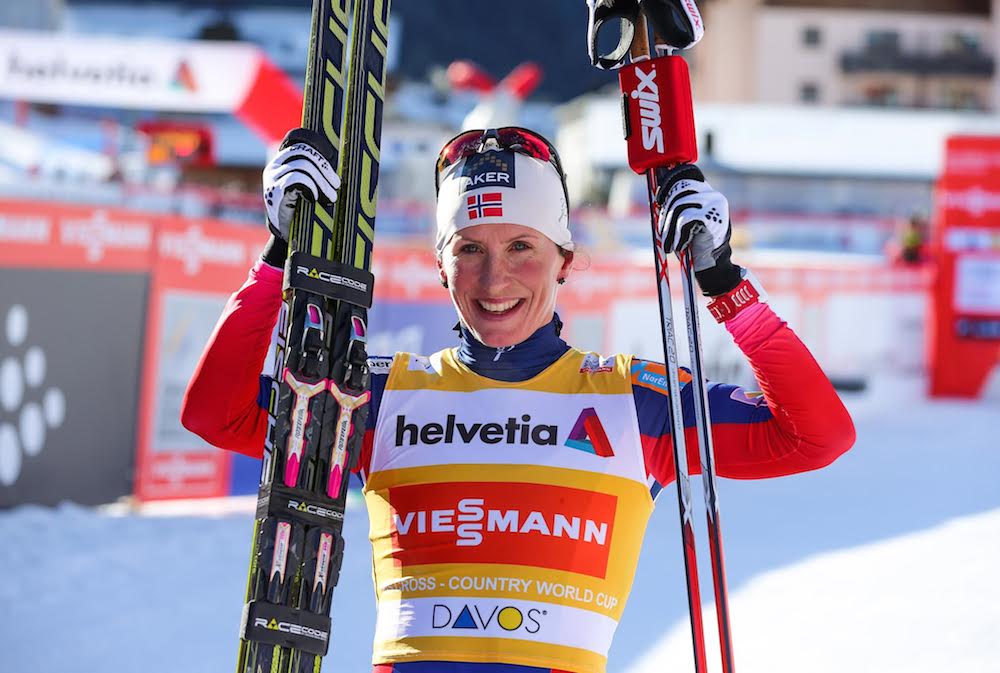
    Marit Bjørgen celebrates her first World Cup distance win of the season on Saturday after taking the 10 k skate by 19.9 seconds in Davos, Switzerland. (Photo: Fischer/NordicFocus)
    Norway’s Marit Bjørgen celebrates her first World Cup distance win of the season on Saturday after taking the 10 k skate by 19.9 seconds in Davos, Switzerland. (Photo: Fischer/NordicFocus)

    Heading into the women’s 10-kilometer freestyle individual start on Friday in Davos, Switzerland, one stat stuck out over the rest. Marit Bjørgen of Norway has not been beaten in a World Cup 10 k skate since Davos in December 
2009, when she placed fourth. Since then, Bjørgen had won all five of the World Cup 10 k skate 
races she started.

    In total, Bjørgen had racked up seven of those 10 k freestyle wins, and with a win on Saturday, she would tie former Czech Republic skier Katerina Neumannova with eight wins, according to a FIS press release. Besides them, no other competitor has more than three 10 k skate wins.

    But Bjørgen hadn’t won a World Cup distance race yet this season; her teammate Therese Johaug had.

    Depending on how the usual showdown shook out, Bjørgen or Johaug could lead the Norwegian women’s team to the longest winning streak in women’s World Cup history. Before Saturday, the Norwegian women had won nine straight World Cup races, not including stages (between Bjørgen, Therese Johaug and Ingvild Flugstad Østberg so far this season). A 10th-consecutive win would beat the Russian record, set during the nearly a decade ago between February and November 1995.

    To top that off, Norway could add to its 14-race winning streak, including World Cup stages.

    Johaug won the last 10 k skate held in Davos in February 2013 — which Bjørgen did not start. On Saturday, Johaug was seeking her sixth-straight distance win, in which she would equal the records of Norway’s Bente Skari (January-February 2003) and Italy’s Manuela Di Centa (February-March 1996). Bjørgen has yet to string together more than five consecutive wins.

    Whether any of these women were aware or cared much about these stats was besides the point — on Saturday morning, Bjørgen and Johaug were out for a duel.

    Because of the less-than-average snow in Europe, this event was originally scheduled to be held in La Clusaz, France, but was canceled then rescheduled last week for Davos. The majority of the course was a mixture of natural and manmade snow leading to an icy surface, which benefited the earlier starters.

    “It was icy, so one could easily lose their skis from under them,” Bjørgen told NRK, according to a translation. “It was better to [ski] safe than to risk anything.”

    As usual, Bjørgen in the overall World Cup leader’s bib, started last with the advantage of chasing down Johaug, who started a minute ahead of her. Judging Johaug’s start out of the gate, she looked primed to give Bjørgen a run, posting the fastest time at 2 k through 53 starters.

    However, once Bjørgen blew through that checkpoint, she was 0.8 seconds faster.

    “[My race] flowed very well. I managed to hit well and got the power down in skis,” Bjørgen said.

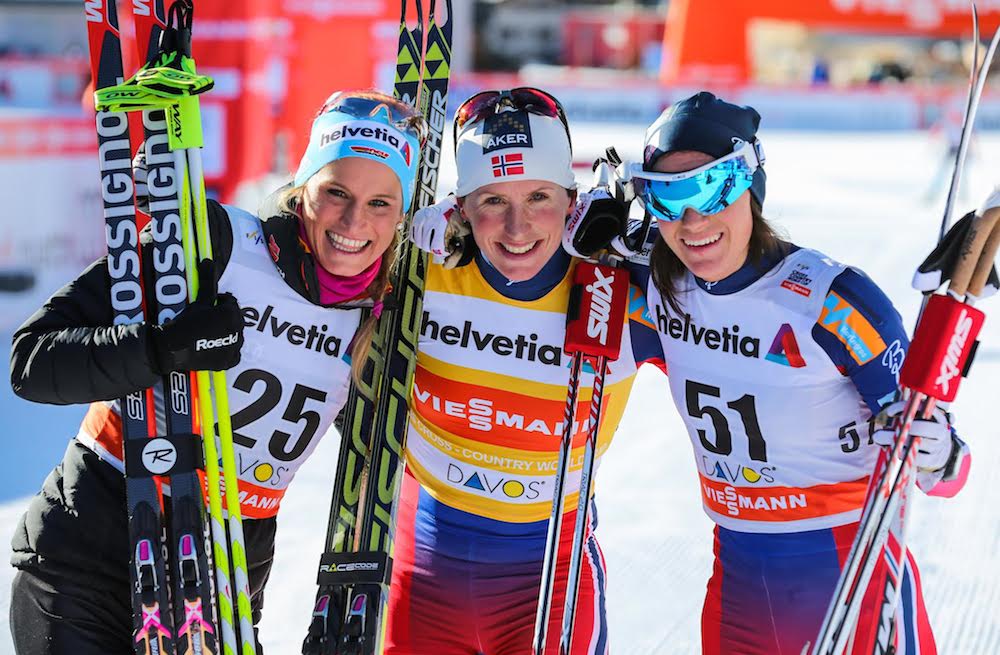
    The women's World Cup 10 k freestyle podium on Saturday in Davos, Switzerland: Norwegian winner Marit Bjørgen (c), German runner-up Nicole Fessel (l) and Norway's Heidi Weng in third. (Photo: Fischer/NordicFocus)
    The women’s World Cup 10 k freestyle podium on Saturday in Davos, Switzerland: Norwegian winner Marit Bjørgen (c), German runner-up Nicole Fessel (l) and Norway’s Heidi Weng in third. (Photo: Fischer/NordicFocus)

    A surprise early leader, Germany’s Nicole Fessel, who started 25th, was 4.3 seconds faster than Johaug at the halfway point. Fessel bumped fellow German Claudia Nystad out of the leader’s chair after finishing 18.4 seconds faster than her, and Fessel would stay there until Bjørgen crossed the finish.

    “I had perfect skis. It was a great today,” Fessel said. “The plan was to start fast and keep the pace high. I grew up in the mountains so I am quite good in downhills.”

    She left three fast Norwegians, who started behind her, with a time to beat. Heidi Weng, Ragnhild Haga and Johaug all tried, but each of them would eventually end up short. The closest to Fessel, Weng came within 6.2 seconds of her at 7.8 k and finished 6.8 seconds behind her in second.

    Bjørgen, who was fastest through each of the checkpoints, including a whopping 22.5 seconds over Fessel at 7.8 k, bumped them both down on the podium when she finished in 24:57.7 — 19.9 seconds faster than Fessel.

    Johaug was 31.1 seconds off Bjørgen’s pace at 7.8 k, and at times, she appeared uncharacteristically cautious on her skis (including on an icy righthand downhill corner before a climb). At the finish, she was 20 seconds behind Fessel in fifth, and moved down one spot to sixth after Bjørgen crossed the line.

    “It was very icy and I was consistently top of my skis,” Johaug told NRK. “I could not stand well enough on the skis.”

    Alternatively, Bjørgen flew all over the course, up until the finish when she seemed to ease up in an effort to seal her victory without incident. There, she secured her sixth-straight 10 k skate win, and Fessel recorded her third World Cup podium in second. Weng took third, 26.7 seconds behind Bjørgen.

    “I think today was my best skating competition,” Weng said. “I tried during the whole summer to improve my skating technique. I was skiing safe in the downhills. I was focused to finish on the podium. My plan was to start slower after the start and speed up in the second lap.”

    Johaug ended up sixth (+39.9) after Haga in fourth (+35.4) and Nystad in fifth (+38.3). With two Germans in the top five, Fessel said their team result was promising.

    “Finally we get salary for the good workout,” she told NRK. “We train so much and have had so many setbacks. We are not a cross-[country skiing] nation like Norway, and it is good to get to this. It gives us motivation.”

    Norway has now won 10 of the last World Cup women’s events (not including Tour stages) since American Kikkan Randall won the freestyle sprint in Lahti last March.

    “I had a very good feeling,” Bjørgen said. “The downhills were not so easy and I had to be careful not to lose the victory. I am very happy for the first distance World Cup victory this season.”

    Results | with splits