Tag: Davos 15 k

  • Diggins Fourth in Davos: Now I ‘Realistically Expect to Be in the Fight’

    Diggins Fourth in Davos: Now I ‘Realistically Expect to Be in the Fight’

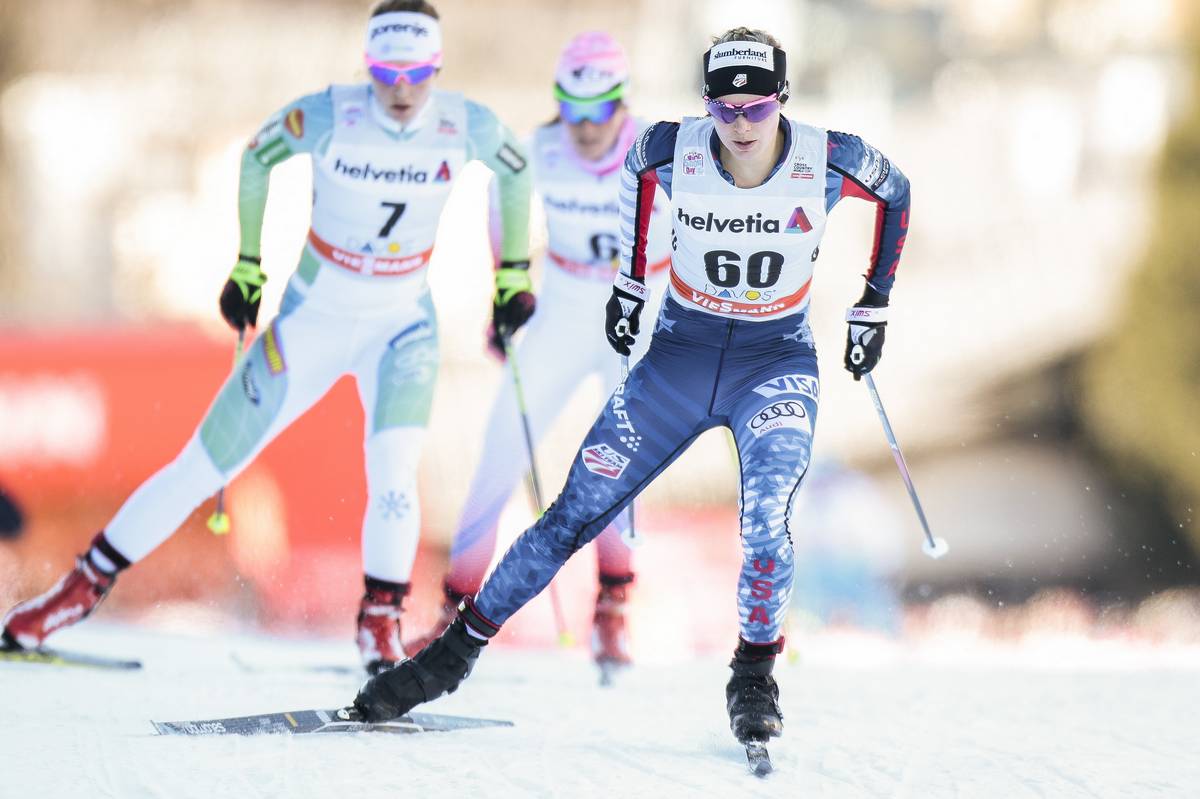
    U.S. Ski Team member Jessie Diggins (60) en route to fourth place in the World Cup women's 15 k freestyle individual start on Saturday in Davos, Switzerland. (Photo: Salomon/NordicFocus)
    U.S. Ski Team member Jessie Diggins (60) en route to fourth place in the World Cup women’s 15 k freestyle individual start on Saturday in Davos, Switzerland, while leading Slovenia’s Alenka Cebasek (7) and Katerina Smutna (6) of the Czech Republic. (Photo: Salomon/NordicFocus)

    DAVOS, Switzerland — Coming off a win in the 5 k skate in Lillehammer, Norway, this weekend, the U.S. Ski Team’s Jessie Diggins knew that plenty was possible in Saturday’s World Cup 15 k skate.

    “I was not expecting to come into the season this hot; normally I would work my way right into it,” she said, “It definitely makes it really fun and exciting when you have you’re sights set on the podium, and you can realistically expect to be in the fight.”

    Fight she did, rising from sixth at the race’s halfway point to fourth at the finish, her best result ever in Davos and also the best 15 k of her World Cup career.

    Her time was 54.3 seconds behind that of Ingvild Flugstad Østberg of Norway, who won the day.

    “Working on the long distances, it’s still a ways to catch up to the girls at the top,” Diggins said. “But it’s a long season, and we have a lot of belief, a lot of sparkles on our side.”

    By 10 k into the race, she was up into fifth place, and within a second of the time laid down by Nathalie Von Siebenthal of Switzerland. Because Diggins had started last out of the field’s 60 competitors, she knew exactly what she had to do to close time on her competitors over the last five kilometers.

    “I know I was really close, like four or five seconds between several of us. “So I was happy to have been able to finish strong, and proud of how I skied the downhills!”

    The 15 k in Davos is not a kind one, with a long flat section out of the stadium and then an undulating climb which provides little to no rest until more than half of the race loop’s 5 k distance is completed. After topping out, it’s a fast downhill section to the lap, and then it’s on to the climb again.

    With the race venue sitting at over 5,000 feet of elevation, pacing becomes even more challenging.

    “It’s definitely hard to pace here, because it’s a 15 k at just the right amount of altitude where if you go under, you’re done,” Diggins said. “But you don’t want to finish with gas in the tank. This was the closest I’ve ever come to the right pacing, and I still think it could have been maybe a little bit better.”

    The downhills also don’t provide much rest, with several icy hairpin turns before the course re-enters the stadium.
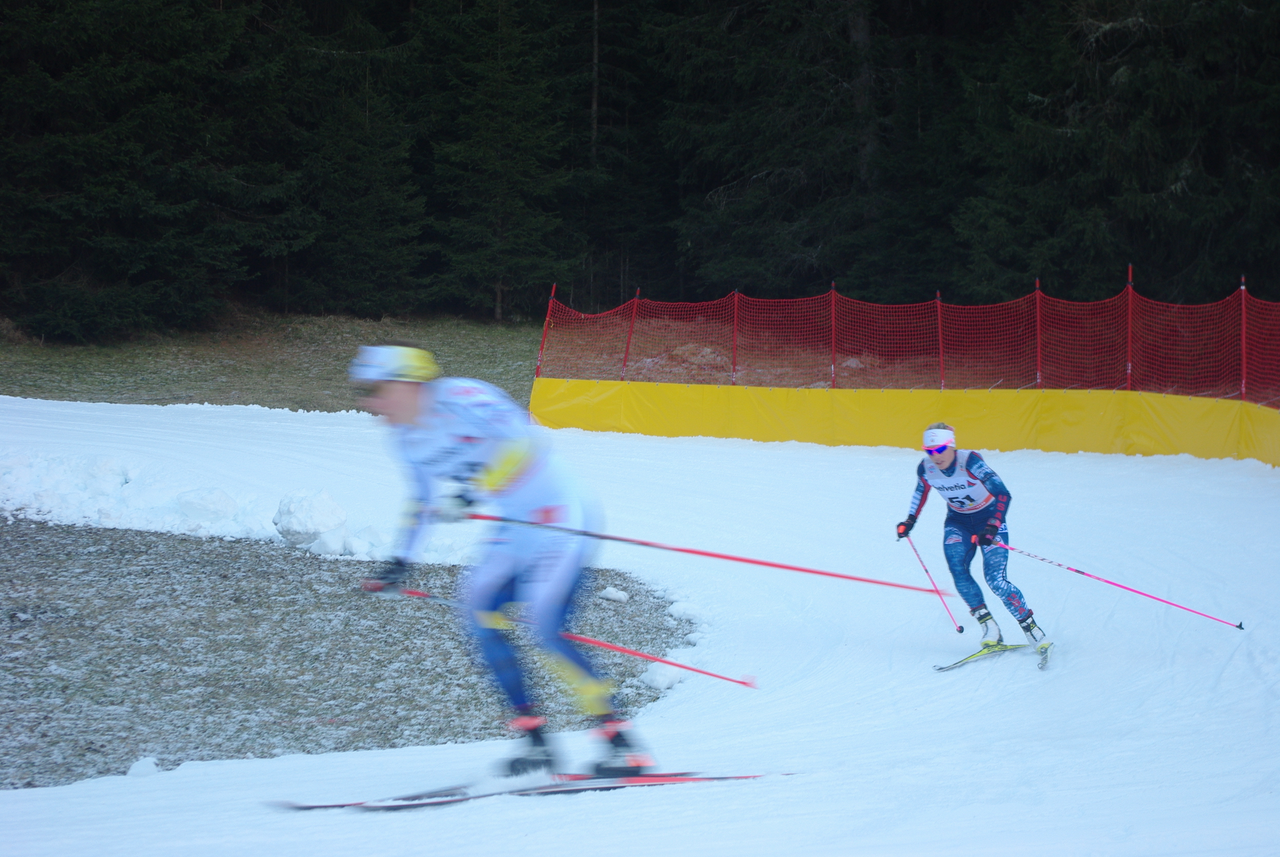
    Kikkan Randall takes a turn on her way to 33rd in the 15 k skate in Davos.
    Kikkan Randall (r) takes a turn on her way to 33rd in the 15 k skate in Davos.

    “I wasn’t happy about starting last here, not going to lie,” Diggins laughed. “I didn’t enjoy that, but the downhill, the big corner there, I would just look for the fresh snow, and throw a hard skid, and step, and it was fine, so… The course held up remarkably well. You know, it’s almost worse on training days when there’s a million techs, and on racing day, there’s actually much less traffic.”

    Diggins is now ramping up for the skate sprint to be held tomorrow. Last year she finished ninth in the event.

    “This is a really interesting course; it’s very tactical, I think it’s hard to drop people, and it’s hard to be dropped,” she explained. “I don’t know–I tend to favor distance races sometimes, because it’s more about your fitness and you, than tactics and seeing if people are pushing, or you get lucky, or you find a window or not, but I’m excited to see what I can do going into it with positive attitude and looking for every opportunity.”

    The U.S. women haven’t had much luck in sprint heats this season, with four women – Diggins, Sadie Bjornsen, Sophie Caldwell, and Ida Sargent – making the quarterfinals in the classic sprints in both Lillehammer and Ruka, but none advancing to the semifinals.

    “This has been a historically great place for us, so knock on wood, but it might be time to turn it around,” Diggins said.

    With the season start she’s had, more excitement always seems to be just around the corner.

    “Training load is still fairly high, so the goal is always way later in the season for me, but to be in the fight this early is like ‘that’s exciting, that’s great!’” Diggins said. “If you would have told me that this summer, I would have been like, ‘nah’.”

    For the U.S., Liz Stephen was the next finisher after Diggins, earning 28th place (+2:17.5).

    “This year, I think that especially with the 15 k, just having to focus for such a longer period of time on that weird grade, I actually was not that excited going into the race this morning,” admitted Stephen, who has finished in the 20’s each time a 15 k race has been held here in Davos.

    “I recognize it, because it’s not usually how I feel,” she continued. “I had to sort of restructure my brain this morning. And just really focus in on what my goal of the day was, which was just to ski as smooth and big as I could, and keep it into my race. Then my brain kind of opened up as I got out there. But it’s a really challenging race and every year, it’s just a really hard grade and altitude to feel like you’re racing. And I think when you don’t feel like you’re racing in your brain, it’s hard to keep engaged.”

    Kikkan Randall finished 33rd (+2:30.2) and Caitlin Patterson 44th (+3:21.6). Rosie Brennan did not start.

    “It was just so much altitude, flatness, yuck,” Patterson said.

    Emily Nishikawa led the Canadian team in 34th (+2:33.5).

    “The two girls that started right behind me [ninth-place Ilaria Debertolis of Italy and 13th-place Polina Kalsina of Russia] caught me, and they are both holding on to pretty good times, so that was nice to ski with them,” Nishikawa said. “It’s a super-hard course. So it’s great to have people out there to help you.”

    — Jake Ellis contributed reporting
  • Østberg Tops Weng in Davos Duel, Cementing All-Around Threat

    Østberg Tops Weng in Davos Duel, Cementing All-Around Threat

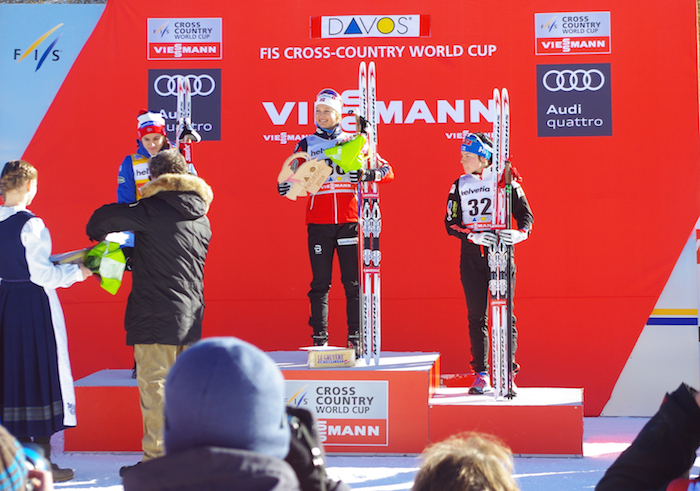
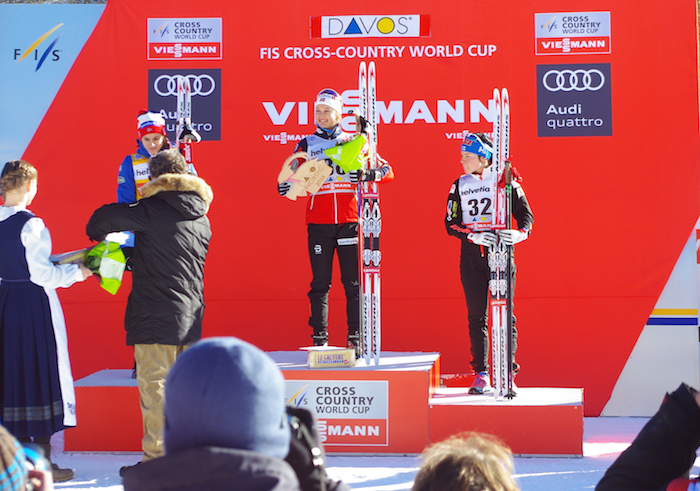
    Ingvild Flugstad Østberg took the first 15 k win of her career on Saturday, besting Norwegian teammate Heidi Weng and Finland's Krista Parmakoski in the women's 15 k freestyle individual start at the World Cup in Davos, Switzerland.
    Ingvild Flugstad Østberg took the first 15 k win of her career on Saturday, besting Norwegian teammate Heidi Weng and Finland’s Krista Parmakoski in the women’s 15 k freestyle individual start at the World Cup in Davos, Switzerland.

    DAVOS, Switzerland — Ingvild Flugstad Østberg didn’t plan to start Saturday’s 15 k skate World Cup like a bat out of hell.

    But by 2.2 kilometers into the course, she already had a 7.9-second lead over Heidi Weng, her Norwegian teammate and the overall leader of the World Cup.

    That gap widened and closed and widened and closed, and at the finish Østberg had just that: a 7.9-second win over Weng, and her first World Cup victory ever in a distance longer than ten kilometers.

    Østberg has an Olympic silver medal in the sprint and a gold medal in the team sprint, but last season emerged as a real overall threat on the World Cup, winning five and ten kilometer races and ranking in the top three in the Tour de Ski, Ski Tour Canada, and overall World Cup standings.

    Yet the win in a 15 k still represented another step in her evolution as a complete skier.

    “For sure it feels really good,” Østberg said in a post-race press conference. “It’s a long time since I won a sprint now. So maybe I have to focus more on sprints! It has been a lot of training for several years, and now my first win in a distance over 10 k. So I’m surprised and very happy.”

    Weng, who started two bibs ahead of Østberg, found the race challenging. It is the first time the World Cup has been to altitude this season; Davos sits at over 5,000 feet above sea level. Despite the pain and fatigue, Weng tried to maintain her pace and technique.

    “I thought it was very hard from the beginning,” she said in the press conference. “I opened slowly. I thought that I can go better, and that everyone would be tired on this track.”

    It was true: with the altitude and the long flat and climb – there’s virtually no rest on the course for the first three kilometers of the five kilometer lap – lots of women were suffering.

    “For sure you have to pace yourself really good here,” Østberg said. “Otherwise it will be not a good feeling if you start too fast.”

    At some points on the course Østberg’s split was only one or two seconds faster than the time Weng had just laid down; Krista Parmakoski of Finland was also within 10-20 seconds.

    But Østberg kept pushing, despite her accidentally fast start.

    “I heard that I had some seconds on Heidi and Krista, but I know that both of them ski really fast at the end,” Østberg said. “So I tried to keep up the speed, because I knew I couldn’t slow down.”

    In the end she was able to open it back up, earning the second Davos win of her career.

    “I had my first sprint World Cup win here, and this is my first win in 15 k, so maybe Davos is a nice place for me,” she said.

    Parmakoski also held her pace, moving from fourth on the first lap – Swiss local Nathalie Von Siebenthal had opened hard – up to third by the halfway point. When all was settled her finishing time was 16.7 seconds off the mark set by Østberg.

    “Because these last few weeks have been classic, and I thought I would be a little bit better on classic style, I was a little bit nervous before this race,” Parkmakoski said in an interview. “Now I’m happy because I know that my technique is better than last year and I know that I can do also good results in skating. I have done a lot of work this summer on the skating technique.”

    While the Norwegians went one-two and put four athletes in the top 12 (Ragnhild Haga seventh (+1:10.8), and Kari Øyre Slind 11th (+1:38.9), the Finns also had a good day, with Riitta-Liisa Roponen eighth (+1:21.4), Kerttu Niskanen 12th (+1:41.7), and Laura Mononen 14th (+1:48.1).

    “The men have also had some good races,” Parmakoski said. “The women’s team knows that we all have to ski fast because we have been so close in the summer training. So we have a good feeling on our team right now.”

    That bodes well for World Championships, to be held on their home turf in Lahti. Parmakoski didn’t think that her fast start to the season – this was her third podium of the season – would compromise her ability to perform in the coming months.

    “Of course I hope that I am in a little bit better shape there,” she said. “But now it is important that I am healthy, and that I get some good training during the season, before the World Championships.”

    Von Seibenthal faded as the race went on, first dropping to fourth place and then by the finish to sixth  (+1:05.6). It was still the best World Cup result of her career.

    Rising to take fourth place was the U.S. Ski Team’s Jessie Diggins, who hovered in sixth place at the halfway point but skied aggressively over the last five kilometers to decisively seal a top finish; she was 54.3 seconds behind Østberg’s time, and 6.2 seconds ahead of fifth-place Yulia Tchekaleva of Russia.

    Both Diggins and Tchekaleva dodged questions about the McLaren Report, released yesterday, which documented widespread systematic doping by Russian athletes, including those in cross-country skiing.

    “My role here is to compete,” Tchekaleva told the press before leaving the mixed zone.

    Diggins said that her statement was summed up by a petition begun by the U.S. Track and Field Athlete Advisory Committee, and which Diggins said that she had signed.

    The petition demands, among other things, that the World Anti-Doping Agency is given authority and capacity to investigate all instances of non-compliance with the World Anti-Doping Code, including imposing consequences for noncompliance, and that international competitions are no longer held in Russia.

    Results