Tag: Davos classic sprint

  • Newell Rises to Fourth in Davos Sprint, Second in World Cup Sprint Standings

    Newell Rises to Fourth in Davos Sprint, Second in World Cup Sprint Standings

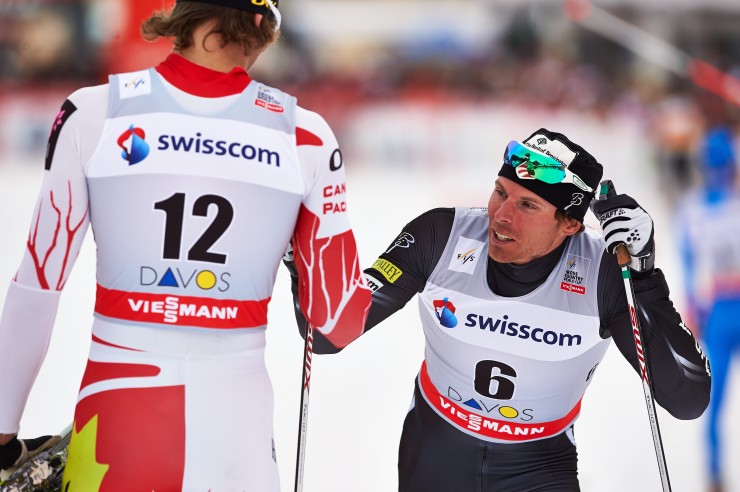
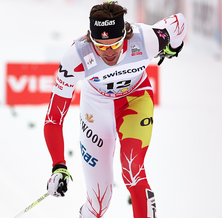
    US Ski Team member Andy Newell (6) checks in with Canadian Lenny Valjas after the World Cup classic sprint final on Saturday in Davos, Switzerland. Newell was fourth for his best result in more than two years, and Valjas placed sixth. (Photo: Fischer/Nordic Focus)
    US Ski Team member Andy Newell (6) checks in with Canadian Lenny Valjas after the World Cup classic sprint final on Saturday in Davos, Switzerland. Newell was fourth for his best result in more than two years, and Valjas placed sixth. (Photo: Fischer/Nordic Focus)

    It didn’t matter how close Andy Newell came to the podium this season, the 28-year-old US Ski Team veteran always said he wanted more. It’s not like he hadn’t been there before – Newell won silver in a World Cup skate sprint in 2008 and placed third in a World Cup classic sprint after the 2010 Olympics – but the latter came almost three years ago.

    Already this season, the Vermont native made it into three sprint finals, where he placed fifth twice and also sixth. Not good enough, he thought. Still, the consistency was positive, and it put Newell in contention for the World Cup sprint title.

    On Saturday, the Stratton Mountain School T2 Team skier came one step closer to that Crystal Globe, moving to second in the sprint standings just 34 points behind Sweden’s Emil Jönsson. To do so, Newell notched fourth in the 1.5-kilometer classic sprint in Davos, Switzerland, qualifying in sixth then winning his quarterfinal and placing second in the semifinal for a considerably dominant day. He ran out of gas in the final, but acknowledged the strength of Kazakhstani winner Alexey Poltoranin, whom he challenged in the semifinal.

    “It was frustrating not to be the on the podium,” Newell said on the phone after finishing 9.09 seconds behind Poltoranin in the final on 0.41 back from him in the semi. “He’s for sure probably the best classic skier I think in the world when it comes to uphill striding so he’s obviously a hard guy to hang with on the uphill.”

    Switzerland’s Dario Cologna was second (+5.49) and Frederico Pellegrino of Italy placed third (+6.02) ahead of Newell, who said they were within reach.
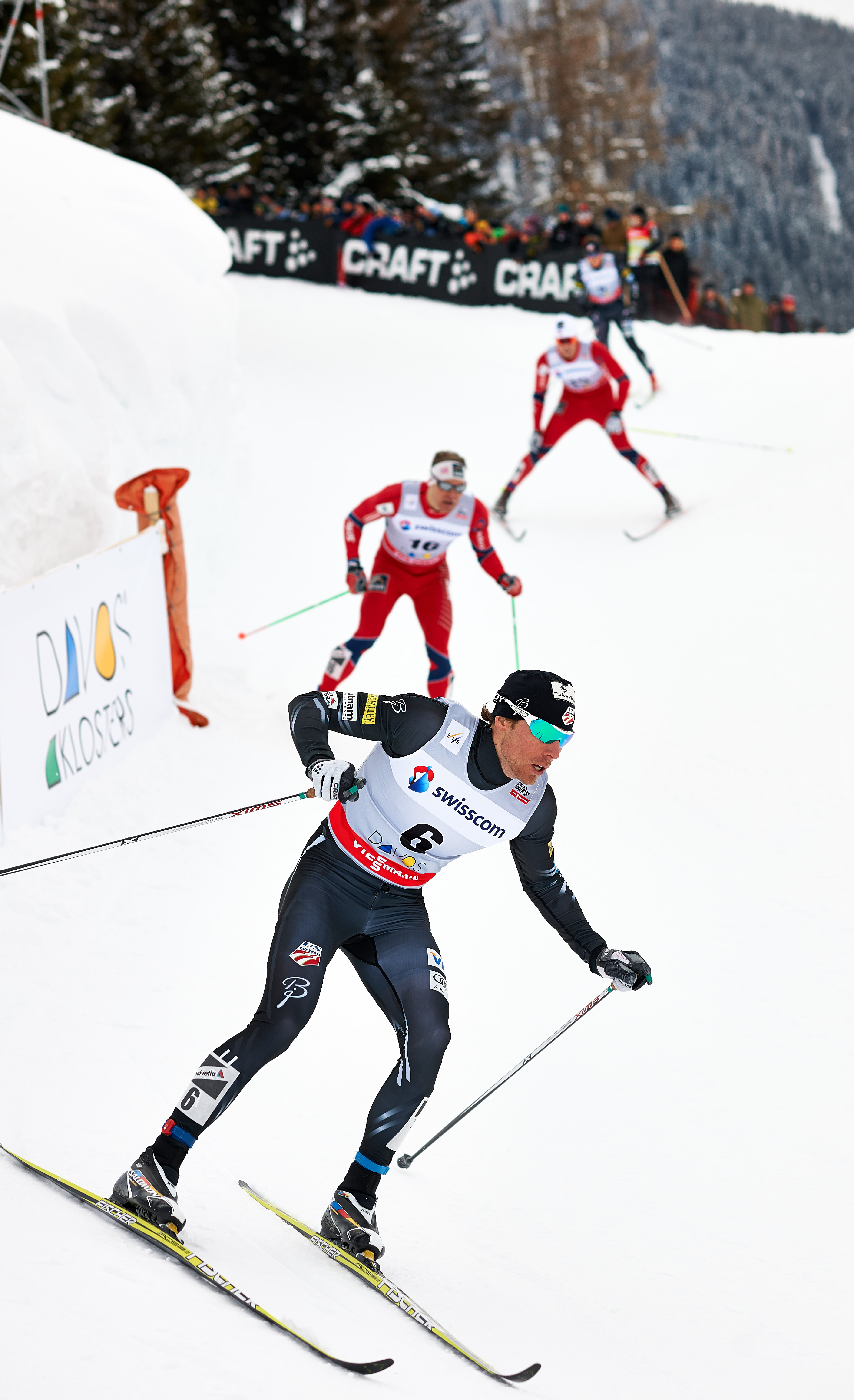
    American Andy Newell leads Norwegians Kent Ove Clausen (c) and Amund Lid Byggland (in third) down a hairy descent in the Davos World Cup classic sprint quarterfinal in Switzerland on Saturday. Newell comfortably won the heat, while teammate Simi Hamilton (in back) did not advance in third. (Photo: Fischer/Nordic Focus)
    American Andy Newell leads Norwegians Kent Ove Clausen (c) and Amund Lid Byggland (in third) down a hairy descent in the Davos World Cup classic sprint quarterfinal in Switzerland on Saturday. Newell comfortably won the heat, while teammate Simi Hamilton (in back) did not advance in third. (Photo: Fischer/Nordic Focus)

    “I could totally see Pellegrino slipping a little bit and Dario, and I just got right on their asses,” Newell said with a laugh. “I was really hoping for that podium, but I just lost a little too much over the top of the hill unfortunately.”

    With a two-lap sprint course marked by a technical uphill turn and long double-pole finish, Newell felt it was critical to play his cards right and not blow up. He conserved appropriately, adding more kick wax after the qualifiers then being careful not to lead the first lap while controlling the pace. He won his quarterfinal by 1.13 seconds over Norway’s Kent Ove Clausen, and went with Poltoranin in the semi to gap the field and advance in second.

    Fellow US Ski teamer Simi Hamilton (Sun Valley Ski Education Foundation) joined Newell in the third quarterfinal after qualifying in fifth. However, Hamilton struggled with his start in the heat and got caught up in traffic early on. Despite a strong double-pole finish, he took third in the photo finish with Clausen.

    The first-quarterfinal winner, Cologna had thrown down a blistering pace – more than three seconds faster than Newell’s quarterfinal time. That eliminated Hamilton’s shot at advancing as a lucky loser and he ended up 13th for an individual season best.

    “In the past, long and gradual double poles have been a bit of a weakness for me, so I am psyched with my finishing speed in the quarter,” Hamilton wrote in an email. “But still, to be so close to a lucky loser spot after fighting very hard is frustrating. It will come though.”

    U.S. coach Matt Whitcomb was impressed with the team’s performance on Saturday, one of two days of World Cup racing less than a week before World Championships begin in Val di Fiemme, Italy.

    “We had a really good day; it’s the kind of day we wanted to have before going to World Champs and our sprinters will go there with some good confidence now,” Whitcomb said.

    He called Newell’s move to second in the sprint standings “an enormous deal” paired with the season-long achievements of Kikkan Randall, who is 134 points ahead as the women’s sprint leader.

    “It’s a pretty cool thing for the U.S. team,” Whitcomb said. “[Newell] looked great today. It was maybe a course that aerobically challenged Sochi, certainly technically it exceed Sochi, and to be able to look good on a course like that is quite a feat. I’d pair Simi in that category, too, so we’re feeling good about this.”

    The good news for Newell, who felt a little flat in the qualifier after taking it easier in training this week, is that if he doesn’t reach that coveted podium in the classic sprint at World Championships, there’s always the rest of the season.

    “I’ve had four finals so far this year and no podiums,” Newell said. “I think that’s making me even more hungry to get one in at World Champs and if not there then sometime in the next few weeks. … I’m really excited to keep racing after world champs, too. Emil’s definitely not out of striking distance [for the World Cup sprint title] so it’s going to be a really cool battle for the rest of the year for that.”

    Two other Americans in Saturday’s sprint, Dakota Blackhorse-von Jess (Bend Endurance Academy) placed 52nd (+14.92) and Erik Bjornsen (US Ski Team/Alaska Pacific University) was 66th in the qualifier.

    For Blackhorse-von Jess, who was about six seconds out of qualifying, his first World Cup race in Europe was all about the experience. Interestingly, he wrote in an email that he felt less pressure than say, U.S. Nationals, where he expects to win qualifiers.

    “Today, I was loose and relaxed, had a plan, and went out and tried to execute,” Blackhorse-von Jess explained. “The only real difference is that this course is harder than anything we’ve raced back home.

    “I thought I did a really good job following my plan and felt really good and really encouraged going into the climbs the second lap,” he added. “Stayed loose, hammered the double pole between the laps and could tell I was in the mix. Then… I exploded. Hard to ski up big hills when you’re flooded like that. Elevation racing, ha.”

    Disappointed with his result at 1,560 meters (5,120 feet) above sea level, Blackhorse-von Jess wrote that he’s still feeling great about his skiing.

    “Today’s result is not an indication of how [the World Cups in] Lahti and Drammen will go other than to be an encouragement that if I was only 6 seconds out of qualifying given how badly I came apart at the end, everything is gonna be okay,” he wrote.

    Bjornsen wasn’t happy where he ended up after crashing on the skied-out downhill corner.

    “I knew that if I went hard through the corner both times I could probably make up a couple seconds even though it was a little risky,” Bjornsen wrote. “I hammered over the top of the hill and didn’t slow my speed down at all and when I hit the icy section I was not able to stay upright. After I fell I skied the rest of the course hard, but it’s really difficult to be motivated after a fall because as soon as you fall in a sprint race your day is over.”

    Looking forward, Bjornsen’s still shooting for a top 30 and feels it’s possible to get there.

    “I feel like I’m in the best shape of my life right now,” he wrote. “I just know I have to have an exceptional race and be willing to take the risk of falling or blowing up.”

    — Audrey Mangan contributed reporting
    Results

  • Valjas Toughs It Out for Sixth in Davos Sprint; Kershaw Repeats Season Best in Eighth

    Valjas Toughs It Out for Sixth in Davos Sprint; Kershaw Repeats Season Best in Eighth

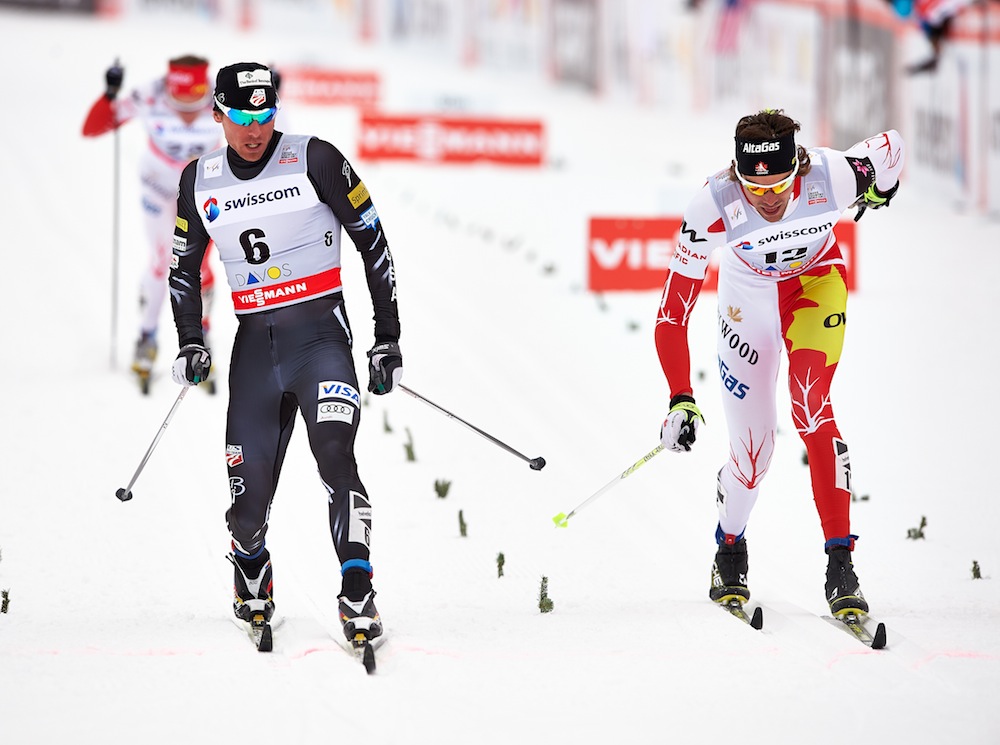
    American Andy Newell (l) captures second in a World Cup semifinal just 0.25 seconds ahead of Canada's Lenny Valjas in Saturday's 1.5 k classic sprint at the Davos World Cup in Switzerland. Valjas advanced to the final with a fast-enough time, and ultimately placed sixth. Newell was fourth in the final. (Photo: Fischer/Nordic Focus)
    Canada’s Lenny Valjas (r) captures third in the World Cup semifinal just 0.25 behind America’s Andy Newell (l) in Saturday’s 1.5 k classic sprint in Davos, Switzerland. Valjas advanced to the final with a fast-enough time, and ultimately placed sixth. Newell was fourth in the final. (Photo: Fischer/Nordic Focus)

    If you ask Canadian National Ski Team Head Coach Justin Wadsworth, things are on the upswing for his World Cup team. And he’s not just blowing hot air; three of his six athletes posted top-12 results on Saturday to back that up.

    Leading the team was its youngest member, 24-year-old Lenny Valjas, who placed sixth in the 1.5-kilometer classic sprint in Davos, Switzerland. It was his fourth World Cup top-10 of the season and best non-stage result (Valjas was third in the freestyle sprint at the Tour de Ski).

    But Valjas has been strong all season, as has Dasha Gaiazova, who placed 12th in Saturday’s 1.5 k women’s sprint. The most improved went to Devon Kershaw, who tied his season-best of eighth, which he notched two weekends ago at the pre-Olympic World Cup in Sochi, Russia.

    “Devon was the snappiest I’ve seen him skiing all year,” Wadsworth said on the phone.

    Kershaw, 30, used the same adjective to describe his form all the way through the semifinals, and this time, he was using it in a good sense.

    “When I wanted to change gears I could and I was super pumped,” Kershaw said. “That’s been something I’ve been missing all year long. Even in Sochi, when I was eighth, I couldn’t change gears like you need to in a sprint, and while the result was the same today I felt much better.”

    As for Valjas, he’s just a beast, Kershaw said. The Canadian World Cup team veteran recalled racing with Valjas in the semifinal. Both started off the back, and Kershaw later made a move before the two-tiered climb on the second lap.

    “Up the first part of the climb, I was feeling awesome and Lenny just went by me,” Kershaw said. “I had a moment where I was like, ‘He’s 6-6 and he’s moving his legs faster than I am!’ It was fun to watch Lenny race so well today. He’s probably not a favorite to win, but he’s definitely somebody everyone’s thinking about to snag a podium at the World Championships.”

    Kershaw lost some steam on the last part of the hill and finished fourth in that heat, 2.72 seconds behind semifinal winner Alexey Poltoranin of Kazakhstan, who also won the final. Valjas was third, just 0.66 out of first and about two-tenths of a second behind American Andy Newell, who went on to place fourth in the final.

    Valjas advanced to the final as well, where he ended up sixth, 12.34 behind Poltoranin. After a strange start to his morning, in which Valjas felt lightheaded and was “seeing stars” when he stood up too fast, he drank a hefty amount of water after the qualifier. (He advanced to the heats in 12th.)

    Kershaw qualified in 23rd and Alex Harvey missed the top 30 by about 1 ½ seconds in 39th (+10.54 behind top qualifier Frederico Pellegrino of Italy.) Phil Widmer of the Alberta World Cup Academy also represented Canada in a tune-up race before World Championships, and placed 46th (+13.0).

    And while Kershaw cruised to a relatively comfortable second-place finish in his quarterfinal (minus a late charge by Germany’s Alexander Wolz, which resulted in a photo finish for second), Valjas had to give every ounce of energy he had to advance.

    Positioned in sixth the first time up the big climb, he got stuck behind Cyril Miranda of France, who “fell on his face and took two Russians [Gleb Retivykh and Anton Gafarov] down with him,” Valjas described in an email. “I was stuck behind these three guys with no room at all to move around. So I waited out the storm.”

    When he reviewed the video, Valjas realized he stood there for a full six seconds as the three untangled their equipment.

    “By this time the two leaders had a huge lead on our group,” he explained. “In my head I was telling myself, ‘Well I’ll finish 3rd in the heat and just end up top 15 in the overall.’ ”

    But when he entered the stadium to start his second lap, Valjas heard one of his wax techs, Joel Knopff, screaming that he could catch the leaders.

    “I really didn’t want to let him down so I attacked through the stadium and caught the leaders in the climb,” Valjas wrote. “I actually surprised myself with the acceleration, but deep down I knew that this effort would come back to haunt me later today.”

    In the semifinal, he shared a similar tactic as Kershaw, letting anyone go on the first lap if they wanted to push the pace. No one did, and on the second lap, Valjas attacked a little later on the climb. Just behind Newell, he nabbed the lucky loser spot.

    “[The] final is easy to explain. I had nothing left in the tank,” Valjas wrote. “The two hard heats left me with no energy to work with. I suffered through the final and ended up 6th. Overall I am happy with how the day turned out, I feel like my shape is good for World Champs next week. Our team is skiing really fast and I have a good feeling about next week.”

    Harvey in 39th wasn’t quite so pleased with his effort, explaining in an email that he couldn’t push very hard. According to him, his shoulder was fine after dislocating it in Sochi two and a half weeks ago.

    “Since I haven’t raced in a whole month, the goal was to put a race bib on and get two good hard efforts in,” Harvey wrote. “Today didn’t really work that way so tomorrow better be better! Although I’m not really looking for a great result in the 15 km [skate] … it’s the event I plan in skipping at Worlds.”

    Overall, Harvey explained he’s feeling confident. Wadsworth elaborated, saying Harvey struggled a bit with the altitude in Davos at 1,560 meters (5,120 feet) above sea level.

    “Alex is in good shape but it was an off day for his body,” Wadsworth said. “[His] shoulder isn’t 100 percent, he’s still taping it for stability and more feeling, but it’s definitely getting better. We don’t consider it a problem unless he would fall on it.”

    As for Widmer, the 29-year-old was just happy to be back in Europe.

    “I was dreaming of a better outing today, but it was good to get the feet wet and get going on this trip overseas,” Widmer wrote. “Top 30 was my goal for the day, but I came up short of that.”

    The course and conditions played a major role for everyone, he explained with tough, steep climbing and what he described as “slippery” conditions.

    “It was a tough course and my pacing could have been a little better,” Widmer wrote of his qualifier. “I’m feeling good, training has been going well and with a little bit of fine tuning, I’ll get ready for a better showing in Val di Fiemme.”

    “I think the whole team is doing well and we’re looking forward to World Championships,” Wadsworth said. “It’s exciting to feel like we’re coming on at just the right time.”

    Kershaw will sit out Sunday’s 15 k skate to rest up for World Championships, which begin in earnest on Thursday. Harvey will race, along with Ivan Babikov and Graham Nishikawa. Emily Nishikawa and Canadian biathlete Zina Kocher will compete in the women’s 10 k.

    Men’s results