From the FasterSkier archive — posts syndicated from athletes’ and coaches’ own blogs between 2004 and 2012, kept online as published. Current coverage is at fasterskier.com.

Tag: Davos freestyle sprint

  • Klæbo Takes His Fourth Sprint Win in Davos; Ogden 12th

    Klæbo Takes His Fourth Sprint Win in Davos; Ogden 12th

    This World Cup coverage is made possible through the generous support of Marty and Kathy Hall and the A Hall Mark of Excellence Award.  To learn more about A Hall Mark of Excellence Award or to learn how you can support FasterSkier’s coverage please contact info@fasterskier.com.


    Three weeks in, the World Cup swings to the picturesque Alpen valley which holds Davos, Switzerland. As may be hinted by the towering mountains surrounding the glacial valley, Davos sits roughly a mile high in elevation, making this the first high-altitude stop of the World Cup season. Most seasons, that simply means less available oxygen for the athletes to consume, adding a variable that might shake up what is expected on the results sheet. 

    However, with less than two months to go until the start of the 2022 Winter Olympics, performance at altitude might carry additional weight. According to FIS, the cross country course at the Kuyangshu Nordic Center near Zhangjiakou, China tops out at 1,800 meters, just under 6,000 feet, in elevation. By concentration of available oxygen per volume, that translates to a deficit of roughly 4% relative to competition at sea level. Altitude is its own beast, and it is not always as simple as adjusting pace when it comes to optimizing performance as an athlete. 

    Altitude and rugged mountain backdrop aside, the sprint course in Davos sits on the valley floor, making it relatively flat compared to other venues. The maximum climb on the two-lap 1.5-kilometer course is just 12 meters; 30 meters or more is needed to meet the criteria of an A-Climb by FIS homologation standards. 
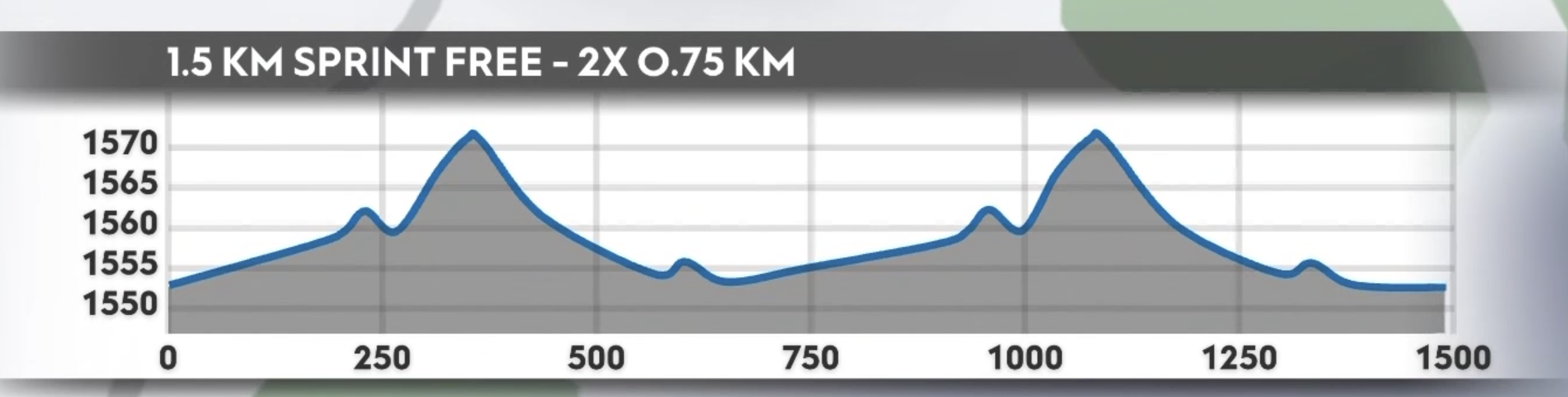
    The elevation profile of the two-lap 1.5k sprint course in Davos, SUI. (Photo: FIS Broadcast)

    Taking command in the qualifier, Norway’s Johannes Høsflot Klæbo set the fastest time of 2:24.16. Lucas Chanavat of France was second in the qualifier (+1.51) followed closely by Federico Pellegrino of Italy, whose name we have not yet seen in the final. That said, Pellegrino had history in his favor when it comes to freestyle sprints on Swiss snow. 

    Coming into the weekend, he had won three freestyle sprints in Davos, including last year, along with two wins in the freestyle sprint stage of the Tour de Ski in Val Müstair, SUI a couple of weeks later. Pellegrino has also won multiple times in Cogne, Italy, at a similar elevation, and has shown prowess on flat courses, including the city sprint in Dresden, Germany. 
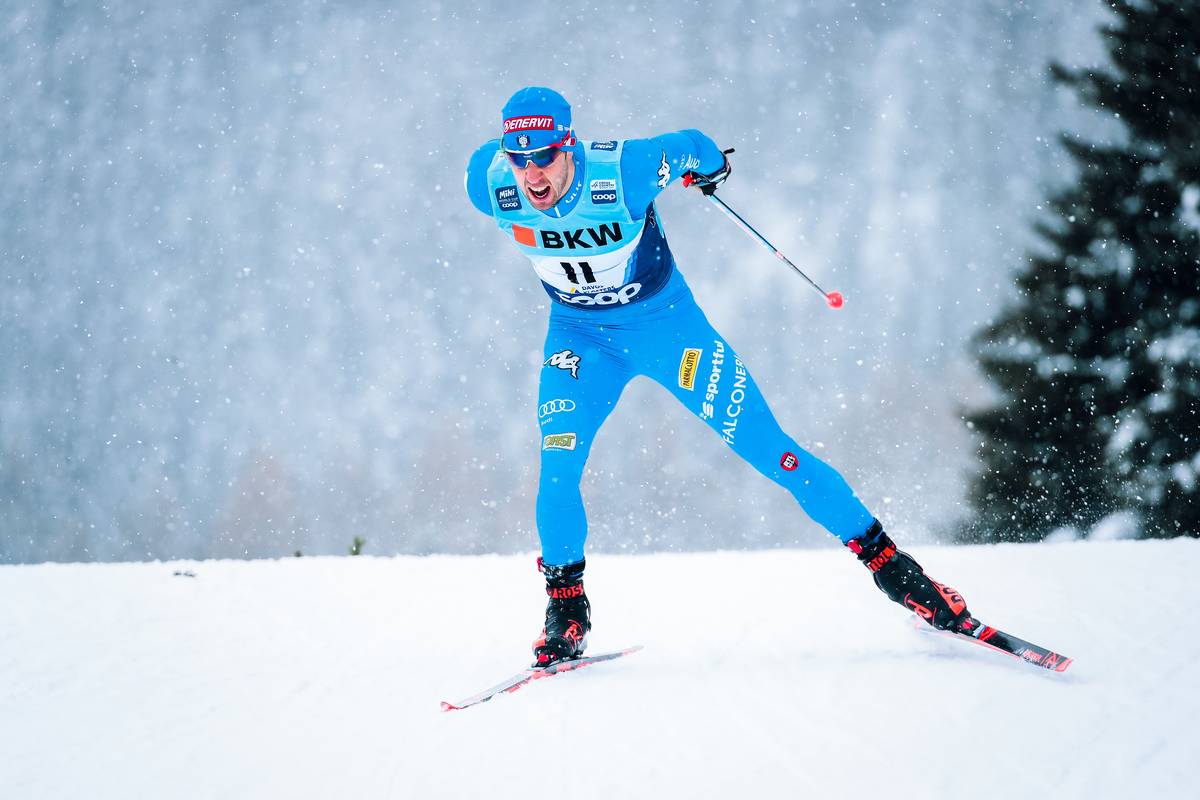
    Federico Pellegrino (ITA) races to third in qualification in Davos. (Photo: NordicFocus)

    The Italian’s stats in Davos are only matched by Klæbo, who also has three wins at the venue. Today was the tie breaker. Who would take home a fourth wooden sled for his collection? 

    On the American front, Ben Ogden was the only athlete who qualified for the rounds today. Ogden skied to 13th (+2.87) and raced in heat five of the quarterfinals.

    The storyline of Pellegrino versus Klæbo was decided before the two could line up to face each other head to head. Klæbo advanced smoothly from the first heat, however, Pellegrino was knocked out in his quarterfinal shortly thereafter. 

    Italy’s Federico Pellegrino pushes the pace during his quarterfinal of the freestyle sprint in Davos. (Photo: NordicFocus)

    In heat two, Pellegrino took the lead in the second lap, hopskating up the primary climb and powering over the top just ahead of Norway’s Håvard Solås Taugbøl and Richard Jouve of France. Holding his position at the front as the men pushed around the final curve, Pellegrino was matched by the surging men as they each held their own finish lane while sprinting to the line. Jouve had the fastest acceleration, gaining the advantage as the three men threw their boots for a photo finish. Jouve took the heat, with Taugbøl 0.12 seconds behind, leaving Pellegrino third (+0.2) Unfortunately for the Italian, the tactical heat was too slow for him to advance to the semis. 

    In Ogden’s quarter, two Swiss men, Jovian Hediger and Valerio Grond, pulled from the front through the first lap. As the men hit the primary climb in the second lap, Russia’s Alexander Terentev, who won the opening sprint in Ruka, accelerated up the left side of the course, cresting the hill with the two Swiss men, creating a spicy final turn into the stadium. Grond caught a ski tip on his teammate’s tails, causing him to lose speed in the turn, but all of the men stayed upright. 
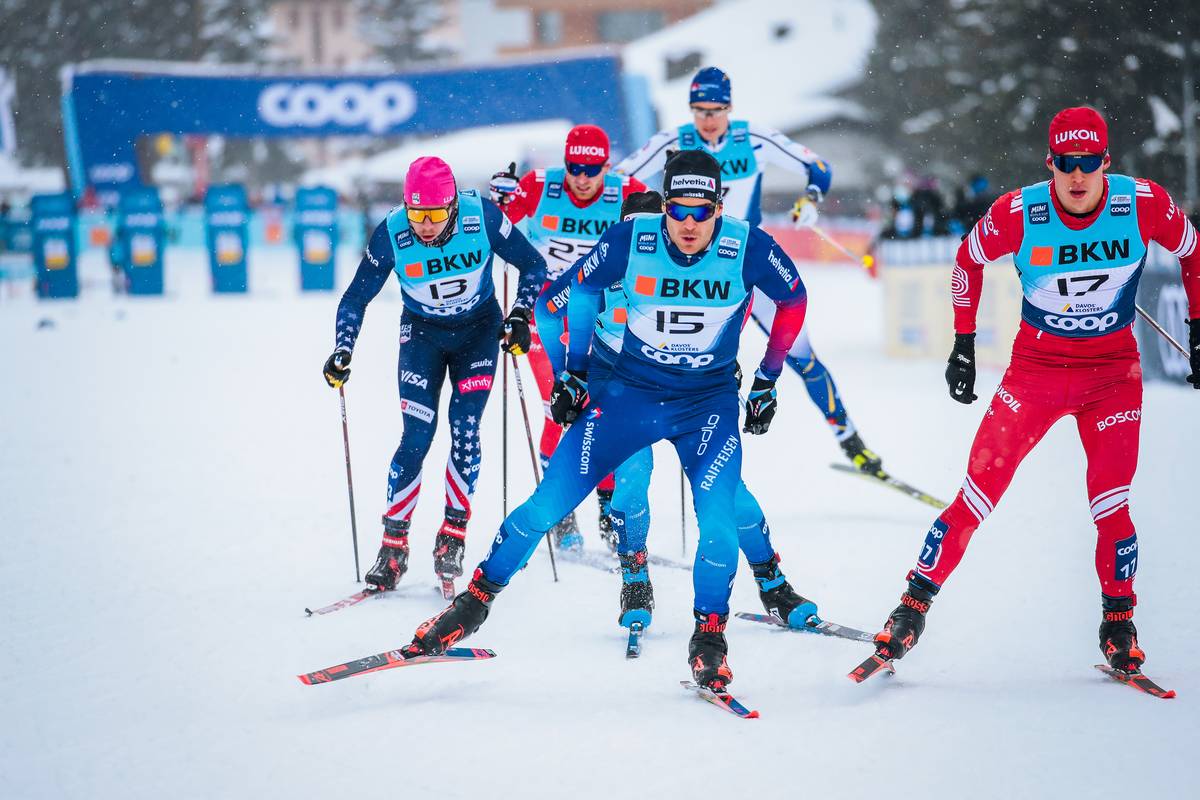
    Ben Ogden (Bib 13) races into the semifinal from a tight heat of the quarters. (Photo: NordicFocus)

    Terentev led in the final straight, but Ogden and Sweden’s Anton Persson, who had maintained contact throughout the heat, were rapidly gaining ground on the Swiss skiers. Coming to the line four across, the men slid over the finish, Persson in second (+0.37), followed by Grond (+0.44), and Ogden (+0.53), with Hediger just behind in fifth (+0.74). Though it was the final heat of the quarters, it ended up being the fastest, allowing both Grond and Ogden to advance to the semifinals. Hediger (SUI) could be seen swatting the ground with his pole at the finish upon seeing his result. 

    In the first heat of the semis, Ogden lined up with three Norwegians, Klæbo, Taugbøl, and Erik Valnes. The heat also contained Jouve, and Russia’s Sergey Ustiugov, who had challenged Klæbo in the quarters. 
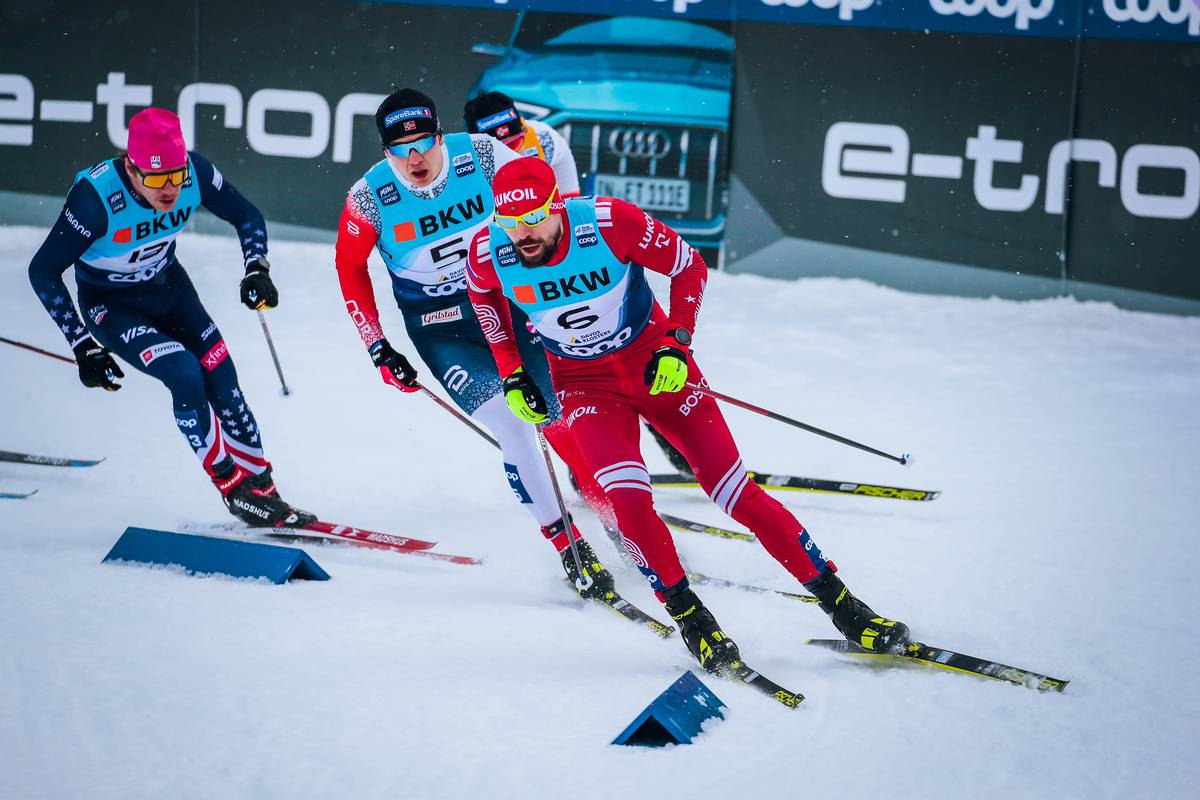
    Ustiugov takes the lead in the semifinal in Davos. Note Ben Ogden in contact wearing bib 13. (Photo: NordicFocus)

    As the pace accelerated in the final lap, Ustiugov took to the front again, this time seeming to want a larger margin over Klæbo as they headed into the final turn and straightaway. Though the Russian led into this turn, Klæbo was able to slingshot around the outside, earning a clear lane to the finish. The Russian was on his right, with Valnes on the other side. Perhaps too confident for his own good, Klæbo stood up before the line, coasting across with a boot kick that looked like an afterthought.
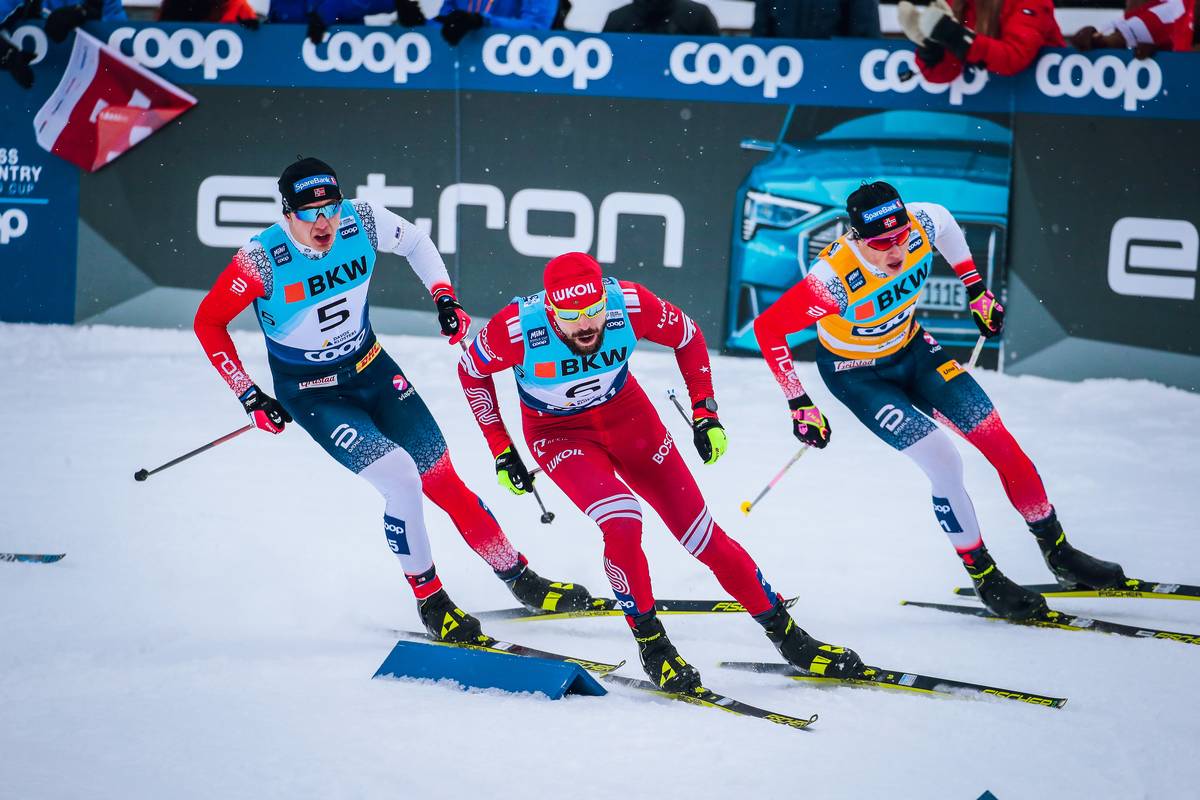
    Erik Valnes (NOR), Sergey Ustiugov (RUS), Johannes Klaebo (NOR), (l-r) (Photo: NordicFocus)

    With five men still tight around him, this allowed Ustiugov to take the win, while an accelerating Jouve tried to throw his boot along Klæbo’s left side, from within the same lane, just 0.14 seconds behind the Norwegian. With multiple athletes vying for limited real estate at the finish, Klæbo had his tails skied over, sending him abruptly onto the ground just after he crossed the line. 

    Valnes was fourth in the heat, followed closely by Taugbøl; these first five men were spread by only 0.58 seconds in total. Ogden, who had lost contact in the second lap, held on for sixth in the heat (+7.28). 

    While still tight, the second heat of the semis had a clear winner, Chanavat of France. Behind him was Even Northug of Norway, followed by Terentev, whose time was not fast enough for a lucky loser spot in the final.

    The pace was pedestrian as the first lap of the final progressed, the athletes seemingly biding their time and conserving energy for a tactical second lap. Mirroring the first two rounds of racing, Ustiugov made a big push in the second time up the climb as the men powered uphill with impressive tempo. But again, as they headed downhill and around the final right-hand curve, it was Klæbo on the Russian’s tails, shooting around the outside and into the center lane as he cruised to the finish for a commanding victory. 

    This time waiting to celebrate until he was over the line, Klæbo took home his fourth win on the tracks in Davos. Ustiugov held pace for second (+0.87), followed by Jouve in third (+1.23). 
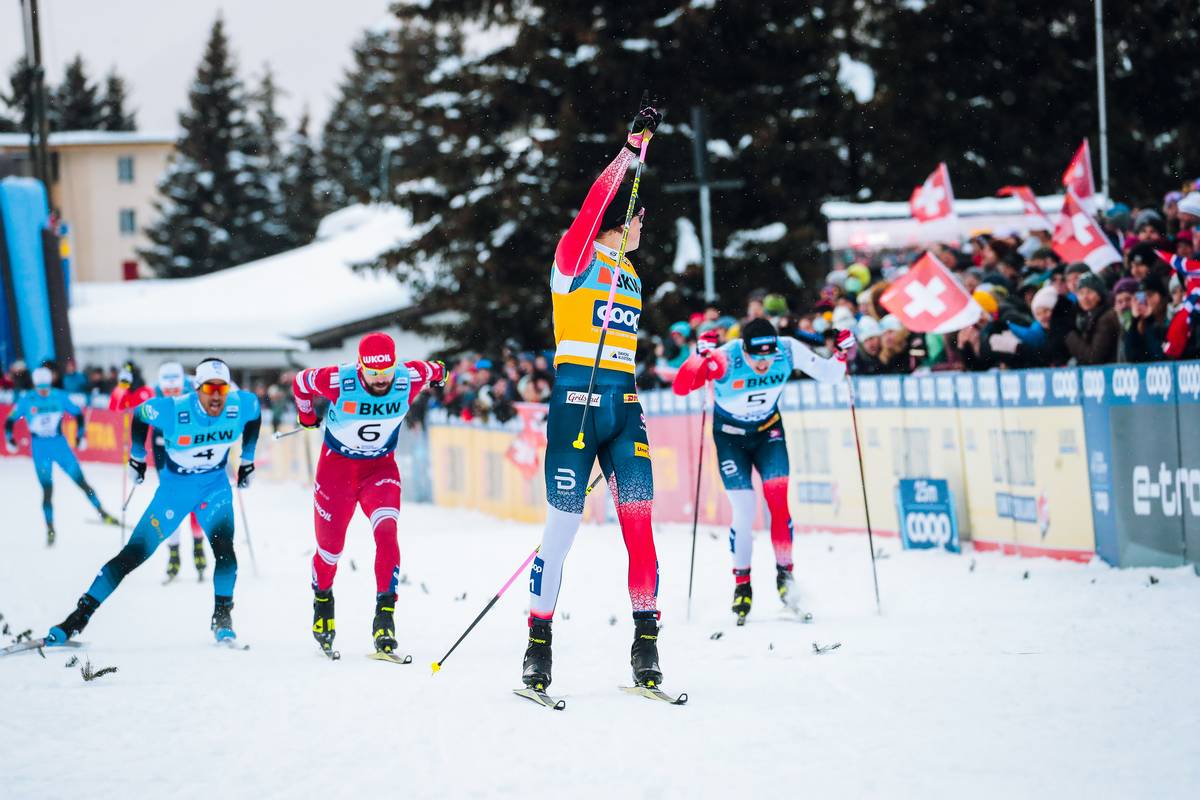
    Johannes Høsflot Klæbo takes the win in Davos, while Sergey Ustiugov and Richard Jouve accelerate to second and third. (Photo: NordicFocus)

    Off the podium, Valnes was fourth in the final (+1.31), followed after a gap by Northug in fifth (+3.74) and Chanavat in sixth (+7.95). 

    “It was an amazing day,” Klæbo told FIS at the finish. “I think it was really, really fun to race out there. I was a little bit skeptical because of the weather before we started today, but I think the conditions are really really good and it was a fair fight, which was really nice.”
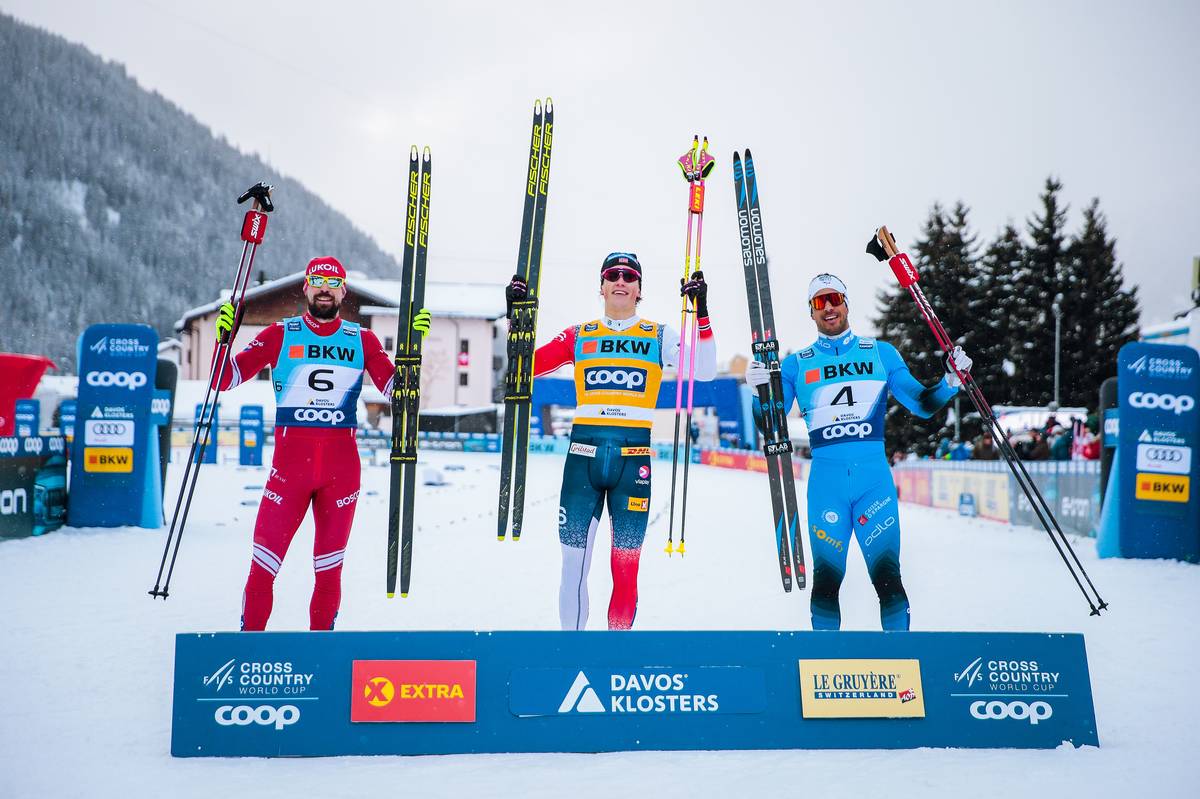
    The men’s podium of the freestyle sprint in Davos. Johannes Høsflot Klæbo (NOR) took his fourth win at the venue, ahead of Sergey Ustiugov (RUS) and Richard Jouve (FRA). (Photo: NordicFocus)

    It was a blustery day with light snow peppering the athletes throughout the rounds, a contrast to the sun and blue sky we often expect from the venue. Klæbo also shared that he will have an extended stay in Davos, putting in some additional time and training at altitude. 

    “I’m going to be here now until the 22nd of December, so I have a few more days left here, and it’s beautiful now, and I see that the weather is going to be much better next week, so I’m looking forward to some nice weeks here.”

    After the final standings were firmed up, it was concluded that Ogden finished his day in 12th.
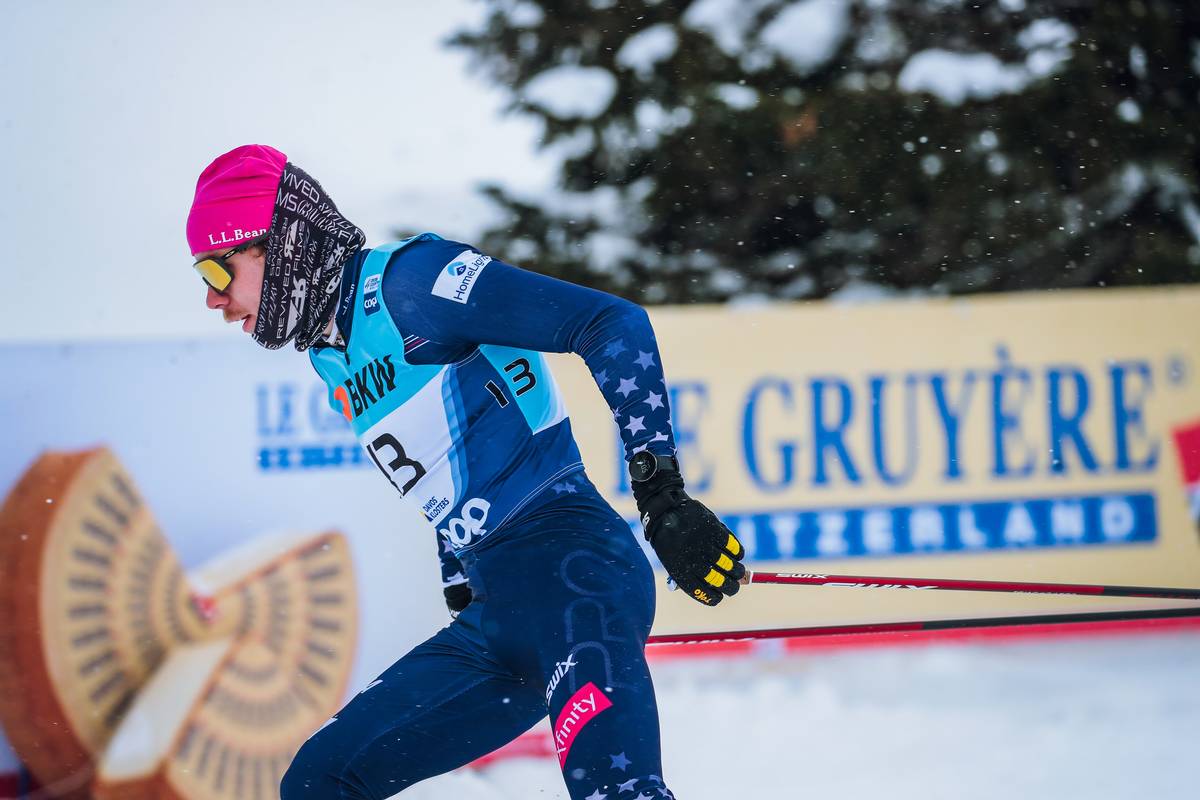
    Ben Ogden races into the semis in Davos. (Photo: NordicFocus)

    “Today was a lot of fun,” wrote Ogden in a post-race email. “For the qualifier, I knew it was going to be hard but there was a good amount of rest out there so I wasn’t afraid to pretty much pin it out from the start ,which thankfully worked out well. I was definitely slower the second time up the hill but was able to push hard over the top and get into the finish without anything catastrophic happening. I was surprised and happy to qualify in 13th.

    “In the quarter final, I figured it was going to be fast because all of us qualified so close to each other. I learned on the first lap that my skis were very fast, so when the other guys got a little gap on me over the top of the hill on the second lap, I was still hopeful. Then they made the critical mistake of sliding the first bit of the last corner, and because I was a touch behind I could step around it and set myself up well for the final straight. I bet it wasn’t pretty, but it was just enough to get me into the semi finals for the first time! Really pumped with this. I always figured I would first advance [into the semifinals] in classic, but things came together today so that was awesome.” 
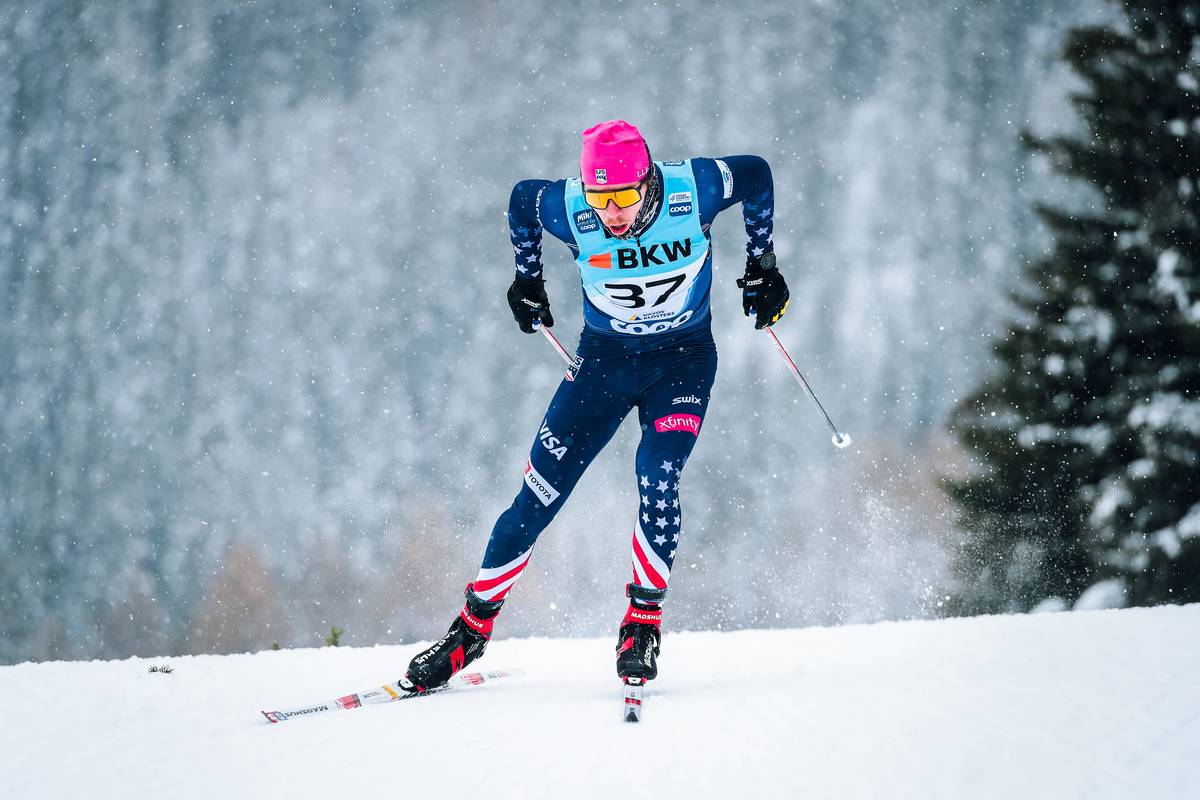
    Ben Ogden puts together a career-best finish in Davos, ending his day in 12th. (Photo: NordicFocus)

    “I did, however, learn that there is a reason all the fast guys pack into quarter final 1 and 2 when I finished and learned that I had just over 10 minutes before my semi final…” Ogden continued. “The guys in the semi final were damn strong, but I was pumped to stay in it for a bit and push all the way to the finish. One step at a time! Fun stuff out there and cheers to my wax tech (the famous Jason Cork) and all the wax techs for awesome skis!”
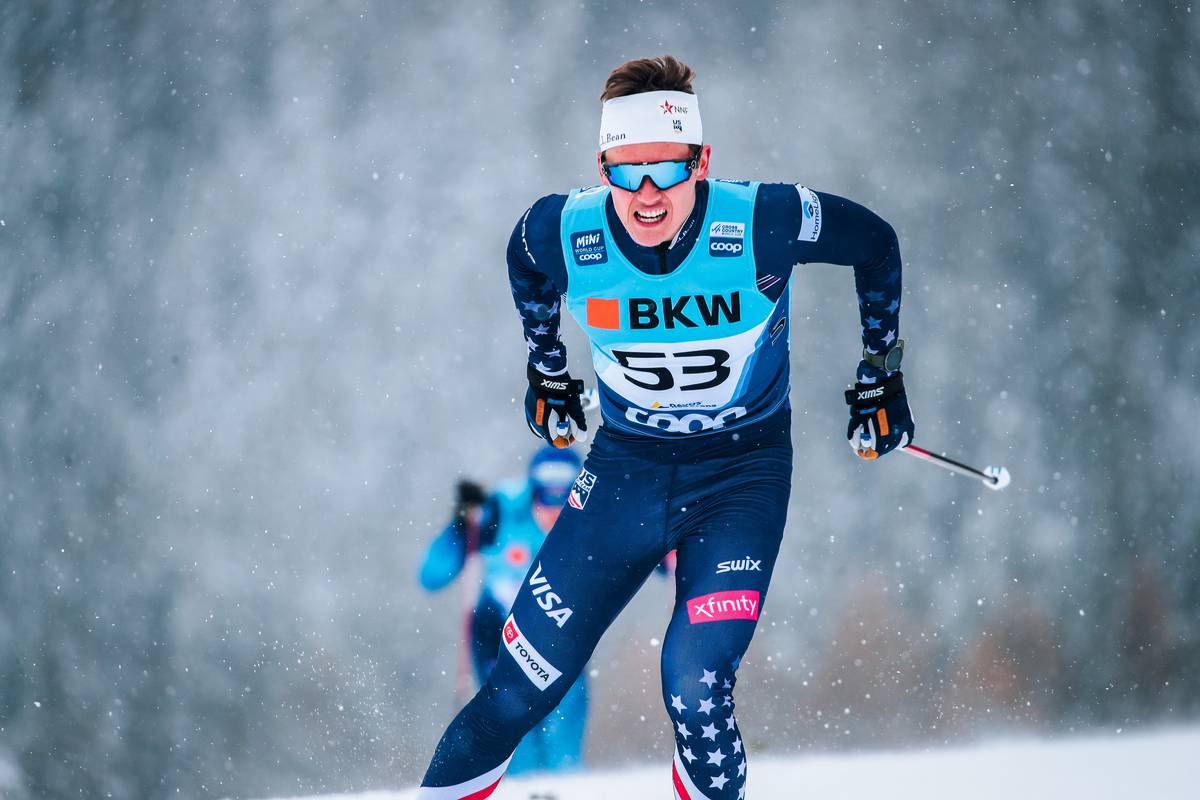
    Luke Jager skis to 41st in the qualification round in Davos. (Photo: NordicFocus)

    Outside the heats, JC Schoonmaker was second for the Americans, finishing 41st (+6.73) in qualification, less than 1.5 seconds off the time needed to compete in the rounds. Logan Hanneman was 44th (+6.99), followed by Luke Jager in 50th (+7.93), Kevin Bolger in 51st (+8.28), and Gus Schumacher in 65th (+10.48). 

    Here is a post-race interview with U.S. Ski Team Head Coach Matt Whitcomb with insights into the altitude and conditions on course, along with individual feedback on the men and women who raced today. Whitcomb also comments on the string of victories earned by Bolger’s girlfriend, Swedish champion Maja Dahlqvist.

    Racing for Canada, Antoine Cyr skied to 36th in qualification (+6.43), followed by Graham Ritchie in 45th (+7.02). 
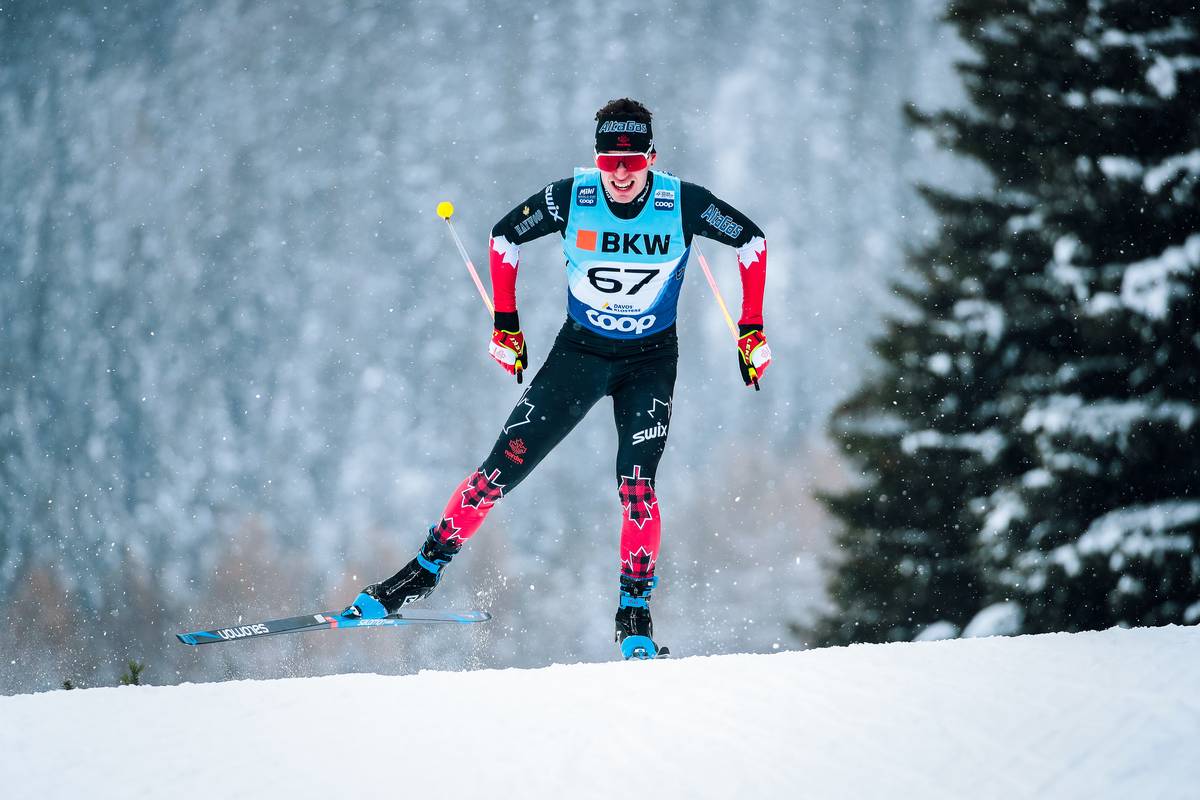
    Antoine Cyr leads the Canadian men, skiing to 36th in the qualifier. (Photo: NordicFocus)

    Results:

    Qualification | Final

  • Pellegrino Delivers Much-Needed Win for Italy in Davos Skate Sprint

    Pellegrino Delivers Much-Needed Win for Italy in Davos Skate Sprint

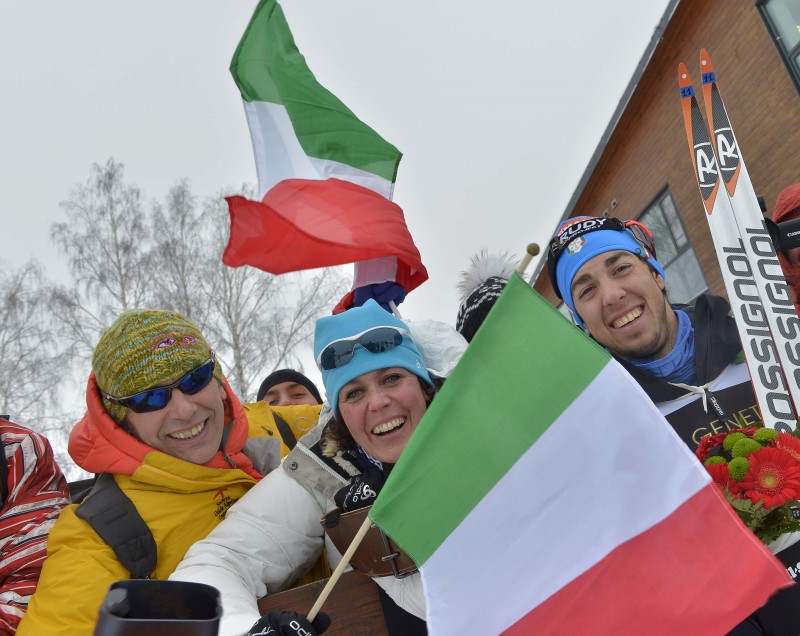
    Pellegrino celebrating his win with Italian supporters. Photo: Liberec2013.
    Federico Pellegrino (r) two seasons ago, celebrating his classic-sprint win with Italian supporters at the 2013 U23 World Championships in Liberec, Czech Republic. (Photo: Liberec2013)

    There was no shortage of action in the men’s 1.3-kilometer freestyle sprint on Sunday as 24-year-old Federico Pellegrino fought his way to his first-ever World Cup win and Italy’s first victory in four years.

    The Italian sprinter took charge in the last half of the men’s final in Davos, Switzerland, and earned the win (and his sixth World Cup podium), while Russia’s Alexey Petukhov slid across the finish line to snag second ahead of Norway’s Finn Hågen Krogh in a photo finish for the podium.

    “It’s a great day. I have been working for the World Cup victory for so long,” Pellegrino told FIS after the race. “It feels amazing to reach this goal. I hope that my victory will help the Italian Cross-Country team to good results.”

    With his best World Cup results coming at altitude, Pellegrino rocketed to first in last weekend’s freestyle-sprint qualifier. He went on to place 11th exactly a week ago after finishing sixth in his semifinal.

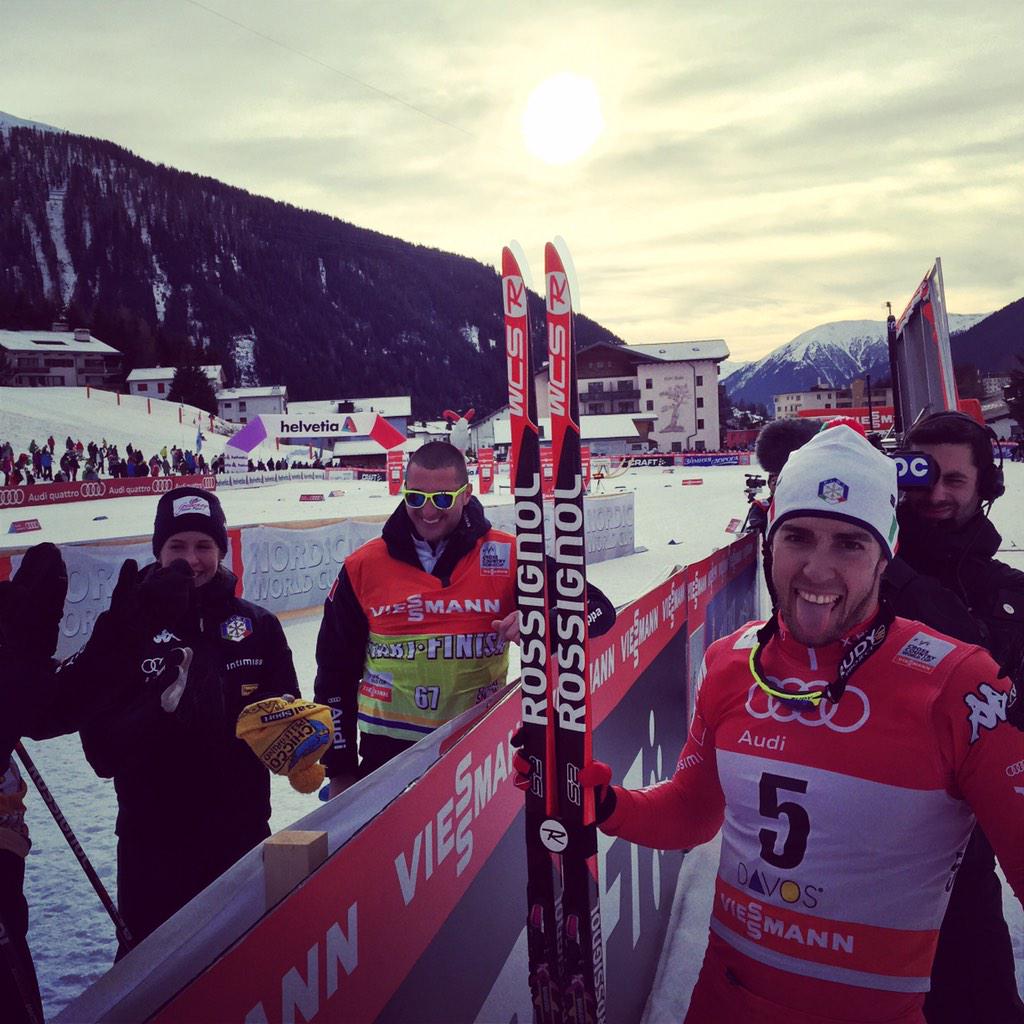
    Federico Pellegrino (r) after his first World Cup victory on Sunday in the 1.4 k skate sprint in Davos, Switzerland. (Photo: FIS Cross Country/Twitter)
    Federico Pellegrino (r) after his first World Cup victory on Sunday in the 1.4 k skate sprint in Davos, Switzerland. (Photo: FIS Cross Country/Twitter)

    On Saturday amid fast conditions with an ample amount of manmade snow, Pellegrino advanced to the final as a lucky loser — the fourth man in a fast heat — and ended a slow start to the season for Italy. The young Italian was last out of the gate, but quickly made up ground to put himself in third by the first turn.

    Petukhov led early, up and over the first hill, where Pellegrino sat in second. The Russian accelerated in an effort to drop him, but Pellegrino hung close. By the time the last climb on the second lap rolled around, the Italian made his move — surging past him and creating a large gap on Petukhov and the rest of the field (with Norway’s Krogh and Sondre Turvoll Fossli, and Sweden’s Calle Halfvarsson and Emil Jönsson) before the final turn into the straightaway finish.

    Petukhov gained ground back on the descent into the stadium with fast skis, and Krogh came like a bullet from behind through the last turn to challenge Petukhov to the finish.

    While Pellegrino edged Petukhov by 0.24 seconds in 2:19.36, the Russian slid across the line two-hundredths of a second ahead of Krogh for second place — his second World Cup podium this season.

    “Last week, I was also in the final but I chose the wrong tactics,” Petukhov told FIS, referencing his fourth-place finish last Sunday behind three Norwegians: Krogh in first, Anders Gløersen in second, and Eirik Brandsdal in third. “Today I did everything right but my legs felt little bit heavy. I was able to close the gap on Pellegrino, but the finishing straight is so fast I could not beat him.”

    After winning last Sunday’s sprint, Krogh advanced from the back of the pack to the podium in the final meters after struggling to stay with the pack for most of the final. Krogh admitted that the pressure to perform affected him during the race.

    “It is always tough to come back on the course where I have won. I felt the pressure, and it is good to be on the podium,” Krogh said to reporters after the race, explaining that he didn’t manage to get himself a very good position.

    “I had a not-so-good start, and I had to find a good position in the field. I gained some places in the uphill and I gave it all in the last corner,” he said, adding that he was very happy to make the podium.

    Fossli had the fastest qualifying time in 2:17.43 and advanced easily through the heats, but fell short in the final and ended up fifth (+1.43), behind Halfvarsson in fourth (+1.01), who was ninth in the qualifier. Jönsson finished last in the final (+11.02), but had the fourth-fastest qualifying time. Krogh was third in the qualifier, Petukhov advanced to the heats in 10th, and Pellegrino qualified fifth in the qualifier and won his quarterfinal.

    “Today, I beat all the Norwegian guys,” Pellegrino told NRK. “All of them.”

    “I wanted this victory with all my strength,” he told the Italian broadcaster RAI, according to a translation. “This victory comes at a negative period for our team, I hope it can serve to raise ourselves. I am very happy because I had not won anything and this time I did.

    “I dedicate the success to all those who have followed me since childhood: coaches , physiotherapists and [wax technicians], and all those who were close to me, including my girlfriend Greta Laurent who lack a bit of confidence in this period,” he added. “I hope it’s a good omen. … I hope it is the first in a long series of triumphs.”

    Results | by heats

  • Gløersen Grabs First Sprint Win Since 2010; Jylhä Ecstatic in Davos

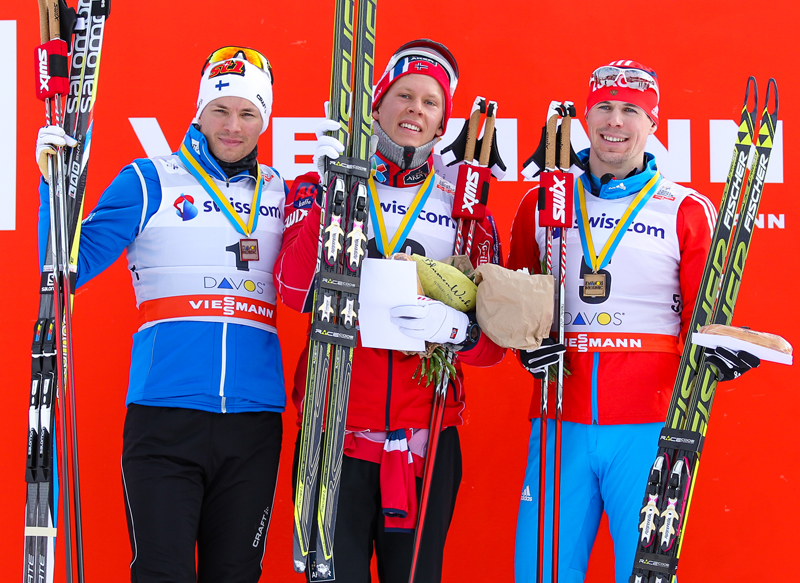
    Gløersen Grabs First Sprint Win Since 2010; Jylhä Ecstatic in Davos

    Norway's Anders Gløersen leading his quarterfinal in the World Cup men's 1.5 k freestyle sprint in Davos, Switzerland. Gløersen didn't win either his quarterfinal or semifinal, but took the victory when it counted in the final by half a second on Sunday.
    Norway’s Anders Gløersen (l) leads his quarterfinal in the World Cup men’s 1.5 k freestyle sprint in Davos, Switzerland. Gløersen didn’t win either his quarterfinal or semifinal — Finland’s Martti Jylhä (second from l) did — but the Norwegian took the victory when it counted in the final by half a second over Jylhä on Sunday.

    If you missed the 2 ½-minute men’s freestyle sprint final on Sunday in Davos, Switzerland, but caught a glimpse of the top three at the finish – you wouldn’t have a clue what happened.

    There was Finland’s 26-year-old Martti Jylhä exuberantly throwing his arms up and running around with unabridged excitement. Then you had Sergey Ustiugov, a 21-year-old Russian coming off multiple U23 World Championships titles, who captured his first World Cup podium on Sunday.

    Anders Gløersen, 27, was perhaps the most contained of the group – probably because he’s Norwegian – but even he was pretty psyched. He had just sealed his first World Cup victory since 2010, winning the 1.5-kilometer sprint by 0.58 seconds over Jylhä and a second ahead of Ustiugov in third.

    Like Ustiugov, “Poika” Jylhä had never achieved a World Cup podium before, but he was off to a good start with the fastest qualifying time by 0.84 seconds. Jylhä clocked 2:32.19 on the two-lap course – relatively flat with gradual rolling hills and one significant climb that required some V1 action.

    “Davos was not my favorite place before,” Jylhä said in a post-race interview. “It was the worst place for me to ski, but now I think I have to change the way how I feel about Davos.”

    Russia’s Alexey Petukhov qualified in second, Sweden’s Simon Persson was third fastest exactly a second behind Jylhä. Italy’s Federico Pellegrino qualified in fourth and Ustiugov advanced with the fifth-fastest time of 2:33.98.

    As usual, the heats ended up being a few seconds slower than the top qualifying time, with Jylhä winning his quarterfinal in 2:35.54, just ahead of Gløersen in second. The Finn edged Gløersen again in the semifinal, this time by 0.14 seconds in 2:34.32.

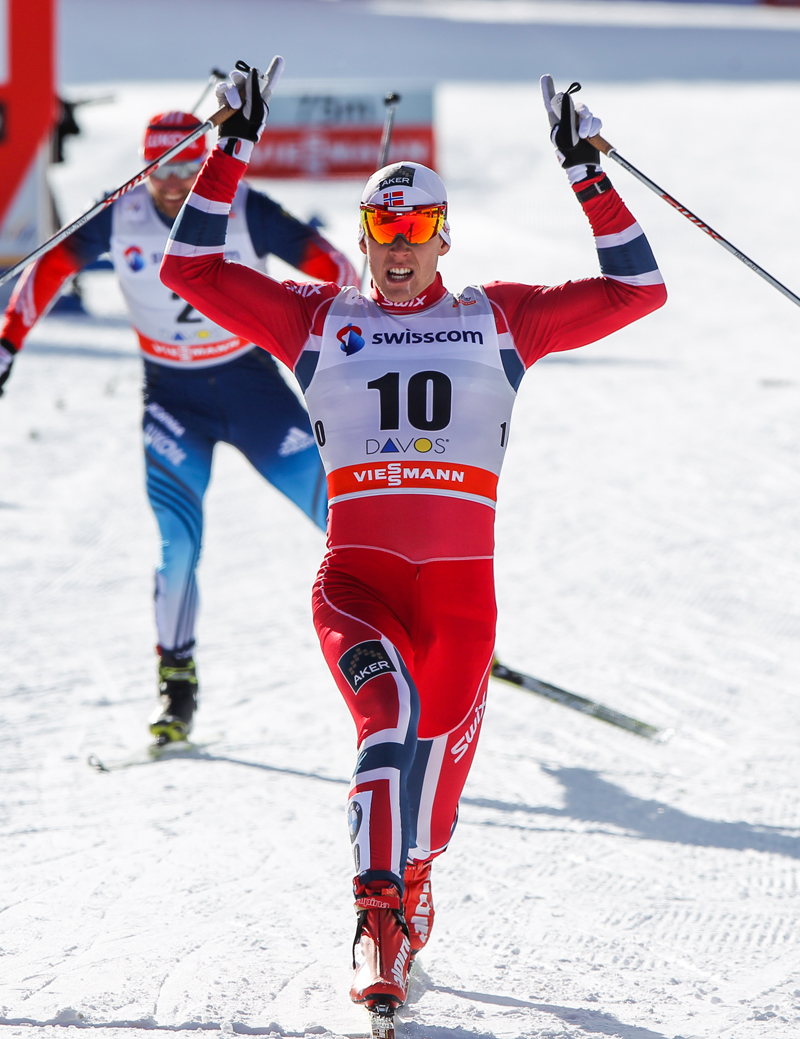
    Norway’s Anders Gløersen celebrates his win as he crosses the finish line (Photo: Fischer/Nordic Focus)
    Norway’s Anders Gløersen celebrates his win as he crosses the finish line (Photo: Fischer/Nordic Focus)

    Once the final rolled around, Gløersen had a pretty good read on Jylhä. The guy was gutsy, racing ahead and trying to break away on the main hill – which worked in his first two heats.

    Early on in the final, which started with a casual pace, Pellegrino tried to jump to the front, but couldn’t quite make it. Petukhov then tried his luck without a whole much, and finally it was Jylhä’s turn.

    Looking like someone who’s skied in World Cup sprint finals a time or two before, Jylhä took charge. Gløersen sat back, waiting for the anticipated downfall of the less-experienced Finn.

    Then again, Gløersen hadn’t won a skate sprint since 2010 in Oslo, Norway. He made the podium twice last season in the Canadian World Cup freestyle individual and team sprints in Canmore and Quebec, respectively, but that was a year ago. He was just as hungry for a win, which could secure his Olympic bid.

    Gløersen gave Jylhä a taste of his own tactic when he attacked up the same climb before the long descent toward the stadium. Jylhä held on and tried to draft him, while the two Russians – Petukhov and Ustiugov – hovered around third and fourth.

    As the group rounded the final corner into the finishing stretch, Gløersen turned up the jets and started to gap the field, ultimately finishing by a clear margin in 2:38.74. Jylhä was next across the line, then Ustiugov, who ended up edging Petukhov for third by 0.31 seconds.

    Petukhov finished fourth, Finn Hågen Krogh placed fifth (+2.14) and Pellegrino ran out of gas to place sixth (+11.81).

    “The finals went very well,” Gløersen told NRK on the anniversary of his first World Cup win, which he notched in six years ago in Rybinsk, Russia. “I was really tired when I started, but I thought the others were more tired. … I was lucky to go in the first heat in the quarter and semifinals.”

    “It was a long time since I won … too long,” he added. “So this was a real good feeling. It was time to step up again.”

    With the same amount of rest as Gløersen, Jylhä struggled to find his position in the final, but when he saw an opening, he said he went for it.

    “Anders worked very hard; I could not overtake him, but second place is like a victory,” Jylhä said.

    A smiling Ustiugov told reporters: “It feels great to be on the podium. … The course fit me very well in Davos. I tried to keep the pace high and stay in front. I gave everything I had in the home stretch.”

    Earlier in the day, Persson mimicked Jylhä’s strategy in the second semifinal and led from the start. Norway’s Krogh and Eirik Brandsdal chased the 22-year-old Swede, along with Russia’s Nikita Kriukov. About halfway through the race, Petukhov leapt to the front and held his position around the final corner, where Brandsdal and Persson collided and fell out of contention.

    The men's podium. Martti Jylhä, Anders Gloeersen, and Sergey Ustiugov. (Photo: Fischer/Nordic Focus)
    The men’s podium. Martti Jylhae, Anders Gløersen, and Sergey Ustiugov. (Photo: Fischer/Nordic Focus)

    Kriukov, who finished second to teammate Petukhov in the semifinal, was blamed for the penalty and disqualified as a result (keeping him from the final). But Norwegian news agencies sided with Brandsdal and blamed Persson, who stumbled earlier in the semifinal on one of the two climbs.

    “I don’t know what he did,” Brandsdal told NRK, according to a translation. “I feel he should have kept outer [lane] instead of cutting in.”

    Second-to-last in the heat, Brandsdal ended up eighth and Persson finished ninth overall.

    “This … happens,” Brandsdal said. “But I’ve had a good day, so I’ll take it with me.”

    In his first World Cup back since a long bout with illness, Sweden’s Emil Jönsson placed 22nd after finishing fifth in his quarterfinal (which Petukhov won). Jönsson told reporters he lost a lot of training and was unable to find his top gear on Sunday. Not too upset with the result, he said his goal was to come to Davos and see where he stood.

    “Out in the quarter is not the best there is …” Jönsson tweeted. “[Next] time!”

    — Chelsea Little contributed reporting

    Results