From the FasterSkier archive — posts syndicated from athletes’ and coaches’ own blogs between 2004 and 2012, kept online as published. Current coverage is at fasterskier.com.

Tag: Davos Switzerland

  • Fire, Ice, and Belief: Two Vermonters Deliver Under the Lights in Davos

    Fire, Ice, and Belief: Two Vermonters Deliver Under the Lights in Davos

    This coverage is made possible through the generous support of Marty and Kathy Hall and A Hall Mark of Excellence Award. To learn more about A Hall Mark of Excellence Award, or to learn how you can support FasterSkier’s coverage, please contact info@fasterskier.com.

    The lights come on early in Davos, not because they are needed, but because Davos wants them on. By mid-afternoon, the valley is already sliding toward dusk, the alpine light thinning and flattening, and the sprint venue leans into the moment the way it always has: music turned up, cowbells ringing with a little extra insistence, flames licking the edges of the course like stage cues. The effect is deliberate. This is not cross-country skiing as a quiet endurance ritual in the woods; this is cross-country skiing as spectacle.
    “Davos deliberately designs this event to feel like a rock concert,” U.S. head coach Matt Whitcomb said afterward. “They race at night, they bring in fire and lighting and music, and because it’s a two-lap course, you see the athletes twice as much. They invest in the experience, and it pays off.”
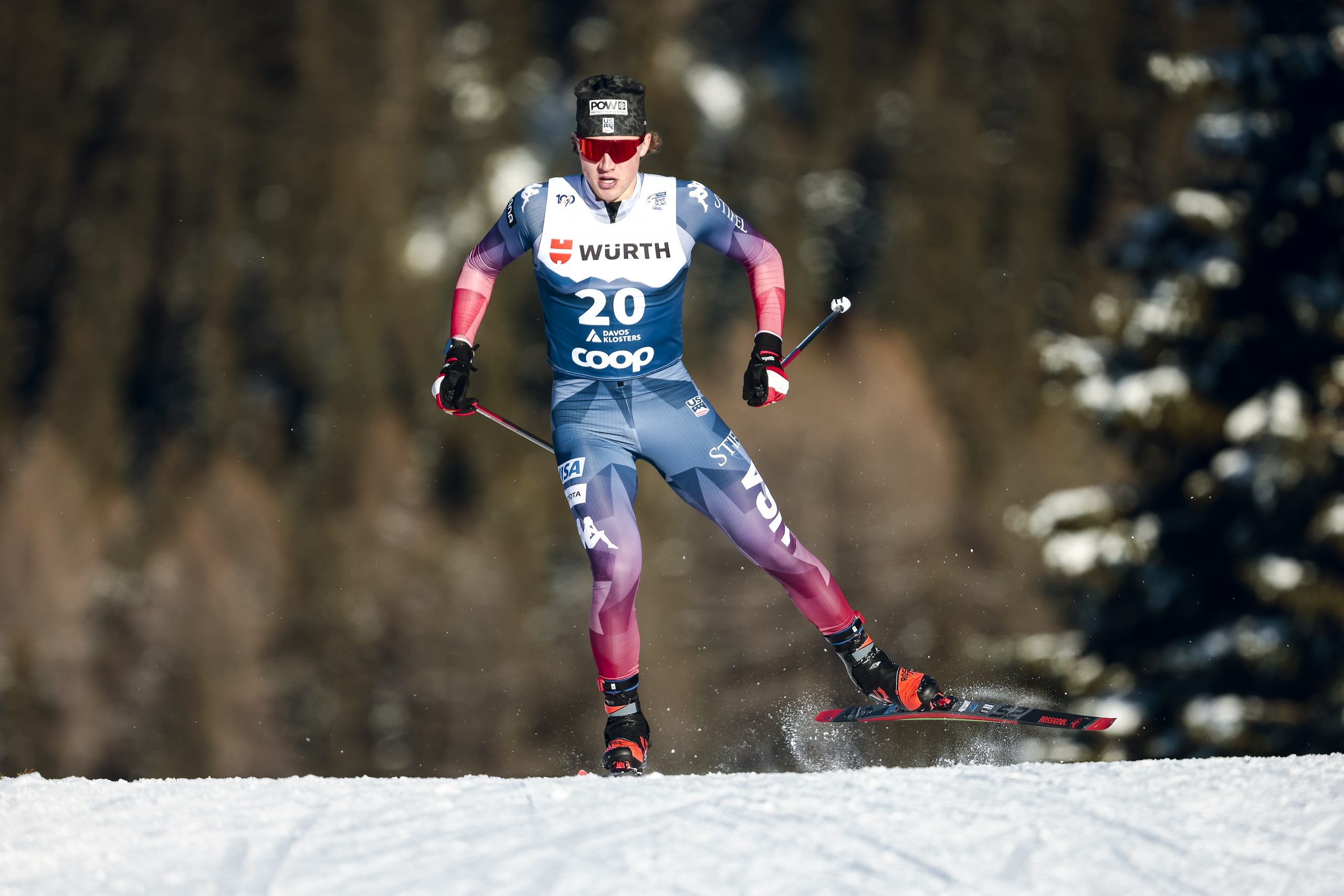
    Jack Young (USA) on his way to a fast qualification in Davos (SUI). (Photo: Modica/NordicFocus)
    On Saturday night, it paid off in a men’s freestyle sprint that delivered one of the most compelling American performances in years. Jack Young finished fourth, Ben Ogden fifth — the first time two American men had made a World Cup sprint final together in Davos — on a night when the script cracked open early and never fully resealed. Johannes Høsflot Klæbo was gone before the semifinals. A notoriously slick downhill corner became the day’s silent antagonist. And by the time Lucas Chanavat lunged across the line to win by three hundredths of a second, the story had already shifted: the U.S. men were no longer visitors to the sprint final. They were participants, with opinions about how it might have ended differently.
    For Young, the fourth-place finish marked his first World Cup sprint final — a breakthrough that felt less like a surprise than a confirmation. “This result means so, so much,” he said. “It really feels like proof that I can make it to the top in this sport. If I’d told myself three years ago that I’d finish fourth in a World Cup sprint, I would have thought I was insane.”
    Ben Ogden (USA) during qualification in Davos (SUI). (Photo: Modica/NordicFocus)
    A course that punishes impatience
    Davos is not a long sprint, but it is not a forgiving one. Two laps of just under 600 meters pack in a decisive climb, sustained skating tempo, and — this year especially — a downhill corner that demanded respect. The snow was entirely man-made, hard and fast, and as the temperature dropped through the evening, it glazed into ice. Athletes began to talk about the corner not as a feature, but as a test.
    “That bottom corner was particularly dicey this year,” Whitcomb said. “Man-made snow turns to ice quickly, and that corner claimed a lot of people over the last couple of days.”
    Ben Ogden felt it more than once. “That last corner was really the focus,” he said. “I fell there yesterday, JC fell there in practice, and I stumbled twice in the final and ended up against the boards. It was unfortunate, but every year you learn a little more about how the ice forms there.”
    The corner changed the race’s outcome. The first time through, athletes skied it conservatively, prioritizing stability over speed. The second time, with fatigue setting in and the finish looming, choices became riskier — and more consequential.
    Janik Riebli (SUI), Jack Young (USA), and Lars Heggen (NOR), (l-r) during the heats in Davos (SUI). (Photo: Vanzetta/NordicFocus)
    Qualifying hints, early shocks
    The qualifying round suggested a familiar hierarchy, but with enough irregularities to hint that Davos might misbehave. Lucas Chanavat of France was fastest, Ben Ogden second, Klæbo third. Jack Young qualified sixth — an excellent position that put him squarely in control of his bracket.
    “That’s one of the best qualifying results we’ve ever had on the U.S. team,” Whitcomb said. “Qualifying in the top ten gives you options. It lets you race offensively instead of defensively.”
    Klæbo’s day began to unravel in the quarterfinals. Boxed in and forced wide through the downhill, he finished fourth in his heat and failed to advance. His 16-race sprint win streak ended not with drama, but with traffic — a reminder that sprinting, for all its stars, is still governed by physics and positioning.
    Ogden and Young both advanced cleanly. Ogden won his quarterfinal with authority. Young skied his with the composure of someone who knew exactly what he needed to do — no more, no less.
    Ben Ogden (USA) and the US Ski Team had a lot to celebrate in Davos (SUI). (Photo: Modica/NordicFocus)
    Semifinals: the Americans arrive together
    By the semifinals, the noise in Davos had sharpened. Chanavat advanced. Ogden advanced. And then Young did, stepping into his first World Cup sprint final with the kind of quiet efficiency that suggested the moment had not surprised him.
    “To be honest, the first thing that went through my mind standing on the start line was how tired I was,” Young said. “But I reminded myself that anything can happen in a sprint final. I don’t train just for qualifiers and quarters — I train for the full day. It was time to execute.”
    For Ogden, the significance of sharing the moment wasn’t lost. “Racing with Jack today was awesome,” he said. “He has this infectious confidence, especially here in Davos. Last year we were in the semifinals together, and this year we were in the final together. That’s a big step.”
    Whitcomb saw it as more than a statistical milestone. “To put two guys into the men’s final is a dream,” he said. “When athletes finish a race seeing the podium and knowing they can be on it, that’s when things start to get dangerous — in a good way.”
    Jack Young (USA) had every right to be celebrated after his breakout race today in Davos (SUI). (Photo: Modica/NordicFocus)
    The final: margins measured in inches
    The men’s final unfolded at full speed. Chanavat and Federico Pellegrino established themselves early, both reading the race the way veterans do — not forcing it, but shaping it. Oskar Opstad Vike of Norway positioned himself patiently, waiting for the moment when commitment would matter.
    Ogden and Young stayed connected. Coming into the final corner, Ogden had position. Young had momentum.
    “I was really gunning for that podium,” Ogden said. “I felt like I was pretty close. With fewer stumbles and maybe a little better positioning, I think I could have made it happen.”
    The corner had other plans. Ogden’s line took him over the ice and was forced wide, momentarily pinned against the boards. Young exited cleaner, carrying speed into the finishing straight.
    Chanavat and Pellegrino lunged together at the line, Chanavat winning by three hundredths of a second. Vike took third. Young crossed fourth, Ogden fifth — separated from the podium by seconds, but not by belief.
    “I finally feel like I can truly compete at the top,” Young said. “That’s a special feeling.”
    Results — Men’s Sprint Freestyle, Davos
    1. Lucas Chanavat (France)
    2. Federico Pellegrino (Italy)
    3. Oskar Opstad Vike (Norway)
    4. Jack Young (USA)
    5. Ben Ogden (USA)
    6. Edvin Anger (Sweden)
    Notables: Johannes Høsflot Klæbo (Norway), 17th, and JC Schoonmaker (USA), 27th.
    It has been a tough trail back to the top step on the podium for Lucas Chanavat (FRA) so he was extremely excited to be standing on it today in Davos (SUI). (Photo: Vanzetta/NordicFocus)
    What Davos leaves behind
    Davos has always been good at revealing things. It reveals how athletes handle altitude, manage nerves, and respond when a race refuses to go according to plan. On Saturday night, it revealed something else: American depth at the sharp end of a sprint final.
    Young talked about the atmosphere as something that lifts him. “With all the energy, it’s easy to trick yourself into thinking you’re walking into a big arena,” he said. Ogden talked about validation — not just from results, but from proximity. “My target in these races is the podium,” he said. “It feels good to know I’m getting closer.”
    Whitcomb, standing back from it all, saw the longer arc. “We’re in a really good place with these guys,” he said. “There’s a lot more to come.”
    The flames went out eventually. The music faded. Davos returned to being a quiet alpine town under an early winter night. But for the American men — and for two Vermonters who now know exactly what a World Cup sprint final feels like in tandem — something lingered.
    Not noise. Not spectacle.
    Belief.


    Men’s Individual Sprint Final RESULTS


    Love Stories Like This? Help Keep Them Coming.

    Feature stories like this one take time, access, and care to produce. If you value thoughtful storytelling and independent ski journalism, please consider becoming a Voluntary Subscriber. Your support directly fuels the work we do to cover the people, places, and moments that make our sport special.

    Join the FasterSkier community!


    Federico Pellegrino (ITA), Lucas Chanavat (FRA), and Oskar Opstad Vike (NOR), (l-r) on the sprint podium in Davos (SUI). (Photo: Vanzetta/NordicFocus)
  • Under the Lights in Davos, Sundling Delivers—and the Margins Show

    Under the Lights in Davos, Sundling Delivers—and the Margins Show

    This coverage is made possible through the generous support of Marty and Kathy Hall and A Hall Mark of Excellence Award. To learn more about A Hall Mark of Excellence Award, or to learn how you can support FasterSkier’s coverage, please contact info@fasterskier.com.

    The night sprint in Davos has a way of making the sport feel louder than it usually allows itself to be. The course is short, the laps repeat, the crowd sees the same faces twice, and the organizers lean into the spectacle—music, lights, flames—until the whole thing starts to resemble a winter street festival that happens to include the fastest skiers in the world. “They deliberately design this event to feel like a rock concert,” U.S. head coach Matt Whitcomb said, pointing to the night racing, the lighting, and the two-lap format that keeps the athletes close and visible.
    But the women’s sprint on Saturday didn’t need help finding drama. It had its own: a final that turned into a study in timing and patience, a surprise runner-up, a home-country podium that felt like the whole point of staging a race like this in the first place, and an American women’s team day that—depending on where you stood—looked either like incremental progress or a reminder of how narrow the margins are when you’re trying to turn good skiing into the kind of skiing that survives the heats.
    At the front, Jonna Sundling (Sweden) won the women’s sprint free in 2:31.86, edging Mathilde Myhrvold (Norway) by 0.08 seconds (2:31.94). Nadine Fähndrich (Switzerland) rounded out the podium in third at +2.60, a result made sweeter by the route she took to get there: she advanced into the final as a lucky loser and still skied her way onto the podium when it mattered most.
    Behind them, the final was saturated with familiar sprint power: Maja Dahlqvist (Sweden) finished fourth, Linn Svahn (Sweden) fifth, and Laura Gimmler (Germany) sixth—three Swedes in a Davos final, again, in a venue that has long amplified Sweden’s particular talent for fast, hard, repeated efforts under bright lights.
    Kristine Stavaas Skistad (NOR), Laura Gimmler (GER), Jonna Sundling (SWE), Nadine Faehndrich (SUI), (l-r) during the sprint heats in Davos (SUI). (Photo: Vanzetta/NordicFocus)
    A course that asks for control more than courage
    Davos is not a long sprint, but it’s demanding in the way short races can be demanding: there’s nowhere to hide, and every mistake is immediate. The compact two-lap circuit rewards rhythm and positioning—especially on the downhill into the technical corner that has been a recurring storyline in Davos when the surface hardens.
    Whitcomb, talking about the venue more broadly, framed Davos as a place where experience matters —not only experience racing hard, but racing smart: managing altitude, managing risk, and understanding that “good” in Davos can disappear fast if you’re constantly reacting rather than shaping.
    That’s why Sundling’s win felt so Sundling: not flamboyant, not chaotic, but efficient—an athlete with enough power to force the pace and enough composure to let the final come to her.
    Mathilde Myhrvold (NOR) and Jonna Sundling (SWE), (l-r) lunge for the sprint final finish line in Davos (SUI). (Photo: Vanzetta/NordicFocus)
    The final: Sundling’s patience, Myhrvold’s moment, Fähndrich’s home lift
    If you didn’t know the result, you might have expected a Swedish one-two. Sundling and Dahlqvist were both in the final, and Sweden brought three athletes onto the start line. But sprint finals aren’t always about the most decorated name; they’re about who can keep their speed intact after a day of qualifiers, quarters, and semis—after the accumulation of small sprints that feel, by the end, like one long race done in pieces.
    Sundling and Myhrvold made the final feel like a contest of timing. Sundling’s skiing had the taut confidence of someone who knows exactly what she wants from the last 200 meters; Myhrvold skied like someone who believed she could take it from her. They hit the line separated by less than a tenth of a second.
    And then there was Fähndrich—third, at home, on a night designed for the crowd to matter. If Sundling’s win was clinical, Fähndrich’s podium was emotional in a quieter Swiss way: the sense that the event’s atmosphere wasn’t just decoration; it was fuel.
    Julia Kern (USA) and Nicole Monsorno (ITA), (l-r) in the quarterfinals in Davos (SUI). (Photo: Vanzetta/NordicFocus)
    The U.S. women: progress, frustration, and the line between them
    For the U.S. women, Davos was not the same kind of headline day the men had produced a few hours earlier. But it also wasn’t empty. It was the kind of day coaches talk about carefully: pieces moving in the right direction, while also acknowledging that “right direction” still has to show up in a bracket.
    Whitcomb didn’t sugarcoat the overall result. “Honestly, a little lackluster on the women’s side today,” he said, adding that the athletes themselves would agree with that assessment. At the same time, he pointed to specific positives—the kind that matter in the arc of a season.
    He said Jessie Diggins “skied competitively” and “narrowly missed advancing,” and he emphasized that the difference between making semifinals and missing them is often a single decision in a single corner. He also singled out Julia Kern as an athlete whose level is rising: “Julia is definitely skiing on another level than she has been for the first couple of weekends,” Whitcomb said, framing it less as a sudden leap and more as a build—more weekends of consistent racing, more reps in heats, more time at speed until the pieces become routine.
    Kern’s own description of her day fit that exact narrative: detailed plan, sharper qualifier, more of a feeling of normalcy returning—plus the kind of bad luck sprinting specializes in.
    “I’m proud of making a detailed race plan and starting faster in the qualifier today,” Kern said. “I felt much more like myself out there and was able to play the tactical game with some good moves, even though it ended with an obstruction by another athlete. I’m excited to take this fresher energy into tomorrow and build on the endurance base I feel like I have going into the distance race.”
    It’s a very Kern quote: pragmatic, technical, forward-looking. Not a lament—more a calibration.
    The deeper truth of sprinting is that it doesn’t always reward “feeling better” immediately. Sometimes it rewards it tomorrow, or next week, or in the next venue where a better qualifier and a cleaner first heat finally align. That’s why Whitcomb’s view was pointed but not pessimistic: he sees the level rising, and he sees that the team standard is higher than the day’s outcome.
    “We should be putting multiple women in the semifinals,” he said. “And it’s time to start doing that.”
    Jessie Diggins (USA) during qualification in Davos (SUI). (Photo: Modica/NordicFocus)
    Why Davos matters beyond the podium
    Davos is always a little odd in the calendar. It arrives after the first wave of races has introduced the season’s storylines, but before the season has fully decided what it wants to be. It’s high enough to punish sloppy energy management, tight enough to punish poor positioning, and loud enough to make athletes feel—at least for one night—that they’re racing in an arena rather than on a trail.
    That can be destabilizing, in a good way. It can pull surprise finalists into the light. It can elevate a lucky-loser path into a podium. It can turn a planned, steady day into a messy one. And it can expose the difference between skiing fast and getting through rounds—a difference that isn’t always about fitness.
    For Sweden, Davos once again looked like a venue built for their sprint depth: three in the final, the winner on top. For Norway, Myhrvold’s second place was a reminder that the sport is always producing new sprint threats, even in an era dominated by familiar names. For Switzerland, Fähndrich’s third place felt like the perfect use of home advantage and crowd energy.
    And for the U.S. women, it was a day that asked a familiar question: how close is “close,” really?
    Kern’s answer—embedded in her quote—was that she’s trending toward the skier she knows she is, and she’s carrying that energy forward into the distance race. Whitcomb’s answer was both sharper and more structural: good signs are not the same as results, but good signs are still worth something if they’re backed by consistent racing.
    Recap: Women’s Sprint Free, Davos
    1. Jonna Sundling (SWE) — 2:31.86
    2. Mathilde Myhrvold (NOR) — +0.08
    3. Nadine Fähndrich (SUI) — +2.60
    4. Maja Dahlqvist (SWE)
    5. Linn Svahn (SWE)
    6. Laura Gimmler (GER)
    Mathilde Myhrvold (NOR), Jonna Sundling (SWE), and Nadine Faehndrich (SUI), (l-r) share the sprint podium in Davos (SUI). (Photo: Vanzetta/NordicFocus)
    The quieter ending Davos can leave you with
    By the time the final ends, the flames are still there, the music is still there, and the crowd is still leaning over the fencing as if the night could produce one more surprise. But the athletes are already drifting toward tomorrow—toward the distance race, toward the next chance to turn “better” into “through,” toward the next bracket that won’t care how good your plan was unless it shows up as a place on the right side of the line.
    That’s the strange promise of Davos: it amplifies everything. It amplifies winners. It amplifies near-misses. It amplifies the feeling that a season can pivot in a single night sprint—sometimes in front of flames and floodlights, sometimes in a quiet tactical mistake that only the skier can feel.
    Sundling won because she was the best sprinter on the night and skied like she knew it. Myhrvold took second because she refused to concede the finish until the last step. Fähndrich climbed onto the podium because sprinting still leaves room for the athlete who keeps the door open long enough to walk through it.
    And the U.S. women left Davos with a different kind of narrative—less celebratory, more unfinished. Kern put it plainly: she felt more like herself, she played the tactical game, and she’s taking that energy into tomorrow. In a season built out of weekends, that’s how momentum often begins: not with a single clean headline, but with the gradual return of a feeling an athlete recognizes—and a plan that, sooner or later, stops being interrupted.


    Women’s Individual Sprint Final RESULTS


    Love Stories Like This? Help Keep Them Coming.

    Feature stories like this one take time, access, and care to produce. If you value thoughtful storytelling and independent ski journalism, please consider becoming a Voluntary Subscriber. Your support directly fuels the work we do to cover the people, places, and moments that make our sport special.

    Join the FasterSkier community!
  • Nyenget Tops International Podium in Davos 20 k Classic

    Nyenget Tops International Podium in Davos 20 k Classic

    A_Hall_Mark_of_Excellence_Award-logo-300.png (300×244)This coverage is made possible through the generous support of Marty and Kathy Hall and A Hall Mark of Excellence Award. To learn more about A Hall Mark of Excellence Award, or to learn how you can support FasterSkier’s coverage, please contact info@fasterskier.com. 

    Seated in Davos’ sled-shaped leader’s chair, Martin Loewstroem Nyenget (NOR) appeared well satisfied with his remarkable effort in the 20 k Classic. (Photo: Vanzetta/NordicFocus)

    World Cup Nordic skiing can seem like it’s become fairly predictable: the Swedish team dominates the Women’s Sprints, Johannes Hoesflot Klaebo (NOR) is unbeatable in the Men’s Sprints, and Therese Johaug (NOR) routinely crushes the Women’s distance field. The only events offering even an inkling of suspense in regard to the eventual winners are Men’s distance races. Each week on the World Cup schedule, at least one distance race is staged: Klaebo always hopes to contend, but his own teammates routinely put his feet to the fire. Harald Oestberg Amundsen (NOR) is defending World Cup Overall champion, and he’s begun this year very much the same way he began last year. Simen Hegstad Krueger (NOR) is a World Champion and Olympic Champion—he’s always dangerous. And there are a bunch of Norwegian youngsters vying impatiently for their spot on the podium: the top guys can’t hold off those young bucks forever. Among non-Norwegians, only the brilliant Finnish Classic specialist, Iivo Niskanen, is typically positioned to interrupt the Norwegian team.

    In Davos, the world’s best Nordic skiers found themselves facing a unique and definable challenge: altitude. The elevation of the top step of the Davos’ Town Hall is 5,118 feet (roughly the same as Denver, Colorado). Even well trained athletes will find themselves out of breath at the top of the flight of stairs in Davos. It’s not enormously high elevation, but it’s more than enough to affect the results of a daunting race like the 20 k Classic. Nordic skiers find that it’s far more difficult to recover at altitude, far more likely that an athlete may stray into oxygen debt (and the accompanying flood of lactate) at altitude. If a skier makes such a mistake, their race is likely over; however, if athletes don’t push that envelope, their chances of victory are pretty low. It’s a risky business, this racing at altitude. Davos is where those bets get made, and where the deck that seems so familiar in the game can find itself getting re-shuffled.

    Today in Davos, Niskanen found himself upended by a hard-charging Martin Loewstroem Nyenget (NOR). Just behind them in third was a frothing and resplendent Hugo Lapalus (FRA).

    “It was a fight,” Nyenget said in post-race interviews. “But I managed to stay at the same pace during the whole race, I think. So I’m really happy about the performance.”

    Among Americans, Gus Schmacher finished 19th, Zanden McMullen 30th, Ben Ogden 40th, Zak Ketterson 42nd, Hunter Wonders 50th, Michael Earnhart 58th. Canadian finishers included Antoine Cyr 32nd, Xavier McKeever 53rd, Olivier Leveille 56th.

    “My fatigue isn’t too bad,” said Schumacher. “Skipping the Team Sprint was good for me. I know some people who did that are feeling pretty beat up today. We’ve got a good break, and should set us up well for the Tour.”

    “I’d say I’m definitely tired from all the races in period 1,” shared McMullen, “But I’m excited for some rest and training at altitude before the Tour.”

    Martin Loewstroem Nyenget (NOR) racing alone on Davos’ 20 k Classic course. Sunday’s race was a bit of a throw back to an earlier age of World Cup skiing when long distances were the norm, and almost all races were interval starts. (Photo: Modica/NordicFocus)
    Men’s 20 k Classic Interval Start

    Courses in Davos change more often than many on the World Cup circuit, and Sunday’s 20 k was no exception. New this year, racers would race across three seven kilometer laps harkening back to an earlier age of ski racing when spectators caught fleeting glimpses of racers striding through the tress. Additional old-fashioned challenges faced the racers: temperatures approached the freezing point; at start time the Classic tracks were slowly covering with freshly falling snow. Wax techs would’ve been busy in the morning’s pre-race hours, though the falling snow would cease midway through the race. Then the challenge became the re-appearance of a bright sun, and subsequent stark shadows crossing the course: glide affected, kick affected.

    Klaebo was the 54th starter, taking to the trails just two minutes behind Amundsen, his closest rival in the chase in the World Cup overall standings. Klaebo would receive a fair amount of information during his race, but his three-race weekend may have drained him. Klaebo never looked sharp, though on this long and difficult day he was not the only one.

    Lunging at the finish line, Martin Loewstroem Nyenget (NOR) left no doubt of his dominance in Davos 20 k Classic Interval Start. Iivo Niskanen (FIN) was a later starter—and pre-race favorite—but even Niskanen’s best efforts would not allow him to overtake Nyenget. (Photo:  Vanzetta/NordicFocus)

    Niskanen started behind Nyenget and received all available information about the Norwegian’s progress. Nevertheless, Niskanen found himself powerless to overcome Nyenget who topped mid-race time checks and carried those margins on to victory.

    Niskanen swerved across the finish line, already headed to a fist-bump with  Nyenget in the leader’s chair. Niskanen paused not at all in the finishing area, suggesting his disappointment at surrendering the win to a rival.

    Hugo Lapalus (FRA) was thrilled with his third place finish. With medalists from Norway, Finland, and France, Davos’ 20 k Classic was the most internationally diverse Men’s distance podiums thus far in the World Cup season. (Photo: Modica/NordicFocus)

    Hugo Lapalus showed great heart throughout the day, his tempo always crisp, his technique always light on his way to third place.

    Following his victory a week ago in the 10 k Freestyle in Lillehammer, Nyenget is establishing himself as a skier who can truly challenge for significant World Cup wins. His victory last year in the Holmenkollen 50 k Classic hinted at his great potential in distance racing. His winning performance here at the end of Period 1 only serves to confirm that potential. It was a sweet victory for Nyenget who also took over the lead in the World Cup distance standings.

    “I really hope to do as much distances in the World Championships as possible,” Nyenget said. “So this was a really good day to get a good result.”

    The Davos 20 k Classic Interval Start delivered a fine effort and an impressive result for Thomas Maloney Westgaard (IRL) who raced his way into the typically Norwegian-crowded top ten. (Photo:  Modica/NordicFocus)

    Norway may have continued to be the dominant force in distance skiing, but Norway’s five finishers in the top ten also were forced to make room for a wonderful eighth place finish for Ireland’s Thomas Maloney Westgaard. The deck is being re-shuffled, indeed.

    Finishing fifth, Klaebo did manage to win a round in the season-long fight with Amundsen who finished in sixth. Their rivalry appears likely to continue when the World Cup returns on December 27.

    Many members of the Stifel US Ski Team will remain in Davos over the upcoming holiday for a bit of well-earned rest and a re-start to their mid-season training.

    “I think I haven’t quite been racing to my full fitness level yet and have some things to figure out performance wise before the next period,” said McMullen. “Christmas time will be the perfect opportunity to dial things in before the Tour with mostly distance training to absorb these last few race weekends.”

    “We were a little up and down through the Period,” said Schumacher. “Maybe having some off days with some skis that made it look maybe a little rougher than it was . . . In general, it wasn’t too bad, and we did have great ski days, too. We’re definitely looking forward to some more racing in a couple weeks.”

    Men’s 20 k Classic Interval Start RESULTS

    15.12.2024, Davos, Switzerland (SUI):
    Iivo Niskanen (FIN), Harald Oestberg Amundsen (NOR), Hugo Lapalus (FRA) celebrate podium performances in the 20 k Classic Interval Start in Davos . (Photo: Vanzetta/NordicFocus)
  • Two Sprint Victories in a Row for Chanavat, Schumacher fourth

    Two Sprint Victories in a Row for Chanavat, Schumacher fourth

    This coverage is made possible through the generous support of Marty and Kathy Hall and A Hall Mark of Excellence Award. To learn more about A Hall Mark of Excellence Award, or to learn how you can support FasterSkier’s coverage, please contact info@fasterskier.com.

    Gus Schumacher (USA) continued the recent trend of American men advancing to World Cup Sprint Finals. Throughout the heats, he would play a tactical game that saw him finish a career-best fourth. (Photo: Modica/NordicFocus)

    Lucas Chanavat (FRA) did a pretty impressive thing a few days ago in Stage 1 of the 2024 Tour de Ski: he won. Ask anyone who knows World Cup Sprinting, and they’ll tell you that Chanavat was fully equipped to win:  he was supposed to win, he was expected to win. But winning is still not an easy thing to do. For much of the 2023-2024 season, Chanavat has been the second best sprinter in the world. So when the. best sprinter in the world (Norway’s Johannes Hoesflot Klaebo) is absent from a sprint race, then Chanavat should win, right? Wouldn’t it be nice if the whole world were as simple as that? But that’s not the way World Cup Nordic skiing works. Again, Davos’ Tour de Ski Freestyle Sprint appeared to be Chanavat’s to win. but he still had to DO it . . .

    The middle of the Tour de Ski is often a place where distance skiers may excel in the Sprints. Exhausted sprinters develop chinks in their fast-twitch armor as the efforts of two prior days of distance racing tends to clip their wings. Evidently, Chanavat had a plan for that typical sprinter’s dilemma: he endured considerable criticism in the press this week for his performance in Monday’s Pursuit race—he effectively walked the challenging portions of the Pursuit course, and finished (among other skiers) well outside the Tour de Ski stage cut-off time. But Tour organizers seemed reluctant to disqualify their most charismatic sprinter, so Chanavat (and the other slow finishers) were granted a waiver of the cut-off time rule. Chanavat used that reprieve to become the top qualifier in the Davos Sprint competition which he would go on the win the Sprint with relative ease ahead of Edvin Anger (SWE) and Federico Pellegrino (ITA). American, Gus Schumacher would weave skillfully through the final of Sprint final contenders to finish a career-best fourth.

    Zanden McMullen and Kevin Bolger both qualified for the heats, but neither would advance beyond their quarterfinals. Tour de Ski Points Leader, Ben Ogden, dropped out of the tour prior to today’s competition. Coaches reported that Ogden’s roommate, JC Schoonmaker had fallen ill just prior to the Tour de Ski; while the team attempted to keep Ogden healthy, it seems that he has succumbed to the cold that felled his roommate.

    Lucas Chanavat (FRA) raises the traditional Davos’ World Cup winner’s trophy after his victory in the Tour de Ski Stage 4 Freestyle Sprint. In the absence of Johannes Hoesflot Klaebo (NOR), Chanavat is definitely the dominant World Cup sprinter. (Photo: Modica/NordicFocus)
    Men’s Freestyle Sprint

    Chanavat won Quarterfinal 1 with ease, ahead of Benjamin Moser (AUT) and Schumacher who would advance to the semifinal as a lucky loser. Current Tour de Ski leader, Harald Oestberg Amundsen (NOR), tumbled out of the race early in the heat, appearing to have been inadvertently interfered with by Moser whose pole may have poked the tail of Amundsen’s outside ski. Completely accidental, no penalty assessed: that’s just the way things go in sprinting. Even so, Amundsen was certainly displeased as he rose dejectedly and slammed his pole furiously into the snow. He knew what an advantage had been lost. His lead over his countryman, Erik Valnes, sat at just 32 seconds. Valnes would advance to the final, but would be visibly exhausted, finishing a distant sixth. The Overall Tour de Ski standings tightened at the top, but none of the contenders looked especially sharp.

    Zanden McMullen (USA) qualified for the heats for the first time in his young career, but he would face a seriously stacked quarterfinal that included Federico Pellegrino (ITA), Evensen, Lauri Vuorinen (FIN), Renaud Jay (FRA), and Paal Golberg (NOR). Evensen led out the quarterfinal while Pellegrino sat patiently, making his move in the finishing straight to win the heat. McMullen would finish fifth.

    Kevin Bolger (USA) was the day’s 16th fastest qualifier, and he would never have a better chance to advance than through his under-powered quarterfinal heat against Janik Riebli (SUI), Joni Maki (FIN), Martino Carollo (ITA), Emil Danielsson (SWE), and Valnes. Sadly, Bolger never truly contended in the heat, finishing fourth but well behind the lucky loser time.

    Gus Schumacher (USA) celebrates his fourth-place finish with Stifel U.S. Ski Team personnel. (Photo:
    Semifinals

    Semifinal 1 matched Chanavat against Evensen, Valerio Grond (SUI), Lauri Vuorinen (FIN), Moser, and Pellegrino. Chanavat simply powered at the front without ever seeming to over-commit. He eased across the line in first place, while Pellegrino (ever the cagey veteran) passed Grond on the inside of the final turn to take the other automatic qualifying spot.

    The second semifinal gave Schumacher his chance to show what he could do, but Haavard Solaas Taugboel (NOR), Valnes, Anger, Janik Riebli (SUI) stood in his way. Schumacher sat at the back of the field throughout the two laps as Anger and Riebli pushed the pace at the front. Riebli fell on the sweeping right hand turn that inexplicably claimed so many racers in Davos’ night sprint (what’s up with that turn?), allowing Schumacher to move up into a battle for second as the field reached the final uphill. Anger and Taugboel powered across the line (an exhausted Anger nearly taking himself down in the final meters). Schumacher was overtaken by Jenssen in the finishing straightaway, but both Jenssen and Schumacher advanced to the final as lucky losers.

    Visibly exhausted by his efforts thus far in the Tour, Valnes coasted across the line sixth, far behind the winners.

    Lucas Chanavat (FRA) (l) led from the front throughout each of the day’s heats in Davos. Gus Schumacher (USA), (r) wove skillfully through each heat to finish a career-best fourth. (Photo: Modica/NordicFocus)
    Sprint Final

    As he had done all day, Chanavat led out the sprint final. Schumacher lurked in the rear, staying out of trouble and stepping gingerly through the turn that had taken down so many contenders in Davos.

    Chanavat played his tactic to the end, launching an acceleration near the top of the final uphill that none of the others could match. Anger was quickly gapped, but managed to hold off Pellegrino over the top of the hil, and down the other side to the finish line. Chanavat first, Anger second (his first World Cup podium performance), Pellegrino third. Schumacher would work his way skillfully through the field to finish a career-best fourth.

    Chanavat has had quite a week—victory in Stage 1, lethargy and ridicule in Stage 3, another victory in Stage 4—winning the races that the oddsmakers expected him to win. It really doesn’t seem likely that Chanavat’s from-the-front tactic would’ve proven successful had Klaebo been here . . . but Chanavat knew the field that he was faced with. His confidence, fitness, and skill were more than enough to produce the victory in Davos.

    Tour de Ski (Davos) Freestyle Sprint RESULTS

    Zanden Mcmullen (USA) qualified 29th, advancing for the first time into World Cup Sprint heats. He would face a seriously-stacked field in his quarterfinal where his impressive fifth-place finish was a career-best. (Photo: Modica/NordicFocus)
  • WAIT, WHAT!?!? Am I seeing that right?? I came in third??

    WAIT, WHAT!?!? Am I seeing that right?? I came in third??

    13.12.2020, Davos, Switzerland (SUI):
    Hailey Swirbul (USA) – FIS world cup cross-country, 10km women, Davos (SUI). www.nordicfocus.com. © Modica/NordicFocus. Every downloaded picture is fee-liable.

    Hailey Swirbul (USA) posted her first World Cup podium this weekend, on the same course where she earned her first World Cup points last season.

    “WAIT, WHAT!?!? Am I seeing that right?? I came in third?? I just raced my heart out, and my skis were amazing. I am so excited,” the 22-year-old cross-country skier said after her 10-kilometer skate race in Davos (SUI) on Sunday.

    For Swirbul, the podium was both a surprise and a milestone.

    “A takeaway I wrote down from this weekend: I don’t have to be the strongest or the lightest or the fittest or the smartest or even the happiest to have a great race. But I DO need to focus on what I enjoy about skiing and not worry about doing things perfectly. Easy to get caught up in that mindset so I wrote it down as a lil’ reminder,” Swirbul wrote on her Facebook page on Monday.

    Related coverage:
    Meet Hailey Swirbul  
    Coping with Corona 

    Story continues below

    Hailey Swirbul (USA) after her first FIS World Cup podium with 3rd place in the 10km skate race in Davos (SUI) on Sunday. Photo: Nordic Focus

    Additionally, Madshus biathletes pulled off a successful World Cup weekend in Hochfilzen (AUT). On Sunday, Sturla Holm Lægreid helped Norway to first place in the relay for the second time this season, his third ever World Cup victory. 45 seconds later, Roman Rees and Benedikt Doll could cheer Germany into third place.

    On Saturday, World Cup veteran Anaïs Bescond helped France to second place in in the women’s relay where she skied the first leg for her team.

    For the record, Lægreid also posted two individual top-10 results in Hochfilzen, coming in ninth in the 10-kilometer sprint on Friday and moving up to sixth place in the 12.5-kilometer pursuit on Saturday.

    Related coverage:
    What a way to kick off the World Cup 

    Sturla Holm Lægreid (NOR) at the IBU World Cup 12.5km pursuit in Hochfilzen (AUT). Photo: Nordic Focus
  • The Devon Kershaw Show: Old School Davos

    The Devon Kershaw Show: Old School Davos


    In this episode of The Devon Kershaw Show … it is all things Davos. While the glam Swiss valley boasts mountain scenery, and a fusion of traditional Swiss cowbell and high finance, in many ways it remains decidely old school. Among other things, we discuss what some say is an outdated Davos distance course and the killing it Swedish women’s team.

    We’ll be releasing a mid-week episode where we chat about last week’s WADA decision to ban Russia from major international competitions for four years.

    If you have any questions for Devon please send them to info@fasterskier.com or devon@fasterskier.com.

    Thanks and you can find The Devon Kershaw Show on iTines and Google Play. The link to subscribe is on the embedded audio player below.


    Outdoor Saunas | Barrel Garden Sauna UK | Royal Tubs

  • Johaug Strikes Again in Davos 10 k Skate; Diggins 3rd; Five Americans in Top-30 (Updated with Whitcomb Audio)

    The podium of the 10-kilometer freestyle in Davos, Switzerland. Therese Johaug (center) took first, Heidi Weng (L) second, and Jessie Diggins (R) third. (Photo: NordicFocus)

    Day two in Davos, Switzerland looked much like the first; blue skies, fast tracks, and spectacular alpen backdrop. Following an interval start, athletes time-trialed through two 5-kilometer loops loops of a course that predominantly climbs the first 3k, ripping back toward the stadium the last two. Gone are the days of the stopwatch and furious arithmetic, coaches with tablets peppered the woods near checkpoints to relay information to their athletes as they skated by, hunting the shadows of the racers starting before them. Data on splits and time back at the coaches’ fingertips, translating to pacing advice for athletes. 

    As predicted, Norway’s dominant distance champion Therese Johaug clocked the fastest time, crossing the line in 25:02.7. 

    Champion Therese Johaug shows off her prizes after the 10-kilometer freestyle race in Davos, Switzerland. (Photo: NordicFocus)

    Wearing bib 34, Johaug was the second of the athletes ranked in the top 15 of the World Cup distance list on course. This seeded group wears even numbered bibs and follows the 30 athletes ranked between 16th and 45th on the list, alternating with athletes ranked 46th to 60th who wear odd numbered bibs.

    Because of her full-throttle effort that could not be matched on the day, her early start and finish provided her with ample time in the fur-lined leader chair. Plenty of time for Johaug, who did not appear concerned about the athletes chasing her time, to comfortably review the effort on her watch and catch up on her text messages, as she seemed to be doing. 

    “Of course, I feel that we are in the altitude, but it was a really good race today,” Johaug told FIS after her race. “My skis were perfect and my body also felt also really good. I’m really happy to be on top of the podium again.”

    As the race behind Johaug unfolded, two athletes emerged at the top of the ranks in contention for the podium: Heidi Weng of Norway wearing bib 32 and Jessie Diggins racing with more information on splits in bib 52.

    Heidi Weng crosses the line in second place at the 10-kilometer freestyle in Davos, Switzerland. (Photo: NordicFocus)

    On her first lap, Diggins crept under Weng’s times at each checkpoint, her splits a second or two faster than the Norwegian’s. Ascending the long climb in the second lap, Diggins could not keep pace with Weng’s ghost and began trailing a few seconds behind. 

    Leaving nothing behind, Diggins powered through the descent, not allowing the small gap to widen. Working through the final straightaway and collapsed in the finish corral, gasping loudly for the oxygen her body craved. Weng’s time held up for second place (+30.6) and Diggins sealed the deal on third (+36.4). 

    The threesome had the podium on lock, as fourth place Theresa Stadlober of Austria was 12.5 seconds behind Diggins and fifth place Krista Pärmäkoski, who was third in Davos last year, nearly 20 seconds behind the American. 

    Camaraderie and sportsmanship were on display as the women congratulated each other and chatted during their top-3 finish line photo. 

    “I never go fast here, this is awesome!” Diggins exclaimed with a laugh to Weng as they lined up for the shot. Today’s result was her career best in sprint or distance in Davos, building from a fifth place finish last year. 

    They jocularly suggested words they could say as they smiled.  

    “Christmas!” shouted Johaug. 

    “Cheese!” offered Diggins, a nod to the large blocks of it that they would be taking home. 

    FIS asked Johaug what it meant to share the podium with the other two accomplished women, and how she felt as she wrapped up Period 1 of racing.

    “It means a lot. Heidi had a really good race and Jessica too. It’s Christmas time for me. We’re staying here until Thursday then going home before Tour de Ski. It has been a really good season  so far, so now I think it will be really good to have a little bit of a break.”

    Jessie Diggins embraces coach Chris Grover at the finish of the 10-kilometer freestyle in Davos, Switzerland. (Photo: NordicFocus)

    Because of poor internet connection, FasterSkier was unable to record an audio interview with Diggins. She alternatively responded via email.

    “I haven’t historically had great races here because I take my time working into the season, and this course is extremely difficult to pace with the first 3 km being an absolute grind up the valley and then a working downhill,” Diggins wrote about the day. “This year one of my goals was to come into the season a little closer to form than in the past, and it’s been awesome to feel like I’m in great shape while still working my way into top race form! I was sick earlier in the week, so getting healthy in time to race this weekend was a big focus, and then feeling rested and ready to rock and roll today definitely contributed to a good race effort. And of course, we had great skis today! I had a lot of fun testing with Cork and Frise from Salomon, and even with a short window on course we narrowed it down to a really fast pair of skis.”
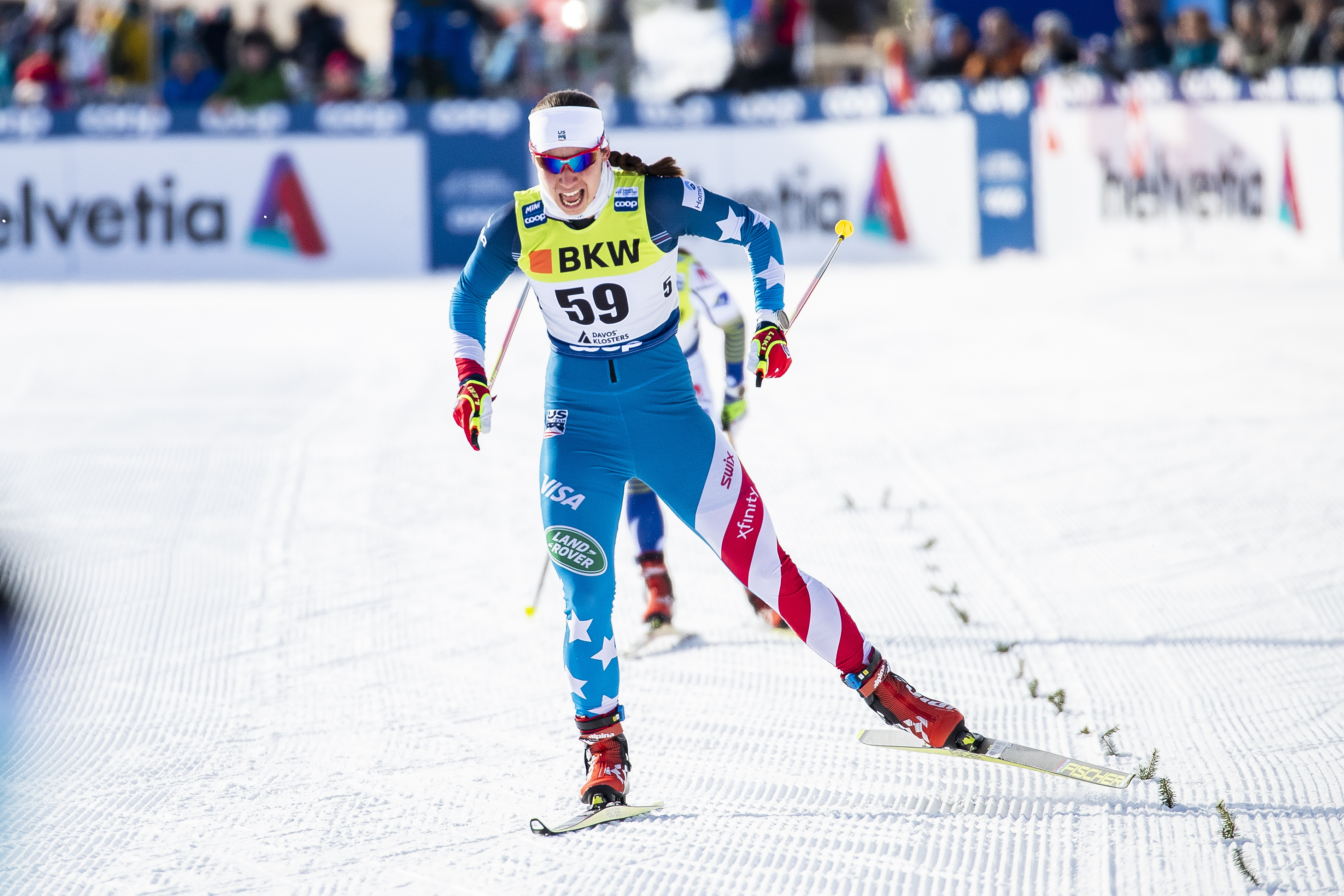
    Diggins commented on the information she received from coaches on course and how that influenced her strategy.

    “It was nice to have the splits on course because this is such a hard course to pace, and I knew it was going well from the numbers I was getting during the race. It’s also super motivating when you hear you’re fighting for podium positions!”

    In order to get some rest before the Tour de Ski, Diggins will sit out next weekends sprint races in Planica, Slovenia.

    “I’ll stay in Davos the next two weeks training, and my family is coming over for Christmas so I’m very much looking forward to having quality time with them!”
    Another consistently strong performance by Sadie Maubet Bjornsen (9th) at the 10-kilometer skate race in Davos, Switzerland. (Photo: NordicFocus)

    Also finishing inside the top-10, Sadie Maubet Bjornsen crossed the line with the 9th fastest time of day, advancing from her 12th place finish last year in Davos. Her effort modeled perfect pacing; Maubet Bjornsen’s position in the field held steady with little variance and she skied her second lap with a 12 second negative split. 

    With consistently strong finishes throughout Period 1, Maubet Bjornsen is ranked 4th on the Overall World Cup list, trailing her teammate Diggins by 65 points.  

    Also racking up FIS points, the trio of Julia Kern, Hailey Swirbul, and Rosie Frankowski finished 19th (+1:49.1), 21st (+1:54.0), and 23rd (+1:58.5) respectively. 

    Kern moderated her effort in the first lap. The 22-year-old was ranked 48th at the 3 k checkpoint and 42nd at 5 k. By 8 k, she had skyrocketed into 21st, and she continued to chip away on the final descent. 

    Julia Kern powers over the line for a 19th place finish at the 10-kilometer skate race in Davos, Switzerland. (Photo: NordicFocus)

    In her post-race interview, Kern explains that she lucked into a ride from Sweden’s veteran athlete Charlotte Kalla, who pulled Kern along for 7 k then lost to the up-and-comer in a final sprint.

    Post-race interview with Julia Kern.

    World Cup Coach Matt Whitcomb on Kern’s day.

    Swirbul, who scored her first World Cup points with a 28th place finish in yesterday’s freestyle sprint, took a more balanced approach and skied well within the points throughout her race.

    Hailey Swirbul gets a congratulatory hug from Sadie Maubet Bjornsen after placing 21st at the 10-kilometer skate race in Davos, Switzerland. (Photo: NordicFocus)

    Growing up in Basalt, Colorado — neighbor to Simi Hamilton and Noah Hoffman’s hometown of Aspen — Swirbul was comfortable racing at altitude and expressed in her post-race interview that her confidence on the World Cup continues to increase as Period 1 wanes. 

    Post-race interview with Hailey Swirbul.

    Frankowski seemed to take the opposite approach. She was ranked 10th at the top of the first long climb at 3 k, 17th at the lap, sliding back to her noteworthy finish position in 23rd. Despite her descending position, she too negative split her race by a few seconds. 

    Rosie Frankowski finishing the 2019 Davos, Switzerland 10k skate. (Photo: NordicFocus)

    Today was Frankowski’s career-best World Cup finish and the first time inside the top-30 in a non-championship race. The APU athlete finished 24th in the 7.5/7.5 k skiathlon during the Seefeld World Championships and 21st in the 30 k classic in the PyeongChang Olympic Games. 

    “This was the first time I have scored world cup points, so it is really exciting for me, and a fun way to cap off my first time racing Period 1 of the World Cup before heading back to Minneapolis for Christmas,” emailed Frankowski. “Last week in Lillehammer in the skiathlon I was battling for top 30, and ended up 33rd, so it was fantastic to be inside the top 30 today.
    “I love racing in the mountains where the scenery is so pretty, and the sun is out, so I tried to just enjoy the race and look around a bit and enjoy how cool it was to be skiing in a beautiful place. I played my own cards, which is a very fast L3 pace for the first lap, and then tried to use my extra energy up in the second lap. I always struggle with downhill finishes and so I lost quite a bit of time in the final 2k, but I blame it on being a little person, and maybe doing a bit too many speed checks through the S-turn section. Regardless, I had wicked fast skis, awesome coaches and cheerers out there, and Christmas cheer to get me to the finish line.”

    Outside the top-30, Emily Nishikawa of Canada finished 35th (+2:15.2) followed by her teammate Dahria Beatty in 36th (+2:16.5). Caitlin Patterson (USST) finished 39th (+2:22.6). Rosie Brennan did not start. 

    Full Results

  • Johaug Wins Davos 10 k Skate; Diggins Fifth and Brennan Sixth for the U.S.

    Johaug Wins Davos 10 k Skate; Diggins Fifth and Brennan Sixth for the U.S.

    The women’s podium from the 2018 World Cup 10 k freestyle individual start in Davos, Switzerland. Therese Johaug (center) of Norway won, teammate Ingvild Flugstad Østberg (left) was second, and Krista Pärmäkoski (right) of Finland was third. (Photo: Fis-Ski.com screenshot)

    Coming off a two-season hiatus from the World Cup for having a banned steroid in her system, Norway’s Therese Johaug has come back onto the distance race stage with time checks and results showing no remorse. This is not to say that Johaug’s reentry to the sport comes with arrogance. But it is to highlight that, on course, her level of control in the early season World Cup distance events has been dominant. Johaug has won all five World Cup distance events thus far. Her string of first places is a way of saying she’ll let the results speak for themselves and her dominance seep into the minds of those who want to fight for second and third place.

    Sunday was yet another win for Johaug. The up-tempo skier won the 10-kilometer freestyle individual start in Davos in a time of 26:06.9 minutes. She led the race at every intermediate time checkpoint.

    buy vancomycin online

    It was Johaug’s 81st World Cup podium. She trails only Norway’s legend Marit Bjørgen who won 99 World Cup podiums during her career.

    The second place finisher on Sunday, Johaug’s teammate Ingvild Flugstad Østberg, had the benefit of starting two places behind the eventual race winner: Johaug started in bib 36, Østberg in bib 38.

    Through the 5 k lap mark, Østberg was able to keep Johaug’s gap no bigger than 10 seconds. On the second lap’s long climb, Østberg only lost a handful of seconds. Her finishing time of 26:19.0 minutes was 12.1 seconds behind Johaug.

    For Østberg, it was her third distance podium in succession after placing second in Lillehammer’s 10 k classic pursuit, and third in Beitostølen’s 15 k freestyle individual start race.

    Johaug leads the World Cup overall with a perfect score of 600 points. Østberg sits in second, with a 149 point deficit.

    Finland’s Krista Pärmäkoski placed third on Sunday, 19.2 seconds back. It was Pärmäkoski’s first podium of the season. She currently is ranked fourth overall on the World Cup.

    Jessie Diggins during the 2018 10 k skate in Davos, Switzerland. Diggins placed fifth for her best result for the season. (Photo: Reese Brown/U.S. Ski Team)

    The U.S. placed two skiers in the top-10. Jessie Diggins placed fifth and Rosie Brennan sixth.

    For Diggins, it was her best result of the season after her eighth place in Beitostølen’s 15 k skate.

    “For me period 1 is a building phase, and it’s a really long season, and every single year I always build into period 1,” Diggins said in a phone call. “And I have to remind myself that I do this for me and that I follow a plan that has worked every other year, so I just have to remember that I will be in the right shape when it’s time. And for me, period 1 is not that time. So I’m really happy that it’s been trending positive.”

    Last season, after the Davos distance race, Diggins was eighth overall on the World Cup. Post-Sunday’s race, Diggins sits 13th overall and eighth in the distance cup standings.  

    The building phase of her season set up a solid foundation on Sunday. Her pace was consistent and only placed her 15.8 seconds out of third at the halfway point. She ended up 1:01.1 minutes behind Johaug at the finish.

    “I think that technically, I was really proud of my race today because of the way I skied,” Diggins said of her on course sensations. “It’s hard on a course like this to not go out guns blazing and just charge and then totally flood. Because that’s when I think you can lose so much time. For me, I was just so focused on trying to ski with a strong core and efficient, long-gliding v2 and I was just happy with it because it’s a really hard course to pace, and of course, you’re never sure if you nailed it or not.”

    With a two week break from racing, Diggins will be training in Seefeld, Austria during the race respite. Next up on the Diggins race schedule is the Tour de Ski (TdS). She placed third overall in the TdS last season, a historic mark for an American. Although she has ambitions at the TdS, Diggins also clarified that it remains a piece in the building-form puzzle. In-form or trending towards the sharp end of fitness, Diggins understands the possibility for more positive outcomes on the result sheet are more palpable as the season progresses.    

    “For me, I feel like period 1 and the Tour are really crucial building blocks for the season ahead, so I’m looking to take really good care of myself and just like get after it in the Tour. I do think that parts of a season are building blocks where you recognize that maybe you’re not in top form, and that’s on purpose because of the training load you’re carrying in. So you want to do the best you can with what you have. You’re not setting unrealistic expectations that might set you up to be bummed out. For me being like ‘I want to win Kuusamo 10k Classic’ would be an unrealistic expectation from myself. So I think that the Tour, yes, I would like to get a podium in the Tour, obviously, like I think that’s a good event for me, for my strengths, I really, really like it.”

    Rosie Brennan (bib 48) on her way to an individual career best on the World Cup with a sixth place in the 2018 Davos, Switzerland 10 k skate. (Photo: Reese Brown/U.S. Ski Team)

    Seeing Diggins steadily improve this season is no surprise. That has been her blueprint for success in the past. Arguably the biggest surprise in total on the women’s World Cup is Brennan’s success.  

    Brennan placed sixth (+1:04.9) on Sunday for her best career individual World Cup result.  

    “I just really wanted to feel good racing again and to enjoy it again,” Brennan said in a call. “I was just so miserable last year, and it was it hard decision to know if it was even worth it to continue on if I could find not only fun in racing again but also good form and just good race feelings.”

    Brennan’s struggle with fatigue and recovery soured her 2017-2018 season. Her down season resulted in her not being renominated to the U.S. Ski Team. What is clear now is that Brennan has found herself in an unprecedented place. Ranked 11th in the World Cup distance standings, Brennan was able to savor her Sunday in Davos.

    “Today was definitely the most fun race I’ve had all period, so I’m leaving period 1 on a high note, there’s not much more I could ask for, so it’s been great,” Brennan said.

    Her current high note has not allowed her to lose sight of managing her long-term energy and goals. Brennan will not race the TdS and will return to the U.S. for a training block.  

    “I had made that plan before the season started, and obviously with good results, it became a very difficult decision,” Brennan said of deciding to forgo the TdS. “But given how late World Champs is in the season this year, I really wanted to make sure that I had enough training under my belt to make it to World Champs, so I’ve decided to stick with the plan.”

    Currently, Brennan has not automatically qualified for World Championship team selection. She’ll have to remain in the top-50 of the distance standings before the selection period for the team ends.

    “The selection ends the second-to-last day of the Tour, and the Tour is only half points,” Brenna explained. “So I feel confident that I will remain in the top-50. So that helped make the decision easier. I have no pressure to race anything, so I’m just going to focus on training and keeping good fitness through the rest of the season.”

    Also for the U.S., Caitlin Patterson placed 38th (+2:22.5) and Kelsey Phinney 65th (+4:02.1). Sadie Bjornsen did not start and according to U.S. coach Matt Whitcomb, that decision was part of her pre-determined race schedule.

    Canada’s Emily Nishikawa stormed into the top-30 in only her second World Cup start of the season to place 23rd (+1:47.6). Cendrine Browne(CNST) was 44th (+2:28.8).

    For Nishikawa, the result ties her career best on the World Cup. She placed 23rd in a 2015 10 k classic in Lahti, Finland. In an email, Nishikawa explained that living in and training in Canmore mitigated some of the altitude effects of racing in Davos. During her race, she was caught by Diggins around 7 k.

    “I hung on as long as I could with [Diggins] and tried to follow her fast pace through top section,” Nishikawa wrote “Other than that I skied alone for the race.”

    Racing continues on the World Cup on December 29, for the TdS’s opening stage skate sprint.

    Results | Distance Standings | Overall World Cup Standings

  • Sunday Rundown: Davos, Canmore, Hochfilzen (Updated 2x)

    Sunday Rundown: Davos, Canmore, Hochfilzen (Updated 2x)

    The women’s podium from the 2018 World Cup 10 k freestyle individual start in Davos, Switzerland. Therese Johaug (center) of Norway won, teammate Ingvild Flugstad Østberg (left) was second, and Krista Pärmäkoski (right) of Finland was third. (Photo: Fis-Ski.com screenshot)

    FIS World Cup Davos, Switzerland  10k/15k Freestyle Individual Start

    Women’s Report | Men’s Report

    On Sunday, the final day of racing on the World Cup before a two-week break prior to the start of the Tour de Ski, the early season trend for women’s distance skiing continues. Norway’s Therese Johaug won the 10-kilometer freestyle individual start in Davos in a time of 26:06.9 minutes. She led the race at every intermediate time checkpoint.

    The only difference with Sunday’s distance narrative was Johaug’s margin of victory. Teammate Ingvild Flugstad Østberg placed second 12.1 seconds back. Krista Pärmäkoski of Finland placed third (+19.2).

    The U.S. Ski Team’s Jessie Diggins popped a season-best fifth place, crossing the line 1:01.1 minutes back. Also for the U.S. and posting a career-best World Cup finish was Rosie Brennan in sixth (+1:04.9).

    Also for the U.S., Caitlin Patterson placed 38th (+2:22.5) and Kelsey Phinney 65th (+4:02.1).

    Canada’s Emily Nishikawa stormed into the top-30 in only her second World Cup start of the season to place 23rd (+1:47.6). Cendrine Browne (CNST) was 44th (+2:28.8).

    Women’s Results

    In the men’s 15 k skate, Russia’s Evgeniy Belov won in 35:52.5 minutes. It was the Russian’s first career individual World Cup win.

    Over the duration of three laps on the up and then down 5 k loop, Belov only outdistanced second-place skier Maurice Manificat of France by a meager 0.9 seconds. Third place went to Norway’s Martin Johnsrud Sundby who finished 4.5 seconds back.

    In another tight men’s race, only 10.6 seconds differentiated first from fifth place. Russia’s Denis Spitsov was fourth (+7.5), and Norway’s Chris André Jespersen fifth (+10.6). Only 1:07.7 minutes separated 30th place from first.

    Alex Harvey of Canada was the best placed North American in 26th (+1:00.9). Teammate Len Valjas (CNST) was 62nd (+2:13.2), and Andy Shields 76th (+2:52.0).

    David Norris (APU) was the best placed American in 61st (+2:12.6). Adam Martin (CGRP) finished in 67th (+2:20.5), Scott Patterson of the U.S. Ski Team (USST) 72nd (+2:49.0), Simi Hamilton 77th (+2:54.3), and Kevin Bolger 92nd (+3:55.3).  

    Men’s Results


    ***

    Canmore NorAm and U23/JW Qualifier

    The third day of the Canmore NorAm weekend featured mass start classic racing.

    In the men’s race, NorAm leader Bob Thompson (TBay) emerged the winner of the 30km in 1:18.40.2 hours after beginning the 8th and final lap in a group of four. Jack Carlyle (AWCA) placed second, 0.3 seconds behind. It had been almost two years to the day since his last podium at this level.

    Russell Kennedy (Team R.A.D.) placed third, 8.6 seconds back, after winning the 15km skate individual start race on Saturday.

    In the junior ranks, Samuel Hendry (Team R.A.D.) was dropped on the final lap, finishing 22.0 seconds in back of the day’s winner as the top junior. Antoine Cyr (CNST) fell back on the 7th lap but held on for 5th overall and top U23 at 1:24.7 back. Remi Drolet (Black Jack) was the second junior in 6th, 0.3 seconds behind Cyr.

    Thompson is the COC leader for Period 1, which should qualify him for the Tour de Ski and World Cup period 3.

    Cyr should be automatically to the U23 team for the Lahti, Finland World Juniors when the High Performance committee meets Sunday afternoon to confirm final selections. As both Hendry and Drolet had already qualified, the committee will be interpreting rules to determine the remaining junior men going to Lahti. Team ULLR’s Tom Stephen (14th today, 3:29 behind) and Xavier McKeever (16th at 5:07.4) will be among the athletes considered for the final junior spots.

    In the women’s 15km, national team members Dahria Beatty and Katherine Stewart-Jones gained a gap on the shorter first lap of the race and were never reeled in. Beatty won the sprint for first crossing the finish in 42:55.8 minutes, with Stewart-Jones 1.8 seconds back.

    Beatty has already met the criteria for World Cup period 2 and 3 starts as COC leader, which means a Canadian woman could possibly be racing the Tour de Ski.

    First year senior Hannah Mehain (Telemark) finished alone in third, 1:55.6 minutes back, after dropping the original chasing pack to take the top U23 spot on the day. Frédérique Vézina (CNEPH) started slower but finished strong to take 4th overall, 2:26.7 behind. Sadie White was 5th at 2:29.7 minutes for the second U23 place.

    Jasmine Drolet was 6th overall at 2:38.0 behind to take the top junior position and join her brother Remi on the Lahti trip.

    Live results [https://zone4.ca/race/2018-12-16/f31c8bac/2018-haywood-noram-world-jr/results/]

    Weekend results [https://zone4.ca/event/18b91492-fd6d-11e8-a07c-0afc046f7944/]


    ***

    IBU World Cup Hochfilzen, Austria women’s 4 x 6 k relay / men’s 4 x 7.5 k relay

    In the women’s 4 x 6 k relay on Sunday, Italy won in a time of 1:10:58.7 hours after using three spares. Italy’s team consisted of Lisa Vittozzi, Alexia Runggaldier, Dorothea Wierer, and Federica Sanfilippo.  

    Sweden placed second (+8.4) using eight spares. Linn Persson, Mona Brorsson, Emma Nilsson, and Hanna Öberg raced the four legs.

    Anais Chevalier, Julia Simon, Celia Aymonier, and Anaïs Bescond placed third for France finishing 11.8 seconds back while using nine spares.

    The U.S. team of Joanne Reid, Susan Dunklee, Clare Egan, and Deedra Irwin placed 13th (+3:39.1) using nine spares and skiing one penalty loop.

    Canada’s women’s team of  Megan Tandy, Megan Bankes, Nadia Moser, and Rosanna Crawford placed 16th (+5:19.3) with two penalties and using 13 spares.

    Women’s relay results

    The men’s 4 x 7.5 k relay was won by Sweden’s Peppe Femling, Martin Ponsiluoma, Torstein Stenersen, and Sebastian Samuelsson in 1:16:10.6 hours using five spares.

    Lars Helge Birkeland, Henrik L’Abee-Lund,Tarjei Bø, and Vetle Sjåstad Christiansen of Norway placed second (+3.6) using seven spares. For Germany, Simon Schempp, Johannes Kuehn, Arnd Peiffer, and Doll Benedikt were third (+28.8) with a single penalty and using six spares.

    The U.S. team of Leif Nordgren, Sean Doherty, Travis Cooper, and Jake Brown placed 12th (+2:33.6) using 10 spares.

    Canada’s Scott Gow, Brendan Green, Jules Burnotte, and Nathan Smith placed 20th (+5:13.0) with three penalties and using 14 spares.

    Men’s relay results


  • Caldwell Claims Second to Nilsson in Davos Freestyle Sprint

    Sophie Caldwell (bib 1) of the U.S. Ski Team racing on Saturday during the women’s 1.5-kilometer freestyle sprint in Davos Switzerland. (Photo: Reese Brown/ U.S. Ski Team)

    DNS. It’s a rare acronym to crop up in the results portion of Sophie Caldwell’s FIS database. But after battling a cold for the first few weeks of the 2018/2019 season, Caldwell did not start (DNS) the Lillehammer freestyle sprint and also chose to sit out the women’s relay last weekend.

    By this Saturday in Davos, Switzerland, the 28 year old’s decision to rest and not race seemed to have paid off. She sprinted to a second place in the women’s 1.5-kilometer Davos freestyle competition, finishing just behind Sweden’s sprint superstar, Stina Nilsson. Earlier in the day, Caldwell also won the women’s qualifier in a time of 2:46.2.

    “I think when you lay down a really fast qualifier, it gives you confidence moving forward,” U.S. World Cup head coach, Matt Whitcomb said during a phone conversation after the race.

    “I was coming off a long bout of illness, so I was honestly just really happy to be racing again and didn’t have any expectations going into the day,” Caldwell wrote in an email to FasterSkier.”I think when you’ve had a period of illness or feeling down, it’s important to set smaller goals to gain your confidence back, so I was really grateful to be feeling healthy again and told myself I would be happy to qualify today. I was very pleasantly surprised when I won the qualifier and continued to feel great throughout the day, so the day exceeded any expectations I had going into it.”

    Sophie Caldwell (bib 1) and Stina Nilsson (bib 3) during the women’s 1.5-kilometer freestyle sprint final on Saturday in Davos Switzerland. (Photo: Reese Brown/U.S. Ski Team)

    After qualifying in first, Caldwell advanced to the first quarterfinal which she won in a time of 2:41.97. Moving on to the semifinal, Caldwell once again crossed first in a time of 2:42.28. For both her quarterfinal and semi, Caldwell remained positioned in third to fourth through the first climb and descent and second major climb of her heats, before making her move in the final descent.

    “She decided in both her quarters and semis and final to lay back a little bit mid-pack try and follow a little bit and then pounce as the pack tired out intending to have bit more energy herself and that went to plan perfectly,” Whitcomb said. “Really proud of her tactics today.”

    “I really like how technical and fast this course is, so after I had a good qualifier, I knew I could be really confident in my ski speed and finishing stretch, so I just tried to ski smart the rest of the time, conserving energy when I could and moving into a good position up the hill the second time,” Caldwell said.

    In the final, it was Nilsson along with Slovenia’s Katja Visnar setting the pace from the gun. Caldwell, who had started in lane two, slotted herself to the inside of the final group in third through the first climb.

    As the field approached the crest of the course’s first major uphill, Finland’s Krista Pärmäkoski made a decisive move to the front. She maneuvered to the left of the group, jetting from fourth to first. Caldwell continued to click away, cornering to the inside to maintain a draft off Visnar and Pärmäkoski. Just to Caldwell’s left, was Nilsson.

    As the group swept into the course’s first descent, the skis of the U.S. and Sweden seemed to outpace the rest. Heading into the following course’s flatter V2 section, Nilsson had snuck around Visnar and Pärmäkoski to take the lead. Caldwell shadowed her move and the two began to push the pace. It was Sweden’s top sprinter being chased down by Caldwell; the remainder of the sprint final’s field chasing down the U.S.

    Neither Caldwell or Nilsson let up. The two pulled away in the final climb, with Nilsson holding a slight gap over Caldwell. As the racers began the final descent on course, almost two meters separated Caldwell from the next closest skier, Sweden’s Maja Dahlqvist.

    Rounding into the final 100-meters, Nilsson maintained her lead on Caldwell and crossed ahead of the American for first in a time of 2:41.34. Caldwell finished 0.72 seconds behind for second place.

    “I was feeling pretty good on the climb, but I knew I had fast skis and felt really good in the finishing stretch, so my goal was to position myself in 2nd or 3rd at the top of the last hill to take advantage of the draft, corner, and finish stretch,” Caldwell wrote in an email. “Unfortunately, Stina got away from me a bit on the climb, but I tried to push as hard as possible to close the gap and am of course thrilled with 2nd!”

    The win is the first of the season for Nilsson. She won the Davos freestyle sprint in December last year, besting American Kikkan Randall (now retired) and Norwegian Maiken Caspersen Falla. Falla placed fourth in her quarterfinal and did not advance to the semis. Nilsson now has 13 individual World Cup sprint victories and is currently ranked first in the sprint standings with 186 points, ahead of Dahlqvist in second with 140 points and Russia’s Yulia Belorukova in third with 119 points. 

    2018 Davos, Switzerland women’s sprint podium. Sweden’s Stina Nilsson (center) placed first, Sophie Caldwell (left) of the U.S. was second, and Maja Dahlqvist (right) also of Sweden was third. (Reese Brown/U.S. Ski Team)

    Claiming Saturday’s third and final podium position was Dahlqvist, who crossed 2.60 seconds behind Nilsson. The podium is Dahlqvist’s second World Cup podium this season. She placed second in the FIS classic sprint opener in Kuusamo, Finland. Prior to this year, Dahlqvist has had one other individual World Cup top three performance, that being her second place finish in last season’s Dresden freestyle sprint.

    Finishing in fourth on Saturday was Russia’s Natalia Nepryaeva (+3.98). Following Nepryaeva was Visnar in fifth (+4.34) and Pärmäkoski in sixth (+11.16).

    Rounding out the top-ten was Swiss skier Nadine Fähndrich in seventh, Evelina Settlin in eighth, Lotta Udnes Weng in ninth and Ingvild Flugstad Østberg in tenth.

    The U.S. placed four women total in the top-30, with Caldwell’s second place performance followed by Sadie Bjornsen in 14th, Ida Sargent 21st, Jessie Diggins 26th, and Rosie Brennan 29th.

    Sadie Bjornsen of the U.S. Ski Team during the third quarterfinal of the women’s skate sprint in Davos, Switzerland. (Photo: Reese Brown/U.S. Ski Team)

    Both Bjornsen and Brennan advanced to the third quarterfinal, with Bjornsen having qualified in 10th and Brennan 28th. Bjornsen had led the first climb and descent of her quarterfinal before Sweden’s Hanna Falk took over the pace as they headed into the course’s second climb.

    Bjornsen held onto second through the descent before getting passed by Nepryaeva in the finishing stretch. She finished the quarterfinal in third behind Falk and Nepryaeva.  Bjornsen missed advancing by 0.13 seconds. Brennan crossed in sixth.

    In the first quarterfinal along with Nilsson, Sargent led the group through the first uphill. However, by the second climb on course, Sargent had dropped back to sixth and eventually crossed her quarterfinal in fifth.

    Ida Sargent locked in during her World Cup quarterfinal in Davos, Switzerland. of the U.S. Ski team during the qualifier of the women’s skate sprint in Davos, Switzerland. (Photo: Reese Brown/U.S. Ski Team)

    In the fourth quarterfinal, an early fall put Diggins out of contention for advancement to the semis. In the first straightaway, the American’s left ski collided with the pole of Russian ski racer, Natalia Matveeva, causing Diggins to crash.

    “Traffic just sort of closed in on her,” Whitcomb said. “Just a race incident, the kind of the thing you saw happen in some of the other heats.”

    In the second semifinal, a collision between Pärmäkoski and Norway’s Tiril Udnes Weng caused the Norwegian’s left ski to fall off midway through the race.

    “Unfortunately in Davos, even Jessie can’t recover the 30-meters required to catch back up to the group,” Whitcomb added. “It’s too delicate a venue at altitude.”

    Results: Qualifier | Final

    Sophie Caldwell (l) and U.S. Ski Team teammate/boyfriend Simi Hamilton after Caldwell placed second in Saturday’s 1.5-kilometer freestyle sprint on Saturday in Davos, Switzerland. (Photo: Reese Brown/U.S. Ski Team)
  • Klæbo Takes Davos Sprint for First Win of the Season; Simi Hamilton in 12th

    Klæbo Takes Davos Sprint for First Win of the Season; Simi Hamilton in 12th

    Johannes Høsflot Klæbo of Norway down the finishing stretch in Davos, Switzerland. He won the day’s skate sprint while Italy’s Federico Pellegrino (green suit) was second. (Photo: Fischer/Nordic Focus)

    As seems fitting for all things Davos, Switzerland: the racers enjoyed a bluebird day for the 1.5-kilometer freestyle sprint on Saturday. And just when we thought Johannes Høsflot Klæbo of Norway might be too spent from a year of media coverage and big-effort racing, he scored his first win of the season in gorgeous Davos.

    He began the day at full-throttle in the men’s qualifier, placing first with a time of 2:22.39 minutes. Lucas Chanavat of France qualified second (+0.36) and Federico Pellegrino of Italy qualified third (+1.76).

    Klæbo continued his winning streak throughout the heats, winning his quarterfinal, and semi. He finished the day with an overall win in the final, finishing in 2:20.44 minutes. This was Klæbo’s first win of the season. He qualified first in the 1.6-km skate sprint in Lillehammer, Norway two weeks ago, but he finished in 11th overall. One thing was for certain in Davos: Klæbo was skiing with confidence, snappiness, and some of the flair he’d been missing this season. 

    On the first climb of the final, Klæbo and Chanavat duked it out for the lead position. Pellegrino, skiing more conservatively at the outset, started in the back of the pack but was able to work the first corner to his advantage. By the top of the hill, he was sitting in third place. As the skiers lapped through and skated around the tight right-hander before the final climb, Kælbo was in stalk and hunt mode. He punched up the final climb and gapped the field on the downhill, sprinting to the finish ahead of Pellegrino who finished second (+.39).

    “That’s what we train for the whole spring and all summer – so now I’m where I want to be. It’s a fantastic feeling,” Klæbo told Norwegian broadcaster NRK according to a translation. Klæbo also told NRK he has not confirmed his plans to race the Tour de Ski (TdS) and will make that decision in the coming days. 

    With the win on Saturday, Klæbo joins Norway’s Eirik Brandsdal and Petter Northug with nine wins each in World Cup individual sprint wins. The three all sit fourth all-time for World Cup sprint wins among Norwegian men.

    For Pellegrino, it was his second podium of the season. He won the 1.6km skate sprint in Lillehammer. Pellegrino has won 11 freestyle sprint World Cups in his career which is the men’s record. That win total is topped by only Kikkan Randall who won 12 freestyle sprints, and Marit Bjørgen who won 24 freestyle sprints during their careers.

    Despite his skate sprint pedigree, Pellegrino admitted he feels slightly old among the sprint scene’s young skiers.

    “I think I am starting to be a bit old,” Pellegrino told the International Ski Federation (FIS). “This was my 10th race here in Davos and always passed the qualifications. I am really proud of that until now and I hope to do 10 more years and maybe I’ll beat the younger then.”

    Babtiste Gros of France finished third (+1.40), barely out sprinting teammate Chanavat (+1.45) in the final. This was Gros’s first podium of the season and his fifth career podium.

    Simi Hamilton of the U.S. Ski team zeroing in during the fifth heat Saturday in the 1.5-kilometer freestyle sprint in Davos, Switzerland. Hamilton placed 12th overall. (Photo: Reese Brown/U.S. Ski Team)

    Simi Hamilton(USST) was the only North American that qualified for the men in the Davos sprint. Hamilton was 17th (+4.76) in the qualifier. In the fifth heat, Hamilton was second to Joni Maeki of Finland to advance to the semis. A bit spent from the quick-turnaround after the fifth heat to the second semi-final, Hamilton placed sixth in his semi-final.

    buy naltrexone online

    “Davos, it’s always been a good place for me, having grown up at 8,000 ft. I don’t feel like it’s super high here at 5,000 feet,” Hamilton told FasterSkier in a call. “I think it is still tough for everyone, but also for me when I haven’t been above 1,000 ft for the last 6 weeks, it’s still a shock to the system.”

    Hamilton also spoke about his short recovery time from the fifth heat to the semis, and why he chose a later heat.

    “Obviously you want to choose one of the earlier heats so you have a longer turnaround time between the quarters and the semis,” Hamilton added. “But, my main goal today was to ski into the semis. It’s always the big goal to be in the final and be on the podium, but I think setting the short-term, realistic goal is also important. So today, having not been at altitude for a while and not feeling super super good, I set the goal of just being in the semis. With that in mind, I chose heat five, knowing that would set me up best for getting into the semis, but probably wouldn’t result in me feeling really good in the semis. So I was kind of expecting that, but just went out and raced as hard as I could and completely ran out of gas in that semi-final and felt pretty crappy on that second lap. ”

    US Ski Team Coach Matt Whitcomb also commented on Hamilton’s 12th place in a call.

    “Nice step forward for Simi today,” Whitcomb said. “Not exactly what we need on a podium day, but it was still a step forward. He felt very controlled in his quarterfinal and was tactically sound today, made really good moves. It was nice to see him in the semifinals, it’s positive feedback for him. But I’m really looking forward to seeing him in the first few ski sprints in the Tour de Ski.”

    Kevin Bolger (USST) was the second-best American, finishing 31st and barely missing the cut off for the heats. This is Bolger’s best individual result so far this season.

    In an email to FasterSkier, Bolger explained he is feeling better energy in his first full World Cup season as a new member of the U.S. Ski Team.

    Kevin Bolger of the U.S. Ski Team during the skate sprint qualifier in Davos, Switzerland. Bolger just missed the heats by qualifying in 31st.  (Photo: Reese Brown/U.S. Ski Team)

    “The qualifier was a fast 2 lapper, no room for error,” Bolger wrote. “Unfortunately, I ended up 31st just 0.02 out from qualifying, but it’s a step in the right direction. I’m moving forward and that’s a huge confidence booster going into Christmas break, and the Tour.”

    Bolger also noted he will be racing in tomorrow’s 15 k skate individual start.

    “It’ll be a burner, pretty tough course especially at altitude but I’m excited. I feel like my distance skiing is moving in the right direction as well, I’ll be using today’s result as fuel for tomorrow, but looking forward to getting out there and putting together a good race, should be a fun day in the sun!”

    Alex Harvey was the best placed Canadian, placing 37th overall. Harvey, who in the past has explained he does not prefer higher altitude courses, has placed in the top-30 twice in Davos sprints: a ninth place in 2011, and a 23rd in 2017. Lenny Valjas, in his first World Cup of the season, was 53rd. Andy Shields finished in 60th. No other Canadians were entered.

    Racing continues tomorrow for the men with a 15 k skate individual start.

    Men’s Results


  • Saturday Rundown: Davos, Hochfilzen and Sovereign (Updated)

    Saturday Rundown: Davos, Hochfilzen and Sovereign (Updated)

    Bob Thompson (304) of NTDC Thunder Bay leading Sun Valley’s Jack Hegman (307) and Patrick Stewart-Jones (317) of the AWCA during their quarterfinal of the NorAm men’s 1.3 k classic sprint on Saturday at Sovereign Lake near Vernon, B.C. (Photo: Peggy Hung)

    NorAm/SuperTour (Sovereign Lake near Vernon, British Columbia): Classic sprints

    On the opening day of the NorAm Continental Cup series in Canada (which doubled as a U.S. SuperTour), American Kaitlynn Miller of the Craftsbury Green Racing Project (CGRP) started Saturday with a nearly three-second win in the classic-sprint qualifier at the Sovereign Lake Nordic Centre, then went on to win her quarterfinal and semifinal before topping the final as well.

    The women’s 1.3 k classic sprint podium and top five at the first NorAm of the season on Saturday at Sovereign Lake near Vernon, B.C., with (from left to right) Caitlin Patterson (CGRP) in second, Kaitlynn Miller (CGRP) in first, Hannah Halvorsen (APU/USST) in third, Kelsey Phinney (SVSEF) in fourth, and Liz Guiney (CGRP) in fifth. (Photo: Peggy Hung)

    Miller was the fastest women’s qualifier by 2.87 seconds on the 1.3-kilometer course with a time of 2:59.39. Ultimately, she won the final in 2:57.53, 0.93 seconds ahead of her teammate Caitlin Patterson in second and 2.59 seconds clear of the third American on the podium, Hannah Halvorsen of Alaska Pacific University (APU) and the U.S. Ski Team (USST) D-team, in third place.

    Halvorsen previously qualified third behind Kelsey Phinney, of the Sun Valley Ski Education Foundation (SVSEF) in second. Phinney finished fourth in the final (+2.85), while a third Craftsbury skier, Liz Guiney placed fifth (+3.53). The lone Canadian in the six-woman final, Sophie Carrier-Laforte of the Pierre-Harvey National Training Centre (CNEPH) placed sixth (+4.38).

    Thompson Fends Off Five Americans

    Of the six racers in the men’s 1.3 k freestyle sprint final, five of them were American. Bob Thompson, of the Thunder Bay National Team Development Centre (NTDC), bested them all for the win in 2:29.31, just 0.03 seconds ahead of Ben Saxton, of the Stratton Mountain School (SMS) Elite Team, in second place. Cole Morgan (SVSEF), the qualifying winner who had so far dominated all of his heats, ended up third overall, 0.48 seconds behind Thompson.

    Sun Valley and APU each had two athletes reach the men’s final with Jack Hegman (SVSEF) taking fourth (+0.51), and APU’s Reese Hanneman and Tyler Kornfield placing fifth (+7.75) and sixth (+7.9), respectively.

    To start the day, Morgan posted the fastest men’s qualifying time in 2:31.00, while last weekend’s SuperTour skate sprint winner Nick Michaud, of the Bridger Ski Foundation (BSF), qualified in second, 0.78 seconds back. Americans took the top-three qualifying spots with Logan Hanneman (APU) in third (+1.59), while Thompson was the top Canadian qualifier in fourth (+2.34).

    Morgan won both his quarterfinal and the first semifinal to advance to the final, along with Thompson who placed second in that semifinal (and placed second to Hegman in the quarterfinals). Saxton won the second semifinal (after finishing second to Logan Hanneman in the quarterfinals) and Kornfield was second behind Saxton in that semifinal to automatically advance to the final. Reese Hanneman and Hegman made it to the final as lucky losers after placing third and fourth, respectively, in the first semifinal.

    Live results

    Qualifier results

    ***

    IBU World Cup (Hochfilzen, Austria): Men’s and women’s pursuits

    Men’s report

    Norway’s Johannes Thingnes Bø notched his second-straight win in Hochfilzen after Martin Fourcade of France missed three on the final shooting stage of the men’s 12.5 k pursuit on Saturday. Bø, who started the race 12 seconds ahead of Fourcade in second, cleaned the final standing stage to leave the range nearly a minute ahead of Slovenia’s Jakov Fak in second. Meanwhile, Fourcade, who had been skiing in first just ahead of Bø before the last stage, dropped 1:19 minutes back to fifth.

    Norway’s Johannes Thingnes Bø (1) heading out of the start, 12 seconds ahead of the second starter, France’s Martin Fourcade (yellow bib), on Saturday in the IBU World Cup men’s 12.5 k pursuit in Hochfilzen, Austria. (Photo: IBU/biathlonworld)

    While Bø skied the win in 36:41.1 minutes and Fak, the third starter, finished 58.8 seconds later in second place, Fourcade made up two places on the final loop to place third (+1:10.0) after passing Germany’s Simon Schempp and Russia’s Maxim Tsvetkov.

    Schempp settled for fourth (+1:10.5), and Bø’s older brother, Tarjei Bø, passed Tsvetkov as well to claim fifth (+1:11.9), while Tsvetkov finished sixth (+11:12.3).

    On another snowy afternoon in Hochfilzen, Johannes Bø had three penalties, two of which came in the first stage (2+0+1+0). Fak was one of four men in the race with just one miss (0+0+1+0) — no one cleaned — while Fourcade missed five (1+0+1+3). Schempp had four penalties (3+1+0+0) but held onto his starting position in fourth, Tarjei Bø improved from 14th at the start to fifth with just two misses (1+0+1+0) and Tsvetkov raced up from 20th to sixth with a single miss (1+0+0+0).

    American Sean Doherty tied his second-best World Cup result in 17th (+2:12.8) after starting 23rd and 1:39 out of first. He had two penalties (1+0+1+0).

    Canada’s top finisher, Nathan Smith placed 31st (+3:02.2) after starting 19th and missing three shots (1+1+0+1). His teammate Brendan Green rose to 33rd (+3:15.7), up from 52nd at the start, with three penalties as well (1+0+1+1).

    Four Canadians qualified for the pursuit, with Scott Gow placing 48th (+5:08.4) with seven penalties (1+1+3+2). His younger brother Christian Gow crossed next in 49th (+5:13.7) after missing five (+5:13.7).

    The other American man in the race, Lowell Bailey placed 36th (+3:20.6), up from 53rd, with three misses (0+2+1+0).

    Kuzmina Gets First Win in Three Years

    Slovakia’s Anastasia Kuzmina cleaning one of two standing stages in the women’s 10 k pursuit at the IBU World Cup in Hochfilzen, Austria, en route to a 10-second win. (Photo: IBU/biathlonworld)

    In the women’s 10 k pursuit that followed, Slovakia’s Anastasia Kuzmina overcame a 22-second starting deficit to win her first race in three and a half years, shooting 19-for-20 (1+0+0+0) and finishing in 34:31.2. Kuzmina (the sister of Russia’s Anton Shipulin) started second behind Friday’s sprint winner Darya Domracheva of Belarus. Domracheva had a single miss as well in Saturday’s pursuit (0+0+1+0) but slipped to second after her penalty in the first standing stage, while Kuzmina cleaned the last three stages to take the win.

    Domracheva settled for third (+11.8) and Finland’s Kaisa Mäkäräinen rose to second (+10.2) after shooting 18-for-20 (1+0+0+1) and skiing the fastest course time to rise from her starting position in sixth.

    Italy’s Dorothea Wierer slipped one place to fourth (+51.6) after starting third and missing two (1+0+0+1), while Norway’s Marte Olsbu raced up from 13th to fifth (+58.2) with a single penalty (1+0+0+0). Ukraine’s Yuliia Dzhima improved from 20th to sixth (+1:08) with one miss as well (0+0+0+1).

    Canada’s Emma Lunder achieved her second-best career World Cup result in 27th (+2:31.6) after starting 42nd and cleaning three stages after missing one in the first prone (1+0+0+0). Her teammate Rosanna Crawford improved from 49th at the start to 39th at the finish (+3:44.3) with four penalties, one in each stage (1+1+1+1).

    The U.S. had one woman qualify for the race, Clare Egan, who finished 53rd (+5:21.6) with seven penalties (2+2+2+1).

    For the third and final day of World Cup racing in Hochfilzen, the men’s and women’s relays will be held Sunday.

    Results: Men | Women

    ***

    FIS Cross Country World Cup (Davos, Switzerland): Freestyle sprints

    Women’s report

    Men’s report

    The women’s skate sprint podium at Saturday’s World Cup in Davos, Switzerland, with Kikkan Randall (r) of the U.S. Ski Team in third place, Sweden’s Stina Nilsson (c) in first, and Norway’s Maiken Caspersen Falla (l) in second. (Photo: Reese Brown/US Ski & Snowboard)

    Kikkan Randall returned to the podium on Saturday in the first freestyle sprint of the 2017/2018 World Cup season, placing third in the women’s 1.5-kilometer skate sprint behind Sweden’s Stina Nilsson and Norway’s Maiken Caspersen Falla, respectively, in Davos, Switzerland.

    Americans made up half of the women’s final, with Jessie Diggins racing to fourth and Ida Sargent sixth, with Norway’s Ingvild Flugstad Østberg between them in fifth.

    Nilsson started the day by winning the qualifier in 2:51.71 minutes, while Østberg had the second-fastest qualifing time, 2.57 seconds back. Switzerland’s Nadine Fähndrich posted the third fastest qualifying time (+2.73), and for the U.S., Diggins qualified fourth (+3.37), Sargent fifth (+3.78), Randall sixth (+4.11), Sophie Caldwell ninth (+4.87), and Sadie Bjornsen in 11th (+5.38).

    Nilsson then won her quarterfinal and the first semifinal before outlunging Falla by eight-hundredths of a second for the final win in 2:47.99. Randall (who won her quarterfinal and advanced to the final as a lucky loser in third in the first semifinal) finished 2.53 seconds after Nilsson for third overall, and Diggins (who won both her quarterfinal and the second semifinal) was 4.41 seconds back in fourth. Østberg finished 5.62 seconds back in fifth, and Sargent crossed the line 14.49 seconds back in sixth.

    Caldwell placed eighth overall after winning her quarterfinal then placing fourth in the second semifinal, behind Diggins, Sargent and Germany’s Sandra Ringwald, respectively. Ringwald did not advance to the final, either, for seventh overall. Bjornsen placed 13th on the day after finishing third in her quarterfinal.

    Also for the U.S., Julia Kern (U.S. Ski Team D-team) finished in 57th in the qualifying round, 16.55 seconds out of first.

    Dahria Beatty was the top Canadian in 53rd (+15.53), followed by Katherine Stewart-Jones in 55th (+16.18) and Cendrine Browne in 64th (+18.27). 

    In the men’s 1.5 k skate sprint, Norway’s Johannes Høsflot Klæbo rocketed to his sixth-straight win in as many World Cup races this season, topping the qualifier in 2:23.10 (by 1.27 seconds over France’s Lucas Chanavat and 1.73 seconds over Italy’s Federico Pellegrino in third) then winning his quarterfinal and semifinal comfortably before capping the day with a victory in the final in 2:28.07. Pellegrino placed second in the final, 1.8 seconds back, and Russia’s Alexander Bolshunov tallied his third podium of the season in third place (+4.64). Finland’s Ristomatti Hakola placed fourth (+5.39), France’s Richard Jouve was fifth (+8.65) and Russia’s Gleb Retivykh was sixth in the final (+18.34).

    Americans Andy Newell and Simi Hamilton both qualified for the heats in 10th and 12th, respectively. Hamilton went on to place ninth overall after finishing second in his quarterfinal (behind France’s Renaud Jay) and fifth in the second semifinal (which Hakola won). Newell’s day ended in the quarterfinals, where he placed fifth, 2.44 seconds behind Klæbo, who won that heat. Overall, Newell was 21st.

    Canada’s Alex Harvey qualified for the heats in 21st and went on to place 23rd overall after finishing fifth in his quarterfinal, 1.14 seconds behind Retivykh in first.

    Also for Canada, Julien Locke missed qualifying in the top 30 by 1.07 seconds in 36th (+7.84). Russell Kennedy placed 48th (+9.39), Knute Johnsgaard was 52nd (+10.35), Jess Cockney 54th (+10.83), Devon Kershaw 63rd (+11.78).

    For the U.S., Erik Bjornsen finished 58th (+11.12) and Paddy Caldwell 108th (+24.04) in the qualifier.

    Results:

    Women’s final | Women’s qualifier

    Men’s final | Men’s qualifier

  • Nordic Nation: Wax-Truck Road Trip with Tim Baucom (While Andrew Morehouse Pilots)

    Nordic Nation: Wax-Truck Road Trip with Tim Baucom (While Andrew Morehouse Pilots)

    Not exactly planned, and on a whim, it’s the wax-truck road trip — otherwise known as the Bon Voyage episode.

    A full crew cab in the USST wax truck. Presumably on the way from Kuusamo, Finland, to Lillehammer, Norway. (Photo: Tim Baucom)

    Nordic Nation dialed up intrepid wax-truck driver and navigator … and U.S. Ski Team Wax Tech Tim Baucom to check in on the new wax truck’s first big Euro-trip. We caught up with Baucom on Day 1 of a three-day trip a few hours after the duo left Lillehammer, Norway, where last weekend’s World Cup races were held. The two techs were headed to Davos, Switzerland, site of this weekend’s World Cup.

    Waxing World Cup fast skis and backed up with a CDL is not their only gig: Tim Baucom (right) and Andrew Morehouse (left) play the Newell-Flowers wedding outside Bozeman, Montana. (Photo: Jeremiah and Rachel Photography)

    Baucom and Morehouse were responsible for $600,000 dollars of precious wax truck (that amount includes the taxes on the truck), as well as something like 600 pairs of skis.

    That’s a lot of XC schwag. And a lot of eventual ski cleaning. (See below.)

    USST wax techs go beyond the call of duty. Tim Baucom is responsible for Simi Hamilton’s and Ida Sargent’s skis throughout the season. Here, Sargent leaves a note for Baucom (with graphics) detailing the cleanup. (Photo: Tim Baucom)

    And just to be safe, we also dialed up Baucom on Day 2 of their three-day journey to Davos. It’s always a good idea to check back in — new pricey truck, irreplaceable skis and two of the finest wax techs on the circuit — who doesn’t want the whole package to be safe?

    Putting the CDL to good use: truckin’ along in the USST wax truck with the big rigs in Europe. (Photo: Tim Baucom)

    For the record, Baucom and Morehouse are safe, legit and well trained. Don’t believe Nordic Nation? Here’s online proof of their CDL’s.

    Listen to Baucom unbound.

    USST wax tech Tim Baucom testing wax and skis in the early a.m. in Lillehammer, Norway. (Photo: Zach Caldwell)

    (To subscribe to the Nordic Nation podcast channel, download the iTunes app. If you have iTunes, subscribe to Nordic Nation here.)

  • Shields Takes Road Less Traveled, Apart from Training Centre

    Shields Takes Road Less Traveled, Apart from Training Centre

    Canadian Andy Shields competing in the men's 10-kilometer freestyle race during Period 1 this year in Lillehammer, Norway. (Photo: Fischer/Nordic Focus)
    Canadian Andy Shields competing in the men’s 10-kilometer freestyle earlier this month in Lillehammer, Norway. (Photo: Fischer/Nordic Focus)

    At the start of last season, Canadian cross-country skier Andy Shields specified two goals on his personal blog: 1.) to be the NorAm leader and earn World Cup starts by 2016, and 2.) to race the Ski Tour Canada.

    Though several of his fellow Canadian competitors may have had similar ambitions, Shields was one of the few who lived them out. He emerged the 2015/2016 NorAm overall men’s winner, besting runner-up Kevin Sandau of the Alberta World Cup Academy (AWCA) by just one point.

    Canada's Andy Shields competing in last season's men's team sprint in Planica, Slovenia (Photo: Fischer/NordicFocus)
    Canada’s Andy Shields competing in a 2016 World Cup men’s team sprint last season in Planica, Slovenia (Photo: Fischer/NordicFocus)

    With some of his early season results –including a first place finish in last year’s NorAm skate sprint at Sovereign Lake, B.C. –Shields earned the opportunity to compete for Canada in two World Cup races in Planica, Slovenia. They were his first.

    A little less than a month later, Shields returned to Canada to compete in more domestic racing, and before he knew it, he found himself living out his second goal of racing in his native country’s Ski Tour.

    While last year marked his debut appearance on the international World Cup, this season is the first time the 25-year-old Shields has joined Cross Country Canada (CCC) for Period 1 of the World Cup.

    “I’ve know I have had these World Cups starts for several months now, so I am really prepared for the day to day racing weekend after weekend,” Shields told FasterSkier after the men’s freestyle sprint last Sunday in Davos, Switzerland. “I am just not as recovered as I would like to be to actually compete against the best in the world … it’s not like Ski Tour Canada last year where they were on their last legs, and I was in top form.”

    Shields is also venturing into new territory after leaving his national training centre and returning to his original coach — his dad. For the last six years, Shields was a member of the Thunder Bay National Development Centre (now the National Team Development Center). Before that, he skied for Waterloo Region Nordic Ski Club.

    “I joined my club where my dad is the coach,” Shields said of his father, Kevin Shields, who coaches at Lappe Nordic, north of Thunder Bay. “I kind of am … focusing on some of the things I felt like I needed to improve, rather than what the team was doing. I had been [with] the training centre for six years, so it was time for a change for sure.”

    Though no longer affiliated with NTDC Thunder Bay, Shields indicated that he maintained a good relationship with Thunder Bay’s head coach Timo Puiras. Throughout the summer and fall, he jumped into team training sessions, which he said Puiras had “no problem with.”

    Andy Shields for his previous club--National Team Development Center Thunder Bay-- in the NorAm skate sprint qualifier in Sovereign Lake in Vernon, British Columbia. (Photo: BUFF® Canada- M-Eve Bilodeau.C.)
    Former NDC Thunder Bay skier Andy Shields racing a NorAm skate sprint qualifier last season at Sovereign Lake in Vernon, British Columbia. (Photo: BUFF Canada/M-Eve Bilodeau.C.)

    After making the switch, Shields does not feel he has lost any opportunities, but rather gained some.

    “It was what I needed,” Shields said. “[I’m] starting to get into the last half of my career now so I kind of have an idea of what I want to be doing.”

    A change for Shields this season was not just starting the season on the World Cup, but doing so after having worked with his dad as his club coach. With a few weekends of World Cup racing behind him, Shields sees himself as headed in the right direction.

    “I am always a little slow for the first couple races of the season so you know [Saturday’s 30 k],  even though it wasn’t that great it was still a big improvement over how I was racing in Ruka and Lillehammer,” Shields said on Sunday, referring to the first two weekends of World Cup racing in Finland and Norway leading up to last weekend in Switzerland.

    His next stop will be France for the men’s skiathlon and relays. Following those races, he will fly back to Canada for the holidays and then to Utah for the 2017 U.S. nationals race series at Soldier Hollow.

    With goals of competing at 2017 World Championships in Lahti, Finland, Shields is simply focused on racing fast, unconcerned at this point with any criteria qualifications.

    “I don’t even know what the criteria exactly is or if there [will] even going to be spots up for grabs at trials down there,” Shields said, referring to U.S. nationals. “I just want to race fast and see what happens, I don’t really need to see the criteria.”

    — Chelsea Little and Ian Tovell contributed

    Canada's Andy Shields (Lappe Nordic) racing to 83rd in the 15 k classic pursuit at the 2016/2017 World Cup opener in Kuusamo, Finland. (Photo: Fischer/NordicFocus)
    Canada’s Andy Shields (Lappe Nordic) racing to 83rd in the 15 k classic pursuit at the 2016/2017 World Cup opener in Kuusamo, Finland. (Photo: Fischer/NordicFocus)
  • Sunday Rundown: Davos, Pokljuka & Sovereign Lake (Updated x3)

    Sunday Rundown: Davos, Pokljuka & Sovereign Lake (Updated x3)

    The French men's relay team after their IBU World Cup win on Sunday in Pokljuka, Slovenia, with (from left to right) Martin Fourcade, Quentin Fillon Maillet, Simon Desthieux, and Jean-Guillaume Béatrix. They beat Russia by 15.7 seconds for the win. (Photo: IBU)
    The French men’s relay team after their IBU World Cup win on Sunday in Pokljuka, Slovenia, with (from left to right) Martin Fourcade, Quentin Fillon Maillet, Simon Desthieux, and Jean-Guillaume Béatrix. They beat Russia by 15.7 seconds for the win. (Photo: IBU)

    Welcome to The Rundown, your quick primer of need-to-know information about the day’s racing. We’ll be updating this digest as the day goes on with additional results, photos and quotes. The Rundown is NOT a race report; stay tuned for complete race reports later today with interviews from the day’s top racers.

    ***

    Note: This recap has been updated to reflect the correct positions each of the four Canadian women exchanged in during Sunday’s 4 x 6 k IBU World Cup relay. 

    IBU World Cup in Pokljuka: Men’s & Women’s Relays

    Germany and France reached the podium in both the men’s 4 x 7.5-kilometer and women’s 4 x 6 k sprints on Sunday, the final day of the International Biathlon Union (IBU) World Cup in Pokljuka, Slovenia.

    France won the men’s race by 15.7 seconds over Russia with a total of seven spare rounds and zero penalties. Jean-Guillaume Béatrix started off by putting the French team in fourth, then Quentin Fillon Maillet elevated them to first, a position both Simon Desthieux and Martin Fourcade held for the victory in 1:11:56.5.

    “When we started the relay, we thought that winning was possible,” Béatrix said, according to an IBU press release. “At the same time, the competition was very tough. There were many strong teams today.”

    “I was very happy to tag Martin with a 20-second lead,” Desthieux said. “This is good for my confidence.”

    Russia placed second with Maxim Tsvetkov, Anton Babikov, Matvey Eliseev, and Anton Shipulin, the four of which combined for one penalty (on Eliseev’s third leg) and six spare rounds.

    Germany rounded out the podium in third, 21.5 seconds behind France, with Erik Lesser, Matthias Dorfer, Benedikt Doll, and Simon Schempp. In ninth after Lesser’s first leg, Dorfer brough the team to eighth and Doll raced them into second before Schempp lost one place to end up third. They used a total of 11 spares but avoided the penalty lap.

    Canada placed 10th of 22 teams, 1:44.7 out of first with one penalty and seven spares. Christian Gow started the team out with clean shooting and tagged off in sixth at the first exchange, and his older brother Scott Gow also shot clean without any spares to move up to fourth at the second tag. Macx Davies required three spares and had to ski a penalty lap on his prone stage, then used another spare to clean standing and tagged off in 14th place. Brendan Green anchored the Canadians to 10th, using three spares but avoiding a penalty in prone, then cleaning standing without any spares.

    “I had a somewhat disappointing pursuit race yesterday, and my goal for today was to refocus on the range and push the ski speed as much as possible,” 28-year-old Scott Gow told Biathlon Canada, according to a press release. “I was happy with the overall performance I was able to put forward for my leg of the relay, and I was especially happy with another clean shooting day.

    “Today was an acceptable result for the team,” he added. “Christian and I are very proud of our results so far this season. We worked very hard all year to try and elevate our racing abilities to the next level, and we saw our hard work pay off today with great skiing and perfect shooting for both of us. It’s also a big confidence boost going forward with the season knowing we are capable of competing among the best.”

    Germany's Karen Hammerschmidt (l) tagging her teammate Laura Dahlmeier in second place at the final exchange of the women's 4 x 6 k relay at the IBU World Cup in Pokljuka, Slovenia. Dahlmeier anchored the team to the win by 10.1 seconds over France. (Photo: IBU)
    Germany’s Karen Hammerschmidt (l) tagging her teammate Laura Dahlmeier in second place at the final exchange of the women’s 4 x 6 k relay at the IBU World Cup in Pokljuka, Slovenia. Dahlmeier anchored the team to the win by 10.1 seconds over France. (Photo: IBU)

    In the women’s relay on Sunday, Germany took first by 10.1 seconds over France, using nine spares but no penalties.

    Vanessa Hinz started the Germans out and tagged off in fifth, and second-leg Franziska Hildebrand moved them up into second by the halfway point. Karen Hammerschmidt held that position, which was enough for Laura Dahlmeier who anchored them to the win in 1:11:31.1.

    “This was a brutally beautiful race today,” Dahlmeier told German broadcaster ZDF after her third win in as many races in Pokljuka. “It was very fun, and I was very relaxed because I knew we were competing as a team. Even if you don’t have as much power left there are still three others. I was on top of my game and just enjoyed it. I really looked forward to the race, although yesterday I was knocked out. But on the course I had a good feeling right from the start.”

    France in second and Ukraine in third (+37.7) both required just three spare rounds and no penalties per team. France secured second place with Anais Chevalier (who initially tagged off in 11th), Justine Braisaz (who picked off eight places to move into third), Celia Aymonier (who tagged off in first), and Marie Dorin Habert (who cleaned without any spares but came up 10 seconds short of Dahlmeier at the finish).

    Ukraine reached the podium with Iryna Varvynets, Yuliia Dzhima, Olena Pidhrushna, and Anastasiya Merkushyna.

    Canada placed 11th (+3:33.1) with a total of just four spares and no penalties. Sarah Beaudry initially tagged off in 23rd, Rosanna Crawford skied them into 18th, Megan Tandy shot clean without any spares and tagged off in 14th, and Julia Ransom anchored them to 11th out of 23 teams.

    The U.S. did not field a men’s or women’s relay team, with just three men and three women in Pokljuka.

    Results: Men | Women

    ***

    FIS Cross-Country World Cup in Davos: Freestyle Sprints

    In the men’s 1.6-kilometer freestyle sprint on Sunday it was Russia’s Sergey Ustiugov who emerged victorious, besting Finn Hågen Krogh of Norway and his Norwegian teammate Sindre Bjørnestad Skar for first.

    After qualifying 29th overall, Ustiugov crossed first in his quarterfinal and held the led through his semifinal and into the final, winning in a time of 2:24.65. Krogh crossed 0.59 tenths of a second behind him for second place and Skar took the final podium spot, crossing 3.29 seconds after Ustiugov.

    Also in the sprint final was Russia’s Alexey Petukhov, who finished just off the podium in fourth (+3.47), Norwegian Emil Iversen in fifth (+5.52) and France’s Lucas Chanavat — who won the qualifier — ended the day in sixth (+11.48).

    Lucas Chanavat of France had the fastest men's qualifying time in the Davos World Cup freestyle sprint on Sunday.
    Lucas Chanavat of France had the fastest men’s qualifying time in the Davos World Cup freestyle sprint on Sunday.

    Canada’s Lenny Valjas was the top North American finisher for the day, qualifying 12th and advancing to the quarterfinals where he finished in 14th overall. No other Canadians made the sprint heats, with Alex Harvey left just outside advancing in 33rd, Devon Kershaw ending the day in 49th, Knute Johnsgaard 60th, Bob Thompson 67th, and Andy Shields 73rd. Jesse Cockney did not finish the race.

    Simi Hamilton led the U.S. in 24th (+3.88). Andy Newell was just outside the heats in 36th, and Eric Packer placed 95th (+21.62).

    In the women’s 1.6 k freestyle sprint, Maiken Caspersen Falla of Norway took the overall win, crossing in a time of 2:44.63. Just 0.53 tenths of a second behind Falla was her Norwegian teammate Ingvild Flugstad Østberg in second place overall. The final women’s podium finisher, Hanna Falk of Sweden was 0.60 tenths of second off Falla in third.

    U.S. Ski Team member, Jessie Diggins made the final, racing to a fifth place overall (+5.91), behind Sweden’s Jonna Sundling in fourth (+1.04) and ahead of Russia’s Natlalia Matveeva in sixth (+6.80).

    The United States put three other women into the heats, including Sophie Caldwell who finished 11th, Sadie Bjornsen 15th, and Ida Sargent 20th.

    American Caitlin Patterson ended the day 47th, Kikkan Randall 58th, and Liz Stephen 61st.

    Dahria Beatty was the top Canadian on Sunday, finishing in 25th overall. Cendrine Browne ended the day 53rd and Sophie Carrier-Laforte 59th.

    Qualifier Results: Men | Women

    Final Results: Men | Women

    ***

    NorAm/SuperTour at Sovereign Lake: 10/15 k Freestyle

    [UPDATE] It was Americans owning the podium again Sunday at Sovereign Lake, and a little bit more. It was warmer on Sunday, -7 Celsius, and snowed lightly throughout.

    The men’s 15 k freestyle was first on the schedule.  APU’s Scott Patterson won in 40:00.2, followed by Saturday’s A-finalist Matt Gelso at 13.2 seconds and Vail’s Tad Elliot at +26.6.

    The top Canadian was Team R.A.D.’s Russell Kennedy in ninth, at 1:38.8 behind.

    In the women’s 10 k freestyle, the podium was owned by APU’s Chelsea Holmes in 30:42.9. SMS Elite’s Katharine Ogden was second at 13.4 seconds, also winning the junior category. Her teammate Erika Flowers was third, 36.4 behind.

    AWCA’s Olivia Bouffard-Nesbitt was the top Canadian for the second day, placing 13th at 1:51.8.