From the FasterSkier archive — posts syndicated from athletes’ and coaches’ own blogs between 2004 and 2012, kept online as published. Current coverage is at fasterskier.com.

Tag: Davos World Cup

  • In Davos, the Second Lap Always Tells the Truth

    In Davos, the Second Lap Always Tells the Truth

    This coverage is made possible through the generous support of Marty and Kathy Hall and A Hall Mark of Excellence Award. To learn more about A Hall Mark of Excellence Award, or to learn how you can support FasterSkier’s coverage, please contact info@fasterskier.com.

    Davos doesn’t reward urgency.

    It tolerates it, sometimes — lets it flirt with the clock through the opening kilometers — but it never forgets. Like a mysterious, wispy cloud, the altitude sits quietly above the stadium, thinning the air just enough that the consequences arrive late, not immediately. The first lap can feel generous. The second is where Davos asks what you’ve really brought with you.

    On Sunday, in the men’s 10-kilometer freestyle interval start at the World Cup in Davos, Switzerland, that truth arrived right on schedule. Athletes who attacked early were gradually called back. Athletes who waited found themselves moving forward without ever appearing to accelerate. And one skier — patient, smooth, and increasingly inevitable — turned the second lap into a private demonstration.

    Einar Hedegart of Norway won in 22:40.7, earning his second straight World Cup victory, this one built not on surprise but on control. Behind him came Harald Østberg Amundsen (NOR) at +11.7 seconds, Mattis Stenshagen (NOR) at +18.8, Johannes Høsflot Klæbo (NOR) fourth (+24.1), and Martin Løwstrøm Nyenget (NOR) fifth (+30.6). Andrew Musgrave (GBR) led the non-Norwegians in sixth (+31.1).

    Five Norwegians in the top five — but only one skied the race the way Davos prefers.

    Mattis Stenshagen (NOR) comes to the 10 k Interval Start Freestyle finish in Davos (SUI). (Photo: Modica/NordicFocus)
    The Temptation of the First Lap

    Interval starts strip racing down to decisions. No drafting. No cover. No negotiation. In Davos, those decisions begin almost immediately because the course invites speed from the start. The opening kilometers flow. The snow was hard and fast after an overnight freeze. Skis hummed. Breathing felt manageable.

    Several athletes took the invitation.

    Early time checks were brisk, and for a moment the race appeared to be tilting toward the skiers willing to press from the gun. Harald Østberg Amundsen, the reigning overall World Cup champion, was among them — assertive, controlled, but unmistakably on the front foot. At the first major checkpoint, Amundsen held a small advantage over Hedegart, exactly the kind of margin that feels reassuring on paper.

    Others followed similar scripts. Strong starters carved seconds in the opening loop, skiing as if Davos were simply another mid-altitude venue rather than one of the circuit’s quiet physiological traps. It all looked reasonable — until the course turned upward again.


    Why Davos Punishes Impatience

    At roughly 1,560 meters above sea level, Davos sits just high enough to distort pacing instincts. Red-lining a climb here doesn’t always feel catastrophic in the moment. The cost arrives later, when recovery never quite comes, and the second lap begins to feel longer than the first.

    That dynamic defined the race.

    Athletes who went hard early found themselves defending, not attacking, once the second lap began. Speed leaked away on the longer climbs. Transitions dulled. The ability to change gears — so critical in freestyle skating — started to fade.

    Hedegart, meanwhile, was doing something else entirely.

    Einar Hedegart (NOR) with Vili Crv (SLO) trailing during the 10 k Interval Start Freestyle in Davos (SUI). (Photo: Vanzetta/NordicFocus)
    Hedegart’s Patience — and the Moment it Mattered

    Hedegart did not lead early.

    That point matters.

    He allowed seconds to slip away in the first lap, skiing smoothly but without urgency, keeping his effort under control on the steepest sections. At altitude, that restraint isn’t passive — it’s strategic. Backing off even a few percent on the climbs can preserve a system that stays responsive later.

    When the race entered the second lap, the difference became apparent.

    Hedegart didn’t surge so much as continue. While others plateaued, he maintained tempo. While early leaders fought to hold speed, he quietly increased his advantage, taking time not through dramatic accelerations but through the absence of slowdown.

    By the 7.4-kilometer mark, the race had clarified. The seconds Hedegart had conceded early were gone — and then some. His advantage over Amundsen had grown decisively. The course was no longer offering second chances.

    The finish confirmed what the splits already suggested: Hedegart’s second lap was the fastest in the field, and it wasn’t close.

    Harald Amundsen (NOR) on his way to second place in Davos (SUI). (Photo: Vanzetta/NordicFocus)
    Amundsen, Stenshagen, and the Norwegian Sorting Hat

    Behind Hedegart, the Norwegian internal race unfolded in layers.

    Amundsen’s early aggression kept him close, but the cost was unavoidable. He remained solid — this was not a collapse — yet the final kilometers belonged to Hedegart. What had been a narrow early lead turned into an 11.7-second deficit at the line.

    Mattis Stenshagen, by contrast, skied one of the day’s most even races. Never flashy, never panicked, he moved steadily forward as others drifted back, finishing third and reinforcing his reputation as one of Norway’s most reliable distance technicians.

    Johannes Høsflot Klæbo offered another useful case study. After a frustrating sprint the day before, Klæbo looked sharper and more composed, staying in contention through the middle of the race. But Davos demands distance-specific economy, not just efficiency, and he lost ground late, finishing fourth — competitive, but never truly threatening Hedegart.

    Martin Løwstrøm Nyenget, wearing the red distance bib, rounded out the Norwegian sweep of the top five, steady as ever but unable to match the winning pace in the final lap.

    Five Norwegians, five slightly different races — and one clear template emerging at the top.

    Andrew Musgrave (GBR) was the fastest non-Norwegian skier in Davos (SUI). (Photo: Vanzetta/NordicFocus)
    The International Picture: Holding On vs. Moving Up

    Outside Norway, the same altitude logic applied.

    Andrew Musgrave (GBR) skied a disciplined race, managing his effort well enough to stay competitive throughout. He was rewarded with sixth place — not by attacking late, but by avoiding the fade that claimed others. In Davos, survival is often the first victory.

    France’s Mathis Desloges and Hugo Lapalus hovered near the top ten, their early speed gradually neutralized by the second lap. Italy’s Federico Pellegrino, so dangerous in sprint formats, found the sustained demands of the 10 km Interval Start less forgiving, finishing outside the top 30.

    The pattern repeated down the results list: strong early checkpoints followed by diminishing returns. Davos was collecting its debts.

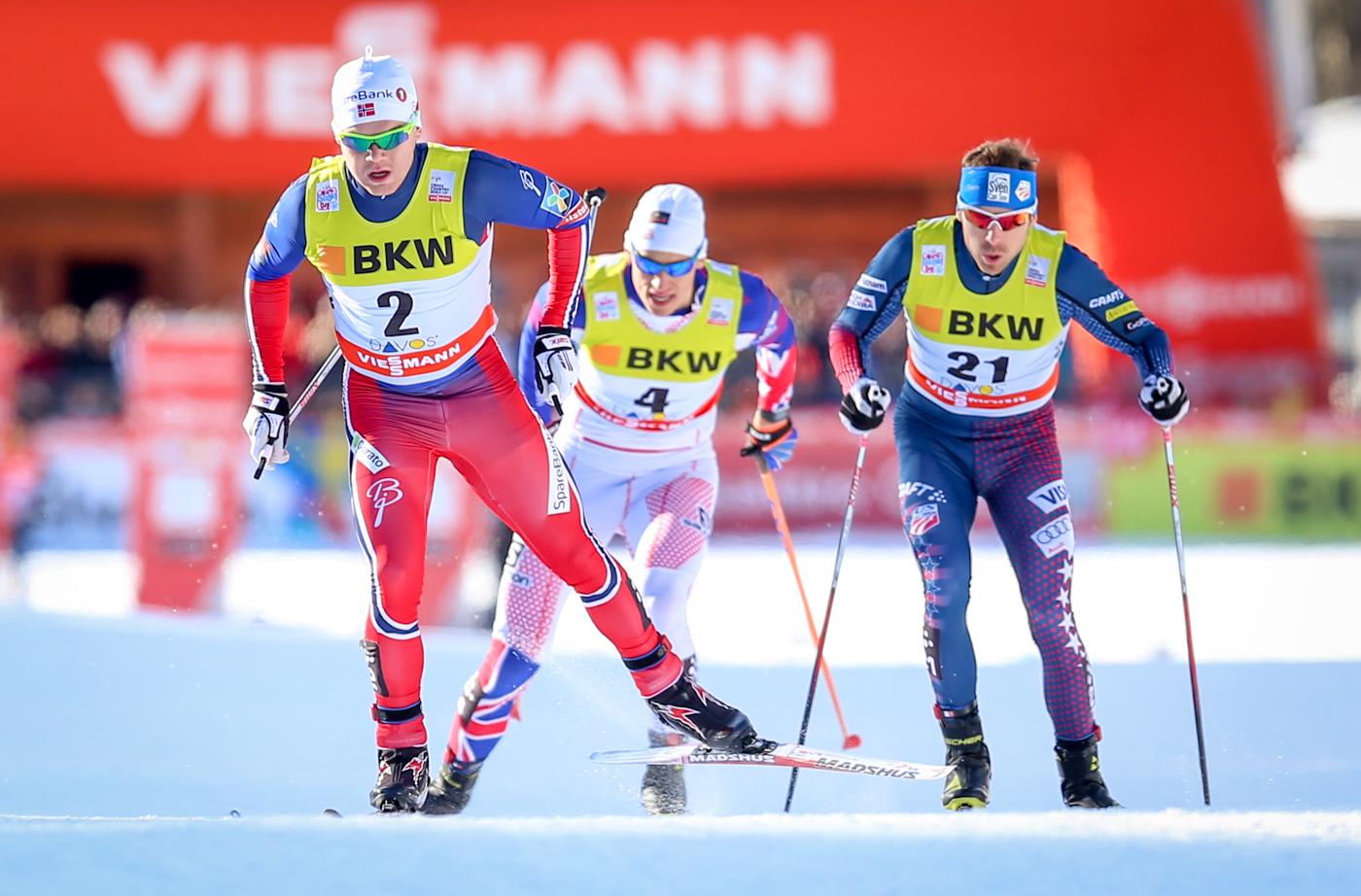
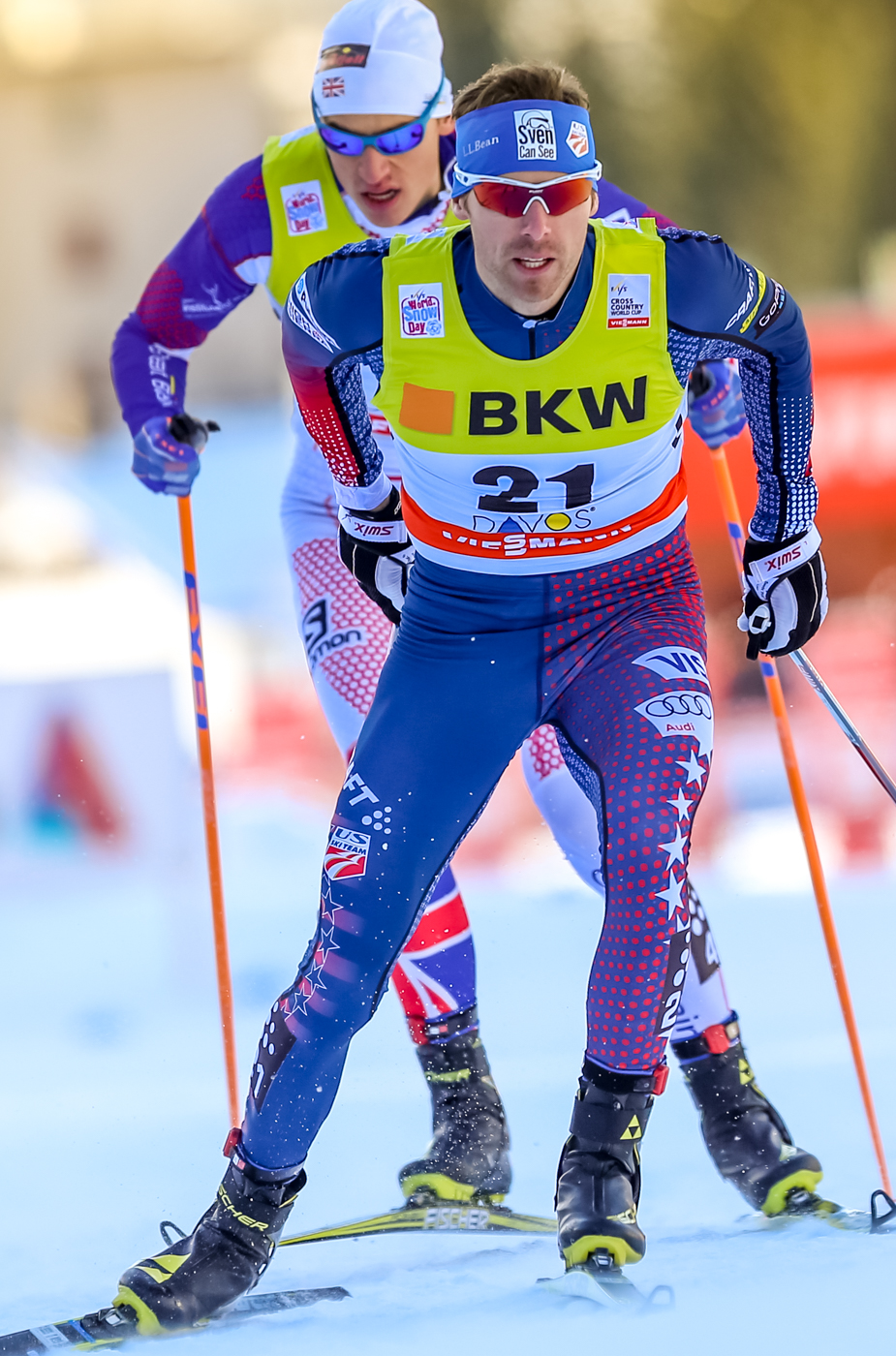
    On his way to 30th place, John Steel Hagenbuch (USA) follows teammate Ben Ogden (USA). (Photo: Vanzetta/NordicFocus)
    The American View: Learning in Familiar Air

    For the U.S. team, John Steel Hagenbuch finished 30th, the top American on the day — a result that only hints at how complicated his Davos race really was.

    Hagenbuch has never considered himself particularly sensitive to altitude, a fact that quietly shaped both his expectations and his pacing plan.

    “I’m maybe not the best authority to say how altitude feels, as I usually don’t feel affected by it much,” Hagenbuch said. “I typically start slow and then pick up speed through races, and this pacing strategy is typically rewarded at altitude.”

    That approach aligned neatly with what Davos demanded. And while Hagenbuch is quick to downplay any physiological advantage from growing up and training in Sun Valley, Idaho, he did note a different kind of familiarity.

    “I think being from altitude can help with racing at altitude, but it’s certainly not a decisively significant factor — I was still plenty far behind the sea-level Norwegians today,” he said, with a laugh. “Speaking of familiarity, however, I remarked at how much Davos reminded me of home — the trails and the surrounding mountains strongly resemble Galena.”

    The race itself marked his best feeling of the opening World Cup block — even if the result came under less-than-ideal circumstances.

    “This Davos Skate 10 km was the best I’ve felt so far in Period 1,” Hagenbuch said. “But it unfortunately came only a day after I crashed hard on the infamously icy slalom downhill coming down from Flüelapass and subluxed my right shoulder for about the tenth time.”

    By race morning, the pain hadn’t gone away.

    “Even with a few thousand milligrams of acetaminophen down the hatch, every single pole stroke hurt,” he said. “So while it was nice to finally — barely — be top 30, I can’t help but think that without the injury and the stress associated with it, I could have done better. Alas, that’s life, and that’s skiing. I am not the only one to have had some bad luck in important races.”

    Zooming out, Hagenbuch remains confident in his trajectory, even if the opening block didn’t fully reflect it.

    “I feel confident in what I can achieve this winter — even if I didn’t necessarily show it during Period 1,” he said. “With this being an Olympic year, the competition was even higher than normal. For example, Per-Erik Bjornestad, one of our Norwegian wax techs, said that the Trondheim 10 km skate was the highest level of skiing he had ever witnessed.”

    Looking ahead, Hagenbuch’s plans are clear — and pragmatic.

    “Pretty much regardless of how today’s race went, I was going to go home to Sun Valley for Christmas,” he said. “I don’t think it makes sense for me to do the Tour de Ski, given how my health has been this fall and the start of the winter. I’m excited to go home and to compete at U.S. Nationals in Lake Placid.”

    Einar Hedegart (NOR) celebrates with a fist pump to the camera in Davos (SUI). (Photo: Modica/NordicFocus)
    Why this Race Matters More than it Looks

    It’s easy to treat Davos as an outlier — scenic, elevated, a little unique. The athletes don’t.

    The men’s 10 km Freestyle Interval Start is an Olympic format. It’s a race without shelter, without drafting, and without excuses. Davos amplifies all of that. Pacing errors are magnified. Aerobic limits are exposed. The second lap becomes a referendum.

    Hedegart passed that referendum emphatically.

    This was not a perfect-day fluke. It was not a tactical accident. It was the same pattern, repeated under different conditions, at a different altitude, against the deepest field in the sport. Ski patiently. Protect the climbs. Let others make the race hard early — then make it impossible late.

    Einar Hedegart (NOR) remained on the snow for several minutes after crossing the finish line in Davos (SUI). (Photo: Modica/NordicFocus)
    A Quiet Finish, a Louder Message

    There was no spectacle at the finish line. No disbelief. No chaos. Hedegart crossed, collapsed, and recovered — another man undone by thin air, but this time by his own effort.

    Two races. Two wins. Two second laps that separated him from everyone else.

    Davos didn’t raise its voice. It didn’t have to.

    It simply told the truth — the same one it always tells — and this time, Einar Hedegart listened better than anyone else.


    Men’s 10 k Individual Start Freestyle RESULTS


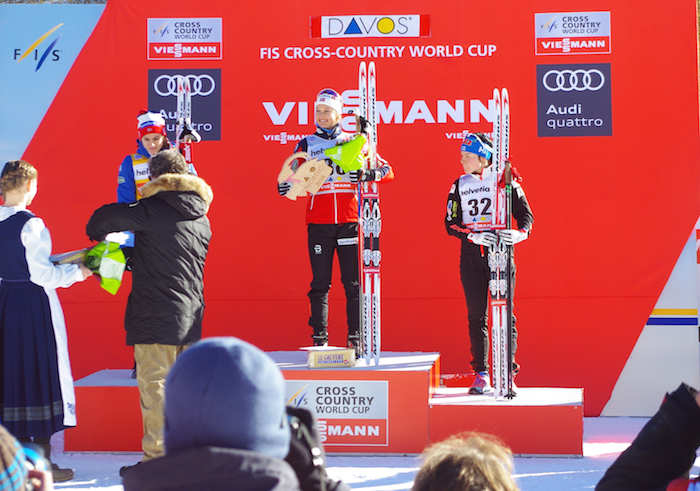
    Harald Amundsen (NOR), Einar Hedegart (NOR), and Mattis Stenshagen (NOR), (l-r) take the 10 k Freestyle podium in Davos (SUI). (Photo: Modica/NordicFocus)

    Love Stories Like This? Help Keep Them Coming.

    Feature stories like this one take time, access, and care to produce. If you value thoughtful storytelling and independent ski journalism, please consider becoming a Voluntary Subscriber. Your support directly fuels the work we do to cover the people, places, and moments that make our sport special.

    Join the FasterSkier community!


    Andrew Musgrave (GBR) gives the race winner Einar Hedegart (NOR) a sleigh ride after the pair had excellent days in the 10 k Freestyle in Davos (SUI). (Photo: Vanzetta/NordicFocus)


  • Fire, Ice, and Belief: Two Vermonters Deliver Under the Lights in Davos

    Fire, Ice, and Belief: Two Vermonters Deliver Under the Lights in Davos

    This coverage is made possible through the generous support of Marty and Kathy Hall and A Hall Mark of Excellence Award. To learn more about A Hall Mark of Excellence Award, or to learn how you can support FasterSkier’s coverage, please contact info@fasterskier.com.

    The lights come on early in Davos, not because they are needed, but because Davos wants them on. By mid-afternoon, the valley is already sliding toward dusk, the alpine light thinning and flattening, and the sprint venue leans into the moment the way it always has: music turned up, cowbells ringing with a little extra insistence, flames licking the edges of the course like stage cues. The effect is deliberate. This is not cross-country skiing as a quiet endurance ritual in the woods; this is cross-country skiing as spectacle.
    “Davos deliberately designs this event to feel like a rock concert,” U.S. head coach Matt Whitcomb said afterward. “They race at night, they bring in fire and lighting and music, and because it’s a two-lap course, you see the athletes twice as much. They invest in the experience, and it pays off.”
    Jack Young (USA) on his way to a fast qualification in Davos (SUI). (Photo: Modica/NordicFocus)
    On Saturday night, it paid off in a men’s freestyle sprint that delivered one of the most compelling American performances in years. Jack Young finished fourth, Ben Ogden fifth — the first time two American men had made a World Cup sprint final together in Davos — on a night when the script cracked open early and never fully resealed. Johannes Høsflot Klæbo was gone before the semifinals. A notoriously slick downhill corner became the day’s silent antagonist. And by the time Lucas Chanavat lunged across the line to win by three hundredths of a second, the story had already shifted: the U.S. men were no longer visitors to the sprint final. They were participants, with opinions about how it might have ended differently.
    For Young, the fourth-place finish marked his first World Cup sprint final — a breakthrough that felt less like a surprise than a confirmation. “This result means so, so much,” he said. “It really feels like proof that I can make it to the top in this sport. If I’d told myself three years ago that I’d finish fourth in a World Cup sprint, I would have thought I was insane.”
    Ben Ogden (USA) during qualification in Davos (SUI). (Photo: Modica/NordicFocus)
    A course that punishes impatience
    Davos is not a long sprint, but it is not a forgiving one. Two laps of just under 600 meters pack in a decisive climb, sustained skating tempo, and — this year especially — a downhill corner that demanded respect. The snow was entirely man-made, hard and fast, and as the temperature dropped through the evening, it glazed into ice. Athletes began to talk about the corner not as a feature, but as a test.
    “That bottom corner was particularly dicey this year,” Whitcomb said. “Man-made snow turns to ice quickly, and that corner claimed a lot of people over the last couple of days.”
    Ben Ogden felt it more than once. “That last corner was really the focus,” he said. “I fell there yesterday, JC fell there in practice, and I stumbled twice in the final and ended up against the boards. It was unfortunate, but every year you learn a little more about how the ice forms there.”
    The corner changed the race’s outcome. The first time through, athletes skied it conservatively, prioritizing stability over speed. The second time, with fatigue setting in and the finish looming, choices became riskier — and more consequential.
    Janik Riebli (SUI), Jack Young (USA), and Lars Heggen (NOR), (l-r) during the heats in Davos (SUI). (Photo: Vanzetta/NordicFocus)
    Qualifying hints, early shocks
    The qualifying round suggested a familiar hierarchy, but with enough irregularities to hint that Davos might misbehave. Lucas Chanavat of France was fastest, Ben Ogden second, Klæbo third. Jack Young qualified sixth — an excellent position that put him squarely in control of his bracket.
    “That’s one of the best qualifying results we’ve ever had on the U.S. team,” Whitcomb said. “Qualifying in the top ten gives you options. It lets you race offensively instead of defensively.”
    Klæbo’s day began to unravel in the quarterfinals. Boxed in and forced wide through the downhill, he finished fourth in his heat and failed to advance. His 16-race sprint win streak ended not with drama, but with traffic — a reminder that sprinting, for all its stars, is still governed by physics and positioning.
    Ogden and Young both advanced cleanly. Ogden won his quarterfinal with authority. Young skied his with the composure of someone who knew exactly what he needed to do — no more, no less.
    Ben Ogden (USA) and the US Ski Team had a lot to celebrate in Davos (SUI). (Photo: Modica/NordicFocus)
    Semifinals: the Americans arrive together
    By the semifinals, the noise in Davos had sharpened. Chanavat advanced. Ogden advanced. And then Young did, stepping into his first World Cup sprint final with the kind of quiet efficiency that suggested the moment had not surprised him.
    “To be honest, the first thing that went through my mind standing on the start line was how tired I was,” Young said. “But I reminded myself that anything can happen in a sprint final. I don’t train just for qualifiers and quarters — I train for the full day. It was time to execute.”
    For Ogden, the significance of sharing the moment wasn’t lost. “Racing with Jack today was awesome,” he said. “He has this infectious confidence, especially here in Davos. Last year we were in the semifinals together, and this year we were in the final together. That’s a big step.”
    Whitcomb saw it as more than a statistical milestone. “To put two guys into the men’s final is a dream,” he said. “When athletes finish a race seeing the podium and knowing they can be on it, that’s when things start to get dangerous — in a good way.”
    Jack Young (USA) had every right to be celebrated after his breakout race today in Davos (SUI). (Photo: Modica/NordicFocus)
    The final: margins measured in inches
    The men’s final unfolded at full speed. Chanavat and Federico Pellegrino established themselves early, both reading the race the way veterans do — not forcing it, but shaping it. Oskar Opstad Vike of Norway positioned himself patiently, waiting for the moment when commitment would matter.
    Ogden and Young stayed connected. Coming into the final corner, Ogden had position. Young had momentum.
    “I was really gunning for that podium,” Ogden said. “I felt like I was pretty close. With fewer stumbles and maybe a little better positioning, I think I could have made it happen.”
    The corner had other plans. Ogden’s line took him over the ice and was forced wide, momentarily pinned against the boards. Young exited cleaner, carrying speed into the finishing straight.
    Chanavat and Pellegrino lunged together at the line, Chanavat winning by three hundredths of a second. Vike took third. Young crossed fourth, Ogden fifth — separated from the podium by seconds, but not by belief.
    “I finally feel like I can truly compete at the top,” Young said. “That’s a special feeling.”
    Results — Men’s Sprint Freestyle, Davos
    1. Lucas Chanavat (France)
    2. Federico Pellegrino (Italy)
    3. Oskar Opstad Vike (Norway)
    4. Jack Young (USA)
    5. Ben Ogden (USA)
    6. Edvin Anger (Sweden)
    Notables: Johannes Høsflot Klæbo (Norway), 17th, and JC Schoonmaker (USA), 27th.
    It has been a tough trail back to the top step on the podium for Lucas Chanavat (FRA) so he was extremely excited to be standing on it today in Davos (SUI). (Photo: Vanzetta/NordicFocus)
    What Davos leaves behind
    Davos has always been good at revealing things. It reveals how athletes handle altitude, manage nerves, and respond when a race refuses to go according to plan. On Saturday night, it revealed something else: American depth at the sharp end of a sprint final.
    Young talked about the atmosphere as something that lifts him. “With all the energy, it’s easy to trick yourself into thinking you’re walking into a big arena,” he said. Ogden talked about validation — not just from results, but from proximity. “My target in these races is the podium,” he said. “It feels good to know I’m getting closer.”
    Whitcomb, standing back from it all, saw the longer arc. “We’re in a really good place with these guys,” he said. “There’s a lot more to come.”
    The flames went out eventually. The music faded. Davos returned to being a quiet alpine town under an early winter night. But for the American men — and for two Vermonters who now know exactly what a World Cup sprint final feels like in tandem — something lingered.
    Not noise. Not spectacle.
    Belief.


    Men’s Individual Sprint Final RESULTS


    Love Stories Like This? Help Keep Them Coming.

    Feature stories like this one take time, access, and care to produce. If you value thoughtful storytelling and independent ski journalism, please consider becoming a Voluntary Subscriber. Your support directly fuels the work we do to cover the people, places, and moments that make our sport special.

    Join the FasterSkier community!


    Federico Pellegrino (ITA), Lucas Chanavat (FRA), and Oskar Opstad Vike (NOR), (l-r) on the sprint podium in Davos (SUI). (Photo: Vanzetta/NordicFocus)
  • Under the Lights in Davos, Sundling Delivers—and the Margins Show

    Under the Lights in Davos, Sundling Delivers—and the Margins Show

    This coverage is made possible through the generous support of Marty and Kathy Hall and A Hall Mark of Excellence Award. To learn more about A Hall Mark of Excellence Award, or to learn how you can support FasterSkier’s coverage, please contact info@fasterskier.com.

    The night sprint in Davos has a way of making the sport feel louder than it usually allows itself to be. The course is short, the laps repeat, the crowd sees the same faces twice, and the organizers lean into the spectacle—music, lights, flames—until the whole thing starts to resemble a winter street festival that happens to include the fastest skiers in the world. “They deliberately design this event to feel like a rock concert,” U.S. head coach Matt Whitcomb said, pointing to the night racing, the lighting, and the two-lap format that keeps the athletes close and visible.
    But the women’s sprint on Saturday didn’t need help finding drama. It had its own: a final that turned into a study in timing and patience, a surprise runner-up, a home-country podium that felt like the whole point of staging a race like this in the first place, and an American women’s team day that—depending on where you stood—looked either like incremental progress or a reminder of how narrow the margins are when you’re trying to turn good skiing into the kind of skiing that survives the heats.
    At the front, Jonna Sundling (Sweden) won the women’s sprint free in 2:31.86, edging Mathilde Myhrvold (Norway) by 0.08 seconds (2:31.94). Nadine Fähndrich (Switzerland) rounded out the podium in third at +2.60, a result made sweeter by the route she took to get there: she advanced into the final as a lucky loser and still skied her way onto the podium when it mattered most.
    Behind them, the final was saturated with familiar sprint power: Maja Dahlqvist (Sweden) finished fourth, Linn Svahn (Sweden) fifth, and Laura Gimmler (Germany) sixth—three Swedes in a Davos final, again, in a venue that has long amplified Sweden’s particular talent for fast, hard, repeated efforts under bright lights.
    Kristine Stavaas Skistad (NOR), Laura Gimmler (GER), Jonna Sundling (SWE), Nadine Faehndrich (SUI), (l-r) during the sprint heats in Davos (SUI). (Photo: Vanzetta/NordicFocus)
    A course that asks for control more than courage
    Davos is not a long sprint, but it’s demanding in the way short races can be demanding: there’s nowhere to hide, and every mistake is immediate. The compact two-lap circuit rewards rhythm and positioning—especially on the downhill into the technical corner that has been a recurring storyline in Davos when the surface hardens.
    Whitcomb, talking about the venue more broadly, framed Davos as a place where experience matters —not only experience racing hard, but racing smart: managing altitude, managing risk, and understanding that “good” in Davos can disappear fast if you’re constantly reacting rather than shaping.
    That’s why Sundling’s win felt so Sundling: not flamboyant, not chaotic, but efficient—an athlete with enough power to force the pace and enough composure to let the final come to her.
    Mathilde Myhrvold (NOR) and Jonna Sundling (SWE), (l-r) lunge for the sprint final finish line in Davos (SUI). (Photo: Vanzetta/NordicFocus)
    The final: Sundling’s patience, Myhrvold’s moment, Fähndrich’s home lift
    If you didn’t know the result, you might have expected a Swedish one-two. Sundling and Dahlqvist were both in the final, and Sweden brought three athletes onto the start line. But sprint finals aren’t always about the most decorated name; they’re about who can keep their speed intact after a day of qualifiers, quarters, and semis—after the accumulation of small sprints that feel, by the end, like one long race done in pieces.
    Sundling and Myhrvold made the final feel like a contest of timing. Sundling’s skiing had the taut confidence of someone who knows exactly what she wants from the last 200 meters; Myhrvold skied like someone who believed she could take it from her. They hit the line separated by less than a tenth of a second.
    And then there was Fähndrich—third, at home, on a night designed for the crowd to matter. If Sundling’s win was clinical, Fähndrich’s podium was emotional in a quieter Swiss way: the sense that the event’s atmosphere wasn’t just decoration; it was fuel.
    Julia Kern (USA) and Nicole Monsorno (ITA), (l-r) in the quarterfinals in Davos (SUI). (Photo: Vanzetta/NordicFocus)
    The U.S. women: progress, frustration, and the line between them
    For the U.S. women, Davos was not the same kind of headline day the men had produced a few hours earlier. But it also wasn’t empty. It was the kind of day coaches talk about carefully: pieces moving in the right direction, while also acknowledging that “right direction” still has to show up in a bracket.
    Whitcomb didn’t sugarcoat the overall result. “Honestly, a little lackluster on the women’s side today,” he said, adding that the athletes themselves would agree with that assessment. At the same time, he pointed to specific positives—the kind that matter in the arc of a season.
    He said Jessie Diggins “skied competitively” and “narrowly missed advancing,” and he emphasized that the difference between making semifinals and missing them is often a single decision in a single corner. He also singled out Julia Kern as an athlete whose level is rising: “Julia is definitely skiing on another level than she has been for the first couple of weekends,” Whitcomb said, framing it less as a sudden leap and more as a build—more weekends of consistent racing, more reps in heats, more time at speed until the pieces become routine.
    Kern’s own description of her day fit that exact narrative: detailed plan, sharper qualifier, more of a feeling of normalcy returning—plus the kind of bad luck sprinting specializes in.
    “I’m proud of making a detailed race plan and starting faster in the qualifier today,” Kern said. “I felt much more like myself out there and was able to play the tactical game with some good moves, even though it ended with an obstruction by another athlete. I’m excited to take this fresher energy into tomorrow and build on the endurance base I feel like I have going into the distance race.”
    It’s a very Kern quote: pragmatic, technical, forward-looking. Not a lament—more a calibration.
    The deeper truth of sprinting is that it doesn’t always reward “feeling better” immediately. Sometimes it rewards it tomorrow, or next week, or in the next venue where a better qualifier and a cleaner first heat finally align. That’s why Whitcomb’s view was pointed but not pessimistic: he sees the level rising, and he sees that the team standard is higher than the day’s outcome.
    “We should be putting multiple women in the semifinals,” he said. “And it’s time to start doing that.”
    Jessie Diggins (USA) during qualification in Davos (SUI). (Photo: Modica/NordicFocus)
    Why Davos matters beyond the podium
    Davos is always a little odd in the calendar. It arrives after the first wave of races has introduced the season’s storylines, but before the season has fully decided what it wants to be. It’s high enough to punish sloppy energy management, tight enough to punish poor positioning, and loud enough to make athletes feel—at least for one night—that they’re racing in an arena rather than on a trail.
    That can be destabilizing, in a good way. It can pull surprise finalists into the light. It can elevate a lucky-loser path into a podium. It can turn a planned, steady day into a messy one. And it can expose the difference between skiing fast and getting through rounds—a difference that isn’t always about fitness.
    For Sweden, Davos once again looked like a venue built for their sprint depth: three in the final, the winner on top. For Norway, Myhrvold’s second place was a reminder that the sport is always producing new sprint threats, even in an era dominated by familiar names. For Switzerland, Fähndrich’s third place felt like the perfect use of home advantage and crowd energy.
    And for the U.S. women, it was a day that asked a familiar question: how close is “close,” really?
    Kern’s answer—embedded in her quote—was that she’s trending toward the skier she knows she is, and she’s carrying that energy forward into the distance race. Whitcomb’s answer was both sharper and more structural: good signs are not the same as results, but good signs are still worth something if they’re backed by consistent racing.
    Recap: Women’s Sprint Free, Davos
    1. Jonna Sundling (SWE) — 2:31.86
    2. Mathilde Myhrvold (NOR) — +0.08
    3. Nadine Fähndrich (SUI) — +2.60
    4. Maja Dahlqvist (SWE)
    5. Linn Svahn (SWE)
    6. Laura Gimmler (GER)
    Mathilde Myhrvold (NOR), Jonna Sundling (SWE), and Nadine Faehndrich (SUI), (l-r) share the sprint podium in Davos (SUI). (Photo: Vanzetta/NordicFocus)
    The quieter ending Davos can leave you with
    By the time the final ends, the flames are still there, the music is still there, and the crowd is still leaning over the fencing as if the night could produce one more surprise. But the athletes are already drifting toward tomorrow—toward the distance race, toward the next chance to turn “better” into “through,” toward the next bracket that won’t care how good your plan was unless it shows up as a place on the right side of the line.
    That’s the strange promise of Davos: it amplifies everything. It amplifies winners. It amplifies near-misses. It amplifies the feeling that a season can pivot in a single night sprint—sometimes in front of flames and floodlights, sometimes in a quiet tactical mistake that only the skier can feel.
    Sundling won because she was the best sprinter on the night and skied like she knew it. Myhrvold took second because she refused to concede the finish until the last step. Fähndrich climbed onto the podium because sprinting still leaves room for the athlete who keeps the door open long enough to walk through it.
    And the U.S. women left Davos with a different kind of narrative—less celebratory, more unfinished. Kern put it plainly: she felt more like herself, she played the tactical game, and she’s taking that energy into tomorrow. In a season built out of weekends, that’s how momentum often begins: not with a single clean headline, but with the gradual return of a feeling an athlete recognizes—and a plan that, sooner or later, stops being interrupted.


    Women’s Individual Sprint Final RESULTS


    Love Stories Like This? Help Keep Them Coming.

    Feature stories like this one take time, access, and care to produce. If you value thoughtful storytelling and independent ski journalism, please consider becoming a Voluntary Subscriber. Your support directly fuels the work we do to cover the people, places, and moments that make our sport special.

    Join the FasterSkier community!
  • Q&A with US Ski D-Team Coach Kristen Bourne: How her Journey in Coaching Inspired a New Fellowship

    Q&A with US Ski D-Team Coach Kristen Bourne: How her Journey in Coaching Inspired a New Fellowship

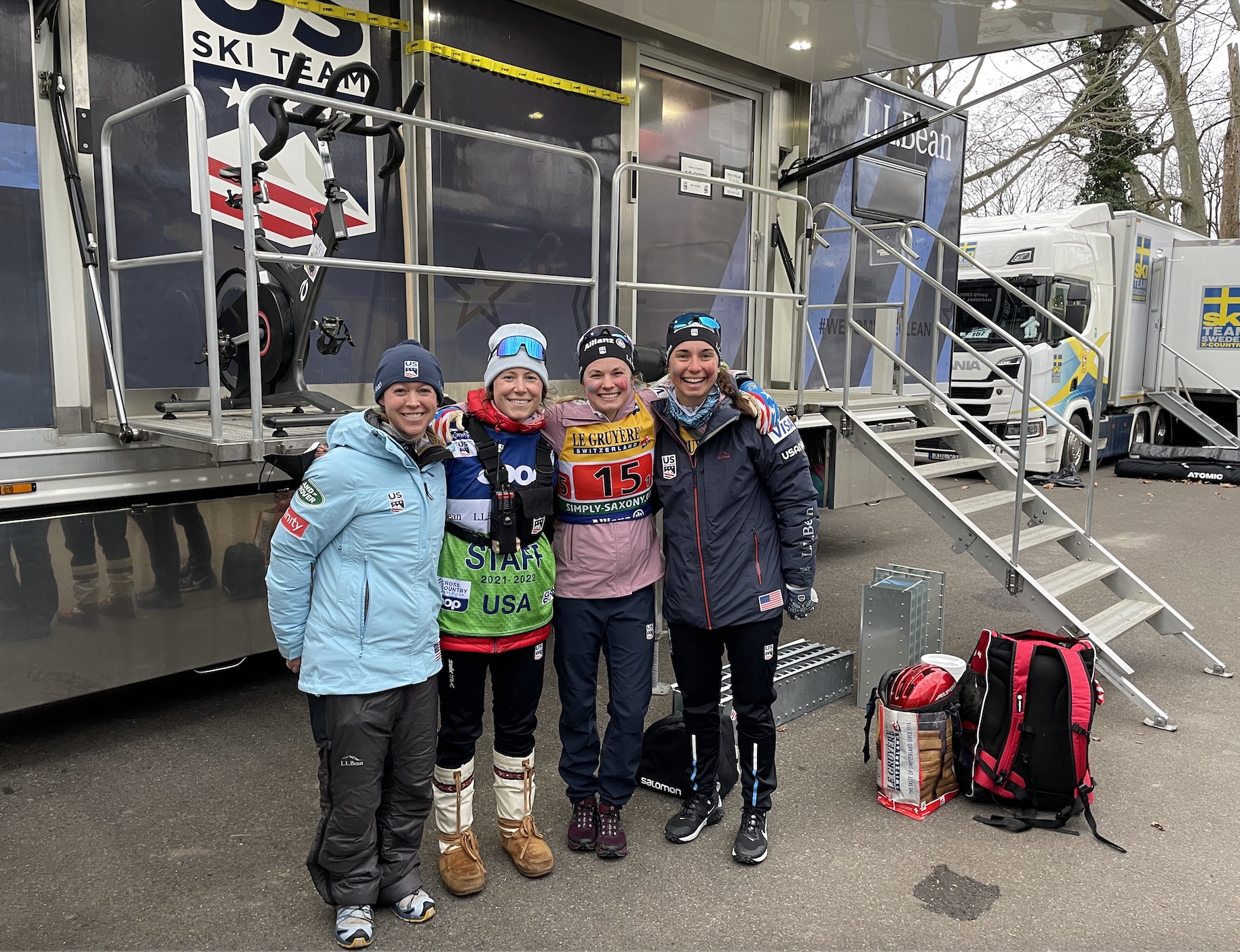
    Physical therapist Ana Robinson, Kristen Bourne, Jessie Diggins, and Julia Kern (left to right), at the Dresden World Cup in December 2021. (Courtesy photo)

    Earlier this month, the National Nordic Foundation (NNF), in partnership with the Women Ski Coach’s Association (WSCA) and the Olympic Women’s Cross-Country Book Project, announced the Trail to Gold Fellowship. The Fellowship aims to correct for a historical gender imbalance in U.S. coaching at the club, collegiate, and international level by providing fellows with funding to complete a two-week internship with the U.S. Ski Team on the World Cup this winter. The Trail to Gold Fellowship was sparked by an idea from the U.S. Olympic Women’s Cross-Country Book Project to dedicate profits from Trail to Gold; the journey of 53 Women Skiers to forward the movement for gender equity within Nordic ski coaching.

    Applications are open until August 31st, interested women coaches are encouraged to apply here. Trail to Gold: the journey of 53 Women Skiers is available here.

    Moving from idea to action for the women involved in the Trail to Gold book turned out to be expedited thanks to an existing template for not only what they wanted their Fellowship to look like, but what they wanted that Fellowship to accomplish. That case study; U.S. Ski Team Development coach Kristen Bourne.

    The story of how Bourne joined the U.S. Ski Team coaching staff is a parable for how success in the sport of nordic skiing should come. In which an extraordinarily talented young coach was paired with supportive institutional structures, relationships, and yes, a little luck here and there, to find her way through the U.S. ski coaching system. It’s also remarkable that Bourne’s whole narrative fits the space of a short story rather than a novel. After a decorated junior and college skiing career at Northern Michigan University (NMU), Kristen Bourne did a stint post-grad skiing that culminated in one last Senior Nationals in Houghton, Michigan in 2020. In an instance where metaphorical resonance became something literal, as Bourne was walking away from her athletic career, College of St. Scholastica (CSS) Head Coach Maria Stuber pulled up in the parking lot and – Midwesterner to Midwesterner – let out a big ol’ “OH Hey there!” which quickly led to a discussion about Bourne coaching, and then, a position as Assistant coach for St. Scholastica.

    From there, it’s been an ongoing whirlwind. Stuber is the founder and leader of the Women Ski Coaches’ Association, founded in 2019 to “develop, retain, and advance women in ski coaching leadership.” Stuber and Bourne worked through existing NCAA coaching development programs, which saw Bourne win the Women Sport’s Foundation Tara VanDerveer Fellowship in 2021, a first for a nordic skiing coach. Bourne’s Fellowship partially helped fund her position at St. Scholastica, but also came with an additional stipend to utilize for professional development in other organizations.

    Stuber reached out to U.S. Ski Team coaches Matt Whitcomb and Chris Grover to see if there would be any opportunity to work with U.S. Ski & Snowboard. That turned into a two-week internship on the World Cup that saw Bourne wax teching and coaching at last year’s Davos and Dresden World Cups. In turn, Bourne received additional offers to work with U.S. athletes making World Cup starts later in the season, all of which culminated in her hiring as a U.S. Ski Team Development Coach earlier this year. To sum it all up, as Bourne did a couple of times when I interviewed her, it’s been a “whirlwind.” Which, to keep to her own metaphor, is a wind that has turned up inspiration among coaches, athletes, and administrators across U.S. Skiing to bring the type of program that put Kristen Bourne in contact with the U.S. Ski Team into the fold of the nordic community. And now, with the Trail to Gold Fellowship, that’s become a reality.

    The energy that’s been infused into making that opportunity a reality is still overflowing at the source. When I caught up with Bourne about the experiences that have made up her journey, she was at the end of a long day working with members of the U.S. Ski Team as they prepared for racing in Torsby, Sweden and at Toppidrettsveka in Trondheim, Norway. She brought the same thoughtfulness to our conversation about what formed her approach to coaching as had just gone into that night’s technique session (which happened to include guests Maja Dahlqvist and Frida Karlsson). We not only talked about her journey, but about her influences, mentors, and outlook as a women coach who, just through her own story, has been a leader in the movement to correct for the historic gender inequity in U.S. ski coaching.

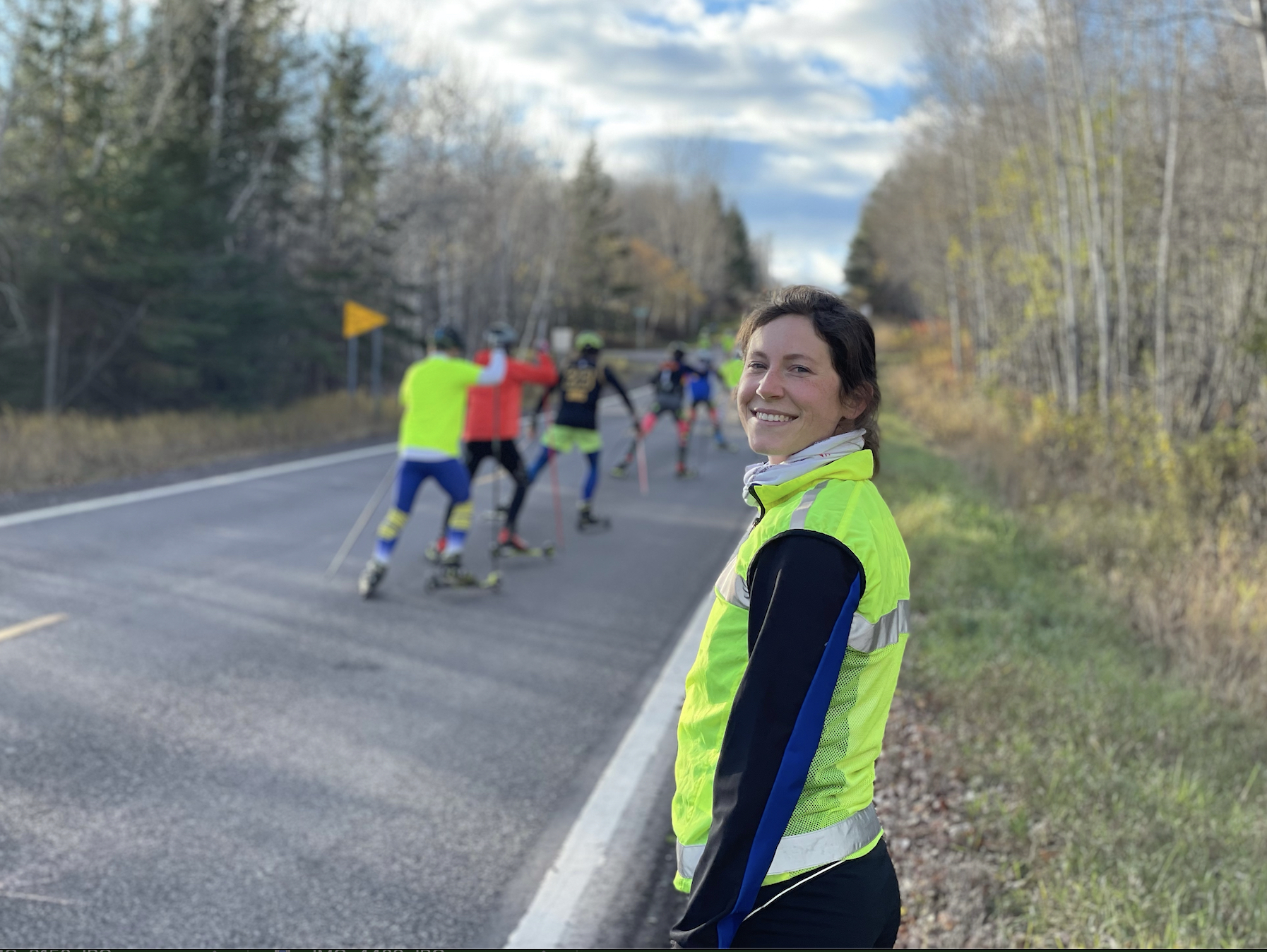
    Kristen Bourne at a CSS practice in Fall 2021 (Photo: Maria Stuber).

    (This interview has been edited for length and clarity).

    Ben Theyerl (BT): Can you start off by giving us a summary of your personal background? What was your journey to your current position with the US Ski Team?

    Kristen Bourne (KB): I’m originally from the Twin Cities [in Minnesota]. I ended up going to Northern Michigan University (NMU) and skied for them for five years. Then, about three weeks after graduation, I packed up my bags and moved to Norway, where I lived for a year and a half [ski racing]. There’s a funny story about that ending – I lost my permit in a friend’s car. I ended up coming back to race US Nationals in 2020, where I met Maria Stuber [Head Coach at the College of St. Scholastica in Duluth, MN]. At the time, I was thinking of calling it quits, and my dad had put out some emails to coaches to really try and pull me towards it. Maria had just started the Women’s Ski Coach Association (WSCA), and my dad had also gone out and signed myself and my sister up for a membership – so between emails and that he was really pulling.

    We were literally in the parking lot when she pulled up and was like ‘I’ve heard about you, you’re going to get an email from me.’ That turned into ‘Do you want to coach with me?’ and she helped set me up with a summer internship coaching with Pepa Miloucheva at the Craftsbury Green Racing Project. Summer of 2020, I started coaching at Craftsbury, and then I was one of Maria’s assistant coaches at St. Scholastica (CSS) for two years.

    When I got to CSS, Maria and I applied for a grant with the Women’s Sports Foundation – the Tara Vanderveer Advancement for Women in Coaching Fund Fellowship. We didn’t get it the first year (2020), and then we applied again, and we got it the second year (2021). That Fellowship partially funded my position at CSS, and then there was an extra $2,500 for professional development outside of that position – which was very broad. Maria nudged me to reach out to the U.S. Ski Team and see if they’d need any help for anything really, and as soon as we did Matt Whitcomb was like yes – ‘we actually could use more help for some World Cups.’ Which was unexpected but made me go, ‘woah.’ So, I went to Davos and Dresden last year.

    Over there, I ended up wax teching for Caitlin Patterson, and learning a whole lot from the U.S. staff. Then I was back in the U.S. for the collegiate season and made one more trip back to the World Cup with Bill Harmeyer as his wax tach. That was actually a really cool moment, as he reached out because I had already had World Cup experience. So that little internship directly translated into another opportunity very quickly. Then two months later, Kate Johnson announced she was leaving her position as the U.S. D-Team coach, and I applied and now here I am. It’s a lot, but it’s been a whirlwind.

    BT: And now you’re back in Scandinavia at the moment…

    KB: Yeah, it’s super full circle now because this is my first time back in Scandinavia since I left and lost my permit. The camp we’re at right now was one of the first ones of a few I had when I was living over in Norway, so it’s definitely a cool thing to be back as a coach this time.

    BT: That’s a really great story in itself. If I can dig a little deeper into your background, what was your earliest inclination that you might want to coach? Was this something you thought about when you were younger? Or was it really just when you were stuck trying to negotiate the next step after being a ski racer?

    KB: I think I always paid attention to people who were like, ‘you should try coaching.’ But I was kind of stubborn in saying that I was going to do something different after skiing. I guess I kept pushing off that idea in my head, but sporadically when I would help out coaching when I was an athlete, I always really loved it. But I guess, it’s one of those things I guess you don’t think of as a career path when you’re an athlete, right?

    As I was ending my ski career and figuring out what I wanted to do I was there with a Bachelor’s in Exercise Science, and I was wanting to do a Master’s in the same, which all just leads me back to skiing. It’s what I love. There was a slow roll towards acceptance that ‘oh man, I think coaching is what I want to do, and then Maria definitely solidified how much I love doing this job.’

    BT: You’ve touched on Maria, which we’ll talk about a little bit more, but I was wondering if now that you are coaching, do you look back on any of the coaches you had as an athlete and go ‘oh, like that was why they did that?’ Like is there an inspiration that’s shaped your coaching from your athlete days?

    KB: Oh yeah. I had a track and field coach in high school, Bev Docherty. I look back and can’t believe she was coaching me in high school based on her accomplishments – (Docherty has a long list of running accomplishments, including having run in the first 6 U.S. Olympic marathon trials open to women). I look back on her style and who she was and how she coached, and she wasn’t super energetic, super loud, or outspoken. She would lean in during the middle of a race though and you could still hear her clearly even when the crowds were cheering all around. I always look back on that because it was so different than anyone I’ve ever been coached by and she was also one of two women coaches that I ever had. I think that I look back to that and try to emulate just how steady she was as a coach. I don’t know if she knows that: she’s been there throughout my racing career and now as I’m going through my own coaching journey, I really do try to emulate her.

    BT: You’ve touched on Maria Stuber a few times. How was that relationship formative when you were starting out coaching, especially given that it was right around when she was taking over at St. Scholastica and starting the Women Ski Coaches Association (WSCA)?

    KB: I mean, do you want to write the book on it? She would shrug this off and say it’s not true, but she is one of the biggest reasons that I’m in this job [as U.S. Ski Team Development Coach] right now. She’s pushed me and knows exactly where and when to push is how I would best describe it. And I think that goes both for coaching and also for which opportunities to pursue. She’s 100% my biggest mentor and I will always look up to her.

    I think the WSCA and her passion for it is also a big aspect of that. She said ‘this is a change that needs to be made and we as coaches can make it if someone is willing to organize it’ and I’m a testament – as are other women coaches – that she is right on that.

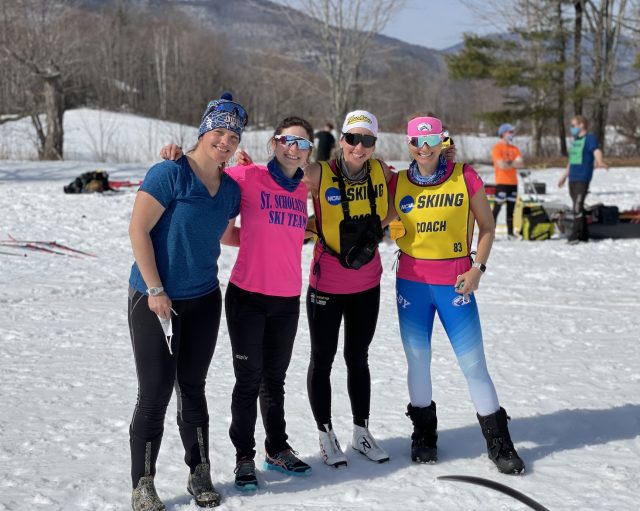
    WSCA members Maria Stuber (CSS), Kristen Bourne (CSS), Kristen Monahan-Smith (Michigan Tech), and Tracey Cote (Colby) (l-r) at NCAA Championships in Jackson, New Hampshire in 2021. (Courtesy Photo).

    BT: Can you describe how the World Cup Fellowship came together, and what you actually did when you were there last year?

    KB: I think the most important part of setting that experience up – because it was really a creation of equal parts myself and Chris Grover and Matt Whitcomb – was that it was a fully immersive experience both on the coaching side and [technician] side, not one or the other. I went over and met up with them right after Lillehammer, which was when the team was on its way to Davos. That gave me three and a half days where I was getting an intensive overview of everything from the wax truck to how [the U.S. techs] do glide-outs, wax application on race day, and the whole process of going from setting up at a World Cup to having our athletes be on the start line.

    Then Saturday came, which was sprints in Davos, and I was fully part of it all. Waxing on the World Cup. Sunday for the Distance race, meanwhile, I worked more one-on-one with Caitlin Patterson. It was a whirlwind, but I never felt like I was overwhelmed, because the coaching staff really from the moment I was there was like ‘we want you to be part of everything, and we also know that you’re doing this for the first time and are here to make our team stronger.’

    That first weekend was a real introduction into the inside process of what goes on with the process of preparing athletes for a World Cup race. When I wasn’t in the wax truck, I was at team meetings where we would watch sprint footage from previous years on that Davos course and discuss tactics. It’s cool to see how the veterans on the team really are thorough about explaining their tactical ideas and are able to make specific suggestions to their newer teammates. You really get a sense of how the ‘team’ aspect of the U.S. Ski Team operates, and it’s pretty special. I would sit in on meetings with Matt and Chris whenever I was allowed, and also got to be part of the team Christmas celebration.

    That was all just in one week. And then we packed up and drove the van to Dresden. Which you know, like I’m driving the whole women’s team from Davos to Dresden and hitting the autobahn and frankly, that was the most nerve-racking part of the entire trip. But we did make it.

    In Dresden, I turned over to more of a coaching role. That’s where I got to go out on course for the first time, with poles and radio – the whole nine yards of what you think of when you’re watching the World Cup and see coaches running alongside their athletes on the course. Everyday was really intense, and exhausting, and most of all fun, just taking in everything and not really processing it until later.

    BT: Was there a moment of realization where you were like ‘holy crap, I’m on the World Cup?’

    KB: I think I tried to process that as much as I could before I got there. Like the moment was really when I had my plane tickets in hand and was like, ‘woah, I’m really gonna go to the World Cup and wax skis.’ But you get there, it was way less intimidating than it looks like on TV. Your years of going to ski races as an athlete of coach kick in and you realize that it’s exactly the same feel and atmosphere – just with the fastest skiers on the planet. Living in Norway and being able to watch World Cups – at Holmenkollen especially – really prepared me for all the extra people, and I think mitigated that feeling you could have when Klæbo or Johaug just skis past you.

    But also, I shouldn’t play it down too much. Like yeah, there were moments throughout the two weeks where I did just look up and go, ‘this is the World Cup!’

    BT: A big part of the Trail to Gold Fellowship that is based off your experience is that there is a value in having World Cup experience cross-pollinate with the coaching back in the U.S. What did you bring back from the World Cup that you felt like you applied to your coaching on the NCAA circuit at St. Scholastica, and now with the D-Team?

    Kristen Bourne logs kilometers on the stunning tracks of Davos, SUI while teching for the U.S. Team. (Courtesy photo)

    KB: There were a few things immediately. Like at Scholastica we adopted the glide-out system I learned on the World Cup to our team. More importantly, the mentalities and being willing to talk with other wax techs and understand that waxing theory is really – and that’s a weird thing to call it – less science. You’re not driving towards a single answer, but rather using your knowledge and experience to make a better call than you would if you didn’t. I had a big realization for both teching and coaching that you’re not learning the answer in how to ski coach, but instead that you’re trying to develop a sense of confidence in your experience so that you give that to athletes. There isn’t a one size fits all in coaching.

    BT: I really like that idea as a young coach myself. You’re not building towards an answer, but rather you’re building experience to bear so you can make a difference in the really tough situations, you know?

    KB: Yeah, I really think that’s a good way of putting it. It’s kind of that moment you realize that there’s not one way to do the job of being a coach, and that’s what makes it a really challenging and exciting profession.

    BT: What about how that attitude played into your role now with the U.S. Ski Team? What are you excited about looking ahead to this winter?

    KB: For [the D-Team], our athletes are well on their way to hopefully getting World Cup starts soon. And so that’s where I can act as a resource with my experience of what they can expect as they look to make those first starts. I’ll also be full-time on the World Cup this winter, which is exciting. I’m not anyone’s primary coach but will be doing a lot of what I did last winter, so in that respect, the World Cup experience I got will be about as good of preparation as I could get.

    BT: I had one last question pertaining specifically to the Trail to Gold Fellowship. What do you think the role of gender representation on the top-level of skiing is in helping the sport develop?

    KB: I think it has an immediate impact. I think it’s as simple as the fact that the more women that young kids see out on the course the more, they are going to believe that they belong there. I hope that immediate impact spreads to those coaches that are doing this fellowship this year as well. They can walk away with tangible World Cup experience, and also realize that they are part of pushing the movement for gender equity in coaching forward and inspiring girls that are out there at the races.

    I think back to being around wax rooms, at local races, or watching the World Cup on TV growing, and I really do think that if I would have seen more female representation it might have made me realize that coaching could be a viable career for me because I’d seen people like me in that position. Doing this fellowship works to inspire both the women who are coaching and the women who will be coaching one day.

    BT: That’s a really eloquent way to put that.

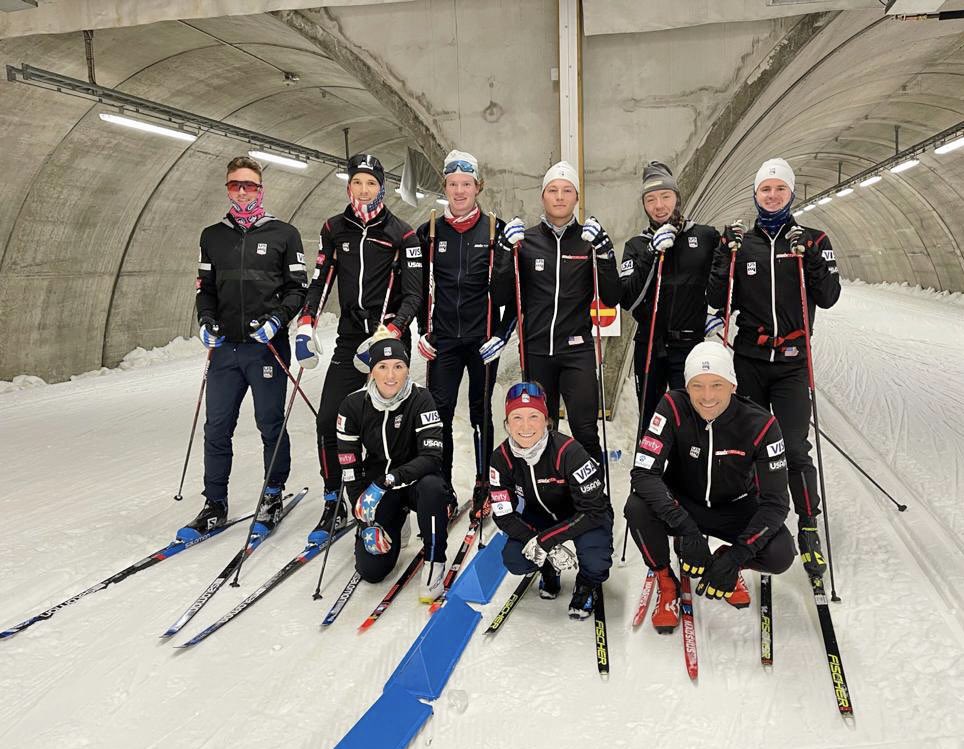
    USST athletes and coaches in the Torsby Ski Tunnel, August 2022. Back row, from left: Johnny Hagenbuch, Kevin Bolger, Finn O’Connell, JC Schoonmaker, Ben Ogden, and Walker Hall. Kneeling, from left: coaches Greta Anderson, Kristen Bourne, and Matt Whitcomb. (photo: François Faivre)

    Applications for the Trail to Gold Fellowship are open until August 31st.

    To buy Trail to Gold, the Journey of 53 Women Skiers, click here. Proceeds are dedicated to funding the Trail to Gold Fellowship.

  • Johaug Wins Davos 10 k Skate; Diggins Fifth and Brennan Sixth for the U.S.

    Johaug Wins Davos 10 k Skate; Diggins Fifth and Brennan Sixth for the U.S.

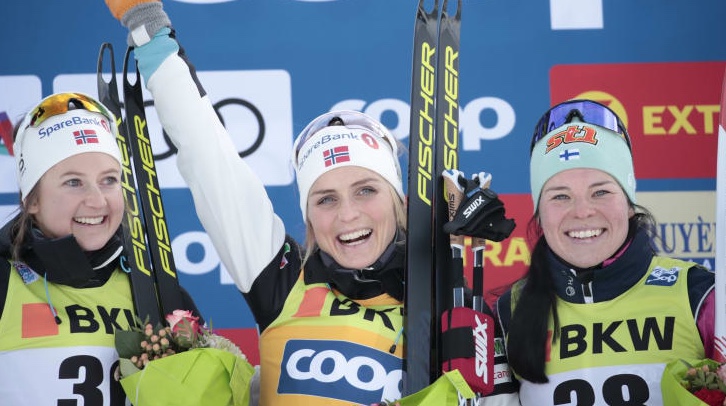
    The women’s podium from the 2018 World Cup 10 k freestyle individual start in Davos, Switzerland. Therese Johaug (center) of Norway won, teammate Ingvild Flugstad Østberg (left) was second, and Krista Pärmäkoski (right) of Finland was third. (Photo: Fis-Ski.com screenshot)

    Coming off a two-season hiatus from the World Cup for having a banned steroid in her system, Norway’s Therese Johaug has come back onto the distance race stage with time checks and results showing no remorse. This is not to say that Johaug’s reentry to the sport comes with arrogance. But it is to highlight that, on course, her level of control in the early season World Cup distance events has been dominant. Johaug has won all five World Cup distance events thus far. Her string of first places is a way of saying she’ll let the results speak for themselves and her dominance seep into the minds of those who want to fight for second and third place.

    Sunday was yet another win for Johaug. The up-tempo skier won the 10-kilometer freestyle individual start in Davos in a time of 26:06.9 minutes. She led the race at every intermediate time checkpoint.

    buy vancomycin online

    It was Johaug’s 81st World Cup podium. She trails only Norway’s legend Marit Bjørgen who won 99 World Cup podiums during her career.

    The second place finisher on Sunday, Johaug’s teammate Ingvild Flugstad Østberg, had the benefit of starting two places behind the eventual race winner: Johaug started in bib 36, Østberg in bib 38.

    Through the 5 k lap mark, Østberg was able to keep Johaug’s gap no bigger than 10 seconds. On the second lap’s long climb, Østberg only lost a handful of seconds. Her finishing time of 26:19.0 minutes was 12.1 seconds behind Johaug.

    For Østberg, it was her third distance podium in succession after placing second in Lillehammer’s 10 k classic pursuit, and third in Beitostølen’s 15 k freestyle individual start race.

    Johaug leads the World Cup overall with a perfect score of 600 points. Østberg sits in second, with a 149 point deficit.

    Finland’s Krista Pärmäkoski placed third on Sunday, 19.2 seconds back. It was Pärmäkoski’s first podium of the season. She currently is ranked fourth overall on the World Cup.

    Jessie Diggins during the 2018 10 k skate in Davos, Switzerland. Diggins placed fifth for her best result for the season. (Photo: Reese Brown/U.S. Ski Team)

    The U.S. placed two skiers in the top-10. Jessie Diggins placed fifth and Rosie Brennan sixth.

    For Diggins, it was her best result of the season after her eighth place in Beitostølen’s 15 k skate.

    “For me period 1 is a building phase, and it’s a really long season, and every single year I always build into period 1,” Diggins said in a phone call. “And I have to remind myself that I do this for me and that I follow a plan that has worked every other year, so I just have to remember that I will be in the right shape when it’s time. And for me, period 1 is not that time. So I’m really happy that it’s been trending positive.”

    Last season, after the Davos distance race, Diggins was eighth overall on the World Cup. Post-Sunday’s race, Diggins sits 13th overall and eighth in the distance cup standings.  

    The building phase of her season set up a solid foundation on Sunday. Her pace was consistent and only placed her 15.8 seconds out of third at the halfway point. She ended up 1:01.1 minutes behind Johaug at the finish.

    “I think that technically, I was really proud of my race today because of the way I skied,” Diggins said of her on course sensations. “It’s hard on a course like this to not go out guns blazing and just charge and then totally flood. Because that’s when I think you can lose so much time. For me, I was just so focused on trying to ski with a strong core and efficient, long-gliding v2 and I was just happy with it because it’s a really hard course to pace, and of course, you’re never sure if you nailed it or not.”

    With a two week break from racing, Diggins will be training in Seefeld, Austria during the race respite. Next up on the Diggins race schedule is the Tour de Ski (TdS). She placed third overall in the TdS last season, a historic mark for an American. Although she has ambitions at the TdS, Diggins also clarified that it remains a piece in the building-form puzzle. In-form or trending towards the sharp end of fitness, Diggins understands the possibility for more positive outcomes on the result sheet are more palpable as the season progresses.    

    “For me, I feel like period 1 and the Tour are really crucial building blocks for the season ahead, so I’m looking to take really good care of myself and just like get after it in the Tour. I do think that parts of a season are building blocks where you recognize that maybe you’re not in top form, and that’s on purpose because of the training load you’re carrying in. So you want to do the best you can with what you have. You’re not setting unrealistic expectations that might set you up to be bummed out. For me being like ‘I want to win Kuusamo 10k Classic’ would be an unrealistic expectation from myself. So I think that the Tour, yes, I would like to get a podium in the Tour, obviously, like I think that’s a good event for me, for my strengths, I really, really like it.”

    Rosie Brennan (bib 48) on her way to an individual career best on the World Cup with a sixth place in the 2018 Davos, Switzerland 10 k skate. (Photo: Reese Brown/U.S. Ski Team)

    Seeing Diggins steadily improve this season is no surprise. That has been her blueprint for success in the past. Arguably the biggest surprise in total on the women’s World Cup is Brennan’s success.  

    Brennan placed sixth (+1:04.9) on Sunday for her best career individual World Cup result.  

    “I just really wanted to feel good racing again and to enjoy it again,” Brennan said in a call. “I was just so miserable last year, and it was it hard decision to know if it was even worth it to continue on if I could find not only fun in racing again but also good form and just good race feelings.”

    Brennan’s struggle with fatigue and recovery soured her 2017-2018 season. Her down season resulted in her not being renominated to the U.S. Ski Team. What is clear now is that Brennan has found herself in an unprecedented place. Ranked 11th in the World Cup distance standings, Brennan was able to savor her Sunday in Davos.

    “Today was definitely the most fun race I’ve had all period, so I’m leaving period 1 on a high note, there’s not much more I could ask for, so it’s been great,” Brennan said.

    Her current high note has not allowed her to lose sight of managing her long-term energy and goals. Brennan will not race the TdS and will return to the U.S. for a training block.  

    “I had made that plan before the season started, and obviously with good results, it became a very difficult decision,” Brennan said of deciding to forgo the TdS. “But given how late World Champs is in the season this year, I really wanted to make sure that I had enough training under my belt to make it to World Champs, so I’ve decided to stick with the plan.”

    Currently, Brennan has not automatically qualified for World Championship team selection. She’ll have to remain in the top-50 of the distance standings before the selection period for the team ends.

    “The selection ends the second-to-last day of the Tour, and the Tour is only half points,” Brenna explained. “So I feel confident that I will remain in the top-50. So that helped make the decision easier. I have no pressure to race anything, so I’m just going to focus on training and keeping good fitness through the rest of the season.”

    Also for the U.S., Caitlin Patterson placed 38th (+2:22.5) and Kelsey Phinney 65th (+4:02.1). Sadie Bjornsen did not start and according to U.S. coach Matt Whitcomb, that decision was part of her pre-determined race schedule.

    Canada’s Emily Nishikawa stormed into the top-30 in only her second World Cup start of the season to place 23rd (+1:47.6). Cendrine Browne(CNST) was 44th (+2:28.8).

    For Nishikawa, the result ties her career best on the World Cup. She placed 23rd in a 2015 10 k classic in Lahti, Finland. In an email, Nishikawa explained that living in and training in Canmore mitigated some of the altitude effects of racing in Davos. During her race, she was caught by Diggins around 7 k.

    “I hung on as long as I could with [Diggins] and tried to follow her fast pace through top section,” Nishikawa wrote “Other than that I skied alone for the race.”

    Racing continues on the World Cup on December 29, for the TdS’s opening stage skate sprint.

    Results | Distance Standings | Overall World Cup Standings

  • Sunday Rundown: Davos, Canmore, Hochfilzen (Updated 2x)

    Sunday Rundown: Davos, Canmore, Hochfilzen (Updated 2x)

    The women’s podium from the 2018 World Cup 10 k freestyle individual start in Davos, Switzerland. Therese Johaug (center) of Norway won, teammate Ingvild Flugstad Østberg (left) was second, and Krista Pärmäkoski (right) of Finland was third. (Photo: Fis-Ski.com screenshot)

    FIS World Cup Davos, Switzerland  10k/15k Freestyle Individual Start

    Women’s Report | Men’s Report

    On Sunday, the final day of racing on the World Cup before a two-week break prior to the start of the Tour de Ski, the early season trend for women’s distance skiing continues. Norway’s Therese Johaug won the 10-kilometer freestyle individual start in Davos in a time of 26:06.9 minutes. She led the race at every intermediate time checkpoint.

    The only difference with Sunday’s distance narrative was Johaug’s margin of victory. Teammate Ingvild Flugstad Østberg placed second 12.1 seconds back. Krista Pärmäkoski of Finland placed third (+19.2).

    The U.S. Ski Team’s Jessie Diggins popped a season-best fifth place, crossing the line 1:01.1 minutes back. Also for the U.S. and posting a career-best World Cup finish was Rosie Brennan in sixth (+1:04.9).

    Also for the U.S., Caitlin Patterson placed 38th (+2:22.5) and Kelsey Phinney 65th (+4:02.1).

    Canada’s Emily Nishikawa stormed into the top-30 in only her second World Cup start of the season to place 23rd (+1:47.6). Cendrine Browne (CNST) was 44th (+2:28.8).

    Women’s Results

    In the men’s 15 k skate, Russia’s Evgeniy Belov won in 35:52.5 minutes. It was the Russian’s first career individual World Cup win.

    Over the duration of three laps on the up and then down 5 k loop, Belov only outdistanced second-place skier Maurice Manificat of France by a meager 0.9 seconds. Third place went to Norway’s Martin Johnsrud Sundby who finished 4.5 seconds back.

    In another tight men’s race, only 10.6 seconds differentiated first from fifth place. Russia’s Denis Spitsov was fourth (+7.5), and Norway’s Chris André Jespersen fifth (+10.6). Only 1:07.7 minutes separated 30th place from first.

    Alex Harvey of Canada was the best placed North American in 26th (+1:00.9). Teammate Len Valjas (CNST) was 62nd (+2:13.2), and Andy Shields 76th (+2:52.0).

    David Norris (APU) was the best placed American in 61st (+2:12.6). Adam Martin (CGRP) finished in 67th (+2:20.5), Scott Patterson of the U.S. Ski Team (USST) 72nd (+2:49.0), Simi Hamilton 77th (+2:54.3), and Kevin Bolger 92nd (+3:55.3).  

    Men’s Results


    ***

    Canmore NorAm and U23/JW Qualifier

    The third day of the Canmore NorAm weekend featured mass start classic racing.

    In the men’s race, NorAm leader Bob Thompson (TBay) emerged the winner of the 30km in 1:18.40.2 hours after beginning the 8th and final lap in a group of four. Jack Carlyle (AWCA) placed second, 0.3 seconds behind. It had been almost two years to the day since his last podium at this level.

    Russell Kennedy (Team R.A.D.) placed third, 8.6 seconds back, after winning the 15km skate individual start race on Saturday.

    In the junior ranks, Samuel Hendry (Team R.A.D.) was dropped on the final lap, finishing 22.0 seconds in back of the day’s winner as the top junior. Antoine Cyr (CNST) fell back on the 7th lap but held on for 5th overall and top U23 at 1:24.7 back. Remi Drolet (Black Jack) was the second junior in 6th, 0.3 seconds behind Cyr.

    Thompson is the COC leader for Period 1, which should qualify him for the Tour de Ski and World Cup period 3.

    Cyr should be automatically to the U23 team for the Lahti, Finland World Juniors when the High Performance committee meets Sunday afternoon to confirm final selections. As both Hendry and Drolet had already qualified, the committee will be interpreting rules to determine the remaining junior men going to Lahti. Team ULLR’s Tom Stephen (14th today, 3:29 behind) and Xavier McKeever (16th at 5:07.4) will be among the athletes considered for the final junior spots.

    In the women’s 15km, national team members Dahria Beatty and Katherine Stewart-Jones gained a gap on the shorter first lap of the race and were never reeled in. Beatty won the sprint for first crossing the finish in 42:55.8 minutes, with Stewart-Jones 1.8 seconds back.

    Beatty has already met the criteria for World Cup period 2 and 3 starts as COC leader, which means a Canadian woman could possibly be racing the Tour de Ski.

    First year senior Hannah Mehain (Telemark) finished alone in third, 1:55.6 minutes back, after dropping the original chasing pack to take the top U23 spot on the day. Frédérique Vézina (CNEPH) started slower but finished strong to take 4th overall, 2:26.7 behind. Sadie White was 5th at 2:29.7 minutes for the second U23 place.

    Jasmine Drolet was 6th overall at 2:38.0 behind to take the top junior position and join her brother Remi on the Lahti trip.

    Live results [https://zone4.ca/race/2018-12-16/f31c8bac/2018-haywood-noram-world-jr/results/]

    Weekend results [https://zone4.ca/event/18b91492-fd6d-11e8-a07c-0afc046f7944/]


    ***

    IBU World Cup Hochfilzen, Austria women’s 4 x 6 k relay / men’s 4 x 7.5 k relay

    In the women’s 4 x 6 k relay on Sunday, Italy won in a time of 1:10:58.7 hours after using three spares. Italy’s team consisted of Lisa Vittozzi, Alexia Runggaldier, Dorothea Wierer, and Federica Sanfilippo.  

    Sweden placed second (+8.4) using eight spares. Linn Persson, Mona Brorsson, Emma Nilsson, and Hanna Öberg raced the four legs.

    Anais Chevalier, Julia Simon, Celia Aymonier, and Anaïs Bescond placed third for France finishing 11.8 seconds back while using nine spares.

    The U.S. team of Joanne Reid, Susan Dunklee, Clare Egan, and Deedra Irwin placed 13th (+3:39.1) using nine spares and skiing one penalty loop.

    Canada’s women’s team of  Megan Tandy, Megan Bankes, Nadia Moser, and Rosanna Crawford placed 16th (+5:19.3) with two penalties and using 13 spares.

    Women’s relay results

    The men’s 4 x 7.5 k relay was won by Sweden’s Peppe Femling, Martin Ponsiluoma, Torstein Stenersen, and Sebastian Samuelsson in 1:16:10.6 hours using five spares.

    Lars Helge Birkeland, Henrik L’Abee-Lund,Tarjei Bø, and Vetle Sjåstad Christiansen of Norway placed second (+3.6) using seven spares. For Germany, Simon Schempp, Johannes Kuehn, Arnd Peiffer, and Doll Benedikt were third (+28.8) with a single penalty and using six spares.

    The U.S. team of Leif Nordgren, Sean Doherty, Travis Cooper, and Jake Brown placed 12th (+2:33.6) using 10 spares.

    Canada’s Scott Gow, Brendan Green, Jules Burnotte, and Nathan Smith placed 20th (+5:13.0) with three penalties and using 14 spares.

    Men’s relay results


  • Another Distance Win for Østberg in her ‘Favorite Place’; Five Americans Top 30 in Davos

    Another Distance Win for Østberg in her ‘Favorite Place’; Five Americans Top 30 in Davos

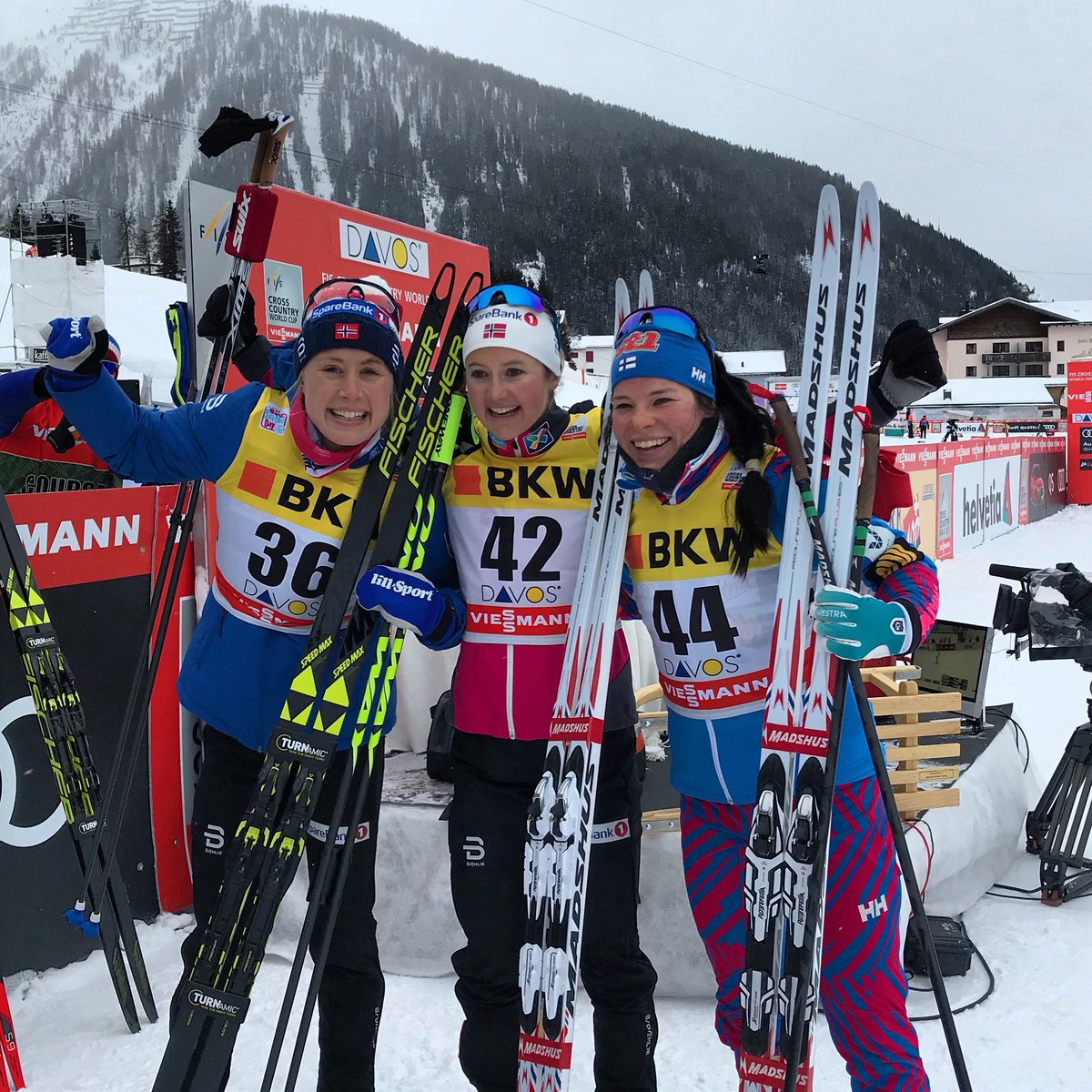
    The women’s 10 k freestyle podium on Sunday at the Davos World Cup in Switzerland, with Norway’s Ingvild Flugstad Østberg (c) in first and Ragnhild Haga (l) in second, and Finland’s Krista Parmakoski (r) in third. (Photo: FIS Cross Country/Twitter)

    DAVOS, Switzerland – Ingvild Flugstad Østberg picked up the third Davos win of her career, and just like one year ago, the Olympic silver medalist didn’t do it in the sprint. Instead, Østberg made her mark in the distance event, this year a 10 kilometer freestyle race.

    Bib 42 in the interval-start competition, the Norwegian knew the split times of some of her top competitors, and quickly surpassed them. By the 5 k mark she had a 5.5-second lead over teammate Heidi Weng, 13 seconds over Sweden’s Charlotte Kalla – who had won the previous three distance races of the season – and nearly 20 seconds over Norwegian teammate Marit Bjørgen.

    Later starters threatened, with Switzerland’s Nathalie Von Siebenthal laying down a time at the 5 k mark that nobody could match. Kerttu Niskanen of Finland was also fast at the halfway point, just a second behind Østberg’s time.

    But while Østberg stayed aggressive and strong over the second lap of the course, several competitors slowed, perhaps having started too fast. To the sighs of the Swiss crowd, Von Siebenthal faded and finished in a tie for fifth with Austria’s Teresa Stadlober. Niskanen was seventh.

    That left Østberg at the top of the standings, 5.9 seconds ahead of teammate Ragnhild Haga and 7.9 seconds ahead of Finland’s Krista Parmakoski.

    “It was completely insane,” Østberg told Norway’s NRK broadcaster. “That’s what I’ve been training for the whole year. This is my favorite place and I love being here.”

    It was Østberg’s second podium of the season after finishing third in the 10 k classic in Ruka, Finland.

    “She’s impressive,” Kalla said to Norway’s VG.

    “I am very impressed,” Bjørgen agreed. “Ingvild went very well here last year, too.”

    Parmakoski was ranked second at the 8.2 mark, but lost time compared to earlier starter Haga, who was able to finish second thanks to her aggressive skiing on the course’s downhill finish.

    Haga is continuing to have her best season to date; this was her third podium, all coming in distance races. Second place is also her best individual World Cup finish ever.

    “t was thrilling [as in nervous] to race, because it was so close,” Haga told Norway’s TV2 of receiving splits along the course, according to a translation. “On the top coach yelled out that I had to ski with my life … It feels great to end up on the podium when it was such a close race.”

    Weng was left off the podium in fourth (+14.5). Kalla finished eighth (+26.8), Bjørgen ninth (+35.9), and Norway’s Astrid Jacobsen tenth (+37.6).

    Sadie Bjornsen (U.S. Ski Team) racing to 12th in the World Cup women’s 10 k freestyle on Sunday in Davos, Switzerland.

    After a banner day in the freestyle sprint on Saturday, which saw four American women in the top eight, the team comparatively slowed. But they still packed the top 20, with Sadie Bjornsen 12th (+44.6), Kikkan Randall 14th (+56.8), Jessie Diggins 15th (+59.9), and Rosie Brennan 17th (+1:11.2).

    “I haven’t raced a distance race here in a few years,” Bjornsen said. “I wasn’t really sure how to approach it other than my wax tech told me yesterday to ski the uphills and race the downhills. I went out a little harder than I normally do on purpose, to see if I could hold it. I think that on a course like this I have to operate like that.”

    It worked, and despite the hard start Bjornsen kept an even position in the field: 10th after 3.2 k, 11th after 5 k, and 12th at the finish.

    “This is, for me, one of the hardest courses because there’s not a second of rest out there,” she said. “I often do a little bit better when I have some recovery. I did today just as a challenge for myself, to practice pushing through some serious pain cave. The result isn’t what matters today. It’s that I did that effort. I felt like I was able to push that.”

    Diggins wasn’t happy with her race; after being sick earlier in the week, she had rallied for the sprint, where she finished fourth yesterday. But in the 10 k she was unable to match her fourth-place finish from last year’s 15 k.

    Jessie Diggins (U.S. Ski Team) racing to 15th in the World Cup women’s 10 k freestyle on Sunday in Davos, Switzerland.

    “It was disappointing for me,” she said. “It wasn’t what I wanted. I felt like my reserves, now that I’ve been sick, maybe wore out. So I made it through yesterday and just didn’t have it today. That’s okay — not every day is going to be good. It felt like I was pushing as hard as I could but I just didn’t have a lot there today. And if something is not great, then it really, really shows on this course.”

    Randall, meanwhile, felt like she put together a solid weekend after hitting the podium in the sprint and then finishing 14th. In her last Davos distance race before retirement, it was also her best Davos distance result. On her first lap, she skied with Kalla, who was finishing the race.

    Sweden’s Charlotte Kalla, in the overall World Cup leader’s bib, leads American Kikkan Randall during the women’s 10 k freestyle individual start at the Davos World Cup in Switzerland.

    “I think today was good,” Randall said. “It was fun to ski with Charlotte on the first lap. I actually felt pretty comfortable skiing behind her. But then on the second lap it was like, oh, that’s what she must have been feeling like. So it was good to get that pace to start and then have to work through it myself on the second lap. So it was solid. It wasn’t a spectacular day, but overall pretty good.”

    Ranked 23rd at the halfway point of the race, Brennan rallied and moved up on the second time up the course’s long climbing section, before losing a few more seconds on the downhill.

    “The uphills!” she laughed when asked whether there was a part of the race that had worked particularly well for her. “The downvalley, I don’t know, I probably have some work to do on that. But gradual uphills are good for me. This course is special — even when you are skiing, you don’t really know what’s going on. You just have to find a way to keep moving. But I felt like I was able to do that, so I’m pretty happy.”

    Chelsea Holmes finished 29th (+1:32.9), Liz Stephen 40th (+1:58.5), and Sophie Caldwell 52nd (+2:20.1).

    Cendrine Browne (Canadian U25 Team) racing to 45th in the World Cup women’s 10 k freestyle on Sunday in Davos, Switzerland.

    Cendrine Browne led the Canadian team in 45th (+2:05.9), followed by Emily Nishikawa in 50th (+2:18.4).

    “It went well,” said Browne. “I’m really happy – usually I have a hard time at altitude because I live at sea level. So I went into the race not knowing how it would go. Last year it did not go really well for me. So I was happy that I had good feelings during the race, I was able to push.”

    After struggling last year, Browne tried to be deliberate in her approach to the Davos course this time around.

    “Yesterday I talked about that with my coach, Louis [Bouchard]. “And other athletes, like Alex, were saying don’t start too fast because everybody dies on this course because it’s so hard. But I talked with Louis and we decided that I would do like always, I would start fast and see if I could hold that pace. So I started fast. I think I had a really good start. I tried to just keep going.”

    Also for Canada, Dahria Beatty placed 73rd (+2:53.0) and Katherine Stewart-Jones 79th (+3:44.6).

    Results

  • Sunday Rundown: Davos, Hochfilzen and Sovereign

    Sunday Rundown: Davos, Hochfilzen and Sovereign

    CGRP's Caitlin Patterson charging up the wall climb. (Photo: Peggy Hung)
    Caitlin Patterson (Craftsbury Green Racing Project) charging up the wall climb en route to the win in the women’s 10 k freestyle on Sunday at the Sovereign Lake NorAm/SuperTour near Vernon, B.C. (Photo: Peggy Hung)

    NorAm/SuperTour (Sovereign Lake near Vernon, British Columbia): 10/15 k freestyle

    VERNON, B.C. — The combined NorAm and SuperTour event at the Sovereign Lake Nordic Centre continued with individual-start distance races and continued with the theme of U.S. domination of the leaderboard.

    Ian Torchia, of Northern Michigan University (NMU) and the U.S. Ski Team D-team, started the day with a big victory in the men’s 15 k freestyle, finishing in 36:29.7 minutes and on the heels of Canadian Para-Nordic guide Graham Nishikawa, who started 30 seconds ahead of him and ended up sixth. Jack Hegman of the Sun Valley Ski Education Foundation (SVSEF) placed second, 19.0 seconds back, to complete his good weekend. Canadian Para-Nordic superstar Brian McKeever rounded out the podium in third, 22.6 seconds back.

    Graham Nishikawa and Ian Torchia worked together after Torchia closed the 30 second gap. (Photo: Peggy Hung)
    Graham Nishikawa (l) and Ian Torchia worked together after Torchia closed the 30-second gap en route to a victory in the men’s 15 k freestyle on Sunday at the Sovereign Lake NorAm near Vernon, B.C. (Photo: Peggy Hung)

    The women were next to get some time in the sunshine with two laps for 10 k. Caitlin Patterson of the Craftsbury Green Racing Project (CRGRP) upgraded from Saturday’s silver to gold on Sunday with winning time of 27:13.0. Rosie Frankowski of Alaska Pacific University (APU) snatched second, 30.7 seconds back. Caitlin Gregg (Team Gregg) raced to third, 1 second behind Frankowski.

    Former Canadian national-team biathlete Zina Kocher started her new cross-country career as the top Canadian in seventh (+1:31.2).

    The weather was a repeat of Saturday: -2 degrees Celsius, windless and sunny. Smiles were evident everywhere, even for athletes who didn’t quite nail the pacing on an unforgiving course.

    Results

    ***

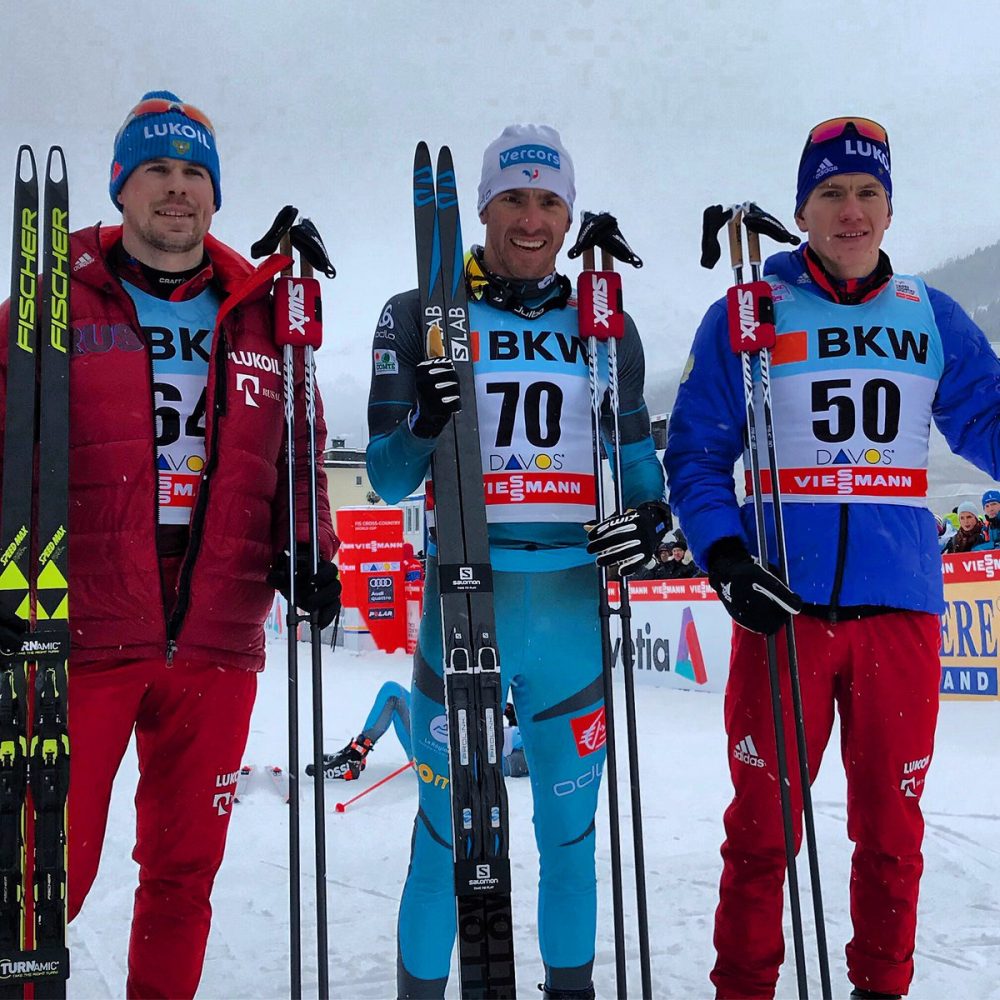
    France’s Maurice Manificat (c) after winning the men’s 15-kilometer freestyle on Sunday in Davos, Switzerland. He finished ahead of Russians Sergey Ustiugov (l) and Alexander Bolshunov in second and third respectively. (Photo: FIS Cross-Country/Twitter)

    FIS Cross Country World Cup (Davos, Switzerland): 10/15 k freestyle 

    Women’s report

    Men’s report

    After a day of sprinting, cross-country racers returned to the Davos World Cup venue on Sunday for the women’s 10-kilometer and men’s 15-kilometer freestyle individual start competitions.

    For his first World Cup win in almost two years, France’s Maurice Manificat took the men’s 15 k race title in a time of 33:56.2. Exactly 4 seconds flat behind Manificat in second place was Russia’s Sergey Ustiugov. Ustiugov’s teammate Alexander Bolshunov, finished 10 seconds behind Ustiugov and 14.6 seconds behind Manificat for the men’s third and final podium spot.

    The remainder of the men’s top ten included Norway’s Simen Hegstad Krüger in fourth (+21.3), Switzerland’s Dario Cologna in fifth (+26.5), Sweden’s Marcus Hellner in sixth (+35.4), Russia’s Denis Spitsov in seventh (+36.1), Hans Christer Holund of Norway in eighth (+36.9), Russian Alexey Chervotkin in ninth (+54.2), and Alex Harvey of Canada in 10th (+1:01.2).

    The next best male North American finisher was American Patrick Caldwell in 41st (1:50.2).

    Canada’s Devon Kershaw placed 44th (1:59.8), Graeme Killick 59th (+2:27.8), Russell Kennedy 68th (+2:43.4), and Julien Locke in 94th (4:27.5). Knute Johnsgaard did not start.

    For the U.S., Noah Hoffman finished 48th (2:05.5) and Scott Patterson 88th (3:46.2). Simi Hamilton did not start and Andy Newell did not finish.

    The women’s 10 k freestyle podium on Sunday at the Davos World Cup in Switzerland, with Norway’s Ingvild Flugstad Østberg (c) in first and Ragnhild Haga (l) in second, and Finland’s Krista Parmakoski (r) in third. (Photo: FIS Cross Country/Twitter)

    In the women’s 10 k, 75 starters finished the 10 k course with Norway’s Ingvild Flugstad Østberg claiming first in a time of 25:28.5. Her Norwegian teammate, Ragnhild Haga finished 5.9 seconds behind her for second place. Krista Pärmäkoski of Finland raced to the third and final podium spot, 7.9 seconds back from Østberg’s winning time.

    Rounding out the women’s top ten was Heidi Weng in fourth (+14.5), Austria’s Teresa Stadlober in fifth (+16.4), Switzerland’s Nathalie von Siebenthal in sixth (+16.4), Finland’s Kerttu Niskanen in seventh (+24.9), Sweden’s Charlotte Kalla in eighth (+26.8), Norwegian Marit Bjørgen in ninth (+35.9), and Astrid Uhrenholdt Jacobsen in tenth (+37.6).

    Leading the U.S. women was Sadie Bjornsen in 12th (+44.6), seven seconds outside the top ten. The next two Americans finishers were within 3.1 seconds of each other, with Kikkan Randall finishing 14th (+56.8) and Jessie Diggins in 15th (+59.9).

    Also scoring World Cup points for the Americans, Rosie Brennan finished in 17th (+1:11.2) and Chelsea Holmes in 29th (+1:32.9).

    The U.S.’s Liz Stephen and Sophie Caldwell finished in 40th (+1:58.5) and 52nd (+2:20.1), respectively.

    For the Canadians, the team was led by Cendrine Browne in 45th (+2:05.9), followed by Emily Nishikawa in 50th (+2:18.4). Dahria Beatty placed 73rd (+2:53.0) and Katherine Stewart-Jones 79th (+3:44.6).

    Results: Women | Men

    ***

    IBU World Cup (Hochfilzen, Austria): Men’s and women’s relays

    Men’s and women’s relays took place on the final day of racing in Hochfilzen, with Norway winning the men’s 4 x 7.5 k and Germany topping the women’s 4 x 6 k by considerable margins.

    Norway’s Ole Einar Bjørndalen, Henrik L’Abée-Lund, Erlend Bjøntegaard, and Lars Helge Birkeland raced to first in 1:21.21.8 hours, nearly two minutes clear of Germany in second, after taking the lead on L’Abée-Lund’s second leg. They avoided the penalty loop and used a total of nine spares, and never lost hold of first place for the rest of the race.

    Germany raced to second (+1:54.9) with Erik Lesser, Benedikt Doll, Arnd Peiffer, and Simon Schempp, with zero penalties and 17 spares, after Peiffer lifted them from fourth to second on the third leg. Schempp held them there, despite using a maximum of three spares on each of his shooting stages, in the final leg.

    France claimed third (+2:34.0) with Jean-Guillaume Béatrix, Simon Desthieux, Emilien Jacquelin, and Quentin Fillon Maillet, despite three penalties and 13 spares. Two of their penalties came on Beatrix’s first leg and another in Fillon Maillet’s final shooting. After being tagged in fifth, Jacquelin raced them up to third on the third leg and Fillon Maillet held onto that position for the last spot on the podium.

    The U.S. men finished ninth (+3:38.3) with Lowell Bailey, Leif Nordgren, Tim Burke, and Sean Doherty, after they combined for three penalties and 13 spares. Bailey avoided the penalty lap and put them in third at the first exchange, while Nordgren slipped to seventh after a penalty, Burke remained in seventh with one penalty as well, and Doherty had one more penalty to anchor the team to ninth.

    Canada placed 15th (+6:22.5) with six penalties and 20 spare rounds, with Christian Gow, Scott Gow, Nathan Smith, and Brendan Green. After being tagged in 21st, Smith raced them up to 13th, using just two spares to clean. Green anchored them to 15th after using six spares and skiing the 15th-ranked time on that last leg.

    In the women’s relay that followed, Germany won by 44.9 seconds over Ukraine, with Vanessa Hinz, Franziska Hildebrand, Maren Hammerschmidt, and Laura Dahlmeier using nine spares while staying out of the penalty lap.

    After Hinz raced them into first, Hildebrand slipped to fourth after using four spares on the second leg. Hammerschmidt raced the fastest third leg to put them back in first, and Dahlmeier held them there to the finish, crossing first in 1:14:36.4.

    Ukraine (0 penalties, 5 spares) took the lead on the second leg but ultimately settled for second with Vita Semerenko, Yuliia Dzhima, Valj Semerenko, and Olena Pidhrushna. Dzhima put them in second heading into the race’s halfway point, but Valj Semerenko lost two places to tag Pidhrushna in third. Pidhrushna used just two spares on the final leg to bring them to second, about 20 seconds ahead of France in third.

    Despite a tough first leg for Marie Dorin Habert, in which she had two penalties and tagged off in 14th, France rose to third place at the finish (+1:04.5) thanks to strong skiing and shooting from anchor Anaïs Bescond.

    The team had a total of two penalties and 13 spares. Celia Aymonier used four spares to put them in ninth after the second leg, and third-leg Justine Braisaz lifted them one more place to seventh before Bescond skied the fastest last leg to pick off four more places.

    Canada placed ninth (+2:31.6) with Emma Lunder, Rosanna Crawford, Megan Bankes, and Julia Ransom, with no penalties and nine spares. Crawford put them in fifth after the second leg, Bankes lost one place on the third leg, and Ransom slipped three more with three spares on her final shooting to finish ninth.

    The U.S. did not enter a women’s team.

    Results: Men | Women

  • Nilsson Prevails in Davos, But Americans Impress with Three in Top 6

    Nilsson Prevails in Davos, But Americans Impress with Three in Top 6

    The women’s skate sprint podium at Saturday’s World Cup in Davos, Switzerland, with Kikkan Randall (r) of the U.S. Ski Team in third place, Sweden’s Stina Nilsson (c) in first, and Norway’s Maiken Caspersen Falla (l) in second. (Photo: Reese Brown/US Ski & Snowboard)

    DAVOS, Switzerland — Stina Nilsson came into Saturday’s freestyle sprint looking to return to her winning ways after having a four-sprint victory streak broken last weekend in Lillehammer, Norway.

    The Norwegian women came into the day looking to further redeem themselves after a slow – by their standards – start to the season, with Nilsson and her Swedish teammate Charlotte Kalla combining to win four of the five races held so far.

    And the U.S. women came in and calmly qualified five women in the top 11 spots, then advanced four of those athletes to the semifinals, three to the final, and one – Kikkan Randall – to the podium.

    Jessie Diggins finished fourth, Ida Sargent sixth, Sophie Caldwell eighth, and Sadie Bjornsen 13th.

    “We obviously have so much experience in this group right now,” U.S. Ski Team Head Coach Chris Grover said after. “And we probably had the best skis out there today, which is gratifying. A lot of things just kind of came together… I’d say at the same time we’ve been waiting for the first skate sprint of the year. Especially after five races in Scandinavia, with a lot of classic races, to come down and have a first skate weekend was something that the athletes were really looking forward to. So I expect that they’ll have some more good results in tomorrow’s race and in Toblach [Italy] in a week.”

    Randall and Diggins 3-4 as Nilsson Wins Again

    In the final, none of the Americans – or anyone else – could match a turn of pace produced by Nilsson and Norway’s Maiken Caspersen Falla, who won last weekend’s classic sprint in Lillhammer. The two women skated away halfway through the course, accelerating through the stadium in a race to be first to the turn up to the course’s steep climb.

    From there, Nilsson pulled away from Falla. But as she descended back into the stadium, she bobbled coming out of a sharp downhill corner. Falla had a chance, and drew even with the Swede in the finishing lanes.

    “I knew the last turn was bad, and I ended up where I shouldn’t have,” Nilsson told NRK, according to a translation. “I knew Maiken came up behind me fast, but I never gave up.”

    In a photo finish, Nilsson managed to just hang onto the win by 0.08 seconds.

    “It was very close, but I’m very happy,” Falla told NRK. “I put absolutely everything I could into it and went for the win… but there was no more to pick up. But I was pleased.”

    Behind the dueling Scandinavians came Randall. Lapping through the stadium halfway through the final, she closely followed Nilsson and Falla. But when they upped the pace, she couldn’t quite respond.

    “I was in a perfect place,” she said in a finish-line interview. “I was right behind both of them. I felt the gears shift – the same thing happened in the semifinal. I felt like I did a better job responding to it in the final. And I think there’s a little bit of just sharpening and confidence that will help me bridge that.”

    American Kikkan Randall (6) leads Switzerland’s Laurien van der Graaff (in black) and others in their quarterfinal of the women’s 1.5 k freestyle sprint on Saturday at the World Cup in Davos, Switzerland. Randall won the heat and went on to place third in the final. (Photo: Reese Brown / US Ski & Snowboard)

    Rather than being discouraged, Randall – who crossed the line 2.53 seconds after Nilsson, well clear of fourth-place Diggins – took it as evidence of exactly what she needs to work on to win.

    “It’s cool to just have that concrete example, like, OK, that’s the best, and you’re right here, now you have to work on bridging that before we get to [the Olympics in] Korea,” Randall said.

    Randall, a three-time Sprint World Cup champion from 2012 to 2014, hadn’t qualified for quarterfinals in either of the sprints so far this season, both of which were classic races.

    “The first couple weekends of the World Cup have been a mixed bag for me,” she said. “I felt like this kind of shape was there, but in classic I haven’t been able to quite put it together. So it’s really nice to know that I have last year all under my belt, a good year of training, and now I’m in a position where I know my fitness is good and I’m just sharpening that race gear as we go. It was really good to lay down a strong effort today.”

    Her teammate Diggins couldn’t hang onto her tails, but still finished fourth – 4.41 seconds behind Nilsson, and more than a second ahead of Norway’s Ingvild Flugstad Østberg in fifth.

    Given that Diggins had been sick earlier in the week, it was a result she seemed more than happy with.

    “I’m so pysched to be able to race this weekend,” Diggins said. “Three days ago I was laying in bed and sick. I was just like, I am just going to go and give it my best. And damn, the podium was right there! And I tried, but I just didn’t get around soon enough. It was so fun to get to another [sprint] final. I am glad to see that sickness didn’t take all of my racing edge.”
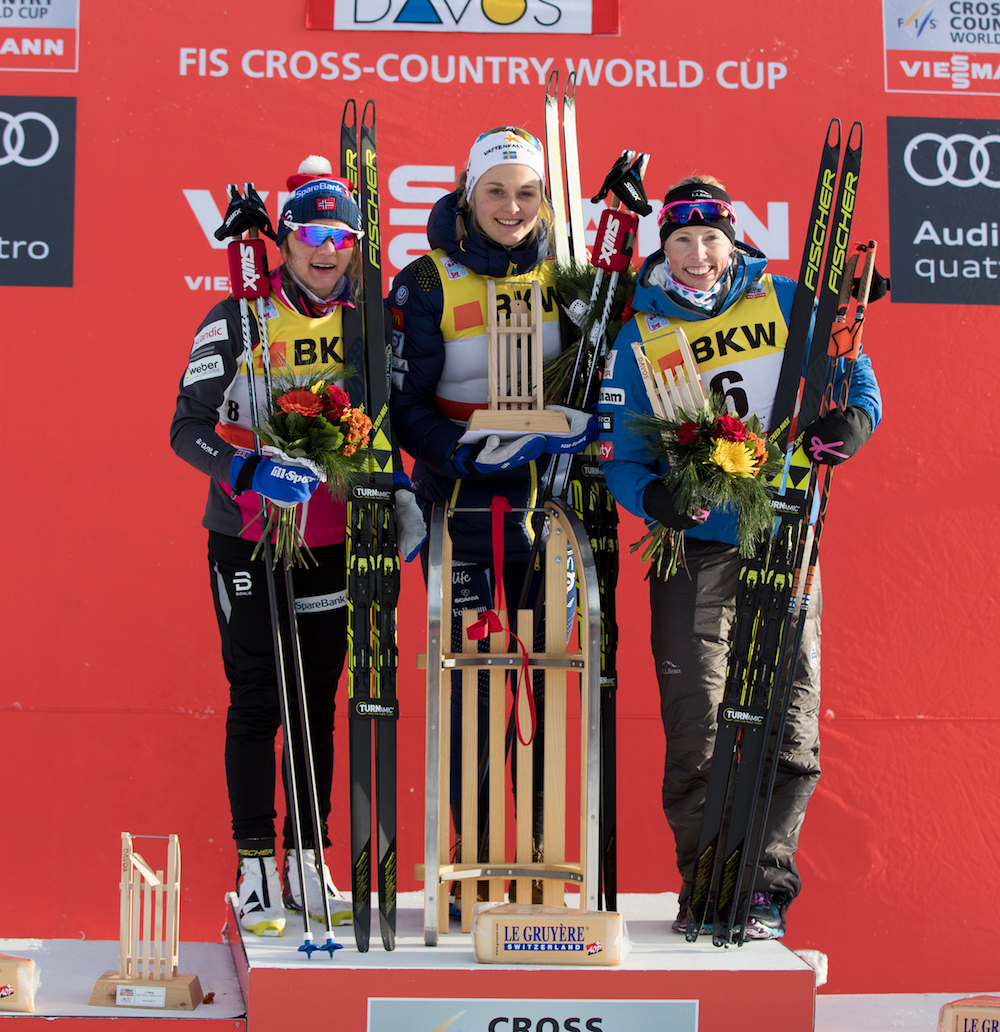
    Diggins had led the Americans in the qualifier in fourth place. But that didn’t give her complete confidence that the heats would go well, or that she had recovered from her illness and missed training.

    Jessie Diggins (4) leads fellow U.S. Ski Team member Sophie Caldwell (9) in their quarterfinal of the women’s 1.5 k freestyle sprint at the World Cup in Davos, Switzerland. Diggins won the heat and Caldwell placed second to advance to the semifinals. (Photo: Reese Brown/US Ski & Snowboard)

    “We had really fast skis, so that can make a big difference,” she said of the qualifying round. “And also sometimes your fitness throughout the rounds is different than your two-minute, 45-second sprinting [in the qualifier], so I wanted to see what is going to happen though the day. I was trying to play the patient game.”

    Both Diggins and Randall were very much in the mix in the final, and had their heads up for opportunities late in the heat, even after Nilsson and Falla had pulled away. The American skis were running fast on the downhill, and both women knew that if they could shortcut the final corner coming into the finishing chute, they might regain some ground.

    “The way our skis were running, the way that corner was skiing, I wasn’t giving any inch,” Randall said. “Anything was possible.”

    But both Nilsson and Falla stayed on their feet, and all Randall could do was ski aggressively to third. Likewise, Diggins was pleased with the downhill and corner but there was nobody for her to pass in the final round.

    “On that corner, the sketchier it got, the more I liked it,” Diggins said. “My skis were flying on the downhill, and that is a strength of mine for sure. I didn’t quite have [the podium] before that corner so I needed to get a good draft there, and I didn’t quite punch it where I needed to but that’s sprint racing, man.”

    Breakthrough for Sargent

    Sargent, the third U.S. woman in the final, ran out of gas and finished sixth, 14.49 seconds behind Nilsson. It was the second skate final of her career, her first coming in 2013 in Sochi, Russia. After qualifying in fifth, just 0.41 seconds behind Diggins, she had finished third in a photo finish with Russia’s Natalia Matveeva in her quarterfinal heat.

    American Ida Sargent (5) in close quarters with Norway’s Maiken Caspersen Falla (8) during their quarterfinal of the World Cup skate sprint on Saturday in Davos, Switzerland. Falla won the heat and Sargent finished third, 1.12 seconds back and advanced to the semifinals as a lucky loser. (Photo: Reese Brown / US Ski & Snowboard)

    That was something of a “heat of death”, with Falla, Østberg, Sargent, Matveeva, and third-place qualifier Nadine Fähndrich of Switzerland all vying to advance. Because of that, it was also a fast heat and Sargent was easily the top “lucky loser” from the quarterfinals.

    In her semifinal, Sargent took the lead on the first big hill and led the heat before ultimately crossing the line second, 0.42 seconds behind Diggins.

    “I was feeling really good and I had great energy today, and I kind of wanted to be up front,” Sargent said. “In the quarterfinal I thought it was harder to stop and go all the time, and it just felt pretty relaxed [in the semifinal]. I tried to stay conservative so I could go for it on the hill in the semi-final… I knew I had to be in the top two.”

    By the final, though, Sargent was tiring.

    “I think being in the second semifinal — I have never really loved altitude,” she said, referring to the Davos venue’s elevation more than 5,000 feet above sea level. “So I started out and the first lap was OK, and then as we started the second lap, it was just like, oh God, I hit a wall. I felt like I was just struggling to the line, but I am psyched to be in the final. It’s a big step for me.”

    In the 2013 sprint final in Sochi, Norway hadn’t brought its A-team. Saturday in Davos was different. As usual in the first period of World Cup racing, the best of the best race every weekend. (Both Kalla and Norway’s Marit Bjørgen sat this race out, but neither has made the top 10 of a sprint so far this season.)

    Grover noted that Sargent’s performance followed up on good results in the first weekend of the World Cup, where she finished 15th in the classic sprint and 22nd in the 10 k classic in Kuusamo, Finland.

    “We knew she was in good anaerobic and aerobic fitness,” Grover said. “She had a rough weekend last weekend. She was too slick [with wax] in the classic sprint, and she had some problems with breathing in skiathlon. But the previous weekend, we’d seen her anaerobic side on the sprint side was quite good, and her aerobic side with the classic 10 k was quite high. So she’s made a real physiological step forward.”

    The physiology isn’t the only thing, though; without tactics and race smarts, simply being in better shape isn’t enough to succeed in World Cup sprinting.

    “I think she’s also made a tactical step forward and improved her confidence, and she’s making better moves out there,” Grover said. “Tactics and aerobic fitness always go hand in hand. If you have more aerobic fitness, you can do more things out there. So, I think what we’re seeing there isimproved fitness, making better decisions, and she’s going to have some great results this year.”

    Randall, too, was impressed with her teammate.

    “I’m just so proud of Ida,” Randall said, “because last week she struggled. But she just reset. She came in this week with a good plan, she laid down a wicked-fast qualifier, and to ski that gutsy race in the semifinal, leading from the front – just so cool to see. She has always been right there, but she has obviously just upped it a level. So that’s really cool. We’re getting closer to an all-American final. Someday.”

    Caldwell, Bjornsen in the Heats

    Caldwell advanced to the semifinals, but was unable to find her place in the pack and finished fourth in the heat where Diggins and Sargent went 1-2.

    “I started from the back, which is fine, but then I just couldn’t really move to the front,” Caldwell said. “But so it goes. Honestly, I felt pretty terrible today, and I just kept telling myself maybe everyone does? I wanted to conserve energy when I could.”

    Bjornsen, meanwhile, was out after the quarterfinals, missing “lucky loser” status by just one place. After two classic sprint podiums to start off the season, she ended up 13th.

    “I was going to try to stay behind [Nilsson], but then she kind of went slow at the beginning,” Bjornsen said of the heat. “When she made her move I was kind of stuck behind everyone unfortunately. I was able to make a nice move over the top of the hill, but I think I just took that last corner wrong. I should have gone on the inside of [Finland’s] Krista [Pärmäkoski] and I didn’t.”

    Bjornsen said she had made a tactical mistake, but that her fitness and feeling was every bit as good as in those podium-worthy classic sprints.

    “Sometimes I think that hardest thing is making it through the quarterfinals,” she said. “Once I get beyond that I find my groove better. Today it wasn’t perfect, but I think I am in the same place in skating [as in classic] so we will have more chances this year.”

    Also for the U.S., Julia Kern finished 57th in qualifying, 16.55 seconds off the pace set by Nilsson and 6.42 seconds out of the top 30.

    Canada’s Dahria Beatty finished 53rd in qualifying (+15.53 seconds), Katherine Stewart-Jones followed in 55th (+16.18), and Cendrine Browne was 64th (+18.27).

    Results: Women’s final | Women’s qualifier

    — Ian Tovell and Andrea Potyodny-Smith contributed

    Kikkan Randall (6) and Jessie Diggins (4), both of the U.S. Ski Team, chasing Sweden’s Stina Nilsson (1) during the World Cup women’s skate sprint on Dec. 9 in Davos, Switzerland. (Photo: Reese Brown / U.S. Ski & Snowboard)
  • Pellegrino Can’t Stop Klæbo in Davos; Hamilton Ninth in Skate Sprint

    Pellegrino Can’t Stop Klæbo in Davos; Hamilton Ninth in Skate Sprint

    Simi Hamilton of the U.S. Ski Team racing to ninth overall in Saturday’s World Cup freestyle sprint in Davos, Switzerland. (Photo: Reese Brown/U.S. Ski & Snowboard)

    DAVOS, Switzerland – Would Johannes Høsflot Klæbo cruise to win No. 6, a perfect World Cup record, in the skate sprint today, or could someone stop him?

    As qualifying finished, the quarterfinals passed, and the semifinals began on Saturday, it became clear that only one man had a chance: Federico Pellegrino, the Italian who won World Championships gold over Klæbo last season.

    Sergey Ustiugov, the Russian who would have challenged Klæbo last year, didn’t make the final. Neither did any of Klæbo’s Norwegian teammates. Sweden’s Teodor Peterson fell in his quarterfinal, Calle Halfvarsson was out sick this weekend and Emil Jönsson, the Swedish hero of old, didn’t make the heats.

    It was all down to Pellegrino, but in the final when Klæbo pulled away on the long straightaway through the stadium, the Italian’s most valliant efforts couldn’t quite keep pace.

    The young Norwegian instead claimed yet another win, and Pellegrino – charging in the finishing lanes as Klæbo slowed up and crossing the line just 1.80 seconds later – was second.

    The men’s skate sprint podium at Saturday’s World Cup in Davos, Switzerland, with Norway’s Johannes Høsflot Klæbo (c) in first, Italy’s Federico Pellegrino (l) in second and Russia’s Alexander Bolushunov (r) in third. (Photo: FIS Cross Country/Twitter)

    “I felt strong in the finals, and I got the luck I needed,” Klæbo told Norway’s NRK broadcaster. “In the prologue it was heavy, and I felt really stiff. But it’s nice to say that it was good at an altitude like this.”

    Indeed, Klæbo had worried that this race wouldn’t be like the five previous ones this year. Unlike some of his competitors, he rarely spends time at altitude. At 1,500 meters above sea level, Davos is one of the highest venues on the World Cup.

    “I have been to Sognefjellet some years in the summer, and that is 1,400 meters,” the 21 year old told NRK. “That’s high enough for a boy like me. And that’s my experience.”

    Meanwhile, Pellegrino, 27, returned to the podium for the first time this season after finishing fifth in the classic sprint in Kuusamo, Finland, and 19th in the classic sprint in Lillehammer, Norway.

    “It’s always good to be on the podium,” Pellegrino told FIS. “Johannes is in a great shape this year and it is very hard to beat him. Davos sprint is kind of my competition so for sure I wanted to win here. But I cannot be unhappy with second.”

    Russia’s Alexander Bolshunov notched his third podium of the season in third place, 4.64 behind Klæbo. He now ranks second in the overall World Cup, just behind Klæbo. Both men are still in the under-23 age category, signaling a potential changing of the guard on the World Cup.

    “In the final, the pace in the first lap was not that high,” Bolshunov, 20, told FIS. “In the second lap, Johannes and Federico were pushing hard. I wanted to stay close to the leading group. When they broke away I did my best to finish in third place.”

    Finland’s Ristomatti Hakola finished fourth (+5.39), France’s Richard Jouve fifth (+8.65), and Russia’s Gleb Retivykh sixth (+18.34) in the final.

    On Sunday, the World Cup will see a new winner as Klæbo is sitting out the 15 k freestyle interval start.

    Hamilton Just Misses Final

    After missing last weekend’s World Cups due to illness, the U.S. Ski Team’s Simi Hamilton qualified in 12th in Davos on Saturday and skated his way to the semifinal, after Sweden’s Peterson, who had been leading his quarterfinal, crashed coming into the final turn. Hamilton put in a little hop to get around Peterson’s skis and cruised to second behind France’s Renaud Jay in first.

    In his semifinal, Hamilton couldn’t quite find room to make the right moves in a hectic heat. He finished fifth, 1.84 seconds behind Hakola who won that semifinal, and ended up ninth on the day.

    “There is so much position changing between the first and second lap, and it definitely gets jammed up in places,” Hamilton said after. “But it’s what makes it super exciting every year. I actually felt really good the last few days training, but I really had no expectations on how I was going to do just bouncing back from a pretty nasty sickness last week. So I was excited to ski in the semifinals and end up top 10 today. I was definitely running on fumes in that semifinal, but I am psyched about everything coming up. I’m healthy again and that really helps.”

    “Simi, you could see that he still doesn’t have full energy back from being ill, but the fitness is there,” U.S. Ski Team Head Coach Chris Grover said. “So when he gets a little bit more glycogen loaded onboard, he’s going to be good.”

    Hamilton’s semifinal was a very fast heat; both “lucky losers” to the final came from his semifinal. Both Klæbo and Pellegrino had been in the first semifinal, and blew it wide open. The second semifinal was more competitive – all six of the racers matched Klæbo’s time from the other heat – so one spot or 0.44 seconds faster would have put Hamilton in the final six.

    “When you get people like Klæbo skiing a heat, it tends to get a little more strung out,” Hamilton said. “I bet a lot of people though that both lucky losers would come out of the first semi, but I think sometimes its kind of opposite. The more homogeneous the heat is, it’s usually faster because you constantly getting people changing leads and drafting, and the momentum keeps getting pushed pushed pushed.”

    Hamilton had thought he just might be able to slingshot into the top four in the heat, and thus into the final, but it didn’t happen.

    “It’s kind of cool knowing that we skied a really fast heat,” he said. “I was a little bummed going into the 180-degree corner on the second lap — I felt like I still had decent position. I didn’t have a lot of energy left, but I thought, all right, if I can just get a really good draft on the downhill and stay smooth in the finish, there’s a good chance I could get third or fourth. But Jouve kind of cut in a little bit on the left and just pinched me. There is always going to be scrappy skiing, so that is what makes it fun.”

    Harvey, Newell Out in Quarterfinals

    Both Andy Newell of the U.S. and Alex Harvey of Canada made the quarterfinals but failed to advance, finishing 21st and 23rd, respectively, at the end of the day. Both finished fifth in their respective heats: Newell finished 2.44 seconds behind Klæbo, who won his quarterfinal, and Harvey was 1.14 seconds behind his quarterfinal’s winner, Retivykh.

    Andy Newell (U.S. Ski Team) racing in the quarterfinals of the World Cup men’s freestyle sprint in Davos, Switzerland. He finished fifth in the heat for 21st overall. (Photo: Reese Brown/U.S. Ski & Snowboard)

    “I felt good in qualification, felt good in the heat, too,” Newell said. “I was really wanting to go on the inside on that last corner like Pellegrino, but [Jovian Hediger] fell in front of me, so it was kind of a bummer, but I was feeling pretty good. It wasn’t a great result but … I think without getting pushed so wide on that last corner I could have had a better finish. So yeah, next week.”

    Harvey ended up being in the fastest quarterfinal, but he couldn’t manage to get one of the lucky loser spots, instead finishing just outside in fifth in his heat.

    While Newell said he wasn’t able to take the line he wanted, Harvey said he simply chose wrong, and that was probably the difference between making the semifinals and not.

    “In the finish I should have gone left of Jouve,” Harvey said. “I was on his left — I kind of slowed down and went on the inside, and that gave [Norway’s] Emil [Iversen] the slingshot, so looking back that was a mistake, because I knew it was a fast heat. We were going fast the whole way, so I knew that top three or even four had a good chance of being lucky losers. I should have carried my speed and then I would have blocked the lane for Emil, but I am happy. It is a really short sprint and my speed is coming up now, so it’s good moving forward.”

    Canada’s Alex Harvey leads Sweden’s Emil Johansson during their quarterfinal in the World Cup men’s freestyle sprint on Saturday in Davos, Switzerland. Harvey finished fifth in the heat and Johansson was sixth for 23rd and 29th overall, respectively. (Photo: Reese Brown/U.S. Ski & Snowboard)

    The Davos course is not one that has always showed Harvey a lot of love in the past, so that was another reason to be happy with 23rd place.

    “I haven’t qualified here in four or five years so, yeah, I was really happy with the qualifier,” he said. “It was still a good day – two and a half minutes is too short for me. I need three and a half. And altitude is always hard — I have never been top 10 in a distance race here, so I am not expecting too much tomorrow. I always struggle at altitude but I will still go do the best I can.”

    Also for Canada, Julien Locke came close to qualifying, finishing 36th and just 1.07 seconds out of the top 30. Russell Kennedy finished 48th (+9.39 out of first), Knute Johnsgaard 52nd (+10.35), Jesse Cockney 54th (+10.83), and Devon Kershaw 63rd (+11.78).

    Also for the U.S., Erik Bjornsen finished 58th in qualifying (+11.12) and Patrick Caldwell was 108th (+24.04) after crashing on a sharp corner.

    Results: Men’s final | Men’s qualifier

  • Saturday Rundown: Davos, Pokljuka & Sovereign Lake (Updated x3)

    Saturday Rundown: Davos, Pokljuka & Sovereign Lake (Updated x3)

    AWCA's Olivia Bouffard-Nesbitt leads the American train around the bridge corner into the finish straight in the A final (Photo: Peggy Hung)
    Olivia Bouffard-Nesbitt of the Alberta World Cup Academy (AWCA) leads the American train around the bridge corner into the finish straight in the A-final of Saturday’s NorAm classic sprint at Sovereign Lake in British Columbia. She went on to finish fourth behind Julia Kern (second from r), Liz Guiney (back left) and Kaitlynn Miller (l), respectively. (Photo: Peggy Hung)

    Welcome to The Rundown, your quick primer of need-to-know information about the day’s racing. We’ll be updating this digest as the day goes on with additional results, photos and quotes. The Rundown is NOT a race report; stay tuned for complete race reports later today with interviews from the day’s top racers.

    ***

    Canadian NorAm/U.S. SuperTour at Sovereign Lake: Classic sprint

    [UPDATE] U.S. skiers filled the open category podiums on the first fully North American NorAm event in recent years on Saturday at Sovereign Lake near Vernon, B.C. With NorAm points, SuperTour points and FIS points on the line there was a great turnout of the top skiers.

    In the open women’s 1.2-kilometer classic sprint, Julia Kern of the Stratton Mountain School (SMS) won in 3:17.04 after qualifying fifth. Liz Guiney of the Craftsbury Green Racing Project (CGRP) finished second, 0.67 seconds back, and her CGRP teammate Kaitlynn Miller rounded out the podium in third (+0.91). Olivia Bouffard-Nesbitt (Alberta World Cup Academy) was the top Canadian in fourth (+1.49) and the lone Canadian in the final. Jennie Bender (Bridger Ski Foundation) placed fifth (+3.8) and Heather Mooney was sixth (+19.84).

    On the same 1.2 k course, Reese Hanneman (Alaska Pacific University) made up for his 15th qualifying time to take the men’s final win in 2:38.08. Cole Morgan of the Sun Valley Ski Education Foundation (SVSEF) took second in the final (+0.87) after winning the qualifier, and Ben Saxton (SMST2) was third (+1.92). Matt Gelso (SVSEF) finished fifth (+3.88), after precipitating a semifinal crash that took three Canadians (Angus Foster, Simon Lapointe and Evan Palmer-Charrette) out of contention, but didn’t result in a protest. The lone Canadian man in the final, Antoine Briand (Pierre-Harvey Training Centre) placed sixth (+11.98).

    Sprint brackets

    IBU World Cup in Pokljuka: 10/12.5 k pursuits

    Susan Dunklee being hoisted up by her US Biathlon support team at the IBU World Cup in Pokljuka, Slovenia, after tying her career-best result in a pursuit. Dunklee placed fifth on Saturday for a season best as well. (Photo: USBA/NordicFocus)
    Susan Dunklee being hoisted up by her US Biathlon support team at the IBU World Cup in Pokljuka, Slovenia, after tying her career-best result in a pursuit. Dunklee placed fifth on Saturday for a season best as well. (Photo: USBA/NordicFocus)

    Women’s report | Men’s report

    Another day at the front of the pack, and another day of (nearly) perfect shooting for Susan Dunklee, who raced from 11th to fifth for her first flower ceremony (top six) of the season at the IBU World Cup in Pokljuka, Slovenia.

    Dunklee (US Biathlon) cleaned the first three of four stages in Saturday’s 10-kilometer pursuit to move into second with one standing stage remaining. In that final shooting stage, she had her first miss of the day, yet still left the range in second, 22 seconds behind Germany’s Laura Dahlmeier in first. Dunklee finished out the race with the 21st-ranked course time on the last loop (her first-loop time was the fastest in the 56-woman field) and placed fifth, 24.1 seconds behind Dahlmeier — who won her second-straight race in Pokljuka. Dahlmeier finished first in 30:43.1 despite two prone misses on the second stage, which put her as far back as fifth (0+2+0+0). Finland’s Kaisa Mäkäräinen finished second, 16.8 seconds back, with two penalties as well (0+0+1+1), and Eva Puskarcikova of the Czech Republic reached the podium in third (+18.7) with a single miss followed by three clean stages (1+0+0+0). One spot ahead of Dunklee, reigning World Cup champion Marie Dorin Habert of France clawed her way up to fourth (+18.8) after starting 17th, with one penalty (0+0+1+0).

    For Dahlmeier, it was her 10th World Cup victory and fifth in a pursuit.

    “My motto is ‘Scheiß da nix, dann feid da nix’,” Dahlmeier told Germany’s ZDF, which vaguely translates to “Don’t worry be happy,” or “Just do it.”

    “That was worth gold today. I was a bit surprised about my two misses in prone. Apparently I already had an aberration in the first stage, then I clicked [adjusted the sights] and was a bit surprised that the two misses still happened,” she added. “… Then came the standing shooting, and there I tried to keep calm again. The race is only over once you cross the finish line, and that became true again today. I am happy that the race flipped again like this.”

    Canada’s Julia Ransom cleaned three consecutive stages before missing two on the last standing. She finished 34th for the second day in a row, 2:33.5 behind Dahlmeier. Rosanna Crawford placed 49th with three penalties (2+1+0+0) and Clare Egan of the U.S. was 56th with six misses (2+0+1+3).  Canada’s Megan Tandy, with seven penalties (1+1+3+2) did not finish.

    In the men’s 12.5 k pursuit, the first man out of the start, Martin Fourcade of France, held his lead to the finish, hitting all 20 targets and winning in 30:27.4. Norway’s Emil Hegle Svendsen rose from fourth at the start to second at the finish (+6.0) with clean shooting as well, and Russia’s Anton Shipulin placed third for the second-straight day (+6.2), with one penalty in the last stage (0+0+0+1).

    Friday’s sprint runner-up, Johannes Thingnes Bø of Norway, ended up fourth (+48) with two misses on the last stage (0+0+0+2), Germany’s Simon Schempp placed fifth (+59.8) after starting sixth, and had one miss (0+0+1+0), and Michael Rösch of Belarus cleaned for sixth place (+1:21.0) after starting 16th.

    Lowell Bailey (US Biathlon) finished 18th (+2:01.6) for the second day in a row, with one prone penalty in the first stage (1+0+0+0).

    Biathlon Canada’s Christian Gow picked off two places for a new career best in 31st (+2:41.7) with a single prone penalty (0+1+0+0).

    Tim Burke placed 42nd (+4:09.8) for the U.S. (after starting 53rd) with five standing penalties (0+0+2+3), Canada’s Scott Gow finished 48th (+4:39) with five misses as well (2+1+0+2), and the third Canadian in the race, Brendan Green was 57th (+5:36.4) with five penalties (+5:36.4).

    Results: Women | Men

    ***

    FIS Cross-Country World Cup in Davos: 15/30 k freestyle

    Women’s report | North American women’s report | Men’s report

    Norway's Ingvild Flugstad Østberg (c) won her first World Cup race of the season on Saturday in the 15 k freestyle individual start in Davos, Switzerland. Joining her on the podium: Norway's Heidi Weng (l) in second and Finland's Krista Parmakoski (r) in third.
    Norway’s Ingvild Flugstad Østberg (c) won her first World Cup race of the season on Saturday in the 15 k freestyle individual start in Davos, Switzerland. Joining her on the podium: Norway’s Heidi Weng (l) in second and Finland’s Krista Parmakoski (r) in third.

    Norway’s Ingvild Flugstad Østberg is back on top of the podium after a 7.9-second win in Saturday’s 15-kilometer freestyle in Davos, Switzerland, over — you guessed it — her teammate Heidi Weng.

    Østberg started 38th (out of 59) and led at every split to take the win in 37:44.4, her first this season and her first in a 15 k. Weng started a minute ahead of her in bib 36 and ended up second, while Finland’s Krista Parmakoski notched third (+16.7) for her third podium of the season, ninth in her career and second skate podium.

    The next fastest woman, American Jessie Diggins finished 37.6 seconds off the podium in fourth (+54.3), ahead of Russia’s Yulia Tchekaleva in fifth (+1:00.5) and Switzerland’s Nathalie von Siebenthal in sixth (+1:05.6). Ragnhild Haga of Norway was seventh (+1:10.8), Finland’s Riitta-Liisa Roponen eighth (+1:21.4), Italy’s Ilaria Debertolis ninth (+1:32.2), and Sweden’s Anna Haag 10th (+1:35.5).

    The U.S. had two in the points with Liz Stephen in 28th (+2:17.5). Kikkan Randall was 2.3 seconds outside the top 30 in 33rd (+2:30.2), and Caitlin Patterson placed 44th (+3:21.6). Rosie Brennan did not start.

    Emily Nishikawa led Canada in 34th (+2:33.5) for her best result this season, Dahria Beatty was 42nd (+3:15.2), and Cendrine Browne 54th (+4:07).

    Weng remains the Overall World Cup leader by 70 points over Østberg, Parmakoski ranks third, and Norway’s Marit Bjørgen, who is not competing this weekend in Davos, is currently fourth.

    [UPDATE] In the men’s race earlier on Saturday, Martin Johnsrud Sundby racked up another victory in Davos’s 30 k freestyle, beating his fellow Norwegian Anders Gløersen by 13.7 seconds with a winning time of 1:07:31.6 hours. Gløersen took second for his first podium in a year (he was third in the Davos 30 k last December) and Finland’s Matti Heikkinen reached the podium for his second-straight race in third (+25.7).

    Canada’s Alex Harvey placed 12th (+1:29.4) and his teammate Graeme Killick notched 21st (+2:24.2) for his second-best World Cup result (after placing 19th in a skiathlon last March at the Ski Tour Canada).

    Devon Kershaw was the next top North American in 43rd (+3:52.9), six seconds ahead of the lone American in the race, Noah Hoffman in 44th (+3:58.9). Canada’s Andy Shields placed 64th (+6:33.9).

    Results: Women | Men


  • Diggins Fourth in Davos: Now I ‘Realistically Expect to Be in the Fight’

    Diggins Fourth in Davos: Now I ‘Realistically Expect to Be in the Fight’

    U.S. Ski Team member Jessie Diggins (60) en route to fourth place in the World Cup women's 15 k freestyle individual start on Saturday in Davos, Switzerland. (Photo: Salomon/NordicFocus)
    U.S. Ski Team member Jessie Diggins (60) en route to fourth place in the World Cup women’s 15 k freestyle individual start on Saturday in Davos, Switzerland, while leading Slovenia’s Alenka Cebasek (7) and Katerina Smutna (6) of the Czech Republic. (Photo: Salomon/NordicFocus)

    DAVOS, Switzerland — Coming off a win in the 5 k skate in Lillehammer, Norway, this weekend, the U.S. Ski Team’s Jessie Diggins knew that plenty was possible in Saturday’s World Cup 15 k skate.

    “I was not expecting to come into the season this hot; normally I would work my way right into it,” she said, “It definitely makes it really fun and exciting when you have you’re sights set on the podium, and you can realistically expect to be in the fight.”

    Fight she did, rising from sixth at the race’s halfway point to fourth at the finish, her best result ever in Davos and also the best 15 k of her World Cup career.

    Her time was 54.3 seconds behind that of Ingvild Flugstad Østberg of Norway, who won the day.

    “Working on the long distances, it’s still a ways to catch up to the girls at the top,” Diggins said. “But it’s a long season, and we have a lot of belief, a lot of sparkles on our side.”

    By 10 k into the race, she was up into fifth place, and within a second of the time laid down by Nathalie Von Siebenthal of Switzerland. Because Diggins had started last out of the field’s 60 competitors, she knew exactly what she had to do to close time on her competitors over the last five kilometers.

    “I know I was really close, like four or five seconds between several of us. “So I was happy to have been able to finish strong, and proud of how I skied the downhills!”

    The 15 k in Davos is not a kind one, with a long flat section out of the stadium and then an undulating climb which provides little to no rest until more than half of the race loop’s 5 k distance is completed. After topping out, it’s a fast downhill section to the lap, and then it’s on to the climb again.

    With the race venue sitting at over 5,000 feet of elevation, pacing becomes even more challenging.

    “It’s definitely hard to pace here, because it’s a 15 k at just the right amount of altitude where if you go under, you’re done,” Diggins said. “But you don’t want to finish with gas in the tank. This was the closest I’ve ever come to the right pacing, and I still think it could have been maybe a little bit better.”

    The downhills also don’t provide much rest, with several icy hairpin turns before the course re-enters the stadium.

    Kikkan Randall takes a turn on her way to 33rd in the 15 k skate in Davos.
    Kikkan Randall (r) takes a turn on her way to 33rd in the 15 k skate in Davos.

    “I wasn’t happy about starting last here, not going to lie,” Diggins laughed. “I didn’t enjoy that, but the downhill, the big corner there, I would just look for the fresh snow, and throw a hard skid, and step, and it was fine, so… The course held up remarkably well. You know, it’s almost worse on training days when there’s a million techs, and on racing day, there’s actually much less traffic.”

    Diggins is now ramping up for the skate sprint to be held tomorrow. Last year she finished ninth in the event.

    “This is a really interesting course; it’s very tactical, I think it’s hard to drop people, and it’s hard to be dropped,” she explained. “I don’t know–I tend to favor distance races sometimes, because it’s more about your fitness and you, than tactics and seeing if people are pushing, or you get lucky, or you find a window or not, but I’m excited to see what I can do going into it with positive attitude and looking for every opportunity.”

    The U.S. women haven’t had much luck in sprint heats this season, with four women – Diggins, Sadie Bjornsen, Sophie Caldwell, and Ida Sargent – making the quarterfinals in the classic sprints in both Lillehammer and Ruka, but none advancing to the semifinals.

    “This has been a historically great place for us, so knock on wood, but it might be time to turn it around,” Diggins said.

    With the season start she’s had, more excitement always seems to be just around the corner.

    “Training load is still fairly high, so the goal is always way later in the season for me, but to be in the fight this early is like ‘that’s exciting, that’s great!’” Diggins said. “If you would have told me that this summer, I would have been like, ‘nah’.”

    For the U.S., Liz Stephen was the next finisher after Diggins, earning 28th place (+2:17.5).

    “This year, I think that especially with the 15 k, just having to focus for such a longer period of time on that weird grade, I actually was not that excited going into the race this morning,” admitted Stephen, who has finished in the 20’s each time a 15 k race has been held here in Davos.

    “I recognize it, because it’s not usually how I feel,” she continued. “I had to sort of restructure my brain this morning. And just really focus in on what my goal of the day was, which was just to ski as smooth and big as I could, and keep it into my race. Then my brain kind of opened up as I got out there. But it’s a really challenging race and every year, it’s just a really hard grade and altitude to feel like you’re racing. And I think when you don’t feel like you’re racing in your brain, it’s hard to keep engaged.”

    Kikkan Randall finished 33rd (+2:30.2) and Caitlin Patterson 44th (+3:21.6). Rosie Brennan did not start.

    “It was just so much altitude, flatness, yuck,” Patterson said.

    Emily Nishikawa led the Canadian team in 34th (+2:33.5).

    “The two girls that started right behind me [ninth-place Ilaria Debertolis of Italy and 13th-place Polina Kalsina of Russia] caught me, and they are both holding on to pretty good times, so that was nice to ski with them,” Nishikawa said. “It’s a super-hard course. So it’s great to have people out there to help you.”

    — Jake Ellis contributed reporting

  • Østberg Tops Weng in Davos Duel, Cementing All-Around Threat

    Østberg Tops Weng in Davos Duel, Cementing All-Around Threat

    Ingvild Flugstad Østberg took the first 15 k win of her career on Saturday, besting Norwegian teammate Heidi Weng and Finland's Krista Parmakoski in the women's 15 k freestyle individual start at the World Cup in Davos, Switzerland.
    Ingvild Flugstad Østberg took the first 15 k win of her career on Saturday, besting Norwegian teammate Heidi Weng and Finland’s Krista Parmakoski in the women’s 15 k freestyle individual start at the World Cup in Davos, Switzerland.

    DAVOS, Switzerland — Ingvild Flugstad Østberg didn’t plan to start Saturday’s 15 k skate World Cup like a bat out of hell.

    But by 2.2 kilometers into the course, she already had a 7.9-second lead over Heidi Weng, her Norwegian teammate and the overall leader of the World Cup.

    That gap widened and closed and widened and closed, and at the finish Østberg had just that: a 7.9-second win over Weng, and her first World Cup victory ever in a distance longer than ten kilometers.

    Østberg has an Olympic silver medal in the sprint and a gold medal in the team sprint, but last season emerged as a real overall threat on the World Cup, winning five and ten kilometer races and ranking in the top three in the Tour de Ski, Ski Tour Canada, and overall World Cup standings.

    Yet the win in a 15 k still represented another step in her evolution as a complete skier.

    “For sure it feels really good,” Østberg said in a post-race press conference. “It’s a long time since I won a sprint now. So maybe I have to focus more on sprints! It has been a lot of training for several years, and now my first win in a distance over 10 k. So I’m surprised and very happy.”

    Weng, who started two bibs ahead of Østberg, found the race challenging. It is the first time the World Cup has been to altitude this season; Davos sits at over 5,000 feet above sea level. Despite the pain and fatigue, Weng tried to maintain her pace and technique.

    “I thought it was very hard from the beginning,” she said in the press conference. “I opened slowly. I thought that I can go better, and that everyone would be tired on this track.”

    It was true: with the altitude and the long flat and climb – there’s virtually no rest on the course for the first three kilometers of the five kilometer lap – lots of women were suffering.

    “For sure you have to pace yourself really good here,” Østberg said. “Otherwise it will be not a good feeling if you start too fast.”

    At some points on the course Østberg’s split was only one or two seconds faster than the time Weng had just laid down; Krista Parmakoski of Finland was also within 10-20 seconds.

    But Østberg kept pushing, despite her accidentally fast start.

    “I heard that I had some seconds on Heidi and Krista, but I know that both of them ski really fast at the end,” Østberg said. “So I tried to keep up the speed, because I knew I couldn’t slow down.”

    In the end she was able to open it back up, earning the second Davos win of her career.

    “I had my first sprint World Cup win here, and this is my first win in 15 k, so maybe Davos is a nice place for me,” she said.

    Parmakoski also held her pace, moving from fourth on the first lap – Swiss local Nathalie Von Siebenthal had opened hard – up to third by the halfway point. When all was settled her finishing time was 16.7 seconds off the mark set by Østberg.

    “Because these last few weeks have been classic, and I thought I would be a little bit better on classic style, I was a little bit nervous before this race,” Parkmakoski said in an interview. “Now I’m happy because I know that my technique is better than last year and I know that I can do also good results in skating. I have done a lot of work this summer on the skating technique.”

    While the Norwegians went one-two and put four athletes in the top 12 (Ragnhild Haga seventh (+1:10.8), and Kari Øyre Slind 11th (+1:38.9), the Finns also had a good day, with Riitta-Liisa Roponen eighth (+1:21.4), Kerttu Niskanen 12th (+1:41.7), and Laura Mononen 14th (+1:48.1).

    “The men have also had some good races,” Parmakoski said. “The women’s team knows that we all have to ski fast because we have been so close in the summer training. So we have a good feeling on our team right now.”

    That bodes well for World Championships, to be held on their home turf in Lahti. Parmakoski didn’t think that her fast start to the season – this was her third podium of the season – would compromise her ability to perform in the coming months.

    “Of course I hope that I am in a little bit better shape there,” she said. “But now it is important that I am healthy, and that I get some good training during the season, before the World Championships.”

    Von Seibenthal faded as the race went on, first dropping to fourth place and then by the finish to sixth  (+1:05.6). It was still the best World Cup result of her career.

    Rising to take fourth place was the U.S. Ski Team’s Jessie Diggins, who hovered in sixth place at the halfway point but skied aggressively over the last five kilometers to decisively seal a top finish; she was 54.3 seconds behind Østberg’s time, and 6.2 seconds ahead of fifth-place Yulia Tchekaleva of Russia.

    Both Diggins and Tchekaleva dodged questions about the McLaren Report, released yesterday, which documented widespread systematic doping by Russian athletes, including those in cross-country skiing.

    “My role here is to compete,” Tchekaleva told the press before leaving the mixed zone.

    Diggins said that her statement was summed up by a petition begun by the U.S. Track and Field Athlete Advisory Committee, and which Diggins said that she had signed.

    The petition demands, among other things, that the World Anti-Doping Agency is given authority and capacity to investigate all instances of non-compliance with the World Anti-Doping Code, including imposing consequences for noncompliance, and that international competitions are no longer held in Russia.

    Results

  • Caldwell Sneaks into Davos Sprint Final for Sixth; Diggins 9th

    Caldwell Sneaks into Davos Sprint Final for Sixth; Diggins 9th

    Sophie Caldwell (U.S. Ski Team) qualified fifth in the Davos World Cup skate sprint on Sunday and went on to make the final as a two-time lucky loser (in both the quarterfinals and semifinals), then finish sixth overall. (Photo: JoJo Baldus)
    Sophie Caldwell (U.S. Ski Team) qualified fifth in the Davos World Cup skate sprint on Sunday and went on to make the final as a two-time lucky loser (in both the quarterfinals and semifinals), then finish sixth overall. (Photo: JoJo Baldus)

    DAVOS, Switzerland — Sprint-racing success requires strength, strategy and at least a little bit of luck. All these factors were in Sophie Caldwell’s favor as the U.S. Ski Team sprinter advanced as a “lucky loser” twice en route to a sixth-place finish in the women’s 1.6-kilometer freestyle sprint at the World Cup in Davos, Switzerland.

    Four U.S. women qualified for the heats, racing two laps of the 787-meter course during each round. Caldwell posted the fifth-fastest qualifying time in 2:43.16, 3.32 seconds behind Norway’s Ingvild Flugstad Østberg, who won the qualifier. Jessie Diggins qualified in 13th, Ida Sargent moved on in 18th and Sadie Bjornsen advanced in 19th.

    American Sophie Caldwell (r) and Sweden's Ida Ingemarsdotter (14) chase Norway's Ingvild Flugstad Østberg (left, in red) during the first women's quarterfinal of the Davos World Cup freestyle sprint in Switzerland. All three advanced to the semifinals. (Photo: Marcel Hilger)
    American Sophie Caldwell (r) and Sweden’s Ida Ingemarsdotter (14) chase Norway’s Ingvild Flugstad Østberg (left, in red) during the first women’s quarterfinal of the Davos World Cup freestyle sprint in Switzerland. All three advanced to the semifinals. (Photo: Marcel Hilger)

    The fifth U.S. women racing on Sunday, Rosie Brennan finished 2 seconds outside the top 30 (necessary to qualify) in 40th, 11.65 seconds behind Østberg.

    After Caldwell, 25, posted her second-best qualifying result in a World Cup (she qualified in fourth two seasons ago in Szklarska Poreba, Poland), she opted for the first quarterfinal heat, squaring off against Norwegian powerhouses like Østberg and Heidi Weng, as well as Sweden’s Ida Ingemarsdotter and even Canadian native Heidi Widmer, a new member of the Swiss National Team.

    Østberg, Weng and Ingemarsdotter all made the final at the opening World Cup sprint in Kuusamo two weeks ago. This season on the World Cup, athletes select which quarterfinal they want to compete in order of their qualifying time or heat placement. This adds an additional element of strategy to the racing.

    “The first heat is nice because you get more recovery before the semis, but it is often what a lot of the top skiers pick,” Caldwell said during an in-person interview. “I don’t really know what the best answer is yet, but we are learning a lot each weekend; it’s kind of fun.”

    In that quarterfinal, Østberg took control out of the start. Caldwell stuck close in second, then slipped into third behind Weng on the first of two hills (with one steep climb per lap). After qualifying in 29th, Widmer hung on in sixth throughout the race while Østberg continued to hammer the pace up front. On the final descent down into a righthand curve and into the stadium, the two Norwegians increased their distance ahead of Caldwell, securing first and second, while Caldwell fought for third, 0.41 seconds ahead of Ingemarsdotter in fourth. She finished 2.34 seconds behind Østberg in first. Widmer placed sixth (+11.1).

    Their quarterfinal ended up being the fastest of all five by 3 seconds, lifting both Caldwell and Ingemarsdotter to the semifinals as lucky losers.

    “I was hanging on for dear life up that last hill,” Caldwell said.

    In the semifinal, competing against two Swedes — Stina Nilsson and Hanna Falk —  two Norwegians — Astrid Uhrenholdt Jacobsen and Kathrine Rolsted Harsem — and Diggins, her U.S. teammate, Caldwell ended up fourth, but just 0.88 seconds behind Nilsson as the winner. Diggins was fifth, 1.7 seconds back after advancing to the semis with a dominant quarterfinal performance.

    Jessie Diggins (13) led her quarterfinal from start to finish on Sunday, with the likes of Slovenia's Vesna Fabian (16), Sweden's Stina Nilsson (in white) and Finland's Krista Parmakoski (21), to advance to the Davos World Cup freestyle sprint semifinal in Switzerland. She went on to place fifth in the semifinal for ninth overall. (Photo: Marcel Hilger)
    Jessie Diggins (13) led her quarterfinal from start to finish on Sunday, with the likes of Slovenia’s Vesna Fabian (16), Sweden’s Stina Nilsson (in white) and Finland’s Krista Parmakoski (21), to advance to the Davos World Cup freestyle sprint semifinal in Switzerland. She went on to place fifth in the semifinal for ninth overall. (Photo: Marcel Hilger)

    Diggins won her quarterfinal by 0.27 seconds over Nilsson after leading the entire 1.6 k. Nilsson came on strong in the finishing stretch, but Diggins held her off. Asked of her strategy, Diggins said she picked the fourth quarterfinal because it was one she thought she could win.

    “I tried to get out in front because I know that passing is really tough,” Diggins said after the race. “I was able to have a good start and just hold it.”

    In their semifinal, Nilsson and Jacobson gapped the group, pushing over the final climb. Nilsson went on to edge Jacobson by 0.24 seconds for the win. Falk placed third (+0.65) and Caldwell was fourth, while Diggins was shuffled to the back of the pack after the first lap. She recovered, catching the group on the final climb and passed Harsem to finish fifth.

    “I was a little more tired than I would have liked so after I got pushed to the back it was really hard to get back on, but I kept fighting,” Diggins said.

    She ended up ninth on the day, while Caldwell continued on with a time 0.03 seconds faster than Weng, who placed third in the other semifinal (behind Østberg and Falla, respectively).

    Caldwell had beaten the odds yet again and advanced to the final along with Falk.

    Sweden's Stina Nilsson racing to 17th in the Davos World Cup freestyle sprint qualifier on Sunday in Switzerland. She went on to win the final for the first World Cup win of her career. (Photo: Marcel Hilger)
    Sweden’s Stina Nilsson racing to 17th in the Davos World Cup freestyle sprint qualifier on Sunday in Switzerland. She went on to win the final for the first World Cup win of her career. (Photo: Marcel Hilger)

    There, in the final round of the day, Falk challenged Østberg out of the gate and into the first climb, and Caldwell skied with the group in fifth at the start of the second lap.

    Østberg and Falla took control by Lap 2, and at the top of the last hill, Falla passed her teammate to lead for the first time. Østberg nearly caught her on the downhill and into the final bend, but few saw U23 World Cup leader Nilsson slingshotting up from third.

    Nilsson took the outside line around the bend then pulled up alongside Østberg and finally Falla to beat them both to the line. The 22-year-old Swede won in 2:39.27, 0.15 seconds ahead of Falla in second place and 0.84 ahead of Østberg in third.

    In 30 World Cup starts, it was Nilsson’s first career victory. She had reached the podium eight times before. For Østberg, it was her second podium in as many days after placing second in Saturday’s 15 k freestyle.

    Jacobsen, who was fourth descending into the stadium and around the turn, ended up fourth (+1.06), Falk placed fifth (+2.74), and Caldwell, who had lost contact after the first lap, finished sixth (+14.47).

    Despite fading in the final, Caldwell expressed happiness with her day.

    “It was definitely a burst of confidence. I’ve felt good skating, but I didn’t know how I stacked up,” she said. “I think my speed and technique are good, but I need to have the fitness to have the same energy as I did in the qualifier in the final.”

    Sixth in the skate sprint at the 2014 Olympics, Caldwell finished a career-best third in a World Cup skate sprint after the Olympics in Lahti, Finland. She placed seventh in two World Cup freestyle sprints last year, and 10th in the 2015 World Championships classic sprint, but she hadn’t made a final since Lahti in March 2014.

    Sadie Bjornsen (U.S. Ski Team) leads Slovenia's Nika Razinger (behind) in their quarterfinal of the Davos World Cup freestyle sprint on Sunday. Bjornsen finished fourth in the heat for 17th overall. (Photo: Marcel Hilger)
    Sadie Bjornsen (U.S. Ski Team) leads Slovenia’s Nika Razinger (behind) in their quarterfinal of the Davos World Cup freestyle sprint on Sunday. Bjornsen finished fourth in the heat for 17th overall. (Photo: Marcel Hilger)

    “I was really psyched to see four girls in the top 20 in the qualifier, highlighted by Sophie’s fifth,” U.S. Ski Team Women’s Coach Matt Whitcomb said in a post-race interview. “Our girls were within striking distance of the top today and that felt really good. We feel like we put together great heats and great performances all the way up to Sophie’s final and she was just too cashed at that point.”

    Bjornsen finished fourth in her quarterfinal, 3 1/2 seconds behind Jacobsen, who won that heat. Harsem placed second (+2.41), Slovenia’s Nika Razinger was third (+3.01). Heading into the final climb, Bjornsen hung around fourth behind Italy’s Gaia Vuerich. She passed Vuerich to move into third, but Razinger ultimately passed Bjornsen in the finishing stretch to bump her to fourth.

    In a post-race interview, Bjornsen said she found it difficult to pass.

    “The course is very tactical so you need to find some open spots,” she said. “On the final climb I got a bit tangled with poles, so I couldn’t sprint it out like I wanted to.”

    Bjornsen ended up 17th overall for her fifth-consecutive top 20 in as many individual World Cup races this season.

    “I’ve only qualified [for the heats] once in Davos so this is good,” Bjornsen said.

    Sargent placed sixth in her quarterfinal, 3.6 seconds behind Germany’s Sandra Ringwald in first. Falk was on the good side of a photo finish for second (+0.06), ahead of Switzerland’s Laurien van der Graaff in third (+0.08). Their quarterfinal ended up being the slowest, leaving only the top two, Ringwald and Falk, to advance to the next round.

    Ida Sargent (U.S. Ski Team) racing to 18th in the women's freestyle sprint qualifier on Sunday at the World Cup in Davos, Switzerland. She went on to place sixth in her quarterfinal for 27th overall. (Photo: Marcel Hilger)
    Ida Sargent (U.S. Ski Team) racing to 18th in the women’s freestyle sprint qualifier on Sunday at the World Cup in Davos, Switzerland. She went on to place sixth in her quarterfinal for 27th overall. (Photo: Marcel Hilger)

    Germany’s Denise Herrmann placed fourth (+0.76), and Russia’s Natalia Matveeva finished fifth (+2.09), while Sargent followed about a second later. She placed 27th overall.

    Afterward, Sargent, a classic-sprint specialist, explained her day went better than expected.

    “I’m not sure if it is the elevation, but today my legs were not moving quickly and I was actually surprised to qualify so well,’” she said. “I was pretty psyched with qualifying in 18th because normally I’m high 20s, so now I just need to get my legs back underneath me.”

    Across the board, the U.S. women credited their wax team with fantastic skis.

    “The techs put together brilliant skis even though we had incredibly limited testing window on the tracks,” Whitcomb said. “The fact that we are operating with more of a complete staff these days allowed us to put some skis on the snow and test some good structures and products. We had fantastic skis, the athletes were feeling good and did good things with them.”

    “I am really proud of this team. All the athletes and all the staff,” Whitcomb added. “We have a good thing going and I’m proud to be representing the U.S. over here in Europe.”

    Widmer finished 30th on the day in her first World Cup of the season. It was her career best and first time in the World Cup heats, and marked her first time representing Switzerland on the World Cup.

    Overall results | Heats

    — JoJo Baldus and Jeremy Blazar contributed reporting

  • Newell, Hamilton Reach Heats in Davos Skate Sprint, 23rd and 26th Overall

    Newell, Hamilton Reach Heats in Davos Skate Sprint, 23rd and 26th Overall

    American Andy Newell (r) and Great Britain's Andrew Young (c) trail Norway's Håvard Solås Taugbøl (2) in the quarterfinal at the Davos World Cup freestyle sprint on Sunday in Switzerland. Taugbøl won the heat, Young placed third, and Newell was fifth after missing out on a photo finish for fourth. Newell finished the day 23rd overall. (Photo: Marcel Hilger)
    American Andy Newell (r) and Great Britain’s Andrew Young (c) trail Norway’s Håvard Solås Taugbøl (2) in the quarterfinal at the Davos World Cup freestyle sprint on Sunday in Switzerland. Taugbøl won the heat, Young placed third, and Newell was fifth after missing out on a photo finish for fourth. Newell finished the day 23rd overall. (Photo: Marcel Hilger)

    DAVOS, Switzerland — A sunny Sunday morning in Davos held an exhilarating bout of freestyle sprints for the World Cup racers and fans alike.

    For the U.S. men, Simi Hamilton and Andy Newell both glided through the qualifiers with times ranking 10th and 21st, respectively.

    American Andy Newell (r) and Great Britain's Andrew Young (c) trail Norway's Håvard Solås Taugbøl (2) in the quarterfinal at the Davos World Cup freestyle sprint on Sunday in Switzerland. Taugbøl won the heat, Young placed third, and Newell was fifth after missing out on a photo finish for fourth. Newell finished the day 23rd overall. (Photo: Marcel Hilger)
    American Andy Newell (r) and Great Britain’s Andrew Young (c) trail Norway’s Håvard Solås Taugbøl (2) in the quarterfinal at the Davos World Cup freestyle sprint on Sunday in Switzerland. Taugbøl won the heat, Young placed third, and Newell was fifth after missing out on a photo finish for fourth. Newell finished the day 23rd overall. (Photo: Marcel Hilger)

    Hamilton suffered a broken pole about halfway through his quarterfinal, which forced him to call it a day as he finished sixth and ended up in 26th overall. Newell’s run also ended in the quarterfinals, where he finished fifth for 23rd overall, which bumped him up to seventh in the overall Sprint World Cup standings.

    Despite the results not going as they would have liked, both Americans reported feeling confident with their fitness and preparation going forward.

    The sprint day began at 8:30 Sunday morning, without much daylight.

    “You have to get down here in the pitch black for the first hour of skiing,” U.S. coach Matt Whitcomb said at the venue. “You see who remembered their headlamp and who didn’t. [We] had some near misses on the test track, but it makes for an adventurous day.”

    From this race, some athletes joked that they took away a goal of improving their “morning person” technique. Needless to say, the sun and its accompanying warmth came through, and were quite welcomed by the racers.

    The course warmed up, too, possibly becoming a little faster, but not necessarily easier for the skiers.

    “The field tires as the day goes on and you just have to operate knowing that,” Whitcomb explained. “You feel lousy and so do your competitors. It really grinds you up.”

    After 15- and 30-kilometer distance races on Saturday, Sunday held a 1.6-kilometer freestyle sprint, composed of two laps. It featured a long flat into gentle uphill straightaway out of the stadium start, followed by a hairpin turn into the one big climb of the course.

    The racers then flew down the other side of the hill into a fairly technical turn around to the wider section of the course, running through the stadium.  Along with many other racers, Newell spoke to the importance of this stretch where “everyone tries to pin it through the stadium on the second lap to try to get into a good position on the hill before the corner.”

    Passing on this course was especially difficult, so it turned out that the jostling in this wide, straight section tended to be crucial to any changes in position.

    The day started with a time-trial qualifier, and those athletes with the top-30 times advanced to the quarterfinals. One athlete starting every 15 seconds, there were 95 men vying for 30 spots to continue on to the next round. While Hamilton and Newell advanced, the third U.S. man in the race, Erik Bjornsen did not in 68th (finishing 9.06 seconds behind qualifying winner Sergey Ustiugov of Russia).

    Neither did any of the Canadians; Len Valjas missed 30th by four-hundredths of a second in 31st (+4.64). Alex Harvey placed 54th (+7.39), Jess Cockney was 62nd (+8.27) and Continental Cup leader Michael Somppi 85th (+15.36).

    “I skied well enough to move on. I was actually surprised I got knocked out,” Valjas said in a Cross Country Canada press release. “I was only .04 from moving on. There is no reason for people to panic. I felt great, I skied great. It is just unfortunate because I was that close to getting more World Cup points.”

    “The field is so deep right now,” he added. “There is just no margin for error. The learning is I need to ski more aggressive now in the qualifiers. You just can’t take any chances or anything for granted anymore. Even if I think I had a great qualifier, when I’m coming down the finishing stretch I have to throw down everything I have, and lunge across the line because you just never know.”

    If he could do it again, the 27-year-old Valjas said he would have approached the final curve more slowly to prevent from exiting it too wide.

    “We have another shot next week and I know we will be better as a team,” Valjas said.

    Hamilton Picks 1st Quarterfinal

    After the qualifier, the top-30 athletes took turns selecting their heats for the quarterfinals. The picking order started with 11th place, going down to first, and then 12th up through 30th. The brackets in the midst of forming were displayed on a screen, and in sequence, each racer walked up and selected their desired heat by pressing one of five big red buttons. This is a new aspect of the sprint system permanently implemented this season.

    Playing the popular tactic, Hamilton picked the first heat. He explained he wanted to maximize his recovery time between the first quarterfinal and first semifinal, should he advance. One of the risks in that is that he chose an empty heat that was known to be a popular choice.

    Simi Hamilton (U.S. Ski Team) rounds a tight corner in the men's 1.6 k freestyle sprint qualifier at the World Cup in Davos, Switzerland. He qualified 10th and went on to place 26th overall. (Photo: JoJo Baldus)
    Simi Hamilton (U.S. Ski Team) rounds a tight corner in the men’s 1.6 k freestyle sprint qualifier at the World Cup in Davos, Switzerland. He qualified 10th and went on to place 26th overall. (Photo: JoJo Baldus)

    “I think it was a little bit of bad luck that I had Ustiugov and [Norway’s Sondre Turvoll] Fossli and Roman [Shaad of Switzerland] all in my heat, who are really strong sprinters,” Hamilton said afterward. “… It is an interesting way to be doing things now. It is kind of fun, it makes it a little more of a thinking game.”

    After the strategy in picking the heat comes the racing strategy, which is frequently shaped around the opponents in that heat. Hamilton anticipated that Ustiugov and Fossli “would probably push the pace a little bit,” he said. “I also felt like this morning in the qualifier, I still had some really good pop at the top of the climb on my second lap. Those guys are really fast starters, so I knew that if I could kind of settle in behind them and ski really relaxed and smooth until I got to the climb the second time, then I could hopefully be able to push up and over that and either move into first or second on that climb.”

    There were two climbs on the course — one for each lap. Hamilton’s plan was going well in the quarterfinal until he broke a pole about halfway through while coming around the corner into the lap lane.

    Hamilton took the corner wide after the big downhill because of “personal preference,” he said. Afterward, he had to shift right to make the turn, and his right pole was clipped in the process. “It happens in tight sprints like this,” he said.

    In the moments after, Hamilton slipped into last place, sixth in the heat, while skiing to the sidelines to get a replacement. He was just starting his second lap.

    The men's freestyle sprint podium at the World Cup in Davos, Switzerland: with Italian winner Federico Pellegrino (c), France’s Baptiste Gros (l) in second, and Norway's Sondre Turvoll Fossli in third. (Photo: Marcel Hilger)
    The men’s freestyle sprint podium at the World Cup in Davos, Switzerland: with Italian winner Federico Pellegrino (c), France’s Baptiste Gros (l) in second, and Norway’s Sondre Turvoll Fossli in third. (Photo: Marcel Hilger)

    In the end, he finished sixth, 7.31 seconds behind the winner of his quarterfinal, Ustiugov. Schaad placed second (+0.74), and Fossli was third (+1.12). Fossli ultimately advanced all the way to the final, where the Norwegian placed third (behind Italy’s Federico Pellegrino and France’s Baptiste Gros, respectively).

    Also in Hamilton’s heat, Lucas Chanavat of France placed fourth (+1.33), and Sweden’s Simon Persson was fifth (+1.86).

    Despite his pole trouble, Hamilton remained positive after his race.

    “I am psyched. I feel like my fitness is good right now, it is great for this time of year,” he said. “It is still early December – we have a lot of sprints left this year.”

    Newell Goes for Last (Quarterfinal)

    Newell raced in the fifth quarterfinal. After qualifying with in 21st, 3.84 seconds behind Ustiugov, Newell selected the last quarterfinal heat.

    “I had a good look at the heats before I could pick,” he explained. “I chose the fifth [heat] because it looked like a good heat with people I thought I could beat, but it ended up being a really fast, tough heat.”

    On the first lap coming into the technical, downhill turn where Hamilton broke a pole, the group shifted and Newell lost a couple spots.

    Andy Newell (U.S. Ski Team) after finishing fifth in his quarterfinal for 23rd overall at the World Cup freestyle sprint in Davos, Switzerland. (Photo: JoJo Baldus)
    Andy Newell (U.S. Ski Team) after finishing fifth in his quarterfinal for 23rd overall at the World Cup freestyle sprint in Davos, Switzerland. (Photo: JoJo Baldus)

    “I kind of stood up a little bit; I went a bit conservative because I didn’t want to crash,” Newell said. “I ended up losing a position or two – I didn’t want to go too far inside because it was icy.”

    Then came the best opportunity for passing back: the wide stadium flat.

    “I thought I could get into a good position, but I pushed the flat hard and maybe didn’t have quite enough on the uphill,” he recalled. “I should have been able to pick off a skier or two on the uphill, which I wasn’t able to do, so that was a bummer.”

    Norway’s Håvard Solås Taugbøl won their quarterfinal in 2:20, just seven-hundredths of a second slower than Hamilton’s heat. Taugbøl beat Germany’s Sebastian Eisenlauer by 0.18 seconds for the win, Andrew Young of Great Britain advanced in third (+0.3), and Norway’s Anders Gløersen nipped Newell in a photo finish for fourth (+1.35) by 0.04 seconds.

    Newell took fifth in his heat for 23rd overall. After his quarterfinal, he mentioned that he had been feeling the effects of altitude around 5,000 feet above sea level in Davos.

    “My fitness is pretty good; I know that I can have strong finishes,” Newell said. “I didn’t have a super strong finish today but I know it will be there. It definitely is there. Hopefully next week.”

    The World Cup continues in Toblach, Italy, next weekend with another freestyle sprint on Saturday and 10/15 k classic individual starts on Sunday, Dec. 20.

    Hamilton said he’s also in shape for better results.

    “I felt really good on the climb both times,” Hamilton observed. “In the past [at Davos] I think I have been able to V2 the climb the first [lap] and then felt like I was pretty flooded the second time up, but today I knew that my fitness is at a spot right now where it hasn’t been at this time of year before.… I think my body is in a good place right now.”

    With a total of six U.S. skiers in the heats (four women and two men), Whitcomb said they’re leaving Davos with confidence.

    “Simi unfortunately broke a pole but he was skiing great, fast qualification. That’s a good sign he’s in form,” Whitcomb said. “Fans at home can expect big things in Toblach next week.  Andy will be back together, he’s been feeling a bit off all day today, but I’m not worried, he’s in great shape.”

    Complete results | Heats

  • With Manificat Breathing Down His Neck, Sundby Hangs Tough for Davos 30 k Win

    With Manificat Breathing Down His Neck, Sundby Hangs Tough for Davos 30 k Win

    Martin Johnsrud Sundby thanks his lucky stars after winning his fourth-straight individual race (and fifth race in a row) of the World Cup season on Saturday at the 30 k freestyle in Davos, Switzerland. He held off France's Maurice Manificat (l) and teammate Anders Gløersen (r) for the win. (Photo: Fischer/NordicFocus)
    Martin Johnsrud Sundby thanks his lucky stars (and skis) after winning his fourth-straight individual race (and fifth race in a row) of the World Cup season on Saturday at the 30 k freestyle in Davos, Switzerland. He held off France’s Maurice Manificat (l) and teammate Anders Gløersen (r) for the win. (Photo: Fischer/NordicFocus)

    If someone had to be a carrot, so to speak, Martin Johnsrud Sundby was the guy to go after in the men’s 30-kilometer freestyle individual start on Saturday at the World Cup in Davos, Switzerland.

    Maurice Manificat of France started a minute behind the Sundby — and interestingly 30 seconds after Canada’s Graeme Killick — in bib 60 of  83. By the first timing point at 2.2 k on the 5 k course, Manificat had already put himself in a position to rival Norway’s defending overall World Cup champion.

    But how long would it hold up?

    One kilometer later, Manificat was just a tenth of a second faster than Sundby with the lead, and by 5 k, the he remained 0.2 seconds ahead in first.

    Maurice Manificat pushed over every inch of the men's 30 k freestyle individual start on Saturday in an effort to beat Norway's Martin Johnsrud Sundby for the win.
    Maurice Manificat pushed over every inch of the men’s 30 k freestyle individual start on Saturday in an effort to beat Norway’s Martin Johnsrud Sundby for the win.

    “I started quite fast and had great skis,” Manificat told FIS after the race. “I was focused the entire time.

    Manificat’s fast start held up as the 29-year-old Frenchman matched Sundby’s times for two-thirds of the six-lap race. Most of the time, despite not actually being able to see Sundby, Manificat had the edge — except for when Sundby was 0.6 seconds ahead at 10 k and then 0.3 seconds up 10 kilometers later.

    That’s where Manificat’s race started to unravel. He later explained his back hurt for the final 10 k. By 22.2 k, he started to lose contact with Sundby, who was then eight seconds ahead at that checkpoint.

    Sundby extended that gap to 9.5 seconds 1 kilometer later, then was 10 seconds ahead with 5 k to go. At 27.2 k, it appeared the race was over and in Sundby’s control, as the 31-year-old Norwegian led Manificat by 20.8 seconds.

    Sundby went on to win by 20.7 seconds in 1:06.27.9, and Manificat held on for second place, 7.9 seconds ahead of Anders Gløersen of Norway. Gløersen won the shortened version of this race last year in Davos: the 15 k freestyle.

    Throughout Saturday’s full-distance signature event, even tougher because it’s at altitude 5,000-plus feet above sea level, Gløersen had been in the hunt for a podium, skiing the same speed as Norwegian teammate Chris André Jespersen early. Both were about 18 seconds behind Manificat and Sundby at 8.2 k. Two kilometers later, Gløersen’s time still ranked third but Jespersen had dropped to fifth behind France’s Robin Duvillard.

    An early starter in bib 22, Duvillard initially set the times to beat for the Norwegians following him. Duvillard’s teammate Jean-Marc Gaillard started 23rd and ultimately finished about 10 seconds faster than Duvillard, earning his seat in the leader’s chair until Norway’s Sjur Røthe in bib 34 crossed the line 1.3 seconds faster.

    Gløersen topped Røthe by almost 15 seconds to take the lead, then was finally bumped to third by Sundby and Manificat. Røthe ended up fourth, Gaillard placed fifth, Norway’s Petter Northug came on strong later in the race to finish sixth (+46.2), Duvillard was seventh (+54.3), and Jespersen finished eighth (+1:03.5). Hans Christer Holund was the sixth Norwegian in the top nine in ninth (+1:07.5), and Switzerland’s Toni Livers placed 10th (+1:13).

    Martin Johnsrud Sundby leads a train with some of his Norwegian teammates, including Petter Northug (56) on Saturday at the Davos World Cup 30 k freestyle in Switzerland. (Photo: Fischer/NordicFocus)
    Martin Johnsrud Sundby leads a train with some of his Norwegian teammates, including Petter Northug (56) on Saturday at the Davos World Cup 30 k freestyle in Switzerland. (Photo: Fischer/NordicFocus)

    At the finish, Sundby appeared content with what he’d done — winning his fourth-straight individual race in as many distance races this season — without much showmanship. Truth be told, he was tired.

    “I pushed a bit too hard the first 15 kilometers,” Sundby told FIS. “I did not feel that good after that. I was lucky I joined Sjur and Petter. Sjur did a great job in the fifth lap. I was able to catch some speed.

    “The races in Davos kill me every year,” he added. “The last two kilometres were almost impossible to ski. I tried to ski easy on the way to the top but I was tired…”

    “I’m glad that I won,” Sundby told VG, according to a translation. “This is the toughest [race] I’ve been in so far this year. This was no ‘walk in the park.’ ”

    He would have preferred to have completed the course — lap after lap — with “steel control”, Sundby added, but that wasn’t in the cards.

    “It was a tough race and Maurice had a hold on me…,” he said. “Today I had to fight. I luckily got good [skiing with] both Petter and Sjur the last two laps.”

    The men's 30 k freestyle podium at the World Cup in Davos, Switzerland, with winner Martin Johnsrud Sundby (c) of Norway, France's Maurice Manificat (l) in second, and Norway's Anders Gløersen (r) in third. (Photo: Fischer/NordicFocus)
    The men’s 30 k freestyle podium at the World Cup in Davos, Switzerland, with winner Martin Johnsrud Sundby (c) of Norway, France’s Maurice Manificat (l) in second, and Norway’s Anders Gløersen (r) in third. (Photo: Fischer/NordicFocus)

    Røthe explained he struggled to follow Sundby, but he stuck with the Norwegian train and it led him to fourth place.

    “I asked Martin if he would pull a bit, but got no answer,” Røthe told VG.

    Perhaps the most visibly gassed at the line, Manificat was initially frustrated with his 20-second loss, but he didn’t take long to recover, stand up and smile at the TV cameras. He had done his best and ended up on the podium.

    “It is crazy to be on the podium again. It was great fight with Martin,” Manificat told FIS. “In the last two laps I had pain in my back. I was losing seconds on Martin and then I let it go…”

    The last time Manificat reached the podium was last February in Östersund, Sweden, when he placed second in the 15 k freestyle at the pre-World Championships World Cup.

    “We are delighted to be joining the fight,” Manificat said to VG about his French teammates, with three French skiers in the top seven.

    As for what it will take to beat the Norwegians, he added, “We have to be in really good shape.”

    Results

  • Kershaw Keeps on Track, 20th in Davos 30 k Skate; Harvey 22nd

    Kershaw Keeps on Track, 20th in Davos 30 k Skate; Harvey 22nd

    Devon Kershaw (Canadian World Cup Team) racing to 20th in the men's World Cup 30 k freestyle on Saturday in Davos, Switzerland.
    Devon Kershaw (Canadian World Cup Team) racing to 20th in the men’s World Cup 30 k freestyle on Saturday in Davos, Switzerland.

    DAVOS, Switzerland — Davos can be postcard-perfect. For spectators of the men’s World Cup 30-kilometer freestyle individual start on Saturday, it was one of those days; a bit of sunblock and trendy sunglasses would have come in handy.

    For the racers, on the other hand, much of the 5 k course climbed and descended in the shade, leaving the accoutrements of the glamourous life in the valley totally useless. For a little over an hour, the reality for 80 finishers was stripped to basic endurance-induced pain. The Davos course was either up or down, the lungs seared in what is considered a high-altitude course some 5,100 feet above sea level.

    Even Norway’s superman, Martin Johnsrud Sundby, was reduced to human-scale statements.

    “The races in Davos kill me every year,” Sundby told FIS.

    Davos didn’t exactly terminate Sundby’s reign. He bested the men’s field, finishing first with a time of 1:06.27.9. France’s Maurice Manificat placed second, 20.7 seconds behind, and Norway’s Anders Gløersen took the third podium spot in third (+28.6).

    The top 10 was a crowded affair for France and Norway. Those two countries occupied all of the top nine positions. Only Switzerland’s Toni Livers broke their stranglehold, he squeaked into 10th (+1:13).

    Canada's Devon Kershaw (c) skis with Sweden's Daniel Richardsson (27) and ahead of Japan's Akira Lenting during the World Cup 30 k freestyle individual start in Davos, Switzerland.
    Canada’s Devon Kershaw (c) skis with Sweden’s Daniel Richardsson (27) and ahead of Japan’s Akira Lenting during the World Cup 30 k freestyle individual start in Davos, Switzerland.

    That type of top-10 monopoly meant a less-than-stellar day collectively for the North American men. Yet Canada’s 32-year-old Devon Kershaw proved his World Cup ski career may just be on an upswing, skiing to 20th (+1:57.7) as the top North American in the men’s race.

    But since 2012, when Kershaw finished second on the overall World Cup standings, Kershaw has struggled to match his consistency. Those negative stats may only be a blip, not a trend.

    So far this year, Kershaw has placed in the top 30 in every distance race. If you like steady state, then the 24th, 23rd and 23rd he posted in Kuusamo, Finland, and Lillehammer, Norway, the two previous World Cup weekends could indicate an athlete building towards the positive end of the Red Group; the culmination of the four-monthlong season favors the tortoise not the hare.

    Historically, Kershaw has skied well in 30 k freestyle races, albeit mass starts. Dating back to 2006, he placed 22nd in a freestyle mass start in La Clusaz, France, 12th in a 2008 skate mass start in Rybinsk, Russia, 25th in La Clusaz in 2009, and 13th again in La Clusaz in 2010.

    However, Saturday’s 30 k skate in Davos was a different problem for Kershaw to solve.

    “It’s my first 30 kilometre individual start skate race since 2004, and on that day in Italy it was my worst-ever World Cup race of my life where I finished third last,” he said in a Cross Country Canada press release. “To have some good feelings 11 years later, in an event I’ve been avoiding, was nice.”

    Considering he started fourth, the fact that Kershaw ended up 20th was even more of a feat, with hardly anyone to gauge off ahead of him. Seeded skiers who started later, like Sundby, Manificat and Norway’s Petter Northug, could get splits from coaches knowing exactly how much harder they needed to push to secure a top 10.

    When the timing wand pushed forward, Kershaw raced off into the unknown.

    “My strategy was to start a little bit more relaxed because of the altitude,” Kershaw told FasterSkier in an in-person interview after the race. “We’ve been only been here for six days so I started a little relaxed and picked it up from there. My legs felt good. The body felt good for skating.”

    Race strategy matters, and in this case, Kershaw’s tempered pacing paid dividends. At 5 k his time ranked 49th (+38.7). By 10 k he had improved to 39th (+1:05.5) and at 20 k, he was up to 27th, then 21st with 5 k to go.

    Alex Harvey (Canadian World Cup Team) leads a train with Germany's Jonas Dobler (8) and Kazakhstan's Alexey Poltoranin (30) racing to 22nd in the men's 30 k freestyle at the World Cup in Davos, Switzerland.
    Alex Harvey (Canadian World Cup Team) leads a train with Germany’s Jonas Dobler (8) and Kazakhstan’s Alexey Poltoranin (30) racing to 22nd in the men’s 30 k freestyle at the World Cup in Davos, Switzerland.

    With little timing information to work with, Kershaw kept a quiet mind. Keeping his speed, he focused on technique.

    “I just had two technique cues, like really trying to stand up on the one-skate and the two-skate, and quick and light and even pushes, side to side on the climbs. I just kind of repeated that mantra over and over and over. The next thing you know, the race is done,” Kershaw said.

    Asked about Kershaw’s race, Canadian head coach Justin Wadsworth said on the phone he was impressed with Kershaw’s ability to stay in the moment and not get caught up in red-lining it.

    “I think he just paced the race really well — Davos being at altitude and the kind course it is, which is mainly climbing followed by a long downhill,” Wadsworth said. “Each lap you just climb up and then you come down and so it is really the pacing on that course that is really important. If you just push a bit too much on the climbing aspect, especially early in the race, it can make you pay for it later.”

    Kershaw kept his energy reserves balanced.

    “No highlights or low-lights, just kind of a solid race,” he said. “Nothing spectacular, nothing terrible. Just solid.” 

    As for Alex Harvey, who finished in 22nd (+1:59.7), Wadsworth guessed the thin air may have factored into his result.

    “I would expect with the way [Alex] was skiing in Lillehammer, how he skated in Ruka, I was expecting today to be a bit better,” he said. “But 30 k is a hard race, and it’s on a day at altitude. That result is not horrible by any means. We keep going towards the season.”

    Ivan Babikov (Canadian World Cup Team) racing to 36th in the Davos World Cup 30 k freestyle on Saturday in Switzerland.
    Ivan Babikov (Canadian World Cup Team) racing to 36th in the Davos World Cup 30 k freestyle on Saturday in Switzerland.

    A third Canadian World Cup Team member, Ivan Babikov was 25 seconds outside the points in 36th (+2:47.6). In his post-race interview with FasterSkier, he noted something important about the individual-start format.

    “It’s all about the rides. If you have good people around you, you might be good. Unfortunately I didn’t have anybody but myself for more than half of the race,” Babikov said.

    Canadian Senior Development Team skier Graeme Killick placed 46th (+3:59.9).

    “[The] 30 k skate really puts you in the hurt locker,” Killick said afterward. “Hard climbs that flood the legs and tricky icy downhills. [I had] hoped to make up time on flats and ease off on climbs to help keep legs fresh.”

    Michael Somppi of the Thunder Bay National Development Centre finished 68th (+6:18.4).

    Top American, Hoffman Takes a Gamble

    The U.S. Ski Team started three men in Saturday’s race, with distance specialist Noah Hoffman heading out in bib 63, 2 1/2 minutes after Sundby, the eventual winner. Sundby’s split times set the standard, but as Hoffman ticked by the timing intervals, something special seemed to be transpiring.

    “Hoff definitely got a lot of the fans excited today,” U.S. coach Matt Whitcomb said. “He started the race with a train that had just gone by that he had to chase down and catch.” 

    That train provided a ride — one that would help Hoffman reach the top end of the timing-interval splits. At 5 k, Hoffman posted the sixth-fastest time (+11.7). A third of the way into the race at 10 k, he sat in 15th (+41.6).

    Noah Hoffman (U.S. Ski Team) racing to 52nd in the Davos World Cup 30 k freestyle on Saturday in Switzerland.
    Noah Hoffman (U.S. Ski Team) racing to 52nd in the Davos World Cup 30 k freestyle on Saturday in Switzerland.

    “He took a gamble and came up a bit short. I think he had to go out a bit hard,” Whitcomb said. “Shortly after that lap, he lost contact with that group and things kinda popped open and he started bleeding time.” 

    In recent years, risk taking — the calculated kind — has been encouraged on the U.S. team. Whitcomb explained that’s a quality he admires.

    “He went for it and I love that in a racer.  You never win if you don’t send it, if you don’t try,” he said. “You do fail quite a bit but that is part of it.”

    “It’s a tough course,” Hoffman said after the race. “I started really hard to go get on [Norway’s Didrik] Tønseth and I thought he’d be a great ride for me and he was. I just wasn’t strong enough once I got on him to stick with him for more than a lap. A disappointing result for sure.”

    Brian Gregg (Team Gregg/Madshus) on his way to 65th in the Davos World Cup 30 k freestyle on Saturday in Switzerland. (Photo: Madshus/NordicFocus)
    Brian Gregg (Team Gregg/Madshus) on his way to 65th in the Davos World Cup 30 k freestyle on Saturday in Switzerland. (Photo: Madshus/NordicFocus)

    Hoffman finished as the top American in 52nd (+5:00.1). Brian Gregg (Team Gregg/Madshus), who joined the U.S. squad in Europe 10 days ago, finished his first World Cup race of the season in 65th (+5:43.7).

    Catching up with the whirlwind of a multiple-time-zone switch, Gregg remained positive about his first foray of the season into World Cup speed.

    “It was fun to catch a ride behind different people, but you had to make sure to keep your own pace and not get too excited,” Gregg said. “It’s good to cheer [my wife] Caitlin on to the top 20.”

    The third U.S. male racing, Kris Freeman (Team Freebird) finished 67th (+6:15.1).

    “We expected more out of today,” Whitcomb said. “We feel like our team is in better shape than our results expressed today, but we are very comfortable with where everybody is, even those who did not put races together today.

    “There is no deep fatigue across the team,” he added. “No injuries, just small, chronic things that are typical for elite athletes. It is going well, but it is one thing to be feeling good and well prepared and another thing to put big results together.”

    Racing continues Sunday in Davos with freestyle sprints.

    Results 

  • Diggins Gets Glimpse of Leader’s Chair, 11th Overall in Davos 15 k; Gregg 20th

    Diggins Gets Glimpse of Leader’s Chair, 11th Overall in Davos 15 k; Gregg 20th

    Jessie Diggins racing to 11th in the women's 15 k freestyle individual start on Saturday at the World Cup in Davos, Switzerland.
    Jessie Diggins (U.S. Ski Team) racing to 11th in the women’s 15 k freestyle individual start on Saturday at the World Cup in Davos, Switzerland.

    DAVOS, Switzerland — Sitting in the leader’s chair in a World Cup event is a big deal, no matter how long it lasts. On Saturday, Jessie Diggins of the U.S. Ski Team posted a fast early time in the 15-kilometer freestyle individual start in Davos, Switzerland, which held up for 11th place overall.

    After starting 16th, Diggins was the woman to beat after 19 finishers, giving her reign of the leader’s chair — long enough for her to put another layer of clothes. Germany’s Nicole Fessel in bib 20 was the first to best Diggins’ time (by 9.1 seconds), but Fessel was immediately bumped by the 24th starter, Therese Johaug of Norway, whose time of 35:40.3 would stand as the fastest of the day by over one minute.

    With all four U.S. women starting 18th or sooner, Diggins and her teammates had to wait to see where they stood after 48 potential finishers. When the final results were posted, Diggins’ time ranked 11th, 2:03.9 behind Johaug. Caitlin Gregg also cracked the top 20 in 20th for her best result this season and second-consecutive top 30, 2:45.5 back. Liz Stephen and Rosie Brennan rounded out the American contingent in 30th (+3:13.9) and 34th (+3:32.1), respectively.

    U.S. Ski Team rookie Caitlin Gregg signs the pre-race autograph board at the Davos World Cup before the 15 k freestyle on Saturday in Switzerland. Gregg went on to place 20th. (Photo: Madshus/NordicFocus)
    U.S. Ski Team rookie Caitlin Gregg signs the pre-race autograph board at the Davos World Cup before the 15 k freestyle on Saturday in Switzerland. Gregg went on to place 20th. (Photo: Madshus/NordicFocus)

    On Saturday, the Norwegian women were in a league of their own, taking the top five positions led by another dominant Johaug victory. The first non-Norwegian was Finland’s Kerttu Niskanen in sixth (+1:40.6).

    By and large, skate races are the bread and butter of the U.S. women’s team, and the individual-start freestyle race was reminiscent of Diggins’ and Gregg’s historic double podium in the 10 k skate at 2015 World Championships last February in Falun, Sweden. Similar to Falun, Diggins posted a fast time early on Saturday and had to wait to see how that stacked up. But this time, the World Championships silver medalist and her teammates didn’t have to wait long as the top-seeded skiers, starting with Fessel, selected unusually early start positions.

    Higher-ranked athletes often start later to gain a better idea of how the race is playing out and hone in on times to beat, however, the potential for deteriorating course conditions on a 5 k loop likely influenced the start order on Saturday. Johaug chose to start 24th and headed out four minutes after Diggins.

    Because of a lack of snow, the annual Davos distance race was held on a manmade course, which featured a gradual climb out of the valley, followed by a long descent back into the stadium. The women had to round it three times; the men six.

    The snow reportedly held up well despite above-freezing temperatures at the start, which continued to rise during the late-morning race.

    “Davos is one of the classic World Cups,” U.S. women’s coach Matt Whitcomb explained. “Fluela Pass is a cold river valley that the race course runs up. It is a very unique course, one of the most unique. There is a lot of gliding and a lot of V2 with a long gradual grind and a long gradual descent that stumps a lot of people. It’s a little bit of a niche course.”

    The interval start on a difficult course more than 5,000 feet above sea level made for a physically and mentally challenging race.

    Jessie Diggins racing to 11th in the women's 15 k freestyle individual start on Saturday at the World Cup in Davos, Switzerland.
    Jessie Diggins racing to 11th in the women’s 15 k freestyle individual start on Saturday at the World Cup in Davos, Switzerland.

    “There is no rest, it is all gradual up or down,” Diggins explained in a post-race interview. “It is really hard to figure out the pacing. My strategy was to be conservative on the climbs and rip the downhills so my last lap can be quality.

    “I think I could have done a better job,” Diggins added. “I’ve done better than in the past, but didn’t quite nail the pacing, but it was a step in the right direction.”

    In U.S. Ski Team press release, Diggins said she felt “a little disappointed” at the finish because she felt like she had some energy left.

    “If I could do it again, I would have gone for a faster first lap than I did,” she said. “But it was better for me to err on the side of being able to finish hard than blow up, so I’m still learning things every time I race this course!”

    Whitcomb was impressed with Diggins’ 11th-place finish — nine seconds behind Fessel in 10th.

    “She can really produce a lot of speed through the flats and the downhills and she really sends it through those technical downhills,” Whitcomb said.

    “Davos is a challenging race mentally because it is such a gradual climb and you are out there by yourself,” Stephens explained. “My approach was to have specific goals for each kilometer and execute them as best as I could.”

    To keep engaged, Diggins focused on technique on the long, steady climb.

    “I was just thinking about getting tall, crunching down on my poles, and really stacking my core,” she said.

    “Davos is a tricky course with the altitude and not a lot of rest — it is a fine line of pacing and skiing every section well,” Brennan said. “I felt really good on the V2 climb and I skied the downhills better than I have previously.”

    Caitlin Gregg (U.S. Ski Team) racing to 20th in the women's World Cup 15 k freestyle on Saturday in Davos, Switzerland. (Photo: Madshus/NordicFocus)
    Caitlin Gregg (U.S. Ski Team) racing to 20th in the women’s World Cup 15 k freestyle on Saturday in Davos, Switzerland. (Photo: Madshus/NordicFocus)

    Pacing was a big part of Gregg’s approach as well.

    “I have the tendency to get excited and go out pretty hot,” the World Championships bronze medalist said. “I wanted to make sure I had something left for the last lap. I gave myself a B+ on that because I definitely felt the wheels come off a bit the last lap.”

    Despite trying to control her pacing, Gregg, who started 14th, set the time to beat at 2.2 k, which held up to rank 12th overall at that checkpoint.

    “The hardest thing about interval starts is to keep pushing and not get complacent,” Gregg said.  “You just have to think ‘Keep fighting, keep fighting.’ ”

    Whitcomb was pleased to see two U.S. athletes in the top 20, but said the team’s overall results on the day were a mixed bag.

    “We expected more out of today. We feel like our team is in better shape than our results expressed today,” he said. “But we are very comfortable with where everybody is, even those who did not put races together … It’s the World Cup so margins are small so If you miss by a little bit, you miss the whole thing.”

    Sunday’s race is a freestyle sprint, another strength for the U.S. women, and Whitcomb has high expectations.

    “I’m looking for big results tomorrow,” he said. “That’s an expectation that is not of greed, but one of observation made this week watching our athletes ski on these tracks. The team is looking really good and I think the sprinters are going to show that tomorrow.”

    Canadian Emily Nishikawa, of the Senior National Development Team, placed 39th ( +4:05.5) of 46 finishers.

    Results

    — JoJo Baldus contributed reporting

    ***

  • Johaug Adds 15 k Skate to Repertoire, Wins in Davos by 70 Seconds

    Johaug Adds 15 k Skate to Repertoire, Wins in Davos by 70 Seconds

    Therese Johaug of Norway after winning the women's 15 k freestyle individual start at the World Cup in Davos, Switzerland, by 1 minute and 10 seconds on Saturday. (Photo: Fischer/NordicFocus)
    Therese Johaug of Norway after winning the women’s 15 k freestyle individual start at the World Cup in Davos, Switzerland, by 1 minute and 10 seconds on Saturday. (Photo: Fischer/NordicFocus)

    If you give Therese Johaug an inch — or precisely five kilometers — she’s proven this season she can win by nearly 18 seconds. So if you give her three times the distance, watch out. The 27-year-old Norwegian won her fifth-consecutive World Cup race (out of six so far) on Saturday, blasting through every checkpoint with a hefty margin ahead of the rest of the field in the women’s 15 k freestyle individual start in Davos, Switzerland.

    She won in 1 minute, 10.3 seconds, finishing the three-lap course in 35:40.3 and replacing Jessie Diggins of the U.S. Ski Team in the leader’s chair. The 16th starter, Diggins posted some of the fastest checkpoint times from 5 k on, before Finland’s Riitta-Liisa Roponen (in bib 17) and Germany’s Nicole Fessel and Norway’s Heidi Weng came through seconds faster. Roponen started 17th, 30 seconds behind Diggins, Fessel wore bib 20 and Weng started 22nd.

    Johaug started 24th, and by 5 k, where Weng topped Diggins’ split by 16.7 seconds, the eventual winner was already 21.6 seconds faster than anyone else. Sure, Johaug had some fast women starting behind her, including teammates Astrid Uhrenholdt Jacobsen (bib 26) and Ingvild Flugstad Østberg (bib 42), Sweden’s Charlotte Kalla (bib 46) and the final starter, Finland’s Kerttu Niskanen (bib 48), but none came close.

    Therese Johaug (c) shared the Davos World Cup 15 k freestyle podium with Norwegian teammates Ingvild Flugstad Østberg (l) in second and Heidi Weng (r) in third. (Photo: Fischer/NordicFocus)
    Therese Johaug (c) shared the Davos World Cup 15 k freestyle podium with Norwegian teammates Ingvild Flugstad Østberg (l) in second and Heidi Weng (r) in third on Saturday in Switzerland. (Photo: Fischer/NordicFocus)

    “I had another fantastic race today; I’m in great shape right now” Johaug told NRK, according to a loose translation, after the win.

    She outpaced Østberg in second, Weng took third (+1:15.3), and Jacobsen was 0.2 seconds off the podium in fourth. A fast-rising Norwegian, Kari Øyre Slind placed fifth (+1:37.3) to help Norway sweep the top five. Niskanen finished sixth (+1:40.6) and Kalla was seventh (+1:43.9). Diggins placed 11th (+2:03.9) behind Norway’s Ragnhild Haga in eighth, Finland’s Krista Parmakoski in ninth, and Fessel in 10th (+1:54.8).

    “I focused on technique throughout the race,” Johaug explained. “Today I could just go all the way. It shows that we have done an outrageously good job [training] this summer and autumn … I thought Kalla would come closer, but we took the better of the rest.”

    While Weng established herself as a force early in the race, Johaug clocked through the 2.2 k timing point already 19.4 seconds faster. Kalla set the second-fastest time at that checkpoint, 16.2 seconds back, Petra Novakova of the Czech Republic was 16.3 seconds behind in third, and Østberg ultimately posted the fourth-fastest split at 2.2 k — just 0.3 seconds ahead of Weng.

    As the race progressed, the time gaps grew to 20 seconds one kilometer later, then 40 seconds at the race’s halfway point. While Weng initially finished second to Johaug, Østberg challenged her time over the last two-thirds of the race to bump Weng to third.

    “Who would have thought it? I didn’t at least,” Østberg said after finishing second to Johaug and ahead of both Weng and Jacobsen.

    Therese Johaug racing to her first World Cup victory in a 15 k freestyle individual start (a not-so-common women's distance) on Saturday in Davos, Switzerland. (Photo: Fischer/NordicFocus)
    Therese Johaug racing to her first World Cup victory in a 15 k freestyle individual start (a not-so-common women’s distance) on Saturday in Davos, Switzerland. (Photo: Fischer/NordicFocus)

    In an interview with NRK, Weng sounded less concerned about where she stood on the podium and was more in awe of her distance to Johaug.

    “I am scary far behind Therese,” she said, according to a translation. “I would like to cut that time in half the time.

    “She is completely a machine. What is it exactly you’re made of?” she said to Johaug.

    At 5-foot-4 and with five World Cup wins before Christmas — equaling the record of Johaug’s teammate Marit Bjørgen — it’s reasonable to assume Johaug is capable of an undefeated distance streak this season.

    Without Bjørgen to compete against (she’s expecting her first child this month), Johaug won her first 15 k freestyle on the World Cup on Saturday. It was her third-career victory in Davos.

    “It was my best race ever in Davos,” she said in a post-race interview. “I had amazing skis. It was very fun to compete today. The whole Norwegian team was very strong.”

    Johaug is now 200 points ahead of Østberg in the overall World Cup standings. Weng is another 27 seconds back in third.

    Stay tuned for more details on the U.S. women’s results, with Diggins in 11th, Caitlin Gregg in 20th (+2:45.5), Liz Stephen in 30th (+3:13.9), and Rosie Brennan in 34th (+3:32.1) in a separate report. Canada’s Emily Nishikawa placed 39th (+4:05.5).

    Results

  • USST Stumbles to Best Results Since Ruka; Randall Feels More Like Herself in Davos

    USST Stumbles to Best Results Since Ruka; Randall Feels More Like Herself in Davos

    Kikkan Randall (U.S. Ski Team) racing to a World Cup win in Saturday's freestyle sprint in Lahti, Finland. (Photo: Fischer/Nordic Focus)
    Kikkan Randall (U.S. Ski Team) led the American squad with a ninth-place finish in Sunday’s World Cup sprint in Davos, Switzerland. She’s pictured here racing to a World Cup win in a 2013 freestyle sprint in Lahti, Finland. (Photo: Fischer/Nordic Focus)

    The frustration in U.S. Ski Team Head Coach Chris Grover’s voice was clear after Sunday’s 1.3-kilometer sprint in Davos, Switzerland – on one hand his skiers had demonstrated their strength with strong qualification and aggressive skiing in the heats, while on the other, their potential results were impeded by uncharacteristic falls.

    Kikkan Randall led the team with her first top-10 finish of the season in ninth with Sophie Caldwell trailing in 11th. Jessie Diggins and Ida Sargent finished 22nd and 29th, while Simi Hamilton ended his day in 23rd.

    “It was a good and bad day for us,” Grover said in a phone interview. “Bad in the sense that I can’t believe we had so many falls. We have some of the most talented cross country skiers in the world and they’re so good on their skis and somehow everybody was stumbling today.”

    Even with the tumbles, the day proved to be a step in the right direction for the USST as they build their results through the season. In year where the team has aimed to start the season slow and faced illness and injury, Sunday’s results demonstrate the potential for continued progression.

    “It was good in the sense that people who have been struggling to come back from injury or from illness or fatigue were moving a lot better,” Grover said referring to Randall and Hamilton who have recently battled sickness, and Caldwell who is recovering from a broken elbow she sustained in October.

    The USST’s top finisher in ninth, Randall, started her day feeling better than she had all season. Earlier in the week she struggled in a intensity workout on the sprint course, but come sprint day Randall was ready to go.

    “I had some better feelings this week compared to last week. Race prep yesterday felt a little better so I was optimistic to take another step forward today,” she said in a phone interview.

    “I was really happy with the way I felt in qualifications and I could tell I definitely made a big step forward,” she added, referring to her 9th position in qualification.

    Randall and teammate Sargent, who earned a fifth in November’s Ruka sprint, were placed in the same quarterfinal heat. Joined by Swiss sprinter Laurien van der Graaff, Heidi Weng of Norway, and Claudia Nystad of Germany, the Americans took off with Randall sitting in second up the first hill.

    Randall soon found herself near  the back of the pack after failing to give a full effort over one of the course’s many hills. It was there that Sargent made a tactical move and advanced into second position.

    As the pack entered the stadium for the second lap of the quarterfinal, Randall saw an opportunity to move forward, but in the process she tangled with her teammate.

    “I had a good line on the inside coming through the lap and I saw and opening to get to the outside,” Randall explained. “I felt like I barely grazed someone, I didn’t realize it was Ida but I knew I needed to have a good lane up the uphill. It ended up working out well.”

    Once in a strong position, Randall and van der Graaff maintained a lead over the other women and cruised across the line to advance to the semifinals.

    Sargent did not fare as well. After the small tangle with Randall she fell back to fourth. As the group climbed the next hill, she and Weng crossed skis resulting in a faceplant for Sargent and an eventual sixth place finish in the heat.

    “I came in last in my heat but I guess that’s sprint racing,” Sargent wrote after the race. “[It] gives me motivation for the next one.”

    Meanwhile, the next quarterfinal featured Caldwell, Norwegian Ingvild Flugstad Østberg, and 2010 Olympic Champion Charlotte Kalla of Sweden.

    Caldwell watched Østberg charge to a convincing victory the previous week in the same event, and decided that her best chance at advancing was sticking with the Norwegian.

    That’s exactly what she did, and from the start of the gun the two skiers were well ahead of the four other women in the heat. But going all-out from the start took its toll on Caldwell as she started to fade just as Kalla began to pick up speed.

    “I told Gus [Kaeding] that my strategy was to stick with Ingvild until I blew up, and that’s exactly what I did. I blew up on the second hill,” she said in a phone interview.

    Despite losing ground, Caldwell held onto third place behind Østberg and Kalla. The heat was fast enough to earn her a lucky loser spot in the semifinals with Randall.

    The only Americans to land in the semifinals, Randall and Caldwell had their eyes on a visit to the final – but events didn’t unfold the way the two had planned.

    As the racers moved up the first hill Caldwell fell, taking the 24-year-old out of contention.

    “I honestly have no idea [what happened],” she said. “I don’t think it was related to anyone else. I don’t know if I pulled between my legs or hit an icy patch, but I was in a pretty good position going up the hill, and the next thing I knew I was just on my knees and the pack skied away.”

    With Caldwell out of the picture Randall sat near the back of the pack of five women, waiting to make her move. The opportunity came on an icy corner where she attempted to take a wide turn and use the momentum to accelerate past her competitors.

    Instead she found herself on the ground.

    “I was set up and I started to look up to decide where I wanted to make a move. Right then I hit ice and my feet went out from under me. I went from ‘ok, I’m in a good position’ to ‘oh, now I’m down,’” she said.

    After the fall, it was clear that Randall had lost her momentum and any chance of advancing. She and Caldwell eventually skied together, and took fifth and sixth positions.

    Randall was disappointed the fall prevented her from achieving her full potential, but was pleased to feel like her old self again.

    “It was a bummer to fall because the feelings were a lot stronger today. I could have been in the fight to move into the final, and in the final anything can happen. I was just really happy that I felt more like myself today. You don’t realize how bad you were feeling until you start to feel good again. I’m happy the trajectory is going uphill,” she said.

    “It was a weird start to the season so I’m glad to be feeling like I am coming back,” she added.

    Caldwell demonstrated that she’s made a near-full recovery in terms of fitness and racing.

    “I was trying not to think about results at all [earlier this season], but it’s never fun to be that far back, and I was just thinking ‘oh God, am I ever going to get back there this year, and how long is it going to take,’” she said of the first weekends of World Cup racing. “I’ve just taken big steps the last two weekends, and that helps a ton with my confidence.”

    Diggins was the other U.S. woman to qualify for the heats in 17th. Diggins prefers to race longer courses that provide opportunities to pass, which made Sunday’s race a challenge for the Minnesota native. Given all the factors, she said was pleased with her qualification.

    “I went into it with a plan for every inch of the course, and I was able to execute the plan and finally qualify. So that felt really good to be able to go into it saying, ‘okay, here’s what I need to work on, here’s what I’ve practiced for,’ and then have it turn out,” she said of her qualification.

    Diggins was the only U.S. skier in the finals who did not fall, but on a final hill in her quarterfinal she and Maja Dahlqvist of Sweden collided which slowed her progress and eventually led to her fifth place finish in the heat.

    In the men’s race, Hamilton was the lone U.S. male to qualify for Sunday’s heats. While the illness that kept him from racing in the previous weekend’s sprint had run its course by Sunday, Hamilton said he still wasn’t feeling 100 percent.

    Qualifying 14th, Hamilton skied the beginning of his quarterfinal with confidence and strong tactics. Near the front of the pack, Hamilton was waiting for a moment of weakness from the heat’s leader, Emil Jönssen of Sweden. The opportunity came as Jönssen faded the course’s final hill.

    That’s when he became a victim to yet another USST fall.

    “I think it was that and a combination of hooking my right tip in a little bit of the softer snow that was on top of the ice. It just caught me and I rocked forward. Before I even knew it I was down on all fours,” he said.

    While Hamilton was eventually able to recover to fifth position in his heat, the placement was far from advancing to the semifinals.

    “I think that in 90% of sprint days, little things happen that throw you off your game. What makes really good ski racers is being able to move past those little things,” he said, explaining that the “little things” for him on Sunday were his health and his fall.

    While Hamilton believes he was far off his mark, the result gives him confidence as he heads into the short break before the Tour de Ski.

    “You keep plugging away, if you’re patient and confident, sooner or later it’s going to pay off,” he said.

    Grover said that there was no particular reason for his team’s abundance of falls, and chalked it up to bad luck.

    “These are typically athletes who don’t fall – Kikkan was trying to remember the last time she had a fall in a sprint. I think it just happened to be some bad luck for a number of people out there,” he said.

    Grover said the team was sitting in a good position as they take a short break before partaking in the Tour de Ski in January.

    “I think we’re feeling really optimistic about the team’s shape at the Tour de Ski. Right now everything is pointing to catching up with the competition. It’s been a slow start but we’re starting to pick up some momentum,” he said.

    Caldwell summed up the team’s sentiment, explaining the day’s results show the she and her teammates are on the right track.

    “It definitely leaves us wanting more, it’s a bummer we all fell, but I think it’s a boost of confidence – that’s how we felt today, knowing our potential,” she said.

    The majority of the of the USST will remain in Davos for Christmas, as the rest of central Europe is facing a lack of snow. Sadie and Erik Bjornsen will head to France for the Holidays.

    Racing returns January 3, with the Tour de Ski 3/4 k prologue in Oberstdorf, Germany.

    Results: men | women