From the FasterSkier archive — posts syndicated from athletes’ and coaches’ own blogs between 2004 and 2012, kept online as published. Current coverage is at fasterskier.com.
The above discretionary selection process will be repeated for each period of World Cup this coming season. As always, if you have questions or concerns about this process, feel free to contact me directly.
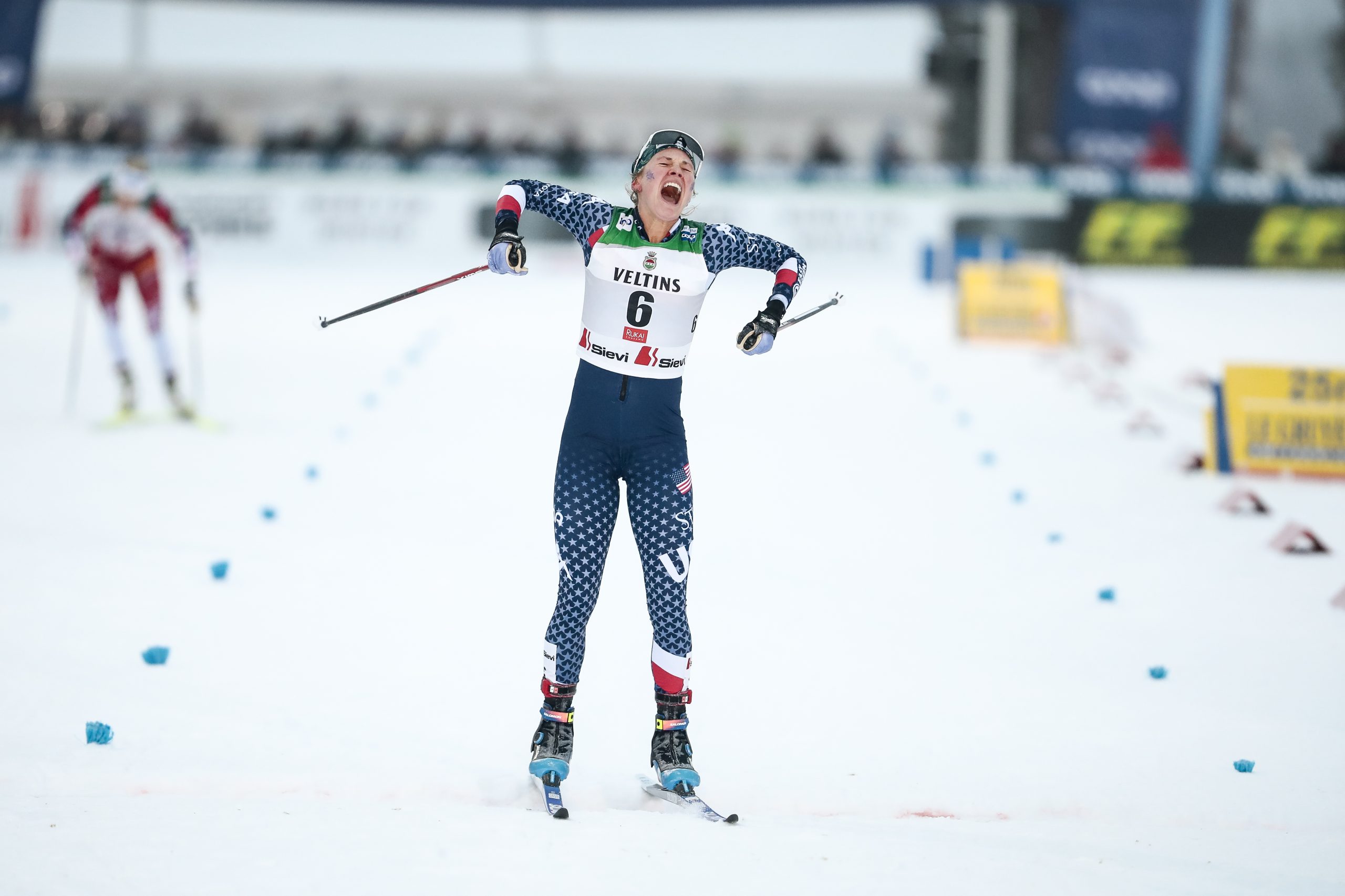
Rosie Brennan (USA) celebrates in Ruka (FIN) in 2023 after finishing 2nd in Saturday’s 10 k classic race. The result was Brennan’s first classic World Cup podium of her career. (Photo: Nordic Focus)
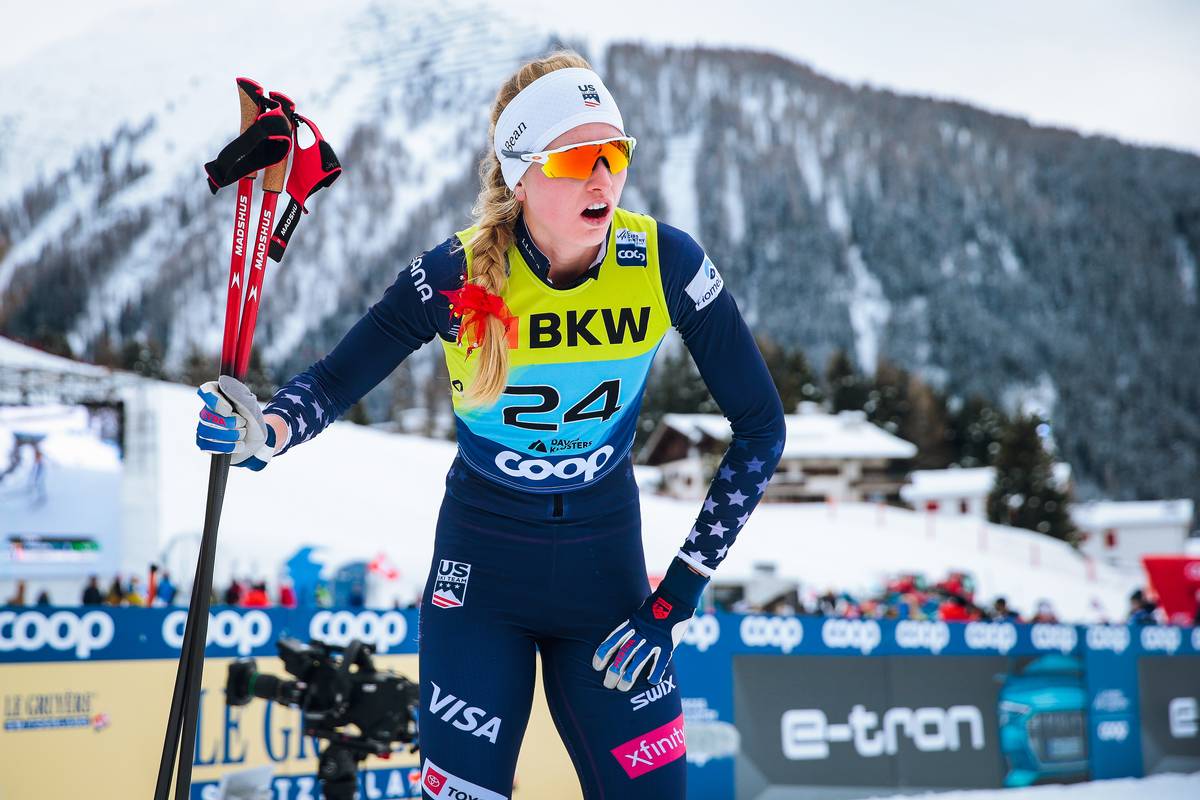
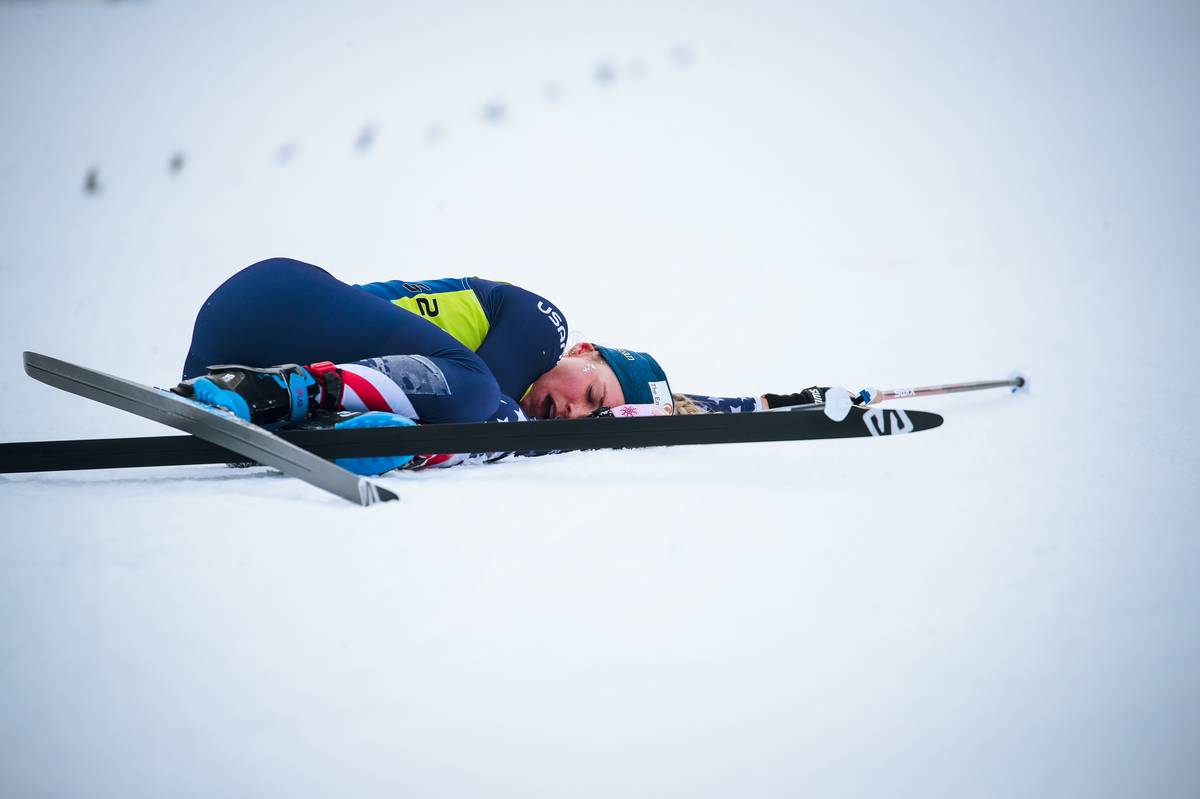
Rosie Brennan has stepped away from the World Cup, though she’s still figuring out exactly how to define the next chapter in her life.
Retirement is the easy word, and in some ways, the accurate one. She is done with the World Cup. She is done with the version of cross-country skiing that demands five months in Europe, constant travel, start lists, team schedules, narrow margins and the unrelenting pressure of measuring a career in seconds.
After more than a decade with the U.S. Ski Team, three Olympic appearances, hundreds of World Cup starts, two World Cup wins and a place among the best all-around skiers the United States has produced, Brennan has stepped away from the highest level of the sport.
But if retirement is supposed to mean the end of something, Brennan is not quite sure the word fits.
“Retirement has been a tough word for me,” Brennan said. “It feels very black and white.”
“One of my friends and older teammates called it rewiring.”
To Brennan, that seems closer. She’s not walking away from skiing so much as trying to build a new relationship with it. The shape of her days may change, and her focus will no longer be “110 percent” on racing, but skiing itself remains too central, too familiar and too joyful to simply leave behind.
“I love skiing and ski racing,” Brennan said. “I want to continue to be able to use my body in ways that challenge and push me in the world of skiing and competition again at some point, maybe sooner than later.”
“Skiing is just not that for me,” Brennan said of the idea of retiring and never doing the thing again. “It’s something that I hope to do till the day I die, honestly.”
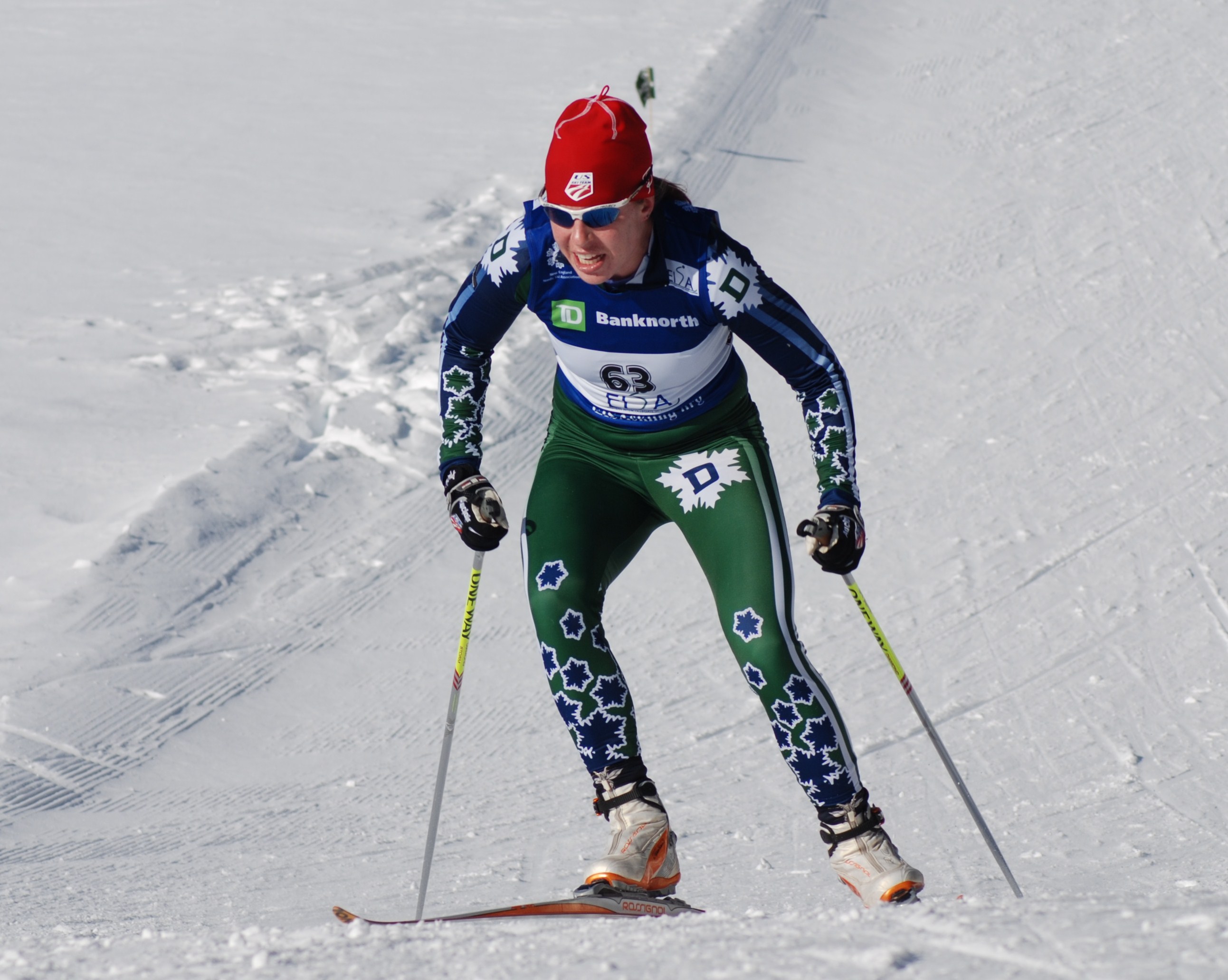
The first uploaded image of Rosie Brennan in the FasterSkier archives after she won both EISA women’s races in Feb. 2009 (Photo: Ruff Patterson)
A Career Built on Perseverance
When Brennan looks back now, the first thing she points to is not a specific race, podium or result sheet, but rather the belief in herself that made all of those things possible.
“I’m really proud of, I guess, the perseverance of my career,” Brennan said. “It takes perseverance to have longevity in a career, to weather the inevitable obstacles that appear throughout a long career, and to find belief when things aren’t going your way.”
That perseverance became the throughline of a career that took time to reveal itself. Brennan was not a teenage prodigy who moved smoothly from junior success to World Cup podiums. She came to skiing later than many of her peers, waited longer for the biggest results and had to weather the doubts that creep in when progress slows, injuries interrupt momentum and other paths begin to look more practical. Then when the results did arrive, those earlier years felt even more meaningful.
In a career defined by patience and progress, one of the things Brennan says she is most proud of is not just that she reached the top level, but that she continued to expand what she could do once she got there. She never settled into one lane as only a distance skier or only a classic specialist. Instead, she kept working to become more complete, finding reward in the challenge of improving across formats, distances and techniques.
“I’m also proud of the range that I maintained throughout my career,” Brennan said. “Continuing to be an all-arounder throughout my career and finding some success in all the disciplines and both techniques throughout — that was something that was just, I don’t know, I guess a personal challenge that I found a lot of reward in.”
That sense of progress extended beyond Brennan’s own results. Her career also unfolded during the strongest era in the history of American women’s cross-country skiing, and as the U.S. team continued to raise its standard internationally, Brennan came to see herself as part of something larger than her own race days.
“I’m proud to have been part of a really amazing wave of American women skiing,” Brennan said, “and to have done my best to carry that wave forward and to help push things forward and pass things on to future generations as well.”
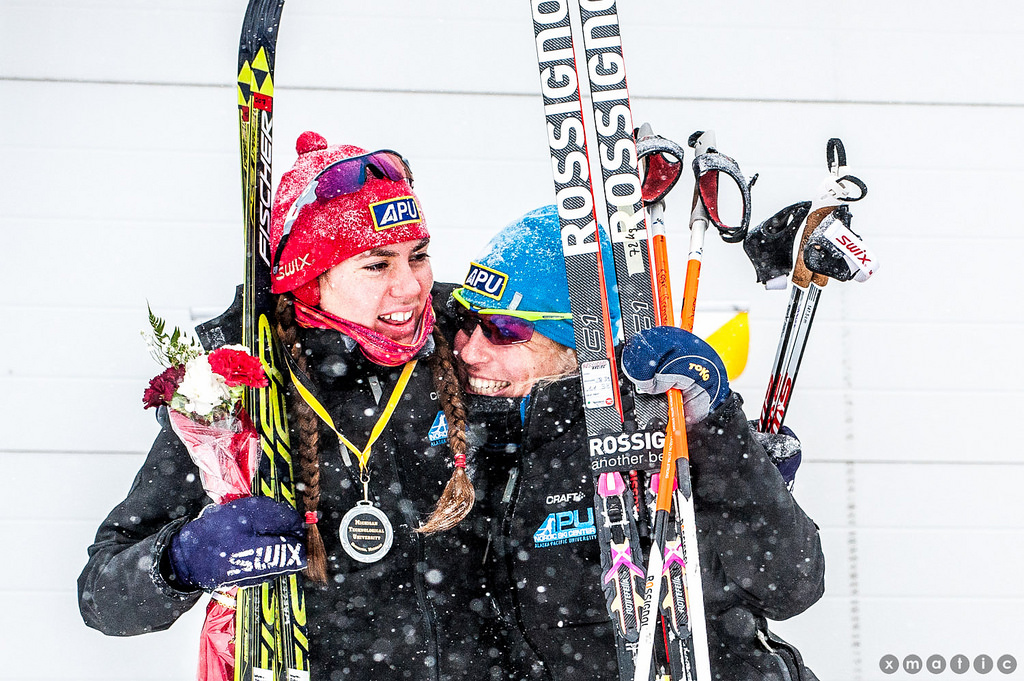
APU’s Rosie Brennan (r) embraces close friend and APU teammate, Becca Rorabaugh (l), after they finish first and second, respectively, in the Women’s 1.5 k Classic Sprint at the 2015 U.S. Cross Country Championships in Houghton, Mich.
Starting Late, Staying Long Enough
Brennan started skiing at 14, late by the standards of an international sport where many athletes first step onto a set of fish scales as young children. But she never saw her development as a simple matter of being behind.
“I was older when I kind of found top-level success in podiums on the World Cup,” Brennan said. “But because I started skiing so late, I guess I never really saw it that way.”
In her mind, the clock did not start with age, but when she first found herself on a pair of skis.
“If you look at when I started at 14 to when I had success, those accumulated hours of skiing and training are probably actually fairly equivalent to somebody who started at eight,” Brennan said. “So I always just chose to look at it that way, as if it was just going to take time to learn those skills, and it was fine that I started late.”
“I’m not good at being patient,” Brennan said.
But skiing gave her little choice. It took time to develop the specific strengths required of the sport, to learn how to race and to absorb the small skills that many skiers pick up almost without realizing it when they start young. Brennan had to build the engine and the instincts at the same time.
There were moments when she wondered whether it was worth it. In college, after injuries and difficult stretches, she decided she was done with skiing when she graduated. She looked toward other paths. At times, she quit, or at least tried to. But the sport kept pulling her back.
“I think what I enjoyed the most that made me keep coming back was just the challenge of it,” Brennan said. “Waking up every day with some purpose to get a little bit better, and to have the challenge of seeing if it was possible.”
Eventually, that challenge became a way of life.
“I just learned to really enjoy and thrive and love the lifestyle of skiing,” Brennan said. “And so that made it a lot easier to just keep coming back.”
Brennan is quick to point out that she did not do that alone. The support systems around her mattered. At Dartmouth and later at Alaska Pacific University, she found teams and coaches that helped her keep believing when she could not quite do it herself.
“There were definitely moments that it’s easy to question, and it’s hard to keep going,” Brennan said. “I was really fortunate to be part of some really, really amazing groups, and have coaches that fostered that belief in me, and made me see things in myself that I couldn’t see on my own.”
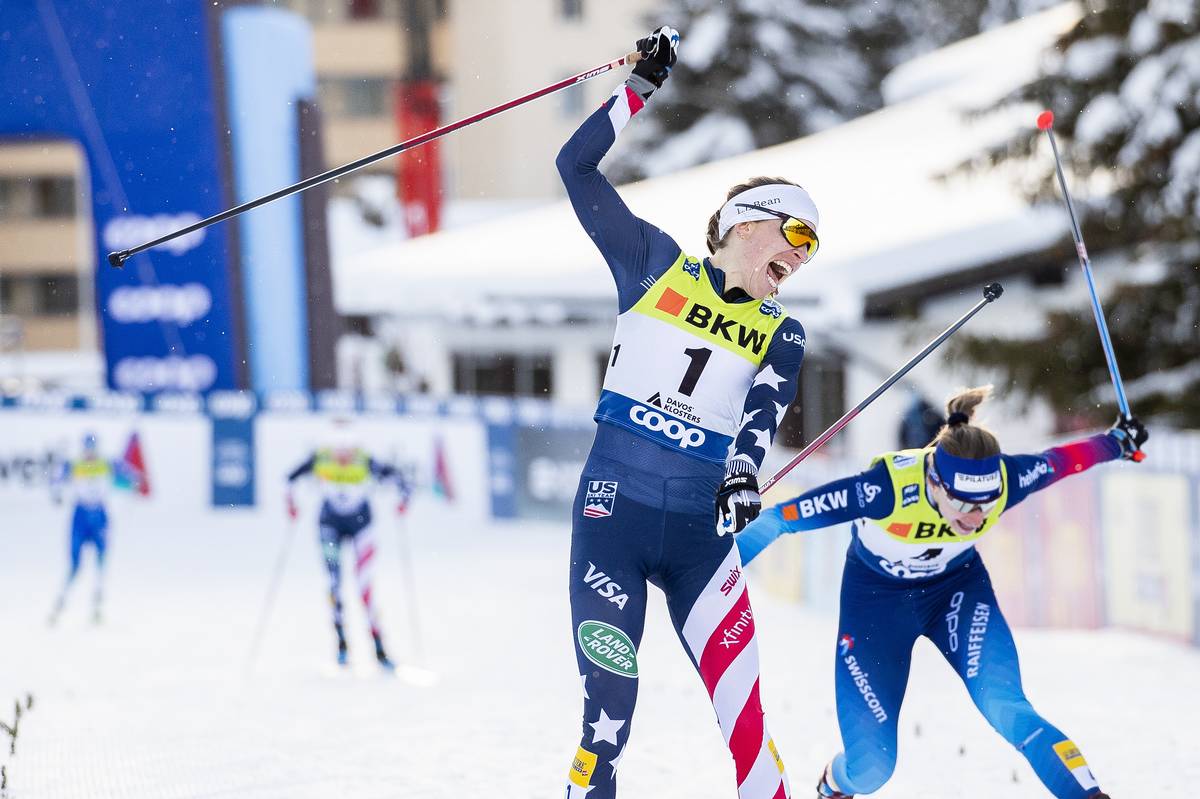
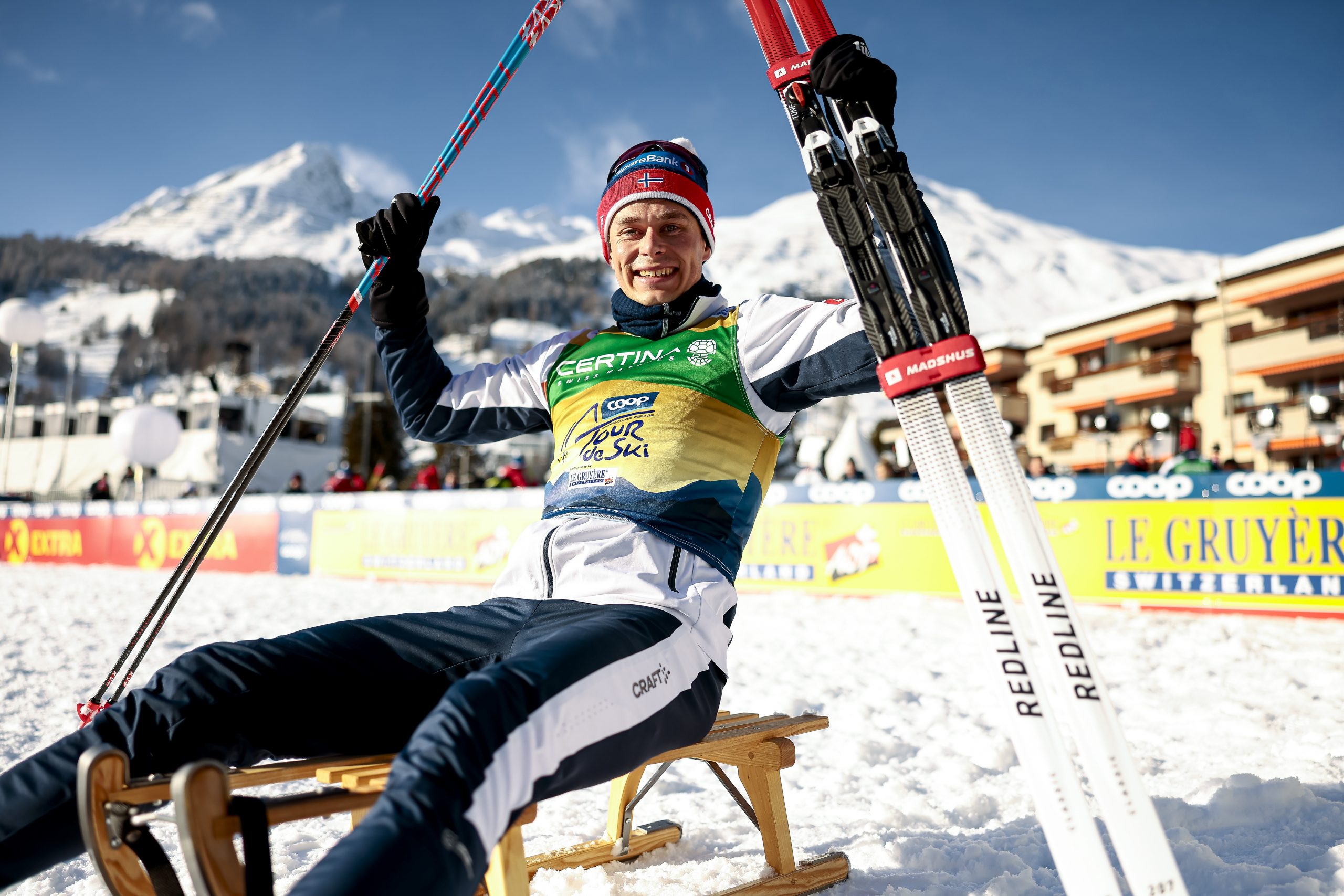
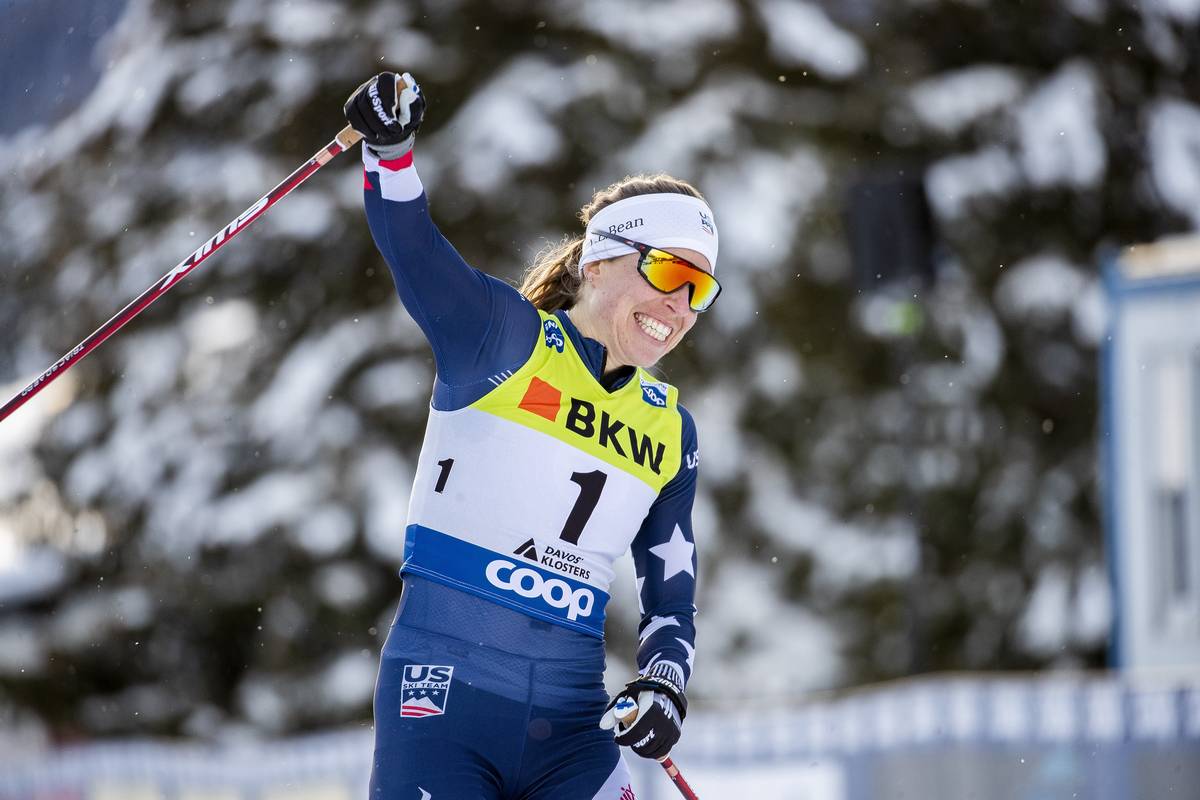
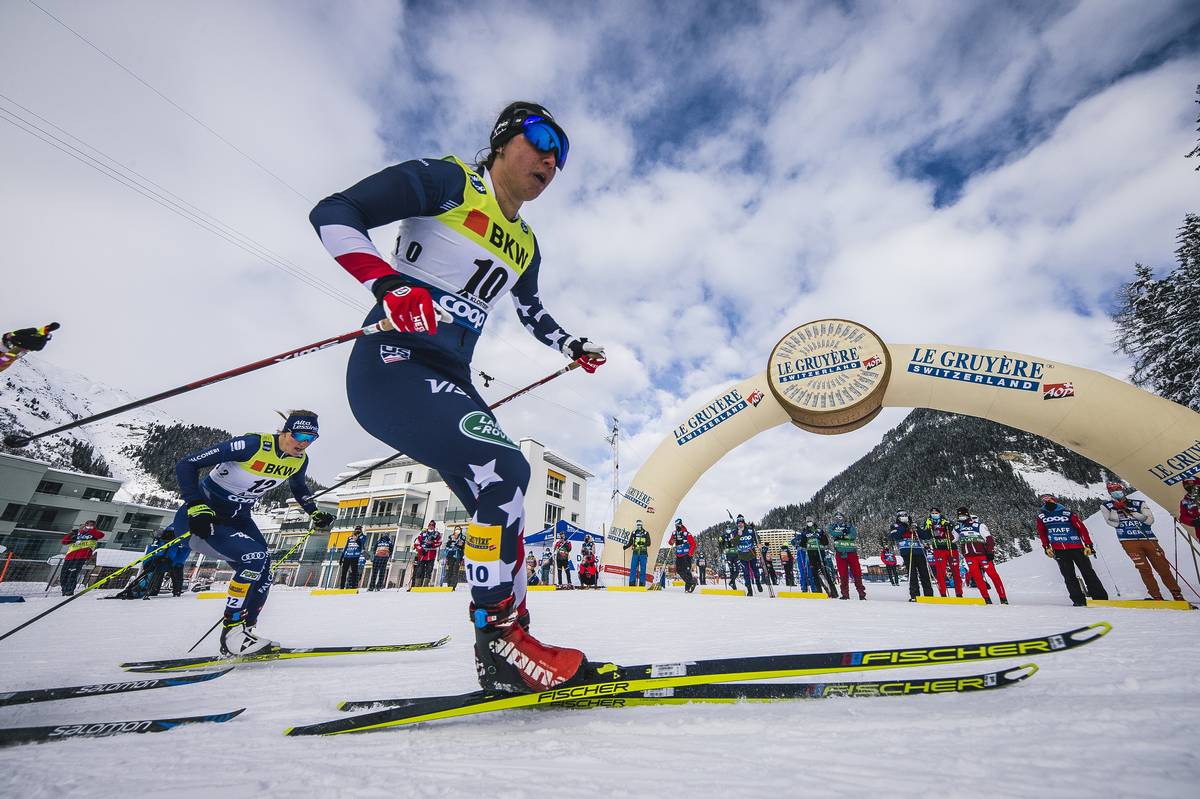
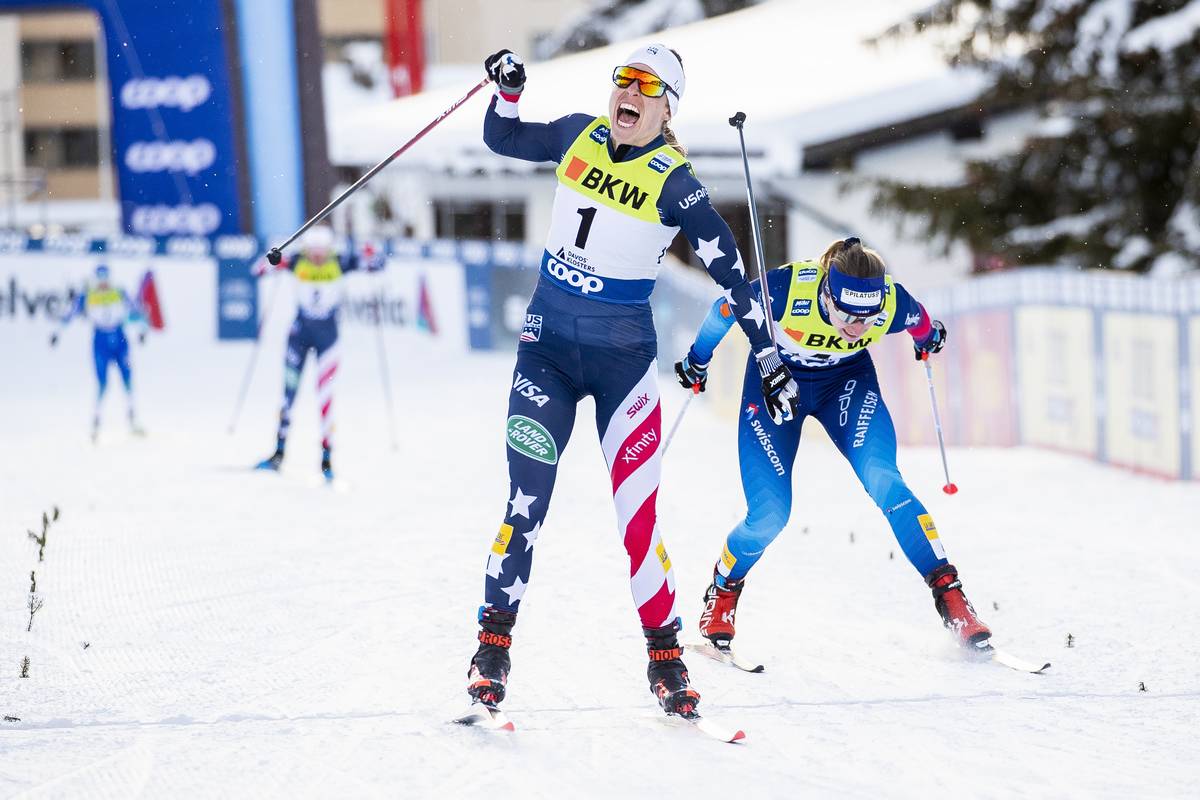
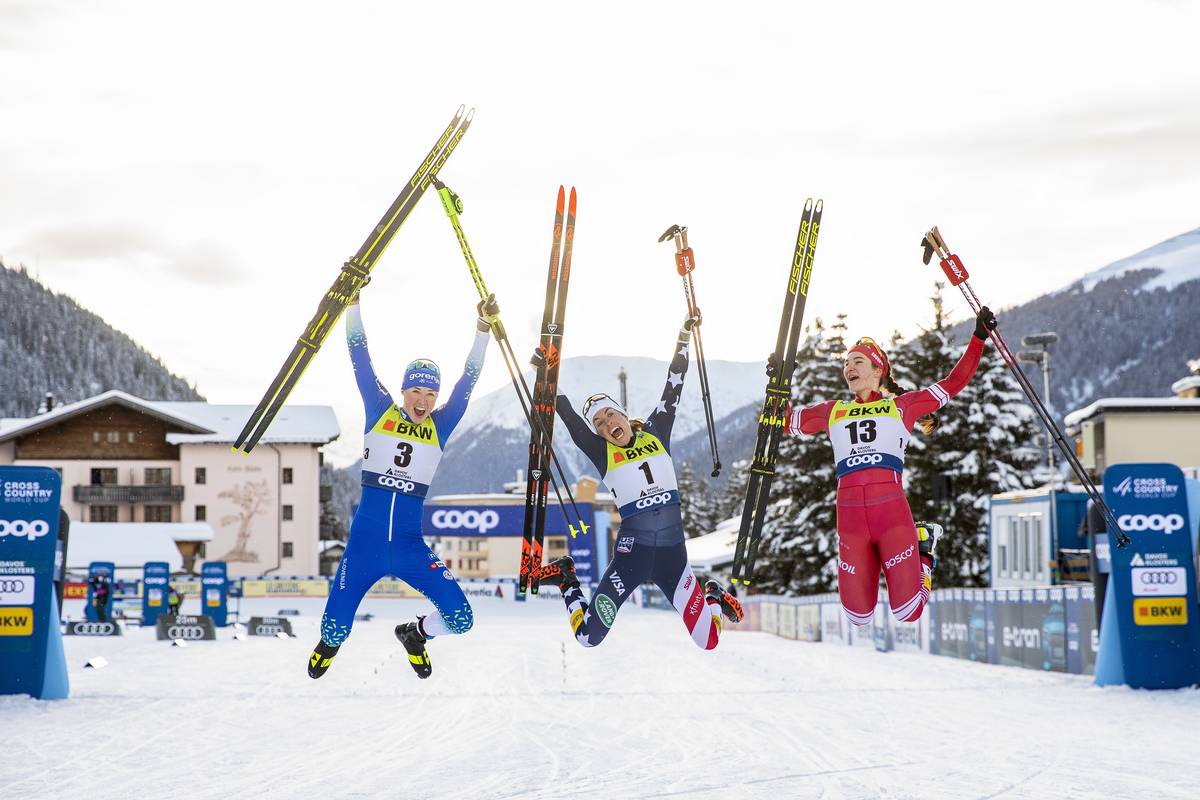
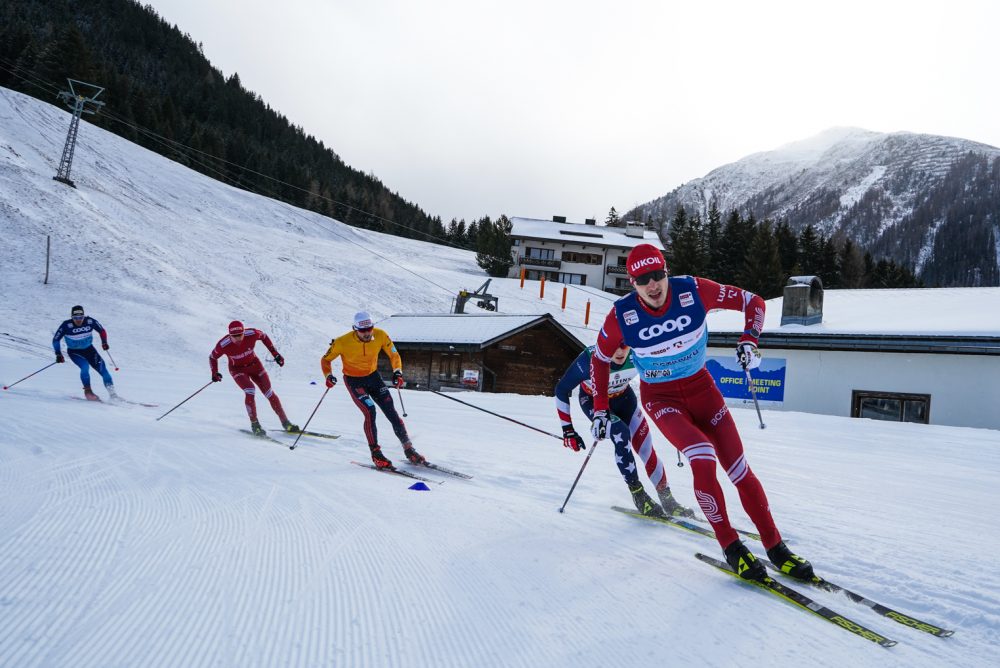
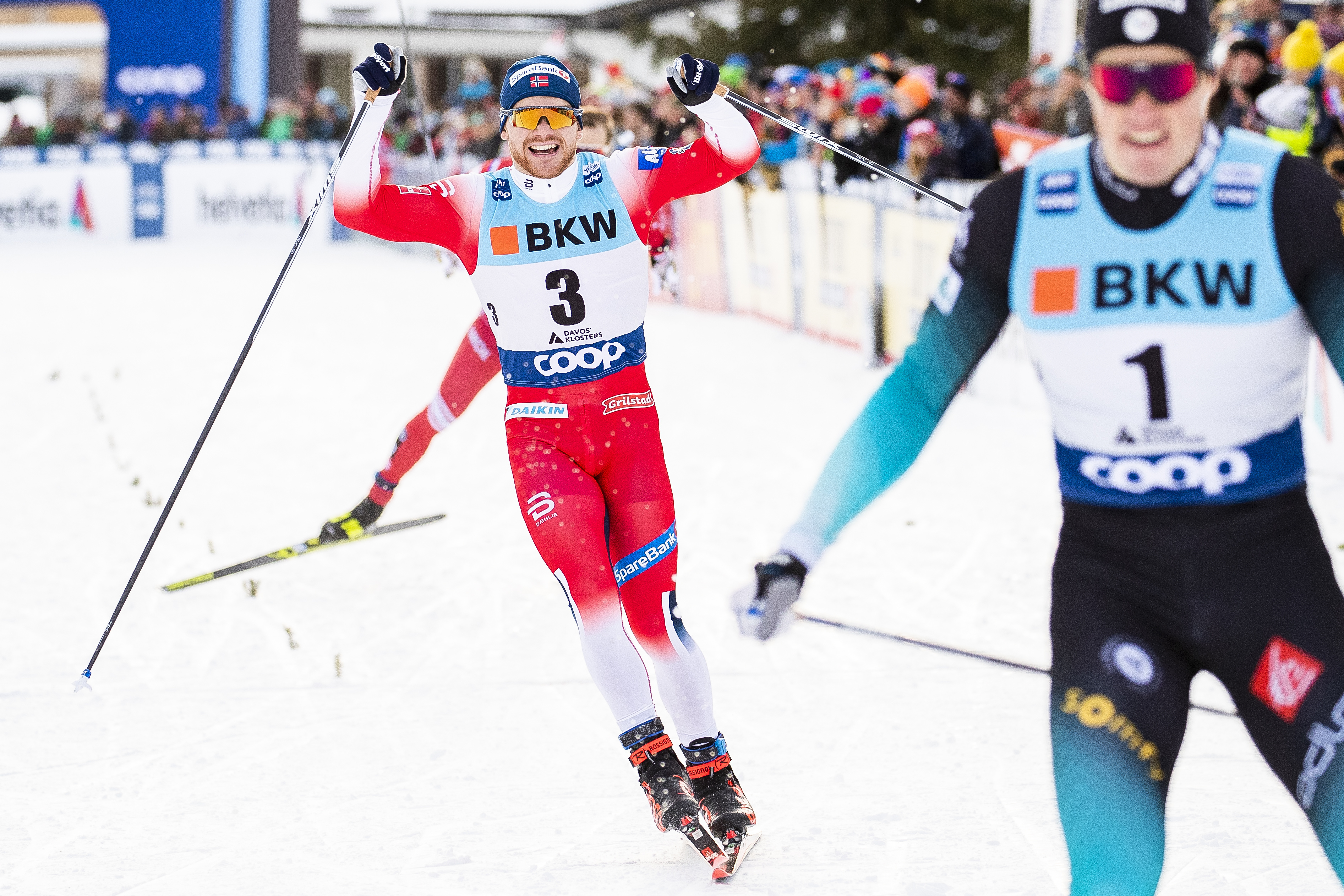
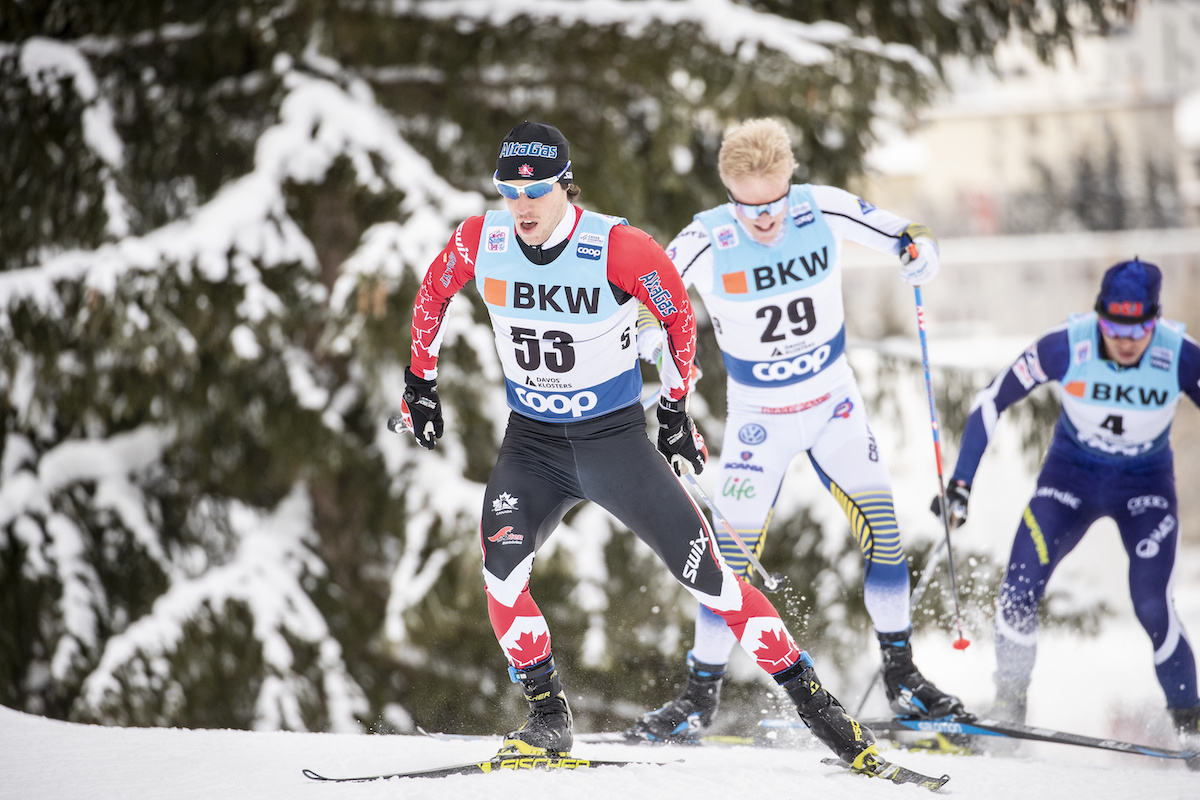
Rosie Brennan celebrates her victory and first World Cup podium after the freestyle sprint in Davos, Switzerland. Photo: NordicFocus
When the World Was Put on Notice
For years, Brennan’s career was a slow and steady build, but then came that famous weekend in Davos.
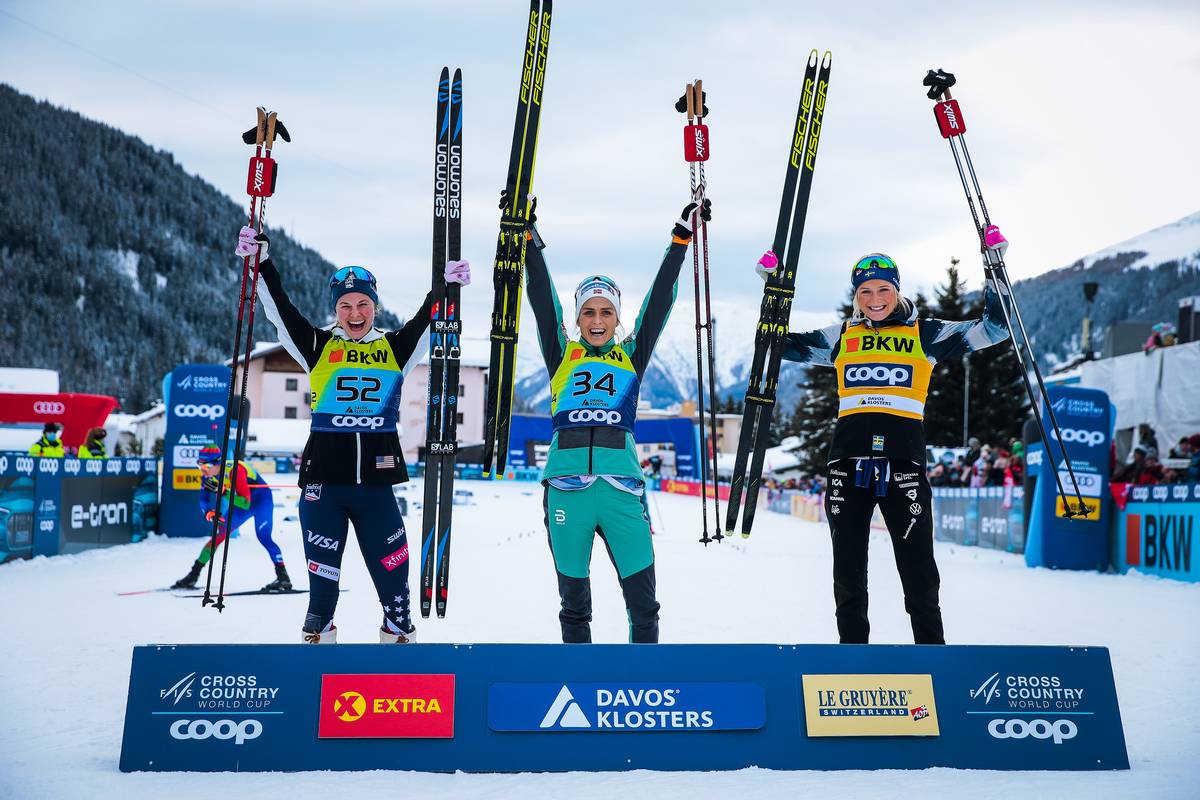
In December of 2020, during a World Cup season shaped by the uncertainty of the pandemic, Brennan won twice in two days in Switzerland. On Saturday, she claimed her first career World Cup victory, in a freestyle sprint, and then the very next day, she won again in the 10-kilometer freestyle.
From the outside, it looked like a breakthrough and a historic moment for U.S. skiing. Brennan does not dispute that. She says what stays with her the most now is not only the winning, but everything she had to manage in order to ski that way.
“Davos 2020 was definitely a breakthrough moment for me,” Brennan said. “That year was challenging for the whole world, and being a ski racer during that time certainly had its challenges too.”
The uncertainty of that season weighed heavily. Rules changed, travel was complicated and athletes did not always know whether races would happen. The risk of illness carried not just health concerns, but career implications for athletes whose bodies were their livelihoods.
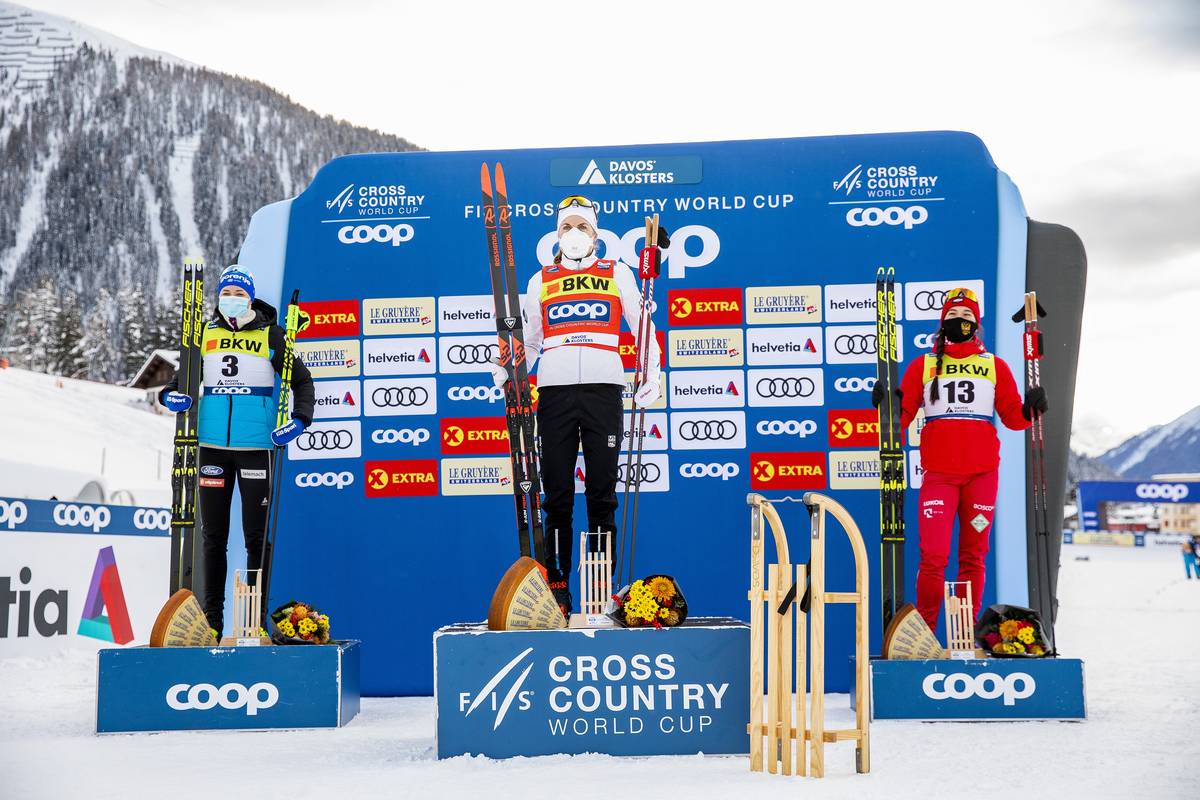
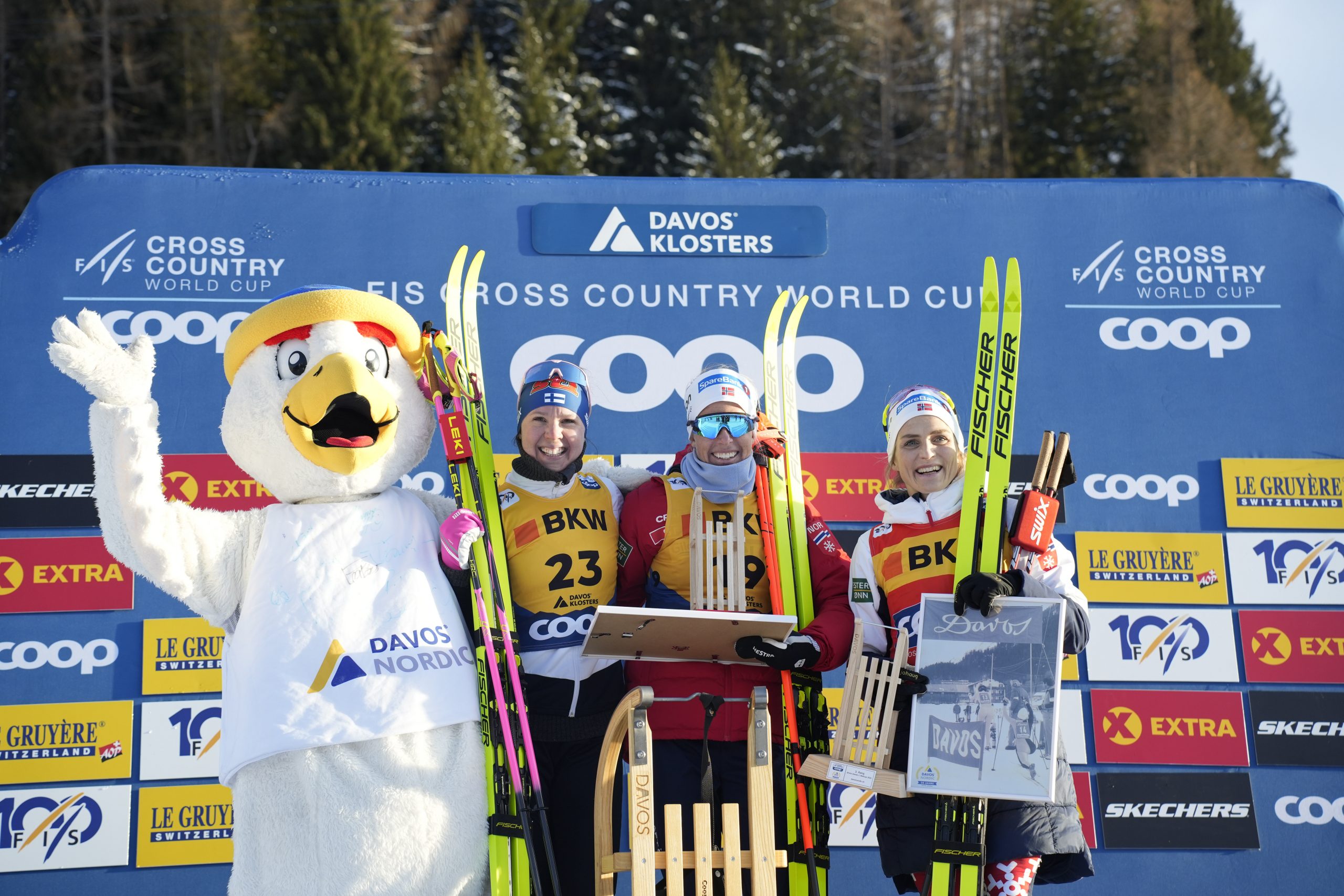
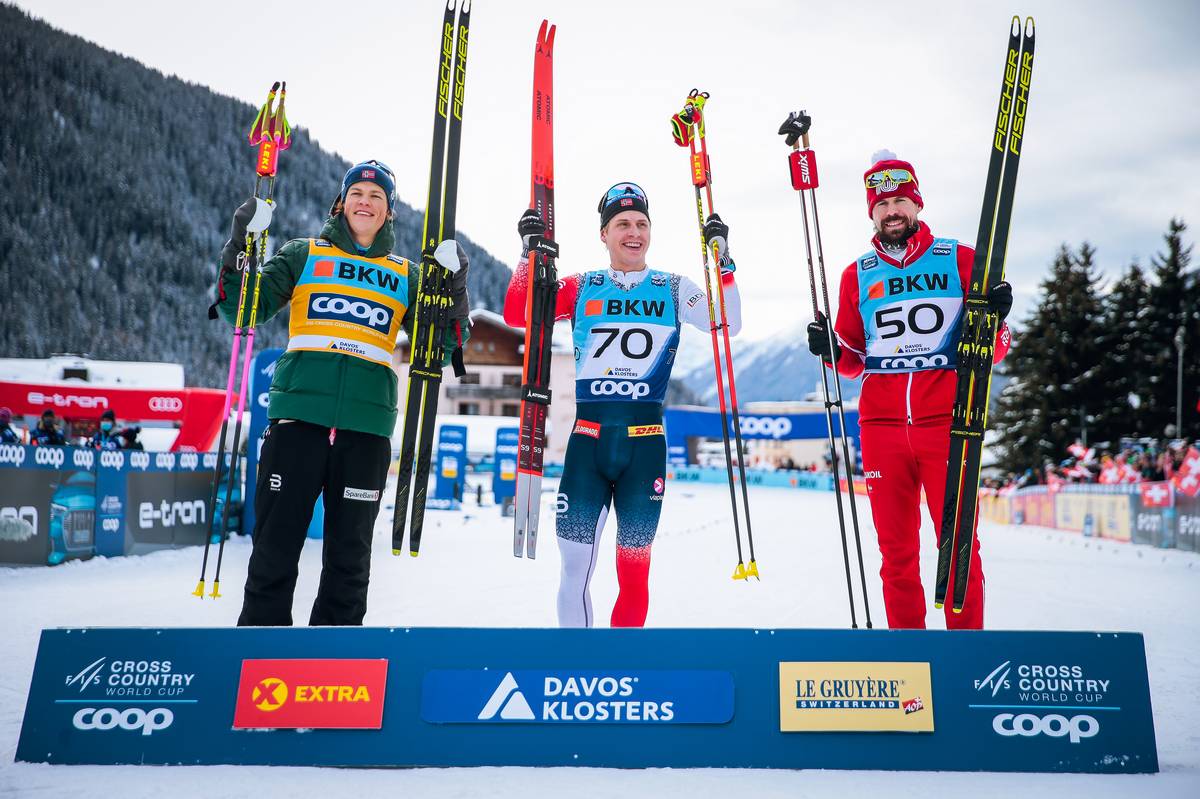
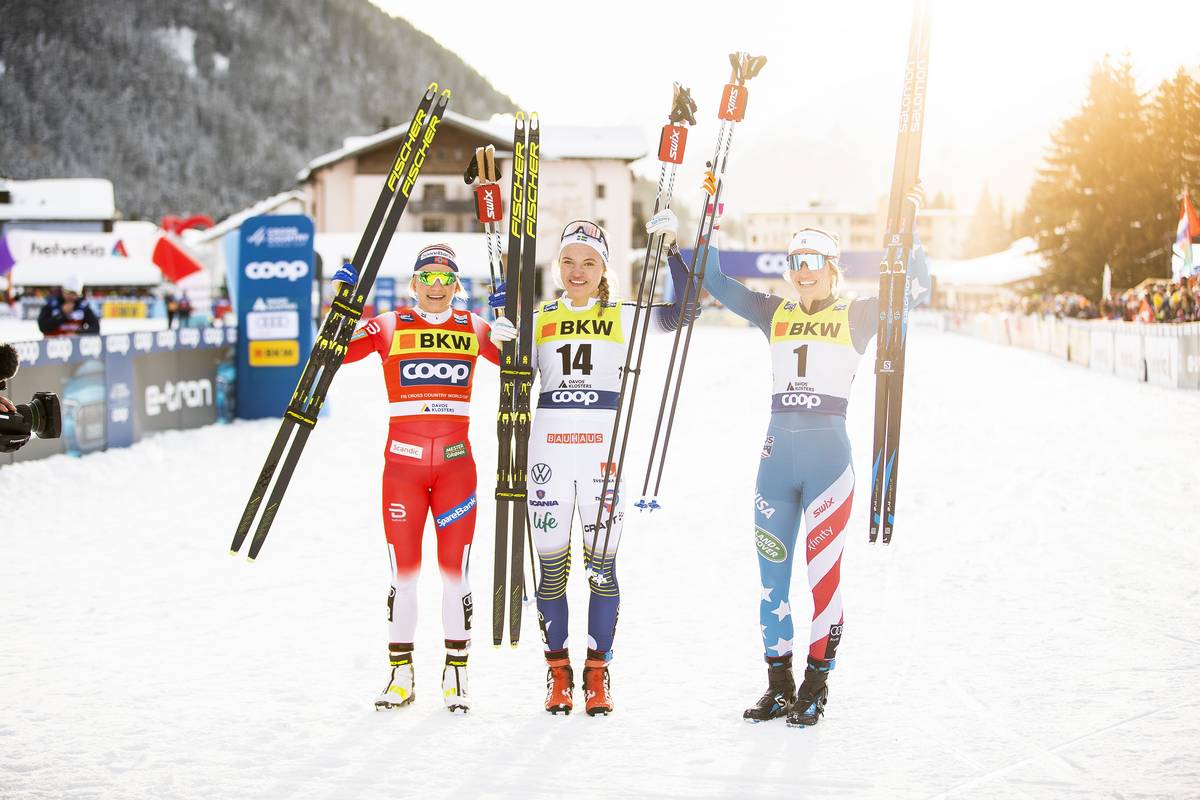
Taking the victory and the sled, Rosie Brennan stands atop the podium in Davos, Switzerland. (Left to right) Anamarija Lampic (SLO) 2nd, Brennan (USA) 1st, Natalia Nepryaeva (RUS) 3rd.
“I really struggled with the anxiety of it all,” Brennan said. “Just never knowing — traveling in foreign countries, where the rules were changing all the time, and you didn’t know what would happen if you got sick.”
Hence why Davos still means something more than two entries on a results page. Brennan was proud of the wins, of course, but she was even more proud of how she managed everything around them.
“It definitely showed me what I was capable of,” Brennan said, “and that I could manage these really high-stress environments and all the uncertainty and thrive in that setting.”
That weekend did not just give Brennan her first World Cup wins. It helped confirm the range she had been building toward for years. Later that season, she became the first American to hold the overall World Cup leader’s bib, sprint leader’s bib and distance leader’s bib at the same time. Which was both a major accomplishment and also a fitting reward for all the work she had put in to become a more complete racer.
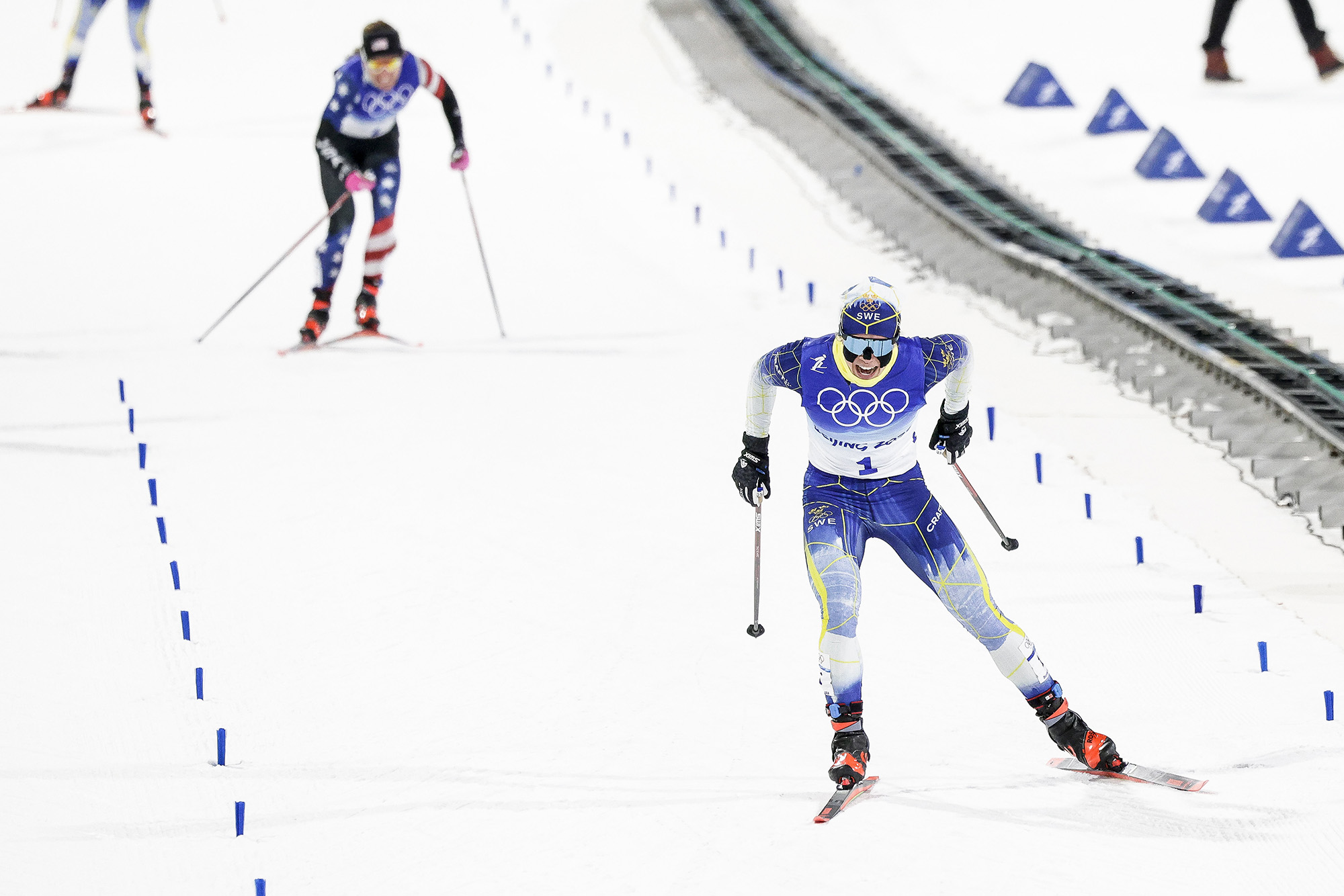
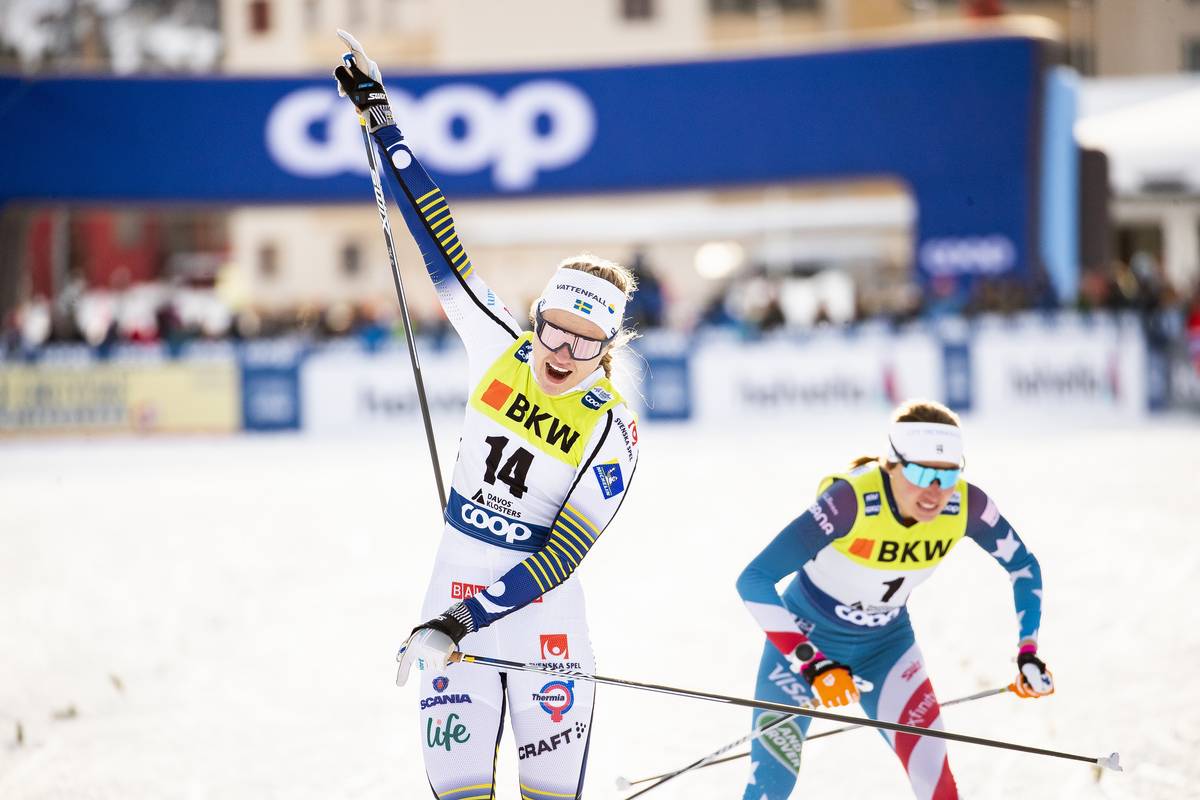
Jonna Sundling (SWE), with a commanding victory in the 2022 Olympic individual freestyle sprint, comes to the finish with Rosie Brennan (USA) in the background on her way to fourth. (Photo: NordicFocus)
What the Career Adds Up To
Brennan will take a step back from her professional career after amassing quite the résumé, representing the United States at the 2018, 2022 and 2026 Winter Olympics. She finished fourth in the freestyle sprint at the Beijing Olympics in 2022, the kind of result that can feel both extraordinary and excruciating, by missing out on an Olympic podium by a single place. She reached World Cup podiums across seasons and disciplines. She became a two-time World Cup winner, a fixture in the American women’s team and one of the athletes who helped move the U.S. from occasional contender to regular presence near the front of international races.
But Brennan’s own accounting of her career is not limited to the results she garnered over the years. She is proud of showing up. Proud of learning. Proud of becoming competitive in every event. Proud of the people who helped her and the younger athletes she helped in return. Proud that a career that could have ended several times kept expanding instead.
That may just be why the end of her World Cup career does not feel like a true breakup. For Brennan, skiing was never just a job. It provided her with structure, challenges, community, identity and gave her something to work toward every day and a way to test what was possible. Even now, when she is no longer organizing her life around World Cup racing, she says she’s not suddenly becoming someone else.
“When you train that many years, it’s hard,” Brennan said. “I’m still going out twice a day most days, because it just feels so normal to me.”
That may change when she starts school again and other commitments begin to fill the space skiing once occupied. Brennan says she plans to pursue new interests and give attention to parts of herself that the World Cup lifestyle did not always allow. But the habits of a skier are not easy to unwind, and she does not seem especially eager to unwind all of them.
“I definitely hope to bring forward a lifestyle that’s active, that treats your body well, that’s also willing to push yourself and see where the limits are,” Brennan said.
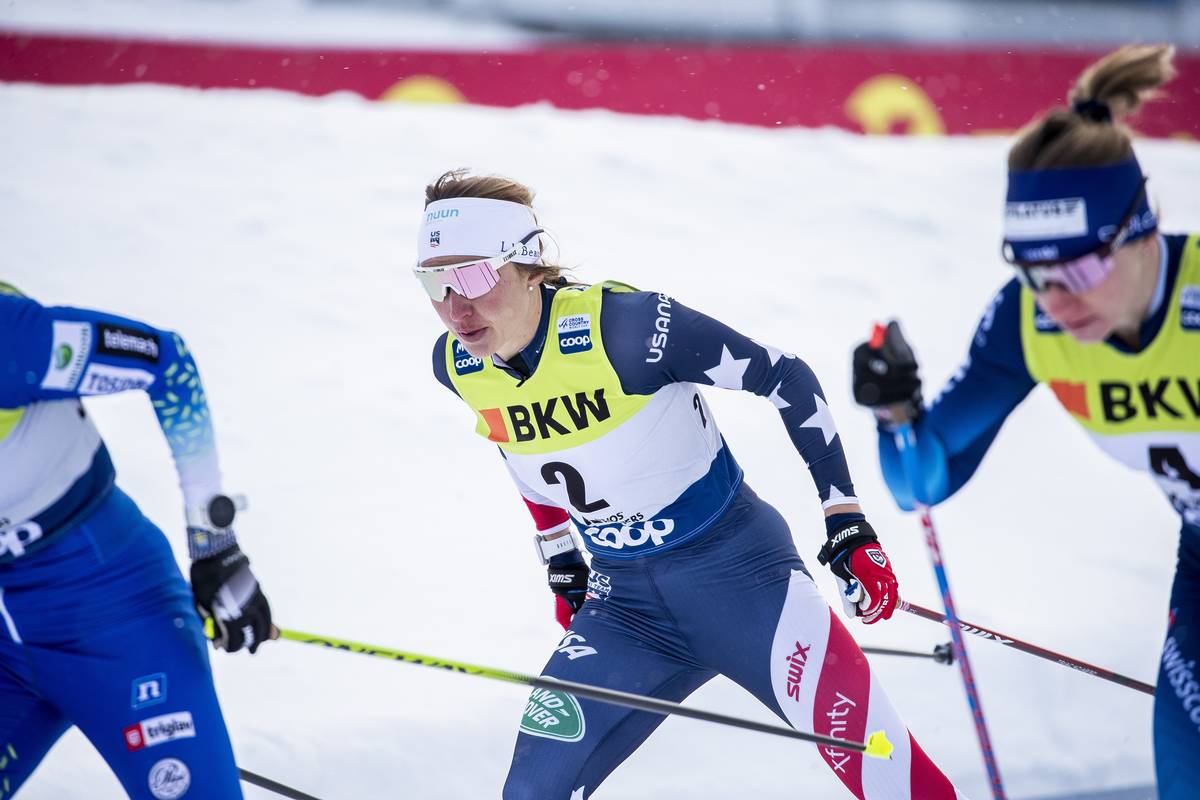
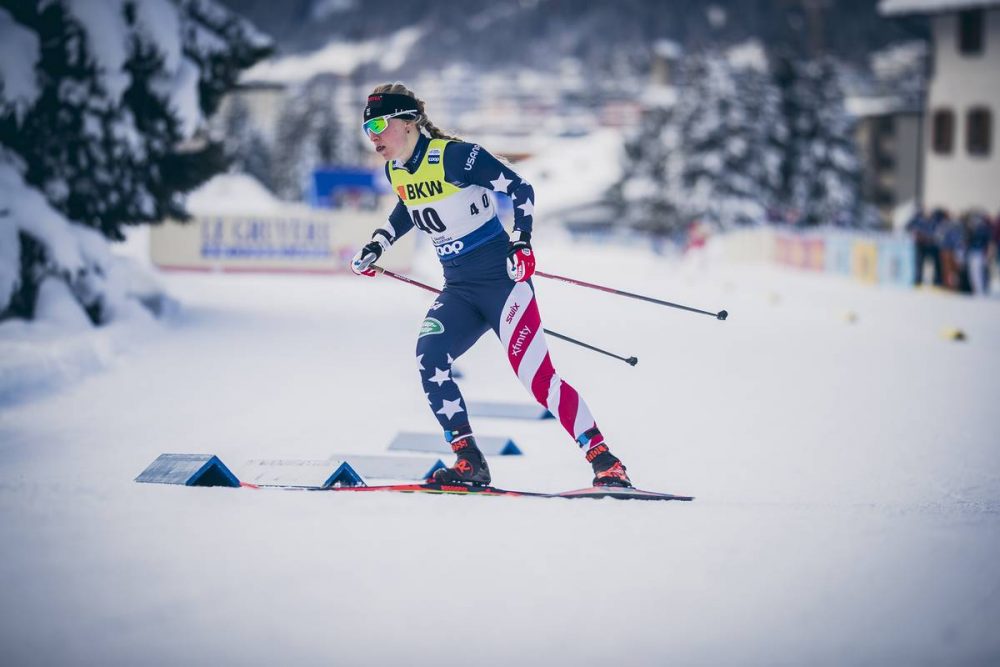
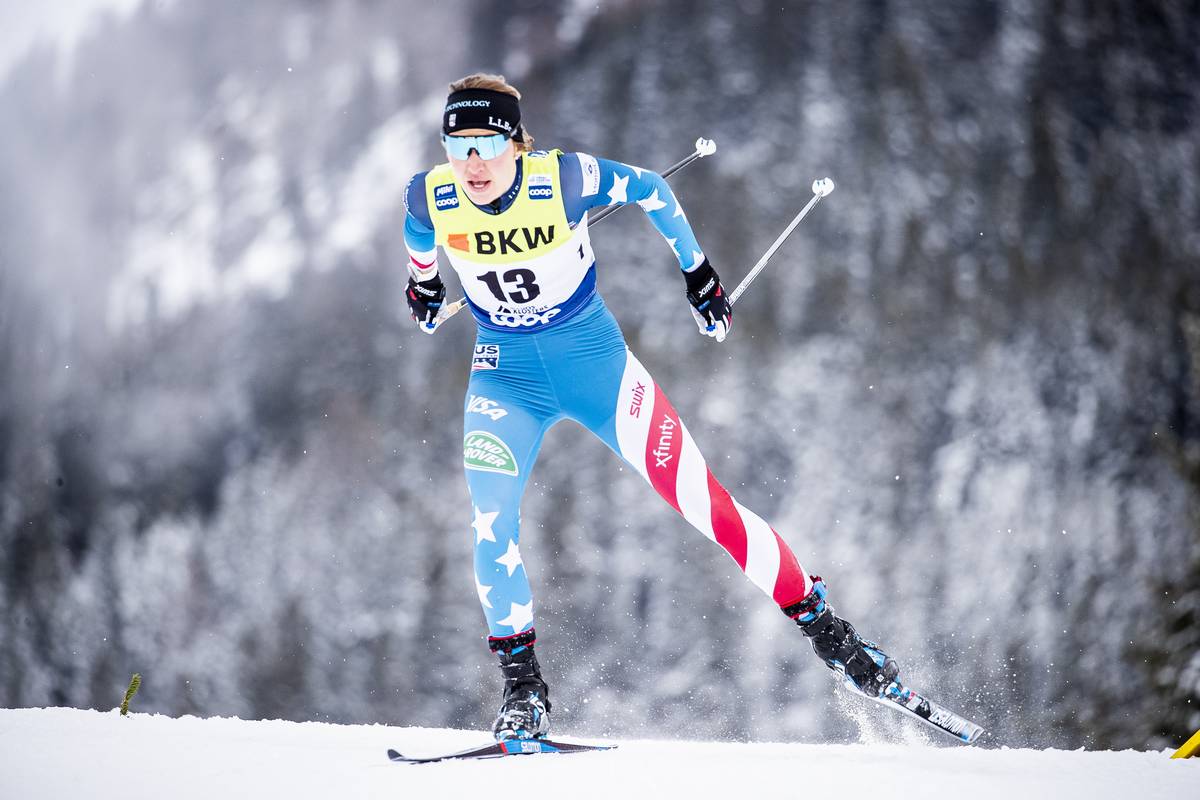
Rosie Brennan (USA) during the individual sprint qualification at the final World Cup weekend this past March in Lake Placid, New York. (Photo: Modica/NordicFocus)
Rewiring, Not Retiring
That is why “rewiring” works. Brennan is not flipping a switch. She is just rearranging the circuitry.
There will be no more full World Cup campaign, no more life built entirely around the next race weekend. But there will still be skiing, there will still be movement and there will still be competition. The habits and lessons of her career that she built through years of resilience and patience are not things Brennan expects to leave behind.
“I’m sure there are countless skills, probably most of the skills I’ve learned in my adult life, that I will have to lean on in any of the various careers that I may pursue, and in my studying as well,” Brennan said. “The lessons that I’ve learned will undoubtedly come with me, along with the character and strength that I’ve built throughout my career.”
Those lessons were built through the less tidy parts of Brennan’s career, from the late start and the years before the podiums to the injuries and doubts that forced her to keep adjusting. But the same career that asked so much of her also gave her something lasting. Skiing was more than a pursuit or a profession, it was the driving rhythm of her adult life, and one she still feels lucky to have followed for so long.
“It’s definitely an incredible lifestyle to be a ski racer,” Brennan said. “I feel insanely lucky to have called that my career, and to have done so for so long.”
That gratitude does not make the transition simple. After so many years of organizing life around training, racing and the rhythm of the World Cup, stepping back from that structure means more than changing a schedule. It means figuring out what skiing looks like when it is no longer the center around which everything else has to turn.
Rosie Brennan (USA) during her final World Cup of her career — the 20 k Freestyle Mass Start in Lake Placid (USA). (Photo: Thibaut/NordicFocus)
But there is also freedom in that. Brennan no longer has to prove she belongs. She already did. And now, instead of defining skiing only through the World Cup, she gets to decide what parts of it she wants to keep.
Maybe that means races. Maybe it means long days outside. Maybe it means testing herself in new settings, with new stakes, away from the circuit that shaped so much of her adult life. Maybe it means all of that.
What seems clear is that Brennan is not disappearing from the sport. She is stepping out of one version of it and into another.
She is retired, if that is the word people want to use. But it is not the sunset kind. Not the final-page kind.
For Rosie Brennan, skiing will always be there, just not in the all-consuming way it once was. Now, she gets the chance to redefine her relationship with the sport as something woven into the life she is building next.
“It’s truly been a dream,” Brennan said.
Help Support Our Coverage!
If you value the thoughtful work and access FasterSkier provides, please consider becoming a Voluntary Subscriber. Your support directly fuels our work to cover the people, places, and moments that make our sport special.
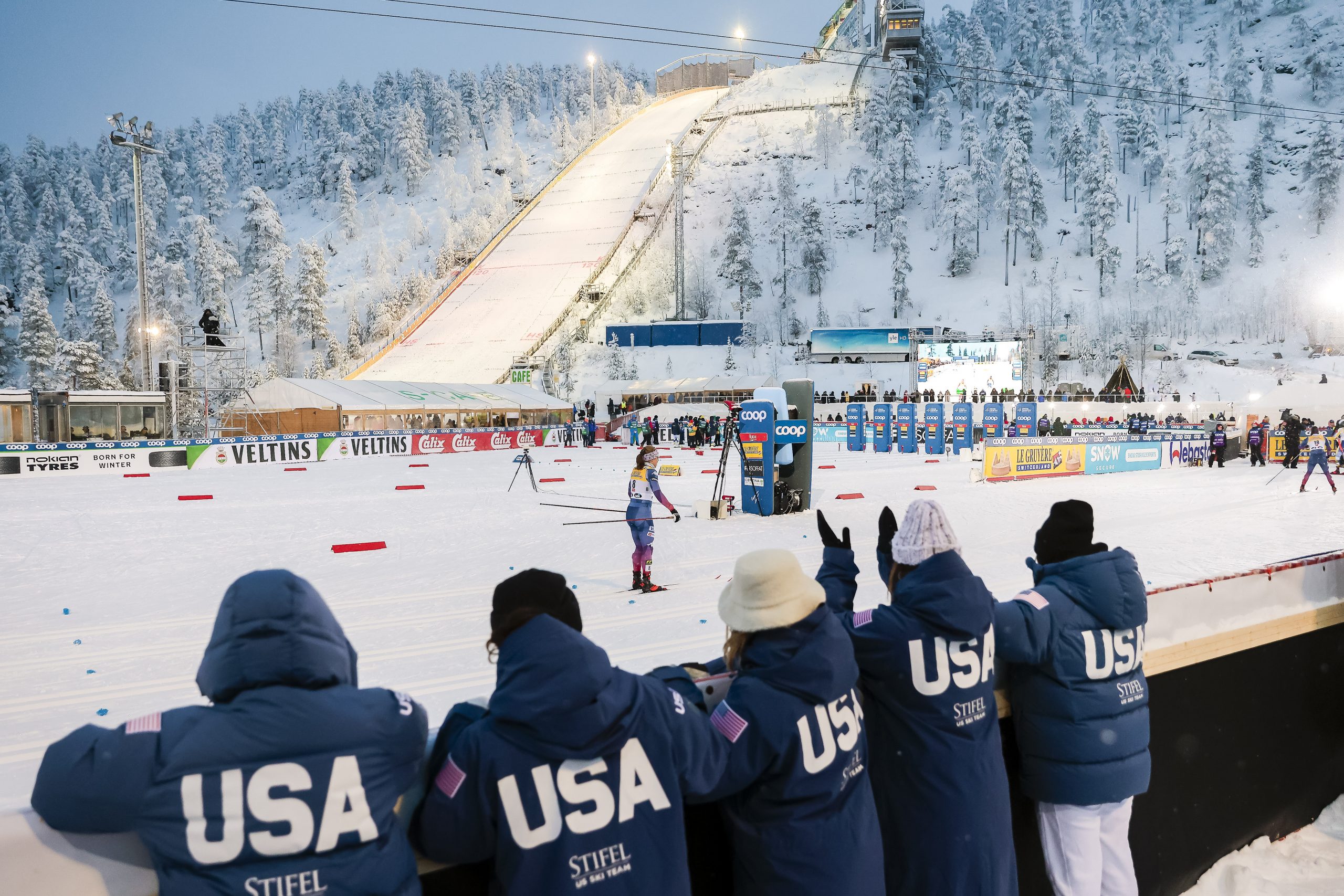
Brennan’s U.S. teammates wait at the line to greet her after her final World Cup race, a 20-kilometer start in Lake Placid on March 22. (Photo: NordicFocus)
The International Ski and Snowboard Federation (FIS) unveiled its proposed 2026/2027 cross-country skiing World Cup calendar this week at the FIS Spring Meetings in Portorož, Slovenia.
The schedule — first shared publicly through FIS social media and still pending FIS Council approval — builds the season around the 2027 World Championships in Falun, Sweden, with three pre-Christmas stops, a nine-race Tour de Ski, a stretch of three weekends between the Tour and Worlds, and a Scandinavian closing kick that ends with the Finals in Ulricehamn.
For North American fans, the calendar is once again entirely European, with no scheduled stops in Canada or the United States.
Frida Karlsson (SWE) poses with Mr. and Mrs. Claus following the 10k Classic to start last season in Ruka (FIN). (Photo: Modica/NordicFocus)
Pre-Holiday: Ruka, Trondheim, Davos
The season opens where it almost always does — in Ruka, Finland, where the World Cup begins November 27. From there, the circuit moves to Trondheim, host of the 2025 World Championships, before the pre-Christmas block closes in Davos, Switzerland, with a team sprint.
November 27-29, 2026: Ruka, Finland
27/11: 10km Interval Start Classic
28/11: Sprint Classic
29/11: 20km Mass Start Freestyle
December 1-3, 2026: Trondheim, Norway
01/12: 10km Interval Start Classic
02/12: Sprint Freestyle
03/12: 20km Skiathlon
December 11-13, 2026: Davos, Switzerland
11/12: 5km Heat Mass Start Freestyle
12/12: Sprint Freestyle
13/12: Team Sprint Freestyle
With Jessie Diggins (USA) now retired, there will be a new FIS Overall Crystal Globe and Tour de Ski champion next season (Photo: Vanzetta/NordicFocus)
Tour de Ski 2026/2027
The Tour de Ski returns to a three-country format, opening in Les Rousses, France, on New Year’s Day, moving to Oberstdorf, Germany, and finishing with three races in Val di Fiemme, Italy — capped, as ever, by the Final Climb up Alpe Cermis.
January 1-3, 2027: Les Rousses, France
01/01: Sprint Classic
02/01: 20km Mass Start Classic
03/01: 15km Pursuit Freestyle
January 5-6, 2027: Oberstdorf, Germany
05/01: 15km Mass Start Classic
06/01: 5km Heat Mass Start Freestyle
January 8-10, 2027: Val di Fiemme, Italy
08/01: 15km Skiathlon
09/01: Sprint Freestyle
10/01: Final Climb
Gus Schumacher (USA) and the rest of the US team will hope to continue their success in Toblach (ITA). (Photo: Modica/NordicFocus)
After the Tour, Before Worlds: Engadin, Toblach, Lahti
Three weekends bridge the Tour de Ski and the World Championships. Engadin opens its weekend with a mixed relay — a format the FIS has been working into more World Cup weekends — and Lahti closes the pre-Worlds stretch with its classic 20km skiathlon and 10km interval start.
January 22-24, 2027: Engadin, Switzerland
22/01: Mixed Relay
23/01: Sprint Freestyle
24/01: 20km Mass Start Freestyle
January 29-31, 2027: Toblach, Italy
29/01: 10km Interval Start Freestyle
30/01: Sprint Freestyle
31/01: 20km Mass Start Classic
February 12-14, 2027: Lahti, Finland
12/02: Sprint Classic
13/02: 20km Skiathlon
14/02: 10km Interval Start Classic
Kendall Kramer (USA) had a breakout World Cup Skiathlon in Falun (SWE) last season. (Photo: Authamayou/NordicFocus)
2027 FIS Nordic World Ski Championships: Falun, Sweden
The 2027 FIS Nordic World Ski Championships run from February 22 through March 7 in Falun, Sweden, with all title formats on the program. Falun last hosted Worlds in 2015.
Final Period: Oslo, Drammen, Ulricehamn
The closing stretch is a Scandinavian one. Oslo’s Holmenkollen weekend features back-to-back 50km mass start classic races on March 13 and 14 — long a fixture of the late-season calendar — before a one-day sprint stop in Drammen and the World Cup Finals in Ulricehamn, Sweden.
March 13-14, 2027: Oslo, Norway
13/03: 50km Mass Start Classic
14/03: 50km Mass Start Classic
March 16, 2027: Drammen, Norway
16/03: Sprint Classic
March 19-21, 2027: Ulricehamn, Sweden (World Cup Finals)
19/03: 10km Interval Start Freestyle
20/03: Sprint Freestyle
21/03: 20km Mass Start Classic
The calendar remains subject to FIS Council approval.
This coverage is made possible through the generous support of Marty and Kathy Hall and A Hall Mark of Excellence Award. To learn more about A Hall Mark of Excellence Award, or to learn how you can support FasterSkier’s coverage, please contact info@fasterskier.com.
Aerial view of Ruka (FIN) this morning, with the start of the World Cup season less than a day away. (Photo: Modica/NordicFocus)
For six hours on Tuesday, the U.S. Cross-Country Ski Team watched Finland scroll past the windows of a northbound bus, the day’s thin slice of sunlight slanting low across the snow. The sun in late November never rises entirely above the horizon there—”maybe ten degrees,” Matt Whitcomb noted—and so the world outside was washed in a pastel light that never quite felt like midday. In that part of the Arctic, sunrise and sunset are effectively the same event.
That is the moment Whitcomb pays attention to every year.
“As it sets, as you’re driving in those first two hours of the bus ride,” he said, “it sort of feels like it’s the official close of the preparation season.” The athletes may have left Muonio only hours earlier, but that sunset marks a boundary: everything before is training; everything after is racing. “That’s it,” he said. “The prep season’s over. It’s time to race now.”
The bus carried all seventeen athletes—nine men and eight women—each holding a different version of readiness. Some were energized, some were still finding their legs, some were quietly anxious. An Olympic season magnifies everything. For veterans, this opener in Ruka is familiar and charged; for athletes on the bubble, the weekend marks the start of a two-month test whose outcomes will determine whether they get to ski in Italy in February.
But for one last window of time, before the waxing trucks and the bib pickup and the official training, the whole team was suspended in this Arctic twilight. It is a soft entry into what quickly becomes a hard world.
When the bus crested the final kilometers into Ruka, the athletes looked out the left side toward the hill that dominates the course—a climb they will race up and over repeatedly in the coming days. “Every year,” Whitcomb said, “that road goes right up the largest hill on the course… your first trip up that is in the bus.” The hill glowed under floodlights. Below it, the village looked like it had been placed inside a glass ornament. “It’s lit up like a snow globe around here.”
By the time the athletes stepped off the bus and into the cold, the World Cup season had begun.
Jessie Diggins (USA) was able to find another gear at the finish which no one could match to take victory in Ruka a year ago in the Mass Start. (Photo: NordicFocus)
What They Carry From Muonio
A week earlier, the team was skiing through air so cold it could freeze eyelashes. Muonio is remote even by Finnish standards, a strip of trails and cabins surrounded by deep quiet. The temperatures dropped to –5°F for the high and –10°F for the low, and the athletes masked up, moving carefully to avoid frozen lungs. No one did intensity that day; even the coaches agreed the cost wasn’t worth the risk.
And yet the camp was a success.
“It was right on the edge of being too cold,” Whitcomb said, “but we made it work. And nobody has residual coughing, so I think that’s the tangible indicator that we didn’t push too hard.”
More importantly, Muonio was calm this year. There were no lingering illnesses, no cascade of early-season injury setbacks. “This year has been a better year with regard to preparation,” he said. “We’ve had fewer long-term illnesses, fewer acute injuries.” In an Olympic season, where every missed week feels like a month, that is no small thing.
Muonio is the last place where the athletes can simply train, ski, nap, andrepeat. Once they arrive in Ruka, the season accelerates in a way no one can fully control.
Zanden Mcmullen (USA) coming to the line in Ruka in 2024. (Photo: Thibaut/NordicFocus.)
Ruka’s Glow and Ruka’s Pressure
Ruka is where the World Cup hardens into its proper form. The quiet trails of Muonio are replaced by a carnival of nations: wax trucks pulled side by side, technicians moving in practiced circuits, athletes from every powerhouse country striding around the stadium. For all teams, the opener reveals the truth of the summer: whose fitness is real, whose technique held up, whose body needs another two weeks before coming online.
“The moment we arrived here in Ruka,” Whitcomb said, “you start to see the waxing vehicles from other nations… the reality of it hits, and you could feel butterflies sort of emerge as a team.” Even the veterans feel it. “Munio last week was all about recovering from jet lag… and you arrive here, and it’s like: official training, then race, race, race. It’s go time now.”
He emphasized that the stress is not negative. Stress, in his framing, is a sign that something meaningful is at hand. “It’s indicative of the privileged environment that we live in,” he said. “We’re doing something important, something these athletes work really hard for, and something that they’re ready for—and that’s why they feel stressed.”
In an Olympic year, there is no such thing as a low-pressure opener.
The U.S. team looks on in Ruka in 2023. (Photo: NordicFocus)
The Team Within the Team
The most striking thing about this group, Whitcomb said, is not its athletic potential—though several athletes are carrying top-10 ambitions into the weekend. It’s the internal energy.
“It feels as supportive a team as I think we’ve ever had,” he said. “Not better, but certainly as good as any team we’ve ever had.” A year ago, he described a similar feeling, but something about the last month apart has deepened it. “They just vibe together,” he said. “They’ve really missed each other.”
From outside, the U.S. team can look like a logistical patchwork—athletes based in Vermont, Alaska, Idaho, Colorado, Norway; college skiers who drop in and out; development athletes rotating through Europe. But when they’re together, Whitcomb believes the culture gives them a competitive advantage.
“One of the privileges our nation has,” he said, “is that we are not as competitive as Norway is.” He doesn’t mean competitive in results—he means internally. In Norway, a single race in Beitostølen can determine whether an athlete gets a World Cup start or disappears back into domestic anonymity. “Literally that one race… has a lot of say in whether your winter is going to be successful,” he said.
In the U.S., the pressure comes from the Olympics, not from your teammates. “A positive team vibe really does some work for you,” he said. It prevents the “little stresses”—the ones that accumulate in toxic environments—from becoming overwhelming in an Olympic year.
“When the only stress you have to worry about is the silly one that is racing,” he said, “you can overcome that.”
Jessie Diggins (USA) keeping it light with her coach, Jason Cork. (Photo: NordicFocus)
Olympic Stakes, Explained Clearly for Once
For athletes and coaches, the rules of Olympic selection are a map that everyone has memorized; for the public, they are a maze. Whitcomb walked through the system with the clarity of someone who helped write it.
There are three primary pathways:
1. Top-8 in an Olympic event on the World Cup
If an athlete finishes top-8—but only in a race that exactly matches an Olympic event—they automatically qualify.
Classic sprint in Trondheim? Yes.
20k Skiathlon in Trondheim? Yes.
10k skate in Davos? Yes.
Team sprint? No.
Any race similar but not identical (ie, the 15k Skiathlons)? No.
2. Top-45 on the World Cup ranking list (by Oberhof)
Any athlete inside the top-45 overall (distance or sprint, depending on discipline) meets the selection criteria. They still need a spot available, but their case becomes strong.
3. Discretionary selection
This exists—but is avoided whenever possible.
“To be candid,” Whitcomb said, “that’s a goat auction in itself.”
In an Olympic year, the staff prefers not to touch discretion at all.
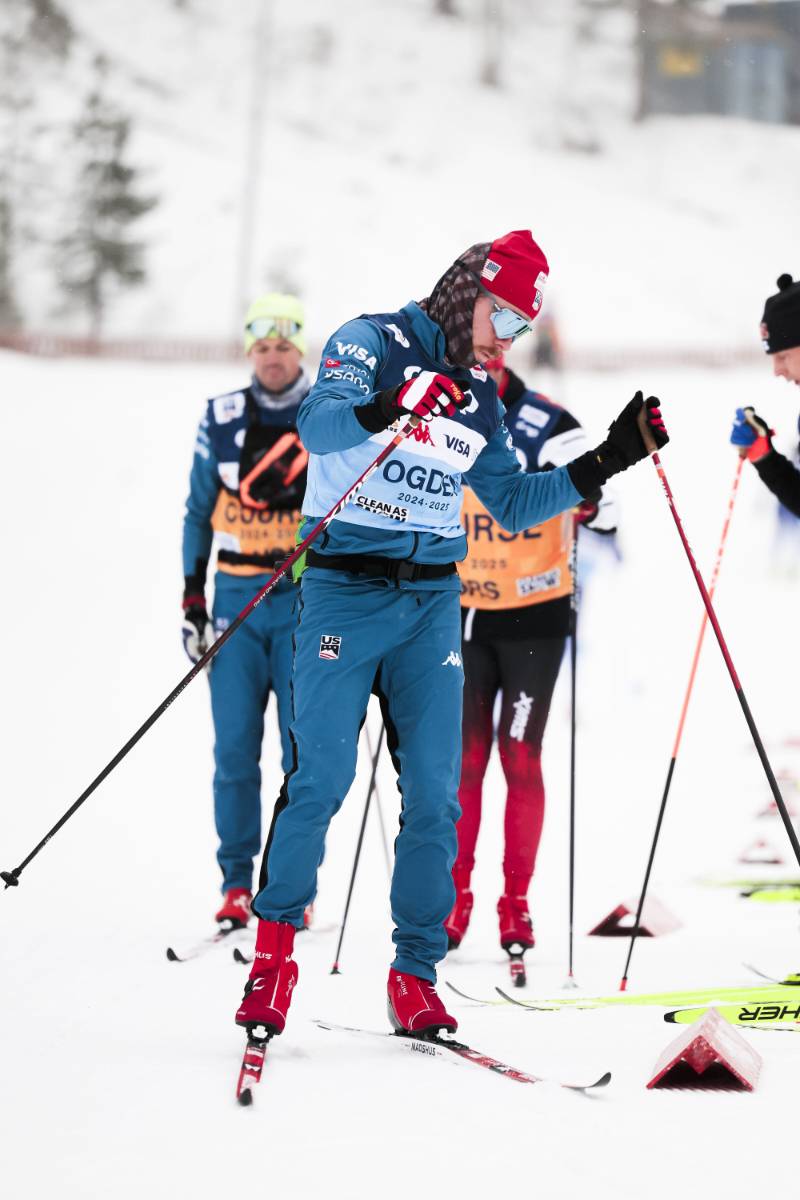
Ben Ogden (USA) working on ski selection on Thursday in Ruka (FIN) a year ago. (Photo: NordicFocus)
Roster limits
Right now, the U.S. holds seven men’s spots and eight women’s spots, with a realistic chance of earning an eighth men’s spot. It will not exceed 8 + 8.
Domestic results?
For someone skiing exceptionally well at Senior Nationals to force their way in, there must be vacancies left by athletes who didn’t meet criteria on the World Cup. In most years, Olympic qualification is won or lost by Christmas.
This is why every World Cup start in Period 1 matters. Every 12th place, every quarterfinal, every decent distance day contributes to the math.
But to Whitcomb, that math isn’t the point. It’s how athletes handle pressure that determines whether the season becomes joyful or claustrophobic.
“Meet Your Body Where It Is”
On Thursday night, in the team meeting before the weekend races, Whitcomb planned to give a simple message.
“You start that 10k, and you’re going up the first hill,” he said, “you just meet your body where it is. You do your very best that day.”
He wants the athletes to tune out the noise:
the coaches on the sides of the trail
the athletes they pass
the athletes who pass them
the crowd, the music, the reporting, the points
“You deal with the one vehicle that you’re driving,” he said. “And you try to enjoy it.”
Because fitness today doesn’t predict February.
Because the Olympic Games begin on February 7th, the only date that truly matters.
Because early-season expectations are a trap: some athletes are ready this weekend; others won’t feel themselves fully until the Tour de Ski.
“The human body,” he said, “is a wildly unpredictable thing.”
If there is one truth that governs the first weekend of racing, it is that.
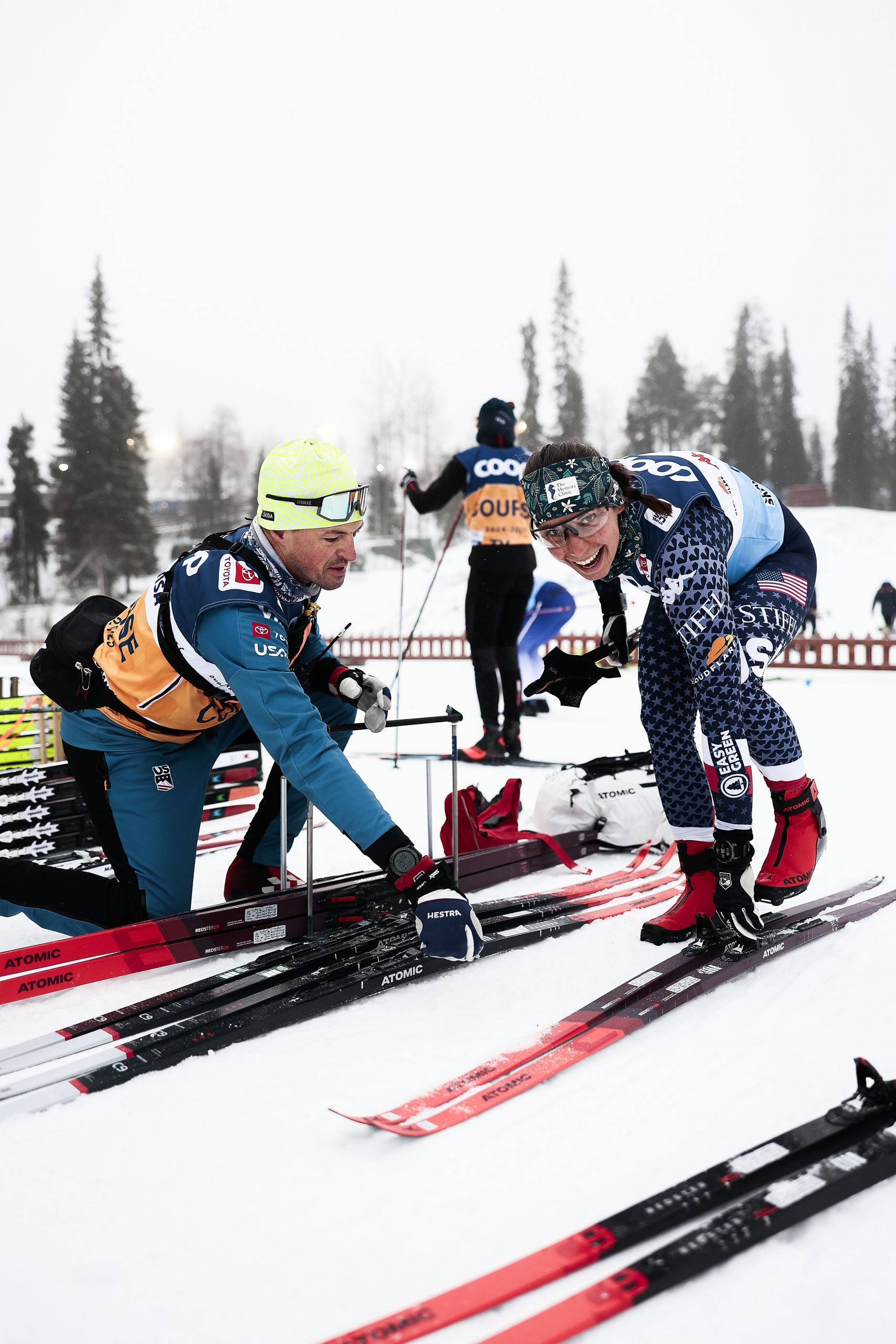
Julia Kern testing her skis with her longtime tech, Eli Brown a year ago. (Photo: NordicFocus)
Why Ruka Still Matters
Still, the weekend is not symbolic. It is competitive, decisive, and formative. Whitcomb believes the team is “positioned well to have a great opener,” but he also knows that Ruka rarely tells the whole story of a winter. The temperatures are often frigid, and the travel is too recent. But it gives athletes one thing they cannot simulate anywhere else: the clarity of racing.
“Early,” he said, “but it can’t come soon enough. We’re really excited.”
Ruka is where the starting gun echoes for the first time, but it’s also where the season’s unseen forces begin working: confidence, doubt, momentum, cohesion, luck, health, andperspective. Many Olympic stories begin here without anyone realizing it until months later.
The First Night in the Snow Globe
By Tuesday evening, the team had unpacked their bags in the small condos near the stadium. By Wednesday, when we spoke, through Whitcomb’s thin door, we could hear athletes talking after dinner—laughing, telling stories, building team chemistry. “You can hear people probably through my door,” he said, because “they’ve really missed each other.”
Outside, the northern lights edged across the sky.
Inside, there were skis to prep, race plans to finalize, nerves to manage.
And in the morning, the first climb of the season would begin at the bottom of that hill they had ridden over on the bus.
There are a few actual rituals in a sport defined by travel and unpredictability. But in the U.S. team’s calendar, the bus ride to Ruka is one of them. It marks the line between the world that was and the one that’s about to begin. Between training and racing. Between imagining and knowing.
The sun had long since set, but the trail lights of Ruka glowed through the fog, warm against the cold.
The World Cup season officially starts tomorrow.
And for the U.S. team—healthy, united, a little nervous, and very ready—there is nothing left to do but ski.
Rosie Brennan (USA) dialing in her skis a year ago. (Photo: Modica/NordicFocus)
10k Interval Start Classic – Women at 4:30 am EST and Men at 7:15 am EST
November 29th:
Classic Sprint – Heats begin at 5:25 am EST
November 30th:
20k Mass Start Freestyle – Men at 4:00 am EST and Women at 5:45 am
Love Stories Like This? Help Keep Them Coming.
Feature interviews like this one take time, access, and care to produce. If you value thoughtful storytelling and independent ski journalism, please consider becoming a Voluntary Subscriber. Your support directly fuels the work we do to cover the people, places, and moments that make our sport special.
When JC Schoonmaker talks about his earliest memories of ski racing, he doesn’t begin with speed or snow conditions, or the particular magic of gliding across winter trails. He starts, instead, with raffles. “I just remember as a kid, there’d be raffles after every race that I would be so stoked for,” he says. “Trying to get a prize, like a new pair of gloves or a hat.” It is an unexpectedly tender snapshot of a skier now known for his explosive starts and the sharp, angular drama of World Cup sprint heats. But it is also revealing. Long before Schoonmaker was on national team radars, long before he was analyzing sprint tactics or refining breathwork, he was simply a boy who loved showing up at races, surrounded by friends, snow, and the possibility of leaving with a hat.
Schoonmaker grew up in Tahoe, a place where winter sport is woven into the fabric of childhood. Yet unlike many of the region’s rising athletes, he was not funneled into Alpine skiing or a single disciplinary track. Instead, he moved constantly—and in every direction. “Both my parents were super athletic, into sports,” he says. “So from a really early age, I was just doing tons of different stuff: soccer, downhill skiing, andNordic skiing. I played lacrosse. A little bit of baseball.” The variety shaped him in ways he didn’t appreciate at the time: balance from soccer, strength from downhill, elasticity from lacrosse, and a developing sense of rhythm from all of it.
Meanwhile, the Nordic community in Tahoe was small enough to feel intimate yet substantial enough to provide him with peers, mentors, and a place to grow without suffocation. “Joining a Nordic team for me was super fun because I got to go out and ski with friends,” he says. “It was kind of my first experience racing.”
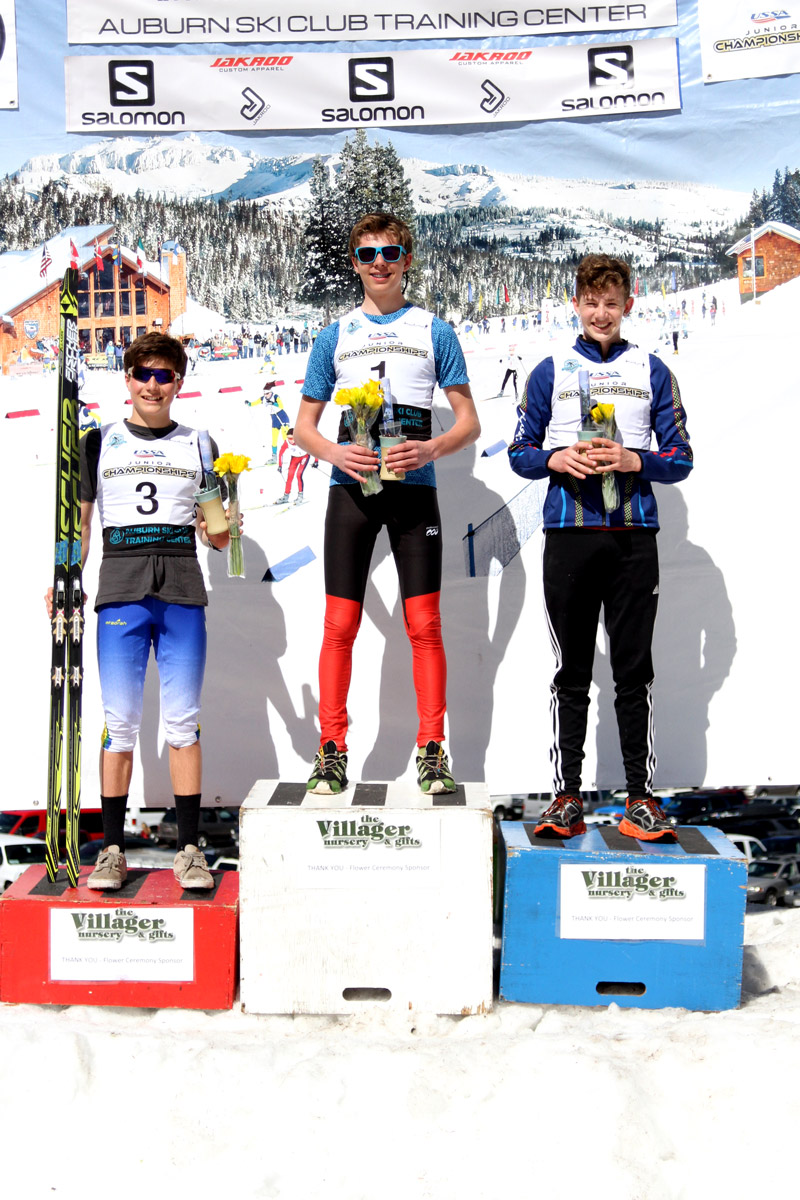
The U16 men’s podium from the 5 k Classic Mass Start at 2015 U.S. Junior Nationals at Auburn Ski Club in Soda Springs, Californial. JC Schoonmaker took home third place. (Photo: Mark Nadell/MacBeth Graphics)
Early Validation in Soldier Hollow and Truckee
It wasn’t until he traveled outside his region that Schoonmaker realized how he measured up. On a Far West trip to Soldier Hollow—his first time racing beyond his local bubble—he surprised himself. “I think I got third in the first race… then I won the second one,” he recalls. “I didn’t even really know it was a big deal, but all the older kids on the trip were… really excited for me.” Their reaction revealed something he hadn’t yet recognized: that his potential extended well beyond his local podiums.
A similar revelation arrived at Junior Nationals in Truckee, where home snow became a proving ground. He had hoped to earn All-American status, although the early races had gone poorly. “All the first races didn’t really go super well,” he says. “I had high expectations.” Yet in the final individual race before the relay, he stepped onto the podium. “Somehow onto the podium and got third,” he says. “That gave me a bunch of confidence… really helped me.” It was not just affirmation but a directional sign. Skiing was becoming more than an activity. It was becoming a path.
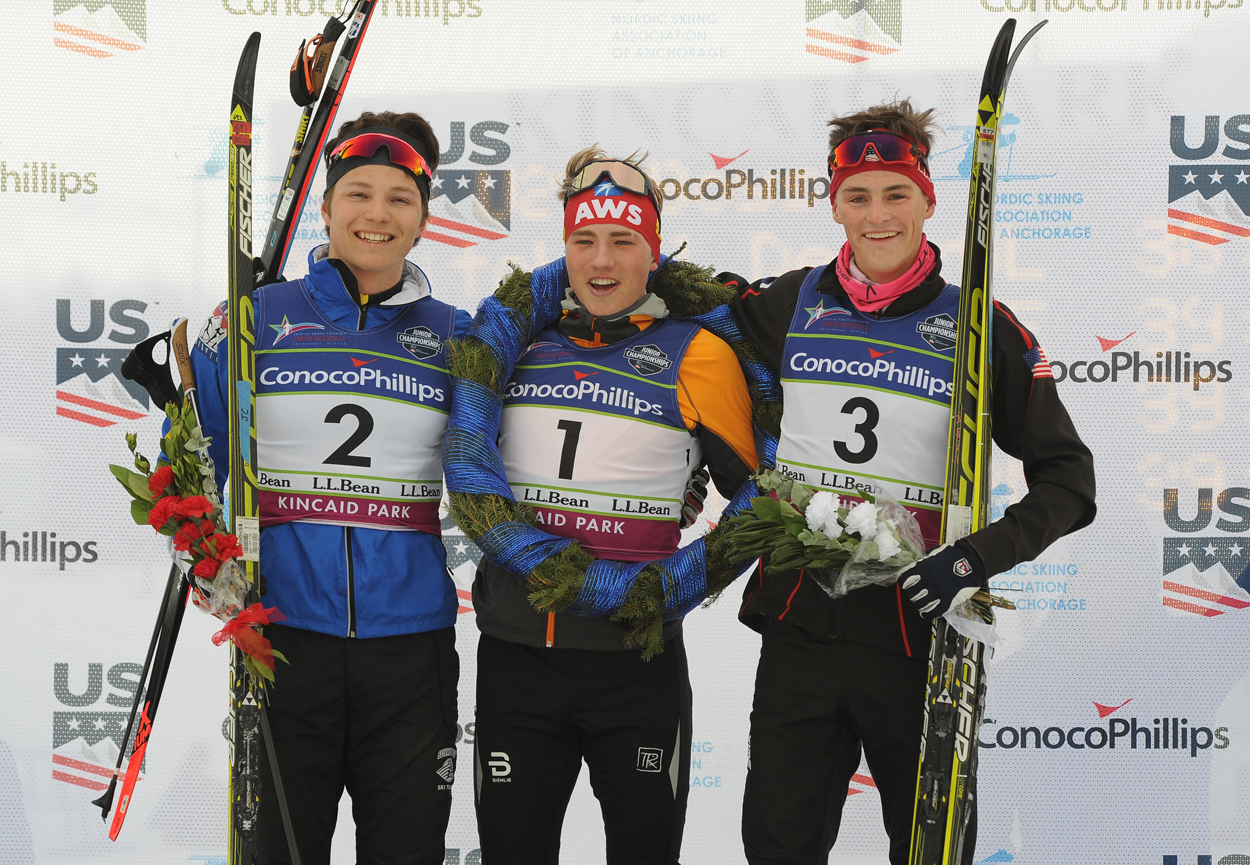
Gus Schumacher (Alaska Winter Stars/Team Alaska), center, won the U20 men’s 15K classic mass start race at the 2019 U.S. Ski & Snowboard Cross Country Junior National Championships at Kincaid Park. J.C. Schoonmaker (UAA-Auburn Ski Club/Far West), left, was second, followed by Cameron Wolfe (Ski and Snowboard Club Vail/Rocky Mountain), right. (Photo: Michael Dinneen)
Choosing Anchorage and the Power of the Right Environment
Despite his junior successes, Schoonmaker’s college recruiting process was sobering. His age cohort was stacked—Gus Schumacher, Luke Jager, Canyon Tobin—and their achievements overshadowed many strong skiers. “My top choice was UVM, and I just didn’t get a spot there,” he says. “I didn’t have a ton of options.” But an unexpected opportunity appeared when a Tahoe friend encouraged him to consider the University of Alaska Anchorage. He visited, and something clicked. “I’d say that’s the best decision I ever made,” he says. “I ended up coming to an excellent team… It’s an awesome place for skiing.”
Anchorage wasn’t glamorous, but it was grounding: clear air, big terrain, and a training culture built on consistency rather than spectacle. Under coach Trond Flagstad, Schoonmaker’s skiing matured—his engine, his technique, and his confidence—all while laying the foundation for a collaborative coaching story that would shape his rise.
A Uniquely Collaborative Coaching Path
Schoonmaker’s development is defined by the unusually harmonious network of coaches who supported him. In Tahoe, he trained with Will Sweetser, whose workout creativity brought nuance to his summer training. At UAA, Flagstad built his fall rhythm with threshold work and bounding. In the winter, U.S. Ski Team coaches—Matt Whitcomb, Kristen Bourne, and Chris Grover—stepped in with race-day craft and a national pipeline. And now, in Anchorage, he works with Eric Flora at APU, whose daily presence has brought structure and clarity.
“I feel like I didn’t even really have to do much in the way of balancing that,” he says. “Trond, Will, and Matt… kind of just took that on themselves.”
That kind of multi-coach collaboration is rare. Instead of conflicting philosophies, Schoonmaker received overlapping layers of expertise, each building on the others. He remembers one of Sweetser’s signature interval sets with particular fondness: “Twenty seconds L5… forty seconds rest… forty seconds L5… then six minutes of threshold. A cool blend… essential for getting you ready for doing sprints on the World Cup.” Flagstad brought heavy doses of fall bounding at L4. Whitcomb and Bourne added race sharpness. Flora, finally, aligned everything. “Having him at World Championships last year made it feel like just a practice in Anchorage,” Schoonmaker says.
JC Schoonmaker (bib #1) at the 2020 Senior Nationals in Houghton Michigan. (Photo: Reese Brown)
The Unexpected World Cup Start That Changed Everything
The first moment when Schoonmaker truly understood the trajectory he was on came suddenly. At U.S. Nationals in Houghton, Michigan, in 2020, he won the sprint qualifier. It was exciting, but he didn’t assume it meant anything beyond that day’s result. Then his assistant coach, Marine Dusser Bjornsen, approached him with unexpected news. “She was like, ‘Oh yeah, you’re gonna get World Cup starts from that,’” he recalls. “And I was like, ‘What? No way.’” His passport was expiring, his bags were unprepared, and within days, he was on a plane to Dresden.
Stepping into the World Cup for the first time felt surreal. “I wasn’t even really worried about those being my first World Cups,” he says. “I was mostly just hoping to get to go over there.” The qualifiers felt manageable; the heats were startling. “Racing against those dudes in the heats… was just a whole other level. A different beast.” Still, he never felt crushed by the moment. “We were just having fun,” he says. “It wasn’t crazy high expectations.” That experience didn’t instantly transform him, but it recalibrated his sense of where he belonged.
APU: A Training Collective That Became Home
When Schoonmaker finished college and committed to training full-time in Anchorage, it wasn’t only because of Flora’s coaching. It was because the environment felt like home. “Luke coming back… Gus joining… Zan and Michael… it was such a good team,” he says. “A lot played into it… but mostly that stuff.” APU is one of the few places in the country where the majority of the national team trains together throughout the year, creating a rare sense of continuity on the World Cup.
Yet even in a group that suits him so well, Schoonmaker knows he needs occasional solitude to stay balanced. “I definitely find times during the summer where I’m pretty excited to do an interval session by myself,” he says. “I grew up training alone in Tahoe.” Winter, of course, is different. “You’re living with this group of people for the entire winter,” he says. “Sometimes it is hard to find time to yourself.” But the team understands him. “Everyone knows whatever’s best for you is what’s best for the team.”
A New Kind of Training: Mindfulness and Sprint Awareness
This year, Schoonmaker added something he had never practiced formally: daily mindfulness training. “Some breath holds… super simple, just five minutes of mindfulness,” he says. “Focusing on my breath, trying not to let my thoughts wander.” The shift wasn’t driven by physical shortcomings, but by an honest assessment of where he needed to grow tactically. “In sprint heats… I’ve tended to have my head down, thinking about my technique… rather than, ‘I need to get this position around this corner.’”
Mindfulness gave him a way to sharpen his presence during races and training. During intervals, he began noticing moments when his focus drifted. “My mind starts thinking about what I’m gonna have for lunch,” he admits. “I’m getting better at bringing myself back… loosen up, ski relaxed.” The work is subtle, internal, and mostly invisible, yet deeply connected to the kind of racer he wants to become.
Passing It On: What He’d Tell the Next Generation
If Schoonmaker were speaking to a group of juniors in Tahoe today, he would know exactly what he would emphasize. “I love this puzzle of trying to get better every day,” he says. “Focus on the small things you can control… let the cards fall where they fall.” But he would also add a piece of training wisdom gained from experience. “I almost feel like I got a little too caught up in L1 and L3,” he says. “Walking up hills on classic skis isn’t getting you better at classic skiing. You have to ski fast to get better at skiing fast.” It is the kind of message that cuts through both trends and dogma.
Life on the Road: Davos, Oslo, and a Simpler Suitcase
Schoonmaker’s favorite destinations reflect a balance of beauty and familiarity. Davos stands out. “I’d love to go there when I’m not getting ready for the Tour de Ski… explore it a little more,” he says. He also holds a soft spot for Oslo. “That’s a special spot. I always feel like I’m having a really good time there.” On race mornings, he keeps things simple: “Probably a couple eggs and a few pieces of toast with jam.” And he no longer travels with the heaviest item from his early career. “I brought over an Xbox… took up, like, 12 pounds in my bag,” he laughs.
Schoonmaker and girlfriend, Emma Ribom (SWE). (Photo: Courtesy Photo)
Olympic Season: Ambition, Clarity, and the Calm Before the Heats
Despite the stakes of the Olympic year, Schoonmaker hasn’t reinvented his approach. “I honestly haven’t been doing anything different,” he says. “I’m more excited to be healthy and head into Period 1 feeling good.” But his goals are not small. “My goals would be to win a medal,” he says. “That’s what I’m shooting for.” A chance to race the relay again is just as meaningful. “The relay in Trondheim was super fun,” he says. “I would love to get another chance.”
As for the individual sprint, his ambition is both grounded and bold. “If I could make the final… that would be a solid day,” he says. “But I do feel like I can win a medal.” Few athletes can express that kind of aim with such composure. Schoonmaker delivers it as calmly as if he were describing a morning ski.
JC Schoonmaker (USA) had a breakout day in Oestersund (SWE) in 2023, reaching the podium for the first time. The American took third place. (Photo: NordicFocus)
Where He Stands Now
What stands out most about Schoonmaker at this moment is not bravado, but clarity. He is no longer the boy who raced for raffle prizes, nor the college skier unsure of his place, nor the rookie dragging an Xbox through European airports. He has become something steadier, more self-aware, and more intentional. A sprinter with composure. An athlete with perspective. A competitor capable of holding his ambition lightly without losing its sharpness.
Presence, for Schoonmaker, is not stillness. It is an ongoing process of tuning himself to the shifting rhythms of a sprint heat, listening to what his mind and body are telling him, and moving through the season with intention rather than urgency. If he keeps his head up—literally and figuratively—this may be the season when the skiing world begins to see not only what he has built, but why it was built this way.
Love Stories Like This? Help Keep Them Coming.
Feature interviews like this one take time, access, and care to produce. If you value thoughtful storytelling and independent ski journalism, please consider becoming a Voluntary Subscriber. Your support directly fuels the work we do to cover the people, places, and moments that make our sport special.
It’s vacation time. We hear from some of the U.S. Ski Team men holed up in their Christmas cottage in Davos, Switzerland — featuring a new lightning round quiz segment — and Devon and Nat take us through the weekend’s results. Happy holidays: We’ll be back during the Tour de Ski.
Questions, comments, want us to use less (or more) profanity? Reach us at devon@fasterskier.com and nat@fasterskier.com.
This coverage is made possible through the generous support of Marty and Kathy Hall and A Hall Mark of Excellence Award. To learn more about A Hall Mark of Excellence Award, or to learn how you can support FasterSkier’s coverage, please contact info@fasterskier.com.
As cowbells and horn music echoed through the course, the women’s 20 k classic marked the final competition before athletes enjoy a brief rest ahead of the Tour de Ski later this month. However, the start list for today’s race was missing several notable names, hinting that some top competitors may still be opting for a conservative start to this World Championships season.
Astrid Oeyre Slind (NOR) earned her first-ever World Cup victory. (Photo: NordicFocus)
Many had written off the top position on the podium as an easy win for Therese Johaug (NOR), a skier renowned for her dominance in distance events and current leader of the distance standings. With key Swedish athletes like Frida Karlsson, Ebba Andersson, Linn Svahn, and Jonna Sundling sitting out, as well as Heidi Weng (NOR), the start list for today’s competition was shorter than usual.
This created an opportunity for others to challenge for the podium. On the final day of the Davos World Cup, it became evident who was feeling the effects of the weekend’s racing. With many top athletes strategically opting to skip Friday and Saturday’s sprint competitions, tired legs certainly played a role in today’s performances.
Victoria Carl (GER), Astrid Oeyre Slind (NOR), Krista Parmakoski (FIN), Kerttu Niskanen (FIN), Kristin Austgulen Fosnaes (NOR), Katharina Hennig (GER), and Teresa Stadlober (AUT), who have all achieved consistent top-15 results in distance events this season, were waiting for an opportunity to advance onto the podium. Perhaps having known this, none of these athletes started Saturday’s sprint. For Americans Jessie Diggins and Rosie Brennan, who competed in both the sprint qualifier and heats yesterday, the additional fatigue may have posed a slight disadvantage.
The podium was largely decided from the outset of today’s competition, as Johaug, Slind, and Niskanen established an early lead that steadily grew throughout the race. Johaug led through most intermediate checkpoints but began losing ground after the 16.5 k checkpoint. Slind, meanwhile, maintained her momentum and accelerated through the final kilometers to secure her first-ever World Cup victory, finishing 10.1 seconds ahead of Niskanen. Johaug crossed the line in third, 13.5 seconds behind Slind.
Diggins and Brennan skied comfortably, finishing 7th and 8th, respectively, to secure spots in the top-10. Other American finishers included Sydney Palmer-Leger in 28th, Haley Brewster in 35th, and Alayna Sonnesyn in 37th. Canada’s Katherine Stewart-Jones also skied to a 22nd place finish.
Rosie Brennan (USA) skied a strong and consistent race, finishing 8th overall (Photo: NordicFocus)
“Today, I definitely wanted to just feel like I was in the race, and able to push when I wanted to and hold pace throughout,” Brennan shared following the competition. “I feel when I am racing at my best, that puts me in the fight.”
As Team USA eases into the season, these early races may highlight room for improvement, especially given the team’s recent transition to on-snow training. “I don’t think I was quite there today,” Brennan reflected, “but it was definitely a step in the right direction for me. I felt a bit more open and able to ski the way I wanted to and find some ability to push a bit out there. I think I’m still missing that top end that will hopefully bring me closer to where I want to be, but all you can ask for is a step in the right direction.”
Women’s 20 k Classic Individual Start
While Johaug was a strong favorite entering the competition, the other podium spots were open for new names to step up today, with some of the strongest World Cup distance skiers missing from the start list. Early starters Niskanen, Slind, Brennan, and Hennig maintained similar splits through the first five kilometers, with Niskanen and Slind gradually pulling away to build a steady lead over the others. By the 9.3 k checkpoint, Niskanen and Slind had established a commanding 45 second advantage over Brennan and Hennig, positioning themselves as clear contenders for the podium.
Kerttu Niskanen (FIN) delivered an impressive performance, posting strong splits that secured her a second-place finish on the podium. (Photo: NordicFocus)
In many ways, the podium positions were already decided within the first few kilometers of the race. The early lead by Niskanen and Slind, combined with Johaug’s well-established strength in distance events, solidified the trio as podium contenders. By the second half of the competition, it was clear that the podium was out of reach for the chasing pack. At the 16.5 k checkpoint, Slind, Niskanen, and Johaug held a lead of more than 30 seconds over Carl and Parmakoski, and a 1.5-minute lead over early contenders Brennan and Hennig.
The specific order on the podium remained uncertain until the final moments of the race. While Johaug may have dominated this competition two years ago, her return this season left more to be decided. Though she established an early lead through the initial checkpoints, Niskanen also positioned herself as a strong contender in the middle kilometers. Only second to Johaug, Niskanen’s lead over Slind grew to 7 seconds around the 12.4 kilometer checkpoint.
Between 14 and 16 kilometers, Slind shifted into high gear, steadily closing the gap on Niskanen and ultimately overtaking her. From there, Slind continued to build her lead through the final kilometers of the competition.
Spectators held their breath through the final kilometers of the day, watching Johaug’s narrow lead over Slind dwindle. By the 16.5-kilometer checkpoint, Johaug was just 1 second ahead, a margin that shrank to 0.5 seconds by 18.5 kilometers. In the final stretch, Johaug couldn’t maintain her pace, dropping back to finish 13.5 seconds behind Slind and 10.1 seconds behind Niskanen, settling for third place.
Therese Johaug (NOR), adorned in the red bib as the reigning distance leader, struggled to maintain her dominance in today’s race, fading in the final kilometers to finish third. (Photo: NordicFocus)
With Johaug out of the way, Slind skied to her first-ever World Cup victory after 59 race starts and five podiums. “I can’t really believe it,” Slind shared following the race. “I never thought this would happen and at least not when Therese is back in the start. I thought I was fighting for second place the whole time and suddenly I realized this could be a win. I don’t know what to say.”
Outside the podium, positions in the top-10 saw more movement throughout the competition. Carl had a strong start, achieving some of the fastest splits early in the race. An exciting battle unfolded between Carl and Johaug in the opening kilometers, with Johaug leading by 3.2 seconds at the first checkpoint before Carl reclaimed the advantage by the 4.2-kilometer mark, edging ahead by 1.1 seconds.
As the race progressed, Johaug extended her lead over Carl, who contended for a position in the top-5 against Parmakoski. However, Carl began to fall off the pace around the 15-kilometer mark and ultimately dropped back during the final lap. In the end, Parmakoski skied to a 4th place finish and Carl followed closely behind in 5th.
Teammates Diggins and Brennan joined Carl in the battle for top-5 positions. Diggins posted strong splits early in the race but appeared to be fading by the 16-kilometer checkpoint. As one of the few top-athletes who competed in all three competitions this weekend, including all three sprint heats, it’s likely this may have been one of the few occasions in which Diggins ran out of steam. Brennan with strong splits throughout, maintaining her position in the top-10. “I was happy with my pacing, I held very consistent through the whole race which is always a good thing,” Brennan shared with FasterSkier.
Kerttu Niskanen (FIN), Astrid Oeyre Slind (NOR), and Therese Johaug (NOR) claimed the podium in the Davos women’s 20 k classic individual start race. (Photo: NordicFocus)
This coverage is made possible through the generous support of Marty and Kathy Hall and A Hall Mark of Excellence Award. To learn more about A Hall Mark of Excellence Award, or to learn how you can support FasterSkier’s coverage, please contact info@fasterskier.com.
Friday night in Davos: A fast course, fireballs, and a remarkably flexible field for the Men’s Team Sprint Finals.
After qualifying, the evening’s would-be winner was uncharacteristically unclear, with four nations represented in the top five qualifying times. Ben Ogden (USA I) started his second weekend of sprinting in pole position, having put a full 1.67 seconds on the individual favorite, Johannes Høsflot Klæbo (Norway 1). Edvin Anger (Sweden 1) qualified third; teammates and host-nation heroes Valerio Grond and Riebli Janik (Switzerland 1) were fourth and fifth, respectively. The Swiss duo’s combined times put Switzerland 1 at the front of the starting gate; USA 1 started in second position (with Zanden McMullen qualifying 26th), followed by Norway 1 (J.H. Klæbo and Paal Golberg) in third. USA 2 (J.C. Schoonmaker and Kevin Bolger, qualifying ninth and 24th) started the race in eighth, putting both American teams in the final. Further down the starting list, although hardly out of contention, were Sweden 1 (E. Anger and Johan Haggstroem) in fourth; and France 1 (Jules Chappaz and Richard Jouve) and France 2 (Remi Bourdin and Renaud Jay) in fifth.
Ben Ogden (USA 1), top qualifier in the Men’s Team Sprint. (Photo: Modica/NordicFocus)
Breathless after qualifying, Ogden panted a comment to FIS, expressing high hopes for the final ahead. “Last week was a good start but a bad finish. Today I’m turning it around: A good start and a good finish!” His race strategy was simple: “Ski fast in the first lap. Ski fast in the second lap. And then ski really fast in the third lap.” As for conditions, Ogden echoed the sentiment expressed across numerous athletes’ social media posts in the previous days, stating that the team is “Happy to be racing in beautiful Switzerland.” With thorough snow coverage, superb grooming, and no shortage of pyrotechnics (athletes were expressly warned to swing wide of the flamethrowers on the final corner), things appeared favorable for left-field performances: Notably absent from the grid were more Norwegians and Swedes (each nation qualified only a single team each); the French are benching Chanavat until tomorrow, and if the Germans or the Finns (other than Lauri Vuorinen, third in Ruka) have a solid Sprint team they haven’t bothered to tell anyone yet.
Switzerland 1: Courageous Performances from the Crowd Favorites
For optimistic viewers, the race was an exercise in suspending disbelief. Far from the self-assured Swedish dominance in the Women’s Team Sprint, the lead of the Men’s pack was repeatedly contested over the course of twelve laps, with a hard-out-of-the-gate start from Janik Riebli putting the Switzerland 1 at the forefront of the evening’s action. Norway’s Paal Golberg made an early challenge descending into the first exchange, but Valerio Grond fended off a few probing jump-skates from Klæbo to reclaim the lead on Lap 3. By Lap 4, the key contests of the evening had already been sketched: the Swiss Men were determined to fight for the front of the pack; the Norwegians wanted–and frequently got–control of the race, and Frederico Pelligrino, returned from a weekend of rest, was practically Klæbo’s shadow each time the two ascended the course’s singular climb–a blue specter locked as closely as possible behind the Norwegian’s white hat.
To more cynical fans, however, the outcome–which always seemed to favor Norway I, despite Golberg’s lackluster qualifying lap (he was 19th, over six seconds behind Ogden)–was clear by the start of Lap 6. Despite repeated challenges, an unflappable Klæbo danced over the hill-crest and around the slick downhill corner as the mass of Men around him appeared lunging (and occasionally stumbling) by comparison. Elia Barp (ITA I)–the young gun to “Daddy Chico’s” elder statesman–had maneuvered the Italians into second; Schoonmaker handed off to Kevin Bolger in third, with Ogden tagging McMullen in sixth, so there was still ample fighting ahead for podium finishes, but Golberg was pulling his weight and keeping the race where Klæbo needed it to be (which, realistically, was anywhere within ten seconds of the lead).
This was not to say that there weren’t a few fireworks in store. Beginning in Lap 8, Valerio Grond saw the writing on the wall and attempted to unnerve the Norwegians with a huge surge over the climb; he managed to open a ski-length against Klæbo and handed off to Riebli, who held onto first position through Lap 9. Golberg moved to reel in the Swiss, but his fatigue was becoming evident on the Lap 10 climb as Riebli initiated a furious jump-skate; dropping his shoulder, the Norwegian was losing turnover and power, but managed to stay in second through the final exchange. Elia Barp handed off to Pellegrino hot on Golberg’s heels, and the Frenchmen occupied fourth and fifth, just ahead of USA 1 and 2.
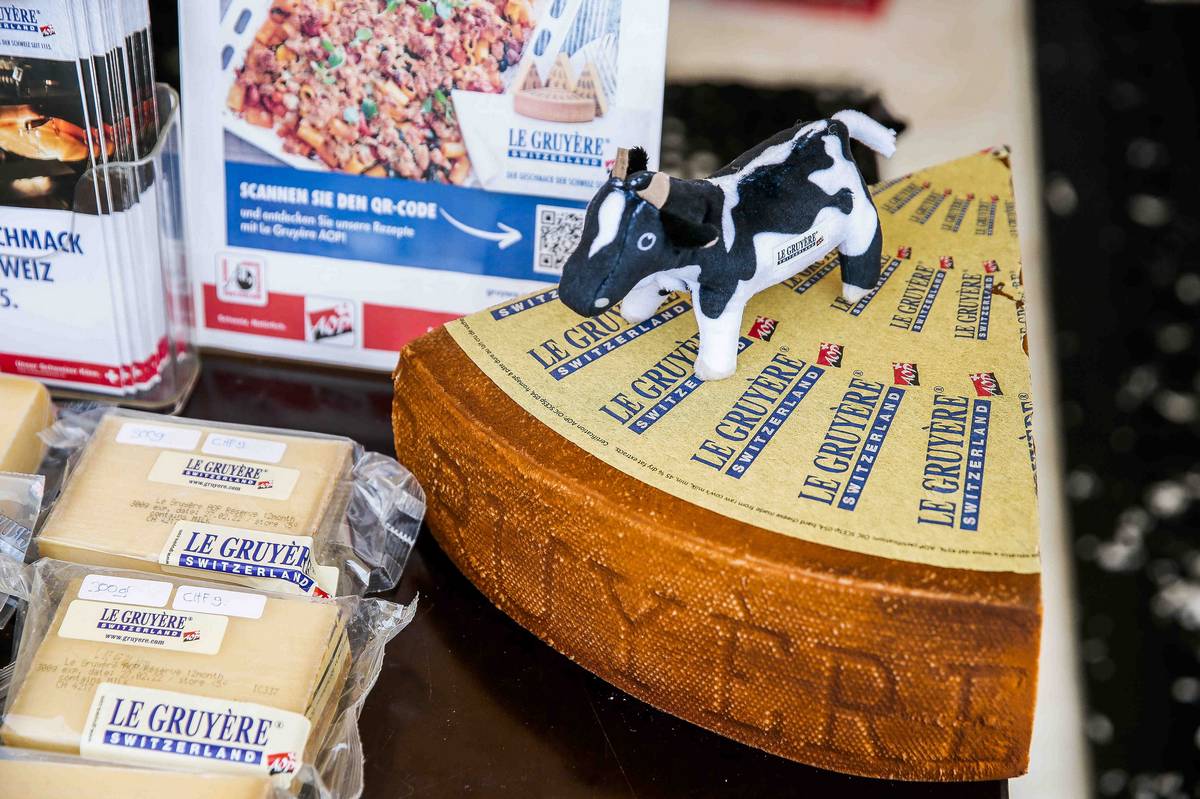
Swinging in to slice across the apex of the first corner, Pellegrino led into the penultimate climb; Grond marked him on the inside, while Klæbo moved to the far left shoulder of the course to challenge the Italian. Appearing to stumble–perhaps catching a ski on Grond–over the crest, Pellegrino descended in third; now it was Grond to the front, with Klæbo adhered to his tails in second. Rounding the downhill corner, nine skiers jockeyed for prime positioning into the long, wide, and flat straightaway into the final lap, but Klæbo could smell the Gruyere (or perhaps the singed spandex) and unfurled himself into a fluid, ground-eating V2. Ben Ogden observed that, although today was an important exercise in “energy management,” this section was undoubtedly “the deciding point of today’s race.” Grond was pumping like mad, but by the base of the last climb, Klæbo had four ski-lengths on the field, and offered his competitors no slipstream on the descent.
With Grond and Pellegrino battling for the podium, and two Frenchmen, Bolger, and Ogden battling for fifth and sixth, the Swedes finally decided to start racing: Edwin Anger, largely absent from the evening’s excitement, leapt up the hill and into second. With a glance over his shoulder, Klæbo powered around the final corner and opened his arms in victory across the line, while the three men behind him–Anger, Grond, and Pellegrino–roared down the finishing stretch. With meters to go, Grond stepped to the outside to clinch second for the Swiss, and Pellegrino–appearing to cross the line in third–ultimately took fourth thanks to a tremendous lunge from Anger, who snuck his toe 0.02 seconds ahead of the Italian’s. France 1’s Richard Jouve was fifth; Ogden for USA 1 and Bolger for USA 2 were sixth and seventh.
Grond secures second place for Switzerland 1, ahead of Edvin Anger (SWE, not pictured) and Frederico Pellegrino (ITA, left), and in front of a raucous home crowd. (Photo: Modica/NordicFocus)
Golberg & Klæbo Steady to the Podium; More Sprinting Ahead
In retrospect, today was Paal Golberg’s race to lose, and the Norwegian showed no intention of doing so. In his post-race interview, Golberg noted he has historically struggled in Davos (his previous personal best was an eighth-place Sprint finish in December, 2011), and was gratified to secure tonight’s podium with Klæbo. For his part, the Norwegian anchor was gracious as always (well, at least since 2018), complimenting the venue and the night-racing format, and modestly stating that he will “come back tomorrow, and try to compete one more time, and see how it goes.” Today marked Klæbo’s 93rd World Cup victory; Saturday could well be his 94th.
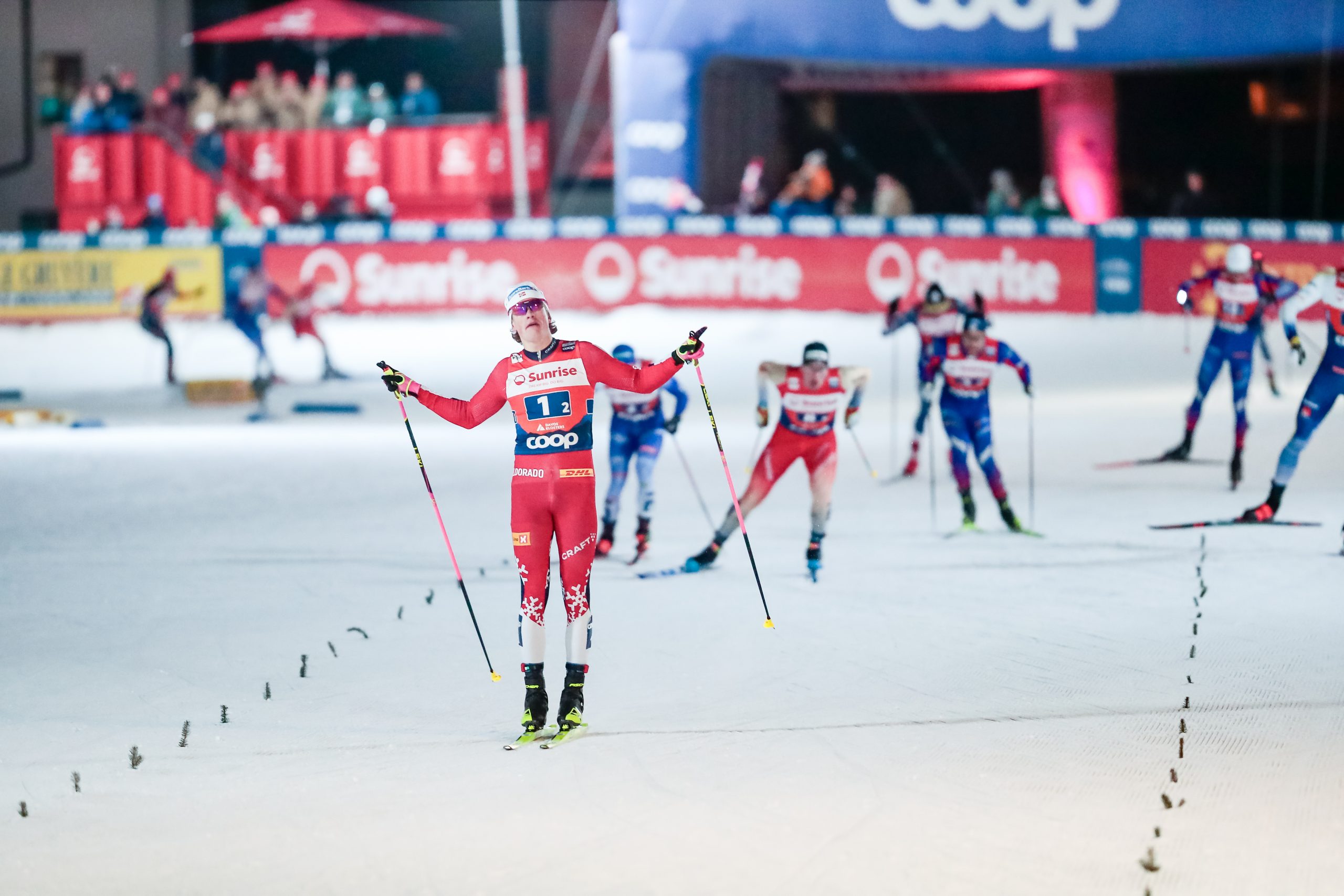
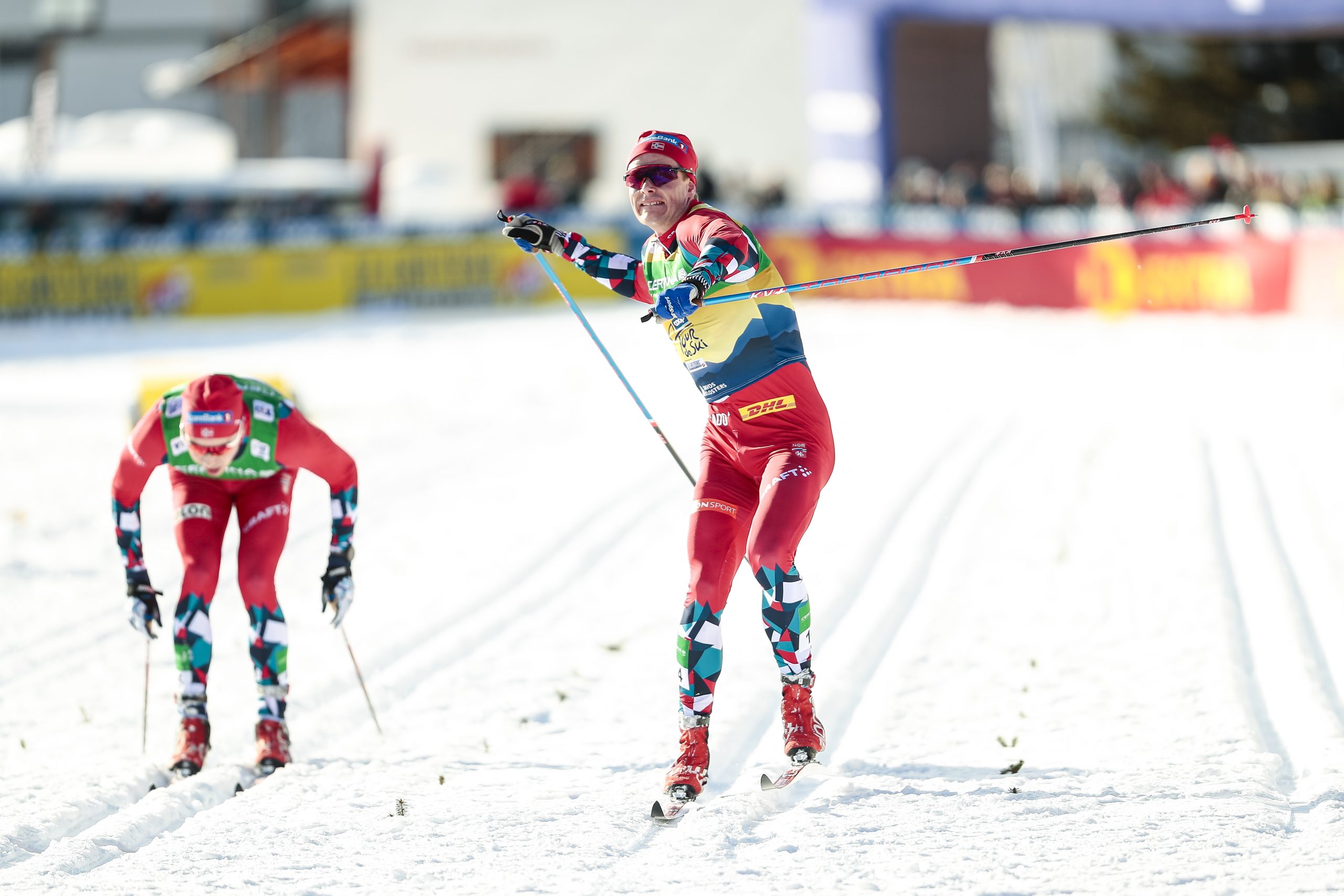
Johannes Hoesflot Klaebo (NOR) crosses the line in the Men’s Team Sprint, his 93rd World Cup victory. (Photo: Modica/NordicFocus)
The Swiss Men appeared ecstatic to secure a podium in front of a home crowd, and Pellegrino–doubtless disappointed–will certainly have another bite at the cheese tomorrow. While the Americans may have had their sights set on a more competitive finish, both Men’s teams finishing in the top eight is a marked improvement from their performance in the single Team Sprint of 2023-24 (Lahti, where no Americans made the final) and from 2022-23 (when USA 1 was 12th in Livigno). Reached for comment, Ben Ogden admitted that he “wanted to better in the actual race and not just the pointless pre-race race.” While frustrated, he feels the American Men “learned a lot and were very close to [their] goals, so [they] are not disappointed.”
Kevin Bolger wrote that it’s “always fun battling between [USA] Team 1 and 2. We joke that at the end of the day, that’s the most important team to beat.” Bolger and J.C. Schoonmaker, ahead of USA 1 for most of the race, “wanted to stay in front and keep out of trouble,” and enjoyed being in the mix with Ogden and McMullen alongside them. While tomorrow will be a “tight turnaround” for the USA sprinters, the “only thing to do is eat, sleep, and try to be horizontal.” Today, “pretty much from the start of Lap 2 the throttle went down,” so there will be no shortage of lactate to flush out over the course of Saturday afternoon as the athletes head to another round of night sprinting.
The US Men are now in sixth in the Nations Cup, 20 points behind Germany.
This coverage is made possible through the generous support of Marty and Kathy Hall and A Hall Mark of Excellence Award. To learn more about A Hall Mark of Excellence Award, or to learn how you can support FasterSkier’s coverage, please contact info@fasterskier.com.
Harald Oestberg Amundsen (NOR) wins the 20 k Classic Pursuit in Davos, Switzerland: sweet redemption after an untimely fall took him out of yesterday’s Freestyle Sprint quarterfinal. (Photo: Modica/NordicFocus)
Winter endurance sports represent a quandary: training for endurance events requires that athletes push themselves repeatedly toward exhaustion . . . a condition that makes them especially susceptible to transferable illnesses. Influenza caught up with Johannes Hoesflot Klaebo who never even started the 2024 Tour de Ski. Ben Ogden (USA) caught the cold that’s been coursing through the Stifel U.S. Ski Team; he was forced to drop out of the Tour de Ski while standing third overall and wearing the Points Leader’s jersey. This morning in Davos, Switzerland, it was Gus Schumacher who fell ill and was forced to withdraw. Only a few hours after his personal-best World Cup finish (fourth in the Stage 4 Men’s Freestyle Sprint), Schumacher was out of the tour.
Zanden Mcmullen (USA) finishes the 20 k Classic Pursuit in Davos, Switzerland. With sickness having swept through Team USA, McMullen and Scott Patterson (USA) are the only American men remaining in the Tour de Ski. (Photo: Modica/NordicFocus)
Canadian, Antoine Cyr, started the Pursuit in 19th place overall. He fought to secure a place in a group led early-on by Amundsen and Pellegrino, allowing Cyr to fight his way to a tremendous seventh place finish. Olivier Leveille was the only other Canadian finisher in 41st. Julien Locke (CAN) did not start the day’s racing. Only Zanden McMullen (USA) and Scott Patterson (USA) remain in the field for Team USA. Patterson finished the day 24th, with McMullen 28th.
Harald Oestberg Amundsen (NOR) was appearing edgy: slamming his poles on the ground after an untimely fall in yesterday’s sprint competition, wearing the bib of the Tour de Ski leader, but definitely wanting more reward—and respect—than he was getting, Amundsen began today’s 20 k Pursuit looking like a man seeking redemption. He would get it, storming through the finishing straightaway for an impressive victory over his countryman, Henrik Doennestad. In what has become common occurance, a third Norwegian rounded out the podium: Martin Loewstroem Nyenget.
Norway may have swept the podium (again), but there were more national choices among the contenders including Beda Klee (SUI) who finished sixth, Friedrich Moch (GER) who finished fifth, and Hugo Lapalus who finished fourth (only a tenth of a second off the podium).
Harald Oestberg Amundsen (NOR) exults at the finish line ahead of his countryman, Henrik Doennestad. Amundsen’s victory in the 20 k Classic Pursuit solidifies his position at the top of the Tour de Ski overall standings with just two more stages remaining. (Photo: Modica/NordicFocus)
20 k Classic Pursuit
After a morning snowstorm that profoundly affected the Women’s Pursuit, the Men’s Pursuit was contested on a Classic track that more accurately resembled old fashioned ski racing—fluffy snow, irregular tracks, lower racing speeds, and long laps through the woods. The snowstorm that buffeted the Women’s Pursuit had abated, but new snow would still affect the Classic tracks and the ability of the wax techs to produce fast skis. Fortunately, the entirety of the Davos valley was in shadow by race time, so there would be no sunny patches for wax technicians to anticipate.
With the start order being determined by placings in the prior day’s Sprint competition, gaps between starters were quite narrow—and the earliest starters were sprinters rather than endurance skiers. The day’s first starter, Lucas Chanavat (FRA) had been accused of “sandbagging” in the last Pursuit stage of the Tour de Ski: slow-walking much of the race course in an attempt to save his energy for later sprint stages. With today’s World Cup cameras focused solidly on him (as the day’s first starter), Chanavat began the race with a more honest effort, focusing his efforts on acquiring the Bonus Points available at 3.4 k. He managed to hold his lead, crossing the Bonus Points line just a ski-length ahead of Edvin Anger (SWE). His mission accomplished, Chanavat quickly pulled up after that checkpoint, resuming a pedestrian pace more closely resembling the way he had raced in the Pursuit event last Saturday. Chanavat would ultimately finish the day’s 20 k race distance, but in 79th place, nearly eight minutes behind the leaders.
Anger—a much more accomplished distance skier than Chanavat—continued on alone, pursued at a distance by a group that included Pellegrino (third in overall standings), Haavard Solaas Taugboel (NOR), Matz William Jenssen (NOR), Erik Valnes (NOR), and Lauri Vuorinen (FIN). The group including Amundsen and Cyr followed only a few more seconds behind.
Anger still held a 30 second lead at 8.6 k, but by end of the first of two laps his lead had evaporated. Soon after, he was swallowed up by a 15-man group led by Amundsen. Ultimately, Amundsen and Henrik Doennestad (NOR) got away from the field, sprinting to the finish line where Amundsen out-sprinted Doennestad by less than a second. Their countryman, Nyenget, managed to hold off a hard-charging Lapalus for third.
Amundsen continues in the Tour de Ski leader’s jersey, but now with the measure of respect to which he believes he is due. The Tour seems Amundsen’s to win or lose, with only two distance-race stages remaining (including Sunday’s daunting climb up Val di Fiemme’s Alpe Cermis).
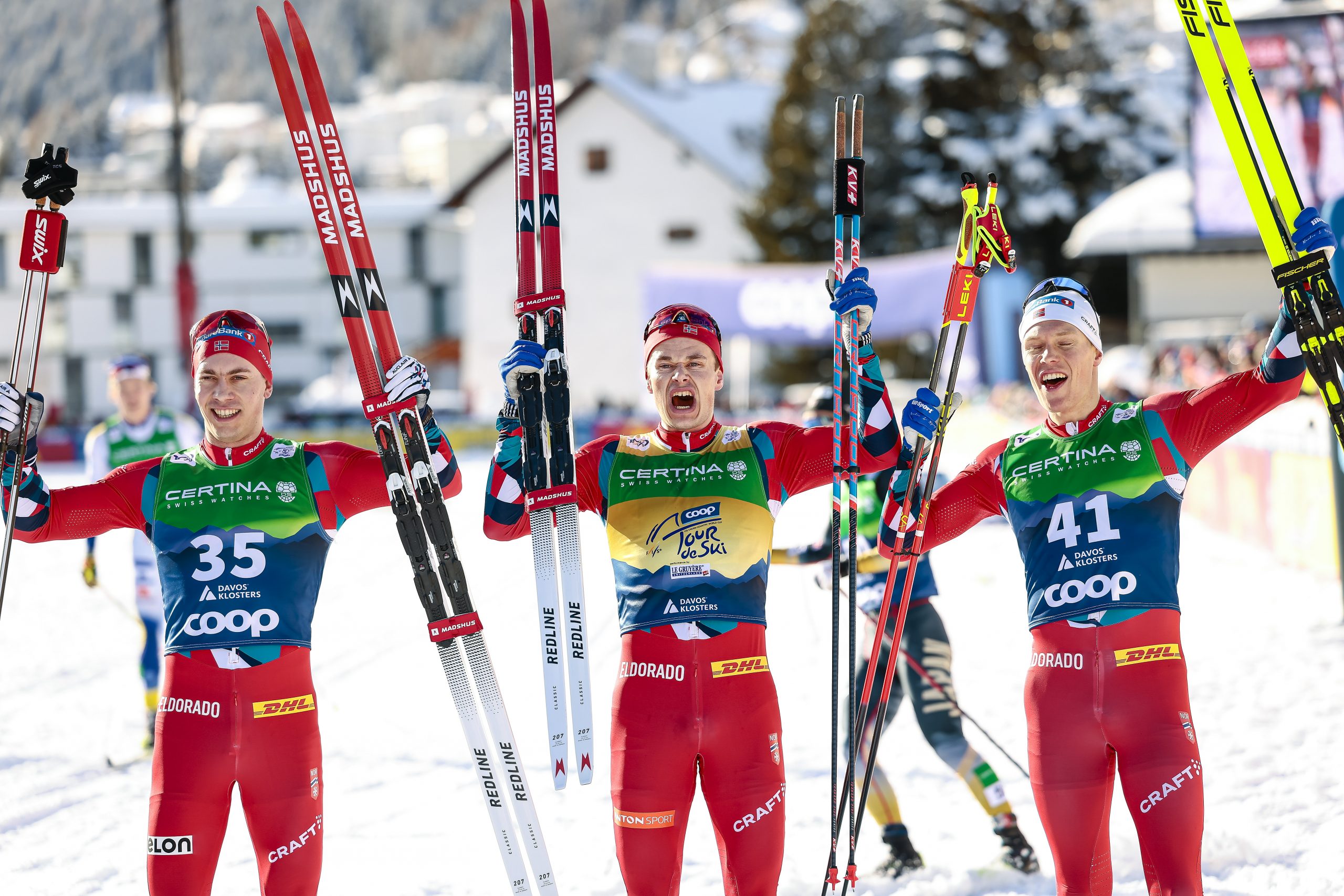
Henrik Doennestad (NOR), Harald Oestberg Amundsen (NOR), Martin Loewstroem Nyenget (NOR), (l-r) celebrate another all-Norwegian podium after the Tour de Ski 20 k Classic Pursuit in Davos, Switzerland. (Photo: Modica/NordicFocus)
This World Cup coverage is made possible through the generous support of Marty and Kathy Hall and A Hall Mark of Excellence Award. To learn more about A Hall Mark of Excellence Award, or to learn how you can support FasterSkier’s coverage, please contact info@fasterskier.com.
With the arrival of a new baby anticipated at any moment, this was an emotional victory for Federico Pellegrino (ITA) in Davos (SUI). (Photo: Nordic Focus)
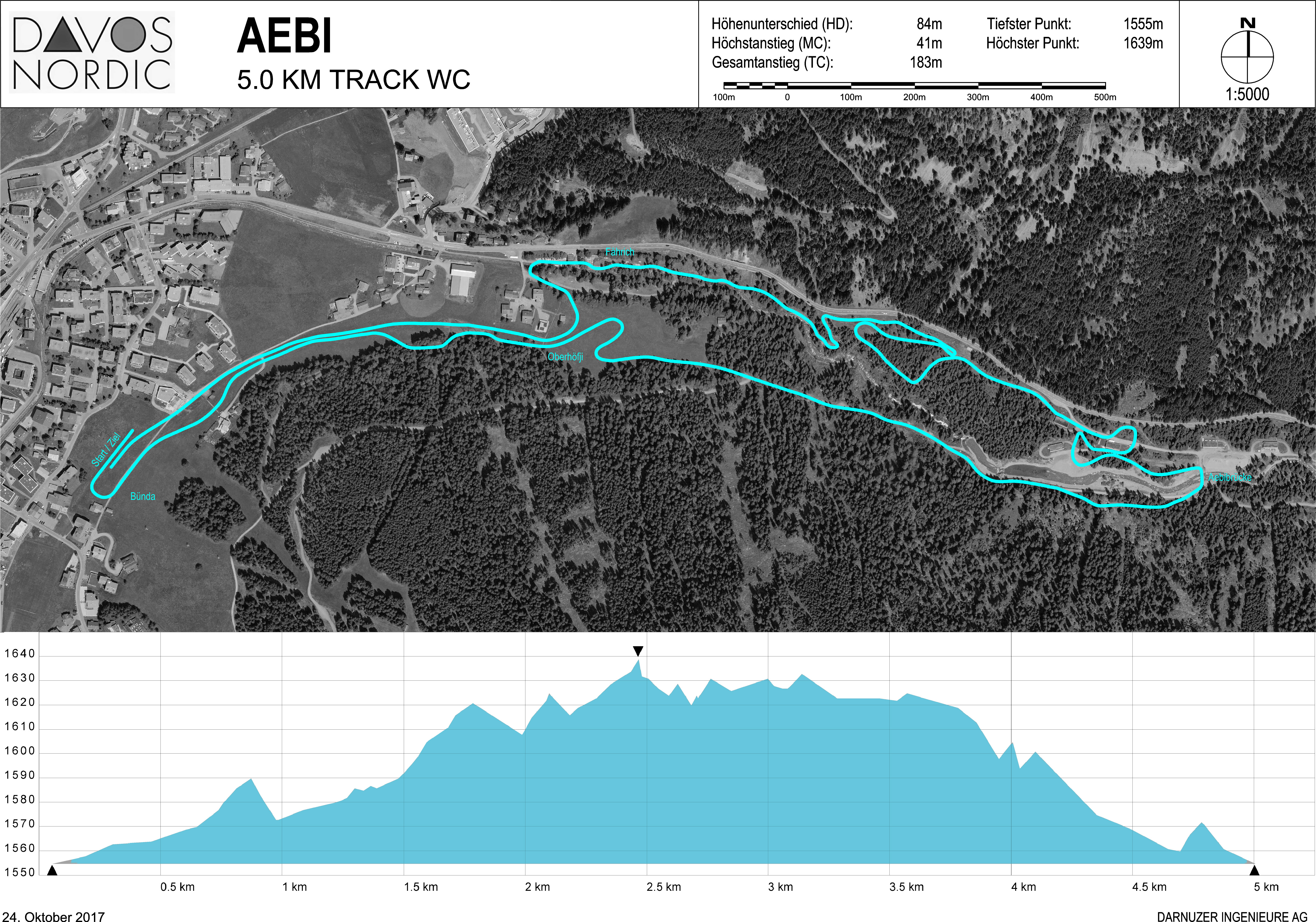
At an elevation of 5,118 feet above sea level, Davos Switzerland is the highest stop on the FIS cross Country World Cup tour—high enough that its elevation has definite effects on racers’ performances. The air is thin and dry, and a long sprint day in Davos (for those who make it all the way to the final) is a test of endurance almost as much as it is a test of speed.
This third sprint event on the World Cup tour also marked the much-anticipated return of FIS World Cup Sprint Leader, Johannes Hosfloet Klaebo, who skipped last week’s endurance finale in Beitostolen on account of illness. Klaebo has often been quoted this year about his intentions for the season, and his feeling that the World Cup Overall crown has already slipped away due to new FIS point systems favoring skiers who compete in all events. Klaebo has already missed numerous starts this season, and he would’ve been much more accustomed to the sort of points-lead that the old system would have provided him (a system that rewarded race wins more than race consistency).
Ultimately, this day would not be about points but about passion, as veteran sprint star, Federico Pellegrino (ITA), stormed forward to win the day, followed by Klaebo in second, and Lucas Chanavat (FRA) third. In Davos today, the Italians were exultant (as they so often are when their athletes achieve such great results); let the national celebrating begin.
Men’s Sprint
The Davos sprint venue consists of two laps making a 2.7 kilometer course. Early on, it appeared that the prologue could prove to be the big story of the day when—for the first time this season—Klaebo was not present atop the leader board. He finished second, .26 behind prologue winner Chanavat. North Americans also qualified well, as has begun to seem like the norm: Ben Ogden (USA) 6th and Graham Ritchie (CAN) 8th.
Ben Ogden (USA) moves into a controlling position during his quarterfinal, though moments later his efforts were undone by a tangle on the significant uphill. (Photo: Nordic Focus)
More North Americans qualified for the quarterfinals—JC Schoonmaker (USA), 21st, Kevin Bolger (USA), 26th, and Antoine Cyr (CAN), 28th—but no North Americans advanced beyond the quarterfinals. Ben Ogden appeared to be in position to advance out of his quarterfinal heat, but an errant pole plant resulted in a tangle on the final uphill that took him out of contention. Ogden would finish the day in 21st, while Canadian Graham Ritchie would finish 17th.
Matt Grover was one of the Team USA staff members who was impressed with Ogden’s performance, despite Ogden’s disappointment at not advancing. “I’m really stoked for [Ben],” Grover commented. “The way he was skiing in the first three quarters of that quarterfinal, it was clear he was going to be one of the people controlling it.”
Grover continued his comments, referring to the potential Ogden is showing in the season to come. “He’s a guy who’s still racing himself into race fitness this year,” said Grover. “It’s really impressive.
The quarterfinal heats also claimed one of the significant contenders, as Richard Jouve (FRA)—the winner of last week’s World Cup Sprint in Beitostolen—crashed mid-race after tangling with his countryman, Renaud Jay.
Semifinals
Five Norwegians qualified for the semifinals, though one of those heats was decidedly more stacked than the other. Semifinal 1 featured Klaebo, Even Northug (NOR), Pellegrino, and the day’s top qualifier, Chanavat. Chanavat set the early pace, followed by Klaebo and Pellegrino. The racing was should to shoulder as Pellegrino executed a daring move to enter the final turn on the inside. His speed pushed him to the outside on the finishing straight, leaving the inside lane open for Klaebo. Pellegrino won the semifinal with Klaebo standing up to glide in ahead of Chanavat (who would qualify into the finals as a lucky loser, along with Northug who finished the semifinal in fourth).
Finals
The final looked to be super-competitive with top-qualifier Chanavat joined by Klaebo, Pellegrino, Northug, Edvin Anger (SWE), and breakthrough performer, James Clugnet (GBR). At the start of the final, Chanavat powered to the front followed closely by Northug. Klaebo drifted to mid-pack, though managed to move up into contention on the straightaway at the beginning of the second lap. Having maneuvered past Northug and Anger, Klaebo transitioned to V1 much more quickly than Chanavat, leaving the Frenchman flat footed. The climb looked to be unfolding as expected with Klaebo speeding to the front. Pellegrino was able to match Klaebo’s pace, and began the final descent in second. Keeping pace, Pellegrino marked Klaebo around the final righthand bend and into the finishing straight. Then the truly unlikely took place, as Pellegrino overtook Klaebo from behind, and out-sprinted him to the finish line.
Johannes Hoesflot Klaebo (NOR) and Federico Pellegrino (ITA) after the finish of the finals. (Photo: Nordic Focus)
Pellegrino’s victory ties him with Klaebo for the most sprint wins (4) in Davos. “Always incredible in Davos,” Pellegrino said in a post-race interview. “Here I feel like home.” Perhaps Pellegrino’s performance is made even more impressive when we consider that he drove to Davos (from his home in Italy) early this morning, after being satisfied that his wife would be fine without him for the day. The couple are expecting a child any day . . . even more reason for all of Italy to celebrate.
Johannes Hoesflot Klaebo (NOR), Federico Pellegrino (ITA) and Lucas Chanavat (FRA), (l-r) share the men’s sprint podium in Davos (SUI). (Photo: Nordic Focus)
We’ve got a special edition of the Devon Kershaw Show for you this week with star American cross-country skier Rosie Brennan. After more than a decade of international racing, Brennan had a breakout season last year with World Cup wins in Davos. She’s had more strong results this year, including a podium in Lillehammer and two near-misses in her return to Davos.
Brennan hails from Utah; she’s a graduate of Dartmouth College and currently trains with the Alaska Pacific University elite team. We’re grateful she was willing to join us.
Have a question you want answered? Send them Devon at devon@fasterskier.com and to Nat at nat@fasterskier.com.
We’ll be back once the Tour de Ski kicks off.
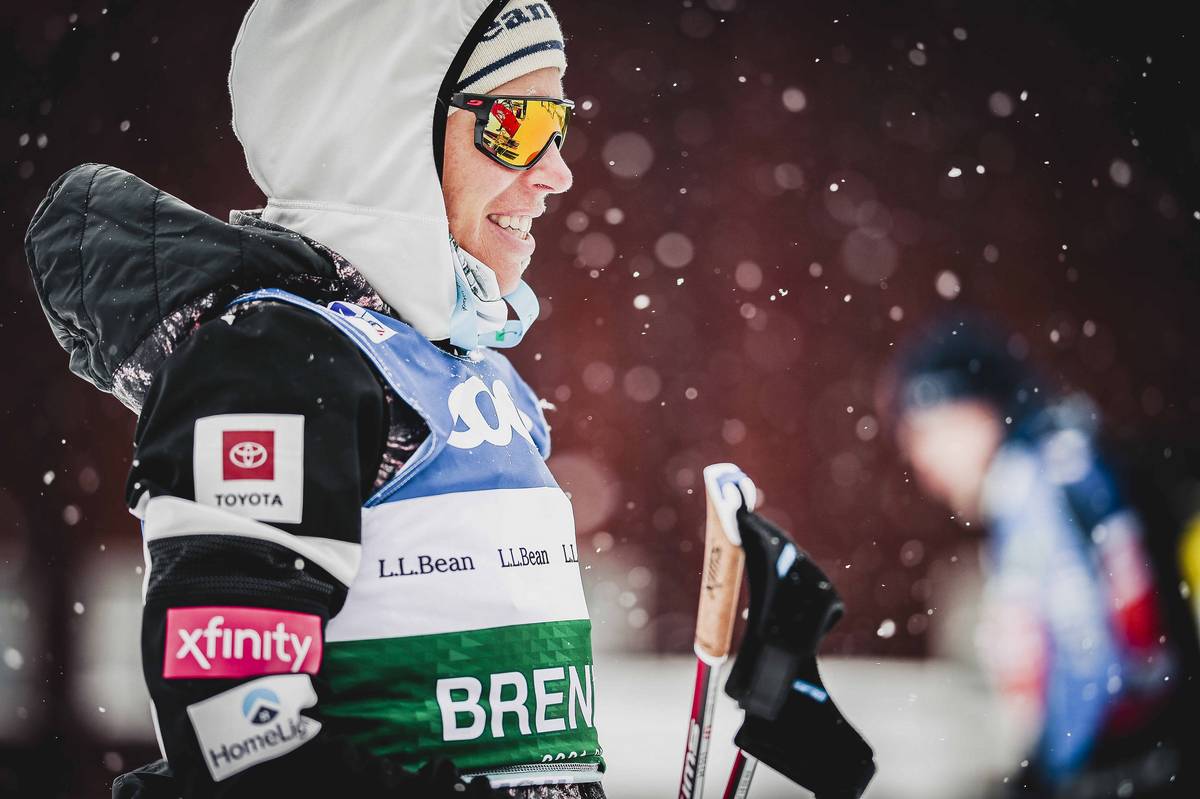
Rosie Brennan enjoys a wintery training day before the weekend of World Cup racing in Davos, SUI. (Photo: NordicFocus)
Davos brought another entertaining weekend of racing for American ski fans, with Rosie Brennan in the mix in both competitions, a podium from Jessie Diggins, and breakout performances from Hailey Swirbul, Sophia Laukli, and Novie McCabe.
Devon Kershaw and FasterSkier’s Nat Herz take us through the results with special guest Eirik Brandsdal, the longtime, now-retired Norwegian World Cup sprint racer.
This World Cup coverage is made possible through the generous support of Marty and Kathy Hall and the A Hall Mark of Excellence Award. To learn more about A Hall Mark of Excellence Award or to learn how you can support FasterSkier’s coverage please contact info@fasterskier.com.
For American ski fans, the Davos 10km on Sunday was one to be anticipated with a mix of expectation and nostalgia. Last season, in a year when the history books on U.S. skiing had to continuously be crossed-out and re-written, Davos was the first annotation – and it was done in bold, uncompromising ink. Rosie Brennan 1st, Hailey Swirbul 3rd, and Jessie Diggins in the top ten. That was in a field absent of the perennial powerhouses though. Most notably, without Therese Johaug (NOR), who at that point seemed unmatchable in distance racing, but also without the rest of the Norwegian or Swedish competitors who tend to populate World Cup top tens.
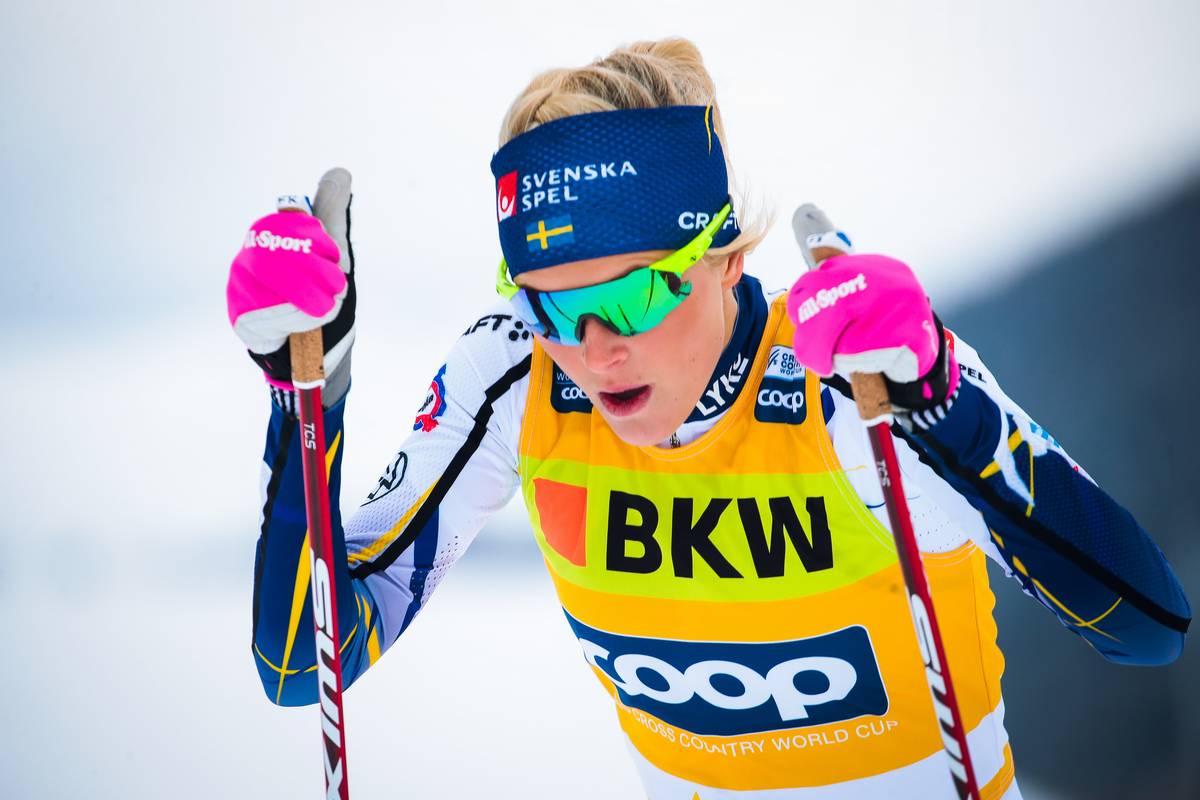
Frida Karlsson skis the 10k freestyle in Davos. (Photo: NordicFocus)
What about Sunday then? Well, time to return to the inkwell.
The tides that have been building in the early part of the season for the U.S. women definitively built into a wave on Sunday. There was the return of Jessie Diggins to the podium in a distance race, the continuation of Rosie Brennan’s world-class start to the season, Hailey Swirbul returning to the top ten, and the addition of two young Americans – Sophia Laukli (19th) and Novie McCabe (28th) – in the top 30. The Americans seemed to be making their mark everywhere on the 10km course Sunday. With starting places throughout the field, it was the American flags that dominated the graphics at the time-checks throughout the day, spanning the field in a way that mimicked their span in age and World Cup experience, but all added up to a remarkable team accomplishment.
Katharine Ogden on course during the 10k individual start freestyle in Davos. (Photo: NordicFocus)
It all started with Katharine Ogden, who started with bib 2, and whose smile to the camera at the start foreshadowed the day to come for her team. Then Caitlin Patterson headed out on course in bib 7, with Hailey Swirbul soon to follow in bib 24.
Swirbul was the first on the day to make an impact in the field. Through the 2.2k checkpoint, she was +3.2sec off leader Delphine Claudel (FRA) and in 3rd place. She would continue through the Davos course holding that margin, until a late push in the final two kilometers led her to overtaking Claudel and taking the race lead by +0.6sec – at which point she looked at the results and let out a surprised “yay!” before heading to the winner’s circle.
Hailey Swirbul sees her name atop the results list after crossing the line of the 10k individual start freestyle. (Photo: NordicFocus)
It was a great sequel to her 3rd place finish on the course last season, and one that reflected her comfort on the course, as she stated in an interview with FasterSkier:
“[This course] is almost exclusively V2, so almost constant work and not a lot of recovery, but also not a lot of steep hills that will blow out your lungs. I think being raised at altitude helped me learn how to pace that [course]. I’m almost more afraid to pace a race at sea level than altitude because it’s more muscular there. I think my strength is grinding V2- so I like it.”
Swirbul would then get to take in the exciting race unfolding from the later starters with the best seat in the house, and with Brennan and Diggins in the mix, she had something to cheer for too.
Hailey Swirbul enjoys her time in the leader’s chair after a solid performance in the 10k skate in Davos. (Photo: NordicFocus)
Of course, amid the rising tide of the Americans there was also a steadfast rock. Starting in bib 34 was Therese Johaug (NOR), who began the day on the tail of 13 consecutive podiums in the 10km Freestyle event (11 of those were wins). She started one minute ahead of Rosie Brennan, and one minute behind Frida Karlsson (SWE).
Karlsson would act as the leading edge for the top racers through the time checks all day, then. When she passed through the 2.2k mark, she had established a 5.4 second lead. Johaug then came through 7.4 seconds ahead of Karlsson, and Brennan would slot herself between the two in 2nd place – off Johaug by just 1 second.
An early starter, Frida Karlsson races to third in the 10k individual start skate in Davos. (Photo: NordicFocus)
It quickly established the pattern that was followed throughout the course. At 5km, Karlsson came in with a 5.7 second advantage over the field, Johaug then came through 13.7 seconds ahead of Karlsson, and Brennan 10.4 off Johaug, in second place, when she came through.
Chasing Karlsson’s splits, Therese Johaug (NOR) takes the win in Davos. (Photo: NordicFocus)
By 8k, Brennan had lost some ground to Karlsson, reversing the early trend of the race. Johaug had a 17.4 second advantage over 2nd placed Karlsson with Brennan coming through 18.4 seconds back, and therefore just one second behind Karlsson.
That was how the trio finished, with Johaug being the one that took over the winner’s chair from Swirbul, with Karlsson 17.1 seconds behind, and Brennan 24.3 seconds back.
Rosie Brennan powers through the final stretch to finish 4th in Davos. (Photo: NordicFocus)
That looked to be how things would finish, but while Brennan crossed the line, bib number 52, belonging to last year’s World Cup overall winner, made its way around the course.
The bib, of course, belonged to Jessie Diggins. She was the truest embodiment of the American wave today, starting off steady in the early part of the race – coming through the 2.2km checkpoint in 4th – before building, and building, and building to an exciting crash across the finish line. At 8k she was still in 3rd place, just off of Karlsson. By the finish line, she had overtaken the Swede, finishing 17.8 seconds off of Johaug, in 2nd place on the day.
Leaving it all on the course, Jessie Diggins finishes second in Davos. (Photo: NordicFocus)
Her remarkable move from 3rd to 2nd place in the last 2km was perhaps the best piece of racing on the day, and in an interview with FasterSkier she reflected that it was possible due to her confidence on the terrain:
“I got a lot of questions on the last 2km today. And I’m going to be honest, I’m not exactly sure how I did that – I was just focused on going all out…but I do think those working downhills have always been a strength of mine…and so I just had a lot of fun out there.”
Here’s the full audio from Jessie Diggins’ post-race comments, including her skis, the race, and managing altitude.
Landing on her first distance podium of the season, Jessie Diggins takes second in the 10k individual start skate in Davos. (Photo: NordicFocus)
It was the highest placing for the Americans on the day, but wasn’t their last statement. As attention turned back to the course, it found Sophia Laukli and Novie McCabe both racing to the best finishes of their nascent World Cup careers. Laukli skied from the back of the field in bib 65 to finish 19th (+57.7), with McCabe in 28th (+1:17.4). Through it all, Swirbul, who had started early and waited patiently as her chasers took swings at her times, finished the day in 6th place (+27.7).
Here’s a post-race interview with Swirbul.
The women’s podium in Davos: Therese Johaug (NOR) took the win ahead of Jessie Diggins (USA) and Frida Karlsson (SWE). (Photo: NordicFocus)
We leave Davos then, with the familiar pages of the World Cup continuing to be filled. Therese Johaug looks to be the best distance skier on the planet, but Frida Karlsson is a real challenger to that dominance, and Jessie Diggins is still a maverick animated by speed and heart. If you want a story though, you can’t beat the complexity, excitement, and tenacity of the one that the whole of the U.S. women’s team is penning this season so far.
The strong results continued elsewhere for the Americans, with Katharine Ogden finishing 43rd (+1:48.5), Caitlin Patterson in 46th (+1:55.9), and Hannah Halvorsen in 78th (+3:53.3). The Canadian women also looked to build off their results in Lillehammer and Ruka, with Cendrine Browne finishing in 36th (+1:44.3), Dahria Beatty in 42nd (+1:48.3), and Katherine Stewart-Jones in 48th (+1:58.5).
Sophia Laukli earns her first World Cup Top-20, finishing 19th in the 10k individual start skate in Davos. (Photo: NordicFocus)
In comments sent to multiple news organizations Brennan reflected on an exciting, but fatigued, 4th place performance:
“Wow, another bittersweet day for me today. Placing 4th is absolutely nothing to complain about, however, I felt I didn’t quite have my best in me today. I definitely have some fatigue from yesterday and from really all of period 1 so I didn’t feel like I had the legs, mind, and body that I wanted and know I can have. That said, I am really proud to have put myself out there, get myself in the game and fight with all I did have. It was a great day for the women’s team and I am really happy to see some outstanding performances from the team. Period 1 is tough and it says a lot when people can rebound 3 weeks in. I still feel I’m on track with my plan and am excited for some rest and a good training camp.”
Putting together another highlight weekend in Davos, Rosie Brennan skis to 4th in the 10k individual start skate. (Photo: NordicFocus)
The men’s 15k freestyle podium in Davos: Simen Hegstad Krüger (NOR) took the win with command ahead of Johannes Høsflot Klæbo (NOR) and Sergey Ustiugov (RUS). (Photo: NordicFocus)
This World Cup coverage is made possible through the generous support of Marty and Kathy Hall and the A Hall Mark of Excellence Award. To learn more about A Hall Mark of Excellence Award or to learn how you can support FasterSkier’s coverage please contact info@fasterskier.com.
The second day in Davos, Switzerland started with the Men’s 15K Freestyle individual race. In contrast to yesterday’s snow and wind, it was a beautiful blue sky day, as 108 men chased splits around the tracks in Davos.
Two of the favorites, Johannes Høsflot Klæbo (NOR) and Alexander Bolshunov (RUS) started one minute apart from each other. The two ascended from the junior level together to quickly become World Cup champions, Klæbo in sprinting and Bolshunov in distance, though the Russian has proven all-around talent.
In total, Klæbo has won 44 World Cup events, including yesterday’s sprint, putting him 3rd on the all-time list behind Petter Northug (47) and Bjørn Dæhlie (46). Bolshunov has won 24 World Cups, with nine individual World Cup distance events in 2021 – already a men’s record for most individual World Cup distance event wins in a single calendar year. As Klæbo has looked to improve as an all-around skier, this matchup is one to watch.
After a conservative start, Johannes Høsflot Klæbo skis to second place in Davos. (Photo: NordicFocus)
Last week’s 15k winner at Lillehammer, Simen Hegstad Krüger looked to win back-to-back individual World Cup distance events. The last man other than Bolshunov to win back-to-back was Sergey Ustiugov (RUS) in the Tour de Ski in 2019.
Norway’s Sjur Røthe on course during the 15k individual start freestyle in Davos. (Photo: NordicFocus)
As splits from the seeded middle group of starters rolled in, it looked like Klæbo (+20.4) was struggling through the first 3k with Bolshunov (+6.6) closing the gap between them both. Perhaps not surprisingly after last weekend’s podium sweep and top-15 dominance, Norway had the top-4 spots through the first 3k, held by Krüger, Hans Christer Holund, Martin Løwstrøm Nyenget, and Harald Østberg Amundsen, respectively. Sjur Røthe was also sixth as the team’s fifth man in the top-10, however, Klæbo had fallen just outside the top-30 in the rankings.
Bolshunov held the lead for the Russian men at this checkpoint, sitting in 8th, but the name that would rapidly ascend the rankings was Ustiugov, who was 19th (+15.6). Ustiugov started in bib-50, later in the lineup than most of the Norwegians except for Krüger, who wore bib-70.
At 12.2k, with roughly 3k to go, the rankings looked similar, with a couple of names making a dramatic swing in standings. Krüger, blasting through each checkpoint as the new leader, had increased his margin to over 24 seconds ahead of his teammate Holund, and Ustiugov had skied all the way up to third.
Simen Hegstad Krüger smashes the 15k skate in Davos. (Photo: NordicFocus)
Close behind by time, Amundsen sat in fourth with Klæbo making a rapid rise into fifth.
Continuing to grow his lead over the final lap, Krüger ran away with the win, stopping the clock at 32:20.4.
Sergey Ustiugov powers down the final stretch for third in Davos. (Photo: NordicFocus)
Klæbo hit the final kilometers hard, accelerating to set what would stand as the fastest time of day until Krüger came through 26 bibs later. Ustiugov had beaten Klæbo’s split at 13k, but could not hold the pace required to stay ahead in the final 2k. After all the top men came through, in particular the dominant Krüger, it was decided that Klæbo took second (+22.9) and Ustiugov third (+27.2), both men earning their second podium of the weekend in Davos.
After back-to-back distance wins, Krüger gave the following remarks in a FIS interview from the leaders chair:
“It feels great and I like it here and I enjoyed every minute of skiing today. My skis were incredible and I just enjoyed every single minute of it. It was a really fun day today.”
Johannes Høsflot Klæbo hands over the leader’s chair to his teammate, Simen Hegstad Krüger, who had smashed the fastest splits at every checkpoint. (Photo: NordicFocus)Winning back-to-back 15k freestyle races, Simen Hegstad Krüger is on form. (Photo: NordicFocus)
The remaining top-10 was composed of three Norwegians, two Russians, and two French skiers. Amundsen (NOR), Holund( NOR), and Røthe (NOR) finished 4th (+32.), 5th (+33.7) and 6th (+38.3), respectively. Artem Maltsev (RUS) finished in 7th (+39.4) with fellow teammate, Ivan Yakimushkin (RUS) finishing in 9th (+52.0). Maurice Manificat (FRA) had a strong race to finish in the top 10 in distance for the second week in a row, this time in 8th (+50.8). His teammate, Hugo Lapalus (FRA) finished 10th (+54.7).
Bolshunov dropped back to 12th in the standings, following 14th place in this event last weekend in Lillehammer. The three-time overall World Cup distance champion has not been outside the top-10 in consecutive events since December 2018.
Gus Schumacher leads the American men with a 29th place finish in the distance race in Davos. (Photo: NordicFocus)
The top U.S. Skier in Davos was Gus Schumacher sat inside the Top-30 throughout most of the race, rising as high as 18th at the 5k. Having started just behind Swedish junior champion William Poromaa, Schumacher held his margin to the Swede even through the first half, then began to cede time to the leaders. Schumacher ended his day in 29th (+1:53.8), improving upon his result from the Lillehammer 15k, where he finished 38th.
“[I’m] pretty happy with it, but i still think I have better races coming,” Schumacher reflected in a post-race email. “I think I did a better job with pacing than last year, but still didn’t quite nail it. Definitely getting a better handle on the race routine and pacing, and I’m looking forward to some more races later this season!”
Schumacher added that he plans to stay in Davos through Christmas with “the boys”, which he said will be “magical.”
Ogden, coming off a fantastic sprint yesterday, was the next American in 51st (+2:39.7). Norris (USA) had a solid race coming in just behind Ogden in 54th ( +2:44.7). Schoonmaker, Wonders, and Patterson finished in 66th (+3:03.5), 70th (+3:07.5), and 75th (+3:26.0) respectively.
David Norris on course during the 15k individual start freestyle in Davos. (Photo: NordicFocus)
After a weekend at altitude, the World Cup now heads to Dresden, Germany for an exciting individual and team sprint in the city. This will be the last races before a break for the holidays, and then we begin the Tour de Ski.
Rosie Brennan was all smiles after her first World Cup victory and podium in Davos, Switzerland. Photo: NordicFocus
This World Cup coverage is made possible through the generous support of Marty and Kathy Hall and their A Hall Mark of Excellence Award. To learn more about A Hall Mark of Excellence Award or to learn how you can support FasterSkier’s coverage please contact info@fasterskier.com.
With a thick, fresh coat of fluffy white snow that fell over the last week, Davos, Switzerland looked regal as ever despite the smaller field and lack of spectators for today’s 1.5-kilometer freestyle sprint. FIS described conditions as hard-packed, elevating what Sophie Caldwell Hamilton, who landed on the podium in Davosthe last two years, called in a pre-race interview with FIS as a “technical and tactical” two lap course. Pumping music and cheering coaches, though perhaps a muted version of the norm, made the stadium feel significantly more full than the no-spectator reality.
With the Scandinavian teams out of the running as they withdrew from the December rounds of the World Cup due to Covid-19 concerns, it would be easy to focus on who did not in Davos. Let’s instead focus on who did.
Rosie Brennan during the skate sprint qualification in Davos, Switzerland. Brennan won the qualifier – a career-best for the American. (Photo: Nordic Focus)
On a roll this season, Rosie Brennan won the qualifier by 1.75 seconds in a time of 2:40.03. Rounding out the Americans in the finals, Caldwell Hamilton took second, Diggins fifth, Julia Kern 10th, and Hailey Swirbul 18th.
Jessie Diggins racing to 5th in the Davos sprint qualifier. (Photo: Nordic Focus)
In the quarterfinals, Caldwell Hamilton faced off with Switzerland’s Nadine Fähndrich in what would be the fastest heat. The pack stayed together in the first lap, but the two peeled off to finish comfortably off the front, Fähndrich in the lead.
The next heats were much closer. Brennan finished second in a pack of four behind Slovenia’s sprint star Anamarija Lampic in heat two, and after taking the lead in the second lap, Kern won the third heat.
Jessie Diggins (left) leads Julia Kern (bib 10) at the front of the group during the quarterfinal of the 1.5 k sprint in Davos, Switzerland. (Photo: NordicFocus)
Dropping into a tuck on the last descent and on Kern’s tails in the fast and furious final turn into the stadium, Diggins was in a tough position. Rather than putting herself in position for the sprint to the finish, she maneuvered to avoid tangling skis with Kern and lost some of her momentum. Despite powering down the straightaway and throwing her boot, she took third in the heat and was not fast enough to earn a lucky loser spot.
Round the bend, Julia Kern in the lead heading into the final straight during the quarterfinal of the 1.5 k skate sprint in Davos, Switzerland. (Photo: NordicFocus)
Swirbul was also eliminated in the quarters after taking fourth in her heat.
Hailey Swirbul climbs amidst the pack during the quarterfinal of the 1.5 k skate sprint in Davos, Switzerland. (Photo: NordicFocus)
In the semis, the three remaining American women lined up together in a stacked first heat with Lampic and Fähndrich. Brennan and Caldwell Hamilton held strong in the middle of the group while the Swiss and the Slovene set the pace. The foursome stayed tight, jockeying for positions in the second lap.
It was anyone’s game in the final straight, but Fähndrich held the others off on home turf to win the heat with Lampic and Brennan in a photo finish for second and third, respectively, behind her and Caldwell half a ski length further back in fourth. Both were able to secure lucky loser positions to advance into the final. Kern was eliminated after finishing 6th in the heat.
To the line, Rosie Brennan (L) leads Switzerland’s Nadine Fähndrich and teammate Sophie Caldwell Hamilton in the final sprint during the semifinal of the rounds in Davos, Switzerland. (Photo: NordicFocus)
Eva Urevc of Slovenia and Natalia Nepryaeva of Russia advanced from the second heat of the semifinals.
Fähndrich and Lampic again took the pace out hot in the final round, but Brennan kept herself in the mix. Challenging Fähndrich, she powered into the lead on the final climb, cresting the hill in front and dropping into a tuck on the downhill. Brennan held her lead out of the final turn and into the straightaway, but Lampic, Fähndrich and Nepryaeva were close on her tails.
Adrenaline pumping and poles lashing, Brennan held her lead by a narrow margin, pumping her fist in the air as she crossed the finish line in 2:37.36, breaking into a wide grin as she gasped for air.
Rosie Brennan celebrates her victory and first World Cup podium after the freestyle sprint in Davos, Switzerland. (Photo: NordicFocus)Rosie Brennan celebrates her victory and first World Cup podium after the freestyle sprint in Davos, Switzerland. (Photo: NordicFocus)
“It’s wild,” Brennan told FIS after the race. “I’ve never considered myself a sprinter, so to find myself on the podium is something I couldn’t even dream of.”
Lampic finished on her tails in second (+0.28), with Nepryaeva and Fähndrich in a photo finish for the final podium spot. They finished third (+0.49) and fourth respectively (+0.53).
The women’s podium at the 1.5 kilometer skate sprint in Davos, Switzerland. (Left to right) Anamarija Lampic (SLO) 2nd, Rosie Brennan (USA) 1st, Natalia Nepryaeva (RUS) 3rd. (Photo: NordicFocus)
After losing contact with the lead group, Caldwell Hamilton finished fifth (+6.83), with Urevc behind in sixth (+15.58).
FasterSkier spoke with Brennan while she awaited a blood draw at antidoping. Still euphoric, Brennan recounted her day and a result that she called “pretty unbelievable” and hadn’t fully set in. In fact, she thought there may have even been a mistake in the timing when she saw her name at the top of the qualifying list. Brennan also discusses training separately with clubs throughout the season, then coming together as a full American squad in Europe.
Post-race interview with Rosie Brennan.
Exhale. Sophie Caldwell in the mix during the heats of the 1.5 k skate sprint in Davos, Switzerland. (Photo: Nordic Focus)
In a post-race interview, Caldwell Hamilton discussed her own strategy to keep herself out of risk of becoming tangled up with other skiers while staying in contention throughout the heats. She also shared how significant today’s results are for the team as a whole, regardless of the presence of the Scandinavian teams.
Post-race interview with Sophie Caldwell Hamilton.
Hannah Halvorsen, qualifying in 38th, in her first World Cup since suffering devastating injuries when she was hit by an automobile in 2019. (Photo: Nordic Focus)
Returning to the World Cup just over a year after being struck by a car and sustaining severe injuries, Hannah Halvorsen placed 38th in today’s qualifier. Halvorsen provided an optimistic comment on how she feels after her first race.
“It was such a thrill to be able to get back on the race course,” wrote Halvorsen in an email. “I was both nervous and excited going into today’s race because I wanted to put down my best race. Everything went really well today so I am quite happy. Thanks to the coaches and wax techs, I had great skis and support. This feels like a great starting point, and I hope to improve off of this as the season continues. It is such an opportunity and honor to be here. The US team performed incredibly well today, and I couldn’t be more proud to be a part of this team.”
Post-race interview with U.S. Head Coach Matt Whitcomb.
Coming in hot! Jessie Diggins leads teammate Sophie Caldwell, Laurien Van Der Graaff (SUI), and Julia Stupak (RUS) during a sprint time trial in Davos. (Photo: Matt Whitcomb)
Lillehammer cancels World Cup events. Norway, Sweden, and Finland pull from the World Cup after the opening weekend in Ruka citing COVID safety concerns. To an outsider, these headlines paint a seemingly bleak picture of the start of the race season. However, an international time trial featuring a skate sprint day Friday and distance event Saturday sparked hope for the American team as they remain in Europe focused on the upcoming weekend of racing in Davos, Switzerland.
FasterSkier spoke with U.S. Ski Team head coach Matt Whitcomb to learn more about the event and its role in helping the American team gain on-snow race experience, sharpen their form and find their race gears amidst a stacked field of friendly competitors.
Taking a step back, Whitcomb shared that travel from Ruka to Davos felt both safe and easy. The team booked a flight through a FIS travel agent from Kuusamo, FIN to Munich, GER, then drove the remaining 3.5 hours to Davos. By reserving through FIS, they ensured that the only other passengers on the flight were other world cup athletes, coaches, and techs, who had been tested in order to participate in the opening World Cup events.
“It was probably the safest flight we’d ever been on and it made for a really easy day,” Whitcomb stated.
Athletes were required to obtain a negative test result within 72 hours prior to entering Finland per the country’s border control policies, then were tested a second time upon arrival at the venue in Ruka. This put them inside what Whitcomb called the “World Cup bubble”.
“FIS tracks our daily whereabouts all winter,” wrote Whitcomb in an email for clarification on testing and travel safety precautions. “We fill out a twice-daily questionnaire for U.S. Ski & Snowboard, as well. We did not need [a test 72 hours] before entering Switzerland. As a team policy, we got one anyway. We were tested again upon arrival to Switzerland, and now that we’ve been here one week, we will test the entire team over the next two days.”
In addition to this testing protocol, the U.S. team is operating an agreed upon team health policy regarding behavior, which Whitcomb outlines below.
“Travel and ride with your roommate. No indoor socializing, other than meals. No family visits, no friend visits. Our current hotel has a separate room and buffet line for our team to use. New athletes and staff arriving to the World Cup enter a ‘quarantine bubble’ until they’ve cleared a PCR test, so we eat in two shifts, and two locations.”
Back to the time trial. Whitcomb explained that the idea for the time trial was raised by one of the Italian coaches, who approached Whitcomb about getting together for some intensity in the week leading up to Ruka.
Gleb Retivykh leads JC Schoonmaker around a bend during the heats of the sprint time trial in Davos. (Photo: Matt Whitcomb)
“We’ve had some pretty good joint workouts and camps over these years with these teams, but I think this was probably the coolest where we had five nations with quite a few athletes entered,” he shared.
The start list for the King’s Court style skate sprint time trial in Davos. (Courtesy: Matt Whitcomb)
With names like Federico Pellegrino (ITA), who finished the 2019/2020 season ranked 4th in the sprint standings, Laurien Van Der Graaff (SUI), who has five World Cup podiums, and last seasons overall World Cup Champion Alexander Bolshunov (RUS) on the start list, the concept gained enough traction that some international athletes chose to stay put in Davos for the collaborative workout rather than travel to a nearby Opa Cup race in Goms, SUI.
Through a text thread, the coaches from each nation agreed upon both COVID safety plans and event format, creating an event that Whitcomb described as “easy-going” in terms of the level of planning and logistics required and the relaxed start time. Teams agreed to forgo fluoros, throwing on CH6 or an equivalent. Despite this seemingly casual atmosphere, putting together a group of fiercely competitive athletes ensured that the event would not be all fun and games.
“It was really nice because — you know, it’s low key and people are relaxed, but you show up and people are warming up har,” said Whitcomb. You just had to bring any bib, so everyone threw on bibs and was wearing their national team uniforms. As soon as you’re suited up, it’s game time, and there was not a lot of holding back out there. It was a really valuable day for us and for everybody. The coaches were all really excited at the end of it.”
Whitcomb explained that because the event was for training purposes, the results would not be released publicly. However, the USST Instagram account calls it a Pellegrino (1)–Bolshunov (2)–Schumacher (3) podium for the men. That said, Whitcomb shared that the effort and results of the athletes were universally positive and indicative that strong performances in true race events are on the horizon.
“Every day that we’re actually on snow doing intensity and in particular head to head racing or intervals is really elevating the level of performance on our team. We’re seeing that just in general comments on feelings in intervals, and this particular day — the skate sprint — I think was a good breakthrough for the team. People were starting to feel good. Conditions were really fast and firm — it was that hero snow that we all love to ski on. And people skied fast, so that was the first time that as a group that we skied at an elevated level rather than just having one or two people knocking one out of the park and the rest of the team skiing just okay at best.”
Some noteworthy results he was able to share include Sophie Caldwell winning the sprint qualifier, the American men keeping the time-back margin tight to top qualifier Pellegrino, and impressive performances by Jessie Diggins and Katharine Ogden in the two lap 10-kilometer distance race.
Katharine Ogden comes on form in the distance time trial in Davos. (Photo: Matt Whitcomb)
Gus Schumacher hammers during the qualifier of a sprint time trial in Davos. (Photo: Matt Whitcomb)
Caldwell’s result was especially encouraging to Whitcomb following what the coach called a “fluke” in Ruka. Finding the last time she had not qualified for the rounds in a sprint event required a lot of scrolling on her FIS athlete profile. Her last time outside the top-30 in qualification happened in Drammen, Norway on March 11th, 2015.
“I think it was a big weight off her shoulders to win the qualifier and just be aware that she’s still the same skier she has been and she’s not suddenly over the hill. I think she can now focus a little bit more without concern that ‘Wow, maybe I’ve overtrained or maybe I’ve really screwed something up here.’”
In her own words, Caldwell shared the following via email.
“I think it’s good practice to get in a race effort, especially when many of us have had so few this year. It was run King’s Court style, so if you won your heat you would move up and if you were last in your heat you would move down. As a result, all the heats were very competitive and well-matched and between three heats and a qualifier it ended up being a very hard day. I was psyched to do my first skate sprint effort on snow and mix it up with some of the girls we will be racing with next weekend.”
(Left to Right) Gus Schumacher (USA), Federico Pellegrino (ITA), Kevin Bolger (USA), JC Schoonmaker (USA), and Alexander Bolshunov (RUS) take to the course in the quarter-final of a sprint time trial in Davos. (Photo: Matt Whitcomb)
As the upcoming race weekends leading up to the Tour de Ski remain scheduled as planned, Whitcomb does not currently anticipate additional workouts like this taking place. He concluded by reflecting on the impact that the development of these international relationships has had on the growth of the American program and his optimism that it’s example will play for continued domestic development.
“For me, the coolest angle of this whole deal is that as unapproachable as the World Cup once seemed to me, that turns out to be not at all the case these days. It’s really a tight family,” said Whitcomb. “The amount of teams that are working together, even if it’s just transferring bags or borrowing wax, it happens on an almost daily basis when we’re in the same location. I just love seeing the same thing happening back in the US. It’s really going to be about partnerships for the US to succeed moving forward and this really left us with a good feeling.”
Interview with Matt Whitcomb following the international time trial in Davos.
Federico Pellegrino (ITA), Gus Schumacher (USA), and Jovian Hediger (SUI) in a trailside chat between the heats of a sprint time trial in Davos. (Photo: Matt Whitcomb)
Picture perfect. Sophie Caldwell on her way to qualifying first in the 2019 Davos, Switzerland skate sprint. She was third overall for the day. (Photo: NordicFocus)
(An earlier version of the story mistakenly stated Caldwell had placed second. FIS live timing had Caldwell in second place. Apologies for the error.)
When Davos is good, it is good on a global scale. With the Swiss valley blanketed in snow, and a gauze of high clouds keeping the race proceedings just a notch away from perfectly sun-shiny, the World Cup’s 1.5-kilometer freestyle sprint was won by twenty-year-old Swede Linn Svahn. According to the International Ski Federation, this was Svahn’s second career World Cup start. She placed 21st in last season’s skate sprint in Falun. At World Juniors, she was fourth in the 2019 classic sprint in Lahti, Finland. Add Svahn to the growing stable of Swedish A-list skiers on the early side of their twenties.
Linn Svahn of Sweden in for her first career World Cup win. Arm raised crossing the line first in Davos, Switzerland. Sophie Caldwell (bib 1) placed third. (Photo: NordicFocus)
As the remaining meters became scarce in the women’s final, Svahn and her lickety-split skis took a ten-meter gap up and over the last climb. Barely separated from the chasers into the final straight, she took a clean win in 2:38.54.
Even Svahn seemed surprised by the result. In near-perfect English, as the camera zeroed in for a podium shot, she blurted the not uncommon expression of “What the &uc!” to describe her astonishment. Her hot-mic moment was spot on.
For North America, it was a very good day. The results were clear: every North American entered qualified for the heats. For the U.S. Ski Team (USST), Sophie Caldwell qualified first at 2:45.15. Her speed was indicative as she had a 1.47 second gap on the second-fastest qualifier, Stina Nilsson of Sweden.
Sadie Maubet Bjornsen (USST) qualified in 5th (+2.76), Jessie Diggins (USST) 6th (+2.91), Julia Kern (USST) 23rd (+8.37), and Hailey Swirbul (USST) 28th (+9.92).
Post-race interview with World Cup Coach Matt Whitcomb
With her first World Cup start of the season, Canada’s Dahria Beatty qualified in 30th (+10.48). One-fifth of the sprint qualifiers hailed from the left side of the Atlantic.
As Caldwell progressed through the sprint bracket, she tapped into her big and smooth technique. She won her quarterfinal and the first semi-final. In that semi, stacked with Stina Nilsson and Maiken Caspersen Falla of Norway, Caldwell played coy. She let others take flight off the front during the first of this two-lap course. Moa Lundgren of Sweden took the pacesetting chore as she made a separation on the first lap, but she was eventually pulled in.
On the second time up the course’s punchy hill, Caldwell moved up the left side and took it wide on the final right hand corner. Into the finish, she shot to the front for the semi-final win.
It was a good sign for Caldwell.
In her element. Sophie Caldwell in the 2019 Davos, Switzerland skate sprint. (Photo: NordicFocus)
Caldwell won the qualifier, her quarterfinal, and her semi on her way to placing third overall in the skate sprint in Davos. (Photo: NordicFocus)
Sophie Caldwell’s post-race interview
In the final, Falla took the helm and led five skiers in a line up the first hill. Caldwell sat in third. Not until roughly 2:10 minutes into the final did any real move occur, and that was Svahn’s. Caldwell and Falla eventually came drag racing down the line for a photo finish. Both were unofficially 0.55 seconds behind Svahn. But Falla out-toed Caldwell to take second.
Since 2013, Caldwell has sprinted here seven times. Five times she’s placed in the top-10. Her third place today piggy backs on a second place result in Davos last season.
Kern was 15th overall on the day, Maubet Bjornsen finished her day in 16th, and Diggins in 17th.
Kern has rebounded from elbow surgery this summer and some minor bumps in her training. Davos proved to be a course and scene where she was able to click. According to Kern, today’s result was a “big step forward, which was exciting.”
Julia Kern (bib 23) skiing to 15th overall in the 2019 Davos, Switzerland skate sprint. (Photo: NordicFocus)
Julia Kern’s post-race interview
Swirbul placed 30th for her first career World Cup points. In her post-race interview, Swirbul noted that she is trying to embrace “skiing like me.” In other words, she is finding her own “best” technique that she describes as skiing “like a noodle”. Finding out she had a sprint start only a few day’s ago, Swirbul made the best of the opportunity.
Hailey Swirbul scored her first varied World Cup points in the 2019 Davos, Switzerland skate sprint. (Photo: NordicFocus)
Hailey Swirbul of the U.S. Ski Team placed 30th in the 2019 Davos, Switzerland skate sprint. (Photo: NordicFocus)
Hailey Swirbul’s post-race interview
Canada’s Beatty placed 25th overall. Last weekend she posted solid results on the OPA Cup where she was third in a skate sprint.
“I was happy with my day today,” Beatty emailed. “It’s always encouraging to make the heats in my first World Cup of the season. It is a good starting point and I look forward to trying to improve on today’s performance as the season progresses. I had some strong racing last week at the OPA in Slovenia and my race shape is feeling good right now so I am really looking forward to tomorrow’s 10km skate here in Davos.”
Racing continues tomorrow with a 10 k interval start skate for the women.
The 2019 Davos, Switzerland 1.5 k skate sprint podium: Maiken Caspersen Falla (NOR) in second, Linn Svahn (SWE) in first, and Sophie Caldwell (USA) in third, (l-r). (Photo: NordicFocus)
The men’s podium of the 1.5-kilometer freestyle sprint in Davos, Switzerland. Johannes Høsflot Klæbo (center) took first ahead of Lucas Chavanat of France (L) and Håvard Solås Taugbøl of Norway (R). (Photo: NordicFocus)
Davos, Switzerland: gifted athletes, throngs of spectators lining the course, plenty of Vitamin-D and a spectacular day for the 1.5-kilometer freestyle sprint. Racers chased down and skied away from their long afternoon shadows as the sun moved across the cloudless bluebird sky.
The crowds were in for a treat. In sprint racing, heats often have significant variance. Some will be fast, some will be slow with a final upsurge in intensity at the end. In today’s event, heats were fast and tight. Winning times were comparable, lucky losers waited with bated breath through the end.
Improving upon their performance in the opening classic sprint in Ruka, two Americans qualified for the heats. Simi Hamilton qualified in 8th and Kevin Bolger in 30th.
Lucas Chavanat of France models composure during the 1.5-kilometer freestyle sprint in Davos, Switzerland. (Photo: NordicFocus)
In the first heat of the quarterfinals, Johannes Høsflot Klæbo, who had qualified in 5th, threw down against France’s Lucas Chavanat, who was the top qualifier. Perhaps making a statement, Klæbo set the tone of the heat, quickly moving to the front and holding his position to comfortably take the heat with Chavanat behind him.
During his round, Hamilton marked the leaders, the Italian favorite Federico Pellegrino and Erik Valnes of Norway. Hamilton maintained contact throughout, fighting through the finish to place third in his heat. His time survived the three subsequent heats each by a fraction of a second to advance as a lucky loser.
Italy’s Federico Pellegrino leading Erik Valnes of Norway in the quarterfinals of the 2019 skate sprint in Davos, Switzerland. (Photo: NordicFocus)
Simi Hamilton hunts down the leaders in the quarterfinal of the 1.5-kilometer freestyle sprint in Davos, Switzerland. (Photo: NordicFocus)
Onto the semis. In the first heat, Chavanat took control from the gate and held it through through the last turn, the stacked group of competitors tucked in closely behind him. Klæbo stayed tucked into the middle of the pack. In the final straightaway, Klæbo swung around overtaking his teammate Valnes in the final meters, besting Chavanat by a toe.
In a tuck and on the hunt. Not an easy victory for Johannes Høsflot Klæbo during the 1.5-kilometer freestyle sprint in Davos, Switzerland. (Photo: NordicFocus)
In the second wave, Hamilton stayed just behind the Norwegian leaders Håvard Solås Taugbøl and Sindre Skar — in the mix but out of trouble. In the final stretch, a pack of five contenders charged toward the finish. Crossing in a photo finish with Gleb Retivykh of Russia, Hamilton was deemed 4th and advanced again as a lucky loser.
At the start of the final, none of the men took the reigns and the first climb looked calm. Chavanat emerged at the front after the descent, but the field behind him stayed tight. Dueling once more, Klæbo tucked in just behind Chavanat, marking him closely and staying low in his draft.
In the final high-velocity stretch, Klæbo and Chavanat were neck-in-neck as the crowd roared. Leading by inches, Klæbo charged with unmatched tempo. He added two jump skates before throwing his boot across the line ahead of the Frenchman in a photo finish. Chavanat was just 0.05 seconds behind Klæbo. Laughing breathlessly, they embraced and congratulated each other at the finish.
Johannes Høsflot Klæbo of Norway checks his position relative to his opponent, Lucas Chavanat of France, at the finish of the 1.5-kilometer freestyle sprint in Davos, Switzerland. (Photo: NordicFocus)
Johannes Høsflot Klæbo (NOR) and Lucas Chavanat (FRA) congratulate one another after a photo finish in the final of the 1.5-kilometer freestyle sprint in Davos, Switzerland. Klæbo won by a margin of 0.05 seconds. (Photo: NordicFocu)
Håvard Solås Taugbøl of Norway finished third (+1.36) — his first career World Cup podium, followed by Sindre Skar (+1.54), Retivykh (+3.19), and Hamilton (+4.82).
“It was a really tough fight and Lucas was very strong all day,” Klæbo told FIS at the finish. “It was really cool to see that he was that strong again. In the quarter-final, the speed was really high and I was trying my best at a final and was a bit in front of him, but it was a really good fight.”
Håvard Solås Taugbøl of Norway celebrates his podium finish at the 1.5-kilometer freestyle sprint in Davos, Switzerland. (Photo: NordicFocus)
Klæbo’s victory makes him the first male athlete to win five consecutive World Cup sprint events. The last athlete to do so was Marit Bjørgen who won a remarkable eleven in a row between 2003 and 2005. He also became the first athlete to win three World Cup sprint events in Davos. Today’s third consecutive win allowed him to surpass Pellegrino, who won in 2014 and 2015.
In his interview with FIS, the sprint champion was also asked about sharing the podium with his teammate.
“It was really cool to have Håvard on the podium today,” said Klæbo. “I think in Norway we are quite happy today.”
Hamilton has a history of racing well in Davos. He placed 12th last season and 9th in 2017. At 5,100’ Davos is one of the highest elevation venues on the World Cup, but much lower than his 8,000′ hometown of Aspen, Colorado.
In his post-race interview, Hamilton shares why this course suits him well and how this performance gives him confidence on the season ahead. He also discusses his opening performance in Ruka and the tight spread throughout the heats.
Simi Hamilton skis to an 8th place result in the qualifying round of the 1.5-kilometer freestyle sprint in Davos, Switzerland. (Photo: NordicFocus)
Post-race interview with Simi Hamilton.
In a post-race call, head coach Matt Whitcomb discussed Hamilton’s performance, fitness, and headspace going into the qualifier.
Post-race interview with Matt Whitcomb about Simi Hamilton’s sprint day in Davos.
Racing in the speedy second heat of the quarterfinals with Hamilton, Bolger was eliminated after finishing sixth in his heat and finished 30th.
“It was a step in the right direction,” wrote Bolger in an email. “Last year I came here and qualified 31st so to be on the right side of that this year felt good! I’ve been struggling a bit to find my form so to get into some heats today is a big confidence booster going forward.
“Simi and I had a ripper of a heat and it was really awesome to see him go all the way through to the final,” he continued. “I wish I could have joined him but [it will happen] in time. I’m excited to find some more fitness and keep progressing into semi-finals and hopefully some finals this year!”
Kevin Bolger crests the top of the climb during the 1.5-kilometer freestyle sprint in Davos, Switzerland. (Photo: NordicFocus)
Whitcomb gives depth to Bolger’s performance and the role it plays in terms of his starts for the season.
Post-race interview with Matt Whitcomb about Kevin Bolger’s performance and physiology.
Outside of the heats, Logan Hanneman finished in 31st after skiing the same qualifying time to the hundredth of a second as Bolger (+6.86). (It apears that in the event of a tie, the skier with the lower FIS points is the winner.) Canada’s only entrant Russell Kennedy finished 42nd (+8.07).
Canada’s Russell Kennedy qualified in 42nd during the 1.5-kilometer freestyle sprint in Davos, Switzerland. (Photo: NordicFocus)
Logan Hanneman on course during the qualifying round at the 1.5-kilometer freestyle sprint in Davos, Switzerland. (Photo: NordicFocus)
Post-race, Whitcomb explains why the tie in the qualifier went to Bolger for who advanced to the heats.
Post-race call with Matt Whitcomb about qualification.
Sweden’s Charlotte Kalla leads American Jessie Diggins and Norway’s Ragnhild Haga during the 2018 Holmenkollen women’s 30 k freestyle mass start at the World Cup in Oslo, Norway. (Photo: Fischer/NordicFocus)
At the close of the season, after some striding and skating on some heavy courses, FasterSkier sent out a query to get some athletes’ opinions on which course (distance and sprint) was the most difficult? We also asked which specific World Cup climb was the deepest-dig grind.
Here are the responses. We’ve included some course profiles for reference at the end of the piece.
In your opinion what World Cup distance course is the most difficult and why do you find this course to be difficult?
Andrew Young: Lillehammer. I think I’ve raced 4 different 5k race loops there. All of them are hard. It’s a combination of a few things. There is a very little flat. The few flat sections come after long uphills so you have no speed through them. The downhills are very steep and very fast – so they are over quickly making the uphill/work to downhill/rest ratio pretty tough. In classic, a lot of the climbs are on the edge of diagonal stride or herringbone. So either you burn a lot of energy and stay in the track or you go slower and herringbone.
Andy Newell: Lillehammer or Ruka. Lillehammer has some massive sustained climes on it, maybe the longest being in the 4+ minute range. The downhills are also extremely fast with big sweeping corners in them. This means less time for the legs to recover. Ruka is difficult because of the sheer steepness of the climbs. There isn’t a venue in the US that compares to the grades of the Ruka hills. It takes me by surprise every year I race there.
Sadie Bjornsen: Davos- Sometimes I think the “easier” the course, the harder the race. Davos is at altitude, and because it doesn’t have any “huge” hills, there are also no extended rests, so it is just constant “work”.
Rosie Brennan: Holmenkollen is the hardest course in my opinion. It has the most climbing and more importantly, the climbs are almost all that very challenging grade that you want to kick up but have to have very good kick and be very strong to do so. I find the grade of climbs to be a more challenging factor than the length or number of climbs in most courses.
Charlotte Kalla: Lillehammer, because they have long uphills and quick downhills. It demands a lot of your capacity when you don’t get a long resting time.
Jessie Diggins: First off, it’s a little tricky, because everyone has their opinion on what makes a “good” World Cup course or what makes it “hard”.
For example, Davos is one of the flatter World Cup courses out there, but it’s incredibly hard because there’s almost no rest and it’s at altitude. Falun is a really hard course, but it’s downhills provide more rest than Lillehammer, so does that make it easier overall? You’re probably going to get a lot of conflicting answers, but here are my thoughts on it!
I think the Holmenkollen is the hardest. Somehow, this course feels like you’re always climbing without any rest at all. The downhills are really fast compared to longer more sustained climbs on the uphill on the red loop (the longer loop) and on the shorter blue loop, the downhills are all curved so you can’t get any rest, and the uphills are steeper.
I think this course is also one of the fairest courses on the World Cup, because the course is wide enough to pass at pretty much any point out there. It’s hard enough that people can’t catch a free ride the entire way, and it really separates the best in terms of fitness and technique.
Noah Hoffman: “Most difficult” is super ambiguous. “Most difficult” for me or “most difficult” in the traditional sense of the term? For me, anything flat where I have to generate sustainable high speed is going to scare me much more than the hilliest courses. I crave and live for the hilly courses. Fast flat courses that I dread include Toblach (old course), Ulricehamn and Quebec. The courses that are “most difficult” in the traditional sense of the term are Holmenkollen, Val di Fiemme, Otepaa, Kuusamo and Sochi. Those are also my favorite courses on tour, the ones where I had the most success. Of course, you can also throw altitude into the mix, which also played to my strength. The highest venue is La Clusaz. If you want my single vote for the “most difficult” for me, I’d say Ullricehamn. And for the “most difficult” in the traditional sense, I’d say Val di Fiemme (World Champs Course).
Which specific World Cup (distance course) climb is the most difficult?
Andrew Young: Mörderbacken (Murder Hill), Falun is probably the longest, toughest individual climb. Excluding Alpe Cermis. Other climbs of note are “the long hill” in Lillehammer – a series of 3 shorter climbs with short “flat” sections in-between. The final climb in Sochi – two climbs linked together with a 100m flat in-between. All of these climbs are pushing 3 minutes, if not more, of almost pure climbing for me. As I am one of the biggest guys racing world cup any climb at that length is pure hell.
Andy Newell: Lillehammer’s 4+ minute climb: It’s a tough grade. IF you feel good you can V2, if you are bonked it’s a slow grind V1 which makes it even worse. Either way, you need to mix up a lot of technique changes. It’s sustained but you have to constantly be changing between V1 and V2.
Sadie Bjornsen: Holmenkollen: It literally just keeps going up. Who knew you could ski straight uphill for 10 minutes without stopping. And then the downhill goes by so fast that you seem to be only climbing.
Charlotte Kalla: Tour de Ski’s Alpe de Cermis. It happens only one time a year and you don’t need to use that technique for uphills anywhere else.
Jessie Diggins: I would say the long climb on the Lillehammer course that goes from the bottom to the top. It’s a really long climb (several minutes) but it varies greatly from steeper pitches to almost flat sections, and that’s what makes it so hard – you have to be constantly pushing incredibly hard or you’ll find yourself losing seconds with every transition in pitch.
Noah Hoffman: The “most difficult” for me to ski effectively are the punchy climbs that are <30sec in Quebec. The “most difficult” in the traditional sense is probably the climb on the far side of the ski jump landing hill in Otepää.
Quebec is full of <30 second climbs that guys who are really effective at generating power (guys like Sim) can ski fundamentally differently from the way I’m able to ski them. I try to ski them like I ski a 4-minute climb and it’s just not very fast. I can’t generate enough power and don’t have good enough technique to ski them how they can be skied.
The far climb in Otepaa is close to 3 and a half minutes and it’s steep. It essentially is bottom to top of a K120 landing hill. It’s awesome.
Which World Cup sprint course is the most difficult?
Andrew Young: Lillehammer – it’s a tough sprint course. There is a lot of climbing, and it’s a fairly long course. Pacing is an issue, it’s very easy to be over cautious of the length of the course and the final big climb. A lot of sprinters start to easy and never really get up to speed. On the flip side, if you start too hard you can haemorrhage time on the last climb. The climbs are also an awkward gradient where you never really knows which technique they should be using.
Val Mustair – The course in itself is quite normal. But this is the highest altitude we race at on the world cup circuit. Sprinting at 1700m is horrible. Whether you are acclimatised or not, it’s going to hurt.
Drammen – It used to be kick wax versus double poling that made it tricky. Now they’ve added diagonal zones. The finish is higher than the start giving it the unusual uphill finish straight. The awkward transitions on the first climb. The long left hand bend at the top of the climb. The ever-running battle of when to change from double pole to diagonal on the final climb. The whole thing is just awkward. Not to mention very limited time testing skis or skiing on the track before the race. Tower-building games bring a fresh feel to online gambling. The Tower Rush game keeps things simple — you build floors higher to grow your payout multiplier before a crash happens. It’s smart to test a Tower Rush demo first so you get used to the timing. Once you’re comfortable, jump int Tower Rush to place a real bet and see how far you can climb. Playing at a licensed casino keeps your deposits safe, and you can also use the Tower Rush app to play right on your phone.
Andy Newell: Sprints are funny. Flat sprints can sometimes be the hardest.. especially if the conditions are slow. Flat sprints mean you need to be working the whole time and it will be a leg burning lactate fest by the end. Even a short downhill in a sprint provides a little bit of needed rest to the legs. For sprinting it kind of depends on a combination of the length and terrain. Ruka has a monster climb but it’s one of the shortest sprints we do so nobody thinks it’s that difficult of a course. Courses like Sochi and Cogne are tough because they require a lot of grinding work and have technical quick downhills, and are both over 3.25 mins
Cogne this year was a tough one because of the altitude and any time there is a sustained climb right from the start in a sprint combined with a long running time it’s going to be tough.
Sadie Bjornsen: This year I think the Val Mustair course was the hardest. The climb was super steep, and the downhill was so technical, while also trying to work the bumps they had put into the course. The combination of constant work and altitude made it a long sprint course with absolutely no rest.
Charlotte Kalla: Kuusamo. It is a tough finish and you have to keep push hard in the finishing sprint after you have taken the challenging Kuusamo-hill.
Jessie Diggins: There are a lot of courses that are difficult simply because they’re impossible to pass on, so you have to get out in the front right away or you have a huge struggle ahead of you trying to get to the front (Seefeld, Cogne, Dresden, Val Mustair, Falun). But in terms of pure difficulty on a course that gives a fair chance to pass, I’d say Lillehammer or Ruka. Ruka, because it ends with that monster steep climb onto flat terrain where everyone is gassed but has to double pole that long finishing stretch. And Lillehammer, because there are two main climbs that really test your sprinting endurance.
Noah Hoffman: I don’t sprint (obviously) but I had to race my fair share of World Cup sprints in tours. I hated flat sprint courses. Toblach in particular.
Double click the images to enlarge.
Holmenkollen lap 2-4 course profile for women’s 30 k.
Holmenkollen lap 1 course profile for women’s 30 k.
Holmenkollen men’s 50 k profile.
Holmenkollen course profile for 50 k men, 30 k women (view 2).
Men’s and women’s Falun 5 k loop course profile.
Falun sprint loop.
Kuusamo/Ruka 5 k loop course profile.
Kuusamo/Ruka 5k course profile
Kuusamo/Ruka sprint loop course profile.
2018 Lillehammer 5 k and sprint loop and course profile.
The men’s podium from the 2018 World Cup 15 k freestyle individual start in Davos, Switzerland. (Photo: FIS-Ski.com screenshot)
It seems there is something in the water in Davos for Maurice Manificat, as he earned his sixth podium there today in the 15-kilometer individual skate event, demonstrating his continued prowess on the course. It was the first race start of the season for the Frenchman, but he quickly made it clear that he was on form to be a contender for the win. Manificat was never lower than third place as he clocked in on the course’s checkpoints. He held the lead going into the final 5 k lap at seven seconds ahead of Evgeniy Belov of Russia who held the second position.
Martin Johnsrud Sundby (NOR) on the course in the15-kilometer men’s race in Davos, Switzerland. (Photo: Fischer/Nordic Focus)
However, Belov was ready to chase Manificat, skiing powerfully to the top of the 3.3 k climb, closing the gap to within a second. Belov flew through the descent and charged to the finish in a time of 35:52.5 minutes, edging Manificat by 0.9 seconds and earning his first ever individual World Cup victory. He has not earned a podium finish since the 15 k skate in Canmore, Canada in 2016. Martin Johnsrud Sundby of Norway took third (+4.5) .
“I would like to thank my team for the support and the great skis,” Belov told the International Ski Federation (FIS). “In the first lap I did not feel so great but when my team told me that I could go for the podium, I tried to speed up from the second lap. In the last round, I really pushed myself hard but it was totally worth it and I am happy with my result.”
It was an incredibly close race with only 10.6 seconds separating first from fifth place. Russia’s Denis Spitsov was fourth (+7.5), and Norway’s Chris André Jespersen fifth (+10.6).
It was a hard day for North Americans with only one skier finishing in the top 30. Alex Harvey of Canada placed 26th (+1:00.9). His teammates Len Valjas and Andy Shields took 62nd (+2:13.2) and 76th (+2:52.0) respectively.
Andy Shields (CAN) on the course in the15-kilometer men’s race in Davos, Switzerland. (Photo: Fischer/Nordic Focus)
The Americans were without their top distance skier, Erik Bjornsen, who left Period 1 after the races in Beitostølen, in order to complete a longer training block in France prior to the upcoming Tour de Ski.
Earning the top spot for the U.S., David Norris (APU) crossed the line in 61st (2:12.6), followed by Adam Martin (CGRP) in 67th (+2:20.5), Scott Patterson (USST) in 72nd (+2:49.0), and Simi Hamilton (USST) in 77th (+2:54.3).
The relatively lackluster finishes may be attributable to the accumulated fatigue of the back to back weekend races on the road, coupled with the challenge of racing in Davos, which sits at roughly 5,’100 feet.
“It was definitely a tougher day out there for the men than it was for the women,” head coach Matt Whitcomb told FasterSkier. “For our team today, we were seeing a bit of end of Period 1 fatigue, certainly a couple of our sprinters who went yesterday, Simi and Kevin, were feeling tired from that effort, and we just simply didn’t really put together any great races out there today.
“It’s a highly competitive environment to be racing on the World Cup,” Whitcomb continued. “And to be anything but very close to perfect really shows up on the result list. But not only that, Davos, racing at altitude, it goes one way or the other, quite dramatically. There’s not a lot of middle ground there, and we unfortunately didn’t have anyone break through the territory they were hoping to see today, so [we’re] leaving unsatisfied, but not discouraged.”
As the Tour de Ski does not begin until December 29th, the team has the chance to focus on their training without the stress of travel, racing, and recovery. As Martin and Norris have only been selected to race Period 1, they will be flying back to the States to prepare for U.S. Nationals.
“We are really looking forward to, after five weeks on the road, a solid training block,” Whitcomb told FasterSkier of the team’s plan. “I know the athletes are looking forward to a weekend without racing. We’ll move into some volume to build up some stability that we’ll tap into later in the season. For most of these athletes they’re [staying] in areas where the snow is quite good, so I think you’re going to see a lot of easy distance training and some good higher volume for our team.”