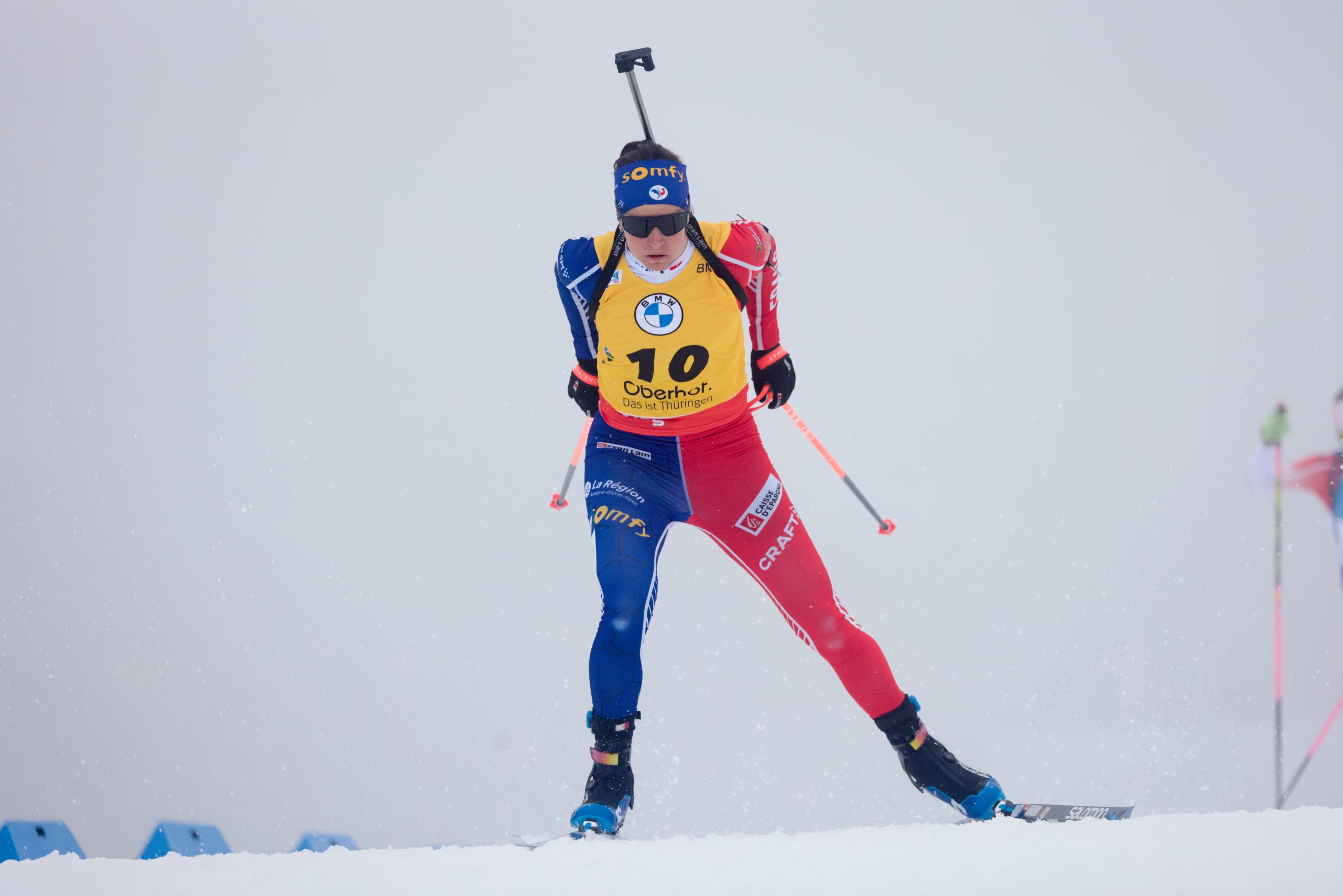
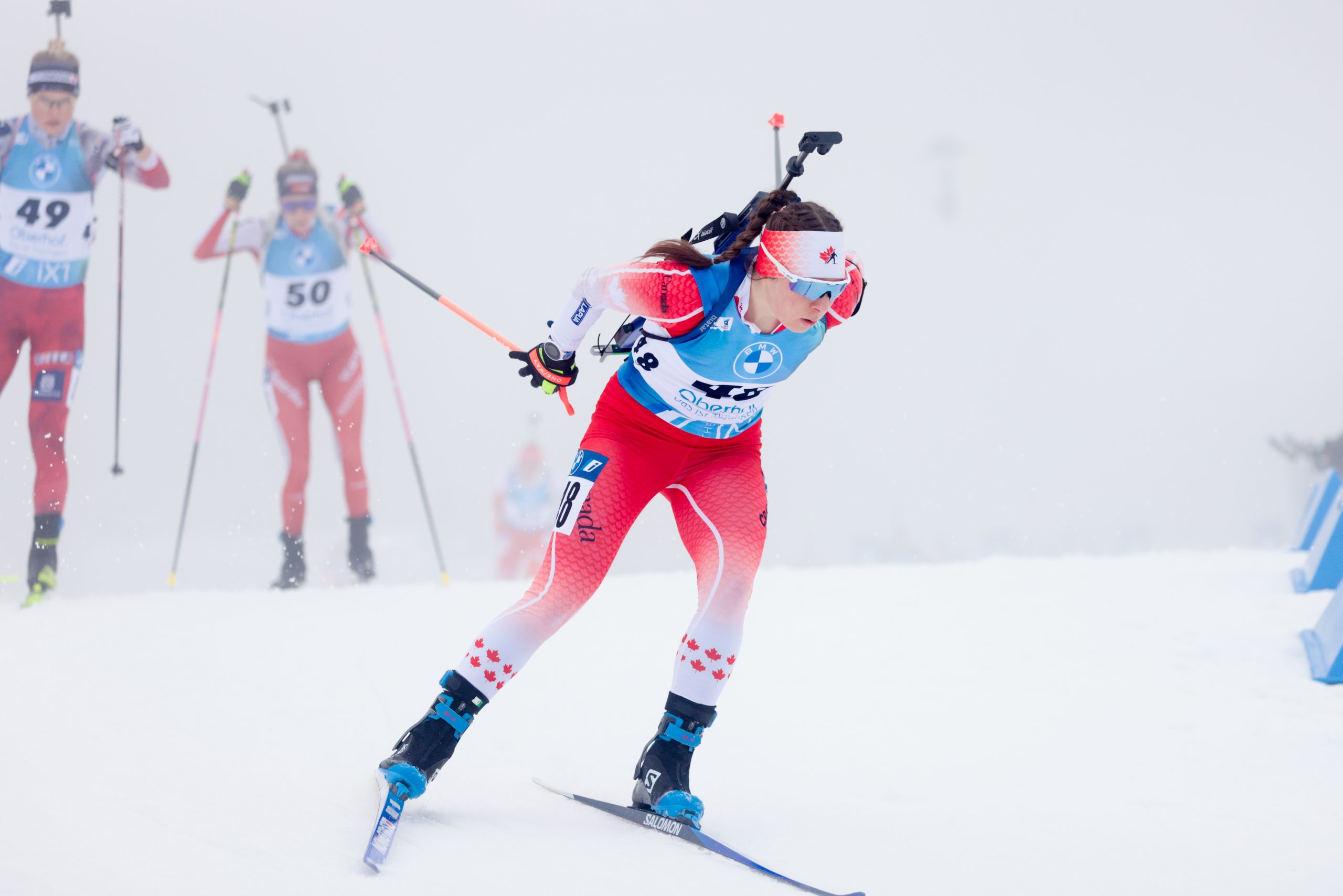
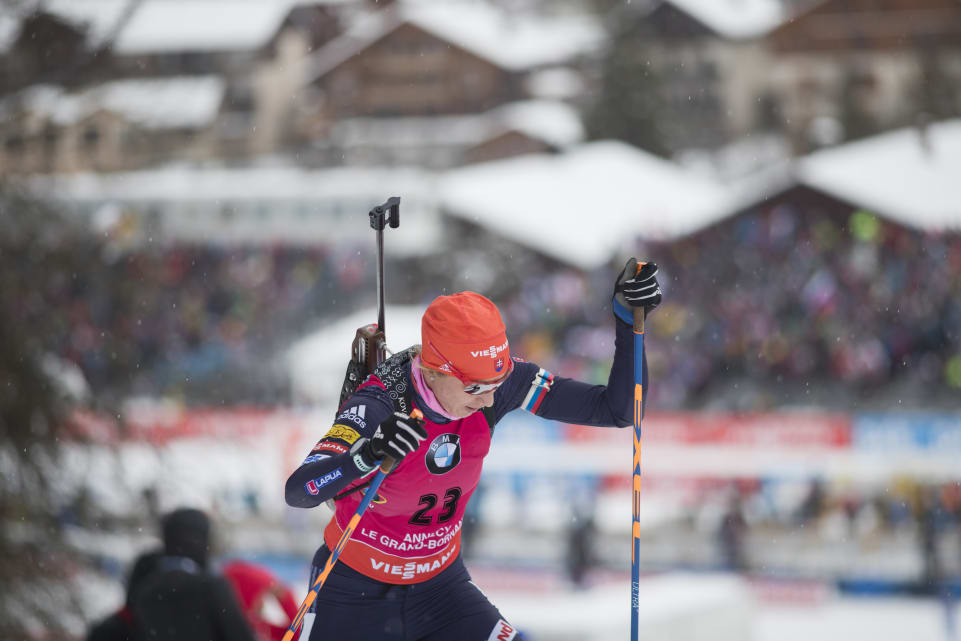
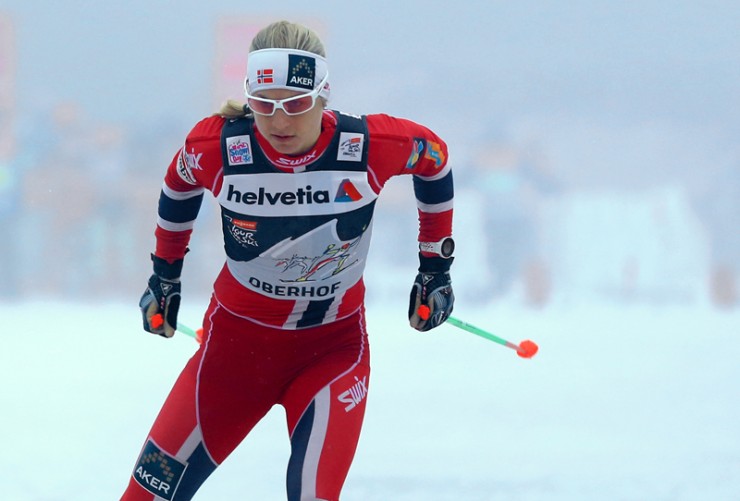
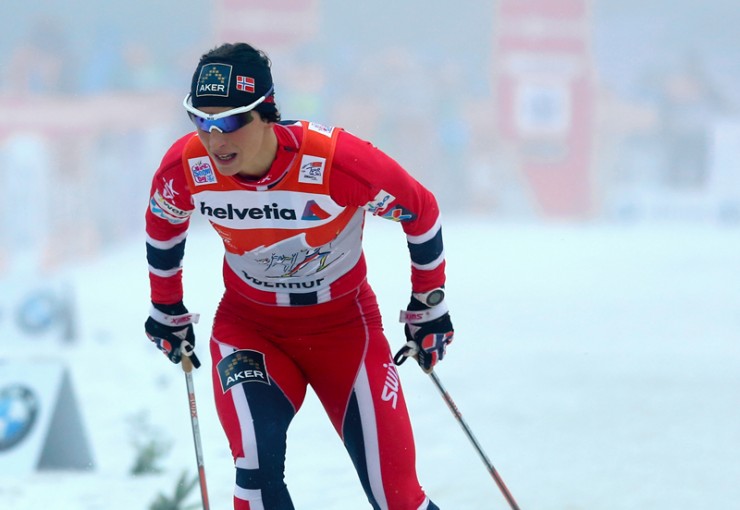
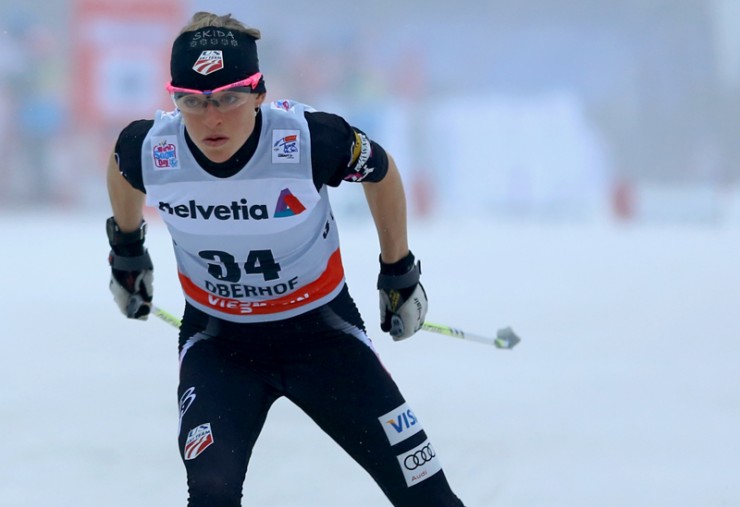
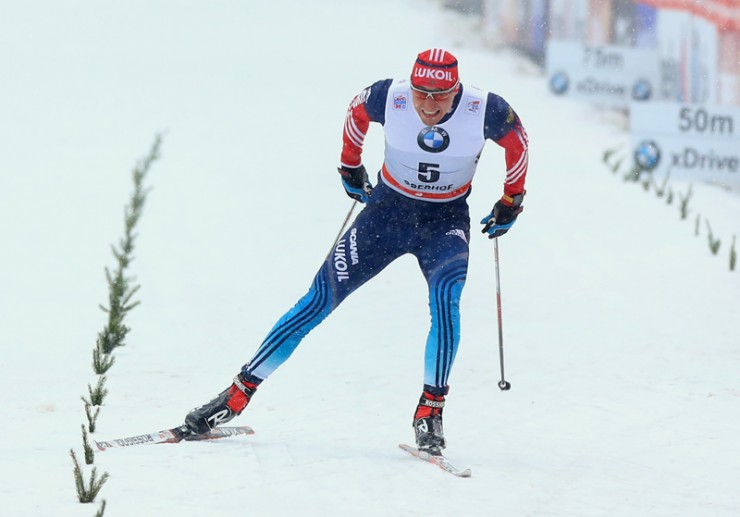
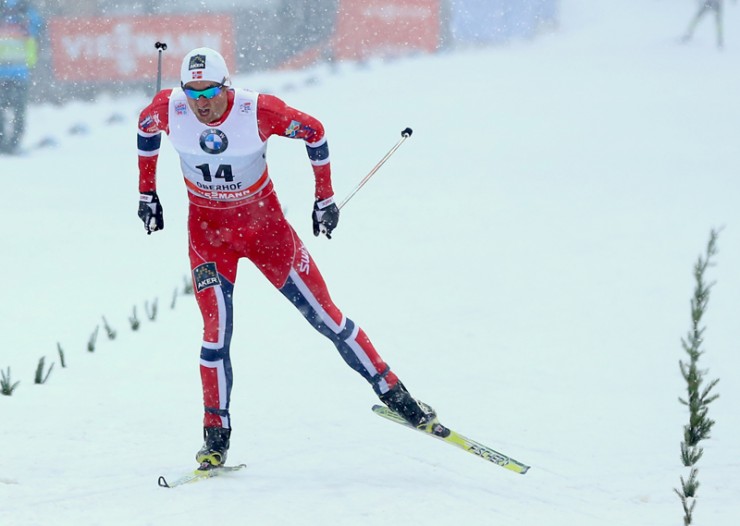
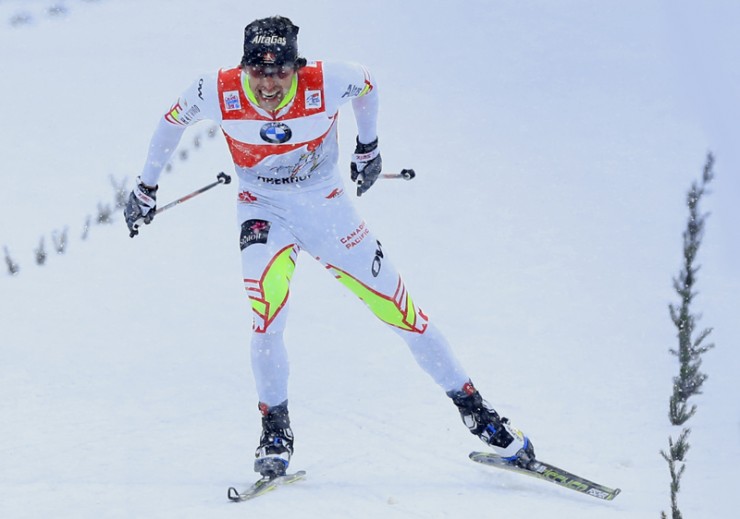
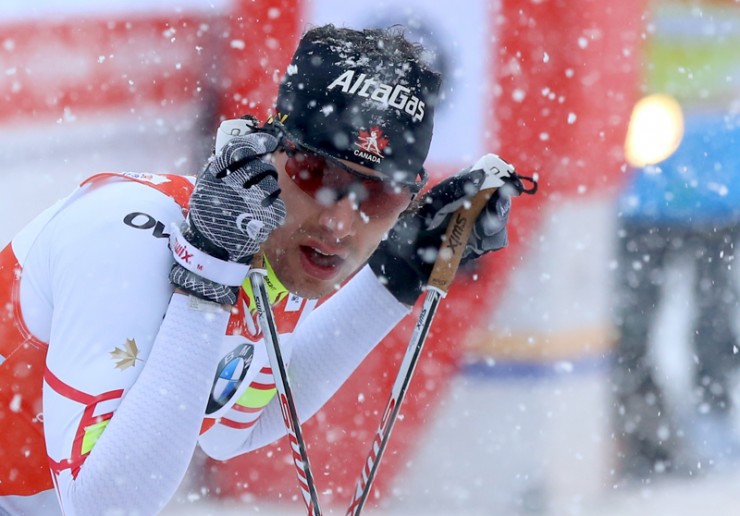
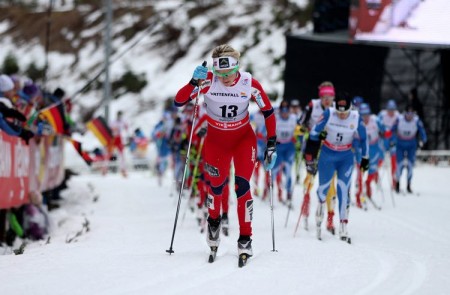
Julia Simon (FRA) wearing the yellow World Cup leader’s bib as she fights her way from 10th to first in the IBU World Championships Pursuit in Oberhof, Germany. (Photo: NordicFocus)
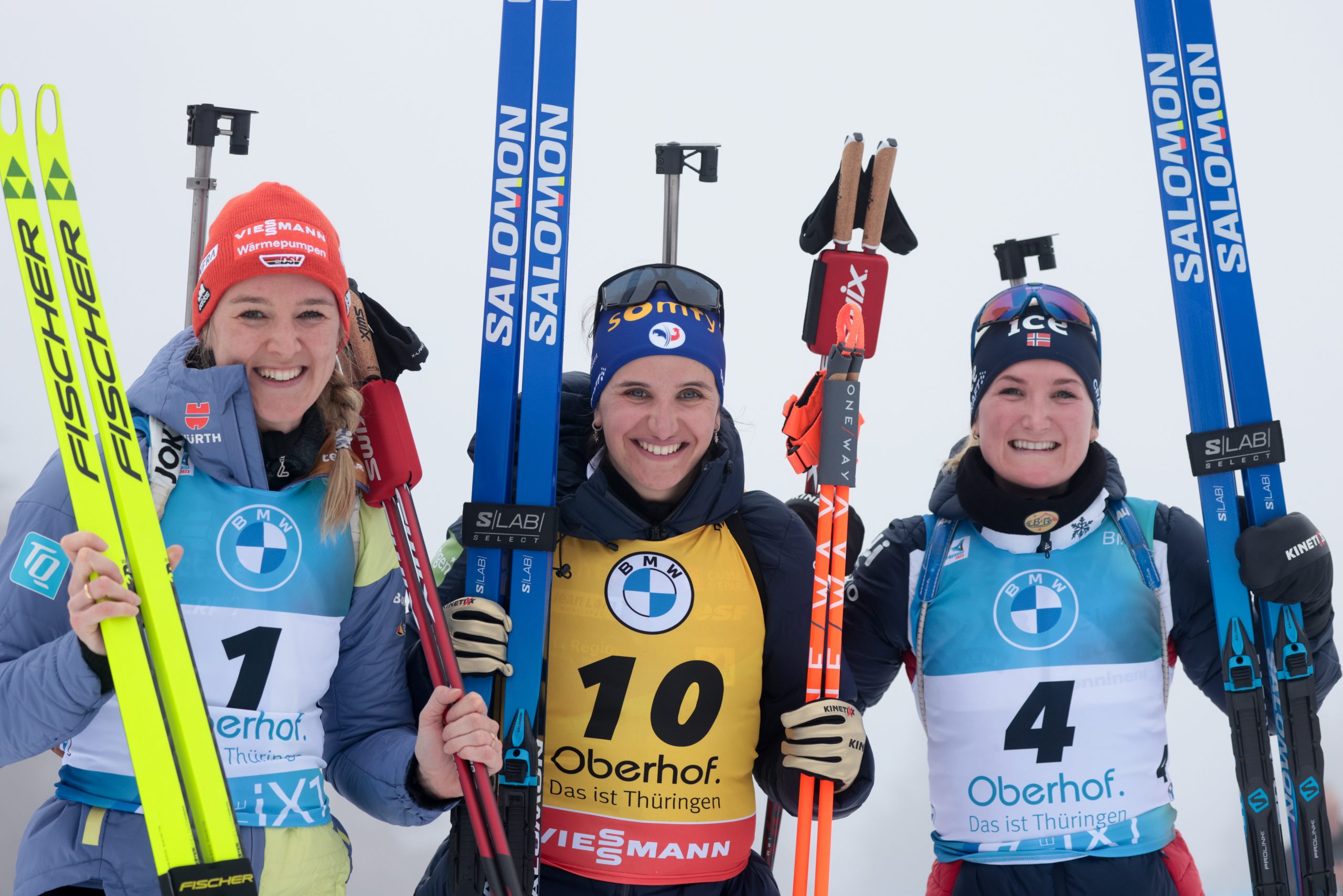
After missing her last two shots in Friday’s Sprint competition and finishing a disappointing tenth, World Cup Overall leader Julia Simon of France was determined to fight her way onto the podium in today’s World Championship Pursuit. In the end, Simon, who thrives in head-to-head competitions, made clear why she leads the World Cup standings, recovering a 1:02.8 deficit from Sprint winner Denise Herrmann (GER) to take gold—her first-ever individual World Championship medal of any color. Herrmann slipped just one place to take silver, and the defending Olympic Champion Marte Oslbu Roieseland moved up from fourth to take bronze.
Podium finishers in the Pursuit at the IBU World Championships in Oberhof (GER): Denise Herrmann-Wick (GER), Julia Simon (FRA), Marte Olsbu Roeiseland (NOR), (l-r). (Photo: NordicFocus)
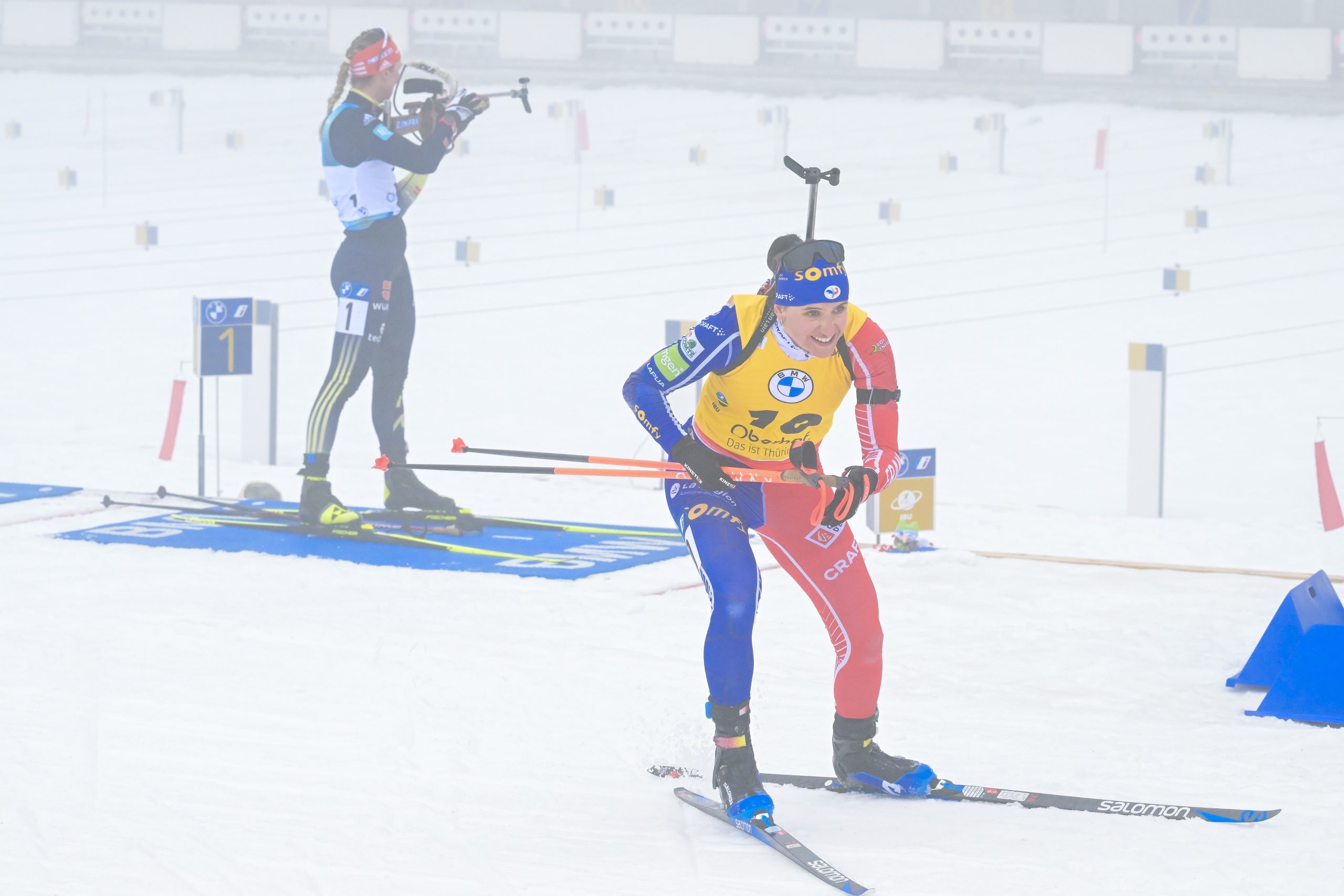
The race unfolded perfectly for Simon through the first three stages. Starting over a minute back in 10th place, Simon hammered out the fastest first lap to overtake five people before arriving at the range. Despite heavy fog which made seeing the target difficult, Simon shot clean through the first three stages of the race, while Hermann and others missed. Simon briefly took the lead from Herrmann after Shooting 3, but Herrmann passed Simon on the tracks and pulled into the shooting range for the final bout on lane 1 three seconds before Simon. This one-on-one test of composure and shooting speed is exactly the scenario that brings out Simon’s best performances. Despite arriving in the range three seconds after Herrmann, she took the first shot and kept a lighting-fast cadence through five shots in 20.1 seconds, but missed once. Herrmann couldn’t match the speed and missed twice, giving Simon a 28-second advantage. Simon cruised through the final 2 k loop to claim the World Championship title.
Julia Simon (FRA) leaves Denise Herrmann (GER) behind on the range after Shooting 4 in the IBU World Championships Pursuit. Oberhof (GER). (Photo: NordicFocus)
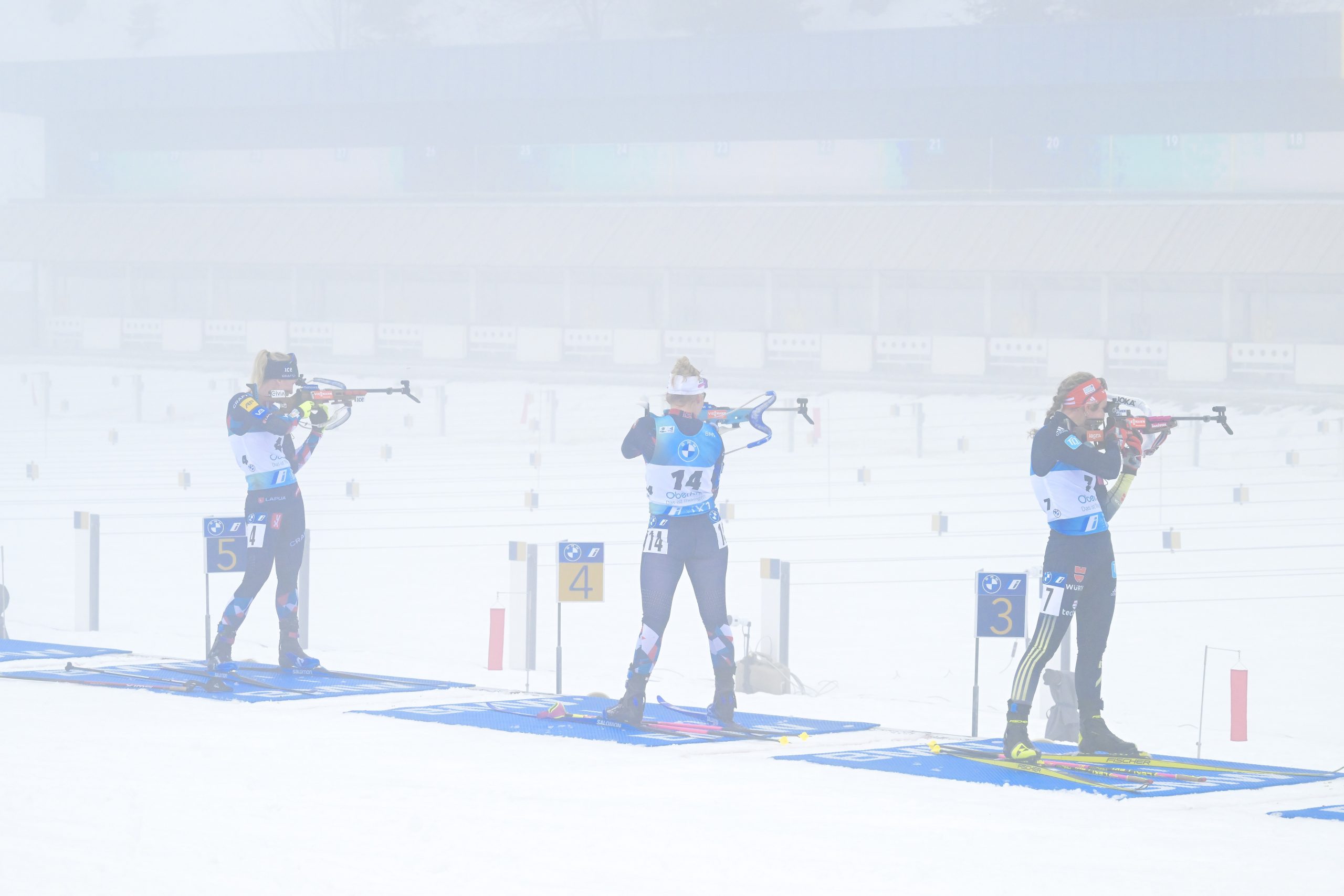
In the fight for third place, Roeiseland arrived at the last shooting in fifth, but when the athletes shooting in lanes three and four both missed, she capitalized on the moment with clean shooting, left the range in third, and held on through the finish. Roeiseland’s teammate, Ingrid Landmark Tandrevold (NOR) took fourth, and behind her there was a four-way race for the last two places in the Flower Ceremony. Encouraged by the cheers of 25,000 German fans in the sold-out stadium, Sophia Schneider of Germany ultimately took fifth, reaching her first Flower Ceremony and improving her previous personal best of seventh which she took unexpectedly in the Sprint. France’s Lou Jeanmonnot finished 6th, out-sprinting Tereza Vobornika of the Czech Republic and Hanna Kebinger of Germany who also set new personal bests.
Marte Olsbu Roeiseland (NOR), Ingrid Landmark Tandrevold (NOR), Sophia Schneider (GER), (l-r) on the final shooting stage of the IBU World Championships Pursuit in Oberhof (GER). (Photo: NordicFocus)
From North America, Emma Lunder was the top starter, wearing bib 11, but she struggled with the low visibility on the range and dropped to 30th with seven penalties. “In prone I could see Echo and Alpha, but not the three targets in the middle,” said Lunder, using the common names of the right and leftmost targets. Deedra Irwin (USA) missed three in the first shooting when she didn’t have a clear sight picture. “I haven’t shot in fog since maybe last year. I probably could have shot better if I stayed calm and just shot, but I freaked out.” Irwin improved from there, missing only two total in the next three stages, but wearing bib 55 and starting with three misses, she found herself out of the race and finished at the back of the Pursuit.
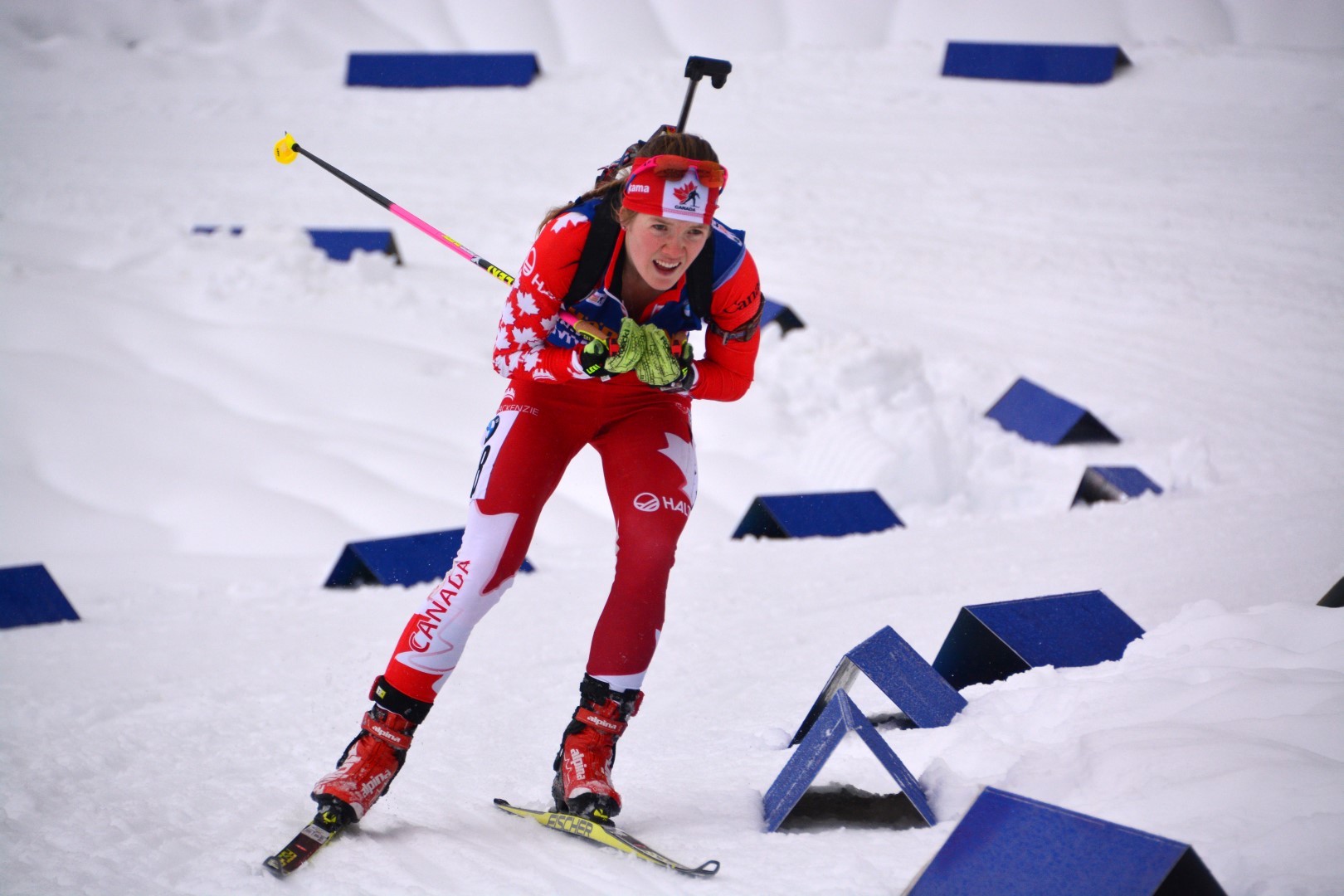
Nadia Moser (CAN) had the highlight North American performance of the day, moving up from 48th to 37th with just three penalties.
Nadia Moser (CAN) shot 0,1,1,1 to move from 48th to 37th in the IBU World Championships Pursuit in Oberhof (GER). (Photo: NordicFocus)
The women now have two days to rest and get ready for their longest competition, the 15km Individual, which takes place on Wednesday at 8:30AM Eastern Time. Watch live HERE.
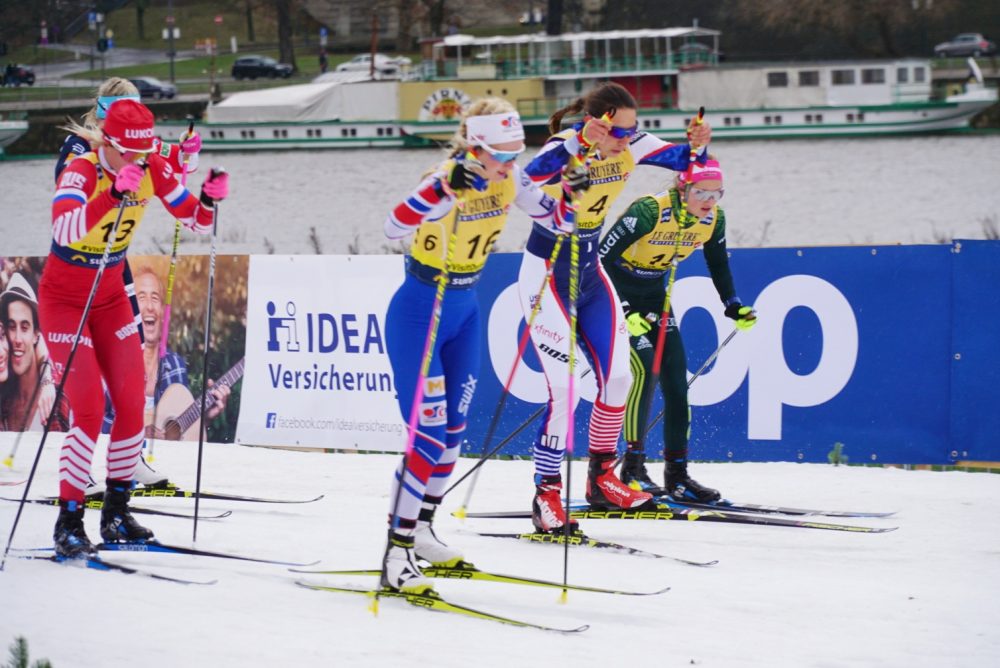
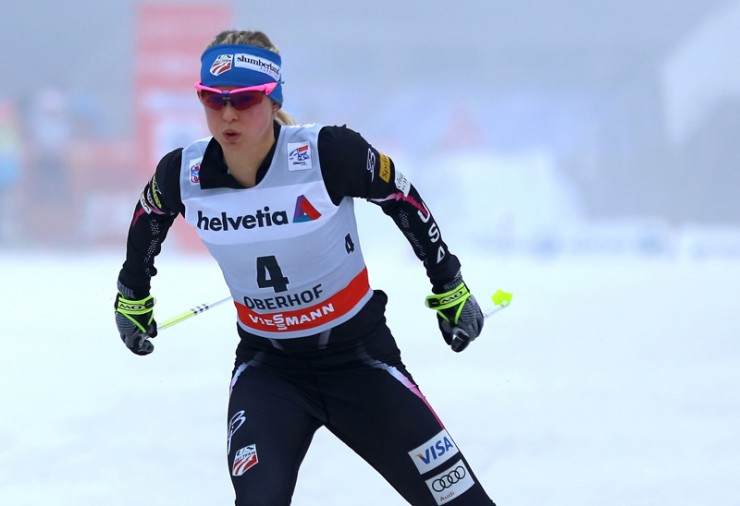
Racing in bib 4 for the U.S., Julia Kern keeps pace in the women’s team sprint during the Dresden, Germany World Cup on Sunday. (Photo: Garrott Kuzzy).
FIS World Cup Dresden, Germany 6 x 1.6 k Freestyle Team Sprint
The first World Cup team sprint of the season was run amidst drizzle and the Dresden, Germany city-scape as the women raced a total of six 1.6-kilometer laps.
Round and round on the looping course, the pace was a mix of tactically subdued speeds with sustained bursts of energy to break the pack.
After all the speed changes and exchanges with one athlete tagging off to the next, it came down to a 1.11 second difference between first place Sweden I and the three closet teams chasing from behind that ended in a photo finish.
Sweden I’s Stina Nilsson and Maja Dahlqvist won in a time of 24:02.5 minutes. Sweden II’s Ida Ingemarsdotter and Jonna Sundling placed second (+1.11), and Norway I, with Eide Mari and Maiken Caspersen Falla in third (+1.11).
U.S. I, featuring Julia Kern and Sophie Caldwell placed fourth (+1.11) after the photo finish was reviewed.
The U.S. entered a second team, consisting of Ida Sargent and Hannah Halvorsen. That duo contested the first semi-final, the same semi as U.S. I, but did not advance after placing fourth (+5.44). The top-three teams from each semi advance to the final, along with the next four fastest teams which are the combined “lucky losers”. Today, the second semi was the faster of the two. The four lucky loser team advancing to the final all originated from the second semi.
In the men’s 6 x 1.6 k skate team sprint race, Norway I and Norway II took the top two podium spots.
In a lunge at the line, Norway I’s Erik Valnes and Sindre Bjørnestad Skar won the final in 22:38.72 minutes. Pål Golberg and Eirik Brandsdal of Norway II placed second (+0.75) and Russia I’s Artem Maltsev and Gleb Retivykh third (+0.80).
Canada’s Bob Thompson and Len Valjas placed seventh (+2.46) in the first semi-final and did not advance to the final. It was the same fate for the only U.S. team entered in the men’s team sprint. Andy Newell and Erik Bjornsen placed 10th (+3.66) in the second semi, and failed to make the finals.
Canada placed 15th in the final standings, the U.S. 19th.
IBU World Cup Oberhof, Germany 4 x 6 k / 4 x 7.5 k Relay
In the women’s 4 x 6 k relay, Russia placed first in a time of 1:18:46.4 hours. Evgeniya Pavlova, Margarita Vasileva, Larisa Kuklina, and Ekaterina Yurlova-Percht made up the team that used eight spares on their way to the win.
Germany placed second (+33.5) with two penalty loops and 10 spare rounds. Karolin Horchler, Franziska Hildebrand, Franziska Preuss, and Denise Hermann comprised Germany’s second place team that had two penalties while using 10 spares. The Czech Republic’s Lucie Charvatova, Veronika Vitkova, Marketa Davidova, and Eva Puskarcikova placed third (+36.7) with 1 penalty loop and six spares.
The top spot for the podium came down to the final leg, when Yurlova-Percht pulled out the win when Hermann skied two penalty loops. The Russian used three spares but escaped with no penalties to take the lead out of the shooting range on the final ski loop.
Susan Dunklee, Clare Egan, Joanne Reid, and Emily Dreissigacker all represented the U.S. and placed 12th (+5:35.8) while skiing five penalty loops and using 16 spares.
Canada’s Sarah Beaudry, Emma Lunder, Megan Bankes, and Rosanna Crawford finished in 13th (+5:58.8) with four penalty loops and 15 spares.
Russian also claimed the men’s relay, winning in a time of 1:20:54.3 hours. The winning team of Maxim Tsvetkov, Evgeniy Garanichev, Dmitry Malyshko, and Alexander Loginov skied no penalty laps and used six spares on their way to victory.
Antonin Guigonnat, Simon Desthieux, Quentin Fillon Maillet, and Martin Fourcade raced for France. The French team placed second (+1:01.1) while skiing a single penalty lap and using eight spares.
Austria’s Tobias Eberhard, Simon Eder, Dominik Landertinger and Julian Eberhard placed third (+2:18.6) with one penalty lap and using seven spares.
Canada’s Scott Gow, Christian Gow, Jules Burnotte, and Brendan Green and the U.S. team of Leif Nordgren, Sean Doherty, Travis Cooper, and Max Durtschi were eventually lapped. Neither team was given an official finishing time.
Canada was ranked 18th in the final standings, the U.S. 19th.
For both relays today, the snowy weather and tough course conditions made for a strenuous day of shooting and skiing.
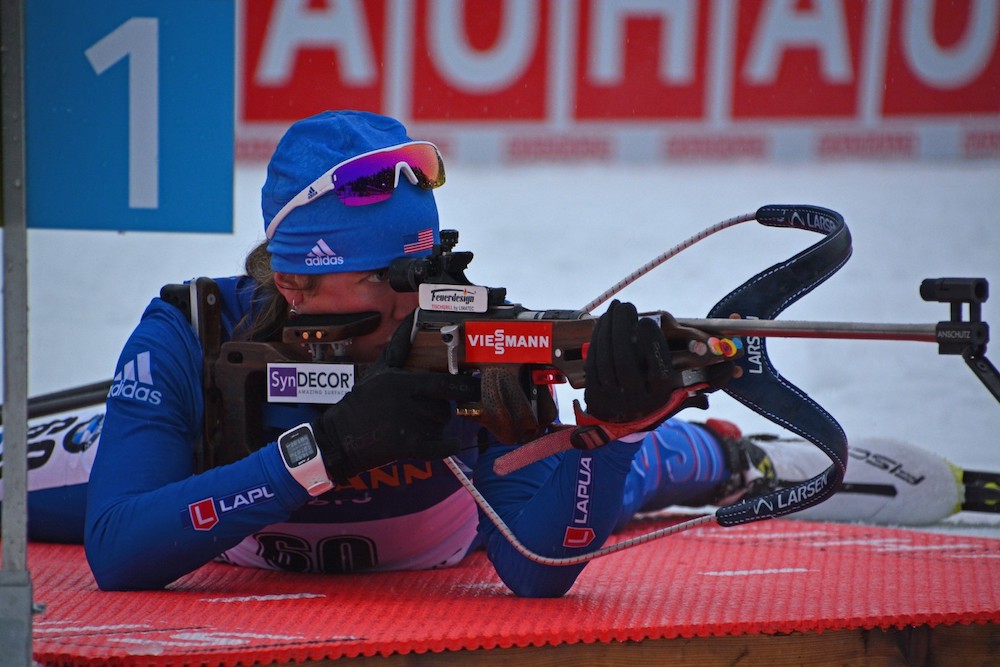
Susan Dunklee (US Biathlon) hitting every target in the prone shooting stage of the women’s 7.5 k sprint at the IBU World Cup in Annecy, France, on Thursday. She ended the day in 10th place with perfect 10-for-10 shooting. (Photo: Glen Crawford)
Susan Dunklee’s start to another International Biathlon Union (IBU) World Cup season hadn’t played out as she’d hoped, specifically in terms of results. Coming off a banner winter, with a silver at 2017 World Championships (in the women’s mass start), Dunklee 31, had so far placed 53rd, 79th and 97th, respectively, in non-relay races over the last two weeks. She had yet to race a mass start, but also had yet to qualify for a pursuit in two World Cup sprints.
So she went back to the drawing board, back to basics and to a “moose garden”.
“My confidence took a big hit these past couple weeks and it was a real challenge was working through that,” Dunklee wrote in an email to FasterSkier on Thursday.
“I tried to find some non-biathlon activities like visiting a ‘moose garden’ in Sweden and seeing the ‘Krampus’ in Austria,” she explained, referring to an Advent costume tradition, “to keep my mind fresh so I wouldn’t obsess 24/7 over disappointing results. I also tried really hard to take a moment each evening to appreciate all the positive things that happened over the course of the day. And I kept telling myself that I am resilient.”
After missing eight targets in last week’s snowstorm sprint in Hochfilzen, Austria, she sat down to brainstorm with US Biathlon consultant Matt Emmons, a 2004 Olympic champion in rifle shooting.
“All summer I’ve been working on some fancier shooting skills, such as wind shading,” Dunklee explained. “Basically we decided I could benefit from focusing back on the absolute basics of shooting: sight alignment, trigger squeeze and follow [through]. That’s what I’ve been doing the last few days.”
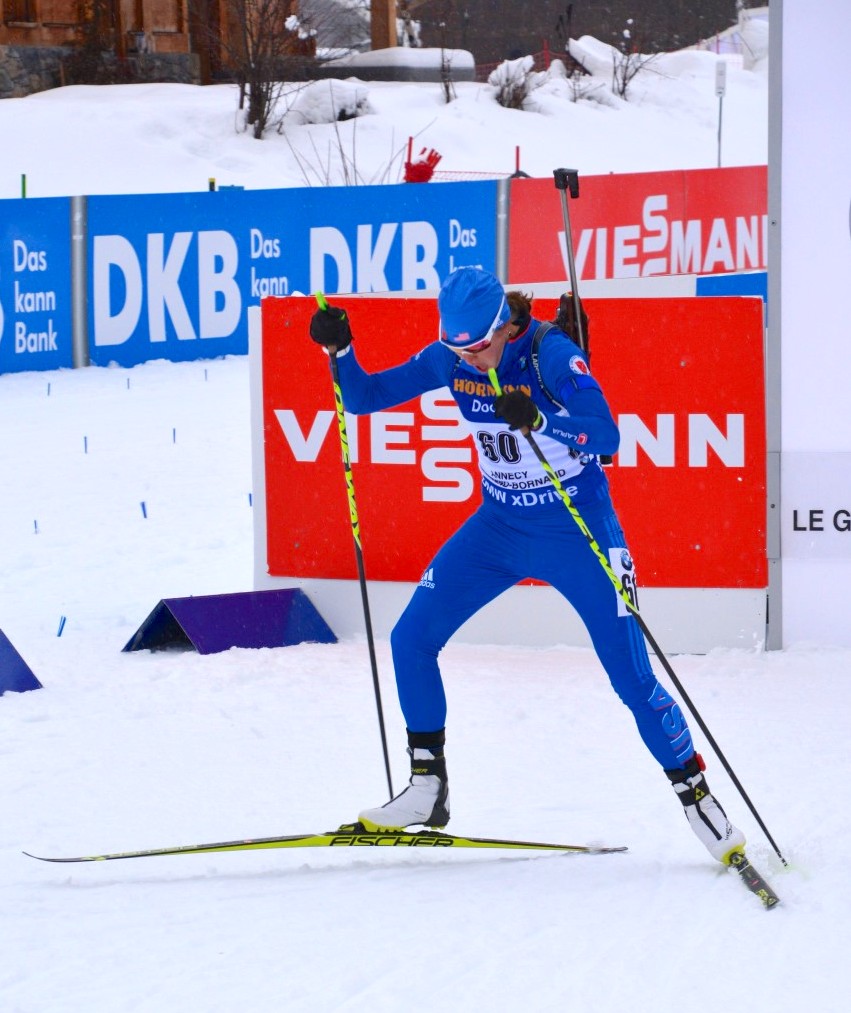
Susan Dunklee (US Biathlon) out of the start of the IBU World Cup women’s 7.5 k sprint on Thursday in Annecy, France, where Dunklee placed 10th overall for her best result of the season. (Photo: Glen Crawford)
On Thursday, she started 60th out of 93 in the women’s 7.5-kilometer sprint in Annecy (Le Grand Bornand), France. In warm, slushy conditions with little wind, as Dunklee described it, she fired away for perfect 10-for-10 shooting to put herself in ninth at the finish.
Dunklee was ultimately bumped one spot down to 10th overall, 1:16.8 minutes behind the winner, by Germany’s Laura Dahlmeier, who started in bib 86 and ended up second — 33.9 seconds behind Slovakia’s Anastasia Kuzmina in first.
Kuzmina, who notched her second-straight individual World Cup win with a time of 20:59.6, and the rest of the top-four finishers — Dahlmeier, Ukraine’s Vita Semerenko in third (+41.4) and Italy’s Lisa Vittozzi in fourth (+50.0) — all shot clean, just like Dunklee. Semerenko’s twin sister Valj, who placed seventh (+1:06.8), was the other woman in the top 10 to hit every target.
Dunklee spent all of the race in the top 10, ranking eighth after the first of three loops and seventh after the second loop.
“All the difference today for me was made on the shooting range,” Dunklee wrote. “The skiing has been fine all season. I backed off approaching the range, and I took enough time to make sure I was taking good shots.”
Her top 10 was her best result since placing seventh in a sprint last March in Oslo, Norway. By landing in the top 60, Dunklee qualified for the Annecy pursuit on Saturday, which will be her first of the season.
“Today helped me put to rest some doubts I was starting to have in my abilities,” she wrote. “I am very grateful to qualify for the pursuit. It will be a good opportunity for some head to head racing which I haven’t seen much of yet this year.”
Kuzmina in Control
Slovakia’s Anastasia Kuzmina racing to a nearly 34-second win in the women’s IBU World Cup sprint on Thursday in Annecy, France. (Photo: IBU/biathlonworld)
Starting in bib 23, Kuzmina rocketed to first place with the fastest course time and fourth-fastest shooting and range times, all while hitting every target.
“It is always a great feeling to be a winner, especially when the race was pretty good from start to finish,” Kuzmina, a two-time defending Olympic sprint champion (from 2010 and 2014), told the IBU, according to a press release. “It was really important to shoot two times zero. The snow condition was not too comfortable for me; I really want to thank my service team for the skis. That was an important part of my victory.”
The Russian-born Slovakian (whose brother is Russian biathlete Anton Shipulin) took the lead after the first shooting, leaving the range 6.3 seconds ahead of Germany’s Denise Herrmann, who started ahead of her in bib 16 and also cleaned prone. Herrmann had a penalty lap in the standing bout to slip to sixth and 45 seconds back, while Kuzmina cleaned again to start her final loop 35 seconds clear of Vittozzi, who was in second at the time wearing bib 13.
Germany’s Laura Dahlmeier prepares to hit all five targets in the standing stage of the IBU World Cup women’s sprint on Thursday in Annecy, France. (Photo: Glen Crawford)
A much later starter in bib 86, Dahlmeier cleaned prone to move into third, 6.7 seconds off Kuzmina’s time. Her next time in the range, Dahlmeier shot clean again to improve to second, but she was still 25.8 seconds short of Kuzmina’s time with one loop to go. Kuzmina skied the second-fastest last loop (about two seconds slower than Switzerland’s Selina Gasparin) to lock up first, while Dahlmeier ended up nearly 34 seconds back in second place.
“This was the first podium in an individual-start race of the new season for me and that makes me very very happy,” Dahlmeier told German broadcaster ZDF, according to a translation. “I am excited that it worked out today, it took a while until I now got back in shape. I am not at 100 percent yet, but today was a super race and I am just happy about that, it was a lot of fun to race today.”
Thursday marked Dahlmeier’s fourth race of the season after she missed the World Cup opener in Östersund, Sweden, due to illness. In Hochfilzen, she anchored the women’s 4 x 6 relay to the win and placed 10th in the pursuit and 16th in the sprint.
“It’s a bit of an unusual situation for me to have such a late bib in an individual race, but as an anchor in relays I am kind of used to that, passing the time by listening to music or something like that,” she said. “When I was at the start gate I was focused again and just tried to do my on race. It has its pros and cons, I just tried to make the best of it.”
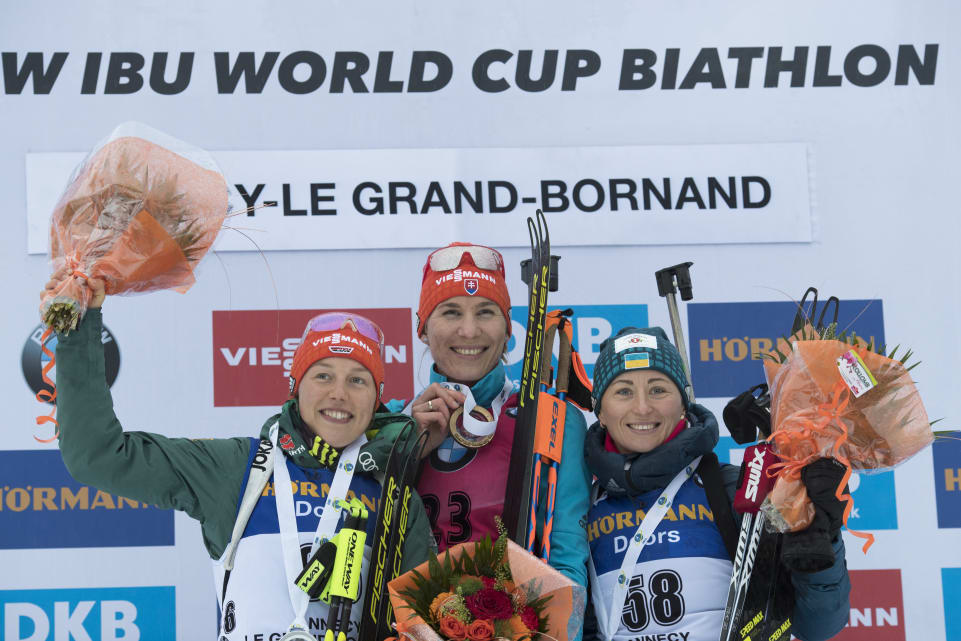
The women’s IBU World Cup sprint podium on Thursday in Annecy, France, with Slovakia’s Anastasia Kuzmina (c) in first, Germany’s Laura Dahlmeier (l) in second, and Vita Semerenko (r) in third. (Photo: IBU/biathlonworld)
For Vita Semerenko, it was her first podium since taking bronze in the sprint at the 2014 Olympics. She missed the two seasons that followed due to a back injury, and gave birth to her son just over a year ago.
“I will never forget my first training after giving birth,” she told the IBU. “My coach said, ‘If we don’t give it a try, we will not find out what happens next.’ I said ‘OK’, but I had a lot of anxiety about coming back to biathlon, as I understood that coming back after three years would be tough. I am also thankful to my husband who told me every day after I had my child, ‘Vita, come on, come on, let’s make a comeback!’ ”
Herrmann was the top finisher with a penalty (0+1) on Thursday in fifth place (+50.6), while Gasparin was just behind in sixth (+53.4) with one miss as well (1+0).
“I am noticing that I am not feeling as fresh anymore as in Östersund, it was quite the number of races for me already,” Herrmann, who won both the sprint and pursuit in Östersund, told ZDF. “And I’d say deep snow conditions like today aren’t ideal for athletes over 60 kilograms. But nevertheless it was a good race, I really tried to hit every shot, and lost quite a few seconds with my shooting time. But I am back on track compared to last weekend, and hope I can continue my successes in the pursuit race.”
In the women’s 10 k pursuit on Saturday, Kuzmina will start 34 seconds ahead of Dahlmeier in second, and Vita Semerenko will head out another 7 seconds later in third. Dunklee will start 1:17 back and just 4 seconds behind Valj Semerenko in seventh.
Emma Lunder (Biathlon Canada) racing to 34th in the IBU World Cup women’s 7.5 k sprint on Thursday in Annecy, France. (Photo: Glen Crawford)
Three Canadians qualified for the pursuit, with Emma Lunder leading them in 34th (+2:07.4) with one standing penalty (0+1). Julia Ransom followed in 39th (+2:13.9) with one prone miss (1+0) and Rosanna Crawford snuck into the top 60 in 60th (+2:39.1) with two penalties (1+1). They will start the pursuit 2:07, 2:14 and 2:39 back, respectively.
Also for Biathlon Canada, Megan Bankes missed the cutoff in 65th (+2:51.5) with one penalty (1+0).
For the U.S., Clare Egan finished 81st (+3:43.7) with three misses (1+2), and Emily Dreissigacker was 88th (+4:36.0) with three penalties as well (2+1).
The Annecy IBU World Cup men’s 10 k sprint takes place Friday, starting at 8:15 a.m. EST.
US Biathlon’s Susan Dunklee (l) before the women’s IBU World Cup sprint in Annecy-Le Grand Bornand, France. (Photo: US Biathlon/NordicFocus)
Susan Dunklee (US Biathlon) during the standing stage of the women’s IBU World Cup sprint in Annecy, France. She went on to place 10th. (Photo: Glen Crawford)
Emma Lunder (Biathlon Canada) racing to 34th in the IBU World Cup women’s 7.5 k sprint on Thursday in Annecy, France. (Photo: Glen Crawford)
Julia Ransom (Biathlon Canada) racing to 39th in the women’s IBU World Cup sprint in Annecy, France. (Photo: Glen Crawford)
Rosanna Crawford (Biathlon Canada) leaving the range during the women’s IBU World Cup sprint in Annecy, France. She placed 60th to qualify for the Annecy pursuit on Saturday. (Photo: Glen Crawford)
Megan Bankes (Biathlon Canada) lunging at the finish of the IBU World Cup women’s sprint in Annecy, France. She placed 65th. (Photo: Glen Crawford)
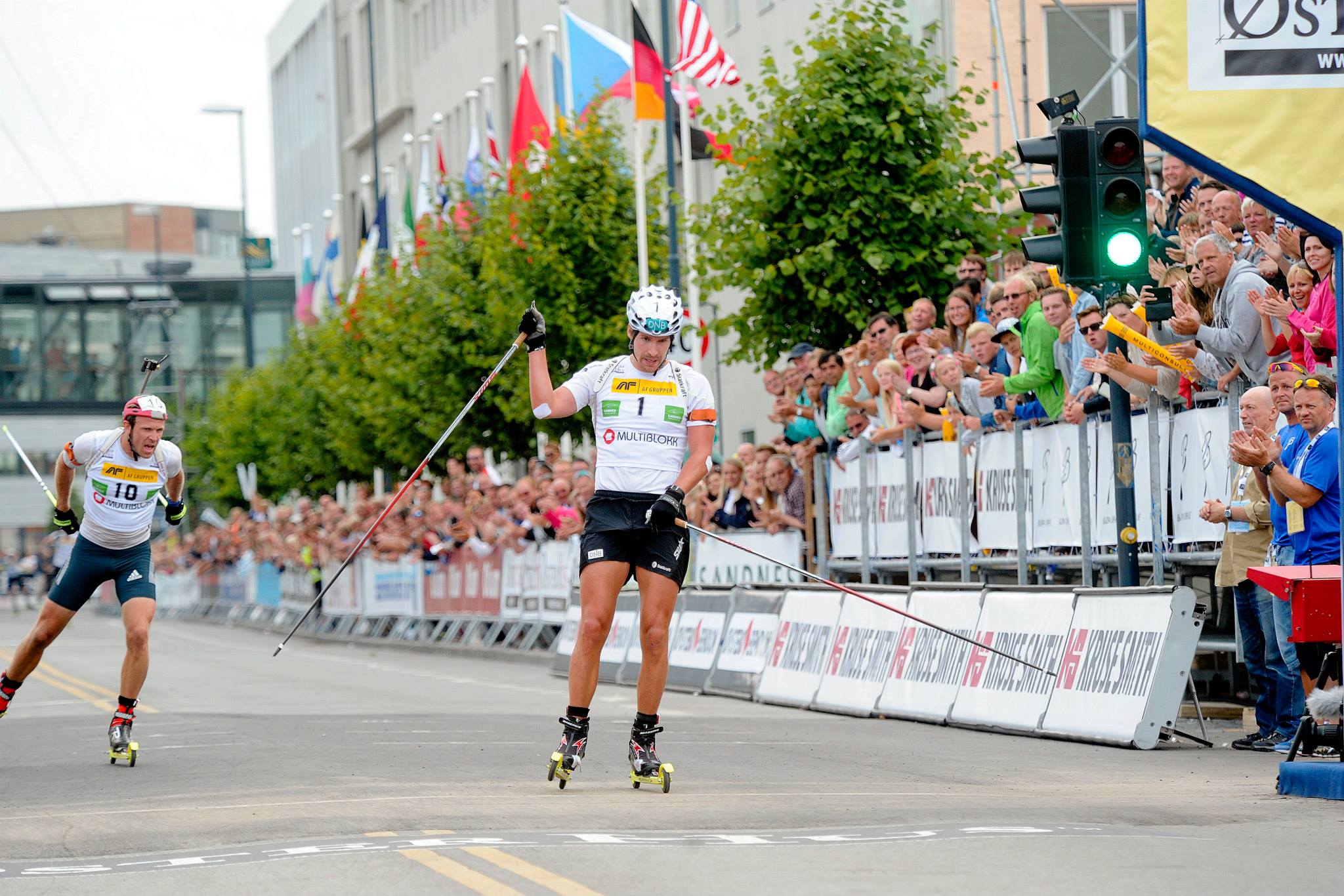
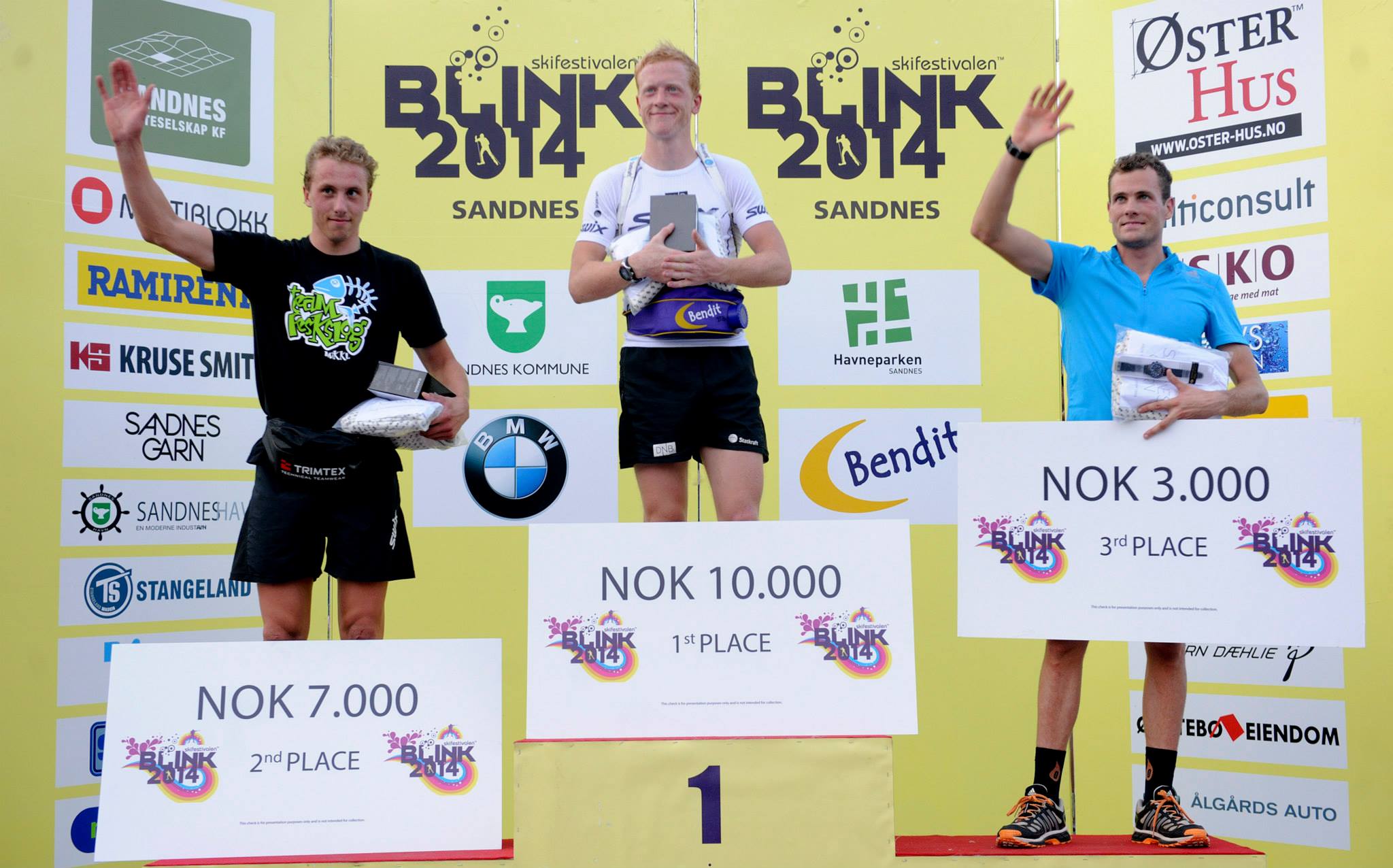
U.S. Biathlon’s Lowell Bailey (l) pushes himself across the finish line in Friday’s biathlon 6.3 k mass start as part of the 2014 Blink Festival. Bailey finished second to Emil Hegle Svedsen (r) of Norway. (Photo: Skifestivalen Blink/Facebook)
When Lowell Bailey raced in the 2014 Blink Festival 7-kilometer hill climb just days after arriving in Norway, he was jolted by a “shock to the system,” he wrote in an email.
Apparently the shock was what he needed to deliver a top-notch performance, as the U.S. biathlete finished second in the biathlon mass start the next day in the city of Sandnes.
The road to the podium wasn’t an easy one. To participate in the mass start, competitors who were not already pre-qualified needed to place in the top six in the qualification round. The round consisted of five laps of 800 meters with prone shooting following the second lap and standing following the fourth.
In a tough field, Bailey and U.S. teammate Tim Burke claimed the last two spots in the mass start by taking fifth and sixth.
Once in the mass start, Bailey knew he had to focus on his shooting if he wanted to have any hopes of placing on the podium.
“I told myself before the race that I was going to race my own race and try not to get caught up in the hurried shooting situations that always happen in this type of race,” Bailey wrote.
Throughout the race, which consisted of nine laps on a 700-meter loop, and two prone and two standing stages, Bailey often took longer to shoot but maintained contact with the lead group.
When he exited the final shooting he was the last of the four competitors he had arrived with to leave the mats.
However, his fellow competitors had rushed through their shots and had penalty loops to compete. Bailey had shot perfectly and left the range with a five-second lead over Norway’s Emil Hegle Svedsen.
Svedsen ultimately caught the American in the final stretches of the race, overcoming him by just 0.7 seconds.
Bailey was followed by Norwegian Tarjei Bø, who finished 12.9 seconds behind Svedsen.
Burke finished eighth in the mass start, 1:09.9 back.
Slovenia’s Katja Visnar celebrates her victory in the women’s 10 k mass start in the 2014 Blink Festival. (Photo: Skifestivalen Blink/Facebook)
In the women’s 6.3 k mass start Fanny Wele-Strand Horn of Norway was victorious with a time of 14:10.8. She was followed by Kaisa Makarainen of Finland and Marine Bolliet of France in second and third.
American Susan Dunklee finished in eighth, 41.8 seconds behind Horn. Dunklee was one of five athletes who had pre-qualified for the mass start, but struggled with her shooting in the final.
“Unfortunately I missed a lot of prone targets early in the final and despite passing a few people on skis, I never regained contact with the main pack,” Dunklee wrote in an email.
The cross-country mass start races that took place later that day consisted of women’s 10 k and a men’s 15 k.
In the men’s race, Teodor Peterson of Sweden claimed victory for the second day in a row on the rollerski course that consisted of 18 laps around an 800-meter loop. The sprint specialist finished with a time of 28:07.3. He was followed by Norwegian Øystein Pettersen in second and Cyril Gaillard in third.
The men’s field was incredibly close with the top-23 finishers crossing the line within ten seconds of Peterson.
Canadian Devon Kershaw was one such finisher. He placed seventh, just 3.7 seconds behind the Swede and 1.4 seconds off the podium.
In an email, Kershaw explained that the curvy course and the 30 aggressive racers that populated it made for conditions he was not used to, but he was happy with how the day ended.
“I was out of position near the end and with all the curves there was nothing I could do,” Kershaw wrote. “It was a fun evening though!”
In the women’s 10 mass start, another sprint-specialist took the win. Slovena’s Katja Visnar finished with a time of 20:36.0. She was followed by German sprinter Denise Herrmann in second and Norway’s Ingvild Flugstad Østberg in third.
American Liz Stephen finished 18th. In an email, she declared the race a success in that there were no major crashes.
“It was good for my head in that I need to be less nervous about skiing in a pack close to other skiers, and after today snow seems like it should be no problem at all,” she wrote.
Tim Burke (r) stands on the podium of the men’s biathlon sprint Saturday at the 2014 Blink Festival. Burke finished third, completing a successful weekend for the Americans in attendance at the festival. (Photo: Skifestivalen Blink/Facebook)
Sprint Day
U.S. biathletes also shined in the final day of the Blink Festival with Burke and Bailey claiming third and sixth, respectively, in the biathlon sprint.
Burke finished 8.7 seconds behind race winner Johannes Thingness Bø of Norway, who won the final in 12:25.8. Second place went to fellow Norwegian Marius Hol who crossed the line 7.4 seconds behind Bø.
After struggling with his shooting in the mass start competition, Burke was pleased to have a strong result.
“This was a good confirmation for me that I am headed in the right direction for the winter season,” he wrote.
It was the first time the 32-year-old American had ever competed in heats for a biathlon race, which he found both unique and challenging.
“I would say the shooting in this type of race is actually harder than a normal biathlon race because you are basically sprinting all out for 1 k before each shooting stage,” he wrote.
Bailey finished sixth, 22.7 seconds behind the winner.
In the women’s biathlon sprint, Dunklee placed sixth in her semifinal and did not advance to the final. The women’s biathlon final was won by was won by Bolliet, who was followed by French teammates Enora Latuilliere and Anais Chevalier in second and third, respectively.
In the cross-country sprints, Norway’s Marit Bjørgen topped the women’s final. She edged teammate MaikenCaspersen Fallafor the win by just 0.1 seconds. Visnar placed third, 1.1 seconds behind Bjørgen.
Stephen was unable to advance from the quarterfinals.
Sondre Turvoll Fossli of Norway won the men’s final in 3:08.1. He was followed by another Norwegian Martin Hammer in second and Sweden’s Peterson in third.
Jessie Diggins (U.S. Ski Team) racing in Sunday’s freestyle sprint qualifier on Sunday. She finished 18th after being knocked out in the heats. After two stages she is ranked 14th overall. (Photo: Marcel Hilger)
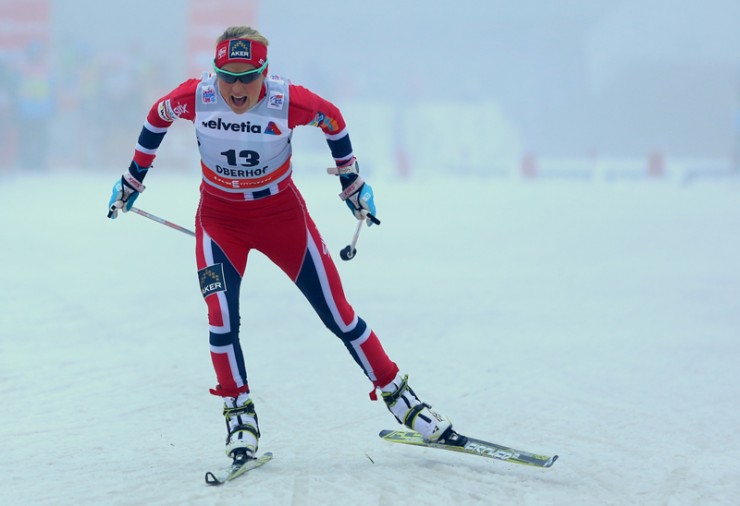
Norway’s Therese Johaug impressed with an eighth place finish in Sunday’s sprint qualifier. (Photo: Marcel Hilger)
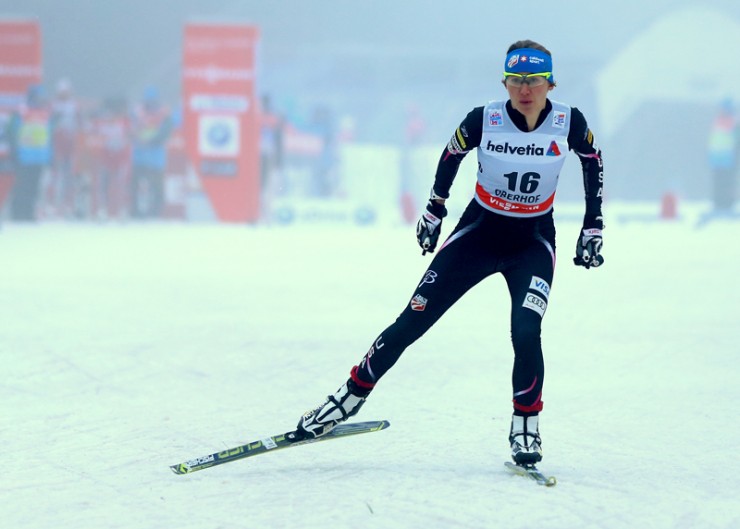
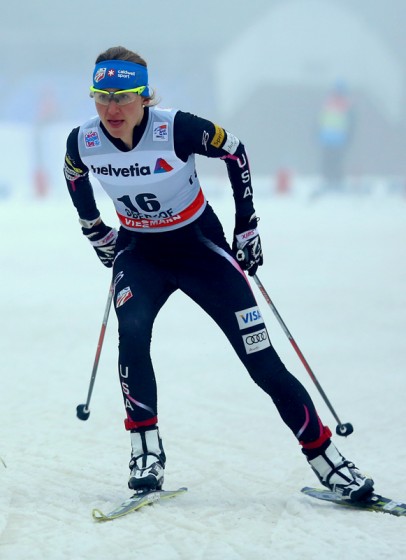
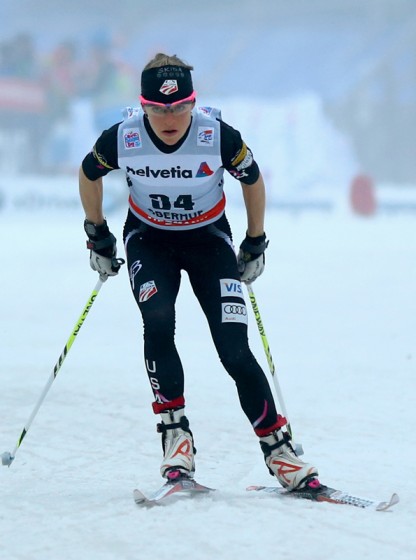
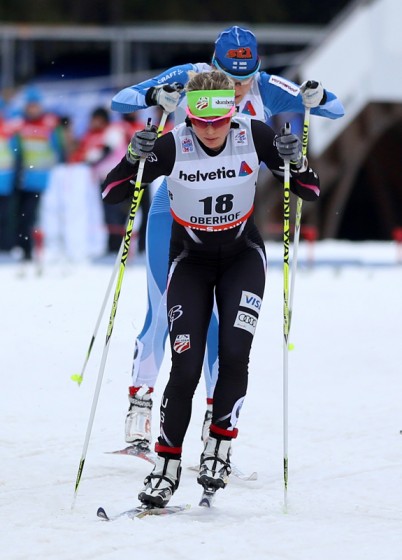
Sophie Caldwell (U.S. Ski Team) racing to an impressive fifth place in the sprint qualifier in the Tour De Ski. She ended her day in 22nd and is now ranked 13th in the overall rankings. (Photo: Marcel Hilger)
Sophie Caldwell (U.S. Ski Team) racing to an impressive fifth place in the sprint qualifier in the Tour De Ski. She ended her day in 22nd and is now ranked 13th in the overall rankings. (Photo: Marcel Hilger)
Holly Brooks (U.S. Ski Team) racing in Sunday’s freestyle sprint qualifier as part of the second stage of the Tour de Ski. (Photo: Marcel Hilger)
Astrid Jacobsen (NOR) in Sunday’s qualification round. (Photo: Marcel Hilger)
Norway’s Marit Bjørgen racing in the Sunday’s sprint qualifier. (Photo: Marcel Hilger)
Norway’s Marit Bjørgen racing in the Sunday’s sprint qualifier. (Photo: Marcel Hilger)
Liz Stephen (U.S. Ski Team) skis to an impressive 32nd place in the second stage of the Tour de Ski. (Photo: Marcel Hilger)
Liz Stephen (U.S. Ski Team) skis to an impressive 32nd place in the second stage of the Tour de Ski. (Photo: Marcel Hilger)
Jessie Diggins (U.S. Ski Team) racing in the quarterfinals of Sunday’s sprints. (Photo: Marcel Hilger)
Jessie Diggins (U.S. Ski Team) racing in the quarterfinals of Sunday’s sprints. (Photo: Marcel Hilger)
Sophie Caldwell (U.S. Ski Team) racing in the quarterfinals of the second stage of the Tour de Ski. (Photo: Marcel Hilger)
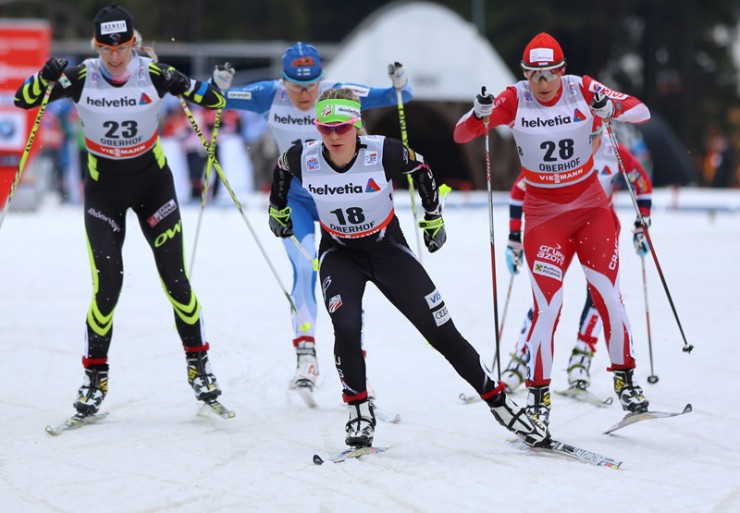
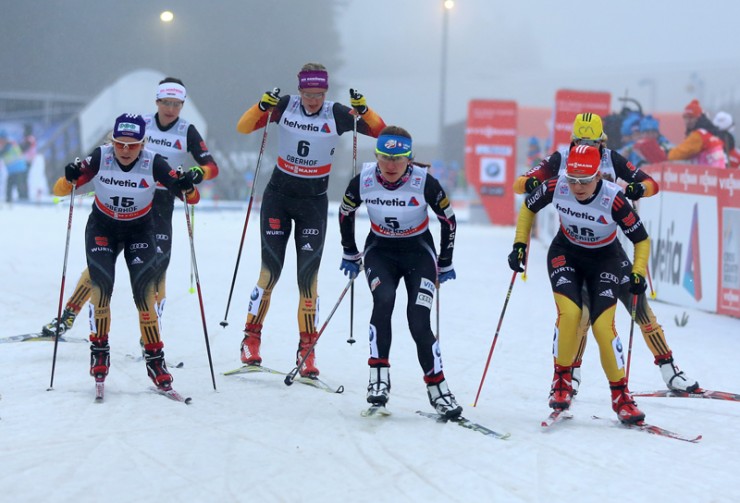
Sophie Caldwell leads five Germans early in her quarterfinal at the Tour de Ski 1.5 k freestyle sprint in Oberhof, Germany.
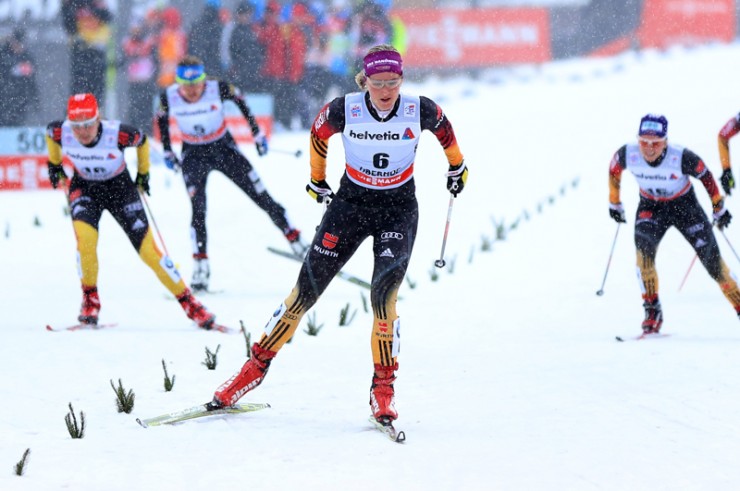
Denise Heramann (GER) wins her quarterfinal on Sunday. (Photo: Marcel Hilger)
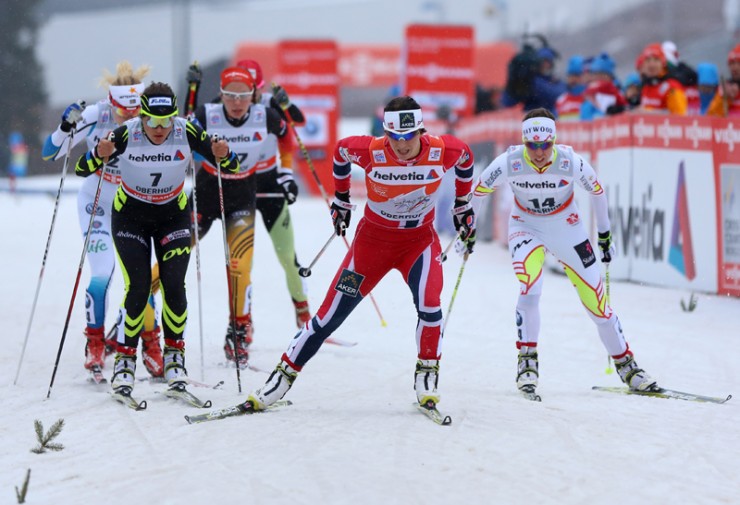
Marit Bjørgen (NOR) leads her quarterfinal in the second stage of the Tour de Ski. (Photo: Marcel Hilger)
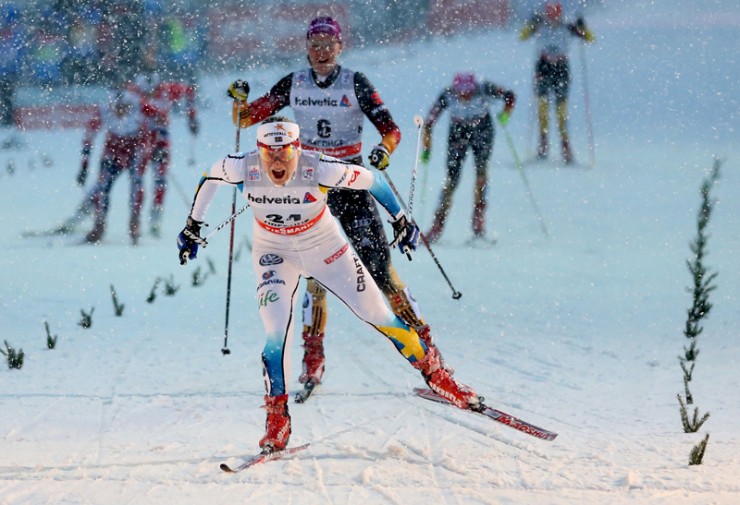
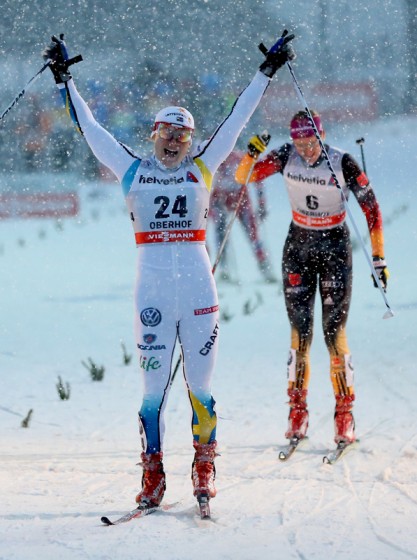
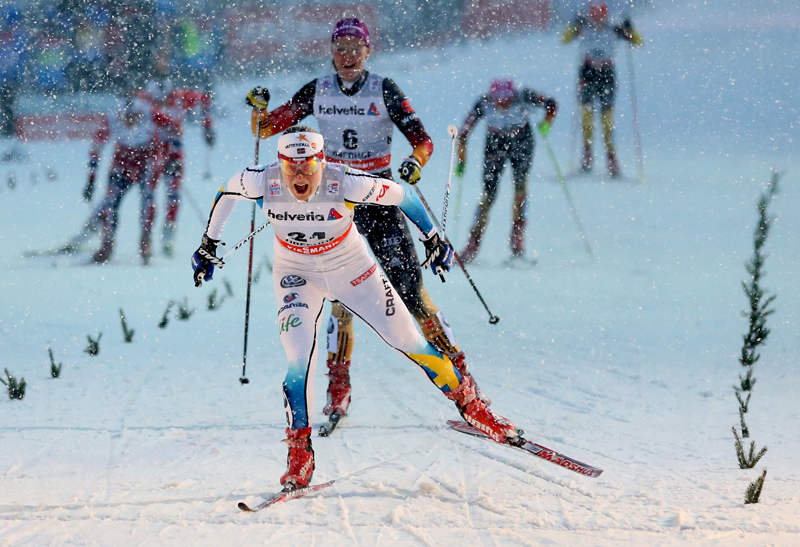
Hanna Erikson (SWE) out sprints Denise Hermann (GER) for the win in Sunday’s freestyle sprint. (Photo: Marcel Hilger)
Hanna Erikson (SWE) celebrates her win. (Photo: Marcel Hilger)
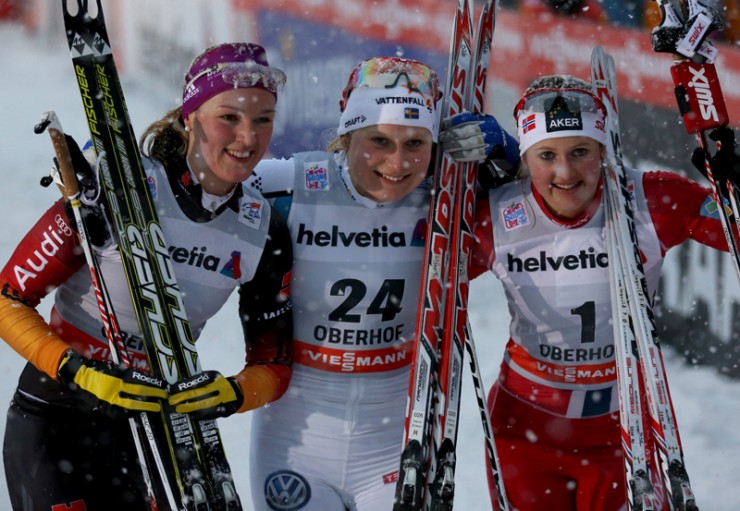
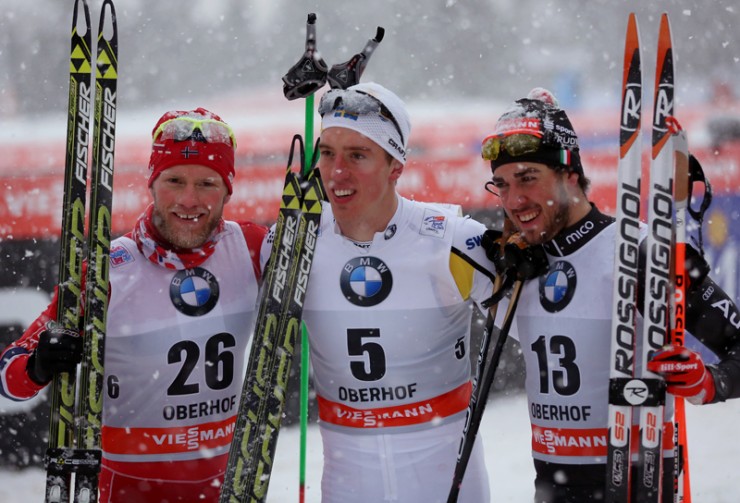
The women’s podium: Denise Hermann (GER), Hanna Erikson (SWE), and Ingvild Oestberg (NOR). (Photo: Marcel Hilger)
Swede Calle Halfvarsson en route to a fifth place finish in the men’s qualification. Halfvarsson finished the day in first. (Photo: Marcel Hilger)
Martin Sundby (NOR) qualified 26th in Sunday’s sprint. (Photo: Marcel Hilger)
Alexander Legkov is one of 22 Russian athletes appealing their disqualifications to the Court of Arbitration for Sport. (Photo: Marcel Hilger)
Petter Northug racing to sixth place in the freestyle sprint quarterfinal. (Photo: Marcel Hilger)
Canadian Alex Harvey racing to a first place finish in the freestyle sprint qualifier in the Tour de Ski. He finished the day in 11th and first in the overall Tour standings. (Photo: Marcel Hilger)
Alex Harvey catches his breath after qualifying in first place. (Photo: Marcel Hilger)
Alex Harvey celebrates his qualification win. (Photo: Marcel Hilger)
Andy Newell (U.S. Ski Team) qualified 12th and finished 10th overall in Sunday’s freestyle sprint. (Photo: Marcel Hilger)
Canadian Ivan Babikov in the qualification rounds. (Photo: Marcel Hilger)
Ivan Babikov in the qualification rounds. (Photo: Marcel Hilger)
Noah Hoffman (U.S. Ski Team) racing in the qualification rounds. (Photo: Marcel Hilger)
Russian Alexander Legkov racing in the heats in the second stage of the Tour de Ski. (Photo: Marcel Hilger)
Great Britain’s Andrew Musgrave, Switzerland’s Gianluca Cologna and Germany’s Jonas Dobler tangle in the quarterfinals of Sunday’s freestyle sprint. (Photo: Marcel Hilger)
Petter Northug (NOR) collapses after his heat in Sunday’s freestyle sprint. (Photo: Marcel Hilger)
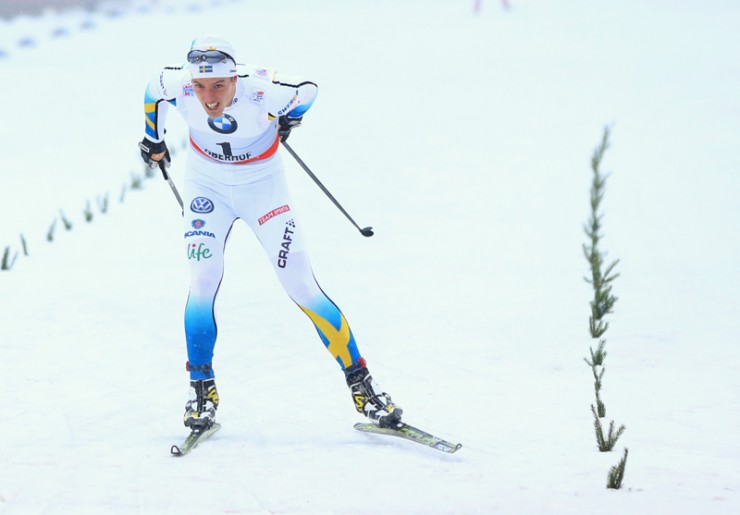
Calle Halfvarsson (SWE) finishing ahead of Martin Sundby in the freestyle sprint final. (Photo: Marcel Hilger)
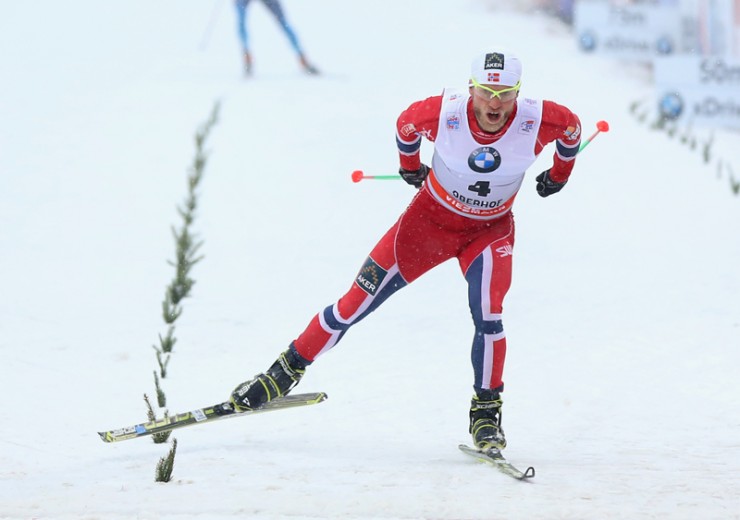
The men’s podium: Martin Sundby (NOR), Calle Halfvarsson (SWE), and Federico Pellegrino (ITA). (Photo: Marcel Hilger)
Hanna Erikson (SWE) out sprints Denise Hermann (GER) for the win in Sunday’s freestyle sprint. (Photo: Marcel Hilger)
Hanna Erikson won her first World Cup race on Sunday in impressive fashion, demonstrated both her strength and tactical acumen. The 23-year-old Swede honed her strategy early on in the day, perfecting the art of a strong, late challenge to finish line.
In the first of the women’s quarterfinal heats began with Norway’s Ingvild Flugstad Østberg firmly controlling her race from start to finish, after she won the qualifier by 0.27 seconds in 3:08.6. The second heat featured a similar performance from Norway’s Marit Bjørgen, though she was nearly caught at the line by Erikson, a strategy the Swede would use successfully in her last two heats.
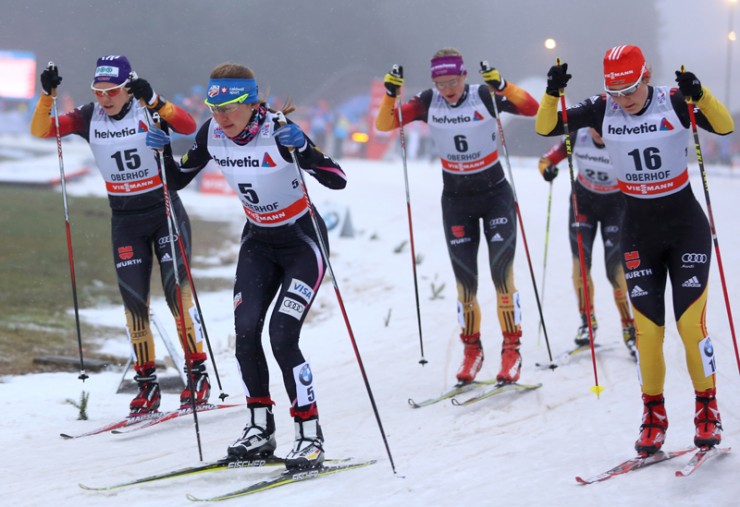
In the third quarterfinal, American Sophie Caldwell found herself on the start line with five Germans: Herrmann, Lucia Anger, Katrin Zeller, Sandra Ringwald, and Claudia Nystad. Caldwell took the lead out of the stadium and through the narrowing trail until a tight right hand corner caused her to slip back to fourth position. Herrmann then took the lead and led all the way to the finish.
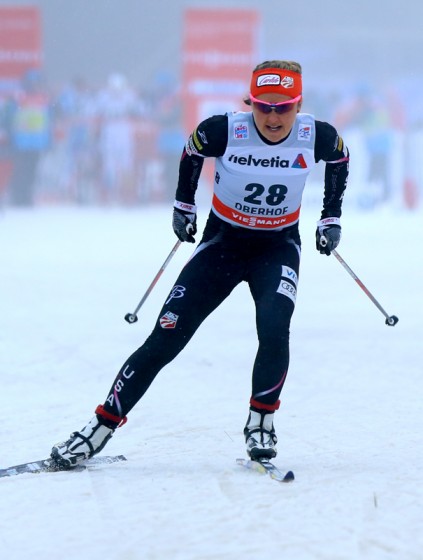
Sophie Cladwell (U.S. Ski Team) racing in the qualification rounds. She now sits in 13th in the overall Tour rankings. (Photo: Fisher/Nordic Focus)
Caldwell became a bit unbalanced on her skis as she made a bid to move up on the last climb and lost her position, finishing in fifth. Anger and Zeller finished second and third.
The fourth quarterfinal saw Finland’s Anne Kyllonen lead from the gun with Italy’s Gaia Vuerich and Germany’s Nicole Fessel close behind her, and Norway’s Astrid Jacobsen hanging on in fourth. That positioning remained unchanged until late in the heat when Vuerich attacked to take the lead, winning the group. The race between Fessel and Kyllonen was very close, with Fessel taking second over the Finn by a mere two-hundredths of a second.
In the fifth and final quarterfinal heat, American Jessie Diggins was the quickest off the starting line and she skied powerfully out of the stadium. At the start of the climb Diggins lead was challenged by France’s Aurore Jean. Diggins managed to hold off Jean’s attack on the first climb but on the slight decline between the first and second climbs, Jean overtook her. Diggins, skiing on the inside lane up the last hill, was cut off as the climb turned right, and she was forced to the back of the pack.
In the final meters, with a late-charging Alenka Cebasek of Slovenia moving past Jean, Jean caught the Slovenian’s ski, bringing them both down just before the finish line and handing the victory to Poland’s Sylwia Jaskowiec. Therese Johaug finished in second, Aino-Kaisa Saarinen in third, and Jessie Diggins in fourth.
The first women’s semifinal was dominated early on by the Norwegian duo of Østberg and Bjørgen, leading in that order. In the falling snow, Bjørgen took over the race and did her best to break up the pack with her climbing strength. Erikson would not be dropped, however, and she stayed right on Bjørgen’s skis. In the stadium, Erikson took the lead to easily outsprint Bjørgen for the win, demonstrating her powerful skiing in the challenging Oberhof snow.
The second semifinal heat was led by Hermann, with Vuerich right behind her until she broke a pole, forcing her to the back of the pack while she looked for a spare pole. Fessel made a move to the front of the race and led the climb with Herrmann behind her and Johaug creeping up on the inside track and Kyllonen looking for a way through. Coming into the stadium Hermann gained the lead back from Fessel to win the heat. Fessel was second and Johaug third.
Therese Johaug on her way to capturing gold in the 10 k freestyle individual start at 2013 World Championships in Val di Fiemme, Italy. (Photo: Fiemme2013)
The women’s final of Anger, Bjørgen, Herrmann, Fessel, Østberg, and Erikson began much like the first semifinal, with Østberg taking the lead and Erikson and Bjørgen in pursuit.
This time though, Erikson didn’t wait to make a move. As soon as the gradient increased, Erikson took the lead from Østberg and the race was on. Herrmann followed her attack on the inside lane, and on the final climb she found herself ahead of the Swede and leading the race into the stadium.
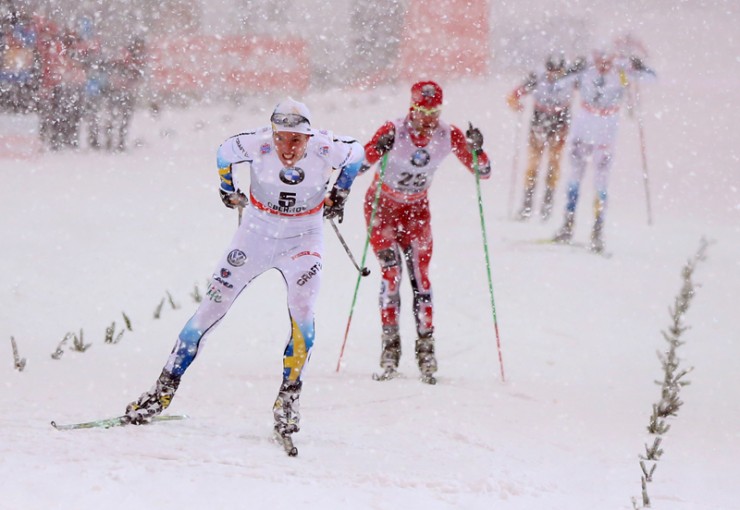
Herrmann faced falling snow being blown into her by a strong headwind, and Erikson closed in behind her, waiting for the last two hundred meters where she turned on an impressive show of strength to overpower Herrmann to win the second stage of the Tour de Ski by 0.79 seconds in 3:25.69.
Østberg was third (+4.32), Fessel fourth (+4.4), Bjørgen fifth (+4.8), and Anger sixth (+9.34).
It was Erikson’s first World Cup victory and she was pleased with how it turned out.
“It’s the first victory in my career,” she told FIS. “I felt better and better in each heat. I tried to ski tactically well, to control my position.”
Bjørgen held onto her overall and sprint leaders’ bibs.
“I’m happy about my performance today,” she told FIS. “In the final I did not ski so well; I fought for the third place but it did not work. It’s good I collected some bonus seconds but there are many left in the Tour.”
The Tour de Ski continues on Tuesday with another freestyle sprint in Lenzerheide, Switzerland.
Justyna Kowalczyk (POL) on her way to winning her fourth-straight Oberhof pursuit in the second stage of the Tour de Ski. Photo: Marcel Hilger.
It didn’t take long for the three-time defending Tour de Ski champion to remind everyone how dominant she can be. Starting the 9 k classic pursuit from the third position, nearly 15 seconds down to prologue winner Kikkan Randall (USA), Justyna Kowalczyk (POL) swallowed that deficit by just the third kilometer of the 10 k classic pursuit, eventually extending it to a 41.4-second winning margin over Therese Johaug (NOR). Anne Kyllönen (FIN) continued her impressive early season in third (+45.0) and Denise Hermann (GER) had a strong fourth-place performance (+48.5) in front of the German crowd.
Kowalczyk was happy to be back in the familiar leader’s bib. “It was good for me today,” she said. “My servicemen did a very good job today, my skis were fast and the kick was good. I also like the conditions here, when the track is a little bit soft.”
Her skis certainly seemed better than most of the field’s. Where others slipped and were forced into a herring-bone, Kowalczyk was more often able to maintain a diagonal stride. Her techs also hit the glide, as she was able to make up considerable time on the descents.
Kowalczyk pulling alongside Kalla in the first few kilometers. Photo: Marcel Hilger.
Kowalczyk has turned mass start events into battles for second several times this season, and after about seven minutes on the Oberhof course she seemed nearly guaranteed do so again. She bridged the gap on Charlotte Kalla (SWE), the starter in front of her, and then on Randall. The American held onto Kowalczyk’s tails for about a minute but by the time the leaders came through the stadium she was losing ground.
“I tried to make it hard for Kowalcyk to catch me, [and then] I tried to hang onto her a little bit but I just can’t seem to find that final gear in my classic skiing yet,” Randall said. She stayed with the main chasing pack for the next few kilometers but eventually lost contact, finishing fourteenth and 1:33 back.
As Kowalczyk skied strong off the front, for only a brief period did it look as though anyone would be able to catch her. Johaug, who started 32 seconds back in bib 13, remained within 18 seconds of Kowalczyk at 3.7 k, at which point the latter had already taken the lead. But by the next checkpoint at 6.7 k Kowalczyk had widened the gap to 35 seconds.
“It was pretty good at first, but I had a little too aggressive start,” Johaug told the NRK.
Therese Johaug leading the chase at the start of the 9 k pursuit. Photo: Marcel Hilger.
The Norwegian women’s best hope to win the Tour made her attempt at catching Kowalczyk alone, and when the chasing group behind her caught back up the leader was out of anyone’s reach. From there Johaug battled in a pack of about ten skiers, including Kyllönen, Hermann, Kristin Stoermer Steira (NOR), Astrid Jacobsen (NOR), and three other Finns.
Johaug successfully held them at bay to move into second in the Tour, and she isn’t counting herself out of the running for the overall just yet. With the time bonuses Johaug is 46.4 seconds down to Kowalczyk headed into the third stage, a sprint in Switzerland, where Kowalczyk is likely to struggle.
“[Kowalczyk] has got a good head start, but now I managed to take second place and got ten bonus points. Now [there is] the sprint, and it is perhaps advantageous that Kowalczyk starts alone in the lead on the next pursuit, so we can chase behind,” Johaug said.
Perhaps Johaug does stand a better chance trying to hunt Kowalczyk down in the next distance race, but on the other hand Kowalczyk is pretty comfortable skiing alone at the front.
“I’m not surprised at all [at the winning margin],” Kowalczyk told the NRK.
The Tour de Ski field and its associated crews travel to Val Müstair, Switzerland, today for the third stage sprint on January 1. Kowalczyk plans to do light training at the venue on the rest day in between and knows that the sprint will be a challenge for her.
“The sprint will be difficult for me especially in the skate technique,” she said. “I will try to not lose too much time.”
Of Note:
— The Finns placed five in the top ten and six of its seven-woman team in the top thirteen.
— Kowalczyk has now won the Oberhof pursuit four times; each time she won this race in the past she went on to win the overall Tour.
— Tour de Ski wins are worth 50 World Cup points, half of what regular-season victories count for. Kowalczyk now has 608 points at the top of the overall World Cup standings; Randall is in second with 550 points.