From the FasterSkier archive — posts syndicated from athletes’ and coaches’ own blogs between 2004 and 2012, kept online as published. Current coverage is at fasterskier.com.
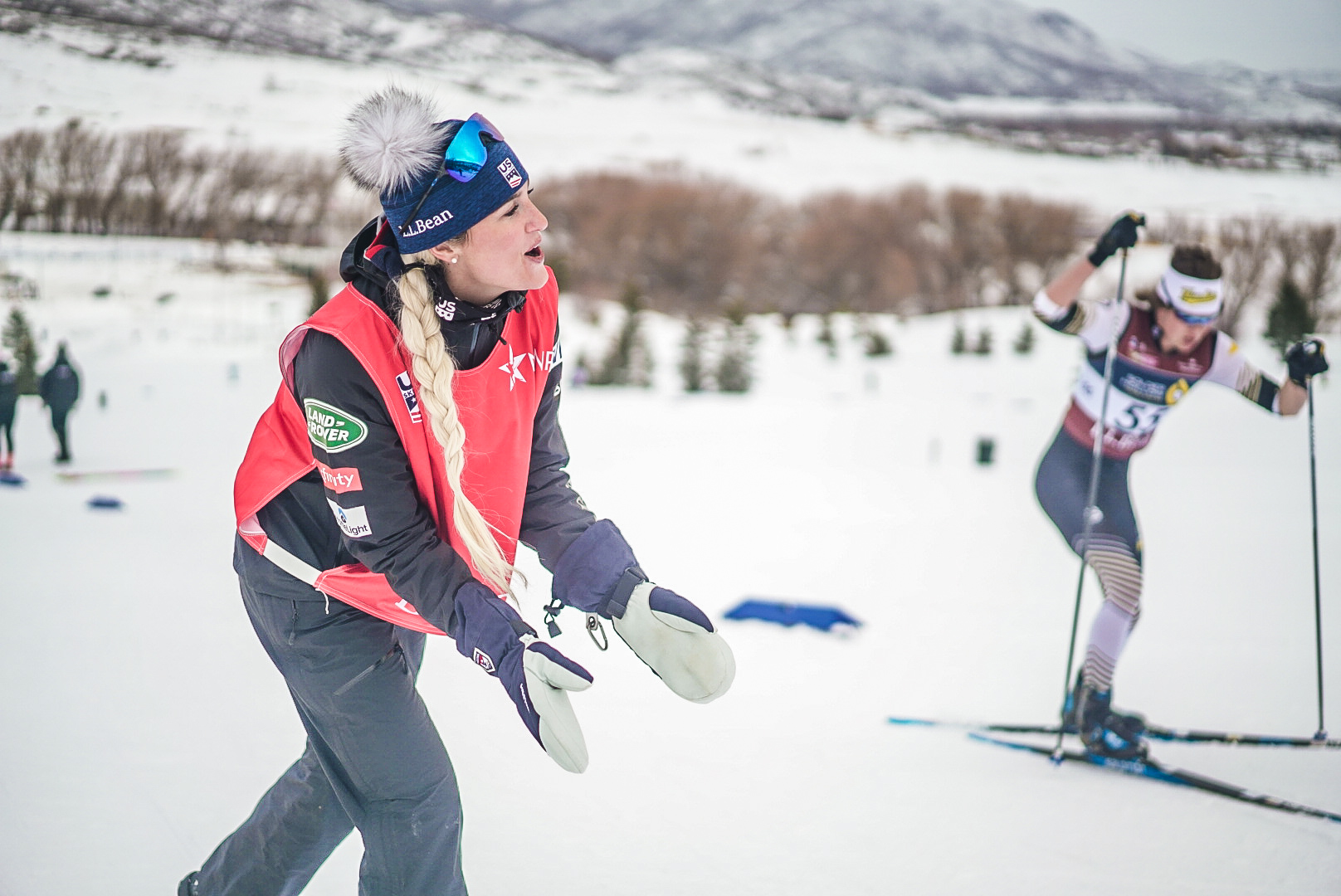
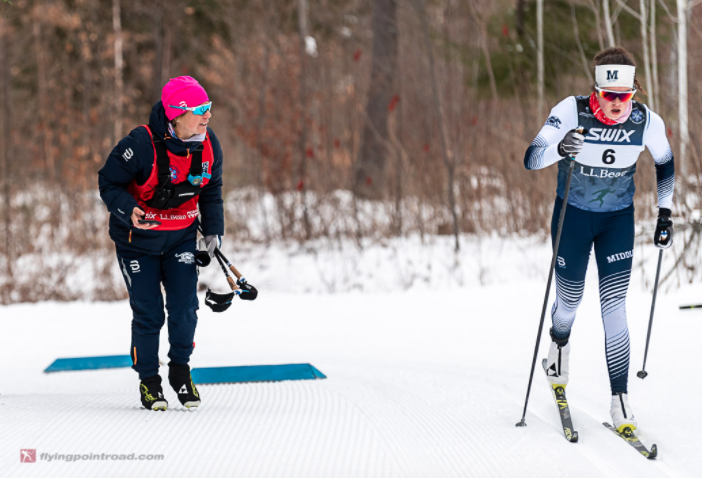
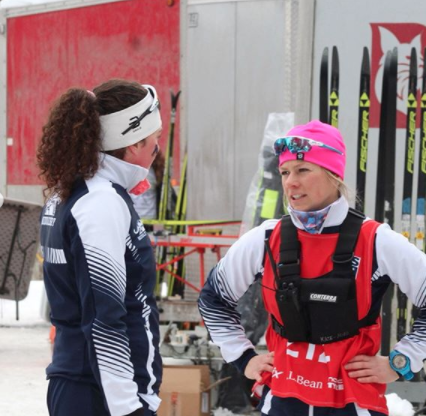
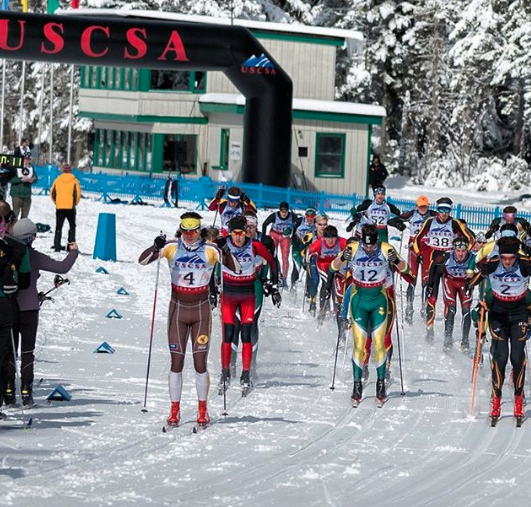
U.S. Ski and Snowboard Development Team Coach Greta Anderson encourages athletes racing the men’s 30k distance race during the 2022 U.S. Cross Country Championships in Soldier Hollow. (Photo: Tobias Albrigtsen / @untraceableg)
Last June, U.S. Ski & Snowboard announced the hiring of Greta Anderson as Development Team Coach, supporting Cross Country Program Manager Bryan Fish in “all aspects of leadership and logistics surrounding the U.S. Development Pathway, including National Training Group camps, U.S. Nationals and Junior/U23 World Championships, Europa Cup, select SuperTour and other national-level competitions, as well as working on Coaches’ Education and Certification.” (Read an in-depth interview with Anderson following the announcement here.)
As she described it, joining the U.S. Ski Team staff during an Olympic year while the COVID-19 pandemic raged on was a bit of “trial by fire.” Nonetheless, Anderson thrived in her new role, approaching the position with humility and open-mindedness as she learned the ropes. With a holistic view of athlete development, which emphasizes the importance of creating an environment where the athlete can be both happy and supported, Anderson had the opportunity to support athletes from the U16 to U23 level across the spectrum of international and domestic clubs and races. She played key roles during the 2022 FIS Junior/U23 World Ski Championships in Lygna, Norway, and had her first experience as the primary trip leader during the Opa Cup Finals pre-camp and competitions in Sappada, Italy.
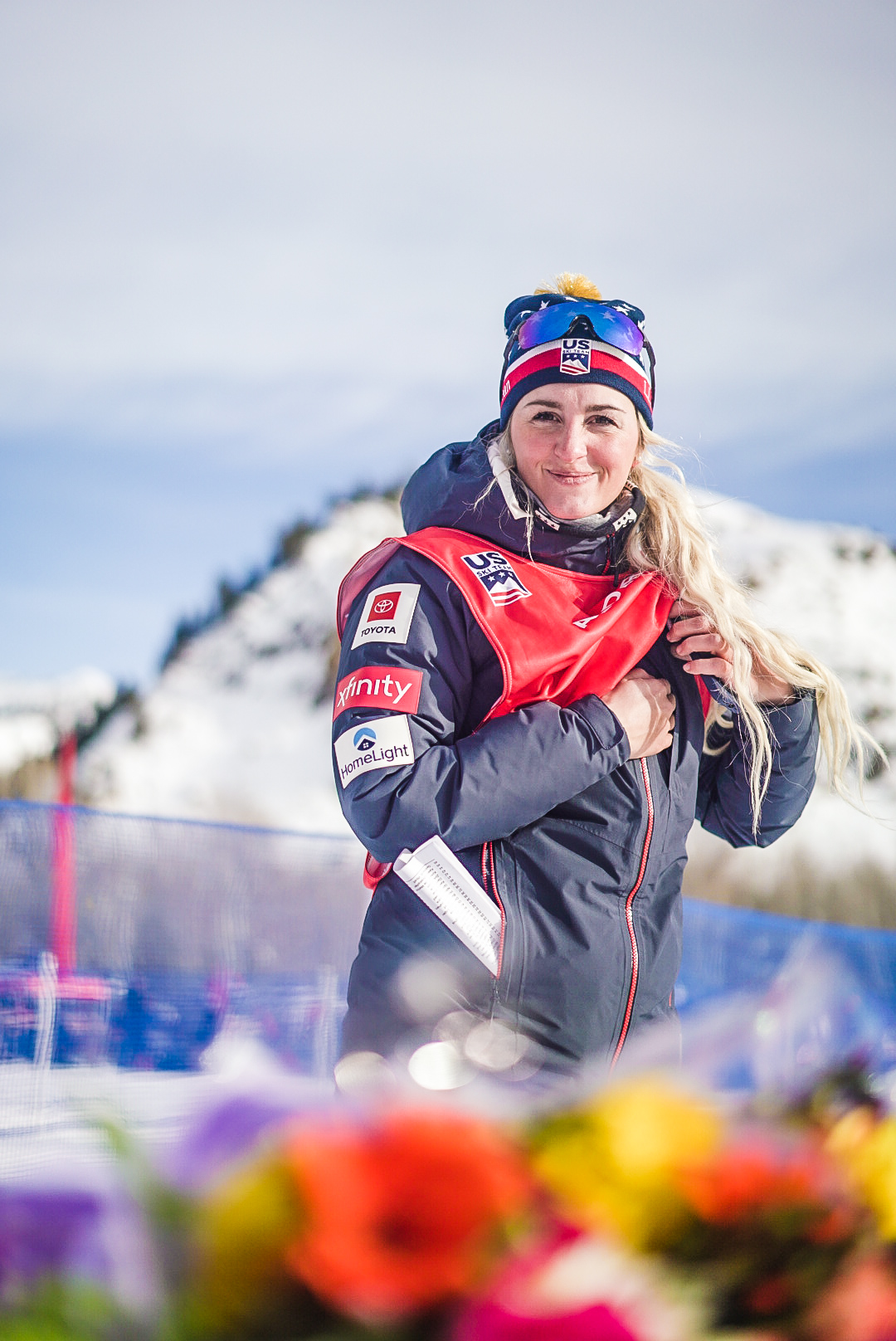
U.S. Ski Team development coach Greta Anderson discusses the highlights and challenges of her first year in the role, as well as insights into the philosophy, projects, and initiatives of the national team development program more broadly. (Photo: Tobias Albrigtsen / @untraceableg)
In this conversation, you’ll hear more about Anderson’s contributions to the development program thus far, and she shares insights into the philosophy, projects, and initiatives the U.S. Ski & Snowboard staff are working on to continue the growth and support of athletes ascending the pathways from junior to senior racing. We also discuss standout performances of the World U23/Junior Championships, and some of the athletes who have been recently named to the 2022-23 U.S. Cross Country Team.
Thanks for listening, and thanks to Boulder Nordic Sport for supporting this podcast.
Note: One of the athletes whom Anderson discusses is Finn O’Connell, who skis for the Bridger Ski Foundation Pro Team in Bozeman, MT. While he was supported by development team coaches at the Opa Cup Finals, his nomination was to the B-Team, not the D-Team.
Anyone who has had the pleasure of interacting with Katharine Ogden, also commonly known as KO, can tell you that she is humorous, kind, and thoughtful – both in regard to others as well as in her own self-introspection. She is also a wicked good skier, proving herself both nationally and internationally in competition. Ogden recently shared that she was stepping away from professional skiing, having already experienced a range of career ups and downs at her relatively young age of twenty-four.
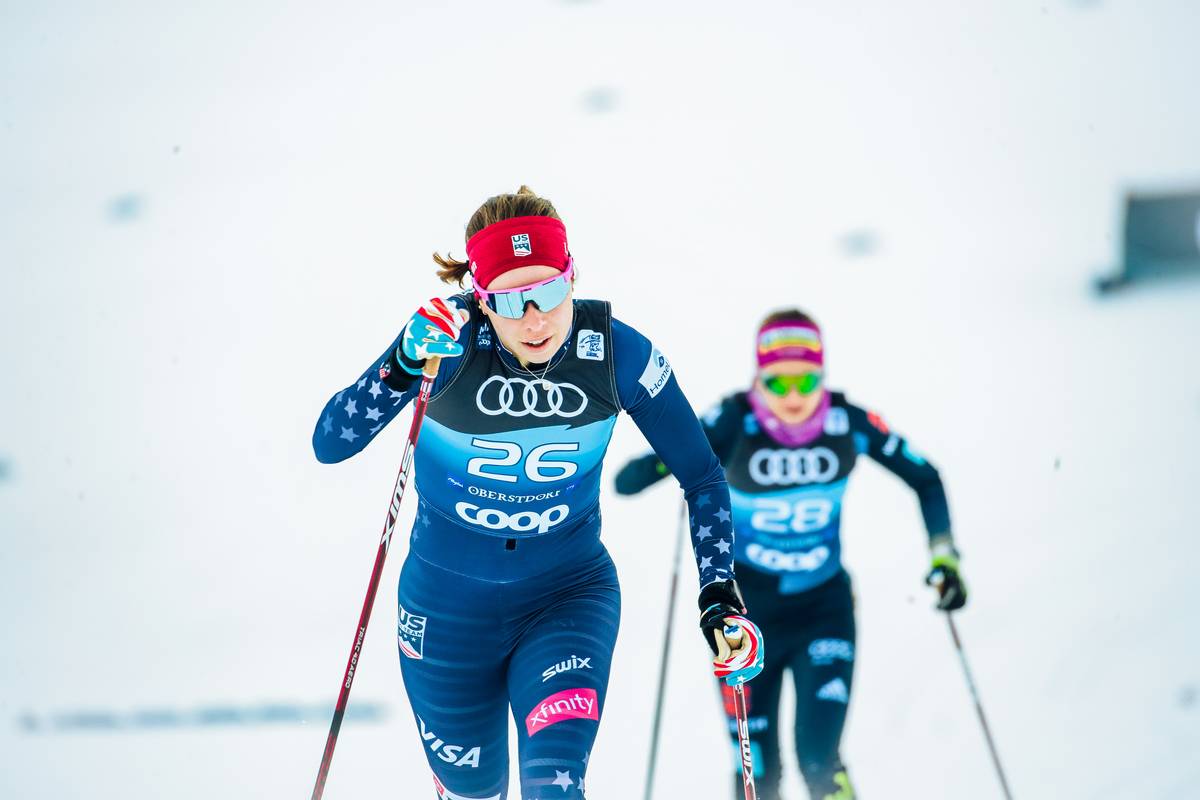
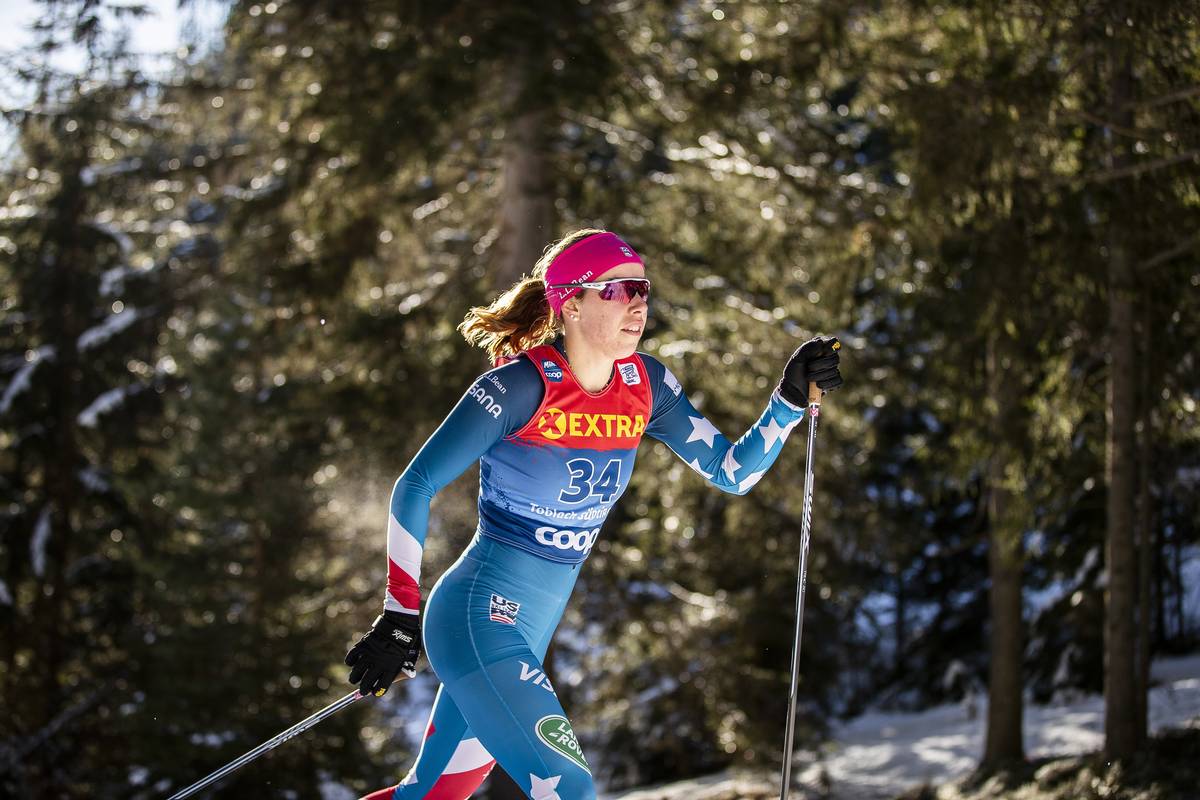
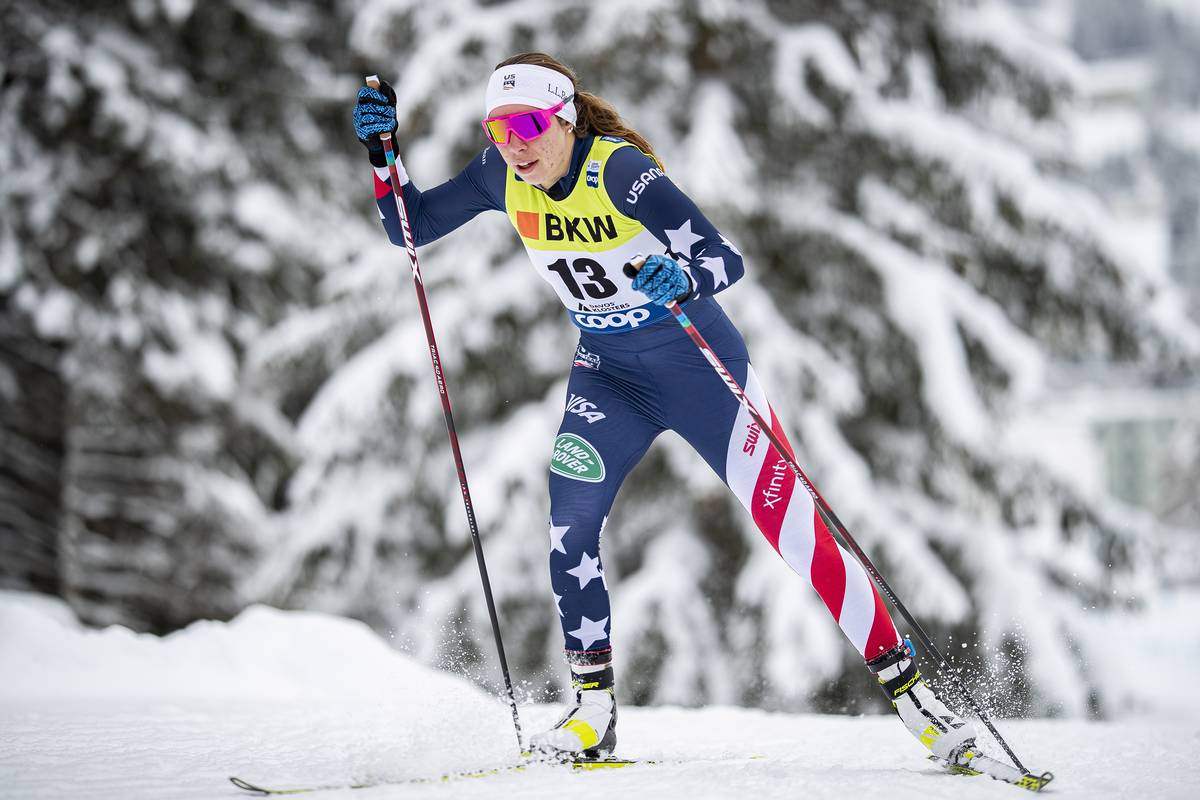
Katharine Ogden races the classic sprint during the 2021/22 Tour de Ski in Oberstdorf, Germany. (Photo: NordicFocus)
I had the privilege of overlapping with Ogden for two years as teammates on the Dartmouth Women’s Ski Team, during which time I was undergoing my own personal, though distinctly less significant, reckoning with ski racing. Thus, when Ogden announced her retirement at the end of last month, I asked to be the one to write this piece, hoping to do justice to the story of a career that is as important in its low moments as it is at its heights. Ogden herself wrote an eloquently expressed reflection of her career on the SMS T2 blog which can – and should – be read here.
Ogden began skiing at the tender age of two, after her family moved from Seattle to Vermont. Shortly thereafter her brother Ben was born and as Ogden explained it, “I was now living in Vermont, no longer an only child, and so I spent a lot of time with my dad, while my mom was having, you know, the baby. And my dad, once we moved back to Vermont, kind of re-engaged with the Nordic ski community and started coaching the local ski program.” Ogden’s father, John, has long been an active member in the Eastern ski community, most recently through his work with the timing company, Bullitt Timing, which he runs with a colleague. “Pretty much since I can remember, my dad has been coaching for [West River Sports] my childhood club, and bringing me to practices and he would also go to the local races and bring me along,” said Ogden.
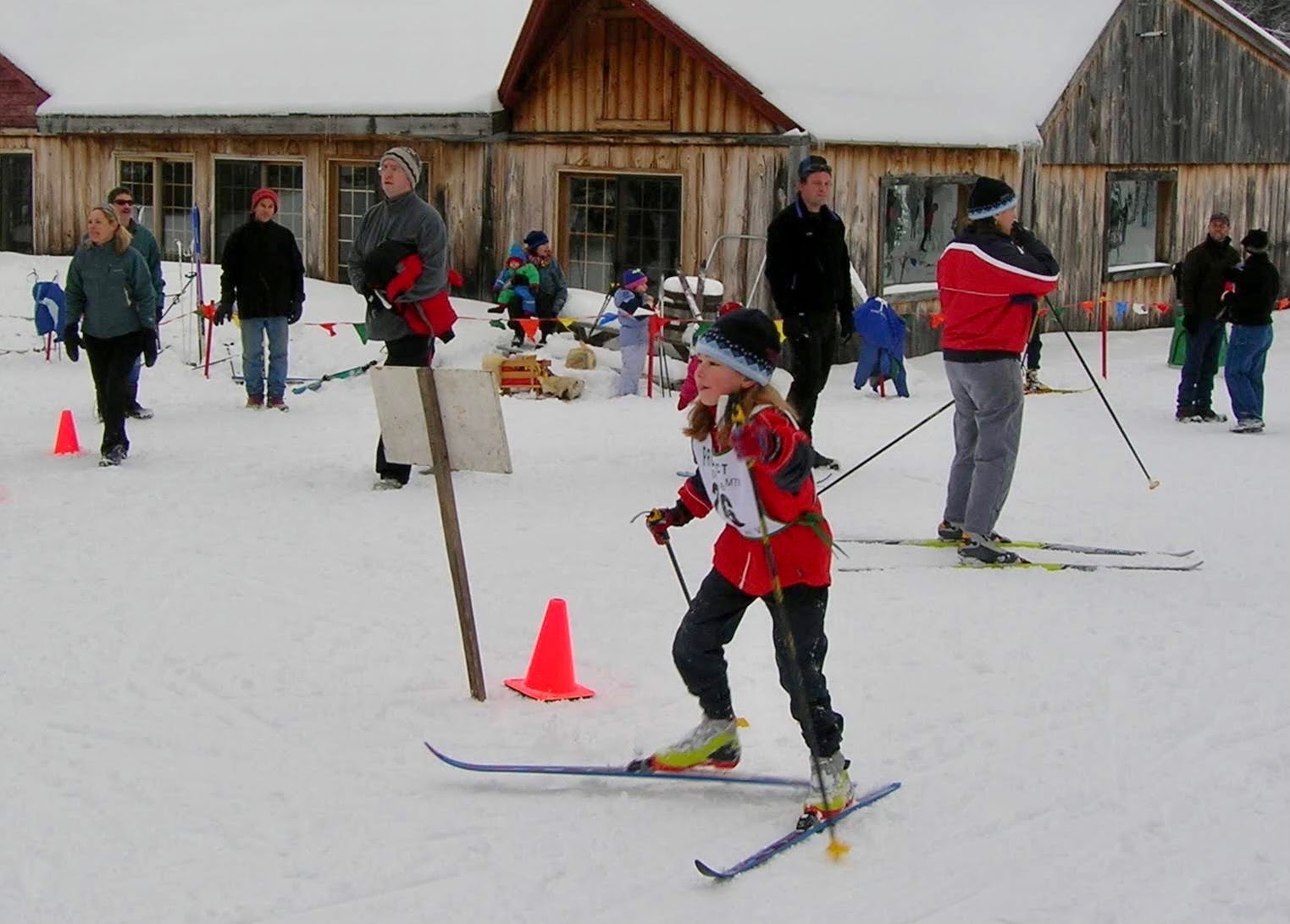
A young KO takes to the race course. (Courtesy photo)
These early memories of ski racing instilled a strong sense of ski community within Ogden and given the high level of participation in Nordic skiing among her elementary school peers, Ogden explained that this was a big reason why she stuck with ski racing. “And, of course, my dad coaching the team,” she added, “Definitely he encouraged us to do it.” Racing with her best friends throughout elementary school and middle school, while participating in events like the Bill Koch Festival, played a big part in growing Ogden’s love for the sport.
Entering high school, Ogden attended Stratton Mountain School in southern Vermont, the well-known private school which, according to its website, “provides a unique environment that offers each student the opportunity to pursue excellence in competitive winter sports and college preparatory academics.” Around the same time, Ogden was earning her first international starts, as she participated in the U18 Scandinavian Cup trips in 2013 and 2014. “That was kind of a cool progression up to World Juniors,” shared Ogden, “I think it’s very important, and honestly sometimes underrated in my opinion, to build up your international experience in that way.”
For at least one, if not both of the years, Ogden had also qualified for World Juniors but she explained that her coaches encouraged her to choose the U18 trip instead. “Sometimes there are really young kids who got to World Juniors and I think that it’s a bit of a missed opportunity, because those U18 team trips are still a really high level of competition,” Ogden said, “And a good way to be like with people your own age, which really improves the experience.”
Katharine Ogden (SMS) competing at U.S. Nationals in 2013 representing Stratton Mountain School. (Photo: Bert Boyer)
After having built some international racing experience, Ogden attended her first FIS World Junior Ski Championship in Almaty, Kazakhstan in 2015. “At that point, I had made a lot of good friends in the ski world,” shared Ogden, “I knew Julia Kern and Hailey Swirbul really well, so that was a blessing for me to have people that I knew and cared about and relied on in that type of situation being there for support. [It] makes the whole experience a lot more enjoyable and it takes a little bit of the pressure off to just be able to treat it as a fun trip.”
This approach seemed to pay off as Ogden placed 11th and 6th in the individual races, besting some familiar names such as this year’s Tour de Ski winner, Natalia Neprayeava. “[It] was fun to go to a crazy country that I wouldn’t normally go to and be able to experience that, while also getting to focus on some higher level racing,” explained Ogden. Her second World Juniors appearance came in Rasnov, Romania the following year where she placed 13th in both individual races.
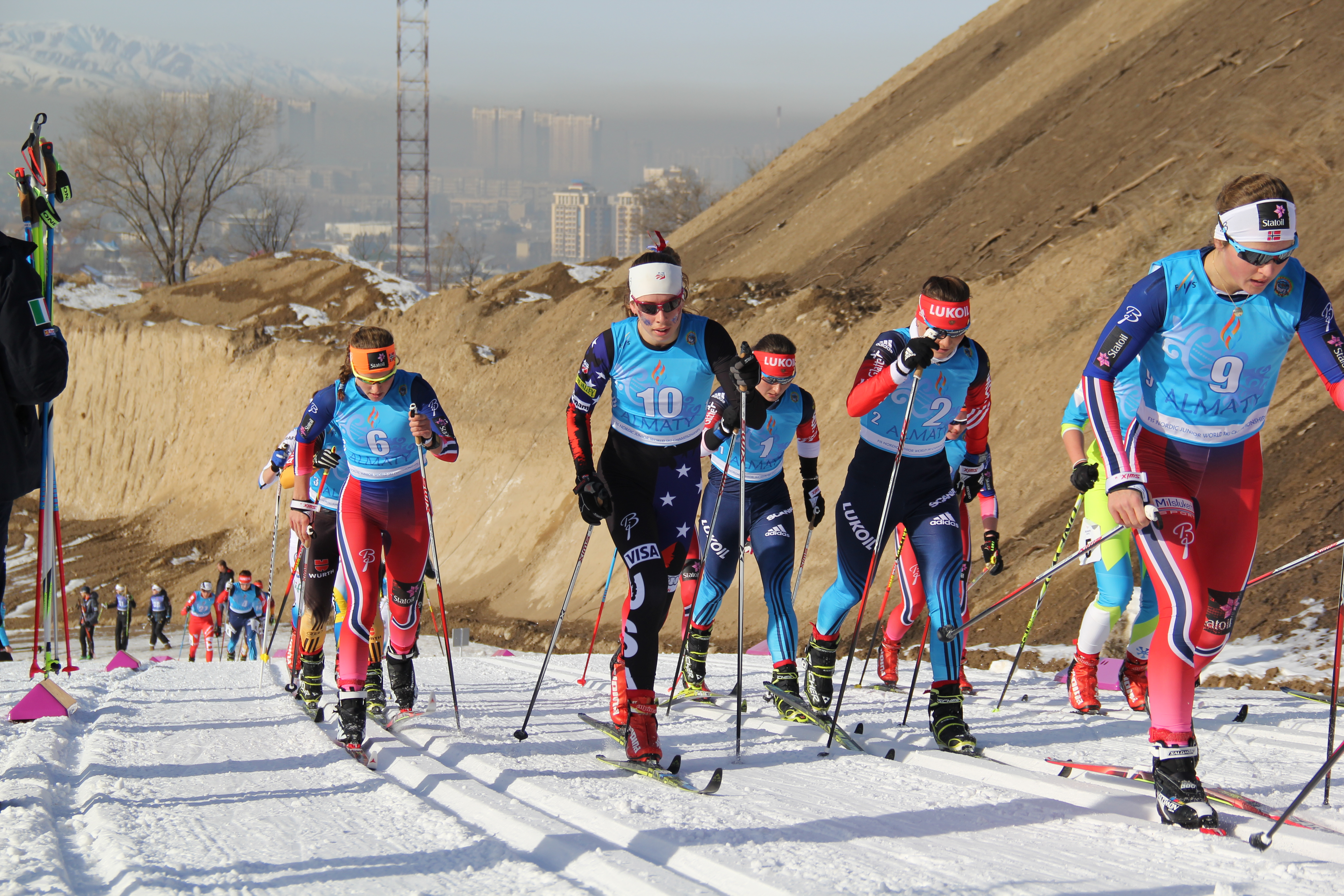
Katharine Ogden (10) on her way to a sixth-place finish in the women’s 10 k skiathlon at the 2015 Junior World Championships in Almaty, Kazakhstan. (Photo: Bryan Fish/USSA)
In June of 2016, Ogden graduated from Stratton, and having applied to college but deferred her acceptance to Middlebury College – her father’s alma mater – she embarked on a gap year. Remaining at SMS, she began training more with the pro team (SMS T2) and focusing a little more seriously on ski racing. “That was definitely an interesting experience for me, it was a pretty mentally difficult year,” said Ogden, “it felt like a convergence of a lot of things in my life that were difficult for me to emotionally handle.”
For one, the 2017 World Junior Championships would be held at Soldier Hollow in the US, an exciting prospect that simultaneously created pressure to perform for the American young athletes who would be in attendance. “There was a lot of hype about it being in the US, which was cool, don’t get me wrong, but I felt that – not by anyone else’s fault other than mine – but that I was putting a lot of pressure on myself because of that.”
Self-aware and reflective, Ogden was open about the difficulty of this time, “Because I’d had previous success at the other two World Juniors that I went to, it kind of felt like it was a lot of pressure on me for those races. On top of that, I didn’t have school to focus on anymore, so I was really not doing much other than skiing, which is not something I would recommend to anyone, even if you’re a professional skier.” Ogden stressed the importance of having something else to balance your attention, “whether it’s a job or school, or even just working on your self-marketing or whatever – something that takes some brain power that is not just directly related to training.”
Katharine Ogden racing in her first World Cup events during the Tour de Canada in 2016, pictured here in the women’s 15 k skiathlon in Camore, Alberta. (Photo: Fischer/NordicFocus)
In addition to these pressures, Ogden’s father, who earlier had been diagnosed with cancer, was in worsening condition. “So that was also kind of weighing on me,” explained Ogden, “all of those things culminated into me not having a good time.” She shared that she has struggled with anxiety since she was young, but in 2017 it morphed into something that became unmanageable at times. (Read Ogden’s January 2020 narrative on her experience with severe anxiety here.)
“I couldn’t functionally live with it anymore,” said Ogden, “So at that point, I was really struggling to eat because the manifestation of my anxiety disorder was that it really caused me to have a lot of gastrointestinal distress and a really upset stomach, so it was difficult for me to fuel myself enough to train and I didn’t have a lot of energy, partly from not eating and partly from just being stressed all the time.”
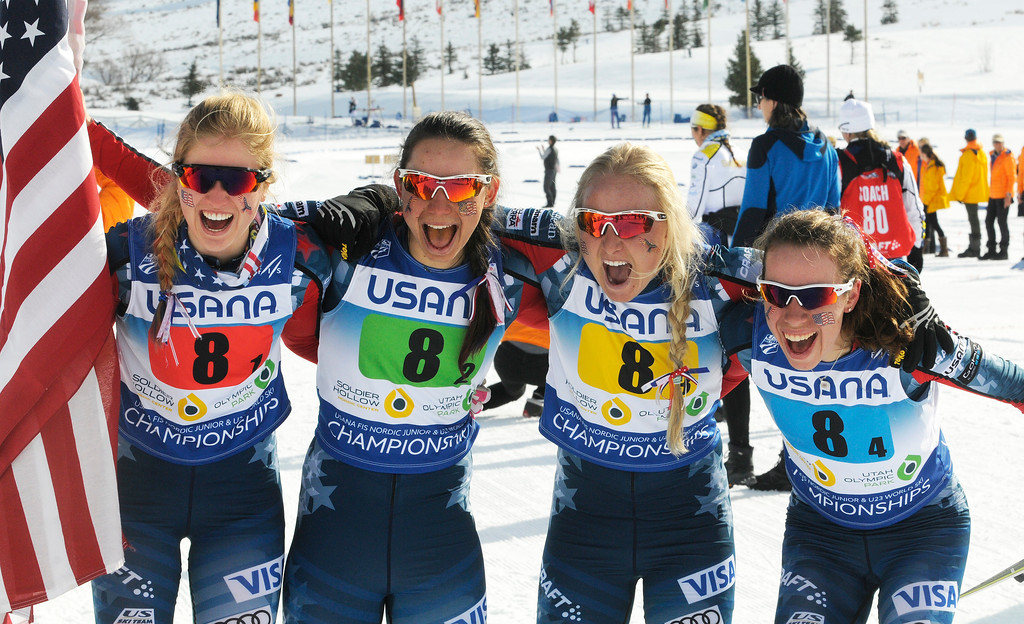
The U.S. women’s relay after taking a historic third in the 4 x 3.3 k relay at 2017 Junior World Championships on Sunday at Soldier Hollow in Midway Utah, with (from left to right) Hailey Swirbul, Julia Kern, Hannah Halvorsen, and Katharine Ogden. (Photo: U.S. Ski Team/Tom Kelly)
Reflecting on this achievement, Ogden shared, “Because I haven’t really had a ton of podium results since then, on an international scale, that is something that my ski career often gets boiled down to. It’s really bittersweet for me because it was a really incredible achievement, especially the relay day, when I was able to work with three of my best friends to accomplish something pretty cool. I still have a lot of pride and such about that experience, but on the other hand, it’s really hard for me to remember that without remembering how awful I was feeling, and how that was really honestly one of the hardest parts of my life to date.”
Returning home to Vermont in early February, Ogden started just one other ski race that season, “I think I did one random Eastern Cup ski race that I ended up actually dropping out of,” she explained. “[After] that race I didn’t put on my skis or anything… I did not go for a ski or a run or do anything for the rest of that year, basically up until May.” At this point, Ogden thought her ski racing career might be over. However, the idea of collegiate skiing started to bring her back around.
Rewind to early December 2016, before World Juniors, and Ogden and the SMS team were in Silver Star, BC for the season-opening Nor-Am events. “My dad was on that trip, because he was helping SMS with some waxing and logistics, and we talked about how I wasn’t very happy, how I wasn’t feeling well, and I was struggling to want to ski and ski race,” said Ogden. While she had accepted a spot at Middlebury, she explained that “no part of me really thought I would go to college.” Examining this feeling, she reflected, “I think part of SMS is that, it’s an interesting environment where sort of everyone’s expected to got to college, but on the other hand, the people who are having a lot of success in their respective sport are almost really expected not to go to college.”
Referring to the infamous US Ski Team “pipeline” and expectations for members of the national team at that time, Ogden said, “I honestly didn’t think a ton about going to college. From pretty early in my high school experience I was like, ‘I’m not gonna do that, I’m gonna be like Liz [Stephen] and Kikkan [Randall] and Andy [Newell],’ and I have so much respect for their ability to focus on skiing that much,” she added, “Like Jessie [Diggins], those people who are really emotionally and mentally healthy and ready enough to be able to accomplish what they did in the ski racing world, without distractions, it’s amazing to me.”
Katharine Ogden, of the Stratton Mountain School and U.S. Ski Team D-team, in the women’s 20 k classic at 2017 U.S. nationals at Soldier Hollow in Midway, Utah. She finished second among the senior women. (Photo: U.S. Ski Team)
As the race season was about to get underway, Ogden was reexamining her priorities. Among the many skiers and teams present for these Nor-Am races was the Dartmouth Women’s Ski Team (DWST), who were wrapping up their annual Thanksgiving camp at Silver Star. “I was kind of watching the Dartmouth team from afar,” said Ogden, “they were always smiling, and they were nor-pining (alpine skiing on nordic skis), and they were going on long skis together. And something about seeing that, I was like, ‘That seems like something I want.’”
Recognizing this, though still not ready to fully commit, Ogden met with long-time Dartmouth coach Cami Thompson-Graves. Like many of the US Ski Team athletes, both alpine and nordic, who chose to attend Dartmouth, Ogden was drawn to the flexibility of the Dartmouth “D-plan”, and thought that perhaps she would take classes in the spring but continue ski racing full time in the winter. Breaking some rules with Middlebury, to whom she had already committed attendance, Ogden applied to Dartmouth that winter. When her acceptance letter arrived in the spring following World Juniors, she talked to Thompson-Graves again. “I was like, ‘I don’t really know what’s going to be the case by the time September comes around. I want to try to ski, but I’m going to ski for Dartmouth, I’m not going to ski for SMS or the national team.’”
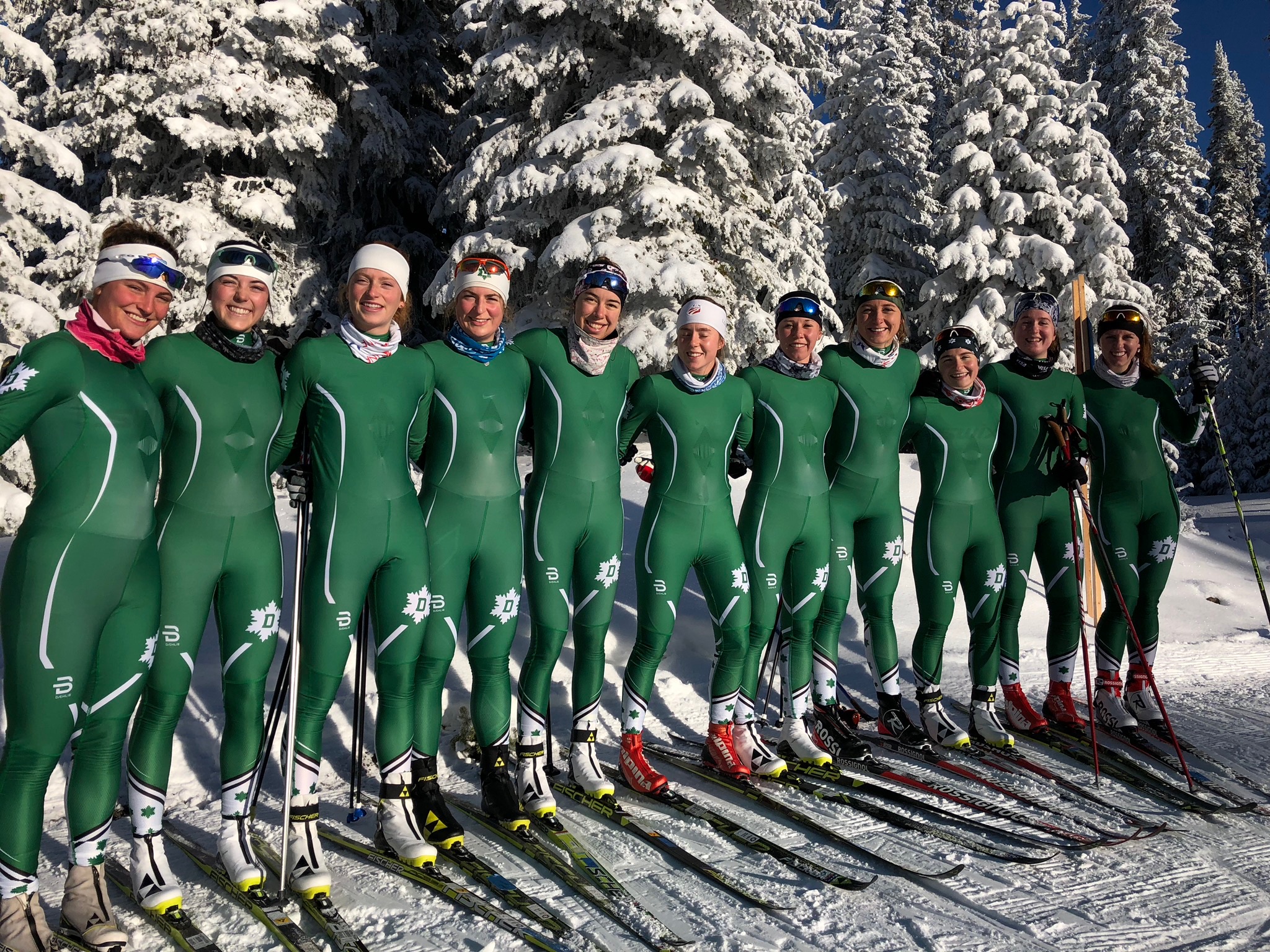
Katharine Ogden (fifth from left) with the 2017/18 Dartmouth Women’s Ski Team training in Silver Star BC. (Photo: DWST)
With this new plan in place, Ogden started to re-engage with training and the ski world. “That summer, I was back to training with Stratton some. I also worked at a preschool that summer, which I loved. I generally went on a bit of an upward trend,” she said. When fall rolled around, she showed up in Hanover unsure of what to expect. “When I got to Dartmouth, it was honestly life changing,” she said, “The team was incredible, full of inspiring and interesting and passionate women, people who were passionate about ski racing, yeah, but also a million other things, which was not something I’d really been exposed to. Stratton Mountain School is incredible in a ton of ways, and was instrumental in facilitating my ski career and getting me to where I got to, but that being said, there’s not a lot of diversity of opportunity there. Because it really is, as advertised, very focused on skiing and ski success.”
Ogden explained that arriving at Dartmouth opened her eyes to the many possibilities that existed beyond the realm of ski racing. “When I got to Dartmouth, it was kind of the first time I’d been able to be like, holy cow, there’s so much else out there that I could be passionate about, not just skiing.” She detailed how the team of women her freshman year displayed the many ways in which one could be both an amazing ski racer and also completely invested in an opposite pursuit. “Lydia [Blanchet] for example, to be so excited about skiing and so talented as a ski racer, but then also sometimes, she would prioritize whitewater kayaking. Or, Taryn [Hunt-Smith] who was casually one of the best skiers on the team but also getting citations in every class and being pre-med… I think that was really eye opening to me.”
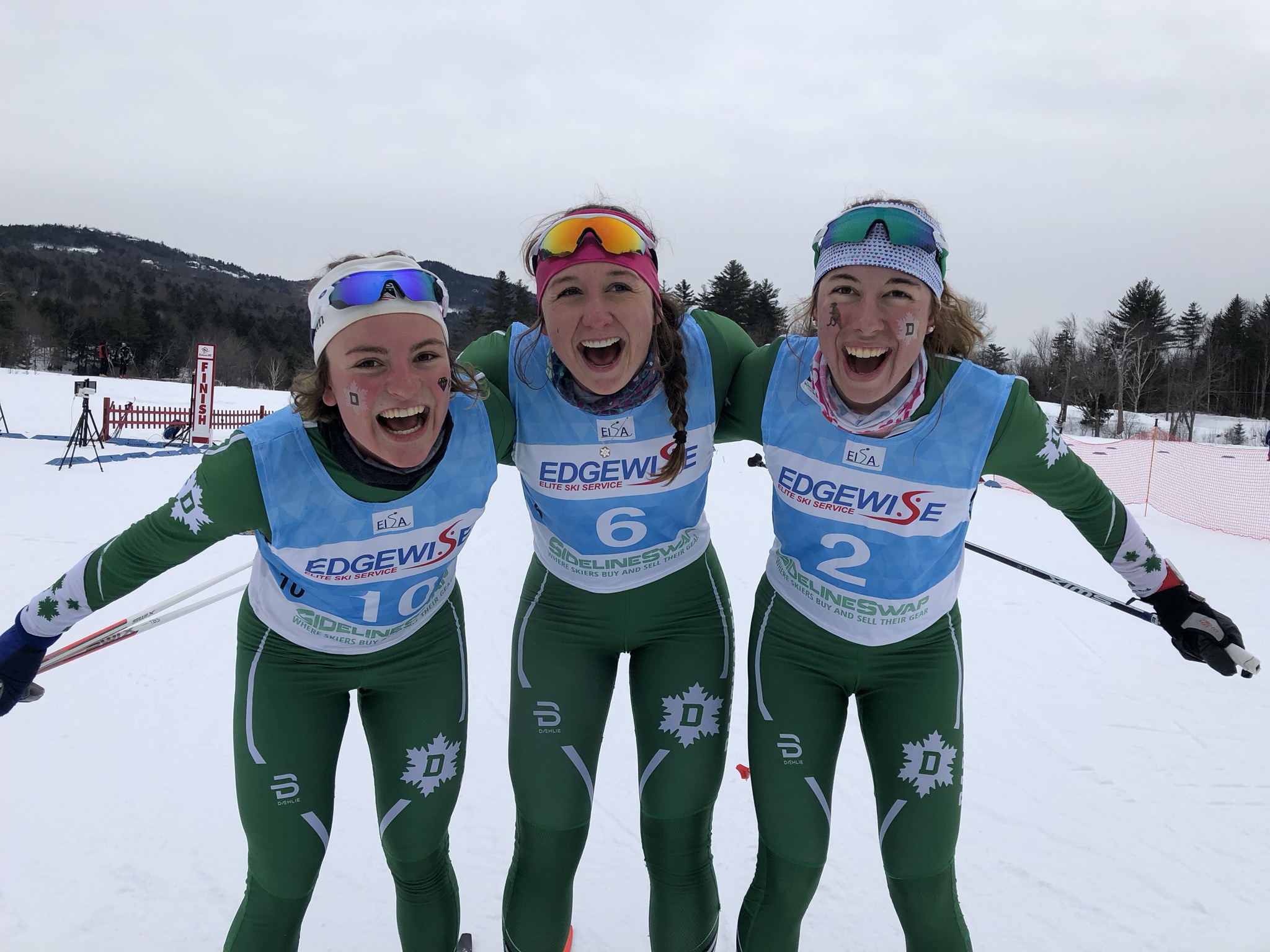
Lydia Blanchet, Taryn Hunt-Smith, and Katharine Ogden (l-r) of the Dartmouth Women’s Ski Team celebrate post-race. (Photo: DWST)
With these role models and examples, Ogden allowed herself to pursue other things outside of skiing. She also devoted herself wholeheartedly to the team and racing collegiately and didn’t compete in any international races for those first two years of school. “My freshman year that was kind of on purpose,” she explained, “I just needed a break, and I just wanted to focus on college skiing.” In November of the following year, as she was warming up to the idea of returning to international racing, Ogden broke her hand. “I was like, man, I don’t need to do that, I’ll just ease into the season and get my hand healed. But in the process of not going to the U23 [Championships], I also got booted off the national team, because I didn’t do any international racing for two years at this point.”
This turned out to be a blessing in disguise for Ogden. “I think in the moment I was sad about it, I had been on the development team for three years at that point, and I was a little bummed to lose that,” she shard, “But also, I wasn’t as sad about it as I expected to be and that next season, when I wasn’t on the national team, it was like a huge sigh of relief, if anything, because I felt a lot less pressure to perform.”
Dartmouth Women’s Ski Team freshmen Sofia Shomento, Katharine Ogden and Maddie Donovan (l-r) happy and ready for Dartmouth Carnival. (Courtesy photo)
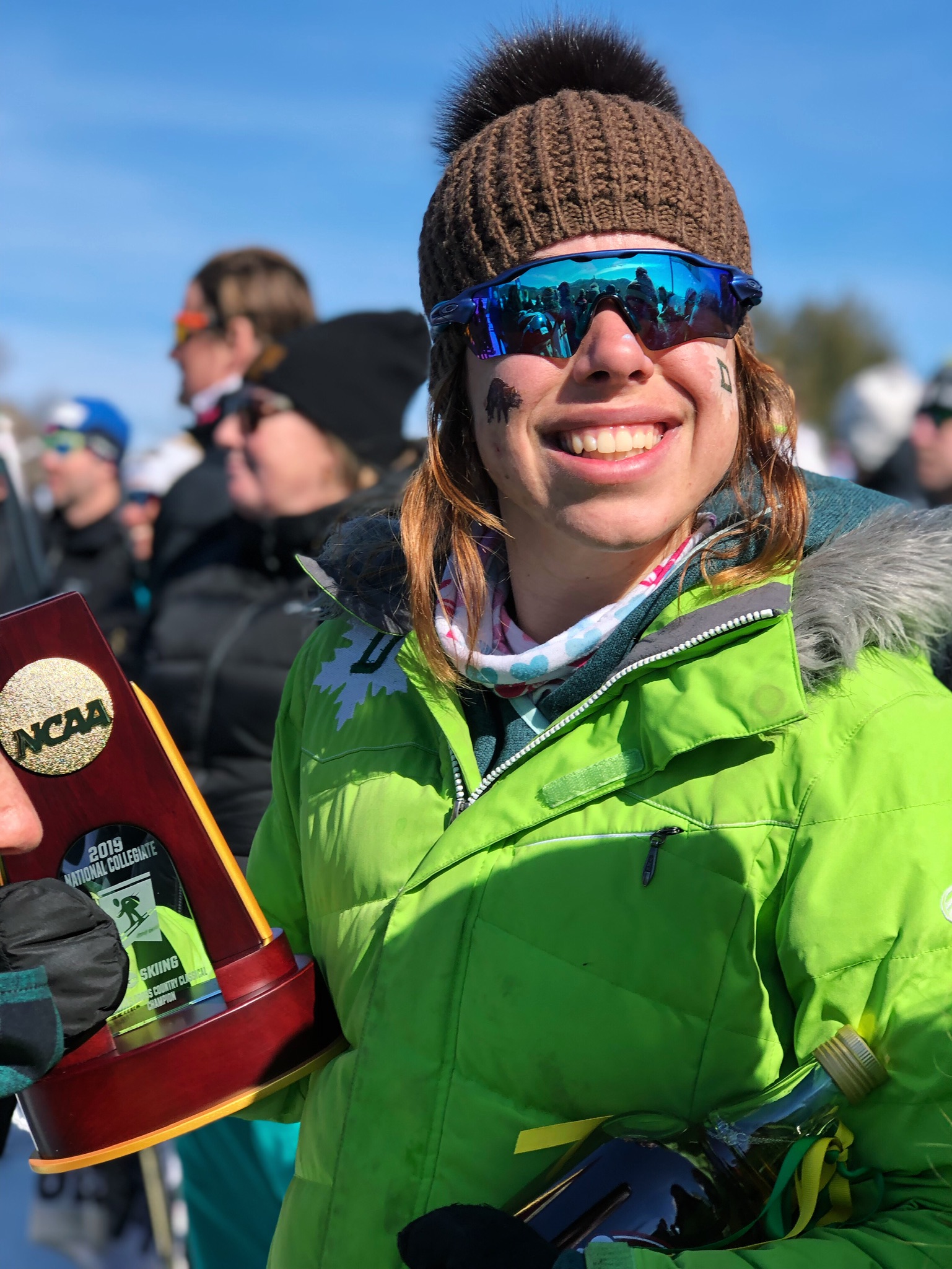
However, the lack of international racing didn’t stop Ogden from achieving outstanding results. In 2018, as a freshman named to the National Collegiate Athletic Association (NCAA) team for Dartmouth, she took the win in both events at the championships by astonishing margins. In addition she earned seven collegiate victories that season, landed on the podium ten times, and never finished lower than fourth place. The next year, recovering from a broken hand, Ogden finished on the podium in every collegiate race she entered, save for one fourth place finish at NCAAs.
Dartmouth freshman Katharine Ogden racing to her second-straight victory of the 2018 NCAA Skiing Championships in Steamboat Springs, Colorado. She won the 15 k freestyle mass start by more than 38 seconds. (Photo: Dartmouth Sports/Clarkson Creative)
Moving into her junior year of college, Ogden found herself back on the international stage for the Tour de Ski (2019/2020) as well as for the Scandinavian Ski Tour. “It was kind of a perfect system for a college student because it was a ton of World Cup racing, but really condensed, into just two weeks of missed school,” she explained. In this way, Ogden was able to accrue eight and six World Cup starts from each event series respectively, making for fourteen international appearances after several seasons away. “That year, I got pretty inspired to pursue that a little bit more fully. So throughout the winter, I started making the decision that I wanted to ski more for the national team and for Stratton again, instead of Dartmouth, the next year, after my three years of skiing for Dartmouth, so that I could take the winter term off from school and try to do a few more World Cups because I was feeling really excited about that, and had some success, especially in the Tour de Ski.”
Ogden finished in the top-thirty in her first attempt at the challenging multi-stage event, ending up 28th overall. “I was feeling confident in my ski racing, and excited and passionate about it again, so I wanted to pursue it,” explained Ogden.
Katharine Ogden during the 2019-2020 Tour de Ski. (Photo: NordicFocus)
If you’ve been following the timeline of this story, you will know what happens next. Enter COVID-19.
At the end of the 2019/2020 season, the World Cup finals scheduled to take place in Minneapolis, Minnesota were canceled and everyone headed home. For Ogden, the timing of the global pandemic happened to work in her favor. The following race season, 2020/2021 was virtually non-existent for the eastern collegiate circuit and with college classes moved online, Ogden was able to keep up with her studies no matter where in the world she was. “When COVID hit, no one was skiing for Dartmouth, it turned out, so I got really lucky on that one, and I was able to take some online terms and continue training with Stratton. So, it was really a year where I was skiing professionally, even though I was still in college.” Ogden reflected that she got “weirdly lucky” with the COVID, “because otherwise, I think I probably would have graduated late if I hadn’t been able to take those remote terms.”
As it was, Ogden graduated from Dartmouth in June of 2021, having completed school in just four years, and the 2020/2021 race season became the first season that she was fully on the World Cup circuit. Ogden wasn’t guaranteed a full season of World Cup racing to begin with but she had starts for Period I, and if she raced well there she could stay for Period II, and so on. Racing in Davos before Christmas break, Ogden finished 22nd in the 10 k skate, securing her ticket to later season races. “That worked out great for me, partly because of COVID, it meant that some of the World Cups were a bit poorly attended, so it was pretty easy to score points and keep on racing, whereas in a normally year it’s a little tougher to score points in Period One,” she explained.
Katharine Ogden, racing to 22nd in the Davos 10 k skate, 2020. (Photo: NordicFocus)
Although, there were other, less desirable outcomes from COVID. “I really enjoyed being on the road longer in the fact that I was able to get to know the team really well and feel like I was really a part of it, and feel really accepted in that environment and that group, but parts of it were also, really, really hard for me,” she said.
For one, as a COVID precaution, the US Ski Team implemented “bubbles” and athletes stayed with the same roommate all season, limiting interactions even among teammates. “One thing that was really tough was, because of the COVID travel restrictions, it was very claustrophobic because we weren’t really supposed to leave to go home at all, or leave the bubble,” Ogden explained. “And even if we could, like if we wanted to, for me it was hard because I was really worried about my parents.” At this point, Ogden’s father, John, was undergoing another round of chemotherapy for cancer, putting him in a high-risk category if he were to catch COVID. “So I didn’t want to travel home and get him sick, but I was feeling very stuck. I couldn’t leave, and I’m definitely a homebody, so being on the road for that long was really tough for me.”
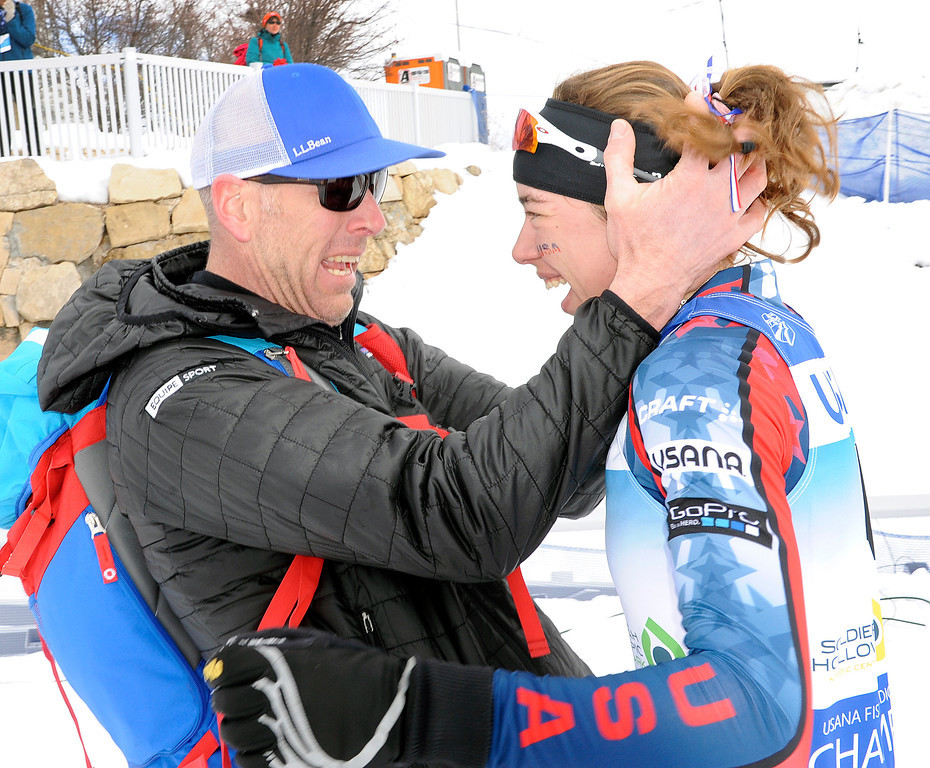
American Katharine Ogden (SMS/USST) and her dad John celebrate her bronze medal in the women’s 10 k skiathlon at the 2017 Junior World Championships in Soldier Hollow in Midway, Utah. (Photo: U.S. Ski Team/Tom Kelly)
These feelings were building, particularly as Christmas break approached, “right before Christmas, I was definitely overwhelmingly homesick, where I was just like, I don’t even know what to do,” said Ogden. “I was feeling stuck, I couldn’t go home, the coaches didn’t want me to go home, and I didn’t really want to put my parents in any sort of danger because I was worried about that.” Thankfully, around this time, John became eligible for a vaccine which took some of the worry off his daughter’s plate. “[That] was one of the most exciting things, I was just thrilled about that because I had to worry a bit less about him, but also because it meant I could feel okay about going home.”
Ogden stayed in Europe to race the Tour de Ski, her second showing at the event. She finished 23rd overall, having posted two top-twenty finishes over the course of the Tour and several more top-thirties. After completing the Tour, Ogden returned home to Vermont for two weeks before the World Championships in Oberstdorf, Germany.
Katharine Ogden on her 30 k classic journey in Oberstdorf, Germany at the 2021 World Championships. (Photo: NordicFocus)
At the 2021 World Championships, Ogden was joined by her brother Ben, who made an impressive championship debut, qualifying 11th in the sprint and ultimately finishing in 17th. Regarding having her brother around, Ogden shared, “Having Ben on the World Cup was great. He’s an entertaining kid. It has also been really fun to watch him finding success and navigating the World Cup in his own unique way. I am really proud of the way that he approaches training and racing, he doesn’t let anyone tell him what he can and can’t do, and makes sure he prioritizes school and jobs and his teammates, even when it appears on the surface to be the detriment of a perfect training/racing plan.”
Ogden finished out the 2021/2022 World Cup season with the rest of her teammates in Engadin, Switzerland before returning home. “I was pretty excited to go home at the end of the season, but a little bit less desperate at that point.” In spite of this, Ogden had realized that being on the road for such a long time was a significant challenge and said it was “hard for me to rationalize doing it again.” Surrounded by older teammates who had been navigating this challenge for many seasons, Ogden asked for advice. “They [told me] this year has been really different than every other year, because of COVID, and you can’t judge the experience based on a COVID year.” Hearing this, Ogden decided to give it another year.
At the same time, she was wrapping up her time at Dartmouth. Given her gap year experience, Ogden was nervous about losing the balance and distraction that school provided from skiing. “I actually, that winter, started applying to grad schools with remote programs for social work,” explained Ogden, “I wanted to have something to do the next year and also, because I was kind of thinking maybe this [skiing] wouldn’t last that much longer for me, because I just really was not enjoying myself that much.” Ogden also pointed out that, perhaps an oft-underrated part of professional skiing is the challenge of earning money from it. “It’s pretty tough to do,” said Ogden, “and involves either being very fast, or extremely good at Instagram marketing… so [that] made it a little bit less sustainable for me, on top of the homesickness and not really enjoying the traveling too much.”
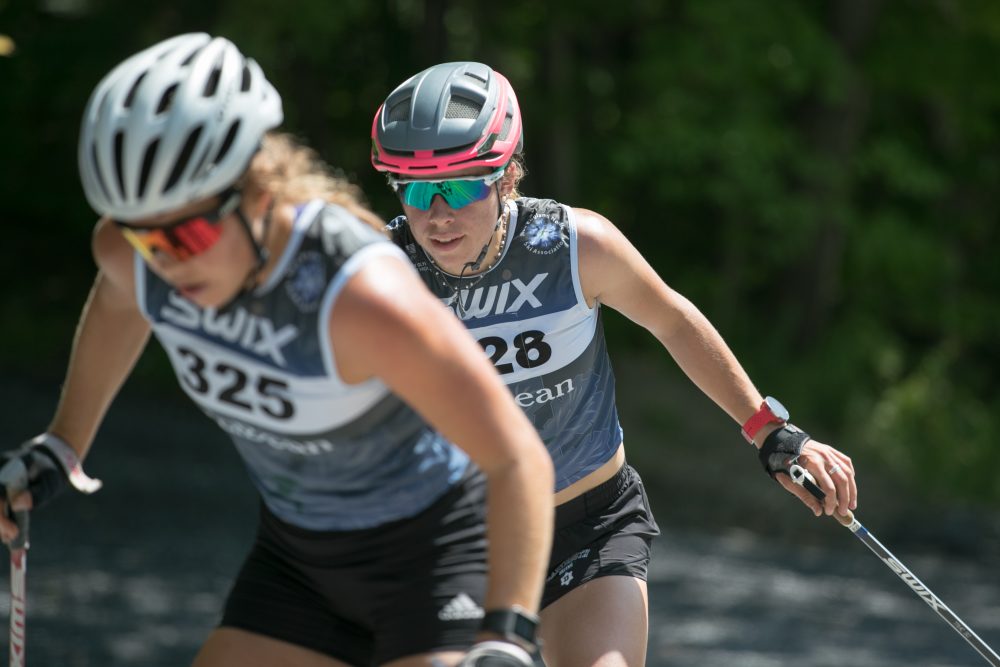
Katharine Ogden racing the App Gap rollerski race with SMS T2 teammate Evelina Sutro. (Photo: Reese Brown – xcski.org)
Recognizing this, Ogden started graduate school online in September (2021) through the Columbia School of Social Work. Having committed to these studies, Ogden would soon have to make another decision, given that part of the program requires a practical, internship component. “At the end of the winter, I had to decide if I would not be ski racing next winter so that I could do my practical, and I had pushed that off for a year, so that I could just do the online classes and some ski racing.” With this knowledge, Ogden entered the 2021/2022 season with an open mind, asking herself the questions, “is this sustainable? Is it something I want to do for longer? In which case I will apply for a leave of absence from school? Or is it something that I’m not really that excited about anymore and I will instead start the process of getting myself placed for that internship?”
An added boon to keep racing this season was the fact that it was an Olympic year. In the end, Ogden was not named to the 2022 Olympic team but she was quick to make it clear that this did not factor into her decision to retire at the end of the season. “I wanted to put my best foot forward, to see if I could qualify for the Olympics. Which obviously, I didn’t. But I would like to clarify that was not why I wanted to stop… I was thinking about it before that.”
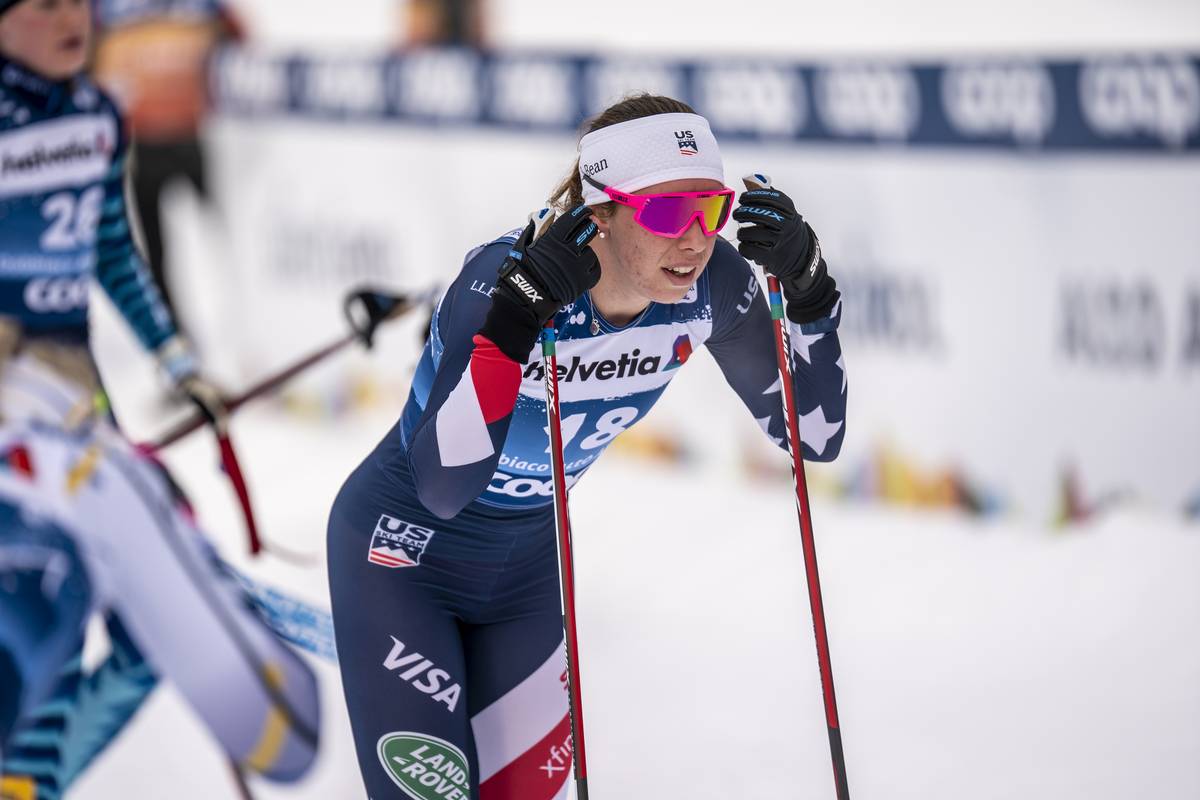
Katharine Odgen after finishing 20th in Stage 5 of the 2021 Tour de Ski. (Photo: NordicFocus)
That being said, Ogden shared candidly that it was difficult not to make the team. “[I] can’t understate the fact that it was really hard emotionally to not qualify, to put that much effort and training and goals and everything into trying, and then fall short. That was definitely hard, emotionally.” But putting on a positive spin, Ogden noted, “I got really lucky, because when I was home, instead of going to the Olympics, I was in Vermont and I love it in Vermont.”
Taking a bit of a mid-season break, Ogden lifted a little pressure off herself for training and skied for enjoyment, rather than in pursuit of a goal. She also did some volunteer coaching for the local ski club, Ford Sayre Nordic. “I really loved doing that, and it got me really excited about that aspect of the ski world,” explained Ogden. “During that month of the Olympics, I was kind of sad from not qualifying but also kind of happy because I got to do this stuff where I was hanging out with kids and going skiing with different people, and skiing for fun and going to the eastern SuperTours… I sort of forgot how much it’s like a blast. The eastern ski community is pretty cool.”
Through these various outlets, Ogden was coming to a realization. “Showing up to a race where I knew so many people there and a community where I felt really valued for myself and not for how I ended up doing in the races, or that type of thing – it was just really amazing to see people and re-engage with that community in a way that reminded me that I’m a part of it because of who I am, and not because of any results I had.” The weeks that she spent in New England showed Ogden a path to fulfillment and engagement with the ski community outside of competitive racing, “I think over those few weeks, when I was home and racing in the east and really enjoying that, I started being ready to be done with skiing, in part because I was like, I’m really happy right now,” she explained.
Katharine Ogden celebrates a victory and fourth place finish at NCAA’s in Stowe, VT 2019. (Photo: DWST)
For someone whose life and identity has been so integrally tied to ski racing, making the decision to step away can be a frightening prospect. “Part of me was scared of losing the ski community,” reflected Ogden, “It’s been such a huge part of my life that I was really scared of not having it anymore, and part of that experience reminded me that I’m not going to lose it. It’s not ever going to be something that goes away, I’m going to be a part of this community and with these people forever. I think it hadn’t really occurred to me that that was the case. I’d never been a part of the ski community as anything other than an athlete.”
With this decision “figured out,” Ogden was ready to return to the World Cup season to get some closure and to go race for fun. She rejoined the US team abroad in Lahti, Finland and was able to race the legendary Holmenkollen 30 k event where she finished 37th, before a positive COVID test took her out of contention. “So I didn’t end up actually doing my last World Cups,” laughed Ogden, “But I still had a great time being quarantined with Hailey [Swirbul] (who also tested positive). We were kind of suffering, but once we were feeling a little better we got to explore Oslo. And Hailey is one of my best friends and a really important part of my ski career, so it was kind of fun, honestly, [to have] a little impromptu vacation with just Hailey at the end of the season.”
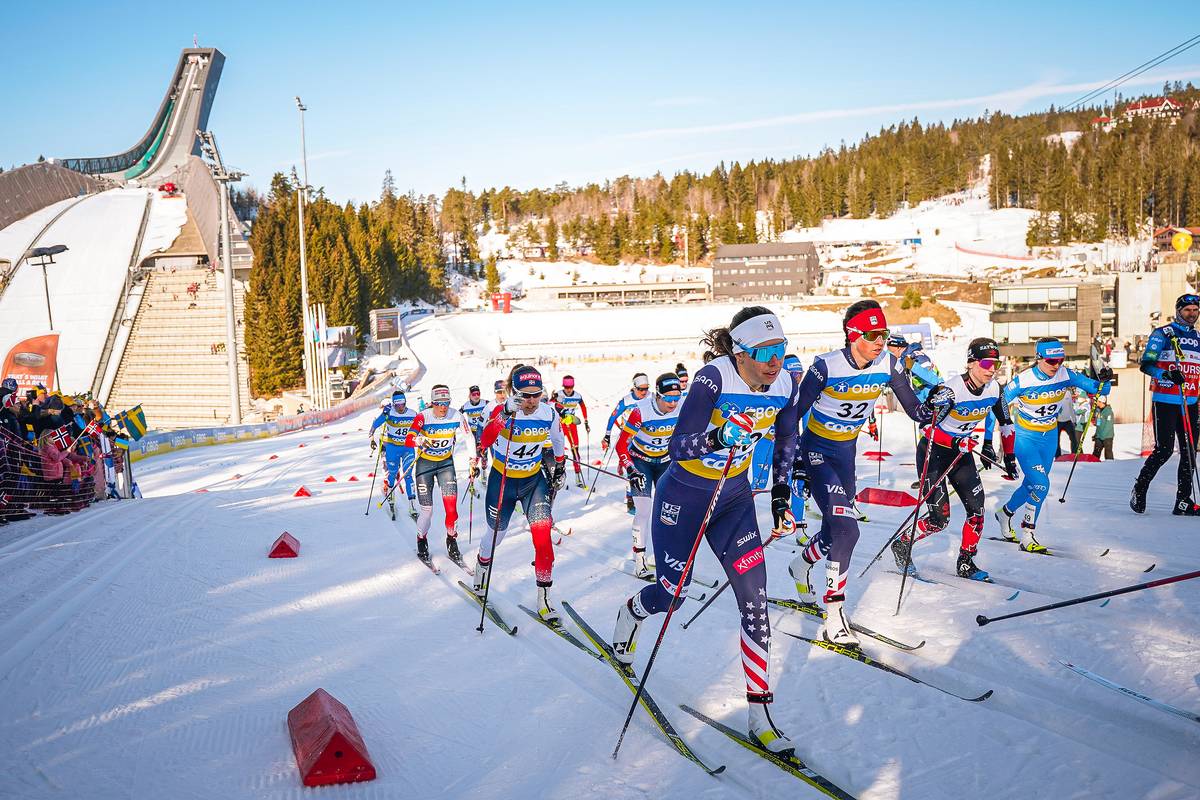
Katharine Ogden (left) and Caitlin Patterson (right) take to the course at the start of the women’s 30 k classic at the Holmenkollen, 2022. (Photo: NordicFocus)
Wanting to close out her career with her SMS T2 teammates, Ogden traveled to Whistler, BC for the combined Canadian Nationals/Super Tour Finals event once she was no longer contagious. Unfortunately, an untimely ear infection meant that she spent most of the week watching Netflix and taking antibiotics. “By the end of the week, [I] was finally able to rally for some races, where I truly had no expectations. I had literally not trained in the past month and still kind of had an ear infection and a cough from COVID, so not thriving, but it was pretty fun. It was nice to be able to celebrate the end of my career with my Stratton teammates who’ve been there, especially Julia [Kern] and Jessie [Diggins], since day one. So I was lucky to be able to do that, even though they were not the most enjoyable races of my life, per se,” she concluded.
Asked to reflect on her career highlights, Ogden mentioned the World Junior performances in Soldier Hollow, but added quickly, “I don’t like that to be my career highlight because I was not happy then. But I would say the 2019/2020 Tour de Ski was one of the real highs of my career. That was something that was a hard thing to do and I was really excited that I’d accomplished it.”
She also noted her first World Cup starts during the 2016 Canadian Ski Tour when she was a senior in high school were a high point. “I think it was an eight-stage tour, and the first World Cup I’d ever done, and that was really gratifying and exciting. Putting on my World Cup bib for the first time was a moment that I will not forget. I got to give my dad a hug on the side of the course when I was warming up, and he was crying. Very cute,” smiled Ogden.
Katharine Ogden crests a hill during the women’s 10 k freestyle at Stage 7 of the 2016 Ski Tour Canada in Canmore, Alberta. (Photo: Fischer/NordicFocus)
Her collegiate races were another notable experience for Ogden, “Almost all the races I did for Dartmouth were really up there,” she said, “but going to NCAA my freshman year was a pretty incredible experience. I had never really had the experience of racing on a team until college. I absolutely loved being able to go into races and know that my result was going towards something bigger and that I was working with a bunch of people to accomplish a goal.”
Offering advice to the next generation, Ogden said “my advice to younger skiers would be to make sure you’re thinking about what makes skiing fun and making sure you prioritize that the whole time. And also, not trying to be just a skier — trying to focus on everything that makes you a complete person, because if you focus on being 100% skier, sometimes it can make this game a little harder.”
Though she is stepping away from competitive racing, Ogden fully intends to remain involved in the ski community. She applied to be on the NENSA board and says, “I’m going to really throw myself into this community, but in a way that’s a little bit more sustainable for me and feels more fulfilling and exciting.” She is continuing to work her way towards a master’s degree in social work, in the specific track of clinical social work with a focus on working with children and families. The current plan is to start her internship for the program in September and eventually graduate in the spring of 2024. “After that I hope to get a job, but as to what job, I’m not sure!” Ogden said, “Hopefully by that point I will have more clarity on that.”
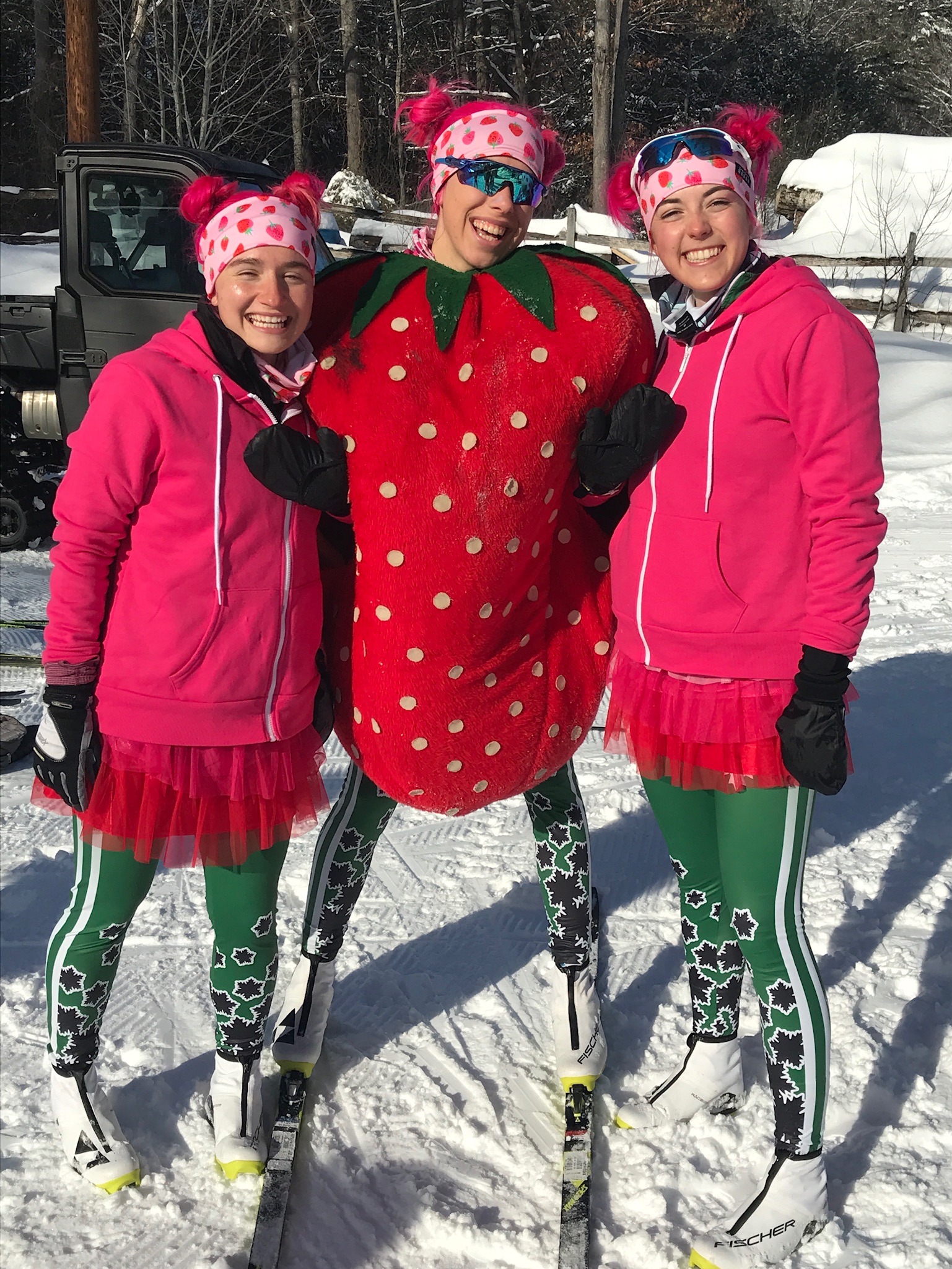
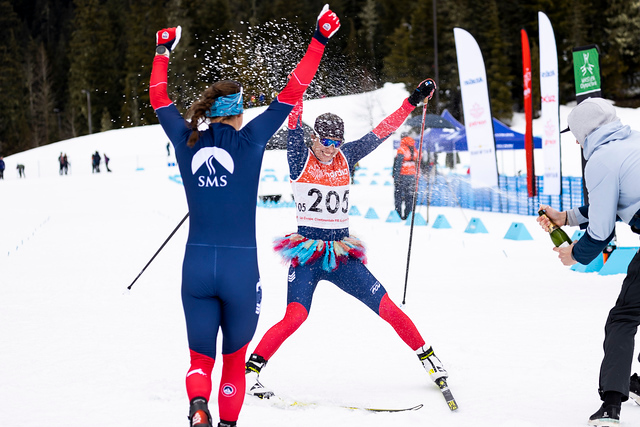
Katharine Ogden celebrates her last professional ski race with 45 k and a tutu. (Photo: Joern Rohde / www.joernrohde.com)
As the current US Ski Team lineup raises the bar for what’s possible on the World Cup, the next generation of skiers lays the foundation to build upon their accomplishments. See it to be it. Success breeds success. Pick your preferred phrasing.
Consequently, the talent pool tracking toward the national development program has been flooded like never before and U.S. Ski & Snowboard has stepped up its support in response.
“We have more junior and Under-23 athletes achieving the U.S. Ski Team standard,” explained sport development manager Bryan Fish in an email. “It is clear we are strengthening as a nation at our development ranks. This is reflected in awards such as the FIS Marc Hodler award where we were second only to Norway at 2020 Junior World Ski Championships after being a USA record-setting 4th in 2019. Hence, we have a growing USST D Team. This growing team needs more support and attention.”
Kate Barton joins the U.S. Ski & Snowboard D-Team as head coach, following four years as the assistant coach at Middlebury College. (Photo: Athletics.Middlebury.edu)
The most recent addition to the development program is former assistant coach at Middlebury College Kate Barton, who will lead the charge as Development and D-Team Head Coach. Barton will replace Bernie Nelson, who stepped down after the inaugural year of the position.
Fish explained that the restructuring and head coach position facilitates more direct and consistent support to D-Team athletes throughout the year. Barton will also have the capacity to work with developing athletes at events like the National Training Group (NTG) camp for top performers at Junior Nationals. Her role frees Fish up to focus his attention on development infrastructure, provide coach education at the club level, and other domestic tasks. He will still support Barton at domestic camps and at international events such as the World Junior Ski Championships and U23 World Championships.
Barton’s selection for the position was made with input from her predecessor, Nelson, and the roster of D-Team athletes, as well as from Cami Thompson Graves, head coach at Dartmouth College and Chair of the U.S. Ski & Snowboard Sport Committee. Barton received positive feedback and recommendation across the board.
Fish explained that he and Nelson had a strong working relationship and that although COVID-19 has interrupted the intended team schedule, Barton has seamlessly stepped into her new role, bringing her own set of strengths and skills to continue the support athletes have received within the new development program structure.
“Kate has worked in many national junior domestic camps and international development projects in the past, so she has a firsthand understanding of our ski community, development structure, team culture, and the standards necessary to be competitive at the international level,” wrote Fish. “I have worked alongside Kate over the past ten years at National Under-16 camps. She is positive, motivating, collaborative, organized, and has a great rapport with athletes and coaches, alike. These are critical qualities that will make Kate successful as the U.S. Ski Team Development and D-Team coach.”
FasterSkier connected with Barton via email to learn more about her background and philosophy as a coach and how she will translate that into her new role as D-Team Head Coach.
Newly appointed USST D-Team Head Coach Kate Barton spent four years as the assistant coach at Middlebury College. (Photo: Instagram @middnordic)
“Authenticity, passion, and principle provide a foundation for my philosophy as a coach and help to guide me,” wrote Barton. “I think it’s important to be authentic in your pursuits and be comfortable being yourself. Everyone is different and skiing is a unique, individual sport within the context of a team. If you can build strong relationships within a team then you can also trust and learn from one another and as a result, increase your chances of being successful.
“I am passionate about Nordic skiing; I love to ski,” she continued. “I want to cultivate a love for this lifelong sport in the athletes on our team. I think part of my job as a coach is to stoke this love for the sport, and for me, that comes from promoting a healthy balance between taking yourself seriously and having fun and enjoying the process. Finally, I think it’s important to be principled. I have to remind myself of this sometimes. But if you’re willing to be critical of yourself and others you can learn and move forward together. As a coach, I’m always trying to find a balance between providing direct feedback and maintaining the patience to let my athletes learn in their own time.”
Barton spent four years working with the Middlebury Program. Before returning to her alma mater in 2016, she was the head coach at Burke Mountain Academy in Vermont for five years. She also spent a year as the head coach of the Jackson Hole Ski Club in 2010.
An accomplished athlete in her own right, Barton graduated from Middlebury College in 2009 as a dual sport athlete in skiing and lacrosse. Demonstrating both talent and leadership potential, she made the NCAA championship team each of her four years and captained the team to an 8th place finish her senior year. In addition, she competed in two semifinal rounds of the NCAA Tournament in lacrosse.
Barton explained that these experiences were formative in her transition to coaching.
“Many of the lessons I learned from my time as a competitive skier were things not to do,” she wrote. “I competed in a variety of sports competitively growing up and was lucky enough to compete as a skier and a lacrosse player through college, two very different but valuable experiences. Most of all, I was lucky enough to be surrounded by some passionate, veteran coaches throughout my entire ski coaching career who were willing to let me tag along and soak up experiences, but who also pushed me to be independent and take on roles outside my comfort zone.”
Through coaching three U18 National Teams at the U23 World Ski Championships as well as for Team New England at Junior Nationals and working at U18 national and regional summer camps, Barton has had the opportunity to work with many of the D-Team athletes. She has also coached at multiple international junior trips to Norway and Sweden.
“One of the coolest things about the ski world is how small it is, and even if I haven’t worked with all of these athletes directly, I’ve been watching them compete for many years. I remember observing this crew race a humid uphill TT at U16 camp many years ago. Even as U16 athletes, it was crystal clear how willing and genuinely excited they were to push limits and grow together, all while having a good deal of fun.”
The athlete she has had the most experience working with is newly nominated 20-year-old Sophia Laukli, who currently attends Middlebury College.
“I’m lucky to be sharing my rookie season with Sophia and I’m excited for the challenge of getting to know a couple of new faces as well.”
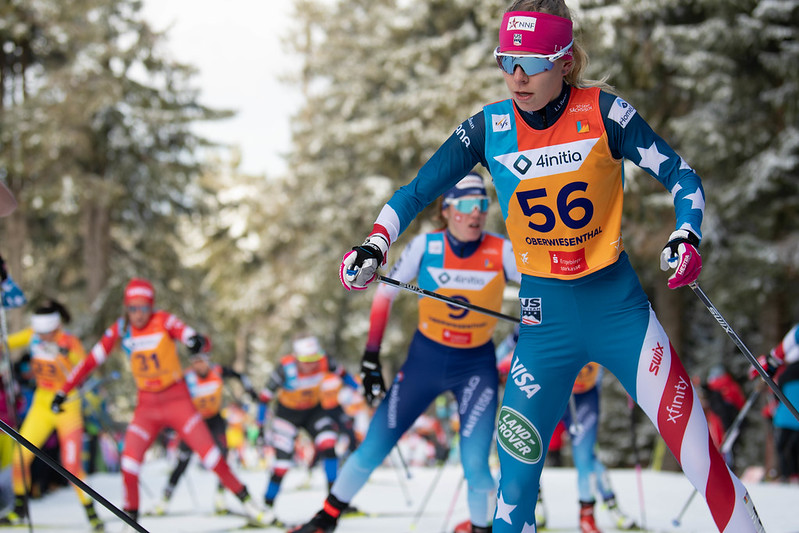
Sophia Laukli (bib 56) skied to 5th overall in the junior women’s 15 k mass start skate at 2020 Junior Worlds. (Photo: Doug Stephen)
The 2020-21 D-Team has a record 11 members. Both Fish and Barton commented on the goals for the program as they work together to support these athletes and continue to foster the national development program.
“‘Working together’ are the keywords here,” responded Fish “We have athletes with the desire, work ethic, and skills to succeed at the highest level of our sport. These athletes have a good understanding of what they need to be successful. This is thanks to our strong clubs, school programs, and strong divisional/ regional support. Kate and I both have a strong background coaching at the club and collegiate ranks, so this will aid in working with these athletes and their local programs to support their individual needs.
“It all starts with the question to the athletes and programs as how can we best support? What can we provide in addition? One common goal is that we continue to build upon the strong USA Team culture that we are bringing to our international trips each year. It is a huge asset when you know your teammates are contributing to your success and have your back. We will need to be creative in continuing to develop our team culture when working together in summer projects is a challenge.”
Barton’s response focused primarily on laying the groundwork for successful coach-athlete relationships, which she identifies as learning about each of her athletes individually and establishing a relationship. This requires collaboration and communication with both the athlete and their club or collegiate coach.
“As a new member of the team, the most important thing is to start to get to know this crew as athletes and as people. I want to coach this team in a way where they get to know me, too. We haven’t had a chance to work together in person yet, given the current state of the world, but I hope we’re starting to build relationships that will make our work at future training camps and competitions more enjoyable and productive. This job has already been rewarding because of the work I get to collaborate with the club coaches of each of these athletes. I’m excited to serve as a resource for any coach willing to get on board and help to push U.S. skiing forward.
“I am most looking forward to the opportunity to learn first-hand from this group of athletes,” she continued. “The D-Team is a special group of motivated individuals. They are stoked to continue to push US skiing forward. I can’t wait to see how they do it, to help them pursue their goals and dreams, and of course to provide some guidance and share my knowledge and experience along the way.”
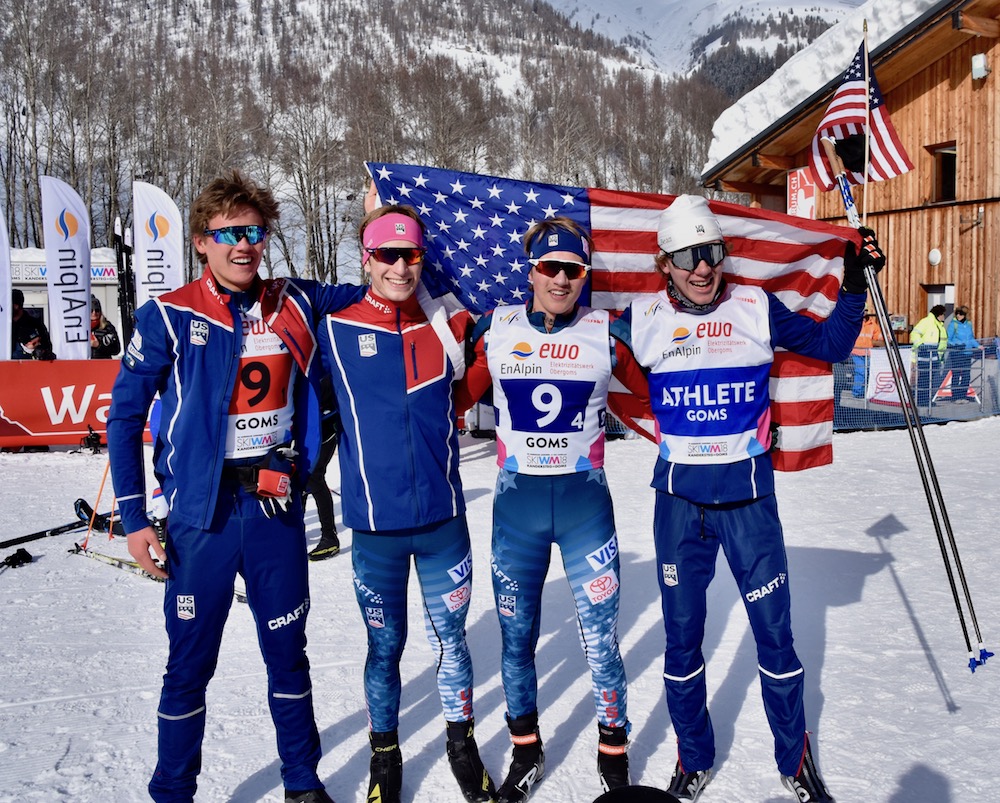
The U.S. men’s silver-medal relay on Saturday at 2018 Junior World Championships in Goms, Switzerland, with (from left to right) Luke Jager, Hunter Wonders, Gus Schumacher, and Ben Ogden. (Photo: Julia Kern)
Finally Barton was asked the challenging question regarding how to best support the mental and physical wellness of athletes who are navigating the pressures that come with elite level sport at a young age. In addition to the stress of training, many of the D Team athletes are also balancing academic demands on top of their training while facing significant transitions in their lives as they advance from high school through college.
“I think relationship building is our most important tool. My most successful coaching relationships have always been built on open and honest communication. I hope to build this culture within the D Team and beyond. We’ll try to break down the stigma that we have to wait until we’re in a time of need or crisis to ask for help. This community is incredibly supportive and there are many resources to help facilitate athlete development. My goal is to get to know a wide variety of young athletes in the US and to help them balance those demands and stressors they face as developing athletes. I don’t believe any of the athletes on the D Team are as fast (yet!) as they need to be, as they want to be, or as they can be, so I hope we’ll work together to build a good foundation on which to continue to develop. We will focus on the process and not just our performance because everyone fails a few times on their way to greatness.”
Last year, 174 athletes in the male and female U18 categories competed at Junior Nationals in Anchorage, AK. This number represents a small fraction of the cross country skiers throughout the country in that age category. As there are only about 30 NCAA programs nationwide that offer Division I or Division II cross country skiing, the opportunity for high-level training and racing narrows significantly after a skier graduates from high school.
However, the door to continue to pursue collegiate nordic skiing does not shut on an athlete who does not make or does not wish to compete for an NCAA team. While lesser known, the United States Collegiate Ski Association (USCSA) has created an opportunity for hundreds of additional skiers throughout the U.S. to continue to participate and compete in cross country skiing. In essence, USCSA is Division III skiing, however, because it is not under the NCAA jurisdiction, it allows for much broader entry, making it accessible to both club and varsity programs.
The mission statement states, “The USCSA asserts that student-athletes, of ALL levels and abilities, should have access to a quality and exciting venue of competition.”
Athletes take to the course during a mass start classic race at the 2019 USCSA National Championships in Jackson Hole, WY. (Photo: USCSA.com)
Much like the NCAA, regional USCSA coordinators organize a season of races, each hosted by a member school, leading up to a regional championship in late February. These races are held at many of the same venues as the NCAA races. At the end of the season, the top teams and individuals from each region compete at a five-day national championship in early March in conjunction with the other snowsport disciplines of USCSA. These championships have been held at prestigious venues across the country including Jackson Hole, WY in 2019, Lake Placid, NY in 2018, and Mt. Bachelor, OR in 2017.
In contrast to an NCAA program, both men and women race the same distances in both sprint and distance events, promoting equality across genders. The USCSA also prides itself in being team-centric, emphasizing team scoring, as opposed to focusing on individual results.
In most cases, USCSA programs are not exclusive, meaning teams or clubs are open to anyone, regardless of their previous experience or exposure to the sport. All athletes are welcome to participate in races. In contrast, an NCAA program may have a limited competition team. However, this inclusivity does not indicate that the programs are not competitive or that they would not serve a high-level junior skier.
“The flexibility of a USCSA team is incredible because you can have people that have never skied before to people that are – there are USCSA racers that have been Junior National Champions,” said Christi Boggs, Vice-President of Nordic Skiing at USCSA and nordic coach at the University of Wyoming (UWYO). “There are some really high-level racers, but it also allows for someone who just loves to do it to keep doing it or someone that wants to try it can try it.”
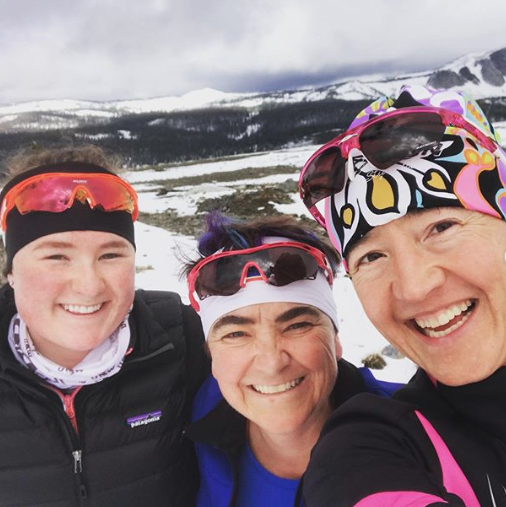
Christi Boggs (center) of the University of Wyoming on a crust ski with her partner and fellow coach Rachel Watson (right) and athlete (left). Boggs is the Vice President of Nordic Skiing for USCSA. (Photo: Instagram @uwnordicski)
A graduate of UWYO herself and a faculty member in the School of Culture, Gender, and Social Justice, Boggs has been overseeing the school’s club program for the last 22 years. During her own time as a student and athlete at UWYO, the nordic ski program was a Division I NCAA program and Boggs became a four-time All American, later pursuing biathlon and winning the Rocky Mountain Cup and North American Cup twice each. But like several other programs, the UWYO lacked the funding to support the program. It was cut in 1993.
While top junior skiers typically do head to NCAA programs, Holly Brooks and Clare Egan, both USCSA alumn, show that the programs can still be stepping stones to elite competition.
In reflecting on her decision not to ski for an NCAA team, Egan described her high school self as “not a real serious athlete”, though she did win the Maine State Championships in 2006 and competed in Junior Nationals in both 2006 and 2007. She explained that she did not do any formal summer training in those days, and out of the three sports she participated and had talent in – she also ran cross country in the fall and track in the spring – none held priority for her. Though she did want to continue in athletics, she was very academically motivated and aspired to study abroad and to continue to play music during her college career as well. To Egan, the idea of being limited as a Division I athlete was off-putting.
“When I applied to college, I wasn’t really sure what I wanted to do,” Egan recalled. “I got offered a Division I running scholarship, I got into Middlebury where I would have been focusing on skiing, and UNH, I was offered a scholarship that would have been a combination of running and skiing. But in the end, I decided that I didn’t want to be a full-time athlete at that point, which is what my impression of Division I was.”
Egan ultimately chose Wellesley College, located 30-minutes west of Boston, MA.
While attending Wellesley College, Clare Egan competed in the USCSA in addition to racing in regional NENSA and EISA races. (Courtesy Photo)
“I ended up picking Wellesley, among other things, because it gave me the opportunity to continue participating and competing in all the sports that I did without having it be Division I,” she explained.
At the time, Wellesley did not offer cross country skiing, but the campus is located within five miles of the Weston Ski Track, so she knew that she could continue to ski. She would also be able to participate in New England Nordic Ski Association (NENSA) races. Egan also joined the varsity cross country and track teams.
“I guess right away my fall at Wellesley, I decided that I did want to do skiing and that I wanted to get involved in some way,” she said. “So I started a club through the student activities and got involved in USCSA.”
By joining the USCSA, which she referred to as a “hidden gem”, Egan was able to race a full season in the Northeast, participating in USCSA and NENSA races as well as Eastern Intercollegiate Ski Association (EISA) carnivals. As was her hope, she studied abroad her junior year in Italy and Switzerland, where she skied regularly and raced in the Engadin Ski Marathon. In her senior year, Egan qualified individually for and competed at NCAA’s in addition to the USCSA national championships. As she had one remaining year of NCAA eligibility, her path then led her to the ski team at the University of New Hampshire and eventually to the Craftsbury Green Racing Project Team and now the US Biathlon Team.
While this trajectory is non-traditional for an Olympic athlete, it demonstrates that an athlete can be successful through a number of different pathways, some more direct than others. Egan attributes some of her longevity in the sport as her career has developed to being in a low-pressure and relatively unstructured environment for so long.
“I can say that I’m not burnt out,” said Egan. “I think a lot of other people who are my age, they stopped a long time ago and maybe part of that is because they competed so intensely for so long already by the time they were 22. Whereas, I did not start doing year-round training until I was 23.”
Egan could not state outright that had she skied four years in an NCAA program she would have fast tracked her career. But the flexibility that USCSA allowed her was a good fit for her and kept her involved with the sport through her collegiate career while focusing on academics.
“I do think that being able to stay involved with skiing in a way that worked with the rest of my life allowed me to – I was able to get involved with it again later because I stayed in touch with it,” she concluded.
Two-time Olympian Holly Brooks, who attended Whitman College in Walla Walla, WA, attributes more of her success in ski racing to her USCSA experience.
Holly Brooks poses with her Whitman Nordic teammates and a Norwegian athlete after forerunning at a World Cup race in Soldier Hollow, UT, in 2001. She explained that they were excited to take a picture with a Norwegian. Little did she know she would one day be racing at the World Cup level herself. (Courtesy photo)
“My time at Whitman played a really important role in my ski career,” wrote Brooks in an email. “Coming out of Seattle I had never been on a bigger team before, and rarely had coaches other than my dad. I actually choose Whitman because it had a ski team and was on the west coast. I wasn’t nearly strong enough to go to any of the larger, more competitive NCAA programs. Once at Whitman, I had awesome teammates and coaching and my love for skiing grew and grew.
“USCSA didn’t really have a ‘regular season’ but Nationals seemed like a big deal and it was enough to motivate us to train hard every day,” she continued. “I have no doubt in my mind that had this opportunity not been available my time and interests would have turned to something else. In essence, USCSA skiing at Whitman served as an important placeholder for skiing in my life. It was the link between being a solo skier in Seattle, to getting me to Alaska, where I truly developed as an athlete.”
In late May, the Aspen Institute held a forum titled theFuture of the U.S. Olympic Movement: Reimagining Goals Beyond Medals. The forum touched on a range of topics including SafeSport, athlete mental health, and more holistic youth sports and development programs. A theme in the development conversation was creating opportunity from a grassroots level, that if an athlete wanted to continue in the sport and compete, they should be able to. The USCSA aligns with this grassroots approach in fostering development as its inclusivity promotes the retention of athletes in cross country skiing during a time frame that many stop participating as well as introducing newcomers to the sport.
“I do think that USCSA plays a really important role, that I wish more people knew about, as a way to keep people involved in the sport through that 18 – 22 time period,” expressed Egan. “You don’t just have to quit after high school if you’re not going to be a Division I athlete. That’s so ridiculous. Skiing, for some reason, is one of the few sports that we look at that way.”
Jim Allott was the head coach at Clarkson University for 19 years during which he led the Golden Knights to 7 USCSA national titles. (Photo: clarksonathletics.edu)
This viewpoint was expanded upon by Jim Allott who recently retired from his role as head coach at Clarkson University in northeastern New York after 19 years. In seven of those years, either the Clarkson men or women were the top nordic team at the USCSA national championships. Both teams won in 2012.
“When you consider how many colleges are not NCAA or skiers for lots of different reasons don’t have the ability to make an NCAA team, you’re turning away hundreds of potential nordic athletes,” said Allott “If you think about what we see here in Potsdam where our regional is 10 to 12 teams, and then you look at our NCAA cohort with EISA, and they have a similar number of teams. So just in that one quick snapshot, you can see that we’ve doubled the number of nordic teams.”
Allott also echoed Egan’s words about athlete “burn out”, adding that the dynamic and culture of USCSA programs allows skiers to grow both their ability and love for the sport. Allott described the USCSA experience as “both positive and fulfilling.”
“It instills the passion that they will want to pursue it when they leave college, and that’s rare in a lot of college athletic sport situations. Many athletes are just done, they’re either just cooked and fried, or they really don’t continue in their sport.”
During his tenure, Allott has seen many of his athletes continue to pursue cross country skiing after college, whether their involvement is recreational, in leadership roles within USCSA, or as a coach of a youth program. He described USCSA alumni as being “like the growth of a tree”, where each forms a branch to create a nationwide community connected by a common passion.
“I take a fair amount of pride in how many of my athletes move on and get involved in the sport of nordic skiing,” said Allott. “That ranges anywhere from a Bill Koch level to high school coaching. The last 15 years, our USCSA regional coordinators have all been Clarkson nordic alumni.”
Boggs seconded Allott’s sentiment about the prevalence of her former athletes in coaching and other areas of sport. She attributes this connection to the sport to the positive culture cultivated within the USCSA opportunity.
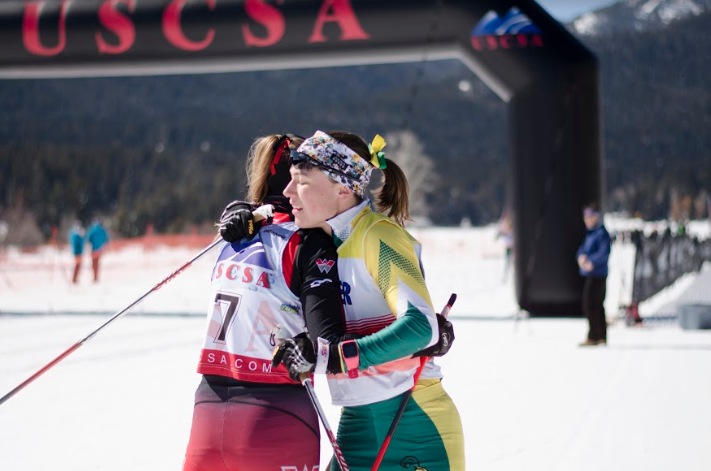
An athlete from Clarkson University celebrates at the finish with a competitor from Western State Colorado University during the 2019 USCSA National Championships in Jackson Hole, WY. (Photo: USCSA.com)
“All of that builds opportunity and pathways for athletes to become really important to the sport overall,” said Boggs emphatically. “I think that’s huge.”
She continued that the nature of students attending USCSA member schools has the power to position them in roles where they can create a large impact on the overall American nordic ski community.
“A lot of USCSA teams – they’re military academies and Ivy League [schools]. These are people that are really going places and getting graduate degrees and can really make a difference going forward. I think that is super important for building the sport.”
Both coaches emphasized the impact of USCSA beyond the development of the skier to the transference of the life skills cultivated through the experience, which includes benefits such as better sleep, self-reliance, positive self-image, teamwork, and time-management. They expressed that these traits help alumni obtain and succeed in post-collegiate careers and to lead healthy and active lifestyles.
After taking the role of Cross Country Sport Development Manager last fall, Bryan Fish described a system of three metrics to track the success of US development: growth in the number of skiers, retention of those skiers, and lastly, improvement in performance. By promoting inclusivity and creating opportunity, USCSA supports this system, assisting in the development of a healthy and thriving American cross country ski community.
“If we don’t maintain and fight for diverse options for people to keep skiing I think our sport is doomed,” wrote Brooks on USCSA’s role in the growth of the sport in the US. “The beauty of cross country skiing is that it can be a lifelong sport. But… we need to make sure that opportunities exist for people to stay engaged. We need enthusiasts, we need fans, we need coaches, groomers, ski parents, officials, donors, etc. The health of our ski community depends on having options. Unfortunately, the official ski program at Whitman folded years ago. I am thankful that the opportunity existed during my time there.”
Boggs reaffirmed this message, furthering the grassroots model of supporting the development of cross country skiing in the US.
“Our support base, the next generation of skiers and the support base for the skiers we have, don’t come from the elite athletes,” expressed Boggs. “It comes from all the people watching the races, the parents taking their kids to races, people that are just passionate and excited. That’s who is donating the money, and spending the time volunteering to coach, and driving kids to races. Those are all the people that get really excited. And I think USCSA is uniquely positioned for that.”
To wrap up her beliefs about the role of USCSA in the success of American nordic sports, Egan offered a concluding message to support high school skiers amidst the “college conflict”.
“If you’re thinking about being an athlete and you don’t necessarily want or don’t qualify to be on one of those Division I teams, you don’t have to give up skiing at all,” concluded Egan. “Someone might not be ready to do Division I in high school or they might not be interested, but there are plenty of athletes who have the passion and ability to stay involved and we shouldn’t exclude those people.”
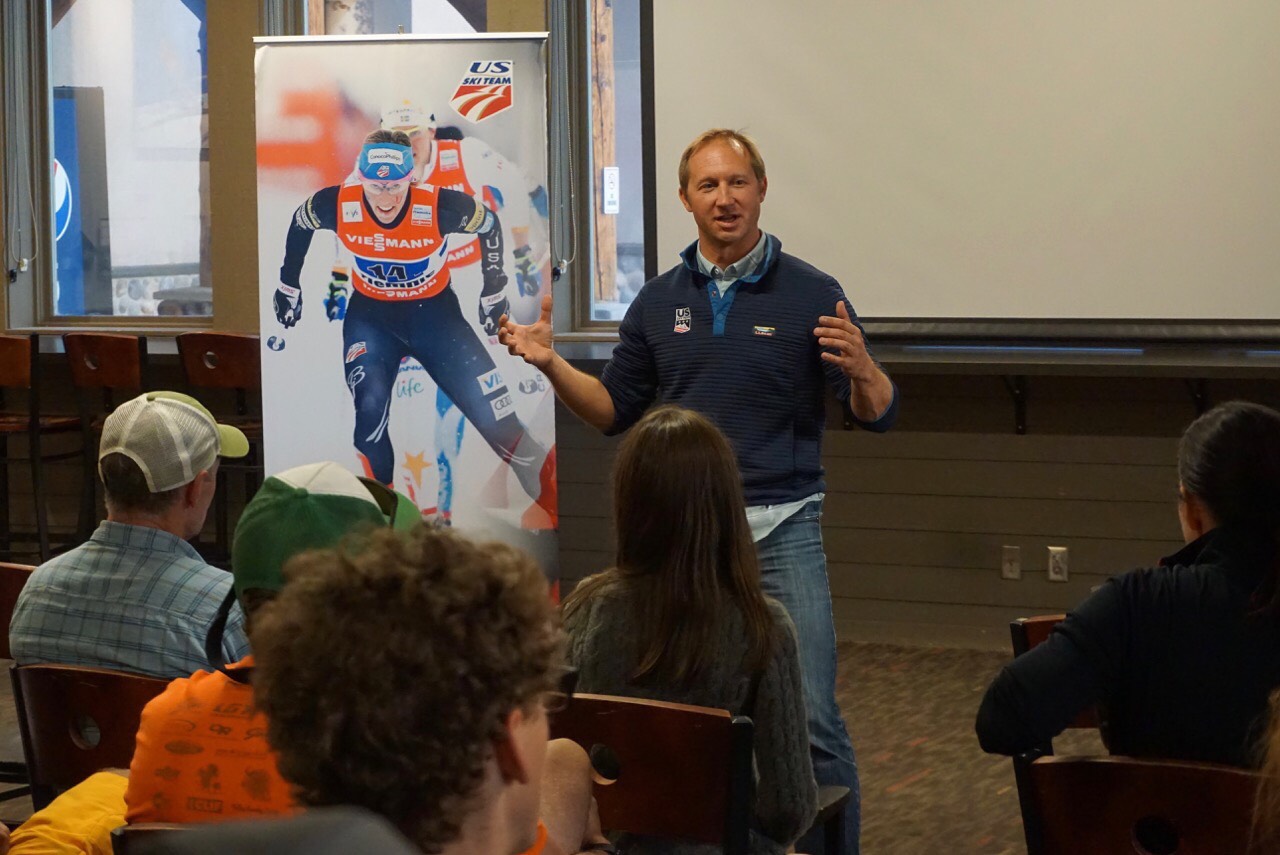
Bryan Fish, U.S. Ski & Snowboard’s cross country sport development manager, delivering a presentation called “Strides of Success – The Key Factors in USA XC Ski Development Success” on Sept. 15 at the Snow King Sports & Events Center in Jackson, Wyoming. (Photo: Nancy Leon/Jackson Hole Nordic)
JACKSON, Wyoming — Last last month, U.S. Ski & Snowboard announced that Bryan Fish had been promoted to cross country sport development manager. FasterSkier sat down with Fish on Sept. 14 at Jackson Hole’s Center for the Arts, where he was leading a Level 200 coaching clinic, to learn more about this transition and how his new position will support the national development program. He also provided insight into the development program’s philosophy and goals for the coming years.
Fish originally joined U.S. Ski & Snowboard as the cross-country development head coach in 2010, after starting the Central Cross Country (CXC) Elite Team in Wisconsin and coaching there for four years. Before that, he was head nordic coach at his alma mater, the University of Wisconsin-Green Bay, from 1998 to 2006. During his last eight years with the national team, he has been the primary development coach and spearheaded sport education to create resources for club coaches and athletes nationwide. As U.S. nordic skiing at the elite level has steadily improved, the development program for juniors has grown and evolved in response.
“I think people look at it and they see this monumental upward trend, but it’s been kind of a slow steady progression,” Fish, 43, said. “It’s been really fun to be a part of. … You just see the whole community collectively raising the bar, and it’s been really exciting to be a part of that.”
U.S. Ski Team Development Coach Bryan Fish gets some glitter from by Hailey Swirbul at 2015 Junior World Championships in Almaty, Kazakhstan (Photo: Julia Kern)
Fish’s new role will include many of his previous responsibilities while reducing certain aspects of his former position, which made it more difficult for him to focus on the development program itself.
“What we really did is took a look and evaluated ‘what are our strengths as a staff?’ How do we need to structure our sport in a way that optimizes our staff and optimizes our resources?’ ” he reflected. “So a lot of things that I was doing previously are very similar to what I am doing now.”
Additionally, a sport consultant who will be based year-round in Park City will be hired to take over office-based work such as uniforming, helping with the competition guide, and data analysis through points at the SuperTour and Junior Nationals. This person, who Fish said will be hired in the coming weeks, will devote about 80 to 85 percent of their time to cross country and the remainder to the all-sport needs of U.S. Ski & Snowboard.
“One of my strengths is working with the athletes in the field, and we want to maintain some consistency with the international competitions like Junior World Ski Championships, World U23’s, OPA Cup as well as some of the national-level junior camps that we do in the summer,” Fish said. “I will still continue to do that.
“I will no longer support World Cup,” he continued. “I’ll be a little more domestic, so I’ll be at West Yellowstone, I’ll be at Silver Star, and that actually was a plan regardless of whether I took this new position or not because the dynamic of our World Cup team and our whole national team is a lot more on the development side.”
Fish’s approach to leading the development program is focused on process goals, creating opportunities for athletes in all regions and at all levels, and providing club coaches with tools to create successful programs. He hopes to develop a systematic process for juniors to excel in skiing that’s both clear and transparent.
“One of the things I’ve been trying to focus on … is taking a deeper look at those steps from what I’ll say, cradle to grave, or from youth all the way to elite, and we’re continuing to recognize and understand that there are gaps in areas, but most importantly, it’s really important that we divide and conquer,” he said. “What I mean by that is that we’re working with our divisions, we’re working with our regions, because they do a lot of the junior racing and youth development, and we do a lot of the national and above. It’s really making sure that we have affiliation agreements with each division and I’ve been looking through those as well and making sure that there’s a clear path and opportunities for junior athletes.”
In order to gauge the success of this approach and the development of junior athletes, Fish offers an approach that is not solely based on results; in fact, success in competition is only one of the three aspects involved.
“Number one: are we growing?” he asked rhetorically. “Growth does not mean membership growth; it just means, do we have more skiers? The second thing is retention. Are we retaining the skiers? And number three is performance. Are we getting better?”
In order for these three components of growth to be possible, opportunities for athletes of all ages and abilities must be available. He described another three-step model for developing programming at any level.
“One is developing a passion for outdoor endurance athletics, number two is developing a culture of training, and then we can develop a culture of performance,” he said. “And even at that high point, a culture of performance, they need to still have that passion for outdoor endurance. So if we’re doing our job, we’re providing opportunities. So we’re making sure that there are appropriate venues, there are events — it doesn’t necessarily mean competition, but there are different events, and that there are programming, and we need to have all three of those pieces.”
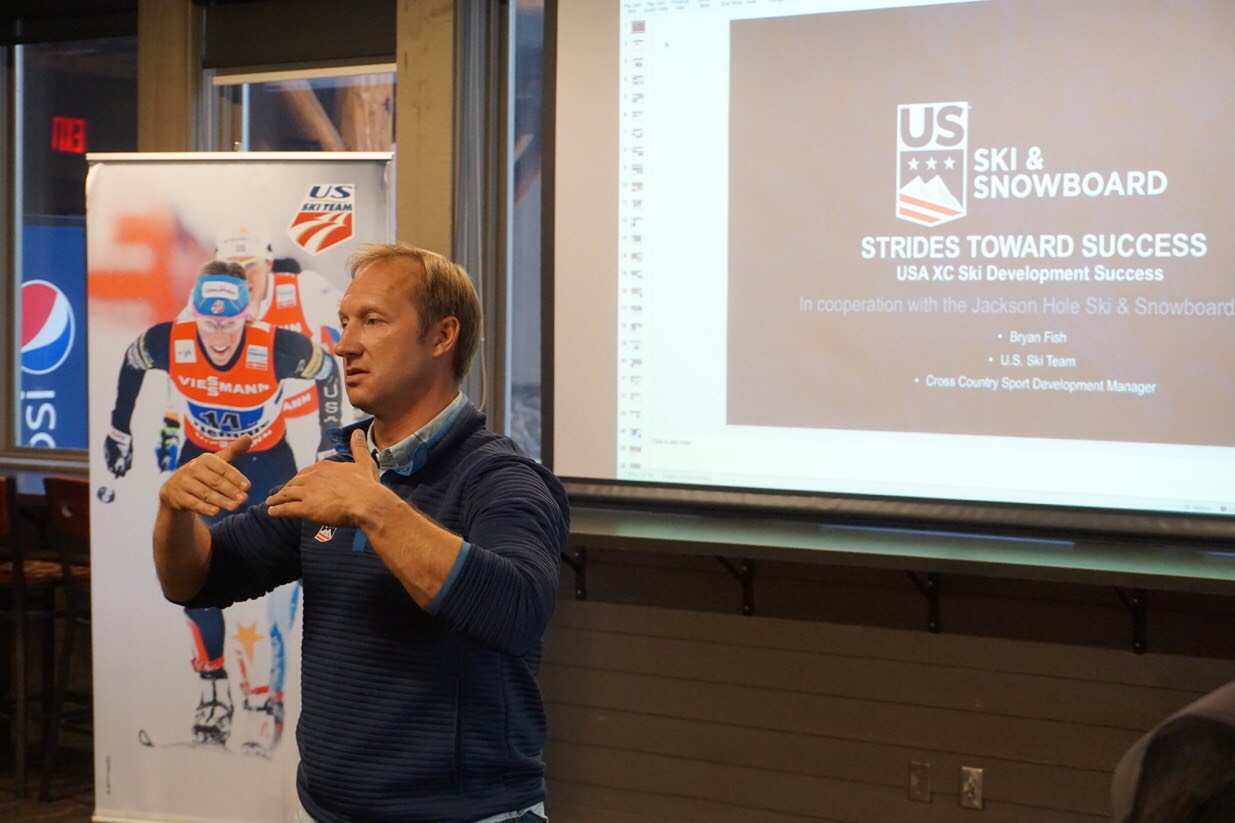
Bryan Fish delivering a presentation called “Strides Toward Success: The Key Factors in USA XC Ski Development Success” on Sept. 15 at the Snow King Sports & Events Center in Jackson, Wyoming. (Photo: Nancy Leon/Jackson Hole Nordic)
Fish refers to these opportunities as part of a “pathway” for athletes, versus using the phrase “pipeline”, which is used by the U.S. Olympic Committee. He adds, “I’m not a big fan of the term ‘pipeline’. … When you think pipeline, it has one path, it goes in this pipe and this little trickle comes out the other end.”
To him, the word “pathway” implies that there are many entry points that can lead to success in skiing, especially when one’s individual goals are taken into consideration.
Fish emphasized that access to quality programming from a young age is essential to the success of U.S. skiing as a whole. He said coach education is crucial to this aspect of creating valuable opportunities for youth, as are the clubs that plant the seeds for success and are most responsible for cultivating a love of the sport.
“I wish U.S. Ski & Snowboard had the capacity to do more at a younger age, but we have to focus our efforts and really be strategic with the resources that we have,” he said. “What we are trying to do is be very transparent about that and say, ‘OK, these things we can do, these things we need you guys to do, clubs and coaches, how can we help you?’ One of the resources we are trying to provide is this coaching education, which we take real seriously, to have some common ground.”
Programming should also be similar across the country.
“We want to make sure that a skier in California is somewhat similar in level to the athlete in Maine and getting the same opportunities,” he said.
In his time with U.S. Ski & Snowboard, Fish has assisted in the development of resources for coaches, such as the Level 100 and 200 certification programs. However, in recent years, his focus has shifted away from some of the minutiae of technique and physiology toward a more pedagogical approach, which he hopes to continue to spread in his new role.
“What we wanted to do is go, ‘OK, here is our scaffolding, here are some best practices in the community for all these different things,’ ” he explained. “We’ve tried to be less detailed as it relates to nuances of technique, but instead ‘here is how you teach technique’… We all might teach it slightly different, but I hope that we can come back to our educational platform and say, ‘OK, we can all agree on that,’ and then from that we can be creative as coaches with our different age groups and resources that we have within a community.”
Fish also stated that partnership with coaches and technicians from around the country fills essential gaps in support at international junior competitions, in turn providing valuable professional development opportunities for the club staff.
“The coaching staff on the national team has been more open to having open training and have more club coaches come on trips, and for me, that collaboration is really important,” he said. “When I go to Junior Worlds, I am the only national team person, all other staff is club coaches. As time has gone by, with that collaboration and bringing more coaches and technicians over internationally and working together with them, we’ve created that trust. And we’ve also seen coaches and techs like Andrew Morehouse and Tim Baucom are now full-time wax techs [for the national team].”
Training camps are another powerful tool, Fish said.
“There’s no more powerful coach than other strong teammates and an environment of training,” he said. “A perfect example of that is our last camp that we just came from in Norway, the International Junior Camp.
“When you’re around other athletes of a similar level, the bar just raises,” he continued. “What I noticed was that it was hard on everybody, but when its hard on everybody and everybody’s doing it, it becomes normal. They’re not all stressed out and they’re not all questioning themselves. They’re just like, well, everybody else is doing it were all in the same boat here; we’re all pretty tired.”
He added that Molly Gellert said it best when she posted a photo of herself on Facebook with Sofia Shomento, an Austrian coach, and athletes from Norway and Finland smiling with their arms around each other after the last training session of the camp. The photo caption reads “Don’t let the smiles deceive you, camp was so freaking hard.”
Asked about the dilemma some athletes face when choosing whether to ski in college or take a post-graduate year, Fish said that decision should not be viewed as black and white, and it should reflect the athlete’s individual strengths and goals. Though he is often in support of a post-grad year, he understands that not all athletes at that age are mature enough to handle the transition being a full-time athlete and still need an additional outlet, such as taking classes or a part-time job.
“I look at it from a perspective of ‘what are the opportunities?’ ” he said. “When I was a college coach, I always said, ‘You need three things if this college to be right for you: the school needs to be right for you, the coach needs to be right for you, and the team needs to be right for you.’ I think you could build upon that to say, ‘Is part-time school the right approach for you?’ I really encourage athletes and their families to really identify and think deeply about what might be the right path for them. There’s no one right pathway.”