From the FasterSkier archive — posts syndicated from athletes’ and coaches’ own blogs between 2004 and 2012, kept online as published. Current coverage is at fasterskier.com.
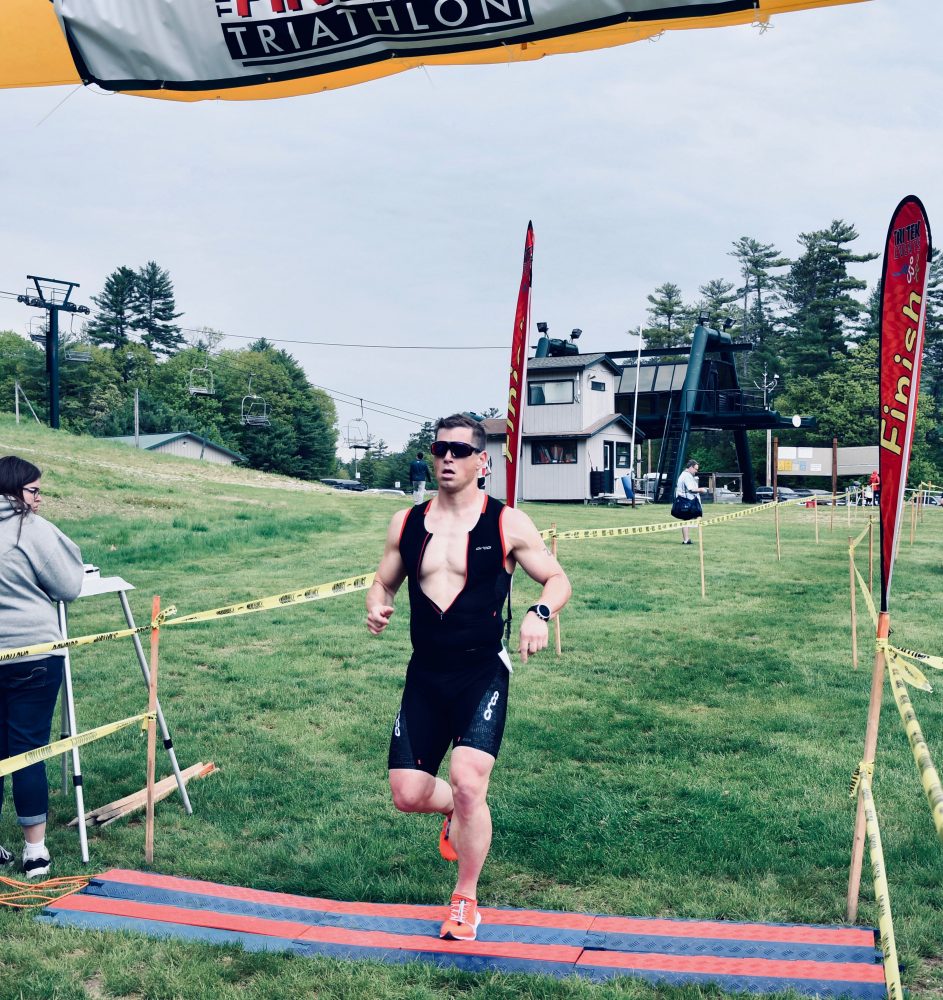
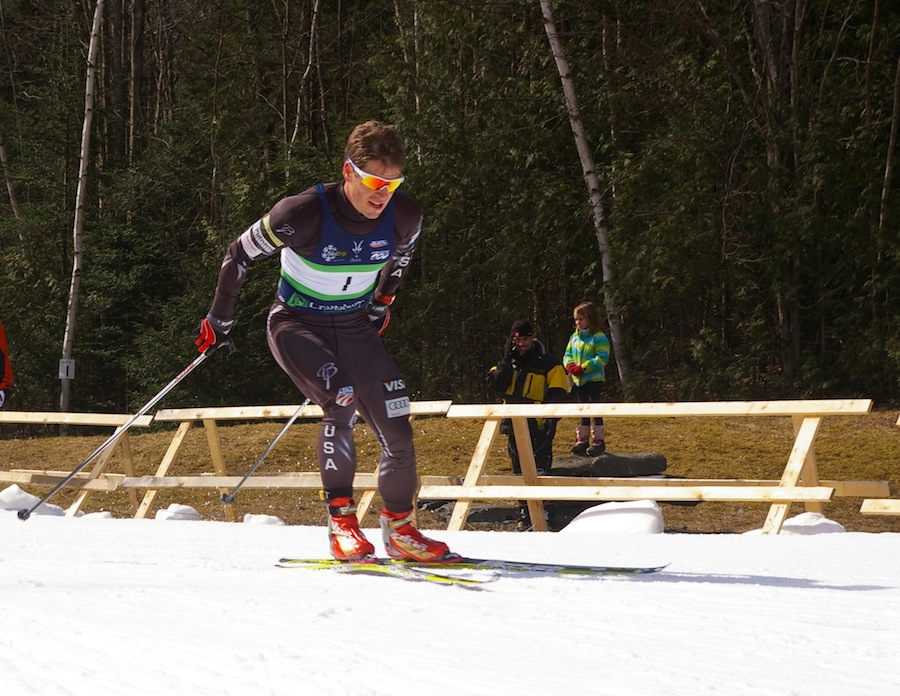
Kris Freeman crossing the line in second overall during the 2019 King Pine triathlon in New Hampshire. (Photo: courtesy of Kris Freeman)
Kris Freeman manages Diabetes. He did this on the World Cup for years and at four Olympics. He remains a competitor and continues to test himself since retiring from elite level skiing in 2018.
Freeman has turned his attention and his considerable capacities to triathlons.
We were interested to know how Freeman had been approaching the sport and managing his Type 1 Diabetes in route to his first Ironman distance triathlon in Lake Placid, N.Y. on July 28. That effort will entail a 2.4 mile open water swim, a 112 mile bike, capped with a 26.2 mile run.
The Lake Placid Ironman is Freeman’s primary goal for the season. To prime for that event, Freeman raced an Olympic distance tri on June 1, and has registered for a half Ironman on June 22.
“I can take a lot of what I learned skiing and apply it to other sports,” said Freeman in a call in late May. “The issue with triathlon though are the shortest events I do are the longest events that I did in skiing.”
The king race on the men’s World Cup is the 50k. A roughly two-hour race pushing the limits of an athlete’s aerobic capacity. An Olympic tri for Freeman clocks near 2:15 hours, the half-Ironman between 4 and 4.5 hours and the full in Lake Placid could go a bit over 9 hours. Freeman has used a Dexcom continuous glucose monitoring system in conjunction with an insulin pump since 2010. The pump injects Freeman with a small dose of insulin every five minutes 24-7. For racing, he pre-programs his doses depending on how high or low he expects his blood sugar levels to be at certain points during the race.
He brings sugar, or glucose, into his system by feeding. The insulin, coming from his pump, draws the glucose out of the blood and into the muscles.
On the World Cup, a few variables kept Freeman from consistently nailing down the moving target of insulin dosing and how to pre-program his pump for a particular race.
“Feeding was always stressful for me on the World Cup,” recalled Freeman. “We had limited staff a lot of the time. So we wouldn’t necessarily have an experienced feeder out there. The guys did the best they could, and a lot of the times we would, but sometimes, we have a volunteer doctor out there who had never fed before in a feed zone and I’m not finishing the race unless I get that bottle. And you come through in a pack of 30 or 40 guys and it is pretty crazy. I definitely had some stress a lot of stress about feeding on the World Cup.”
Distance events were Freeman’s specialty. But the insulin dosage for a 15 k and a 30 k would differ drastically.
“In a 15 k race, I am pretty much all out the whole way,” said Freeman. “I am anaerobic with lactates over 10mm/mol on every uphill and just gasping for air on the backside. Whereas on the 30 k you just cannot sustain that type of output for that long.”
The anaerobic work during harder efforts, Freeman explained, pushes his blood sugar levels up — glucose is a byproduct of lactate.
When programming insulin dosing for shorter races, like a 15 k, Freeman would have to factor in his expected increased lactate load.
“In the shorter races it was always more difficult to find that happy medium of how much insulin to take to cover my anaerobic workload without taking too much and crashing through the floor and going low in a race,” he said.
Freeman explained that in the 30 k and 50 k races his lactate levels were moderated and he would burn primarily glucose for fuel which he could replenish with a timely feed. And his lower levels of lactate would not drive up his blood sugar levels.
In the half and full Ironman distances, Freeman said he expects to be in an anaerobic state for a short period of time. The insulin dosing, he thinks, should be easier to determine. And the feeds in triathlon are simpler than in cross-country skiing. He can consume sugar in the form a sports drink during the swim-bike transition, and take continuous sips while on the bike, and as needed during the run.
According to Freeman, the longer the triathlon event, the lower his insulin dosage.
Freeman’s glucose monitor provides important audible feedback if his blood sugar trends in a too high or too low direction. A certain alarm chimes at the low or 100 mg/dl mark, and another at the 180 mg/dl mark.
“Those are my chosen levels, because if I am below 100 I am not that far from an area, below 70 is going to negatively impact my performance from a low standpoint,” said Freeman. “Below 70 for a non-diabetic, you are bonking. And you are headed to a bad place. So that is just a warning like ‘ok I am below 100 I need to get some glucose on here so I do not go any lower. On the 180 side, if the chime went off, it is programmed to continue to chime every five minutes until it is no longer about 180. So I would listen for 15 minutes, ‘did I hear the chime again?’ Ok I did, I am going to hold off feeding. And if I really got concerned about my level, I could take the device out and look at it, because I am going to be on that bike for five hours so I could take a look if I needed to.”
On the bike, for example, if Freeman hears the 180 level chime, he can cease taking on glucose until his workload “burned enough glucose and made me insulin sensitive enough that my levels just came down,” he said.
Prior to his Olympic distance tri on June 1, Freeman’s only other recent triathlon experience was last year’s Sea to Summit race that finishes atop New Hampshire’s Mount Washington. Freeman won that event in 5:41:37 hours despite what he said was some flawed insulin dosing.
“I learned a lot because I had never done a race longer than a 50 k up until that point,” Freeman said. “And so then I am racing six hours and I actually took too much insulin. I took less insulin than I had ever taken in a 50 k and it was still too much.”
Remember, the insulin pulls glucose from his system. During the Sea to Summit, his insulin levels removed too much glucose out of his blood despite what he believed to be a steady intake of sugar. (And he wasn’t producing lactate that would be converted into glucose.)
In that race, he refueled on the bike, and then made an unplanned stop a half mile from the summit finish to consume what he called an “emergency flask” of UnTapped maple syrup.
“I just drained like five ounces because I was dropping really quickly, and that got me to the top,” he said. “It was a good day. But definitely learned some lessons about how little insulin you need when you are at that aerobic glycogen burning state.”
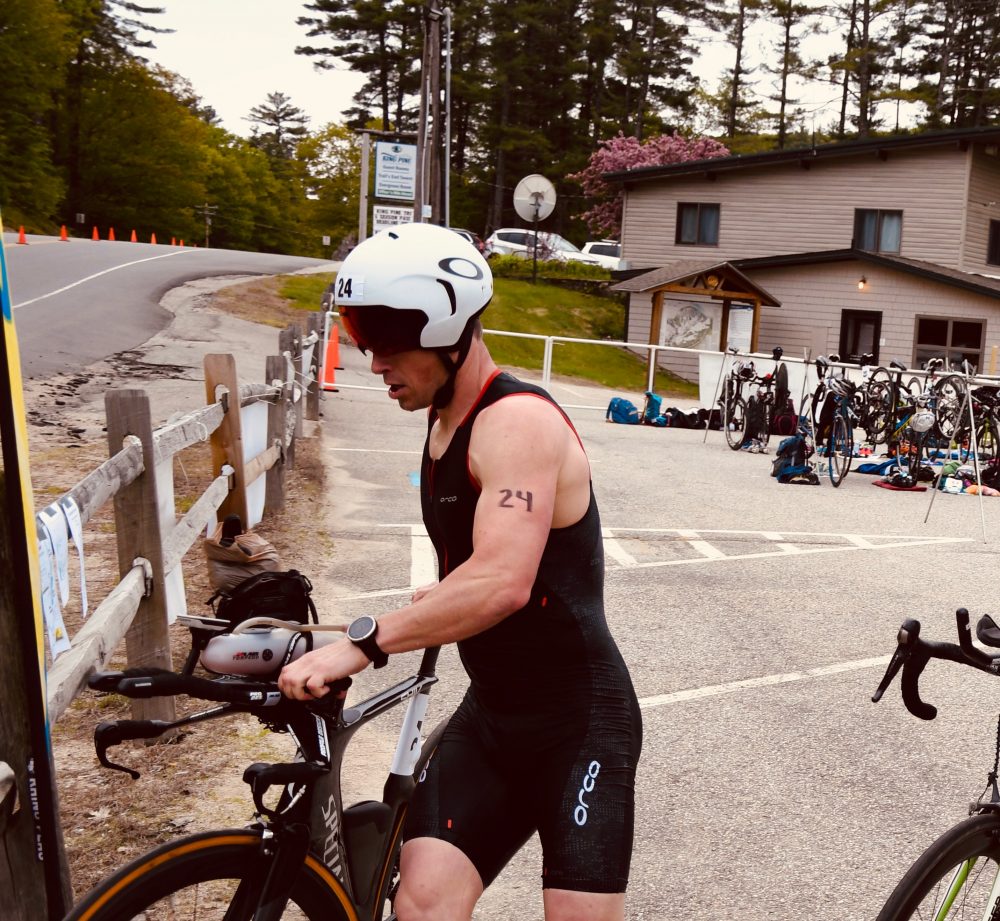
Kris Freeman during the 2019 King Pine triathlon. (Photo: courtesy of Kris Freeman)
Adding to the physiological puzzle, Freeman said riding the bike is lactate intensive. Again, that has the effect of driving up his blood sugar levels, so he might need to refuel on the bike less than he originally thought.
So how did the June 1, race go?
Freeman began the race with a glucose reading of just over 180 mg/dl. He finished around the 150-160 range.
“It was actually about a perfect blood sugar profile as I could hope to have for a race,” Freeman said in a post-race call. “And it is interesting because it was a two hour and 24 minute race which would be kind of like a 50 k ski race. And I used a more aggressive dose in the triathlon than I would have in a ski race. I fed about half what I would have in a 50k. And I think that the reason for that is that I am pushing such a high lactate when I am riding my bike, the lactate drives the sugar upwards. Also, when I am ski racing too, the downhills you truly do nothing when you are in a race. Which allows your body to catch up. In a relatively flat bike race, I am pedaling 99.8 percent of the time.”
With a 33 mile bike portion on June 1, and a 56 mile bike for the half marathon, Freemen suspects he’ll not be pushing into the anaerobic zone as much in the later race. For now, his plan is to run half the dose of insulin for the half-marathon distance. A race approximately twice as long in total elapsed time than his recent Olympic distance performance.
Kris Freeman’s blood glucose levels for the duration of his King Pine triathlon. The race began at approximately 8:15A and lasted 2:24:27 hours. (Photo: courtesy of Kris Freeman)
Freeman’s strategy on June 1, of drinking half-strength sports drink throughout the bike leg and then small quantities of full-strength sports drink at the start of the run, helped keep his blood glucose within the 100-180 mg/dl sweet spot.
Lessons learned and applied. Freeman stated he needs to dial in his swimming (admittedly it is his least strong leg) and his swim to bike transition. Yet, his insulin dosing and feeding strategies passed the first triathlon racing test of the season. He placed second overall in the King Pine Olympic distance tri.
We’ll be following Freeman this summer to hear more about his build-up to his first Ironman in late July and learn more about what he learns when it comes to diabetes management and his high standard of performance.
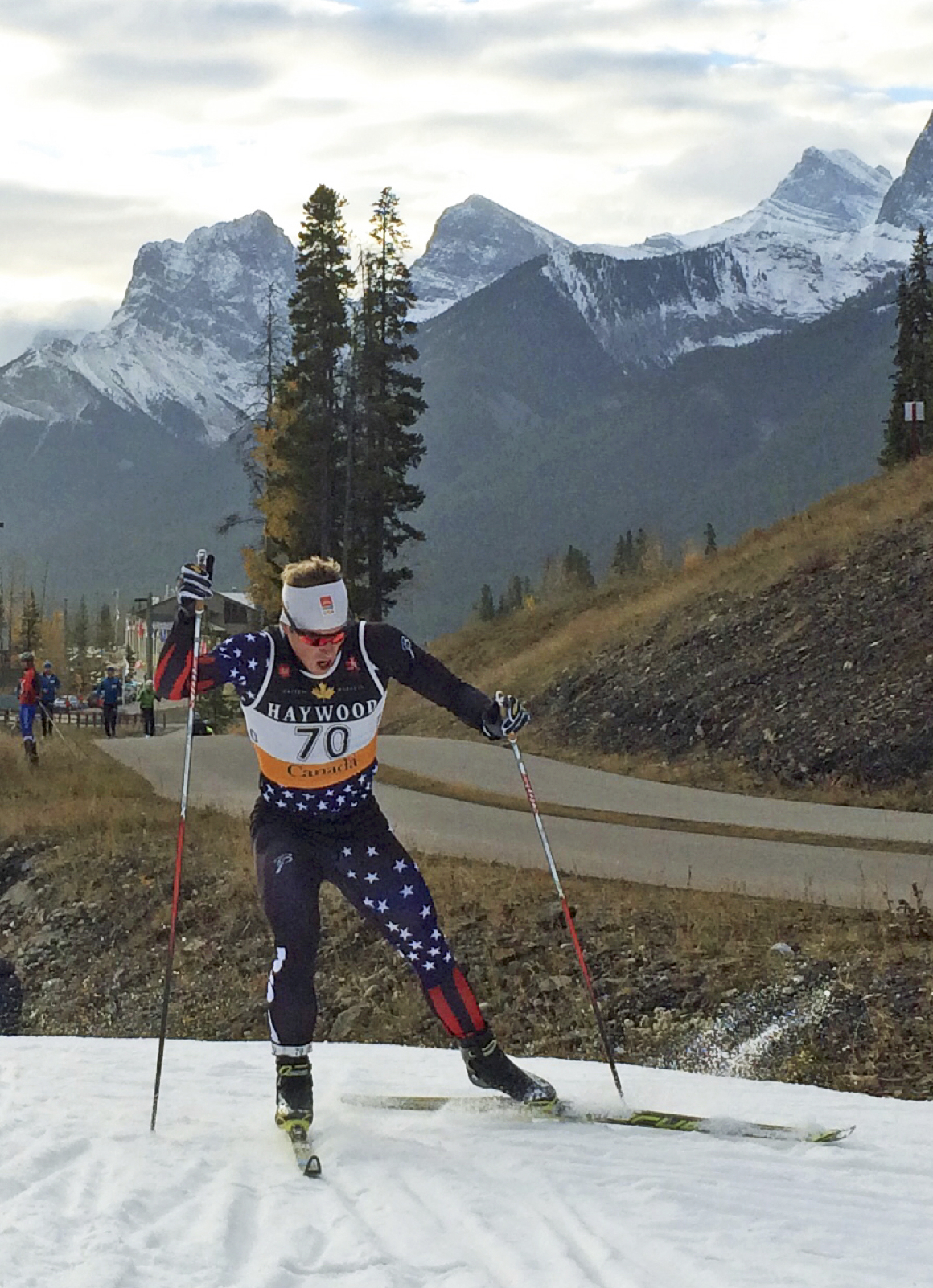
Kris Freeman racing to second in the 10.8 k Frozen Thunder skate race on Oct. 27 in Canmore, Alberta. (Courtesy photo)
It’s been nine years since Kris Freeman last visited West Yellowstone, Mont. Back then, the New Hampshire native was 25 and one of the U.S. Ski Team’s best distance guys (along with Andrew Johnson, Carl Swenson and James Southam) destined for his second Olympics.
After the 2006 Torino Games and two more Olympics later, Freeman, 34, has returned to southern Montana, where he’s only been twice before: for the 2005 and 2002 SuperTour-opening races of the season.
Before that, Sovereign Lake — commonly known as Silver Star— in Vernon, British Columbia, was where many top Americans and Canadians converged at the start of each season in late November.
And every year since 2005, Freeman, a U.S. Ski Team (USST) member from 2002 to 2013, started each winter in Europe. So yeah, it’ll be a little weird for him to be back in West for this year’s opening SuperTour races, but he’s not complaining.
In a phone interview earlier this month from his home in Thornton, N.H., Freeman said he’s more settled this year since losing a major source of income and health benefits after the USST didn’t renominate him to the team in April 2013. In the months after, the Type-1 diabetic became a nordic-racing instructor at Waterville Valley, his original club, which provided health care and a financial boost in the months leading up to the 2014 Sochi Olympics.
Freeman, a 16-time national champion, went on to make the U.S. Olympic team as a non-USST member, placing third at U.S. nationals in the 15-kilometer classic as well as the 30 k freestyle mass start, and fourth in the classic sprint. In Sochi, Russia, he consistently placed around 50th: 52nd in the 15 k classic, 53rd in the skiathlon and 57th in the 50 k freestyle mass start.
It wasn’t anywhere close to the Olympic performance he was looking for, and Freeman ended the season then and there, returning home for two minor surgeries: to remove a viral infection from his right heel and undergo a gum-grafting procedure (in which tissue from the roof of his mouth was used to fill in three areas along his gum line).
Freeman (back right) descending in the skiathlon at the 2014 Olympics in Sochi, Russia.
He scheduled the procedures in advance for the week he got back from Russia, tackling the foot first then seeing the oral surgeon the next day. For the next three weeks, he was out of commission, but that was OK — and by design. He spent the better part of the next three months taking a breather from nordic skiing.
“After the Olympics, my body was completely trashed,” Freeman said. “Part of the interesting thing about having diabetes is when things go bad, they go really bad for me really fast, and I go really deep into what appears to be a deep training hole. … I took three months of basically whatever I wanted to do which consisted of mostly telemark skiing and playing. By late June, I was back and my body was feeling the way it was used to.”
Because of his diabetes, he explained he’s more prone to chronic fatigue, which, in non-diabetic athletes, is caused by overly intense training and racing.
“Once the body’s reserves are used up it will begin to run on adrenaline whenever a stress is placed on it,” he explained. “This is not sustainable and eventually the adrenal gland will get tapped out. When this happens an athlete is diagnosable with chronic fatigue.”
When his blood sugar drops below normal, Freeman explained his body tries to keep those levels in check by releasing adrenaline, which tells the liver to dump sugar into the bloodstream. Since racing and interval training use a lot of adrenaline, a hard race schedule combined with frequent and severe blood-sugar lows could send him spiraling into chronic fatigue.
That’s what happened last season.
“Things just started out at not a very high level … and went downhill from there,” he said. “Last year was one of my hardest training years ever. I was absolutely flying in August and September, which is not when you want to be [at your fastest]. … I’m 34 now. I don’t respond to training the way I used to when I was 24. This year, we [myself and coach Zach Caldwell] took a much more conservative approach, especially after those three months of super easy.”
For each of the last four or five years, Freeman estimated he’d logged about 900 training hours. This training season, he figured he was closer to 700 or 800.
“When I look back at the overtraining or whatever you want to call it, the mistiming of fitness, the mistakes I made, I thought I was kind of immune from being cut from the USST,” he recalled. But he realized it had a bigger impact on his life than he anticipated.
“It was the only support system I knew. Going and changing everything in an Olympic year is difficult,” he said. “I’m still being supported by Waterville. I’m an employee there and I will be teaching some ski lessons this winter. I’m happy with that natural fit. My sponsors have stepped up for another year of support. The big change is I’m no longer with the Maine Winter Sports Center. I’ve chosen to be independent. I’m more comfortable to be at home; that’s where I’ve always made my biggest gains.”
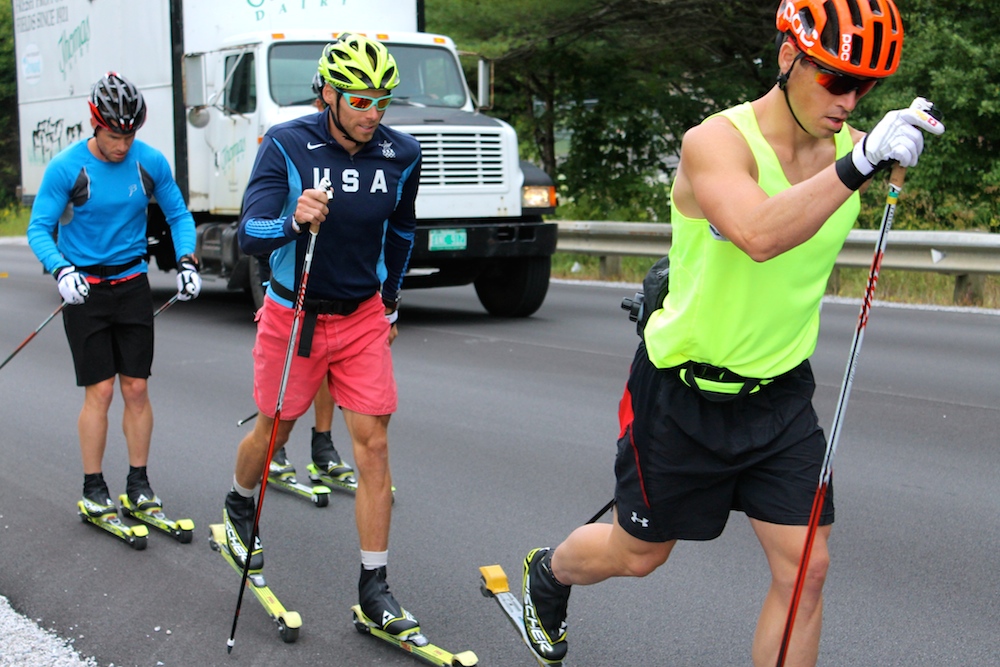
Kris Freeman (r) leads Andy Newell (c) and some others during a rollerski workout in lAugust in Stratton, Vt. There, he trained with the Stratton Mountain School T2 Team as well as the Canadian World Cup Team (not shown).
After revving up his training season with the Canadian World Cup Team and a couple USST men (Andy Newell and Simi Hamilton) in August in Stratton, Vt., Freeman went on to participate in the informal season-opener in Canmore, Alberta, racing both the classic sprint and 10.8 k freestyle race at Frozen Thunder. There, he placed second in the distance race and fourth in the sprint.
“I had what was probably my best sprint qualifier ever there — that was pretty fun,” Freeman said of his fourth-fastest qualifying time. “The skate race, I felt in control with good snap and good power. I would say both those race were far better than anything I put out last year.”
This season, Freeman, who raced in Canmore under the club name Freebird and is backed by equipment sponsors Swix and Fischer (he switched to their boots this year), will start the season in Montana, racing both the West Yellowstone opener and Bozeman SuperTour next weekend. Then, he’ll head north to the Canadian NorAm opener Dec. 13-14 in Rossland, British Columbia, followed by Whistler (Dec. 20-21), return to Thornton for Christmas, and head to Houghton, Mich., after New Year’s for U.S. nationals.
“I’m hoping at that point to be leading the SuperTour, in which case I’ll [earn World Cup starts in Rybinsk,] Russia,” he said.
But he doesn’t plan to go to Russia because it’s 13 time zones and a week after nationals.
“If all goes well, my first World Cup will be in Östersund, Sweden [Feb. 14-15],” he said. “I hope to make the World Championship team and finish out the season on the World Cup.”
While he’d like to see how he stacks up at this point on the World Cup, Freeman said going to Europe later could be a good thing. In the past, he struggled at times in February and March.
“I’d rather go over and hit it at World Championships than hit it in Kuusamo,” he said.
As for the 2018 Olympics in PyeongChang, South Korea, Freeman said he still “very much” enjoys skiing and tracking the adaptations in his body to build a perfect season. “I would love to complete in my fifth Olympics,” he said. “I’m going to take it year by year at this point.”
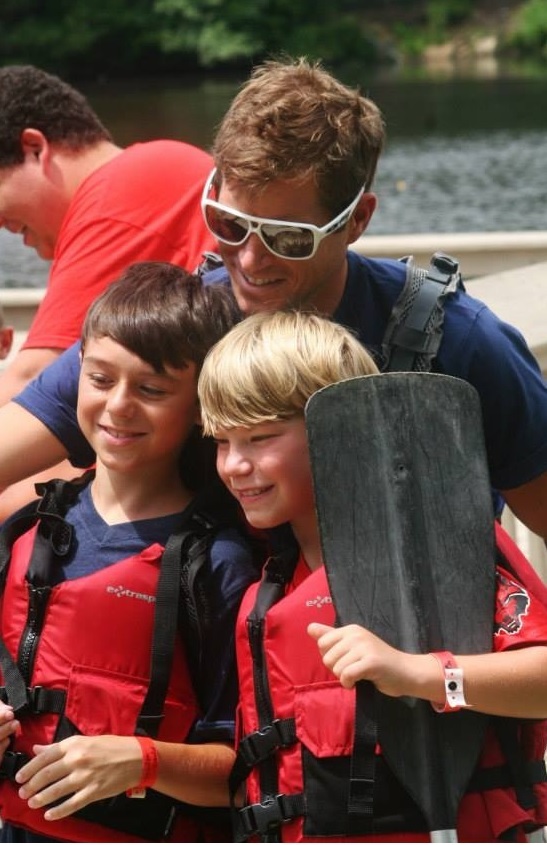
Kris Freeman at an American Diabetes Association’s Camp Aldersgate in July in Little Rock, Arkansas. (Photo: Lilly Diabetes)
Kris Freeman, the guest of honor at a JDRF gala in Indianapolis this past spring. (Courtesy photo)
Kris Freeman, the guest of honor at a JDRF gala in Indianapolis this past spring. (Courtesy photo)
Same Story, Stronger Message
After two seasons with the Maine Winter Sports Center (MWSC) in the northeastern tip of Maine — about a 6 1/2-hour drive from Thornton in central New Hampshire, Freeman decided to return to his longtime base near Waterville Valley and cut down on travel during training blocks.
When he wasn’t pounding the pavement on rollerskis or running trails around Waterville, he could often be found touring a multitude of states around the country, speaking on behalf of Lilly Diabetes. Freeman’s been an ambassador with Lilly since just before the 2002 Olympics.
“When I first started working with Lilly, I used to spend more time going to diabetes expos where I’d sit at a booth and introduce myself,” he explained. “But we weren’t really targeting the people that could relate and maybe draw inspiration from my story.
“I always enjoyed working with kids far more than working with adults,” he continued. “I didn’t grow up with the disease as a lot of these kids have so I’ve learned a lot more. You get exposed to the challenges they’ve had: changing hormones, social interactions can be difficult, also at the very young ages, something as simple as sleeping over at somebody else’s house can be difficult because parents have no idea how to care to somebody with diabetes…”
For the last 10 years, Freeman has taken part in about six to 10 camps every summer, visiting more than 10,000 Type-1 campers and traveling more than 120,000 miles, according to Lilly.
He tries not to keep track.
“Each year, hundreds of camps will request I go there,” he said. Typically, he’ll give precedence to the places he hasn’t been before and lets Lilly do all the scheduling around his training plan.
This year, he dedicated two weeks to presenting, appeared at five camps in a week and made stops in “Indiana, Texas, Arkansas, California, New York… it becomes a little bit of a blur,” he said.
In May, he was a featured speaker at Juvenile Diabetes Research Foundation (JDRF) educational conferences in Phoenix, Detroit, and Albany, N.Y.
“Some people in the ski community might find it ironic, I actually kind of serve as a motivational speaker and I do have a rather blunt style of telling my story,” he said. “But at the same time it’s a very honest way of telling my story and people react to it and that’s why I do it.”
“Some people in the ski community might find it ironic, I actually kind of serve as a motivational speaker and I do have a rather blunt style of telling my story.” — Kris Freeman, Lilly Camp Care ambassador and four-time Olympian who was diagnosed with Type 1 diabetes at 19
Lilly has been his headgear sponsor since 2001, and while the nonprofit pays him to help with his racing, he said it’s about more than the money.
“I could continue to ski race without them, [but] it’s a lot easier to ski race with them,” he said. “They’re a part of my income for sure. I’m glad that I have a company that I respect.”
Questions from Kids: (Provided by Freeman, from one of his interviews this summer. “I found with kids that grow up with diabetes, they mature more quickly,” he said.)
What has been your highest and lowest BG, and how did you deal with it?
I have never lost consciousness from low blood sugar because I can always feel that I am low before I test myself. The less frequently you have low blood sugar the stronger your adrenal response to hypoglycemia. You will sweat shake and feel nervous. However repeated lows in a short space of time will put too much stress on your adrenal gland and your body will give you less warning. My lowest sugars have been in the 30’s. I drank 16 ounces of gatorade and sat down for twenty minutes until my sugar rose above 80.
My highest sugars have been in upper 300’s. When I am high I take a small corrective bolus and then go for an easy walk. The light exercise makes my cells more sensitive to insulin which lowers my blood sugar more quickly. This method also allows me to use less or a corrective bolus which lessens the chance of a subsequent low form overdosing. If I go high in the middle of the night I will do 100-200 jumping jacks to increase my insulin sensitivity instead of walking.
What is it about cross-country skiing that you like?
I have competed in all forms of ski racing. I was a ski jumper, a downhill racer, and a xc ski racer as I kid. I love all forms of skiing but xc is my favorite because I never have to stop or sit on a lift. I love knowing that I can ski continuously for hours and cover 50 miles in a single training session.
What’s your favorite low-carb snack?
I really like Greek Yogurt. Its very high in protein and has a nice texture.
What’s your favorite all-time Guns N’ Roses song (‘Welcome to the Jungle’ would be my answer)?
My favorite G n’ R song is “Rocket Queen” which is the last track on Appetite for Destruction. The first time I listened to the album in its entirety the song blew my mind and it still does.
Over the years, Freeman’s message has generally stayed the same. He tells kids ages 6 to 18 that they can achieve anything they set their minds to — whether it involves sports, music, academics or anything else — and not to listen to anyone who tells them their diabetes will prevent them from doing so.
The first two doctors he had when he was diagnosed with Type-1 diabetes as a 19-year-old USST member said he wouldn’t compete at the next Olympics.
“I tell the kids this so that if somebody tells them they can’t do something, they can do it — they need to find a doctor that can work with them,” he said. “Their eyes open a little bit more. … A lot of the adults in their lives tell them they can’t do things because they’re nervous about them hurting themselves. [It’s about] educating the people around them about what this is and means.”
Since he’s become more comfortable with speaking in front of anywhere from 10 to 100 people at a time (although he still gets nervous presenting to 6 year olds: “It’s a little bit different keeping their attention,” he said), Freeman has opened up and shared more of his personal story as well.
“I tell them about the first time I went to the World Cup and it came time to take an injection of insulin,” he said. “I was like, ‘What am I going to do here? Go into the corner and be sneaky like I’m doping or something, or am I going to sit here at the lunch table and do it like I would at home?’ ”
He sat at the table and injected himself, and while it drew some looks, his fellow competitors eventually got used to it.
“I tell them to be open with it, about it, and I also tell them about the ideas of limitations of diabetes are outdated at this point because of the advances in insulin … and the way we can detect glucose,” Freeman added.
“In my early presentations, I would gloss over any difficulties I had. I wouldn’t talk about any lows … I wouldn’t talk about getting in the van after a workout being absolutely dehydrated, out of fuel and watch all [my] teammates pull out a quart of Gatorade and just down it, like, oh my God, that is something I wish I could do.”
He also frequently brings up what he considers one of the lowest points of his racing career: when he didn’t finish the 50 k classic at the 2010 Vancouver Olympics.
“I’ve had two lows in my career and one of them came in the biggest ski races of my life,” he said. “I share this crushing story and it makes me very relatable and it makes me seem real to them. I didn’t stop after that race and I came back after that season. … It’s a story of resilience, and if they can draw from that it makes it worth it. Honestly, the kids I talk to think 52nd at the Olympics was pretty awesome so it gives me perspective.”
When he gets back to training after a couple weeks on the road each summer, Freeman said he’s more focused. That’s what five to six hours a day at a diabetes camp, speaking and conversing and playing kickball and climbing on a ropes course with kids, does for him.
“When I take time away from training, it is important and I think more important in the grand scheme of things than skiing ever might be,” Freeman said. “I’m as guilty as ever as letting skiing be all-consuming …. I’ve gotten better at it over the years.”
At home, Freeman spends time with his girlfriend Amber Dodge and new puppy, She-Ra.
“The puppy is doing great — she’s gotten big enough that I can run with her now,” Freeman said of the seven-month-old, 40-pound Vizsla named after the sister of the comic-book character, He-Man.
This summer, he competed in a number of cross-training events, like the Wildman Biathlon, Top Notch and Josh Billings triathlons, US National Mountain Running Championships, and Mount Washington Road Race.
Fifteenth overall in Mount Washington’s 7.6-mile uphill run after his brother Justin in ninth, Freeman said he felt “pretty drained” and couldn’t get his heart rate above 164 during the June race. In a recent time trial, he was back to normal at 179.
This training season, he and Caldwell have measured his recovery using Galanes Sports Systems’ Firstbeat technology, which detects variability in Freeman’s heart rate while sleeping. From there, they’ve been able to determine how stressed his body is from training as well as measure the effects of his workouts.
“As time has gone on, I felt better and better,” Freeman said. “The time trials I did out in Park City with the Canadians … and in Canmore felt even better. Things are going in the right direction right now.”
Kris Freeman’s girlfriend Amber Dodge and their puppy She-Ra riding the Gondola down from the finish of the Wildman. (Courtesy photo)
Kris Freeman at the second transition of the Wildman Biathlon, a 10 k run, 22.3 k road bike and 3-mile hill climb run, on Aug. 9 in Gorham, N.H. (Courtesy photo)
Kris Freeman kayaking toward his dog She-Ra. (Courtesy photo)
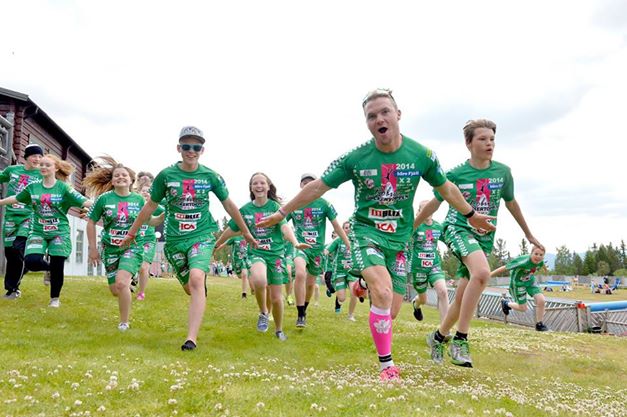
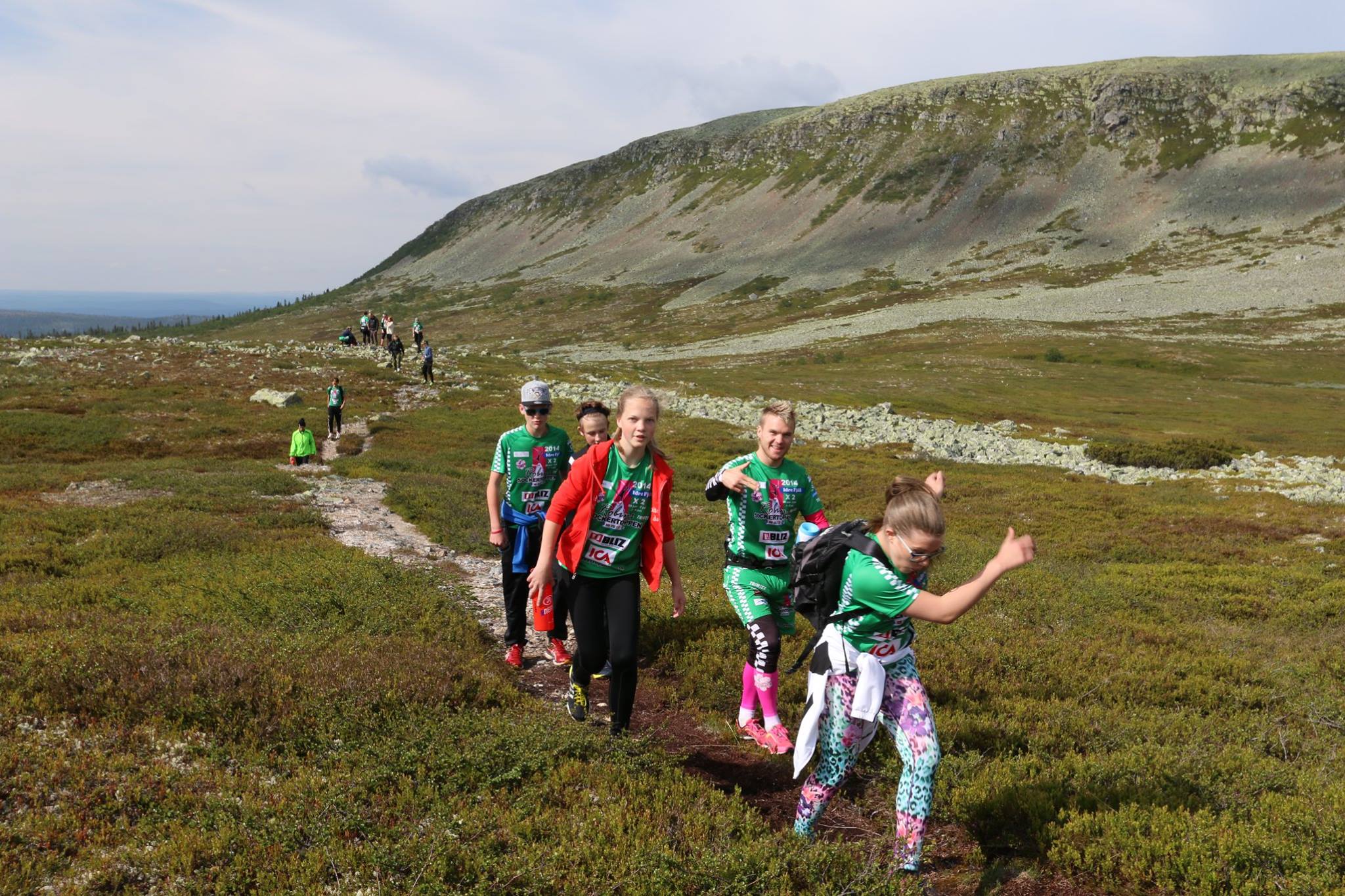
Robin Bryntesson (front) running with Swedish kids at his camp for diabetic children. Photo: Team Robin.
When he was a kid, Robin Bryntesson skied a lot. That’s not unusual for a Swede.
But then he got some news that definitely set him apart from his many teammates: he had diabetes.
“My doctor told me that my skiing career was over,” he explained in an e-mail.
Like any fiercely competitive athlete, Bryntesson didn’t take the news lying down. He kept skiing and went on to win a World Junior Championship, then a World Cup team sprint with Emil Jonsson.
“Then I call my doctor and say that my career is not over, maybe yours,” Bryntesson joked.
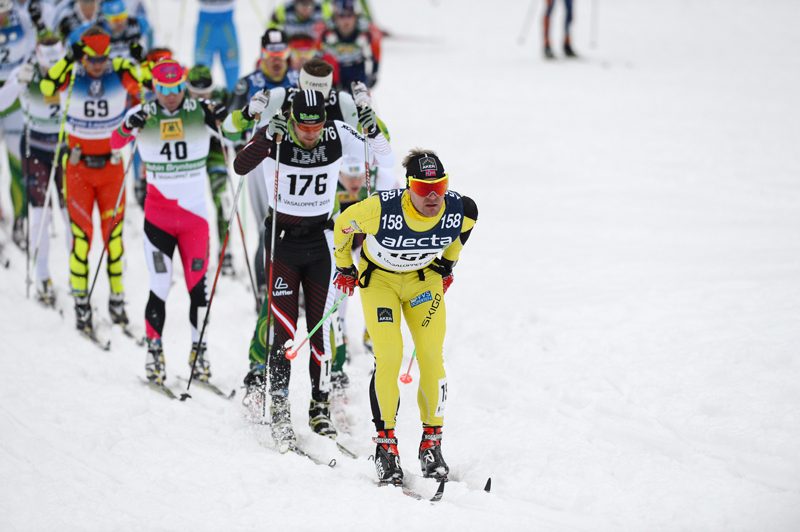
Robin Bryntesson, in bib 40, skiing in the lead pack at the Vasaloppet this winter.
These days, he doesn’t get so many World Cup starts, but that’s due as much to Sweden’s strength and depth as a ski nation as much as anything else – Bryntesson still excels at distances from sprints to the 90 k Vasaloppet, and is still seeking starts for his country at the sport’s highest level.
And he’s beloved in Sweden and abroad as the court jester of the ski world, making funny videos that often feature his famous teammates and sometimes go viral. Recent hits have been a well-done music video for Bliz eyewear spoofing the Faith Hill song “This Kiss”, and a promotion for the Östersund World Cup weekend in February that features an anything-but-conventional sprint course.
Things don’t always go smoothly: his quest to win the Vasaloppet ended this year when Bryntesson’s blood sugar crashed late in the race. Despite being more or less delirious (“cross-eyed” was how his support team described it), he finished within 2 minutes of the winner.
And so it’s safe to say that Bryntesson has proven to both himself and his doctor that a diagnosis of diabetes doesn’t mean the end of an athletic career. But a few years after learning he had the disease, Bryntesson realized that there was more he could be doing.
“It started when I sold pink hats in favor of juvenile diabetes fund those first few years,” Brytesson explained. “I donated 12000 SEK (roughly $1600) the first year and later it became more pink clothes and now a camp for children with diabetes. Next summer will be the fifth year of the camp.”
Bryntesson and his campers reach new heights around Idre, Sweden. Photo: Team Robin.
The pink hats for “Team Robin” have become ubiquitous – and in a restrained country of muted wardrobes and Jantelagen, Brytnesson has made bright colors and particularly pink his trademark. The summer camp, called Söckertoppen, had record enrollment this summer and is popular enough that this year there were two different sessions in the mountain area of Idre, one for kids aged 10-13 and another for those aged 14-17.
The name of the camp is something of a play on words: the Swedish translates to “Sugar Top”, which Bryntesson says he means as “Sugar is good!”
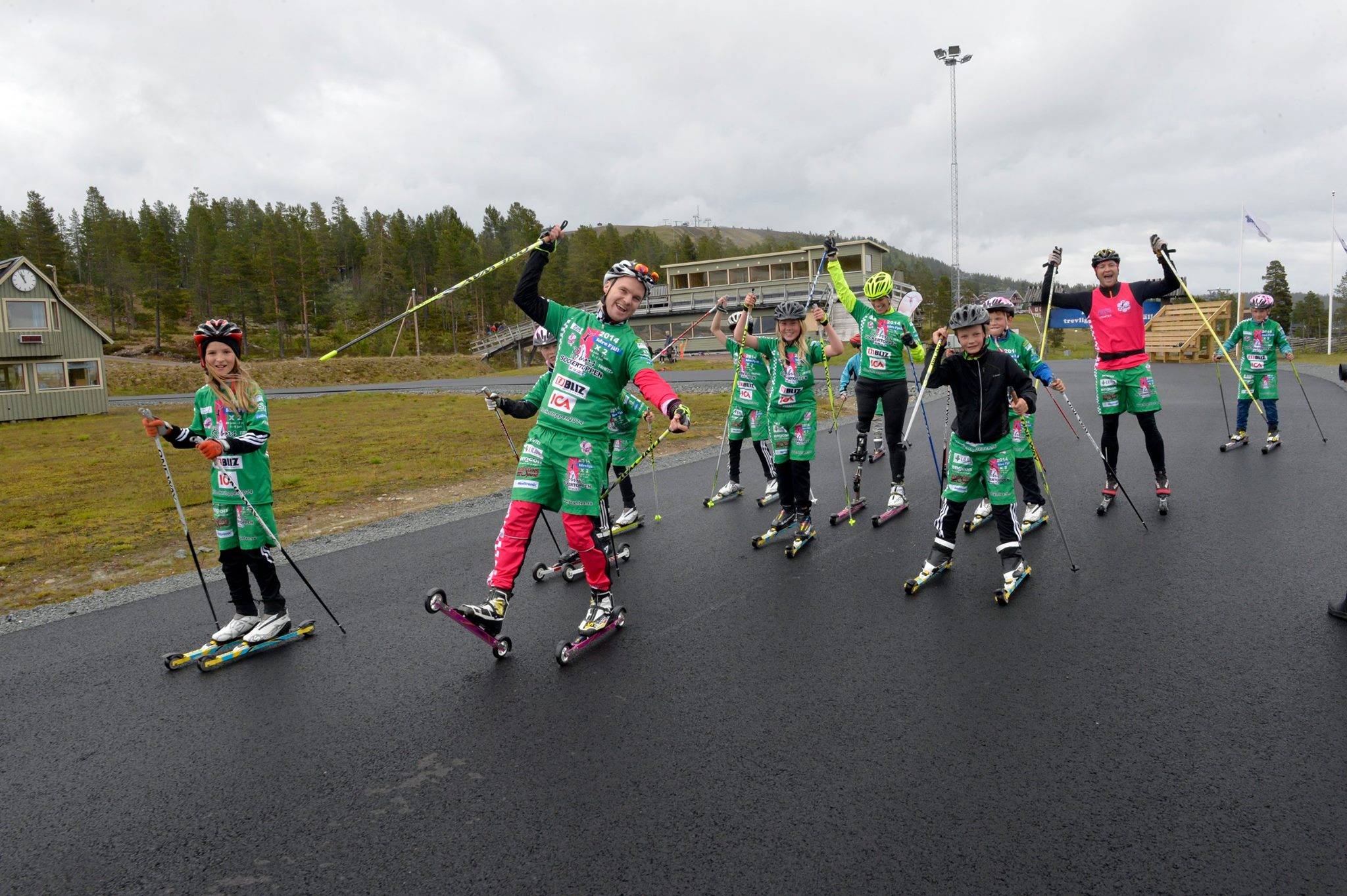
“Examples of what the guys and girls where doing those days was to challenge themselves, get to know others in the same situation, roller skiing, climbing peaks, the Masters champion (one swedish tv show), gymnastics, diabetes paths, swimming, disco and banquet,” Bryntesson wrote. “There was lecture by me and a stunning girl who won Paralympic gold in 2014 in Sochi, Helene Ripa. She’s skiing very fast despite an amputated leg and what a wonderful story!”
While there are a variety of summer camps for diabetic children in the U.S. – Olympic skier Kris Freeman, himself a diabetic, regularly visits camps organized by the pharmaceutical company Lilly to give inspirational speches – Bryntesson says that’s not the case in Sweden. So he struck out on his own.
“There is not so many diabetic camps in Sweden and there is no one like ours,” he wrote. “We have taken the best from the athletic world and put that in the diabetic world. We learn from each other and develop together! It took me 10 years with diabetes before I started the camp. And I´m learning something new every day about diabetes. What’s most important is to learn to know your own body! That’s what´s really matters!”
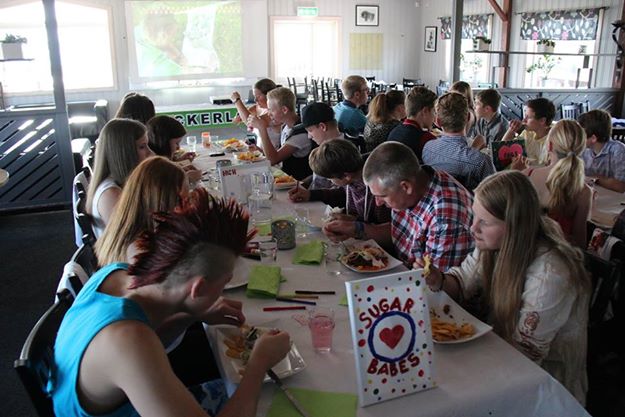
A typical mealtime scene at Sockertoppen. Photo: Team Robin.
Lately, he has had reason to expand his sights somewhat. Bryntesson was asked to announce the Paralympics in Sochi for Swedish television, an opportunity he relished. That has helped him forge closer ties to the world of disabled athletes, not just those with his own illness.
“It was really very inspiring to be in the Paralympics,” he wrote. “They are amazing, they really show that no mountain is too high! Whether one has an arm, leg, or is blind so they just keep on moving and inspires people worldwide. Even diabetics.”
With summer, and Söckertoppen, behind him, Bryntesson is finishing another project: a technique app called “Superb Skiing” which teaches world-class ski technique while entertaining with Bryntesson’s trademark brand of humor.
Of course, the app has a video trailer, featuring a typically Bryntesson attitude towards life.
“I get many questions about different technology/skiteknik and training,” he wrote as an explanation for why he wanted to make an app. “And one time for 1.5 years ago, when we where out and making a movie abaut ‘braking on rollerskis’, then we thought it was time to make an app. Since then we have been working on it. It’s about training in general and skiing in particular, and the goal is to make every owner of the app to a better skier.”
Despite all his other callings, Bryntesson’s biggest goal for the upcoming season is to earn a start at World Championships, which will be held on home turf in Sweden.
“My goal this winter is to try to fight for a ticket to the World Championships at home in Falun,” he wrote. “Although, as usual, Sweden is very tough for sprint spots. Then there will also be many of the longer races with Vasaloppet as the main focus. There I my best finish is 12th place. Which is the goal to beat!”
How can he possibly maintain a full training load and stay one of the fastest skiers in the world, when he’s spending so much time doing diabetes outreach, business ventures, making videos, and entertaining the whole ski world?
“It’s not the first time I’ve heard this question,” Bryntesson wrote. “I often have a lot of energy over besides training so that makes many projects coming up. I also like to make movies, it gives me even more energy. I like to have fun and I try to show that in many of the films that we do! It can sometimes take a lot of time, true. But I think it is worth every minute. If life is fun, then the good results can come.”
The “Superb Skiing” app is available for download from Google Play here for $5.40.
Bryntesson rollerskiing with campers this summer. Photo: Team Robin.
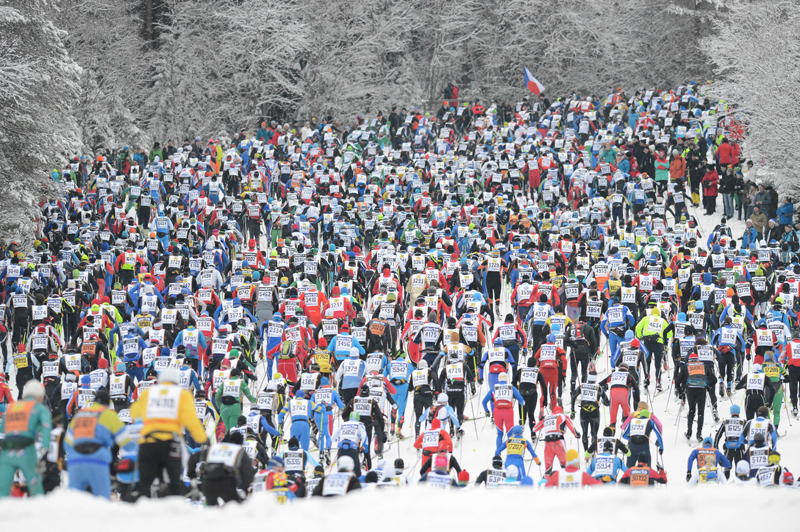
The first hill on the Vasaloppet course – and it looked a lot worse by the time I got there. 15,800 skiers start at once, and it took me 35 minutes to go three kilometers. Photo: Rauschendorfer/NordicFocus.
MORA, Sweden – I just climbed into a car with three people I don’t know: Lars and Raffa, tall jovial Swedes, and Ingunn, a beautiful wispy-thin Norwegian. After a quick trip to the grocery store, we’re trying to navigate our way back through Mora. The problem is, it is two days before the Vasaloppet, the only thing that ever happens in Mora. Traffic is at a standstill.
Eventually, we make it to the other side of the town. My three companions are having a lively discussion in Swedish which I don’t understand. After a series of hesitant turns, I can see the thought “ah well, screw this” pass across Ingunn’s face and next thing I know, we’re driving the wrong way down a one-way street. Then the men jump out of the car and Ingunn and I come to rest in something that is not a parking space.
“The liquor store,” she says.
The three are supporting a friend at the Vasaloppet, and to get through tonight and tomorrow until they actually have something to do on race day, they are going to need some booze. I know their friend Mattias, who generously offered to let me join their group, a godsend since organizing yourself for a point-to-point race is pretty complicated. But Mattias is off testing wax, so here I am.
The men eventually return and Raffa tells me to sit in the front. Soon we’re back on the road. Lars and Raffa are packing snus and drinking beer (and doing who knows what else) in the back seat, and the beautiful Norwegian is driving with one hand on the wheel and a distinct attitude of ennui.
We are making our way toward Sälen, the start of the famous 90 k Vasaloppet and where we will stay this weekend. Along the way we pass the race trail quite a few times. It’s raining out. There are people skiing and it looks completely miserable.
Mattias has told me next to nothing about where I’ll be staying and who I’ll be with. Cryptic and strangely capitalized e-mails have told me that it will be very crowded in the house, but there will for sure be space for one more; that a woman has already cooked all the food so I should just plan to eat with them; and to bring sheets.
When we arrive in Sälen (after a few wrong turns and confusion along the way), I walk into a cheerful, large cabin that appears freshly decorated along a tasteful black-and-white theme. It’s warm and smells like dinner. The kitchen is already full, but not of people I know. In fact, of the 15 or so people who will be staying in the house this weekend, Mattias is the only connection I have. He’s not here.
“Welcome to Robin’s team!” a middle-aged woman named Lenita tells me and gives me a hug.
We sit down for dinner. They try to tell me what the food is, but decide it can’t be translated. Even after we’re done with the meal, I have no idea what I have just eaten. It’s delicious though – rice and some sort of meat in a sauce, and we sprinkle flaked coconut, peanuts, crushed pineapple, and banana slices on top.
“It’s one of Robin’s favorites,” Lenita explains. “Good luck food.”
Robin Bryntesson, in bib 40, skiing the Vasaloppet.
As it turns out, I have joined Robin Bryntesson’s team for the weekend.
Yes, that Robin Bryntesson – the famous Swedish skier, a two-time U23 sprint champion who might be best-known to North Americans because he won the World Cup team sprint with Emil Jönsson in Vancouver back in 2009. It turns out that Mattias grew up with Robin in the tiny town of Rossön, and the two are something like best friends. The gang from Rossön is all here, family and friends alike, to support Robin in his quest to win the Vasaloppet. I’m along for the ride.
* * *
I’m not here to win the Vasaloppet. When I moved to Europe a year and a half ago, I thought I should try some of the big ski marathons. The Vasaloppet was the one I was least interested in – too much double-poling, I really need hills – but was living in Sweden, and if you’re a skier you can’t leave Sweden without doing the Vasaloppet. I signed up, buying an entry off the black market website startplatser.se from a guy named Micke who wished me luck.
“Please race hard for me,” he wrote in one of our last e-mail exchanges. “I will think of you.”
Come Vasaloppet time, I was even worse off than I had expected, fitness-wise, because I had just gotten back from the Olympics. The race trails in Sochi were not open to journalists like me, and there weren’t any other trails to ski on. Even the running was inadequate. Not that it mattered – I had brought my running shoes and envisioned long training runs in the Sochi sun, but I was working far too many hours to have any energy for training. I called it the “live high, train not-at-all” strategy.
So, three days after arriving home from Russia, I was still exhausted and at a huge sleep deficit. I hadn’t skied in a month. The weather was warm and I secretly wished that the race would be canceled. Instead, they brought snow in and used helicopters to dump it on the course. Anything for the Vasaloppet.
On Friday, I got on a train for Mora. Direct route, no connections. I wore a raincoat and could not have been less excited. I’m pretty sure that’s not how you’re supposed to feel right before you do the biggest ski race in the entire world.
But it’s hard to feel discouraged when you’re with Team Robin. First, there is Robin himself. Everyone had been friendly, but Robin was even more friendly and even more outgoing. Just watch the video on the front page of his website and you will get a sense of this. He has founded his own team and the uniforms tend to be hot pink with strange patterns and other bright colors.
All this, combined with the fact that it’s Team Robin, goes strongly against the Jantelagen, a de facto cultural law of Sweden about how you conduct yourself. Some examples of the Jante laws:
#1: You’re not to think you are anything special.
#7: You’re not to think you are good at anything.
#9: You’re not to think anyone cares about you.
So to have a garishly rainbow uniform and advertise your own name is distinctly un-Swedish. But people love Robin. It’s his personality, but perhaps also what he stands for. Robin has diabetes, and spends a lot of time and energy working with kids who also have diabetes, and generally raising awareness about how it’s possible to still be anything even if you are diabetic.
Robin’s title sponsor for the Vasaloppet was Changing Diabetes, a campaign by the pharmaceutical company Novo Nordisk. Saturday morning I helped shoot a little video of Team Robin, in which he explained how his suit had been specially doctored to hold his insulin monitor and transmitter, and how the whole team (gleefully messing around in the background) would be supporting him with lots of feeds to keep his blood sugar stable.
It’s not just a public persona. When I arrived that first night, Robin walked right up, introduced himself, and asked if I’d had trouble picking up my bib. More than most of the others, he made sure to translate bits of conversation into English so I’d sort of know what was going on. I couldn’t believe that anyone was doing this for me, a fat out-of-shape American girl seeded in start group six who would take many more hours than him to ski the 90 k.
* * *
Saturday unfolds in a haze of jokes, laughing, skiing, and race prep. Besides Robin, his friend the biathlete Magnus Jonsson was also racing, and another friend Anders Strid, who is now a coach in Östersund and tells me he is both helping and racing. We all go skiing on Saturday. It’s the first time I have skied in a month and I feel surprisingly good.
We relax all afternoon at home, but I still begin to get a sense of what it takes to try to win the Vasaloppet, especially if you have diabetes. First there are the predictable things, like skis. Mattias is out all day testing wax and structure. He’s in the garage waxing skis until late at night. He’s out again at 3 a.m. the next morning, and he and Robin’s brother Pierre shuttle back and forth to test and rewax race skis.
But the logistics are even more complicated. There are no less than seven cars in the driveway. On race day, three of them will get “Vasaloppet Elitservis” signs to put in the window so that they can drive the road from Sälen to Mora and take turns onto smaller roads that serve as access points for the more remote parts of the trail. Each night we talk for over an hour about how to coordinate all the feeds and the timing of who can drive to which spot.
Or, they talk – it’s in Swedish and I have no idea what they are saying. I pretend to not be bored. Mattias sits beside me drinking a beer and occasionally translates something.
To keep morale high for this huge group of people who are helping Robin, we pool our money to bet on a race horse. Lars, one of the guys who had originally picked me up in Mora, drives trotting horses. He organizes the betting. I pay my 100 crowns. Maybe we’ll all get rich.
I sleep on a blow-up mattress in the living room, next to Robin’s aunts, who snore loudly. One of them tells me that if it’s too much, I should stick a sock in her mouth, but only if it’s a clean sock. Then she bursts out laughing. Everyone laughs here.
Then, it’s race day. I wake up at 5 a.m. to find much of the crew has been awake for quite a while already. I try to eat as much porridge as I can (I try milk and jam this time) and organize my things. Jonas, one of the helpers, has agreed to drive me to the start.
Here’s how the Vasaloppet starts: it is divided into an elite group, plus ten more seeding groups based on your times in other races. Everyone lines up in a giant pen in their start group, but at 8 a.m. the lines are all raised at once and 16,000 people take off together. There are horrible bottlenecks as the trail quickly narrows down. On top of that, less than a kilometer into the race there is a huge hill which is quite steep at first but becomes more gradual, lasting at least a kilometer or two in total.
Robin, Magnus, and Anders don’t have to go early – there are something like 250 people in the elite wave, and so they can show up and grab their choice of starting positions. I, however, am in start group six. There are 1,500 people in start group 6 alone, and over 5,600 in front of us. I don’t want to be in the back of my start group. Some people have showed up as early as 4 a.m. to line up at the front when the gates open at 5:30. I don’t need to be on the front line either, but I want to get there early.
I pack everything into Jonas’s car and say my goodbyes. Everyone wishes me luck.
“Have you eaten enough?” Mattias asks.
I tell Mattias I love him for making me amazing skis, and he tells me to wait to say that until after the race.
We leave the house at 5:45. Normally it would take seven minutes to drive to the start, but the traffic is horrible. Eventually Jonas has to just drop me off on the side of the road because he has to return to the house and then head out again to go do his job with feeds. I jog the rest of the way to the start.
It’s just like so many other huge marathons. There are people milling about everywhere, huge DHL trailers to drop off your bag (tagged with your bib number) for transit to the finish, separate number-tagged trash bags for your warm-up clothes which you should keep on until just before the race starts. In the middle of each start group is a giant raised platform where there are women dancing along to music and urging skiers to dance too, to help stay warm. I have an hour and a half to spend here. I manage to snag a place in the fourth or fifth row of group six and make friends with two Finnish guys next to me. After a fun but disconcerting weekend, I feel at home: some things about ski racing are the same no matter where you go.
* * *
What is there to say about the race? It takes me 35 minutes to go the first three kilometers, through the bottlenecked start and up the first part of the big hill. I manage to not fall down, not get tangled, not break anything. I heed the advice to keep my poles close to my body, and try to do what Mattias had said and look far up ahead of me to see which lines were moving the fastest.
It is kind of exhilarating. I am still searching for gaps 10 k into the race, when I realize that I should probably calm down. There are 80 k to go. Settle back and enjoy the ride, don’t use up your energy now.
Every marathon has its high points and low points, and I don’t just mean in terms of topography. You’re guaranteed to feel terrible at least once or twice. I feel pretty bad, about 30 k in, for a while. But I stop to eat a couple of times and make good use of the feed stations. I don’t like blueberries, but I guzzle blåbärssoppa (blueberry soup) like it’s my job. I start feeling better. In fact, I feel pretty great. I can’t really believe it.
Then, with about 30 k to go, I feel decidedly not great. I bonk: run out of energy completely, glycogen stores depleted. It’s hard to come back from a bonk, to un-bonk yourself. You can eat, but you have crossed a line that is something quite definitive. I stop on the side of the trail, eat a bar, and feel a little better. Just a kilometer later, though, I’m be back to walking. There is no long-term solution for a bonk.
I try to console myself: I had already skied 60 k, which is farther than I had ever raced in my life. If it were a normal marathon, I would have been tired at the end but things would have gone pretty well. I would be finished already. Making it 60 k before having major problems should maybe be considered a victory, especially considering that probably nobody had prepared for this race worse than I had.
But it is hard not to get depressed. 30 k to go is a long, long way. You ski, or walk on your skis, painfully and slowly, only to learn that these minutes that have felt like a lifetime have only brought you to the point where you have 28 k to go. Like 30 k, 28 k is a long, long way.
At the finish: I was not moving as fast as this picture suggests. Photo: Simon Evans.
On top of that, the trail is a mess. There was natural snow for the first 30 k or so, but then it was trucked-in snow. It is warm and everything fell apart completely. The slush is deep and in many places there are no tracks at all. People are falling down all around me, getting their skis caught in piles of slush or divots in the trail. It’s a minefield. I am proud of this one thing, that I did not fall down.
I want to quit, but I couldn’t: Mattias and all of Team Robin got me to the start. I have to finish, for them, even if I do horribly. Doing horribly is still better than dropping out.
Hundreds of people flow past me. Maybe even thousands. Everybody and their brother is passing me, and their father is passing me, and maybe even their grandfather. A snail or a turtle could both ski faster than I am skiing.
You have not bonked until you bonk with 30 k left in the Vasaloppet. Only then do you understand the true meaning of “bonk.”
The last feed station is with nine kilometers to the finish, and they surprise us with coffee. I am elated. The caffeine gives me a burst of energy and for the next few kilometers, I hook on to a group of two other women and we are double-poling well, passing people. My original time goal had been six hours, but now I glance at my watch and guess that maybe, if I stay with this group, I could make it in seven hours. But five kilometers later I have been dropped and I’m dying again. Really dying.
The last two kilometers are maybe the worst of the entire race. Even though I am so close, I don’t know how I can possibly keep moving.
You ski over a small bridge before descending to the finish, and as it happens, my club teammate Simon is standing there with his camera. I can only imagine how many hours ago he had finished. He waves and I practically stop skiing as I beseech him, no pictures! Please! Allow me some dignity!
Then I am done. Seven hours and six minutes. I couldn’t even make it under seven hours, but who cares, I’m finished.
* * *
I eventually find Jonas, who has agreed to also pick me up at the finish.
“Congratulations!” he says. “You did great!”
I don’t feel like I did great. I feel like an unprepared idiot.
I hand my skis over to a storage area where they are tagged with a number, then get on a bus to the area where we can collect our bags. I haven’t planned well, and although I have clothes to change into, I have no other socks. I put my bare, wet feet in my running shoes and walk back to find Jonas. We had talked about eating in the cafeteria, but I just want to go home.
I ask how Robin’s race went. Not perfectly, it turns out. He was with the lead group until deep into the race, but a few feeds didn’t go as planned. Whether because of that or the complexities of racing or his disease, Robin’s blood sugar crashed. Jonas said they first noticed because for the last 20 k, Robin was supposed to be taking feeds on the right side of the trail. But he didn’t remember, and stayed on the left side.
Later, he was woozy, and “cross-eyed.”
Miraculously, though, he hung on to finish 52nd, less than two minutes behind Norway’s John Kristian Dahl, who won. He was in a good mood afterwards.
“What a stud,” I say. “We say that in America.”
“We say, he has a big forehead,” Jonas said wistfully. “Doesn’t translate.”
In the car we talk to the family, most of whom are on their way back to Rossön. They all congratulate me. Mattias texts me that “the conditions was tuff” and that I did a great job.
A lot of people dropped out. I didn’t. And I can cross the Vasaloppet off my life’s to-do list.
Kris Freeman on his way to winning the 50 k freestyle mass start at the 2012 U.S. Distance Nationals on March 31 in Craftsbury, Vt.
Tell Kris Freeman something he doesn’t know about racing with diabetes. Better yet, give him hope that he can ski faster.
That’s exactly how Dr. Jim Stray-Gundersen piqued Freeman’s interest two months ago in Norway. Without having seen him race, Stray-Gundersen got right to the point in Oslo.
Forget about what happened in the past; let’s look to the future. How do you feel about racing with a CamelBak?
For Freeman and his personal coach Zach Caldwell, that was a new idea. After a decade of consulting experts – endocrinologists, physicians and physiotherapists, Freeman had heard enough Monday morning quarterbacks.
Rehashing what went wrong in each race was valuable, but the U.S. Ski Team veteran needed to move on. Near the end of his season, in which Freeman, 31, finished uncharacteristically low on the World Cup rankings – 86th overall and 54th in the distance cup – the type-one diabetic booked a lab session with Stray-Gundersen.
Three days after he ended the season on a high note, winning the SuperTour Finals and U.S. Distance Nationals 50 k skate race in Craftsbury, Vt., Freeman went to work on a treadmill inside U.S. Ski and Snowboard Association’s Center of Excellence in Park City, Utah.
Stray-Gundersen, a former USST sports science director and physician/physio at the ’88 and ’92 Olympics, had an inkling that Freeman could improve in mass-start distance races. They just needed to figure out how to keep his blood sugar in check.
Since Freeman was diagnosed with diabetes in 2000, he experimented with his body’s limits, especially in races, despite its inability to regulate blood sugar. By 2006, his pancreas stopped producing the regulating hormone known as insulin altogether, and he was left to rely on technology and developing research to continue with the sport.
Freeman powers off the start line during a team time trial at last year's U.S. Ski Team dryland training camp in Lake Placid, N.Y.
Either that or give up distance races, which put him at risk for life-threatening complications if his glucose levels rose or dropped too much. But Freeman wasn’t about to do that.
He’d race with a water-bottle backpack and a tube taped to his face if he had to.
Stray-Gundersen suggested that a steady amount of feed throughout a longer race could help Freeman, especially in mass starts where he wouldn’t necessarily set the pace. Time trials weren’t usually a problem; Freeman could better monitor his exertion in those from start to finish. And domestic races? Freeman was usually in control up front.
“Whether I’m anaerobic [without oxygen] or aerobic really affects how I utilize sugar,” Freeman said in a phone interview from Hawaii, where he vacationed after testing in Park City.
“But when you’ve got [Petter] Northug or [Dario] Cologna throwing in surges every now and then, it becomes unpredictable,” he added. “I need to be able to react on the fly.”
When he pushed hard early in those races, usually a 30 or 50 k, Freeman said he couldn’t recover. Rather than beat himself up over his fitness, he entertained thoughts that his blood-sugar management could be improved.
That’s where the study came in.
One Expert’s Opinion
In the past, Stray-Gundersen offered Freeman advice on altitude training. Internationally known as an innovator, he conducted a 12-year study that suggested training at higher elevations was the best way to optimize sea-level performance. Stray-Gundersen was also at the forefront of EPO studies and determined that the drug could be used to unfairly enhance endurance performance.
While Stray-Gundersen explained he couldn’t discuss details of Freeman’s ongoing lab tests, Freeman described them. Immediately after wrapping up in Vermont in late March, he flew out to Utah to prepare for the studies during the first week of April.
There, Freeman said he rollerskied on a treadmill for about an hour and 15 minutes each day, warming up to start each session and then going hard for nearly 50 minutes. Stray-Gundersen observed while he progressed through the interval workout – skating nearly all-out for five minutes then backing off to Level 3 for five minutes. Freeman repeated that five times.
“We basically tried to simulate the stresses that are put on me with an unpredictable pace in a 30 k environment where the pace ebbs and flows,” Freeman said. “It was close to an hour of intense, very hard [testing] and I did it four times in five days. Not very much fun.”
As long as it could potentially make him faster, Freeman was game. Based on preliminary findings, he said a steady supply of sugar was important when racing at various speeds. Stray-Gundersen brought up the idea of a CamelBak-type device: what if Freeman carried a sports drink rather than rely on feeds every five kilometers or so?
“Consuming small sips of sugar throughout the hour and 15 minutes was far more effective at keeping a steady blood sugar than taking 10 ounces every 15 minutes,” Freeman said. “Not really surprising. With the exact same amount of feed consumed, I had much more stable sugar throughout the test and therefore better finishes.”
He could care less what he would look like with a pouch on his back. He raced with a water bottle before, but found it was too cumbersome to take out and put back behind him. If he were to race with some kind of backpack, he’d probably need the tube fastened to his face.
“I’ve spent eight years on the World Cup taking a needle or syringe out and injecting my stomach at meal time so I got a lot of weird looks,” Freeman said. “I’ve got an insulin pump attached to my chest right now so I’m pretty used to getting looks in that way, and it doesn’t bother me.”
Backpack or Not
Before jumping ahead to how a CamelBak could work efficiently, Freeman planned to follow up with Stray-Gundersen on May 10 for a second round of tests. Back in Park City, he could get the full analysis from the first series and spend another week pounding it out on the treadmill.
After that, Freeman wasn’t sure what was next. In terms of summer training, whatever they found wouldn’t change much.
“It will just be a different strategy in feeding in a race, a different strategy of insulin,” Freeman said. “It won’t change my preparation or the way I go into a race, it will just change the dosage I’m on and the way I put sugar into my body in the longer races.”
One of the big questions left was how Freeman would carry all the nutrients he needed. A CamelBak would probably have to weigh four of five pounds to last him throughout a race, Freeman said. Stray-Gundersen suggested designing 20-ounce sports-drink cartridges that could be exchanged and clicked into place at feed zones.
Either way, it would require trial and error and some outside help. In a phone interview, Caldwell elaborated on the current mass-start feeding process.
“What is really alarming if you’re out on the course supporting Kris Freeman is how much he can consume,” Caldwell said. “Kris can come by and take 20 ounces in one feed. It’s insane.”
With that much going down at once, or even more typically 8-12 ounces per feed, Caldwell said that could weigh him down for a bit.
“That’s a big bomb sitting in his stomach … where continuously sipping is a very, very different way to approach it,” Caldwell said. “It’s not probably that cool to race with a CamelBak, but this was one of the questions that Jim really brought up and said, ‘Is there a better way to do this?’ So far, we’ve got a very small amount of testing to support it, but … I wouldn’t be surprised to see him utilizing some kind of carry-along feeding strategy during the winter.”
Above all, the possibilities were a fresh and welcome perspective after a long season and six years of trying to mitigate the effects of diabetes. Caldwell said it had been a long time since they felt there were gains to be made in Freeman’s glucose management.
“It was mostly just eliminate bad days,” Caldwell said. “Kris had no bad days this year that were directly attributable to sugar. … It was not the problem. In no way is this an attempt to make up for ground that was lost last year.”
When Stray-Gundersen did his homework and told them they could immediately start making improvements, Caldwell said they were sold.
“I think it’s a good opportunity,” Caldwell said. “I don’t know what’s going to come from it … [but] this is looking forward and trying to get better. Better than the Kris we’ve seen, certainly in mass-start events.”
Freeman, an American cross-country skier, has weathered a diagnosis of type one diabetes—which, for the careers of mostendurance athletes, would have been a death sentence. He has picked himself up from a snowbank and finished a race at the Olympics after passing out on the side of the trail from hypoglycemia. He has pushed through two surgeries on his lower legs to relieve the debilitating symptoms of exertional compartment syndrome.
Freeman climbing
On a coolSeptember day in New Hampshire, Freeman is demonstrating this same resiliency. An hour-and-a-half into a 30-kilometer time trial, he is hammering his way up a steep sideroad on rollerskis, and the power he’s displaying is phenomenal. Up until the bottom of this hill, Freeman was skiing at a pace that would have cracked all but a handful of people on the planet—and then he upped it. Only a few hundred meters separated him from the top of climb, which marked the finish line for this test.
Except he didn’t make it. Freeman yelled at his coach Zach Caldwell, who was driving a rental car up ahead.
“I’m done,” he said. “I can finish—my heart rate’s just going to drop. Do you want me to finish?”
“I don’t know. Let’s just take the numbers right now—if you’re pegged, let’s do it,” Caldwell said.
“I’m pegged,” said Freeman.
“Yeah—good. You look pegged,” Caldwell said.
Exhausted, doubled over, Freeman pricked his finger and squeezed out a dark red drop of blood. He touched it to a strip of paper, the other end of which was inserted into a tiny meter.
In just a few seconds, the meter would spit out a two- or three-digit number representing the concentration of glucose in Freeman’s blood. More than anything, that’s what his efforts were dedicated towards today—not training, physical or mental, but these numbers.
That’s why Freeman stopped before the top. And that’s why, after an hour and a half of skiing, he and Caldwell were hunched over the tiny monitor, waiting for a reading.
‘So Many Questions’
The numbers from the monitor will prove important this coming weekend, when Freeman, 30, competes in his first 30 k race of the year in La Clusaz, France, after a strong start to the season. But the day before that September time trial, Freeman was busy recounting the previous year.
Reclining comfortably on an inner tube in his two-car garage, he betrayed no sense of the disappointment and anger that he displayed at the Olympic Games in Vancouver in February, when a decade’s worth of preparation went up in smoke. In the 15 k, Freeman’s best event—and the one to which he had dedicated the most effort towards minimizing complications from his diabetes—his dreams of a medal were crushed by bad skis, and he finished 59th. Then, five days later, in the 30 kpursuit,Freeman suffered a severe bout of low blood sugar. That left him passed out on the side of the trail, and he limped in in 45th place, nearly eight minutes behind the winner.
“There were so many questions after the Olympics, and so much doubt,” Caldwell said.
Bad skis had been one of the problems, but the diabetes treatment clearly needed to be re-evaluated, too. In March, his season over, Freeman vowed to take a hard look at his treatment regime, writing on his blog that he was going “back to the drawing board.”
In the spring, Freeman went out and found a new doctor, Matt Corcoran, who specializes in working with diabetic athletes. Armed with new information, Freeman has been working through the summer and fall to develop new strategies for controlling his blood sugar while racing. The 30 k time trial he would be racing the next day was designed to test out an entirely new approach to insulin dosing for the event—one that was, in large part, the opposite of the approach Freeman uses in the 15 k races.
In the garage, as Caldwell worked with a drill and screwdriver to mount bindings on a new pair of rollerskis, Freeman recounted his efforts over the past few years to devise a successful strategy for keeping his blood sugar under control.
Freeman’s body uses glucose as one of its primary fuel sources for his athletic pursuits, from easy running workouts to rollerski time trials to World Cup races in the winter. But as a type one diabetic, Freeman’s body doesn’t produce insulin, the hormone that takes glucose out of the bloodstream and transfers it to the muscles—where it’s actually used. Since 2000, when Freeman was diagnosed with the disease, he has injected himself with a synthetic version of the hormone in order to keep his blood glucose at an acceptable level.
It’s a delicate balance: too much insulin will cause Freeman’s blood glucose levels to plummet and leave him weak and cognitively impaired, even unconscious if he really messes up—a condition known as hypoglycemia. Not enough insulin and Freeman’s blood sugar will climb, leaving him hyperglycemic and at-risk for some of the long-term complications of diabetes, like blindness and kidney damage.
Insulin dosing would be easy if blood glucose levels didn’t fluctuate constantly—but they do. Eating and drinking cause some of the largest changes, but other factors like travel, stress, and—most crucially—exercise can also have a big impact. The basics of the interaction between exercise and blood glucose are simple: The more you train, the less insulin you need to use, because generally, physical activity accelerates the hormone’s effects. But the intense effort of racing can makes things more complicated.
When Freeman was diagnosed with diabetes in 2000, he set about reading, to educate himself about the disease. But what he found, he said, was a minimal amount of research and medical literature on high-level endurance athletes competing with the disease—and certainly no cookie-cutter guidelines for insulin dosing in 10-kilometer, 15-kilometer, and 30-kilometer cross-country ski races. And even if there had been relevant studies conducted, it’s not clear that they would have been much help, since effects of the disease and the drugs used to treat it are different for each individual.
“All diabetes…is very much about that one patient’s experience,” said Katy Tierney, a nurse practitioner at the Joslin Diabetes Center in Connecticut. “We have some general guidelines to go to, and some goals to shoot for, but everybody lives a different life.”
From 2000 to 2006, Freeman was still in what’s called the “honeymoon phase” of the disease—the period in which his body’s natural production of insulin was compromised, but not entirely destroyed. Without injections of synthetic insulin, his blood sugar levels would still have fluctuated, but he needed less of it to keep things under control.
“That made the first couple years of having diabetes a lot easier than it would have been otherwise, because I had a little bit of a built-in bailout, something that helped me along,” he said.
Caldwell offering a feed
During this period,Freeman wasn’t working as closely with Caldwell—instead, he trained under the U.S. Ski Team’s coaches, and developed his insulin dosing regime primarily with the assistance of Larry Gaul, the U.S. Cross-Country Ski Team’s physician. Gaul didn’t have experience working with diabetic athletes, but as a cardiologist, he did have training in internal medicine—which gave him sufficient expertise to advise Freeman. Initially, Gaul said, he put Freeman on a conventional insulin treatment plan, but over the next few years, Freeman learned more about the disease and began coming up with his own schemes.
“He would develop ideas and then test ’em out, oftentimes without any of us knowing,” Gaul said. “He could call when he was in a stuck, or if he was having difficulties with [a] particular process, and so it just sort of evolved.”
Throughout the honeymoon phase, though, Freeman’s dosing strategies were shooting at a moving target, because his body’s natural production of insulin was still dwindling. “Each year, I was dealing with less insulin than the year before—so what I was doing the year before didn’t work,” he said. It took until 2006 for him to finally hit what he calls “ground zero,” when the flow of natural insulin shut off altogether.
2006 was also the year when Caldwell began working with Freeman on a day-to-day basis.Before then, Freeman said, his coaches weren’t particularly involved in discussions about dosing. But Caldwell, who comes from a long line of ski coaches, also has a self-taught background in physiology, thanks to a few years of work alongside experts at the Olympic Training Center in Lake Placid, when he was running camps for the New England Nordic Ski Association. And he was fascinated by the challenge of developing insulin dosing strategies for Freeman.
Working with Caldwell, Freeman said, “was the first time that I was able to discuss dosing with my coach, and its importance.”
“I kind of look at myself as a race car with a broken fuel injector,” he said. “Zach kind of shared that opinion with me, so, basically, we started a dialogue, and we talked about it—what worked, and what didn’t work.”
Caldwell’s paying job is working as a stonegrinder and ski technician at a ski shop in Colorado. But coaching Freeman, and Freeman’s teammate Noah Hoffman, is where his true passion lies.
“The work with Kris, and some of the work with Noah—it’s the only thing that I’m really interested in doing in the sport. I like grinding skis, I like testing stuff, and I like working with the equipment, but I don’t like working with the people very much,” Caldwell said. “It’s incredibly rewarding working with Kris.”
Measuring lactate
More Insulin, Better Results
Caldwell’s physiological and cross-country skiing expertise was a good complement to Gaul’s medical background, and it was the missing piece for Freeman, who forged ahead developing more complex dosing strategies for his hard efforts. But given that Freeman’s insulin needs had been in flux up until 2006, as his natural production shut down, the pair had some rethinking to do.
Right off the bat, Freeman and Caldwell noticed two basic trends. First, it appeared that Freeman’s best races would come when he was using a lot of insulin.The second thing they noticed was that Freeman would spectacularly flame out at the occasional competition, like in Kuusamo, Finland, in 2006. After a strong race in Sweden the week prior, Freeman completely tanked in Kuusamo, finishing outside of the top 30 and barely making it up the last hill. His lactate at the end of the race—a measure of how hard an athlete has been working—was over 13 millimoles, excruciatingly high. The next summer, Freeman had a similarly bad day on Mt. Sunapee, a hill climb time trial in New Hampshire that he uses as a test of fitness. He was a minute slower than the time he was aiming for, with lactate of over 16 millimoles.
Besides the lactate levels and the poor performances, there was one other constant between those two efforts: Freeman had blood sugar levels of over 300 at the end of both of them, way above the normal range.
Those races got Freeman and Caldwell thinking about the dynamics of blood sugar and lactate. It seemed to them that there was a correlation—when Freeman’s blood sugar got too high, his lactate levels would also rise. And since Freeman tanked whenever his lactate spiked, his sugar would have to be better controlled. That meant he would need to use more insulin, because he needed the hormone to take the sugar out of his bloodstream and push it into his muscles.
On the face of it, using more insulin doesn’t sound too difficult, but in fact, it was easier said than done. For the Kuusamo race and the Sunapee time trial—all the way up until the spring of 2008—Freeman had been injecting his insulin, which meant that the hormone stayed in his system for a full 24 hours after it was administered. That made it hard for Freeman to use large quantities for competitions, because even though he only needed the dose for the brief period of time he was racing, he’d be stuck with it for a full day. Too much insulin floating around in your system is tough on your body, because you have to be continually ingesting food to keep blood glucose levels from dropping too low.
“He was going to be up all night eating to stay alive,” Caldwell said.
Freeman racing a US Ski Team time trial this fall.
But in the spring of 2008—the year after that miserable test at Sunapee— Freeman began using a device called the Omnipod, a pump that administers micro-doses of insulin at five-minute intervals, rather than one large one every 24 hours. The pump allowed him to fine-tune his dose just before races, and lower it as soon as he finished, and consequently, Freeman was able to experiment with higher levels of the hormone. From the get-go, it was clear that more insulin was yielding better results.
In the early part of that training season, Freeman was competing in a team sprint workout in Whistler. With his insulin dose set at .75 units an hour, Freeman gave a miserable showing in the semi-final, Caldwell said. Between rounds, Freeman doubled the dose, then “went out and just destroyed everyone. Just, absolutely skied the legs off ’em,” Caldwell said.
The pair wanted more data, so they booked time for treadmill testing with the U.S. Ski and Snowboard Association’s sports science department in Park City. That testing only confirmed their suspicions that there was a correlation: lactate levels seemed to be closely tied to Freeman’s blood sugar. So they kept pushing Freeman’s insulin dose up, because he needed the hormone to keep his blood sugar from getting too high. For the next few field tests, Caldwell said, the pair left caution aside—even though too much insulin can result in severe hypoglycemia. Both Caldwell and Freeman have a morbid sense of humor when it comes to diabetes, and Caldwell in particular seemed to relish one story from an uphill running test in Whistler.
“Kris was like, ‘if I don’t show up within this amount of time, start running back down the trail. And if you find me passed out in a ditch, rip the pod off the back of my arm!’” Caldwell said. “I’m like…‘okay…’”
By the beginning of last season, the Olympic year, the pair had finally settled on a dosing strategy for the 15 k races, which was where Caldwell and Freeman had been focusing their efforts. What they had discovered was this: As long as Freeman stayed at a sustainable pace—at or below his anaerobic threshold—his blood sugar would drop, and he would need minimal insulin. But as soon as Freeman crossed over that line into the anaerobic zone—the hard pace at which he raced the 15 k events—his body would start dumping massive quantities of sugar into his system, meaning that he needed massive amounts of insulin to deal with it.
According to Caldwell, Freeman’s normal insulin needs are relative to any number of factors: his fatigue level, state of recovery, and even environmental conditions.
“But at a certain point, once he hits that anaerobic work level, it feels to us like it’s just sort of absolute. This isn’t relative to stress load—it’s just, ‘you need this much to move this much sugar,’” Caldwell said.
The amount of insulin Freeman settled on for anaerobic efforts was a huge dose: between six and seven units an hour. That’s up to ten times as much as an average diabetic uses during training, but it was what Freeman needed.And by the end of the 2008-2009 season, it seemed to be working. Despite suffering a relapse of compartment syndrome at the end of the year, he still managed to place fourth in the 15 k classic at World Championships—what he called a career result, just 1.3 seconds from a medal. While the compartment syndrome had hurt him, there had been few diabetes-related complications that season. And for that reason, Freeman said he saw little need to make any changes to his treatment regimen leading into the Olympic year.
Freeman’s early-season results only reaffirmed that his approach was working. Over the first five weeks of the 2009-2010 season, he raced a total of ten times. And using the high insulin dose, Freeman was consistently skiing to some of his best results ever. His first World Cup race was in November in Beitostolen, Norway, where Freeman raced with a dose of six units an hour to a 22nd place finish. The weekend after Beitostolen, in Kuusamo, Finland, he upped the dose to seven units an hour, and was fourth in the 15 k classic. Two weeks later, in Davos, Switzerland, he used the same amount, and was seventh. Those were some of Freeman’s best-ever World Cup results, and they came while racing a packed schedule.
“The guy is phenomenally resilient, and over the course of that, his fitness got better and better,” Caldwell said.
After the World Cup in Davos, the circuit moved on to Rogla, Slovenia, for two classic races: a sprint, and a 30 k. The events were Freeman’s last ones before heading home to New Hampshire for Christmas, and after the fall’s strong performances, he and Caldwell were hopeful, since his fitness still seemed to be on the rise. For all of his national championships, and for all of his strong international results, Freeman had yet to be on the podium at a World Cup. The way he had been skiing, both he and Caldwell felt that there was a chance that Rogla could be the first.
Freeman working with Caldwell on technique
‘A Real Bitch’
Except for one problem: The race where he’d have his best shot to do it was a 30 k, not a 15 k. The distance was a good one for Freeman—he won the world U-23 championship 30 k in 2003, and his first national championship came in the 30 k in 2000. But since 2008, when Freeman had gotten his Omnipod pump—which required an overhaul of his insulin strategy—he had only raced the distance twice, giving him few opportunities to experiment with different doses. And in his off-season testing, Freeman’s emphasis had been on the 15 k competitions—racing a 30 k time trial in the middle of the summer isn’t the best way to get fit, he said.
Physiologically, a 30 k race is very different from a 15 k. Since the distance is longer—and because the format is a mass-start, not an individual-start—the race would often go out slower, closer to an aerobic pace than an anaerobic pace. And because Freeman needs minimal insulin at an aerobic pace, he and Caldwell knew that the proper dose would be lower. The problem was that it couldn’t be too much lower, because to win the race, Freeman would have to ratchet his pace up to an anaerobic level at the end. That would trigger the big sugar dump, and to compensate for it, Freeman would still need a whole lot of insulin in his system.
“Our thinking is this…we know for a fact that Kris doesn’t need seven units an hour to go out and ski at threshold,” Caldwell said. “The problem is, to win one of those races, during the last 10 k, he’s got to be maxed out at times. And for the last five k, he’s got to be, just, hammering.”
That made dosing for the Rogla 30 k “a real bitch,” Caldwell said. While he and Freeman knew that the right dose would be less insulin than for the 15 k’s, they didn’t know how much less. Too little insulin, and Freeman would end up full of lactate and off the back of the pack. Too much, and he’d end up with plummeting blood sugar, and the crippling effects of hypoglycemia.
Ultimately, they decided on six units an hour—only slightly less than Freeman had been using for the 15 k races. There was a chance that the dose could be too high, but the two figured that if Freeman went hypoglycemic, he could just drop out, drink some Gatorade, and be back to normal.
“We had decided, ‘okay, it’s a risk, but we’re going to try this,’” Caldwell said. “He’s fit enough to win. So let’s put him at a winning dose.”
Last December was the first time Rogla had ever held a World Cup, and the conditions were raw. The first race, the sprint, was held in a snowstorm. The day of the 30 k, it was windy and frigid, and there was nowhere indoors for Freeman to fine-tune his insulin dosing just before the start, like he usually does. His monitors aren’t reliable below 40 degrees, although with a handwarmer, they’ll work down to about 10. At Rogla, it was seven degrees. With just a few minutes before the gun, Freeman’s glucose monitor was telling him that his blood sugar was perilously low—and while he didn’t trust it in the cold, he still decided to wolf down about 45 grams worth of carbohydrates, just to be sure.
When the race started, Freeman looked great. 20 minutes in, he was comfortably in the pack, or more accurately, at the front of it. At the time check at 7.5 kilometers, a quarter of the way through the race, he was sitting in fifth, ten seconds behind the leader. And according to Caldwell, he looked “fantastic,” moving easily and skiing comfortably at the front of the race. It appeared that the dose was bang on, and that Freeman would finally have his shot at the podium—until he suddenly lost two minutes on an uphill.
Just like that, Freeman had gone hypoglycemic, and the race went down the drain. At first, he was so disoriented that thought that his blood sugar was too high, not too low, and he was skipping the sports drink handouts that he normally took from coaches to keep his glucose levels up.
“It was bad. I couldn’t figure out what was going on,” Freeman said. “When I got to 20 k, I…felt like crap, and just went, ‘screw it, I’m going to pull over.” When he tested his blood sugar, it was 49—very low. Freeman shut off the Omnipod that was still pumping insulin into his system, then spent the next five hours chugging sports drink, to try to keep from going too low again.
“No matter how much I ate, [my blood sugar] continually fell to 50. Continually, just fell,” he said. “I was sitting in a car next to [teammate Andy] Newell, pounding Gatorade. I would test my blood sugar, and I would be down to 50 again. I’d drink a quart of it, and it would go up to 65, and then it would go down to 50.”
Freeman said he didn’t feel too bad after the race—like he had just finished a hard effort, but not horrible—and a day later, on December 21, he was already back home in New Hampshire. But by Christmas evening, he started to feel nauseous, and that night, he came down with a vomiting flu, which knocked him completely out of commission for two days and threatened his trip to the U.S. National Championships in Alaska. By December 31, Freeman was finally feeling better, though, and he left for Anchorage the next day.
Little did Freeman know at the time, but his season had begun to unravel. The hypoglycemic episode in the 30 k—and the high insulin doses he had been using at other races—had exacted a huge toll on his body, though he wasn’t aware of it. Until the race in Rogla, there were few indications that Freeman was doing anything wrong with his dosing. In fact, the strong results in the early-season had only reaffirmed his belief that he was doing the right thing.
‘My Worst Nightmare’
After recovering from his illness, Freeman’s first event of the championships was the 15 k, which went fine: he won the race by nearly 30 seconds over his closest challenger, 21-year-old Tad Elliott. But his next race was another 30 k, which again presented Freeman with a dosing dilemma. After the debacle in Rogla, where he had used six units of insulin an hour and gone way too low, two units seemed like a reasonable dose. But to confirm that that dose was working, Freeman decided to do something he’d never done before: stop in the middle of a race to test his blood sugar. His rationale was that the data was crucial—especially with the 30 k at the Olympics less than two months off—and, given the way he had been skiing on the World Cup, Freeman felt he could still do it and win.
But it didn’t happen. Freeman had horrible skis that day, couldn’t shake James Southam, got dropped when he stopped to test his sugar, and then buried himself trying to catch up. He limped in in second place—and to make matters worse, the glucose test was a failure.
“I don’t like losing. And to make matters worse, we didn’t even get the data point. It wasn’t reliable,” he said. “The whole day was ruined.”
The good news? Freeman didn’t go low. His blood sugar was 108 at the finish, right on target, which he and Caldwell took as a sign that they’d finally nailed down the 30 k dose. Two units was what he had used that day—the last 30 k he would race before the Olympics—and two units was the dose Freeman ultimately decided to use for Vancouver.
Nationals was Freeman’s final event before the pre-Olympic World Cup races in early February in Canmore, Alberta, where he placed 20th in the 15 k freestyle and 40th in the sprint. Those results weren’t quite what Freeman wanted, but on the heels of a solid training block at home after Anchorage, he knew that it would take a few hard efforts to climb back to the level where he’d been in the early season.
“I did not go into the Olympics thinking I was in bad shape,” he said.
Freeman had been looking towards Vancouver for nearly his entire career—and for once, it seemed like the whole country really was watching. In the lead-up to the Games, he was a media darling, making the cover of Outside Magazine and appearing on the Today Show. But beginning with Freeman’s first race on February 15, his two weeks at the Olympics were an unqualified disaster.
That first race was the 15 k—Freeman’s best chance at a medal, and an event he’d been targeting for years. It was the first cross-country ski event of the Games, taking place just three days after the opening ceremonies, and on a warm day at Whistler Olympic Park, Freeman had a brutal race, finishing 59th, over three minutes behind the winner, Switzerland’s Dario Cologna. He wasn’t even the first American—that honor went to Alaska’s James Southam, in 48th place. The reason for Freeman’s implosion was the topic of much debate at the time, generating a firestorm of criticism and comments. But seven months out, Caldwell made it clear: Freeman had “atrocious” skis.
While Freeman’s confidence was shaken, he and Caldwell still knew that his fitness wasn’t bad. Caldwell took video of a workout three days before the 15 k, and he said that it was the best Freeman had looked since December, when he was tearing it up on the World Cup. So when Freeman stepped to the line for the 30 k pursuit on February 20, no one knew exactly what to expect. Like in Anchorage, Freeman was using two units of insulin an hour—much less than the dose he had settled on for the 15 k’s.
Freeman during the 30 k pursuit at the Olympics
In the early part of the race, Freeman looked fine. He wasn’t doing anything special—he was in the pack, but the pack wasn’t doing a whole lot. Then, on the second lap, Czech strongman Lukas Bauer put in a series of attacks to try to break the race open, which dropped a handful of skiers, but wasn’t enough to shell any big guns. Meanwhile, Freeman was skiing well, moving up in the pack.
“During that lap, Kris skied from 45th place to 16th, through traffic, without any effort. Like, take a double pole, pass three guys. Easy,” Caldwell said. “And we all started to get excited. I was watching on the monitor, and [the staff was] running out to the side of the trail.”
That excitement lasted up until Bauer gave up his breakaway attempt and slowed down. But even though the pace had gotten far easier, Freeman, inexplicably, couldn’t handle it, and he was dropped from the lead pack. A few minutes later, he was passed out on the side of the trail from hypoglycemia, and it took a packet of gel from a German coach to get him out from a snowbank and across the line—nearly eight minutes behind winner Marcus Hellner of Sweden. The effort of finishing took a huge toll: Freeman’s back seized up as soon as he was done skiing. Caldwell drove him back to the Olympic village, where he said Freeman was “basically incapable of moving.”
“I couldn’t get out of the car,” Freeman said.
To make matters worse, Freeman had no idea what had caused the hypoglycemic episode—since the same dose had worked fine at the national championship 30 k less than two months earlier.
“I ran the same basal rate as in Anchorage, and in Anchorage it worked,” he told FasterSkier at the time. “I’m crushed. I don’t know what’s happened. I’ve been working towards this for four years, and it’s my worst nightmare.”
The 30 k was the last race Freeman would finish that season. He entered the 50 k on the last day of the Games, but struggled early and dropped out less than halfway through the race, to avoid a repeat of another hypoglycemic incident. Rather than heading to Europe for the last World Cups of the season, Freeman went home to recover and train for the U.S.’s final domestic races. Instead, he ended up with a fever, another vomiting attack, and a sinus infection.
Freeman's continuous glucose monitor
‘Nowhere to Go’
After the struggles with his blood sugar through the winter and at the Olympics, Freeman resolved to revamp his diabetes management strategy in the spring. First, he got fitted for something called a continuous glucose monitor—a device attached to his body that gives him a blood sugar reading every five minutes, courtesy of tiny needle inserted below his skin. He also began working with Matt Corcoran, an endocrinologist and an expert on diabetes and exercise. (Endocrinologists are specialists on hormones and glands.)
In the past, Freeman had never worked closely with an endocrinologist. The two key members of his team were Caldwell and Gaul, the cardiologist and U.S. Ski Team doctor. Prior to this spring, Freeman had never found anyone else with any insights to offer, and who was willing to build on his existing knowledge. Most endocrinologists, he said, worked with patients at an entirely different athletic level.
“If you look at the average road-running race,” he said, “there’d be 5,000 people running in the race, and there would be about 70 of them actually racing. And so, there’s all kinds of doctors and endocrinologists trying to figure out how to help diabetics complete a race. But they’re not talking about working at maximal exertion—most people don’t even know what maximal exertion is.”
There are a small number of diabetic athletes who have raced at the Olympic level, including swimmer Gary Hall, Jr., and rower Steve Redgrave, but both of those men competed in events much shorter than Freeman’s.
“No one has ever attempted to be an Olympic athlete with type one before, in an endurance race,” Freeman said. “So there’s just nowhere to go.”
The mindset of many people with medical backgrounds, Caldwell added, didn’t help either.
“He’s never talked to a doctor who could even begin to relate. The most arrogant of them want to come in and start from scratch. And Kris is like, ‘you know, I’m not at scratch–I’m way beyond that,’” Caldwell said.
According to Gaul, Freeman has become his own expert—“the biggest expert there is on himself, and on diabetes and endurance sports, probably.”
But despite the results Freeman achieved with the insulin program he’d designed with Caldwell and Gaul—without an endocrinologist—Corcoran said that he could have added something to the picture, and perhaps helped Freeman avoid some of the hypoglycemic episodes that plagued him last year.
“I do think some athletes who operate at a higher level sometimes isolate themselves off a bit—and maybe they should,” Corcoran said. “Oftentimes, [they] sort of work under the perception that they’re the only ones out there, if that makes sense.
“But there have been a lot of elite athletes who have diabetes. I mean, if you look at the list of athletes who have competed, in the U.S. and in the world, with type one diabetes, it’s pretty phenomenal what level they’ve taken it to,” he added. “I do think there’s a body of knowledge out there, and understanding.”
In retrospect, Freeman acknowledged that his reluctance to reach out to an expert might have hurt him over the past season. But heading into that year, Freeman had just netted a career result at World Championships, which he had attributed to solid insulin dosing.
“At the time I thought my energy would be better served training than seeking out new medical advice,” Freeman wrote in a follow-up e-mail. “I was wrong and I learned the hard way.”
Looking for a Spike
Freeman has not been working especially closely with Corcoran, but through their interactions, combined with new information from his continuous glucose monitor, he was able to obtain some crucial insights into his treatment.
In the past, Freeman had always operated under the assumption that his insulin was taking about 15 minutes to kick in—“reach peak,” in medical parlance—because he had a fast metabolism.
“From the limited amount of glucose testing I could do, that was the closest I could figure out. And it was what I was led to believe,” Freeman said.
But in fact, he learned in the spring, the effects of the insulin weren’t actually coming to peak for roughly 45 minutes. So when Freeman would crank his dose up to six or seven units an hour, just prior to one of his 15 k races, he would only be using a small proportion of the hormone before the finish line. Afterwards, the large quantity of insulin still floating around in his body would cause his blood sugar to drop to hypoglycemic levels. While Caldwell and Freeman had recognized that he would often be ending races with low blood sugar, they had assumed that Freeman could easily push it back up with sports drink or food, without suffering any lingering effects.
“That was something that was okay,” Caldwell said. “It was like, ‘yeah, you just feed it.’ Big deal. You finish the race, it’s over, it’s done. Now you’ve just got to manage the sugar however you can.”
But in his conversations with Corcoran, Freeman learned that the minor low blood sugar episodes at the end of each race were having cumulative effects—and that the two major crashes last year, in Rogla and Vancouver, were probably what destroyed Freeman’s whole season.
Last year, Freeman now believes, each time he raced, his body was relying on adrenaline, a backup hormone, to try to boost his blood sugar back to normal levels during his recovery. That became tougher and tougher on his immune system as the year went on—and eventually overwhelmed him after the severe hypoglycemic episodes in Rogla and Vancouver, draining his energy reserves and causing the illnesses that disrupted his season.
Freeman racing on the World Cup in 2010
“I’m racing twice a week on the World Cup. I’m skiing well. But to compound recovery from one race to the next, I’m also dropping to [a blood sugar level of] 40 in my cooldown,” he said. “It’s uncomfortable, you feel crappy, but you drink some Gatorade and eat a Powerbar and you feel fine again. I didn’t really realize the long-term implications of the fatigue I was putting myself under. Who knows how much adrenaline I was wasting doing that?”
The insights that Freeman gleaned from Corcoran, and the data from the continuous glucose monitor, led him to make some major changes in his insulin regime. Rather than upping his dose 15 minutes before races, like he did last year, Freeman has been making his adjustments roughly half an hour prior to the start, to make sure that the hormone is coming to peak just as the race begins—not just as it’s finishing. That strategy was successful in a number of hard efforts in the summer, including running races in New Hampshire, up Mt. Washington and Mt. Moosilauke.
Those races were both hill climbs—anaerobic efforts similar to the 15 k ski races Freeman does in the winter. But while the adaptations for those shorter races were fairly straightforward, he still had a problem: the 30 k’s. He had only started three of them last year, two of which had ended disastrously, and after the nightmare at the Olympics, Freeman still didn’t know how much insulin he would need.
The event was a potential strong point for Freeman, though. So beginning with the U.S. Ski Team’s first camp of the season, in Bend, Oregon, and continuing in New Zealand and later in New Hampshire, in September, Freeman and Caldwell conducted a series of 30 k time trials to try to get a better idea of the just how much insulin Freeman would need. While there was “very questionable training benefit” to doing long time trials in the off-season, Freeman said, he desperately needed the data.
Freeman striding out during the classic portion of the 30km time trial
In the past, the pair had always operated under the assumption that Freeman would need a healthy amount of insulin for these races. While the first portion of the 30 k’s on the World Cup was usually fairly tame—putting Freeman at an aerobic pace, and burning up the sugar in his bloodstream more quickly—the race would always ratchet up to a far more challenging speed by the end. The strenuous, anaerobic effort necessary to keep up would precipitate the same blood sugar spike that Freeman experienced in his 15 k races, and in order to combat it and keep his levels acceptable, he would need to have plenty of insulin around—or so he and Caldwell suspected.
However, the available evidence was inconclusive. Clearly, the dose of seven units an hour for the 30 k at Rogla had been too much. So was two units an hour at the Olympics. Freeman had also used two units an hour with moderate success at the 30 k in Anchorage, but that event was a special case—he had had terrible skis, and was at an anaerobic pace for almost the entire race trying to drop and then catch up to James Southam—which likely led to a prolonged blood sugar spike that offset the large insulin dose.
Since Freeman had gotten the insulin pump, he and Caldwell had always assumed that his body would behave the same way when he went hard at the end of a 30 k as it did when he went hard at the beginning of a 15 k—with the spike in blood sugar. But what if they were wrong? What if, by the end of the 30 k, that spike didn’t come? Caldwell surmised that after nearly an hour and a half of racing, Freeman might have already burned up all the available glucose stored in his body—“defusing the bomb,” so to speak.
“We had assumed that that spike was going to happen under any circumstances… But understand that it is different to try to go really hard after an hour of going pretty hard, than it is just to go really hard right from the gun,” Caldwell said, outlining the difference between the 15 and 30 k races. “After an hour of operating at threshold and burning a lot of sugar, is there enough glycogen [glucose stored in the liver] to cause the same spike? I assumed that the answer would be yes, which is why we were trying to jack the dose up.”
But by the time Freeman began with his 30 k time trials in the spring, he and Caldwell were no longer sure. So to start, the pair decided to run Freeman at a much lower level of insulin than he had used in the past—on the off chance that it might be enough. For the first 30 k, in Bend, Freeman raced at his basal insulin rate—the same level he was using to lie on the couch in the middle of the day. That was .5 units an hour, or roughly one quarter of what he had used in Anchorage and at the Olympics—just 10 percent of the Rogla dose.
Freeman conducted the Bend test on a series of loops—three seven-kilometer circuits to start out, then four three-kilometer loops to finish. At the end of each loop, he would stop to test his blood sugar and lactate levels, as well as to refuel with some Gatorade. He and Caldwell expected to see some kind of blood sugar spike as Freeman ratcheted up his pace at the end of the test, but to their surprise, they didn’t. His glucose levels remained constant throughout the entire workout—despite the fact that Freeman went all out for the final half hour.
“I went absolutely maximum for the last 10 k, and didn’t get a rise in blood sugar,” he said. “I did this time trial with about the best blood control I’ve ever seen.”
In New Zealand, at the U.S. Ski Team’s summer camp, Freeman conducted a second time trial, where again, he raced with a dose close to his basal insulin level. Again, there was no spike.That was despite the fact that in both time trials, Freeman was drinking a huge quantity of Gatorade—in Bend, he’d had 57 ounces, nearly half a gallon—which should have helped prop up his blood sugar. The evidence was mounting that any blood sugar spike at the end of the 30 k races was extremely small—if there was one at all.
‘We’ll See If We Can Kill Him’
After the two tests in Bend and New Zealand, Freeman and Caldwell scheduled their third 30 k time trial in New Hampshire in September. This time, they decided to try something unprecedented: have Freeman race the entire 30 k distance without any insulin. Just before starting the race, Freeman would turn his pump off, and leave it off.
“We need to come at the solution from both sides,” Caldwell said. “He’s low enough at this point that basically, we’ve got to say, ‘what if we just shut it off?’”
Clearly, this strategy was a sharp departure—essentially a reversal—from the one that they had been following the previous winter, when Freeman had raced the 30 k at Rogla with a dose of six units of insulin. In nine months time, their approach to the long races had taken almost a complete about-face. In the previous season, Freeman and Caldwell had been operating under the assumption that the dosing for the 15 k and the 30 k races would be similar. It had slowly become clear that they were closer to opposites.
“Every test we’ve run, so far, has indicated that the 15 k and the 30 k are totally different events that need to be fueled differently, and medicated differently,” Caldwell said.
Caldwell lives in Boulder, Colorado, but the U.S. Ski Team had paid for him to fly back east to oversee the testing. The day before the time trial, Caldwell drove up to Freeman’s condo in Thornton, New Hampshire, at the southern edge of the White Mountains. The next morning,just after 10 a.m., the pair set out—Freeman on his classic rollerskis, Caldwell rolling along just behind in his rental car.
After navigating some construction and getting a guarantee of safe passage from one of the flaggers, Freeman made his way up a long rise. At the top, he turned right onto a road that looked like a driveway, but instead wound precipitously upwards for about a mile. Freeman didn’t usually test himself on this particular climb, since he has no way of descending safely when training alone. But with Caldwell driving, he could use it as a challenging finish to his time trial, then catch a ride down. The idea, Caldwell said, was for the last part of the test to be “fucking hard,” to make sure that Freeman could hurt himself badly enough to get into an anaerobic state, and potentially precipitate a blood sugar spike.
For now, though, Freeman was still in the middle of his warm-up. At the top of the climb, he hopped in the car with Caldwell, and as the pair drove down, Freeman pricked his finger to get a blood sugar reading. While he was still wearing the continuous glucose monitor, the readings it takes are about ten minutes behind—which means that a blood test is the only way to get a current reading.
“So, I’m dropping quickly… I’m going to take some sugar before we start,” Freeman said, taking a swig of Gatorade. “As long as I don’t die in the [construction], this should be good.”
At the bottom, Freeman got out and skied another few kilometers before stepping off the road under some pine trees next to a stone wall. Caldwell pulled off behind him: This was the start. Freeman would ski four loops of about seven kilometers, and at the end of each lap, he would stop here to test blood sugar and lactate levels. He’d finish by hammering as hard as he could to the top of the steep section. “We’ll see if we can kill him,” Caldwell said.
Freeman began the effort unceremoniously—there were no starters, no motorbikers to lead him along, no teammates. Even at threshold, Freeman’s power was something to behold, propelling himself with huge, sharp double pole strokes up long climbs, with no fumbles or signs of fatigue. After 22 minutes, he made his way back to the stone wall where he started, and hopped off the road for a blood sugar and lactate test. He was breathing hard, but didn’t seem to be in a whole lot of pain.
“You’re looking great—that’s gotta be pretty fuckin’ hard,” Caldwell said.
“Let’s see what we’ve got,” Freeman said, looking at his watch. “Average heart rate 147, max 167. I backed off when I saw the 167.”
Freeman pricked his finger, squeezed out a drop of blood, and touched it to a strip of paper connected to his glucose monitor. A second drop of blood went into the lactate analyzer Caldwell was holding. It beeped.
“Did it get it?” Caldwell asked.
“I think so,” Freeman said. “134.”
That was well within the acceptable range for blood sugar for Freeman. “Sounds perfect,” Caldwell said. “Cool. On the road whenever you like.”
On his second lap, Freeman didn’t look like he had lost any of the pep that he had when he started. He was still eating his way up the climbs on the course, moving with a relentless intensity.
“It’s phenomenally impressive to watch him do one of these 30 k’s,” Caldwell said. “You’re just like, ‘we’ve been out here an hour and a quarter, and he’s still doing that.’”
After 47 minutes, Freeman had completed his second lap, and he turned off again at the stone wall to squeeze out another couple of drops of blood. After a quick switch to skate rollerskis to simulate the transition in the pursuit races run on the World Cup, Freeman continued on. His blood sugar was on target, at 116, and his lactate was still in the right range as well.
Caldwell getting blood for sugar and lactate levels
“So far, so good. We already know that if it comes to just supporting a threshold-type effort—something in the four to six millimole range, which is where he’s been every time we test him here—then he can be in the pack in a mass start 30 k….This has never been the issue,” Caldwell said. But, he added, Freeman has no chance of winning a race “unless he can lay out 15 minutes of astonishing work on top of this. And that’s just what we want to test.”
After a third lap of skiing at threshold, Freeman was still moving at the same impressive pace, but he returned to the stone wall looking a little more spent—he had been working for nearly an hour and ten minutes.
“Do you want me to jam it from here?” he asked Caldwell.
“Yeah—I want to see if there’s a spike,” Caldwell said.
Freeman headed off for his final lap, and the numbers came back: blood sugar at 116, lactate of 4.8. The blood sugar was still right where it should be, but the question was whether it would stay that way when Freeman really began digging deep. As Caldwell followed on the final lap, Freeman was starting to attack the uphills using an energy-intensive hop-skate technique.
“Look at him accelerate!” Caldwell said, pulling up alongside Freeman. “That looks fantastic, Kris! Really nice skiing!”
As he turned up the sideroad that he and Caldwell had scouted on the warm-up, Freeman was suffering, head down, burying himself. If he wanted to see a blood sugar spike, he was going to have to create it, pushing himself into that painful anaerobic zone, where his liver would release its stores of sugar. The first hour and 20 minutes of Freeman’s test were necessary, but the data wasn’t particularly useful—what he and Caldwell really wanted to know was what would happen over the last few kilometers.
The hill was a brutal grade, but Freeman was grinding his way up impressively—especially considering his pace for the past hour and a half. Finally, as he approached a steep righthand corner, he signaled to Caldwell: He was done, a few hundred meters short of the top.
Hanging from his pole straps, gasping, Freeman pricked his finger one last time and explained to Caldwell why he had stopped—he had already maxed himself out.
“I totally understand—the whole premise of this thing is the possibility of not making it to the finish,” Caldwell said. “This is not a race—this is an exercise in hurting yourself.”
“It went from being pretty darn fun to hurting real bad real quick,” Freeman said.
He touched his finger to the glucose monitor, and the drop of blood jumped to the strip of paper. He and Caldwell both gazed at it until the number flashed on the screen: 112. Right on the money.
“That was it, Zach—that was all I had,” Freeman said.
“That was all you had…There’s no spike. There’s no fuckin’ spike,” Caldwell said, sounding a little flummoxed. “That makes it easy…couldn’t have hoped for a better outcome.”
Freeman pulled his continuous monitor out of his pocket and looked at its screen, which showed a graph of his glucose levels for the hour prior. It was a straight, flat line, showing that his readings had barely budged over the past 60 minutes, despite sustaining a huge effort and power output.
“Absolutely dead-on perfect blood sugar for any time of day, let alone at the end of a maximal effort,” Caldwell said.
Freeman attacking the final climb
Freeman had given everything he had on the final climb, gone deep into the pain cave, but there had still been no spike in blood sugar—like he normally experienced when he put the hammer down in 15 k races. Caldwell wasn’t sure why, but he suspected it was because Freeman had already used up most of the sugar stored in his muscles.
“The only way I have to interpret this is that…when that signal comes for that sugar dump, there’s not much left to dump. That’s all I can come up with as an explanation,” Caldwell said. Besides, he added, “it doesn’t really matter whether I state that or not—we just operate off what we can measure.”
Before this season, the pair had always assumed that the spike would come if Freeman went hard enough, no matter how long he had been racing. But the fact that it hadn’t showed up was an unexpected boon, because dosing for a race where Freeman’s blood sugar levels were shooting up at the very end would have been challenging. If he only needed a high dose for the finish, when the pace got fierce, how would he administer it? Freeman and Caldwell had discussed programming the pump to send the insulin halfway through the race, or even having a coach run alongside him with a remote, to jack up the dose when things got wild. But with the insulin’s effects peaking 45 minutes later, such a strategy would have been difficult to coordinate.
With the 30 k dosing presenting such a challenge, Freeman said, a number of people had floated the idea that he should just drop the event entirely. But 30 k’s, he said, are “half the sport—and that’s not the way I want to do this sport.”
Given the indication that the sugar spike didn’t show up at the end of an extended effort, though, it meant that Freeman wouldn’t have to dose for it.
“Our expectation being wrong was obviously a good thing,” he said.
‘Something You’ve Got to Live With’
Freeman’s first 30 k of the year is this coming weekend, in La Clusaz, France. He’s obviously on track, after a series of top-15 results in the early season. But while the time trial in September answered a lot of the questions about 30 k dosing for Freeman and Caldwell, it didn’t answer all of them. Clearly, he wouldn’t need anywhere near the amount of insulin he had used last season: six units an hour in Rogla, and two in Anchorage and at the Olympics. The pair had began pondering the day of the test.
“It just leaves us in a little nervy situation, where it’s like, ‘well, do you actually race a World Cup with no insulin?” Caldwell said.
The answer is no—at least not this weekend. While rollerski time trials in New Hampshire in September are no big deal, Freeman gets nervous before World Cup races—causing him to secrete adrenaline, which in turn boosts his blood sugar. For La Clusaz, Freeman said that he would still have to use some insulin—just not very much. In an interview from Davos last weekend, where he was racing, he said that he’d be using between .3 and .5 units per hour.
From La Clusaz, Freeman will return to Davos for Christmas break, before tackling an entirely new challenge: the 2011 edition of the Tour de Ski, an eight-day stage race. Outside of the Olympics and World Championships, it’s the most prestigious event on the circuit, but to compete, Freeman said that he’ll have to be able to keep his health together. The 30 k in La Clusaz, he said, would tell him a lot about how he’ll hold up in the tour.
In an interview in November, before heading over to Europe for the season, Freeman said that he didn’t anticipate the same kind of complications from diabetes that he dealt with at the Olympics—but he also recognized that there’s no way of knowing if there are still holes in his knowledge.
“I don’t foresee a huge falling out like there was last season. But it could happen again, and it’s just something you’ve got to live with,” he said. “I haven’t been doing this for ten years by being scared to try.”
The U.S. Cross Country Ski Team’s Kris Freeman had an outstanding year in 2009 as he earned two U.S. titles and a fourth place at World Championships. But, even with intense training for the 2010 Olympics at the forefront of his mind, Freeman is taking the time to speak to youth about Diabetes.
A Type 1 diabetic, Freeman was told when he was diagnosed that he would have to end his career as an endurance athlete because the disease would keep him from that type of competition. But, nearly nine years after his diagnosis, Freeman is spreading the word throughout the diabetic youth community that diabetics can reach their dreams.
“I want to make sure that no other children get that message from their healthcare providers or the environment they’re in, so it’s really important for me to get out there and say, you can do anything with this disease as long as you manage it properly,” Freeman said.
So, Freeman, along with his sponsor Eli Lilly, got together to find a way for the cross country star to spread his message. The duo settled on the idea of sending Freeman to a handful of summer camps for children with diabetes.
“I’ve been through seven so far this summer. I did the same thing last summer as well. I have a 15 or 20 minute presentation and I basically just tell my story and how I overcame the circumstances I was dealt and that I’ve been successful and there is no reason they can’t be successful, too,” Freeman said. “And then I open it up to questions and answers, and it’s always interesting to see what the questions are.”
According to Freeman, his time with the children is all about encouraging them that anything is possible.
“I always use sports as an example because that is what I am so passionate about. But people like to put limits on people with diabetes mostly because they don’t understand it,” Freeman said. “I like to express that they can go on to become doctors, scientists, artists, that nothing needs to get in their way. There’s no reason for that as long as you learn the proper way to take care of yourself.”
And the summer camps are exactly where the children learn how to do just that.
“These camps are for children with diabetes. They are just like any other children’s camp except that there is some educational portion to it as far as how to take care of your disease, and also there’s much more staff to help supervise them,” Freeman said. “For many of them, it’s kind of a gateway because it is their first time away from their parents. When they are diagnosed very young, their parents always take care of their diabetes for them, and as they get older into their teens, they need to become more independent, so it’s kind of a bridge towards treating yourself.”
At the end of the day, Freeman is just happy that he can have an impact on the children.
“The kids are always very interested in meeting me, and a lot of them ask for autographs,” Freeman said. “I wear my insulin pump on my arm, and a couple of times the kids have gone to the nurse’s station afterwards and requested to have their pump moved from their abs to their arm because that was the way I was wearing it. There’s some flattering mimicry there, and you can certainly see that you’re touching them.”
With another camp visit scheduled for the late summer, Freeman is focusing on reaching his Olympic goals.
“I’m headed to New Zealand in two weeks and I’ll be down there for 20 days training with the national team.”
Source: USSA
Kris Freeman skiing to victory in the classic sprint at US Nationals (Photo: Lance Parrish)