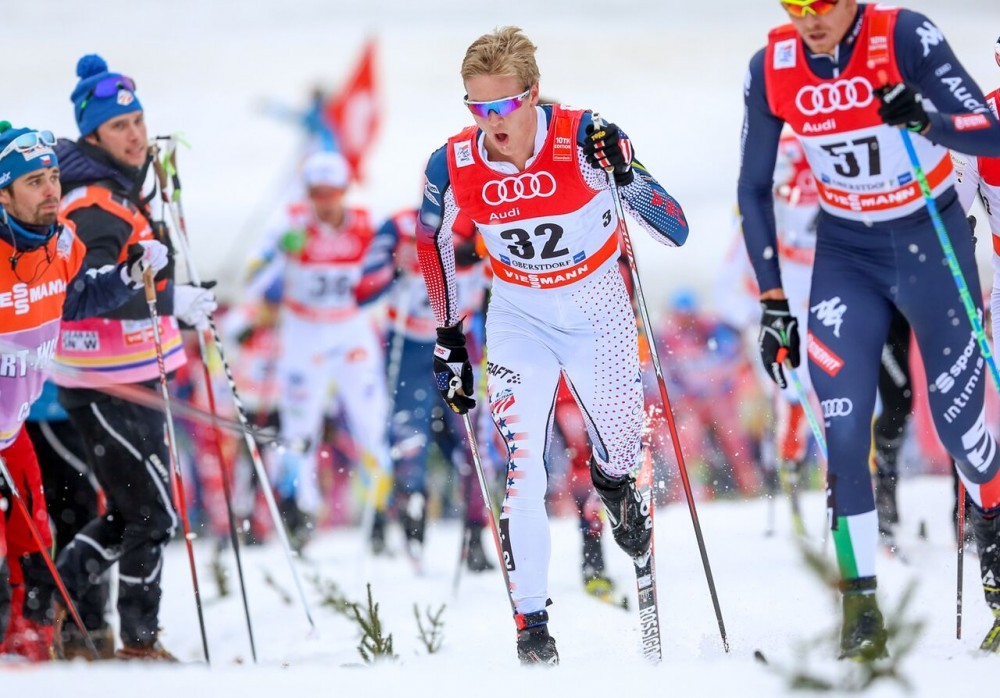
Tag: Didrik Toenseth

  • Musgrave! Brit Takes Second in Trondheim Skiathlon

    Musgrave! Brit Takes Second in Trondheim Skiathlon

    This coverage is made possible through the generous support of Marty and Kathy Hall and A Hall Mark of Excellence Award. To learn more about A Hall Mark of Excellence Award, or to learn how you can support FasterSkier’s coverage, please contact info@fasterskier.com.

    On Saturday in Trondheim, Norway, the first Skiathlon of the year was held. Competitors skied a 10 kilometer Classic leg followed by a 10 kilometer Freestyle leg. In the men’s race, the prevailing question was which Norwegian would win? The last time a non-Norwegian male won a distance World Cup competition was 24 races ago going back to February 2022. The Norwegian winning streak has gained a kind of life of its own with spectators and pundits wondering when, and if, it will end. The other big question was how would Joannes Hosflot Klaebo (NOR) perform? When there’s a Sprint race, everyone expects Klaebo to win—a distance race— not so much. This year his best distance finish was seventh place. His Skiathlon performances have been erratic. The last time he raced a Skiathlon in the World cup, he failed to finish. However, he did have a second place finish in the World Championships last year. So, the range of predictions were quite diverse.

    The weather was a factor with mist and temperatures in the mid-40s leading to klister becoming the only option for the Classic leg. The weather notwithstanding, form was maintained today as Klaebo took the top spot on the podium. A non-Norwegian was able to fight to the podium with Andrew Musgrave (GBR) taking second. Didrik Toenseth (NOR) was third.
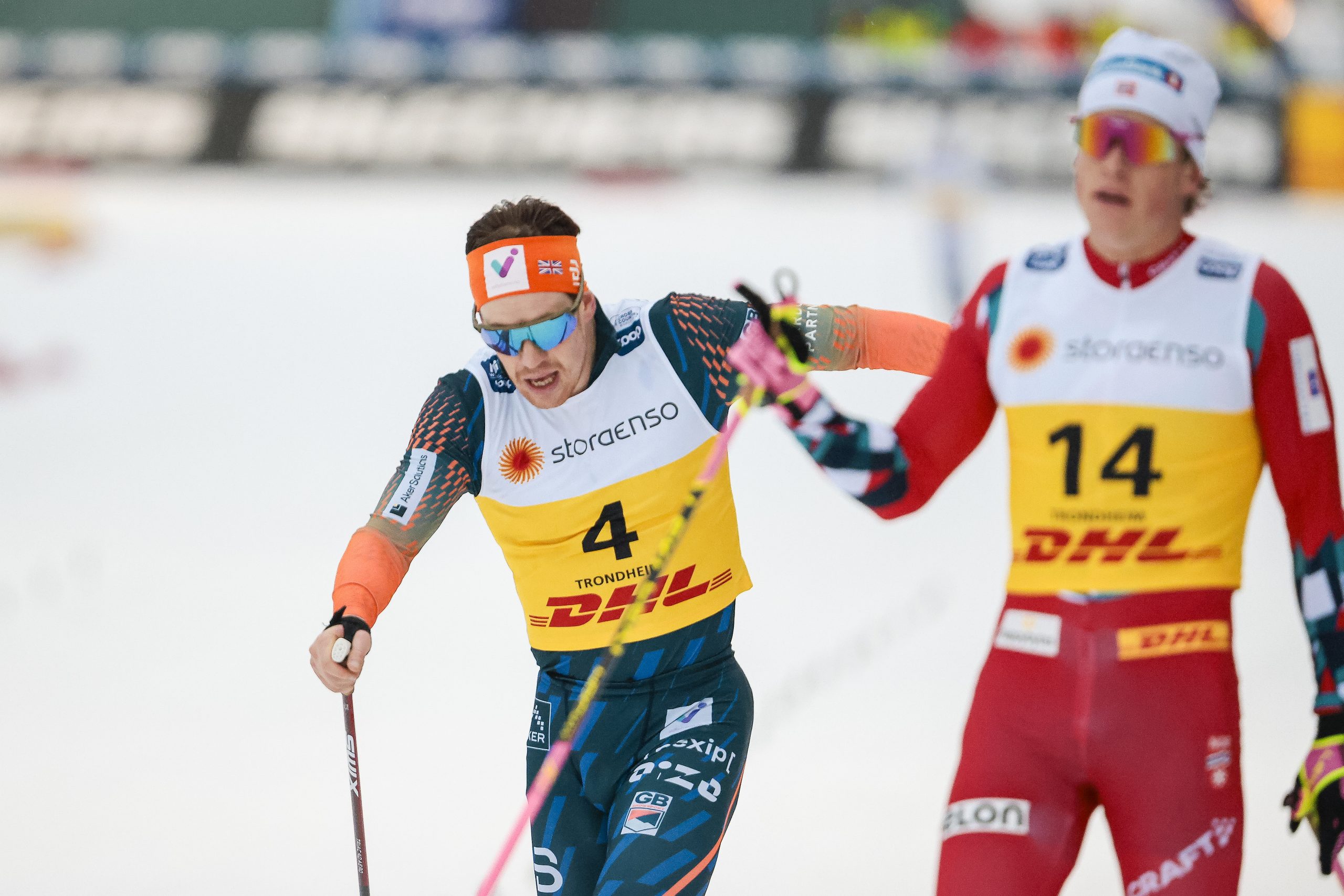
    Andrew Musgrave (GBR) was able to overcome a bad ski exchange to pull out a second place finish. (Photo: NordicFocus)

    The Americans threw everything they could at the race, fielding seven skiers: the second largest representation by country in the race— behind only Norway. The top American finisher was Ben Ogden in 17th, 1:30 off the lead. Gus Schumacher was 32nd, Scott Patterson, 41st, Zanden McMullen, 45th, JC Schoonmaker, 50th, Luke Jager, 52nd, and John Steel Hagenbuch 56th.

    The top Canadian finisher was Antoine Cyr in 21st. He was followed by Olivier Leveille in 43rd.
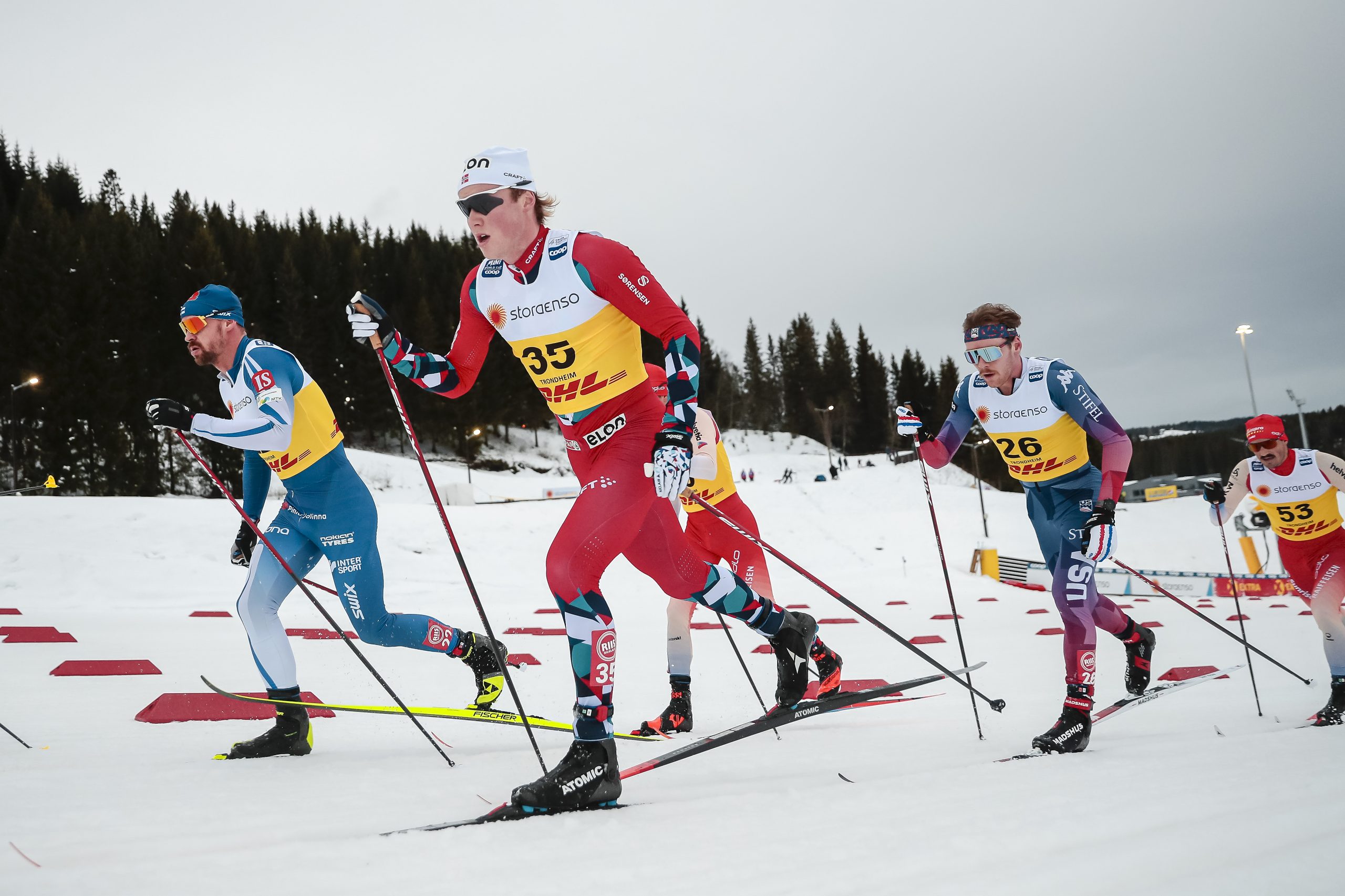
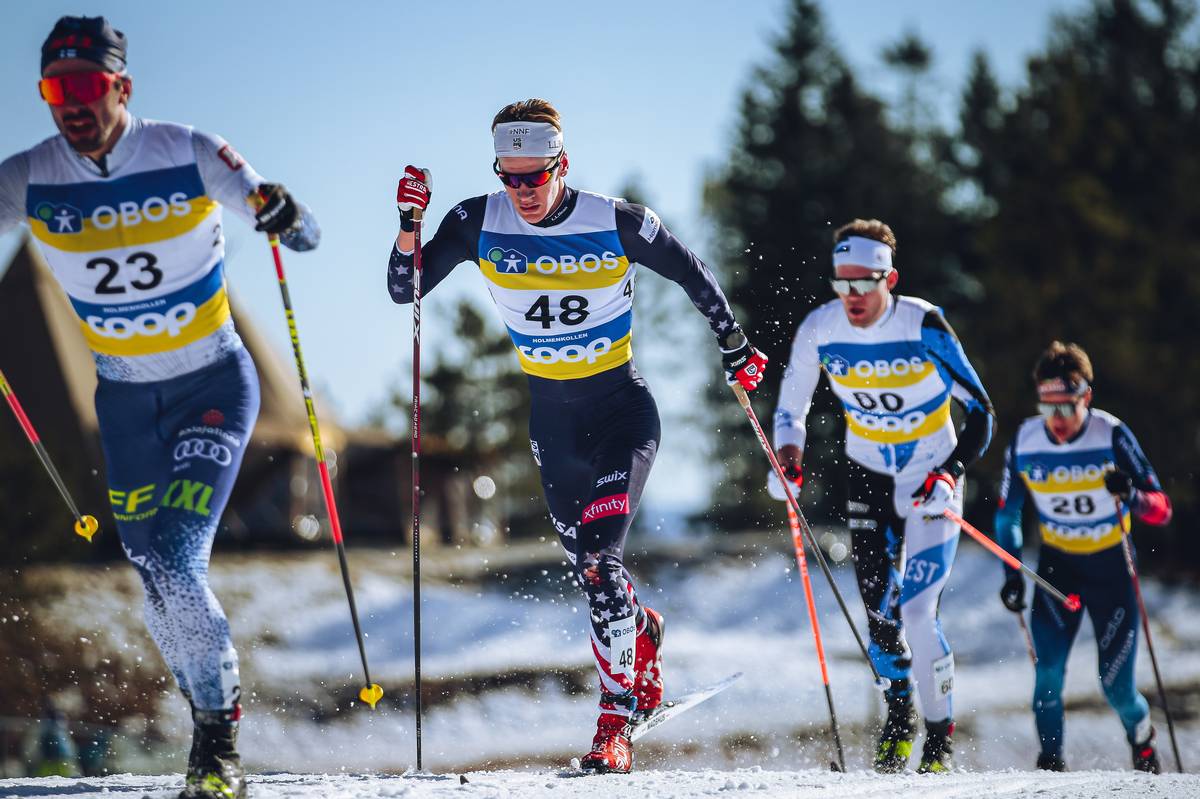
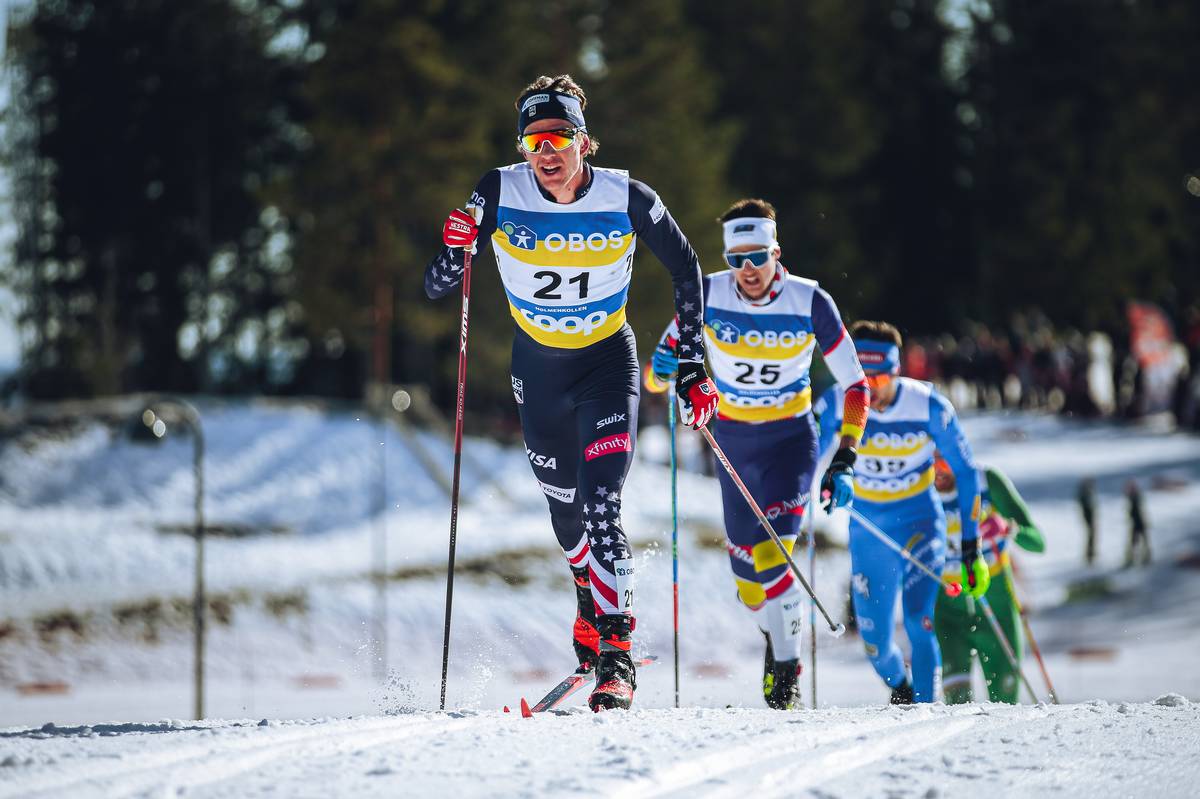
    Ben Ogden (USA) (bib 26) was the top American, finishing 17th (Photo: NordicFocus)
    Men’s 20 k Skiathlon

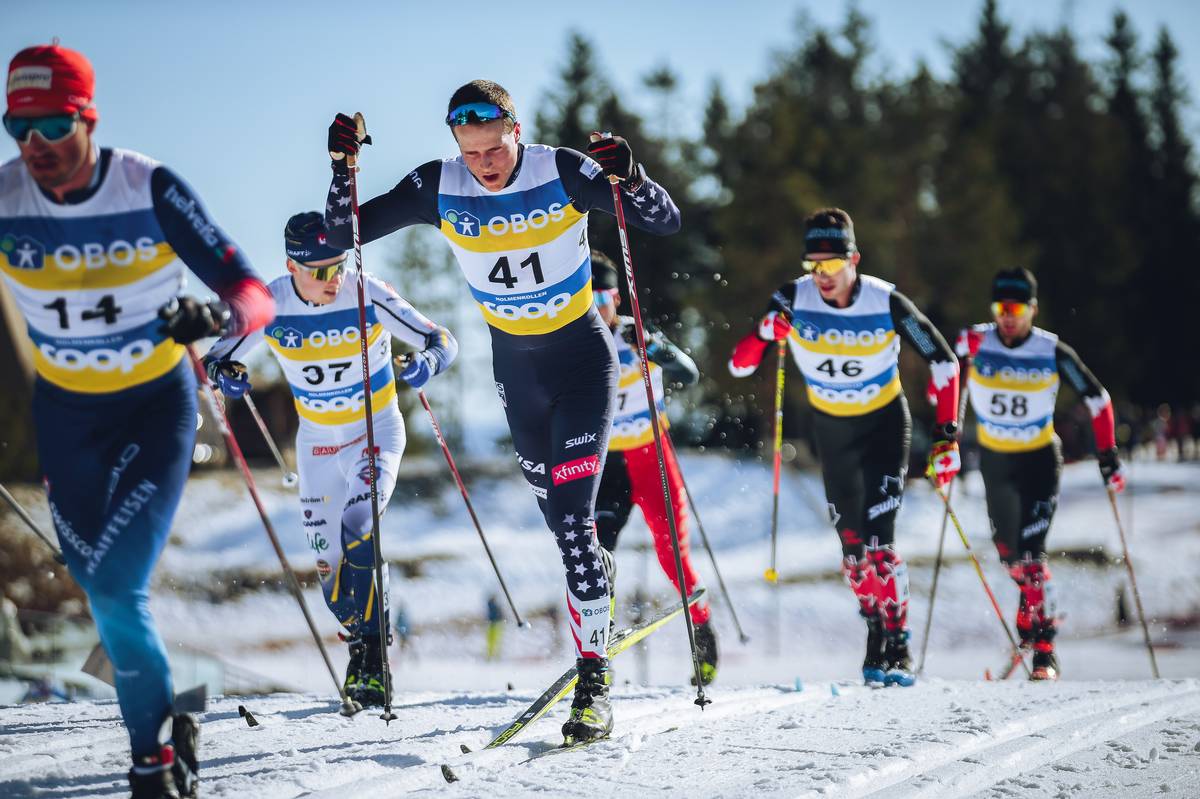
    The men began at a somewhat aggressive pace with Andrew Musgrave (GBR) and Johannes Hoesflot Klaebo (NOR) setting the early pace. Very early on it was clear that some racers were going to have a long day, having missed the kick wax. U.S. coach Chris Grover was able to add some insight into the kick wax scenario.  “We had gotten some rain and things were beginning to transform,” he said. “It was tricky because there was a colder snowpack underneath. The guys ran into some klisters that were icing and some that were going pretty good, so hats off to the service team. It was an absolutely huge day for the service team in terms of ski preparation.”

    At a relatively early point, 2.1 kilometers into the race, the pack began to get strung out a little, Calle Halfvarsson (SWE) moved to the front with Klaebo. Halfvarsson would make himself a presence toward the front for much of the race.

    The course had several spots where World Cup overall bonus points were awarded. Klaebo pushed to the front to take the lead at the first bonus point marker at 3.9 kilometers, which put the rest of the field under additional stress. Awarding bonus points seemed to have had its desired effect of keeping the field motivated to race hard the entire way.

    After the bonus point sprint, things settled back down a little and Musgrave went back to the lead. Musgrave has definitely become a fan favorite over the years having taken on the role of the plucky underdog. But today, he was determined to prove that he was more than that. At 4.7 kilometers he had pushed to the front and looked very strong. At this point the top American was Ben Ogden in 17th.

    Ogden continued to hang with the main pack, and at 7.2 kilometers he was only nine seconds off the leaders. But at the front it was Klaebo and Musgrave continuing to force the pace jockeying back and forth for the lead. The hard pace continued to string out the field even further. At this point, other than Musgrave, the only non-Norwegians at the front were Halfvrasson and Jens Burman (SWE). Ogden was still going strong, hanging with the lead pack.

    When the skiers were a kilometer from the ski exchange the leaders turned up the pace even more. Klaebo clearly wanted to lead entering the stadium ski exchange. As they entered the stadium, there was a group of about 14 skiers in the lead, with Klaebo going to the front of the pack. Klaebo was first out of the ski exchange along with about half a dozen countrymen. Ogden was in 18th, 21.5 seconds off the lead.
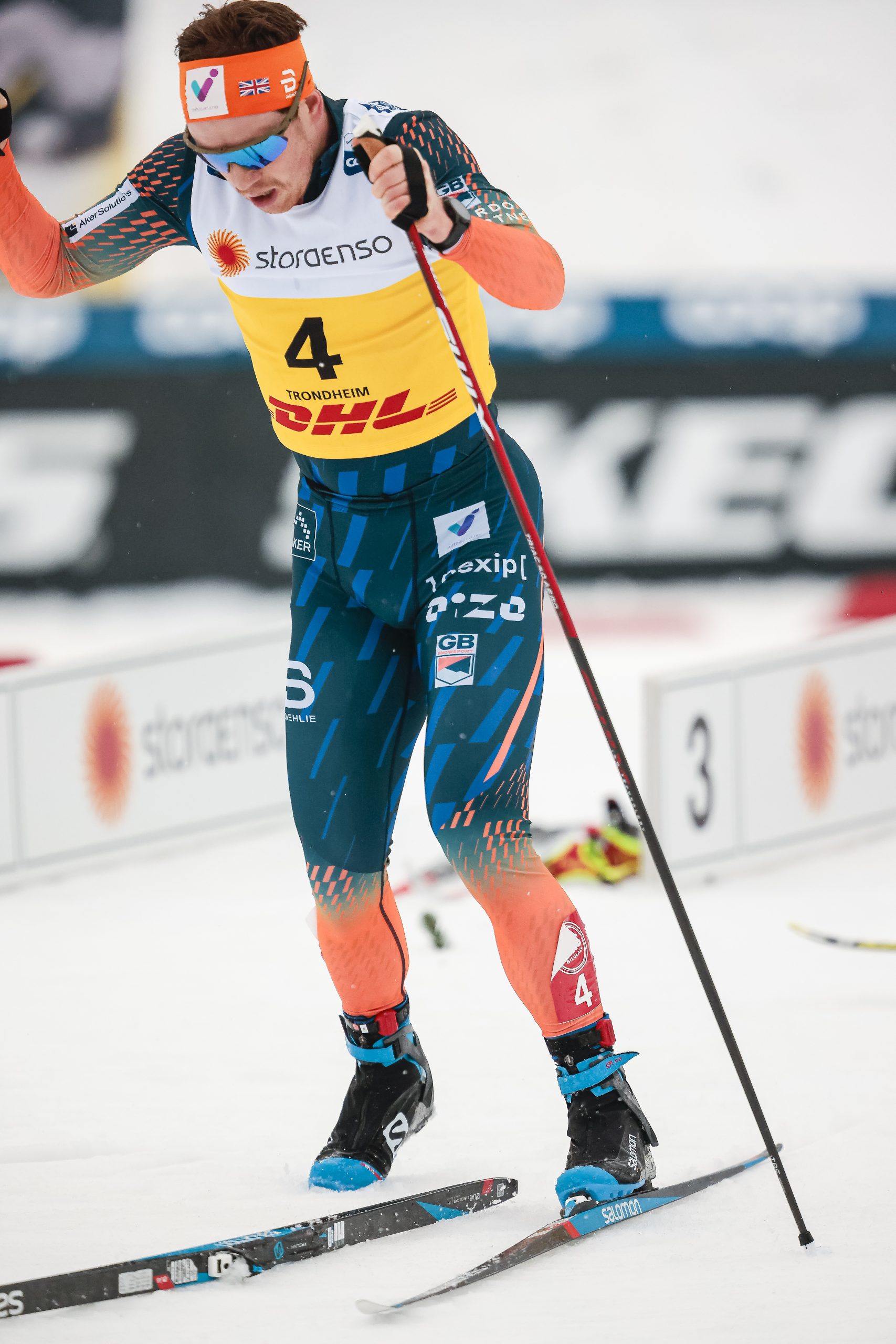
    Andrew Musgrave (GBR) lost valuable time in the ski exchange when he couldn’t get his boot into the binding. However, he refused to let that stop him on his march to the podium. (Photo: NordicFocus)

    Musgrave had a troublesome ski exchange, and it almost cost him dearly. He fumbled the switch from Classic to Skate skis struggling to get his foot into the binding. This cost him precious seconds. The lead group left the ski exchange without him.

    Grover provided some insight to FasterSkier about how the new fluoro rules could cause ski exchange problems. He said that, “the Skate skis can be placed in the transition up to ten minutes before the start of the Skate leg. In the past, athletes placed their own Skate skis in their pits for the exchange, and now coaches or technicians do that after they’ve already started.” He pointed out that this could lead to unintended consequences, “it’s the first time [Musgrave] hasn’t placed his own skis in the exchange. Athletes have different styles in how they set up their skis, whether they straddle one of them and they move right to right, or they come in and they straddle both on the outside and jump to the Skate skis on the inside.” There is time to practice the transition, but it’s a format the athletes don’t often encounter. Also, it’s a challenge for smaller staffed teams like Great Britain. Grover noted that the U.S. has the resources to fine tune the transition to a great extent. He said that, the American athletes coordinate with their coaches ahead of the race. “Last night, we had a fun homework assignment during the team meeting. Everyone who was racing drew a diagram of how they like their skis positioned. Jason Cork processed everybody’s [preferences], so it was in one place digitally. So we had a digital file of how every athlete wanted their pit set up.” He observed that smaller teams might not have the resources to prepare in such detail.

    Freestyle Leg

    Musgrave’s troubles meant that he had come out of the ski exchange ten seconds off  Klaebo’s lead, and was forced back to the second chase group. By the time the leaders reached the 12.1 kilometer mark, it was a red Norwegian wave with Klaebo and Didrik Toenseth (NOR) leading. Burman and Halfvarsson were still in the top ten to break up the sea of red uniforms. The early pace had definitely taken its toll. The group of fourteen skiers was now down to eight with Toenseth and Klaebo setting the pace at the front. Musgrave had used the two kilometers since the ski exchange wisely and done an admirable job of working his way back to join the lead group, but he had clearly expended a lot of energy doing so.
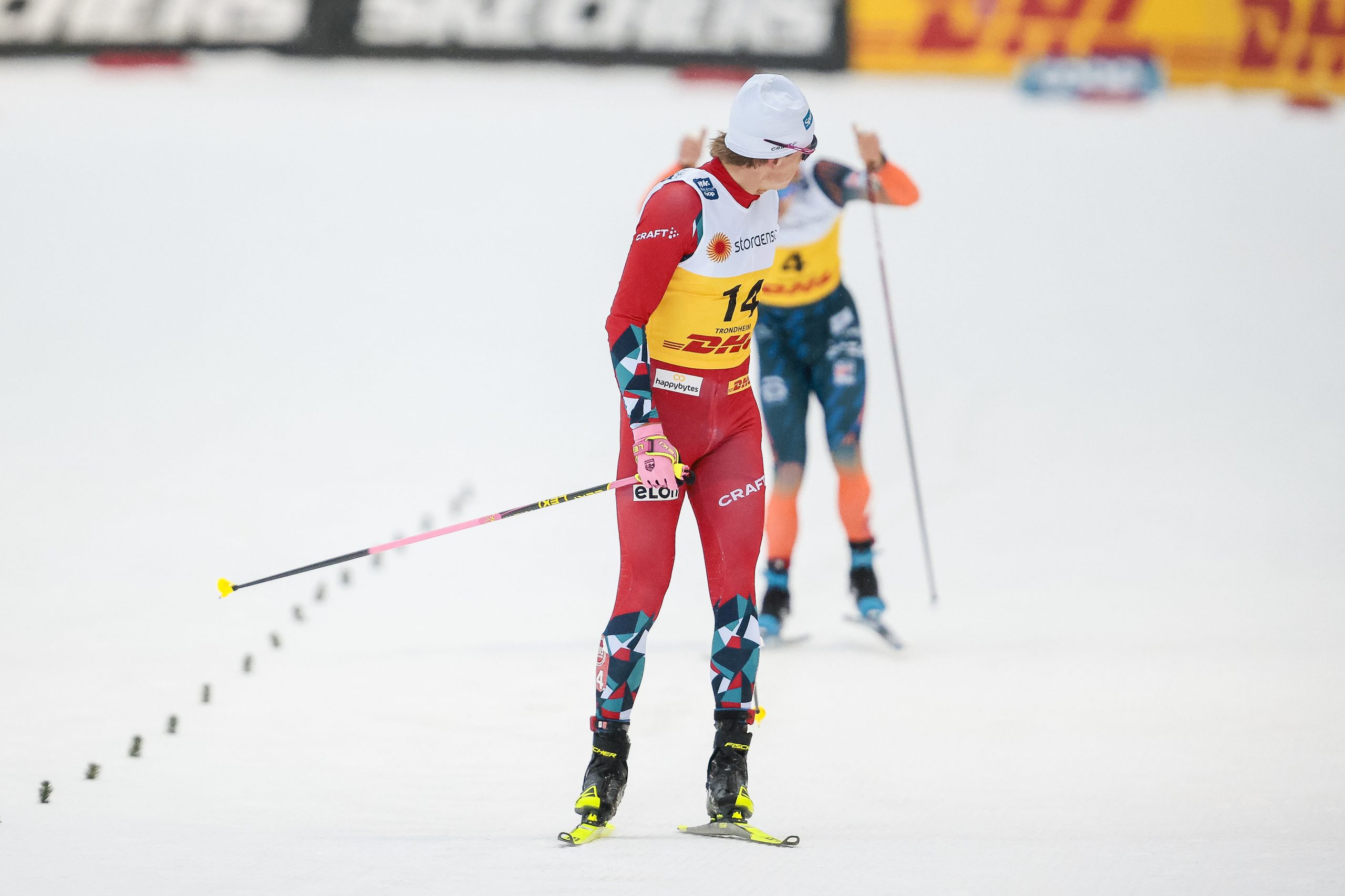
    Johannes Hoesflot Klaebo (NOR) stayed near the front the entire race. He didn’t take any chances as he surged at the finish and had enough time to look over his shoulder and wave to the crowd. (Photo: NordicFocus)

    At 13.3 kilometers a small crack in Norway’s armor began to show as Burman and Halfvarsson were skiing fourth and fifth, refusing to let the Norwegians completely dominate. Musgrave had efficiently clawed his way back into contact with the lead group and was gathering himself as the Norwegians continued to set the pace at the front. Ogden was still skiing well, in 20th, but only 42 seconds off the front.

    Musgrave continued to push and at 15.4 kilometers had worked to put himself into the lead. It was an impressive comeback for the British skier as he had worked hard to overcome his earlier mistake. He was now working with Klaebo and Toenseth to keep the speed high. At 16 kilometers there was another bonus sprint which increased the tempo again. Now the pack had broken into a group of five: three Norewegians, plus Musgrave and Halfvarsson.

    With 3.3 kilometers left, Harald Oestberg Amundsen (NOR) went to the front, knowing that he had to establish a gap over Klaebo to have a chance at the finish. The back and forth was relentless with Musgrave then moving to the lead with the three Norwegians on his tail. Halfvarsson had been gapped and couldn’t keep with the group, though he gamely tried to rejoin it. It was now the three Norwegians at 18 kilometers chasing Musgrave!

    With one kilometer left, the back and forth continued with Klaebo moving to the front. It was still the three Norwegians and Musgrave. Simen Hegstad Krueger (NOR) and Klaebo now traded places at the front with all four skiers forming one pack. In the final climb leading into the stadium it was three skiers spread across the front; Musgrave, Klaebo, and Krueger. All the racers knew that unless they had a gap on Klaebo their chances were slim in a sprint finish. Coming into the stadium Klaebo put in one of his trademark moves and tried to bury the field using the big downhill into the stadium to create a gap. As usual, his strategy was successful and he created separation between himself and the other contenders. On the final turn, Musgrave went wide and lost some speed. It probably didn’t matter as Klaebo had established a big enough lead to wave to the crowd as he crossed the finish. Musgrave had been able to fight forward for second place, with Toenseth taking third. It was a dramatic finish that thrilled the local crowd and kept Norway’s winning streak intact. But Musgrave had proven that there was at least an opportunity for a non-Norwegian to fight for the top spot.
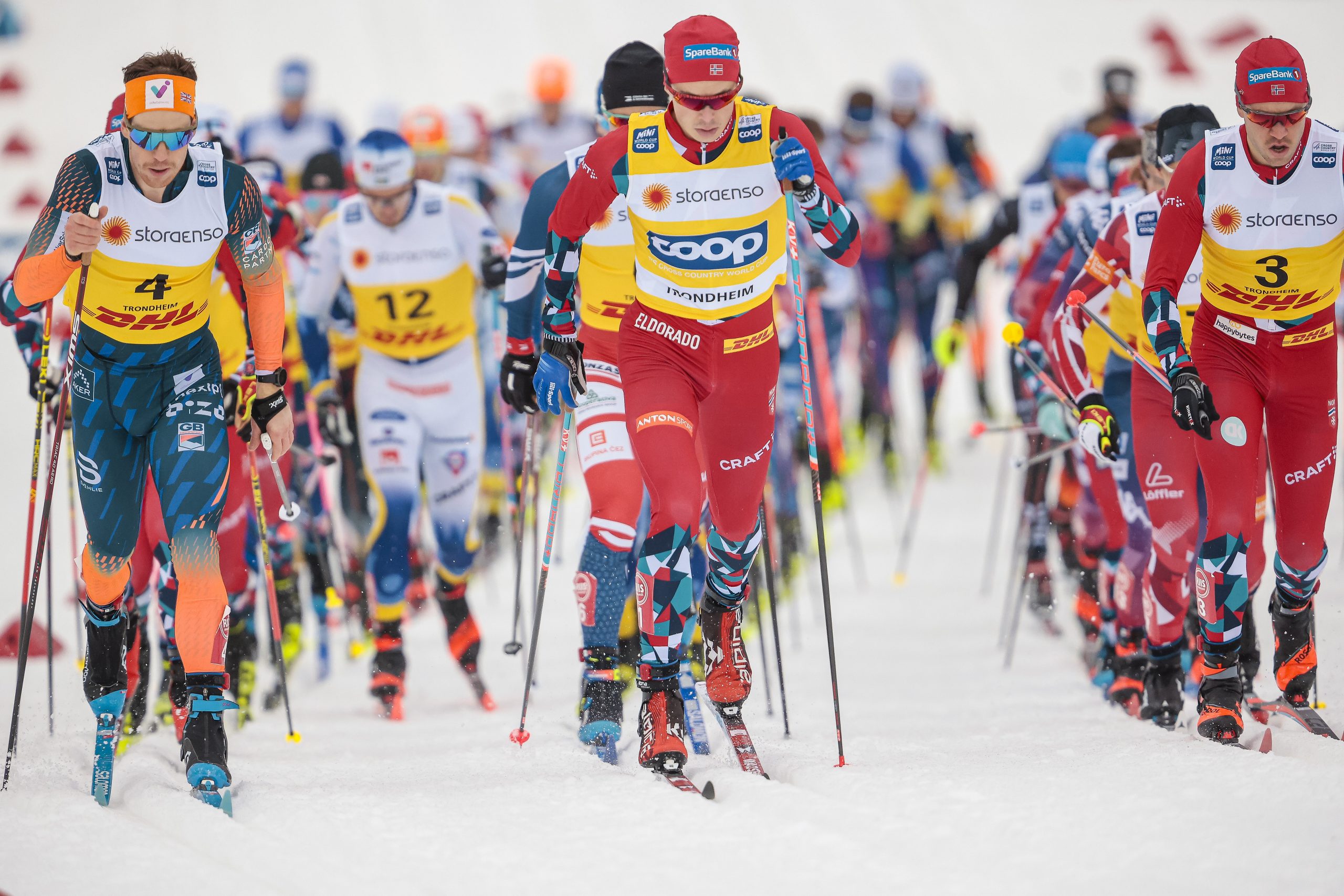
    Andrew Musgrave (GBR)(number four) turned what could have been a disastrous ski exchange into a glorious podium finish. (Photo: NordicFocus)

    Ogden’s sixteenth place was the highlight for team USA. It was a very exciting race; as the Skiathlon often is. The hometown crowd came away pleased, and the Americans saw promise in it’s future with Ogden continuing to ski well.

    Disaster during the race was barely averted when climate protesters attempted to string a barrier across the course. “On the Classsic loop, a couple of guys tried to stretch a chain or a wire across the course, but luckily some locals tackled them, American coaches told FasterSkier. “I’m very sympathetic to climate change, but I’m also sympathetic to the athletes having a safe competition and being able to compete . . . “They tried to interrupt it just as the skiers were about to get to that point, and the protesters were pushed aside, so it didn’t impede the race.” It was a close call for skiers, and FIS will have to do something to address this situation.

    Men’s 20 k Skiathlon RESULTS


  • The Devon Kershaw Show: The Super Bowl of Skiing with Guest Jess Cockney

    The Devon Kershaw Show: The Super Bowl of Skiing with Guest Jess Cockney

    It doesn’t get much better than a weekend of full sun, epic skiing and meetings with the king of Norway. But that’s what we’ve got for you after another fun weekend of racing, at Oslo’s classic Holmenkollen venue. With help from Canadian retired Olympian Jess Cockney, we break down the 30 k and 50 k from Saturday and Sunday, touch on the COVID outbreak that’s hitting World Cup teams including the U.S. and take the International Ski Federation to task for canceling World Cup finals.

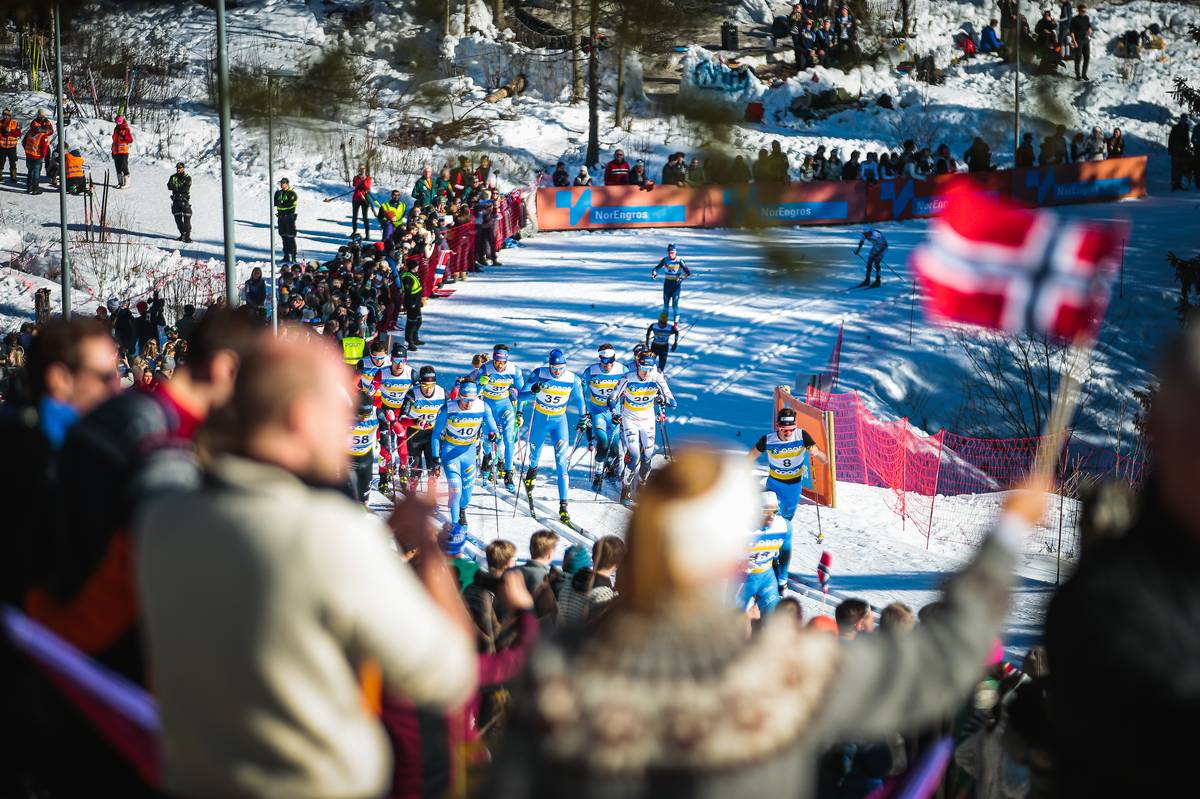
    Crowds returned in droves to Holmenkollen for the men’s 50 k mass start classic. (Photo: NordicFocus)

    You can email us at devon@fasterskier.com and nat@fasterskier.com. We’re still hoping to catch up with an Olympic mailbag episode soon once things settle down.

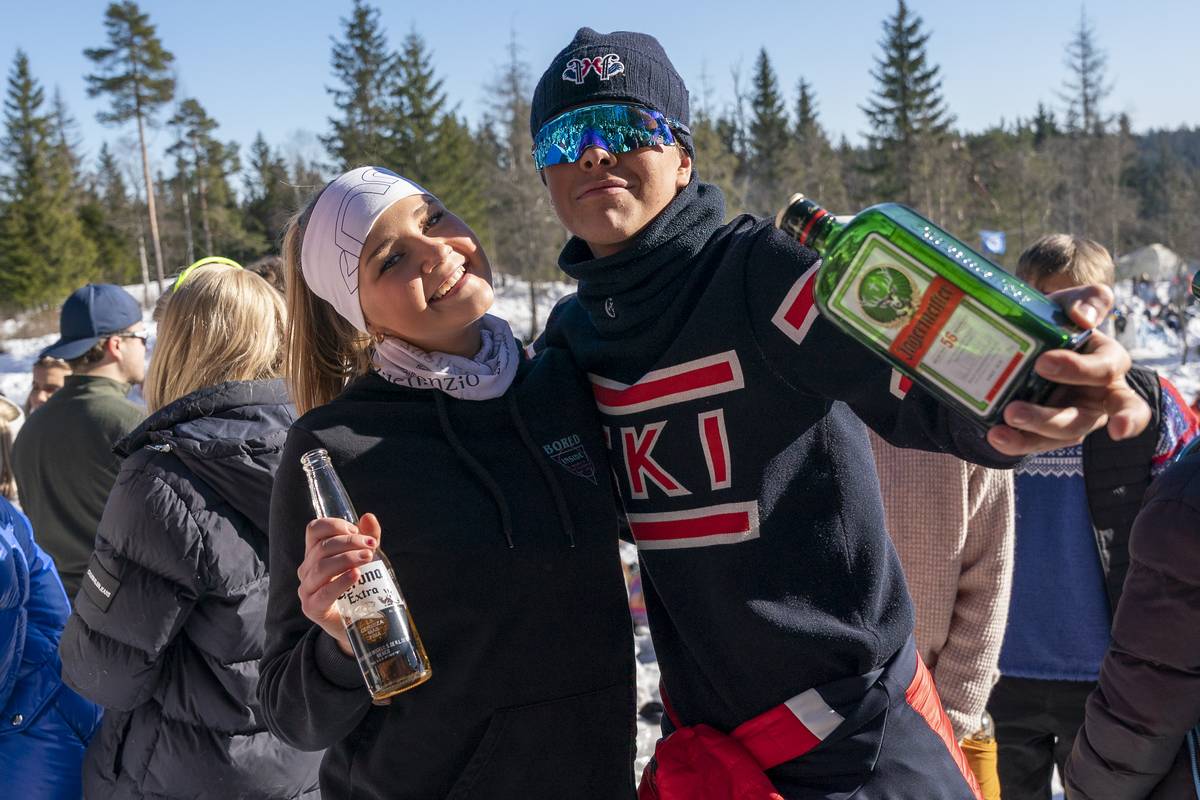
    Revelry at Holmenkollen. (Photo: NordicFocus)
  • Norway Sweeps Podium as Revelry Returns at Holmenkollen 50 k; Martin Leads US in 26th

    Norway Sweeps Podium as Revelry Returns at Holmenkollen 50 k; Martin Leads US in 26th

    This World Cup coverage is made possible through the generous support of Marty and Kathy Hall and the A Hall Mark of Excellence Award.  To learn more about A Hall Mark of Excellence Award or to learn how you can support FasterSkier’s coverage please contact info@fasterskier.com.

    In Oslo on Sunday, came another sign of the times.

    The Holmenkollen Ski Festival, the beating heart and center of the modern sport of skiing since Torjus Hemmestveit won the first 50-kilometer cross country race held there in 1888, has only stopped for extraordinary interruptions in human and natural history. (Interestingly enough, the Hemmestveit family immigrated from Norway to Minnesota, marking the first and only North American connection to the Holmenkollen 50 k men’s podium until Canadian Pierre Harvey won the race exactly a century later in 1988.) The latter – a natural lack of snow – has been fairly harmless (but ominous), but the former has only ever been due to a World War. That is, of course, until the last two years, when the COVID-19 pandemic forced first no spectators at skiing’s most well-attended event in 2020, and then full cancellation in 2021. 

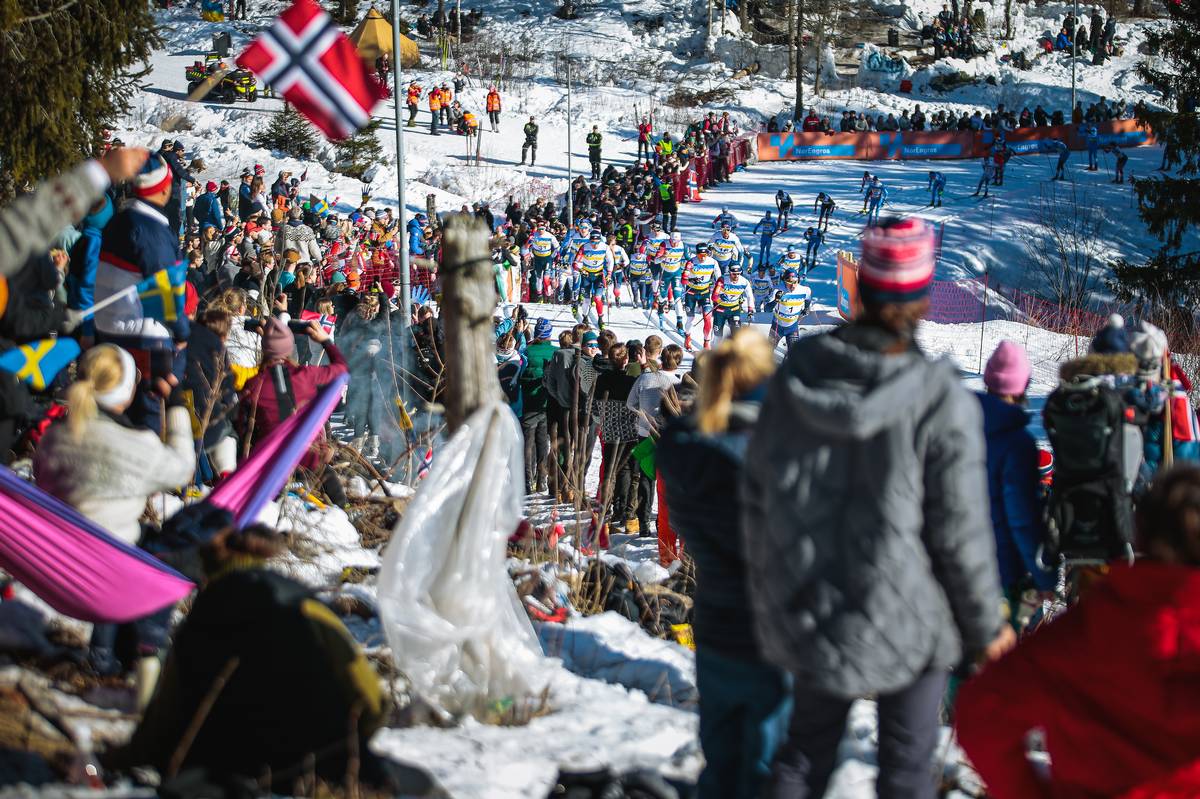
    After a three-year wait, the bustling, flag-waving, marching band playing (there was definitely a marching band!), Norwegian crowd was back out under the hot Oslo sun, in what seemed a matter of national pride.

    Revelry returns to the iconic Holmenkollen 50 k in Oslo, NOR. (Photo: NordicFocus)

    They could only hope that the same sense of the matter extended to their countrymen doing the racing at Holmenkollen. Coming into today, it had been a full five years since a Norwegian had won the 50 k at Holmenkollen, when Martin Johnsrud Sundby did so in a 2017 classic mass start. With the Russian athletes who have been at the forefront of the event since then banned (the Russians completed a podium sweep in 2019, before Alexander Bolshunov won in 2020), Norway was poised to make a run at adding to the thirty-five champions it has seen at its most famous race. One of those previous 35, Sjur Røthe, was in the field on Sunday. Alongside him was Beijing Olympic 30 k bronze medalist Simen Hegstad Kreuger, Didrik Tønseth, and Hans Christer Holund. 

    Of course, in a 50 k classic, they would have to try and beat the best classic skier in the world. Iivo Niskanen was looking to revive another long Holmenkollen tradition – the Finns ruining the Norwegians national outing. Fresh off a pair of individual medals at the Beijing games in the 15 k Classic (gold), and 30 k skiathlon (silver), the 50 k Holmenkollen classic seemed like a perfect opportunity for Niskanen to add to his legacy as a modern giant of the classic technique.

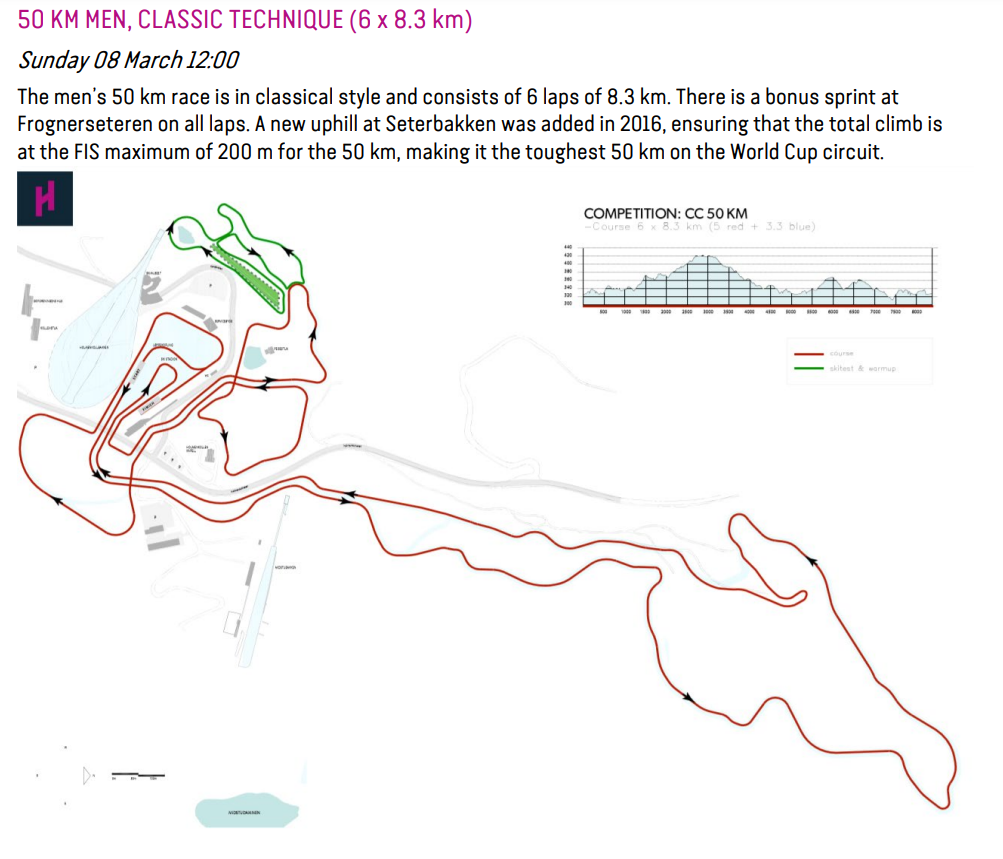
    The field was set to race six laps of an 8.3 k course that organizers billed as the toughest on the World Cup (see below). With temperatures at the noon start reaching 8℃ (about 47℉), the FIS camera couldn’t help but turn to the extra set of skis layed out in the stadium each lap, no doubt waiting to resupply skiers with the warm klister that was in demand today.

    The Holmenkollen 50 k course. (Photo: Holmenkollen Ski Festival)

    For a 50 k, the field began at a furious pace today, with much of the first 15 k led out by pulls from the skiers, mainly Norwegian and Finnish with the odd Andorran (Ireneu Esteve Altimiras) thrown in, that indicated that they were in control of the race and willing to give the long-burn attack a try today. Within the top group of twenty that eventually formed, however, there wasn’t one skier that looked strong enough to break-away and win by minutes in, say, the way that Marit Bjørgen controlled the Holmenkollen race in her heyday, or the way Therese Johaug did in her final Holmenkollen appearance yesterday.

    By the beginning of the fourth lap (24.9 k), the lead group had narrowed down to about fifteen skiers. Included were a slew of Norwegians, including Sjur Røthe, Didrik Tønseth, Martin Løwstrøm Nyenget, and Harald Østberg Amundsen, Iivo Niskanen (FIN), Britain’s Andrew Musgrave, 2018 champion Dario Cologna (SUI), and young Swedish hopeful William Poromaa.

    Adam Martin races the 50 k mass start classic at Holmenkollen in Oslo, NOR. (Photo: NordicFocus)

    With the pack established, the group seemed to allow the pace to let up over the course of the next 8 k. The one exception was Iivo Niskanen, who throughout the whole day positioned himself at the front of the pack for a series of bonus points offered on course. They revealed a prescient concern for Niskanen – he is still in the running to win the distance World Cup this season, and came into today 3rd place behind two athletes, Alexander Bolshunov (1st) and Johannes Høsflot Klæbo (2nd) who may not race again. He had every incentive to chase down the points, with the question arising whether having to maneuver to the front every 5 k or so to take the checkpoints would cost him the energy needed for a bid at the win.

    When the lead group came into the stadium to complete their 4th lap (33.2 k), Sjur Røthe made a move towards the second set of skis layed out for him with a fresh kick zone of wax. The whole field followed. That is, save Amundsen, who flew past the transition zone and into the steep climb that led away from the stadium.

    Whether it was the ski swap itself, or the fact that the race was now 15 k out from the finish, the move going into the 5th lap seemed to blow open a pack that had been subdued for the last 15 k. Amundsen didn’t try and ease up to allow a larger pack to reform, but instead tried to drive onward. The effect was that the field, led by Andrew Musgrave, had to increase their pace to try and cover Amundsen’s move. Musgrave didn’t pack such a punch in his acceleration that the top skiers couldn’t follow, and as they came into the final lap, the Norwegian hopefuls of Nygenet, Røthe, and Tønseth, along with livo Niskanen and William Poromaa, were the skiers left to vie for Holmenkollen 50 k crown.

    Young talents: Harald Østberg Amundsen (NOR) races alongside William Poromaa (SWE) during the 50 k mass start classic at Holmenkollen. (Photo: NordicFocus)

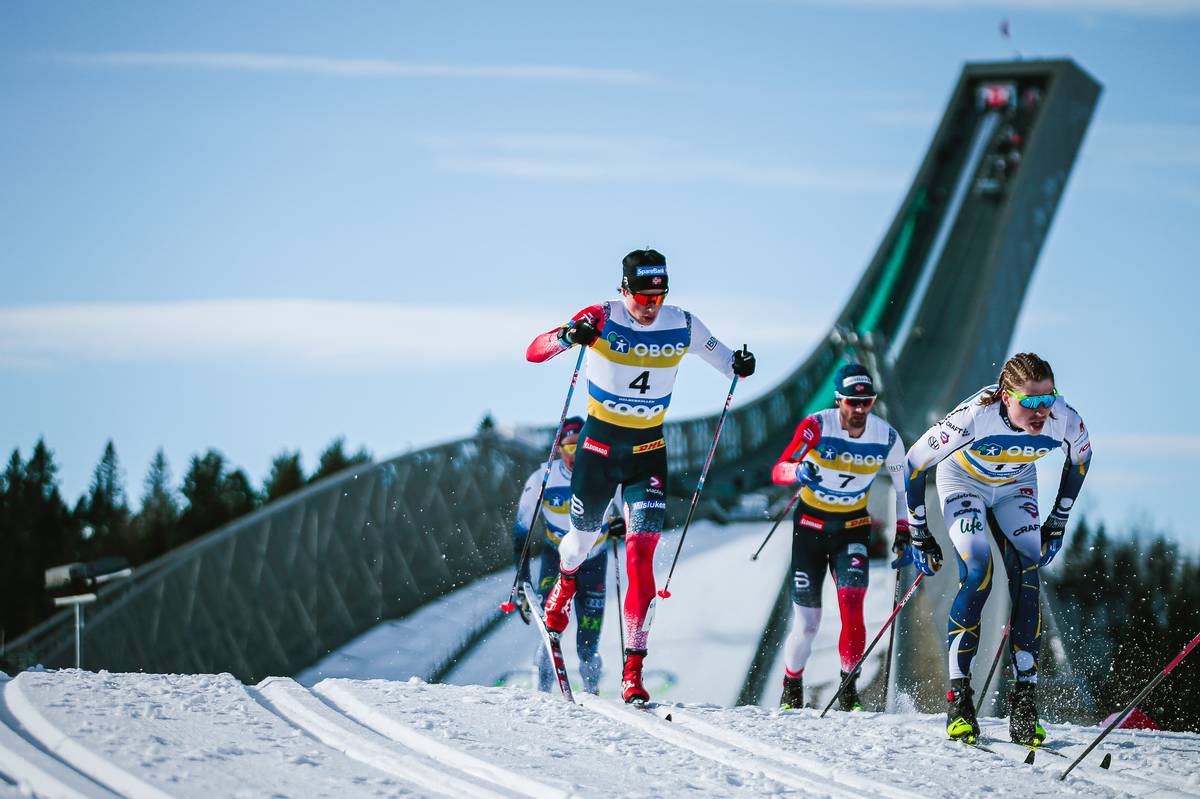
    The home country, as if its skiers sensed a special mix of history combined with a perfect Oslo day, got to see one of the oldest, most impressive sights in ski-sport. Three Norwegians, led by Didrik Tønseth, then Martin Løwstrøm Nyenget and Sjur Røthe, moved together towards the finish line. Iivo Niskanen and William Poromaa stayed in the frame, but by the final 2 k, they were out of the picture.

    In a scene that thousands of Norwegian spectators had dreamed about since their most famous race had been thrown into disarray two years ago, they were treated to the end of a Holmenkollen weekend with three Norwegians at the front, vying for the podium, a rare landmark for the treasured and iconic event.

    Tønseth led the pack as they moved into a long downhill that went into the stadium. From there, Røthe out-glided his two teammates, with Nyenget in behind them. At the end of a long downhill straight, one final hill led around and down again to the final stretch. As Røthe approached the hill, he positioned himself outside of the tracks, which seemed an indication that his great glide into the stadium may have also foreshadowed a want of kick wax. He was forced to run up the last hill, searching for every little bit of klister left in its zone (in a dance very familiar to many of us skiers), while Nyenget was the picture of perfect classic technique, driving through to go over the top of the hill in first place. Røthe stumbled slightly, Nyenget burst into the final stretch, and they came across the line like that. Nyenget the winner (2:03:27.3), Røthe second (+0.6), and Tønseth in third (+3.5).

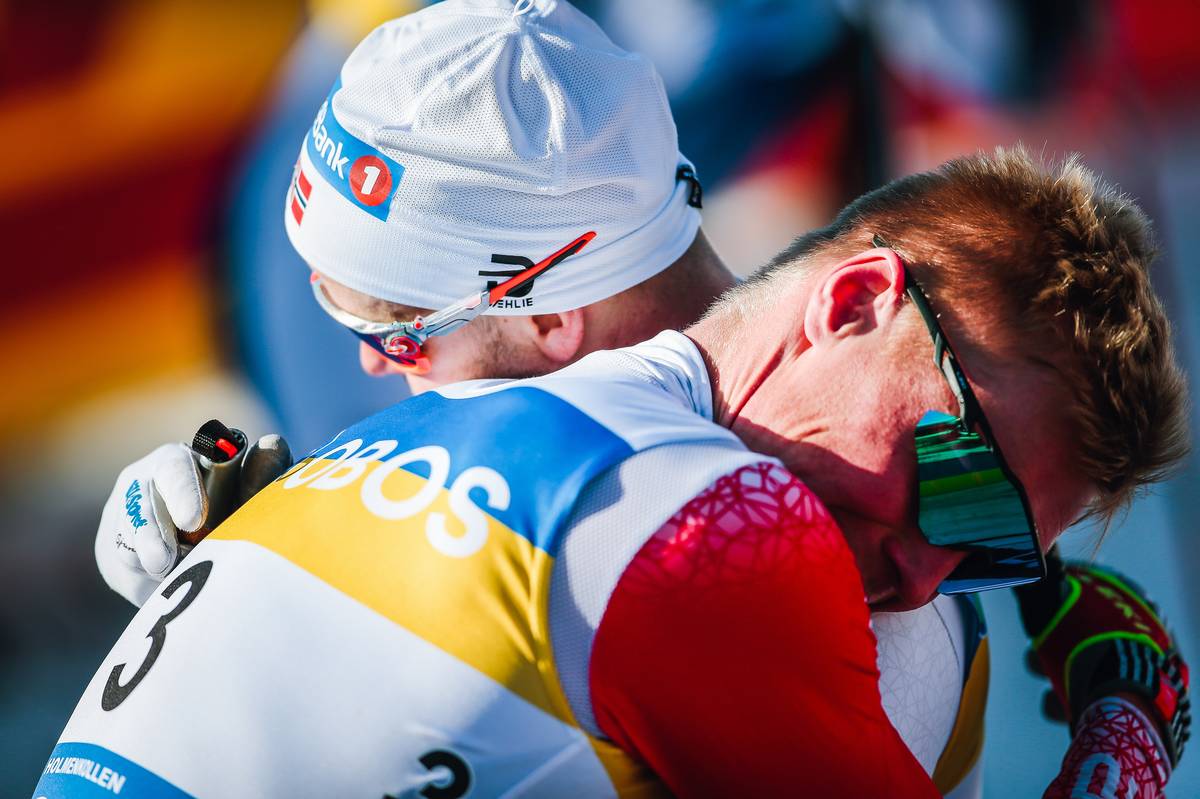
    Martin Løwstrøm Nyenget embraces his teammate Sjur Røthe after going one-two at Holmenkollen. (Photo: NordicFocus)

    The three Norweigans completed the first podium sweep for the home country at Holmenkollen since 1985, and the first since the event has been held as a World Cup. The center of Norwegian skiing, after two years where it has stumbled through, has held, and held firmly. Nyenget, Røthe, and Tønseth doing their home nation proud on a sunny Oslo day that seemed to foreshadow brighter times ahead for Holmenkollen, and the sport that is ski racing the festival energized over a century ago.

    The US trio of Scott Patterson, Adam Martin, and Zak Ketterson that started the day came away with great results as well. Martin, who was recently pulled up to the World Cup based on his results in the SuperTour, came in 26th (+5:03.2). Scott Patterson, coming off an 8th place finish in the Beijing 30 k, finished 31st (+6:05.5), and Zak Ketterson finished in 41st (+7:14.8).

    “It was a beautiful day today,” wrote Martin after the race. “It was warm, and it did get slushy on some of the climbs, but most of the course held up really well. I think we had great wax.”

    On his approach to the day, Martin continued, “I suspect pretty much every guy out there starts with the same strategy: hang on to the lead group until the finish or it’s no longer possible. That was my strategy, at least. I think I managed two laps or something, and then I skied the rest of the race with a smaller group of skiers who also fell behind.

    This is Martin’s third time racing at the 50 k at Holmenkollen, with today marking a step forward, after taking one backward in his last appearance. “I placed 31st in 2019 with a smaller field after World Champs, and I finished last (but did finish) in 2020 after Ian Torchia and I erroneously opted for zeros.”

    Zak Ketterson races the 50 k mass start classic at Holmenkollen in Oslo, NOR. (Photo: NordicFocus)
    Scott Patterson races the 50 k mass start classic at Holmenkollen in Oslo, NOR. (Photo: NordicFocus)

    Canadians Remi Drolet finished in 48th (+10:27.1), while Philippe Boucher came in 54th (+17:36.0). Staying in Norway following the U23/Junior Ski World Ski Championships, Tom Stephen also started for the 50 k, however, he withdrew following the third lap and did not finish. 

    20-year-old Thomas Stephen (CAN) races the 50 k classic at Holmenkollen in Oslo, NOR. (Photo: NordicFocus)

    Full Results


  • Klæbo Holds Off Ustiogov to Become the Youngest Winner of the Tour de Ski; Lustgarten 42nd

    Norway’s Johannes Høsflot Klæbo exhaustedly crosses the line at the top of Alpe Cermis in Stage 6 of the 2018/2019 Tour de Ski. (Photo: Instagram screenshot @johanneshk)

    “It was just full speed to the finish and I am not stopping until the finish line now,” Johannes Høsflot Klæbo told the International Ski Federation (FIS) after his victory in Stage 6.

    With the 45 bonus seconds he gathered from his win in both the overall event and the bonus sprint in yesterday’s 15-kilometer classic race, Klæbo entered the final Stage of the 2018/2019 Tour de Ski with a bit of insurance on his lead over Russia’s Sergey Ustiugov, who was ranked second in the overall standings after Stage 6. The Norwegian began the 9 k skate race to the top of the Alpe Cermis ski area 1:20.4 ahead of Ustiogov, meaning that so long as he could keep the Russian at bay through one last stage, the 22-year-old would seal the deal on an overall victory in his first ever Tour de Ski.

    Sergey Ustiugov of Russia (l) chases Norway’s Johannes Høsflot Klæbo up Alpe Cermis in Stage 6 of the 2018/2019 Tour de Ski. (Photo: FIS Screenshot)

    Giving his all in his final opportunity to surpass Klæbo in the Tour, Ustiugov fought hard throughout the race to close the gap between the Norwegian and himself. As the men worked their way up the steep serpentine track, Klæbo looked over his shoulder to see the Russian just one switchback below him.

    Klæbo is known for his ability to make powerful moves on hills during sprint races, sometimes making the other skiers look as though they are standing still. His dominance is so well known that the short steep climb on the sprint course during the Olympic Games in PyeongChang became dubbed the “Klæbo-bakken”. However, after seven races in nine days, Klæbo looked exhausted as the men neared the top of the climb, no longer the spry sprint phenom. Ustiugov maintained a faster tempo, gradually reeling the Norwegian in. With a grimace and a last look back, Klæbo collapsed across the line in a time of 32:51.3, just 16.7 seconds ahead of Ustiugov.

    Men’s podium of the 2018/2019 Tour de Ski. Norway’s Johannes Høsflot Klæbo took first after winning five out of the seven stages, followed by Russia’s Sergey Ustiugov (l) and Simen Hegstad Krüger (r), also of Norway. Photo: Screenshot Instagram @fiscrosscountry

    “It was really tough,” Klæbo told FIS. “I was really tired after yesterday. I heard all the way from the bottom that Sergey [Ustiogov] was going quite fast so I was just trying to push myself. It was really tough but quite good to be here first.

    “I saw him all the time, so it was really tough to just look back and see him getting closer and closer,” Klæbo continued. “It was really tough mentally, but it was really good to come to the top and look back and see that you have the gap that you needed.”

    Klæbo’s win made him the youngest ever male winner of the TdS, an honor previously held by Dario Cologna of Switzerland who won his first tour in 2009. Today was also his fifth stage win in this season’s Tour, tied for the most wins with Cologna and Norway’s recently retired champion, Petter Northug jr.

    “It means a lot, for sure,” Klæbo told Fischer. “PyeonghCang was maybe the biggest moment in my life, but this is a good number two. I really think this is a great start of 2019.”

    The implications of differences in start time are not as cut and dry when the gut punch of the hill climb is taken into consideration. A contingent of Norwegians lurked hungrily behind Alexander Bolshunov of Russia and Francesco de Fabiani of Italy, ranked third and fourth, respectively, entering the final stage. Simen Hegstad Krüger, Sjur Røthe, Martin Johnsrud Sundby, and Didrik Tønseth held positions five through eight, all within 1:45 minutes of Bolshunov.

    The pack worked together, slowly drawing de Fabiani into their sights. They passed him near the bottom of the climb. Their next target, Bolshunov, proved harder to catch. With less than 500-meters to go, Krüger skirted around the Russian on a switchback, clearly exhibiting more energy and a higher tempo. As the first Norwegian powered ahead, Røthe also surpassed the fading Bolshunov.

    In the end, Krüger maintained his energy to steal the third position on the podium, 48.8 seconds behind his teammate Klæbo. Røthe took fourth (+1:05.3), followed by Bolshunov in fifth (+1:26.6).

    The sole American to finish the Tour, Ben Lustgarten, finished 42nd (+15:54.5).

    “It can definitely eat you alive,” said Matt Whitcomb in a call. “I was really happy to see him it finish it because it devours a lot of people.”

  • STC Photo Gallery: Stage 6 Skiathlon

    STC Photo Gallery: Stage 6 Skiathlon

    CANMORE, Alberta — Stage 6 of the Ski Tour Canada featured a brutal course for both the women’s 15-kilometer and the men’s 30 k skiathlons. It was simply survival of the fittest as the classic loop featured a grueling 1.2 k climb while the skate leg was punctuated by dicey soft-snow corners navigated at high speed.

    The women’s race became a showdown between second place overall in the Ski Tour Canada, Norwegian Therese Johaug and Tour leader Heidi Weng, also from Norway. Weng took the win.

    In the men’s race, Norway’s Martin Johnsrud Sundby played at times a cool follower and at others an aggressive pace setter. Sunday won the day and jumped to third overall Ski Tour Canada’s standings.

    Read more: Women’s 15 k skiathlon | Men’s 30 k skiathlon


  • Russia Takes Top Two in Falun 10 k Classic; Erik Bjornsen Tallies Season-Best 21st

    Russia Takes Top Two in Falun 10 k Classic; Erik Bjornsen Tallies Season-Best 21st

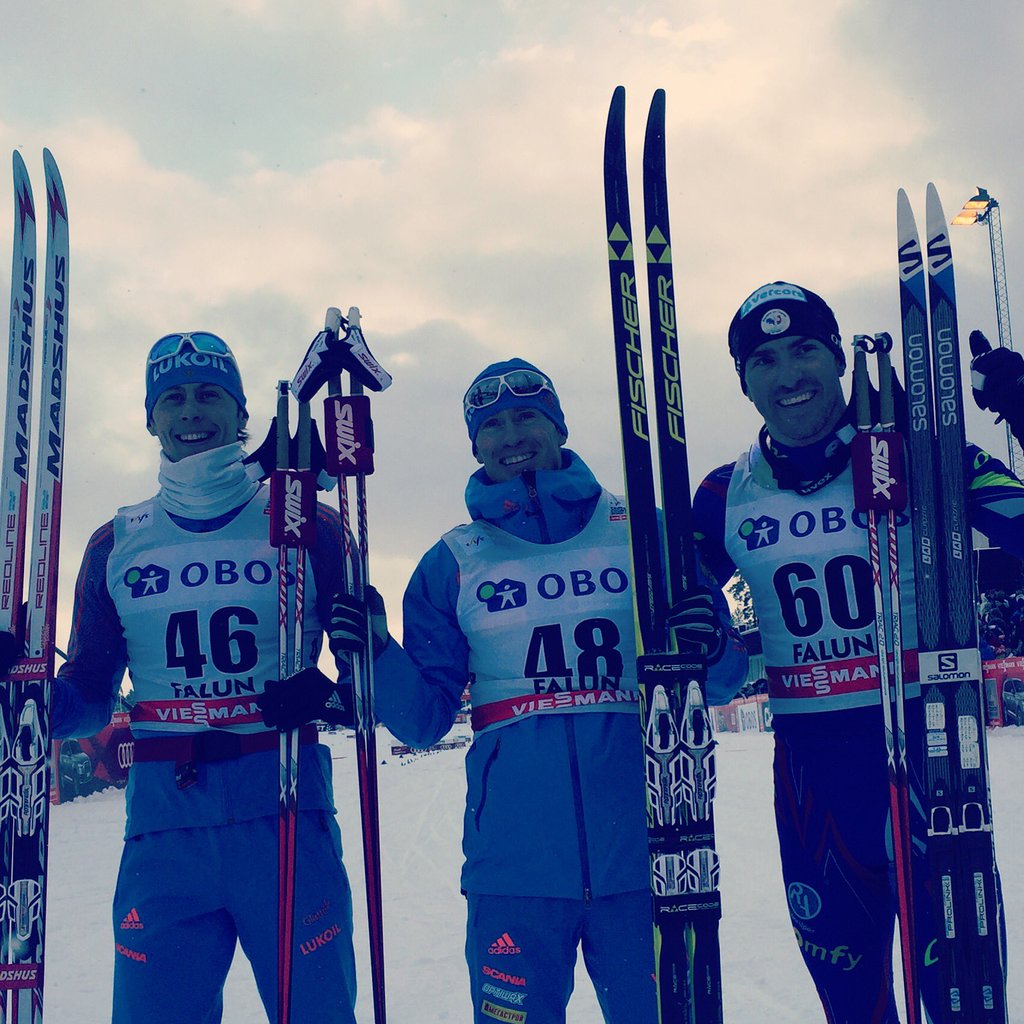
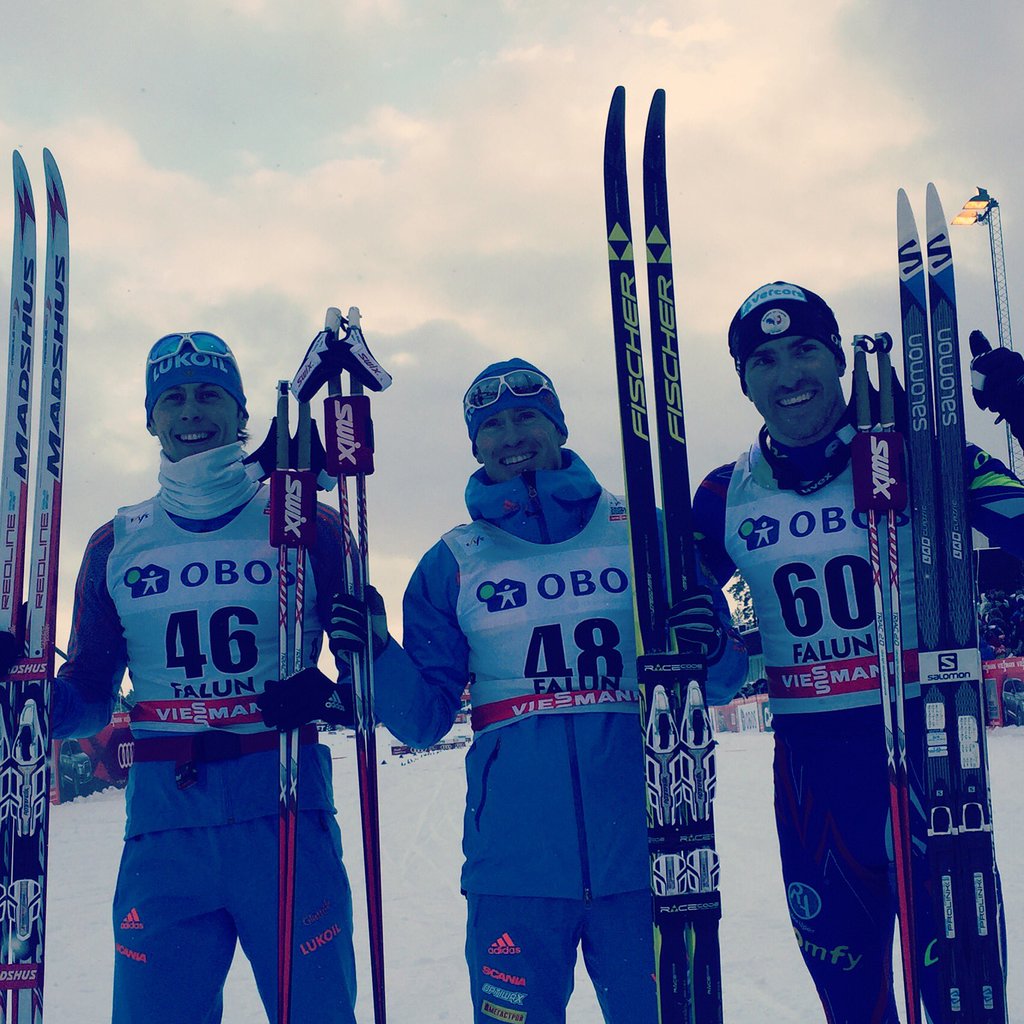
    Russia took first and second in the men's 10 k classic on Saturday in Falun, Sweden, with Maxim Vylegzhanin (c) in first and Alexander Bessmertnykh (l) in second and France's Maurice Manificat placed third. (Photo: FIS Cross Country/Twitter)
    Russia took first and second in the men’s 10 k classic on Saturday in Falun, Sweden, with Maxim Vylegzhanin (c) in first and Alexander Bessmertnykh (l) in second and France’s Maurice Manificat placed third. (Photo: FIS Cross Country/Twitter)

    There were a few striking anomalies at the World Cup on Saturday in Falun, Sweden. First, there’s the race format. The men skied a 10-kilometer classic race. Excluding tours, it’s the first time a 10 k classic has run as a regular World Cup event since February 2003. Second, Saturday’s results found Norway locked out of the podium.

    Russia secured the two top spots. Maxim Vylegzhanin took first in 25:14.6, Alexander Bessmertnykh was second (+3.5). France’s Maurice Manificat, only a sliver out of second, finished third (+3.6). With four skiers in the top 10, Russia seemed resurgent. Beyond the top-two positions, Sergey Turyshev placed seventh, 19.8 seconds back, with Sergey Ustiugov in 10th (+22.5).

    Norway also put four in the top 10, with 24-four-year old Emil Iversen in fourth (+7.8), Martin Johnsrud Sundby in fifth (+9.5), Didrik Tønseth in sixth (+19.2), Niklas Dyrhaug in eighth (+21.4). For the powerhouse nation’s top-of-the-podium benchmark, it was not Norway’s day. It was Russia’s. 

    I am always happy for a win and it is even better to have two Russians on the podium with the victory,” Vylegzhanin said, according to a FIS press release. “It was a slow start to the season for me but I am getting better the past couple of weeks. The Tour de Ski didn’t go as I would have liked but there is still the Ski Tour Canada.

    With a good dose of snow falling at the race start, the light was the only thing about the course that was flat. The men skied two 5-kilometer laps, which equates to 364 meters of total climbing, including twice up the infamous Morderbakken.

    The 33-year-old Vylegzhanin didn’t blink. He’s been on a podium roll. Last weekend in the Holmenkollen 50 k, he kept pace with the lead pack, along with three Norwegians, including race winner Sundby, ultimately finishing third. With his form dialed, and his past success on Falun’s trails (Vylegzhanin won the 30 k skiathlon at the 2015 Falun World Championships), the Russian strategically built his pace.

    In terms of race strategy, there was little room for seconds lost. As the time margins for the 10 k suggest, this was a tight race. Only 22.5 seconds separated first from 10th place.

    Vylegzhanin was 10.6 seconds back in seventh at 3.2 kilometers, 7.6 seconds off the pace at 6.7 k, and closing in for the win at 8.2 k, as he was 2.7 seconds back from Bessmertnykh’s leading time-split. Like a locomotive, maybe just a little bit sluggish at the start, Vylegzhanin’s accelerating pace won out.

    Despite leading the race until the closing 1.8 kilometers, Bessmertnykh was pleased. “I am happy to be back on the podium as in Toblach.  I prefer the interval start classic competitions.  It is the best for me,” Bessmertnykh remarked in a FIS press release.

    This was the 29-year-old Russian’s second World Cup podium this season. Back in December, he was second in the 15 k classic in Tobalch, Italy.

    For France’s Manificat, Saturday’s race was a breakthrough. The French skier is a proven freestyle threat. He won the 15 k free in Nove Mesto, Czech Republic, in late January. According to FIS, this is Manificat’s best distance classic World Cup result ever.  

    In a FIS press release, Manificat remarked he, too, found Saturday’s format to his liking.

    “This is my first individual classic technique podium,” Manificat said. “I am in good shape now after a training camp in Les Saisies the site from the 1992 Albertville Olympic Games.  My preference, like Alexander, is interval start as it is really just a race against yourself and your mind.  But I am looking forward to tomorrow’s [15 k freestyle] mass start and look for another good result.”

    Sundby, uncharacteristically never led the race. Regardless he is still crushing the overall World Cup, he leads teammate and second overall skier, Finn Hågen Krogh, by 715 points. On Saturday, Sundby was second at the first two time checks and fourth by only one tenth of a second with 1.8 k to go. The winner of last weekend’s 50 k Holmenkollen classic race — get ready for some words rarely written about Sundby  — ultimately fell off the pace.

    In a roughly translated NRK article, Sundby spoke of the kilometers catching up to him. “I’m probably been a little pampered. But when one is not better, then you have to make do with what you get. I should like to know what the reason is. But it has been a hard run in the past, and I’m a little tired after last weekend,” Sundby said.

    An Uptick for Bjornsen

    Erik Bjornsen on his way to 56th in the 15 k classic mass start at Stage 5 of the Tour de Ski in Oberstdorf, Germany. (Photo: Marcel Hilger)
    Erik Bjornsen (32) racing during the fifth stage of the Tour de Ski, in which he placed 56th in the 15 k classic mass start in Oberstdorf, Germany. (Photo: Marcel Hilger)

    For many of the North American men, it’s been a season where solid top-30 results, podium near-misses, and actual podiums have already come. There’s Canada’s Alex Harvey and Devon Kershaw. There’s Americans Noah Hoffman and Simi Hamilton. Add Erik Bjornsen to the list.

    Bjornsen had the best North American men’s result on Saturday. He placed 21st overall, only one minute from first place.

    U.S. Head Coach Chris Grover said in a phone interview that Bjornsen had been eying the Falun 10 k classic.

    He’s had a couple fantastic classic 7.5k relay legs this year. In fact, those relay legs have really been a couple of his really best races of the season,” Grover said.

    One of those relay legs was back in December in Lillehammer, Norway. In a stacked field (it’s a World Cup in Norway after all), Bjornsen skied the fastest second classic leg. He bested Norwegian skiers Hans Christer Holund, Mathias Rungreen, and Tønseth. He beat all the men standing on Saturday’s 10 k podium in Falun.

    “I think [Bjornsen] saw this 10 kilometer classic race, which is a little bit of an unusual distance for us, as for sure a target, and he took advantage of it,” Grover said. “He just cranked right out of the start. He went hard from the get-go, he was always in the mix at every split station.” 

    Bjornsen, who admittedly is disappointed with his season, needed the result.

    “I had a rough summer of training,” Bjornsen said on the phone. “I had hand surgery, I didn’t do much classic rollerskiing for, I think, two two and a half months to let that hand recover. I also had some knee issues at the same time from trying to get back right after surgery. I tried to get back into it a little too quick … I was feeling really strong up until July when I had that surgery and it seemed like I never really got those feelings back. I’ve been pretty disappointed with my season so far.”

    At 24, Bjornsen has been a skier maturing as an athlete on the World Cup. “I was hoping to have a trajectory since the Olympics two years ago of trying to knock five or so places off each year,” he said. “I haven’t quite had the trajectory the last couple years that I am looking for.”

    With his 21st place on Saturday, Bjronsen’s long term trajectory may be more positive  — he appears to have many more years on this stage to tick off those five or more places.

    “I’m not in this sport just to crack into the top-30 every once in awhile. I’m doing this sport because I think I have a chance of bringing home medals someday,” Bjornsen said. “I want to keep doing it as long as I believe that is possible. I’m not going to lie, there has definitely been some periods throughout this winter that I doubted myself, I wasn’t sure if that was going to be possible.”

    Bjornsen’s best-ever distance result came last season in a 15 k classic in Toblach, Italy, where he placed 18th. Saturday’s 21st stood as both a season-best and his second-best result.

    Also for the U.S., Hoffman placed 56th (+1:50), Scott Patterson was 63rd (+1:57.7), Reese Hanneman 87th (+3:23.7), and Andy Newell did not start. According to Grover, Newell had a fitful night’s sleep and awoke not well rested.

    No Canadians were in the points. Kershaw placed 44th (+1:34.3), Harvey 52nd (+1:46.3), Graeme Killick 55th (+1:49.6), Len Valjas 80th (+2:38.9).

    Kershaw had the potential for a very fast ride — he started in bib 57. Thirty seconds back, Sundby in bib 58.

    It’s a huge gift this season to start 30 seconds ahead of the by-far the best skier in the world,” Kershaw explained in an email. “The reality is that if he catches you — and you can stay on him — it’s top 15. Simple as that. The hard part of course is actually staying with him — since he’s so much better than everyone else this season.”

    At the first time check at 3.2 k, Kershaw had ceded 29.3 of those 30 seconds. “I was really motivated and excited for this 10km classic today — so I when I saw that I was starting only 30sec ahead of Sundby, I was pumped.”

    Kershaw, flying back to Canada soon, hopes to be primed for the Ski Tour Canada beginning March 1.

    I am feeling fantastic. Last weekend [at Holmenkollen] and today I am feeling the best I’ve felt in two years probably,” he wrote. “Too bad the equipment hasn’t been there to actually see if those good feelings translate into great racing results. Patience is key now, and I guess I hope to keep the momentum (feeling good) going towards my big goal of the year — Ski Tour Canada. And of course I am looking forward to being back in those beautiful Rocky Mountains in only a few days time!”

    Racing continues Sunday with the women’s 10 k and men’s 15 k freestyle mass starts.

    — Gerry Furseth contributed reporting

    Results

  • Poltaranin Wins 15k With a Lunge, Denies Bessmertnykh

    Alexey Poltaranin (KAZ) has officially shifted from a an early-season flash to a consistent World Cup podium threat, winning his third race in four starts by overtaking Russian Alexander Bessmertnykh at the line.

    Poltaranin came on strong at the end of the Tour de Ski, winning the 5k classic prologue and 15k classic mass start, before placing 11th overall. He skipped the sprint weekend in Liberec, but demonstrated today that he is still in top form.

    On the wide-open fields in La Clusaz, France, the 25-year-old never slipped far from the front of the pack in the 15k classic event, picking up an additional 22 World Cup points for his work in the two intermediate bonus sprints.

    “I like all distances when it is classic,” Poltaranin told FIS News after the race. “I had a good rest after the Tour de Ski and I am happy that my shape was good today.”

    The main pack never fractured, but the pace was high enough on the final climbs to spread out the field a little bit.

    Dario Cologna (SUI) spent most of the race in customary position — toward the front, controlled and content to let others lead. He took over headed into the last shorter climbs, several times switching tracks to remain right in front of overall World Cup leader Alexander Legkov (RUS).

    But Bessmertnykh, who has been knocking on the World Cup podium door of late, attacked over the crest of the final hill and opened a five meter gap.

    Driving a hard double pole, Cologna pulled back up, with Poltaranin, Legkov and a surprising Didrik Toenseth (NOR) on his tails.

    The Russian, however, held the edge on the hairpin turns in the stadium, and had the first step into the homestretch.

    Cologna was unable to muster a sufficient kick while Poltaranin found a higher gear, blasting by on the outside and taking the victory with a superior lunge at the line.

    Bessmertnykh still earned his first World Cup podium and just his third top-10.

    He placed 7th and 9th in the final two classic events of the Tour de Ski.

    The Russian did not push at the front early, perhaps learning form an ill-fated break in the Canmore 30k, but worked into position when it counted.

    Entering the day Cologna had been hoping for his first win of the season, but told FIS News he was satisfied with third.

    “It was a tough course and I wasn’t sure how I would feel after resting from the Tour de Ski,” he said.

    While he missed out on the podium, the story of the day was Toenseth.

    The 21-year-old entered the day with all of four World Cup starts under his belt, each coming last season.

    His best finish was a 17th in the 15k classic in Oteppaa, Estonia.

    Starting with bib 44, Toenseth slowly worked his way up through the field, eventually moving in to the lead at the 13k mark.

    He held position in the top-5 for the remainder, and had the finishing speed to hold of Legkov at the end.

    “It was unreal,” Toenseth told Norwegian broadcaster NRK after the race. “This I had not imagined. It feels like a victory.”

    A member of the winning relay team at the 2010 World Junior Championships in Hinterzarten, Germany, Toenseth has inserted himself in the World Championship discussion after besting Norwegian veterans Martin Johnsrud Sundby and Eldar Roenning.

    A member of the Norwegain National Development Team, Toenseth will ski the second leg in Sunday’s 4×7.5k relay.

    Poltaranin jumped into second in the World Cup distance standings, just four points behind Legkov. Cologna is third.

    Legkov held his position in the overall, losing just one point to Cologna today after the bonus sprints were factored in.

    Results