From the FasterSkier archive — posts syndicated from athletes’ and coaches’ own blogs between 2004 and 2012, kept online as published. Current coverage is at fasterskier.com.

Tag: Didrik Tønseth

  • Let the Chaos Reign: Norway’s Impossible Eight-Man Puzzle for the Olympics

    Let the Chaos Reign: Norway’s Impossible Eight-Man Puzzle for the Olympics

    On most race weekends, I take my job seriously — up at 3:00 am EST, fresh coffee made, woodstove loaded, notebook out, logged on to coverage early to make sure I don’t have a technical issue. Then once the race starts, I begin looking for subtle, important moments to describe in greater detail in the race report. But there are also weekends, like this past one, when I toss my journalism hat onto the mantle above the woodstove to warm for another day, ‘grab a bucket of popcorn’, and watch, specifically, the Norwegian men’s Olympic selection saga unfold like the most incredible reality show in sport.

    This year, the selection of Norway’s eight-man Olympic cross-country ski team might be the third most fascinating storyline in the Nordic world — trailing only Jessie Diggins’ farewell tour and the Russians’ return to the start gate. And yet, the drama out of Oslo might be the strangest: imagine being one of the ten fastest skiers alive… and still needing binoculars to see an Olympic start line.

    This is what it means to be a Norwegian man in an Olympic year. It is both a birthright and a statistical tragedy.

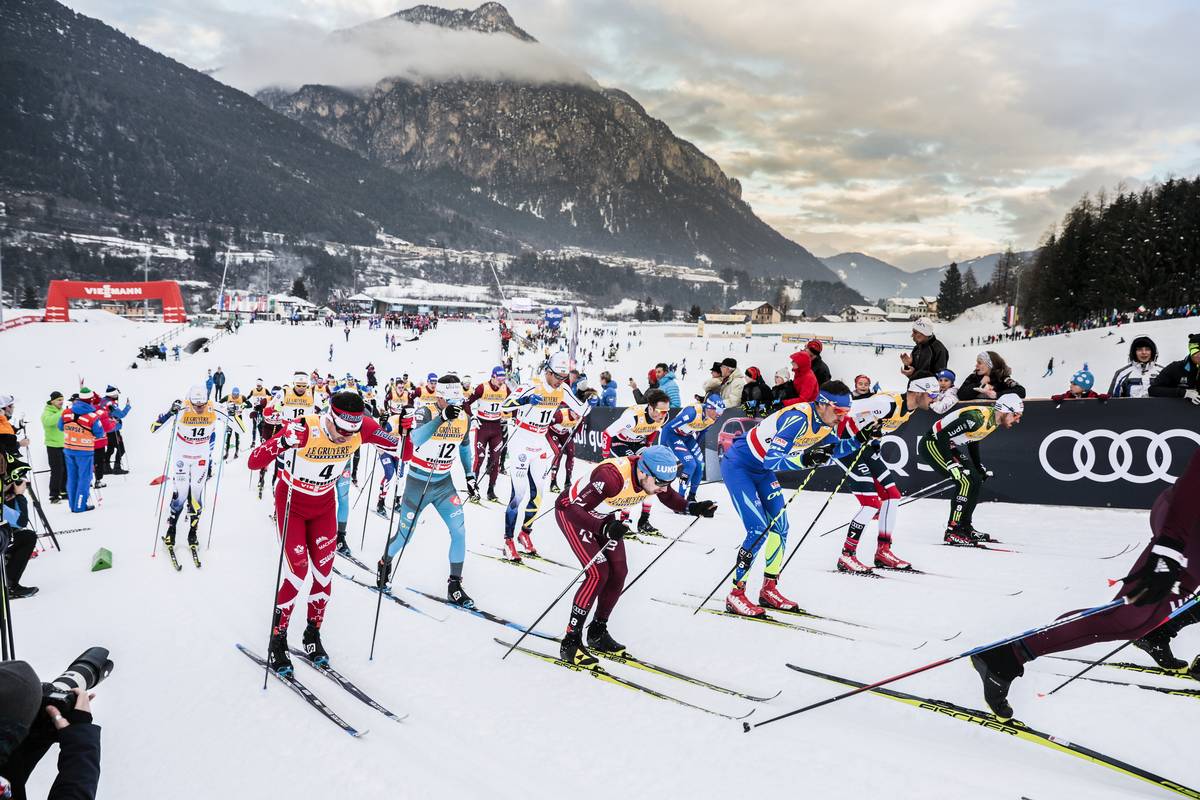
    Erik Valnes (NOR) and Johannes Hoesflot Klaebo (NOR), (l-r) crest the final climb before descending into the stadium during the World Cup Classic Sprint in Trondheim (NOR). (Photo: Modica/NordicFocus)

    A Nation That Could Sweep Top 10 — and Still Leave Podium Skiers at Home

    Let’s get one thing out of the way: on any given Sunday — sprint, classic, skate, distance, mass start, you name it — Norway could theoretically fill the entire top ten of a World Cup with home-grown talent. Twelve deep. Some years, nearly fifteen. The country is, bluntly, absurd.

    And yet:

    • Only eight can go to Milano–Cortina.
    • Only four can start each race.
    • Only two can sprint in the team sprint.
    • Only four can race the relay.

    You can be the fifth-best classic distance skier in the world, wearing red and blue, and never get to test yourself in the Olympic 50 k Classic, the sport’s defining event.

    You can be a podium threat.

    You can be a badge-wearing World Cup, World Championship, or Olympic winner. And still hear the most devastating phrase in the language of elite skiing: “Reserve.”

    Johannes Hoesflot Klaebo leads training partner Emil Iversen durning the Skiathlon in Trondheim (NOR). (Photo: Modica/NordicFocus)

    The Ten-Man Hunger Games

    After Ruka and Trondheim, the men fighting for eight tickets look something like this:

    • Johannes Hoesflot Klaebo — simply the best male skier ever and is a favorite for gold in any race he enters.
    • Harald Oestberg Amundsen — has two fifths, one second and a first already this season.
    • Martin Loewstroem Nyenget is a force in any distance race, with first, third, fourth, and seventh-place finishes in the races he has entered this season, and is indispensable in the relay.
    • Andreas Fjorden Ree— second in the 10 k Freestyle and eighth in the Skiathlon this weekend.
    • Einar Hedegart — the young biathlete turned cross-country racer, who doesn’t even have a FIS bio pic, has broken onto the scene this season with a second in Ruka and a win in Trondheim in the two skate distance races he has entered.
    • Oskar Opstad Vike — He was second in the Classic Sprint in Trondheim, an Olympic event.
    • Erik Valnes — Olympic gold potential in the individual sprint, team sprint, and/or relay.
    • Lars Heggen — while he was only fourth in the Classic Sprint in Trondheim, that is an Olympic event.
    • Emil Iversen — the comeback story, the steady relay hand, who climbed onto the podium last weekend for the first time in five years.
    • Didrik Toenseth — has only started one World Cup, the 10 k Classic in Ruka, thus far, but was in 8th place, and it is an Olympic event. Toenseth is still one of the world’s best in distance races, yet still at risk of not making the team.

    That is ten world-class athletes, without even mentioning skiers like Simen Hegstad Krueger, who is knocking at the door and who has won bronze in all the championship 50 k races for years.

    Norway only gets to name eight Olympians.

    Grab more popcorn.

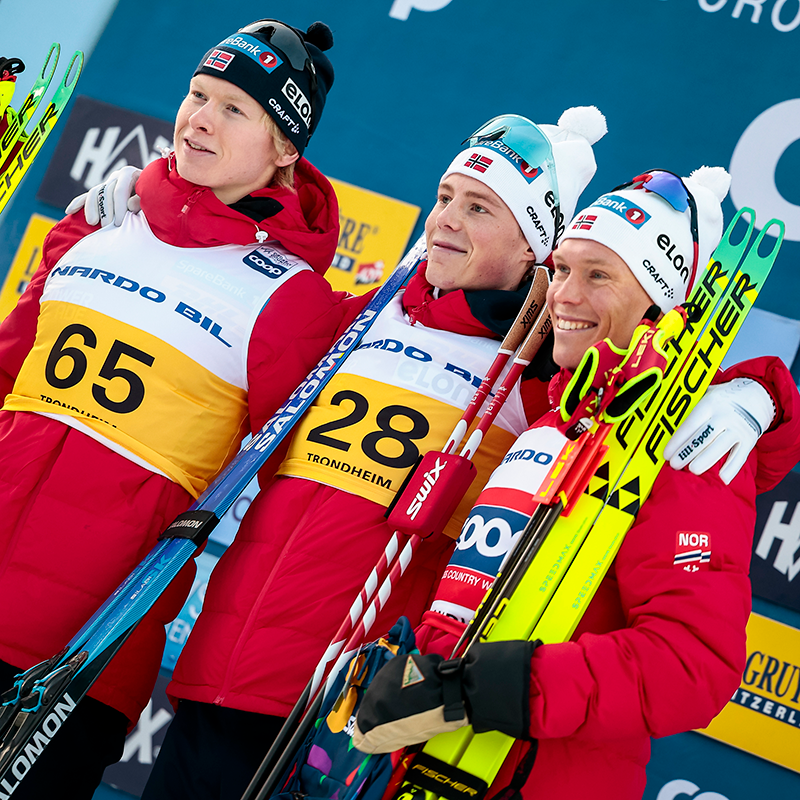
    Norway’s Andreas Fjorden Ree (NOR), Einar Hedegart (NOR), Martin Loewstroem Nyenget (NOR), (l-r) share the podium after the 10km freestyle Trondheim (NOR) last weekend. (Photo: Modica/NordicFocus)

    Who Gets the Golden Tickets? Norway’s Math Problem

    If the federation’s stated goal is to:

    1. Sweep the podiums (plural),
    2. Win the relay,
    3. Win the team sprint

    And possibly have Klaebo win everything except the marble flooring in the athletes’ dining hall, then the selection is not just about speed. It’s about risk management, event coverage, and event specialization.

    Here’s how the roles break down:

    The Locks (2):

    • Klaebo
    • Amundsen

    Barring a meteor strike, these two are sharper in December than most nations’ peak athletes in February.

    The Near-Locks (2):

    • Nyenget — championship DNA, distance weapon.
    • Valnes — if classic sprint is a medal event (it is) and you want a dependable classic leg in the relay, Valnes is on the plane.
    Didrik Toenseth took third at the 2022 Holmenkollen 50 k Classic. (Photo: NordicFocus)

    The Crucial Middle (six guys for four spots):

    This is where heartbreak lives.

    • Heggen — might already be one of the five best sprinters on earth.
    • Ree — versatility is gold in Olympic selection, and he might be Norway’s best “plug into anything” skier outside of Klæbo and Amundsen.
    • Hedegart — never flashy, but quietly always where he needs to be.
    • Vike — brutal aerobic capacity, championship build. Coaches trust this archetype.
    • Iversen — history matters. Championships matter. Norwegians never entirely write him off.
    • Toenseth — elite distance skier who would start for literally any other nation.

    Pick four.

    Explain it to the other two.

    Good luck.

    Harald Oestberg Amundsen (NOR) wins the 20 k Mass Start Freestyle during the World Cup opening weekend in Ruka (FIN). (Photo: Modica/NordicFocus)

    Then There’s the Start-Quota Madness

    Let’s say you do make the team.

    Let’s say you ski the best season of your life.

    Let’s say you’re in the shape of a medalist.

    Too bad — your teammates might be in even better shape.

    Norway could very realistically bring to Italy:

    • Eight skiers capable of a medal in the Skiathlon
    • Eight skiers capable of a medal in the Classic Sprint
    • Eight skiers capable of a medal in the 10 km Freestyle
    • Eight skiers capable of a medal in the 4 x 7.5 k Relay
    • Eight skiers capable of a medal in the Freestyle Team Sprint
    • Eight skiers capable of a medal in the 50 k Classic

    But they can only start four.

    Which means a realist must acknowledge something deliciously absurd:

    Norway will leave potential Olympic medalists off the Olympic start list. Not just off the team — off the start list.

    That is a uniquely Norwegian form of pain.

    Oskar Opstad Vike (NOR) on his way to second place during the Classic Sprint last weekend in Trondheim (NOR). (Photo: Modica/NordicFocus)

    The Fan in Me Wants A Front Row Seat

    I admit it: I want this selection battle to go deep into January.

    I want someone to pop one in Davos and get hot in Toblach.

    I want the young skiers to keep storming the podiums and scrambling what we think we know.

    I want Iversen — or Vike, or Hedegart, or Ree — to force selectors into sleepless January nights.

    Because for once, the stakes in Norway aren’t abstract. The Olympics aren’t a coronation; they’re a compression chamber.

    There are eight tickets for ten men who could anchor most nations’ relays.

    There are four start spots for races where all Norwegian Olympians can podium.

    There is no path through this selection period that does not end in heartbreak.

    And yes, as a journalist, I will cover every step of it analytically, carefully, and responsibly.

    But as a fan?

    I’m sitting on the couch, popcorn in hand, and watching the drama unfold. If competitive suffering is the essence of cross-country ski racing, Norway’s selection battle might be the purest expression the sport has.

    Bring on Davos.

    Bring on Toblach.

    Bring on the Tour.

    Let the Hunger Games continue.


    Love Stories Like This? Help Keep Them Coming.

    Feature interviews like this one take time, access, and care to produce. If you value thoughtful storytelling and independent ski journalism, please consider becoming a Voluntary Subscriber. Your support directly fuels the work we do to cover the people, places, and moments that make our sport special.

    Join the FasterSkier community!


    Lars Heggen (NOR) was fourth place in the Classic Sprint in Trondheim (NOR) last weekend. (Photo: Modica/NordicFocus)
  • Canmore Reporter’s Notebook: Scandinavian Feuds, Nearly-Nudes, Car Crash Recovery, and Doping Doubts

    Canmore Reporter’s Notebook: Scandinavian Feuds, Nearly-Nudes, Car Crash Recovery, and Doping Doubts

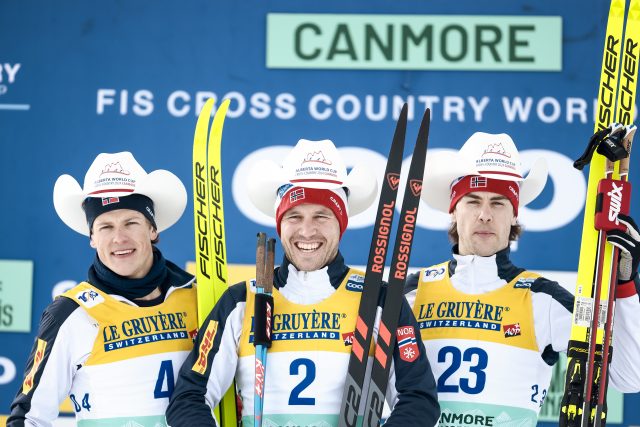
    The three Norwegian podium finishers sport their new cowboy hats Sunday. From left: Johannes Hoesflot Klaebo, Paal Golberg and Mattis Stenshagen. (Photo: NordicFocus)

    CANMORE, Alberta:  We’re three days into a six-race series of World Cup racing in North America and I’m just one guy, which means there hasn’t been time to share all the fun little stories and subplots that have been filling my notebook.

    I’m summarizing a few of the better ones here. Stay tuned for more notes and some feature stories after Tuesday’s final race in Canmore. If you have ideas for stories, tips or feedback for us, drop us a line at info@fasterskier.com.

    Canmore mayor says thanks but no thanks to nearly-naked Krüger

    Canmore is situated in the spectacular Canadian Rockies, but Alberta’s prairies start just down the highway to the east, and the events here celebrate the province’s cowboy culture with branded 10-gallon hats awarded to the podium finishers.

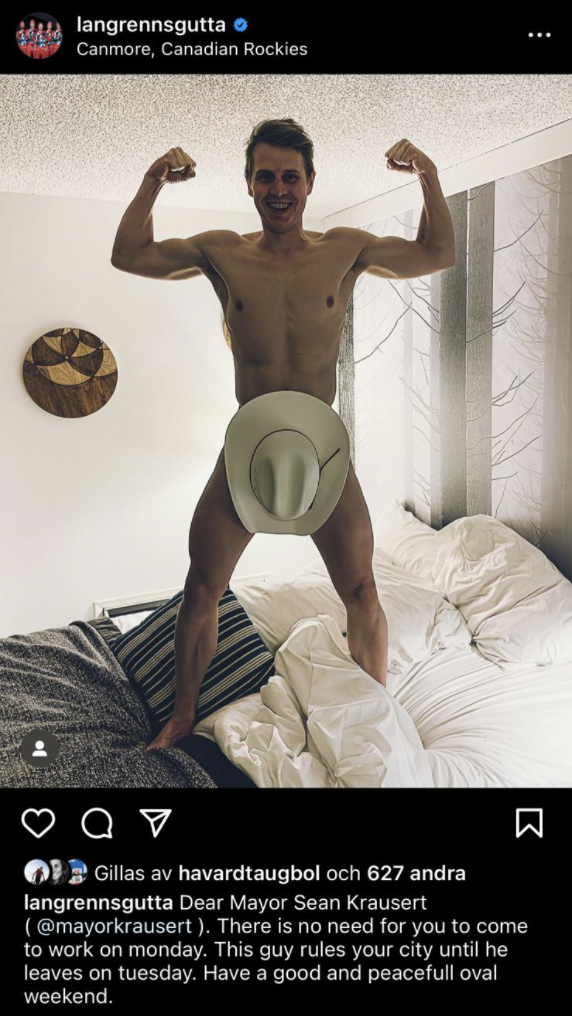
    Simen Hegstad Krüger of Norway won the first men’s race in Canmore in spectacular fashion Friday, and swiftly proceeded to defile the prize: In an Instagram post from the Norwegian team’s account later that day, he posed for a photo, naked, with only the cowboy hat preserving the image’s PG rating.

    This post from the Norwegian team needs no explanation.

    “Dear Mayor Sean Krausert,” the post said, tagging the mayor of Canmore. “There is no need for you to come to work on Monday. This guy rules your city until he leaves on Tuesday. Have a good and peaceful long weekend.”

    The next day, the post had been deleted. But after Norway swept the podium in Sunday’s men’s race, they published a new photoshopped image with five team members all posing naked with tastefully-placed hats and another offer that Krausert and his staff could have “two more days off, if you want.”

    Reached Sunday, Krausert said he was not aware of the posts, then, after I sent them to him, responded with a laugh-crying emoji.

    “Really…what can I say!!” he said. I said that he could, in fact, say whatever he wanted, to which he responded: “While I appreciate the offer, I’ll be at work on Monday so these incredible athletes can focus on skiing and enjoying Canmore.”

    Krüger said the idea for the original post came from his teammate Didrik Tønseth. “We had some fun about it, but then I figured in the morning that it is enough — maybe we can take it down,” he said, adding that no one instructed him to remove it.

    Tønseth told me, cheekily, that the Norwegian men had been failed by their “back-up crew, back in Norway,” which includes their “oldest and wisest” teammate, Sjur Røthe. The crew, Tønseth explained, is supposed to review all posts from the team’s Instagram account but didn’t because of the eight-hour time difference between Alberta and Europe.

    “It’s a lot of things we post that stop in the committee back in Norway,” Tønseth said. “Sjur is the athlete representative, but he was asleep, so it was his mistake, I think. Not ours.”

    Unfortunately for Røthe, it was too late in Norway for me to reach him for comment.

    A car crash derailed Jortberg last month. She’s back now.

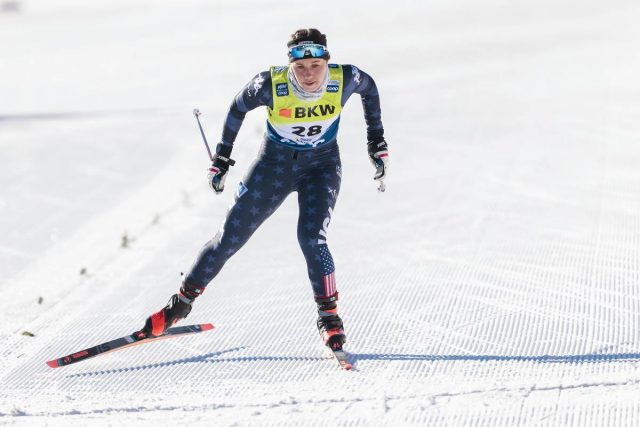
    U.S. skier Lauren Jortberg is racing in Canmore just two weeks after a crash that left her with “pretty bad” whiplash and totaled the car she was driving — and she nonetheless placed 19th in Saturday’s skate sprint.

    “Honestly, I think it was for the better, looking back on it,” she said after the sprint. “I was having kind of a tough season and kind of just needed to have a little gratitude for life and everything — and have a scary situation that makes you appreciate everything more.”

    Lauren Jortberg racing earlier this year. (Photo: Nordic Focus)

    She added: “I wouldn’t recommend it, definitely. But it definitely gave me some perspective that skiing isn’t everything.”

    Jortberg, who races with the SMS T2 team in Vermont, said she was leaving a race in Craftsbury late last month and was driving on a dirt road in freezing rain when she had a head-on collision. Her car had gotten caught in a rut while she was driving around a turn.

    “It was pretty traumatic and scary,” she said.

    An ambulance came to the scene, and while Jortberg didn’t go to the hospital, she said she was suffering some “pretty bad symptoms” that stopped her from training for the next week.

    “But I feel a lot better now,” she said. “And we have a great staff here, and they’re really taking care of me.”

    Skistad fans the flames of a feud that…may not actually be much of a feud

    One of the fun ongoing subplots of the past year of racing on the World Cup has been the up-and-coming Norwegian sprinter, Kristine Stavås Skistad, poking at her Swedish rivals.

    Skistad, 25, has been the only woman to consistently puncture the dominance of the Swedish sprinters, who often put as many as three or four women in the six-person final heats on the World Cup. And when she wins, she seems to relish rubbing it in — or trying to, anyway.

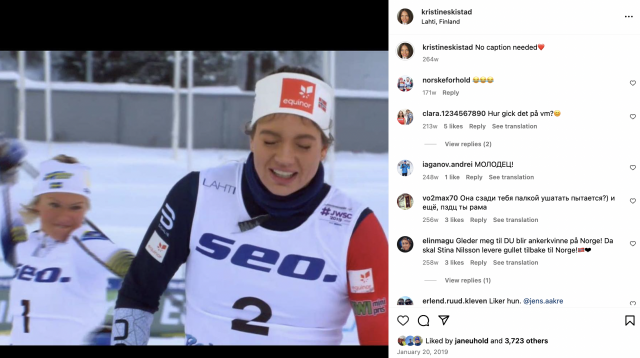
    Skistad’s ski-related snark appears to date back several years: An informed observer pointed me toward this objectively hilarious Instagram photo she posted from the World Junior Ski Championships in Finland five years ago. In it, Skistad smiles as she wins a gold medal in the sprint, while a clearly enraged Frida Karlsson of Sweden, who’s now a superstar on the World Cup, appears poised to smash her ski pole into the snow. “No caption needed,” Skistad wrote.

    No caption needed.

    In Saturday’s skate sprint, Skistad delivered not just a win but also another provocative gesture—a kiss, blown in the direction of the three Swedes who finished directly behind her.

    The Scandinavian media is delighting in what appears to be a budding rivalry: On Saturday, a Swedish television channel that was covering the Canmore races played a clip that analogized Skistad to a villainous character from the horror film “The Ring.”

    The Swedes themselves, however, appear generally unperturbed.

    “I feel like she sees us more like a rival than we really see her,” Maja Dahlqvist, one of the Swedish sprinters, told me. “We’re kind of friendly to her, and I think that maybe annoys her more. It doesn’t affect us at all—it’s not anger.”

    Johanna Hagström, another Swedish sprinter, said it’s a “little bit annoying” that Skistad is such a strong finisher. But she said the team’s read on Skistad is that she’s actually “really shy.”

    “She doesn’t speak that much—but on social media, she’s very cocky,” Hagström said. She added: “It’s really fun that she’s doing it. But I would never do that.”

    Hagström said she also thinks it’s good for the Swedish women to have other strong sprinters to compete against, and to give them motivation for summer training.

    Diggins works on saying ‘no’

    Nearly 30,000 tickets have been distributed for next weekend’s World Cup races in Minneapolis, which is setting up to be something of a homecoming celebration for Jessie Diggins, the U.S. star who grew up in Minnesota.

    Diggins is adored by fans, but the attention on her is making for an “exceedingly high” level of intensity and pressure, she told reporters after Friday’s race.

    “There’s a lot going on in my life right now. That’s the magic of having races at home is, it’s something you wanted and something I have worked for and advocated for for six years,” she said. “But at the same time, it comes with a lot of pressure and a lot of expectations and a lot of obligations for my time.”

    She added: “But that’s something I’m trying to role model well, for not just me but my teammates — like, it’s okay to be able to focus on your race, it’s okay to say no to things.”

    Saying no to things, however, is not always easy, she said.

    “It’s exceedingly difficult, and I struggle with it,” she said. “That’s something that I have to keep reminding myself is, I can’t do everything. Can’t possibly do it—it’s not possible. So we’re going to pick and choose, and kind of shoot for the happy medium.”

    I ended the interview by cheerfully pointing out that the Devon Kershaw Show, the FasterSkier podcast, is “ready for a yes” any time.

    Breakout Austrian star on doping doubts: “I get it.”

    Austrian racer Mika Vermeulen has been having a breakout season, and earned his first podium finish in Friday’s distance race.

    But Austrian cross-country racers have been implicated in doping scandals multiple times — most recently during the World Championships in Austria in 2019, where one of the country’s athletes was caught in the middle of a blood transfusion.

    Mika Vermeulen races Friday. (Photo: NordicFocus)

    Vermeulen was not implicated in that scandal and no evidence has ever emerged to cast doubt on his own performances. But I’d heard him bring up the subject on his own podcast previously, and also heard from one person in Canmore who had doubts about Vermeulen’s results.

    So I asked him, gently, what he wants people to think when he performs well, in light of the Austrian team’s history.

    “With all the shit that’s been happening on our team, and the last few years, yeah, I get it,” he said. “But the only thing I can do is keep on being good, being on my level. And I can tell you I’m not going to be caught, because I don’t do anything.”

    He added: “That’s the only thing I can do: Be on the level not just once but many and many times. And I just keep telling people I believe in myself, and I invite everyone to believe me.”

  • The Devon Kershaw Show: Recapping a soggy, fluoro-free weekend in Trondheim

    The Devon Kershaw Show: Recapping a soggy, fluoro-free weekend in Trondheim

    Eli Brown, a member of the U.S. Ski Team’s waxing and ski service staff, joins us this week to talk about his job and the new enforcement of the rules banning fluorocarbons on the World Cup circuit. We recap another strong weekend for American athletes, along with all the hijinks that happened in Trondheim, Norway at the test event for next season’s World Championships.

    The World Cup takes a break next weekend before the Tour de Ski, but we may try to squeeze in a mailbag episode. Send us questions if you’ve got ’em. Reach us at nat@fasterskier.com and devon@fasterskier.com.

  • The Devon Kershaw Show: Finals in Falun, eff yeah

    The Devon Kershaw Show: Finals in Falun, eff yeah

    It was full sun and full gas in Falun, Sweden, for one last hurrah of World Cup racing. The three-day weekend brought us new formats, American podium performances (plural!) and any number of other highlights. Thanks for listening over the course of the World Cup tour — we’ll be back periodically during the off-season with interviews and updates.

    You can email us at devon@fasterskier.com and nat@fasterskier.com. We’ll catch up with a mailbag episode in the next few weeks.

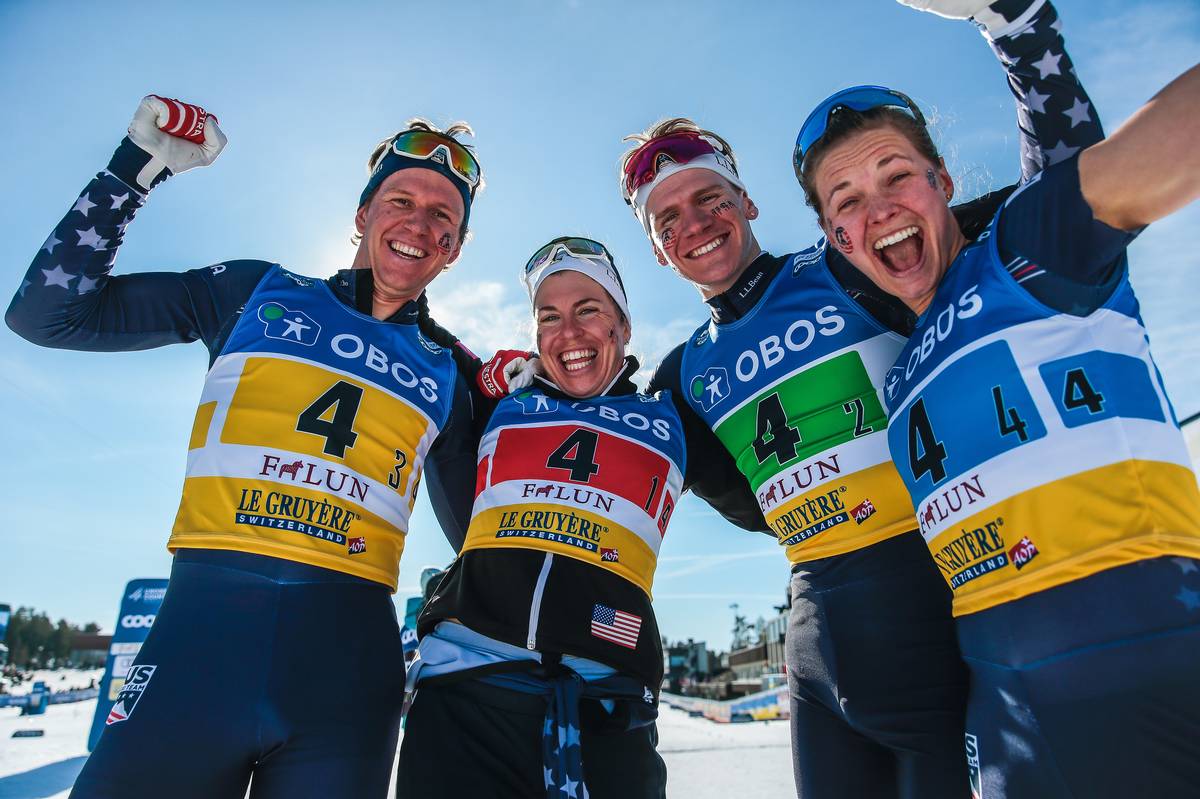
    USA I takes the win in Falun’s 4 x 5 k mixed relay. From left to right, Scott Patterson, Rosie Brennan, Zak Ketterson, and Jessie Diggins. (Photo: NordicFocus)
  • North American Men End on High Note in Falun 15 k Free; Patterson 7th, Léveillé 9th, Ketterson 15th

    North American Men End on High Note in Falun 15 k Free; Patterson 7th, Léveillé 9th, Ketterson 15th

    This World Cup coverage is made possible through the generous support of Marty and Kathy Hall and the A Hall Mark of Excellence Award.  To learn more about A Hall Mark of Excellence Award or to learn how you can support FasterSkier’s coverage please contact info@fasterskier.com.

    Following the men’s Olympic 50-turned-28.6 k in Zhangjiakou, long-time American distance champion Kris Freeman and Devon Kershaw called Scott Patterson an “Olympic Specialist”, commenting on how Patterson had found many of his top results at either World Ski Championships or during the Olympics in PyeongChang and Zhangjiakou. 

    His top championship results are this: 8th in the 30 k free in Beijing, 11th in the 15/15 k skiathlon; 14th in the skiathon and 10th in the 50 k classic during the 2021 World Ski Championships in Oberstdorf, Germany; 21st in the skiathlon in the skiathlon during the 2019 World Champs in Seefeld, Austria; 18th in the skiathlon, 21st in the 15k skate and 11th in the 50 k classic during the 2018 Olympics in PyeongChang.  

    Until today, Patterson had raced into the Top-20 on the World Cup five times individually, with his best result – and only other individual Top-10 – arriving in 2017 in the 30 k skiathlon during a pre-Olympic World Cup in PyeongChang. This event saw just 31 finishers, and a scan of the results sheet shows only a small number of names that frequent this site. 

    Scott Patterson races to 7th place during the 15 k individual start skate in Falun. (Photo: NordicFocus)

    But here in Falun, Sweden, Patterson popped a 7th place finish in the 15-kilometer individual start skate, finishing 42 seconds behind winner Didrik Tønseth (NOR) as the first non-Scandinavian athlete on the tails of five Norwegians plus Calle Halfvarsson of Sweden. 

    Roughly another 40 seconds back, Team Birkie’s Zak Ketterson was rolling too. In a steady effort that saw him inside the Top-20 throughout the day, he not only his first World Cup points, but finished 15th, +1:20.8 on Tønseth. 

    In short, Patterson and Ketterson shaped the final men’s distance race of the season into a high note for the U.S. And both men did it as early-starters, before the seeded group.

    Zak Ketterson (bib 8) leads Logan Hanneman during the 15 k individual start skate in Falun. (Photo: NordicFocus)

    Diving into the race, a winning strategy looked to be a conservative first of four laps on the championship-caliber course in Falun. While the top-three established themselves early, the eventual winner, Tønseth, did not make his charge for the win until the final lap. 23-year-old Harald Østberg Amundsen (NOR) was on top at the first lap, followed by Halfvarsson of Sweden, and then Tønseth. At the half, it was Halfvarsson on top, with Amundsen and Tønseth just under four seconds back. Then, Tønseth slowly turned the dial upward. 

    With one lap to go, Tønseth had five seconds on the Swede, and ten on his young countryman. With just over 2 k to go, this lead had grown to +13.3 seconds, of which he ceded very little through the finish. Tønseth stopped the clock at a ripping 31:57.6, knocking down the time of Halfvarsson who had started eleven bibs earlier. The Swede kept the second spot on the podium (+9.0), while Amundsen, who faded in the second half, kept pace from the back-half of the seeded group to finish third (+20.4). 

    Sweden’s Calle Halfvarsson sets the mark at the finish of the 15 k skate in Falun, while Scott Patterson races the final meters in the background. (Photo: NordicFocus)
    Norway’s Didrik Tønseth wins the 15 k individual start skate in Falun. (Photo: NordicFocus)

    Today marked Tønseth’s second consecutive podium, after taking 3rd at Holmenkollen last weekend, and his career first World Cup victory in freestyle. It had been a nearly three year stretch since his previous World Cup podium, which took place in Québec City in March, 2019.

    “I’m happy to end it like this,” Tønseth told FIS after the race. “This year has been pretty good, to finish it off with victories – I’m really happy with that. Considering the last two seasons before this one have been tough, and it was not working, but this one has been better and better, and I ended  up at the top, so I’m really happy.”

    Norway’s Didrik Tønseth wins the 15 k individual start skate in Falun. (Photo: NordicFocus)

    On his season highlights, Tønseth continued, “For me, the most important is that my body works and I can train it. I can train hard, and things respond, and I’m happy to go ski fast.”

    Asked his feelings on sharing the podium with teammate Amundsen, Tønseth said, “He is a rookie, but he showed last year, he is a good cross country skier. I’m happy for him to be on the podium and I’m happy to beat him as well.”

    Falun’s 15 k skate podium: Didrik Tønseth (NOR) took the win ahead of Calle Halfvarsson (SWE) and Harald Østberg Amundsen (NOR). (Photo: NordicFocus)

    Expanding on the conservative start – though the eventual podium athletes would simply reshuffle themselves throughout the race, the remainder of the top-10 saw some changes, like France’s Clement Parisse falling from fourth place at the halfway mark to 8th at the finish, and two Finns, Remi Lindholm and Iivo Niskanen, dropping from fifth and seventh at the first lap to 14th and tenth at the finish. 

    Meanwhile, the seemingly more patient starters, like Martin Løwstrøm Nyenget, who won last weekend’s 50 k classic at Holmenkollen, were climbing the rankings at time checks. Nyenget was in eighth at the half, before ascending to fifth at the finish (+23.6), just behind his teammate Hans Christer Holund, who took fourth (+21.2).

    Both Patterson and Ketterson exemplified this tactic also, knocking off three spots each between the halfway mark and the finish. Propagating a banner day for North America, Canada’s Olivier Léveillé was also steadily climbing the ranks, moving up from 16th at 7.5k to finish 9th (+48.9). Léveillé’s teammate Antoine Cyr had skied up from 37th at the half to finish 25th (+1:42.3), while fellow Canadian Phillippe Boucher took 29th (+1:45.0) as the third member of his team inside the top-30.

    Canada’s Antoine Cyr skis to 25th in Falun’s 15 k free. (Photo: NordicFocus)

    While Patterson was 15th in Falun last year, and has aforementioned strong results on championship courses like this one, Patterson said in a post-race call that the venue has actually been a challenge for him through his career. Though it’s a championship course, it lacks the high altitude factor of Zhangjiakou, where Patterson thrived, and has just one major climb, the signature “Morderbakken” which rises 65 vertical meters over the course of roughly 0.6 k. Gaining from his experiences racing on this course, Patterson shared what he’s done to solve the puzzle.

    “A lot of my approach today was trying to find some of the same feelings as last year, which was a lot of pushing hard, working through all the transitions. There’s a lot of time out there — beyond Morderbakken, there’s a lot of twisting down hills and gradual flats where it’s easy to lose time. But if you’re on form and thinking about it all the time, it’s a good place to gain time.”

    Scott Patterson takes 7th place in the 15 k individual start skate in Falun. (Photo: NordicFocus)

    Patterson also shared that he was unsure how his form would be today, as he was carrying fatigue from his performance at the Holmenkollen, which he identified as below his expectations. 

    “I started questioning my fitness. So it was nice to turn that around today with a good race and actually remind myself that I can ski well again and also appreciate a good distance skate race.”

    Overall, the season has been one of high highs and low lows for the 30-year-old. A late-fall broken wrist inhibited his ability to capitalize on the fitness he built over the summer, along with his early-season results, which would be critical for making the 2022 Olympic team. Patterson discussed the turning point of his season, which will end on a high note. 

    “[I hit a] big turning point going into nationals, where I had a lot of pressure, but I felt like I was actually starting to find my form and race well. So that was one big point, just coming into nationals and actually pulling out those results to make the Olympic team. But also, just going into the Olympics, I I had a really good training block in Bozeman. I was staying with my parents instead of going over to Livigno, like a lot of the US Olympic team. And I think that was really productive for me getting some altitude training, but also just keeping the stress low, which really helped going into the Olympics.”

    Here’s the full interview with Patterson, including non-race season highlights and how a trivia night in Lahti helped bring the North American contingent closer together, making today’s results even more exciting for Patterson to be part of.

    Adam Martin pushes to the line at the finish of the men’s 15 k individual start skate in Falun. (Photo: NordicFocus)
    Canada’s Xavier McKeever down the home stretch in the men’s 15 k free in Falun. (Photo: NordicFocus)

    Outside the Top-30 for the U.S., Crafttsbury’s Adam Martin skied to 44th (+2:20.9), while Logan Hanneman finished 52nd (+2:58.4), and Peter Holmes took 68th (+4:20.0). For Canada, Thomas Stephen was 61st (+3:32.2), while Xavier McKeever was 62nd (+3:36.9). 

    Post-race interview with Matt Whitcomb:

    With World Cup individual racing now complete for the 2021/22 season, awards for both the overall and distance champions were handed out today in Falun. 

    Though he was 10th today, Finland’s Iivo Niskanen ended his season with 493 points, overtaking previous leader Alexander Bolshunov (RUS) to win the distance standings. Bolshunov remained in second, trailing by 75 points. After a remarkable Olympic run, Bolshunov missed the final two distance races on the World Cup following FIS’ ban of Russian and Belarusian athletes on March 1st. Also unable to compete in the final two World Cup distance events after contracting COVID-19, Johannes Høsflot Klæbo finished third, at an 80 point deficit.

    Finland’s Iivo Niskanen is the 2022 World Cup distance champion. (Photo: NordicFocus)

    With Niskanen still the only podium member present to accept his awards, this leaderboard was reshuffled for the overall standings. Having won the 2021/22 Tour de Ski and consistently proved his range beyond the sprint course, Klæbo ran away with the overall World Cup victory to finish with 1375 points. He’s had some cake, but receiving the crystal globe will have to wait for the time being. 

    Bolshunov held his ground in second place, 497 points back, while Niskanen took third in the overall standings, 631 points behind Klæbo. 

    A Norwegian coach accepts the overall World Cup crystal globe on behalf of winner Johannes Høsflot Klæbo. (Photo: NordicFocus)

    You can expect more analysis on the seasons of these World Cup champions, but first, we’ve got one final day of World Cup racing on deck. The final day of racing in Falun will feature a mixed-gender 4 x 5 k relay in the morning, followed by a mixed team sprint in the afternoon. 

    Results

    World Cup: Overall | Distance


  • Attrition in the Fog: Bolshunov pips Krüger for the Oslo 50 k Classic Win

    Attrition in the Fog: Bolshunov pips Krüger for the Oslo 50 k Classic Win

    En mass: early in the Oslo 50 k classic. (Photo: NordicFocus)

    Oslo in late winter – it’s be hit or miss. Fog. Bluebird. A maritime climate, with plentiful moisture in the air, a slight drop in temps can morph the Holmenkollen ski complex into a ping-pong-ball-world. Athletes were mere shadows striding into and out of view on a foggy- drizzly day at the Holmenkollen. As spectators were limited to trail side spots as the main stadium was closed due to the Covid-19 virus, for some concerned, it was a slog for the 50-kilometer classic to close out the European portion of the World Cup. (That’s right- it’s ocean hopping time for the entourage post-race as the World Cup moves to North America.)

    Sunday church along the Holmenkollen course: Iivo Niskanen (FIN), Alexander Bolshunov (RUS), Johannes Høsflot Klæbo (NOR), (l-r). (Photo: NordicFocus)

    Let’s cut to the chase. The main action over 50 k involved main pack attrition. The sharp end pack remained robust with skiers through 18 k, as skiers passed through the main stadium as Sjur Røthe of Norway came through first. That much didn’t matter beyond a minor foot note in the day’s narrative, as a handful of Norwegian’s took pace leading chores throughout the race. 

    On a day that many would have preferred to practice their own personal art of hygge, the main pack remained 20 deep at 30 K. The top-20, which contained all the key skiers, was separated by a scant 5.6 seconds. A group that big surely provided its own sense of Norwegian coziness despite the high heart rates. Of those 20 athletes, four were Russian, two Swedes, one Finn, one Swiss — the rest Norwegians. Charging through was overall World Cup leader Alexander Bolshunov. There was Emil Iversen, Pål Golberg, Martin Johnsrud Sundby, Simen Hegstad Krüger, Didrik Tønseth, Hans Christer Holund, and Johannes Høsflot Klæbo. Bundled in there was Dario Cologna of Switzerland, and Iivo Niskanen of Finland, who was lucky enough to have fans and there chanting “Iivo-Iivo”. 

    With so many skiers clustered together, and the tactics less explosive than simply see who could hang on, the camera shots at each turn of the race through the main stadium turned to the spare classics skis racers had the option of swapping into. The lure of fresh kick or speed, seemed like tempting race candy. Halfway through, at roughly 25 k, it appeared that Golberg was one of a few of the main contenders opting for a fresh pair. The rest skied through the ski exchange zone, at least content for another lap with their boards.

    Lapping through at 30 k, scores of skiers opted for fresh kick and glide. Post-ski-exchange,  the front pack soon coalesced into two orderly lines, like marching soldiers, as they crested a hill roughly an hour twenty into the race. 

    No matter any skiers herculean efforts to pop off the front, this was a simply a group affair. Any potential burst of speed, or pulse for bonus points, was absorbed. Ski speed or kick, seemingly equalized among the scrum. The question simply was this: which human engine would last the longest? Forty kilometers in, and the front group had winnowed 13 skiers separated by about seven seconds. Bolshunov led, followed by Røthe and Cologna. 

    Pål Golberg (NOR), Sjur Røthe (NOR), Iivo Niskanen (FIN), and Johannes Høsflot Klæbo(NOR), (l-r). (Photo: NordicFocus)

    Then it was two — barely. Just after the two hour mark, Krüger spiced up the pace. Striding and double poling in earnest, at 47.7 k. Krüger was only shadowed by Bolshunov, as the Norwegian’s late in the race move stuck. Røthe, Cologna, and Holund fell off in third, fourth, and fifth, respectively, to just over 11 seconds back. 

    Two stallions double poling into an eerily silent stadium. That was probably not such a bad thing (although fans present are always better), as one can imagine the fans falling silent had they been there in droves. Russia’s Bolshunov out sprinted Krüger to win in 2:08:05.3, 0.9 seconds better than the second place Norwegian. 

    “I knew that Bolshunov is strong on the final 100m so I tried to get rid of him before that,” Krüger  told FIS. “I felt really good today so I knew that I could really push myself before that. But he is strong and it’s hard to get rid of him. I almost made it but I am really happy to be on the podium. It’s an amazing feeling.”

    “Me, the team and the skis were all working together perfectly today and I am very happy to win here,” Bolshunov said after the race. “Because compared to Trondheim, where I had no possibility to do something with my skis, it was more important for me to win here today.”

    That Trondheim race mentioned by Bolshunov was the final stage of the SkiTour 2020 in which he lost the overall due to poor skis.

    For Bolshunov, this made for back-to-back 50 k classic wins in Oslo. Last season he won in a final sprint that saw Russia sweep the podium. And for Krüger, this was a career best in a 50 k race. He was seventh in last season Oslo 50 k. Lastly, when it comes to classic skiing, this has been a breakout year for Krüger – he is an athlete we had often considered a skate specialist. 

    For the final podium spot, Iversen placed third (+19.5). Norway claimed seven of the top-10 spots. 

    “In the last lap I heard that I can fight for the podium and this is where I got some more energy,” Iversen said to FIS. “So I am really happy to stay 50km all in because I am not known as the best athlete in our team so it is nice for me to show the coaches and all that I can stand a hard and long 50km. I am really proud of that.”

    Emil Iversen skiing to third overall in the 2020 Oslo 50 k classic. (Photo: NordicFocus)


    The Oslo 50 k classic podium: Simen Hegstad Krüger (NOR) second, Alexander Bolshunov (RUS) first, and Emil Iversen (NOR) third, (l-r). (Photo: NordicFocus)

    This was a tough day for the Americans, who started four athletes. Ben Lustgarten (CGRP) finished in 47th (+13:20.1), and Adam Martin (CGRP) 50th (+15:10.1). David Norris and Ian Torchia did not finish as they pulled due to illness.

    “It was one of the toughest races I’ve been in,” Martin emailed. “I made a blunder by selecting zeroes and paid for it in the first lap. I used my one ski exchange as soon as I could at 6k with 44k to go. I spent a large majority of the race skiing by myself in windy conditions with no racers in sight. I am thankful for the spectators that cheered me on many k’s.
    Adam Martin during the Olso 50 k. (Photo: NordicFocus)
    Lustgarten reiterated the day’s difficultly.
    “The race today was absolutely brutal,” Lustgarten explained in an email. “The conditions were not as tricky as we thought because it was just rain and super saturated wet tracks, instead of the new snow they called for in the morning. Still the tracks were glazed wet and breaking down, and also got really slow after a lap or so because of the fluoros fading from the skis. I had amazing skis for my first pair.
    “I was able to stick with the lead pack for about 1.5 laps (we did 8 laps of 6.2km). I felt really good, my skis were amazing, fast and great kick. I started to fade a bit on the steep climbs and lost contact with the main front pack. Basically after that I skied alone or around a few other skiers for the rest of the race. The wind was tough being alone, and just forcing myself to ski well and try to keep my pace up. I swapped skis after 4 laps and unfortunately had a bit less kick on my second pair, in addition to fatigue and glazed tracks I found myself herring boning most of the steep climbs, but they were nice and fast for a few laps. My triceps started cramping about 20km earlier than most 50s, with about 30km to go. That was uncomfortable and not a great sign. My second half of the race was more about holding on and trying to finish the race instead of racing as hard as I could. I find at Holmenkollen it takes everything I have to just try and ski ok and finish the race because of how hard the course is. I was proud to finish today in such challenging conditions, even though my fitness didn’t feel amazing. Overall I was really happy with the skis and our wax techs deserve a shout out for that!”
    Ben Lustgarten (front) fog bound and Oslo 50 k determined. (Photo: NordicFocus)

    “This was a very tough weekend for our team, but I’ll say this first: We’ll be back next year to swing again,” U.S. World Cup Coach Matt Whotcomb explained. “Whether we are coaches or athletes, the process of figuring out this race is why we do this job. It’s just so difficult here, and we love it. We’ve been near the top and the bottom on the same weekend, and in each of those cases, the result is always over-shadowed by the experience with the crowd. This is a major-league sporting event in these woods, with crowds in the tens of thousands, strapping speakers to trees, screeching trumpets, blazing fires, and cheering for everyone. In fact, they cheer extra-loud for athletes who aren’t having a good race. In terms of uncracking the Holmenkollen, the courses, conditions, and 30/50k race formats are so difficult that anything but near-perfect skis, fitness, and health will put an athlete way off the mark. We just didn’t pull any triple cherries this weekend. We were also hit by a cold that caused us to scratch Sadie on the morning of her race, and it lead to David pulling out after three laps. I had the chance to talk to David in the feed zone as things were starting to go sideways, and I told him to pull out. He said, “But that’s not what I do.” It’s not my style either, frankly, but it would’ve been a season-ender for him to finish the race ill. There was no other way; he was pale green. Just behind David on the course, Ian was puking (on his birthday), so he had to drop out, too. So, like I said, it was a tough weekend. And while I support David and Ian in their need to drop out of today’s race, I’m also very proud of Ben and Adam for finishing this beast.”

    Results


    Simen Hegstad Krüger of Norway, post-race. (Photo: NordicFocus)


    A Bolshunov power surge. (Photo: NordicFocus)


    A lonely day at the Holmenkollen for some: Germany’s Jonas Dobler. (Photo: NordicFocus)


    Ian Torchia: Oslo 50 k classic. (Photo: NordicFocus)
  • Beitostølen 15 k Classic:  Tønseth, Klæbo, Krüger go 1-2-3

    Beitostølen 15 k Classic: Tønseth, Klæbo, Krüger go 1-2-3

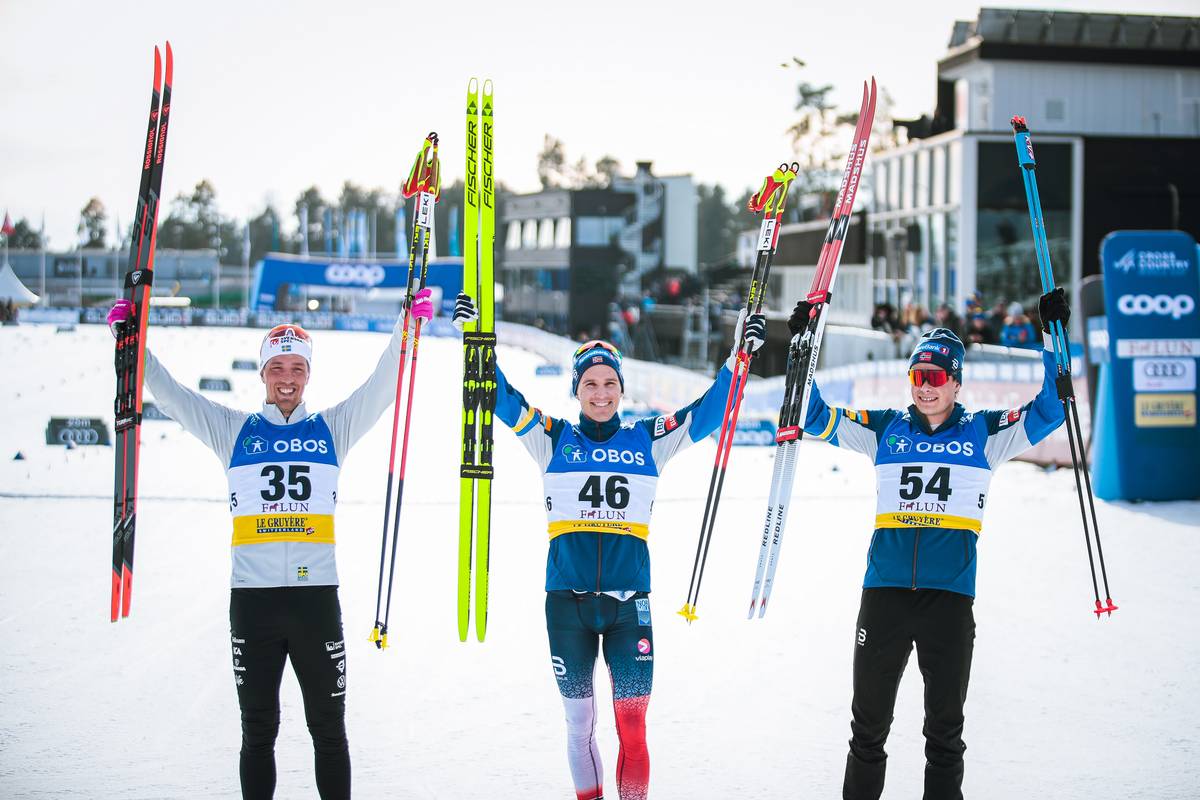
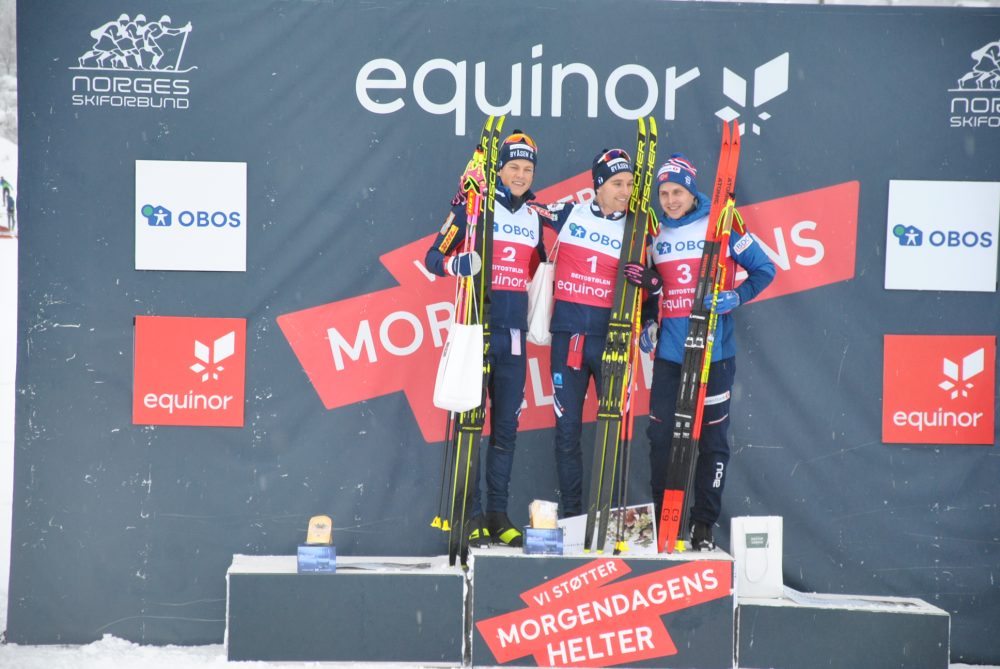
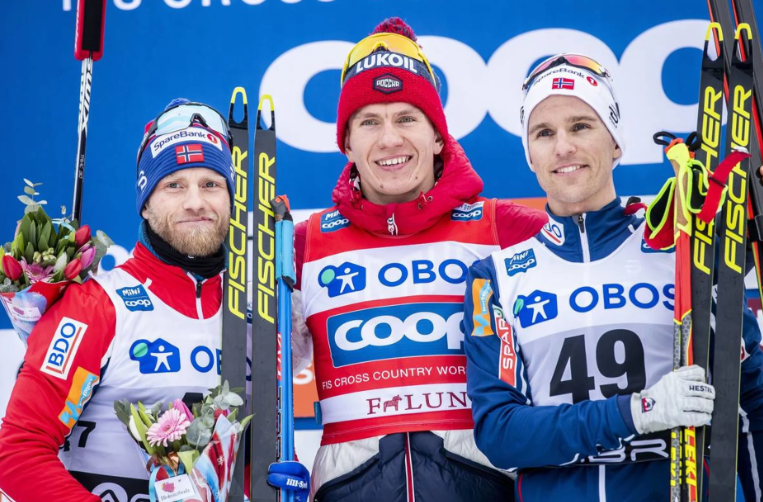
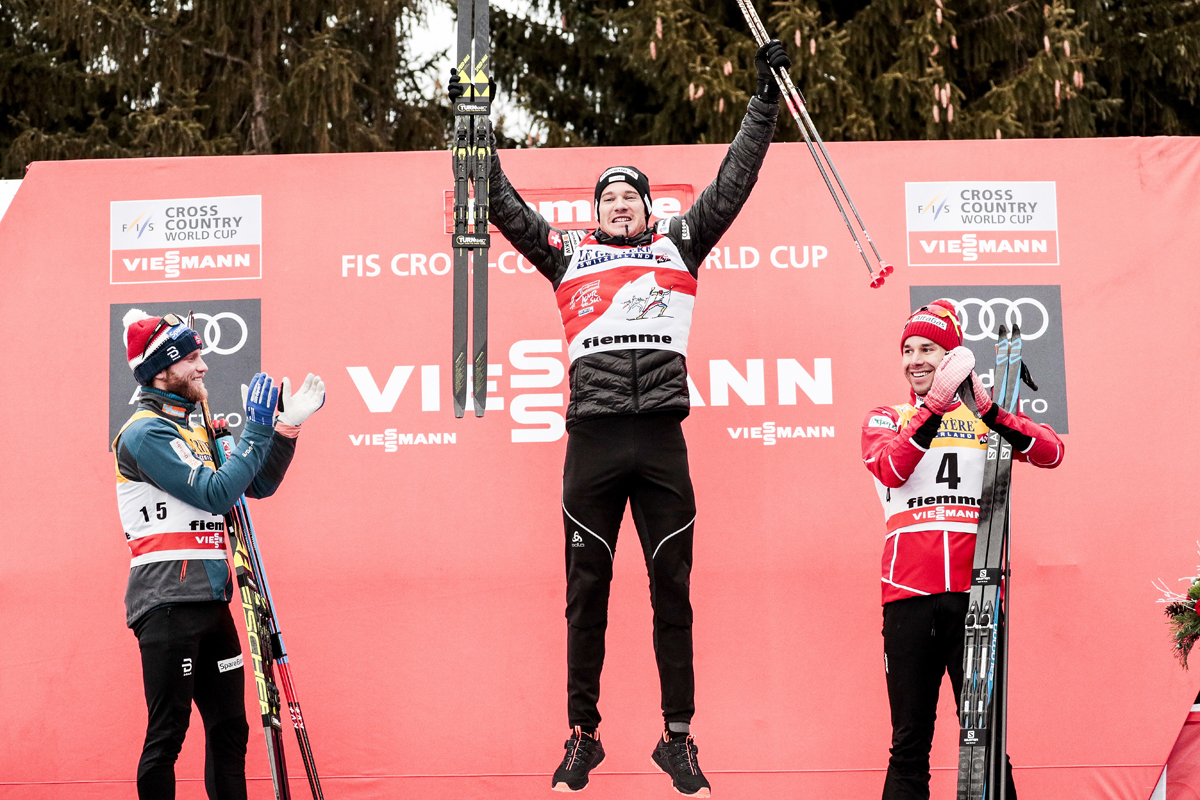
    The men’s podium from the 15 k classic in Beitostølen. Norway. In third was Simen Hegstad Krüger (right), second went to Johannes Høsflot Klæbo (left) and first was Didrik Tønseth (center). (Photo: Aleks Tangen)

    A national race in Norway, dare we say, may at times be at least as competitive as some World Cups: the field is deep. Today in Beitostølen, Norway the men contested a 15-kilometer classic in tricky waxing conditions.

    With fine classic technique on display, Didrik Tønseth of Norway won in 34:56.7. Teammates Johannes Høsflot Klæbo placed second, 18.9 seconds back with Simen Hegstad Krüger taking third (+36.5).

    David Norris (APU) was the top placed U.S. skier in 36th (+2:39.5). Erik Bjornsen of the U.S. Ski Team (UUST) was 54th (3:12.6), Kyle Bratrud (SMS T2) 73rd (+3:59.2), and Scott Patterson (USST) raced to 94th (+4:48.5). Simi Hamilton (USST) and Kevin Bolger (USST) were listed as did not start.

    David Norris during the men’s 15 k classic in Beitostølen. Norway. (Photo: Aleks Tangen)

    David Norris’ interview from the mixed zone

    Scott Patterson during the men’s 15 k classic in Beitostølen. Norway. (Photo: Aleks Tangen)

    Scott Patterson’s interview from the mixed zone

    Great Britain’s Andrew Young placed 63rd (+3:36.9) on the day. In his interview below he discussed how he enters the season coming off an extended altitude camp prior to the World Cup season.

    Andrew Young’s interview from the mixed zone

    Men’s Results

    Click images below to enlarge.

  • Takeaways from the 2019 International Coach Seminar in Trondheim, Norway

    Takeaways from the 2019 International Coach Seminar in Trondheim, Norway

    Guri Hetland is shown here when she coached the Swiss National Team. (Photo: FIS)

    Concurrent with the U.S. Ski Team and other nations partaking in the Toppidrettsveka rollerski series based in Trondheim, Norway, local organizers hosted the 2019 International Coach Seminar from August 24-25. 

    The conference attracted coaches from eleven countries including Russia, the U.S., China, Finland, and Norway. 

    Guri Knotten Hetland, a former Norwegian competitive skier, helped steer the conference’s agenda. Hetland is also leading Trondheim’s bid to secure the 2025 Nordic Ski World Championships and is the CEO of Tour 2020 AD – a joint Swedish and Norwegian venture hosting the Ski Tour 2020. 

    “In 2015, we organized the first coaches seminar and got great feedback,” said Hetland.  We did it again in 2016. I think we all realized it is useful to have such an arena to discuss cross-country topics and develop coaching.”

    This year’s meeting explored several topics including how different countries develop female athletes and approach anti-doping education. At a time when the sport recovers from anti-doping raids in Seefeld, Austria and an ongoing Russia scandal, Hetland said it was important to have a culturally diverse group openly discuss anti-doping efforts. 

    “What we wanted to do was give the coaches more information about how it is working,” said Hetland. “How does the anti-doping work function with so many different organizations. You have WADA and FIS doing testing, and you have so many court systems. We wanted to give an overview of how and who is involved and how it works. And for sure there are some differences and different approaches to it. An impression was that there are some very different approaches to this very serious and important question in terms of how to make the sport clean. For me, it is more important to make anti-doping work as value based as possible and to work to get the nations to implement values and ethics and educate young athletes when they are forming. In my opinion, you should not form them to become Olympic champions but form them to make them enjoy sport, love skiing, love fair sport.”

    One notable conference attendee who discussed anti-doping efforts was Yuriy Ganus. Ganus is the Director of RUSADA and has recently been outspoken about Russia’s need to reform. 

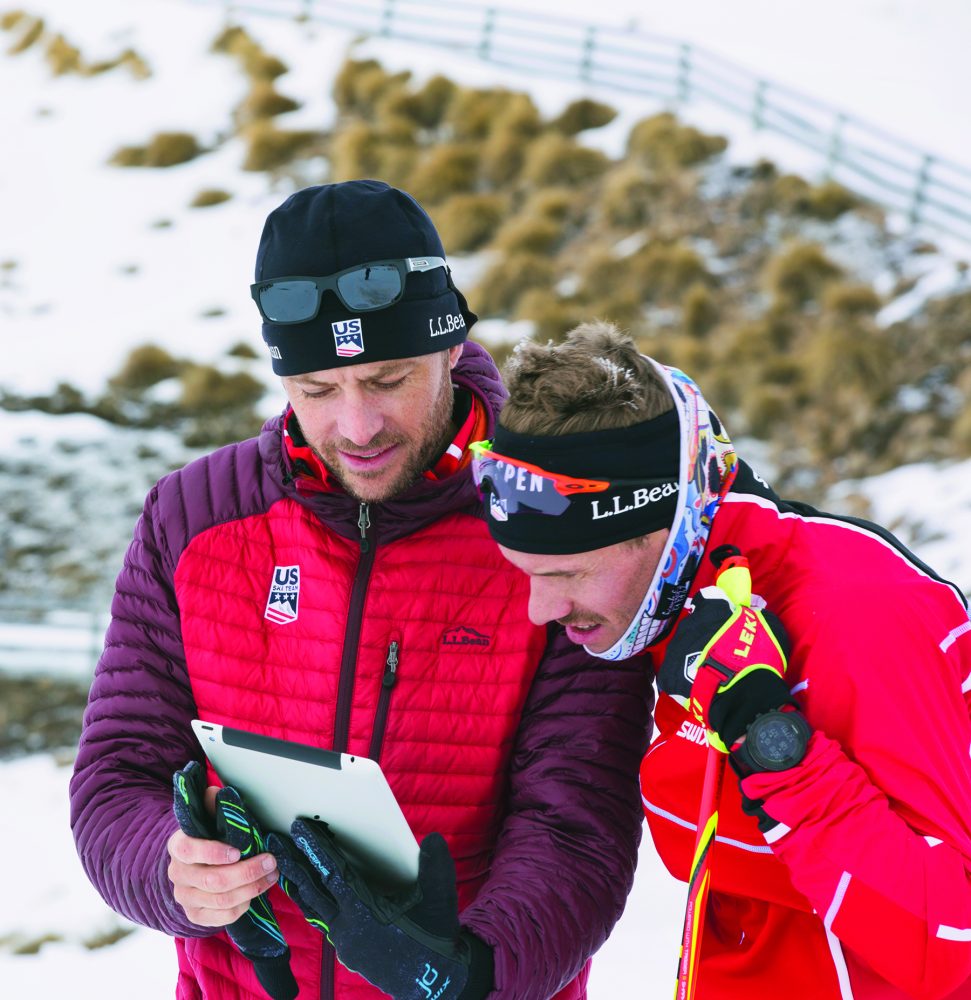
    U.S. Ski Team member Simi Hamilton reviewing technique footage with coach Matt Whitcomb at New Zealand’s Snow Farm, 2018. The photo was taken as part of a Warren Miller production. (Photo: ColinWitherill/Warren Miller Entertainment)

    “He gave an impassioned presentation on Russia and somewhat acknowledging their dark past with a specific reference to Sochi,” U.S. World Cup Coach Matt Whitcomb said. “Basically, my take on this was, if everything Yuri says is true, Russia will be moving into cleaner territory. And I like to hear that. It appeared he was motivated to promote clean sport in Russia.”

    During the seminar block focused on female athlete development, Dr. Johanna Ihalainen presented Physiology and considerations for coaching practice. Whitcomb came away from the lecture with several thoughts. One revolved around the concept of how to align an athlete’s training with their menstrual cycle. 

    “I knew this was going to be a question that I was a little bit nervous about because I never have, and I have considered it,” said Whitcomb. “But, I have never found the right situation and coaching relationship with an athlete.”

    According to Ihalainen, the follicular phase of the cycle is appropriate for high-intensity work. Ovulation is when strength gains are most pronounced — but her findings suggest some athletes may be more prone to injury during this phase. The final stage of the cycle may be best suited to lower intensity, higher volume training. 

    “Johanne showed a number of slides that backed up this research and the problem is that these suggestions are based on the average athlete,” said Whitcomb. “So many of the data points from which these recommendations are tied have the opposite effect.”

    Whitcomb said he and Cross Country Program Director Chris Grover felt it made sense to have their athletes note what training methods may benefit and inhibit their training and to document where it corresponds on their menstrual cycle. 

    “Better awareness by the athletes, in our case, on our team, is a good solution,” said Whitcomb. “So if an athlete has a particular opportunity, they can choose to talk with their coach and together they can take advantage of that, that was our takeaway.” 

    The coaches also took a working field trip to the local rollerski tracks. According to Whitcomb, it became a key opportunity to workshop different coaching strategies. The assignment was to help a Norwegian World Cup athlete modify their classic technique. Didrik Tønseth was the primary ski technique guinea pig. He was joined by Niklas Dyrhaug, Johannes Høsflot Klæbo, and last season’s Vasaloppet winner Tore Björset. As the coaches filmed, the skiers made passes striding and double poling. 

    “We then broke into groups to discuss the technique of Tønseth and Dyrhaug specifically and to then come up with recommendations for them,” Whitcomb wrote in an email. “Our initial thought was, ‘yeah right, we’re going to help the guys who are already beating us?’ My group was comprised of Germans, Finns, and Chinese. Tønseth told us he wanted to ski higher in his double poling, and to deliver the power more quickly and with less full body movement, rather than going so deep into a compression. Our group though that’s a good idea, but one must also have the physiology to use that specific technique, which is why we felt like he should use his entire body for double poling and not fight what he doesn’t have. He’s old enough so a change that big is less likely to see success. This was a great session to see how the technique talking points differ.”

    Whitcomb also explained he has been incorporating some new ideas learned from the Italians and Marcus Cramer who coaches some top Russian athletes. These groups, according to Whitcomb, most often conduct strength sessions in the afternoons prior to intensity sessions the following day. 

    “This yields more priority to the strength,” wrote Whitcomb. “We do our intensity and strength on the same day as a way of reserving the other days for recovery and easy distance. This new pattern, which is something I’m testing currently with Simi [Hamilton] and Sophie [Caldwell], also allows them to do a light strength workout – something short, intense but not fatiguing, and involving neural activation – the night before races. They feel this prepares the body better than an easy afternoon jog, which is the overwhelming standard on our team and many others.”

  • The World’s Great Age Begins Anew: Athletes Mark May 1

    The World’s Great Age Begins Anew: Athletes Mark May 1

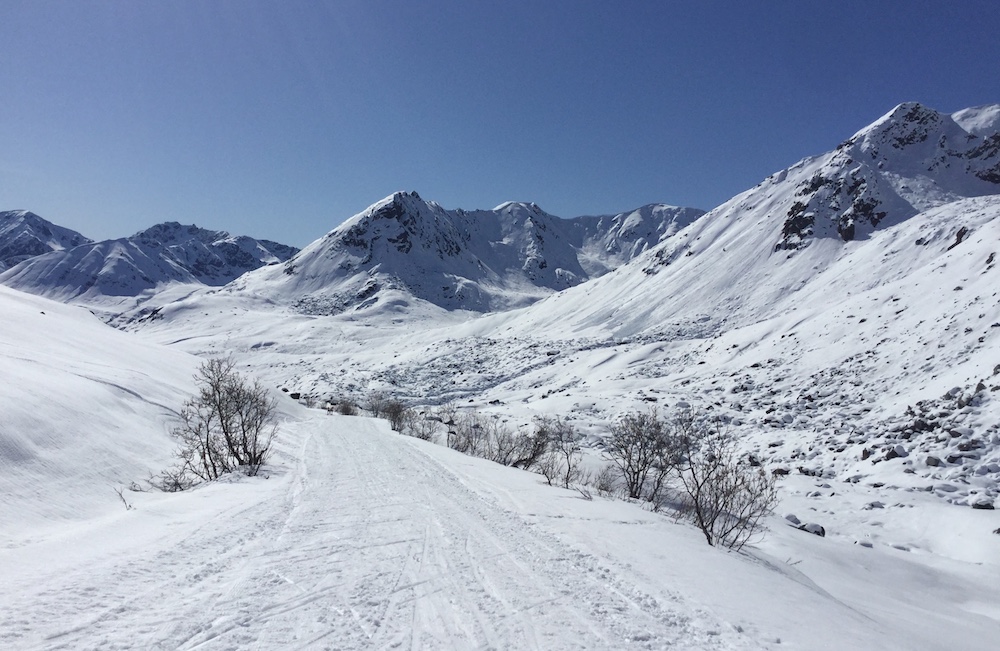
    David Norris (APU) and Luke Jager (University of Utah) (very small skiers on trail in background) ski up Archangel Road, Talkeetna Mountains, Alaska, on May 1, 2019. (photo: Gavin Kentch)
    David Norris (APU) and Luke Jager (University of Utah) (very small skiers on trail in center background) ski up Archangel Road, Talkeetna Mountains, Alaska, on May 1, 2019. (photo: Gavin Kentch)

    If you’re reading this website, you’re probably well aware that the nordic skiing training year begins on May 1. In a sport where most races happen between November and March, and demand of athletes that they repeatedly race to the point of nearly losing consciousness, the preparation for race season had better start a long time before that. As the well-worn, but accurate, saying has it, skiers are made in the summer.

    tretinoin

    Embracing the start of May – either May 1 per se, or a conveniently located Monday a few days on either side of that date – as Skier’s New Year is nothing new. Indeed, here’s Luke Bodensteiner, at the time a struggling Olympic hopeful, in the opening lines of his book Endless Winter: An Olympian’s Journal, describing a training day 26 years ago this week: “Monday, May 3: Salt Lake City, Utah. This is it. Training begins today for the 1994 ski racing season. The focus this year is on the Winter Olympics to be held in Norway in February, but the season won’t end until the final races are over in April. … It isn’t like I ever really stopped training, but now instead of pick-up basketball and soccer, back-country alpine skiing and the odd midnight kayak trip with my roommates, training has to get serious. … My little black wristwatch suddenly rules my day.”

    Or here’s a notably ambitious Cory Smith, in the ur-skier blog “Somewhere Between Obscurity and Oblivion,” writing on April 26, 1999, while acknowledging that he was doing so five days earlier than custom and generic expectation would suggest: “April 26: Yes, I know that it is still April, but I am writing in my May journal. That is because today is the official start of the 1999-2000 training year. To preserve a sense of continuity it is just easier to assume that May is the first month of the year and squeeze a couple extra April days into the month. I hope this doesn’t screw up your crop planting or biological clock or anything. So what did I do to kick off the year? I went for a run. I know, it’s not very exciting, but you have to start somewhere. Besides, I am only supposed to be training 8-12 hours per week this month, so I shouldn’t do too much the first day. But at last I am underway and ready to prepare for an even better winter next year.”

    Or here’s Noah Hoffman, writing on April 30, 2014, in a post entitled, “Start of the Training Year”: “Today was my first scheduled training day of the year. … I started my two hour double pole outdoor roller ski session (Double poling is the only outdoor roller skiing I’m allowed to do right now.) before 7 a.m.” (And here’s the follow-up, from May 1: “I am SORE today! Yesterday was my first real training day of the year. It was all upper body based (with a two hour double pole and strength), and now I can barely lift my arms.”)
    While Instagram has largely replaced blogs (or a book (!)) as the platform of choice, the message has changed far less than the medium: Early May is perpetually a time for new beginnings, new hopes, big plans, and maybe a self-effacing crack about being out of shape or needing to go find one’s rollerskis. Here is a look at how an unscientifically selected group of athletes marked the occasion online, with the only emphasis being on athletes who were posting about new training rather than about new sponsors (corporate sponsors being more characteristic of European skiers than their impoverished American counterparts):

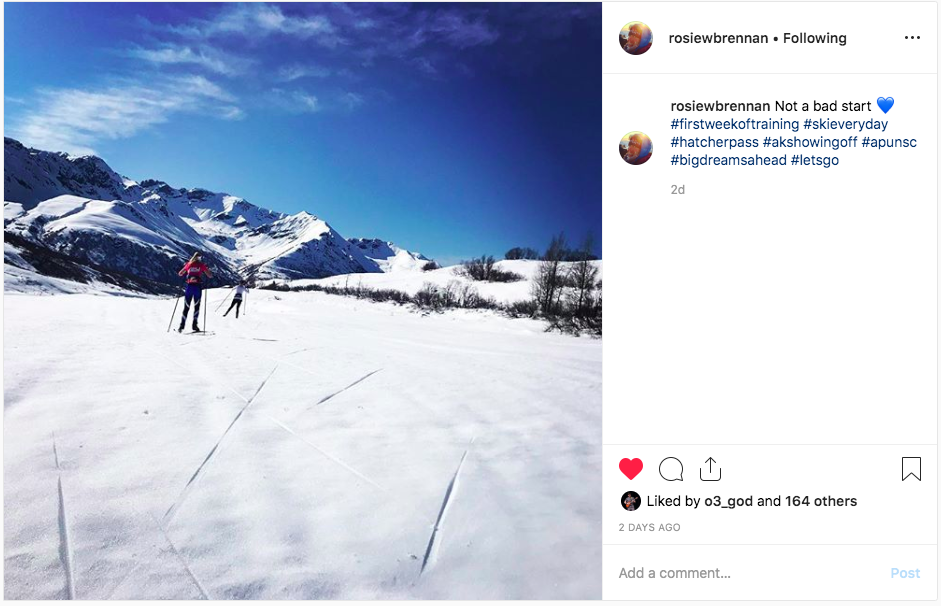
    Rosie Brennan, APU (also Hailey Swirbul and Sadie Bjornsen): Crust skiing in Alaska

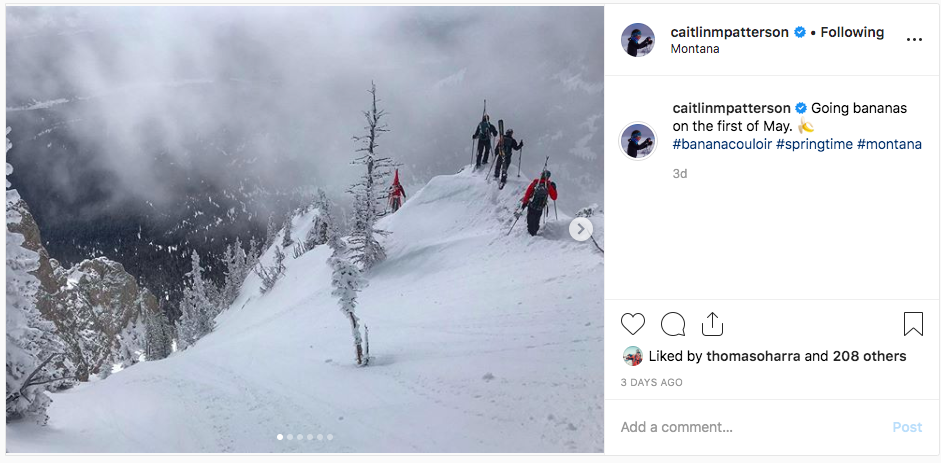
    Caitlin Patterson, Craftsbury Green Racing Project: Backcountry skiing in Montana

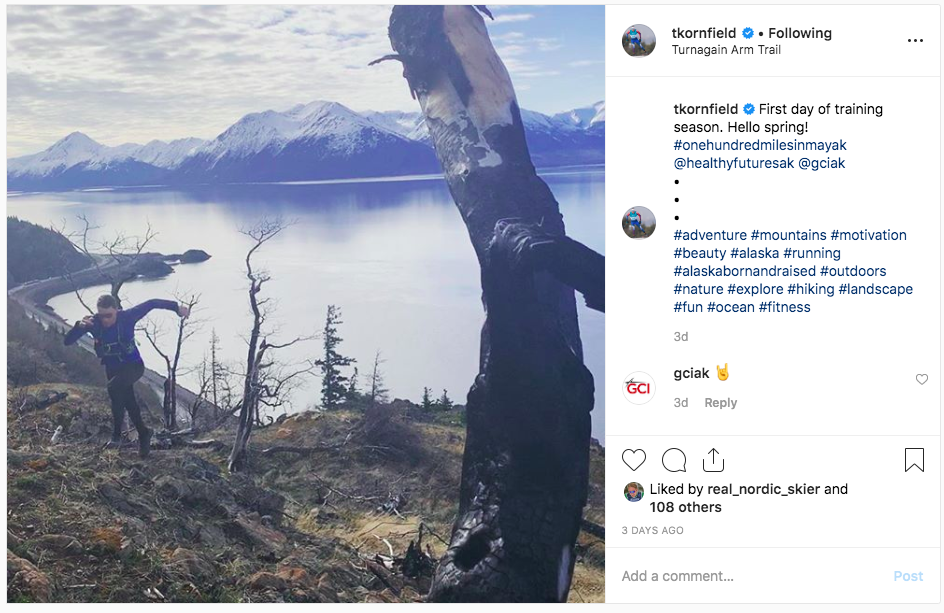
    Tyler Kornfield, APU: Trail running in Alaska

    Caitlin Gregg, Team Gregg/Madshus: Winning a ski race in Iceland

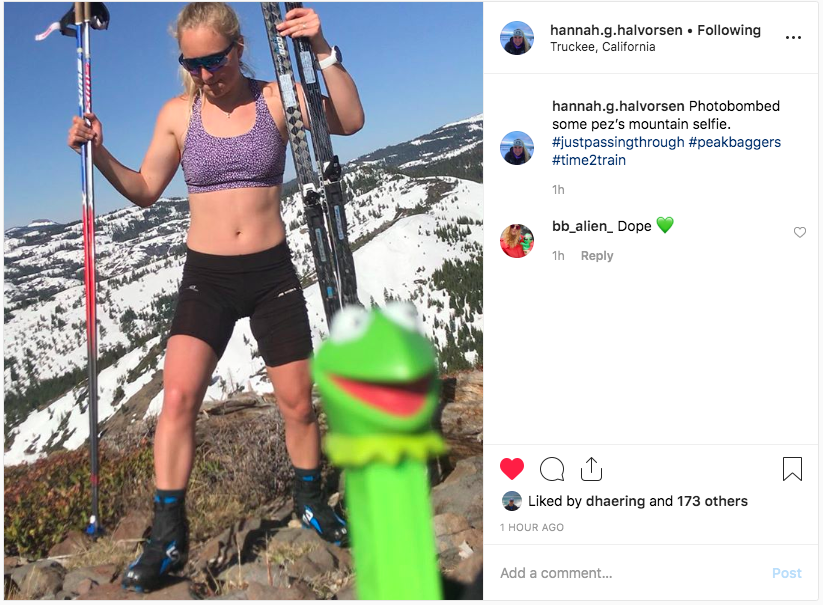
    Hannah Halvorsen, APU: Nordic skiing in California

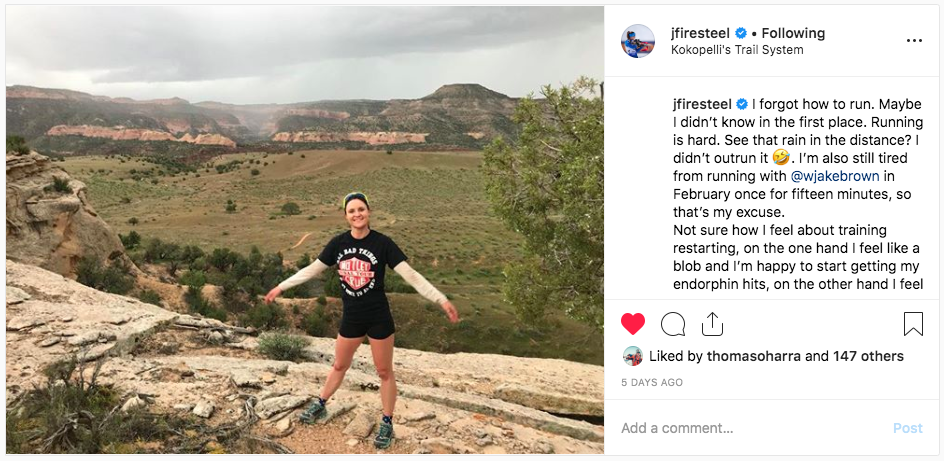
    Joanne Firesteel Reid, U.S. Biathlon A Team: Learning how to run again in Colorado

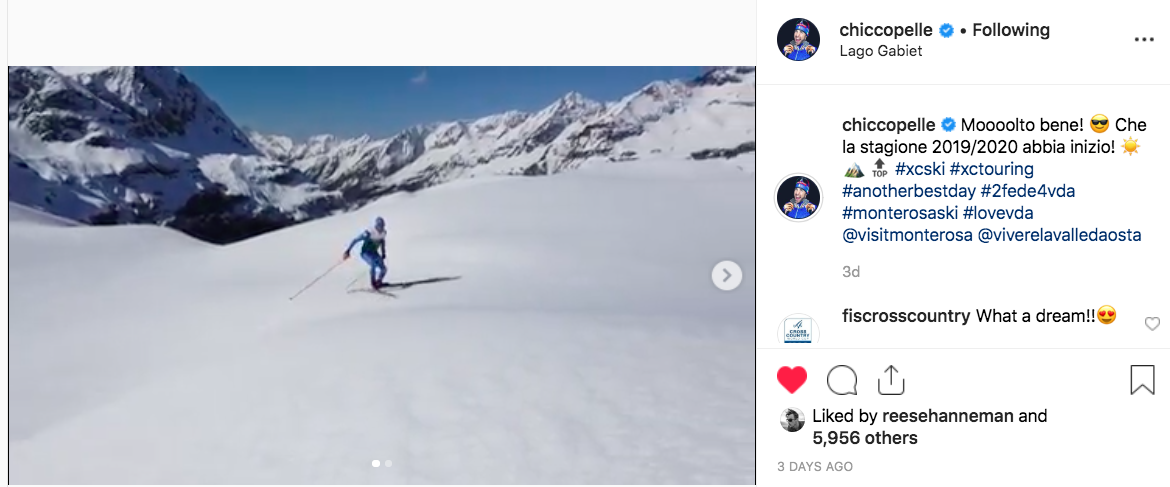
    Federico Pellegrino, Italy: Crust skiing in Italy

    Jonna Sundling, Sweden: Season highlights from 2018/2019

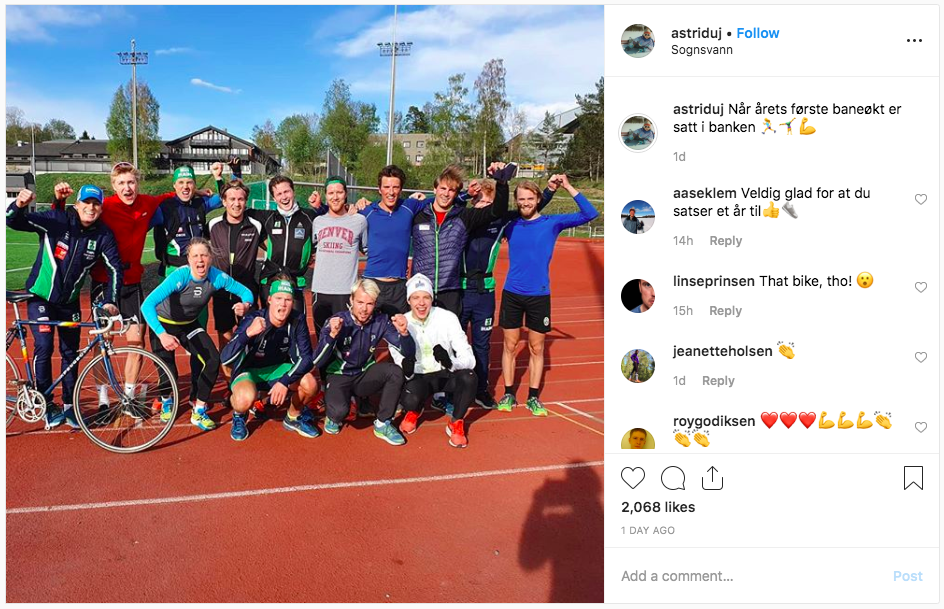
    Astrid Jacobsen, Norway: Logging the year’s first track session

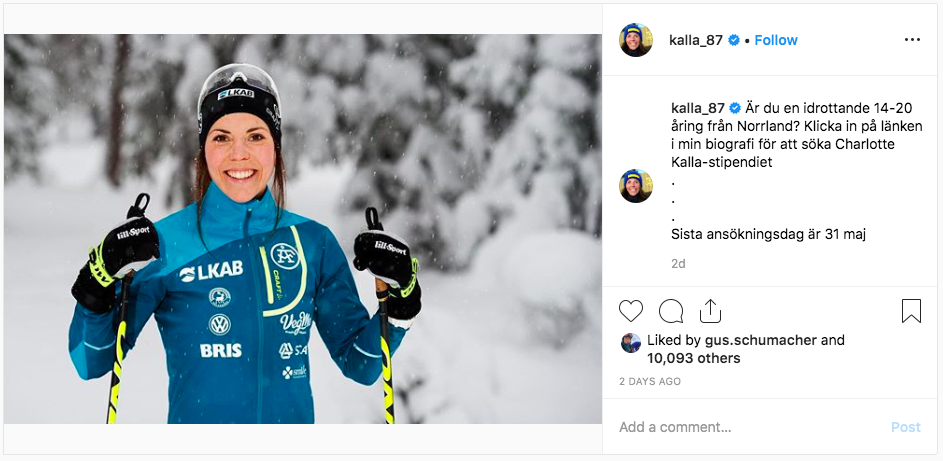
    Charlotte Kalla, Sweden: Announcing her scholarship for local juniors

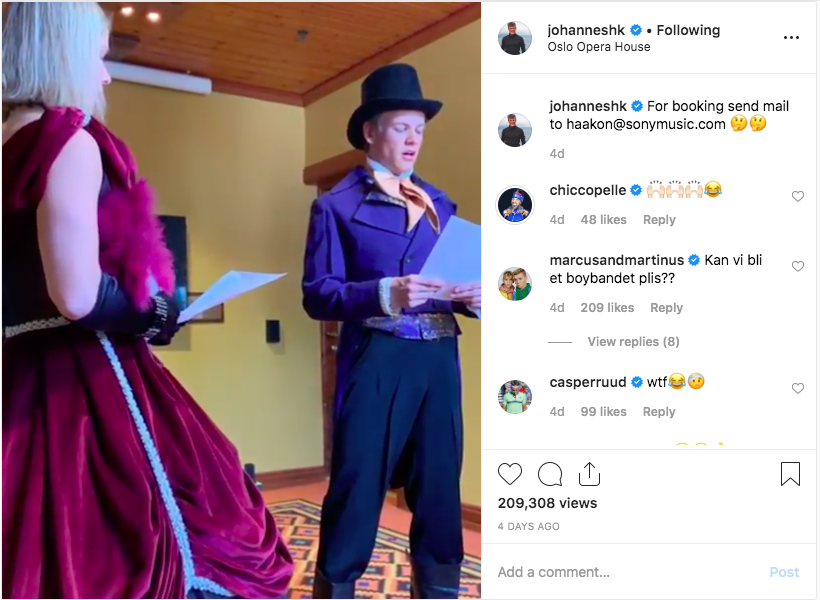
    Johannes Høsflot Klæbo, Norway: Singing light opera

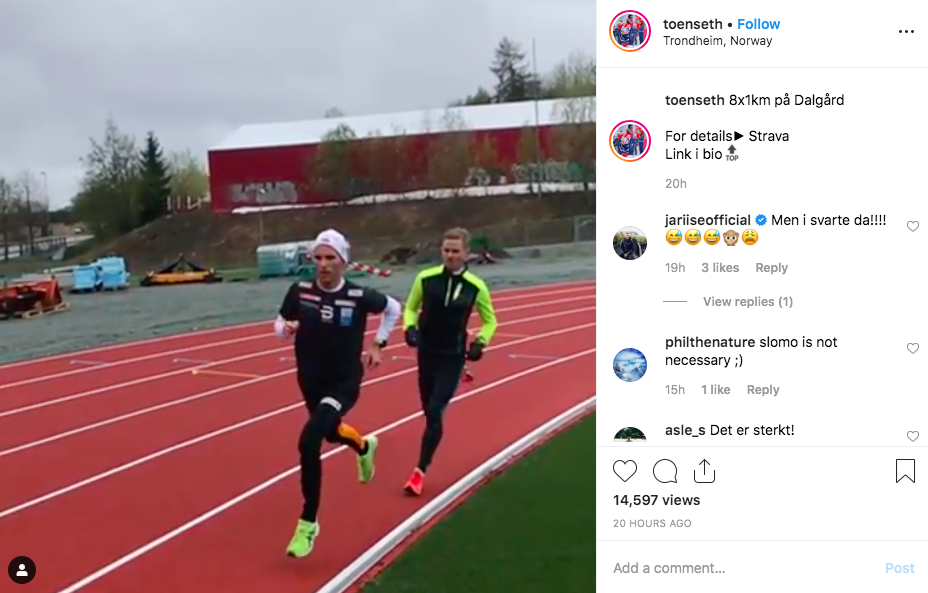
    Didrik Tønseth, Norway: 8 x 1km on the track

    (per Strava link in bio: splits of 3:06, 2:59, 2:56, 2:55, 3:01, 2:59, 2:57, 3:03, with 80-90 seconds recovery. 2:55/km is a 4:42 mile pace, for those of us who measure skiing in km but running in mi. And what were you doing at 8:47 a.m. Saturday morning?)

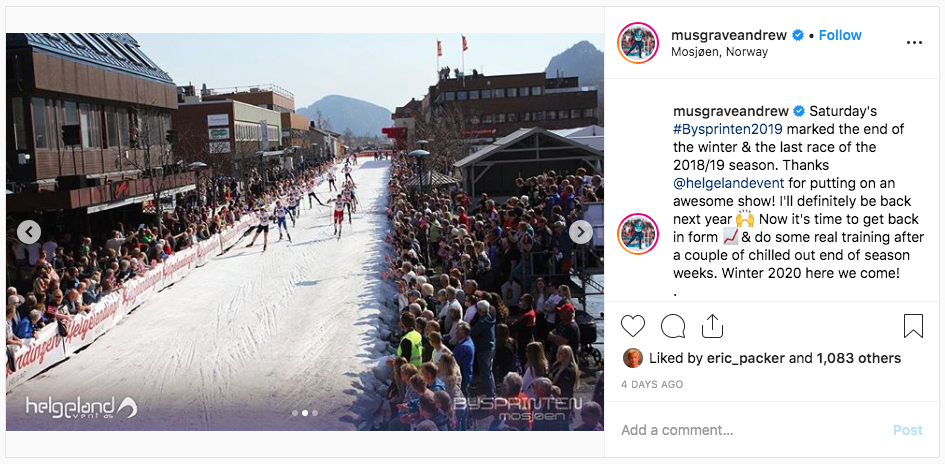
    Andrew Musgrave, Great Britain: City sprint festival in Norway

    … and last but not least:

    Honorable mention: Stina Nilsson, Sweden, April 24, sitting on a beach in Greece

  • At Home, Harvey Garners Second to Klæbo; Bjornsen 18th

    At Home, Harvey Garners Second to Klæbo; Bjornsen 18th

    Canada’s Alex Harvey acknowledging the crowd after his second place in the men’s 15 k classic in Québec City. (Photo: John Lazenby/lazenbyphoto.com)

    Amidst overcast skies and spectators bearing signs for the local cross-country favorite, Canadian Alex Harvey, World Cup Finals resumed on Saturday in Québec City, Québec with a men’s 15-kilometer classic mass start race.

    Thanks to his win in Friday’s freestyle sprint, Norway’s Johannes Høsflot Klæbo lead Saturday’s 78 starters out of the gate, his yellow bib also indicative of his first place rank in the 2019 Overall World Cup Standings.

    With Saturday and Sunday being the last competition days of the World Cup season, and only 24 points separating Klæbo’s first place (1443 points) from second place Alexander Bolshunov of Russia (1419 points) in the Overall Standings heading into the 15 k on Saturday, both athletes were looking for a win. Klæbo to solidify his position on top and Bolshunov to supersede it.

    A literal mass of skiers after the start of the men’s 15 k mass start classic in Québec City. (Photo: John Lazenby/lazenbyphoto.com)

    Leading up to 10 k, it appeared as if Bolshunov was on track to overhaul Klæbo’s immutable position on top. The Russian had positioned himself at the front of the lead pack’s 13 skiers which included Klæbo, Harvey, Italians Federico Pellegrino and Francesco de Fabiani, Russian Andrey Larkov, Switzerland’s Dario Cologna and Norwegians Didrik Tønseth, Sindre Bjørnestad Skar, Emil Iversen, and Sjur Røthe.

    Taking charge through the climbs, Klæbo and Bolshunov went stride for stride, with Harvey hard pressed a little more than 1 second behind.

    “I didn’t want to be leading because it was windy but I wanted to be near the lead every time,” Harvey told FasterSkier after the race.

    Their descents through the tight sugary s-turns were maneuvered with ease. At 12 k, a Klæbo versus Bolshunov battle had directed most of the race and seemed fated to the finish. 

    However at the 13 k mark, halfway up one of the course’s major climbs, the bottom of Bolshunov’s right pole snapped. Although he received a replacement pole within a meter or so, the broken one did damage to his pace.

    Russia’s Alexander Bolshunov leads the front group of skiers in the mens’s 15 k mass start classic in Québec City. (Photo: John Lazenby/lazenbyphoto.com)

    “When I heard the Russian broke his pole, I went all in for Klæbo to make a gap as big as possible,” Tønseth told FasterSkier after the race. “We went for Klæbo and that’s the most important thing.”

    With Tønseth pushing the pace, Bolshunov began to fall back. By the bottom of the next descent, the lead group had dwindled to five: Tønseth, Klæbo, de Fabiani, Røthe, and Harvey.

    “We started to stretch the pack and…Didrik [Tønseth] is the strong guy that can make a hard drive in the final 2 kilometer to the finish he’s better than Johannes [Klæbo] or me in that so it was almost fun for him, if you want to be on the podium you got to punch it hard now and I knew for me it was going to help me,” Harvey said.

    For the remaining 2 k, all five skied together until the finishing stretch. In the final 100-meters to the finish, Klæbo moved to the front and held off the charge of Harvey and Tønseth. Klæbo crossed first in a time of 36:10.9, while Harvey claimed second, just 0.8 seconds behind Klæbo, after a last minute surge past Tønseth.

    Crossing 0.5 seconds back from Harvey and 1.3 seconds back from his teammate, Klæbo, was Tønseth in third.

    Two years ago, World Cup Finals were also held in Québec City with Harvey coming into that weekend ranked third in the Overall Standings and having just won his first individual World Championships gold in the Lahti 50 k.

    “It’s a different scenario than two years ago when I came in newly World Champion fighting for the top three in the overall, I feel like this time I’ve had a harder season, was a bit more of an outsider,” the 31-year-old Harvey said. So I knew I needed my best race of the year to be on the podium and I was able to do that today so it’s pretty special.”

    It is spring. “Go Alex!” (Photo: John Lazenby/lazenbyphoto.com)

    Harvey confirmed earlier this season that World Cup Finals in Québec City will be the last World Cup races of his career. The Canadian will now start Sunday’s pursuit less than a second behind Klæbo.

    “I felt strong today so I was able to come up in the front again. I needed these points for the total World Cup,” Klæbo told FasterSkier after the race.

    With Saturday’s 15 k complete, Klæbo retained his top spot in the Overall Standings now with 1493 points. Bolshunov is currently second with 1451 points and Røthe third with 892 points.

    Following Harvey was the U.S. Ski Team’s (USST) Erik Bjornsen in 18th (+1:04.3).

    “I’m happy with the result,” Bjornsen told FasterSkier after the race. “I think it might have been the first time I was leading a World Cup for a bit. ”

    Around 4 k, Bjornsen was at the front of the 78 skiers who started the race.

    zanaflex

    “The way my season’s been going it feels easy to go at race pace but when there are surges in the pack, if I try to go I just flood and I can’t really recover the way I’m hoping. But that was fun today,” Bjornsen said.

    The next top North American finisher was Canada’s Len Valjas in 32nd (+1:43.6).

    “It was one of the best distance races of my career,” Valjas told FasterSkier after the race. “I’ve had a few really good ones, but I don’t think I’ve ever been near [Top] 30 in my career other than the two podiums. So I’m super happy. Alex had a great day. I feel like I had a great day and I’m looking forward to tomorrow.”

    “I was in bib 69 and I was skiing with some guys who were in the Top 20, so it’s really exciting for me to feel sort of back again,” Valjas added.

    Following Valjas was the USST’s Simi Hamilton in 39th (+2:13.7). After the race, Hamilton indicated that prior to Saturday, his most recent classic distance race had been the Lillehammer 15 k back in December.

    “I think by far the hardest part about today was the poling,” Hamilton told FasterSkier after the race. “It was just super rotten everywhere, the tracks stayed firm, which was nice, but the poling trenches just got so deep. I was constantly trying to look for harder snow on the outside and it made for, as a bit of a heavier skier, it made for a tricky 15k, but it was fun.”

    Also skiing for the Americans was Kevin Bolger in 44th (+2:31.1), Scott Patterson in 50th (+2:37.9), Gus Schumacher in 56th (+3:44.1), David Norris 57th (+3:48.8), Ben Saxton 66th (+4:55.0), Logan Hanneman 67th (41:17.2) Ben Ogden 70th (+5:15.2) and Peter Holmes 73rd (+6:30.4). Andy Newell did not finish.

    For the Canadians Remi Drolet finished 52nd (+2:57.4), Evan Palmer-Charette 55th (+3:16.6), Philippe Boucher 58th (+3:53.9), Jack Carlyle 59th (+4:13.6), Russell Kennedy 62nd (+4:27.0), Antoine Cyr 63rd (+4:29.8), Scott James Hill 64th (+4:46.5), Alexis Dumas 65th (+4:52.3), Bob Thompson 69th (+5:06.6), Antoine Briand 71st (+5:16.1), Julian Smith 72nd (+5:56.7), Julien Locke 74th (+6:31.8), Graham Ritchie 75th (+6:44.4).

    Results

    –Gerry Furseth and Kelsey Dickinson contributed

    The men’s podium from the 15 k classic mass start in in Québec City. Alex Harvey (bib 11) was given the honor of standing in the center. Harvey placed second to Johannes Høsflot Klæbo (left). Third place went to Didrik Tønseth (bib 17). (Photo: John Lazenby/lazenbyphoto.com)


  • Bolshunov wins 15 k in Falun and the Distance Cup; Harvey 11th, David Norris 16th

    Bolshunov wins 15 k in Falun and the Distance Cup; Harvey 11th, David Norris 16th

    The men’s podium from the Falun, Sweden 15 k skate. From left to right, Norway’s Martin Johnsrud Sundby in Second, Alexander Bolshunov of Russia first, and Didrik Tønseth of Norway third. (Photo: fis-ski.com screenshot)

    Sunday’s men’s 15-kilometer freestyle individual start race in Falun, Sweden, was the final European stop for the World Cup. With the race concluded, athletes will pack up ski bags, moth-ball the wax buses, and jet across the Atlantic. Next week athletes will race amidst the crowds and city-scape of Québec.

    The final Euro-leg of the World Cup saw Alexander Bolshunov of Russia win his third individual race in a row. His top-step effort was his fifth win of the season. Norway took the next three spots with Martin Johnsrud Sundby in second, Didrik Tønseth in third and Sjur Røthe in fourth.

    During the first 5k of the race Bolshunov moved up through a tight pack clustered near the top of the time splits.

    After his first 5k lap, Bolshunov held a 4.4 second margin over Russia’s Alexey Chervotkin at 5k. Sundby kept it real for Bolshunov coming through at 5.6 seconds back. With the relative luxury of a late bib start, Bolshunov wore bib 69, Sundby 47, the Russian could push towards the redline of effort knowing precisely where he stood against Sundby.  

    At the 10 k mark Sundby was a an eyeblink back amounting to 0.4 seconds behind Bolshunov. In other words, Bolshunov understood his race lead margin was thin. With 2 k remaining, Bolshunov had a pad of 3.1 seconds. That buffer would have been enough as Bolshunov finished today’s race in a time of 33:18.6. Sundby placed second, 8.9 seconds back.

    Along with the day’s top prize, Bolshunov seized for good the overall distance crystal globe. The twenty-two-year-old Russian began the distance crystal globe campaign with the first race of the season, a 15 k classic win in Ruka, Finland. Along the way, Bolshunov collected seven distance podiums, including Sunday’s win. His streak of three successive World Cup distance wins includes a 15 k classic in Cogne, Italy prior to World Championships. He then followed that with a win in the Holmenkollen 50 k classic.

    skelaxin

    Canadian skier Alex Harvey was the first North American to cross the line finishing 11th overall. During the second half of the race, Harvey skied from 21st to 11th, he finished +1:10.9 behind Bolshunov.

    David Norris (APU) of the U.S. was the top American finisher. In Falun, he finished 16th for a career best individual World Cup result. The success curve of late for Norris has been remarkable. The twenty-eight-year-old Anchorage based athlete has been a highlight for U.S. men’s distance skiing.

    The man has a motor. Ask the field contesting the Mt. Marathon race in Seward, Alaska. He’s a multi-time winner. The motor has now been fine tuned to excel in wintertime Europe. He placed 20th in the 2019 World Championship 50 k mass start skate. He proved that mark was no aberration with a 24th in the Holmenkollen 50 k mass start classic. And then Sunday was a bump in the standings for that 16th place.

    “I am certainly more confident this spring than I was during Period 1 of World Cup,” Norris emailed when asked if he was carrying more confidence since his Seefeld result. “This higher confidence allowed me to improve my pacing today; I was more relaxed going into it and able to ski my own race.”

    According to Norris, he’s more likely to push on the climbs and recover on more variable terrain. He attributes some of his success to making subtle pacing changes.

    “My usual tendency is to focus on the climbs,” Norris wrote. “I have been working on relaxing a bit on the climbs so that I can focus more on pushing the gradual terrain. I know I can climb well, but if I emphasize that too much I tend to lose time over the rest of the course.

    “The new snow today packed down well for the men’s race. I like how the course flowed; I felt strong on the long climb and had a game plan to really target the flats after the climb and the flats leaving the stadium.”

    American David Norris the men’s 30-kilometer skiathlon at the 2019 World Ski Championship in Seefeld, Austria. (Photo: John Lazenby/lazenbyphoto.com)

    During a year when the U.S. Ski Team has offered numerous international starts to a host of non-USST members, Norris and his trifecta of results in the points promotes the notion that on the right day and even the right World Cup string of races, elite U.S. skiers can step up.

    “I am super happy with my result- I feel like I have recovered well from back-to-back 50ks, and my skis were good,” explained Norris when asked if he was surprised to find himself so close in the standings to Canada’s Alex Harvey, who placed 11th. “Today was the type of result I have been believing I should be able to do on a good day, so I am psyched to have made that happen.”

    Results

  • Sunday Race Rundown (Updated 2x)

    Sunday Race Rundown (Updated 2x)

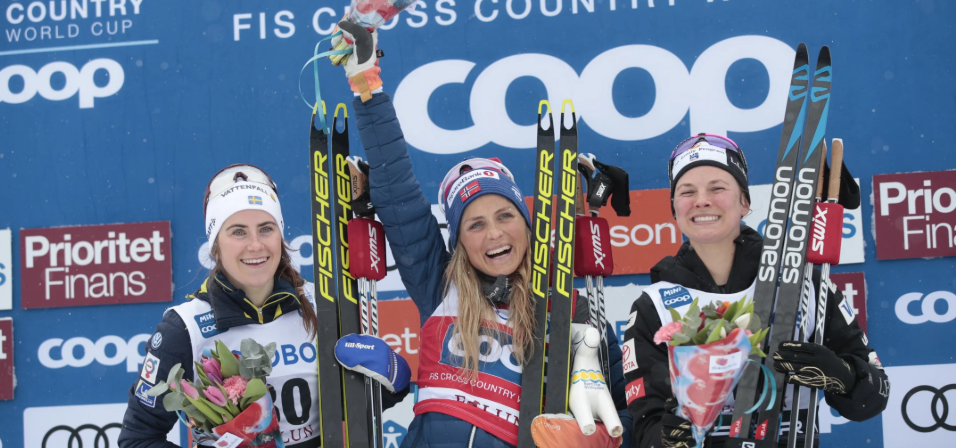
    The podium from the 10 k skate in Falun, Sweden. From left to right, Sweden’s Ebba Andersson in third, Norway’s Therese Johaug in second, and the U.S. Ski Team’s Jessie Diggins in third. (Photo: fis-ski.com screenshot)

    FIS World Cup Falun, Sweden 10k/15k Inidividual Freestyle

    The sun rises. The sun sets. And Norway’s Therese Johaug won the 10-kilometer individual start freestyle in Falun, Sweden. In 25:23.9 minutes, Johaug made her winning statement. Sweden’s Ebba Andersson placed second (+18.75), with the U.S. Ski Team’s (USST) Jessie Diggins in third (+30.3).

    Fourth place went to Ingvild Flugstad Østberg of Norway who finished 30.8 seconds back.

    Sadie Bjornsen (USST) raced to 12th (+1:05.7), Julia Kern (USST) 25th (+1:53.9), Rosie Brennan (APU) 27th, Kaitlynn Miller (CGRP) 34th (+2:21.5), and  Rosie Frankowski (APU) 35th (+2:26.1).

    Results


    The men’s 15 k skate was won by Russia’s Alexander Bolshunov in 33:18.6 minutes. Martin Johnsrud Sundby of Norway was second (+8.9) and Didrik Tønseth third (+17.7).

    The top North American finisher was Canada’s Alex Harvey in 11th (1:10.9). Jack Carlyle finished in 66th (+5:55.5).

    For the U.S., David Norris (APU) placed 16th (+1:15.3), Kevin Bolger (USST) 45th (+2:41.9), and Scott Patterson (USST) 54th (+3:39.8), Kyle Bratrud (SMST2) did not start.

    Results

    ***

    IBU World Championships Östersund, Sweden 12.5 k Mass Start

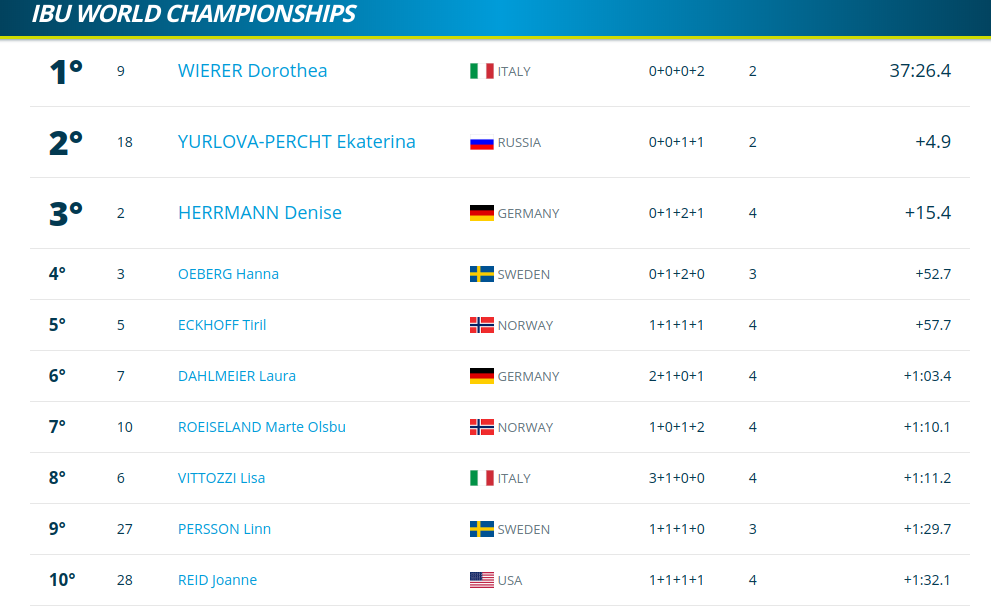
    Here’s the top-10 results from today’s 12.5 k mass start in Östersund, Sweden. The eyes need only read 10 skiers down for U.S. biathlete Joanne Reid’s name. There it is: 10th place for a career best individual result at a championship event.

    Her teammate Clare Egan placed 26th (+3:01.4, 0+0+3+2).

    Results

  • Russian Teams Take the Top Two Spots in Ulricehamn; U.S. in 13th

    Russian Teams Take the Top Two Spots in Ulricehamn; U.S. in 13th


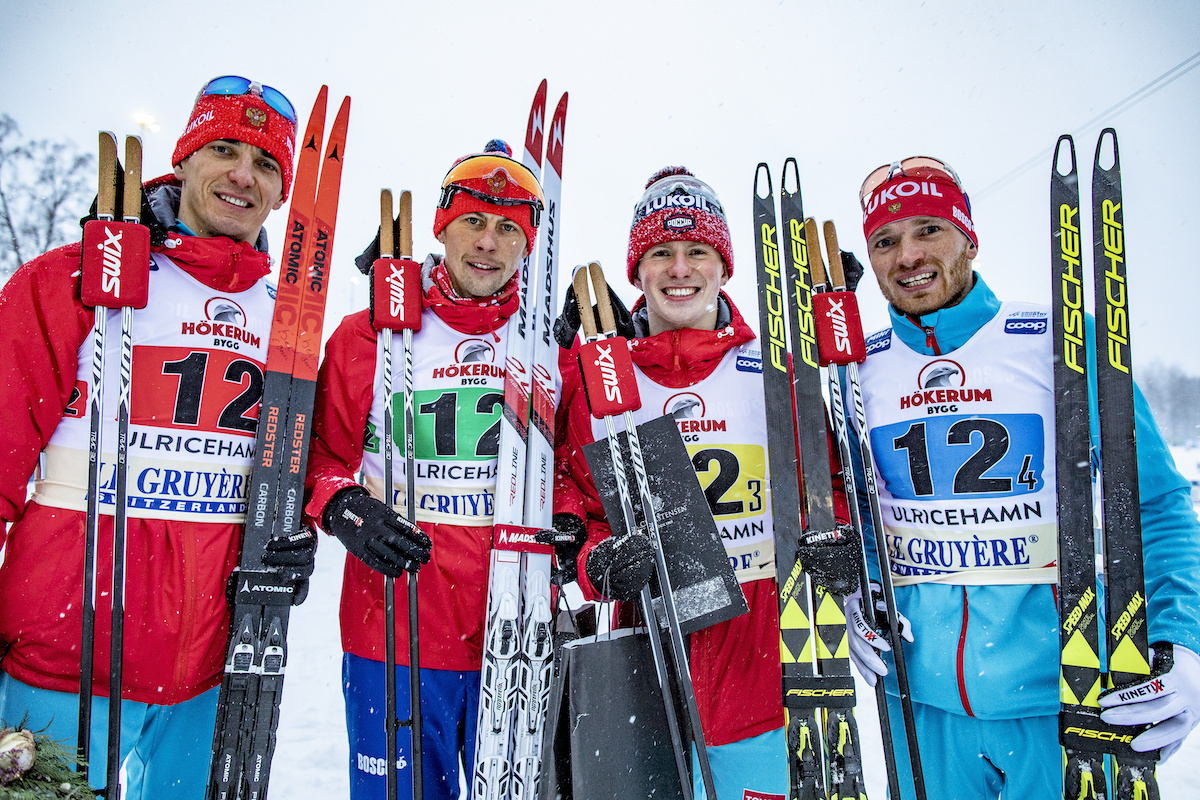
    The Winning 4 x 7.5 k Russian relay team at the Ulricehamn, Sweden World Cups: from left to right, Evgeniy Belov, Alexander Bessmertnykh, Denis Spitsov and Artem Maltsev. (Photo: Fischer/Nordic Focus)

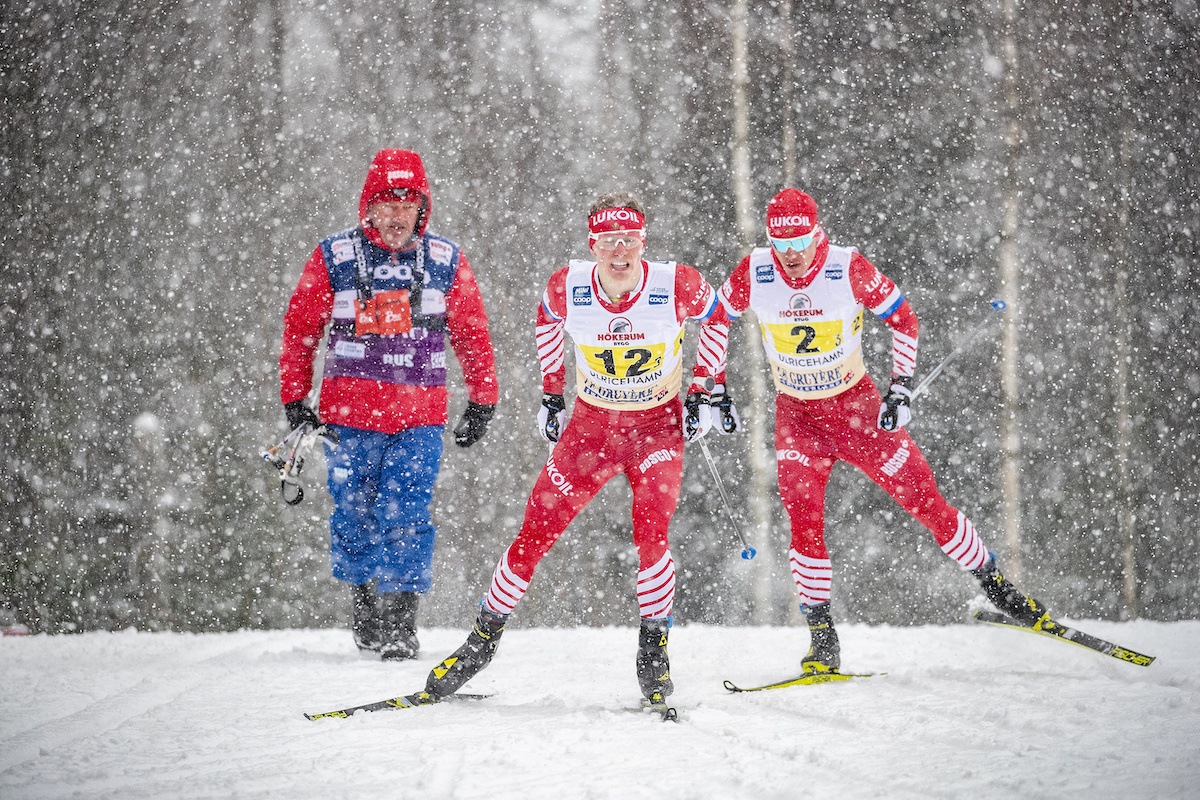
    Today in Ulricehamn, Sweden, the men skied a 4 x 7.5- kilometer relay in unsettled conditions. Racers dealt with harsh conditions as the wind howled and heavy snow fell. With a softened course, it appeared most teams struggled with kick on the steeper climbs.

    Scott Patterson of the U.S. Ski Team (USST) commented on the conditions via email, “the race conditions were interesting with both falling snow and blasting wind. The organizers re-groomed the course in between the women’s and men’s races which did improve things, but the downhill corners were chopped up and soft.”

    Russia II took the victory today in a time of 1:17:53.2 minutes with Evgeniy Belov, Alexander Bessmertnykh, Denis Spitsov and Artem Maltsev.

    The winning team was followed closely by their teammates on Russia I; Andrey Larkov, Alexander Bolshunov, Andrey Melnichenko and Sergey Ustiugov.

    Atypically, Norway had a rough start to the day – more on this in a bit — but the entire team put in a massive effort to claim third place. The Norwegian team consisted of Hans Christer Holund, Didrik Tønseth, Sjur Røthe and Simen Hegstad Krueger.

    The Russian teams lead the entire race, flip-flopping between leaders. Russia I and II worked together throughout, but Russia II had superior fitness. With each Russia II surge, Russia I was unable to match the pace. In the closing k’s, Russia II charged for the finish. Russia I couldn’t hold on. Russia I finished 20.8 seconds behind.

    During the initial lap of the scramble leg, the entire field remained close-knit. Only at the start of the second lap did both Russian teams, along with Sweden I, begin to gap the field. The Russians were able to hold this lead throughout the race. As the race progressed, and the pacing screws turned, Sweden was unable to match the Russians as they faded to place fifth overall (+1:39.6).

    Russia’s Denis Spitsov (bib 12) and Andrey Melnichenko (bib2) leading the men’s 4 x 7.5 k relay in Ulricehamn, Sweden. (Photo: Fischer/Nordic Focus)

    USST Head Coach Chris Grover commented on the Russian team’s performance this season. 

    “I mean they’ve been super strong all season, we certainly saw that up in Beitostolen and Lillehammer and the Tour,” Grover remarked over the phone. “It does seem like there are a lot of really good things going on with their program from a service perspective. They just had extraordinary skis race after race after race, especially in classic legs. It is very noticeable that they are doing a fantastic job on the service side and they obviously have a lot of depth and a lot of great athletes that have been coming up for a long time.”

    The Norwegian team, as strong as they were, fell back during the first classic leg. It was a gradual decline for Holund throughout his 7.5 k effort. Coming into the first exchange, Norway was sitting in 12th place.

    During Norway’s second leg, Tønseth made gains. He tagged Norway off in fourth place, giving his teammates a chance at the podium. Røthe, the third skier for Norway hammered to put his team within eyesight of third, which at the time was held by Lari Lehtonen of Finland.

    By the end of his leg, Roethe had caught, passed and dropped Lehtonen, putting Norway solidly in third place. Krueger, the Norwegian team’s anchor, was able to hold third place until the finish. According to FIS, Norway has been on the podium in every men’s distance relay for the last 12 years.

    The U.S. relay team, Erik Bjornsen, Scott Patterson, David Norris, and Benjamin Lustgarten finished 13th overall (+4.10.8). 

    During the first two legs, the U.S. team sat in the top-10. Bjornsen skied a strategically strong race, skiing smoothly towards the front of the pack. For the remainder of the race, the U.S. bounced bouncing between eighth and 13th place.

    The U.S. Ski Team’s Erik Bjornsen during December’s  4 x 7.5 k relay in Beitostølen, Norway. (Photo: Aleks Tangen)

    Bjornsen commented on the team’s strategy going into the race, “Our tactics were to try and stay with the group for as long as possible. We knew we weren’t going to be fighting for a podium spot today, just with where everyone is at right now. We also know this is good practice for World Champs so we used it as another opportunity to learn. We’ve set a goal as a men’s team to get a top 8. In a few years with some strong younger guys coming up, maybe that could be a top 5. Once you’re getting top 5’s then anything is possible when it all comes together.”

    Bjornsen chose to race only the relay this weekend in preparation for World Championships which begin in three weeks. His conservative approach to race stars this weekend left him feeling fresh for Sunday’s relay.

    “Erik did a great job, stayed in the fight for a long time there and it may be one of Scott’s better classic races. He did a really good job of holding steady with the group that he was in,” Grover commented.

    This was Norris’s first World Cup since the U.S. National Championships concluded in early January.

    “Coming off of Nationals I feel fit and healthy,” Norris told FasterSkier. “I got here Thursday night and I am glad I got two hard races in before a training camp in Davos. I am going to Davos tomorrow. This gives me plenty of time to adjust and prepare for the Cogne World Cup and World Championships.”

    The U.S. team has a distance and sprint training camp planned for the next two weeks until the World Cup in Lahti, Finland on Feb. 9. The Lahti races include a skate sprint and team sprint, with no distance races scheduled until Cogne’s races starting on Feb.16. These training camps are in preparation for the World Championships in Seefeld, Austria.

    Men’s Results

  • Sunday Race Rundown: Ulricehamn, Antholz, and Lake Placid (Updated)

    Sunday Race Rundown: Ulricehamn, Antholz, and Lake Placid (Updated)

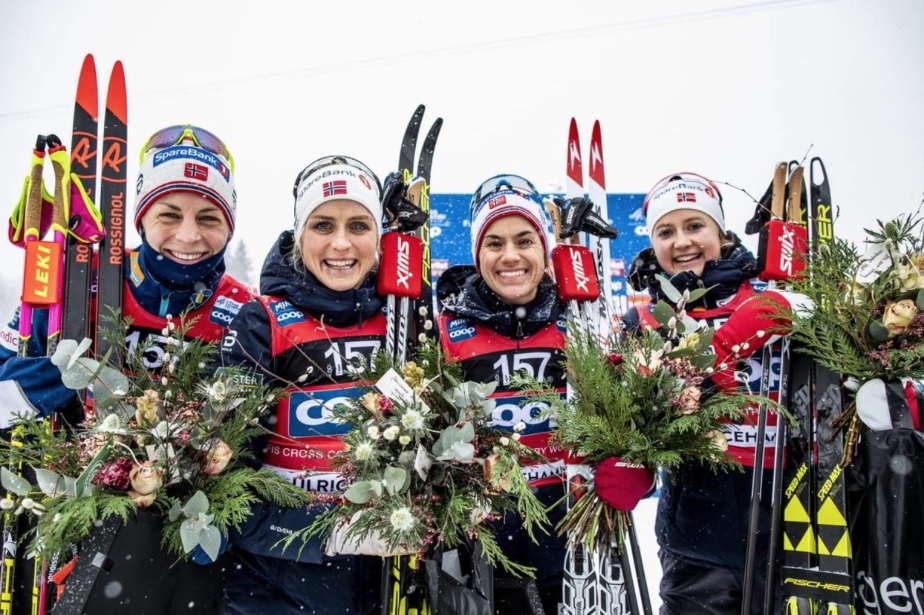
    The winners of the 2019 4 x 5 k relay in Ulricehamn, Sweden: (l-r) Norway’s Astrid Uhrenholdt Jacobsen, Therese Johaug, Heidi Weng, and Ingvild Flugstad Østberg. (Photo: fis-ski.com screenshot)

    FIS World Cup Ulricehamn, Sweden 4 x 5 k / 4 x 7.5 k relay

    The sun rises, the sun sets, and Norway wins the women’s 4 x 5-kilometer relay in Ulricehamn, Norway on Sunday. For the 11th time in a row, a Norwegian women’s team bested the world in the storied race format.

    Heidi Weng, Therese Johaug, Astrid Uhrenholdt Jacobsen, and Ingvild Flugstad Østberg won in a time of 57:06.3 minutes. For the first tag, nine teams came in separated by 8.1 seconds. Johaug, skiing the second leg for Norway, opened a gap of 9.3 seconds over Russia I by the 10 k mark.

    The time back to second-placed Sweden I stretched to 37.4 seconds by the finish.

    Sweden I’s team consisted of Evelina Settlin, Ebba Andersson, Charlotte Kalla, and Jonna Sundling.

    Finland I placed third (+41.2) wth Laura Mononen, Krista Pärmäkoski, , Riitta-Liisa Roponen, and Evelina Piippo.

    The U.S. team of Sadie Bjornsen, Rosie Brennan, Caitlin Patterson, and Jessie Diggins finished in sixth (+1:26.6).

    Women’s Results

    In the men’s 4x 7.5k relay, Russia II and Russia I came away in first and second place respectively.

    Russia II’s team of Evgeniy Belov, Alexander Bessmertnykh, Denis Spitsov, and Artem Maltsev won in a time of 1:17.53.2 hours.

    Russia I’s Andrey Larkov, Alexander Bolshunov, Andrey Melnichenko, and Sergey Ustiugov finished 20.8 seconds back.

    In third was Norway, 35.8 seconds behind. Hans Christer Holund, Didrik Tønseth, Sjur Røthe, and Simen Hegstad Krüger, Norway’s foursome, were 35.8 seconds back. On the first leg, at 9.7 k, Norway was in ninth place, with a 43.1-second deficit.

    The U.S. team of Erik Bjornsen, Scott Patterson, David Norris, and Ben Lustgarten placed 13th (+4:10.8).

    Men’s Relay Results


    ***

    IBU World Cup Antholz, Germany 12.5 k / 15 k Mass Start

    On Sunday in Antholz, home country athlete Germany’s Laura Dahlmeier won in 35:32.8 minutes while skiing a single penalty lap during her first prone stage. The Czech Republic’s Marketa Davidova placed second (13.1, 0+0+1+0), with Vanessa Hinz of Germany in third (+16.4 1+0+0+0).

    “It’s a fantastic feeling to be right at the top again,” Dahlmeier told the IBU. “I started very badly and I felt slow. But I came back strongly and I remained virtually without error in the shooting. It was a good weekend for me.”

    US Biathlon’s Clare Egan raced and shot to 15th overall, 1:05.8 back, with two penalties in her first prone stage, otherwise she shot clean.

    Rosanna Crawford of Canada placed 28th (+3:50.2, 0+1+3+1).

    Women’s Results

    In the men’s 15 k mass start, there was one new development: Johannes Thingnes Bø of Norway did not win.  He did, however, place second to France’s Quentin Fillon Maillet. He won the race in 34:39.4 seconds while shooting clean in all four stages. Depositing between PLN 60 and PLN 199, we will receive a bonus of 125% of our deposit (a maximum of PLN 1,600), as well as a package of 50 free spins Vulkan Bet on the Doom of Dead slot machine. On the other hand, if we deposit at least PLN 200, we will get 100 free spins after the game as a reward, as well as a bonus of as much as 200% of our own deposit (a maximum of PLN 2,800 to visit).

    Bø was 14.3 seconds back in second place, with a single miss in each of his standing stages. Germany’s Arnd Peiffer was third (+24.6, 0+0+0+0).

    Christian Gow of Canada was the sole North American in the race. He placed 27th (+3:22.5, 1+1+0+1).

    Men’s Results

    ***

    Lake Placid SuperTour 10 k/15 k mass start classic

    Kaitlynn Miller (CGRP) won the women’s 1o k classic mass start in 36:12.7 minutes. Coming in 2.9 seconds back was Jessica Yeaton (APU/Australian National Team) in second place. In third, skiing for Dartmouth, was Katharine Ogden (37:27.8).

    Women’s Results

    Kyle Bratrud (SMS T2) won the men’s 15 k classic mass start in 46:41.3 minutes. In second place was Adam Martin (CGRP) who raced to a time of 46:55.0. Canada’s Andy Shields (Lappe Nordic) placed third in 47:41.6.

    Men’s Results


  • Manificat Gets his Win; Harvey Returns for Ninth

    Manificat Gets his Win; Harvey Returns for Ninth


    The men’s podium from the World Cup 15 k skate in Ulricehamn, Sweden. From left to right, Norway’s Simen Hegstad Krüger placed second, France’s Maurice Manificat first, and Didrik Tønseth of Norway was third. (Photo: Fischer/Nordic Focus)

    The tension in the interval start race comes down to watching the clock.

    The seconds tick, the time checks pass, the squirm of the of the skier in the leader’s chair only quelled after the top-prospects slide past the finish — and there’s only a reference to time back.

    On Dec. 12, that was France’s Maurice Manificat, the thirty-two-year-old skate skiing star, residing where he often belongs, sitting in the leader’s chair in Davos, Switzerland during the 15-kilometer skate. In bib 39, Manificat set the fastest time of the earlier starters. As the other would-be-winners came in, Manificat’s lead held.

    Until Russia’s Evgeniy Belov bested Manificat’s time by 0.9 seconds. The Frenchman finished second in what was his first World Cup start of the season.

    Today in Ulricehamn, Sweden in the men’s 15 k skate, it was déjà vu all over again. Manificat in bib 39. Manificat in the leader’s chair waiting for the possible bigger guns on the day to cross the line.

    Manificat’s time of 34:55.4 minutes held, just barely, for the win. Simen Hegstad Krüger, the day’s 46th starter, stopped the clock 1.1 seconds back for second place. Didrik Tønseth, also of Norway, came in third (+8.7).

    “We were waiting to come back to Ulricehamn for 2 years. I was pushed with the atmosphere and the crowd!” Manificat told the International Ski Federation (FIS) after the race. 2017 was the last time the World Cup made a stop in Ulricehamn – a venue known for its boisterous spectators. (FIS reported an estimated 27,000 fans were on hand for today’s World Cup.)


    Maurice Manificat of France after his 15 k skate win in Ulricehamn, Sweden. (Photo: fis-ski.com screenshot)

    2017 in Ulricehamn was also a time when Alex Harvey reigned supreme in the 15 k skate. He won that day’s 15 k skate by six seconds over Norway’s Martin Johnsrud Sundby.

    At thirty-years-old Harvey has been near, but not at the top of his form this season.

    Harvey, who placed third last season in the Tour de Ski (TdS), pulled himself from this season’s TdS after placing 22nd in stage 5. He took an extended break from Europe to train and rest at his home in Quebec.

    Today saw a different Harvey return to the World Cup. He placed ninth in Saturday’s 15 k skate, 31.4 seconds back.

    Harvey explained in a post-race call that he feels rejuvenated and satisfied with the result, despite having flown to Europe on Wednesday.

    “I felt quite good, but I have been in Europe for two days only,” Harvey said. “I flew on Wednesday and arrived here Thursday midday. After the Tour, I felt I needed to go home and reset a little bit. I just wasn’t skiing the way I wanted to. I wasn’t feeling good and especially after races. Of course, you are tired after a ski race but it was like I was really really tired after the races and I didn’t feel like the body could handle the effort much. I needed a bit of a mental break at home. So I went back and was able to make the most of the great conditions we had there in Mont St Anne and I was able to put in a good block of training and just in a more relaxed environment being at home.” Each of Australia’s online pokies has its own payout percentage. The most well-known are Australian the best paying online pokies try this . Most gamers are aware that playing pokies with the greatest payout percentages increases your chances of winning. This is in contrast to casino games with smaller payoff percentages, such as craps, roulette, and video poker machines.

    In the past, Harvey said he had used the TdS as a “launching pad” for the latter part of the season. This year, Harvey sensed the expected performance bump during and after the Tour was in jeopardy.

    It was a feeling he said he had not experienced since 2012, a lifetime ago on the World Cup.

    “I struggled [in 2012] and I had some back issues back then too,” Harvey said. “It was my first season or maybe second spending the whole winter in Europe and that was quite hard for me. I think I was 23 years old. That was the only other time but I was still more of an underdog back then and I wasn’t too worried about it. It was a bit of a drought there for me in the middle of the season, that was the last time, that was 2012. Since then it hasn’t really happened … But this year I didn’t feel like the body was handling racing well enough to benefit from the Tour, from all those hard efforts. That is why I had to pull the plug near the end and go home and reset.”

    Canada’s Alex Harvey during his R & R in Quebec. (Photo: Alexis Turgeon, @alx_rv Instagram screenshot)

    Harvey went on to explain his time in Quebec allowed him to focus on a lovely three letter word, “fun”. The chance to reset was also an opportunity to finetune the training.

    “I am the type of athlete, I cannot just rest my way into shape,” said Harvey. “That never worked for me. I was mentally resting but I was still actually skiing quite a bit back home. Just easy for the first week and then normal doing some intervals and strength and all that normal stuff the other week and a half. The last week at home, in intervals, the last two interval sessions were quite good and I was able to push the body and recover in a day or two. And get ready to push again three days later I knew that I was training up that is good for.”

    With low expectations, Harvey started strong in Ulricehamn on Saturday. At 5 k he was off Manificat’s mark by 10.6 seconds with the ninth fastest split. By 10 k, he ceded 30.7 seconds to the eventual winner. For the remainder of the race, he lost only an additional 0.7 seconds to Manificat’s winning mark.

    “I came here on short notice, so I am really happy with both the effort and the results but most importantly the feeling,” said Harvey. “That was the most important thing for me.”

    As he keeps his eye on Seefeld’s World Championships, starting about a month out, Harvey said he was optimistic.

    “Just about as long as the arrow is pointing in the right direction, which has to be uphill and upwards from now on, I think today is a good result for that,” Harvey expressed. “It is pointing up and so that is what I am just going to focus on and get better every day. And if I am able to do that, I  will be a challenger for top-five top positions in Seefeld. I have to keep believing in the plan and I think so far the last three weeks the adjustments we made were pretty good.”

    Also for Canada, Lenny Valjas skied to 57th (+2:32.1), and Bob Thompson 77th (+4:16.6).

    For the U.S., Scott Patterson finished 35th (+1:26.5), David Norris 53rd (+2:11.3), and Ben Lustgarten 64th (+3:04.7).

    Racing continues tomorrow for the men with a 4 x 7.5 k relay.

    Men’s Results


  • Niskanen wins in Otepää, Bolshunov second, Bjornsen 30th

    Niskanen wins in Otepää, Bolshunov second, Bjornsen 30th

    The men’s 15-kilometer classic podium on Sunday in Otepää, Estonia with Russia’s Alexander Bolshunov (left) in second, Iivo Niskanen of Finland (center) in first and Norwegian Didrik Tønseth (right) in third. (Photo: Fischer/Nordic Focus)

    Finland’s Iivo Niskanen took the victory in Sunday’s 15-kilometer classic individual start in Otepää, Estonia. This is Niskanen’s first World Cup win of the season and his third career individual World Cup victory.

    During the first half of the race, Niskanen’s splits were up on the rest of the field and by 7.5 k, he had almost 15 seconds on the next closest competitor. Niskanen finished in a time of 19:26.8. Niskanen was just voted Finland’s “Athlete of the Year” at Finland’s Annual Sports Gala.

    “It was a nice way to start a new season and new year,” Niskanen told the International Ski Federation (FIS) after the race. “I have been really tired after the Sports Gala in Finland. Yesterday, I couldn’t have done this kind of result, but I was happy that when I woke up this morning I felt fresh legs. So it was easy to classic 15k today even though the weather was so slow.”

    Finishing 15.9 seconds behind Niskanen on Sunday was Russia’s Alexander Bolshunov in second place. This is Bolshunov’s eighth individual podium of the 2018/2019 World Cup season.

    Sunday’s third and final podium spot went to Norway’s Didrik Tønseth, who finished 46.4 seconds off of the winning time.

    Screen shot
    Finland’s Iivo Niskanen after winning Sunday’s 15-kilometer classic individual start race in Otepää, Estonia. (FIS screenshot)

    Erik Bjornsen of the U.S. Ski Team was the top North American on Sunday, finishing in 30th (+2:35.7).

    “Today was okay,” Bjornsen wrote in an email to FasterSkier. “I had some good moments during the race. My fitness is not where I would like it to be right now so I’m trying to turn that around.

    “This weekend was a step in the right direction,” he added. In yesterday’s classic sprint, he finished 24th.

    “My focus is on the team sprint and the individual 15 k at world champs,” he wrote on Sunday. “Today was a tough effort and hopefully something I can build off of. I’m not satisfied with a 30th place finish.”

    Following Bjornsen, the next U.S. skier to finish was Scott Patterson in 36th (+3:01.0).

    “Today was a step in the right direction for me,” Patterson wrote in an email to FasterSkier. “US Nationals was a little tough due to a painful shoulder injury over the holidays; however, I am working on putting that behind me and building towards peak fitness for later in the season. I started a little slow in Period 1 and today was definitely better than that. There is still lots of room for improvement, but today represented progress.” Bettilt https://bettilt33.com estabeleceu-se como um lugar fiável e seguro, proporcionando uma fonte de excitação positiva e uma oportunidade para os seus muitos clientes de ganharem dinheiro com as apostas. A principal prioridade da casa é justificar a confiança nela depositada pelos seus clientes

    “I think the US techs did a great job today for the men’s race in figuring out pretty good skis for some tricky conditions with loose blowing snow, some glazing sections, steep hills, and blown out tracks,” Patterson continued. “It was extremely variable skiing today. Relative to others I skied with in the race, I think our skis were competitive.”

    The U.S. Ski Team’s Kevin Bolger during the men’s 15 k classic in Otepää, Estonia. (Photo: Fischer/Nordic Focus)

    Also racing for the U.S., Ben Lustgarten finished 53rd (+4:41.1) and Kevin Bolger 56th (+4:57.3).

    “I’m coming off of a week of being sick before Dresden and the last few days I was taking some antibiotics to get over my sickness, so the body wasn’t feeling the best,” Bolger wrote in an email to FasterSkier.

    Canadians Len Valjas and Bob Thompson placed 43rd (+3:56.9) and 52nd (+4:24.0), respectively.

    American Andy Newell did not start Sunday’s 15 k race.

    Next weekend, the World Cup will head to Ulricehamn, Sweden. Patterson told FasterSkier, “Apparently they have already sold 40,000 tickets for the races so it should be a great show.”

    Men’s results

  • Sunday Race Rundown: Otepää and More (Updated 2x)

    Sunday Race Rundown: Otepää and More (Updated 2x)

    Norway’s Therese Johuag after winning the women’s 10-kilometer classic sprint on Sunday in Otepää, Estonia. (NBC screenshot)

    FIS World Cup Otepää, Estonia classic 10/15 k individual start 

    Women’s Full Report | Men’s Full Report

    World Cup cross-country action returned to the Otepää race venue on Sunday, with athletes reconvening after Saturday’s classic sprints for the weekend’s distance classic event. In the women’s 10-kilometer individual start classic race, Norway’s Therese Johaug finished first in a time of 29:53.7 for the win. Sweden’s Ebba Andersson finished second (+48.4) while Russia’s Natalia Nepryaeva claimed third (+56.7).

    Skiing for the U.S. Ski Team (USST), Jessie Diggins was the top North American woman on Sunday, placing 13th (+2:26.0). Two more Americans skied into the Top 30, with Rosie Brennan finishing 27th (+3:09.9) and Sadie Bjornsen 29th (+3:11.3).

    Also skiing for the U.S. on Sunday, Caitlin Patterson and Ida Sargent finished in 39th (+3:50.9) and 41st (+4:17.2), respectively. Dahria Beatty was the lone Canadian to enter the race, placing 43rd (+4:42.5).

    Results

    Screenshot
    The men’s 15-kilometer classic podium on Sunday in Otepää, Estonia with Russia’s Alexander Bolshunov (left) in second, Iivo Niskanen of Finland (center) in first and Norwegian Didrik Tønseth (right) in third. (FIS screenshot)

    In the men’s 15 k, Finland’s Iivo Niskanen took first, completing the course in a time of 40:07.1.  Russia’s  Alexander Bolshunov finished in second place (+15.9) and Norway’s Didrik Tønseth in third (+46.4).

    The USST’s Erik Bjornsen led the charge for the Americans, placing 30th (+2:35.7). Scott Patterson placed 36th (+3:01.0), while Ben Lustgarten finished in 53rd (+4:41.1). Kevin Bolger placed 56th (+4:57.3) and Andy Newell did not start.

    Racing for Canada, Len Valjas placed 43rd (+3:56.9) and Bob Thompson 52nd (+4:24.0).

    Results

    ***

    Katherine Stewart-Jones leads Cendrine Browne early in the mass start. (Photo: Michèle Carriere)
    Katherine Stewart-Jones leads Cendrine Browne early in the mass start. (Photo: Michèle Carriere)

    Worlds Selections/NorAms/Coupe Québec, Bishop’s University, Québec

    The NorAm weekend wrapped up with mass start free technique on shortened courses. The predicted extreme cold and extreme snow didn’t materialize with a relatively balmy -13C recorded by the jury.

    Katherine Stewart-Jones (CNST) continued her dominance with a win in 48:25.5, gapping Cendrine Browne (CNST) on the third and final lap for a 8.4 second separation. That is two wins and a second for Stewart-Jones. Zoë Williams (Nakkertokk) was third again, 1:38.2 behind. The shortened course was 14.3km, with one 4.3km lap and two 5km laps.

    Russell Kennedy (Team R.A.D.) collected his first win of the weekend to earn his trip to World Championships, finishing alone at 57:12.6 on the four lap 19.3km race. Scott Hill (Hardwood) was second at 23.4 seconds behind. Evan Palmer-Charrette out-sprinted the remains of the original six leaders to complete the podium at 1:07.0.

    Mass Start Results, Full Weekend


    ***


    IBU World Cup Ruhpolding, Germany 15 k / 12.5 k Mass Start

    Career-best days are good days. That’s the main narrative from US Biathlon’s Sean Doherty 15-kilometer mass start in Ruhpolding, Germany on Sunday.

    Doherty’s previous best in the mass start was a 24th place. In the 30-athlete field, Doherty began in bib-30. In his first two shooting stages, both prone, he skied a single penalty lap in each. As he found his ski-speed groove for his second two laps, marking the third fastest ski split for lap three and the fifth fastest split for lap four, Doherty also made his mark on the shooting range as he shot clean for for both his standing stages.

    Doherty finished in 13th overall which matched his individual career best on the IBU World Cup. Johannes Thingnes Bø of Norway won the mass start in a time of 36:43.8 minutes while shooting clean for his first three stages and skiing one penalty lap on his fourth. Doherty’s finishing time was 42.2 seconds behind Bø’s.

    Canada’s Christian Gow also posted a career best IBU World Cup results with an 11th place. Gow skied a single penalty lap after missing a target on his second prone stage. Otherwise, he shot clean to finish 34.3 seconds behind Bø.

    Austria’s Julian Eberhard placed second (+0.6, 0+1+0+1), and France’s Quentin Fillon Maillet was third (+2.8, 0+1+0+0). Teammate Martin Fourcade skied to fourth (+8.6, 0+0+0+1).

    Bø’s win on Sunday marked his 10th win (including relays) this season on the IBU World Cup. He leads the overall points series.

    Men’s Results  

    It was time for a first in the women’s 12.5 k mass start. Franziska Preuss of Germany won the race – an IBU World Cup career first for her — in a time of 32:34 minutes. Preuss shot clean on her way to the win.

    Norway’s Ingrid Landmark Tandrevold placed second (+0.2, 0+0+0+0). For Tandrevold it was a her first IBU World Cup podium. Paulina Fialkova of Slovakia was third (+15.1, 0+0+0+0).

    US Biathlon’s Clare Egan placed 24th (+1:59.7, 0+0+3+2), teammate Susan Dunklee 25th (+2:12.5 2+1+1+0).

    No other North American women qualified for the mass start.

    Women’s Results


    .r2b29l {display:none}

  • 2018/2019 Tour de Ski Preview (Updated)

    2018/2019 Tour de Ski Preview (Updated)

    The start of the men’s 15 k classic mass start at Stage 6 of the 2018 Tour de Ski on Saturday in Val di Fiemme, Italy, with (front row, left to right) Canada’s Alex Harvey, Russia’s Sergey Ustiugov, Kazakhstan’s Alexey Poltoranin, Norway’s Martin Johnsrud Sundby, and Switzerland’s Dario Cologna. (Photo: Salomon/NordicFocus)

    Beginning this Saturday in Toblach, Italy with a freestyle sprint is the 13th edition of the Tour de Ski (TdS). According to the International Ski Federation (FIS), over the course of seven stages the men will race 80.918 kilometers, the women 60.67 k. 

    The TdS has become both a staple and a spectacle of the annual World Cup calendar. With a jam-packed series of races primacy is placed on both the ability to recover well and wither less as the TdS transpires.

    Prognostication can be tricky in a long-form template like the TdS. So much can go astray during seven races not to mention the travel and dicey germ-avoidance. 

    Last season’s winner on the women’s side, Heidi Weng of Norway, sits 18th overall in the World Cup standings (14th in distance). She has four top-20’s in the four distance events she’s contested with her best result an eighth in Lillehammer’s 10 k skate. Although featuring two sprints in the first three stages, the TdS remains a distance skier’s paradise.

    Weng has skied solidly on the World Cup, but she has yet to show the form that made her a TdS overall winner in 2017 and 2018. Norway has won the last five iterations of the TdS: Marit Bjørgen won once in 2014/2015, Therese Johaug twice (2013/2014, 2015/2016), and Weng the last two years.

    Austria’s Teresa Stadlober leads Norway’s Heidi Weng (2) and Ingvild Flugstad Østberg, American Jessie Diggins (3) and others around a downhill corner during the women’s 10 k classic mass start at Stage 6 of the 2018 Tour de Ski in Val di Fiemme, Italy. (Photo: Fischer/NordicFocus)


    If Norway is to keep the streak alive, Ingvild Flugstad Østberg, last year’s TdS runner up, could be the heir apparent. She currently ranks second in the World Cup overall and 15th on the sprint list.

    Johaug, having returned from an 18 month doping ban, has been on a distance race tear. She has won all five World Cup distance events this season. Johaug, however, will not be lining up for the TdS.

    Only five different women have earned distance podiums this season — Johaug, Østberg, Sweden’s Charlotte Kalla and Ebba Andersson, and Finland’s Krista Pärmäkoski. Along with Johaug, Kalla and Andersson are skipping the TdS. (Andersson sits third overall on the World Cup, Kalla fifth.) With the TdS missing three of the five top ranked World Cup distance skiers, daily stages and the overall podium are up for grabs.   

    Last season’s third overall finisher, Jessie Diggins of the U.S. Ski Team (USST), often cites the TdS as a point in the season when her form trends towards podium performances. She sits eighth in the current distance standings and could very well have a stout TdS. 

    Russia’s Natalia Belorukova and Yulia Nepryaeva look strong as does Sadie Bjornsen (USST), and Austria’s Teresa Stadlober.

    With less than predictable distance stage podiums for the women, it may simply come down to a drag race on the Alpe Cermis final climb Jan. 6.

    Switzerland’s Dario Cologna (c) celebrates his fourth Tour de Ski overall title. He was joined by Norway’s Martin Johnsrud Sundby (l) and Canada’s Alex Harvey (r) on the podium in second and third, respectively. (Photo: Fischer/NordicFocus)


    The men’s scene is also open to interpretation. Last season’s TdS winner, Switzerland’s Dario Cologna, was in fact a surprise victor. Prior to Cologna’s stage two win in last year’s TdS, it had been nearly three years since the four time TdS overall winner had won a World Cup. Cologna sits 21st overall on the World Cup currently. Given last year’s resurgence, anything is possible for the Swiss skier.

    Then there’s Martin Johnsrud Sundby form Norway. He finished on the TdS podium the last three years. At thirty-four-years-old, Sundby is ranked first on the distance list, with a second, a third, and a fourth place in distance races this season.

    Sundby won the TdS on two occasions – in 2013/2014 and in 2016. His 2015 win was stripped after he tested positive for excessive levels of Salbutamol. He placed second in the past two Tours.

    In a field rife with talent, Sundby’s ability to race and rebound and race and rebound will be tested. Sjur Røthe, Emil Iversen, and Didrik Tønseth— all from Norway— look in form. And there’s Norway’s Johannes Høsflot Klæbo. The winner of last season’s overall World Cup has had flashes of his past explosive self. He could be a TdS protagonist.

    The men’s field is notably tight. Along with the Norwegians, several Russians could pop a podium, a stage win, and the overall. Russia comes with a loaded team ready to exploit. Alexander Bolshunov leads the overall World Cup – he’ll turn twenty two on Dec. 31st. He’s backed by teammates Evgeniy Belov, Andrey Melnichenko, and Denis Spitsov. 

    Canada’s Alex Harvey placed third overall last year and he looked stronger as the TdS progressed.

    The Stages

    Stage 1:  Dec. 29, skate sprint in Toblach, Italy.

    Stage 2: Dec. 30, 10 k/15 k skate in Toblach, Italy.

    Stage 3: Jan. 1, skate sprint in Val Müstair, Switzerland.

    Stage 4: Jan. 2, 10 k/15 k classic mass start in Oberstdorf, Germany.

    Stage 5: Jan. 3, 10 k/15 k skate pursuit in Oberstdorf, Germany.

    Stage 6: Jan. 5th, 10 k/15 k classic mass start in Val di Fiemme, Italy.

    Stage 7: Jan 6th, 9 k final climb skate pursuit in Val di Fiemme, Italy.

    Teams

    United States

    Women: Sophie Caldwell, Sadie Bjornsen, Jessie Diggins.

    Men: Ben Lustgarten, Simi Hamilton, Erik Bjornsen, Kevin Bolger.

    U.S. Ski Team Head Coach Chris Grover noted in a text that Caldwell, Hamilton, and Bolger will likely cease the TdS after the stage three sprint. Additionally, this is a small team for the U.S. at the TdS. Several athletes turned down TdS nominations including Scott Patterson (USST), Andy Newell (SMS T2/Salomon), Kyle Bratrud (SMS T2), Rosie Brennan (APU), Rosie Frankowski (APU), Caitlin Patterson (CGRP), and Julia Kern (SMS T2). These skiers plan on racing U.S. Nationals this January in Craftsbury, Vermont.

    Canada

    Women: Emily Nishikawa, Dahria Beatty

    Men: Alex Harvey, Lenny Valjas, Bob Thompson

    Norway

    Women: Ingvild Flugstad Østberg, Maiken Caspersen Falla, Astrid Uhrenholdt Jacobsen, Kari Øyre Slind, Kathrine Rolsted Harsem, Heidi Weng, Lotta Udnes Weng, Tiril Udnes Weng Mari Eide, Anna Svendsen

    Men: Martin Johnsrud Sundby, Hans Christer Holund, Emil Iversen, Didrik Tønseth, Simen Hegstad, Krüger, Sjur Røthe, Johannes Høsflot Klæbo, Martin Løwstrøm Nyenget, Eirik Brandsdal, Finn Hågen Krogh

    Russia

    Women: Yulia Belorukova, Lidia Durkina, Anna Zherebyateva, Mariya Istomina, Natalia Nepryaeva, Anna Nechaevskaya, Anastasia Sedova, Elena Soboleva

    Men: Evgeniy Belov, Alexander Bolshunov, Maxim Vylegzhanin, Andrey Larkov, Andrey Melnichenko,  Gleb Retivykh, Andrey Sobakarev, Denis Spitsov, Sergey Ustiugov

    Sweden

    Women: Mia Eriksson, Ida Ingemarsdotter, Moa Molander Kristiansen, Stina Nilsson, Maria Nordström, Linn Sömskar, Lisa Vinsa

    Men: Calle Halfvarsson, Simon Lageson, Teodor Peterson, Daniel Rickardsson, Oskar Svensson, Viktor Thorn, Karl Johan Westberg

    Finland

    Women: Mari Eder, Anne Kyllönen, Laura Mononen, Krista Pärmäkoski, Susanna Saapunki

    Men: Ristomatti Hakola, Matti Heikkinen, Lauri Vuorinen

    Italy

    Women: Elisa Brocard, Anna Comarella, Ilaria Debertolis, Caterina Ganz, Greta Laurent, Sara Pellegrini, Lucia Scardoni

    Men: Francesco de Fabiani, Stefano Gardener, Enrico Nizzo, Dietmar Noeckler, Federico Pellegrino, Maicol Rastelli, Giandomenico Salvadori

    Switzerland

    Women: Nathalie von Siebenthal, Laurien van der Graaff, Nadine Fähndrich

    Men: Dario Cologna, and Jovian Hediger, Jonas Baumann, Livio Bieler, Roman Furger, Käser Erwanm, Beda Klee, Toni Livers, Jason Rüesch, Schaad Roman

    Austria

    Women: Therese Stadlober

    Germany

    Women: Julia Belger, Victoria Carl, Pia Fink, Laura Gimmler, Katharina Hennig, Sandra Ringwald, Elisabeth Schicho, Anne Winkler

    Men: Thomas Bing, Lucas Bögl, Janosch Brugger, Jonas Dobler, Sebastian Eisenlauer, Andreas Katz, Valentin Mättig, Florian Notz, Max Olex, Thomas Wick

    France

    Women: Anouk Faivre Picon, Delphine Claudel, Laura Chamiot-Maitral

    Men: Maurice Manificat, Lucas Chanavat, Adrien Backscheider, Jean-Marc Gaillard, Baptiste Gros, Renaud Jay, Richard Jouve, Jules Lapierre, Clement Parisse

    FasterSkier will update team start lists as we gather more information.

    antibiotics

  • Sunday Rundown: Beitostølen, Pokljuka (Biathlon), and Sovereign Lake (Update 4x)

    The women’s field cresting a hill during the scramble leg of the World Cup 4 x 5 k relay in Beitostølen, Norway.

    FIS World Cup Beitostølen, Norway 4 x 5 k / 4 x 7.5 k Relay

    Sunday in Beitostølen, Norway the women raced a 4 x 5-kilometer relay on firm tracks and under partly cloudy skies — Saturday’s races featured fresh snowfall.

    Norway I took the win in a total time of 57:23.6 minutes. In order of relay legs, Heidi Weng, Therese Johaug, Ragnhild Haga, and Ingvild Flugstad Østberg comprised the team that raced at the sharp end of the race for all but the first leg.

    Weng, the first leg skier for Norway, tagged Johaug in fourth, 7.3 seconds behind Russia’s Yulia Belorukova who scrambled for Russia I. From then on, Norway I set the speed benchmark. 

    Despite Russia I’s star power, it was Russia II that took second place Sunday. Lidia Durkina, Anna Zherebyateva, Mariya Istomina, and Elena Soboleva, having been gapped by Norway I, could pack-ski until the final stretch to slot over the line .5 seconds ahead of third place Finland I. (Russia II finished 37.3 seconds behind Norway I.)

    Russia I’s anchor, Anna Nechaevskaya, fell in the final downhill turn losing several places for her team.

    minocycline buy online, vteabp.org

    Finland I, the third-place team on the day, featured Johanna Matintalo, Krista Pärmäkoski, Ritta-Liisa Roponen, and Eveliina Piippo. Finland I finished 37.8 seconds behind winner Norway I.

    The U.S. I team placed fifth (+48.0) in a performance that saw them out dual Sweden and Norway II in the closing moments of the race. Sadie Bjornsen, Rosie Brennan, Caitlin Patterson, and Jessie Diggins skied for the U.S. on a roster absent some names that were longtime staples of the U.S. team’s relay quartet — both Kikkan Randall and Liz Stephen retired from racing last season.

    The U.S. had planned on fielding a second team featuring the U.S. Ski Team’s (USST) Sophie Caldwell (USST), Ida Sargent (USST), Kelsey Phinney (SMS T2), and Kaitlynn Miller (CGRP), however, they did not start.

    Canada did not enter a team.

    Women’s Results

    Norway I held on for the win in the men’s 4 x 7.5 k relay today in Beitostølen in a time of 57:23.6 minutes. This was head-to-head racing at its finest. After 30 k of racing, the final standings came down to a lunge at the finish between Norway I and Russia I. Russia I placed second (+0.7).

    Emil Iversen, Martin Johnsrud Sundby, Sjur Røthe, and Finn Hågen Krogh formed the Norway I team. The Russia I team included Evgeniy Belov, Alexander Bolshunov, Denis Spitsov, and Andrey Melnichenko.

    Norway II’s Didrik Tønseth, Hans Christer Holund, Magne Haga, and Simen Hegstad Krueger placed third (+53.4).

    The U.S. team of Erik Bjornsen, Kevin Bolger, Scott Patterson, and Simi Hamilton placed 12th (+3:22.7).

    Canada did not enter a team.

    Men’s Results


    ***

    IBU World Cup, Pokljuka, Slovenia 7.5 k / 12.5 k Pursuit

    Looking smooth across the finish line, Norway’s Johannes Thingnes Bø, won the men’s 12.5 k pursuit in Pokljuka, Slovenia in a time of 30:20.4 minutes. That smoothness was matched in a photo finish with France’s Quentin Fillon Maillet who placed second, 0.1 seconds behind Bø. Maillet cleaned his four shooting stages.

    Bø looked in control for the last portions of the race. His strong skiing gave him a 50-second lead as he began his final shooting stage. There, the Norwegian missed two targets, allowing the chasers to latch back on during the final lap. In total, Bø missed three targets, one during his first prone stage, and two during his second standing stage.

    Russia’s Alexander Loginov was third in the sprint, finishing 1.9 seconds back. Loginov missed one target in his first standing bout, otherwise, he shot clean.

    Canada’s Christian Gow placed 14th (+1:09.1) while shooting clean. No other Canadians qualified for the pursuit.

    For the U.S., Leif Nordgren was the best placed American in 33rd (+2:39.1, 0+2+1+0). Sean Doherty was 39th (+3:07.9, 0+0+2+2),

    Men’s Results

    Kaisa Mäkäräinen of Finland won the women’s 10 k sprint in a time of 29:16.9 minutes. Mäkäräinen shot clean during the competition. Italy’s Dorothea Wierer was second, finishing 41.3 seconds behind while also shooting clean during all four shooting bouts.

    Third place went to Paulina Fialkova of Slovenia. Fialkova finished 59.2 seconds back and shot clean for the day.  

    Clare Egan after placing sixth in the IBU World Cup’s 10 k pursuit in Pokljuka, Slovenia. (Photo: Biathlonworld.com)

    For the U.S., Clare Egan placed a career-best sixth (+1:22.4, 0+0+1+0). Egan missed a single target during the race.

    “I knew the pieces were there,” Egan told IBU TV after the race. “I had clean shooting in a [preseason] race at the Austrian trials before the World Cup. And then I had just awesome ski times this week, so I knew it was coming. I just had really good focus today, and I love competing head to head, so pursuit is a great race for me. I thought I was… I wasn’t sure if I was in fifth or sixth, and this Norwegian skier [Marte Olsbu Røiseland], really good, just got me at the finish. So I was so happy when I looked up and saw that I was in sixth in the flower ceremony.”

    Also for the U.S., Susan Dunklee placed 39th (+3:36.3 0+1+0+1), and Joanne Reid 43rd (+3:51., 0+0+1+0).

    No Canadian women qualified for today’s pursuit.

    Women’s Results

    ***

    CNST teammates Dahria Beatty (l) and Katherine Stewart-Jones charge the last hill of the 10km on their way to 6th and 1st respectively. (Photo: Peggy Hung)
    CNST teammates Dahria Beatty (l) and Katherine Stewart-Jones charge the last hill of the 10km on their way to 6th and 1st respectively. (Photo: Peggy Hung)

    Sovereign Lake NorAm/SuperTour 5k/10k Classic

    The Sovereign Lake weekend wrapped up with individual start classic distance races and a more neighbourly distribution of results.

    buy nizoral online vancomycin

    Katherine Stewart-Jones (CNST) won the women’s 10km in 31:48.4, hanging on in the last lap to finish ahead of APU’s Becca Rorabaugh (+7.1) and SMS’ Julia Kern (+7.8). APU’s Hailey Swirlbul snatched 4th at 10.9 seconds with Dahria Beatty (CNST) in 5th, 26.7 seconds back.

    Kyle Bratrud on his way to victory in the 15km (Photo: Peggy Hung)
    Kyle Bratrud on his way to victory in the 15km (Photo: Peggy Hung)

    Kyle Bratrud (SMS T2) won the battle in the men’s 15km in 41:59.3, 3.8 seconds ahead of Ben Lustgarten (CGRP) and 34.7 seconds ahead of Ricardo Izquierdo-Bernier (NMU/CNEPH). Sam Hendry (CJNST) edged out Andy Newell (SMS T2) for fifth.

    Individual start results are here with the full weekend here. Photos and interviews are coming in the Noram/SuperTour wrap-up.

  • Tønseth Bests Røthe to Lock Up Lillehammer Pursuit Win; Harvey 16th

    Tønseth Bests Røthe to Lock Up Lillehammer Pursuit Win; Harvey 16th

    Men’s podium from the 15 k classic pursuit in Lillehammer, Norway. The home country swept the podium. Sjur Røthe (left) placed second, Didrik Tønseth (center) won, and Emil Iversen (right) was third. (Photo: Fischer/Nordic Focus)

    In sport, there’s the win and then there’s the story behind the win. In the sport of nordic skiing, some of these stories seem all too familiar, such as Sunday’s Norwegian victory in the men’s 15-kilometer classic pursuit.

    But even among the Norwegians in the sport of cross-country skiing, there are idiosyncrasies to the success.

    In the case of Didrik Tønseth, the Norwegian winner of Sunday’s 15 k pursuit in Lillehammer, Norway, the victory was a long awaited recognition. Back in 2014, while competing in the Davos, Switzerland 15 k classic pursuit in early December, Tønseth crossed the finish line after Norwegian Martin Johnsrud Sundby for second place.

    Two years later, Sundby was stripped of the Davos 15 k win, as well as his 2015 Tour de Ski and 2014/2015 overall World Cup titles, due to a doping violation. Sundby had been found to have twice exceeded the amount of salbutamol, also known as albuterol, which Sundby indicated he used for asthma.

    The doping allegations and Sundby were under the spotlight. Few media outlets focused on Tønseth, the fact that he became the new race winner of the Davos 15 k, and that it was his first individual World Cup victory. He would have to wait until this December before another individual World Cup win would come his way for a toast to his individual victories.

    Tønseth now has two individual World Cup wins–the Davos 15 k from 2014 and this Sunday’s Lillehammer pursuit.

    “It feels incredibly good. It’s fascinating that I succeeded so,” Didrik Tønseth told NRK according to a Norwegian translation, also confirming to NRK that it was his greatest day as a cross-country skier.

    “It actually means everything,” the 27 year old added.

    Didrik Tønseth during the 2018 men’s 15 k classic pursuit in Lillehammer, Norway. (Photo: Fischer/Nordic Focus)

    Tønseth’s win this Sunday came in a time of 44:13.8 minutes. He earned the pursuit’s second start position, thanks to a second place finish in Saturday’s 15 k freestyle race. He was also, reportedly, the only Norwegian to race on zeroes on Sunday.

    “Tønseth was on zeroes,” U.S. World Cup head coach, Matt Whitcomb, said during a phone conversation on Sunday. “He was the only Norwegian that I know of that was on zeroes.”

    Still, Tønseth hardly skied alone during the pursuit. He and Norwegian Sjur Røthe started within one second of each other and the two continued to set the pace for the remainder of the race. Just before the third lap the day’s snowfall picked up drastically. Røthe and Tønseth, however, remained untouchable by the chase group, which was a little over a minute behind at the 8.3 k mark.

    In the final double pole showdown to the finish line, Tønseth bested Røthe by 1.6 seconds to take the win. Snagging the final podium spot by 1.1 seconds ahead of Sweden’s Calle Halfvarrson was Emil Iverson in third (+1:03.3). Halfvarrson took fourth (+1:04.4) and one tenth of a second behind the Swede was Russia’s Alexander Bolshunov in fifth (+1:04.5).

    Rounding out the top ten was Russian Andrey Larkov in sixth (+1:05.0), Finland’s Iivo Niskanen in seventh (+1:05.2), Norwegian Simen Hegstad Krüger in eighth (+1:05.3), Sweden’s U23 skier Viktor Thorn in ninth (+1:05.5) and Dario Cologna of Switzerland in tenth (+1:05.8).

    Leading the North Americans was Canada’s Alex Harvey in 16th (+1:08.7). Harvey started the pursuit in bib number 10, sandwiched by Great Britain’s Andrew Musgrave starting in bib nine and Norway’s Hans Christer Holund in bib 11. After chasing down and catching up to Sundby and Cologna, Harvey remained in the main chase pack through all three course laps.

    “[The first lap was the hardest, I had to close a decent gap, up to Dario [Cologna] and Sundby,” Harvey told Faskier during an in-person interview after the race. “They were closing on [Denis] Spitsov and these guys, so the first lap was the hardest for me, second was super easy, and first half of the third lap was also really easy.

    “I think I actually had really good skis and [my] body was feeling okay, just missing some punch at the end,” Harvey continued. “Given the shape that I have right now for distance, it’s the best I can do.”

    Snow dump — during the 2018 15 k classic pursuit in Lillehammer, Norway. Emil Iversen (bib 3) holds off the charging pack to take third. (Photo: Fischer/Nordic Focus)

    Finishing 7.9 seconds outside the top 30 in 32nd (+1:26.1), was U.S. Ski Team (USST) B-team member, Erik Bjornsen. Bjornsen ended the day with the third fastest course time.

    buy minocycline, antibiotics online

    “I was able to ski up into the top 30 but then the last lap with all this new snow, [I] just couldn’t get the skis to kick,” Bjornsen, who started in bib 43, told Fasterskier after the race. “You had to be relaxed with the kick and patient. As soon as I [started] getting tired it made it more difficult to be able to find the kick. Super tricky conditions.”

    Whitcomb explained that the result is a positive indication of Bjornsen’s direction this season.

    “Erik was able to ski from bib 40 up to bib 32 today, and [he was] in contact with 25 after the second lap, so 10 k through,” Whitcomb said. “He was looking much more like himself, not completely where he wants to be in terms of his race feeling yet, but it was a step in the right direction today. I think this will give him some confidence as we move forward to a big training week in Beitostølen.”

    “The main thing that will power these guys into the points, and for some, the podium, is confidence,” Whitcomb added later via text. “Small improvements each week lead to increasingly confident athletes.  it’s generally only the confident athletes that will do well. That’s why an athlete that starts to roll tends to keep rolling.”

    Following Bjornsen, American David Norris (APU) skied to 52nd (+3:21.9), Kevin Bolger (USST) 59th (+4:20.8), Adam Martin (CGRP) 62nd (+4:35.7), Scott Patterson (USST) 63rd (+4:39.0), Simi Hamilton 66th (+4:44.1).

    “We’re a bit thinner on the men’s side with regards to the distance depth and so when when they’re not on race form it really shows up,” Whitcomb said. “As soon as things start to open up and these athletes come out from under this blanket of fatigue, from fall travel, training, getting over here and adjusting to snow, things… results can start to open up much more quickly for us come December.”

    For Canada, Russell Kennedy (Team R.A.D.) was 61st (+4:32.4), and Andy Shields 71st (+6:06.7)

    World Cup cross-country athletes’ next stop is Beitostølen, Norway for the 15/30 k distance events and a relay.

    Results