From the FasterSkier archive — posts syndicated from athletes’ and coaches’ own blogs between 2004 and 2012, kept online as published. Current coverage is at fasterskier.com.
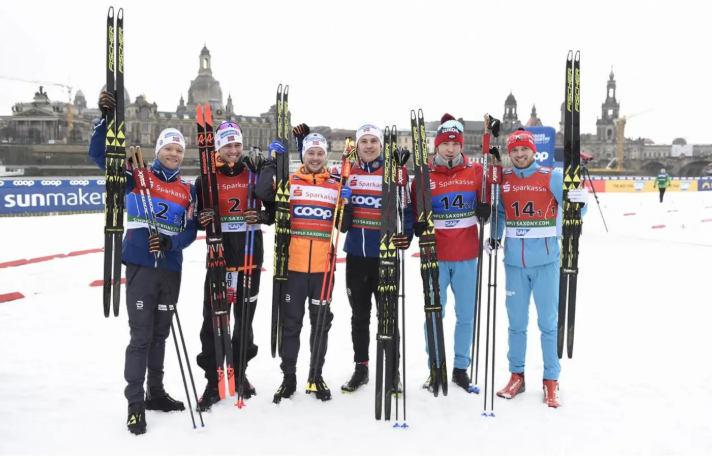
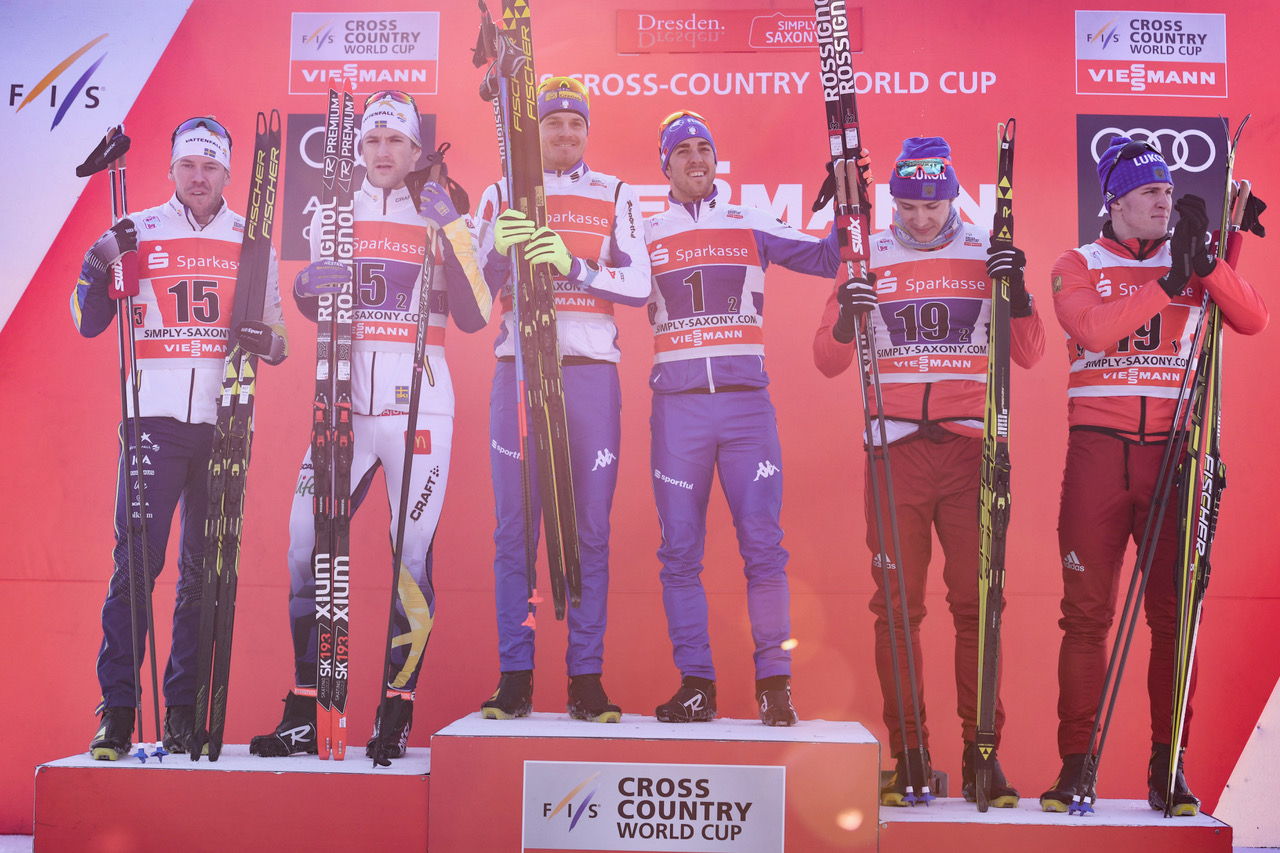
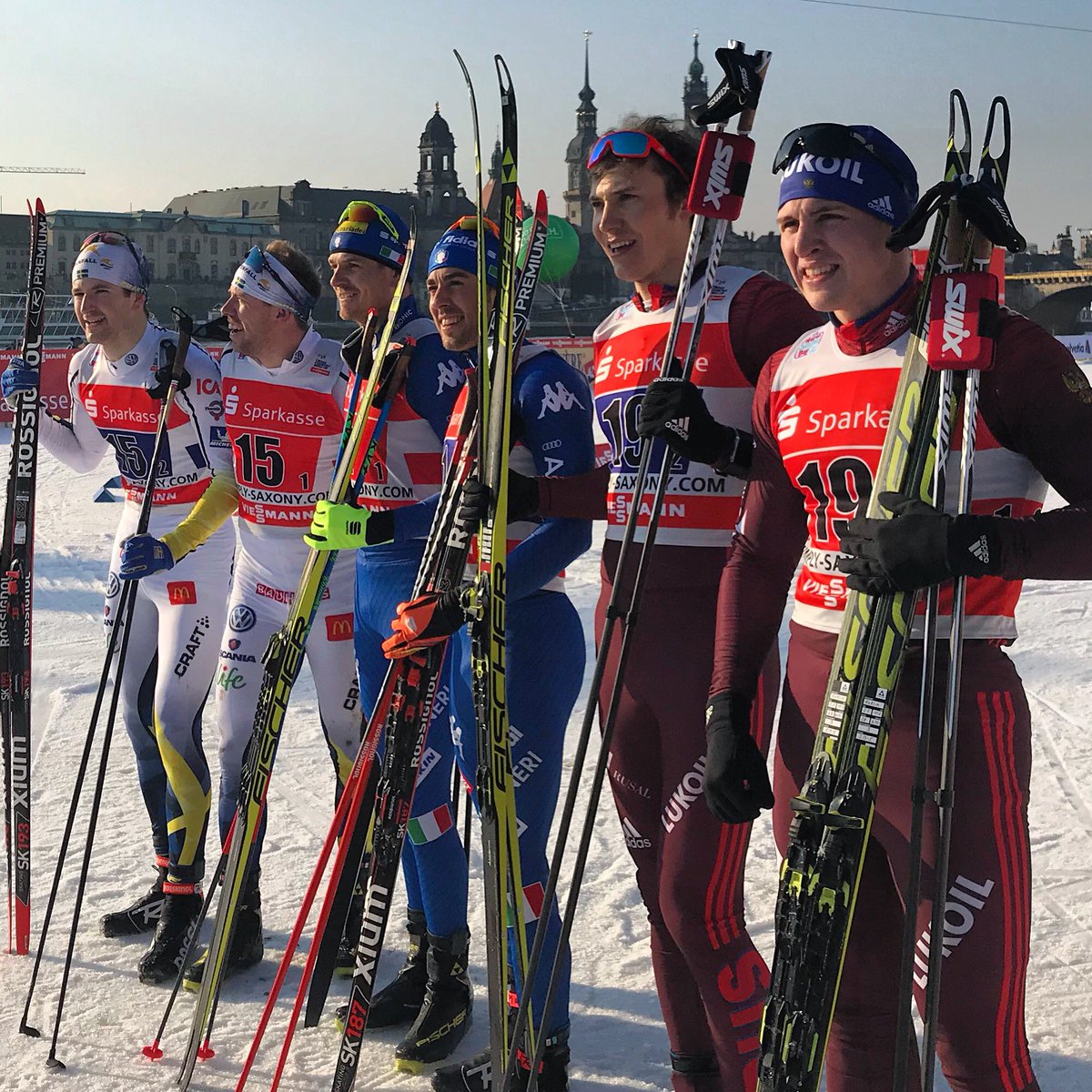
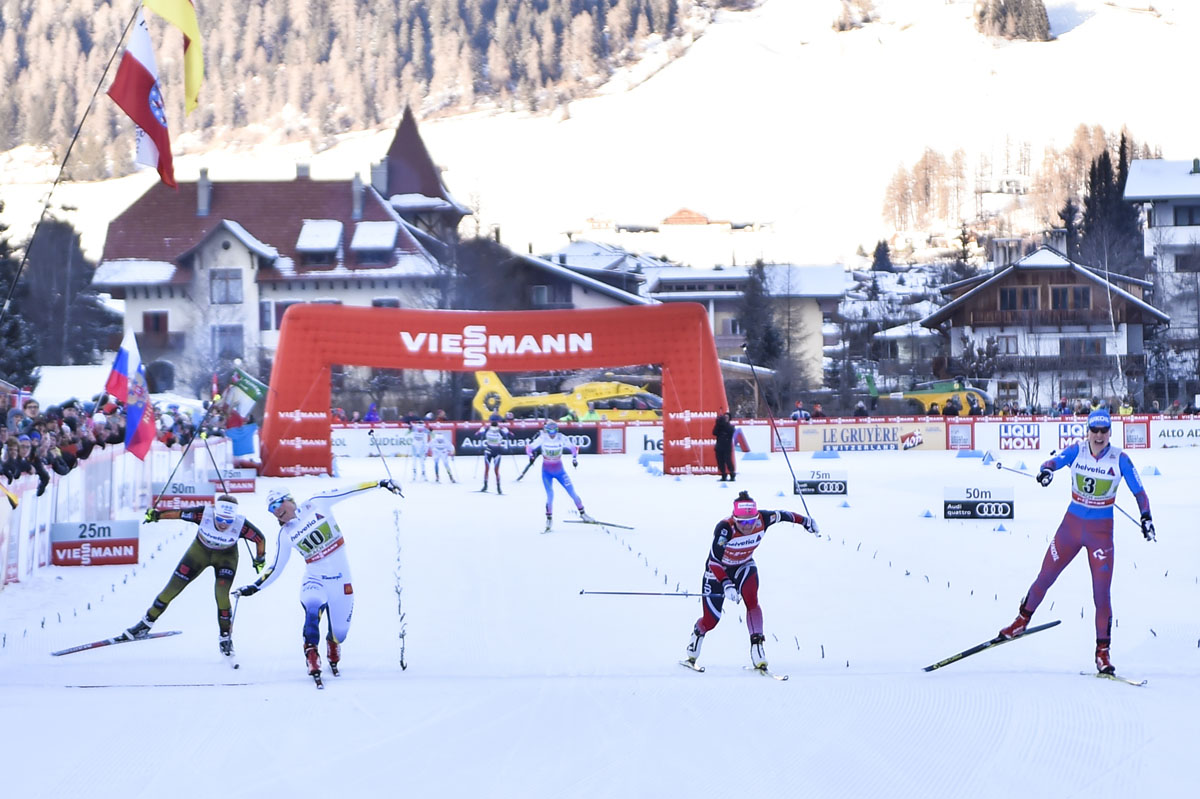
The men’s team sprint podium from the Dresden, Germany World Cup team sprint: From left to right, Norway II in second, Norway I first, and Russia I third. (Photo: fis-ski.com screenshot)
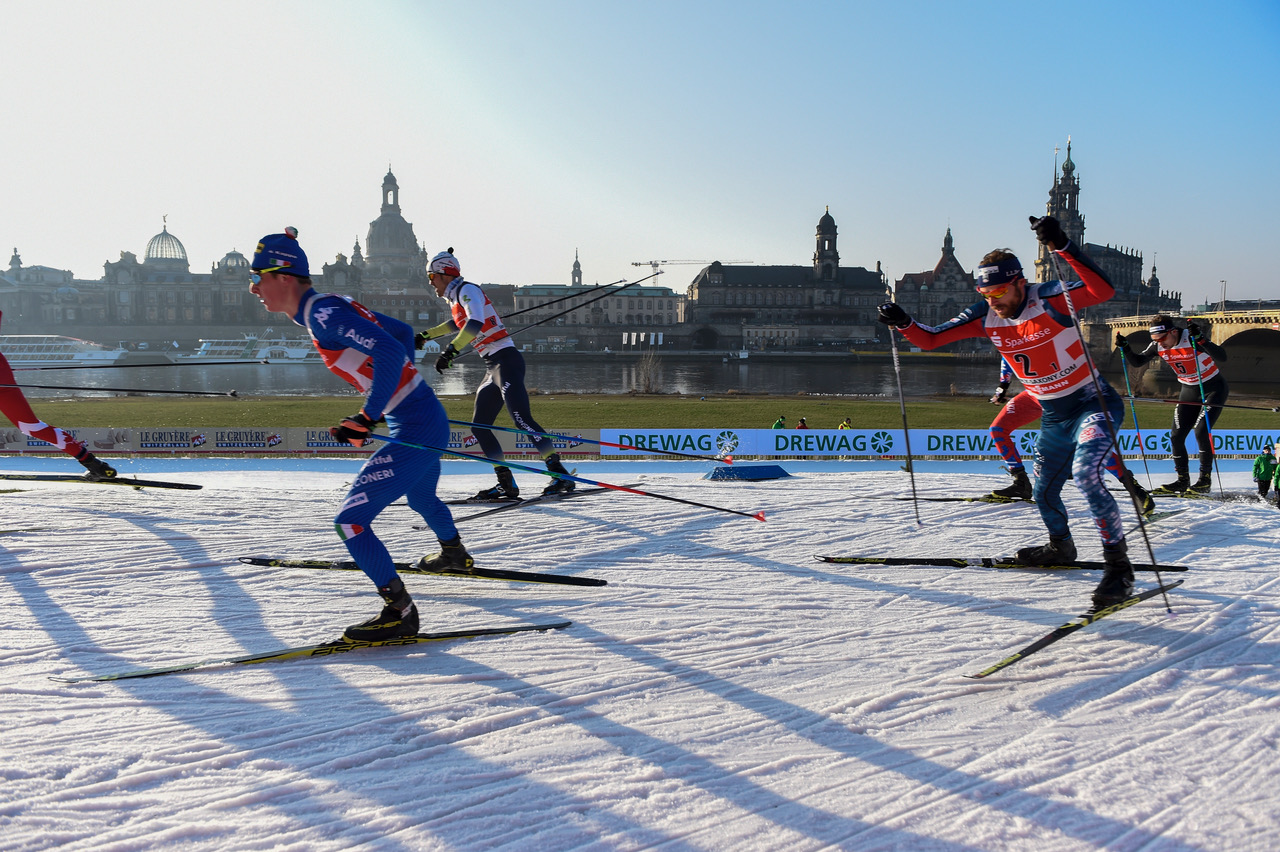
A strip of imported snow along the Elbe river, iconic architectural reminders of old-world Europe’s city-scape in Dresden, Germany, Lycra, speedy skiers, and teams of two: all the ingredients for the men’s 1.6-kilometer freestyle team sprint.
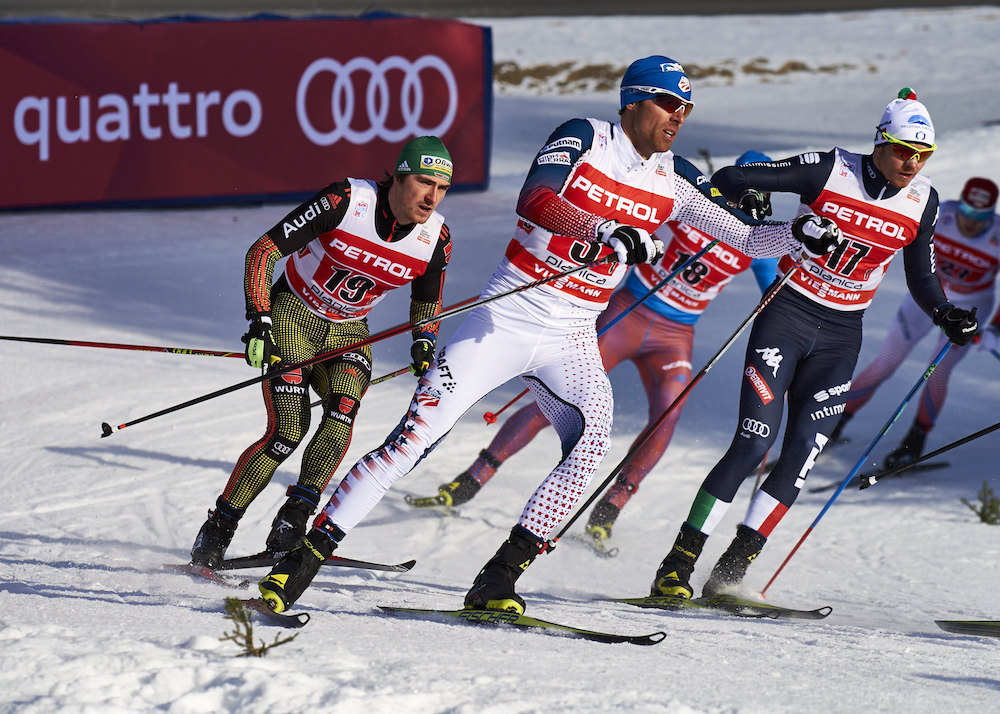
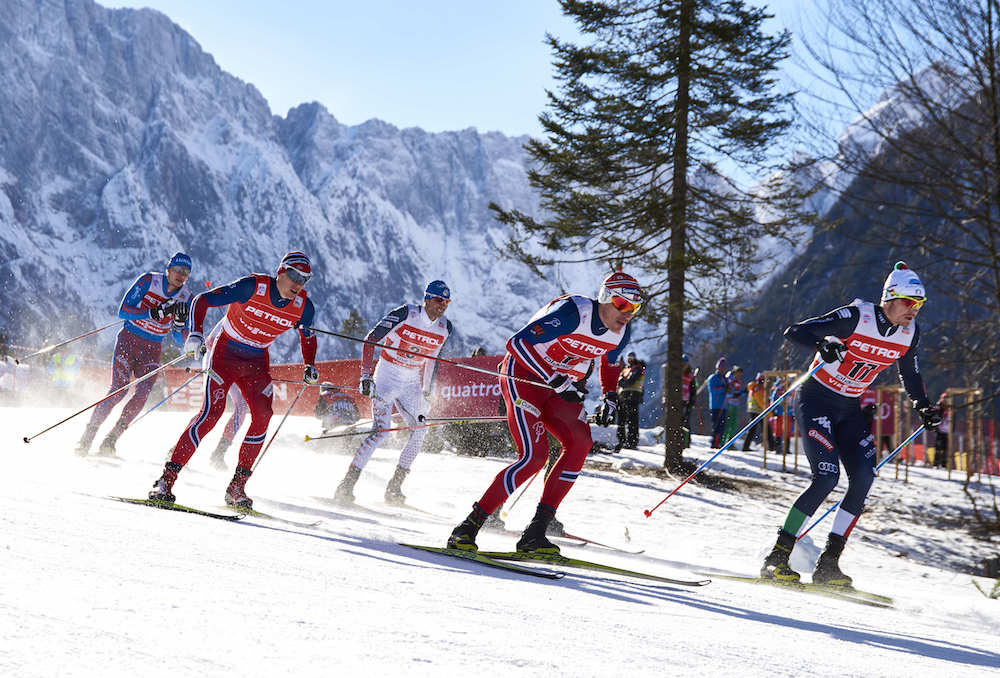
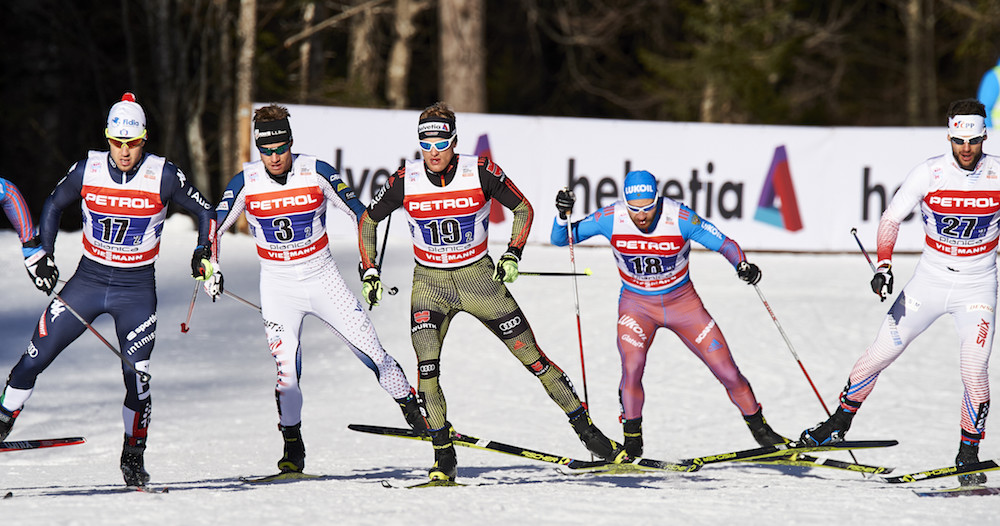
With tight pack skiing a function of the the relatively flat Dresden ski loop, the ten teams in the final attempted to play stay-out-of-trouble-skiing for the six total laps. But with a crowded tag area and tight corners where skiers abruptly bled speed, mix ups and tumbles occasionally picked skiers out of the front scrum.
Coming into the final tag, 8 k into the race, the top-seven teams came through the time check all within 2.63 seconds of one another.
Norway II, Italy I, Russia II, Norway I, France I, Russia I, and Great Britain sped through with the remaining three teams in the finals, Switzerland I, Austria I, and Australia I within closing distance to the leaders.
Intermittently contracting and spreading out, no decisive moves to splinter the group materialized until the last lap.
In the team sprint, it’s not simply the fastest one or two lap skier who prevails — each athlete, during their three respective legs (each leg consisted of three laps), was required to mentally focus and push the boundaries of their aerobic and anaerobic engines for 4.8 k total.
On that last lap, the pull away move was simple enough.
Leading much of the final k was Norway I’s Sindre Bjørnestad Skar, the winner of Saturday’s skate sprint in Dresden. Skar kept out trouble, positioning himself at the front. He then shifted into a sixth or seventh gear no other skier could match.
Up to the point Skar began to channel his reserve of booster-fuel, it appeared it could have been one of several teams across the line first. But approximately 4.6 k into Skar’s pathway to the finish line, his top effort was simply too much. he was on another level of endurance-sprint fitness as he closed out the win.
Skar along with his teammate Erik Valnes won the final in 22:38.72 minutes.
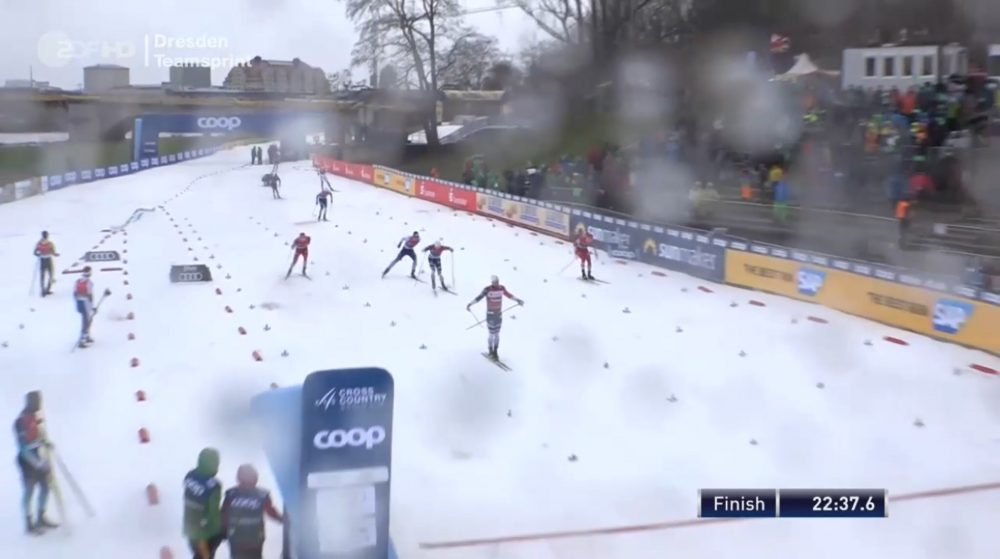
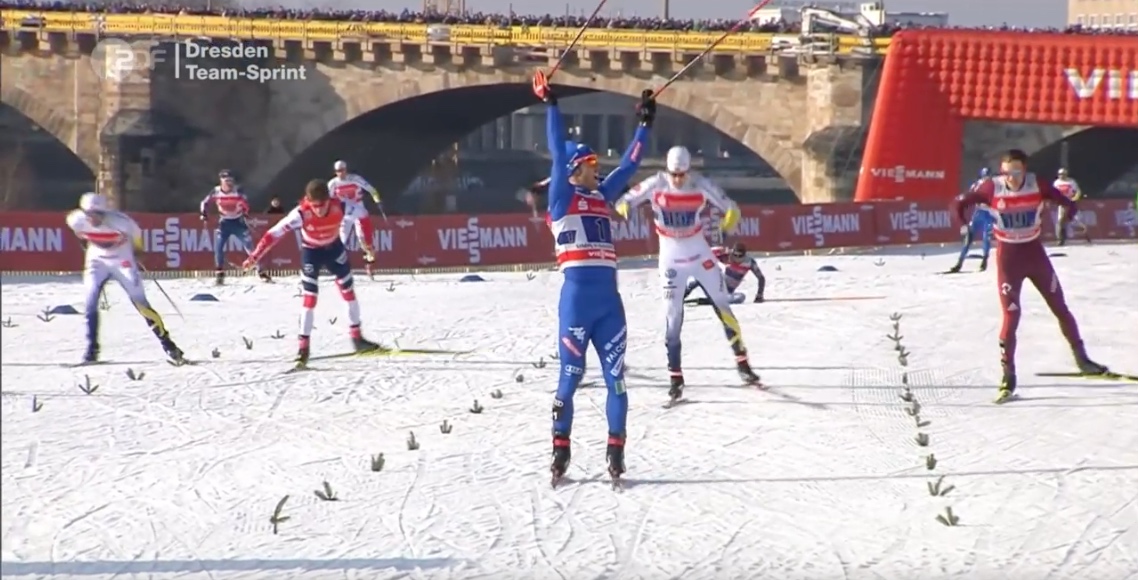
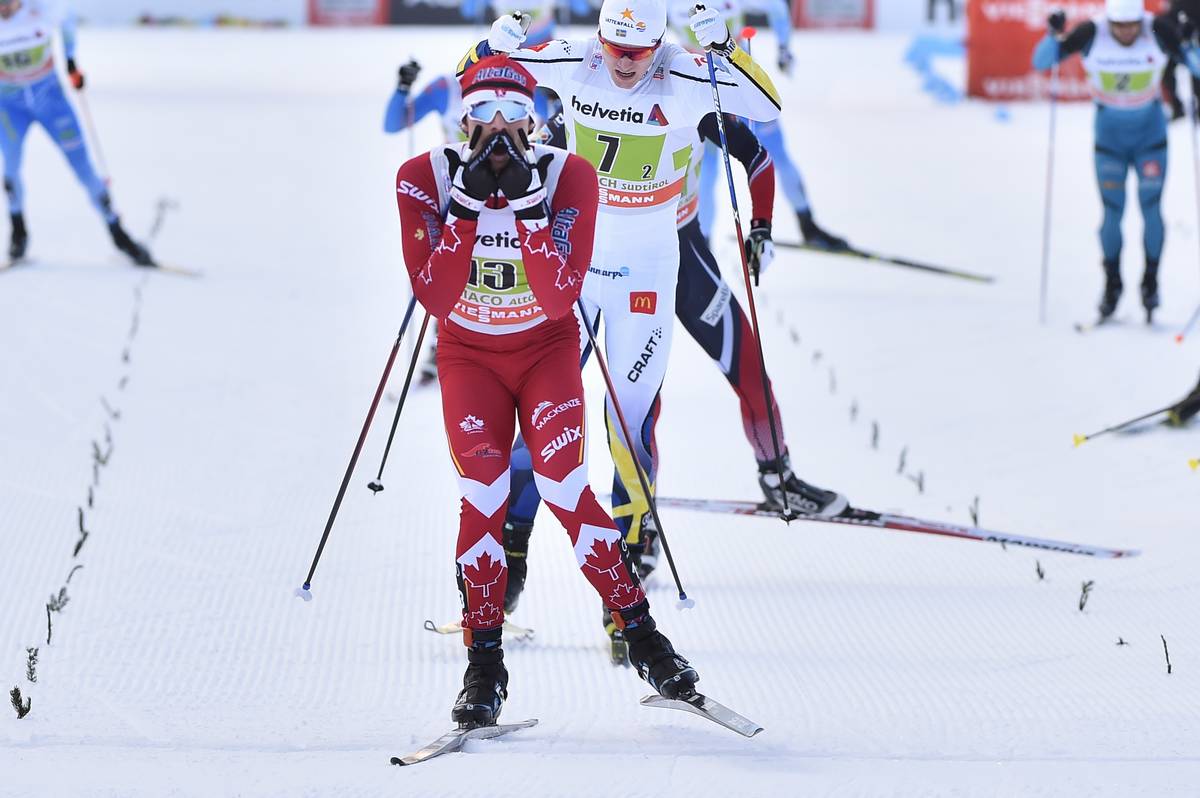
Sindre Bjørnestad Skar in front to finish first for Norway I during the Dresden, Germany World Cup team sprint on Sunday. (Photo: ZDF screenshot)
But behind Skar, a four team whirlwind charged down together on the finish. A photo-finish captured the moment to decide the final standings. In second (+0.75) was Norway II’s Pål Golberg and Eirik Brandsdal, Russia I’s Artem Maltsev and Gleb Retivykh third (+0.80).
Fourth place, 1.01 seconds back, went to Roland Schaad and Jovian Hediger of Switzerland. Russia II’s Andrey Krasnov and Alexander Terentev were fifth (+1.04).
Great Britains’s James Clugnet and Andrew Young placed sixth (+3.17).
Right in the middle of the the finishing lane mix, possibly fighting for podium scraps was Italy’s Federico Pellegrino. He appeared to catch his tip on another skiers ski-tail and took a spill. He and teammate Dietmar Nöckler placed 10th in the 10 team final. The Italian duo won last season’s team sprint in Dresden.
Canada’s Bob Thompson and Len Valjas placed seventh (+2.46) in the first semi-final and did not advance to the final. It was the same fate for the only U.S. team entered in the men’s team sprint. Andy Newell and Erik Bjornsen placed 10th (+3.66) in the second semi, and failed to make the finals.
Canada placed 15th in the final standings, the U.S. 19th.
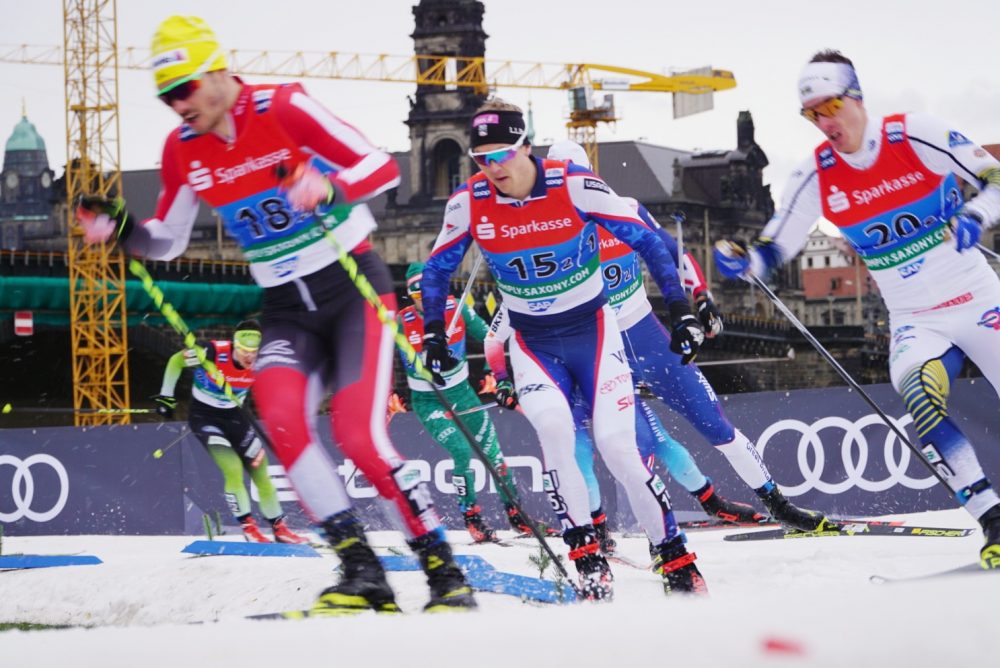
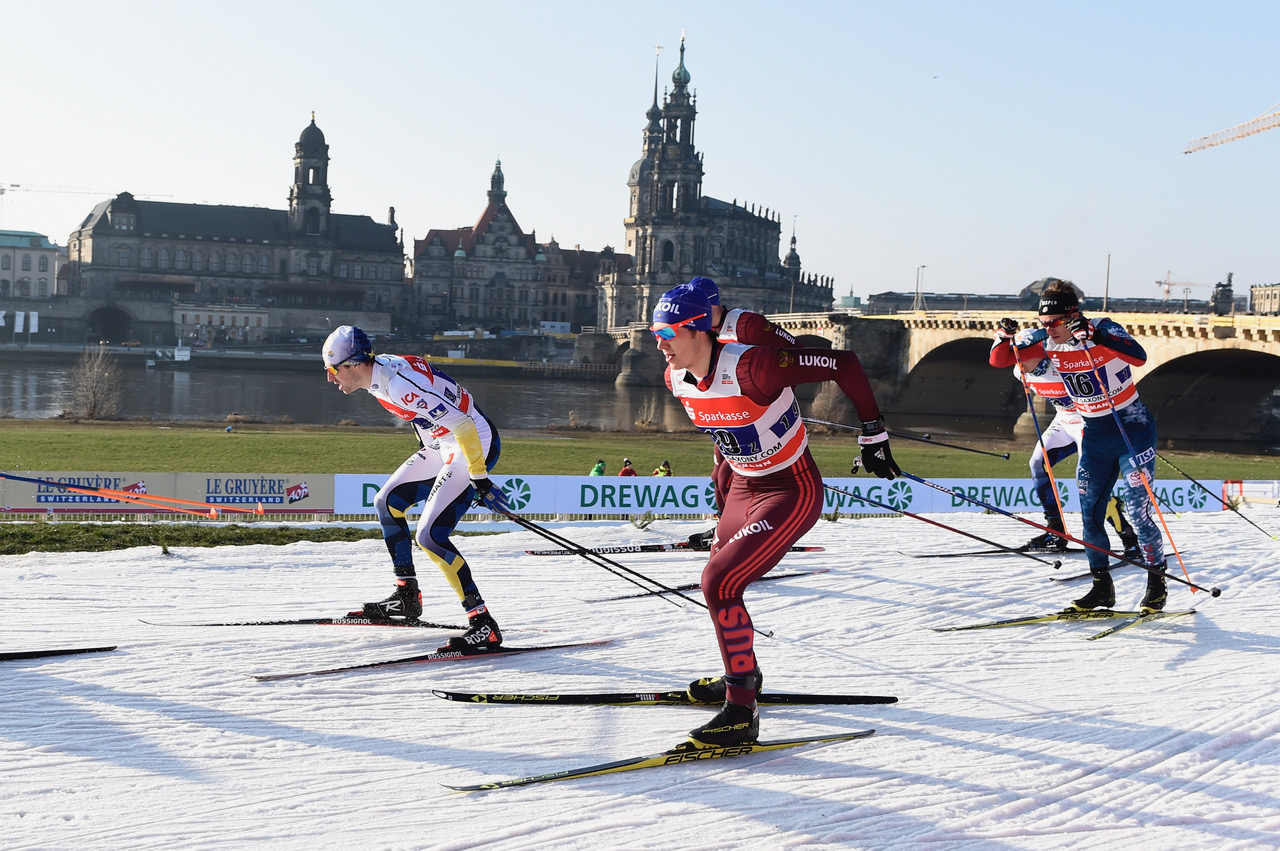
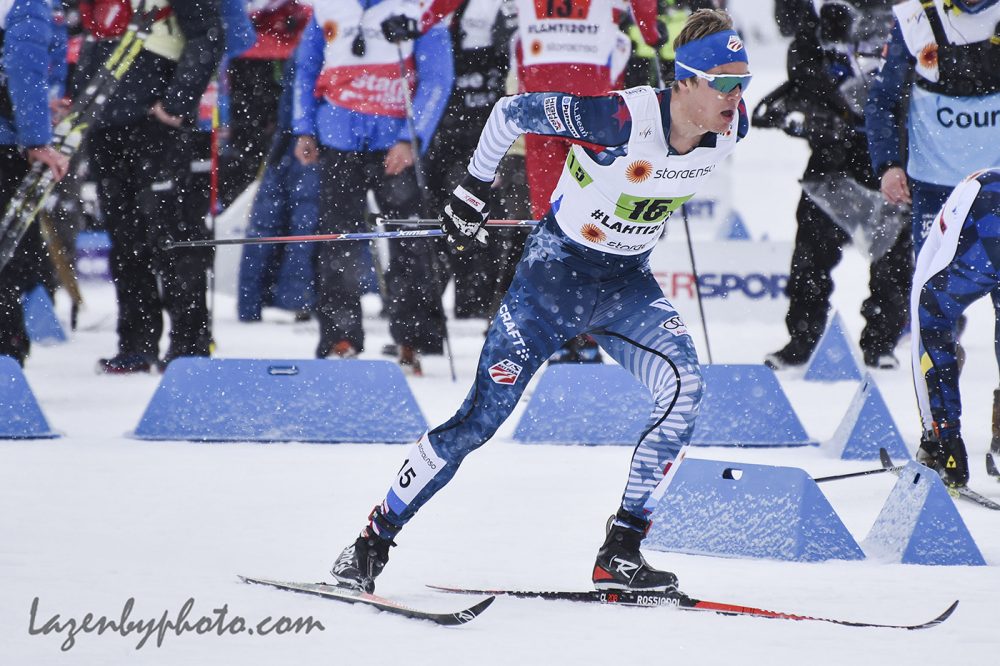
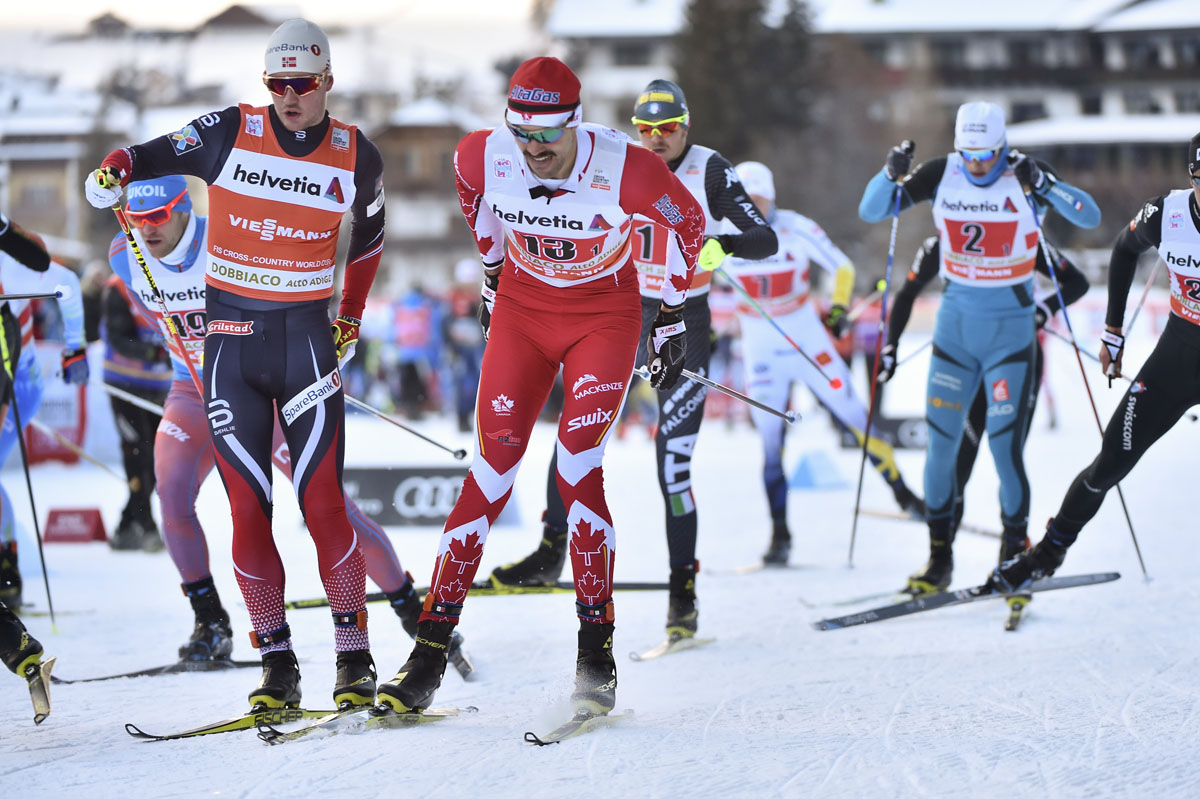
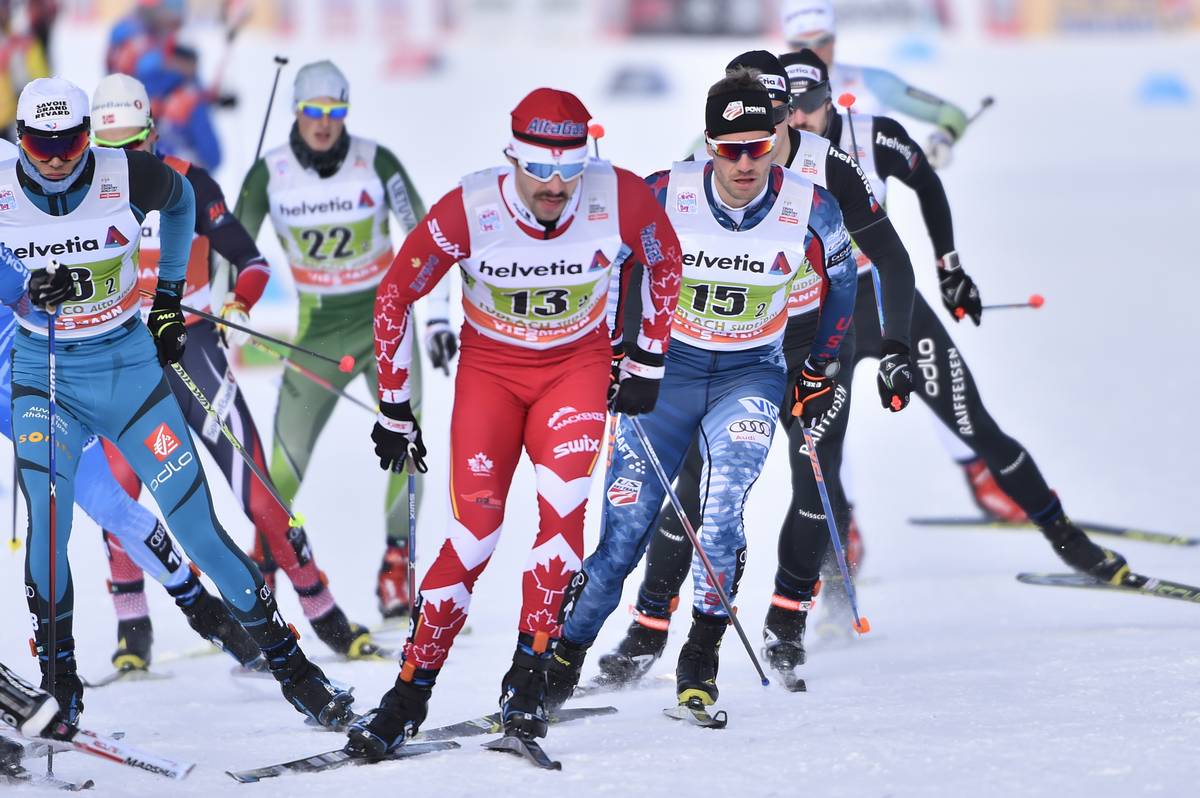
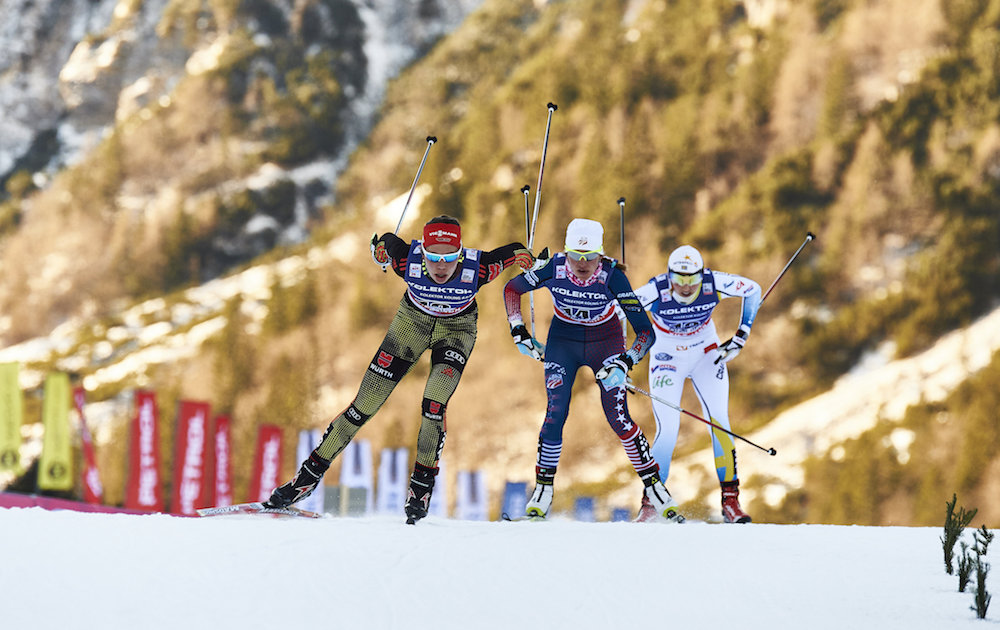
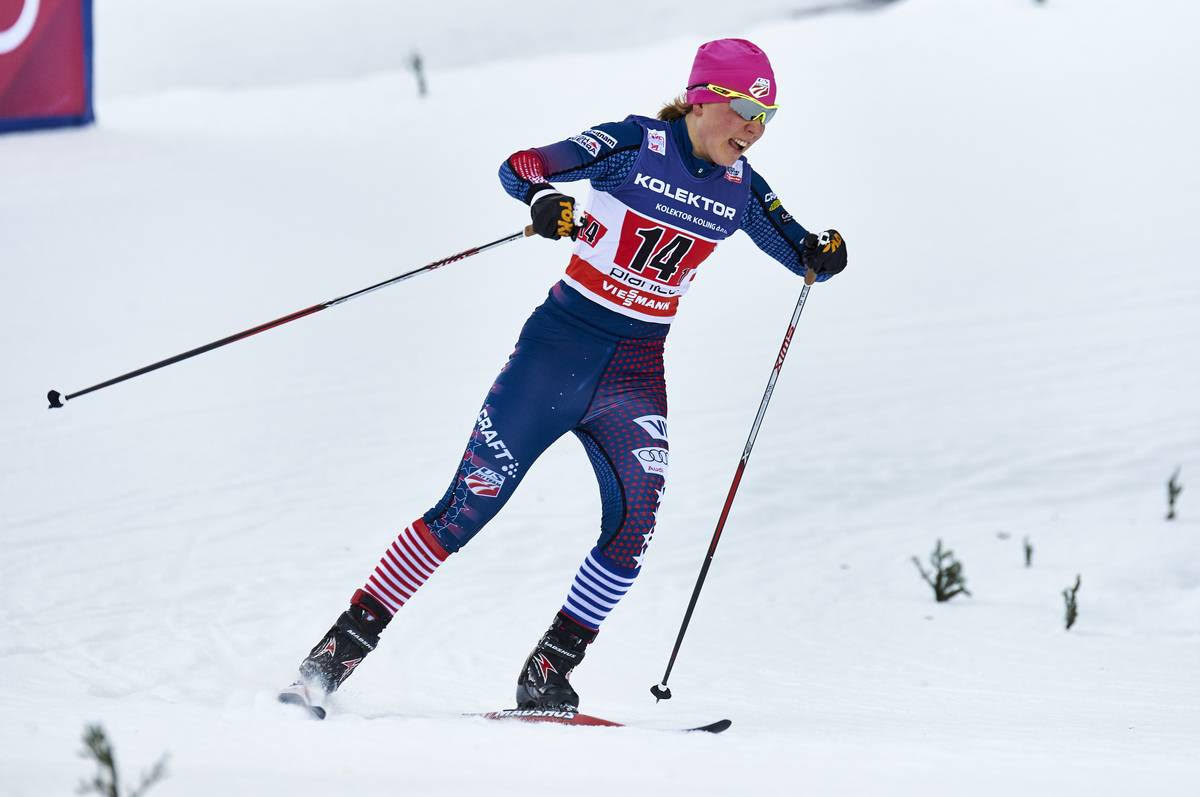
In bib 15, the U.S. Ski Team’s Erik Bjornsen navigates the crowds during Dresden, Germany’s team sprint on Sunday. (Photo: Garrott Kuzzy)
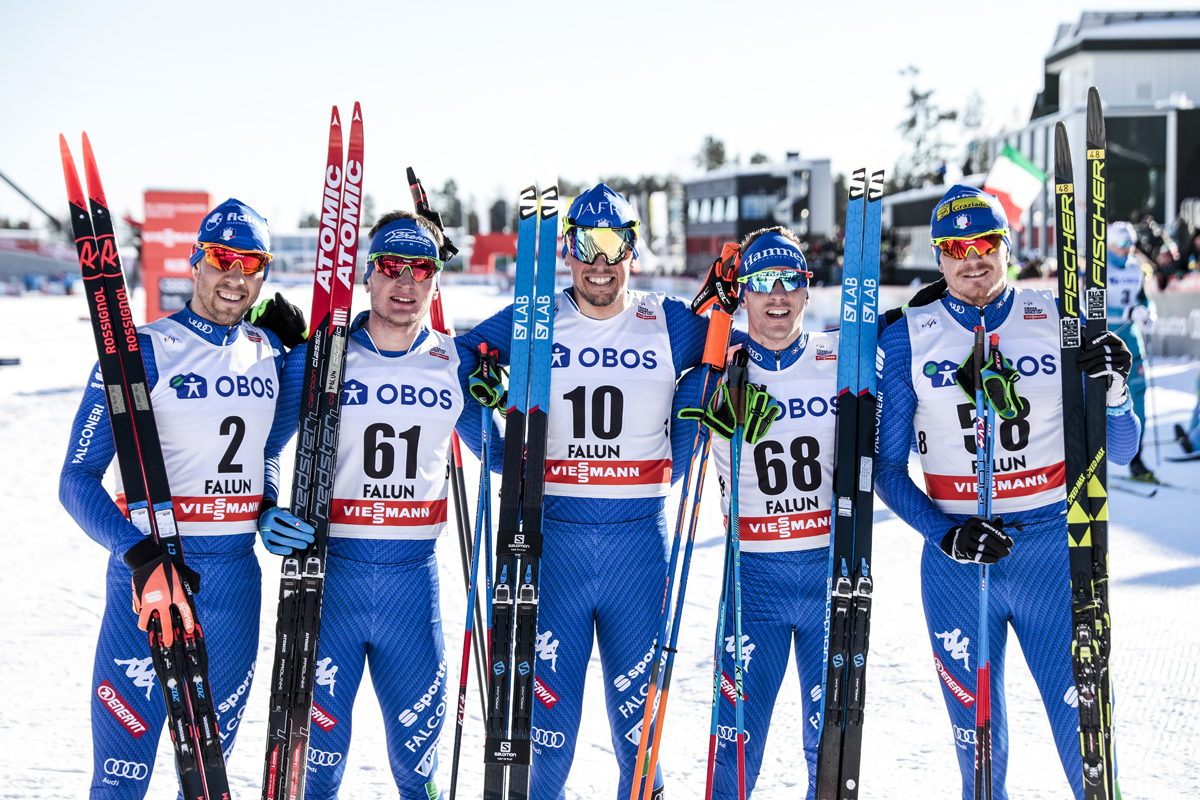
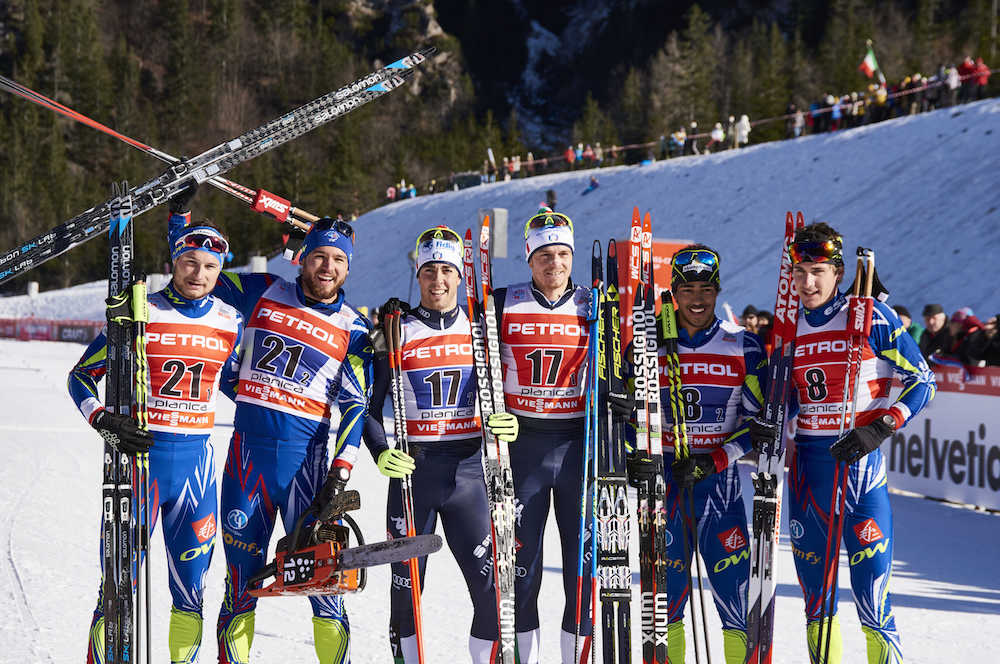
The Italian men’s team after Saturday’s 15 k classic mass start at 2018 World Cup Finals in Falun, Sweden, with (from left to right) Federico Pellegrino, Giandomenico Salvadori, Francesco De Fabiani, Maicol Rastelli, and Dietmar Nöckler. (Photo: Fischer/NordicFocus)
Welcome to FasterSkier’s World Cup Preview, where we check in with the top-10 teams from last year’s FIS Cross Country World Cup tour before the season starts with the Ruka weekend in Kuusamo, Finland, on Nov. 24 with a classic sprint.
***
Italy
Overall in Nations Cup Last Year:Ninth
Women’s Ranking 2017/2018:10th
Men’s Ranking 2017/2018:Sixth
Italians to Watch:
One name to rule them all in Italy: Twenty-eight-year-old Federico Pellegrino. Synonymous with fast and furious when it comes to freestyle sprints. Last season Pellegrino won World Cup sprints in Dresden and Lahti, both were skate. He stood second on World Cup skate sprint podiums on three other occasions in 2017/2018. One of those seconds was in Seefeld, Austria – site of the 2019 Nordic Ski World Championships. And yes, it’s a skate sprint this season in Seefeld.
For the naysayers out there, claiming Pellegrino is a one-trick-pony, the skate specialist claimed a 2018 Olympic silver medal in the classic sprint.
The 2016 winner of the overall FIS Sprint Crystal Globe, Pellegrino has been out-hustled by Norway’s Johannes Høsflot Klæbo for the sprint cup since. With nine of the 12 World Cup sprints this season designated skate technique, it may be time for the Italian flyer to claim sprint cup number two.
Dietmar Nöckler returns as a possible Pellegrino partner in the team sprint. The duo placed first in Dresden’s skate team sprint in January. The big-stage team sprint in Seefeld is classic technique.
Francesco DeFabiana provided the Italian men some 15-kilometer punch in 2017/2018. DeFabiana placed third twice on the World Cup last year: in the Oberstdorf’s 15 k skate and Falun’s 15 k classic — both were mass starts.
Thirty-four-year-old Elisa Brocard stepped up for the Italian women. She was a steady top-30 skier, including several top-20 results. Brocard was Tour de Ski ready, placing 17th overall. By season’s end, she ranked 29th in the distance cup – her highest position since beginning her World Cup career in 2008.
On the sprint side for Italy’s women, Greta Laurent placed consistently in the top-30. Her best result, a ninth place, came in Seefeld’s skate sprint. Laurent finished 2018 ranked the 36th sprinter on the World Cup.
Norway’s Johannes Høsflot Klæbo celebrates his team-sprint win with Martin Johnsrud Sundby (not shown), while Alexander Bolshunov of the Olympic Athletes from Russia (l) pushes for silver on Wednesday at the 2018 Olympics in PyeongChang, South Korea. It was his third-straight gold of the week. (Photo: FlyingPointRoad)
With a gold medal for their team already in the bag on Wednesday, Erik Bjornsen and Simi Hamilton put their heads down for the start of their own race at the 2018 Olympics. The men’s 6 x 1.4-kilometer freestyle team sprint final was scheduled to start just minutes after the women’s team sprint final ended, a race which saw Americans Kikkan Randall and Jessie Diggins capture the first Olympic gold for the U.S. in cross-country skiing.
It was motivating and inspiring, even confidence-boosting, Bjornsen reflected after his race in an in-person interview with FasterSkier. But he and Hamilton had their own medal hopes to tend to.
Like most of the men’s finalists, they weren’t able to watch the women’s race beforehand and came out onto the course shortly before the start of their final.
“I was warming up and kind of focusing on my own race, but I saw that they took the win when I was running to the start,” Bjornsen explained. “ … We were ready to match them.”
“I did not even see a second and I’m really bummed out that I didn’t,” Canada’s first-leg skier Len Valjas told FasterSkier after. “But so happy for the U.S., that’s amazing, like it actually gave us some positive energy before the race hearing who won. Our techs and coaches ran into our room, like, ‘Did you hear about the girls’ race?’ So it’s a win for North America. It just makes today even sweeter.”
American Erik Bjornsen (6) skiing with Canada’s Len Valjas (7) during the men’s 6 x 1.4 k freestyle team sprint at the 2018 Olympics in PyeongChang, South Korea. (Photo: FlyingPointRoad)
Both the American and Canadian men’s teams qualified for the 10-team final on Wednesday evening in PyeongChang, South Korea. Bjornsen and Hamilton had advanced with a fast-enough time after placing third in the second semifinal, while Valjas and his teammate Alex Harvey moved on as well (also as “lucky losers”) after finishing fifth in that semifinal.
The U.S. had some confidence going into the final after a semifinal performance that saw Bjornsen take the lead on the second-to-last lap, ahead of Norway. Hamilton held onto first for most of the the final lap until Norway’s Johannes Høsflot Klæbo passed him shortly before the finish, and France’s Richard Jouve passed Hamilton in the finishing straight as well, putting the Americans in third.
For the final, it was all about the medal hunt for Bjornsen and Hamilton, who placed fifth in last year’s World Championships classic team sprint in Lahti, Finland, just ahead of Canada in sixth, for the best U.S. men’s result in a team event.
Russia had won that 2017 world-champs team sprint with two athletes who were banned from competing at these Olympics, Nikita Kriukov and Sergey Ustiugov, and Italy placed second with Dietmar Nöckler and Federico Pellegrino. After an infamous tangle coming out of the final downhill, Finland ended up third with Sami Jauhojärvi (who retired after last season) and Iivo Niskanen, and Norway finished fourth with Klæbo and Emil Iversen. Norway opted for Klæbo and Sundby for its Olympic team-sprint squad on Wednesday, and Sundby later proved that he was worthy of the pick.
Ever since World Championships, it’s safe to say this is the race that had been primarily on Bjornsen’s and Hamilton’s minds for the better part of the last year.
They came out with a mission on Wednesday, putting themselves in the mix early in the final, alongside Canada.
Sweden’s first-leg skier Marcus Hellner leading during the men’s freestyle team sprint at the 2018 Olympics in PyeongChang, South Korea. (Photo: FlyingPointRoad)
Sweden set the pace for the first two laps, with Marcus Hellner starting them off and Calle Halfvarsson holding their lead on the second leg. They tagged off in first through the first two exchanges, just ahead of Norway and the Olympic Athletes from Russia after the first lap, then ahead of France, Norway and Russia after Lap 2. By the end of Hellner’s second lap, Sweden was still in first, tagging off in front of Norway, France and Russia, all within 1.3 seconds of first. Germany followed in fourth, 2.9 seconds back, and Bjornsen tagged the U.S. in fifth (+3.2).
The Americans had been hanging in fifth and sixth throughout the first half of the race, even after Bjornsen crashed at the beginning of his second leg. Heading into the first uphill after the exchange, Bjornsen skated over the tails of Nöckler’s skis ahead of him. He fell down and by the time he got back up, was in 10th — last place — starting back up the hill. Bjornsen recovered to put the U.S. in sixth, 3.2 seconds out of first, with three laps to go.
“It was super disappointing when I went down, but I mean, it was only halfway through the race and I just got up, and that’s for sure not going to be the end of it for us today,” Bjornsen said. “Unfortunately, I kind felt like I let the team down there a bit. I think that was one mistake that may have made a huge impact on our race today, but you know, that’s ski racing, that’s the way it goes sometimes. Unfortunately it’s at the Olympics.”
Hamilton was quick to respond to his teammate’s comments.
“In absolutely no way did Erik let any of us down, especially me,” Hamilton said. “I watched that on the big screen, I have been at a lot of team sprints on the World Cup, World Champs, Olympics, that always happens to someone, and 99 percent of the time, that person, especially if it’s in the finals, just gives up, whether it’s the first leg, second leg, third leg, they just give up. And Erik, he never does that, no matter what happens to him, what happens to us, he just fights ’til the absolute very end.
“It’s cliché to say that, but that’s what he does,” he continued. “That’s the only way he knows how to operate. … I am incredibly proud to be always be racing with Erik, to be training with him, to be rooming with him.”
The two Americans, who are rooming together in the Olympic Village, went on to lose a few more seconds and two places during Hamilton’s second leg, after which he tagged Bjornsen in eighth, 8.3 seconds out of first.
At the front of the pack, Klæbo had made a game-changing attack on the final climb of that leg, following Russia’s Alexander Bolshunov up it then making a few swift strides to get around him several meters from the top. As Klæbo jump-skated up and over and away from them, Bolshunov, Halfvarsson and France’s Jouve almost looked as if they were standing still, leaving them several seconds behind as they chased him toward the exchange.
Klæbo tagged Sundby 1.7 seconds ahead of Russia in second, 2.2 seconds clear of Sweden in third, 3 seconds ahead of Italy in fourth, and 3.3 seconds ahead of France in fifth. A couple more seconds back, Germany followed in sixth (+5.7), Finland in seventh (+6.0), the U.S. in eighth (+8.3), and Canada in ninth (+11.0), ahead of the Czech Republic in 10th (+12.8).
Sundby dug deep for his final 1.4 k lap to extend Norway’s lead to 5.1 seconds at the last exchange. For the first time all race, Klæbo took his hat off and prepared for his last time around the PyeongChang sprint course with Sweden, France and Russia about six seconds behind him.
Simi Hamilton (6) racing with Italy’s Federico Pellegrino (3) and others out of the exchange of the men’s 6 x 1.4 k freestyle team sprint semifinal at the 2018 Olympics in PyeongChang, South Korea. (Photo: FlyingPointRoad)
Bjornsen had skied the Americans back into sixth, 11.7 seconds back at the last exchange. Valjas tagged Harvey in eighth, 26.6 seconds out of first.
While Hamilton chased Pellegrino, who started 0.3 seconds ahead of him out of the exchange, over the next lap, the two kept Halfvarsson, Jouve and Bolshunov in their sights. Ultimately, however, they were unable to close the gap to fight for the medals.
The three-man chase group, led by Bolshunov, didn’t let off as they pursued Klæbo, who appeared untouchable as he rounded the course. As they sped down the final descent toward the finish, Klæbo pushed over the last little rise, looked back and appeared to exhale as he relaxed his shoulders. But it wasn’t over. Bolshunov was charging hard and Klæbo couldn’t let off just yet. The 21-year-old Norwegian took another breath then about a dozen or so more V2 pushes in the finishing straight. A full four seconds before the line, he let off and secured his third gold of his first Olympics in 15:56.26 minutes, 1.71 seconds ahead of Bolshunov (and Denis Spitsov of the Olympic Athletes of Russia) in second. Jouve outsprinted Halfvarsson to give France (with teammate Maurice Manificat) its second-straight bronze (+2.02), after France placed third in the men’s 4 x 10 k relay, and Sweden finished the race in fourth (+3.07).
About 15 1/2 seconds later, Pellegrino crossed the line in fifth (+18.55) for Italy, 2.17 seconds ahead of Hamilton in sixth (+20.72). The Czech Republic came through in seventh (+28.57) with Martin Jaks and Ales Razym, Harvey anchored Canada to eighth (+35.6), Finland finished ninth (+36.04) with Martti Jylhä and Ristomatti Hakola, and Germany placed 10th (+45.94) with Sebastian Eisenlauer and Thomas Bing.
“For our race tonight, we’re proud of what we accomplished,” Hamilton reflected. “Obviously, it’s always our goal to be on that podium. I think we both know that we can be up there and maybe someday we will. … If we are going to do that someday, there’s no way were going to do it without trying, so tonight was another one of those attempts, and it was a super-fun race, did everything we could, came up short, but we fought hard.”
“I guess we will have keep skiing and fight for it,” Bjornsen said, later adding, “We’re coming back for a gold.”
Canada’s Alex Harvey jets out of the exchange during the men’s 6 x 1.4 k team sprint semifinal at the 2018 Olympics in PyeongChang, South Korea. The Canadians went on to finish eighth. (Photo: FlyingPointRoad)
For Valjas, who had slipped to 10th on his second leg but brought his team back to eighth after Harvey put them in ninth with two laps to go, a top 10 at the Olympics on any day was a good one. He previously raced on Canada’s 4 x 10 k relay that finished ninth.
“I actually got a chest cold two days ago so it was kind of a game-time decision,” Valjas said after of Canada’s decision to start him with Harvey. “The team really wanted me to start this even if I’m not 100 percent, and honestly it felt pretty good. I think it was my legs that gave out before my lungs so I’m glad I did start because I felt horrible coming on the bus here. I was like, ‘How am I gonna race against these guys? Like, even healthy I’m gonna suffer.’
He explained that the course didn’t exactly suit his strengths with its long climbs.
“The first work section is a minute with no break,” Valjas said. “I was just trying to use the flats and the downhills like what I’m good at and the rest I was just surviving…
“Honestly for me on this course, at the World Cup last year, I had a terrible team sprint,” he added, reflecting on his 13th-place result last year with teammate Jess Cockney at the pre-Olympic World Cup in PyeongChang. “And I was good shape then. Jess raced great, I was just getting dropped. For me, another top 10 in the Olympics and I’m thrilled how it went and so happy that Alex had some punch in the end there. The 50 k [on Saturday], I’ll be out here cheering. It’s looking great for [Alex] and I’m glad I could help him in his race prep.”
Norway’s Johannes Høsflot Klæbo and Martin Johnsrud Sundby (1) embrace after Klæbo anchored the two-man team to first in the 6 x 1.4 k freestyle team sprint at the 2018 Olympics in PyeongChang, South Korea. (Photo: FlyingPointRoad)
For Norway, the gold medal was its fourth in five men’s races so far at these Olympics. Klæbo has won three of them (individual classic sprint, relay and team sprint) and Sundby two (relay and team sprint).
In a post-race press conference, Sundby, 33, had nothing but praise for his young teammate.
“I think the whole cross-country world at this point is looking on what Johannes does, how he does it, and why he is so fast,” Sundby said. “… We are close and are able to learn so much from this guy. He’s 21 years old. Today we were both extremely nervous for the competition. … Anything can happen, and these tracks are so tough, this sprint track. It’s a lot of uphill and a really tough downhill, and you don’t get any rest at any point, so we were not looking forward to it, but its really good to finish it.”
While Russia’s Spitsov said they had been going for gold, he explained through a translator that they were “not very lucky.”
“We had a small tactical mistake and we lost a few seconds through that when he was basically being blocked, lagging behind the French guy,” he said at the press conference. “We tried to catch up but we couldn’t. Johannes was stronger and faster.”
France’s Maurice Manificat (r) with teammate Richard Jouve after they earned bronze in the men’s freestyle team sprint final at the 2018 Olympics in PyeongChang, South Korea. (Photo: FlyingPointRoad)
For France, the bronze medal was a big deal. It was the first for the 23-year-old Jouve in his first Olympics. Manificat previously raced in France’s bronze-medal relay.
“Second medal and also with Richard, it’s unbelievable,” Manificat said at the press conference. “Three days ago a medal in distance with my teammates on the distance team, and it was a hard choice the last day with our sprinter Lucas Chanavat; he was really sad to not be part of this relay, but I think with this medal, it was for all for the team … and we are so happy together as you could see in the [finish] and to share it with Richard. [He was] unbelievable in the final [lap], it was so crazy, so thanks to him and thanks to all team’s waxers, we had such good skis, so it was perfect.”
— Jason Albert, Gabby Naranja, Ian Tovell, and Harald Zimmer contributed
The men’s 6 x 1.4 k freestyle team sprint podium at the 2018 PyeongChang Olympics, with Norway’s Martin Johnsrud Sundby and Johannes Høsflot Klæbo (c) in first, the Olympic Athletes of Russia’s Denis Spitsov (l) and Alexander Bolshunov (second from l) in second, and France’s Maurice Manificat (second from r) and Richard Jouve (r) in third. (Photo: FlyingPointRoad)
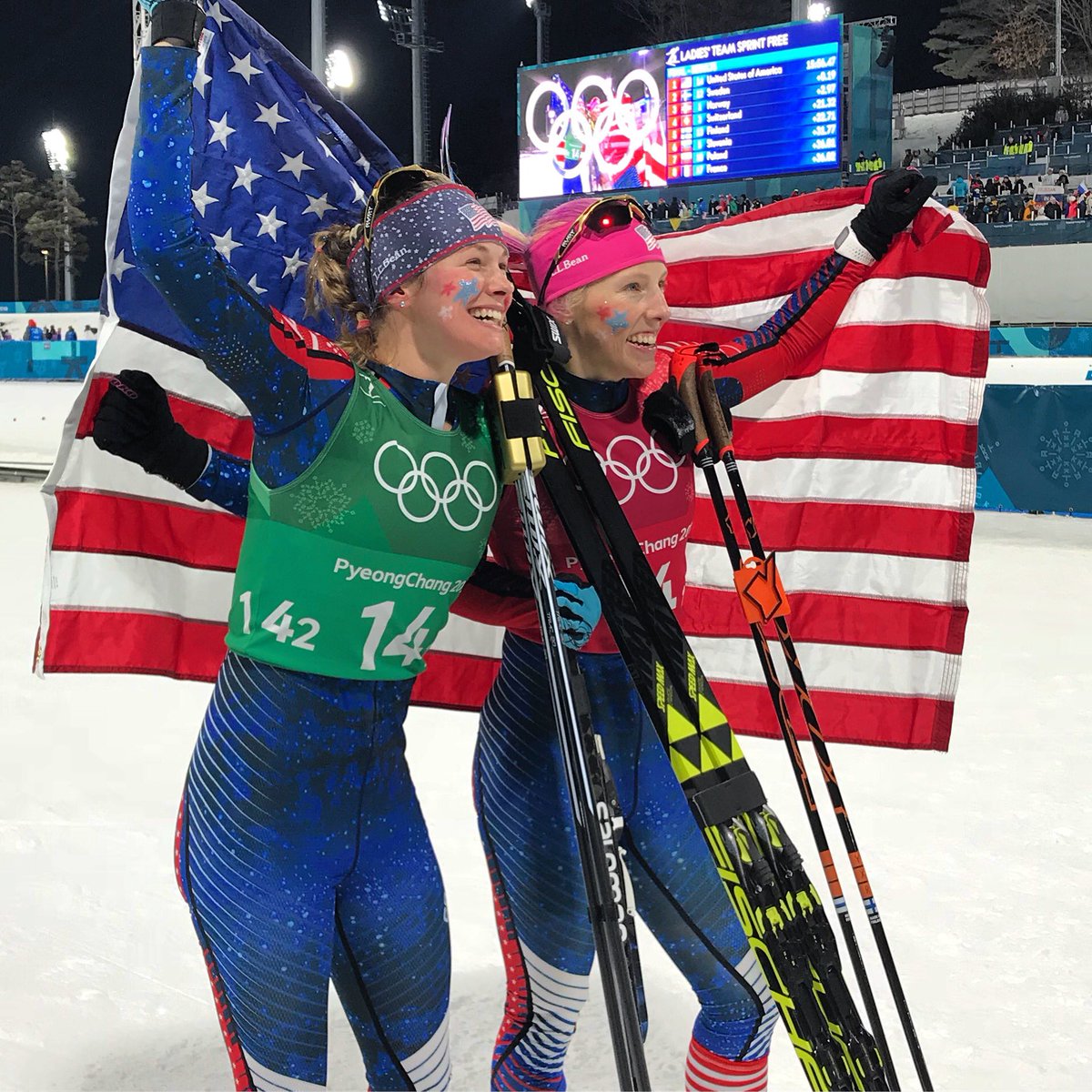
Team USA after Kikkan Randall and Jessie Diggins (c) won gold in the women’s freestyle team sprint on Wednesday at the 2018 Olympics in PyeongChang, South Korea. (Photo: FlyingPointRoad)
(Note: This rundown has been updated to include comments from Canadians Emily Nishikawa and Dahria Beatty.)
The medal hunt is over. In the final team event of the 2018 Winter Olympics, the U.S. women got the job done on Wednesday in PyeongChang, winning not just a medal, but the first Olympic gold in the history of U.S. cross-country skiing.
Jessie Diggins (l) and Kikkan Randall soak up their win in the women’s freestyle team sprint on Wednesday at the 2018 Olympics in PyeongChang, South Korea. (Photo: FIS Cross Country/Twitter)
Kikkan Randall and Jessie Diggins teamed up in the 6 x 1.25-kilometer event, with Randall tagging Diggins in third at the final exchange, just 0.7 seconds behind Norway’s Marit Bjørgen in first and 0.5 seconds behind Sweden’s Charlotte Kalla in second. With 1.25 k to go, Diggins charged ahead on the first climb, with Norway’s Maiken Caspersen Falla and Sweden’s Stina Nilsson chasing her in second and third, respectively. They were about 10 seconds clear of Switzerland in fourth at the final exchange.
Falla moved into first at the bottom of the final grueling climb. Halfway up, Diggins and Nilsson jostled to position themselves in second, and over the top, Diggins slotted into third.
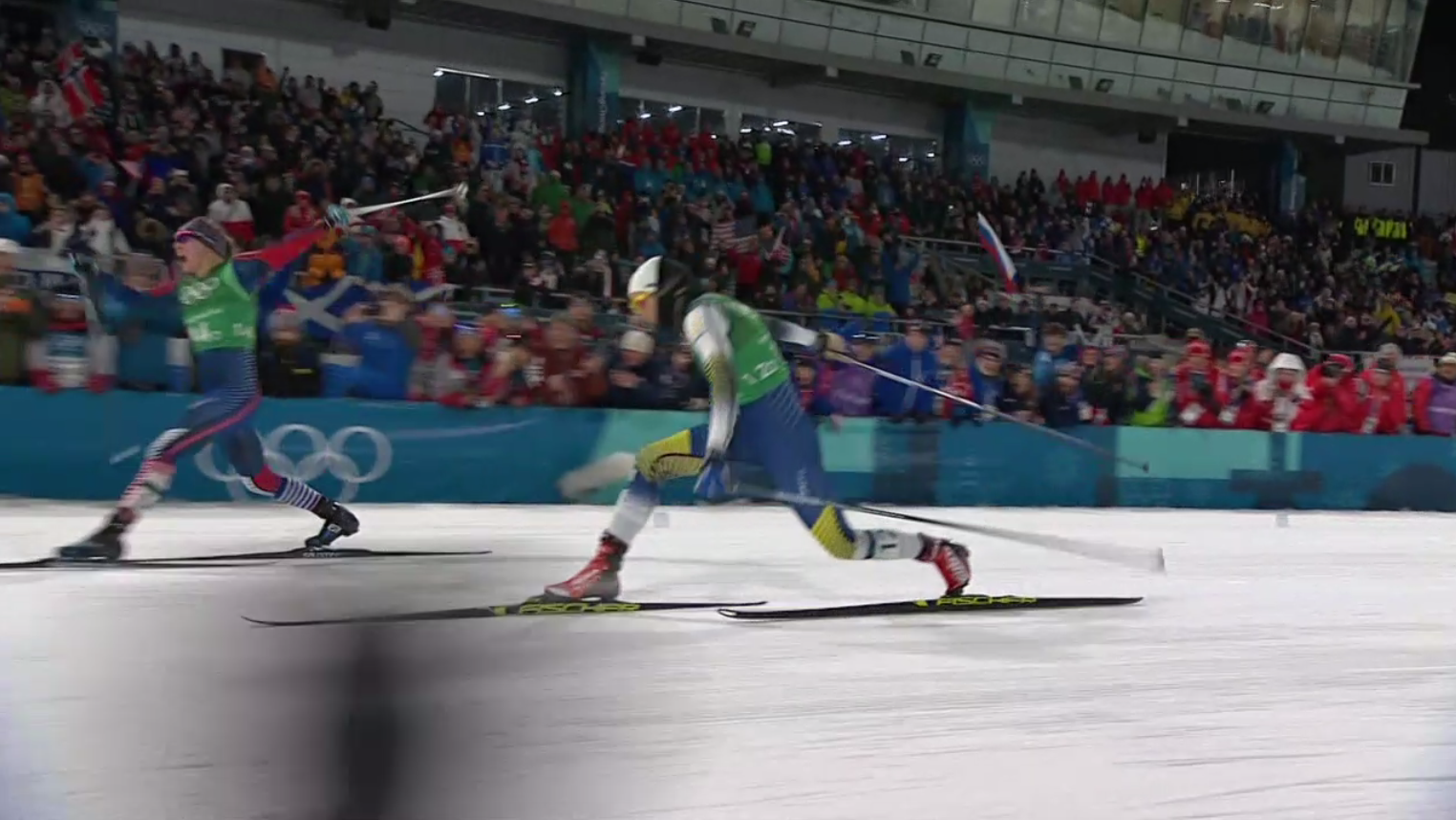
Riding fast skis on the downhill toward the stadium, Diggins stayed out of trouble while Nilsson nearly rode up onto Falla’s skis. While Nilsson used the draft to get into first coming out of that downhill, Diggins eyed a specific line, saw the opening between the two and took it to move into second. As Nilsson entered the finishing straight, Diggins was right there with her, even pulling into first as they came within 50 meters of the line. The gold became a reality, as Diggins outlunged Nilsson by 0.2 seconds at the finish with a time of 15:56.4 minutes, and Falla crossed 3 seconds back in third.
Jessie Diggins (l) lunging for gold in the women’s freestyle team sprint, 0.2 seconds ahead of Sweden’s Stina Nilsson at the 2018 Olympics in PyeongChang, South Korea. (Screenshot: NBC broadcast)
Gold for the U.S., silver for Sweden, bronze for Norway. With her 14th Olympic medal, Bjørgen became the most decorated Winter Olympian of all time, while Randall and Diggins earned their country’s first Olympic gold.
In the men’s 6 x 1.4 k team sprint final that followed, Johannes Høsflot Klæbo once again anchored another Norwegian victory, teaming up with Martin Johnsrud Sundby for Klæbo’s third medal of his first Olympics. With a strong second leg from Klæbo, the Norwegians gapped the field, and Sundby extended that gap to 5 seconds over Sweden by the final exchange. Klæbo rounded the final lap alone, still charging for the win and only letting up a few meters before the line to celebrate as he crossed in first with a time of 15:56.26.
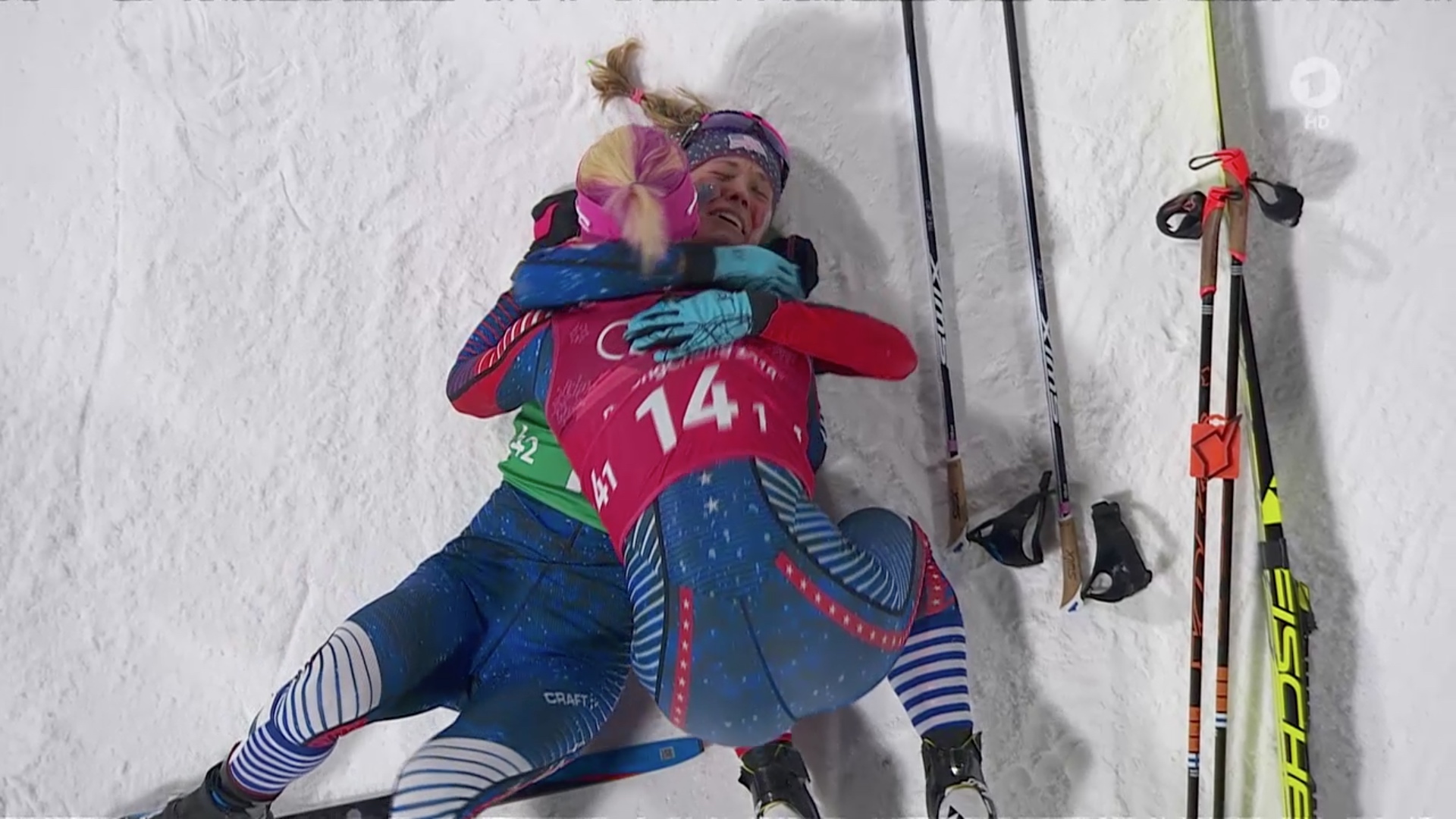
Kikkan Randall (14) and Jessie Diggins embrace as they celebrate their freestyle team sprint gold on Wednesday at the 2018 Winter Olympics in PyeongChang, South Korea. It is the first U.S. cross-country skiing gold medal in Olympic history, besting Bill Koch’s individual silver medal in the 30 k at the 1976 Winter Olympics. (Screenshot: ARD broadcast)
Alexander Bolshunov of the Olympic Athletes from Russia pushed to catch Klæbo on the last lap and motored for silver, finishing 1.71 seconds back. He teamed up with Denis Spitsov fortheir second-straight silver medal of the Games (after placing second in the 4 x 10 k relay) and Spitsov’s third medal (after placing third in the 15 k freestyle).
France (Maurice Manificat and Richard Jouve) placed third (+2.02) with Jouve edging Sweden’s Calle Halfvarsson by about a second for bronze, while Sweden placed fourth (+3.07) with Marcus Hellner and Halfvarsson. It was the French men’s second-straight bronze medal after placing third in the relay.
Italy (Dietmar Nöckler and Federico Pellegrino) was next across the line in fifth place, 18.55 seconds out of first, while the U.S. men (Erik Bjornsen and Simi Hamilton) followed in sixth (+20.72). Bjornsen crashed shortly after the start of the third leg (his second leg) after skiing onto the tails of Nöckler’s skis up the first climb out of the stadium. That put the American in last place near the bottom of the hill, but Bjornsen rebounded to tag off in sixth, just 3.2 seconds out of first. Hamilton slipped to eighth and 8.3 seconds back on the next leg, and by the last lap, it was Hamilton chasing Pellegrino for fifth place, which Italy ultimately took about 2 seconds ahead of him at the finish.
Canada’s Len Valjas and Alex Harvey finished eighth (+35.6), with Harvey holding off Finland in ninth by half a second at the line, after slipping as far back as 10th on Valjas’s second leg.
Semifinals
Earlier in the day, the Norwegian men and women, Russian men, and American women each won their semifinal heats as the field was narrowed to ten teams for each final.
In the first women’s semifinal, Bjørgen and Falla posted an easy win by 6.6 seconds. Switzerland’s Nadine Fähndrich and Laurien van der Graaff bested Slovenia’s Alenka Cebasek and Anamarija Lampic for second place.
In the second semifinal, Randall and Diggins claimed the win, with Kalla and Nilsson finishing second, just 0.7 seconds back; Diggins and Nilsson didn’t sprint for bragging rights, seemingly saving energy for the final. Russia’s Natalia Nepryaeva and Yulia Belorukova finished third (+2.1).
Only the top two finishers from each semifinal automatically advance to the final, but Slovenia and Russia qualified as “lucky losers” based on their time. Also qualifying for the final were Finland (MariLaukkanen and Krista Parmakoski), Poland (Justyna Kowalczyk and Sylvia Jasckowiec), France (Aurore Jean and Coraline Hugue), and Germany (Nicole Fessel and Sandra Ringwald).
The Canadian women’s team of Emily Nishikawa and Dahria Beatty finished seventh in the second semifinal, and were two spots out of making the final (the Czech Republic had a faster time than the Canadians but also did not advance).
“The first four legs we were right in there with the group,” Nishikawa told FasterSkier after their semifinal. “I think our second heat was quite a strong heat, it stayed together until the fifth leg. That’s where I blew up a little bit, but I did everything I could. … Dahria skied amazingly well, she was able to still catch Italy again on the sixth leg.”
“We knew that the first three, four teams would be quite strong: USA, Sweden, Russia and Finland,” Beatty said. “So we knew everyone else, we could ski with them in the group, so we were trying to stay with that kind of middle group ’cause we knew five or six would probably be qualifying from our heat. … I think we did a really good job of skiing a race where we were right in there. … I think we came something like 11 seconds short of what we needed…
“Even though we didn’t qualify it was nice to be able to go catch one team on the last lap there and finish strong,” Beatty added. “Our coaches were cheering amazing out there, and had some cheering from the American coaches, too. So there was a lot of motivation on the course to really fight to the line.”
In the men’s semifinals, Russia’s Spitsov and Bolshunov and Sweden’s Hellner and Halfvarsson at some points appeared to be running away with the first heat, but by the finish Germany (Sebastian Eisenlauer and Thomas Bing) and Finland (Martti Jylhä and Ristomatti Hakola) were within three seconds in third and fourth.
For the U.S., Bjornsen took charge of the second semifinal on the fifth lap, and Hamilton kept the lead into the final downhill. Klæbo passed him late in the game and claimed the win along with teammate Sundby, and Hamilton appeared unconcerned as Jouve passed him in the finishing straight as well to put France (with Manificat) in second; based on time, the U.S. advanced as a lucky loser.
Also in the men’s final were Italy (Nöckler and Pellegrino), Canada (Valjas and Alex Harvey) — who finished fifth in the second semifinal — and the Czech Republic (Martin Jaks and Ales Razym).
The men’s 6 x 1.2 k freestyle team sprint podium at Sunday’s World Cup in Dresden, Germany, with Italy’s Dietmar Nöckler and Federico Pellegrino in first (c), Sweden’s Emil Jönsson and Teodor Peterson in second (l) and Russia’s Andrey Krasnov and Gleb Retivykh in third (r). (Photo: Fischer/NordicFocus)
(Note: This article has been updated to include comments from Canada’s Bob Thompson.)
Federico Pellegrino’s winning move in the men’s 6 x 1.2-kilometer freestyle team sprint on Sunday wasn’t exactly the same as yesterday when the Italian attacked on the final climb of the individual skate sprint.
“Yesterday on the right side and today I tried on the left side and it was OK,” Pellegrino said in a post-race interview with the International Ski Federation (FIS).
By “OK,” Pellegrino meant perfect.
“Today everything was perfect, even the sun was super,” he said after winning his second race in as many days with team-sprint partner Dietmar Nöckler. “We can continue like this to the Olympics then catch the gold.”
A number of teams were looking to do exactly as the Italians did on Sunday on a tightly woven city sprint course in the heart of Dresden, Germany. This race marked the last team sprint before the Olympics, which starts in less than a month in PyeongChang, South Korea. The Olympic team sprint, set for Feb. 21, is also freestyle. Sunday was the first team sprint so far of the 2017/2018 season.
Pellegrino locked it up after Nöckler came through the last exchange in fifth, 2.6 seconds behind Sweden’s Emil Jönsson in first. On the final lap, Pellegrino chased Sweden’s Teodor Peterson and Switzerland’s Roman Schaad, before Pellegrino made his move past Schaad in first heading into the final rise before the stadium. The attack was just slightly before the one he executed to win Saturday’s skate sprint over Norway’s Johannes Høsflot Klæbo.
“I had to use it,” he said of the move.
Federico Pellegrino (front) celebrates across the line as he anchors Italy to a freestyle team sprint victory for his second-straight win at the World Cup in Dresden, Germany. Behind him, Sweden I’s Teodor Peterson (second from r) and Russia’s Gleb Retivykh (r) battled for second, and Sweden II’s Karl-Johan Westberg (l) and Norway’s Johannes Høsflot Klæbo (second for r) jockey for third. American Simi Hamilton (on the ground) is seen trying to recover from a crash. (Screenshot: ZDF broadcast)
First over the top, Pellegrino pushed farther ahead of Peterson in second while Schaad, Russia’s Gleb Retivykh, Sweden II’s Karl-Johan Westberg, Klæbo, and American Simi Hamilton chased in third. Hamilton went down when he collided with Klæbo just before the finish line, but was able to get up and finish eighth, 14.28 seconds behind Italy in first.
Pellegrino sealed the deal in 12:18.31, and Peterson crossed 1.07 seconds back for Sweden I in second place. Russia’s first team, with Andrey Krasnov and Retivykh, placed third (+1.23), just ahead of Switzerland I (Jovian Hediger and Schaad) in fourth (+1.45), Norway I (Kasper Stadaas and Klæbo) in fifth (+1.93), and Sweden II (Johan Häggström and Westberg) in sixth (+1.94). Italy II (Stefan Zelger and Giacomo Gabrielli) placed seventh (+7.31) ahead of the U.S. (Erik Bjornsen and Hamilton) in eighth.
“When I arrived at the finish line, I could go slow and had some time to look to the people and say thank you for a great day,” Pellegrino told German TV broadcaster ZDF. “I had really good fun here in Germany!”
“He showed all the world that today he is the strongest athlete on the track,” Nöckler said while standing next to his teammate Pellegrino in a televised interview with FIS. “And today we were both on the podium so we’re really happy.”
Bjornsen, Hamilton in the Mix
The U.S. men were in contention to the finish, with Bjornsen putting them in third on the second-to-last leg. Norway’s Stadaas had been given a 1.3-second lead at the fourth exchange by his teammate Klæbo (who had previously made his way back into first after Stadaas tagged him in fifth). While Stadaas widened the gap for the first half of his last loop, Bjornsen led the chase, skiing several seconds behind him in second place.
In an in-person interview with FasterSkier, Bjornsen recalled being tentative in the semifinals, where he and Hamilton finished fourth but advanced as lucky losers with a fast-enough time.
“Going into the final, I was feeling good and I wanted to use my aerobic capacity,” Bjornsen said. “As soon as Simi handed off to me, I was kind of in the back end of that group and Norway had a good lead and I was like, I’m just gonna go for it.”
Hamilton had tagged him in eighth, 2.5 seconds behind Norway in first. About halfway through the next 1.2 k loop, Bjornsen had bridged the gap to Stadaas, but brought a large pack of racers with him.
“I went to the outside and was able to pass my group of like six or so, and I bridged up to Norway and tried to hit that corner pretty hard, then it kind of hit me,” Bjornsen said. “I was tired, that group had caught up to me and unfortunately I had pulled — some people jumped on the back of me, so then they kind of went by me, but I was able to hand off in third so I was happy with that. We were in the mix today.”
Sweden’s Jönsson took the lead over the last rise before the stadium, and Switzerland’s Hediger slotted into second, coming through the exchange 0.9 seconds after Jönsson. Bjornsen tagged third, 2 seconds back.
American Simi Hamilton (r) chasing Russia’s Gleb Retivykh (19) and one of two Swedish teams the second semifinal of the men’s 6 x 1.2 k freestyle team sprint at the World Cup in Dresden, Germany. (Photo: Fischer/NordicFocus)
From there, Hamilton kept himself in contention in the top five, hanging just behind Pellegrino and Peterson as the large group approached the finish. In the middle with several races on either side of him, Hamilton went down, hard, but stood back up again and finished eighth.
“My crash wasn’t too terrible, but I did break Klæbo’s pole with my face and got a bunch of carbon fiber splinters in my upper lip. So once I got that cleaned up I was okay,” Hamilton wrote in an email. “Whacked my head a bit too, but I’ll be fine.”
He explained that he and Bjornsen had made a game plan to “ski towards the front, stay out of crashes, and figure out how the semifinal was going to play out while racing,” he wrote. “I thought we both skied the semi well, although I think I could have been a bit more aggressive on my last lap and done more skiing that would have assured us a spot into the final. But it turned out okay.”
In the final, “Erik did an awesome job keeping us at the front and I just focused on doing the same for him,” Hamilton wrote. “He turned in a hell of a last leg, tagging me in 3rd for my last lap.”
Bjornsen was pleased with his last lap, but would have like to have been first through the final exchange.
“I wish I had a little higher speed that I could push past people quicker, but I find when I’m up against the best, my talent or whatever is to kind of press hard for a while,” Bjornsen said. “… So I just tried to send it hard for 45 seconds and it seemed to work out. I wish I could’ve handed off in first, but I’m happy to be in the mix there.”
On the final lap, Hamilton recalled “a decent sized gap up to first and second, I think mostly because those were the only two teams that had perfect tags on that last exchange,” he wrote.
Unsure whether to ski all out on his last of three 1.2 k efforts, while simultaneously pulling along competitors like Pellegrino and Klæbo, Hamilton focused on skiing fast, but not to his max.
“On the far end, Pellegrino went by me and by that point we were really close to making contact with the top two,” he wrote. “I thought we were totally in the hunt for a podium until somehow I lost a second on the plateau [after the last hill] with about 15 seconds of racing left. “I don’t know how I lost it, if it was just entirely my fault or if something happened like I got punched from my line, but I am pretty bummed about it because that was where I felt like I let the podium slip through our hands,” Hamilton continued. “Coming in to the finish lanes, I got tripped up with Klæbo and my skis got clipped as were skiing for the same lane. It wasn’t intentional and he’s a very clean racer, but it was definitely a bummer to not be able to sprint it out for 3rd, 4th, or 5th with those other guys.”
As for Norway, Klæbo told Germany’s ZDF he was out of the race at the start of that last lap: “After the last exchange it was too difficult, the gap was too large to the guys in front,” he said.
Overall, Hamilton concluded that it was a great and interesting weekend of racing at a new venue in Dresden.
“I think they could make some big improvements to the course with making it more technical, flowy, and wider, but I hope they continue to hold sprints here in the future,” he wrote.
Canada had two teams in the first semifinal of the men’s 6 x 1.2 k freestyle team sprint at the World Cup in Dresden, Germany, with Canada I’s Julien Locke (near) skiing just ahead of Canada II’s Dominique Moncion-Groulx, who caught an edge just ahead of Italy’s Federico Pellegrino (second from r) and American Ben Lustgarten (behind Pellegrino), over the top of a climb. (Photo: Fischer/NordicFocus)
While the Bjornsen and Hamilton as the U.S. Ski Team’s first team on Sunday were the lone North Americans to reach the men’s final, Canada came close with Bob Thompson and Julien Locke.
“The main points of our plan was make sure we stayed in the lead group and to take any easy opportunities to make up positions whenever we saw them,” Thompson, of the National Team Development Centre (NTDC) Thunder Bay, wrote in an email. “I started first as we were confident I could hang on to the pace and then after Julien’s excellent performance yesterday we felt he would have good speed to finish.”
The two ultimately finished seventh in the first team-sprint semifinal, just one place behind Great Britain’s James Clugnet and Andrew Young. The Brits advanced to the final as lucky losers in sixth, 1.85 seconds behind Norway’s Stadaas and Klæbo in first, becoming the first team from Great Britain to reach the final in a World Cup team sprint. (In the final, they finished behind the U.S. in ninth, 14.68 seconds out of first.)
After Thompson tagged Locke (Canadian National U25 Team/Black Jack Ski Club) in eighth in the last exchange of their semifinal, Locke picked off one place to finish seventh, 0.39 seconds behind Great Britain’s Young.
“The third leg just started going from the exchange and I was able to hang on to the back and then dodge around the French teams who both crashed,” Thompson explained. “So I was able to tag off to Julien solidly in the mix of the lead pack. Julien had a pole break on the small hill with just 200m to go and had to free skate in, so the .15 seconds from making the final hurts a bit.
“I’m happy with how we raced,” he continued. “We both stayed controlled and I think we had the pace well enough. I believe I skied it as well as I could have and being right up with those guys feels great.”
The Americans’ second team of Andy Newell and Ben Lustgarten crossed the line 0.57 seconds later for eighth place (+2.81) in that semifinal. Newell had put them in second place at the last exchange, just 0.11 seconds out of first.
“I felt good on my last leg and was able to make some moves and tag Ben in the lead going into the final lap,” Newell wrote in an email. “He skied really well to stay close to the leaders. If we were even less than a second faster I think we would have moved on as [lucky losers] instead of Sweden 2 and USA 1 from the next semi. So we were a bit unlucky there but it was a fun race.”
American Andy Newell (2) chasing Italy II’s Stefan Zelger (in blue) during the first semifinal of the men’s 6 x 1.2 k freestyle team sprint at the World Cup in Dresden, Germany. (Photo: Fischer/NordicFocus)
Previously, Newell had tagged Lustgarten in fourth at the first exchange, then Newell found himself back in 10th and almost 2 seconds back after his second leg.
“Ben and I tried to ski up toward the front half of the pack but had a small crash on our second tag,” Newell explained.
“The [second] handoff wasn’t clean but I got Newell just in time,” Lustgarten, of the Craftsbury Green Racing Project, recalled in an in-person interview with FasterSkier. “But there is so much happening and I obviously don’t have that much experience in this event, so it was just like a learning experience and trying to ski well. … On my last lap, Klæbo and Pellegrino went by and I am not really at that level yet so I didn’t really expect anything. I just tried to go as hard as I could.
“I haven’t done a team sprint in eight years maybe, so it was a whole new kind of experience,” Lustgarten explained. “And obviously all these guys are so fast and strong that it was just an insane event.”
Canada’s second team of Antoine Briand (Pierre-Harvey National Training Centre) and Dominique Moncion-Groulx (Alberta World Cup Academy) finished 13th in the first semifinal, 26.20 seconds out of first. Notably, Moncion-Groulx skied the fastest second leg of the race to bring them from 12th after the first exchange to sixth.
The World Cup has two more weekends of racing before the Olympics, with all-classic races next weekend in Planica, Slovenia (classic sprint and 10/15 k classic individual starts), followed by freestyle races in Seefeld, Austria, on Jan. 27-28 (skate sprints and 10/15 k freestyle mass starts).
Bjornsen said he was unsure whether he’d race next weekend in Planica, potentially opting for a training block before the Olympics instead.
“I still have to talk to [U.S .SKi Team Head Coach Chris] Grover about which races I’m going to start at the Olympics and so if it looks like I’ll have a full schedule at the Olympics then I’ll try to do a training block,” Bjornsen said.
Hamilton wrote that he was planning on racing the classic sprint in Planica, and was headed to Ramsau, Austria, with his teammates for a couple days of training first.
According to Thompson, the four Canadians that raced in Dresden were also on their way to Ramsau, Austria, where they’ll train until Tuesday and then continue on to Planica.
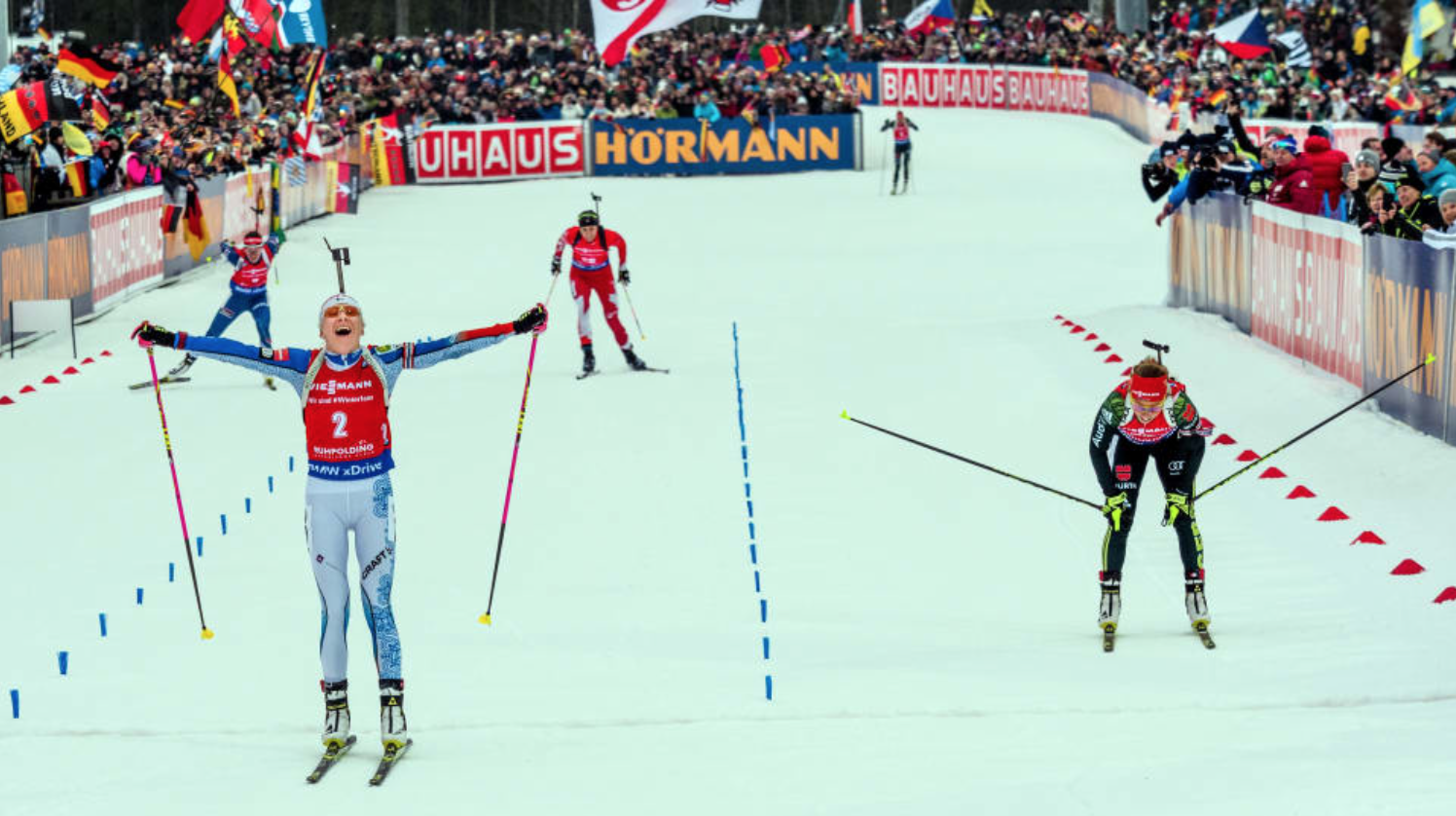
Kaisa Makarainen of Finland celebrates winning the women’s 12.5 k mass start in Ruhpolding, Germany, as Laura Dahlmeier (Germany) is second, Veronica Vitkova (Czech Republic) third, and Rosanna Crawford (Canada) fourth. (Photo: IBU/Biathlonworld)
IBU Biathlon World Cup (Ruhpolding, Germany): 12.5/15 k mass starts
Kaisa Makarainen of Finland took her first win of the season and will start next weekend with the overall World Cup leader’s bib after she outsprinted Germany’s Laura Dahlmeier by 0.8 seconds to claim the win in the 12.5 k mass start. In a tight race for third, Veronica Vitkova of the Czech Republic edged out Rosanna Crawford of Canada for the final spot on the podium; the pair crossed the line 4.6 and 5.2 seconds behind Makarainen. The podium finishers all had two penalties apiece while Crawford shot clean, repeating the 20-for-20 effort that netted her third place and her first-ever podium in the 15 k individual earlier this week. Germany’s Denise Herrmann was sixth, +16.7 seconds, despite four missed targets.
In the men’s 15 k mass start, Norway’s Johannes Thingnes Bø took a win over France’s Martin Fourcade as the pair continue their running battle this season. Bø had one penalty to Fourcade’s two, although that penalty came in the last shooting stage to make things interesting – Fourcade, whose penalties had come in the prior shooting stage, closed to within 4.5 seconds by the finish, but was unable to beat the Norwegian. Antonin Guigonnat, one of the newest members of the French World Cup team, shot 20-for-20 to claim third place and his second podium of the season. In an exciting race, the top nine men all finished within 15 seconds of one another. The sole U.S. entry, Tim Burke, was in the top 15 for much of the race before missing two shots in the final standing shooting stage and finishing 21st, +1:30.2
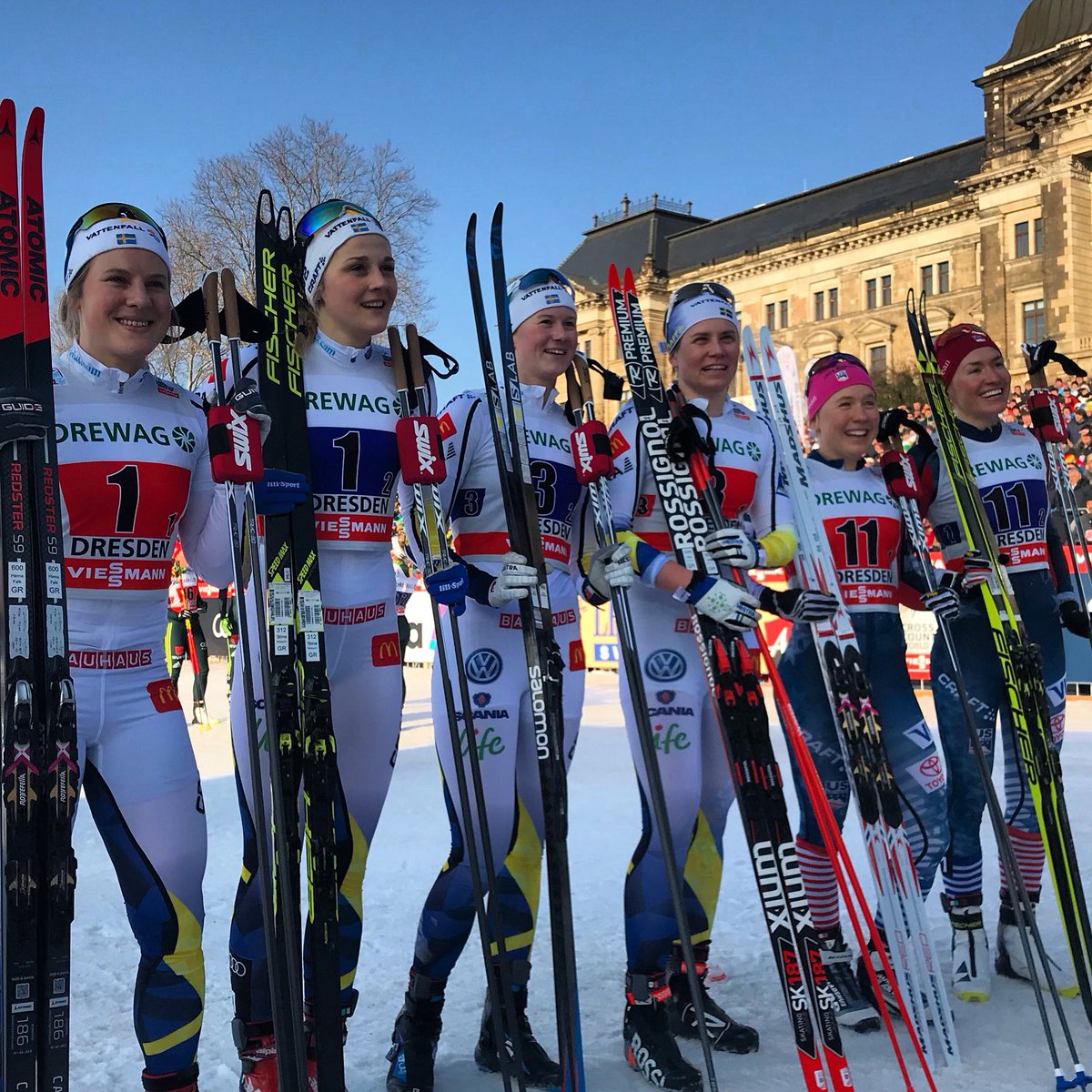
The women’s 6 x 1.2 k freestyle team sprint podium at Sunday’s World Cup in Dresden, Germany, with Sweden II’s Maja Dahlqvist and Ida Ingemarsdotter in first (c), Sweden I’s Hanna Falk and Stina Nilsson in second (l), and USA I’s Ida Sargent and Sophie Caldwell in third (r). (Photo: FIS Cross Country/Twitter)
FIS Cross Country World Cup (Dresden, Germany): 6 x 1.2 k freestyle team sprint
For the second-straight day in Dresden, Sophie Caldwell notched third place and was nearly second with U.S. teammate Ida Sargent on Sunday in the World Cup women’s 1.2-kilometer freestyle team sprint.
The race ended in a three-way fight for first, which Sweden II’s anchor Maja Dahlqvist took by 0.16 seconds over Sweden I’s Stina Nilsson. While the two lunged for the line, Caldwell came on strong to give them a run as well, finishing just 0.23 seconds back in third (after being in a photo finish for second).
Earlier in the day, Sargent and Caldwell had won the second semifinal to advance to the 10-team final. The U.S. Ski Team’s second team, Caitlin Patterson and Kikkan Randall, finished second in that heat, just 0.11 seconds back and advanced as well.
Sweden I won the first semifinal with Hanna Falk (Saturday’s individual skate-sprint winner) and Nilsson. Sweden II finished 0.17 back in second with Ida Ingemarsdotter and Dahlqvist.
In the final, Sweden II’s Ida Ingemarsdotter led through her first two legs before tagging Dahlqvist in third with one lap to go. Meanwhile, Sargent tagged Caldwell in fourth, 0.9 seconds back. On the final lap, with Switzerland, the two Swedish teams, and USA I’s Caldwell skiing together up front, they dropped Switzerland’s Laurien van der Graaff before the finish and went all out for first.
Dahlqvist took it for Sweden II in 13:33.4, Sweden I placed second and USA I third. The same duo of Caldwell and Sargent placed third in the pre-Olympic freestyle team sprint last year in PyeongChang, South Korea. There, Sargent also placed third in a classic sprint for her first World Cup podium. Sunday marked Caldwell’s fourth individual World Cup podium (sixth including team events).
USA II was up to sixth after Randall’s first leg, just 0.5 seconds out of first, and remained 1.8 seconds behind the leaders with two laps to go. On the second-to-last leg, Patterson tagged Randall in ninth, and Randall anchored them to eighth (+7.95).
Germany I finished fourth (+2.11) with Hanna Kolb and Sandra Ringwald, Slovenia was fifth (+4.46) with Alenka Cebasek and Vesna Fabjan, Germany II was sixth (+4.62) with Katharina Hennig and Elisabeth Schicho, and Switzerland seventh (+5.09) with Nadine Fähndrich and van der Graaff.
The men’s 6 x 1.2 k freestyle team sprint podium at Sunday’s World Cup in Dresden, Germany, with Italy’s Dietmar Nöckler and Federico Pellegrino in first (c), Sweden’s Emil Jönsson and Teodor Peterson in second (l) and Russia’s Andrey Krasnov and Gleb Retivykh in third (r). (Photo: FIS Cross Country/Twitter)
In the men’s race, Norway’s Johannes Høsflot Klæbo teamed up with Kasper Stadaas, and the two won their semifinal by 0.26 seconds over Italy’s Dietmar Nöckler and Saturday’s winnerFederico Pellegrino. The U.S. men’s first team of Erik Bjornsen and Simi Hamilton advanced to the final as the last lucky loser in the second semifinal, where they placed fourth, 0.85 seconds behind Russia I’s Andrey Krasnov and Gleb Retivykh in first. Sweden I (Emil Jönsson and Teodor Peterson) and Sweden II (Johan Häggström and Karl-Johan Westberg) also advanced in second and third in that heat.
In the final, which included Great Britain for the first time in team-sprint history (after James Clugnet and Andrew Young clinched the last lucky loser spot in the first semifinal in sixth place), Stadaas set a fast pace on the opening 1.2 k loop. He tagged Klæbo in first, 0.3 seconds ahead of Sweden I, while the U.S. hung in contention 0.9 seconds back in fifth.
Norway continued to lead until Stadaas’s second lap, where Russia’s Krasnov came through the third exchange first, 0.1 ahead of Switzerland’s Jovian Hediger in second. Stadaas tagged Klæbo in fourth, 0.5 seconds back, and Klæbo predictably recovered the lead on the next lap.
After he gave Stadaas a 1.3-second lead at the fourth exchange, Stadaas initially ran with it and extended it significantly. But he ran out of steam on the second half of his last loop and dropped to 10th (last place), 3.7 seconds out of first by the final exchange.
There, Jönsson tagged Peterson in first, 0.9 seconds ahead of Hediger in second. Bjornsen had brought the U.S. to third, 2 seconds back, after leading the chase group in second as they reeled in Stadaas.
On the final lap, Pellegrino came on strong in the last few hundred meters, just as he had done in Saturday’s individual sprint, to take the win for Italy in 12:18.3. Peterson anchored Sweden I to second place, 1 second back, and Russia’s Retivykh took third (+1.2), just ahead of Switzerland’s Roman Schaad in fourth (+1.4).
Hamilton suffered a nasty crash in the middle of the group just before the finish and crossed the line in eighth (+14.2).
Klæbo finished fifth for Norway (+1.9), with Sweden II in sixth (+1.9). Italy II (Stefan Zelger and Giacomo Gabrielli) followed in seventh (+7.3), Great Britain placed ninth (+14.6), and Switzerland II (Erwan Käser and Roman Furger) 10th (+20.9).
This is the last team sprint before a freestyle team sprint is contested at the 2018 PyeongChang Olympics.
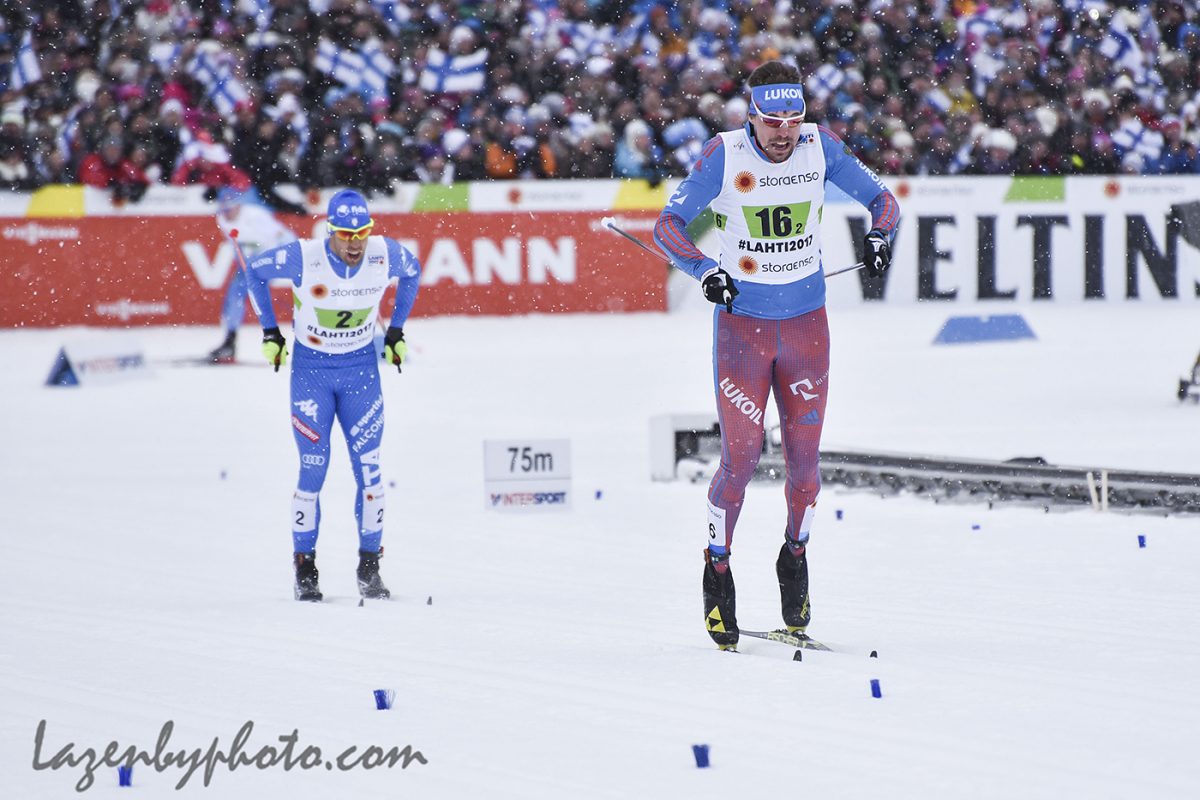
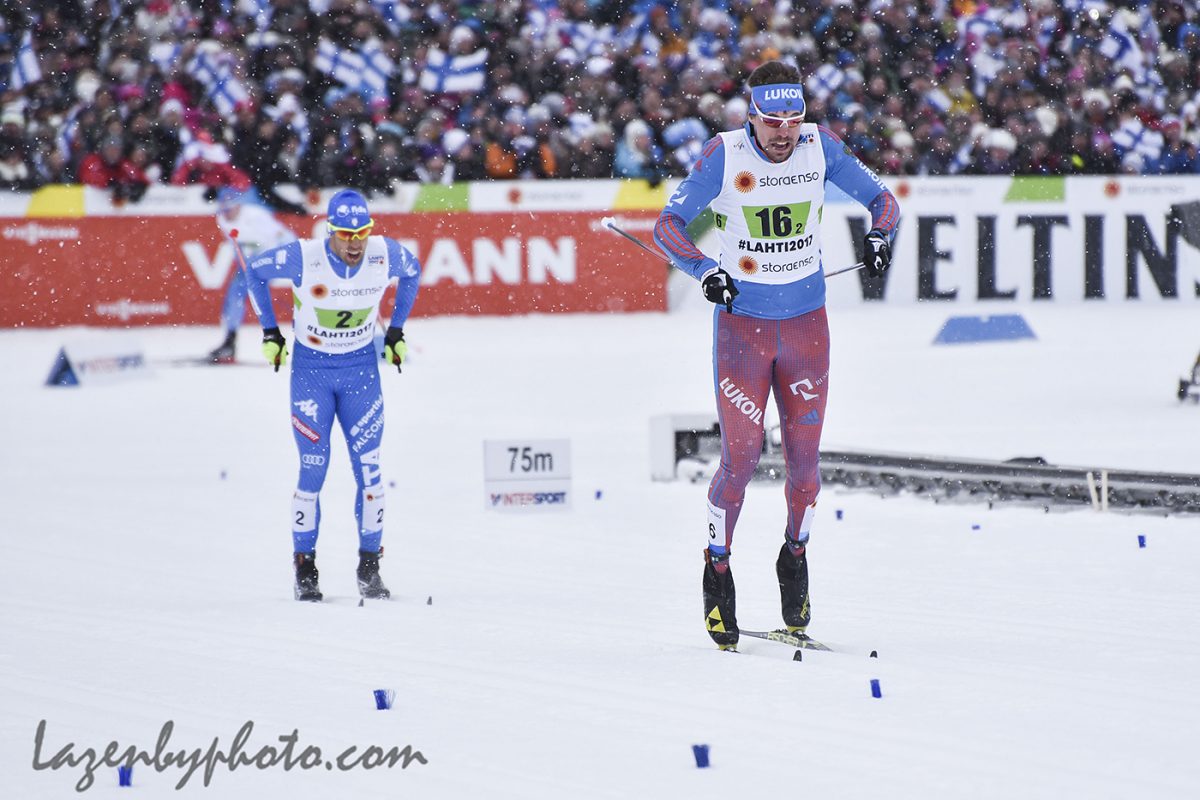
Russia’s Sergey Ustiugov out-duels Italy’s Federico Pellegrino for the men’s classic team sprint gold at 2017 Nordic World Championships on Sunday in Lahti, Finland. (Photo: John Lazenby/Lazenbyphoto.com)
LAHTI, Finland — The breath taken out of a nation.
Throughout the lifetime of a sporting fan, high-stakes races or games offer the chance for seared-into-the-neurons moments, things you remember for an eternity with the distinct recollection of where you were and what you were doing when the news came down.
But those are exceptionally rare moments. And depending on what side of the equation you’re on, they can be mile high or a mile deep. It’s rendered down to the win or the loss.
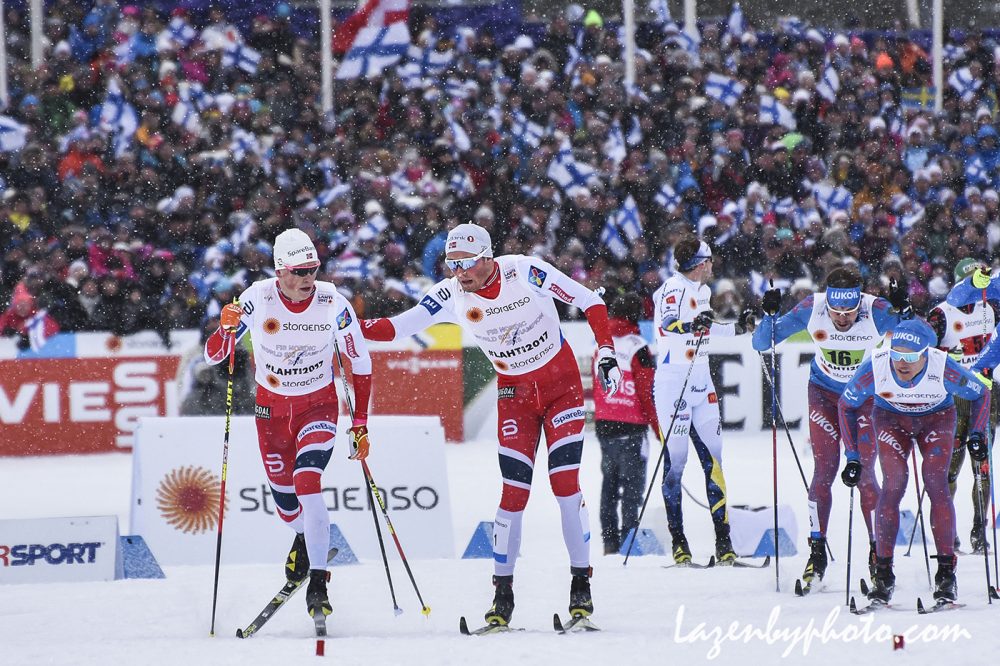
Norway’s Emil Iversen tags teammate Johannes Høsflot Klæbo during the men’s classic team sprint final at the 2017 Nordic World Championships on Sunday in Lahti, Finland. (Photo: John Lazenby/Lazenbyphoto.com)
For much of Sunday’s men’s 6 x 1.3-kilometer classic team sprint at the 2017 Nordic World Championships, it appeared to be a cruiser for team Norway, featuring Johannes Høsflot Klæbo and Emil Iversen. The ending to their gold-medal story seemingly written after the third exchange when Klæbo gifted Iversen and all of Norway a 5.38-second lead over the chasing Finns.
5.38 seconds is a small duration. But when that time gap is illustrated as a distance gap in a sprint, the void looks immense: in this case the distance from Iversen to Finland’s chaser Iivo Niskanen was 45 meters. Even in the best of times, an often too-wide gap to close.
The sprint course features a long but strideable climb right from the stadium’s steps. It then 180’s to the left and hits a steep headwall most skiers herringboned. Then it was a speedy descent into the hairpin known as “Lahti Corner”, and then stadium time — a horseshoe-shaped venue of terraced stands filled to capacity with a mostly Finnish crowd.
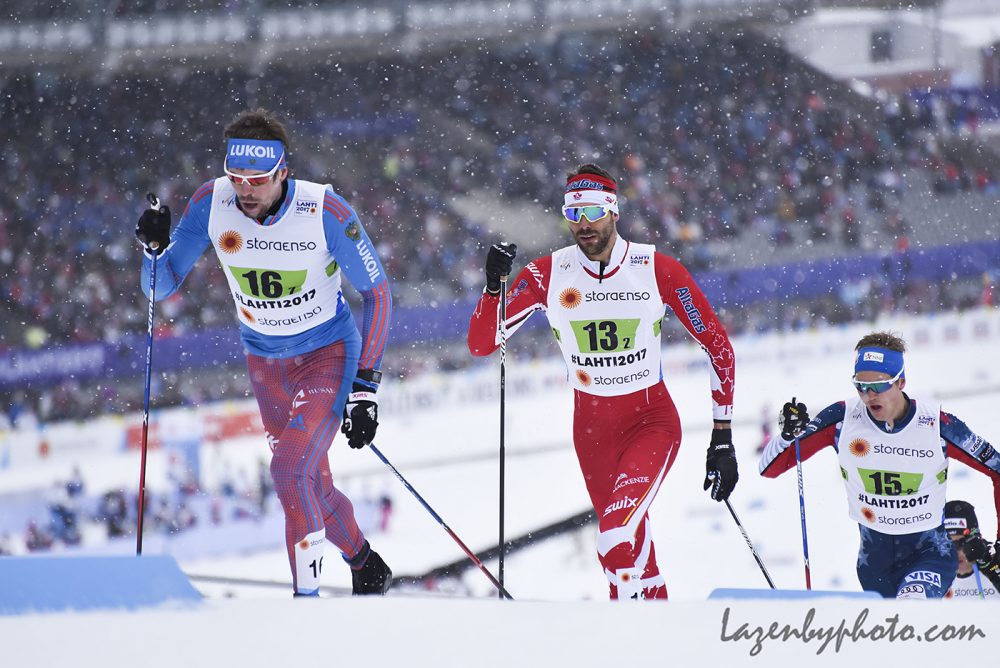
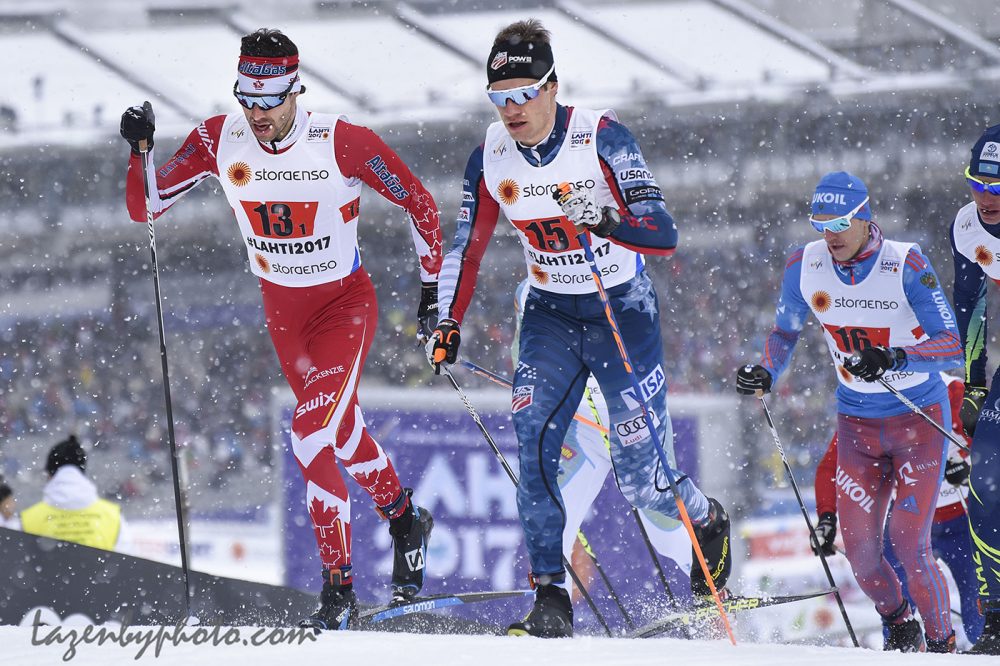
Russia’s Sergey Ustiugov (16) leads Canada’s Lenny Valjas (13) and American Erik Bjornsen (15) in the men’s classic team sprint final at 2017 Nordic World Championships on Sunday in Lahti, Finland. (Photo: John Lazenby/lazenbyphoto.com)
Chasing Iversen, frothing at his heels, were three skiers. There was Niskanen, and right behind him, matching stride for stride were Russia’s Sergey Ustiugov and Italy’s Federico Pellegrino.
As Niskanen worked up the headwall and pushed over the top, he put some meters on Ustiugov and Pellegrino. After a powerful double poling section, Niskanen tipped on the fulcrum into a fast downhill towards Iversen. By “Lahti Corner”, Niskanen had caught the Norwegian.
The Finnish frenzy that ensued was a roar. The crowd had sensed the Niskanen-Iversen link up.
On the glide out from Lahti Corner, a 300-meter straight away, Iversen was set in the third of four tracks. One lane of tracks remained to the left — inside of the Norwegian.
Niskanen, inches away from Iversen’s tails, slotted to his left to pass. There are many perspectives out there, and many depend on which flag you wave, but surely Iversen sensed Norway’s grasp on team gold weaken.
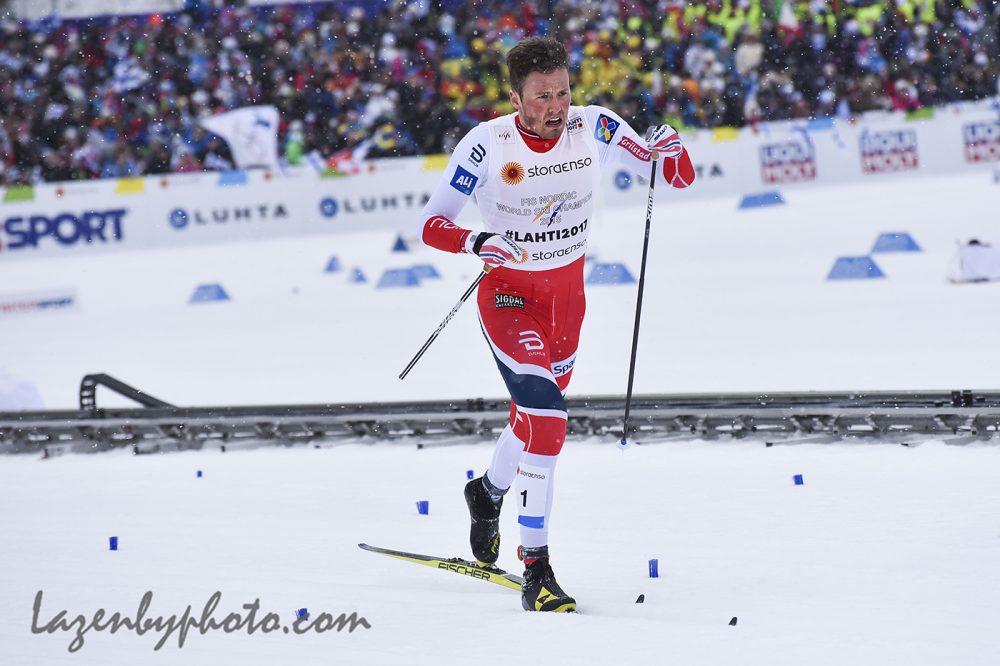
Norway’s Emil Iversen skiing with a broken pole down the finishing stretch after tangling with Finland’s Iivo Niskanen (not shown) 200 meters from the line, which cost Norway gold in the men’s classic team sprint at the 2017 Nordic World Championships in Lahti, Finland. (Photo: John Lazenby/lazenbyphoto.com)
Iversen moved to his left to shut down the Finn and immediately jolted backward as he tangled with Niskanen.
Finland and Norway down. The Finnish cheers snuffed.
In a blink, Ustiugov and Pellegrino zipped passed in what moments before had been a fight for bronze, into a sprint for gold.
Finland’s duo of Sami Jauhojärvi and Niskanen were third (+8.64), Norway fourth (+18.42). The race jury deliberated for a half hour before announcing that neither Norway nor Finland were relegated.
“What can I do at that situation, when I see that my teammate is going to push for the gold, and then happens this unfortunate crash?” Jauhojärvi said during the press conference. “But it’s just a part of sports, and sports is just a small part of life. We need to be happy that we can pick up the medal in front of [a] home audience this evening.“
After crossing the line Niskanen fumed and ranted.
“Yeah, of course straight after the finish line I was very angry, and maybe it wasn’t the most cleverest thing to do with Emil in that last curve,” Niskanen said of his antics. “He lost a medal, and maybe we lost a gold medal. But it’s over now, we are in bronze, and the games are continuing. Just only thing we need to do about this is shaking hands with Emil. We have many years to compete together in the same arenas, and our careers are continuing, and the Lahti ski games are continuing, and we will have good days later.”
A Norwegian journalist asked a pointed question of Niskanen. “Did you expect a rookie mistake from someone like Iversen?” he asked.
“Emil has done many sprints, and maybe that move was the only thing to do if he wanted to fight for the gold medal,” Niskanen said in his response. “He really wanted to win, and we did. I came faster behind him and he changed the line, but… it’s a sprint.“
Answering in English, Kriukov spoke to his lackluster early season results. “This season, yeah, not so good for me and my shape not so best,” he said. “But today I am liking the situation. And lucky for our team and I think there is a reason while our team is first today.”
For Kriukov’s partner Ustiugov, it was his second gold and third medal overall in as many championship races.
U.S. Fifth, Canada Sixth
American Simi Hamilton (16) and Canada’s Alex Harvey (13) racing together ahead of Russia’s Nikita Kriukov (16) in the men’s classic sprint semifinal at the 2017 Nordic World Championships in Lahti, Finland. Both teams reached the final, where the U.S. placed fifth and Canada sixth. (Photo: John Lazenby/lazenbyphoto.com)
U.S. Ski Team members Simi Hamilton and Erik Bjornsen skied to fifth place, 23.58 seconds behind Russia. For much of the race, Hamilton and Bjornsen remained in contact with the main group consisting of the podium countries: Norway, Canada, Germany, and Sweden.
On occasion, Klæbo would try to break the race, but the integrity of the group remained for most of three laps. After the race, when asked how he managed Klæbo’s burst, Hamilton said his was a game of calculated risk.
“I think it goes both ways. It’s one of those courses and one of those races where if you go too hard in the same spot then you’re going to pay for it later” Hamilton said. “But at the same time, you know, we’re at world champs, you have to take chances. I think you’re constantly sort of evaluating that risk versus reward the whole time you’re out there.”
The risks for losing contact were a gassed slog playing catch up; the reward — opportunity. And lap after lap it was either Bjornsen or Hamilton deep in a tuck after rounding “Lahti Corner”, playing in a congested international game once reserved for the traditional nordic-ski nations.
For the 25-year-old Bjornsen, it could have been a day of nerves instead of the calm and power with which he skied. Throughout the race, he posted the fourth- or fifth-fastest splits of the second-leg skiers.
“We haven’t done a lot of team sprints together,” Bjornsen said about his experience teaming up with Hamilton. “The last one was in Sochi. I haven’t done a lot of them recently. So it was great. Going into the finals, it was like, the best teams in the world and the best dudes next to me.”
Bjornsen skied the Americans from eighth into fifth on his second loop, and after Hamilton dropped two places to seventh by the last exchange, Bjornsen again rallied for fifth.
At 29 years old, Hamilton remains humble and a student of continued improvement.
“My classic skiing is still progressing,” Hamilton said. “And for someone like Erik, it comes so naturally for him, he’s such a beautiful classic skier, he’s so efficient. I just focused on putting myself in as much pain as possible to keep contact with that group that I was skiing with. I always have faith in him being able to dig to a place where not many people can dig too in order to come up with that result.”
Erik Bjornsen (U.S. Ski Team) racing in the men’s classic team sprint final at 2017 Nordic World Championships in Lahti, Finland. With teammate Simi Hamilton (not shown), the Americans finished fifth. (Photo: John Lazenby/lazenbyphoto.com)
Heading into the last lap, Hamilton tagged Bjornsen in seventh, 10 seconds back from Russia, Italy and Finland. (After a Klæbo flyer, Norway was 16 seconds ahead of the U.S. as Bjornsen began the final lap.)
“Simi handed off to me in a great spot on the last leg,” Bjornsen reflected. “I was fighting with a few other guys and it was just perfect. Super fun to be with the veteran here.”
“I actually didn’t know that she was on the podium until after [my] race,” Bjornsen admitted. “I was second leg so I showed up pretty late, kind of just when Simi was starting … So I was trying to stay pretty focused. I wasn’t even thinking about the fact – I actually glanced up at one point and saw a replay of her crashing, and so I was a little worried that they weren’t in it. But it was so exciting to see Sadie come up and get a podium here. This is her first race and I know she’s in good shape. It’s great. Nobody deserves it more than she does. I watched her over the years, just so focused and dedicated. There’s a reason she’s so strong.”
Canada was represented by national-team members Alex Harvey and Len Valjas. In January, the duo won the World Cup season’s first team sprint. On paper they still remained a medal contender, in addition Harvey has come into the championships primed. However, Valjas has struggled with a health issue the last few weeks.
“I’m better now, what I think we came to the conclusion with the doctors and everybody, two weeks ago in the gym in Davos I hurt my vertebrae a bit,” Valjas said after the race. “I don’t know how, but it totally affects my breathing, so [at the last World Cup in] Estonia and the sprint here, I felt like I was not able to breathe. The race starts well and I die immediately.”
Valjas said he’s received treatment to alleviate the symptoms. “A couple days ago, I didn’t know if I’d even start because it was really actually hard to take a deep breath,” he elaborated. “It doesn’t feel like much but when you try to go at 100 percent, you cannot keep up and it’s frustrating. So I was just happy that I was able to ski with these guys, but when it got away on that second leg there, trying to catch Iversen kind of pushed me over the limit a bit.”
Harvey initially skied the team into third by the first exchange, just 2.8 seconds out of first, and despite slipping to fifth on Valjas’s first loop, Harvey raced up to second by the third exchange, 4.9 seconds behind Norway. On Valjas’s second loop, he dropped to eighth. Harvey held that position on the second-to last leg and tagged Valjas with the same group containing the U.S. Valjas then picked off two places for sixth place.
“I died a bit in the end, but I still had a lot of confidence in Len’s finish,” Harvey said. “We know in a high-speed finish like that, Len is maybe the best in the world so I was still confident that if I put him in the right situation, we still had a legitimate shot. We still believed in a podium finish and it’s just, you can’t have it every time. But I think it was a big improvement for Lenny, compared to the last two weeks and leading up to the relay.”
The Canadians finished sixth, 27.02 seconds behind Russia and 3.44 seconds behind the U.S., in the final.
Championship racing continues Tuesday with the women’s 10 k classic individual start.
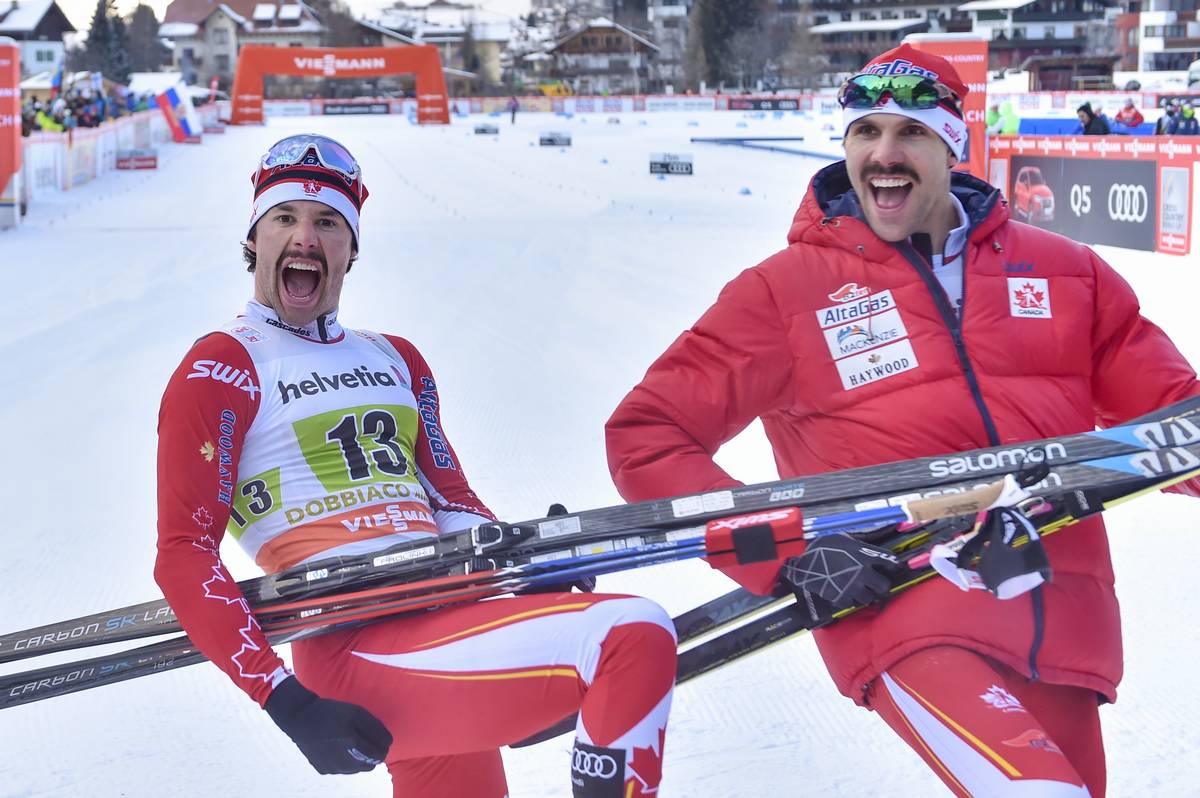
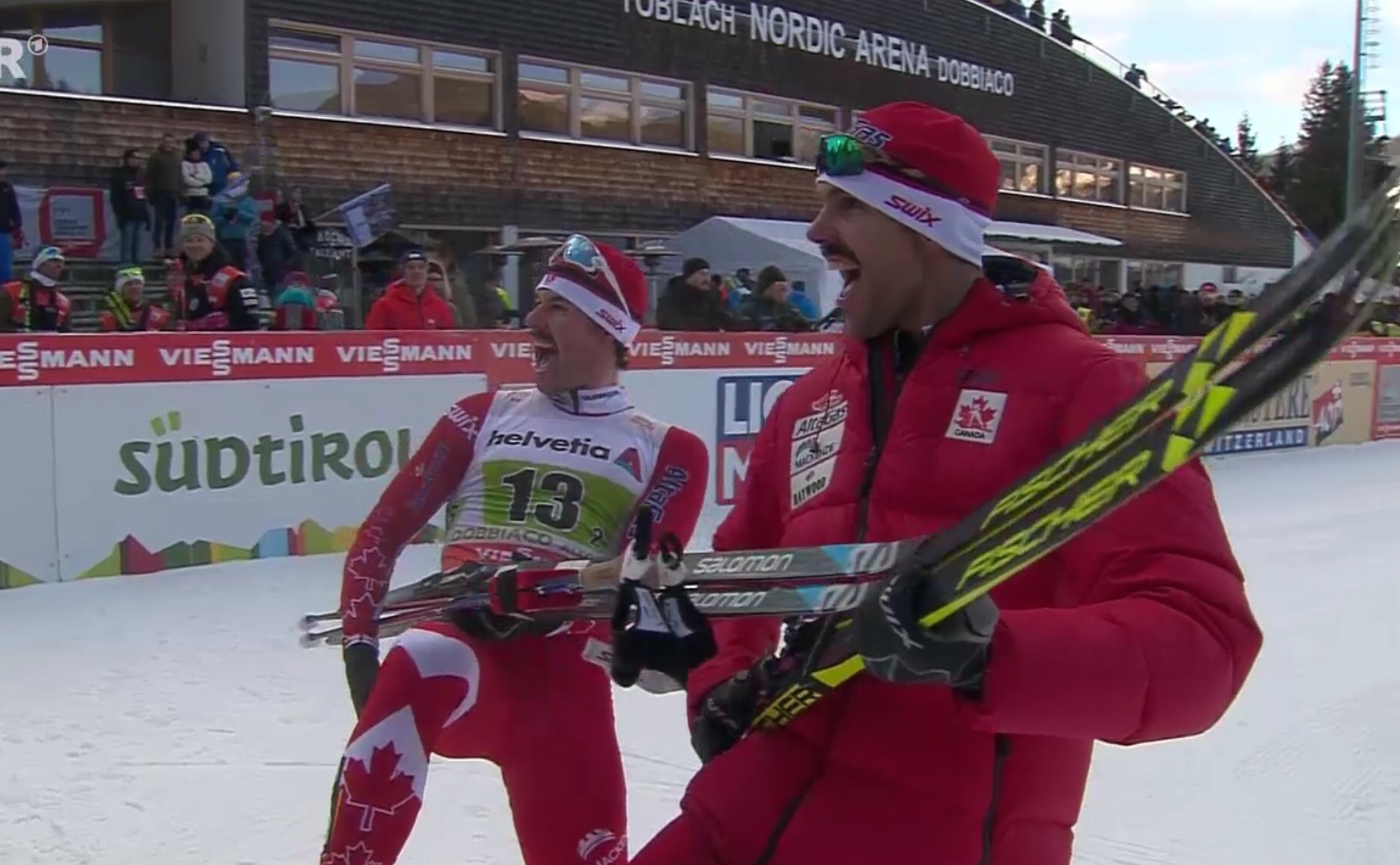
Canada’s Alex Harvey (l) and Len Valjas celebrate their World Cup freestyle team sprint win on Sunday in Toblach, Italy. It was the first team-sprint victory for Canada since 2011 World Championships. (Photo: Salomon/NordicFocus)
It’s been a year since the last World Cup freestyle team sprint. That event went down in Planica, Slovenia. Historically, the men’s skate team sprint has been a revolving door when it comes to the podium’s top step. According to the International Ski Federation (FIS), the last seven World Cup skate team sprints were won by seven different nations.
Add an eighth nation to that list: Canada.
On Sunday in Toblach, Italy, the Canadian duo of Alex Harvey and Len Valjas once again got an opportunity for some grandstanding air-guitar: a celebratory tradition it seems when the Canadians take the win. Harvey and Valjas won the 6 x 1.3-kilometer freestyle team sprint in 16:02.1 minutes. As the times back suggest, no team was able to pull away. Occasionally one nation shot off the front, trying to break the chain of drafting skiers, but that tactic proved fruitless. With Toblach’s undulating draft-friendly course, the chase pack would eventually glide up tight onto the skis of any athlete trying to make a break.
Here’s how the podium rounded out. Sweden I, comprised of Karl-Johan Westberg and Oskar Svensson, placed second (+0.53). Dietmar Nöckler and Federico Pellegrino of Italy I were third (+0.65).
As the times back to Harvey and Valjas suggest, it was a no-margin-for-error race; fourth through 11th place were separated by a little more than three seconds. So after five exchanges, where one skier tags the other for another two-lap 1.3 k leg, the U.S. team, with Simi Hamilton and Andy Newell, were in it: they finished sixth (+2.62).
Harvey + Valjas
Just one week ago, Harvey finished the Tour de Ski in seventh overall, a career best in the annual multi-stage event. And just days ago, Sunday’s win might have been off his radar.
“If you had asked me that two days ago, it’s surprising. I felt really good yesterday,” Harvey explained on the phone Sunday. “My qualification was my best qualification in two years.”
“I had a lot of speed, a lot of punch yesterday,” Harvey added. “Then I was like, ‘OK, maybe we can do something in the team sprint.’ ”
Canada’s Lenny Valjas (in red) en route to his first World Cup victory in the men’s freestyle team sprint in Toblach, Italy. (Photo: Fischer/NordicFocus)
Sunday’s win was the first World Cup victory for Valjas, Harvey’s teammate on the Canadian World Cup A-team. It was also the first win for Harvey and Valjas together in a team sprint. Harvey said the pair came into the day with little on-the-ground practice, but they had discussed their exchanges beforehand.
“We did not practice, actually, but we talked about it,” Harvey said. “Most of the time, after the pre-race meeting, it’s always the same; people say, ‘Don’t stress it. You can’t win the race with the exchange, but you can lose it, if it’s a bad one.’ So, we told each other, ‘Let’s not f- up, but if we can, let’s try and get position in the exchange.’ Like, why not? It’s part of the race.”
The Canadians executed their verbally mapped-out plan: they kept to the back and side of the exchange zone, and efficiently communicated when to accelerate once the tag was made.
“We made it clear what we wanted to do, and what we would say. Like, if I said your name and yell, ‘Go, go, go!’ that means you can go full gas, and I’ll still be able to touch you,” Harvey said of their exchange plan. “That’s half a second here, half a second there, and sometimes it’s two positions, and on a course that’s turny like this, two positions for free is a big difference.”
For Valjas, the victory marked his sixth-career podium on the World Cup. Four of those podiums, including Sunday’s win, came in sprints. His last podium came four years ago.
“This is unreal,” Valjas, 28, told the International Ski Federation (FIS) in a televised, post-race interview. “Honestly, we were hoping for a good result today, but I had no idea it was going to be this good.”
He described Sunday’s race as crowded. For this season, FIS expanded the team sprint finals from 10 to 15 teams.
“The final, there’s a lot of guys who go out,” Valjas explained on the phone. “[We] just kept ourselves out in the top half of the group in the top six or seven. Otherwise you just have so much traffic and it was on my last leg of my final, I got a little boxed in on the big climb, and I was making contact with people’s poles and skis and, instead of trying to make a move and potentially crashing, just doing everything I could to ski smart and to keep my skis off other people’s skis.”
That patience paid off. Other teams led throughout the race, including Sweden II, Norway II, Finland II, Norway I, and France I.
“The goal was to stay close to the front, but never in the lead because there was no point,” Harvey said of the team’s on-course strategy. “You could see the Norwegians on Lenny’s second leg in the final — the two guys gapped the field a little bit. But then it comes back in the downhill, and that surge, it takes it out of you because the recovery is so short in the team sprint, so it’s about positioning yourself in the best way possible while saving energy for the last lap.”
The fifth exchange, when Valjas tagged Harvey for the final leg, it was still early, but maybe time to tune the air guitars.
“I think it was around sixth place when I came around the corner … and out of the exchange. Alex had a great lane on the left, too,” Valjas recalled. He actually tagged off in eighth, but just 2.1 seconds out of first, it was close enough.
“[Alex] made a quick burst leaving the exchange and passed three guys right there and moved into a contending position,” Valjas said.
Respect the power of the mustache: Canadian Alex Harvey celebrates as he anchors his team to a World Cup freestyle team sprint win on Sunday in Toblach, Italy. (Photo: Salomon/NordicFocus)
Harvey was ready to capitalize. Having watched other nations take flyers off the front, he had reserves. Harvey skied the fastest final leg, moving into third at the base of the last climb then leading over the top. It was a risky move, staying in first from the final descent down into the stadium and all the way into the looping finishing stretch. Nobody on Sunday had won from that position before, having become victims of the draft, but Harvey didn’t let that stop him from leading.
“Look at those, look at those,” he said, pointing to his skis when FIS asked how he pulled off the win from that position. “The wax techs did a good job and we had good skis.”
While several teams scurried for the remaining spots on the podium behind him, the Canadian crossed the line looking relaxed and grooming his mustache for the cameras.
“I’m feeling good, but I had a really good teammate,” Harvey told FIS.
With 2017 World Championships beginning late next month, Harvey and Valjas are likely eyeing the classic team sprint there.
“Today was an amazing performance by those two, and I think it’s going to give them a really good boost for the world champs,” Canadian World Cup coach Ivan Babikov said from his home in Canmore, Alberta. “It’s a pretty stacked calendar [at World Championships] especially for Alex, who can be podium potential in every race. He wants to do everything, but sometimes you just have to be smart, and focus on the things he feels strongly about. Lot’s can change with the time, too. We’ll be looking forward to world champs, and try to plan it out perfectly, so enough energy through the whole World Championship.”
Hamilton, Newell in It Until the End
Canada’s Alex Harvey (13) leading American Simi Hamilton (15) among others in the men’s 6 x 1.3 k freestyle team sprint on Sunday at the World Cup in Toblach, Italy. (Photo: Salomon/NordicFocus)
For the U.S. men’s team, Sunday was also a day to unkink and de-rust the team sprint tactics and techniques. Hamilton and Newell combined for fifth in their semifinal, one place behind Valjas and Harvey in fourth in that heat.
Hamilton was coming off a second-place finish in Saturday’s skate sprint. He explained his initial sensations for the day were bland, as he spent over three hours after Saturday’s sprint navigating doping control in a cold, restricted area, absent equipment for a proper warmdown.
Despite feeling sharp in the semifinal, Newell crashed just before the tag zone for the first exchange in the final.
“It was unfortunate that I took an early, hard crash right before the tag zone on my first [leg],” Newell said on the phone. “I was kind of spun like a top and landed right on my butt. I was able to get up pretty fast, and sprint towards the tag zone, but we were still in last.”
Also on that first leg, Newell received a yellow card for obstruction. He explained that he stepped on another racer’s ski on a downhill section of course. The infraction did not cause a crash, but it did give Newell a written reprimand. Accumulating two yellow cards in a season leads to a disqualification (although, according to the FIS rulebook, “Written reprimands given during the season are not valid in the WSC [World Ski Championships] and OWG [Olympic Winter Games] periods. Written reprimands given during WSC or OWG are valid until the end of the season.”)
After that initial tag, Hamilton gunned it. He skied the fastest second leg, keeping the team from losing ground. Newell and Hamilton kept in the hunt, conserving energy, maybe losing a spot here, then gaining two there. Hamilton tagged Newell in 12th.
“My right glute took a hard hit, and it wasn’t a super-easy course to pass on either, so I think we spent some energy trying to get around people, but even still, we were right in it by the last lap,” Newell said.
Despite the spill or less-than-perfect exchanges, the U.S. was never out of it. Hamilton brought them into ninth and 4.2 seconds out of first after the fourth of six legs, and Newell slipped back slightly to 11th, just 4.5 seconds back. Finally, Hamilton’s second-fastest final leg time put them in sixth at the finish.
“We are both quick on our feet and we’re adaptable and we figure things out like that pretty quickly, but I think, for sure, we will spend some time just working on our tags to make them a little more crisp,” Hamilton said on the phone. “At the same time, you can’t dial in just one way you are planning on doing things in the future because things are constantly changing. You never know if the race is going to be at a pretty ‘pedestrian’ pace off the bat and you might be tagging in the very front of the pack, or if it is a really hot pace, you might be closer to the back. You just have to change things on the fly a little bit. I think that is something that we are both really good at, just being able to adapt to kind of a changing environment.”
The shifting nature of this race, when most teams at one point either seemed way out of it or right in it, was the type of changing environment Hamilton referred to.
The next team sprint prior to World Championships will take place Feb. 5 at the World Cup in PyeongChang, South Korea. Hamilton and Newell plan on contesting that event.
Russia’s Matveeva 2-2 in Toblach; U.S. Women 10th
On the women’s side, race organizers were most likely thankful for modern technology: after the teams of two raced their shares of the 6 x 1.3 k team-sprint pie, a hypersensitive camera was needed to determine the winner. It was a three-way photo finish.
Russia’s Natalia Matveeva (r) winning a three-way photo finish for first in the women’s freestyle team sprint on Sunday in Toblach, Italy, ahead of Sweden’s Hanna Falk (second from l, in white), who placed second (+0.04), and Norway’s Maiken Caspersen Falla (second from r), who ended up third (+0.11), respectively. Germany’s Sandra Ringwald (l) finished fourth. (Photo: Fischer/NordicFocus)
Team Russia I’s Yulia Belorukova and Natalia Matveeva won in a time of 18:00.96, after Matveeva repeated her tactics from Saturday’s individual sprint to come from behind in the finishing stretch.
Just like on Saturday, she followed Norway’s Maiken Caspersen Falla up the last climb and trailed her closely on the descent. Between them on Sunday, Sweden’s Hanna Falk drafted Falla while skiing in second on the downhill, then went wide on the curve to challenge her over the last 100 meters. Matveeva took the inside line around the turn and snuck up on the other side of Falla. Upon close review, the final results revealed that Matveeva captured the win — her second in two days — by 0.04 seconds over Falk in second, and Falla settled for third (+0.11).
“Today I was definitely not world-class level,” a disappointed Falla said, according to a FIS press release. “I have a strong competitive instinct so this loss really irritates me.”
For Matveeva, it was the beginning of a winning streak, and for her teammate Belorukova, a U23 skier, it was her first World Cup podium.
“It was an amazing weekend in Toblach,” the 30-year-old Matveeva said, according to FIS. “To leave with two wins is great. Yulia did a great job in her leg, and I had a lot of confidence from yesterday I could be again fast on the home stretch. To win with my teammate is really special.”
Falk teamed up with Ida Ingemarsdotter for Sweden I, while Falla combined with Astrid Uhrenholdt Jacobsen for third.
“It was a good day at work,” Ingemarsdotter said, according to FIS. “We raced well and this was a big step in the right direction for the upcoming competitions.”
Canada did not enter a women’s team, and the U.S. team of Sophie Caldwell and Kikkan Randall placed 10th (+20.63).
In an email, U.S. skier Caldwell mentioned it was a grind.
“While I always love the opportunity to do a team event, I think I was running on fumes today,” Caldwell wrote. “The semifinal went well, but I didn’t have too much left in me for the final, so was bleeding some time on pretty much all parts of the course.”
Russia’s Natalia Matveeva (l) and Yulia Belorukova celebrating Belorukova’s first World Cup victory and Matveeva’s second-straight win after Sunday’s freestyle team sprint in Toblach, Italy. (Photo: Fischer/NordicFocus)
According to the email, Caldwell went to the hospital last Monday with a “stomach bug”.
“I’m looking forward to getting in some solid training and focusing on eating back the energy I lost earlier this week from being sick. It’s a bummer to have a bad race, especially in a team event, but all I can do is look ahead and try to put this one behind me,” she wrote.
Caldwell placed 11th in Saturday’s sprint, following Randall in 10th.
In their semifinal, the duo raced to third to secure a spot in the final.
“With 15 teams in the final it was pretty busy those first few laps,” Randall wrote in an email. “I just tried to stay relaxed in the pack on my first round. On the second round I tried to move up but it was really hard to find space to get around. I was always able to make up a few places coming off the last turn before the tag zone. But the tag zone was always really chaotic. Matveeva almost took Sophie out on the 2nd tag.”
On her second leg, Randall skied the fastest split and was a handful of seconds back from the lead as she tagged Caldwell.
“We were still right with the lead group going into Sophie’s last lap,” Randall wrote. “Sophie laid it out there up the first climb, but I think the effort caught up with her and we lost touch with the leaders before the last tag. I was able to chase a few teams down to get us into the top 10.”
Like others, Randall is eyeing the World Championships team sprint.
“World Championships this year will be classic so it could play out a little differently than today,” Randall wrote when asked what the U.S. will be looking to improve on in the team sprint. “We just need more durability so we can stay in the fight all the way until the last round and then I think we have several finishers on this team that could be in the hunt for a podium.”
Canada’s Alex Harvey (l) and Len Valjas celebrate their World Cup freestyle team sprint win on Sunday in Toblach, Italy. (Photo: WDR/ARD broadcast screenshot)
FIS Cross-Country World Cup (Toblach, Italy): Freestyle team sprint
The Canadians pulled the upset on Sunday in the first team sprint of the season, coming from eighth place and 2.1 seconds back at the last exchange to take the win in the men’s 6 x 1.3-kilometer freestyle team sprint final in Toblach, Italy.
For Len Valjas, it was his first World Cup victory and first time back on the podium in four years. For Alex Harvey, the team’s anchor leg who secured the 0.5-second win over Sweden’s Oskar Svensson, it was a flashback to his team-sprint gold (with teammate Devon Kershaw) at 2011 World Championships. He hadn’t reached the podium in a team sprint since.
“This is unreal,” Valjas, a 28-year-old member of Canada’s World Cup A-team, told the International Ski Federation (FIS) in a televised interview. “Honestly, we were hoping for a good result today, but I had no idea it was going to be this good.”
Harvey did the unthinkable on Sunday, taking the lead on the last climb and into the downhill before the finish. In the preceding women’s team-sprint final and throughout the semifinals earlier in the day, no one had won the race by leading into that downhill. Harvey changed that, surging from third at the base to first by the top, ahead of Sweden’s Svensson and Italy’s Federico Pellegrino.
As he rounded the final lefthand corner into the finishing straight in first, Harvey unleashed one last push to distance himself from his competitors, crossing the line in 16:02.1. Svensson (who teamed up with Karl-Johan Westberg for Sweden I) followed him in second (+0.5), just ahead of Pellegrino (who teamed up with Dietmar Nöckler for Italy I) in third (+0.6).
“I’m feeling good, but I had a really good teammate,” Harvey told FIS. “We said we needed to stay near the front and try to have a good exchange. … People say, ‘Oh, you can’t win the race in the exchange, you can only mess up,’ but today we were moving really well in the exchange and that put me in a great position for the last lap.”
Despite leading for much of the six-leg, 12-lap race, Norway missed the podium with Norway II (Håvard Solås Taugbøl/Pål Golberg) in fourth (+1.1) and Norway I (Sindre Bjørnestad Skar/Johannes Høsflot Klæbo) in fifth (+1.9).
The U.S. men, Andy Newell and Simi Hamilton, placed sixth (+2.6), after Hamilton came on strong on his final lap to overtake both Russian teams and France, among others, after starting the last leg in 11th and 4.5 seconds out of first.
In the women’s 6 x 1.3 k freestyle-sprint final, Russia’s Natalia Matveeva notched her second-straight victory, beating Norway’s Maiken Caspersen Falla and Sweden’s Hanna Falk down the finishing stretch after Falla led up and over the final climb. Matveeva finished in 18:00.9 for Russia I, teaming up with Yulia Belorukova for the win after a three-way photo finish for first. Sweden I’s Falk (who teamed up with Ida Ingemarsdotter) edged Falla by seven-hundreths of a second for second place (+0.04), and Norway I (Falla and Astrid Uhrenholdt Jacobsen) placed third (+0.11).
The U.S. women’s team, Sophie Caldwell and Kikkan Randall, reached the final and ended up 10th (+20.6), with Randall moving up from 14th at the final exchange.
The start of the women’s freestyle team sprint final, with (from left to right) American Ida Sargent, Slovenia Vesna Fabjan, Sweden’s Ida Ingemarsdotter, Norway’s Heidi Weng, Germany’s Sandra Ringwald, Slovenia’s Nika Razinger, Germany’s Laura Gimmler, Sweden’s Jonna Sundling, and Norway’s Mari Eide at the World Cup in Planica, Slovenia. (Photo: Fischer/NordicFocus)
The team sprint is a unique beast that World Cup racers only get one or two shots in a season to tame. Despite strong skiing, the U.S. men’s and women’s team came up just short of being in podium contention in the 6 x 1.2-kilometer freestyle team sprint at Sunday’s World Cup in Planica, Slovenia.
The format of the team sprint competition features two-skier teams who each race alternating legs of a sprint course. Each skier completes three legs and they must make contact with their teammate in the exchange zone between each leg. The Planica team sprints were held on the same fast, twisty and technically-challenging 1.2 k course as Saturday’s freestyle sprint.
The format poses unique challenges for athletes as well as logistical challenge for the staff. For the athletes racing three separate legs, it is a challenge of measuring energy output to be ready for the decisive moves in the last lap. The technicians have their own race in between heats to work on skis.
American Sophie Caldwell (c) and Sweden’s Stina Nilsson (r) trail Germany’s Hanna Kolb during the women’s freestyle team sprint final at the World Cup in Planica, Slovenia. (Photo: Fischer/NordicFocus)
“One of the challenges is we don’t get a chance to race this event very often,” head coach Chris Grover said on the phone after Sunday’s race, in which two of three U.S. teams qualified for the final. “We are doing the only team sprint out of 37 starts [this season], so it is a very rare format.
“It is really fun for the athletes and the staff. It is so logistically intense in terms of ski prep,” he added. “It is a race to get the skis off the athletes’ feet, freshened up, and back on their feet.”
Grover noted the course was shorter than typically used in team sprints (it took the men about 2 1/2 minutes and the women 2:45 to round each time on Sunday.
“Because of that short window, it makes for an extremely hectic time for the techs,” he said. “But our techs did an awesome job and we had great skis.”
The U.S. entered one women’s team (with most of its athletes taking the weekend off following the Tour de Ski); Ida Sargent and Sophie Caldwell teamed up to take fifth in the final, 20.57 seconds behind Sweden I, with Stina Nilsson and Ida Ingemarsdotter, who won the event in 16:14.08. Norway I (Heidi Weng/Astrid Uhrenholdt Jacobsen) placed second (+3:51) and Germany I (Sandra Ringwald/Hanna Kolb) took third (+8.84).
Ida Sargent (U.S. Ski Team) teamed up with Sophie Caldwell (not shown) to place fifth in the 6 x 1.2 k freestyle team sprint at the World Cup in Planica, Slovenia. (Photo: Madshus/NordicFocus)
Sargent and Caldwell delivered a well-executed semifinal to automatically advance in second place behind Sweden I, the eventual winners. In the team sprint racing, the top two teams advance in both semifinals, in addition to six lucky loser qualifiers.
“Ida learned from yesterday how to pace the course and made a great move at the end of her last leg and tagged off in first,” Grover said of the semifinal. “Sophie brought it in easily in second to advance.”
In the final, the field broke apart during the third leg when Weng began pushing the pace. Sweden and Germany responded, but Sargent lost time on the leaders. By the final handoff, the U.S. had slipped several places to sixth, 13 seconds behind the leaders.
At the final handoff, Sargent tagged Caldwell in sixth, 13 seconds behind the leaders, for the finishing charge. Caldwell was able to catch Norway II and hold off Germany II to secure fifth place, 20.57 seconds behind the Swedish winners.
“Those top women’s teams just skied away. They [Sargent and Caldwell] actually skied great all day and did tactically what they wanted to do,” Grover said.
“It ties my best-ever team sprint result and is my best ever with Sophie so it was a good day,” Sargent said on the phone. “The course was really hard with lots of climbing and fast technical downhills so there wasn’t much recovery and it was important to balance pushing the pace and conserving energy for later rounds.”
Newell and Hamilton Miss the Tag
Andy Newell (in white) rounds a corner with Germany’s Thomas Bing (l), Italy’s Dietmar Noeckler (r) during the World Cup men’s freestyle team sprint final in Planica, Slovenia.
The men’s team of Andy Newell and Simi Hamilton made it to the final after advancing in fourth out of the first semifinal (behind the second teams for France, Russia and Norway, respectively). In the final, the Americans initially finished eighth, but were disqualified for missing a tag in the exchange zone.
The men’s field remained tight throughout the final, making the exchange zone both challenging and game-changing.
The U.S. men’s team ran into trouble when Hamilton entered a chaotic tag zone after his first leg for the second exchange.
“It was basically unavoidable since the Norwegian, who was tagged right before I reached out to tag Andy, cut to the left and skied right between Andy and I, essentially creating a barrier,” Hamilton said on the phone. “We were tagging towards the end of the zone, so we didn’t have room to stop to ensure we made contact, even though both of us stretched as best we could.”
They emerged out of second exchange in eighth, 2 seconds behind Norway II in the lead. One lap later, by the third exchange, they were 3.22 seconds back in ninth.
Unsure whether the jury would rule an infraction, Newell and Hamilton continued to race. They finished eighth, less than six seconds off the podium. Italy I took the win with Dietmar Nöckler and Federico Pellegrino in 14:44.82, and France swept the remaining podium spots in second (+1.79) and third (+2.41), with Renaud Jay/Baptiste Gros and Valentin Chauvin/Richard Jouve, respectively. The first teams for Germany, Norway and Russia ended up fourth, fifth and sixth, respectively, and the top eight teams at the end of the day — not counting the Americans — all finished within nine seconds of one another.
(From right to left) Italy’s Dietmar Nöckler leads Norway II’s Ola Vigen Hattestad, American Andy Newell, and Norway I’s Anders Gløersen and a Russian in the men’s freestyle team sprint final at the World Cup in Planica, Slovenia. (Photo: Fischer/NordicFocus)
“It was disappointing for sure, but it was a good call by the jury,” Grover said. “Andy and Simi have done a lot of team sprints together and tags are such a critical part of the team sprint. Andy and Simi are usually some of the very best at maintaining speed and having really good tags in chaotic situations, but today they just missed it.”
Reflecting on their semifinal, in which they advanced as lucky losers, Newell was pleased with how he balanced his energy.
“I was able to stay up near the front with Norway, stay out of trouble, and put down a hard third lap tagging Simi in second,” Newell said on the phone. “In the final I don’t think we found the same rhythm, at least I hard a harder time feeling the line of hard versus too hard. We got bounced around a bit in the back and our tags weren’t as smooth as in the semi. It’s easy to waste energy even just trying to pick off a few places can take it out of you each lap when you are coming from the back.”
Considering the circumstances, Hamilton was content with the day.
“I felt good today, and my speed and shape are rebounding after getting sick during the Tour de Ski,” he said.
“Team sprinting is one of the hardest race formats we have, but it super fun,” Hamilton added. “It combines the best of sprinting and distance racing I think, and I hope we see more of it, or events similar to it, in the future.”
This was the first and only team sprint on the World Cup calendar this season.
(Story continues below)
(From left to right) Italy’s Federico Pellegrino, American Simi Hamilton, Germany’s Sebastian Eisenlauer, Russia’s Alexey Petukhov, and Dusan Kozisek of the Czech Republic during the men’s freestyle team sprint final at the World Cup in Planica, Slovenia. (Photo: Fischer/NordicFocus)
Also competing for the U.S. was the second men’s team of Dakota Blackhorse-von Jess and Reese Hanneman. They finished 12th in the same semifinal as Newell and Hamilton, 51.08 seconds behind France II (Chauvin and Jouve) as the winner of that heat. Blackhorse-von Jess and Hanneman did not advance and ended up 23rd overall.
“For Dakota and I, it was just a chance to get right in the big pack of the fastest guys in the world and see what we could do,” Hanneman wrote in an email. “No amount of preparation could really prepare you for the chaos that happens at breakneck speed out there.”
“I think they were both left wanting more,” Grover said. “They are going to need some time in Europe to get get acclimated some good training and racing and hopefully come into their top form.”
The weekend following the Tour de Ski can be rough on teams and the U.S. team is feeling the effects.
“It was a little bit of a flat weekend overall for us,” Grover observed. “We are certainly feeling the effects of post-Tour de Ski fatigue, both physical and mental, and we have a bit of illness going around the team so all of these things added up to take our edge off a bit, but I think we’ll be back by next weekend.”
‘Good save Canada!’
Four Canadian teams raced Sunday, but none advanced out of the semifinals. Canada’s second women’s team, with Cendrine Browne and Emily Nishikawa, placed eighth in the second women’s semifinal, 55.64 seconds behind Sweden I as the winners of that heat, for 15th overall.
Emily Nishikawa (above) teamed up with Cendrine Browne (not shown) to represent Canada II in the women’s World Cup freestyle team sprint on Sunday in Planica, Slovenia. They placed eighth in the semifinal for 15th overall. (Photo: Fischer/NordicFocus)
In that same semi, Canada I, with Maya MacIsaac-Jones and Dahria Beatty, finished 10th (+1:06.39) for 19th overall.
“I focussed on staying with the pack as long as possible,” Browne, Canada II’s first starter, recalled in an email. “I managed to stay with them on the first lap but on my second lap, we were already a couple seconds back.
“The down hills are pretty sketchy … I almost fell today but catched myself at the last second!” she added. “The jury even told me: Good save Canada!”
“The women fought hard, but it will take some more racing at that level to get used to the speed,” Alberta World Cup Academy head coach Chris Jeffries, who’s leading the Canadian team in Slovenia, said in a Cross Country Canada press release. “These World Cups are definitely focused on development, and hopefully they will take some really good lessons to their training in preparation for the Ski Tour Canada races in March and the coming years.”
Both Canadian men’s teams squared off in the second semifinal, with Knute Johnsgaard and Len Valjas placing ninth for Canada I (+13.23) for 16th overall, and Jess Cockney and Andy Shields finishing 12th for Canada II (+23.85) for 22nd overall.
Stina Nilsson smiles as she secures the win for Sweden with teammate Ida Ingemarsdotter (not shown) in the women’s freestyle team sprint final at the World Cup in Planica, Slovenia. She beat Norway’s Astrid Jacobsen (behind) for the victory. (Photo: Fischer/NordicFocus)
Groundhog Day. That was the feel of Sunday’s 6 x 1.2-kilometer freestyle team sprints at the World Cup in Planica, Slovenia, a day after Sweden’s Stina Nilsson and Italy’s Federico Pellegrino won the individual freestyle sprints on the same one-lap 1.2 k course.
The women’s team sprint came down to the final climb on the last leg — just like in the last round of the individual women’s sprint on Saturday. Trailing a Norwegian on the last descent and into the base of the climb back up to the stadium (yesterday it was Ingvild Flugstad Østberg; today it was Astrid Uhrenholdt Jacobsen), Nilsson carried her speed to pull up alongside and blow past the Norwegian, leading by the top.
Look familiar? That’s because it is. Sweden’s Stina Nilsson notched her second-straight victory of the World Cup weekend in Planica, Slovenia, on Sunday, anchoring Sweden I to the freestyle team sprint win. (Photo: Fischer/NordicFocus)
The 22-year-old Nilsson, both U23 and Sprint World Cup leader, continued to accelerate in the last 200 hundred meters to the finish, winning in 3.51 seconds for her second victory of the weekend. Nilsson shared it with Ida Ingemarsdotter, 30, teammates on Sweden’s first team (noted as Sweden I).
“We had a great day as a team. You could say we are a good couple,” Nilsson told FIS after the race. “Ida did a great work. In the final lap I was in a good position and I could ski as I wanted. I am very satisfied with the weekend in Planica.”
After sharing the podium with Nilsson on Saturday, Heidi Weng and Jacobsen teamed up for Norway I and finished second after leading at every exchange, just ahead of the Swedes. Nilsson and Ingemarsdotter had won their semifinal (ahead of Americans Ida Sargent and Sophie Caldwell in second) to automatically advance to the final, and Weng and Jacobsen won the other semifinal.
“This is better than third, but not good enough tactically to win,” Jacobsen told VG after the final, according to a translation. “Towards the end Stina had a gear that I had not.”
After nine of 10 teams skied within four seconds of the lead through the first two exchanges, Weng picked up the tempo on her second leg (third overall), and Ingemarsdotter and Germany’s I’s Sandra Ringwald stuck closest to her. Meanwhile, Sweden II slipped about 1.5 seconds off the pace in fourth, while the U.S., with Ida Sargent and Sophie Caldwell, skied in fifth (+4.46) at the third exchange — the halfway point.
One lap later, Jacobsen and Nilsson remained close, about half a second ahead of Sweden II’s Hanna Falk in third. Germany’s I’s Hanna Kolb came through the exchange a second later in fourth. By the final exchange, Weng and Ingemarsdotter had gapped Germany’s Ringwald, skiing in third, by 2 1/2 seconds.
“I knew Weng would run hard, especially in the second and third lap and am happy that I could latch on to and give Stina a good position,” Ingemarsdotter told Dagens Nyheter, according to a translation.
“Ida made it perfect. I just got the position I wanted,” Nilsson said.
Germany’s first team hung onto third and secured third, 8.84 seconds behind Sweden and 5.33 seconds behind Norway, for their first podium in almost two years.
“My attack came maybe a little too early, but it was the plan, and maybe that didn’t totally work out because I folded a little in the end,” Ringwald told German TV broadcaster ZDF. “But the three of us were able to create a gap, and so we are satisfied with the third place.”
“I am really relieved, because we knew we had a gigantic chance today and that we had to grasp it,” Kolb said. “Just a great feeling.”
Last season, Nilsson and Ingemarsdotter won the only team sprint on the schedule — also freestyle technique — in Otepää, Estonia. There, they beat Norway’s Maiken Caspersen Falla and Østberg by 0.85 seconds, and Poland’s Justyna Kowalczyk and Sylwia Jaskowiec finished 0.95 seconds back in third.
Falla and Østberg rested on Sunday, while Mari Eide and Kathrine Rolsted Harsem represented Norway II. Fourth through seventh were separated by 2.77 seconds, with Falk (Sweden II) leading the chase group in for fourth (+18.24), followed by Caldwell in fifth (+20.57).
Germany II’s Lucia Anger edged Harsem in a photo finish for sixth by 0.01 seconds, 21 seconds behind the winners. Two Slovenian teams reached the final, placing eighth (+47.24) and 10th (+2:42.12), while Italy finished ninth (+55.98).
(Story continues below)
The men’s freestyle team sprint podium at the World Cup in Planica, Slovenia: with Italian winners Federico Pellegrino and Dietmar Nöckler (c), France I’s Renaud Jay and Baptiste Gros (l) in second, and France II’s Richard Jouve, age 21, and Valentin Chauvin, age 20, (r) in third. Yes, Gros is holding a chainsaw — a chain-free noisemaker borrowed from spectators. (Photo: Fischer/NordicFocus)
Italy, France, France
Minutes after the women’s final, the men’s final played out to produce the identical winner to Saturday’s sprint — Italy’s Federico Pellegrino — who essentially pulled off the same move as Nilsson, not long after she anchored the Swedish women to the win in 16:14.08. Pellegrino anchored Italy’s first team (with teammate Dietmar Nöckler) to the win in 14:44.82.
In yet another repeat, France occupied the remaining spots on the podium in the men’s race. Renaud Jay of France’s first team led five frontrunners into the exchange zone for the last time, with France I, Germany I, Italy I, Russia I, and Norway I all within a second of one another.
On the next lap, Jay’s teammate Baptiste Gros set a blistering pace and Pellegrino chased him up the longest climb on the course. There, they began to break away from Germany and France’s second team, and Gros continued to lead up the final ascent.
On that climb, Pellegrino pulled a “Nilsson,” so to speak, as he carried his momentum from the downhill draft to pass Gros before the top. The 25-year-old Pellegrino, who became Italy’s winningest Italian male skier of all time on Saturday with his seventh individual World Cup win, added another victory to his resume as he skated away toward the finish, looking back a few strides before and winning in 1.79 seconds.
(From right to left) Italy’s Dietmar Nöckler leads Norway II’s Ola Vigen Hattestad, American Andy Newell, and Norway I’s Anders Gløersen and a Russian in the men’s freestyle team sprint final at the World Cup in Planica, Slovenia. (Photo: Fischer/NordicFocus)
France I’s Jay and Gros place second, and France II, with 20-year-old Valentin Chauvin and Richard Jouve, 21, held off Germany for third (+2.41).
Germany I, with Thomas Bing and Sebastian Eisenlauer, notched fourth (+2.93). Norway missed the podium for the second-straight men’s race with Norway I’s Anders Gløersen and Eirik Brandsdal in fifth (+4.51) and Norway II’s Ola Vigen Hattestad and Pål Golberg in seventh (+7.66), behind Russia’s Gleb Retivykh and Alexey Petukhov in sixth (+6.46).
Americans Andy Newell and Simi Hamilton crossed the finish line in eighth, but were disqualified for missing the tag in the zone on the second exchange.
Early in the race, Gløersen led though the first exchange to give Norway I an early lead, but they slipped to sixth with Brandsdal on the next leg, 1.3 seconds behind Norway II in first. Hattestad had brought Norway II into the lead, and by the fourth exchange, his teammate Golberg remained third, within half a second of Pellegrino and Gros. One lap later, Norway I and II came through the last exchange in fifth and sixth, 1 and 2 seconds out, respectively.
Norwegian commentators were quick to call Sunday’s final another instance of the Norwegians being “outclassed,” pointing out that six Norwegians occupy the top seven in the men’s overall World Cup standings. In the sprint standings, Pellegrino leads Norway’s Sondre Turvoll Fossli by nearly 200 points. Finn Hågen Krogh ranks fourth and Petter Northug is the third Norwegian in the top six.
Italian teammates Federico Pellegrino (l) and Dietmar Nöckler after winning Sunday’s World Cup freestyle team sprint in Planica, Slovenia.
“I realized a dream I had at a very young age,” Pellegrino told Italy’s La Gazzetta after Sunday’s win, according to translation. It was apparently Italy’s first team-sprint win since the women won in 2010 in Düsseldorf, Germany.
“In my early years of the World Cup, one of my first trips to the World Cup was in Düsseldorf, where they scheduled just a sprint and team sprint,” he added. “Seeing champions such [Italy’s Arianna] Follis and [Norway’s] Hattestad that could make a perfect weekend lit my imagination. I wondered if I could ever do it.”
For Nöckler, 27, it was his first World Cup win.
“I did not feel that good in the semifinal,” he told FIS after he and Pellegrino qualified second behind France’s Jay and Gros. France II won the other semifinal.
“I knew Federico is the best finisher in the world,” Nöckler added. “I tried to work hard to prepare a good position for him. We have won five Italian national championships together. It is great to win the World Cup.”
At 2015 Word Championships, Nöckler and Pellegrino earned bronze in the freestyle team sprint (behind Norway and Russia, respectively).
France’s Jay was thrilled to be on the podium after placing fourth on Saturday.
“I knew Baptiste was very strong today,” Jay told FIS. “I wanted to gain some meters before the last exchange so that Baptiste has advantage on Pellegrino, but Federico was too strong.”
For Chauvin, the weekend marked his first on the World Cup.
“It is just amazing,” he said of Sunday’s podium. “It is fantastic I could be on the podium with my friends. The whole team did great here during the whole weekend.”
Francesco de Fabiani racing to his first World Cup win (and podium) in the Lahti World Cup 15 k classic on March 8, which was Italy’s first victory in a classic-distance race since 1997. (Photo: Fischer/NordicFocus)
No amount of fog or soggy classic conditions could dampen Francesco de Fabiani’s spirits on Sunday as the 21-year-old broke through an 18-year barrier for Italy with a World Cup classic-distance win in the men’s 15-kilometer individual start in Lahti, Finland.
After starting second in the seeded group in bib 22, de Fabiani took to the course 30 seconds after Norway’s Eldar Rønning and gradually worked his way into the three-lap race.
De Fabiani finally took the lead at 11.2 k, and from that point on, the young Italian — who had never been on the World Cup podium before — became untouchable. Kazakhstan’s Alexey Poltoranin came close, clocking through the checkpoint 3 seconds behind De Fabiani, and Finland’s Sami Jauhojärvi was 4.6 seconds out of the lead in third.
Out of 71 finishers, de Fabiani’s time at 3.4 k ranked 25th. By 6.2 k, he was up to 20th, and by 13.4 k, he remained 7.2 seconds ahead of Jauhojärvi in first.
“I was very motivated to show my best today after a disappointing performance in the 50 k in Falun last week,” de Fabiani told FIS after the race.
Exactly a week ago on March 1, the Italian placed 32nd in the 50 k classic mass start at World Championships in Falun, Sweden. Three of his teammates, Dietmar Nöckler, Giorgio Di Centa and Mattia Pellegrin, finished ahead of him in 12th, 22nd and 23rd, respectively.
But this Sunday was different. De Fabiani set the new time to beat at the finish, besting Norway’s Martin Løwstrøm Nyenget by 6.5 seconds to bump the 22-year-old Norwegian U23 team member out of the leader’s seat.
The men’s 15 k classic podium at Sunday’s World Cup in Lahti, Finland, with Italian winner Francesco de Fabiani (c), Kazakhstan’s Alexey Poltoranin in second (l), and Finland’s Sami Jauhojärvi in third. (Photo: Fischer/NordicFocus)
Even with Jauhojärvi in bib 25 hot on his tails, de Fabiani remained on top at the finish as the Finn came through 4.6 seconds back to take second. The 33-year-old Jauhojärvi crossed the line while waving of his hand back and forth, indicating it was a so-so race, then smirked and pointed two fingers at the TV camera to indicate second.
“I’m quite satisfied with the result, but still little bit disappointed I lost the victory by only 4.6 seconds,” Jauhojärvi told FIS. “Only on the big climb in the the second lap I was in trouble and I lost about six seconds. Then I got a ride with [Switzerland’s] Dario Cologna and I tried to follow him.”
An early leader in bib 36, Poltoranin came through the 3.4 k checkpoint with the fastest time, and behind him, Sweden’s Calle Halfvarsson came closest to it, 1.4 seconds back. Poltoranin went on to lead through 8.4 k, where Russia’s Alexander Bessmertnykh was fastest, 0.5 seconds ahead of Rønning. Nyenget was 1.3 seconds back in third at that point, and Poltoranin 1.5 second behind in fourth.
Also at 8.4 k, Nöckler, who started 30 seconds behind his teammate, was ahead of De Fabiani and 2.7 seconds behind the Russian, along with Cologna (+3.9). With 6.6 k to go, De Fabiani was 5.7 seconds out of first, followed by Halfvarsson (+6.8).
About 2 1/2 kilometers later, de Fabiani found he was within three seconds of Nyenget in first, and Rønning and Cologna worked their way up into contention in second and third, less than a second back. Bessmertnykh remained in the mix with Nöckler and Poltarinin, within 2 seconds of the lead.
On the final 5 k lap, de Fabiani made his mark. Cologna and Nöckler came within 2.6 seconds of him at 11.2 k, and Nyenget was another 0.1 seconds back in fourth.
With 1 1/2 k to go, de Fabiani picked up the tempo considerably, and Jauhojärvi came within 7.2 seconds of him at 13.4 k to post the second-fastest split. Poltoranin and Nyenget were 7.7 seconds off the pace tied for third, and Nöckler and Cologna dropped more than 10 seconds behind in fifth and sixth.
Poltoranin closed hard and came up 3 seconds short of de Fabiani, who ended up clinching the win ahead of him in 34:51.2. Jauhojärvi ended up third at his home World Cup, and Nyenget took fourth, 6.5 seconds back and 1.9 seconds off the podium in his second World Cup race (he previously placed 41st in last year’s 50 k classic at Holmenkollen in Oslo, Norway).
Cologna in fifth (+9.7) boosted his points in the overall World Cup standings to come within one point of Norway’s Petter Northug, who placed seventh on Sunday, 15.3 seconds after de Fabiani. The two remain in third and fourth overall, respectively, despite putting some points into Norwegian World Cup leader Martin Johnsrud Sundby, who finished 10th on Sunday (+21.5).
In the race for the overall Distance World Cup, Cologna remains 83 points ahead of Sundby with one race to go (the 50 k skate in Holmenkollen next Saturday) and 190 points remaining.
“It is great to win a first World Cup,” De Fabiani told FIS. “I was lucky today. I skied with Lukas Bauer [of the Czech Republic] for two laps and he helped me a lot to win the race today.”
Bauer, who started 45th and finished ninth (+20.3), after Rønning in eighth (+16.9), immediately congratulated the Italian at the finish. De Fabiani stood up out of his seat to greet him in the finishing pen.
Beyond de Fabiani’s first career win and podium, the victory was a first for Italian cross-country skiing, which had not won a classic distance race since Silvio Fauner topped a 10 k in January 1997, according to Neveitalia.
Italy had two in the top six, with Nöckler finishing 13 seconds back from his teammate in sixth.
For Poltoranin, it was his 21st career World Cup podium after a medal-less World Championships.
“I am happy to be back on the podium,” he told FIS. I was not satisfied with my performance at the World Championships. Today was a difficult race. I was in the lead in the halfway of the race, but then I could not keep the speed.”
Petter Northug (c) celebrates Norway’s freestyle team-sprint gold, which he won with teammate Finn Hågen Krogh on Sunday for his second title of 2015 World Championships in Falun, Sweden. (Photo: FlyingPointRoad.com)
FasterSkier’s coverage of the 2015 FIS Nordic World Ski Championships in Falun, Sweden, is brought to you by the generous support of L.L. Bean, now featuring a complete line of Kikkan Randall training wear.
FALUN, Sweden — Why waste time when you can get the job done? That was Petter Northug’s mentality on his second of three laps in the men’s 6 x 1.4-kilometer freestyle team sprint at 2015 FIS Nordic World Ski Championships on Sunday.
Already on a roll with one gold in the World Championships classic sprint three days earlier, Northug was on a quest for another in the only event he had yet to win at worlds: the team sprint.
With Norwegian teammate Finn Hågen Krogh, the two built an early lead in the final, and Krogh kept them in first on his second lap, handing off to Northug 2.79 seconds ahead of Sweden in second. Soon after, Northug attacked on the longest of the course’s two steep climbs, leaving Sweden’s Teodor Peterson behind.
“In the final, I looked for things to do pretty early,” Northug said in a press conference. “We thought that Sweden wanted high speed in the final when they put Calle [Halfvarsson] on the first leg. I was prepared to fight with [Peterson] on the last leg, but he was sitting on the bike when we were skiing fast.”
As Northug warmed up into his accelerated pace, Russia’s Nikita Kriukov led the chase, heading out six seconds after him. Teammate Alexey Petukhov had tagged him in third, just ahead of Italy and about two seconds in front of France and Germany, and Kriukov proceeded to lead Italy’s Federico Pellegrino and Germany’s Tim Tscharnke in pursuit of Peterson.
They caught the Swede on the second uphill, and the four descended into the stadium and second-to-last exchange together, led by Peterson about eight seconds after Northug.
One lap later, Krogh had increased Norway’s first-place cushion to nearly 16 seconds, while Italy’s Dietmar Nöckler and Halfvarsson raced behind him in second and third, respectively, up the first climb.
On the second uphill, Russia’s Petukhov was back in contact with the chase group, along with Germany’s Thomas Bing, Finland’s Ville Nousiainen, France’s Robin Duvillard, and the Czech Republic’s Ales Razym. Another five seconds back, American Andy Newell led a second group in ninth.
Krogh cruised into the final exchange in first, while Bing led the seven-man pack through 15.68 seconds later.
“Petter didn’t leave me much choice,” Krogh said in the conference about the lead. “When I saw he had the gap, I only had one thing on my mind, it was go hard the rest of the race.”
From there, Northug went through the motions, skiing the third-slowest anchor leg and looking back before the last rise in the stadium to see if anyone was charging from behind.
Nope.
The 2015 World Championships freestyle team sprint podium, with Norway (c) as the winners (Finn Hågen Krogh/Petter Northug), Russia (r) in second (Nikita Kriukov/Alexey Petukhov), and Italy (l) in third (Federico Pellegrino/Dietmar Nöckler). (Photo: FIS Cross Country/Twitter)
On that same stadium hill several seconds later, Kriukov attacked one last time to move into second ahead of Tscharnke and Pellegrino. He left both of them behind, securing silver for Russia, 5.64 seconds after Northug and nine-hundredths of a second ahead of Pellegrino, who claimed bronze for Italy.
“We lost only five seconds to Petter, but while we was [waving] the flag and drinking coffee, what can you say,” Kriukov said through a translator in the press conference. “The Norwegians were the best. We are really happy for them.”
The defending world champions in the 2013 freestyle team sprint in Val di Fiemme, Italy, Kriukov and Petukhov were also pleased with themselves.
“I’m happy today,” Petukhov said in the conference through a translator. “Because this silver medal, I have to work hard for it, but of course if you win the race, then you are even higher above, but still I am very happy.”
Tscharnke was 0.38 seconds short of the podium in fourth, which was Germany’s second wooden medal of the day after Nicole Fessel and Denise Herrmann placed fourth in the women’s team sprint.
Finland’s Martti Jylhä finished another 7.55 seconds back in fifth, 13.66 seconds after Northug, and the Czech Republic placed sixth with Dusan Kozisek coming through 16.73 seconds after the winners.
While Simi Hamilton skied the fourth-fastest anchor leg for the U.S., the Americans placed seventh (+17.48) ahead of Poland in ninth (+26.46), Sweden in 10th (+47.43) and France in 10th (+1:01.04).
Petukhov inadvertently took out Sweden — the silver medalists in the 2013 World Championships team sprint — when he came into the last exchange with such high speed that he fell and broke Peterson’s pole as Peterson was about to start on his last lap.
“I could not have done anything differently; I went to Teodor and apologized from the bottom of my heart,” Petukhov told Aftonbladet, according to a translation. “I cannot speak English so I do not know what he said, but I think we understood each other.”
“He arrived and apologized. There is no evil in him, but he knows he did wrong,” Peterson told Aftonbladet.
After breaking a pole in Saturday’s skiathlon, in which he placed sixth, Halfvarsson called the bad luck “just crap.”
“Why is this happening? I broke a pole yesterday and now we break a pole on the last lap. It is pure bad luck,” he said to Aftonbladet.
France also fell out of contention in the men’s final, after Duvillard had skied up to fifth at the halfway point behind Krogh. One lap later, they were still in the mix with Baptiste Gros in sixth, and Duvillard tagged them in seventh for the last lap, which was where they ran into trouble.
Coming down the last descent into the stadium, Gros crashed suddenly at the bottom; his ski popped off and he sprawled out on the ground for several moments. He ended up finishing, nearly 14 seconds after Sweden.
Earlier in the afternoon, France placed second to Italy in the first semifinal, one-hundredth of a second ahead of Sweden in third. While Italy and France automatically advanced, Sweden ended up moving on as well as one of the six-fastest lucky loser times among 28 teams. Finland and the Czech Republic also ended up advancing out of that semifinal.
Norway won the second, slower semifinal after Northug set the pace for that heat on his second lap and forced everyone else to contend for a top-two finish to guarantee a spot in the final. Russia placed second in that heat, ahead of the U.S., which also advanced in third, and Germany and Poland made the final as well.
Kazakhstan, which took bronze in the 2013 World Championships team sprint, did not advance to the final and placed 18th overall. Norway didn’t reach the team-sprint final in Val di Fiemme, where Pål Golberg and Northug finished 11th.
“We had a really bad team sprint in Val di Fiemme and also in Oslo [in 2011 where] we lost the team sprint in the last meters to Canada,” he said in the press conference. “So it feels really good to win the World Championships in a team sprint — it’s good to have checked off all the distances.”
With three races to go and 11 World Championships golds to his name, he’s still looking for more.
“I milk [my] base for all its worth,” he told NRK, referring to his altitude training before and after Norwegian nationals late last month. “That makes racing really fun, and I’m planning on riding that flow the coming week as well.”