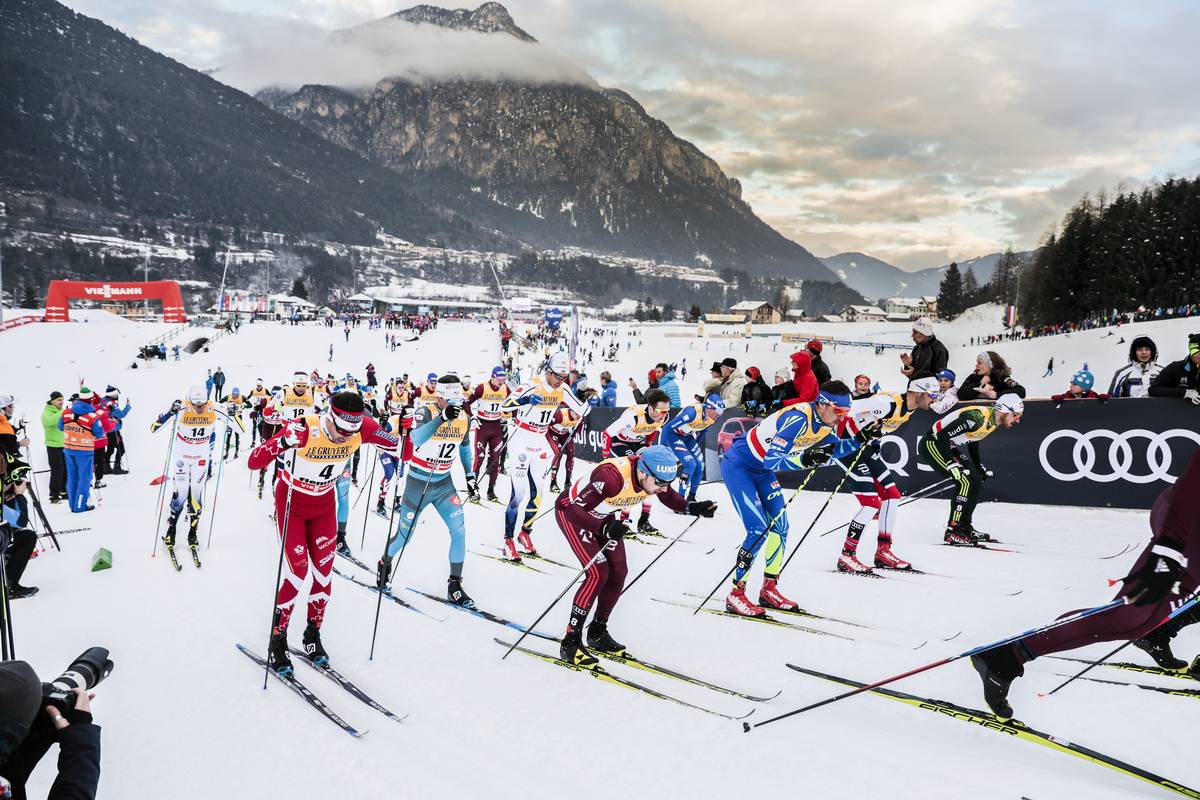
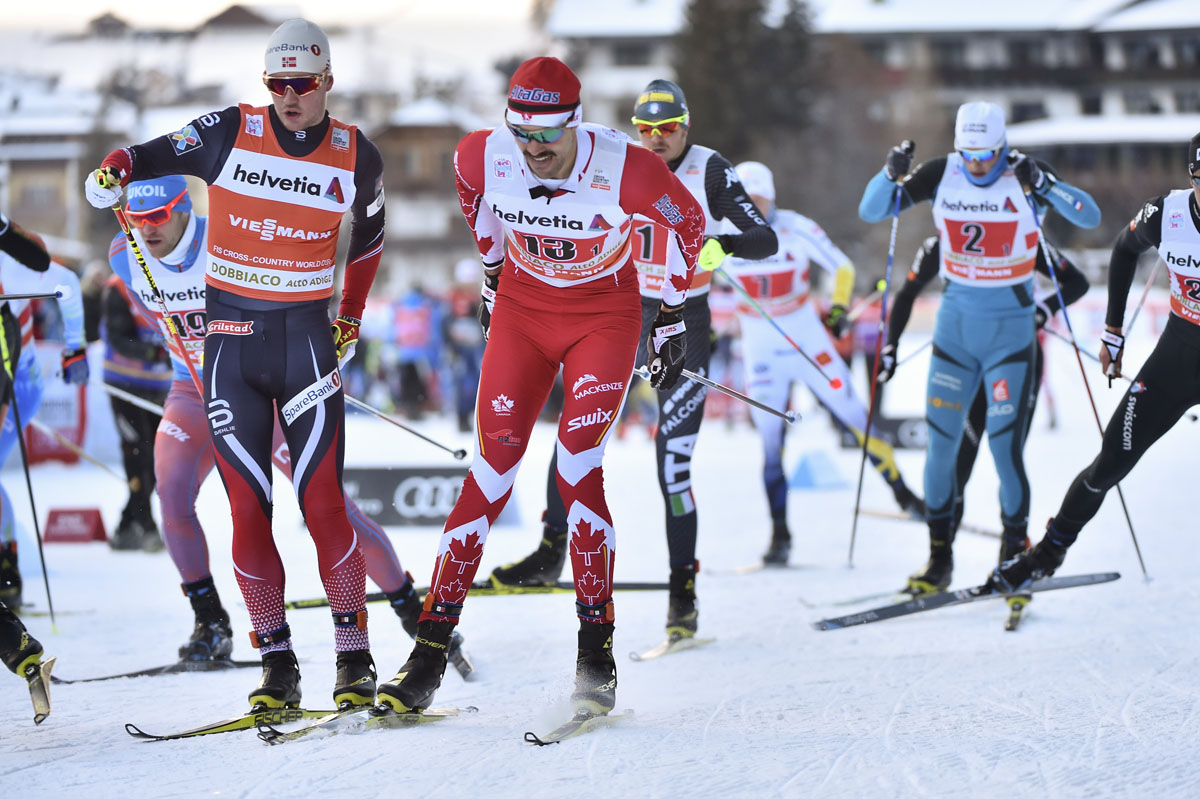
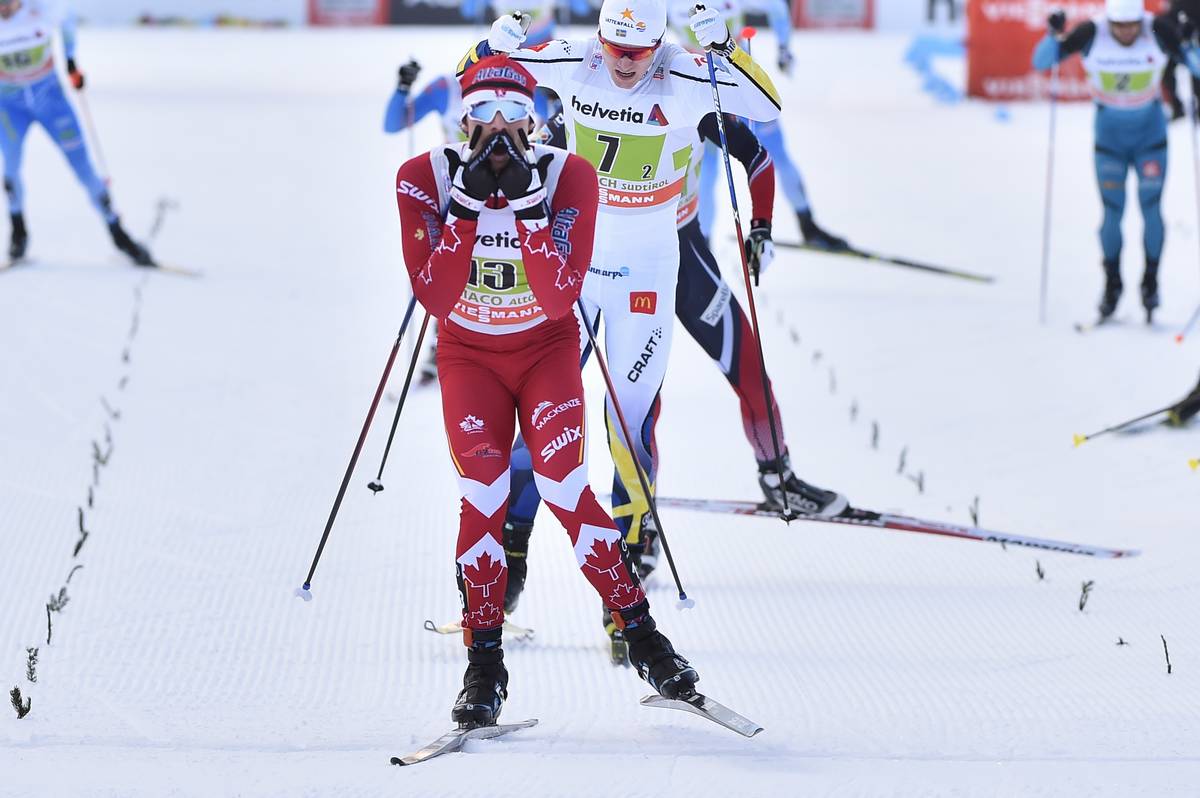
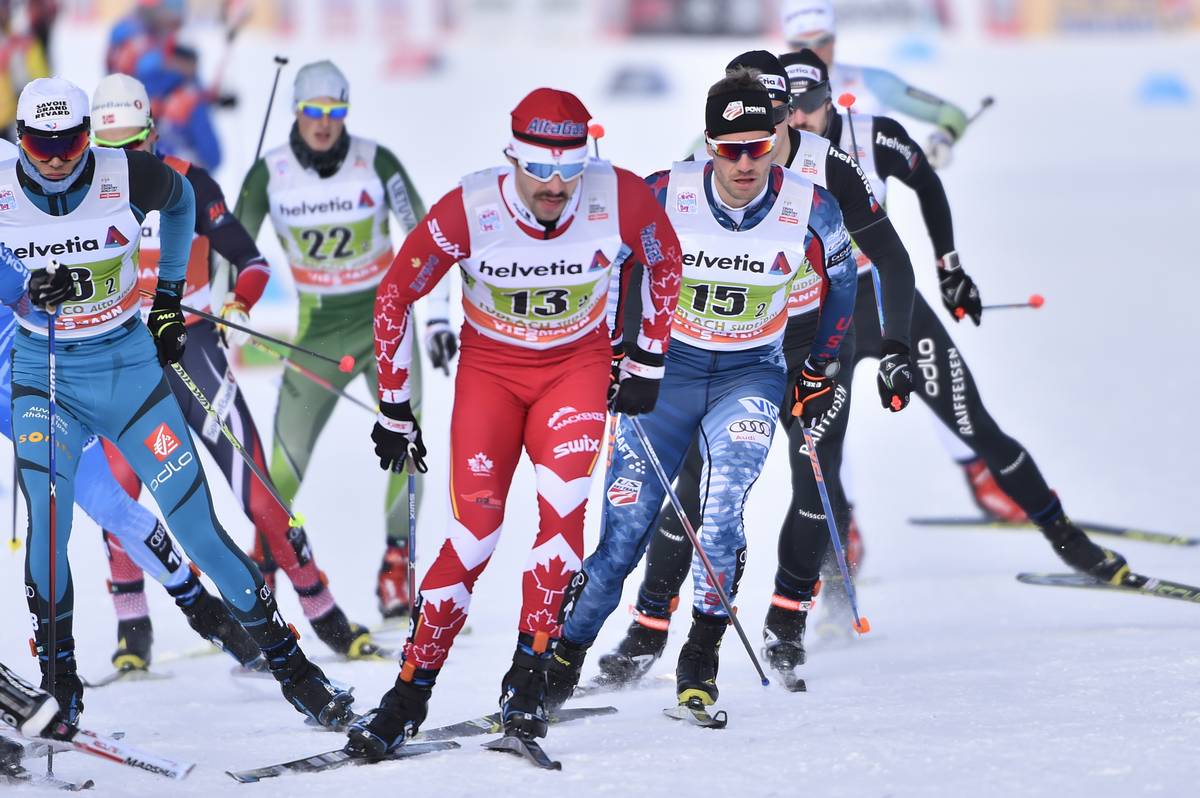
The start of the men’s 15 k classic mass start at Stage 6 of the 2018 Tour de Ski on Saturday in Val di Fiemme, Italy, with (front row, left to right) Canada’s Alex Harvey, Russia’s Sergey Ustiugov, Kazakhstan’s Alexey Poltoranin, Norway’s Martin Johnsrud Sundby, and Switzerland’s Dario Cologna. (Photo: Salomon/NordicFocus)
Beginning this Saturday in Toblach, Italy with a freestyle sprint is the 13th edition of the Tour de Ski (TdS). According to the International Ski Federation (FIS), over the course of seven stages the men will race 80.918 kilometers, the women 60.67 k.
The TdS has become both a staple and a spectacle of the annual World Cup calendar. With a jam-packed series of races primacy is placed on both the ability to recover well and wither less as the TdS transpires.
Prognostication can be tricky in a long-form template like the TdS. So much can go astray during seven races not to mention the travel and dicey germ-avoidance.
Last season’s winner on the women’s side, Heidi Weng of Norway, sits 18th overall in the World Cup standings (14th in distance). She has four top-20’s in the four distance events she’s contested with her best result an eighth in Lillehammer’s 10 k skate. Although featuring two sprints in the first three stages, the TdS remains a distance skier’s paradise.
Weng has skied solidly on the World Cup, but she has yet to show the form that made her a TdS overall winner in 2017 and 2018. Norway has won the last five iterations of the TdS: Marit Bjørgen won once in 2014/2015, Therese Johaug twice (2013/2014, 2015/2016), and Weng the last two years.
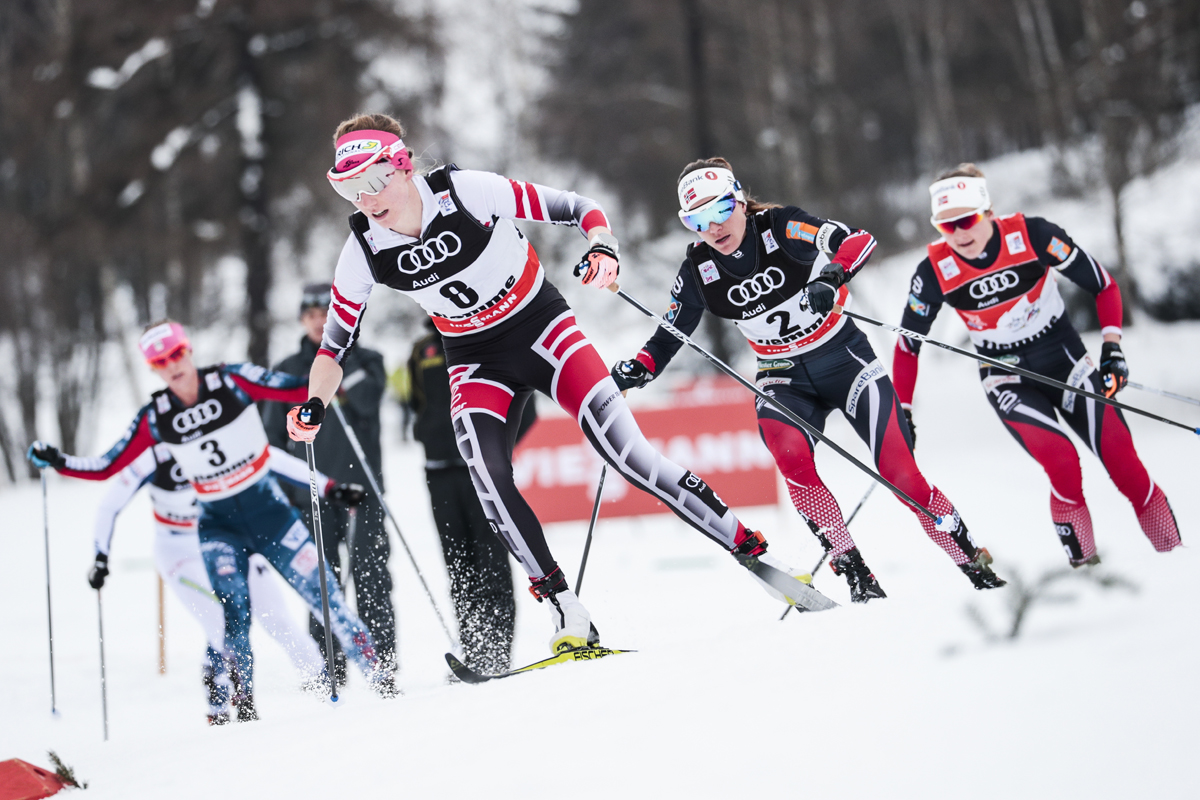
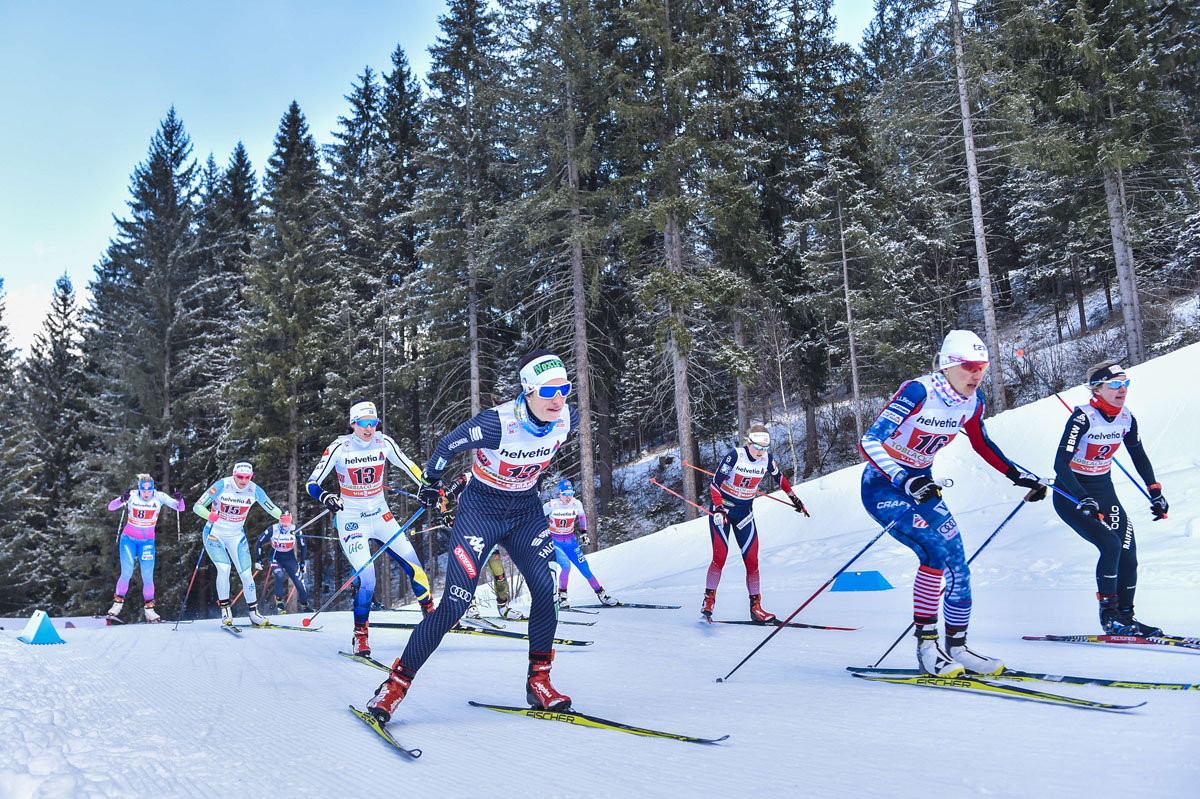
Austria’s Teresa Stadlober leads Norway’s Heidi Weng (2) and Ingvild Flugstad Østberg, American Jessie Diggins (3) and others around a downhill corner during the women’s 10 k classic mass start at Stage 6 of the 2018 Tour de Ski in Val di Fiemme, Italy. (Photo: Fischer/NordicFocus)
If Norway is to keep the streak alive, Ingvild Flugstad Østberg, last year’s TdS runner up, could be the heir apparent. She currently ranks second in the World Cup overall and 15th on the sprint list.
Johaug, having returned from an 18 month doping ban, has been on a distance race tear. She has won all five World Cup distance events this season. Johaug, however, will not be lining up for the TdS.
Only five different women have earned distance podiums this season — Johaug, Østberg, Sweden’s Charlotte Kalla and Ebba Andersson, and Finland’s Krista Pärmäkoski. Along with Johaug, Kalla and Andersson are skipping the TdS. (Andersson sits third overall on the World Cup, Kalla fifth.) With the TdS missing three of the five top ranked World Cup distance skiers, daily stages and the overall podium are up for grabs.
Last season’s third overall finisher, Jessie Diggins of the U.S. Ski Team (USST), often cites the TdS as a point in the season when her form trends towards podium performances. She sits eighth in the current distance standings and could very well have a stout TdS.
Russia’s Natalia Belorukova and Yulia Nepryaeva look strong as does Sadie Bjornsen (USST), and Austria’s Teresa Stadlober.
With less than predictable distance stage podiums for the women, it may simply come down to a drag race on the Alpe Cermis final climb Jan. 6.
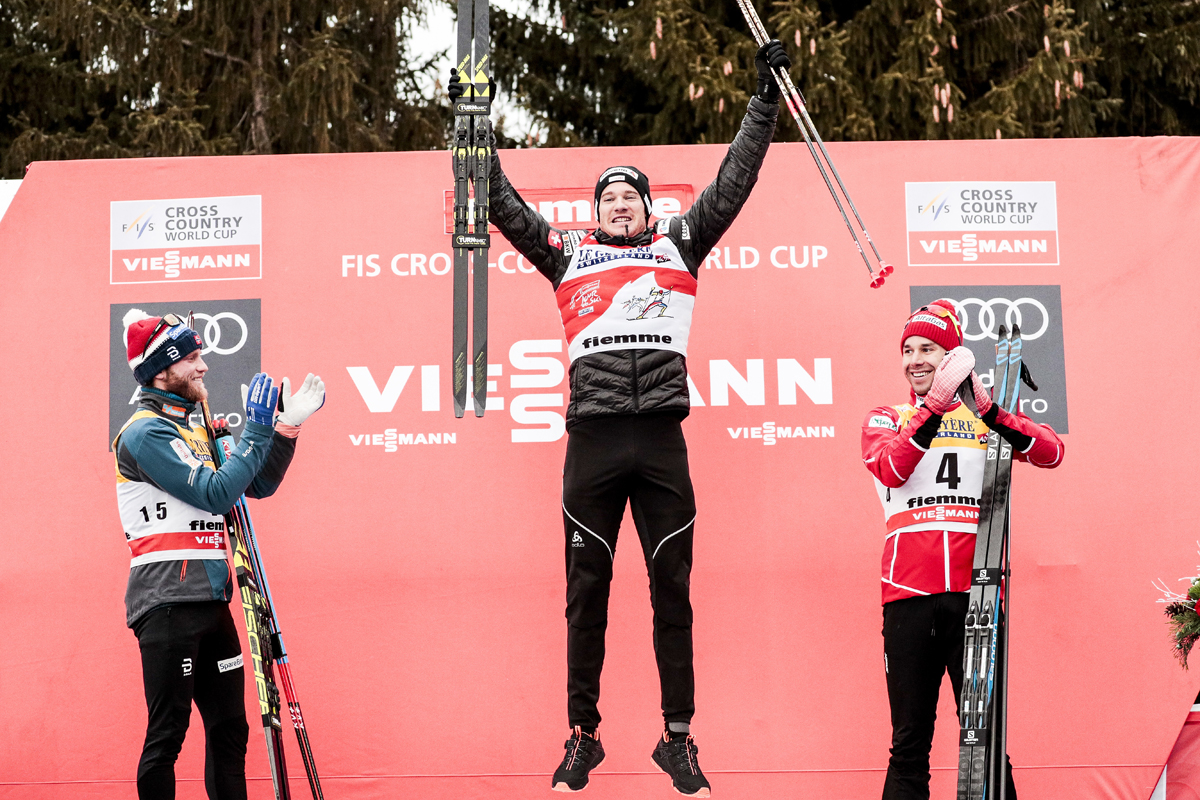
Switzerland’s Dario Cologna (c) celebrates his fourth Tour de Ski overall title. He was joined by Norway’s Martin Johnsrud Sundby (l) and Canada’s Alex Harvey (r) on the podium in second and third, respectively. (Photo: Fischer/NordicFocus)
The men’s scene is also open to interpretation. Last season’s TdS winner, Switzerland’s Dario Cologna, was in fact a surprise victor. Prior to Cologna’s stage two win in last year’s TdS, it had been nearly three years since the four time TdS overall winner had won a World Cup. Cologna sits 21st overall on the World Cup currently. Given last year’s resurgence, anything is possible for the Swiss skier.
Then there’s Martin Johnsrud Sundby form Norway. He finished on the TdS podium the last three years. At thirty-four-years-old, Sundby is ranked first on the distance list, with a second, a third, and a fourth place in distance races this season.
Sundby won the TdS on two occasions – in 2013/2014 and in 2016. His 2015 win was stripped after he tested positive for excessive levels of Salbutamol. He placed second in the past two Tours.
In a field rife with talent, Sundby’s ability to race and rebound and race and rebound will be tested. Sjur Røthe, Emil Iversen, and Didrik Tønseth— all from Norway— look in form. And there’s Norway’s Johannes Høsflot Klæbo. The winner of last season’s overall World Cup has had flashes of his past explosive self. He could be a TdS protagonist.
The men’s field is notably tight. Along with the Norwegians, several Russians could pop a podium, a stage win, and the overall. Russia comes with a loaded team ready to exploit. Alexander Bolshunov leads the overall World Cup – he’ll turn twenty two on Dec. 31st. He’s backed by teammates Evgeniy Belov, Andrey Melnichenko, and Denis Spitsov.
Canada’s Alex Harvey placed third overall last year and he looked stronger as the TdS progressed.
The Stages
Stage 1: Dec. 29, skate sprint in Toblach, Italy.
Stage 2: Dec. 30, 10 k/15 k skate in Toblach, Italy.
Stage 3: Jan. 1, skate sprint in Val Müstair, Switzerland.
Stage 4: Jan. 2, 10 k/15 k classic mass start in Oberstdorf, Germany.
Stage 5: Jan. 3, 10 k/15 k skate pursuit in Oberstdorf, Germany.
Stage 6: Jan. 5th, 10 k/15 k classic mass start in Val di Fiemme, Italy.
Stage 7: Jan 6th, 9 k final climb skate pursuit in Val di Fiemme, Italy.
Teams
United States
Women: Sophie Caldwell, Sadie Bjornsen, Jessie Diggins.
Men: Ben Lustgarten, Simi Hamilton, Erik Bjornsen, Kevin Bolger.
U.S. Ski Team Head Coach Chris Grover noted in a text that Caldwell, Hamilton, and Bolger will likely cease the TdS after the stage three sprint. Additionally, this is a small team for the U.S. at the TdS. Several athletes turned down TdS nominations including Scott Patterson (USST), Andy Newell (SMS T2/Salomon), Kyle Bratrud (SMS T2), Rosie Brennan (APU), Rosie Frankowski (APU), Caitlin Patterson (CGRP), and Julia Kern (SMS T2). These skiers plan on racing U.S. Nationals this January in Craftsbury, Vermont.
Canada
Women: Emily Nishikawa, Dahria Beatty
Men: Alex Harvey, Lenny Valjas, Bob Thompson
Norway
Women: Ingvild Flugstad Østberg, Maiken Caspersen Falla, Astrid Uhrenholdt Jacobsen, Kari Øyre Slind, Kathrine Rolsted Harsem, Heidi Weng, Lotta Udnes Weng, Tiril Udnes Weng Mari Eide, Anna Svendsen
Men: Martin Johnsrud Sundby, Hans Christer Holund, Emil Iversen, Didrik Tønseth, Simen Hegstad, Krüger, Sjur Røthe, Johannes Høsflot Klæbo, Martin Løwstrøm Nyenget, Eirik Brandsdal, Finn Hågen Krogh
Russia
Women: Yulia Belorukova, Lidia Durkina, Anna Zherebyateva, Mariya Istomina, Natalia Nepryaeva, Anna Nechaevskaya, Anastasia Sedova, Elena Soboleva
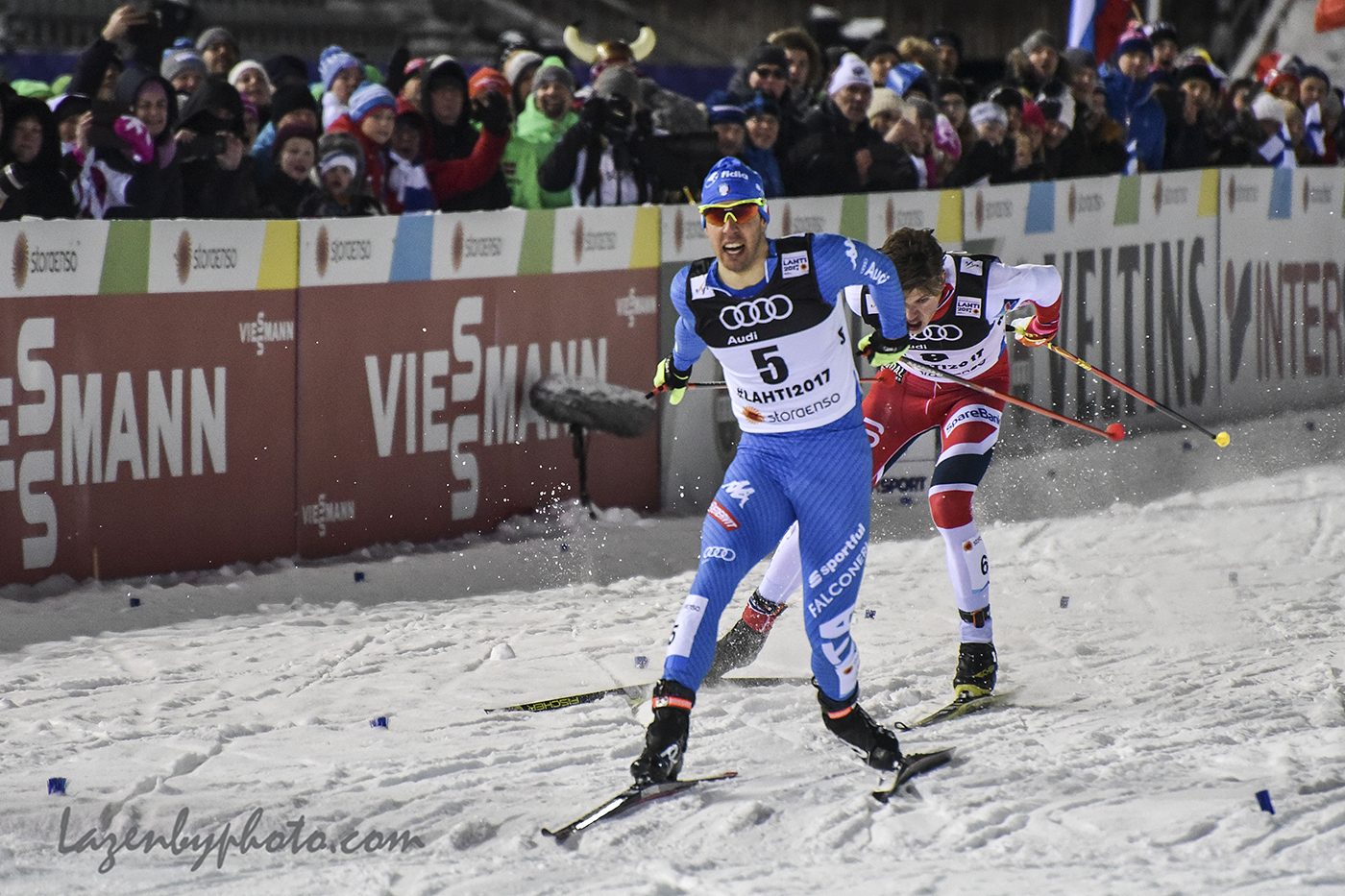
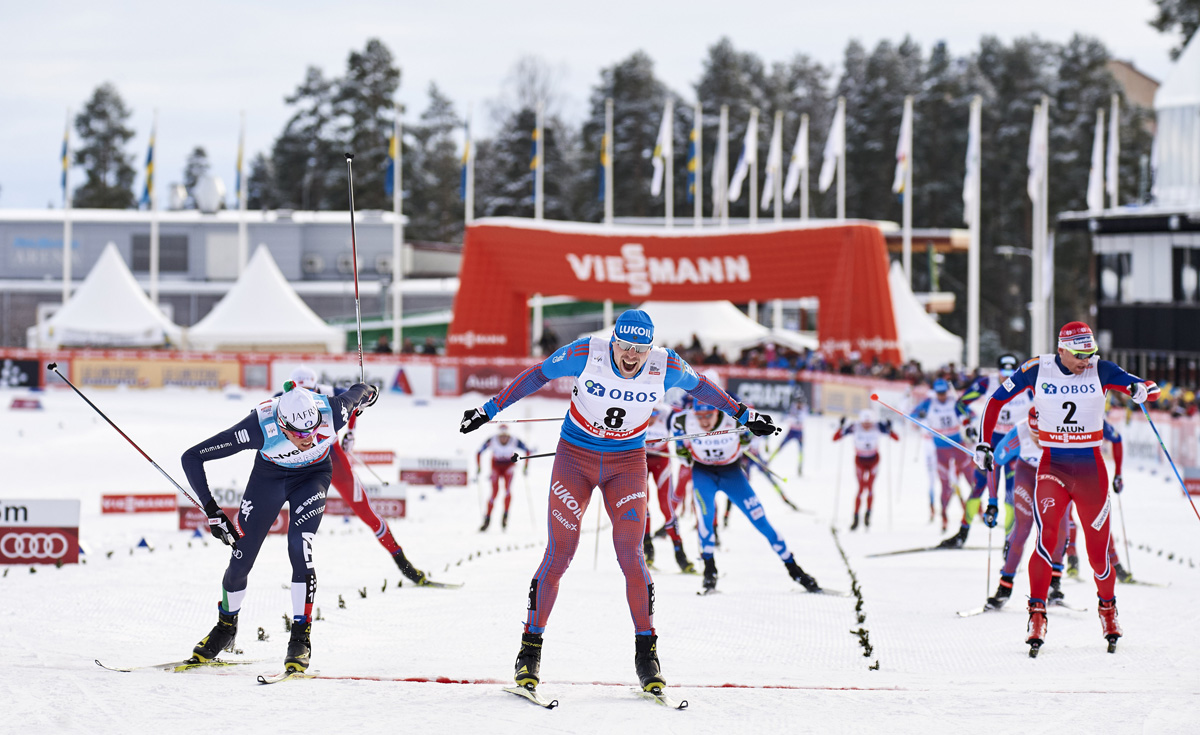
Italy’s Federico Pellegrino outlasting Russia’s Sergey Ustiugov (not shown) and Norway’s Johannes Høsflot Klæbo (behind) for the win in the men’s freestyle sprint final at 2017 Nordic World Championships in Lahti, Finland. (Photo: John Lazenby/Lazenbyphoto.com)
Welcome to World Cup Windup, where we check in with the top-10 teams from last year’s FIS Cross Country World Cup tour before the season starts with the Ruka Triple in Kuusamo, Finland, on Nov. 24.
ITALY
Overall in Nations Cup Last Year: Ninth
Women’s Ranking 2016/2017: Ninth
Men’s Ranking 2016/2017: Eighth
Who’s Back:
Federico Pellegrino, World Champion in the sprint and runner-up in the Sprint Cup; Dietmar Nöckler, who joined him for team sprint silver at World Championships and with one individual World Cup top-10; Francesco de Fabiani, with two top-tens in Tour de Ski stages; Ilaria Debertolis, top-30 in both the distance and sprint rankings and with two individual top-10’s.
Who’s Missing:
Ilaria Debertolis competing in the World Cup team sprint in Toblach, Italy, in January. (Photo: Fischer/Nordic Focus)
Debora Agreiter announced on Facebook that she is taking a break from World Cup racing to focus on medical school. “Dear friends, fans and fans, I have made a decision to leave high-level sport and to embark on a new road.” She wrote, according to a translation. “I am also going to be very active in the future, doing what I have always loved, but I am putting sport on the second floor and I am dedicated to medical studies. I sincerely thank my family, who has always supported me and also supports me in this new experience. Thank you!” Agreiter finished 16th in the 30 k mass start at the 2014 Olympics
Pre-Season Results:
In pre-season racing in Davos, Giacomo Gabrielli and Stefan Zelger were third in fourth in a classic sprint while Ilaria Debertolis was fifth in both the women’s sprint and distance competitions; Giandomenico Salvadori was fourth in the men’s distance race.
Federico Pellegrino is raring to go for the World Cup season. “Now I can’t wait to leave for the north and for the first sprint of the season,” he told Fondo Italia. “In Kuusamo, I want to try to win.” He told SkiTime.it that he also will compete in the Tour de Ski (or at least part of it), unlike some other top World Cup skiers who have already said they will bow out. He will also compete in a few distance races during World Cup Period I.
Russian Sergey Ustiugov (center) takes the win ahead of Italy’s Francesco De Fabiani (l) and Norwegian Niklas Dyrhaug (r) during the men’s 15 k freestyle mass start in Falun, Sweden, in 2016. (Photo: Fischer/NordicFocus)
One of the target races for the Italians is the team sprint in the Olympics, and Dietmar Nöckler has been focusing on this. “The preparation has been similar to the past years, although we have an eye on the Games,” he told Fondo Italia, according to a translation. “I have worked hard on skating, because the goal is to qualify for the Olympic team sprint team. This race could be very important for my career.”
Virginia de Martin Topranin made some summer training videos for the Sportful apparel company. “A roller skiing session is definitely less romantic than cross-country skiing in the midst of glistening snow crystals, since you have to deal with asphalt and cars, but I have to admit that reaching the top of a pass on those four wheels offers great satisfaction, and the view is the reward for the effort!” she wrote in the accompanying text.
Best Social Media Presence:
Francesco de Fabiani posts a lot of training and drone videos on his Facebook page. A recent video showed training on the Schnalstal glacier, with great skiing shots but also some beautiful landscapes and scenery.
Dietmar Nöckler consistently posts great training and racing photos on Instagram.
Hands-down the most prolific Instagrammer on the team, and with more followers than all except Pellegrino, is Continental Cup skier Alice Canclini. If you want a tour of how to be an athlete in Italy, follow her and go along for the ride.
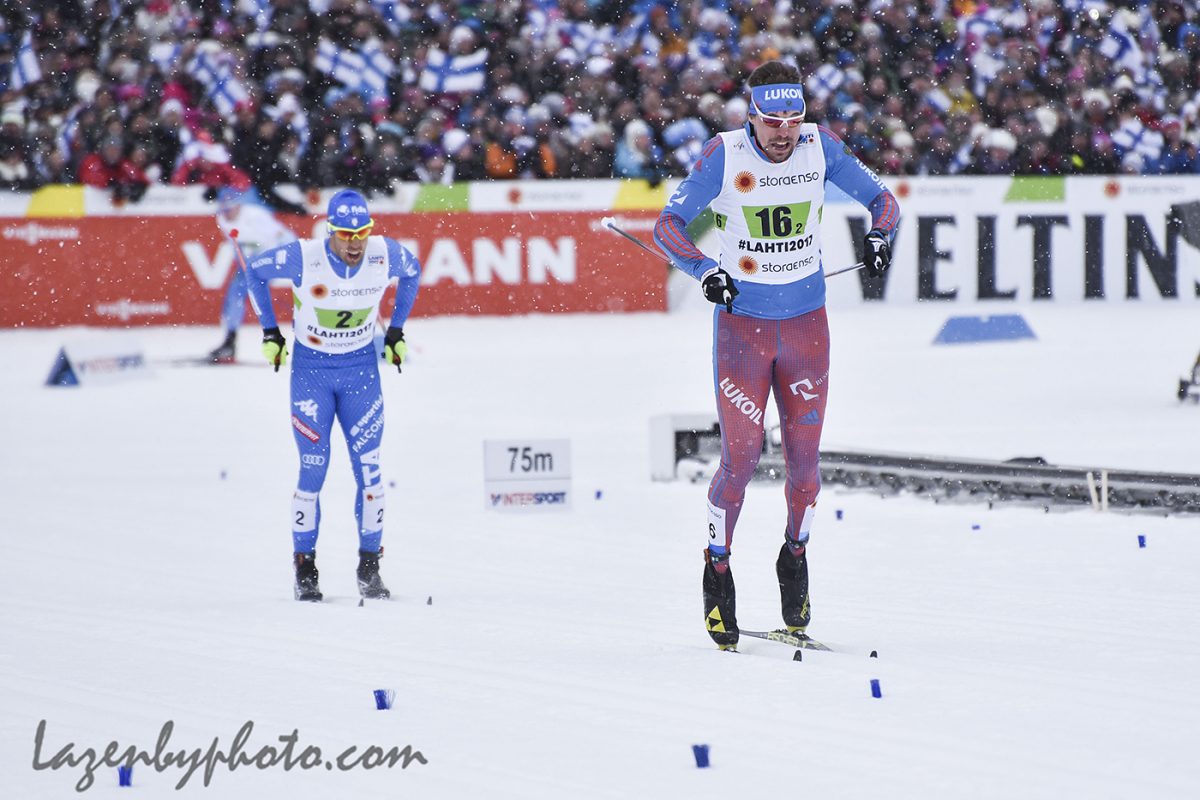
Russia’s Sergey Ustiugov out-duels Italy’s Federico Pellegrino for the men’s classic team sprint gold at 2017 Nordic World Championships on Sunday in Lahti, Finland. (Photo: John Lazenby/Lazenbyphoto.com)
LAHTI, Finland — The breath taken out of a nation.
Throughout the lifetime of a sporting fan, high-stakes races or games offer the chance for seared-into-the-neurons moments, things you remember for an eternity with the distinct recollection of where you were and what you were doing when the news came down.
But those are exceptionally rare moments. And depending on what side of the equation you’re on, they can be mile high or a mile deep. It’s rendered down to the win or the loss.
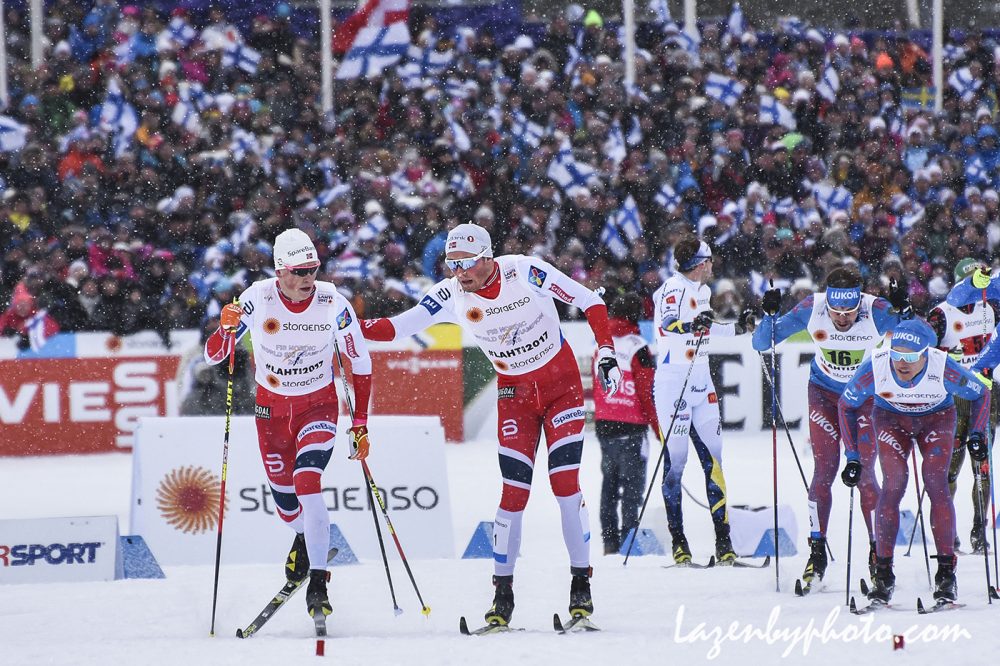
Norway’s Emil Iversen tags teammate Johannes Høsflot Klæbo during the men’s classic team sprint final at the 2017 Nordic World Championships on Sunday in Lahti, Finland. (Photo: John Lazenby/Lazenbyphoto.com)
For much of Sunday’s men’s 6 x 1.3-kilometer classic team sprint at the 2017 Nordic World Championships, it appeared to be a cruiser for team Norway, featuring Johannes Høsflot Klæbo and Emil Iversen. The ending to their gold-medal story seemingly written after the third exchange when Klæbo gifted Iversen and all of Norway a 5.38-second lead over the chasing Finns.
5.38 seconds is a small duration. But when that time gap is illustrated as a distance gap in a sprint, the void looks immense: in this case the distance from Iversen to Finland’s chaser Iivo Niskanen was 45 meters. Even in the best of times, an often too-wide gap to close.
The sprint course features a long but strideable climb right from the stadium’s steps. It then 180’s to the left and hits a steep headwall most skiers herringboned. Then it was a speedy descent into the hairpin known as “Lahti Corner”, and then stadium time — a horseshoe-shaped venue of terraced stands filled to capacity with a mostly Finnish crowd.
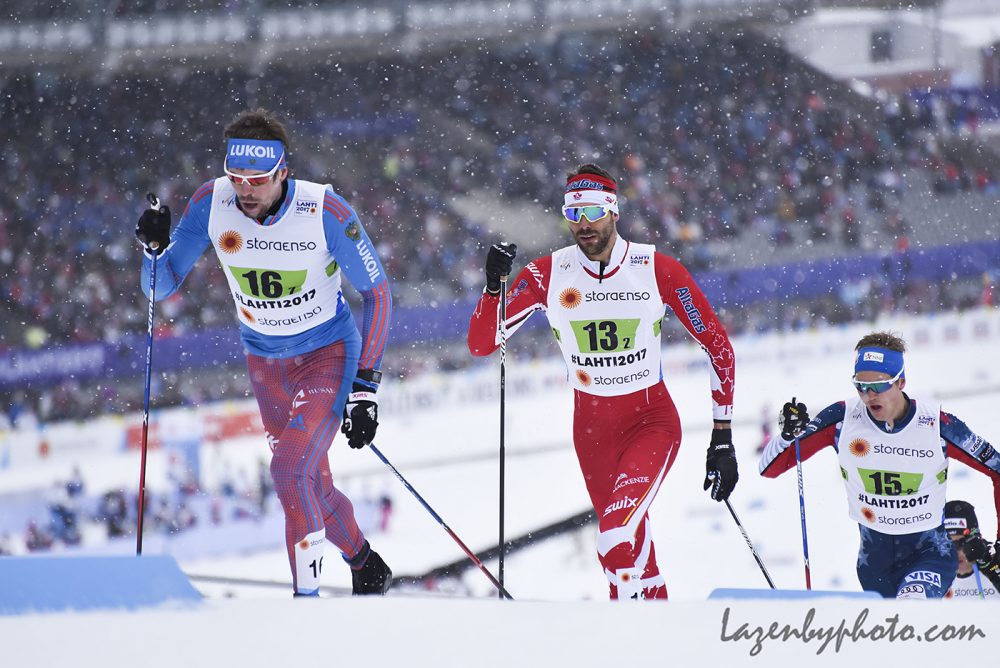
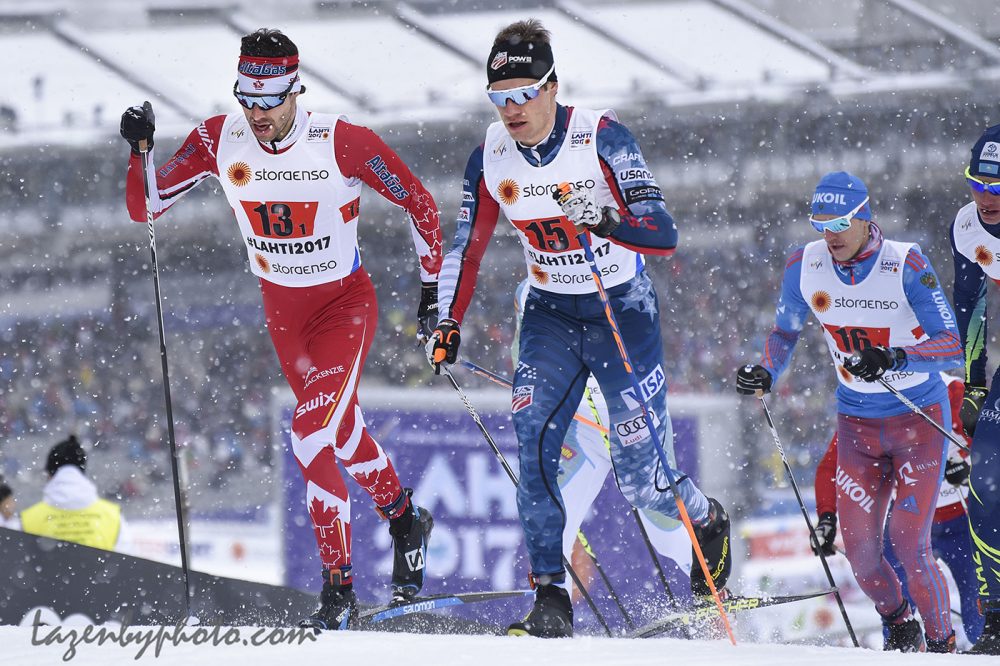
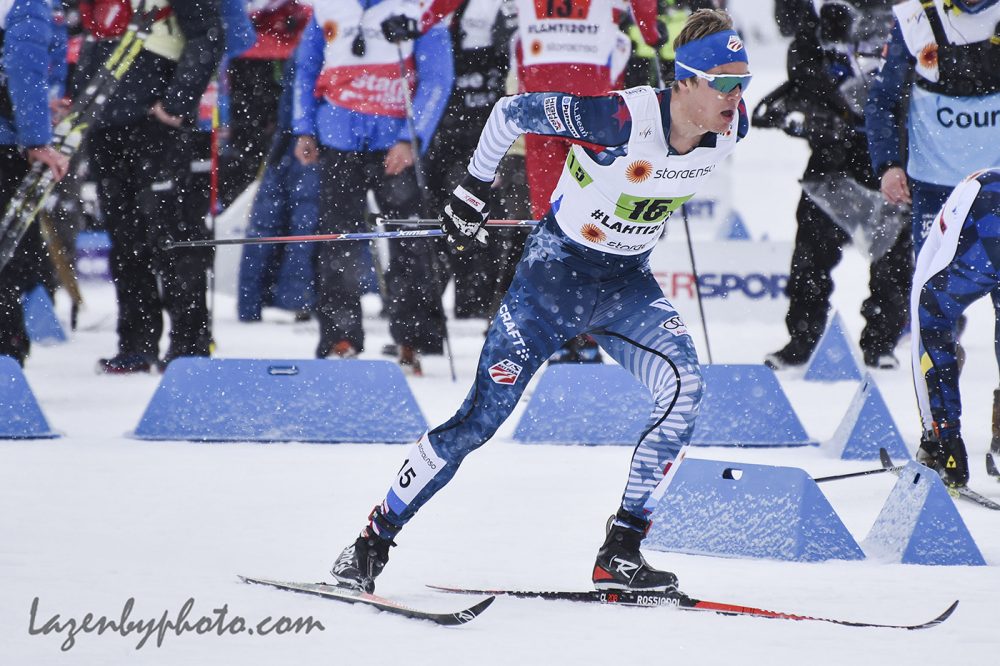
Russia’s Sergey Ustiugov (16) leads Canada’s Lenny Valjas (13) and American Erik Bjornsen (15) in the men’s classic team sprint final at 2017 Nordic World Championships on Sunday in Lahti, Finland. (Photo: John Lazenby/lazenbyphoto.com)
Chasing Iversen, frothing at his heels, were three skiers. There was Niskanen, and right behind him, matching stride for stride were Russia’s Sergey Ustiugov and Italy’s Federico Pellegrino.
As Niskanen worked up the headwall and pushed over the top, he put some meters on Ustiugov and Pellegrino. After a powerful double poling section, Niskanen tipped on the fulcrum into a fast downhill towards Iversen. By “Lahti Corner”, Niskanen had caught the Norwegian.
The Finnish frenzy that ensued was a roar. The crowd had sensed the Niskanen-Iversen link up.
On the glide out from Lahti Corner, a 300-meter straight away, Iversen was set in the third of four tracks. One lane of tracks remained to the left — inside of the Norwegian.
Niskanen, inches away from Iversen’s tails, slotted to his left to pass. There are many perspectives out there, and many depend on which flag you wave, but surely Iversen sensed Norway’s grasp on team gold weaken.
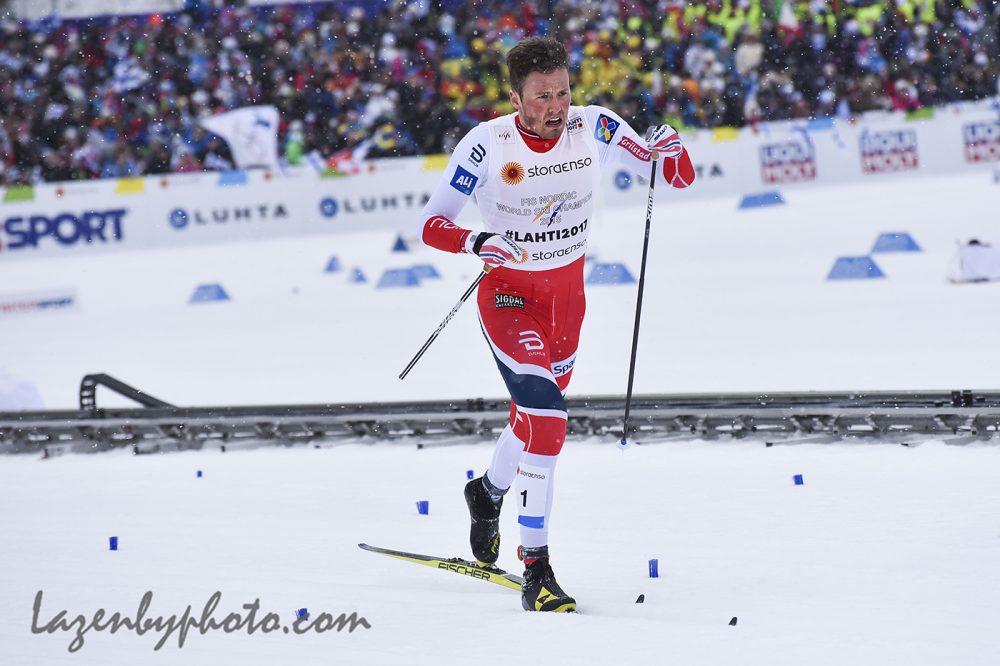
Norway’s Emil Iversen skiing with a broken pole down the finishing stretch after tangling with Finland’s Iivo Niskanen (not shown) 200 meters from the line, which cost Norway gold in the men’s classic team sprint at the 2017 Nordic World Championships in Lahti, Finland. (Photo: John Lazenby/lazenbyphoto.com)
Iversen moved to his left to shut down the Finn and immediately jolted backward as he tangled with Niskanen.
Finland and Norway down. The Finnish cheers snuffed.
In a blink, Ustiugov and Pellegrino zipped passed in what moments before had been a fight for bronze, into a sprint for gold.
Finland’s duo of Sami Jauhojärvi and Niskanen were third (+8.64), Norway fourth (+18.42). The race jury deliberated for a half hour before announcing that neither Norway nor Finland were relegated.
“What can I do at that situation, when I see that my teammate is going to push for the gold, and then happens this unfortunate crash?” Jauhojärvi said during the press conference. “But it’s just a part of sports, and sports is just a small part of life. We need to be happy that we can pick up the medal in front of [a] home audience this evening.“
After crossing the line Niskanen fumed and ranted.
“Yeah, of course straight after the finish line I was very angry, and maybe it wasn’t the most cleverest thing to do with Emil in that last curve,” Niskanen said of his antics. “He lost a medal, and maybe we lost a gold medal. But it’s over now, we are in bronze, and the games are continuing. Just only thing we need to do about this is shaking hands with Emil. We have many years to compete together in the same arenas, and our careers are continuing, and the Lahti ski games are continuing, and we will have good days later.”
A Norwegian journalist asked a pointed question of Niskanen. “Did you expect a rookie mistake from someone like Iversen?” he asked.
“Emil has done many sprints, and maybe that move was the only thing to do if he wanted to fight for the gold medal,” Niskanen said in his response. “He really wanted to win, and we did. I came faster behind him and he changed the line, but… it’s a sprint.“
Answering in English, Kriukov spoke to his lackluster early season results. “This season, yeah, not so good for me and my shape not so best,” he said. “But today I am liking the situation. And lucky for our team and I think there is a reason while our team is first today.”
For Kriukov’s partner Ustiugov, it was his second gold and third medal overall in as many championship races.
U.S. Fifth, Canada Sixth
American Simi Hamilton (16) and Canada’s Alex Harvey (13) racing together ahead of Russia’s Nikita Kriukov (16) in the men’s classic sprint semifinal at the 2017 Nordic World Championships in Lahti, Finland. Both teams reached the final, where the U.S. placed fifth and Canada sixth. (Photo: John Lazenby/lazenbyphoto.com)
U.S. Ski Team members Simi Hamilton and Erik Bjornsen skied to fifth place, 23.58 seconds behind Russia. For much of the race, Hamilton and Bjornsen remained in contact with the main group consisting of the podium countries: Norway, Canada, Germany, and Sweden.
On occasion, Klæbo would try to break the race, but the integrity of the group remained for most of three laps. After the race, when asked how he managed Klæbo’s burst, Hamilton said his was a game of calculated risk.
“I think it goes both ways. It’s one of those courses and one of those races where if you go too hard in the same spot then you’re going to pay for it later” Hamilton said. “But at the same time, you know, we’re at world champs, you have to take chances. I think you’re constantly sort of evaluating that risk versus reward the whole time you’re out there.”
The risks for losing contact were a gassed slog playing catch up; the reward — opportunity. And lap after lap it was either Bjornsen or Hamilton deep in a tuck after rounding “Lahti Corner”, playing in a congested international game once reserved for the traditional nordic-ski nations.
For the 25-year-old Bjornsen, it could have been a day of nerves instead of the calm and power with which he skied. Throughout the race, he posted the fourth- or fifth-fastest splits of the second-leg skiers.
“We haven’t done a lot of team sprints together,” Bjornsen said about his experience teaming up with Hamilton. “The last one was in Sochi. I haven’t done a lot of them recently. So it was great. Going into the finals, it was like, the best teams in the world and the best dudes next to me.”
Bjornsen skied the Americans from eighth into fifth on his second loop, and after Hamilton dropped two places to seventh by the last exchange, Bjornsen again rallied for fifth.
At 29 years old, Hamilton remains humble and a student of continued improvement.
“My classic skiing is still progressing,” Hamilton said. “And for someone like Erik, it comes so naturally for him, he’s such a beautiful classic skier, he’s so efficient. I just focused on putting myself in as much pain as possible to keep contact with that group that I was skiing with. I always have faith in him being able to dig to a place where not many people can dig too in order to come up with that result.”
Erik Bjornsen (U.S. Ski Team) racing in the men’s classic team sprint final at 2017 Nordic World Championships in Lahti, Finland. With teammate Simi Hamilton (not shown), the Americans finished fifth. (Photo: John Lazenby/lazenbyphoto.com)
Heading into the last lap, Hamilton tagged Bjornsen in seventh, 10 seconds back from Russia, Italy and Finland. (After a Klæbo flyer, Norway was 16 seconds ahead of the U.S. as Bjornsen began the final lap.)
“Simi handed off to me in a great spot on the last leg,” Bjornsen reflected. “I was fighting with a few other guys and it was just perfect. Super fun to be with the veteran here.”
“I actually didn’t know that she was on the podium until after [my] race,” Bjornsen admitted. “I was second leg so I showed up pretty late, kind of just when Simi was starting … So I was trying to stay pretty focused. I wasn’t even thinking about the fact – I actually glanced up at one point and saw a replay of her crashing, and so I was a little worried that they weren’t in it. But it was so exciting to see Sadie come up and get a podium here. This is her first race and I know she’s in good shape. It’s great. Nobody deserves it more than she does. I watched her over the years, just so focused and dedicated. There’s a reason she’s so strong.”
Canada was represented by national-team members Alex Harvey and Len Valjas. In January, the duo won the World Cup season’s first team sprint. On paper they still remained a medal contender, in addition Harvey has come into the championships primed. However, Valjas has struggled with a health issue the last few weeks.
“I’m better now, what I think we came to the conclusion with the doctors and everybody, two weeks ago in the gym in Davos I hurt my vertebrae a bit,” Valjas said after the race. “I don’t know how, but it totally affects my breathing, so [at the last World Cup in] Estonia and the sprint here, I felt like I was not able to breathe. The race starts well and I die immediately.”
Valjas said he’s received treatment to alleviate the symptoms. “A couple days ago, I didn’t know if I’d even start because it was really actually hard to take a deep breath,” he elaborated. “It doesn’t feel like much but when you try to go at 100 percent, you cannot keep up and it’s frustrating. So I was just happy that I was able to ski with these guys, but when it got away on that second leg there, trying to catch Iversen kind of pushed me over the limit a bit.”
Harvey initially skied the team into third by the first exchange, just 2.8 seconds out of first, and despite slipping to fifth on Valjas’s first loop, Harvey raced up to second by the third exchange, 4.9 seconds behind Norway. On Valjas’s second loop, he dropped to eighth. Harvey held that position on the second-to last leg and tagged Valjas with the same group containing the U.S. Valjas then picked off two places for sixth place.
“I died a bit in the end, but I still had a lot of confidence in Len’s finish,” Harvey said. “We know in a high-speed finish like that, Len is maybe the best in the world so I was still confident that if I put him in the right situation, we still had a legitimate shot. We still believed in a podium finish and it’s just, you can’t have it every time. But I think it was a big improvement for Lenny, compared to the last two weeks and leading up to the relay.”
The Canadians finished sixth, 27.02 seconds behind Russia and 3.44 seconds behind the U.S., in the final.
Championship racing continues Tuesday with the women’s 10 k classic individual start.
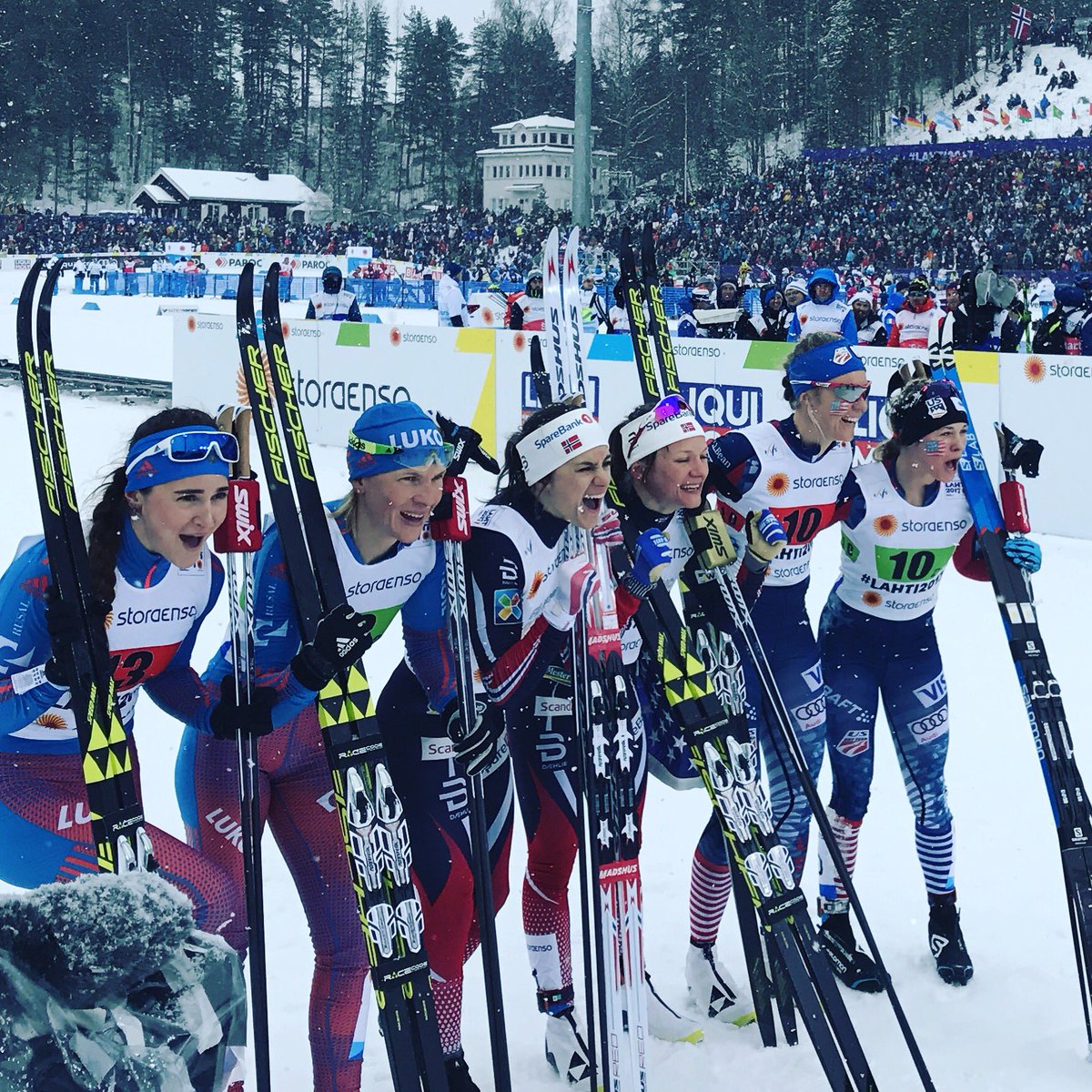
Heidi Weng and Maiken Caspersen Fall of Norway (center) bested Yulia Belorukova and Natalia Matveeva of Russia (left) for gold in the women’s team sprint at 2017 World Championships, with Sadie Bjornsen and Jessie Diggins of the U.S. (right) outsprinting Sweden for bronze. (Photo: FIS Cross Country/Twitter)
FIS Nordic World Championships (Lahti, Finland): Classic team sprints
Defending champions Norway repeated gold in the women’s team sprint, with Heidi Weng and Maiken Caspersen Falla crossing the finish line first in Lahti, Finland. On the second-to-last loop, it looked like Russia could have something to say about that. Yulia Belorukova put in a furious sprint up the course’s biggest climb, and then beat Weng to the exchange. But her teammate Natalia Matveeva could not match the pace when Falla put on her own sprint on the last uphill. Russia finished second for silver, +5.56.
The competition for bronze was closer, with Germany, Finland, Sweden, and the United States going out of the stadium for the last loop together in chase of the Norwegian and Russian leaders. The last climb was defining in the race for bronze, with Jessie Diggins of the United States staying closest to Sweden’s Stina Nilsson. Diggins caught Nilsson on the downhill and was able to stay just ahead of the Swede to the finish, claiming bronze (+18.38) along with teammate Sadie Bjornsen. It was a return to the team sprint podium for Diggins: after winning the team sprint at 2013 World Championships with Kikkan Randall, she teamed up with Sophie Caldwell in 2015 but the pair finished eighth.
Nilsson and Ida Ingemarsdotter settled for fourth (+18.57), and the Finnish team of Aino-Kaisa Saarinen and Kerttu Niskanen finished fifth (+23.02).
The Canadian team of Cendrine Browne and Dahria Beatty was seventh in their semifinal and landed 13th overall.
In the men’s team sprint, Norway set a high pace from the beginning, with phenom Johannes Høsflot Klæbo attacking on the steep uphill every time he skied. On his second and third loops, he tagged off to Emil Iversen with gaps of just over five seconds to the rest of the field. But Iversen had a hard time holding the lead, in part because of Russia’s Sergey Ustiugov, who had won the 30 k skiathlon the day before and put in a huge effort to catch Iversen on the fourth loop of the team sprint.
On the final loop, Finland’s Iivo Niskanen bridged the gap up to Iversen, mostly on the steep uphill and then also with ski speed on the downhill. But the time the pair entered the stadium, Niskanen had caught the Norwegian and was moving with higher speed. He decided to switch tracks to overtake Iversen, but Iversen decided to switch tracks just a second later, without checking one last time to make sure the track was clear. He fell, taking out Niskanen with him.
That allowed Ustiugov and Italy’s Federico Pellegrino to go sailing by to claim gold and silver (+2.14) with their teammates Nikita Kriukov and Dietmar Noeckler. It was the second gold for Russia in the event in three World Championships; Kriukov and Alexey Petukhov won in 2013, and also took silver in 2015.
Niskanen got up and claimed bronze (+8.64 with Sami Jauhojärvi), swearing as he crossed the finish line; with a broken pole, Iversen limped across the line in fourth (+18.42). He was called to a jury meeting but ultimately no teams were disqualified because of the crash.
Erik Bjornsen of the United States won a sprint finish for fifth (+23.58) with teammate Simi Hamilton), besting Lenny Valjas (+27.02 with teammate Alex Harvey) of Canada.
FIS Nordic World Championships (Lahti, Finland): Nordic combined 4 x 5 k team event
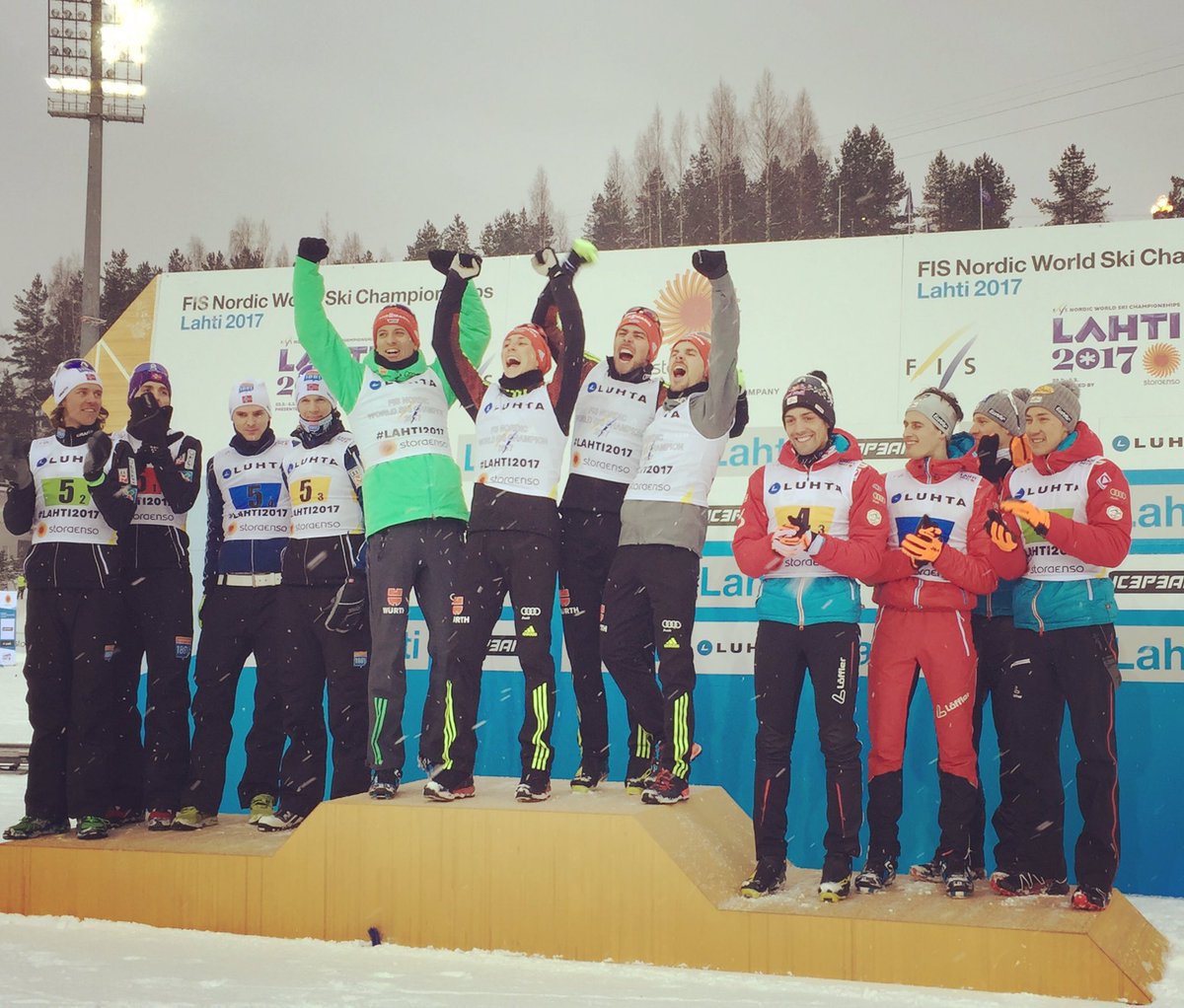
Germany (Björn Kircheisen, Eric Frenzel, Fabian Rießle, and Johannes Rydzek) took gold in the nordic combined 4 x 5 k team event on Sunday at Nordic World Championships in Lahti, Finland, while Norway placed second and Austria third. (Photo: FIS Nordic Combined/Twitter)
[UPDATED] After sweeping the first individual nordic-combined competition of 2017 Nordic World Championships on Friday, Germany achieved gold as a team, with Björn Kircheisen, Eric Frenzel, Fabian Rießle, and Johannes Rydzek winning the 4 x 5-kilometer team event in 47:57.3.
The Germans combined for the best jumping score of 11 teams and started the relay in first, 44 seconds ahead of Japan in second. Norway started 1:07 minutes back in fifth but rose to second place (+41.7), with Magnus Moan, Mikko Kokslein, Magnus Krog, and Jørgen Graabak. Moan raced them into third at the first exchange, then Kokslein secured second, which they held onto for the remaining two legs.
“It was our goal to ski a controlled race,” Germany’s Frenzel told ZDF. “Not really look at how the gap was developing, but just make our own race. And put up a little more pressure towards the end of each leg. That worked well, that was a wickedly cool team performance today. And I am just happy that we could put a little golden crown on the whole event today.”
“I think today you could see again that we all worked together and enjoyed the competition,” Rydzek added. “We were all happy about each other’s performance, and just rewarded ourselves for hard hard work.”
Austria started fourth, 1:05 behind Norway, and clinched bronze (+1:03.7) with Bernhard Gruber, Mario Seidl, Philipp Orter, and Paul Gerstgraser. Gruber initially raced them into second at the first exchange, but they relinquished one spot and hung on for third, ahead of Japan in fourth (+1:06).
Japan (Hideaki Nagai, Takehiro Watanabe, Yoshito Watabe, and Akito Watabe) jumped to second, but found themselves in fourth at every exchange.
Finland took fifth, Italy sixth, France seventh, and the U.S. eighth (+3:27.2) with Bryan Fletcher, Taylor Fletcher, Ben Berend, and Ben Loomis. The Americans started the race in seventh and were in sixth after the first two exchanges, but slipped to eighth on the third leg.
IBU Youth/Junior World Championships (Osrblie, Slovakia): Youth & junior pursuits
Four seems to be Chloe Levins’s lucky number. After a career breakthrough of fourth place in the pursuit at last year’s Youth Olympic Games (YOG) in Lillehammer, Norway, the 18-year-old Vermonter raced to fourth in the youth women’s 7.5-kilometer pursuit on Sunday at the International Biathlon Union (IBU) Youth/Junior World Championships in Osrblie, Slovakia.
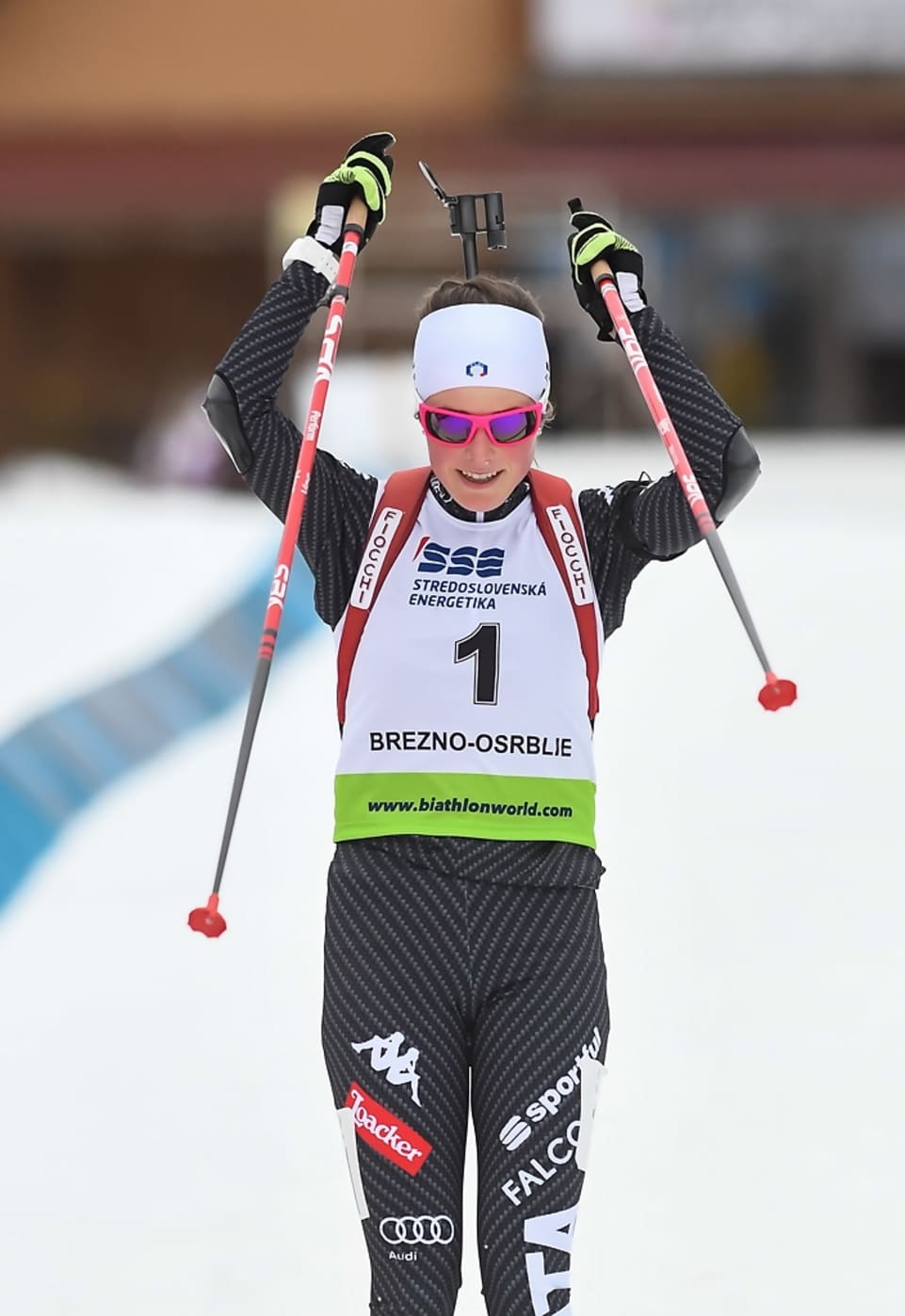
Italy’s Irene Lardschneider winning the youth women’s 7.5 k pursuit on Sunday for her second-straight gold at 2017 IBU Youth World Championships in Osrblie, Slovakia. (Photo: IBU)
Levins started the race in 11th and worked her way up to fourth with clean shooting in three stages. She missed two in the first prone but rebounded and held off Ukraine’s Khrystyna Dmytrenko by seven seconds for fourth place. Levins finished 1:55.5 minutes behind the winner, Italy’s Irene Lardschneider, who started the race first and held on for her second-straight gold medal despite four penalties (0+0+2+2), finishing in 26:57.1. France’s Lou Jeanmonnot-Laurent rose from fourth to second place with 19-for-20 shooting (0+0+1+0), and Italy’s Samuela Comola took bronze (+1:08.5) for the second-straight race with two misses (1+0+1+0).
Three U.S. women qualified for the pursuit, with Amanda Kautzer finishing 42nd (+6:16.2) after starting 59th and shooting 80 percent (1+0+2+1), and Grace Gilliland finishing 55th (+8:32.1) with six penalties (2+3+1+0).
Canada’s Shilo Rousseau followed in 54th (+9:02.1) with eight misses (3+1+2+2).
In the junior women’s 10 k pursuit, Canada’s Megan Bankes raced to 16th for the best finish for a North American in that race. The gold medalist in last week’s 12.5 k individual, Bankes finished 13th in Saturday’s sprint and thus started in that position, 1:25 out of first. She ended up 16th with four penalties (0+1+2+1) and finished 2:15.8 behind the winner, Russia’s Valeriia Vasnetcova, who started 24th and worked her way all the way up to first with clean shooting.
Vasnetcova was the only one to clean the four-stage pursuit on Sunday, and in doing so, she achieved her first gold of the championships and second of her career at Youth/Junior Worlds after her team won last year’s youth relay in Romania.
Coming off a sprint win, Italy’s Michela Carrara started first and took second at the finish, 10 seconds behind Vasnetcova with three misses (1+1+1+0). Norway’s Ingrid Tandrevold scored her second-straight medal as well, after starting second and finishing third (+10.8), with two penalties (0+0+1+1).
Canada’s Nadia Moser had her best result of the championships in 30th (+3:43.5), moving up one place after starting 31st, with three penalties (0+1+0+2). Emily Dickson finished 47th for the second-straight day (+6:29.9) with four penalties (1+0+1+2).
Siena Ellingson was the lone American to start after placing 18th in Saturday’s sprint. She finished 41st (+5:24.7) with seven misses (1+2+1+3).
In the junior men’s 12.5 k pursuit, Canada’s Pearce Hanna rocketed to 23rd after starting 47th, shooting 17-for-20 after cleaning the first two stages (0+0+1+2) for his first top 30 of the championships. Hanna finished 3:12 behind the winner, Russia’s Igor Malinovskii who picked up his second-straight gold.
Malinovskii started first and finished in 32:39.8, 13 seconds ahead of second place, with four penalties (0+1+2+1). Norway’s Sindre Pettersen took the silver medal after starting in eighth and posting the fastest course time to overcome five misses (2+1+1+1). Belarus’s Anton Smolski moved up from fourth at the start to reach the podium in third (+27.4) with five misses as well (0+0+3+2).
All four Canadian junior men qualified for the pursuit. Trevor Kiers led them in 39th (+5:13.3), after starting 48th, for his best result of the championships. Jules Burnotte placed 43rd (+5:35.3), up from 55th, for his best result as well, and Zachari Bolduc finished 57th (+8:18.3). Kiers missed five targets (2+0+1+2), Burnotte had seven misses (3+1+1+2), and Bolduc missed eight (2+3+2+1).
For the U.S., Cody Johnson finished 55th (+7:19.5) with nine penalties (2+1+2+4) and Travis Cooper 59th (+8:46.2) with eight misses (5+0+1+2).
In the youth men’s 10 k pursuit, the first race of the day on Sunday, two Canadians finished in the top 30, with Leo Grandbois in 22nd and Adam Runnalls in 27th.
For Grandbois, it was his first time outside the top 15 of the championships after he had won the youth men’s 12.5 k individual last Wednesday and finished 14th in Friday’s 7.5 k sprint. He had to ski six penalty loops on Sunday (0+2+2+2), dropping outside the top 20 after the third shooting. Grandbois finished 3:21.8 behind the winner, France’s Emilien Claude, who won the sprint as well to start the pursuit first.
Claude, who had four penalties (1+1+0+2) and finished in 29:22.4, held off Italy’s hard-charging Cedric Christille by 16 seconds after Christille shot just two penalties (0+0+1+1) to move up from fourth to second for his first medal in his first Youth World Championships. Germany’s Danilo Riethmüller rose from sixth to third place (+30.7) despite four misses (1+0+1+2). For the German, it was his second bronze of these championships after placing third in the 12.5 k individual.
Canada’s Runnalls moved up from 32nd at the start to 27th at the finish (+3:47.5) for his first top 30 of the championships. He had five penalties (1+3+1+0), but cleaned the last stage to move into the top 30.
Vasek Cervenka was the lone American to qualify in the youth men’s pursuit, and he moved up from 49th at the start to 30th (+3:52) with five penalties (1+1+1+2).
Canada’s Alex Harvey (l) and Len Valjas celebrate their World Cup freestyle team sprint win on Sunday in Toblach, Italy. It was the first team-sprint victory for Canada since 2011 World Championships. (Photo: Salomon/NordicFocus)
It’s been a year since the last World Cup freestyle team sprint. That event went down in Planica, Slovenia. Historically, the men’s skate team sprint has been a revolving door when it comes to the podium’s top step. According to the International Ski Federation (FIS), the last seven World Cup skate team sprints were won by seven different nations.
Add an eighth nation to that list: Canada.
On Sunday in Toblach, Italy, the Canadian duo of Alex Harvey and Len Valjas once again got an opportunity for some grandstanding air-guitar: a celebratory tradition it seems when the Canadians take the win. Harvey and Valjas won the 6 x 1.3-kilometer freestyle team sprint in 16:02.1 minutes. As the times back suggest, no team was able to pull away. Occasionally one nation shot off the front, trying to break the chain of drafting skiers, but that tactic proved fruitless. With Toblach’s undulating draft-friendly course, the chase pack would eventually glide up tight onto the skis of any athlete trying to make a break.
Here’s how the podium rounded out. Sweden I, comprised of Karl-Johan Westberg and Oskar Svensson, placed second (+0.53). Dietmar Nöckler and Federico Pellegrino of Italy I were third (+0.65).
As the times back to Harvey and Valjas suggest, it was a no-margin-for-error race; fourth through 11th place were separated by a little more than three seconds. So after five exchanges, where one skier tags the other for another two-lap 1.3 k leg, the U.S. team, with Simi Hamilton and Andy Newell, were in it: they finished sixth (+2.62).
Harvey + Valjas
Just one week ago, Harvey finished the Tour de Ski in seventh overall, a career best in the annual multi-stage event. And just days ago, Sunday’s win might have been off his radar.
“If you had asked me that two days ago, it’s surprising. I felt really good yesterday,” Harvey explained on the phone Sunday. “My qualification was my best qualification in two years.”
“I had a lot of speed, a lot of punch yesterday,” Harvey added. “Then I was like, ‘OK, maybe we can do something in the team sprint.’ ”
Canada’s Lenny Valjas (in red) en route to his first World Cup victory in the men’s freestyle team sprint in Toblach, Italy. (Photo: Fischer/NordicFocus)
Sunday’s win was the first World Cup victory for Valjas, Harvey’s teammate on the Canadian World Cup A-team. It was also the first win for Harvey and Valjas together in a team sprint. Harvey said the pair came into the day with little on-the-ground practice, but they had discussed their exchanges beforehand.
“We did not practice, actually, but we talked about it,” Harvey said. “Most of the time, after the pre-race meeting, it’s always the same; people say, ‘Don’t stress it. You can’t win the race with the exchange, but you can lose it, if it’s a bad one.’ So, we told each other, ‘Let’s not f- up, but if we can, let’s try and get position in the exchange.’ Like, why not? It’s part of the race.”
The Canadians executed their verbally mapped-out plan: they kept to the back and side of the exchange zone, and efficiently communicated when to accelerate once the tag was made.
“We made it clear what we wanted to do, and what we would say. Like, if I said your name and yell, ‘Go, go, go!’ that means you can go full gas, and I’ll still be able to touch you,” Harvey said of their exchange plan. “That’s half a second here, half a second there, and sometimes it’s two positions, and on a course that’s turny like this, two positions for free is a big difference.”
For Valjas, the victory marked his sixth-career podium on the World Cup. Four of those podiums, including Sunday’s win, came in sprints. His last podium came four years ago.
“This is unreal,” Valjas, 28, told the International Ski Federation (FIS) in a televised, post-race interview. “Honestly, we were hoping for a good result today, but I had no idea it was going to be this good.”
He described Sunday’s race as crowded. For this season, FIS expanded the team sprint finals from 10 to 15 teams.
“The final, there’s a lot of guys who go out,” Valjas explained on the phone. “[We] just kept ourselves out in the top half of the group in the top six or seven. Otherwise you just have so much traffic and it was on my last leg of my final, I got a little boxed in on the big climb, and I was making contact with people’s poles and skis and, instead of trying to make a move and potentially crashing, just doing everything I could to ski smart and to keep my skis off other people’s skis.”
That patience paid off. Other teams led throughout the race, including Sweden II, Norway II, Finland II, Norway I, and France I.
“The goal was to stay close to the front, but never in the lead because there was no point,” Harvey said of the team’s on-course strategy. “You could see the Norwegians on Lenny’s second leg in the final — the two guys gapped the field a little bit. But then it comes back in the downhill, and that surge, it takes it out of you because the recovery is so short in the team sprint, so it’s about positioning yourself in the best way possible while saving energy for the last lap.”
The fifth exchange, when Valjas tagged Harvey for the final leg, it was still early, but maybe time to tune the air guitars.
“I think it was around sixth place when I came around the corner … and out of the exchange. Alex had a great lane on the left, too,” Valjas recalled. He actually tagged off in eighth, but just 2.1 seconds out of first, it was close enough.
“[Alex] made a quick burst leaving the exchange and passed three guys right there and moved into a contending position,” Valjas said.
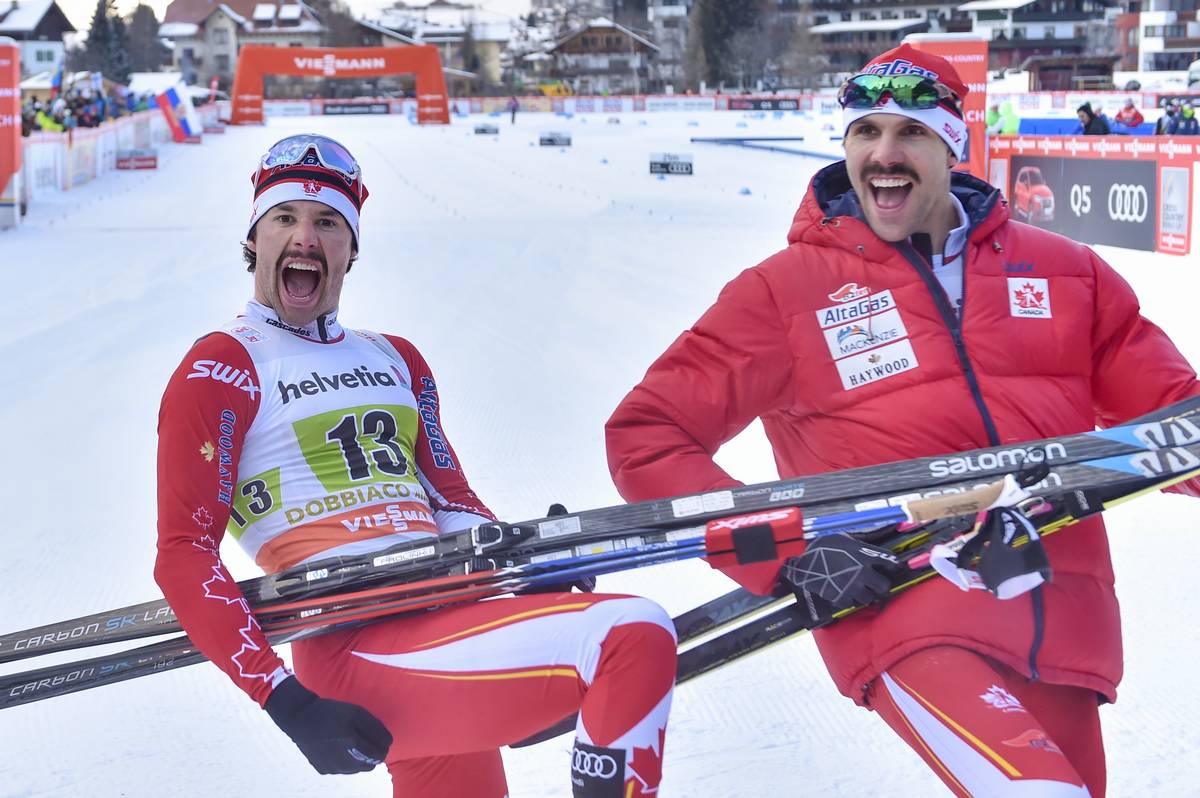
Respect the power of the mustache: Canadian Alex Harvey celebrates as he anchors his team to a World Cup freestyle team sprint win on Sunday in Toblach, Italy. (Photo: Salomon/NordicFocus)
Harvey was ready to capitalize. Having watched other nations take flyers off the front, he had reserves. Harvey skied the fastest final leg, moving into third at the base of the last climb then leading over the top. It was a risky move, staying in first from the final descent down into the stadium and all the way into the looping finishing stretch. Nobody on Sunday had won from that position before, having become victims of the draft, but Harvey didn’t let that stop him from leading.
“Look at those, look at those,” he said, pointing to his skis when FIS asked how he pulled off the win from that position. “The wax techs did a good job and we had good skis.”
While several teams scurried for the remaining spots on the podium behind him, the Canadian crossed the line looking relaxed and grooming his mustache for the cameras.
“I’m feeling good, but I had a really good teammate,” Harvey told FIS.
With 2017 World Championships beginning late next month, Harvey and Valjas are likely eyeing the classic team sprint there.
“Today was an amazing performance by those two, and I think it’s going to give them a really good boost for the world champs,” Canadian World Cup coach Ivan Babikov said from his home in Canmore, Alberta. “It’s a pretty stacked calendar [at World Championships] especially for Alex, who can be podium potential in every race. He wants to do everything, but sometimes you just have to be smart, and focus on the things he feels strongly about. Lot’s can change with the time, too. We’ll be looking forward to world champs, and try to plan it out perfectly, so enough energy through the whole World Championship.”
Hamilton, Newell in It Until the End
Canada’s Alex Harvey (13) leading American Simi Hamilton (15) among others in the men’s 6 x 1.3 k freestyle team sprint on Sunday at the World Cup in Toblach, Italy. (Photo: Salomon/NordicFocus)
For the U.S. men’s team, Sunday was also a day to unkink and de-rust the team sprint tactics and techniques. Hamilton and Newell combined for fifth in their semifinal, one place behind Valjas and Harvey in fourth in that heat.
Hamilton was coming off a second-place finish in Saturday’s skate sprint. He explained his initial sensations for the day were bland, as he spent over three hours after Saturday’s sprint navigating doping control in a cold, restricted area, absent equipment for a proper warmdown.
Despite feeling sharp in the semifinal, Newell crashed just before the tag zone for the first exchange in the final.
“It was unfortunate that I took an early, hard crash right before the tag zone on my first [leg],” Newell said on the phone. “I was kind of spun like a top and landed right on my butt. I was able to get up pretty fast, and sprint towards the tag zone, but we were still in last.”
Also on that first leg, Newell received a yellow card for obstruction. He explained that he stepped on another racer’s ski on a downhill section of course. The infraction did not cause a crash, but it did give Newell a written reprimand. Accumulating two yellow cards in a season leads to a disqualification (although, according to the FIS rulebook, “Written reprimands given during the season are not valid in the WSC [World Ski Championships] and OWG [Olympic Winter Games] periods. Written reprimands given during WSC or OWG are valid until the end of the season.”)
After that initial tag, Hamilton gunned it. He skied the fastest second leg, keeping the team from losing ground. Newell and Hamilton kept in the hunt, conserving energy, maybe losing a spot here, then gaining two there. Hamilton tagged Newell in 12th.
“My right glute took a hard hit, and it wasn’t a super-easy course to pass on either, so I think we spent some energy trying to get around people, but even still, we were right in it by the last lap,” Newell said.
Despite the spill or less-than-perfect exchanges, the U.S. was never out of it. Hamilton brought them into ninth and 4.2 seconds out of first after the fourth of six legs, and Newell slipped back slightly to 11th, just 4.5 seconds back. Finally, Hamilton’s second-fastest final leg time put them in sixth at the finish.
“We are both quick on our feet and we’re adaptable and we figure things out like that pretty quickly, but I think, for sure, we will spend some time just working on our tags to make them a little more crisp,” Hamilton said on the phone. “At the same time, you can’t dial in just one way you are planning on doing things in the future because things are constantly changing. You never know if the race is going to be at a pretty ‘pedestrian’ pace off the bat and you might be tagging in the very front of the pack, or if it is a really hot pace, you might be closer to the back. You just have to change things on the fly a little bit. I think that is something that we are both really good at, just being able to adapt to kind of a changing environment.”
The shifting nature of this race, when most teams at one point either seemed way out of it or right in it, was the type of changing environment Hamilton referred to.
The next team sprint prior to World Championships will take place Feb. 5 at the World Cup in PyeongChang, South Korea. Hamilton and Newell plan on contesting that event.
Russia’s Matveeva 2-2 in Toblach; U.S. Women 10th
On the women’s side, race organizers were most likely thankful for modern technology: after the teams of two raced their shares of the 6 x 1.3 k team-sprint pie, a hypersensitive camera was needed to determine the winner. It was a three-way photo finish.
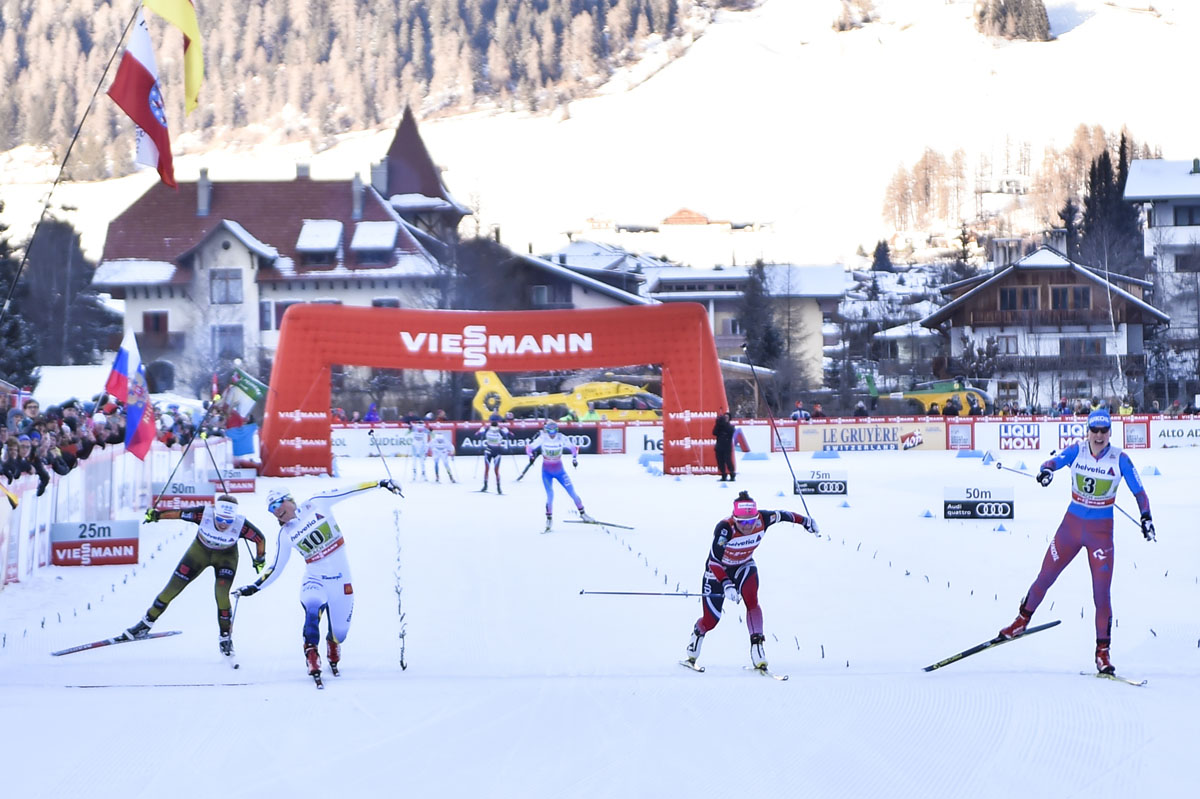
Russia’s Natalia Matveeva (r) winning a three-way photo finish for first in the women’s freestyle team sprint on Sunday in Toblach, Italy, ahead of Sweden’s Hanna Falk (second from l, in white), who placed second (+0.04), and Norway’s Maiken Caspersen Falla (second from r), who ended up third (+0.11), respectively. Germany’s Sandra Ringwald (l) finished fourth. (Photo: Fischer/NordicFocus)
Team Russia I’s Yulia Belorukova and Natalia Matveeva won in a time of 18:00.96, after Matveeva repeated her tactics from Saturday’s individual sprint to come from behind in the finishing stretch.
Just like on Saturday, she followed Norway’s Maiken Caspersen Falla up the last climb and trailed her closely on the descent. Between them on Sunday, Sweden’s Hanna Falk drafted Falla while skiing in second on the downhill, then went wide on the curve to challenge her over the last 100 meters. Matveeva took the inside line around the turn and snuck up on the other side of Falla. Upon close review, the final results revealed that Matveeva captured the win — her second in two days — by 0.04 seconds over Falk in second, and Falla settled for third (+0.11).
“Today I was definitely not world-class level,” a disappointed Falla said, according to a FIS press release. “I have a strong competitive instinct so this loss really irritates me.”
For Matveeva, it was the beginning of a winning streak, and for her teammate Belorukova, a U23 skier, it was her first World Cup podium.
“It was an amazing weekend in Toblach,” the 30-year-old Matveeva said, according to FIS. “To leave with two wins is great. Yulia did a great job in her leg, and I had a lot of confidence from yesterday I could be again fast on the home stretch. To win with my teammate is really special.”
Falk teamed up with Ida Ingemarsdotter for Sweden I, while Falla combined with Astrid Uhrenholdt Jacobsen for third.
“It was a good day at work,” Ingemarsdotter said, according to FIS. “We raced well and this was a big step in the right direction for the upcoming competitions.”
Canada did not enter a women’s team, and the U.S. team of Sophie Caldwell and Kikkan Randall placed 10th (+20.63).
In an email, U.S. skier Caldwell mentioned it was a grind.
“While I always love the opportunity to do a team event, I think I was running on fumes today,” Caldwell wrote. “The semifinal went well, but I didn’t have too much left in me for the final, so was bleeding some time on pretty much all parts of the course.”
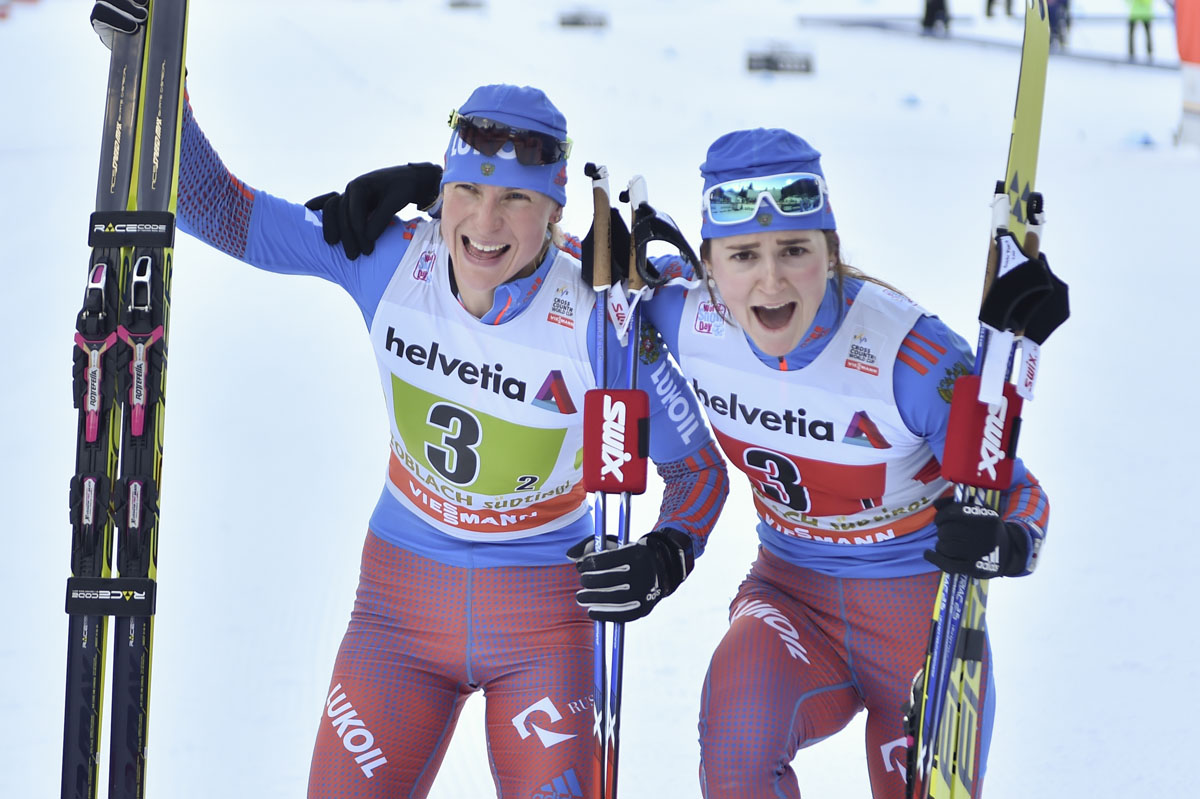
Russia’s Natalia Matveeva (l) and Yulia Belorukova celebrating Belorukova’s first World Cup victory and Matveeva’s second-straight win after Sunday’s freestyle team sprint in Toblach, Italy. (Photo: Fischer/NordicFocus)
According to the email, Caldwell went to the hospital last Monday with a “stomach bug”.
“I’m looking forward to getting in some solid training and focusing on eating back the energy I lost earlier this week from being sick. It’s a bummer to have a bad race, especially in a team event, but all I can do is look ahead and try to put this one behind me,” she wrote.
Caldwell placed 11th in Saturday’s sprint, following Randall in 10th.
In their semifinal, the duo raced to third to secure a spot in the final.
“With 15 teams in the final it was pretty busy those first few laps,” Randall wrote in an email. “I just tried to stay relaxed in the pack on my first round. On the second round I tried to move up but it was really hard to find space to get around. I was always able to make up a few places coming off the last turn before the tag zone. But the tag zone was always really chaotic. Matveeva almost took Sophie out on the 2nd tag.”
On her second leg, Randall skied the fastest split and was a handful of seconds back from the lead as she tagged Caldwell.
“We were still right with the lead group going into Sophie’s last lap,” Randall wrote. “Sophie laid it out there up the first climb, but I think the effort caught up with her and we lost touch with the leaders before the last tag. I was able to chase a few teams down to get us into the top 10.”
Like others, Randall is eyeing the World Championships team sprint.
“World Championships this year will be classic so it could play out a little differently than today,” Randall wrote when asked what the U.S. will be looking to improve on in the team sprint. “We just need more durability so we can stay in the fight all the way until the last round and then I think we have several finishers on this team that could be in the hunt for a podium.”