Tag: discretion

  • Inside the 2018 Olympic Selection Criteria with Chris Grover

    Inside the 2018 Olympic Selection Criteria with Chris Grover

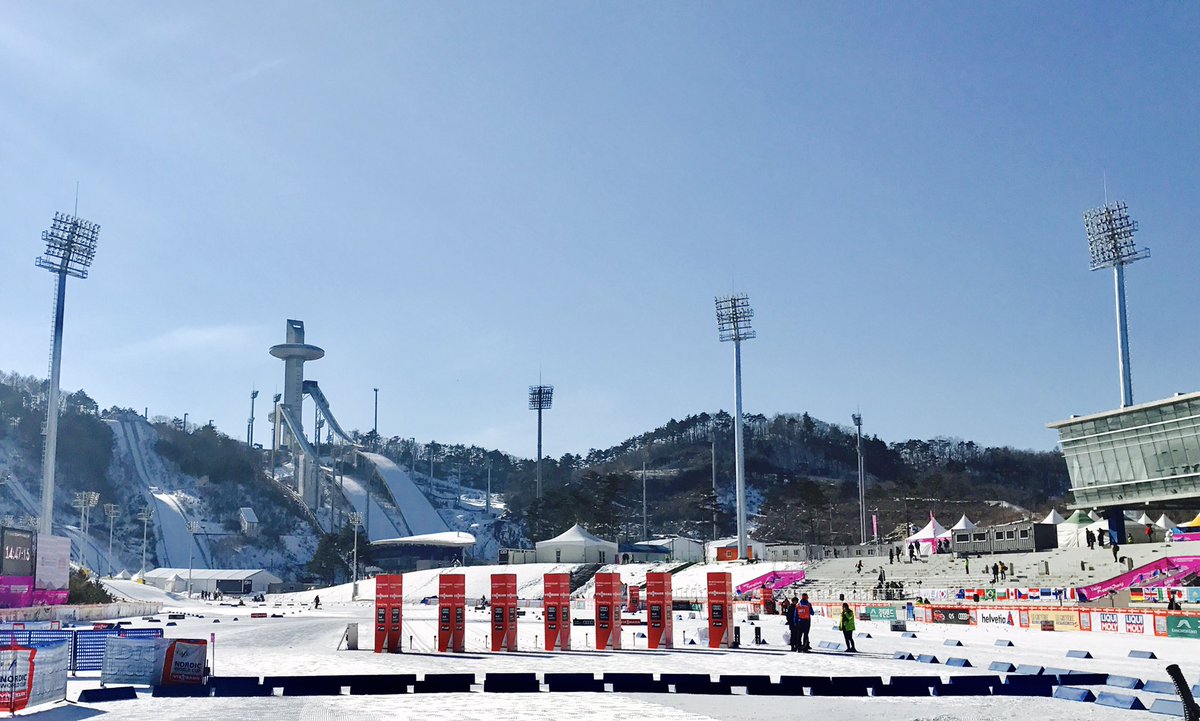
    The PyeongChang venue as seen in February 2017. PyeongChang, South Korea, will host the 2018 Olympic Games this coming February. (Photo: FIS Cross Country/Twitter)

    Note: This is the first of a multiple-part series on the 2018 Winter Olympic selection criteria for the U.S. cross-country ski team. A parallel piece compares the cross-country team’s criteria with other U.S. winter sports.

    ***

    Friday, July 7, will mark seven months to go until the Opening Ceremony for the 2018 Winter Olympics in PyeongChang, South Korea. As athletes across the country ramp up their commitment in this Olympic year, and #roadtopyeongchang trends across various social media platforms, FasterSkier takes a look at the recently released selection criteria and procedures for nomination to the U.S. Olympic team.

    Briefly put, what does it take to get to PyeongChang? And what factors will U.S. Ski Team (USST) coaches and (newly rebranded) U.S. Ski & Snowboard leaders apply in deciding who will be wearing red, white and blue next February?

    In this article, FasterSkier first breaks down the criteria themselves, then summarizes a recent interview with USST Head Coach Chris Grover about why these criteria were chosen and how they should work.

    Inside the criteria: World Cup performance, discretion and potential domestic picks

    The criteria themselves are little changed from the standards used to pick the American team for the last two international championship events, World Champs in Falun in 2015 and Lahti in 2017. First comes objective qualification via performance on the World Cup. Second comes the potential use of discretionary picks. Third, if any spots are left over, the highest-ranking athlete on a domestic points list may, but does not have to, be nominated to the team.

    As for the overall size of the U.S. team, a maximum of 12 male or 12 female athletes may be nominated, with a final team quota of probably 17 to 20 athletes to be determined closer to the Olympics themselves. (This is up from a total team quota of 17 in 2014, though ultimately only 14 athletes were named for Sochi, and the extra three American spots were redistributed to other nations.)

    The U.S. may enter up to four athletes in a single race at the Olympics. The six cross-country events in PyeongChang will be a skiathlon (15 kilometers for women and 30 k for men), individual classic sprint, freestyle team sprint, 10/15 k skate interval start, 4 x 5 k or 4 x 10 k mixed technique relay (classic, classic, skate, skate), and 30/50 k classic mass start.

    As for the criteria themselves for making the U.S. Olympic team: In order:

    1. Objective qualification via World Cup results

    Athletes who have achieved a top-eight finish in one of five specific races, or who have a top-50 ranking on either the World Cup sprint or distance list midway through Period II, will be named to the team.

    Most precisely, “Any eligible athlete that posts a top-8 individual final World Cup result during the selection period [Nov. 23, 2017, through Jan. 15, 2018] in the following events will be selected to the Team: Sprint C, individual start 10/15 km F, and 15/30 km Skiathlon.”

    Looking to the schedule for the 2017/2018 World Cup season, classic sprints will be held on Nov. 24, in Ruka, Finland; Dec. 2, in Lillehammer, Norway; and Jan. 3 in Oberstdorf, Germany (as part of the Tour de Ski). A 10/15 k freestyle individual start will be held in Davos, Switzerland, on Dec. 10. The only skiathlon on the 2017/2018 World Cup calendar will be held in Lillehammer on Dec. 3. Any athlete posting a top-eight final result in one of those five races will be named to the Olympic team.

    (The 10/15 k skate pursuits on the schedule don’t count for top-eight purposes – it’s only Olympic formats that are used for qualification. And the 10/15 k skate race in PyeongChang is an interval-start race, not a pursuit.)

    So that’s high finishes in individual races. As for cumulative performance across multiple races, “Athletes ranking in the top-50 in the distance World Cup standings or the top-50 in the Sprint World Cup standings as of January 15, 2018 shall be selected to the team.” Jan. 15 marks roughly the midway point of the World Cup calendar. By that point, 18 World Cup races will have been held.
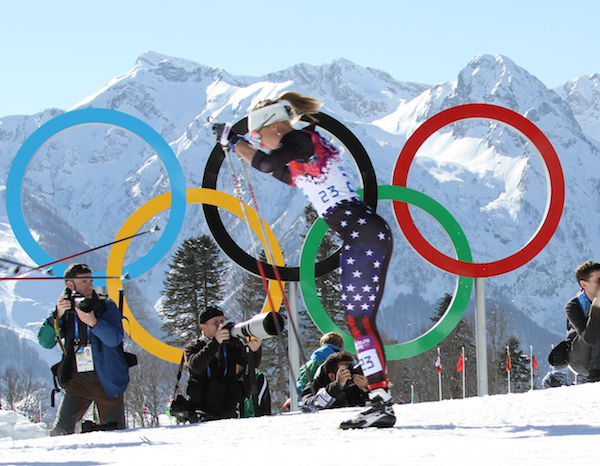
    U.S. Ski Team member Sadie Bjornsen racing in the women’s 15 k skiathlon at the 2014 Winter Olympics in Sochi, Russia. Bjornsen is a veteran member of the national team heading into another Olympic year.

    As of the comparable point in the 2016/2017 season, shortly after the Tour de Ski, USST members Sadie Bjornsen, Rosie Brennan, Sophie Caldwell, Jessie Diggins, Simi Hamilton, Noah Hoffman, Andy Newell, Kikkan Randall, Ida Sargent, and Liz Stephen had top-50 rankings in either or both disciplines.

    A maximum of five athletes per gender may be selected based on their Sprint World Cup rankings. Tiebreaking procedures come into play at that point if necessary, generally based on an athlete’s single best finish in a sprint race.

    1. Discretionary selection

    Spots on the U.S. Olympic team will presumably remain open after the application of the objective criterion of World Cup performance. In that case, “the USSA Cross Country Head Coach may use discretion … to determine team nominations” for additional spots on the Olympic team.

    Grover would at that point recommend additional athletes to a three-person committee, composed of U.S. Ski & Snowboard President Tiger Shaw, Executive Vice President of Athletics Luke Bodensteiner, and athlete representative Rosie Brennan.

    If Brennan stands exposed to a potential conflict of interest from discretionary selection (that is, through no fault of her own, she “stands to benefit privately from a decision made by the Selection Committee,” as would happen if she had not qualified objectively and were being considered for discretionary selection), then she would be directed not to engage in any conduct “meant to unduly influence” the selection committee regarding her potential selection to the Olympic team.

    Grover is then directed to consider any of (a) “outstanding competition results” from both this season and last season, (b) “Recent positive direction or trend of competition results indicating a potential for Olympic success,” or (c) “Indication of medal potential in future Olympic or World Championship competition (such as international age group results and rankings) that would be materially enhanced by selection to the team.”

    U.S. Ski & Snowboard was not required to make discretion a means of selection to the team. It also has the discretion not to use discretion at all; as the document states, Grover may use discretion to determine additional team nominations, but does not have to.

    1. Domestic selection. Maybe.

    If there are any spots remaining on the team after applying criteria (1) and (2), U.S. Ski & Snowboard may consider the highest-ranked domestic athlete, one per gender. But it technically doesn’t have to.

    (There is some ambiguity within the selection document itself as to whether more than one team spot could be filled via a domestic ranking list. On the one hand, selection criterion 3 uses the plural when it talks about “any remaining positions,” and “those positions may be filled.” On the other hand, it also mentions “the athlete with the highest rank on the 2018 Olympic Winter Games Selection List,” and both “athlete” and “rank” are in the singular. In practice, Grover clarified in a recent phone interview that the national team is potentially open to bringing more than one skier per gender, pointing out that four men and two women were brought to Lahti off the domestic rankings list.)

    The 2018 Olympic Winter Games Selection List, as with the comparable list for 2017 World Champs in Lahti, is essentially the “normal” 2017/2018 SuperTour points list, plus substantial bonus points for 2018 U.S. National Championships. An athlete’s best two finishes in a single discipline (sprint or distance, not skate or classic) will be counted.

    The SuperTour point totals system, and bonus points for podium finishes at 2018 U.S. nationals, appear to be precisely the same as those used last winter for Lahti. That is, first through third at the December SuperTour races will be worth 30, 25, and 21 points, respectively. The addition of nationals-only bonus points means that first through third in the four races in Anchorage count for 45, 35, and 26 points, respectively. When an athlete’s best two finishes are counted, a second and third at U.S. nationals (61 points) would be worth more than two firsts (60 points) at “normal” SuperTour races.

    For this reason, in last year’s preview for 2017 U.S. nationals, FasterSkier quoted longtime racer Kris Freeman as stating that “the allocation of bonus points to Nationals essentially makes the remainder of the SuperTours irrelevant. Nationals is now World Champ and Olympic Trials which is fine, but let’s call them what they are.”

    The math is the same this season as last season. This season, U.S. nationals start in Anchorage on Jan. 3, 2018. The four races there will be a skate sprint, classic sprint, 10/15 k skate interval start, and 20/30 k classic mass start.

    Discretion and selection to international championship events

    The appropriate role of discretion when selecting athletes for a World Ski Championships or Olympic team is a subject of recurring interest for fans and supporters of American cross-country skiing, and has frequently arisen on this site.

    For example, here’s USST Women’s Coach Matt Whitcomb in an interview with FasterSkier in July 2016, answering the question, “Is it fair to say that making discretionary picks is one of the harder parts of your job as a coach?” Whitcomb replied, “For sure. We love not to do it. But in any criteria, discretion can often be one of the most important pieces. We really envy these Olympic Trials [for the American track and field athletes for the 2016 Rio Olympics] that we’re watching right now, where the top three go and fourth is either an alternate or they don’t go, and it’s just much more objective.”

    And here’s Grover in January 2017, slightly ahead of the naming of the U.S. team for Lahti: “The real key thing is that, at the bottom of the selection, we followed the selection criteria. That’s key. Discretion really belongs to be used at the top, for those athletes who have a chance to come over and have big races at World Championships, and by big races I mean someone who can go on the podium, or the top five, top 10, or top 15. Look for some selections from USA, but I wouldn’t look for a lot of discretion at the end of the day.”

    Or here’s Grover in January 2014, discussing why he and the rest of U.S. team leadership abjured discretion completely in taking Brian Gregg to Sochi but not Matt Liebsch, when only 0.04 points separated the two on the domestic men’s distance list: “We really tried to apply the selection criteria in the most fair way possible.That becomes, for sure, a challenge, especially on the men’s side when you get down to the sixth, seventh, eighth guys, you’re really splitting hairs because the FIS points are so close at that point. Because they were so close we opted not to use discretion. It really wasn’t a fair way to do it.”

    (As things played out in Sochi, USSA selected 14 athletes out of a total possible quota of 17. Grover explained at the time, shortly after selections were made and before the Olympics began, that they had only intended to bring those athletes whom they planned on starting in races. “With seven women and seven men, we have our start positions filled,” Grover told FasterSkier before the Games. “Seven and seven was the magic number for us.” Liebsch is reported to have considered legal action to gain a spot on the U.S. team for Sochi, but found that that it was “too late” for him to do so. In Sochi a few weeks later, U.S. athlete Torin Koos did not start the 50 k skate race, a race format in which Liebsch had previously won at the American Birkebeiner.)

    The U.S. Ski Team’s views on discretion

    Grover, the longtime USST head coach, is aware that people feel strongly about the substance and application of selection criteria for U.S. championship teams. “I think overall I’d say people get a little bit mired up and tied up with selection criteria, and whether it’s fair or not, or how this potentially sees them falling within that criteria,” Grover told FasterSkier in a recent phone interview.

    But Grover has a simple message for domestic athletes hoping to go to PyeongChang: “All you need to do is to ski fast, you need to go out there and win races, or to reach podiums. And if you can do that, your chances of being selected to the team are quite good.”

    The current criteria are “better than ever, more fair than ever,” Grover continued. “I think [it] gives athletes the most direct path possible to a major championship team.”

    Grover urged domestic athletes not to obsess over the apparent prioritization of discretion over domestic race results as a means of picking the Olympic team. Addressing a hypothetical non-national team member, he said, “As as an athlete domestically, don’t get hung up in the order that those things come down in the selection criteria. Discretion has to be next, because a discretionary athlete that’s picked needs to be picked because they are a top athlete who should be on the team, who has somehow been missed by the selection criteria.

    “So that’s the placement it has to be,” he continued. “And that’s consistent with selection criteria across different disciplines, in different sports. So that’s just the way that the procedure needs to work. But it doesn’t mean that a large number of discretionary athletes will necessarily be selected prior to the domestic field.”

    The statements that discretion “has” to have this status, and that this is “consistent with … different sports,” are not necessarily correct. As reported today in another article on FasterSkier, discretion plays a less prominent role in every other U.S. Ski & Snowboard sport.

    Grover also underscored that the use of discretion within American skiing pales in comparison to its role in Norway or Russia.

    “We’re competing against teams that are using 100-percent discretion to name their teams,” Grover emphasized. “So in the U.S., we have kind of the most democratic, objective, fair, I guess you could say – other nations, our Scandinavian peers, might call this an American system that we use for selecting athletes. It’s very cut-and-dried.”

    The four countries that Grover mentioned by name in his interview as the Americans’ main competition – Norway, Sweden, Finland, and Russia – all finished ahead of the U.S. in the final Nations Cup standings for the 2016/2017 World Cup season.

    Grover also stressed that U.S. Ski & Snowboard used only one discretionary pick for the Lahti roster, taking USST athlete Erik Bjornsen. “And the reason that we used one discretionary spot to select Erik was because he basically fell between the two criteria. He didn’t quite make the top-50 in the world standard because he had gotten sick during the selection process, and he wasn’t home domestically to race in the races domestically, but I think very few people out there would argue that that wasn’t a good use or a smart use of one discretionary spot.”

    Grover further stressed that the team had used, as he initially put it, “zero discretion” when selecting athletes for Falun World Championships in 2015. (In a subsequent email to FasterSkier, Grover clarified that “We used zero discretion in the original selection of 16 athletes (8 men and 8 women) to the Falun Team, but we did add Ben [Saxton] at a later date via discretion after he finished 6th in the sprint at U23 Champs.”)

    Writing criteria for the top vs. the bottom

    Grover cited the decision to bring Erik Bjornsen to Lahti as an exemplary use of discretion, underscoring that Bjornsen was a skilled athlete who “had some of the very best individual results there” among American skiers.

    “So that is absolutely our intention,” Grover continued, “it has been our intention, and it will be our intention going forward, is that we use discretion on the rare case where there’s an injury, or an illness, with a top athlete, and/or the criteria fail to select someone that I think most everyone would agree should be there representing the United States.”

    At world champs in Lahti in 2017, Bjornsen finished 18th in the 15 k classic and teamed up with Simi Hamilton to finish fifth in the team sprint. At world champs in Falun in 2015, Saxton finished 54th in classic sprint qualifying, roughly nine seconds from making the heats.

    While Grover is confident that discretion is most appropriately used for a top-performing U.S. athlete, he acknowledged some issues regarding the final athletes selected (or not selected) to a team.

    Summarizing his discussion with domestic senior club coaches about the selection criteria used for Lahti, and any potential changes before PyeongChang, Grover said, “All the responses I got back were positive, people were like, Yeah, it worked well. It’s never perfect at the bottom, but I don’t really see any way to improve it.”

    Indeed, he noted, the U.S. Ski & Snowboard working group “struggled with” how to select “athletes at the bottom of the selection, and make it as fair as possible. And what you come up with at the end is, in the end there’s no real perfect way to do it, and there’s going to be challenges to the way that any selection criteria works at the very bottom of the selection.”

    Current success vs. preparing for the future

    Another issue surrounding selection is the question of current competitiveness vs. taking a young athlete to a “practice” Olympics just for the experience – that is, is the Olympics for development or for podiums. In 2014, for example, regarding the recently named team for Sochi, Grover said, “The Olympics is the pinnacle of the performance or competition pipeline.”

    Development occurs at many lower levels, Grover noted (Europa Cups, World Juniors, etc.), but “It does not and should not come at the World Championships or the Olympics. … It’s not a development trip; it’s a competition trip at the very highest level.”

    Similarly, earlier this year Grover explained that junior skier Katharine Ogden (a.k.a. “KO”) was not selected for Lahti on the grounds that “athletes should first aim to be successful at – in the age group that they’re competing against. So for KO, that means World Juniors, and being successful at World Juniors.”

    The third prong of discretionary selection for the current Olympic team, “Indication of medal potential in future Olympic or World Championship competition (such as international age group results and rankings) that would be materially enhanced by selection to the team,” may be said to go against these principles.

    But Grover explained that this “future medal potential” path to discretionary selection is rarely if ever used, even when the Olympic team is selected with an eye to current podium potential.

    “We haven’t used it that way,” Grover said. “Obviously the language is there if we were to choose to use it, but in the past we really have not used it that way, and I don’t anticipate using it going forward into this season. … We want … the fastest skiers on the start line in Korea, and those are the ones that we’re gonna be selecting.”

    Different standards for men and women?

    An additional issue in selecting American skiers is that the women are currently, proportionally speaking, faster than the men – that is, the U.S. women, as a team, have recently tended to achieve better results within the women’s World Cup field than the U.S. men do within the men’s World Cup field.

    It is also true that the international men’s field is more top-heavy than the women’s field, across the course of a single World Cup season, meaning that a greater number of World Cup points is needed to crack the top-50 of a discipline ranking.

    (As of the end of the 2016/2017 World Cup season, 50th place in the men’s distance ranking had 66 points; in the women’s distance rankings, 42 points. For sprinting, it was 28 points to make the top-50 on the men’s side, 22 points for women.)

    Perhaps for these reasons, multiple athletes have confirmed to FasterSkier the substance of a suggestion made at a recent athletes’ meeting at the season-ending 2017 U.S. Distance Nationals in Fairbanks: That the selection criteria should be made more challenging on the women’s side, such as by making the objective cutoff there be a top-40 or even a top-30 discipline ranking rather than top-50.

    “I understand where the person who asked that question, where kind of they’re coming from” Grover told FasterSkier, when asked generally if there had ever been discussions about making the objective criteria different between the genders.

    “They’re referring to the fact that there’s greater depth on the men’s side … there’s a lot more men ranked – that have FIS points that are say 30 and under, versus the number of women perhaps that have 30 FIS points or less.”

    (This is a correct statement about the distribution of FIS points, at least in distance rankings.)

    But, Grover continued, “top results are top results at the end of the day. And there’s three medals that are handed out, for men and for women. And if that means that selecting an athlete who ends up to be, say, 46th in the top, in terms of the top 50 in a discipline list by the middle of January, that athlete might be closer to contributing to a top result or a podium than one of the guys.”

    For this reason, Grover questioned the aims served by this suggestion. “Is the end objective for that person just to provide more opportunities for men to come over and be 50th place at the Olympics? Because if that is the objective, then I don’t think it’s worthwhile pursuing. What we’re trying to do is have top results … to really compete. And that means selecting those athletes who are the closest to the top placings.”

    Unfair advantages to Tour de Ski starters?

    Another concern raised about the criteria is the argument that, as Freeman wrote in his recent opinion piece on FasterSkier, “The Tour de Ski ended up being a points feeding frenzy,” given the attrition-ravaged field that saw only 31 women finish the seven-stage Tour. (There were 40 finishers on the men’s side.)

    Freeman also argued that it was illogical to use a non-championship event for selection to the USST, “whose primary stated goal is to win medals. … Is racing up a hill at the end of a nine-day tour really a fair way to determine who goes to the World Championships or Olympics?”

    Grover’s stance is that it’s more difficult to finish in the overall top 30 of the Tour de Ski than reach the podium at U.S. nationals. Due to recent changes in FIS rules that will allow more pure sprinters to start the 2017/2018 Tour de Ski without counting against their nation’s start quota, he foresees a greater number of finishers in this year’s Tour.

    “I would anticipate that this year you’re going to have much better numbers of athletes that are actually finishing the Tour,” he said, “and so the standard there won’t be quite as ‘easy,’ quote-unquote. It’s not necessarily easy, but won’t be as easy as it was this last year.

    “Is it easier to score points, even at the end of a Tour de Ski if you can survive it, versus to have a podium at U.S. nationals, given that a bunch of the top USA athletes are doing the Tour de Ski at the same time?” he asked. “I would still guess that it’s easier to reach the podium at U.S. nationals, and thereby that would make it an easier path for an athlete to make the Olympic team.”

    FasterSkier has separately addressed Freeman’s argument regarding the “access problem” of obtaining Tour or World Cup start rights in the first place. FasterSkier has also considered the approach used by the US Biathlon Association, which makes it “not a foregone conclusion” that athletes receiving World Cup starts will necessarily make the Olympics.

    The bottom line

    “At the end of the day,” Grover concluded, “I would anticipate that we’ll be able to bring the athletes that we want to bring so that we can fill every potential start spot at the Games. … We will fill every start at the Olympics.”

    Grover and U.S. Ski & Snowboard intend to do so by making sure “that we capture any athlete who can reach the podium, any athlete who can reach the top five, the top 10, the top 15. That’s the absolute critical element, is that we give ourselves the best chance to be successful.”

    And Grover believes that the current criteria are “the best way to do that.” We “were trying to create a more equitable, more concrete, easier to understand and visualize path for domestic athletes, racing SuperTour, to qualify for a major championship team,” Grover said. The result, he concludes, is “better than ever, more fair than ever. … So, you know, I feel good, I feel really good about the criteria, I feel like we got the most fair criteria for the Olympic selection that we’ve had, and I’m excited to see how it turns out.”

    Jason Albert and Chelsea Little contributed reporting

    ***

    Stay tuned for more on this topic, including an article on American athletes’ reaction to the Olympic selection criteria and how they feel the exercise of discretion has affected them and U.S. skiing. And be sure to read about the role of discretion across other U.S. Ski & Snowboard sports, particularly biathlon.
  • The Cross-Country Olympic Criteria, in the Context of U.S. Winter Sports

    The Cross-Country Olympic Criteria, in the Context of U.S. Winter Sports

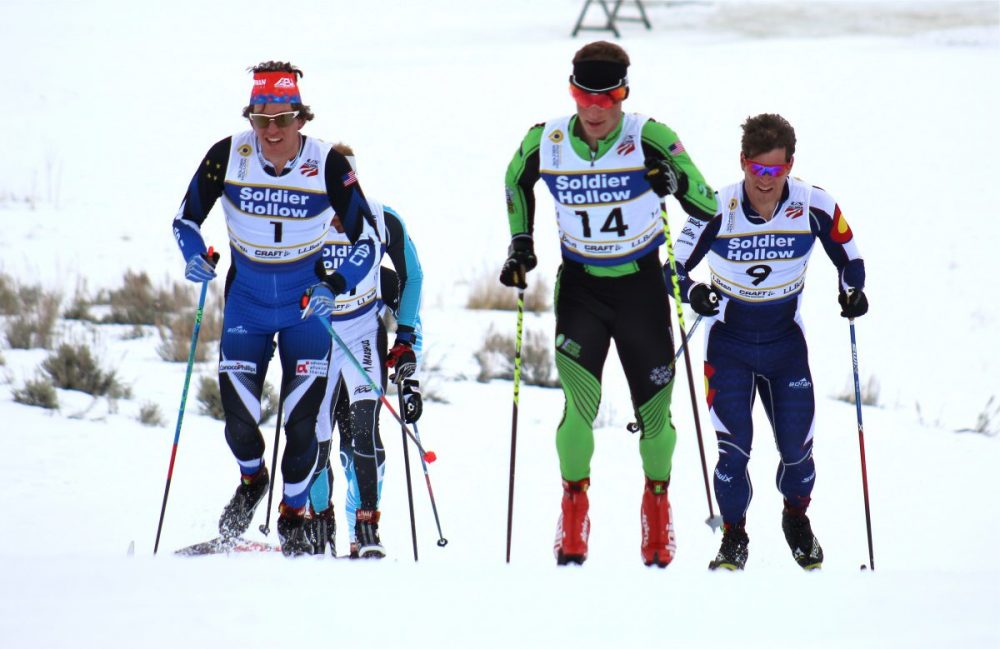
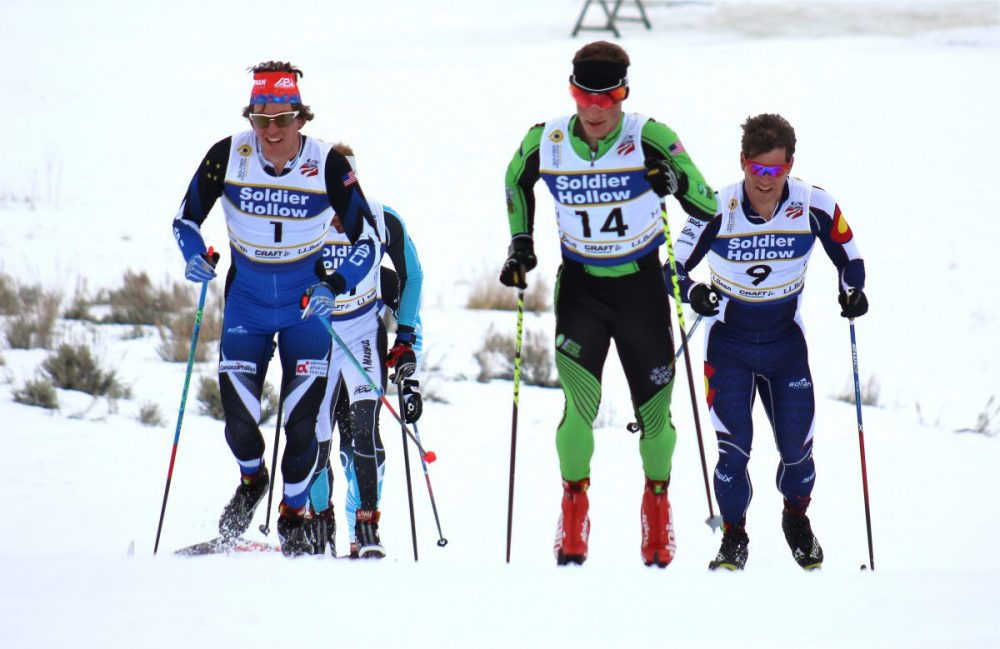
    U.S. nordic skiers Scott Patterson (1), Ben Lustgarten (14), Kris Freeman (9), Brian Gregg (behind Patterson) racing head to head in the 30 k classic mass start at 2017 U.S. nationals at Soldier Hollow in Midway, Utah. Lustgarten went on to win for his first national title.

    Note: This is part of a series on the 2018 Winter Olympic selection criteria for the U.S. cross-country ski team. Read this parallel article for specifics on the criteria itself.

    ***

    When considering the criteria recently posted by the U.S. Ski Team regarding how cross-country athletes will be selected for the 2018 Olympics in PyeongChang, South Korea, it’s useful to know some context about how selections are made in other sports.

    As described in a parallel piece, the criteria have three main components: a World Cup qualification process via top-eight results on one of five different days between November and mid-January, or else a top-50 World Cup ranking; discretion; and standings from the U.S. SuperTour and national championships.

    Some aspects of these criteria are consistent with common practices in other disciplines under the umbrella of U.S. Ski & Snowboard and across other winter national governing bodies.

    Others are not.

    For instance: of all of the U.S. Ski & Snowboard disciplines, the cross-country criteria were the last to be approved. The final signature of approval came on May 30, 2017, and the document was not posted online until June; on the other end of the spectrum, the freestyle skiing criteria got its last signature in June 2016.

    Secondly, though criteria for many of the ski and snowboard disciplines include discretionary clauses, few are featured as prominently as the discretionary clause is in cross-country skiing. Few individual winter sports use discretion so prominently, with the exception of figure skating (a judged sport).

    But at the same time, the lack of a guaranteed nomination route via domestic racing is not unusual, as several other sports will fill their Olympic rosters based only on international competition results.

    So considering different aspects of the criteria, which are in line with national best practices? Which likely came from cross-country team staff? Which are in line with, and perhaps generated from, U.S. Ski & Snowboard’s overall philosophy?

    Who knows what, when

    Most straightforward issue to address is the timing of Olympic criteria approval. Criteria were released later for cross-country skiing than for any other U.S. Ski & Snowboard discipline; in addition, sports independent of U.S. Ski & Snowboard: biathlon, bobsled, skeleton, luge, short- and long-track speedskating, hockey and curling had already published their criteria.

    Figure skating criteria could not be found on the U.S. federation’s website, but the official selection procedure had already been described on the NBC Olympic site.

    That means that cross-country skiing was the very last set of 2018 U.S. Winter Olympic team criteria to be published, a deviation from past Games. The 2014 Olympic criteria for cross-country skiing were signed in June 2012, more than a year and a half before those Olympics.

    “At best we would like the selection procedures to be made available to the athletes a year before the evaluative events that may be used to select [the Olympic team,” said Rachel Isaacs, a sport performance bid liaison for the U.S. Olympic Committee (USOC) who previously served as the organization’s team leader for sport performance.

    With the first World Cup races less than six months away at the time the criteria were posted, that didn’t happen this year.

    Isaacs said that the time frame is not a requirement, and that the organization offers flexibility. That means that there are no strict consequences for publishing criteria late.

    “We do realize that that can’t always be the case,” she said of the year-in-advance standard. “The informal guideline would be to make sure that the athletes know if a World Cup season is going to be used, certainly prior to the World Cup season starting … But we wouldn’t mandate that the first event of a World Cup season in 2017 — it wouldn’t be a year prior to that. We understand that they are still developing their selection criteria and qualification process.”

    In this case, the 2018 Olympic criteria for cross-country skiing are more or less identical to those used for 2017 World Championships, although U.S. Ski Team Head Coach Chris Grover said that there had been discussions about whether to implement any changes.

    Isaacs also didn’t see a problem with the fact that the qualification period for the World Cups themselves was long past by the time the criteria were posted.

    “I think athletes know that the World Cup season is always part of, and I do want to emphasize a part of, the selection process,” Isaacs said, indicating that athletes should have known that qualifying for the early-season competitions would be important.

    Because of the Olympic criteria’s similarity to 2017 World Championships selection criteria, athletes might have been able to guess how things would shake out.

    As to the question of whether athletes might have planned their previous season differently if they knew the criteria further in advance — or built a multi-year training plan differently, or a single-season training plan that accounted for having to peak multiple times – Isaacs was dismissive.

    “Any athlete knows what she or he needs to do to best prepare themselves along with their coaching staff or whatnot,” she said, adding that responsibility for preparing did not rest with national team staff who develop selection criteria.

    Discretion in the main criteria

    The most controversial part of the criteria is likely to be the placement of discretion before a domestic qualifying mechanism.

    (Discretion also comes heavily into play at the World Cup level, discussed later in this piece.)

    After World Cup results and standings, the next way to qualify for the Olympics is via discretion: “If team positions remain open after the application of criteria 1 above, the USSA Cross Country Head Coach may use discretion (See Section 2 below) to determine team nominations.”

    (Note: USSA refers to the U.S. Ski & Snowboard Association, which until June 19 was the name of what is now simply U.S. Ski & Snowboard, for which there is no official abbreviation.)

    The reason for that, according to U.S. Ski & Snowboard Executive Vice President for Athletics Luke Bodensteiner, would be to prevent a situation where the team roster had already been filled via objective criteria and coaches could not nominate a key athlete who had somehow not met the criteria.

    “We’ve got some interesting factors in cross-country, like with the team sprint, where arguably a different kind of athlete is best — and there aren’t that many team sprints to evaluate from,” he said in an interview. “The coaches have the ability to pick that roster in ways that don’t pin them down to results that may not be reflective of true performance.”

    The criteria specify that athletes may be selected via discretion if they have indicated the potential for Olympic success via results in the 2016/2017 or 2017/2018 season, have a recent positive trend towards success that would suggest strong performances at the Games, or show potential for medals in future Olympics in such a way that participating in this Olympics would be beneficial for development.

    That is consistent throughout U.S. Ski & Snowboard: the language describing what discretion should be based on is identical or nearly identical to wording in criteria documents from alpine skiing, snowboarding, nordic combined, freestyle skiing, and ski jumping.

    But for cross-country skiing, discretion is listed as the second criterion just as it was for the 2014 Olympics and 2015 and 2017 World Championships.

    That is a departure from other U.S. Ski & Snowboard disciplines.

    In alpine skiing, discretion is only listed as the last possible mechanism in a cascade of criteria – it is only to be used if four previous objective criteria, all based on World Cup results, fail to fill the team.

    And in snowboarding and freestyle skiing criteria, discretion is not even listed together with the objective mechanisms and is rather only described in a separate section of the criteria. There, too, discretion is to be used only if the objective criteria fail to fill the team roster.

    In nordic combined and jumping, discretion is listed as the second criterion – like cross-country skiing (which lists its two World Cup qualifying mechanisms together under one heading) – but the criteria also state, “There is no requirement that section 1.3.2 [discretion] be used for nominating athletes to the team.” That sentence appears nowhere in the cross-country criteria.

    Bodensteiner suggested that the different disciplines could not be directly compared, because alpine skiing, for example, has no Continental Cup-based qualifying mechanism.

    “Rather than looking at alpine having discretion as their last piece, I think the primary difference between alpine and cross-country is there’s not that third tier of domestic selection in alpine,” Bodensteiner said. “There’s more of a push to say, if we don’t have athletes that gain selection through the World Cup, then we probably don’t fill our quota.”

    Outside of skiing, some sports, like figure skating and hockey, use discretion exclusively with no objective criteria. Bobsled uses discretion widely; while there are objective standards for bobsled pilots, the pushers are assembled into teams based on discretion after having met minimum requirements through a long selection process.

    There are yet other sports which use objective criteria for most of the team selection, but deal with the possibility of a key athlete failing to meet the objective criteria for some reason by guaranteeing coaches the ability to use some discretion.

    In biathlon (as discussed on this site yesterday), one discretionary selection is hard-coded into the process – for the last athlete for the five-man or five-woman roster, meaning that the first four spots are already automatically filled by athletes best meeting the objective criteria.

    For bobsled pilots and for skeleton, too, the criteria state that if the U.S. receives more than one quota spot at the Olympics, the last team selection will be made via discretion. (If the U.S. gets only one sled, it will be selected based on objective criteria.)

    Such a system of leaving the last spot to discretion would seem to fulfill Bodensteiner’s idea of picking “an athlete” via discretion in case their suitability for a team event was not captured by individual results, for instance.

    Yet there is no cap in the cross-country skiing criteria for how many athletes could be selected via discretion. In the recent past, zero, one or two athletes per Championships have been picked using discretion.

    Bodensteiner seemed wary of using discretion in general, saying that “I know from experience that using discretion — particularly in the Olympics — is painful and it’s really not worth the challenges that it can create… unless this is something that really supports a medal objective.”

    But he stood behind the prominent inclusion of discretion in the cross-country criteria, even though it seemed anomalous among the other disciplines he oversees.

    “We put it in after the World Cup selection just to have that ability to make that assessment there, pick an athlete through discretion if we need to and then use the third criteria to fill up the team if we elect to fill up the team,” Bodensteiner said.

    And when pressed on whether that meant that only a small number of athletes would gain Olympic starts via discretion, Bodensteiner demurred.

    “We always want to leave the door open because you can never really anticipate everything that happens,” he said.

    International vs. domestic results

    Another aspect of the criteria sure to raise discussion is that it would be possible to fill the Olympic roster without ever dipping into the field of athletes who compete primarily within North America.

    The first two criteria for Olympic qualification come from the World Cup. First priority will be given to athletes who notch top-eight results in the period between Nov. 23, 2017 and Jan. 15, 2018 in classic sprints (in Ruka, Finland; Lillehammer, Norway; and the Tour de Ski stage in Oberstdorf, Germany), the 10/15 k freestyle individual start in Davos, Switzerland, or the 15/30 k skiathlon in Lillehammer.

    Second priority goes to athletes ranked in the top 50 of the distance or sprint World Cup standings at the end of this selection period.

    Add a discretionary selection or two, and particularly on the women’s side, it’s easy to imagine a team that completely bypasses athletes racing on the SuperTour and at U.S. nationals.

    There were just two domestic skiers nominated to the women’s World Championships teams in each of 2015 and 2017 (Caitlin Gregg both years, and Rosie Brennan in 2015 and Chelsea Holmes in 2017; between the three of them are one World Championships medal and two top-20 finishes).

    And the whole women’s team to the 2014 Olympics was picked based on World Cup results.

    International-based qualification priorities may rankle athletes who have not been offered World Cup starts and whose only opportunity to qualify for the Olympics is through domestic results. But in the wider world of U.S. sports, it isn’t all that unusual.

    As noted above, U.S. Ski & Snowboard’s Olympic selection criteria for alpine skiing completely bypass any domestic competitions, relying instead solely on international results.

    Ski jumping and nordic combined offer Olympic spots to the winners of Olympic trials (and only the winners, not also runners-up). But that is their first criteria, and all the rest are based on international results at the World Cup or Continental Cup level. Thus, if a World Cup athlete wins trials, the team will end up filled only with athletes competing internationally (barring the use of the discretionary clause). Domestic athletes have no direct opportunity to fill spots at the bottom of the roster.

    Outside of skiing, luge also bases all of its selections on the results of international-level competitions. Bobsled makes all of its objective selections based on international results, with the last spot being filled by discretion.

    Providing a domestic qualification route is not mandated or even suggested by the U.S. Olympic Committee.

    “There is definitely a range [of selection strategies] from the national governing bodies,” said Isaacs. “The sports are the experts. They tell us how they think they will pick the best team and we work with them to ensure a fair process.”

    Who gets to the World Cup?

    The key to making good team selections based on international results, it seems, is to get all of the best athletes to those international competitions. With World Cup results being the only way for cross-country skiers to absolutely guarantee a trip to the 2018 Olympics, who gets to even go to the World Cup may become critically important.

    And while U.S. Ski and Snowboard wishes to generally avoid using discretion to pick an Olympic team, that masks a potentially essential role discretion might play: in determining who races on the World Cup and can shoot for those top-eight finishes or top-50 rankings.

    At the time that the Olympic selection criteria were published, the criteria for how to qualify for the 2017/2018 World Cup and Tour de Ski were already posted.

    For Period 1, the only athletes guaranteed starts are those with a top-50 overall World Cup ranking from the previous season (Jessie Diggins, Sadie Bjornsen, Liz Stephen, Sophie Caldwell, Kikkan Randall, Ida Sargent, and Simi Hamilton), a top-30 Sprint Cup or Distance Cup ranking (Andy Newell), and the 2016/2017 SuperTour champions (Scott Patterson and Chelsea Holmes).

    And the only athletes guaranteed Tour de Ski starts by the U.S. Ski Team are those who are sitting in the top 30 of the World Cup overall or distance rankings at the conclusion of Period 1. The top 20 athletes in the Sprint Cup are also now guaranteed spots by FIS, outside of each country’s specific quota.

    That means that in order for any other athlete to qualify via the World Cup mechanism, they would need to be offered World Cup starts via discretion. The World Cup criteria state that “Discretionary selections, if any, may be based on a variety of factors, including competitions conducted outside of the selection period.”

    Bodensteiner stated that he supported the cross-country coaching staff in their ability to make discretionary picks at the World Cup level.

    “We’re using discretion maybe more on a strategic basis,” he said. “With Tour de Ski, there is sensitivity about team size and just our ability to really service the best athletes in that kind of environment. You also have specific considerations in terms of which actual disciplines and techniques are being competed in those different blocks of World Cup… But I also know [Head Coach Chris Grover] is using some of his ability to select athletes into the World Cup to think forward in terms of preparing an athlete over successive years for international success.”

    A top-eight World Cup finish is, obviously, not easy to obtain.

    Nor is a top-50 ranking, although last season Caitlin Patterson, racing Period 1 as the SuperTour winner, came close, ranking 54th on the distance list at Christmas. That wasn’t far from unprecedented: in 2011 Holly Brooks, the previous year’s SuperTour champion, was 20th on the distance list at Christmas. That 2011/2012 season, Diggins won the SuperTour. She went home for Christmas in 2012 ranked 40th on the World Cup distance list.

    (For men, such successes by SuperTour leaders sent to the first period of World Cup racing have been rare.)

    Providing specific athletes with a chance to notch an Olympic-qualifying body of work on the World Cup may or may not go into that decision-making process regarding who gets starts.

    But the question of who heads to the World Cup will likely to come into play, especially on the men’s side.

    While the World Cup criteria state that “USSA policy mandates that team selection criteria shall be principally objective (or performance-based) and that available start rights and team spots will not necessarily be filled,” only three men have objectively qualified to start World Cups in Period 1.

    Grover has already stated that he tentatively plans to send three more men to the World Cup for Period 1 – U.S. Ski Team (USST) members Erik Bjornsen and Paddy Caldwell, along with Noah Hoffman, who was not renominated to the USST this season.

    Those selections are not based on any documented selection criteria. This was also true of the (very successful) World Cup starts by Scott and Caitlin Patterson in PyeongChang, South Korea, last season.

    If one of the planned six men does not end up on the World Cup this fall – due to illness, injury, or some other factors – the USST might invite someone else. But even that is not straightforward.

    “World Cup Period 1 is a little problematic for athletes,” Grover said in an interview earlier this month. “If making the Olympics, for example, is a primary goal, which it is for most of the top senior athletes, it’s a little problematic for an athlete to decide whether they want to attempt to do that domestically, or on the World Cup. Obviously it’s easier to do that domestically. Not that it’s easy, but that it’s easier, for sure, to qualify at home versus to qualify on the World Cup. So if, for example, one of those six men weren’t able to make it, we might look at inviting another athlete, but I wouldn’t be surprised if we get turned down on that particular offer.”

    In terms of who such an offer might go out to, there are no written, clear-cut standards for what an athlete must do to receive one. It’s discretion, or nothing.

    “It’s pretty challenging to figure out, after a dryland training season, who is the next best athlete,” Grover said. “Everybody has just been training on their own domestically, in their clubs. And according to everybody, the training is going very well – but it’s quite hard at that point to reach down and say, OK, this is going to be the next best person to bring up.”

    In Conclusion

    Both U.S. Ski & Snowboard and the USOC document that fairness and openness are important in the selection process.

    “One of the keys that we have is that there’s always basically an objective pathway to the Olympics,” Bodensteiner said.

    “If it wasn’t fair – if it was picking somebody’s best friend or cousin – we would tell them that these would not be approved and they need to go back and redo the draft,” Isaacs said of the potential situation of a national federation writing criteria which didn’t meet USOC standards.

    But fairness and an open path to the Olympics are in the eye of the beholder.

    “Sometimes that might be really limited,” Bodensteiner said of the ability to qualify outright for an event. “In cross-country, sometimes it’s pretty limited. But there’s still the objective opening for an athlete to have that pathway.”

  • Op-Ed: The Substance of Perspective

    Op-Ed: The Substance of Perspective

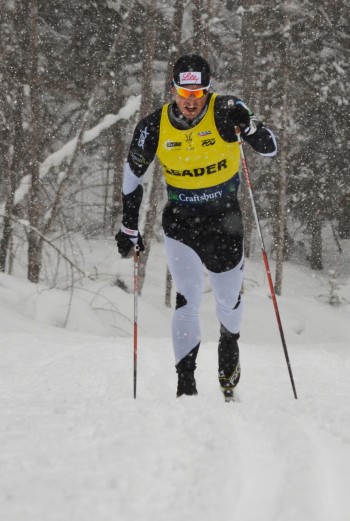
    Kris Freeman wearing the 2014/2015 yellow SuperTour leader’s bib en route to a win in the Craftsbury SuperTour 15 k classic mass start in February 2015. (Photo: John Lazenby/lazenbyphoto.com)

    (The following op-ed is an opinion piece submitted by an author unassociated with FasterSkier. Viewpoints do not necessarily reflect that of FasterSkier’s staff or sponsors. We fully support open dialogue and encourage the use of the comments section at the bottom of this page to express varying views. To submit an op-ed, email info@fasterskier.com.)

    About the author: Kris Freeman raced for the U.S. Ski Team for more than a decade, from 2002 to 2013. A four-time Olympian who placed fourth in the 15 k classic at both 2003 and 2009 World Championships, Freeman, 36, is currently training in New Hampshire in hopes of making the 2018 Olympics in PyeongChang, South Korea.

    ***

    “The U.S. Ski Team will select only the most qualified athletes with the greatest possibilities for winning medals in future World Championship and Olympic Winter Games competitions,” the team wrote in its 2018 national team selection criteria.

    In a recent interview, Head Coach Chris Grover explained that the potential for winning medals was key to several discretionary nominations.

    I believe that there should always be room for discretion when nominating athletes, but the vague “medal potential” standard has become an excuse for the national team coaches to have free reign.

    It’s another example of how the U.S. Ski Team markets itself to the ski community as all-inclusive, as representing all of U.S. skiing. But watching their actions, this advertisement rings false.

    Can the best skiers make the national team?

    Before I go any further, I believe that a case can be made for every athlete nominated for the 2017/2018 team and I mean no disrespect to any of them.

    I merely wonder how many skiers in our country are consistently overlooked and what part personal favoritism plays in the nomination process.

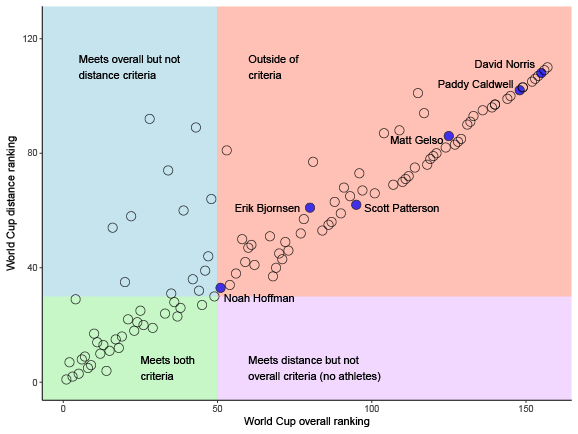
    U.S. Ski Team national-team criteria provide two ways to get onto the team via World Cup rankings: a top-50 ranking overall, or top-30 in sprint and distance. However, for male distance skiers, this is not much of a choice. No additional man in the entire World Cup field would meet that distance criteria who was not already in the top 50 overall. Thus, this criteria does not represent a way to add additional male distance skiers to the team. (Graphic: FasterSkier/Chelsea Little)

    For the first time in several years, the B-team is made up entirely of discretionary picks. Noah Hoffman failed to make the objective criteria by only one World Cup point but was left off the team. Yet Erik Bjornsen scored 66 fewer points than Noah and was still named to the team for the fifth time.

    It should be noted that Erik has never made the objective criteria in any year, and also did not objectively qualify for this year’s World Championships in Lahti, Finland, based on written criteria.

    Erik teamed up with Simi Hamilton to take fifth place in the team sprint and was 18th in the 15 k classic in Lahti. Even though success at World Championships is ostensibly one of the national-team’s main goals, those solid results were not sufficient for an objective nomination.

    The U.S. Ski Team does provide one criteria based on FIS points: that skiers with a top-20 ranking on the FIS distance or sprint points list will be named to the team. However, this is harsh top-20 cutoff represents unattainable standard that is redundant with the other criteria. All of the top-20 male distance skiers according to FIS points are also ranked in the top 50 of the World Cup. It should be noted that Chelsea Holmes of APU is the 33rd-ranked woman in the world according to FIS distance points. Only three women with lower points are not at least semi-regular starters on the World Cup, and for one (Sweden’s Ebba Andersson) that is because she is still a junior and notably a Junior World champion. (Graphic: FasterSkier/Chelsea Little)

    I believe Erik is our best all-around skier and, again, I have no issue with his nomination. However, when the best skier in the country can’t make the B-team criteria, it raises questions.

    I believe the unstated rationale for the high objective standard is that ski team leadership wants complete control over the nomination process. The easiest way to do that is to put objective criteria out of reach, keeping athletes on the B-team in a constant state of subservience as the team’s decisionmakers hold the keys to their livelihood.  The team can tell them what to say to media and what financial information can be disclosed to the public.

    Ask yourself: when was the last time a U.S. Ski Team athlete talked publicly about a poor wax job?  Are you aware that B-team athletes have to pay roughly $150 each day that they are in Europe racing on the World Cup? Have any of them ever mentioned that in an interview you have read?

    Who scores points?

    The particular results, numbers, and details of individual nominated-or-not cases (see “More Discretionary Picks” below) are interesting fodder and could be discussed for hours. But doing so might miss the forest for the trees. Such decisions are emblematic of broader problems at the U.S. Ski Team.

    There is no written standard for athletes to qualify for the funded A-team vs. the unfunded B-team, but the common discretionary standard that the U.S. Ski Team has used is a top 30 ranking in either Distance or Sprint world ranking list, formerly known as the Red Group.

    The team used this standard because Red Group skiers were partially funded by FIS up until this year. But now that the FIS funding allocation system has changed, maintaining this standard merely encourages our athletes to start every World Cup in order to not miss a chance to score points. For an organization that claims World Championships and Olympic medals are their only goal, racing their own athletes into the ground is hypocritical.

    More Discretionary Picks:
    Paddy Caldwell and Scott Patterson were also named to the B-team using discretion. Paddy followed the pipeline route to his nomination. With two top-10’s at U23 World Championships, his nomination at some level was predictable even if he did not meet objective criteria.

    Scott’s nomination is more of a mystery. He is too old for the ski team’s pipeline system, and he wasn’t nominated to the World Championship team. He did have some solid World Cup results, taking ninth place on the Olympic trails in South Korea and 27th at the Holmenkollen 50 k in Oslo. However, it should be noted that Noah beat him in Korea in his last race of the season before he came down with pneumonia.

    The World Cup start rights that were given to Patterson baffled the rest of the domestic field, as there was no qualification criteria for them or explanation for why those starts were granted; in a recent interview, Grover told FasterSkier that “We wanted to find opportunities for Scott.” Scott definitely did well with these opportunities, but who is to say that other domestic skiers could not have had the same success?

    Then there is Tad Elliott, who was the king of clutch this season. As a distance skate specialist, he took third and second in the two freestyle World Championships qualifying races. Then he went to Finland and pounded out a 27th place finish in the 50 k, the best result we have had in that race since I was 12th a decade ago. As a reward, Tad was snubbed for World Cup start rights at World Cup Finals in Quebec. The disparity between Scott and Tad’s treatment is troubling.

    Meanwhile, Rosie Brennan is the only women’s B-team nominee this year despite Caitlin Patterson having scored an identical amount of World Cup points and Chelsea Holmes putting up a 13th place in the 30 k skate at World Championships. Rosie may, as Grover says, be a medal contender in the 4 x 5 relay. But by that rationale, Caitlin and Chelsea should also certainly be named to the national team.

    Crucially, the standard also makes no sense in that it does not differentiate success against strong fields versus weaker ones. For instance, Liz Stephen scored 98 of her World Cup points en route to a second place finish in the Korean World Cup. The race had the weakest World Cup field in my lifetime. Liz scored most of the rest of her points in the hill climb in the Tour de Ski. Only 31 women started, and last time I checked, there are no hill climbs in the Olympics.

    I want to reiterate that all of the athletes nominated to the team deserve to be there. Liz is clearly one of our best skiers.

    But all the same, why is a non-championship event being used as a standard to make the U.S. Ski Team, whose primary stated goal is to win medals?

    The Tour de Ski ended up being a points feeding frenzy. Rosie Brennan and Liz would not have qualified for the World Championships without it. They did not accrue enough points to make the top-50 standard until that final Tour stage. Noah also qualified for the World Championships in a non-Championship event on the final day of the Tour against a diminished field. Is racing up a hill at the end of a nine-day tour really a fair way to determine who goes to the World Championships or Olympics?

    Even if you believe that the Tour de Ski is a fine qualification basis for the Olympics, there is that access problem. U.S. Ski Team staff can (and does) give or deny Tour de Ski start rights at their whim. There are no written standards for how these spots are doled out. I believe that there are half a dozen domestic skiers that potentially could have qualified for the World Championships had they been given the opportunity to race World Cups during the qualification period.

    What are the priorities?

    The U.S. Ski Team has gradually consolidated too much power in the naming of the national team, major Championships teams, and World Cup start rights. “Discretion” and “medal potential” are getting in the way of U.S. cross-country skiing reaching its true potential. The team’s World Cup staff need to have a presence at Nationals and SuperTour Finals, so that they have a hands-on way of evaluating domestic talent.

    This brings me to the most aggravating part of the U.S. Ski Team dynamic in relation to domestic skiing. I call it “teaminess.”

    Much has been made of the good team dynamics that the women’s team has marketed, and clearly it is working for them. However, the staff uses these dynamics as another way of controlling team composition: they have decided what emotional attributes an athlete should have, and if the athlete doesn’t have them (or doesn’t pretend to have them) he or she is not welcome.

    “Attitude and commitment of athletes” is even one of the discretionary criteria for team selection.

    This could be construed to include every male athlete in the country because it is well-documented that men and women have very different psychological needs. As a generalization, women perform better when they train in close-knit groups amid lots of social support. Men, on the other hand, generally like to have independence and thrive when given space and respect.

    Yet for the last six years, the men have been perpetually bombarded with criticism for not behaving like the women’s team. Many independent-minded skiers, who have posted some of the best results in our nation’s history, do not feel supported or welcome within the U.S. Ski Team structure.

    My question is, how real is the team dynamic if it is so fragile that it could collapse by the mere presence of these skiers?

    Also, is it fair to protect the women’s team from any type of intrusion at the expense of the men’s team and anyone on an ever-expanding blacklist?

    The staff appears to believe that it is. In the name of maintaining the status quo, the team has avoided hiring a men’s coach, perhaps due to a desire to not disrupt the women’s team dynamic.

    It is completely unacceptable that the men’s team has no dedicated advocate among the staff of the governing body.

    What are we paying for?

    The “teaminess” factor also plays into financial issues. The U.S. Ski Team wants to be all-inclusive when it comes to raising money from the cross-country ski community and projects itself as a supportive and welcoming resource. But in reality, the team’s resources are denied to many athletes with the potential to succeed internationally.

    With the current lack of funding coming from U.S. Ski and Snowboard Association (USSA), the nordic program could not survive without assistance from the nation’s clubs. In return for this financial support, the clubs should know how their money is being spent. And there should be clear, attainable objective criteria for their striving athletes.

    But what is the budget of the U.S. Ski Team, anyway? It has been a decade since anyone at the USSA released a cross-country skiing budget document to the public or press. Most years, they won’t even answer what the overall budget cost is, without even getting into how it is broken down. That’s quite the culture of secrecy.

    The U.S. Ski Team coaching staff has become convinced that only they know which athletes should be supported – and how they should be supported. They have created a closed system over which they have complete control.

    This is a fearful and exploitative way of running a national governing body. U.S. skiing will not grow without outside ideas and influence.

    It is time for leadership that is open to all personalities and ideas. Fear of losing what we have will not allow us to reach our true potential as a nation.

  • U.S. Ski Team Nomination Breakdown with Head Coach Grover

    U.S. Ski Team Nomination Breakdown with Head Coach Grover

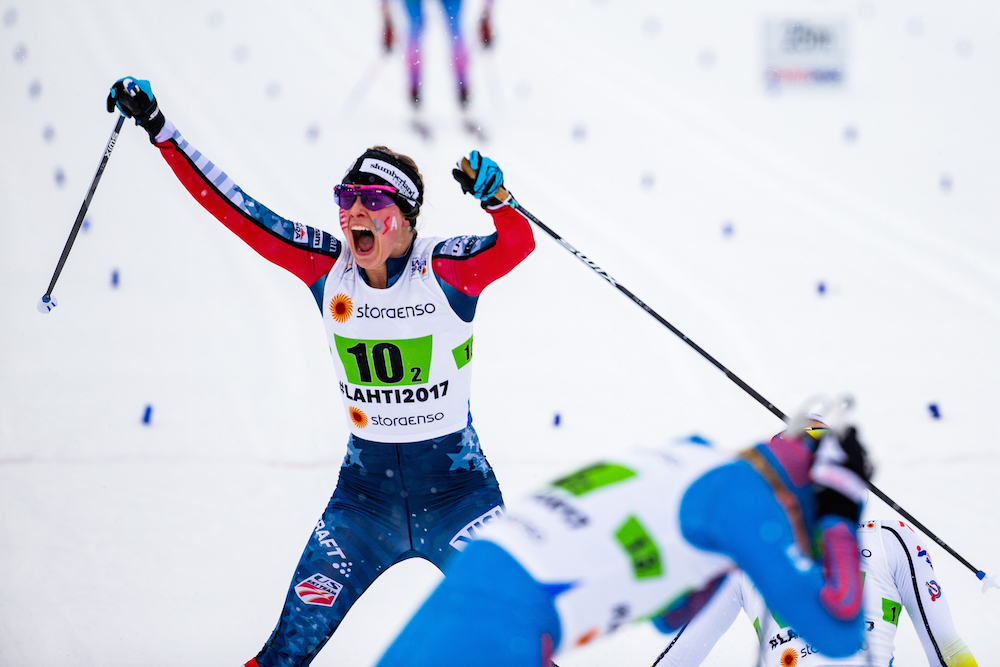
    Jessie Diggins celebrates after anchoring her team to bronze in the women’s classic team sprint on Feb. 26 at 2017 World Championships in Lahti, Finland. (Photo: Dustin Satloff/dustinsatloff.com)

    Shortly after the U.S. Ski Team (USST) formally announced its 2017/2018 cross-country team, FasterSkier reached USST Head Coach Chris Grover on the phone for his comments. Grover is in Bend, Ore., for the team’s traditional on-snow camp.

    We have nine athletes who made the objective criteria to make the 2018 U.S. Ski Team,” Grover said. “Eight that are on the A-team, all of whom finished in the top 30 in the world in either sprint or distance. And then Katharine Ogden, who as a medalist at the World Junior Championships, made the objective criteria that way.”

    Below are the eight A-team athletes and Ogden, who was renominated to the development “D” team, that met the USST’s objective criteria for team selection.

    A Team

    Men

    • Simi Hamilton (Stratton Mountain School Elite Team)
    • Andy Newell (SMS Elite)

    Women

    • Sadie Bjornsen (Alaska Pacific University)
    • Sophie Caldwell (SMS Elite)
    • Jessie Diggins (SMS Elite)
    • Kikkan Randall (APU)
    • Ida Sargent (Craftsbury Green Racing Project)
    • Liz Stephen (Burke Mountain Academy)

    D Team

    • Katharine Ogden (SMS)

    The USST’s 2018 cross-country nomination criteria, as it relates and is applied to athletes meeting the objective criteria, remains straightforward.

    • Attain top-50 ranking in the 2017 final World Cup Overall ranking list.
    • Attain top-30 ranking in the 2017 final World Cup Sprint or Distance ranking list.
    • Attain top-20 ranking in the 2017 FIS final sprint or distance points list.
    • Attain a top-3 individual finish at the 2017 Junior World Championships or U-23 World Championships.

    Six women finished the season ranked in the top 50 in the World Cup Overall ranking list: Diggins (6th), Bjornsen (16th), Stephen (28th), Caldwell (33rd), Randall (36th), and Sargent (44th). Notably, Diggins, Caldwell, Sargent, Randall, and Bjornsen all ranked in the top 30 for the final World Cup Sprint list, too, and Diggins, Bjornsen and Stephen all finished in the top 30 on the final World Cup Distance list.

    Nineteen-year-old Ogden earned an individual bronze in the 10-kilometer skiathlon at the 2017 Junior Worlds.

    Hamilton and Newell were the two men that met the objective criteria, with Hamilton ranking 30th on the final World Cup Overall list and ninth in the World Cup Sprint standings and Newell 28th on the final World Cup Sprint list.

    The remainder of the USST were discretionary selections. The athletes nominated to the team under the discretionary guidelines are as follows:

    B TEAM

    Men

    • Erik Bjornsen (APU)
    • Paddy Caldwell (SMS Elite)
    • Scott Patterson (APU)

    Women

    • Rosie Brennan (APU)

    D TEAM

    • Ian Torchia (Northern Michigan University)
    • Hannah Halvorsen (Sugar Bowl Academy)
    • Julia Kern (SMS Elite)

    As Grover explained, the USST’s use of discretion should not perceived as murky. Built into the criteria are aspects of fulfilling “individual markers” or competition results, “attitude and commitment”, illness or injury, and the heavily weighted medal potential.

    “We are trying to incorporate athletes who we see are on a path to winning a medal at the highest level, at the Olympic level or at the World Championship level,” Grover said. “Can we make a strong case suggesting that an athlete is on the path to winning the medal? It’s really a difficult call. What are the metrics that we’ll be using: FIS points? Should we be using World Cup points? Should we be using placing at World Juniors or U23s, at NCAAs or SuperTours? There are so many different places where athletes are coming from, so many different places where they are competing. Are they all equal? No, of course not.”

    What often makes discretionary selections difficult is that USST coaches must make assessments about future potential using real-time accomplishments between skiers skiing on the World Cup and those skiers competing at the World Cup and Continental Cup (i.e. SuperTour).

    “You can’t really compare someone who has been competing on the World Cup to someone who has been competing at a Continental Cup level,” Grover explained. “So that’s a real challenge for us. Yes, you can look at FIS points – that’s one thing we have always done, for many years. We’ve taken that athlete and tracked FIS points and age in distance or sprint, whatever that athlete’s strongest discipline is, and we try to see where they are compared to the best skiers in the world, the top 10 athletes in sprint or distance of that sex in the world.”

    Grover knows the FIS point system is not necessarily the best indicator of a U.S. skier’s potential on the World Cup.

    “One of the big challenges that we had using that methodology is that our FIS points as a nation in the US are artificially low,” Grover said.

    Grover believes FIS points are “artificially low” because the U.S. collegiate system has numerous European athletes with low FIS points that compete nearly every weekend on the NCAA circuit or FIS-sanctioned races. As a result, those skiers bring some U.S. skiers’ FIS points down.

    “The same thing happens occasionally when the U.S. Ski Team comes back from Europe,” Grover said. “The U.S. women in particular but also some of the men, and they bring good points and then they are not perhaps at their sharpest at SuperTour Finals, and other athletes are able to improve their points by coming close to or beating these athletes. And so that really drives our points down. We’re just not in the European pool enough to have points that are directly compared to European counterparts. The isolation, the way that points come over and they get passed around, and then they stay isolated over here, it prevents us from our points being representative of where people are compared to their European peers.”

    Athlete by Athlete

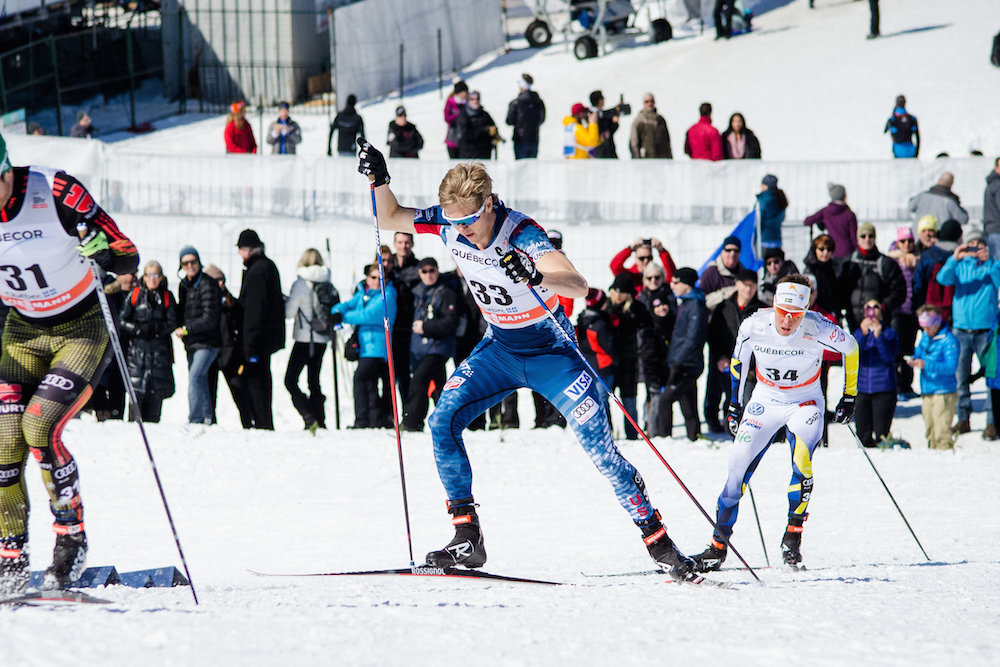
    American Erik Bjornsen (33) racing to the 11th-fastest time of day in the men’s 15 k freestyle pursuit at World Cup Finals in Quebec City for his career-best World Cup result. He finished 25th overall. (Photo: Gretchen Powers)

    For the B-team, let’s go athlete by athlete, those nominated and those not, to get a better picture of the whys and hows of USST discretionary selection. (Note that all of the D-team members from last year were renominated and will accordingly be invited to team camps.)

    “About Erik Bjornsen for example, and why was he nominated to the team,” Grover said. “For a number of reasons, but one thing that we see is that he could contribute to a medal in the team sprint, which is an event where he and Simi were fifth at this World Championships. … [Erik is] a guy who is scoring points in sprints in the World Cup occasionally, some points in distance occasionally. He is a hybrid between aerobic and anaerobic capacities, and that lends itself rather well to team sprint. We feel like he has strong potential there.”

    Bjornsen also skied to an impressive 18th (+1:56.7 behind the winner) in the 15 k classic at the 2017 World Championships.

    Patterson is the lone new face nominated to the USST.  “[Scott] just keeps coming up in conversation and he’s a really really interesting skier,” Grover said. “He got sick before U.S. nationals and then was sick for part of U.S. nationals and did not ski particularly well, at least by his standards for national championships in Soldier Hollow.”

    The Anchorage-based skier did not make 2017 World Championships team. Yet at the start of the season, before his illness, he placed third in the 15 k classic in the West Yellowstone SuperTour and won the 15 k skate in the Sovereign Lake NorAm in mid-December.

    “So this past winter, we knew he’s definitely one of those next guys — can we find some opportunities on the World Cup to start him?” Grover said.

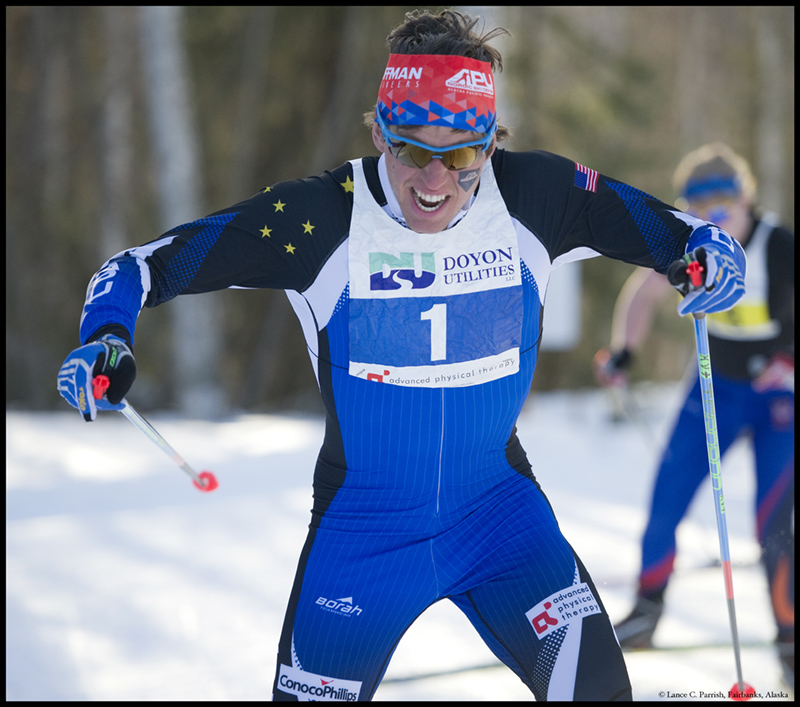
    Scott Patterson (APU) racing the anchor leg of the mixed relay at U.S. Distance Nationals in late March in Fairbanks, Alaska. (Photo: Lance Parrish, Fairbanks)

    Last season, Patterson was offered World Cup starts in PyeongChang, South Korea, and Oslo, Norway. In a thin PyeongChang World Cup field, he placed ninth in both the 30 k skiathlon and team sprint. At Holmenkollen in Oslo, Patterson was the top American man, skiing to a 28th in a loaded field. Patterson also qualified for World Cup Finals in Quebec.

    “And the cool thing was everywhere he went, he scored World Cup points as a 25-year-old athlete,” Grover said of Patterson’s potential. “So he’s a young guy who has got a big history of training. He’s training a lot and training really well and he’s also seizing these opportunities and showing in a very difficult men’s field that he’s a young guy who can grab some World Cup points.”

    Patterson went on to dominate U.S. SuperTour Finals and Distance Nationals at the end of the season, winning both the 20 k skiathlon and 50 k freestyle mass start in Fairbanks, Alaska.

    Addressing the question of why Patterson was given starts in PyeongChang and Oslo despite not leading the SuperTour at the time or qualifying for World Championships, Grover said Patterson had nearly fallen through the cracks. They needed to see he how he might perform on the World Cup.

    “Last year it was a challenging year for us as a national-team staff to look back at what was happening domestically and to make much sense of who was skiing well,” Grover said. “For example, in the first four distance races of the year, Yellowstone, Silver Star, and the two at Soldier Hollow, we had four different men win the four distance races. And of the four first sprint races, in those locations, I believe we had four different men win those four sprint races. And different athletes that were winning qualification in some cases versus those that were actually winning the day result for the sprint. So it was a very unclear picture in terms of who was skiing well … especially on the men’s side.”

    Of the skiers winning some of those races outright, Grover knew Patterson was promising, yet he wasn’t able to demonstrate it internationally on the World Cup or at World Championships.

    “So we wanted to find opportunities for Scott,” Grover said.

    Patrick “Paddy” Caldwell, 23, was bumped from the D-team to B-team status.

    “Paddy, he’s been on the D-team for a few years; he’s obviously been on the radar,” Grover said.

    Caldwell placed ninth in both the 15 k freestyle and 30 k skiathlon at the 2017 U23 World Championships. He also qualified for World Cup Finals in Quebec, where he skied the 25th-best time of day in the 15 k freestyle pursuit.

    “Just given where he is in terms of his ability and his age, we felt like it was the right move for him to move from the D-team to the B-team,” Grover said.

    Longtime USST member Noah Hoffman was not renominated to the team, but he has been offered World Cup Period 1 starts.

    “I think Noah would be the first to admit that last season was pretty disappointing, by his standards,” Grover said. “He and I were able to talk about expectations going into the season and Noah had struggled for a few years on the World Cup previous to this past season. …  And so we just talked that we need to make progress towards an eventual medal in the sport. So this year needs to be a step forward and unfortunately it wasn’t. It wasn’t the results Noah wanted to see and unfortunately it wasn’t the result that we were hoping to see from Noah.”

    Hoffman, 27, finished the season ranked 51st on the World Cup Overall list, a single point from the top 50 needed to meet the team’s objective criteria.

    “We hope that Noah gets back in there and starts skiing closer to his potential and starts making progress towards that medal,” Grover added. “Absolutely, the door for sure is never closed for Noah or any athlete.”

    On the women’s side, Rosie Brennan, 28, was renominated to the B-team. This past season on the World Cup, Brennan earned eight top 30s (the benchmark for scoring World Cup points). Her best finish, beyond her 23rd-best time of day in the Tour de Ski’s final climb, was a 22nd in La Clusaz, France, in the 10 k freestyle mass start.

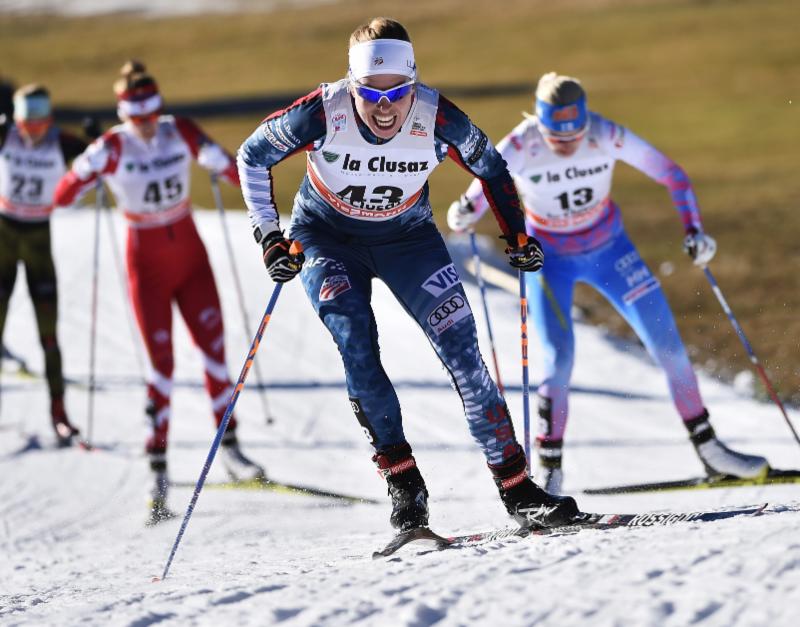
    Rosie Brennan (43) racing to a season-best World Cup result of 22nd in the 10 k freestyle mass start on Dec. 17 in La Clusaz, France. (Photo: Toko/NordicFocus)

    “Rosie is another interesting case,” Grover said. “It’s very hard to differentiate right now between Rosie Brennan, the skiing that she is doing, versus Caitlin Patterson, for example, or Chelsea Holmes. Yes, Rosie has been a little bit stronger in some races, but she has also had some more opportunity. However, we are really looking towards Rosie as a potential leg in a 4 x 5 kilometer women’s relay at a World Championship event. She has contributed a 5 k classic leg to a podium in Lillehammer, and she also skied a terrific leg in Ulricehamn — I want to say 12 seconds from the fastest on that particular leg in that relay this year. So she’s someone we are really looking towards for a potential relay leg. So there are athletes like that where it’s hard to differentiate sometimes between some of the domestic athletes who are really starting to blossom, who we are starting to take a lot of notice of them, but Rosie is somebody who … is in shape and ready to go when we get to Korea this winter.”

    On the non-nomination side of the equation are Holmes and Patterson.

    “Chelsea, she is someone who we have discussed a ton this spring,” Grover said. “And this is a conversation I’ve had with Chelsea as well. Is she a 5 k skier right now? Maybe, maybe not. She has certainly shown her ability in longer events. Her one standout international result from this season is a longer event in skating.”

    The 30-year-old Homes placed 13th in the marquee 30 k freestyle mass start at 2017 World Championships.

    “Does that, at this particular moment, suggest that she might be able to provide a 5 k classic leg in the relay? Not at this particular moment,” he said. “We have a lot of skaters on the women’s side right now. Our skating ability is quite high. So at this moment it doesn’t pencil out, but does that prevent her from being considered in the future for anything? Absolutely not.”

    Scott Patterson’s older sister Caitlin, 27, remains on the USST radar as well.

    “Caitlin is somebody else that we’ve discussed quite a bit,” Grover said. “She’s made a big step forward in the last year she started to score World Cup points and really flirting with that edge of the top thirty on a regular basis. So we absolutely have our eye on her. … Of course Chelsea is Continental Cup leader for Period 1, so she will be skiing World Cup Period 1. And then we’ll assess where she is at that point. Anything can happen at that point. She might be someone that’s skiing really well and we want to keep on the World Cup.”