From the FasterSkier archive — posts syndicated from athletes’ and coaches’ own blogs between 2004 and 2012, kept online as published. Current coverage is at fasterskier.com.
Welcome back to the Devon Kershaw show for our Tour de Ski stage 3 and 4 recap. We get into Frida Karlsson’s withdrawal from the tour after her egregious take-out of Jessie Diggins in Saturday’s classic sprint. We also cover Calle Halfvarsson and Joanna Hagström delivering for Sweden, Johannes Klæbo giving a couple of beat-downs, and Diggins’ come-from-behind win Friday.
We’ll be taping a mailbag episode next week — send us your questions at devon@fasterskier.com and nat@fasterskier.com. And happy new year.
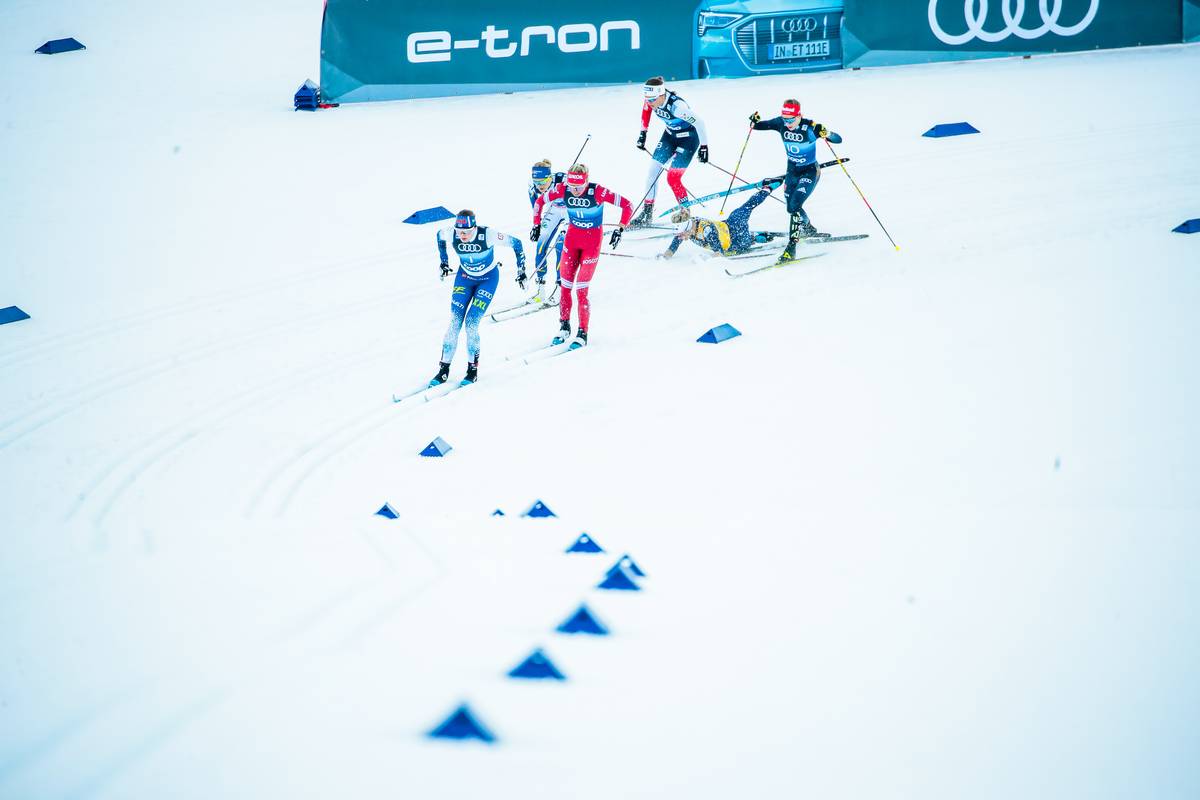
Jessie Diggins goes down in her quarterfinal heat. Frida Karlsson (SWE) was penalized for obstruction, but the fall left Diggins in 3rd place overall in the Tour de Ski. (Photo: NordicFocus)
One of the most controversial ski-related narratives to come out of the U.S. in 2012 was Torin Koos’ disqualification from the classic sprint at U.S. Nationals in Rumford, Maine. It’s not every day that a race unfolds the way that one did, and in its aftermath the incident generated heated discussion in the ski community.
We revisit the incident now because video of the move has recently surfaced. Koos never denied that his skis made contact with Scott’s, but his appeal did object to the legitimacy of the jury’s evidence. He didn’t think a marshall had seen him make the move, and at the time nobody had film that clearly showed the event — until now.
Quick rehash, since it’s been a few months: Koos cut across Ryan Scott’s skis on his way to winning the classic A-final, only to be reported by a course marshall and subsequently stripped of the win for obstruction of another competitor, which is against International Ski Federation (FIS) rules. Due to a prior warning for an separate incident earlier that week, what would have been relegation to sixth place defaulted to outright disqualification. Koos appealed the decision, but FIS rejected it, and the season went on.
The above footage was taken by Corky Harrer for Revived Films, and was unearthed from the cutting room floor during work on the company’s new movie, Fact or Fiction, in the process of interviewing its producers for a forthcoming review on FasterSkier. Though grainy, the image is clear enough to see Koos change tracks and nick Scott’s skis, causing the latter to stumble.
The film’s editors, Tyler Foulkes and Mac Fisher, had to zoom in on the shot to get a decent view of the move; hence the pixelated quality. Zoomed out, the figures were too far away to make the cut in the film, and the pair scrapped it without realizing what they’d barely managed to capture.
“It happened towards the beginning of the shot — that’s why it’s pixilated, because I blew it up a bit,” Foulkes said. “We don’t usually use that part of the shot; we don’t even look at it and wait until they’re more towards the camera. So I didn’t even realize it, but once you brought it up I was like, “Well we probably have something,’ and we did. I looked towards the beginning, and it was right there.
“I wish we’d realized at the time that we had that shot.”
Seven months removed, the new evidence has no official bearing as the case has long been closed. But the video does provide a look at what, in this case, was ruled obstruction.
Torin Koos skiing in the 30 k at U.S. Nationals last week. Photo: Flying Point Road.
After less than a week of deliberation, the International Ski Federation (FIS) Appeals Committee responded to the case Torin Koos (BSF/Rossignol) filed last Monday regarding his disqualification from the classic sprint at U.S. Cross Country Championships in Rumford, ME for obstruction of competition. The Committee rejected his case for lack of sufficient evidence.
In his appeal, Koos primarily took issue with the process by which the jury disqualified him, which he interpreted as a departure from the due process outlined in the FIS International Competition Rulebook (ICR). According to Koos, he was not allowed to defend his actions from the A-final before he was informed of his disqualification, which violates rule 224.7 in the ICR.
The committee’s response cited Koos’s lack of evidence to support this claim, and in its official ruling, included counterevidence for Rumford TD Kent Slaughter that stated Koos had actually been allowed to give a defense before the jury ruled to suspend him from competition. This decision automatically resulted in disqualification, as it was the second reprimand Koos received that week.
In a written statement on Monday morning, Koos maintained that he felt his case had been a strong one, but had no choice to accept the Appeals Commission’s decision.
“I received a written letter from the U.S. Anti Doping Agency stating twenty minutes after finishing the race that the race jury had disqualified me,” wrote Koos. “The letter goes on to say this is the sole reason the lead Doping Control Officer released me from doping control. As this all happened before I was summoned to the race jury room, [BSF coaches] Tim [Baucom], Bjorn [Bakken], Dragan [Danevski] and I all felt we had independent, verified evidence that the due process ensuring an athlete the right to defend themselves had been infringed upon.
“It is apparent from the decision that FIS felt otherwise,” he continued. “I have to respect this decision.”
The day after the conclusion of racing in Rumford, Koos got on a plane to Trondheim, Norway, where he will live for the rest of the winter to train and race for the ski club based there. With the conclusion of his appeal, Koos said he wants to move on and focus on the rest of his year.
“It is over and I really look forward to the rest of the season,” he said. “I have been really appreciative of all the encouragement and support I have received, both in all the years skiing, and also with this appeals process. A special thank you has to go out to the Bridger Ski Foundation.”
Koos continued on to say he was appreciative of the work the Black Mountain volunteers put in to make the 2012 U.S. Nationals possible, which he believes is what people should remember about the week of racing in Rumford.
“At the events banquet dinner, a Chisholm ski member stood up and told a story about how Matt Pauli had paid his own way and was using up his vacation time to prepare the courses at Black Mountain,” wrote Koos. “Hearing this story was special and reminded me why being a part of the Nordic ski community is such a privilege.”
Torin Koos (BSF/Rossignol) crossing the line in first in the A-final of the men's classic sprint at U.S. Nationals. While waiting to take to the podium, he found out his win was in question. Photo: Flying Point Road.
After crossing the finish line in first in the U.S. Nationals classic sprint A-final, Torin Koos (BSF/Rossignol) was disqualified for moving into a lane in front of Ryan Scott (MSU/Team HomeGrown) before completely clearing Scott’s skis, which resulted in contact between Koos’ tails and Scott’s tips. A course controller saw the pass, and after the conclusion of the race, reported a violation to the jury.
Per International Ski Federation (FIS) rules, the competition jury deemed the move to have been an obstruction of competition, which results in competition suspension and relegates the skier at fault to the back of the sprint heat. Tyler Kornfield (University of Alaska Fairbanks) thereby took the top of the podium, Mike Sinnott (SVSEF) moved into second and Eric Packer (Dartmouth College) finished third. Scott wound up in fourth, and Skyler Davis (SMS/USST) in fifth.
Had this been the only rule infraction Koos had been docked within the current competition period, Koos would have placed sixth in the classic sprint and been issued a written warning and competition suspension. However, due to a mix-up at the start of Friday’s 30 k mass start classic race, he had also been given a written warning for lining up in the wrong starting position.
Koos wore the blank green sprint leader bib on Friday, and in his explanation to the jury on Sunday, was told by his coaches to go to a start position turned out to be incorrect. Koos said he went to the spot he thought he’d been assigned, only to find someone already there. With only a few minutes to go before the race began, Koos said he tried unsuccessfully to find someone with a start list to figure out where he should go. With the clock ticking down until the gun went off, he moved to the first open spot he could find—position 29, which ended up being two rows ahead of where he should have been in position 43.
“I couldn’t find anybody with a start list. This was right before the start,” said Koos on Sunday.
According to jury member Eileen Carey, she and several other volunteers were in the starting pen with a grid of lane assignments. She said she witnessed no confusion in the start area in the last few minutes before the beginning of the race.
The jury ruled after the 30 k that Koos’s start in the incorrect position did not affect the race outcome, and his fifth place finish remained on the results. But the written warning he was issued for Friday’s offense meant that his competition suspension on Sunday automatically defaulted to a disqualification. The ICR states that a competitor must be disqualified if he or she “receives a second written reprimand in the same season” (392.7).
According to Koos’s account of the A-final on Sunday, which his competitors corroborated, the move in question occurred just after the men’s 1.6 k course split from the women’s 1.4 k loop, on a flat section that veered to the left after a substantial downhill, which had skiers carrying a lot of speed. The tracks went from four across to three, with a break in between for skiers to maneuver into the new track. Koos was skiing on Scott’s right-hand side just before the break in the tracks, and made his move to get on the inside, left-hand lane at the break, clipping Scott’s skis in the process.
“I told Ryan right after the race—I apologized,” said Koos. “It was not deliberate, stuff like that happens all the time, so it’s interesting that this one time I’m called out.”
The most recent version of the FIS Precision Rules, which are essentially updates made to the FIS International Competition Rules (ICR) in between the publication of a new ICR every four years, states that:
In all competitions obstruction is defined as deliberately impeding, blocking (by not following best line), charging or pushing any competitor with any part of the body or ski equipment. When overtaking occurs, competitors must not cause any obstruction. The responsibility for a correct passing without obstruction is on the overtaking skier. The overtaking skier must have his/her skis in front of the skis of the overtaken skier before skiing his/her best line. (340.1.4)
Koos and his Bridger Ski Foundation coaches protested the disqualification on the grounds that the obstruction was not intentional.
The necessary steps for juries to take in the case of a rule infraction are outlined in the ICR, and more comprehensively in a separate document, the FIS Cross-Country Guidelines for Jury Work. According to the procedure outlined in item 7 of the guidelines, “Prior to the imposition of a penalty the person accused of an offence shall be given the opportunity to present a defense at a hearing orally or in writing” (also stated in ICR, 224.7).
The jury informed Koos and his coaches in timing headquarters that he had committed a competition violation, and according to Carey was given the chance to defend himself. The jury then decided to disqualify him, and told Koos he could collect additional evidence in his defense to protest the disqualification. Koos then returned to the main lodge, where most of his competitors from the A-final were inside getting warm, and asked them to write down their version of what had happened during the race. At least three of them—Kornfield, Sinnott and Packer—were seen submitting their testimonials to Koos, which he brought back to the jury in the timing building as evidence, and awaited its verdict.
After about twenty minutes of deliberation, the jury told Koos his disqualification remained unchanged, and that he could appeal their decision to FIS if he so chose. Early Sunday evening, Koos said he planned to submit an appeal on Monday morning, which would go through the U.S. Ski and Snowboard Association (USSA) to FIS. He would not specify if he would appeal Friday’s warning, Sunday’s suspension, or both.
Asked after the jury’s final decision if anyone had seen the contact between Koos’s and Scott’s skis firsthand, USSA’s jury representative Allan Seranno said, “Yes: a controller who was put in place for that purpose. He gave that information to the jury, and then the jury made its decision based on that [evidence].”
Back in the lodge, Scott explained what happened from his point of view. “We were all pretty tight in the group going down the hill,” he said. “The heat was pretty aggressive, and how it worked out in the bottom there, everyone was tight on the turn.”
Asked if he thought Koos’s move interfered significantly with his race, he said, “You have to be aggressive in a sprint race to stay in there and stuff. It was [the jury’s] call that it was an obstruction.”
Tyler Kornfield (UAF) finishing the classic sprint A-final. Photo: Flying Point Road.
Kornfield, the eventual winner, had one of the best vantage points of the move during the race, as he was skiing in the tracks directly behind Scott. He said Koos was skiing level with Scott, double-poling in the track to the right of Scott and Kornfield.
“It happened pretty quickly,” said Kornfield. “We were all double-poling, and Torin was about one boot length in front of Ryan, and it seemed like he had a clear shot on what lane he wanted to choose.”
There was a break in the tracks around the corner, and the lanes went from four abreast to three.
“Right after he moved on Ryan there was a break in the tracks, so you had to pick another track,” said Kornfield. “Torin tried to pick the inside track [on the left], and he moved onto Ryan’s skis, and it knocked Ryan off balance… It seemed like it took [Scott] a while to get back his balance.”
Kornfield characterized the move as “unfair” on Koos’s part. “According to the rules, it was legal for them to disqualify him. I don’t know what to think about it,” he concluded. “It’s definitely not the way you’d want to win your national title.”
Packer, who wound up in third, thought it was unfortunate that Koos had been disqualified, as in his mind it was clear that Koos had been the fastest skier out on the course, and that aggressive moves happen all the time on the World Cup that don’t result in disqualification.
“I personally didn’t see anything that merited disqualification—I’m really bummed for him,” said Packer. “[Koos] is a great guy and I think deserved the win today—he skied away from everybody.”
“It did not materially affect the outcome of the race,” said Koos after the jury’s final decision. “I’ve had a lot of people come up and be like, ‘Dude, I can’t believe that.’ And I don’t think they’re just talking.”
From here, Koos can appeal the jury’s decision within 72 hours, which goes to an Appeals Commission at FIS.
Carey said the FIS rules are unclear as to how to go about an appeal. “He can present whatever [evidence] he chooses, I’ve never been through this process,” she said. “It’s really unclear in the FIS rulebook. I supposed he can submit additional information if he gets any more. There’s not a specific appeal form, or a script process that’s outlined in the rulebook.”
U.S. Nationals Chief of Competition Carlie Casey said that in the case of an appeal, the head TD, Kent Slaughter, could be contacted “if the FIS Appeals Committee wants more information.”
As of early Sunday evening, Koos said he was just trying to figure out what he had to do to appeal. After he submits it on Monday, “Then it’s out of our hands,” he said, adding that at least “I can leave here and know there’s no doubt who the strongest athlete was.” Koos flies to Trondheim, Norway on Monday, where he will begin renting an apartment with his girlfriend to train and race with the club team there for the rest of the season.
A national title, the $1,200 winner’s purse and Koos’s sponsor win schedule money are not the only things at stake in the outcome of the appeal. He wore the green sprint leader bib when he crossed the line on Sunday. The sprint leader after January 30, 2012 is awarded World Cup start rights, and if the disqualification remains, he won’t be able to hang onto it. If it comes down to it, Koos said he hopes USSA will make a discretionary decision in his favor regarding the start rights.