From the FasterSkier archive — posts syndicated from athletes’ and coaches’ own blogs between 2004 and 2012, kept online as published. Current coverage is at fasterskier.com.
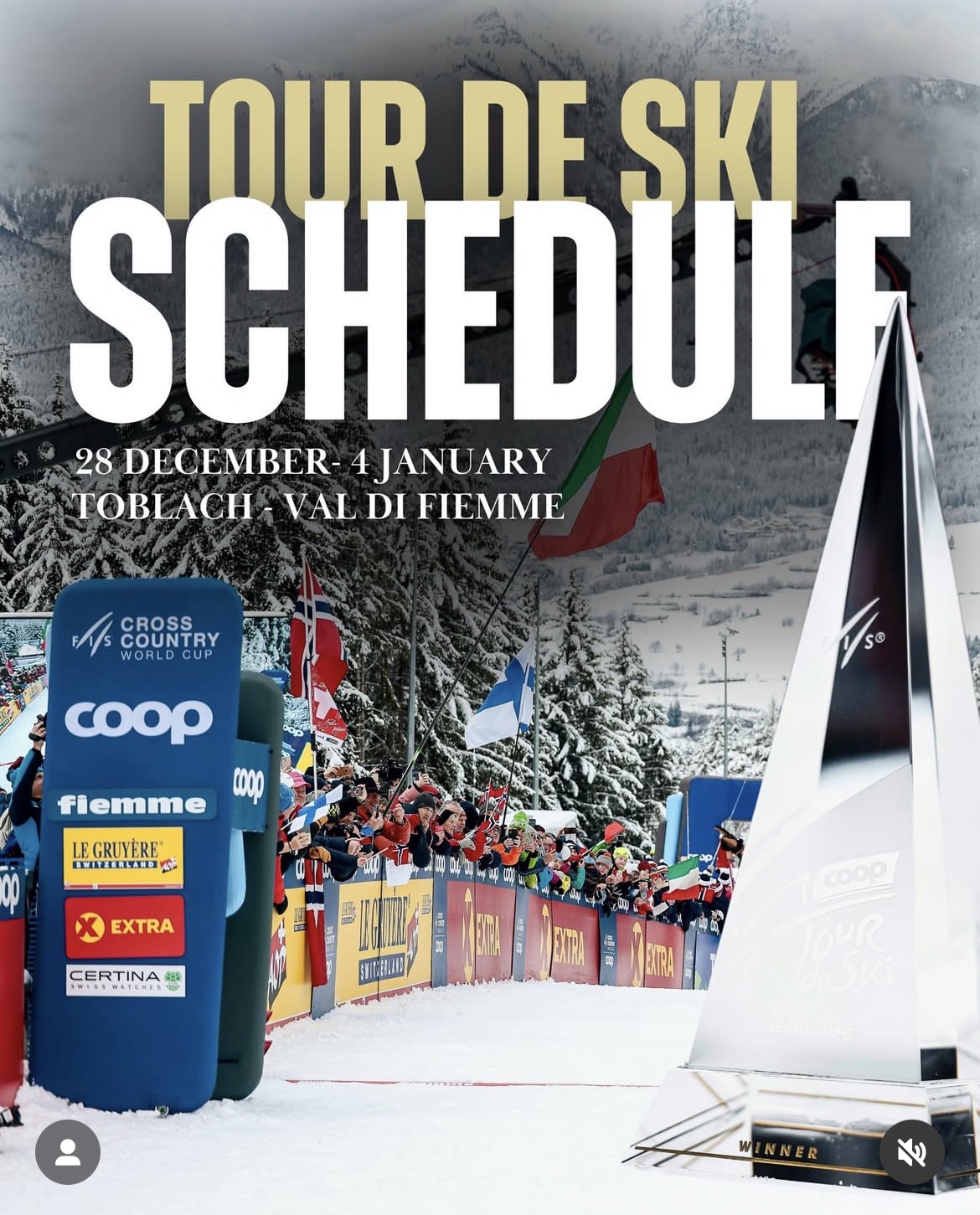
World Cup skiers get a holiday break from the grind of the World Cup tour . . . but it’s up for debate just how much rest they get during that break. It’s gotta be tough to relax when the horizon is clouded by the impending approach of the Tour de Ski, possibly the most daunting challenge that skiers will face all season. As a ski-fan, I just adore the Tour de Ski—day after day of racing and competition and drama, staged for the edification of the viewing audience. If I were a World Cup skier, I think I might feel differently, especially during an Olympic year.
Over the span of eight exhausting days—Dec 28-Jan 4—Men’s and Women’s fields will each race six events from Sprints to Interval Starts to the the unbelievably steep and seemingly endless climb up the Alpe Cermis. Nearly insurmountable leads in FIS World Cup points are amassed by the winners of the Tour de Ski; most years, the eventual winner of the World Cup Overall Crystal Globe is the same as the winner of the Tour de Ski . . . except in those seasons—like 2025—when the Tour winner skips most of the other World Cup races in anticipation of a larger prize like the World Championships or the Olympics. In 2026, most of the primary Olympic contenders have also signed up for the Tour de Ski.
Tour Streaming
As has been the case for numerous years in a row, North American viewers can stream the 2026 Tour de Ski on skiandsnowboard.live. The website adjusts to the home-area of viewers, so the broadcast time on the thumbnail corresponds to your local viewing time. Yes, the races stream in brutally early time slots, especially for viewers on the west coast. Get up early anyway . . . it’ll be worth it.
The championship of the Women’s Tour de Ski is likely to be contested among Jessie Diggins (USA), Frida Karlsson (SWE), Heidi Weng (NOR), and Astrid Oeyre Slind (NOR), and Norwegian upstart Karoline Simpson-Larsen (fresh off her recent win in the World Cup 10 k Interval Start in Davos). Certain contenders are choosing to stay home—Linn Svahn (SWE), Jonna Sundling (SWE)—thus opening up additional spots in Sprint heats for all-rounders who might not normally advance on Sprint days.
Johannes Hoesflot Klaebo’s prowess in Sprint events—and his competitive resilience in Distance events—makes him nearly impossible to beat in the race for the Crystal Globe. Even if he does not win the Tour—even if he drops out of the Tour—he’ll likely secure another Overall Crystal Globe if he remains healthy and stays on the World Cup Tour. Though if the Olympics deliver him another amazing week like the one he constructed at last year’s World Championships (where he won an unprecedented six out of six races), Klaebo just might sail off into a well deserved sunset, leaving World Cup scraps for other contenders to scrabble over.
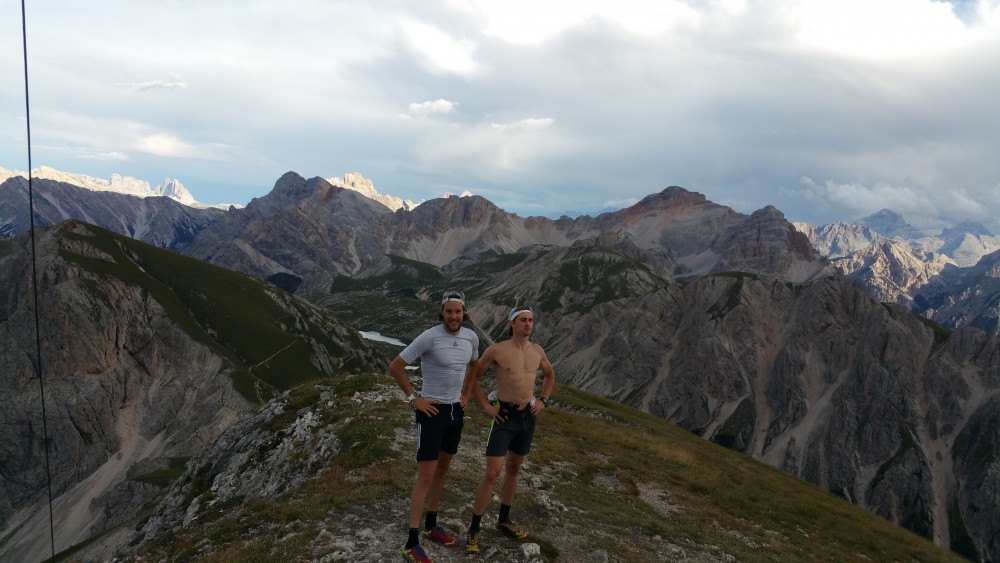
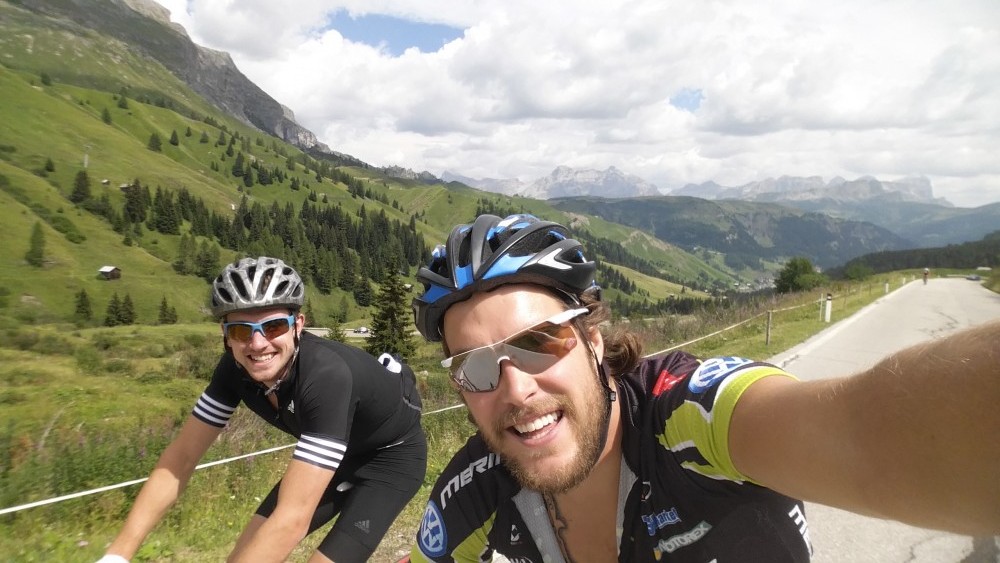
US Biathlon A-teamers Leif Nordgren (l) and Sean Doherty hiking in Antholz, Italy, last month. “When the self timer works to perfection,” Nordgren captioned the photo on Instagram. (Photo: Leif Nordgren)
Revving the engine to the US Biathlon team van past Italian road signs and the distant Dolomite peaks of northeastern Italy. Swimming and fishing off Slovenia’s southwestern shores. Rollerskiing the streets of Östersund, Sweden, while under the watchful eye of your coach. Competing in Norway’s famed Blink rollerski festival against local favorites like Ole Einar Bjørndalen and the backdrop of an exuberant crowd.
With six weeks in Europe behind them and one more to go, these are only a few of the adventures US Biathlon teammates Leif Nordgren and Sean Doherty have accomplished this summer during their seven week, self-made training camp they’ve hashtagged: “#theadventuresofskidandpants.”
“On the team we all have little nicknames that we call each other; one of Sean’s nicknames is skid, and one of mine is pants,” Nordgren explained in an email, adding that he and Doherty have been good friends for a few years now. “There’s stories behind both names but they’re both quite long. It had a funny ring to it, and all of our teammates thought it was pretty funny as a hashtag, so we kept it going.”
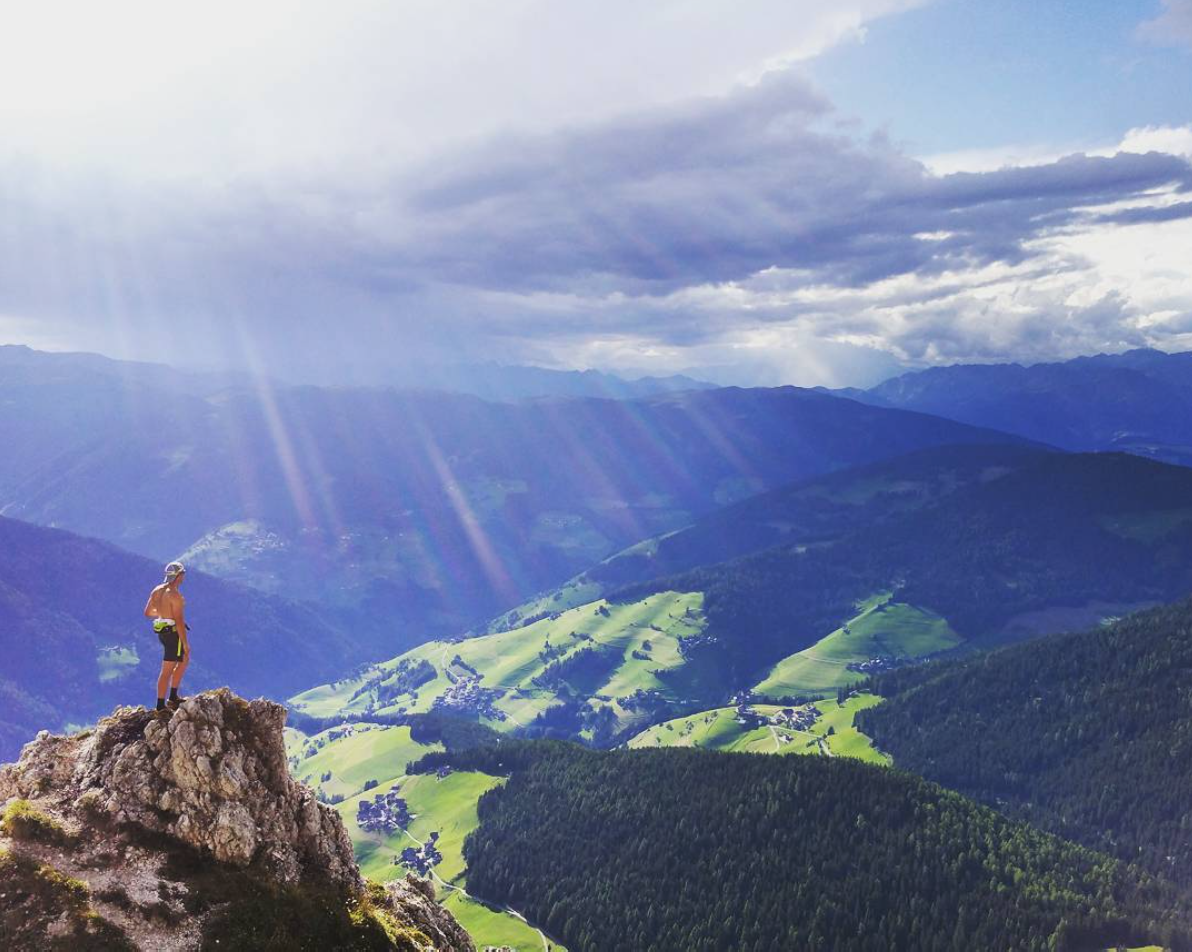
Sean Doherty looks out at a breathtaking view in Italy’s Dolomites. “… Just a small skid in a big world,” US Biathlon teammate Leif Nordgren captioned the photo on Instagram. (Photo: Leif Nordgren/Instagram)
The spark for global travel and training ignited after Nordgren and Doherty spent most of last summer training at their home base in Lake Placid, N.Y. Desiring something different this offseason — and knowing that the US Biathlon’s European training camp would once again take place in Ruhpolding and Oberhof, Germany, from Aug. 21 to Sept. 11 — the duo decided to pack their bags early and begin their adventures abroad five weeks before the start of camp. The greatest gain they expected by leaving the U.S. was the opportunity to training with other teams.
“Last summer, we were kind of stuck training in Lake Placid a lot,” Nordgren said on the phone from Ruhpolding. “So with all that time in Lake Placid last year, we wanted to expand our boundaries a little bit, to get out of Lake Placid, come to Europe, see what other teams are doing for training, jump in with them when we could, but mostly just get out and experience new stimuli and train in other cool places with new people.”
The two other US Biathlon national team members, Tim Burke and Lowell Bailey, opted to stay in the states for most of the summer.
“Tim is in the process of building a house right now, Lowell just had a baby girl back in June,” , Nordgren wrote in an email. “So both of those guys had things to do back at home that kept them from wanting to be gone in Europe for half the summer.”
Nordgren and Doherty’s seven-week training block began with Blink, three days of various cross-country and biathlon rollerski competitions, from July 27-30 in Sandnes, Norway. This year’s events included an elite biathlon mass start and an elite biathlon sprint, as well as an uphill climb. Both Nordgren and Doherty competed in all three elite events. In a lighthearted, pre-race “shooting duels” competition before the mass start, Nordgren reached the final and ranked 11th overall. In the sprint the next day, both Nordgren and Doherty made it to the quarterfinals.
“The first week we were up in Norway at the Blink rollerski festival, which was a good opportunity to get some high-level races in with a lot of Norwegians, a couple Swedes, a couple Germans, and a lot of the French national team too,” Nordgren said. “Unfortunately neither of us had very good races there, but the experience was good all the same.”
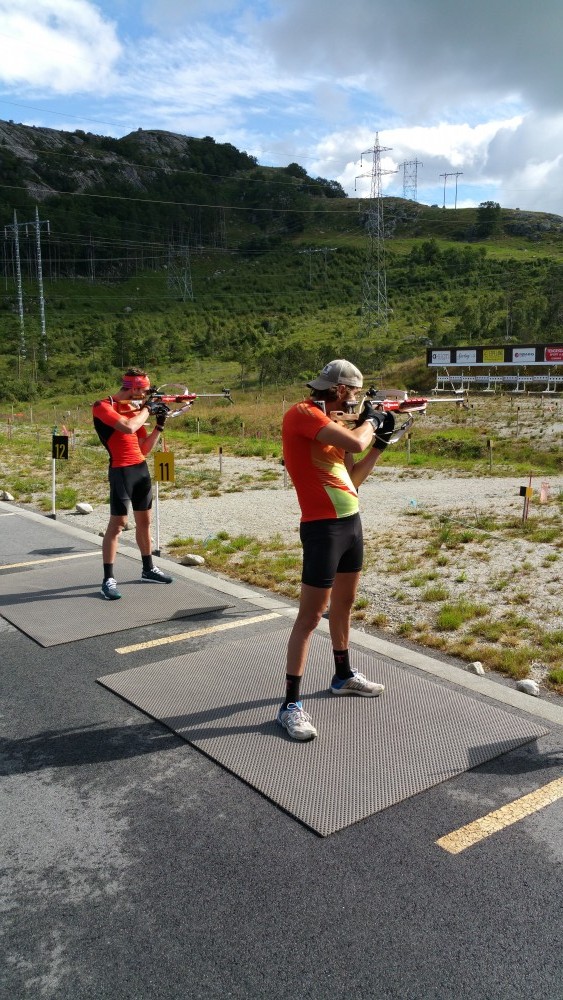
US Biathlon’s Sean Doherty (l) and Leif Nordgren training at a shooting range in Sandnes, Norway, in July. (Photo: Leif Nordgren)
The next destination for Nordgren and Doherty was Östersund, where they spent two weeks training with US Biathlon Men’s Coach Jonas Johansson in his hometown, as well as a few former and current Swedish Biathlon national-team members.
“There is a team called Team Östersund and it’s made up of a lot of national-team athletes and former national-team athletes that have kind of declined their spot on the national team to train more on their own,” Nordgren explained. “So we did a couple of training sessions with them.”
Saying goodbye to Scandinavia, the two flew to Munich, Germany, hopped in a team van and drove down to Antholz, Italy, for another week of training.
“The team has a van here that stays in Germany where most of our staff are from and our manager let us take that for the weeks we were [in Italy],” Nordgren said.
“One of our goals [in Antholz] was to train a little bit with the Italian team,” he added. “Unfortunately, I think they had just gotten back from a training camp and so a lot of them were a little tired, so none of the intensity training sessions really aligned like we thought they were going to. Those workouts we went ahead and did by ourselves. That was kind of a bummer, but again it was nice to get a change of scenery, and Antholz is a beautiful place to train in the summer.”
After Antholz, they took a three-day break before meeting back up with the rest of their teammates for two final weeks with the US Biathlon national team in Germany.
“We went down to the coast in [Piran] Slovenia, which is about a three-hour drive from Antholz,” Nordgren said. “We met a couple friends down there who hooked us up with one of their friends one day to do a little fishing and swimming … After that we came up here to Ruhpolding and met up with the team, and it’s been kind of normal training back with the team since then.”
Leif Nordgren (r) captures a photo of himself and US Biathlon teammate Sean Doherty during a road ride in Antholz, Italy, last month. “When training doesn’t suck,” Nordgren captioned the photo on Instagram.
Back in Germany, Nordgren acknowledged that much of his and Doherty’s ease in travel and accommodation along the way derived from their team budget.
“The team was able to set aside a little bit of a budget for us,” he said. “At Blink, the organizers put us up at one of the hotels. In Östersund, we actually stayed right at the venue at Camp Södergren. They have a couple of apartments there that they normally rent out to university students during the school year and they rented us one for two weeks … and then when we were down in Italy, we had a hotel.”
With about a week left of their adventure abroad, Nordgren is satisfied with the training he’s logged, but is also looking forward to returning back to Lake Placid. The final camp on the national team’s schedule before race season will take place in Canmore, Alberta at the end of October.
“I’m not sure I would do seven weeks away again, but it’s been a good time,” Nordgren said. “Sean were talking about if we were to do it again, I think we would probably go like one less place. So maybe [go] from Norway straight down to Italy, or something like that, just to be a little more stationary and get a feel for one place a little more because there has been quite a lot of travel. But both of us, I know, have had a great time even though it has been a long time away.”
Doherty could not be reached for comment.
During a three-day recovery period in Piran, Slovenia, in August. (Photo: Leif Nordgren)
During a three-day recovery period in Piran, Slovenia, in August. (Photo: Leif Nordgren)
The climb up Alpe Cermis is the final stage of the Tour de Ski. The Marcialonga course runs below it. (Photo: Travis Rector)
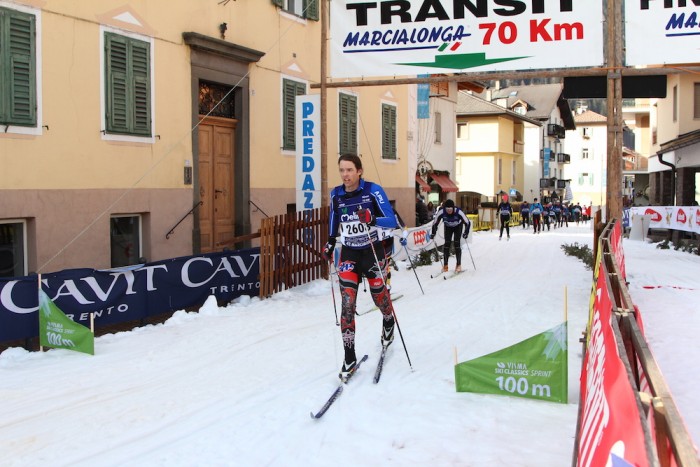
Along every crest, turn and downhill of the course, fans greeted us with cheers of “Bravi! Bravi!” But every so often I swore I could hear strangers cheering my name. Maybe I was getting delusional from fatigue? My name, if mispronounced, does sound similar to the Italian cheer. Then I heard a woman screaming “Travis! Travis! America! America!” Out of eight thousand people, I was one of only 12 Americans to do the race. It turns out I was a bit of a novelty. In a race rivaled in fame only by the Birkebeinerrennet and the Vasaloppet, how could there be so few of us?
Translating as “The Long March,” the Marcialonga is a 70-kilometer classic-only ski race held in Trentino, a mountainous province in the northern part of Italy. Like many people my fascination with the Marcialonga came from watching the Ski Classics race series. While all of these races feature beautiful scenery, the Marcialonga stood out. The thought of skiing through picturesque villages in the Dolomites held particular charm. It’s a race that has been on my bucket list for years. And after seeing the race reduced to 57 k last year due to a lack of snow I knew I shouldn’t wait any longer.
The first challenge is gaining entry to the race. Online registration opens in October but fills up within minutes, but that’s because by that point very few entries remain. The race organizers give allotments of entries to several tour group listed on their website. Signing up with one of these tour groups appears to be the only way to guarantee entry into the race. (Although I did talk with a Canadian couple who said some hotels also get allotments of start numbers.)
Life at the Marcialonga: What’s up with all the Norwegian flags? I thought this was Italy. (Photo: Paola Banchero)
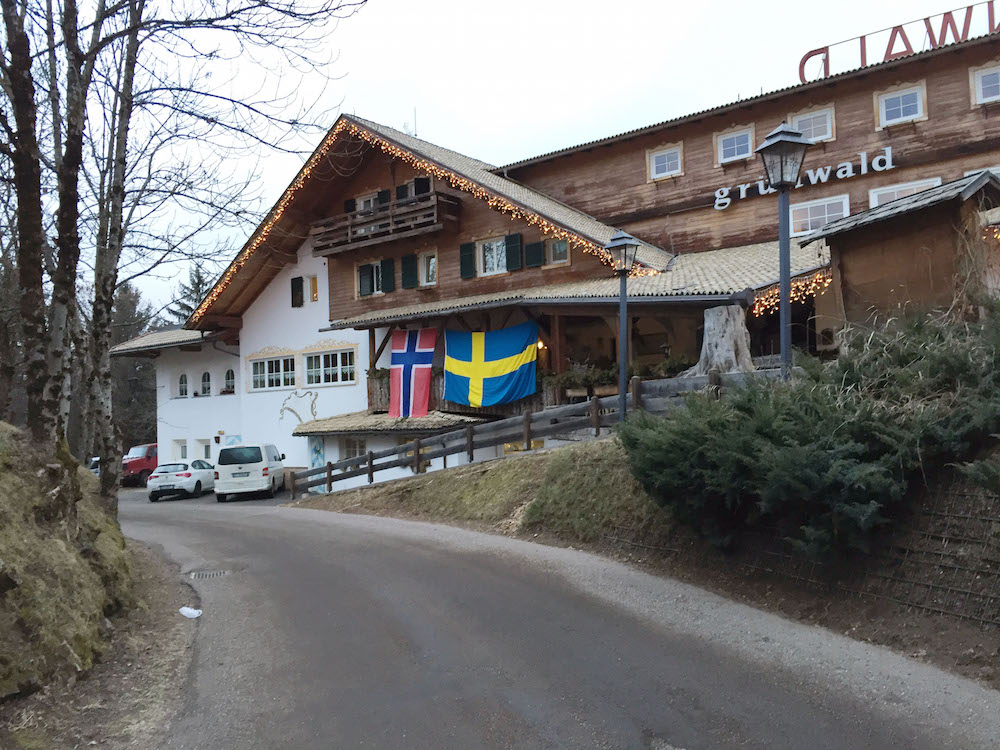
Entries unused by the tour companies are returned to the race and made available in October. All of the tour companies are located in Norway and Sweden, which becomes clear why once you’re there. Thousands of Scandinavians descend upon Trentino to do the race. You’d swear that you were in Lillehammer by the sheer number of Norwegian flags hanging from hotel windows — including one that (somewhat annoyingly) hung from our own balcony.
Most of the tour companies were not willing to help those from outside their country, but Norway’s Maxpulse agreed to put a customized package together for us. The thought of being part of a tour group didn’t appeal to me — I took pride in figuring out how to do the Vasaloppet and Birken on my own. But after the experience I appreciate how nice it is to have the logistics taken care of for you. We arranged to meet the Maxpulse group at the Verona airport three days prior to the race. As part of the package they arranged for our accommodations as well as travel from Verona by tour bus. Everyone else in the Maxpulse group (300 in all!) flew in on charter flights from Norway. I’m guessing the Verona airport doesn’t normally see six flights from Oslo every day, but it did the day we arrived. Maxpulse offered several options for places to stay in several towns. We opted to stay at one of the hotels in Cavalese that was conveniently just 200 meters from the finish line.
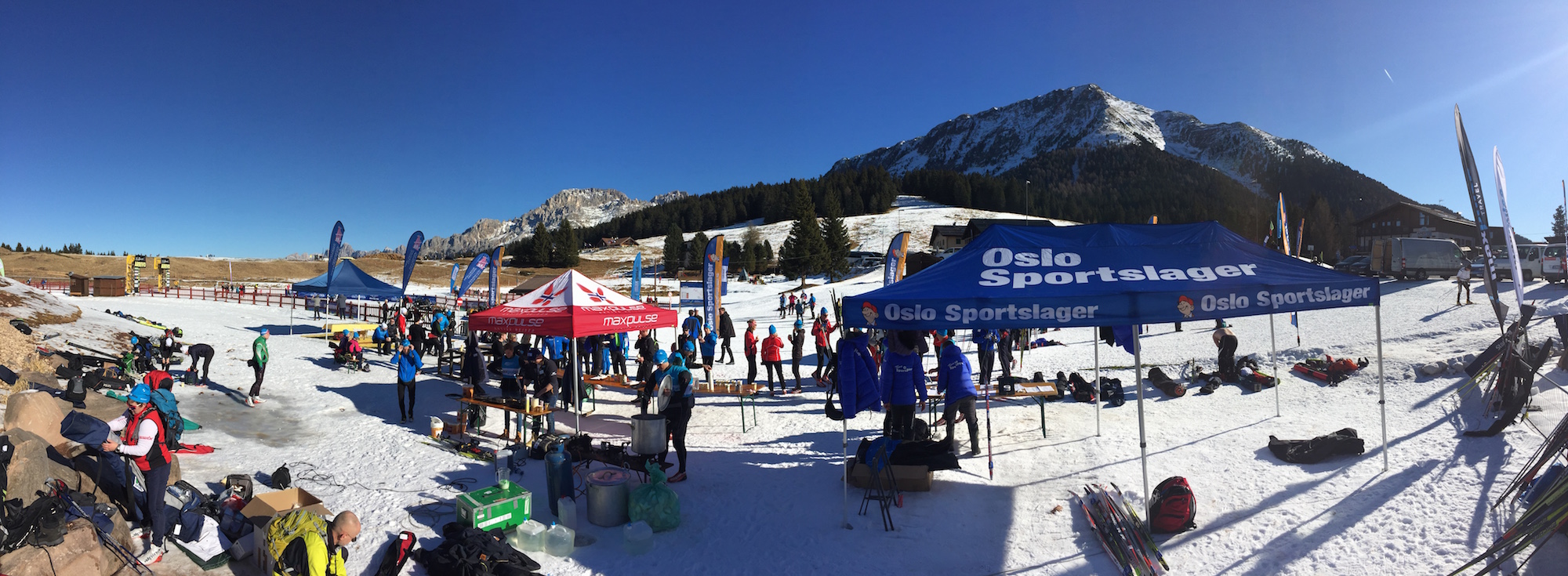
Before the race Maxpulse organized two ski trips in the area. Two days prior they bused us up to Passo di Lavazé, a nordic trail system with spectacular views of the Dolomites. Normally there is over 80 k of groomed ski trails, but due to the lack of snow only two of the trails were open. It may have been just as well as the temptation to ski too much before the race would have been hard to resist. Maxpulse provided waffles and a warm currant juice that hit the spot after some easy skiing on a bluebird day.
(Story continues below)
Enjoying waffles and hot drinks after a ski at Passo di Lavazé in Italy. (Photo: Travis Rector)
The next day included a trip to the World Cup stadium in Val di Fiemme for testing skis. The stadium is also the start for the final stage of the Tour de Ski, which finishes with the notorious climb up to Alpe Cermis. On our own we took the gondola up Alpe Cermis to see the climb in person. The TV screen doesn’t come close to showing the size or steepness of this monster. Imagine skiing up a blue slope at your local downhill resort and you’ll get the idea.
Maxpulse also took care of all of the logistics related to the race, including registration and travel to/from the start/finish lines. They also had wax techs from Oslo Sportslager, a Norwegian sports store, to prep your skis (for a price) and a wax table and tools if you want to do it yourself. They also had an aid station at the bottom of the final climb to Cavalese to give your kick wax a much-needed touchup. Being able to get on a tour bus, be driven to the start, and then have a place to stay warm prior to the race was fantastic — far superior to the hours I’ve spent freezing while standing around outside before other races.
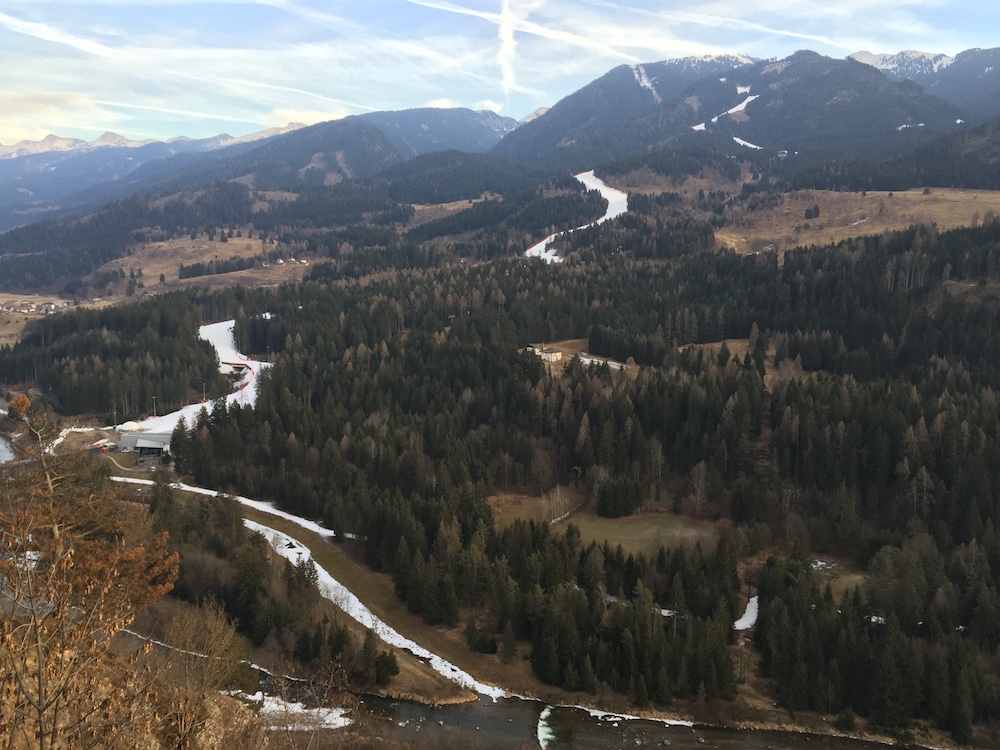
Like last year a paucity of snow provided a challenge to the race organizers, but this year they were able to put together then entire course. The Italians are famous for their snowmaking, but it’s still impressive to see a 70 k long white stripe of manmade snow that runs along an otherwise brown valley. Each day we watched a seemingly endless procession of trucks carting in snow for the course. No praise is too high for the race organizers pulling this off.
The race course starts in the small town of Moena. Upon arrival by tour bus it becomes clear why in part the race organizers wanted most participants to come with a tour group. The small parking area was lined with tour buses. Despite the congestion it wasn’t difficult to get to the start area and test your skis. The start of the race is the most civilized I’ve experienced in a large race. Skiers are placed in “bins” prior to the race based upon your seeding. You wait in your bin with skis off. When it is your bin’s turn to start, you walk out into the starting area, put your skis on, and go when you’re ready. Thanks to a chip in your bib, your personal race time starts when you cross the start line. Starting this way meant you didn’t have to worry about broken poles or being stuck in the back of your wave.
The start of the race is the most civilized I’ve experienced in a large race.
Important note: Be sure to do a qualifying race so that you get a reasonable start position. Like other Worldloppet races, the Marcialonga is rather strict. Unfortunately the only race they accept as a qualifier stateside is the American Birkie classic race. Also, it has to be the year prior. Even if you don’t plan to race your best effort, starting with skiers of your own ability is huge. Despite having 8000 participants, the Marcialonga never felt crowded because, even though there were at most three sets of track, I was largely with skiers of my own ability. Years ago I got stuck in the back of the Vasaloppet and, despite starting with 16 lanes of track, I spent the entire race weaving in and around skiers. It was hell.
The first 18 k of the Marcialonga consist of a gradual (1 percent average grade) climb up to the town of Canazei. The course winds along the western side of the Val di Fassa valley, with occasional short climbs and descents along the way. After Canazei the course descends on the eastern side of the valley back to Moena then continues on to Predazzo, which is the finish point for the 45 k “light” race. The course continues down the Val di Fiemme valley, passing through the World Cup stadium on the way to the town of Molina, the lowest point of the course at the 64 k mark. The meat of the course, roughly 50 k, is a gradual downhill and perfect for double poling. After Molina you turn around and head back up the valley. The last 2.5 k of the race is the legendary Cascata climb to the finish line in the town of Cavalese.
This year’s Marcialonga will be remembered as one of the slowest because of the difficult snow conditions. When the race started it was overcast and temps just above freezing — perfect violet klister conditions, if you’re out skiing alone that is. Even near the front of the race, skier traffic quickly broke down the tracks. Uphills were churned to sugar and even short downhills were scraped down to the ice below. Thankfully none of the hills, up or down, were particularly long or difficult. A few hours into the race the skies cleared and the temps climbed to +10C (50°F). Once the sun was on the course it was pretty much reduced to slop that was slow to push through. Violet klister was no longer working either, making for some seriously slow double poling.
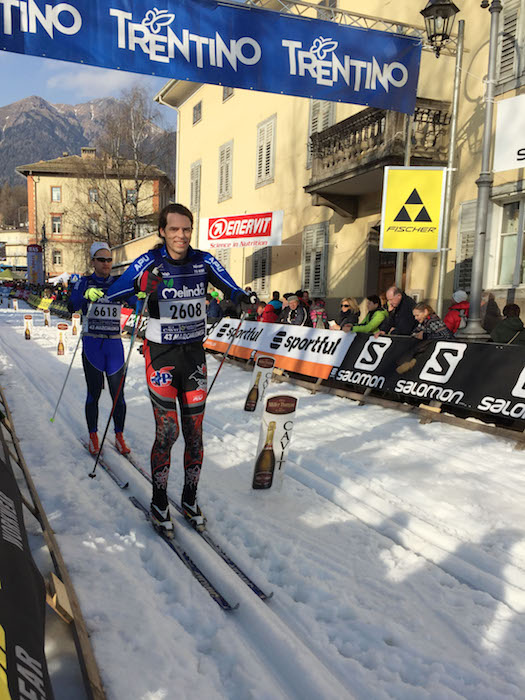
The author approaching the finish of the 2016 Marcialonga, ready for another helping of gelato. (Photo: Paola Banchero)
Fortunately for me I was through the high point of the course before I lost kick. I was able to double pole most of the course from Canazei to Molina. A lack of kick wasn’t too much of a problem on the steeper uphills because they frequently turned into a “conga line” of skiers anyway. The biggest challenge was often just keeping your skis pointed straight, as the tracks were erratic or gone. The hardest part of the race was the 4 k from Molina to the start of the Cascata climb. Navigating this gradual uphill without kick after 50+ k of double poling was brutal. The Maxpulse folks touched up my klister, giving me just enough kick to get up the climb and to the finish. My time was about an hour slower than I had expected, but veterans of the race reported being one to two hours behind their best times.
But if you’re doing the Marcialonga to ski fast you’re missing the point. The course is to be savored, as it winds along a picturesque countryside from one charming town to the next. Skiing through these villages, with crowds cheering and the town church’s bell ringing, are among the experiences that make the race special. The aid stations had the typical allotment of oranges and energy drink. But they also had plates heaping with chocolates, cookies, and other treats. And if you wanted a shot of espresso to get you going, some of the aid stations had that too. In the background of it all is the jaw-dropping expanse of the Dolomites.
The highlight of the race is the Cascata climb, where the crowds and adrenaline power you up to the finish line. I won’t pretend I was happy or comfortable the entire race, but by the end I knew I had done something special.
After the race was special too. The town of Cavalese hosted an outdoor party near the finish line, meaning that finishers were met with cheers even as they trickled in well after darkness. The evening concluded with a delightful fireworks display. The next day Maxpulse bused us back to Verona and we racers went our separate ways.
I won’t pretend I was happy or comfortable the entire race, but by the end I knew I had done something special.
As global warming makes winter snow less reliable, ski races will be more prone to being shortened or canceled. This year demonstrated that the Marcialonga’s organizers were able to hold a race, even in adverse conditions, thanks to their prodigious snowmaking abilities. So if you want to do the race, be sure to plan early to get a start number. Be sure to bring sunscreen, as you might need it more than a hat. Don’t forget to say “Grazie mille” to the volunteers at the aid stations. And don’t forget to bring an American flag.
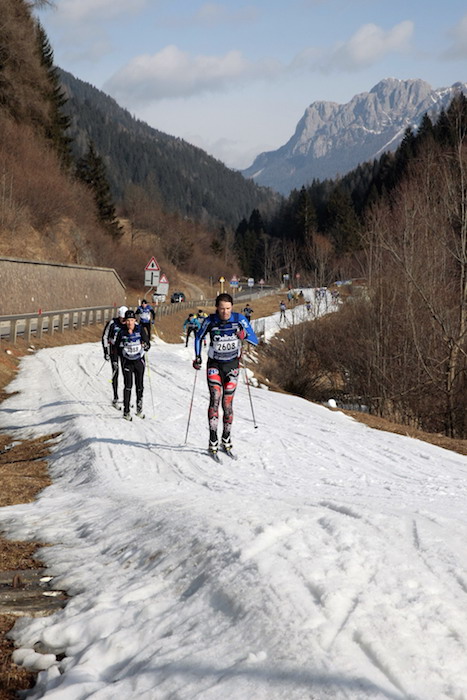
Like to double pole? The Marcialonga is for you! Despite its length it is an easy course to ski- well within the abilities of anyone who can do the American Birkie classic race. (Photo: Fotostudio3)
The trail of manmade snow in an otherwise brown valley. (Photo: Fotostudio3)
Skiers continued to trickle in after sunset, but the crowds remained to cheer them on to the finish. (Photo: Paola Banchero)
A highlight of the race was skiing through the many picturesque towns along the course. (Photo: Fotostudio3)
About the Author: Travis Rector is a physics and astronomy professor at the University of Alaska-Anchorage and a longtime member of the Alaska Pacific University ski program. In late January, he was one of 12 Americans to race the Marcialonga, a 70-kilometer classic race in the Province of Trento, Italy.