From the FasterSkier archive — posts syndicated from athletes’ and coaches’ own blogs between 2004 and 2012, kept online as published. Current coverage is at fasterskier.com.

Tag: Dominik Landertinger

  • Burke Nabs Season-Best 7th in Canmore Mass Start; Italy’s Windisch Gets First-Career Win

    Burke Nabs Season-Best 7th in Canmore Mass Start; Italy’s Windisch Gets First-Career Win

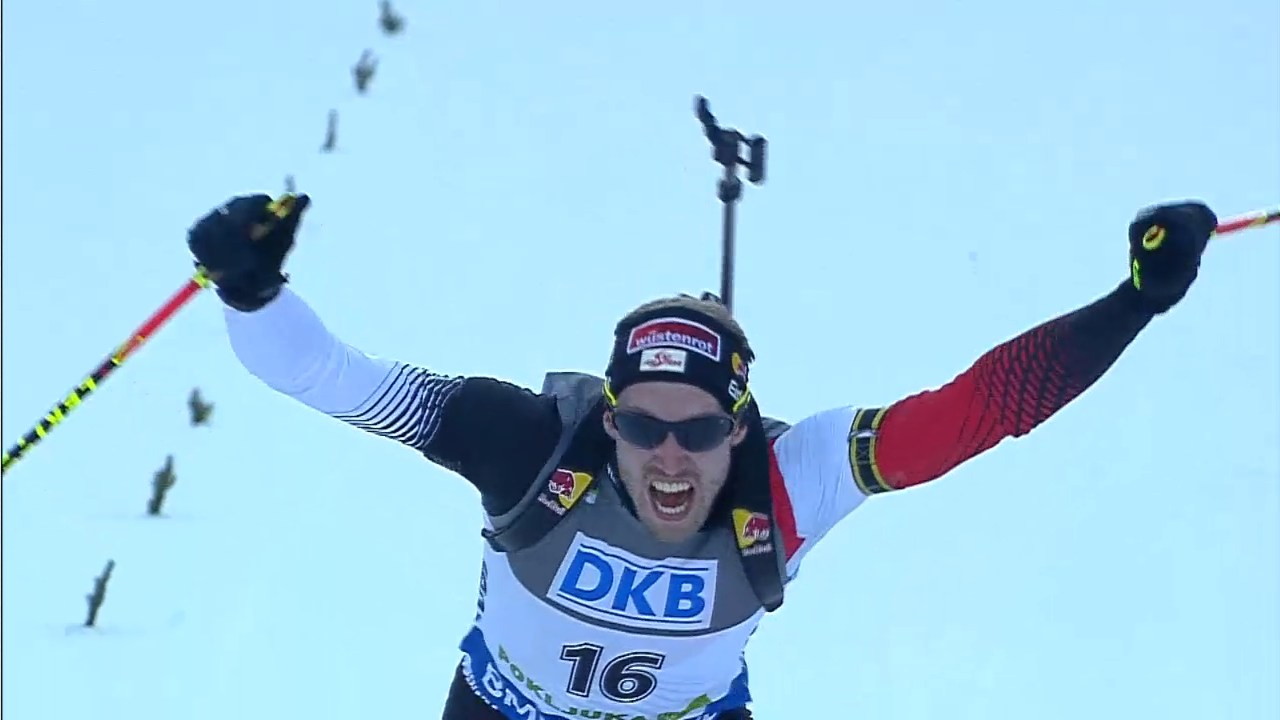
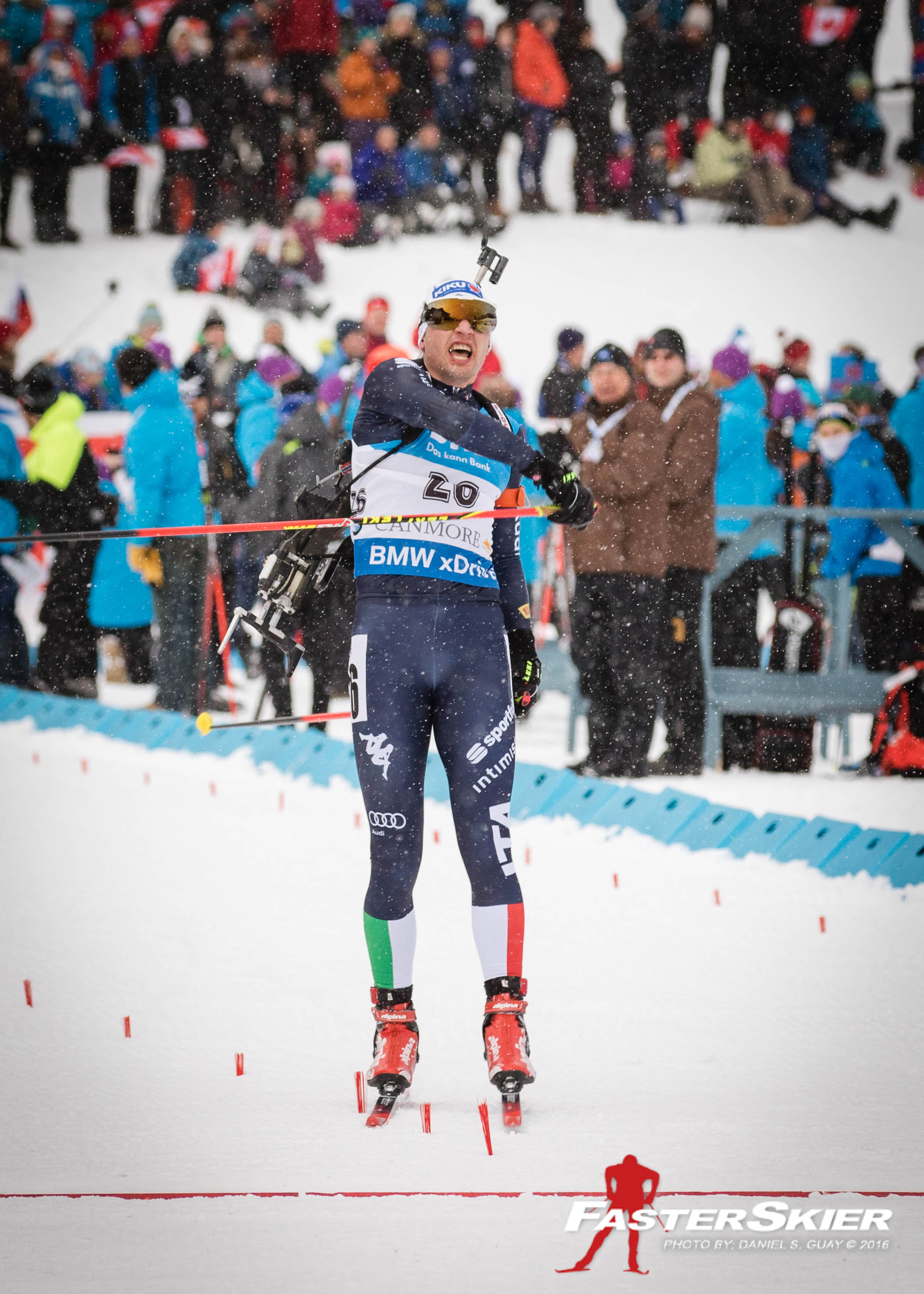
    Italy's 26-year-old Dominik Windisch celebrates his first-career victory in the IBU World Cup 15 k mass start on Saturday in Canmore, Alberta. (Photo: Daniel S. Guay)
    Italy’s 26-year-old Dominik Windisch celebrates his first-career victory in the IBU World Cup 15 k mass start on Saturday in Canmore, Alberta. (Photo: Daniel S. Guay)

    In a race affected by difficult conditions on the course and shooting range, Italy’s Dominik Windisch achieved the first victory and podium of his career in the International Biathlon Union (IBU) World Cup men’s 15-kilometer mass start on Saturday in Canmore, Alberta. In third place after the final shooting stage and despite four penalties in total, the 26-year-old Windisch finished first with a time of 40:37.1 minutes, after a strong last loop.

    “It was amazing. I can’t believe it yet. A dream came true for me today,” Windisch said during the post-race press conference.

    Asked how long he has been waiting for this moment, Windisch later told the IBU: “I think for over 20 years, since I was a child watching competitions of the World Cup in Antholz [Italy].”

    Second place went to Germany’s Benedikt Doll, 4.1 seconds back with four penalties, for the third podium of his career. Doll also moved up on the final loop thanks to the fastest course time of all athletes. France’s Quentin Fillon Maillet, who led the pack after the last shooting, fell behind on the final loop and ended up third, 8.6 seconds after the Italian, with three penalties.

    ‘He puked all over my skis’
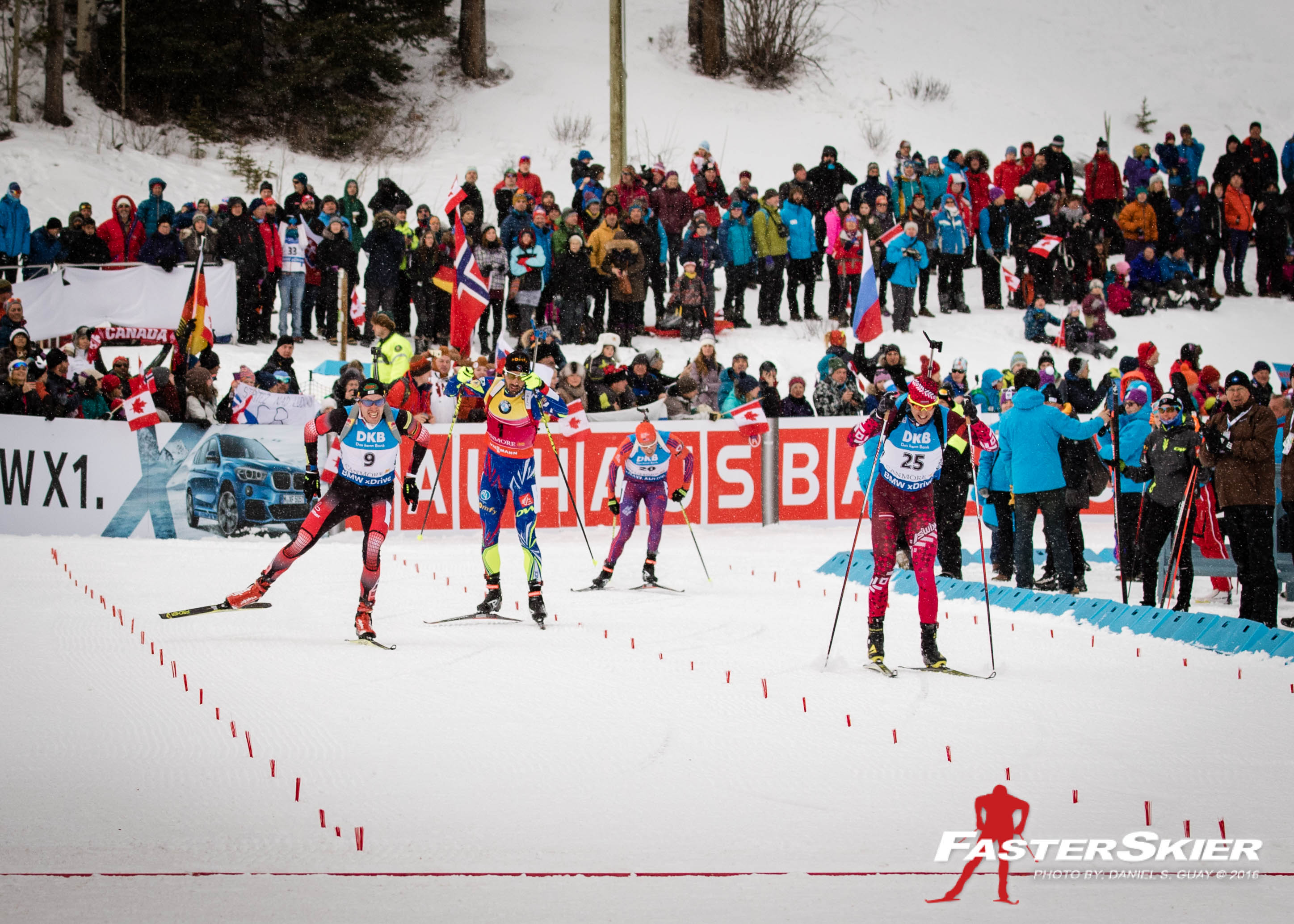
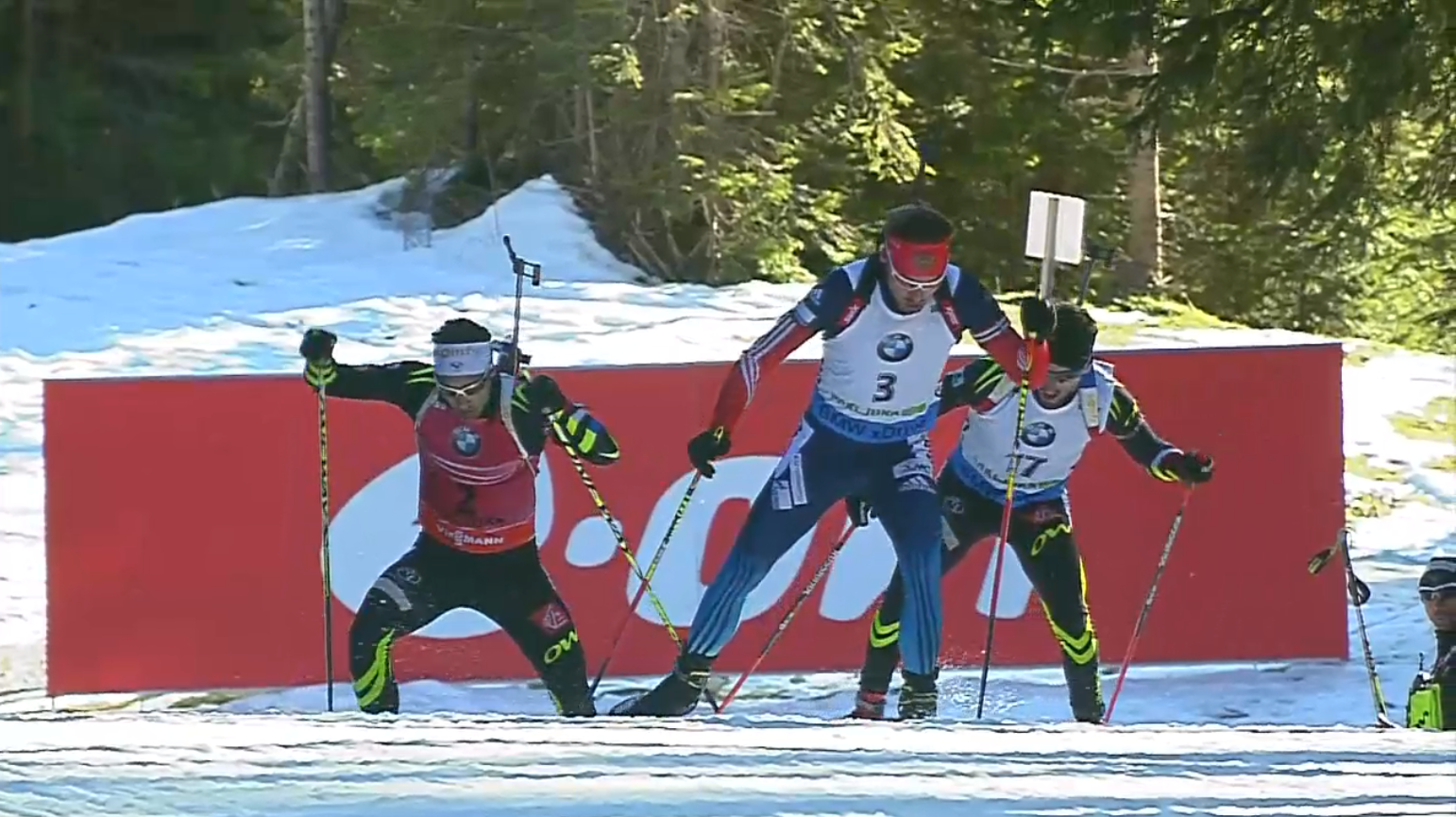
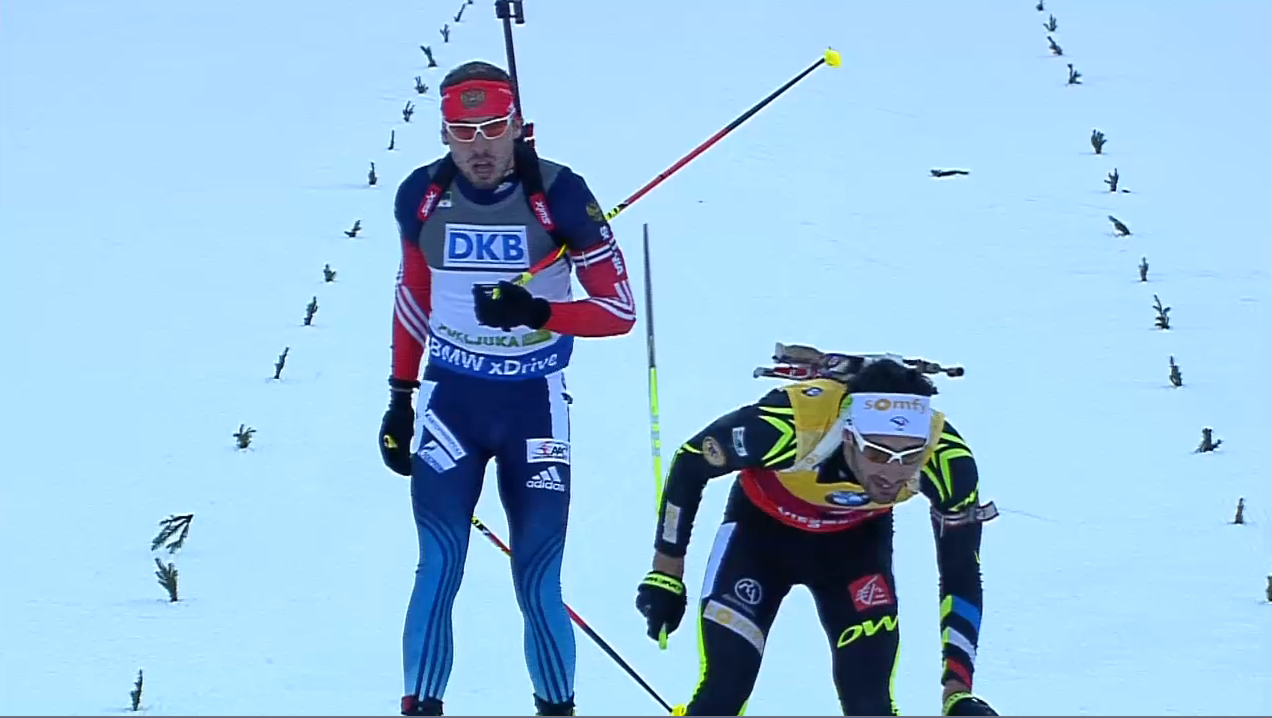
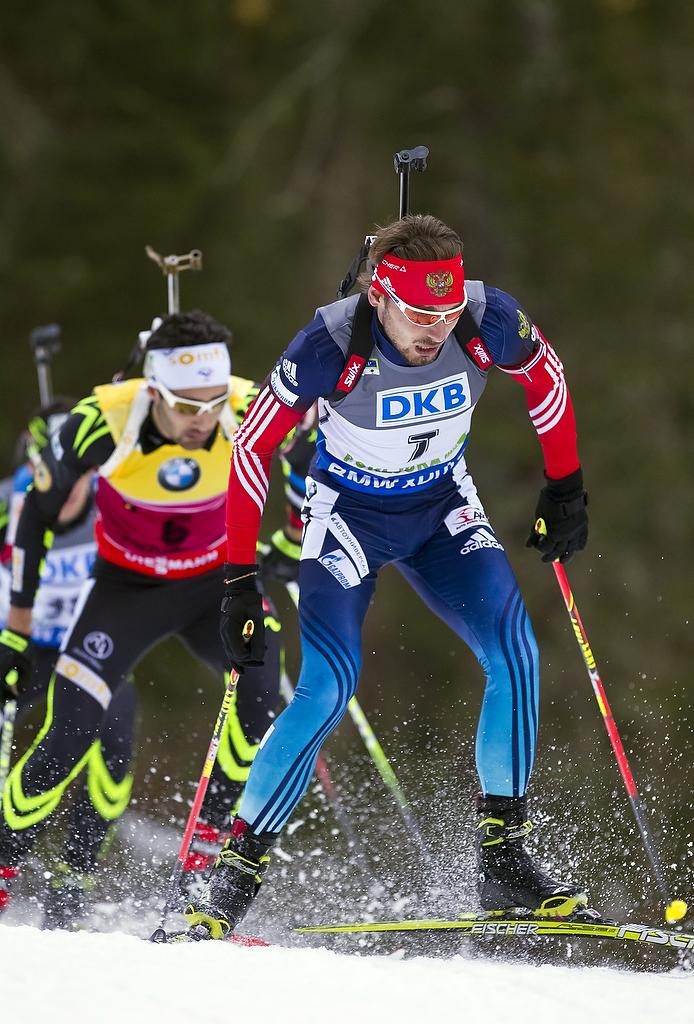
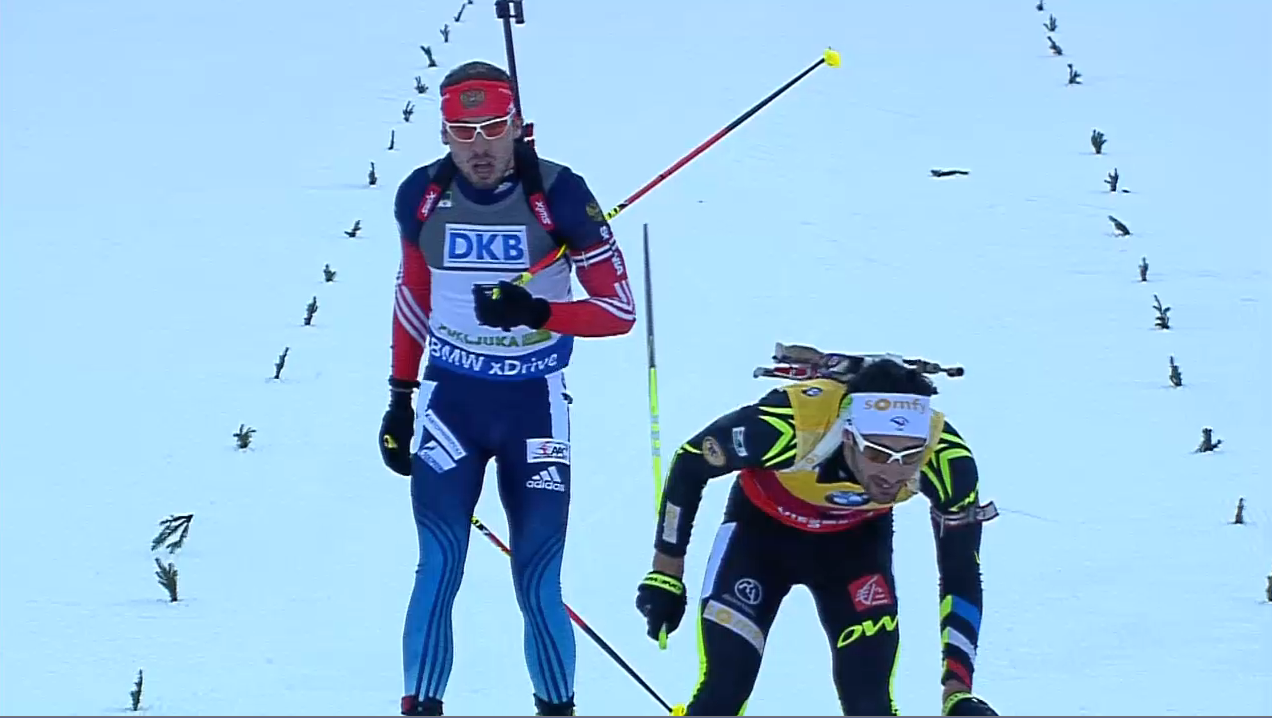
    Latvia’s Andrejs Rastorgujevs (25) and Austria’s Dominik Landertinger (9) lead the race for fourth, which Landertinger took by 0.2 seconds. France's Martin Fourcade (second from l) placed sixth in the mass start, 1.5 seconds ahead of American Tim Burke (behind) on Saturday at the IBU World Cup in Canmore, Alberta. (Photo: Daniel S. Guay)
    Latvia’s Andrejs Rastorgujevs (25) and Austria’s Dominik Landertinger (9) lead the race for fourth, which Landertinger took by 0.2 seconds. France’s Martin Fourcade (second from l) placed sixth in the mass start, 1.5 seconds ahead of American Tim Burke (behind) on Saturday at the IBU World Cup in Canmore, Alberta. (Photo: Daniel S. Guay)

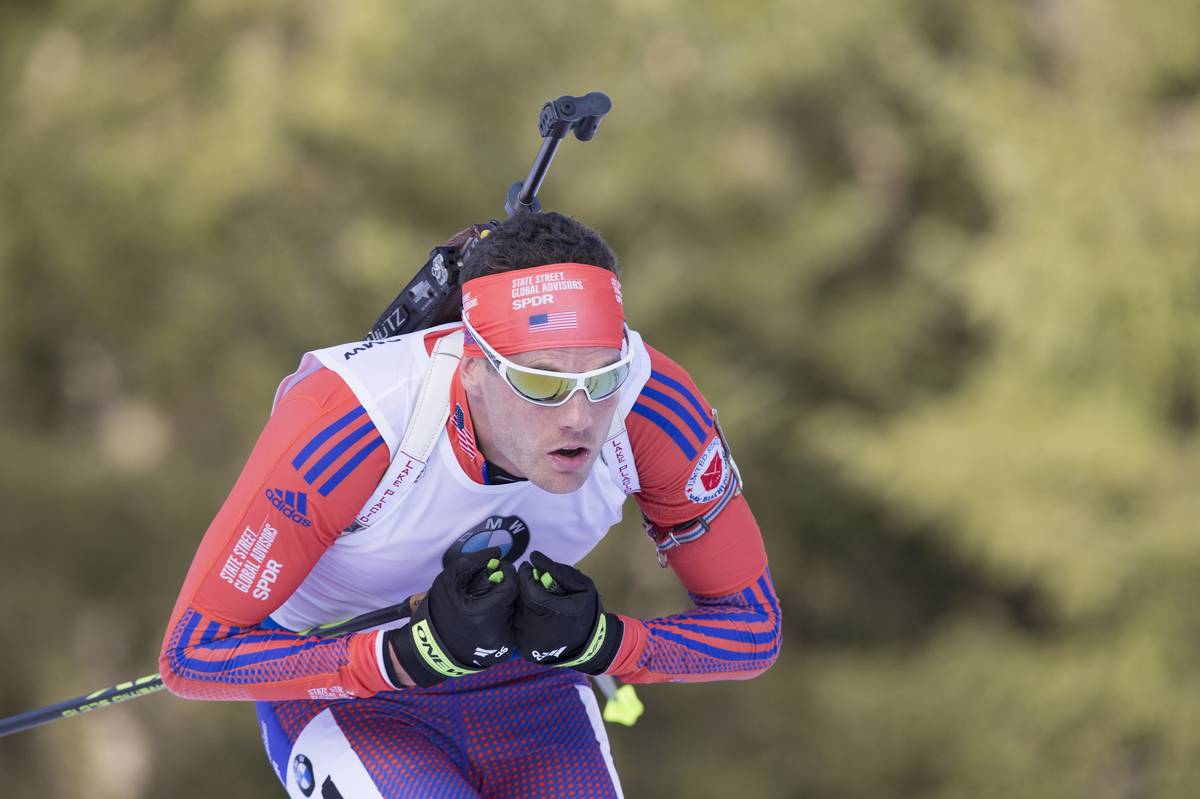
    U.S. Biathlon’s Tim Burke had the best day of the three North Americans in the race, finishing seventh, 23.8 seconds after Windisch with three penalties, and just 1.5 seconds behind the overall World Cup leader, Martin Fourcade of France.

    It was Burke’s best result of the season in an individual race so far, and he last achieved seventh in a 2014 mass start in Pokljuka, Slovenia.

    Burke raced under the watchful eye of his wife, Andrea Burke (formerly Henkel), an Olympic and World Championships gold medalist for the German biathlon team, who provided commentary and analysis with Chad Salmela for the IBU’s live stream of the North American World Cups.

    “When your wife is commentating live it puts a little extra pressure on…,“ Burke said in a post-race phone interview with FasterSkier. “I think she’s having a lot of fun with it. It’s for sure a challenge to commentate in not your first language.”

    Burke said the first prone shooting was the “trickiest stage” on Saturday, but he managed to keep the damage in check with just one penalty.

    “It [was] changing so much shot to shot that I didn’t crack down my shots at all,” he said. “I would aim [left] off the target knowing that the wind would blow [really strong left to right]. I missed my first shot and I realized I wasn’t aiming far enough off.”

    He left the range in 15th place, 41.8 seconds behind Austria’s Simon Eder in first, but still with several other athletes who had also missed at least one target.

    “As I was skiing out of the range, just checking the targets, I could see there were quite a few mistakes. I knew that would keep me in the race,” Burke recalled.

    In the second prone stage, Burke shot clean.

    “It was really good conditions. The wind was down. It was a lot like I had zeroed for,” he said. “I hadn’t changed my sights at all so I was able to aim through and shoot fast.”
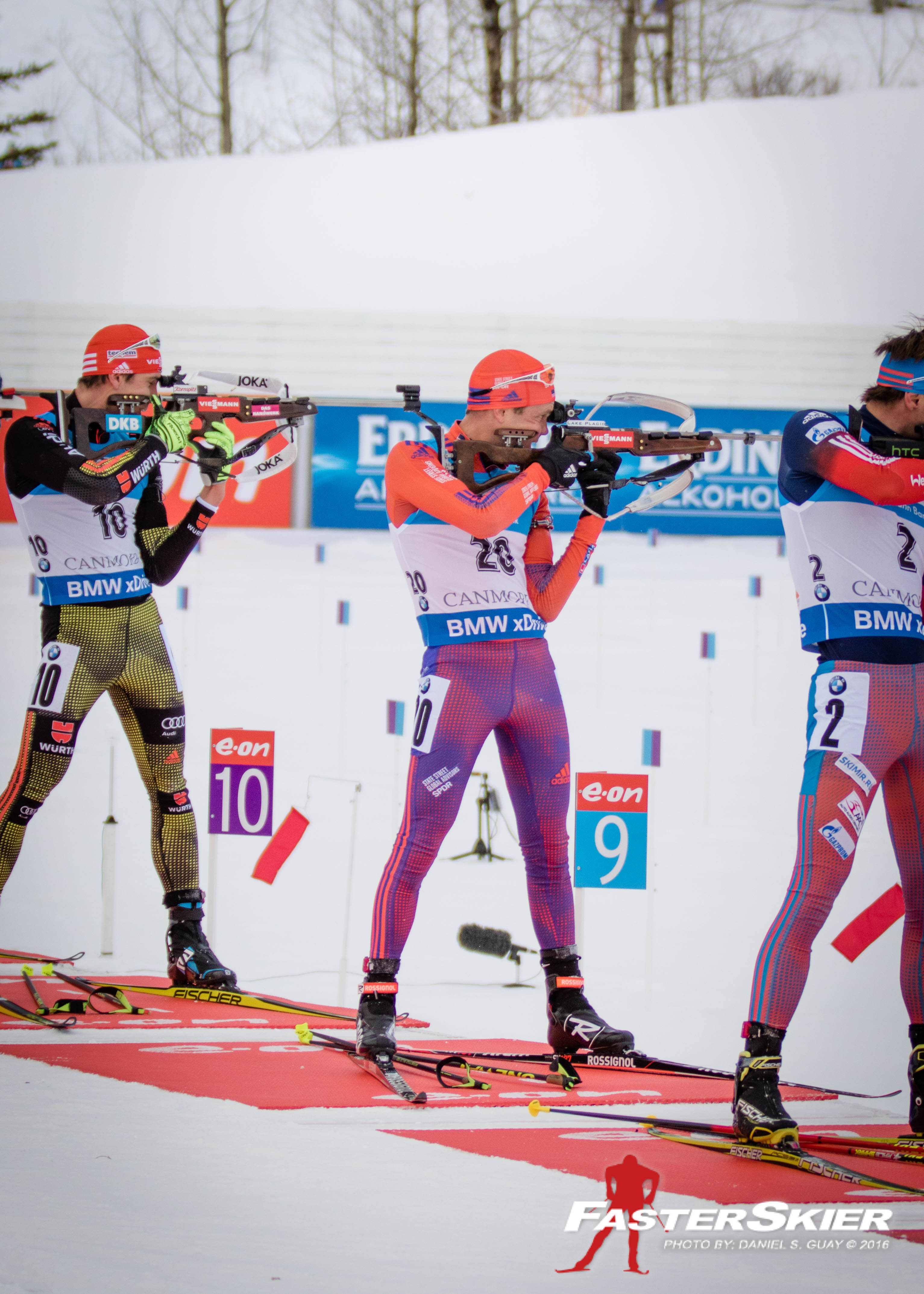
    American Tim Burke (c) shooting with Russia's Anton Shipulin (r) and Germany's Arnd Peiffer (l) during the men's 15 k mass start on Saturday at the IBU World Cup in Canmore, Alberta. Burke went on to place a season-best seventh. (Photo: Daniel S. Guay)
    American Tim Burke (c) shooting with Russia’s Anton Shipulin (r) and Germany’s Arnd Peiffer (l) during the men’s 15 k mass start on Saturday at the IBU World Cup in Canmore, Alberta. Burke went on to place a season-best seventh. (Photo: Daniel S. Guay)

    One lap later, the wind picked up for the third shooting (first standing stage).

    “I just really took my time and was very happy to get out of there with one penalty. … When I left the range everyone except I think one person was in the penalty loop.”

    He left the range in fourth, 17.5 seconds behind Fillon Maillet, 6.3 seconds after Latvia’s Andrejs Rastorgujevs in second, and 2.4 seconds behind Austria’s Dominik Landertinger in third.

    Burke lost a few positions on the course, skiing in a group led by eventual third-place finisher Doll.

    “At that point, I knew the win was still possible just because the conditions were changing so fast,” Burke said. “Anything is possible in a race like that.”

    In the last shooting stage, Burke recorded another miss, skied a penalty loop and headed into the final loop in ninth place with competitive company around him: Fourcade, Landertinger, Ondrej Moravec of the Czech Republic, Slovakia’s Matej Kazar (the best shooter on Saturday with just one penalty), and Germany’s Arnd Peiffer.

    “It’s not the best group to head out on the last loop with, so I knew it was going to be tough, but I hung in there,“ Burke said. “Fourcade and Landertinger got a gap with about a [kilometer] and a half to go. Then it was me and Peiffer … he was in front of me and unfortunately puked all over my skis.”

    He estimated Peiffer got sick with about half a kilometer remaining in the, heading into one of the final climbs.

    “I’ve heard of it happening, but that’s the first time I’ve ever seen it,” Burke said of someone throwing up during the race. “I was able to get around him after that. … Then I actually ended up catching back up to Fourcade because they started playing around, setting up for the finish … but as soon as I caught them they started sprinting, so I was pretty gassed.”

    “It was a brutally difficult race,“ Landertinger, who placed fourth (+20.7) with three penalties, said in an Austrian Ski Federation press release. “On the one hand the course was extremely slow and strenuous, on the other it was difficult to assess the wind correctly on the shooting range. I had a strong final loop, where I was able to prevail against Fourcade and Rastorgujevs in the end. I am very happy with the race and the result.“

    Overall, Burke skied the eighth-fastest course time, as well as the sixth-fastest final loop.

    “I really like the course, that’s why I was disappointed with the sprint [on Thursday] because I feel like on a good day here I could have been one of the faster skiers,” Burke said. He placed 23rd in Thursday’s 10 k sprint with with 80 percent shooting.

    “I was definitely really happy with the result. It was a crazy race with the conditions,“ Burke concluded. “[It’s my] best result this year. I feel like I can be up there more often and hopefully this will be a good step moving forward.”

    Fast Skiing Wins The Race
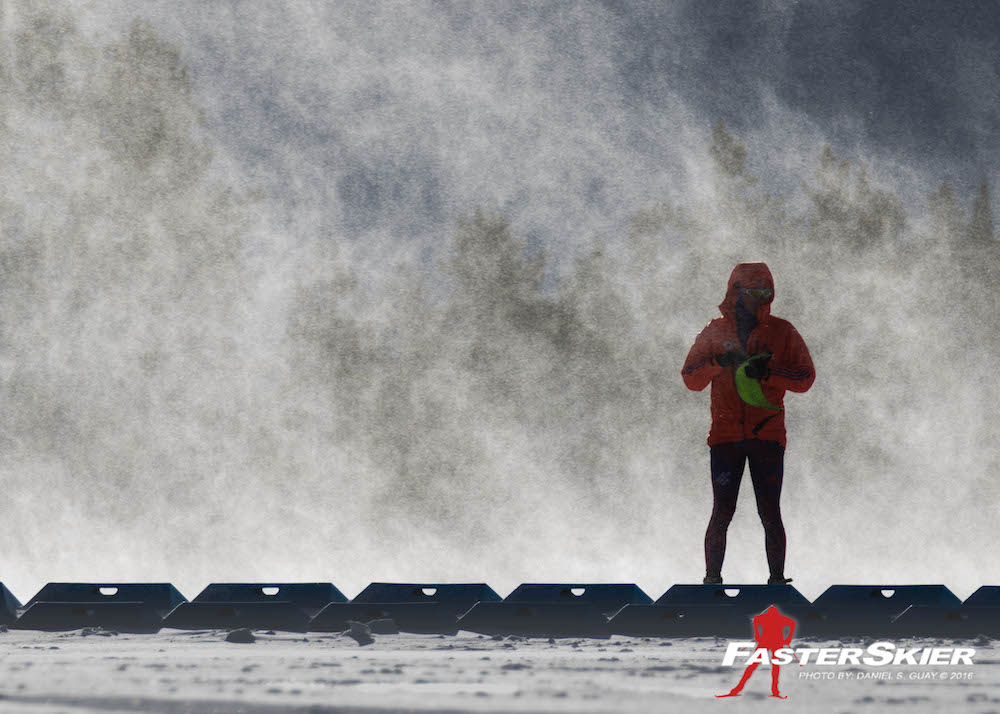
    Another windy day at the Canmore Nordic Centre on Saturday for the IBU World Cup men's 15 k mass start.(Photo: Daniel S. Guay)
    A gust of wind blows snow during zero at the Canmore Nordic Centre on Saturday before the IBU World Cup men’s 15 k mass start.(Photo: Daniel S. Guay)

    A blizzard in the early morning with strong snowfall that lasted for about 30 minutes was followed by dry strong winds which made ski preparation difficult, with a number of wax technicians reportedly already out on the course at night, working with headlamps to prepare optimal skis for the athletes.

    “Today was really challenging for a lot of the technicians … I saw really big differences with the skis out there on the course,” Burke said. “We [the Americans] were in the mix.”

    At the start of the race, the scenic Canadian Rockies were shrouded by thick clouds but without precipitation, although later it started to lightly snow. Wind conditions were difficult right out of the gate, and only four athletes out of 30 in the mass start managed to shoot clean in the first stage, despite a fairly slow pace on the loop with the field bunched together.

    After the second shooting stage, Eder had been in the lead with clean and very fast prone shootings, but when he came back into the range the third time for his first standing stage, strong gusts of wind made it difficult for him — as well as the other top athletes — and three penalties set him back. Eder finished the race in 14th place (+57.3), with four penalties.

    “Unfortunately I had no chance today. The wind in the third shooting decided the race, otherwise I would have been very well in the mix,” Eder said in the Austrian team press release. “I can’t help it. Just tick it off and look ahead.”

    Fillon Maillet moved up from sixth to first place during the third loop and third shooting stage. After no athlete in the lead group was able to shoot clean in the last stage, either, the Frenchman headed out on the final loop in first, with Rastorgujevs 13.9 seconds behind. Meanwhile, Windisch, who was 14.3 seconds back to start the loop, and Doll, 20.7 seconds behind, came flying out of the penalty loop.

    At the 13.4 k timing point, Windisch had taken the lead with the other three close behind him. Then at the last timing point 700 meters before the finish, Fillon Maillet still remained ahead of Doll, but into the final stretch, Doll pushed ahead of him.

    Rastorgujevs, often one of the fastest skiers in the field but a somewhat shaky shooter, especially in standing, fell behind Doll and Fillon Maillet on the last loop and also lost the finish sprint to Landertinger by 0.2 seconds. He finished fifth place (+20.9), with three penalties, narrowly missing the first World Cup podium of his career.

    “Last 1.5 kilometers I am empty, totally empty. No chance for fighting,” he said in a post-race English interview with the IBU. “My shooting today was good, but I am not so happy with [the] last shooting.”
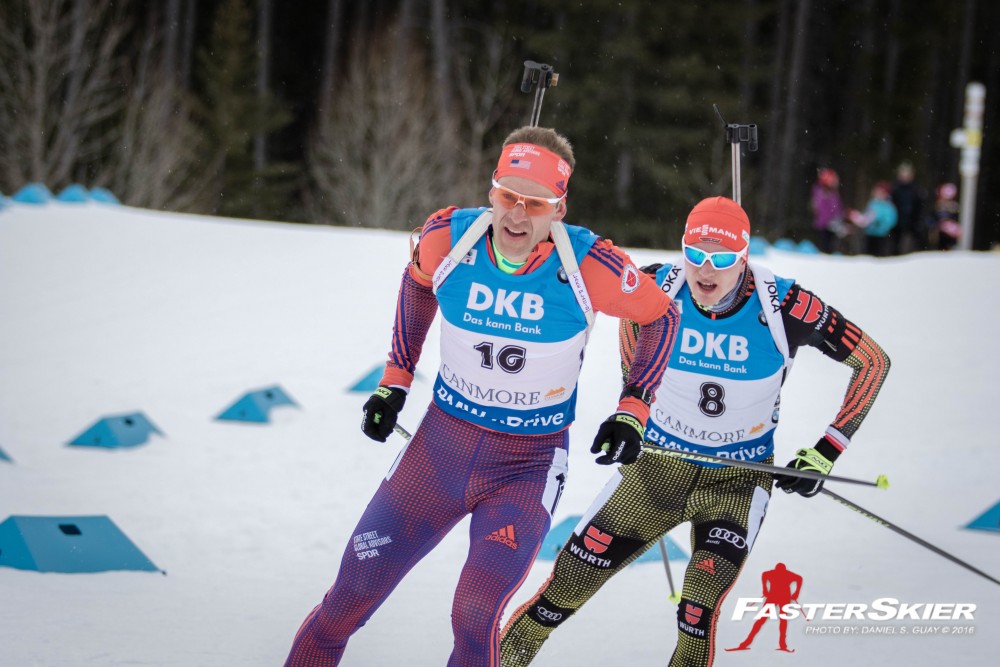
    Lowell Bailey (US Biathlon) leads Germany's Benedikt Doll during the men's 15 k mass start at the IBU World Cup in Canmore, Alberta. Doll went on to place second while Bailey finished 20th. (Photo: Daniel S. Guay)
    Lowell Bailey (US Biathlon) leads Germany’s Benedikt Doll during the men’s 15 k mass start at the IBU World Cup in Canmore, Alberta. Doll went on to place second while Bailey finished 20th. (Photo: Daniel S. Guay)

    Doll closed in on the victory, but partly due to the short finishing stretch in Canmore, he was unable to catch Windisch.

    “My skiing was very good, and I really had great material,” Windisch said during the press conference. “I want to dedicate this victory to our wax men, they really did a great job.”

    “It was not easy today because of the wind,” he added. “I think this shows what biathlon is [about], the field is so close and everybody can win.”

    Asked about the final loop, Windisch recalled: “I just wanted to keep Rastorgujevs [behind me]. But I saw that I had faster skis, so I thought, ‘I have to take my chance now.’ I tried, and it finished well.

    “Since I was a child I have watched the World Cup competitions in Antholz and saw my coach Andreas Zingerle [on the podium] there. He was an idol for me. Since this time I was dreaming of competing in the World Cup,” Windisch added

    Asked about the successes of the Italian team this season, he said: “I think we are a good team, we are a young team, there is good harmony on the team, and we are good friends. It’s joy.”

    “I had a bit of stitch on the last loop, breathing is still not easy,” Doll told German TV broadcaster ZDF immediately after the race, still gasping for air. “The snowfall that began during the race made an allegedly easy course very arduous.”

    Doll recorded the fastest course time of all 30 athletes, but said he struggled especially on the last loop.

    “I saw the guys ahead, but I have to admit my bigger fear was about those behind because there were seven or eight guys following me,” Doll said of the final 2.5 k. “So I said to myself that I have to go full-throttle right from the start so they never catch up. That worked well, but I didn’t expect to be able to make up two more positions. Quentin [Fillon Maillet] didn’t look so fresh anymore, and I made use of that.”

    “After my bad sprint, I wanted to do a good shooting,” the 23-year-old Fillon Maillet said during the press conference, after notching his third-career podium. “Today the conditions were windy, very windy… Three mistakes is [usually] not very good, but today that was good shooting. Skiing was very hard on the last loop. But I am very happy for this race… I prefer racing in mass starts or pursuits, because we are all very close together…. Maybe I have more motivation for this [type of] race.”

    The World Cup Leaders

    It was also an uncharacteristically difficult race day for the leaders in the overall World Cup standings. Fourcade incurred six penalties, but was able to place sixth thanks to the second-fastest skiing time on the course. Russia’s Anton Shipulin finished 17th with six penalties, and Germany’s Simon Schempp in 21st place with eight. In the standings, Schempp moved into third, ahead of Norway’s Tarjei Bø, who is skipping the World Cup stages in North America, by one point.

    Smith Frustrated with Ski Speed, Bailey with Shooting

    Canada’s lone man in the mass start, Nathan Smith finished 16th (+1:12.1) with three penalties) and American Lowell Bailey placed 20th (+1:46.7) with five penalties. The field is limited to 30, with the top 25 in the World Cup standings and five others with the best sprint results in Canmore.

    “On the first lap I thought this could be good,“ Smith said in a Biathlon Canada press release. “I’m still feeling kind of tired on the skis so I was making up some time on the range thankfully so I could maintain my placing in the middle of the pack.”
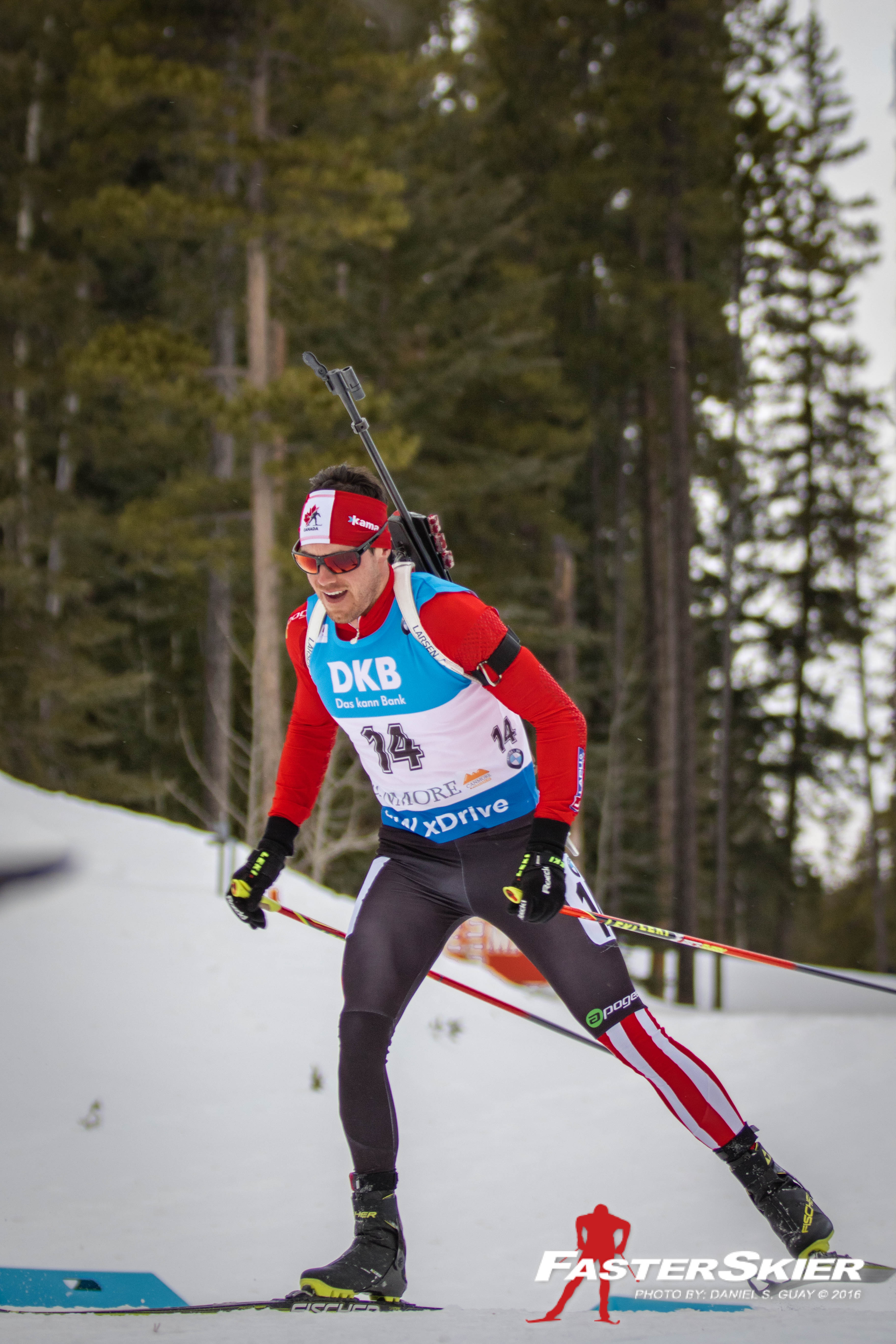
    Nathan Smith (Biathlon Canada) racing to 16th in the men's 15 k mass start at the IBU World Cup in Canmore, Alberta. (Photo: Daniel S. Guay)
    Nathan Smith (Biathlon Canada) racing to 16th in the men’s 15 k mass start at the IBU World Cup in Canmore, Alberta. (Photo: Daniel S. Guay)

    Smith had one miss in the first prone stage and left the range in 12th place.

    “Usually a miss in the first prone will put me off the back in 25th or so, but with the tricky conditions it was pretty much equivalent to 5/5,” Smith wrote in an email to FasterSkier. “At that point I thought I could still be in the mix through the whole race.”

    In the second prone, he shot clean, improving to eighth, 33.5 seconds out of first, but lost positions on the course again with the 26th-ranked time on that loop. Overall, his course time ranked 24th.

    “I knew my skiing was once again not good enough,” he wrote. “I was getting passed on course and couldn’t hang on. I knew today it would take perfect shooting for a strong result.”

    He went on to record two more penalties in the standing stages.

    “My standing actually felt amazing today,” Smith wrote. “I was kicking myself for missing one shot in each.”

    “We are all shooting at the same time in a mass start so if it is windy, it is windy for everyone,” he explained in the press release. “There was a reasonable amount of wind in standing, but not so windy you couldn’t hold the rifle and focus on the target.”

    On the final loop, three competitors passed Smith, and as he headed toward the finish to finish 8 seconds behind Russia’s Evgeniy Garanichev in 15th, Smith waived to his hometown crowd.

    “I tried my best to maintain position on the last lap but just couldn’t hang on,” Smith wrote. “The crowd was so loud each time I came into or looped behind the stadium. I felt privileged to come ‘home’ to the finish with all that support.”

    “16th is a good result for me,” Smith concluded. “I’m happy with where my shooting is at but am becoming more and more frustrated with my ski shape. I’m not sure what has gone wrong but I’m going to look for a solution.”

    After a first loop in the top third of the pack, U.S. Biathlon’s Lowell Bailey had one more miss than Burke and Smith in the first shooting stage, setting him back to 21st place at the time.

    “I didn’t take enough clicks [sight adjustments] to account for the wind change in the first prone,” Bailey wrote in an email. “You never want to start out a race with two penalties.”

    With the help of his coaches, he made the necessary adjustments for the next prone stage, this time cleaning it.

    “The coaches show you a board with all of your shots at some point on the foregoing loop,” Bailey explained. “After a 6-click wind in the first prone, the wind died back to calm by the second prone. This meant I could just aim for the center.”

    In the third shooting, Bailey incurred two more penalties, dropping him back down to 21st and 1:13 out of first, and then he missed one more in the final shooting stage to leave the range in 20th, 1:37 behind the leader.

    “There wasn’t much wind in the third shooting and I can only blame myself for those misses,” he wrote.

    Overall Bailey recorded the 21st course time. “I felt fine,” he explained of his skiing. “It definitely wasn’t the ski course that was holding me back today. ”

    “I’m disappointed with the race,” he wrote. “I put a lot of focus and effort into this world cup [in Canmore]. I came directly here in preparation following the Antholz World Cup and I really felt prepared for these races. Unfortunately, I wasn’t able to put it together on the range over the past two races. It’s frustrating, but you can’t go back and re-do it… you just have to focus on what adjustments need to be made going into the next races.”

    He placed 24th in the sprint, just behind Burke with two penalties. Smith finished 31st in that race with one miss.

    Mixed Relays

    The World Cup in Canmore concludes with a mixed relay (2 women, 2 men) and a single mixed relay (1 woman, 1 man) on Sunday.

    Burke and Bailey plan to race the mixed relay for the U.S., together with Hannah Dreissigacker and Susan Dunklee at the start, while Leif Nordgren and Annelies Cook will team up for the single-mixed relay.

    “I just want to put together a decent performance on the range. That’s my goal,” Bailey wrote.

    Biathlon Canada will aim for a podium at home this weekend; after Rosanna Crawford and Nathan Smith were able to achieve second place in the single mixed relay at the opening World Cup in Östersund, Sweden.

    On Sunday, Smith will team up with Julia Ransom, while Crawford races the mixed relay with Sarah Beaudry, Macx Davies, and Brendan Green.

    “Julia has been so strong lately, I know we will put on a good show for the home crowd!” Smith wrote.

    Results

    Photos

    Start lists: Single mixed relay | Mixed relay

    — Alex Kochon contributed reporting

  • Another Sprint Win for Fourcade; Burke 23rd, Bailey 24th and Davies Elated with 25th

    Another Sprint Win for Fourcade; Burke 23rd, Bailey 24th and Davies Elated with 25th

    Martin Fourcade celebrates his win on Thursday at the IBU World Cup in Canmore, Alberta, where he bested the field by more than 15 seconds in the men's 10 k sprint. (Photo: Daniel S. Guay)
    Still full of energy, Martin Fourcade celebrates his win on Thursday at the IBU World Cup in Canmore, Alberta, where he bested the field by more than 15 seconds in the men’s 10 k sprint. (Photo: Daniel S. Guay)

    Two words: jet lag. Martin Fourcade had to deal with it, but so did the Canadians on their return trip to Canmore for the International Biathlon Union (IBU) World Cup Feb. 4 through 7.

    The overall World Cup leader from France, Fourcade touched down in Calgary, Alberta, four days ago. On Instagram, he noted that it had been “5 years since the last time I competed in North America. Really happy to be here for 2 beautiful weeks of competition!” he wrote, according to a translation, referring to the World Cups in Canmore followed by Presque Isle, Maine, next week.

    Like the rest of the field traveling to Canada from Europe, he was eight hours removed from Central European time, and it might have felt like he should be winding down for the evening when he stood on top of the podium Thursday afternoon in Canmore.

    Regardless, he won, and did so without much trouble — at least by the looks of it. Fourcade hit all 10 of his targets in the men’s 10-kilometer sprint on Thursday and skied the fastest overall course time to win comfortably, by 15.7 seconds over Russia’s Anton Shipulin in second place.

    But racking up win No. 43 wasn’t all that easy, Fourcade later explained.

    “I was a bit nervous,” he told the IBU. “I was not satisfied with my shooting this week during training and today, I had some problems zeroing. But I was confident on my skis, I was clean and fast enough to win, so I am happy.”

    Austria's Simon Eder started first in bib 1 in the men's 10 k sprint at the IBU World Cup in Canmore, Alberta, and he finished sixth with clean shooting and the 19th-ranked course time. (Photo: Daniel S. Guay)
    Austria’s Simon Eder started first in bib 1 in the men’s 10 k sprint at the IBU World Cup in Canmore, Alberta, and he finished sixth with clean shooting and the 19th-ranked course time. (Photo: Daniel S. Guay)

    The sixth starter, Fourcade took control of the race early, skiing through the first 1 k checkpoint 1 1/2 seconds faster than Austria’s Simon Eder, who started first. Both cleaned prone, and Fourcade left the range 0.6 seconds behind Eder. Shipulin in bib 7 blazed through the first shooting even faster, cleaning prone and leaving the range with a 3.6-second lead over Eder.

    Shipulin held his own for most of the second loop as well, and just like Fourcade, cleaned standing, but left the range in second, 6.3 seconds behind Fourcade. Germany’s Simon Schempp (in bib 4) also hit 100 percent of his targets in both stages to move into third, 11 seconds behind Fourcade with one loop to go.

    There, Fourcade extended his gap over Shipulin to 8.6 seconds early in the final loop. Schempp skied in third, nearly 15 seconds behind. The order held to the finish: Fourcade won in 23:51.5, Shipulin finished 15.7 seconds off his pace in second and Schempp 18.7 seconds behind in third.

    “I spoke with Simon and Anton, and we all had the same feeling about the track,” Fourcade told German broadcaster ZDF in an English interview. “When we trained, we felt like it’s an easy track, but I knew it will be hard because of the altitude, and because the track is really wide you feel to be really slow. I think I had a good strategy keeping some strength on the first loop, and being as fast as possible on the last one.”

    Canmore’s elevation is roughly 1,400 meters (4,600 feet).

    “I really like this place; it is very friendly and I love the atmosphere with the teams and the local people,” Fourcade told the IBU. “If we are truly an international sport, we need to come to places like this out of Europe.”

    “I really like this place; it is very friendly and I love the atmosphere. … If we are truly an international sport, we need to come to places like this out of Europe.” — Martin Fourcade, Thursday’s sprint winner and overall IBU World Cup leader

    Schempp explained that the three podium finishers — all of which shot clean in the two-stage race — chatted while changing into dry clothes afterward.

    “We all didn’t have a really good feeling out on the course because it’s relatively slow,” Schempp told ZDF. “You have to push all the time, you have very little time to relax because you pretty much ski from the lowest to the highest point. … So none of us felt they were skiing really fast, but the times are still good and I am very satisfied with the result.”

    Asked what it was like to race overseas, Schempp told ZDF, “A little different, because your body is adapted to another time. At home it’s evening now. Of course, we had a little bit of lead time, three or four days, but … normally, you would sit on the couch or almost go to bed already right now, and instead you have to compete. That’s different, but the same for everyone.”

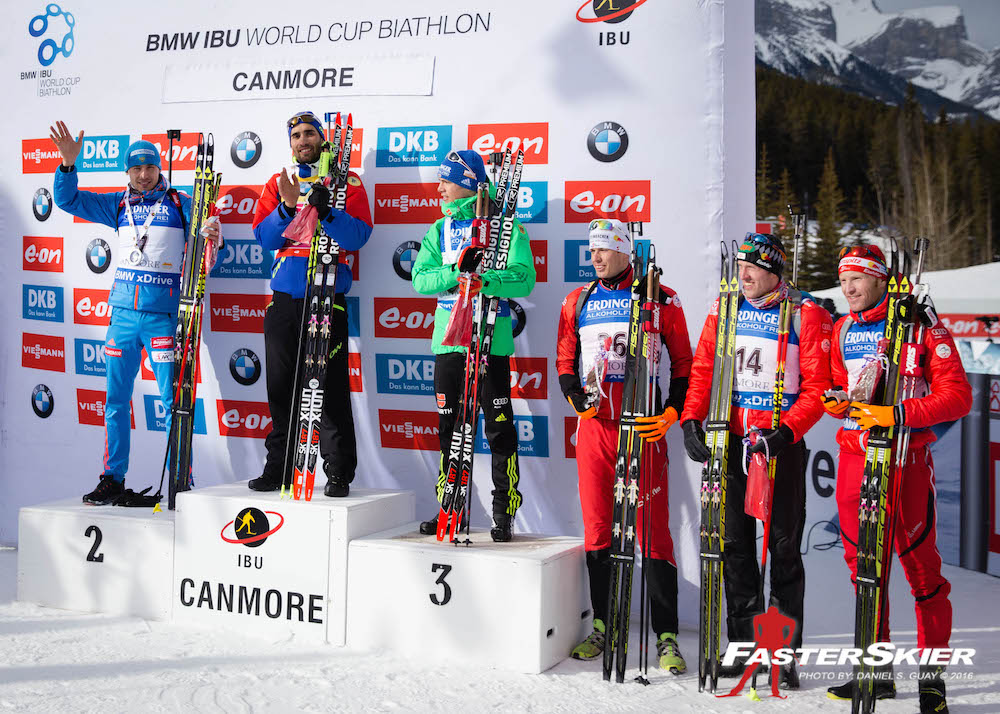
    The men's sprint podium at the IBU World Cup in Canmore, Alberta, with France's Martin Fourcade in first (second from l), Russia's Anton Shipulin in second (l), and Germany's Simon Schempp in third (r). Austria took fourth through sixth with (from left to right) Julian Eberhard with a career-best fourth, Dominik Landertinger in fifth, and Simon Eder in sixth. (Photo: Daniel S. Guay)
    The men’s sprint podium at the IBU World Cup in Canmore, Alberta, with France’s Martin Fourcade in first (second from l), Russia’s Anton Shipulin in second, and Germany’s Simon Schempp in third. Austria took fourth through sixth with (from left to right, in red) Julian Eberhard in fourth, Dominik Landertinger in fifth and Simon Eder in sixth. (Photo: Daniel S. Guay)

    Austria swept fourth through sixth, and while Eder cleaned both stages, he wasn’t the fastest of the three. Eder placed sixth, 47.6 seconds behind Fourcade and just behind his teammates, Julian Eberhard with a career-best fourth (+45.0) and Dominik Landertinger in fifth (+47.1).

    “I already noticed during the last days that my body feels very good,” Eberhard said in an Austrian team press release.

    He previously placed seventh in a sprint earlier this season in Hochfilzen, Austria. On Thursday, he had a single penalty in each stage and the second-fastest course time, 6.8 seconds slower than Fourcade.

    “The course here suits me well,” Eberhard said of Canmore. “That makes every strength session in the summer pay dividends, because you can really put that on the track here. I am happy that my shape is trending upwards ahead of the World Championships.”

    Landertinger cleaned prone and missed one standing. Seven of the top 11 men cleaned the sprint, including the top three.

    Davies’ Dream Come True

    While he didn’t clean, Tim Burke posted the 10th fastest overall course time to place 23rd, 1:44.8 behind Fourcade, with two standing penalties. He led the North Americans on Thursday, with U.S. teammate Lowell Bailey following in 24th (+1:45.2), also with two standing misses.

    The top Canadian Macx Davies finished less than half a second farther back in 25th (+1:45.7), and the third American, Leif Nordgren placed 26th (+1:46.7).

    Macx Davies cleaning his second-straight stage on his home course en route to 100 percent shooting and 25th overall, for his second-best result of his career at the IBU World Cup in Canmore, Alberta. (Photo: Daniel S. Guay)
    Macx Davies cleaning his second-straight stage on his home course en route to 100 percent shooting and 25th overall, for his second-best result of his career at the IBU World Cup in Canmore, Alberta. (Photo: Daniel S. Guay)

    Out of that group, Davies, 23, was the only one to shoot clean. In doing so, he posted his second-best World Cup result of his career — in his hometown.

    “I started the day with the goal of being top 20 and after seeing the first few athletes in the range I knew that I would have to shoot clean to do that,” Davies, the 31st starter, wrote in an email. “And once I made that decision there was no other possibility.”

    Knowing the course well, he decided to conserve for the final loop. Afterward, he reflected that he paced it well and “was able to give a good punch on the finishing climbs.

    “I didn’t realize how good of a day it was until I was on my final loop and the coaches and wax techs were screaming at me, telling me that I was close to the top 20 and needed to ski faster!” Davies wrote. “My thoughts after I cleaned standing were accepting that I would have to ski very hard on my final loop if I wanted to stay with the people around me.”

    Davies initially finished 19th, about a second back from Burke’s time. Bailey in bib 38 ended up between them, and all three slipped a few places outside the top 20, but it was enough for Davies.

    “I am so happy to have had this race at home! It is truly a dream of mine to race well in front of my home crowd and I feel happy that I could show where Biathlon Canada is going, and it is only up!” Davies wrote.

    “After seeing the first few athletes in the range I knew that I would have to shoot clean … And once I made that decision there was no other possibility.” — Macx Davies (Biathlon Canada) on shooting 10-for-10 in Thursday’s sprint to place 25th

    As somewhat of an aside, his father is the chairperson of the event.

    “It makes me realize how much effort from a few people it actually takes to make a World Cup event happen,” Davies noted. “I am proud to have him so closely tied to me and it doesn’t add any pressure, just makes the victory sweeter.”

    While many of the Europeans chose to spend the bye week at home, Burke and several other North American flew directly to Canmore after the last World Cup two weeks ago in Antholz, Italy. That gave Burke 10 days to get his legs back under him.

    Tim Burke (US Biathlon) racing to 23rd in the men's 10 k sprint at Thursday's IBU World Cup in Canmore, Alberta. He cleaned prone, but missed two standing and posted the 10th-ranked course time overall. (Photo: Daniel S. Guay)
    Tim Burke (US Biathlon) en route to 23rd in the men’s 10 k sprint at Thursday’s IBU World Cup in Canmore, Alberta. He cleaned prone, but missed two standing and posted the 10th-ranked course time overall. (Photo: Daniel S. Guay)

    “This was my first winter race in North America in 5 years! I feel like the Canadian crowd was also cheering for us, so it made the race a lot of fun,” Burke, who turned 34 on Wednesday, wrote in an email.

    During the race, he started 20th and found himself in the top 10 with a clean prone, leaving the range for his second loop in ninth. After two misses in standing, he was down to 15th. While Burke initially finished 14th, nine men behind him bumped him into 23rd.

    “I was not happy with my two standing misses but this simply happens in biathlon,” Burke wrote. “I was more frustrated with my skiing today. I feel like I had great preparation for these races and this course is perfect for my strengths. I’m not really sure why, but I just felt really flat today right from the start. I’m hoping that this effort was a wake up call for my body and that I will bounce back for the Mass Start on Saturday.”

    Based on a provisional start list for Saturday’s mass start, which includes only the top 30 athletes, Burke, Bailey and Canada’s Nathan Smith are in (ranked 20th, 16th and 14th, respectively). On Thursday, Smith placed 31st (+1:52.7) with a single prone penalty.

    Nathan Smith (Biathlon Canada) on his way to 31st in the men's 10 k sprint at the IBU World Cup in Canmore, Alberta. (Photo: Daniel S. Guay)
    Nathan Smith (Biathlon Canada) on his way to 31st in the men’s 10 k sprint at the IBU World Cup in Canmore, Alberta. (Photo: Daniel S. Guay)

    “I have been struggling skiing for the last few weeks,” Smith, the second-best Canadian on Thursday, wrote in an email. “Before it could’ve been my back pain, but today I didn’t have any. Late last week in intensity I felt in top form, but then in race prep yesterday I just felt totally heavy. Unfortunately it was the same today.”

    On the upside, “My shooting had been rock solid for the last two weeks,” he added. “No worries there. I’m hoping that today’s tough ski will have gotten me into better shape for the mass start and mixed relays this weekend.”

    While Bailey was alternatively pleased with his clean prone stage, his two standing misses left him “extremely disappointed,” he wrote in an email.

    “I missed both shots by a few millimeters,” Bailey explained. “I think it hurts a little more when you realize how close everything was.”

    Asked about pacing on Canmore’s course, the 34-year-old US Biathlon veteran noted: “This course has a huge climb — perhaps the longest on the world cup circuit — so I really tried to work that climb so that I was able to push in the last part of the hill. I definitely felt fatigued by the last time up it, but I think a lot of athletes were feeling this way as well.

    “I’m ok with a top-25 but I know I can do better than this,” Bailey added. “I just have to re-focus and set my sights on the next races. I’m confident in our preparation and I really feel like we can put together some quality results during the North American tour.”

    Lowell Bailey racing to 24th in the men's 10 k sprint at the IBU World Cup in Canmore, Alberta. (Photo: Daniel S. Guay)
    Lowell Bailey racing to 24th in the men’s 10 k sprint at the IBU World Cup in Canmore, Alberta. (Photo: Daniel S. Guay)

    Nordgren was disappointed to miss his last prone shot — his only penalty of the day. The 49th starter, Nordgren found himself in 41st initially after the first shooting. He then improved to 27th after the second shooting with a clean standing stage.

    “I know I’m capable of more, and I showed it last season,” Nordgren wrote in an email. “… Missing the last shot in any stage is just painful. I haven’t raced here in a few years, but I remember going out too hard last time and blowing up pretty hard on the last loop. Today I tried to start pretty aggressive, while still leaving enough to ski a good last loop.

    “The most disappointing thing is knowing I would have been in the mass start on Saturday had I hit that prone shot, which leaves a bitter taste in my mouth even though it was a fairly good race,” he added.

    Before Canmore, Nordgren spent a few days at home in Minnesota.

    “Since I wasn’t there for Christmas it was good to just relax at home, even if it was really short,” he wrote. “I traveled to Canmore Last Thursday in order to get a few days extra to adjust to the altitude. It’s been nice here in Canmore, the snow is in really good condition and the temps have been pretty mild.”

    For the home team, the atmosphere was uplifting. A couple thousand spectators came out for the races, Smith estimated, and a large number of them were schoolchildren. Smith is originally from nearby Calgary.

    “Maybe one day one of those students in the crowd will represent Canada at the Olympics,” he wrote. “At the start I felt really proud to be representing Canada at home, to be an ambassador for the sport, and knowing that I’m racing for something larger than just myself.”

    Scott Gow (Biathlon Canada) racing to 34th, one of the best results of his IBU World Cup career, at the men's sprint in Canmore, Alberta. (Photo: Daniel S. Guay)
    Scott Gow (Biathlon Canada) racing to 34th, one of the best results of his IBU World Cup career, at the men’s sprint in Canmore, Alberta. (Photo: Daniel S. Guay)

    In 34th, about three seconds behind Smith, Canada’s Scott Gow, 25, had one of his top-five best results. Like Davies, the Gow brothers also grew up in Canmore. Scott Gow had one prone penalty to finish 1:55.5 behind Fourcade.

    In an email, Gow explained that his race started like any other: “There were a few nerves I needed to get out of my system but after 1km everything felt normal,” he wrote. “I got some splits saying my ski time was good, and the techs kept telling me throughout the race that I was maintaining good ski speed.”

    While he wasn’t happy with his prone miss, his standing stage gave him “renewed motivation to really try and hammer out my last lap,” Gow added. “It was nice skiing by the stadium and having a few hundred people cheering me on, making sure I finish well. … I’m happy with my end result. I was hoping to feel better on skis and of course I would have liked to hit all my targets. Overall I’m very pleased.”

    His brother, Christian Gow, and Brendan Green also had one miss each (both in standing) and ended up in 61st (+2:50.2) and 40th (+2:09.5), respectively.

    The fourth American, Max Durtschi in his first-ever World Cup placed 85th with five penalties (2+3).

    “Overall, I am disappointed with my performance today,” Durtschi, a 24-year-old former professional cyclist, wrote in an email. “I felt solid on skis, but my shooting was not up to standard. At the World Cup level you cannot shoot 50% and call it a good day.  Representing the USA at this level is a big privilege, and I expect a much better performance out of myself in the range.”

    A member of US Biathlon’s X-team, he is slated to join the World Cup team in Presque Isle next week.

    “The next days I am focusing on training and improving!” Durtschi wrote. “I will remain open minded to whatever comes my way.  For now, I need to continue to work on the fundamentals of the sport.”

    Results

    Photos

    — Harald Zimmer contributed reporting
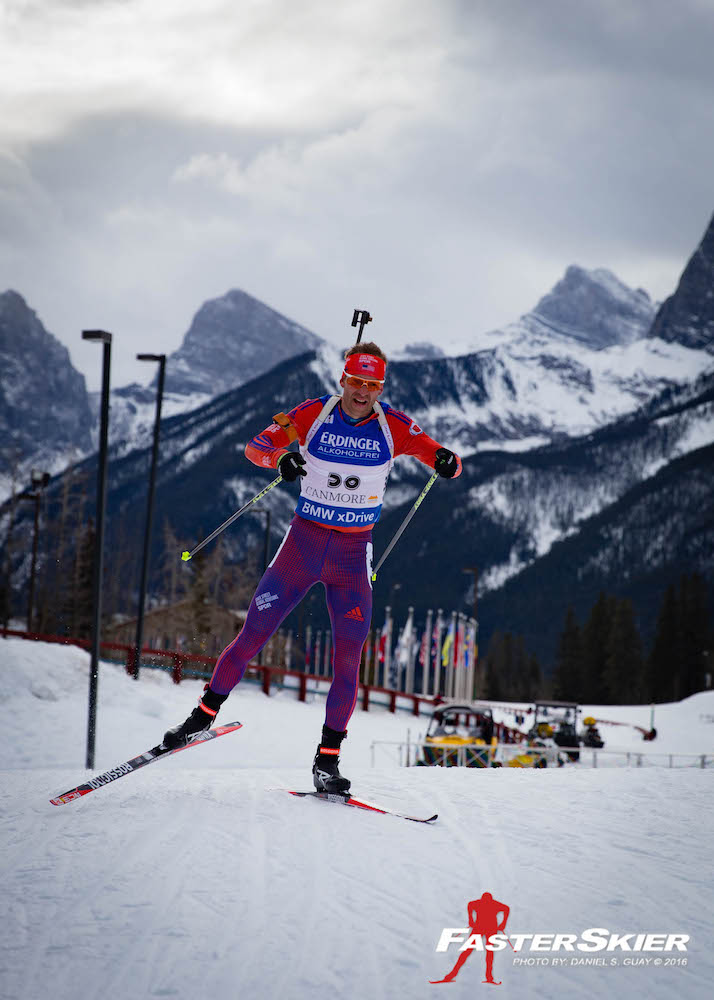
    Canadian biathlete Macx Davies raced to his second-best IBU World Cup result of 25th on Thursday in the men's 10 k sprint in Canmore, Alberta. (Photo: Daniel S. Guay)
    Canadian biathlete Macx Davies raced to his second-best IBU World Cup result of 25th on Thursday in the men’s 10 k sprint in Canmore, Alberta. (Photo: Daniel S. Guay)
  • Russia’s Shipulin Prevails Again, Edges Germany for Relay Win; U.S. Ties Season Best

    Russia’s Shipulin Prevails Again, Edges Germany for Relay Win; U.S. Ties Season Best

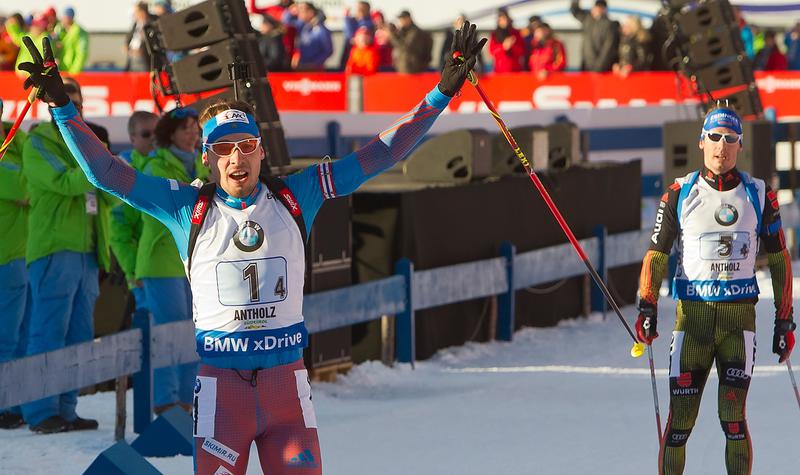
    Russia's Anton Shipulin (l) celebrates after holding off Germany's Simon Schempp to anchor Russia to the men's relay victory on Sunday at the IBU World Cup in Antholz, Italy. Shipulin outlasted Schempp by 1 second for the win. (Photo: IBU/Rene Miko)
    Russia’s Anton Shipulin (l) celebrates after holding off Germany’s Simon Schempp (r) to anchor Russia to the men’s relay victory on Sunday at the IBU World Cup in Antholz, Italy. Shipulin outlasted Schempp by 1 second for the win. (Photo: IBU/Rene Miko)

    Russia’s Anton Shipulin and Germany’s Simon Schempp have met multiple times on the final loop of an International Biathlon Union (IBU) World Cup race and duked it out for first, both in individual races as well as relays. In fact, they did so in Saturday’s pursuit in Antholz, Italy, where Shipulin prevailed by 10 seconds to claim his first victory of the season.

    On Sunday in the men’s 4 x 7.5-kilometer relay in the same packed arena with over 20,000 biathlon fans, Shipulin did it again to anchor a Russian team — with Maxim Tsvetkov, Evgeny Garanichev and Dmitry Malyshko — to first in 1:12:24.8, with no penalties and seven spare rounds.

    The German team, with Erik Lesser, Benedikt Doll, Arnd Peiffer, and Schempp, finished just 1 second behind, with one penalty but just four spares.

    “It has become sort of a tradition with me and Simon together on the last shooting range and then on the last lap,” Shipulin commented in the post-race press conference through a translator. “Honestly Simon becomes stronger and stronger every time, but today I would say I didn’t beat him physically, it was more about tactics. It is not a very long finish lane here, so I just made it tactically better to not give him a chance.”

    “Being on the podium shows that we are in good shape,” Malyshko said through a translator. “We will try our best at the World Championships [in Oslo in March] to show everybody that we are even stronger than in the World Cups.”

    “We trust in Anton, and Anton believes in the team,” one of Shipulin’s teammates added in an interview with the IBU.

    Schempp was not pleased with a situation that happened when he and Shipulin came into the arena, having to pass a lapped athlete from Japan just before the last turn, with Shipulin overtaking on the right but Schempp getting slightly blocked.

    “The lapped athlete ran in the middle of the track. The whole audience was yelling for him to go to the side. I don’t know, maybe he is deaf on his ears, or whatever he is doing,” Schempp told German broadcaster ARD. “With all the peace of mind he is running right between us, and that must not happen.”

    Asked if he thought a protest with the IBU would be an option, Schempp replied: “Nah, surely that would not go through. That result stands.”

    “I gave everything I had, it was a neat relay, and we were rewarded with the second place,” he added. “The Russians were very, very strong, especially Anton in the finish. We can live with that. It was a clear step forward in the relays [the German men’s first relay podium of the season]. Of course the end is a little annoying, but we can be satisfied.”

    The head coaches for German and Russia, Mark Kirchner and Ricco Gross, respectively, hugged and congratulated each other in the coaching zone after the race. Both 45 years old, they are former German teammates and won gold together in the men’s relay at the 1994 Olympics in Lillehammer, Norway. More recently, they were also colleagues, with Kirchner coaching the German men’s team and Gross being an assistant for the women at the 2014 Olympics, before Gross took an offer last summer to lead the Russian men’s team (after being “demoted” to the IBU Cup by the German Ski Federation).

    “It’s difficult to even pick the six best athletes for the World Cup,” Gross had told German newspaper FAZ in an interview published on Friday, just before Shipulin’s sprint victory. “I was extremely surprised in September when I watched the Russian championships for the first time, with more than 100 athletes. There is a giant talent pool … My target is the Olympic Games in 2018.”

    Norway opted to rest its usual starters Tarjei Bø and Emil Hegle Svendsen for the relay on Sunday, instead starting veteran Ole Einar Bjørndalen, Lars Helge Birkeland, Johannes Thingnes Bø, and Erlend Bjøntegaard.

    “They married and went on vacation,” Johannes Bø joked during the press conference when asked about the absence of his brother Tarjei and Svendsen.

    Thus it fell to the relatively inexperienced Bjøntegaard to anchor the team. Bø tagged  him with a 29.2-second lead over Russia, and 33.5 seconds ahead of Germany, with Shipulin and Schempp chasing after him.

    “Now it’s becoming really exciting. I wouldn’t like to be in the shoes of Bjøntegaard right now,” Germany’s third-leg Arnd Peiffer said during an interview with ARD while the race was still going on. “I think he has a lot of stress now, and I am curious what happens.”

    But facing this big challenge, Bjøntegaard did a good job skiing a fast first loop to return to the range still in first and only needing two spares in his prone shooting. Yet this still reduced his lead to 6.8 seconds over Schempp, who had shot clean, and 14.9 seconds to Shipulin, who required one spare.

    In the final standing shooting, the Norwegian needed two more spare rounds, while Shipulin and Schempp both remained clean and left the range just 0.5 seconds apart. They skied together until the finishing sprint, with Bjøntegaard securing the third place on the podium, 22.9 seconds after Russia, but securely ahead of the rest of the field.

    “With Emil and Tarjei, two of our best athletes were not in the relay,” Johannes Thingnes Bø said during the press conference. “I was hoping that we could make the podium, and we did. A perfect race for everyone on the team. Erlend and Lars Helge were called up last minute, but they were relaxed, and third place is good. It’s not easy for Erlend to go out with Schempp and Shipulin.”

    Behind Norway, Austria, with Sven Grossegger, Julian Eberhard, Simon Eder, and Dominik Landertinger, finished fourth (+1:01.7), with one penalty and 11 spare rounds.

    “Better shooting,” Simon Eder told the IBU in a video interview when questioned what it would have taken to reach the podium. “We always have the extra [penalty] loop. It’s not easy, it happens so fast. But we hope to manage it at the World Champs without it.”

    “The running shape is very good in the Austrian team,” Landertinger added. “And if the shooting is a little bit better we can make the podium.”

    France, starting without World Cup leader Martin Fourcade with a lineup of his older brother Simon Fourcade, Quentin Fillion Maillet, Simon Desthieux, and Jean Guillaume Beatrix, placed fifth (+1:39.3), with no penalties and 11 spares.

    U.S. Ties Season-Best 6th; Canada 11th

    Lowell Bailey (US Biathlon leads Russia's Maxim Tsvetkov during the first leg of the men's 4 x 7.5 k IBU World Cup relay on Sunday in Antholz, Italy. Russia went on to win and the U.S. finished 1:43.7 minutes back in sixth, tying a season-best team result. (Photo: IBU)
    Lowell Bailey (US Biathlon leads Russia’s Maxim Tsvetkov during the first leg of the men’s 4 x 7.5 k IBU World Cup relay on Sunday in Antholz, Italy. Russia went on to win and the U.S. finished 1:43.7 minutes back in sixth, tying a season-best team result. (Photo: IBU)

    On the last leg, Beatrix narrowly won out a race against American Sean Doherty, who crossed the finish less than five seconds later in sixth place, 1:43.7 behind the winners. The U.S. ended up with one penalty and 13 spares, and tied its season-best result after having achieved sixth in the relay a week ago in Ruhpolding, Germany.

    The Americans started the race in bib 6 with their now-usual lineup of Lowell Bailey, Tim Burke, Leif Nordgren, and Doherty, the same starters they had used at the World Championships in Kontiolahti, Finland, where the U.S. placed 14th in the men’s relay.

    Bailey briefly took the lead on the loop out of the arena, before two misses in his prone shooting stage required spare rounds and set him back to 15th, but still within 15.5 seconds out of the lead. With another spare in his standing stage, he still moved up five positions, and with the second-fastest, first-leg course time on his final loop, he tagged off in seventh, 20.8 seconds behind Germany’s Lesser.

    Burke held that position throughout his first loop, but two misses in the prone stage set him back. In the standing shooting, he used all three spare rounds to avoid the penalty lap, falling back to 14th before he made up ground again with a fast last loop (third-best course time) to tag Nordgren in ninth (+1:04.3).

    “Today proved that last week was not a fluke,” Burke said in a US Biathlon press release. “We are happy to be right in the mix with the ‘big’ biathlon nations but we still know that we are capable of more.”

    “I got the tag from Tim right with the Czech Republic,” Nordgren wrote in an email to FasterSkier. “For all of the first loop I just focused on staying nice and relaxed, trying to conserve as much energy as possible. Prone I wanted to be pretty aggressive and it worked out well.”

    After a clean prone shooting, Nordgren left the range in seventh place, virtually tied with a few other teams.

    “The second loop I left the range with Eder from Austria, again I was just tucked in with him saving energy,” Nordgren recalled. “Although I had super great skis today, so eventually on the downhill I put in a good transition and was pushing towards the French team in front of us.”

    After using two spare rounds in his standing stage, Nordgren still managed to move up to sixth place as some other teams, such as Italy and Switzerland, struggled on this leg, and handed off 1:04.5 minutes behind the leaders — about the same gap he had when he started.

    Russia's Evgeniy Garanichev (l) leads Tim Burke (US Biathlon) during the second leg of the men's 4 x 7.5 k IBU World Cup relay in Antholz, Italy. (Photo: IBU/Rene Miko)
    Russia’s Evgeniy Garanichev (l) leads Tim Burke (US Biathlon) during the second leg of the men’s 4 x 7.5 k IBU World Cup relay in Antholz, Italy. (Photo: IBU/Rene Miko)

    “Standing was the only disappointing part about my race today, it was a bummer to have two mistakes, but I didn’t lose any places and I was quick with the extras,” Nordgren wrote. “I was surprised on the third loop, I actually had some energy to push. Eventually France passed me and got a small gap I couldn’t close.”

    Doherty kept the team in sixth on his first loop and through the first prone shooting, which he cleaned, reducing his gap to first by about ten seconds.

    “The conditions today were ideal,” Doherty wrote in an email. “The course was in great shape and there was no wind. The altitude here adds to the difficulty, but I also pushed hard on the second loop and I did not really hold it together on the range as I wish I could have.”

    By the final standing shooting he had moved to fifth, and was on the range behind Austria, with France nearby and Slovakia further behind. Austria’s Landertinger shot clean and finished first, while Doherty caused a penalty lap. But he only lost one position and still had France’s Beatrix in sight who had needed three spares.

    Doherty skied a fast final loop, almost closing a 20-second gap again, finishing sixth, 4.4 seconds behind France in fifth and 1:43.7 behind Russia.

    “I am a little bummed to have had that penalty because I was excited to fight for 5th. But overall 6th was secure,” Doherty wrote.

    “I am happy with another strong result,” Doherty added in the US Biathlon press release. “We were in the mix the whole time and even though I did not shoot my best the team did well. We are all looking forward to the next relay.”

    “As a team I think we’re happy with this race, but it was nowhere near a perfect race for us,” Nordgren wrote. “We still have more to give and will be looking for more in the relays to come.”

    Canada in bib 7 chose a lineup of Christian Gow, Nathan Smith, Macx Davies, and Scott Gow. Brendan Green had to sit out the relay because of back issues following his collision in Saturday’s pursuit, “which did not improve until race time,” according to Biathlon Canada head coach Matthias Ahrens. “We had to put Scott Gow in his place,” Ahrens wrote in an email.

    Younger brother Christian Gow jumped out to the lead after cleaning the initial prone stage, but on the next loop he lost some ground, crossing the next timing point in 11th, just 10 seconds out of first. After he required two spare rounds in his standing stage, Christian lost additional time to the leaders, but kept his position in the field, tagging off to Smith in 11th (+1:08.3).

    Smith, currently the highest-ranked Canadian in the overall World Cup, cleaned both stages for his first 100-percent shooting in a race this season. Reflecting on his race in an email, he said his ski shape was off — and it has been for the last couple days. Unable to move up in the field, he tagged Davies in 11th (+1:07.7).

    “I wanted to make up some spots and get our team up to the top 10. I knew it would mean some really good shooting,” Smith wrote in an email. “I’m really happy to finally have my first clean of the winter, especially after poor shooting in the other two races this weekend. On the other hand my skiing hasn’t been where it should for the last two weeks. I’m not sure why, I went from my best ski shape to my worst ski shape in literally 3 days. I have been struggling with back pain after a hard downhill crash in the Ruhpolding 20 km.”

    Davies went on to clean his prone stage and move into 10th, reducing the gap to the leaders to 41 seconds. In standing, he needed all three spares, which caused him to lose some time. Overall Davies skied the second-best course time of his leg (only behind Norway’s Bø), and handed off to Scott Gow in 10th place (+1:39.0).

    On the anchor leg, Scott needed two spares in his prone stage and one in standing, with Estonia’s anchor Ermits Kalev still passing him on the final loop. The Canadian crossed the finish in 11th, 5.7 seconds behind Estonia and 2:28.9 minutes behind Russia.

    Combined, the team had no penalty and required just eight spares. But 11th wasn’t exactly close to their season best: the Canadians finished sixth in Hochfilzen, Austria and 10th last week in Ruhpolding.

    “There were some good aspects of our relay: Christian’s first prone was amazing, my shooting, and Macx’s skiing,” Smith wrote. “Overall though I would say unfortunately it was not a good relay. A good race for us is top 6. The potential for a medal is there if everyone can put together their best race on the same day. Easier said than done.”

    The Biathlon World Cup resumes in two weeks on Canada’s home turf in Canmore, Alberta, with sprints on Thursday, Feb. 4 and Friday, Feb. 5, followed by mass starts on Saturday, Feb. 6, and single-mixed (1 woman, 1 man) and mixed (2 women, 2 men) relays on Sunday, Feb. 7.

    “I’m going to North America in a good mood,” Germany’s Peiffer said at the press conference. “The last three weeks were really exhausting. Now I had a good week here in Antholz, and I am looking forward to go to Canmore. I have never been there before. Maybe not as many [spectators] as in Ruhpolding or Antholz, but it’s nice to see a new place for biathlon.”

    “I will be in Romania for my last Junior World Championships,” Sean Doherty, 20, wrote, which will take place in Cheile Gradistei (Brasov, Romania) from Jan. 27 to Feb. 2. “So I will only be attending the Presque Isle World Cup [after Canmore].”

    Results

  • Bø Brothers Lead Norwegian Sweep; Canada’s Christian Gow Gets Career Best After Rib Injury

    Bø Brothers Lead Norwegian Sweep; Canada’s Christian Gow Gets Career Best After Rib Injury

    The all-Norwegian podium in the men's 10 k sprint on Friday at the IBU World Cup in Ruhpolding, Germany: with winner Johannes Thingnes Bø (c), brother Tarjei Bø (l) in second, and Emil Hegle Svendsen (r) in third. (Photo: IBU/Eberhard Thonfeld)
    The all-Norwegian podium in the men’s 10 k sprint on Friday at the IBU World Cup in Ruhpolding, Germany: with winner Johannes Thingnes Bø (c), brother Tarjei Bø (l) in second, and Emil Hegle Svendsen (r) in third. (Photo: IBU/Eberhard Thonfeld)

    The Norwegian biathlon team must have used the holiday break well, as evidenced by their men’s podium sweep in Friday’s 10-kilometer sprint in Ruhpolding, Germany, the first IBU World Cup of the new year.

    Twenty-two-year-old Johannes Thingnes Bø started early in bib 8 and won the race in 21:57.5 minutes, supplanting his brother Tarjei, six years his elder, by 3 seconds after Tarjei started three positions earlier and held the lead until then.

    No other athlete could beat the Bø brothers. Emil Hegle Svendsen in bib 26 completed the podium sweep for Norway, finishing 7.6 seconds back in third. The last time Norway took all of the top-three spots was eight years ago during the 2007/2008 season at a sprint in Hochfilzen, Austria.

    Johannes Bø also won last season’s sprint in Ruhpolding, thus repeating the feat after a slow start to the season — by his standards.

    On a sunny day with essentially no wind on the shooting range, and skiing on an artificial snow loop that had become firmer overnight due to light rain, the Bø brothers and Svendsen all shot clean through both stages.

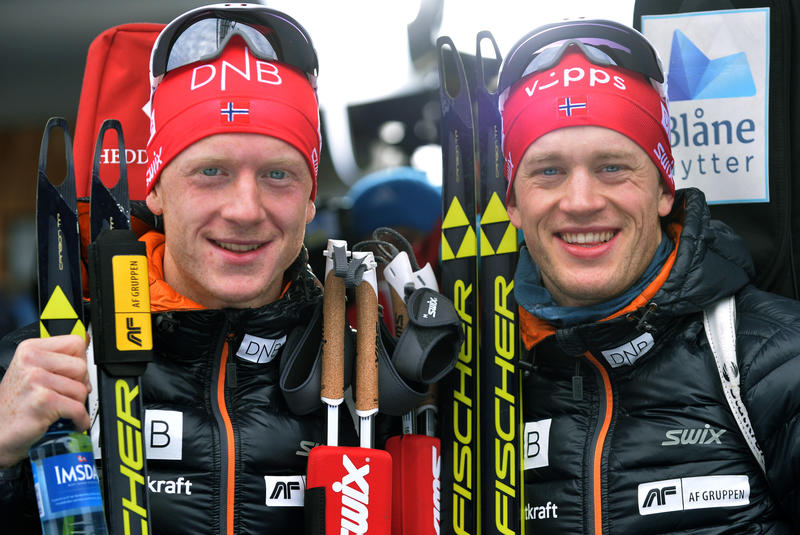
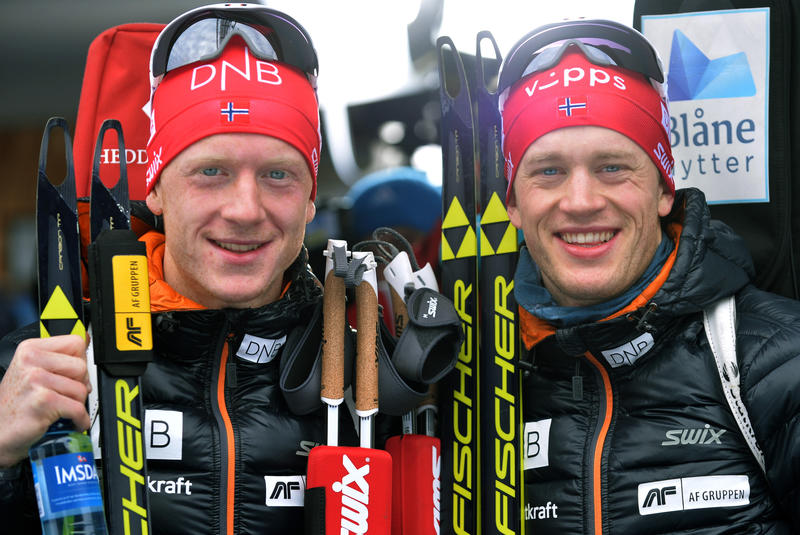
    The Bø brothers: Johannes Thingnes (l) and older brother Tarjei at the IBU World Cup 4 in Ruhpolding, Germany, where they placed first and second, respectively in the sprint. (Photo: IBU/Eberhard Thonfeld)
    The Bø brothers: Johannes Thingnes (l) and older brother Tarjei at the IBU World Cup 4 in Ruhpolding, Germany, where they placed first and second, respectively, in the sprint. (Photo: IBU/Eberhard Thonfeld)

    “[Over Christmas] we were just home training … relaxing mostly,” Johannes said during an English interview with his brother with German TV broadcaster ARD. “Watching Christmas movies, eating good food, we relaxed and trained.”

    “It’s not so often we take the triple,” added Tarjei. “But today it was a really good, also really relaxed team. Really good skis. Our focus is World Champs in Oslo [in March]. Before Christmas we tried to be too fast. Now we have to wait with our energy to still be good in February.”

    Asked about the harmony in the family as competitors, the brothers shared a laugh.

    “For me it’s OK, but uh…,” joked winner Johannes, pointing to his brother.

    “It’s always some seconds, like in Kontiolahti at the World Champs [last season],” Tarjei replied. “Today it was so close, we shot clean, skied fast … I don’t know what to do. Three seconds. I hope tomorrow [in the pursuit], maybe I can beat him.”

    “I have eight or nine World Cup victories. He has one less than me,” Johannes concluded.

    “It’s not so often in biathlon when you get three athletes from the same country on the podium,” Svendsen noted in an IBU press release. “It is nice to be here today with the two brothers. This is the best PR we can get for the World Championships. I think it’s going the right way. I am feeling better and better.”

    Norway's Tarjei Bø racing to second on Friday in the IBU World Cup sprint in Ruhpolding, Germany. (Photo: IBU/Eberhard Thonfeld)
    Norway’s Tarjei Bø racing to second on Friday in the IBU World Cup sprint in Ruhpolding, Germany. (Photo: IBU/Eberhard Thonfeld)

    Germany’s Simon Schempp, who has made Ruhpolding his home and is currently third in the overall World Cup standings, did not start due to a cold.

    “Of course it’s sad,” commented his coach Mark Kirchner told ARD. “He doesn’t feel too bad, it’s rather a localized infection. But of course his own ambition by now is that when he is starting, he wants to attack the podium, and even just 98 percent of your ability is not enough for that, so that’s why he is not starting today.

    “We will observe the situation,” Kirchner continued. “The earliest possible return date is for [the mass start] Sunday, but we won’t force it. The season is long, there are many other goals.”

    Similarly, Norway’s superstar Ole Einar Bjørndalen also sat out Friday’s sprint due to an unspecified illness.

    As a result France’s World Cup leader Martin Fourcade, despite not feeling well, either, came closest to preventing the Norwegian trifecta. He posted the best course time in the field, but couldn’t overcome  a miss on the third target in his prone shooting stage and the resulting penalty lap.

    Fourcade crossed the line in fourth place, 10.9 seconds back and just 3.3 seconds off the podium. However, he still collected 43 additional valuable points in the overall ranking (and likely more on Saturday when his toughest competitors, Schempp and Bjørndalen, will not be able to start the pursuit) to widen the gap.

    “It was a strange race for me. I was sick last night, I had stomach problems,” Fourcade said in an English interview with ARD. “I was a bit worried this morning, then when I looked on the start list I saw the second [in the World Cup ranking, Bjørndalen] and the third [Schempp] would not race, so to catch some points I decided to start. But my feeling was not so good, and I did a stupid mistake in the prone, that’s why Norway has all three on the podium.

    Tarjei Bø during his prone shooting, which he cleaned. The Norwegian went on to place second in the IBU World Cup sprint in Ruhpolding, Germany, behind his younger brother Johannes Thingnes Bø (not shown). (Photo: IBU/Eberhard Thonfeld)
    Tarjei Bø during his prone shooting, which he cleaned. The Norwegian went on to place second in the IBU World Cup sprint in Ruhpolding, Germany, behind his younger brother Johannes Thingnes Bø (not shown). (Photo: IBU/Eberhard Thonfeld)

    “But they were good,” he continued. “Johannes I think wanted revenge after a strange December month. The same for Emil. That’s good for Norway, they had a huge team result, but that is not a surprise for me.”

    Questioned again if he started mainly to increase his World Cup lead, he added: “Yeah, I don’t like to start in that condition, but I woke up and … with my experience even if you are not good to win it, you still have to compete. Now it’s two more competitions without points for Simon and Ole Einar, and I think that’s too much for them [to come back from] even if I am not in super-shape tomorrow because I was sick today.

    “That’s the strange thing about the Overall World Cup,” Fourcade said. “Even if you are not good, you have to compete. That’s something I do even if I don’t like that, and I know it’s not good for my body.”

    Behind the Norwegians and Fourcade, the Austrian men’s team had their best performance of the season, claiming the next three spots mainly helped by also achieving clean shootings. Sven Grossegger recorded the best individual World Cup result of his career in fifth, 24.4 seconds back, after placing 10th in a sprint during the 2011/2012 season. Teammates Simon Eder was in sixth (+27.5), and Dominik Landertinger took seventh (+39.8).

    “I felt good skiing right from the start,” Grossegger said after the race, according to an Austrian Ski Federation press release. “Today were fast, icy conditions. That just suits me. During the shootings I was working well and was focused. In standing position I had a little luck with one shot.”

    Smith 15th; Six North Americans Qualify for Pursuit

    Early in the holiday break, the International Biathlon Union had announced that the fourth World Cup would be relocated to Ruhpolding, after warm weather conditions made it impossible to produce artificial snow at the originally scheduled location in Oberhof, Germany. Thus Ruhpolding is in the rare situation to be hosting back-to-back World Cups in the same location (ironically, it finally snowed in Oberhof last week, which might have allowed organizers to groom a track, but the decision had already been made).

    Biathlon Canada again brought a full men’s roster to the sprint, filling all the five spots allowed for them this season (on the men’s side, only Czech Republic, Germany, France, Norway, and Russia currently have six).

    Nathan Smith, the top North American male in the World Cup standings in 13th overall, also had the best result on Friday, finishing in 15th place (+59.9). Unlike most of his teammates, he had not traveled home for the holidays, instead training in France.

    On Friday, he started early in the field in bib 7 and clocked the best initial split times. After a fast-and-clean prone stage, he took the lead, ahead of eventual second-place finisher Tarjei Bø, and only Johannes displaced him at the split, leaving the range later.

    In standing, Smith missed two targets and the two resulting penalty laps set him back.

    “I started off really strong with a clean prone, which put me in second spot going into my standing,” he explained.

    “I knew I was in medal contention and I let those thoughts become a distraction,” Smith said, according to a Biathlon Canada press release.

    Overall he skied the seventh-fastest course time of all athletes.

    “My skiing was good enough for a medal today, but 10/10 (shooting) is a requirement when conditions are perfect,” he added.

    Tim Burke (US Biathlon) racing to 18th to lead the U.S. men in Friday's IBU World Cup sprint in Ruhpolding, Germany. Burke had a single penalty (0+1). (Photo: USBA/NordicFocus)
    Tim Burke (US Biathlon) racing to 18th to lead the U.S. men in Friday’s IBU World Cup sprint in Ruhpolding, Germany. Burke had a single penalty (0+1). (Photo: USBA/NordicFocus)

    In contrast to the Canadians, the U.S. men only had two athletes start Friday with Tim Burke and Lowell Bailey. Sean Doherty opted for a longer training period block over the holidays in preparation for Junior World Championships in February in Cheile Gradistei, Romania, according U.S. Biathlon Chief of Sport Bernd Eisenbichler. Doherty plans to join his teammates in Ruhpolding on Sunday.

    Leif Nordgren was assigned to the IBU Cup team, joining Wynn Roberts, Casey Smith, and Max Durtschi. They will compete this weekend in Nove Mesto, Czech Republic.

    According to a press release, US Biathlon plans to call up “an additional athlete per gender”  for World Cups 5-6 following this weekend’s IBU World Cup.

    Starting shortly behind Smith in bib 11, Burke managed to clean his prone shooting before missing one shot in standing, finishing in 18th, 1:01.3 minutes back.

    “The approach to the shooting range is pretty easy here so I knew there would be a lot of good, fast shooting,” Burke explained in an email. “I just tried to stay aggressive in the range and not give up too much time on the shooting mat.”

    Overall he recorded the 31st-fastest shooting time. Out on the course he was able to improve his position on each of the three rounds compared to the field, closing out strong with the 13th-fastest final loop and recording the 17th-best overall course time.

    “I had not been home for the holidays in a few years so it was a nice change of pace for me,” Burke added. “I definitely still felt a little jet lagged in the race today, but I feel like my body responded well. I expect to feel better with each race, especially since I did not do too much intensity training over the break.

    “I would normally hope for a better place in the sprint with one penalty, but considering my recent travel and that this not my favorite course, I am pleased,” he continued.

    Closer to the middle of the field of 102 starters in bib 40, Lowell Bailey also recorded a single miss in the standing stage (0+1), but his overall course time ranked 45th time, putting him in 33rd at the finish, 1:01.3 minutes back and one spot behind the winner of the last race of 2015, France’s Jean-Guillaume Béatrix.

    One place behind Bailey in 34th was 22-year-old Canadian Christian Gow (+1:03). He managed to clean both stages for a World Cup career best, giving him seven more points in his overall World Cup standing. He improved on his 37th place in the sprint in Pokljuka, Slovenia, just before the holiday break, as well as 39th in a pursuit in Hochfilzen, Austria, earlier this season.

    “I am really happy with the race today,” Gow wrote in an email. “It feels great to put out another personal best and also to be in a good position for the pursuit! I am quite surprised by the result today, as I have not had a very productive break since the last World Cup. I, unfortunately, got sick right after Christmas and also took a fall injuring my ribs. Between those two things, I haven’t been able to do intensity until yesterday’s race prep, and that did not go too well for me. Today was a really nice surprise to see that my ski shape didn’t fall off too much despite all of that!”

    His older brother Scott Gow finished the sprint in 47th (+1:48.1) with two penalties (1+1), and teammate Macx Davies placed 55th (+1:53.5) with a single prone miss and one in standing as well.

    The fifth Canadian, Scott Perras competed in his first World Cup race of the season and placed 72nd (+2:27.5), after two prone penalties (2+0).

    Perras replaced Brendan Green for the race, who “has been nursing a small injury,” according to Biathlon Canada’s High Performance Director Eric de Nys. Green is expected to be back for next weekend’s World Cup races in Ruhpolding.

    Only Perras missed the top-60 cut for Saturday’s pursuit.

    “It was a decent day considering the athletes hopped off the plane on Monday and training has been limited with the lack of snow,” de Nys wrote in an email. “We will look to improve on these results in the coming days.”

    Results | Pursuit start list

  • Gow Brothers Lift Canada to Sixth, U.S. Eighth in Hochfilzen Men’s Relay (Updated)

    Gow Brothers Lift Canada to Sixth, U.S. Eighth in Hochfilzen Men’s Relay (Updated)

    Brendan Green racing to sixth for Canada in the men's 4 x 7.5 k relay at the IBU World Cup in Hochfilzen, Austria. Sixth place matched the Canadian men's previous best relay result. (Photo: Biathlon Canada/NordicFocus)
    Brendan Green racing to sixth for Canada in the men’s 4 x 7.5 k relay at the IBU World Cup in Hochfilzen, Austria. Sixth place remains the Canadian men’s second-best relay result. (Photo: Biathlon Canada/NordicFocus)

    The men’s 4 x 7.5-kilometer relay at the IBU World Cup in Hochfilzen, Austria, was marked by frequent lead changes on Sunday, leaving the big question of which nation — out of several — would actually win.

    At one point, US Biathlon’s Tim Burke was sitting in first place as his team’s second skier. But in the end, three of the “usual suspects” prevailed, with Russia catching up to and eventually overtaking Norway at the very end of the final lap. France claimed the third podium spot, and Canada and the U.S. finished sixth and eighth, respectively.

    For Canada, sixth place stood as the second-best men’s relay finish since the same four skiers placed fifth at last season’s World Cup in Oslo, Norway. With Christian Gow, Nathan Smith, Scott Gow, and Brendan Green racing in the same order as they did in Oslo, the Canadians rose to sixth during the second half of Sunday’s race and ended up 21.3 seconds off the podium in Hochfilzen.

    With a clean prone stage and one spare in standing, Christian Gow, 22, tagged Smith 25.7 seconds behind Latvia in first. The Latvians had been elevated by a flawless leg from their scramble skier, Andrejs Rastorgujevs. On the second leg, Lativa slipped to 23rd (and was ultimately lapped on the final leg), while Canada moved into seventh with Smith.

    “It was a lot of fun to race and to be so close to the top of the field,” Christian wrote in an email. “I am happy with how well I held it together in the range and out on the course! It was an all round very good day for me.”

    Smith explained that while his men’s team repeated its sixth-place result from last year’s Hochfilzen relay, the competition was a lot tighter on Sunday.

    “It was a much more exciting race to be in, with constant changes,” he wrote.

    “Each time I went into the range I could still see the leaders,” Smith added. “This might’ve led me to be overly aggressive in shooting as I knew a quick clean could get me up there. Unfortunately I didn’t have any of those…”

    Smith needed all six spares — three for each shooting — but knocked down all his targets to avoid the penalty lap. He noted that “6 spares is a lot on this course. Ski times are so close that it really all came down to shooting accuracy and speed. The rest of the guys had phenomenal shooting, though. I’ll admit I was the one that didn’t race to my potential today.”

    With the seventh-fastest course time, Smith overtook three teams to move the Canadians into seventh, 49.3 seconds back at the second exchange. From there, Scott Gow cleaned without needing any spares and also skied the seventh-fastest course time for his leg to put his team in sixth (+59.0) before the final leg.

    “My goal today was to try and not rely on spares, and the end result was exactly what I wanted,” Scott, 25, wrote in an email. “My skiing felt good today and my shooting was perfect, so overall I’m very happy.”

    Canada’s anchor leg, Greene used one spare in both prone and standing and posted the fifth-fastest course time of his leg to secure sixth. He was able to still overtake Sweden’s Jesper Nelin, while Germany’s Simon Schempp moved ahead of him.

    According to a Biathlon Canada press release, Green was also on the Canadian men’s sixth-place relay team two seasons ago in Italy, as well as last year’s on the same course in Hochfilzen.

    “Austria has been great to us,” Green said with a laugh. “It’s hard to say what it is. I think right now momentum is building on the team with some good results early in the season. But I think as a team we are more confident now.

    “The biggest thing for me is knowing if I don’t perform, one of the younger guys will, so that removes some pressure because the expectations for the team are not all on one athlete anymore,” Green added.

    A 29-year-old team veteran, Green felt the pressure on the final leg after his teammates skied as high as fifth during the race.

    “There was a lot of pressure out there on that last leg today but I’m happy with how I handled it,” Green said.

    He considered the Gow brothers to be the difference-makers on Sunday, and Smith agreed.

    “The Gows are a lot stronger this year skiing and can fight with the top teams now,” Smith wrote. “I think a relay medal is within reach if we can all lay down our best on the same day.”

    After using nine spares, the Canadians ended up behind Russia in first, with Alexander Volkov, Evgeny Garanichev, Dimitry Malyshko, and Anton Shipulin winning in 1:11:40.8. Norway placed second, 3.1 seconds back, with Henrik L’Abee-Lund, Johannes Thingnes Bø, Tarjei Bø, and Emil Hegle Svendsen. France was more than a minute back in third (+1:01.9), and Austria finished fourth 9 seconds later. Germany placed fifth (+1:18.4), 4.8 seconds ahead of Canada.

    According to Smith, sixth place wasn’t necessarily a surprise. The team ranked seventh in the relay based on last season’s results. At the same time, coming close to a team best was always a good thing.

    “All of us put forward strong legs to get in to the top 6 and that is an accomplishment we are all proud of,” Christian wrote. “I am hoping that we can match or hopefully even improve upon our 5th place relay from last year. That will be a tall order to say the least, but today was a good sign that we are on the right track!”

    “That was some high-pressured racing today. We are all pretty happy for sure,” Green told Biathlon Canada.

    Canada’s head coach Matthias Ahrens said in a post-race interview with the IBU that he was pleased to outlast Sweden for sixth.

    “It was a really exciting race. I mean when you look at how the position changed, and now at the end still a good fight for the sixth place with the Swedes. I’m very happy that we made it,” Ahrens said.

    Asked which athlete he would single out he added: “You know I’d have to pick all four, they put their work in, and not having a penalty and shooting very solid all throughout. But also the skiing, really fighting it out there, attacking … And our anchor Brendan at the end, when Schempp passed him to go with him and catch the Swede was the highlight.”

    “It’s a young season, but so far, besides our other relay, the mixed relay in Östersund, it’s definitely a highlight,” he added.

    Sean Doherty on his way to anchoring the U.S. men's 4 x 7.5 k relay to eighth on Sunday at the IBU World Cup in Hochfilzen, Austria. (Photo: Fischer/NordicFocus)
    Sean Doherty on his way to anchoring the U.S. men’s 4 x 7.5 k relay to eighth on Sunday at the IBU World Cup in Hochfilzen, Austria. (Photo: Fischer/NordicFocus)

    The U.S. men placed eighth (+2:06.6) with Lowell Bailey, Burke, Leif Nordgren, and Sean Doherty requiring a total of 12 spares and one penalty lap.

    Sixth after Bailey’s first leg, in which he used one spare in prone and cleaned all of his targets, the U.S. moved into eighth with Burke, who ended up skiing a penalty lap after using all three spares on his second shooting (0+0, 1+3). Nordgren used a total of three spares between his two stages (0+2, 0+1) before tagging Doherty in ninth. Doherty recovered to eighth despite five spares (0+3, 0+2) with the sixth-fastest anchor leg.

    “I was really happy with the performance. I felt a little bit better on course today, too,” Bailey wrote in an email, ”which is encouraging leading into the Pokljuka World Cup next week.  I think we are satisfied as a team, but we all know that we have the potential to be on the podium…”

    “We’re all capable of much more,” Nordgren wrote in an email. “This was a good starting point, but as we get deeper into the season we’ll be expecting more.”

    Shipulin Attacks for the Win

    n a large field of 27 starting countries, Russia came out at the top, requiring just six spare rounds and no penalty laps. Russia’s anchor Anton Shipulin achieved his first podium of the season on Sunday, and later said in the post-race press conference that he felt that he was “doing better and better race by race.” He put an exclamation mark to this statement on Sunday, outsprinting Norway’s Svendsen on the last meters.

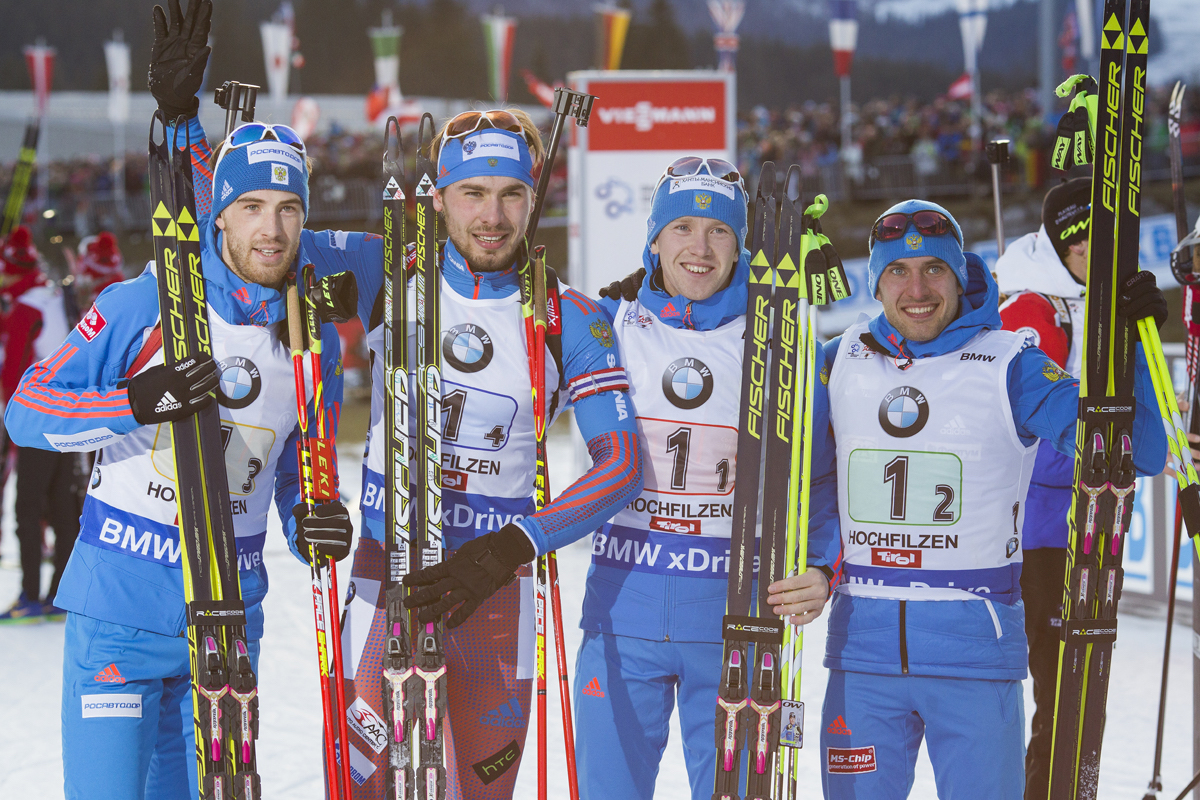
    The Russian men's relay team won the IBU World Cup in Hochfilzen, Austria, on Sunday, with (from l to r) Dmitry Malyshko, Anton Shipulin, Alexey Volkov, and Evgeniy Garanichev. (Photo: Fischer/NordicFocus)
    The Russian men’s relay team won the IBU World Cup 4 x 7.5 k on Sunday in Hochfilzen, Austria, with (from l to r) Dmitry Malyshko, Anton Shipulin, Alexey Volkov, and Evgeniy Garanichev. (Photo: Fischer/NordicFocus)

    “After the last shooting stage, I saw Emil was not too far away from me and I knew I had to attack and catch him; I was a bit better on the track, so that was basically the plan,” Shipulin said through a translator. “This was not just my victory; all of the guys on the team were really great today.”

    Norway had decided to give superstar Ole Einar Bjørndalen some rest, with L’Abee-Lund starting in his place, then handing off to the Bø brothers and finally closing with Svendsen. For quite a while they looked like the eventual winners, with Tarjei Bø handing over to Svendsen with a 30.8 second lead over Russia at the final exchange. But that gap wasn’t enough.

    Svendsen still led by 18.1 seconds after the penultimate shooting, and many local as well as Norwegian fans that had traveled to Austria loudly chanted the typical “Hey!” with every target he cleaned while uncontested in the range (0+0). He still came into the final stage first, but then required two spares and his lead shrunk significantly to 10.4 seconds when he left the stadium.

    Seeing the opportunity to catch Norway, Shipulin began his chase up the last climbs, posting the best course time on the final loop and sprinting past Svendsen as they approached the finish. Just 3.1 seconds behind Russia in the finish, Norway required seven spare rounds, and had no penalties.

    Despite the close loss, the Norwegians weren’t too disappointed: “The team did a good job today, and we are satisfied with the race,” L’Abee-Lund said during the press conference.

    “I feel my shape and confidence is coming back,” Johannes Thingnes Bø said.”Hopefully after the New Year I will come back and fight with Fourcade, Schempp and the best.”

    13.12.2015, Hochfilzen, Austria (AUT): Norway's Johannes Thingnes Bø leads France's Quentin Fillon Maillet (c) and Italy's Lukas Hofer during the second leg of the men's relay at the IBU World Cup in Hochfilzen, Austria. (Photo: Fischer/NordicFocus)
    13.12.2015, Hochfilzen, Austria (AUT):
    Norway’s Johannes Thingnes Bø leads France’s Quentin Fillon Maillet (c) and Italy’s Lukas Hofer during the second leg of the men’s relay at the IBU World Cup in Hochfilzen, Austria. (Photo: Fischer/NordicFocus)

    France grabbed the last spot on the podium, finishing more than a minute behind Russia, also requiring six spares and no penalty lap. The team chose a lineup of Simon Fourcade, Quentin Fillon Maillet, Simon Desthieux, and Martin Fourcade, and was skiing just outside the top three for most of the race.

    Then, anchor Martin Fourcade, last year’s overall World Cup winner and runner-up in Friday’s sprint and winner of Saturday’s pursuit, managed to move them up one position after he required just one spare in his prone shooting. On the next loop, he crashed descending down a bridge before the final shooting stage, a mistake that didn’t cost France the podium, yet ended any chances to catch up to the two leading teams before the last shooting.

    “It was not a perfect race, but I’m satisfied with it,” the team’s starter Simon Fourcade said in the press conference, after using one spare in prone and handing off in eighth. “I had some little mistakes in the shooting … But yeah, satisfied with the race today, and satisfied to see that my ski level is back.”

    Local favorite Austria, with Sven Grossegger, Julian Eberhard, Simon Eder, and Dominik Landertinger placed fourth (+1:10.9) and just 9 seconds off the podium, despite having to ski two penalty loops, which all the other top teams avoided. They used a total of 13 spares, two of which came from Landertinger on his first stage, but the Austrian anchor closed out the race with a flawless standing stage and the second-fastest time behind Shipulin on the final loop.

    “A little bit more would have been possible, the two misses in prone shooting are really annoying,” Landertinger told Austrian broadcaster ORF. In the pursuit the day before, he had already achieved the best individual result of the season so far for his team.

    Germany’s Simon Schempp, who had battled Martin Fourcade for the win in the other two races this weekend, again skied a very strong last lap with the third-fastest time behind Shipulin and Landertinger and only required two spares. With that performance he elevated his squad from 10th to fifth place (+1:18.4), after his teammates Erik Lesser, Andreas Birnbacher and Benedikt Doll struggled throughout the race with shooting. Uncharacteristically, Germany required 16 spares, the second-most of any team on Sunday, and narrowly avoided the penalty lap on four of eight stages.

    Arguably the biggest surprise of the day was Sweden in seventh (+1:26.1), with Torstein Stenersen, Ted Armgren, Fredrik Lindström and Jesper Nelin. Aside from Lindström, the team had little World Cup experience. Despite that, Sweden managed to stay near the top the whole race and even tagged off in third place on the last exchange, before Nelin missed three targets on his leg and fell back a bit to seventh place, finishing 2.9 seconds after Canada and 40.5 seconds ahead of the U.S.

    Results

  • Fourcade Strikes Back in Hochfilzen Pursuit; Bailey Just Misses Top 10

    Fourcade Strikes Back in Hochfilzen Pursuit; Bailey Just Misses Top 10

    Lowell Bailey on his way to 13th in the men's 12.5 k pursuit at the IBU World Cup in Hochfilzen, Austria. (Photo: USBA/NordicFocus)
    Lowell Bailey (US Biathlon) on his way to 13th in the men’s 12.5 k pursuit at the IBU World Cup in Hochfilzen, Austria. (Photo: USBA/NordicFocus)

    Despite the best efforts of his competitors, it appeared French biathlon star Martin Fourcade was almost his own worst enemy in Saturday’s 12.5-kilometer World Cup pursuit in Hochfilzen, Austria.

    In a scene reminiscent of Norwegian cross-country skier Heidi Weng’s mistake in Kuusamo earlier this season, Fourcade, who was being followed closely by Germany’s Simon Schempp and Russia’s Anton Shipulin, nearly skipped his final shooting stage. He was saved, though, because as he turned towards the finishing stretch, he saw his two competitors ski toward the range again. He very quickly realized his mistake, and followed them, keeping his focus to clean the final stage.

    After that he never looked back until he finished first in 31:19.9, pounding his chest and pointing to the crowd as he did so. Schempp finished 8.9 seconds later in second place and Shipulin was 19.1 seconds back in third to round out the podium.

    After what runner-up Simon Schempp (l) of Germany called a "psycho race" Schempp, winner Martin Fourcade (c) of France, and Russia's Anton Shipulin (r) shared the pursuit podium at the IBU World Cup in Hochfilzen, Austria. (Photo: Fischer/NordicFocus)
    After what runner-up Simon Schempp (l) of Germany called a “psycho race” Schempp, winner Martin Fourcade (c) of France, and Russia’s Anton Shipulin (r) shared the pursuit podium at the IBU World Cup in Hochfilzen, Austria. (Photo: Fischer/NordicFocus)

    During a post-race press conference, Fourcade had no comment on his nearly-disastrous wrong turn. But Schempp, who suspected a mistake mused it might just have been a move by Fourcade to avoid having to go on the first position on the shooting range.

    “It was a wonderful victory at the site of the next [2017] World Championships,” Fourcade told the IBU. “My fan club, my family, is here, and it was a really good fight. I love to win, but I love to win more when the opponents are really strong. Today it was a great fight, which is why I’m so happy to succeed.”

    For most of the race, Friday’s sprint runner-up Fourcade had struck with or been within a few seconds of sprint winner Schempp and Shipulin, who started fourth. After taking the control of the pursuit, each with two clean shooting stages, Schempp and Shipulin at times slowed down considerably on the track, skating next to each other with Shipulin gesturing wildly for Schempp to take his turn in front, but the German was seemingly unwilling to set the pace.

    This posturing enabled a few athletes, including Fourcade, to close the gap to them again, after Fourcade had missed two targets in the second shooting. But he, too, didn’t want to take the lead.

    All three athletes managed to leave the crucial last shooting stage without a miss. Fourcade shot the fastest, and Schempp entered the final lap about five seconds later, with Shipulin 12 seconds behind. They tried everything in their power to catch Fourcade, but to no avail.

    “I am happy about the second place,” Schempp told the German broadcaster ARD, “but it was a complete psycho race. Like Martin not wanting to go in front, then attacking just ahead of the shooting, then he wanted to skate into the finish…”

    “It was not so easy for my brain. Topsy-turvy, but that’s part of the game,” he added. “It was a fine competition [for me] with one miss on the shooting range. And of course I’m happy with the second place.”

    Nathan Smith (Biathlon Canada) racing to 18th in the IBU World Cup pursuit in Hochfilzen, Austria. (Photo: Fischer/NordicFocus)
    Nathan Smith (Biathlon Canada) racing to 18th in the IBU World Cup pursuit in Hochfilzen, Austria. (Photo: Fischer/NordicFocus)

    Both athletes complimented their fierce competition afterward.

    “I gave all I had in the beginning of the loop,” Schempp said in the press conference. “The gap was the same a long time, but at the last hill, Martin was very strong, so I had to defend my second place to Anton.”

    Fourcade echoed those remarks after swapping positions with Schempp in two races between Friday and Saturday.

    “Simon showed me on the last lap it was necessary to do my best,” Fourcade said. “This week I had to give 100 percent. It was a great fight between us.”

    Shipulin also expressed his satisfaction with his first podium of the season.

    “I realized those are my conditions and I’m getting better and better compared to the first leg in Östersund,” he said through a translator. “I still have to work hard on my form, but I’m really glad this is the first podium for me, and I’m doing better and better race by race.

    “I have always loved pursuits,” Shipulin added. “Of course, I was a bit disappointed [Friday] with the fourth place, but I only tried to pay attention to today and in the end the podium is a good result.”

    Last week at the World Cup in Östersund, Sweden, Schempp struggled mightily with the windy range, missing the pursuit after placing out of the top 60 in the sprint.

    Asked before Saturday’s race how he coped and turned a difficult situation into a sprint victory on Friday, Schempp revealed his latest training secret to ARD: last week, he had worked with his home-team coach and assistant national-team coach Andreas Stitzl, using a leaf blower to simulate strong sudden gusts of wind.

    While he acknowledged Fourcade’s strong performance in the two Hochfilzen individual races, Schempp was not too pleased with a scene that happened during the final shooting stage. He claimed Fourcade, who was next to him, nicked Schempp’s ski poles on the mat between his legs while Fourcade left the range.

    “You have to be able to focus on yourself, but of course you notice what happens left and right,” Schempp told ARD. “I noticed Martin had hit everything in the last shooting, he was a little bit faster than me. And then when he was leaving, he hit my ski poles good, while I still had one shot. That brought me out of my rhythm a little bit, but thank God I hit it. Then on the last round I tried everything, but there was nothing left.”

    Schempp reiterated this irritation in his post-race interview with the IBU: “I was not calm every time. It was a psycho race. You have to be calm.”

    Norway’s Tarjei Bø, who had started the pursuit in third, always kept the leaders in viewing distance but couldn’t quite catch them in the end, finishing with two penalties (0+1+0+1) and missing the podium by 12 seconds (+31.2).

    With about 8,000 spectators in the stadium and lining the course in the Austrian Alps, local fan favorite Dominik Landertinger managed to move up eight positions with a single miss, finishing fifth place (+39.8), ahead of Norwegian stars Ole Einar Bjørndalen (+57.5) and Emil Hegle Svendsen (+59.5).

    Landertinger told the Austrian television broadcaster ORF that he’s been struggling with the recent death of his mother and wished she could have been there to see him.

    “Everything I had to go through in recent weeks, I can tune that out pretty well during the race,” he said. “I have a great family with everyone supporting each other, but this has been a hard time for me.
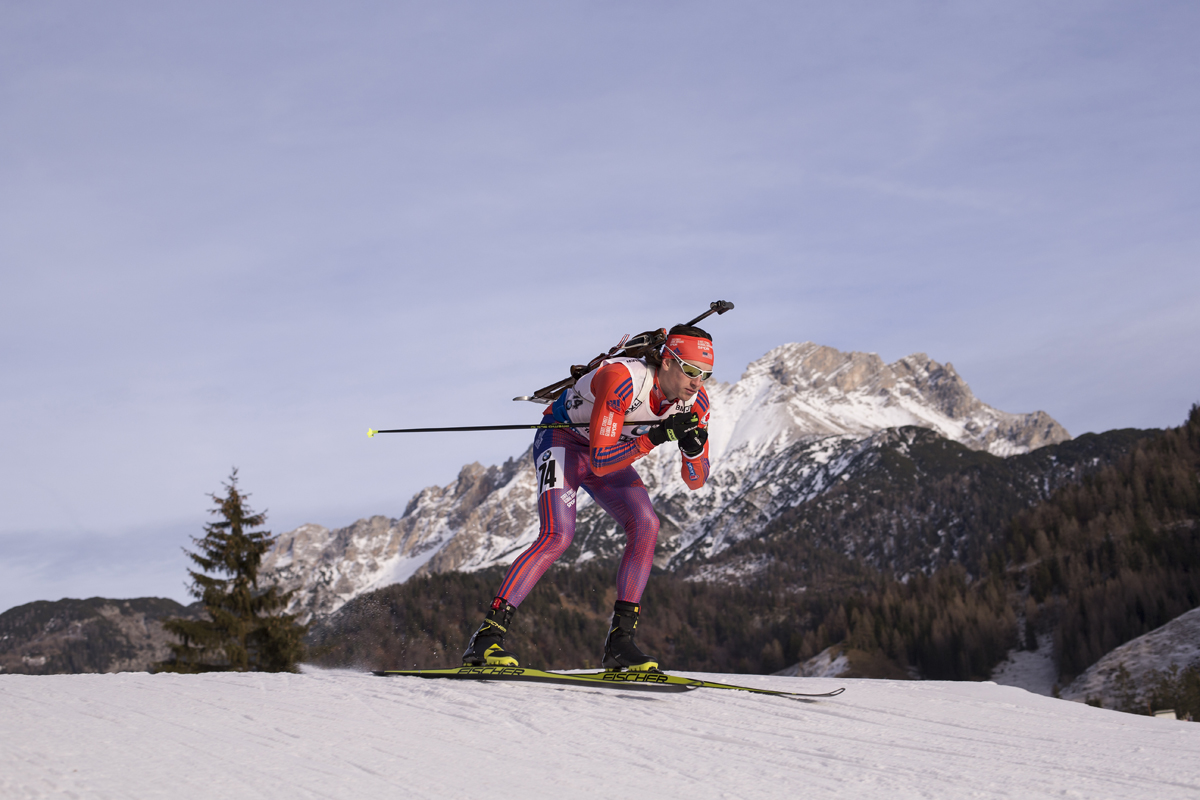
    “That was a very good race. I came through the shooting great. I achieved exactly what I had set out to do. Focus just on myself,” Landertinger added. “But for the podium I should not have had that miss. You’ve got to be satisfied, there are so many good guys here.”

    Bailey Just Outside Top 10

    Lowell Bailey on his way to 13th in the men's 12.5 k pursuit at the IBU World Cup in Hochfilzen, Austria. (Photo: USBA/NordicFocus)
    Lowell Bailey on his way to 13th in the men’s 12.5 k pursuit at the IBU World Cup in Hochfilzen, Austria. (Photo: USBA/NordicFocus)

    Of the eight North American men in Saturday’s pursuit, US Biathlon’s Lowell Bailey came closest to a top 10 after starting 12th and briefly moving into eighth with two clean prone stages. He skied the third lap in a fairly large chase group with six other athletes, but after missing a target in the first standing, Bailey fell back to 13th.
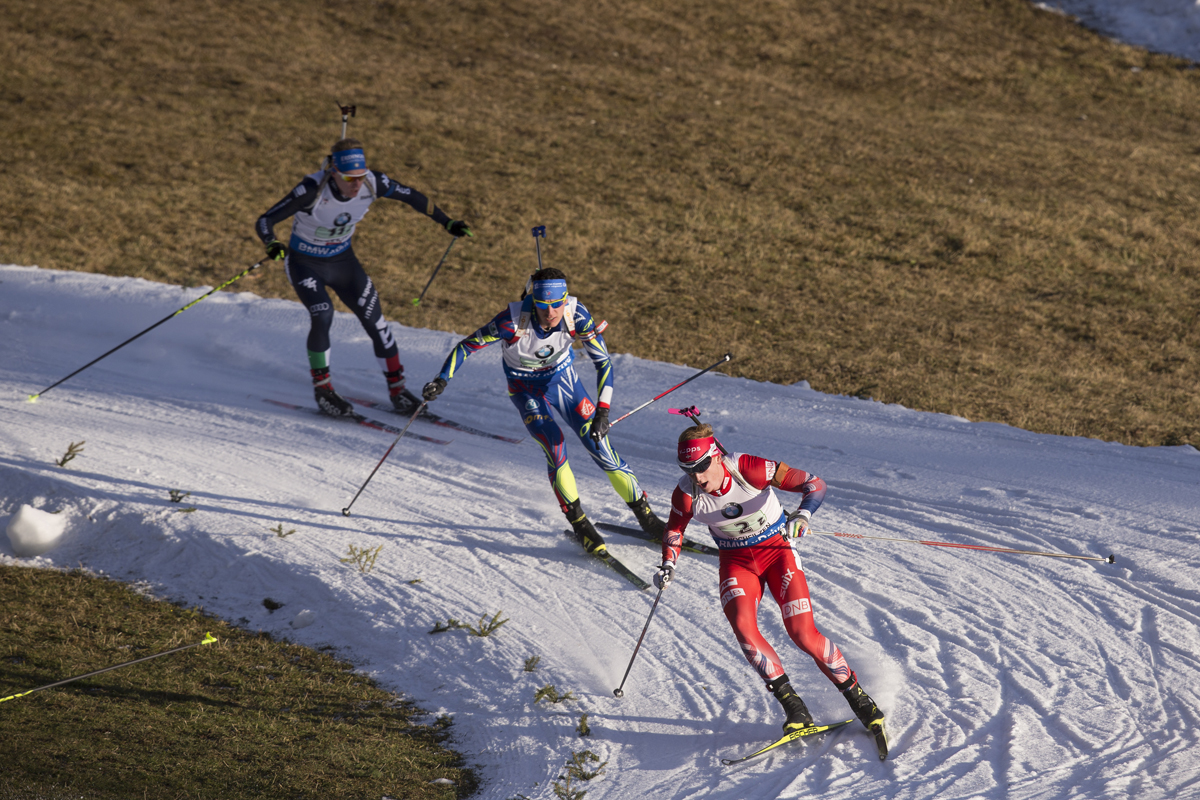
    From there, the 34-year-old Bailey pushed to hang on up two climbs on the course. After cleaning his final standing stage, he left the range for a last time in 10th place, just between Germany’s Andreas Birnbacher and Slovenia’s Jakov Fak. Bailey faded a bit on the last loop, and in the finish he had given up the positions he previously gained on the shooting range, ending the day in 13th place (+1:20).
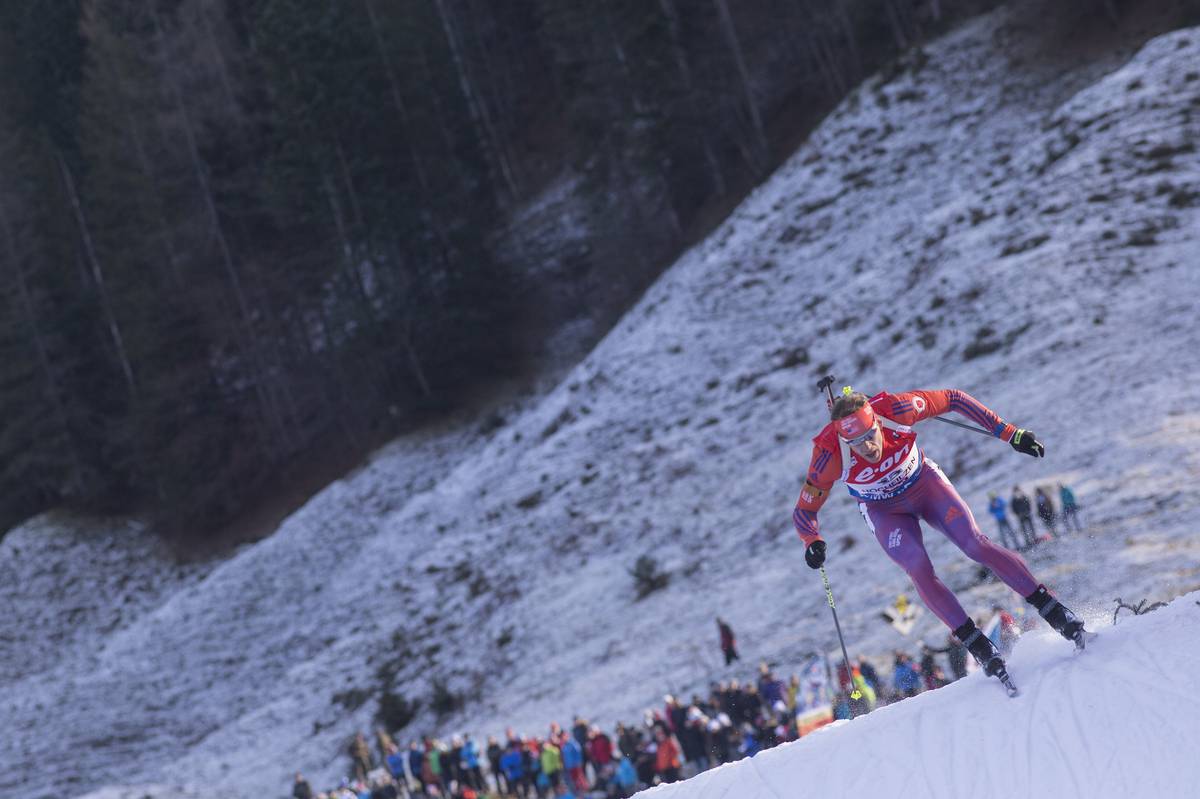
    “Today was a great indicator of how strong the current men’s World Cup field is,” Bailey said in a US Biathlon press release. “I feel really good about my race today, but unfortunately I wasn’t able to hold or improve my starting place. Some days the field is just that strong and you just have to live with the result. Still, I’m happy with another top-15 and excited for the relay tomorrow.”
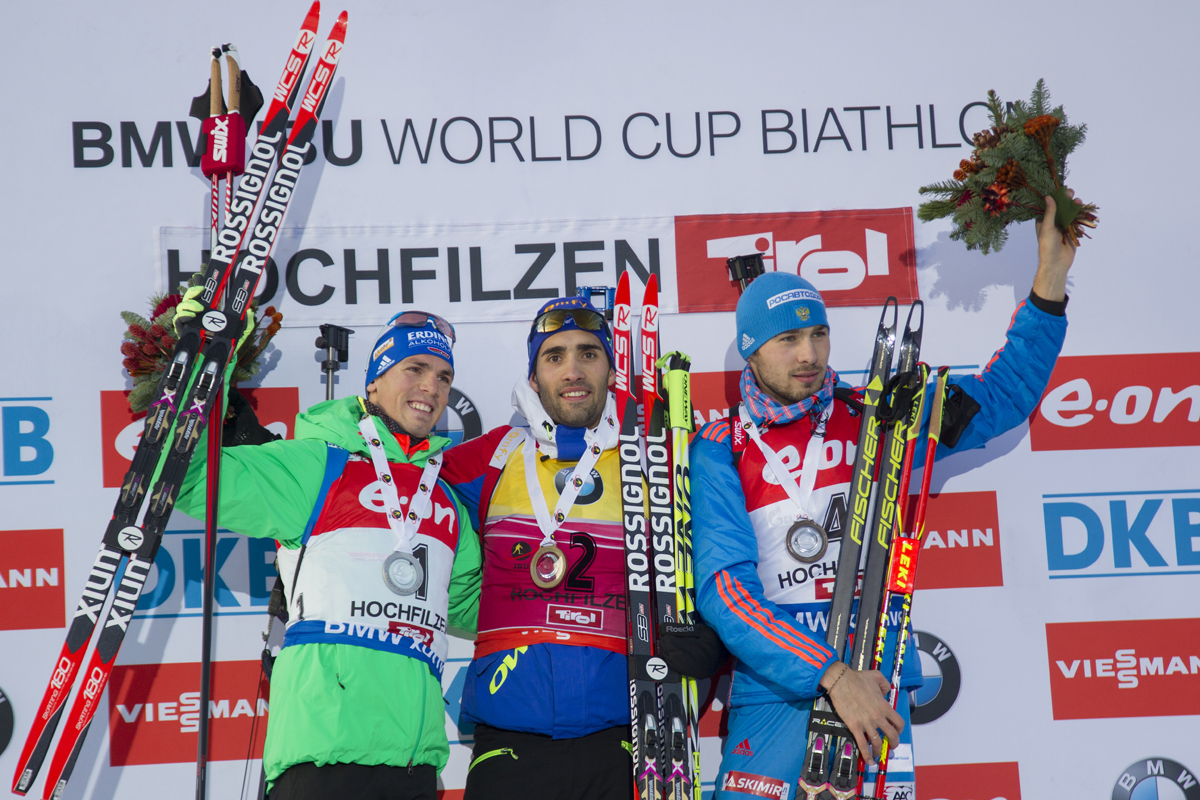
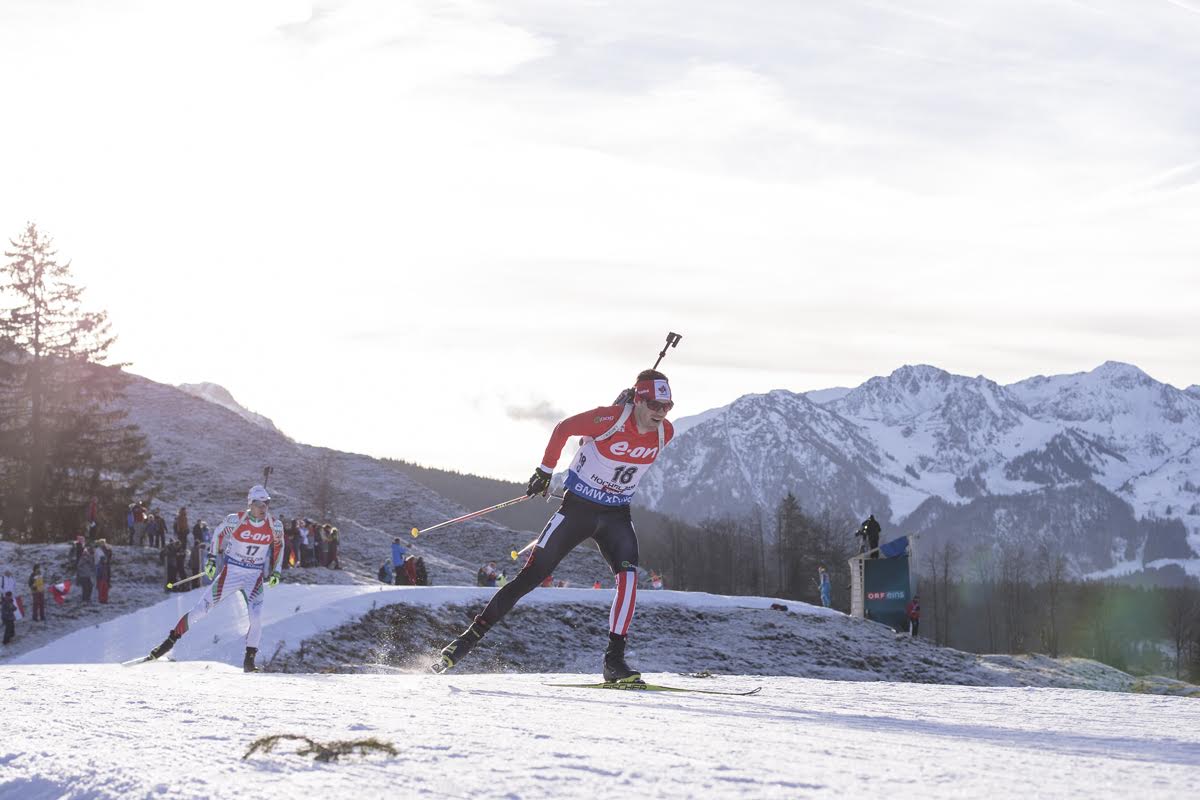
    Nathan Smith of Canada skates his way to 18th at the IBU World Cup pursuit in Hochfilzen, Austria. (Photo: Fischer/NordicFocus)
    Nathan Smith (Biathlon Canada) racing to 18th in the IBU World Cup pursuit in Hochfilzen, Austria. (Photo: Fischer/NordicFocus)

    Biathlon Canada’s Nathan Smith ended the day in 18th (+1:48.4) — the same position he had started in — with too many penalty laps preventing a better result. Smith missed two targets in the first shooting, then cleaned the next two stages before adding another two penalties in the last standing to his tally. His skiing remained strong, posting the fifth-fastest time on the final lap for the 13th-best course time overall.

    On Friday, Smith had predicted “some spectacular crashes” in the pursuit, due to the difficult snow conditions on the course. Crashes didn’t decide the outcome of Saturday’s race, but indeed, there were some victims. Germany’s Daniel Böhm careened off the course on the third lap in a downhill hairpin turn, then struggled back to his feet and onto the elevated track. Worse yet, in addition to the lost time, Böhm damaged his rifle in the crash and had to switch to the official reserve each team has in store during a race. However, as he explained after the race, that replacement rifle has a generic fit, rather than being fitted to any one athlete. Böhm went on to miss three shots between the last two standing stages, ultimately falling nine spots to 55th (+6:14.2).

    Tim Burke achieved another top 30 for the U.S., moving up three spots to finish the day in 27th (+2:38.5). He cleaned the first two prone stages, before missing three on the next two (0+0+2+1) and crashing, which set him back farther.

    “I had a great start to the race today with two clean prone stages and solid skiing,” Burke wrote in an email. “Unfortunately, I had a huge crash on the third loop and lost a lot of time.  This definitely took a little wind out of my sails.”

    He was cheered on by his wife, retired German biathlete Andrea Burke (formerly Henkel), who attended the race with a few friends from her national-team days.

    “Considering [the crash], I was very happy to still move up a few places,” Burke continued. “I was really happy with my skiing so far this week.  It was a big improvement from Ostersund and I feel like I am back to my normal ski form.

    “I am pretty banged up from the crash today,” he added. “But am hoping to feel better for the relay tomorrow.  Everyone seems to be in good shape, so anything is possible!”

    A third American, Sean Doherty started 45th and ended the pursuit in 35th (+3:24.8). He missed six (2+1+1+2) while skiing the 23rd-fastest course time. Leif Nordgren placed 52nd (+5:27.1) for the U.S., with three misses in the first shooting and five in all (3+0+1+1).

    Canada’s Christian Gow moved up 20 spots to finish 39th (+3:43.1) after having missed two targets and cleaning both standing stages (1+1+0+0), while his older brother Scott Gow missed six targets (2+3+1+0), and dropped 12 places to end the day in 45th (+4:23.8).

    Racing continues in Hochfilzen with the four-person relays on Sunday.

    Results

  • In Second-Ever Mass Start, Smith Clinches Ninth; Shipulin Causes Late Trip to Win in Pokljuka

    In Second-Ever Mass Start, Smith Clinches Ninth; Shipulin Causes Late Trip to Win in Pokljuka

    Nathan Smith of Canada finished 13th in the first Olympic race of his career.
    Nathan Smith (Biathlon Canada) racing to 13th in the first Olympic race of his career, the 10 k sprint in last season in Sochi, Russia.

    This wasn’t Nathan Smith’s first time in a mass-start rodeo. The 28-year-old Canadian biathlete, who turns 29 on Christmas, had raced a 15-kilometer mass start in his first Olympics last winter. That was his first one — and he crashed out of it in a downhill pileup in the first 500 meters.

    Sunday was going to be different — at least he’d know what to expect. Starting in the last of 10 rows in bib 30 out of 30 racers, Smith knew he was at a disadvantage from the get-go and tried not to stress over it on the first lap.
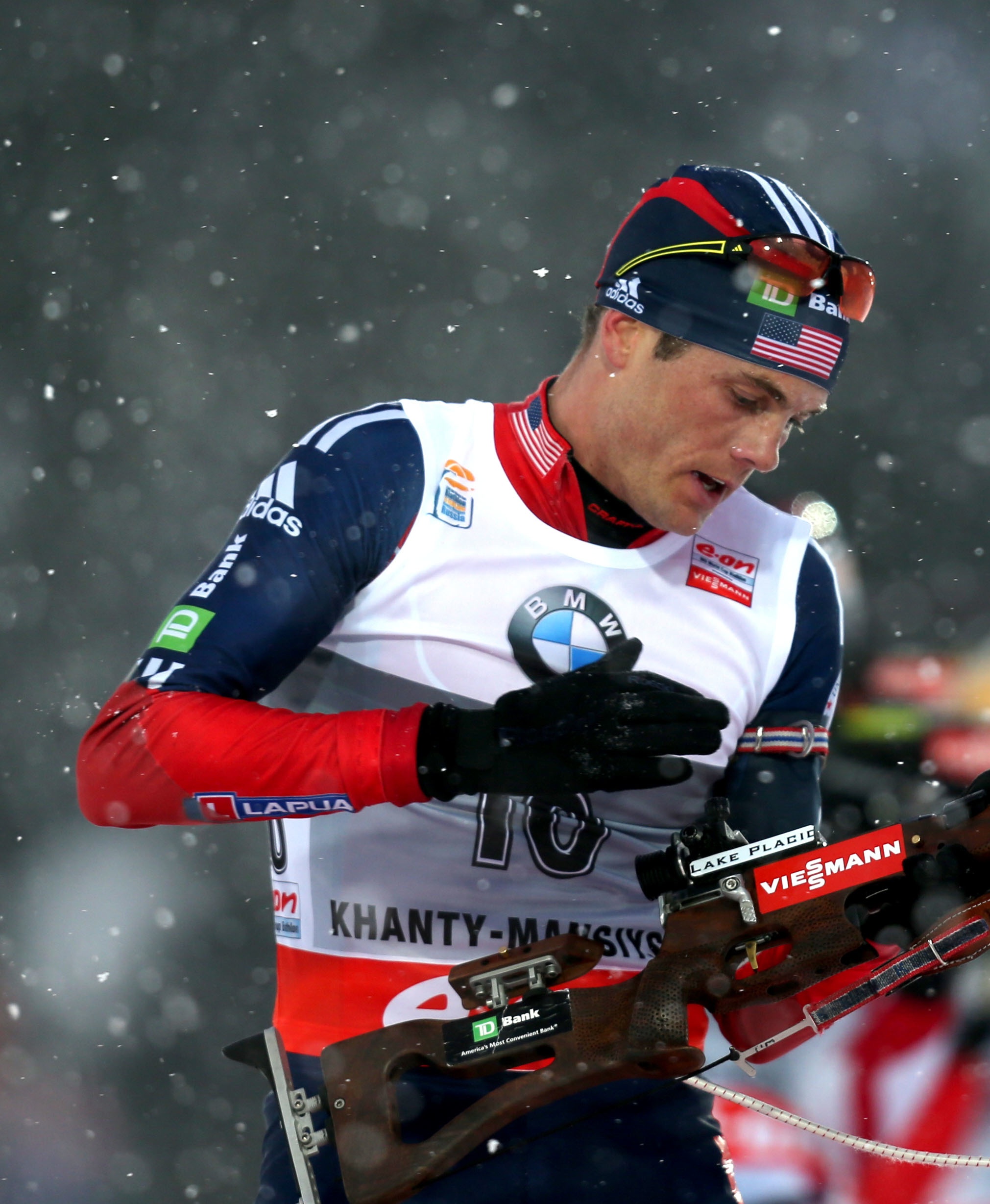
    Not long into the final IBU World Cup race in Pokljuka, Slovenia (the last one of the circuit’s first trimester), Smith watched as a few competitors crashed in front of him. Fortunately, he saw the chaos coming and had enough time to move around them.

    “I knew that if would take really strong skiing to maintain position because these are the 30 fastest in the world,” Smith reflected in an email on Monday.

    Russia's Anton Shipulin celebrates his IBU World Cup mass-start victory on Sunday in Pokljuka, Slovenia, which he won by 1.2 seconds over France's Martin Fourcade (back). (Photo: IBU/Rene Miko)
    Russia’s Anton Shipulin celebrates his IBU World Cup mass-start victory on Sunday in Pokljuka, Slovenia, which he won by 1.2 seconds over France’s Martin Fourcade (back). (Photo: IBU/Rene Miko)

    Meanwhile, two of the top men in the overall World Cup, Norway’s Emil Hegle Svendsen in bib 1 and France’s Martin Fourcade in bib 2, set the pace out of the start. The third-ranked man in the World Cup at the time, Russia’s Anton Shipulin went with them. All three started in the first row.

    Another Russian, Timofey Lapshin, who start in bib 29 near Smith, lost a ski on that first lap. By 2.2 k, Shipulin was leading a three-man train with Fourcade and Svendsen, and American Lowell Bailey was up to 11th, four seconds behind them. His US Biathlon teammate Tim Burke was another three seconds back in 17th, and Smith trailed by 11 seconds in 24th.

    By the first shooting stage, all 30 racers lined up in their designated lanes, and Smith headed to the farthest mat from the exit — all the way off to the left. Then he missed his first shot.
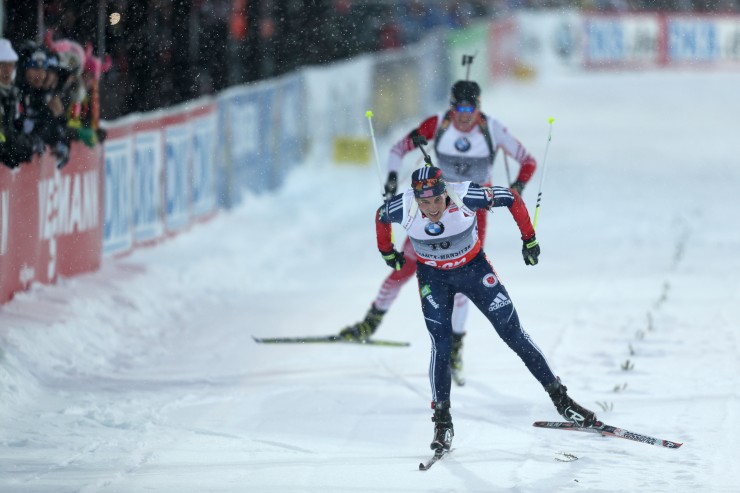
    “I’m not sure why I missed the first shot, but I had to be super, super careful after that,” he wrote.

    It worked, he added, as he knocked down the next four targets — and went on to hit 18 straight on Sunday. Smith left the range in 20th, 33.7 seconds behind Shipulin, who cleaned, followed by Austria’s Dominik Landertinger 1.9 seconds back in second, Fourcade 3.5 seconds behind in third, and another Austrian, Simon Eder 4.8 seconds back in fourth.

    The top 13 men after the first prone all cleaned, leaving Svendsen, who missed one, 21.7 seconds back in 14th.
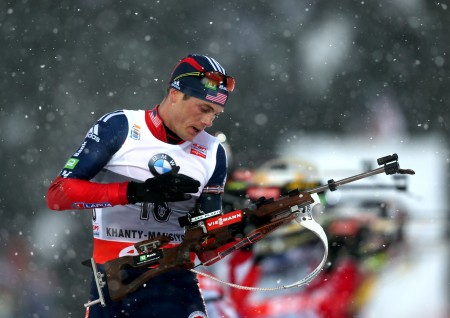
    The two other North Americans in the race, Bailey missed one and Burke had two penalties to put them in 26 and 28th, respectively, 46 and 54 seconds behind.

    On the next lap, Fourcade took the lead, ahead of Landertinger, Shipulin, France’s Jean Guillaume Beatrix, who left the range in fifth, and Eder.

    By the time the second prone rolled around, a large group of about 10 men entered the range together. Landertinger cleaned quickly, Shipulin matched him, as did Eder, Fourcade, and Beatrix. All five left the range within 1.6 seconds of one another.

    Smith hit every target to move to 13th, 34 seconds behind.

    “Shooting was excellent after that [first stage],” he reflected. “After the second prone I knew it was gonna be a great race.”
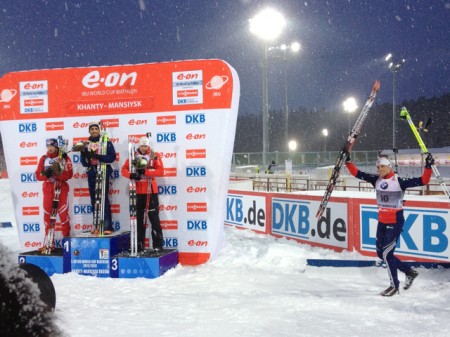
    Bailey and Burke both cleaned to improve to 21st and 24th, respectively, both about a minute out from the lead.

    Shipulin led Fourcade, Landertinger, Beatrix, and Eder through 8.2 k, then Fourcade took charge after the third stage. He quickly cleaned his standing shots, and Beatrix, Shipulin, and Sweden’s Fredrik Lindström, who had been hovering in the top 10 with perfect shooting, did as well. Eder had one penalty, Bulgaria’s Krasimir Anev jumped to sixth with clean shooting, and Smith found himself in seventh with another flawless stage.

    “I had to reset once in the first standing but other than that there were no problems until the last few shots of the race,” Smith wrote.

    The wind picked up for the men’s afternoon race, after a mostly calm-and-bluebird week in Pokljuka. It was still sunny, with more of a headwind coming at the athletes as they shot into the range.

    Bailey also cleaned his second-straight stage to move to 19th (+1:07), and Burke had one miss to drop to 25th (+1:31).

    Beatrix led around 10.6 k into the penultimate lap, with Shipulin and Fourcade right on his heels. Lindström fell 20 seconds off the pace, followed by Eder, and Smith was another nine seconds back — up to sixth, and just ahead of Anev and Ondrej Moravec of the Czech Republic.

    Shipulin (3) leads Frenchmen Fourcade (l) and Beatrix (r) around 11.2 k during Sunday's 15 k mass start in Pokljuka, Slovenia.
    Shipulin (3) leads Frenchmen Fourcade (l) and Beatrix (r) around 11.2 k during Sunday’s 15 k mass start in Pokljuka, Slovenia.

    Shipulin took his turn leading at 11.2 k, followed by Beatrix and Fourcade, while Lindstroem and Eder hung together in fourth and fifth, about 13 seconds ahead of Smith.

    Shipulin led into the range for the last time, where his first miss of the day put him 8.1 seconds back in fifth behind Eder, who cleaned, and Fourcade, who missed one but shot quickly to stay within three seconds of Eder.

    Lindström finished the stage out with 20-for-20 shooting, the only man to do so, to leave the range in third, 7.2 back, and Beatrix missed one to head out fourth (+8.0), just ahead of Shipulin.

    Smith missed his final shot to drop to 11th, but left the penalty loop feeling like he had a lot left to give — 37 seconds out at the time. Less than three seconds ahead of him, Germany’s Andreas Birnbacher in eighth, France’s Quentin Fillon Maillet in ninth and Russia’s Dmitry Malyshko in 10th were within reach.

    “I really struggled to hold it together and those last three [stages],” Smith explained. “I almost felt dizzy trying to aim and concentrate from the pressure. That shot cost me a position where I could’ve been fighting in the lead pack for a medal.

    “I almost felt dizzy trying to aim and concentrate from the pressure.” — Nathan Smith (Biathlon Canada), after placing ninth in Pokljuka mass start

    “I held back behind a couple guys and waited to attack at the top of the second last climb,” Smith added. “I made a good gap on them and almost shook [Slovenia’s Jakov] Fak [who left the range in 12th], but he surged again on the next hill and got in front of me.”

    At the front of the race, French teammates Beatrix and Fourcade led side by side up a hill, and attacked together to try to drop Shipulin, Eder, and Lindström — and perhaps each other. Beatrix picked up the pace again with about a kilometer to go, and Fourcade went with him, as did Shipulin trailing off the back of the breakaway.

    Beatrix fell, apparently tripped up by Shipulin, and the Russian pounced on the opportunity to get ahead, attacking up and over the last rise to drop the field, soaring down into the stadium well ahead of Fourcade, as well as Eder and Lindström, who also passed Beatrix.

    “I would like to apologize to Jean Guillaume; sometimes these things happen in sports, but I did not mean anything and did not do it on purpose,” Shipulin told the IBU media after the race.

    Fourcade backed him up. “I think this is a part of the game,” he said. “I am 100-percent sure that Anton did not do it consciously. It kept me from battling Anton on the final stretch, but I have only to blame myself for not winning today; I missed one shot on the shooting range.”

    Shipulin took the victory in 35:16.8, while Fourcade finished 1.2 seconds back in second, and Eder outsprinted Lindström in a photo finish for third (+1.4). Beatrix took fifth (+4.8).

    “I am the guy who benefitted from the ‘wheel-banging’ in the last loop,” Eder said. “I might have been fourth! This is biathlon; I did not give up and you can see what happened!”

    Norway’s Tarjei Bø placed sixth with a single penalty on his third stage, Moravec took seventh with one miss on his second prone, and Fak edged Smith by 0.6 seconds for eighth (+29.8).

    Canada's Nathan Smith racing to ninth in Saturday's IBU World Cup 10 k sprint in Östersund, Sweden. Photo: Fischer/NordicFocus.
    Canada’s Nathan Smith racing to ninth in the IBU World Cup 10 k sprint in Östersund, Sweden, earlier this season. (Photo: Fischer/NordicFocus)

    For Smith, ninth stood as his second-best World Cup result (after tallying two eighth-place finishes in a sprint and pursuit last season) in his second-ever mass start. After finishing 30.4 seconds behind the winner, he posted the third-fastest shooting time, seventh-ranked range time and eighth-fastest course time.

    “Mass starts are a lot different than pursuits. It’s nice to get one under my belt now and I hope to do a few more this season, too,” Smith reflected. “I’m very happy with yesterday’s race and it’s a perfect way to cap off a strong trimester. It gives me extra motivation to rest up and train over the Christmas break.”

    Just a few weeks ago, Smith placed ninth in the sprint at the World Cup opener in Östersund, Sweden, and 16th in the pursuit there, after skiing in the top three.

    “I’m happy with the season so far. A bit disappointed that I missed a few medal opportunities due to last standing misses,” Smith wrote. “Skiing hasn’t been on average quite as good as last year yet, but it has been more consistent. My two best skis so far though are definitely at least as good as anything I did last year. Prone has been amazing, but standing needs to come up just a little and then I will be where I want to be.”

    He’ll spend his holidays mostly in Vernon, British Columbia, with his girlfriend, Emma Lunder, and her family. After that, Smith planned to head to Canmore for a week, then back to Oberhof, Germany.

    Lowell Bailey (US Biathlon) racing to 21st with two penalties in the 15 k mass start on the last day of IBU World Cup racing in Pokljuka, Slovenia. (Photo: USBA/NordicFocus)
    Lowell Bailey (US Biathlon) racing to 21st with two penalties in the 15 k mass start on the last day of IBU World Cup racing in Pokljuka, Slovenia. (Photo: USBA/NordicFocus)

    In the final shooting stage of Sunday’s race, Bailey had another penalty and Burke missed three to drop to 22nd (+1:25.7) and 28th (+2:29.8), respectively. Bailey held his position to finish 22nd with two penalties, 1:34.6 behind Shipulin, while Burke moved up one spot to 27th (+2:32.3) with six misses.

    “I was actually pretty satisfied with most of my race today,” Bailey said in a US Biathlon press release. “I felt better on the ski course and the shooting was pretty decent. The only issue was early on in the first prone stage. I had some trouble with my rifle and probably lost an extra 25 seconds getting that figured out. This made it pretty hard to recover and catch the rest of the pack. Other than that, I’m satisfied with the race and looking forward to the Christmas break.”

    Fourcade regained the World Cup lead, and Shipulin moved up to second, 25 points back and just one point ahead of Svendsen — who finished 17th with four penalties on Sunday — in third overall.

    Results

    (Stay tuned for women’s mass-start report)

  • Shooting ‘So Easy’ for Svendsen; Burke Top North American in Pokljuka Pursuit in 21st

    Shooting ‘So Easy’ for Svendsen; Burke Top North American in Pokljuka Pursuit in 21st


    Norway's Emil Hegle Svendsen on his way to a perfect 20-for-20 IBU World Cup pursuit, which he won on Saturday in Pokljuka, Slovenia.
    Norway’s Emil Hegle Svendsen on his way to a perfect 20-for-20 IBU World Cup pursuit, which he won on Saturday in Pokljuka, Slovenia.

    Emil Hegle Svendsen’s strategy for Saturday’s pursuit was pretty simple. Don’t miss.

    The 29-year-old Norwegian started 24 seconds behind Russia’s Anton Shipulin, who won Friday’s 10-kilometer sprint to start the 12.5 k pursuit first.

    He had Austria’s Dominik Landertinger 12 seconds ahead of him in second, and after the first shooting stage, it became fairly evident that everyone in the top 11 was “on” — at least early on.

    Shipulin, Landertinger and Svendsen all cleaned, leaving the range in that order, followed by France’s Martin Fourcade, who started fourth. Norway’s Johannes Thingnes Bø in bib 10 was already up to fifth, Germany’s Simon Schempp left the range in sixth, then France’s Quentin Fillon Maillet in seventh, and Italy’s Lukas Hofer, up from 15th to eighth. Three more men also cleaned the first prone — Germany’s Daniel Boehm, France’s Jean Guillaume Beatrix, and Vladimir Iliev, respectively — to leave the range in the top 11.

    Shipulin led into the stadium for the second prone, where he hit his first four shots but missed the last. Landertinger, Svendsen and Fourcade were quick to capitalize on his mistake and cleaned, leaving the range 6.8 seconds, 7.6 seconds and 14.6 seconds behind him, in that order.

    By 6.8 k, Landertinger and Svendsen essentially caught Shipulin, trailing him by a second. They approached the third stage as a unit, where Svendsen cleaned, Shipulin missed another, and Landertinger missed two. Suddenly, Svendsen was in sole control, leaving the range 21 seconds ahead of the Russian in second and 33 seconds head of Fourcade, who missed one but hung in fourth.

    Landertinger started his fourth lap 56 seconds off the pace, four seconds ahead of Hofer, who missed one on his second prone but cleaned his first standing.

    Russian runner-up Anton Shipulin cleaned his final standing stage in the Pokljuka pursuit, but was unable to close the gap to Norway's Emil Hegle Svendsen in first.
    Russian runner-up Anton Shipulin cleaned his final standing stage in the Pokljuka pursuit, but was unable to close the gap to Norway’s Emil Hegle Svendsen in first.

    Svendsen went on to clean his final stage, and so did Shipulin, but at that point, the Norwegian was too far gone — with a 25.4-second lead with 2 k to go.

    Fourcade was still shooting when Shipulin left the range to chase Svendsen down, yet he took his time to clean the final stage and keep him soundly in podium position.

    Meanwhile, Svendsen powered through the last lap, keeping 20 seconds between himself and Shipulin at 11.8 k. Cruising down into the stadium, he stood up and relaxed, waved to the crowd then let out a fist pump at the finish.

    The only man in the top 12 to hit all 20 targets, Svendsen won by 17.8 seconds. Shipulin placed second, nearly 42 seconds ahead of Fourcade, who looked back to make sure no one was challenging him for third.

    Svendsen waves to the crowd in Pokljuka, Slovenia, before winning the men's 12.5 k pursuit on Saturday for his second IBU World Cup win of the season.
    Svendsen waves to the crowd in Pokljuka, Slovenia, before winning the men’s 12.5 k pursuit on Saturday for his second IBU World Cup win of the season.

    “It was a fantastic day today,” Svendsen told the IBU. “I am a sunshine boy; I like the sun. I had a lot of energy.”

    It was certainly sunny on Saturday afternoon, with shadows covering the targets for the men’s race, but bright sunlight blanketing the rest of the course.

    “On the shooting range it was so easy,” Svendsen continued. “It was one of the easiest days of my career on the shooting range. I was faster and felt better on skis.”

    For Svendsen, who reclaimed the overall World Cup lead on Saturday over Fourcade, it was the second-straight race in which he shot clean and his second win of the season (after winning the individual World Cup opener in Östersund, Sweden, also with perfect shooting).

    Shipulin said he made a couple mistakes, two to be precise, which took him out of the hunt.

    “I hope to improve on that in the next race,” he told the IBU.

    Svendsen will start Sunday’s 15 k mass start in bib 1 as the World Cup leader, next to Fourcade in bib 2 and Shipulin in bib 3. Landertinger placed fourth on Saturday (+1:12.9) with three total penalties (0+0+2+1) and will start in bib 4. Ondrej Moravec of the Czech Republic placed fifth (+1:14.2) with two penalties (1+1+0+0).

    Burke Improves to 21st

    Americans Lowell Bailey, Tim Burke and Leif Nordgren started the pursuit 16th, 26th and 53rd, respectively. Nathan Smith led the Canadians in the sprint to start 25th (four seconds ahead of Burke), and teammate Brendan Green went out 19 seconds later in 34th.

    By the first stage, Smith cleaned to leave the range in 17th, a minute and 15 seconds behind the leaders, and Bailey missed one to move to 19th, 2.9 seconds behind Smith.

    American Lowell Bailey leads a chase pack, including Russia's Evgeniy Garanichev directly behind him, on his way to 29th in the men's 12.5 k pursuit on Saturday in Pokljuka, Slovenia. (Photo: USBA/NordicFocus)
    American Lowell Bailey leads a chase pack, including Russia’s Evgeniy Garanichev directly behind him, on his way to 29th in the men’s 12.5 k pursuit on Saturday in Pokljuka, Slovenia. (Photo: USBA/NordicFocus)

    In the second prone, Smith and Bailey both cleaned to leave the range in 13th and 14th, respectively, just over a minute behind the leaders. By the third stage, they were up to ninth and 10th, respectively, despite one miss each, 1:21 and 1:23 out of first.

    The two dropped into the top 30 after the fourth stage, with two penalties apiece. Smith headed out on his last lap in 23rd and Bailey was 26th with 2 k to go.

    “My shooting felt really solid today, right up until the last standing,” Smith recalled in an email. “My shooting speed is always an advantage in short-loop races like the pursuit.  Even if I lose a little time skiing I can catch back up after gaining a couple in the range.”

    Burke was right behind Bailey in 27th after a single miss on his final stage and two on his first prone.

    “It was actually a really rough start for me with two penalties in that first stage,” Burke said on the phone Saturday. “I think I fell back almost twenty places [to 44th], but I was able to claw myself back in it.”

    With clean shooting on his second and third stages, he improved to 36th and 26th, respectively. And on his last lap, Burke passed six people to finish 21st with three penalties, 1:56 behind Svendsen.

    “I was really happy with my last lap,” Burke said. “I just tried to keep a little bit of distance over the last group over that last climb. I think I just tucked over the line.”

    He treated that last rise before the straightaway downhill into the stadium like the finish line, and made sure to lead over the top of it. At the actual finish, Burke edged Smith by 0.8 seconds and Germany’s Erik Lesser by another one-tenth of a second in 23rd. Smith narrowly topped Lesser in the photo finish for 22nd, and beat out Austria’s Sven Grossegger in 24th by 0.8 seconds.

    “Leaving the range I could see ahead a German who was suffering,” Smith wrote. “I could also feel a good 5 people breathing down my neck.  So I did my best to keep them at bay and catch the German. Tim looked really strong skiing and passed a bunch of us like it was nothing on the longest climb.

    “Thankfully I managed to stay somewhat in contact with the guys that followed right behind him,” he added. “Tim was too far ahead at the finish, but I had a good draft heading into the ridiculously fast finish and could free skate past the other two.”

    Bailey finished 29th (+2:07) with four penalties (1+0+1+2), Brendan Green cleaned his first and third stages but missed three total (0+1+0+2) to place 33rd (+2:22.7), and Nordgren ended up 51st with three penalties (0+1+2+0).

    “Skiing felt decent. Shooting got a little shaky toward the end,” Bailey wrote in an email. “I don’t think I was nervous, but I my legs were definitely a little unstable from late-race fatigue. … I definitely didn’t feel completely in sync with my standing shooting today and missing those two targets in the end hurt pretty bad. But, tomorrow another day!”

    On Sunday, Burke, Bailey and Smith will start the mass start in bibs 15, 18 and 30, respectively — which is where they stand overall on the World Cup. And while Smith will start in the 10th-and-last row, he explained he was excited to make the mass start.

    “It’s only my second one ever,” he wrote. “The first one was at the Olympics, but unfortunately that one ended 500m in thanks to a crash. I’m not sure what to expect, but a top 15 would be nice. Since I’m starting way at the back I’ll just hang out there and not worry about trying to move up at all first lap. I will have to also be quite careful entering the range as lane 30 is right at the bottom of the downhill entry, where you have to slam on the brakes.”

    Since the more-condensed start format is new to mass starts this season, Burke wasn’t sure exactly what to expect.

    “I’ve never done one of these starts before; I haven’t heard many positive things about it so it’ll be interesting,” he said. “I imagine I’ll be right in the middle of the pack, which isn’t necessarily where I want to be.”

    But he’ll try to ski the first loop relaxed. “I just try to avoid any trouble,” he said. “I try to tell myself that the race really start after the first prone.”

    Results

  • Shipulin Finds His Mojo in Pokljuka Sprint; Bailey Cleans for 16th

    Shipulin Finds His Mojo in Pokljuka Sprint; Bailey Cleans for 16th

    Russia's Anton Shipulin leads Martin Fourcade of France in the men's 10 k sprint on Friday at the IBU World Cup in Pokljuka, Slovenia. (Photo: IBU/Rene Miko)
    Russia’s Anton Shipulin leads Martin Fourcade of France in the men’s 10 k sprint on Friday at the IBU World Cup in Pokljuka, Slovenia. (Photo: IBU/Rene Miko)

    Clean shooting just doesn’t cut it. Ask anyone on the International Biathlon Union (IBU) World Cup circuit: ask Friday’s runner-up, Dominik Landertinger of Austria, ask Norway’s Emil Hegle Svendsen, who finished third in the men’s 10-kilometer sprint in Pokljuka, Slovenia.

    Ask Frenchman Martin Fourcade, who placed fourth and was the only one in the top nine that didn’t clean. And be sure to ask American Lowell Bailey, who hit all his targets and put together one of his best races all season to finish 16th.

    “You always want to be up there fighting for a podium when you clean,” Bailey said on the phone Friday after shooting 100 percent and finishing 54.3 seconds behind sprint winner Anton Shipulin of Russia, who also cleaned.

    “I’m just not there yet on the skis there this season,” Bailey added. “… The most important thing is shooting accurately and then you get the speed, and hopefully you get both of those things.”

    Friday's sprint winner, Anton Shipulin of Russia (l) stands up after catching France's Martin Fourcade at the finish. Fourcade started 30 seconds ahead of him and ultimately placed fourth.
    Friday’s sprint winner, Anton Shipulin of Russia (l) stands up after catching France’s Martin Fourcade at the finish. Fourcade started 30 seconds ahead of him and ultimately placed fourth with a single penalty.

    That’s precisely what Shipulin possessed en route to his sixth World Cup win and second podium this season. All of the top-three men cleaned, but the Russian posted the fastest range and second-fastest course times, which made him untouchable on Friday.

    Only Fourcade was faster. But the overall World Cup leader missed one standing on a sunny and relatively calm day in Pokljuka. That cost him.

    After entering the range in fourth, 6.8 seconds behind Norway’s Johannes Thingnes Bø, Shipulin and Landertinger, respectively, Fourcade missed one to slip to seventh, 29 seconds back.

    For Bø, who had cleaned prone just like Shipulin, Landertinger, Fourcade, and France’s Jean Guillaume Beatrix in fifth before the second stage, it was worse. Bø missed two and fell 38 seconds behind Shipulin, who took the lead. Beatrix had two standing penalties as well to drop from 10 seconds behind to 48 seconds off the pace.

    Germany’s Simon Schempp, who started eighth behind Fourcade in bib 6 and Shipulin in bib 7, held strong in second after two clean stages, 21.7 seconds behind Shipulin. Landertinger, who started behind him in bib 16 and Svendsen, who started 12th, and much later on, Russia’s Evegeniy Garanichev in bib 71, collectively bumped Schempp to fifth after two stages.

    That’s where Fourcade kicked it in with one 3.3 k loop to go, rising from seventh to fourth at the finish. But Shipulin was even faster on the last loop, nearly catching Fourcade at the finish line after starting 30 seconds behind him.

    Austria's Dominik Landertinger celebrates his push for second in Friday's 10 k sprint at the IBU World Cup in Pokljuka, Slovenia.
    Austria’s Dominik Landertinger celebrates his push for second in Friday’s 10 k sprint at the IBU World Cup in Pokljuka, Slovenia.

    At the finish, Shipulin posted the fastest time by nearly 30 seconds. Landertinger was charging, skiing up to second, 7.4 seconds back, after standing, and so was Svendsen, who clocked in second at the finish, 24 seconds behind.

    Landertinger pushed hard through the final stretch, but came up 11.9 seconds short. The Austrian looked at the TV cameras and gave a thumbs up. He had done his best; Shipulin was simply faster.

    “This is a special moment for me; my shape the early part of season was not so good,” Shipulin told the IBU after the race, which he won in 23:18.6. “I waited a long time for this win … this is a very important step for me. This was my first clean shooting and a confirmation of my good shape.”

    Venues like Pokljuka and Antholz, Italy, suited him, he explained, “because I always feel good in these mountain places.”

    Landertinger was as pleased as he looked on TV as well.

    “I had good results last week in Hochfilzen, but just missed the podium, so today is a big step for me,” he told the IBU.

    Svendsen finished 24.1 seconds back in third, ahead of Fourcade (+29.9) in fourth. Garanichev ultimately led a string of clean shooters in fifth (+34.1), with Schempp in sixth (+36.3), Norway’s Tarjei Bø in seventh (+38.1), France’s Quentin Fillon Maillet, who had a career-best eighth (+41.6), and Russia’s Maxim Tsvetkov, who scored his second-ever top 10 in ninth (+42.6).

    Johannes Thingnes Bø was 10th with an two misses to break up the clean-shooters list, and Beatrix ended up 14th with the same amount of penalties.

    Lowell Bailey (US Biathlon) placed 16th in the 10 k sprint on Friday at the IBU World Cup in Pokljuka, Slovenia. (Photo: USBA/Manzoni/NordicFocus)
    Lowell Bailey (US Biathlon) placed 16th in the 10 k sprint on Friday at the IBU World Cup in Pokljuka, Slovenia. (Photo: USBA/Manzoni/NordicFocus)

    Then there was Italy’s Lukas Hofer in 15th, who cleaned and finished 53.9 second behind Shipulin. Bailey was another 0.4 seconds back in 16th. Beatrix, Hofer and Bailey will all start together, 54 seconds behind Shipulin in Saturday’s 12.5 k pursuit.

    “That’ll be an exciting first lap,” Bailey anticipated. “It’s all about shooting tomorrow especially on this course. I think you can really get benefit from getting in a train of skiers because there’s a lot of fast, rolling sections so if you’re skiing behind that can be an advantage.”

    On Friday, Bailey confirmed that he had made gains already this season, despite planning to build gradually throughout the next couple months. After initially finishing 12th, he recalled feeling satisfied with his race, but not ecstatic.

    Bailey in bib 42 was quickly bounced by Hofer, who started a minute behind him, and Germany’s Daniel Boem, who started 30 seconds after Bailey and placed 13th. Two Russians —Tsvetkov and Garanichev — ultimately put Bailey in 16th.

    “I’m happy with how the shooting’s gone,” Bailey said. “I’ve changed somethings around with my shooting in the training season and I’m happy that those seem to be working out already.”

    Specifically, Bailey said he and his US Biathlon teammates incorporated more head-to-head shooting in their workouts. That helped mimic high-pressure scenarios with distractions, and while he acknowledged, “there’s no better training than a race,” that kind of exercise helped.

    Bailey also worked on improving his efficiency and reducing the amount of time between stepping on that mat to taking his first shot. Prone felt a little delayed on Friday, “but standing felt good. I felt like that was a solid fast stage,” he said.

    What he was most perplexed with was where he lost time — and why.

    “I think the biggest, sort of confusing thing I could say today was that I actually had a decent ski time,” he said. “I probably had the best ski time I’ve had all year, but I lost a lot of time by the first 2.6 k split so I’m going to have to go back and see if theres anything I can change about that going forward into the next race. But the pursuit is about getting in a group and skiing strong.”

    Tim Burke (US Biathlon) on his way to 26th in Friday's IBU World Cup 10 k sprint in Pokljuka, Slovenia. (Photo: USBA/Manzoni/NordicFocus)
    Tim Burke (US Biathlon) on his way to 26th in Friday’s IBU World Cup 10 k sprint in Pokljuka, Slovenia. (Photo: USBA/Manzoni/NordicFocus)

    He’ll start ahead of teammate Tim Burke, who finished 26th (+1:20.7) with two standing misses.

    “Popluka has been a great place for me in the past and I feel the course really suits my strengths,” Burke wrote in an email. Last year, he placed fourth in the sprint and third in the mass start at the same venue.

    “I felt solid warming up, but right from the start of the race today I just felt a little flat,” he added.  “After cleaning prone, I thought I could still manage a solid result but the two penalties in standing really set me back. I have struggled so far this season to put together consecutive good shooting stages and that was again the case today.”

    Burke posted the 16th-fastest course time, 37 seconds back from Shipulin. His range time ranked 19th-fastest overall.

    “I don’t plan on making any changes, I will continue to attack each race and sooner or later everything will come together,” he added.

    Burke will start the pursuit 1:21 back with Switzerland’s Benjamin Weger, and five seconds behind Canada’s Nathan Smith, who placed 25th (+1:16.4) with a single prone penalty on Friday.

    Smith Top Canadian in 25th

    Canada's Nathan Smith racing to ninth in Saturday's IBU World Cup 10 k sprint in Östersund, Sweden. Photo: Fischer/NordicFocus.
    Canada’s Nathan Smith racing to ninth in the IBU World Cup 10 k sprint earlier this season in Östersund, Sweden. (Photo: Fischer/NordicFocus)

    Smith started second and initially fell off the pace with one miss. After his standing stage, his time trailed Shipulin’s by 55 seconds.

    “The prone miss was a split. It didn’t feel bad but I may have not quite fully moved over to the next target,” Smith explained. “Standing was a battle today but I was diligent in not throwing away any shots and fighting for each one.”

    As the first starter in the first race of the Olympics last winter, starting second didn’t bother him.

    “My big goal this weekend is to make it into the mass start,” he wrote. “In order to do that I will have to bang out two solid races. That means at least 90% and good skiing.”

    With the third-fastest range time overall, he had to have been pleased with his shooting, but Smith explained his skiing lacked aggressiveness.

    “I’m satisfied with today’s race. It wasn’t amazing, but not terrible either,” he wrote. ‘It puts me in a good spot to fight in the pursuit tomorrow for a mass start spot.”

    Smith’s Biathlon Canada teammate Brendan Green also qualified for the pursuit in 34th, and he’ll start 1:35 after Shipulin. On Friday, Green cleaned prone, missed one standing and skied the 10th-fastest last lap to finish in the top 40.

    “Heading into today my goal was to finish in the top 30,” Green wrote in an email. “I was able to put together my best ski performance this season with my best Sprint shooting so far this season and the result was close to where I wanted to be today.”

    Prone proved challenging: “I had to really work to hit my targets and even reset a couple of times,” he explained. “I was able to shoot clean prone but it was very slow and that cost me quite a bit of time at the end of the day. With better shooting speed today a top 30 was absolutely possible.”

    He started off slower, sitting in 59th after prone and 54th after standing, but Green was pleased to pick up speed throughout the three-lap race, especially on the last loop.

    “I’m hoping I’ll be able to take my form into tomorrow and chase a top 30 result or better in the Pursuit,” he added. “… Today was an improvement and I’m content with that for now, but there is still a lot of work to be done before I’ll be performing at my expectations.  It’s good to know where my form is at the moment, and it will be beneficial to have time [at home] over Christmas to address and fine tune some aspects of my performances from my season thus far.”

    American Leif Nordgren made the top-60 pursuit cutoff in 53rd with one standing miss, and will start 1:56 behind the leader on Saturday.

    “My goal is always top 40, today was no different,” Nordgren explained. “I’m not super happy with my ski shape right now, so I know I have to shoot well to get into the top 40.  Today that was a fine line.

    “This is one of the tightest pursuits I think I’ve ever seen,” he added. Nordgren will start at the same time as France’s Florent Claude and Switzerland’s Serafin Wiestner.

    “But it’s nice to know tomorrow that good shooting can make an even bigger difference than normal with everyone being so closely packed!”

    Results

  • Thingnes Bø Pulls Out Fast-and-Flawless Hochfilzen Sprint; Burke Goes ‘All Out’

    Thingnes Bø Pulls Out Fast-and-Flawless Hochfilzen Sprint; Burke Goes ‘All Out’

    Tim Burke racing to 13th in the men's 10 k sprint at the IBU World Cup on Friday in Hochfilzen, Austria. (Photo: USBA/NordicFocus)
    Tim Burke racing to 13th in the men’s 10 k sprint at the IBU World Cup on Friday in Hochfilzen, Austria. (Photo: USBA/NordicFocus)

    Note: This article has been updated to include comments from Canada’s Nathan Smith.

    Tim Burke knows you have to get a little weak in the knees to achieve the performance of a lifetime. Or something like that.

    Friday’s IBU World Cup 10-kilometer sprint in Hochfilzen, Austria, wasn’t exactly that race for the U.S. biathlete — he’s had plenty of top 10s and top 15s in his career — but it was headed in that direction.

    “One of my big goals this year is to really try to attack every race and give myself the best chance I can to get on the podium,” Burke said on the phone after Friday’s race.

    As the seventh starter of 105 men on an unusual 2.5 k loop (shorter because of Hochfilzen’s lack of snow; racers had to ski two uninterrupted loops between the first and second stages), Burke started fast and tried to hold it the pace throughout the three-lap race.

    He ended up cleaning prone and hitting every target but his last in standing.

    That was the one he wanted back — but he also acknowledged that he pushed himself to the brink.

    “I came into that last stage really gassed; I definitely went all out after the start,” Burke said.

    After organizers trucked in snow to hold the races, conditions were fast and solid on a just-above freezing, sunny afternoon. According to Burke, he experienced good conditions and no wind during his race. It was just a matter of fatigue when it came to the last stage.

    “After the third and fourth shot, I was starting to shake a little bit and couldn’t really hold it together for that last shot,” he said. “I feel like right now in men’s biathlon, it’s so competitive that there are always a bunch [of guys] who are going to take a gamble, and I realize that to get the podium now, I really need to get right to the edge and sometimes over the edge, and that’s the way I want to start every race.”

    That’s also the way he finished it. Glad to have just 2.5 k to go on his last lap, Burke crossed the line in Burke fourth. He would eventually end up 13th.

    “Even after the miss, I still thought I could be up there in the top-ten today,” he said. “Normally at this range, you see a lot of penalties because it’s a challenging approach to the range.”

    Johannes Thingnes Bø celebrates his 10 k sprint win at Friday's IBU World Cup in Hochfilzen, Austria. (Photo: IBU/Ernst Wukits)
    Johannes Thingnes Bø celebrates his 10 k sprint win at Friday’s IBU World Cup in Hochfilzen, Austria. (Photo: IBU/Ernst Wukits)

    After the start, racers headed straight down into the valley before turning around for a long grind back to the top. Burke said that type of “gradual climbing” was what suited him best. To his surprise, several others hit most of their targets as well. The top four — Norway’s Johannes Thingnes Bø, Germany’s Simon Schempp and Andreas Birnbacher, and Austria’s Dominik Landertinger, respectively — all cleaned.

    At the end of the day, Burke knew his one miss probably cost him the podium, but he continued to focus on the positives and was pleased he took the risk. His course time ranked ninth-fastest overall.

    “I’m really happy with my ski speed right now; I think it’s probably my strongest start ski-speed wise that I’ve ever had,” he said.

    Burke finished 39.6 seconds behind Bø, who took the lead from fellow Norwegian Emil Hegle Svendsen, who started second, after starting 13th and quickly cleaning prone. Hegle cleaned as well, but missed one standing and gradually fell farther behind the 21-year-old Bø, who notched the fastest course time.

    Bø finished in 24:34.9, beating Schempp by 14.3 seconds for the win on Day 1 of the second World Cup of the season. Birnbacher was 17.9 seconds back in third, and Landertinger finished 22.5 seconds after Bø in fourth. He edged Slovenia’s Jakov Fak by 0.4 seconds, and Bø’s older brother, Tarjei, cleaned for sixth (+26.7).

    In fact, sixth through eighth place finished with perfect shooting. France’s Martin Fourcade was seventh (+27.8) and Russia’s Dmitriy Malyshko eighth (+29.2). Svendsen, the overall World Cup leader, placed ninth (+30.9) with a single miss.

    Friday’s sprint finishes determine the start order and time back for Sunday’s 12.5 k pursuit.

    “I stayed really close today, only 39 seconds back and I’ll start in a big group of guys,” Burke explained. “It should be an exciting race. I think a lot of guys will be contending for the podium.”

    Lowell Bailey (US Biathlon) racing to 17th in Friday's 10 k sprint at the IBU World Cup in Hochfilzen, Austria. (Photo: USBA/NordicFocus)
    Lowell Bailey (US Biathlon) racing to 17th in Friday’s 10 k sprint at the IBU World Cup in Hochfilzen, Austria. (Photo: USBA/NordicFocus)

    Burke’s teammate Lowell Bailey also landed in the top 20 for the U.S. on Friday, cleaning and tying Bulgaria’s Krasmir Anev for 17th, 57.6 seconds behind the winner.

    On Saturday, Bailey, Burke, Leif Nordgren, and Russell Currier will team up — in that order — in the men’s 4×7.5 k relay. “Anything can happen for sure,” Burke said.

    Nordgren placed 51st on Friday (+2:19) to qualify for the pursuit, with a single miss in prone. Currier was just outside the top-60 needed to qualify, finishing 61st with three penalties — two prone and one standing.

    Nathan Smith led the Canadians in 44th with three misses as well — two prone, one standing, and 1:57 behind the winner. Brendan Green placed 49th with two prone penalties (+2:13.9).

    In an email, Smith explained more than half of their team came down with a cold in Östersund.

    “I felt tired and on the edge during the travel day Monday. Thankfully I managed to turn things around and feel good again,” he wrote. “My prone just plain did not feel very solid. I fought for the shots but they didn’t come easily. Standing was pretty good but my first shot, which missed, I pulled a little early.”

    Smith felt better about his skiing.  I felt like today could have been a top-20 ski time but I didn’t quite make it,” he said. “Usually I feel better race to race, so maybe on Sunday I’ll be there.”

    In Sunday’s pursuit, he’ll aim for a top 30, and “with an amazing race, perhaps top 20,” he said. “I’m farther back than I’d hoped.”

    In an email, Green explained he was frustrated to open with two misses.

    “My shots throughout that bout were consistently high but I think that’s something I should be able to work through going into [Saturday],” he wrote. “Standing felt solid with a nice rhythm which I’m happy with.”

    Struggling with back pain since the start of the season in Sweden, Green explained that it wasn’t quite 100 percent, but it hadn’t kept him from doing any of his planned workouts this week, either.

    “The travel day from Sweden was hard on it but I’ve been able to get daily treatments here which are definitely helping it from getting any worse,” he wrote. “I’m hoping that over Christmas I’ll be able to spend time with my physio and sort things out to a more manageable level again.  Hopefully I won’t have too many issues with the rest of the season in the new year.”

    As for how he felt skiing on Friday, he wrote that it was “slowly starting to come along.  I’m definitely disappointed with my start to the season thus far and with my form, but I know there is the potential there for a lot more and hopefully I will get a glimpse of that soon. The course seemed to hold up fairly well and although we had to ski a double 2.5km loop after prone the race still went by pretty fast.”

    In Saturday’s relay, Smith will start for the first time, followed by Green, Marc-André Bédard, and Scott Perras. On Friday, Bedard placed 82nd with three misses (2+1) and Perras was 100th with six penalties (3+3).

    “I’ve never been anything but 3rd or 4th leg,” Smith wrote, “so it’s going to be a new experience for sure! I want to tag Brendan off in a position where he can be right in there with the lead pack. A good result right now for where we’re at is top 8.”

    “I know we’ll all be focused on doing our job during each leg of the relay and racing to the best we can,” Green wrote. “We’ll see at the end of the day how we stack up against other nations.”

    Results

  • Fourcade Out with a Bang in Mass Start, Total Score Wins; Burke 9th (Photo Gallery)

    Fourcade Out with a Bang in Mass Start, Total Score Wins; Burke 9th (Photo Gallery)

    Martin Fourcade gets some air over the final roller coming into the stadium...
    Martin Fourcade gets some air over the final roller coming into the stadium…

    OSLO, Norway– Martin Fourcade had the World Cup Total Score wrapped up long before today’s 15 k mass start in Oslo, but he went out with a win anyway just to make a point.

    The French star had a big enough lead coming into the finish that he turned the final roller into a jump, catching air and then nailing a telemark landing that most ski jumpers would envy. Fourcade celebrated all the way to the finish line.

    “It’s not about wanting to show something to someone,” said the world’s best biathlete, who has told media that he plans to become a cross country skier next year. “It’s just about me, about wanting to finish the season with a good competition, to be okay this summer when I need something in my head.”

    Latvia’s Andrejs Rastorgujevs seemed to be on the way to his first win or at least his first podium, taking a lead from the third shooting stage and stretching it to 26 seconds, enough to buffer one penalty loop in the final stage. But instead he missed three shots. While he was stuck in the penalty loop, Dominik Landertinger of Austria went out on course secure in second place.

    Rastorguyevs hit the trails with a pack of other skiers, and led them – including Norway’s Ole Einar Bjørndalen and Slovenia’s Jakov Fak – all the way around the final three kilometers. But Fak put in an explosive burst up the final hill and locked up third place. Rastorguyevs finished seventh, last among the group.

    “It was not really a good season for me but in the end everything turned out well,” said Fak, who won the sprint competition on Thursday. “I have some good races behind me and this is good motivation going into the summer.”

    U.S. biathlete Tim Burke shot a nearly perfect race, collecting only one penalty out of 20 targets. He left the range in sixth place but bled time over the final loop and finished in ninth.

    “The fact that I haven’t trained since Christmas, that’s what was going on,” Burke said, referring to a long string of illnesses that cost him training time throughout the season. “Usually with the skis that I had and the shooting, I would have been on the podium for sure. I wasn’t even sure if I was going to race today. It’s really disappointing for me, for sure. I’m happy to end with a top ten, that’s always a solid result on the World Cup, but it has been a really tough season for me. I’ve struggled a lot. It’s hard to end like that.”

    Teammate Lowell Bailey placed 28th with four penalties.

    Results

  • The King Is Back: Ageless Bjoerndalen Wins Sprint, Equals Daehlie Mark

    The King Is Back: Ageless Bjoerndalen Wins Sprint, Equals Daehlie Mark

    Norwegian biathlete Ole Einar Bjoerndalen skiing to the win in Saturday's 10 k pursuit at the Sochi Olympics.
    Norwegian biathlete Ole Einar Bjoerndalen skiing to the win in Saturday’s 10 k pursuit at the Sochi Olympics.

    FasterSkier’s coverage is made possible through the generous support of Rudy Project. 

    SOCHI, Russia — When Norwegian biathlete Ole Einar Bjoerndalen won his first Olympic medal, Google didn’t exist.

    That was in 1998, when Bjoerndalen won gold in the sprint in Nagano, Japan.

    Sixteen years later, Bjoerndalen, now 40, won again in the same event at the 2014 games in Sochi, Russia on Saturday — earning his seventh career gold and 12th Olympic medal, besting competitors half his age over 10 kilometers of skiing and two rounds of shooting.

    Bjoerndalen’s result tied the record for the most career medals in the Winter Olympics, a mark that had been held by the Norwegian cross-country skier Bjoern Daehlie, who Bjoerndalen describes as “one of the biggest stars in Norway, and one of the biggest stars, total.”

    But there’s no doubt that Bjoerndalen belongs in that same category — and his result Saturday only solidified that standing.

    He won the race despite notching a penalty, edging out two men who ended up below him on the podium despite shooting clean — Austrian Dominik Landertinger and the Czech Republic’s Jaroslav Soukup, who trailed by 1.3 and 5.7 seconds, respectively.

    Of the 87 men in the race, Bjoerndalen was the third fastest on his skis — behind only the French star Martin Fourcade and Russia’s Anton Shipulin, each of whom also had one penalty.

    But what put Bjoerndalen atop of the podium was the combination of speed on skis with speed on the range: the Norwegian took his 10 shots in just 45 seconds. That was quicker than all but three other men, none of whom were as fast as Bjoerndalen on the course.

    “They don’t call him the king for no reason,” said Leif Nordgren, an American biathlete who finished 45th, nearly two minutes behind Bjoerndalen.

    Admiration for Bjoerndalen poured in from all sides — from teammates and competitors alike.

    “He’s been my big idol since I was 10 years old, starting with this sport,” said Norway’s Tarjei Boe.

    “He can step up to the plate and do it,” said American biathlete Lowell Bailey. “It’s pretty amazing.”

    “If there’s one guy outside of our four that I wanted to see win, it was him,” said Canadian Scott Perras, looking more than a little bit starry eyed. “Forty years old, and what an inspiration.”

    Perras recalled how the Canadians had held a pre-Olympic camp at the ski area in northern Italy where Bjoerndalen was training alone — where Perras said the Norwegian had asked workers to specially groom a meadow to prepare him for the courses in Sochi.

    “Once the normal uphill ended, they added another section,” Perras said. “You’d just see him do his loop, go back up the hill, do his loop. So it’s no wonder.”

    On Saturday, Bjoerndalen said he was worried his speed was beginning to falter in the later part of the race.

    “But in the last uphill, I had some power in my legs,” he said.

    His last Olympics, in 2010, had been moderately successful, as he earned a silver medal in the individual 20 k race, and a gold in the relay.

    In the intervening years, however, he’d struggled with illness, as well as some of the inevitable aches and pains that come with aging: he blamed a back injury in 2011 on an attempt to cut down a tree that went awry.

    (“I thought I could do it,” he said at the time. “But I got injured and lost several weeks.”)

    What kept him going?

    “Life is too short to give up,” Bjoerndalen said in a press conference after the race. “My motivation was never a problem, so I could keep on and do my training every day — and that was most important to why I am here today.”

    This season will be Bjoerndalen’s last. But before it’s over, he’ll likely have several chances to break Daehlie’s record of 12 Olympic medals.

    As of last week, he had not been promised a position on Norway’s relay team, which should win a medal barring a catastrophic collapse. But Bjoerndalen’s result Saturday should dramatically improve his chances of earning a spot, and he’ll start Monday’s pursuit in the lead.

    In the mean time, his performance in the sprint will serve as something for his competitors to aspire to, according to Perras, the Canadian.

    “Just to see him train, how focused and dedicated he was,” Perras said, referring to his time watching Bjoerndalen at the Italian ski area. “He’s just really pushing the sport, still.”

    –Alex Matthews and Chelsea Little contributed reporting.

  • After Years-Long Hiatus, Austrian Men are Back to Biathlon Dominance with Showstopping Sprint Finish over Germany

    After Years-Long Hiatus, Austrian Men are Back to Biathlon Dominance with Showstopping Sprint Finish over Germany

    Team Austria celebrates their IBU World Cup biathlon relay victory in Ruhpolding (GER).  (l to r) Christoph Sumann (AUT), Daniel Mesotitsch (AUT), Simon Eder (AUT), Dominik Landertinger (AUT) .  Photo: Fischer / Nordic Focus.
    Team Austria celebrates their IBU World Cup biathlon relay victory in Ruhpolding (GER). (l to r) Christoph Sumann (AUT), Daniel Mesotitsch (AUT), Simon Eder (AUT), Dominik Landertinger (AUT) . Photo: Fischer / Nordic Focus.

    RUHPOLDING, Germany – Remember when Austria was one of the best biathlon teams in the world?

    The Austrian men do, too. All four members of today’s 4 x 7.5 k relay team were also on the team that finished second in the Nations Cup standings in 2009, and won a silver medal in the relay at the 2010 Olympics.

    In the last few years, it has seemed unlikely that the Austrians would be able to match that feat in Sochi. For various reasons, their stars were no longer shining so bright. They underperformed and only returned to the podium three times since Vancouver, all third-place finishes.

    Today, though, they signaled that they are back in the most dramatic fashion: outsprinting the host team Germany in a showstopper of a relay competition here at one of the biggest venues on the World Cup. For Germany, this loss in its heartland must have been like a stab in the heart – especially after Russia did the same thing to the women’s team, more or less, yesterday.

    It was Dominik Landertinger, the best-ranked Austrian last season who ended up third in the World Cup Total Score, who did the heaviest damage, although the entire Austrian team was smooth throughout the race. Landertinger, though, shot a calm and clean final standing stage, leaving along with Anton Shipulin of Russia.

    When Simon Schempp of Germany caught them, making up the five-second deficit he had accumulated by using a spare round, he must have thought he had a chance at the win. He almost did: Landertinger took off on the last uphill and got a small gap, but in an impressive show of determination, Schempp caught up and led the way down the hair-raising downhill for the last time.

    Landertinger had the last laugh, though, dueling Schempp all the way to the finish for a 0.1-second victory for his team.

    Just how big was that win? Ask Christoph Sumann, the anchor in Vancouver who skied leadoff today.

    “This was our first win ever in Ruhpolding so that alone is a very big deal,” he said in a press conference. “[And] winning 30 days before the Olympics makes us one of the favorites.”

    Sumann had the fastest course time of all the leadoff skiers, but had to use three spare rounds in standing. Despite the scare, he was still in third place when he tagged off.

    “We saw the relays have been close in every competition; it was a good day for us and we are absolutely lucky,” Sumann said.

    Daniel Mesotitsch used a total of four spare rounds to drop the team to fourth place, before Simon Eder used just one to move back up again, handing off to Landertinger in second, five seconds behind Germany. For all the things that the Germans did right, they did collect one more spare round than Austria – which is enough of a difference in a relay race.

    As much as the German fans felt robbed, the Russians were even more deflated. With seven spare rounds – one less than Germany and two less than Austria – the Russian men had been in the lead for several points during the race, including coming out of the very last shooting stage. But Shipulin was unable to find his legs, and was left behind as the Germany-Austria duel intensified.

    Sweden settled for a distant fourth place after being in podium position for much of the race. A penalty loop by Fredrik Lindstöm kept them out of the top three. With a remarkable two spare rounds over the entire relay, the Czech Republic finished fifth.

    Two favorites were out of the running. Norway climbed back to ninth after a disastrous first leg by Johannes Thingnes Bø, who missed all five of his targets on his first try in prone. Even after using spare rounds, he had to ski three penalty loops. That left him in 24th place – last place. His teammates worked hard to make up the gap, with both his older brother Tarjei Bø and anchor leg Emil Hegle Svendsen shooting perfectly.

    France, often a relay podium finisher, placed one spot behind in tenth. Martin Fourcade did not race, and in his absence, his teammates all had fine races – the team had just five spare rounds over the course of the whole race – but none of the spark that often elevates them to the front.

    The Canadian team finished eighth.

    Results


    The German team gathers after the World Cup relay in Ruhpolding, Germany: Eric Lesser (GER), Christoph Stephan (GER), Andreas Birnbacher  (GER), Simon Schempp (GER). Photo: Fischer / Nordic Focus.
    The German team gathers after the World Cup relay in Ruhpolding, Germany: Eric Lesser (GER), Christoph Stephan (GER), Andreas Birnbacher (GER), Simon Schempp (GER). Photo: Fischer / Nordic Focus.


  • Fourcade Secures Last of Biathlon’s Five Crystal Globes with Mass Start Win; Burke Fourth in Sprint Finish

    Fourcade Secures Last of Biathlon’s Five Crystal Globes with Mass Start Win; Burke Fourth in Sprint Finish

    Tim Burke sprinting for the finish line ahead of Simon Eder of Austria in today's 15 k mass start in Khanty-Mansiysk, Russia. Photo: USBA/NordicFocus.
    Tim Burke sprinting for the finish line ahead of Simon Eder of Austria in today’s 15 k mass start in Khanty-Mansiysk, Russia. Photo: USBA/NordicFocus.

    What a difference a day makes.

    In Saturday’s 12.5 k pursuit, Martin Fourcade of France – who had already wrapped up biathlon’s overall World Cup title by a huge margin – looked decidedly unlike himself, missing five shots and missing the win.

    “It was great to see that Fourcade is indeed human,” U.S. biathlete Tim Burke wrote in an e-mail to FasterSkier after that race. “Biathlon is a crazy sport and anything can happen in a race. I am looking forward to one more chance tomorrow!”

    But come Sunday, Fourcade was putting those missteps behind him. In the 15 k mass start, he was once again the unstoppable force to be reckoned with that has had competitors quaking in their boots all seasons. Instead of those painful five penalties, Fourcade only missed one of his twenty shots. That meant that he was never far from the lead.

    Even after the second stage, when that penalty loop knocked him back 18 seconds and he slipped to seventh, it took him only 1500 meters to make up the gap and rejoin the lead pack. Now that’s some skiing.

    “It was a lot of fun – it was almost perfect,” Fourcade said in the post-race press conference. “This year every time I won a globe I did it with a victory, so I am really proud. And today I had to do it to win the last crystal globe.”

    The win gave Fourcade something almost unprecedented: he won all of the titles available, from the overall to each of the four discipline globes. The last person to do that was another famous Frenchman, Raphael Poirée.

    “I am really proud to join Raphael Poirée, who was the only one to do it before,” Fourcade said. “I’m really happy to be close to this great champion. He was my idol when I was young.”

    And despite the focus that it took to get him here, Fourcade made sure he enjoyed the moment, too. He took his time skiing the French flag down the homestretch to the cheers of the crowd.

    Snowy conditions have made the range tough for the last two days; Burke has experienced a jamming rifle and blocked sights so far this weekend. Photo: USBA/NordicFocus.
    Snowy conditions have made the range tough for the last two days; Burke has experienced a jamming rifle and blocked sights so far this weekend. Photo: USBA/NordicFocus.

    “I really enjoyed it,” he said. “It was really pleasant, the whole race. We all know that it’s the last World Cup of the season and it’s a special moment, because you have to look forward to the next season, but also look back, too. It was a lot of emotions today.”

    By the time the racers had shot the fourth time, Fourcade was on his own. But a little over 30 seconds back, there was plenty of fighting still to be done. A pack of five men all left the range more or less together.

    Anton Shipulin of Russia led the way. He had been the only one to keep pace with Fourcade through three laps, but missed a shot in the last stage. As he exited the penalty loop, he was joined by Simon Eder and Dominik Landertinger of Austria, Emil Hegle Svendsen of Norway, and Burke, who was, as planned, making the most of his last start of the season.

    “Unfortunately, the last loop turned into a lot of tactics because it was so windy and no one wanted to lead,” Burke wrote in an e-mail to FasterSkier and USBA. “I don’t normally like sprint finishes but I had no choice today.”

    Shipulin fell behind, and was even eventually passed by Simon Fourcade and Tarjei Bø. The other four bided their time, but not to the extent that the chasers could pass them. While the Austrians had teamwork, Burke had already demonstrated that he was among the fastest skiers this week.

    Svendsen, meanwhile, had missed the previous two World Cup weekends and was recovering from being sick. He hadn’t been able to break into the top 20 in either of the previous races in Khanty-Mansiysk, and it was a question whether he would be able to race like himself – the man who had won two individual gold medals at World Championships, besting Fourcade.

    The podium ceremony: Fourcade on top, Landertinger, Svendsen, and Burke. Photo: Max Cobb.
    The podium ceremony: Fourcade on top, Landertinger, Svendsen, and Burke. Photo: Max Cobb.

    “The last few weeks have been really relaxing,” Svendsen said in the press conference, at least half seriously. “After World Championships I was just lying in my bed and lying on the coach for three weeks. It’s not the best to come here after that, but for sure it was nice. I was enjoying every minute that I had to myself while others were struggling on the slopes.”

    Nevertheless, Svendsen had powerful motivation to do well. He’s not used to sitting on the sidelines, and willed his way around the course.

    “I wanted to have a good result in the last race,” Svendsen said. “The sprint and the pursuit were really bad, so I just tried to stay with the leaders. But for sure my shape is the worst I have ever been on the World Cup, so I only raced with my head, not my body.”

    Would he be able to pull off a sprint like he did at World Championships and beat the others?

    Burke, too, was hoping he could maneuver his way to the front.

    “Man, I wanted that podium so badly,” he told the IBU news service at the finish line.

    But in the end it was Landertinger who got a bit of a jump and snuck away to second place, four seconds ahead of the others. It was a nice reward for the Austrian, who along with the rest of the Austrian team had suffered through several sub-par seasons before this one. He had also gotten knee surgery this summer, and was happy to be back at full strength.

    On top of that, the race today earned him third place in the overall standings, passing Jakov Fak of Slovenia. The two finished separated by just six points after an entire season of racing.

    “For me it is perfect after two bad seasons,” he said in the press conference. “I had a lot of good results—I am very happy to go home with this second place.”

    Svendsen, not fast enough to win, did manage to outsprint Burke for third place, leaving the American with the wooden medal.

    “There were a lot of us there,” Burke said. “It was really tough. I gave it everything I had, so that’s what it is.”

    At least he can say that he pushed Svendsen to the limit: the Norwegian collapsed at the finish and had to be helped away from the course. With so few reserves to rely on, this was a particularly difficult race, he said.

    “I was so dizzy when I got to the finish,” Svendsen told Norwegian broadcaster NRK. “I fainted for a few seconds and was suddenly completely gone. It was hell. My body is not quite used to doing it this way… it’s not such fun when you’re in bad shape. It was on pure will, and my shape is complete ass.”

    One consolation is that the performance left Burke in third place in the mass start rankings; that goes with third in the individual rankings as well and tenth in the total score.

    “Today was a great way for to cap of a memorable season,” Burke wrote in the e-mail. “I achieved all of my season goals with getting back to the podium, winning a World Championship medal and finishing in the top 10 of the overall. Now I am already looking forward to next year’s Olympic season!”

    Lowell Bailey also had a strong race, turning in strong skiing to finish 14th despite a penalty in each of the last three stages.

    After the end of the season, and such a successful one for these men, it’s time to relax. But also, to get ready for new goals, and to find new motivation.

    “Now I, and I think all of the other guys, are focused on the Olympics,” Fourcade said. “It’s my last goal in biathlon, the last goal of my career. I’m only 24 but I… yes. It’s wonderful.”

    When Landertinger was asked what his hopes were for next season, he confirmed that Fourcade was not alone in his aspirations.

    “To run like Martin Fourcade,” he laughed.

    Results

  • Fourcade Picks Up Where He Left Off; Wins Biathlon World Cup Opener

    Fourcade Picks Up Where He Left Off; Wins Biathlon World Cup Opener

    Martin Fourcade (FRA) missed just one shot on the first standing prone en route to a 12.3-second victory on Wednesday in at the first biathlon World Cup of the season in Ostersund, Sweden.

    “Sometimes you go down in order to go higher.”

    That’s what Martin Fourcade, the defending biathlon World Cup champion from France, told FasterSkier after finishing 48th in a cross-country World Cup race on Saturday.

    He had finished more than a minute and a half behind Norwegian winner Martin Johnsrud Sundby in the men’s 15 k freestyle in Gällivare, Sweden. Not exactly what he’d hoped for, but he picked himself up and sat out Sunday’s mixed relay – the first official biathlon World Cup race of the season – to prepare for Wednesday.

    This time last year in Östersund, Sweden, Fourcade won the men’s 20-kilometer individual start by nearly two minutes. How do you top that?

    For starters, he’d have to win the first World Cup of the season again in the same place. And sometimes a closer race with a flair for the dramatic is more interesting anyways.

    As the crowd “oohed” and “ahhed” over several favorites as they entered the range, Fourcade gave them something to gasp about. After missing just one shot on the first standing stage, he paused his typical rapid fire before his last shot on the fourth and final stage. One breath and then he executed, shooting 19-for-20 and finishing with a time of 50:44.7.

    After starting near the front of the pack in bib 15, Fourcade waited near the finish for a several minutes as other top contenders rolled through. In the end, the effort was good enough with the next-closest finisher Dominik Landertinger of Austria placing second, 12.3 seconds back. It wasn’t the 1:54.3-minute margin Fourcade won by last year over Michal Slesingr (CZE), but he’d take it.

    After two cross-country races in the last 10 days (the first of which he placed sixth in a FIS 15 k skate race, just 25 seconds behind Norwegian winner Petter Northug in Beitostolen, Norway), Fourcade said he was not his best shape. He took that into account Wednesday.

    “I was able to shoot slowly today and not push so hard on the tracks,” Fourcade told IBU reporters on Wednesday. “I was confident with my shooting today.”

    “I had some bad moments after the cross-country. I did not shoot and was tired,” he added. “I am a better athlete than last year. I was not so fast on the skis, but I was a better biathlete today with shooting and skiing.”

    The runner-up with one missed shot on the second stage as well, Landertinger came on strong toward the finish, rising from 22nd to seventh between the second and third loops. After the fourth loop with one more to go, he ranked third and shot clean to bump an earlier finisher, Emil Hegle Svendsen (NOR), down to at least third. Starting nearly 40 bibs later, Germany’s Erik Lesser continued to pick off his competitors and shot clean to finish a career-best third, 21.7 seconds behind Fourcade.

    Erik Lesser (GER) after notching a career-best third at the IBU World Cup opener on Wednesday in Ostersund, Sweden.

    After collapsing at the finish, Lesser seemed a bit shocked about his result.

    “Top twenty was my goal, but this is better,” he told reporters. “I am just a small guy from Germany who made it to the podium. … I knew I had to be good on the shooting range, so on the last standing I tried to be cool like Martin and Landi and shot zero.”

    Svendsen placed fourth (+37.1) with two penalties – amounting for a total loss of two minutes – and Russia’s Evgeny Ustyugov was fifth with two penalties (+1:01.3). Ustyugov initially led out of the first prone stage, but Svendsen followed him into the range and shot clean to capture the lead. Meanwhile, Fourcade was just a second back.

    In the first standing stage, Carl Johan Bergman (SWE) continued his clean-shooting streak, and Fourcade dropped to 15th. Svendsen suffered a big blow when he missed twice and was dealt two minutes of penalties, while Ondrej Moravec (CZE) cruised through three clean stages before missing two shots on the last. He ended up 14th and Bergman missed three shots between the last two stages to place 18th.

    Fans cheered loudly as late starter Austrian Fritz Pinter entered the stadium to place sixth with one penalty (+1:06.1), and Erlend Bjoentegaard (NOR) and Krasimir Anev (BUL) placed seventh and eighth, respectively, with one miss apiece. Russia’s Anton Shipulin had three penalties yet pulled off ninth, and Jarkko Kauppinen (FIN) shot clean for 10th.

    Perras Leads North Americans

    Canadian Scott Perras had the best result among North Americans, finishing 32nd (+3:04) with two penalties on the first and second standing stages. The performance ranked among the top of his career in individual races, rivaling a 31st he tallied two seasons ago at a 20 k in Pokljuka, Slovenia. At one point, he was 27th after the third loop on Wednesday, but a final penalty minute cost him.

    Perras had hoped for a top 30 going into the race, he explained in an email. “I enjoy the challenge of the Individual race and there are only two more this season,” he wrote. “I hope that I can start these and collect something a little more sizeable than 9 WC points. I am not satisfied with the skiing but feel it will improve as the season progresses.”

    He was happy with his shooting so far this year after having worked hard to improve it.

    “I love the moment when you enter the range with good shooting up to that point, this is where the next big challenge is in a race,” Perras wrote. “It’s what we train for. I executed well but left one target standing, more training and those type of experiences will be what allows me to perform on demand in moments like that.”

    Trailing Perras by 2.7 seconds in 33rd, Tim Burke (USA) appeared to be running in fifth after cleaning the final shooting stage. However, after starting early in bib No. 8, his fourth-place rank at the finish gradually slipped away. He shot 17-for-20 with two misses on the first standing stage and another on the second prone, adding three minutes to his time for a cumulative of 3:06.7 seconds behind Fourcade.

    “Going into today I had zero expectations,” Burke wrote in an email. “I have been sick for the majority of our pre season camp here in Sweden so I have not been able to do any hard training. I had no idea how my body would react for this hard effort so I was actually pretty happy with my skiing.”

    He came down with a chest cold soon after arriving in Sweden two weeks ago. On Wednesday, he explained he was finally feeling better and his cough was going away. Considering the circumstances, he felt like he had a decent race “except for my shooting times,” he wrote.

    “In the last standing I jammed a round and had to come out of position to load the rifle. With the times so close today, I could not afford this mistake,” Burke explained. “Going into this weekend, I am confident that the skiing will only get better so I am definitely hopeful for a good result in the sprint.”

    U.S. teammate Lowell Bailey placed 37th with three penalties – one on each of the last three stages – and was 3:14.4 back. After placing ninth in the 20 k individual race there last year, he wrote in an email that he tried to forgo expectations and had planned to approach the season “less aggressively this year, with the hopes of increasing the ski speed as the season progresses.

    “I had a great year of training and I’m confident with my plan going into the season,” Bailey wrote. “Although I wasn’t as high up on the result list as last year, I’m happy with the result.  I was competitive on both the ski course and the shooting range and this is the most important thing to take away from today.
    “The other thing to remember is that one penalty today, especially in the two and three penalty area, made a huge difference in the results,” he added. “But that is the nature of the Individual race, and the sport of biathlon generally!”
    Canada’s Nathan Smith missed three shots for 55th (+4:40.7), and teammate Jean-Philippe Le Guellec went from hovering in the top 10, then top 20, to falling to 62nd with four penalties (two on each standing stage).

    Of the Americans, Jay Hakkinen tied for 63rd with one penalty (+5:12.1), Leif Nordgren had four penalties for 75th and Russell Currier was 89th with eight misses.

    Results

  • Burke 16th in World Cup Finale

    Tim Burke racing at the Vancouver Olympics

    Tim Burke wrapped up a banner season on the World Cup by finishing 16th in Saturday’s 15 k mass start event in Khanty-Mansiysk, Russia.

    He finished 1:14 behind the winner, Austria’s Dominik Landertinger. Arnd Peiffer (GER) and 40-year-old Halvard Hanevold (NOR) were second and third.

    Like in yesterday’s sprint, Burke was again one of the strongest on the course, finishing with the fifth-fastest ski time. But he couldn’t overcome four misses.

    “My skiing shape was again amazing, but four misses are definitively too much to finish up front,” Burke said.

    After struggling with his shooting at the Olympics and in the late-season World Cups, Burke will be spending some quality time with his rifle in the next few months.
    “The current level of the men’s field is amazingly high, and you have to show a good shooting to be able to score a podium,” he said.

    Despite his struggles in the second half of the season, Burke had the best season ever by a U.S. biathlete, scoring three World Cup podiums. He wore the yellow bib of overall World Cup leader in January, and ended up 14th in the standings, less than 75 points from the top ten.

    Link to full results