From the FasterSkier archive — posts syndicated from athletes’ and coaches’ own blogs between 2004 and 2012, kept online as published. Current coverage is at fasterskier.com.
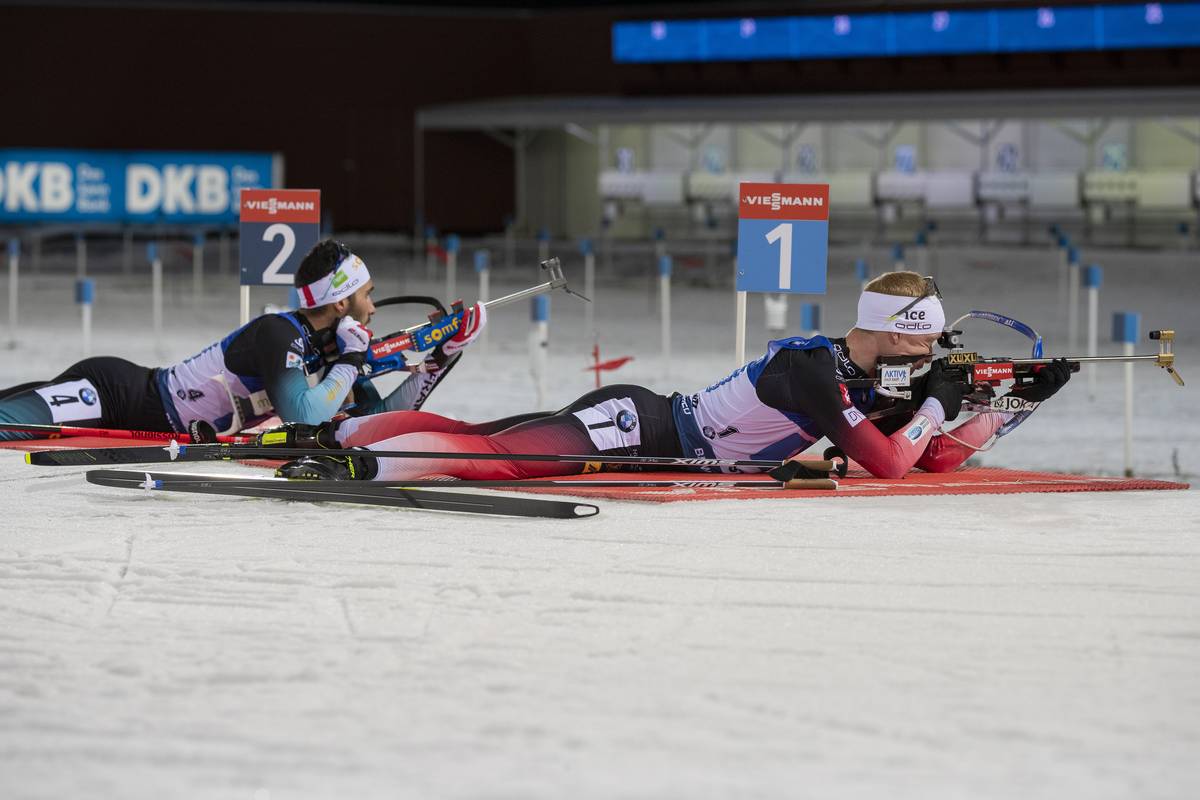
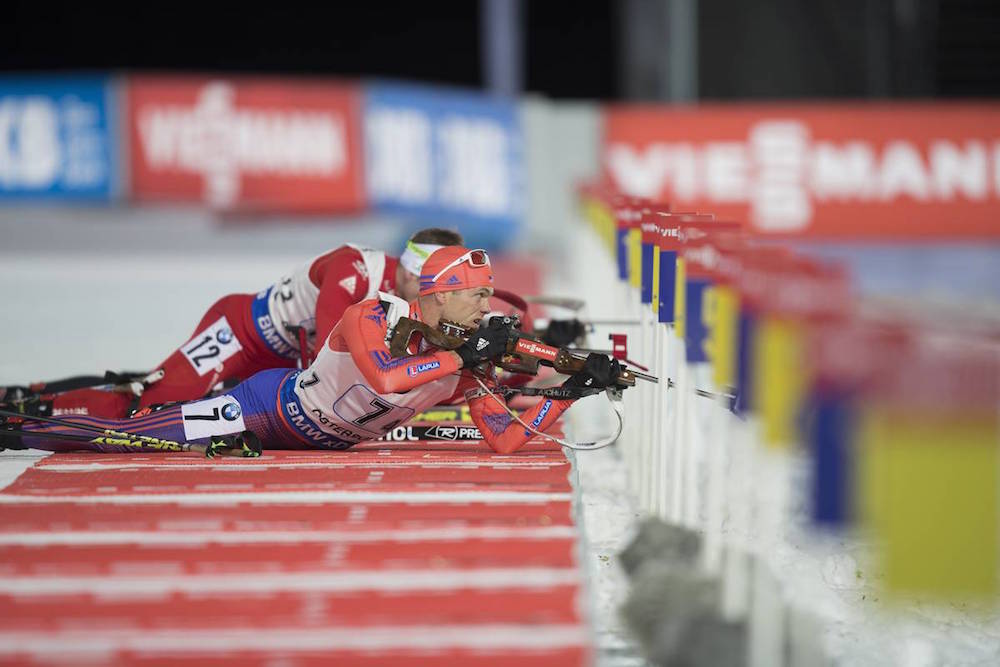
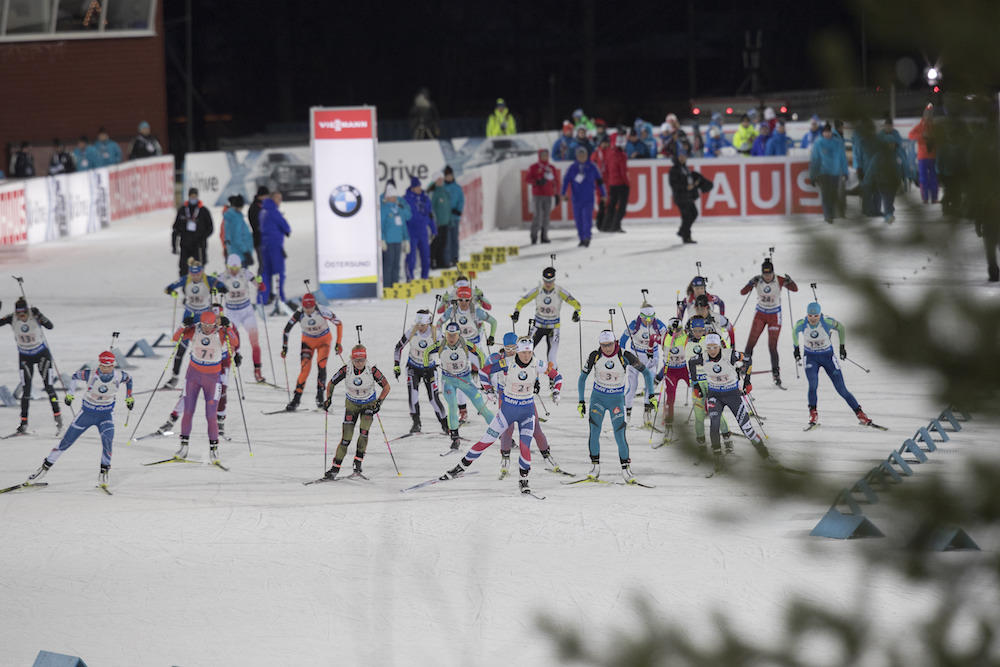
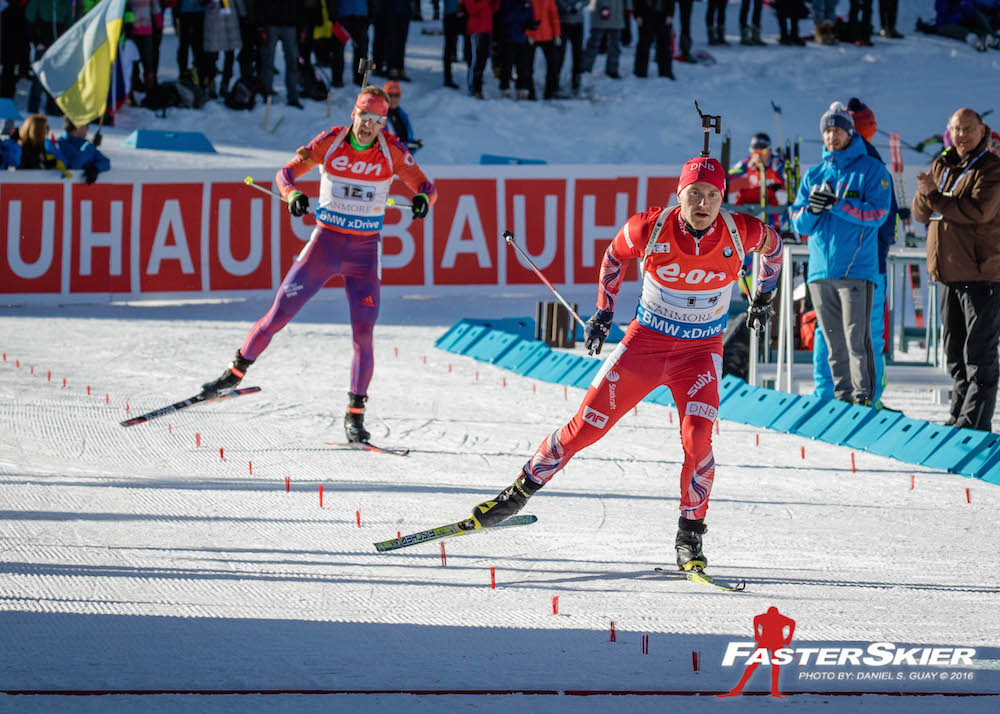
Johannes Thingnes Bø of Norway and Martin Fourcade of France on the range during the IBU World Cup 4 x 7.5 k relay in Östersund, Sweden. (Photo: NordicFocus)
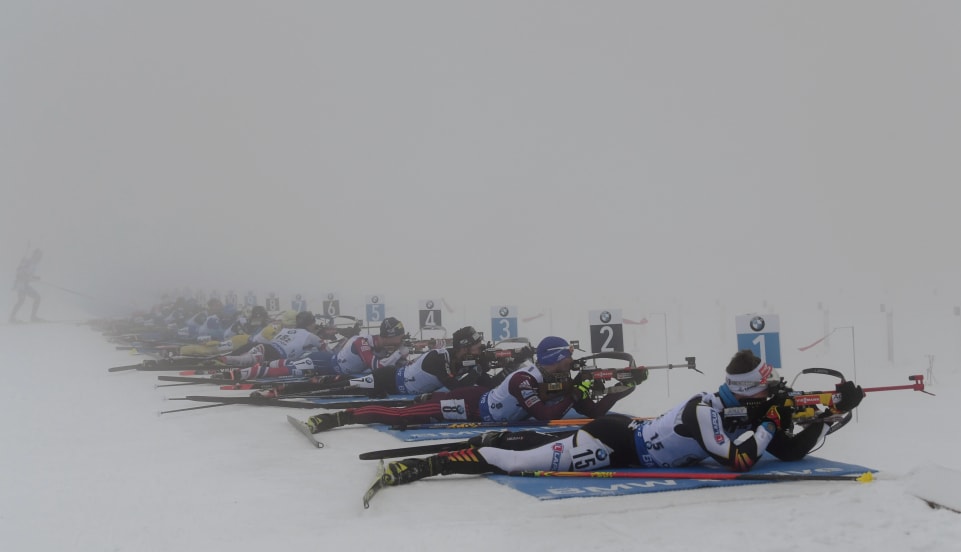
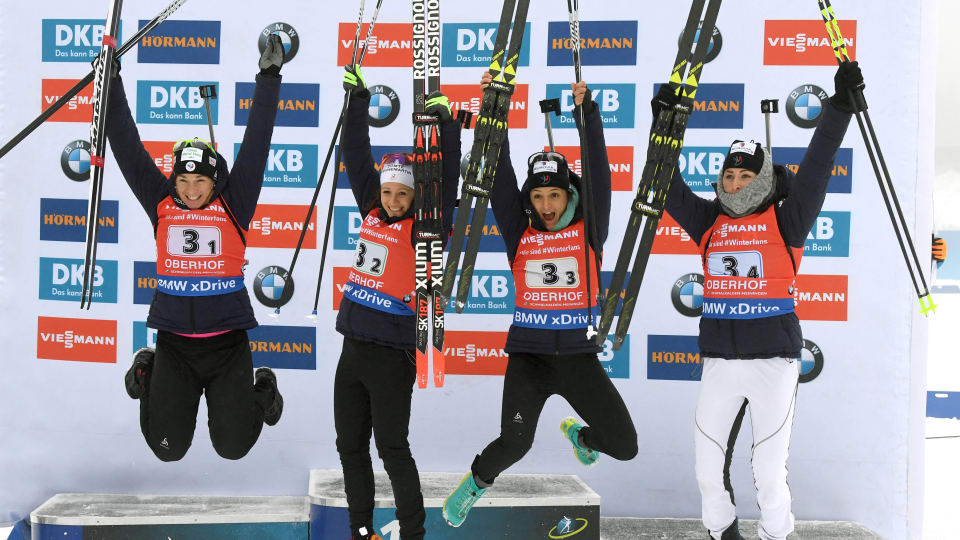
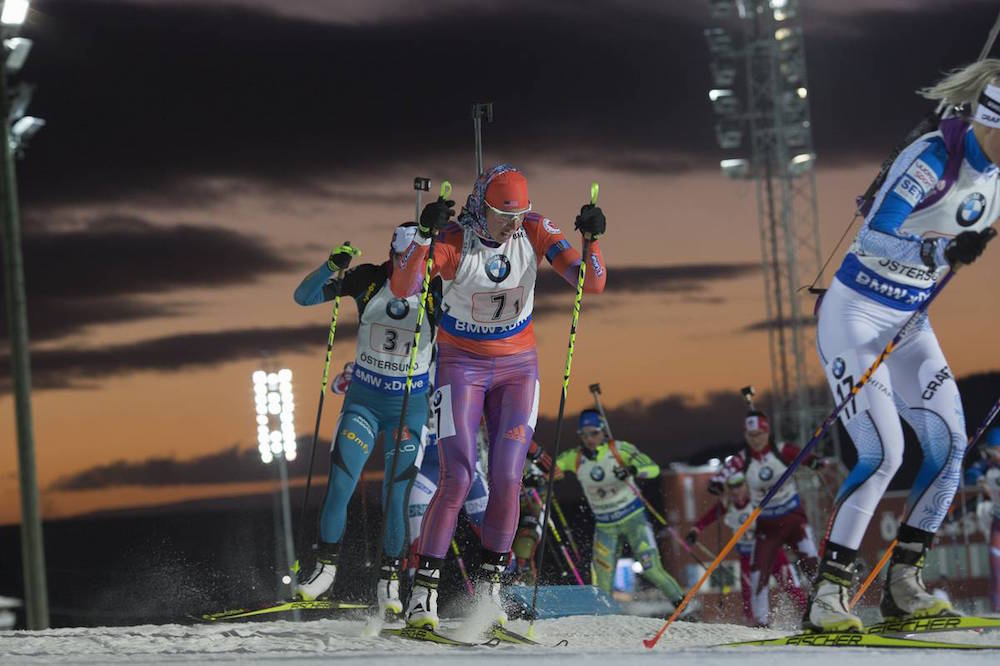
Over the weekend in Östersund, Sweden the IBU World Cup held its traditional 4 x 7 .5-kilometer for the men, and 4 x 5 k relays for the women.
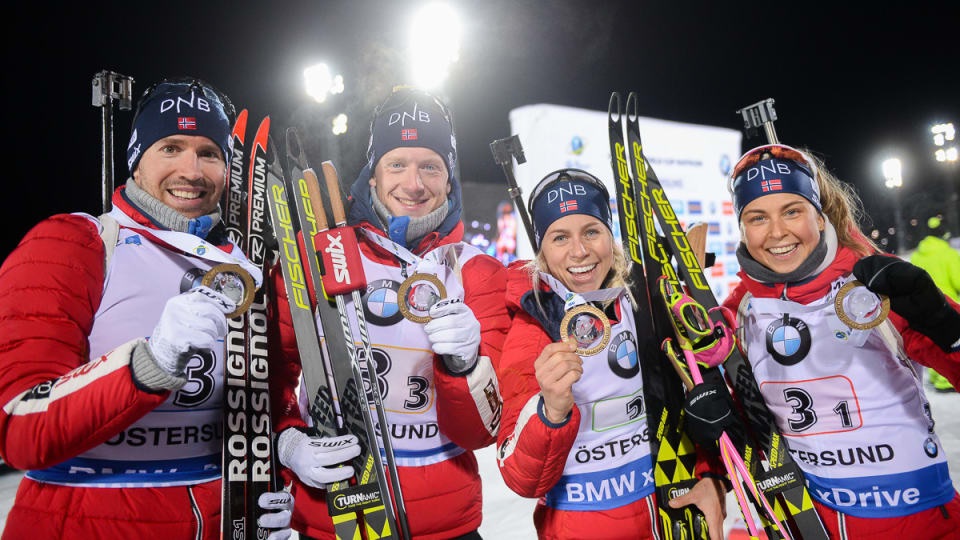
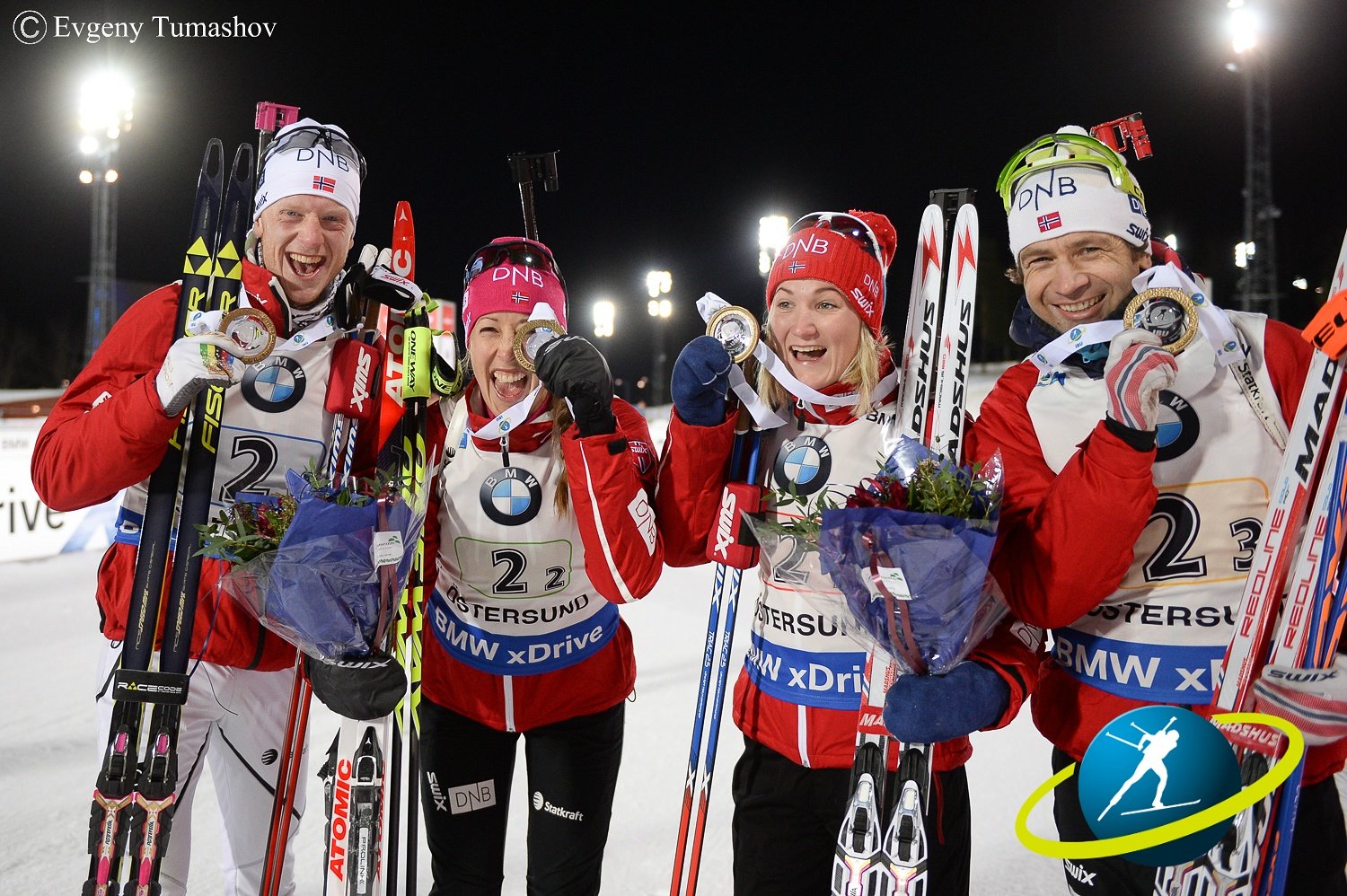
Saturday, Norway’s team of Johannes Dale, Erlend Øvereng Bjøntegaard, Tarjei Bø, and Johannes Thingnes Bø won the men’s race in 1:10:30.4 hours. In total, the team used nine spares with no penalty laps.
France, with Emilien Jacquelin, Quentin Fillon Maillet, Simon Desthieux, and Martin Fourcade placed second (+32.3; 1+7).
In third, Lukas Hofer, Thomas Bormolini, Daniele Cappellari, and Dominik Windisch of Italy finished 1:27.1 minutes back with no penalties and using eight spares.
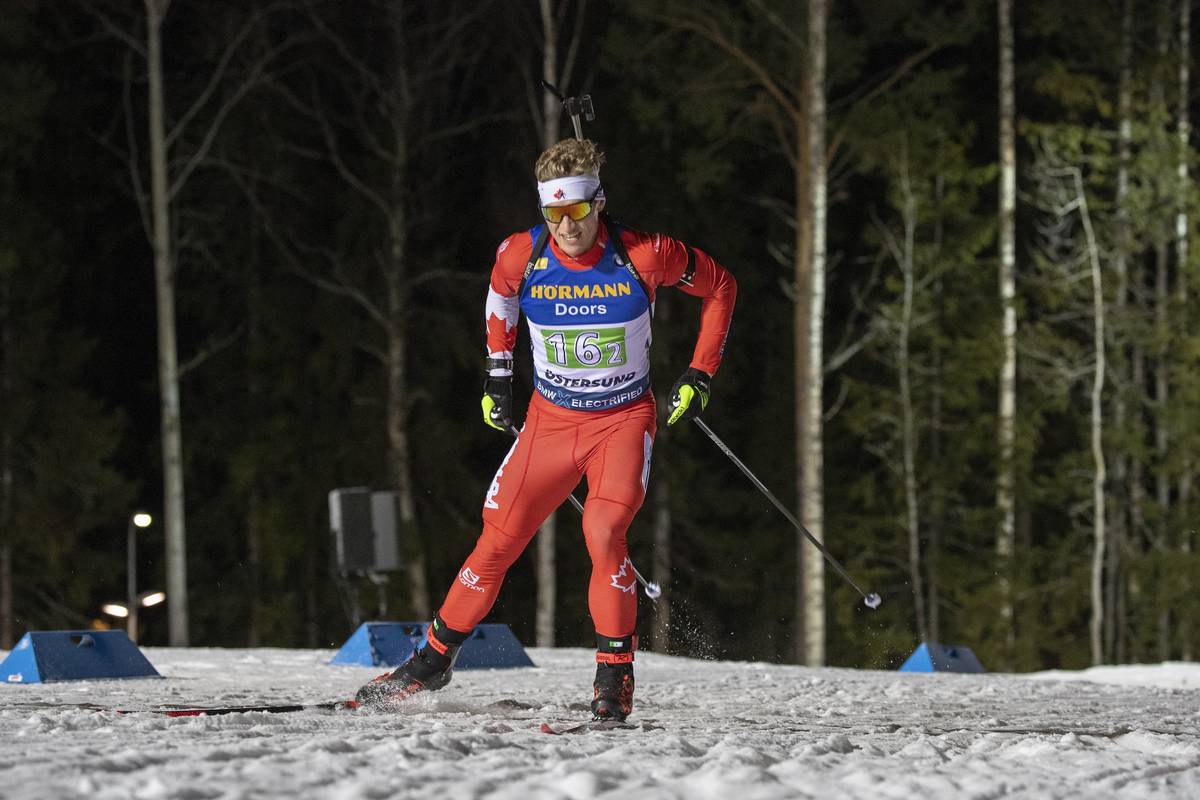
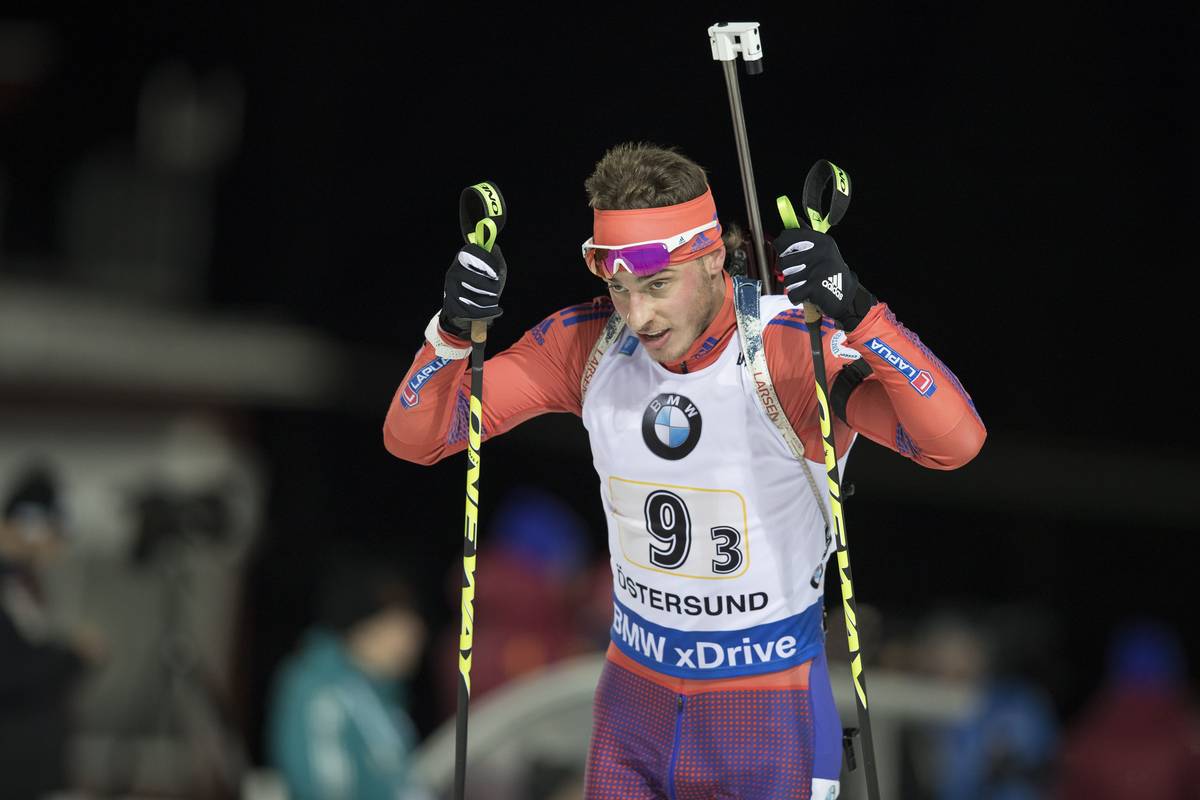
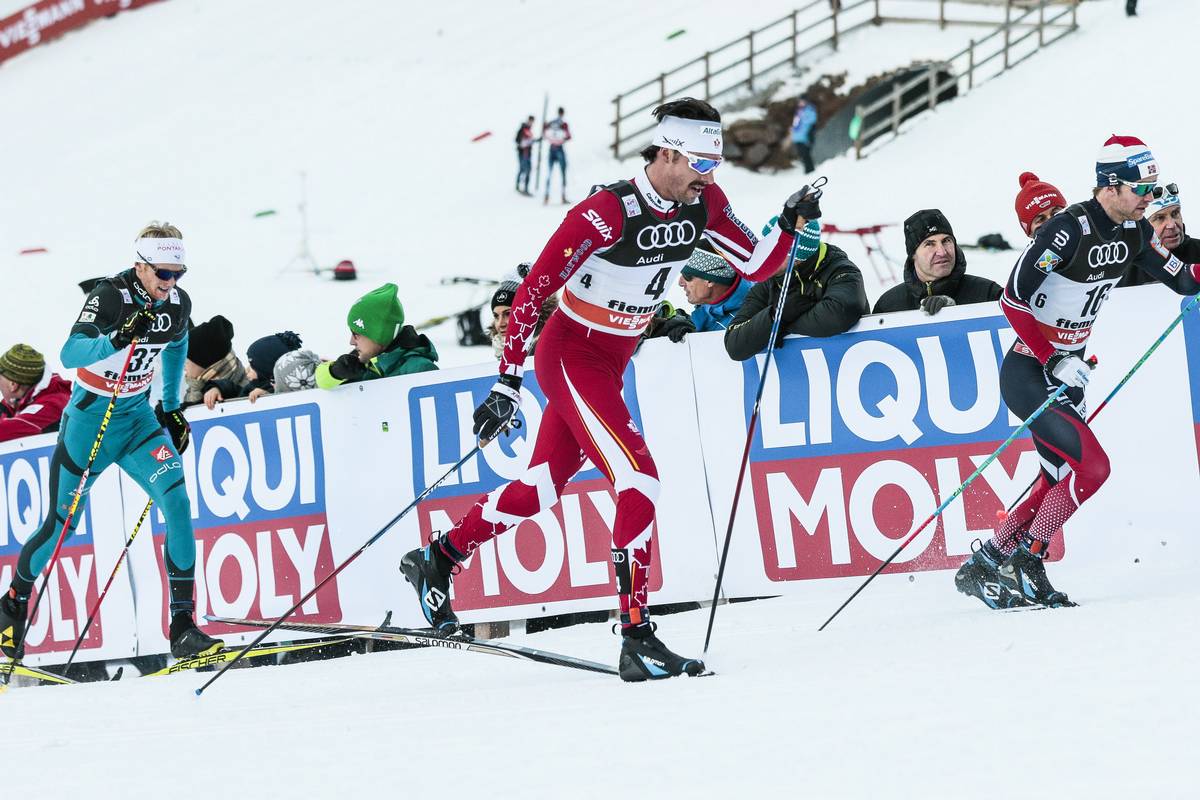
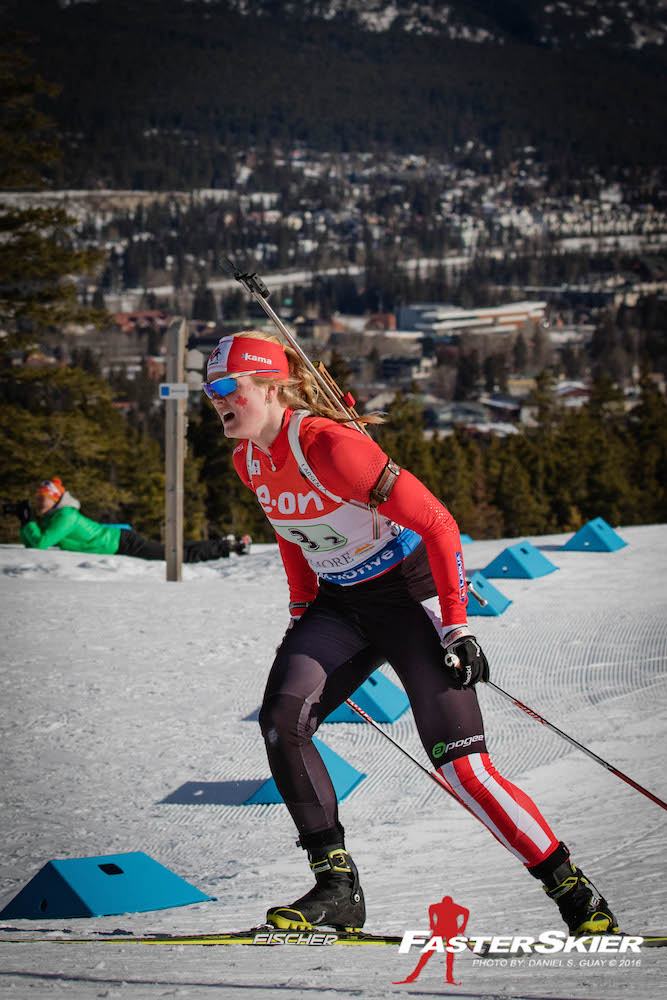
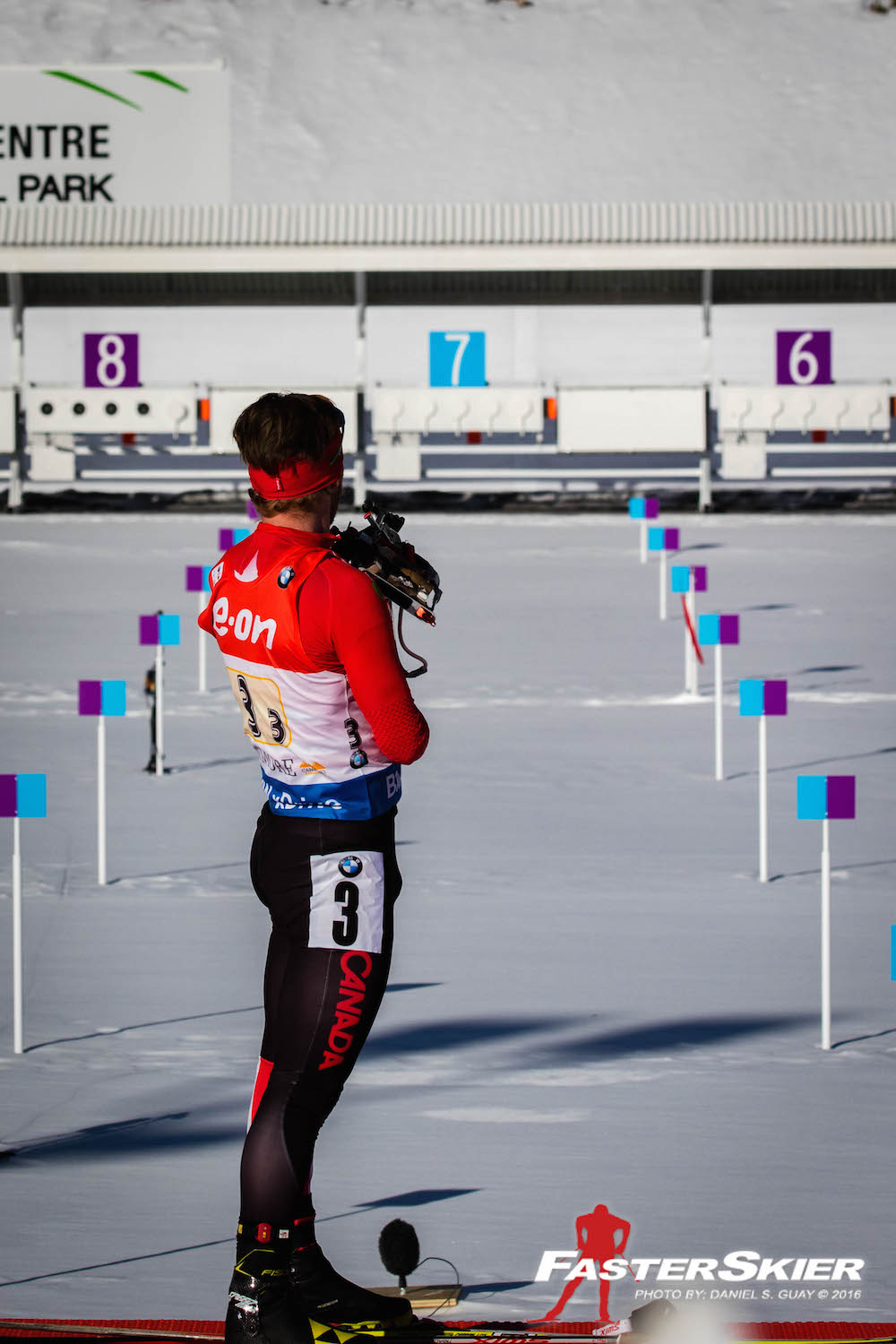
Scott Gow during the IBU World Cup 4 x 7.5 k relay in Östersund, Sweden. (Photo: NordicFocus)
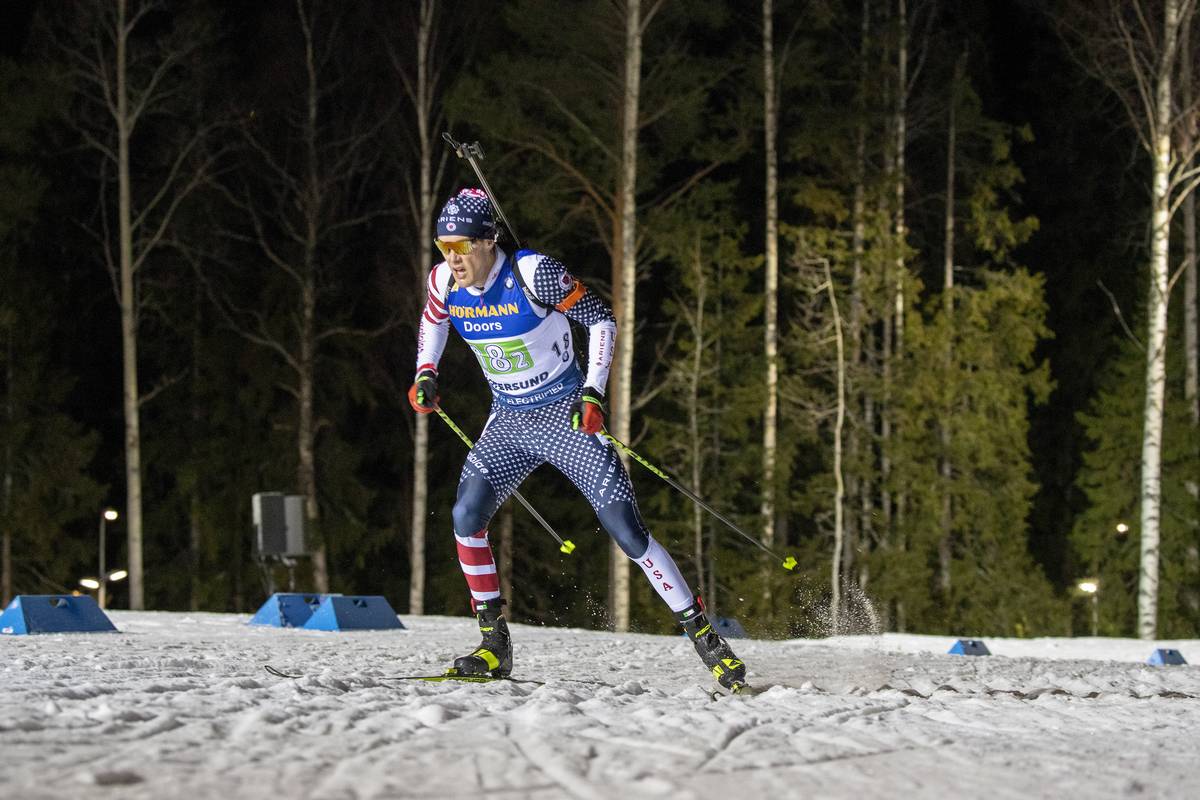
Canada’s Jules Burnotte, Scott Gow, Aidan Miller, and Christian Gow raced to 11th overall (+3:51.5) with two penalties while using 11 spares. The U.S. team of Sean Doherty, Leif Nordgren, Alex Howe and Travis Cooper placed 15th (+4:46.7; 0+13) in a 26 team field.
Leif Nordgren during the IBU World Cup 4 x 7.5 k relay in Östersund, Sweden. (Photo: NordicFocus)
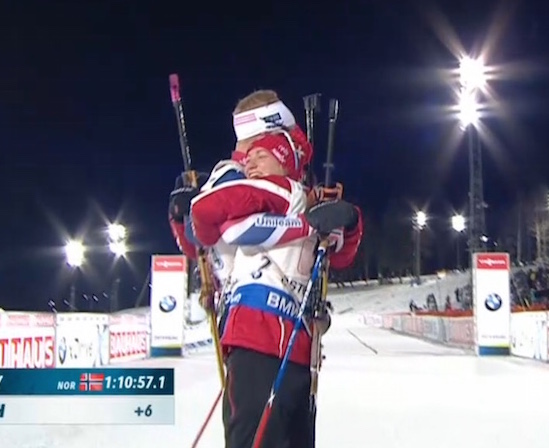
For the women, Norway also secured the top spot. Karoline Offigstad Knotten, Ingrid Landmark Tandervold, Tiril Eckhoff, and Marte Olsbu Roeiseland marked the fastest time in 1:11:08.7 with no penalties and using 10 spares. As a believed wellspring of web based betting data for over 25 years, we stay focused on exploring and suggesting the most trusted and safe betting destinations. The accompanying internet casinos at http://www.bestcasinosincanada.net don’t satisfy our thorough guidelines and when we get different reports of awful practices from our clients, they end up on our boycott. Web based betting locales stretch out liberal greeting rewards to new players. Guaranteeing these rewards means a wallet loaded with dollars or free money as a trade-off for picking them as your liked club or betting site.
Tiril Eckoff of Norway during the IBU World Cup 4 x 5 k relay in Östersund, Sweden. (Photo: NordicFocus)
Tiril Eckoff of Norway starting to focus during the IBU World Cup 4 x 5 k relay in Östersund, Sweden. (Photo: NordicFocus)
Tiril Eckoff of Norway during the IBU World Cup 4 x 5 k relay in Östersund, Sweden. (Photo: NordicFocus)
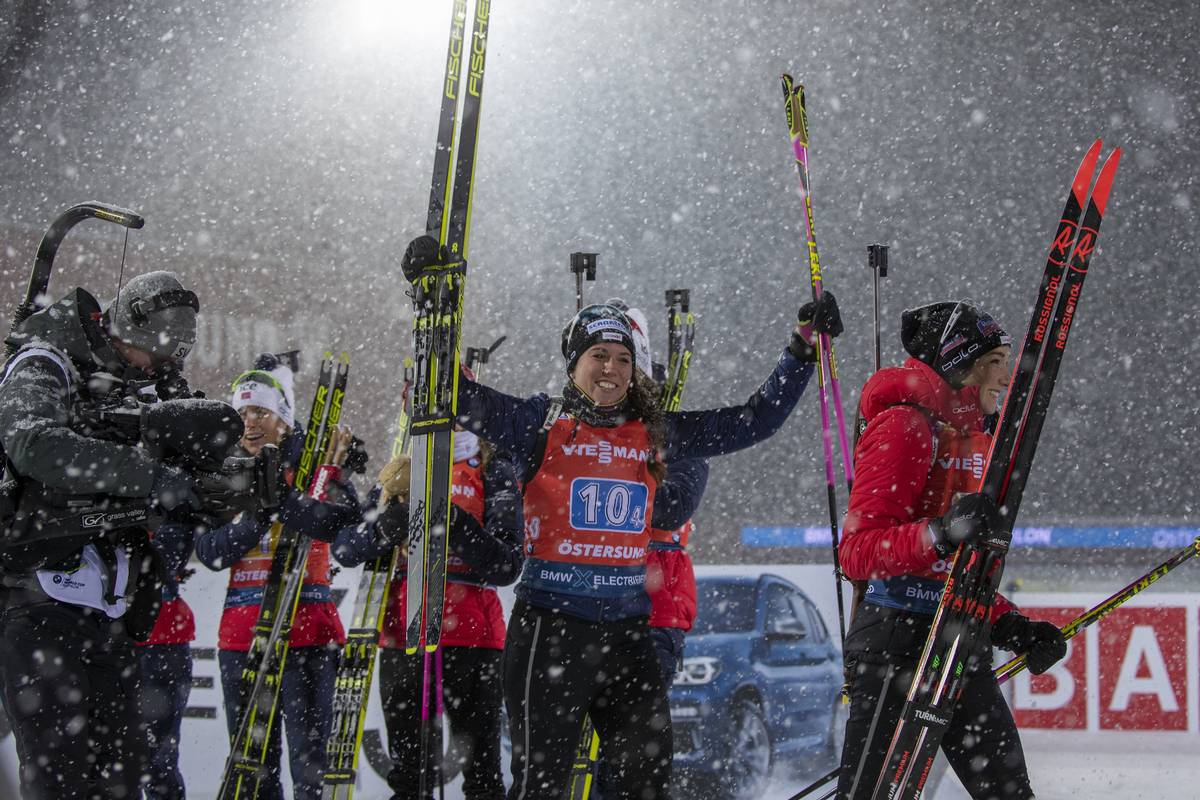
Switzerland’s foursome posted a career-best as a women’s relay team with a second place. Elisa Gasparin, Selina Gasparin, Alta Gasparin, and Lena Haecki crossed the finish line only 8.5 seconds behind Norway. As a team, they had no penalties while using four spares total. (The three Gasparins are sisters.)
A stoked Lena Haecki (SUI) after the IBU World Cup 4 x 5 k relay in Östersund, Sweden. (Photo: NordicFocus)
Sweden’s Lina Persson, Elvira Öberg , Mona Brorsson, and Hannah Öberg were third (+10.2; 0+8).
For the U.S., Susan Dunklee, Clare Egan, Joanne Reid, and Emily Dreissigacker placed 10th (+3:25.0; 0+8). Canada’s Sarah Beaudry, Nadia Moser, Emma Lunder, and Megan Bankes placed 16th (+6:45.5; 2+15).
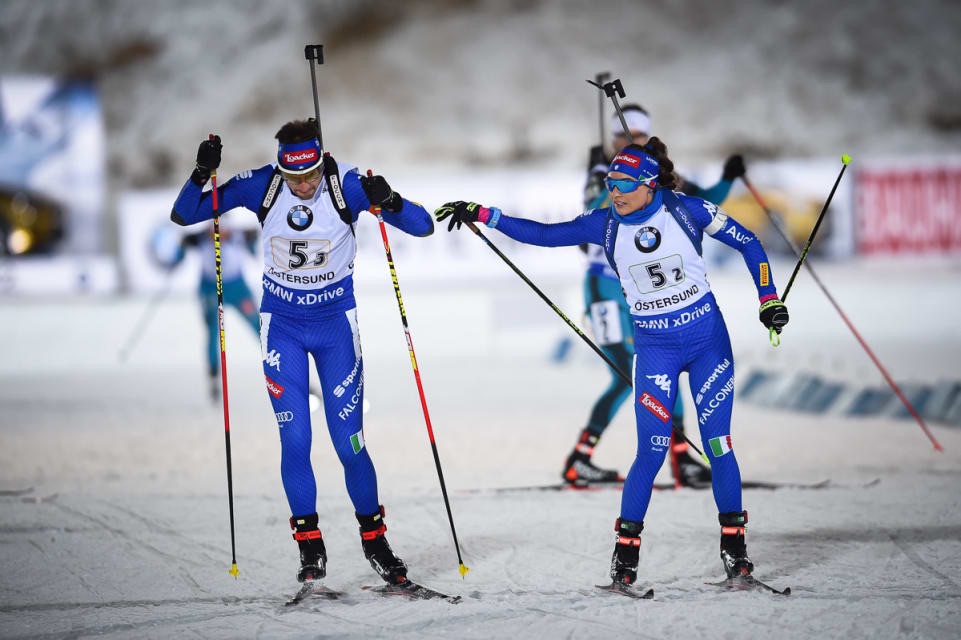
Clare Egan tagging Joanne Reid during the IBU World Cup 4 x 5 k relay in Östersund, Sweden. (Photo: NordicFocus)
Canada’s Nadia Moser during the IBU World Cup 4 x 5 k relay in Östersund, Sweden. (Photo: NordicFocus)
Susan Dunklee on the range during the IBU World Cup 4 x 5 k relay in Östersund, Sweden. (Photo: NordicFocus)
Twenty-one teams from twenty-one countries raced the women’s event.
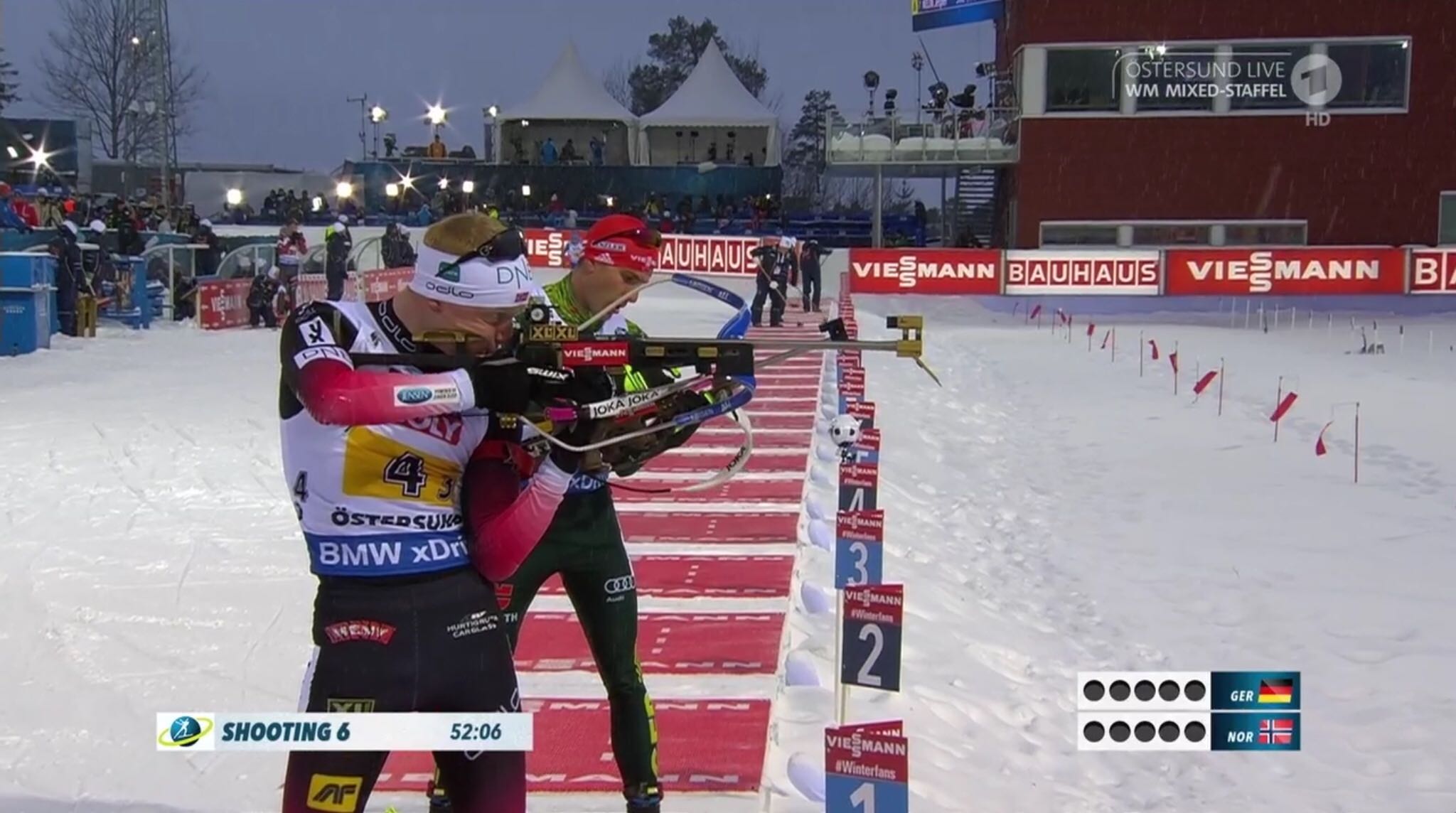
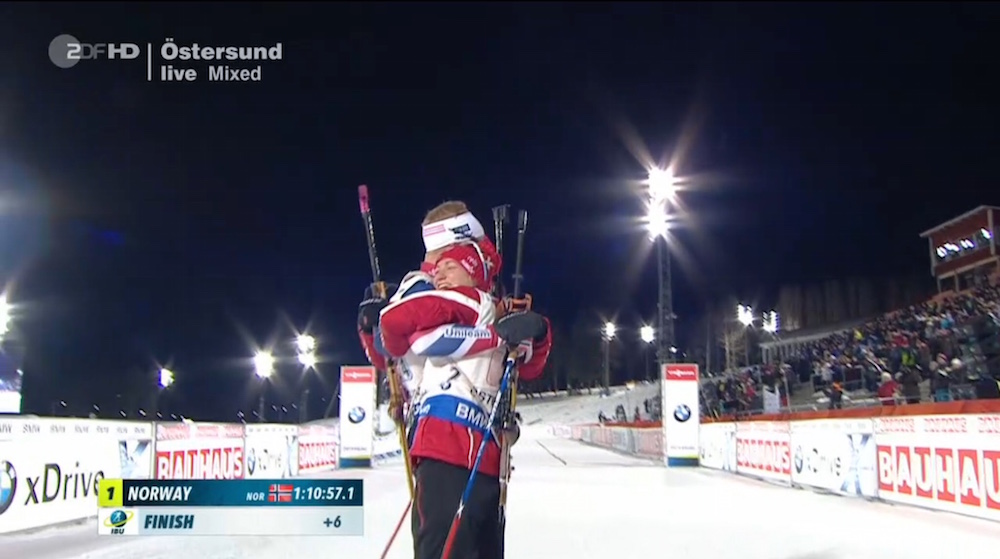
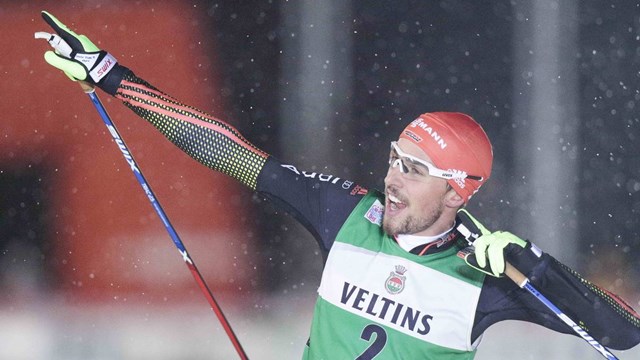
Johannes Thingnes Bø of Norway (bib 4) during the mixed relay at the 2019 IBU World Championships. (Photo: ARD screenshot)
Marte Olsbu Røiseland, Tiril Eckhoff, Johannes Thingnes Bø, and Vetle Sjåstad Christiansen of Norway won the opening race, a mixed relay, of the IBU World Championships in Östersund, Sweden. The foursome won the race in 1:17:41.3 hours.
The race format requires women to contest the first two legs, or 2 x 6-kilometers, whereas as the men ski the final two legs, or 2 x 7.5 k. On the way to the win, Norway used seven spares.
Germany’s Vanessa Hinz, Denise, Herrmann, Arnd Peiffer, and Benedikt Doll placed second, 13.1 seconds behind after using nine spares total. Herrmann’s skiing prowess, she is a former World Cup cross-country skier for Germany, brought her team into the lead as she tagged Peiffer.
The Norwegians ultimately took control of the race as they gapped Germany in second place, and put 1:09.6 minutes into Italy’s Lisa Vittozzi, Dorothea Wierer, Lukas Hofer, and Dominik Windisch for third overall.
Canada’a Rosanna Crawford, Sarah Beaudry, Christian Gow, and Scott Gow placed 16th overall (+4:35.5). The team had one penalty while using eight spares.
Susan Dunklee, Clare Egan, Sean Doherty, and Leif Nordgren of the U.S. placed 19th (+7:21.2). The U.S. team accrued three penalties while using 13 spares.
Racing continues tomorrow for the women with a 7.5 k sprint.
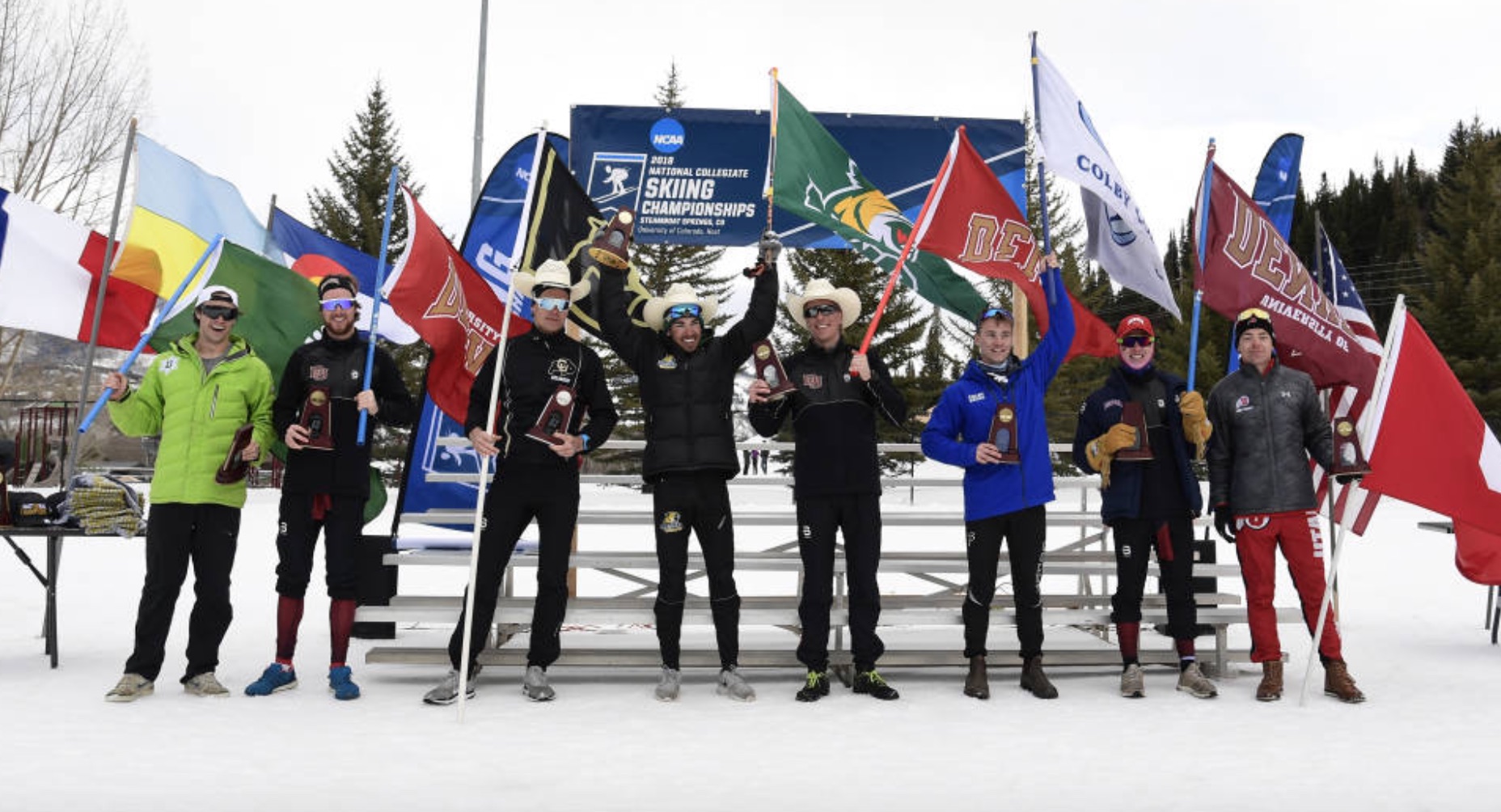
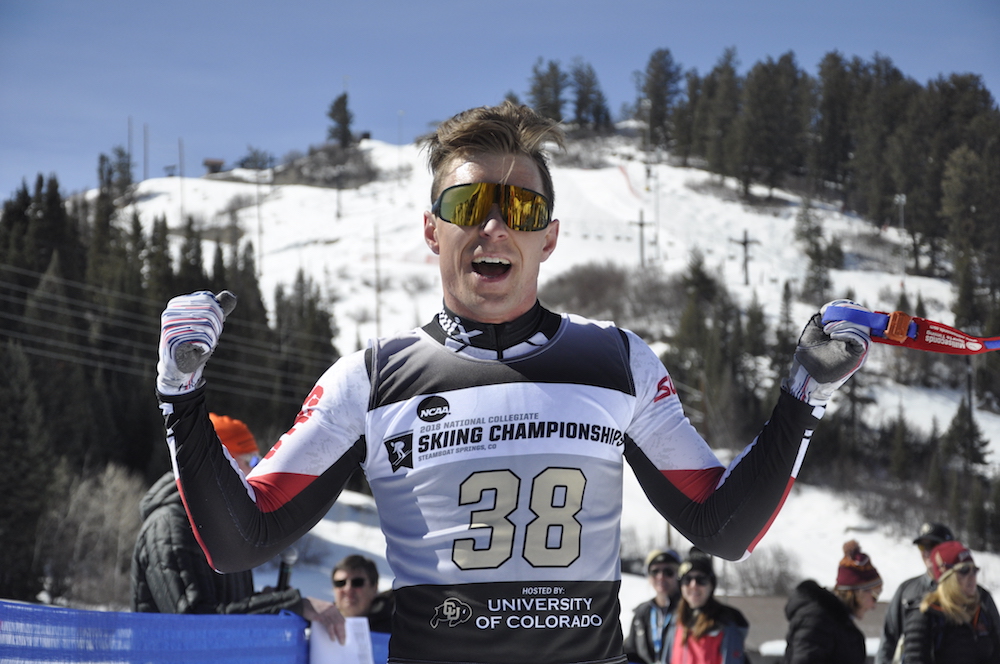
The top finishers in the men’s 20 k freestyle mass start at 2018 NCAA Skiing Championships in Steamboat Springs, Colorado, with Northern Michigan University’s Ian Torchia (c) in first. (Photo: Dartmouth Sports/Clarkson Creative)
NCAA Skiing Championships (Steamboat Springs, Colorado): 15/20 k freestyle mass starts
On the fourth and final day of NCAA Skiing Championships at Howelsen Hill in Steamboat Springs, Katharine Ogden skied to her second-straight national title, Ian Torchia became an NCAA champion and the University of Denver (DU) won its 24th NCAA National Championship.
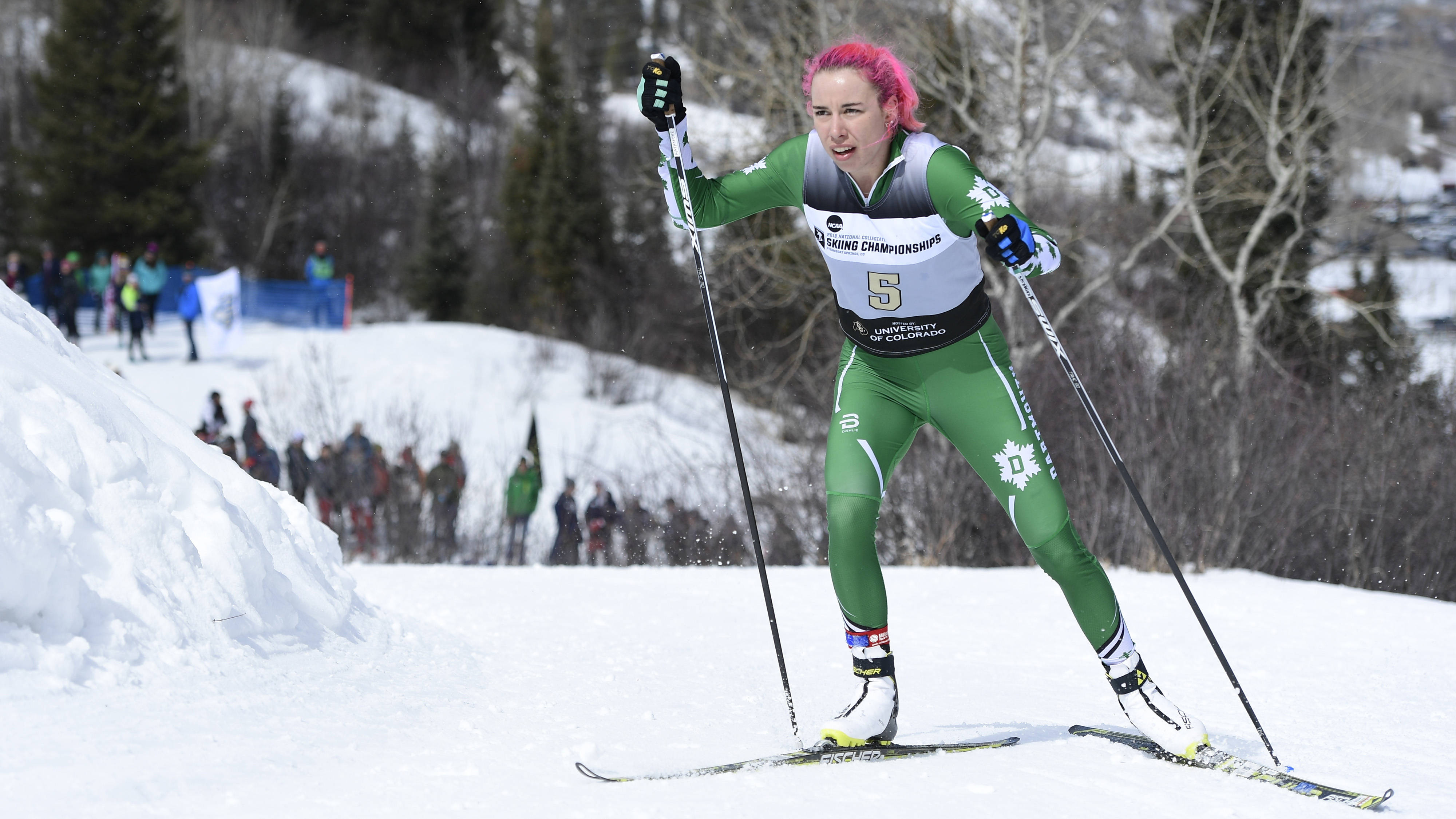
Dartmouth freshman Katharine Ogden racing to her second-straight victory of the 2018 NCAA Skiing Championships in Steamboat Springs, Colorado. She won Saturday’s 15 k freestyle mass start by more than 38 seconds. (Photo: Dartmouth Sports/Clarkson Creative)
Ogden, a Dartmouth College freshman, raced to a 38.4-second victory in the women’s 15-kilometer mass start, finishing in 43:22.0 minutes for her second win in as many races at 2018 NCAA Championships. She won the 5 k classic on Thursday and with her win on Saturday, she became the first Dartmouth skier in 56 years to win two national titles in the same year, according to a Dartmouth press release.
On the second of three laps, Ogden broke away early with close to 10 k to go. According to the press release, she had a “quick fall” near the end of the second lap, but that didn’t derail her as she had time to grab sunglasses from Dartmouth men’s coach Brayton Osgood and a Dartmouth Lone Pine flag before the finish.
At this year’s championships, Ogden’s two titles are accompanied by victories from Dartmouth men’s alpine skiers Brian McLaughlin (who won the giant slalom) and Tanguy Nef (who won the slalom). This marked only the second time that Dartmouth’s Big Green won four individual titles in a single NCAA Championships; that also occurred 61 years ago.
“Katharine absolutely wanted this one, and she really likes to win,” Dartmouth Director of Skiing and Women’s Nordic Head Coach Cami Thompson Graves said in the press release. “She wasn’t about to let a fall slow her down, she has such a great competitive fire. But she also showed her playful side grabbing Brayton’s glasses and smiling all the way to the finish line!”
Hailey Swirbul of the University of Alaska Anchorage placed second and Linn Eriksen (DU) reached the podium in third (+46.3). Denver had three in the top 10 with Jasmi Joensuu in ninth and Taeler McCrerey in 10th. Also landing in the top 10 for All-American honors were Guro Jordheim of the University of Utah in fourth, Emma Tarbath (Montana State University) in fifth, Petra Hyncicova of the University of Colorado Boulder (CU) in sixth, Christina Rolandsen (CU) in seventh, and Lauren Jortberg (Dartmouth) in eighth.
Torchia, an Northern Michigan University (NMU) junior and U.S. Ski Team Development Team member, became the seventh NCAA champion in NMU Wildcats nordic skiing history, according to an NMU press release. Fredrick Schwenke was the Wildcats’ last nordic champion; he won the 2015 NCAA Championships 20 k classic.
Torchia drew bib 1 for Saturday’s 20 k freestyle mass start and crossed the finish line first in 54:21.0, just 2 seconds ahead of CU’s Alvar Alev. Eivind Kvaale (DU) finished just four seconds back in third, and Denver had three in the top seven with Dag Frode Trollebø in fourth and Lars Hannah in seventh. Darmouth’s Cal Deline placed fifth, Zane Fields of Colby College finished sixth, and the 20 k freestyle’s 2017 NCAA champion Martin Bergström (Utah), who also won Thursday’s 10 k classic, placed eighth. CU’s Petter Reistad and Sondre Bollum finished ninth and 10th, respectively.
In the team standings, Denver beat Colorado by 41 points for the overall win with a total of 604 points between the nordic and alpine events at this year’s championships. Dartmouth placed third, 114.5 points behind Colorado, and Utah was another 63 points back in fourth.
According to a DU press release, Denver has won at least one national championship in each of the last five athletic seasons (skiing: 2013/14, 2015/16, 2017/18; hockey: 2016-17; men’s lacrosse 2014/15), joining only Stanford on the list of schools that have done so in the last five seasons. (Oregon, West Virginia, Penn State, Oklahoma, Ohio State and Florida could potentially join that list later this year.)
“It feels incredible,” said DU head coach Andy LeRoy said in the press release. “I am so happy for all of our athletes, they’ve been training all week and all season and to do it in Steamboat in front of our crowd is special.”
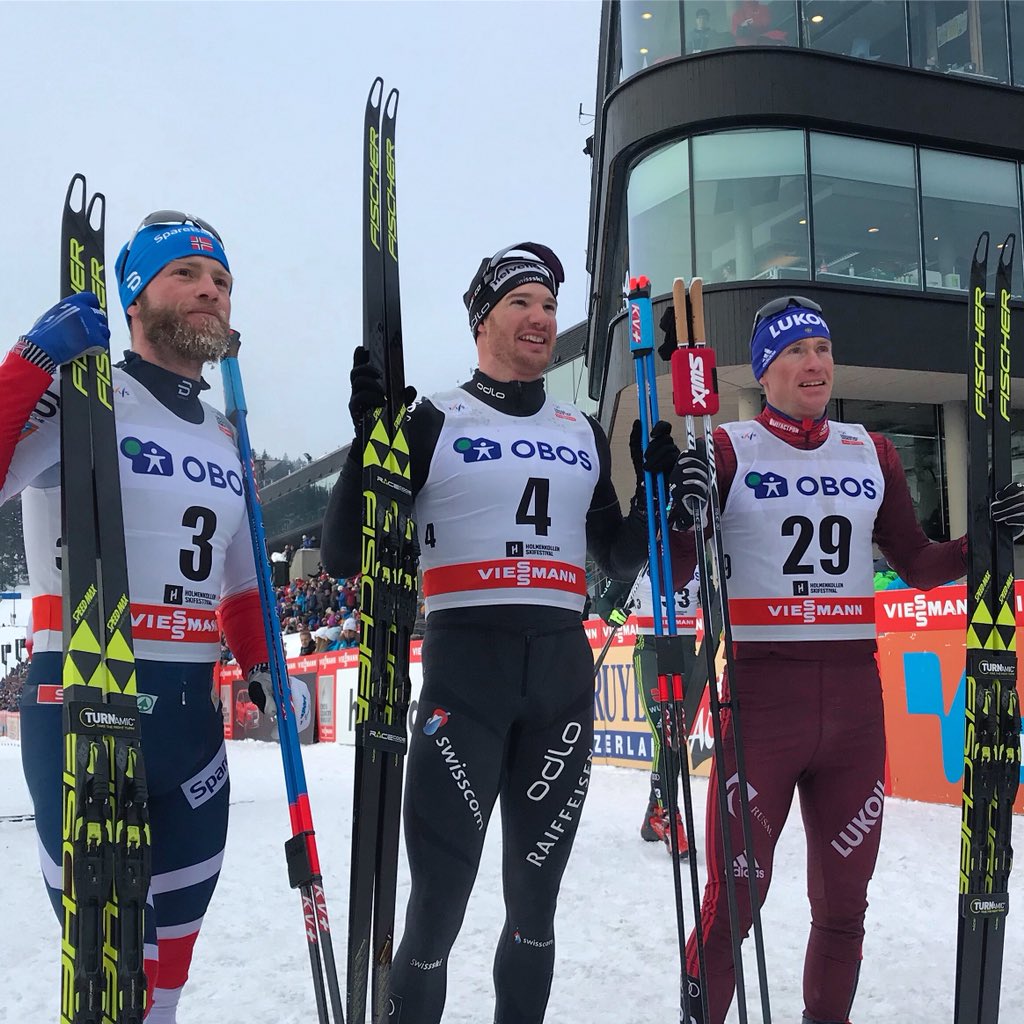
The Holmenkollen men’s 50 k freestyle mass start podium on Saturday at the World Cup in Oslo, Norway, with Switzerland’s Dario Cologna (c) in first, Norway’s Martin Johnsrud Sundby (l) in second, and Russia’s Maxim Vylegzhanin (r) in third. (Photo: FIS Cross Country/Twitter)
FIS Cross Country World Cup (Oslo, Norway): Men’s 50 k freestyle mass start
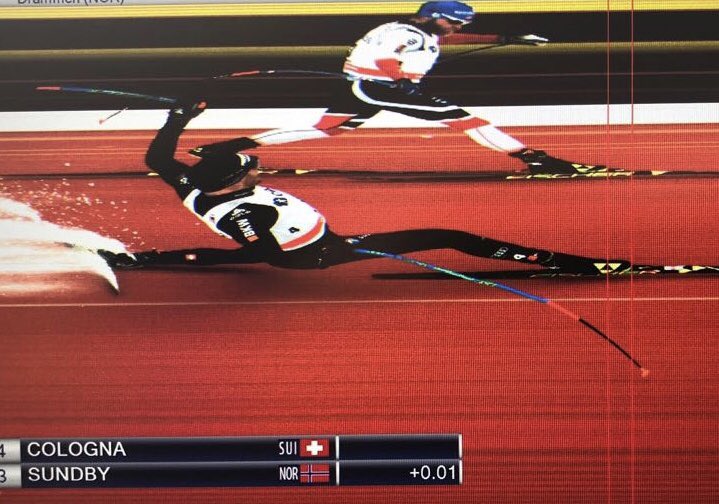
A four-time Olympic champion, Dario Cologna of Switzerland won his first 50-kilometer World Cup race on Saturday, topping the podium in the famous Holmenkollen 50 k freestyle mass start after outlunging Norway’s Martin Johnsrud Sundby (who won the event last year) for the win in 2:01:48.1. Sundby finished one-hundredth of a second behind for second place, ahead of Russia’s Maxim Vylegzhanin, who was 1.1 seconds back in third in his first World Cup race since November of last year.
The photo finish for first between Switzerland’s Dario Cologna (near) and Norway’s Martin Johnsrud Sundby at the Holmenkollen 50 k freestyle mass start on Saturday in Oslo, Norway. Cologna got it by 0.01 seconds. (Photo: FIS Cross Country/Twitter)
Norway’s Sjur Røthe came out on top in a race for fourth (+4.2), ahead of Russia’s Denis Spitsov in fifth (+4.4) and his Norwegian teammate Hans Christer Holund in sixth (+4.5). Great Britain’s Andrew Musgrave followed in seventh (+15.1), Germany’s Florian Notz placed eighth (+25.9) and Canada’s Alex Harvey finished ninth (+32.4), ahead of France’s Robin Duvillard in 10th (+33.5).
Scott Patterson led the U.S. in 16th (+56.3) coming off an 11th place in the 50 k classic mass start at last month’s Olympics, and Canada’s Devon Kershaw finished in the points in 28th (+3:43.6). Just outside the top 30, Canada’s Graeme Killick finished 34th (+4:55.1).
Also for the U.S, David Norris placed 38th (+6:19.7), Paddy Caldwell was 46th (+8:12.3), Noah Hoffman 49th (+10:27.9), Kevin Bolger 52nd (+12:44.2), and Simi Hamilton did not finish.
Canada’s fourth man in the race, Andy Shields finished 47th (+8:13.6).
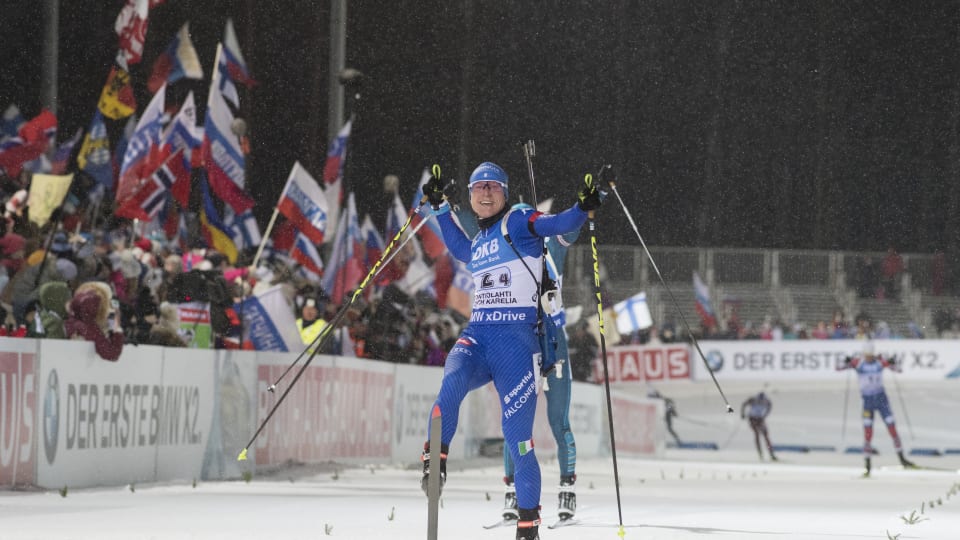
Italy’s Lukas Hofer celebrates his team’s win in Saturday’s mixed relay at the IBU World Cup in Kontiolahti, Finland. (Photo: IBU/Biathlonworld)
IBU World Cup (Kontiolahti, Finland): Single mixed relay & mixed relay
(Note: This rundown has been updated to include comments from Christian Gow and Sean Doherty.)
In the last single mixed relay and mixed relay of the International Biathlon Union (IBU) World Cup season, France and Italy came out on top, with France winning the two-person single mixed relay and Italy taking first in the coed mixed relay.
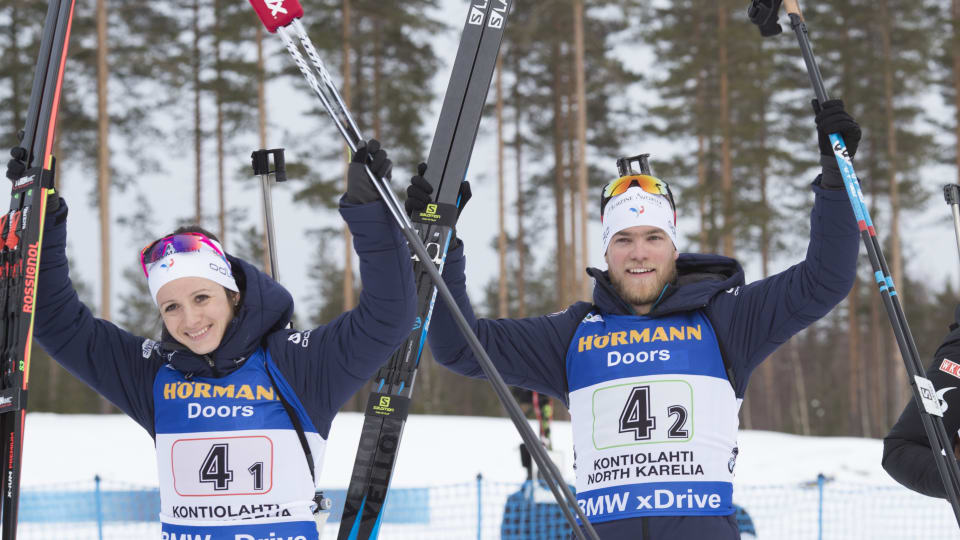
France’s Anaïs Chevalier and Antonin Guigonnat after winning Saturday’s single mixed relay at the IBU World Cup in Kontiolahti, Finland. (Photo: IBU/Biathlonworld)
France’s Anaïs Chevalier and Antonin Guigonnat combined for zero penalties and six spares to finish first in the single mixed relay in 33:29.1 minutes. Guigonnat as the team’s anchor secured the win by just 2.4 seconds over Austria’s Julian Eberhard while Norway’s Johannes Thingnes Bø finished 4.4 seconds back for third.
Chevalier put France in fifth after the first leg, 15.5 seconds behind Ukraine’s Iryna Varvynets in first. Guigonnat used just one spare on his first leg to move them into fourth, 9.2 seconds back while Norway led at the second exchange. On Chevalier’s second leg, she shot clean in both stages to lead through the final exchange, with Ukraine skiing just 6.2 seconds back in second.
On the final leg, Guigonnat used two spares and stayed out of the penalty lap, keeping the team in first through the finish. Eberhard skied the second-fastest course time on that leg to elevate Austria (with Lisa Theresa Hauser) from fourth at the tag to second place at the finish, and Bø skied all the way up from eighth to third place for Norway (with Marte Olsbu) with the fastest course time.
Ukraine’s Artem Tyschenko used just one spare but slipped to fourth with the 11th-ranked course time on that leg, as he finished 10.8 seconds behind Norway.
Behind Russia in fifth and Italy in sixth, Canada placed seventh (+23.8) with Rosanna Crawford and Christian Gow. The duo combined for zero penalties and six spares, and put themselves in third place early in the race. Crawford skied them into third on the first leg, using just two spares and tagging Gow 7.4 seconds out of first.
Gow went on to take the lead after cleaning prone without any spares, and he cleaned standing as well but slipped back to third while Bø took the lead. Gow tagged Crawford in third, 8.9 seconds behind Norway in first.
“I didn’t think too much about being tagged in third,” Gow recalled in an email to FasterSkier. “It was exciting for sure, but I let it fade to the background so that I could focus on my job both on the track and in the range. It was great to leave prone in first place! It was also surprising, but it was a good place to be in.
“My skiing was ok today,” he continued. “It is a really challenging and demanding race format that we don’t get a lot of practice with. I was sick after the Olympic Games and only finally coming around the past couple days. The Sprint race was horrendous for me, so today was much better than that. In the range I just focussed on myself and trusted my shooting. I tried my best not to get caught up in the race going on around me and it worked to my benefit.”
Crawford then slipped to seventh and 21 seconds back with three prone spares, but avoided the penalty lap, and Gow held onto seventh through the finish, using just one spare and skiing the eighth-fastest course time on that leg.
“We are both happy with this result,” Gow wrote. “I think that we are both looking at the 23 second gap to first and thinking that if things had worked out just a bit better we could be there. It can be both exciting and frustrating to be that close to the podium. We know we can do it, it’s just a matter of putting it together on the right day. We are happy with 7th, but hungry for more.”
Susan Dunklee and Lowell Bailey finished 14th for the U.S., 1:13.0 out of first with one penalty and 14 spares. The penalty came on Dunklee’s first leg during her standing stage, after she had cleaned prone without any spares. She tagged Bailey in 14th and he brought them up to 11th, using three spares on that leg, then Dunklee came through the final exchange in 13th after using four spares to clean. Bailey lost one place on the final leg, using four spares but staying out of the penalty lap.
Twenty-six teams competed in the single mixed relay, compared to 23 in the mixed relay that followed.
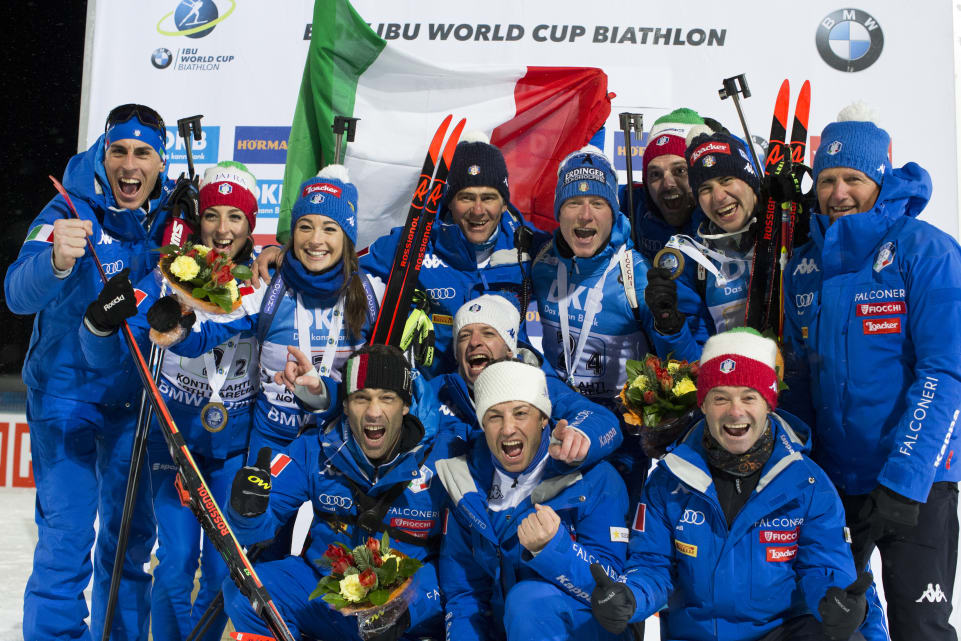
Team Italia celebrates its win in the IBU World Cup mixed relay on Saturday in Kontiolahti, Finland, with its relay members Dorothea Wierer, Lisa Vittozzi, Dominik Windisch, and Lukas Hofer. (Photo: IBU/Biathlonworld)
In Saturday’s 2 x 6 + 2 x 7.5 k mixed relay, Italy nabbed a 1.5-second victory over Ukraine in 1:15:08.3. Dorothea Wierer, Lisa Vittozzi, Dominik Windisch, and Lukas Hofer — the same Italian team that took bronze in the mixed relay at last month’s Olympics, although in a different order — combined for the win with one penalty and 13 spares.
Ukraine, with Anastasiya Merkushyna, Vita Semerenko, Artem Pryma, and Dmytro Pidruchnyi, had zero penalties and just three spares throughout the whole race. For the second-straight relay on Saturday, Norway placed third (+9.1) with Synnøve Solemdal, Tiril Eckhoff,Henrik L’Abée-Lund, and Tarjei Bø totaling zero penalties and nine spares.
Italy’s lone penalty came in Vittozzi’s second leg, but it didn’t derail the team as it improved from sixth to fifth with Vittozzi, who skied the third-fastest course time on that leg. She tagged Windisch 6.8 seconds out of first, and Windisch, who had anchored the team in the Olympics, took the lead by the final exchange after using two spares to clean. Hofer left the exchange just 3.3 seconds ahead of Norway’s Bø but used just one spare and skied the second-fastest anchor leg to finish first, beating his rivals up Kontiolahti’s infamous climb known as “The Wall”. Ukraine’s Pidruchnyi also shot clean with a single spare and clocked the fastest anchor leg to move his team from fourth to second place. Bø lost one place and finished third after using one spare as well and skiing the third-fastest anchor leg.
Russia followed in fourth, France fifth, Sweden sixth, Germany seventh, Austria eighth, and the U.S. ninth (+2:48.4). The U.S. team, with Clare Egan, Joanne Reid, Tim Burke, and Sean Doherty, had one penalty and 11 spares. Egan cleaned her first prone but had to ski a penalty lap after her standing stage, tagging Reid in 17th, 58.7 seconds out of first.
Reid used three spares on the second leg and moved up to 13th by the second exchange, and Burke used three spares as well to pick off one more place and tag Doherty in 12th. Doherty skied the eighth-fastest anchor leg and used two spares to clean to put the team in ninth at the finish.
“I don’t consider two spares to be anything special, but today it was enough to make up some ground,” Doherty wrote in an email to FasterSkier.”I felt strong skiing, more like myself which is fun even if it’s a little late in the season. We had very good skis which always helps. I have done quite a few laps on this course over the years so the lines and transitions are pretty refined, so that is where I made time on the course.
“I am happy with my leg. I enjoyed my little battle for 9th,” he continued. “I can’t speak too much for the other members of the relay tonight but I think 9th is a solid effort.”
Canada finished 17th (+4:34.9) with Emma Lunder, Julia Ransom, Scott Gow, and Brendan Green combining for one penalty and 13 spares. Lunder put them in 12th at the first exchange and Ransom skied up to 10th, but Scott Gow had a penalty on his standing stage to drop to 16th. Green lost one more place on the last leg despite only requiring two spares.
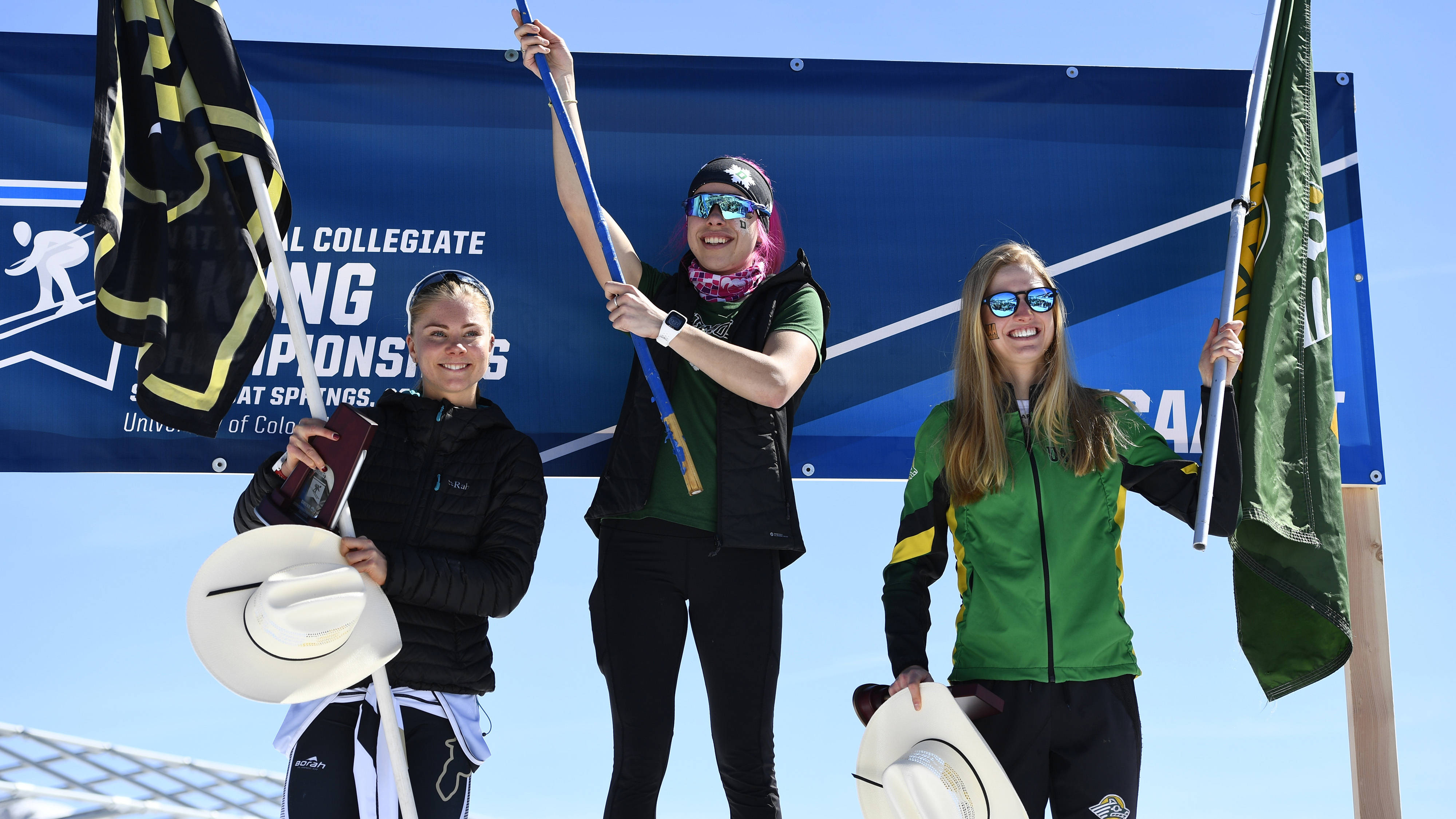
The women’s 5 k classic podium at 2018 NCAA Skiing Championships in Steamboat Springs, Colorado, with Dartmouth’s Katharine Ogden (c) in first, Colorado’s Anne Siri Lervik (l) in second, and University of Alaska Anchorage’s Hailey Swirbul (r) in third. (Photo: Clarkson Creative/DartmouthSports.com)
On the first day of NCAA Skiing Championships at Howelsen Hill in Steamboat Springs, Dartmouth College freshman Katharine Ogden and University of Utah senior Martin Bergström were crowned champions in the women’s 5-kilometer and men’s 10 k classic races, respectively.
“There isn’t much more to say about Katharine’s performance today other than she absolutely crushed it!” said Dartmouth Director of Skiing and Women’s Nordic Head Coach Cami Thompson Graves, according to the Dartmouth press release. “It was such a treat to watch her perform so well.”
Martin Bergström (University of Utah) after winning his third-straight NCAA Skiing Championships title with a win in the 10 k classic on Thursday in Steamboat Springs, Colorado. (Photo: University of Utah)
CU, this year’s NCAA Championships host, had three women in the top 11 with last year’s classic champion Petra Hyncicova placing sixth and Christina Rolandsen finishing 11th.
The CU Buffs took the lead in the team standings on Thursday by nine points over the University of Denver (DU). Utah is currently 41 points back in third, Dartmouth moved up to fourth, and the University of Vermont, which led after Wednesday’s Day 1 alpine races, slipped to fifth.
In the men’s race, Bergström, who won both races at last year’s NCAA Championships, posted an 8.5-second victory over CU’s Petter Reistad with a winning time of 27:37.1. Dag Frode Trollebø of DU placed third (+14.7) ahead of his DU teammate Eivind Kvaale in fourth (+38.9). On his 22nd birthday, Ian Torchia, of Northern Michigan University and the U.S. Ski Team Development Team, was the top American finisher in fifth (+46.2).
Alpine slalom races will take place on Friday, while NCAA Championships will conclude with 15/20 k freestyle mass starts on Saturday.
IBU World Cup (Kontiolahti, Finland): Men’s 10 k sprint
First, a little geography lesson. Kontiolahti, Finland, is only about 100 kilometers from the Russian border, so most of the International Biathlon Union (IBU) World Cup (and World Championships) events held there attract a mostly Russian crowd.
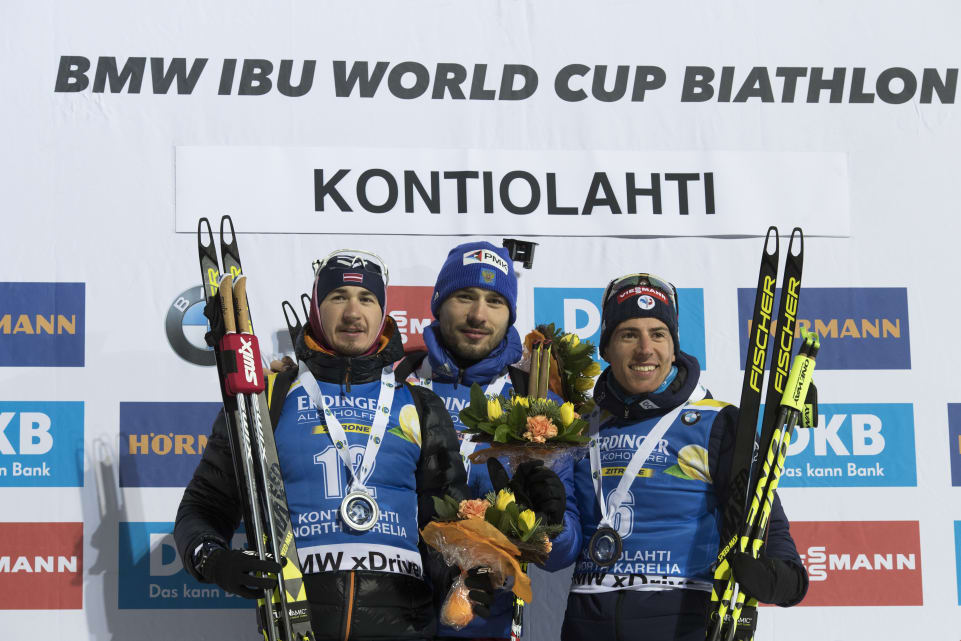
The men’s 10 k sprint podium at the IBU World Cup in Kontiolahti, Finland, with Russia’s Anton Shipulin (c) in first, Latvia’s Andrejs Rastorgujevs (l) in second, France’s Quentin Fillon Maillet (r) in third. (Photo: IBU/Biathlonworld)
And here’s a little more background: Russia’s Anton Shipulin showed up for Thursday’s IBU World Cup in Kontiolahti raring to go after having been barred from last month’s Winter Olympics in PyeongChang, South Korea.
So Shipulin hadn’t raced since Jan. 21 in Antholz, Italy. The International Olympic Committee’s decision to ban him from the 2018 Games went public on Jan. 23.
Back in action in Kontiolahti, in front of Russian fans, Shipulin delivered a 5.8-second win in the men’s 10-kilometer sprint, shooting clean and finishing in 23:51.6. It was the 31 year old’s third non-relay podium of the season and first World Cup win of 2017/2018, and he did so on a relatively moderate evening by Kontiolahti standards (at -6 degrees Celsius, or 21 Fahrenheit) with a “stiff breeze” on the range, according to an IBU press release.
“I felt very good on the tracks and shooting and today it was enough to win,” Shipulin told the IBU. “I am very happy about this … all of the Russian fans gave me a lot of support on the tracks.”
Latvia’s Andrejs Rastorgujevs tied his career best in second place, after shooting a perfect 10-for-10 as well. He acknowledged his mom and women in general after the race.
“This is very important for my team,” Rastorgujevs told the IBU. “I would also like to congratulate all of the ladies and especially my mom on International Women’s Day.”
France’s Quentin Fillon Maillet also shot clean to place third (+17.3) for his third non-relay World Cup podium of the season.
Fillon Maillet was one of the earliest starters in bib 6 yet held off Norway’s Johannes Thingnes Bø, the 30th starter, by 1.7 seconds for the last spot on the podium. Bø had been a race leader after cleaning prone but missed two standing targets (0+2) to slip out of contention and into fourth at the finish (+19.0).
Germany’s Olympic sprint champion, Arnd Peiffer placed fifth (+27.4) with one miss (0+1), and France’s Simon Desthieux finished sixth (+28.3) with one prone penalty (1+0), and Germany took seventh and eighth with Erik Lesser (+30.6; one penalty) and Simon Schempp (+32.0; two penalties), respectively. Italy had two in the top 10 with Lukas Hofer in ninth (+35.2; one penalty) and Dominik Windisch in 10th (+38.3; one penalty).
Lowell Bailey of the U.S. posted his best sprint result of the season in 16th (+48.4) after cleaning prone and missing one standing target (0+1). After starting 22nd, he recorded the 13th- and 14th-fastest overall shooting and range times, respectively, and 23rd-ranked course time.
After the Olympics, Bailey returned home to Lake Placid, N.Y., for a brief training block. Despite a hefty amount of travel over the last week and a half, he explained in an email that he felt good in his first race back.
“I felt better than I have for most of the season. Sometimes that can happen. I guess that’s the part of the unpredictability of biathlon,” Bailey wrote of Thursday’s race. “The conditions were great today; hard tracks and calm winds on the range. There was a bit of wind, but compared to the three weeks in South Korea, it seemed pretty tame.
“Shooting felt solid today,” he added. “That missed shot in standing was sooo close, but not close enough!”
Overall, Bailey stated that he was happy with his performance and looking forward to the rest of the races in Kontiolahti.
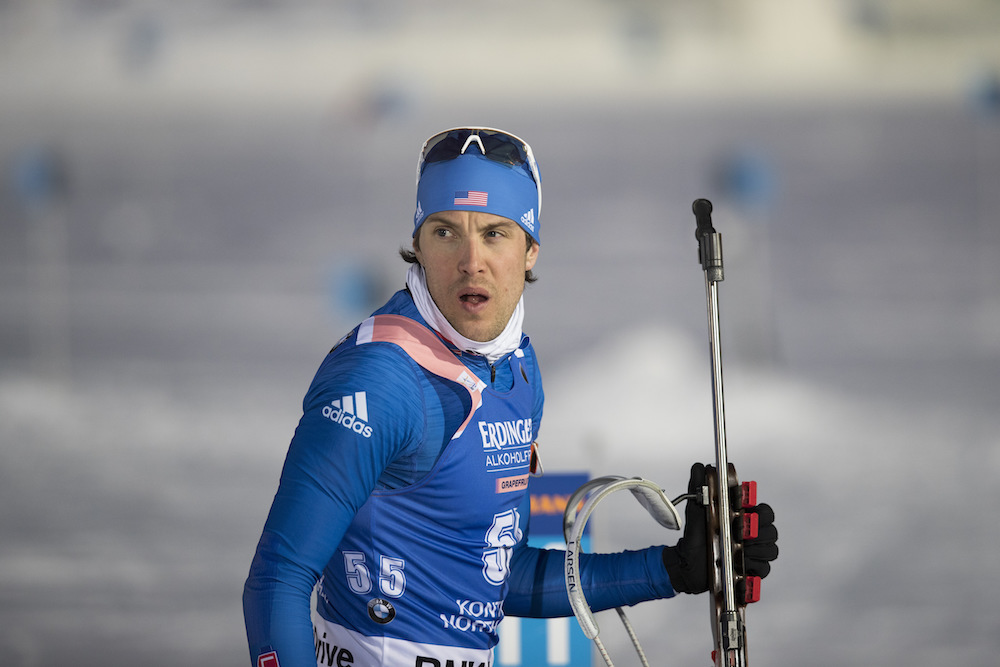
Leif Nordgren (US Biathlon) raced to 17th for his best result in three seasons on Thursday in the men’s 10 k sprint at the IBU World Cup in Kontiolahti, Finland. (Photo: USBA/NordicFocus)
His teammate Leif Nordgren finished just one place behind him in 17th (+49.9) for his best result in three years. A later starter in bib 55, Nordgren also cleaned prone and missed one standing (0+1) with the fifth-fastest shooting time and seventh-fastest range time. Overall, his course time ranked 28th out of 100 finishers. Nordgren’s individual career best on the World Cup is 16th in a sprint in February 2015. He has finished 17th three times; the last time was in a pursuit in March 2015.
Brendan Green shot clean to lead the Canadian team in 34th (+1:29.5). American Sean Doherty followed in 35th (+1:29.7) with three penalties (1+2), and Tim Burke placed 38th (+1:36.1) for the U.S., also with three misses (1+2).
In his World Cup debut, American Alex Howe finished 68th (+2:23.1) with two misses (1+1).
Canada’s Christian Gow finished 79th (+2:47.4) with two penalties (1+1), and Scott Gow was 86th (+3:01.7) with three misses (1+2).
This year’s Kontiolahti World Cup does not include a pursuit race. The women’s 7.5 k sprint is scheduled for Friday at 11:45 a.m. EST in Kontiolahti, and the single mixed relay and mixed relay will follow on Saturday. Racing in Kontiolahti will conclude with men’s and women’s mass starts.
Martin Fourcade waves the tricolore down the finishing straight as France claims gold in the biathlon mixed relay on Tuesday at the 2018 Olympics in PyeongChang, South Korea. (Photo: FlyingPointRoad)
PYEONGCHANG, South Korea — In its four-card-deep deck, the French biathlon team had an ace. Anchoring France’s 2 x 6 + 2 x 7.5-kilometer mixed relay was Martin Fourcade. The 29 year old had already taken two individual gold medals at these Winter Games. The final leg of Tuesday’s race presented the opportunity for another.
Coming through the last exchange, it was Germany’s Erik Lesser tagging off to Arnd Peiffer. Without Fourcade chasing them, Germany’s chances of a medal would have seemed certain.
Peiffer, who learned around 1 p.m. that afternoon that he would start the relay in place of Simon Schempp, who reportedly was feeling under the weather, was first into the range after one loop for his round of prone shooting. There, Peiffer missed two shots, but using two spares, hit the remaining two targets and stayed out of the penalty lap.
Then came Fourcade. The Frenchman shot clean. Skiing into the range with France was Norway’s Emil Hegle Svendsen and Italy’s Dominik Windisch. Svendsen and Windisch both used one spare each to clean and steer clear of the penalty lap as well.
Out on course, Peiffer had a 6.1-second buffer between himself and Fourcade. Windisch was the third racer to depart the range, 16.3 seconds out of first, and just 0.1 seconds behind him was Svendssen.
The 6.1 seconds separating the two frontrunners was soon down to zero. Fourcade attacked on the first uphill, passing the German and was the first into the range for the standing shooting — exactly the type of stage Fourcade craves.
Five days ago, Fourcade was in a similar situation. During the men’s 20 k individual race, he skied into the range for the final round of shooting with a comfortable lead. The almost-always clutch Frenchman missed the last two targets, losing the gold and finishing fifth on the day.
Martin Fourcade cleaning his final five targets of the day to secure gold for France in the mixed relay at the 2018 Olympics in PyeongChang, South Korea. (Photo: FlyingPointRoad)
During Tuesday’s mixed relay, Fourcade was on his A-game. Five pings heard throughout the stadium and five targets down. With his remaining 2.5 k to go, another medal for France and Fourcade was certain. Not long after, it became clear that medal would be gold.
Back in the range, Peiffer struggled, using three spares and having to ski a penalty loop. Meanwhile, Svendsen used one spare to clean and Windisch two. Svendsen slid into second place, 34.3 seconds behind an already long-gone Fourcade.
Windisch left about 15 seconds after the Svendsen. After emerging from the penalty lap, Peiffer skied up behind Windisch. In a moment of déjà vu, Fourcade carrying France’s fluttering flag crossed the finish line first in a time of 1:08:34.3 for the gold medal. Svendsen held his own with the third-fastest anchor lap to secure silver for Norway, 20.9 seconds behind Fourcade.
For Fourcade, it was his fifth gold medal in two Olympics and his first in a team event. France last won the mixed relay at the world-championships level at 2016 World Championships in Oslo, Norway.
Asked what it was like capturing his fifth Olympic gold, Fourcade responded at the press conference, “Tonight it’s not about numbers, it’s not about personal, it’s a team adventure that began in 2009 in the world champs in [PyeongChang] Korea, and tonight it’s a really big emotion for the team and all the crew because we are individual athletes and the emotion of an individual Olympic gold medal is amazing, but when you can share it with your teammates it’s something really much more incredible.”
“I think for the Norwegian team, we have a big priority on this relay,” Svendsen said at the press conference. “We really like it a lot, great to race both women and men together. You can see the best biathlon nations … so great event, it was very exciting.”
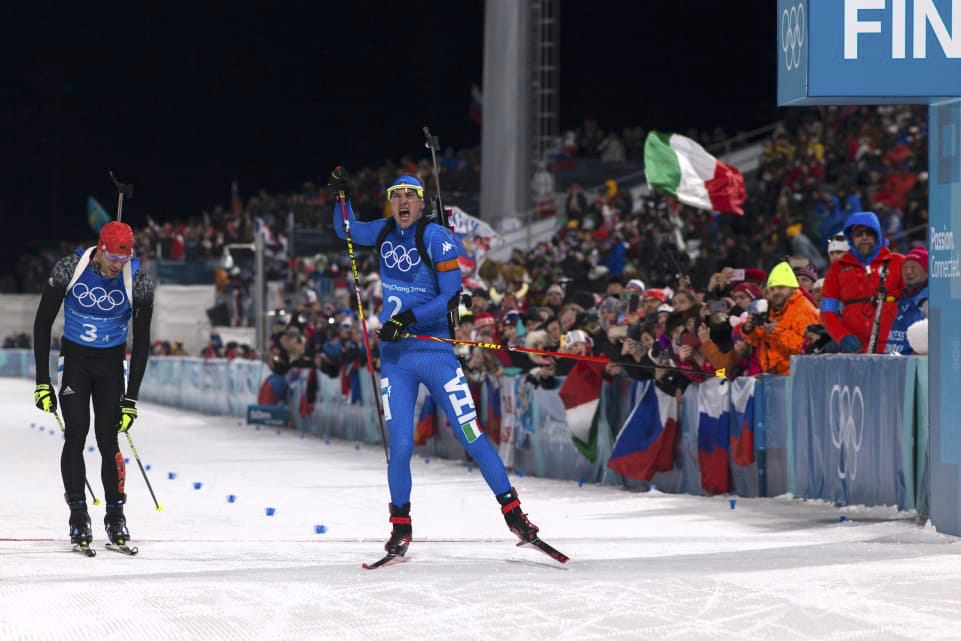
Italy’s Dominik Windisch (r) celebrates bronze for his team in the mixed relay, which he took by 0.3 seconds over Germany’s Arnd Peiffer (l) at the 2018 Olympics in PyeongChang, South Korea. (Photo: IBU/Biathlonworld)
The battle for third and fourth came down to a contentious last 100 meters.
As they rounded into the finishing straight, Peiffer was skiing in the left lane and Windisch in the right. In one final push to the line, Windisch crossed over into the Peiffer’s lane and took third place and bronze medal by 0.3 seconds ahead of him, 26.9 seconds after Fourcade.
Peiffer crossed in fourth place (+27.2) and Germany subsequently filed a protest that Windisch obstructed Peiffer. Ultimately, the protest was denied and the results stood.
Speaking to German broadcaster ARD after the race, Peiffer initially said Windisch’s move was within the rules. However, after viewing the replay, he changed his mind.
“I believe he [Windisch] would have beaten me if he’d just remained straight ahead in his corridor and not skied such a curve,” Peiffer later told ARD, according to a translation. “That’s what I also told him. I told him I congratulate him because I believe he was better today. I just did a poor job today, that’s how it even came to this situation…
Germany’s mixed relay anchor Arnd Peiffer during his last shooting stage on Tuesday, where he incurred a penalty and slipped out of gold-medal contention and ultimately finished fourth in the event at the 2018 Olympics in PyeongChang, South Korea. (Photo: FlyingPointRoad)
“I took another look at it now, and to me it’s a rule violation,” Peiffer added. “But from experience I know that the jury never makes any decision or generally denies appeals. Just because they don’t have the courage, I believe. I am sorry for the other three, because they did a great job. I don’t believe I would have deserved a medal today, but it’s always sad if rules get broken.”
During a post-race press conference, the issue of Italy’s move was raised again. One reporter directed a question at Windisch, asking about his thoughts on the filed complaint.
“It happened realy really fast because it come down from the downhill and I was convinced to do the right thing because I was in front of Peiffer,” Windisch said.“The jury had a long, long meeting to take this decision and they decided for us. I am really happy about this, so I think they had their reasons and I am happy for Italy.”
The same reporter posed the question to Fourcade, stating that the move seemed like one the Frenchman has done in the past.
“As Dominik Windisch told you it happened really fast in a situation we are not fully able to decide really quickly because we already have 7.5 kilometers in the legs,” Fourcade said. “When you are looking a the picture you can see it’s probably not the best decision Dominik took, but in the end it changes nothing because Dominik is stronger than Arnd in the sprint and he didn’t change anything with the final results. I think and I’m sure if it happened again he would choose another line.”
Italy’s Strong Start
Italy’s Lisa Vittozzi (2), alongside Germany’s Vanessa Heinz, leads the first leg of the 2 x 6 + 2 x 7.5 k mixed relay on Tuesday at the 2018 Olympics in PyeongChang, South Korea. She went on to hand off in first, and Italy ultimately earned bronze in the event. (Photo: FlyingPointRoad)
In the first leg of the race, Italy’s Lisa Vittozzi and Germany’s Vanessa Heinz tagged off in first and second, respectively, with Germany 2.2 seconds back at the exchange after both skiers shot clean without any spares. Vittozzi hanged off to Dorothea Wierer, while Heinz tagged Germany’s strongest leg Laura Dahlmeier, who took gold in the sprint and pursuit to start the Games and placed third in the 15 k individual.
Dahlmeier shot clean in the first prone and used one spare to clean standing, tagging Lesser in first, 29.9 seconds ahead of Italy, at the second exchange.
Norway’s Johannes Thingnes Bø racing the third leg of the mixed relay at the 2018 Olympics in PyeongChang, South Korea. After being tagged in 10th, he skied up to fourth at the last exchange, and Norway ultimately finished second. (Photo: FlyingPointRoad)
Norway’s ascent to second place involved a strong third leg from Johannes Thingnes Bø. Using just a single spare to clean his two stages (0+0, 0+1), Bø overcame two less-than-stellar legs from teammates Marte Olsbu (0+2, 0+1) and Tiril Eckhoff, who had a penalty (0+2, 1+3). When Eckhoff tagged Bø, he was in 10th, 1:24.4 minutes behind Germany in first. With the fastest third-leg course time, Bø handed off to Svendsen in fourth place, 33.1 seconds behind the Germans and half a second behind Italy.
Canada 12th, U.S. 15th
Canada finished the relay in 12th (+2:36.7) after skiing three places up from their bib number.
Rosanna Crawford skiing the first leg of Canada’s mixed relay at the 2018 Olympics in PyeongChang, South Korea. She tagged off in 11th and Canada went on to finish 12th. (Photo:FlyingPointRoad)
Rosanna Crawford skied the opening leg, using two spares, one each in prone and standing, to avoid the penalty lap.
“I tried to be super focused in prone,” she told FasterSkier after. “I went on to have one miss, that was just a bad trigger pull on my part. Skiing wasn’t great, but I just tried my best to stick with the women around me and give Julia the best chance I could.”
Crawford tagged teammate Julia Ransom in 11th, 34.7 seconds out of first. Ransom shot without a miss in prone and used two spares to clean standing. She maintained 11th while tagging Brendan Green 1:44.7 minutes behind the leaders.
After what Ransom considered a less-than-ideal personal start to the Olympics, she was pleased with how she felt racing on Tuesday.
“Today I felt like I could actually push a little harder and have fun racing,” she said.
Canada’s Brendan Green racing the third leg of the mixed relay at the 2018 Olympics in PyeongChang, South Korea. (Photo: FlyingPointRoad)
Green used three spares in total (0+1, 0+2) but remained clear of the penalty lap. He came through the last exchange in 14th, 2:27.9 out of first.
“I thought the wind would make it a little bit challenging today,” Green said after finishing his leg, with Canada’s fourth-leg skier, Christian Gow, still on course. “It was up a bit from the other days, [but] thankfully it was fairly consistent. This won’t be the result we are hoping for but it’s a good primer for the men’s and women’s relays later this week and so looking forward to that.”
In his first mixed relay and first time anchoring a championship relay, Christian Gow headed out on the final leg to pick off some places.
Canada’s Christian Gow racing to 26th in the men’s 20 k individual for his best non-relay result at his first Olympics in PyeongChang, South Korea. (Photo: FlyingPointRoad)
“I knew there would be a bit more pressure depending on the position that we were in when I got tagged because all the teams were putting their strongest guys last,” Gow said after. “It’s some pretty big names when you’re looking at the list. You’re like, ‘OK, there are some of my idols,’ so there’s a bit more pressure there, but I have been feeling pretty good.”
The 24-year-old Gow shot clean and then used two spares in standing, racing the ninth-fastest last leg to put Canada in 12th at the finish (+2:36.7).
“I think Nathan [Smith] one time told me you can’t idolize your competition, which is very true,” Gow said of his teammate and fellow Olympian. “I think I get a little better at that every year, believing in myself a little more and not looking at the big names I’m racing as untouchable or anything like that. I am especially happy with how I have been doing that this year. You try to handle it just like any other race and it doesn’t matter who the guy is next to you, it’s what you do in the race to beat them.”
Julia Ransom racing the second leg for Canada in the mixed relay at the 2018 Olympics. She kept the team in 11th and they went on to place 12th. (Photo: FlyingPointRoad)
Four years ago at the Olympics in Sochi, Russia, the Canadian mixed relay finished 11th. As the race was still going on Tuesday, Crawford said a top eight would be a good result and top six would be “the dream result.”
Despite their goals, Ransom, a first-time Olympian, said they hadn’t felt any added pressure coming into the mixed relay.
“… Everybody on the team knows that we’re all trying our best and are gonna bring our best to the day,” Ransom, 25, said of the team’s effort on any given relay day. “It’s an unsaid sort of encouragement, I guess.”
For the U.S., Susan Dunklee skied a strong first leg, putting the team in fifth at the first exchange, 23.8 seconds out of first. She used two spares to clean prone and hit every target in standing (0+2, 0+0).
Susan Dunklee (center, in all blue) leading out for the U.S team in the first leg of mixed relay at the 2018 Olympics in PyeongChang, South Korea. She handed off in fifth and the team ultimately finished 15th. (Photo: FlyingPointRoad)
“I definitely felt better today than I did in the individual,” Dunklee said, referring to the 15 k race where she placed 19th. “I was closing on the lead group for the first kilometer or so and then by the top of the big hill, I kind of ran out of steam a little bit and was just trying to get into the finish.”
After being tagged in fifth, right behind the Czech Republic* in fourth, Joanne Reid hung in contention in sixth after cleaning prone without any spares. But in standing, she missed all five targets and used all three spares, ultimately having to ski three penalty laps. She went on to tag Tim Burke in 18th, 3:10 minutes back.
“It went poorly,” Ransom said after. “… The best I could do was just try and stick on and hand over with something they could work with, and that didn’t really work out for me today.”
“I guess the strategy was once I got tagged try to make some time, try to get in contact with at least one other team so that Lowell could have someone to chase,” Burke said.
Tim Burke racing the third leg of the U.S. mixed relay at the 2018 Olympics in PyeongChang, South Korea. After being tagged in 18th, he moved the team into 16th and they ultimately finished 15th. (Photo: FlyignPointRoad)
Burke in fact caught two other teams, shooting without a miss in prone and using three spares to clean standing (0+0, 0+3), and tagging teammate Lowell Bailey in 16th (+3:24.4).
The U.S. anchor leg, Bailey used one spare in prone and none in standing (0+1, 0+0). He skied the seventh-fastest anchor leg and finished the race in 15th (+3:31.1) out of 20 teams.
“We actually had decent performances, it was really just one bad stage,” Bailey said. “Joanne had a good race otherwise and Susan had a great start, Tim had a solid race, I feel good about my race, so unfortunately, it’s eight stages not seven, but I think everyone gave everything they had and that’s the way biathlon goes. Some days go your way and some days don’t.”
Olympic biathlon racing continues Thursday with the women’s 4 x 6 k relay.
*Note: After her race, Dunklee told reporters about her collision with the Czech Republic’s Veronika Vítková as the two first-leg skiers came through the exchange with several others. The crash broke Vítková’s rifle right after she tagged off in fourth, just ahead of Dunklee.
“I feel really bad,” Dunklee said. “I tangled with [Vítková] in the tag-off zone and she tripped and broke her rifle and that just puts a real damper on everything. So that’s sad. … It doesn’t affect her race today, but it certainly affects her races going forward. Stocks are highly customized pieces of equipment and you can spend months tinkering with them to get them to fit you just right, so it’s not easy to fix them when they break.”
The Czech team went on to finish eighth (+1:39.3).
Germany’s Arnd Peiffer (front) on his way to winning the men’s 10 k sprint at the Alpensia Biathlon Center on Sunday at the 2018 Olympics in PyeongChang, South Korea. The German was one of just four men to shoot clean in windy conditions. (Photo: FlyingPointRoad)
Arnd Peiffer’s race day before the men’s 10-kilometer sprint at the 2018 Olympic Winter Games in PyeongChang began anything but ideal, not giving any indication that it would end as one of the luckiest days in the athletic career of the German, standing at the top of the podium and flanked by Michal Krčmář of the Czech Republic in second and Italy’s Dominik Windisch in third place.
“Shortly before ski testing, the bolt on my rifle broke. Then I slipped outside the wax cabin [on a flight of stairs] and badly bruised my elbow,” Peiffer told German broadcaster ARD about a series of mishaps that also included a cut to his hand, a forgotten key for his rifle storage locker and a poor warmup. “Somehow nothing was really working as planned, but then in the race everything did.”
About an hour before the race during dry firing target practice (without loaded ammunition clips), the bolt on Peiffer’s rifle that triggers the shots just snapped. On short notice the weapon had to be disassembled and the bolt replaced with the help of men’s head coach Mark Kirchner (a successful biathlete himself with a gold medal in the sprint and two in relays at the 1992 and 1994 Olympics), a problem that according to Peiffer “happens about once every six months to a year… That’s not so bad, but something you don’t really want to occur right before a race”.
“I am generally not superstitious at all,” Peiffer recounted during an interview with ARD in the Olympic broadcasting center late Sunday night. “But Mark told me, ’22 is a good bib number, I once became world champion with that… And [teammate Erik Lesser] also had a broken bolt before the individual race at the [2014] Olympics in Sochi when he shot clean four times and won silver, that was surely a good omen.’ I was like, yeah, that won’t help me today either.”
Yet after he had started his race, Peiffer was indeed the lucky one, hitting 10-for-10 shots in every bit as difficult wind conditions as the day before during the women’s sprint when his teammate Laura Dahlmeier won gold, while the presumed favorites such as France’s Martin Fourcade and Norway’s Johannes Thingnes Bø missed too many targets to contend for the medals.
In his prone shooting, Peiffer reacted correctly to a strong gust of wind from the left side of the range, adjusting his sights with several clicks on his rifle. Then in the standing shooting he took advantage of manageable conditions to shoot in rhythm and again remained clean. On the final loop he skied the 10th-fastest time (18th overall), crossing the line in a time of 23:38.8 minutes. That mark would not be beaten anymore by the 65 athletes starting behind him.
“I have waited a long time for this individual medal,” he said during his in-studio interview with ARD. “I won one in 2011 [at IBU World Championships] and since then had a few chances that I didn’t take advantage of, and sometimes didn’t have any chance at all. So that it worked out today, with a pretty mediocre course time, is a gift that I am very grateful for.”
It was Peiffer’s first individual medal at Olympics, following a silver medal in the men’s relay in Sochi and no podium in Vancouver in 2010. Most of the World Cup successes for the 30-year-old biathlete have been in sprints, and he won the title in this discipline at the 2011 World Championships in Khanty Mansiysk, Russia. His first World Championship medals also came in PyeongChang, back in 2009, when he took bronze with the relay and mixed relay, which he fondly remembered.
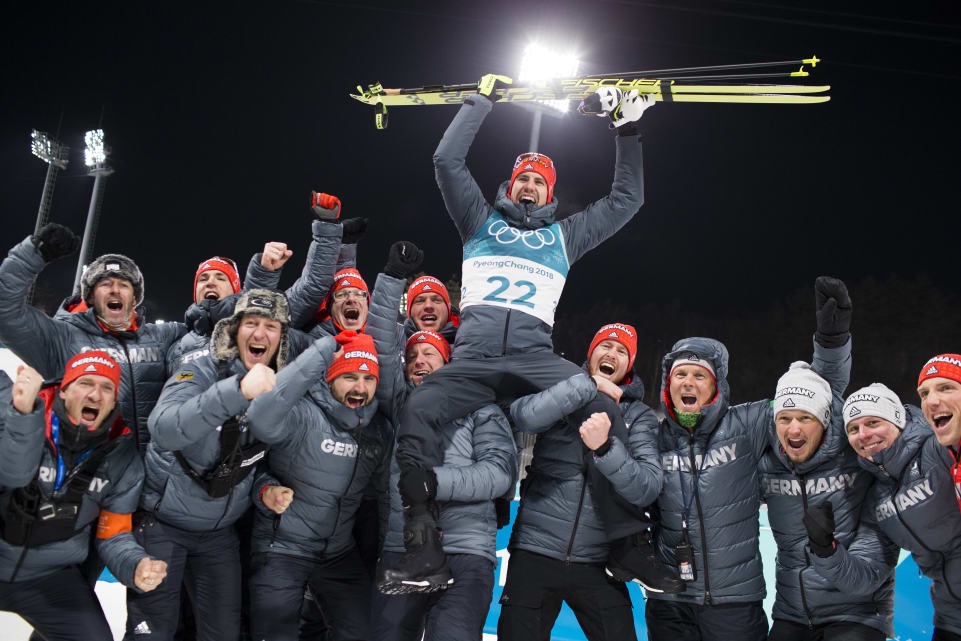
Germany’s Arnd Peiffer is hoisted up by his coaches, staff and teammates, celebrating his victory in the men’s 10-kilometer sprint on Sunday at the 2018 Olympic Winter Games in PyeongChang, South Korea. (Photo: IBU/Biathlonworld.com)
“I am honestly completely surprised that my result was so amazing, that I am standing at the very top,” he had told ARD right after the race. “I am just happy about my performance, because in Vancouver and Sochi I twice had a bad sprint [finishing outside the top 30]… So for today I just was determined to have a good one, have a good shooting performance, and if it had been a sixth place I’d also have been happy.”
The silver medal in Sunday’s sprint went to Krčmář, who also hit 10-for-10 and finished 4.4 seconds shy of Peiffer’s time. Starting behind Peiffer in the middle of the field, that clean shooting performance opened a window of opportunity to wedge himself between the times set by Peiffer and Windisch, who ultimately placed third (+7.7) with one penalty.
“For me, it was very hard in the last loop,” Krčmář said at the post-race press conference. “I [had no] power in last loop and my teammate on the track said to me, ‘You are five seconds behind Arnd’. I do maximum [went as hard I could], but Arnd [was really] better today.”
He made up 2.4 seconds on that final loop, but could not catch up to Peiffer’s time. It was the first sprint podium for the 27-year-old Krčmář at the World Cup or championships level, and at these Olympics it came just at the right moment.
“It’s true, for me a big, big medal. First in career,” Krčmář said. “It’s for me [a] very surprising day because I [felt bad] in the training here. My shooting in training [was] not so good. And now, zero-zero. I am lucky man today because I [had] very good condition in standing shooting and on the track.”
Windisch missed one target in his standing bout, and came back on the course 12.2 seconds behind Peiffer’s time and 5.4 seconds behind Krčmář. He narrowed that gap on the final loop, but it wasn’t enough to catch either one.
“The wind was not easy because it continued to change … but maybe it was the best for me because I had something to think about and to be concentrated on my work,” Windisch said at the press conference. “I didn’t think about results, and maybe that was my secret today.”
For Windisch, 28, it was the second Olympic medal of his career after he held Italy to bronze in the mixed relay in Sochi four years ago.
“The relay is always a tough race because you are racing also for your friends or for three other persons. Maybe it’s more pressure there,” Windisch said when asked to compare the two achievements. “But to win an individual medal [means] a little more because it’s really hard to reach it, because there are so many different good athletes. I think the emotions are really big. But also [for the] relay the emotions are maybe bigger because the whole team celebrates the medal.”
Down On Their Luck
Having started in bib 5, Austria’s Julian Eberhard led the race early on until Peiffer beat his time, and in the end he just missed a medal by 0.7 seconds when Windisch bumped him off the podium to fourth place (+8.4, with one penalty).
During the race, Eberhard, who has three World Cup victories to his name, broke a pole on the loop after prone shooting and had to ski about 300 meters before receiving a spare. But he couldn’t explain why he lost time on the final downhill before the finish.
“I definitely started today with the goal to get the victory. I did my job, and it was very close. Only eight seconds are missing, so of course this is very bitter now,” Eberhard told Austrian broadcaster ORF, according to a translation. “Especially considering that before the downhill 500 meters before the finish I was clearly in second place … Those are the little details that have to work out for a gold medal.”
Norway’s Erlend Bjøntegaard led the race after the prone stage with his time and in the end finished fifth (+17.4), also just missing the podium after he missed two targets in his standing stage (0+2). He had been selected as the final athlete on the Norwegian men’s Olympic roster, effectively replacing biathlon legend Ole Einar Bjørndalen, a decision debated controversially in his home country. But on Sunday, Bjøntegaard, 27, justified his start.
“It feels incredibly strange when you put it that way,” Bjøntegaard told Norwegian broadcaster NRK when told he might have been one miss away from the podium, according to a translation. “It slowly dawns on me that I was so close to an Olympic medal and the gold. There is a lot of buzzing in my head. I’m happy, but also a little disappointed and mad at myself. It’s strange to look at the results list. Very strange. I’m struggling to take it in, but it’s slowly coming to me that I was so close.”
A number of athletes could have echoed same feeling, including three of Peiffer’s teammates.
Benedikt Doll, the defending sprint world champion, placed sixth (+17.6) after missing his final shot. Mass-start world champion Simon Schempp came almost as close in seventh (+21.4, with one penalty), and Erik Lesser, whose past rifle troubles had served as a positive example for Peiffer, was not far behind in 11th place (+31.9, also missing his final shot), despite starting the race with a bruised ribcage.
“I am rooming with Arnd and lost our team-internal duel. So that totally annoys me,” Lesser jokingly told ARD.
“I think that is the hallmark of our men’s team. Today I was the lucky one who got through. From my point of view, it could have been any one of the other three as well. I am not just saying that, I truly believe that,” Peiffer told ARD.
“I will definitely drink a small beer with my coaches, wax techs and teammates, I won’t let myself be denied of that,” he added with a laugh, although it was already past midnight local time. “And then I’ll be looking forward to [the pursuit], because now the pressure is gone. We have a great starting position, the others also did a great race even if that won’t be at the center of attention now. We can be really proud of that.”
As for the presumed “Big Two” race favorites who have dominated the International Biathlon Union (IBU) World Cup this season, with France’s Fourcade standing on the podium in every individual race he started and Norway’s Johannes Bø having won eight races including three sprints, on Sunday they looked like mere mortals for once.
While Peiffer was approaching the finishing stretch, Fourcade, who had started in a later group in bib 54, missed three prone shots. He came out of the penalty lap with a split time that ranked 56th overall. That setback would have taken just about any other athlete completely out of contention, but with a clean standing shooting and the fastest overall course time of the day, Fourcade limited the damage and rose to eighth at the finish (+22.1).
Bø, currently ranked second behind Fourcade in the World Cup Total Score, also missed three shots in prone and another one in standing (3+1), crossing the line 1:12.7 back in 31st.
Their uncharacteristic days left openings and opportunities for the three podium finishers.
“I think on these conditions, it’s possible for everything and nothing, so today it was our lucky day and maybe not the day for Bø and Fourcade,” Windisch said at the press conference. “It was really difficult to shoot, and I think they will have many other chances at these Olympic Winter Games and they will be here [at the press conference] the next time.”
“I don’t know how this could happen,” Peiffer said at the press conference, still a bit incredulous about the outcome. “The other two [Fourcade and J.T. Bø] were dominating the season in ski times and on the range, so I didn’t expect that anyone would be in front of them, for sure not me.”
Four North Americans Qualify for Pursuit
American Lowell Bailey racing to 33rd in the first men’s race of the 2018 Olympics, the 10 k sprint, on Sunday in PyeongChang, South Korea. (Photo: FlyingPointRoad)
The best North American in the difficult conditions was US Biathlon’s 2017 individual-discipline world champion Lowell Bailey, who began his race by cleaning all his prone targets, leaving the range with a split time that ranked him in eighth overall.
Then Bailey was shown on the international broadcast as one of the last remaining podium contenders still out on the course when he came into the range again for his standing shooting, in which he missed the fourth shot and thus had to ski through the 150-meter penalty lap.
That set him back to 24th place, and after losing about 30 more seconds on the final loop he crossed the line 1:15.6 out of first in 33rd.
“I had a good performance on the range, I was happy with the shooting but, unfortunately, I just didn’t have it in the legs,” Bailey said, according to a US Biathlon press release. “I just haven’t had the ski shape that I had last year. I haven’t gotten the speed going this year and that’s the way biathlon is. It wasn’t a bad race. I had a really good first lap, I just didn’t have it on the second and third laps. With any luck I’ll feel better and better as the Games go on.”
Tim Burke (US Biathlon) en route to 47th in the men’s 10 k sprint at the 2018 Olympics in PyeongChang, South Korea. (Photo: FlyingPointRoad)
His teammate Tim Burke finished 47th (+1:47.5) with four penalties (2+2).
“Physically I felt descent. It wasn’t a bad start,” Burke told FasterSkier after the race. “Shooting was tough. I had four penalties. It was real tricky today; it’s a bit of a lottery and that’s the way it goes. … I thought I had similar wind [to zeroing] when I was shooting prone, but what makes it really tough here is it switches literally from one shot to the next. I am really curious to talk to the coaches and see where I was at because I felt totally fine and normally I don’t miss all these shots.”
“It’s a tough course because you have longer climbs,” he said of the course at the Alpensia Biathlon Center, after skiing the 28th-ranked time of the day. “A lot of biathlon courses today, the climbs are only 30 seconds long before you get a break and here you have a couple climbs that are significantly longer than that, so that suits me well.”
Leif Nordgren (US Biathlon) en route to 58th in the men’s 10 k sprint at the 2018 Olympics in PyeongChang, South Korea. (Photo: FlyingPointRoad)
Leif Nordgren will join them in Monday’s pursuit after finishing 58th (+2:10.2) with a missed shot in each of his shooting stages (1+1).
“I’m satisfied that I made the pursuit and there’s another [race] day tomorrow, but yeah, the shooting was quite tough today and the wind,” Nordgren said after. “I made two mistakes and that was too much to have a great race today.”
Asked about the challenging conditions, he added:
“The wind was obviously number one, but actually the cold is another thing. If your hands ever get cold, it impacts the shooting tremendously. If you pause just for a second to even think about how cold your hands are that can throw off the shooting right away. So little things like that. It doesn’t take much to really lose that focus.”
Sean Doherty (US Biathlon) racing to 65th in the men’s 10 k sprint at the 2018 Olympics in PyeongChang, South Korea. (Photo: FlyingPointRoad)
The fourth American starter Sean Doherty missed four of his five prone targets, having to shoot about in the middle of the lane positions on the wind-exposed range. The penalties set him back almost 2 minutes, and even a clean standing shooting was not enough to overcome that deficit. He ultimately finished 65th (+2:16.4, 4+0), only about 2.5 seconds out of the top 60 needed to qualify for the pursuit.
“The wind today is very highly variable and I really thought I had a handle on it in zero [target practice],” Doherty said after. “I had a good zero, I had a good shooting warm up. I had pretty good confidence in what I am doing with things. I came in and I thought I had it under control and obviously something is off. … When I came in I did not assess the wind to be that severe, I guess I didn’t give it enough credit. … But everything else went well. The skiing feels strong. Standing shooting was fine.”
Doherty skied the 48th-ranked course time for the day.
“The course is skiing well,” he said. “It’s very fast and firm and this is a good hard course. … I am happy with the skiing, I felt fairly energetic and I am pretty encouraged with that, but it’s just the range. You leave a lot out there when you miss four.”
The Canadians also struggled with the windy conditions and demanding course.
Nathan Smith was able to cope best, shooting clean in prone before having to ski one penalty lap in his standing bout (0+1) to finish 44th (+1:43.5).
“I was happy with my shooting,” Smith said of his race. “Nine out of ten so that’s good for the windy conditions. … My shooting has been really good this year. Whenever I race I’m probably like 90 percent average or something. I usually shoot pretty quick and this year I haven’t been afraid to slow down when I need to be to hit those targets.”
On the course Smith only skied the 77th-ranked time of 87 starters, after he missed every World Cup race since the sprint in Annecy, France, before Christmas.
“Skiing was hard,” Smith said. “I haven’t raced for two months so it’s hard to jump into the top level of racing when you have just kind of been racing by yourself for a bit after getting sick … When you’re not feeling tip top, I think the biggest difference is when you’re going over hills and stuff, you’re tired and you’re just like, ‘Oh yeah, I’m getting to a downhill,’ and you can’t really push hard through all those transitions.”
Unfortunately he was Biathlon Canada’s only team member to qualify for the pursuit, while others missed the top 60 by mere fractions of a second.
Scott Gow missed four shots in his prone stage before cleaning all targets in standing (4+0), finishing 2:14.0 back in 61st place. That was just 0.1 seconds behind Romania’s Cornel Puchianu, who had incurred just one penalty, and finished 60th.
Gow told FasterSkier he took special care to bundle up before the race to keep warm fingers and a feeling for the trigger, but when he reached the prone stage, the wind had changed directions from the zeroing target practice, posing yet another problem.
“I had a fairly consistent wind from the left I would say, then when I came in to shoot in the race, it had switched directions,” Gow said. “So I thought I had accounted for it and I could hear that I was actually, we call it splitting, but hitting like half the target there and I didn’t want to chance making an overcorrection. So it was disappointing. I think luck-of-draw type of thing. It was too bad.”
The four penalty laps set him back two minutes and all the way to 84th place at the split time, and despite hitting all his targets in the following standing stage, Gow couldn’t quite make up that deficit.
On the course he skied the 46th-ranked time of the day overall and the 29th-ranked final loop.
“It’s a really hard course,” Gow said. “It’s basically three big hills with a couple downhills in-between. There’s no transitional areas, there’s no flatter spots. So it feels like you’re always grinding up a hill just to go back down and have to go up it again. … I felt like I could go a little harder on the first two-thirds of the course, and then just make sure I drop back a little bit on the last climb before you come back into the stadium just for the shooting sake. Then also with the wind, especially the headwind, to try and ski behind people if possible to get a good draft. … Overall I would say I did a fairly solid job with my race plan.”
Christian Gow (Biathlon Canada) racing to 62nd in the men’s 10 k sprint at the 2018 Olympics in PyeongChang, South Korea. (Photo: FlyingPointRoad)
His brother Christian Gow was just behind him in 62nd, 2:14.7 back with three penalties (2+1). Thus he also was less than a second out of the top 60.
“The conditions are tough today,” Christian said after. “It’s windy. It’s not nearly as bad as it was this afternoon, that was crazy. But regardless, it’s changing a lot, which I think is the hardest thing.”
“I corrected in prone and so I have to talk to the coaches and see if it was me or if I missed the correction, where those misses were,” he said of his shooting performance. “Then standing I think was a bit more my fault than anything. Shooting on lane 30 here, it’s quite sheltered. It blocks most of the wind, so it was pretty calm when I shot there and I still came away with a miss.”
Christian skied the 61st-ranked course time, acknowledging that he was impacted by the cold temperatures and wind.
“Today I felt a bit heavier than I would have liked to on the track,” he said of his skiing. “It’s a tough course for sure, really big climbs in it, and you’ve got to manage your energy so that you can do them time and again. … The wind, absolutely you get thrown around by it, but I kind of figure that everyone is getting some of that at some point.”
Brendan Green (Biathlon Canada) en route to 82nd in the men’s 10 k sprint at the 2018 Olympics in PyeongChang, South Korea. (Photo: FlyingPointRoad)
The fourth Canadian starter Brendan Green cleaned prone and was also shown on the international broadcast as a potential late contender when he came into the range for his standing shooting. But with strong wind he then missed three shots, ultimately finishing the race in 82nd place (+3:09.2, 0+3).
“It was a tough day,” Green said. “The conditions were obviously very challenging. But on a day like today that … opens up the door a bit, there’s a good opportunity, but I just was not able to put together a solid performance today. … Standing I just had a lot of gusts, just couldn’t quite overcome the wind for standing.”
“It’s a very challenging course,” he said of the conditions. “The cold weather and the wind. The snow is very dry and very slow, kind of like a sandpaper feel to it. But hopefully the weather starts to cooperate and things start to warm up a bit and the wind drops.”
The biathlon competitions in PyeongChang continue Monday with pursuits for the women at 7:10 p.m. local time (5:10 a.m. EST) and men at 9 p.m (7 a.m. EST). The times back to the winner from the sprint carry over into the pursuit race.
Norway’s Simen Hegstad Krüger celebrates after winning gold in the men’s 30 k skiathlon on Sunday at the 2018 Olympics in PyeongChang, South Korea. (Photo: FlyingPointRoad)
It was an improbable move: Norway’s Simen Hegsted Krüger attacked a few kilometers from the finish of the men’s 30 k skiathlon, and the rest of the field let him go. Krüger didn’t let up and at one point had a lead of 25 seconds with just about two kilometers to go, all the more impressive because he had crashed just meters into the race and broken a pole, having to then make up 35 to 40 seconds to get back to the lead pack.
Norwegian teammates Martin Johnsrud Sundby and Hans Christer Holund tried to close the gap to Krüger in the final kilometer, but the 24 year old hung on for a 8-second win. Sundby was second and Holund was third (+9.0) to give Norway a medal sweep.
Denis Spitsov of the Olympic Athletes of Russia, also in his first Olympics, finished fourth, 12.7 seconds back. Maurice Manificat of France was fifth (+14.2), Dario Cologna of Switzerland sixth (+25.1), Andrew Musgrave of Great Britain seventh (+25.7), and Alex Harvey of Canada edged Martin Jaks of the Czech Republic for eighth (+33.4 and +33.8, respectively). Johannes Høsflot Klæbo of Norway, one of the pre-race favorites, finished 10th (+43.4).
For the U.S., Scott Patterson led the way in 18th (+1:07.5). Erik Bjornsen finished 42th (+4:34.7), Paddy Caldwell 51st (+6:58.1), and Noah Hoffman 54th (+7:08.7).
After Harvey’s top-10 finish, the next Canadian across the line was Devon Kershaw in 36th (+3:35.3). GraemeKillick finished 45th (+5:19.6), and Knute Johnsgaard was lapped and did not finish.
University of Utah alum Snorri Einarsson finished 56th (+7:13.9) in Iceland’s best result in Olympic cross-country skiing since 1994.
Arnd Peiffer on his way to winning the 10 k sprint at Alpensia Biathlon Center today. The German was one of just four men to shoot clean in windy conditions. (Photo: FlyingPointRoad)
With the race favorites each picking up a bevy of penalties, Germany’s Arnd Peiffer skated to a gold medal in the men’s 10 k sprint on Sunday. Both he and silver medalist Michal Krčmář of the Czech Republic shot clean, and were two of only four men in the field to do so. With that performance, Peiffer — whose lone senior Championship-level individual medal came when he won the World Championships sprint back in 2011 — made Germany two-for-two in biathlon races so far after Laura Dahlmeier’s win in the women’s sprint on Saturday.
The top of the results sheet was tight, with Krčmář finishing just 4.4 seconds slower than Peiffer. Krčmář only has one World Cup podium to his name, coming last season. Dominik Windisch of Italy finished with the bronze medal (+7.7) despite one missed shot, and edged out Austria’s Julian Eberhard (+8.4) seconds, who also had one penalty.
Erlend Bjøntegaard of Norway was fifth (+17.4) with two penalties, and Benedikt Doll (+17.6) and Simon Schempp (+21.4) gave Germany an impressive three spots in the top seven.
Those pre-race favorites? Martin Fourcade of France missed three shots in prone and despite cleaning standing, couldn’t make up enough time on the final loop for a top result. He finished eighth, +22.1. Johannes Thingnes Bø of Norway missed three shots in prone and then another in standing, finishing 31st, +1:12.7.
For the U.S., Lowell Bailey cleaned prone and then collected one penalty in standing to end the day 33rd (+1:15.6). Tim Burke had four penalties to land 47th (+1:47.5), and Leif Nordgren will join them in Monday’s pursuit after finishing 58th (+2:10.2) with two missed shots. Sean Doherty missed four of his five prone targets and was unable to come back from that blow, finishing 65th (+2:16.4).
The Canadians also suffered shooting woes. with Nathan Smith able to limit the losses to one penalty and finish 44th (+1:43.5). He is the only team member to make the pursuit. Brothers Scott and Christian Gow missed four and three shots, respectively, to earn the unlucky honor of being the first two men outside the pursuit cutoff in 61st (+2:14.0) and 62nd (+2:14.7). Brendan Green cleaned prone but then missed three shots in standing to finish 82nd (+3:09.2).
The women’s 10 pursuit and men’s 12.5 k pursuit are set for Monday at 5:10 a.m. and 7 a.m. Eastern Standard Time.
The Norwegian men’s relay after winning the 4 x 7.5 k on Friday at the IBU World Cup in Ruhpolding, Germany, with Lars Helge Birkeland (l), Tarjei Bø (far r), Emil Hegle Svendsen (second from r), and Johannes Thingnes Bø (second from l). It was their second win of the season (after winning with Ole Einar Bjørndalen, Henrik L’Abée-Lund, and Erlend Bjøntegaard, and Birkeland in the first men’s relay of the 2017/2018 season in Hochfilzen, Austria. (Photo: IBU/Biathlonworld)
IBU World Cup (Ruhpolding, Germany): Men’s 4 x 7.5 k relay
Less than a week after Sweden won the men’s 4 x 7.5-kilometer relay in Oberhof, Germany, with an up-and-coming group, Norway posted its second win (in three relays) this season, with an all-star lineup on Friday in Ruhpolding, Germany.
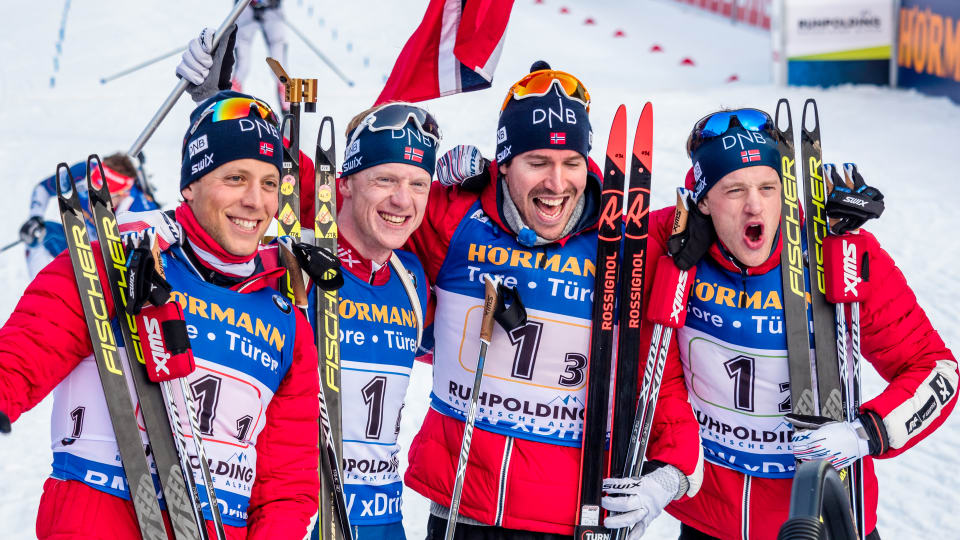
Lars Helge Birkeland, Tarjei Bø, Emil Hegle Svendsen, and Johannes Thingnes Bø took the lead during Johannes Bø’s anchor leg and ultimately the win in 1:13:11.1 hours, 24.9 seconds ahead of France in second and 53.4 seconds ahead of Russia in third.
On a bluebird day with no wind in the range, according to an International Biathlon Union (IBU) press release, the Norwegians avoided the penalty lap and used seven spares to clean. First-leg skier Birkeland put them in second with near-perfect shooting (0+0, 0+1), just 0.4 seconds behind Germany’s Erik Lesser, who cleaned without any spares, in first. (Birkeland was also on the Norwegian team that won the first relay of the season in Hochfilzen, Austria.)
Norway remained in second during Tarjei Bø’s second leg, in which he had to use three spares to clean prone (0+3, 0+0). He tagged Svendsen in second, 0.6 seconds behind Italy, which had risen to first thanks to Lukas Hofer’s fast skiing and solid shooting (0+0, 0+2).
Svendsen slipped slightly to third place by the final exchange despite only needing one spare to clean (0+0, 0+1), but was still just a second out of first at the tag. France had moved into first place with a predictably strong third leg from Martin Fourcade (0+0, 0+0), in which he brought the team from seventh to first place, just ahead of Italy’s Dominik Windisch and Norway’s Svendsen.
Johannes Bø skied the third-fastest anchor leg and cleaned prone and used two spares in standing (0+0, 0+2) to overtake France’s Antonin Guigonnat and Italy’s Thierry Chenal, who slipped to second and seventh, respectively, by the finish.
Guigonnat shot well, requiring just one spare (0+1, 0+0), but finished nearly 25 seconds after Bø for second place. Russia reached the podium with Anton Shipulin picking off two places, after being tagged in fifth.
In all, France had zero penalties and six spares, with Simon Desthieux, Quentin Fillon Maillet, Fourcade, and Guigonnat, and Russia used a total of just four spares and had no penalties with Alexey Volkov, Maxim Tsvetkov, Anton Babikov, and Shipulin.
Germany finished fourth (+1:26.5) with zero penalties and 10 spares, with Lesser, Benedikt Doll, Arnd Peiffer and Simon Schempp. After Doll dropped to fifth on the second leg, they skied in fourth on the last two legs.
Austria took fifth (+1:39.8) with zero penalties and six spares, with David Komatz, Simon Eder, Daniel Mesotitsch, and Dominik Landertinger. Sweden followed in sixth (+1:50.6) with zero penalties, six spares and three of the same men who won last Sunday’s relay (Sebastian Samuelsson, Martin Ponsiluoma and Fredrik Lindström) with new member Torstein Stenersen. Italy finished seventh (+1:58.5) with one penalty and 11 spares.
Of 26 teams in the relay, Canada placed 14th (+3:22.3) with one penalty and 10 spares, and the U.S. finished 24th (+16:21.6) with eight penalties (four of which stemmed from cross-firing) and 13 spares.
Notably, the U.S. had been fourth and just 3 seconds out of first after Lowell Bailey’s first leg, which he cleaned without any spares (0+0, 0+0). Leif Nordgren then dropped to 22nd with a penalty in each of his shooting stages (1+3, 1+3) and the 25th-ranked second-leg time. Tim Burke as the team’s third leg had to ski two penalty laps as well (0+2, 2+3), and anchor Sean Doherty was penalized for cross-firing in his last standing stage (0+1, 4+1), according to a US Biathlon press release, and the team was hit with four additional penalties.
“We have a solid team and I know we didn’t show our true potential today,” Bailey said, according to the release. “But the most important relay is still to come. We’ll just have to wait until then.”
“I was happy to put together a good race on the track and in the range,” he said. “The first lap was a bit of a roller derby with no easy way to get to the front. I was fortunate to clean without extra rounds because this allowed me to leapfrog up to the lead pack exiting the range. I tried to keep an even pace for loop two and I thought I would be able to hang in second or third, but no one wanted to pass so I had to lead for most of the loop.
“I had struggled in standing in the previous race so I wanted to get back to taking good shots in standing,” he added. “Although I didn’t shoot as quickly as some of the other guys, I felt good about the stage and the fact that I didn’t have to use extras. It was a fight to catch the lead group on the last loop, but fortunately I had some help from [Italy’s Thomas] Bormolini (of Italy) and we worked together to get back in contact with the lead group.”
Canada finished 14th with Christian Gow, Scott Gow, Macx Davies, and Brendan Green. On the opening leg, Christian Gow put them in 11th with clean prone shooting and just one spare needed to clean standing (0+0, 0+1), but they slipped one spot to 12th with a penalty on Scott Gow’s second leg (0+0, 1+3). Davies then dropped two more places to 14th despite avoiding the penalty lap (0+3, 0+1), and Green held that position to the finish (0+1, 0+1).
The women’s 4 x 6 k relay will be held Saturday in Ruhpolding, with Canada starting Emma Lunder, Julia Ransom, Sarah Beaudry, and Rosanna Crawford. For the U.S., it will be Susan Dunklee, Clare Egan, Emily Dreissigacker, and Joanne Reid. Watch it live on the Olympic Channel at 8:30 a.m. EST.
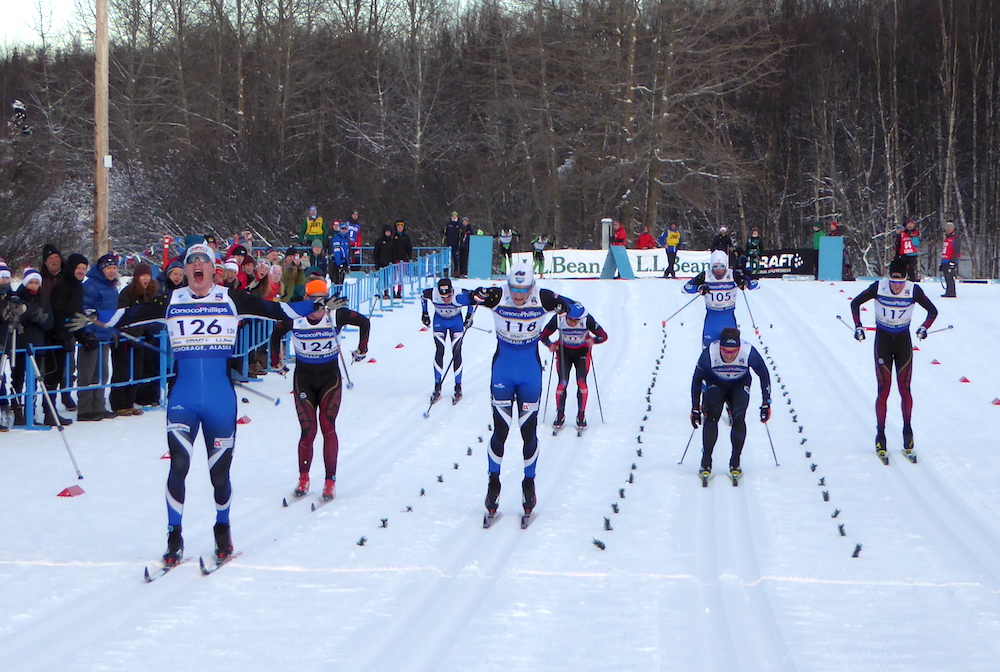
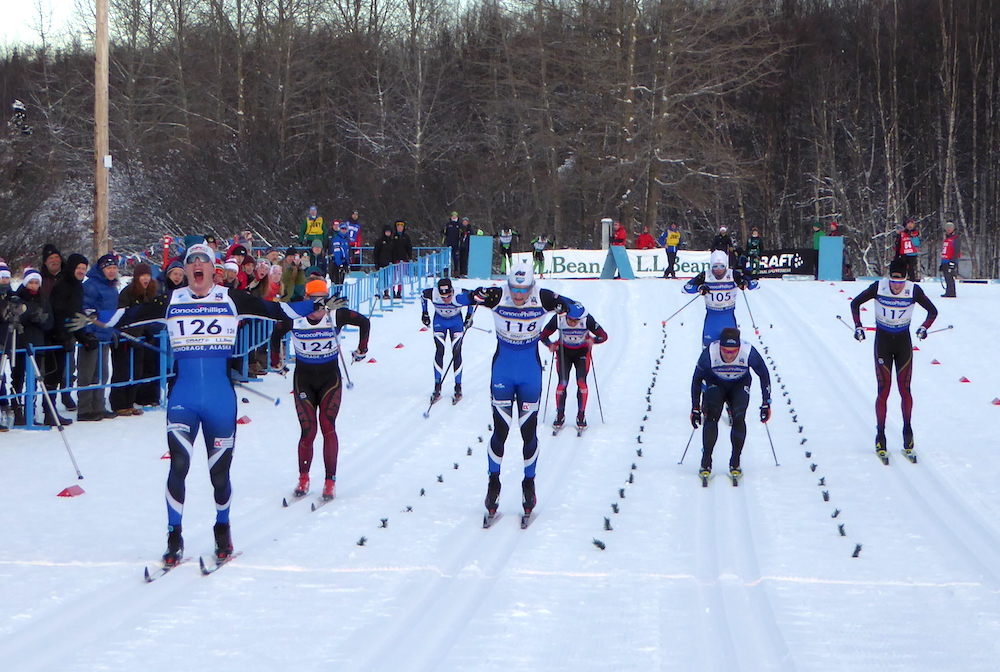
APU’s Tyler Kornfield (126) leads APU’s Eric Packer (118) and DU’s Eivind Romberg Kvaale (124) to the line in the men’s 30 k classic mass start at 2018 U.S. Cross Country Championships on Sunday in Anchorage, Alaska. Kornfield, Packer, and Kvaale finished first, second and third, respectively. Kris Freeman (10, second from left) was fourth overall and the third American.
U.S. Cross Country Championships (Anchorage, Alaska): 20/30 k classic mass starts
Sweden’s Hedda Bångman denied Caitlin Patterson of her first outright victory of the week at 2018 U.S. Cross Country Championships, but Patterson as the first American racked up her third-straight national title in the women’s 20-kilometer classic mass start at Kincaid Park on Sunday in Anchorage, Alaska.
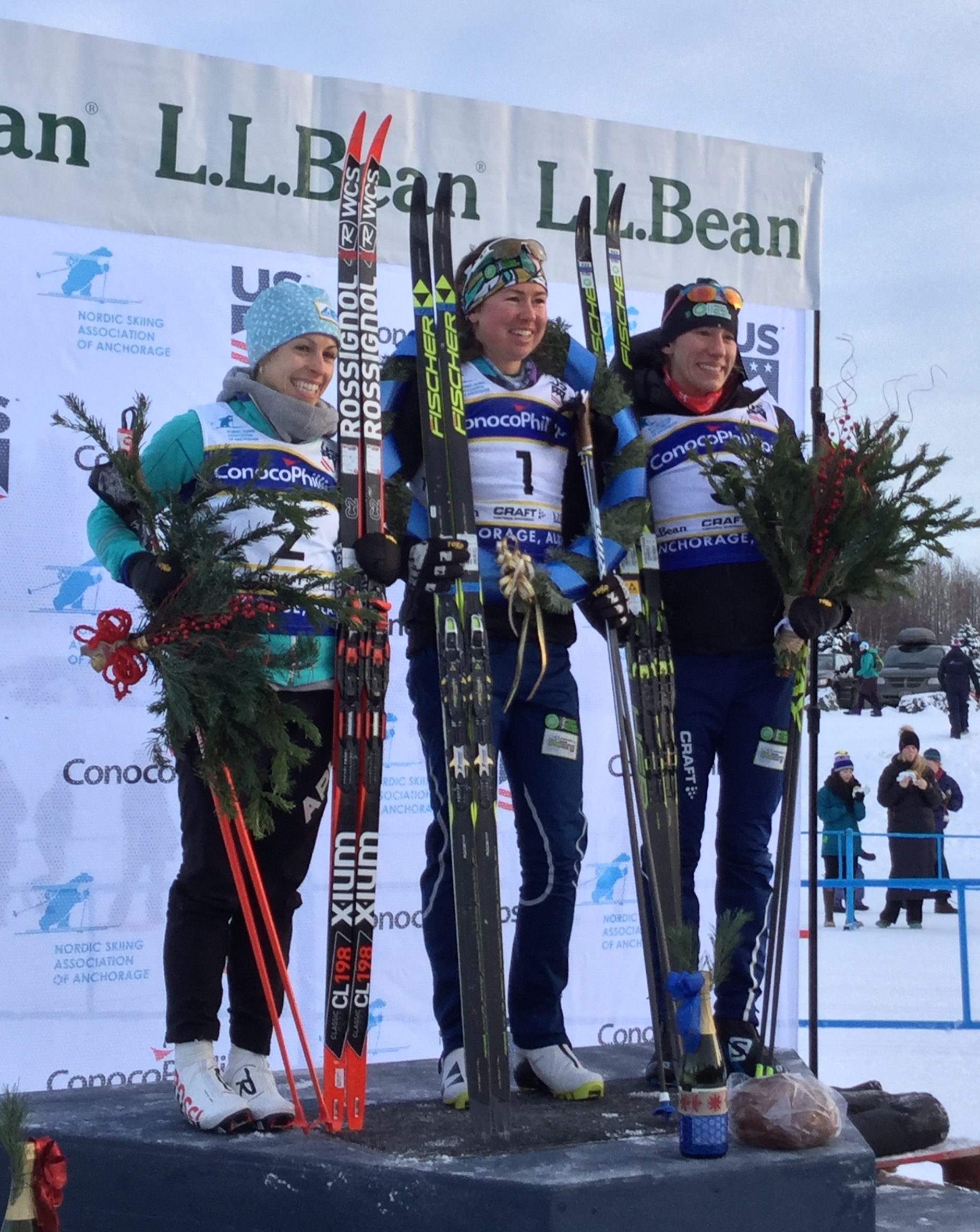
The top-three Americans in the women’s 20 k classic mass start on Sunday at 2018 U.S. nationals in Anchorage, Alaska, with Caitlin Patterson (1) of the Craftsbury Green Racing Project (CGRP) in first, Rosie Frankowski of APU (l) in second, and Kaitlynn Miller (r) of CRGP in third.
Bångman, a 22-year-old freshman at the University of Colorado Boulder (CU), pulled off a 15.9-second win in the mass start, crossing the line in 1:00:55.3 hours. Patterson, of the Craftsbury Green Racing Project (CGRP), finished second, but was the top American in the event for the third time this week, and Rosie Frankowski, of Alaska Pacific University (APU), notched third (second American), 19.6 seconds back.
Rounding out the top 10 was Jessica Yeaton, who trains with APU and races for Australia, in fourth (+44.1), Kaitlynn Miller (CGRP) as the third American in fifth overall (+1:13.5), Alayna Sonnesyn of the University of Vermont (UVM) in sixth (+1:25.3), Chelsea Holmes (APU) in seventh (+1:55.4), Norwegian CU skiers Christina Rolandson and Anne Siri Lervik in eighth (+1:55.7) and ninth (+1:56.1), respectively, and Erika Flowers of the Stratton Mountain School (SMS) Elite Team in 10th (+2:14.6).
The men’s 30 k classic mass start was incredibly close, with APU’s Tyler Kornfield taking his first-ever distance national title (he was the 2012 classic sprint national champion) in 1:21:43.6. He edged his teammate Eric Packer by 0.7 seconds at the line, and Eivind Romberg Kvaale, a sophomore at the University of Denver (DU), finished 1 seconds back in third.
Kris Freeman (Caldwell Sport) was just off the overall podium in fourth (+1.6), but was the third American. Another DU skier, Dag Frode Trollebø, also from Norway, finished fifth (+2.0), and APU had three in the top six with David Norris in sixth (+2.5). Noah Hoffman (Ski & Snowboard Club Vail) finished seventh (+2.6), Scott Patterson (APU) eighth (+3.6), and Craftsbury’s Adam Martin and Ben Lustgarten followed in ninth (+14.7) and 10th (+14.9), respectively. With Brian Gregg (CXC/LNR/Team Gregg) in 11th (+16.1), the men’s top 11 were separated by less than 17 seconds.
IBU World Cup (Oberhof, Germany): Men’s and women’s relays
Racers on the range during the men’s 4 x 7.5 k relay on a foggy Sunday at the IBU World Cup in Oberhof, Germany. (Photo: IBU/Biathlonworld)
The Swedish men’s team and French women won the second relays of the International Biathlon Union (IBU) World Cup season on Sunday, with Sweden winning the men’s 4 x 7.5 k relay by 1:10.8 over Italy, and France besting Germany by 32.4 seconds.
Notably, most of the top teams didn’t start all of their “A” teamers.
In the men’s race, Sweden’s Martin Ponsiluoma, Jesper Nelin, Sebastian Samuelsson, and Fredrik Lindström combined for their first win together — and the first win for most of the members on the team.
“It is a dream when you are a kid to compete in a World Cup,” Samuelsson said, according to an IBU press release. “To have a win is really amazing!”
The Swedish women’s team also landed on the podium in third (+48.2).
“What a race by the whole team,” said Lindström, who also has one non-relay World Cup win (from 2012) to his name. “It could not be better.”
Conditions could not have been much more difficult for shooting on Sunday, with the fog that had descended early in the day for the women’s race worsening for the men’s race. When there wasn’t fog, there was wind.
Misses were common throughout the two races, and even with racers being able to use three spares per shooting stage to clean, there were a high number of penalty laps.
But the Swedish men kept their penalties to a minimum, with just one for the entire team and a total of nine spare rounds used among them. After Ponsiluoma came through the first exchange in sixth, Nelin skied them into third, Samuelsson picked off another place despite skiing a penalty after his standing stage to put them in second, and Lindström anchored them to first.
“The conditions today were so special. Somehow I felt not so nervous, I was calm and had luck on my side,” Lindström said at a post-race press conference about his nearly flawless shooting (0+0; 0+1).
“I have never [been first] before,” he added. “Not like this in a relay at least. That’s really fantastic.”
“I had to look up to see if I was aiming the right way,” Nelin said after cleaning prone (0+0) then using two spares to clean standing (0+2). “I had no idea where I was aiming, so it was really difficult. But I hit, and it was good. Maybe these conditions fit me and I should never see anything.”
Italy placed second with Thomas Bormolini, Lukas Hofer, Dominik Windisch, and Thierry Chenal combining for two penalties and 11 spares. Hofer had skied them up from eighth to second, and Windisch then took the lead on the third leg to put them in first at the final exchange, 1 minute ahead of Sweden. But Chenal slipped with the seventh-fastest last leg time and a penalty after standing.
“Being on the podium with the team is always a special feeling,” Hofer said at the press conference. “For Thierry, it’s the first year in the World Cup, and he does a really good job, not just today. I am really happy that he could close out this relay. Second place is like a win for us.”
Norway placed third (+2:04.6) with Vetle Sjåstad Christiansen, Henrik L’Abée-Lund, Lars Helge Birkeland, and Tarjei Bø. Together, they had three penalties (two from L’Abée-Lund and one from Birkeland) and 14 spares.
“I grew up on Holmenkollen so I practiced a lot there [in fog],” L’Abée-Lund said. “But today was really really hard, I didn’t see anything in prone. Standing was OK, but prone was really difficult.”
“It’s great to be on the podium,” Christiansen said. “Of course Norway always wants to win, but today we are very happy for our brothers in our neighbor-country Sweden.”
The Canadian men placed 10th (+6:23.1) out of 25 teams with Christian Gow, Scott Gow, Brendan Green, and Carsen Campbell having a combined six penalties and 20 spares. Three of those penalties came on Scott Gow’s second leg, two from Campbell’s anchor leg, and one on Christian Gow’s first leg.
After a penalty on his first prone stage (1+3), Christian cleaned standing with a spare (0+1) and tagged Scott in 11th, 53 seconds out of first. Scott then had two penalties in prone and three in standing, but managed to improve to eighth given how much everyone else was struggling with the shooting as well. Green kept them in eighth with two clean stages (0+2, 0+3), and Campbell, in his first World Cup relay, cleaned prone (0+2) but had two standing penalties (2+3) to put the team in 10th at the finish.
In an interview with German broadcaster ARD halfway through the race, Canadian coach Matthias Ahrens called the range conditions, which ranged from thick fog to unpredictable wind, “very hard to assess.”
“… To be honest, the good thing was that conditions were very bad,” he later added. “So regarding visibility, almost everyone was on the range at the same time [with the same irregular conditions]. They had to wait very long, and of course had bad conditions to shoot, but much of the field was there at the same time.”
The French women’s team, of Anais Bescond, Anais Chevalier, Celia Aymonier, and Justine Braisaz, celebrate their relay victory on Sunday at the IBU World Cup in Oberhof, Germany. (Photo: IBU/Biathlonworld)
In the women’s race, with better shooting visibility, France’s Anais Bescond, Anais Chevalier, Celia Aymonier, and Justine Braisaz took the win in 1:12.42.4, with one penalty and 10 spares. After Bescond put them in first through the first exchange, 6 seconds ahead of Italy in second, Chevalier had to ski a penalty loop after prone but cleaned standings (1+3, 0+0) and tagged off in second, 23 seconds behind Italy, now in first.
One loop later, France was back in first thanks to Aymonier, who cleaned with just two spares (0+0, 0+2), and they extended their lead from 0.8 seconds at the last exchange to 32 seconds at the finish with Braisaz, who shot 0+1, 0+3, and skied the fastest anchor leg.
“I know that it’s always good for Justine to start in the first position, so I really wanted to pass the relay to her in that,” Aymonier said in a press conference after.
“I was nervous, too,” Braisaz said. “That kind of shooting turned my mind upside down, actually. The crowd was very loud, and … I wasn’t very focused on what I did. It was a bit foggy, too, so that made it harder. But finally it was a French day, maybe.”
“In my mind the whole team is really strong, and really able to get the first place,” Bescond said. “After years and years and years behind Germany’s team we finally did it. So just Oberhof spirit I think.”
Germany placed second with Vanessa Hinz, Denise Herrmann, Franziska Preuss, and Maren Hammerschmidt. They combined for two penalties and 13 spares; with a penalty on Hinz’s first leg and one more on Hammerschmidt’s last shooting. After being tagged in 14th, Herrmann skied them into fourth, 40 seconds out of first, and Preuss elevated them to second, which Hammerschmidt held onto.
“I was struggling a little bit in the prone shooting,” Herrmann said. “But the skiing was good today, and also the standing [shooting]. I tried to go fast on the track and catch some girls.”
Sweden, with Linn Persson, Anna Magnusson, Elisabeth Högberg, and Mona Brorsson, avoided the penalty loop and used eight spares to reach the podium for the first time in six seasons. In sixth place at the first exchange, they slipped one place to seventh on the second leg, but Högberg raced them up to fourth with near-perfect shooting (0+0, 0+1) with one leg to go. Brorsson then anchored them to third with clean shooting (0+2, 0+1) and the third-fastest last leg.
“It’s just super nice for us! I am super happy,” Magnusson said. “We were very emotional at the finish.”
When Brorsson was asked if she believe she could fight for the podium, she responded, “Not really. But I said to Linn, ‘Maybe it is our day today. Please let it be our day today.’ ”
The Canadian women finished 14th (+6:37.5), out of 20 teams, with two penalties and 13 spares. Sarah Beaudry initially put them in 15th after shooting 0+1, 0+2, then Julia Ransom had a standing penalty (0+2, 1+3) to slip one place to 16th. Megan Tandy picked off three places with clean shooting (0+0, 0+2) and tagged Emma Lunder in 13th, and Lunder had a penalty in prone but cleaned standing (1+3, 0+0) to finish in 14th.
The men’s overall 2018 Tour de Ski podium atop Alpe Cermis after the final Stage 7 hill climb: with Switzerland’s Dario Cologna (c) in first, Norway’s Martin Johnsrud Sundby (l) in second and Canada’s Alex Harvey (r) in third. (Photo: FIS Cross Country/Twitter)
Dario Cologna of Switzerland added a fourth Tour de Ski (TdS) title to his list of accolades on Sunday, winning the 2018 edition of the race in dominant fashion, with a 1:26.5-minute win over Norway’s Martin Johnsrud Sundby. And Canada’s Alex Harvey scored his first TdS overall podium in third.
The 31-year-old Cologna started the 9-kilometer freestyle pursuit up Alpe Cermis 1:15 ahead of Kazakhstan’s Alexey Poltoranin in second. Russia’s Sergey Ustiugov, slated to start third, did not start due to a back injury. Thus Harvey was the third man off the start line, 1:23 behind Cologna.
(Sweden’s Marcus Hellner, 13th after Saturday’s Stage 6, also did not start the Tour’s final stage.)
Early on, Cologna started putting time into his competitors, extending his lead on Poltoranin to 1:20.5 and Harvey to 1:24 at 1.8 k.
By 4 k, however, Harvey had used his speedy skiing on the flatter portions of the race leading up to the climb to catch Poltoranin, and the two clocked through that checkpoint 1:19.4 behind Cologna. Behind them, Russia’s Alexander Bolshunov skied just ahead of Sundby, another 21 seconds and 22 seconds back, respectively, in fifth and sixth.
While Harvey clawed back a few more seconds on Cologna, he was still 1:17.8 back at 6.2 k, with Poltoranin just 0.7 seconds behind him in third.
Harvey remained in second until around 8.5 k; with just a half kilometer to go, Sundby had caught both Poltoranin and Harvey, passing them both. Sundby held that position and finished second, 1:26.5 behind Cologna, who won in 28:52.1.
Harvey stayed strong for third (+1:30.6) while Poltoranin dropped off the Canadian’s pace in the final half kilometer and finished fourth (+1:41.7). Norway’s Hans Christer Holund placed fifth (+2:17.8), Bolshunov lost a spot to finish sixth (+3:09.7), France’s Jean-Marc Gaillard finished seventh (+3:16.7), Sweden’s Daniel Rickardsson eighth (+3:20.8), and Russia’s Alexey Chervotkin and Andrey Larkov took ninth (+3:33.5) and 10th (+3:37.8), respectively.
France’s Maurice Manificat, known for his strength in freestyle hill climbs and pursuit races, rose from 14th to 11th (+3:45.7) with the second fastest time of day, 12.8 seconds slower than Sundby as the time of day winner in 28:36.4. Cologna’s time was fourth fastest (+15.7), behind Russian U23 skier Denis Spitsov in third (+14.3) (Spitsov started 20th and finished 13th). Holund’s time ranked fifth (+20.6) and Harvey’s time was sixth fastest (+23.6) of the 43 men that finished the race.
The lone American man to complete this year’s Tour, Paddy Caldwell (U.S. Ski Team) skied the 22nd fastest time of day for 38th overall (+11:54.8).
Heidi Weng (center) celebrates her second Tour de Ski victory, with teammate Ingvild Flugstad Østberg second and the U.S. Ski Team’s Jessie Diggins third. (Photo: FIS Cross Country/Twitter)
In the women’s hill climb that kicked off the day, Heidi Weng raced to her second consecutive TdS title. The Norwegian started the day within two seconds of teammate Ingvild Flugstad Østberg, and the two skied together for the flat section of the nine-kilometer stage of the competition. But when the climbing got steep on Alpe Cermis, Weng left her teammate behind and eventually racked up a 48.5-second win.
The battle for third was less predictable. Jessie Diggins of the United States started the day in fourth, but made up the ten seconds to third-place KristaPärmäkoski of Finland in the first few kilometers. The pair climbed together for a while before Diggins attacked. Pärmäkoski tired on the final sections of the Alpe Cermis and Diggins took the podium in definitive style, 2:23.2 behind Weng and 24 seconds ahead of Pärmäkoski. It’s the first overall Tour de Ski podium for Diggins or any American athlete.
Teresa Stadlober of Austria finished fifth (+3:09.4), Kerttu Niskanen of Finland sixth (+4:17.0), Russia’s Anastasia Sedova seventh (+4:49.6), and Switzerland’s Nathalie von Siebenthal eighth (+4:56.1).
Sadie Bjornsen started eighth and slipped one spot to finish ninth (+6:15.0), giving the U.S. two top-ten finishers in the Tour de Ski for the first time. Liz Stephen finished 16th (+8:25.8) and Rosie Brennan 24th (+10:59.6).
En route to her win, Weng notched the fastest time of the day on the 9 k stage. Stadlober’s time was second, Diggins third, Østberg fourth, and Stephen fifth.
32 women finished this year’s edition of the Tour de Ski.
(Left to right) Norwy’s Emil Hegle Svendsen, Johannes Thingnes Bø, Tiril Eckhoff and Ingrid Landmark Tandrevold show off their medals after winning the mixed relay on the opening day of the 2017/2018 IBU World Cup season in Östersund, Sweden. (Photo: IBU/biathlonworld)
Even the most renowned athletes and national teams in the mixed relay on Sunday afternoon admitted they had not yet found their perfect groove in Östersund, Sweden, on the opening day of the 2017/2018 International Biathlon Union (IBU) World Cup season.
Nevertheless it still made for an exciting race, with four teams vying for the podium on the last lap. And in the finishing stretch, anchored by veteran Emil Hegle Svendsen, the same country prevailed as in the last two seasons in the same race and at the same place: Norway.
In a time of 1:11:31.7 hours, Svendsen held off a final push from Italy’s Lukas Hofer by 5.3 seconds. Norway required 13 spare rounds on the shooting range while Italy needed just six; however Hofer incurred a penalty lap in his prone stage, momentarily falling back 30 seconds and to fourth place before returning to the top three.
Germany, anchored by Arnd Peiffer, placed third, 6.4 seconds back with 10 spare rounds and no penalties, with Peiffer managing to overtake Slovakia’s Matej Kazar on the final lap. Slovakia narrowly finished off the podium after a strong team performance with its best World Cup result in a mixed relay in five seasons. The team finished 7.7 seconds out of first, with nine spares and no penalties.
“It was a really tough fight with Lukas just behind,” Svendsen recounted of the final lap during the post-race press conference. He had used all of his spares to clean his standing stage.
“I was happy to walk away with the win. I looked back, it’s impossible not to I think, but I felt quite strong…,” he continued. “I was unsure if I should just let him come to me and then we can finish in a sprint, but I looked behind and I had about a five-second gap so I just said to myself to just go and see what happens … Always a good feeling to start the season with a victory, good for the team, good for the spirit.”
“The last lap, when I went out from the stadium, I saw Emil in front of me and tried to close the gap as fast as possible,” Hofer said at the press conference. “But it was a bit too much because he also pushed so strong, and normally he is one of the best on the last loop. I was happy to finish like this… It was a really good start into the season.”
In the mixed relay format, with a 2 x 6 + 2 x 7.5-kilometer course length, two women followed by two men hand off to one another on the track, and each can use up to three spare rounds per shooting stage to avoid a penalty lap.
This time of the year, the sun sets early in Östersund in central Sweden. In a race under floodlights with mostly calm wind conditions, Norway, with Ingrid Landmark Tandrevold, Tiril Eckhoff, Johannes Thingnes Bø and Svendsen, combined for the best performance once again.
“I was really nervous, but I think everyone was, especially on the first loop,” Tandrevold said at the press conference, after she got the nod to start, replacing sick teammate Marte Olsbu. “The standing shooting was really hard, but I think the rest of my race was good. I was happy to be in front on the last downhill, because last year I fell [there] so I was a bit scared.”
“I was a bit rusty, I need some more races, then hopefully it will be a really good season,” added her teammate Eckhoff.
“Full speed from the start, that was the only plan I had,” Bø explained the tactics on his leg, where he required two spares in the prone shooting and all three in standing. “Of course I didn’t plan to use five extra [shots]. All in all I am satisfied, but there are still some things I need to improve on. A little bit faster skiing, a little bit better shooting.”
That prompted laughter from his teammates and his competitors on the podium.
Italy’s Dorothea Wierer tags Dominik Windisch at the halfway point of the mixed relay in Östersund, Sweden. The team went on to finish second on the day to open the 2017/2018 IBU World Cup season. (Photo: IBU/biathlonworld)
Italy, with Lisa Vittozzi, Dorothea Wierer, Dominik Windisch and Hofer, narrowly missed out on its first victory in the mixed relay, tying its second place from two seasons ago in Canmore, Alberta.
“I was sure that Lukas would catch Emil!” Wierer said in the press conference with a laugh. “I think we can be satisfied. Of course we are not in perfect shape yet right now. I for sure didn’t have the best autumn, I was sick three times in two months. So it wasn’t perfect, but with some more races I can get in shape.”
The defending mixed relay world champion Germany, with Franziska Preuss, Maren Hammerschmidt, Benedikt Doll and Peiffer, was also happy with its outcome. Last season’s 2017 World Championships star Laura Dahlmeier will likely miss the whole opening weekend following an illness.
“It’s always a good feeling to start the season with a podium,” Hammerschmidt said at the press conference. “First race, I am always very nervous.”
“It was OK. In prone I could have hit my shot if I had taken a little more time,” Peiffer told German broadcaster ARD in an interview after the race, according to a translation. “It was a hard last lap, they really pushed the tempo right out of the shooting range and then I immediately had a small gap. I am glad that I was able to make up one more position and secure the podium … You are always nervous before a relay, with a big audience, and you have to race against all the good guys again who you didn’t see all year, so everyone is a bit excited.”
Slovakia, with Paulina Fialkova, Anastasiya Kuzmina, Tomas Hasilla and Kazar, had to settle for fourth place, but still the team was all smiles in an interview with the IBU.
“I am really surprised, but it was great,” Fialkova said. “It was close to the podium, but we hope maybe next time.”
“A good start to the season, and we will do it again and again,” Kuzmina added.
“I was really happy for the shooting and also running, a good result for the team today, good motivation,” their teammate Hasilla agreed.
“Very happy from this competition,” Kazar said. “Very hard last lap, going from [second] place after the final shooting to fourth place in the finish. There were really good men [racing against me].”
The home team from Sweden, with Hanna Öberg, Anna Magnusson, Jesper Nelin and Fredrik Lindström, was fifth on the day (+34.5, with one penalty and five spares), delighting the fans in Östersund after Öberg tagged off in first place after the first leg.
Another surprise of the day was Finland, with Mari Laukkanen, Kaisa Mäkäräinen, Tero Seppälä and Tuomas Gronman, leading the race at the halfway point behind a strong performance from Mäkäräinen, who moved up from eighth to first place with the best first-leg course time.
“It was a hard race, especially with Kaisa Mäkäräinen, she was really fast today,” Eckhoff said during the press conference.
The two Finnish men could not quite hold on to that position, but still finished in eighth place, 1:32.4 back with one penalty and eight spares.
It was Finland’s best World Cup mixed relay performance since placing seventh during the 2011/2012 season and sixth at 2009 World Championships in PyeongChang, South Korea, host of the upcoming Olympics.
Also with Mäkäräinen and Laukkanen, Finland actually won the gold medal in the mixed relay at the 2016 summer biathlon world championships, a rollerski biathlon event typically skipped by a number of the world’s best athletes. Similarly three of Slovakia’s starters on Sunday had placed second in that event last summer, gaining some positive experiences for the upcoming season.
Canadians Satisfied with First Race, Despite ‘Race Jitters’
For Biathlon Canada, Emma Lunder, Julia Ransom, Scott Gow and Brendan Green formed the relay team on Sunday.
“Today was the second mixed relay I’ve ever done on the World Cup circuit, and I felt pretty calm going into the race,” the 26-year-old Lunder wrote in an email to FasterSkier. “My plan was to sit back on the first lap as I know it can get really frantic, and I didn’t want to get tangled up with anyone.”
She cleaned her prone stage, coming back on the course in 12th place just 13 seconds out of first.
“I’ve never raced in Östersund before and I’ve always heard that it’s notorious for tricky winds, but the flags were almost totally still during both my zero [target practice] and the race,” Lunder wrote. “I was really proud of my prone as I’ve been working hard to improve my accuracy and speed this summer.”
In the standing stage, she had to use all three spares to avoid skiing a penalty lap, but improved positions nonetheless as other teams struggled as well.
“I had a bit of a problem when I came into standing with my contact lens moving around leaving my eye blurry,” she explained. “I think I paid a little bit too much attention to that, and wasn’t as focused on the standing shooting as I would’ve liked.”
On the last loop, she was passed by three teams fighting for positions in a pack, but didn’t lose any more time to the top.
“We had amazing skis after a great performance from our wax team, so I was able to take advantage of that on the downhills and zip past people,” Lunder wrote. “It was pretty exciting for me to be skiing with a pack where I could actually see the leader of the race, and I felt strong for the most part. Overall I was happy with my race today.”
Lunder exchanged to Ransom in 13th position, still only 24.2 seconds out of first.
“I was very excited for Emma Lunder’s race,” Ransom wrote. “She handled the start leg calmly and confidently, tagging me off in a great position.”
Like Lunder, Ransom also shot clean in her prone stage, then needed two spares to also clear her standing targets.
“The shooting range was really calm, especially in comparison to past years I’ve raced here,” Ransom wrote. “I was happy that I kept my shooting somewhat together. That was a big improvement from last year’s mixed relay in Östersund.”
But on the course she had some trouble holding up with the pace set by the race leaders, losing more than 40 seconds to them on both her second and third loops.
“Today was a tough day for me. My legs were lead on the course, but I half expected that to be the case [on] day three after travel,” she wrote.
Ransom tagged Gow in 15th place, 1:46.2 back.
“It was nice to be back racing again,” Gow wrote in an email. “This was probably the most calm I have been for a season opener.”
The older brother of Christian Gow, who raced the single mixed relay with Rosanna Crawford earlier in the day, required all three spares in his prone stage and another two in standing.
“I was mostly happy with my race except for my shooting. The conditions can be very tricky here, but my problem was with my head, not the wind,” Scott Gow wrote. “I was so wrapped up in the race and trying to make as much time as possible that I think I was too excited going in to each shooting. I will try to be more relaxed for the upcoming races.”
He he tagged Green in 16th place, after losing more than another minute to the leaders (+3:03.9).
“Östersund can often provide some very tricky racing conditions, but today was actually almost perfect in terms of wind,” Green, Canada’s anchor, wrote in an email. “In my experience, it’s rare to see a day like this.”
He only needed one spare each in his prone and standing stages, and with the 15th-ranked course time improved again by one position to finish 15th, 3:28 minutes behind Norway, without any team penalties and a total of 12 spares.
“I always find the season opener quite tough,” Green explained. “Digging deep to find that extra gear always hurts at the beginning of the season, but hopefully it will get easier and start to feel better from here on out.”
The Canadians agreed that all in all, the race was a good building block to start off the new season.
“From chatting with the team I think we all had some good parts of our races, and a few things we’ll work on between now and the individual races,” Lunder concluded. “It was a good start today, and we can definitely build and improve from here!”
“After a few more days of adjustment I think our team is positioned for some great results this coming season,” Ransom wrote.
“I think I held us back a little bit with my shooting, but otherwise we did a decent job,” Gow wrote. “We got the race jitters out and now I think we will be ready to give it our all next week.”
“I think each of us were able to take away some positive aspects from todays race, but as a whole we are for sure expecting to improve upon today,” Green concluded. “It was good to get the first world cup race out of way, and we are looking forward to more racing this coming week.”
U.S. Still ‘Blowing Out The Cobwebs’
US Biathlon’s Paul Schommer racing the third leg of the mixed relay on the opening day of the 2017/2018 IBU World Cup season in Östersund, Sweden. (Photo: USBA/NordicFocus)
US Biathlon’s original race lineup included 2017 World Championships gold medalist Lowell Bailey and silver medalist Susan Dunklee, Clare Egan, and former Junior World Champion Sean Doherty.
But on race day, teammate Paul Schommer had to take Bailey’s spot after he “woke up with congestion,” according to a US Biathlon press release.
“We had planned on racing Lowell for the third leg, he didn’t feel 100% today so Paul was subbed in,” Doherty explained in an email to Fasterskier. “Just no risk in pushing it with the hardest individual race of the year on Thursday.”
Dunklee started the team out well, taking the lead on the course to come into the first shooting stage and leaving in eighth position, just under 10 seconds back after needing one spare. She moved up with a pack out on course, but in the standing stage required all three spares after initially missing one target.
“I felt strong and relaxed skiing during the first two loops and I think my technique is already a notch above last year,” Dunklee wrote in an email. “The third loop was a bit painful as my legs flooded with lactic acid and I wasn’t quite able to reel in the pack ahead. I struggled in standing with the spare rounds despite favorable conditions but shooting can often improve with my better race fitness.”
Coming back on the course in 11th position and 26.1 seconds back, she still managed to cut the distance to the leaders in half on her final lap and tagged off in ninth place.
Egan got off to a strong start, both on the course and in her prone stage, where she cleaned without any spares and started her second loop in 11th. But with athletes like Mäkäräinen and Kuzmina setting a high pace up front, she explained she was struggling.
“This was my first race of the year and it was a rude awakening,” Egan wrote in an email to FasterSkier. “From the very beginning the pace seemed crazy and I was just trying to hold on. I am reminded now that the level is super high and I just need to go harder and faster all the time. I’ll get better as I race more but today was a bit of a shock.”
In the standing stage, she quickly ran out of spares and had to ski two penalty laps, which put her back to 20th (+2:27) when she returned to the course for her final loop.
“Conditions were perfect for me on the range today,” Egan wrote. “Last year in this race I did the exact same thing. I think the shock to the body makes it almost impossible to keep my mind where it needs to be for shooting. My prone is automatic — I am at the level of ‘unconscious competence’ — where I can do it right without thinking about it. But in standing I’m at the ‘conscious competence’ level. I really have to use my brain to execute all the steps.
“Today, I shot all 5 rounds from the clip plus 1 spare before suddenly having a moment of clarity and saying (out loud actually), ‘where have I even been aiming??’ …may or may not have included an expletive,” Egan continued. “Then, using my brain, I was able to easily hit my last two shots.”
She tagged Schommer in 21st, 2:51.5 minutes back.
Schommer lost more time on the course, but with a good shooting performance — needing just one spare in each of his stages and a range time ranked in the middle of the field — he avoided getting lapped and held the team in 21st, 4:29.5 seconds back.
It was only his second World Cup appearance in a mixed relay, following an eighth place last season in Kontiolahti, Finland.
From there, Doherty anchored the team to 21st place, also requiring just one spare round in each of his shooting stages.
“The conditions were uncharacteristically calm,” Doherty wrote in an email. “But I would not expect the conditions to stay calm for all the races so I forecast some challenging shooting on the [next] weekend.”
“It felt great to be back on the world stage,” he added. “It is a fantastic atmosphere. I enjoy competing on the world cup and I am always looking forward to the start of the season. The level of competition is just as high as I remember it last year and I am excited to see where I stack up after a great summer of training.”
“The good news was that I was never nervous, which is something I’ve struggled with in the past, and I shot fast today,” Egan reflected. “My shooting has been excellent in training since we got on snow, so I just need to transition into race mode. Today was what you might call ‘blowing out the cobwebs’!!!”
“The first race of the season is typically a tune up race for us and not one where we necessarily try to optimize our performance,” team veteran Dunklee concluded. “There are more nerves, there’s jet lag, and it often takes a few real races before the body starts to feel fully sharp again. We didn’t end up very high on the results list tonight, but I have no doubt that our best is yet to come.”
“I was impressed watching Emily [Dreissigacker] lead the first loop of the single mixed relay – she looked very comfortable in front of the pack,” Dunklee also commented on the performance of her teammates in Sunday’s single mixed relay. “Most rookies are terrified of trying something like that. You’ll see more of her in the future for sure.”
Racing will continue on Wednesday with the women’s 15 k individual, and the men compete on Thursday in the 20 k individual.
Next season, Östersund will host the 2019 IBU World Championships. Norway surely wouldn’t mind making it four wins in a row in Östersund in the mixed relay there.
France’s Martin Fourcade celebrates his victory in the men’s 12.5-kilometer pursuit on Saturday at the 2017 IBU World Cup in Oberhof, Germany. (Photo: IBU)
With cold, fierce gusts of wind blowing over the biathlon range in Oberhof, Germany, the International Biathlon Union (IBU) World Cup men’s 12.5-kilometer pursuit on Saturday was decided in the first standing stage. Out of a top group of seven athletes, only France’s Martin Fourcade was able to shoot clean to create a 35-second gap. In the final shooting, he cleared his targets in a slow but controlled rhythm, avoiding the penalty lap once again, while his pursuers missed more shots to increase the gap to an insurmountable lead.
Fourcade, the dominant athlete of the season so far who only missed the podium in the sprint two days ago, crossed the line in a time of 36.45.7 minutes with only one penalty (0+1+0+0), clapping and waiving to the crowd on the long finish stretch.
“That is a difficult situation, something I fight with during a lot of competitions in my career,” Fourcade commented on his final shooting at the press conference. “On some days it’s a good decision to wait, like it was today. Some days you just regret afterwards to not join the penalty loop as fast as possible.”
“My fingers were very cold, and in biathlon we can’t use big gloves for the shooting,” Fourcade said of the challenging conditions to German broadcaster ZDF. “Getting them warm was my main occupation during the race … I knew shooting was the key today. In French I would say I have a ‘hard head’, when I am not satisfied about one competition I am often good the day after. So I am very happy to do it again today.”
Germany’s Arnd Peiffer thought he had lost all chances for a podium finish with two penalties in the final standing shooting, but managed to refocus to hit his last two shots and with all of his closest competitors incurring at least as much — e.g. Austria’s sprint winner Julian Eberhard missed every target in that stage — he still was able to secure second place by a comfortable margin for his best result of the season (+1:09.9 with 3 penalties).
“In the last shooting with two misses I already thought I had gambled the race away,” Peiffer told ZDF after the race. “It was very difficult to shoot with the wind, very turbulent. I am glad that I made the last shot today… I felt pretty good on the skis and was able to close gaps. But the snow is very cold, very blunt, so the skiing is pretty energy-sapping especially on the second part of the loop with headwinds… Only on the last one I didn’t have as much stress anymore with a large gap behind me. There is nothing better than skiing into the finish relaxed like that.”
Four athletes, who each had to ski five penalty laps during the race, fought for the third spot on the podium. Italy’s Dominik Windisch was able to repeat his third place from the sprint (+1:32.4), edging out Norway’s Emil Hegle Svendsen by 0.2 seconds (+1:32.6).
Italy’s Dominik Windisch (l) celebrates after beating Norway’s Emil Hegle Svendsen (r) in the race for third place in the men’s 12.5-kilometer pursuit at the 2017 IBU World Cup in Oberhof, Germany. (Photo: IBU)
“During the last lap, I was thinking about my strategy, I saw him in the uphill a bit tired, but I think it was a fake,” a smiling Windisch said at the press conference on his last loop with Svendsen. “I tried to attack there, but saw that he was still behind me. I then thought maybe this was a mistake. When he passed me on the last uphill again I thought maybe that’s my chance, because on the finish stretch you have the wind against you. … So I could stay behind and attacked at the end. I am happy that my strategy at the finish was good.”
“He was a little stronger than me in the end. I felt like a log,” Svendsen told Norwegian broadcaster NRK. “I was a little too aggressive toward the end. I thought he looked tired and I thought I could pass him. I ended the long lane in the final stretch with lots of wind. I think he came out from behind me and got a little rest during the decisive seconds.”
Behind them Germany’s Erik Lesser (+1:36.1) and Russia’s Anton Babikov (+1:40.7) placed fifth and sixth, respectively. They had closed a gap of more than ten seconds to Svendsen and Windisch on the final loop, but then had no energy left to pass them up the last climb and sprint finish stretch.
No athlete managed to shoot clean in the windy conditions, and aside from Fourcade, only Ukraine’s Vladimir Semakov was able to limit his penalties to one, finishing 13th (0+0+1+0, +2:08.2). His teammate Artjom Pryma made an even bigger leap in the results after starting in 57th place to finish ninth with two penalties (+1:55.3).
US Biathlon’s Tim Burke (r) racing to 26th for his second-best individual result of the season on Saturday in the IBU World Cup 12.5 k pursuit in Oberhof, Germany. (Photo: USBA/NordicFocus)
US Biathlon’s Tim Burke had his second-best individual result of the season in 26th (+3:18.9). After starting in 35th, he improved to 17th with two clean shooting performances in the prone stages, before four penalties in his standing bouts (0+0+2+2) put him outside the top 20 in the second half of the race.
“Today was another challenging race with extremely windy and cold conditions,” Burke said, according to a US Biathlon press release. “Considering the conditions, I am happy with my performance today. It’s always good to move up in the pursuit and I feel like my ski shape is getting better with each race. Hopefully I can continue this trend next week in Ruhpolding.”
American Russell Currier racing to 34th for his best result of the season and first time in four years scoring IBU World Cup points on Saturday in the men’s 12.5 k pursuit in Oberhof, Germany. (Photo: USBA/NordicFocus)
The other American in the pursuit, Russell Currier moved up 12 spots from a 46th starting position to 34th at the finish (+4:29.8) with five penalties (2+0+1+2), for his best race result of the season.
“It’s been four years since I last finished in the points,” Currier told US Biathlon. “It was frustrating knowing I could do it, but never being able to execute on the few chances there were. Today was the sign of progress I’ve been training for all year.”
Scott Gow was the lone Canadian to qualify for the pursuit in the sprint’s top 60. He finished the race in 45th (+5:45.7), after starting in 43rd, with seven penalties (1+1+2+3).
The biathlon weekend in Oberhof concludes with mass starts on Sunday. No North American representative is qualified for the men’s race, with Lowell Bailey, who currently is in 17th place in the overall standings skipping this World Cup in Oberhof for a training block.
For the women’s mass start, US Biathlon’s Susan Dunklee qualified with her 17th ranking in the World Cup standings. Biathlon Canada’s Rosanna Crawford is next in line on the list of “reserve standby athletes”, based on her results in Oberhof, should another qualified athlete have to cancel (e.g. due to illness).
Left to right: Chelsea Holmes, Caitlin Gregg, and Caitlin Patterson standing on top of the podium for the women’s 10-kilometer freestyle event at the 2017 U.S. Cross Country Championships at Soldier Hollow in Midway, Utah.
U.S. Cross Country Championships (Soldier Hollow): 10 k skate
[UPDATED] Don’t bet against Caitlin Gregg (Team Gregg) in a distance skate event. The 36-year-old took another national title in the 10-kilometer freestyle individual start at Soldier Hollow in Midway, Utah, earlier today in the first event of the 2017 U.S. Cross Country Championships. Gregg’s winning time was 27:00.6 on a cold, slow-snow morning at SoHo.
Chelsea Holmes (Alaska Pacific University) was second, 2.2 seconds back, with Caitlin Patterson (Craftsbury Green Racing Project) third (+14.5). Katharine Ogden (Stratton Mountain School, +20) was fourth, Becca Rorabaugh (APU, +58.4) fifth, and Rosie Frankowski (APU, +1:05) sixth to round out the extended podium.
In the men’s 15-kilometer freestyle event, Central Cross Country Ski Association’s Kyle Bratrud took first in a time of 34:52.0. Second place wen tot Ski and Snowboard Club Vail’s Tad Elliott finished in a time of 35:14.6, while University of Denver’s Mori Madelaner (+35:22.4) rounded out the podium in third. Patrick Caldwell of Stratton Mountain School was seven tenths of a second out of third place in fourth overall (the third American on the day) in a time of 35:23.1. Fifth went to Kris Freeman of Team Freebird in a time of 35:28.0.
[UPDATED] In the men’s 12.5 k pursuit on Saturday in Oberhof, Germany, France’s Martin Fourcade got back to his winning ways, shooting 19-for-20 (0+1+0+0) on a cold and gusting afternoon for a 1:09.9-minute victory in 36:45.7. He started eighth.
Germany’s Arnd Peiffer started 15th and finished second with three penalties (0+0+1+2), and for the second-straight race, Italy’s Dominik Windisch placed third (+1:32.4), with five misses. Windisch was just 0.2 seconds ahead of Norway’s Emil Hegle Svendsen in fifth (+1:32.6), also with five penalties (1+1+2+1).
Tim Burke (US Biathlon) raced to 26th (+3:18.9) after starting 35th, with four penalties, all in standing (0+0+2+2). Also for the U.S., Russell Currier placed 34th (+4:29.8), up from 46th at the start, with five penalties (2+0+1+2).
Canada’s Scott Gow finished 45th (+5:45.7) with seven misses (1+1+2+3).
No North American men are listed on the provisional start list for Sunday’s 15 k mass start.
In the women’s 10 k pursuit that followed, France made it a double on the day with Marie Dorin Habert taking a 38.8-second victory in 34:33.3. She started third and had two penalties (1+0+0+1) en route to the win, ahead of Friday’s sprint winner Gabriela Koukalova of the Czech Republic in second, with two clean stages followed by three misses (0+0+1+2).
Finland’s Kaisa Mäkäräinen started second and ended up third (+1:19.1) with four penalties (1+0+1+2) amid blustery conditions in Oberhof.
Canada’s Rosanna Crawford finished 22nd (+3:47.9), one spot down from starting 21st, with four penalties (0+1+1+2).
For the U.S., Susan Dunklee placed 44th (+6:20.4), up from starting 50th, despite nine misses (1+3+4+1). Clare Egan finished 49th (+7:25.6) after starting 52nd, with seven misses (4+0+0+3).
Dunklee was listed as the lone North American starter in Sunday’s 12.5 k mass start, as she is currently ranked 17th overall in the IBU World Cup. Crawford is next in line on the “reserve standby athletes” lists by her event results of the week, should another qualified athlete have to cancel (e.g. due to illness).
Alex Harvey (Canadian World Cup Team) en route to 19th in the men’s 15 k classic mass start on Saturday, which puts him sixth overall in the Tour de Ski with one stage remaining in Val di Fiemme, Italy. (Photo: Salomon/Nordic Focus)
FIS Cross-Country Tour de Ski Stage 6 (Val di Fiemme, Italy): 10/15 k classic
Russian Sergey Ustiugov’s Tour de Ski winning streak came to an end on Saturday at the penultimate stage of the seven-stage Tour, with Norway’s Martin Johnsrud Sundby breaking away on the final 2.5 k lap to win the men’s 15-kilometer classic mass start at Stage 6 in Val di Fiemme, Italy.
Ustiugov had to outlast a chase pack to settle for second, 2.2 seconds behind Sundby, who won in 40:40.0. Finland’s Matti Heikkinen reached the podium in third (+2.8), ahead of Italy’s Francesco de Fabiani in fourth (+3.2), Russia’s Andrey Larkov in fifth (+3.3), Norway’s Niklas Dyrhaug in sixth (+3.5), Switzerland’s Dario Cologna in seventh (+3.8), and Russia’s Alexander Bessmertnykh in eighth (+3.9). Behind Heikkinen, the fourth- through eighth-place finishers were all within 1.1 seconds of the stage podium.
Canada’s Alex Harvey ended up 19th (+38.7) after losing seconds to the leaders on the second half of the course. He finished ahead of teammates Devon Kershaw in 27th (+1:12.1) and Graeme Killick in 32nd (+1:31.0).
For the U.S., Noah Hoffman scored points for the second-straight day in 30th (+1:17.1). Erik Bjornsen crashed on an early downhill and dropped out of the race around the halfway point.
Ustiugov previously built a more than 1 1/2 minute lead in the Tour, so he remains 1:11.9 minutes ahead of Sundby in the overall with one stage (the 9 k final climb) to go. Cologna remains in third (+2:04.1), Heikkinen is fourth (+2:32.9), France’s Maurice Manificat fifth (+2:34.6) after finishing 13th on Saturday, and Harvey slipped from fourth to sixth overall (+2:42.5), ahead of Sweden’s Marcus Hellner, who finished 10th for seventh overall (+2:54.5).
Kershaw is 23rd overall (+7:19.1), Hoffman 30th (+9.42.7), and Killick 37th (+11:25.1) heading into the final stage.
Stina Nilsson of Sweden (center) celebrates another win in the Tour de Ski, which puts her atop the overall standings; Anne Kyllönen of Finland (left) was second in the 10 k classic mass start and Charlotte Kalla of Sweden third.
In the women’s 10 k classic mass start to start the day, Stina Nilsson of Sweden won her fourth stage of this year’s Tour, racing aggressively from start to finish and picking up extra bonus seconds along the way.
Nilsson pushed the hills late and nobody from the already-fractured main pack could keep up. She notched a 3.0-second win over Anne Kyllönen of Finland, who collected her first individual podium of the season. Charlotte Kalla joined her Swedish teammate on the podium in third (+3.7), also her first podium of the year; she had been fourth in the 5 k freestyle the day before in Toblach, Italy.
Krista Parmakoski of Finland was fourth, +9.4, Teresa Stadlober of Austria fifth, +10.1, and Yulia Tchekaleva of Russia sixth, +10.5.
With the bonus seconds that Nilsson picked up along the way, she stole the overall Tour de Ski lead from Norway’s Heidi Weng, who finished seventh (+17.5). Ingvild Flugstad Østberg, also of Norway, had been in second place but slipped even farther. After leading at the start of the race, she slipped through the pack and then off the back, crossing the line 18th (+1:08.5). She is now fourth in the Tour de ski, behind Parmakoski.
Jessie Diggins of the U.S. skied to eighth place (+19.5) and retained her fifth place overall Tour standing. Teammate Liz Stephen raced to 19th (+1:11.2), and moved into the top 20 of the Tour standings for the first time. Rosie Brennan scored points again in 28th (+2:06.1).
FIS Cross-Country OPA Cup (Planica, Slovenia): 10 k classic
[UPDATED] A quartet of American sprinters turned to distance classic skiing, placing as high as fifth, in 10-kilometer classic interval start races at the OPA Cup in Planica, Slovenia, earlier Saturday.
U.S. Ski Team member Simi Hamilton posted the day’s best result for the Americans, finishing fifth in the men’s race, 13.8 seconds back from winner Jean Tiberghien of France. Hamilton, who started in the final third of the 110-skier field, worked his way into the race, placing 14th at the 3.8 k mark and seventh at 7.5 k before moving up into fifth by the finish. His teammate and the other American in the race, Andy Newell, placed 58th, 1:30.7 back, finishing strong after placing 67th at the 7.5 k time checkpoint.
Mickael Philipot (+2.0) and Valentin Chauvin (+8.6) rounded out the all-Gallic podium.
In the women’s race, Ida Sargent (USST) was the leading American in 17th. She finished 1:10 behind winner Sara Pellegrini of Italy. Sargent likewise worked her way into the race, placing 26th and 18th at intermediate checkpoints before moving up to 17th by the finish.
Three places and less than ten seconds back, Sophie Caldwell (USST) finished 20th, 1:19.7 back of Pellegrini. Caldwell started out somewhat faster than the three other Americans who raced today, placing as high as seventh at the first checkpoint.
The final podium, reminiscent of the 2006 World Cup soccer final, was Pellegrini in first, Italian Caterina Ganz in second (+7.6), and Delphine Claudel of France in third (+14.6).
Conditions in Planica were clear and cold and just a few degrees above the FIS-legal cutoff, with race-time temperatures between 3° F and 5° F.
Racing in Planica concludes tomorrow with interval start 10 and 15 k classic races, replacing the 7.5/15 k skiathlon that was originally scheduled.
Austria’s Julian Eberhard celebrating his victory in the men’s 10-kilometer sprint (along with the Oberhof snowman) at the 2017 IBU World Cup in Oberhof, Germany. (Photo: IBU)
Even Martin Fourcade is a mere mortal who can’t win every race he competes in. After winning the first three sprints of the 2016/2017 season and five races in a row, for once the French biathlon star had to settle for an eighth place after uncharacteristically missing three targets in his standing shooting stage.
That left an opening for other athletes to shine on Thursday afternoon in the men’s 10-kilometer sprint at the International Biathlon Union (IBU) World Cup in Oberhof, Germany. Austria’s Julian Eberhard seized the opportunity and won the second sprint of his career in a time of 26:57.5 minutes, skiing the second-best course time, ahead of the Czech Republic’s Michal Slesingr (+10.8) and Italy’s Dominik Windisch (+40.3). All athletes on the podium had to ski one penalty lap.
“I rescued myself into the finish with my last power,” Eberhard told Austrian broadcaster ORF. “The competition could not have been any longer. Of course I am overjoyed now. That was an important victory, also regarding the World Championships at home in Hochfilzen [in February].”
A year ago, all races in Oberhof had to be canceled due to a lack of snow. After the organizers invested significant resources in snow-farming and storage capacities over the summer to prevent that from happening again, ironically two days ago the first heavy snowfalls of the season and one of the most severe winter storms in a decade that devastated the northern coast of Germany posed different challenges for the organizers: additional volunteers were needed to help prepare the tracks overnight, or simply to sweep snow off the seats in the arena.
“The conditions were really difficult,” Eberhard said during the post-race press conference. “Because there was a lot of fresh snow, and a lot of wind. But I like that. So I think it was a difficult but really good day for me.”
(Left to right): Czech Republic’s Michal Slesingr (second place), Austria’s Julian Eberhard (first place) and Italy’s Dominik Windisch (third place) on the podium for the men’s 10-kilometer sprint at the 2017 IBU World Cup in Oberhof, Germany. (Photo: IBU)
“Today, I was quite relaxed during the race,” Slesingr said at the press conference when asked about the difference to last racing at home in Nove Mesto. “Because I did not think about that race before too much. It was like I’m just going around the stadium and think ‘whatever, let’s do the race’. So I didn’t feel any pressure today.”
Slesingr smiled when asked if training in Oberhof during the summer maybe gave him an advantage, clarifying that his team mainly comes there to train in a ski tunnel near the venue.
“We don’t use the shooting range outside too much, so I can’t say that it helped us. In the tunnel you always have perfect conditions for shooting. No wind, no snowing like today.”
Late in the field in bib 70, Italy’s Lukas Hofer challenged for the podium after shooting clean, but he missed the time set by his teammate Windisch by one-tenth of a second at the finish (+40.4). It was Hofer’s best individual result since the 2013/2014 season, and Windisch’s second-career podium.
“Like an old saying… Start your day right… we just say “Start your year right” Hofer posted on social media with a picture of the Italian team celebrating the third and fourth place.
“I watched it while I was in the changing room,” Windisch recalled during the press conference. “When I saw that he was with me, at the same time, I thought maybe he will beat me. But at the end of the competition maybe I was a little bit faster. I am happy, but most of all I am happy for the whole team because this is a really good position for Italy. […] I really thought that someone would beat me, so until the end I was very surprised. And I still am.”
Behind Windisch and Hofer, Germany’s Erik Lesser finished fifth (+41.2) with two penalties in standing, after shooting clean and taking the lead following the prone stage. He was satisfied with the result, but the athlete living and training near Oberhof gave some insights into how difficult it can be to race in front of a raucous home crowd.
“I can’t complain about the fifth place,” Lesser told German broadcaster ZDF. “Especially with two misses I absolutely have to be satisfied with the result. On the course everything I worked for during the last days panned out. […] But I am a little annoyed about the two misses in standing. In Nove Mesto, we talked about the home field advantage for the Czech Republic, and then you see Gabriela Koukalová shoot 0+3 [in the sprint there], and I believe that’s how I also felt today in the standing stage. It was very quiet, I hit the first shot, and then there comes such a noise [from the stands] to the shooting range that it got me a little bit out of my concentration, which must not happen, so I am a bit angry about that.”
“Conditions were not easy,” Martin Fourcade told ZDF about his shooting woes with three penalties on his way to an eighth place (+51.3). “I was struggling with the wind. It was not easy. This is not an excuse, but I had my zeroing on the [lane position] target number one and it was quite easy for the prone shooting, but we had no wind for the standing [in target practice] and it was something I didn’t succeed to manage for my standing position in real wind conditions.”
Fourcade limited the damage for the following pursuit by once again skiing the fastest course time.
Three North Americans Onto the Pursuit
US Biathlon’s Tim Burke (21) on the course during heavy snowfall during the men’s 10-kilometer sprint at the 2017 IBU World Cup in Oberhof, Germany, leading Austria’s David Komatz. (Photo: USBA/NordicFocus)
The best North American in the difficult conditions was Tim Burke, who finished 35th (+1:51.8) with two penalties (0+2).
“The heavy snow and gusty wind made for a challenging race today,” Burke said according to a US Biathlon press release. “We were lucky that the snow stopped right before the start today, but this also made for some challenging conditions on the track throughout the race. I feel like I was lucky in prone with having little wind, but standing was a real fight with strong wind and it took me a long time to get all five shots off.”
“Overall, I was pleased with my shooting performance today considering the windy conditions,” he added. “Unfortunately, I am far off my normal ski shape. I had one of my best training years, so I am a bit confused as to why I have been so flat racing, but I am confident that it will eventually come around. If we continue to have strong winds here in Oberhof, Saturday’s pursuit should present some great opportunities to move up.”
Also for the U.S., Russell Currier placed 46th (+2:15.1) with three penalties (1+2), qualifying for his second pursuit of the season.
In his return to the IBU World Cup after missing the first races of the season due to mononucleosis, last year’s junior world champion Sean Doherty finished 80th with three penalties (+3:20.2), missing out on the top 60 to qualify for Saturday’s pursuit.
Lowell Bailey is skipping the races in Oberhof for a training block at home in Lake Placid, N.Y. He plans to join the team again next week for the World Cup in Ruhpolding, Germany.
“I planned to skip Oberhof earlier this year when we laid out the seasonal training plan,” Bailey explained in an email to FasterSkier. “I wanted to put in a solid three-week block of training during the middle of the season so that I’m hopefully set up well for World Champs and the last half of the season. It’s tough to voluntarily sit out, but I think it is the right decision, and I hope it will pay off later on in the season.”
For Biathlon Canada, Scott Gow had the best result of the day in 43rd (+2:11.9) with one miss (0+1) and was the only Canadian to qualify for the pursuit. Macx Davies finished 68th (+2:51.1) with two penalties (0+2), just ahead of teammate Brendan Green in 69th (+2:58.0) with four misses (3+1).
In his second World Cup after one appearance last season in Presque Isle, Maine, Canada’s Matthew Hudec finished 90th (+3:50.8) with one penalty (0+1), and Christian Gow with three penalties (1+2) was 92nd (+3:54.7) in the field of 102 starters.
The other regular North American team members, Canada’s Nathan Smith and US Biathlon’s Leif Nordgren, have not yet returned to the World Cup.
Athletes-Only Meeting Regarding McLaren Report
On the eve of the races in Oberhof, about 50 athletes from various teams reportedly gathered for an athletes-only meeting for about 90 minutes to discuss the current status of the IBU investigation into the findings of the report by World Anti-Doping Agency (WADA) special investigator Richard McLaren, which also lists 31 biathletes. From the side of the IBU, Secretary General Nicole Resch was present for about 15 minutes to discuss the current status of the internal IBU investigation and answer some of the most pressing questions from the athletes, before she was asked to leave the meeting again.
Afterwards, few athletes in attendance wanted to go on record to the media about any details of questions and demands made towards the IBU before a concrete, common position had been agreed upon and written up for communication.
From public statements by several athletes after the race on Thursday, it could be inferred that nations losing starting quotas in cases of multiple doping violations or organized manipulations could be one of them.
Slesingr, reportedly one of the organizers of the meeting, along with Martin Fourcade and some others, told the gathered media members that the athletes don’t plan to boycott World Cup races, at least in Oberhof, but that “depending on how the IBU reacts [to our demands] we will then decide how we can increase the pressure again.”
Furthermore, Slesingr explained that they have asked the IBU to state how many of the biathletes mentioned in the McLaren report are still active in IBU-sanctioned events, seemingly a topic that is contentious among the athletes potentially having to race against athletes under investigation.
“We don’t want exact names, but a number,” he said. “Our demands mostly deal with how to protect our sport from doping and corruption in the future.”
From the Russian team, the most prominent athlete present was Anton Shipulin, according to reports by German broadcasters ARD and ZDF.
“I was asked many questions, but I also have more questions than answers myself,” Shipulin afterwards told the media, according to a translation. “I don’t want to wash dirty laundry in public. I asked all athletes for patience and to wait until after the IBU investigation. I can only say for myself: I have never doped. All my samples are clean.”
“I don’t want to make statements regarding individual names,” Secretary General Resch told ZDF after the athletes’ meeting and a second one with team coaches. “We currently have to generate proofs out of the evidence, and I don’t know yet for which ones we will be able to succeed with that. And for someone where we don’t have concrete evidence available, dragging that name through the media as a positive doping case would be irresponsible and unprofessional. We don’t want to do that.”
“It was a really constructive meeting yesterday,” Germany’s Schempp told ZDF when questioned about the situation after the sprint race. “Because the whole procedure was explained to us, the athletes, by the side of the IBU. That they are also not having an easy time with that, and that one should keep calm for some time. They are doing their best to clear that up, and to really not draw premature conclusions. I also believe that would be the wrong approach. We will see how that progresses, and will closely observe that, but I think this won’t have been the last meeting.”
“In general this is not about pointing fingers at the Russians,” his teammate Lesser told ZDF. “This is about fighting the basic evil of doping with all force. The IBU has to define its own marching order for that, how it internally wants to deal with that. And I hope that this will be tackled with maximum force, that starting quota spots are being taken away after multiple offenses, and then you have to punish the nation and not just the individual athlete. And I hope the IBU will figure that out some time and go after that.”
Races in Oberhof continue on Friday with the women’s 7.5 k sprint, followed by the men’s and women’s pursuits on Saturday. The times back to the winner from the sprint carry over into the pursuit race.
(l-r) Norway’s Johannes Thingnes Bø, Fanny Horn Birkeland, Marte Olsbu, and Ole Einar Bjørndalen celebrate after winning the first race of the 2016/2017 biathlon World Cup season, a mixed relay in Östersund, Sweden. (Photo: IBU/Evgeny Tumashov/Twitter)
It’s a new season on the International Biathlon Union (IBU) World Cup, but the Norwegian biathlon team made it clear that they didn’t want anything to change: just as they won the World Cup mixed relay trophy in 2016, they picked up a 33.7-second win in the event in Östersund, Sweden, on Sunday to kick off the new year.
And just as he had so many times before, it was Ole Einar Bjørndalen — the “King of Biathlon” — who provided one of the crucial contributions for the Norway team, bringing them a lead that his teammates would never relinquish.
The Norwegians were one of just three relay teams all afternoon to avoid the penalty loop, but things didn’t start out so auspiciously. Marte Olsbu used a spare round in the first prone stage, dropping to eighth.
But despite missing again in standing, she left the range in first place, then held on to the lead almost to the exchange, where she tagged off 0.1 seconds behind Susan Dunklee of the U.S.
Twenty-one-year-old Anna Magnusson of Sweden was also in the lead pack, tagging off 0.6 seconds back and making for a tough fight on the last loop.
Susan Dunklee (US Biathlon) racing in Sunday’s mixed relay, the first race of the 2016/2017 IBU World Cup season, in Östersund, Sweden. (Photo: USBA/NordicFocus)
“I was really impressed with Sweden being right up there on the first loop, too,” said Dunklee, who had a similar battle with Olsbu in the mixed relay at 2016 IBU World Championships. “The three of us were just duking it out that whole last loop. I flooded my system a little early with lactic acid on one of the early hills… but then I came back and caught them towards the end of that lap and we all came in together. Yeah, it was fun!”
Norway’s second athlete, Fanny Horn Birkeland, held the lead for several kilometers, but was one of many women felled by the wind in the second-leg standing stage. Birkeland used all three spare rounds to knock down her targets, and yet only fell 9.3 seconds out of the lead; at this point all but one team in the field had used at least four spare rounds, and some had used many more.
Birkeland wasn’t thrilled with her shooting, but knew it was good enough to get the job done.
Clare Egan was another casualty of the wind. The American had taken the tag from Dunklee in first place, and maintained a sixth-place position close to the leaders at the halfway point of her race. But with two penalty laps in standing, she dropped to 13th, 1:39.9 from the lead.
“Clare had a fantastic first half of her race,” Dunklee said. “I was really impressed that she stayed with the pack in the prone, and shot clean under that pressure. I think the pieces are there and they’ll come together later in the season for us as a team.”
By the next tag, Italay’s Dorothea Wierer had put together a small 4.9-second lead over Birkeland. Lukas Hofer, the first man out of the exchange zone, had a near-perfect start for Italy, extending his lead over the first loop and then using one spare round to clean his targets, finishing his shots before anyone else had even begun shooting.
But Norway’s Bjørndalen was steadily chasing, and on the second loop began to close ground. By the time the two came into the range for standing, it was a close race and Bjørndalen showed that despite being 42 years old, he still has the instincts and strength that have earned him well over 90 World Cup wins.
Hofer and Bjørndalen traded shots, cleaning one target after another, and Hofer began to leave his mat before realizing that his last target hadn’t actually fallen. Bjørndalen hit five for five and left with the lead, but Hofer had to use all three spare rounds to knock down that one target.
“I felt really good all the first four shots, and I was so sure I cleaned the last one, I was about to put the rifle back on,” Hofer lamented in the post-race press conference.
In the meantime, Benedikt Doll of Germany finished his shots and headed out on course in second place, 25.4 seconds behind Norway.
“There was a tricky wind today, which was noticeable in the standing shooting,” Bjørndalen said in a television interview with NRK. “For my part it went all right today. It ‘worked out’ and I was able to do what I was supposed to do.”
Johannes Thingnes Bø of Norway “flies” across the finish line to win the mixed relay in Östersund, Sweden.
Bjørndalen tagged off to Johannes Thingnes Bø, who cruised around his first loop and then missed his last target in prone. He easily cleaned it with a single spare round, however, and was back on his way.
In standing, Bø put on a clinic and had one of the fastest range times of the day while cleaning all five targets.
“The last leg is very hard, and I haven’t done it so many times,” Bø said in a press conference. “When I was starting alone the pressure was off, and I wanted to do my own race. I tried to gain some seconds from the very start.”
Arnd Peiffer likewise held Germany in second, using one spare round in prone and none in standing.
“I was pretty much alone the whole time, but I received pretty good information from the coaches, so I could find a good speed,” he said in an interview with Germany’s ZDF broadcaster. “In prone I was a bit hectic, also because it wasn’t so easy today, the wind was changing back and forth. Already during the zeroing [target practice] I had a few problems. So I was a bit insecure and unfortunately shot the last one away, but was able to hit the first spare. Overall I think it worked out pretty well today.”
So just like Norway, the German team had stayed out of the penalty loop and used just six spare rounds total.
“I have to say they worked really well at the range today,” German men’s coach Mark Kirchner told ZDF. “It was not so easy, with changing winds you had to be wide awake. You can’t complain if you need just one spare each.”
The most exciting finish of the day was the race for third place between Russia – a team which had bounced between fifth and seventh for much of the race – and Italy. Anton Shipulin pulled the Russians from seventh into fifth and then into third with two perfect shooting stages and the fastest ski time of all anchor leg skiers.
But Dominik Windisch of Italy was eager to make up for his teammate Hofer’s shooting collapse and after leaving the range just a few seconds behind Shipulin after standing, managed to catch up and stick on him like glue. Windisch looked labored as the two flew around the course, but he knew that the venue has a downhill finish.
Windisch shadowed Shipulin down the hill, then used a slingshot of momentum to fly past into the finishing straight and outsprint the Russian to secure third place for Italy, +44.2.
Tim Burke (US Biathlon) during his prone stage of the mixed relay, the first race of the 2016/2017 IBU World Cup season. The U.S. anchor, Burke brought his team from 10th to eighth at the finish. (Photo: USBA/NordicFocus)
As for the U.S., Egan had already moved from 13th up to 12th by the time she tagged to Lowell Bailey, who brought the team into 10th. Tim Burke then brought them up into eighth place, despite three spare rounds.
“I was happy with my shooting from the clip in standing but disappointed that I needed three extras to get the last [standing] targets,” Burke wrote in an email. “I tried to push the pace on the first two spares and just missed with both. On the third extra round, I really took my time to make sure I hit because I knew there was no one to catch in front and that I would lose a few places if I missed… I just need to be a bit more relaxed with the extras in the future.”
Burke had the fourth-fastest course time of the anchor-leg athletes, and said that while he “did not feel at my absolute best”, his ski speed was where he wanted it to be at this early point in the season.
“It certainly was not our best race or perfect race, but a good sign that we can fight for the podium later in the season if we all have an ‘on’ day,” Dunklee said. “So that’s exciting to know.”
“Going into the race I know we all hoped for a better result,” Burke agreed. “[But] in years past, we could have been 15th place with this shooting, so we are encouraged by that improvement and we know more is possible in the future.”
The Canadian team was never really in the picture after leadoff athlete Julia Ransom skied two penalty loops in the opening standing stage. Megan Tandy and Scott Gow had shooting troubles of their own, and the team was sitting in 22nd place with those two penalty loops and 11 spare rounds before being lapped and pulled from the race.
Two members of the Norwegian mixed relay, Johannes Bø and Marte Olsbu, celebrate their win in the first IBU World Cup race of the 2016/2017 season on Sunday in Östersund, Sweden. (Photo: ZDF screen shot)
Welcome to The Rundown, your quick primer of need-to-know information about the day’s racing. We’ll be updating this digest as the day goes on with additional results, photos and quotes. The Rundown is NOT a race report; stay tuned for complete race reports later today with interviews from the day’s top racers.
***
IBU Cup in Beitostølen: 7.5/10 k sprints
[UPDATE] With the second set of men’s and women’s sprints canceled Saturday and moved to Sunday in Beitostølen, Norway, the first IBU Cup relays of the season were bumped off the schedule, and no North Americans competed on Sunday. (American Russell Currier placed 44th in the IBU Cup sprint on Friday.)
In the women’s 7.5 k sprint, Marketa Davidova of the Czech Republic pulled out a 3.6-second win over Germany’s Nadine Horchler, and Germany had two on the podium with former cross-country skier Denise Herrmann in third (+29.9). Davidova hit 9 out of 10 targets (1+0) en route to the victory in 24:18.3. Horchler missed just one target as well (0+1) and Herrmann (who won the IBU Cup women’s sprint two days earlier) had three penalties (1+2) but skied fast enough for the podium.
In the men’s 10 k sprint, Russia’s Matvey Eliseev edged his teammate Dmitry Malyshko by just 3.2 seconds for the win in 26:16.8. More than a minute later, Norway’s Henrik L’Abee-Lund placed third (+1:15.9) with four penalties (1+3). Both Eliseev and Malyshko had one miss apiece, with Eliseev missing one in prone (1+0) and Malyshko missing one standing (0+1).
The next IBU Cup is set for Dec. 6-11 in Ridnaun, Italy.
The first race if the International Biathlon Union (IBU) World Cup season went to Norway, which won Sunday’s co-ed mixed relay (2 x 6 k + 2 x 7.5 k) by nearly 34 seconds over Germany in Östersund, Sweden.
The Norwegian team of Marte Olsbu, Fanny Horn Birkeland, Ole Einar Bjørndalen, and Johannes Thingnes Bø used a total of six spare rounds to get to the finish line first in 1:10.57.1.
Germany, with Franziska Hildebrand, Laura Dahlmeier, Benedikt Doll, and Arnd Peiffer, used the same amount of total spares for second place (+33.7), and both teams avoided the penalty loop.
Italy took third (+44.2), with Lisa Vittozzi, Dorothea Wierer, Lukas Hofer, and Dominik Windisch using a combined 12 spares and having one penalty loop during Hofer’s standing stage.
The Italians narrowly held off Russia (Olga Podchufarova, Tatiana Akimova, Maxim Tsvetkov, Anton Shipulin) by 0.3 seconds for the final spot the podium.
France placed fifth (+1:13.3), Sweden was sixth (+1:20.9), the Czech Republic seventh (+1:20.9), and the U.S. eighth (+2:38.5).
Susan Dunklee started first for the Americans using three spares to clean (0+1, 0+2), then tagging off to Clare Egan, who didn’t need any spares for prone, but had to use all three and skied two penalty loops in standing. Lowell Bailey used just two spares (0+1, 0+1), and Tim Burke locked up eighth for the team with a flawless prone and three spares in standing (0+0, 0+3). In all the team used 13 spares and had two penalty loops.
Of 24 teams in the race, Canada (Julia Ransom, Megan Tandy, Scott Gow, and Brendan Green) was among the four that were lapped. In seven out of eight stages, the team combined for 11 spares and two penalties.
FIS Nordic Combined World Cup in Ruka: Individual Large Hill/10 k
Germany’s 24-year-old Johannes Rydzek celebrating his first of two wins on Saturday at the Ruka Nordic Combined World Cup in Kuusamo, Finland. He now has eighth career individual World Cup victories. (Photo: FIS/NordicFocus)
Germany’s Johannes Rydzek can do the Usain-Bolt-victory stance all the way to the next Nordic Combined World Cup after winning the first two competitions of the 2016/2017 season, with another individual large hill/10 k win on Sunday in Kuusamo, Finland.
Rydzek posted the fifth-best jump after Norway’s Jarl Magnus Riiber, Watabe, Denifl, and Austria’s Mario Seidl, respectively. Rydzek started the 10 k Gundersen 1:04 minutes after Riiber and posted the seventh-fastest course time to capture first. Riiber slipped to 10th (+1:07.5) at the finish, with the 37th-ranked course time of 42 in the cross-country race.
Of note, Frenzel improved from 27th in the jump to 17th (+1:32.4) at the finish with the second-fastest course time.
Bryan Fletcher was one of two Americans in the race, finishing 31st (+3:40.7). His jump ranked 40th, but he skied the fourth-fastest course time to pick off nine places. Taylor Fletcher placed 40th (+6:24.4), improving slightly from 43rd in the jump.
The Nordic Combined World Cup now moves to Lillehammer, Norway, for a team and two individual competitions Dec. 2-4.
Visma Ski Classics Prologue in Pontresina: 8 k Classic
Petter Eliassen of Team Leaseplan Go (left) and Katerina Smutna of Team Santander (right) celebrate after winning the Visma Ski Classics 8 k prologue in Pontresina, Switzerland. (Photo: Visma Ski Classics)
The Visma Ski Classics series started off in Pontresina, Switzerland, with 8-kilometer time trials for both men and women.
In the women’s race, an individual interval start seeded last to first, Kristin Antonsen of Team Synnfjell set an early best mark. But as the previous season’s top women hit the course times began to come down, and the race ended as a battle between Britta Johansson Norgren of Team Lager 157 and Katerina Smutna of Team Santander. Smutna ended up with the win by just 0.66 seconds over Johansson Norgren, with Sara Lindborg of Team Serneke third (+20.66).
The men’s race was a team interval start, with the teams separated by five minutes and with skiers at 15 second intervals within that span. Last year’s Visma Ski Classics Champion, Petter Eliassen of Team Leaseplan Go, came out on top with a time of 19:42.66. Bastien Poirrier of Team Gel Interim Rossignol was second (+8.53), leading five members of his new France-based team into the top ten and turning heads along the way. Morten Eide Pedersen of Team BN Bank was third (+15.80).
Twenty-four-year-old Finnish A-teamer Iivo Niskanen notched his second-career World Cup victory the men’s 15-kilometer classic on Sunday, Day 2 of the Ruka World Cup in Kuusamo, Finland.
The men’s podium in Sunday’s 15 k classic at the Ruka World Cup in Kuusamo, Finland: with Finnish winner Iivo Niskanen (c) and Norway’s Emil Iversen (l) in second and Martin Johnsrud Sundby (r) in third. (Photo: NBC Sports screen shot)
Niskanen started 21st of more than 90 in the men’s field and finished in 35:27.6, which stood as the fastest time all day. After the finish, he paced between the leader’s chair and the finishing pen, even jogging around the stadium and course. But every time he looked the Finnish crowd, he was all smiles.
Niskanen held off three Norwegians in the top four, with Emil Iversen 10.2 seconds behind him in second, Martin Johnsrud Sundby 11.2 seconds back in third, and Didrik Tønseth missing the podium by about six seconds and tying Sweden’s Johan Olsson for fourth (+17.0). Norway’s Finn Hågen Krogh placed sixth (+18.3), Sweden’s Calle Halfvarsson was seventh (+21.2), Russia’s Alexander Bessmertnykh was eighth (+24.3), Finland’s Matti Heikkinen ninth (+32.0), and Great Britain’s Andrew Musgrave 10th (+33.8).
Canada’s Alex Harvey was close behind in 11th (+35), and was the lone North American man in the points on Sunday. His teammate Devon Kershaw missed the top 30 by 4.5 seconds in 33rd (+1:23.4).
Erik Bjornsen led the U.S. men in 41st (+1:37.2). Canada’s Graeme Killick was 53rd (+2:12.9), American Noah Hoffman was 64th (+2:42.6). For Canada, Len Valjas was 76th (+3:19.8), Jess Cockney 78th (+3:26), Knute Johnsgaard 85th (+3:53.4), and Andy Shields 91st (+4:26.1), and for the U.S., Eric Packer 87th (+4:01) and Andy Newell 88th (+4:17.4) out of 96.
In the women’s 10 k classic earlier in the day, Marit Bjørgen of Norway picked up her first win of the season, a 4.6-second win over Finland’s Krista Parmakoski.
Marit Bjørgen of Norway (center) collected her first World Cup win of the season in the 10 k classic in Ruka, Finland, ahead of Finland’s Krista Parmakoski (left) and Norway’s Heidi Weng (right). (Photo: FIS Cross Country/Twitter)
It is the 103rd World Cup win for the 36-year-old Bjørgen, who took last season off to have a baby. Norway followed up Bjørgen’s win with third and fourth place finishes by Heidi Weng (+12.7) and Ingvild Flugstad Ørtberg (+36.8).
Parmakoski also led a good day for the Finnish team, with Laura Mononen coming in seventh (+50.0). She was just behind sixth-place Nicole Fessel of Germany (+42.4).
Jessie Diggins led the U.S. women’s team with a 13th-place finish (+1:09.0), one of her best distance classic races ever outside of Tour and mini-tour stages. Sadie Bjornsen followed in 17th (+1.14.9), and 2016 SuperTour champion Caitlin Patterson of the Craftsbury Green Racing Project scored points in 28th (+1:45.4). The U.S. Ski Team rounded out its results with Rosie Brennan 39th (+2:22.2), Kikkan Randall 43rd (+2:29.7), Ida Sargent 44th (+2:30.4), and Sophie Caldwell 61st (+3:13.4)
Cendrine Browne and Emily Nishikawa slotted into 58th and 59th for Canada, +3:04.8 and +3:07.1, respectively. Dahria Beatty finished 74th (+3:54.4).
Norway’s Håvard Bogetveit leads American Lowell Bailey into the finish in a race for third in Sunday’s mixed relay at the IBU World Cup in Canmore, Alberta. The U.S. placed fourth for a team best in the event’s 11-year history. (Photo: Daniel S. Guay)
Considering anything better than sixth would have been a first-ever for either the U.S. or Canada in the IBU World Cup four-person (2 x 6 + 2 x 7.5-kilometer) mixed relay, that put Lowell Bailey in a bit of a position heading into the final loop of the last relay leg on Sunday.
Here he was, in fifth with 2.5 k to go, and just three seconds ahead of France’s Quentin Fillon Maillet in sixth and 4.6 seconds behind Canada’s Brendan Green in fourth. In front of both the Canadian and American teams, Norway set out on the final loop in Canmore, Alberta, 16 seconds ahead.
What or whom do you focus on? Should Bailey go for fourth? Should Green try to catch the Norwegian and the final spot on the podium? Or is it best to hold your own and not risk too much?
According to Bailey, a lot was going through his head after emerging from the final standing with clean shooting, thanks to two spares, shortly behind Green, who cleaned both stages without any spare rounds.
Tim Burke (l) after tagging U.S. teammate Lowell Bailey in fourth, about 36 seconds behind Norway in third, during the last exchange of the mixed relay at the IBU World Cup in Canmore, Alberta. (Photo: Daniel S. Guay)
“To be honest, I know [Fillon Maillet] and I know how good of a skier he is, he’s top 10 in the overall [World Cup],” Bailey said in a phone interview after the race. “So the thoughts going through my head on the last lap was, ‘OK, I’ve got to stay focused here,’ … My goal was to ski the first half of the loop well enough that France wasn’t going to get into my draft.”
The second half of the course was uphill and into the wind, and tactically, a skier able to catch a draft off someone in front of them on that part could be fresher for the last 700 meters to the finish.
In his effort to drop Fillon Maillet and make sure he wasn’t on the losing end of that strategy, Bailey inadvertently caught Green on the second-to-last major climb before the finish.
“It just so happened that I felt pretty good so I just went for it,” Bailey recalled.
After passing Green in fourth, he looked up and saw Norway’s Håvard Bogetveit, a 23-year-old Norwegian B-team member, in third.
“I didn’t see Norway until about halfway up that climb,” Bailey said. “I’m not sure if the Norwegian, if he was tired or what, but it didn’t become clear that there was a chance at third until that last uphill. Our team and ski technicians and coaches and staff were cheering me on and hoping that I could catch that gap.”
Meanwhile, Green, who had been tagged in seventh and climbed into fourth with perfect shooting, started to come undone.
“I really tried to race more aggressive. I had to. After the sprint on Thursday and knowing that my form wasn’t where it needed to be, I knew I couldn’t afford to hold back at all this race,” Green wrote in an email, referring to Canmore’s opening sprint last Thursday, where he placed 40th with one miss. “As for the shooting today I think I was just feeling confident. Canmore is often a very difficult range to shoot on, but I felt that [Saturday] I was really able to get a grasp of the wind while training, and was able to bring that confidence and shooting form into today.
“When I left [the range] in 4th I knew I was going to have my work cut out, especially given the pace of my second loop with France,” Green recalled. “That said, I gave it my all. I started to blow up and just couldn’t maintain the pace, but I think with a bit better form I could have hung on.”
Racing up and over the final climbs and into the finish, Bailey pushed to catch Bogetveit. He came within 1.7 seconds at the finish, but Norway secured the final spot on the podium, 1:23.8 minutes behind the German winners, and the U.S. claimed the so-called wooden medal in fourth. Regardless, it was the best showing for a U.S. mixed relay since its inception, officially at 2005 World Championships.
US Biathlon’s previous best mixed relay was sixth place four years ago at the World Cup in Kontiolahti, Finland, with Jay Hakkinen, Sara Studebaker, Annelies Cook, and Tim Burke. This time around, Susan Dunklee, Hannah Dreissigacker, Burke, and Bailey teamed up for fourth, 1:25.5 behind Germany. (Earlier in the day, Annelies Cook and Leif Nordgren raced the single mixed relay, placing 16th.)
“It didn’t become clear that there was a chance at third until that last uphill. Our team and ski technicians and coaches and staff were cheering me on and hoping that I could catch that gap.” — Lowell Bailey, who anchored the U.S. mixed relay to a team-best fourth on Sunday
“It’s easy to say, ‘Oh man, if I had known, I would’ve skied two seconds faster,’ but I really don’t think I could’ve,” Bailey said of finishing less than two seconds out of third. “I put everything I could have into that last lap. It’s bittersweet, but it’s also our best result ever in the mixed relay. … Fourth is where we ended up, and I think we have to be satisfied with that and keep that momentum going forward.”
Behind him, Green anchored Canada to sixth, 3.6 seconds behind Fillon Maillet, who notched fifth for France (+1:30.7). The result tied the Canadians’ best in a mixed relay after placing sixth in 2011 in Hochfilzen, Austria. Like the U.S., that team only included one of the same athletes from Sunday’s relay — Green — who had teamed up with Megan Imrie, Zina Kocher and JP Le Guellec in 2011. (Julia Ransom and Nathan Smith raced Sunday’s single mixed relay, placing 12th.)
“We’ll get to the podium eventually — it will just be a matter of small consistent steps, nothing drastic,” Green wrote. “The team was awesome today. Everyone did a really great job and set the race up well for the next person. I couldn’t have asked for more from them today.”
Germany in It to Win It
Germany topped the podium with a 1:12.9-minute win in the mixed relay on Sunday at the IBU World Cup in Canmore, Alberta, with (from left to right) Franziska Hildebrand, Franziska Preuss, Arnd Pfeiffer, and Simon Schempp. (Photo: Daniel S. Guay)
In the race for first, Germany established itself as a frontrunner early when Franziska Hildebrand tagged Franziska Preuss in third, just 1.4 seconds out of the lead. Switzerland’s Selina Gasparin had moved to the front of the first leg after cleaning her standing stage and leaving the range five seconds ahead of Italy’s Dorothea Wierer in second.
Wierer had previously been the first out of prone, 3.4 seconds ahead of Dunklee in second. Both women cleaned prone without needing any of three possible spares. Dunklee left the range two seconds ahead of Kazakhstan’s Alina Raikova in third, and almost immediately, the American caught Wierer. The two remained together off the front of the pack for the next loop, skiing 4.2 seconds ahead of Gasparin in third while Raikova dropped 13 seconds back to sixth before the second shooting.
There, Wierer needed two spares to clean and Dunklee used all three, but both avoided the penalty loop to leave the range in second and sixth, respectively. Wierer followed Gasparin into the final loop before the exchange, 5.1 seconds back, while Germany’s Hildebrand cleaned with no spares to move into third, 7 seconds out of first.
“I didn’t expect anything special today,” Dunklee wrote in an email, a day after placing 30th in the mass start with 10 penalties. “To be honest, I’ve been struggling this week to find my normal race hunger and my physical shape has felt flat.
Italy’s Dorothea Wierer (l) leads Susan Dunklee of the U.S. in first and second on the second loop of their first leg of the IBU World Cup mixed relay in Canmore, Alberta. Italy went on to place second and the U.S. notched a best-ever fourth. (Photo: Daniel S. Guay)
“[On Saturday] I dirtied a stage,” she said of missing every target — the opposite of “cleaning.” “Probably my first time doing so on the World Cup. Today I felt like a completely different animal. It was a good reminder that things can turn around suddenly.”
After leaving the range in sixth, 22.5 seconds behind Gasparin in first, Dunklee made up one place on the next loop to tag Dreissigacker in fifth, 16 seconds back, at the first exchange.
Meanwhile, Crawford used one spare on each stage to climb from ninth after the first shooting to fourth after the second stage. She left the range just ahead of Dunklee, 21.1 seconds out of first with one loop to go, and came through the exchange just 0.3 seconds behind Dunklee to tag Beaudry in sixth.
Also on that loop, Sweden’s Emma Nilsson slipped from fifth to eighth, and Norway’s Marte Olsbu improved from seventh to fourth.
“Susan passed me like I standing still, it was very impressive, but then she slowed down again and I tried to hang onto Norway once they passed me,” Crawford explained in an email. “It was a tough fight on that last loop, my legs and lungs were screaming, but I knew that in about 3min I could collapse in the snow.”
On the first shooting of the second leg, Preuss cleaned prone quickly to move into first, 5 seconds ahead of Switzerland’s Aita Gasparin, who also cleaned without any spares.
Dreissigacker leapt into third for the U.S. with flawless prone shooting as well, 17 seconds behind Preuss. She needed one spare to clean standing but remained in contention in fourth, just 0.2 seconds behind Sweden’s Mona Brorsson in third and 31.6 seconds behind Preuss up front with one loop to go.
“I’m happy with my whole race,” Dreissigacker wrote in an email. “One spare in standing is good for me. And I got some good rides, skiing behind [Norway’s Synnøve] Solemdal and then battling with Mona Brorsson on the last loop. Skiing with people really helps me ski more efficiently.”
Hannah Dreissigacker (r) skied the second leg for the U.S. mixed relay on Sunday and brought the team to fourth by the second exchange. Norway’s Synnøve Solemdal (l) tagged in second, 23 seconds behind Germany (not shown) in first. (Photo: Daniel S. Guay)
She held her position to the exchange, tagging Burke in fourth, 1.5 seconds out of third and 36 seconds from the lead.
“I think that confidence was the biggest key to my shooting today. I just told myself, ‘I can do this. Just do what I always do. It doesn’t have to be perfect, just normal,’ ” Dreissigacker explained.
After starting her season on the World Cup, Dreissigacker, a 29-year-old U.S. A-team member, was put on the IBU Cup squad in January. At the last IBU Cup in Arber, Germany, she placed 10th in the sprint and 16th in the pursuit to earn World Cup starts in Canmore. In the Canmore on Friday, she finished 28th in the sprint for one of her top-six career results.
“You have to really respect the trajectory that Hannah’s taken over the season,” Bailey, 34, said. “I’ve been there, I know what it’s like to start off a season with high expectations and fall short early on and have to refocus. A lot of athletes give up, but the fact that she stuck it out and really believed in her ability is a testament to her as an athlete and an individual.
“I think this week she showed that she can be there, and especially today — Susan had a great leg and handed off to Hannah in a fairly high-pressure scenario,” he continued. “… It was great to see Hannah handle that pressure. She had an awesome, awesome performance and kept us in contention for the medals.”
Last spring, Dreissigacker made up her mind that she would retire after this season. She explained that decision “has nothing to do with how this season has gone or will go. It’s a decision about my life and what I want to do with it and what will make me most happy. For this season I’ve been trying to not think about that decision and just ‘be here now’ and enjoy it,” she added.
In terms of pressure, she had a new way of handling that.
“I made a promise with myself a few weeks ago that I would be done with feeling pressure in a negative way about racing,” she wrote. “I definitely got nervous today, but I decided to call it ‘excitement’ and not think about pressure.”
“It’s a decision about my life and what I want to do with it and what will make me most happy. For this season I’ve been trying to not think about that decision and just ‘be here now’ and enjoy it.” — Hannah Dreissigacker, on her decision to retire after this season
Sarah Beaudry used just one spare to clean two stages during the second leg of the IBU World Cup mixed relay in Canmore, Alberta, to come through the second exchange in sixth. Canada ultimately placed sixth to tie the team’s best result in the mixed relay. (Photo: Daniel S. Guay)
Canada’s Beaudry, also getting the call up from the IBU Cup for the Canmore World Cup, kept her team in sixth with a perfect prone and just one spare in standing. In her second shooting stage, she moved into fifth, 10 seconds behind Dreissigacker in fourth, but slipped one spot back to sixth when Italy’s Karin Oberhofer passed her on their last loop.
At the second exchange, she tagged Davies 1:07.3 behind Germany, while the Germans skied 23 seconds ahead of Norway in second place.
“On the range overall I wanted to be confident and relaxed,” Beaudry wrote in an email. “I shoot on this range all the time know the winds and wanted to use that as an advantage. The last lap I tried to give it everything I had to be able to give Macx every extra second I could. I was very happy with my performance and as a team we were definitely stoked with where we ended up tying Biathlon Canada’s previous personal best.”
Two days earlier, the 21-year-old British Columbia native posted her World Cup personal best in 38th.
“It has definitely been super exciting posting my best results at home in Canmore, for my family to be able to watch and all the Canadian Biathlon community,” Beaudry wrote. “I feel like I managed to take full advantage of my start spot in the sprint with the windy conditions being worse at the beginning. However this being my second World Cup weekend of the season and my other weekend [in Ruhpolding, Germany] being a last minute decision and three days of driving before the race I was able to be way more prepared for this event.”
The third-leg skiers for the U.S. and Canada, Burke and Davies, put their teams in fourth and seventh, respectively, by the final exchange.
Burke came within six seconds of third place after a clean prone without any spares, but had some trouble in standing, using all three spares and appearing to have problems loading at least one of them. He ended up with a penalty — the first and only penalty for the U.S. — and left the range in fifth, 1:36.6 behind Germany’s Arnd Peiffer, who shot flawlessly in both stages to take a 56-second lead over Norway.
Canada’s third leg of the mixed relay, Macx Davies used one spare to clean his standing stage and left the range in seventh before handing off to anchor Brendan Green (not shown) in the IBU World Cup mixed relay in Canmore, Alberta. Canada placed sixth to tie a team best. (Photo: Daniel S. Guay)
Thirty seconds behind Sweden’s Tobias Arwidson with one loop to go, Burke caught the Swede and moved back into fourth by the exchange — 36 seconds behind Norway in third.
As for Davies, he used two spares in prone and one to clean standing, leaving the range in seventh after both stages.
“After getting tagged in sixth I was hard pressed to stay with [Switzerland’s] Benjamin Weger and lost a bit of time on the first loop, so I was a little worried that I was skiing slowly, but when it came to the shooting range, that’s where I know you can make lots of time,” Davies wrote in an email. “So I was very focused going into prone on a fast clean bout. … My performance today was good [on] skis and in the range, nothing exceptional but I had a good day out there and very happy that I could stay in 7th on the final lap.”
Germany’s anchor, Simon Schempp mostly had to go through the motions to ensure the win after receiving the tag in first, 1:02.9 ahead of Italy in second and 1:03.6 clear of Norway in third. (Bailey was 1:40 back at the tag in fourth.)
Schempp used one spare in both stages and ended up sealing the win in 1:05:38.8, by 1:12.9 over Italy’s Dominik Windisch in second place and 1:23.8 ahead of Norway’s Bogetveit in third.
“I still started out fairly hard, make my own race, work clean on the shooting range, and after the standing shooting I noticed that it would be sufficient,” Schempp said in a post-race interview with Germany’s ZDF. “But before that you are never sure, anything can happen, so you can’t relax.”
He felt comfortable enough to high-five some of his teammates on the final loop.
“I saw a few [national-team] green jackets out of the corner of my eye on the edge of the course. And on the prior loops I already heard a few familiar voices,” he recalled. “So when you have the time and the whole team is celebrating with you, that’s something you can enjoy very much.”
Italy placed second in the mixed relay at the IBU World Cup in Canmore, Alberta, with Dorothea Wierer (second from r), Karin Oberhofer (second from l), Lukas Hofer (r), and Dominik Windisch. (Photo: Daniel S. Guay)
For the Italians (Wierer, Oberhofer, Lukas Hofer, and Windisch), another podium in Canmore was beginning to create expectations. In Canmore, Wierer finished third in the women’s sprint on Friday, then won the mass start on Saturday and Windisch won the men’s mass start that same day.
“Everyone at home expects bigger things every week,” Italy’s third leg, Hofer told the IBU afterward. The team finished with one penalty (from Oberhofer’s prone stage) and required 10 spares.
And Norway’s B-team (with its top athletes opting to skip the Canmore weekend and come to Presque Isle instead) wasn’t surprised with a podium: “We always try to be on the podium, but you never know,” Olsbu told the IBU. Olsbu, Solemdal, Alexander Os, and Bogetveit combined for third with seven spares and no penalties.
For Bailey, fourth (with a team total of one penalty and nine spares) was one step closer to the medals — a goal US Biathlon has been focused on for the last several years, specifically in the mixed relay, he said.
“Sochi was the first Olympics where we had it as a medal event now it’s a legit medal event,” he explained. “We realized that we had strong women at the top and strong men at the top and when you combine those, we start to be able to compete with the powerhouses.”
While fourth was “bittersweet,” he added that it was promising.
“It was by no means a perfect race for any of us. I guess that’s a good thing… that means you can do better,” he said. “We can feel satisfied, but we also have the momentum and the knowledge that … if we put together an excellent performance, we can be on the podium.”
“I’ve dreamed of being in the top 6 in a world cup relay for years and to be 2 seconds out of third is absolutely incredible!” Dunklee wrote. “Today was a great team effort. Hannah had a very rough start to the season with injury and it’s been truly inspiring to watch her turn it around. Lowell skied a heroic last loop leaving his pack behind and almost catching Norway, who didn’t seem within reach when he left the range.”
Canada’s Brendan Green acknowledges the crowd at the IBU World Cup mixed relay in Canmore, Alberta, after anchoring his team to sixth, tying a team best. “It was really fun and definitely special,” he said of the experience racing at home. (Photo: Daniel S. Guay)
Canada, with no penalties and six spares, was happy, too.
“We had a different team out there today with Brendan and I the veterans and Macx and Sarah the young guns in their first mixed relay!” Crawford pointed out. “We are showing more depth in our team that we can put together 4 athletes and come out with a pretty good mixed relay! We’ve been knocking on the door of the podium for mixed relay for a while and I am sure it will happen some day!
“It was so special having so many fans in the crowd, friends and family, that everywhere on course people were cheering for you, during warmup, the race and cool down!” she added. “Even though it was a disappointing sprint, it was super cool to have everyone cheering for me, and that they didn’t care how I did, they were just pumped to watch me race!”
On Monday, the U.S. team flew on a direct charter to Presque Isle, where the World Cup will pick back up again on Thursday through Sunday. The U.S. team will race on home soil while the Canadians still aiming to qualify for World Championships (Emma Lunder, Zina Kocher, Audrey Vaillancourt, and Erin Yungblut) will race in Maine, along with Smith, who ranks 19th in the overall World Cup standings.
Those prequalified for World Championships, including Crawford, Beaudry, Green, Davies, Ransom, Scott Gow, and Christian Gow, will train in Canmore until Feb. 22.
Italy’s 26-year-old Dominik Windisch celebrates his first-career victory in the IBU World Cup 15 k mass start on Saturday in Canmore, Alberta. (Photo: Daniel S. Guay)
In a race affected by difficult conditions on the course and shooting range, Italy’s Dominik Windisch achieved the first victory and podium of his career in the International Biathlon Union (IBU) World Cup men’s 15-kilometer mass start on Saturday in Canmore, Alberta. In third place after the final shooting stage and despite four penalties in total, the 26-year-old Windisch finished first with a time of 40:37.1 minutes, after a strong last loop.
“It was amazing. I can’t believe it yet. A dream came true for me today,” Windisch said during the post-race press conference.
Asked how long he has been waiting for this moment, Windisch later told the IBU: “I think for over 20 years, since I was a child watching competitions of the World Cup in Antholz [Italy].”
Second place went to Germany’s Benedikt Doll, 4.1 seconds back with four penalties, for the third podium of his career. Doll also moved up on the final loop thanks to the fastest course time of all athletes. France’s Quentin Fillon Maillet, who led the pack after the last shooting, fell behind on the final loop and ended up third, 8.6 seconds after the Italian, with three penalties.
‘He puked all over my skis’
Latvia’s Andrejs Rastorgujevs (25) and Austria’s Dominik Landertinger (9) lead the race for fourth, which Landertinger took by 0.2 seconds. France’s Martin Fourcade (second from l) placed sixth in the mass start, 1.5 seconds ahead of American Tim Burke (behind) on Saturday at the IBU World Cup in Canmore, Alberta. (Photo: Daniel S. Guay)
U.S. Biathlon’s Tim Burke had the best day of the three North Americans in the race, finishing seventh, 23.8 seconds after Windisch with three penalties, and just 1.5 seconds behind the overall World Cup leader, Martin Fourcade of France.
It was Burke’s best result of the season in an individual race so far, and he last achieved seventh in a 2014 mass start in Pokljuka, Slovenia.
Burke raced under the watchful eye of his wife, Andrea Burke (formerly Henkel), an Olympic and World Championships gold medalist for the German biathlon team, who provided commentary and analysis with Chad Salmela for the IBU’s live stream of the North American World Cups.
“When your wife is commentating live it puts a little extra pressure on…,“ Burke said in a post-race phone interview with FasterSkier. “I think she’s having a lot of fun with it. It’s for sure a challenge to commentate in not your first language.”
Burke said the first prone shooting was the “trickiest stage” on Saturday, but he managed to keep the damage in check with just one penalty.
“It [was] changing so much shot to shot that I didn’t crack down my shots at all,” he said. “I would aim [left] off the target knowing that the wind would blow [really strong left to right]. I missed my first shot and I realized I wasn’t aiming far enough off.”
He left the range in 15th place, 41.8 seconds behind Austria’s Simon Eder in first, but still with several other athletes who had also missed at least one target.
“As I was skiing out of the range, just checking the targets, I could see there were quite a few mistakes. I knew that would keep me in the race,” Burke recalled.
In the second prone stage, Burke shot clean.
“It was really good conditions. The wind was down. It was a lot like I had zeroed for,” he said. “I hadn’t changed my sights at all so I was able to aim through and shoot fast.”
American Tim Burke (c) shooting with Russia’s Anton Shipulin (r) and Germany’s Arnd Peiffer (l) during the men’s 15 k mass start on Saturday at the IBU World Cup in Canmore, Alberta. Burke went on to place a season-best seventh. (Photo: Daniel S. Guay)
One lap later, the wind picked up for the third shooting (first standing stage).
“I just really took my time and was very happy to get out of there with one penalty. … When I left the range everyone except I think one person was in the penalty loop.”
He left the range in fourth, 17.5 seconds behind Fillon Maillet, 6.3 seconds after Latvia’s Andrejs Rastorgujevs in second, and 2.4 seconds behind Austria’s Dominik Landertinger in third.
Burke lost a few positions on the course, skiing in a group led by eventual third-place finisher Doll.
“At that point, I knew the win was still possible just because the conditions were changing so fast,” Burke said. “Anything is possible in a race like that.”
In the last shooting stage, Burke recorded another miss, skied a penalty loop and headed into the final loop in ninth place with competitive company around him: Fourcade, Landertinger, Ondrej Moravec of the Czech Republic, Slovakia’s Matej Kazar (the best shooter on Saturday with just one penalty), and Germany’s Arnd Peiffer.
“It’s not the best group to head out on the last loop with, so I knew it was going to be tough, but I hung in there,“ Burke said. “Fourcade and Landertinger got a gap with about a [kilometer] and a half to go. Then it was me and Peiffer … he was in front of me and unfortunately puked all over my skis.”
He estimated Peiffer got sick with about half a kilometer remaining in the, heading into one of the final climbs.
“I’ve heard of it happening, but that’s the first time I’ve ever seen it,” Burke said of someone throwing up during the race. “I was able to get around him after that. … Then I actually ended up catching back up to Fourcade because they started playing around, setting up for the finish … but as soon as I caught them they started sprinting, so I was pretty gassed.”
“It was a brutally difficult race,“ Landertinger, who placed fourth (+20.7) with three penalties, said in an Austrian Ski Federation press release. “On the one hand the course was extremely slow and strenuous, on the other it was difficult to assess the wind correctly on the shooting range. I had a strong final loop, where I was able to prevail against Fourcade and Rastorgujevs in the end. I am very happy with the race and the result.“
Overall, Burke skied the eighth-fastest course time, as well as the sixth-fastest final loop.
“I really like the course, that’s why I was disappointed with the sprint [on Thursday] because I feel like on a good day here I could have been one of the faster skiers,” Burke said. He placed 23rd in Thursday’s 10 k sprint with with 80 percent shooting.
“I was definitely really happy with the result. It was a crazy race with the conditions,“ Burke concluded. “[It’s my] best result this year. I feel like I can be up there more often and hopefully this will be a good step moving forward.”
Fast Skiing Wins The Race
A gust of wind blows snow during zero at the Canmore Nordic Centre on Saturday before the IBU World Cup men’s 15 k mass start.(Photo: Daniel S. Guay)
A blizzard in the early morning with strong snowfall that lasted for about 30 minutes was followed by dry strong winds which made ski preparation difficult, with a number of wax technicians reportedly already out on the course at night, working with headlamps to prepare optimal skis for the athletes.
“Today was really challenging for a lot of the technicians … I saw really big differences with the skis out there on the course,” Burke said. “We [the Americans] were in the mix.”
At the start of the race, the scenic Canadian Rockies were shrouded by thick clouds but without precipitation, although later it started to lightly snow. Wind conditions were difficult right out of the gate, and only four athletes out of 30 in the mass start managed to shoot clean in the first stage, despite a fairly slow pace on the loop with the field bunched together.
After the second shooting stage, Eder had been in the lead with clean and very fast prone shootings, but when he came back into the range the third time for his first standing stage, strong gusts of wind made it difficult for him — as well as the other top athletes — and three penalties set him back. Eder finished the race in 14th place (+57.3), with four penalties.
“Unfortunately I had no chance today. The wind in the third shooting decided the race, otherwise I would have been very well in the mix,” Eder said in the Austrian team press release. “I can’t help it. Just tick it off and look ahead.”
Fillon Maillet moved up from sixth to first place during the third loop and third shooting stage. After no athlete in the lead group was able to shoot clean in the last stage, either, the Frenchman headed out on the final loop in first, with Rastorgujevs 13.9 seconds behind. Meanwhile, Windisch, who was 14.3 seconds back to start the loop, and Doll, 20.7 seconds behind, came flying out of the penalty loop.
At the 13.4 k timing point, Windisch had taken the lead with the other three close behind him. Then at the last timing point 700 meters before the finish, Fillon Maillet still remained ahead of Doll, but into the final stretch, Doll pushed ahead of him.
Rastorgujevs, often one of the fastest skiers in the field but a somewhat shaky shooter, especially in standing, fell behind Doll and Fillon Maillet on the last loop and also lost the finish sprint to Landertinger by 0.2 seconds. He finished fifth place (+20.9), with three penalties, narrowly missing the first World Cup podium of his career.
“Last 1.5 kilometers I am empty, totally empty. No chance for fighting,” he said in a post-race English interview with the IBU. “My shooting today was good, but I am not so happy with [the] last shooting.”
Lowell Bailey (US Biathlon) leads Germany’s Benedikt Doll during the men’s 15 k mass start at the IBU World Cup in Canmore, Alberta. Doll went on to place second while Bailey finished 20th. (Photo: Daniel S. Guay)
Doll closed in on the victory, but partly due to the short finishing stretch in Canmore, he was unable to catch Windisch.
“My skiing was very good, and I really had great material,” Windisch said during the press conference. “I want to dedicate this victory to our wax men, they really did a great job.”
“It was not easy today because of the wind,” he added. “I think this shows what biathlon is [about], the field is so close and everybody can win.”
Asked about the final loop, Windisch recalled: “I just wanted to keep Rastorgujevs [behind me]. But I saw that I had faster skis, so I thought, ‘I have to take my chance now.’ I tried, and it finished well.
“Since I was a child I have watched the World Cup competitions in Antholz and saw my coach Andreas Zingerle [on the podium] there. He was an idol for me. Since this time I was dreaming of competing in the World Cup,” Windisch added
Asked about the successes of the Italian team this season, he said: “I think we are a good team, we are a young team, there is good harmony on the team, and we are good friends. It’s joy.”
“I had a bit of stitch on the last loop, breathing is still not easy,” Doll told German TV broadcaster ZDF immediately after the race, still gasping for air. “The snowfall that began during the race made an allegedly easy course very arduous.”
Doll recorded the fastest course time of all 30 athletes, but said he struggled especially on the last loop.
“I saw the guys ahead, but I have to admit my bigger fear was about those behind because there were seven or eight guys following me,” Doll said of the final 2.5 k. “So I said to myself that I have to go full-throttle right from the start so they never catch up. That worked well, but I didn’t expect to be able to make up two more positions. Quentin [Fillon Maillet] didn’t look so fresh anymore, and I made use of that.”
“After my bad sprint, I wanted to do a good shooting,” the 23-year-old Fillon Maillet said during the press conference, after notching his third-career podium. “Today the conditions were windy, very windy… Three mistakes is [usually] not very good, but today that was good shooting. Skiing was very hard on the last loop. But I am very happy for this race… I prefer racing in mass starts or pursuits, because we are all very close together…. Maybe I have more motivation for this [type of] race.”
The World Cup Leaders
It was also an uncharacteristically difficult race day for the leaders in the overall World Cup standings. Fourcade incurred six penalties, but was able to place sixth thanks to the second-fastest skiing time on the course. Russia’s Anton Shipulin finished 17th with six penalties, and Germany’s Simon Schempp in 21st place with eight. In the standings, Schempp moved into third, ahead of Norway’s Tarjei Bø, who is skipping the World Cup stages in North America, by one point.
Smith Frustrated with Ski Speed, Bailey with Shooting
Canada’s lone man in the mass start, Nathan Smith finished 16th (+1:12.1) with three penalties) and American Lowell Bailey placed 20th (+1:46.7) with five penalties. The field is limited to 30, with the top 25 in the World Cup standings and five others with the best sprint results in Canmore.
“On the first lap I thought this could be good,“ Smith said in a Biathlon Canada press release. “I’m still feeling kind of tired on the skis so I was making up some time on the range thankfully so I could maintain my placing in the middle of the pack.”
Nathan Smith (Biathlon Canada) racing to 16th in the men’s 15 k mass start at the IBU World Cup in Canmore, Alberta. (Photo: Daniel S. Guay)
Smith had one miss in the first prone stage and left the range in 12th place.
“Usually a miss in the first prone will put me off the back in 25th or so, but with the tricky conditions it was pretty much equivalent to 5/5,” Smith wrote in an email to FasterSkier. “At that point I thought I could still be in the mix through the whole race.”
In the second prone, he shot clean, improving to eighth, 33.5 seconds out of first, but lost positions on the course again with the 26th-ranked time on that loop. Overall, his course time ranked 24th.
“I knew my skiing was once again not good enough,” he wrote. “I was getting passed on course and couldn’t hang on. I knew today it would take perfect shooting for a strong result.”
He went on to record two more penalties in the standing stages.
“My standing actually felt amazing today,” Smith wrote. “I was kicking myself for missing one shot in each.”
“We are all shooting at the same time in a mass start so if it is windy, it is windy for everyone,” he explained in the press release. “There was a reasonable amount of wind in standing, but not so windy you couldn’t hold the rifle and focus on the target.”
On the final loop, three competitors passed Smith, and as he headed toward the finish to finish 8 seconds behind Russia’s Evgeniy Garanichev in 15th, Smith waived to his hometown crowd.
“I tried my best to maintain position on the last lap but just couldn’t hang on,” Smith wrote. “The crowd was so loud each time I came into or looped behind the stadium. I felt privileged to come ‘home’ to the finish with all that support.”
“16th is a good result for me,” Smith concluded. “I’m happy with where my shooting is at but am becoming more and more frustrated with my ski shape. I’m not sure what has gone wrong but I’m going to look for a solution.”
After a first loop in the top third of the pack, U.S. Biathlon’s Lowell Bailey had one more miss than Burke and Smith in the first shooting stage, setting him back to 21st place at the time.
“I didn’t take enough clicks [sight adjustments] to account for the wind change in the first prone,” Bailey wrote in an email. “You never want to start out a race with two penalties.”
With the help of his coaches, he made the necessary adjustments for the next prone stage, this time cleaning it.
“The coaches show you a board with all of your shots at some point on the foregoing loop,” Bailey explained. “After a 6-click wind in the first prone, the wind died back to calm by the second prone. This meant I could just aim for the center.”
In the third shooting, Bailey incurred two more penalties, dropping him back down to 21st and 1:13 out of first, and then he missed one more in the final shooting stage to leave the range in 20th, 1:37 behind the leader.
“There wasn’t much wind in the third shooting and I can only blame myself for those misses,” he wrote.
Overall Bailey recorded the 21st course time. “I felt fine,” he explained of his skiing. “It definitely wasn’t the ski course that was holding me back today. ”
“I’m disappointed with the race,” he wrote. “I put a lot of focus and effort into this world cup [in Canmore]. I came directly here in preparation following the Antholz World Cup and I really felt prepared for these races. Unfortunately, I wasn’t able to put it together on the range over the past two races. It’s frustrating, but you can’t go back and re-do it… you just have to focus on what adjustments need to be made going into the next races.”
He placed 24th in the sprint, just behind Burke with two penalties. Smith finished 31st in that race with one miss.
Mixed Relays
The World Cup in Canmore concludes with a mixed relay (2 women, 2 men) and a single mixed relay (1 woman, 1 man) on Sunday.
Burke and Bailey plan to race the mixed relay for the U.S., together with Hannah Dreissigacker and Susan Dunklee at the start, while Leif Nordgren and Annelies Cook will team up for the single-mixed relay.
“I just want to put together a decent performance on the range. That’s my goal,” Bailey wrote.
Biathlon Canada will aim for a podium at home this weekend; after Rosanna Crawford and Nathan Smith were able to achieve second place in the single mixed relay at the opening World Cup in Östersund, Sweden.
On Sunday, Smith will team up with Julia Ransom, while Crawford races the mixed relay with Sarah Beaudry, Macx Davies, and Brendan Green.
“Julia has been so strong lately, I know we will put on a good show for the home crowd!” Smith wrote.
Russia’s Anton Shipulin (2) leads early in the men’s 15 k mass start at the IBU World Cup in Canmore, Alberta. (Photo: Daniel S. Guay)
IBU World Cup men’s 15 k mass start in Canmore, Alberta. (Photo: Daniel S. Guay)
IBU World Cup men’s 15 k mass start in Canmore, Alberta. (Photo: Daniel S. Guay)
IBU World Cup men’s 15 k mass start in Canmore, Alberta. (Photo: Daniel S. Guay)
IBU World Cup men’s 15 k mass start in Canmore, Alberta. (Photo: Daniel S. Guay)
IBU World Cup men’s 15 k mass start in Canmore, Alberta. (Photo: Daniel S. Guay)
Overall World Cup leader Martin Fourcade of France after placing sixth in the men’s mass start at the IBU World Cup in Canmore, Alberta. (Photo: Daniel S. Guay)
Tim Burke (US Biathlon) after finishing seventh in the men’s 15 k mass start at the IBU World Cup in Canmore, Alberta. (Photo: Daniel S. Guay)
IBU World Cup men’s 15 k mass start in Canmore, Alberta. (Photo: Daniel S. Guay)
IBU World Cup men’s 15 k mass start in Canmore, Alberta. (Photo: Daniel S. Guay)