From the FasterSkier archive — posts syndicated from athletes’ and coaches’ own blogs between 2004 and 2012, kept online as published. Current coverage is at fasterskier.com.
Auburn Ski Club (ASC) is a historic non-profit organization dedicated to providing snow sports opportunities to the greater Northern California region since 1928. Today, ASC operates a snow sports Training Center on Donner Summit that provides athletic programs, USSS/FIS competition and training venues, and youth snow sports teams ranging from entry-level to elite for Alpine, Snowboard, Nordic, and Biathlon. The Training Center’s cross-country venue also operates as a 25-kilometer Nordic Center open to the public.
ASC is now hiring a Head Coach for its Nordic Development Program.
Position Overview
The Head Coach of the Nordic Development Program leads the Devo 1 and Devo 2 teams, where U10 through U14 athletes move from learning to ski toward learning to train. This is the stage of the pipeline that determines whether a young skier stays in the sport. ASC is looking for a coach who understands that skill, confidence, and enjoyment at this age build better racers than early specialization does.
The Head Coach takes graduates of the Super Sliders program and prepares them, technically and personally, for the Competition Team. The role covers session planning and on-snow coaching, technical progression across both Devo groups, support and training of assistant coaches and parent volunteers, and steady communication with families. It suits a coach who wants ownership of a program rather than a set of practices, and who is comfortable being the person a nine-year-old remembers as the reason they kept skiing.
The Details
Annual salary based on experience
Salary structure includes coaching hours, administrative responsibilities, and flex time off
Health insurance offered
ASC 401(k) program with annual 3% salary match
Key Responsibilities
Coaching & Athlete Development
Lead the Devo 1 and Devo 2 programs year-round, on snow and in dryland
Plan and deliver weekly training across the Devo schedule, including weekday afternoon sessions under the Nordic Center lights and Saturday mornings
Build technical progressions appropriate to the age group: classic stride with coordinated pole use, skate skiing with and without poles, V1, step turns, hockey stops, terrain reading, pacing over varied distances, and smooth transitions between techniques
Run Devo 1 as a train-to-learn environment and Devo 2 as a learn-to-train environment, with a clear and deliberate step between them
Teach athletes to take care of their own equipment as they approach the Competition Team, including ski selection, basic tuning, and hot waxing
Introduce racing as something athletes look forward to, supporting Devo skiers at local and Far West Nordic events without making competition the price of admission
Identify athletes ready to move up, and prepare both the athlete and the family for that step
Keep retention and long-term participation as measures of the program’s success alongside results
Program Leadership & Collaboration
Work with Super Sliders staff so athletes arriving in Devo 1 meet a familiar teaching language and a consistent standard
Coordinate with Competition Team coaching staff to keep one continuous progression across the Nordic pipeline
Recruit, train, schedule, and support assistant coaches and parent volunteers, including the volunteer sessions Devo families are asked to fill
Support ASC-hosted racing, including Far West Nordic qualifying events held on the Training Center trails
Contribute to registration, retention, and program growth planning with Nordic program leadership
Build a culture of mentorship and sportsmanship across the ASC Nordic community
Community & Regional Engagement
Serve as a visible and positive presence in the Far West Nordic community
Work with regional programs on development events, clinics, and youth racing opportunities
Support initiatives that create access and opportunity for athletes at every level, including needs-based scholarship efforts
Potential leadership role representing ASC at the FW Junior Committee or FW Board
Communication & Family Engagement
Maintain consistent, proactive communication with athletes and families
Lead parent education on what development looks like at this age, and on what it does not need to look like
Guide families through equipment decisions, including fall meetings ahead of the season
Help families understand the pathway ahead while keeping expectations honest and athlete-centered
What ASC Offers
Leadership & Professional Growth
ASC is committed to investing in coaching development and leadership growth. The Head Coach will receive:
Support identifying and attending regional and national camps
Increased investment in coaching certifications and continuing education
Opportunities for leadership development within a growing organization
Athlete Support Philosophy
ASC believes opportunity and access are critical to athlete success. Coaches work within a system that actively supports:
Needs-based scholarships
Athlete development scholarships
Offseason camp and training support opportunities
Long-term athlete development pathways
Benefits
Use of the CA Gold pass
Opportunity to shape the foundation of Nordic skiing in the Far West region
Support for professional growth and development opportunities
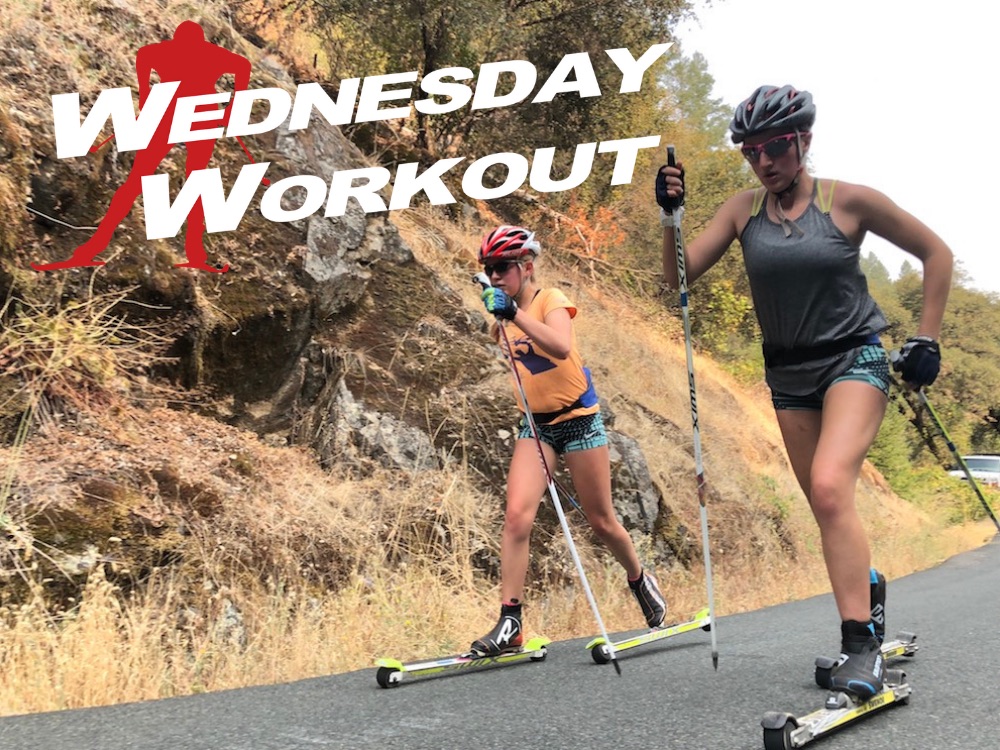
Kili Lehmkuhl (l) and Lilly Murnane of the Auburn Ski Club Training Center striding on Iowa Hill Road near Colfax, California, on Aug. 26. (Photo: Gus Johnson)
This Wednesday Workout came to us just over a week ago from Gus Johnson, nordic program director and head coach at the Auburn Ski Club Training Center (ASC-TC) on Donner Summit in California. Have a workout of your own (or one of your club’s) that you’d like to share? Send submissions to info@fasterskier.com with the subject line “Wednesday Workout”.
***
August proved to be smoke season in California for the Auburn Ski Club Training Center athletes, but a few days of clear air has given us the opportunity to put in some late summer intensity. Like many athletes across the west, ASC-TC athletes have had to adjust their training to be flexible with the wind and smoke patterns this summer. When the smoke outside became unhealthy, workouts consisted mainly of focusing on technique and shorter sessions, or finding alternatives for indoor training.
Auburn Ski Club Training Center is located on Donner Summit at 7,200 feet above sea level, but has easy access (within one-hour drive) to rollerski locations at elevations around 1,000 feet. This week, with a change in the weather and the sunny skies California is famous for, the Auburn Ski Club Training Center Comp Team headed down to Colfax, California, to rollerski Iowa Hill Road for some Level 4-5 (L4-L5) intervals.
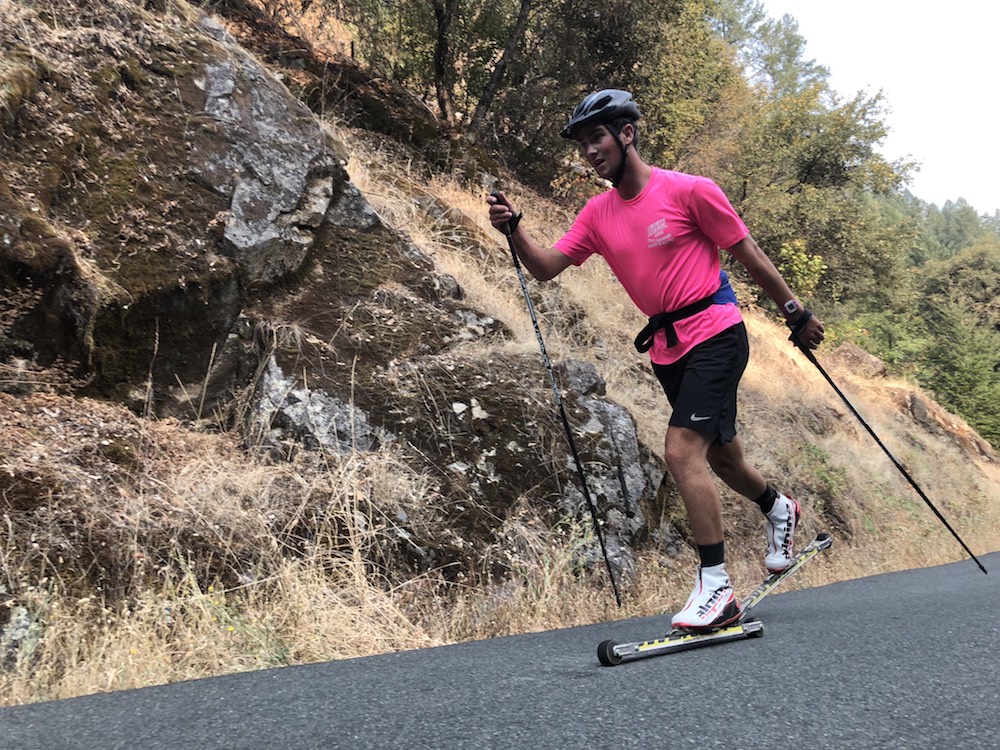
Max Roske of the Auburn Ski Club Training Center striding on Iowa Hill Road near Colfax, California, on Aug. 26. (Photo: Gus Johnson)
With Junior Nationals at sea level this year in Anchorage, our altitude athletes are looking for ways to inject some pace into their normal ski preparations. Our team typically plans at least one week-long training camp on the California coast, and several mini camps at low altitude for hard rollerski intervals and speed sessions. We’re lucky to be able to hop in the car on short notice and find cheap campgrounds to stay at for low-altitude over the weekends. It spices things up whenever we feel things getting stale at home in the mountains.
The base of Iowa Hill Road starts around 1,000-feet elevation in the river gorge of the North Fork of the American River and climbs up to Colfax at 2,100 feet. We find the session to be both a test of mental toughness and a great opportunity to challenge our fast-twitch muscles.
The workout:
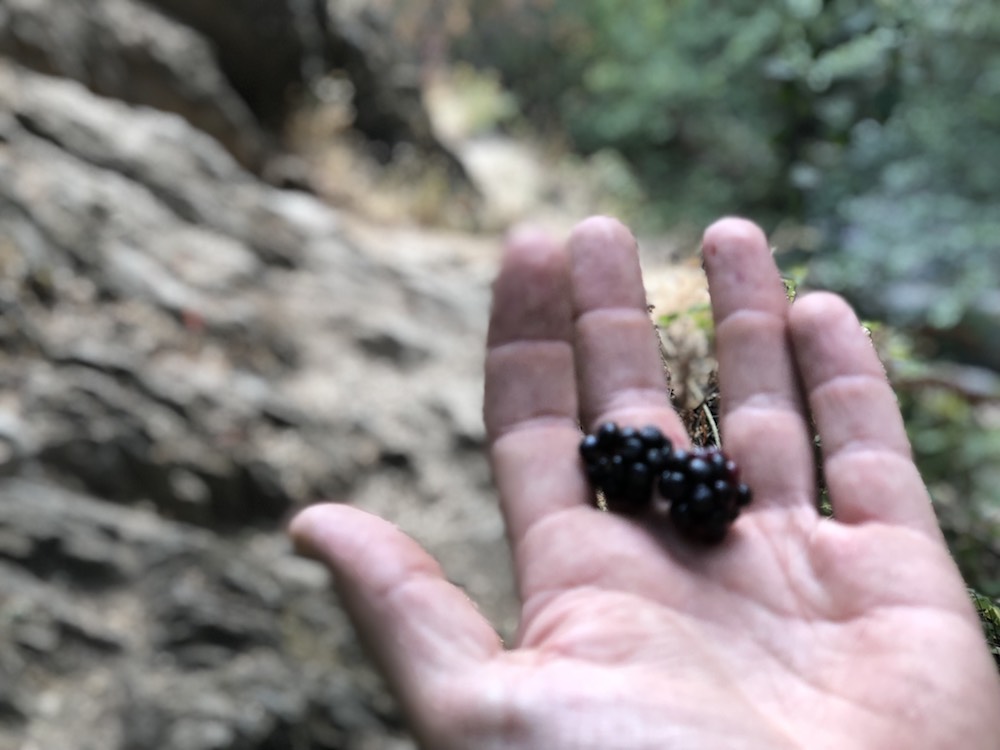
Blackberry picking doubles as a warmup for Auburn Ski Club Training Center athletes in California. (Photo: Gus Johnson)
Warmup (on foot): 10-15 minutes of easy jogging (hunt for blackberries)
– 5 minutes of dynamic warmup (A-skips, B-skips, agility ladders, and dynamic stretching)
Change into the rollerski gear
– 4-6 short speeds, starts, and lunges, each about 8-seconds long
– 4 x 1-minute classic rollerski intervals (L4+) uphill with 1-minute recovery, followed by 2 x 5 minutes with 3-minute recovery, and another set of 4 x 1 minute intervals.
Cool down
***
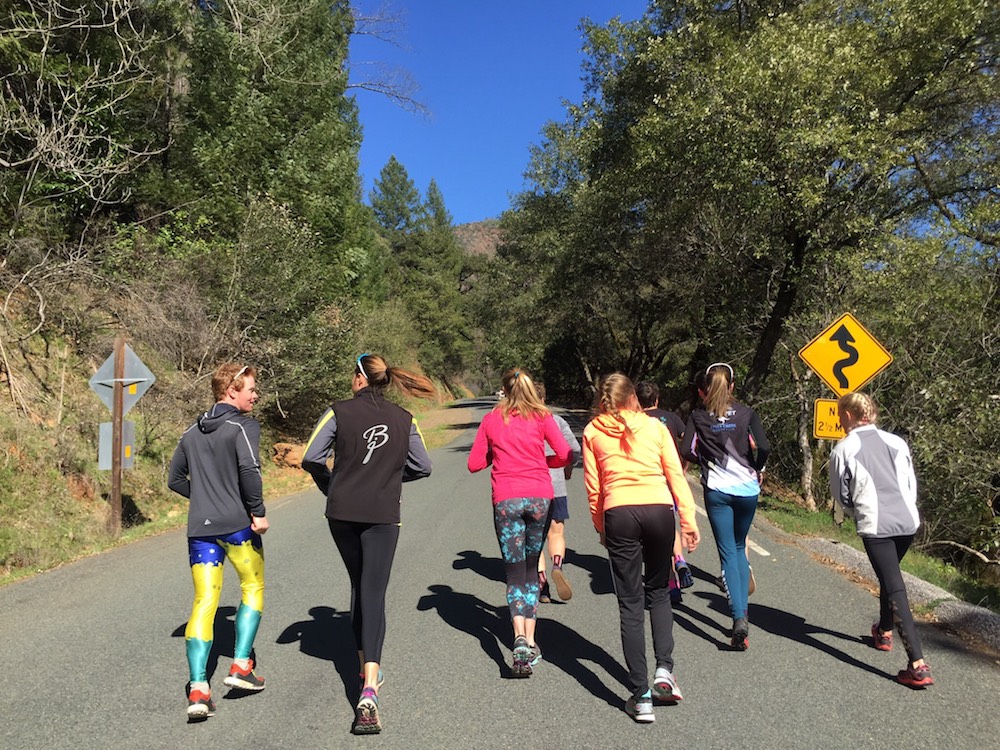
Auburn Ski Club Training Center skiers warm up on Iowa Hill Road near Colfax, California, on Aug. 26. (Photo: Gus Johnson)
About the Auburn Ski Club Training Center:
The ASC Training Center is a premier training and racing venue in the western U.S. with programming for all ages and ability levels across four ski and snowboard disciplines (alpine, cross country, biathlon, and snowboard). Our institution’s roots go back to the club’s founding in 1928 (we were instrumental in the development of ski culture and ski tourism in California), and that legacy continues today with a bid to host the 2020 xc junior national chamionships. We have hosted the XC Junior Nationals four times to date, the US Ski and Snowboard Supertours twice, as well as the NCAA National Championships and the US Biathlon Nationals. Whether it is as a training and racing venue for the region or as a part of our programming, it is safe to say ASC-TC plays a significant role in the development of all Far West Nordic skiers.
The ASC-TC Competition team is made up of athletes from all across the greater Northern California and Nevada region and is for athletes ages 14-19. The majority of Comp Team athletes live and train near the Truckee and Tahoe area, but some athletes are based out of the sierra foothills (Grass Valley, Colfax, Nevada City, and Auburn) and even some as far away from snow as the Bay Area will come up and ski with the team on weekends or gain race support at events. Our programming is year-round and strives for flexibility to support both elite junior racing as well as participation for athletes whom skiing is only one of their many passions.
The ASC Training Center is a non-profit organization located on Donner Summit, adjacent to Boreal Mountain Resort. ASCTC provides a variety of programs for 1000 members. Activities include Junior Alpine, Snowboard, Nordic and Biathlon programs; recreational XC skiing and clinics on club trails; competitions and social events.
Position: Nordic Assistant Coach
Employer: Auburn Ski Club Associates
Reports to: Nordic Head Coach
Employee period: June 1 –Nov. 15 (avg. 25 hours a week). Nov. 15– April 15 (avg. 40hrs/week).
Compensation: DOE
Benefits: Continuing education, USSA Level 100 Coaching Certification and CPR/First Aid Training Available, ski passes at other xc areas
Functions and Responsibilities:
The Nordic Assistant Coach is a key member of the coaching staff. The ASCTC team operates the Training Center for the enjoyment of participants and guests and to meet the athletic goals and objectives shared by ASC, Inc. and Auburn Ski Club Associates. Responsibilities include, but are not limited to:
1. Essential Functions:
Attend racing events at the direction of head coaches (local races, JNQs, national championship events, training camps, etc.)
Work across multiple program areas (123 Ski, Masters, Comp and Devo, and Foothill Outreach) with weekly training sessions in the various programs at Auburn Ski Club Training Center.
Ability to work with individuals and athletes of all ages including kids, teen, young adults, parents, and other instructors and coaches at various levels of development
Conduct safe and appropriate training sessions for ASC Training Center Nordic programs.
Operate vehicles for the safe transportation of athletes.
2. Work closely with ASCTC membership and program administrator to recruit and enroll participants. Work with the Nordic Coaches for scheduling between the disciplines and to achieve program goals.
3. Provide content for newsletters and media/advertising ventures.
4. Work with ASC staff, board members, and parents to help fundraise for ASC.
5. Assist as needed, day-to-day TC operation, snow removal, opening and closing, staff meetings, risk management training, etc.
Qualifications and requirements:
Passion and extensive knowledge of XC racing and training for the development of ASCTC Athletes
Submission of a motor vehicle record acceptable to ASCA insurance.
Completion of a background screening.
USSA Level 100 Coaching Certification and CPR/First Aid (training available at ASC)
Friendly, outgoing personality with proven communication, writing and organizational skills.
Ability to work as part of a team and be productive when unsupervised
Computer competency – word processing, spreadsheets, email and internet
Sugar Bowl Ski Team and Academy is currently seeking an assistant Nordic ski coach. The Sugar Bowl Ski Team & Academy is located on Donner Summit, Calif., and is dedicated to the healthy, joyful growth of passionate skiers: mind, body and spirit. Sugar Bowl Academy (SBA) was founded in 1998, and SBA student-athletes thrive on the dual pursuit of rigorous academics and competitive skiing in an environment that celebrates hard work and the pursuit of worthy goals. Graduates have gone on to some of the best colleges and universities in the country and many have continued their pursuit of skiing on NCAA teams at schools like Bates, Boston College, Dartmouth, Middlebury, Saint Lawrence University, and the University of Colorado.
The position will assist the Head Coach in creating training plans and schedules, trip planning, and recruiting. The coach will work primarily with the SBA team (grades 8-12) and also assist in coaching seasonal development teams (ages 9-15). Work with the SBA team will include travel to SuperTour races, US Nationals, and Junior Nationals. Development teams are run locally and are focused on creating a positive learning environment. In addition, the position will assist in expanding the extant Nordic programming and will have the opportunity to pursue relevant professional development.
Relevant work or racing experience is required. Salary will be dependent on experience. If interested, please send your resume and cover letter to Martin Benes, Head Nordic Coach, mbenes@sbacademy.org.
Skiers pause in the Devil's Peak area at Royal Gorge Cross Country Ski Resort in early 2011. Photo courtesy Mark Nadell — www.macbethgraphics.com
The thing about Royal Gorge is, nobody really knows how big it is.
Trail reports have varied since the cross-country ski resort went up on Donner Summit in 1971, suggesting the nearly 3,000-acre property offers anywhere between 195 to 320 kilometers of groomed terrain.
Back in the early stages of the Royal Gorge’s rapid development in Soda Springs, Calif., founder John Slouber claimed it was the largest nordic ski area in North America. Forty years later, one would be hard-pressed to refute that.
“I don’t know of anyone that grooms more kilometers than them,” said Mark Nadell, the former head of Far West Nordic who designs the area’s trail maps. “Whether they were 300 or 150 it didn’t matter, it was always more than you could eat.”
A local skier from nearby Truckee, Calif., Nadell tried to ski Royal Gorge’s perimeter with friends. Six or seven hours later, he figured they had only scratched the surface.
The obscurity that surrounds the resort’s total kilometers matches its current financial situation. Simply put, it’s a tough one to pin down and could be harder to sort out.
Six years ago when California developers Kirk Syme and Todd and Mark Foster bought the business for a reported $35 million, they had big plans in mind. Their vision, which included some 900 condominiums and two manmade lakes, never panned out for a myriad of reasons. To name a few, the economy turned sour in a saturated market, Donner Summit’s environment was both fragile and historical, and the community rallied to conserve it.
In June, news broke that Royal Gorge’s owners defaulted on a $16.7 million loan. Their continued inaction on the nonpayment put the resort under court-appointed receivership in August. The owners were given 45 days to resolve the situation with the receiver, Douglas Wilson Companies of San Diego.
Time expired without resolution in mid-September, delegating the resort’s operations to the receiver for the upcoming winter and leaving its future undecided.
For Royal Gorge and its influx of skiers, that arrangement won’t affect much, said the area’s marketing and sales coordinator Lauren Birtwhistle. General manager David Achey remains at the helm and the rest of the resort’s usual staff is in place, ready to offer lessons, rentals and the deluxe nordic ski experience unique to Royal Gorge.
“Royal Gorge will be open this season,” Birtwhistle said. “There isn’t any reason to be hesitant to make plans to come up here. … There aren’t any big dramatic changes going on.”
As part of an ongoing marketing effort, Royal Gorge reduced its season-pass price from $425 to $375 per adult and extended the early-season discount to Oct. 31.
Operating hours would most likely be similar, Birtwhistle said, from Thursday to Monday (9 a.m. to 4 p.m.) and Tuesday (9-1:30), except for holidays when the resort was open seven days a week. She didn’t anticipate major alterations to grooming, especially not at Ice Lakes Lodge, which is under separate ownership.
“The lodge is the lodge; we have the trail systems and the land,” Birtwhistle said. “Everyone has their rumors and this and that, but you wouldn’t be able to see anything different from day-to-day operations. … We’re really expecting one of our biggest years.”
The Royal Gorge Experience
The entrance to the Royal Gorge Cross Country Ski Resort. Photo courtesy of David Madison — Royal Gorge.
The ski area’s original visionary, John Slouber reportedly chose the property when he discovered a hunting lodge on Donner Summit, according to Moonshine Ink of Truckee and North Lake Tahoe.
Born in Auburn, Calif., he ski raced and guided in Europe, picking up influences from Scandinavian resorts. Starting with four trails on about 10 kilometers, Slouber quickly expanded Royal Gorge with the help of Donner Summit landowner Rancho Monterey. The resort soon encompassed some 3,000 acres, from Van Norden Meadows near the Sugar Bowl alpine resort to the edge of the 4,417-foot-deep Royal Gorge on the North Fork of the American River.
“Creation of this thing is the fun part,” Slouber once said, according to the San Francisco Chronicle. “I want to see how far it can go.”
He initially wanted an Olympic Village – a multisport playground in the heart of Royal Gorge, complete with luge runs, ski jumps, ice rinks, a biathlon stadium, five lodges, two lifts and 510 “condotel” rooms, Moonshine Ink reported.
That idea hit a snag in the early ’90s when the economy took a dive, but Slouber kept thinking. He proposed a lodge and 18 residential units on Van Norden Meadows, but Donner Summit homeowners and conservationists strongly objected.
In the end, Slouber left Royal Gorge in 2005 with plenty of developmental marks, including four lifts, two overnight lodges and a day lodge, and eight warming huts scattered among 90 trails.
Six years later, the resort stands as one of the nation’s largest. Development, however, has stalled and one surface lift remains.
“John Slouber was brilliant,” said Nadell, who worked with Royal Gorge since 1977. “He got out at just the right time, buy low, sell high.”
The Master Plan
When Syme and the Foster cousins took over in 2005, they neither anticipated the economic recession that hit the nation less than three years later nor the regulatory problems of developing Donner Summit.
The real-estate investors reportedly discovered the property in a Wall Street Journal advertisement while living in the San Francisco Bay area. Considering the building boom that was taking place in Truckee – with nearly 10 new golf courses in a few years – they figured they couldn’t lose.
Before submitting their proposals to Placer County, the new owners took the time to meet the Donner Summit locals. In January 2006, they held a public meeting and noted the community’s concerns, which mostly involved public access. Syme and Todd Foster touched upon their development plans without too much detail, and encouraged people to submit comments and stay updated on their website: royalgorgefuture.com.
Five years later, that web address did not work.
In March 2007, the developers held another meeting with Donner Summit residents, this time with concrete plans. Among them, Syme and Foster proposed 600 residential units (for a total of 900), two hotels, two artificial lakes, several ski lifts and trails and a series of retail stores and restaurants.
The community and several conservationist groups wouldn’t have it.
“We have felt that the development does not match our community, that it would be very harmful to the environment,” said Serene Lakes Property Owners Association President Ken Hall, specifically pointing out the area’s small lakes and surrounding mountains.
“We were very opposed to Mr. Syme’s plan,” Hall added. “There were just so many problems with his proposal.”
Finding an adequate water supply was a major issue. The developers suggested pulling from a lake, which would have caused a significant drop in water level, Hall said. Their expansion would have doubled the population on Donner Summit, which posed septic problems and would have required the construction of a second road in case of emergency.
According to Hall, the plans did not evolve past the talking stages and were never submitted to the county. While conservationist groups like Sierra Watch stepped in and argued their case, the developers’ lack of progress most likely came down to finances.
Perry Norris, president of the Truckee Donner Land Trust, said the market was developmentally saturated by 2007, and Donner Summit wasn’t exactly conducive to year-round activities.
“Literally, there are two or three months where there’s not snow,” Norris said.
Skiers stop at Palisade Peak Warming Hut, one of eight huts at Royal Gorge Cross Country Ski Area. Photo courtesy of David Madison — Royal Gorge.
Moving Forward
While the business didn’t work out as Syme and Foster had planned, skiers can plan on recreating Royal Gorge in the future.
Conservationists and homeowners agree: it’s a must for the area.
“We really do value the Royal Gorge cross-country ski area,” Hall said. “We don’t want to lose the resort.”
With the recent merger of the Squaw Valley and Alpine Meadows alpine resorts, the Tahoe area could be approaching an era of increased tourism, he said. The continued operation of Royal Gorge would add to that.
“When people come to visit Tahoe for say a week, they’ll typically visit different areas,” said Kevin Murnane, general manager of Tahoe Cross Country and a member of the Cross Country Ski Areas Association board of directors.
Besides Tahoe Cross Country and Royal Gorge, nordic skiers can also visit Tahoe Donner.
“In terms of a joint marketing of the area, it shows how much terrain there is,” Murnane added. “From the association side, Royal Gorge was traditionally pretty influential. John Slouber brought about this great revolution. It was creating this presence in cross country … because he had this larger approach. At the same time, the sustainability of that becomes the greater challenge.”
If all goes according to the plans of the Truckee Donner Land Trust, the property will go up for sale by November and Norris will move toward purchasing it. The land trust’s president for 11 years, he first considered Royal Gorge’s conservation potential in the early 1990s. Back then, the trust tried to buy the 1,000-acre Van Norden Meadows.
The pending acquisition, which would include more than 3,000 acres in and around the resort, would not be the land trust’s biggest deal in terms of size, Norris said.
“We’ve done larger acreages and we’ve done more expensive properties,” he said. “But I don’t think we’ve ever done one that’s so important to the community.”
Devoting some 60 hours a week to the project, Norris has met and spoke with several stakeholders regarding the transition. Foreclosure was an initial concern, but Norris said the owners cooperated with the bank, and the resort would mostly likely not go to auction.
In the meantime, the Truckee Donner Land Trust was pooling its resources, reaching out to national land trusts and calling for outside help.
“Our long term goal is to protect the property, keep the nordic center running and most likely, running it better,” Norris said. “We’re going to be looking 100 percent to the private sector to finance this opportunity, and we’re going to be looking to the nordic ski community to step up as well.”
According to Sugar Bowl Ski Resort President Rob Kautz, his alpine area — with trails that connect to Royal Gorge — was interested in purchasing the land and expanding into the nordic market. If a partnership played out, the land trust wouldn’t run the area, Sugar Bowl would.
“Royal Gorge is a great brand; it’s a wonderful cross-country resort,” Kautz said. “We would ultimately like to take over the operation. I think the community is supportive of that concept.”
“The investors in Sugar Bowl are a kind of who’s who in San Francisco,” Norris said of the downhill resort, which opened in 1939. “So they’ll be able to make the investment that the resort needs.”
As for other potential buyers, Norris said not to expect any.
In order for the Truckee Donner Land Trust to reach a deal, a long negotiating process was likely, he said. For starters, they would need to convince the Missouri lender, Armed Forces Bank, that Royal Gorge’s price tag shouldn’t be based on sheer acreage.
“In some ways, a very capable developer looked at this property for six years and wasn’t able to move the property one inch,” Norris said. “I don’t think there’s any developer that is going to come out of the woodwork and buy this property.”
If there were, the “Save Donner Summit” bumper stickers still clinging to the backs of local vehicles could dissuade them.
“A reasonable appraiser would probably conclude that the property would best be used as an open space,” Norris said. “And nordic ski area.”
The position will oversee on snow and administrative operations for the Auburn Ski Club Associates’ Nordic Training Center based Programs.
The Auburn Ski Club has a long history of offering quality, low cost programs & events to encourage youth to participate in snow-sports. We are looking for a self-starter with a passion for youth & skiing to help us oversee and further develop our youth, junior & adult recreational Nordic programs at the Club’s Training Center on Donner Summit near Truckee CA.
The Program manager will also assist with various races held each season. The Auburn Ski Club was host for the 2004 NCAA Champs & 2005 & 2009 Junior Olympics & continues to offer top level local and National level races.
The successful candidate will:
Be strong intermediate or advanced Nordic skier with teaching experience. (PSIA certification and some racing experience preferred – but not essential)
Excited to work with youth and junior development in Nordic skiing
Be a skilled, enthusiastic, well organized administrator with computer & internet competency
Have excellent communication skills; friendly personality and excellent customer service skills
Be a ‘self starter’ who works effectively with or without supervision and as part of a team.
The position is primarily a Training Center /office based position, with some outside/ offsite coaching/teaching/ event responsibilities.
Packaged based on 40 hrs a week – Wage depending on experience