From the FasterSkier archive — posts syndicated from athletes’ and coaches’ own blogs between 2004 and 2012, kept online as published. Current coverage is at fasterskier.com.

Tag: double-pole workouts

  • Wednesday Workout: Double-Pole Endurance Training

    Wednesday Workout: Double-Pole Endurance Training

    The Marcialonga course follows the rivers in the Fiemme and Fassa valleys for the first 67 kilometres. (Photo: Ian Murray)
    The Marcialonga course follows the rivers in Italy’s Fiemme and Fassa valleys for the first 67 kilometres. (Photo: Ian Murray)

    Double poling is an increasingly important part of cross-country skiing and it pays to be good at it. If watching World Cup stars double pole short races on television doesn’t have you convinced, take a look at the races you might enter. Most loppets, marathons and citizen races feature flatter courses with a lot of double-poling time. Even in skating, the three main techniques all include slight variations on double poling.

    When five Canmore skiers decided to make the 70-kilometer Marcialonga in Italy (part of the Ski Classics marathon series) their major target for this season, they decided to emphasize one technique in their preparation.

    “Pretty much the whole elite field will [double pole the Marcialonga without grip wax],” Erik Carleton, a longtime Canadian Para-Nordic Ski Team guide, explained. “It’s all about getting to the last uphill, and then it’s 3 k pretty steep and you just try and survive that.”

    Here are three of the workouts that the 38-year-old Carleton and his Canmore-based training partners, including Canadian Para-Nordic veteran Brian McKeever (age 37), his other guide Graham Nishikawa (33), Ian Murray of North Highlands Nordic (38), and Jon Arne Enevoldsen (54), a former Norwegian biathlete who now runs a coaching business, used to prepare. Each of these five athletes had a different mix of goals for the season and shared workouts were just a part of their individual preparation. FasterSkier has suggested variations for those of us who are less than elite.

    Workout 1: Go to a local classic loppet/marathon/citizen’s race and don’t bring kick wax.
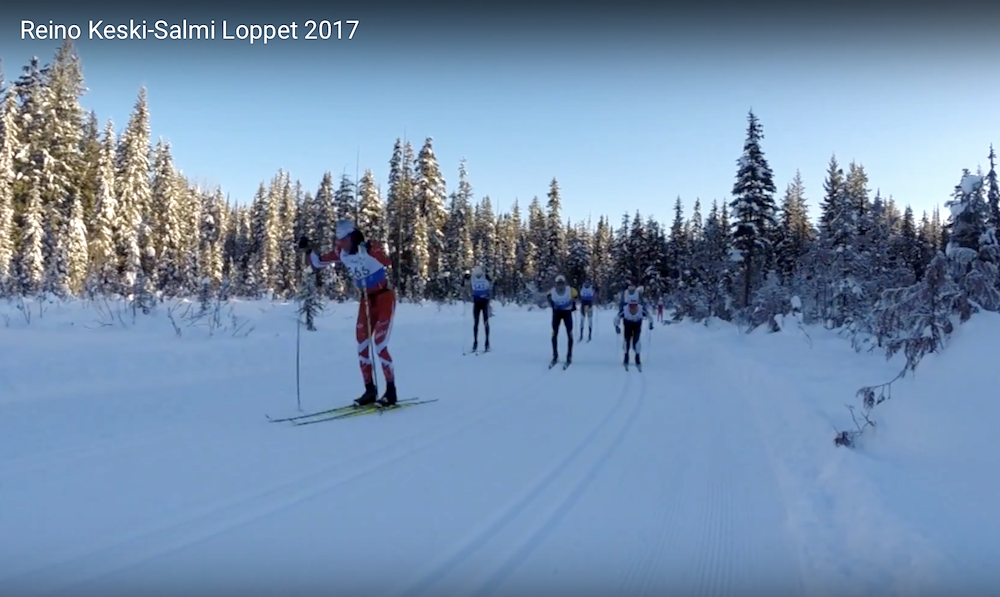
    Erik Carleton leads a group through Bilbo's Bog at the RKS 2017. (Photo: Larch Hills)
    Erik Carleton leads a group through Bilbo’s Bog at the 2017 Reino Keski-Salmi Loppet at the Larch Hills trails in Salmon Arm, B.C. (Photo: Larch Hills Nordic)

    The Canmore crew chose the Reino Keski-Salmi loppet, a 34 k race at the Larch Hills trails in Salmon Arm, B.C., known to locals as the RKS. This event is a typical regional loppet: the long course is relatively flat with a little over 600 metres of climbing, the demographic is dominated by kids and retired people, and most of the 396 finishers were solidly focussed on having fun on snow.

    Before the race, Enevoldsen correctly predicted that local skiers with grip wax would easily beat anyone double poling on squeaky -17 Celsius snow. Their goal was not to win, but to get some quality DP training done two weeks before the Marcialonga.

    In the end, Larch Hills local Thomas Hardy cruised to victory on grip wax in 1:38:52, just four days after placing 18th at the U.S. nationals 30 k classic mass start at Soldier Hollow in Utah.  McKeever and Nishikawa returned from Soldier Hollow ill and didn’t start.

    Carleton was feeling the effects of his 15th at Soldier Hollow, finishing the RKS 4:03 minutes behind Hardy. Carleton said afterwards, “It felt good off the start and I tried to push the pace a bit, but then the body was — not today.”

    Murray and Enevoldsen were fresher but still treated the RKS as a training workout, finishing at 1:32 and 9:00 respectively to win their age groups.

    If it seems wrong to go to a race and not push for the best possible finish, these guys weren’t alone in looking past the result sheet. Retired Canadian national-team member Alysson Marshall returned to her hometown event with her new husband Chris Hamilton to have fun on the trails she grew up on.

    Variations:

    • Choose a race to suit your needs. McKeever and Carleton have double poled 50 k races in the past, but your local weeknight 10 k might be a better fit.
    • Split a race in two. If you aren’t ready to double pole the full race that fits your calendar, choose a point on the course where you will pretend you have switched to skate skis and double pole to the finish.


    Workout 2: Long DP rollerski with race pace at end
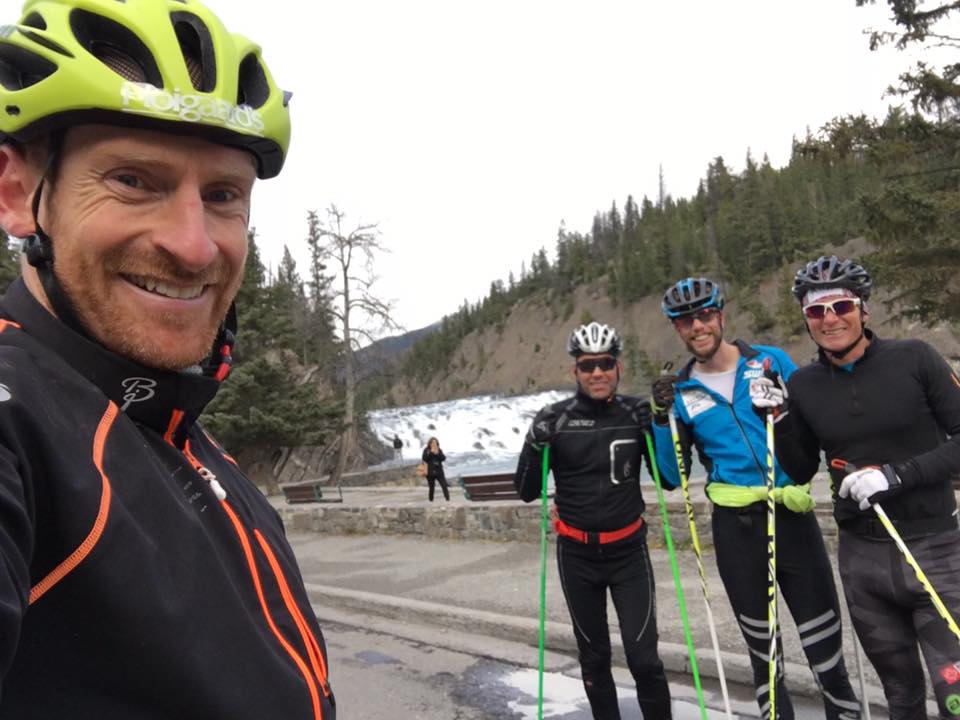
    Brian Gregg, Jon Arne Enevoldsen, Erik Carleton, and Ian Murray during a double-pole rollerski to Banff. (Selfie: Brian Gregg)
    (From left to right) Brian Gregg, Jon Arne Enevoldsen, Erik Carleton, and Ian Murray during a double-pole rollerski from Canmore to Banff, Alberta. (Photo: Brian Gregg)

    Roughly every two weeks, the crew would get together for a long Zone 1 (Level 1, or easy chat level) double-pole ski followed immediately by 30 to 60 minutes in Zone 3 (loppet race pace).

    “The idea is you tire out your body and then try and push it a bit more,” Carleton said, “so that it will give you that endurance double-poling at the end of loppet races.”

    For this crew, the long easy session was two to four hours.

    While this workout could be done on snow, it was a rollerski favourite because of available trails. “We’ve got this nice legacy trail to Banff and it’s good flat terrain for that,” Carleton said. Few ski areas can provide flat trails suitable for a four hour ski without excessive laps.

    Variations:

    • Adjust the times. Starting out, one hour of Zone 1 followed by 30 minutes of Zone 3 might be hard enough.
    • Use your legs for the Zone 1 part. If you don’t have enough flat terrain to stay in Zone 1 double poling, stride or skate as needed in the first part of the workout. For the second part, hilly terrain is less of a problem in Zone 3.


    Workout 3: 4 x 45-minute intervals 

    Double pole 45 minutes in Zone 3, followed by four hours of rest between.

    Murray came up with this workout after getting good performance gains from doing mountain bike relay races like ’24 Hours of Adrenaline Canmore’ and ‘Golden 24’.

    “Some of my friends give me a hard time, saying this is too difficult,” Murray wrote in an email. “But the mountain bike races are far harder.”

    Variations:

    • Don’t do this. While this workout seems unnecessarily hard, it is clearly working for Murray. Maybe we can all think outside the box to build new workouts from races, events, or long backcountry days that produced good results.
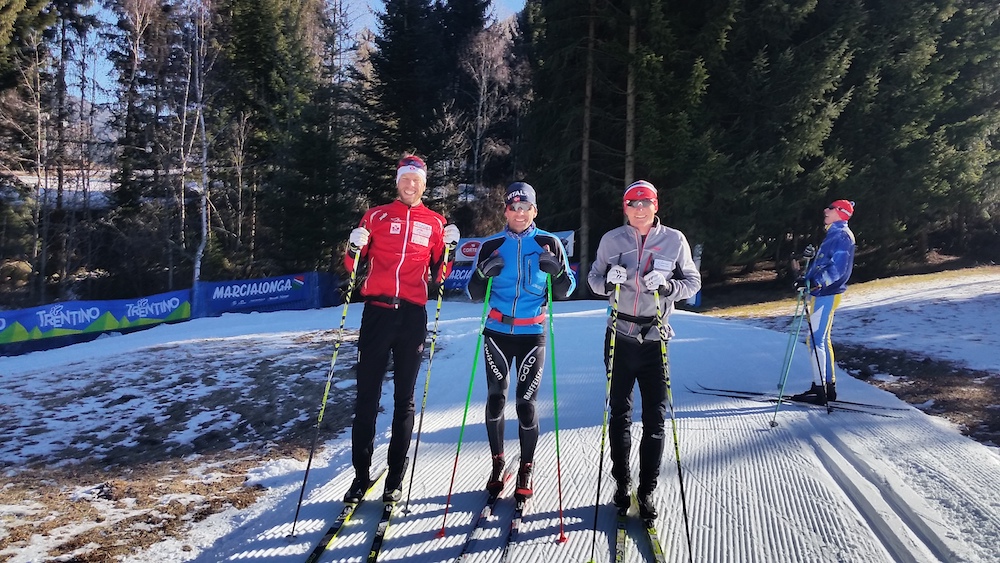
    Erik Carleton, Jon Arne Enevoldsen, and Ian Murray previewing the Marcialonga course. (Courtesy photo)
    (From left to right) Erik Carleton, Jon Arne Enevoldsen and Ian Murray previewing the Marcialonga course. (Courtesy photo)

    Conclusions:

    So how did these five fare in the Marcialonga after all the preparation?

    McKeever was the fastest of the group (and fastest Canadian), finishing the shortened 57 k course in 2:21:32.5 hours, 9:13 minutes behind the winner Tord Asle Gjerdalen for 57th overall. Nishikawa was next, 81st at +12:56, then Murray (86th, +13:37), Carleton (113th, +17:50), and Enevoldsen (160th, +22:14).

    Murray was pleased with his personal best at a Ski Classics event, writing “The double pole training has worked out well. I was able to hold a hard effort for the first 50km although I faded a bit in the last 7km.”

    Murray’s event highlight: “Being so close to the lead for the first part of the race.  Also skiing down the streets of 4 old Italian towns along the 57km track.  I didn’t get to soak in that aspect of the race during the event but rather in the pre-skis and post race ski it was fantastic.”

    And how much did the double-pole preparation pay off? Considering there were 5761 finishers including many former world cup stars like Gjerdalen, Anders Aukland, Toni Livers, and Østein Pettersen, top 200 is impressive.

    2017 Marcialonga results

  • Wednesday Workout: Double Poling with Biathlete Tim Burke

    Wednesday Workout: Double Poling with Biathlete Tim Burke

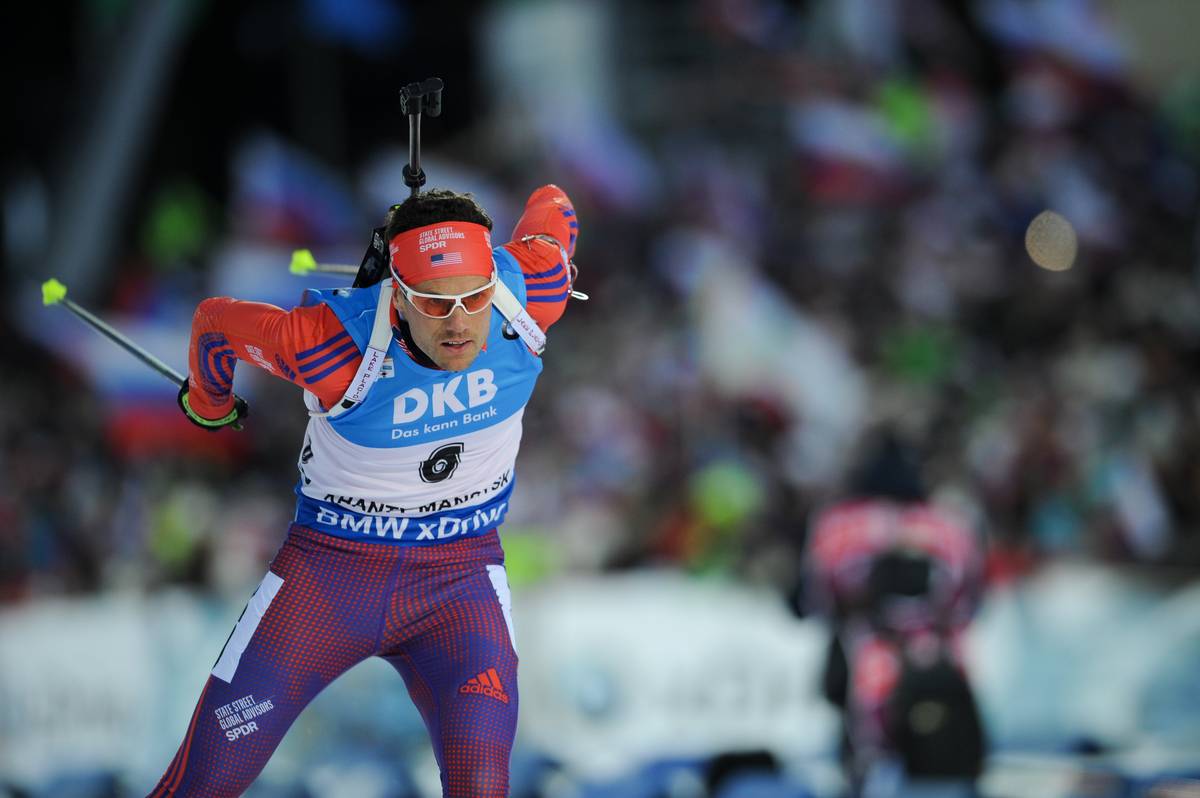
    Tim Burke (US Biathlon) racing the men's sprint at the 2016 US Biathlon National Rollerski Championships in August in Jericho, Vt. (Photo: Katrina Howe)
    Tim Burke (US Biathlon) racing the men’s sprint at the 2016 US Biathlon National Rollerski Championships in August in Jericho, Vt. (Photo: Katrina Howe)

    Here’s a modified acronym: KIS. Intentionally left out is the final S, as in KISS; “Keep It Simple Stupid”.

    Let’s give ourselves the benefit of the doubt. It’s been a long summer and dryland season. We’re all in a place to learn more, not denigrate. Keeping things simple and positive may tilt the cost-benefit scales in our favor. 

    “Keep it simple” is a basic mantra for building upper body, ski-specific strength.

    If you thought biathletes had enough to worry about with the skate skiing, ski selection and shooting as they prep for the International Biathlon Union (IBU) World Cup, you’d be right. Maybe race-day nerves are a bit mellower for biathlon wax techs on race day — there’s no kick wax snafu’s to tiptoe around — but that doesn’t mean US Biathlon’s Tim Burke doesn’t use double-pole workouts in his offseason training.

    Yeah, you heard that right. Noah Hoffman and his now quotidian five-hour double pole rollerski sessions, they’re not just for nordies. Although it should be noted, Burke does partake in the double poling, it’s just a much shorter workout in duration than Hoffman’s epics.

    This Wednesday Workout might best apply to the cross-country skier who only associates the word “classic” with things like cars, music, clothing, and say Coke. And if you’ve ever blurted out this: “Klister and Extra Blue are nothing to me!”, then keep reading. If Burke does it, the logic may follow that you should, too.

    Burke’s Simple Double-Pole Workout (as written by Tim Burke):

    “Here is a short but extremely effective double pole workout … the whole thing is pretty simple.  I start in the weight room with 30 minutes of pretty continuous core work.  You can be creative with the exercises here but I prefer to do most of my work with a redcord. I mostly focus on the core and other muscle groups used during double pole.  The goal here is to fatigue these muscles for the second part of the workout.  

    After 30 minutes is up, I head over to the roller ski treadmill and double pole for up to an hour.  I start at 6% grade and gradually work up to 15% by the finish.  Of course you don’t need a roller ski treadmill, but it definitely makes the workout more challenging.  I also always use skate poles in my double workouts because I am most interested in the crossover to my skate skiing.”

    Part I: 30 minutes in the weight room, continuous core work

    Part II: 1-hour double pole, up gradually increasing incline (like a moderate-to-steep hill)

    Tim Burke (US Biathlon) racing to sixth, which tied his season best, in Saturday's pursuit in Khanty-Mansiysk, Russia. (Photo: USBA/NordicFocus)
    Tim Burke (US Biathlon) racing to sixth, which tied his season best, in a 2016 IBU World Cup pursuit in March in Khanty-Mansiysk, Russia. (Photo: USBA/NordicFocus)

    True enough, it’s rare for skiers to own or have access to a rollerski treadmill. But that doesn’t mean that creativity cannot win out. Find that long, gradually getting steeper and steeper hill and presto: the resourceful person’s rollerski treadmill but with clean air, trees, and hopefully minimal traffic. 

    For those wanting to dive a bit deeper into the specific muscle groups used while double poling, here’s a link to a useful 2010 Journal of Applied Physiology paper. (Note: the red coloration in the images denoting muscles groups used indicate greater glucose uptake. All that means this: the red muscles are used more intensely.)

  • Wednesday Workout: Throwback Over-Distance Double-Pole with Kikkan Randall

    Wednesday Workout: Throwback Over-Distance Double-Pole with Kikkan Randall

    Kikkan Randall taking a break from a fall double pole in 2011 in Anchorage. (Courtesy photo)
    Kikkan Randall taking a break from a fall double pole in 2011 in Anchorage. (Courtesy photo)

    This week’s workout is a blast from the past, written four years ago about U.S. Ski Team sprinter Kikkan Randall. Now, with three Sprint World Cup titles to her name, we figured it might be a good time to revisit what made Randall so fast. Interestingly, one of her favorite fall workouts in 2011 was distance. Randall, 32, is currently in Norway preparing for the Toppidrettsveka rollerski races in Aure, Orkdal and Trondheim, held Thursday through Saturday. See the original pro workout here. 

    ***

    [Circa Oct. 2011] … Kikkan Randall is known for her speed. But even though her forte is in races under three minutes long, one of her favorite workouts to do in the fall is a 50 k rollerski double-pole session. In addition to being a solid level one effort, the U.S. Ski Team (USST) veteran also uses the workout as an opportunity to work on her double-pole form.

    “The goal is to get a lot of repetition in the double-pole movement, going long enough that you tire out the easy-to-use muscles and really find the most efficient positions, timing and impulse,” said Randall.

    Randall has a favorite point-to-point route in Anchorage that usually takes her about three hours to cover. She recruits a family member to drive her outside of town, and then she skis home.

    Alaska Pacific University's Kikkan Randall (r) leads fellow U.S. Ski Team member Liz Stephen and Norway's Celine Brun-Lie (l) during a dryland session last week in Anchorage, Alaska, part of the North American Women's Training Alliance. (Photo: Matt Whitcomb)
    Kikkan Randall (r) leads fellow U.S. Ski Team member Liz Stephen and Norway’s Celine Brun-Lie (l) during a dryland session last summer in Anchorage, Alaska. (Photo: Matt Whitcomb)

    “It includes rolling terrain, but most importantly long, flat sections where I can get into a rhythm in my double-pole technique and really ingrain correct movement patterns,” she explained. Randall makes sure to keep her heart rate under control for the duration of the workout, at about 60 to 70 percent of her max.

    Between September and when the snow flies in Anchorage at the end of October, Randall will head out for a long double-pole every other week. Sometimes she has company for the three-hour workout, but she also enjoys taking in the fall colors when it’s just her and her iPod.

    During such a long, sustained effort, Randall is careful to keep herself hydrated, drinking about 30 ounces throughout the workout, and more after she returns home to continue replenishing lost fluid.

    “You lose more water than you think on a long ski like this!” she said.

    Randall also emphasizes getting recovery food into her system directly after the workout, and will usually go for a smoothie packed with carbohydrates and protein: 1 cup Greek non-fat plain yogurt, 1 cup frozen berries, 1 scoop protein powder, 1/2 cup milk, 1/2 cup juice and 1 Tbsp honey.

    As she usually starts the workout when the air is still crisp, she follows the effort up with a hearty breakfast and a nap.