
Tag: double poling

  • Closing the Gap: Brain Training

    Closing the Gap: Brain Training

    “Norwegian fjell running.” Team Asker doing some dryland mountain training during a training camp in Norefjell, Norway. (All photos: Maks Zechel)

    Editor’s Note: The following is part of a series proposed by Maks Zechel, a 20-year-old Canadian cross-country skier embarking on his first season training abroad. In August, he recently made the big move to Norway, where he’ll be training and racing with Team Asker for the entire winter. Through these updates, Maks hopes to share his personal “observations, stories and lessons learned” to help close the gap between North American and Scandinavian nordic skiing. Previous posts: #1, #2, #3#4#5and #6.

    ***

    There is something about passion that drives people to push boundaries like nothing else. For many Canadians, this passion lies in hockey. If it’s January and you aren’t within walking distance of at least two outdoor hockey rinks, you probably don’t live in Canada.

    I’ve never been a huge hockey fan, but regardless I still went through a phase as a 9 year old when I practised my stick-handling skills religiously, making marks against the garage door or the basement wall. Black marks and dented aluminum are the proud checkmarks of passionate Canadian youth (and the source of endless frustration for Canadian parents). Canadian hockey drives youth and even adults to fervently practice a sport that only a small percentage will ever play professionally. Even on a weekday night in the middle of winter, if you bring a stick and skates to any Canadian outdoor rink, you will be allowed to join a game of shinny. No matter your gender or age, whether you claim to have been a AAA hockey legend or have never skated before, whether your family has lived in Canada for generations or if you are a newly landed immigrant, Canadians are brought together by something that transcends sport.

    National passion for a sport ensures that a large and diverse percentage of the population will actively pursue that activity in a multitude of ways. It encourages creativity and innovation. Similarly to hockey in Canada, albeit on a smaller scale, there are an astonishing number of Norwegian skiers who dedicate much of their time to just training and racing fast, even without sponsorships or national-team status.

    This creates a field of close to 500 open men at the Norwegian national championships. In the 10-kilometer skate race at last year’s national championships, the top-100 racers were separated by 1:47.6 minutes, the top 200 by 2:33.2 minutes, and the top 300 by 3:31.7 minutes (note that the conditions were fast that day). The medal winners, and many of the skiers far off the podium, were World Cup, World Championship and Olympic medalists (Anders Gløersen won, Martin Johnsrud Sundby was second, Emil Iversen was 11th, Sjur Røthe was 32nd (full race results here). The depth of field at Norwegian and Scandinavian Cups and national-championships races rivals that of World Cup races, with many believing it to be more difficult to crack the top 30 in the aforementioned three than it is at most World Cups.
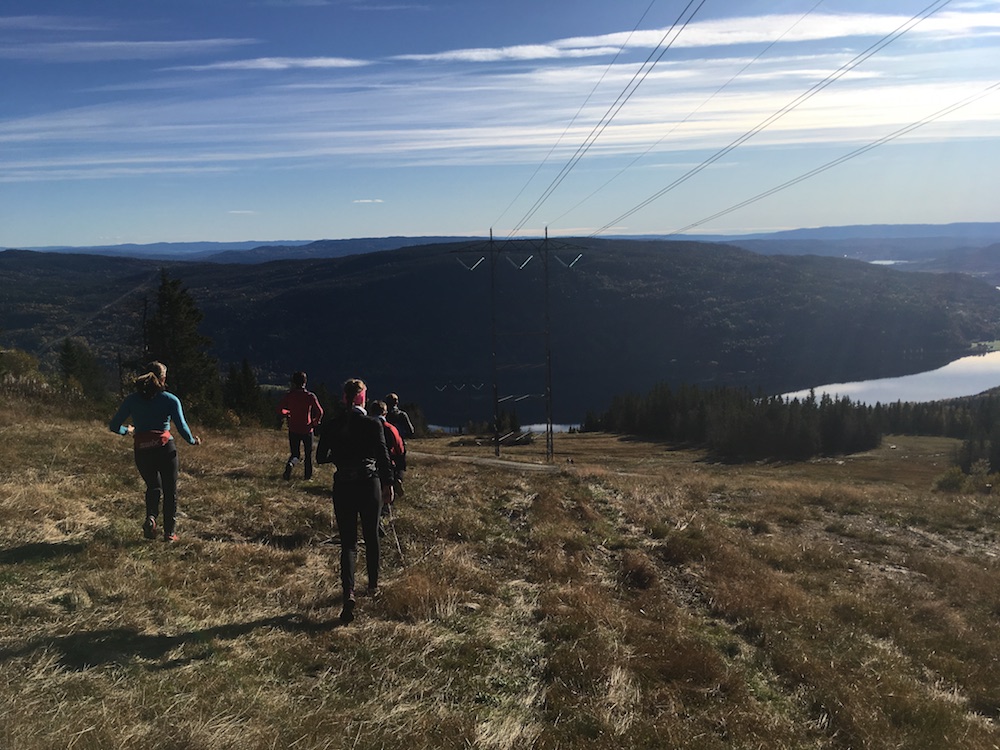
    Team Asker skiers recover as they run down an alpine ski slope during 10- x 4-minute Zone 4 bounding intervals, with one minute rests in between, at a recent training camp in Norefjell, Norway.

    The success that we see in the Norwegian senior ranks begins with Norway’s junior skiers, and I am lucky enough to be training partners with some of these top-level athletes. One of Team Asker’s most successful junior skiers, Harald, has two medals from last year’s Junior World Championships. To put his level of skiing into a senior-racing perspective, he was 26th in the previously mentioned 10 k race at the Norwegian nationals — as an 18 year old.

    It can be deceptive to see skiers who still look quite young, but to know that they are already skiing fast enough to potentially crack the top 30 on a World Cup. I believe that much of this ability stems from the incredible amount of maturity in Norwegian junior racers, although not necessarily in the traditional sense. Not all of them are obsessive about the small things; I have seen top Norwegian skiers down two Cokes per day at training camps, eat Nutella for breakfast and stretch as little as possible. Their maturity becomes apparent in how they approach training and races, ready to learn to push their bodies in the best way that they can.

    With more skiers, you see more body types and different minds. My teammates have told me to expect many funny styles of double poling when I race Norwegian and Scandinavian Cups this winter. Already at the junior level, skiers spend hours working on their double-pole technique, not just doing exactly what their coaches told them to do, but practising different movements and seeing how it works for them. Double poling is a simple motion, in theory, but with different body types you can have countless different styles of double poling that all produce the maximum amount of power for those individual skiers.

    With Team Asker, we discuss technique with our coach and we do group-technique sessions, but then we are encouraged to try things out by ourselves and see how we can adapt those basics of power transfer to how our individual bodies work. The same goes with training plans. The spectrum of what type of training makes someone ski fast is all over the place, and that is something that many Norwegian skiers seem to accept. Some athletes on Team Asker disagree with certain things that our coach says, but they are not criticized for this and are supported in altering their training as they see fit, although they are encouraged to discuss why they are making these choices.

    In Canada, I have often heard repeated “golden rules” to technique and training, things that are accepted by most coaches across the country. In Norway, I learn a new philosophy every time I speak to a different coach or athlete. For some skiers, it is important for them to train long and slowly in Zone 1 so that they have the energy to focus on interval workouts. Other skiers do short Zone 1 workouts, but push the workouts so that they are in high Zone 1 or low Zone 2, skiing closer to competition speed. Many skiers do sprints with every workout, even long runs, while others add sections of Zone 3 pickups in the middle of their easy workouts. I have a teammate who builds up to a period in the training season where he is doing 30 short sprints per day. I know Norwegian 16 year olds who are training more than 1,000 hours per year, but there are also World Cup skiers who are barely training 600 hours.
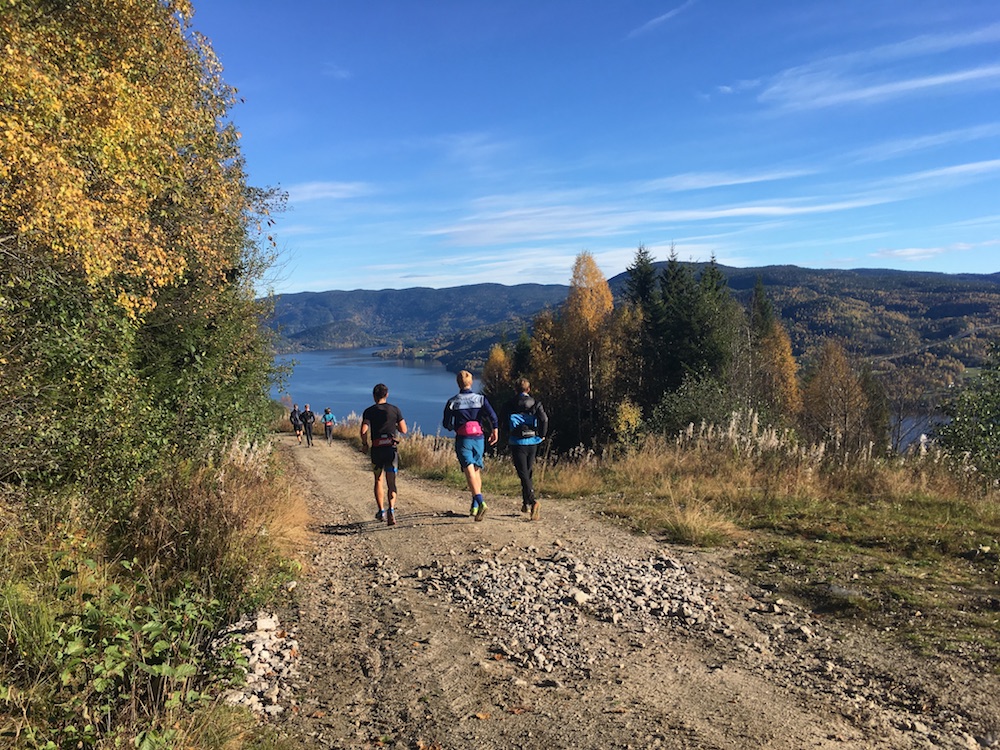
    Team Asker finishing a combo rollerski/run workout at recent training camp in Norefjell, Norway.

    Some people think that too much base training (slow Zone 1) is a waste of time, so they do the bare minimum that is required to be able to absorb intensity training and the long race season. Johannes Klæbo’s big breakthrough in the past couple of years is said to have come from an emphasis on strength and sprint training, while Petter Northug has long sworn by doing intervals in “myra” (spongy and uneven bog/marsh), but for some people, those same things will make little difference to their speed on snow. Talent may have helped them in the beginning, but whether it was Klæbo or Northug, they didn’t reach the top level through talent alone, but by perfecting all the things that make them fast.

    There are skiers, some point to Therese Johaug, who many think could do almost any type of training, and they will be fast simply from general fitness, but for most people training is not so simple. Fortunately for us mortals there is no limit to what we can achieve, so long as we are willing to take chances and use our brains rather than just succumbing to that “training junkie gene” that so many skiers possess. Each one of us is so different, that it is not possible for us to do the same things and achieve the same results.

    Over and over I have heard coaches and athletes, who go to Scandinavia for a few weeks to learn the “secrets” of the best skiers in the world, come back and confidently tell us Canadians that “they do the same training as us” and therefore we can be just as fast as them. I agree that we can be just as fast, but from my first three months in Norway, I can tell you that we do not train anything like the Norwegians. We may do similar bounding, rollerskiing and running workouts, but training in Norway is taken to the highest level by the competitive dialogue that takes place among young skiers, old skiers, back of the pack skiers, and top skiers. From my perspective, training innovation and experimentation doesn’t happen in North America on the same small scale level as it does in Norway.
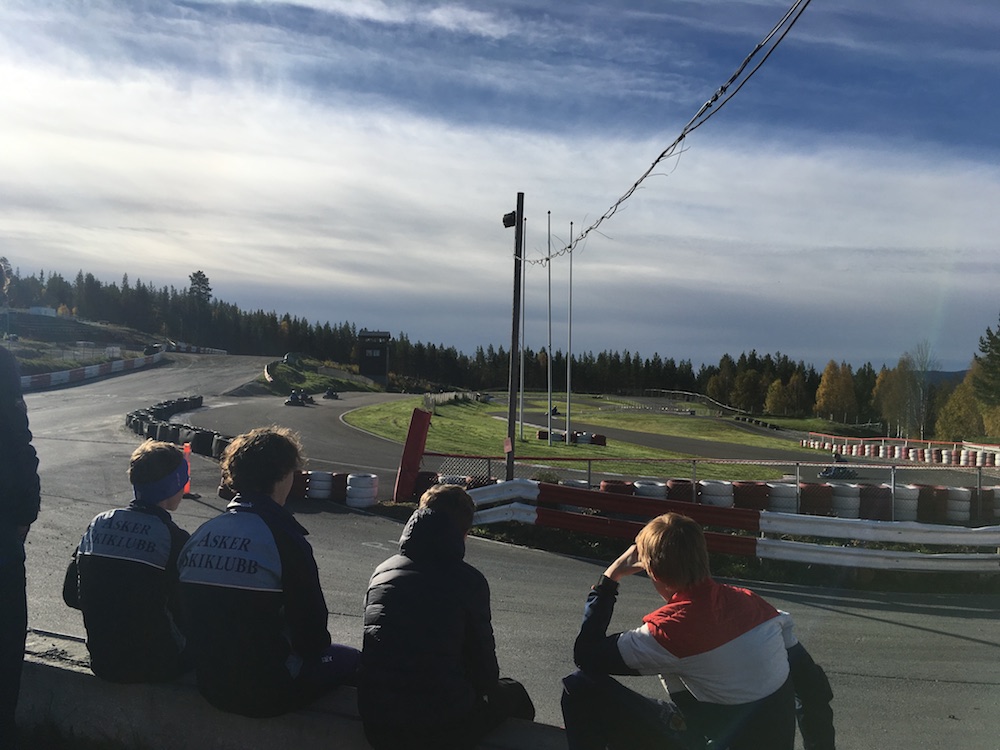
    The go-kart track where Team Asker held “King’s Court” style rollerski skate sprints (8 x approximately 1:30 minutes) during a recent training camp in Norefjell, Norway.

    In Canada we look to those that are better than us, whether they are national-team members or World Cup skiers, and try to copy them from afar. This puts us decades behind the competition. A lot of the technique innovations that we will see on the World Cup in the next two decades will have come from the Norwegian junior skiers of today, but by the time North American skiers take note of these changes, and adjust their training, the next generation of Norwegian juniors will already be working on the technique advances for the next decade.

    When I first came to Norway, the first thing I did was try to copy how the best skiers on the team double poled. I copied them for 12 weeks, but every time I looked at video footage of myself, I still looked completely different. It wasn’t until my coach explained a miniscule timing difference to me that I understood what the others were doing differently. With the switch flicked, my double poling has improved because of things that I could not figure out just by watching others ski. It is this type of interaction, between skiers and coaches of all levels, that causes breakthroughs in technique. Not all club-level coaches in Norway look to the Norwegian national team for advice on all aspects of skiing. Many coaches disagree with the common consensus on technique and training, and this opens up the discussion which is so important to moving forward.

    Most skiers love to talk about technique and the finer aspects of skiing, but when I was in Canada, I found these discussions usually revolved around what faster people were doing. In Norway I find myself having more discussions on what we individually think we should be doing, and even if someone is superior at a certain aspect of skiing, they are usually eager to try what someone else thinks might be better.

    As “Mad-Eye Moody” from J.K. Rowling’s Harry Potter series would say, “Constant vigilance!” and adjustment are required in all aspects of our training if we want to succeed. We have to seek variation in training, and learn together to discover the things that make us go fast as individuals, or else we suffer individually under the repetition of uniform training that cannot meet all of our needs.

    Norwegian Phrase of the Week:

    Norwegian: “Jeg er ut å mate.”

    Google Translate: “I’m out to feed.”

    True meaning: “I am training a lot.” (slang)
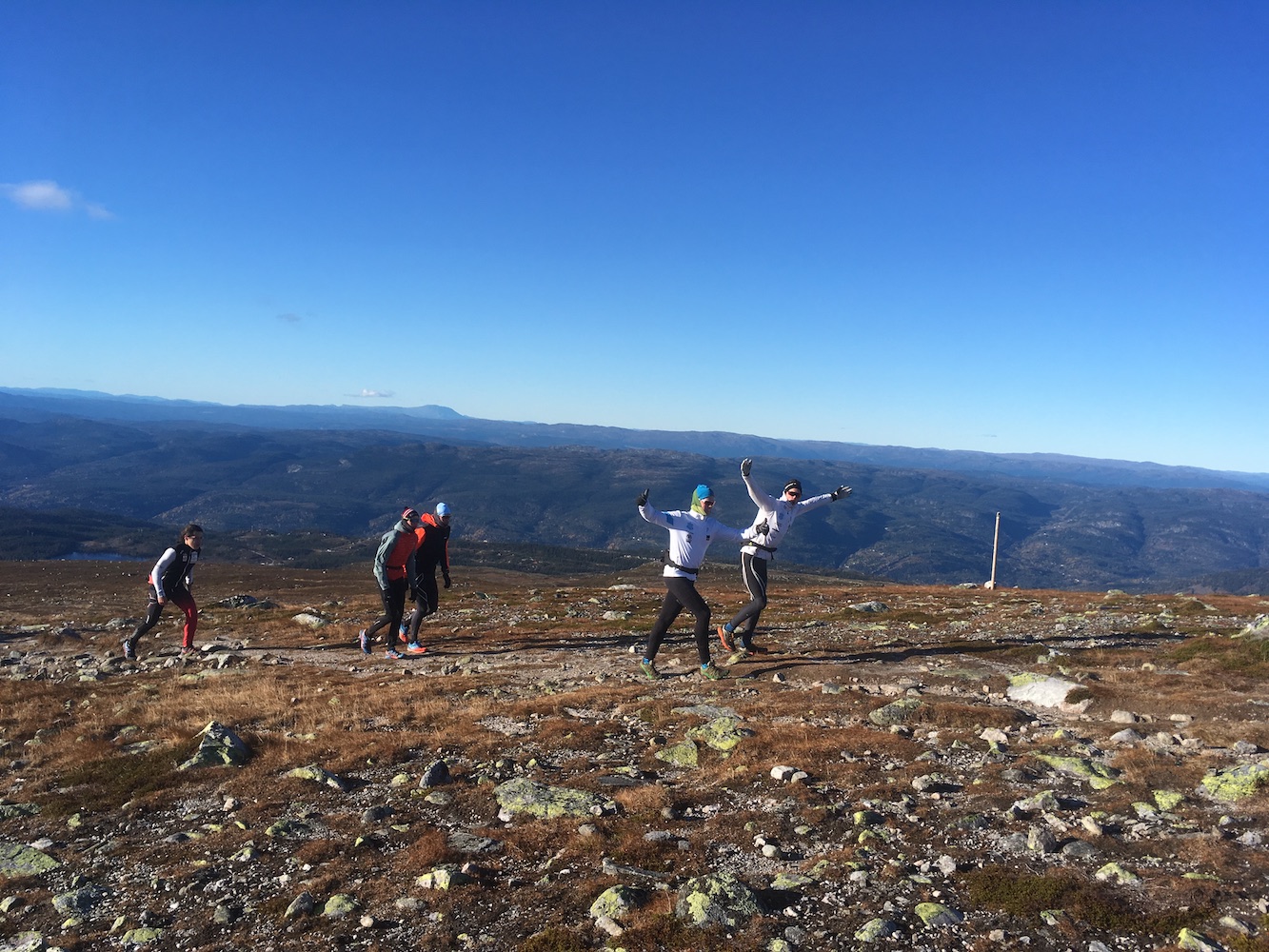
    Team Asker during a long run through the mountains at a recent training camp in Norefjell, Norway.

    ***

    About Maks: Maks Zechel is a competitive cross-country skier who secretly wants to become a professional mile runner. He loves hiking and going on canoe trips with his family, as well as peanut butter cups in ice cream. Johan Olsson is his favourite skier and he hopes to race the Cortina-Toblach stage of the Tour de Ski one day. He enjoys writing about his experiences. Follow him on Instagram @makszechel.

  • Wednesday Workout: SkiErg Intervals with Sadie Bjornsen

    Wednesday Workout: SkiErg Intervals with Sadie Bjornsen

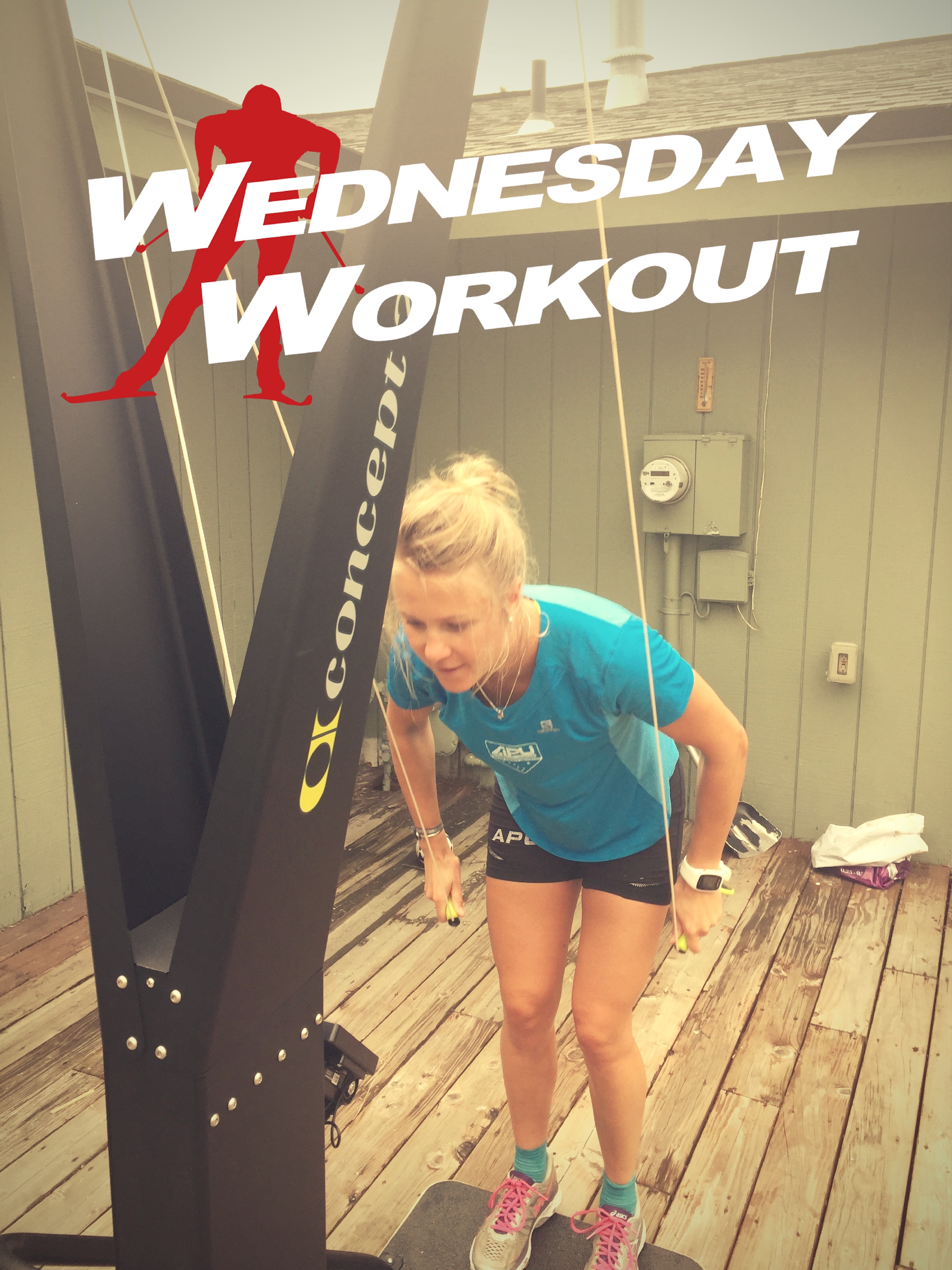
    Sadie Bjornsen, of APU and the U.S. Ski Team, during a SkiErg interval workout at her home in Anchorage, Alaska. (Courtesy photo)

    If you have a lower-body injury, be it acute or chronic, training for cross-country skiing can be frustrating: there are so many activities which must be cut back if you are trying to protect a knee, ankle, or foot.

    Luckily, there are good training options available, especially if you have access to a double-pole machine like an Ercolina or a Concept2 SkiErg.

    “I use the SkiErg a lot because I fight with feet injuries, and it is a safe escape from ski boots or shoes,” U.S. Ski Team and APU skier Sadie Bjornsen wrote in an email.

    Last season, Bjornsen won World Championships bronze in the team sprint with Jessie Diggins. This season, she is back to battling heel spurs. That’s why she has been putting in time on the SkiErg she has at her house, but she sees other benefits to these types of workouts as well.

    Sadie Bjornsen (l) en route to her first World Championships medal, bronze with teammate Jessie Diggins (not shown), in the women’s classic team sprint on Feb. 26 in Lahti, Finland.

    “The SkiErg can also be really helpful on rainy days, super cold days in the winter, or just days that you want to rock out to some tunes indoors and avoid traffic on the roads,” Bjornsen explained. “It is an easy workout to get the most ‘bang for your buck’ if you have a short amount of time, which I also really like. There is no wasted time tucking on downhills, or coasting across the flats. Instead, you are on power mode from the start to the finish.”

    And as numerous research studies have recently shown, double-poling ability and upper-body strength are more and more becoming great predictors of overall ski performance, even in freestyle races.

    “I like to do a little intensity in my SkiErg workouts because it helps keep it fun and fresh, and I also think it really helps to build my upper body strength,” Bjornsen wrote. “Our sport has become really upper-body driven, so I feel like I can never get too much upper-body workouts!”

    With that in mind, she shared a recent interval workout she did on the SkiErg — it’s bread and butter for Bjornsen. “I like to try to do this workout at least once a week all through the summer, and sometimes more if I am going through a period of struggle with my heel spurs,” she wrote.

    It aims for an hour of total workout time.

    The Start: “I start my workout with a fifteen-minute warm up. During this time, I often shut my eyes, and visualize skiing. This helps bring in true ski form, and feel my movements, rather than just fall into a ‘SkiErg-specific technique.’”

    Getting Speedy: “During this time, I will do some little ten-second increases in power to warm up my back and arms, and get ready to go hard.”

    The Workout: “After fifteen minutes, I begin the workout known as 30-30’s. This means 30 seconds of intervals followed by 30 seconds of recovery, then repeat for 30 minutes. What may feel easy at first, quickly catches up after 10 minutes, so I always start this workout more conservative than feels appropriate.”

    Keeping It Going: “After about five minutes of 30 seconds on, 30 seconds off, I start to see a common number of watts I am exerting during the 30 seconds. This is where I set a goal. Maybe it’s 190 watts I am hitting, I want to continue to reach that level or more for the next 25 minutes of this workout. This becomes increasingly hard around 20 minutes, and requires a certain amount of mental power. The 30 seconds of rest begins to pass too quickly, and I find myself becoming really focused in my own little world… forgetting where I am (maybe a garage, maybe a gym).”

    Finishing Up: “By the end of 30 minutes of 30-30’s, I am pretty worked, and feel like I have just done a race out on the snow. This is when I bring myself back to my surroundings, and finish with a fifteen minute easy warm down to help flush my arms out.”

    Final Thoughts: “Not only does this one hour pass really fast, but it is a really focused workout that feels like it truly helps build specific power. I always make sure I finish this workout with a little five minute walk. This helps flush all my muscles, but also helps make sure my back goes back to moving naturally after a pretty intense workout.”
  • Alsgaard on the Advent of Double Poling and FIS’s ‘Stupid Rule’

    Alsgaard on the Advent of Double Poling and FIS’s ‘Stupid Rule’

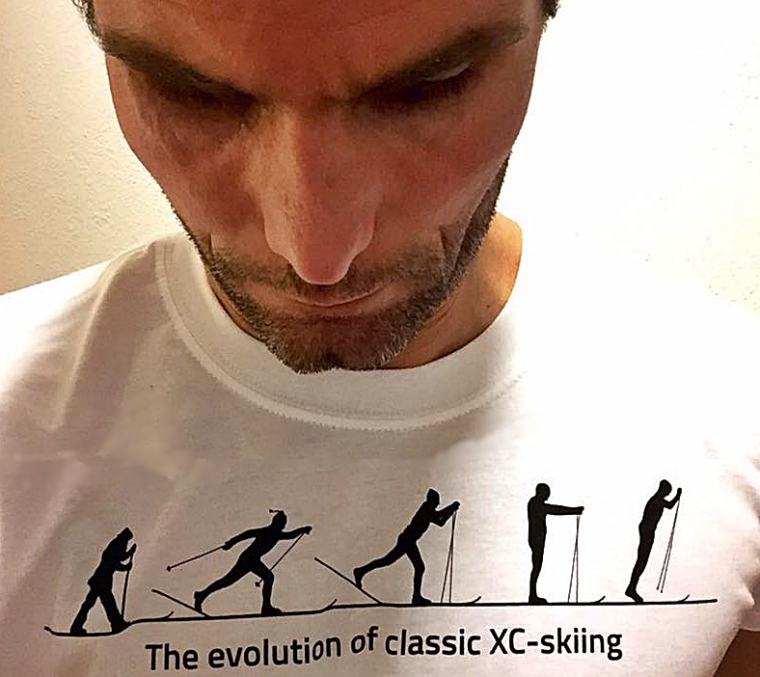
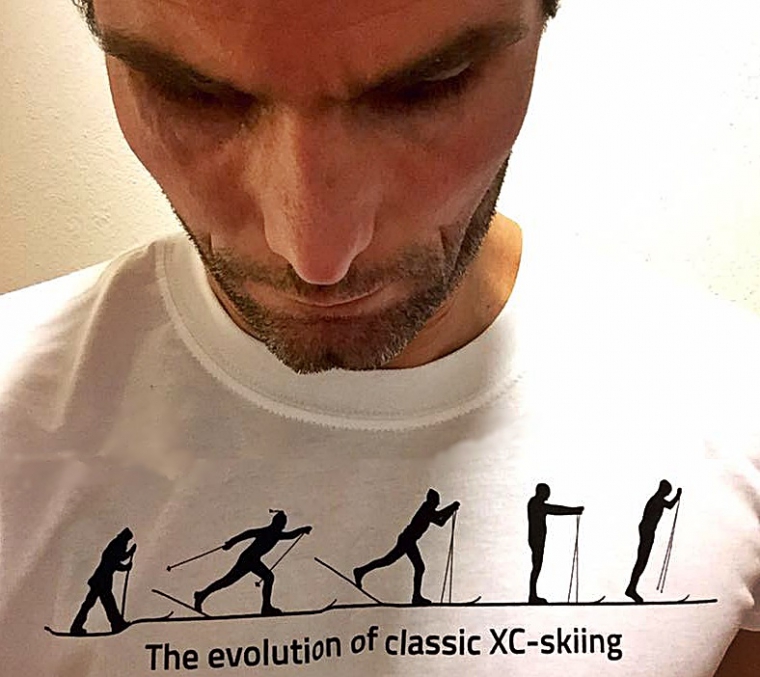
    Thomas Alsgaard is all about the evolution of double poling, especially as it pertains to long-distance ski marathons. Alsgaard, the owner and manager of Team LeasePlan, took a selfie his team's new shirts for the 2016/2017 Ski Classics season. (Photo: Thomas Alsgaard Instagram via OpenSki.ru)
    Thomas Alsgaard is all about the evolution of double poling, especially as it pertains to long-distance ski marathons. Alsgaard, the owner and manager of Team LeasePlan, took a selfie his team’s new shirts for the 2016/2017 Ski Classics season. (Photo: Thomas Alsgaard Instagram via OpenSki.ru)

    Thomas Alsgaard is fired up. Having challenged the International Ski Federation (FIS) regarding rules he considers arbitrary and insensitive to other venues for nordic skiing besides the World Cup, a potential divide may be opening up between the Ski Classics marathons and World Cup racing. With 15 Olympic and World Championships medals, Alsgaard is considered by many to be the most apt pupil of the skating technique, and has the palmares to corroborate that claim. As a veteran of World Cup and professional racing, and the owner/manager of Team LeasePlan, ski fans are receptive to his points against the FIS’s new regulations.

    Earlier this month, the day before La Sgambeda, the opening race of the Ski Classics season, the Russian ski website Openski.ru interviewed the legend himself in Livigno, Italy. Reporter Denis Kabanen covered topics ranging from the FIS rule restricting pole length in classic-technique racing, to the growing divide between the Ski Classics and FIS, women racers at the highest level of the sport, and the future of double poling.

    Kabanen provided FasterSkier with the original interview in English. Here is part of it (to read more, see Part I and Part II of OpenSki’s interview with Alsgaard):

    OpenSki: What do you think of the development of double poling? Do you think the women’s side will develop the same as the men in a couple of years?

    Thomas Alsgaard: I think so. You see, the distance between men and women in long distance; years ago it was usually half an hour, now it’s just a narrow … The men have developed, very fast, but the women have developed [at an even faster rate].

    OS: Let’s talk about the double-pole rule. I was checking my length today for the first time, I have ski poles that are a centimeter too long. I will actually put something under my heel. What’s your opinion?

    TA: The rule is there, so now you can’t do anything, so what’s the point? It’s a stupid rule… everything they are doing is because they are organized by people who think World Cup, and everything and every rule is meant for World Cup, and long distance racing … we just have to follow. So, I talked to them and said, ‘you knew this doesn’t change anything,’ and they said, ‘yeah, it doesn’t change anything.’ So, why the hell do you do it then? Are you kidding with us? Why? What’s the point?

    OS: They say we don’t want technique to go a different way, like super-long ski poles.

    TA: Yeah, but they don’t. That’s where they don’t have the knowledge … the double-poling king [two-time Ski Classics overall champion Petter Eliassen], he used one centimeter lower than the 83-percent rule.

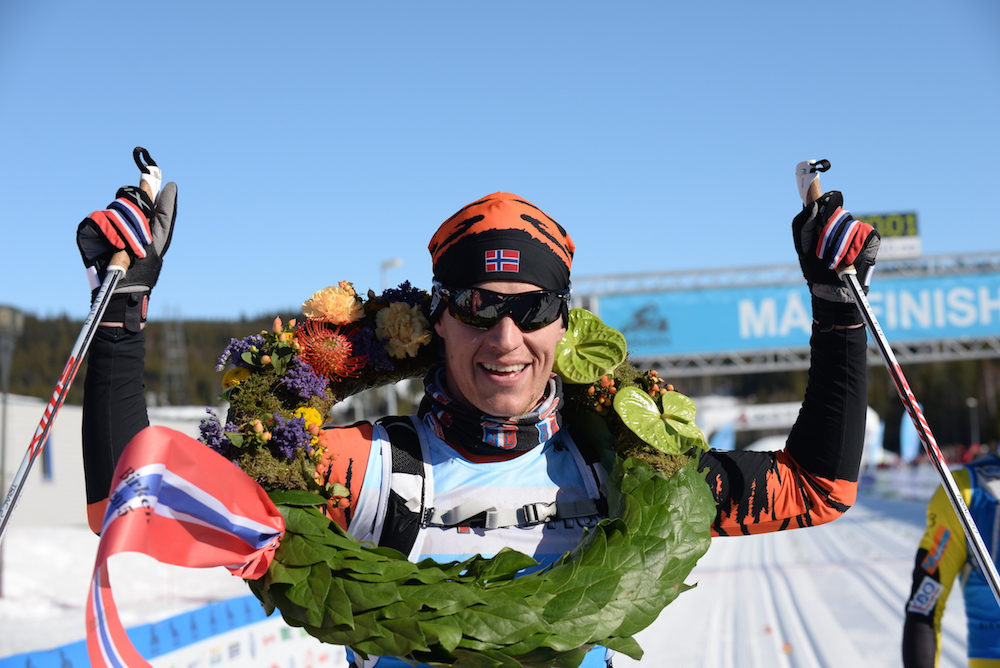
    Two-time defending Ski Classics champion Petter Eliassen, of Team LeasePlan. (Photo: Visma Ski Classics)
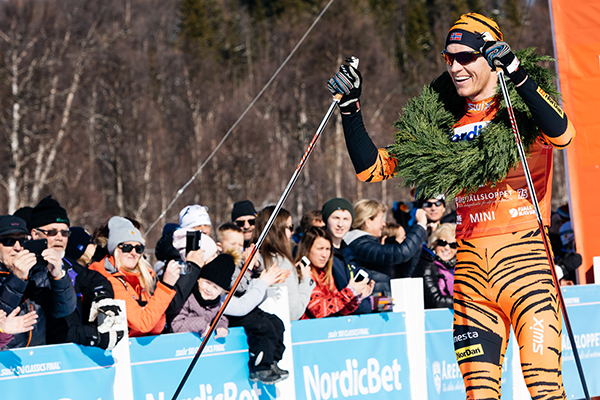
    Two-time defending Ski Classics champion Petter Eliassen, of Team LeasePlan, celebrating another win in his team’s tiger suit. (Photo: Visma Ski Classics)

    OS: Could you tell me more about [Eliassen’s] experience last year? The year before he started with 150 centimeters, and then he went to 170, 172 cm, but you feel that he lost frequency? What did he gain?

    TA: It’s more comfortable. If you do slow training, it’s very comfortable, but we have experienced, during the spring and summer, that in shorter hills and sprints you don’t get the frequency. If you have too long poles, it’s too much to move, so … Uphill it’s quite good, and for the average racer, just ski one speed around the track, it’s comfortable, but for the best poling speeds, a lot of times during the race then you have to go slower.

    OS: I read that he said that regular classic length minus 30 centimeters for flat races, and hillier races maybe closer to skate. So two different lengths?

    TA: That might be, but I still think skating poles … if you want to win the races, it’s too long.

    OS: What’s the best frequency for double poling? 

    TA: It’s impossible to say. It’s all up to feeling. The terrain, speed of the snow, conditions, there are so many factors…

    OS: In terms of technique, ski classics are developing like cycling races with teamwork; did you work out some kind of team tactic [for Team LeasePlan]?

    TA: No, I never do that. I know from experience that if you want to win the race, you have to be able to read everything as it happens. You have to make the right decisions at the right time. It doesn’t matter if you have the best plan in the world if the [other racers] do something else, you have to adapt, you have to be there in the moment. It’s very complicated, but if you’re calm and have experience you usually do the right thing.

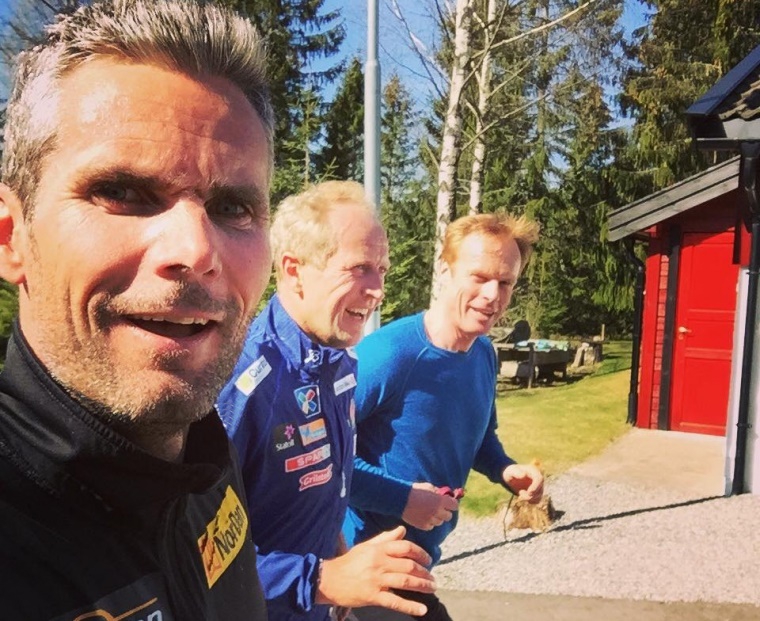
    Thomas Alsgaard (near) jogging with fellow former Norwegian skiers Espen Bjervig and Bjørn Dæhlie earlier this year. (Photo: Thomas Alsgaard Instagram via OpenSki.ru)
    Thomas Alsgaard (near) jogging with fellow former Norwegian skiers Espen Bjervig and Bjørn Dæhlie (far) earlier this year. (Photo: Thomas Alsgaard Instagram via OpenSki.ru)

    OS: Do you think double poling is something that will help young skiers get better at any kind of skiing?

    TA: Yeah… People on a high level, with a high capacity, when they have been thrown out of the national team and get on to a long distance team, they train a lot more double poling and long distance training. Then they get also much more stronger in all-around skiing.

    OS: That’s good for sport! Why would you stop that? 

    TA: Why avoid double poling? It makes everyone stronger. And the younger guys I have trained with are 16, 17; they are so strong. They can’t hold it for long, because the age, but they are so incredibly strong. I cannot keep up with them. When they grow up, when they get older, five, seven years from now, then we’ll really see. I know because I was from the first generation that grew up with skating, and when I won Lillehammer I was on a completely different level, technically, than all the other guys. I think the same will happen in classic in six years when these young guys grow up we’ll see some amazing double poling.

    — FasterSkier’s Jake Ellis contributed reporting

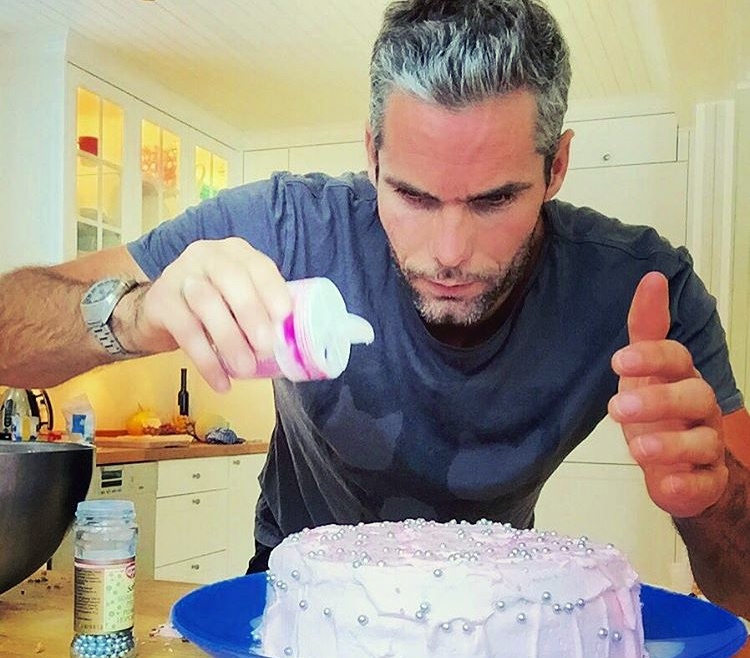
    Marathon team owner/manager and five-time Olympic gold medalist Thomas Alsgaard, of Norway, shows his softer side, decorating a cake for his Team LeasePlan before the start of the 2016/2017 Ski Classics season: "... Winter has come ❄️❄️ It's a happy day." @leaseplan_tigers celebrates with (pink ...) birthday cake !!! How are you celebrating?" (Photo: Thomas Alsgaard Instagram via OpenSki.ru)
    Marathon team owner/manager and five-time Olympic gold medalist Thomas Alsgaard, of Norway, shows his softer side, decorating a cake for his Team LeasePlan before the start of the 2016/2017 Ski Classics season: “… Winter has come ❄️❄️ It’s a happy day.” @leaseplan_tigers celebrates with (pink …) birthday cake !!! How are you celebrating?” (Photo: Thomas Alsgaard Instagram via OpenSki.ru)
  • Wednesday Workout: Double Poling with Biathlete Tim Burke

    Wednesday Workout: Double Poling with Biathlete Tim Burke

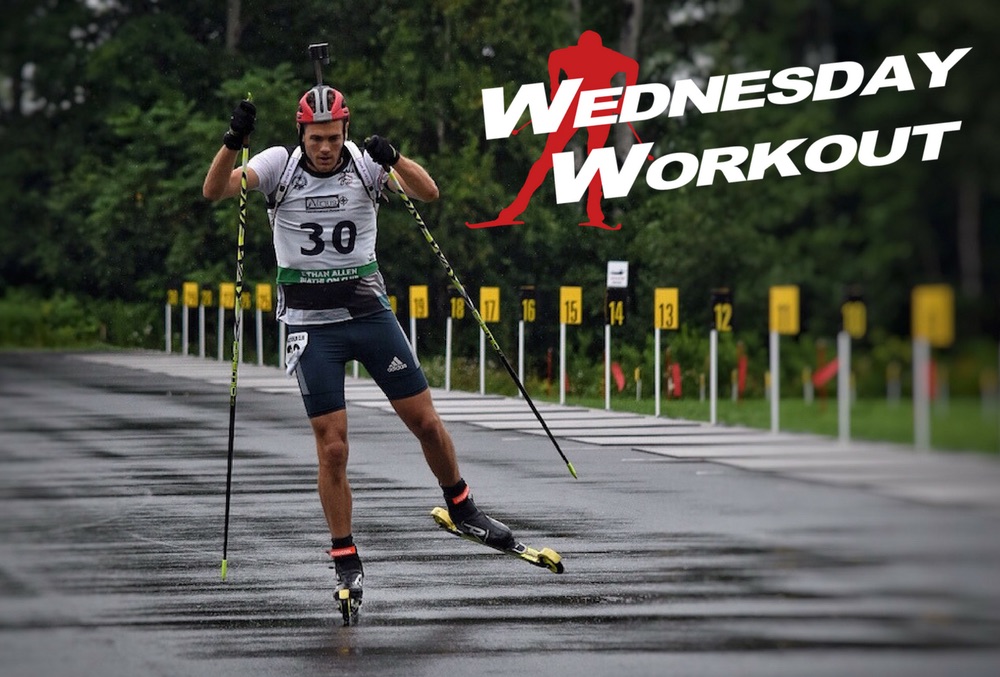
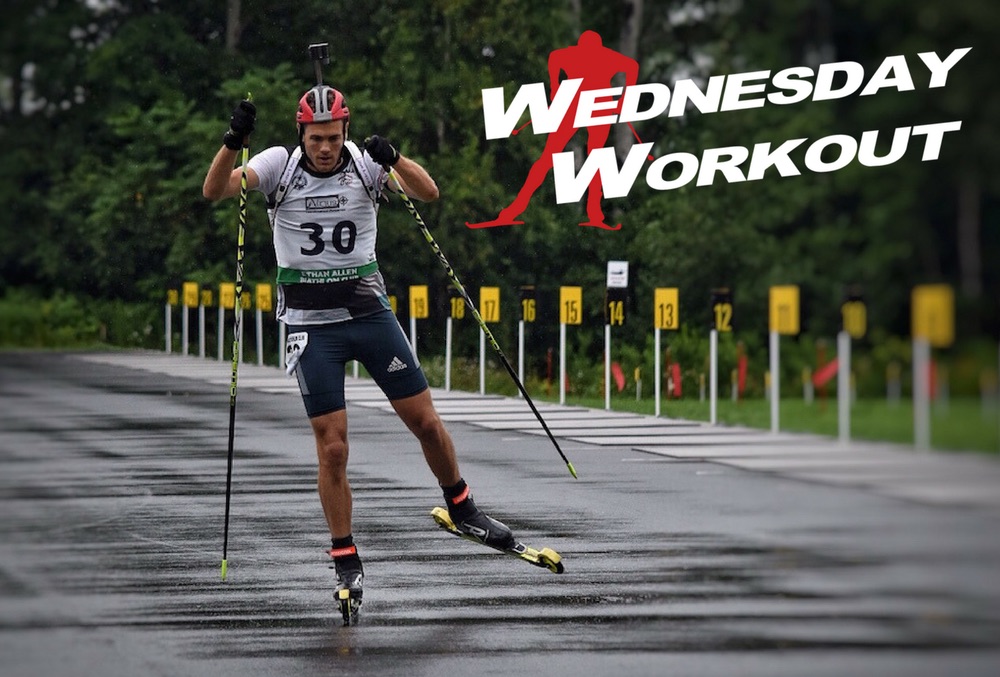
    Tim Burke (US Biathlon) racing the men's sprint at the 2016 US Biathlon National Rollerski Championships in August in Jericho, Vt. (Photo: Katrina Howe)
    Tim Burke (US Biathlon) racing the men’s sprint at the 2016 US Biathlon National Rollerski Championships in August in Jericho, Vt. (Photo: Katrina Howe)

    Here’s a modified acronym: KIS. Intentionally left out is the final S, as in KISS; “Keep It Simple Stupid”.

    Let’s give ourselves the benefit of the doubt. It’s been a long summer and dryland season. We’re all in a place to learn more, not denigrate. Keeping things simple and positive may tilt the cost-benefit scales in our favor. 

    “Keep it simple” is a basic mantra for building upper body, ski-specific strength.

    If you thought biathletes had enough to worry about with the skate skiing, ski selection and shooting as they prep for the International Biathlon Union (IBU) World Cup, you’d be right. Maybe race-day nerves are a bit mellower for biathlon wax techs on race day — there’s no kick wax snafu’s to tiptoe around — but that doesn’t mean US Biathlon’s Tim Burke doesn’t use double-pole workouts in his offseason training.

    Yeah, you heard that right. Noah Hoffman and his now quotidian five-hour double pole rollerski sessions, they’re not just for nordies. Although it should be noted, Burke does partake in the double poling, it’s just a much shorter workout in duration than Hoffman’s epics.

    This Wednesday Workout might best apply to the cross-country skier who only associates the word “classic” with things like cars, music, clothing, and say Coke. And if you’ve ever blurted out this: “Klister and Extra Blue are nothing to me!”, then keep reading. If Burke does it, the logic may follow that you should, too.

    Burke’s Simple Double-Pole Workout (as written by Tim Burke):

    “Here is a short but extremely effective double pole workout … the whole thing is pretty simple.  I start in the weight room with 30 minutes of pretty continuous core work.  You can be creative with the exercises here but I prefer to do most of my work with a redcord. I mostly focus on the core and other muscle groups used during double pole.  The goal here is to fatigue these muscles for the second part of the workout.  

    After 30 minutes is up, I head over to the roller ski treadmill and double pole for up to an hour.  I start at 6% grade and gradually work up to 15% by the finish.  Of course you don’t need a roller ski treadmill, but it definitely makes the workout more challenging.  I also always use skate poles in my double workouts because I am most interested in the crossover to my skate skiing.”

    Part I: 30 minutes in the weight room, continuous core work

    Part II: 1-hour double pole, up gradually increasing incline (like a moderate-to-steep hill)

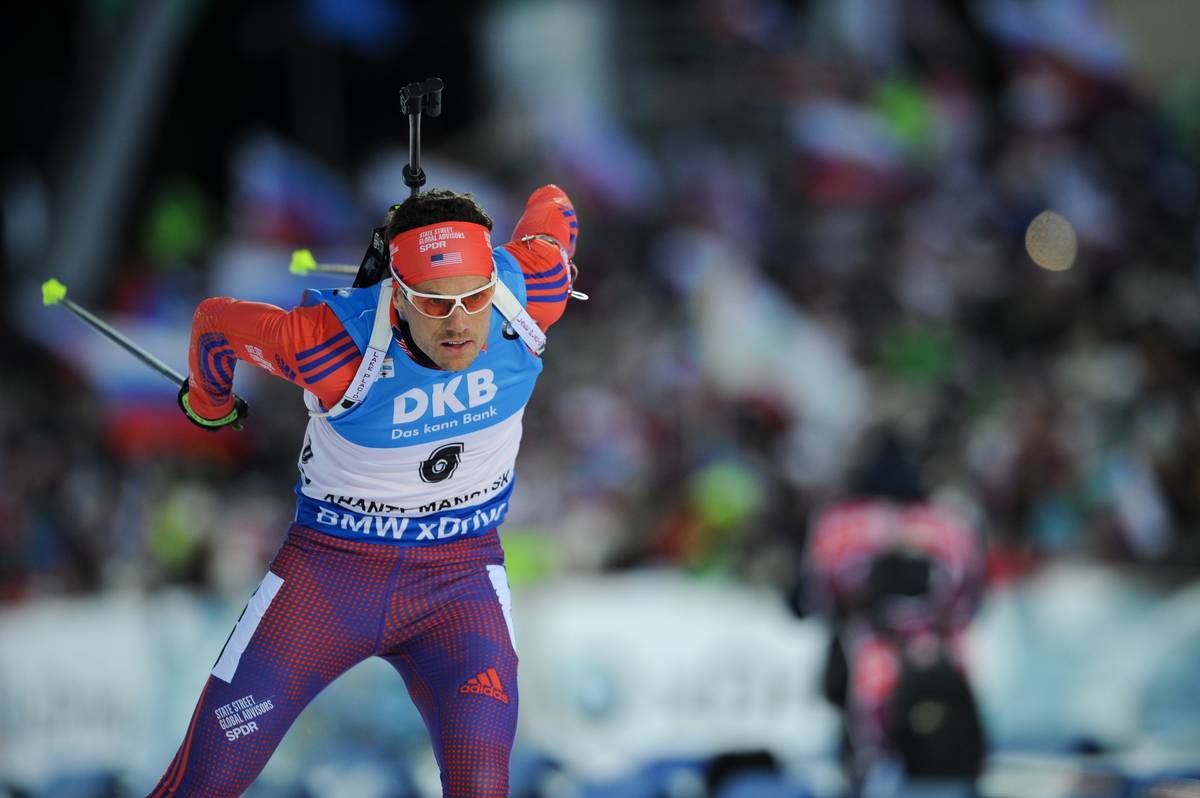
    Tim Burke (US Biathlon) racing to sixth, which tied his season best, in Saturday's pursuit in Khanty-Mansiysk, Russia. (Photo: USBA/NordicFocus)
    Tim Burke (US Biathlon) racing to sixth, which tied his season best, in a 2016 IBU World Cup pursuit in March in Khanty-Mansiysk, Russia. (Photo: USBA/NordicFocus)

    True enough, it’s rare for skiers to own or have access to a rollerski treadmill. But that doesn’t mean that creativity cannot win out. Find that long, gradually getting steeper and steeper hill and presto: the resourceful person’s rollerski treadmill but with clean air, trees, and hopefully minimal traffic. 

    For those wanting to dive a bit deeper into the specific muscle groups used while double poling, here’s a link to a useful 2010 Journal of Applied Physiology paper. (Note: the red coloration in the images denoting muscles groups used indicate greater glucose uptake. All that means this: the red muscles are used more intensely.)

  • Time to Ruminate on the 83% Rule: The Future of Classic at the Highest Level

    Time to Ruminate on the 83% Rule: The Future of Classic at the Highest Level

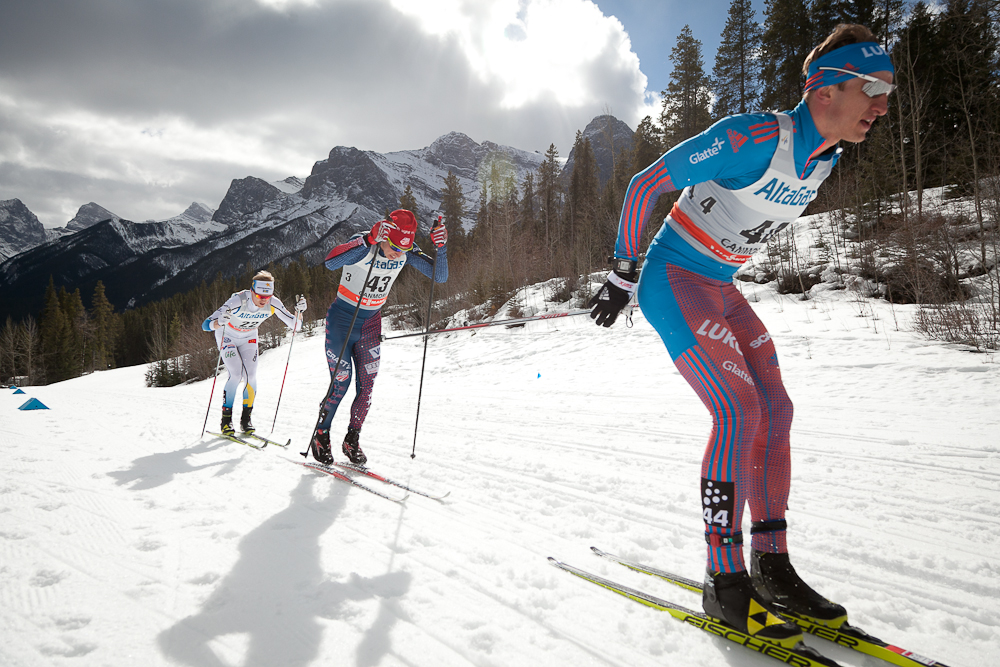
    American Noah Hoffman (43) racing to 35th in the men's 30 k skiathlon, a best for the U.S. men in the sixth stage of the Ski Tour Canada in Canmore, Alberta.
    American Noah Hoffman (43) racing to 35th in the men’s 30 k skiathlon, a best for the U.S. men in the sixth stage of the 2016 Ski Tour Canada in Canmore, Alberta.

    In so much as a social-media statement, the International Ski Federation (FIS), the governing body of cross-country skiing, proclaimed itself a curator. For some context, here is the definition of “curate” from an old-school source, Merriam-Webster: one who has the care and superintendence of something; especially  :  one in charge of a museum, zoo, or other place of exhibit.

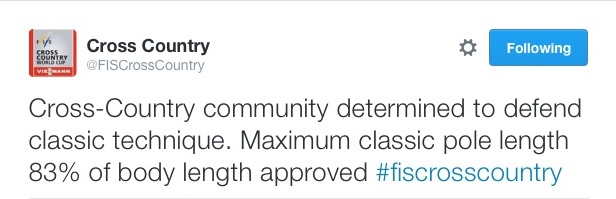
    Back to the FIS tweet from last Friday.

    FIS Tweet regarding the 83% rule.
    FIS tweet regarding the 83% pole length rule.

    Assuming FIS’s words were chosen carefully, the words “defend classic technique” stand out. It makes the assumption that FIS perceives that classic technique was/is under attack — that it requires protection from those tainting its technical sanctity.

    All the rumbling has to do with the decision to enforce a new rule limiting the maximum pole length to 83 percent of a skier’s total height (with boots on) during FIS-sanctioned classic cross country ski races.

    This Wednesday, FIS Cross Country published a Q & A on its website. In response to why the rule was accepted, FIS reiterated that it believed desperate times warrant desperate measures. “The evolution of double poling has been challenging the core of the Cross-Country Skiing sport. Several measures to slow down this development have been put in place (see paragraph 5),” it stated.

    Paragraph five in the document notes: “This will not stop anyone from double poling even in steep uphills but it is expected to stop the unwanted evolution of classic technique. The experiences from the upcoming season will be carefully examined next spring and further steps including a lowering of the percentage may be discussed.

    Field of play

    Moving forward, let’s assume those percentages for pole length are a moving target. Rather than being relegated to museum status, classic technique remains living history.

    In recent years, if the image you’re seeking is to watch World Cup skiers stride up hills exclusively, then perhaps you’re wanting.

    On certain World Cup distance classic courses like Toblach (Italy) or Davos (Switzerland), and sprint courses like Drammen (Norway) and Stockholm (Sweden), it’s just as likely a double poler on skate skis prevails than a nordie with the magic combo of bomber kick and zippy skis. Some call it evolution, others, like FIS, call it an affront to a technique that has historically defined the sport and anchored it to the past.

    It does beg the question, what is the responsibility of a sport’s international governing body when it may have promoted that evolution in the first place?

    “In skiing, the field of play has changed tremendously and it has been driven by the governing body and that has driven the evolution of sport,” Zach Caldwell, of Caldwell Sport, said in a recent phone interview. “That’s why athletes are more powerful. Classic technique is totally different from what it was 30 years ago, 40 years ago. Completely different. Some of it is just plain equipment innovation, but mostly the equipment innovation reflects the field of play.”

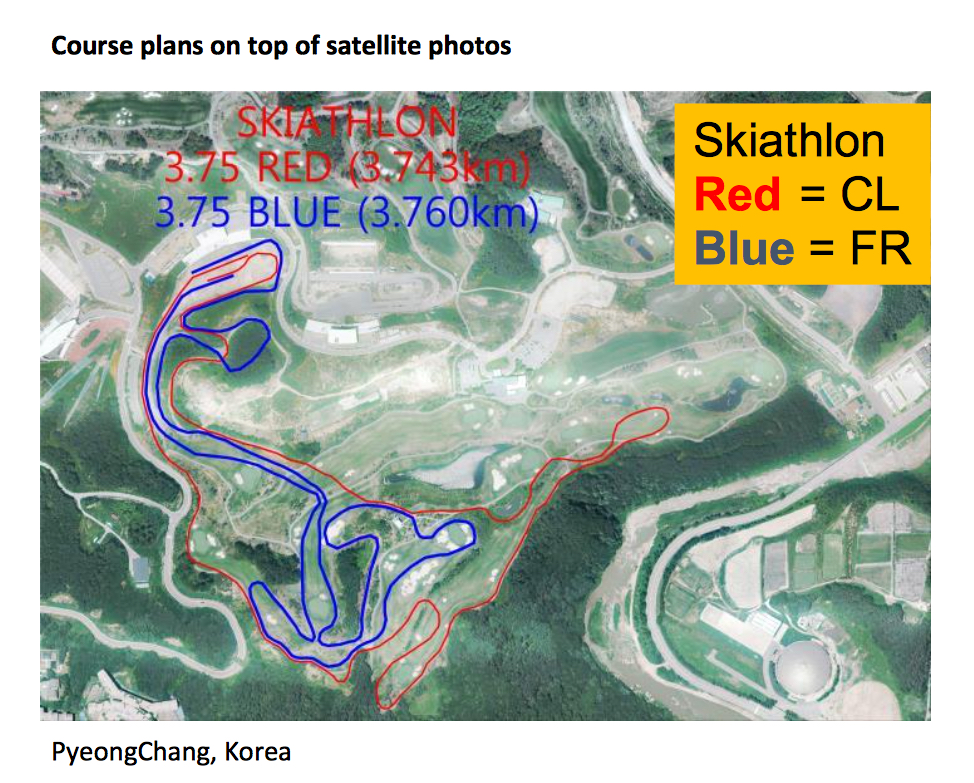
    What Caldwell is referring to when he mentions “field of play,” which he did several times during the interview, is the actual classic-ski course. The ups and downs, course width, tracks, and resulting new-school skiing speed. FIS homologation requirements are extensive and technical. According to the 2016 FIS Cross Country Homologation Manual, modern FIS-approved courses should be “⅓ uphill, ⅓ downhill, and ⅓ undulating terrain”. Those uphills are broken down into “A”, “B” and “C” climbs where percent of the course’s total climbing and a specific hill’s percent grade have strict parameters. To fully understand the homologation document, be prepared for some basic math.

    PyeongChang, Korea Homologated Olympic Skiathlon Course. Source: Page 70 2016 FIS Cross-Country Homologation Manual
    The homologated Olympic skiathlon course in PyeongChang, South Korea. (Source: 2016 FIS Cross-Country Homologation Manual, page 70)

    FIS also opines on the subjective and murky territory of correlating course design, or field of play as Caldwell says, with human emotion when it states boldly in section 2.3 of the manual that, “The joy of skiing should be the ultimate goal”. (Note: FIS’s underline, not FasterSkier’s).

    Joyful or not, Caldwell asserts that FIS has made an effort in its course requirements that have inadvertently promoted the use of double poling.

    Sport governing bodies need to understand that innovation is a product of the field of play that they have put in front of skiers,” Caldwell explained. “The FIS has made a series of decisions over the last decade to push the sport toward ever-faster speeds. The homologation requirements. The course width requirement. They apply a best line to the width of the course that they have got now and the speed, the average speed that they are producing on the average course permeation, demands double poling. It becomes compelling because of the sport that FIS has built. FIS has built this sport purposefully because they think they think it is going to be more compelling for a TV audience. They wanted a faster sport. They wanted a sport that looks better on televisions … it doesn’t look so much like old folks grinding it out. It looks like a flashy fast thing: that’s double poling … But to respond to innovation based on the field of play that they have put forth by deducing to add regulations about equipment or whatever else, it is kind of disingenuous and it’s a demand made by a bunch of people thinking really only about World Cup racing, not about the vast number of FIS races out there or about the practicalities of growing junior skiers or any of this. And frankly it’s not going to make a difference. People are going to double pole because that is the sport that FIS has built.”

    Another nordic lifer, Fairbanks resident, former U.S. Ski Team coach (1990-1993) and passionate ski-course designer, is John Estle. In an email, Estle pointed out that Europe’s snow conditions have played a part in the emergence of double poling.

    Last winter many, if not most World Cup competitions were conducted on exclusively or primarily man-made snow,” Estle wrote. “The sometimes icy (and often rock-hard) quality of that snow, as well as races held in sketchy waxing conditions also promote double-poling.  Not to mention the influence of the use of double-poling by winners of all the major classic marathons.”

    At the core of evolution is the premise that evolutionary change is prompted by changes in environmental conditions — crudely put, it’s survival of the fittest. Estle agrees with Caldwell in that the modern field of play has incentivized double poling. “To this point, double-poling by many or most skiers in an event is correlated most closely with terrain … That may change in the future as skiers become stronger but for now the closest correlation is indisputably between ‘flat’ courses and double-poling,” Estle commented.

    Like courses, all skiers are not equal. For some double poling may be a practical answer to modern course design, for some it is not. Caldwell asserts that on the World Cup and the vast series of FIS races like its Marathon Cup, double poling will have its day, but it most likely will remain an option for a few.

    “If they [FIS] left it alone, if they let the top guys double pole, you would have the entire rest of the population of the skiing world try it, fail and continue to wax their skis,” Caldwell said of FIS’s broad-stroke solution to what he sees as a non-issue. “The level that is required to double pole is really, really high … The vast majority of skiers are not going to be well served by double poling entire marathons or distance cross-country races.”

    The trend of more double poling, according to Caldwell, may eventually wane as skiers bump up against their maximum power output. “It’s going to balloon, it’s going to bubble and it’s going to burst because there are physiological reasons to use your legs more, to use your legs more actively in less of a static mode,” Caldwell said. “You know, just as soon as everyone figures out they can double pole races really fast, some kid’s going to show up and start striding them and beat everyone.”

    “It’s going to balloon, it’s going to bubble and it’s going to burst. … Just as soon as everyone figures out they can double pole races really fast, some kid’s going to show up and start striding them and beat everyone.” — Zach Caldwell on the double-pole trend

    Estle asserted that how sport is played by elite athletes does not categorically promote seismic change at lower levels. “I don’t dunk, but I like to watch NBA and college basketball and occasionally to shoot hoops; I don’t throw a baseball 100 mph, but I like to play catch now and then, and still like to watch major league baseball.  Sport at the highest level IN NO WAY resembles sport as practiced by the vast majority of practitioners.  Where the elite level of sport competition has long since been out of the reach of the other 99% of participants, sports remain very popular to both spectators and participants. The fact that I can’t dunk doesn’t make me not want to watch the Golden State Warriors, nor does my lame arm prevent me from enjoying an MLB pitching duel between two flamethrowers.”

    And as far as keeping the sport viable and exciting, Estle offers this: “If classic skiing at the highest levels evolves naturally into double-poling, that may not be a problem. On hilly courses, skiers will have to make an important strategic decision about whether to wax or not to wax. That makes the sport interesting.”

    Ski Boots and Poles on the Ground: Hoffman’s Thoughts

    Current U.S. Ski Team member Noah Hoffman, who is coached by Zach Caldwell, has the pole rule on his radar. For now, Hoffman hasn’t done the math, but he believes his poles will have to be cut by a centimeter or two. Amongst his U.S. teammates, he says he may be the only one unable to continue using his current length classic poles.

    Of the skiers double poling classic courses on the World Cup with skate skis, Hoffman is not one of them.

    Noah Hoffman en route to a podium finish in the 2012 U23 World Championships. Hoffman strides it out.
    Noah Hoffman striding en route to a podium finish in the 2012 U23 World Championships.

    “Double poling is a weakness and I have worked on it a lot of course,” Hoffman said on the phone. “But I don’t think it will ever be world-class and competitive internationally as a stand-alone technique.”

    Hoffman knows his strong points and his limitations. “From an athletic standpoint, this rule change absolutely is a benefit to me because any rule that limits the amount of double poling is helpful to me in my career. … I respect the FIS council and the politics that go into it, but I don’t have a super-strong opinion.”

    Running through this year’s World Cup venues, Hoffman explained he thought FIS had remedied the double-pole conundrum in the short term.

    “Ulricehamn, the new venue in Sweden, is apparently quite flat. I have never skied there and that was pegged as a 15-kilometer classic race and that was the only other significant decision that came out of the FIS meetings last week: they switched that to a skate race and swapped it with Falun which will now be a classic race. So they have taken away the one venue where I think it was an issue,” he noted. “That being said, there were guys talking about double poling in Falun last year, which has the Mördarbacken. At least the loop they ran us on last year closes with three or four kilometers with gradual downhill terrain. It is a huge advantage not to have kick wax on your skis, and so I see the logic there. I don’t think that I can double pole a course like Falun faster than I can classic ski it, but I wouldn’t be surprised if some athlete can.”

    Davos and Toblach are on the schedule, both slated as freestyle events. There’s Kuusamo (Finland), Lillehammer (Norway), Val di Fiemme (Italy), and Val Müstair (Switzerland) all hosting classic races. And skiathlons in La Clusaz (France) and Oberstdorf (Germany) — all scheduled before World Championships in Lahti.

    “So you run through the venues and it’s all not an issue for me,” Hoffman said. “I don’t see any venue where it’s even close for me. But, I won’t be surprised if we see athletes double pole more hilly courses this year, but I won’t be one of them.”

    Estle thought pole-length restrictions might impact those choosing kick wax as their best fastest option on the World Cup — athletes like Hoffman.

    “Restricting the length of poles creates additional problems,” Estle wrote. “First, there may be (likely are) some skiers who like to classic ski, with wax on their skis, with poles that are longer than 83% of body height. Keeping them from using the poles they want in classic technique events doesn’t really accomplish anything. It will only make maximizing performance more difficult for those skiers.”

    “There may be (likely are) some skiers who like to classic ski, with wax on their skis, with poles that are longer than 83% of body height…” — John Estle, former U.S. Ski Team coach (1990-1993)

    Classic gasping on its death bed? Possible solutions

    Caldwell believes classic technique is safe and double poling part of its natural evolution. Although he mentioned several solutions to incentivize striding on the field of play.

    “The single biggest change that FIS could make to preserve striding is to create the need to accelerate from low speed to high speed on climbs; that’s really damn hard to do,” Caldwell advised if FIS wanted to ensure the preservation of kick and glide. The simple physics of gravity, steepness, inertia, and friction are restrictive.

    “You start from a stop on an uphill and you have to accelerate that is not an easy task,” Caldwell said of how to modify courses to promote kick and glide. “If they were to put a series of hairpin corners on the uphills … what if they were to go to the groomers and say, ‘Hey look, give us a nice track pan, but then let’s just till up the snow and not compact it on either side for you know forty centimeters wide outside the track and create a mess of a poling platform so there is no good poling platform.’ There are tons of ways that they can prepare the courses, lay out the courses, and set them up to be disadvantageous for double poling.”

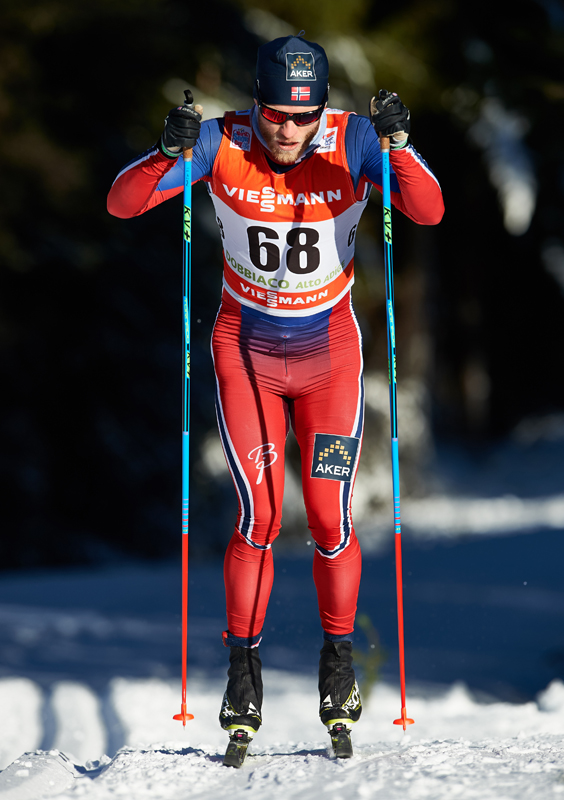
    Norway's Martin Johnsrud Sundby racing to third in Wednesday's 10 k classic, the fourth stage of the Tour de Ski in Toblach, Italy. (Photo: Fischer/Nordic Focus)
    A double-poling machine: Norway’s Martin Johnsrud Sundby racing to third in the 10 k classic, the fourth stage of the 2016 Tour de Ski, in Toblach, Italy. (Photo: Fischer/Nordic Focus)

    Estle’s solutions? “For now, my recommendation would be: 1) DO NOT implement no double-pole zones under any circumstances, 2) have classic races on courses with big/long/steep uphills, 3) apply the pole-length rules only at the highest level of competition and 4) make enforcement the responsibility of the Jury.  The sport is already complicated enough!”

    In its Q & A, FIS made some clarifications in terms of enforcement. Athletes will be able to check the legality of their poles during training. “The controls will be performed randomly and/or will be targeted,” it stated. “It will be possible to perform the measurements before the start and after the finish. If necessary, more than one measurement device will be available.”

    Break a single pole during the race, FIS has you covered. Snap a single pole and receive a replacement greater than the 83-percent rule, you’re still in compliance. Break two poles, then it’s a strict application — “the poles must comply with the 83% body length rule.”

    Former U.S. Ski Team member and Alaska resident Tim Kelley had this observation: “The fate of classic skiing is up to the younger generations. There was a couple of years in the mid 80’s classic pretty much disappeared as all races were ‘freestyle’, your choice of technique.  So it was skating in classic boots and with short poles for a bit.  But it seems classic skiing has resiliency.  It survived a short death in the 80’s and was revived.  Should be interesting to see how classic skiing bodes in the future.”

  • Double-pole Revolution? Thirty Percent of Teams Penalized at Norwegian Nationals Relay

    Double-pole Revolution? Thirty Percent of Teams Penalized at Norwegian Nationals Relay

    One of the many examples of classic technique violations described by the FIS Cross Country Sub-Committee for Rules in an exhaustive November posting, which you can find here.
    One of the many examples of classic technique violations described by the FIS Cross Country Sub-Committee for Rules in an exhaustive November posting, which you can find here.

    Race officials put cross-country skiers on notice early this year that those who tried to double-pole classic races on skis without kickwax would be held to strict technique standards: in the first weekend of racing in Norway, defending World Cup Champion Martin Johnsrud Sundby (along with two others) was disqualified for skating in a 10 k classic race.

    The message got even more clear this weekend when 15 men’s teams and one women’s team were given time penalties in the National Championships relay in Tromø for classic technique violations.

    The race jury placed a video camera on a section they had identified in their course inspection as a place that would be tricky to navigate on unwaxed skis.

    “It’s actually quite a steep uphill, a herringbone hill,” explained John Aalberg, the Technical Delegate for the weekend, in a phone call on Monday. “If you classic ski, probably 99% of all skiers would herringbone up it… It looks like a corner, but it’s a corner on a hill that’s very steep. It’s a tricky situation because there’s no tracks. You don’t set tracks on a herringbone hill, they’d just be washed out after warm-up anyway if you did. It’s kind of a new situation.”

    The video showed that some of the racers double-poled carefully and painstakingly up the steep pitch, while others threw in one push off their outside leg to straighten their trajectory. Others pushed off their outside ski several times in a row, and a few even tossed in a stride of V1.

    “We felt that this is not classical technique,” Aalberg said. “You gain so much advantage skating up there… We reviewed very carefully back and forth. We allowed those that did a stride or two getting into the hill and maybe at the top of the hill. We didn’t judge that as a violation. But those that were skating several strides up, those were the 15 teams that we reacted to.”

    While a standard FIS jury consists of three members, Aalberg explained that for the championships there were four: him, two Assistant Technical Delegates, and the Chief of Competition (a position titled Rennleder in Norwegian), Sylvi Ofstad.

    There were also two technique controllers. All six members agreed on the action, which gave a three-minute time penalty for technique infractions. The podium remained unchanged by the penalties – Lyn, a club from a northern district of Oslo whose roster included Hans Christer Holund, came out on top – but fourth-place Henning moved down to sixth place.

    “So we discussed: either we let it go, or we treat everybody the same,” Aalberg said. “We thought, if we do nothing and let it go, then everything we have done this year is wasted. The racers, especially the World Cup racers, are telling us to be strict and consistent. So it was a tough decision, but we wanted to prove a point or put it on the agenda: if everybody starts to double pole, and if you loosen up the rules at the same time, that’s the end of classic skiing.”

    The sanctions shook up the results sheet considerably (15 teams represented almost a third of the 50 teams who finished without lapping). Racers and coaches were angry.

    “It was interesting,” Aalberg said. “We showed it to a couple of them and they agreed it was skating. And then they started pointing out, well how about this guy? How come you didn’t take that guy? It’s like when you’re driving too fast, and then you complain that someone else was also driving fast and didn’t get caught.”

    Some coaches are still angry. Øistein Lunde of FIS told Norwegian ski website Langrenn.com on Monday that four teams had filed appeals and that an appeals committee had 72 hours to look at the evidence and come to a conclusion.

    “In the jury room, we were greeted with a very arrogant attitude,” Svein Riseth told Norwegian broadcaster NRK. “They had no clear evidence… If they have balls they will send the video to the clubs who were affected so we can see it.”

    Riseth may have simply not had time to converse with the jury, as he was catching a flight; Aalberg mentioned that they had shown the video to some racers.

    And, the race organizers posted the video online so that not only could the affected clubs view it, but so could everyone else.

    The topic was discussed by FIS Technical Delegates before this season, as well as by technical staff in Norway. Both groups meant to make a concerted effort to be more strict in enforcing technique rules this season.

    The FIS Cross Country Sub-Committee for Rules, which Aalberg is part of, posted an exhaustive set of diagrams of appropriate and illegal technique for classic races back in November. That has been freely available on the FIS website with other competition rules documents for ten weeks now.

    The increased focus was also mentioned in a FIS media article of the “most important rule changes” for the upcoming season.

    “I’ve spoken to some of the national team coaches and the coaches that I know, and they are all in support of being strict,” Aalberg said. “They are all saying that this is good and it needs to be done in order to clean up a bit. Coaches or team leaders that are not usually on the high level races don’t understand the rules and they think that this is allowed. So there’s a discrepancy somewhere.”

    He doesn’t believe that the skiers caught on tape were breaking the rules on purpose. Instead, it’s simply that more and more athletes are pushing to double-pole classic races. This challenges them in new ways.

    “It’s not intentional at all,” Aalberg said of the infractions this weekend. “Think of yourself. If you double pole up the hill and you peter out, your foot automatically goes out. It’s not intentional at all. But it doesn’t matter if it’s intentional or not, you still get a big advantage.”

    He noted that some of the top skiers know the technique rules well, and are also strong enough to follow them. That’s why they podium was unaffected by technique violations.

    “The good skiers, the stronger ones, they are strong enough to do proper technique,” Aalberg explained. “It’s the next ones, who are trying to hang on, but they aren’t strong enough. So that’s when you see them do the wrong technique. Then you have the slowest ones, who are waxing, and they are doing proper technique. But it’s in the middle group where we saw most of the issues.”

    Even though the violations are unintentional, he is hopeful that strict enforcement can improve technique.

    “It has been a lot better this year on the World Cup level,” Aalberg said. “I was the TD in Kuusamo and have been watching the World Cups live. I think it’s much better classic skiing on the World Cup level. We don’t really see much anymore. We’ve had a few cases but nothing like we saw last year and the year before, now that we are stricter and more consistent.”

  • An Unlikely King: Ski Classics Champ Eliassen on the Secret to His Successful Rookie Season

    An Unlikely King: Ski Classics Champ Eliassen on the Secret to His Successful Rookie Season

    Petter Eliassen after double poling his way to a victory at the Norwegian Birkebeiner on March 22. The 29-year-old Norwegian went on to win the 2014/2015 Ski Classics title in his first season on the circuit. (Photo: Kent Murdoch)
    Petter Eliassen after double poling his way to a victory at the Norwegian Birkebeiner on March 22. The 29-year-old Norwegian went on to win the 2014/2015 Ski Classics title in his first season on the circuit. (Photo: Kent Murdoch)

    How did Petter Eliassen do it? A month ago, the 29-year-old Norwegian from Trondheim double poled his way to a victory in the Norwegian Birkebeiner and went on to win the final Ski Classics race of the season — Sweden’s Årefjällsloppet — to claim the overall 2014/2015 Ski Classics title. It was his fourth-straight win on the circuit, making him the first racer to do so in Ski Classics history.

    FasterSkier recently spoke with Eliassen, a Norwegian national team member two seasons ago, on the phone, and he happily shared his training strategies. The following interview has been translated from Norwegian to English.

    A rookie to the long-distance circuit, he was content with the opening of his season, placing among the top 10 in the first five races of the Ski Classics series.

    But Eliassen did not expect to close the season with a four-race winning streak — starting with the König Ludwig Lauf in Germany on Feb. 2, then a Vasaloppet win in his very first attempt at the legendary 90-kilometer classic race in Sweden on March 9. He won the Norwegian Birkebeiner on March 21, and finished the season off with a final victory in the Årefjällsloppet on March 28.

    And he certainly didn’t expect to win the overall circuit crown in his first try. Eliassen beat established elite racers, such as the Aukland brothers of Norway, and former Vasaloppet champions, like Norway’s John Kristian Dahl and three-time Vasa Champion Jörgen Brink of Sweden, as well as a long list of merited marathon specialists, including Sweden’s Jerry Ahrlin, Oskar Svärd and Daniel Tynell, and Czech super-veterans Lukáš Bauer and Stanislav Řezáč.

    Seraina Boner (l) of Switzerland and Team Coop and Petter Eliassen of Norway and Team LeasePlan Go won the Årefjällsloppet on March 28, the last of nine events in the 2014/2015 Swix Ski Classics marathon series. (Photo: Ski Classics)
    Petter Eliassen (r) of Norway and Team LeasePlan Go and Switzerland’s Seraina Boner (l) of Team Coop won the Årefjällsloppet on March 28, the last of nine events in the 2014/2015 Swix Ski Classics marathon series. (Photo: Ski Classics)

    What’s your key to marathon success?

    “I definitely benefit from years of racing experience,” Eliassen said, adding that the support and depth on Team LeasePlan Go made a difference. “We have a support crew and a race team that is very experienced and very well run. That’s huge both prior to the races and also in the offseason.

    “Training-wise, I have done much the same leading up to this season as I did when I was on the national team. We do a lot of volume and some strength, but I have focused a bit more on double poling than I used to and much less on skating,” he said, adding that he does miss skating.

    “I enjoy skating, and I still do some skate workouts throughout the season, but it’s definitely not the main part of the volume.”

    While the Ski Classics organizers have not ruled out including freestyle events to the race schedule in the future, Eliassen doesn’t see that happen in the near future.

    “So many of the established long-distance elite racers are highly specialized and spend so much of their training effort on perfecting their double-pole technique and strength that I think they would object,” he said.

    Practice your weaknesses, race your strengths

    While double poling isn’t his specialty, Eliassen is constantly trying to improve that aspect of his classic technique. He explained his team spends many of its group workouts focusing on tight finishes and does a lot of intense intervals in all kinds of terrain to prep for those.

    “My favorite terrain is uphill. But many of the Ski Classics events have flat or even slight downhill finishes, so we spend a lot of time on that,” he said.

    His race strategy is to determine how the race will play out well ahead of the finish line to avoid a double-pole showdown.

    “I always go into the race with the intention to stay with the lead group as long as I can, but I try to pull away while there is still some distance to go and preferably in terrain that I’m good at,” he explained.

    Skiers are made in the summer

    During the season, Eliassen generally puts in one or two double-pole workouts per week, which last from one to three hours depending on how he feels and how much time there is between the races. When there are several weeks between events, he does longer workouts, and when the races come like rapid-fire, his main focus is recovering from one event to the next.

    But the bulk of his double-pole training is completed even before the snow falls. During the dryland season, Eliassen and his teammates log several long rollerski workouts each week, with two to four hours of double poling.

    “I am definitely not the one who logs the most volume on our team, but in the summer, I do at least two of those each week,” he said.

    While rollerskiing isn’t his choice dryland workout, he loves running and also puts in a fair amount of time on his bike.

    “I have to admit that my favorite summer workouts are long runs in the mountains. That’s where I really feel at home,” he said.

    Strength and recovery

    Eliassen stressed that plenty of variety was the key to staying injury free, along with a healthy dose of general strength, flexibility and recovery.

    “It’s really important to do a lot of core strength in order to protect your back, shoulders and arms,” he said. “Also make sure to stretch. When you do a lot of ski-specific and double-pole specific training, you tend to get very tight, especially in the front of your body.

    “And definitely make sure you allow yourself plenty of recovery time between the hard and long workouts, especially the rollerski double-pole sessions,” he added, pointing out that tendinitis issues often are a result of overuse and under-recovery.

    In terms of building double-pole specific strength, he believes in simply double poling a lot.

    “I don’t do any of the double-pole machines … I know a lot of skiers use them, but I believe there are several training methods that will lead to success, and so far, I haven’t used those,” he said.

    If it ain’t broke, don’t fix it

    Based on his experiences and results from his rookie season on the marathon circuit, Eliassen planned to continue with his training plan from last season.

    “I will train mostly the same way as I did prior to this season, but of course, I will try to improve my test results even a little bit more,” he said.

    Generally, Team LeasePlan Go does a one-week training camp each month during the dryland season, and in between, its athletes train independently.

    “We live all over the country, so it’s nice to meet on a regular basis, but I also enjoy the flexibility of setting my own training schedule,” Eliassen said.

    “I think the marathons really is my arena,” he added with a smile.

  • This Month in Journals: Drink Your Coffee to Race Fast; Are Supplements a Gateway to Doping?

    This Month in Journals: Drink Your Coffee to Race Fast; Are Supplements a Gateway to Doping?

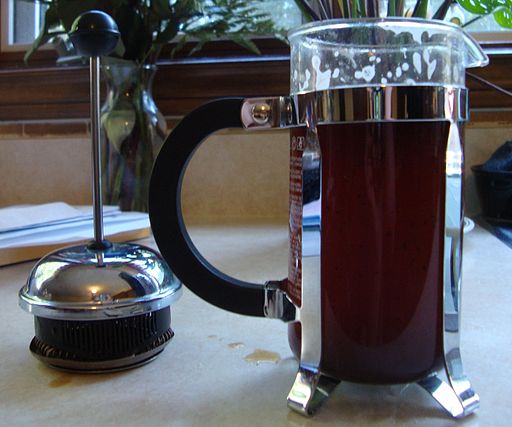
    Is this just as important as what happens in the wax cabin? Photo: wikimedia user erobins through creative commons.
    Is this just as important as what happens in the wax cabin? Photo: Wikimedia user Erobins/Creative Commons.

    Welcome back to This Month in Journals, where we read the latest exercise and sports science and pull out some research that might be of interest to skiers.

    * Many skiers build coffee into their pre-race rituals – and it turns out, they should. For decades scientists have been finding that caffeine increases endurance in more mainstream sports like running and cycling. But finally, someone decided to look at caffeine’s effect on skiing.

    Published in Medicine and Science in Sports and Exercise online ahead of print, Dr. Hans Stadheim from the Norwegian School of Sports Sciences in Oslo and his team set ten high-level skiers on an 8-kilometer double-pole time trail; each participant did the test twice, one after ingesting caffeine and another time with a placebo. Eight of the ten subjects improved their times after taking caffeine, and overall the times dropped by about a minute and a half. This represented a four percent change.

    The researchers are excited about their results because they are the first to test this effect in a primarily arms-based activity; arm and leg muscles differ in both the types of muscle fibers that make them, and the amount of carbohydrates they use to extract different amounts of oxygen during exercise.

    The team not only showed that caffeine was beneficial for performance, but also gained some insight into its mechanism. For instance, they found that skiers who had ingested caffeine were able to maintain higher heart rates throughout the test, a difference of about five beats per minute. Skiers were also able to reach higher blood lactate concentrations after taking the caffeine. Finally, questionnaires showed that participants had lower perceived exertion and less pain during tests after taking caffeine.

    The size of the benefit gained by caffeine users was impressive, and the authors made sure to frame it as such.

    The improvement of 4% after ingestion of 6 mg · kg-1 CAF observed in the study would most likely effect results in real life XCS competitions,” they wrote. “Actually a reduction of 1:25 min to complete the 8 km C-PT is [analogous to] the time difference between the winner and 12th place in the 2011 World Championships relay… in Oslo.”

    Takeaway message? Don’t forget that cuppa joe on race morning!

    * Careful, though. A study published in the Scandinavian Journal of Medicine and Science in Sports suggests that the use of nutritional supplements changes people’s attitudes towards what is or isn’t acceptable performance enhancement.

    Dr. S.H. Blackhouse of Leeds Metropolitan University asked: are supplements a “Gateway to Doping?” They surveyed over 200 high-level athletes – just under half of whom used nutritional supplements – across 32 sports and received surprisingly honest answers. For example: 22% of the athletes who used supplements admitted to doping, while just six percent of the non-users did the same.

    The athletes were also presented with scenarios related to supplements and doping, and asked both what they would do and what they thought others would do. Supplement users had significantly more positive attitudes towards doping, and also were significantly more likely to think that doping was effective and would help them win.

    Interestingly, both groups said that they would prefer to compete in an environment where there was no doping. But supplement users perceived a greater pressure to dope, and also gave higher estimates of the percentage of athletes in their sport who were doping.

    “Athletes who engage in legal performance-enhancement practices appear to embody an ‘at-risk’ group for transition toward doping,” the authors wrote. “…This common practice may lead to a greater willingness to engage in doping behavior if athletes perceive the benefits of using NS have been fully realized and believe that doping is an effective enhancement method.”

    However, while the authors found the correlation between supplement use and propensity towards doping both significant and troubling, they didn’t fully accept the “gateway” mechanism that has been proposed both here and in other drug situations. Indeed, they questioned whether doping chronologically followed supplement use, or whether both were simply a symptom of the same thought process.

    The paper’s final discussion touched on two further issues. The true level of doping in sport is unknown: it is certainly higher than WADA’s adverse analytical findings log, which calculates a rate of about two percent. But how much higher is it? Previous studies have found projections ranging from six to 34 percent. The supplement users reported a 22 % doping rate and guessed that was about typical of the athletic population (although estimates ranged widely, with a standard deviation of 23).

    This highlights what may be a feedback loop. Regardless of the true level of doping, athletes who perceive doping to be more prevalent may feel more pressure to dope. In this study, the athletes who did not use supplements were either blissfully unaware of the scope of the doping problem, or were more realistic and optimistic than the supplement users. Either way, their perception of a lower rate of doping coincided with feeling less pressure to do so themselves.

    Finally, the authors pointed out that some substances, like creatine, are on the line between being considered illegal performance-enhancing drugs and simply nutritional supplements. For athletes who use and believe in supplements, these types of drugs may create confusion and influence their decisions as they move towards the world of doping.

    * A quick piece in the British Journal of Sports Medicine aimed to address whether the minimalist footwear craze is all it’s really cracked up to be. Specifically, is running in such “shoes” the same as running barefoot?

    Dr. Jason Bonacci led a team that put 22 distance runners through their paces barefoot, and also in minimalist footwear, racing flats, and normal training shoes. Their answer, based on biomechanics, was said best in their title: “Running in a minimalist and lightweight shoe is not the same as running barefoot.”

    When the runners were barefoot, they had shorter and quicker strides, even while running at the same speed. There were differences in knee and ankle flex and angles, too, but only between barefoot and “shod” running – not between, say, minimalist footwear (in this case Nike Free 3.0 shoes) and racing flats. When running barefoot, power production shifted from the knee to the ankle. That wasn’t replicated with the Nike Frees.

    This is somewhat in contrast to other studies, including one that was published looking at Vibram Fivefingers footwear. But other studies have used recreational runners, where this research team, based on Australia, recruited highly-trained runners. They hypothesized that at that level, running mechanics may be so deeply ingrained into athletes that type of footwear has less of an effect, compared to occasional runners who may change their form considerably based on how their feet hit the ground.

    This Month in Journals is our occasional series surveying the world of sports science and trying to extract tidbits of research that might be of interest to the skiing public. Previous editions can be found here: March, February, January, December, October, and September.

  • Biomechanical Analysis of Double Poling in Elite Cross-Country Skiers

    USSA has posted the article “Biomechanical Analysis of Double Poling in Elite Cross-Country Skiers” by Hans-Christer Holmberg, Stefan Lindinger, Thomas Stoggl, Erich Eitzlmair, and Erich Muller.  Holmberg is part of the  Department of Physiology & Pharmacology, Karolinska Institute, Stockholm, Sweden and the Åstrand Laboratory, Stockholm University College of Physical Education and Sports, Stockholm, Sweden.  The other authors work with Department of Sport Science and Kinesiology, University of Salzburg, Austria and  the Christian Doppler Laboratory Salzburg,
    Austria.

    From the article abstract:

    Purpose: To further the understanding of double poling (DP) through biomechanical analysis of upper and lower body movements during DP in cross-country (XC) skiing at racing speed. Methods: Eleven elite XC skiers performed DP at 85% of their maximal DP velocity (V85%) during roller skiing at 1° inclination on a treadmill. Pole and plantar ground reaction forces, joint angles (elbow, hip, knee, and ankle), cycle characteristics, and electromyography (EMG) of upper and lower body muscles were analyzed.

    The entire article is available for download in PDF form here from the USSA website.

  • Double Poling with the US Ski Team Ladies

    So you think you can double pole?  The US Ski Team’s Torin Koos put together a technique video from the recent Whistler Training Camp.  The movie features excellent footage of the top US women.  This is a much watch if you are looking for good images to take with you on your next double pole workout.