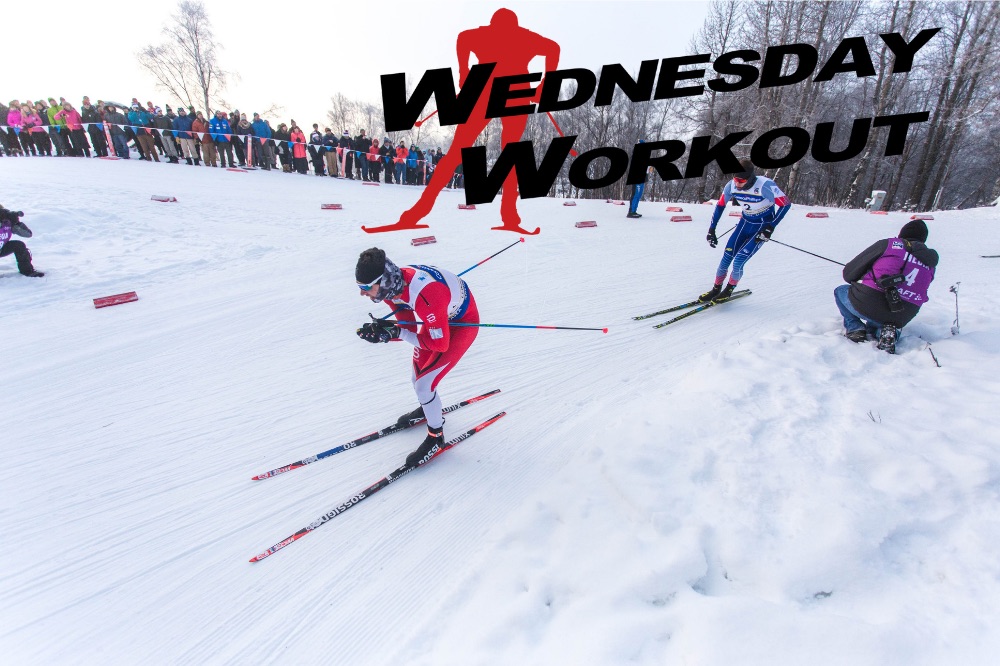
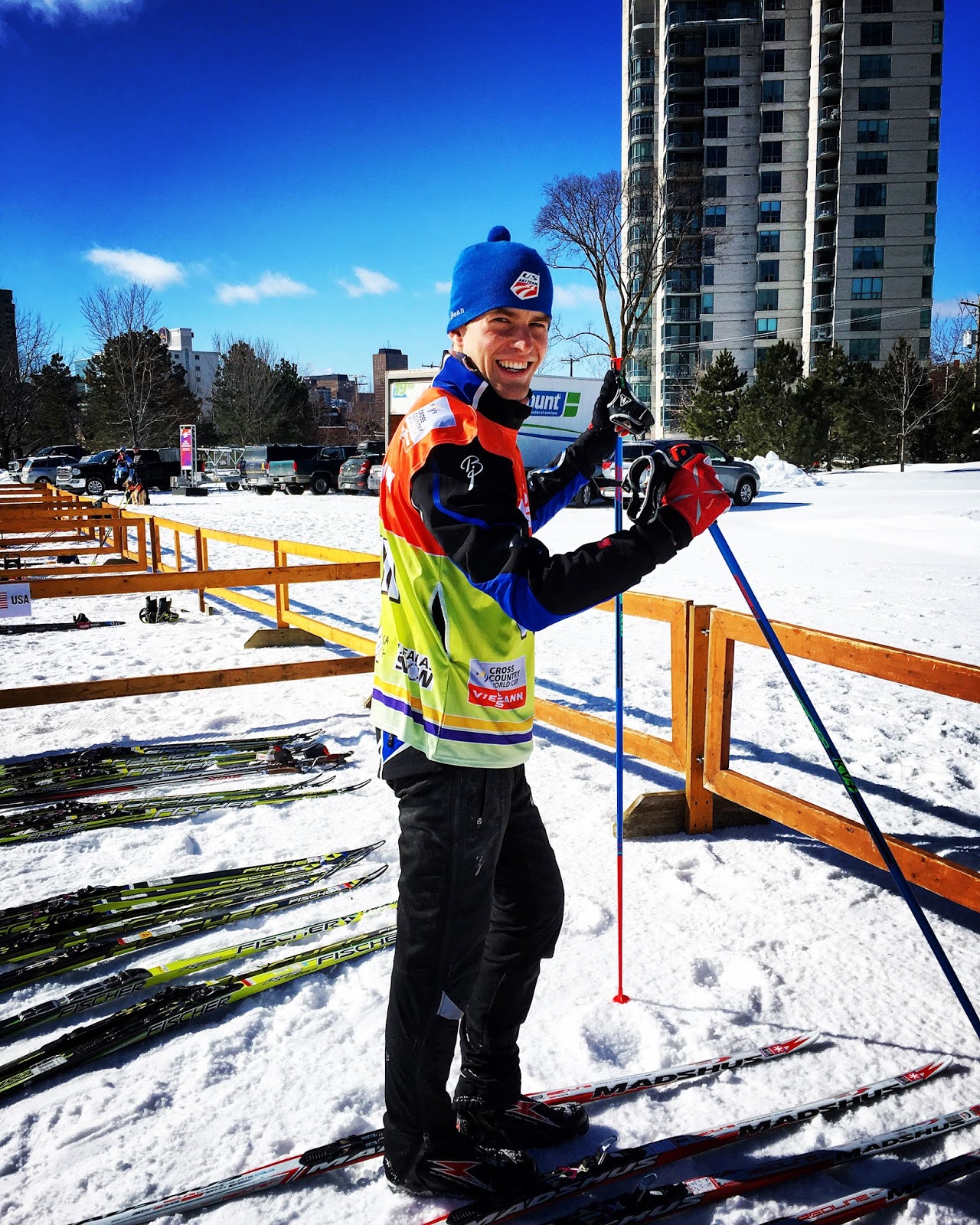
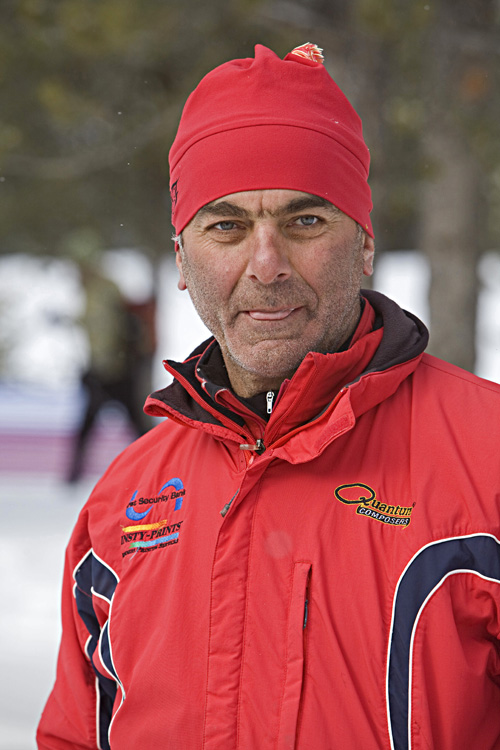
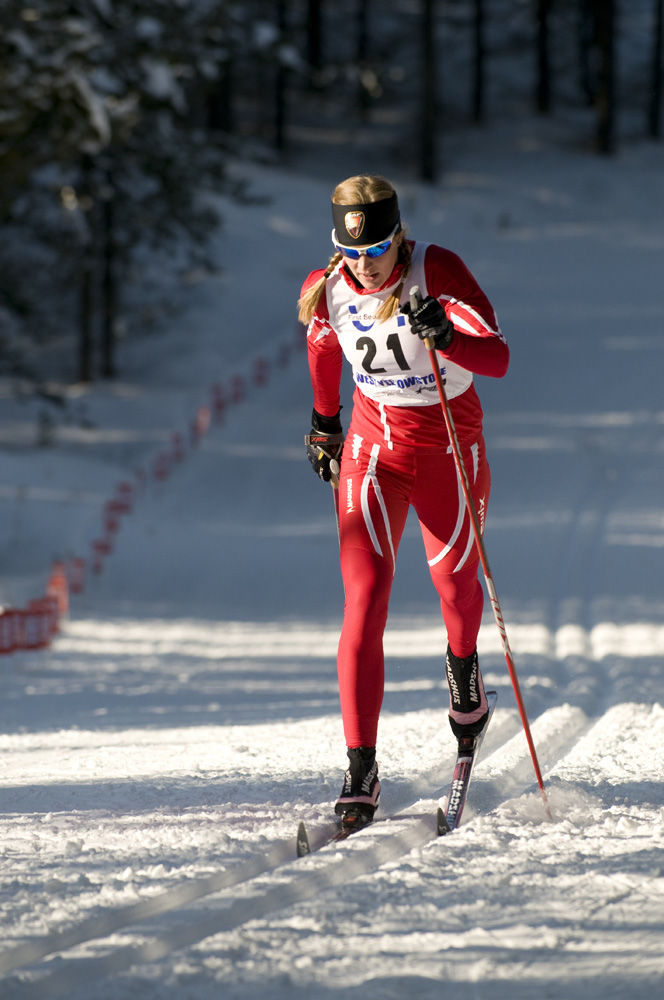
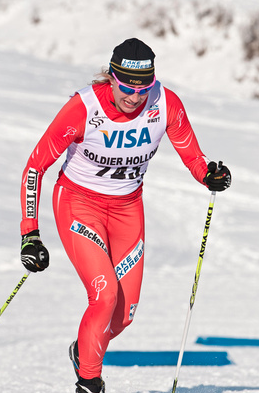
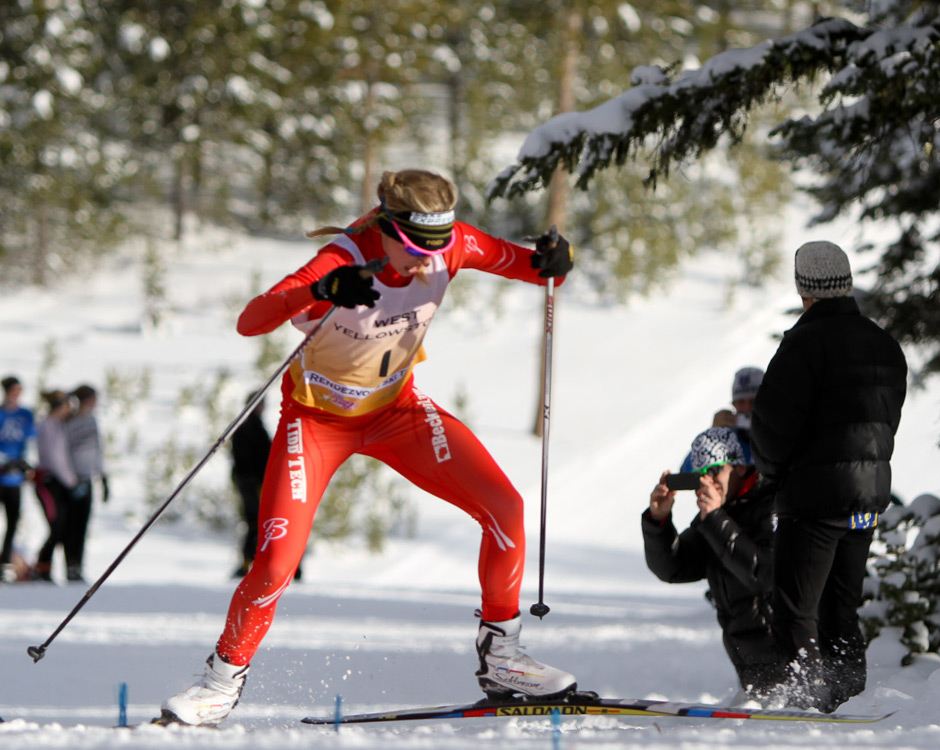
BSF’s Nick Michaud (red suit) at last season’s Senior National Championships in Anchorage, Alaska. Michaud qualified 4th. (Photo: Gilbert Michaud)
This Wednesday Workout was provided by twenty-six-year-old Bridger Ski Foundation (BSF) skier Nick Michaud. Bates College educated and raised plumb-line north in Fort Kent Maine, Michaud has emerged as a sprinter to watch on the SuperTour. He’s a gritty, salt-of-the-earth athlete who barely missed a nomination to the 2018 Olympic Team.
Michaud offered FasterSkier a menu of options for the 30/30 workout — 30 seconds on 30 seconds off. From junior athletes to masters in M8 and beyond, Michaud has you covered with these training session variants.
Let the gains begin.
Backstory of the Sizzling Hot 30/30’s from Michaud:
“Short, explosive movements are like bacon for me. I’m thrilled to eat bacon anytime, anywhere, with anyone. With vegetables, grains, and most foods that are really important for function, it can feel like a chore. That’s what a lot of nordic ski training feels like for me. My body, my mind, would prefer to just do speed work, lift heavy weight, and play basketball — and eat bacon. But in order to meet my performance goals, I have to eat vegetables and grains: aerobic base, lactate threshold, energy management, mindfulness and so much more. For these reasons, I love 30/30s.
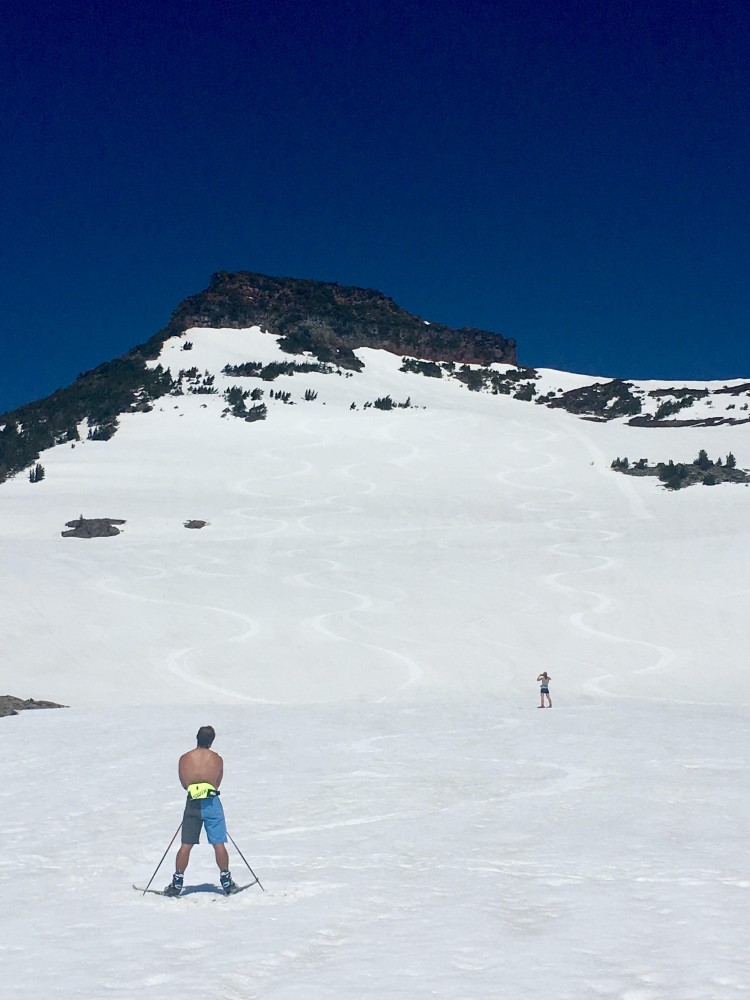
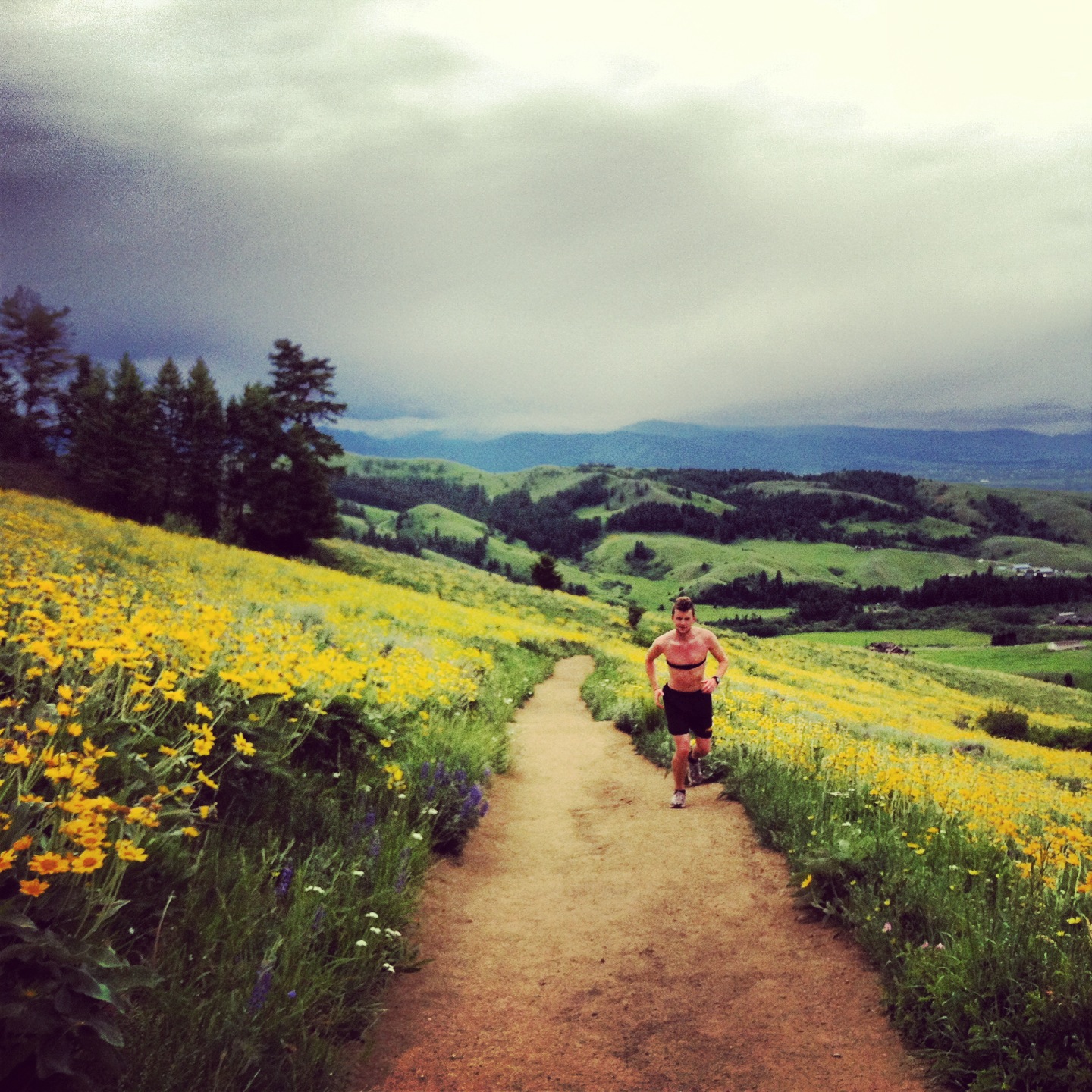
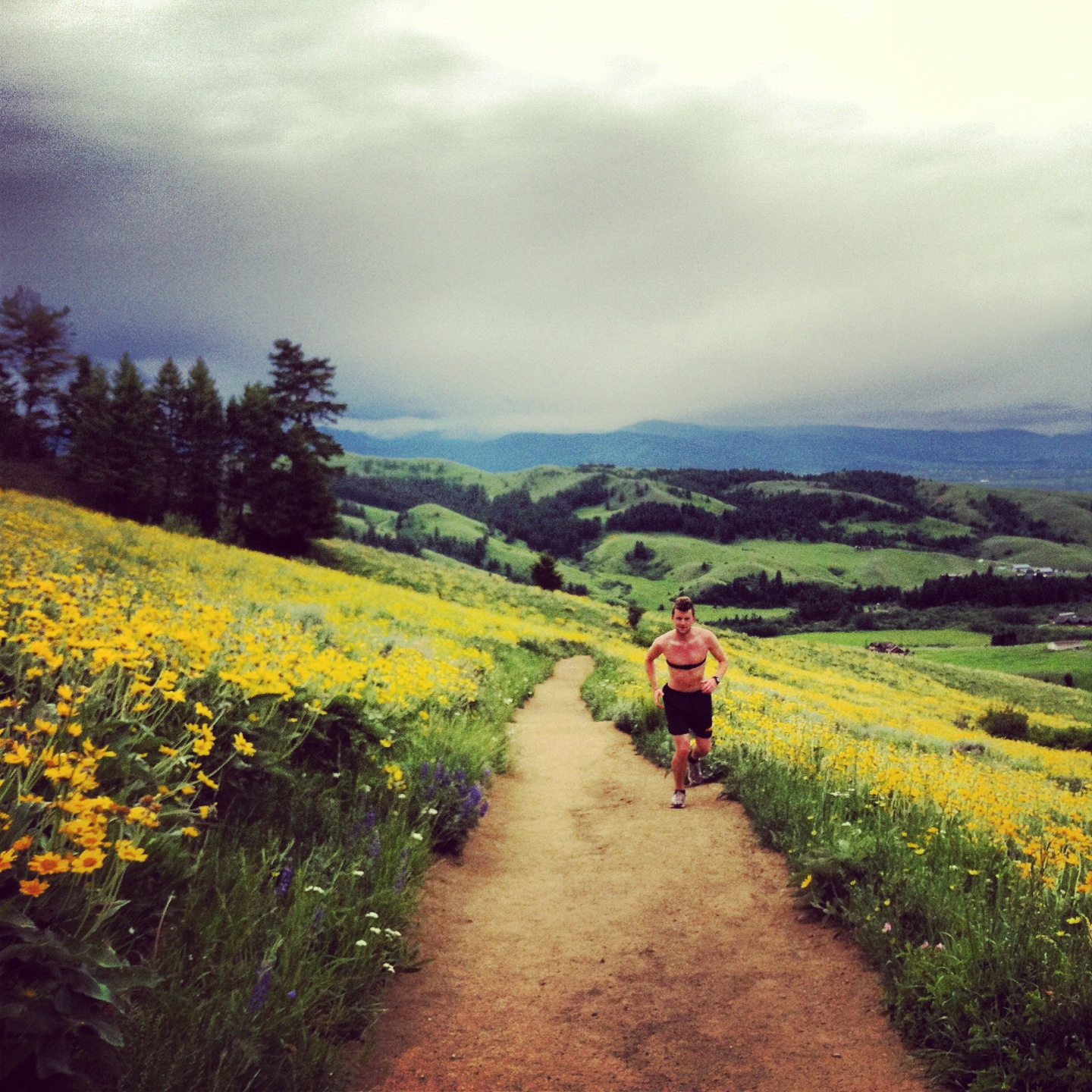
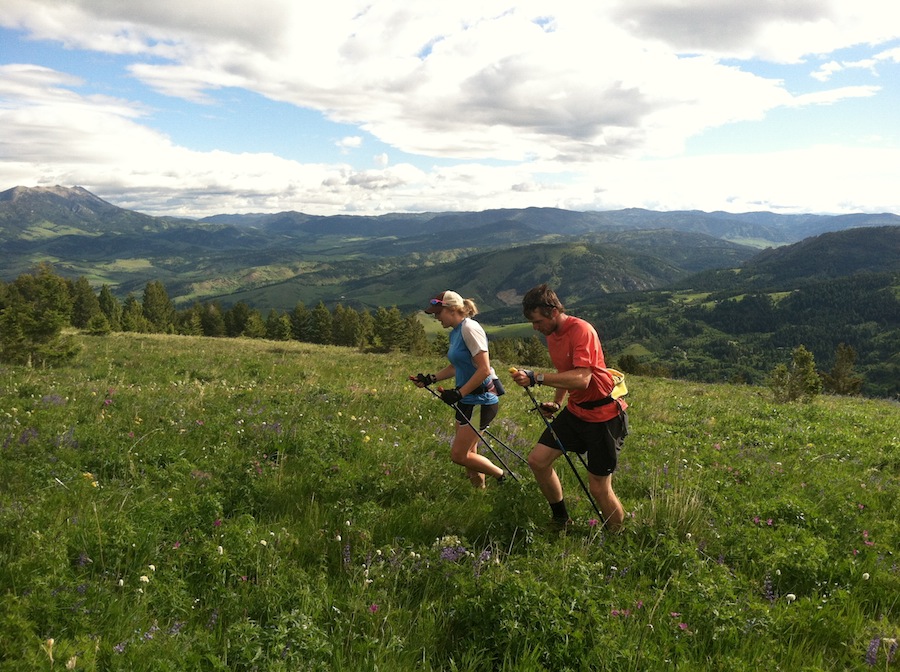
30/30 home terrain for BSF’s Nick Michaud in Bozeman, Montana. (Photo: Max Lachance)
The execution is very simple: 30 seconds “on”, 30 seconds “off”. The effort and duration can be customized for the purpose of the workout. There should always be a purpose!. For athletes with periodized training plans, 30/30s can be used in different cycles of training to meet different goals. For a more casual athlete, 30/30s can simply be an extremely fun way to get in some higher intensity training.
Dragan Danevski, BSF nordic program director, began using 30/30s eight years ago. There was a study in Europe focusing on track and field and how to improve efficiency of running economy, improve aerobic capacity, and reduce the recovery time in a 30/30 workout. The original study tracked mainly 1500m and 3000m runners. Danevski adjusted the workout for skiers here at BSF.
Danevski said BSF has used 30 by 30s for a few different goals: improving skier’s economy, stimulate good technique, and shortening recovery time for lactate clearance. Originally it was for improving threshold. For his skiers, Danevski saw the potential to improve anaerobic capacity.
Throughout summer Danevski follows the study and uses 30/30s to improve threshold.
For the following age groups, the coach prescribes one 25-30 minute block of 30/30s for U16 and U18s. U20s go for a 30-35 a minute block of 30/30s. Some older skiers are ready for a 45 minute 30/30 session.
Danevski said these 30/30 training days need to be disciplined by monitoring heart rate.
In the past, the 30/30 workouts were used only during intensity blocks. Recently, we’ve started using it throughout the whole training year: on skis, foot, and rollerskis.
Psychologically, Danevski said the 30/30 is a more tolerable intensity session, especially for kids, since they can focus on high-quality efforts for 30 seconds each time. It’s easier to focus.
As we transition into fall here at BSF, we also use 30/30s to improve anaerobic capacity. One basic example we use are three to six sets of a 15-minute long 30/30s — with appropriate rest between each set.
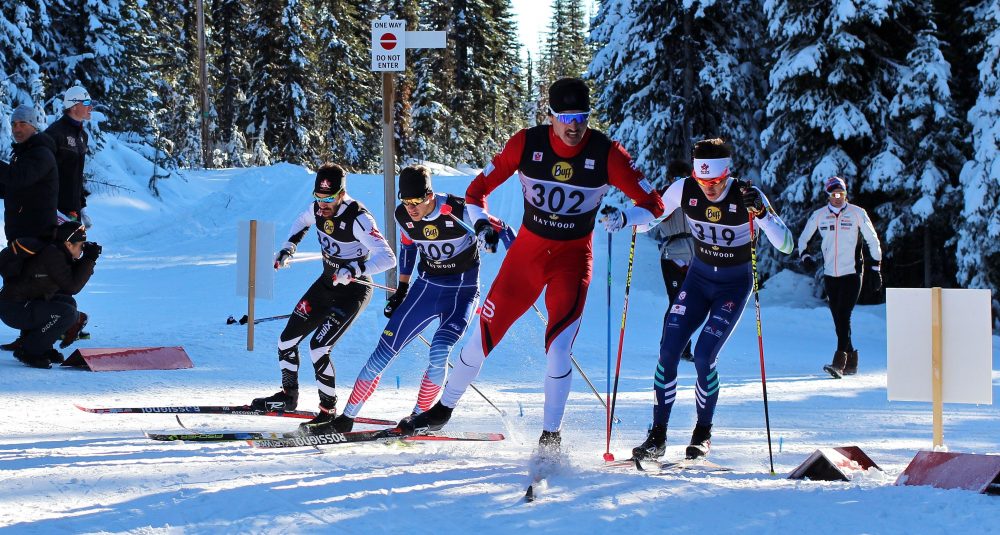
Nick Michaud (BSF) in bib 302 putting those 30/30s to good use at the Sovereign Lake NorAm in 2017. Michaud was the second fastest qualifier. (Photo: Forrest Mahlen)
The 30/30 Workout Menu Starting with Michaud’s Favorite Variation:
Nick Michaud: 3 x 5 minutes, sprint pace. So we are all clear, this means a five minute long 30/30 excecuted three seperate times. During each five minute period, that’s a total of 2.5 minutes “on”, and 2.5 minutes “off”. For the entire session, the athlete is “on” for 7.5 minutes, or half the total elasped time. I rest for five minutes between each set.
Notes:I use this two days before a sprint race, increasing my effort each set. It’s a great way to get a feel for speed, technique, and effort in all areas of the course. I take five minute breaks between sets. I leave the venue with a good understanding of the course and excited to move fast on it two days later. Using this training sessions at different points of the year is a great way to practice understanding the critical difference between effort and ski speed — which I think is crucial.
Favorite 30/30 Variations from Others:
Gary Colliander, US Paralympic Biathlon Coach: 4-8 x 6 minutes. Number of blocks depends on L3 or L4.
Notes from Colliander: “Focus on quality of movement through the interval and a slightly higher turnover. With the short ‘on’ time I think you can hold the technique together better and because there is a short rest you can potentially push the pace and thus the level a bit. They’re still very tough, but that short rest just seems to offer bit of recovery while allowing the heart rate to remain high.
Another way to look at the short 30 second rest is like it’s a downhill. Anytime you get a downhill it’s a chance to grab some O2 and recover although for a very short bit. But it always feels good when you come out of that tuck.”
Lina Hultin, Bridger Ski Foundation Development/Competitive Team Coach: 5×6 minutes.
Notes from Hultin:“What I like with 30/30s and 45/15s is that it allows the athletes to ski more efficiently. Since you have that shorter break, you tend to have better and more efficient technique since athletes ‘dare’ to push it a little harder when they know they will have a shorter break. Good technique requires strength and power and the shorter interval allows athletes to keep good technique for a longer time.
The closer you get to the season you can dare to let go of that shorter break and hopefully you can maintain that good efficiency in you technique in a continuous time trial or longer intervals.”
Akeo Maifeld Carucci: Craftsbury Green Racing Project Athlete: 2-4 x 10-15 minutes at L4+.
Notes:“Terrain wise, I like small rolling terrain or maybe gradual uphill with some bumps. I believe in keeping it between L1 and recovery pace during the rest phase, but it is important that it keeps moving at the least.”
Seth Hubbard, Bridger Biathlon Club Head Coach: 15/15s for sets of 4-8 minutes at race pace +
Notes: “This workout is altered depending on an athlete’s age and their work on pacing, and ability to surge and recover.”
Will Sweetser: Nordic Programs Director at Sugar Bowl Ski Team and Academy: 15 sec/15 sec 6-12 minutes.
Notes:“I use 6-12 minute repeats with ‘on time’ at either L3+ or goal pace for races 8 minutes and longer. First used this coaching runners in the mid 90’s. Have since had good success with younger athletes developing pace sense.
Used the 15/15 to help take an athlete’s 3,000 meter time from 11:38 to 10:10 in 5 weeks. The next year this athlete brought their time down to 9:27 using 15/15 session of 2 x 3000m about once every 10 days.”
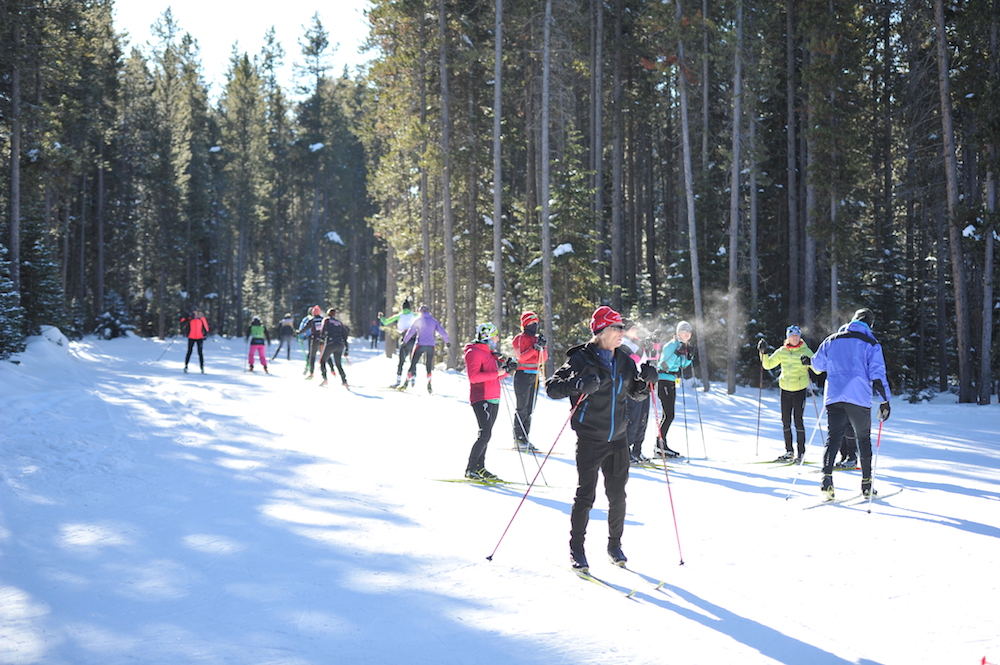
Skiers on the Rendezvous Ski Trails in West Yellowstone, Mont., during last year’s Yellowstone Ski Festival. (Photo: 2015 YSF)
Note: This article has been updated to reflect a more accurate elevation difference between the trailheads at Bohart Ranch and the Rendezvous Ski Trails.
The opening U.S. SuperTour races of the 2016/2017 ski season scheduled to take place next weekend, Dec. 3 and Dec. 4 in Bozeman Mont., at Bohart Ranch were recently canceled and rescheduled for West Yellowstone, located 90 miles south and at roughly 600 feet higher in elevation in Montana.
Due to lack of snow at Bohart, the races were called off on Thursday and moved to West Yellowstone as of Friday, where there is approximately 25 kilometers of trails open at the Rendezvous Ski Trails. Though the Bozeman-based Bridger Ski Foundation (BSF) said it was ready to host the races, not enough snow coverage caused the organization to cancel.
“We wait to postpone the decision until yesterday, Thursday, but didn’t get the snow we expected from that last storm,” Dragan Danevski, BSF’s head nordic coach and program director, said on the phone Friday.
Danevski indicated that BSF and West Yellowstone race organizers communicated after the cancelation regarding potentially moving the races.
“We were working back and forth with their organizing committees and ours,” Danevski said. “I just officially heard that West Yellowstone organizing committee agreed to host the SuperTours we couldn’t.”
Skiers at the trailhead of the Rendezvous Ski Trails in West Yellowstone, Mont., on Monday, Nov. 21, 2016. (Photo: FBD)
The races will keep the same format and remain on their scheduled dates, with freestyle sprints on Saturday, Dec. 3, and 10/15 k classic on Sunday, Dec. 4.
In terms of the U.S. Ski Team using these races for scoring and consideration purposes for 2017 World Championships, it doesn’t appear this will change anything.
“West Yellowstone just agreed to take the weekend of SuperTour racing today. Same formats,” U.S. Ski Team Head Coach Chris Grover wrote in an email on Friday night.
Asked how this affects out-of-town athletes’ travel plans, Alaska Pacific University (APU) skier Reese Hanneman said that aside from “the logistical headache,” it’s not too different.
“Big thanks to the people in West Yellowstone for taking them over. From a racing standpoint, not what we were expecting but nothing we haven’t seen before,” Hanneman, last season’s SuperTour sprint leader, wrote. “I personally think it’s a pretty solid sprint course, I have had good results there so I am stoked!”
On the Canadian side, it’s taken a bit more reshuffling. Cross Country Canada (CCC) intended to use Bozeman as its NorAm opener as well as selection races, but West Yellowstone’s altitude of nearly 6,700 feet is “too high to use it as a selection race for the Canadian team – will not count for the FIS COC series,” CCC High Performance Director Tom Holland wrote in an email Friday night.
Now instead of considering an athlete’s best three results out of seven race days, CCC will consider three out of five races to help select its World Championships team and Continental Cup leader World Cup spots.
“Bozeman was going to be a really fun race series I am a little bummed because I thought it was good to have two races that were points for both Canada and USA it would have been an amazing field,” Russell Kennedy of the Canmore-based Team R.A.D. wrote in an email on Friday night.
“That being said it was pretty easy for me to cancel my plans and put my focus to [the second NorAm in] Silver Star [Dec. 10-11]. I have also been focusing on getting everything prepped for this weekend of racing so it hasn’t sunk in too much,” he added. “The selection looks like it is changed slightly but it shouldn’t impact us too much. I am super pumped to get my season underway and look forward to all the American competition in Silver Star.”
“I feel bad even though it’s just weather,” Danevski said. “I feel bad that we had to cancel because we were so excited to have the SuperTour in Bozeman and whole club and volunteers were excited, but the weather didn’t cooperate.”
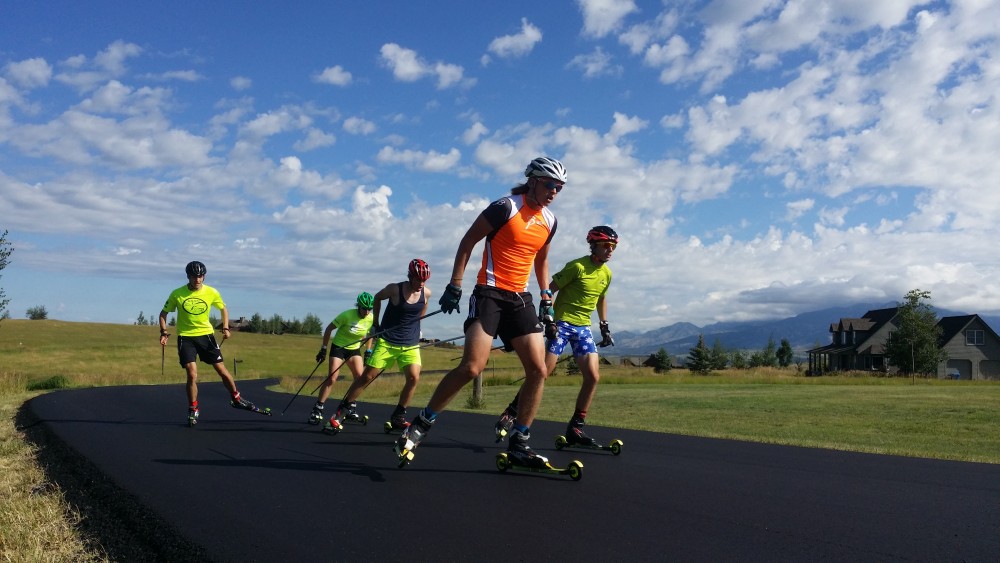
(From left to right) BSF skiers Silas Talbot, Jennie Bender, Paul Everett, Logan Diekmann, and Max LaChance during a rollerski in Bozeman, Mont. (Photo: Austin Caldwell)
The pale wood grain of a wax trailer’s interior walls and the sound of a power-tool firing up can only hold one’s attention for so long, especially if that someone has the coaching gene. As the grandson of John Caldwell, a former U.S. Ski Team (USST) head coach, and son of Sverre Caldwell, the Stratton Mountain School (SMS) nordic director and head coach, it may be no surprise that John — who goes by his middle name of Austin — Caldwell, also heard the call to coach.
After spending this past winter working for Caldwell Sport as a wax technician, Austin, a 24-year-old Dartmouth grad, wanted a challenge and change. Not only in his work, to include a greater focus on interactions with athletes, but in his whereabouts as well.
“I really enjoyed working with Zach and Amy [Caldwell] wax-teching last year,” Austin said on the phone while in Bozeman, Mont. “But part of me wanted to spread my wings a bit and try some new place outside of the east and outside of Vermont where I’ve lived all my life.”
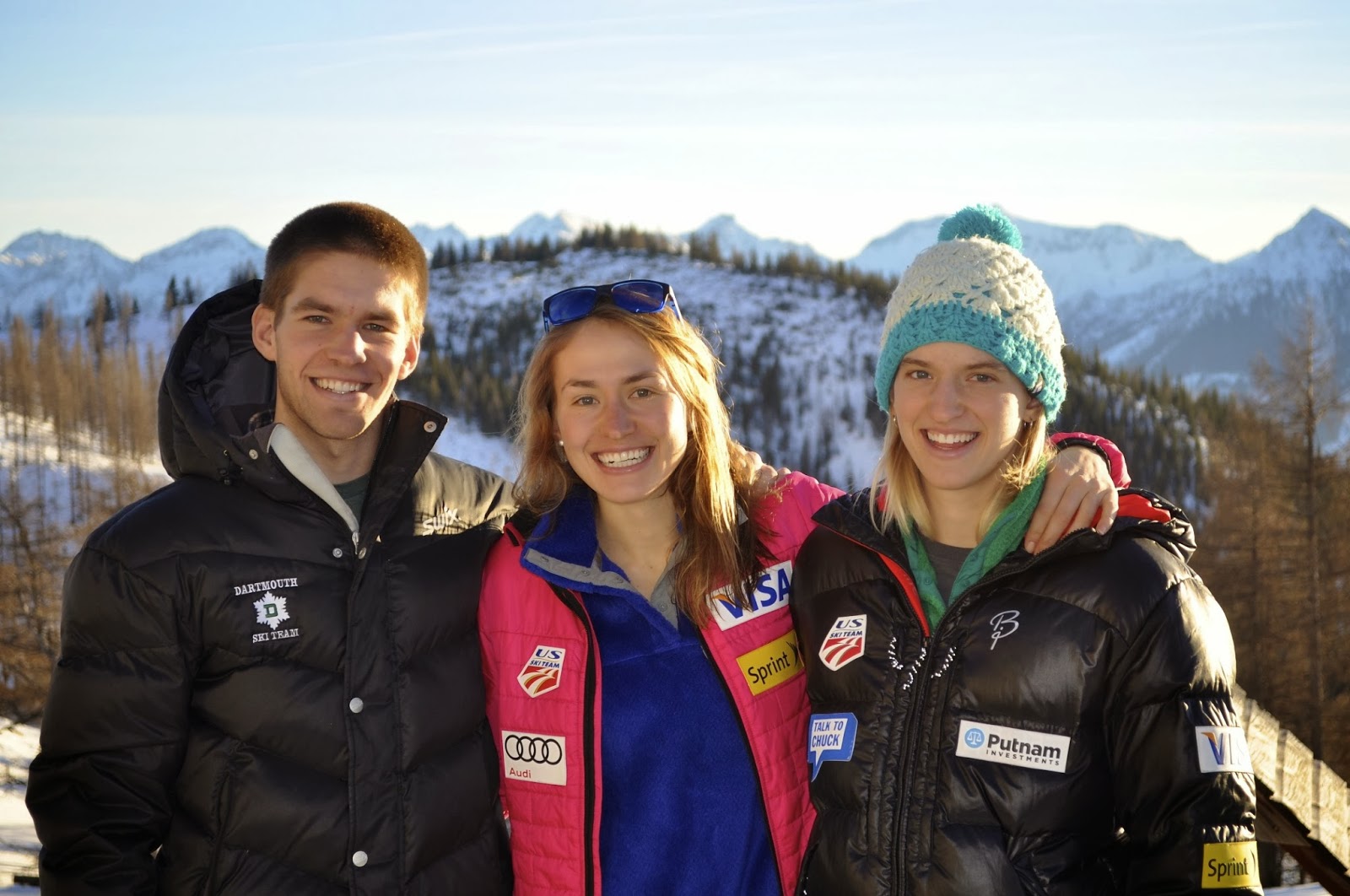
Austin, Sophie and Isabel Caldwell (l-r) during their Christmas visit to Europe in 2013 to see Sophie race on the World Cup circuit. (Photo: Sophie Caldwell/sophiecaldwell.blogspot.com)
Growing up in Peru, Vt., alongside his two sisters Isabel and Sophie Caldwell (the latter of which is a USST member), skiing was not just what Austin spent his spare time doing. It was the family mealtime topic of choice; it was how vacations were spent with relatives — his uncle Tim Caldwell, a four-time Olympian, and cousins are all avid nordic skiers as well.
Surrounded by skiing his entire life, Austin did not want to give it up anytime soon. When the head coaching position for the Bridger Ski Foundation (BSF) elite nordic program opened up and his cousin, Anya Caldwell-Bean, BSF’s U18/U20 junior coach, told him of the opening, he saw an opportunity to not only stay involved with skiing, but further himself and his experiences in it.
“I loved wax-teching last year, that was really fun, but I also enjoyed coaching in the past for junior skiers,” Austin said. “My dad is a coach and I’ve always been interested in coaching … so now I get to coach and wax tech.”
Stepping into his new role and responsibilities as the head coach for the BSF elite team — his first coaching position of this caliber — Austin is aware of the challenges that rest ahead for himself and his athletes. Prior to this year, his work with athletes involved coaching juniors last year in Putney, Vt., and at SMS youth summer camps over the past five years.
“I have gained most of my understanding of coaching from my relationships with Sverre, Ruff Patterson, and Zach and Amy Caldwell,” Austin wrote in an email, referring to his father, college coach, and first cousin once removed (and his wife), respectively. “Those four have been great mentors and in the process they have taught me almost everything I know about skiing.”
Bridger Ski Foundation (BSF) 2016/2017 Roster:
Elite Team Jennie Bender
Silas Talbot
Nick Power
PG/Collegiate
Paul Everett
Max LaChance
Nick Matelich Summer Collegiate
Noah Anderson
Logan Diekmann
Currently eight athletes will work with him during the summer and throughout the season. Three athletes, Jennie Bender, Silas Talbot and Nick Power comprise the elite team, and five others make up the post-graduate crew, with a few of them heading to college in the fall and being replaced with new post grads for the upcoming school year.
“We’ll have some kids taking classes and then partway through the winter, people will be going different ways depending on how they do [during the season],” Austin explained. “So that will be, as far as managing at that point, that will be one of the bigger challenges.
“But I think it’s something all teams face,” he added. “Just having kids at different levels and different age groups as well.”
On a personal level, Austin admits one of his biggest adjustments so far has been learning Bozeman’s trails and rollerskiing roads, as well as not getting the team or team van lost in Montana’s mountains.
“For me, I guess the biggest challenge that everyone has been helping me with is finding my way around Bozeman and finding new routes for rollerskiing,” Austin said. “Every week I’ve been trying kind of to add a new place to rollerski … because it’s important to switch it up.”
“I plan on staying in the ski world for as long as I can, so far BSF and Bozeman have been great and I plan on remaining here for the coming years.” — Austin Caldwell on becoming BSF’s elite head coach
But even if navigating Bozeman has been a bit of a learning process during the beginning stages of his coaching career, the city and a well-established elite program were two of the draws that pulled Austin to apply and eventually take the position.
“Having a strong program in place and being in Bozeman were the two main factors [why I considered working with BSF],” Austin said. “I also talked with Dragan [Danevski, BSF’s head coach and program director] and with my cousin Anya and it just seemed like it would be a good fit.”
With the goal to remain involved with skiing for as long as possible, Bozeman and BSF struck Austin as the ideal program and place to be a part of.
“I plan on staying in the ski world for as long as I can, so far BSF and Bozeman have been great and I plan on remaining here for the coming years,” he wrote in an email.
Danevski respectfully declined to comment on Austin’s hiring. In the last two years, the BSF elite team has weathered several coaching transitions, most recently with the departure of Bernie Nelson — the team’s coach since the fall of 2014.
In his first season as an elite head coach and with eight athletes to oversee, his greatest ambition involves pushing his athletes to their full potential. Talbot, 23, Austin’s former classmate, co-captain and fraternity brother at Dartmouth College, and now an athlete for the BSF elite team, saw the transition to having Austin as a coach as uniquely strong.
“For myself, it has been hugely beneficial to have Austin coaching because he knows my athletic background so well,” Talbot, originally from Anchorage, Alaska, wrote in an email. “He already knows my strengths and weaknesses (which are especially prevalent in the dryland season), and so there is no need to build up the trust and/or understanding between us from scratch. In short, having someone I know well as a coach makes the adjustment to the new program — something that for many after college is a tough step — much easier.”
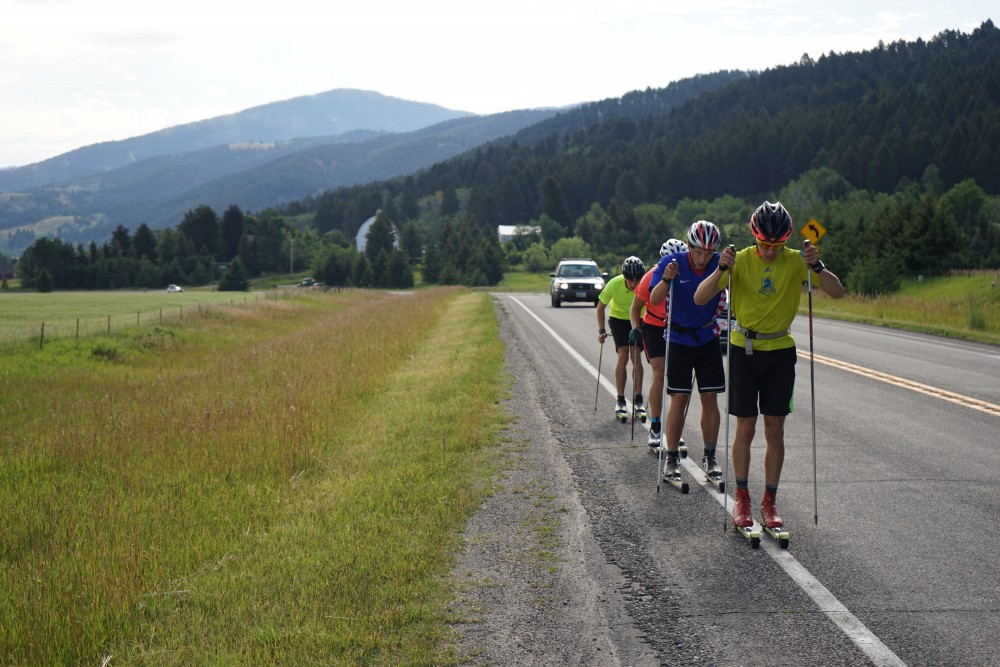
Bridger Ski Foundation elite and post-graduate athletes during a classic rollerski in Bozeman, Mont. From left to right: Max LaChance, Nick Power, Logan Diekmann, and Silas Talbot. (Photo: Austin Caldwell)
Entering her fourth year on the BSF elite team, Bender also found Austin a positive addition to BSF and the greater Bozeman area.
“Austin waxed for me during the last few World Cups at the Canadian Tour this past March, and I was instantly impressed with his professionalism,” Bender wrote in an email. “Austin taking the head Elite/PG coach position is a great attribution to not only BSF, but to the Bozeman ski community as a whole.”
So far, Austin too, cannot ask more of his athletes and training group. The higher level of focus and preparation he finds evident with the BSF elite and PG level athletes gives him confidence in the season and performances to come.
“I think the key to success is having a group that motivates each other and pushes each other,” Austin said. “And I’m very excited about this training group we have going into the summer. They’re all working very hard and they’ve come together really well. It’s like they’ve been training together a lot longer than three weeks … everyone in this group is always trying to push the limits and do everything they can do to get better.”
Bernie Nelson (l) coaching Australian national-team skier, Alaska Pacific University member, and former Montana State University athlete Jessica Yeaton (r) at the 2015 World Championships in Falun, Sweden. (Courtesy photo)
BEND, Ore. — A few things stand out while interviewing Bernadette “Bernie” Nelson, the newly hired head nordic coach at the Bend Endurance Academy (BEA): she’s intentional with her words, meticulous and grateful for the opportunities she’s been given as she develops into an emerging leader on the cross-country ski racing scene.
Growing up in Truckee, Calif., Nelson said she became hooked on nordic skiing because of the way her coaches used the Sierras as a playground — where play just happened to be training.
“Skiing wasn’t just skiing,” she explained. “We went running, and climbing, and biking, and we ran all our camps out of Yosemite, which was just the coolest opportunity ever.”
Beyond the physical settings and cross-training opportunities the Sierras afforded, Nelson mentioned that Truckee’s ski scene placed an emphasis on building a unified team. Nelson said that end goal — team spirit — began with parents emphasizing the organization rather than individual results.
“I feel like when I was growing up, something that worked in Truckee was that the parents weren’t just invested in their child — they were invested in the organization and the community and the process,” she said. “I feel like it shifted the focus from the child’s performance to the experience that the child was having. And so, having parents invested in that experience and invested in the greater organization kind of it took the emphasis off of, ‘My child won today.’ ”
In that healthy environment, Nelson thrived — she skied herself onto several Junior National podiums.
Coach and Collaborator
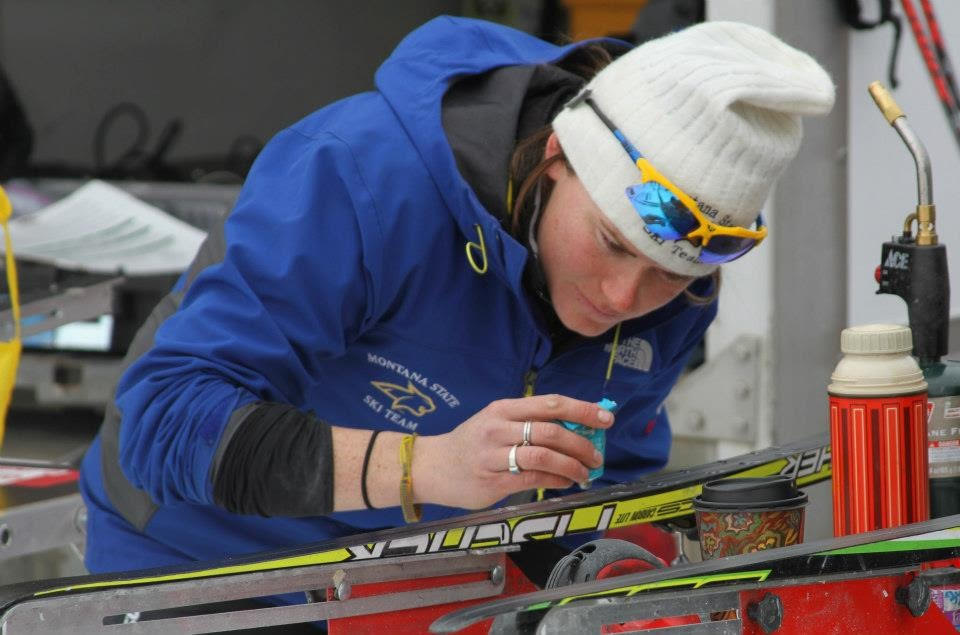
Bernie Nelson prepping skis while coaching at Montana State University. (Courtesy photo)
Nelson eventually went on to ski for the Montana State University (MSU) nordic ski team for two years. After that she focused on her studies while at the same time serving as the assistant nordic coach at MSU for another three seasons.
With a proven aptitude for managing athletes, school and the stress of travel and waxing, Nelson was hired by Bridger Ski Foundation’s (BSF) Dragan Danevski to head up the post-graduate and elite teams in 2014.
One difficult task Nelson was held responsible for was guiding a team of 18- and 19-year-olds in BSF’s post-grad program. Nelson says she built mutual respect with her athletes premised on a simple common goal.
“I want the athletes to develop just as much they want to develop,” she said of her coaching style: less dogmatic, more like a collaborator. “I hand them the keys and I’ll sit in the passenger seat. I’ll provide the roadmap to where they are going and where they need to turn and if they are driving too fast or you’re not paying attention anymore, the speed limit is 60 and you are going 25. And that’s how I run my program. It’s through mutual respect and mutual understanding and a lot of communication.”
For Nelson, communicating wasn’t simply about the day’s intensity session, or periodization within a complex training plan. Sometimes it was more basic.
“I’ve worked with [postgraduates],” she said. “So there is a lot of life things going on. ‘I’m out of the house.’ ‘I don’t know how to do laundry.’ ‘I cannot find a job, can you help me?’ ‘Can I list you as a reference?’ And so it’s just a big picture and I try to not be ignorant of any of the moving pieces.”
Two BSF athletes who built a strong relationship with Nelson will be moving to Bend this June to continue working with her: Nick Michaud and Akeo Maifeld-Carucci.
At BEA, Nelson says she’ll make good use of the multi-disciplinary hat she once wore at BSF in terms of meeting the demands of junior skiers and what they want out of the sport.
“Especially in junior skiing, their goals range from making JN’s, to racing a junior qualifier, to winning JN’s, to going to World Juniors, to making friends,” she said. “I mean, the spectrum is so broad and through all of it, you learn pillars that support your life later on.”
Time to Simplify
This past spring, before her move to Bend, Nelson’s life became more complicated. While in Canmore serving as a guest coach for the U.S. Ski Team at the Ski Tour Canada, Nelson had a health scare.
“I had a Grand mal seizure in Canmore,” Nelson explained. “I came home from the skiathlon, got out of the shower, they think that I just passed out from accumulation of stress and exhaustion, and hit my head and had a Grand mal seizure. And I was actually air flighted and medically sedated into a coma in Calgary. It was unfortunate timing in that I couldn’t go to [SuperTour] Spring Series and I think there were all of these rumors flying and circulating about why I was leaving BSF.”
Nelson wanted to make clear that her departure from BSF was amicable.
“I did not leave because of BSF — BSF was keeping me in Bozeman,” Nelson said. “I love that job. I loved that organization, and working with Dragan was a fantastic opportunity. And I’m excited to continue working with him.”
BSF’s program director, Danevski could not be reached for comment.
Dakota Blackhorse-von Jess admiring turns with Bernie Nelson below Broken Hand Mountain in the Three Sisters Wilderness outside Bend, Ore. (Courtesy photo)
Nelson’s arrival in Bend was in many ways an attempt to simplify her life. Her partner is Dakota Blackhorse-von Jess, a perennial SuperTour sprint podium threat and longtime Bend resident. The couple saw each other either in Europe or at national-level races, or they endured the 800-mile road trip between Bend and Bozeman.
It was a combination of events that convinced Nelson to make the move: her personal relationship, the events in Canmore, and the job opening at BEA.
“I was more or less planning to come out here and then I had this seizure and it was like, ‘Yup, life is short,’ ” she said.
She explained that during her recovery — at least in the short-term — she couldn’t be alone or drive.
“It’s just that my life, a little bit, has just been kind of turned on its head,” she said.
Having Blackhorse-von Jess nearby to help with her recovery made practical sense. But on a lighter note, being in Bend affords Nelson the opportunity to foster their relationship.
“Part of me moving here takes the traveling out,” Nelson said. “Hopefully it allows him and us to kind of be a team here. In the sense that we can get things done together.”
Blackhorse-von Jess reiterated Nelson’s sentiments that their partnership in Bend will streamline their lives.
“Most of the upside is actually the intangible stuff,” Blackhorse-von Jess said. “We can facilitate workouts if necessary. If I need someone to drive a vehicle for example or run a lactate meter. The real benefit to having her here is that I don’t have to travel to Bozeman/she doesn’t have to travel here for us to see each other. And having two people in the house actually makes a huge difference with regards to food preparation and scheduling, and equipment maintenance. Those are the sort of tasks that you can share when you are in the same general field together.”
With World Championships this coming winter and 2018 being an Olympic year, Blackhorse-von Jess, 30, said he plans to continue training and racing for at least the next two years.
BEA Executive Director Ben Husaby will continue to supervise Blackhorse-von Jess’ training as he has for most of the 2013 and 2015 national champion’s career.
“I’m not coaching him, Ben is, and Ben does an awesome job,” Nelson maintained. “Maybe there will be days where we’ll be at the same place and I’ll take some video but I’m not going to coach him.”
Husaby’s hands will be full. BEA is a growing nonprofit with biking and climbing programs complimenting their nordic skiing offerings.
“Up until two years ago, I was everywhere,” Husaby said. “My primary focus was to grow the nordic program, to show its financial viability, and to lead the program … As time has gone on and our board has watched us grow and our program directors have had more needs, there were two options. I was either going to continue to be the program director and be the face of the nordic program, or I was going to shoot into the Executive Director role. And it’s been a relatively slow process, because selfishly, I really still enjoy coaching. It’s my passion.”
For the past two seasons, Jordan Buetow served as BEA’s head nordic coach. Buetow helped build the program and in his second season became the go-to face of the ski program as Husaby primarily coached Blackhorse-von Jess and tended to organizational duties.
Husaby said Buetow created a seamless transition for Nelson before he recently returned to his native Alaska.
Currently, Nelson is immersed with office work, learning about the broader details of BEA’s programs and community of parents and athletes, and writing training plans. She’ll be taking over more of the ski program’s coaching duties starting June 1.
Bernadette Nelson leading an OD workout for Bend Endurance Academy skiers. (Photo: Bernadette Nelson)
Bernie Nelson (l) coaching Australian national-team skier, Alaska Pacific University member and former MSU athlete Jessica Yeaton (r) at the 2015 World Championships in Falun, Sweden. (Photo: Bernadette Nelson)
“I don’t think that there being a lack of [elite] female coaches has anything to do with entry into the sport,” she said in a recent in-person interview. “I think it’s more that the lifestyle is not the most glamorous.
“Sleeping in bunk beds, sleeping on couches, sleeping in different tiny little rooms”, as she describes it, “coaches just put 150 percent into what they’re doing. And then they go home and collect themselves because next weekend, they’re doing it again.”
The copious amounts of coffee and early mornings spent doing hot laps in the dark is not a job for the weak at heart. Still, if the profession doesn’t include fancy hotels and plush king-size beds, what keeps Nelson, and other nordic coaches like her, going? According to Nelson, one word: passion.
“I don’t think that there is a single [nordic] coach out there — young, old, grumpy, not grumpy — who doesn’t truly love skiing,” she said. “I think that passion drives most coaches. Let’s be honest, coaches don’t start coaching for the salary. Coaches coach because they love coaching, or they love skiing, or they love teaching, or there’s something that they are passionate about in the sport.”
“Let’s be honest, coaches don’t start coaching for the salary. Coaches coach because they love coaching, or they love skiing, or they love teaching, or there’s something that they are passionate about in the sport.” — Bernie Nelson, head coach of the BSF Elite and postgrad teams
But what does this passion look like? For Nelson, who turns 25 on Tuesday, it’s five years of ski coaching — one year at Montana State University (MSU) as a student assistant coach, followed by two years there as an assistant coach, and a year as the Bridger Ski Foundation (BSF) PG and Elite Team head coach — as well as over 10 years of competitive ski racing. It’s also a lot of time.
“I put thought into each session and I put thought into each individual at each session,” Nelson said.
Bridger Ski Foundation athletes:
Elite Team
Akeo Maifeld-Carucci
Jennie Bender
Nicholas Michaud
Full-time PG
Max LaChance
Logan Diekmann
College PG
Mitch Harris
Cameron Bobb
Henry Trowbridge
Erin Bolger
Paul Everett
Ben Grodner
Sam Nelson
Sarah Lyle
With a total of 13 athletes and close to 12 sessions a week, Nelson’s passion for coaching invariably means a lot of time dedicated to people other than herself. It also means looking to others.
“I try not to get stuck in just nordic,” she said. “I love hearing about what other people are doing in our sport, but also I love hearing what other coaches are doing in other sports because I think you can take those components, think about them and implement them when they need to be implemented. It’s more tools in your toolbox.”
A native of Truckee, Calif., she added that a bit of time in the race bib isn’t unwarranted as a coach.
“I think it’s so important to race every now and again, because it reminds you how much it hurts, how nervous you get, and all the different feelings that your athletes have,” Nelson said.
Being a nordic skier, Nelson explained that “it’s fun to tie up the competitive laces” and experience “the pain that’s replaced with euphoria” every once in a while. Especially when running on four hours of sleep with a legion of race skis to wax.
Part of the passion Nelson exhibits stems from those who coached her. “A lot of my coaching principles are rooted deeply in [Far West Nordic Head Coach] Ben Grasseschi’s approach to skiing,” she said. “Ben taught me not only how to love the sport and nordic skiing as an athletic endeavor, but also to love what you’re doing when you’re doing it.”
Nelson’s work with coaches, such as Grasseschi and former MSU assistant Chad Anderson, gave her what she called “perspective.” The perspective of not just a coach, but an athlete and mentor.
“Coaching is complex,” BSF Head Coach and Program Director Dragan Danevski said in a recent phone interview. “One coach needs to have different abilities: understanding physiology, understanding psychology, understanding waxing, organizational skills with athletes, races, and trips. These abilities come with experience and you need somebody willing to take on that challenge. Somebody who has enthusiasm, energy, and motivation. I believe Bernie is that person.”
Bernie at a Glance:
-Name: Bernie Nelson -Nickname: Bern -Age: One day shy of a quarter century! -Hometown: Truckee, Calif. -Education: B.S. in Community Health, Montana State University -Current Profession: BSF Postgraduate and Elite Team Head Nordic Coach -Interests/Hobbies: Skiing, skiing, skiing, mostly in the downhill direction. Running, Mountain Biking, General life training to keep up with Dak [Dakota Blackhorse-von Jess] -Most Bad-A** Moment: Snowshoeing in Yellowstone Park with my mom. -Most Embarrassing Moment: Getting arrested in Yellowstone Park while snowshoeing with my mom. It was a mix up and I still don’t like snowshoeing. -Self-Identified Spirit Animal: Bear -Favorite Music Jam: Eric Church. But the team loves the Greatest Hits of Elton John CD.
Along with coaches, Nelson’s experience with team sports has influenced her coaching style.
“The biggest thing I bring to skiing is the idea of team and feeling a part of something that’s bigger than yourself,” she said. “There’s something to be said about digging deep and pushing past your point of comfort and really burying yourself in the pain, but there’s also something really enlightening about doing it for yourself and doing it for the people that are right next to you, whether you are on the same team or not.”
During an in-person interview, Michaud — the newest BSF Elite team member who hails from Maine — said that even after one summer with Nelson, he learned “there’s always more in the tank.”
“Working with Bernie, you learn a lot about the power of positive attitude and energy,” said Maifeld-Carucci, a recent Harvard graduate and also first-year BSF Elite Team member.
For Nelson, having that sort of positive impact on her athletes remains the most important part of her coaching. One of her goals for the BSF program includes “helping motivated and committed BSF athletes discover their athletic potential, believe in their potential and supporting them as they develop from domestic racing to the highest level of the sport,” she explained.
Nelson’s passion as a coach stems largely from the people she coaches.
“What makes me love coaching, is to not only see my athletes’ athletic development, but also to see their development as a person,” she said. “My goal in and out for the last five years that I’ve been coaching is to have my athletes not only leave as better skiers, but as better people.”
***
About the Author: Gabby Naranja considers herself a true Mainer, having grown up in the northernmost part of the state playing hockey and roofing houses with her five brothers. She recently graduated from Bates College where she ran cross country, track, and nordic skied and is excited to work with FasterSkier.
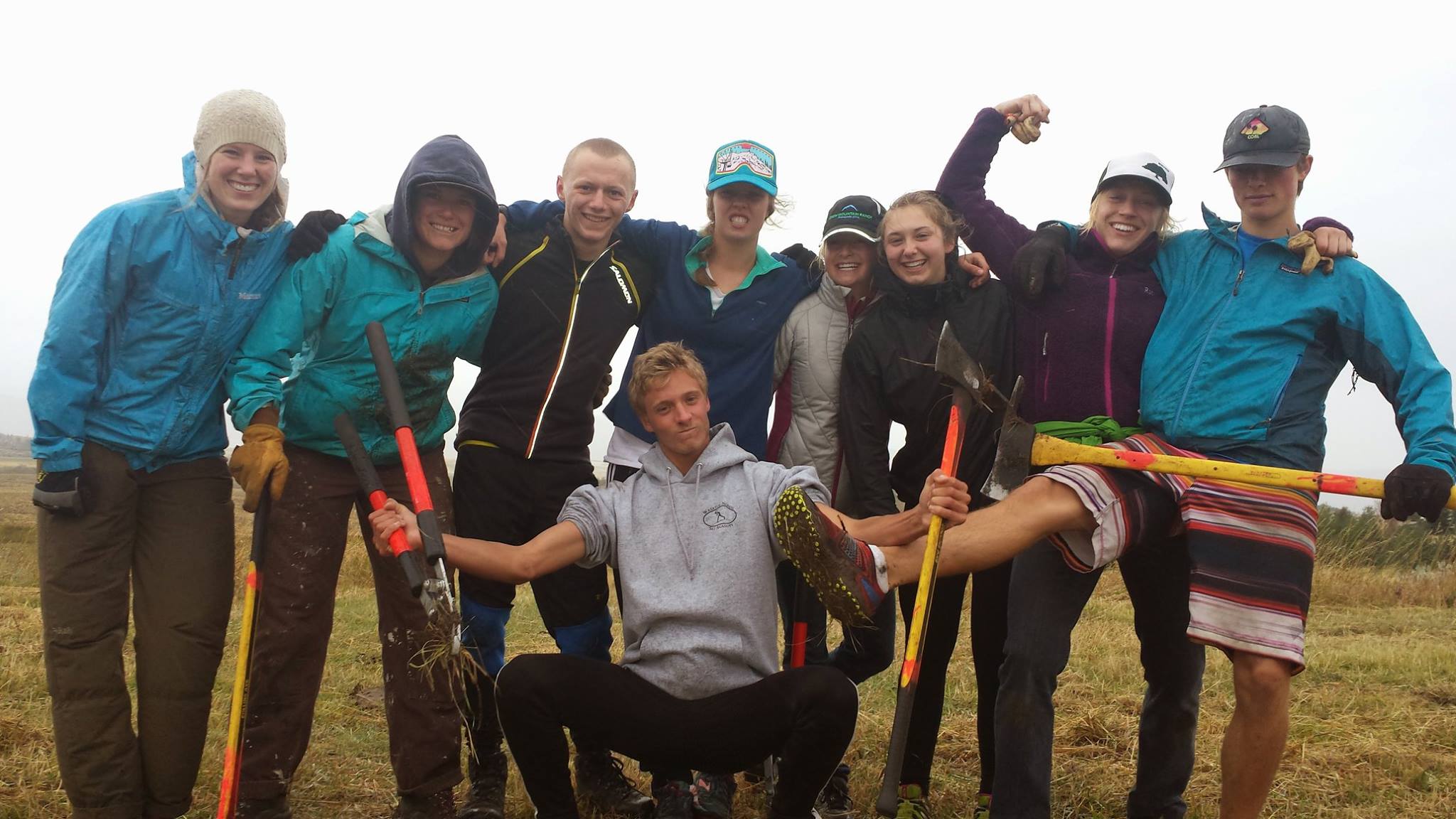
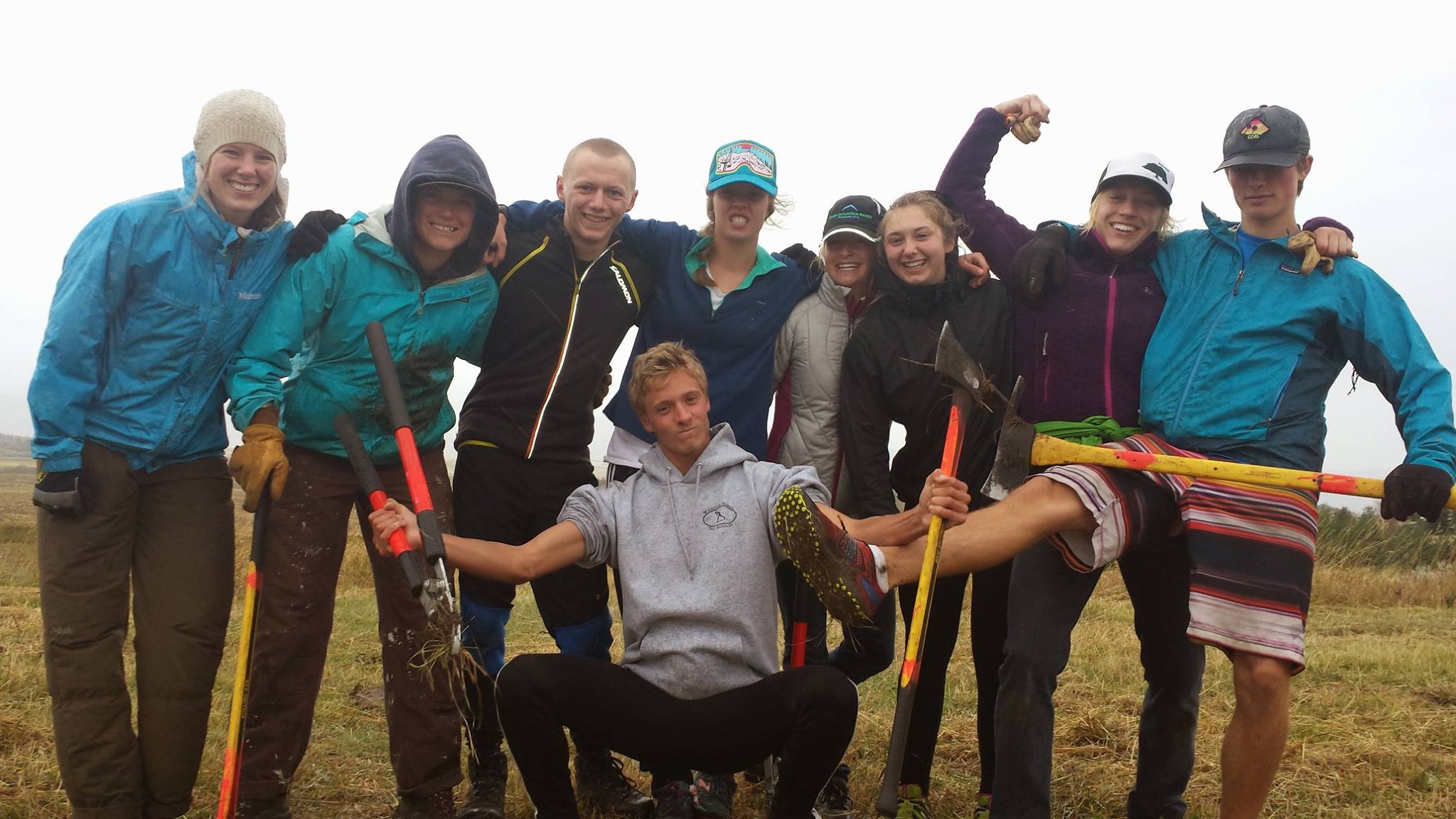
Members of the Bridger Ski Foundation elite and postgraduate perform trail maintenance at Bozeman’s Lindley Park in September. (Photo: Bridger Ski Foundation)
The future of the Bridger Ski Foundation (BSF) elite and postgraduate team was a bit uncertain in July.
Shortly after coming on as BSF’s new elite-and-postgrad coach in May, alumna and Bozeman, Mont., native Kristina Trygstad-Saari left her position to lead the Montana State University (MSU) nordic team.
To make matters worse, soon-to-be BSF athletes Sam Tarling and Eric Wolcott decided to retire from skiing, leaving just two elite skiers, Jennie Bender and Riley Eusden, on the team.
Today, however, the woes of the summer are behind BSF as it says its team is stronger than it has been in years. In a remarkable turn of events, the elite and postgraduate team now boasts 14 high-level athletes led by Truckee-native Bernie Nelson.
Rebuilding the Team
Dragan Danevski, the Bridger Ski Foundation head coach and program director. (Photo: Bridger Ski Foundation)
According to BSF Head Coach Dragan Danevski, the summer months were trying for the team’s skiers and coaches due to the uncertainty of the program. However, Danevski and his colleagues worked tirelessly to build the team from the bottom-up.
“It was not good for BSF’s image in the summer,” Danevski said in a phone interview. “Many of us were not happy with how that developed. It was disappointing for us.”
According to Danevski, the first step in rebuilding the team was hiring a coach.
Nelson, who served as assistant coach to Grethe Hagensen and Chad Andersen at MSU, was exactly what Danevski was looking for: she had extensive knowledge of the sport, experience racing, and energy.
“This is not a job for everybody. Everyday you have to work with athletes, you have to energize them, and you have to motivate them,” he said. “You can do that only if you as a coach are energetic and enthusiastic. That is what we see with Bernie.”
Once Danevski hired Nelson, he was faced with the daunting task of completing the team roster.
With persistence and good luck, Danevski recruited 10 incoming and current MSU students to join the postgraduate program.
Nelson was also instrumental in building the the team’s numbers. Given her experience as a college athlete from her days at MSU, the 23 year old could relate to university students as they balanced school and skiing.
With the postgraduate team squared away, all that remained was the addition of more elite skiers to the team.
American skiers had already been with their respective teams since the beginning of the summer, but fortunately for Danevski and BSF, two foreign skiers were looking for an American team to join.
Bernadette Nelson joined BSF as its elite and postgraduate coach in September after Kristina Trygstad Sarri left the position in June. (Photo: LinkedIn)
Australian Paul Kovacs contacted Danevski this spring about the possibility of training with the BSF elite team. Always open to new energy, Danevski remained in touch with the Australian and accepted him on his squad. After hearing about the opportunity from Kovacs, another Australian skier, Mark Pollock jumped at the chance to train in Montana and worked to earn a spot on the team as well.
Both Kovacs and Pollock raced in the FIS Australia New Zealand Cup this summer, and now that the Australian winter is over, the two will travel to Bozeman in the coming weeks to begin their training and racing with the team.
Reflecting on the changes to his team, Danevski said he was pleased with the progress and happy that the program was able to recover from a tumultuous summer.
Bender, who spent part of August and September in the east, said that she didn’t recognize the team when she returned to Bozeman.
“When I left for the Lake Placid [training camp] there were three athletes,” she said. “When I came back there were 14 new people and a new coach. Now that we have this big group, there’s been great a vibe.”
Team Veteran: Bender
The women’s 1.5 k freestyle sprint podium at the 2014 U.S. Cross Country Championships , with Jennie Bender (c) of the Bridger Ski Foundation, Caitlin Gregg (l) of Team Gregg/Madshus in second, and Rosie Brennan (APU) in third. (Photo: Tom Kelly/USSA)
At the center of the BSF elite team, Bender has seen it all. In the past two years, she’s had ranging results spanning from the top of the podium to the back of the pack.
Since she began skiing with BSF last season, the Vermont-native earned her second national title in January. At the same time, however, she failed to accomplish her goal of making the 2014 Olympics and struggled to find her form in last March at the World Cups in Finland and Norway.
Bender said that a major factor in her inconsistent results over the past two years was her health. In addition to a case of mono and Lyme disease in 2012, Bender suffered a herniated disk in 2013. Due to fatigue and pain, her training and racing suffered.
“The last two years have been a physical struggle and a mental struggle,” Bender on the phone. “Having a couple good races at nationals was huge. … I didn’t go out and accomplish what I was hoping to do with my World Cup starts, but having those starts was important for me and I’m hoping to have more because I’m ready for that next stage. I feel that there is more that I can give.”
Despite the impediments of the the last two years, Bender said she believes the 2014/2015 season will be her best yet. With her health intact and little-to-no pain in her back, she said she recently finished her most consistent-and-productive summer training to date.
She also has a new outlook on life and skiing. Bender said she learned important aspects about herself from the past ups and downs, and that such lessons will aid her in her search for top results.
“Tenacity became really important. I’ve had my lowest of the lows and my highest of the highs all in one year with being at my wits end and then being on top of the podium,” she explained. “Being thrown into different those two different spectrums, I’ve learned to maintain a solid head and realize what’s important and what’s not important in life. I think it’s been a good lesson on how to stay positive and not dwell on the negative.”
As the winter approaches, Bender said that she is excited to demonstrate the hard work she has put into her training over the past months. Her season goals are lofty – a spot on the 2015 U.S. World Championships team – but not out of reach.
A Team of Potential
Bender’s teammates are also aiming high.
According to Danevski, Kovacs hopes to compete for the Australian World Championships team in Sweden this February, while Pollock’s main goal is to race at the U23 World Championships in Kazakhstan.
Three of the nine postgraduate skiers are training to compete at Junior World Championships, while the rest of the squad is looking to prequalify for Junior Nationals by ranking as top-20 juniors at U.S. nationals in January in Houghton, Mich.
While the team will have the opportunity to accomplish their goals in a few short months, the way BSF sees it, it’s already won half the battle, rebuilding from what many would call a devastating summer.
“I think BSF has potential to be a very solid elite team,” Bender said. “Everyone on the team is in a really good space. Everyone is working hard and it’s great.”
Kristina Trygstad-Saari in the leads the 2009 Boulder Mountain Tour. The 29-year-old Bozeman native was announced as Montana State University’s nordic ski team head coach on July 11. (Photo: Saab/Salomon Factory)
When Montana State University (MSU) started a national search for a new nordic head coach, little did they know that their final pick would come from their own backyard.
The university announced last Friday that Bozeman, Mont., native Kristina Trygstad-Saari will take the place of former head coach Grethe-Lise Hagensen, whose contract was not renewed in May.
This is the second job announcement in recent months for Trygstad-Saari as she was reported to be the new elite/post-graduate coach of the Bridger Ski Foundation (BSF) in May. She has since resigned from the position.
“The job opened up later than is ideal for ski coaches and I was already working for BSF doing the elite team,” Trygstad-Saari explained in a phone interview. “Growing up in Bozeman I’ve always watched that position as something that could be a potential career position so when it opened up I decided to apply and see what happened.”
Trygstad-Saari was one of four finalists for the post, including former MSU assistant coaches, Chad Andersen and Dan Campbell, and current University of New Hampshire assistant coach Stephen Monsulick.
“We’re fortunate to live in one of the best ski towns in the United States,” MSU Athletics Director Peter Fields said in a press release. “And to be able to tap into our local community for our Nordic ski coach is exciting. Coach Trygstad-Saari has competed at the highest levels, raced and coached collegiately at Dartmouth, and knows the challenges of being a student-athlete. We feel she is a great fit for our program and look forward to her taking over the reins of the Bobcat Nordic program.”
Returning member of the MSU ski team and former BSF racer Cambria McDermott also expressed her excitement to have Trygstad-Saari at the helm of the university’s nordic program.
Former Bridger Ski Foundation (BSF) elite team racer Kristina Trygstad-Saari had planned to coach the BSF elite nordic team. However, when the head coach position became available at Montana State University, Trygstad-Saari jumped at the opportunity. (Photo: Mary Klotz)
“Kristina is a great choice for our new head coach. She has had so much success as an athlete and, more recently, as a coach. Besides her knowledge and experience, I think she will bring a new, focused energy to our team,” McDermott wrote in an email.
The decision to leave Bridger shortly after her hire was difficult for Trygstad-Sarri, who was one of the program’s most successful skiers as a junior. While content with her position at BSF, she had always wanted to coach collegiate-level skiing and knew the position at the university was an opportunity she had to take.
“I would say that this has been a really tough decision for me for a lot of reasons. I have always been supportive of and supported by BSF. I am really loyal to the organization and I was very happy with my position there at the elite team,” she said. “I had in the back of my mind that I wanted to coach college eventually. It seemed like one of those opportunities that I just needed to go for and if it ended up working out, I knew I might need to take that step.”
“When I found out that I got the job, I took some time to think about all sides of the situation and it’s definitely challenging to leave something that’s really good. I had really great coworkers, Dragan [Danevski] has always been super supportive of me. I look forward to the new position but it has been challenging for sure.”
BSF Head Coach and Program Director Dragan Danevski had no comment about the departure of Trygstad-Saari but said that the program was currently searching for her replacement.
Without Trygstad-Saari, the club’s elite and post-graduate team is currently without a coach and with several skiers joining the program in the fall, a new hire will be necessary in the coming weeks.
When asked whether she was open with BSF about her college-coaching aspirations, Trygstad-Saari said she had communicated with the club prior to her acceptance of the job.
“I was pretty open part way through the process. Initially I applied not knowing what would happen and just did that on my own,” she explained. “I’ve been pretty open about the process and trying to communicate things well with people. I know it’s a hard decision that affects a lot of people and I hope that in the end it works out for everybody.”
Despite the tough choices that Trygstad-Saari has made, she is ready to lead the MSU ski team into a new era.
The Montana State University Nordic Team conducts an upper-body power test in 2012. Trygstad-Saari will become head coach of the team August 1, 2014. (Photo: Dan Heil)
“I’m really excited to be working with collegiate athletes. It’s an interesting and exciting time for skiers,” she said. “I look back on my college skiing experience and I really value that. I really looked up to my coach at that time so I’m really excited to step into that role and lead these athletes through their college experience.”
Trygstad-Saari, 29, intends to use her depth of knowledge as both a ski racer and coach to push her athletes to the next level. A nine-time junior national champion, she placed sixth in the 2002 Junior World Championships, and was named 2002 National Junior Skier of the Year.
At Dartmouth, she skied two seasons for the Big Green. Since then he has been both racing and coaching, culminating in her position as interim men’s coach at Dartmouth where she lead the team to fifth place at the 2013 NCAA Championships in Middlebury, Vt.
In terms of goals for the MSU ski team, Trygstad-Saari is focused on making her transition into the program easy for her athletes. Once that is accomplished she plans to bring the team to its full potential.
“My priority right now is making a smooth transition for the athletes individually and the program as a whole,” she said. “I know it’s hard to transition between coaches so it’s going to take some time to get to know everybody. I’ve been watching this team grow over the last 10 years and I see a lot of potential. There is no reason that we can’t be in the top three teams collegiate circuit and I hope to take the team to that level.”
Former Bridger Ski Foundation (BSF) elite team racer Kristina Trygstad-Saari was recently named head coach of the BSF elite nordic team. (Photo: Mary Klotz)
A return to one’s roots can often lead to new opportunities. Such is the case with Kristina Trygstad-Saari, a Bozeman, Mont., native and Bridger Ski Foundation (BSF) alumnus who was recently named the ski club’s elite and post-graduate coach for the 2014-2015 season.
Trygstad-Saari found her start in nordic ski racing with the Bridger Ski Foundation and found great success in her skiing under the guidance of head coach, Dragan Danevski. After nine junior-national titles, Trygstad-Saari attended the Junior World Championships in 2002 and earned one of the top finishes by an American woman in the championships after finishing sixth in the 5 k freestyle.
After her junior years were over, Trygstad-Saari made her leap to the collegiate circuit at Dartmouth College, where she skied with the Big Green for two seasons. She left New Hampshire in 2007, ready for a break from ski racing. However, when the 2010 Olympic Games were on the horizon Trygstad-Saari was ready to give it another go, and adorned the red BSF racing suit along with former teammate Leif Zimmermann. While she didn’t make the Olympics, she continued to stay involved with the Bridger Ski Foundation.
Former Bridger Ski Foundation (BSF) elite team racer Kristina Trygstad-Saari was recently named head coach of the BSF elite nordic team.
With her beginnings as a coach in the U14 age group, she made her way up through the ranks of the coaching staff, until she left Bozeman to be the men’s assistant team coach at Dartmouth for the 2012-2013 season, helping the team earn a fifth place finish at the 2013 NCAA Championships in Middlebury, Vt.
Since her season-long stint at Dartmouth, Trygstad-Saari, returned to Bozeman and BSF in the hopes of revitalizing the masters program as well as creating a new citizen’s race series aimed at attracting members of the community who were uninvolved with the ski club.
“In the past we had a masters coach but it hasn’t been super established and we’ve rotated coaches through each session,” Trygstad-Sarri said in a recent phone interview. “I kind of wanted to take that on and make it a more established program for a year.”
She considers her work last season a success, especially in regards to the citizen’s race series, hoping that the progress she made will continue in the future. “It was our first year doing it and it actually went really well. We had between 50 and 75 skiers at every race and a lot of those were citizens racers and not from BSF. We felt really great about how it went.”
With the departure of BSF coaches Tim Baucom, who is headed to Sun Valley as a wax technician, and Andrew Morehouse, who was hired as an assistant coach at Montana State University, a void was opened in the elite coaching staff of BSF. Due to her history with the club, success in both national and international racing, and experience coaching, Trygstad-Saari was viewed as the perfect fit.
According to Baucom, he simply “needed something different” after several seasons of working as a wax technician and assistant coach at BSF.
“[Andrew] and I both decided, independently of course, to move on from BSF,” he wrote in an email. “I really value everything I have learned working for BSF over the last 5 years, and believe it is a excellent club.”
In her new role, Trygstad-Saari said her main goal is to create a cohesive team atmosphere that not only helps skiers attain their individual goals but also helps further the team as a whole.
“Even though skiing is an individual sport, we’ve seen that it’s really important to have a good group to train with and be with and live with and travel with,” she said. “I would really like to establish a more cohesive group and bring more people to Bozeman and up our elite team status in the world of elite teams.”
Former Bridger Ski Foundation (BSF) elite team racer Kristina Trygstad-Saari was recently named head coach of the BSF elite nordic team. (Photo: Doug Edgerton)
This spring, an influx of new skiers joined the team, which already included veteran Jennie Bender, the 2014 U.S. national champion in the freestyle sprint. They include Trygstad-Saari’s former Dartmouth athlete, Sam Tarling, Eric Wolcott (formerly of St. Lawrence and CXC), Riley Eusden (Bowdoin College), former BSF skier Sawyer Kesselheim, as well as a variety of post-grad skiers.
Asked whether Torin Koos, a multiple Olympian and national champion, would return to the elite team in any capacity, Trygstad-Saari said he was finishing up school and making that decision about racing next season.
“We’re not sure about that,” she said. “I think he’s done with his full-time skiing career but we’re open to other options.”
As for Danevski, he will retain his role as BSF head coach, and Trygstad-Saari will assume the role of elite coach.
“She’ll run workout and communicate with athletes and I will be in the back supporting,” he said in a phone interview. “I’m working with Kristina on developing the year round plan and trainings and volume of training and intensity and wax. Athletes will have access to talk to me, or they will go through Kristina, and Kristina will ask me these things.”
At the end of the day, Trygstad-Saari is happy to be working with her former coach in the community where she developed her skiing career.
“Dragan is a really great leader and he provides a foundation for all of this and I’m excited to work with him and learn from him and be able to execute the job on my own on a daily basis but have him back me up and help me out,“ she said. “I think that BSF and Bozeman have a lot to offer skiers and we have a lot of potential in this area. We’ve spent a lot of time trying to put these teams together so I think that we have the opportunity to take another step in the right direction.”
Former Bridger Ski Foundation (BSF) elite team racer Kristina Trygstad-Saari was recently named head coach of the BSF elite nordic team. (Photo: Doug Edgerton)
(Press release)
Former BSF athlete returns to coach the club’s highest-level Nordic skiers
BOZEMAN, MT – Bridger Ski Foundation has named a new Head Coach for its Nordic Elite Team. The Bozeman-based nonprofit ski club announced today that Kristina Trygstad-Saari, one of their former Elite athletes and accomplished international ski racer, has filled this leadership role.
Bridger Ski Foundation’s Nordic Elite Team strives to offer the highest quality individual and team training experience for talented, committed skiers, giving them the opportunity to reach their full athletic potential and achieve success at the highest levels of National and International competition.
Trygstad-Saari (Photo: Mary Klotz)
Kristina Trygstad-Saari grew up racing for Bridger Ski Foundation (BSF). A nine-time junior national champion, Kristina was on multiple World Junior and U23 teams, and qualified for the 2003 World Championship team. She competed in 2001 World Cup races, placed 6th at the 2002 World Junior Championships, and won a NorAm at age 18. Kristina continued racing for the BSF Elite Team and the Saab-Salomon Factory Team, with top-5 U.S. and Canadian Nationals finishes, and Super Tour podiums.
She attended Dartmouth College, where she raced for two seasons and graduated with a B.A. in Philosophy in 2007. Since then, Trygstad-Saari has coached youth and adult BSF skiers, and also spent one year coaching at Dartmouth. She is currently pursuing a master’s degree in English.
“I am so excited to have this opportunity to work with the Elite Team,” said Trygstad-Saari. “We have a tremendous group of athletes, coming from many different backgrounds, and I look forward to working with each of them. My experiences skiing and coaching for BSF have brought me to this point, and I think I have a lot to offer this team as we head into the 2014/2015 season.”
While BSF Nordic Program Director and Head Coach Dragan Danevski will still be very involved with the Team, Trygstad-Saari will take over the day-to-day coaching and race travel.
Last season’s Elite Team included four-time Olympian Torin Koos, who competed at Sochi, and two-time national sprint champion Jennie Bender. Koos and Bender both took national skate sprint titles at the U.S. Championships at Soldier Hollow in January 2014.
This coming season, Trygstad-Saari will coach returning Elite Team member Bender, as well as new members Sam Tarling (Dartmouth), Eric Wolcott (St. Lawrence), Riley Eusden (Bowdoin), and former BSF junior athlete Sawyer Kesselheim (Montana State). BSF is still accepting Elite Team applications for the 2014/2015 season.
Bridger Ski Foundation is a nonprofit community organization based in Bozeman, Montana, that promotes athletic and personal excellence through educational and competitive programs in three Olympic ski disciplines.
Bridger Ski Foundation elite and post-grad team members Jennie Bender (front) and Akeo Maifeld-Carucci (l) celebrate the fruits of their training session with coach Andrew Morehouse (r) near Bozeman, Mont. (Photo: Anya Caldwell Bean)
Note: This is the fifth preview in our series on U.S. elite teams, which we’ve dubbed the “The 12.” We asked coaches to tell us what’s new and whom to look out for in the coming season and will publish additional previews in the coming weeks in no particular order.
Team: Bridger Ski Foundation (BSF) Nordic Elite Team
Coaches: Dragan Danevski (program director/head coach), Andrew Morehouse (competitive team/elite/post-grad coach, service tech), Tim Baucom (competitive team/junior coach, service tech)
A BSF skier working hard in the offseason near Bozeman, Mont. (Photo: Anya Caldwell Bean)
Post-grads: Sawyer Kesselheim (Montana State University), Patrick Madden (MSU), Will Meyer (University of New Hampshire), Akeo Maifeld-Carucci (Harvard), Ketchum Wilt (formerly of Sun Valley Ski Education Foundation);
Natalie Flowers (Dartmouth), Lizzie Gill (UNH), Katie Gill (University of Denver), and Cambria McDermott (MSU junior, red-shirting to pursuit some non-NCAA skiing goals)
Who’s new: Reinking (MSU Master’s student), Bender (formerly of Central Cross Country, a.k.a. CXC), Bean (2013 UNH graduate), Malcolm (former US Biathlon member)
Top results last season: Seasoned veteran Torin Koos, who turns 33 on Friday, pulled out impressive performances in January at Soldier Hollow, winning two national titles in the freestyle sprint and 30-kilometer classic mass start in Midway, Utah. A couple weeks later, the U.S. Ski Team did not name the former Olympian to its World Championships squad, stirring up some controversy, but you can expect Koos, who’s nearly finished with his Master’s in communication at Westminster College in Salt Lake City, to be back this season – hungry for his fourth Olympics.
Torin Koos celebrating his overall Tour de Twin Cities win in late January.
Later last season, Koos won the Tour de Twin Cities (five stages of SuperTour races) and led the overall SuperTour standings for World Cup Period 3. He traveled to Whistler, British Columbia, in late March and won the 50 k freestyle mass start before coming down sick at SuperTour Finals in California.
Newcomers to the BSF elite team, Bender won the classic sprint at SoHo for her first national title and Bean achieved All-American status at NCAA Championships in Ripton, Vt., where she was sixth in the 15 k freestyle mass start.
At age 19, Kesselheim cracked the top 30 at the Junior World Ski Championships in Liberec, Czech Republic, placing 29th in the 10 k skate.
Coach’s comment: In an email, Morehouse explained that most of the elite team has been at their base in Bozeman, Mont., since May. “With the combination of a good group of college skiers, energy has been high and there has been a great atmosphere for training,” he wrote.
Jennie Bender (l) working out with her new team, the Bridger Ski Foundation, in Bozeman, Mont. (Photo: Anya Caldwell Bean)
BSF opted out of its annual training camp in Bend, Ore., because of a lack of snow, but is off to Canmore, Alberta, on July 25 for about two weeks of dryland training. In September, the team plans to head back up to Alberta, about a nine-hour drive, for an on-snow camp on the Haig glacier.
According to Baucom, the team is excited to expand its elite and post-graduate programs (from the three elite-team members last year, all of which were men). The post-grad team has yet to be finalized, but a large group of college skiers have been training with BSF this summer.
“With the opportunities that Bozeman has to offer, I think the potential for growth is huge,” Baucom wrote. “We have a great community of skiing enthusiasts here who are excited to support these athletes. … With Montana State University in town, BSF also gives athletes the opportunity to develop as postgraduate skiers and gain in-state status before pursuing a college ski career.”
In terms of goals, Baucom expects his athletes to commit to long-term individual objectives and BSF aims to create a positive atmosphere to make those possible.
“Individual goals range from medaling at international championships, to qualifying for junior and U23 worlds,” he added.
Jennie Bender at 2013 U.S. Nationals, where she won the classic sprint. Photo: Bert Boyer.
On the last day of the season in April, national champion Jennie Bender finished dead last in a race. Out of the 33 women who contested the 30 k classic at U.S. Distance Nationals, Bender crossed the finished line over nine minutes behind the second-to-last athlete and a full 30 minutes behind the race-winner.
“I never want to see myself last ever again,” Bender said in a recent phone interview. “That was horrible and embarrassing. The good thing is, now I know I can…do better and I know I have things I haven’t tapped into yet.”
For Bender, 25, finishing last in California taught her once more how to swallow her pride in a season filled with both trying and triumphant moments. She won her first national championship, the classic sprint, and dropped out of her first race in the span of the same week in Soldier Hollow, Utah. The summer before, she missed months of training while she fought off lyme disease and mono at the same time. At Canadian Nationals in the spring she got strep throat and entered SuperTour Finals on fumes.
Despite the setbacks, the win at nationals taught Bender never to count herself out. That lesson is coming in handy now that she’s facing another physical hurdle: a herniated disk in her back. She thinks the misalignment may be the result her fall in the finish lanes at U.S. Nationals in 2012 and two years of subsequent overcompensation. After making several trips to the doctor, Bender decided not treat the injury with surgery and will instead bring herself back to fitness with physical therapy.
“Obviously it’s disappointing and I’d rather not have this, but it could be a lot worse, I guess,” Bender said. “I’m just going to have to deal with it.”
She can’t run or rollerski at the moment, so Bender is doing the majority of her endurance training on an elliptical, in the pool and with nordic walking. She doesn’t know exactly when she can return to rollerskis, but is confident the problem can be fixed in time to be ready to race in November as long as she’s careful with her physical activity throughout the summer.
The uncertainty comes at a time of transition for Bender. At this moment, she is driving from her home of the past three years with Central Cross Country (CXC) in Minneapolis, Minn., to Bozeman, Mont., to begin skiing for Dragan Danevski’s program at the Bridger Ski Foundation (BSF).
Bender, a Vermont native and University of Vermont graduate, says her decision to leave the Midwest was motivated in part by her unpredictable season and a need for something new.
“I’ve thought a lot this summer about where I want to be and why I’m doing what I’m doing, and I realized that the fire is burning very strongly still,” she said. “I still don’t feel like I’ve reached my potential, which bothers me. It all comes down to personal drive, which is what kept me going this year. Everyone is like, ‘I don’t know how you did what you did this winter,’ and I’m like, ‘I don’t really know, either.’”
At BSF, Bender hopes to reenergize her training.
“I’m excited, because I think…the Bridger Ski Foundation seems to be a very big organization with lots of supporters and it’s a big, enthusiastic ski community with one club,” Bender said. “I’ve only heard good things about the program and about Dragan.”
In addition to Bender, BSF is growing by two other women this season. University of New Hampshire graduate and NCAA All-American Anya Caldwell Bean is headed for Bozeman soon and MSU’s Cambria McDermott will ski in the BSF suit while she red-shirts a year from the NCAA.
“Dragan Danevski is very happy with the acquisitions, and combined with a great group of Post Graduate skiers, is excited about the future of BSF skiing at the top level,” said BSF assistant coach Tim Baucom.
With three elite women on its roster, BSF carries a bigger women’s squad into next season than it’s ever seen.
“It’s bigger than we have had in the past, and the first time that we feel we have several women who will be competitive nationally and internationally,” Baucom said. “Besides Kristina Trygstad-Saari, we have not had many senior women who have been competitive.”
On the men’s side, Torin Koos will again be on the BSF squad and is joined by NCAA All-American Tyler Reinking from MSU. Leif Zimmermann, four-time national champion and 2006 U.S. Olympic team member, is retiring from competition after 15 years of racing.
Bender in Soldier Hollow waiting to climb the podium at 2013 U.S. Nationals with men’s classic sprint champion Torin Koos. Bender and Koos will be teammates at the Bridger Ski Foundation next season.
For Bender, the move to BSF gives her more group training opportunities, as her workout partners in Minneapolis last year often included masters and juniors.
“I’ve been training a lot on my own in Minneapolis and I think I’ll be around more girls my age who will be eager to go out and rollerski,” Bender said.
“It’s important to be around, in general, a really active environment and that’s what Bozeman is. It’s very outdoorsy, very active, people are always doing something even if it’s not nordic skiing. As long as there’s people willing to go outside and do something active, that’s very motivating for me to go do the same.”
Bender’s back injury will limit her training options as she settles into her new life in Bozeman. Injured is not the ideal way she would like to be joining a new team, but she is enthusiastic about the change of scene.
“It’s hard to leave the midwestern ski community and the friends I’ve made there the last three years, for sure,” she said. “Developing a healthy environment is all part of life; all part of being a successful athlete is surrounding yourself with positivity. But this is a change I think will be good and I’m excited for some mountains.”
Bender’s goals, she added, are the same as they ever were.
“The moral of the story is, you never know what’s going to happen,” she said. “Obviously my hopes are still high; I [am] out to make the next Olympics… [I’m] strongest in classic sprinting and the [U.S. Ski Team] is already heavy on sprinters, but because women’s sprinting is a big focus this year I think I could contribute to an already stellar lineup.”
And after a rollercoaster season, Bender thinks her inconsistency in the past might work to her advantage in the future.
“It’s a new year; you never know what I’m going to do,” she laughed.
Michael Sinnott (SVSEF) and Sam Tarling (Dartmouth) racing in the Bozeman SuperTour at Bohart Ranch in 2011. The venue is being considered to host the freestyle sprint originally scheduled for West Yellowstone. Photo: Evan Dethier.
Due to the lamentable conditions in West Yellowstone, there’s a chance that the SuperTour freestyle sprint originally scheduled here this weekend will end up taking place at Bohart Ranch instead. The Bozeman venue is already set to hold a SuperTour classic sprint and mass start on December 1 and 2.
Bridger Ski Foundation director and race organizer Dragen Danevski said on Tuesday that he was confident Bohart could pull off a third race, which is being proposed for Thursday before the classic events. When conditions prompt a last-minute schedule addition like this one, however, several things have to fall into place for it to be possible.
Number one, the conditions in Bozeman have to improve like they’re expected to. With temperatures in the high 40s on Tuesday, what snow Bohart did have last week is currently melting. However, the air is supposed to get back below freezing and stay there early next week, with more snow in the forecast for several days.
Given cooperative weather, Bohart has several course options. The original, newly-homologated sprint course is one. The other is a trail higher up in the meadow that has cooler temperatures and longer-lasting snow.
“It will be better if we can race on the original sprint course and not on the B course,” Danevski said. Heats could be possible, “but it would be difficult. The start and finish is narrower, and the course itself will be very difficult.”
If expected snowfall becomes an actuality, Danevski thinks Bohart will be able to use the original sprint course without a problem. As an added precaution, BSF also owns snowmaking equipment and is willing to loan it to Bohart to lay a good base for the earlier SuperTour. The only question is whether Bohart has people to do the work.
“Bohart has the water source and we can provide the pipes and all that, but for them it will be lots of work,” Danevski said. “We (BSF) have volunteers and some paid people; they don’t have the manpower.”
Snowmaking is an option, but it’s a lot to pull off within a week and a half. Danevski, who is also in West Yellowstone this week coaching his own athletes, has been on the phone with Bohart every day making plans.
Logistics become chaotic when a race changes venues and hosts, and is a factor Danevski considers as he determines what he wants to take on.
“Registration fees and all that can be messy. People are registered [in West Yellowstone], but this would be cancelled,” he said. “Racers will not want to pay again. I expressed my frustration with that. What happened in the past is we had three races and didn’t have prize money for the prologue. People got upset.
Danevski says he can host the additional race, but that competitors would have to adjust their expectations.
“I told [USST Nordic Director] Joey Caterinichio we could do it but I don’t want coaches and athletes to start coming to BSF saying, ‘Where is the prize money?’” he said.
If coaches and athletes want to pay for all three races, Danevski thinks he could offer purses for each race. “But if they say, ‘Oh, we already paid once in West,’ we probably will not be able to provide prizes for three races.’”
The available options will likely be a major topic of discussion at the coaches meeting in West Yellowstone on Wednesday night. As a coach, Danevski very much wants to see full sprints in Montana this first period of the SuperTour, and to help make it possible at Bohart.
“I think if we would like to develop sprinters and good skiers, we should have full sprints. A prologue is only one third of the race,” he said.
As an organizer at the same time, however, “We’ll have to kill ourselves to make this possible.”
Fans cheering at the SuperTour Sprint Showdown last November in West Yellowstone, Mont. Full sprints are back on the schedule in both West Yellowstone and Bozeman this fall, which has both venues working towards making courses that meet FIS homologation requirements.
After a few years of experimentation with the controversial sprint qualifiers, the format is on its way out of the national calendar. Two venues that held early-season SuperTour sprint qualifiers last season are holding full heats this November, and are currently completing trail work to ensure their courses meet International Ski Federation (FIS) homologation standards. The Rendezvous Ski Trails in West Yellowstone and Bohart Ranch in Bozeman, Mont., expect their sprint courses to be ready for the start of winter.
In West Yellowstone, the inclusion of a freestyle sprint in the festival means the elimination of the double qualifier SuperTour Sprint Showdown.
“Everybody realized that, I think, it’s run its course,” former race director Dan Cantrell said of the double qualifier in June. “In the ski community there’s obviously a push to get our domestic racers more experience in the heats. They’re more fun to race in for the skiers and they need the experience, especially if the SuperTours are a representation of the World Cup [and] we’re qualifying people to send there. So from our end, we’re figuring out what we can do to make that happen.”
As of June the full schedule had yet to be finalized, but Cantrell said it would likely feature an additional non-FIS sanctioned distance race on Wednesday, the freestyle sprint on Friday and a 10/15 k individual freestyle on Saturday.
The Rendezvous Ski Trails obtained preliminary homologation approval early this summer from John Aalberg, the North American FIS homologation coordinator. Its orange 1.5 k course meets the total climb and independent climb requirements for a freestyle sprint course; the trail only needs widening in a few spots to meet the nine-meter specification.
“It’s relatively minor,” Cantrell said of the necessary trail work. “We’re only looking at about two sections of 100 yards apiece that need widening, and only by five to six feet.”
The trails could only homologate a freestyle sprint course; Cantrell said the Rendezvous doesn’t have the available terrain to create a classic sprint course, which requires climbs of specific size in order to necessitate striding.
In Bozeman, Bohart Ranch is currently working on homologating a classic sprint course. Bridger Ski Foundation director Dragan Danevski says the hills are being improved and the total course will be 150-200 meters longer to make it a complete 1.5 k.
“We are working on finishing the homologation this fall [to] have it FIS certified,” Danevski said. “This summer we have also been working to improve the start and finish area and made improvements on the distance course. When we complete all of that we will put up course maps on the BSF website.”
In addition to a classic sprint, Bozeman has a 10/15 k classic mass start on its schedule.
All together, the four SuperTour races in Montana during Period 1 will be the last opportunity athletes not already on the World Cup have to earn start rights to the Canadian World Cups from December 8 – 16. The U.S. benefits from a larger Nation’s Group quota for both the Quebec and Canmore races and can bring five additional men and women. Outside World Cup performance, additional athletes are selected from the leaders of the respective distance and sprint USSA SuperTour standings on December 3.
Athletes collide during sprint heats at U.S. Nationals in Rumford, Maine, 2012.
A sprint qualifier can be defined as the preliminary stage of a sprint race in nordic skiing. In a race against the clock, competitors leave the starting gate at intervals and go as hard as they can for anywhere between 1 and 1.8 kilometers. The top 30 in most internationally sanctioned competitions, and sometimes a lesser number in other events, move onto the quarterfinals to face off against five other athletes at a time for the right to advance to the next round.
Sprint races progress in this manner all over the world; on the World Cup, in Continental Cups, in the collegiate circuit, and sometimes at small-scale high school races.
In the winter of 2009, the term “sprint qualifier” took on another meaning. The U.S. Ski and Snowboard Association (USSA) introduced a sprint race to the SuperTour that was truncated at the qualifying round; medals were awarded to skiers who clocked the fastest qualifying times, and the athletes’ entire day was done in a matter of two to four minutes. No longer just a prologue, the qualifier became a race all its own.
At the time, the trial run was met with mixed reviews. Athletes felt robbed of the chance to develop head-to-head sprint skills. Coaches acknowledged the challenges the organizers faced in putting on full heats, but agreed that the format was not ideal. Canadians who occasionally dabbled in the SuperTour simply didn’t understand it.
Qualifier-only sprints started with a trial run in West Yellowstone, Mont. that first winter, but have since spread to three other stops on the SuperTour in 2012. What began as confusion is now ranting fury — some still fail to understand why the experimental format was deemed a success and allowed to proliferate.
To begin to answer that question, we start with that first time qualifier-only sprints were held in the U.S.
When the format was first conceived of prior to the 2009-2010 season, then-USSA Nordic Director John Farra intended for it to do two things. First and foremost, the decision to leave out the heats from the West Yellowstone sprint was a philosophical one. Farra believed it to be the right move for U.S. skiing at the time, and today stands by his decision.
“We still don’t have enough Americans, in my personal opinion, who can qualify, period,” said Farra, who has since left USSA to become the High Performance Director for Paralympic skiing, in a phone interview in December. “That’s a problem. For me, at this point in our development, there’s an argument for getting athletes in more races where they’re just throwing down… I think it works on a gear all Americans need to keep working on.”
Secondly, it put an additional sprint race back on the calendar in the first period of the SuperTour where, at the time, there was only one in Bozeman, MT. It would not be the first time sprint races were held in West Yellowstone. Regular sprints, complete with heats, were held on the Rendezvous trails up until 2007, but according to Farra, coaches complained that the trails were too narrow and the altitude too punishing for a full sprint day.
One of the jobs of the Nordic Director is to select skiers at the end of the Period 1 to send to the World Cup. With an additional sprint thrown into the mix, Farra’s theory was that the overall points leader would have to be a decent sprinter and distance skier to earn those coveted European start rights.
Rankings of the best distance skiers and sprinters on the domestic circuit are often very similar, however. For example, at the end of Period 1 this winter, the women’s SuperTour sprint leader, distance leader, and overall leader were all one person: Jessie Diggins (CXC/USST).
On the men’s side, overall leader Mike Sinnott (SVSEF) had two top-5 distance results along with his two sprint wins and one second.
The sprint qualifier has also been accused of having another motive. It was introduced in the season leading up to the 2010 Vancouver Olympics, and it’s been suggested that the qualifier, in squeezing another race into a short time frame, was a grab for better FIS points to boost the U.S. quota for the Games.
Farra said this was never the case. Points are always based off the qualifier, so heats would have no effect on FIS points either way. Additionally, as Farra pointed out, “you can only ‘boost’ the points if you have a quality field in the race.”
Jessie Diggins competing in the qualifier-only skate sprint in West Yellowstone, Mont., in November 2011.
With his idea for a modified sprint in mind, Farra went to the West Yellowstone Chief of Competition at the time, Sara Hoovler, with the proposal.
From the organizer’s perspective, the introduction of an additional race in West Yellowstone brought with it organizational and financial burdens, which became the main point of negotiation.
“As an organizing committee we were pretty maxed out,” said Hoovler, who is now a school teacher in the area. “We couldn’t put on another full-scale race.”
When Farra brought the proposal to the organizers, they agreed to try out the additional sprint as long as it didn’t come with a significant extra cost—specifically, as long as it didn’t require coming up with the additional prize money. At $3,900 per race, prize money is one of the single most expensive components of hosting a SuperTour.
“Purses for these races can sink the entire event,” said Dan Cantrell, Hoovler’s successor as the West Yellowstone race director.
He estimates that between all the major costs involved with putting on the SuperTour every year—notably prize money and gas for grooming—the event runs the Yellowstone Ski Festival around $20,000. When the weather is especially uncooperative, the number goes up as tents and space heaters are brought in, or the Pisten Bully has go over the course multiple times.
With the introduction of homologation standards this year, any argument for heats became moot—the venue simply doesn’t have the terrain to meet the standards on a traditional sprint loop. For the race to count as a SuperTour complete with FIS points, there needed to be a certain amount of total climbing.
The only sprint course West Yellowstone could come up with that met the standards is a point-to-point 1.5 k, which ruled out the possibility for heats. For timing and officiating purposes, heats have to start and end in the same stadium.
“We were able to FIS homologate West for a sprint qualifier only. That’s a big deal, otherwise we don’t sprint there,” said Farra.
The other option would be to hold the fall SuperTours at locations that could homologate a sprint loop, but choices are limited by the reliability of snow anywhere else in the country in late November, and the number of venues willing to take on a SuperTour.
With the advent of homologation standards looming for 2011, Cantrell also had to account for the cost of the trail work necessary to get the courses up to standard. In addition to sitting on National Forest land, the Rendezvous Ski Trails occupy endangered grizzly bear habitat. Every time the ski trails are modified, the Forest Service requires an environmental impact assessment.
“To put it in perspective, the improvements from this year, with the connectors and homologation, was about a three year process,” said Cantrell. “We had a bulldozer out there two weeks before Thanksgiving.”
With these demands on the race organizers in mind, Farra was loath to push West Yellowstone to take on significant extra cost in adding a sprint qualifier to the schedule.
“We weren’t prepared to make the organizer come up with the prize money,” said Farra.
Since USSA strategically thought it was important to hold a sprint in Yellowstone, the organizers were excused from the obligation to hand out the prize money for sprint qualifiers. The exception is laid out in the USSA Rulebook—none of the sprint qualifiers on the SuperTour schedule this year award the usual purses to the top six finishers.
Since 2009, Yellowstone’s sprint qualifier has become two. In the second and third years of its existence, the opening day of the SuperTour was a double-header. The “SuperTour Sprint Showdown” starts with a skate sprint qualifier, and ends one hour later with a classic sprint. Each of the two races is an opportunity to earn points, but the single winner of the Showdown and recipient of the $250 purse is calculated from the combined times.
The first running of the Showdown at West Yellowstone, on the whole, was a success in the eyes of the organizers and USSA. There were a few kinks to work out—the flow of athletes from the finish back to the start was congested, and cold weather made the trek an uncomfortable one for athletes still just in spandex—but overall, organizers felt good about the trial run.
For her part, Hoovler thought the number of participants in the sprint qualifiers as reason to look positively at the outcome.
“We saw a lot of junior skiers, just getting some race experience, and also master skiers that weren’t competing for FIS points but challenging themselves,” she said. “I was very shocked at the amount of racers that participated.”
When West Yellowstone still had sprint heats in 2007, 42 women and 51 men participated. In 2009, 61 women and 67 competed in the qualifier-only version. In 2011, more athletes competed in the freestyle sprint than the classic, but the totals in the freestyle qualifier were 60 women and 92 men.
Amongst elite skiers, the sprint qualifier was met with some complaints about the absence of heats. Despite this feedback during the season, Farra said the format wasn’t a major issue at the spring USSA meetings, and he saw no reason not to keep experimenting with it.
“This is not a new topic,” Farra emphasized. “There’s been at least two springs for people to say, ‘Hey, this is ridiculous.’ I don’t remember there being significant discussion about that.”
The release of the 2011-2012 SuperTour calendar saw the addition of sprint qualifiers to three new venues: in Bozeman, Mont. one week after West Yellowstone; in night-sprint form at the Tour de Twin Cities, which took place just two weeks ago in Minneapolis, Minn.; and as a prologue to the upcoming 5/10 k classic on day one of the Owl Creek Chase in Aspen, Colo.
In the negotiating phase of calendar planning prior this season, Farra proposed the addition of sprint qualifiers to each of the new hosts. As with West Yellowstone, at each location, the investment that new homologation standards required already had organizers strapped for cash and volunteer power.
Austin Weiss, the Race Director for the Aspen SuperTour and Owl Creek Chase, agreed to add the sprint qualifier to the schedule on February 11 in order to make the entire weekend a more attractive package to racers. Weiss said the Aspen organizing committee was never asked if they could hold a full sprint with heats. He indicated that it would be a challenge, as heats require a separate day of racing, but didn’t rule it out as a possibility in the future.
“Logistically, everything is possible,” said Weiss. “It’s biting off a bit much—it’s not out of the question, but it’s something that the organizing committee would have to consider.
“The other benefit of a sprint qualifier is that it doesn’t require that much more work on the part of organizers.”
The race director in Minneapolis had a similar view.
John Munger, the director of the City of Lakes foundation, which hosted the first three races of the Tour de Twin Cities, pointed to the challenge of putting on a number of high-profile events within a short timeframe.
“It takes a long time to do sprints and lots of volunteer power,” Munger said in a phone interview. “We’re doing the Mayor’s Challenge, the IPC Paralympic World Cup, and the City of Lakes Loppet all within about two weeks.”
This is the compromise Farra sought to strike as he set about adding more sprints to the SuperTour last spring: give skiers more opportunity to develop their sprinting ability without pushing organizers to the point where they wouldn’t hold sprints at all. Just as in West Yellowstone, he saw qualifiers as the best solution.
“It’s a fine dance between what athletes and coaches want, and what we think organizers can do,” said Farra.
The financial burden of the additional race was also lessened at the new sprint venues. As with the two independent sprints in West Yellowstone, none of the three new sprint qualifiers come with the normal win payout, which adds up to $3,900 between both men and women (1st – $750, 2nd – $500, 3rd – $250, 4th – $200, 5th – $150, 6th – $100).
“Imagine if you push Bozeman, and we say, ‘Come up with four grand,’ and they say, ‘Sorry, can’t do it.’”
According to Dragan Danevski, director of the Bridger Ski Foundation, the additional prize money would have been more than they could afford, and was a point of negotiation when Farra asked them to hold a sprint qualifier in the spring.
“It would be nice if we could have $100,000 in prize money, but I said, ‘Look, in this economy, in this situation, we are lucky to have SuperTour races even with [some] money,’ sad Danevski in December.
“I had to make the decision that we would no be able to do three races and have prize money for three.”
The financial compromise has not gone unnoticed by the athletes, particularly those who have repeatedly placed in the top six in the SuperTour sprints thus far.
“I don’t understand it,” said Mike Sinnott (SVSEF), who was first and second in the two sprints in West Yellowstone and won the freestyle sprint the next week in Bozeman.
“It’s unprofessional in my opinion.”
In Sinnott’s view, the $250 check he won as the Sprint Showdown champion in West Yellowstone should have been a bonus.
“I think it’s pretty clear in the rules that you get $750 for a win,” he said.
Caitlin Gregg (CXC) has similarly excelled in sprinting this winter. She began with a fourth and first in West Yellowstone, a second-place in Bozeman, and a third in Minneapolis. Like Sinnott, she believes the sprint qualifiers should have prize money.
“If any race requires a registration fee and awards points…there needs to be prize money,” Gregg wrote in an email in December. While she understands that qualifier-only sprints, as a format, are easier on race volunteers than full heats, she believes that leaving out their prize money altogether undermines sprinting development in the U.S.
“It seems as though there was once a push to hold more sprints and team sprints on the circuit and suddenly (ironically coinciding with some of the best results ever for U.S. skiing, which came from sprints and team sprints internationally), the U.S. has decided to reduce the opportunities domestically for sprinters to develop,” said Gregg.
“Without prize money, sprint specialists or those who are competitive in both distance and sprint races would be loosing a large percentage of potential earnings that could allow them to continue competing on the SuperTour domestic circuit.”
As a solution, she proposed getting a title sponsor to help fund the SuperTour purses in the future.
If USSA is adamant about adding more sprints to the SuperTour, and has found race committees unable to produce the extra prize money, would USSA ever contribute their own cash to the pot to make up for it?
Given the state of its budget, “No way would USSA pay,” said Farra. “The SuperTour has never been funded by USSA… Given the state of the union at USSA, it’s highly doubtful that any prize money will come from them.”
Farra empathizes with the opinion of the athletes, but notes that contesting the sprints are still worth something.
“While I agree—I would be disappointed not to benefit from that prize money— World Cup qualifying is still up for grabs,” he said.
But for many athletes on the SuperTour, not even that is enough. Without heats, some don’t feel sprint qualifiers to be a valuable format.
Pat O’Brien (CGRP), who placed second in the night sprint qualifier two weeks ago in Minneapolis, believes the heats are critical to developing competitive sprinters.
“While I agree that it is important for US skiers to be able to qualify well (and make the heats), the real test to me is how well an athlete skis rounds,” said O’Brien. “It doesn’t matter how fast you are in the qualifier if you can’t move out of the quarters. Skiing well in a group is a skill that you only can develop through practice.”
“Cutting full sprints out of the schedule and replacing them with just qualifiers undermines this development.”
His teammate Tim Reynolds (CGRP) suggested an alternative format for heats that would be less demanding on organizers, and in cases like Minneapolis where there were fewer numbers, make more sense.
“You don’t have to take 30 onto the heats… I think you can adapt the format to the field size,” said Reynolds, pointing to the Madison, Wisconsin SuperTour as an example. In the past, the Madison event has taken on eight skiers from the qualifier on to the heats, which reduces the number of rounds to two semis and one final.
“Heats are a valuable experience,” said Reynolds.
If dissatisfaction with sprint qualifiers is as widespread as the vocal skiers would make it seem, then Farra agrees that USSA should go back to the drawing board.
“It’s part of being progressive,” said Farra. “How we’ll be a better ski nation is being open-minded to trying different things.”
“My memory is that we are still testing this concept. Until coaches come back in the spring and say, ‘This doesn’t work, we need to stop’—until that happens, we’re still testing it.”
If athletes really want to see qualifiers scaled back next year, Farra encourages them to go to the USSA spring meetings, or make sure their views will be represented at them.
“The USSA Congress really does work,” he said. “It’s amazing how many coaches go out of their way in the spring and engage in dialogue when they don’t want to be thinking about skiing.
“Athletes need to be able to remind their coaches, ‘This is what we’d like to see; this is how the SuperTour could be improved… Everybody is working their butts off, but it’s only going to get better if people bring their ideas forward.”
Torin Koos (BSF/Rossignol), Skyler Davis (SMS/USST) and Reese Hanneman (APU) skiing up the first hill in the semifinals of the classic sprint at U.S. Nationals. Photo: Flying Point Road.
As promised, Torin Koos (Bridger Ski Foundation/Rossignol) filed an appeal on Monday with the International Ski Federation (FIS) Appeals Commission against the the jury’s determination at the U.S. Cross Country Championships that he had obstructed competition on his way to winning the A-final of the classic sprint, which resulted in his disqualification.
Koos declined to answer specific questions about the case until the Appeals Commission comes to a decision, but confirmed that Dragan Danevski, Nordic Program Director at BSF, had submitted the appeal to the U.S. Ski and Snowboard Association (USSA) on Monday. USSA then forwarded the case to the Appeals Commission at FIS, which will review the evidence over the coming days and determine whether to uphold the jury’s decision.
In a phone interview on Tuesday, Danevski explained that Koos and the BSF coaches were contesting several aspects of the jury’s decision and course of action on Sunday in Rumford, ME. Koos does not deny that his skis made contact with MSU/Team HomeGrown’s Ryan Scott as he moved to get in the tracks in front him. Rather, he and his coaches take issue with the process by which Koos was disqualified, which in their view contained numerous departures from the proper protocol outlined in the FIS International Competition Rules (ICR).
I. The Jury Proceedings in Rumford
First and foremost, Koos is protesting the way he was notified of his infraction on Sunday. The competitoin jury issued him a written reprimand for obstruction of Scott’s skis, and according to Tim Baucom, one of two BSF coaches present in the jury room when Koos was first called in, Koos was not given the chance to defend himself before the jury disqualified him. As outlined in the FIS Cross-Country Guidelines for Jury Work, a competitor believed to have obstructed competition must be given the opportunity to explain himself before the jury can make its decision.
For Koos and his coaches, the realization that his gold medal finish was being called into question began as he waited to take to the podium. While waiting with Koos an unusually long time for the ceremony to begin, Baucom said they began hearing rumors that an issue had come up with Koos’s win. Fellow BSF coach Bjørn Bakken went to find out what the problem was, and soon radioed to Baucom that Koos was needed across the stadium in the timing building.
“We started walking over there, and Torin realized the doping control guy was no longer with him,” recalled Baucom. The classic sprint was the second testing day of the week, and U.S. Anti-Doping Agency (USADA) chaperones need to keep their designated athlete in sight at all times until the competitor is brought to testing.
Koos backtracked to bring his chaperone with him, only for the chaperone to inform Koos he had been released from doping control. “From there, Torin knew what had happened,” said Baucom. As they waited for the jury to be ready for them, they heard the men’s podium ceremony begin across the stadium without them.
In Baucom’s eyes, those two facts—that Koos was released from doping control and that the podium ceremony took place before he’d been informed of his offense—are evidence of a significant departure from the FIS jury procedural guidelines, which state that “Prior to the imposition of a penalty (except in cases of reprimands and withdrawal of accreditation according to 223.5 and 224.2), the person accused of an offence shall be given the opportunity to present a defence at a hearing, orally or in writing” (224.7).
“The fact that they pulled doping control off of him before he knew what was happening indicated [the jury] had made its decision,” said Baucom. Though official results were not signed and posted until later, he perceived that the two actions represented the jury “taking all measurable steps in that direction before Torin knew what was happening.”
Present in every part of Sunday’s jury procedures was USSA representative Allan Serrano. From his perspective, the jury at Black Mountain followed FIS-outlined procedure to the T.
Baucom’s interpretation of the jury proceedings are right, said Serrano, but the rulebook’s exception of reprimands from the requirement of jury’s to hear a defense is crucial.
“We didn’t vote to disqualify him—that’s the pertinent point,” he explained. If the jury calls for a disqualification, “that person is entitled to witness of themselves at that jury meeting. But we didn’t disqualify him, we gave him a competition suspension, and as it was his second reprimand, [it] resulted in a DQ.”
The usual result of competition suspension in a sprint heat is relegation to the back of the field—sixth place in the case of the A-final, which would have been the outcome of Sunday’s events had Friday’s 30 k infraction not also taken place beforehand. Hence, Serrano told the USADA chaperone charged with tailing the first place finisher that Koos was now in sixth, and Koos was released from doping control.
Serrano acknowledged that the doping control situation was “definitely awkward.”
As for the medal ceremony taking place before official results were posted, there is nothing unusual about that, explained Eileen Carey, one of the jury members. “It is protocol for the Championships that ceremonies can take place with preliminary results,” she said. “This was communicated at at least one of the coaches meetings, and is in the USSA rulebook.”
The rule (53.1.1) also allows the ceremony to take place for an individual-start distance race while everyone other than the early starters of the A- and B-seeds are still on the course.
II. The Jury’s Evidence
The second major part of Koos’s appeal calls into question the legitimacy of the evidence presented against him. According to Baucom, Koos and his coaches were told that (1) Serrano had been standing nearby and had heard Scott yell after Koos cut him off, (2) officials heard Koos apologize to Scott after crossing the finish line and (3) an official standing at the crossing reported to the jury that he “may have seen something happen,” said Baucom. “But [the jury] was pretty vague about what or who was seen…We didn’t get a first-hand perspective of what [the controller] had seen.”
Serrano and Carey both asserted that a course controller saw the incident first-hand, but whether the jury immediately communicated that effectively to Koos is unclear, as reports from the jury and from Baucom differ.
“He was told that [the incident] had been witnessed during the heat by a controller, and we also witnessed at the finish him acknowledging offending Ryan Scott,” said Serrano. “There’s a record of the controller’s testimony… They fill out cards on the course.”
Apart from whether a controller actually witnessed the offence, Baucom pointed out that a jury is not allowed to regard comments from competitors as evidence. The jury guidelines state that a jury can “react on reports from officially appointed controllers or jury members. A jury should not act on base of comments from athletes or team leaders” (item 6).
This rule should discount reports of Scott yelling and Koos apologizing as evidence, said Baucom.
“Anything can happen during a race that would merit an apology,” he said. “You could accidentally cut someone off; it happens.”
As for Serrano hearing Scott yell during the heat, Baucom continued, “[Scott] wasn’t yelling for a TD to say anything—that could be used as some sort of evidence. In a men’s sprint final there will be contact and some yelling; that’s the nature of the race. That’s why there are heats and not just a qualifier.”
III. The 30 k: Bib Marking of Competitors
The final segment of Koos’s appeal pertains to the written reprimand he received for starting in the wrong position during the mass start 30 k classic on Friday, which is half of the reason he was disqualified two days later under FIS’s two-strikes-and-you’re-out rule.
Koos’s confusion originated with either misremembering or being misinformed of his bib number, and since he wore the numberless green sprint leader bib for the 30 k, couldn’t check his starting position against it.
Baucom doesn’t recall whether he read Koos his correct bib number the night before the race. “It could have been my fault; it could have been a miscommunication,” Baucom said. But it shouldn’t matter, in Baucom’s view, if all competitors in the 30 k were marked with their number as he believed they should have been.
For mass start races, FIS rules state that it is “required to affix start numbers to the competitor’s thigh that is closest to the finish-line camera” (337.2.1). There were no leg numbers in Rumford; had there been, Baucom argued, Koos would have known where to start, would not have been given his first written reprimand, and at worst would have taken sixth place for his infraction in Sunday’s sprint.
Leg numbers or no, the rules also clearly say that it is the responsibility of the athlete to get to the starting line on time. Baucom acknowledged this, but thought that a verbal reprimand would perhaps have been more appropriate, which simply alerts the competitor that his behavior is “borderline.”
“Sure, an athlete should maybe be responsible for knowing his starting spot, but given the stress and preparation, especially for a classic race—Koos was testing skis until five minutes before the start,” Baucom said. “Then he’s running over there, thinking he knows his bib number.”
In the aftermath of his disqualification on Sunday, Koos recalled trying unsuccessfully to find someone with a start list upon discovering someone already standing in the position he thought was his. With minutes to go before the gun, he decided to choose the first open spot he saw.
Carey, who stood at the back of the lanes being loaded before the mass start, said that she and four other volunteers and jury members were stationed around the starting grid specifically to help people find the right position. She recalled seeing no signs of confusion from the athletes in the minutes leading up to the start.
Two Strikes, You’re Out: Too Harsh a Rule?
If anything can be said for sure about what happened in at U.S. Nationals on Friday and Sunday, it’s that the chaos of ski racing made itself evident.
For Serrano, it also became apparent that the rules were perhaps harsher than the situation required. He said members of the jury felt badly about the series of events that resulted in Koos’s disqualification.
“The jury felt that this seemed terrible, but we didn’t have any other choice,” said Serrano. “We made that known to FIS—that this seems silly.”
He referred in particular to the rule that equates two written reprimands to an automatic disqualification. If there had been any wiggle room in the rules, Serrano said he would have tried to avoid disqualifying Koos.
“There may be room for something to evolve there—some other penalty for a second offence,” he said. “The object, I’m sure, is to deal with repeat offenders and problem cases.”
Two days after racing was finished in Rumford, Danevski was still trying to grapple with why his athlete had been disqualified.
“He’s disappointed; [Koos] cannot understand that jury made that kind of decision. Nobody understands,” said Danevski, who was in Bozeman, MT for the duration of Nationals. “For them to disqualify skier who skied for 12 years on the World Cup…to come to Senior Nationals and win by 50 meters, you know, I just—it’s really hard to understand… I got calls from coaches and people are shocked, people cannot believe it.”
Luke Bodensteiner, USSA Executive Vice President of Athletics, said the timeline for the FIS Appeals Commission’s decision on Koos’s case could be up to a week.
“They’re generally pretty expeditious,” he said. “The one time I’ve done this before it was a 24-hour turnaround, so probably by the end of the week.”