Tag: Drammen 1.2 k classic sprint

  • Nilsson Back to Winning Ways in Drammen Classic Sprint; Caldwell Top American in 9th

    Nilsson Back to Winning Ways in Drammen Classic Sprint; Caldwell Top American in 9th

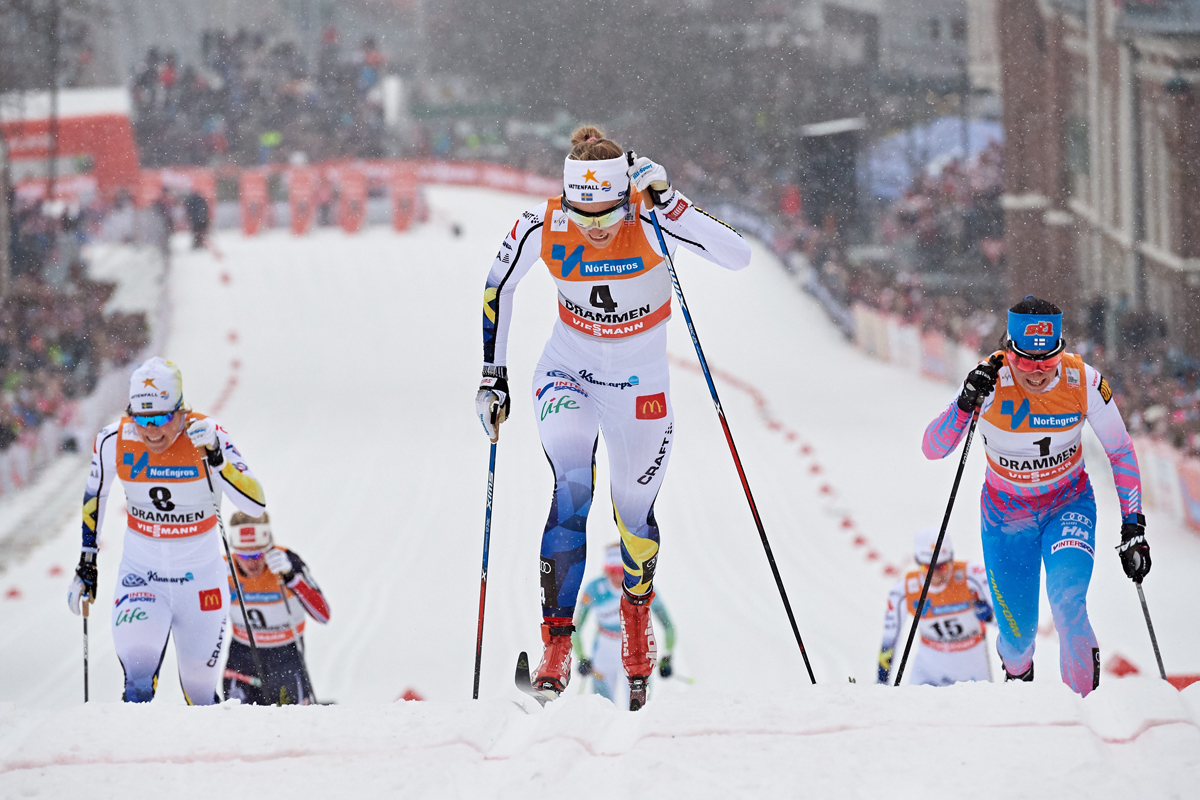
    Sweden’s Stina Nilsson charging to her eighth World Cup victory of the season in Wednesday’s 1.2 k classic sprint final in Drammen, Norway. She finished first, ahead of Finland’s Krista Pärmäkoski (r) in second and her Swedish teammate Hanna Falk (l) in third. (Photo: Fischer/NordicFocus)

    Drammen is one of those staples on the World Cup, appearing on the circuit late each season and remembered for its trademark uphill finish in the middle of a city of 63,000 inhabitants, just 40 kilometers west of Oslo, Norway.

    “It tends to be fairly predictable snow,” U.S. Ski Team Women’s Coach Matt Whitcomb told FasterSkier during an in-person interview in Drammen on Wednesday. “It’s generally clean [snow]. It’s generally some sort of klister.”

    But that doesn’t make Drammen easy. Finding the ideal balance of kick and glide on the city’s 1.2-kilometer course, marked by a steady uphill out of the start, followed by a 60-second downhill, and finally, one last climb to the finish, is key and something even the most seasoned World Cup skiers can struggle with at this venue, Whitcomb explained.

    “We tend to see athletes focusing a little bit too much on the climbs, getting those good sensations and not enough gliding … out on the downhills,” he said. “That’s where the heart of this course really lies.”

    For instance, consider Maiken Caspersen Falla. Coming off an individual skate-sprint victory at 2017 Lahti World Championships, the Norwegian didn’t ski fast enough to qualify for the heats on Wednesday. She finished 31st, 0.34 seconds out of qualifying in 30th but 6.49 seconds off the top qualifying time set by Finland’s Krista Pärmäkoski. With Falla usually qualifying first or close to it in sprints (and Pärmäkoski better known for her distance skiing), it was a shakeup that confused even Falla — Drammen’s three-time defending classic-sprint winner.

    “I think it is weird,” Falla told NRK, according to a translation. “I do not know what’s going on. I was thinking I was going pretty well. I’m not far behind [the top 30], but I have no idea. Maybe I didn’t have the best skis or maybe I left far too much time in a turn. I am very unsure of what’s going on; the body has worked great the last few days.”

    American Kikkan Randall, who placed third in the world-champs freestyle sprint behind Falla, was in the same boat. She finished 52nd out of 56 women in Wednesday’s sprint qualifier, 12.76 seconds out of first.

    Whitcomb said that was likely due to too much kick and too little glide. Drammen as a downtown sprint poses an additional challenge for athletes and wax techs, allowing just 20 minutes for testing on race day.

    “Every athlete’s working out of one depot so you have basically 100 people, male athletes and female athletes, and just trying to control the chaos as much as possible,” he said. “But I feel like our athletes, I can trust them to ask for more kick and know that it’s not gonna compromise their glide. Sometimes it does, it’s just the risk that you have to make because on this course, you spend a fair amount of time gliding and if you’re not close to having enough grip, you’ll be too tired in the finish.”
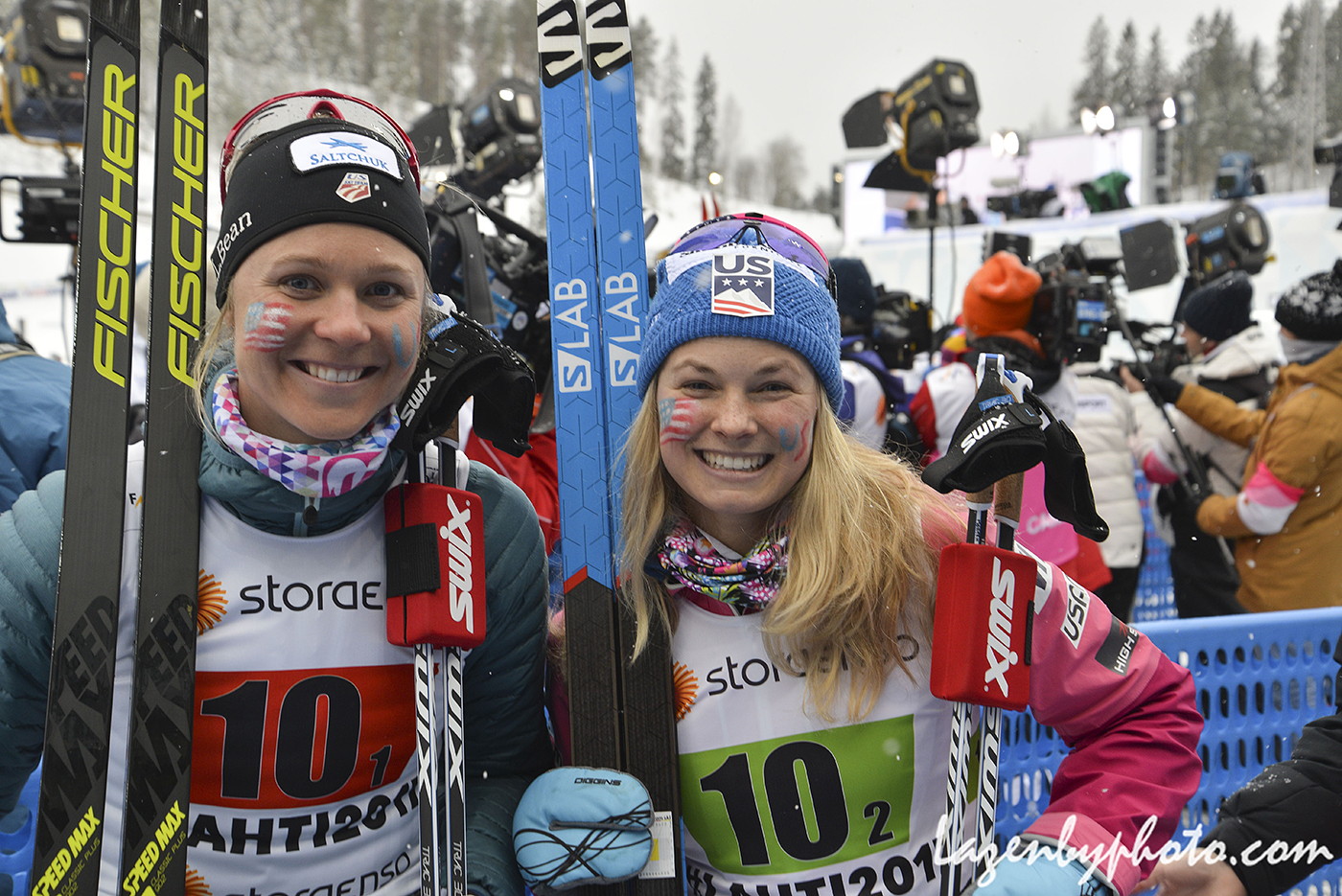
    U.S. teammates Sadie Bjornsen (l) and Jessie Diggins after placing third for bronze in the women’s classic team sprint at 2017 World Championships in Lahti, Finland. (Photo: John Lazenby/Lazenbyphoto.com)

    One U.S. Ski Team member thrilled with her skis was Jessie Diggins, who qualified sixth (+2.12) behind her teammate Sadie Bjornsen in fifth (+1.63). Behind them, Sophie Caldwell was the third American to qualify in 11th (+2.95).

    While Diggins and Bjornsen went on to finish sixth and fifth in their quarterfinals, respectively, and did not advance to the semifinals, Diggins said that in her case, it wasn’t for a lack of speed. After some physical contact at the top of the course got her fired up and surging into first on the long descent, Diggins slipped back to the middle of the pack coming out of the downhill draft and broke a pole around the last hairpin corner before the long, uphill finishing straight.

    “Jessie came into the final corner with too much traffic and a pole broke somehow,” Whitcomb said. “If it had been made out of steel, it would’ve bent, but it was loud and unfortunately none of us could get to her because there were too many cameras and fences in the way.”

    “I was just ready to fight on that final climb,” Diggins reflected. “I knew I was strong because even after skiing with a broken pole, I caught back up to [the group] at the end so I mean, I did everything I could.”

    She finished 5.11 seconds behind the winner of that quarterfinal, Sweden’s Stina Nilsson, who would go on to win the day.

    “I was so stoked with my skis,” Diggins added. “They were fast, they had good kick and I know they had good kick because I had one pole and I was like, ‘Wow! They really nailed it!’ ”

    While Diggins raced in the second quarterfinal, Bjornsen was one of the guinea pigs, so to speak, in the first heat of the day. Whitcomb explained that coaches and athletes routinely watch the first women’s quarterfinal on sprint days to figure out the course and determine strategies for the remaining rounds.

    While Bjornsen skied in third for much of her quarterfinal behind Norway’s Mari Eide, who led for most of it, the American bronze medalist in the world-champs classic team sprint (with Diggins) positioned herself closer to second entering the final climb to the finish.

    While the last few hundred meters of the race were shaping into a four-way fight for first between Eide, Bjornsen, Sweden’s Hanna Falk, and Slovenia’s Anamarija Lampič, Bjornsen in the far right tracks suddenly found herself behind a V-board when the course narrowed from four tracks to three across, and her tracks ended. She jumped to the left, slotting in behind Eide, and ran out of room to make any more moves to end up fifth, 2.52 seconds behind Falk in first.

    “I felt really strong in the qualifier, had some great skis, and was so excited for the heats,” Bjornsen said, according to a U.S. Ski Team press release. “Unfortunately in the final stretch, I chose a lane that didn’t go to the finish, so I had to stop and go in behind the others — which simply didn’t work. That was an expensive mistake, and cost a day full of great feelings. Fortunately I feel really good right now, and I am so excited to keep racing and get my chance.”
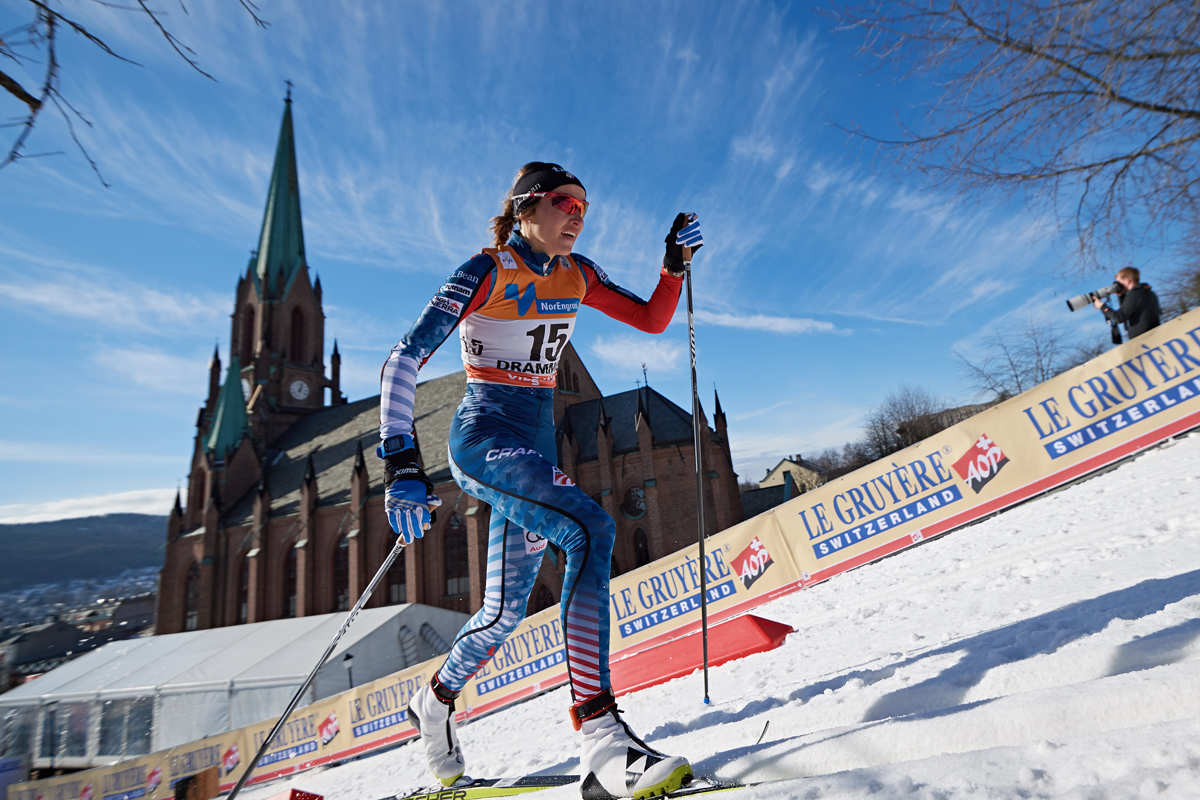
    Sophie Caldwell (U.S. Ski Team) striding to 11th in the women’s 1.2 k classic sprint qualifier at Wednesday’s World Cup in Drammen, Norway. She went on to place ninth overall. (Photo: Fischer/NordicFocus)

    Bjornsen and Diggins ended up 21st and 26th on the day, respectively. Leading their team, Caldwell reached the semifinals and ultimately placed ninth overall.

    In an in-person interview after the race, she told FasterSkier that she was particularly pleased with her qualifier considering her past results in Drammen. Before Wednesday, had never cracked the top 10 there.

    “The first three years I raced in Drammen, it was just a really hard course for me for some reason and I found myself not qualifying, but not even close to qualifying, like, back in the end of the pack,” Caldwell said. “Last year I figured out how to qualify and I was just thrilled to have qualified so this year it was one step further making the semis so I’m really happy with that.

    “It’s still a tough course for me,” she added. “It’s so gradual that it’s a really good course for power skiers and that’s been something I’ve been working on a lot, but power skiing for classic for sure isn’t my strength. … I think that’s probably why it’s been so difficult for me in the past but I’m really happy with today.”

    Third in her quarterfinal, just 0.79 seconds behind Norway’s Ingvild Flugstad Østberg, who won it, and half a second behind another Norwegian, Kathrine Rolsted Harsem, who automatically advanced in second, Caldwell reached the semifinals as a lucky loser — along with Finland’s Aino-Kaisa Saarinen in fourth (+0.95) in that heat.

    Caldwell went on to place fifth in the second semifinal, 1.44 seconds behind Sweden’s Ida Ingemarsdotter in first. The American had put herself in third behind Pärmäkoski and Harsem before Ingemarsdotter hammered up the finishing straight to take the win.

    “There was a little jostling around both on the downhill and up the final stretch,” Caldwell explained. “I kind of tried to cut inside Ida on the downhill and she moved in front of me so then I switched to the other side, then coming back up this way, Ida sort of hopped in the track in front of me so I went to move to the other one without knowing [Slovenia’s Katja Višnar] was coming up on the side so I had to bop back. There was a lot of bouncing around, but that’s part of the game. You want to be aggressive, but you want to be fair, and I think that’s something I’ve always tried to do.”

    Also for the U.S., Rosie Brennan finished 37th in the qualifier and Ida Sargent was 42nd. Canada’s lone woman racing on Wednesday, Dahria Beatty, who turned 23 on Tuesday, finished 48th.
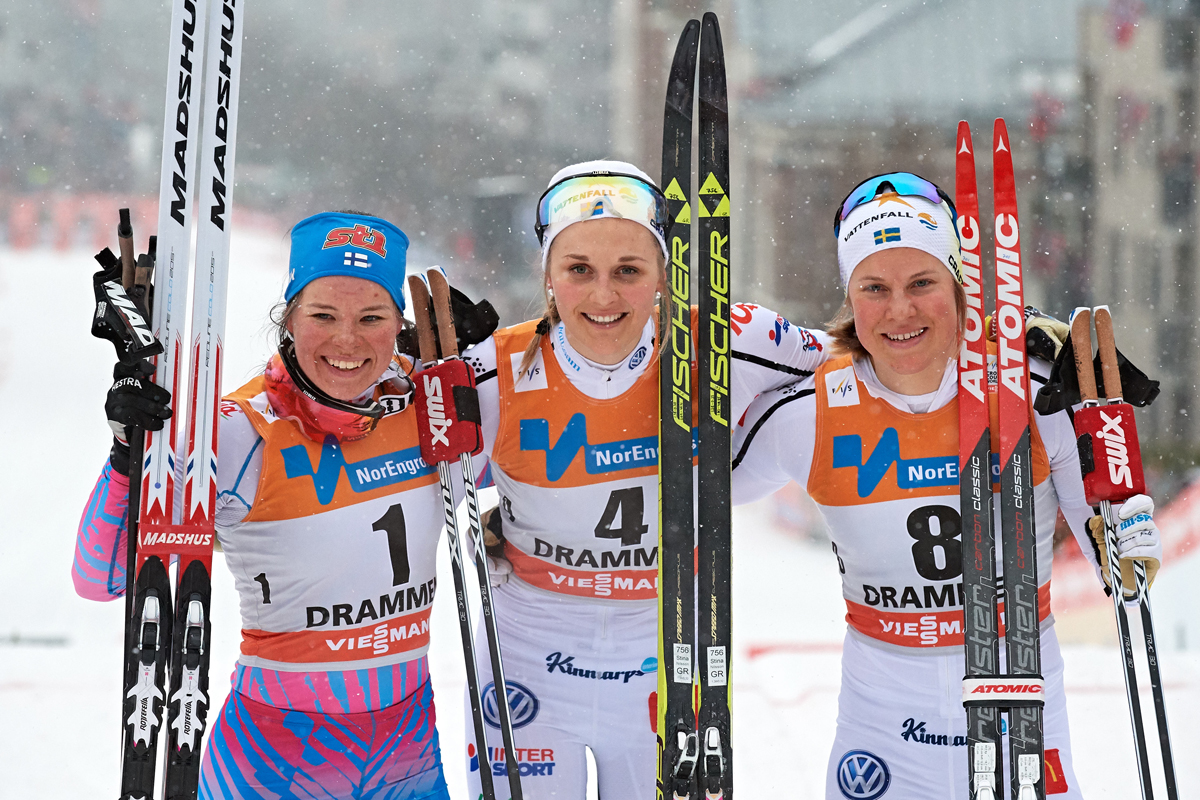
    The women’s 1.2 k classic sprint podium at Wednesday’s World Cup in Drammen, Norway, with Sweden’s Stina Nilsson (c) in first, Finland’s Krista Pärmäkoski (l) in second and Sweden’s Hanna Falk (r) in third. (Photo: Fischer/NordicFocus)

    As the day progressed, Sweden’s Nilsson continued to pick up steam. Coming off a World Championships in which she earned one medal (silver in the 4 x 5 k relay) and placed 12th in the freestyle sprint, the world’s second-ranked sprinter (behind Falla) had something to prove.

    She started by posting the fourth-fastest qualifying time, 1.54 seconds behind Pärmäkoski, then won her quarterfinal and first semifinal before dusting her competition in the final. While Nilsson followed the lead of fellow Swede Linn Sömskar in the quarterfinal and drafted off Diggins on the downhill to slingshot to first before the finishing stretch, Nilsson took a backseat to Østberg in the semifinal. With energy to spare, Nilsson and her teammate Falk pounced on the long grind to the finish, placing first and second, respectively, while Østberg dropped to fourth behind Lampič in third.

    In the final, Nilsson didn’t bother with games. She led out of the start, with Harsem following in second up the first double-pole section of the initial climb. While Nilsson continued to lead over the top, Falk and Pärmäkoski ended up duking it out for second place. Pärmäkoski double poled hard up the finishing straight to move into second, which she took by 0.84 seconds over Falk for her first World Cup sprint podium. Nilsson powered to the win in 3:07.57 minutes, 0.42 seconds clear of Pärmäkoski and 1.42 seconds ahead of Falk.

    The remaining finalists, Harsem finished fourth (+3.27), Ingemarsdotter was fifth (+4.86), and Lampič, the U23 World Cup leader, placed sixth (+9.67).

    The victory was Nilsson’s eighth of the season and puts her 42 points behind Falla with one sprint to go — a freestyle sprint in Quebec City next Friday, where 50 points for a win are on the line.

    “I thought I could win and this feels really great,” Nilsson told the International Ski Federation (FIS), according to a press release. “I was sure Maiken would win the sprint globe today. I don’t think it’s possible still to win it, but there is still a chance and I will travel to Quebec and try my best.”

    For Pärmäkoski, the podium showed her continued momentum after two World Championships medals (second in the 15 k skiathlon and third in the relay).

    “I am really happy,” she told FIS. “I wasn’t sure how I would feel after the championships but I felt really strong today.”

    Falk is third in the overall sprint standings, 154 points behind Nilsson and 29 points ahead of Norway’s Heidi Weng in fourth. At World Championships, Falk missed a medal in the skate sprint in fourth.

    “This makes up a little bit for my fourth place finish at the World Championships, so it feels good to come here today and get a podium,” Falk said.

    The last European World Cup races of the season will take place Saturday and Sunday with the famous Holmenkollen 30/50 k mass starts near Oslo. This year, those races are classic technique. The men race on Saturday at 12:45 p.m. Central European Time (6:45 a.m. Eastern Standard Time) and women start at noon CET (5 a.m. Eastern Daylight Time) on Sunday.

    — Jason Albert and Harald Zimmer contributed

    Results | Sprint World Cup standings
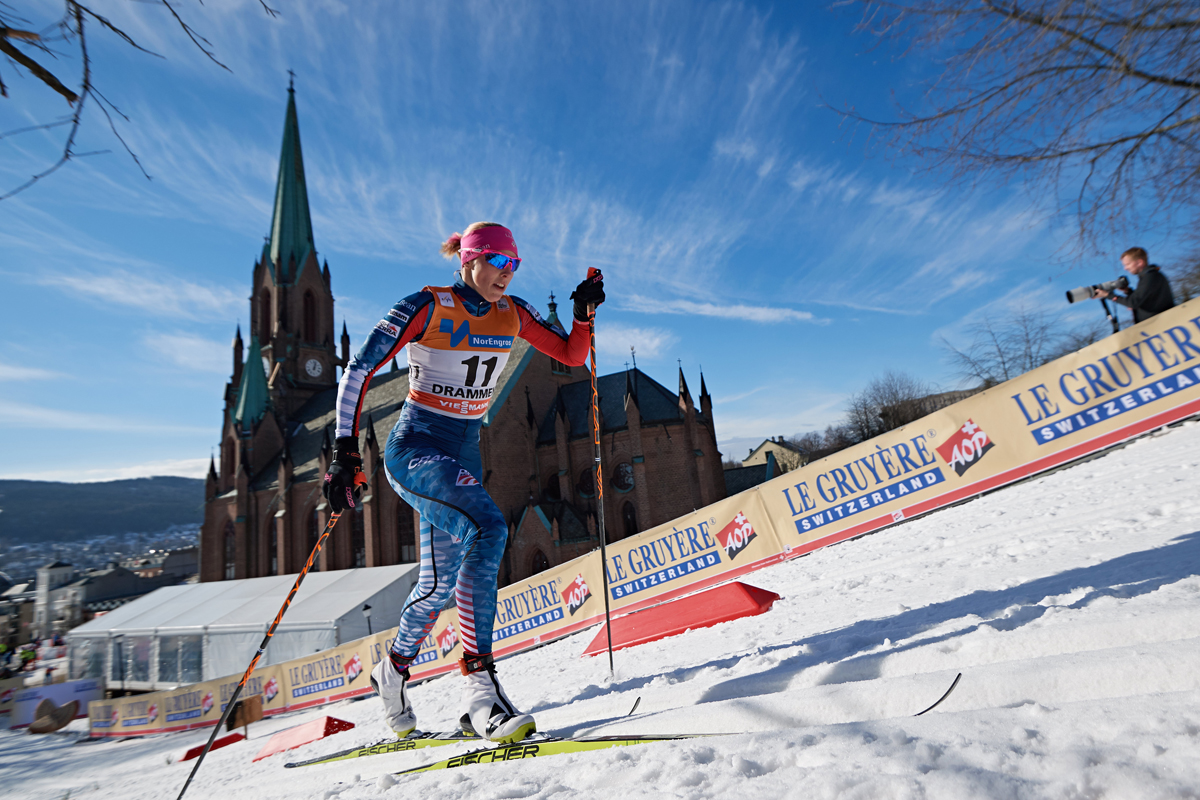
    Kikkan Randall (U.S. Ski Team) during the women’s 1.2 k classic sprint qualifier on Wednesday at the World Cup in Drammen, Norway. (Photo: Fischer/NordicFocus)
  • Brandsdal Outduels Klæbo for Drammen City Sprint Win

    Brandsdal Outduels Klæbo for Drammen City Sprint Win

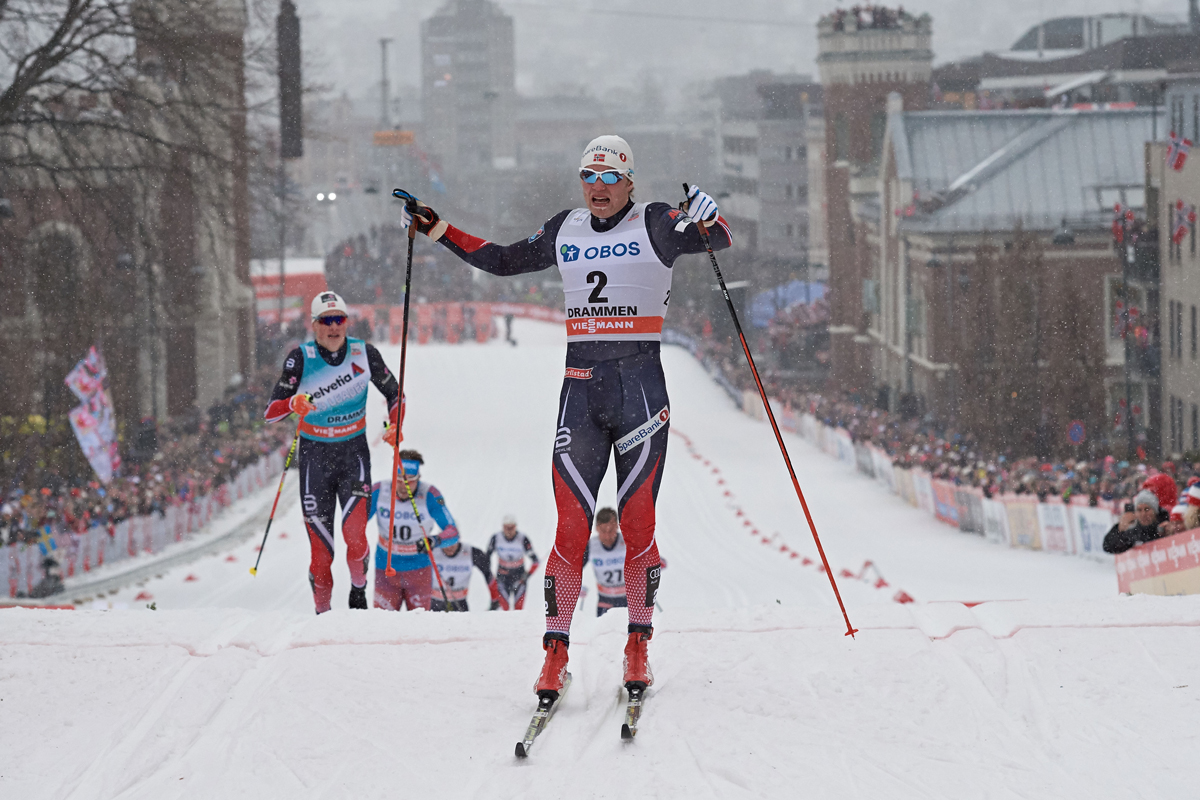
    Norway’s Eirik Brandsdal (2) crossing the line first for his first World Cup victory in two years in the men’s 1.2 k classic sprint on Wednesday at the last World Cup classic sprint of the season in Drammen, Norway. He beat out fellow Norwegian Johannes Høsflot Klæbo (l) and Russia’s Sergey Ustiugov (10), respectively, for his first win since the 2015 Drammen classic sprint. (Photo: Fischer/NordicFocus)

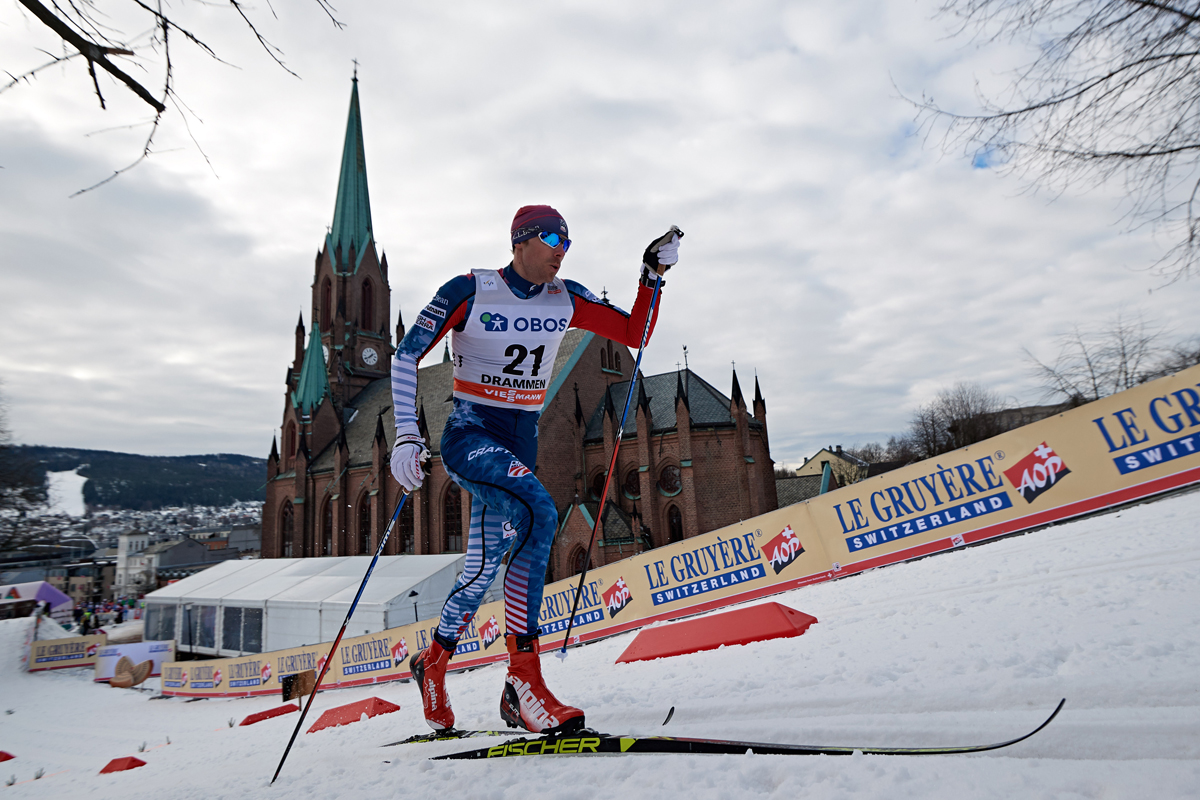
    DRAMMEN, Norway — The stage was set around 1:30 p.m. Wednesday when a homegrown Norwegian made good in front of a spectator-lined 1.2-kilometer classic course smack-dab in the middle of Drammen’s city center. It was a day of contrast that began with blue skies and ended with a deep chill and falling snow as thumping music pounded and the gothic Bragernes Church loomed. In between, the clouds amassed and the classic tracks stayed firmed for the Drammen city sprint.

    As the host country, Norway was blessed with more skier starts for the midweek World Cup sprint. That, however, looked like a curse for every other nation competing. Thirty-three percent of the eventual top 30 finishers were from Norway — 10 out of 30 — and five of six in the final. We’ll get to that in a bit.

    The qualifier was owned in every sense of the word by Norway’s 20-year-old Johannes Høsflot Klæbo. He was first in the qualifier by what some may consider a whopping 3.62 seconds. He stopped the clock at 2:33.81. around the one-loop course, which went up, then down again, and then up again. Klæbo’s Norwegian teammate Eirik Brandsdal was second in the qualifier with a time of 2:37.43.

    And if that time margin wasn’t a stunner, consider this. The day also marked the first time a World Cup sprint included two no-double-pole (DP) zones. During his qualifier, Klæbo came out of the first no-DP zone and stumbled, momentarily looking as if he was about to fall. His iconoclastic high-tempo, run-ski up steep hills is already a winning trademark, but in this instance it almost doomed him.

    That, of course, didn’t happen — he cruised in cool if not for his furious speed.

    All of this set the young Norwegian up for stardom. The World Cup’s season-long U23 leader came into Drammen ranked second overall on the World Cup sprint list with 289 points, just behind Italy’s Federico Pellegrino with 309 points. Pellegrino placed 12th on Wednesday, while Klæbo advanced to the finals.

    But perhaps the principle animator on the day was none other than Norway’s Petter Northug. After qualifying 27th, Northug looked rejuvenated in the first quarterfinal. Coming up the gradual mostly double-pole-able climb to finish, it was a Northug double-pole drag race in which he began the grind in sixth. In his famous fashion, he pulled away from the field, crossed the line, then U-turned in front of the oncoming skiers and chest-thumped. It was a throwback to his earlier dominance. And yes, the fans drank from the Northug Kool-Aid.

    Northug eventually advanced to the final as the second lucky loser after placing fourth in his semifinal, 3 seconds behind Klæbo, who won that heat.

    Another skier to make the final was Norway’s two-time Drammen classic-sprint winner, Brandsdal. His 2015 Drammen win was his last World Cup victory.

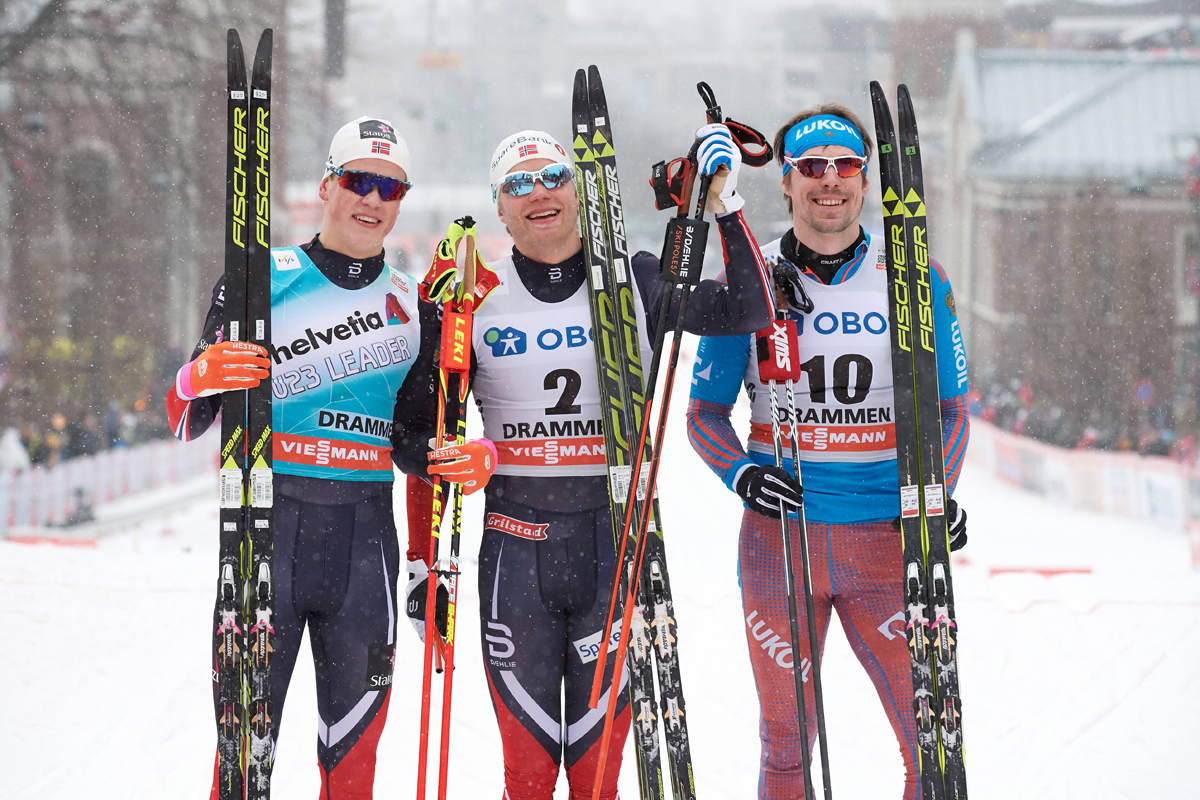
    The men’s World Cup 1.2 k classic sprint podium on Wednesday in Drammen, Norway, with Norway’s Eirik Brandsdal (c) in first and Johannes Høsflot Klæbo (l) in second, and Russia’s Sergey Ustiugov (r) in third. (Photo: Fischer/Nordic Focus)

    Recall that Wednesday’s race was one of contrast. There was the upstart Klæbo. There was Northug’s theatrics. And there was Brandsdal’s steady state skiing.

    He had been second in the qualifier, first in his quarterfinal, second in his semi, and untouchable in a final that featured these four other Norwegians: Klæbo, Northug, Pål Golberg, and Sondre Turvoll Fossli and Russian super-skier Sergey Ustiugov.

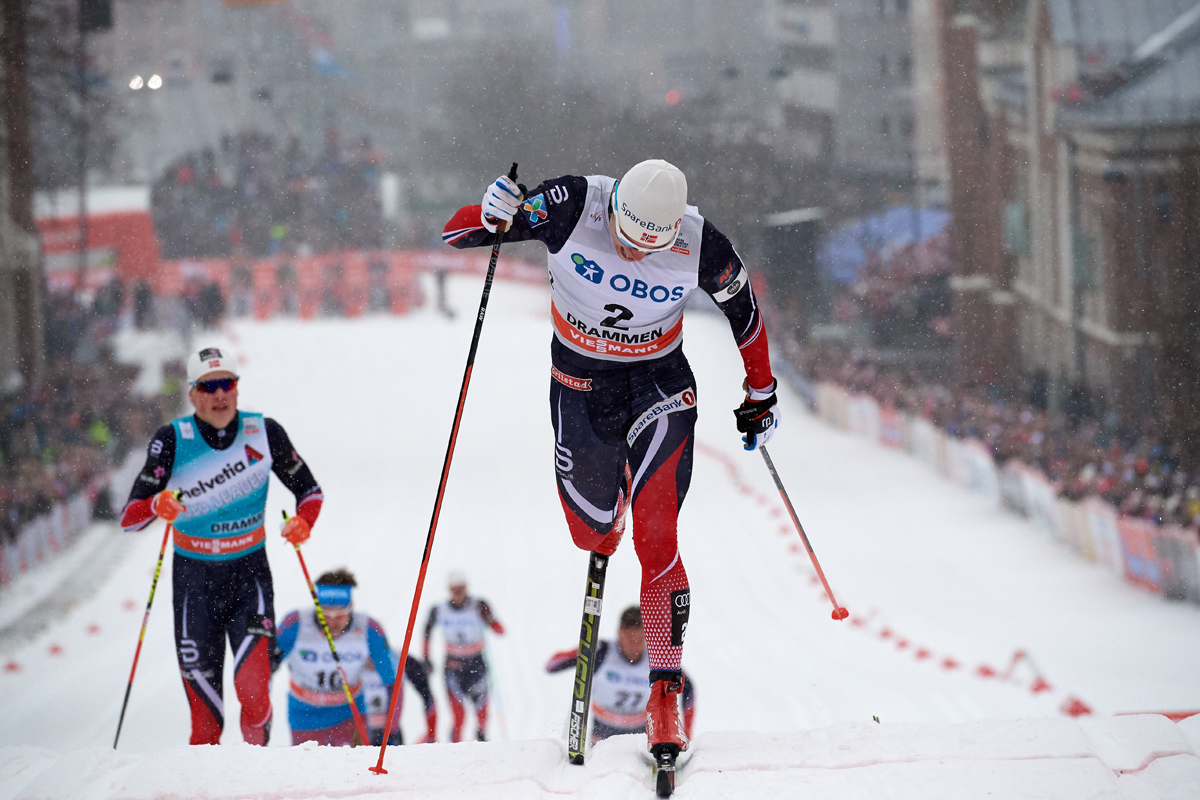
    Up the everlasting final stretch to the feet of the old Bragernes Church, it was initially a Klæbo-Brandsdal dual. That didn’t last long as Brandsdal closed out hard, winning the day for his third-career Drammen victory. Klæbo placed second (+2.55), and Ustiugov third (+3.28) for the Russian’s seventh-straight podium, including five medals in five races at World Championships. Northug finished fourth (+4.5), Golberg fifth (+5.99), and Fossli sixth (+12.42).

    Norway’s Eirik Brandsdal (2) crossing the line first for his first World Cup victory in two years in the men’s 1.2 k classic sprint on Wednesday at the last World Cup classic sprint of the season in Drammen, Norway. He beat out fellow Norwegian Johannes Høsflot Klæbo (l) and Russia’s Sergey Ustiugov (10), respectively, for his first win since the 2015 Drammen classic sprint. (Photo: Fischer/NordicFocus)

    “That was hard,” the 30-year-old Brandsdal told the International Ski Federation (FIS) after. “… It feels good to be back on top of the podium again.”

    With his second place and Pellegrino’s stall out in the quarterfinals, Klæbo now leads the sprint standings over the Italian, 369 points to 331.

    “I will travel now to Quebec and won’t race Holmenkollen this weekend,” Klæbo told FIS. “I just got the sprint leader’s red bib and I will fight to keep it in Quebec and take the Crystal Globe.”

    One World Cup sprint remains: a freestyle sprint to start the three-day World Cup Finals in Quebec City next week.

    Sunday’s 50 k world champion Alex Harvey was sprint worthy in Drammen. He finished the day in eighth overall after qualifying 18th, winning his quarterfinal, and taking fourth in his semifinal, 4.41 seconds behind Ustiugov, who won that heat.

    “I’ve been feeling good, I mean, I’ve never made the semis here in Drammen so it’s the best race of my life here on this course, so feeling good,” Harvey told FasterSkier after being eliminated in the semifinals.

    Now the sport’s king in the World Cup’s longest race, the 50 k, Harvey lamented the Drammen course’s short nature. “It’s short. 2:40 [minutes],” Harvey said. “It’s way too short for me. I need a bit closer to three minutes to be able to do something.”

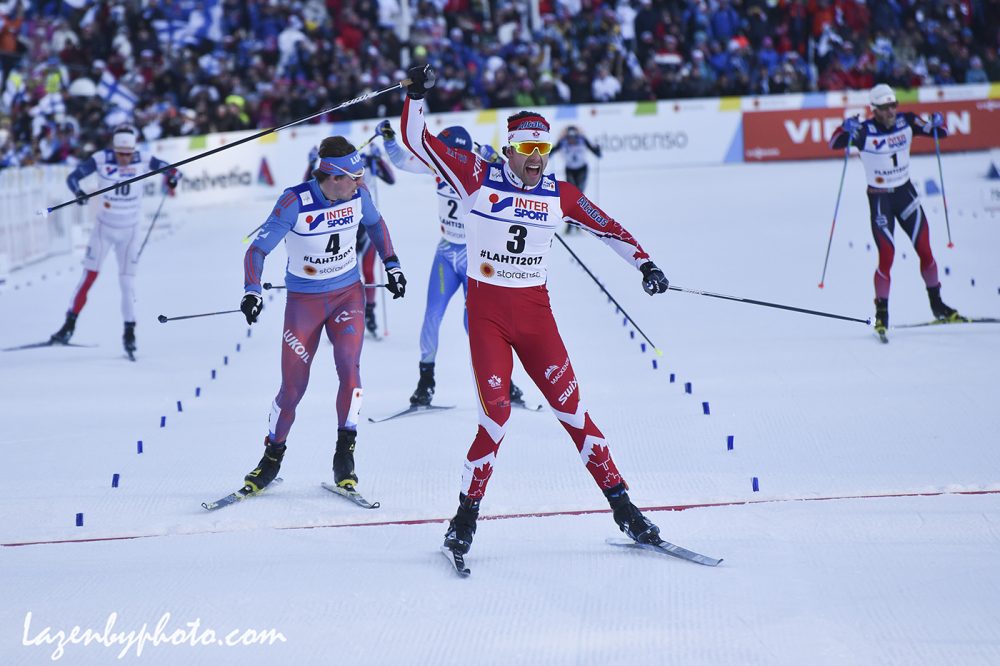
    Canada’s Alex Harvey (5) celebrating his first individual World Championships gold after winning Sunday’s 50 k freestyle mass start on the last day of 2017 Nordic World Championships in Lahti, Finland, ahead of Russia’s Sergey Ustiugov (4), Norway’s Martin Johnsrud Sundby (1), and Finland’s Matti Heikkinen (2), respectively. (Photo: John Lazenby/Lazenbyphoto.com)

    Prior to the upcoming World Cup Finals, which will be held in Harvey’s hometown March 17-19, the Canadian ranks fourth overall on the World Cup leaderboard, 65 points behind Finland’s Matti Heikkinen in third and 104 points ahead of Sweden’s Marcus Hellner in fifth. Neither raced Wednesday’s sprint.

    Asked precisely what he was hunting as the World Cup winds down, the 28-year-old Harvey was succinct.

    “The top three overall, for sure,” he said. “This is already a good step forward today, got around 20 points or something like that. I know that especially the races in Quebec are a good format for me. If you’re good in the sprint, I can get a bit of an edge on Heikkinen for the last day, for the pursuit start, and with double points there, it can go pretty fast.”

    Also advancing to the quarters for Canada was Len Valjas after qualifying 21st (+7.97). Initially the 28-year-old Valjas looked poised to advance beyond the quarters as he was announced the winner of a photo finish with Russia’s Alexander Bolshunov for second place behind Harvey. But the replay showed a fine line as Valjas appeared to make a gutsy move in the closing meters. The race jury ruled that Valjas obstructed Bolshunov by skirting around and in front of him at the finish, and relegated Valjas to last in the heat for 27th overall.

    One American man reached the heats: Andy Newell, who began the day qualifying in 13th (+6.45). The U.S. Ski Team member placed fourth in his quarterfinal, 1.7 seconds behind Brandsdal who won the heat, and did not advance to the semifinals to end up 18th overall.

    Andy Newell (U.S. Ski Team) racing to 13th in the men’s 1.2 k classic sprint qualifier at Wednesday’s World Cup city sprint in Drammen, Norway. Newell went on to finish fourth in his quarterfinal for 18th overall. (Photo: Fischer/NordicFocus)

    “I felt good today,” Newell said after, “so it’s a shame not to move on to the final. I really was hoping to do that here, this is one of my favorite sprints. I love this atmosphere here and I love Drammen. It’s definitely one of the hardest sprints, competitive sprints, but for me it’s just really fun. So yeah I’m bummed not to advance … But I am feeling good, so I can’t complain.”

    Newell added insight into the no-double-pole zones in play, explaining that he learned of the new rule with little time to spare.

    “They have been trying them in Scandinavian Cup races and this is the first time they have ever done it on a World Cup,” he said. “It was weird because they literally told us they would have no-double-pole zones, or striding zones, an hour before qualifications. So a lot of us waxed skate skis that we were going to test in anticipation that it would be a double-pole race, because it’s really good conditions for double-pole now. So that was obviously the end of that.”

    Also for the U.S., Simi Hamilton placed 42nd in the qualifier, 1.69 seconds out of the top 30 needed to qualify, but the disqualification of two other skiers for receiving their second yellow card — Norway’s Finn Hågen Krogh and Sweden’s Emil Jönsson — moved Hamilton up to 40th. (Krogh was disqualified after racing in the same semifinal as Harvey, and Jönsson was disqualified in the quarterfinals.) Also for the U.S., Erik Bjornsen (U.S. Ski Team) finished the day in 44th, and Ben Lustgarten (Craftsbury Green Racing Project) 62nd.

    Canada’s third skier, Russell Kennedy (Canmore Nordic/Team R.A.D.) was 63rd in his first overseas World Cup race.

    Results | Overall World Cup standings

  • Wednesday Rundown: Drammen & Lake Placid (Updated)

    Wednesday Rundown: Drammen & Lake Placid (Updated)

    The men’s World Cup 1.2 k classic sprint podium on Wednesday in Drammen, Norway, with Norway’s Eirik Brandsdal (c) in first and Johannes Høsflot Klæbo (l) in second, and Russia’s Sergey Ustiugov (r) in third. (Photo: FIS Cross-Country/Twitter)

    FIS Cross-Country World Cup (Drammen, Norway): Classic sprints

    Just three days after 2017 Nordic World Championships ended in Lahti, Finland, World Cup cross-country skiers were back to their regular-season grind with 1.2-kilometer classic sprints on Wednesday in Drammen, Norway.

    In the men’s race, Norway stole the day with Eirik Brandsdal notching his first World Cup win since 2015 in Drammen, but Russia’s Sergey Ustiugov broke up the team’s total domination of the final with a third place, behind Brandsdal (who won it in 2:39.35 minutes) and Johannes Høsflot Klæbo in second (+2.55). Ustiguov placed third (+3.28) for his seventh consecutive podium coming off five medals in five races at World Championships, and three other Norwegians, Petter Northug, Pål Golberg and Sondre Turvoll Fossli finished behind him in fourth through sixth, respectively, in the final.

    To start the day, Klæbo won the qualifier in 2:33.81, 3.62 seconds ahead of Brandsdal in second. Ustiugov qualified 10th (+6.21).

    Canada’s Alex Harvey and Len Valjas qualified for the heats in 18th and 21st, respectively, and Andy Newell was the lone American to reach the quarterfinals after qualifying in 13th.

    In the third quarterfinal, Newell finished third, 1.7 seconds behind Brandsdal, who won it. Sweden’s Oskar Svensson took second in that heat (+0.66).

    Harvey won the fifth quarterfinal, and Canada originally took first and second with Valjas outlunging Alexander Bolshunov for second place. Valjas was ultimately relegated to last in the heat for his move around Bolshunov at the line, and the Russian was listed as second (+0.27) for an automatic spot in the semifinals.

    While Klæbo won the first men’s semifinal by 0.46 seconds over Brandsdal, Ustiugov topped the second semi by 0.32 over Golberg. Harvey initially finished fifth in that second semi but moved up one spot to fourth (+4.41) after Norway’s Finn Hågen Krogh was disqualified (putting him in last, 67th overall). Harvey ended up eighth overall on the day.

    Newell placed 18th overall and Valjas 27th.

    Also for the North Americans, U.S. Ski Team members Simi Hamilton and Erik Bjornsen finished 40th and 44th, respectively, and Ben Lustgarten (Craftsbury Green Racing Project) was 62nd. Canada’s Russell Kennedy (Canmore Nordic/Team R.A.D.) finished 63rd.

    In the women’s 1.2 k classic sprint, Stina Nilsson commanded the day and Sweden ended up with two on the podium, with Hanna Falk in third.

    Nilsson started off by qualifying in fourth, 1.54 seconds behind Finland’s Krista Pärmäkoski, who topped the qualifier in 3:00.28. While Pärmäkoski went on to win her quarterfinal and place third in her semifinal (advancing as a lucky loser to the final), Nilsson won both her quarterfinal and semi, and ultimately took first in the final in 3:07.57. Pärmäkoski notched second (+0.42), and Falk third (+1.26) ahead of Norway’s Kathrine Rolsted Harsem in fourth (+3.27), Sweden’s Ida Ingemarsdotter in fifth (+4.86), and Slovenia’s Anamarija Lampič in sixth (+9.67).

    Three U.S. women qualified for the heats, with Sadie Bjornsen in fifth, Jessie Diggins in sixth and Sophie Caldwell in 11th.

    Bjornsen and Diggins were eliminated in the quarterfinals after placing fifth and sixth, respectively, while Caldwell finished third in the third quarterfinal (0.79 seconds behind Østberg, who won that heat) and advanced as a lucky loser to the semifinals with Finland’s Aino-Kaisa Saarinen, who was fourth in that heat (+0.95).

    In the semifinals, Nilsson led her teammate Falk across the line by 0.14 seconds, and Lampic advanced as a lucky loser in third (+1.05).

    Ingemarsdotter won the second semifinal by 0.22 seconds over Harsem, and Pärmäkoski made the cut for the final with a fast-enough time in third (+0.56). In that heat, Slovenia’s Katja Višnar (who had posted the second-fastest qualifying time) finished fourth (+0.83), and Caldwell fifth (+1.44).

    That put Caldwell in ninth overall, while Bjornsen placed 21st and Diggins 26th. Also for the U.S., Rosie Brennan finished 37th in the qualifier, Ida Sargent was 42nd, and Kikkan Randall 52nd.

    One day after her 23rd birthday, Canada’s Dahria Beatty finished 48th.

    Men’s results: Final | Qualifier

    Women’s results: Final | Qualifier

    ***

    USSA Cross Country Junior Championships (Lake Placid, N.Y.): Classic sprints

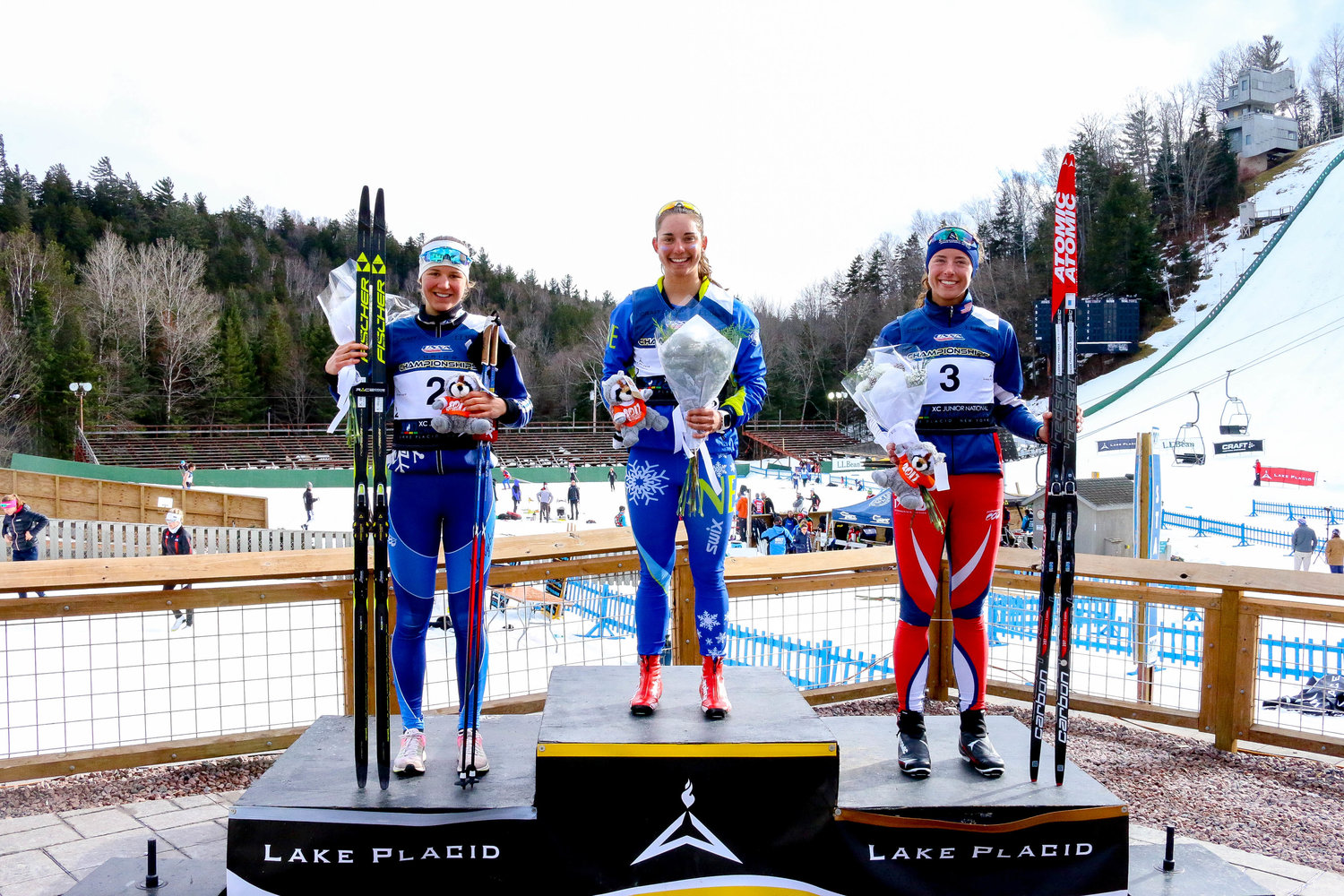
    The U20 women’s classic sprint podium at U.S. Junior Nationals on Wednesday in Lake Placid, N.Y., with Julia Kern (c) of the Stratton Mountain School in first, Canada’s Katherine Weaver (l) of Hollyburn XC Ski Club in second and Maddie Morgan (r) of the Wasatch Nordic Ski Academy in third. (Photo: XCJuniorNationals2017.com)

    [UPDATED] On the second day of racing at 2017 U.S. Junior Nationals in Lake Placid, N.Y., Novie McCabe, Haydn Halvorsen, Gus Schumacher, and Julia Kern achieved their second national titles of the week in the classic sprints on Wednesday at the Olympic Jumping Complex.

    Representing the Pacific Northwest division and Methow Valley Nordic Ski Educational Foundation, McCabe won the U16 girls’ A-final more than 5 seconds ahead of anyone else in 5:04.22 minutes. New England’s Anna Lehmann, of the Stratton Mountain School (SMS) followed in second (+5.14) and Intermountain’s Sydney Palmer-Leger notched her second-straight podium in third (+5.96). Also in the U16 girls’ final were Rocky Mountain’s Bridget Donovan (Ski & Snowboard Club Vail) and Waverly Gebhardt (Steamboat Springs Winter Sports Club), who placed fourth and fifth, respectively, and Intermountain’s Sarah Morgan, of the Wasatch Nordic Ski Academy (WNSA), in sixth.

    In the U16 boys’ A-final, Halvorsen (Far West/Sugar Bowl Ski Team & Academy) won by 3.31 seconds in 4:28.29 minutes. New England’s Will Koch (SMS) placed second for his second podium in as many races, and Intermountain’s Lane Myshrall (Park City Nordic Ski Club) took third (+6:39). Also in the U16 boys’ final, Johnny Hagenbuch (Intermountain/SVSEF) placed fourth, George Cvancara (Alaska/Alaska Nordic Racing) fifth and Will Lange (Pacific Northwest/Mt. Bachelor Sports Education Foundation) sixth.

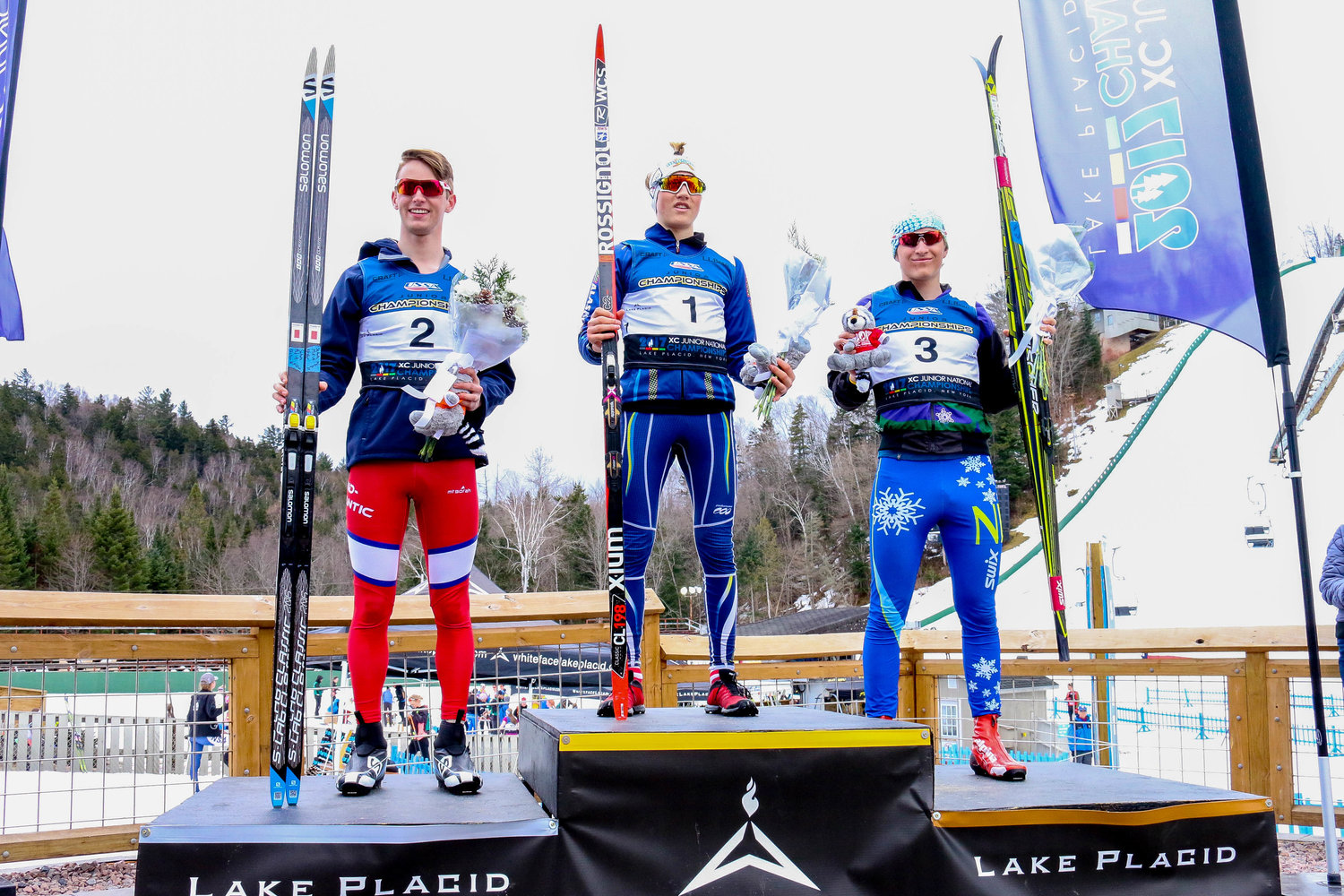
    The U18 boys’ classic sprint podium at U.S. Junior Nationals on Wednesday in Lake Placid, N.Y., with Gus Schumacher (c) of Alaska Winter Stars in first, Scott Schulz (l) of the New York Ski Educational Foundation in second, and Adam Glueck (r) of Ford Sayre in third. (Photo: XCJuniorNationals2017.com)

    Alaska’s Gus Schumacher (Alaska Winter Stars) topped the U18 boys’ A-final by 1.13 seconds in 4:35.95. Local Mid-Atlantic skier Scott Schulz (New York Ski Educational Foundation) took second, and New England’s Adam Glueck (Ford Sayre) placed third (+5:04). Alaska’s Canyon Tobin (APUNSC) followed in fourth, Far West’s JC Schoonmaker (Auburn Ski Club Associates Inc.) fifth, and New England’s Ben Ogden (SMS) reached the final but was disqualified.

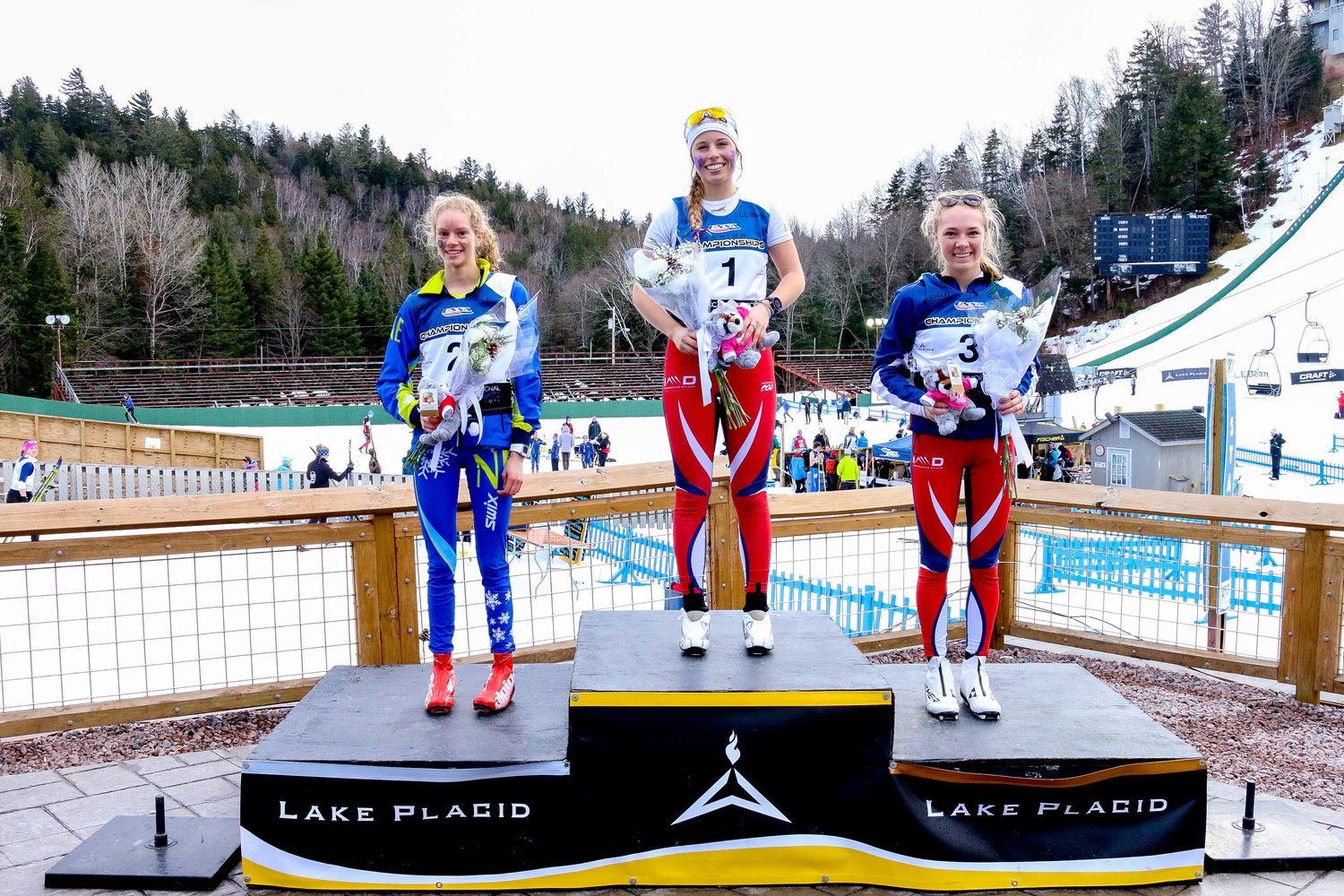
    The U18 girls’ classic sprint podium at U.S. Junior Nationals on Wednesday in Lake Placid, N.Y., with Marin Coletta (c) of the Bridger Ski Foundation in first, Rena Schwartz (l) of GMVS in second and Anna Gibson (r) of Jackson Hole Ski Club in third. (Photo: XCJuniorNationals2017.com)

    In the U18 girls’ A-final, Marin Coletta, representing Intermountain and the Bridger Ski Foundation (BSF), took the win in 5:14.30, 4.4 seconds ahead of New England’s Rena Schwartz (Green Mountain Valley School). Intermountain’s Anna Gibson (Jackson Hole Ski Club) rounded out the podium in third (+6.26). Also reaching the final, Brooke Dunnagan (Intermountain/BBNT) finished fourth, Jenna DiFolco (Alaska/NSCF-FXC) fifth, and Callie Young (New England/Craftsbury Nordic) sixth.

    U.S. Ski Team Development Team member Julia Kern picked up her second-straight win in the U20 women’s category, winning the A-final by a resounding 18.47 seconds. After Kern (New England/SMS) finished in 4:47.54, Canada’s Katherine Weaver (Hollyburn XC Ski Club) placed second for the second-straight race, and Intermountain’s Maddie Morgan (WNSA) took third (+33.38) in the most strung-out final of the day. Also in that final, Intermountain’s Leah Lange (University of Utah) finished fourth, Margie Freed (Midwest/Loppet Nordic Racing) fifth, and Canada’s Catherine Reed-Metayer (Skibec) sixth.

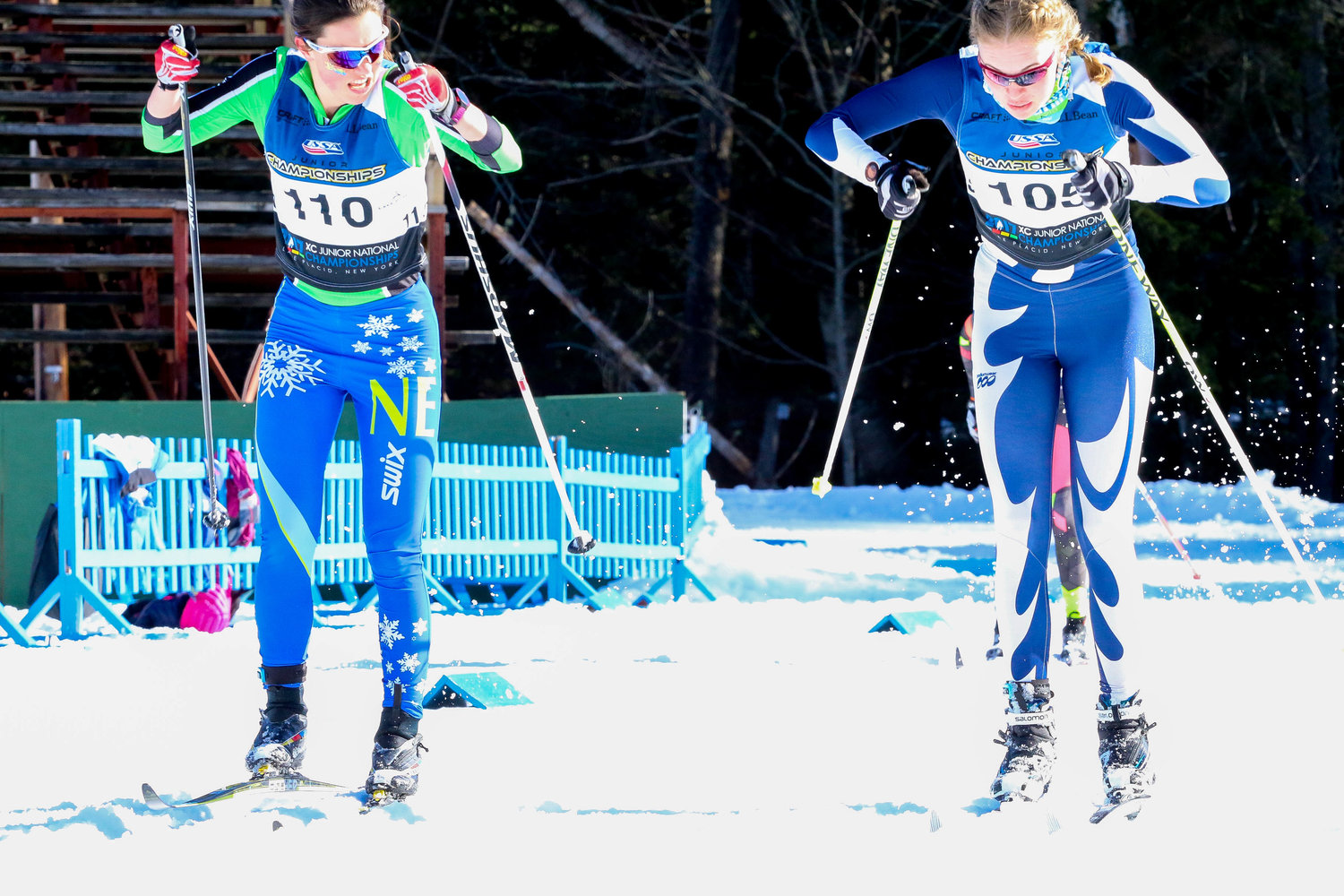
    From left to right: Alexandra Lawson (New England/Craftsbury Nordic) and Maya Seckinger (Pacific Northwest/Bend Endurance Academy) go head to head during a U20 women’s classic sprint heat on Wednesday at 2017 U.S. Junior Nationals. Both reached the B-final, where they placed fourth and third, respectively. (Photo: XCJuniorNationals2017.com)

    The U20 men’s classic sprint win went to Canada’s Reed Godfrey (Canmore Nordic/Team R.A.D.), who finished first in 4:33.64. Kam Husain (SMS) crossed 3.32 seconds later as the top American in second overall, and Canada’s Ryan Jackson (Team Hardwood) was the third man on the podium in third (+5.68). Rounding out the A-final, Finn O’Connell (New England/University of Vermont Ski team) placed fourth and Daniel Streinz (New England/Mountain Endurance) fifth, and Canada’s Étienne Hébert (Montériski) was disqualified.

    Results: U16 girls | U16 boys | U18 boys | U18 girls | U20 women | U20 men