From the FasterSkier archive — posts syndicated from athletes’ and coaches’ own blogs between 2004 and 2012, kept online as published. Current coverage is at fasterskier.com.
We had to take a break after our three-week Olympic sprint, but we’re back to catch up on a couple of weeks of World Cup racing.
Devon and Nat take a quick run-through of events in Sweden, Finland and Norway. We’ll be back after the marathons at Holmenkollen.
Reach us at devon[at]fasterskier.com and nat[at]fasterskier.com.
A reminder: This is a homegrown podcast done by two guys working long hours and late nights. We also paid real money to be in Italy for the Olympics. If you can, support the show and FasterSkier’s ongoing coverage with a voluntary membership.
Help Support Our Olympic Coverage!
FasterSkier had our own Nat Herz on the ground at the Olympics, which, to be honest, was a very big financial lift for us. If you value the thoughtful work and access FasterSkier provides at championships like this one, please consider becoming a Voluntary Subscriber. Your support directly fuels the work we do to cover the people, places, and moments that make our sport special.
This World Cup coverage is made possible through the generous support of Marty and Kathy Hall and the A Hall Mark of Excellence Award. To learn more about A Hall Mark of Excellence Award or to learn how you can support FasterSkier’s coverage please contact info@fasterskier.com.
Returning to Norway after last year’s coronavirus induced hiatus, the World Cup picked up with a 1.2-kilometer classic city sprint in Drammen. With the Russian and Belarusian athletes banned from competing thanks to a recent decision by FIS, the size of the field was slightly reduced. Last weekend’s skate sprint in Lahti, Finland saw 62 racers on the women’s side, whereas today’s qualifier had only 53 finishers.
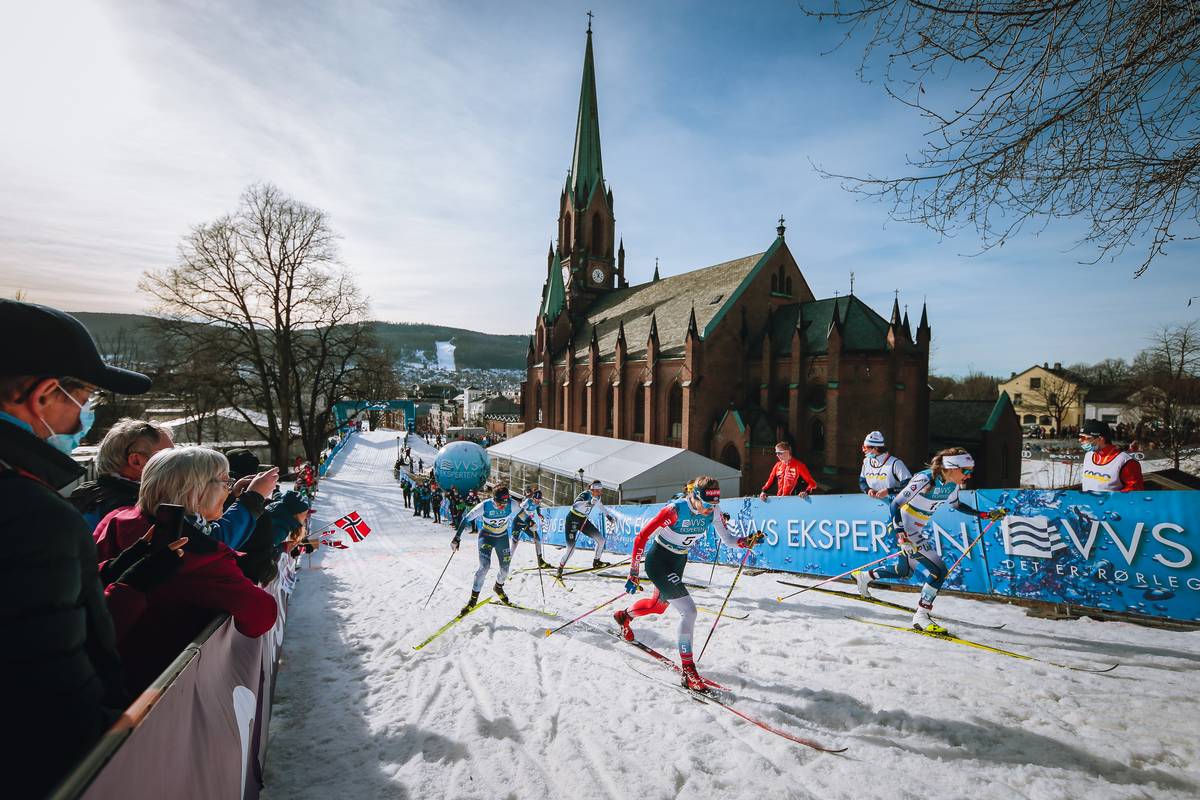
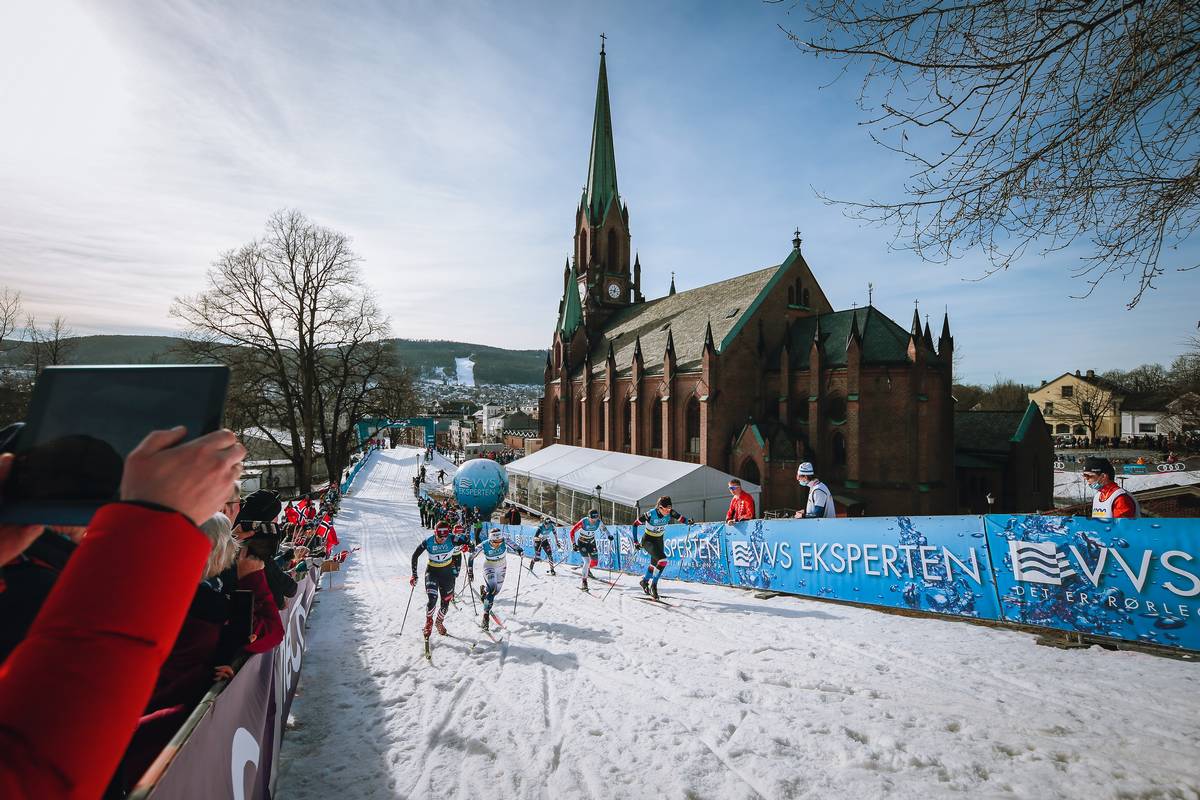
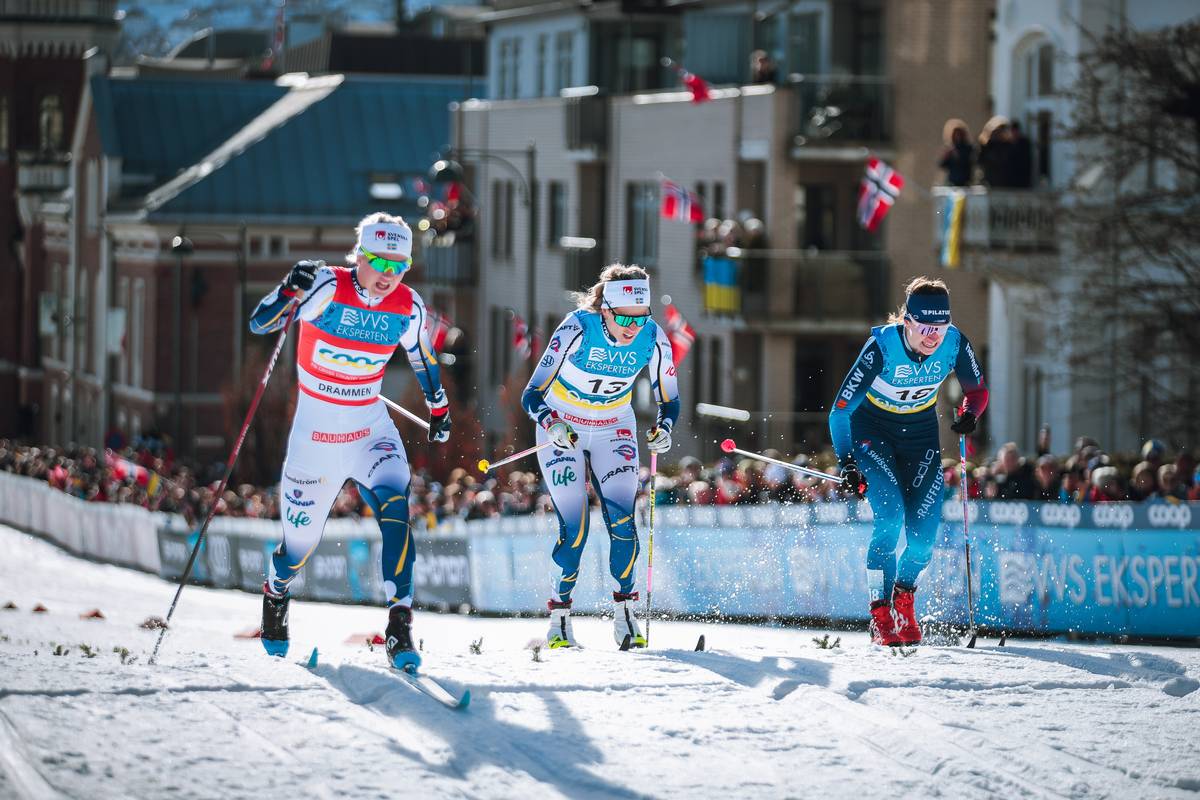
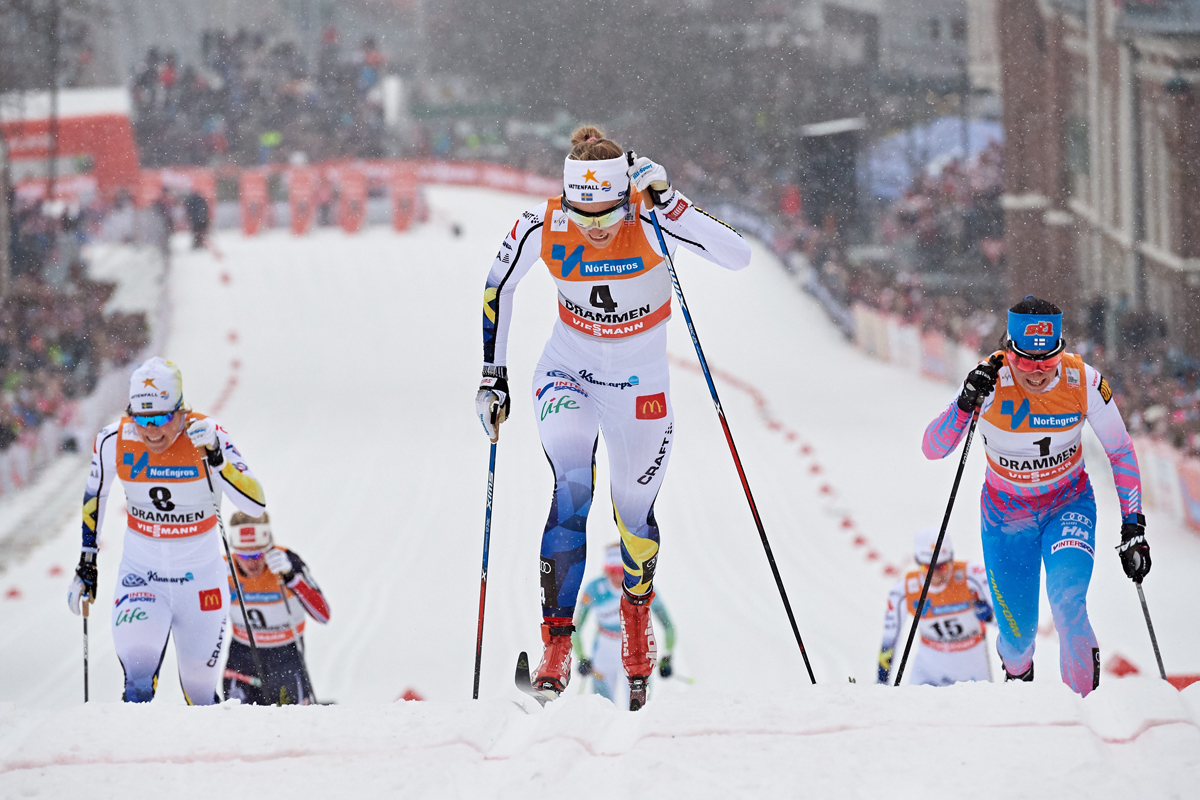
Katri Lylynpera (FIN), Kerttu Niskanen (FIN) and Hedda Østberg Amundsen (NOR) duke it out on the initial climb in the Drammen city sprint in front of excited crowds (Photo: NordicFocus)
Unlike the largely flat city sprint in Dresden, Germany earlier the season, the Drammen course features significantly more climbing and descent. This combined with the soft snow and tight trails led to lots of mishaps throughout the rounds, providing drama for the fans that packed the sidelines in stands and along the sideboards. In a show of support for Ukraine, the country’s blue and yellow colors were displayed on the sponsor boards that line the track, on the athletes’ bibs and in the flags and hats born by the spectators.
Johanna Hagström wins the women’s sprint qualifier (Photo: NordicFocus)
The qualifier was won by Johanna Hagström of Sweden in a time of 2:48.88. Rosie Brennan was the first American qualifier in 12th position, +4.30 back from Hagström. Julia Kern qualified in 17th, (+4.97) and Jessie Diggins was the final American woman through to the heats in 19th (+5.11). Hailey Swirbul came in 36th (+9.05), Katharine Ogden finished 44th (+10.98) and Alayna Sonnesyn ended 52nd (+18.14) after hopping on a plane following her Birkie win last weekend.
The Canadian women all finished outside the top thirty, led by Olivia Bouffard-Nesbitt in 40th (+10.21). Dahria Beatty came in 41st (+10.37), Katherine Stewart-Jones in 48th (+13.86), Laura Leclaire in 51st (+17.20) and Cendrine Browne in 53rd (+18.85).
Temperatures were warm and springlike, above 40°F, as the athletes lined up for the heats. The first heat featured the second-fastest qualifier and this year’s Olympic sprint gold medalist, Jonna Sundling of Sweden. Brennan (USA) also elected to go in heat one, and she and Sundling took on the lead out of the start. A move by Johanna Matintalo of Finland on the first climb took out Sofie Krehl of Germany, resulting in a yellow card for Matintalo.
Rosie Brennan leads her quarterfinal during Drammen’s classic sprint. (Photo: NordicFocus)
On the descent, Julie Myhre of Norway moved to the front, aided by a pair of speedy skis. Rounding the tight corner at the bottom of the course, Myhre and Sundling were in the lead, Brennan having dropped slightly. With a powerful double-pole Sundling pulled clear of the field to take the first qualifying position easily. A tight three-way finish between Myhre (NOR), Laurein Van der Graaff of Switzerland and Brennan, went in favor of Myhre. This left Brennan in fourth place, with a time not quick enough to make lucky loser.
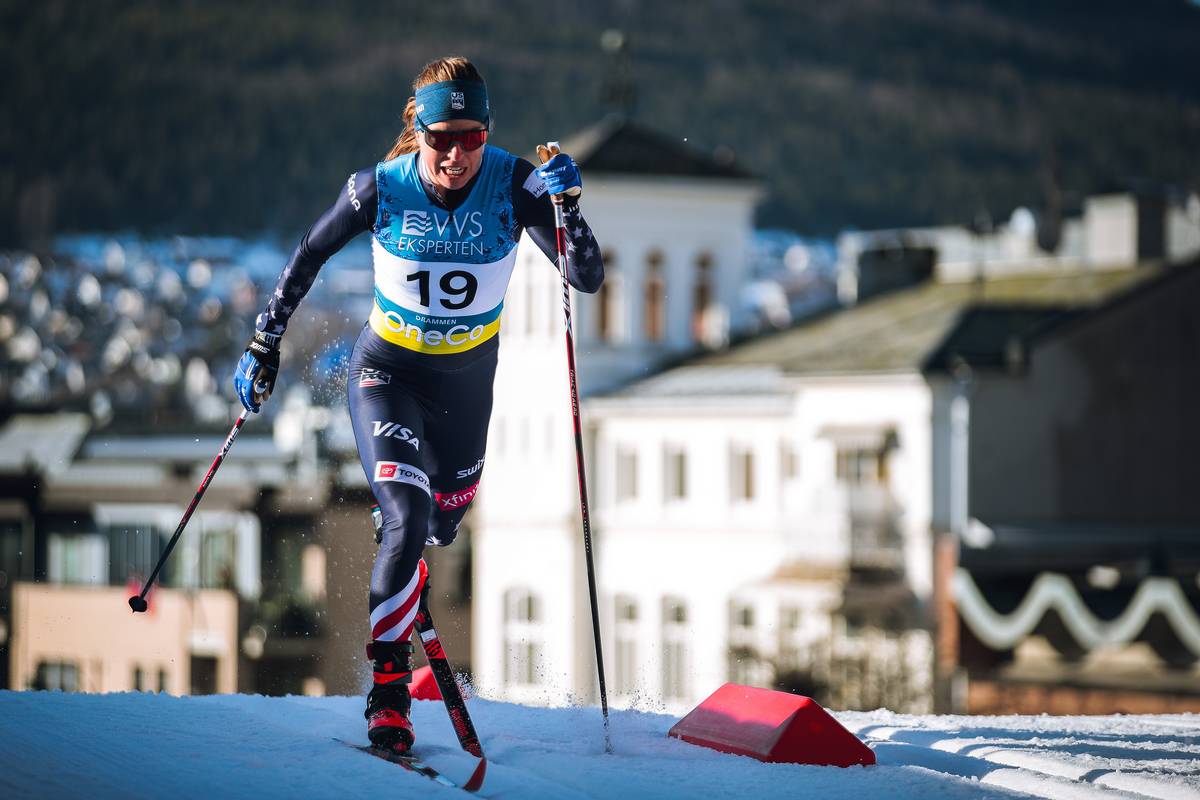
Rosie Brennan leads the American women in the classic sprint qualifier in Drammen, NOR, placing 12th and ultimately finishing 17th overall. (Photo: NordicFocus)
“Drammen is such a cool event and I really love doing the city sprint thing at least once during the season,” wrote Brennan after the race. “It’s been a few years since I’ve raced here and with so many improvements in my sprinting since then, I felt I could have a good day today. As with all city sprints, a big part of it is not getting too pushed around and that part I did a bad job of today. After a decent qualifier, I got way to pushed around and skied over in my quarterfinal to move on. I had a strong finish and thought maybe it was enough but I lost another lunge this weekend. It’s always a tough way to get out because it’s so close, but that is such a big part of sprinting. I guess I will have to work with master lunger Tyler [Kornfield] (Brennan’s partner) and see if I can improve on those close finishes in the future. In the meantime, it’s a fast turn around to Holmenkollen so I will be focusing on recovery.”
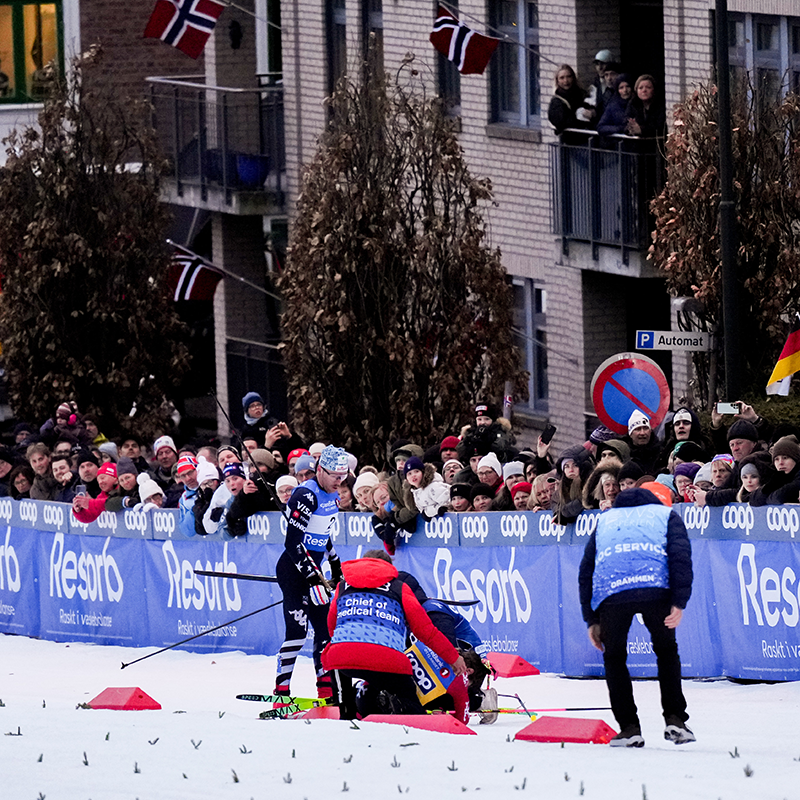
The second heat saw another fall on the initial climb, Lucia Scardoni of Italy got bogged down in deep snow and broke a pole, taking herself out of contention. In the end, Maja Dahlqvist of Sweden strided to victory, with Anamarija Lampic also qualifying.
Lucia Scardoni of Italy goes down on the hill (Photo: NordicFocus)
In heat three, Lotta Udnes Weng of Norway and Jasmi Joensuu of Finland got tangled on the hill. The third time in three sprints that Joensuu has broken a pole in the quarterfinals. Maiken Caspersen Falla of Norway proved again that the Norwegians had ripping skis as she gained on the downhill and put in a fast finish, Nadine Fähndrich of Switzerland and Laura Gimmler of Germany also qualifying from this heat.
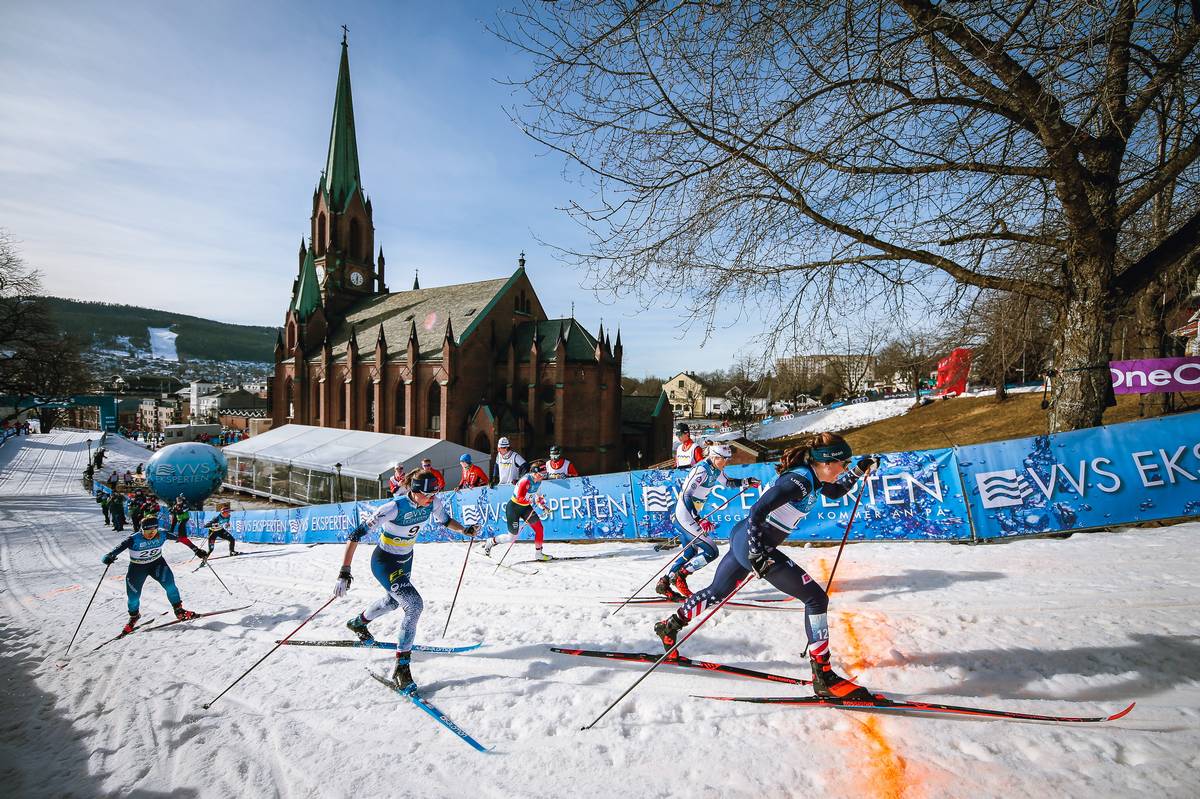
As in Lahti last weekend, roommates Julia Kern and Jessie Diggins chose the same heat, both going in quarterfinal number four. All athletes making it up the initial climb without a fall, it seemed like this might be the first heat to get away without any spills, only to have the fastest qualifier, Hagström (SWE), wipe out on the downhill. Losing all her speed at the wrong moment, Hagström was out and the two Americans capitalized on this. Diggins entered the final turn in first, followed by Kern. On a deceptively long finishing straight, Kern continued to press hard, besting Falla’s time from the prior heat. Behind her, Diggins battled a surge from Katharina Hennig of Germany, ultimately both of them qualifying for the semis.
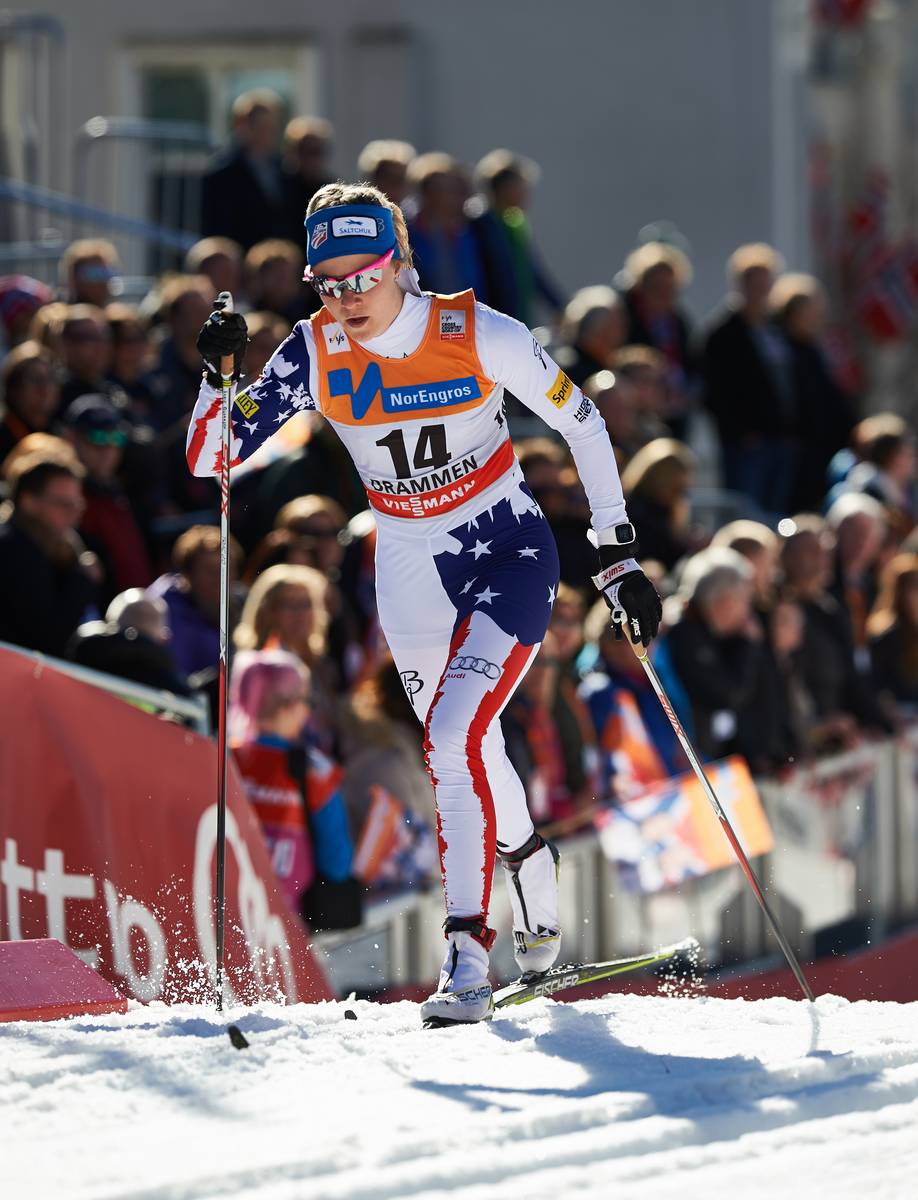
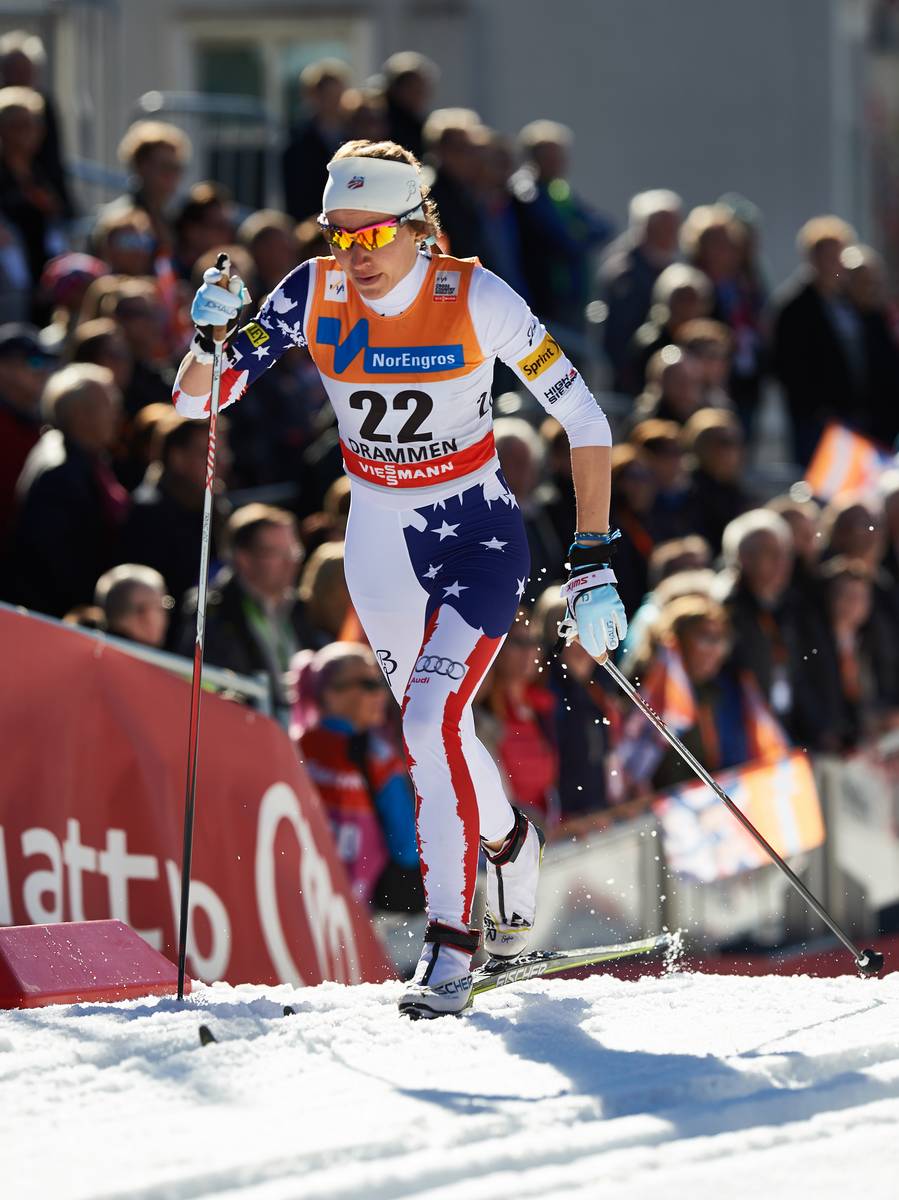
Julia Kern and Jessie Diggins race in the fourth quarterfinal in Drammen, finishing first and second in the heat. (Photo: NordicFocus)
“I didn’t know what to expect going into today,” shared Kern, “I’ve only done Drammen once and was around 60th or so, so I was really excited to have qualified in this iconic sprint.”
The final quarterfinal heat saw a relatively chill pace. In the end, Anna Dyvik of Sweden took first and Katri Lylynpera of Finland also qualified, finishing second.
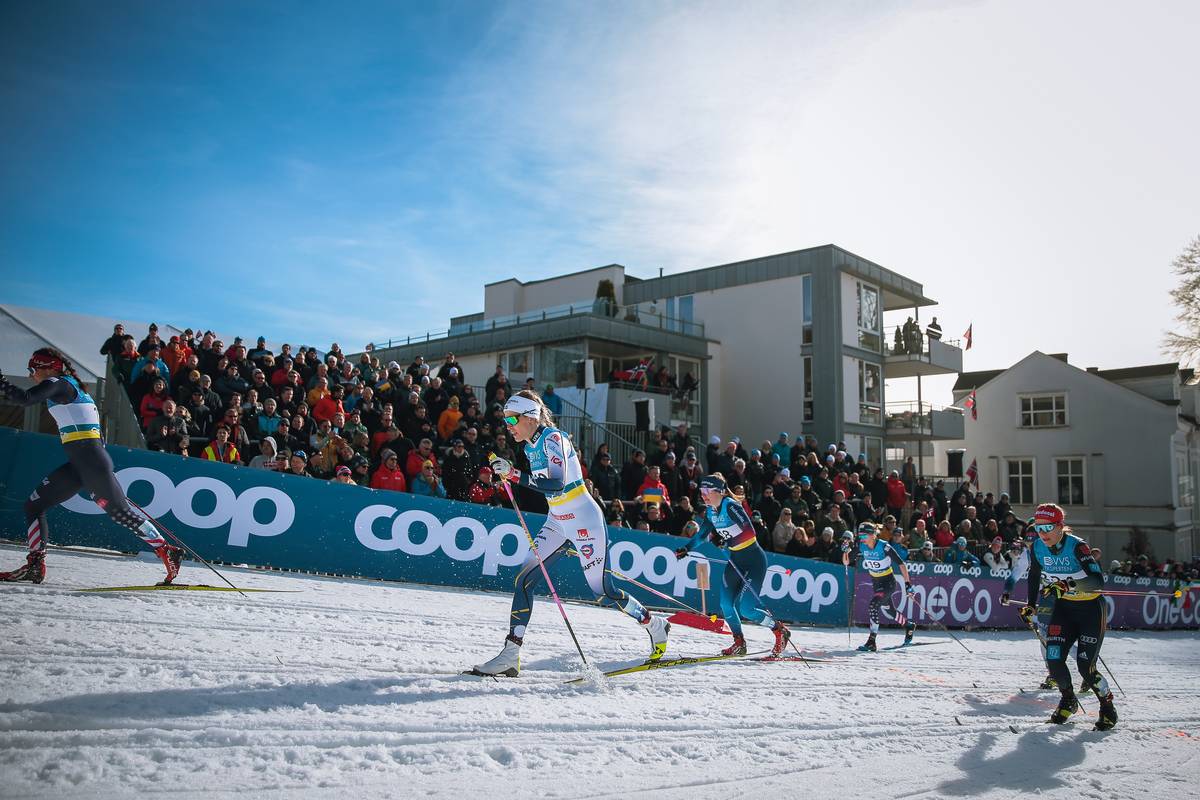
Moving into the semi-finals, the first heat hosted two Norwegians, two Swedes, a German and a Slovenian. It was the Slovenian, Lampic, who took the pace out hot from the start. She was followed closely by Sundling and Dahlqvist as they rounded the corner at the bottom of the course.
Anamarija Lampic (SLO) and Jonna Sundling (SWE) lead the first heat of women’s semifinal in Drammen. (Photo: NordicFocus)
Coming from the back, Falla (NOR) went wide to get a clear track into the finish and put in an impressive burst of speed. She took the win followed by Sundling (SWE) as Lampic dropped to third. Dahlqvist came in fourth but given the fast pace, both qualified in lucky loser spots.
The second semi featured higher bib numbers, with the lowest qualifier being Dyvik of Sweden in bib 13. Both Kern and Diggins were in this heat and when the gun went off, Kern shot to the front. Her quick start was matched by Dyvik but on the first climb, Kern began to pull away. Over the top, she appeared to have created a gap to the rest of the field, however she was quickly reeled in and passed by Dyvik (SWE) on the descent, her ski speed no match for those of the Swede.
Julia Kern (top left) leads the second semifinal, racing with Jessie Diggins, in Drammen, NOR. (Photo: NordicFocus)
Fähndrich (SUI) also pulled ahead of Kern and those front three maintained their respective positions exiting the final corner. Fähndrich nearly fell in a sudden loss of balance but managed to stay on her feet and came across the line in second, behind Dyvik. Despite her efforts out of the start, Kern finished third and the heat was not as quick as the first. Diggins came in fifth to end her day in 10th position.
“It was a really cool atmosphere out there, that was super fun to see,” Diggins shared with FasterSkier. “They always do a great job here, everyone was out cheering and it really felt like spring World Cup out there. It was sunny, it was warm and honestly the course held up pretty well given that it’s snow that they had to truck in and it is super warm. But there were a lot of crashes out there, it was sort of crazy, wild skiing.”
Diggins continued, “Andy Newell reminded us last night that in Drammen you just have to embrace the chaos. It was cool to get out there and I’m feeling really lucky to be able to be racing right now.”
For Kern, her approach was to stay flexible. She said, “I knew the start was important, but I also had a flexible approach since in tight city sprinting you never know where you slot in out of the start. I ended up almost tangling and finding my open lane on the right out of the start, and it ended up being the tactical move that I liked. My body was feeling good, I’ve had great energy the past two weeks and my skis were climbing well.”
Lining up for the final, it was Dyvik, Sundling, and Dahlqvist for Sweden, with Falla for Norway and Fähndrich for Switzerland. Out of the start, Sundling went to the front, eager to take on the lead work as four skiers slotted in behind her. Over the top of the course Sundling, Falla and Lampic had pulled clear of the others.
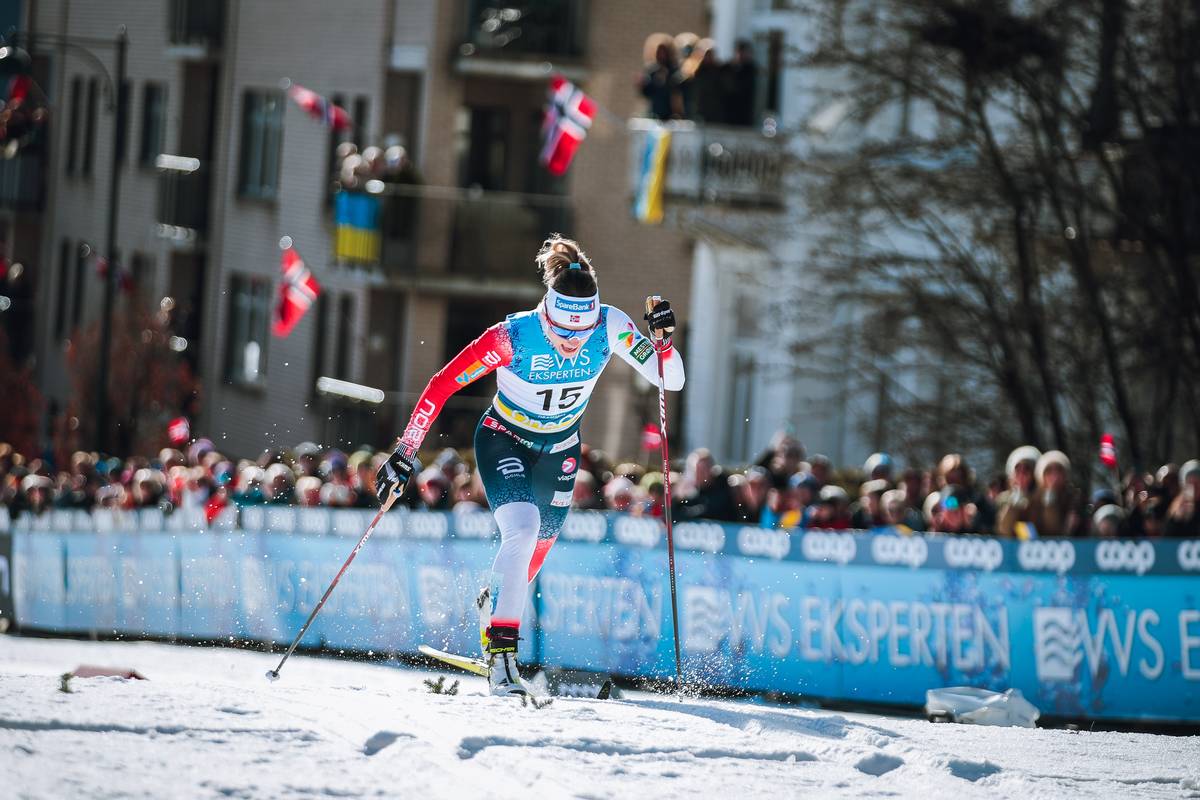
As they exited the bottom corner, Falla cut wide once again. With all three skis abreast, Sundling looked strong and had a slight lead. But Falla executed another incredible change of pace, switching to diagonal stride and edging ahead of the Swede she crossed the line in first.
Maiken Caspersen Falla (NOR) races to the line to win her career sixth sprint on the streets of Drammen, NOR. (Photo: NordicFocus)
“I felt so good,” said Falla in a FIS interview afterwards, “it’s so good to be back here in Drammen, to have a good atmosphere and it was a really good day.” Falla has had a challenging season, the only other time she made a sprint final was back in November in the first weekend of racing in Ruka, Finland.
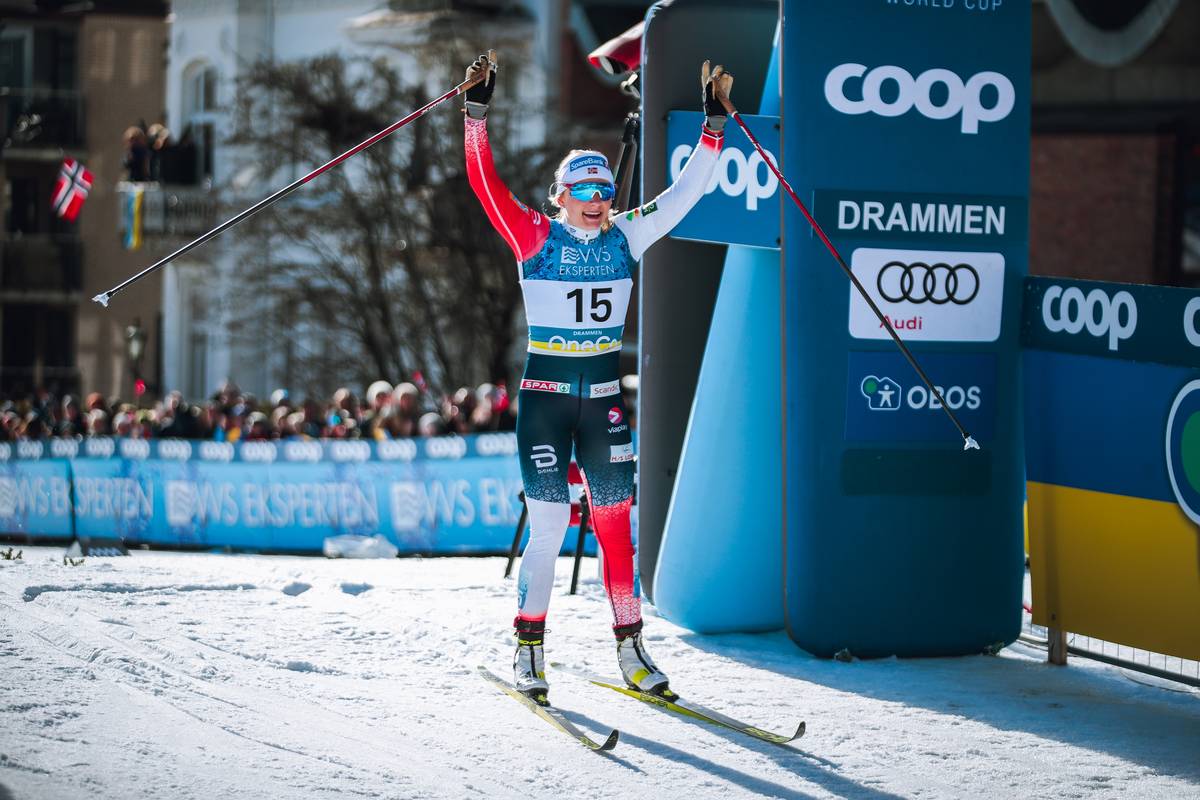
The Drammen event is something of a favorite for Falla however, she has won it on five occasions prior to today, her last win here coming in 2019. “It is really good to be back,” continued Falla, “I’ve been watching a lot of ski races on TV this season. I’m so happy to be here and to finish the season in a good way.”
Maiken Caspersen Falla (NOR) celebrates her sixth win in Drammen. (Photo: NordicFocus)
Behind Falla, Sundling finished second, continuing to show her strength in sprint racing with yet another podium finish. Lampic finished third, her fourth third-place finish of the season. For Dahlqvist, who finished fourth, it was her first time off the podium in a sprint yet this year.
Maja Dahlqvist (SWE), Anna Dyvik (SWE), Nadine Fähndrich (SUI)(l-r) head to the line to take fourth through sixth, respectively, in the women’s classic sprint final in Drammen, NOR. (Photo: NordicFocus)
Falla in first for her fifth Drammen sprint. (Photo: NRK screenshot)
The World Cup entourage gathered Tuesday at the head of the Drammensfjord in Norway. The 1.2-kilometer classic sprint in Drammen, Norway — the post-Holmenkollen sprint stop on the calendar — was held under overcast skies and within a city center jammed with fans.
Coming into Tuesday’s classic sprint, Norway’s Maiken Caspersen Falla had claimed two individual World Cup sprint victories this season and a World Championship sprint win in Seefeld, Austria. Falla remains consistent, having won three of the last four sprint globes. And she’s a lock in Drammen. She has won four of the last five Drammen city sprints — 2014, 2015, 2016, and 2018.
As we bring the Americans into the story, the benchmark for qualification time was again set by Falla. Sadie Bjornsen of the U.S. Ski Team (USST) was the fastest American qualifier in eighth place. She was 3.32 seconds behind Falla, who completed the course in 2:49.90 minutes. Jessie Diggins (USST) qualified in 18th (+4.65), and Sophie Caldwell (USST) was 20th (+4.99).
With the heats progressing, Diggins moved to the finals after placing second in the fifth heat and winning the second semi-final. Her semi-final lunge at the finish was a blur along with the three other skiers she was synced with across the line. There was a four way photo finish won by Diggins as she advanced to the finals.
“That was really fun today,” Diggins emailed, “I’m so grateful and appreciative of the techs for giving me very competitive skis. Drammen is kind of a funny course, and this year they took away the iconic uphill pitch at the finish, so it was even harder to determine the right moment to transition from double poling to power striding on the gradual uphill! It’s not a secret that I love workable downhills so my strategy each heat was to ski smooth and smart and get myself into an open lane heading into the finishing straight.”
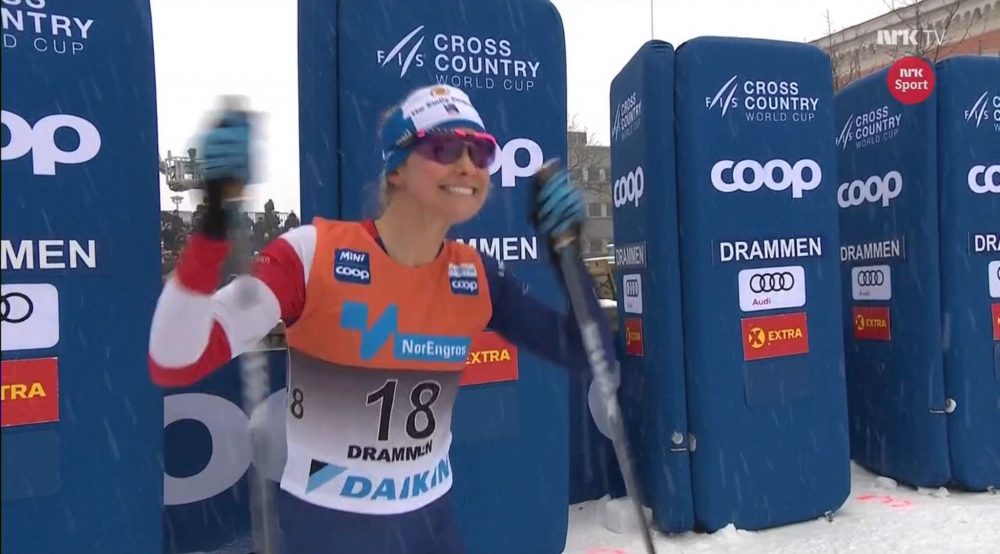
Jessie Diggins of the U.S. Ski Team lining up for the finals in the Drammen , Norway classic sprint. (Photo: NRK screenshot)
The six-across in the start gates for the finals were Diggins, Stina Nilsson of Sweden, Falla, Natalia Nepryaeva of Russia, and Norwegians Astrid Uhrenholdt Jacobsen and Anna Svendsen.
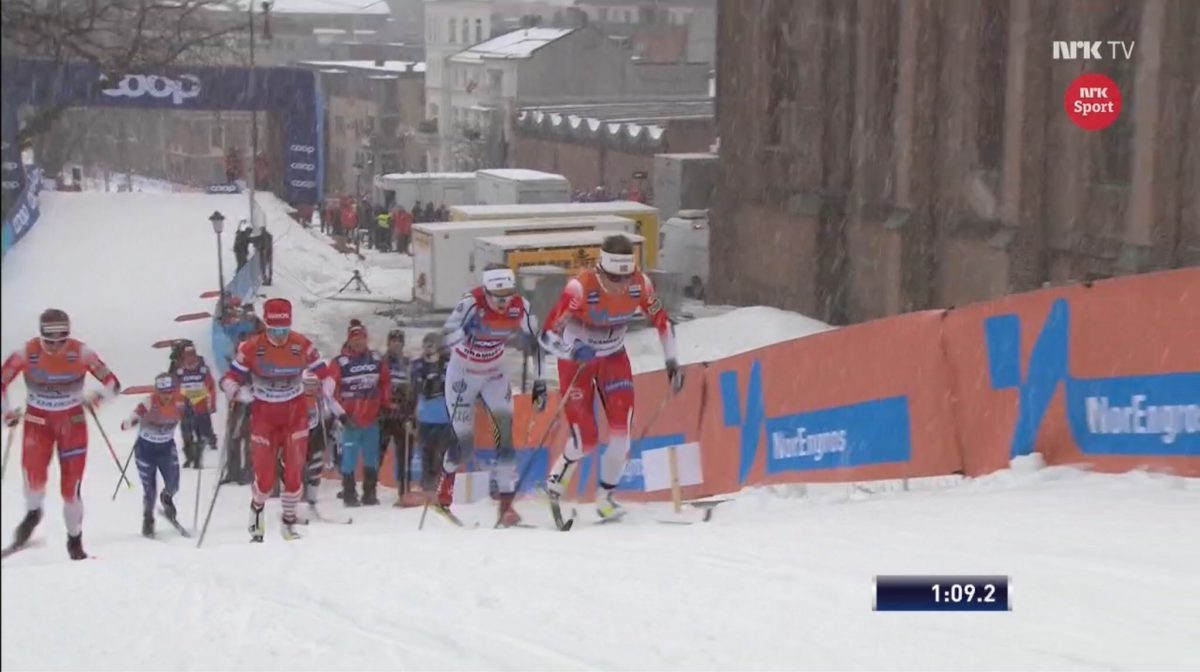
With steady snowfall, Falla set the follow-me-if-you-can pace as the course ascends and then drops in a series of tight and sinuous turns back to the course low point. Falla led throughout. Driving on the ups and leading a four skier line snaking through the downhill. As she descended, Falla kept a small gap on those trying to draft behind which included Nilsson, Jacobsen, and Nepryaeva.
A tight left-hander at the low-point is where Nilsson strategically slotted in and step-turned ahead of Falla, as she took the initial lead on the long incline to the finish. By then, Diggins and Svendsen had fallen off the pace.
Nilsson double poled and then strode on the right, with Jacobsen on her tails. In the adjacent lane to the left, Falla notched into her double pole gear and began moving ahead. Her power maxing out, Falla gained centimeters then a bit of breathing room that became a few meters. Jacobsen, sensing her moment and a Nilsson power lapse, moved to her own lane and surged into second. As Nilsson faded, Nepryaeva kept enough reserves for the end as she barely took Nilsson at the line.
Maiken Caspersen Falla of Norway getting a small gap on Sweden’s Stina Nilsson in Drammen, Norway (Photo: NRK screenshot)
Falla crossed the line in 2:56.12 for the top podium step. Make it five out of six in Drammen for headlines like “Falla Wins!”
“I think my technique is good for the climb before the finish line, my upper body is strong that is why this course fits me so well,” Falla told the International Ski Federation (FIS) after the race. “It is definitely one of the highlights of the season. It is such a great atmosphere. You can really feel the energy and the cross-country spirit. Yah, it is very good.”
Jacobsen placed second (+0.80) after qualifying in fifth, with Nepryaeva in third (+1.06). Nilsson was fourth (+1.28), Diggins fifth (+5.38), and Svendsen sixth (+7.59).
It was Jacobsen’s second podium of the season, the other coming in the 10 k freestyle in Ulricehamn, Sweden. She earned Her last World Cup sprint podium in March of 2016, in Canmore, Canada.
For Nepryaeva, it was her second sprint podium this World Cup campaign with ramifications in the overall World Cup standings. Leading the overall is Norway’s Ingvild Flugstad Østberg with 1329 points. She did qualify for the heats but did not advance to the semis, finishing 19th overall. With her third place today, Nepryaeva now sits two points behind Østberg 1327 points with five races remaining.
While racing to a fifth place on Tuesday, Diggins currently sits fifth in the overall World Cup. This was her first race after the conclusion of the World Championships in Seefeld, Austria. Both Diggins and Bjornsen sat out the Holmenkollen 30 k classic on Saturday to recover.
“In the final I simply got tired from the short turnaround time you get from the second semifinal, but overall I was really happy with the whole day and how I executed my process-oriented goals of efficient and decisive ski testing in the short course opening window, a powerful double pole and ripping downhills, and just having fun and enjoying the atmosphere,” Diggins wrote. “As it turns out, the reminder to actually have fun IS a necessary goal this year with increased pressure, but I’ve decided that if I don’t let outside pressures dictate the joy I feel for the sport and in racing, then I can just relax and enjoy doing what I love best!”
Bjornsen was eliminated in the second heat. Nilsson won the heat in 2:54.37, with Bjornsen placing fifth (+2.69). Bjornsen finished 21st overall.
“Exciting, and frustrating sprint here in Drammen,” Bjornsen explained in an email. “I sat out Holmekollen last weekend in hopes of saving some energy for the final push of the season. My body is feeling good, I just wanted to make sure I didn’t try to do too much and end up sick or tired.”
The course’s uphill finish requires stout double pole capacity. Bjornsen felt that was a positive asset in Drammen.
“I have been feeling really good in double pole this season, which helped me have a good qualifier here to start the day out,” she continued. “Unfortunately, I kind of struggled to find position over the top of the climb, and then really struggled with that super gradual striding in sprint speed right there at the finish. I was trying to push the DP as far as possible because I know that is my strength, but I just couldn’t keep up in that unique striding. That is something I have been ‘re-reminded’ every season I come here, but this time I am writing it down, and getting it done! So many of our courses now are running or DP, so I forget it is a gear I need until I come here to sprint every year. … I was excited to have great skis out there today, and look forward to putting these great feelings to use the next two weekends! I wish we had more classic sprints coming, but we will have to wait until next year now. Off to Falun for a weekend of skating!
Caldwell ended her racing after placing fifth in her heat and 24th overall.
“Drammen has always been a tough nut to crack,” U.S. Ski Team Head Chris Grover wrote in an email. “The finals appearances we’ve had here over the years with Andy, Kikkan, and Jessie have been very special. Even with diagonal technique control zones, the race remains a double-pole fest. If an athlete is not one of the best double-polers in the world, they have little hope in Drammen; the race is simply too short, too fast, and too specific in its demands. The shortening of the course this season, taking out the final steeper classic striding pitch at the finish, placed even more emphasis on double-poling.”
Those Americans missing the top-30 cut to advance were Ida Sargent (USST) in 34th, Kelsey Phinney (SMS T2) 49th, Julia Kern (USST) 50th, and Kaitlynn Miller (CGRP) 55th.
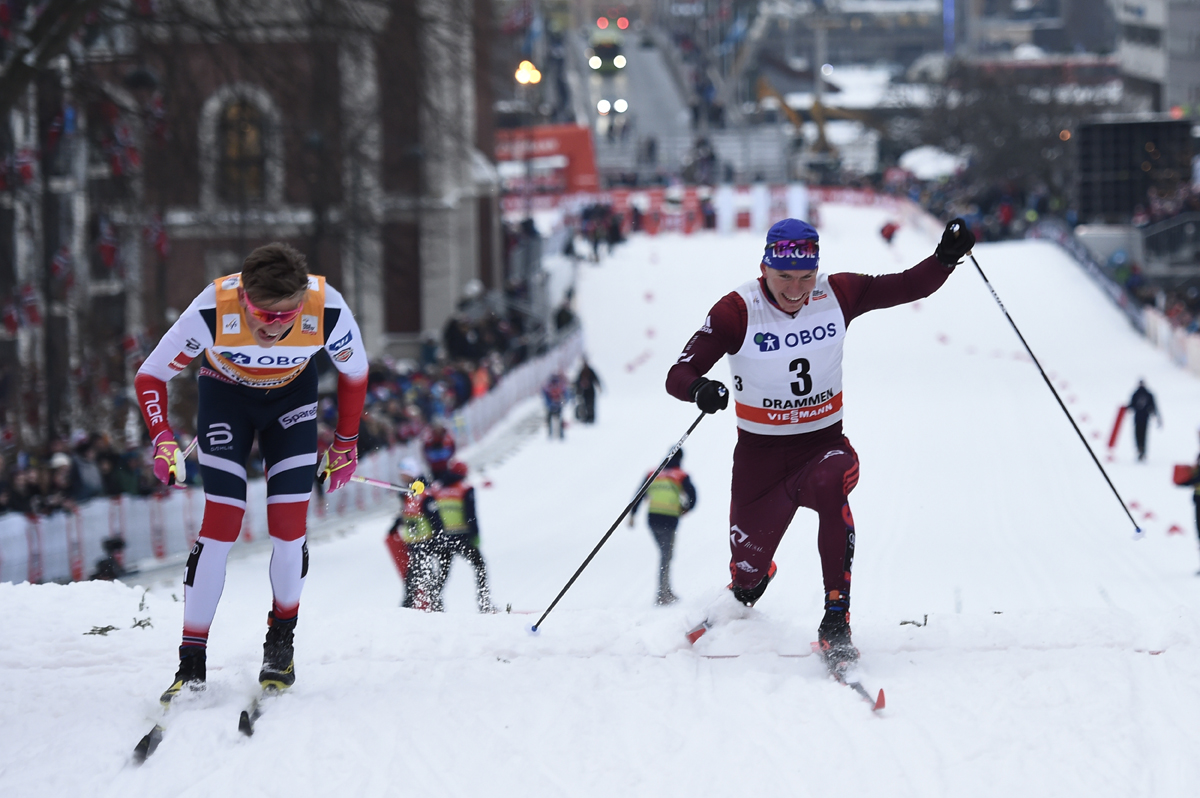
Norway’s Johannes Høsflot Klæbo (l) edging Russia’s Alexander Bolshunov (3) and Norway’s Eirik Brandsdal (not shown) in the first semifinal of the men’s classic sprint at the World Cup in Drammen, Norway. Klæbo went on to win the final, ahead of Brandsdal in second and Bolshunov in third. (Photo: Fischer/Nordic Focus)
In the classic venue that are the Drammen city sprints, it was a singular affair from start to finish during the men’s World Cup 1.2-kilometer classic sprint on Wednesday. In a race format that tapered from a field of 61 skiers to the winner, one only needs to track the skier in the overall World Cup’s leader bib to follow along.
The yellow-bibbed skier, Norway’s Johannes Høsflot Klæbo, didn’t surprise with his sprint win in Drammen as much as place another high performance stamp on his 2017/2018 campaign.
Klæbo won the qualifier in 2:49.32 minutes. Teammate Eirik Brandsdal skied to second in the qualifier, 3.5 seconds behind Klæbo. Russian Alexander Bolshunov skied the third-fastest qualifying time, finishing 4.48 seconds back. This puts some things in perspective, if anybody thought Klæbo would bloat in his post-Olympic gold medal glow — he won three golds in PyeongChang — you’d be wrong.
Klæbo would have have good reason to cash it in. What exactly does the 21 year old need to prove? Coming into Wednesday’s race, Klæbo had already captured the Sprint World Cup Crystal Globe. It’s the Norwegian phenom’s second-consecutive overall sprint title.
Yet Klæbo is also on the verge of sealing up his first Overall World Cup title. After the Drammen sprints, Klæbo leads the overall standings with 1308 points. Behind him, Martin Johnsrud Sundby of Norway (who did not contest Wednesday’s sprint), trails in second place with 980 points total.
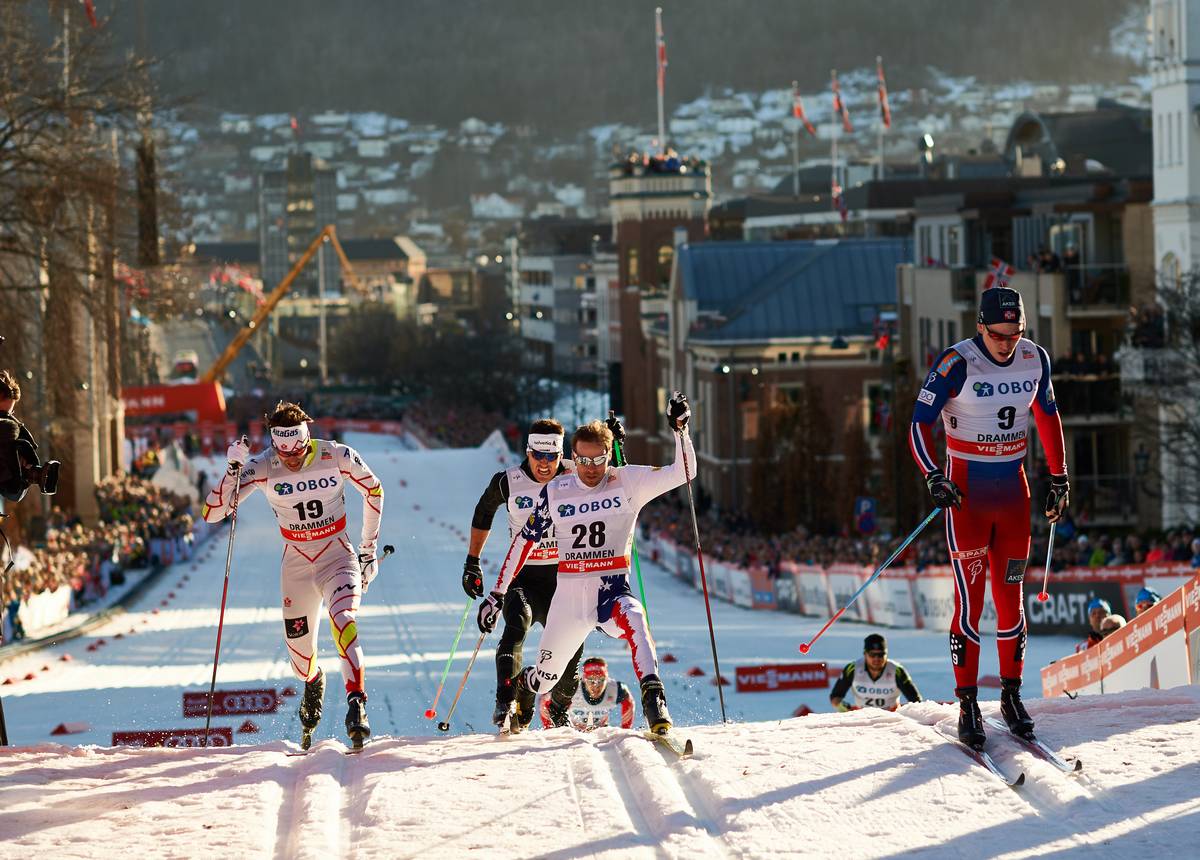
Johannes Høsflot Klæbo leads his quarterfinal with fellow Norwegian Fredrik Riseth (l) and Sweden’s Emil Jönsson (30) at the World Cup classic sprint in Drammen, Norway. (Photo: Fischer/NordicFocus)
“It was really important to me to get the 100 points today,” Klæbo told the International Ski Federation (FIS) after the race. “I need as many points as I can get against the other guys for the [overall] Crystal Globe. I will race the Holmenkollen 50 k this weekend and I know it will be tough. Also it’s great to win here in front of all the people. I was second here last season and I’m really happy to now have won Drammen.”
Let’s circle back to what Klæbo needs to prove, beyond padding his overall lead by another 100 points by winning the Drammen sprint. He’s proving at his young age, pending any monumental flameout, that he’s setting the stage for a historic international cross-country ski career.
This season alone, Klæbo has won six of nine individual sprint World Cups. He’s won 10 World Cup races in total. That win total puts Klæbo in rarefied company: in the men’s field, only Petter Northug (with 10 wins) and Sundby (16 wins) have won 10 or more World Cup races in a single season.
Winners want to win. Amidst the five-deep crowd surrounding the sprint course featuring Drammen’s iconic Bragernes Church, with his pink-themed flare, Klæbo proved once again he is a consummate winner.
There was his dominating qualifier. Then there was Klæbo’s quarterfinal, in which he looked less threatening. He won the first quarterfinal by 0.7 seconds in a photo finish with Brandsdal. That heat seemed to be a test run, as if Klæbo were feeling the course out and asking himself how it skied with five other bodies jousting for tracks and inside lines. There was never the hallmark Klæbo burst of speed or any real dominance. Klæbo kept in contact up the long initial uphill, and down through the tight and sinuous S-turns after the course’s highpoint.
If in fact the first quarterfinal was a dress rehearsal, Klæbo must have realized that any real podium threats would be drag racing up the final quarter-kilometer climb that finished nearly smack-dab in front of the church.
The first semifinal featured the day’s top-three qualifiers: Klæbo, Brandsdal and Bolshunov. (Bolshunov advanced by winning the second quarterfinal.) The three skiers finished 1-2-3 with Klæbo taking the win in another photo finish with Brandsdal.
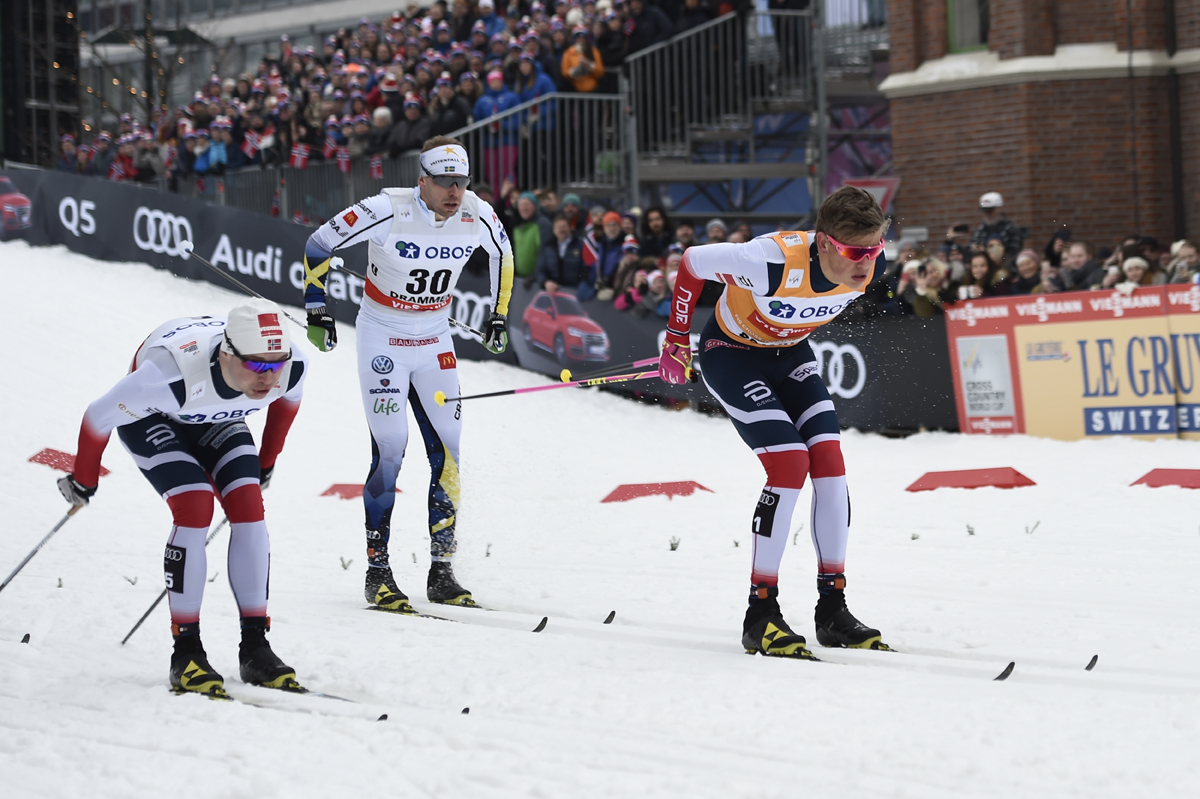
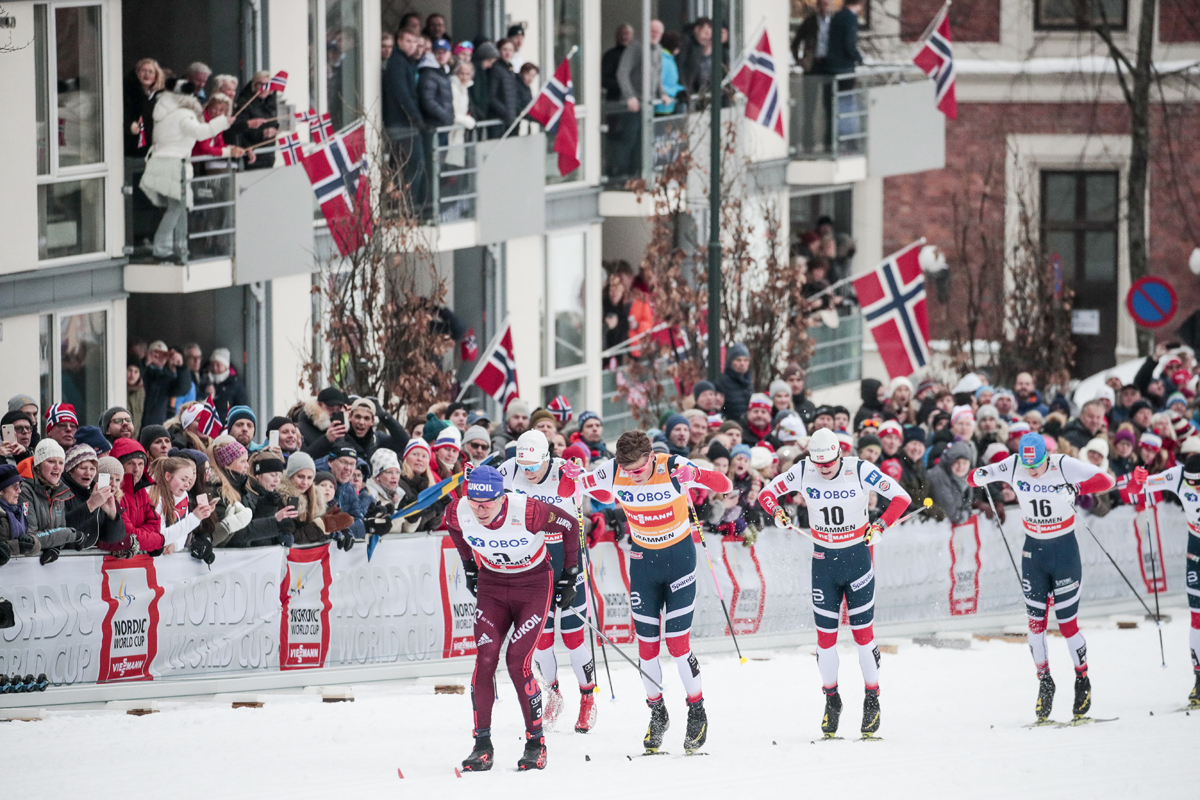
Russia’s Alexander Bolshunov leads five Norwegians in the men’s classic sprint final at the World Cup in Drammen, Norway: (from l to r) Eriik Brandsdal, Johannes Høsflot Klæbo (yellow bib), Sindre Bjørnestad Skar (10), Kasper Stadaas (16), and Emil Iversen. (Photo: Fischer/Nordic Focus)
Tactically, Bolshunov played his hand early. Determined to break Klæbo, the Russian led out hard and took the sharp end of the race in earnest. At the top of the course, Bolshunov had strung the five other skiers out behind him. Moments before the highpoint and entering the technical downhill S-turns, Bolshunov and Klæbo gave a burst of speed and distanced themselves by 10 meters. As Klæbo learned in his heat, even with speedy skis, the downhill is not decisive. It’s more a function of skiing out front, staying on your feet and entering the final straight with enough high-octane gas to turbo the finish.
Up the final climbing stretch, which seems as eternal as some flame burning inside the Bragernes Church, Bolshunov faded slightly, while Klæbo and Brandsdal pulled ahead.
Klæbo’s second takeaway: he already knew the course was won on the final straightaway climb. If he could match Bolshunov on the remainder of the course, Bolshunov could not mirror him in the final meters.
The final played out like Klæbo’s semi. Bolshunov punched it early. Klæbo sat behind the Russian, matching him pole for pole, stride for stride. Up front was as good a place as any for Bolshunov. Besides the Russian, it was an all-Norwegian final. There was Klæbo and Brandsdal, along with Sindre Bjørnestad Skar, Kasper Stadaas and Emil Iversen.
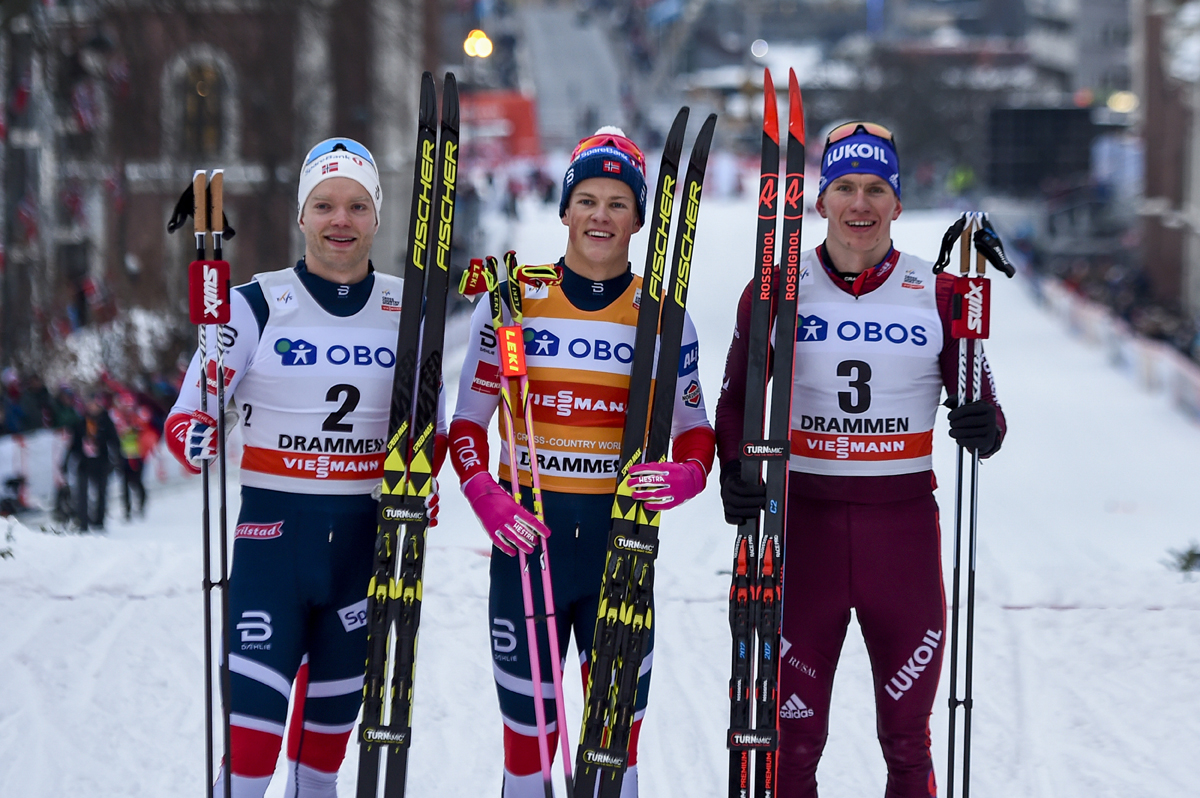
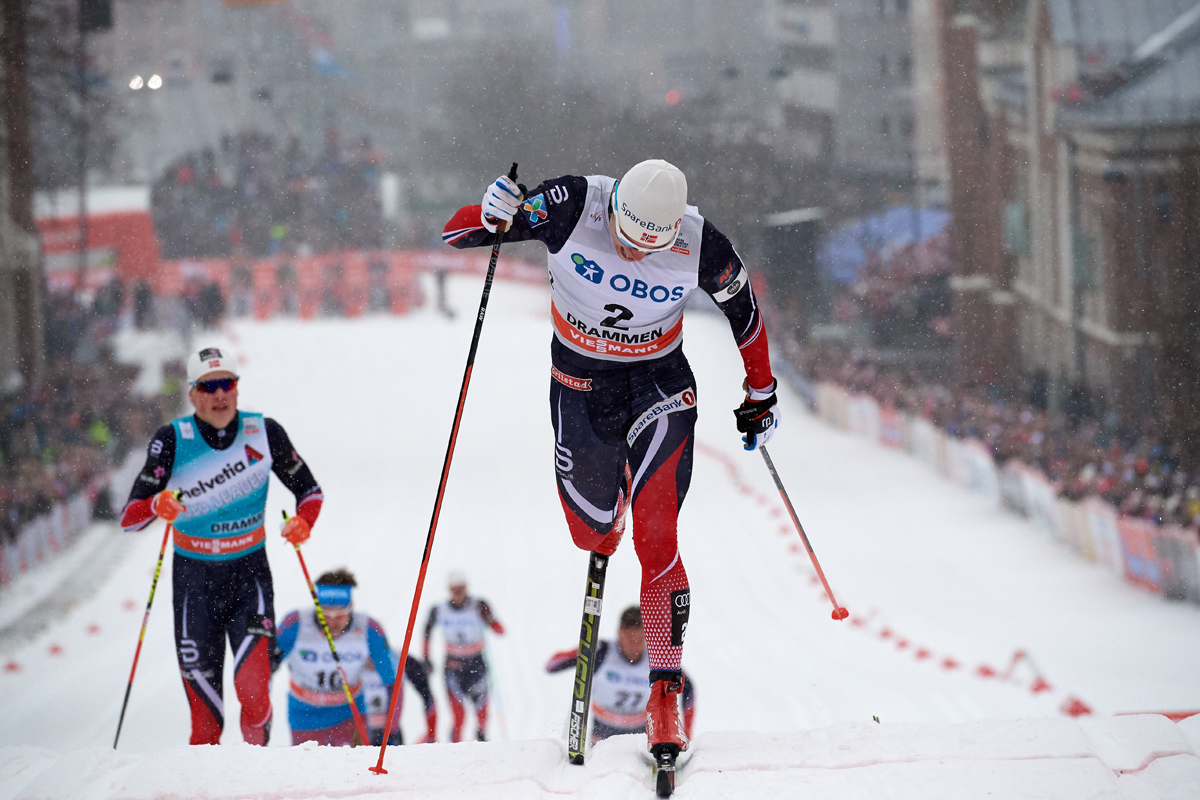
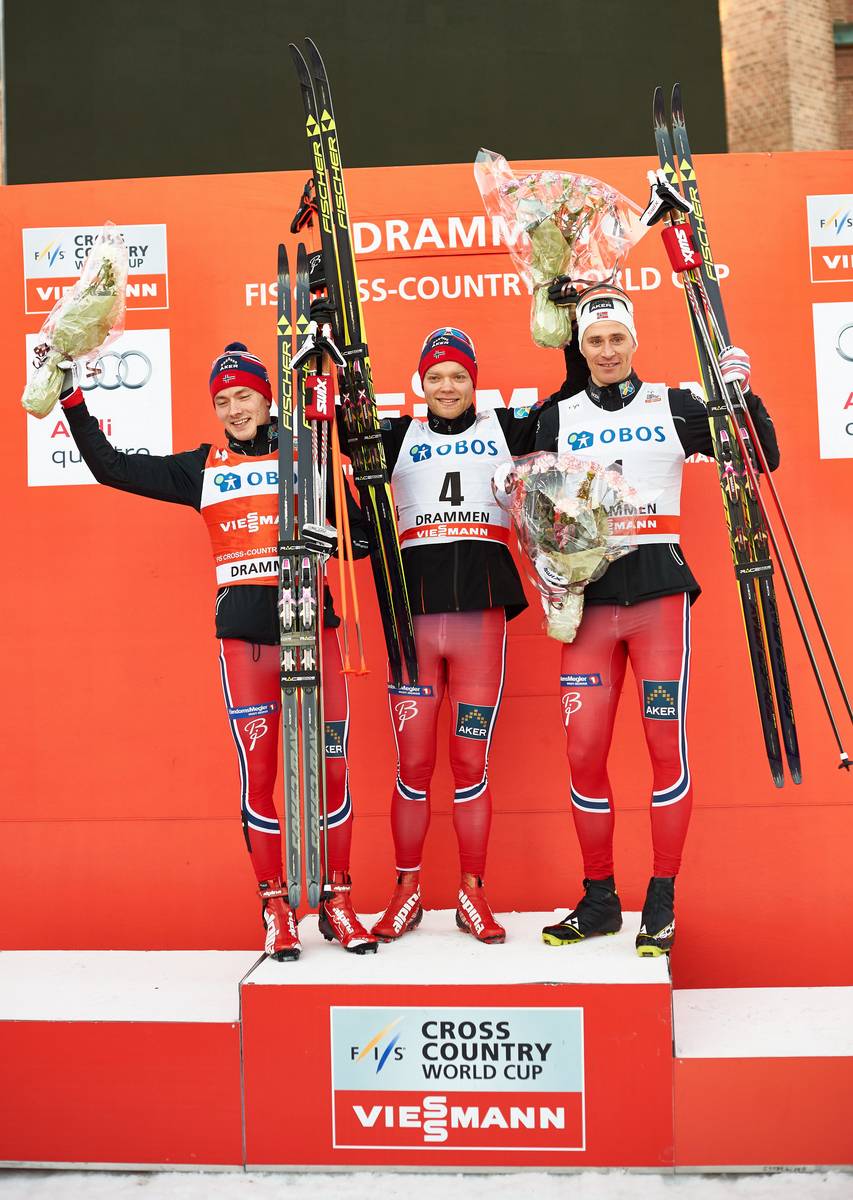
The men’s podium from Drammen’s 2018 classic sprint. Norway’s Johannes Høsflot Klæbo (c) placed first, his teammate Eirik Brandsdal (l) was second, and Russia’s Alexander Bolshunov (r) finished third. (Photo: Fischer/NordicFocus)
Bolshunov again led up and over the top of the course, through the S-turns and through the tucking downhill. Brandsdal trailed by 10 meters, but by the final turn before the uphill to the church’s front door, the threesome had regrouped. Again, as the double poling got down to business, Bolshunov faded, Klæbo pulled away and Brandsdal could only stay a second behind the day’s winner. And of course Klæbo was able to toe the line as he bowed to the frenzied crowd. Nothing to prove except he can win with panache and win in style when the Norwegian cameras turn out in force.
Klæbo won the final in 2:44.69 minutes. Brandsdal followed 1.04 seconds back in second place, Bolshunov finished third (+3.78), Bjørnestad fourth (+6.55), Kaspar fifth (+8.71), and Iversen sixth (+11.45).
Bjornsen Reaches Quarterfinals, 18th Overall
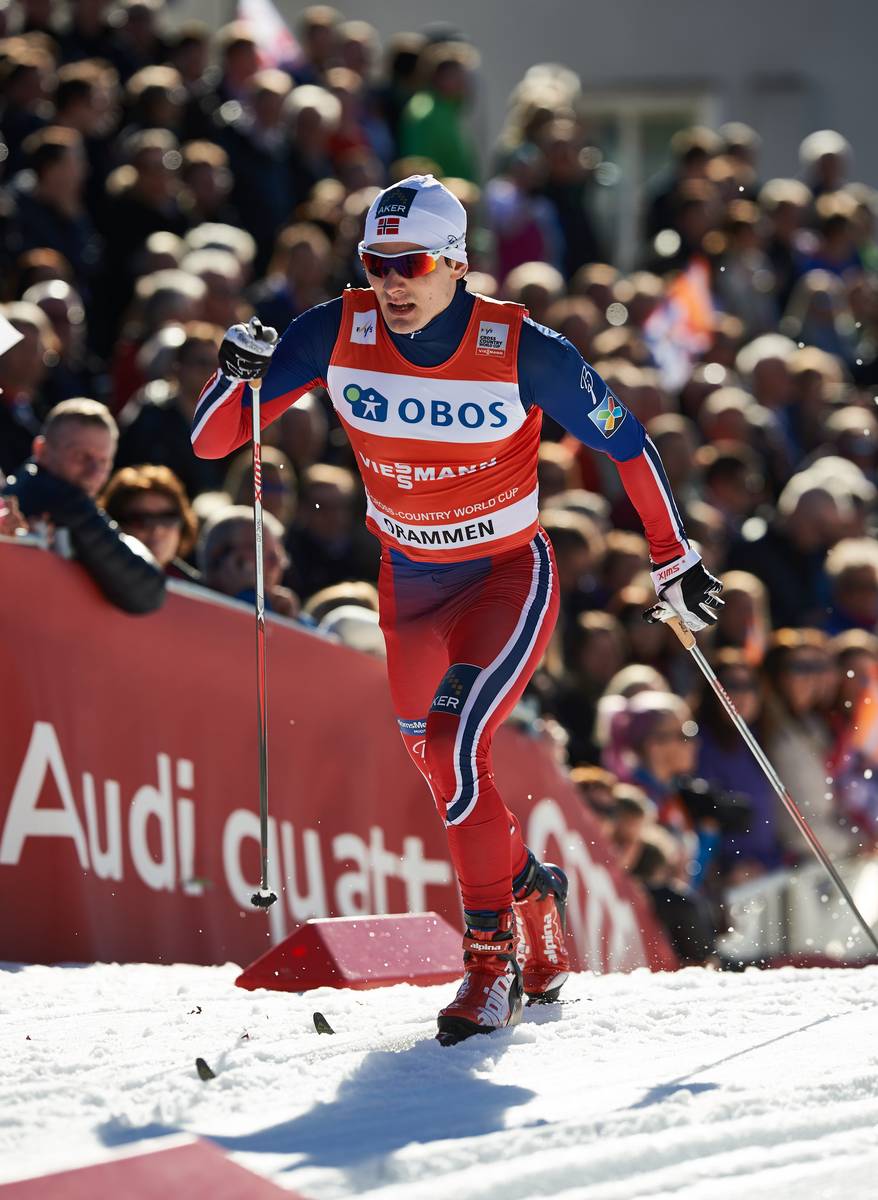
Erik Bjornsen was the lone North American who advanced to the heats, qualifying in 26th and finishing the day in 18th.
“I was feeling good,” Bjornsen told FasterSkier after the race. “It’s a tight course. It was a bit scrappy. … It’s my first time here qualifying for the heats, so I’m learning some things, for sure.”
Bjornsen skied in the fifth quarterfinal with Iversen, Russia’s Alexander Panzhinskiy, Finland’s Ristomatti Hakola, Emil Nyeng of Norway, and France’s Lucas Chavanat.
The American skied near the back of the group but avoided any real mishaps. Although the sport is not roller derby, Drammen’s tight-and-rutted corners offer up a close cross-country skiing cousin.
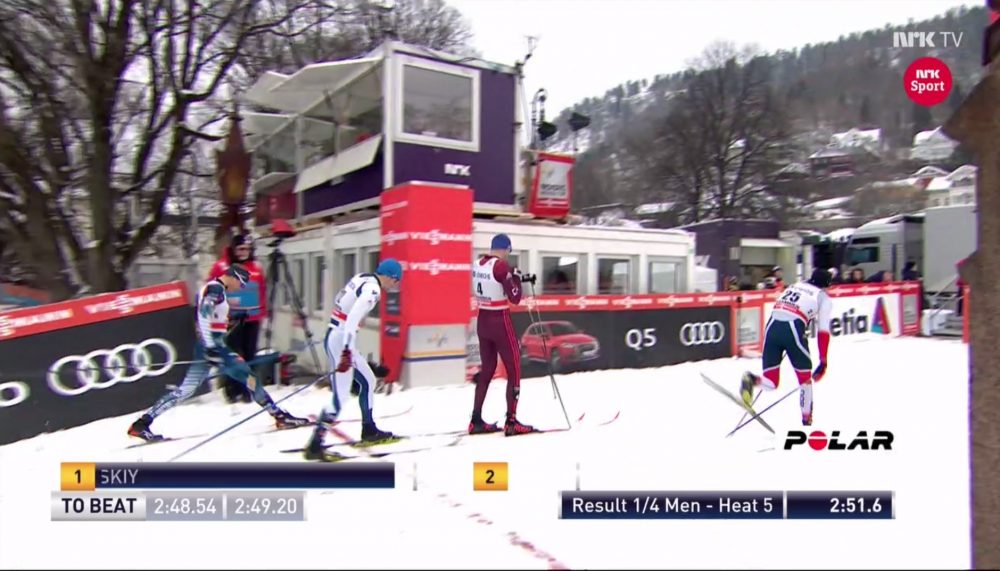
The U.S. Ski Team’s Erik Bjornsen toeing the line in fourth during Wednesday’s fifth heat in Drammen, Norway. Bjornsen placed 18th on the day. (Screenshot: NRK broadcast)
“I feel like – I kind of missed a few spots,” Bjornsen said. “At the bottom corner I was pushed to the outside. I was almost moving up into second, and looking back maybe I should have gone around him on the other side.”
Up the never-ending final straightaway, Bjornsen poled himself into a position to potentially advance to the semifinals as a lucky loser. However, that didn’t pan out for Bjornsen. Iversen won the heat in 2:51.96 minutes, Panzhinskiy placed second (+0.20), Hakola third (+0.99), with Bjornsen in fourth (+1.18).
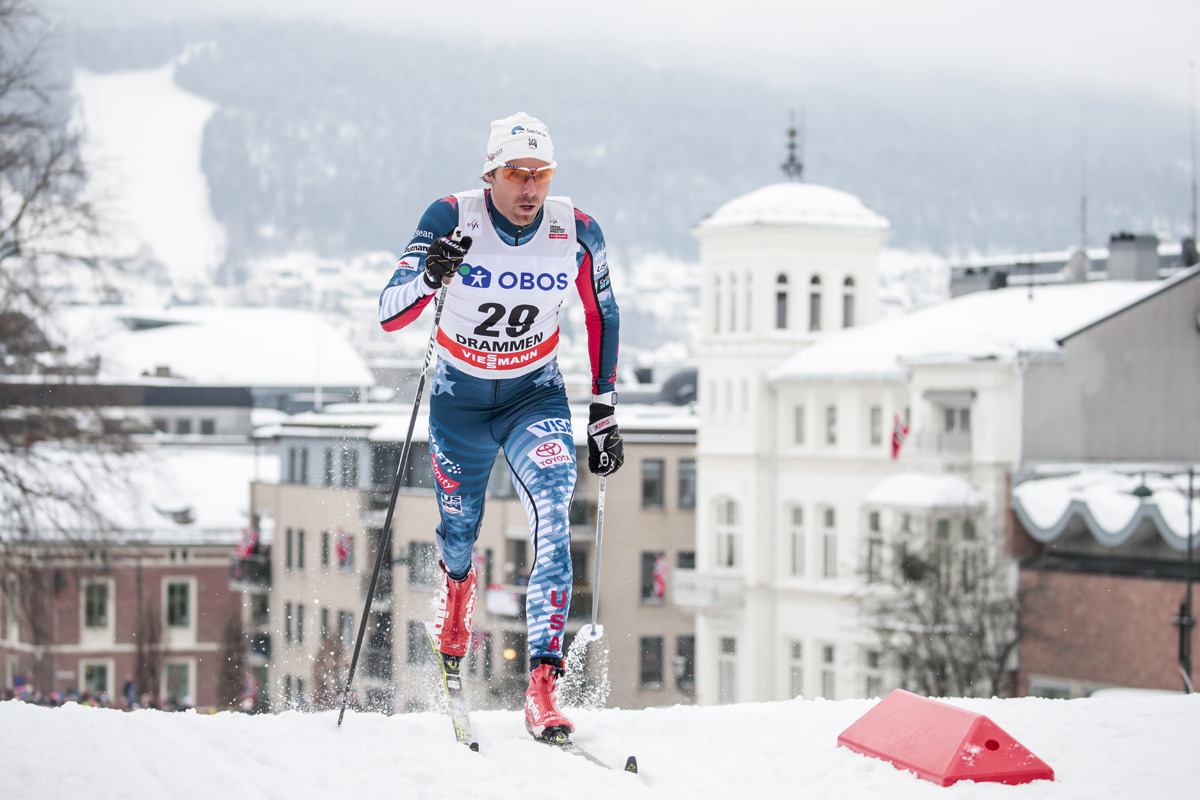
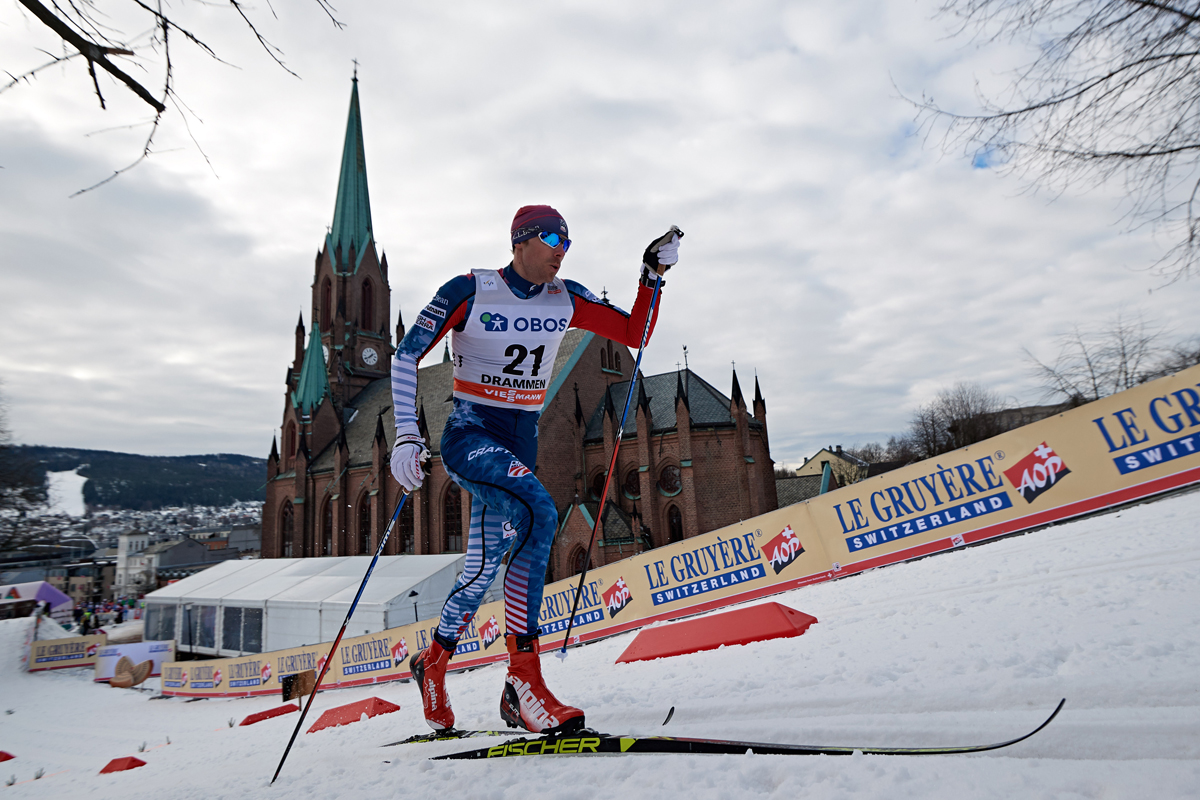
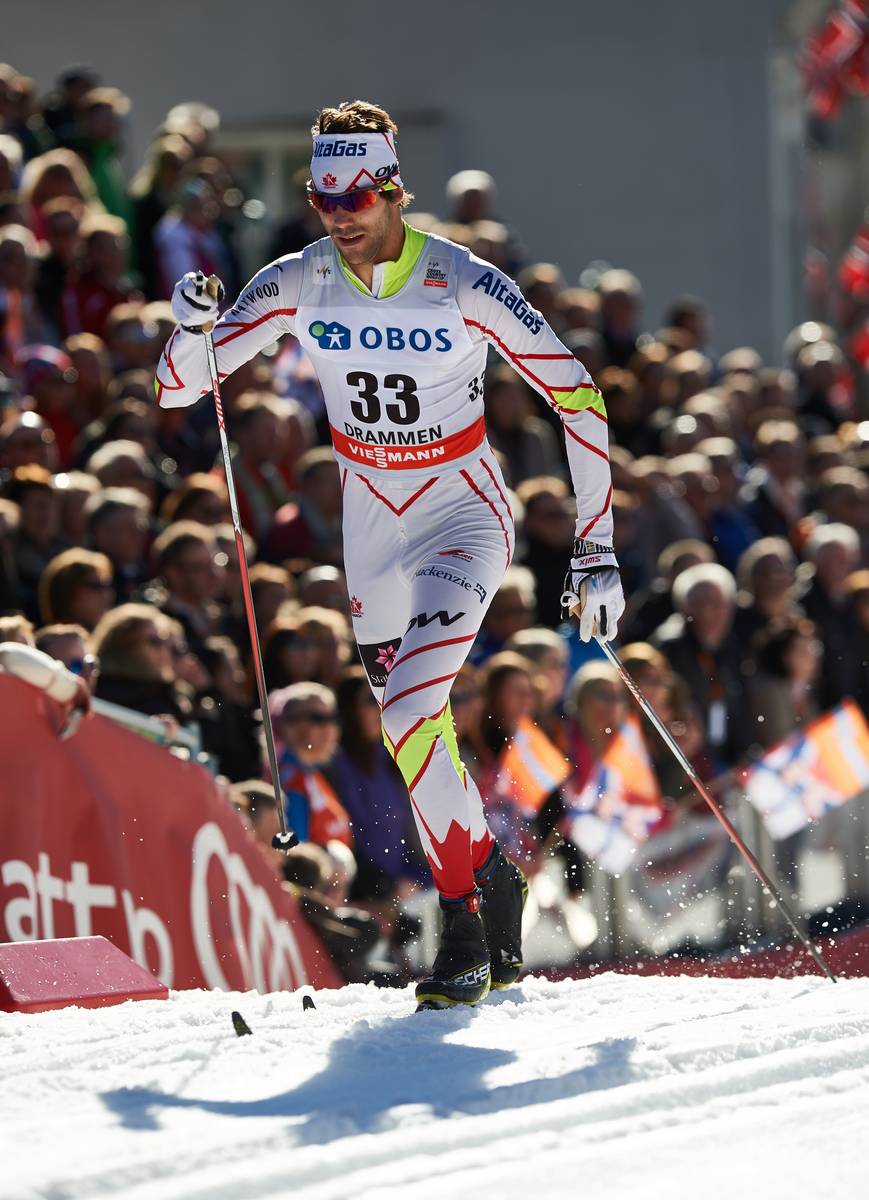
Andy Newell racing to 33rd in the men’s classic sprint qualifier at the World Cup in Drammen, Norway. (Photo: Fischer/NordicFocus)
Also for the U.S., Andy Newell missed the quarterfinals after finishing 33rd in qualification, 0.9 seconds out of 30th. Logan Hanneman and Kevin Bolger finished 49th and 50th, respectively, and Reese Hanneman 56th. The U.S. Ski Team’s Simi Hamilton sat out Wednesday’s sprint as he is recovering from an illness.
For Canada, Julien Locke finished 51st in qualifying, Alex Harvey was 54th, and Andy Shields 58th.
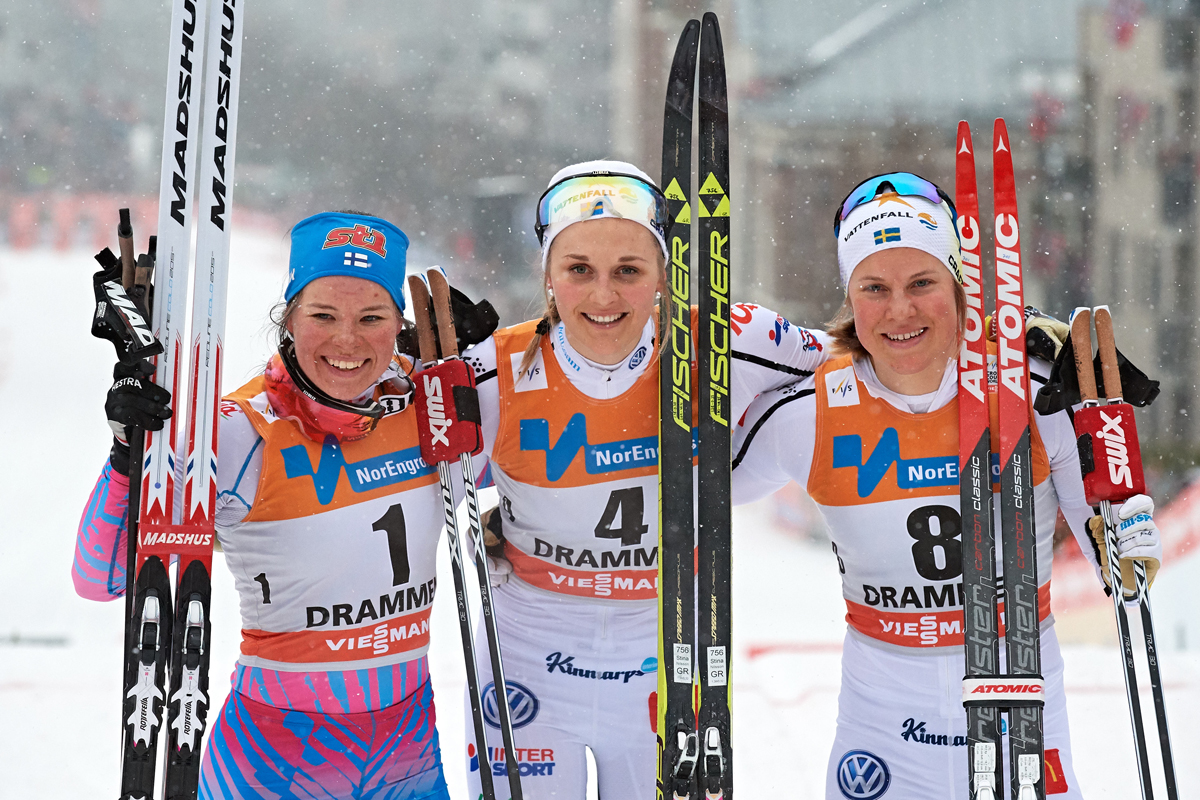
Sweden’s Stina Nilsson charging to her eighth World Cup victory of the season in Wednesday’s 1.2 k classic sprint final in Drammen, Norway. She finished first, ahead of Finland’s Krista Pärmäkoski (r) in second and her Swedish teammate Hanna Falk (l) in third. (Photo: Fischer/NordicFocus)
Drammen is one of those staples on the World Cup, appearing on the circuit late each season and remembered for its trademark uphill finish in the middle of a city of 63,000 inhabitants, just 40 kilometers west of Oslo, Norway.
“It tends to be fairly predictable snow,” U.S. Ski Team Women’s Coach Matt Whitcomb told FasterSkier during an in-person interview in Drammen on Wednesday. “It’s generally clean [snow]. It’s generally some sort of klister.”
But that doesn’t make Drammen easy. Finding the ideal balance of kick and glide on the city’s 1.2-kilometer course, marked by a steady uphill out of the start, followed by a 60-second downhill, and finally, one last climb to the finish, is key and something even the most seasoned World Cup skiers can struggle with at this venue, Whitcomb explained.
“We tend to see athletes focusing a little bit too much on the climbs, getting those good sensations and not enough gliding … out on the downhills,” he said. “That’s where the heart of this course really lies.”
For instance, consider Maiken Caspersen Falla. Coming off an individual skate-sprint victory at 2017 Lahti World Championships, the Norwegian didn’t ski fast enough to qualify for the heats on Wednesday. She finished 31st, 0.34 seconds out of qualifying in 30th but 6.49 seconds off the top qualifying time set by Finland’s Krista Pärmäkoski. With Falla usually qualifying first or close to it in sprints (and Pärmäkoski better known for her distance skiing), it was a shakeup that confused even Falla — Drammen’s three-time defending classic-sprint winner.
“I think it is weird,” Falla told NRK, according to a translation. “I do not know what’s going on. I was thinking I was going pretty well. I’m not far behind [the top 30], but I have no idea. Maybe I didn’t have the best skis or maybe I left far too much time in a turn. I am very unsure of what’s going on; the body has worked great the last few days.”
American Kikkan Randall, who placed third in the world-champs freestyle sprint behind Falla, was in the same boat. She finished 52nd out of 56 women in Wednesday’s sprint qualifier, 12.76 seconds out of first.
Whitcomb said that was likely due to too much kick and too little glide. Drammen as a downtown sprint poses an additional challenge for athletes and wax techs, allowing just 20 minutes for testing on race day.
“Every athlete’s working out of one depot so you have basically 100 people, male athletes and female athletes, and just trying to control the chaos as much as possible,” he said. “But I feel like our athletes, I can trust them to ask for more kick and know that it’s not gonna compromise their glide. Sometimes it does, it’s just the risk that you have to make because on this course, you spend a fair amount of time gliding and if you’re not close to having enough grip, you’ll be too tired in the finish.”
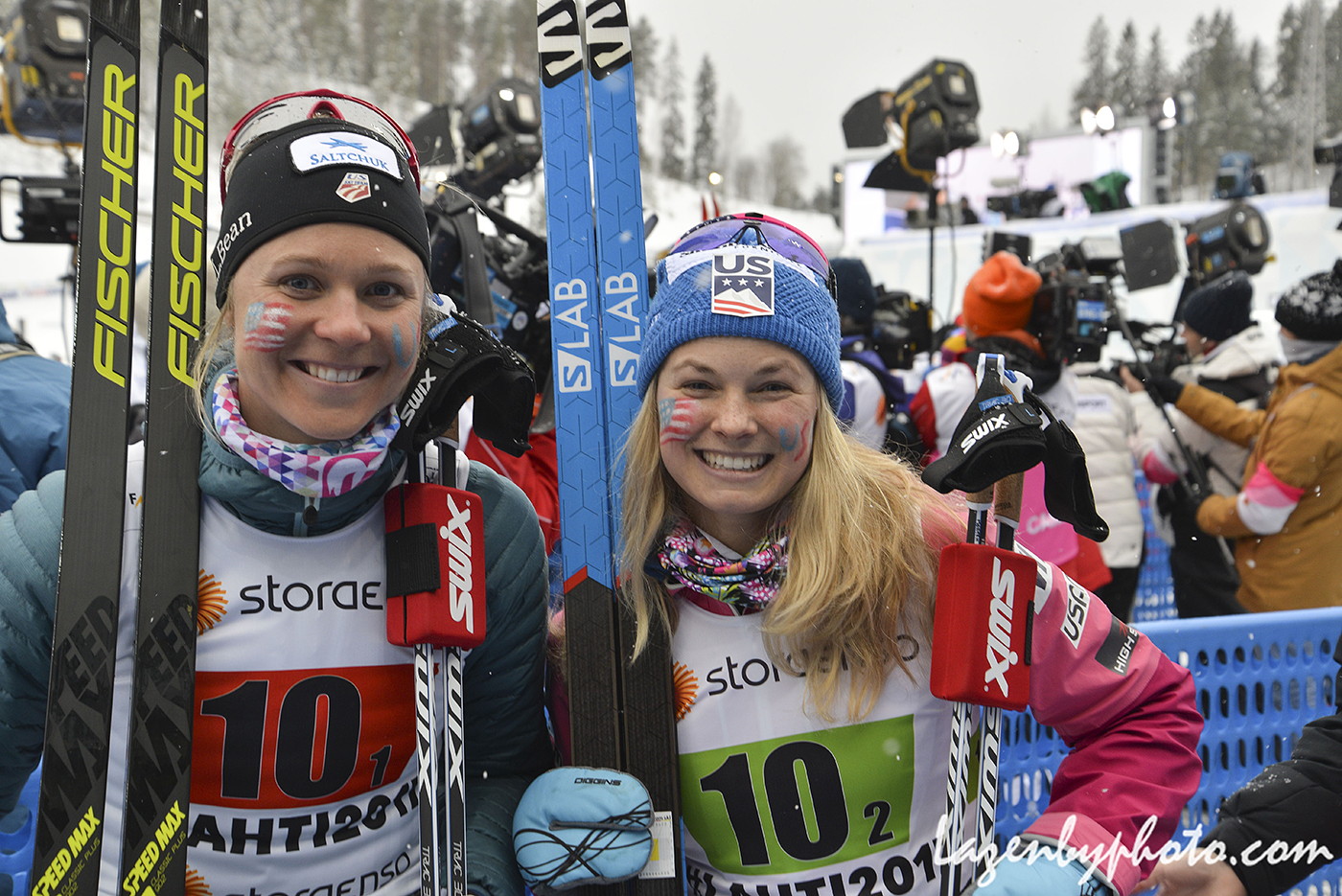
U.S. teammates Sadie Bjornsen (l) and Jessie Diggins after placing third for bronze in the women’s classic team sprint at 2017 World Championships in Lahti, Finland. (Photo: John Lazenby/Lazenbyphoto.com)
One U.S. Ski Team member thrilled with her skis was Jessie Diggins, who qualified sixth (+2.12) behind her teammate Sadie Bjornsen in fifth (+1.63). Behind them, Sophie Caldwell was the third American to qualify in 11th (+2.95).
While Diggins and Bjornsen went on to finish sixth and fifth in their quarterfinals, respectively, and did not advance to the semifinals, Diggins said that in her case, it wasn’t for a lack of speed. After some physical contact at the top of the course got her fired up and surging into first on the long descent, Diggins slipped back to the middle of the pack coming out of the downhill draft and broke a pole around the last hairpin corner before the long, uphill finishing straight.
“Jessie came into the final corner with too much traffic and a pole broke somehow,” Whitcomb said. “If it had been made out of steel, it would’ve bent, but it was loud and unfortunately none of us could get to her because there were too many cameras and fences in the way.”
“I was just ready to fight on that final climb,” Diggins reflected. “I knew I was strong because even after skiing with a broken pole, I caught back up to [the group] at the end so I mean, I did everything I could.”
She finished 5.11 seconds behind the winner of that quarterfinal, Sweden’s Stina Nilsson, who would go on to win the day.
“I was so stoked with my skis,” Diggins added. “They were fast, they had good kick and I know they had good kick because I had one pole and I was like, ‘Wow! They really nailed it!’ ”
While Diggins raced in the second quarterfinal, Bjornsen was one of the guinea pigs, so to speak, in the first heat of the day. Whitcomb explained that coaches and athletes routinely watch the first women’s quarterfinal on sprint days to figure out the course and determine strategies for the remaining rounds.
While Bjornsen skied in third for much of her quarterfinal behind Norway’s Mari Eide, who led for most of it, the American bronze medalist in the world-champs classic team sprint (with Diggins) positioned herself closer to second entering the final climb to the finish.
While the last few hundred meters of the race were shaping into a four-way fight for first between Eide, Bjornsen, Sweden’s Hanna Falk, and Slovenia’s Anamarija Lampič, Bjornsen in the far right tracks suddenly found herself behind a V-board when the course narrowed from four tracks to three across, and her tracks ended. She jumped to the left, slotting in behind Eide, and ran out of room to make any more moves to end up fifth, 2.52 seconds behind Falk in first.
“I felt really strong in the qualifier, had some great skis, and was so excited for the heats,” Bjornsen said, according to a U.S. Ski Team press release. “Unfortunately in the final stretch, I chose a lane that didn’t go to the finish, so I had to stop and go in behind the others — which simply didn’t work. That was an expensive mistake, and cost a day full of great feelings. Fortunately I feel really good right now, and I am so excited to keep racing and get my chance.”
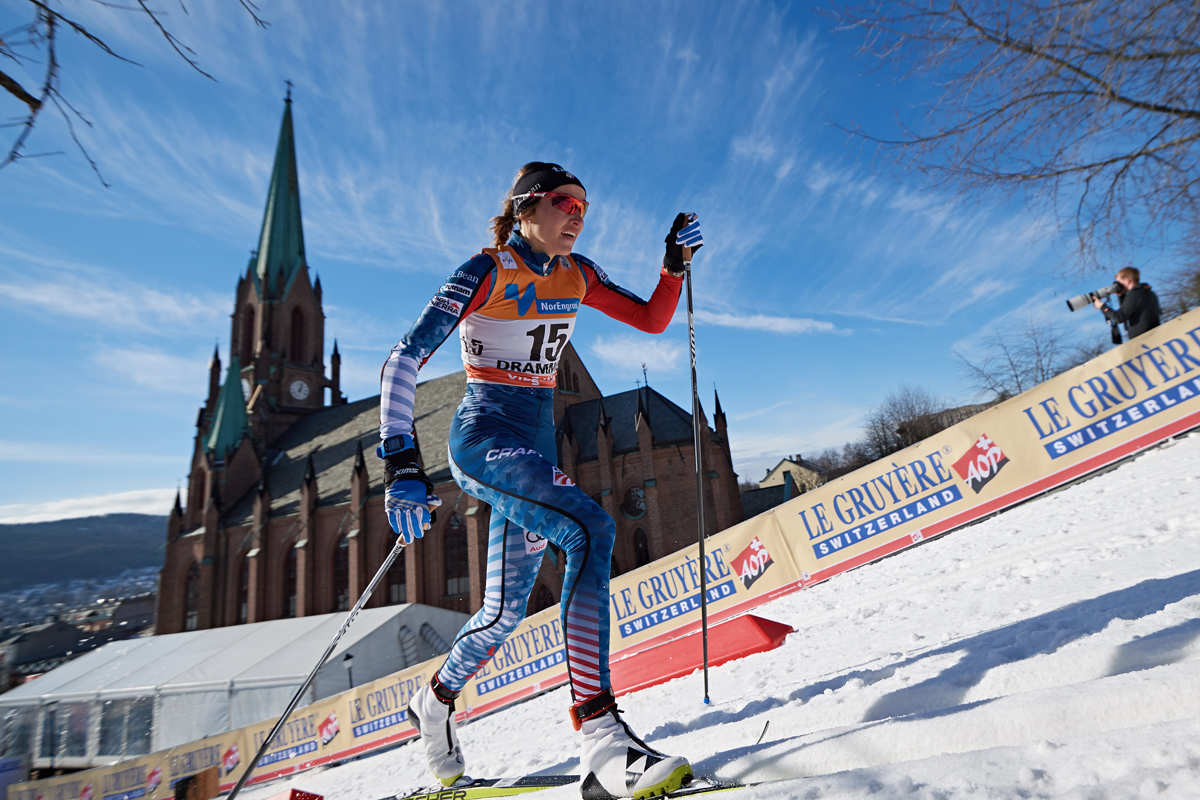
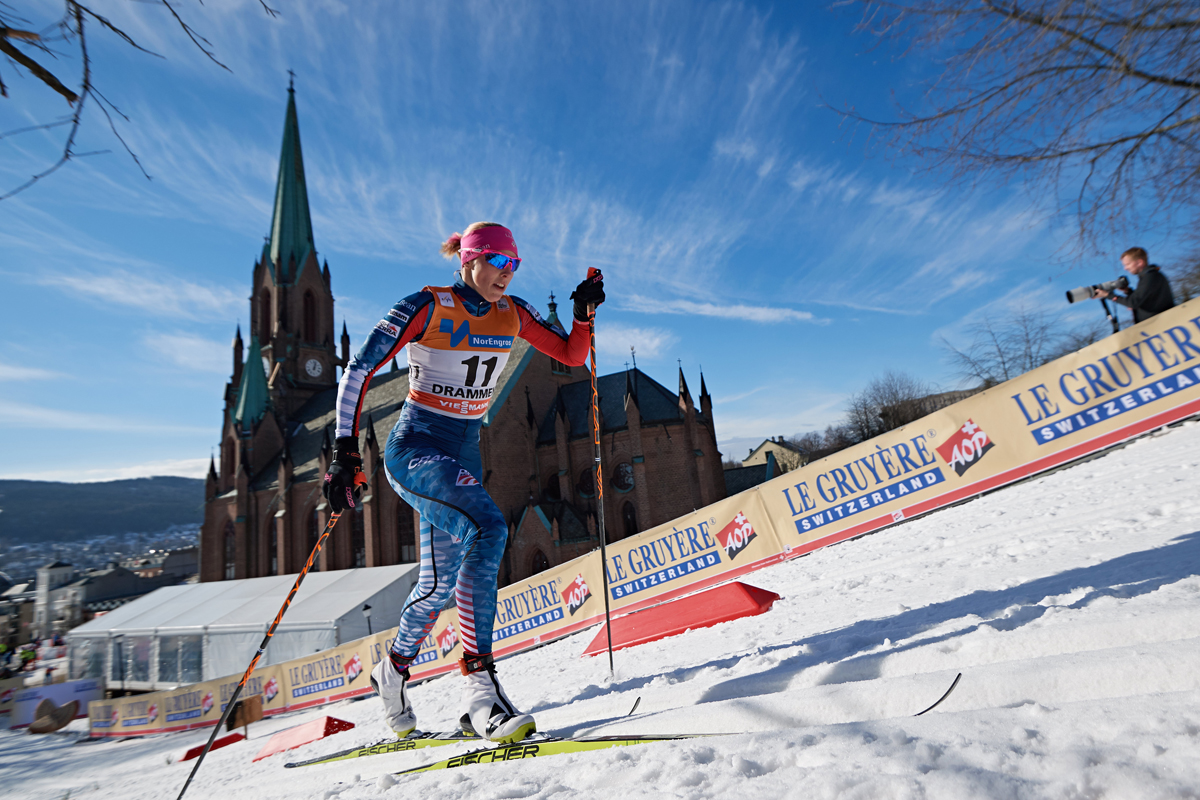
Sophie Caldwell (U.S. Ski Team) striding to 11th in the women’s 1.2 k classic sprint qualifier at Wednesday’s World Cup in Drammen, Norway. She went on to place ninth overall. (Photo: Fischer/NordicFocus)
Bjornsen and Diggins ended up 21st and 26th on the day, respectively. Leading their team, Caldwell reached the semifinals and ultimately placed ninth overall.
In an in-person interview after the race, she told FasterSkier that she was particularly pleased with her qualifier considering her past results in Drammen. Before Wednesday, had never cracked the top 10 there.
“The first three years I raced in Drammen, it was just a really hard course for me for some reason and I found myself not qualifying, but not even close to qualifying, like, back in the end of the pack,” Caldwell said. “Last year I figured out how to qualify and I was just thrilled to have qualified so this year it was one step further making the semis so I’m really happy with that.
“It’s still a tough course for me,” she added. “It’s so gradual that it’s a really good course for power skiers and that’s been something I’ve been working on a lot, but power skiing for classic for sure isn’t my strength. … I think that’s probably why it’s been so difficult for me in the past but I’m really happy with today.”
Third in her quarterfinal, just 0.79 seconds behind Norway’s Ingvild Flugstad Østberg, who won it, and half a second behind another Norwegian, Kathrine Rolsted Harsem, who automatically advanced in second, Caldwell reached the semifinals as a lucky loser — along with Finland’s Aino-Kaisa Saarinen in fourth (+0.95) in that heat.
Caldwell went on to place fifth in the second semifinal, 1.44 seconds behind Sweden’s Ida Ingemarsdotter in first. The American had put herself in third behind Pärmäkoski and Harsem before Ingemarsdotter hammered up the finishing straight to take the win.
“There was a little jostling around both on the downhill and up the final stretch,” Caldwell explained. “I kind of tried to cut inside Ida on the downhill and she moved in front of me so then I switched to the other side, then coming back up this way, Ida sort of hopped in the track in front of me so I went to move to the other one without knowing [Slovenia’s Katja Višnar] was coming up on the side so I had to bop back. There was a lot of bouncing around, but that’s part of the game. You want to be aggressive, but you want to be fair, and I think that’s something I’ve always tried to do.”
Also for the U.S., Rosie Brennan finished 37th in the qualifier and Ida Sargent was 42nd. Canada’s lone woman racing on Wednesday, Dahria Beatty, who turned 23 on Tuesday, finished 48th.
The women’s 1.2 k classic sprint podium at Wednesday’s World Cup in Drammen, Norway, with Sweden’s Stina Nilsson (c) in first, Finland’s Krista Pärmäkoski (l) in second and Sweden’s Hanna Falk (r) in third. (Photo: Fischer/NordicFocus)
As the day progressed, Sweden’s Nilsson continued to pick up steam. Coming off a World Championships in which she earned one medal (silver in the 4 x 5 k relay) and placed 12th in the freestyle sprint, the world’s second-ranked sprinter (behind Falla) had something to prove.
She started by posting the fourth-fastest qualifying time, 1.54 seconds behind Pärmäkoski, then won her quarterfinal and first semifinal before dusting her competition in the final. While Nilsson followed the lead of fellow Swede Linn Sömskar in the quarterfinal and drafted off Diggins on the downhill to slingshot to first before the finishing stretch, Nilsson took a backseat to Østberg in the semifinal. With energy to spare, Nilsson and her teammate Falk pounced on the long grind to the finish, placing first and second, respectively, while Østberg dropped to fourth behind Lampič in third.
In the final, Nilsson didn’t bother with games. She led out of the start, with Harsem following in second up the first double-pole section of the initial climb. While Nilsson continued to lead over the top, Falk and Pärmäkoski ended up duking it out for second place. Pärmäkoski double poled hard up the finishing straight to move into second, which she took by 0.84 seconds over Falk for her first World Cup sprint podium. Nilsson powered to the win in 3:07.57 minutes, 0.42 seconds clear of Pärmäkoski and 1.42 seconds ahead of Falk.
The remaining finalists, Harsem finished fourth (+3.27), Ingemarsdotter was fifth (+4.86), and Lampič, the U23 World Cup leader, placed sixth (+9.67).
The victory was Nilsson’s eighth of the season and puts her 42 points behind Falla with one sprint to go — a freestyle sprint in Quebec City next Friday, where 50 points for a win are on the line.
“I thought I could win and this feels really great,” Nilsson told the International Ski Federation (FIS), according to a press release. “I was sure Maiken would win the sprint globe today. I don’t think it’s possible still to win it, but there is still a chance and I will travel to Quebec and try my best.”
For Pärmäkoski, the podium showed her continued momentum after two World Championships medals (second in the 15 k skiathlon and third in the relay).
“I am really happy,” she told FIS. “I wasn’t sure how I would feel after the championships but I felt really strong today.”
Falk is third in the overall sprint standings, 154 points behind Nilsson and 29 points ahead of Norway’s Heidi Weng in fourth. At World Championships, Falk missed a medal in the skate sprint in fourth.
“This makes up a little bit for my fourth place finish at the World Championships, so it feels good to come here today and get a podium,” Falk said.
The last European World Cup races of the season will take place Saturday and Sunday with the famous Holmenkollen 30/50 k mass starts near Oslo. This year, those races are classic technique. The men race on Saturday at 12:45 p.m. Central European Time (6:45 a.m. Eastern Standard Time) and women start at noon CET (5 a.m. Eastern Daylight Time) on Sunday.
Kikkan Randall (U.S. Ski Team) during the women’s 1.2 k classic sprint qualifier on Wednesday at the World Cup in Drammen, Norway. (Photo: Fischer/NordicFocus)
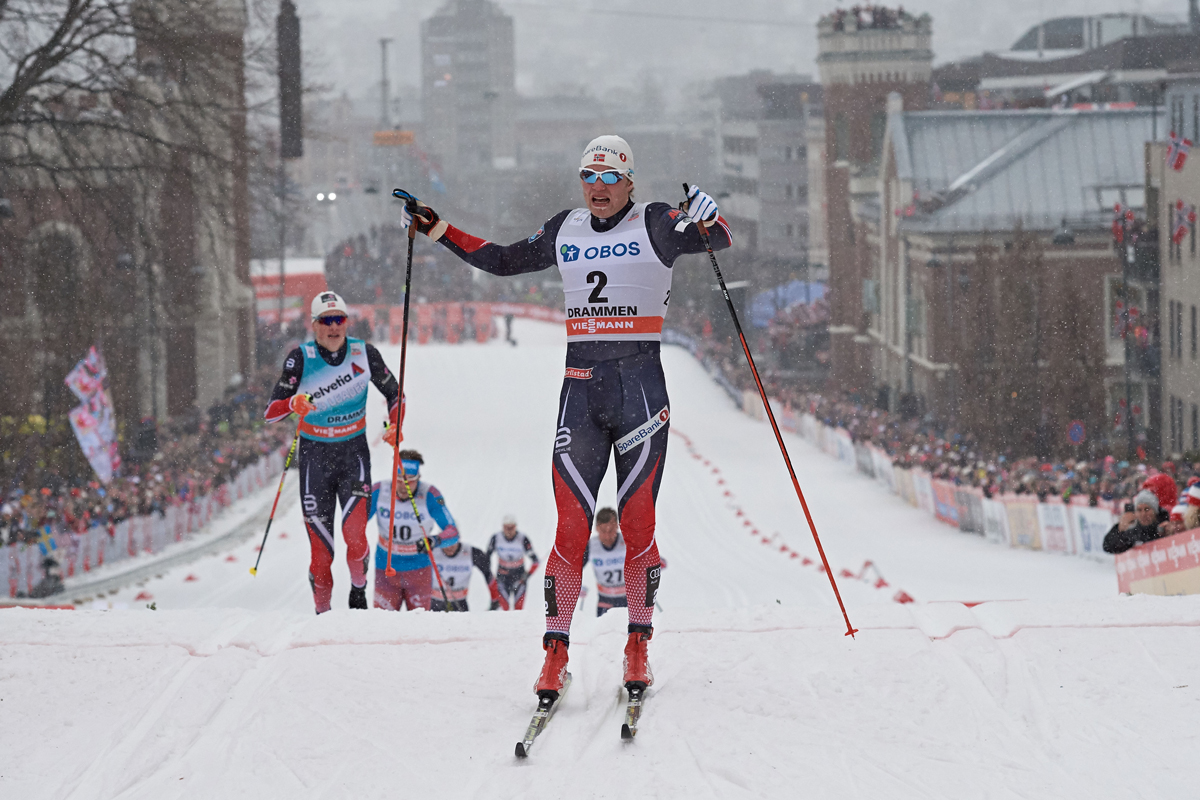
Norway’s Eirik Brandsdal (2) crossing the line first for his first World Cup victory in two years in the men’s 1.2 k classic sprint on Wednesday at the last World Cup classic sprint of the season in Drammen, Norway. He beat out fellow Norwegian Johannes Høsflot Klæbo (l) and Russia’s Sergey Ustiugov (10), respectively, for his first win since the 2015 Drammen classic sprint. (Photo: Fischer/NordicFocus)
DRAMMEN, Norway — The stage was set around 1:30 p.m. Wednesday when a homegrown Norwegian made good in front of a spectator-lined 1.2-kilometer classic course smack-dab in the middle of Drammen’s city center. It was a day of contrast that began with blue skies and ended with a deep chill and falling snow as thumping music pounded and the gothic Bragernes Church loomed. In between, the clouds amassed and the classic tracks stayed firmed for the Drammen city sprint.
As the host country, Norway was blessed with more skier starts for the midweek World Cup sprint. That, however, looked like a curse for every other nation competing. Thirty-three percent of the eventual top 30 finishers were from Norway — 10 out of 30 — and five of six in the final. We’ll get to that in a bit.
The qualifier was owned in every sense of the word by Norway’s 20-year-old Johannes Høsflot Klæbo. He was first in the qualifier by what some may consider a whopping 3.62 seconds. He stopped the clock at 2:33.81. around the one-loop course, which went up, then down again, and then up again. Klæbo’s Norwegian teammate Eirik Brandsdal was second in the qualifier with a time of 2:37.43.
And if that time margin wasn’t a stunner, consider this. The day also marked the first time a World Cup sprint included two no-double-pole (DP) zones. During his qualifier, Klæbo came out of the first no-DP zone and stumbled, momentarily looking as if he was about to fall. His iconoclastic high-tempo, run-ski up steep hills is already a winning trademark, but in this instance it almost doomed him.
That, of course, didn’t happen — he cruised in cool if not for his furious speed.
All of this set the young Norwegian up for stardom. The World Cup’s season-long U23 leader came into Drammen ranked second overall on the World Cup sprint list with 289 points, just behind Italy’s Federico Pellegrino with 309 points. Pellegrino placed 12th on Wednesday, while Klæbo advanced to the finals.
But perhaps the principle animator on the day was none other than Norway’s Petter Northug. After qualifying 27th, Northug looked rejuvenated in the first quarterfinal. Coming up the gradual mostly double-pole-able climb to finish, it was a Northug double-pole drag race in which he began the grind in sixth. In his famous fashion, he pulled away from the field, crossed the line, then U-turned in front of the oncoming skiers and chest-thumped. It was a throwback to his earlier dominance. And yes, the fans drank from the Northug Kool-Aid.
Northug eventually advanced to the final as the second lucky loser after placing fourth in his semifinal, 3 seconds behind Klæbo, who won that heat.
Another skier to make the final was Norway’s two-time Drammen classic-sprint winner, Brandsdal. His 2015 Drammen win was his last World Cup victory.
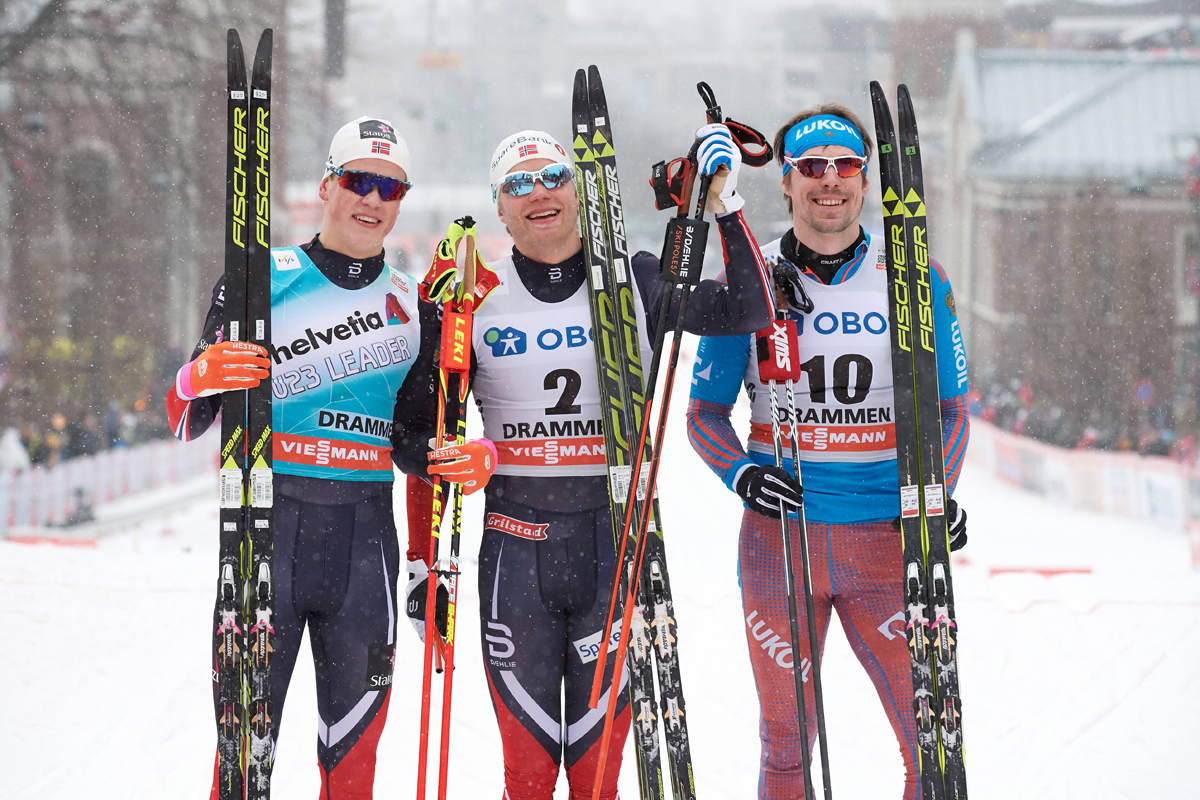
The men’s World Cup 1.2 k classic sprint podium on Wednesday in Drammen, Norway, with Norway’s Eirik Brandsdal (c) in first and Johannes Høsflot Klæbo (l) in second, and Russia’s Sergey Ustiugov (r) in third. (Photo: Fischer/Nordic Focus)
Recall that Wednesday’s race was one of contrast. There was the upstart Klæbo. There was Northug’s theatrics. And there was Brandsdal’s steady state skiing.
He had been second in the qualifier, first in his quarterfinal, second in his semi, and untouchable in a final that featured these four other Norwegians: Klæbo, Northug, Pål Golberg, and Sondre Turvoll Fossli and Russian super-skier Sergey Ustiugov.
Up the everlasting final stretch to the feet of the old Bragernes Church, it was initially a Klæbo-Brandsdal dual. That didn’t last long as Brandsdal closed out hard, winning the day for his third-career Drammen victory. Klæbo placed second (+2.55), and Ustiugov third (+3.28) for the Russian’s seventh-straight podium, including five medals in five races at World Championships. Northug finished fourth (+4.5), Golberg fifth (+5.99), and Fossli sixth (+12.42).
Norway’s Eirik Brandsdal (2) crossing the line first for his first World Cup victory in two years in the men’s 1.2 k classic sprint on Wednesday at the last World Cup classic sprint of the season in Drammen, Norway. He beat out fellow Norwegian Johannes Høsflot Klæbo (l) and Russia’s Sergey Ustiugov (10), respectively, for his first win since the 2015 Drammen classic sprint. (Photo: Fischer/NordicFocus)
“That was hard,” the 30-year-old Brandsdal told the International Ski Federation (FIS) after. “… It feels good to be back on top of the podium again.”
With his second place and Pellegrino’s stall out in the quarterfinals, Klæbo now leads the sprint standings over the Italian, 369 points to 331.
“I will travel now to Quebec and won’t race Holmenkollen this weekend,” Klæbo told FIS. “I just got the sprint leader’s red bib and I will fight to keep it in Quebec and take the Crystal Globe.”
One World Cup sprint remains: a freestyle sprint to start the three-day World Cup Finals in Quebec City next week.
Sunday’s 50 k world champion Alex Harvey was sprint worthy in Drammen. He finished the day in eighth overall after qualifying 18th, winning his quarterfinal, and taking fourth in his semifinal, 4.41 seconds behind Ustiugov, who won that heat.
“I’ve been feeling good, I mean, I’ve never made the semis here in Drammen so it’s the best race of my life here on this course, so feeling good,” Harvey told FasterSkier after being eliminated in the semifinals.
Now the sport’s king in the World Cup’s longest race, the 50 k, Harvey lamented the Drammen course’s short nature. “It’s short. 2:40 [minutes],” Harvey said. “It’s way too short for me. I need a bit closer to three minutes to be able to do something.”
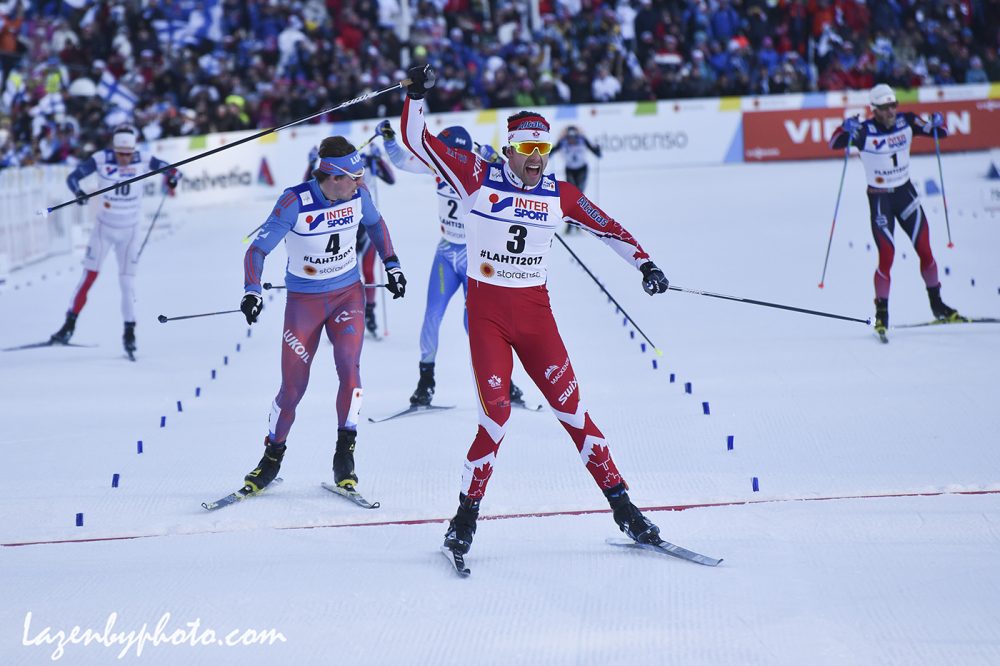
Canada’s Alex Harvey (5) celebrating his first individual World Championships gold after winning Sunday’s 50 k freestyle mass start on the last day of 2017 Nordic World Championships in Lahti, Finland, ahead of Russia’s Sergey Ustiugov (4), Norway’s Martin Johnsrud Sundby (1), and Finland’s Matti Heikkinen (2), respectively. (Photo: John Lazenby/Lazenbyphoto.com)
Prior to the upcoming World Cup Finals, which will be held in Harvey’s hometown March 17-19, the Canadian ranks fourth overall on the World Cup leaderboard, 65 points behind Finland’s Matti Heikkinen in third and 104 points ahead of Sweden’s Marcus Hellner in fifth. Neither raced Wednesday’s sprint.
Asked precisely what he was hunting as the World Cup winds down, the 28-year-old Harvey was succinct.
“The top three overall, for sure,” he said. “This is already a good step forward today, got around 20 points or something like that. I know that especially the races in Quebec are a good format for me. If you’re good in the sprint, I can get a bit of an edge on Heikkinen for the last day, for the pursuit start, and with double points there, it can go pretty fast.”
Also advancing to the quarters for Canada was Len Valjas after qualifying 21st (+7.97). Initially the 28-year-old Valjas looked poised to advance beyond the quarters as he was announced the winner of a photo finish with Russia’s Alexander Bolshunov for second place behind Harvey. But the replay showed a fine line as Valjas appeared to make a gutsy move in the closing meters. The race jury ruled that Valjas obstructed Bolshunov by skirting around and in front of him at the finish, and relegated Valjas to last in the heat for 27th overall.
One American man reached the heats: Andy Newell, who began the day qualifying in 13th (+6.45). The U.S. Ski Team member placed fourth in his quarterfinal, 1.7 seconds behind Brandsdal who won the heat, and did not advance to the semifinals to end up 18th overall.
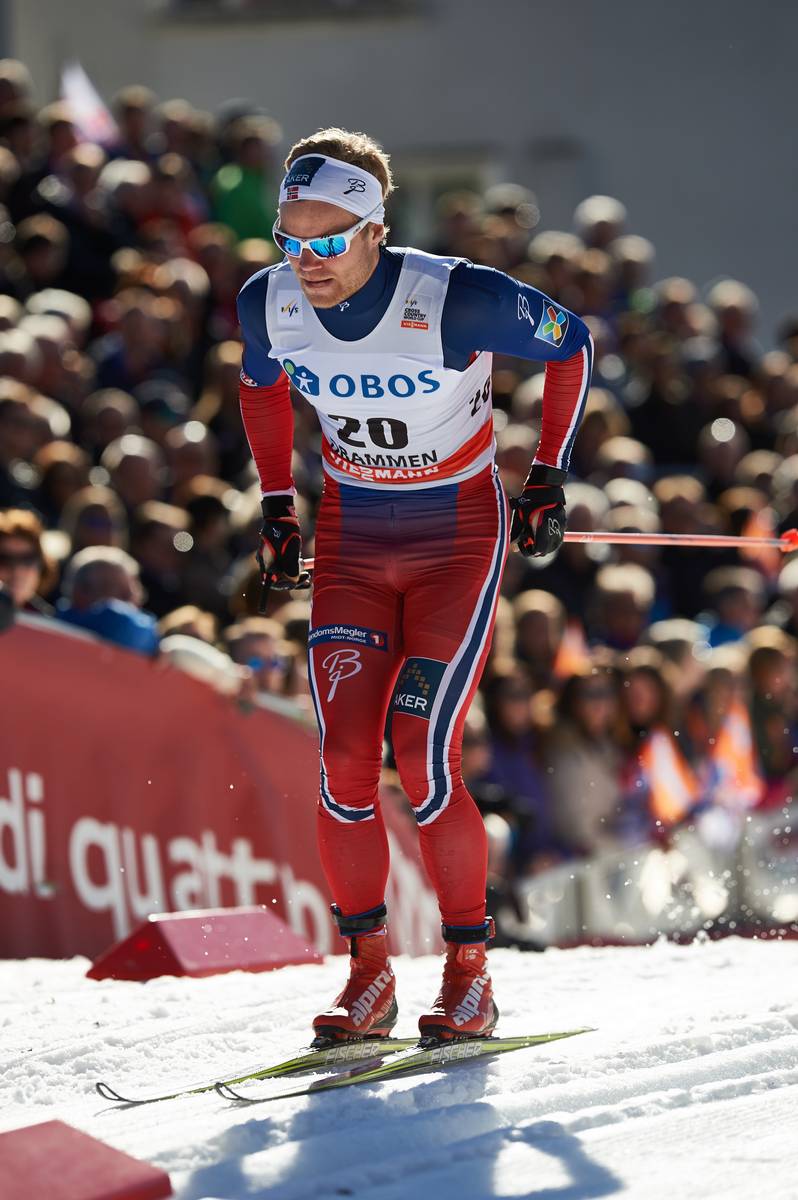
Andy Newell (U.S. Ski Team) racing to 13th in the men’s 1.2 k classic sprint qualifier at Wednesday’s World Cup city sprint in Drammen, Norway. Newell went on to finish fourth in his quarterfinal for 18th overall. (Photo: Fischer/NordicFocus)
“I felt good today,” Newell said after, “so it’s a shame not to move on to the final. I really was hoping to do that here, this is one of my favorite sprints. I love this atmosphere here and I love Drammen. It’s definitely one of the hardest sprints, competitive sprints, but for me it’s just really fun. So yeah I’m bummed not to advance … But I am feeling good, so I can’t complain.”
Newell added insight into the no-double-pole zones in play, explaining that he learned of the new rule with little time to spare.
“They have been trying them in Scandinavian Cup races and this is the first time they have ever done it on a World Cup,” he said. “It was weird because they literally told us they would have no-double-pole zones, or striding zones, an hour before qualifications. So a lot of us waxed skate skis that we were going to test in anticipation that it would be a double-pole race, because it’s really good conditions for double-pole now. So that was obviously the end of that.”
Also for the U.S., Simi Hamilton placed 42nd in the qualifier, 1.69 seconds out of the top 30 needed to qualify, but the disqualification of two other skiers for receiving their second yellow card — Norway’s Finn Hågen Krogh and Sweden’s Emil Jönsson — moved Hamilton up to 40th. (Krogh was disqualified after racing in the same semifinal as Harvey, and Jönsson was disqualified in the quarterfinals.) Also for the U.S., Erik Bjornsen (U.S. Ski Team) finished the day in 44th, and Ben Lustgarten (Craftsbury Green Racing Project) 62nd.
Canada’s third skier, Russell Kennedy (Canmore Nordic/Team R.A.D.) was 63rd in his first overseas World Cup race.
(From l-r) Canada’s Lenny Valjas, Andy Newell of the U.S., and Norway’s Pål Golberg (9) at the finish line of their quarterfinal heat in the World Cup freestyle sprint in Drammen, Norway. Newell advanced to the semifinals and ended up 12th overall, while Valjas narrowly missed advancing and placed 14th. (Photo: Fischer/Nordic Focus)
American Andy Newell ended his World Cup season on a high note, finishing as the top North American in Wednesday’s 1.3-kilometer classic sprint in Drammen, Norway. He reached the semifinals before finishing 12th overall.
Newell qualified in 28th, 5.48 seconds behind top qualifier Ola Vigen Hattestad of Norway (2:36.48).
Canada’s Lenny Valjas during of the World Cup classic-sprint qualifier in Drammen, Norway. Valjas qualified 19th and placed 14th overall. (Photo: Fischer/Nordic Focus)
Lenny Valjas of Canada qualified in 19th (+4.90) and was the only other North American male in the quarterfinals. He and Newell ended up racing in the fifth quarterfinal.
In that heat, Valjas held a slim lead until Newell and Norway’s Pål Golberg passed him in the final stretch. The Canadian finished in third, just 0.72 seconds behind Golberg, who won the heat in 2:39.43, while Newell lunged to a second-place finish, 0.43 seconds back.
Valjas would finish 14th overall. He did not immediately respond to an email for comment.
Newell said in a phone interview that he felt strong during his quarterfinal heat, deciding to go with kick wax while trying to stay near the front throughout the heat.
“I was able to do that in the first climb and get a good draft on the downhill. I felt good striding up to the finish line and was able to move on pretty comfortably,” he said.
Newell, who is coming off an eighth-place finish in Saturday’s freestyle sprint in Lahti, Finland, explained that he had a yellow card on his record and had to be especially careful to avoid skating, a risk on the steep hill where many of the racers were herringboning.
“You can be skating very easily trying to do that,” he said. “I think there were definitely some sketchy techniques going on out there, so I went into that hill doing my best to be really under control and not herringboning too much.”
In the semifinal, Newell finished sixth, 8.75 seconds behind winner Sondre Turvoll Fossli, who won in 2:35.41.
Newell said that although he was happy to reach that round, he wished he could have been more competitive. The quick turnaround from the final quarterfinal heat left him fatigued, he said.
“I just got stuck in the back going over the tops of the hills and into the drafts,” he explained.
Newell wanted to establish a good position to catch a draft on the long downhill, but became stuck behind Russia’s Nikita Kriukov, who was herringboning the uphill.
“I had to herringbone behind him as well, and he wasn’t going as fast as some of the guys that had kick wax,” Newell said. “We did come back on the downhill, but because he had skate skis he wasn’t a great person to draft behind because he pulled away from me and I was left in no-man’s land on the downhill. And then I didn’t carry quite enough speed on the corner.”
Andy Newell (U.S. Ski Team) at the 1.3 k classic sprint in Drammen, Norway. He placed sixth in his semifinal for 12th overall. (Photo: Fischer/NordicFocus)
Newell finished the season 18th in the overall Sprint World Cup, despite missing one sprint and failing to score in two others.
He explained he was pleased to be able to turn his season around after suffering from a slow start, injuries and adversity, particularly a neck injury and a reoccurring allergic reaction, earlier in the season.
“As far as an overall sprint year, it was not super successful, but I was able to learn some things and turn it around at the end of the season,” Newell said. “It’s always nice to finish pretty strong.”
Canada’s Alex Harvey, who took a silver medal in the classic sprint at the 2015 World Championships and bronze in the skiathlon, missed qualifying by 0.7 seconds in 33rd (6.53 seconds behind the qualifying winner) and ended the season 13th in the sprint standings.
Other American men racing on Wednesday included Erik Bjornsen in 38th (+7.16), Dakota Blackhorse-von Jess in 42nd (+7.55), and Simi Hamilton in 65th (+13.56). Hamilton crashed late in his qualifier to take him out of contention.
Sadie Bjornsen Qualifies Ninth
Sadie Bjornsen was the lone North American woman to qualify for the heats, finishing ninth, 5.22 seconds behind Norway’s Ingvild Flugstad Østberg, the top female qualifier in 3:01.25.
Sadie Bjornsen (U.S. Ski Team) racing to ninth in the 1.3 k classic-sprint qualifier on Wednesday at the World Cup in Drammen, Norway. In the last sprint of the season, Bjornsen went on to place sixth in her quarterfinal for 26th overall. (Photo: Fischer/NordicFocus)
However, Bjornsen ended up in the fastest quarterfinal, which Norway’s Astrid Uhrenholdt Jacobsen won in 3:00.33, and placed sixth (+2.87) to finish 26th overall.
Bjornsen said in a phone interview that it is unfortunate she was put a heat with so many fast skiers, but her time in the heat still left her encouraged.
“Even though I was last in my heat, I was skiing faster than most of the other heats, so there’s definitely some positive things to take away,” she said.
Bjornsen explained that her strategy in the quarterfinal was simply to ski as hard as she could and try to keep contact with the front. She said she had a strong start, but became caught behind the other skiers. Once she had to slow down, she had a difficult time regaining speed. It is something she says she has struggled with throughout the season.
“I ended up skiing from the back the whole time, and every time I tried to find a hole, it was quickly covered,” she explained. “It was a bit frustrating, but those are all really good skiers so it was hard to find my way to the front.”
Bjornsen was able to make contact with the leaders at the bottom of the course’s steep hill, but got tangled up in the back while climbing the other side and was not in an ideal position when she reached the finishing stretch.
“The hills were steep and narrow and tricky,” she said.
Despite temperatures above 50degrees Fahrenheit, skis were not an issue for her.
“I definitely had awesome skis,” she explained.
Even though she was not able to reach the semifinals, Bjornsen is encouraged by how she qualified.
“I feel like this year I’ve sort of struggled. There have been many races where I’m just barely qualifying or on the other side of not qualifying,” she said. “I was definitely really happy to finish the last sprint of the year knowing that I can qualify in the top 10.”
Although she has not had as many top results as during the 2013/2014 World Cup season, Bjornsen said this season has been a step in the right direction. She finished 24th in the sprint standings.
“It’s easy to be greedy and just want to have those high races … but I’ve finally found a level of consistency. And I do believe this is the next step,” she said.
She explained that this winter she has raced more than ever, and hopes for even better results next season after a good summer of training.
American Sophie Caldwell placed 35th in qualifying in Wednesday’s World Cup freestyle sprint in Drammen, Norway. (Photo: Fischer/Nordic Focus)
Meanwhile, her teammate Sophie Caldwell missed out on qualifying by 1.18 seconds, placing 35th (+11.59). She finishes the season 20th in the sprint standings.
She wrote in an email that she was not very satisfied with her qualifier and felt like she skied frantically.
“I’ve been fighting a little sickness the past few days, but it never got bad enough to consider not racing. I felt a little flat and tired, but mostly just frantic,” she explained.
She wrote that she tends to struggle with the Drammen course due to the power striding and double poling, and is going to work hard to improve those techniques during the offseason.
“I’ve never qualified in Drammen, but one of these years that’s going to change!” she wrote.
American Kikkan Randall, who reached the podium in third in Saturday’s freestyle sprint in Lahti, qualified in 45th (+18.03), while Caitlin Patterson was 51st (+19.73) for the U.S.
No Canadian women competed on Wednesday.
The 2014/2015 World Cup season finishes this weekend at Holmenkollen in Oslo, Norway, with the men’s 50 k and women’s 30 k freestyle mass starts.
The all-Norwegian men’s classic sprint podium in the last World Cup sprint of the season on Wednesday in Drammen, Norway: (from left to right) runner-up Finn Hågen Krogh, winner Eirik Brandsdal, and Ola Vigen Hattestad in third. (Photo: Fischer/NordicFocus)
Wednesday’s 1.3-kilometer classic sprint in Drammen, Norway, was essentially two races in one: the race for the win and the race for the overall Sprint World Cup.
Drammen marked the final World Cup sprint this season. Going into the race, Norway’s Finn Hågen Krogh led the Sprint World Cup with 399 points, 33 points ahead of Italy’s Federico Pellegrino and 57 points ahead of fellow Norwegian Eirik Brandsdal.
All three men were still mathematically eligible to win the overall title. Brandsdal won last weekend’s freestyle sprint in Lahti and neither Krogh nor Pellegrino had ever qualified for the final in Drammen. Pellegrino had only qualified for one World Cup classic-sprint final in his career.
Eirik Brandsdal racing to the victory in the men’s 1.3 k classic sprint in Drammen, Norway. While he won the race, he took second overall in the Sprint World Cup to teammate Finn Hågen Krogh. (Photo: Fischer/NordicFocus)
Over the course of the qualification round, the snow at Drammen turned very soft with temperatures around 50 degrees Fahrenheit. Earlier in the morning, organizers hauled in two truckloads of snow to slow the rate of thawing on the course. Several skiers opted to use skate skis and take their chances double poling instead of making decisions regarding classic skis and what to use for kick.
As the first quarterfinal heats got underway, it appeared that Norwegian Petter Northug’s decision to use skate skis over classic might be the way to go. He had very fast skis and only lost to Brandsdal in a photo finish. Brandsdal took the quarterfinal win in 2:37.55, and both advanced to the semifinals.
One-third of the race for the Sprint World Cup was decided after the first quarterfinal. Pellegrino finished fifth, 2 seconds behind Brandsdal, ending his chance of winning his first ever overall sprint title.
Last year’s Drammen and overall Sprint World Cup champion, Ola Vigen Hattestad of Norway was a decisive winner in heat two. He qualified in 2:35.91, and teammate Timo Andre Bakken advanced as well, 1.71 behind.
Krogh kept his title hopes alive when he and Russia’s Anton Gafarov advanced out of the third quarterfinal. Krogh won it in 2:38.34, and Gafarov was 0.21 seconds behind in second.
Also advancing to the semifinals were Russia’s Sergey Ustiugov and three more Norwegians: Sondre Turvoli Fossili, Pål Golberg and Fredrik Riseth. American Andy Newell qualified as well.
It was an all-Norwegian lineup for the first semifinal. Still on skate skis, Northug jumped out to a fast start and lead up the first climb, but in the slushy conditions, he fell behind quickly and never came back into contention. Brandsdal dominated the race, crossing the line first at 2:36.3, ahead of Hattestad in second.
Fossli and Ustiugov advanced from the second semifinal, as did Russia’s Nikita Kriukov in third. Fossil’s winning time was 2:35.41, Ustiugov finished 0.39 seconds back, and Kriukov was 0.61 seconds back in third. Kriukov and Krogh advanced as lucky losers.
The finals were set, with two Russians Ustiugov and Kriukov, and four Norwegians: Brandsdal, Fossli, Hattestad, and Krogh. With his spot in the finals, the sprint title was wrapped up by Krogh before the final started. His margin over Brandsdal was too big of a deficit for Brandsdal to overcome even if he won.
Norway’s Finn Hågen Krogh placed second in Wedneday’s classic sprint in Drammen, Norway, to secure his first Sprint World Cup Crystal Globe. (Photo: Fischer/NordicFocus)
At the start, Ustiugov led up the first climb and started to pull away from the pack. The group started to string out with Ustiugov leading to the second hill then an unforced error took out the two Russians at the same time.
Ustiugov on skate skis tried to herringbone up the second hill in the middle lane. Since he had no grip he tried to cut the corner short by going to the inside. He wasn’t aware that Kriukov was there and both men collided and lost momentum. Kriukov was later relegated to last in the heat.
With this happening at the back of the pack, the Norwegian train with Hattestad up front rocketed down the hill towards the finish. On the last turn, Brandsdal ultimately made the winning move, gliding past Hattestad and into the lead. He crossed the line first at 2:38.18. Krogh followed Brandsdal past Hattestad as well and finished second, 0.56 seconds later. Hattestad held onto third to complete the all-Norwegian podium.
“The World Championships in Falun did not go as I had planned. I wanted to end the season strong,” Brandsdal told FIS after the race. “I did everything I could to fight for the crystal globe for the sprint.”
While he didn’t get it, Brandsdal did win his sixth World Cup race.
Krogh used his disappointment from not being named to Norway’s World Championships sprint team as motivation.
“I have little to put a finger on what has been bad this season. Everything has gone according to plan,” Krogh told NRK, according to a translation. “This has been a bright season.”
This Sprint Crystal Globe was Krogh’s first. He won it by 57 points over Brandsdal and 103 points over Pellegrino. Hattestad won it last season, ahead of Brandsdal in second, and Brandsdal was third in the sprint overall in 2011/2012.
Maiken Caspersen Falla (NOR, left) leading a quarterfinal heat in Val Mustair, Switzerland, earlier this season. On Wednesday, Falla picked up the final sprint win of the season. (Photo: Fischer/Nordic Focus)
The final sprint of the 2014-2015 FIS World Cup season was held on Wednesday in Drammen, Norway. There were two races in one: a race for the win in Drammen, and the second a race for the season’s overall sprint title.
Heading into the day, a trio of Norwegian skiers were on top of the Sprint Cup leader board. Marit Bjørgen had the lead with 550 points, ahead of Ingvild Flugstad Østberg with 510 points and Maiken Caspersen Falla with 412 points.
Østberg needed to win Drammen to take the title; Bjørgen needed to finish in 4th place or better.
Bjørgen was the favorite to win her second crystal globe of the season, already securing the overall World Cup title, but Østberg and Falla weren’t ready to give their more veteran teammate the Drammen win without a fight.
“It will be hard to beat Marit but I will give everything I have and give her a struggle,” Østberg said to NRK before the race. “Whoever is best is best. If the winner is Marit then it is very much deserved.”
Before the race, Bjørgen commented with her signature brand of diplomacy, but also a bit of nationalism.
“40 points is not much,” she told NRK. “It will be a tough challenge and the fight is still warm. The main thing is that whoever wins is Norwegian.”
Coming out of the prologue Østberg was the fastest qualifier at 3:01.25, with Katja Visnar of Slovenia second (+1.18) and Bjørgen third (+2.40).
But in the end, Falla proved that it isn’t how you qualify but rather how you finish the race that matters most. That started in the quarterfinals, where Falla fell early in her heat and teammate Astrid Uhrenholdt Jacobsen took the win. Falla came back to finish second, +0.29. In a packed heat, Østberg was third, +0.49, and also advanced along with Aino-Kaisa Saarinen of Finland as lucky losers.
Meanwhile, Bjørgen easily won the third quarterfinal heat gliding away from teammate Heidi Weng, who also advanced.
Other quarterfinal qualifiers were Sweden’s Stina Nilsson, Visnar, Norwegian teammates Kathrine Rolsted Harsem and Kari Vikhagen Gjeitnes, Sweden’s Hanna Falk, and Finland’s Anne Kyllönen.
Again in the semifinals, things didn’t go perfectly for Falla. Østberg showed increased speed and aggression compared to her quarterfinal heat, leading from start to finish. Weng finished second, 1.42 behind, and Falla finished third, lucky to advance on time. Bjørgen and Nilsson skied together for their entire semifinal, and qualified together for the final.
Showdown in the Finals
At the start, Bjørgen was struggling and seemed to be fighting herself as much as the other competitors. She was boxed in between Nilsson and Weng and fought to get position into the track. When Nilsson switched lanes she hit Bjørgen’s skis, causing her to stumble, and as a result the star was in sixth place before the first climb.
If there’s anyone who can come back from such a start on the women’s circuit, it’s Bjørgen. She had to take an outside line in order to get better snow, but was able to work her way to the front to join Falla, Weng and Østberg. As the group of Norwegians descended, Bjørgen was in front for the first time all race.
As the race headed to the finish line Falla stepped out to the left, Bjørgen to the right and it was apparent right away Falla had the faster skis. The two were side by side but Falla double-poled her way past Bjørgen, who was striding and losing ground. Weng caught and eventually passed Bjørgen as well, but the group crossed the finish line within seconds of each other; Falla first, 3:01.37, Weng second (+0.72) and Bjørgen third (+1.51).
“I have to say Drammen is my favorite course,” a happy Falla told FIS. “The crowd was amazing and the atmosphere was thrilling.”
Østberg was fourth 2.49 behind and as a result, second to Bjørgen in the Sprint Cup race.
“I was not sure I could win the sprint crystal globe,” Bjørgen told FIS after the race. “It’s been nine years since I won it last time. I am 34 and I was not sure if I can win it again. I knew I would have the fight with Ingvild.”
Problems With New Heat Selection System
Before her heat even started, Falla had a tougher time selecting her heat than she had hoped. A new system of athlete seeding was started last week in Lahti, Finland, and implemented again in Drammen, in which the athletes in reverse order from their qualification standings got to pick their heat placements. Falla qualified seventh but was not at the podium in time when it was her turn to choose her heat. As a result her heat placement was decided by the race jury.
According to NRK, race director Pierre Mignerey said that Falla was given a verbal message that the elections would start five minutes after the last runner was finished as well as a written notice that it would start 13.25.”
Falla claimed that she was there at the right time but her pick was already decided. Since she missed her time, she was given the time as if she was the 30th fastest qualifier. Eventually she left the podium in tears to prepare for her heat.
“I was angry and really sorry for heat location,” Falla told NRK. “They thought I came late, but I disagree. It is unfair to treat us that way. Every day, almost every hour, I work to succeed at races like this. And then they [FIS] find new rules.”
Mignerey admitted to NRK that FIS had to evaluate whether to continue with the system, as there were also problems in Lahti.
Three Globes for Bjørgen?
With her third place finish today Bjørgen clinched the fifth Sprint Cup crystal globe of her career. The last time she won the sprint globe was in the 2005/06 season. In the end she had 610 points to Østberg’s 560 points and Falla’s 512 points.
Bjørgen has a chance to get the third and final globe of the season on Sunday. The 30 k Holmenkollen mass start race will be the final race for the season and the distance competition. In the distance competition Bjørgen is first with 818 points followed by teammate Therese Johaug with 717 points and Weng with 621 points.
Norwegian Petter Northug (r) edges Kazakhstan’s Alexey Poltoranin by 2.15 seconds in the Wednesday’s 1.3 k classic sprint at the World Cup in Drammen, Norway. (Photo: Fischer/Nordic Focus)
Once Petter Northug gets rolling, he’s tough to stop. Just ask Kazakhstan’s Alexey Poltoranin, who fell victim to the Norwegian on Wednesday in the last few hundred meters of the men’s 1.3-kilometer World Cup classic sprint in Drammen, Norway.
You could also ask Switzerland’s Dario Cologna, who sat out the city sprint to rest up for Saturday’s 50 k freestyle mass start at Holmenkollen in Oslo, Norway. But he probably doesn’t have much to say; things might be a little tense with Northug just 23 points behind him for the overall World Cup crown.
Petter Northug celebrating his first victory in Drammen after dominating Wednesday’s 1.3 k classic sprint at home in Norway. (Photo: Fischer/Nordic Focus)
And coming off two World Championships titles and a 15 k classic victory last Sunday at the World Cup in Lahti, Finland, Northug’s not about to let up.
“It is very amusing that the body is so good,” the 27-year-old told NRK after winning Wednesday’s sprint final, his 27th World Cup victory and first in Drammen, by 2.15 seconds over Poltoranin. “I guess I can only say that I will be very hard to deal with the future.”
Northug also won the qualifier (by 1.68 seconds over teammate Eldar Rønning) and then his quarterfinal (ahead of teammates Paal Golberg and Northug’s younger brother Tomas, who finished second and third in the heat).
In the semifinal, Northug took second to Poltoranin, but not by much: 0.09 seconds. Poltoranin relied on his classic striding to get him up and over the line first, ahead of Northug and Russia’s Nikita Kruikov, who was just 0.4 seconds back in third.
Northug wasn’t going to let that happen again. Sticking with his choice of freestyle skis – which required double poling the entire one-lap course, with one hill in the middle and another incline at the finish – Northug would have to lean on pure strength in the finishing straight.
In the final, Poltoranin broke away on the main climb, skiing alone on the descent. It wasn’t long until Northug’s glide got the best of the Kazakh, and he came close enough to catch Poltoranin’s draft then switched tracks to overtake him.
With a gradual uphill between them and the finish, Northug and Poltoranin began their double-pole battle. Northug quickly gained, and Poltoranin switched to striding, running as fast as he could to hold on. Using every ounce of his explosiveness, Northug prevailed, cresting the hill and stepping over the line first.
Northug points back after beating Alexey Poltoranin on Wednesday in the World Cup classic sprint final in Drammen, Norway.
Northug immediately threw his right arm in the air, then turned around to point at Poltoranin. The seventh-fastest qualifier of the day, Poltoranin put his hand up as well, celebrating his silver.
Kriukov placed third, 4.96 seconds behind Northug. Norway’s John Kristian Dahl and Øystein Pettersen achieved season bests in fourth (+6.22) and fifth (+7.74), and Dario Cologna’s younger brother, Gianluca Cologna was sixth (+11.95).
Out of the start, which was delayed by an intentional false start by Dahl (seeking a break after racing Cologna and Pettersen in the second semifinal), Kriukov lead early. Northug sent Poltoranin a message out of the gate, switching to a track in front of him and forcing Kazakhstan’s leading skier to stand up and slow down.
Of the six finalists, the group was evenly divided by equipment choices on a mostly sunny afternoon with temperatures just below freezing. Three went with skate skis, and three went on classic. Like Poltoranin, Kriukov was one of the latter.
“In the quarterfinals and semifinals I skied on skate skis, but I was not as fast as Petter,” he said at a post-race press conference. “I thought it would be better to go on classic skis in the finals.”
Alexey Poltoranin (KAZ), who finished second to Petter Northug on Wednesday in the World Cup classic sprint in Drammen, Norway. (Photo: Fischer/Nordic Focus)
Poltoranin had no regrets: the 25-year-old believed he’d be faster on classic skis, and he came close.
“I started very fast, but Petter was very strong,” he said. “I am again second, but I am very happy for it.”
Sunday in Lahti, Poltoranin was the 15 k runner-up by nearly 32 seconds. He’s fourth in the World Cup standings, 199 points behind Northug and 115 behind Kriukov in third. A total of 190 points are up for grabs in Holmenkollen on Saturday, and another 350 will be distributed at next week’s World Cup Finals in Sweden.
According to Northug, his own success is a testament to his training and desire to win the second-biggest prize of the season (after a World Championships gold), the Crystal Globe.
“I’ve been very careful about things after I got home from the World Championships,” Northug told NRK, according to a translation. “I’ve done things properly, focused up and tried to keep the throttle in any way up [until] the World Cup is finished.”
Last season, Northug finished third in the overall World Cup rankings to Cologna and Canadian runner-up Devon Kershaw. The Norwegian won the year before in 2010, ahead of Lukas Bauer of the Czech Republic and Sweden’s Marcus Hellner, after placing second to Cologna in 2009.
“The World Championships was the most important; World Cup comes in second,” Northug said. “But I want to finish the season in style.”
Aside from Northug, Norway put on an all-around good show for its home crowd with a total of seven racers in the top 11. Eirik Brandsdal was seventh, Finn Hågen Krogh placed eighth, Sondre Turvoll Fossli was ninth, and Golberg was 11th. Tomas Northug, 22, took 14th to tie his career-best World Cup result.
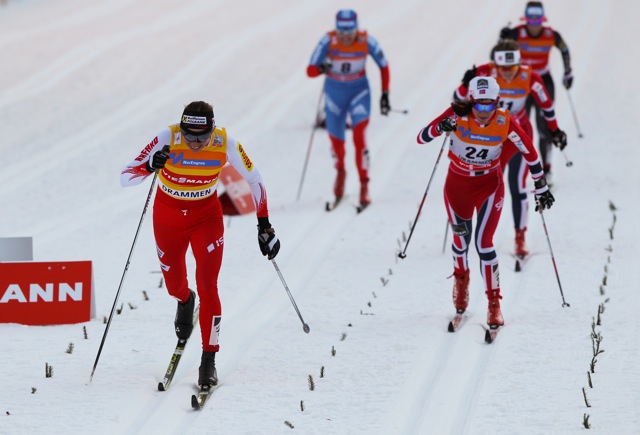
Justyna Kowalczyk (POL) sprints for the finish in Drammen, Norway, to both win the race and secure the overall World Cup crystal globe. Photo: Fischer/Nordic Focus.
There has been no stopping Justyna Kowalczyk (POL) on classic skis lately. In Drammen, Norway, on Wednesday she continued the momentum from her distance win in Lahti and charged to victory yet again, this time in a 1.3 k city sprint. Save for a challenge from Heidi Weng (NOR) in the final round, the Polish star blew the competition away all day, and in the process secured the overall World Cup crystal globe for the 2012-2013 season and for the fourth time in her career.
“It is my first victory in Drammen,” Kowalczyk told the FIS interviewer at the finish. “I felt strong and could enjoy the race when I had secured the Overall World Cup.”
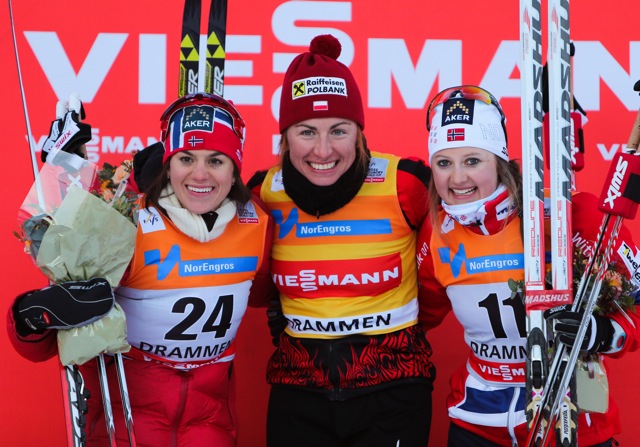
Weng finished second, 0.9 seconds behind Kowalczyk, and compatriot Invild Flugstad Østberg took third (+2.0).
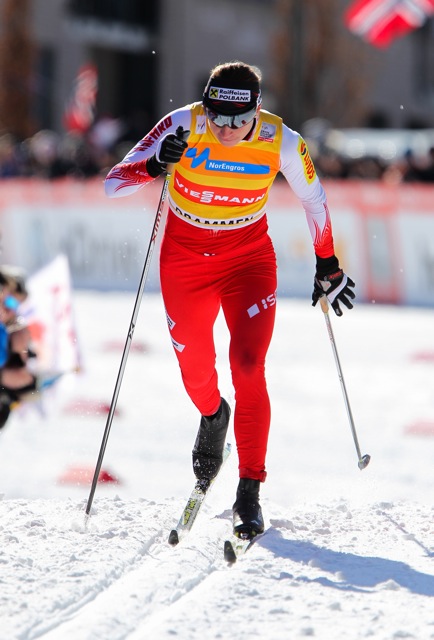
Kowalczyk in qualifying. Photo: Fischer/Nordic Focus.
After qualifying third behind Mona-Lisa Malvalehto (FIN) and Katja Visnar (SLO), Kowalczyk proceeded to stomp to three consecutive wins throughout the heats, leaving no room for doubt as to who the best sprinter on the course was. Marit Bjørgen (NOR), the recently-crowned World Champion, was notably absent due to illness, leaving the door wide open for Kowalcyk to win her quarterfinal by an gaping 1.62 seconds and her semifinal by 0.2 seconds after gapping the field early on.
If Kowalczyk felt the weight of the crystal globe on her shoulders, she didn’t show it.
“I was calm about the competition [for] the overall World Cup,” Kowalczk said on her website. “Today, so much beyond the statistics in this regard for me has changed. Of course, it’s nice, but that day I concentrated mainly on the [race].”
Her surges off the front of the pack in the first two rounds clearly projected Kowalczk’s expected strategy for the final, where she faced the two young Norwegians, Weng and Østberg, along with Evgenia Shapovalova (RUS), Kikkan Randall (USA) and Malvalehto (FIN). Such a field was not one to be trifled with, as Shapovalova had nearly caught Kowalczyk in the final meters of their semifinal, Malvalehto had looked strong all day and Randall was a newly-minted World Cup sprint champion.
It was with some surprise, then, to see Weng take the initiative to make the only attempt to hang onto Kowalczyk when the latter made her predictable blitz to the front. Kowalczyk looked back a few times as the pair drew away from the field, and each time Weng was right behind her.
The women behind them expected the move, and believed Drammen’s winding course and sharp corners would bring them back to the leaders before the finishing straight.
“I knew Kowalczyk would set a fast pace and I knew I could tuck in and conserve energy early,” Randall said. “That final stretch is so crucial every time.”
But the American wasn’t quite aggressive enough to be in a position to contend in that final stretch. Randall got stuck towards the back at the end as Weng and Kowalczk duked it out for gold. It was only in the last few meters, as they drew up to the awkwardly-situated finish line at the top of a short climb, that Kowalczyk was able to bury her challenger. Weng visibly struggled to stride fast enough as Kowalczyk kept double-poling, and when Kowalczyk finally broke into a confident stride she put 0.9 seconds on Weng before they both made an uphill lunge.
Østberg took third, 2.0 seconds back, Shapovalova was fourth (+4.5), Randall finished fifth (+4.7) and Malvalehto fell to sixth (+8.8).
After fighting hard to advance in her previous rounds, Weng said she simply ran out of energy at the conclusion of Drammen’s challenging course.
“I knew there is uphill in the finish and I believed I could be strong in a classic sprint here,” Weng said. “I thought I could beat Justyna but I was very tired in the end, but I am happy for second place.”
In front of an enthusiastic Norweigan crowd, Weng noted that two Norwegians on the podium was especially rewarding.
“Very gratifying that both the Norwegian in the finals ended on the podium,” she told the NRK.
The result is a new personal-best in sprinting for the 21-year-old and only her second career podium on the World Cup in a sprint event.
Østberg was equally happy with third place as it was her first individual World Cup podium ever and brought some satisfaction after a disappointing World Championships, where she failed to advance past the quarterfinals.
“It feels great to be on the World Cup podium for the first time in my career, especially here in Norway,” Østberg said. “The crowds were phenomenal. It is a great revenge for me after the World Championships.”