Tag: Drammen World Cup

  • Klæbo Takes a Bow in Drammen Classic Sprint; Erik Bjornsen 18th

    Klæbo Takes a Bow in Drammen Classic Sprint; Erik Bjornsen 18th

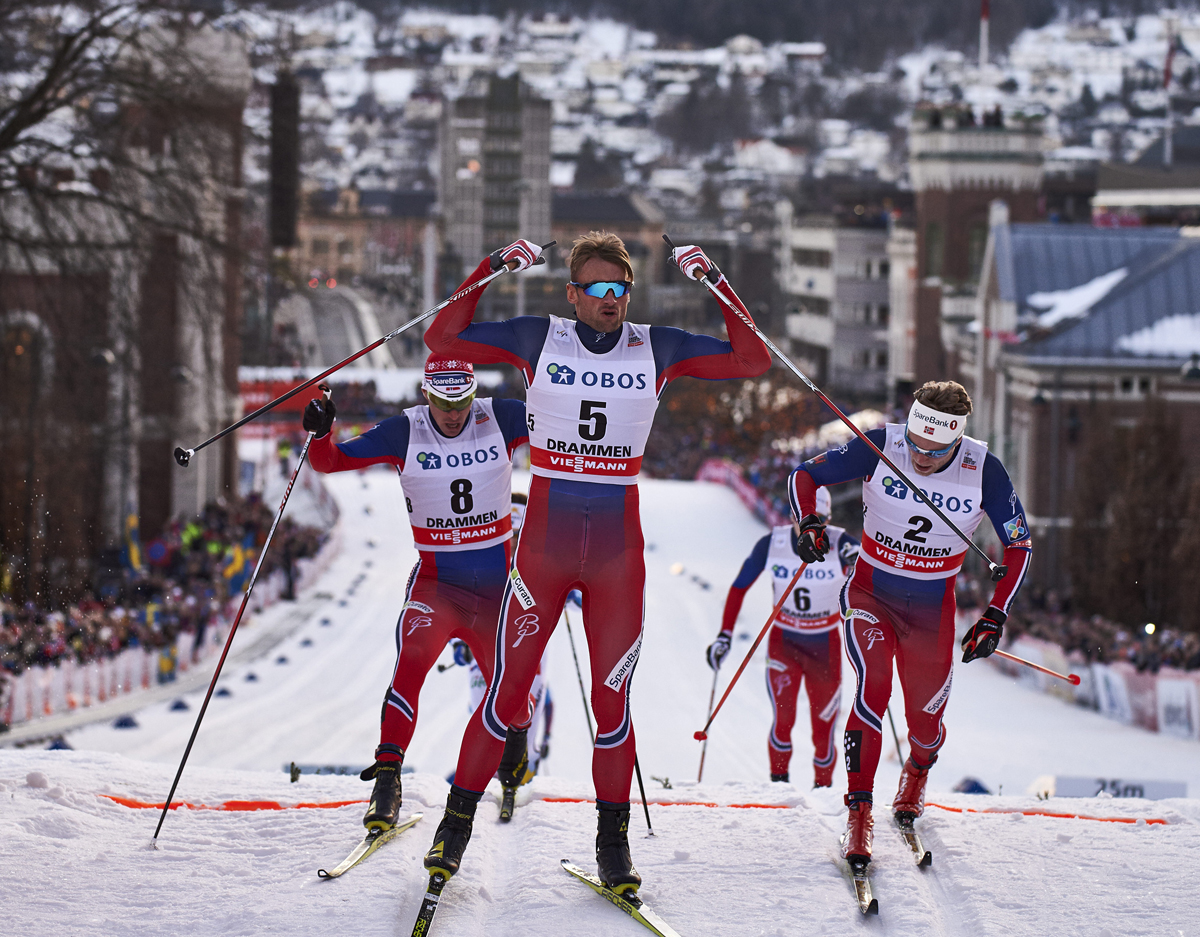
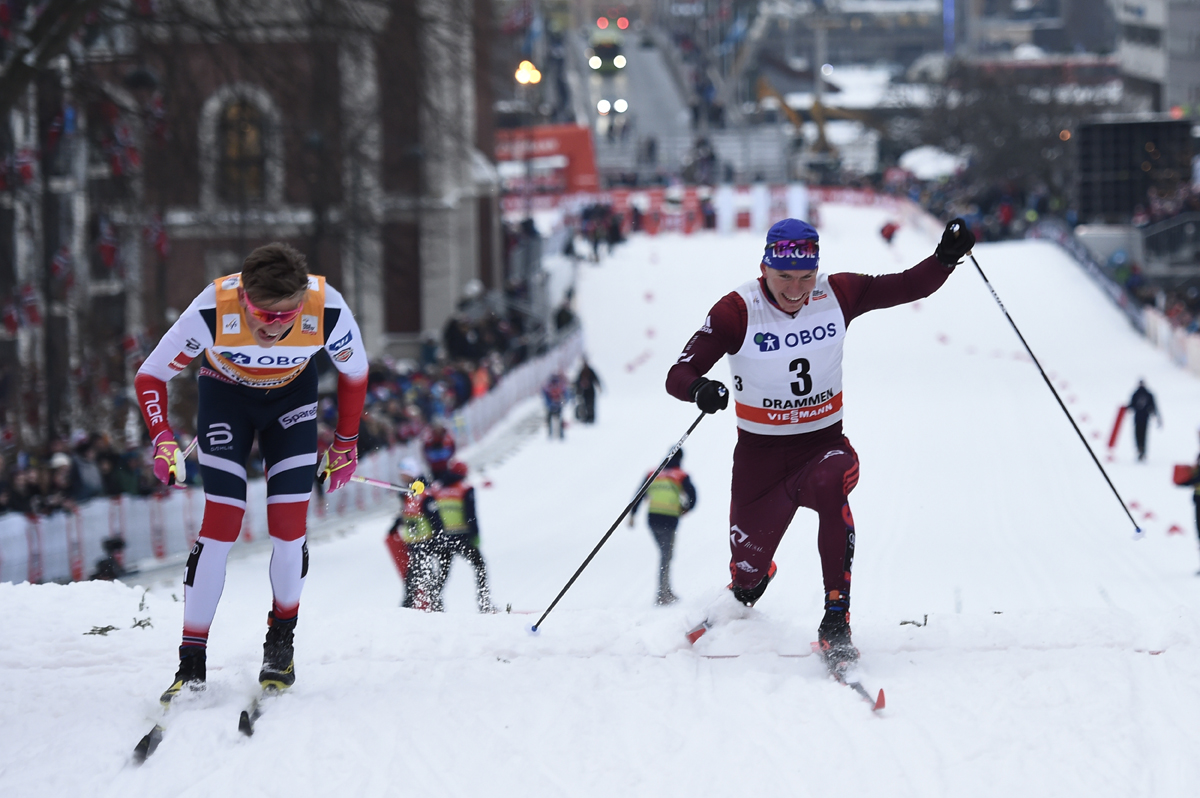
    Norway’s Johannes Høsflot Klæbo (l) edging Russia’s Alexander Bolshunov (3) and Norway’s Eirik Brandsdal (not shown) in the first semifinal of the men’s classic sprint at the World Cup in Drammen, Norway. Klæbo went on to win the final, ahead of Brandsdal in second and Bolshunov in third. (Photo: Fischer/Nordic Focus)

    In the classic venue that are the Drammen city sprints, it was a singular affair from start to finish during the men’s World Cup 1.2-kilometer classic sprint on Wednesday. In a race format that tapered from a field of 61 skiers to the winner, one only needs to track the skier in the overall World Cup’s leader bib to follow along.

    The yellow-bibbed skier, Norway’s Johannes Høsflot Klæbo, didn’t surprise with his sprint win in Drammen as much as place another high performance stamp on his 2017/2018 campaign.

    Klæbo won the qualifier in 2:49.32 minutes. Teammate Eirik Brandsdal skied to second in the qualifier, 3.5 seconds behind Klæbo. Russian Alexander Bolshunov skied the third-fastest qualifying time, finishing 4.48 seconds back. This puts some things in perspective, if anybody thought Klæbo would bloat in his post-Olympic gold medal glow — he won three golds in PyeongChang — you’d be wrong.

    Klæbo would have have good reason to cash it in. What exactly does the 21 year old need to prove? Coming into Wednesday’s race, Klæbo had already captured the Sprint World Cup Crystal Globe. It’s the Norwegian phenom’s second-consecutive overall sprint title.

    Yet Klæbo is also on the verge of sealing up his first Overall World Cup title. After the Drammen sprints, Klæbo leads the overall standings with 1308 points. Behind him, Martin Johnsrud Sundby of Norway (who did not contest Wednesday’s sprint), trails in second place with 980 points total.
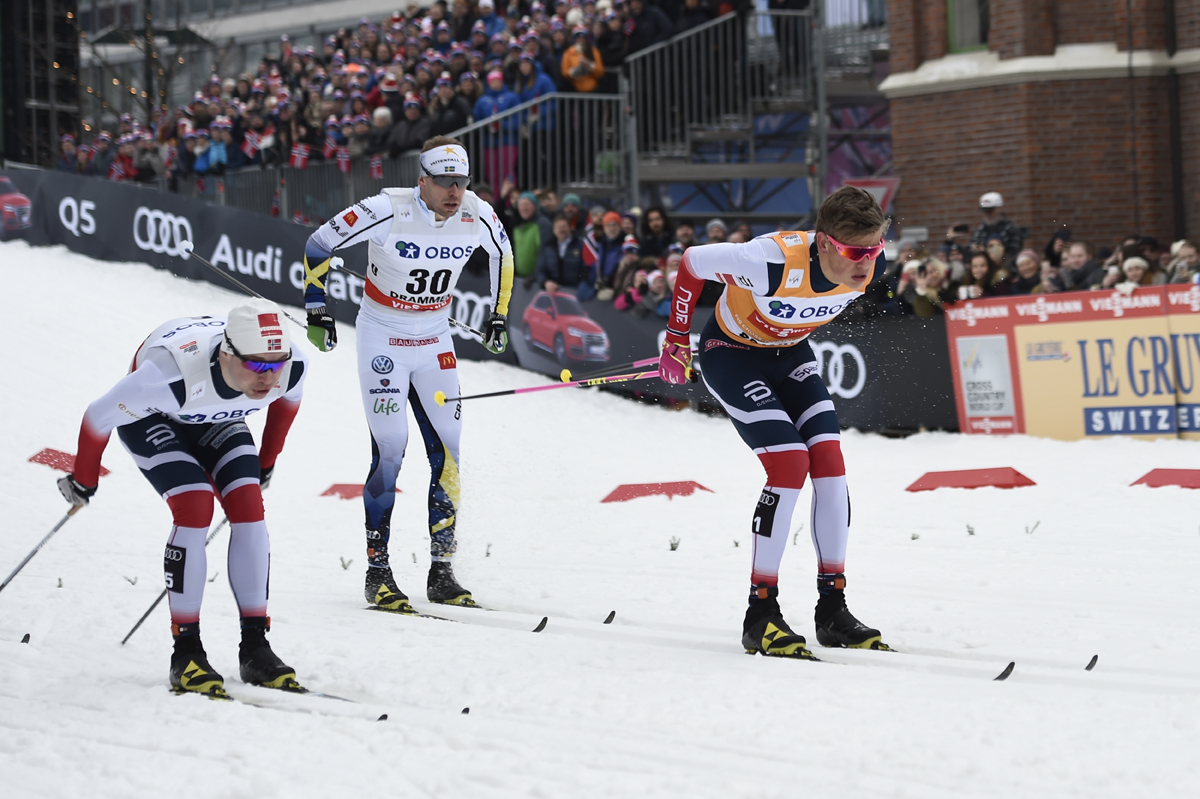
    Johannes Høsflot Klæbo leads his quarterfinal with fellow Norwegian Fredrik Riseth (l) and Sweden’s Emil Jönsson (30) at the World Cup classic sprint in Drammen, Norway. (Photo: Fischer/NordicFocus)

    “It was really important to me to get the 100 points today,” Klæbo told the International Ski Federation (FIS) after the race. “I need as many points as I can get against the other guys for the [overall] Crystal Globe. I will race the Holmenkollen 50 k this weekend and I know it will be tough. Also it’s great to win here in front of all the people. I was second here last season and I’m really happy to now have won Drammen.”

    Let’s circle back to what Klæbo needs to prove, beyond padding his overall lead by another 100 points by winning the Drammen sprint. He’s proving at his young age, pending any monumental flameout, that he’s setting the stage for a historic international cross-country ski career.

    This season alone, Klæbo has won six of nine individual sprint World Cups. He’s won 10 World Cup races in total. That win total puts Klæbo in rarefied company: in the men’s field, only Petter Northug (with 10 wins) and Sundby (16 wins) have won 10 or more World Cup races in a single season.

    Winners want to win. Amidst the five-deep crowd surrounding the sprint course featuring Drammen’s iconic Bragernes Church, with his pink-themed flare, Klæbo proved once again he is a consummate winner.

    There was his dominating qualifier. Then there was Klæbo’s quarterfinal, in which he looked less threatening. He won the first quarterfinal by 0.7 seconds in a photo finish with Brandsdal. That heat seemed to be a test run, as if Klæbo were feeling the course out and asking himself how it skied with five other bodies jousting for tracks and inside lines. There was never the hallmark Klæbo burst of speed or any real dominance. Klæbo kept in contact up the long initial uphill, and down through the tight and sinuous S-turns after the course’s highpoint.

    If in fact the first quarterfinal was a dress rehearsal, Klæbo must have realized that any real podium threats would be drag racing up the final quarter-kilometer climb that finished nearly smack-dab in front of the church.

    The first semifinal featured the day’s top-three qualifiers: Klæbo, Brandsdal and Bolshunov. (Bolshunov advanced by winning the second quarterfinal.) The three skiers finished 1-2-3 with Klæbo taking the win in another photo finish with Brandsdal.
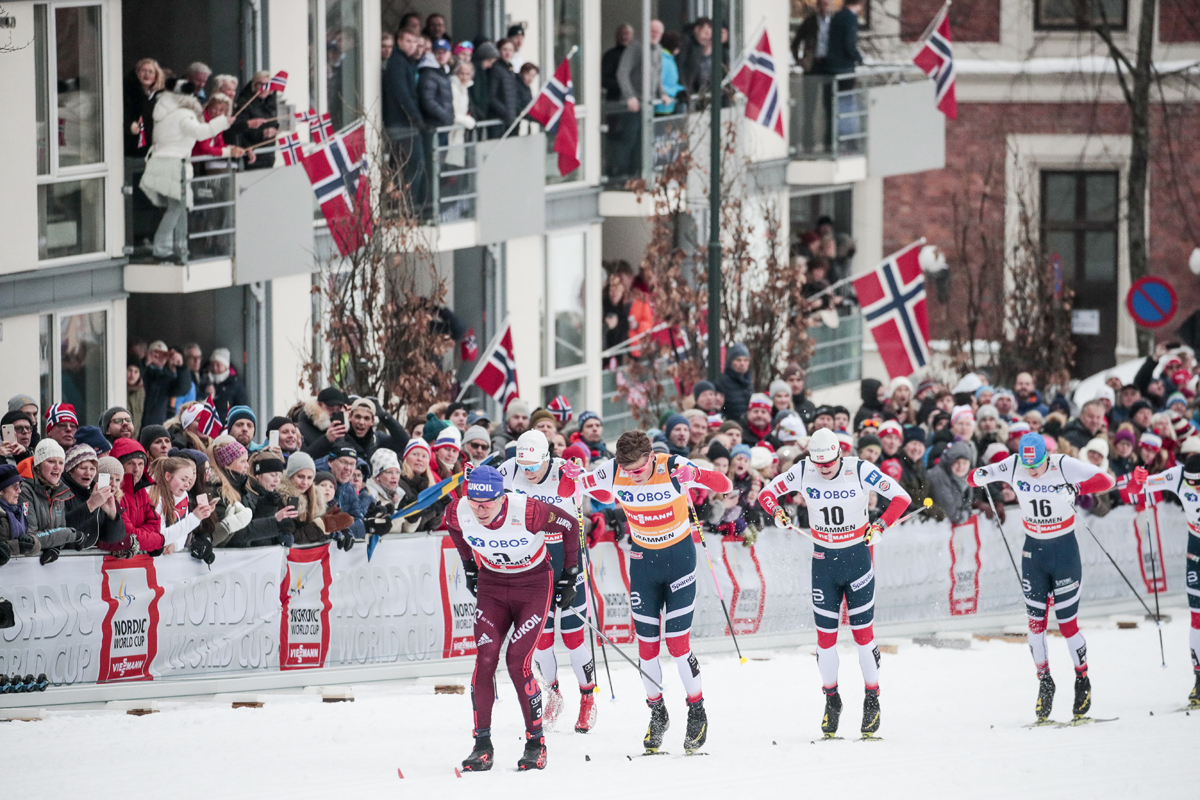
    Russia’s Alexander Bolshunov leads five Norwegians in the men’s classic sprint final at the World Cup in Drammen, Norway: (from l to r) Eriik Brandsdal, Johannes Høsflot Klæbo (yellow bib), Sindre Bjørnestad Skar (10), Kasper Stadaas (16), and Emil Iversen. (Photo: Fischer/Nordic Focus)

    Tactically, Bolshunov played his hand early. Determined to break Klæbo, the Russian led out hard and took the sharp end of the race in earnest. At the top of the course, Bolshunov had strung the five other skiers out behind him. Moments before the highpoint and entering the technical downhill S-turns, Bolshunov and Klæbo gave a burst of speed and distanced themselves by 10 meters. As Klæbo learned in his heat, even with speedy skis, the downhill is not decisive. It’s more a function of skiing out front, staying on your feet and entering the final straight with enough high-octane gas to turbo the finish.

    Up the final climbing stretch, which seems as eternal as some flame burning inside the Bragernes Church, Bolshunov faded slightly, while Klæbo and Brandsdal pulled ahead.

    Klæbo’s second takeaway: he already knew the course was won on the final straightaway climb. If he could match Bolshunov on the remainder of the course, Bolshunov could not mirror him in the final meters.

    The final played out like Klæbo’s semi. Bolshunov punched it early. Klæbo sat behind the Russian, matching him pole for pole, stride for stride. Up front was as good a place as any for Bolshunov. Besides the Russian, it was an all-Norwegian final. There was Klæbo and Brandsdal, along with Sindre Bjørnestad Skar, Kasper Stadaas and Emil Iversen.
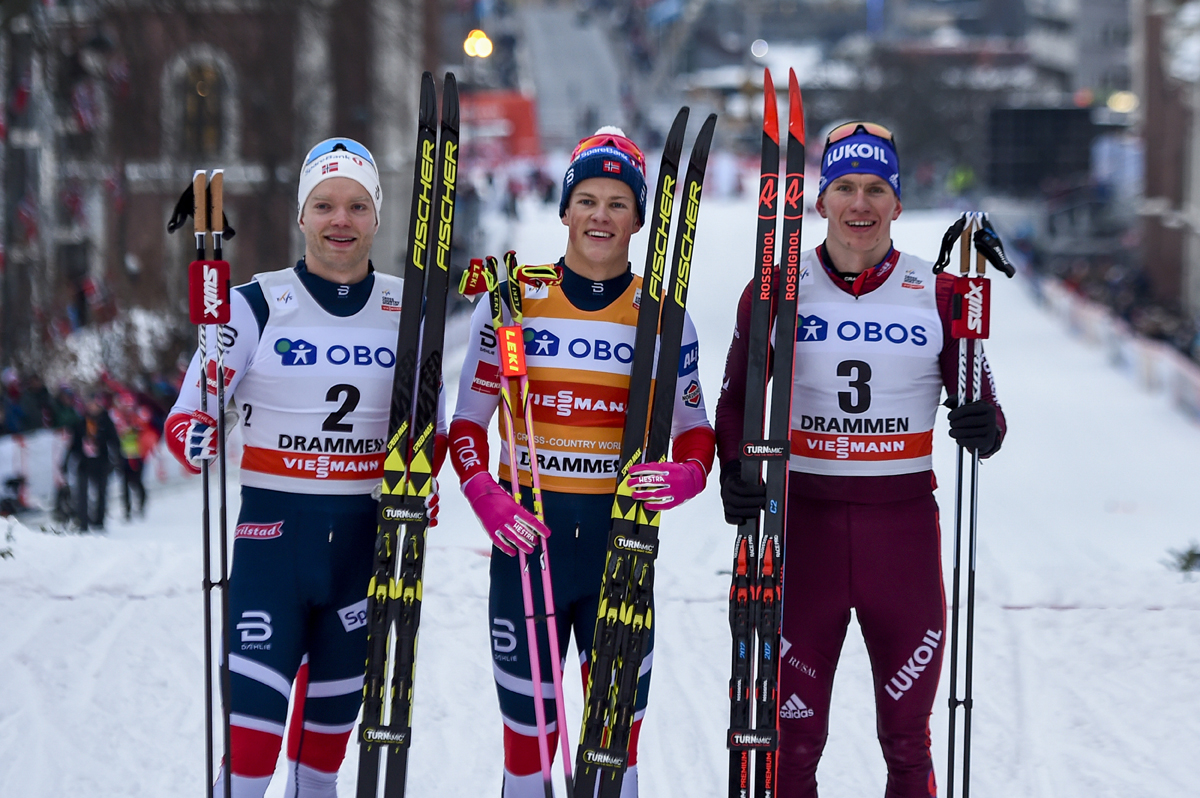
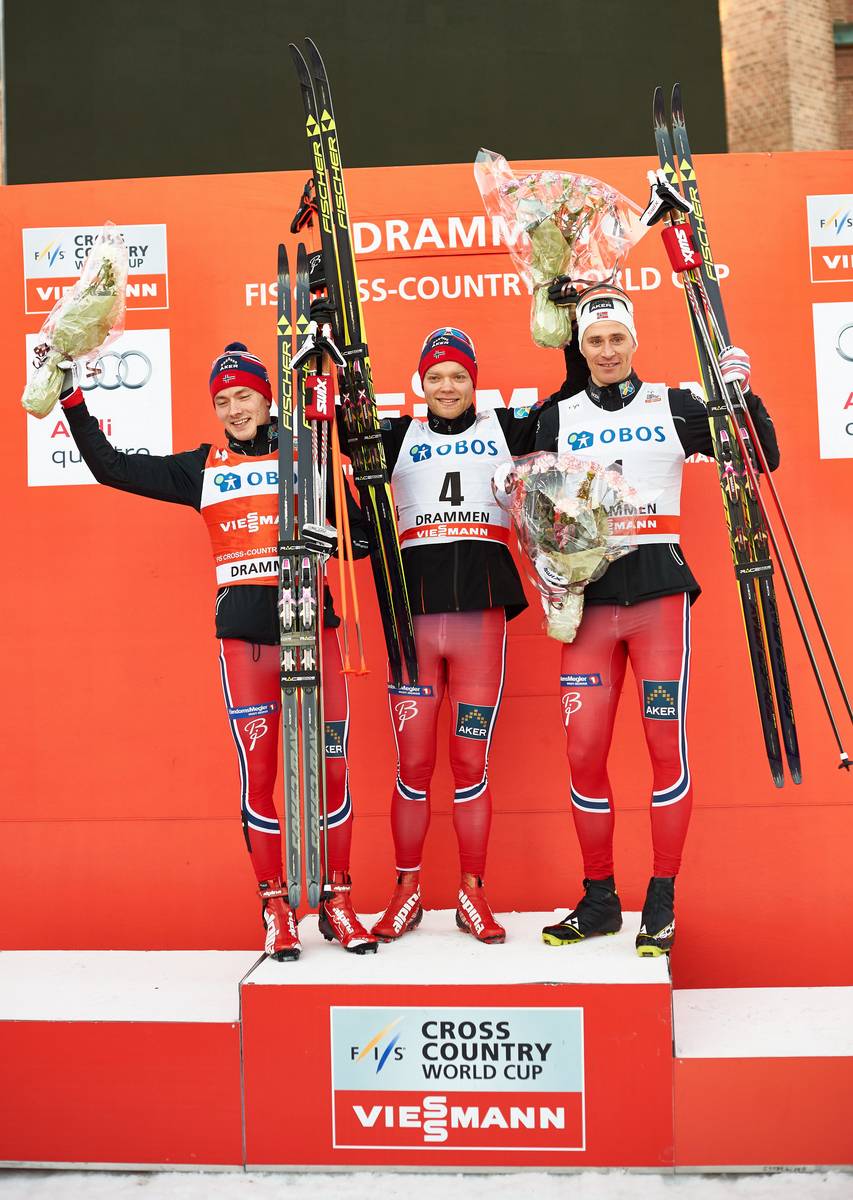
    The men’s podium from Drammen’s 2018 classic sprint. Norway’s Johannes Høsflot Klæbo (c) placed first, his teammate Eirik Brandsdal (l) was second, and Russia’s Alexander Bolshunov (r) finished third. (Photo: Fischer/NordicFocus)

    Bolshunov again led up and over the top of the course, through the S-turns and through the tucking downhill. Brandsdal trailed by 10 meters, but by the final turn before the uphill to the church’s front door, the threesome had regrouped. Again, as the double poling got down to business, Bolshunov faded, Klæbo pulled away and Brandsdal could only stay a second behind the day’s winner. And of course Klæbo was able to toe the line as he bowed to the frenzied crowd. Nothing to prove except he can win with panache and win in style when the Norwegian cameras turn out in force.

    Klæbo won the final in 2:44.69 minutes. Brandsdal followed 1.04 seconds back in second place, Bolshunov finished third (+3.78), Bjørnestad fourth (+6.55), Kaspar fifth (+8.71), and Iversen sixth (+11.45).

    Bjornsen Reaches Quarterfinals, 18th Overall

    Erik Bjornsen was the lone North American who advanced to the heats, qualifying in 26th and finishing the day in 18th.

    “I was feeling good,” Bjornsen told FasterSkier after the race. “It’s a tight course. It was a bit scrappy. … It’s my first time here qualifying for the heats, so I’m learning some things, for sure.”

    Bjornsen skied in the fifth quarterfinal with Iversen, Russia’s Alexander Panzhinskiy, Finland’s Ristomatti Hakola, Emil Nyeng of Norway, and France’s Lucas Chavanat.

    The American skied near the back of the group but avoided any real mishaps. Although the sport is not roller derby, Drammen’s tight-and-rutted corners offer up a close cross-country skiing cousin.
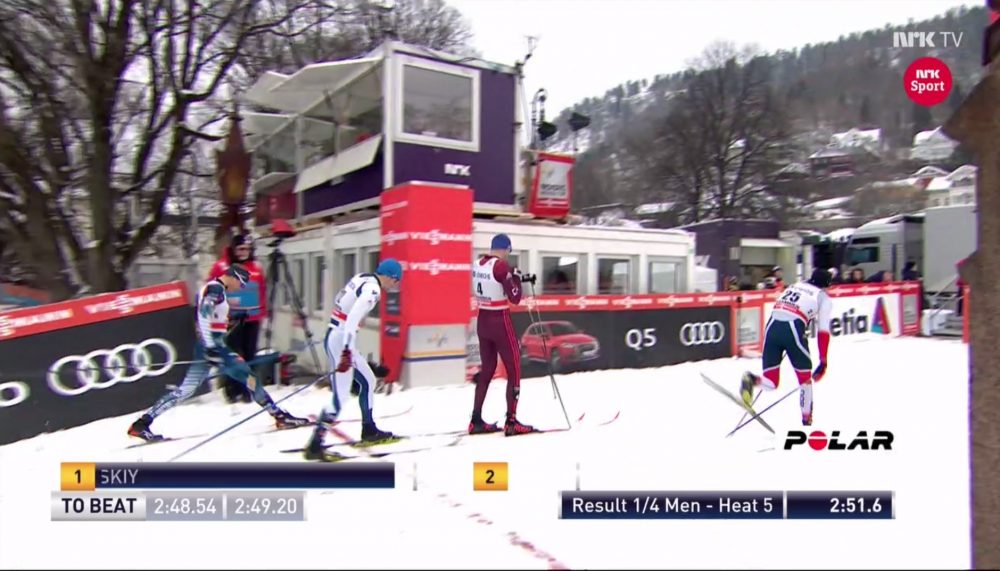
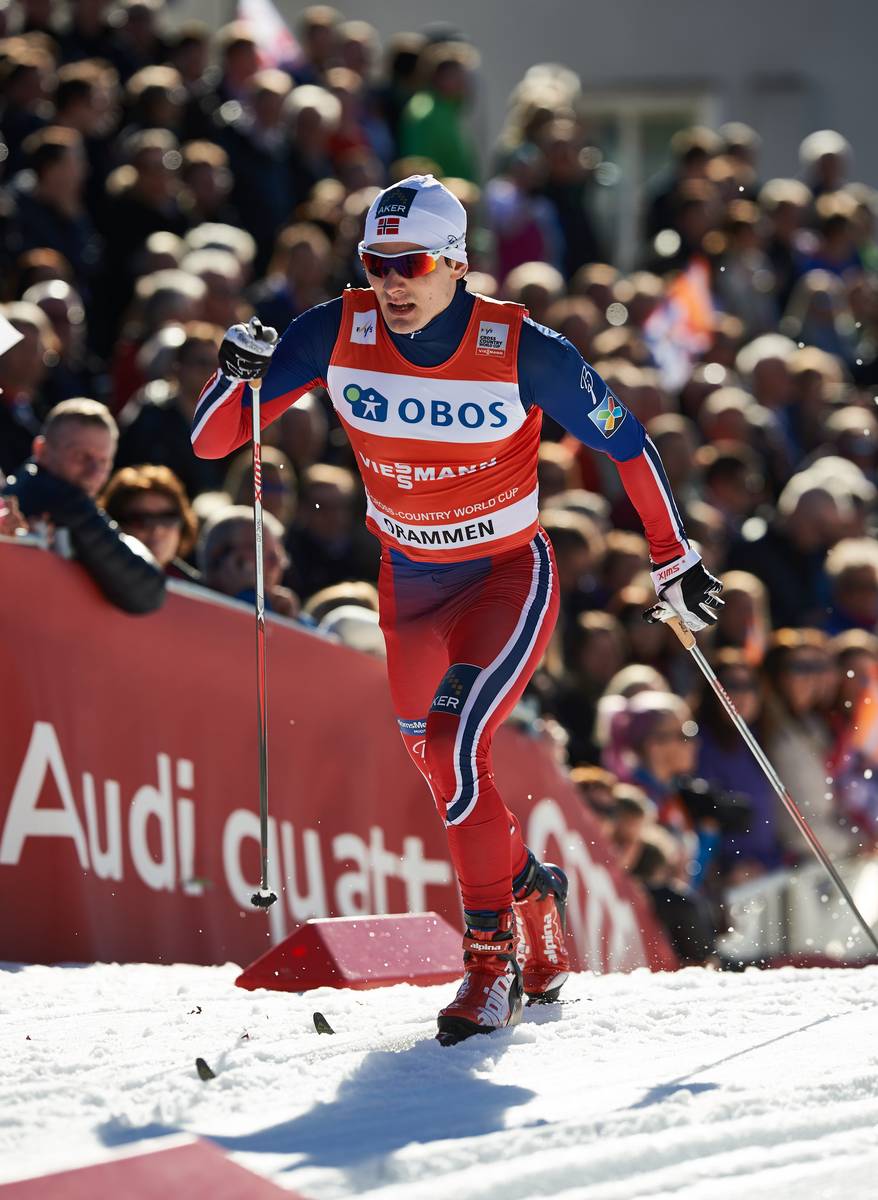
    The U.S. Ski Team’s Erik Bjornsen toeing the line in fourth during Wednesday’s fifth heat in Drammen, Norway. Bjornsen placed 18th on the day. (Screenshot: NRK broadcast)

    I feel like – I kind of missed a few spots,” Bjornsen said.  “At the bottom corner I was pushed to the outside. I was almost moving up into second, and looking back maybe I should have gone around him on the other side.”

    Up the never-ending final straightaway, Bjornsen poled himself into a position to potentially advance to the semifinals as a lucky loser. However, that didn’t pan out for Bjornsen. Iversen won the heat in 2:51.96 minutes, Panzhinskiy placed second (+0.20), Hakola third (+0.99), with Bjornsen in fourth (+1.18).
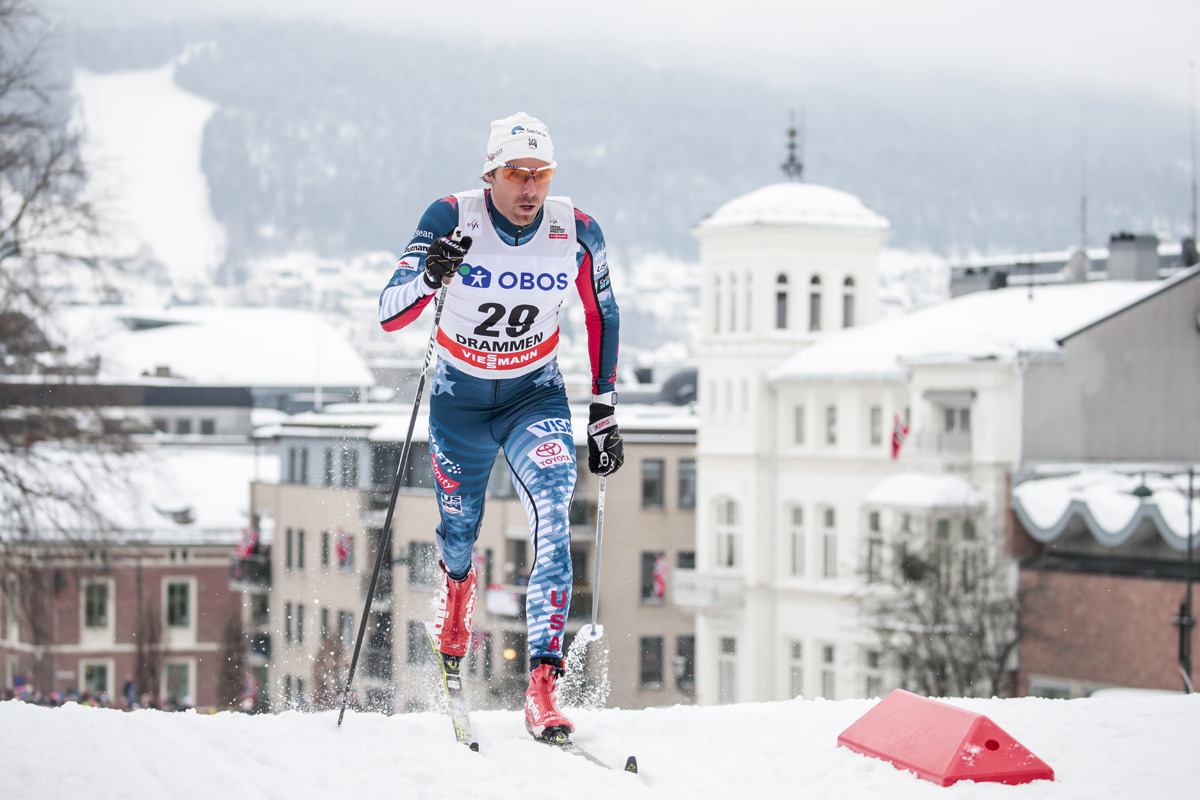
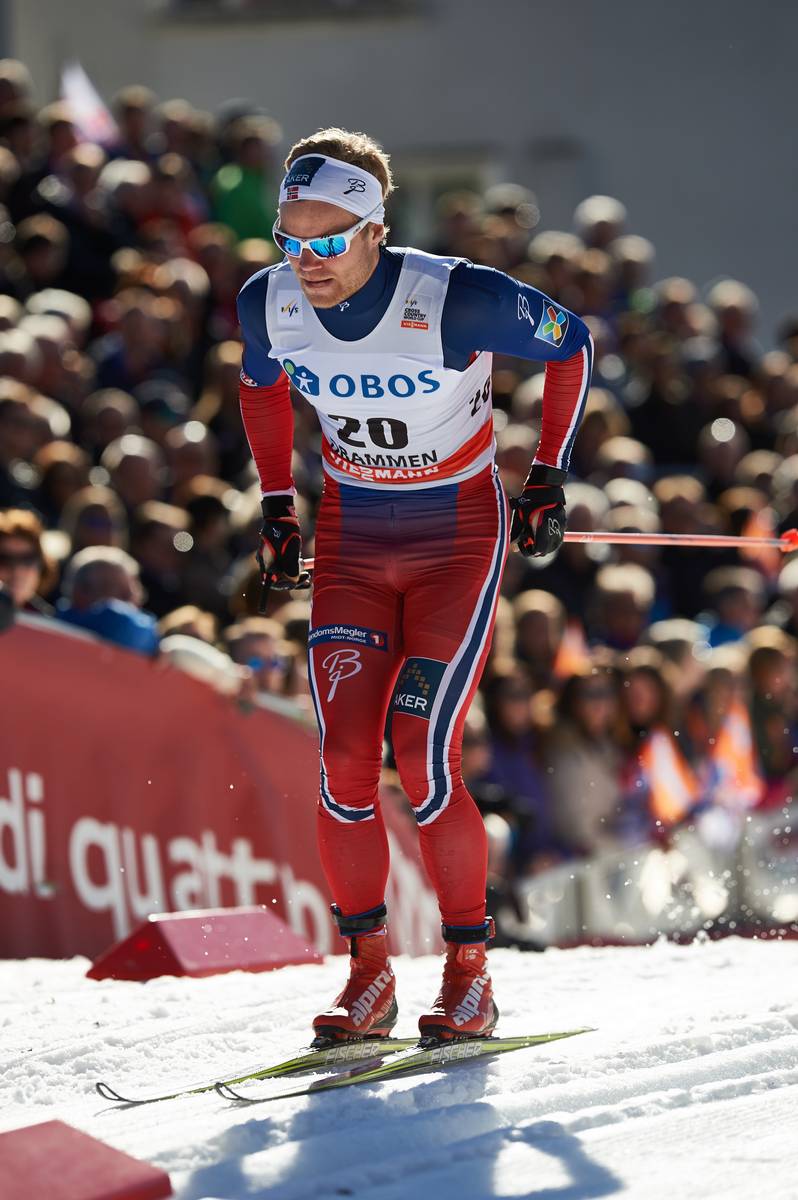
    Andy Newell racing to 33rd in the men’s classic sprint qualifier at the World Cup in Drammen, Norway. (Photo: Fischer/NordicFocus)

    Also for the U.S., Andy Newell missed the quarterfinals after finishing 33rd in qualification, 0.9 seconds out of 30th. Logan Hanneman and Kevin Bolger finished 49th and 50th, respectively, and Reese Hanneman 56th. The U.S. Ski Team’s Simi Hamilton sat out Wednesday’s sprint as he is recovering from an illness.

    For Canada, Julien Locke finished 51st in qualifying, Alex Harvey was 54th, and Andy Shields 58th.

    Results: Qualifier | Final

  • Nilsson Back to Winning Ways in Drammen Classic Sprint; Caldwell Top American in 9th

    Nilsson Back to Winning Ways in Drammen Classic Sprint; Caldwell Top American in 9th

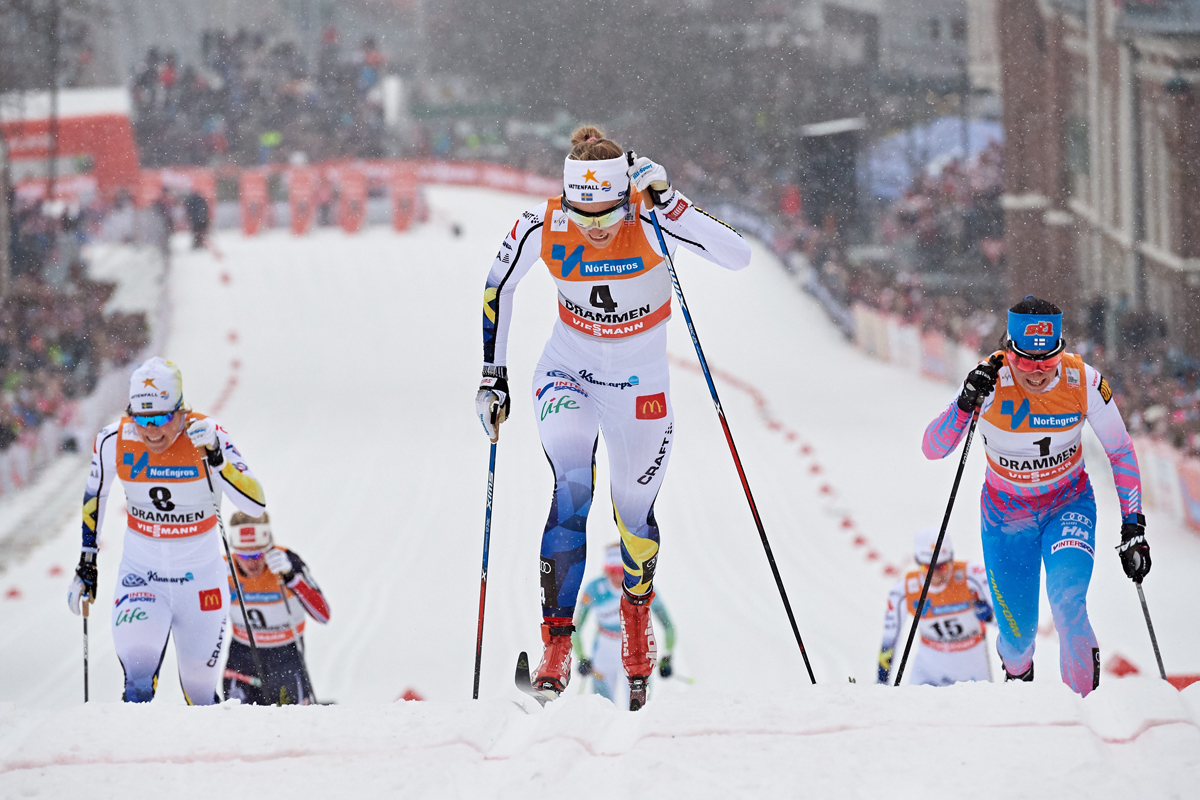
    Sweden’s Stina Nilsson charging to her eighth World Cup victory of the season in Wednesday’s 1.2 k classic sprint final in Drammen, Norway. She finished first, ahead of Finland’s Krista Pärmäkoski (r) in second and her Swedish teammate Hanna Falk (l) in third. (Photo: Fischer/NordicFocus)

    Drammen is one of those staples on the World Cup, appearing on the circuit late each season and remembered for its trademark uphill finish in the middle of a city of 63,000 inhabitants, just 40 kilometers west of Oslo, Norway.

    “It tends to be fairly predictable snow,” U.S. Ski Team Women’s Coach Matt Whitcomb told FasterSkier during an in-person interview in Drammen on Wednesday. “It’s generally clean [snow]. It’s generally some sort of klister.”

    But that doesn’t make Drammen easy. Finding the ideal balance of kick and glide on the city’s 1.2-kilometer course, marked by a steady uphill out of the start, followed by a 60-second downhill, and finally, one last climb to the finish, is key and something even the most seasoned World Cup skiers can struggle with at this venue, Whitcomb explained.

    “We tend to see athletes focusing a little bit too much on the climbs, getting those good sensations and not enough gliding … out on the downhills,” he said. “That’s where the heart of this course really lies.”

    For instance, consider Maiken Caspersen Falla. Coming off an individual skate-sprint victory at 2017 Lahti World Championships, the Norwegian didn’t ski fast enough to qualify for the heats on Wednesday. She finished 31st, 0.34 seconds out of qualifying in 30th but 6.49 seconds off the top qualifying time set by Finland’s Krista Pärmäkoski. With Falla usually qualifying first or close to it in sprints (and Pärmäkoski better known for her distance skiing), it was a shakeup that confused even Falla — Drammen’s three-time defending classic-sprint winner.

    “I think it is weird,” Falla told NRK, according to a translation. “I do not know what’s going on. I was thinking I was going pretty well. I’m not far behind [the top 30], but I have no idea. Maybe I didn’t have the best skis or maybe I left far too much time in a turn. I am very unsure of what’s going on; the body has worked great the last few days.”

    American Kikkan Randall, who placed third in the world-champs freestyle sprint behind Falla, was in the same boat. She finished 52nd out of 56 women in Wednesday’s sprint qualifier, 12.76 seconds out of first.

    Whitcomb said that was likely due to too much kick and too little glide. Drammen as a downtown sprint poses an additional challenge for athletes and wax techs, allowing just 20 minutes for testing on race day.

    “Every athlete’s working out of one depot so you have basically 100 people, male athletes and female athletes, and just trying to control the chaos as much as possible,” he said. “But I feel like our athletes, I can trust them to ask for more kick and know that it’s not gonna compromise their glide. Sometimes it does, it’s just the risk that you have to make because on this course, you spend a fair amount of time gliding and if you’re not close to having enough grip, you’ll be too tired in the finish.”

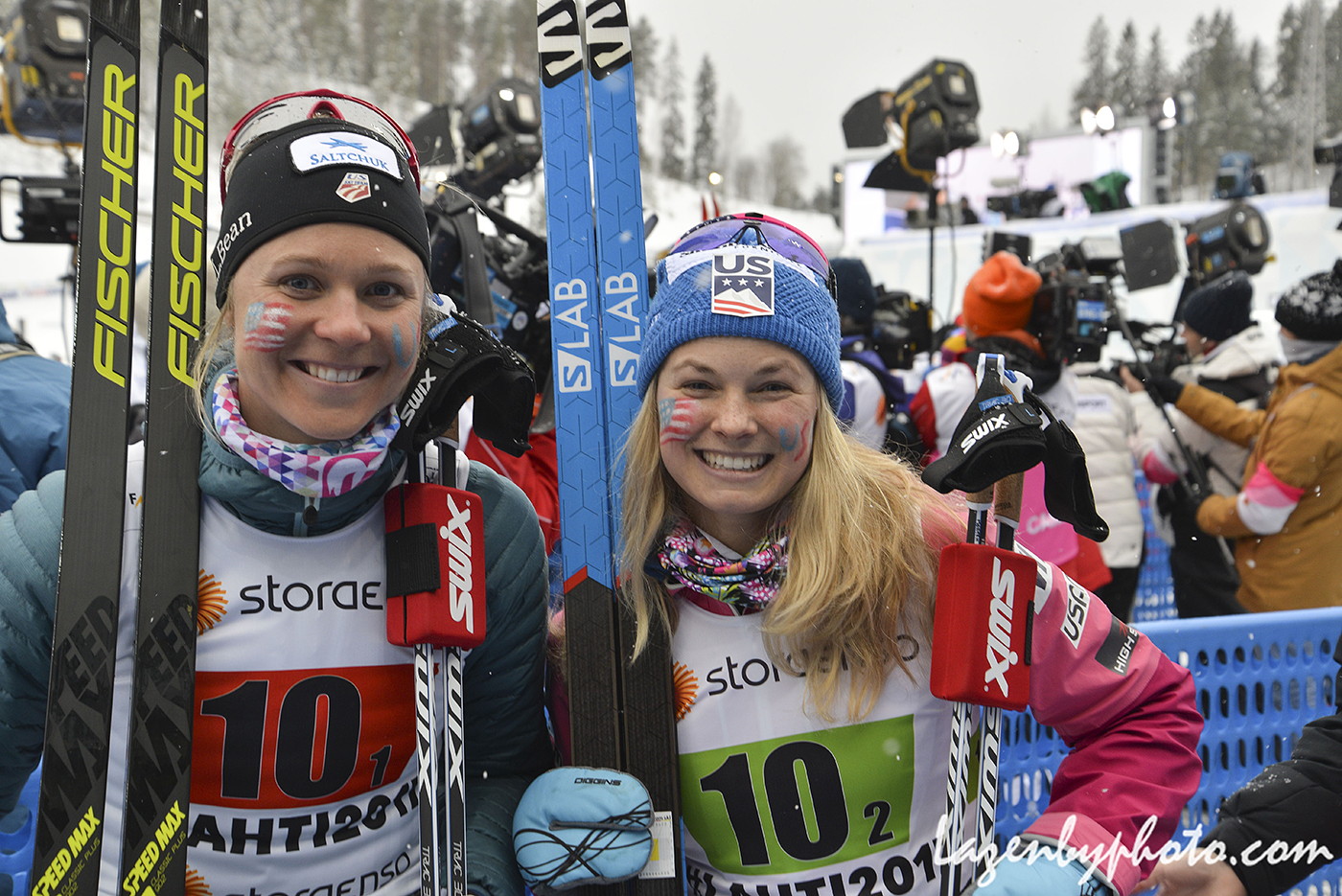
    U.S. teammates Sadie Bjornsen (l) and Jessie Diggins after placing third for bronze in the women’s classic team sprint at 2017 World Championships in Lahti, Finland. (Photo: John Lazenby/Lazenbyphoto.com)

    One U.S. Ski Team member thrilled with her skis was Jessie Diggins, who qualified sixth (+2.12) behind her teammate Sadie Bjornsen in fifth (+1.63). Behind them, Sophie Caldwell was the third American to qualify in 11th (+2.95).

    While Diggins and Bjornsen went on to finish sixth and fifth in their quarterfinals, respectively, and did not advance to the semifinals, Diggins said that in her case, it wasn’t for a lack of speed. After some physical contact at the top of the course got her fired up and surging into first on the long descent, Diggins slipped back to the middle of the pack coming out of the downhill draft and broke a pole around the last hairpin corner before the long, uphill finishing straight.

    “Jessie came into the final corner with too much traffic and a pole broke somehow,” Whitcomb said. “If it had been made out of steel, it would’ve bent, but it was loud and unfortunately none of us could get to her because there were too many cameras and fences in the way.”

    “I was just ready to fight on that final climb,” Diggins reflected. “I knew I was strong because even after skiing with a broken pole, I caught back up to [the group] at the end so I mean, I did everything I could.”

    She finished 5.11 seconds behind the winner of that quarterfinal, Sweden’s Stina Nilsson, who would go on to win the day.

    “I was so stoked with my skis,” Diggins added. “They were fast, they had good kick and I know they had good kick because I had one pole and I was like, ‘Wow! They really nailed it!’ ”

    While Diggins raced in the second quarterfinal, Bjornsen was one of the guinea pigs, so to speak, in the first heat of the day. Whitcomb explained that coaches and athletes routinely watch the first women’s quarterfinal on sprint days to figure out the course and determine strategies for the remaining rounds.

    While Bjornsen skied in third for much of her quarterfinal behind Norway’s Mari Eide, who led for most of it, the American bronze medalist in the world-champs classic team sprint (with Diggins) positioned herself closer to second entering the final climb to the finish.

    While the last few hundred meters of the race were shaping into a four-way fight for first between Eide, Bjornsen, Sweden’s Hanna Falk, and Slovenia’s Anamarija Lampič, Bjornsen in the far right tracks suddenly found herself behind a V-board when the course narrowed from four tracks to three across, and her tracks ended. She jumped to the left, slotting in behind Eide, and ran out of room to make any more moves to end up fifth, 2.52 seconds behind Falk in first.

    “I felt really strong in the qualifier, had some great skis, and was so excited for the heats,” Bjornsen said, according to a U.S. Ski Team press release. “Unfortunately in the final stretch, I chose a lane that didn’t go to the finish, so I had to stop and go in behind the others — which simply didn’t work. That was an expensive mistake, and cost a day full of great feelings. Fortunately I feel really good right now, and I am so excited to keep racing and get my chance.”

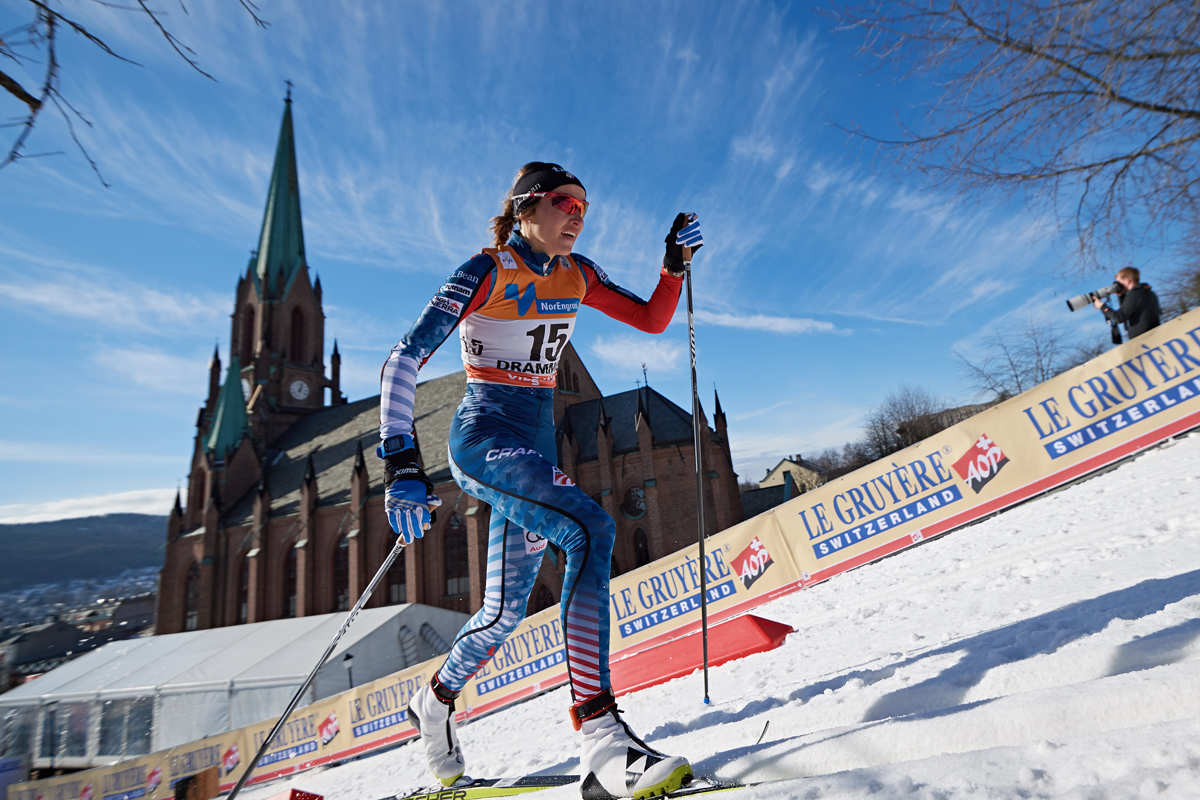
    Sophie Caldwell (U.S. Ski Team) striding to 11th in the women’s 1.2 k classic sprint qualifier at Wednesday’s World Cup in Drammen, Norway. She went on to place ninth overall. (Photo: Fischer/NordicFocus)

    Bjornsen and Diggins ended up 21st and 26th on the day, respectively. Leading their team, Caldwell reached the semifinals and ultimately placed ninth overall.

    In an in-person interview after the race, she told FasterSkier that she was particularly pleased with her qualifier considering her past results in Drammen. Before Wednesday, had never cracked the top 10 there.

    “The first three years I raced in Drammen, it was just a really hard course for me for some reason and I found myself not qualifying, but not even close to qualifying, like, back in the end of the pack,” Caldwell said. “Last year I figured out how to qualify and I was just thrilled to have qualified so this year it was one step further making the semis so I’m really happy with that.

    “It’s still a tough course for me,” she added. “It’s so gradual that it’s a really good course for power skiers and that’s been something I’ve been working on a lot, but power skiing for classic for sure isn’t my strength. … I think that’s probably why it’s been so difficult for me in the past but I’m really happy with today.”

    Third in her quarterfinal, just 0.79 seconds behind Norway’s Ingvild Flugstad Østberg, who won it, and half a second behind another Norwegian, Kathrine Rolsted Harsem, who automatically advanced in second, Caldwell reached the semifinals as a lucky loser — along with Finland’s Aino-Kaisa Saarinen in fourth (+0.95) in that heat.

    Caldwell went on to place fifth in the second semifinal, 1.44 seconds behind Sweden’s Ida Ingemarsdotter in first. The American had put herself in third behind Pärmäkoski and Harsem before Ingemarsdotter hammered up the finishing straight to take the win.

    “There was a little jostling around both on the downhill and up the final stretch,” Caldwell explained. “I kind of tried to cut inside Ida on the downhill and she moved in front of me so then I switched to the other side, then coming back up this way, Ida sort of hopped in the track in front of me so I went to move to the other one without knowing [Slovenia’s Katja Višnar] was coming up on the side so I had to bop back. There was a lot of bouncing around, but that’s part of the game. You want to be aggressive, but you want to be fair, and I think that’s something I’ve always tried to do.”

    Also for the U.S., Rosie Brennan finished 37th in the qualifier and Ida Sargent was 42nd. Canada’s lone woman racing on Wednesday, Dahria Beatty, who turned 23 on Tuesday, finished 48th.

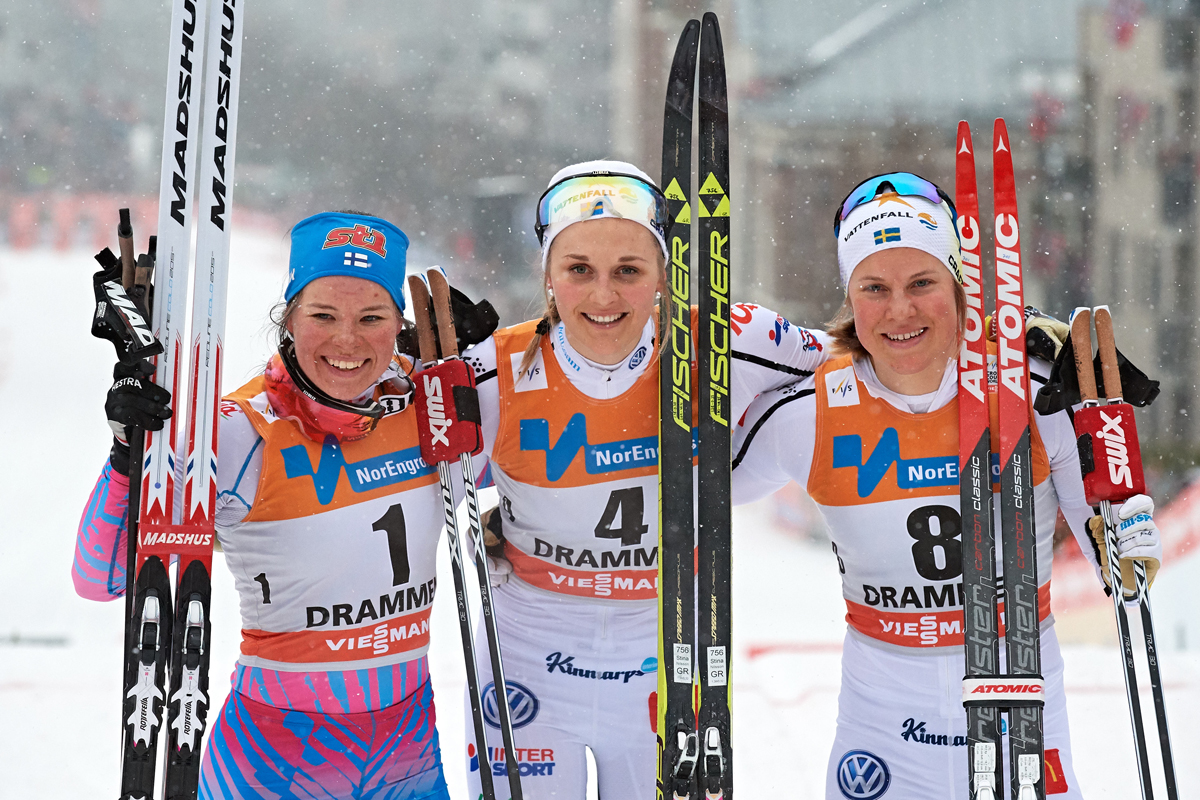
    The women’s 1.2 k classic sprint podium at Wednesday’s World Cup in Drammen, Norway, with Sweden’s Stina Nilsson (c) in first, Finland’s Krista Pärmäkoski (l) in second and Sweden’s Hanna Falk (r) in third. (Photo: Fischer/NordicFocus)

    As the day progressed, Sweden’s Nilsson continued to pick up steam. Coming off a World Championships in which she earned one medal (silver in the 4 x 5 k relay) and placed 12th in the freestyle sprint, the world’s second-ranked sprinter (behind Falla) had something to prove.

    She started by posting the fourth-fastest qualifying time, 1.54 seconds behind Pärmäkoski, then won her quarterfinal and first semifinal before dusting her competition in the final. While Nilsson followed the lead of fellow Swede Linn Sömskar in the quarterfinal and drafted off Diggins on the downhill to slingshot to first before the finishing stretch, Nilsson took a backseat to Østberg in the semifinal. With energy to spare, Nilsson and her teammate Falk pounced on the long grind to the finish, placing first and second, respectively, while Østberg dropped to fourth behind Lampič in third.

    In the final, Nilsson didn’t bother with games. She led out of the start, with Harsem following in second up the first double-pole section of the initial climb. While Nilsson continued to lead over the top, Falk and Pärmäkoski ended up duking it out for second place. Pärmäkoski double poled hard up the finishing straight to move into second, which she took by 0.84 seconds over Falk for her first World Cup sprint podium. Nilsson powered to the win in 3:07.57 minutes, 0.42 seconds clear of Pärmäkoski and 1.42 seconds ahead of Falk.

    The remaining finalists, Harsem finished fourth (+3.27), Ingemarsdotter was fifth (+4.86), and Lampič, the U23 World Cup leader, placed sixth (+9.67).

    The victory was Nilsson’s eighth of the season and puts her 42 points behind Falla with one sprint to go — a freestyle sprint in Quebec City next Friday, where 50 points for a win are on the line.

    “I thought I could win and this feels really great,” Nilsson told the International Ski Federation (FIS), according to a press release. “I was sure Maiken would win the sprint globe today. I don’t think it’s possible still to win it, but there is still a chance and I will travel to Quebec and try my best.”

    For Pärmäkoski, the podium showed her continued momentum after two World Championships medals (second in the 15 k skiathlon and third in the relay).

    “I am really happy,” she told FIS. “I wasn’t sure how I would feel after the championships but I felt really strong today.”

    Falk is third in the overall sprint standings, 154 points behind Nilsson and 29 points ahead of Norway’s Heidi Weng in fourth. At World Championships, Falk missed a medal in the skate sprint in fourth.

    “This makes up a little bit for my fourth place finish at the World Championships, so it feels good to come here today and get a podium,” Falk said.

    The last European World Cup races of the season will take place Saturday and Sunday with the famous Holmenkollen 30/50 k mass starts near Oslo. This year, those races are classic technique. The men race on Saturday at 12:45 p.m. Central European Time (6:45 a.m. Eastern Standard Time) and women start at noon CET (5 a.m. Eastern Daylight Time) on Sunday.

    — Jason Albert and Harald Zimmer contributed

    Results | Sprint World Cup standings

    Kikkan Randall (U.S. Ski Team) during the women’s 1.2 k classic sprint qualifier on Wednesday at the World Cup in Drammen, Norway. (Photo: Fischer/NordicFocus)
  • Wednesday Rundown: Drammen & Lake Placid (Updated)

    Wednesday Rundown: Drammen & Lake Placid (Updated)

    The men’s World Cup 1.2 k classic sprint podium on Wednesday in Drammen, Norway, with Norway’s Eirik Brandsdal (c) in first and Johannes Høsflot Klæbo (l) in second, and Russia’s Sergey Ustiugov (r) in third. (Photo: FIS Cross-Country/Twitter)

    FIS Cross-Country World Cup (Drammen, Norway): Classic sprints

    Just three days after 2017 Nordic World Championships ended in Lahti, Finland, World Cup cross-country skiers were back to their regular-season grind with 1.2-kilometer classic sprints on Wednesday in Drammen, Norway.

    In the men’s race, Norway stole the day with Eirik Brandsdal notching his first World Cup win since 2015 in Drammen, but Russia’s Sergey Ustiugov broke up the team’s total domination of the final with a third place, behind Brandsdal (who won it in 2:39.35 minutes) and Johannes Høsflot Klæbo in second (+2.55). Ustiguov placed third (+3.28) for his seventh consecutive podium coming off five medals in five races at World Championships, and three other Norwegians, Petter Northug, Pål Golberg and Sondre Turvoll Fossli finished behind him in fourth through sixth, respectively, in the final.

    To start the day, Klæbo won the qualifier in 2:33.81, 3.62 seconds ahead of Brandsdal in second. Ustiugov qualified 10th (+6.21).

    Canada’s Alex Harvey and Len Valjas qualified for the heats in 18th and 21st, respectively, and Andy Newell was the lone American to reach the quarterfinals after qualifying in 13th.

    In the third quarterfinal, Newell finished third, 1.7 seconds behind Brandsdal, who won it. Sweden’s Oskar Svensson took second in that heat (+0.66).

    Harvey won the fifth quarterfinal, and Canada originally took first and second with Valjas outlunging Alexander Bolshunov for second place. Valjas was ultimately relegated to last in the heat for his move around Bolshunov at the line, and the Russian was listed as second (+0.27) for an automatic spot in the semifinals.

    While Klæbo won the first men’s semifinal by 0.46 seconds over Brandsdal, Ustiugov topped the second semi by 0.32 over Golberg. Harvey initially finished fifth in that second semi but moved up one spot to fourth (+4.41) after Norway’s Finn Hågen Krogh was disqualified (putting him in last, 67th overall). Harvey ended up eighth overall on the day.

    Newell placed 18th overall and Valjas 27th.

    Also for the North Americans, U.S. Ski Team members Simi Hamilton and Erik Bjornsen finished 40th and 44th, respectively, and Ben Lustgarten (Craftsbury Green Racing Project) was 62nd. Canada’s Russell Kennedy (Canmore Nordic/Team R.A.D.) finished 63rd.

    In the women’s 1.2 k classic sprint, Stina Nilsson commanded the day and Sweden ended up with two on the podium, with Hanna Falk in third.

    Nilsson started off by qualifying in fourth, 1.54 seconds behind Finland’s Krista Pärmäkoski, who topped the qualifier in 3:00.28. While Pärmäkoski went on to win her quarterfinal and place third in her semifinal (advancing as a lucky loser to the final), Nilsson won both her quarterfinal and semi, and ultimately took first in the final in 3:07.57. Pärmäkoski notched second (+0.42), and Falk third (+1.26) ahead of Norway’s Kathrine Rolsted Harsem in fourth (+3.27), Sweden’s Ida Ingemarsdotter in fifth (+4.86), and Slovenia’s Anamarija Lampič in sixth (+9.67).

    Three U.S. women qualified for the heats, with Sadie Bjornsen in fifth, Jessie Diggins in sixth and Sophie Caldwell in 11th.

    Bjornsen and Diggins were eliminated in the quarterfinals after placing fifth and sixth, respectively, while Caldwell finished third in the third quarterfinal (0.79 seconds behind Østberg, who won that heat) and advanced as a lucky loser to the semifinals with Finland’s Aino-Kaisa Saarinen, who was fourth in that heat (+0.95).

    In the semifinals, Nilsson led her teammate Falk across the line by 0.14 seconds, and Lampic advanced as a lucky loser in third (+1.05).

    Ingemarsdotter won the second semifinal by 0.22 seconds over Harsem, and Pärmäkoski made the cut for the final with a fast-enough time in third (+0.56). In that heat, Slovenia’s Katja Višnar (who had posted the second-fastest qualifying time) finished fourth (+0.83), and Caldwell fifth (+1.44).

    That put Caldwell in ninth overall, while Bjornsen placed 21st and Diggins 26th. Also for the U.S., Rosie Brennan finished 37th in the qualifier, Ida Sargent was 42nd, and Kikkan Randall 52nd.

    One day after her 23rd birthday, Canada’s Dahria Beatty finished 48th.

    Men’s results: Final | Qualifier

    Women’s results: Final | Qualifier

    ***

    USSA Cross Country Junior Championships (Lake Placid, N.Y.): Classic sprints

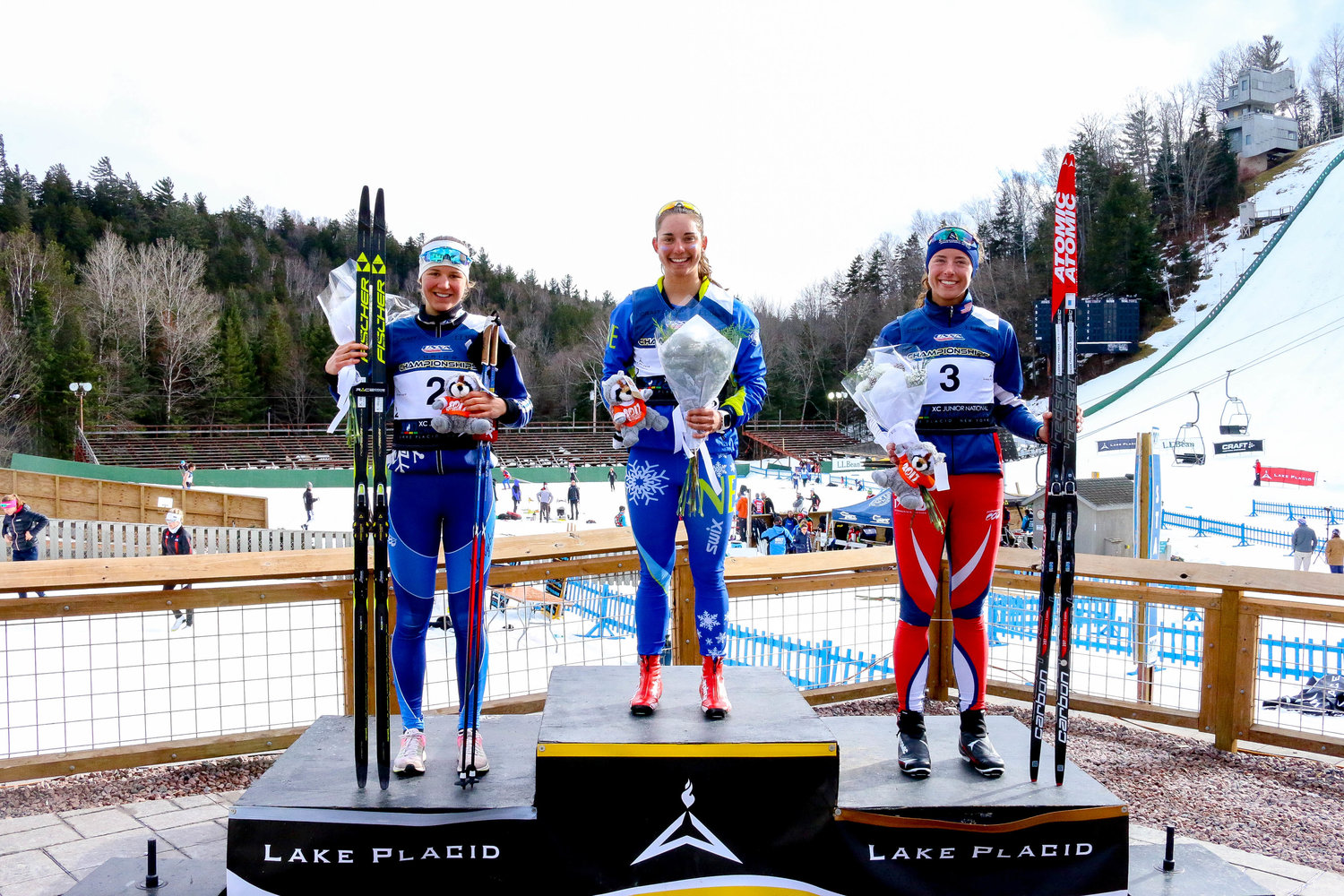
    The U20 women’s classic sprint podium at U.S. Junior Nationals on Wednesday in Lake Placid, N.Y., with Julia Kern (c) of the Stratton Mountain School in first, Canada’s Katherine Weaver (l) of Hollyburn XC Ski Club in second and Maddie Morgan (r) of the Wasatch Nordic Ski Academy in third. (Photo: XCJuniorNationals2017.com)

    [UPDATED] On the second day of racing at 2017 U.S. Junior Nationals in Lake Placid, N.Y., Novie McCabe, Haydn Halvorsen, Gus Schumacher, and Julia Kern achieved their second national titles of the week in the classic sprints on Wednesday at the Olympic Jumping Complex.

    Representing the Pacific Northwest division and Methow Valley Nordic Ski Educational Foundation, McCabe won the U16 girls’ A-final more than 5 seconds ahead of anyone else in 5:04.22 minutes. New England’s Anna Lehmann, of the Stratton Mountain School (SMS) followed in second (+5.14) and Intermountain’s Sydney Palmer-Leger notched her second-straight podium in third (+5.96). Also in the U16 girls’ final were Rocky Mountain’s Bridget Donovan (Ski & Snowboard Club Vail) and Waverly Gebhardt (Steamboat Springs Winter Sports Club), who placed fourth and fifth, respectively, and Intermountain’s Sarah Morgan, of the Wasatch Nordic Ski Academy (WNSA), in sixth.

    In the U16 boys’ A-final, Halvorsen (Far West/Sugar Bowl Ski Team & Academy) won by 3.31 seconds in 4:28.29 minutes. New England’s Will Koch (SMS) placed second for his second podium in as many races, and Intermountain’s Lane Myshrall (Park City Nordic Ski Club) took third (+6:39). Also in the U16 boys’ final, Johnny Hagenbuch (Intermountain/SVSEF) placed fourth, George Cvancara (Alaska/Alaska Nordic Racing) fifth and Will Lange (Pacific Northwest/Mt. Bachelor Sports Education Foundation) sixth.

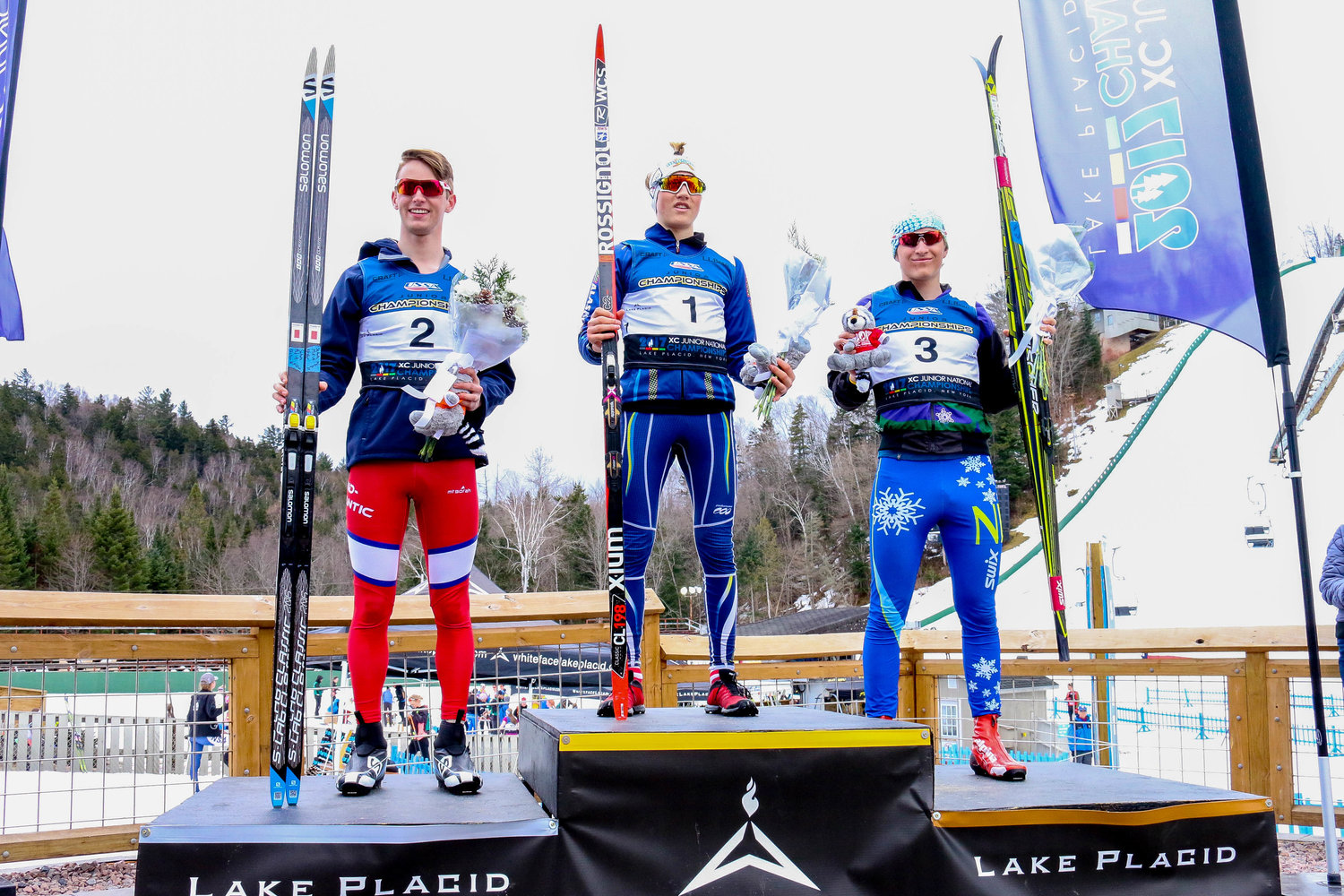
    The U18 boys’ classic sprint podium at U.S. Junior Nationals on Wednesday in Lake Placid, N.Y., with Gus Schumacher (c) of Alaska Winter Stars in first, Scott Schulz (l) of the New York Ski Educational Foundation in second, and Adam Glueck (r) of Ford Sayre in third. (Photo: XCJuniorNationals2017.com)

    Alaska’s Gus Schumacher (Alaska Winter Stars) topped the U18 boys’ A-final by 1.13 seconds in 4:35.95. Local Mid-Atlantic skier Scott Schulz (New York Ski Educational Foundation) took second, and New England’s Adam Glueck (Ford Sayre) placed third (+5:04). Alaska’s Canyon Tobin (APUNSC) followed in fourth, Far West’s JC Schoonmaker (Auburn Ski Club Associates Inc.) fifth, and New England’s Ben Ogden (SMS) reached the final but was disqualified.

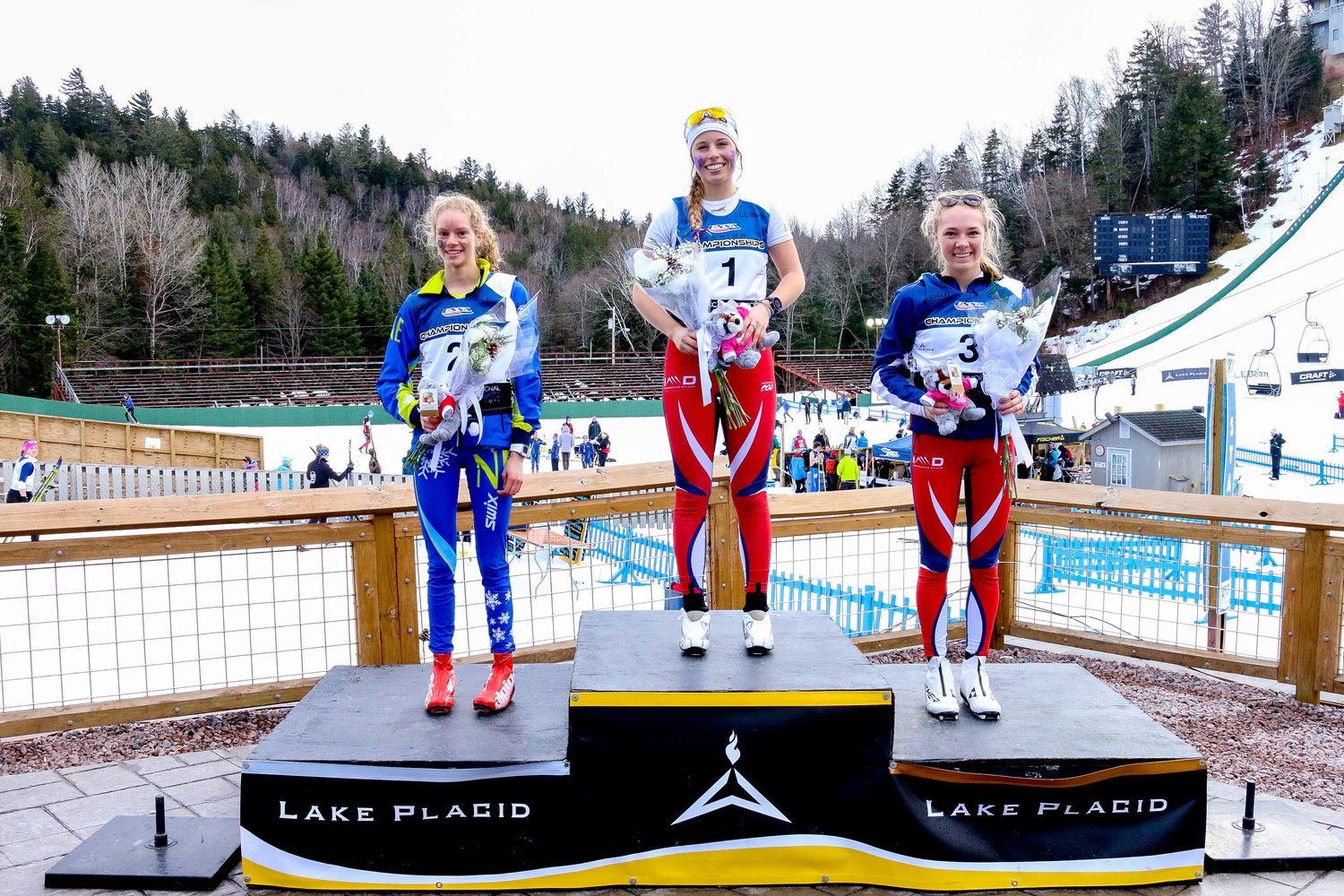
    The U18 girls’ classic sprint podium at U.S. Junior Nationals on Wednesday in Lake Placid, N.Y., with Marin Coletta (c) of the Bridger Ski Foundation in first, Rena Schwartz (l) of GMVS in second and Anna Gibson (r) of Jackson Hole Ski Club in third. (Photo: XCJuniorNationals2017.com)

    In the U18 girls’ A-final, Marin Coletta, representing Intermountain and the Bridger Ski Foundation (BSF), took the win in 5:14.30, 4.4 seconds ahead of New England’s Rena Schwartz (Green Mountain Valley School). Intermountain’s Anna Gibson (Jackson Hole Ski Club) rounded out the podium in third (+6.26). Also reaching the final, Brooke Dunnagan (Intermountain/BBNT) finished fourth, Jenna DiFolco (Alaska/NSCF-FXC) fifth, and Callie Young (New England/Craftsbury Nordic) sixth.

    U.S. Ski Team Development Team member Julia Kern picked up her second-straight win in the U20 women’s category, winning the A-final by a resounding 18.47 seconds. After Kern (New England/SMS) finished in 4:47.54, Canada’s Katherine Weaver (Hollyburn XC Ski Club) placed second for the second-straight race, and Intermountain’s Maddie Morgan (WNSA) took third (+33.38) in the most strung-out final of the day. Also in that final, Intermountain’s Leah Lange (University of Utah) finished fourth, Margie Freed (Midwest/Loppet Nordic Racing) fifth, and Canada’s Catherine Reed-Metayer (Skibec) sixth.

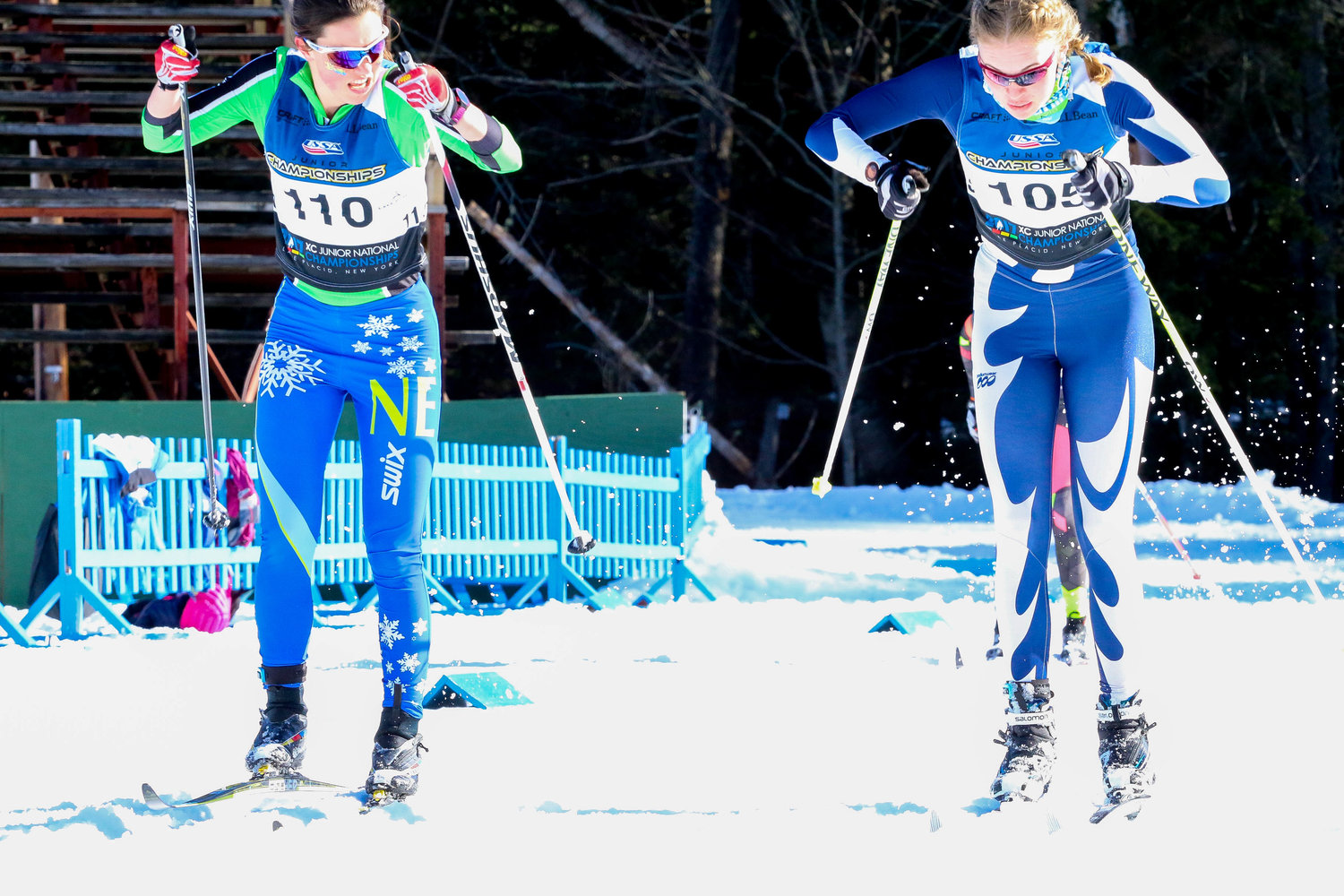
    From left to right: Alexandra Lawson (New England/Craftsbury Nordic) and Maya Seckinger (Pacific Northwest/Bend Endurance Academy) go head to head during a U20 women’s classic sprint heat on Wednesday at 2017 U.S. Junior Nationals. Both reached the B-final, where they placed fourth and third, respectively. (Photo: XCJuniorNationals2017.com)

    The U20 men’s classic sprint win went to Canada’s Reed Godfrey (Canmore Nordic/Team R.A.D.), who finished first in 4:33.64. Kam Husain (SMS) crossed 3.32 seconds later as the top American in second overall, and Canada’s Ryan Jackson (Team Hardwood) was the third man on the podium in third (+5.68). Rounding out the A-final, Finn O’Connell (New England/University of Vermont Ski team) placed fourth and Daniel Streinz (New England/Mountain Endurance) fifth, and Canada’s Étienne Hébert (Montériski) was disqualified.

    Results: U16 girls | U16 boys | U18 boys | U18 girls | U20 women | U20 men

  • Double-Pole Victory for Northug in Drammen; Hamilton Top North American in 11th

    Double-Pole Victory for Northug in Drammen; Hamilton Top North American in 11th

    03.02.2016, Drammen, Norway (NOR): Ola Vigen Hattestad (NOR), Petter Northug (NOR), Eirik Brandsdal (NOR), (l-r)  - FIS world cup cross-country, individual sprint, Drammen (NOR). www.nordicfocus.com. © Felgenhauer/NordicFocus. Every downloaded picture is fee-liable.
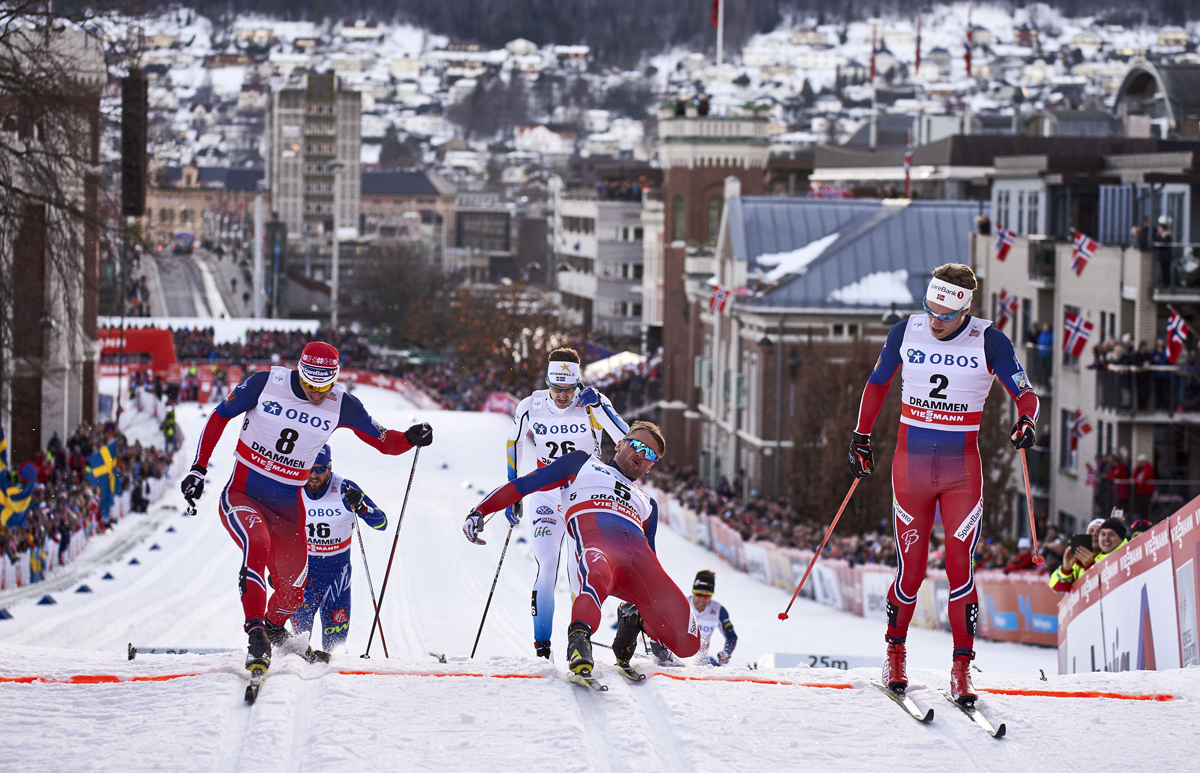
    Petter Northug flexes his muscles in celebration of his win during Wednesday’s classic-sprint final at the World Cup in Drammen, Norway. He led a Norwegian sweep of the top four, with Ola Vigen Hattestad (8) in second and Eirik Brandsdal (2) in third. (Photo: Fischer/NordicFocus)

    It’s a modified saying, but when in Norway, ski like Norwegians do. During Wednesday’s 1.2-kilometer classic sprint in Drammen, Norway, the Norwegian men took that saying to heart.

    On a postcard day, with the late-afternoon sun dipping below the quaint city and the surrounding forested hills, Norway dominated the finals — they locked up the top-four spots. Double poling to victory was Petter Northug Jr. in 2:38.95. Ola Vigen Hattestad, also a double-poler, finished second (+0.41) in a photo finish with Eirik Brandsdal (+0.47), who took third.

    Norway’s Finn Hågen Krogh skied to fourth, 1.98 seconds back. The first non-Norwegian was Sweden’s Teodor Peterson in fifth (+2.13). Russia’s Alexander Panzhinskiy rounded out the final in sixth, 11.41 seconds behind Northug.

    American skier Simi Hamilton was the top North American finisher, placing 11th on the day. Hamilton was eliminated in the first semifinal, where he finished sixth.

    The remaining U.S. Ski Team members did not advance after the qualifier. Erik Bjornsen skied to 46th, 8.23 seconds behind top qualifier, Panzhinskiy, who skied the course in 2:32.69. Reese Hanneman followed in 59th (+10.02), Andy Newell in 63rd (+11.52), Dakota Blackhorse-von Jess in 69th (+15.13), and Scott Patterson in 71st (+18.07).

    The top Canadian was Alex Harvey, who placed 20th overall —  he was knocked out in the fourth quarterfinal when he finished fourth, only 2.08 seconds out of first. Teammate Len Valjas qualified in 19th, and placed 28th overall after finishing sixth in his quarterfinal. No other Canadians entered the race.

    03.02.2016, Drammen, Norway (NOR): Ola Vigen Hattestad (NOR), Petter Northug (NOR), Eirik Brandsdal (NOR), (l-r)  - FIS world cup cross-country, individual sprint, Drammen (NOR). www.nordicfocus.com. © Felgenhauer/NordicFocus. Every downloaded picture is fee-liable.
    Petter Northug’s lunge at the line during his semifinal heat in Drammen, Norway’s classic sprint, gained him second place to Erik Brandsdal (bib 2) and a spot ahead of Ola Vigen Hattestad (bib 8) in third. (Photo: Fischer/Nordic Focus)

    Northug’s World

    It’s been nearly a month since the last World Cup classic sprint in Oberstdorf, Germany. That race, as part of the 2016 Tour de Ski, saw many tired sprint specialists — many dropped out of the Tour after that stage. Wednesday’s qualifiers should have seen a World Cup crew of sprinters on rested and ready-to-hustle legs.

    As noted, Russia’s Panzhinskiy, a classic sprint specialist who took Olympic silver in 2010, bested the field in the qualifier, crossing the line in 2:32.69. But it was a notable Northug who placed fifth, 2.84 seconds behind. Northug has been a results enigma — always in the hunt, sometimes a crafty World Cup win, on-form for championships.

    Despite all the glory, the top-of-the-world all-around skiing, Northug last won a regular World Cup sprint nearly three years ago; a 2013 classic sprint in Stockholm, Sweden. The week prior to that victory, Northug also won the classic sprint in Drammen. (He double poled to victory in those sprints as well.) So to say Northug was due for a win isn’t exactly the truth. But to say that Northug skied wisely, powerfully, and stamped his authority on the reality of the new double-pole norm, is tough to refute.

    The first semifinal was stacked. The top finishers on the day, Northug, Brandsdal, and Hattestad finished second, first, and third, respectively. Hamilton placed sixth (+4.69). On a firm-and-fast course, where most skiers used klister and strided on the short-steeps and used a combo of kick and double poling on the false flats, Northug proved he could stay in the mix with the heavy hitters by relying on his slick skate skis and a hammering double pole.

    Northug’s semifinal never really strung out. Like a Slinky, expanding and contracting, every time a small gap formed, the group eventually came back together. And that’s how it was: the six skiers entered the final stretch in a clustered group, and it was a frenzy to the finish.

    Yet in the finals, it first appeared Northug’s double-pole only strategy would come to naught. Northug dangled in fourth while Panzhinskiy and Brandsdal strided ahead — both used kick wax.

    Then the dynamic changed 1:36 into the race. On a fast gradual downhill, in a tight tuck, Northug simply glided past first, second, and third, and into first himself. Just before the final 180-degree turn back to the everlasting homestretch, Northug had time to give a glance, or maybe a glare, behind.

    The race then was his to lose.

    With his signature forward hips and high hands, Northug looked to be in rare form in victory. As were his comments after the race. Across the finish line, celebrating, Northug flexed his arms.

    In a translation from an NRK article, Northug said he was signaling his mother. “It was a signal to my mother that she can be proud that she produced a crazy guy like me,” he said.

    Crazy or not, the choice to double pole was never in doubt. “Perhaps it would have been smart to use kick wax in the quarterfinals, but I have always double poled in Drammen,” Northug told NRK. The translation reads that Northug thought he’d be bullied or made fun of had he used kick wax.

    “I laugh at those who use kick wax and feel like we should spare our waxers that job,” Northug commented to NRK.

    With the win, Northug immediately looked ahead to Saturday’s 50 k classic mass start at Holmenkollen in Oslo, Norway. Apparently, even with his energy expenditures Wednesday, he’s looking forward to it.

    “The double poling cost me nothing. It’ll be easy to keep up the same pace for 50 k on Saturday,” Northug joked with NRK. “I’ve been training for the Holmenkollen 50 k the past weeks, it’s the year’s toughest race. My dream is to be in the mix and fight the whole way. I will challenge Martin [Johnsrud Sundby].”

    Aware he was speaking about Sundby, an indomitable force this year, Northug doesn’t believe Sundby is nervous. “I’m sure he’s snickering when he thinks about how I raced four heats today. But I’m still really looking forward to Saturday,” Northug told NRK.

    03.02.2016, Drammen, Norway (NOR): Simeon Hamilton (USA) - FIS world cup cross-country, individual sprint, Drammen (NOR). www.nordicfocus.com. © Felgenhauer/NordicFocus. Every downloaded picture is fee-liable.
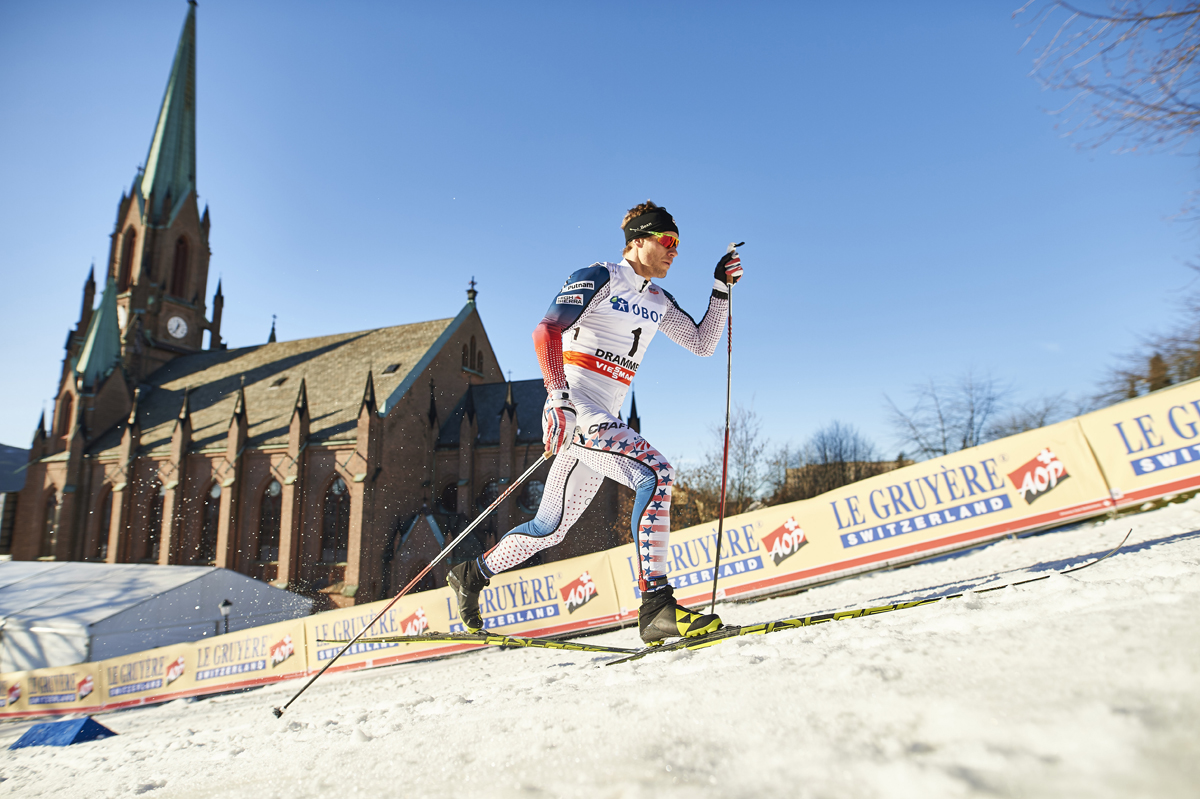
    The U.S. Ski Team’s Simi Hamilton leads out in bib #1 during the classic-sprint qualifier in Drammen, Norway. Hamilton was knocked out in the semifinals, but finished the day as the best North American in 11th overall. (Photo: Fischer/Nordic Focus)

    Simi in the Semis

    North America’s top finisher, Hamilton, who sprinted to 11th overall, was satisfied with his performance.

    I’m definitely happy with today, not ecstatic,” Hamilton said in a post-race phone interview. “It’s always to nice to ski more than just a couple rounds. Drammen for sure is one of the harder sprints of the year, especially for me as more of a skate sprinter. It’s always been either good or bad here, and luckily today was good.” 

    The Drammen sprint was deep with Norwegian skiers. That, coupled with the nature of the course, made Hamilton’s efforts particularly taxing. Despite cheering fans, Hamilton said the lungs still burned.

    “It’s a pretty straightforward course, but you are working for a lot of it,” he said. “The start and finish straight especially, is really tough because it’s so long and you can see where the finish is when you come around that corner at the very far end. And it’s just kind of mentally really hard because you can see it and then you just have to know that it’s just 45 seconds of all out skiing during that section.”

    In his semifinal, Hamilton was positioned in second place for much of the first kilometer.

    “My tactic was to to ski really comfortably the first half of the race … and just conserve energy and then try to make a move at the bottom of the course,” Hamilton said.

    Coming out of the final corner, Hamilton played his tactics well for a big push down the stretch.

    “I was in a great spot coming out of that very bottom corner and we hit the finish straight and I just ran out of steam in a big way,” he said. Hamilton finished sixth, and explained that his energy reserves may have had something to do with his lack of rest between his quarterfinal and semi.

    “It’s always tough being the second lucky loser coming from the fifth quarter because you go straight into the first semifinal,” he said. “And that basically, it gives essentially six minutes of rest. So it’s a tough spot to be in, it happened at World Champs last year, too. So you’ve just got keep thinking positively and it’s hard for sure.”

    Notably absent from the rounds was Newell. He’s a consistent sprint qualifier who craves the classic sprints.

    U.S. coach Matt Whitcomb said Newell’s result was unexpected. “I think he [Andy] is a little bit puzzled, he is really disappointed. He chose to double pole and in the end it didn’t end up to be a great value to doing so. What we look for is conditions where klister is slow and skate skis can really shine. But even then, it only works if you have the very fastest pair of skate skis.”

    Newell himself got right to the point in an email. “I guess you could call today an interesting day for me!” he wrote. “In a lot of ways I think it was a perfect storm of bad ski selection and just messing up the qual. I didn’t spend enough time dialing in my grip wax skis instead was just too dead set on double poling. The course broke down a lot more than I thought it was going too and I think that caught me off guard when I was out on course and I bogged on the uphill and my skaters just didn’t feel like they were gliding well in the stadium. One of those days when I would love a do-over!”

    Newell added that Wednesday’s racing in Drammen was a learning experience, too. “I’ve always taken qualifying for granted so it was hard not to be in the heats today especially on a course where I have been so successful in the past. Its tough but at the same time its good because it helps put things in perspective and makes me realize how important those race day adjustments can be and to be more grateful of the opportunities I have to go for it in the heats.”

    Another U.S. skier frustrated with their Drammen results was the Bend Endurance Academy’s Blackhorse-von Jess. Racing and training in Europe for the past three weeks, Blackhorse-von Jess wanted more.

    “I was hoping for World Cup experience — in the rounds,” he wrote in an email. “But clearly my issues qualifying are keeping me from the next step. I’ll head home now and see if I can figure out how to put together a race in the Ski Tour Canada.

    “The biggest jump for me is figuring out how to put a race together,” Blackhorse-von Jess added. “At home, I never have a problem putting races together. Good days, bad days, I make it work. I haven’t figured out how to make it work over here. Yes, these guys are fast. No question. But if I can’t figure out how to show up and race as fast as I can then I’ll never get the chance to actually race — qualification is important, but it isn’t ‘the race’.”

    03.02.2016, Drammen, Norway (NOR): Alex Harvey (CAN) - FIS world cup cross-country, individual sprint, Drammen (NOR). www.nordicfocus.com. © Felgenhauer/NordicFocus. Every downloaded picture is fee-liable.
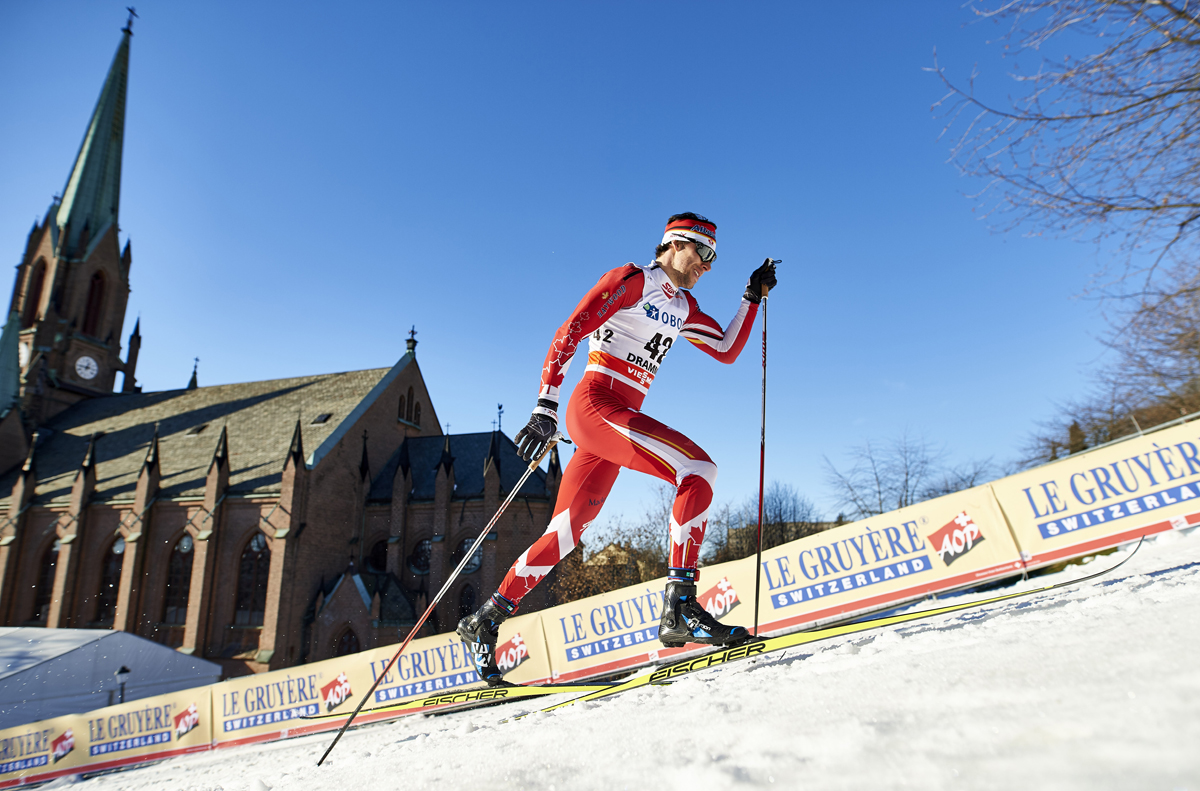
    Canada’s Alex Harvey had his second-best sprint result of the 2016 season during the Drammen, Norway classic sprints. He placed 20th overall. (Photo: Fischer/Nordic Focus)

    On the Canadian side, the Drammen rounds accounted for a solid result — Harvey finished 20th overall for his second-best sprint result this season after the Oberstdorf classic sprint, where he placed 15th.

    “So for me to qualify was already like a really good sign. This year I have qualified only once before and really it was at the Tour, the second sprint of the Tour, when people had already dropped out and their are less sprinters. So really, it’s the first actual real sprint that I have qualified in this year,” Harvey said on the phone.

    Harvey’s strong skiing on the day positioned him close to making the semifinals. His fast quarterfinal, the fourth of five heats, earned him a lucky loser spot until Hamilton knocked him out. Yet Harvey comes away with renewed sensations.

    “I felt like I had a good kick in the end for the last two to three hundred meters. I think that is the first time this year I felt that strong in a finish,” he said. “In the the past I have quite good finishes in both distance and sprinting. But this year, for some reason, it just wasn’t there until today.”

    Harvey plans to race this weekend’s Holmenkollen 50 k classic. He sits 12th overall on the World Cup.

    Racing continues for the men on Saturday with the Holmenkollen 50 k classic mass start.

    Results

  • Brandsdal Rolls to Drammen Classic-Sprint Win, But Krogh Takes Overall Sprint Globe

    Brandsdal Rolls to Drammen Classic-Sprint Win, But Krogh Takes Overall Sprint Globe

    The all-Norwegian men's classic sprint podium in the last World Cup sprint of the season on Wednesday in Drammen, Norway: (from left to right) runner-up Finn Hågen Krogh, winner Eirik Brandsdal, and Ola Vigen Hattestad in third.  (Photo: Fischer/NordicFocus)
    The all-Norwegian men’s classic sprint podium in the last World Cup sprint of the season on Wednesday in Drammen, Norway: (from left to right) runner-up Finn Hågen Krogh, winner Eirik Brandsdal, and Ola Vigen Hattestad in third.
    (Photo: Fischer/NordicFocus)

    Wednesday’s 1.3-kilometer classic sprint in Drammen, Norway, was essentially two races in one: the race for the win and the race for the overall Sprint World Cup.

    Drammen marked the final World Cup sprint this season. Going into the race, Norway’s Finn Hågen Krogh led the Sprint World Cup with 399 points, 33 points ahead of Italy’s Federico Pellegrino and 57 points ahead of fellow Norwegian Eirik Brandsdal.

    All three men were still mathematically eligible to win the overall title. Brandsdal won last weekend’s freestyle sprint in Lahti and neither Krogh nor Pellegrino had ever qualified for the final in Drammen. Pellegrino had only qualified for one World Cup classic-sprint final in his career.

    Eirik Brandsdal racing to the victory in the men's 1.3 k classic sprint in Drammen, Norway. While he won the race, he took second overall in the Sprint World Cup to teammate  Finn Hågen Krogh. (Photo: Fischer/NordicFocus)
    Eirik Brandsdal racing to the victory in the men’s 1.3 k classic sprint in Drammen, Norway. While he won the race, he took second overall in the Sprint World Cup to teammate Finn Hågen Krogh. (Photo: Fischer/NordicFocus)

    Over the course of the qualification round, the snow at Drammen turned very soft with temperatures around 50 degrees Fahrenheit. Earlier in the morning, organizers hauled in two truckloads of snow to slow the rate of thawing on the course. Several skiers opted to use skate skis and take their chances double poling instead of making decisions regarding classic skis and what to use for kick.

    As the first quarterfinal heats got underway, it appeared that Norwegian Petter Northug’s decision to use skate skis over classic might be the way to go. He had very fast skis and only lost to Brandsdal in a photo finish. Brandsdal took the quarterfinal win in 2:37.55, and both advanced to the semifinals.

    One-third of the race for the Sprint World Cup was decided after the first quarterfinal. Pellegrino finished fifth, 2 seconds behind Brandsdal, ending his chance of winning his first ever overall sprint title.

    Last year’s Drammen and overall Sprint World Cup champion, Ola Vigen Hattestad of Norway was a decisive winner in heat two. He qualified in 2:35.91, and teammate Timo Andre Bakken advanced as well, 1.71 behind.

    Krogh kept his title hopes alive when he and Russia’s Anton Gafarov advanced out of the third quarterfinal. Krogh won it in 2:38.34, and Gafarov was 0.21 seconds behind in second.

    Also advancing to the semifinals were Russia’s Sergey Ustiugov and three more Norwegians: Sondre Turvoli Fossili, Pål Golberg and Fredrik Riseth. American Andy Newell qualified as well.

    It was an all-Norwegian lineup for the first semifinal. Still on skate skis, Northug jumped out to a fast start and lead up the first climb, but in the slushy conditions, he fell behind quickly and never came back into contention. Brandsdal dominated the race, crossing the line first at 2:36.3, ahead of Hattestad in second.

    Fossli and Ustiugov advanced from the second semifinal, as did Russia’s Nikita Kriukov in third. Fossil’s winning time was 2:35.41, Ustiugov finished 0.39 seconds back, and Kriukov was 0.61 seconds back in third. Kriukov and Krogh advanced as lucky losers.

    The finals were set, with two Russians Ustiugov and Kriukov, and four Norwegians: Brandsdal, Fossli, Hattestad, and Krogh. With his spot in the finals, the sprint title was wrapped up by Krogh before the final started. His margin over Brandsdal was too big of a deficit for Brandsdal to overcome even if he won.

    Norway's Finn Hågen Krogh placed second in Wedneday's classic sprint in Drammen, Norway, to secure his first Sprint World Cup Crystal Globe. (Photo: Fischer/NordicFocus)
    Norway’s Finn Hågen Krogh placed second in Wedneday’s classic sprint in Drammen, Norway, to secure his first Sprint World Cup Crystal Globe. (Photo: Fischer/NordicFocus)

    At the start, Ustiugov led up the first climb and started to pull away from the pack. The group started to string out with Ustiugov leading to the second hill then an unforced error took out the two Russians at the same time.

    Ustiugov on skate skis tried to herringbone up the second hill in the middle lane. Since he had no grip he tried to cut the corner short by going to the inside. He wasn’t aware that Kriukov was there and both men collided and lost momentum. Kriukov was later relegated to last in the heat.

    With this happening at the back of the pack, the Norwegian train with Hattestad up front rocketed down the hill towards the finish. On the last turn, Brandsdal ultimately made the winning move, gliding past Hattestad and into the lead. He crossed the line first at 2:38.18. Krogh followed Brandsdal past Hattestad as well and finished second, 0.56 seconds later. Hattestad held onto third to complete the all-Norwegian podium.

    “The World Championships in Falun did not go as I had planned. I wanted to end the season strong,” Brandsdal told FIS after the race. “I did everything I could to fight for the crystal globe for the sprint.”

    While he didn’t get it, Brandsdal did win his sixth World Cup race.

    Krogh used his disappointment from not being named to Norway’s World Championships sprint team as motivation.

    “I have little to put a finger on what has been bad this season. Everything has gone according to plan,” Krogh told NRK, according to a translation. “This has been a bright season.”

    This Sprint Crystal Globe was Krogh’s first. He won it by 57 points over Brandsdal and 103 points over Pellegrino. Hattestad won it last season, ahead of Brandsdal in second, and Brandsdal was third in the sprint overall in 2011/2012.

    Results

  • Weekly Roundup: Homestretch

    Weekly Roundup: Homestretch

    The women's podium in the 15 k freestyle mass start at the 2014 NCAA Championships in Park City, Utah. The University of Denver won the its 22nd NCAA title on Saturday. (Photo: http://bertboyer.zenfolio.com) All proceeds from photo sales will be directly donated to NNF.
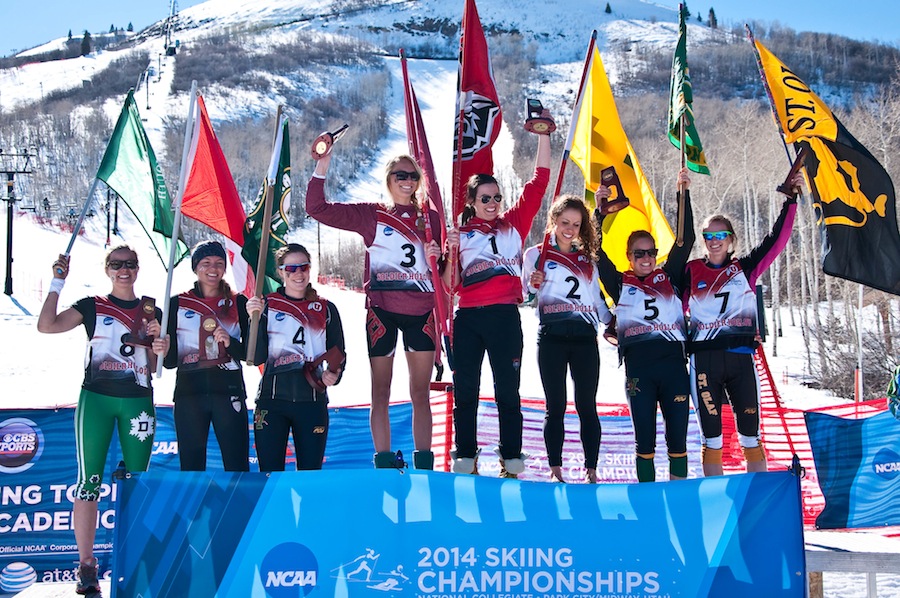
    The women’s podium in the 15 k freestyle mass start at the 2014 NCAA Championships in Park City, Utah. The University of Denver won the its 22nd NCAA title on Saturday. (Photo: http://bertboyer.zenfolio.com) All proceeds from photo sales will be donated to NNF.

    This week contained a flurry of action: the Drammen sprints, Holmenkollen 50 k and 30 k, Junior Nationals, NCAAs, IBU World Cup, IBU Youth/Junior Worlds, Nordic Combined World Cup, not to mention the Paralympic Winter Games and a couple marathons.

    A bit overwhelmed? We’ve got you covered. This week we’ll let our articles do the talking, but we’ve organized them below so you can keep the nordic action around the globe strait. Happy reading!

    Cross Country World Cup, Drammen and Oslo, Norway

    March 5 classic sprint men’s report | women’s report | American women’s report | skating controversy

    Saturday’s 50 k classic mass start men’s report | North American men’s report

    Sunday’s 30 k classic mass start women’s report | American women’s report

    2014 Paralympic Winter Games, Sochi, Russia 

    American preview | Canadian Preview

    Saturday’s biathlon 7.5 k standing Canadian report

    Sunday’s cross-country 12 k sitting American report

    Monday’s cross-country 20 k classic visually impaired Canadian report

    Tuesday’s biathlon 12.5 k standing Canadian report

    U.S. Junior Nationals, Stowe, Vt.

    March 3 classic individual top-10 recognition | video

    March 5 classic sprints top-10 recognition | video

    March 7 freestyle mass starts top-10 recognition

    March 8 freestyle relays top-10 recognition

    NCAA Championships, Park City, Utah

    Preview

    March 6 classic individual 5 k and 10 k men’s report | women’s report

    March 8 freestyle 15 k and 20 k mass starts report

    Photos

    Biathlon Youth/Junior World Championships, Presque Isle, Maine

    March 4 youth 10 and 12.5 k individual races report

    March 5 junior 12.5 and 15 k individual races report

    March 6 youth relays report

    Biathlon World Cup, Pokljuka, Slovenia 

    March 6 women’s and men’s 7.5 k and 10 k sprints men’s report | women’s report | American women’s report

    Saturday’s 10 k and 12.5 k pursuits men’s report | women’s report

    Sunday’s 12.5 k and 15 k mass starts men’s report | women’s recap

    Nordic Combined World Cup Trondheim and Oslo, Norway 

    March 6 10 k recap

    Saturday’s 10 k recap

    Marathons:

    Lake Placid Loppet

    Engadin (stay tuned)

  • Might Not Be Perfect, But Canadians Will Take Three in Top 20

    Might Not Be Perfect, But Canadians Will Take Three in Top 20

    Canadian World Cup Team member Lenny Valjas, who qualified in 29th and went on to place 16th in Wednesday's 1.3 k classic sprint in Drammen, Norway. (Photo: Fischer/Nordic Focus)
    Canadian World Cup Team member Lenny Valjas, who qualified in 29th and went on to place 16th in Wednesday’s 1.3 k classic sprint in Drammen, Norway. (Photo: Fischer/Nordic Focus)

    Any racer will tell you it feels pretty good to qualify, especially in a World Cup sprint. Even if they expect to, making that top-30 cutoff is often easier said than done and doing so is a relief.

    However, in the hour or so that follows before the heats, one has to move on, refocus and think strategically about the quarterfinals ahead. And on the downtown course in Drammen, Norway, there’s no cut-and-dry method to depend on. No matter what the conditions, some men double pole on skate skis, some stride the 1.3-kilometer classic course. Women race the same distance and have to get in position early if they want to make it to the next round.

    For Canada’s three qualifiers in Wednesday’s World Cup classic sprint, Dasha Gaiazova, Lenny Valjas and Alex Harvey, there were a few decisions to be made after concerning kick, no kick, etc. But mostly, they were thinking about how to guarantee a top-two finish and secure a spot in the semifinals.

    Dasha Gaiazova (CAN). Québec City Sprints, December 7, 2012, 12/7/12, Canada
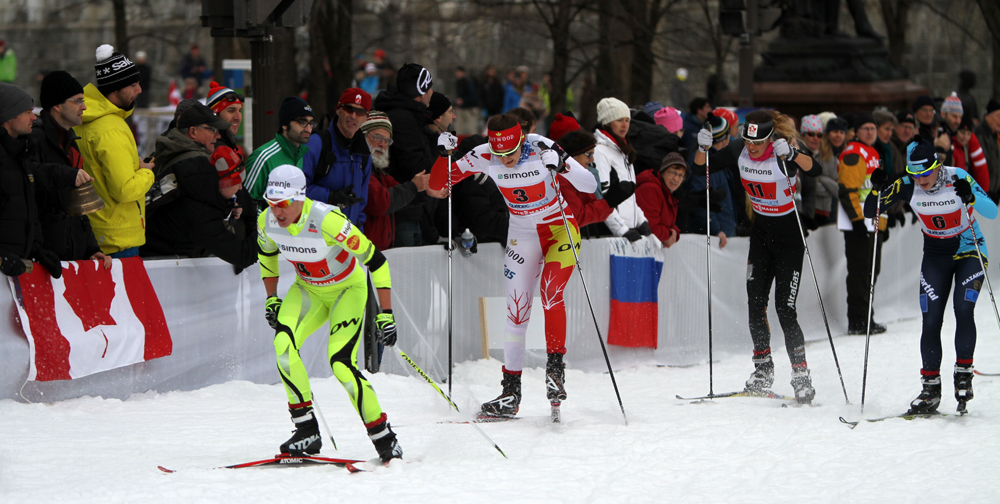
    Canada’s Dasha Gaiazova (second from l) at the Québec World Cup city sprints on Dec. 7, 2012.

    Once again, not so simple.

    Both men and women raced the one-lap course in Drammen, marked by a gradual incline from the start to the top of a 60-meter (200-foot) hill, followed by a long descent, a few sharp corners and several straightaways. The longest straight leads to the finish, and at several hundred meters long, it’s also uphill.

    Gaiazova qualified in 24th, the best of the Canadians, while Valjas and Harvey narrowly made it though in 29th and 30th, respectively.

    Like several of the top racers in the 75-person men’s field, Harvey initially raced on freestyle skis – double poling the entire loop. Qualifying by six-hundredths of a second didn’t exactly put him at ease, and Harvey opted for classic skis in the heats. Valjas, meanwhile, stuck with striding throughout.

    In the women’s quarterfinals, Gaiazova surged to the front out of the start, leading Sweden’s Linn Sömskar and Aino-Kaisa Saarinen of Finland. Saarinen pulled ahead over the top of the long hill, and Gaiazova and Sömskar attempted to hang on. Germany’s Hanna Kolb and Nicole Fessel threw themselves into the mix on the descent, coming around the last corner in second and third behind Saarinen.

    Back in fifth ahead of American Sadie Bjornsen, Gaiazova pushed hard toward the finish, picking off a few places to finish third and edging Kolb in a photo finish. Saarinen won the heat in 3:19.2, Sömskar was 0.9 seconds back in second and Gaiazova 1.4 seconds behind in third.

    With two more women’s quarterfinals to go, Gaiazova waited to see if she’d nab one of two lucky-loser spots. Her heat wasn’t fast enough compared to the five others, and the Canadian settled for 15th.

    “That was a hard effort,” Gaiazova told Cross Country Canada. “My arms and lungs are toast now, but I’ll take a 15th place result in a World Cup.”

    Gaiazova has been one of Canada’s most consistent racers this season, notching 12th at the last World Cup classic sprint in Davos, Switzerland, and achieving the same result in a skate sprint at the pre-Olympic World Cup in Sochi, Russia. Also in Sochi, Gaiazova and teammate Perianne Jones won bronze in the classic team sprint. And in mid-January in Liberec, Czech Republic, Gaiazova tallied a career-best fourth in a World Cup classic sprint.

    “Dasha was good today,” Canadian head coach Justin Wadsworth wrote in an email. “She kinda got pin-balled around a bit, but was solid.”

    Jones placed 45th, about 15 seconds behind Finland’s top qualifier Mona-Liisa Malvalehto and 3.43 seconds out of the top 30. Emily Nishikawa of the Alberta World Cup Academy (AWCA) was 63rd (+26.56).

    Canadian World Cup Team member Alex Harvey, who qualified in 30th and went on to place 20th in Wednesday's 1.3 k classic sprint in Drammen, Norway. (Photo: Fischer/Nordic Focus)
    Canadian World Cup Team member Alex Harvey, who qualified in 30th and went on to place 20th in Wednesday’s 1.3 k classic sprint in Drammen, Norway. (Photo: Fischer/Nordic Focus)

    In the men’s quarterfinals, Harvey lined up in the first heat with eventual-winner Petter Northug and his younger brother Tomas Northug, another Norwegian in Paal Golberg, American Andy Newell, and Sweden’s Johan Edin.

    Dropped by the top of the climb, Harvey took advantage of separate crashes on the other side: the first by Newell, who appeared to have his skis slip out from underneath him on a fast straightaway, and the second by Edin, who fell on an S-turn before the finish.

    “I think I crashed at that exact same spot last year,” Harvey said of Newell. “He was skiing outside the track because it was faster and I think he hit some ice and kind of slid, but I couldn’t see … I wasn’t really in contact with these guys.”

    Until Newell and Edin went down, that is. The Canadian moved from sixth to fourth in the heat, 5.23 seconds behind Petter Northug as the winner.

    “I got kind of lucky that they crashed because I wasn’t in it much,” Harvey said.

    His time wasn’t fast enough to lift him to the semifinals, and Harvey ended up 20th. A World Championships bronze medalist in the preceding classic sprint in Val di Fiemme, Italy, Harvey pointed out that he hadn’t cracked the top 30 in a World Cup race since the Tour de Ski in early January.

    So even though it wasn’t a “super-great result” and he might have reconsidered using skate skis for the heats, Harvey wasn’t disappointed. With the Holmenkollen 50 k freestyle mass start on Saturday in Oslo, Norway, and World Cup Finals next week in Sweden, he’s hungry for more.

    “Holmenkollen’s always really special and the World Cup Finals, last year was pretty good for me and I hope this year will be the same,” Harvey said. “It’s the last push now so I’m excited for the five next races.”

    Valjas is feeling good about his form coming off an eighth-place skate sprint result last weekend at the World Cup in Lahti, Finland. Wednesday didn’t exactly go as planned after he placed third in his quarterfinal for 16th overall.

    But it was also sprint racing in Drammen, where positioning is king. Given a difficult starting spot on the outside, Valjas had to get out early and fight for a track. When he couldn’t quite cut in, he decided to restart his race from the back.

    Trailing up the hill, Valjas was unable to pass on the descent. He opted for a lot of grip, which didn’t make his skis fast compared to the four skate-ski double polers in his heat. Pushing hard to get toward the front, Valjas had no room to move, no tracks to ski in. Somehow he skied along the outside and finished third, 0.7 seconds behind Norway’s Finn Hågen Krogh and John Kristian Dahl, respectively.

    “It was kind of a frustrating race and then getting blocked at the finish, there were no tracks to kind of show my speed,” Valjas said. “I just followed and ran in between the track at the end there. I’m a bit disappointed, but I guess it could’ve been worse. I’m happy that I even got in the heats.

    “I was really hoping to hoping to get top two in that heat and get to the semi and try again … but Stockholm’s coming,” Valjas added.

    He’ll also participate in the 100-meter sprint in Olso on Monday. “I’ve never done a hundred-meter race so that should be pretty fun,” he said.

    As for the rest of the Canadian men, Devon Kershaw placed 49th, 8.43 seconds behind Northug as the qualifying winner and 1.84 seconds out of 30th. Like Harvey, he also went with skate skis.

    “Drammen is always one of the toughest sprints to qualify for due to the number of good classic sprinters in Norway, so getting [in] was good,” Wadsworth wrote. “Devon was satisfied with his effort, and although disappointed, at least his body felt decent and was not too far from qualifying.”

    Kershaw has not raced since World Championships in an effort to rebound from stomach ailments. AWCA skiers Jess Cockney was 67th (+15.58) and Graeme Killick was 71st (+19.83).

    “Today was pretty disappointing,” Cockney wrote in an email. “I was really hoping to ski heats again and being so far out contention was really never what I imagined.”

    Cockney, Killick and their teammate Michael Somppi will join Canadian World Cup members Ivan Babikov, Harvey and Kershaw in Holmenkollen, according to Wadsworth.

    “The guys seemed in OK shape, so we’re hoping for good bodies on Saturday and next week,” Wadsworth added.

    ***

    Results: women | men

  • Images of the Action: North American Men in Drammen World Cup Distance Race

    Images of the Action: North American Men in Drammen World Cup Distance Race

    The men’s turn.  FasterSkier’s Topher Sabot was able to capture much of the action during them men’s 15km classic at the World Cup in Drammen, Norway this past weekend.  Here is a small sampling of what he saw through his lens.

  • Valjas Takes Another Step in Drammen Sprint

    Valjas Takes Another Step in Drammen Sprint

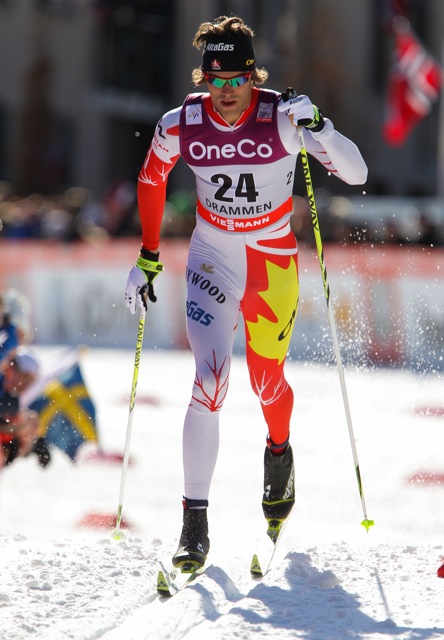
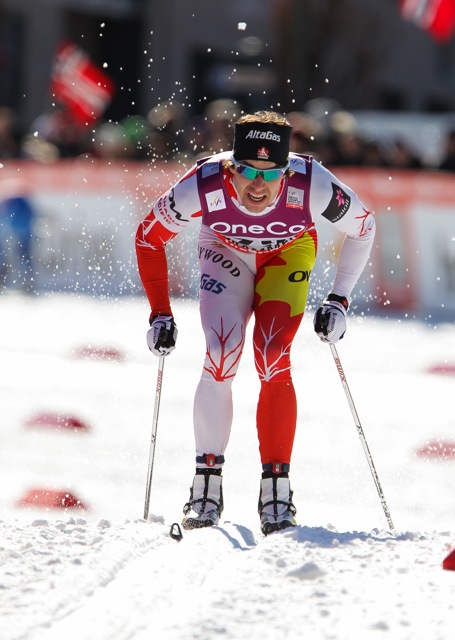
    Canadian Len Valjas in action on Sunday.

    If the directors at the International Ski Federation had gone to Canadian Len Valjas and asked him to lay out a 1.6-kilometer course, it would have looked a lot like the one used for the World Cup skate sprint in Drammen on Sunday.

    Mostly flat, with a ton of V2, the 6’6” Valjas described it as “the best course for me.”

    “I don’t have to offset,” he said, referring to the technique Americans call V1.

    Appropriately, then, Valjas used the loop as a launching pad to take fourth place in the prelim, and ninth in the heats—both career bests. And even better, the results qualified him to race for the Canadians in Thursday’s World Championships skate sprint.

    Valjas (second from left) in the quarters.

    With some steeper terrain, the course in Oslo isn’t quite as ideal for Valjas. But after his performance on Sunday, don’t count this guy out just yet.

    While skating has typically been his weaker discipline, he didn’t seem to have too many problems in Drammen.

    “We’ll see—I always surprise myself,” he said. “I’m like, ‘okay, I’m a classicer—and then this happens. Now, I’m a skater.’”

    Few people, Valjas included, could have foreseen his transformation over the past year, from a good domestic level sprinter into a world-class athlete fighting tooth and nail with international stars for a berth in a World Cup final.

    After another season of training alongside his teammate Alex Harvey, under coach Louis Bouchard at a regional training center in Quebec, Valjas attributed his rise to a better understanding of his own body—knowing when to take it easy.

    “I overdid it in the fall last year. And this year—some of the workouts, and some races and time trials and stuff, I was like, ‘you know what, Louis? I’m just going to sit this one out,’” he said. “’I missed a whole bunch of races, and I think that helped me just stay under that point of no return.”

    The first signs that Valjas had stepped it up came in Davos, Switzerland, where he qualified for his second set of World Cup sprint heats and nearly made it through to the semis. But when things started getting heavy, he said, he made a few tactical errors.

    “Those guys, they ski aggressive, for sure…I let some guys by, and after the race felt like I had made some mistakes,” he said.

    Valjas said he’s been studying video, though, and had boosted his confidence thanks to some workouts with Harvey at a recent high-altitude camp in Italy.

    In the heats in Drammen, he skied like he belonged there. In the quarters, he bided his time, letting a Norwegian junior lead much of the race before working him over to win on the homestretch.

    In his semi, which included eventual winner Emil Joensson and Olympic sprint medalist Petter Northug, Valjas was stuck near the back going over the final climb—which he otherwise might have skied faster.

    “I felt like I had more….I felt so comfortable,” he said. “I was kind of looking at the bristles on the left—I was thinking about straddling them, and making an attack. But you might get disqualified for that.”

    Instead, Valjas had to be content with holding his position on the last descent into the stadium to snag the inside lane for the homestretch—which he said took some cojones, to fight off an encroaching Swede, Mats Larsson.

    “We were side by side there. The old me would have just let him go, kind of,” he said. “You’ve just got to be aggressive and cut right in. One guy goes by, get in the train.”

    Valjas was still in contact with Joensson and Northug at the beginning of the homestretch; he just didn’t have quite enough left to match their finishing speed. It was close though, and his fifth-place finish in the heat left him close to advancing to the finals as a lucky loser.

    “I was missing just a hair of extra power in the final straight,” he said. “We’re talking, like, a foot every ten strokes. I was the same speed as those guys—I was just losing an inch every stride, I feel like.”

    There was no sense of disappointment from Valjas, though. And, he said, the result erased a crushing day in Estonia in January, where he was eliminated in the semifinals of the sprint at the U-23 World Championships after qualifying second.

    “That one was tough to swallow. In the qualifier, that was on my mind,” he said. “I’m happy now—this feels pretty good.”

    Valjas will get his next shot in Oslo—and, surely, throughout the next few years. The experience in Drammen will no doubt help.

    “Every time, he’s learning stuff,” said Canadian national team coach Justin Wadsworth. “We have good homes for him in distance, too, in the future.”

  • Harvey Surprises With Second in Drammen; Joensson Wins Final Tune-Up

    Harvey Surprises With Second in Drammen; Joensson Wins Final Tune-Up

    Alex Harvey and Emil Joensson dig for the line in the final.

    For Canada’s Alex Harvey, the bad news is that at next week’s World Ski Championships in Oslo, he’s not likely to improve much on his finish in his final tune-up race.

    The good news is why: in Sunday’s World Cup skate sprint in Drammen, Norway, he was a stunning second place, surging on the homestretch to top Olympic medalists Petter Northug (NOR) and Marcus Hellner (SWE), and falling just a few feet short of catching Emil Joensson (SWE) for the win.

    Emil Joensson (SWE) takes first.

    Harvey said he felt sluggish early in the day, when he skied to 22nd in the qualifier. But as the day went on, he got better and better, using Drammen’s seemingly endless homestretch to make up ground in all three of his heats. By the day’s close, he’d claimed his third career World Cup podium.
    “Good sign to be able to race fast when you’re not feeling too good,” he said. “I know in a couple of days, I should be feeling better than that.”

    It was a strong day for the Canadian men in the heats, with Harvey’s finish complemented by the performance of his teammate Len Valjas. In just his third-ever set of World Cup heats, Valjas nearly made the finals, ultimately placing ninth on the day after being eliminated in a cutthroat semifinal that included both Joensson and Northug.

    Meanwhile, American Andy Newell’s brutal season continued, as he was eliminated in a tight quarterfinal after leading early on.

    “He’s definitely kind of struggled this year, to find the form,” said U.S. Ski Team Head Coach Chris Grover. “If you’re slightly off against that men’s field, forget about it, because there’s so much depth.”

    By contrast, Harvey doesn’t seem to have lost a step from the peak he was riding in early January, when he placed 10th overall in the Tour de Ski. From there, he went on to collect a U-23 Championship in the 30 k pursuit in Estonia, a trip that also served as a brief respite from an altitude camp in Italy that he used as preparation for Worlds.

    In Drammen, the skate sprint wasn’t the event that was supposed to suit Harvey. He’s a stronger classic skier, and with his only individual World Cup podium coming in a 50 k, he’s been stronger in distance races in previous seasons.

    But Harvey told FasterSkier that he’s always had some speed—he’s just never given sprint races much focus, either in training or in competition.

    “He’d always had the skills for sprinting,” said Justin Wadsworth, the Canadian National Ski Team coach. “He just didn’t, maybe, on the World Cup show it that much. When we do a lot of the sprint workouts with [teammate] Devon [Kershaw]…Alex is always, always there.”

    This season, Harvey said, he didn’t change much, but he knew that he needed to pay a bit more attention to the format to be able to place well in the Tour. He was rewarded by two top-15 finishes there—his last sprint starts before Drammen.

    On Sunday, Harvey was slow off the line every time. But the course was as broad as a highway, and with two long, gradual uphills, there was plenty of time to make up ground.

    “You can pass basically anywhere you want,” Harvey said, “which is good, because I never have a super-fast start. You don’t need to be quick—you need to be powerful and glide well.”

    He was also aided by a finishing straight that went on forever—basically giving a shot to any athlete still in contact with the leaders when each heat rounded the final corner.

    In his quarterfinal, Harvey moved up from sixth to third on the last climb, and exploded on the homestretch to win the heat; he pulled a similar maneuver in his semi.

    In the finals, he was stacked up against Northug and Joensson for the first time, and again, Harvey was at the back—all the way until the last descent. There, he managed to get the inside lane, and came around into the homestretch in third, behind Joensson and Martti Jylhae (FIN).

    Jylhae faded to fifth. But Joensson, after fading on a similarly eternal homestretch in his last sprint in Estonia, had the staying power this time, holding off a hard-charging Harvey, as Northug was consigned to third place for the second straight day.

    Just like last season, Joensson seems to be on form for the major championship of the year—he was dominating in the tune-up sprint in Canmore before the 2010 Olympics.

    At those Games, though, he choked, failing to escape from the semifinals. And even after his performance Sunday, Joensson still said that he knows that medaling in Thursday’s World Championships sprint will be tough—especially with the top Norwegians and Russians opting to rest rather than race in Drammen.

    “Any Norwegian can win,” he said in the press conference. “They have five great guys…it’s going to be the toughest race to win, I think. You just have to have a good day, and have a bit of luck.”

    While Joensson will go in as the favorite in Oslo, Harvey, too, appears to have at least a shot at a sprint medal now.

    He maintained that his best chances are still in the team sprint, the 50 k freestyle, and the 30 k pursuit, but he said that Sunday’s result means that he’ll have another podium opportunity at the championships—removing some of the pressure from the other events. And, he added, the result in Drammen is a sign that he has the closing speed for those longer races.

    “It’s good to be finishing fast in skating,” he said, “because the 30 k and the 50 k are skating [the last leg of the pursuit is freestyle]. It’s going to be sprint finishes for the win, for the podium, for sure.”

    The Canadians had a spectacular Olympics last year, but they still left their home games without a medal in cross-country skiing. Now, Harvey said, the squad is looking for hardware.

    “This year, we want to be on the podium. It doesn’t necessarily have to be me, but we want a Canadian medal,” he said. “There’s only three guys per day that are going to get medals. But, I mean, I think every race I’ll enter, I think there’s a good shot at being on the top 10, top five.”

    Newell’s Woes Continue; Kershaw Struggles As Well

    If Harvey broke through on Sunday, Newell continues to run into a wall in the quarterfinals.

    In seven World Cup sprints this year, he’s qualified in the top 10 all but once—including four times in the top five. But out of those seven starts, he’s made it through to the finals just once, in his first sprint of the year back in November.

    In Drammen, the story was the same, even though he said he felt “pretty good.” After qualifying third and controlling his heat early, Newell couldn’t hold on and was passed on the homestretch by Italy’s Renato Pasini and Japan’s Yuichi Onda.

    “I just couldn’t quite do it at the end, I guess,” he said. “At least now I get to rest up. I’m ready—I’ve been feeling good during training, and everything.”

    Tough day for Newell.

    Newell’s struggles in the heats are lost on few people: even the Swedish stadium announcer in Drammen noted the trend on Sunday. Grover, the U.S. head coach, said that the problems simply come down fitness.

    “I think, for whatever reason, there’s been periods where he’s just not absorving the training very well,” he said. “I know that he feels like he’s just not in his peak form, for whatever reason.”

    Still, Grover said, Newell typically struggles in his first few efforts after traveling to Europe.
    “He’s dealing with that transition again… a few more days, a little bit more acclimating, I think might be the ticket for him,” he said. “His attitude’s been really good. He’s frustrated, because he’s knows that there’s more in there, but he’s staying loose.”

    At least Newell qualified. Kershaw, the Canadian, was 48th, and didn’t even crack the heats—a tough result to swallow given that he won a skate sprint at the Tour de Ski in January.

    After the qualifier, he said he didn’t know what went wrong. But Wadsworth, his coach, said that Kershaw was merely “a little flat right now.”
    “This is something we would experience in the past, too,” he said. “With Devon, I’m still 100 percent confident…We just need to find the right balance between training and rest.”
    Kershaw, Wadsworth said, will do one more hard session between now and the World Championships sprint on Thursday, likely on Tuesday. He’ll no doubt be doing plenty of mental rehashing of the weekend—his 26th-place performance in Saturday’s 15 k classic wasn’t up to his standards either—but Kershaw has a reputation for using drama as fuel.

    “It definitely doesn’t hurt,” Wadsworth said.

    Complete Results

    Men's podium: Petter Northug (NOR, 3rd place), Emil Joensson (SWE, 1st place) and Alex Harvey (CAN) 2nd place.