From the FasterSkier archive — posts syndicated from athletes’ and coaches’ own blogs between 2004 and 2012, kept online as published. Current coverage is at fasterskier.com.
The International Ski and Snowboard Federation (FIS) unveiled its proposed 2026/2027 cross-country skiing World Cup calendar this week at the FIS Spring Meetings in Portorož, Slovenia.
The schedule — first shared publicly through FIS social media and still pending FIS Council approval — builds the season around the 2027 World Championships in Falun, Sweden, with three pre-Christmas stops, a nine-race Tour de Ski, a stretch of three weekends between the Tour and Worlds, and a Scandinavian closing kick that ends with the Finals in Ulricehamn.
For North American fans, the calendar is once again entirely European, with no scheduled stops in Canada or the United States.
Frida Karlsson (SWE) poses with Mr. and Mrs. Claus following the 10k Classic to start last season in Ruka (FIN). (Photo: Modica/NordicFocus)
Pre-Holiday: Ruka, Trondheim, Davos
The season opens where it almost always does — in Ruka, Finland, where the World Cup begins November 27. From there, the circuit moves to Trondheim, host of the 2025 World Championships, before the pre-Christmas block closes in Davos, Switzerland, with a team sprint.
November 27-29, 2026: Ruka, Finland
27/11: 10km Interval Start Classic
28/11: Sprint Classic
29/11: 20km Mass Start Freestyle
December 1-3, 2026: Trondheim, Norway
01/12: 10km Interval Start Classic
02/12: Sprint Freestyle
03/12: 20km Skiathlon
December 11-13, 2026: Davos, Switzerland
11/12: 5km Heat Mass Start Freestyle
12/12: Sprint Freestyle
13/12: Team Sprint Freestyle
With Jessie Diggins (USA) now retired, there will be a new FIS Overall Crystal Globe and Tour de Ski champion next season (Photo: Vanzetta/NordicFocus)
Tour de Ski 2026/2027
The Tour de Ski returns to a three-country format, opening in Les Rousses, France, on New Year’s Day, moving to Oberstdorf, Germany, and finishing with three races in Val di Fiemme, Italy — capped, as ever, by the Final Climb up Alpe Cermis.
January 1-3, 2027: Les Rousses, France
01/01: Sprint Classic
02/01: 20km Mass Start Classic
03/01: 15km Pursuit Freestyle
January 5-6, 2027: Oberstdorf, Germany
05/01: 15km Mass Start Classic
06/01: 5km Heat Mass Start Freestyle
January 8-10, 2027: Val di Fiemme, Italy
08/01: 15km Skiathlon
09/01: Sprint Freestyle
10/01: Final Climb
Gus Schumacher (USA) and the rest of the US team will hope to continue their success in Toblach (ITA). (Photo: Modica/NordicFocus)
After the Tour, Before Worlds: Engadin, Toblach, Lahti
Three weekends bridge the Tour de Ski and the World Championships. Engadin opens its weekend with a mixed relay — a format the FIS has been working into more World Cup weekends — and Lahti closes the pre-Worlds stretch with its classic 20km skiathlon and 10km interval start.
January 22-24, 2027: Engadin, Switzerland
22/01: Mixed Relay
23/01: Sprint Freestyle
24/01: 20km Mass Start Freestyle
January 29-31, 2027: Toblach, Italy
29/01: 10km Interval Start Freestyle
30/01: Sprint Freestyle
31/01: 20km Mass Start Classic
February 12-14, 2027: Lahti, Finland
12/02: Sprint Classic
13/02: 20km Skiathlon
14/02: 10km Interval Start Classic
Kendall Kramer (USA) had a breakout World Cup Skiathlon in Falun (SWE) last season. (Photo: Authamayou/NordicFocus)
2027 FIS Nordic World Ski Championships: Falun, Sweden
The 2027 FIS Nordic World Ski Championships run from February 22 through March 7 in Falun, Sweden, with all title formats on the program. Falun last hosted Worlds in 2015.
Final Period: Oslo, Drammen, Ulricehamn
The closing stretch is a Scandinavian one. Oslo’s Holmenkollen weekend features back-to-back 50km mass start classic races on March 13 and 14 — long a fixture of the late-season calendar — before a one-day sprint stop in Drammen and the World Cup Finals in Ulricehamn, Sweden.
March 13-14, 2027: Oslo, Norway
13/03: 50km Mass Start Classic
14/03: 50km Mass Start Classic
March 16, 2027: Drammen, Norway
16/03: Sprint Classic
March 19-21, 2027: Ulricehamn, Sweden (World Cup Finals)
19/03: 10km Interval Start Freestyle
20/03: Sprint Freestyle
21/03: 20km Mass Start Classic
The calendar remains subject to FIS Council approval.
This coverage is made possible through the generous support of Marty and Kathy Hall and A Hall Mark of Excellence Award. To learn more about A Hall Mark of Excellence Award, or to learn how you can support FasterSkier’s coverage, please contact info@fasterskier.com.
Ben Ogden (USA) and Johannes Hoesflot Klaebo (NOR), (l-r) moments after their Semifinal crash in Drammen, Norway. (Photo: Nordnes/NordicFocus)
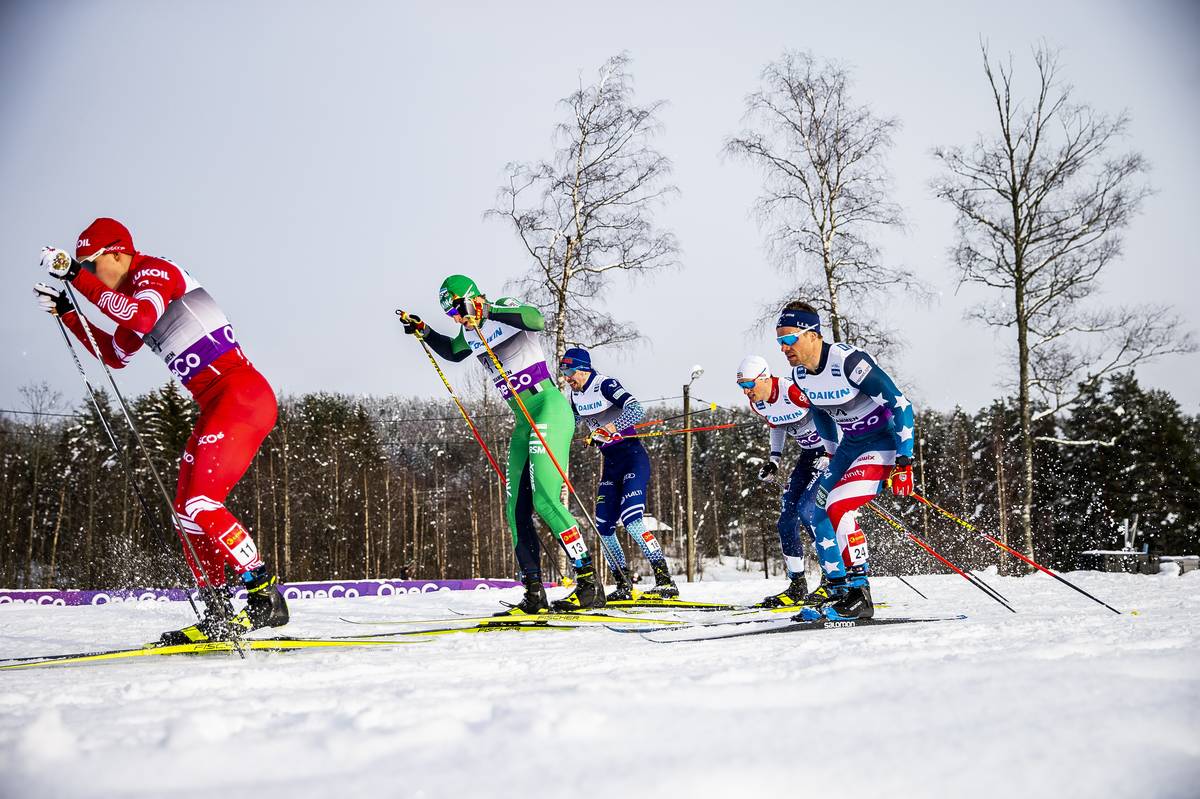
The greatest cross-country skier in history was lying on the snow, his arms wrapped over his face, his hands holding the back of his head, and the city of Drammen — where the man-made course magically appears on top of the streets, and Norwegian children crane from balconies to watch the racing — went very, very quiet.
Johannes Hoesflot Klaebo did not finish on Thursday. Neither did Ben Ogden. The gold and silver medalists from the Olympic sprint classic in Milano Cortina just last month, the two men who have defined this event all season, were tangled together on the hard-packed final downhill before the hairpin, while the semifinal raced on without them.
After the chaos of the semi-final, which took down the two fastest qualifiers, a 25-year-old Norwegian named Ansgar Evensen — who had changed into Skiathlon boots between the quarterfinals and semifinals because he felt so unsteady on his feet — surged from sixth place in the final to cross the line first.
Evensen won ahead of Jiri Tuz, the 21-year-old Czech who earned a career-best second place. Kristian Kollerud of Norway, racing in his very first World Cup start, took a remarkable third, and Harald Oestberg Amundsen, the 2024 overall World Cup champion, finished fourth.
It was the kind of day that maybe only Drammen — with its icy hairpin, its drafting effect, and its knack for producing chaos at precisely the wrong moment — could deliver.
Johannes Hoesflot Klaebo (NOR), Bernat Selles Gasch (ESP), Theo Schely (FRA), Ludek Seller (CZE), and Vili Crv (SLO), (l-r) in the first Quarterfinal. (Photo: Nordnes/NordicFocus)
Qualification and Quarterfinals
Klaebo’s dominance was apparent from the opening qualification. He posted a 2:24.88, nearly three seconds faster than Ogden’s 2:27.47, with the next 28 qualifiers separated by less than five seconds. That kind of gap on a world-class field in sprint qualification puts his dominance in perspective.
Klaebo, as he always does, chose the first quarterfinal heat. He won it easily — clocking 2:37.14 — compared to his qualifier, a notably conservative time that suggested he was managing his energy for the rounds ahead.
Simone Mocellini (ITA), Ben Ogden (USA), and Aron Aakre Rysstad (NOR), (l-r) in the second Quarterfinal. (Photo: Nordnes/NordicFocus)
Ogden, the lone American in the top 30, qualified second and chose Quarterfinal 2 alongside Italy’s Simone Mocellini and Norway’s Even Northug. He entered the bottom of the final climb up to the iconic finish on the steps of the Neo-Gothic Bragernes Church behind the leaders, but unleashed a powerful double-pole to charge into second place, advancing comfortably.
The quarterfinals also produced some early drama. Northug, who had been enjoying a strong sprint season, was disqualified from Heat 2 after receiving his second written reprimand of the season, this time for a classical technique infraction.
And quietly, in Heat 3, Evensen advanced as a photo-finish second behind Sweden’s Alvar Myhlback.
Ben Ogden (USA) and the medical team check on Johannes Hoesflot Klaebo (NOR). (Photo: Nordnes/NordicFocus)
The Crash
The first semifinal will be remembered for the crash.
Klaebo had won his quarterfinal from the front and appeared to be cruising. Ogden, too, looked comfortable. But on the icy final descent heading toward the hairpin around the fountain behind the start gates, the pack compressed. Klaebo held tight to the inside along the fencing, leaving him vulnerable when the skis began to cross. Contact was made. Ogden’s feet swept out from under him and fell right in front of the Norwegian. Klaebo had no place to go, skiing right into Ogden, which launched him into the air, spinning backward, ultimately hitting the back of his head on the hard-packed snow.
Ben Ogden (USA) walks off after the crash in the Semifinals. (Photo: Nordnes/NordicFocus)
Listening to the broadcast, the silence in Drammen was palpable. Ogden scrambled to his feet with only one ski still attached; Klaebo did not immediately follow. Replays showed Klaebo had not only hit his head on the hard snow, but may also have been struck in the head by a trailing ski as he fell. Both men would be listed as DNF — a designation almost never seen next to Klaebo’s name in a decade of dominance.
Anton Grahn of Sweden, who had been near the front, took the semifinal win. Tuz advanced automatically in second. Alvar Myhlback of Sweden finished third but would not be fast enough to advance as a lucky loser. The crash all but guaranteed that the top four finishers from Semifinal 2 would all advance to the final.
After the crash in Semifinal 1, Semifinal 2 with Harald Oestberg Amundsen (NOR), Kristian Kollerud (NOR), Jules Chappaz (FRA), Ansgar Evensen (NOR), Noe Naeff (SUI), and Davide Graz (ITA), (l-r) race for the finals. (Photo: Nordnes/NordicFocus)
Semifinal 2 and the Path to the Final
The second semifinal, then, was a race with diminished stakes but no shortage of quality. Chappaz drove the pace from the front and never relinquished it. Kollerud, the 21-year-old in his club racing suit, making his World Cup debut, finished an impressive second.
Behind them, Amundsen and Evensen advanced as lucky losers, separated by just hundredths of a second. The final would feature three Norwegians, a Frenchman, a Czech, and a Swede — but no Klaebo and no Ogden.
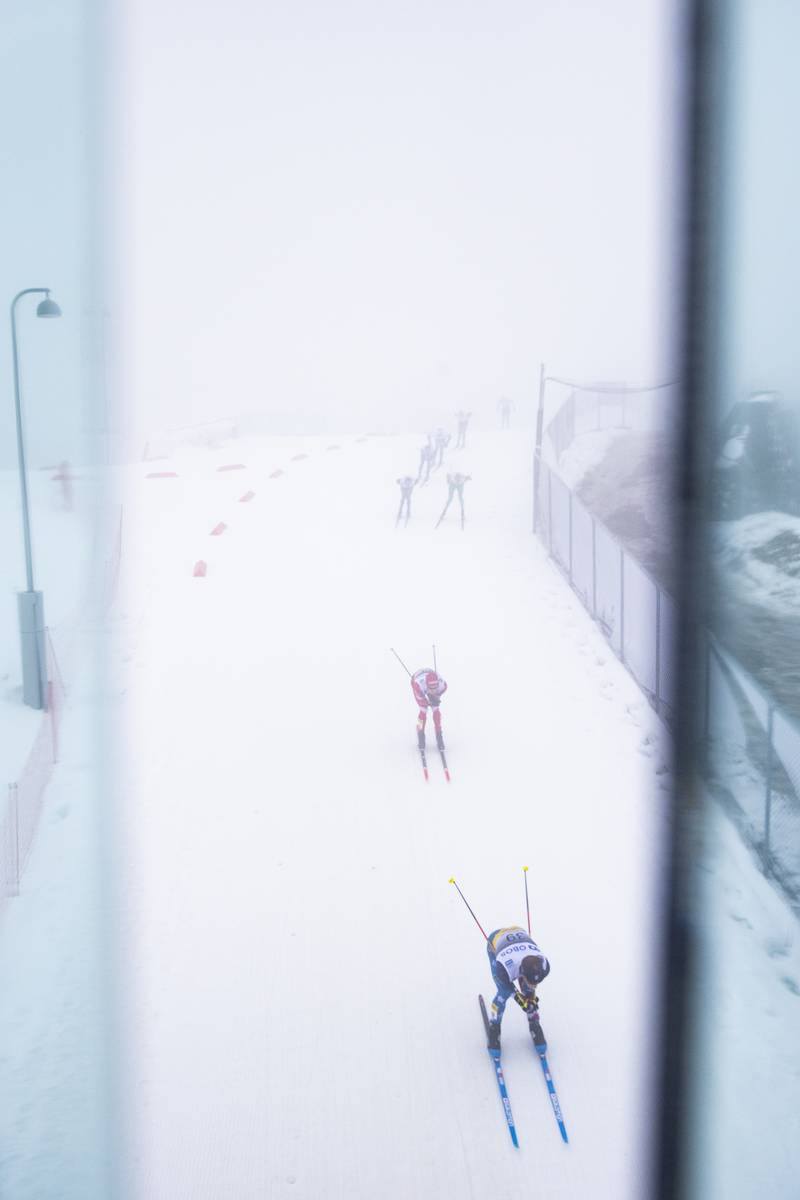
Entering the finish stretch. (Photo: Nordnes/NordicFocus)
The Final
Half the final field was under 23 years old. Tuz, Kollerud, and Grahn — all 21 — represented a generational shift on a day when the established order had been upended.
Tuz, perhaps emboldened by his semifinal crash survival, went hard from the gun, leading over the opening climb. It was a brave tactic from a young racer in only his second World Cup final. Behind him, the more experienced campaigners — Amundsen, Evensen, Chappaz — bided their time, trusting that the Drammen draft would bring them back and leave them well rested for the final climb.
It did. The group had reformed as they skied behind the fountain. As they navigated the icy turn, Grahn — who had been skiing near the front all day — lost his footing on the hairpin and crashed, his race effectively over. He would finish sixth on the day.
The final dash for the line. (Photo: Nordnes/NordicFocus)
Grahn’s fall opened a lane on the outside. Evensen, who had been sitting sixth, saw it and calmly worked his way around the dicy turn.
“When Anton fell in the last corner, I had every opportunity,” Evensen said afterward. “So I took it from fifth place to first on the final.”
What followed was one of the great finishing surges in Drammen’s long sprint history. Amundsen and Kollerud were locked in their own battle, focused on each other. Chappaz was charging. But Evensen — who had finished fourth on this same course back in 2023, who knew exactly how the final 50 meters of this city sprint played out — found a gear that nobody else could match.
Harald Oestberg Amundsen (NOR), Jiri Tuz (CZE), Kristian Kollerud (NOR), Jules Chappaz (FRA), and Ansgar Evensen (NOR), (l-r) had an exciting finish in Drammen. (Photo: Nordnes/NordicFocus)
He crossed the line first, fist clenched, pounding his chest. Tuz nipped Kollerud for second by four hundredths of a second. Amundsen was fourth, just 0.43 seconds off the win.
“It was super cool and I love to ski in Drammen,” Evensen said in a post-race interview with FIS, still catching his breath. “I had to change boots to my combi boots because I felt so unbalanced in the quarterfinal. But that’s how it is. Have to stay on your feet to win. And unfortunately for Johannes and Ben, they weren’t as stable today.”
Kristian Kollerud (NOR) waits for final confirmation of his podium. (Photo: Nordnes/NordicFocus)
Kollerud’s Debut
The feel-good story of the final belonged to Kollerud, who stood on the podium in his club racing suit — not the Norwegian national team uniform — soaking in a result he could not have imagined when he woke up that morning. A podium in your first World Cup start doesn’t happen. Except when it does.
He picked up a written reprimand for a classical technique infraction during the semifinals, but it was his first of the season and carried no further consequence. What will carry forward is the confidence of knowing he can compete with the best in the world.
Tuz, too, earned a career milestone. The Czech U23 athlete had made the final in Milano Cortina but never stood on a World Cup podium before Thursday. He now has a silver medal from Drammen.
Jiri Tuz (CZE) celebrates his podium in Drammen, Norway. (Photo: Nordnes/NordicFocus)
Standings and What’s Next
Klaebo’s DNF stung, but his World Cup position remains commanding. He leads the overall standings at 2,071 points (636 points more than Amundsen in second), the sprint standings at 835 points (283 points in front of Lars Heggen), and the distance standings at 936 points (128 points in front of Amundsen).
Barring further incident, Klaebo will sweep the overall, distance, and sprint crystal globes for the season.
Whether he gets the chance to race for them this weekend, however, is now in question. Norwegian national team doctor Ove Feragen told TV2 that Klaebo was taken to the hospital following the crash for precautionary testing related to the head impact. Feragen said Klaebo was conscious, in stable condition, and not believed to be seriously injured, but the severity of the fall warranted evaluation. His status for Saturday’s 50 k Freestyle Mass Start at the historic Holmenkollen in Oslo remains uncertain.
The season concludes with World Cup Finals in Lake Placid, New York, March 20-22, where Ogden and the American men will race in front of a home crowd. With four races left, a lot of exciting racing remains.
Feature stories like this one take time, access, and care to produce. If you value thoughtful storytelling and independent ski journalism, please consider becoming a Voluntary Subscriber. Your support directly fuels the work we do to cover the people, places, and moments that make our sport special.
Jiri Tuz (CZE), Ansgar Evensen (NOR), and Kristian Kollerud (NOR), (l-r) share the Classic Sprint podium in Drammen, Norway. (Photo: Nordnes/NordicFocus)
This coverage is made possible through the generous support of Marty and Kathy Hall and A Hall Mark of Excellence Award. To learn more about A Hall Mark of Excellence Award, or to learn how you can support FasterSkier’s coverage, please contact info@fasterskier.com.
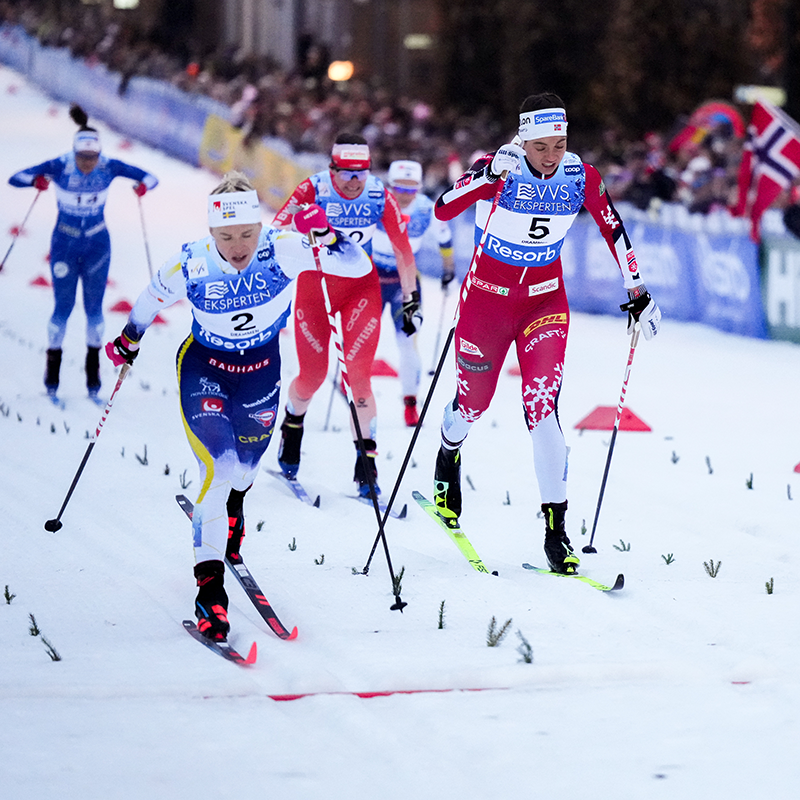
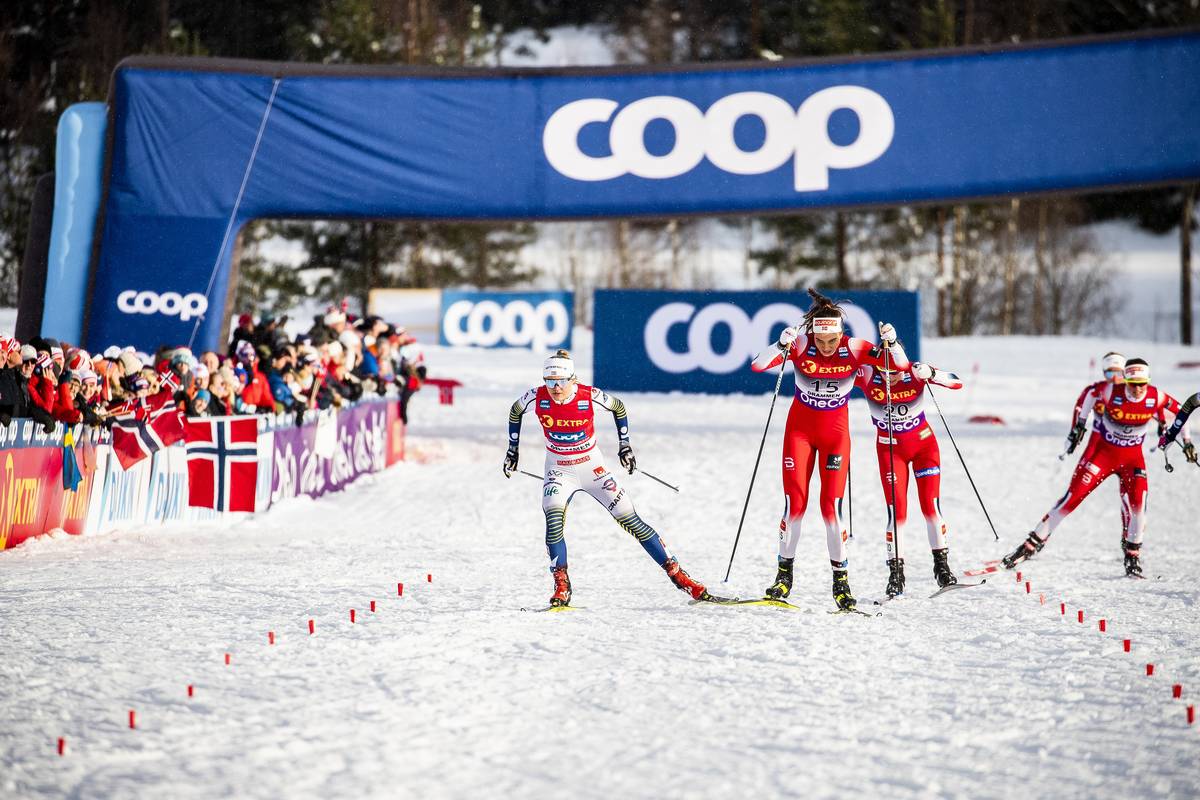
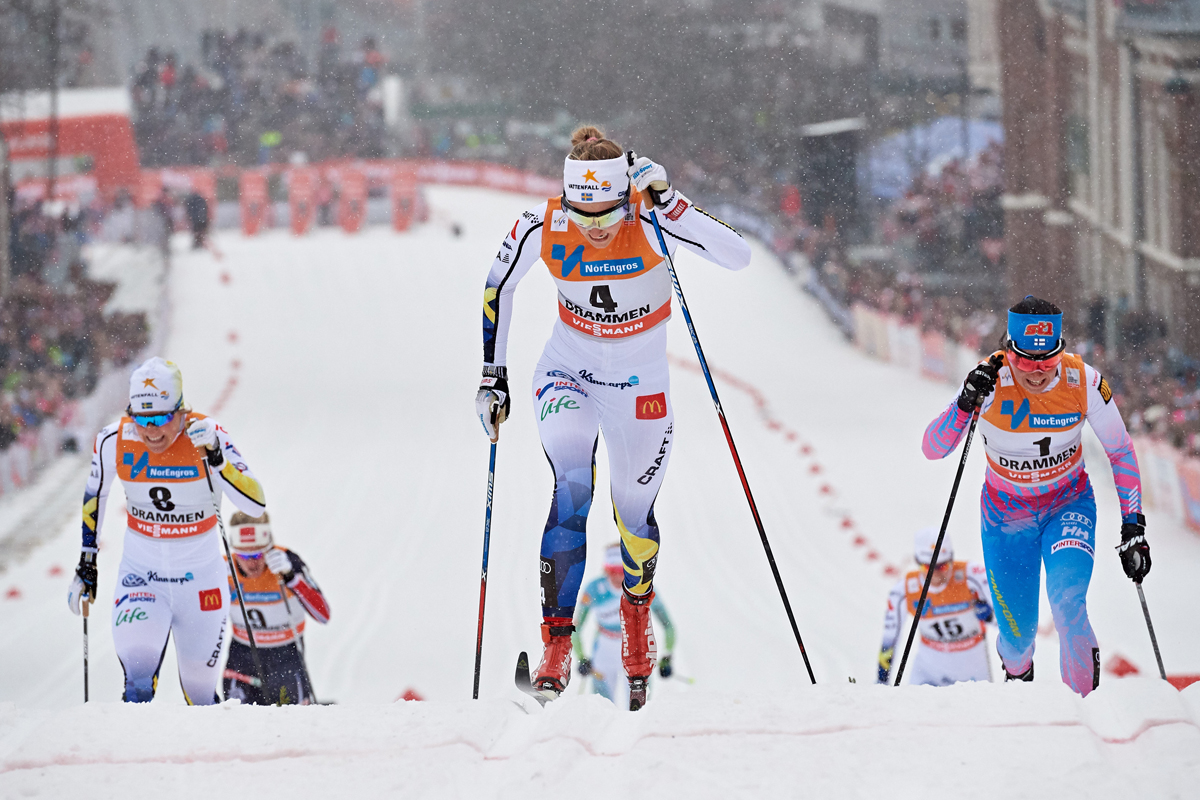
The women’s sprint final comes into the finish in Drammen, Norway with: Laura Gimmler (GER), Ane Appelkvist Stenseth (NOR), Jonna Sundling (SWE), Nadine Faehndrich (SUI), Johanna Hagstroem (SWE), and Kristine Stavaas Skistad (NOR), (l-r). (Photo: Nordnes/NordicFocus)
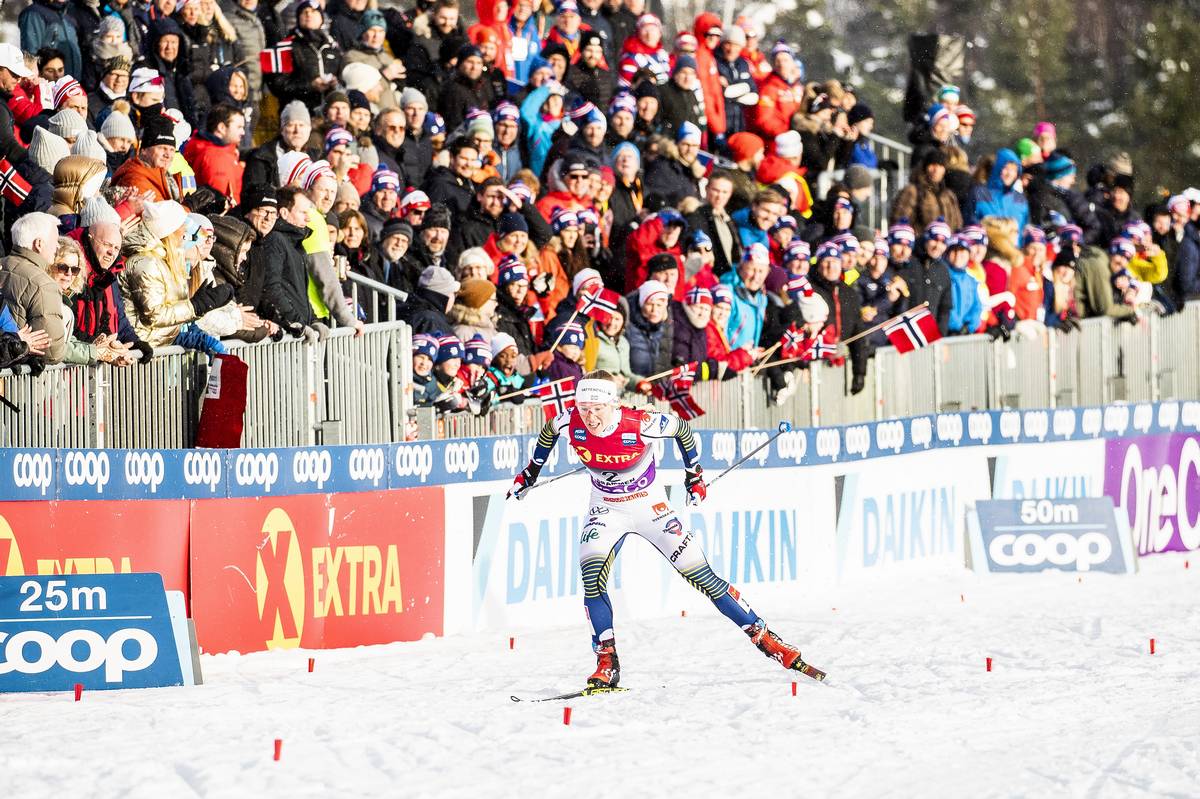
The snow was trucked in, the rock band was playing near the finish, and Norwegian children cheered from second-story windows along the course. On a rare midweek World Cup race day in Drammen — a small city just southwest of Oslo where the sprint course loops through the streets, wraps around an old fountain, and finishes on the snow-covered steps of an iconic church — Jonna Sundling of Sweden took home another World Cup sprint victory.
Sundling won the women’s classic sprint, going stride for stride with Norway’s Kristine Stavaas Skistad before pulling away in the final meters. Switzerland’s Nadine Faehndrich, racing her final classic sprint before retirement, earned the bronze.
It was Sundling’s fifth individual World Cup victory of the season and the latest chapter in an intensifying rivalry with Skistad that has captivated ski fans, especially Scandinavian ones, for the last few seasons. From the World Championship final in Trondheim last year to the Olympic final in Milano Cortina, Sundling, with the rest of the Swedish sprinters, and Skistad have been locked in a tactical chess match. On Thursday in Drammen, it was Sundling who played the final move.
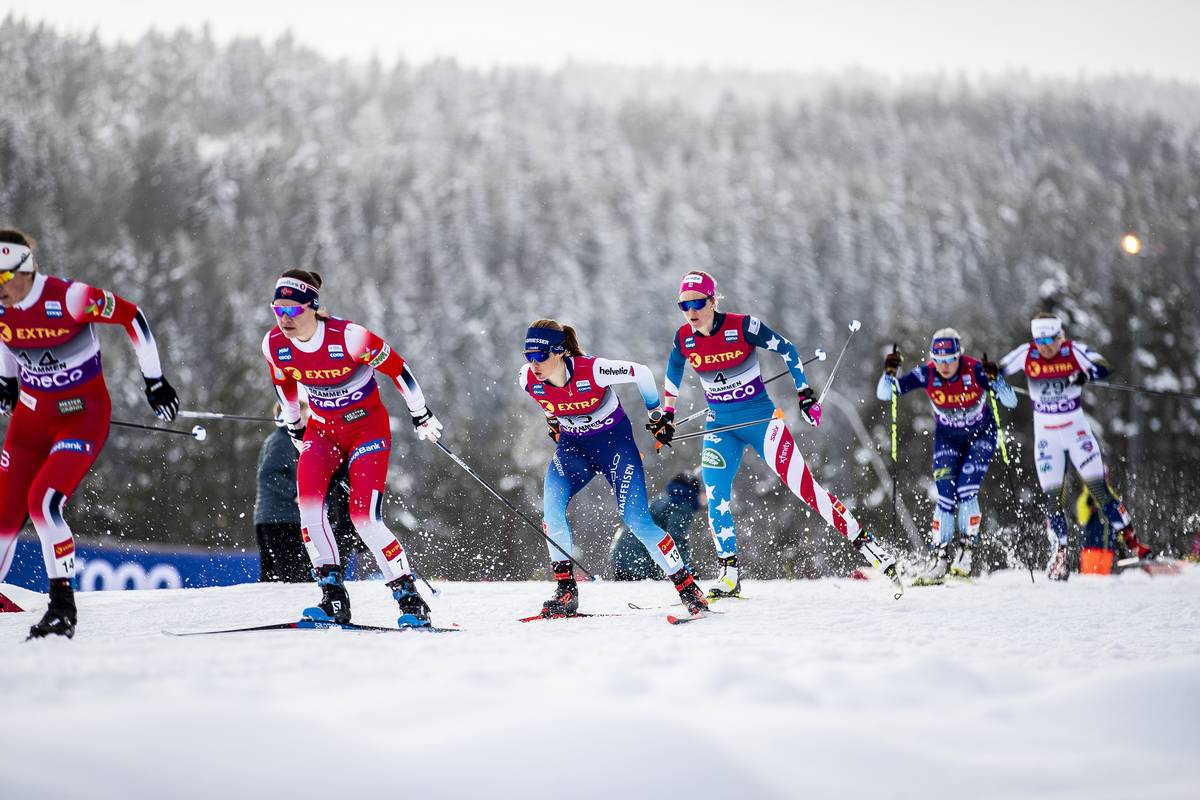
Quarterfinal number one heads up the first climb with: Barbora Antosova (CZE), Mathilde Myhrvold (NOR), Jessie Diggins (USA), Melissa Gal (FRA), (l-r). (Photo: Nordnes/NordicFocus)
Qualification and Quarterfinals
Sweden’s Linn Svahn, the reigning Olympic sprint champion, posted the fastest qualification time at 2:41.87 — nearly three seconds clear of Sundling’s 2:44.39. But qualification speed, as World Cup sprinting always reminds us, is only the entry ticket.
Two Americans advanced to the heats. Jessie Diggins, the overall World Cup leader wearing the yellow bib in what she called a “full circle moment,” qualified 17th in 2:50.91. Rosie Brennan, seeded 28th, also made the top 30.
Diggins chose Quarterfinal 1 alongside Sundling and Skistad — a loaded heat. Skistad took the win with Sundling second via a photo finish, just 0.18 seconds separating them. Diggins fought hard for third, advancing as a lucky loser after finishing just 0.22 seconds behind Sundling.
Rosie Brennan (USA) said after the race, “Drammen is one of my favorite races, it’s a fun course and always has a lively atmosphere.” (Photo: Nordnes/NordicFocus)
Brennan’s day ended in the quarterfinals. Racing in Heat 3, she bobbled heading into the downhill and lost the draft, which was a costly moment on a course where the slipstream effect was enormous all afternoon. She finished fifth in her heat.
“I was happy to get a chance in the rounds, but the conditions were very tough,” Brennan said. “They salted the course, and it was skiing great in the qualifier and then got really icy for the rounds. Anyway, I bobbled into the downhill and lost the draft and then just don’t have the power I need to pass that many people up the finish stretch, so I was disappointed to not be more in the mix.”
Meanwhile, Svahn survived a scare of her own… as her quarterfinal rounded the fountain that anchors the bottom of the course behind the start gates, five of the six athletes ended up in a pile and Svahn seemingly had the most bodies and equipment to navigate as she got back out on the course, but somehow recovered to advance. The Olympic champion’s troubles, however, were only beginning.
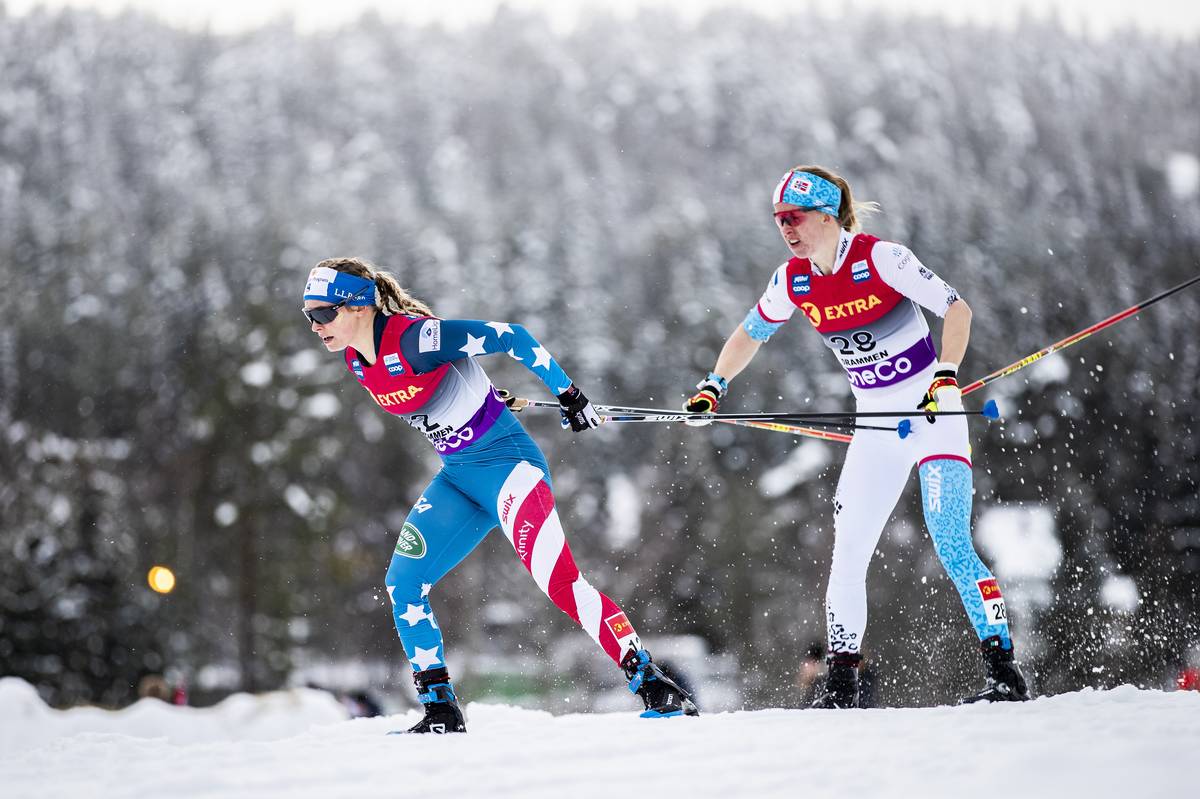
Maja Dahlqvist (SWE) and Jessie Diggins (USA), (l-r) during the second semifinal. (Photo: Nordnes/NordicFocus)
Semifinals
The two semifinals told entirely different stories, and the contrast between them shaped the final.
In Semifinal 1, Skistad took the win with Sundling second, just 0.20 seconds back. Both advanced automatically. Behind them, Svahn finished third and would not advance.
Semifinal 2 was a different race entirely. Johanna Hagstroem and Ane Appelkvist Stenseth pushed the pace from the gun, stringing the field out over the first climb. But on the long downhill, the draft did its work. Faehndrich and Laura Gimmler of Germany surged past, using the slipstream to slingshot into the lead.
Nadine Faehndrich (SUI), who is planning to retire after the season, found a little extra Drammen magic today as she finished on the podium in third. (Photo: Nordnes/NordicFocus)
Faehndrich won the heat decisively. Gimmler was second. The fast overall times meant Hagstroem would advance along with Stenseth, who just out-lunged Diggins for fourth and the second lucky loser position.
For Diggins, the day ended in 10th. But she left Drammen at peace.
“This was really cool because the Drammen area was my first ever World Cup start and it was a skate sprint,” Diggins said. “So it’s kind of a very full circle moment to close it out with a classic sprint here as the last classic sprint of my career.”
She had tried something new in the heats, sitting in the draft instead of going to the front, a departure from her usual aggressive approach. “Normally, because literal strength is not my strength, I usually just try to go really, really hot and try to go off the front,” she said. “I was like, nope, I don’t think that’s gonna work for me here with the crazy draft and slingshot effect. I was taking a lot of notes in warm-up, and in the quarterfinal, I had the smallest tuck of my life. It was just really fun to try to believe in myself as more of a pure sprinter and to try to be a little more tactical.”
She acknowledged she ran out of power in the semifinal, but had no regrets. “I still felt like I executed my plan to the best of my ability, and that’s always a cool feeling.”
Jonna Sundling (SWE) crosses the finish line just ahead of Kristine Stavaas Skistad (NOR) for the win in Drammen, Norway. (Photo: Nordnes/NordicFocus)
The Final
Six women lined up for the final: Sundling and Hagstroem for Sweden, Skistad and Stenseth for Norway, Faehndrich for Switzerland, and Gimmler for Germany. Svahn and Maja Dahlqvist, the Olympic gold and bronze medalists in the sprint classic, were both absent.
On the opening climb, Skistad sat behind Sundling in a familiar posture — patient, conserving, waiting for the right moment. As Kikkan Randall mentioned on the broadcast, Skistad almost never leads into a downhill. She baited Gimmler into taking the front position, then tucked into her slipstream.
Coming off the descent and around the final hairpin, Faehndrich made her bid, surging past Gimmler and into third. But the race was between the two women everyone expected.
Sundling and Skistad skied side by side on the final climb, and what followed was a scene that encapsulated their rivalry. Stride for stride, shoulder to shoulder, neither yielding a centimeter. Sundling’s transition from double pole to striding was fractionally sharper — she carried more momentum through the final meters — and she crossed the line with a small advantage.
“It is usually very tight in Drammen, but today it was extremely tight,” Sundling said on air afterward. “Till the last meter. I was like, okay, I need to continue all the way over the finish line. It was tough, but I’m happy that I was the first person over the line.”
For Faehndrich, the bronze was a fitting farewell. The 30-year-old Swiss racer, who announced her retirement this season, now sits third in the sprint World Cup standings at 700 points — just behind Hagstroem (708) and within striking distance of leader Dahlqvist (720) heading into the final sprint of the season in Lake Placid next weekend.
Jessie Diggins (USA) gave her fans something to cheer about during her quarterfinal when she charged to the finish line. (Photo: Nordnes/NordicFocus)
Looking Ahead
Diggins continues to lead the overall World Cup standings with 1,961 points, 275 points ahead of Sweden’s Moa Ilar, a margin that appears insurmountable with four races remaining. The distance globe, too, seems firmly in her grasp. But the sprint crystal globe race is wide open: Dahlqvist, Hagstroem, and Faehndrich are separated by just 20 points at the top of the standings, and the final sprint in Lake Placid could decide everything.
For Diggins, there’s another milestone ahead — she’s only a few nights away from sleeping in her own bed before racing in front of an American crowd at the World Cup Finals. “Very, very, very excited about that,” she said.
The World Cup moves to the historic Holmenkollen venue in Oslo on Saturday for the Women’s 50 k Freestyle Mass Start, before the season concludes in Lake Placid, New York, March 20-22.
Feature stories like this one take time, access, and care to produce. If you value thoughtful storytelling and independent ski journalism, please consider becoming a Voluntary Subscriber. Your support directly fuels the work we do to cover the people, places, and moments that make our sport special.
No rest for the weary (except those who skipped Holmenkollen): We’re back with recaps of, objectively, the most lit series of races on the World Cup circuit, in Norway. We’ve got the goods from the Holmenkollen 50 k races, including the first-ever for women, and the always satisfying Drammen sprints.
We’ll be back next week. Reach us at devon@fasterskier.com and nat@fasterskier.com.
Today the International Ski Federation (FIS) banned all Russian and Belarusian athletes and officials from taking part in any remaining FIS competitions. The press release stated, “The FIS Council decided unanimously in line with the IOC recommendation, that with immediate effect, no Russian or Belarusian athlete shall participate in any FIS competition at any level through the end of the 2021-2022 season.”
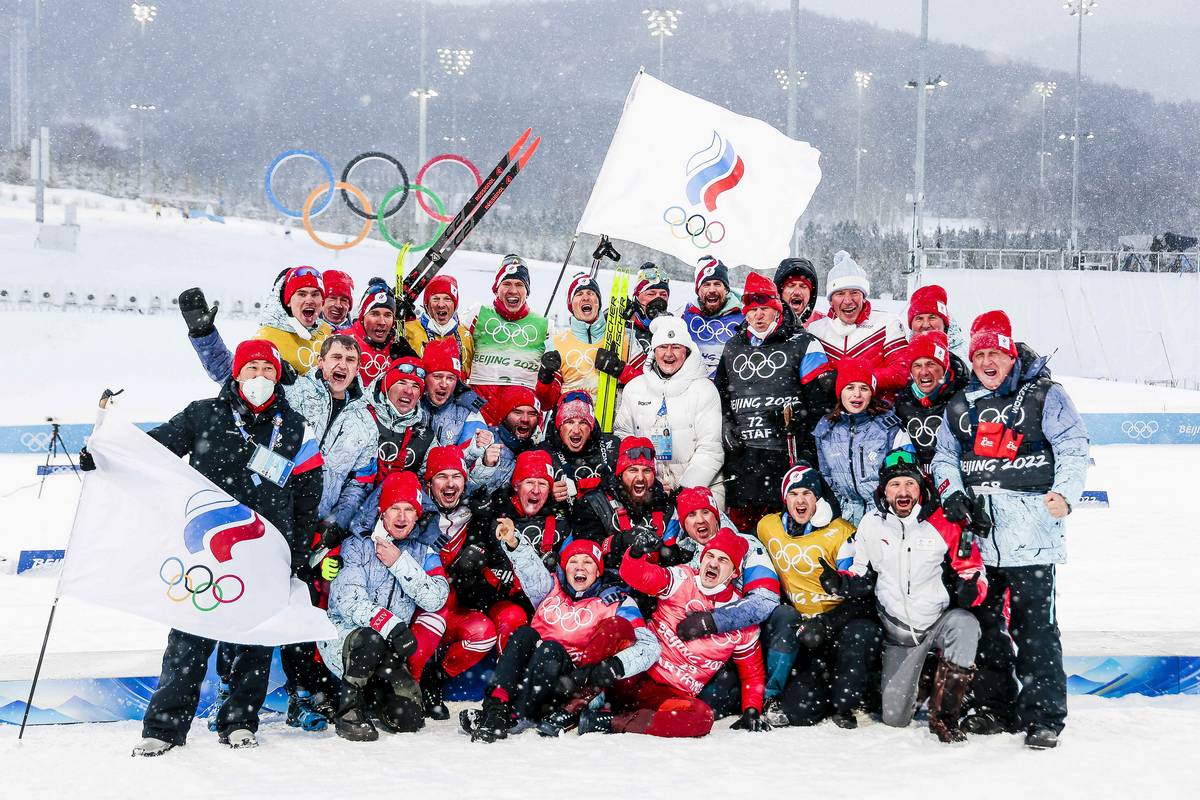
The Russian team celebrates a dominant performance at the men’s 4 x 10 k relay during the 2022 Olympic Winter Games. (Photo: NordicFocus)
On Saturday, February 26th the board of the Norwegian Ski Association decided in a special meeting to uninvite Russian and Belarusian athletes from its upcoming World Cup races in Drammen and Holmenkollen. The position of the Ski Association was clear: “We do not want their participation.”
However, the Norwegian Ski Association and the event organizers lacked the authority to bar athletes, and FIS stood by their position of allowing all athletes to compete, telling NRK “The FIS board has been clear in its approach to Russian athletes in all FIS competitions… national federations and local organizers should not exclude athletes on the grounds of gender, race, nationality or sexual orientation.”
On Monday, February 28 the Russian cross country ski team arrived in Oslo despite their lack of welcome and were met by Norwegian reporters at the Gardermoen airport. The athletes declined to speak, but Bolshunov’s coach, Yuri Borodavko did. “Well, it’s a terrible situation,” Borodavko told NRK. “War is always terrible. No one has ever wanted a war, not even us. Thank God there are sensible people with common sense, who do not give in to the panic that is now spreading throughout the world, and it is the leaders of FIS.”
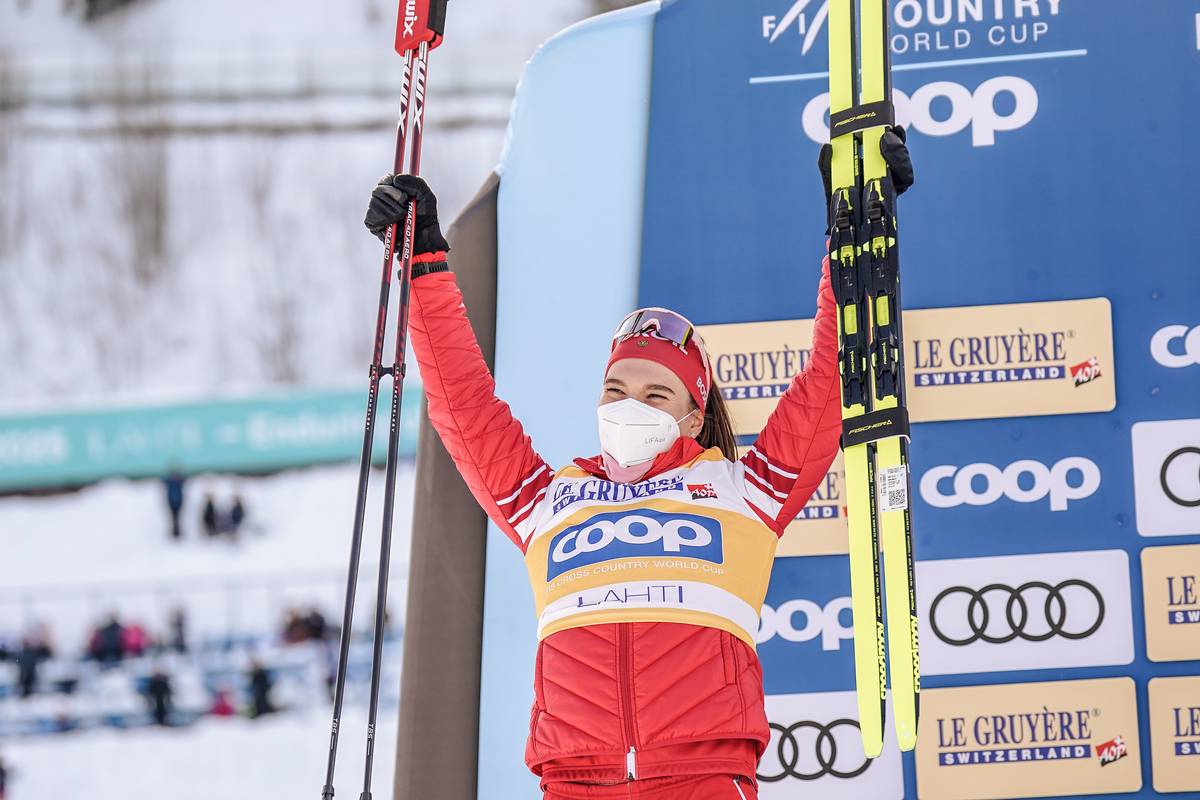
Russia’s Natalia Nepryaeva steps onto the podium following a second place finish in the 10 k classic in Lahti. (Photo: NordicFocus)
On Monday the Ski Associations for Norway, Sweden, and Finlandwrote to FIS to ask for the exclusion of Russian athletes. Later in the day, the International Olympic Committee (IOC) revised their advice and requested the exclusion of Russian and Belarusian athletes.
“[The Ski Associations] letter was somewhat surprising to us,” said FIS Secretary General Michel Vion.
FIS, seemingly unable to move in tandem with events, made no response, and Vegard Ulvang pushed the Norwegian Ski Association to carry through with the refusal to host Russian athletes, saying, “It is a decision that FIS should have made. When they do not take it, it is we [Norway], who own the event, who must take it. If FIS disagrees with the decision, they can take the World Cup from us, it is a risk we should take. Then we will also force FIS to take active action.”
With no word from FIS, the Norwegian Ski Association hosted a series of crisis meetings on Monday night and early Tuesday morning, during which the organization decided to override FIS and ban all Russian and Belarussian athletes from competing, regardless of the consequences of the action.
“We had hoped that FIS would come to that decision on behalf of the entire ski sport,” said Norwegian Ski Association President Erik Røste, “But now the Ski Association can not wait any longer.”
FIS Secretary General Vion dismissed the position of the Norwegians saying, “We received some emails, with inquiries that were not reality-oriented. The Norwegian Ski Association does not have the authority to cancel anything or to exclude athletes. They express a wish that there will be no Russian athletes, but it was just a wish.”
The Russian ski team, training in Holmenkollen on Tuesday morning confirmed that they would leave Norway and not participate in the World Cup. “Let our rivals compete,” Borodavko told VG. “Let’s just say they are not our friends and not comrades.”
With the decision effectively already taken, FIS seized the moment at noon Central European time on Tuesday and banned the Russian and Belarusian athletes and officials. “I am very happy that FIS ended up in that position,” said Røste, adding, “It has taken too long, it could have come earlier.”
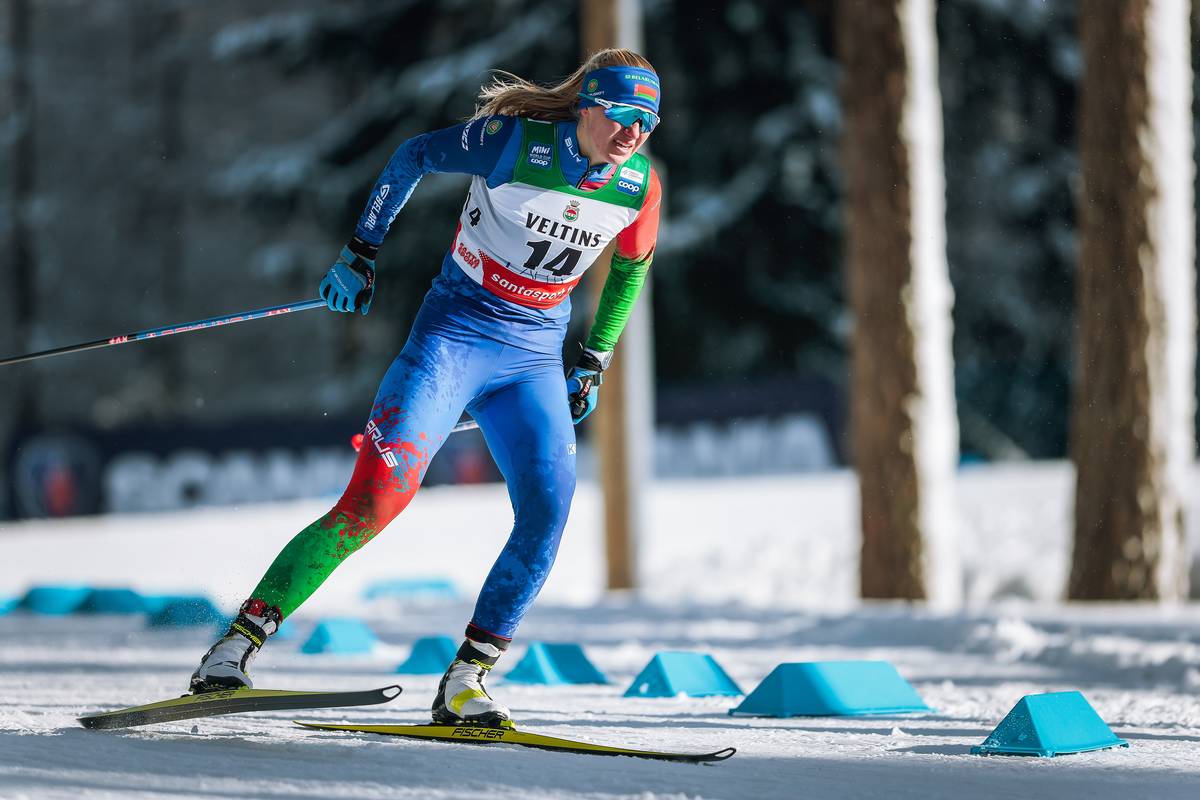
Belarussian athlete Hanna Karaliova races the freestyle sprint qualifier last weekend in Lahti, FIN. (Photo: NordicFocus)
The FIS decision narrowly averted the likely cancellation of the remaining World Cup races and the flight of sponsors.
Geirr Kihle, the event organizer of the Drammen city sprints this Thursday had urged fans to come to the event in the blue and yellow of the Ukrainian colors. He said he hoped the public’s reception to the Russian athletes would be, “to put it a little simply, sour.”
On Tuesday morning, Drammen said they would withdraw from hosting the race if the Russian athletes were not banned.
Pressure on FIS also came from Coop—the title sponsor of the World Cup. “We have given FIS clear guidelines for what we believe,” said Takle Friis, the Director of Communications for Coop to VG. “They must respond immediately. In sympathy and solidarity with Ukraine, we can not accept that the Russian team will go to the World Cup.”
Coop will adopt the Ukrainian colors for their logo on race bibs, and are working to change trailside billboards at Holmenkollen to promote donations to the Red Cross.
Sponsorship deals for Russian athletes also began to evaporate. Brav, the parent company of Swix and Toko announced on Monday that effective immediately, it will end all business in Russia and sever ties with Russian athletes.
The conflict between the sporting associations and FIS is yet another note in a habit of day-too-late decision making by the governing body of world skiing. Following the Russian invasion of Ukraine, the US ski team along with Norway, Sweden, and Finland all declared that they would not send teams to the scheduled World Cup Finals in Tyumen, Russia. After a day of urging FIS to act, the following day FIS canceled all remaining events in Russia. By then, it was already a moot point—no one was going.
Johannes Høsflot Klæbo enjoys a victory in Lahti’s freestyle sprint. (Photo: NordicFocus)
Johannes Klæbo has been perhaps the most outspoken athlete on the issue. On Monday, he told VG “I think it is both cowardly and weak that FIS does not make the decision to deny Russia participation in Norway and in the World Cup. FIS should have done as Ski Classics [did] – and said no to Russia.”
The Visma Ski Classics, a rival circuit to that of FIS World Cup, moved swiftly on Monday to remove Russian skiers from the Vasaloppet and the season long competition.
The FIS decision came too late for some quarters: Ӧstersund announced that there was no longer sufficient time to get a budget and sponsorship ready to host the World Cup Finals.
A day earlier, the municipality of Ӧstersund, which owns the ski trails, declared that they would bar the use of the ski trails for the event if FIS did not ban Russian athletes.
The World Cup will now likely end a week earlier than scheduled in Falun, Sweden on March 13th.
The late decision from FIS stoked grumbles that the federation may be overly beholden to Russian interests. As Drammen race organizer Geirr Kihle put it about sport federations in general, “Those who are called the ‘high lords’ have a hard time deciding. It is very common for Russians to sit on the boards. They are involved in deciding and will probably almost veto if they do not get what they want.”
Norwegian newspaper Dagbladet also questioned the interests of new FIS President Johan Eliasch, the Swedish-British billionaire and former CEO of the ski company HEAD. Dagbladet challenged Eliasch’s record of supporting Russian tennis star, and HEAD athlete Maria Maria Sharapova, after tested positive in 2016 for banned substance Meldonium. Eliasch at the time said “Has WADA something against Russia? I believe they do.”
The assertion that FIS is biased towards Russia was refuted by Secretary General Vion who replied to the NRK question, “Of course not! How can you say that?” He pointed out that Elena Valbe, the head of Russian skiing, is the only Russian to sit on the 19 member council.
Nevertheless, the situation is far from resolved. NRK commentator Jan Petter Saltvedt rejected the phrasing that FIS used to ban the athletes which focused on athlete safety and in his words, lacked “the essential thing, namely the condemnation of Russia’s invasion.”
“The whole reasoning is untrustworthy and deficient,” argued Saltvedt. “Many questions remain about what kind of power struggle this has been and what FIS leaders really think about this.”
The cautious wording from FIS likely has much to do with an expected appeal by the Russians in the Court of Arbitration for Sport (CAS).
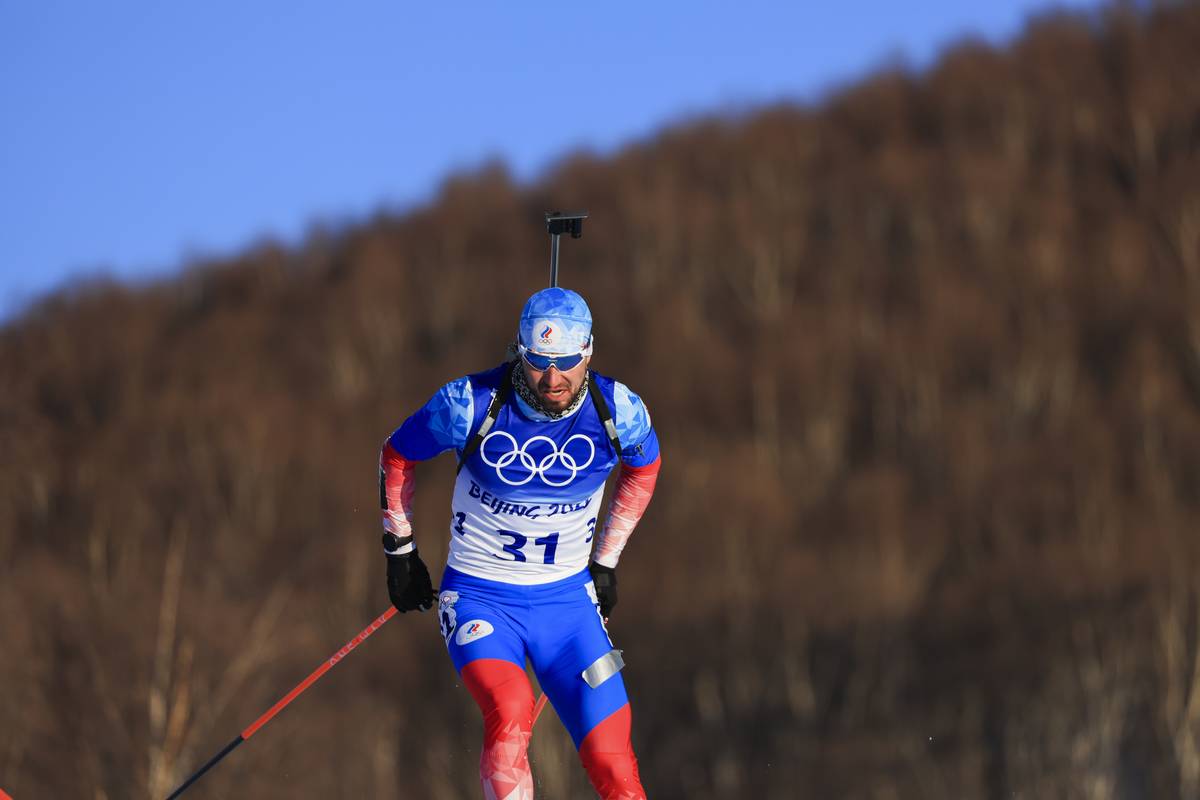
Russian biathlete Alexander Loginov competes in the men’s individual competition during the 2022 Beijing Olympic Winter Games. (Photo: NordicFocus)
When the International Biathlon Union decided on Saturday to require Russian athletes to compete under a neutral flag, their team promptly withdrew from the World Cup, stating, “We are furious at these illegal actions of the IBU and will defend the rights of our athletes and the rights of the RBU as a member of the International Federation.”
The case is expected to end up in CAS, and there is a likelihood that the same will occur in cross country skiing.
The Russian team will leave Norway on Wednesday, reported Borodavko to NRK. “When you start to mix politics into the picture,” Borodavko said, “there is something we can not accept, so therefore we go back.” With no flights between Europe and Russia, their journey home will likely route them through Turkey.
The manner in which FIS came to the decision will likely deal a blow to its credibility, managing in a single stroke to alienate both its Scandinavian and Russian partners. FIS has struggled to rise to the challenge that this season has presented, with previous misses being the COVID related cancellations of World Cup races in France and Slovenia, an impromptu shortening of the men’s Olympic 50 k, and a belated cancelation of the World Cup Finals in Russia.
“Things take time,” Klæbosaid on Friday, adding, “But I certainly think we do not have to wait until the longest every single time.”
Jens Burman of Sweden may have summed it best to Aftenbladet on Tuesday morning before FIS’s announcement. “In principle, everyone has excluded them, but not FIS. You are almost a little ashamed.”
Sweden’s Jens Burman races the 15 k skate during a December 2021 World Cup in Davos, SUI. (Photo: NordicFocus)
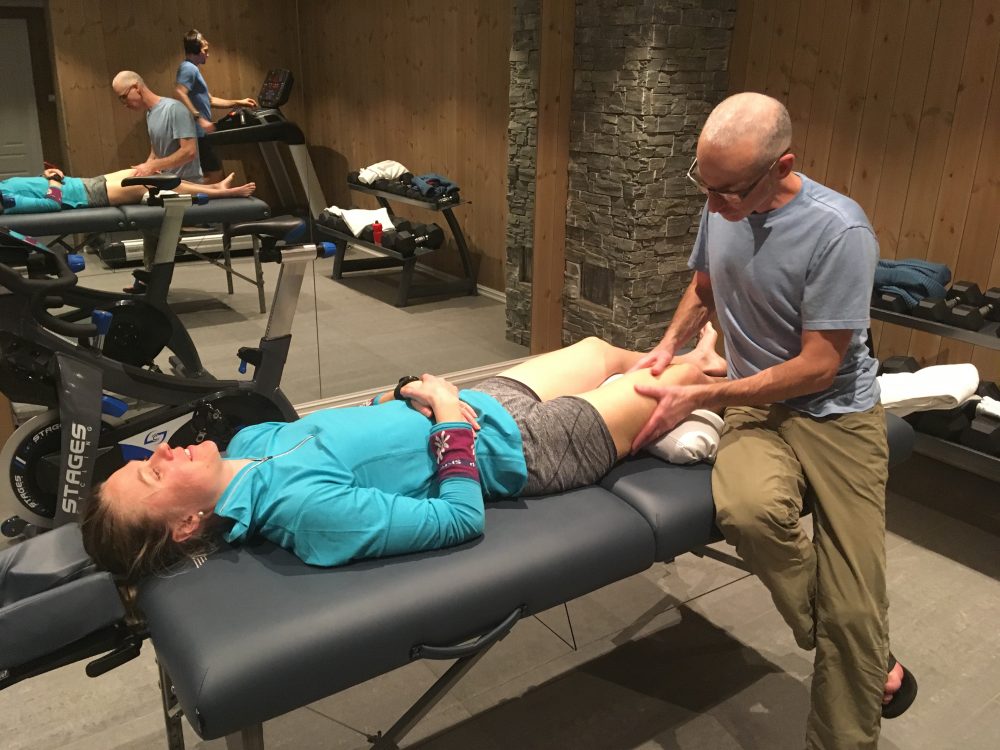
Ned Dowling working on Sadie Maubet Bjornsen. (Photo: Ned Dowling collection)
“Get whatever you want. I’m buying.”
“It’s ok. I’ve got a card with me.”
“No. You’re over here working for us. The least I could do is buy you a coffee and a bun.”
Conversation over. Jessie Diggins bought my cinnamon bun and cappuccino. The same Jessie Diggins who won Gold at the last winter Olympics and is a regular on World Cup podiums just refused to let me buy my own snack at the café stop while skiing in Sjusjøen, Norway. If I didn’t already feel accepted, I did then.
The email from U.S. Ski and Snowboard had arrived two months earlier. The Physical Therapist who was scheduled to work with the U.S. Cross Country Ski Team during races in March was unable to travel. Would I be able to cover for her? My jaw dropped. My pulse quickened. I’d just been asked to travel with the U.S. Ski Team to Norway—the Mecca, the Motherland.
I didn’t sleep a wink that night.
This was not my first gig as a PT working with elite athletes. I’d had a stint as a part-time soigneur with a U.S. based, pro cycling team. In French, soigneur means “helper.” In every other language, it means “worst job in sports.” The hours are long, the tasks are menial, and the actual “physio” role is often limited to recovery massages (aka Rubs). I found myself exhausted, unappreciated, and wondering why I’d left my “easy” PT job in the clinic to work twice as long for half the pay. Like most experiences that become teachable moments and help us grow in life, my time as a soigneur was the sort of arduous misery that, once survived, opened doors to better things. While grateful, I was still more than a little burned.
The burned feeling was felt even more by my wife. I’m pretty sure she could still smell the smoke when I asked her how she felt about a redo in Norway for two weeks. During my time with the cycling team, while I was off babysitting professional athletes, she was single-momming it with our toddler son. And she was not happy about it. Proving how wonderful she really is, my permission slip to Norway was signed. The other signature required was from my boss at work. That proved to be easier than imagined as my manager in the PT clinic at the University of Utah’s Orthopaedic Center gave me her full support. Permission granted, passport renewed, and official team logo wear issued, I was ready for Norway.
But I still wasn’t sure if this was going to be heaven or hell.
I was used to communication from the cycling team management being brief, procrastinated, and severely limited to an “as needed” basis. Don’t call me, I’ll call you … maybe, sometimes a couple of days before you deploy. So I was quite surprised when I started getting timely and detailed emails from the ski team coaches, which included sentences like “Looking forward to working with you Ned!” and “Thanks again for joining us.” Maybe these folks are going to be different. Maybe they know how to feed themselves and do their own laundry. Maybe I won’t be working 14 hours a day with my face coated in a mixture of sweat, sports drink powder, and massage lotion. Maybe I’ll be appreciated.
After 21 hours of travel and 21 minutes of sleep, my train pulled into Lillehammer, site of the 1994 Winter Olympics. I had arrived! And I was greeted trackside by Matt Whitcomb and Jason Cork, two of the ski seam coaches. I did not have to send a text and wait for a ride. I did not have to catch a bus to some hotel I couldn’t pronounce. I was riding shotgun while Jason was wedged in the back of the van, imprisoned by duffel bags and pole cases. Severely jet-lagged, I tried to make sense of my surreal surroundings as Matt briefed me while we ascended the winding road to the cross-country heaven that is Sjusjøen.
The plan for the next two weeks looked something like this: The first week was to be a “training camp” for four of the top skiers. Then we would head to Drammen for the famous city sprint. After that would be the even more famous World Cups at Holmenkollen—the Super Bowl of cross country ski racing, typically attracting over 50,000 fans.
As all plans are subject to change, so did this one. Multiple times. But one thing stayed consistent—everyone’s positive attitude.
That first week turned out to be more about recovery than training. The athletes in Sjusjøen were coming off of Ski Tour 2020, a new addition to the World Cup calendar with six races in nine days and no shortage of travel in between. Exhausted was an understatement. I felt like a jet-lagged zombie, but I met the cast of Night of the Living Dead when Simi Hamilton, Sadie Maubet Bjornsen, Jessie Diggins, and David Norris arrived at the cabin. We were surrounded by a few hundred kilometers of perfectly groomed ski tracks literally right outside of our door and not a single one of them wanted to ski. At least for a day. While I did my best to resuscitate their muscles and joints with daily manual therapy treatments, they slowly returned to the land of the living.
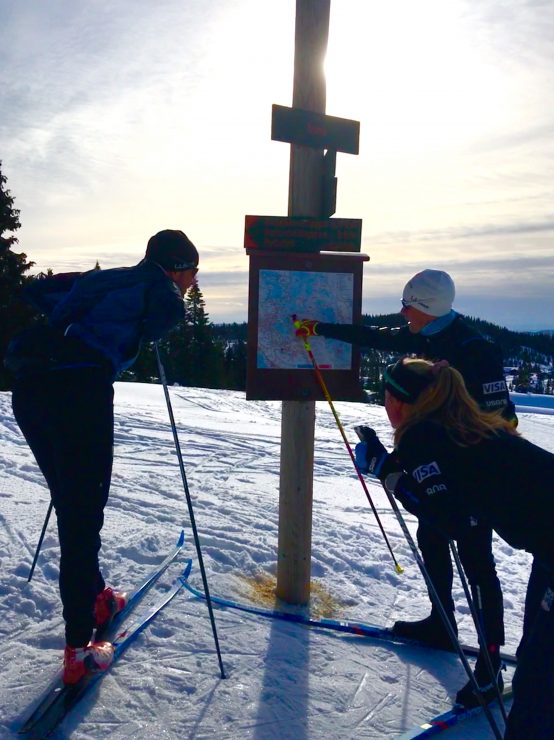
Jessie Diggins, Ned Dowling, and Matt Whtcomb skiing in Sjusjoe, Norway. (Photo: Ned Dowling Colleciton)
Susjoen can be a maze. (Photo: Ned Dowling Collection)
The silver lining for me was they all skied slowly enough that I could keep up. The days began to take on structure for me: wake up at a normal time (versus the jet-lagged pattern of undersleeping one night then oversleeping the next), eat, ski, eat, treat athletes, eat, sleep. Their days resembled mine except for being on the other side of the treatment table. Remarkably to me, the athletes and coaches took turns grocery shopping, cooking meals, and doing dishes. Everyone even did their own laundry! I was so used to working in the world of cyclists where “self-sufficient” wasn’t even in their dictionary. (We used to have a duffel bag labeled “DA” that was taken to the start of every bike race. It was full of extra jerseys, bib-shorts, and socks for the inevitable rider who forgot something. “DA” stood for Dumb Ass.) But these skiers were elite athletes, winners of medals, the best in America, and yet they could take care of themselves.
Despite the fatigue, a respiratory infection that was eventually passed to all of the athletes, a couple of days with sideways blowing snow, barley flour (“that’s all the grocery had!”) that left the baked goods flat as matzo, and the increasing presence of coronavirus in the news, the team just seemed to roll with the punches, make lemonade, and keep on keepin’ on.
Just before we left Sjusjøen for Drammen, it was announced that, due to a lack of snow, the race would be moved to Konnerud. The race in Drammen is one of the coolest venues on the calendar with skiers sprinting up and down the main street through the old city center and around the Bragernes Church. Instead, it was moved to a small ski venue that had not hosted a World Cup caliber race since 2011. That 2011 race, it turns out, was the first World Cup start for both Jessie and Sadie. Now, veterans of the race circuit, they were excited for the venue change out of nostalgia, and the media loved the silver lining story.
With the next day came the news that the weekend of races in Holmenkollen, the biggest party in Norway, would be closed to spectators due to fears over the spread of the coronavirus. While utterly disappointing, this made sense on two levels. For one, most of the 50,000 fans arrive packed like sardines in the trains from Oslo. Secondly, as pointed out by one of the health ministers, drunk people tend to make poor hygiene decisions. And the fans lining the Holmenkollen course are known to party.
The next round of bad news came when Sadie, one of the top skiers and a front pack contender, did not start due to the bug that had made its way around the Sjusjøen cabin. (David would end up dropping from his race from the same cold). Saturday morning at the often raucous Holmenkollen began with an eerie quiet in the ski stadium and a little less chaos in the wax truck since only three women were starting the 30 k classic.
The race, at least on the front end, turned out to be one of the more exciting in recent years with the strongly favored Norwegian, Therese Johaug, getting caught and passed in the last kilometer by a young Swede, Frida Karlsson.
Becca Rorabaugh during her 30 k classic effort in Oslo. (Photo: NordicFocus)
Kaitlynn Miller racing the 30 k classic in Oslo. (Photo: NordicFocus)
There was more bad news on the back end of the race as the American women struggled to keep pace — like your local marathon hero trying to toe the line with Eliud Kipchoge. They fought hard for a grueling 90 minutes and finished at the bottom of the standings in what would turn out to be the last race of the season. But there was a remarkably bright spot in that foggy, ghost town of a ski stadium as I watched Kaitlynn Miller wait for Becca Rorabaugh. Exhausted and disappointed, they hugged and walked together past the podium presentation that was already starting. Seeing that display of kindness and friendship, my mood was immediately uplifted. I was proud to walk with these women, heads held high, past vacant looks from the media and other skiers. The results don’t always matter as much as the comradery of the team.
On Sunday, the men raced 50 k. At least those who finished. It was cold, wet, foggy, windy, and – we’ll mention again — cold and wet. For over two hours the men slogged around an increasingly slow and sloppy track. David abandoned due to illness and anticipation of upcoming races that would eventually be canceled (had he known that he was in his last race of the season, he would have surely soldiered on). Ian Torchia dropped out after throwing up his breakfast and every ounce of liquid he tried to take in at the feed zones. Ben Lustgarten and Adam Martin persevered and crossed the finish line; both later suggested it was one of the more miserable races of their lives.
Ben Lustgarten (front) during the Oslo 50 k classic. (Photo: NordicFocus)
At the team meeting that night, there might have been feelings of disappointment but no one showed it. As Matt spoke to the team, he emphasized that he was proud, not embarrassed, by the performances that weekend. There is no shame in showing up and trying your best, even if your best leaves you at the bottom of the results sheet. There’s much more to it than the results sheet. Gratitude and appreciation were reiterated with not a mention of anger or blame.
A rising tide lifts all boats is an idiom often used to describe a setting where one person’s success or positive attitude inspires others to push the limits of their own performance. Sadly there were no podium celebrations during my two-week stint, but that did not deter me from doing whatever I could to help, whether fetching coffee for wax techs (an errand that used to irritate the hell out of me when I was a soigneur) or tactfully (I hope) ushering Jessie away from admiring fans when she was needed elsewhere.
And I was especially motivated to put my energy into the well-being of the athletes, simple as my role was: to methodically push on a joint here and a muscle there in hopes of giving the athletes the physical and psychological confidence to charge into battle with their skinny skis, carbon fiber poles, and Lycra armor. I’d like to think that I channeled my years of Physical Therapy practice and experience into their muscles, joints, and fascia to make them more resilient in the fight, whether that was 2 ½ minutes at full gas in a sprint or 2 ½ hours in the 50 k pain cave. My simple role was to help them perform at their best.
What I know I accomplished during these two weeks in Norway was an education in the meaning of team spirit. They cheered each other’s victories and consoled each other in defeat. They cooked each other meals and volunteered to do the dishes. They said thank you after every PT session. I would call my time with the U.S. Cross Country Ski Team a once in a lifetime experience, except that I want to go back next year.
Perhaps unsurprisingly, the Norwegian men showed up on form for today’s freestyle sprints in Konnerud, just outside the city of Drammen. As the venue was used for the Norwegian National championship at the end of January, most of the team has already had a dress rehearsal racing on the windy course.
Johannes Høsflot Klæbo of Norway, where he is found most often: winning down the stretch. (Photo: NordicFocus)
It seems that Johannes Høsflot Klæbo, who sat out the national championships, did not need a dress rehearsal. He won the qualifier by a margin of nearly four seconds, continuing easily through the rounds to win the overall. This is Klæbo’s eighth sprint win of the season, matching last year’s record, and his 14th career World Cup freestyle sprint victory, the most of any male athlete.
Racing in the final with Klæbo were four of his teammates: Håvard Solås Taugbøl, Eirik Brandsdal, Sindre Bjørnestad Skar, and Erik Valnes, each of whom also raced in the national championship final on January 31st (and finished in a very similar order). Interrupting the all-Norwegian field was Alexander Bolshunov of Russia.
In the final, Klæbo hovered in the middle of the pack marking his teammates, with Taugbøl in the lead. When Brandsdal took control on the primary climb of the course, Klæbo swung outside of the group to move into second before tucking into the last downhill. As they passed under the arch and headed into the final straightaway, Klæbo engaged his unmatchable top gear, with Taugbøl and Brandsdal chasing.
After crossing in a photo finish, Taugbøl was deemed second (+0.65) — a World Cup career best individual result — with Brandsdal third (+0.69). Skar took fourth (+0.94), followed by Bolshunov in fifth (+1.92) and Valnes a late arriving sixth (+12.79).
Simi Hamilton (bib 24) during his quarterfinal in Konnerud. (Photo: NordicFocus)
Simi Hamilton was the only American sprinter racing in Konnerud. He qualified in 24th and raced in the fourth heat of the quarterfinals, where he finished fifth, ending his day ranked the same in the overall as in his qualifier.
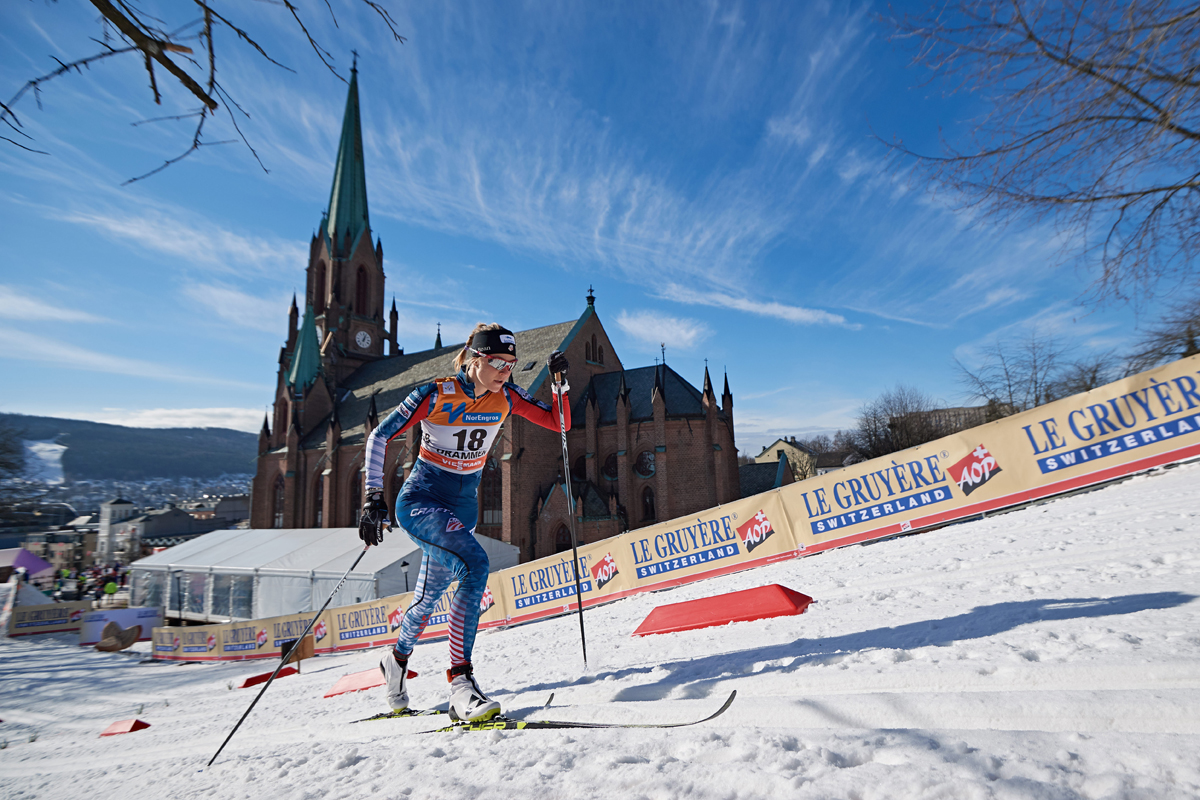
The looping sprint course around the ol’ church in Drammen, Norway will have to wait another year, or at least until sufficient snow: the iconic city sprint was moved to Konnerud due to insuffient snow in Drammen. Winter, please, pretty please, return to places such as Drammen.
Powering home for the Konnerud win: Jonna Sundling of Sweden. (Photo: NordicFocus)
Although deep in Norway, but not so far from Sweden as the planes fly, Sweden took the win and third place in the World Cup’s relocated 1.2 k skate sprint in Konnerud. Jonna Sundling won the final in 2:38.41 — a toe and perhaps the tail of a ski ahead of Switzerland’s Nadine Faehndrich in second (+0.24). It was a photo finish for second through fourth. Linn Svahn, a U23 skier forgoing those championships, placed third (+0.39). Norway’s U23 Kristine Stavaas Skistad was fourth (+0.97), Sweden’s Maja Dahlqvist placed fifth (+5.70), and Anamarija Lampic of Slovenia sixth (+26.04).
Sundling powered down the final sraight outpacing Faehndrich in the final 100 meters. Sundling advanced to the finals as a lucky loser in the semis.
Sadie Bjornsen (bib 4) during her quarterfinal heat in Konnerud. (Photo: NordicFocus)
Sadie Bjornsen of the U.S. was the top American in 16th overall. Bjornsen qualified in fourth, 1.2seconds behind the top qualifier, Katja Visnar of Slovenia. Bjornsen placed fourth in the second quarterfinal and did not advance.
Jessie Diggins was the only other American to qualify.After qualifying in 12th , she placed sixth in the first quarterfinal, to end her day ranked 27th. Also for the U.S., Kaitlynn Miller placed 50th, and Becca Rorabaugh 54th.
Jessie Diggins sprinting in Konnerud. (Photo: NordicFocus)
Of note, Swedish sprinter, Hanna Falk, who suffered a back injust prior to the season, started her first World Cup of the year. She finished in 30th.
Racing continues Saturday with the women’s 30 k classic mass start. The men race a 50 k in Oslo on Sunday.
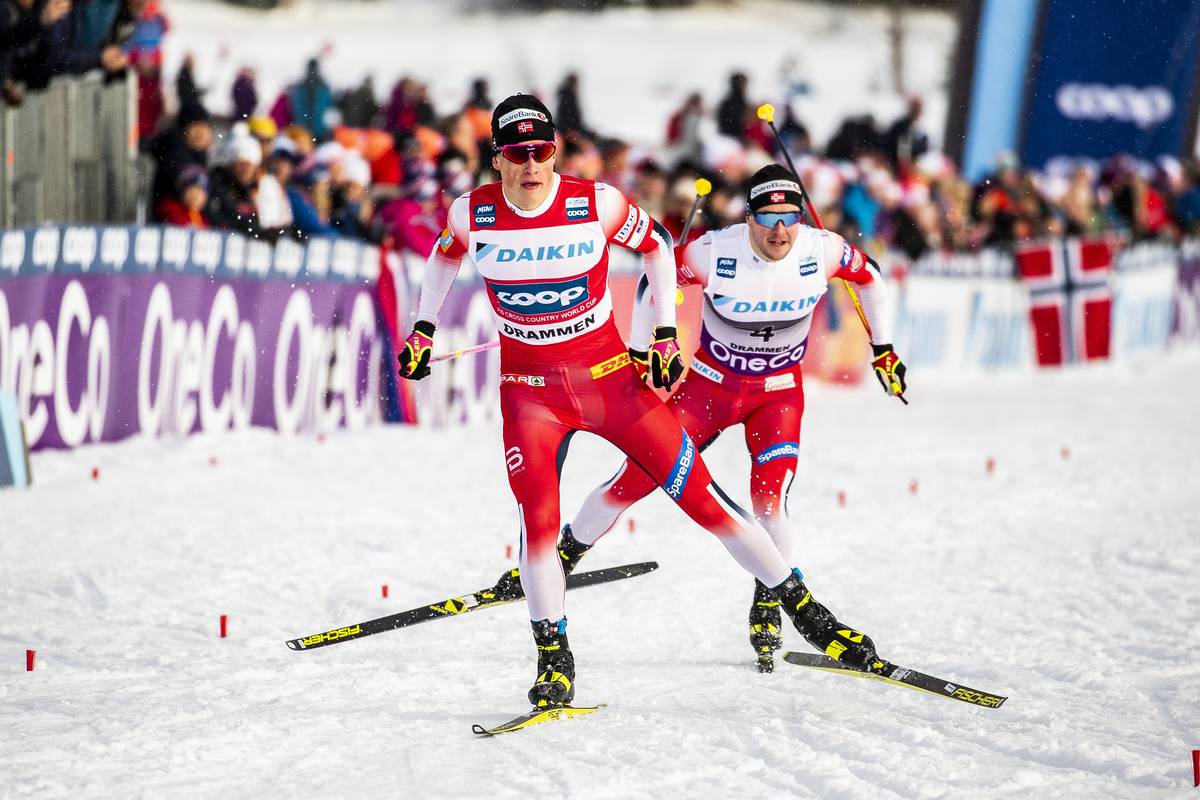
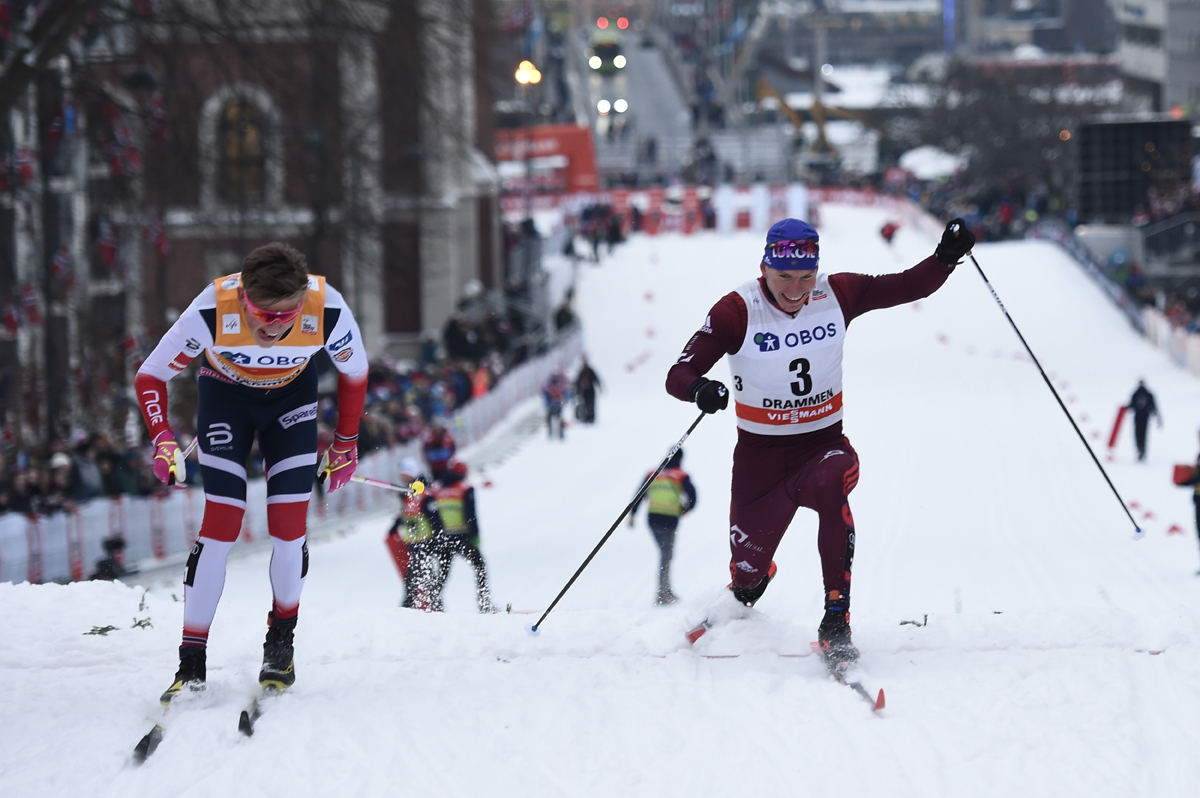
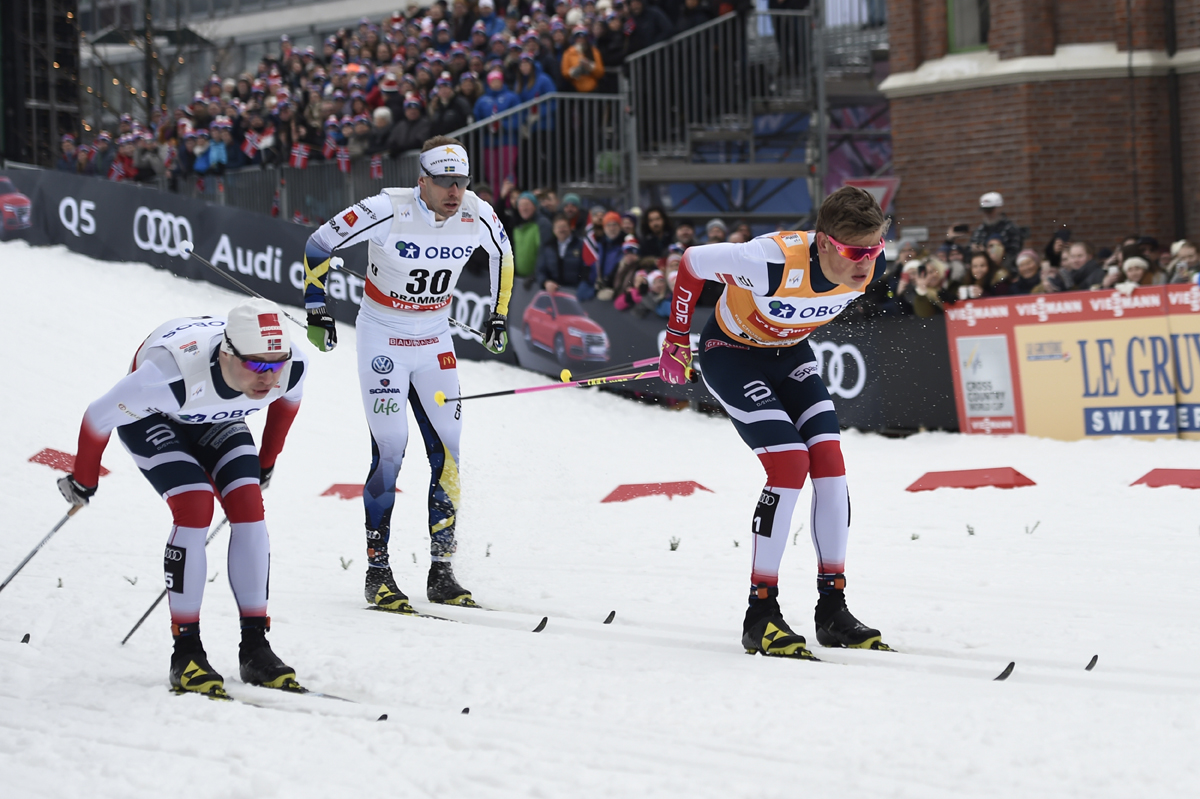
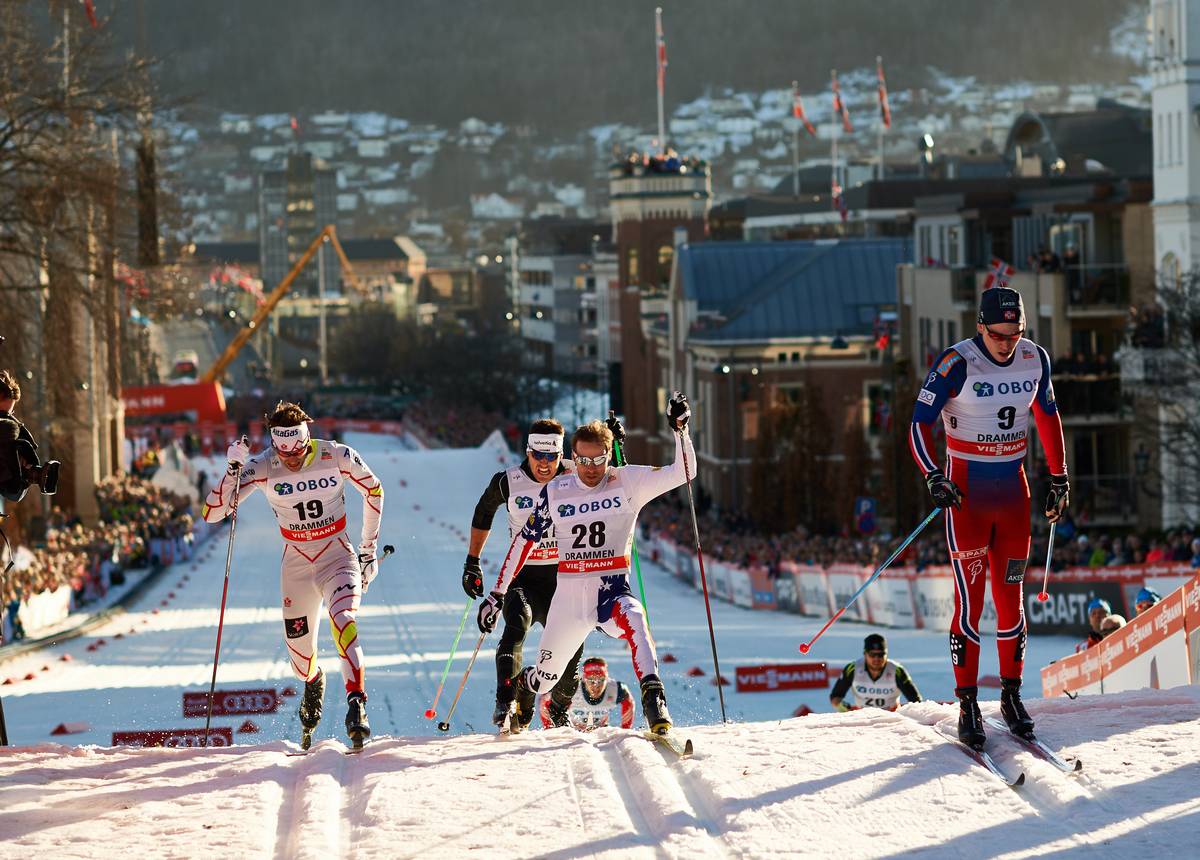
Norway’s Johannes Høsflot Klæbo (l) edging Russia’s Alexander Bolshunov (3) and Norway’s Eirik Brandsdal (not shown) in the first semifinal of the men’s classic sprint at the World Cup in Drammen, Norway. Klæbo went on to win the final, ahead of Brandsdal in second and Bolshunov in third. (Photo: Fischer/Nordic Focus)
In the classic venue that are the Drammen city sprints, it was a singular affair from start to finish during the men’s World Cup 1.2-kilometer classic sprint on Wednesday. In a race format that tapered from a field of 61 skiers to the winner, one only needs to track the skier in the overall World Cup’s leader bib to follow along.
The yellow-bibbed skier, Norway’s Johannes Høsflot Klæbo, didn’t surprise with his sprint win in Drammen as much as place another high performance stamp on his 2017/2018 campaign.
Klæbo won the qualifier in 2:49.32 minutes. Teammate Eirik Brandsdal skied to second in the qualifier, 3.5 seconds behind Klæbo. Russian Alexander Bolshunov skied the third-fastest qualifying time, finishing 4.48 seconds back. This puts some things in perspective, if anybody thought Klæbo would bloat in his post-Olympic gold medal glow — he won three golds in PyeongChang — you’d be wrong.
Klæbo would have have good reason to cash it in. What exactly does the 21 year old need to prove? Coming into Wednesday’s race, Klæbo had already captured the Sprint World Cup Crystal Globe. It’s the Norwegian phenom’s second-consecutive overall sprint title.
Yet Klæbo is also on the verge of sealing up his first Overall World Cup title. After the Drammen sprints, Klæbo leads the overall standings with 1308 points. Behind him, Martin Johnsrud Sundby of Norway (who did not contest Wednesday’s sprint), trails in second place with 980 points total.
Johannes Høsflot Klæbo leads his quarterfinal with fellow Norwegian Fredrik Riseth (l) and Sweden’s Emil Jönsson (30) at the World Cup classic sprint in Drammen, Norway. (Photo: Fischer/NordicFocus)
“It was really important to me to get the 100 points today,” Klæbo told the International Ski Federation (FIS) after the race. “I need as many points as I can get against the other guys for the [overall] Crystal Globe. I will race the Holmenkollen 50 k this weekend and I know it will be tough. Also it’s great to win here in front of all the people. I was second here last season and I’m really happy to now have won Drammen.”
Let’s circle back to what Klæbo needs to prove, beyond padding his overall lead by another 100 points by winning the Drammen sprint. He’s proving at his young age, pending any monumental flameout, that he’s setting the stage for a historic international cross-country ski career.
This season alone, Klæbo has won six of nine individual sprint World Cups. He’s won 10 World Cup races in total. That win total puts Klæbo in rarefied company: in the men’s field, only Petter Northug (with 10 wins) and Sundby (16 wins) have won 10 or more World Cup races in a single season.
Winners want to win. Amidst the five-deep crowd surrounding the sprint course featuring Drammen’s iconic Bragernes Church, with his pink-themed flare, Klæbo proved once again he is a consummate winner.
There was his dominating qualifier. Then there was Klæbo’s quarterfinal, in which he looked less threatening. He won the first quarterfinal by 0.7 seconds in a photo finish with Brandsdal. That heat seemed to be a test run, as if Klæbo were feeling the course out and asking himself how it skied with five other bodies jousting for tracks and inside lines. There was never the hallmark Klæbo burst of speed or any real dominance. Klæbo kept in contact up the long initial uphill, and down through the tight and sinuous S-turns after the course’s highpoint.
If in fact the first quarterfinal was a dress rehearsal, Klæbo must have realized that any real podium threats would be drag racing up the final quarter-kilometer climb that finished nearly smack-dab in front of the church.
The first semifinal featured the day’s top-three qualifiers: Klæbo, Brandsdal and Bolshunov. (Bolshunov advanced by winning the second quarterfinal.) The three skiers finished 1-2-3 with Klæbo taking the win in another photo finish with Brandsdal.
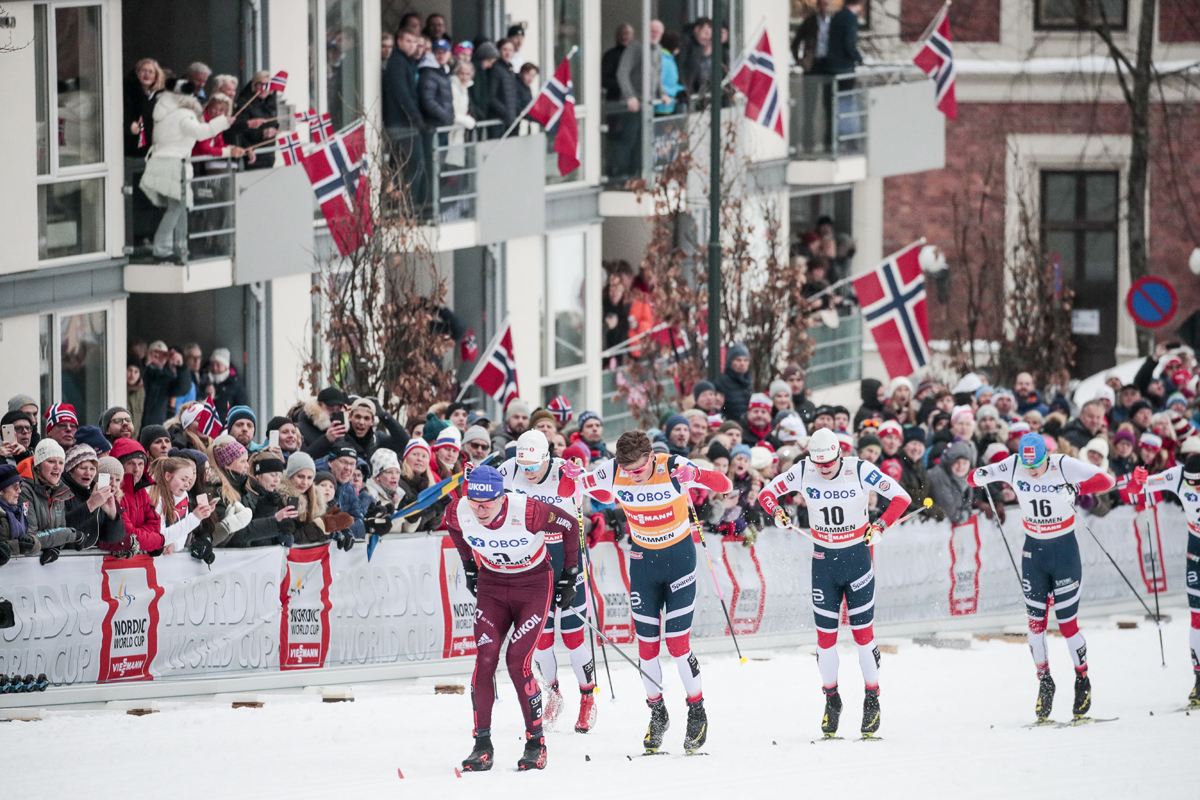
Russia’s Alexander Bolshunov leads five Norwegians in the men’s classic sprint final at the World Cup in Drammen, Norway: (from l to r) Eriik Brandsdal, Johannes Høsflot Klæbo (yellow bib), Sindre Bjørnestad Skar (10), Kasper Stadaas (16), and Emil Iversen. (Photo: Fischer/Nordic Focus)
Tactically, Bolshunov played his hand early. Determined to break Klæbo, the Russian led out hard and took the sharp end of the race in earnest. At the top of the course, Bolshunov had strung the five other skiers out behind him. Moments before the highpoint and entering the technical downhill S-turns, Bolshunov and Klæbo gave a burst of speed and distanced themselves by 10 meters. As Klæbo learned in his heat, even with speedy skis, the downhill is not decisive. It’s more a function of skiing out front, staying on your feet and entering the final straight with enough high-octane gas to turbo the finish.
Up the final climbing stretch, which seems as eternal as some flame burning inside the Bragernes Church, Bolshunov faded slightly, while Klæbo and Brandsdal pulled ahead.
Klæbo’s second takeaway: he already knew the course was won on the final straightaway climb. If he could match Bolshunov on the remainder of the course, Bolshunov could not mirror him in the final meters.
The final played out like Klæbo’s semi. Bolshunov punched it early. Klæbo sat behind the Russian, matching him pole for pole, stride for stride. Up front was as good a place as any for Bolshunov. Besides the Russian, it was an all-Norwegian final. There was Klæbo and Brandsdal, along with Sindre Bjørnestad Skar, Kasper Stadaas and Emil Iversen.
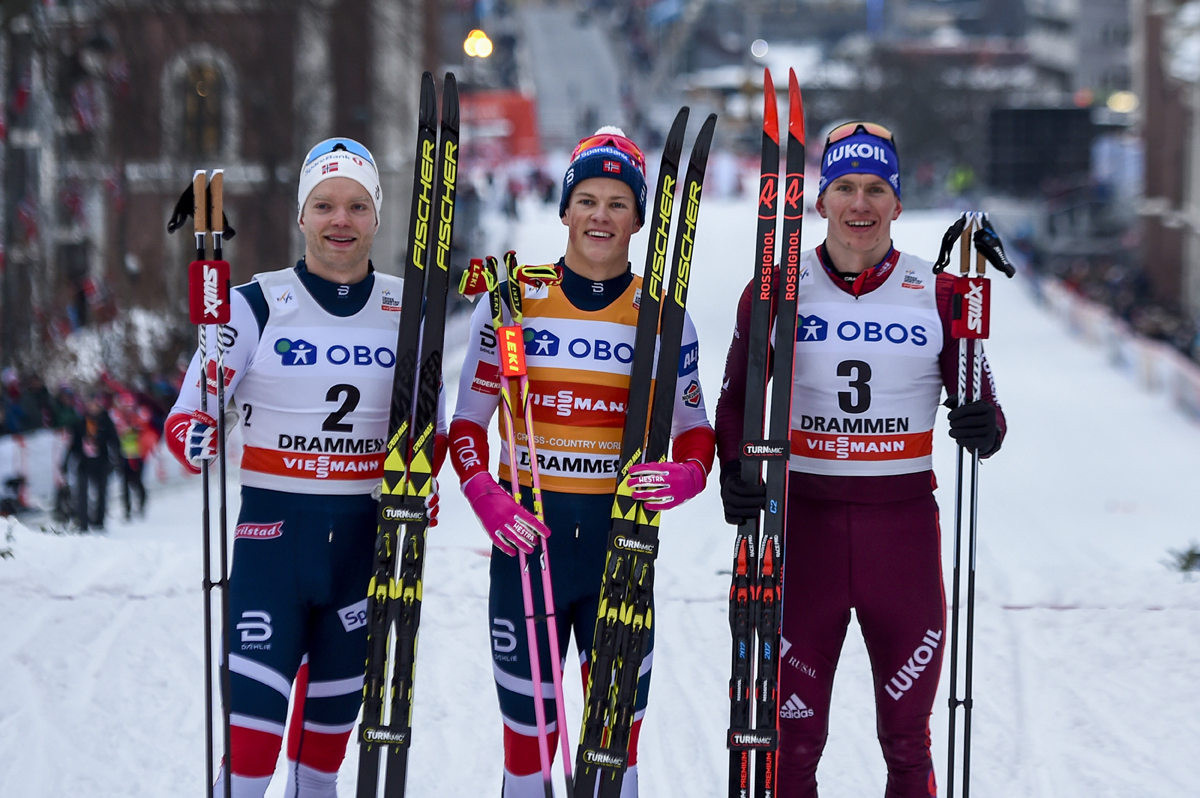
The men’s podium from Drammen’s 2018 classic sprint. Norway’s Johannes Høsflot Klæbo (c) placed first, his teammate Eirik Brandsdal (l) was second, and Russia’s Alexander Bolshunov (r) finished third. (Photo: Fischer/NordicFocus)
Bolshunov again led up and over the top of the course, through the S-turns and through the tucking downhill. Brandsdal trailed by 10 meters, but by the final turn before the uphill to the church’s front door, the threesome had regrouped. Again, as the double poling got down to business, Bolshunov faded, Klæbo pulled away and Brandsdal could only stay a second behind the day’s winner. And of course Klæbo was able to toe the line as he bowed to the frenzied crowd. Nothing to prove except he can win with panache and win in style when the Norwegian cameras turn out in force.
Klæbo won the final in 2:44.69 minutes. Brandsdal followed 1.04 seconds back in second place, Bolshunov finished third (+3.78), Bjørnestad fourth (+6.55), Kaspar fifth (+8.71), and Iversen sixth (+11.45).
Bjornsen Reaches Quarterfinals, 18th Overall
Erik Bjornsen was the lone North American who advanced to the heats, qualifying in 26th and finishing the day in 18th.
“I was feeling good,” Bjornsen told FasterSkier after the race. “It’s a tight course. It was a bit scrappy. … It’s my first time here qualifying for the heats, so I’m learning some things, for sure.”
Bjornsen skied in the fifth quarterfinal with Iversen, Russia’s Alexander Panzhinskiy, Finland’s Ristomatti Hakola, Emil Nyeng of Norway, and France’s Lucas Chavanat.
The American skied near the back of the group but avoided any real mishaps. Although the sport is not roller derby, Drammen’s tight-and-rutted corners offer up a close cross-country skiing cousin.
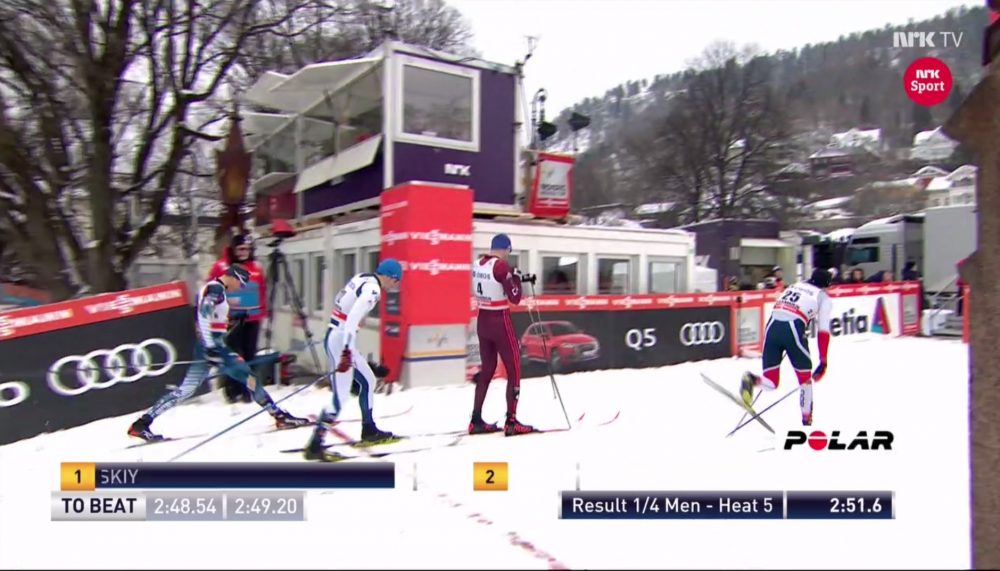
The U.S. Ski Team’s Erik Bjornsen toeing the line in fourth during Wednesday’s fifth heat in Drammen, Norway. Bjornsen placed 18th on the day. (Screenshot: NRK broadcast)
“I feel like – I kind of missed a few spots,” Bjornsen said. “At the bottom corner I was pushed to the outside. I was almost moving up into second, and looking back maybe I should have gone around him on the other side.”
Up the never-ending final straightaway, Bjornsen poled himself into a position to potentially advance to the semifinals as a lucky loser. However, that didn’t pan out for Bjornsen. Iversen won the heat in 2:51.96 minutes, Panzhinskiy placed second (+0.20), Hakola third (+0.99), with Bjornsen in fourth (+1.18).
Andy Newell racing to 33rd in the men’s classic sprint qualifier at the World Cup in Drammen, Norway. (Photo: Fischer/NordicFocus)
Also for the U.S., Andy Newell missed the quarterfinals after finishing 33rd in qualification, 0.9 seconds out of 30th. Logan Hanneman and Kevin Bolger finished 49th and 50th, respectively, and Reese Hanneman 56th. The U.S. Ski Team’s Simi Hamilton sat out Wednesday’s sprint as he is recovering from an illness.
For Canada, Julien Locke finished 51st in qualifying, Alex Harvey was 54th, and Andy Shields 58th.
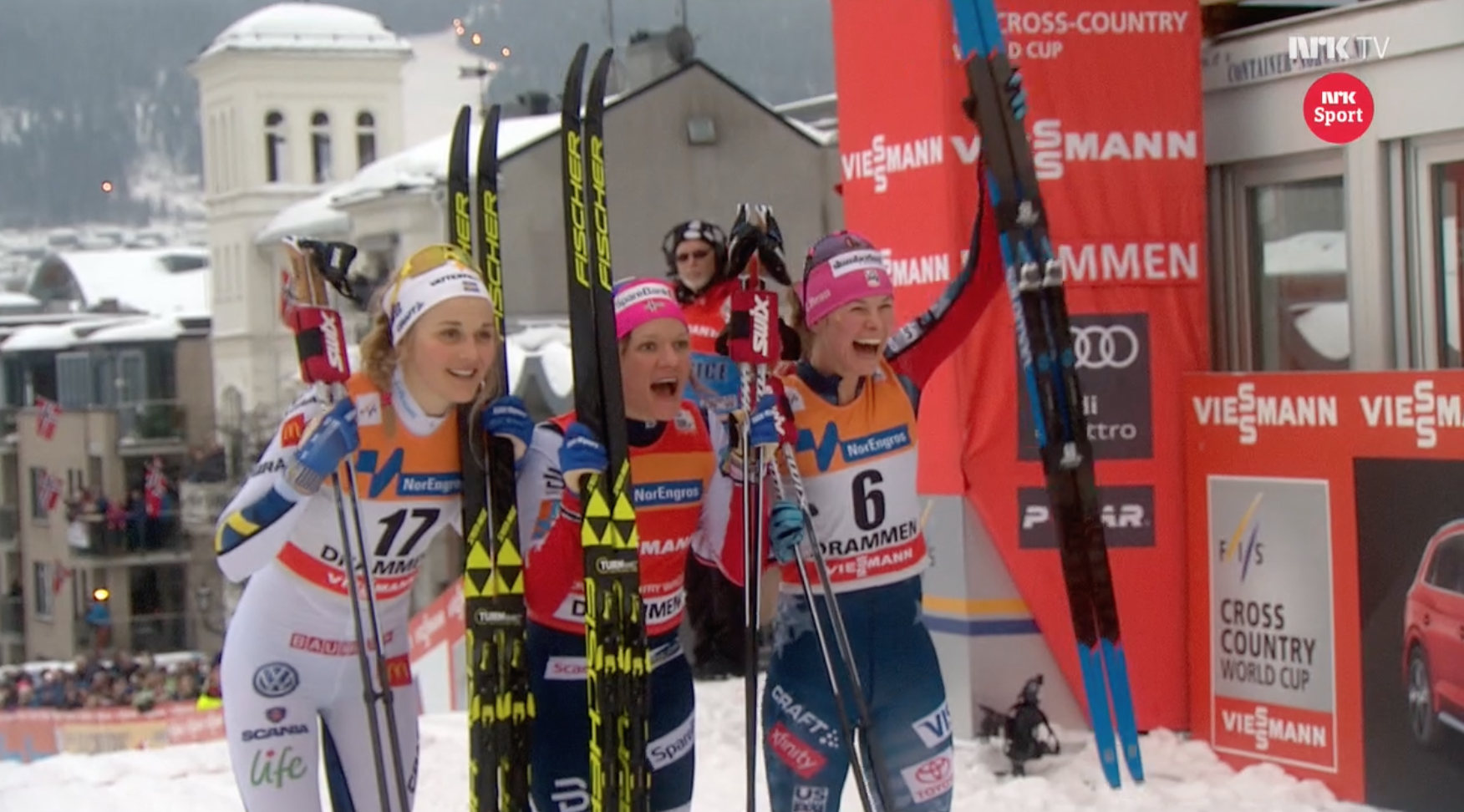
Maiken Caspersen Falla of Norway (center) won the classic sprint in Drammen and all but wrapped up the Sprint Cup. Stina Nilsson of Sweden (left) was second and Jessie Diggins of the United States third. (NRK screencap)
FIS Cross Country World Cup (Drammen, Norway): Classic sprints
The cross-country World Cup hit the city on Wednesday, with classic sprints contested in the Oslo suburb of Drammen on snow which had been trucked onto the streets. And the crowd was rewarded with wins by two Norwegian favorites: Maiken Caspersen Falla in the women’s sprint and Johannes Høsflot Klæbo in the men’s race.
In the women’s final, Falla and Natalia Nepryaeva of Russia battled at the lead for much of the race, but Falla pulled away from the field on the last climb to the finish. Stina Nilsson of Sweden and Jessie Diggins of the United States pulled past Nepryaeva in the final few hundred meters to claim spots on the podium; Krista Parmakoski of Finland was fifth and Katja Visnar of Slovenia sixth.
With the win, Falla all but wrapped up the World Cup’s Sprint Cup crystal globe: she is just two points from having it clinched, with one sprint remaining on the calendar. In Falun, Sweden, in ten days, she more or less just has to make the heats to earn her third Sprint Cup in a row.
Also racing for the United States, Sadie Bjornsen and Sophie Caldwell made the quarterfinals, but did not advance past that round. Bjornsen ended the day in 21st and Caldwell in 27th.
Ida Sargent and Rosie Brennan were 47th and 48th in qualifying, followed by Kikkan Randall in 50th and Kaitlynn Miller in 53rd.
For Canada, Emily Nishikawa finished 52nd and Dahria Beatty 55th.
Great Britain’s Nichole Bathe, who raced for the University of Alaska Fairbanks, finished 58th.
In the men’s final, Russia’s Alexander Bolshunov set the pace for most of the heat. Klæbowas on his ski tails, and drew even on the course’s on downhill, where Norwegian teammate Eirik Brandsdal also caught up to them. Skiing back up to the finish, Klæbo ramped up to a furious tempo and was uncatchable. Brandsdal passed Bolshunov to claim second by a healthy margin. Sindre Bjørnestad Skar finished fourth, Kasper Stadaas fifth, and Emil Iversen sixth, all for Norway.
The lone North American to make the heats, Erik Bjornsen, qualified in 26th and finished the day in 18th. Teammate Andy Newell just missed the quarterfinals after finishing 33rd in qualification. Logan Hanneman and Kevin Bolger finished 49th and 50th, and Reese Hanneman 56th.
For Canada, Julien Locke placed 51st in qualifying, Alex Harvey 54th, and Andy Shields 58th.
Sweden’s Stina Nilsson charging to her eighth World Cup victory of the season in Wednesday’s 1.2 k classic sprint final in Drammen, Norway. She finished first, ahead of Finland’s Krista Pärmäkoski (r) in second and her Swedish teammate Hanna Falk (l) in third. (Photo: Fischer/NordicFocus)
Drammen is one of those staples on the World Cup, appearing on the circuit late each season and remembered for its trademark uphill finish in the middle of a city of 63,000 inhabitants, just 40 kilometers west of Oslo, Norway.
“It tends to be fairly predictable snow,” U.S. Ski Team Women’s Coach Matt Whitcomb told FasterSkier during an in-person interview in Drammen on Wednesday. “It’s generally clean [snow]. It’s generally some sort of klister.”
But that doesn’t make Drammen easy. Finding the ideal balance of kick and glide on the city’s 1.2-kilometer course, marked by a steady uphill out of the start, followed by a 60-second downhill, and finally, one last climb to the finish, is key and something even the most seasoned World Cup skiers can struggle with at this venue, Whitcomb explained.
“We tend to see athletes focusing a little bit too much on the climbs, getting those good sensations and not enough gliding … out on the downhills,” he said. “That’s where the heart of this course really lies.”
For instance, consider Maiken Caspersen Falla. Coming off an individual skate-sprint victory at 2017 Lahti World Championships, the Norwegian didn’t ski fast enough to qualify for the heats on Wednesday. She finished 31st, 0.34 seconds out of qualifying in 30th but 6.49 seconds off the top qualifying time set by Finland’s Krista Pärmäkoski. With Falla usually qualifying first or close to it in sprints (and Pärmäkoski better known for her distance skiing), it was a shakeup that confused even Falla — Drammen’s three-time defending classic-sprint winner.
“I think it is weird,” Falla told NRK, according to a translation. “I do not know what’s going on. I was thinking I was going pretty well. I’m not far behind [the top 30], but I have no idea. Maybe I didn’t have the best skis or maybe I left far too much time in a turn. I am very unsure of what’s going on; the body has worked great the last few days.”
American Kikkan Randall, who placed third in the world-champs freestyle sprint behind Falla, was in the same boat. She finished 52nd out of 56 women in Wednesday’s sprint qualifier, 12.76 seconds out of first.
Whitcomb said that was likely due to too much kick and too little glide. Drammen as a downtown sprint poses an additional challenge for athletes and wax techs, allowing just 20 minutes for testing on race day.
“Every athlete’s working out of one depot so you have basically 100 people, male athletes and female athletes, and just trying to control the chaos as much as possible,” he said. “But I feel like our athletes, I can trust them to ask for more kick and know that it’s not gonna compromise their glide. Sometimes it does, it’s just the risk that you have to make because on this course, you spend a fair amount of time gliding and if you’re not close to having enough grip, you’ll be too tired in the finish.”
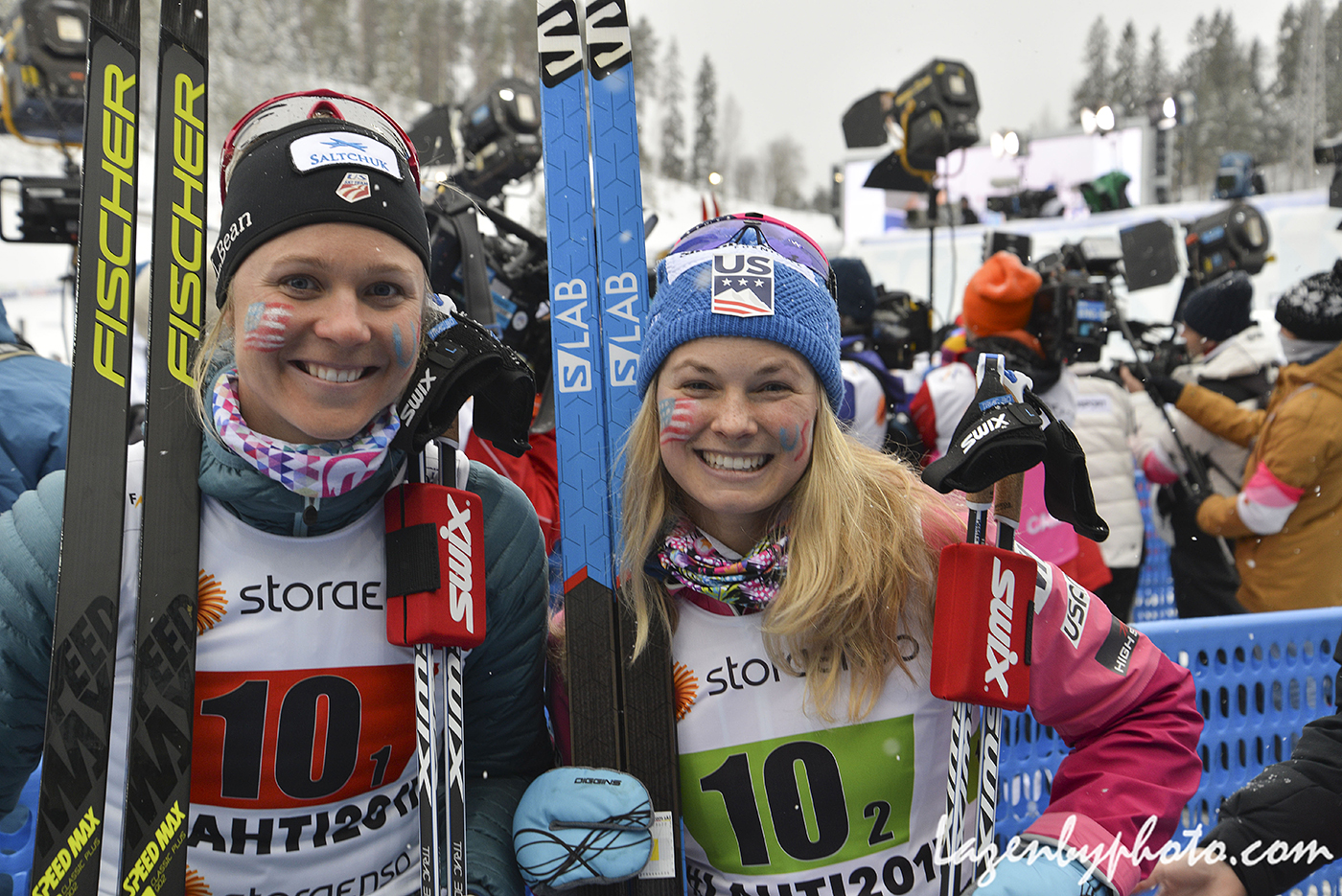
U.S. teammates Sadie Bjornsen (l) and Jessie Diggins after placing third for bronze in the women’s classic team sprint at 2017 World Championships in Lahti, Finland. (Photo: John Lazenby/Lazenbyphoto.com)
One U.S. Ski Team member thrilled with her skis was Jessie Diggins, who qualified sixth (+2.12) behind her teammate Sadie Bjornsen in fifth (+1.63). Behind them, Sophie Caldwell was the third American to qualify in 11th (+2.95).
While Diggins and Bjornsen went on to finish sixth and fifth in their quarterfinals, respectively, and did not advance to the semifinals, Diggins said that in her case, it wasn’t for a lack of speed. After some physical contact at the top of the course got her fired up and surging into first on the long descent, Diggins slipped back to the middle of the pack coming out of the downhill draft and broke a pole around the last hairpin corner before the long, uphill finishing straight.
“Jessie came into the final corner with too much traffic and a pole broke somehow,” Whitcomb said. “If it had been made out of steel, it would’ve bent, but it was loud and unfortunately none of us could get to her because there were too many cameras and fences in the way.”
“I was just ready to fight on that final climb,” Diggins reflected. “I knew I was strong because even after skiing with a broken pole, I caught back up to [the group] at the end so I mean, I did everything I could.”
She finished 5.11 seconds behind the winner of that quarterfinal, Sweden’s Stina Nilsson, who would go on to win the day.
“I was so stoked with my skis,” Diggins added. “They were fast, they had good kick and I know they had good kick because I had one pole and I was like, ‘Wow! They really nailed it!’ ”
While Diggins raced in the second quarterfinal, Bjornsen was one of the guinea pigs, so to speak, in the first heat of the day. Whitcomb explained that coaches and athletes routinely watch the first women’s quarterfinal on sprint days to figure out the course and determine strategies for the remaining rounds.
While Bjornsen skied in third for much of her quarterfinal behind Norway’s Mari Eide, who led for most of it, the American bronze medalist in the world-champs classic team sprint (with Diggins) positioned herself closer to second entering the final climb to the finish.
While the last few hundred meters of the race were shaping into a four-way fight for first between Eide, Bjornsen, Sweden’s Hanna Falk, and Slovenia’s Anamarija Lampič, Bjornsen in the far right tracks suddenly found herself behind a V-board when the course narrowed from four tracks to three across, and her tracks ended. She jumped to the left, slotting in behind Eide, and ran out of room to make any more moves to end up fifth, 2.52 seconds behind Falk in first.
“I felt really strong in the qualifier, had some great skis, and was so excited for the heats,” Bjornsen said, according to a U.S. Ski Team press release. “Unfortunately in the final stretch, I chose a lane that didn’t go to the finish, so I had to stop and go in behind the others — which simply didn’t work. That was an expensive mistake, and cost a day full of great feelings. Fortunately I feel really good right now, and I am so excited to keep racing and get my chance.”
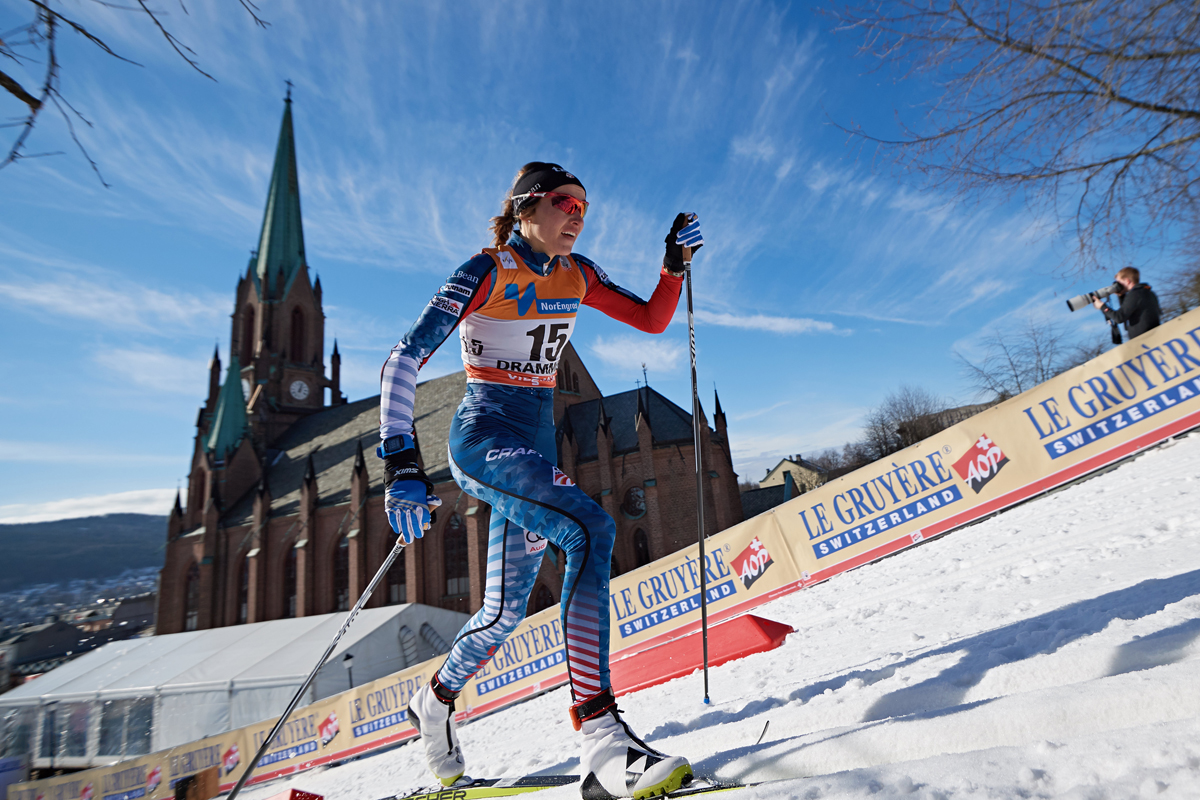
Sophie Caldwell (U.S. Ski Team) striding to 11th in the women’s 1.2 k classic sprint qualifier at Wednesday’s World Cup in Drammen, Norway. She went on to place ninth overall. (Photo: Fischer/NordicFocus)
Bjornsen and Diggins ended up 21st and 26th on the day, respectively. Leading their team, Caldwell reached the semifinals and ultimately placed ninth overall.
In an in-person interview after the race, she told FasterSkier that she was particularly pleased with her qualifier considering her past results in Drammen. Before Wednesday, had never cracked the top 10 there.
“The first three years I raced in Drammen, it was just a really hard course for me for some reason and I found myself not qualifying, but not even close to qualifying, like, back in the end of the pack,” Caldwell said. “Last year I figured out how to qualify and I was just thrilled to have qualified so this year it was one step further making the semis so I’m really happy with that.
“It’s still a tough course for me,” she added. “It’s so gradual that it’s a really good course for power skiers and that’s been something I’ve been working on a lot, but power skiing for classic for sure isn’t my strength. … I think that’s probably why it’s been so difficult for me in the past but I’m really happy with today.”
Third in her quarterfinal, just 0.79 seconds behind Norway’s Ingvild Flugstad Østberg, who won it, and half a second behind another Norwegian, Kathrine Rolsted Harsem, who automatically advanced in second, Caldwell reached the semifinals as a lucky loser — along with Finland’s Aino-Kaisa Saarinen in fourth (+0.95) in that heat.
Caldwell went on to place fifth in the second semifinal, 1.44 seconds behind Sweden’s Ida Ingemarsdotter in first. The American had put herself in third behind Pärmäkoski and Harsem before Ingemarsdotter hammered up the finishing straight to take the win.
“There was a little jostling around both on the downhill and up the final stretch,” Caldwell explained. “I kind of tried to cut inside Ida on the downhill and she moved in front of me so then I switched to the other side, then coming back up this way, Ida sort of hopped in the track in front of me so I went to move to the other one without knowing [Slovenia’s Katja Višnar] was coming up on the side so I had to bop back. There was a lot of bouncing around, but that’s part of the game. You want to be aggressive, but you want to be fair, and I think that’s something I’ve always tried to do.”
Also for the U.S., Rosie Brennan finished 37th in the qualifier and Ida Sargent was 42nd. Canada’s lone woman racing on Wednesday, Dahria Beatty, who turned 23 on Tuesday, finished 48th.
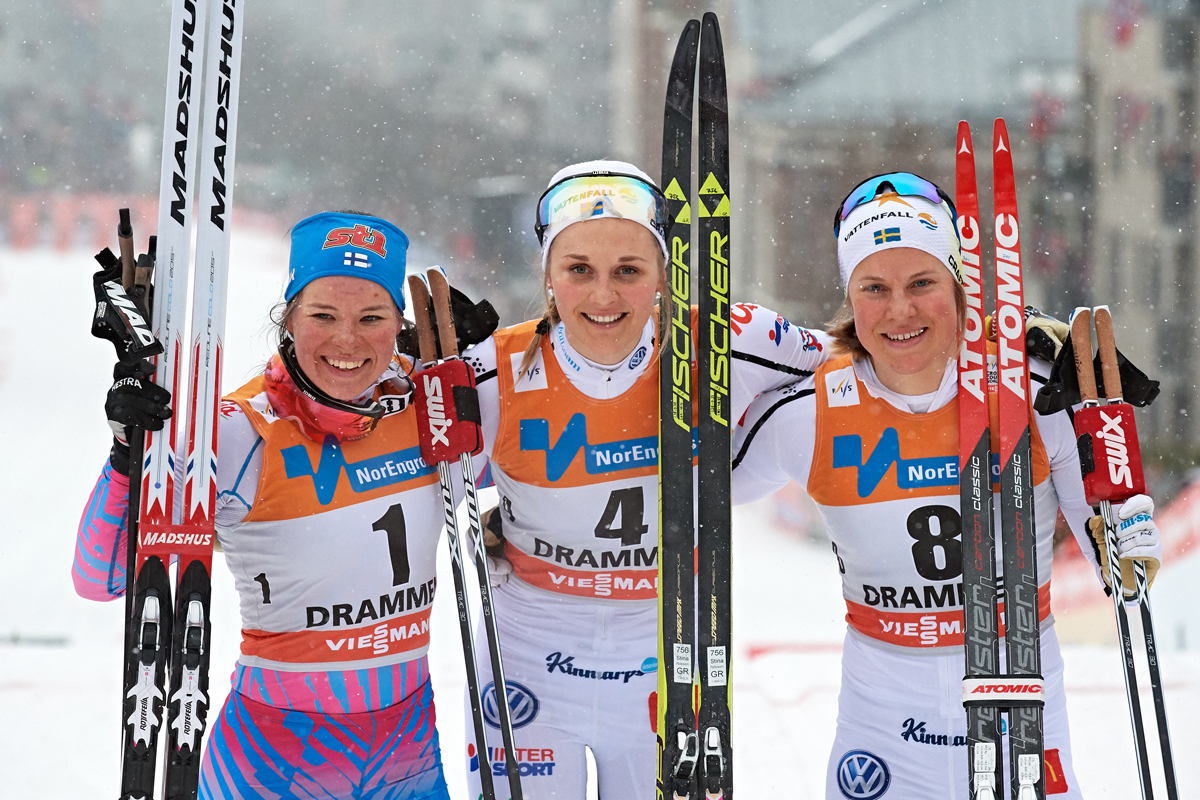
The women’s 1.2 k classic sprint podium at Wednesday’s World Cup in Drammen, Norway, with Sweden’s Stina Nilsson (c) in first, Finland’s Krista Pärmäkoski (l) in second and Sweden’s Hanna Falk (r) in third. (Photo: Fischer/NordicFocus)
As the day progressed, Sweden’s Nilsson continued to pick up steam. Coming off a World Championships in which she earned one medal (silver in the 4 x 5 k relay) and placed 12th in the freestyle sprint, the world’s second-ranked sprinter (behind Falla) had something to prove.
She started by posting the fourth-fastest qualifying time, 1.54 seconds behind Pärmäkoski, then won her quarterfinal and first semifinal before dusting her competition in the final. While Nilsson followed the lead of fellow Swede Linn Sömskar in the quarterfinal and drafted off Diggins on the downhill to slingshot to first before the finishing stretch, Nilsson took a backseat to Østberg in the semifinal. With energy to spare, Nilsson and her teammate Falk pounced on the long grind to the finish, placing first and second, respectively, while Østberg dropped to fourth behind Lampič in third.
In the final, Nilsson didn’t bother with games. She led out of the start, with Harsem following in second up the first double-pole section of the initial climb. While Nilsson continued to lead over the top, Falk and Pärmäkoski ended up duking it out for second place. Pärmäkoski double poled hard up the finishing straight to move into second, which she took by 0.84 seconds over Falk for her first World Cup sprint podium. Nilsson powered to the win in 3:07.57 minutes, 0.42 seconds clear of Pärmäkoski and 1.42 seconds ahead of Falk.
The remaining finalists, Harsem finished fourth (+3.27), Ingemarsdotter was fifth (+4.86), and Lampič, the U23 World Cup leader, placed sixth (+9.67).
The victory was Nilsson’s eighth of the season and puts her 42 points behind Falla with one sprint to go — a freestyle sprint in Quebec City next Friday, where 50 points for a win are on the line.
“I thought I could win and this feels really great,” Nilsson told the International Ski Federation (FIS), according to a press release. “I was sure Maiken would win the sprint globe today. I don’t think it’s possible still to win it, but there is still a chance and I will travel to Quebec and try my best.”
For Pärmäkoski, the podium showed her continued momentum after two World Championships medals (second in the 15 k skiathlon and third in the relay).
“I am really happy,” she told FIS. “I wasn’t sure how I would feel after the championships but I felt really strong today.”
Falk is third in the overall sprint standings, 154 points behind Nilsson and 29 points ahead of Norway’s Heidi Weng in fourth. At World Championships, Falk missed a medal in the skate sprint in fourth.
“This makes up a little bit for my fourth place finish at the World Championships, so it feels good to come here today and get a podium,” Falk said.
The last European World Cup races of the season will take place Saturday and Sunday with the famous Holmenkollen 30/50 k mass starts near Oslo. This year, those races are classic technique. The men race on Saturday at 12:45 p.m. Central European Time (6:45 a.m. Eastern Standard Time) and women start at noon CET (5 a.m. Eastern Daylight Time) on Sunday.
Kikkan Randall (U.S. Ski Team) during the women’s 1.2 k classic sprint qualifier on Wednesday at the World Cup in Drammen, Norway. (Photo: Fischer/NordicFocus)
The men’s World Cup 1.2 k classic sprint podium on Wednesday in Drammen, Norway, with Norway’s Eirik Brandsdal (c) in first and Johannes Høsflot Klæbo (l) in second, and Russia’s Sergey Ustiugov (r) in third. (Photo: FIS Cross-Country/Twitter)
FIS Cross-Country World Cup (Drammen, Norway): Classic sprints
Just three days after 2017 Nordic World Championships ended in Lahti, Finland, World Cup cross-country skiers were back to their regular-season grind with 1.2-kilometer classic sprints on Wednesday in Drammen, Norway.
In the men’s race, Norway stole the day with Eirik Brandsdal notching his first World Cup win since 2015 in Drammen, but Russia’s Sergey Ustiugov broke up the team’s total domination of the final with a third place, behind Brandsdal (who won it in 2:39.35 minutes) and Johannes Høsflot Klæbo in second (+2.55). Ustiguov placed third (+3.28) for his seventh consecutive podium coming off five medals in five races at World Championships, and three other Norwegians, Petter Northug, Pål Golberg and Sondre Turvoll Fossli finished behind him in fourth through sixth, respectively, in the final.
To start the day, Klæbo won the qualifier in 2:33.81, 3.62 seconds ahead of Brandsdal in second. Ustiugov qualified 10th (+6.21).
Canada’s Alex Harvey and Len Valjas qualified for the heats in 18th and 21st, respectively, and Andy Newell was the lone American to reach the quarterfinals after qualifying in 13th.
In the third quarterfinal, Newell finished third, 1.7 seconds behind Brandsdal, who won it. Sweden’s Oskar Svensson took second in that heat (+0.66).
Harvey won the fifth quarterfinal, and Canada originally took first and second with Valjas outlunging Alexander Bolshunov for second place. Valjas was ultimately relegated to last in the heat for his move around Bolshunov at the line, and the Russian was listed as second (+0.27) for an automatic spot in the semifinals.
While Klæbo won the first men’s semifinal by 0.46 seconds over Brandsdal, Ustiugov topped the second semi by 0.32 over Golberg. Harvey initially finished fifth in that second semi but moved up one spot to fourth (+4.41) after Norway’s Finn Hågen Krogh was disqualified (putting him in last, 67th overall). Harvey ended up eighth overall on the day.
Newell placed 18th overall and Valjas 27th.
Also for the North Americans, U.S. Ski Team members Simi Hamilton and Erik Bjornsen finished 40th and 44th, respectively, and Ben Lustgarten (Craftsbury Green Racing Project) was 62nd. Canada’s Russell Kennedy (Canmore Nordic/Team R.A.D.) finished 63rd.
In the women’s 1.2 k classic sprint, Stina Nilsson commanded the day and Sweden ended up with two on the podium, with Hanna Falk in third.
Nilsson started off by qualifying in fourth, 1.54 seconds behind Finland’s Krista Pärmäkoski, who topped the qualifier in 3:00.28. While Pärmäkoski went on to win her quarterfinal and place third in her semifinal (advancing as a lucky loser to the final), Nilsson won both her quarterfinal and semi, and ultimately took first in the final in 3:07.57. Pärmäkoski notched second (+0.42), and Falk third (+1.26) ahead of Norway’s Kathrine Rolsted Harsem in fourth (+3.27), Sweden’s Ida Ingemarsdotter in fifth (+4.86), and Slovenia’s Anamarija Lampič in sixth (+9.67).
Three U.S. women qualified for the heats, with Sadie Bjornsen in fifth, Jessie Diggins in sixth and Sophie Caldwell in 11th.
Bjornsen and Diggins were eliminated in the quarterfinals after placing fifth and sixth, respectively, while Caldwell finished third in the third quarterfinal (0.79 seconds behind Østberg, who won that heat) and advanced as a lucky loser to the semifinals with Finland’s Aino-Kaisa Saarinen, who was fourth in that heat (+0.95).
In the semifinals, Nilsson led her teammate Falk across the line by 0.14 seconds, and Lampic advanced as a lucky loser in third (+1.05).
Ingemarsdotter won the second semifinal by 0.22 seconds over Harsem, and Pärmäkoski made the cut for the final with a fast-enough time in third (+0.56). In that heat, Slovenia’s Katja Višnar (who had posted the second-fastest qualifying time) finished fourth (+0.83), and Caldwell fifth (+1.44).
That put Caldwell in ninth overall, while Bjornsen placed 21st and Diggins 26th. Also for the U.S., Rosie Brennan finished 37th in the qualifier, Ida Sargent was 42nd, and Kikkan Randall 52nd.
One day after her 23rd birthday, Canada’s Dahria Beatty finished 48th.
USSA Cross Country Junior Championships (Lake Placid, N.Y.): Classic sprints
The U20 women’s classic sprint podium at U.S. Junior Nationals on Wednesday in Lake Placid, N.Y., with Julia Kern (c) of the Stratton Mountain School in first, Canada’s Katherine Weaver (l) of Hollyburn XC Ski Club in second and Maddie Morgan (r) of the Wasatch Nordic Ski Academy in third. (Photo: XCJuniorNationals2017.com)
[UPDATED] On the second day of racing at 2017 U.S. Junior Nationals in Lake Placid, N.Y., Novie McCabe, Haydn Halvorsen, Gus Schumacher, and Julia Kern achieved their second national titles of the week in the classic sprints on Wednesday at the Olympic Jumping Complex.
Representing the Pacific Northwest division and Methow Valley Nordic Ski Educational Foundation, McCabe won the U16 girls’ A-final more than 5 seconds ahead of anyone else in 5:04.22 minutes. New England’s Anna Lehmann, of the Stratton Mountain School (SMS) followed in second (+5.14) and Intermountain’s Sydney Palmer-Leger notched her second-straight podium in third (+5.96). Also in the U16 girls’ final were Rocky Mountain’s Bridget Donovan (Ski & Snowboard Club Vail) and Waverly Gebhardt (Steamboat Springs Winter Sports Club), who placed fourth and fifth, respectively, and Intermountain’s Sarah Morgan, of the Wasatch Nordic Ski Academy (WNSA), in sixth.
In the U16 boys’ A-final, Halvorsen (Far West/Sugar Bowl Ski Team & Academy) won by 3.31 seconds in 4:28.29 minutes. New England’s Will Koch (SMS) placed second for his second podium in as many races, and Intermountain’s Lane Myshrall (Park City Nordic Ski Club) took third (+6:39). Also in the U16 boys’ final, Johnny Hagenbuch (Intermountain/SVSEF) placed fourth, George Cvancara (Alaska/Alaska Nordic Racing) fifth and Will Lange (Pacific Northwest/Mt. Bachelor Sports Education Foundation) sixth.
The U18 boys’ classic sprint podium at U.S. Junior Nationals on Wednesday in Lake Placid, N.Y., with Gus Schumacher (c) of Alaska Winter Stars in first, Scott Schulz (l) of the New York Ski Educational Foundation in second, and Adam Glueck (r) of Ford Sayre in third. (Photo: XCJuniorNationals2017.com)
Alaska’s Gus Schumacher (Alaska Winter Stars) topped the U18 boys’ A-final by 1.13 seconds in 4:35.95. Local Mid-Atlantic skier Scott Schulz (New York Ski Educational Foundation) took second, and New England’s Adam Glueck (Ford Sayre) placed third (+5:04). Alaska’s Canyon Tobin (APUNSC) followed in fourth, Far West’s JC Schoonmaker (Auburn Ski Club Associates Inc.) fifth, and New England’s Ben Ogden (SMS) reached the final but was disqualified.
The U18 girls’ classic sprint podium at U.S. Junior Nationals on Wednesday in Lake Placid, N.Y., with Marin Coletta (c) of the Bridger Ski Foundation in first, Rena Schwartz (l) of GMVS in second and Anna Gibson (r) of Jackson Hole Ski Club in third. (Photo: XCJuniorNationals2017.com)
In the U18 girls’ A-final, Marin Coletta, representing Intermountain and the Bridger Ski Foundation (BSF), took the win in 5:14.30, 4.4 seconds ahead of New England’s Rena Schwartz (Green Mountain Valley School). Intermountain’s Anna Gibson (Jackson Hole Ski Club) rounded out the podium in third (+6.26). Also reaching the final, Brooke Dunnagan (Intermountain/BBNT) finished fourth, Jenna DiFolco (Alaska/NSCF-FXC) fifth, and Callie Young (New England/Craftsbury Nordic) sixth.
U.S. Ski Team Development Team member Julia Kern picked up her second-straight win in the U20 women’s category, winning the A-final by a resounding 18.47 seconds. After Kern (New England/SMS) finished in 4:47.54, Canada’s Katherine Weaver (Hollyburn XC Ski Club) placed second for the second-straight race, and Intermountain’s Maddie Morgan (WNSA) took third (+33.38) in the most strung-out final of the day. Also in that final, Intermountain’s Leah Lange (University of Utah) finished fourth, Margie Freed (Midwest/Loppet Nordic Racing) fifth, and Canada’s Catherine Reed-Metayer (Skibec) sixth.
From left to right: Alexandra Lawson (New England/Craftsbury Nordic) and Maya Seckinger (Pacific Northwest/Bend Endurance Academy) go head to head during a U20 women’s classic sprint heat on Wednesday at 2017 U.S. Junior Nationals. Both reached the B-final, where they placed fourth and third, respectively. (Photo: XCJuniorNationals2017.com)
The U20 men’s classic sprint win went to Canada’s Reed Godfrey (Canmore Nordic/Team R.A.D.), who finished first in 4:33.64. Kam Husain (SMS) crossed 3.32 seconds later as the top American in second overall, and Canada’s Ryan Jackson (Team Hardwood) was the third man on the podium in third (+5.68). Rounding out the A-final, Finn O’Connell (New England/University of Vermont Ski team) placed fourth and Daniel Streinz (New England/Mountain Endurance) fifth, and Canada’s Étienne Hébert (Montériski) was disqualified.
The Norwegian national women’s team and U.S. Ski Team member Jessie Diggins (second from right) during a classic rollerski workout late last month in Norway. (Photo: Roar Hjelmeset)
Update: This article formerly read that the Norwegian national team training camp took place in Farstad, Norway. The camp was actually held in Svarstad Vestfold, Norway and the article has been updated accordingly.
Booking a plane ticket for a 10-hour overnight flight seldomly stirs airline passengers to jump for joy. Yet when current U.S. Ski Team member Jessie Diggins clicked the ‘buy’ button for a red-eye flight to Oslo, Norway, departing June 18, she couldn’t contain her excitement. The Afton, Minn., native had spent plenty of time lunging to the line competing against Norway’s fastest nordic women, but the opportunity to work out with them as a training partner and short-term teammate was altogether new.
Diggins’s Norwegian Ski Federation (NSF) camp invite stemmed from a conversation she had with Norway’s women’s coach at the time, Egil Kristiansen. Following the final races of the Ski Tour Canada this past March in Canmore, Alberta, Diggins, 24, approached Kristiansen and asked about the possibility of joining one of their camps. Despite his initial response, she remained determined in convincing him the value of international shared training experiences.
Norway’s Ragnhild Haga (l) and Maiken Caspersen Falla (r) with U.S. Ski Team member Jessie Diggins at the top of a mountain hike during one of the Norwegian team’s camps in late June. (Photo: Jessie Diggins)
“I said, ‘Hey, you know I’m always looking for ways to make summer training exciting, new and adventurous, and if you have a spot open at any of your camps, I would really love to come,’ ” Diggins recalled on the phone Monday, back at her training base in Vermont.
“The coach laughed, and then I was like, ‘No, I promise I’ll have a great attitude.’ And we started talking and he was like, ‘You know, we we’re actually thinking we might start inviting a new athlete to camps,’ ” she explained. “Previously the [Norwegian team] never really did that.
Three months later, Diggins found herself opening a forwarded email from the new Norwegian women’s coach Roar Hjelmeset with a list of available national-team camps for her to attend.
“They sent [U.S. women’s coach] Matt [Whitcomb] the official [invite] … and I booked my ticket the next day,” Diggins said. “I flew to Oslo on the night of the 18th … and I stayed with Astrid [Uhrenholdt Jacobsen] then I drove with her and Roar to the camp.”
Diggins kicked off her weeklong adventure with a rollerski in Drammen, Norway, the site of her first World Cup race before the Oslo World Championships in 2011.
“It was really funny that my first World Cup race happened to be this place where I was [now] coming to do intervals with the Norwegian girls,” Diggins said.
After that, athletes piled into the vans and made the remaining 45-minute drive up to Svarstad Vestfold, Norway, where the rest of the camp took place. During the next six days, Diggins immersed herself in the team’s workouts, discovered the difference between the Norwegian women’s training plans and those of the U.S. women, and baked banana bread with the team.
“If you’re a guest at a camp, you go there willing to work,” Diggins said. “At least I can do that. I’m willing to work, I’m ready to be there, I’m ready to just be jumping. Whatever they do, I’ll do, too. And that was really fun; that was the best part … I just tried to be as much a part of the team as possible.”
Team ‘Norge’ Sample Workout: Distance rollerski, ending with pickups
Length: 2 hours
End with: Set of 5 x 10-second pickups, done about three-fourths of the way through the workout. Start head-to-head for the pickups.
Diggins’s Top-Three Takeaways from Training with Norway:
1. Training is Training. “The biggest thing I found out right off the bat was that there really ARE no training secrets. In all the big ways, we train exactly the same as the Norwegians, which was really awesome (and reassuring) to find out,” Diggins wrote in a blog post. “The training plan for the camp was almost identical to one we would have at our training camps – a mix of long slow distance training, L3 and L4 intervals, strength and speed training.”
2. Don’t Be Afraid to Take Charge. According to Diggins, the Norwegian women hold eight camps throughout their training season, with two weeks “on their own” in-between. Post-training camp, the Norwegian women evaluate their own needs and write their own training plans for those two weeks in between camps. “The Norwegian girls, they are their own main coach in between camps,” Diggins said, “which I think is really cool because at the end of the day, you are the one in your body. You’re the only one who knows, oh, my legs are really tired, I shouldn’t do bounding I should just double pole or something. So I think it’s really cool that they take charge that way.”
3. Tally Your Worth as a Teammate. “The skill and ability to be a great teammate is often under-valued but can make the biggest difference in how you look back on your career and feel about your work as an athlete,” Diggins wrote on her blog.
Maiken Caspersen Falla (NOR) takes another sprint victory in Drammen (NOR). (photo: Fischer/NordicFocus.com)
Much to the delight of the Norwegian crowd gathered in the center of Drammen, a port city outside of Oslo, their sprint stars Ingvild Flugstad Østberg and Maiken Caspersen Falla battled Sweden’s Stina Nilsson to the line for the win of Wednesday’s World Cup classic sprint final.
Falla returned to the top, taking her third consecutive Drammen sprint title – a first for either men or women – while Nilsson was relegated to last in the heat for obstructing Finland’s Krista Parmakoski.
“It’s quite a long time from the prologue to the final,” Falla told Norway’s TV2. “This was a good thing for me today. I felt nothing good in the prologue. I’ll be honest. But when I got to the finals, I felt raw and good.”
The Drammen sprints held in the city center promise an exciting course and atmosphere every year. The 1.2 kilometer course includes a straightaway to the first climb followed by a long gradual descent that leads into a high speed hairpin turn. The finish line sits atop a short and steep pitch that follows a long homestretch in front of a passionate Norwegian crowd. The luckiest can watch the races unfold from their windows and balconies.
With the sun shining and temperatures hovering just around freezing, Østberg charged to the front from the gun as she had in both her quarterfinal and semifinal. She established a gap in the first several hundred meters that she held through the course and entered the finishing straightaway in the lead.
However, Falla and Nilsson were charging hard just behind her. Falla’s surge on the final pitch to the finish was enough to overtake Østberg by 0.81 seconds for the win.
It was a thrilling return to racing for Falla, who battled illness in January and finished 45th in the freestyle sprint qualifier at Planica, Slovenia, two weeks ago.
Maiken Caspersen Falla (NOR) celebrates her win in Drammen (NOR). (photo: Fischer/NordicFocus.com)
“I’m just glad to be back because I have been sick a lot,”Falla told Norwegian broadcaster NRK. “The shape is unfortunately not top notch, but I want to be there so I pretend I’m in good shape.”
Just behind Falla, Østberg held off Nilsson to take second. The three completed their parade and podium photos before the ruling was released that Nilsson had been disqualified for obstruction of Parmakoski on the final stretch.
Although Sweden protested the call, the jury stood firm on the decision. The disqualification allowed Natalia Matveeva of Russia the final podium placing.
Nilsson was disappointed but remained grounded after the call.
“It’s their decision,” Nilsson told Expressen. “I do not speculate on something like that. It is difficult for me to comment, I go alone, I have not seen the race.”
After Nilsson was placed last in the final for the infringement, Parmakoski and Weng placed fourth (+4.28) and fifth (+8.69) respectively.
Despite the penalty, Nilsson finished sixth and retains the Sprint Cup lead over Østberg and Falla.
“I was not sure even today, but it worked well,” Falla, who is third in the standings, told Norwegian news service VG. “34 points is a lot smaller than it was when I woke up today.Then there is still hope.It’s the one I’ve wanted all season.Now I’ve seen so many ski races on TV this winter that I will go a little myself.”
Three American Women Qualify for Quarterfinals
After the qualifier, it looked to be a strong day for the U.S. women, who put three in the top 11.
Jessie Diggins posted the seventh fastest time, 6.91 seconds behind Østberg’s mark of 2:52.8. Today marked her third time qualifying for the heats in a World Cup classic sprint and her best-ever placing in a classic sprint qualifier. Two teammates were not far behind: Sadie Bjornsen qualified in 10th (+7.45) and Sophie Caldwell in 11th (+7.60).
Americans Ida Sargent and Jennie Bender also competed, taking 47th and 53rd respectively, but did not advance into the heats.
Skiing in the second quarterfinal, Diggins faced a fast heat with four of the top ten qualifiers. Finland’s Parmakoski and Russia’s Matveeva – both of whom eventually ended up in the final – controlled the heat from the start, with the rest of the field in pursuit. Diggins lost contact with the leaders cresting the biggest climb with a couple of unfortunately timed slips.
“I made some technique errors in my quarterfinal and slipped a few too many times near the top of the course, letting a gap form between myself and the leaders,” Diggins wrote in an email. “I caught back up at the end but by then I had run out of track!”
With a strong finishing surge, Diggins claimed third, 1.59 seconds behind Parmakoski’s winning time of 2:58.71. Diggins had no chance of advancing as a lucky loser as her heat was slow and third and fourth place from the first quarterfinal topped her time.
“Overall I’m really satisfied with my race and my shape,” she wrote. “And to finish right behind the girls in my quarter who ended up third and fourth overall is never a bad spot to be in!”
Although Caldwell has chosen the first or second quarterfinal in each race so far this season, she decided to try something different and selected the third heat. With not as many top seeds as the first two heats, placing in the top two was crucial – advancing as a lucky loser seemed unlikely.
Caldwell slipped into the lead just before the long descent, passing Kathrine Harsem from Norway.
“I definitely didn’t intend on leading down the hill, but I had good skis and took the first corner well, so I sucked Harsem up pretty quickly on the downhill,” Caldwell explained in an email. “I don’t know if it was an advantage or a disadvantage to be leading the downhill, but I think it was a good way to stay out of trouble and come into that last corner in a good position.”
Caldwell entered the final straightaway in the mix but ended up fourth in a tight finish, just 0.51 seconds behind Harsem, who won the heat.
“She ended up getting swallowed up a bit,” U.S. Ski Team Women’s Coach Matt Whitcomb said of Caldwell’s race. “She is so good on the downhills that she tends to catch people regardless of whether or not her skis are fast. The difference was she didn’t have the gas in the finishing stretch today.”
Sadie Bjornsen (USA) racing in Drammen (NOR) on Wednesday. (photo: Fischer/NordicFocus.com)
Caldwell still saw positives, however.
“In years past, I haven’t even been close to qualifying in Drammen, so to qualify in 11th today was a huge step in the right direction for me,” she wrote. “I still think classic sprinting on gradual terrain is probably my weakness in sprinting and there’s still a lot of room for improvement, but I was really happy to have made such a big gain in this sprint this year.”
In the fourth quarterfinal, Bjornsen found herself in a heat with several of the favorites including Falla and Ida Ingemarsdotter of Sweden.
“I ended up in a pretty stacked heat, with some girls that qualified low, but were obviously really good skiers, but I tried to look forward without intimidation,” Bjornsen wrote in an email. “Things were going well until the final drag into the finish when I went on the wide track, which was super icy, and a big slip over the bump cost me a few meters on those three girls… and I wasn’t able to catch back up.”
Bjornsen finished third (+3.26) behind Falla who won the heat and, like her teammates, she missed moving on as a lucky loser.
Despite the lack of any “flashy” results, coach Matt Whitcomb was happy with a solid day of results.
“We were in the mix but for all three women, not in the mix enough,” he noted. “The heats that we finished third or fourth were not fast enough to be lucky losers. The highlight of the day was qualifying four in the top 12 [including Simi Hamilton in the men’s race], and Jessie has continued to keep things rolling. It doesn’t matter who you are or what the race is, top 10 qualification is really fast. So we are psyched for that.”
World Cup racing is back this weekend for the men’s 50 k at Holmenkollen in Oslo on Saturday and the women’s 30 k on Sunday.
Caitlin Patterson (Craftsbury Green Racing Project) racing to 51st the classic-sprint qualifier on March 11 in Drammen, Norway. (Photo: Fischer/NordicFocus)
Caitlin Patterson, a member of the Craftsbury Green Racing Project, recently returned to the U.S. after her first time racing the World Cup in Europe. In February, she traveled to Rogla, Slovenia, to compete in two Alpen Cup races before making her World Cup debut on March 7 in Lahti, Finland.
Patterson, 25, competed in a sprint and a 10-kilometer classic in Lahti, followed by the Drammen city sprints in Norway and the 30 k freestyle mass start at Holmenkollen in Oslo, Norway. She placed between 50th and 53rd in each of her four World Cup starts.
Prior to earning those starts, Patterson explained in an email she was consumed by the busy spring race season and overlooked the points calculation, despite usually being attentive to results and rankings. So when U.S. Ski Team coaches sent her an email explaining that she would likely earn World Cup starts as the SuperTour distance leader, it caught her by surprise.
“It was actually good timing for me personally,” Patterson wrote. “I had been extremely sick and then was still recovering during the Craftsbury race weekend and had sub-par races that I was not particularly happy about. So finding out about the World Cup opportunity really helped me recover and get healthy so I could get back to training.”
Though she did not explicitly set World Cup starts as a goal, she did aim for overseas starts in the form of the OPA/Alpen Cup to continue building race experience.
“World Cup starts were ‘on the radar’ as something I really wanted to earn,” she explained. “A way to make progress towards racing faster, but I also aimed to qualify for the US OPA Cup trip, to be able to race in Europe in at least some capacity to test myself against a larger variety of racers and deep competitive fields.”
In December 2012, Patterson qualified and competed in three World Cup races in Canmore, Alberta, where she notched a personal best of 44th in the 15 k skiathlon. Her decision to not make the World Cup a specific goal this year was one of several careful calculations she made in managing her season.
“I usually set up my goals not so much in terms of specific results, but as overall objectives that may be a little more ambiguously interpreted,” the Anchorage, Alaska, native explained. “I have high expectations for myself, but I also feel that setting strict results goals may not be productive, if it opens up the possibility to make me unhappy if I do not achieve the goals.”
She allowed herself one specific objective: to earn at least one podium at U.S. nationals in January. She achieved it, placing second in the 20 k classic mass start in Houghton, Mich.
Apart from that, she kept her racing goals non-specific.
“Warm up really well for every race, work on being able to sustain higher tempo for races, learn something about [myself] or how to ski faster from every race and then apply it, and enjoy racing,” she wrote.
‘Don’t Get Derailed’
Caitlin Patterson (Craftsbury Green Racing Project) racing to fourth in the women’s 10 k freestyle at 2015 Cross Country Championships in early January in Houghton, Mich. Patterson also notched second in the 20 k classic mass start at nationals.
In terms of setting goals, Patterson gave a detailed description of her thought process.
“I tried to approach the races as I would any other racing event,” she wrote. “Don’t get derailed by course closures or last-minute changes of plans, test wax and skis decisively, warm up well, arrive at the start ready to go, and push myself to ski as fast as possible during the race.”
At the highest international level, keeping that process on track can be difficult.
“Nothing is quite the same at the World Cup, with different wax techs, stricter rules about course access, and the stars of the World Cup circuit zooming around passing you during warm up like you’re standing still,” Patterson explained. “I didn’t quite manage to keep my preparation under control the way I wanted it to be [at my first World Cup], and a combination of factors caused me not to be able to kick my classic skis in the 10k race in Lahti, which was brutally tough on the steep climbs of Lahti.”
She finished 50th in that classic distance race, a day after placing 51st in the freestyle sprint in Lahti.
For most North American skiers, it’s a massive transition to the big stage and the crowds of European World Cup racing. In the classic-sprint qualifier in Drammen, Patterson had an “only-at-the-World-Cup” experience.
“I was sprinting up towards the finish, looking up the last bit of the hill towards the finish line, zeroing in on where I needed to get to as fast as possible,” she wrote. “There is a giant screen behind the finish, showing racers from around the course, and as I strode towards the finish I caught a glimpse of the screen, and my thoughts went something like ‘Who’s that? Oh, that’s me! I better go faster, it doesn’t really look like I’m sprinting fast enough.’ It’s funny to have the immediate-feedback of a live video screen come across your vision during a race, it caught me by surprise to see myself.”
Asked specifically about Holmenkollen, Oslo’s flagship venue, Patterson explained it was hard to put into words.
“Some of the photos of the races come close to capturing the essence, but even that doesn’t give you an idea of the sound,” she wrote. “There are still clear, wide ribbons of snow to race along, just like every race, but the sound of the crowd overwhelms just about all other senses. And you feel as though you are always in the spotlight, many eyes follow you around the course. The cheering is great — I was skiing by myself for the last 10-15k of the 30k, and all along the course I was engulfed in cheers of ‘U-S-A’ and ‘Cait-lin–Cait-lin…’ ”
“The sound of the crowd overwhelms just about all other senses. And you feel as though you are always in the spotlight, many eyes follow you around the course…” — Caitlin Patterson, on racing the Holmenkollen 30 k for the first time
Mixed Feelings
Caitlin Patterson (Craftsbury Green Racing Project) racing to ninth in the 10 k classic individual start on March 21 at 2015 Super Tour Finals in Sun Valley, Idaho.
Looking back, Patterson couldn’t pinpoint a particular World Cup race she was most proud of: “They all had high and low points and most of all many chances for learning how to race better,” she wrote. “I’m proud that I approached each race as a new day and believed in myself, and gave everything I had on that day.”
Even after coming out on top in the SuperTour and making it to her first European World Cups, Patterson had a hard time fighting the feeling that she didn’t meet her potential.
“I’m feeling happy with some of the season, but also more than some years, I feel like I have had relatively few races where I’ve really put together my fitness with good skis, competitive fields, and the right preparation to show how well I can actually race,” she wrote. “It takes many pieces coming together to have a truly excellent race, and I need to get better at putting the pieces together on the right day.”
“The World Cup experience was a highlight — racing in Finland and Norway and the opportunity to race against the best in the world, and to start learning how to become competitive with them,” she added. “But the way I felt in the World Cup distance races particularly was not good. I have had a few races this season that stand out as highlights — the 20 k classic at US Nationals and the 20 k classic at Craftsbury where I won my first Supertour, and actually I felt the very best of this season so far in a 5 k skate race in January in Rumford that was a combined Eastern Cup and college carnival.”
For Patterson, now it is about learning how to use her racing this season to build towards bigger things in the future. She is particularly focused on race preparation and identifying weaknesses, being consistent across all event formats and distances, skiing with greater confidence and power, “and most of all faster.” She’s also aiming for more World Cup starts next season.
“I don’t want to be a 50th-plus place World Cup skier, but I’ll have to live with those results until I can earn the chance to prove to myself and everyone else that I can ski better,” she wrote. “I’m dreaming of being truly competitive in the World Cup in the future!”
(From l-r) Canada’s Lenny Valjas, Andy Newell of the U.S., and Norway’s Pål Golberg (9) at the finish line of their quarterfinal heat in the World Cup freestyle sprint in Drammen, Norway. Newell advanced to the semifinals and ended up 12th overall, while Valjas narrowly missed advancing and placed 14th. (Photo: Fischer/Nordic Focus)
American Andy Newell ended his World Cup season on a high note, finishing as the top North American in Wednesday’s 1.3-kilometer classic sprint in Drammen, Norway. He reached the semifinals before finishing 12th overall.
Newell qualified in 28th, 5.48 seconds behind top qualifier Ola Vigen Hattestad of Norway (2:36.48).
Canada’s Lenny Valjas during of the World Cup classic-sprint qualifier in Drammen, Norway. Valjas qualified 19th and placed 14th overall. (Photo: Fischer/Nordic Focus)
Lenny Valjas of Canada qualified in 19th (+4.90) and was the only other North American male in the quarterfinals. He and Newell ended up racing in the fifth quarterfinal.
In that heat, Valjas held a slim lead until Newell and Norway’s Pål Golberg passed him in the final stretch. The Canadian finished in third, just 0.72 seconds behind Golberg, who won the heat in 2:39.43, while Newell lunged to a second-place finish, 0.43 seconds back.
Valjas would finish 14th overall. He did not immediately respond to an email for comment.
Newell said in a phone interview that he felt strong during his quarterfinal heat, deciding to go with kick wax while trying to stay near the front throughout the heat.
“I was able to do that in the first climb and get a good draft on the downhill. I felt good striding up to the finish line and was able to move on pretty comfortably,” he said.
Newell, who is coming off an eighth-place finish in Saturday’s freestyle sprint in Lahti, Finland, explained that he had a yellow card on his record and had to be especially careful to avoid skating, a risk on the steep hill where many of the racers were herringboning.
“You can be skating very easily trying to do that,” he said. “I think there were definitely some sketchy techniques going on out there, so I went into that hill doing my best to be really under control and not herringboning too much.”
In the semifinal, Newell finished sixth, 8.75 seconds behind winner Sondre Turvoll Fossli, who won in 2:35.41.
Newell said that although he was happy to reach that round, he wished he could have been more competitive. The quick turnaround from the final quarterfinal heat left him fatigued, he said.
“I just got stuck in the back going over the tops of the hills and into the drafts,” he explained.
Newell wanted to establish a good position to catch a draft on the long downhill, but became stuck behind Russia’s Nikita Kriukov, who was herringboning the uphill.
“I had to herringbone behind him as well, and he wasn’t going as fast as some of the guys that had kick wax,” Newell said. “We did come back on the downhill, but because he had skate skis he wasn’t a great person to draft behind because he pulled away from me and I was left in no-man’s land on the downhill. And then I didn’t carry quite enough speed on the corner.”
Andy Newell (U.S. Ski Team) at the 1.3 k classic sprint in Drammen, Norway. He placed sixth in his semifinal for 12th overall. (Photo: Fischer/NordicFocus)
Newell finished the season 18th in the overall Sprint World Cup, despite missing one sprint and failing to score in two others.
He explained he was pleased to be able to turn his season around after suffering from a slow start, injuries and adversity, particularly a neck injury and a reoccurring allergic reaction, earlier in the season.
“As far as an overall sprint year, it was not super successful, but I was able to learn some things and turn it around at the end of the season,” Newell said. “It’s always nice to finish pretty strong.”
Canada’s Alex Harvey, who took a silver medal in the classic sprint at the 2015 World Championships and bronze in the skiathlon, missed qualifying by 0.7 seconds in 33rd (6.53 seconds behind the qualifying winner) and ended the season 13th in the sprint standings.
Other American men racing on Wednesday included Erik Bjornsen in 38th (+7.16), Dakota Blackhorse-von Jess in 42nd (+7.55), and Simi Hamilton in 65th (+13.56). Hamilton crashed late in his qualifier to take him out of contention.
Sadie Bjornsen Qualifies Ninth
Sadie Bjornsen was the lone North American woman to qualify for the heats, finishing ninth, 5.22 seconds behind Norway’s Ingvild Flugstad Østberg, the top female qualifier in 3:01.25.
Sadie Bjornsen (U.S. Ski Team) racing to ninth in the 1.3 k classic-sprint qualifier on Wednesday at the World Cup in Drammen, Norway. In the last sprint of the season, Bjornsen went on to place sixth in her quarterfinal for 26th overall. (Photo: Fischer/NordicFocus)
However, Bjornsen ended up in the fastest quarterfinal, which Norway’s Astrid Uhrenholdt Jacobsen won in 3:00.33, and placed sixth (+2.87) to finish 26th overall.
Bjornsen said in a phone interview that it is unfortunate she was put a heat with so many fast skiers, but her time in the heat still left her encouraged.
“Even though I was last in my heat, I was skiing faster than most of the other heats, so there’s definitely some positive things to take away,” she said.
Bjornsen explained that her strategy in the quarterfinal was simply to ski as hard as she could and try to keep contact with the front. She said she had a strong start, but became caught behind the other skiers. Once she had to slow down, she had a difficult time regaining speed. It is something she says she has struggled with throughout the season.
“I ended up skiing from the back the whole time, and every time I tried to find a hole, it was quickly covered,” she explained. “It was a bit frustrating, but those are all really good skiers so it was hard to find my way to the front.”
Bjornsen was able to make contact with the leaders at the bottom of the course’s steep hill, but got tangled up in the back while climbing the other side and was not in an ideal position when she reached the finishing stretch.
“The hills were steep and narrow and tricky,” she said.
Despite temperatures above 50degrees Fahrenheit, skis were not an issue for her.
“I definitely had awesome skis,” she explained.
Even though she was not able to reach the semifinals, Bjornsen is encouraged by how she qualified.
“I feel like this year I’ve sort of struggled. There have been many races where I’m just barely qualifying or on the other side of not qualifying,” she said. “I was definitely really happy to finish the last sprint of the year knowing that I can qualify in the top 10.”
Although she has not had as many top results as during the 2013/2014 World Cup season, Bjornsen said this season has been a step in the right direction. She finished 24th in the sprint standings.
“It’s easy to be greedy and just want to have those high races … but I’ve finally found a level of consistency. And I do believe this is the next step,” she said.
She explained that this winter she has raced more than ever, and hopes for even better results next season after a good summer of training.
American Sophie Caldwell placed 35th in qualifying in Wednesday’s World Cup freestyle sprint in Drammen, Norway. (Photo: Fischer/Nordic Focus)
Meanwhile, her teammate Sophie Caldwell missed out on qualifying by 1.18 seconds, placing 35th (+11.59). She finishes the season 20th in the sprint standings.
She wrote in an email that she was not very satisfied with her qualifier and felt like she skied frantically.
“I’ve been fighting a little sickness the past few days, but it never got bad enough to consider not racing. I felt a little flat and tired, but mostly just frantic,” she explained.
She wrote that she tends to struggle with the Drammen course due to the power striding and double poling, and is going to work hard to improve those techniques during the offseason.
“I’ve never qualified in Drammen, but one of these years that’s going to change!” she wrote.
American Kikkan Randall, who reached the podium in third in Saturday’s freestyle sprint in Lahti, qualified in 45th (+18.03), while Caitlin Patterson was 51st (+19.73) for the U.S.
No Canadian women competed on Wednesday.
The 2014/2015 World Cup season finishes this weekend at Holmenkollen in Oslo, Norway, with the men’s 50 k and women’s 30 k freestyle mass starts.
The all-Norwegian men’s classic sprint podium in the last World Cup sprint of the season on Wednesday in Drammen, Norway: (from left to right) runner-up Finn Hågen Krogh, winner Eirik Brandsdal, and Ola Vigen Hattestad in third. (Photo: Fischer/NordicFocus)
Wednesday’s 1.3-kilometer classic sprint in Drammen, Norway, was essentially two races in one: the race for the win and the race for the overall Sprint World Cup.
Drammen marked the final World Cup sprint this season. Going into the race, Norway’s Finn Hågen Krogh led the Sprint World Cup with 399 points, 33 points ahead of Italy’s Federico Pellegrino and 57 points ahead of fellow Norwegian Eirik Brandsdal.
All three men were still mathematically eligible to win the overall title. Brandsdal won last weekend’s freestyle sprint in Lahti and neither Krogh nor Pellegrino had ever qualified for the final in Drammen. Pellegrino had only qualified for one World Cup classic-sprint final in his career.
Eirik Brandsdal racing to the victory in the men’s 1.3 k classic sprint in Drammen, Norway. While he won the race, he took second overall in the Sprint World Cup to teammate Finn Hågen Krogh. (Photo: Fischer/NordicFocus)
Over the course of the qualification round, the snow at Drammen turned very soft with temperatures around 50 degrees Fahrenheit. Earlier in the morning, organizers hauled in two truckloads of snow to slow the rate of thawing on the course. Several skiers opted to use skate skis and take their chances double poling instead of making decisions regarding classic skis and what to use for kick.
As the first quarterfinal heats got underway, it appeared that Norwegian Petter Northug’s decision to use skate skis over classic might be the way to go. He had very fast skis and only lost to Brandsdal in a photo finish. Brandsdal took the quarterfinal win in 2:37.55, and both advanced to the semifinals.
One-third of the race for the Sprint World Cup was decided after the first quarterfinal. Pellegrino finished fifth, 2 seconds behind Brandsdal, ending his chance of winning his first ever overall sprint title.
Last year’s Drammen and overall Sprint World Cup champion, Ola Vigen Hattestad of Norway was a decisive winner in heat two. He qualified in 2:35.91, and teammate Timo Andre Bakken advanced as well, 1.71 behind.
Krogh kept his title hopes alive when he and Russia’s Anton Gafarov advanced out of the third quarterfinal. Krogh won it in 2:38.34, and Gafarov was 0.21 seconds behind in second.
Also advancing to the semifinals were Russia’s Sergey Ustiugov and three more Norwegians: Sondre Turvoli Fossili, Pål Golberg and Fredrik Riseth. American Andy Newell qualified as well.
It was an all-Norwegian lineup for the first semifinal. Still on skate skis, Northug jumped out to a fast start and lead up the first climb, but in the slushy conditions, he fell behind quickly and never came back into contention. Brandsdal dominated the race, crossing the line first at 2:36.3, ahead of Hattestad in second.
Fossli and Ustiugov advanced from the second semifinal, as did Russia’s Nikita Kriukov in third. Fossil’s winning time was 2:35.41, Ustiugov finished 0.39 seconds back, and Kriukov was 0.61 seconds back in third. Kriukov and Krogh advanced as lucky losers.
The finals were set, with two Russians Ustiugov and Kriukov, and four Norwegians: Brandsdal, Fossli, Hattestad, and Krogh. With his spot in the finals, the sprint title was wrapped up by Krogh before the final started. His margin over Brandsdal was too big of a deficit for Brandsdal to overcome even if he won.
Norway’s Finn Hågen Krogh placed second in Wedneday’s classic sprint in Drammen, Norway, to secure his first Sprint World Cup Crystal Globe. (Photo: Fischer/NordicFocus)
At the start, Ustiugov led up the first climb and started to pull away from the pack. The group started to string out with Ustiugov leading to the second hill then an unforced error took out the two Russians at the same time.
Ustiugov on skate skis tried to herringbone up the second hill in the middle lane. Since he had no grip he tried to cut the corner short by going to the inside. He wasn’t aware that Kriukov was there and both men collided and lost momentum. Kriukov was later relegated to last in the heat.
With this happening at the back of the pack, the Norwegian train with Hattestad up front rocketed down the hill towards the finish. On the last turn, Brandsdal ultimately made the winning move, gliding past Hattestad and into the lead. He crossed the line first at 2:38.18. Krogh followed Brandsdal past Hattestad as well and finished second, 0.56 seconds later. Hattestad held onto third to complete the all-Norwegian podium.
“The World Championships in Falun did not go as I had planned. I wanted to end the season strong,” Brandsdal told FIS after the race. “I did everything I could to fight for the crystal globe for the sprint.”
While he didn’t get it, Brandsdal did win his sixth World Cup race.
Krogh used his disappointment from not being named to Norway’s World Championships sprint team as motivation.
“I have little to put a finger on what has been bad this season. Everything has gone according to plan,” Krogh told NRK, according to a translation. “This has been a bright season.”
This Sprint Crystal Globe was Krogh’s first. He won it by 57 points over Brandsdal and 103 points over Pellegrino. Hattestad won it last season, ahead of Brandsdal in second, and Brandsdal was third in the sprint overall in 2011/2012.
Russia I’s Maxim Vylegzhanin leading Norway II’s Paal Golberg in the World Cup 6 x 1.6 k classic team sprint in Nove Mesto, Czech Republic. (Photo: Fischer/Nordic Focus)
How much skate skiing should be allowed in a classic sprint race? Quite a bit, if Wednesday’s race in Drammen, Norway, was any indication. U.S. women’s coach Matt Whitcomb was well positioned to observe the technical shenanigans at play in Drammen.
“It was in the men’s qualifier race,” Whitcomb said. “I was actually standing on the corner where the infractions took place. There were at least eight skiers that were out of the tracks at the top of the course going around a left hand corner and really the only way to legally do it would have been to be in the tracks double poling. It was almost impossible not to skate. Our athletes and the more experienced Drammen skiers knew that they needed to be in the tracks, otherwise they’d be skating on a corner that was being controlled via technique monitors and jury members. It’s just not legit to be skating on a corner that has tracks.”
Ultimately the FIS jury decided to issue a written reprimand to 15 athletes. Two more athletes were disqualified as it was their second infraction for skating this season.
Michal Lamplot, a media director with FIS, wrote in an email to FasterSkier, “Both [Joeri] Kindschi (SUI) and [Siim] Sellis (EST) got the yellow card today for the classical technique violation. In their cases, it was the second yellow card, which means it led automatically to DSQ.”
“I was really disappointed by the call the jury made,” said Whitcomb of the decision to issue written reprimands instead of disqualification. “But that’s the call the jury makes, and I’m really supportive of that process. I was very certain that we would find out that Simi Hamilton would be in the heats after they made their decision. So we had Simi stick around and continue the cool down/warm up process before the heats.”
USST Coach Matt Whitcomb
Hamilton finished 31st in qualifying, just one position and .23 seconds away from making the heats. In light of so many infractions, it seemed reasonable for Whitcomb to expect that Hamilton would be handed a starting lane in the quarterfinals.
“They ended up just giving written reprimands,” said a frustrated Whitcomb. “I don’t think it was the right call; I think classic skiing took a step backwards. I don’t think the line between what’s legitimate for classic technique was respected yesterday, and I think it opens a can of worms that makes the line very fuzzy now.”
“At least half a dozen athletes I would have disqualified. And I would say the same if it were our own athletes. We teach technique legally and we play by the rules. It’s not always that we’ll be in the right on certain technical matters because in sprint racing you have to push the limits to fight for survival, as was the case with Sadie [Bjornsen]. That’s an accident and we can own up to that. But it’s too bad they supported the skating.”
Vegard Ulvang, the head of the International Cross Country Committee for FIS and a Norwegian ski legend, sounded the alarm about the future of classic skiing after the men’s 15 k in Sochi. Ulvang is worried about what is called “alley skating” in Norway will take over the sport. “Alley skating” is when a skier frequently changes tracks, skating across the alley between classic tracks.
“Juries must be tougher,” said Ulvang to NRK. “It is allowed to change tracks, but when, as in the sprint in Asiago before Christmas, we see that a skier is switching tracks three times on the same slope, then we must begin to discuss it.”
“I’ve even seen races where it is quite obvious that many are skating,” said Ulvang. “They cheat! There is a problem.”
The skating on display in Drammen wasn’t quite “alley skating” by its typical definition. Skiers were skiing outside of the tracks as it was slightly faster, and taking skating strides to round the corner.
“During the World Championships in Lahti in 2001 there was so much skating in classic races that it was totally unacceptable,” recalled Ulvang. “We did not have enough rules. Afterwards we made the rule. I would argue that it’s the rock of classic cross country skiing: where there are set tracks, you are not allowed to take direction altering thereof.”
Vegard Ulvang
Ulvang is also concerned about the creeping prevalence of double poling classic races in their entirety. Exclusive double poling has long been a part of men’s sprint racing including Drammen, and flat long distance events such as the Marcialonga and Vasaloppet. Now, Ulvang sees a potential for skiers to use skate skis on all courses.
“We have seen examples of skiers who have [double poled] a 15 kilometer race. Johan Kjølstad double poled the extremely tough course in Beitostoelen and was number twenty in the national opening this season. It makes me worried,” said Ulvang, wondering, “What happens in five or ten years? I think we will soon see skiers double poling 15 km at the World Cup.”
Ulvang thinks that using skate skis in classic races is more practical now because the skiers are stronger, the glide is faster, and the poles are lighter and stronger, making double poling more effective than it was in the past.
Tor Arne Hetland, a former Norwegian sprint star and current Swiss National Team Coach, told NRK after the Drammen race that he didn’t believe Ulvang’s hype about classic skiing being corrupted. “I would say that there was much more skating during classic races in Ulvang’s time, in the late 80’s and 90’s. Then there was much less control. Now there is actually pretty good control,” said Hetland, coach of disqualified skier Joeri Kindschi.
Hetland also raised the point that the rules are not necessarily evenly enforced across all World Cup races. “There should be a more consistent interpretation of the rules,” Hetland suggested. “One must consider if the exact same jury should travel around to all the World Cups. Only then will there be identical decisions. It is important that the skiers know where the boundaries are.”
In Hetland’s eyes the rise of double poling classic races is a sign that the sport is developing further. “For me to watch the skiers go diagonal up a hill is one of the most beautiful things,” Hetland said. “But seeing two skiers in a double pole duel, such as that between Ola Vigen Hattestad and Pål Golberg here in Drammen is also beautiful. It certainly has its place in cross country skiing.”
Jesper Modin (R) double poles past Petter Northug (L) during the final
Ulvang’s view on the matter has also changed. “I would say that it is not as important today as it once was,” he said of the separation of disciplines on the World Cup, an issue that Ulvang had been outspoken about. “It won’t be a disaster for the professional portion of the cross country sport if it just has skating.” But, Ulvang added, “It will be considerably worse for recreational skiing.”
Ulvang was referring to the steady increase in recreational skiers that choose to skate, causing him to worry that classic skiing might disappear as a way that the average skier chooses to ski. Ulvang is now more concerned with protecting the integrity of classic technique in the big traditional races such as the Vasaloppet, Marcialonga and the Birkebeinerrennet.
“That we want to have classic cross country has to do with tradition, culture, and history,” said Ulvang. “But above all, it’s the most natural movement for most of us when we go skiing.”
Though Hetland and Ulvang disagree about the impact that these techniques will have on the sport, both men agree on one thing: we will soon see skiers double poling 15 k races on the World Cup.
Pål Golberg and Ola Vigen Hattestad battle for first place. Photo: Fischer/Nordic Focus
The World Cup returned to Drammen on Wednesday, with the traditional men’s classic sprint through the packed streets of the Norwegian city, just south of Oslo. In typically misty weather, the course once again proved to pose a difficult question: use faster skate skis and double pole the whole course, or use classic skis with the advantage of striding straightaway to the uphill finish.
The first of the men’s quarterfinals began with a false start by Sebastian Eisenlauer of Germany. When the gun did go off, Eisenlauer led, trailed by Russian Alexander Panzhinskiy and Italy’s Maicol Rastelli. Calle Halfvarsson, opting to ski on skate equipment and double pole the whole course, managed to break a pole out of view of the cameras and trailed behind.
In the last few hundred meters, the course gradually steepens toward the finish line. The Russian skiers Anton Gafarov and Panzhinskiy led, double poling to the line, while Toni Ketelae of Finland challenged. For a moment it appeared that the Russians would take the heat but as the course steepened right before the line, a striding Rastelli breezed past the double poling efforts of the other three men to win the heat, with Panzhinskiy second, and Ketelae third.
The second quarterfinal saw Sweden’s Johan Edin stumble and flail a few meters out from the starting gates. He nearly toppled over, but managed to stay on his skis. Norwegian Ola Vigen Hattestad led the whole race from start to finish, with fellow teammate Pål Golberg right behind him, testing Hattestad in a close contest. Hattestad won the heat, but only .12 seconds ahead of Golberg.
Norway’s Ola Vigen Hattestad
The third quarterfinal had a revolving cast of leaders. Sondre Turvoll Fossli of Norway enthusiastically took the lead at first, before Sweden’s Teodor Peterson took over the front of the race. Peterson was caught on the downhill, and Finnish sprinter Matias Strandvall took the lead before the last corner into the final straightaway. Peterson and Strandvall were neck and neck, with Josef Wenzl of Germany edging closer and Fossli flying in on the inside. In the end it was Strandvall who reached the finish first, followed by Fossli, Wenzl, and Peterson.
Two young Norwegian skiers led the fourth quarterfinal out of the gates, Emil Nyeng and Vegard Bjerkreim Nilsen. Russia’s Anton Gafarov skied behind them, and the USA’s Andy Newell stayed behind the Russian, striding. Gafarov took over the lead on the downhill and led until the end, where Gafarov and his teammate Sergey Ustiugov dueled for first in an impressive display of double poling prowess that ultimately Ustiogov won, with Gafarov second.
The fifth quarterfinal saw a stacked field Alex Harvey of Canada, Italy’s Federico Pellegrino, Norway’s Finn Haagen Krogh and Eirik Brandsdal, Sweden’s Emil Jönsson, and Russian double pole specialist, Nikita Kriukov.
Jönsson led from the gun, and clocked 51 kilometers-per-hour down the hill. In the final stretch Jönsson led, followed closely by the five others.
Of his quarterfinal, Harvey said, “I was really well positioned in the final stretch. I had my own lane and I was side by side with Jönsson, and in second place I guess, but then Kriukov was skiing in between lanes, between Jönsson and I, and he was kind of hitting my pole a bunch, so I decided to switch lanes and go left again, and that was what sunk me. That lane was wet, it wasn’t skied in enough, and I didn’t have enough power at the end.”
Harvey appeared to be on the verge of making the semifinals, but slowed on the short rise to the finish line. Jönsson won the heat followed by Krogh, Kriukov, Brandsdal, and Harvey. Both Kriukov and Brandsdal advanced as lucky losers.
Golberg made a move to the front of the heat in the first semifinal, before Rastelli took over at a breakneck pace. Hattestad took the lead from Rastelli before the downhill, and upon exiting the narrow confines of the Drammen streets for the finishing boulevard, only Hattestad and Golberg could keep up with each other, and unlike their quarterfinal, it was Golberg this time who took Hattestad by a toe. Rastelli was third, and Fossli fourth, with Rastelli’s time good enough for a lucky loser position.
The second semifinal got off to a dramatic start when, shortly after starting, Krogh lost his balance, and in an attempt to regain it, stumbled, sending his left ski sliding out from under him and into his teammate Brandsdal, and toppling both men into the snow and out of contention.
Pål Golberg (NOR), Ola Vigen Hattestad (NOR), and Maicol Rastelli (ITA) (l-r). Photo: Fischer/Nordic Focus
Ustiogov, seemingly aware of the crash, surged ahead in what looked like an effort to consolidate the advantage. Gafarov was in second and there was a sizeable gap to third and fourth placed Strandvall and Jönsson as they headed down the hill. On the descent, however, they caught the Russians.
At the finish it was between Jönsson and Strandvall, with Jönsson finishing a second ahead of the Finn and Gafarov taking third and a lucky loser position in the final despite falling just feet from the finish line.
It was a difficult day for both Krogh and Brandsdal. Speaking to NRK after their heat Krogh was apologetic and contrite for taking out Brandsdal. ”I’ll take the blame, and I would rather take someone else out than Eirik,” Krogh told NRK. Brandsdal started the day in the sprint leaders bib, but lost it to Hattestad. With only the Falun sprint remaining, worth half the points, Brandsdal has little opportunity to win back the crystal globe. He tried to put on a brave face while speaking with NRK, but he clearly felt the sting of his misfortune.
The final heat began with tense jockeying for the leading position. Golberg led breifly before Jönsson took over, who shortly thereafter was dethroned by Hattestad.
On the downhill, Jönsson, who had fallen back, glided his way to second behind Hattestad. Then, just as the course turned left out of the hill, Jönsson cut through on the inside to take the lead from Hattestad in a beautiful move. Jönsson’s finesse quickly ran out though, as he failed to round the full corner, crashing into the boards and out of contention for the win. It was another piece of bad luck for the Swede who has had a long string of sprinting mishaps this season.
In the final stretch it was once again Hattestad and Golberg going to toe to toe to the finish line as they had done in all the heats. Golberg initially looked the strongest, but it was Hattestad who had just a little extra power at the end to get him over the rise. Both Norwegians lunged for the line, falling backwards as they did so to crash at the finish line. Rastelli calmly strode around them to take third.
Hattestad won with a time of 2:47.08. Golberg was tantalizingly close, just seven hundreths of second out of first place, and Rastelli was two seconds behind.
Speaking to FIS after the race, Hattestad said, ”After the gold medal at the Olympics my focus switched to trying to win the sprint overall title. I am happy now to have the red bib for the final sprint of the year. My shape is really good right now so I am looking forward to defending the lead in Falun. It will be nice to see the new sprint course that we will race next year at the World Championships.”
Golberg told FIS, “I didn’t compete like I had hoped at the Olympics so it is nice to have strong results now. I am looking forward to the rest of the season. I will race Holmenkollen on Saturday. The 50 km is an event I am looking towards for the future.”
Rastelli, a fairly unknown skier, had a remarkable day. It was a breakthrough performance for the Italian, who was impressive in all of his heats. “I qualified for the first time ever and I landed on the podium for the first time,” he said. “Today has been just beautiful. I have been in a good shape and my skis were perfect.”
Canadian World Cup Team member Lenny Valjas, who qualified in 29th and went on to place 16th in Wednesday’s 1.3 k classic sprint in Drammen, Norway. (Photo: Fischer/Nordic Focus)
Any racer will tell you it feels pretty good to qualify, especially in a World Cup sprint. Even if they expect to, making that top-30 cutoff is often easier said than done and doing so is a relief.
However, in the hour or so that follows before the heats, one has to move on, refocus and think strategically about the quarterfinals ahead. And on the downtown course in Drammen, Norway, there’s no cut-and-dry method to depend on. No matter what the conditions, some men double pole on skate skis, some stride the 1.3-kilometer classic course. Women race the same distance and have to get in position early if they want to make it to the next round.
For Canada’s three qualifiers in Wednesday’s World Cup classic sprint, Dasha Gaiazova, Lenny Valjas and Alex Harvey, there were a few decisions to be made after concerning kick, no kick, etc. But mostly, they were thinking about how to guarantee a top-two finish and secure a spot in the semifinals.
Canada’s Dasha Gaiazova (second from l) at the Québec World Cup city sprints on Dec. 7, 2012.
Once again, not so simple.
Both men and women raced the one-lap course in Drammen, marked by a gradual incline from the start to the top of a 60-meter (200-foot) hill, followed by a long descent, a few sharp corners and several straightaways. The longest straight leads to the finish, and at several hundred meters long, it’s also uphill.
Gaiazova qualified in 24th, the best of the Canadians, while Valjas and Harvey narrowly made it though in 29th and 30th, respectively.
Like several of the top racers in the 75-person men’s field, Harvey initially raced on freestyle skis – double poling the entire loop. Qualifying by six-hundredths of a second didn’t exactly put him at ease, and Harvey opted for classic skis in the heats. Valjas, meanwhile, stuck with striding throughout.
In the women’s quarterfinals, Gaiazova surged to the front out of the start, leading Sweden’s Linn Sömskar and Aino-Kaisa Saarinen of Finland. Saarinen pulled ahead over the top of the long hill, and Gaiazova and Sömskar attempted to hang on. Germany’s Hanna Kolb and Nicole Fessel threw themselves into the mix on the descent, coming around the last corner in second and third behind Saarinen.
Back in fifth ahead of American Sadie Bjornsen, Gaiazova pushed hard toward the finish, picking off a few places to finish third and edging Kolb in a photo finish. Saarinen won the heat in 3:19.2, Sömskar was 0.9 seconds back in second and Gaiazova 1.4 seconds behind in third.
With two more women’s quarterfinals to go, Gaiazova waited to see if she’d nab one of two lucky-loser spots. Her heat wasn’t fast enough compared to the five others, and the Canadian settled for 15th.
“That was a hard effort,” Gaiazova told Cross Country Canada. “My arms and lungs are toast now, but I’ll take a 15th place result in a World Cup.”
Gaiazova has been one of Canada’s most consistent racers this season, notching 12th at the last World Cup classic sprint in Davos, Switzerland, and achieving the same result in a skate sprint at the pre-Olympic World Cup in Sochi, Russia. Also in Sochi, Gaiazova and teammate Perianne Jones won bronze in the classic team sprint. And in mid-January in Liberec, Czech Republic, Gaiazova tallied a career-best fourth in a World Cup classic sprint.
“Dasha was good today,” Canadian head coach Justin Wadsworth wrote in an email. “She kinda got pin-balled around a bit, but was solid.”
Jones placed 45th, about 15 seconds behind Finland’s top qualifier Mona-Liisa Malvalehto and 3.43 seconds out of the top 30. Emily Nishikawa of the Alberta World Cup Academy (AWCA) was 63rd (+26.56).
Canadian World Cup Team member Alex Harvey, who qualified in 30th and went on to place 20th in Wednesday’s 1.3 k classic sprint in Drammen, Norway. (Photo: Fischer/Nordic Focus)
In the men’s quarterfinals, Harvey lined up in the first heat with eventual-winner Petter Northug and his younger brother Tomas Northug, another Norwegian in Paal Golberg, American Andy Newell, and Sweden’s Johan Edin.
Dropped by the top of the climb, Harvey took advantage of separate crashes on the other side: the first by Newell, who appeared to have his skis slip out from underneath him on a fast straightaway, and the second by Edin, who fell on an S-turn before the finish.
“I think I crashed at that exact same spot last year,” Harvey said of Newell. “He was skiing outside the track because it was faster and I think he hit some ice and kind of slid, but I couldn’t see … I wasn’t really in contact with these guys.”
Until Newell and Edin went down, that is. The Canadian moved from sixth to fourth in the heat, 5.23 seconds behind Petter Northug as the winner.
“I got kind of lucky that they crashed because I wasn’t in it much,” Harvey said.
His time wasn’t fast enough to lift him to the semifinals, and Harvey ended up 20th. A World Championships bronze medalist in the preceding classic sprint in Val di Fiemme, Italy, Harvey pointed out that he hadn’t cracked the top 30 in a World Cup race since the Tour de Ski in early January.
So even though it wasn’t a “super-great result” and he might have reconsidered using skate skis for the heats, Harvey wasn’t disappointed. With the Holmenkollen 50 k freestyle mass start on Saturday in Oslo, Norway, and World Cup Finals next week in Sweden, he’s hungry for more.
“Holmenkollen’s always really special and the World Cup Finals, last year was pretty good for me and I hope this year will be the same,” Harvey said. “It’s the last push now so I’m excited for the five next races.”
Valjas is feeling good about his form coming off an eighth-place skate sprint result last weekend at the World Cup in Lahti, Finland. Wednesday didn’t exactly go as planned after he placed third in his quarterfinal for 16th overall.
But it was also sprint racing in Drammen, where positioning is king. Given a difficult starting spot on the outside, Valjas had to get out early and fight for a track. When he couldn’t quite cut in, he decided to restart his race from the back.
Trailing up the hill, Valjas was unable to pass on the descent. He opted for a lot of grip, which didn’t make his skis fast compared to the four skate-ski double polers in his heat. Pushing hard to get toward the front, Valjas had no room to move, no tracks to ski in. Somehow he skied along the outside and finished third, 0.7 seconds behind Norway’s Finn Hågen Krogh and John Kristian Dahl, respectively.
“It was kind of a frustrating race and then getting blocked at the finish, there were no tracks to kind of show my speed,” Valjas said. “I just followed and ran in between the track at the end there. I’m a bit disappointed, but I guess it could’ve been worse. I’m happy that I even got in the heats.
“I was really hoping to hoping to get top two in that heat and get to the semi and try again … but Stockholm’s coming,” Valjas added.
He’ll also participate in the 100-meter sprint in Olso on Monday. “I’ve never done a hundred-meter race so that should be pretty fun,” he said.
As for the rest of the Canadian men, Devon Kershaw placed 49th, 8.43 seconds behind Northug as the qualifying winner and 1.84 seconds out of 30th. Like Harvey, he also went with skate skis.
“Drammen is always one of the toughest sprints to qualify for due to the number of good classic sprinters in Norway, so getting [in] was good,” Wadsworth wrote. “Devon was satisfied with his effort, and although disappointed, at least his body felt decent and was not too far from qualifying.”
Kershaw has not raced since World Championships in an effort to rebound from stomach ailments. AWCA skiers Jess Cockney was 67th (+15.58) and Graeme Killick was 71st (+19.83).
“Today was pretty disappointing,” Cockney wrote in an email. “I was really hoping to ski heats again and being so far out contention was really never what I imagined.”
Cockney, Killick and their teammate Michael Somppi will join Canadian World Cup members Ivan Babikov, Harvey and Kershaw in Holmenkollen, according to Wadsworth.
“The guys seemed in OK shape, so we’re hoping for good bodies on Saturday and next week,” Wadsworth added.
Kikkan Randall (USA) reached her first classic sprint final of the season on Wednesday in Drammen, Norway, placing fifth overall to lead the U.S. women. Photo: Fischer/Nordic Focus.
With the season winding down and only World Cup Finals remaining on the calendar for sprinters, Kikkan Randall produced her best classic result of the year on Wednesday with a fifth-place finish in Drammen, Norway. She led the American women in the city sprint; Sadie Bjornsen also qualified for the heats and finished 30th.
Randall in another sprint final — it may seem like well-worn territory for an athlete whose list of season accomplishments already includes World Championship gold and a crystal sprint globe. Yet fifth is still somewhat of a season milestone for Randall — it marks first time she has made it to a classic final all season, and it was also the product of a bit of a lucky break. She scraped into qualification for the heats in 29th and subsequently moved on from the semifinals as a lucky loser in the heat that included eventual race-winner, Justyna Kowalczyk (POL).
“It’s my best classic result from this year for sure, and last year I had a fourth in Kuusamo, so this sits right in there with a better classic finish for me,” Randall said.
Ever the competitor, however, she looked back on the race wishing she had done a few things differently. Fitness-wise, she thinks her sprint form is getting stronger as the season comes to a close and in hindsight saw opportunities to have moved up that she didn’t take.
“I wish I had skied it tactically a little differently,” Randall said. “I knew Kowalczyk would set a fast pace and I knew I could tuck in and conserve energy early. That final finish stretch is so crucial every time and that’s where it was working really well for me. The mistake I made is I wasn’t aggressive enough around those final corners down at the bottom of the course. I kept trying to take a really wide line because I was trying to find faster snow, but I ended up skiing by myself and didn’t set myself up in a good enough position for that last bit to challenge for the podium. So I’m a little disappointed with that.”
Even so, Randall felt positive about the result as she left the Drammen venue.
“The feelings were good today and I think I’m feeling stronger and stronger now,” she said. “That’s a good sign, so I was pretty happy with it.”
The next race on her schedule is a low-stakes exhibition sprint on a snow-filled track & field stadium in Oslo. From there the World Cup season ends in Stockholm and Falun, Sweden, after which she and her teammates fly back to the U.S. for SuperTour Finals.
“I’m glad it’s at a point in the year when we can just race,” Randall said. “It’s a lot, like every other day. It’s been a long season and I’m feeling like it’s wrapping up just in time.”
The second and only other American to make the women’s heats on Wednesday was Bjornsen, who recently finished a career-high weekend in Lahti, Finland. In Drammen she didn’t expect to make it through qualification, even though she hoped to somehow earn enough points for World Cup finals. But make it to the heats she did as the 26th qualifier. Bjornsen later finished her day in the quarterfinals, placing sixth in her heat and 30th overall. The performance was good enough for a 54th overall World Cup ranking as of Wednesday, four places and 14 points shy of the top-50 cut-off for Stockholm and Falun.
“I’m happy because I haven’t qualified for a classic sprint yet this year, and it was an extremely challenging day of picking skis and finding the wax,” Bjornsen said. “I was quite happy to make it into the heats because I wasn’t expecting it. My quarterfinal wasn’t exactly as I would hope, but it was still fun.”
She went up against Aino-Kaisa Saarinen (FIN), Linn Soemskar (SWE), Nicole Fessel (GER), Dasha Gaiazova (CAN) and Hanna Kolb (GER) in the quarterfinals. At the top of the course Bjornsen led the five other women, but on the descent she lost ground to them and fell back to sixth, where she ultimately finished the heat.
“I think it was hard to pick the right ski today, I don’t know,” Bjornsen said. “I definitely didn’t do that do the greatest of my ability. It’s so sugary you feel like you want a lot of kick because it’s hard to find your kick, but then I think it maybe slows it down… I felt it as the whole pack went by. I was like, ‘Well, darn.’”
Ski selection for the sugary conditions in Drammen on Wednesday is a skill Bjornsen says she needs to work on for the future. Even though she didn’t make World Cup finals with her sprint result she wasn’t too discouraged, as reaching the cutoff only became a goal after her career-high weekend in Lahti.
“I went into this year having scored two World Cup points in my life; it wasn’t even a goal of mine to make World Cup finals,” she said. “After having a great weekend last weekend it’s like that confirmation to motivate me even more for next year, like hey: that is a possibility to make World Cup finals and that’s what I should be gunning for.”
Bjornsen’s next stop is OPA Cup finals, which take place in Italy on Friday, Saturday and Sunday.
Randall and Bjornsen were the only two American women to make the heats. Holly Brooks and Sophie Caldwell just missed qualifying in 34th and 35th, respectively. Ida Sargent was 48th, Rosie Brennan finished 52nd and Jessie Diggins was 55th.