This week’s edition of the Devon Kershaw Show comes in hot with a recap of the city sprint in Dresden, Germany.
The breakdown includes solid American results and a tragic crash for a Canadian sprinter, plus some Kremlinology about Alexander Bolshunov and the Russian Ski Federation, discussion about the internal dynamics of the Swedish sprinters, and a reminder about how you’re lucky to live outside Norway if you want to go to the Olympics for cross-country skiing.
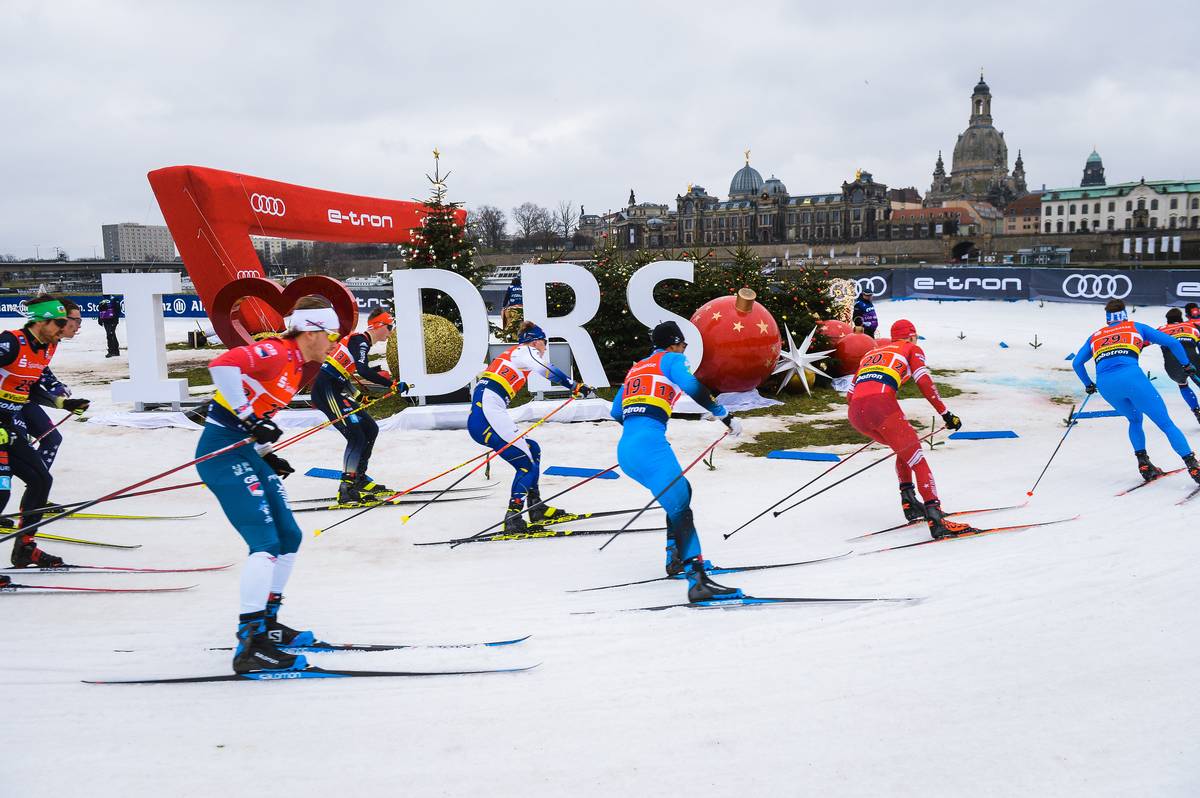
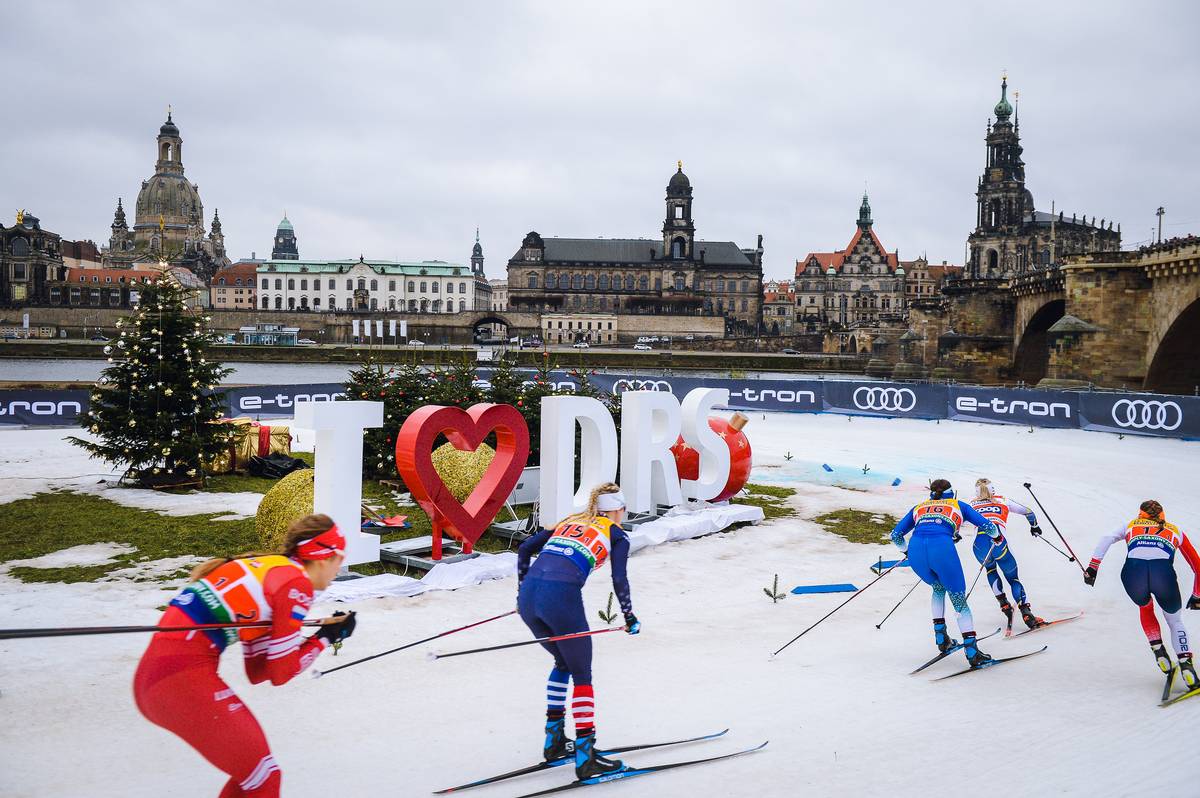
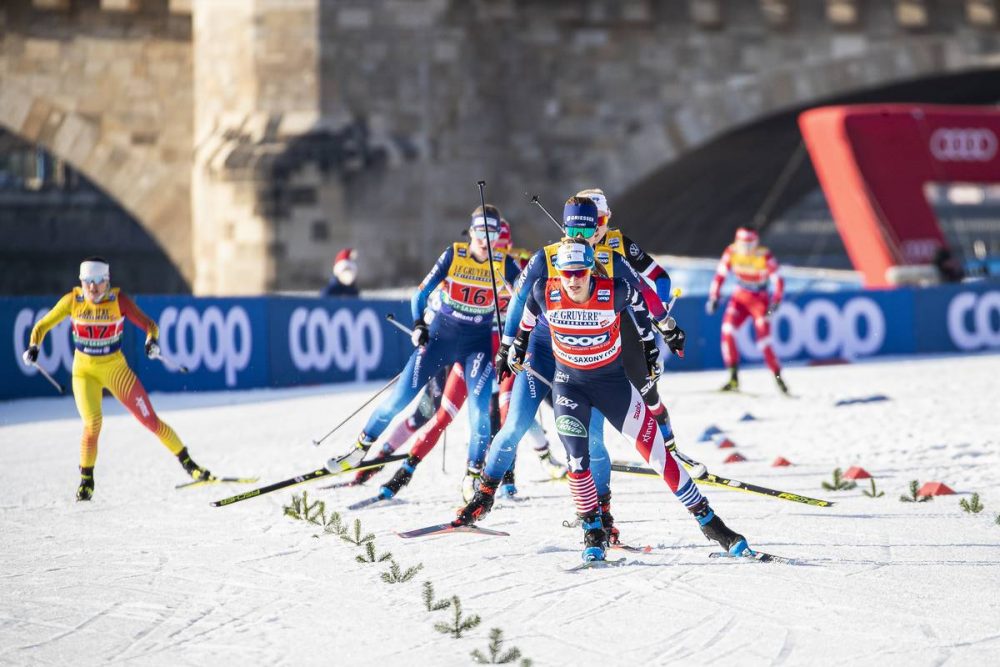
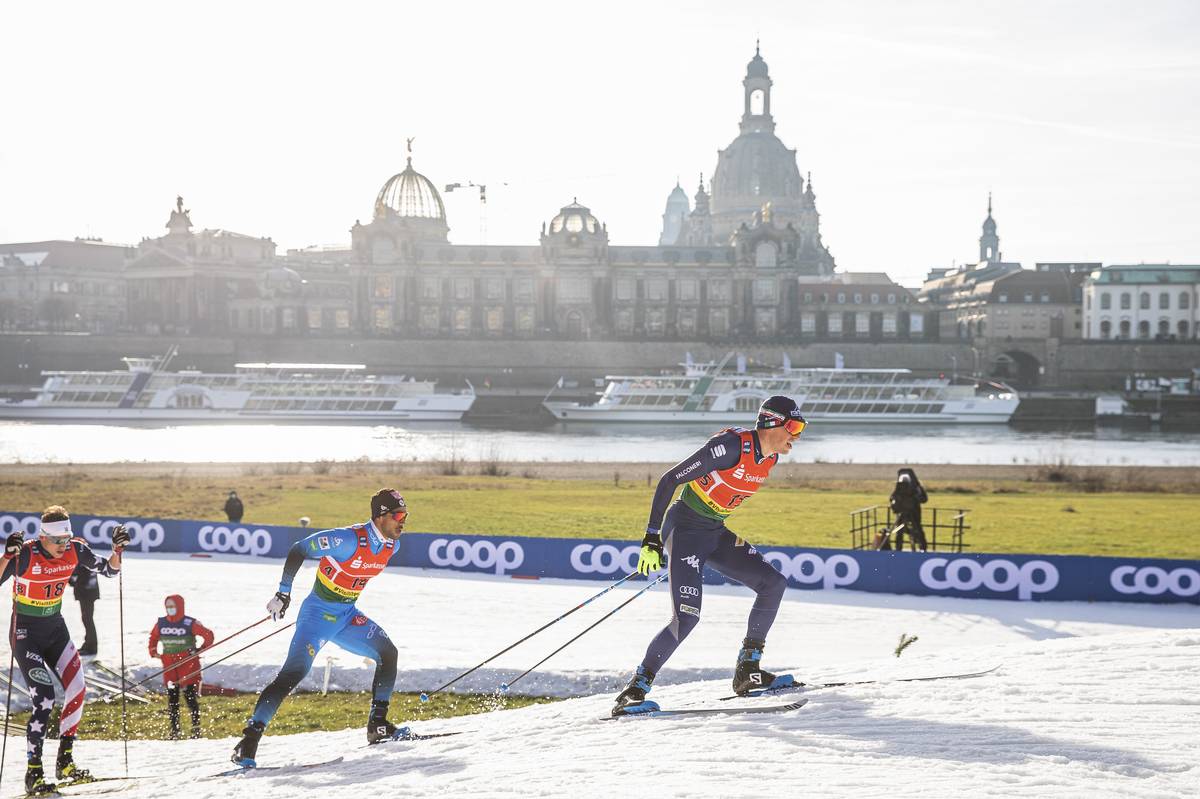
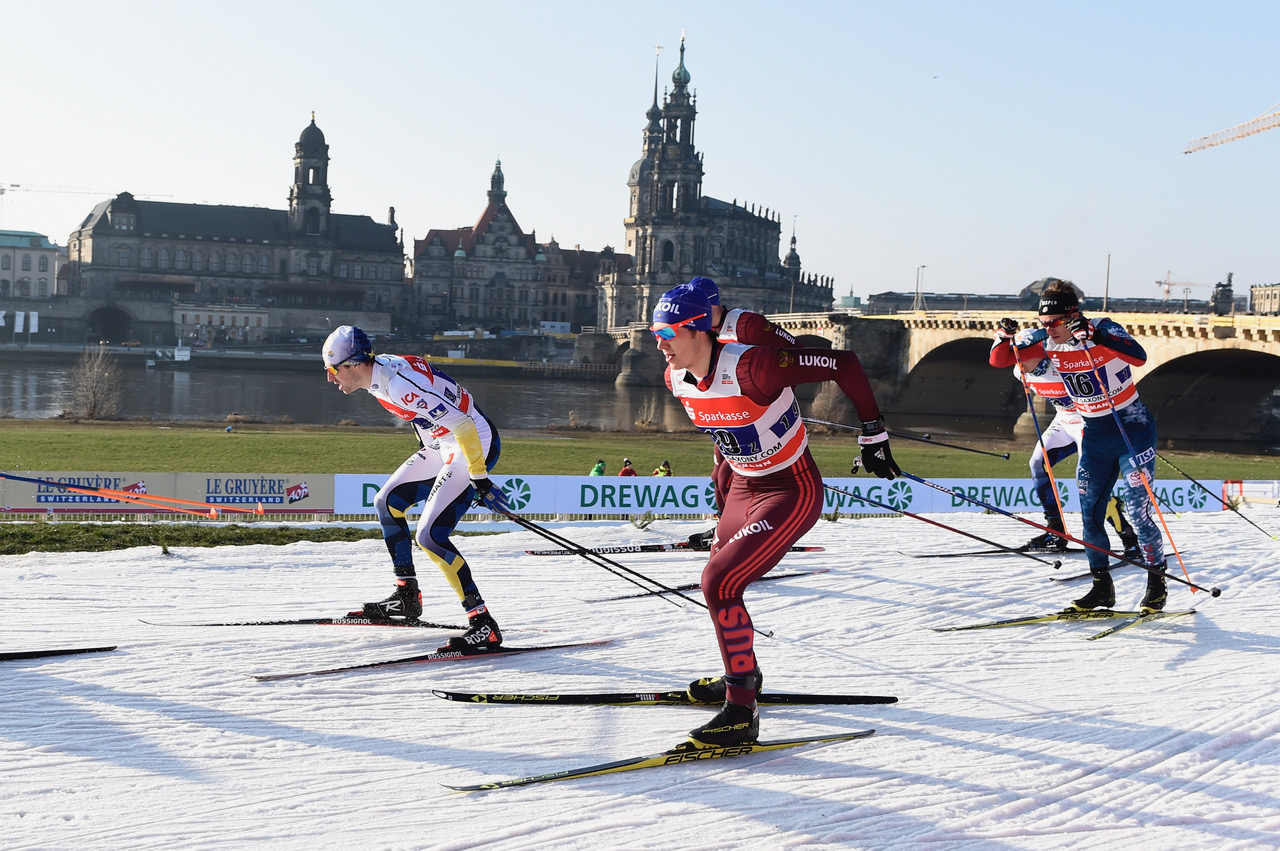
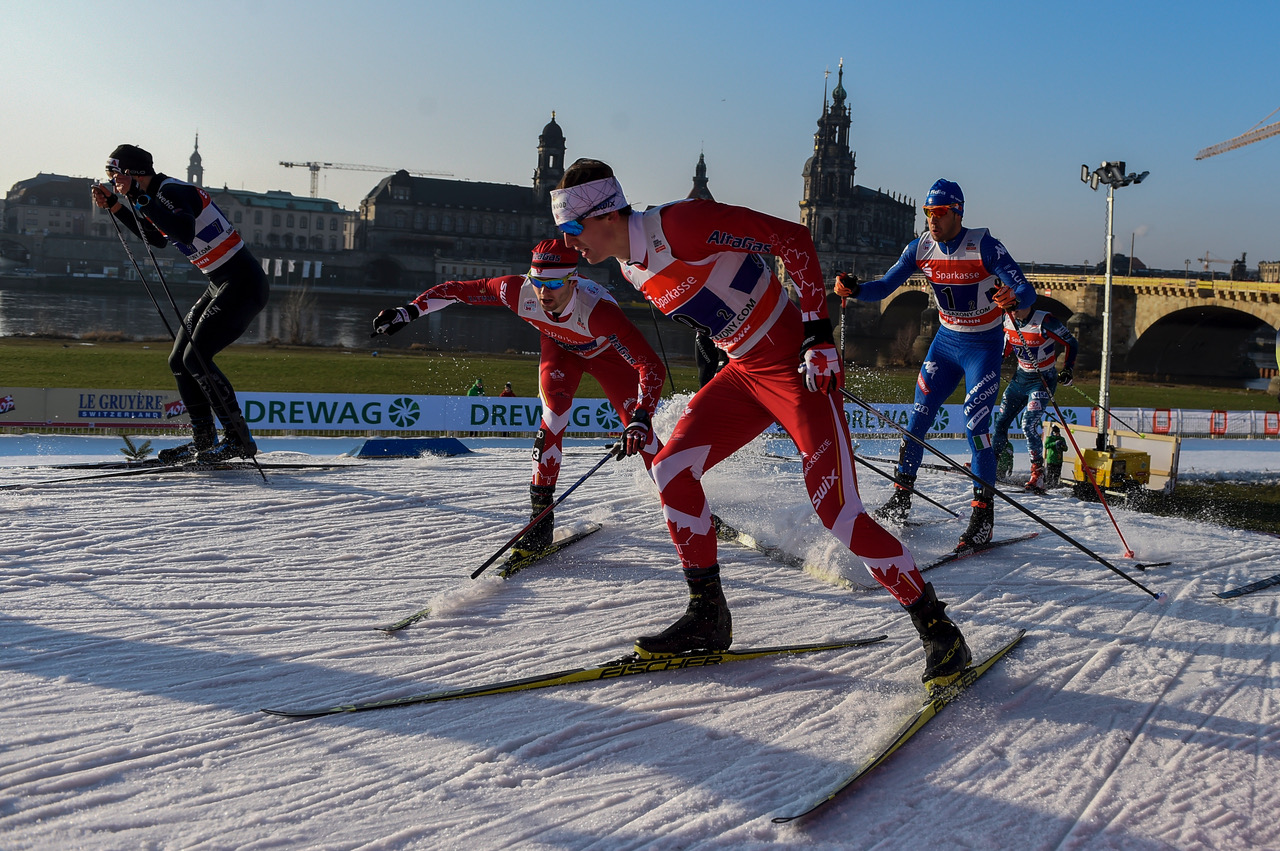
Overcast skies mute the spectacular architecture along the River Elbe, which provides the backdrop for the sprint track in Dresden, Germany. (Photo: NordicFocus)
This World Cup coverage is made possible through the generous support of Marty and Kathy Hall and the A Hall Mark of Excellence Award. To learn more about A Hall Mark of Excellence Award or to learn how you can support FasterSkier’s coverage please contact info@fasterskier.com.
In the wake of the American women taking second to the Swedish powerhouse duo, and yesterday’s top two spots on the podium, Maja Dahlqvist and Jonna Sundling, the men’s team of JC Schoonmaker and Kevin Bolger lined up to race the freestyle team sprint final on the track in historic Dresden, Germany.
“Together again,” wrote Bolger in a post-race email. “We teamed up 3 years ago when JC came over for his first World Cup and didnt ski great then together, but being able to team up again and move to the final after a really solid semi was super rad today! He skied really well all weekend and I’m so impressed with how he’s looking, so it made today really fun!”
Six quick laps each, eleven exchanges total, on a flat and fast city 0.65-kilometer loop with minimal recovery means flooded legs and tight racing. Like a series of just-over one minute intervals with equal rest, athletes take a conservative start, accruing fatigue while minimizing the opportunity for crashes and broken equipment to decide the race, over fitness and tactics. As the number of remaining laps dwindles, the pace steadily builds, like a bottle rocket, until the critical point arrives in the last few laps and leaders explode off the front in an effort to take control of the outcome.
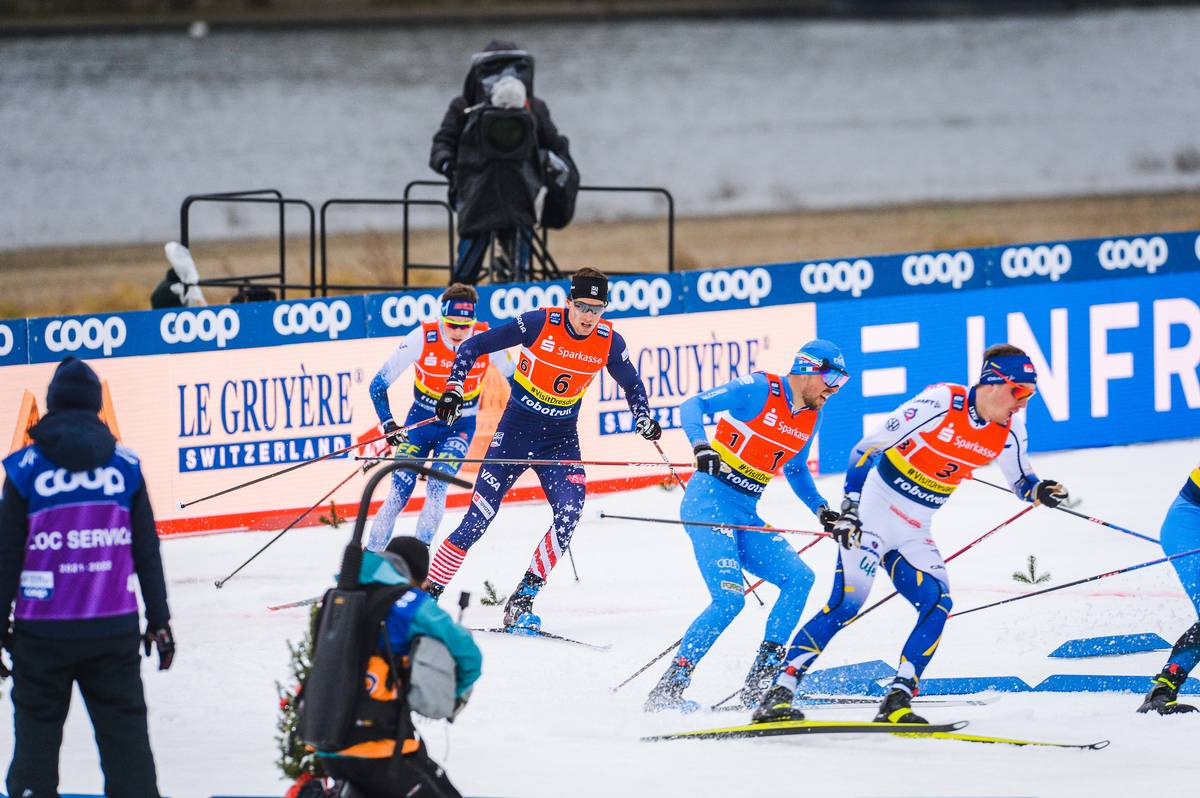
Kevin Bolger navigates a tight curve during the men’s team sprint in Dresden, Germany. (Photo: NordicFocus)
As expected from a lap that lasted just over a minute, the whole pack of ten teams stayed very tight through the halfway mark. The Norway II team of Thomas Larsen and Even Northug spent time at the front, putting in quick surges at the beginning of each leg to re-establish their position.
Tagging off after lap 6, the team tagged off with Great Britain on one side, and the Norway I team of Sindre Bjørnestad Skar and Håvard Solås Taugbøl, on the other. Still very much in the mix were the Russia I pairing of Alexander Bolshunov tagging Gleb Retivykh, Italy’s Francesco di Fabiani and Federico Pellegrino, and France’s Richard Jouve and Lucas Chanavat.
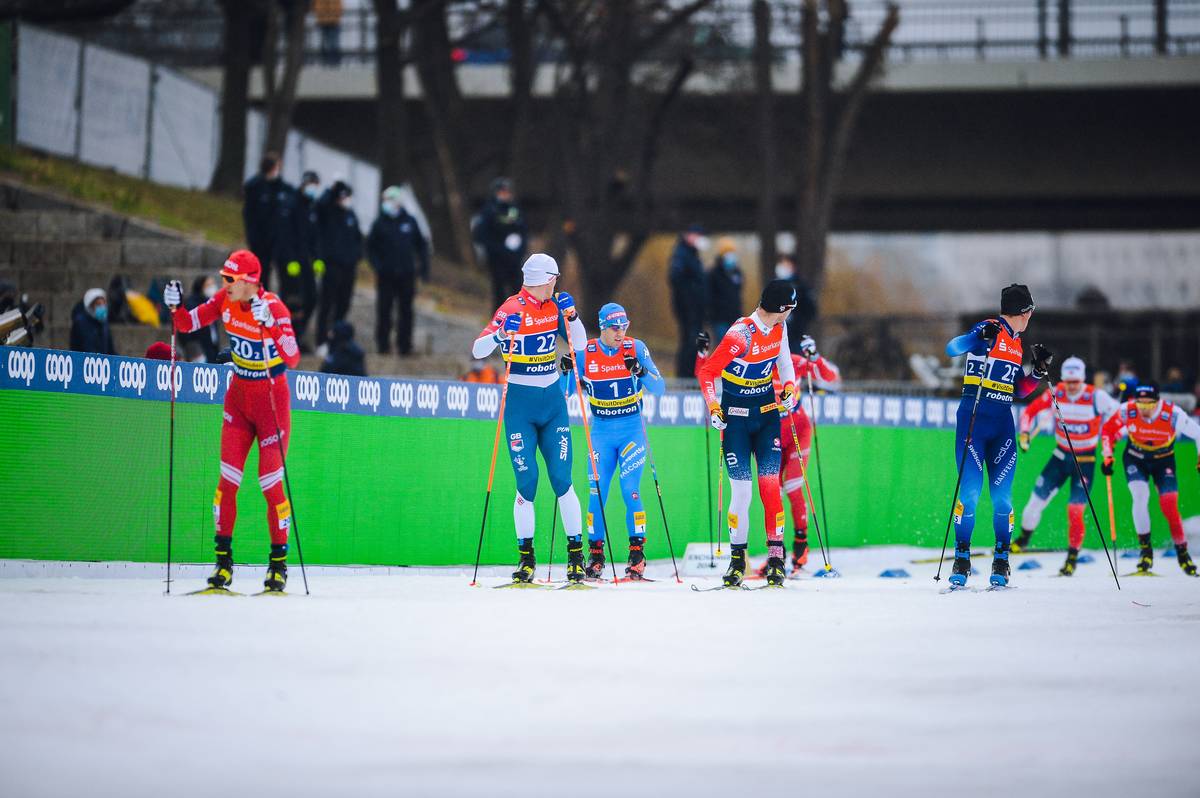
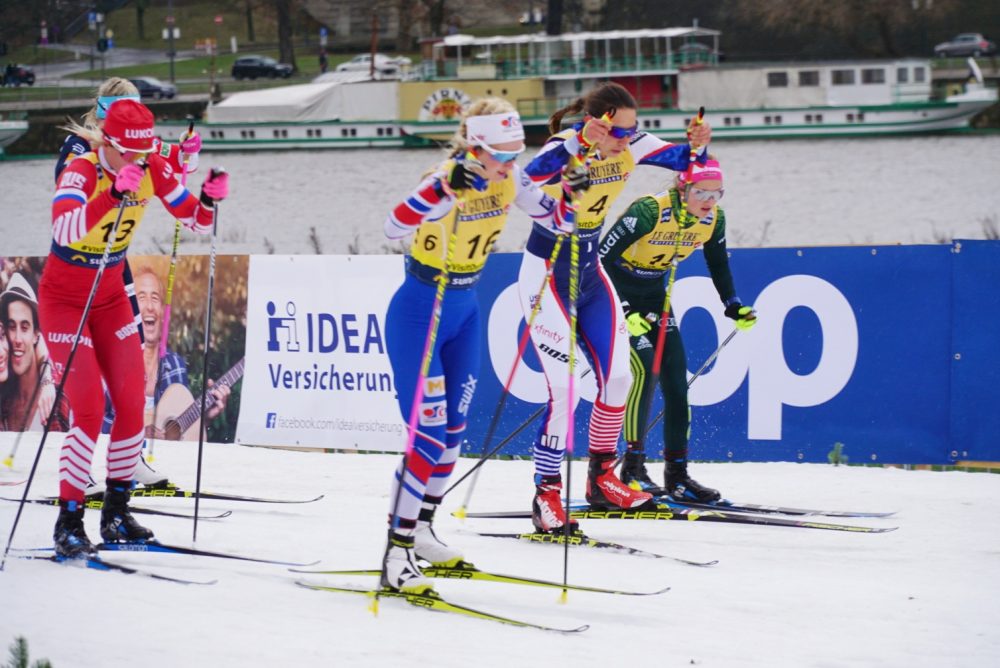
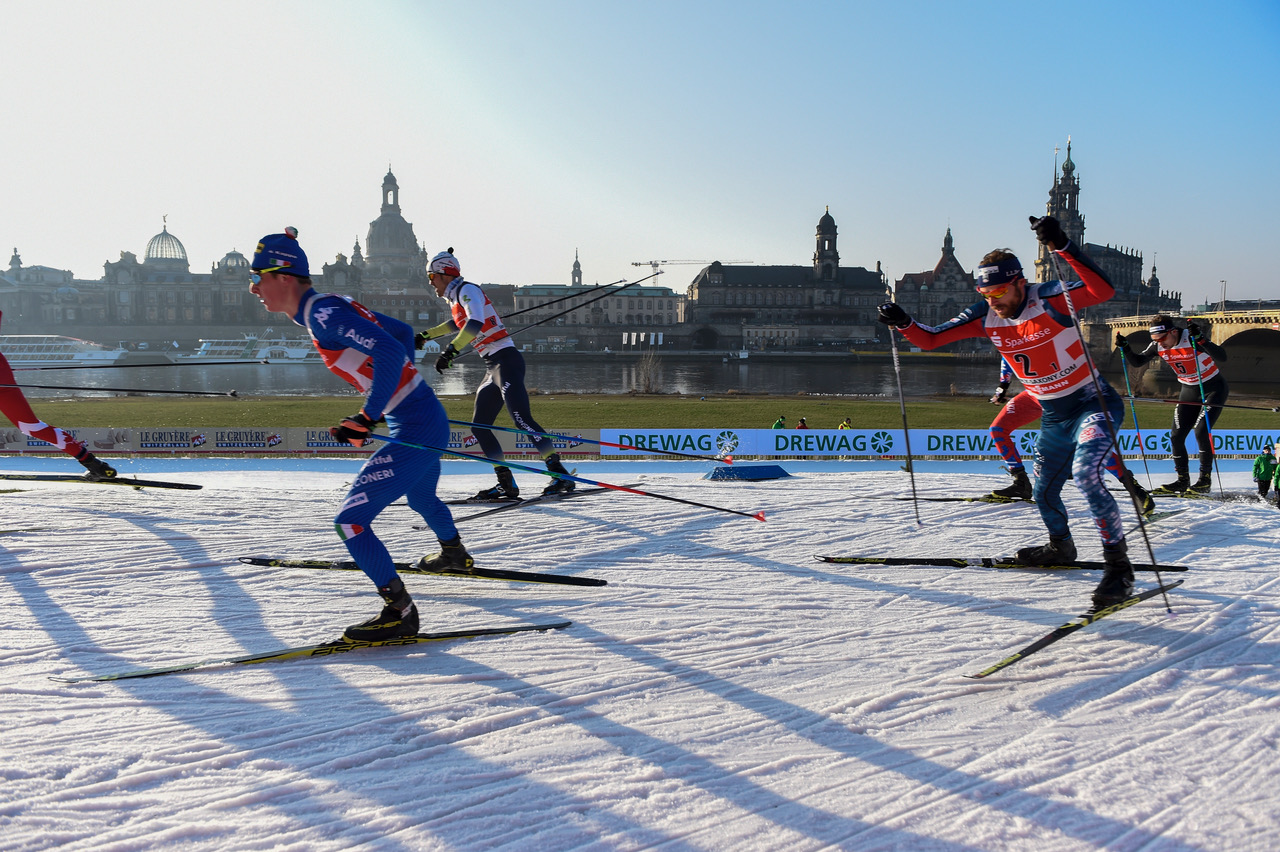
The leaders wait for a tag during the Dresden team sprint. (Photo: NordicFocus)
At the half, the Americans remained in contact near the back of the pack, as Bolger tagged Schoonmaker in 9th (+2.0).
Coming into lap 9, Bolshunov made a move to the front to take the reins for Russia I, with both Norway teams and Jouve quickly responding to his tempo, while Italy and Great Britain worked hard to maintain contact. This burst set the tone for the final three laps.
As Retivykh unsuccessfully attempted to drop Taugbøl and Northug in lap 10, the pack in pursuit began to stretch out. While all remained in contact with the leaders, Great Britain began to look out of the running for a win, with Italy and France remaining a podium-threat in fourth and fifth. The teams behind thinned rapidly.
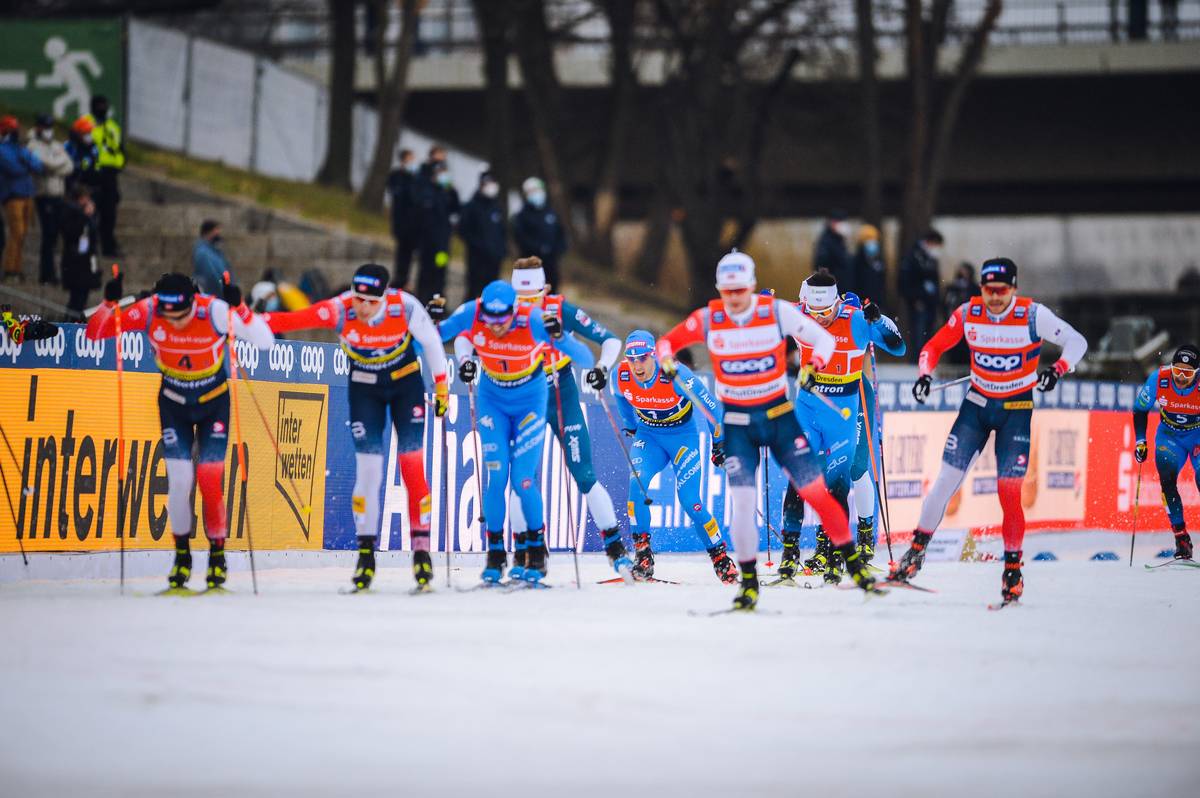
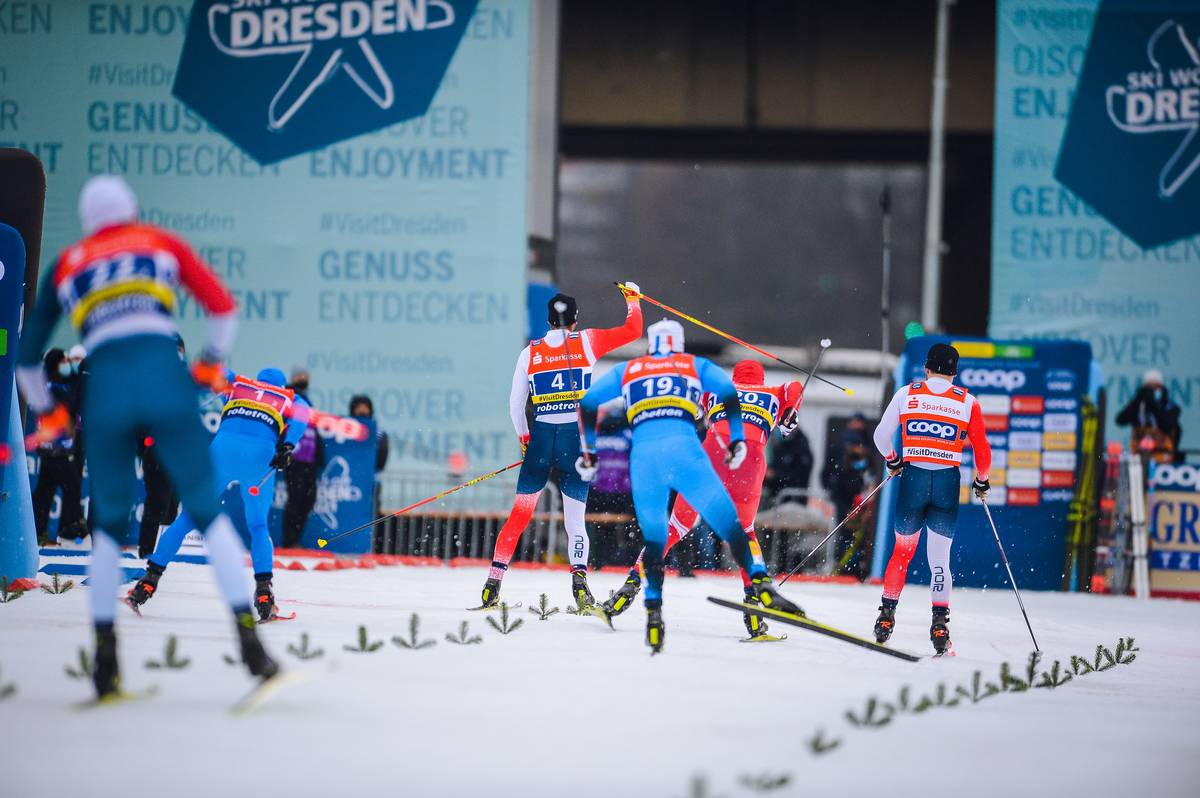
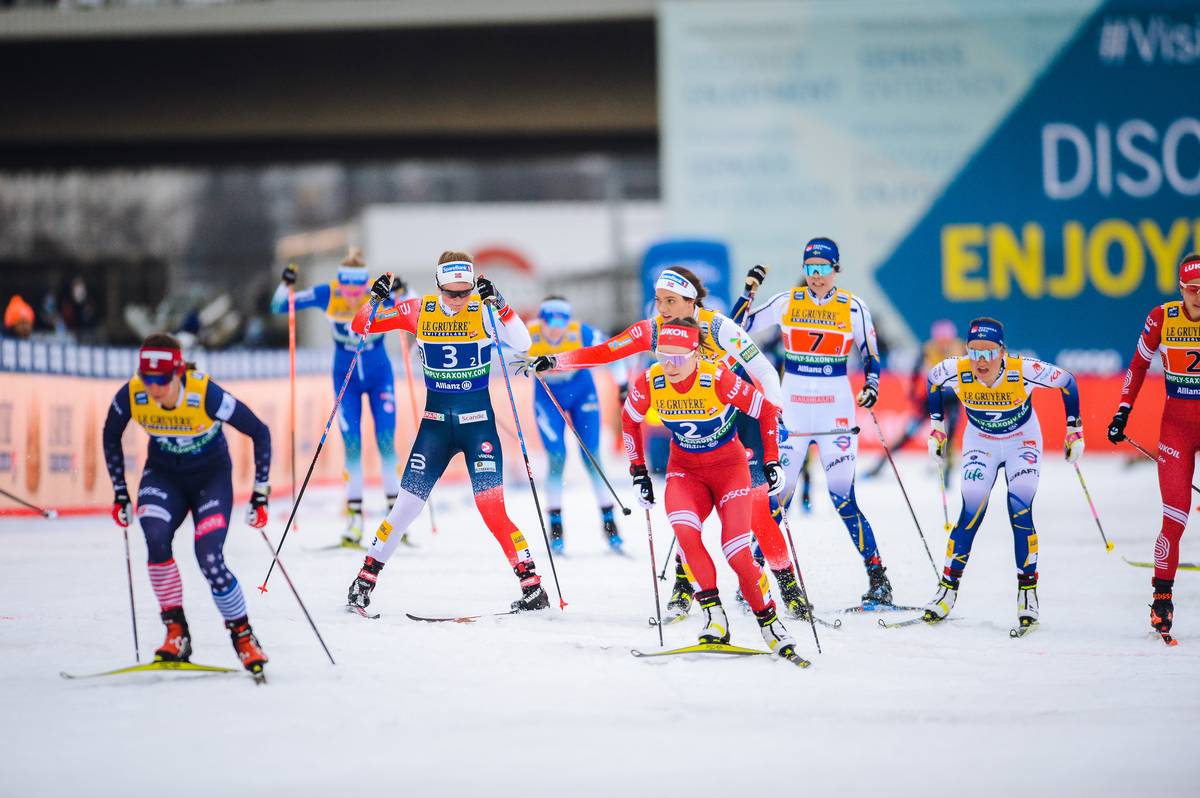
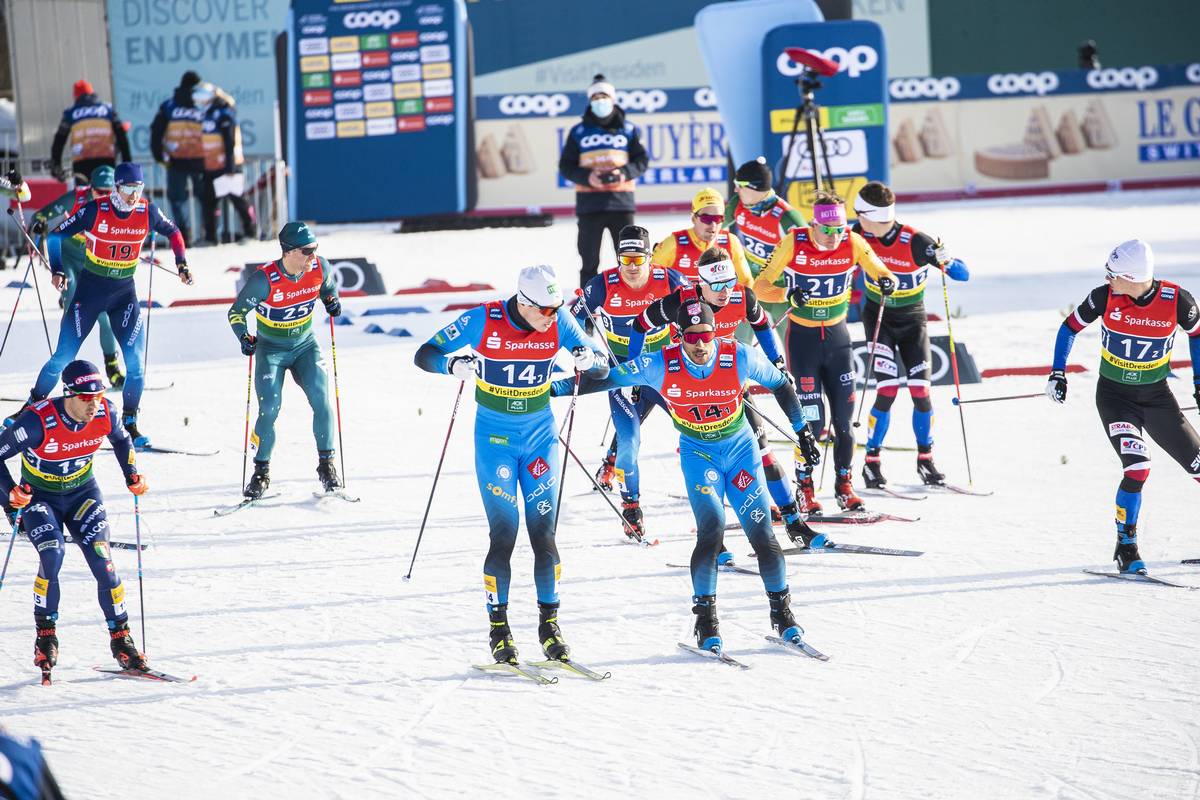
Still tight at the Tag, Norway II, Italy, and Norway I (left to right) head out for another lap during the Dresden team sprint. (Photo: NordicFocus)
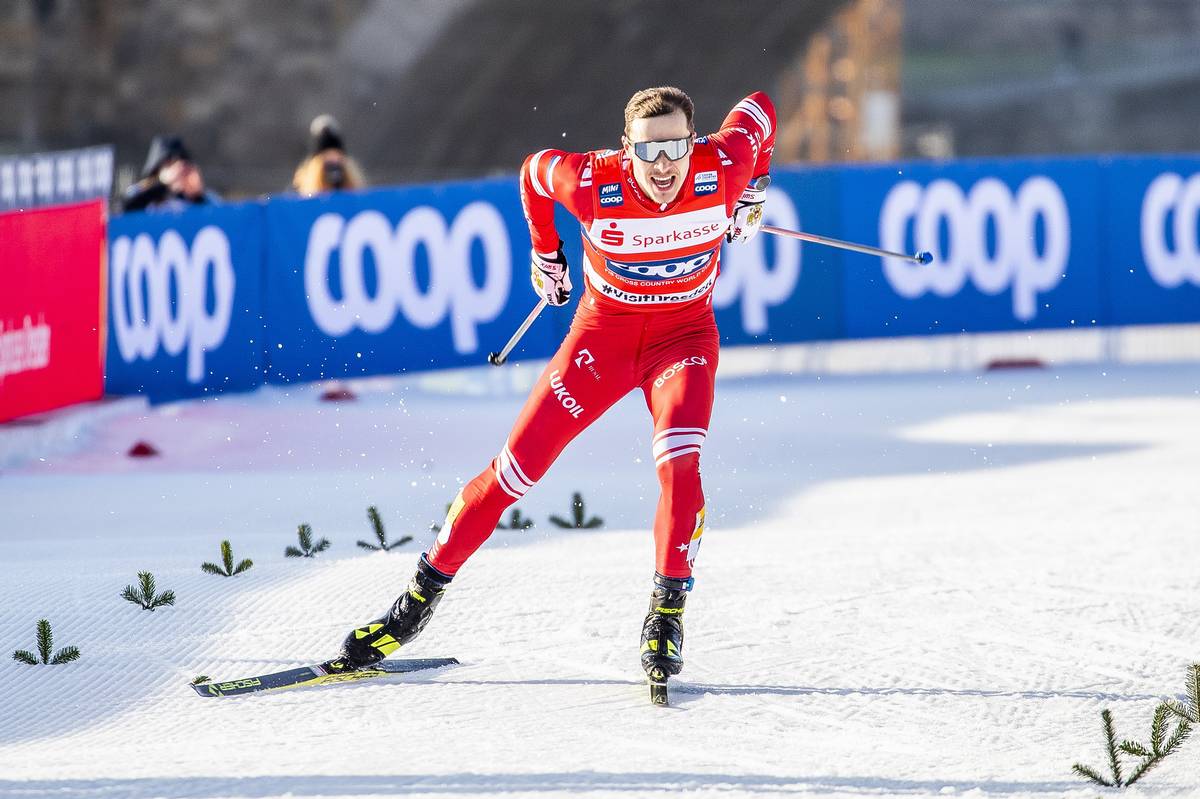
In Bolshunov’s final lap, he rocketed off the front, skiing powerfully through his legs with an aggressive forward lean, carrying momentum between each push. Whereas the early laps, rounding the tight curves looked careful and calculated, the men shot around the degrading bends, losing no speed as they pushed into the straightaways.
Tagging off for the final lap, Northug accelerated ahead of Retivykh, free skating powerfully off the first roller to regain the lead for Norway II. Feet quickly stepping around the first curve, Norway II looked in control with Norway I and Russia not ceding the win just yet. Italy and France remained on their tails, still in position for the podium.
Coming into the final curve hot, Taugbøl made an attempt to slingshot Norway I to the lead, but the tactic was thwarted by the closing speed and power of Northug. Standing up to pump his fist into the air, Northug coasted over the line for the win in 14:19.34, while Taugbøl narrowly edged out a hard-closing Retivykh to make it Norway II, Norway I (+0.42), then Russia I (0.62) for the podium.
Even Northug pumps his fist as he takes the win, while the second and third spots on the podium remain up for grabs behind him. (Photo: NordicFocus)
“It was amazing,” Northug told FIS at the finish. “We struggled a little bit in the semifinal, but in the final we did everything right. Thomas sent me out first on the final lap and that was the plan. It was good.”
Speaking to the experience of racing with Northug, Larsen spoke highly of his partner, and of putting the Norway II team ahead of Norway I on the podium.
“It’s fantastic, he’s an incredibly good skier,” Larsen said. “He hasn’t had so many chances in the World Cup so far, but now he shows with yesterday and last week, he shows that he is one of the best in the world. I think this was a dream team today, and it’s cool to be the underdogs and just take it home.”After a fast final leg by Pellegrino to keep his team in the mix for the top-three, Italy was next over the line, narrowly missing the podium in fourth (+0.78), with Chanavat bringing the French I team home in fifth (+1.21). Knowing he was no longer in position to snag top-three, Great Britain’s Andrew Young relaxed in the final stretch, coasting over the line in sixth (+3.84), followed by a sizable gap to the next racers.
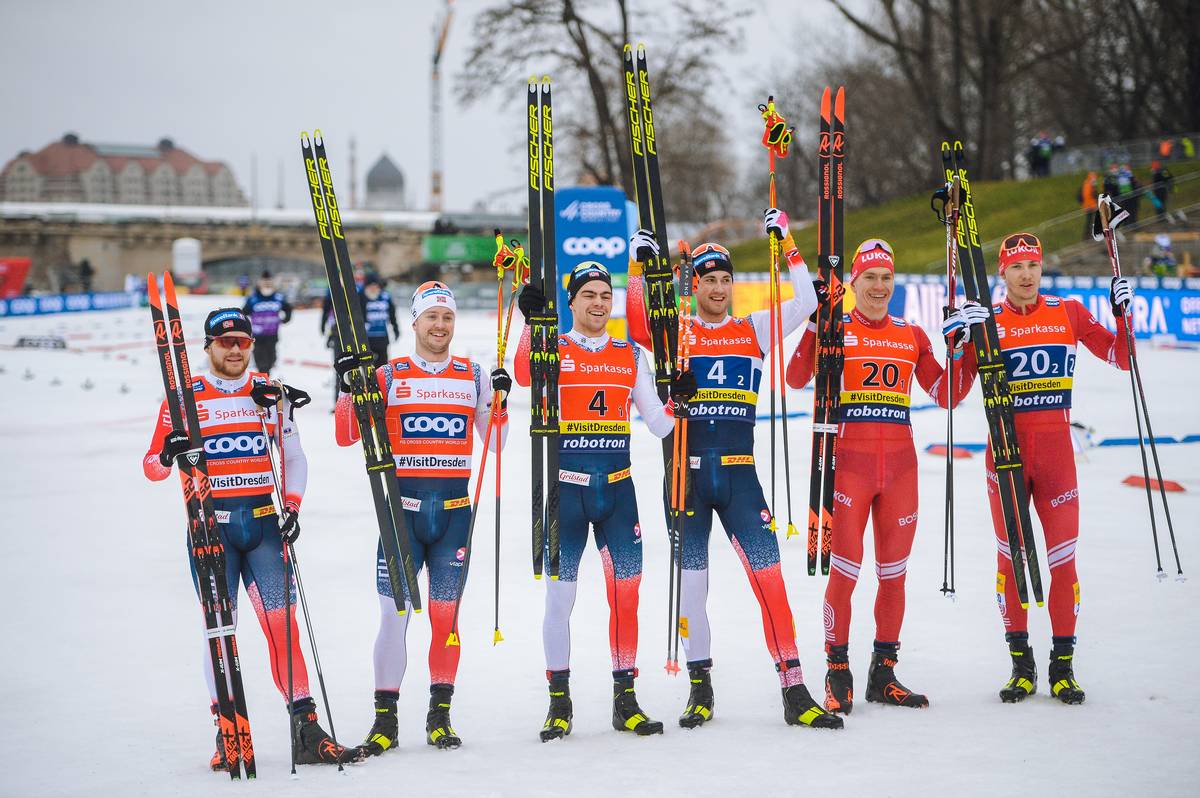
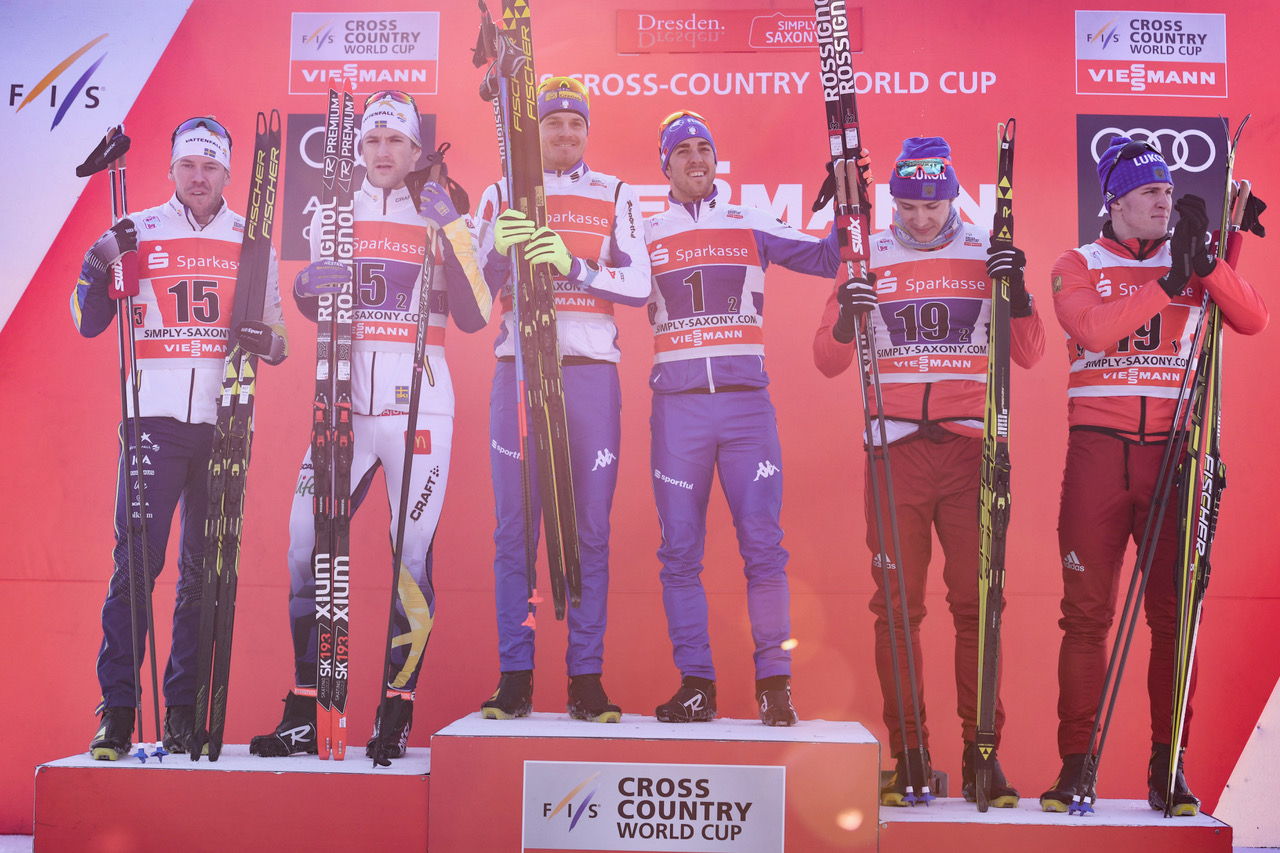
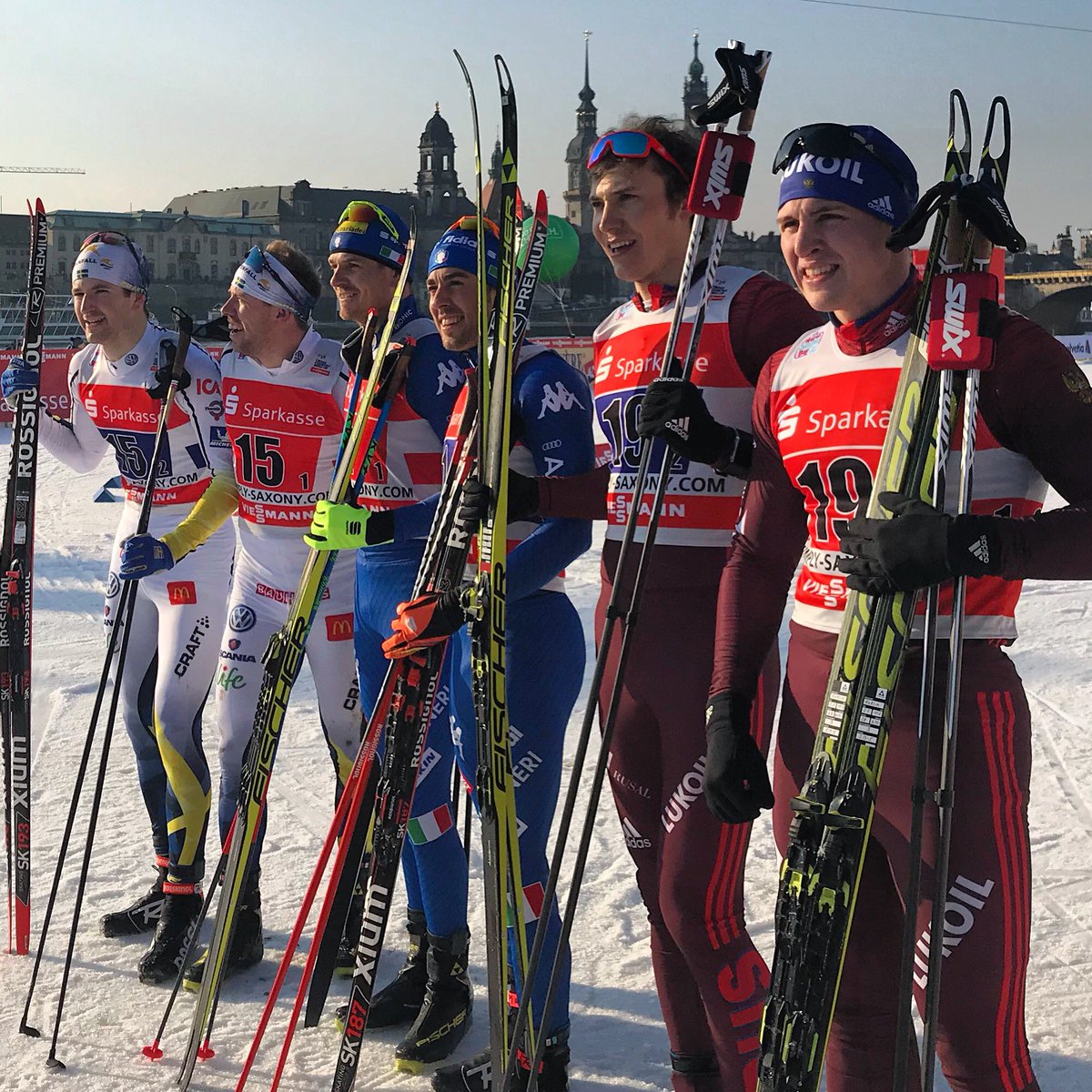
The men’s podium of the team sprint in Dresden: The Norway II team of Thomas Larsen and Even Northug took the win ahead of Norway I, Sindre Bjørnestad Skar and Håvard Solås Taugbøl, and Russia I, Alexander Bolshunov and Gleb Retivykh. (Photo: NordicFocus)
After losing contact in the final laps, Schoonmaker brought the American team to the line in 9th (+11.36).
“Dresden is a really fun event,” Bolger said after the race. “I think it’s something a lot of us skiers on the a World Cup enjoy to mix things up!”
Bolger explained that he and Schoonmaker “just wanted to stay out of trouble — and try as best as we could to put ourselves into a position to where we could attack when we needed to… I was hoping for more of a tactical final but it seemed like Bolshunov had a different plan and really pushed the pace for my leg the whole time, which made it really hurt, but I think that makes it really fun and competitive!”
Providing insights into the team’s tactics and his experience during the final, Schoonmaker provided the following comment in a post-race email from the road.
“I would say our main strategy going into the final was to conserve energy while staying in the top half of the field so that we would be able to match any moves made later in the race,” Schoonmaker explained. “It seems everyone had the same plan in mind, though, so it was tough to make that work. We were a little too far back to make anything happen when the pace picked up in the second half of the race. In Dresden, it really seems to be all about being out front because passing is just hard on a short, narrow and turny course. It’s a super fun format with the short laps, but also very challenging!”
Racing in semifinal B, Luke Jager and Logan Hanneman skied to 10th (+10.96), with the Canadian duo of Russell Kennedy and Graham Ritchie not far behind in 12th (+14.91). Neither team advanced to the finals.
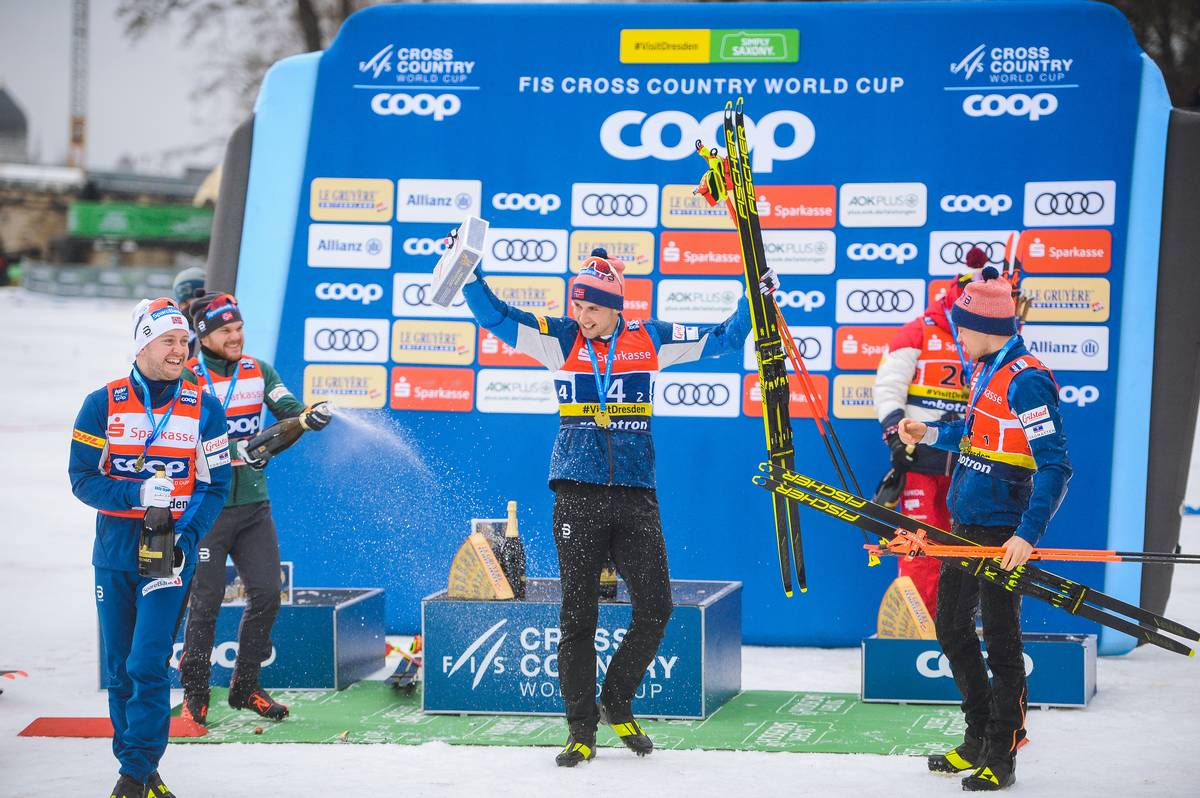
With champagne spraying, Even Northug and Thomas Larsen step off the top spot of the team sprint podium in Dresden. (Photo: NordicFocus)
Despite sitting out the weekend in Dresden, Norway’s Johannes Høsflot Klæbo currently leads both the World Cup overall and sprint standings. Klæbo is roughly 150 points ahead of Sergey Ustiugov (RUS) in the overall, and 60 points ahead of Taugbøl in sprinting.
Leading the American men, Schoonmaker sits in 11th place in the sprint standings with 112 World Cup points, and 20th in the overall. Schoonmaker is also the second ranked U23 skier, trailing Russia’s Alexander Terentev by 219 points.
Ben Ogden also ranks inside the top-30 in sprinting, sitting in 23rd with 46 points. Ogden is 4th on the U23 list, with Gus Schumacher 20 points behind in 7th. Luke Jager sits in 13th of the 21 athletes on the U23 list, with Zanden McMullen close behind in 16th. The future of American skiing is looking bright.
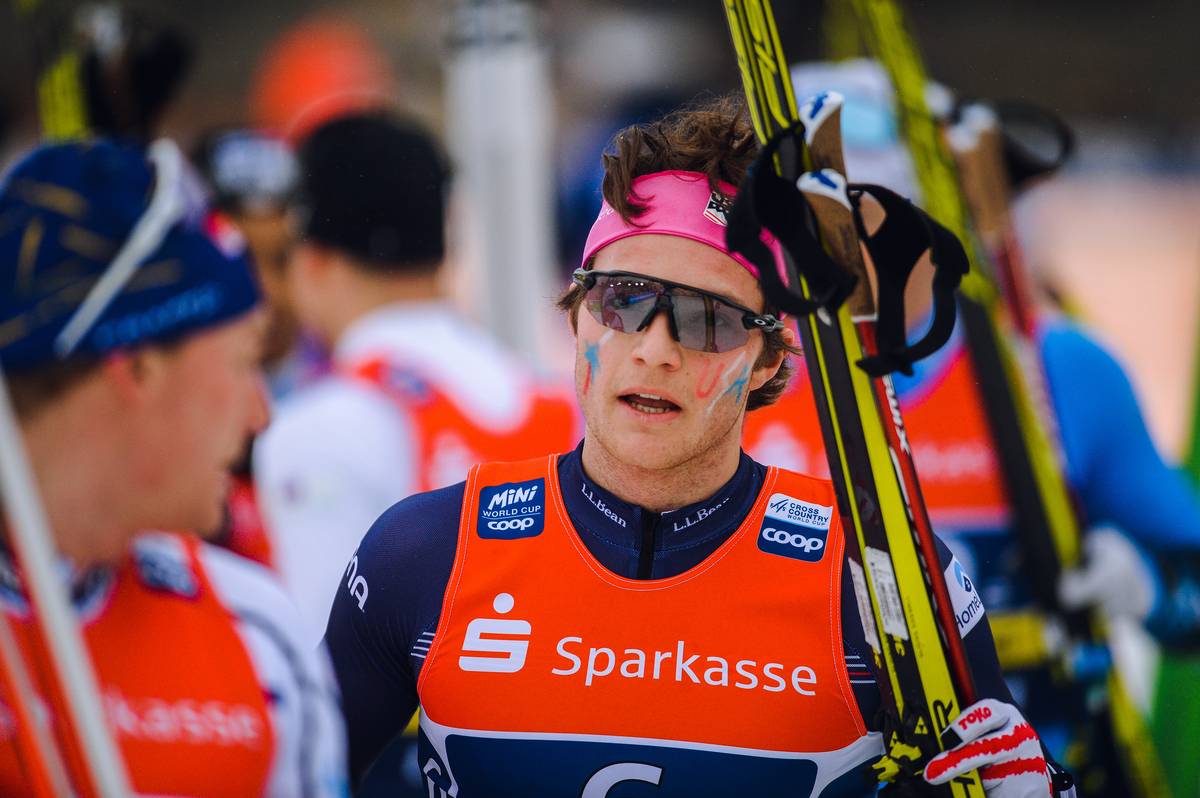
Face painted with stars and stripes, JC Schoonmaker leads the American men in the overall, sprint, and U23 World Cup standings. (Photo: NordicFocus)
After a holiday break, racing continues with the Tour de Ski, which kicks off in Lenzerheide, SUI on December 28th.
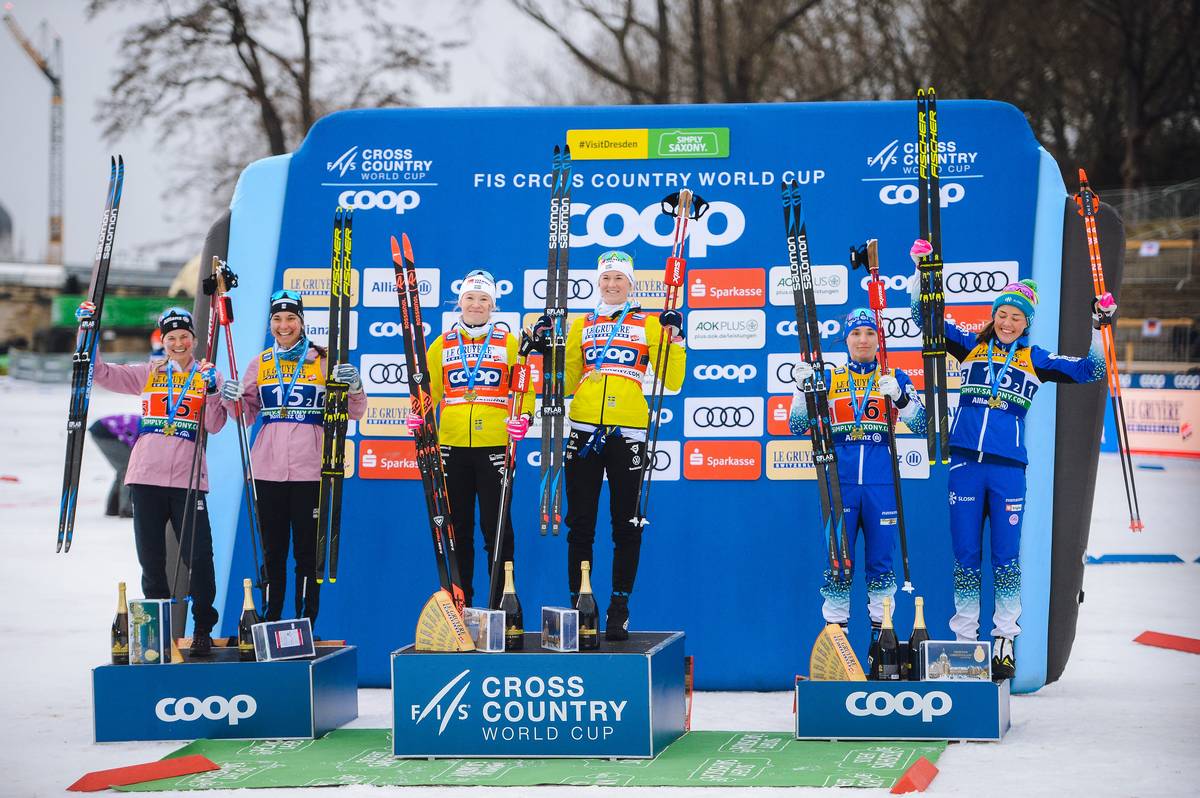
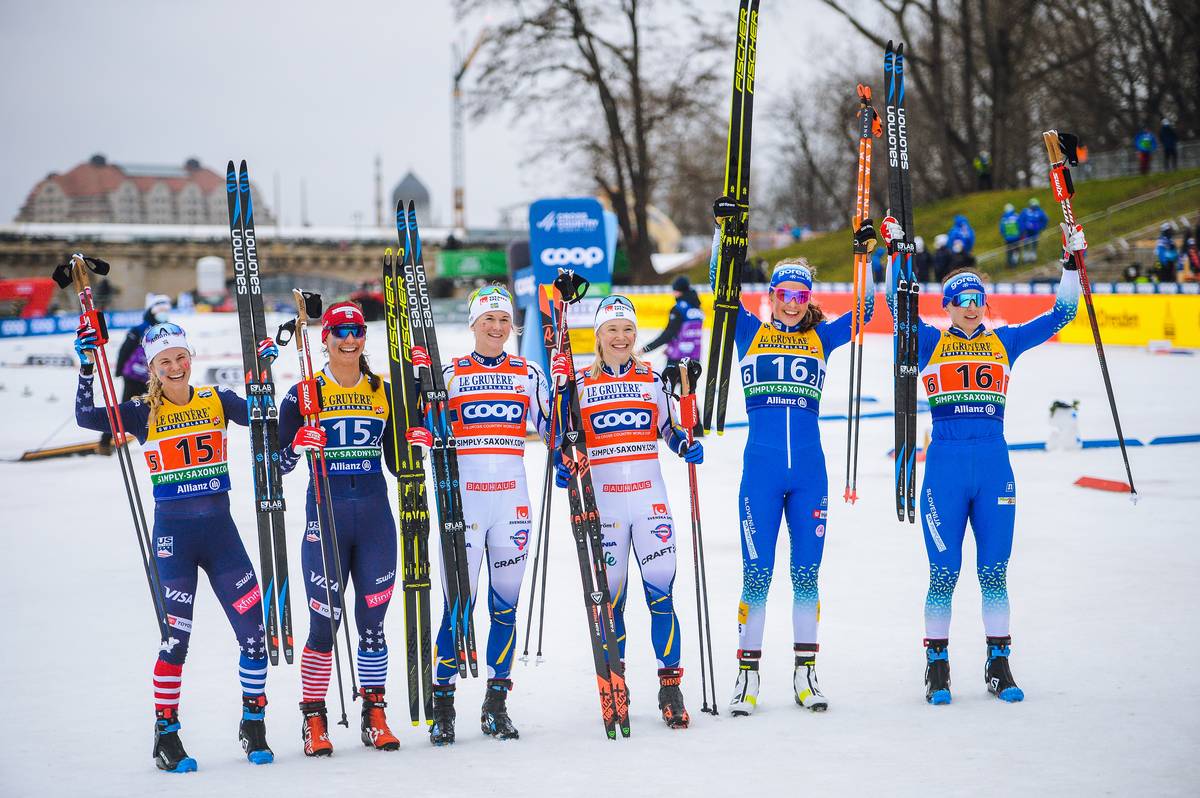
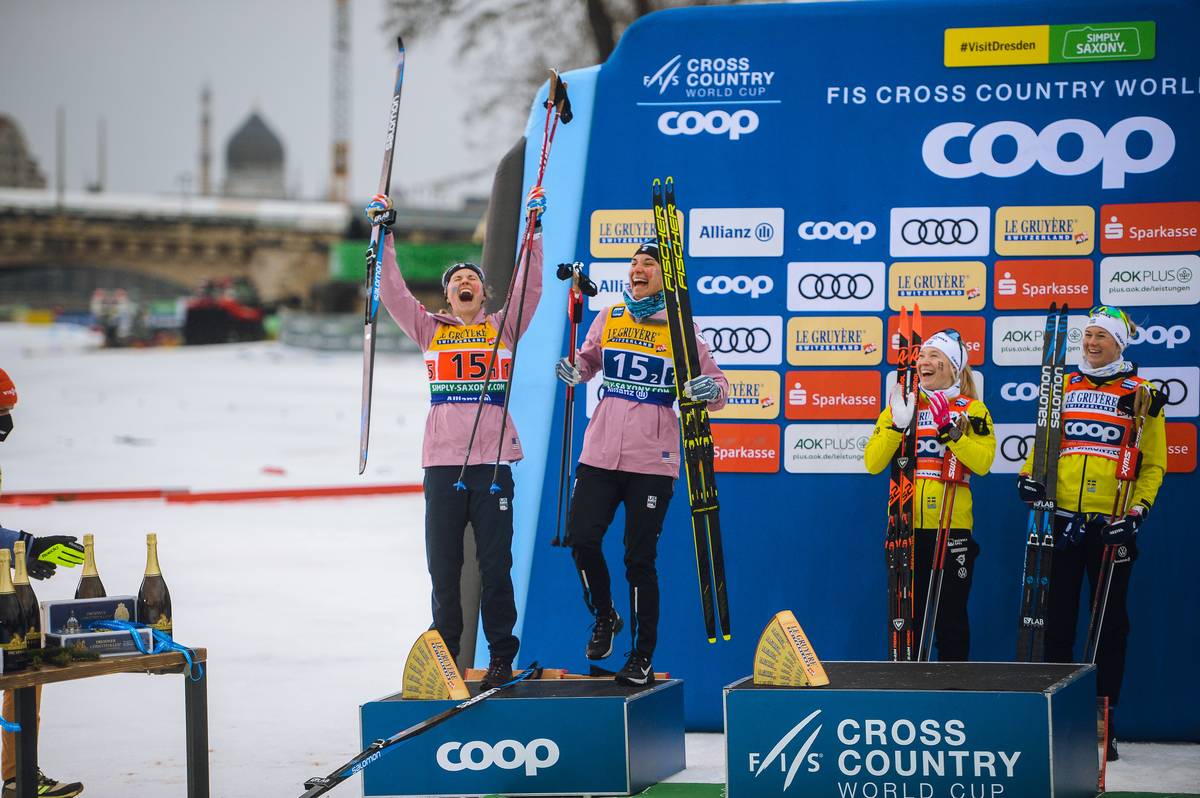
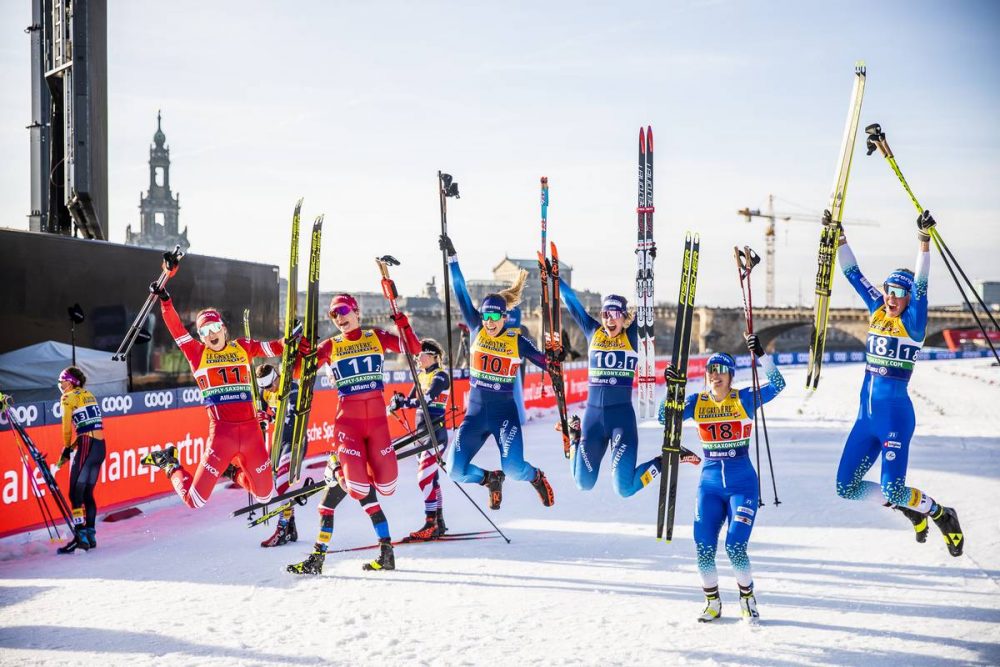
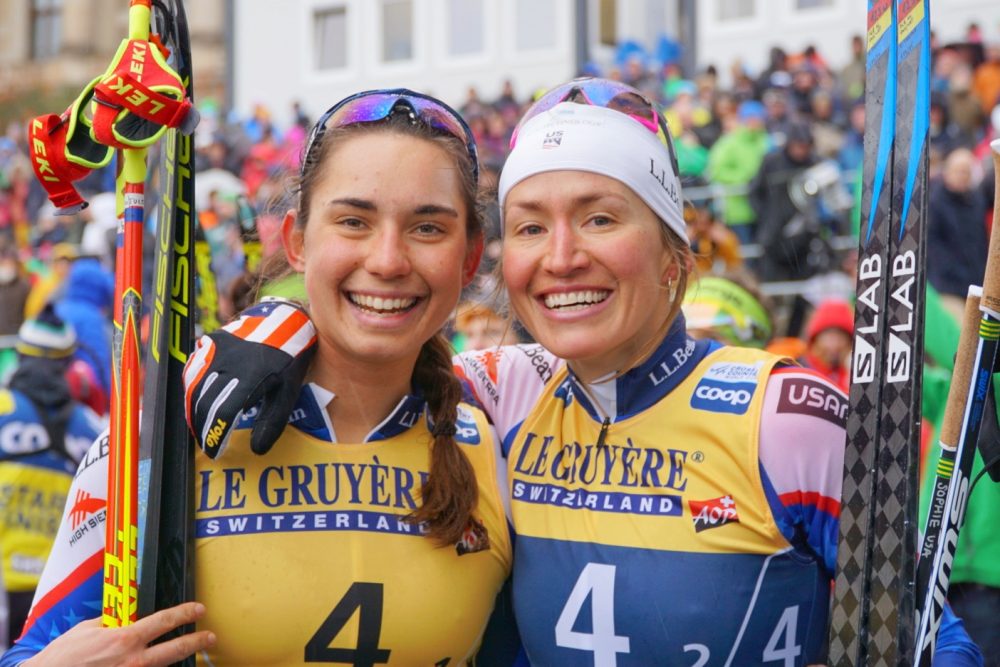
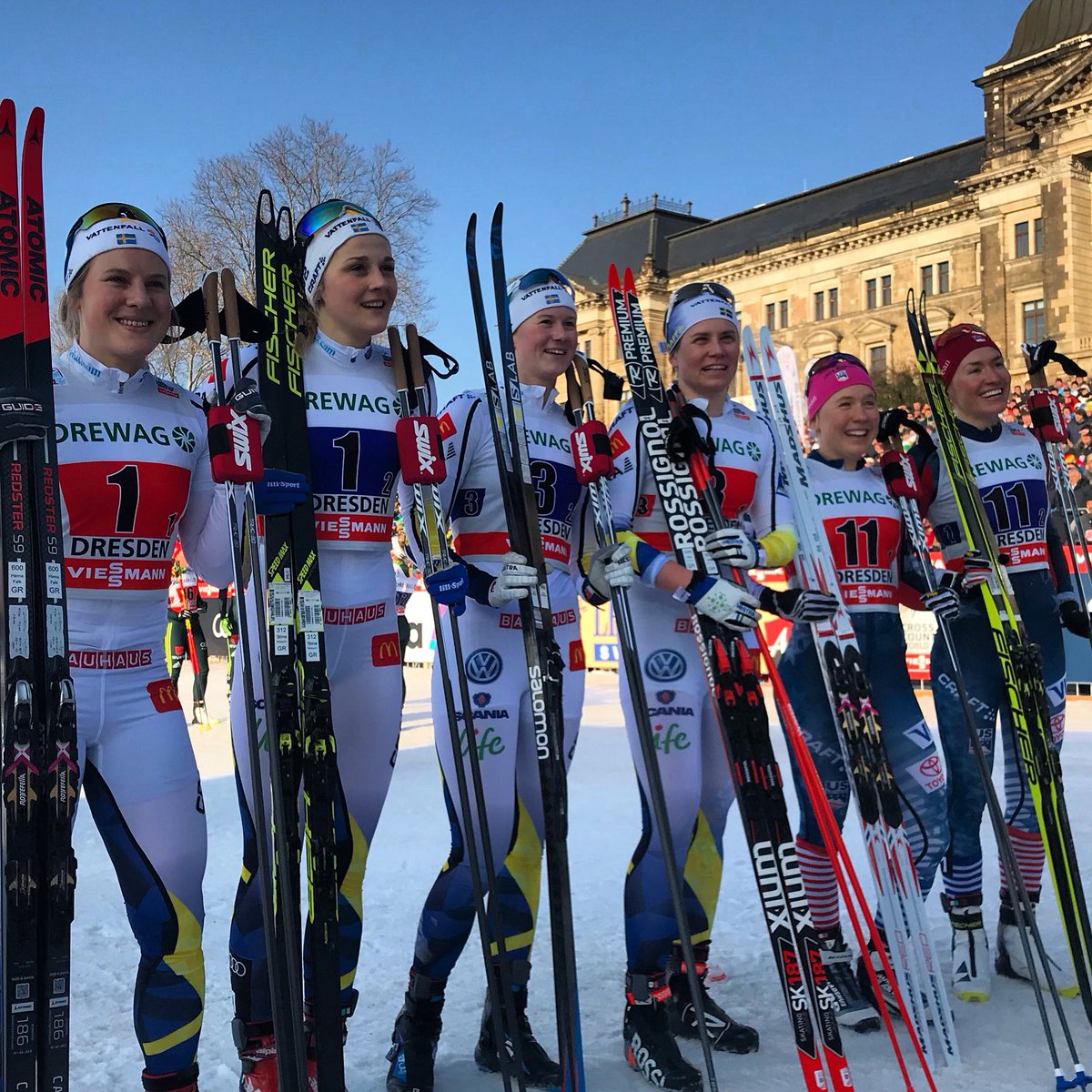
The women’s team sprint podium in Dresden: The Sweden I duo of Jonna Sundling and Maja Dahlqvist took the win ahead of USA’s Jessie Diggins and Julia Kern, with Slovenia’s Eva Urevc and Anamarija Lampic in third. (Photo: NordicFocus)
This World Cup coverage is made possible through the generous support of Marty and Kathy Hall and the A Hall Mark of Excellence Award. To learn more about A Hall Mark of Excellence Award or to learn how you can support FasterSkier’s coverage please contact info@fasterskier.com.
By Ryan Sederquist
Defending team sprint world champions Maja Dahlqvist and Jonna Sundling continued the Swedish women’s sprint dominance with a polished performance and confident victory Saturday morning in Dresden on day two of World Cup action in the German city.
“We just want to be in front because it’s a tight course,” Dahlqvist told a FIS reporter after the race. With athletes taking six turns each on the 644-meter course, which contains a maximum climb of 14 meters and a total height difference of just 4 meters, opportunities to pull away were low and the chances of crashing were high. In order to stay focused on their job, maintaining a lead was crucial for the dynamic duo.
Body to body being the name of the game, Maja Dahlqvist tags her teammate Jonna Sundling as the women set pace during the team sprint in Dresden. (Photo: NordicFocus)
“It’s difficult because [there are] people everywhere,” Sundling said when asked how she and Dahlqvist kept their calm in the bunched-up chaos. “The equipment – you want to keep it like it is – no broken poles and stuff. So, it’s difficult to focus on the right thing, but when you’re in the front, it’s easier.”
The Swedes did have some company at the front throughout the 11 exchanges. One of the early challenges came from the Jessie Diggins – Julia Kern pairing, who qualified with the top time out of semifinal B.
Kern explained post-race that staying near the leaders was part of their strategy heading into the team sprint.
“Jessie and I focused a lot on executing clean and fast tags, and tried to remain as far front in the pack as possible,” Kern said. “There is so much traffic and tangles that we wanted to avoid as much of that as possible. There was a strong headwind which made leading more costly, but it still is advantageous especially given how fast and firm the track was.”
Another surprise at the front was from Finland. The team of U23 athletes, Jasmi Joensuu and Jasmin Kahara, nabbed the final automatic qualifying spot in the first semifinal. Despite squeaking into the final, the young women made their presence known throughout the race, moving alongside Sundling and Dalqvist into second at the end of the tenth lap before ultimately finishing in fourth.
Jessie Diggins heads into what would be later become a dicy turn. (Photo: NordicFocus)
With Sundling leading off, Sweden set the pace through the first four laps, with different nations taking turns at their shoulder. Russia I took lap two, Norway II took lap three, and Slovenia, led by Anamarija Lampic, who was third in the individual yesterday, popped in on lap four. The Americans, who placed Diggins as their lead-off skier, patiently bided their time, content to sit in the tight grouping and stay on their skis. Unfortunately, a wrench was about to be thrown into that plan.
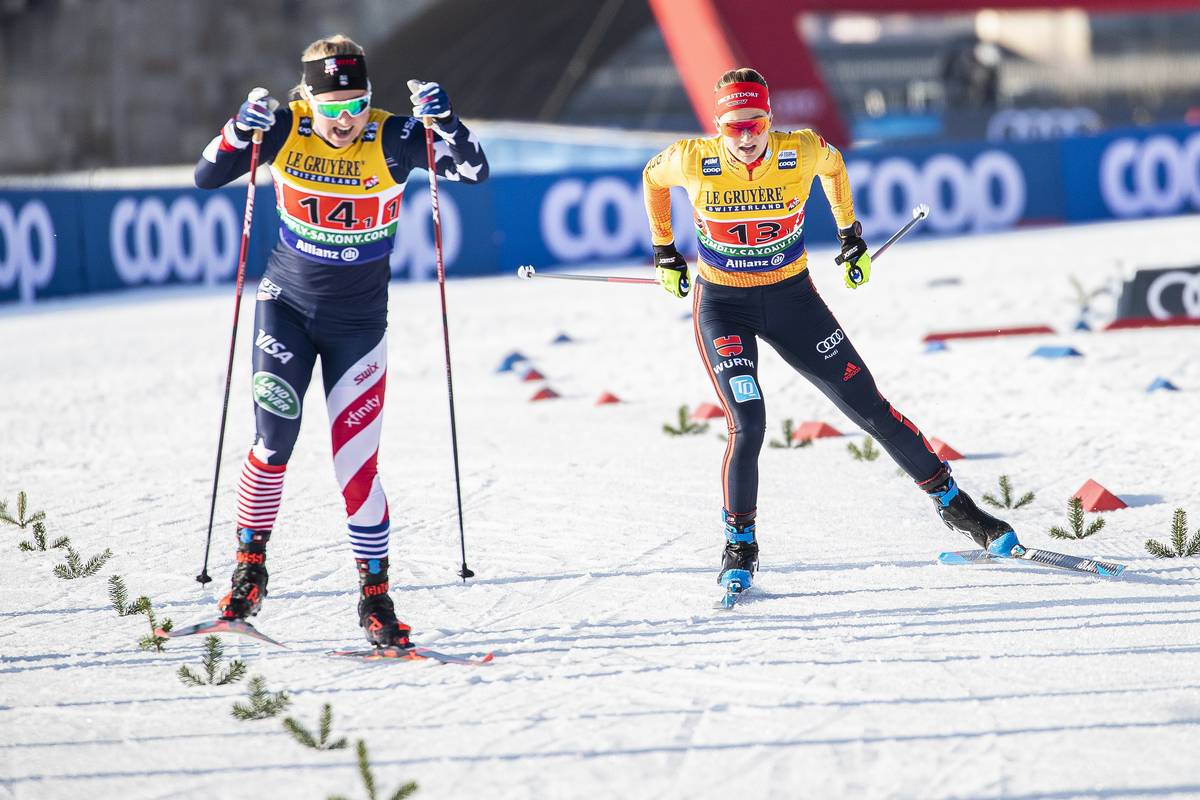
On lap five, Diggins moved into second place. Coming around the penultimate turn, she swung to the outside and was tangled up with Eva Urevc of Slovenia, who tumbled over the top of the 2018 Olympic gold medalist in the event. Diggins kept her cool, quickly rose to her feet, and skied hard to the next exchange. She tagged off to Kern 4.1 seconds back.
“I got back our places as quickly and efficiently as I could,” Diggins told FasterSkier after the race. She also noted that she is headed into Christmas break with a fresh set of bruises to go along with her podium cheese.
“I’m always proud of the ‘never give up attitude’ and I think it really paid off for us today. We didn’t panic, we just skied as smooth and smart and hard as we could.”
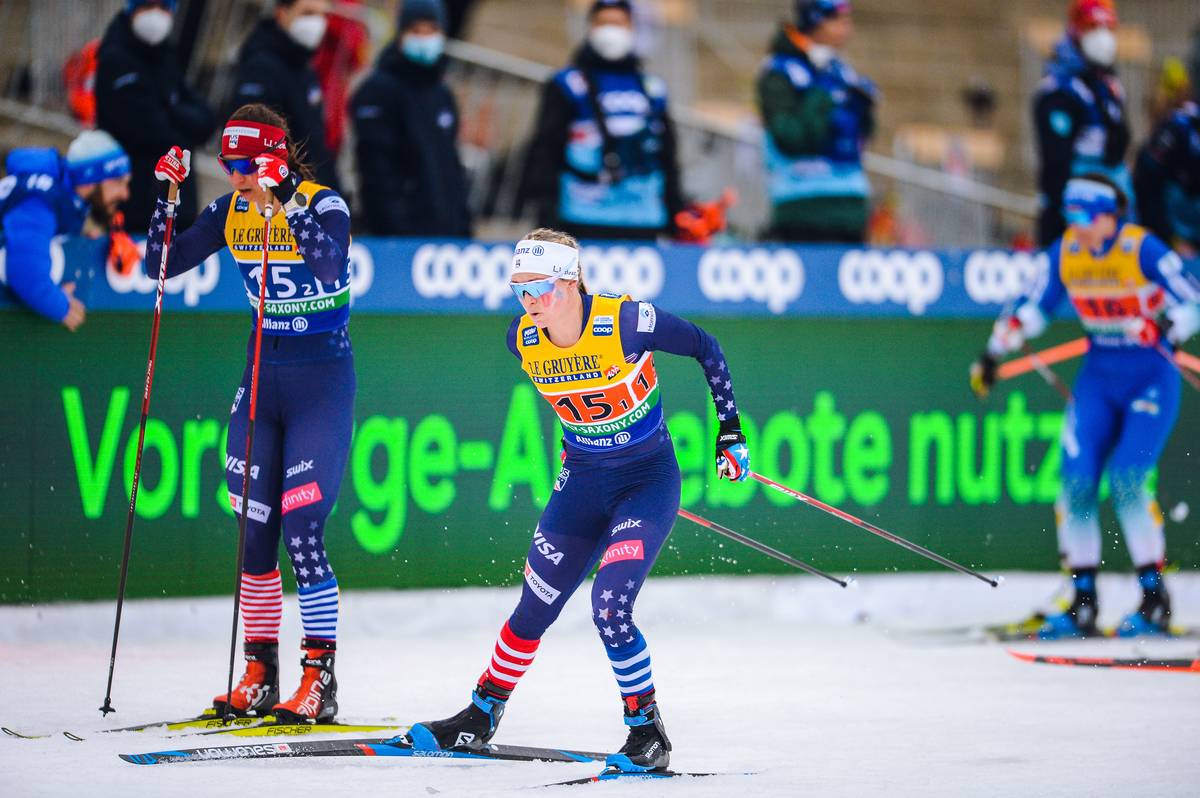
Julia Kern powers into her leg during the team sprint in Dresden. (Photo: NordicFocus)Julia Kern navigates fast curves on course in Dresden. (Photo: NordicFocus)
After the crash, Kern and Diggins kept their composure and gradually crawled back into contention. Kern explained post-race that Diggins had also crashed in the semifinal, which evidenced how they could rebound.
“I think the crashes actually lit the fire for Jessie and I,” Kern wrote in a text. “It got us ready to fight back. I had full confidence in Jessie that she would ski right back on to the group in the semifinal and that is exactly what she did. We remained very calm in the process which was key. So come the finals when it happened again, I just smiled a little since I wasn’t worried one bit and knew we would just do the same thing as the semi finals. I had confidence in how we were both skiing and feeling out there, and crashes are almost always a part of the game in Dresden.”
By the next exchange, Kern had already lopped off 1.8 seconds of the deficit. By lap eight, Diggins was just 1.5 seconds out of the lead, which still belonged to Sweden. Going into lap nine, all of the major contenders were back. Trailing Sweden were the upstart Finns (+0.3), the United States (+0.6), and Russia (+1.1). The only key player seemingly out of the running was Slovenia, who sat 4.7 seconds out of the lead.
On the final lap, Sundling, the 26-year old two-time World Championship gold medalist, rocketed from the exchange zone with a stern tempo. Diggins matched it, slipping behind the sprint specialist.
Jessie Diggins heads out after receiving a tag from Julia Kern. (Photo: NordicFocus)
At the final exchange, Diggins handed off to Kern 0.5 seconds from Sweden. Slovenia, with Lampic to close, was in fourth, a mere 1.9 seconds back.
In the final lap, Dahlqvist, who was a member of the pairings that won the team sprint World Championship title in 2019 and 2021, bided her time, happy to cruise through the first straightaway. After the first hairpin turn, she accelerated to a comfortable lead, leaving the competition in the wake of her strong V2-alternate strides.
Coming into the homestretch, Dahlqvist coasted across the line in first (15:45.81). Meanwhile, Kern was being challenged by Lampic, who had moved in front of Finland on the final bend. A great sprinter on the flats, Kern held off the three-time World Championship medalist, stretching her boot forward at the line for second (+1.11), with Lampic rounding out the podium to put Slovenia in third (+1.21).
The women’s team sprint podium in Dresden: The Sweden I duo of Jonna Sundling and Maja Dahlqvist took the win ahead of USA’s Jessie Diggins and Julia Kern, with Slovenia’s Eva Urevc and Anamarija Lampic in third. (Photo: NordicFocus)
We’ve seen Kern excel on fast and flat courses before, and asked whether 24-year-old identified this style of racing as a strength.
“I think flat courses have been more of an advantage for me the past, but I feel my fitness is better this year so I actually enjoy the hills too,” Kern explained. “But given my background growing up skiing at the Weston ski track [outside of Boston, MA] on a golf course growing up, skiing on a flat, turny, manmade snow course, I always feel right at home in Dresden.”
On approaching this style of racing, in comparison to typical World Cup courses with more climbing, Kern explained how she modifies her focus.
“I don’t necessarily change my technique on the flatter course, but focus on staying stable and trying to use my legs as much as possible. I played around with a few different technique cues during training this week since the hardest part on the salted, icy fast snow is generating speed without wobbling or rushing the motions.”
Jessie Diggins and Julia Kern rebounded after two crashes to take the second step of the podium in the women’s freestyle team sprint in Dresden. (Photo: NordicFocus)
Diggins, a veteran in the event, spoke highly of her partner’s efforts in Dresden.
“Wow – I’m so proud of Julia. She was confident and smooth,” said Diggins fondly. “It was a bit of a battlefield out there. You really had to fight for position and she did so with such grace and poise and power and speed. I’m really, really proud of her.”
Here’s the full audio clip from Diggins:
A second American contingent of Hailey Swirbul and Hannah Halvorsen skied to 8th (+2.74) in a tight Semifinal A, but did not advance into the final.
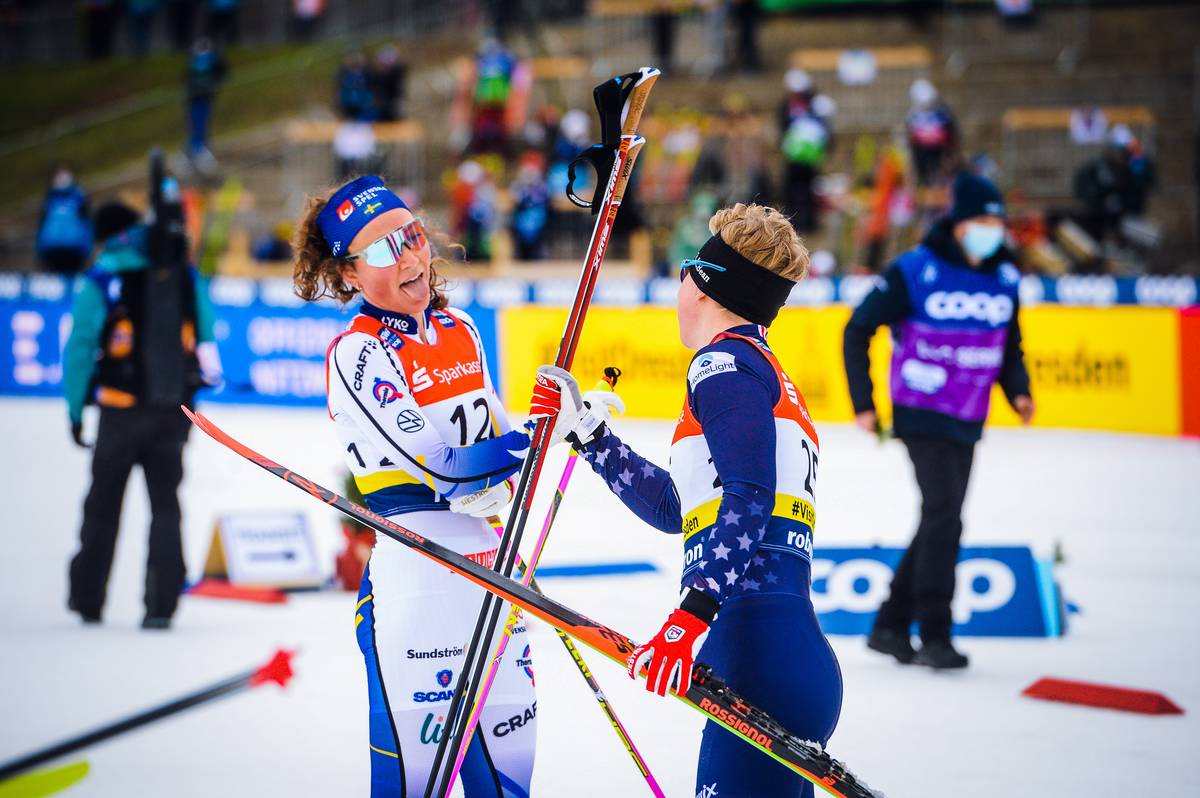
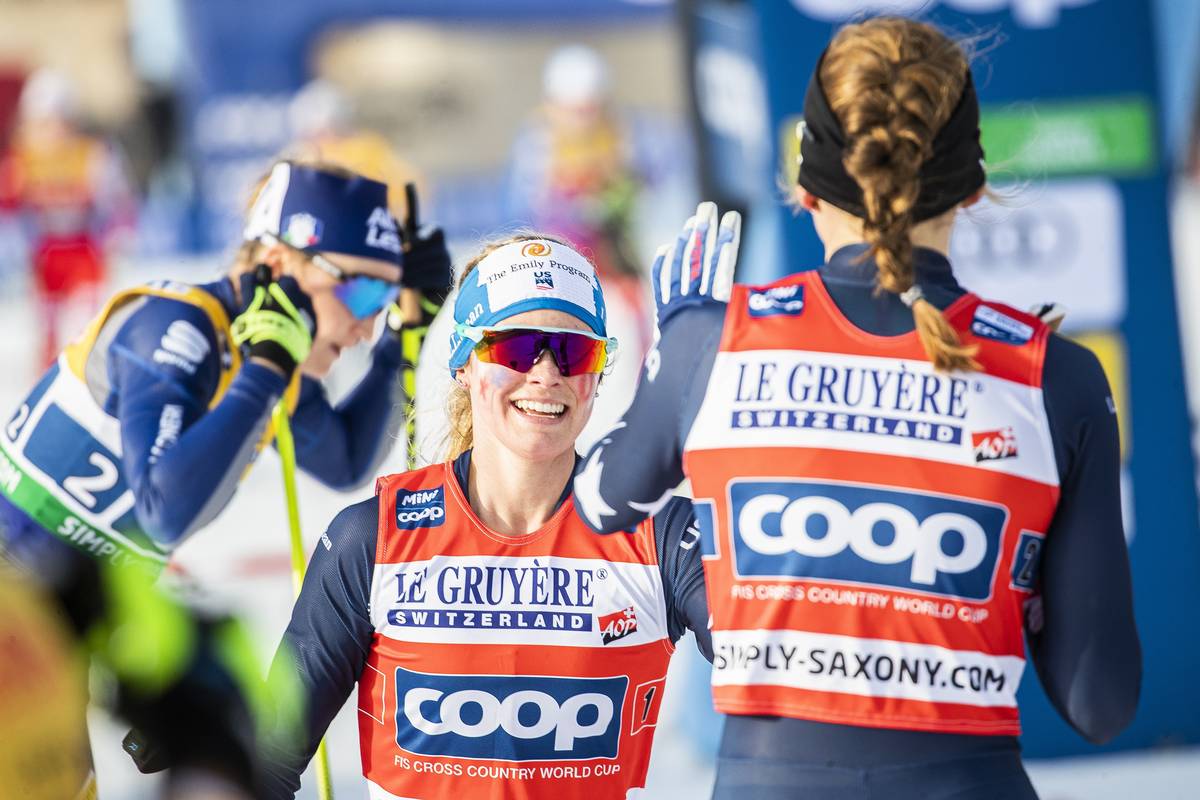
Hailey Swirbul (bib 9) comes in for the tag during the semifinal of Dresden’s team sprint. (Photo: NordicFocus)Hannah Halvorsen wrist-bumps Sweden’s Moa Lundgren after the semifinal round of Dresden’s team sprint. (Photo: NordicFocus)
As Period 1 draws to a close, we take a look at the current World Cup standings. Diggins now sits in fifth place in the overall standings, trailing teammate Rosie Brennan by nine points in fourth. Maja Dahlqvist is the overall leader with 464 points. Dahlqvist, who has won every sprint this season, also leads the sprint standings, more than doubling the points of second place Lampic from Slovenia. Diggins in the third-place position in sprinting heading into the Tour de Ski.
After period 1, Maja Dahlqvist leads both the overall and sprint World Cup standings. (Photo: NordicFocus)
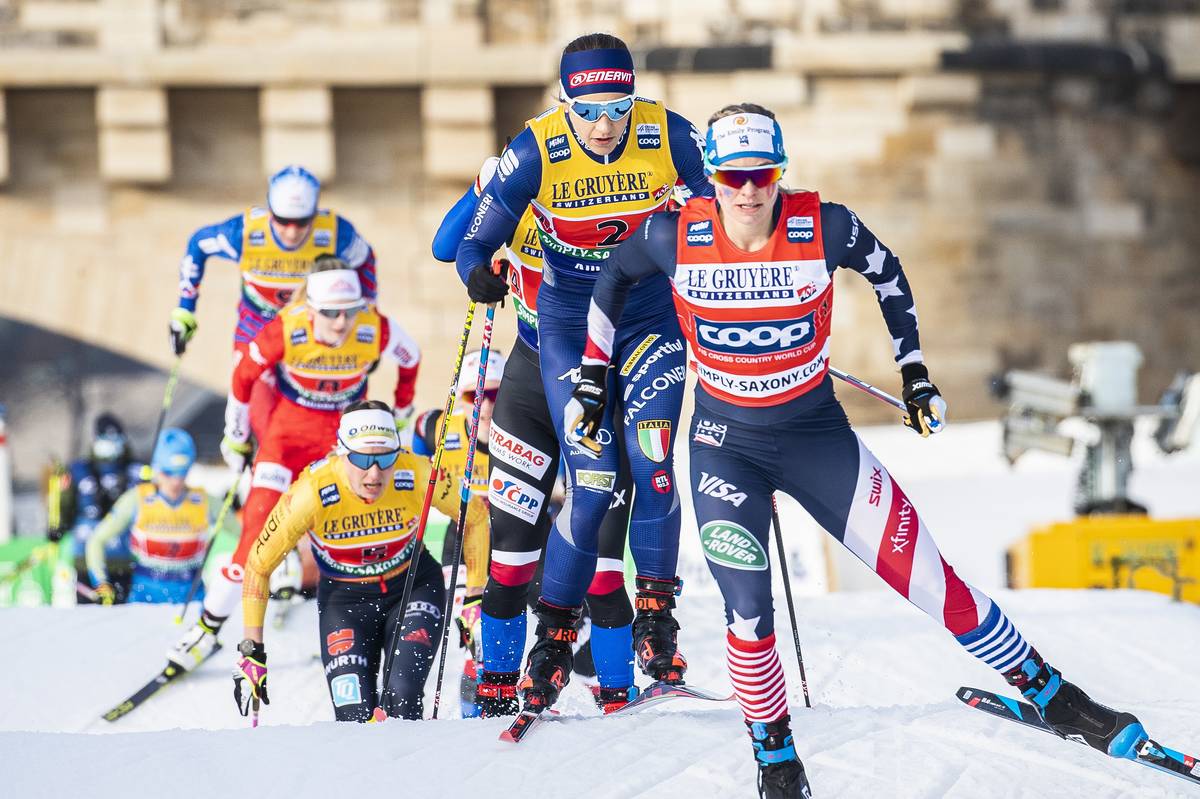
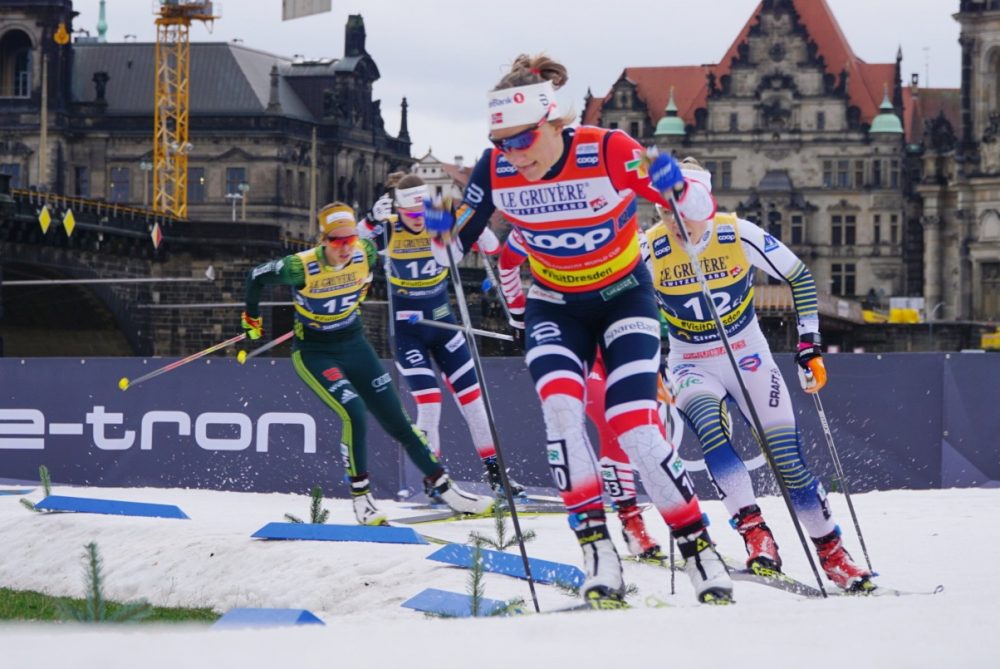
Jessie Diggins leads the pack during the team sprint in Dresden, Germany. (Photo: NordicFocus)
This World Cup coverage is made possible through the generous support of Marty and Kathy Hall and their A Hall Mark of Excellence Award. To learn more about A Hall Mark of Excellence Award or to learn how you can support FasterSkier’s coverage please contact info@fasterskier.com.
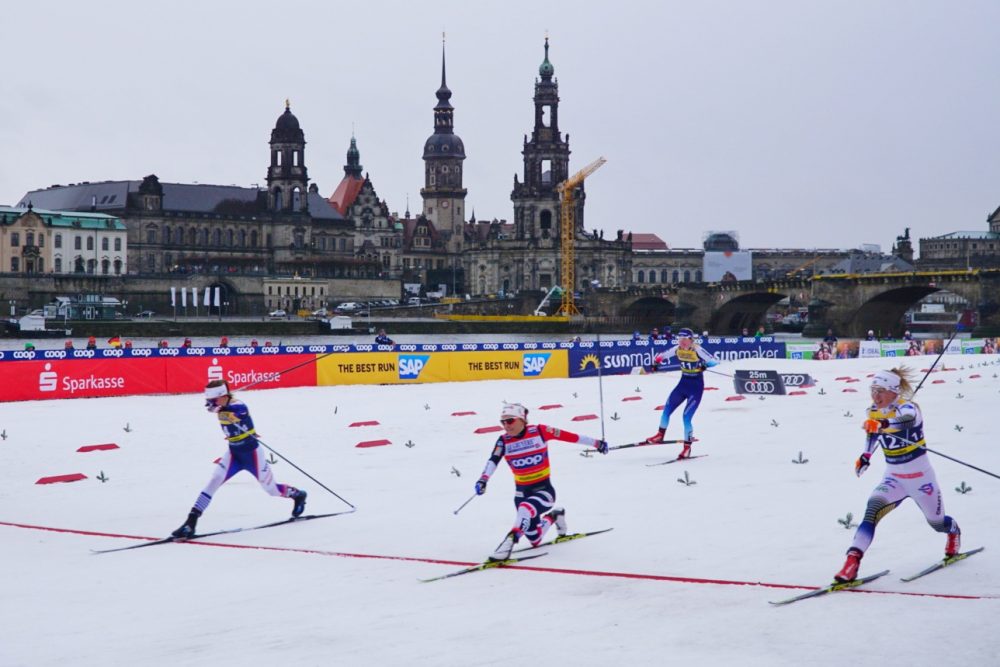
Another lovely spring-like day in Dresden, Germany with vibrant green grass contrasting the ribbon of man-made snow along the Elbe River bank. On course in the women’s team sprint final, a ten-team affair became a relative runaway as it concluded.
For the uninitiated and new to the team sprint concept, two-athletes form a team, and they tag off to one another six times each. In other words, each athlete races a .65 k lap (one time around the Dresden course) and tags off to their partner. Each partner races six 0.65 k laps for a total of 7.8 k for the team. It is dizzying. And yes, it can seem like a blur of Lycra and skis and poles. Roller derby meets cross-country ski refinement is one way to describe it.
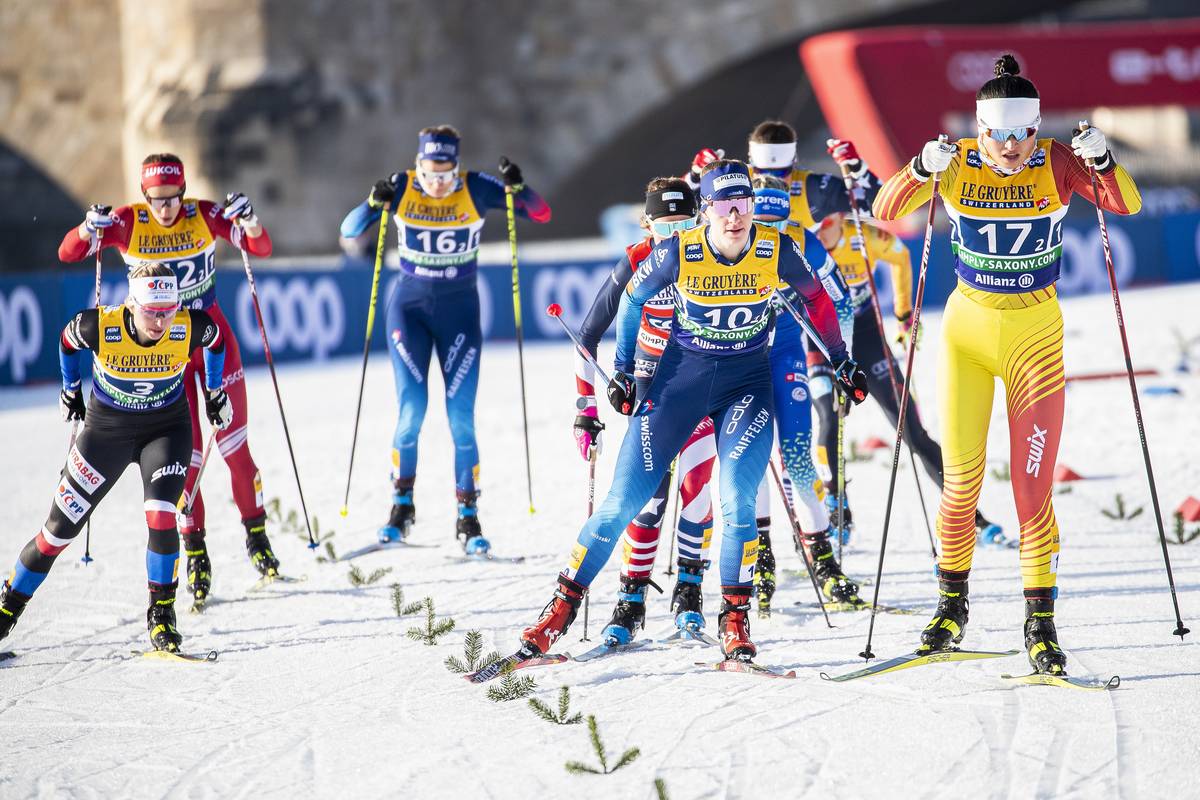
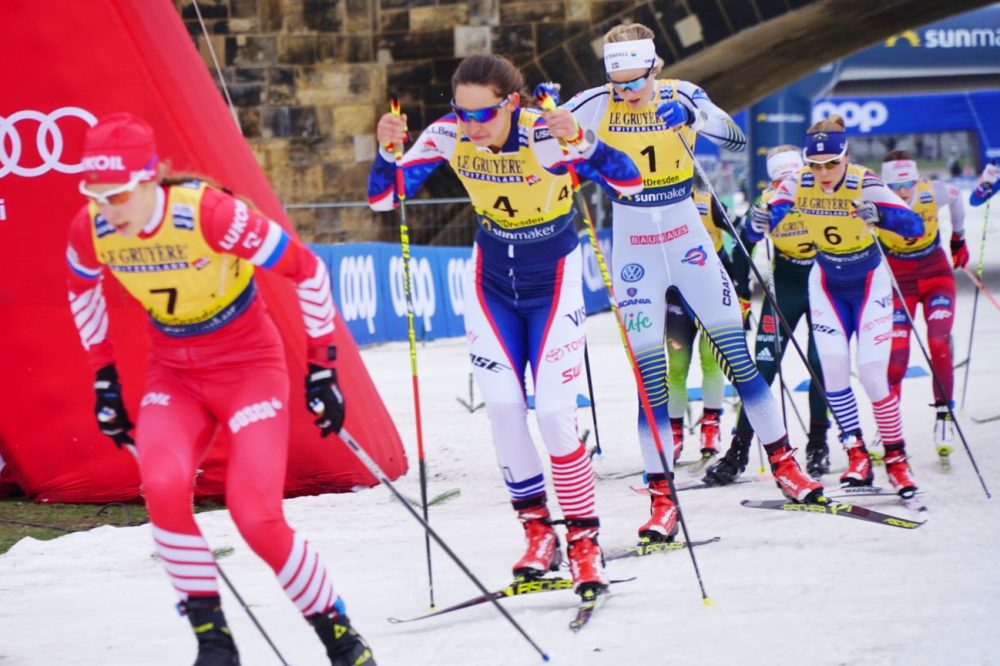
At the race’s midpoint, the racing blur was led by an upstart team from China, pulling the pack along in their yellow and red highlighted suits. Switzerland I, U.S. I, Slovenia, Russia I, and Germany I were separated by 2.8 seconds. Just enough time back for those in the rear to keep hope alive, and for viewers to see that no real breakaway and podium locks had been determined. We’ll call it semi-scrum in its organization.
Dinigeer Yilamujiang of China leads the women’s pack halfway through the team sprint in Dresden, Germany. (Photo: NordicFocus)
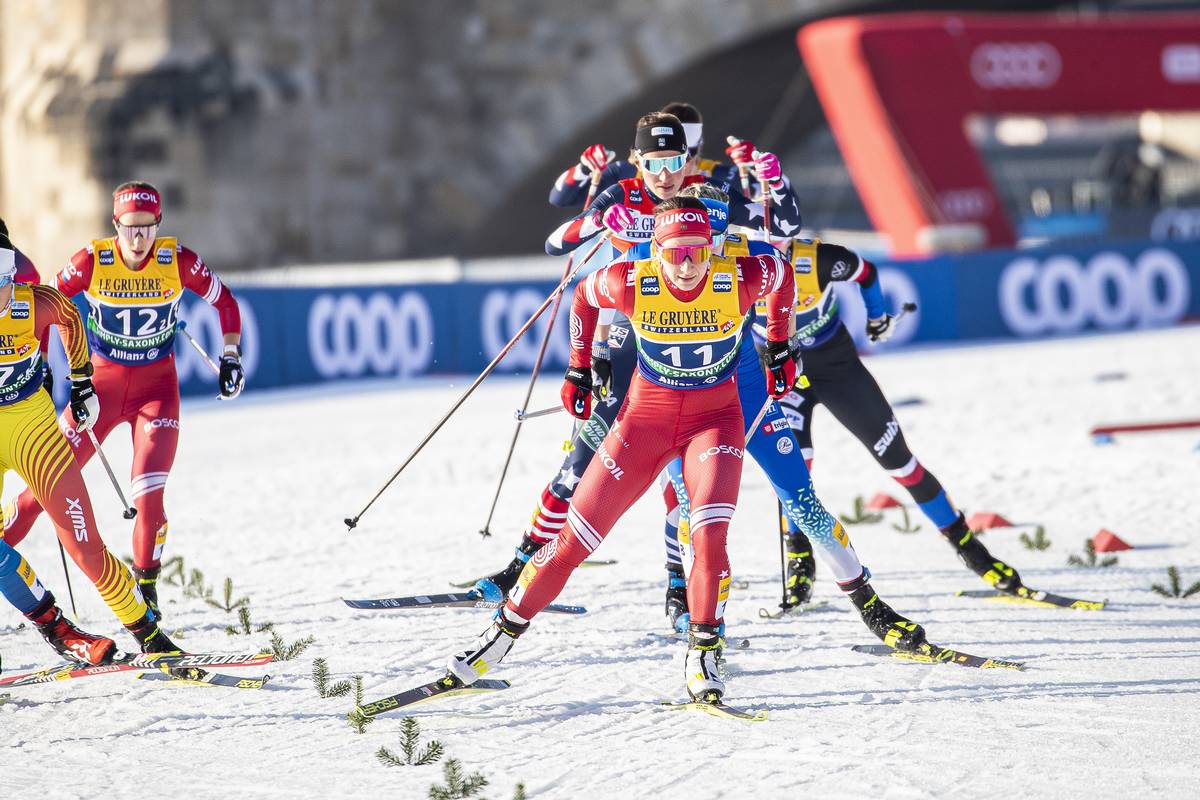
5.2 k into the race, at the eighth exchange, Russia I played their hand as they burned fuel upfront. The race became a four-team affair with Russia I setting the pace, and Switzerland I, Slovenia, and the U.S. racing in the slipstream. This trend continued with the U.S. falling off slightly at 6.5 k, 1.4 seconds back. Not much time, but in a team sprint event, when drafting and maintaining a lock on those in front are key, it can appear to be a mighty gap.
Russia I continued it’s work up front and the pattern was set on the final tag. With 0.7 k to go, the Russians were up 2.3 seconds on the Swiss, 2.5 seconds on Slovenia, and 2.6 seconds on the U.S.
Natalie Nepryaeva of Russia takes charge in the second half during the team sprint in Dresden, Germany. Caldwell Hamilton tucks in just behind. (Photo: NordicFocus)
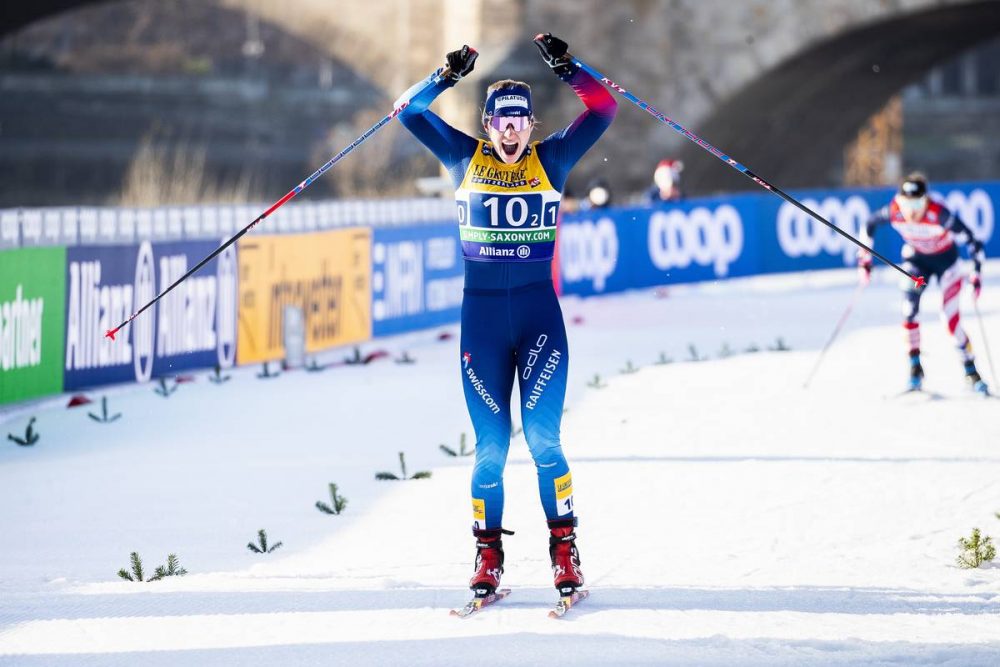
In that final lap, Fähndrich for the Swiss, reeled in Russia’s Nepryaeva, who at the onset seemed uncatchable, seized control of the front and took the win in 16:38.34 minutes. Nepryaeva crossed 0.32 seconds back to secure second for Russia I. Lampic crossed 1.12 seconds back for Slovenia’s third place. Caldwell Hamilton, slightly off the pace, finished in fourth (+3.01) for U.S. I.
Switzerland’s Nadine Fähndrich celebrates bringing home a team sprint victory with partner Laurien Van Der Graaff. (Photo: NordicFocus)
“I felt very good and saw that Natalia [Nepryaeva] was already a bit tired and I could catch up a lot from behind. So I had a very good feeling, and was hoping and fighting to make it happen today,” said Fähndrich to Swiss broadcaster SRF about her team’s last loop.
Laurien Van Der Graaff and partner Nadine Fähndrich take the win for Switzerland in the team sprint in Dresden, Germany. (Photo: NordicFocus)
Van der Graaff, Fähndrich’s teammate, added, “I knew I had to send off Nadine in a good position. So I fought and suffered on my last leg, and talked to myself the whole time ‘come on, just a little bit more until I can tag off to her’. We already saw yesterday that she’s in great shape, she’s the strongest athlete at the moment. And I knew in the end she’d make it.”
The women’s podium of the team sprint in Dresden Germany. Switzerland’s Laurie Van Der Graaf and Nadine Fähndrich took the win with Russia’s Yulia Stupak and Natalia Nepryaeva in second, and Eva Urevc and Anamarija Lampic of Slovenia in third. (Photo: NordicFocus)
Sophie Caldwell Hamilton marks the leader around the bend during the team sprint in Dresden, Germany. (Photo: NordicFocus)
“We fought hard out there, and I am so proud of all our teams for giving it out best effort!” wrote Diggins in a post-race email. “Personally I struggled a bit with positioning on such a short and tactical loop, but I was proud of how I held my own in city sprinting on a course that challenged me in different ways! I thought we had great skis and it’s nice to feel that we’re working our way into better and better racing form.”
Both Caldwell Hamilton and Diggins were coming off of strong performances on the course in yesterday’s individual sprint event, finishing 2nd and 4th, respectively. Both seemed well matched for the flat and spicy course, with tight corners where the manmade snow crumbles to a dicey sugar.
Jessie Diggins in control over the rollers during the team sprint in Dresden, Germany. (Photo: NordicFocus)
“It was fast and furious out there today, as Dresden always is,” emailed Caldwell Hamilton. “I think Jessie and I both wanted to fight for a podium today and knew we were capable of it, but this race is a wild card and I think overall we skied quite well. For me personally, I always look back at these Dresden team sprints and wish I had skied more aggressively, but with so much carnage out there, you’re riding a fine line between aggressive and risky, so that sweet spot can be tricky to find. In hindsight, we can always find a small thing or two we would have done differently, but it’s still an effort I’m proud of and any time I get to team up with Jessie is an honor. Dresden hosted an exciting weekend as usual and now I’m looking forward to a little Christmas break in Seefeld!”
Jessie Diggins and Sophie Caldwell Hamilton celebrate a 4th place finish in the team sprint in Dresden, Germany. (Photo: NordicFocus)
Hannah Halvorsen and Julia Kern placed eighth in the final, 12.35 seconds off the winning time. The duop advanced to the final after placing fifth in the first semi-final. The top five teams from each semi advance to the finals.
Hannah Halvorsen faces off with Germany’s Laura Gimmler during the team sprint in Dresden, Germany. (Photo: NordicFocus)
A quick look to the overall standings as Period 1 draws to a close: Despite sitting out the city sprints in Dresden, Rosie Brennan is still in charge of the yellow bib with 377 points. Missing this World Cup stop was part of Brennan’s season plan. Russia’s Tatiana Sorina trails by 41 points in second (334 pts), followed by Norway’s Therese Johaug in third (301 pts).
This World Cup coverage is made possible through the generous support of Marty and Kathy Hall and their A Hall Mark of Excellence Award. To learn more about A Hall Mark of Excellence Award or to learn how you can support FasterSkier’s coverage please contact info@fasterskier.com.
The team sprint is like a pump rocket, slowly building pressure for a final eruptive takeoff. Six 0.65 km laps each in rapid succession. Short recoveries between legs mean the athletes slowly wind up the effort while staying out of trouble, not wanting the rocket to misfire and lose it’s peak potential. Stay in the pack, drafting and in control, don’t crash or break a pole are sound strategies.
Chaos in the exchange zone, Richard Jouve tags Lucas Chanavat during the team sprint in Dresden, Germany. (Photo: NordicFocus)
The men’s event evidenced this metaphor perfectly. The pack stayed close and looked comfortable with no crashes through the first half. As the final four exchanges progressed, you could feel the pressure from the pump steadily rise (in this case, three pumps wearing red, navy, or royal blue lycra) fighting against the confines of the bottle.
At the 7th exchange, just after the half-way mark, the pressure reached its limit and the launch began. Richard Jouve of the France 1 team accelerated from the exchange zone, making an effective push to stretch out the field. Italy’s Francesco De Fabiani and Russia’s Alexander Bolshunov kept close on his tails, and although the remaining pack did not immediately lose contact, it became increasingly clear who the podium contenders would be.
Foot on the gas, Richard Jouve accelerates to spread out the pack for the final half of the team sprint in Dresden, Germany. (Photo: NordicFocus)
Next exchange, Russia took the reins, with Gleb Retivykh setting pace. Yesterday’s sprint winner Federico Pellegrino looked confident as he tucked in behind the Russian, the winners of the two qualifying rounds squaring off. Lucas Chavanat of France kept close contact in third.
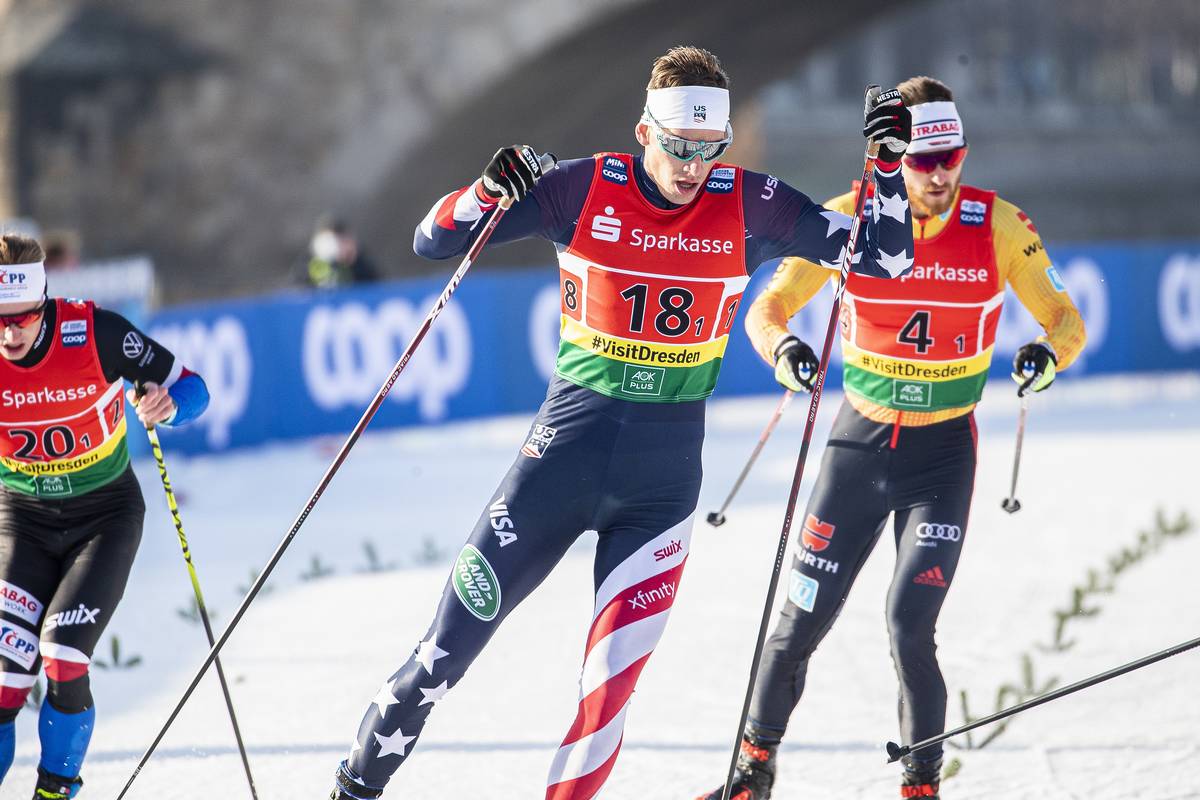
With the Dresden skyline as a backdrop, Italy’s Francesco De Fabiani leads Richard Jouve of France and American Kevin Bolger during the team sprint. (Photo: NordicFocus)
Russia continued their up-tempo from the front during the final lap where the three leading teams separated from the chasers. Heading into the lanes, all three teams had a chance. Retivykh took charge off of looker’s left, while Chavanat fought for centimeters on lookers right. Pellegrino tucked in behind the Frenchman, priming himself to sneak a boot around at the line.
Real estate was limited and Retivykh had unmatched finishing speed on the day, crossing the line for the win in 15:01.14. Chavanat stopped the clock +0.19 seconds behind in second, and Pellegrino carried the Italians to third (+0.58).
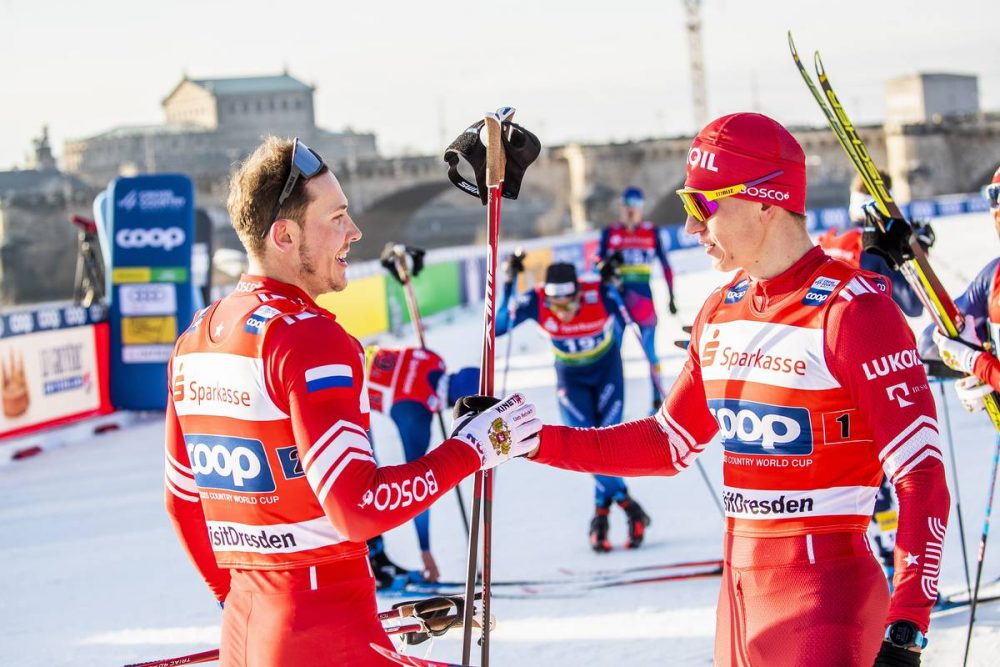
Down the home strech, Gleb Retivykh takes the victory for Russia at the team sprint in Dresden, Germany. (Photo: NordicFocus)The Russian victors Gleb Retivykh (L) and Alexander Bolshunov (R) shake hands after the team sprint in Dresden, Germany. (Photo: NordicFocus)
“It is a very nice competition every time we come to Dresden…” Retivykh told FIS after the race. “We worked together really well and with tactics. The Russian teams took the podium today for women and men. We’re happy.”
Prior to today’s win, Russia was in a three-year drought for team sprint victories. Russia last won the event in February, 2017 during a pre-Olympic World Cup in PyeongChang, China. Retivykh was also the anchor on that day.
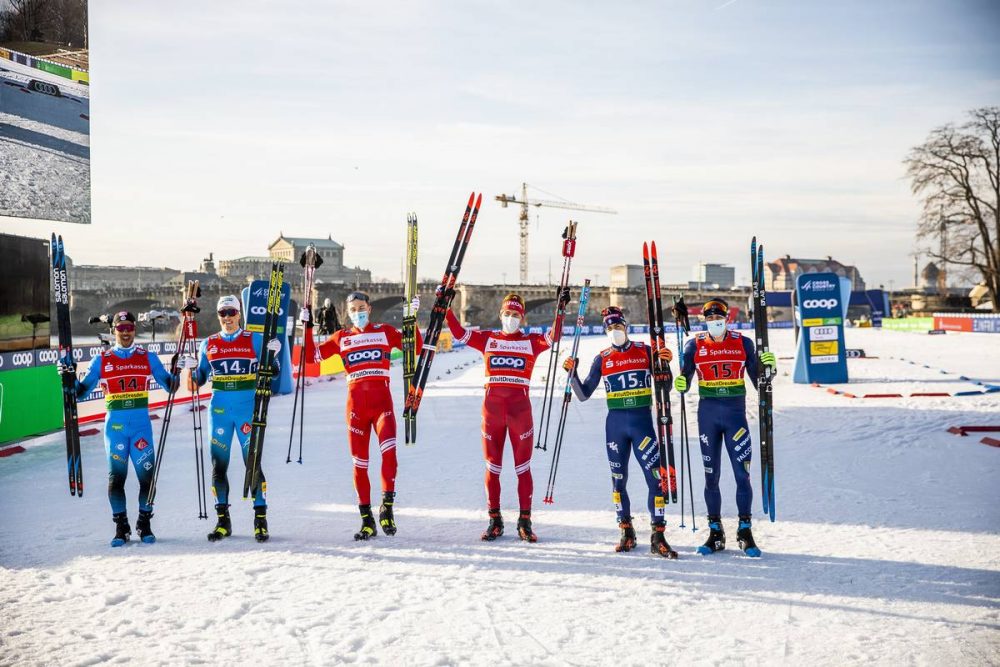
The men’s podium of the team sprint in Dresden, Germany. The Russia 1 team of Alexander Bolshunov and Gleb Retivykh stole the show, with Richard Jouve and Lucas Chavanat of France in close second, and Italy’s Francisco de Fabiani and Federico Pellegrino in third. (Photo: NordicFocus)
Behind the podium finishers, the U.S. team of Kevin Bolger and Simi Hamilton stayed in the mix, skiing strong in the middle of the pack and close to the leaders through the final two laps. With two laps of the course to go, Bolger and Hamilton began to lose contact along with the remaining teams, fading from 2 seconds back at 6.5 k to finish 12.57 seconds behind in 9th.
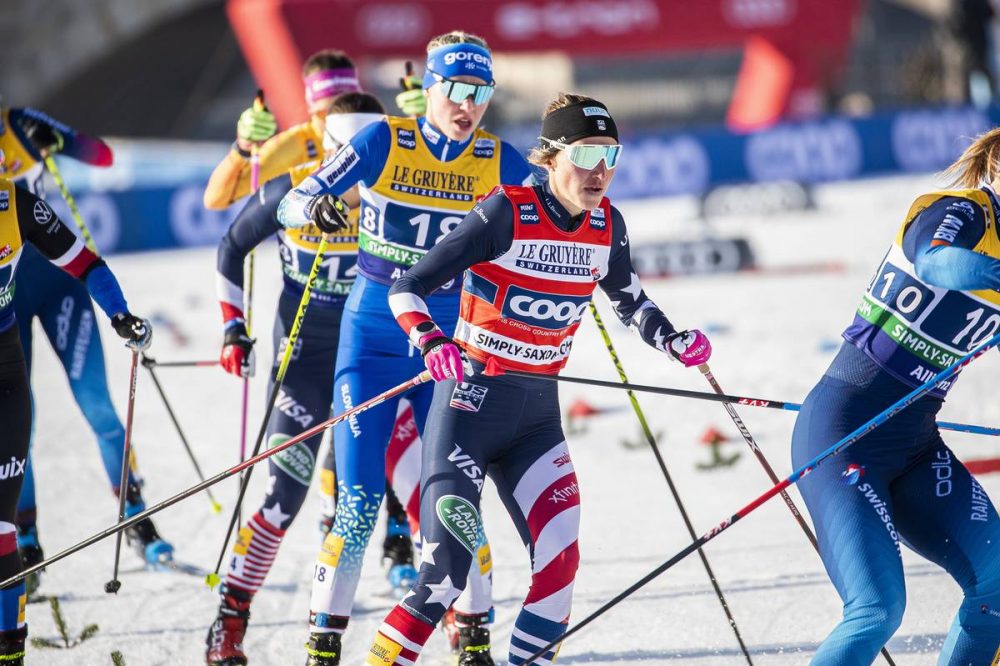
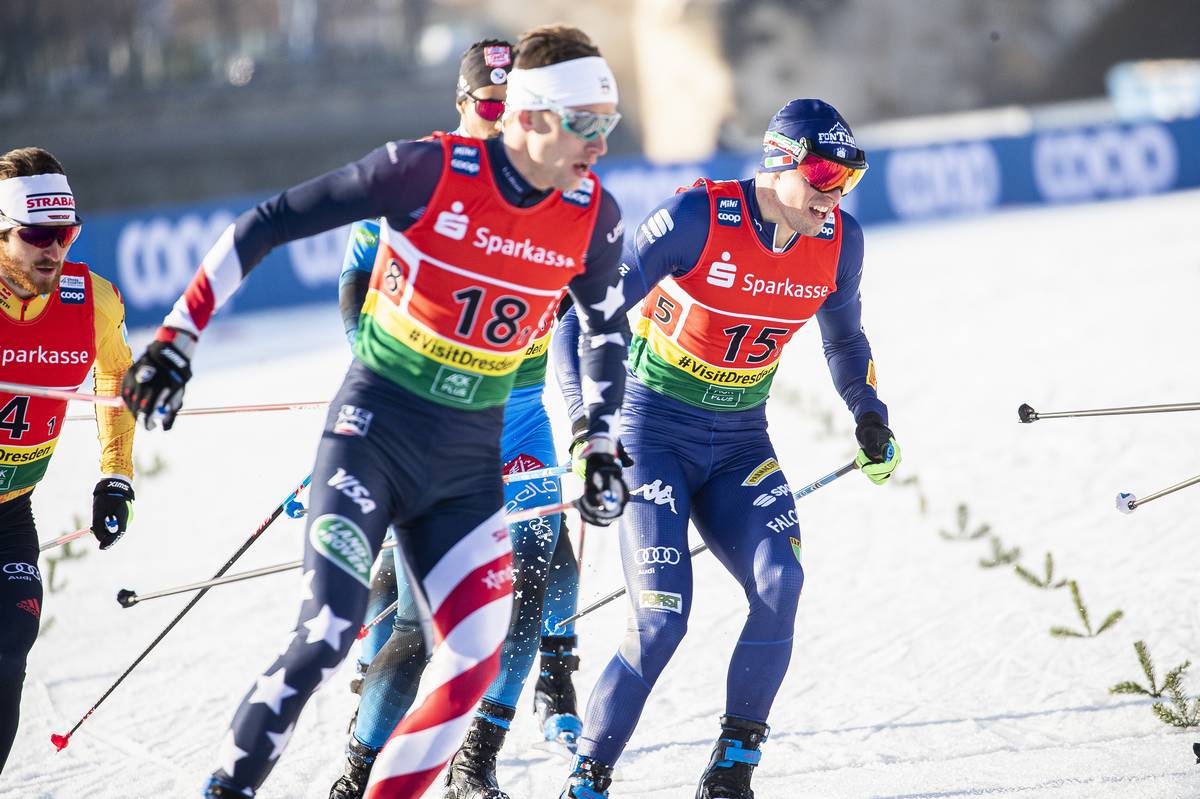
Kevin Bolger (bib 18) rounds the curve with Italy’s Francisco De Fabiani during the team sprint in Dresden, Germany. (Photo: NordicFocus)Simi Hamilton keeps the U.S. team in the mix during the team sprint in Dresden, Germany. (Photo: NordicFocus)
“Even though the result wasn’t exactly what we wanted today I thought we skied really well and fought through both heats,” wrote Hamilton after the race. “I felt great in our semi, and still pretty good for the final, but things were incredibly scrappy and we just kind of kept getting caught in the back with tangles, broken poles, and the likes. Team sprinting can be so fun and so frustrating at the same time, but it was just really, really cool to ski with Kevin today and I’m so psyched with how he’s skiing right now.”
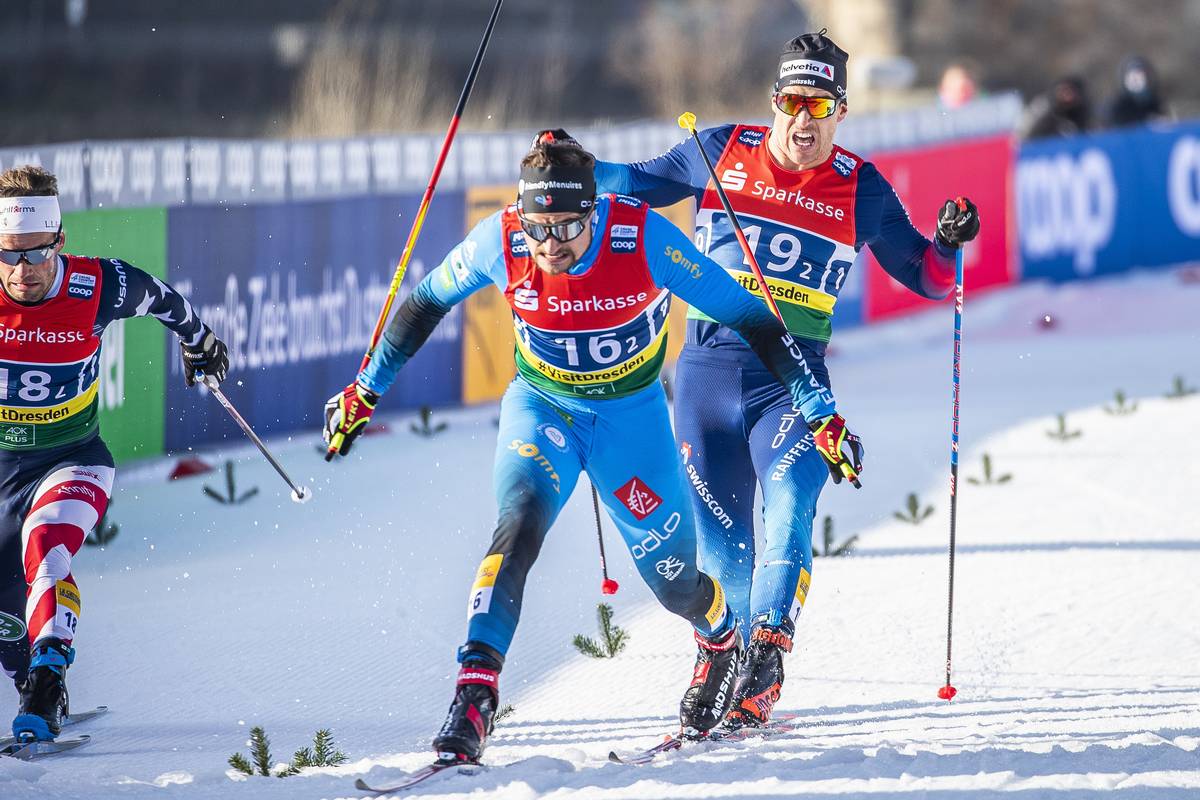
Simi Hamilton fights to the finish with Jovian Hediger (SUI), Renaud Jay (FRA) just behind. (Photo: NordicFocus)
The Bolger-Hamilton duo had placed fifth in the first semi-final in a tight finish, 0.69 seconds behind winners Italy I ( De Fabiani and Pellegrino).
In the second men’s semi-final, the U.S. team of Logan Hanneman and JC Schoonmaker placed 10th (+27.21) and did not advance.
The World Cup takes a holiday break until the Tour de Ski which is scheduled to begin on January 1.
We are corrected in this episode: we try to be better Francophiles by improving our pronunciation of the weekend’s stand out performer on the men’s side, Lucas Chanavat. We also dig down and find the fun in Sunday’s team sprint in Dresden. With a whirlwind 0.7 k loop, and each skier racing six legs, it was basic sprinting fun. Thanks for listening.
American Sophie Caldwell (far left) lunges to the line with Norway’s Maiken Caspersen Falla and Sweden’s Jonna Sundling. Caldwell ended up fourth, while Sundling took second and Fall third. Sweden’s Maja Dahlqvist 9not shown) crossed first for the win. (Photo: Garrott Kuzzy /LumiExperiences.com)
If the Grand Prix were to host a ski race, it might look like the Team Sprint in Dresden, Germany. With 10 teams racing the 6 x 1.6-kilometer final and the racetrack style, three-lap loop situated in the city’s center, the tactics of a Formula One driver seemed employable on the relatively flat course. For most teams’ skiers, that meant patience; staying in one’s lane and in contact until the last lap.
Norway’s Team I of Mari Eide and Maiken Caspersen Falla, the U.S.’s Team I of Julia Kern and Sophie Caldwell, Sweden’s Team I of Stina Nilsson and Maja Dahlqvist, as well as the Swede’s Team II of Ida Ingemarsdotter and Jonna Sundling remained the teams to watch heading through each exchange.
By the time she started her third and final leg, Falla appeared to have played the conservation game. When on course, she had taken a few pulls at the front, though for the most part, left that work to Sweden’s Team I and Team II second leg skiers, Dahlqvist and Sundling. With the brunt of the pace-setting work having gone to the Swedes, Falla’s engine seemed primed for a jumpstart to the front.
Norway’s Maiken Caspersen Falla leading the women’s 6 x 1.6-kilometer Team Sprint on Sunday in Dresden, Germany. (Photo: Garrott Kuzzy /LumiExperiences.com)
Just a few meters before the course’s hairpin turn, which shuttled racers back to the finish, Falla made her move. She pushed around both Sundling and Dahlqvist to take over the lead. A hard pressing Dahlqvist led the chase on the Norwegian’s ski tails, which included herself as well as Sundling and the U.S. Team I’s second leg skier, Caldwell.
Sporting the red leader’s bib, Falla looked in good form. Any challenge for the win would need to come from behind and the the opportunity to do so–in correlation to the course’s chances of survival in Sunday’s steady drizzling rain–was dwindling.
The quad of skiers, led by Falla, headed toward the sole, brief, gut-punch of a climb. Dahlqvist pushed to the inside right of Falla and using two powerful V2 strokes, the Swede had reached the top of the short uphill and the pinnacle of the city’s modernized race course.
What unfolded next was an aged battle: Sweden and Norway duking it out for the win.
Dahlqvist inched ahead. Descending toward the finish, it was Sweden leading Norway followed by Sundling and Caldwell.
American Sophie Caldwell (bib 4) racing during the women’s 6 x 1.6-kilometer Team Sprint semifinal on Sunday in Dresden, Germany. (Photo: Garrott Kuzzy /LumiExperiences.com)
By the time the group rounded the last corner to the finishing stretch, Dahlqvist had increased her lead. Skating in a tuck, Falla scrambled to make up lost ground. The pressure for Norway in the race’s final moments quickly became less about overtaking the win and more staving off Sweden II and the U.S.
Crossing first to secure the win for Sweden’s Team I was Dahlqvist in a time of 24:02.45. In a three-way lunge to the line, Sweden’s Team II snagged second place (+1.11), while Norway claimed third (+1.11). Caldwell crossed fourth (+1.11) according to the International Ski Federation’s (FIS) photo finish.
“Today was a really fun day. Julia and I have never team sprinted together before, so we didn’t really have any expectations going into the day, but I knew we could be fighting in the final if we had a good day,” Caldwell wrote in an email.
In last year’s Team Sprint in Dresden, Caldwell teamed up with Ida Sargent and finished in third behind Sweden’s Team I and Team II. This year, Sargent raced on the U.S.’s Team II with World Cup rookie, Hannah Halvorsen. Sargent and Halvorsen finished Sunday’s race in 11th, just outside of advancing to the finals.
The fourth place finish for U.S. Team I on Sunday, was what Kern described as “bittersweet.’ The difference between Caldwell’s ski boot and Falla’s in the final lunge to the line barely discernible.
“The photo finish did end up being extremely close and I so badly wanted to get that podium for Julia’s first World Cup podium, but podium or not, I think it was still an awesome day for us,” Caldwell said. “We’re club teammates as well as national team teammates and are pretty familiar with how we each ski and have a lot of mutual respect for each other, so it was really just an awesome opportunity to go out there and get to show what we practice for all year!”
Both Caldwell and Kern ski for the Stratton Mountain School T2 club team. Though mere fractions of a second away from her first World Cup podium, Kern was focused primarily on the opportunity she had gained to race with Caldwell on the U.S.’s Team I.
She found out Saturday evening, after the women’s 1.6-kilometer freestyle sprint–in which Kern finished 19th–that she would be partnered up with Caldwell for Sunday’s Team Sprint.
“It was a dream come true,” Kern said of being selected to race with Caldwell on the U.S.’s Team I. “Going in to the weekend it was not what I expected, but after my qualifier heats yesterday, it was definitely on the table.”
Prior to the start of the race, Kern gave the camera a smile and wave, expressing outward excitement for her first Team Sprint World Cup start. Despite being slotted against the likes of Nilsson, Ingemarsdotter and Eide, Kern said she did not feel nervous.
“I think going into the race today, I tried to be really confident and wasn’t afraid to ski in front of Stina or didn’t really feel out of place because I needed to ski big and confident to hold my position,” Kern said.
U.S. Ski Team member, Julia Kern (bib 4) leads Sweden’s Stina Nilsson (bib 1) and American Ida Sargent (bib 6) during the women’s 6 x 1.6-kilometer Team Sprint semifinal on Sunday in Dresden, Germany. (Photo: Garrott Kuzzy /LumiExperiences.com)
The biggest goal for Kern on Sunday was to maintain her position and as she put it, “stay out of trouble.” While on course, she narrowly avoided a crash between Russia’s Tatiana Aleshina and Slovenia’s Alenka Cebasek that occurred just after the second exchange.
“I just stayed relaxed and made my way around, which I was very happy to avoid that,” Kern said of the crash.
“In the final things got much more aggressive than in the semi-final. There was a lot more jostling around for position and pretty much everyone was skiing over each others skis,” Kern said. “You kind of had to ride that fine line were you were playing it safe so you weren’t risking falling or getting you pole broken, but also holding your line.”
“I had a blast racing my first world cup weekend,” Halvorsen wrote in an email to FasterSkier on Sunday. “I am happy about how things turned out because I put down two really solid races for me and didn’t make any big rookie mistakes.
“While I am grateful things went smoothly, it was a wake up call of how many things I have to learn,” she added. Especially racing in the team sprint, my inexperience became apparent where one or two people would somehow pass me on every turn or transition. I would have to work hard to regain my position, and I learned how important it is to hold your line.
“In both races I learned the importance of working every section, and how easy it is to lose time by not accelerating out of a corner or not pushing hard enough over hills, etc,” she continued. “I loved getting to see how well the U.S. World Cup coaches and athletes work together and was beyond excited to take a part in it. Thank you to everyone who made this possible for me!”
Julia Kern (l) and Sophie Caldwell after finishing fourth in the women’s 6 x 1.6-kilometer freestyle Team Sprint in Dresden Germany. (Photo: Garrott Kuzzy /LumiExperiences.com)
Racing in bib 4 for the U.S., Julia Kern keeps pace in the women’s team sprint during the Dresden, Germany World Cup on Sunday. (Photo: Garrott Kuzzy).
FIS World Cup Dresden, Germany 6 x 1.6 k Freestyle Team Sprint
The first World Cup team sprint of the season was run amidst drizzle and the Dresden, Germany city-scape as the women raced a total of six 1.6-kilometer laps.
Round and round on the looping course, the pace was a mix of tactically subdued speeds with sustained bursts of energy to break the pack.
After all the speed changes and exchanges with one athlete tagging off to the next, it came down to a 1.11 second difference between first place Sweden I and the three closet teams chasing from behind that ended in a photo finish.
Sweden I’s Stina Nilsson and Maja Dahlqvist won in a time of 24:02.5 minutes. Sweden II’s Ida Ingemarsdotter and Jonna Sundling placed second (+1.11), and Norway I, with Eide Mari and Maiken Caspersen Falla in third (+1.11).
U.S. I, featuring Julia Kern and Sophie Caldwell placed fourth (+1.11) after the photo finish was reviewed.
The U.S. entered a second team, consisting of Ida Sargent and Hannah Halvorsen. That duo contested the first semi-final, the same semi as U.S. I, but did not advance after placing fourth (+5.44). The top-three teams from each semi advance to the final, along with the next four fastest teams which are the combined “lucky losers”. Today, the second semi was the faster of the two. The four lucky loser team advancing to the final all originated from the second semi.
In the men’s 6 x 1.6 k skate team sprint race, Norway I and Norway II took the top two podium spots.
In a lunge at the line, Norway I’s Erik Valnes and Sindre Bjørnestad Skar won the final in 22:38.72 minutes. Pål Golberg and Eirik Brandsdal of Norway II placed second (+0.75) and Russia I’s Artem Maltsev and Gleb Retivykh third (+0.80).
Canada’s Bob Thompson and Len Valjas placed seventh (+2.46) in the first semi-final and did not advance to the final. It was the same fate for the only U.S. team entered in the men’s team sprint. Andy Newell and Erik Bjornsen placed 10th (+3.66) in the second semi, and failed to make the finals.
Canada placed 15th in the final standings, the U.S. 19th.
IBU World Cup Oberhof, Germany 4 x 6 k / 4 x 7.5 k Relay
In the women’s 4 x 6 k relay, Russia placed first in a time of 1:18:46.4 hours. Evgeniya Pavlova, Margarita Vasileva, Larisa Kuklina, and Ekaterina Yurlova-Percht made up the team that used eight spares on their way to the win.
Germany placed second (+33.5) with two penalty loops and 10 spare rounds. Karolin Horchler, Franziska Hildebrand, Franziska Preuss, and Denise Hermann comprised Germany’s second place team that had two penalties while using 10 spares. The Czech Republic’s Lucie Charvatova, Veronika Vitkova, Marketa Davidova, and Eva Puskarcikova placed third (+36.7) with 1 penalty loop and six spares.
The top spot for the podium came down to the final leg, when Yurlova-Percht pulled out the win when Hermann skied two penalty loops. The Russian used three spares but escaped with no penalties to take the lead out of the shooting range on the final ski loop.
Susan Dunklee, Clare Egan, Joanne Reid, and Emily Dreissigacker all represented the U.S. and placed 12th (+5:35.8) while skiing five penalty loops and using 16 spares.
Canada’s Sarah Beaudry, Emma Lunder, Megan Bankes, and Rosanna Crawford finished in 13th (+5:58.8) with four penalty loops and 15 spares.
Russian also claimed the men’s relay, winning in a time of 1:20:54.3 hours. The winning team of Maxim Tsvetkov, Evgeniy Garanichev, Dmitry Malyshko, and Alexander Loginov skied no penalty laps and used six spares on their way to victory.
Antonin Guigonnat, Simon Desthieux, Quentin Fillon Maillet, and Martin Fourcade raced for France. The French team placed second (+1:01.1) while skiing a single penalty lap and using eight spares.
Austria’s Tobias Eberhard, Simon Eder, Dominik Landertinger and Julian Eberhard placed third (+2:18.6) with one penalty lap and using seven spares.
Canada’s Scott Gow, Christian Gow, Jules Burnotte, and Brendan Green and the U.S. team of Leif Nordgren, Sean Doherty, Travis Cooper, and Max Durtschi were eventually lapped. Neither team was given an official finishing time.
Canada was ranked 18th in the final standings, the U.S. 19th.
For both relays today, the snowy weather and tough course conditions made for a strenuous day of shooting and skiing.
The men’s 6 x 1.2 k freestyle team sprint podium at Sunday’s World Cup in Dresden, Germany, with Italy’s Dietmar Nöckler and Federico Pellegrino in first (c), Sweden’s Emil Jönsson and Teodor Peterson in second (l) and Russia’s Andrey Krasnov and Gleb Retivykh in third (r). (Photo: Fischer/NordicFocus)
(Note: This article has been updated to include comments from Canada’s Bob Thompson.)
Federico Pellegrino’s winning move in the men’s 6 x 1.2-kilometer freestyle team sprint on Sunday wasn’t exactly the same as yesterday when the Italian attacked on the final climb of the individual skate sprint.
“Yesterday on the right side and today I tried on the left side and it was OK,” Pellegrino said in a post-race interview with the International Ski Federation (FIS).
By “OK,” Pellegrino meant perfect.
“Today everything was perfect, even the sun was super,” he said after winning his second race in as many days with team-sprint partner Dietmar Nöckler. “We can continue like this to the Olympics then catch the gold.”
A number of teams were looking to do exactly as the Italians did on Sunday on a tightly woven city sprint course in the heart of Dresden, Germany. This race marked the last team sprint before the Olympics, which starts in less than a month in PyeongChang, South Korea. The Olympic team sprint, set for Feb. 21, is also freestyle. Sunday was the first team sprint so far of the 2017/2018 season.
Pellegrino locked it up after Nöckler came through the last exchange in fifth, 2.6 seconds behind Sweden’s Emil Jönsson in first. On the final lap, Pellegrino chased Sweden’s Teodor Peterson and Switzerland’s Roman Schaad, before Pellegrino made his move past Schaad in first heading into the final rise before the stadium. The attack was just slightly before the one he executed to win Saturday’s skate sprint over Norway’s Johannes Høsflot Klæbo.
“I had to use it,” he said of the move.
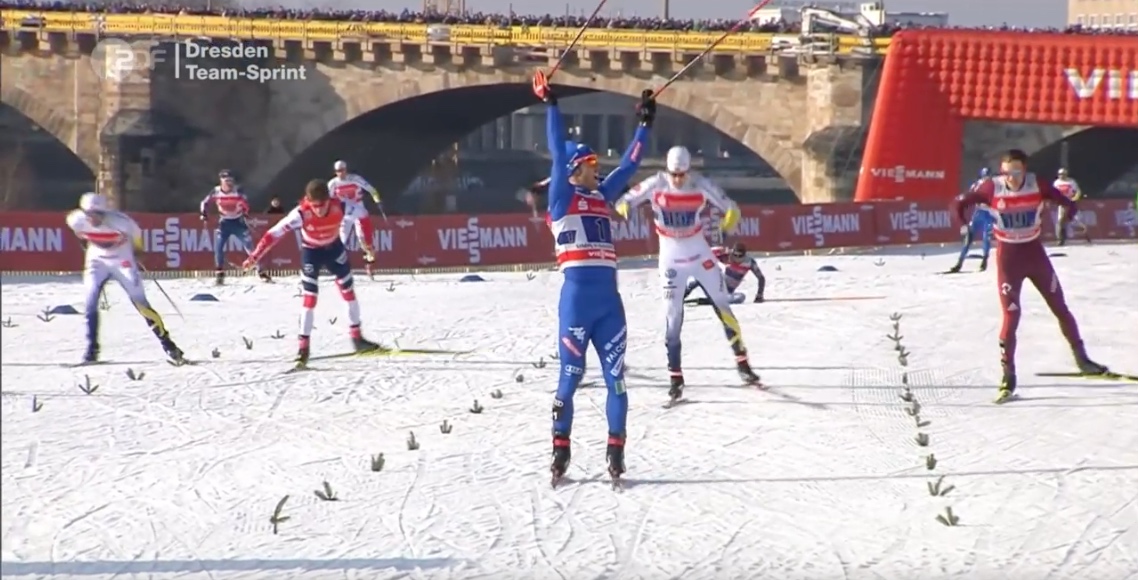
Federico Pellegrino (front) celebrates across the line as he anchors Italy to a freestyle team sprint victory for his second-straight win at the World Cup in Dresden, Germany. Behind him, Sweden I’s Teodor Peterson (second from r) and Russia’s Gleb Retivykh (r) battled for second, and Sweden II’s Karl-Johan Westberg (l) and Norway’s Johannes Høsflot Klæbo (second for r) jockey for third. American Simi Hamilton (on the ground) is seen trying to recover from a crash. (Screenshot: ZDF broadcast)
First over the top, Pellegrino pushed farther ahead of Peterson in second while Schaad, Russia’s Gleb Retivykh, Sweden II’s Karl-Johan Westberg, Klæbo, and American Simi Hamilton chased in third. Hamilton went down when he collided with Klæbo just before the finish line, but was able to get up and finish eighth, 14.28 seconds behind Italy in first.
Pellegrino sealed the deal in 12:18.31, and Peterson crossed 1.07 seconds back for Sweden I in second place. Russia’s first team, with Andrey Krasnov and Retivykh, placed third (+1.23), just ahead of Switzerland I (Jovian Hediger and Schaad) in fourth (+1.45), Norway I (Kasper Stadaas and Klæbo) in fifth (+1.93), and Sweden II (Johan Häggström and Westberg) in sixth (+1.94). Italy II (Stefan Zelger and Giacomo Gabrielli) placed seventh (+7.31) ahead of the U.S. (Erik Bjornsen and Hamilton) in eighth.
“When I arrived at the finish line, I could go slow and had some time to look to the people and say thank you for a great day,” Pellegrino told German TV broadcaster ZDF. “I had really good fun here in Germany!”
“He showed all the world that today he is the strongest athlete on the track,” Nöckler said while standing next to his teammate Pellegrino in a televised interview with FIS. “And today we were both on the podium so we’re really happy.”
Bjornsen, Hamilton in the Mix
The U.S. men were in contention to the finish, with Bjornsen putting them in third on the second-to-last leg. Norway’s Stadaas had been given a 1.3-second lead at the fourth exchange by his teammate Klæbo (who had previously made his way back into first after Stadaas tagged him in fifth). While Stadaas widened the gap for the first half of his last loop, Bjornsen led the chase, skiing several seconds behind him in second place.
In an in-person interview with FasterSkier, Bjornsen recalled being tentative in the semifinals, where he and Hamilton finished fourth but advanced as lucky losers with a fast-enough time.
“Going into the final, I was feeling good and I wanted to use my aerobic capacity,” Bjornsen said. “As soon as Simi handed off to me, I was kind of in the back end of that group and Norway had a good lead and I was like, I’m just gonna go for it.”
Hamilton had tagged him in eighth, 2.5 seconds behind Norway in first. About halfway through the next 1.2 k loop, Bjornsen had bridged the gap to Stadaas, but brought a large pack of racers with him.
“I went to the outside and was able to pass my group of like six or so, and I bridged up to Norway and tried to hit that corner pretty hard, then it kind of hit me,” Bjornsen said. “I was tired, that group had caught up to me and unfortunately I had pulled — some people jumped on the back of me, so then they kind of went by me, but I was able to hand off in third so I was happy with that. We were in the mix today.”
Sweden’s Jönsson took the lead over the last rise before the stadium, and Switzerland’s Hediger slotted into second, coming through the exchange 0.9 seconds after Jönsson. Bjornsen tagged third, 2 seconds back.
American Simi Hamilton (r) chasing Russia’s Gleb Retivykh (19) and one of two Swedish teams the second semifinal of the men’s 6 x 1.2 k freestyle team sprint at the World Cup in Dresden, Germany. (Photo: Fischer/NordicFocus)
From there, Hamilton kept himself in contention in the top five, hanging just behind Pellegrino and Peterson as the large group approached the finish. In the middle with several races on either side of him, Hamilton went down, hard, but stood back up again and finished eighth.
“My crash wasn’t too terrible, but I did break Klæbo’s pole with my face and got a bunch of carbon fiber splinters in my upper lip. So once I got that cleaned up I was okay,” Hamilton wrote in an email. “Whacked my head a bit too, but I’ll be fine.”
He explained that he and Bjornsen had made a game plan to “ski towards the front, stay out of crashes, and figure out how the semifinal was going to play out while racing,” he wrote. “I thought we both skied the semi well, although I think I could have been a bit more aggressive on my last lap and done more skiing that would have assured us a spot into the final. But it turned out okay.”
In the final, “Erik did an awesome job keeping us at the front and I just focused on doing the same for him,” Hamilton wrote. “He turned in a hell of a last leg, tagging me in 3rd for my last lap.”
Bjornsen was pleased with his last lap, but would have like to have been first through the final exchange.
“I wish I had a little higher speed that I could push past people quicker, but I find when I’m up against the best, my talent or whatever is to kind of press hard for a while,” Bjornsen said. “… So I just tried to send it hard for 45 seconds and it seemed to work out. I wish I could’ve handed off in first, but I’m happy to be in the mix there.”
On the final lap, Hamilton recalled “a decent sized gap up to first and second, I think mostly because those were the only two teams that had perfect tags on that last exchange,” he wrote.
Unsure whether to ski all out on his last of three 1.2 k efforts, while simultaneously pulling along competitors like Pellegrino and Klæbo, Hamilton focused on skiing fast, but not to his max.
“On the far end, Pellegrino went by me and by that point we were really close to making contact with the top two,” he wrote. “I thought we were totally in the hunt for a podium until somehow I lost a second on the plateau [after the last hill] with about 15 seconds of racing left. “I don’t know how I lost it, if it was just entirely my fault or if something happened like I got punched from my line, but I am pretty bummed about it because that was where I felt like I let the podium slip through our hands,” Hamilton continued. “Coming in to the finish lanes, I got tripped up with Klæbo and my skis got clipped as were skiing for the same lane. It wasn’t intentional and he’s a very clean racer, but it was definitely a bummer to not be able to sprint it out for 3rd, 4th, or 5th with those other guys.”
As for Norway, Klæbo told Germany’s ZDF he was out of the race at the start of that last lap: “After the last exchange it was too difficult, the gap was too large to the guys in front,” he said.
Overall, Hamilton concluded that it was a great and interesting weekend of racing at a new venue in Dresden.
“I think they could make some big improvements to the course with making it more technical, flowy, and wider, but I hope they continue to hold sprints here in the future,” he wrote.
Canada had two teams in the first semifinal of the men’s 6 x 1.2 k freestyle team sprint at the World Cup in Dresden, Germany, with Canada I’s Julien Locke (near) skiing just ahead of Canada II’s Dominique Moncion-Groulx, who caught an edge just ahead of Italy’s Federico Pellegrino (second from r) and American Ben Lustgarten (behind Pellegrino), over the top of a climb. (Photo: Fischer/NordicFocus)
While the Bjornsen and Hamilton as the U.S. Ski Team’s first team on Sunday were the lone North Americans to reach the men’s final, Canada came close with Bob Thompson and Julien Locke.
“The main points of our plan was make sure we stayed in the lead group and to take any easy opportunities to make up positions whenever we saw them,” Thompson, of the National Team Development Centre (NTDC) Thunder Bay, wrote in an email. “I started first as we were confident I could hang on to the pace and then after Julien’s excellent performance yesterday we felt he would have good speed to finish.”
The two ultimately finished seventh in the first team-sprint semifinal, just one place behind Great Britain’s James Clugnet and Andrew Young. The Brits advanced to the final as lucky losers in sixth, 1.85 seconds behind Norway’s Stadaas and Klæbo in first, becoming the first team from Great Britain to reach the final in a World Cup team sprint. (In the final, they finished behind the U.S. in ninth, 14.68 seconds out of first.)
After Thompson tagged Locke (Canadian National U25 Team/Black Jack Ski Club) in eighth in the last exchange of their semifinal, Locke picked off one place to finish seventh, 0.39 seconds behind Great Britain’s Young.
“The third leg just started going from the exchange and I was able to hang on to the back and then dodge around the French teams who both crashed,” Thompson explained. “So I was able to tag off to Julien solidly in the mix of the lead pack. Julien had a pole break on the small hill with just 200m to go and had to free skate in, so the .15 seconds from making the final hurts a bit.
“I’m happy with how we raced,” he continued. “We both stayed controlled and I think we had the pace well enough. I believe I skied it as well as I could have and being right up with those guys feels great.”
The Americans’ second team of Andy Newell and Ben Lustgarten crossed the line 0.57 seconds later for eighth place (+2.81) in that semifinal. Newell had put them in second place at the last exchange, just 0.11 seconds out of first.
“I felt good on my last leg and was able to make some moves and tag Ben in the lead going into the final lap,” Newell wrote in an email. “He skied really well to stay close to the leaders. If we were even less than a second faster I think we would have moved on as [lucky losers] instead of Sweden 2 and USA 1 from the next semi. So we were a bit unlucky there but it was a fun race.”
American Andy Newell (2) chasing Italy II’s Stefan Zelger (in blue) during the first semifinal of the men’s 6 x 1.2 k freestyle team sprint at the World Cup in Dresden, Germany. (Photo: Fischer/NordicFocus)
Previously, Newell had tagged Lustgarten in fourth at the first exchange, then Newell found himself back in 10th and almost 2 seconds back after his second leg.
“Ben and I tried to ski up toward the front half of the pack but had a small crash on our second tag,” Newell explained.
“The [second] handoff wasn’t clean but I got Newell just in time,” Lustgarten, of the Craftsbury Green Racing Project, recalled in an in-person interview with FasterSkier. “But there is so much happening and I obviously don’t have that much experience in this event, so it was just like a learning experience and trying to ski well. … On my last lap, Klæbo and Pellegrino went by and I am not really at that level yet so I didn’t really expect anything. I just tried to go as hard as I could.
“I haven’t done a team sprint in eight years maybe, so it was a whole new kind of experience,” Lustgarten explained. “And obviously all these guys are so fast and strong that it was just an insane event.”
Canada’s second team of Antoine Briand (Pierre-Harvey National Training Centre) and Dominique Moncion-Groulx (Alberta World Cup Academy) finished 13th in the first semifinal, 26.20 seconds out of first. Notably, Moncion-Groulx skied the fastest second leg of the race to bring them from 12th after the first exchange to sixth.
The World Cup has two more weekends of racing before the Olympics, with all-classic races next weekend in Planica, Slovenia (classic sprint and 10/15 k classic individual starts), followed by freestyle races in Seefeld, Austria, on Jan. 27-28 (skate sprints and 10/15 k freestyle mass starts).
Bjornsen said he was unsure whether he’d race next weekend in Planica, potentially opting for a training block before the Olympics instead.
“I still have to talk to [U.S .SKi Team Head Coach Chris] Grover about which races I’m going to start at the Olympics and so if it looks like I’ll have a full schedule at the Olympics then I’ll try to do a training block,” Bjornsen said.
Hamilton wrote that he was planning on racing the classic sprint in Planica, and was headed to Ramsau, Austria, with his teammates for a couple days of training first.
According to Thompson, the four Canadians that raced in Dresden were also on their way to Ramsau, Austria, where they’ll train until Tuesday and then continue on to Planica.
Kaisa Makarainen of Finland celebrates winning the women’s 12.5 k mass start in Ruhpolding, Germany, as Laura Dahlmeier (Germany) is second, Veronica Vitkova (Czech Republic) third, and Rosanna Crawford (Canada) fourth. (Photo: IBU/Biathlonworld)
IBU Biathlon World Cup (Ruhpolding, Germany): 12.5/15 k mass starts
Kaisa Makarainen of Finland took her first win of the season and will start next weekend with the overall World Cup leader’s bib after she outsprinted Germany’s Laura Dahlmeier by 0.8 seconds to claim the win in the 12.5 k mass start. In a tight race for third, Veronica Vitkova of the Czech Republic edged out Rosanna Crawford of Canada for the final spot on the podium; the pair crossed the line 4.6 and 5.2 seconds behind Makarainen. The podium finishers all had two penalties apiece while Crawford shot clean, repeating the 20-for-20 effort that netted her third place and her first-ever podium in the 15 k individual earlier this week. Germany’s Denise Herrmann was sixth, +16.7 seconds, despite four missed targets.
In the men’s 15 k mass start, Norway’s Johannes Thingnes Bø took a win over France’s Martin Fourcade as the pair continue their running battle this season. Bø had one penalty to Fourcade’s two, although that penalty came in the last shooting stage to make things interesting – Fourcade, whose penalties had come in the prior shooting stage, closed to within 4.5 seconds by the finish, but was unable to beat the Norwegian. Antonin Guigonnat, one of the newest members of the French World Cup team, shot 20-for-20 to claim third place and his second podium of the season. In an exciting race, the top nine men all finished within 15 seconds of one another. The sole U.S. entry, Tim Burke, was in the top 15 for much of the race before missing two shots in the final standing shooting stage and finishing 21st, +1:30.2
The women’s 6 x 1.2 k freestyle team sprint podium at Sunday’s World Cup in Dresden, Germany, with Sweden II’s Maja Dahlqvist and Ida Ingemarsdotter in first (c), Sweden I’s Hanna Falk and Stina Nilsson in second (l), and USA I’s Ida Sargent and Sophie Caldwell in third (r). (Photo: FIS Cross Country/Twitter)
FIS Cross Country World Cup (Dresden, Germany): 6 x 1.2 k freestyle team sprint
For the second-straight day in Dresden, Sophie Caldwell notched third place and was nearly second with U.S. teammate Ida Sargent on Sunday in the World Cup women’s 1.2-kilometer freestyle team sprint.
The race ended in a three-way fight for first, which Sweden II’s anchor Maja Dahlqvist took by 0.16 seconds over Sweden I’s Stina Nilsson. While the two lunged for the line, Caldwell came on strong to give them a run as well, finishing just 0.23 seconds back in third (after being in a photo finish for second).
Earlier in the day, Sargent and Caldwell had won the second semifinal to advance to the 10-team final. The U.S. Ski Team’s second team, Caitlin Patterson and Kikkan Randall, finished second in that heat, just 0.11 seconds back and advanced as well.
Sweden I won the first semifinal with Hanna Falk (Saturday’s individual skate-sprint winner) and Nilsson. Sweden II finished 0.17 back in second with Ida Ingemarsdotter and Dahlqvist.
In the final, Sweden II’s Ida Ingemarsdotter led through her first two legs before tagging Dahlqvist in third with one lap to go. Meanwhile, Sargent tagged Caldwell in fourth, 0.9 seconds back. On the final lap, with Switzerland, the two Swedish teams, and USA I’s Caldwell skiing together up front, they dropped Switzerland’s Laurien van der Graaff before the finish and went all out for first.
Dahlqvist took it for Sweden II in 13:33.4, Sweden I placed second and USA I third. The same duo of Caldwell and Sargent placed third in the pre-Olympic freestyle team sprint last year in PyeongChang, South Korea. There, Sargent also placed third in a classic sprint for her first World Cup podium. Sunday marked Caldwell’s fourth individual World Cup podium (sixth including team events).
USA II was up to sixth after Randall’s first leg, just 0.5 seconds out of first, and remained 1.8 seconds behind the leaders with two laps to go. On the second-to-last leg, Patterson tagged Randall in ninth, and Randall anchored them to eighth (+7.95).
Germany I finished fourth (+2.11) with Hanna Kolb and Sandra Ringwald, Slovenia was fifth (+4.46) with Alenka Cebasek and Vesna Fabjan, Germany II was sixth (+4.62) with Katharina Hennig and Elisabeth Schicho, and Switzerland seventh (+5.09) with Nadine Fähndrich and van der Graaff.
The men’s 6 x 1.2 k freestyle team sprint podium at Sunday’s World Cup in Dresden, Germany, with Italy’s Dietmar Nöckler and Federico Pellegrino in first (c), Sweden’s Emil Jönsson and Teodor Peterson in second (l) and Russia’s Andrey Krasnov and Gleb Retivykh in third (r). (Photo: FIS Cross Country/Twitter)
In the men’s race, Norway’s Johannes Høsflot Klæbo teamed up with Kasper Stadaas, and the two won their semifinal by 0.26 seconds over Italy’s Dietmar Nöckler and Saturday’s winnerFederico Pellegrino. The U.S. men’s first team of Erik Bjornsen and Simi Hamilton advanced to the final as the last lucky loser in the second semifinal, where they placed fourth, 0.85 seconds behind Russia I’s Andrey Krasnov and Gleb Retivykh in first. Sweden I (Emil Jönsson and Teodor Peterson) and Sweden II (Johan Häggström and Karl-Johan Westberg) also advanced in second and third in that heat.
In the final, which included Great Britain for the first time in team-sprint history (after James Clugnet and Andrew Young clinched the last lucky loser spot in the first semifinal in sixth place), Stadaas set a fast pace on the opening 1.2 k loop. He tagged Klæbo in first, 0.3 seconds ahead of Sweden I, while the U.S. hung in contention 0.9 seconds back in fifth.
Norway continued to lead until Stadaas’s second lap, where Russia’s Krasnov came through the third exchange first, 0.1 ahead of Switzerland’s Jovian Hediger in second. Stadaas tagged Klæbo in fourth, 0.5 seconds back, and Klæbo predictably recovered the lead on the next lap.
After he gave Stadaas a 1.3-second lead at the fourth exchange, Stadaas initially ran with it and extended it significantly. But he ran out of steam on the second half of his last loop and dropped to 10th (last place), 3.7 seconds out of first by the final exchange.
There, Jönsson tagged Peterson in first, 0.9 seconds ahead of Hediger in second. Bjornsen had brought the U.S. to third, 2 seconds back, after leading the chase group in second as they reeled in Stadaas.
On the final lap, Pellegrino came on strong in the last few hundred meters, just as he had done in Saturday’s individual sprint, to take the win for Italy in 12:18.3. Peterson anchored Sweden I to second place, 1 second back, and Russia’s Retivykh took third (+1.2), just ahead of Switzerland’s Roman Schaad in fourth (+1.4).
Hamilton suffered a nasty crash in the middle of the group just before the finish and crossed the line in eighth (+14.2).
Klæbo finished fifth for Norway (+1.9), with Sweden II in sixth (+1.9). Italy II (Stefan Zelger and Giacomo Gabrielli) followed in seventh (+7.3), Great Britain placed ninth (+14.6), and Switzerland II (Erwan Käser and Roman Furger) 10th (+20.9).
This is the last team sprint before a freestyle team sprint is contested at the 2018 PyeongChang Olympics.