From the FasterSkier archive — posts syndicated from athletes’ and coaches’ own blogs between 2004 and 2012, kept online as published. Current coverage is at fasterskier.com.

Tag: Dresden World Cup

  • Q&A with US Ski D-Team Coach Kristen Bourne: How her Journey in Coaching Inspired a New Fellowship

    Q&A with US Ski D-Team Coach Kristen Bourne: How her Journey in Coaching Inspired a New Fellowship

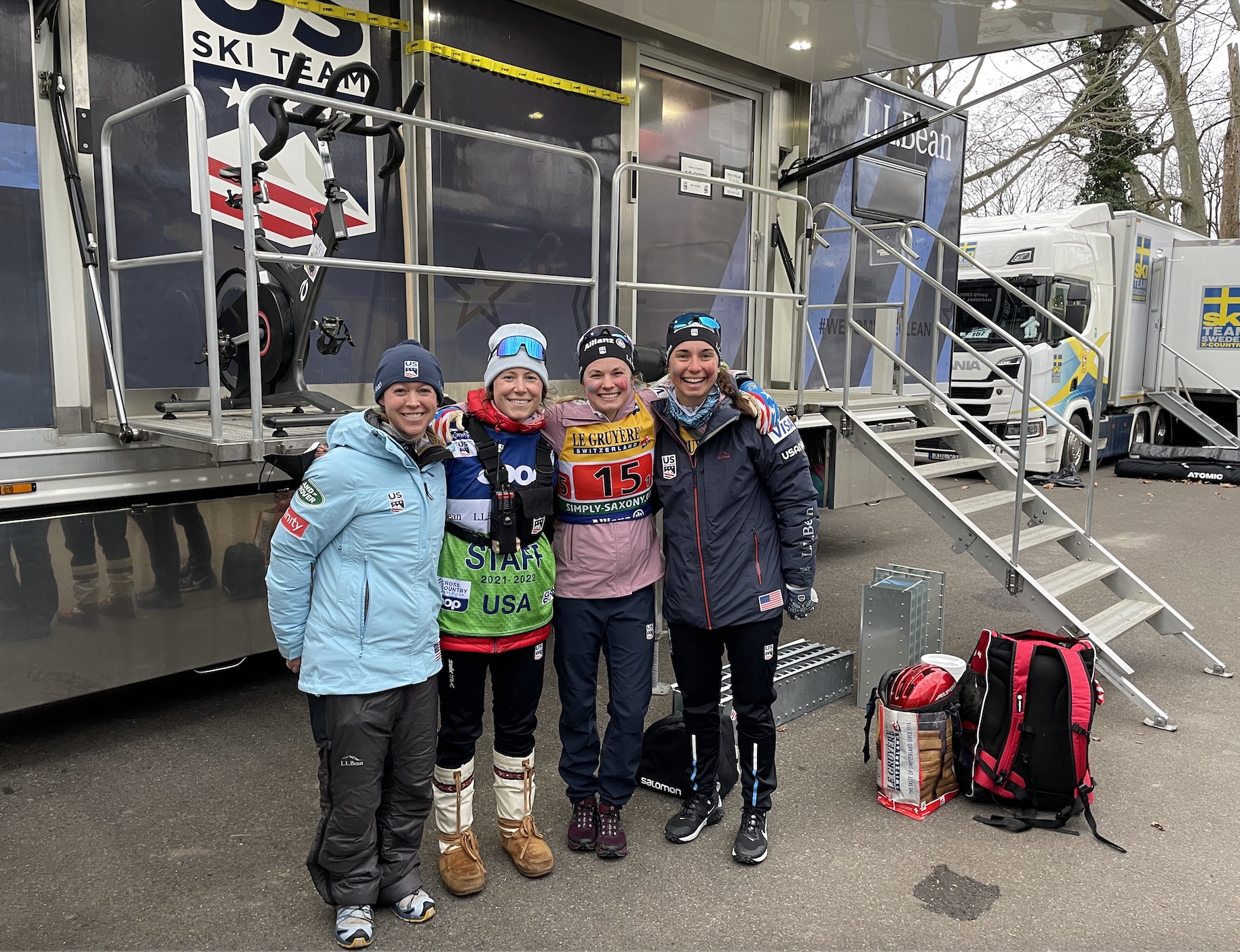
    Physical therapist Ana Robinson, Kristen Bourne, Jessie Diggins, and Julia Kern (left to right), at the Dresden World Cup in December 2021. (Courtesy photo)

    Earlier this month, the National Nordic Foundation (NNF), in partnership with the Women Ski Coach’s Association (WSCA) and the Olympic Women’s Cross-Country Book Project, announced the Trail to Gold Fellowship. The Fellowship aims to correct for a historical gender imbalance in U.S. coaching at the club, collegiate, and international level by providing fellows with funding to complete a two-week internship with the U.S. Ski Team on the World Cup this winter. The Trail to Gold Fellowship was sparked by an idea from the U.S. Olympic Women’s Cross-Country Book Project to dedicate profits from Trail to Gold; the journey of 53 Women Skiers to forward the movement for gender equity within Nordic ski coaching.

    Applications are open until August 31st, interested women coaches are encouraged to apply here. Trail to Gold: the journey of 53 Women Skiers is available here.

    Moving from idea to action for the women involved in the Trail to Gold book turned out to be expedited thanks to an existing template for not only what they wanted their Fellowship to look like, but what they wanted that Fellowship to accomplish. That case study; U.S. Ski Team Development coach Kristen Bourne.

    The story of how Bourne joined the U.S. Ski Team coaching staff is a parable for how success in the sport of nordic skiing should come. In which an extraordinarily talented young coach was paired with supportive institutional structures, relationships, and yes, a little luck here and there, to find her way through the U.S. ski coaching system. It’s also remarkable that Bourne’s whole narrative fits the space of a short story rather than a novel. After a decorated junior and college skiing career at Northern Michigan University (NMU), Kristen Bourne did a stint post-grad skiing that culminated in one last Senior Nationals in Houghton, Michigan in 2020. In an instance where metaphorical resonance became something literal, as Bourne was walking away from her athletic career, College of St. Scholastica (CSS) Head Coach Maria Stuber pulled up in the parking lot and – Midwesterner to Midwesterner – let out a big ol’ “OH Hey there!” which quickly led to a discussion about Bourne coaching, and then, a position as Assistant coach for St. Scholastica.

    From there, it’s been an ongoing whirlwind. Stuber is the founder and leader of the Women Ski Coaches’ Association, founded in 2019 to “develop, retain, and advance women in ski coaching leadership.” Stuber and Bourne worked through existing NCAA coaching development programs, which saw Bourne win the Women Sport’s Foundation Tara VanDerveer Fellowship in 2021, a first for a nordic skiing coach. Bourne’s Fellowship partially helped fund her position at St. Scholastica, but also came with an additional stipend to utilize for professional development in other organizations.

    Stuber reached out to U.S. Ski Team coaches Matt Whitcomb and Chris Grover to see if there would be any opportunity to work with U.S. Ski & Snowboard. That turned into a two-week internship on the World Cup that saw Bourne wax teching and coaching at last year’s Davos and Dresden World Cups. In turn, Bourne received additional offers to work with U.S. athletes making World Cup starts later in the season, all of which culminated in her hiring as a U.S. Ski Team Development Coach earlier this year. To sum it all up, as Bourne did a couple of times when I interviewed her, it’s been a “whirlwind.” Which, to keep to her own metaphor, is a wind that has turned up inspiration among coaches, athletes, and administrators across U.S. Skiing to bring the type of program that put Kristen Bourne in contact with the U.S. Ski Team into the fold of the nordic community. And now, with the Trail to Gold Fellowship, that’s become a reality.

    The energy that’s been infused into making that opportunity a reality is still overflowing at the source. When I caught up with Bourne about the experiences that have made up her journey, she was at the end of a long day working with members of the U.S. Ski Team as they prepared for racing in Torsby, Sweden and at Toppidrettsveka in Trondheim, Norway. She brought the same thoughtfulness to our conversation about what formed her approach to coaching as had just gone into that night’s technique session (which happened to include guests Maja Dahlqvist and Frida Karlsson). We not only talked about her journey, but about her influences, mentors, and outlook as a women coach who, just through her own story, has been a leader in the movement to correct for the historic gender inequity in U.S. ski coaching.
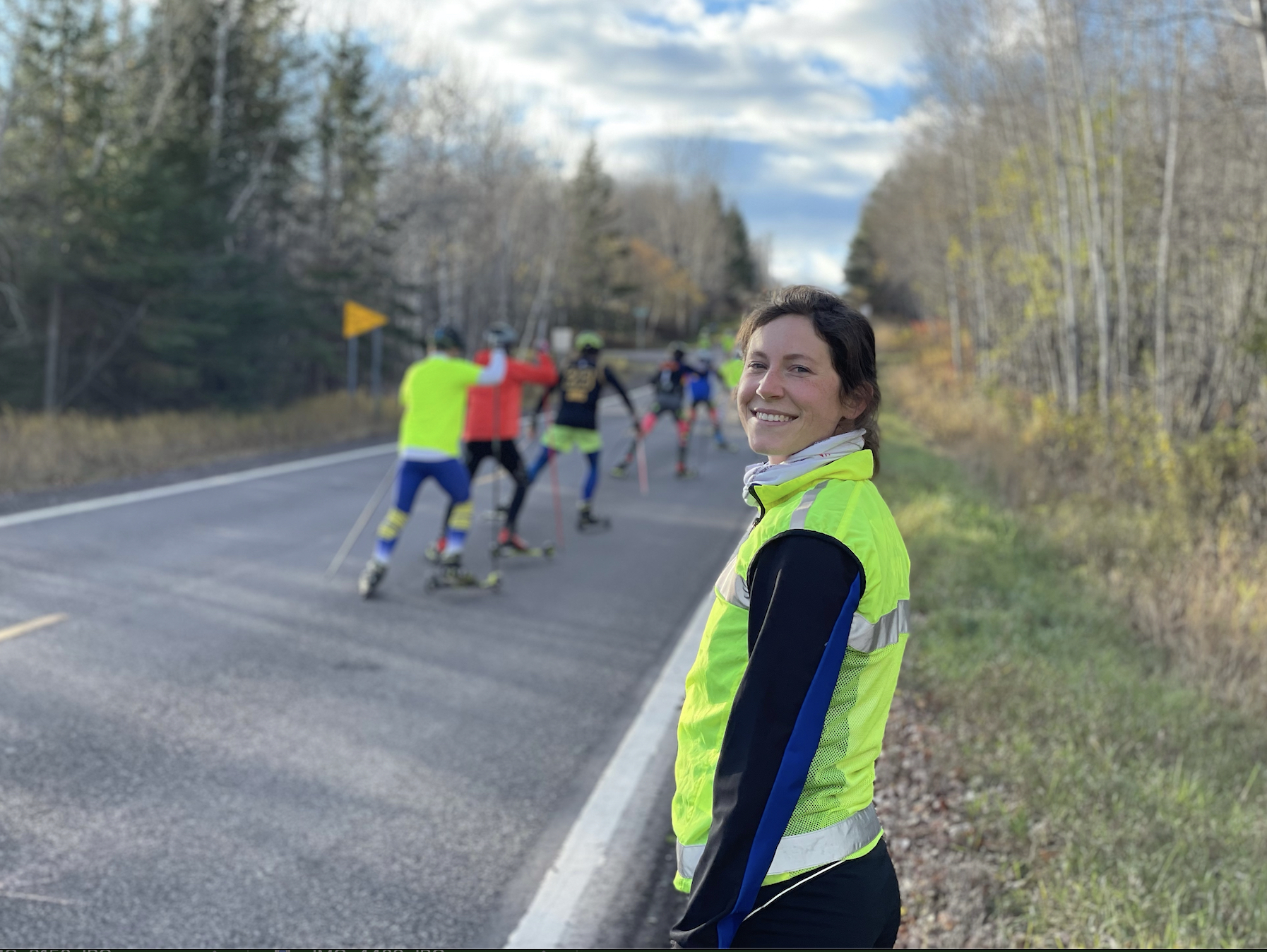
    Kristen Bourne at a CSS practice in Fall 2021 (Photo: Maria Stuber).

    (This interview has been edited for length and clarity).

    Ben Theyerl (BT): Can you start off by giving us a summary of your personal background? What was your journey to your current position with the US Ski Team?

    Kristen Bourne (KB): I’m originally from the Twin Cities [in Minnesota]. I ended up going to Northern Michigan University (NMU) and skied for them for five years. Then, about three weeks after graduation, I packed up my bags and moved to Norway, where I lived for a year and a half [ski racing]. There’s a funny story about that ending – I lost my permit in a friend’s car. I ended up coming back to race US Nationals in 2020, where I met Maria Stuber [Head Coach at the College of St. Scholastica in Duluth, MN]. At the time, I was thinking of calling it quits, and my dad had put out some emails to coaches to really try and pull me towards it. Maria had just started the Women’s Ski Coach Association (WSCA), and my dad had also gone out and signed myself and my sister up for a membership – so between emails and that he was really pulling.

    We were literally in the parking lot when she pulled up and was like ‘I’ve heard about you, you’re going to get an email from me.’ That turned into ‘Do you want to coach with me?’ and she helped set me up with a summer internship coaching with Pepa Miloucheva at the Craftsbury Green Racing Project. Summer of 2020, I started coaching at Craftsbury, and then I was one of Maria’s assistant coaches at St. Scholastica (CSS) for two years.

    When I got to CSS, Maria and I applied for a grant with the Women’s Sports Foundation – the Tara Vanderveer Advancement for Women in Coaching Fund Fellowship. We didn’t get it the first year (2020), and then we applied again, and we got it the second year (2021). That Fellowship partially funded my position at CSS, and then there was an extra $2,500 for professional development outside of that position – which was very broad. Maria nudged me to reach out to the U.S. Ski Team and see if they’d need any help for anything really, and as soon as we did Matt Whitcomb was like yes – ‘we actually could use more help for some World Cups.’ Which was unexpected but made me go, ‘woah.’ So, I went to Davos and Dresden last year.

    Over there, I ended up wax teching for Caitlin Patterson, and learning a whole lot from the U.S. staff. Then I was back in the U.S. for the collegiate season and made one more trip back to the World Cup with Bill Harmeyer as his wax tach. That was actually a really cool moment, as he reached out because I had already had World Cup experience. So that little internship directly translated into another opportunity very quickly. Then two months later, Kate Johnson announced she was leaving her position as the U.S. D-Team coach, and I applied and now here I am. It’s a lot, but it’s been a whirlwind.

    BT: And now you’re back in Scandinavia at the moment…

    KB: Yeah, it’s super full circle now because this is my first time back in Scandinavia since I left and lost my permit. The camp we’re at right now was one of the first ones of a few I had when I was living over in Norway, so it’s definitely a cool thing to be back as a coach this time.

    BT: That’s a really great story in itself. If I can dig a little deeper into your background, what was your earliest inclination that you might want to coach? Was this something you thought about when you were younger? Or was it really just when you were stuck trying to negotiate the next step after being a ski racer?

    KB: I think I always paid attention to people who were like, ‘you should try coaching.’ But I was kind of stubborn in saying that I was going to do something different after skiing. I guess I kept pushing off that idea in my head, but sporadically when I would help out coaching when I was an athlete, I always really loved it. But I guess, it’s one of those things I guess you don’t think of as a career path when you’re an athlete, right?

    As I was ending my ski career and figuring out what I wanted to do I was there with a Bachelor’s in Exercise Science, and I was wanting to do a Master’s in the same, which all just leads me back to skiing. It’s what I love. There was a slow roll towards acceptance that ‘oh man, I think coaching is what I want to do, and then Maria definitely solidified how much I love doing this job.’

    BT: You’ve touched on Maria, which we’ll talk about a little bit more, but I was wondering if now that you are coaching, do you look back on any of the coaches you had as an athlete and go ‘oh, like that was why they did that?’ Like is there an inspiration that’s shaped your coaching from your athlete days?

    KB: Oh yeah. I had a track and field coach in high school, Bev Docherty. I look back and can’t believe she was coaching me in high school based on her accomplishments – (Docherty has a long list of running accomplishments, including having run in the first 6 U.S. Olympic marathon trials open to women). I look back on her style and who she was and how she coached, and she wasn’t super energetic, super loud, or outspoken. She would lean in during the middle of a race though and you could still hear her clearly even when the crowds were cheering all around. I always look back on that because it was so different than anyone I’ve ever been coached by and she was also one of two women coaches that I ever had. I think that I look back to that and try to emulate just how steady she was as a coach. I don’t know if she knows that: she’s been there throughout my racing career and now as I’m going through my own coaching journey, I really do try to emulate her.

    BT: You’ve touched on Maria Stuber a few times. How was that relationship formative when you were starting out coaching, especially given that it was right around when she was taking over at St. Scholastica and starting the Women Ski Coaches Association (WSCA)?

    KB: I mean, do you want to write the book on it? She would shrug this off and say it’s not true, but she is one of the biggest reasons that I’m in this job [as U.S. Ski Team Development Coach] right now. She’s pushed me and knows exactly where and when to push is how I would best describe it. And I think that goes both for coaching and also for which opportunities to pursue. She’s 100% my biggest mentor and I will always look up to her.

    I think the WSCA and her passion for it is also a big aspect of that. She said ‘this is a change that needs to be made and we as coaches can make it if someone is willing to organize it’ and I’m a testament – as are other women coaches – that she is right on that.
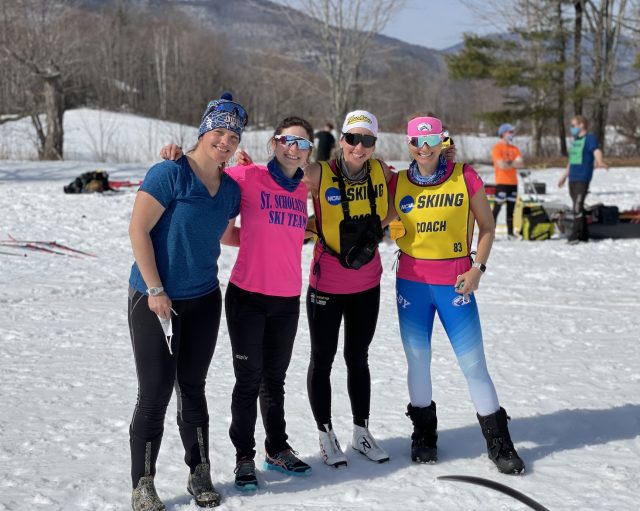
    WSCA members Maria Stuber (CSS), Kristen Bourne (CSS), Kristen Monahan-Smith (Michigan Tech), and Tracey Cote (Colby) (l-r) at NCAA Championships in Jackson, New Hampshire in 2021. (Courtesy Photo).

    BT: Can you describe how the World Cup Fellowship came together, and what you actually did when you were there last year?

    KB: I think the most important part of setting that experience up – because it was really a creation of equal parts myself and Chris Grover and Matt Whitcomb – was that it was a fully immersive experience both on the coaching side and [technician] side, not one or the other. I went over and met up with them right after Lillehammer, which was when the team was on its way to Davos. That gave me three and a half days where I was getting an intensive overview of everything from the wax truck to how [the U.S. techs] do glide-outs, wax application on race day, and the whole process of going from setting up at a World Cup to having our athletes be on the start line.

    Then Saturday came, which was sprints in Davos, and I was fully part of it all. Waxing on the World Cup. Sunday for the Distance race, meanwhile, I worked more one-on-one with Caitlin Patterson. It was a whirlwind, but I never felt like I was overwhelmed, because the coaching staff really from the moment I was there was like ‘we want you to be part of everything, and we also know that you’re doing this for the first time and are here to make our team stronger.’

    That first weekend was a real introduction into the inside process of what goes on with the process of preparing athletes for a World Cup race. When I wasn’t in the wax truck, I was at team meetings where we would watch sprint footage from previous years on that Davos course and discuss tactics. It’s cool to see how the veterans on the team really are thorough about explaining their tactical ideas and are able to make specific suggestions to their newer teammates. You really get a sense of how the ‘team’ aspect of the U.S. Ski Team operates, and it’s pretty special. I would sit in on meetings with Matt and Chris whenever I was allowed, and also got to be part of the team Christmas celebration.

    That was all just in one week. And then we packed up and drove the van to Dresden. Which you know, like I’m driving the whole women’s team from Davos to Dresden and hitting the autobahn and frankly, that was the most nerve-racking part of the entire trip. But we did make it.

    In Dresden, I turned over to more of a coaching role. That’s where I got to go out on course for the first time, with poles and radio – the whole nine yards of what you think of when you’re watching the World Cup and see coaches running alongside their athletes on the course. Everyday was really intense, and exhausting, and most of all fun, just taking in everything and not really processing it until later.

    BT: Was there a moment of realization where you were like ‘holy crap, I’m on the World Cup?’

    KB: I think I tried to process that as much as I could before I got there. Like the moment was really when I had my plane tickets in hand and was like, ‘woah, I’m really gonna go to the World Cup and wax skis.’ But you get there, it was way less intimidating than it looks like on TV. Your years of going to ski races as an athlete of coach kick in and you realize that it’s exactly the same feel and atmosphere – just with the fastest skiers on the planet. Living in Norway and being able to watch World Cups – at Holmenkollen especially – really prepared me for all the extra people, and I think mitigated that feeling you could have when Klæbo or Johaug just skis past you.

    But also, I shouldn’t play it down too much. Like yeah, there were moments throughout the two weeks where I did just look up and go, ‘this is the World Cup!’

    BT: A big part of the Trail to Gold Fellowship that is based off your experience is that there is a value in having World Cup experience cross-pollinate with the coaching back in the U.S. What did you bring back from the World Cup that you felt like you applied to your coaching on the NCAA circuit at St. Scholastica, and now with the D-Team?
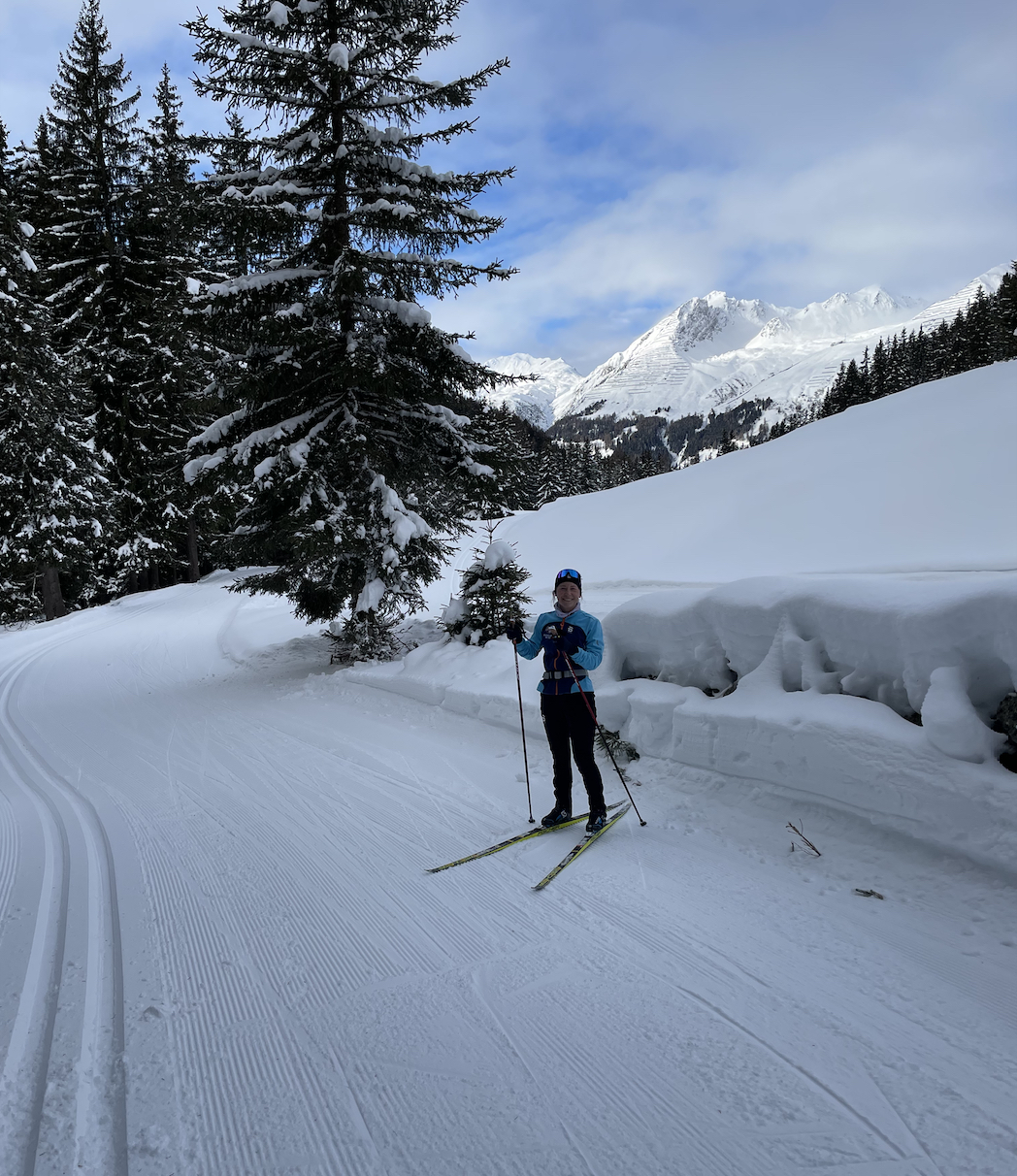
    Kristen Bourne logs kilometers on the stunning tracks of Davos, SUI while teching for the U.S. Team. (Courtesy photo)

    KB: There were a few things immediately. Like at Scholastica we adopted the glide-out system I learned on the World Cup to our team. More importantly, the mentalities and being willing to talk with other wax techs and understand that waxing theory is really – and that’s a weird thing to call it – less science. You’re not driving towards a single answer, but rather using your knowledge and experience to make a better call than you would if you didn’t. I had a big realization for both teching and coaching that you’re not learning the answer in how to ski coach, but instead that you’re trying to develop a sense of confidence in your experience so that you give that to athletes. There isn’t a one size fits all in coaching.

    BT: I really like that idea as a young coach myself. You’re not building towards an answer, but rather you’re building experience to bear so you can make a difference in the really tough situations, you know?

    KB: Yeah, I really think that’s a good way of putting it. It’s kind of that moment you realize that there’s not one way to do the job of being a coach, and that’s what makes it a really challenging and exciting profession.

    BT: What about how that attitude played into your role now with the U.S. Ski Team? What are you excited about looking ahead to this winter?

    KB: For [the D-Team], our athletes are well on their way to hopefully getting World Cup starts soon. And so that’s where I can act as a resource with my experience of what they can expect as they look to make those first starts. I’ll also be full-time on the World Cup this winter, which is exciting. I’m not anyone’s primary coach but will be doing a lot of what I did last winter, so in that respect, the World Cup experience I got will be about as good of preparation as I could get.

    BT: I had one last question pertaining specifically to the Trail to Gold Fellowship. What do you think the role of gender representation on the top-level of skiing is in helping the sport develop?

    KB: I think it has an immediate impact. I think it’s as simple as the fact that the more women that young kids see out on the course the more, they are going to believe that they belong there. I hope that immediate impact spreads to those coaches that are doing this fellowship this year as well. They can walk away with tangible World Cup experience, and also realize that they are part of pushing the movement for gender equity in coaching forward and inspiring girls that are out there at the races.

    I think back to being around wax rooms, at local races, or watching the World Cup on TV growing, and I really do think that if I would have seen more female representation it might have made me realize that coaching could be a viable career for me because I’d seen people like me in that position. Doing this fellowship works to inspire both the women who are coaching and the women who will be coaching one day.

    BT: That’s a really eloquent way to put that.
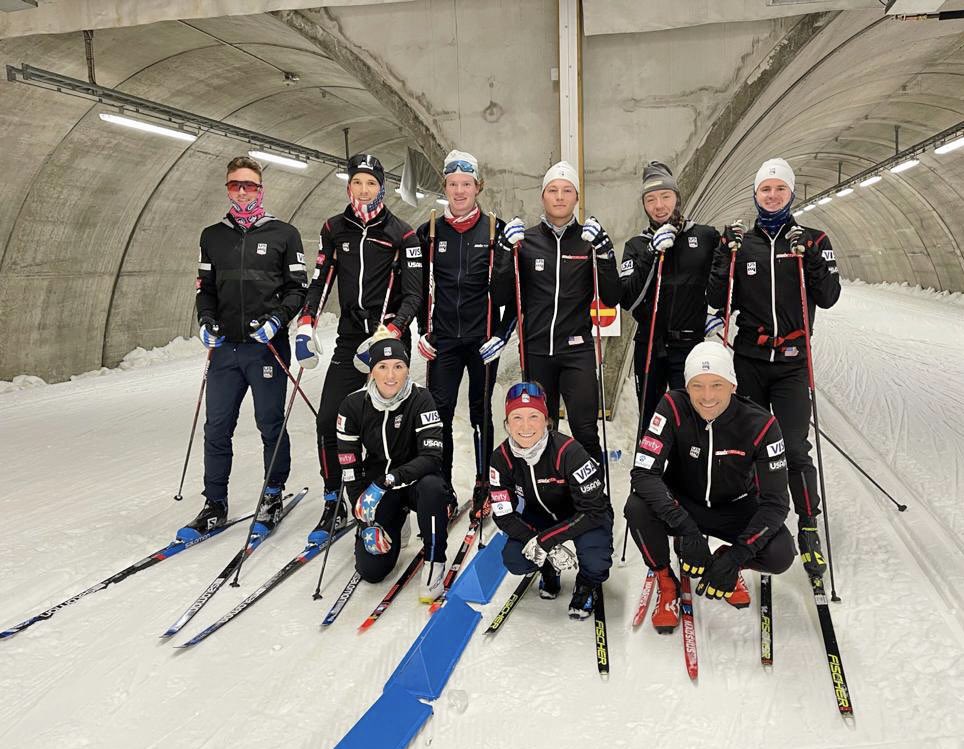
    USST athletes and coaches in the Torsby Ski Tunnel, August 2022. Back row, from left: Johnny Hagenbuch, Kevin Bolger, Finn O’Connell, JC Schoonmaker, Ben Ogden, and Walker Hall. Kneeling, from left: coaches Greta Anderson, Kristen Bourne, and Matt Whitcomb. (photo: François Faivre)

    Applications for the Trail to Gold Fellowship are open until August 31st.

    To buy Trail to Gold, the Journey of 53 Women Skiers, click here. Proceeds are dedicated to funding the Trail to Gold Fellowship.

  • Pellegrino Anchors Italy to Another Dresden Win; Late Crash Takes Out U.S. Men

    Pellegrino Anchors Italy to Another Dresden Win; Late Crash Takes Out U.S. Men

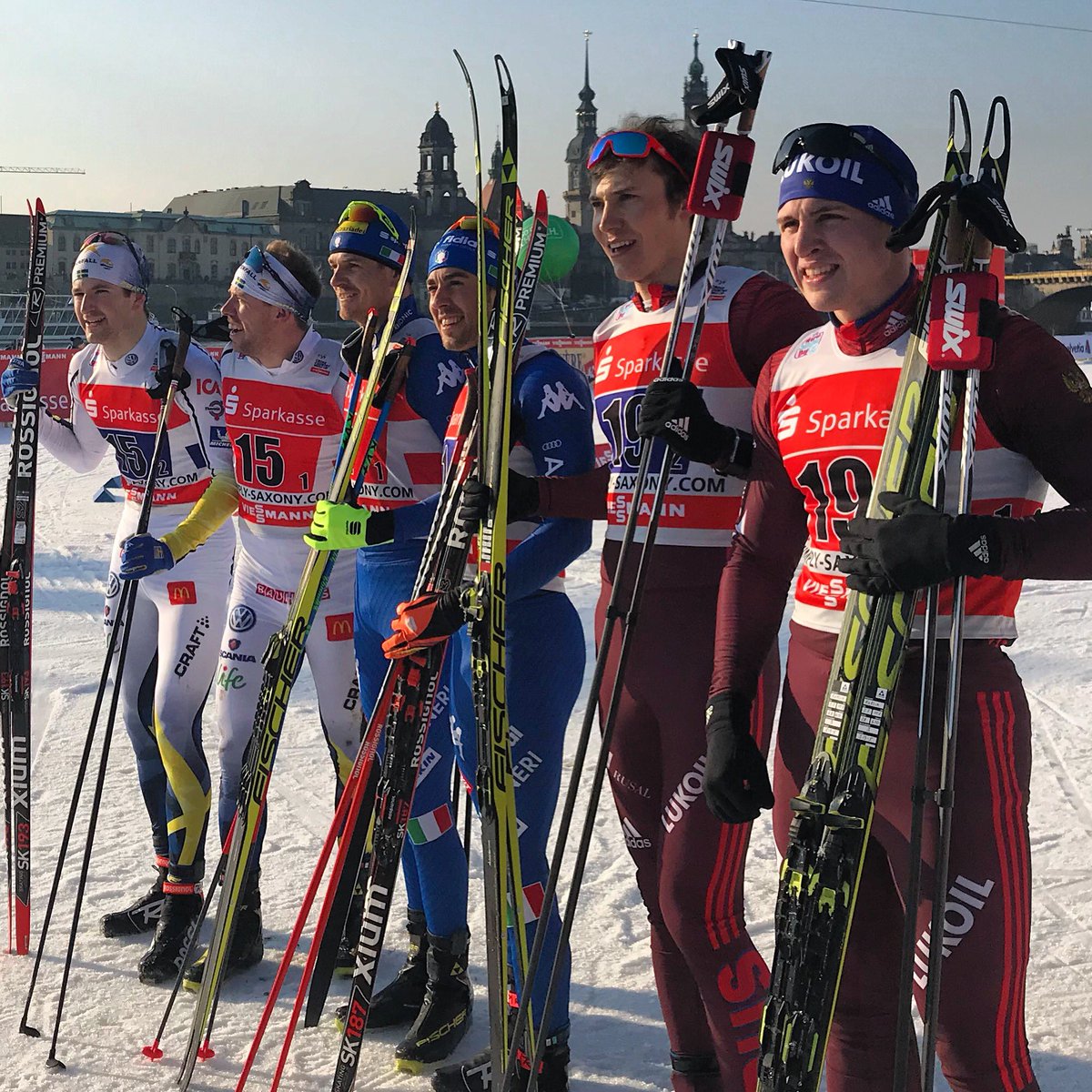
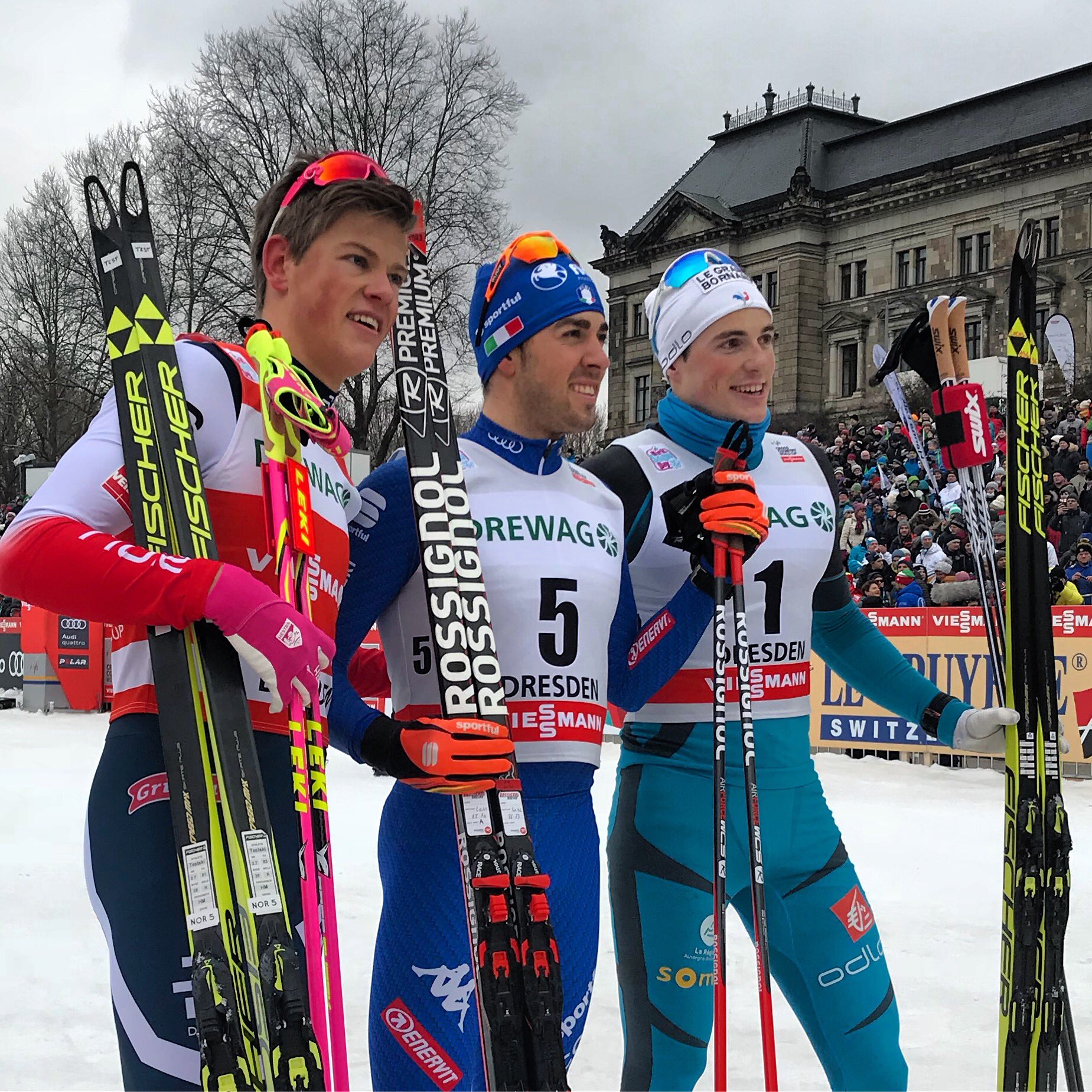
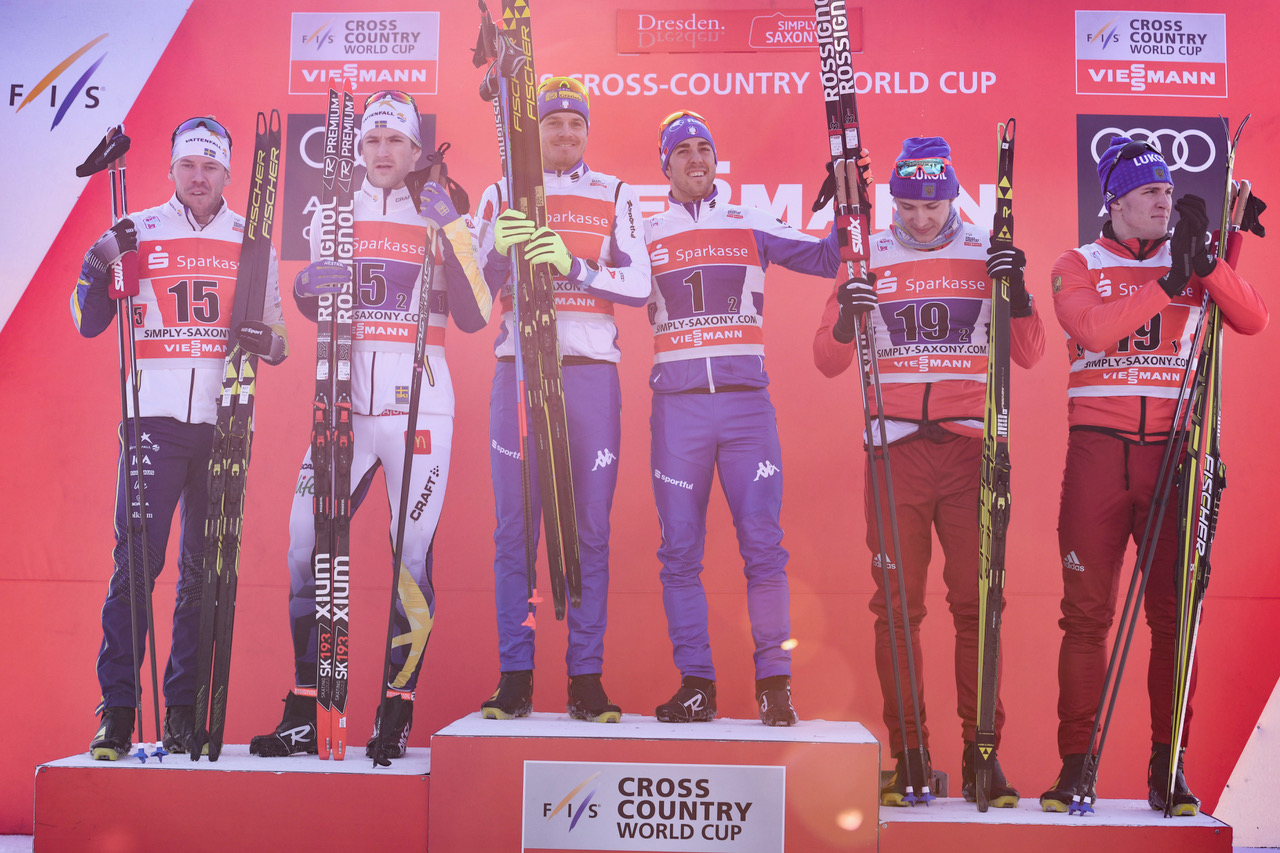
    The men’s 6 x 1.2 k freestyle team sprint podium at Sunday’s World Cup in Dresden, Germany, with Italy’s Dietmar Nöckler and Federico Pellegrino in first (c), Sweden’s Emil Jönsson and Teodor Peterson in second (l) and Russia’s Andrey Krasnov and Gleb Retivykh in third (r). (Photo: Fischer/NordicFocus)

    (Note: This article has been updated to include comments from Canada’s Bob Thompson.)

    Federico Pellegrino’s winning move in the men’s 6 x 1.2-kilometer freestyle team sprint on Sunday wasn’t exactly the same as yesterday when the Italian attacked on the final climb of the individual skate sprint.

    “Yesterday on the right side and today I tried on the left side and it was OK,” Pellegrino said in a post-race interview with the International Ski Federation (FIS).

    By “OK,” Pellegrino meant perfect.

    “Today everything was perfect, even the sun was super,” he said after winning his second race in as many days with team-sprint partner Dietmar Nöckler. “We can continue like this to the Olympics then catch the gold.”

    A number of teams were looking to do exactly as the Italians did on Sunday on a tightly woven city sprint course in the heart of Dresden, Germany. This race marked the last team sprint before the Olympics, which starts in less than a month in PyeongChang, South Korea. The Olympic team sprint, set for Feb. 21, is also freestyle. Sunday was the first team sprint so far of the 2017/2018 season.

    Pellegrino locked it up after Nöckler came through the last exchange in fifth, 2.6 seconds behind Sweden’s Emil Jönsson in first. On the final lap, Pellegrino chased Sweden’s Teodor Peterson and Switzerland’s Roman Schaad, before Pellegrino made his move past Schaad in first heading into the final rise before the stadium. The attack was just slightly before the one he executed to win Saturday’s skate sprint over Norway’s Johannes Høsflot Klæbo.

    “I had to use it,” he said of the move.

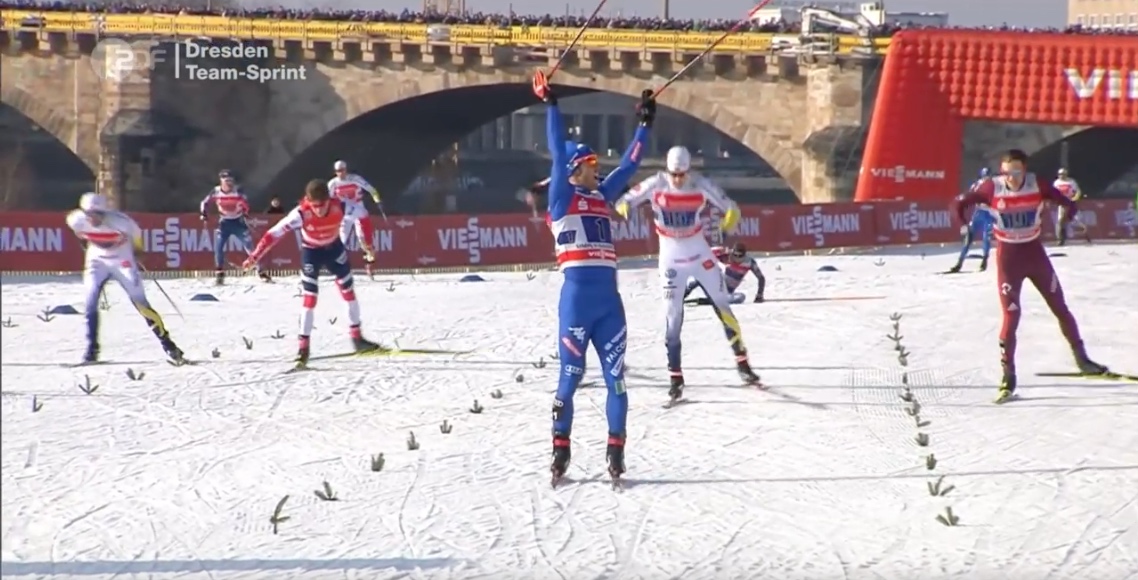
    Federico Pellegrino (front) celebrates across the line as he anchors Italy to a freestyle team sprint victory for his second-straight win at the World Cup in Dresden, Germany. Behind him, Sweden I’s Teodor Peterson (second from r) and Russia’s Gleb Retivykh (r) battled for second, and Sweden II’s Karl-Johan Westberg (l) and Norway’s Johannes Høsflot Klæbo (second for r) jockey for third. American Simi Hamilton (on the ground) is seen trying to recover from a crash. (Screenshot: ZDF broadcast)

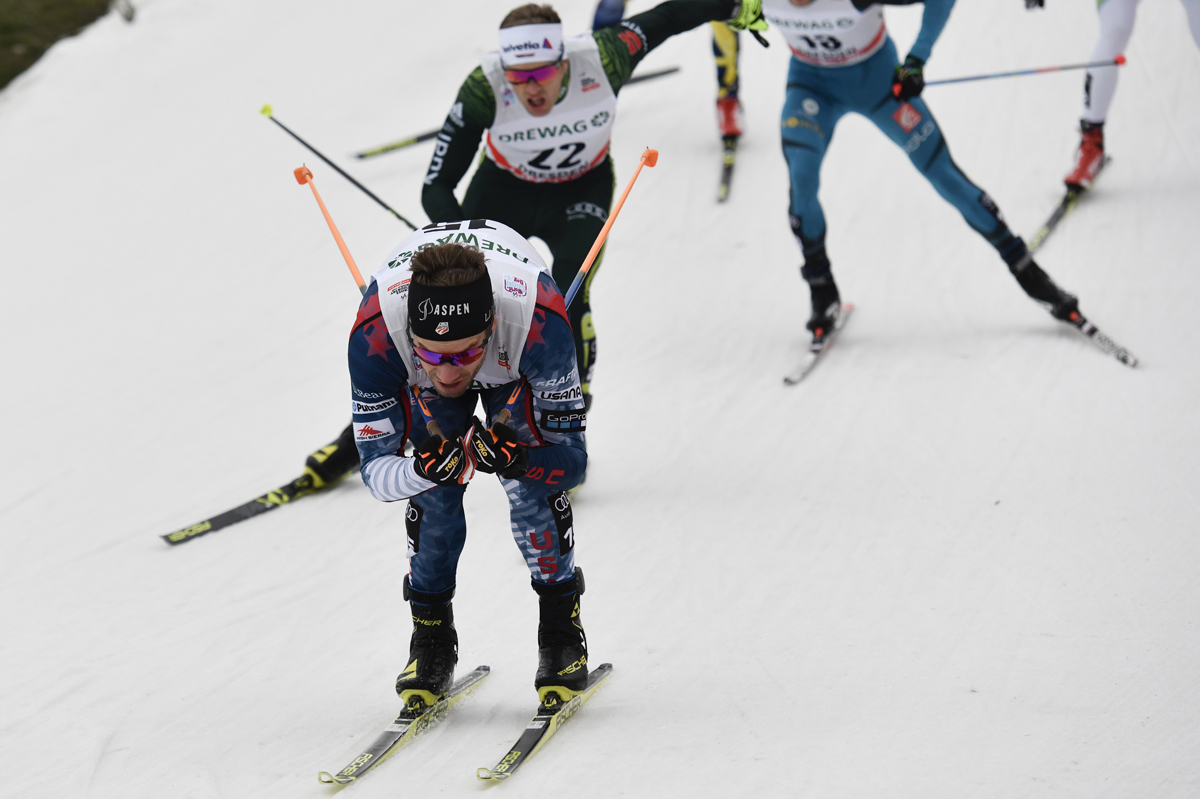
    First over the top, Pellegrino pushed farther ahead of Peterson in second while Schaad, Russia’s Gleb Retivykh, Sweden II’s Karl-Johan Westberg, Klæbo, and American Simi Hamilton chased in third. Hamilton went down when he collided with Klæbo just before the finish line, but was able to get up and finish eighth, 14.28 seconds behind Italy in first.

    Pellegrino sealed the deal in 12:18.31, and Peterson crossed 1.07 seconds back for Sweden I in second place. Russia’s first team, with Andrey Krasnov and Retivykh, placed third (+1.23), just ahead of Switzerland I (Jovian Hediger and Schaad) in fourth (+1.45), Norway I (Kasper Stadaas and Klæbo) in fifth (+1.93), and Sweden II (Johan Häggström and Westberg) in sixth (+1.94). Italy II (Stefan Zelger and Giacomo Gabrielli) placed seventh (+7.31) ahead of the U.S. (Erik Bjornsen and Hamilton) in eighth.

    “When I arrived at the finish line, I could go slow and had some time to look to the people and say thank you for a great day,” Pellegrino told German TV broadcaster ZDF. “I had really good fun here in Germany!”

    “He showed all the world that today he is the strongest athlete on the track,” Nöckler said while standing next to his teammate Pellegrino in a televised interview with FIS. “And today we were both on the podium so we’re really happy.”

    Bjornsen, Hamilton in the Mix 

    The U.S. men were in contention to the finish, with Bjornsen putting them in third on the second-to-last leg. Norway’s Stadaas had been given a 1.3-second lead at the fourth exchange by his teammate Klæbo (who had previously made his way back into first after Stadaas tagged him in fifth). While Stadaas widened the gap for the first half of his last loop, Bjornsen led the chase, skiing several seconds behind him in second place.

    In an in-person interview with FasterSkier, Bjornsen recalled being tentative in the semifinals, where he and Hamilton finished fourth but advanced as lucky losers with a fast-enough time.

    “Going into the final, I was feeling good and I wanted to use my aerobic capacity,” Bjornsen said. “As soon as Simi handed off to me, I was kind of in the back end of that group and Norway had a good lead and I was like, I’m just gonna go for it.”

    Hamilton had tagged him in eighth, 2.5 seconds behind Norway in first. About halfway through the next 1.2 k loop, Bjornsen had bridged the gap to Stadaas, but brought a large pack of racers with him.

    “I went to the outside and was able to pass my group of like six or so, and I bridged up to Norway and tried to hit that corner pretty hard, then it kind of hit me,” Bjornsen said. “I was tired, that group had caught up to me and unfortunately I had pulled — some people jumped on the back of me, so then they kind of went by me, but I was able to hand off in third so I was happy with that. We were in the mix today.”

    Sweden’s Jönsson took the lead over the last rise before the stadium, and Switzerland’s Hediger slotted into second, coming through the exchange 0.9 seconds after Jönsson. Bjornsen tagged third, 2 seconds back.

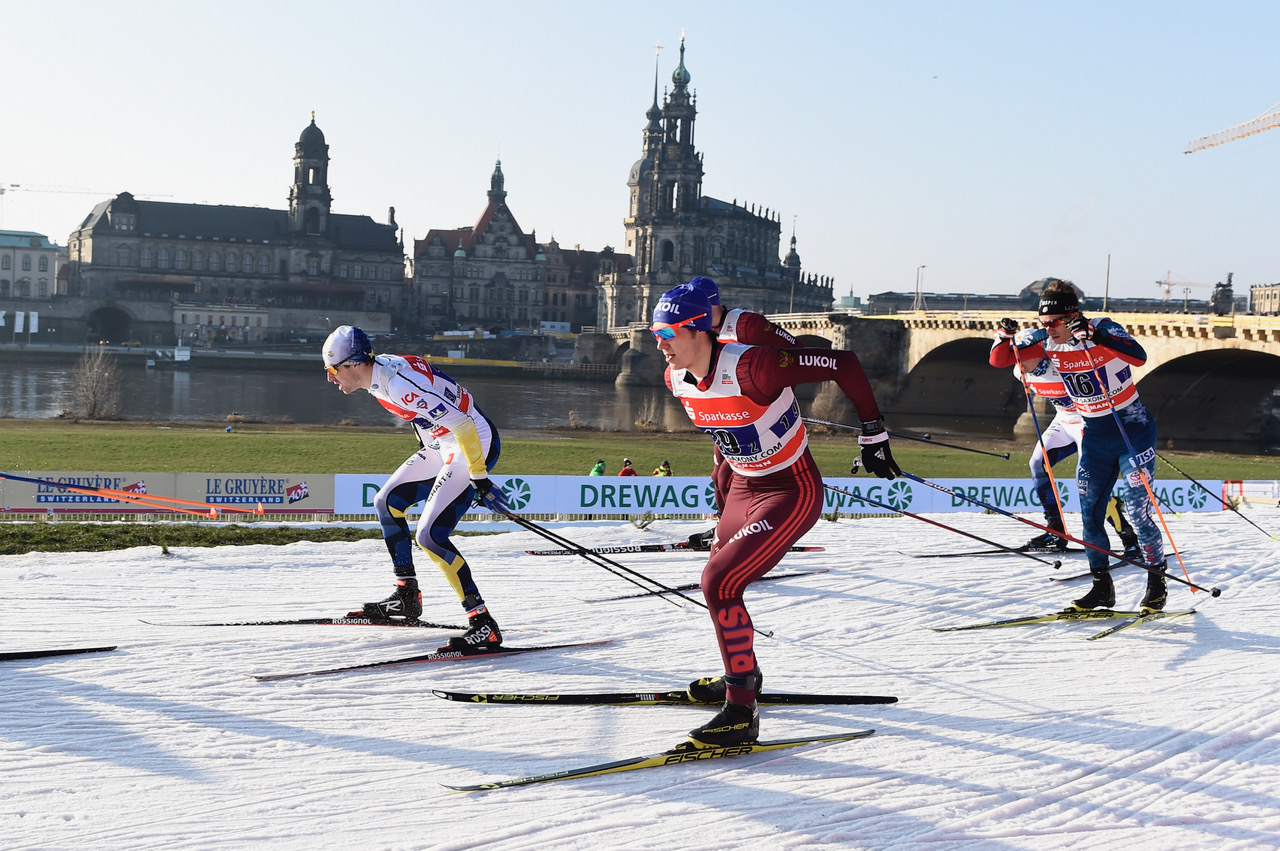
    American Simi Hamilton (r) chasing Russia’s Gleb Retivykh (19) and one of two Swedish teams the second semifinal of the men’s 6 x 1.2 k freestyle team sprint at the World Cup in Dresden, Germany. (Photo: Fischer/NordicFocus)

    From there, Hamilton kept himself in contention in the top five, hanging just behind Pellegrino and Peterson as the large group approached the finish. In the middle with several races on either side of him, Hamilton went down, hard, but stood back up again and finished eighth.

    “My crash wasn’t too terrible, but I did break Klæbo’s pole with my face and got a bunch of carbon fiber splinters in my upper lip. So once I got that cleaned up I was okay,” Hamilton wrote in an email. “Whacked my head a bit too, but I’ll be fine.”

    (Article continues below)

    https://www.instagram.com/p/Bd74ijTngPq/?taken-by=simihamilton

    He explained that he and Bjornsen had made a game plan to “ski towards the front, stay out of crashes, and figure out how the semifinal was going to play out while racing,” he wrote. “I thought we both skied the semi well, although I think I could have been a bit more aggressive on my last lap and done more skiing that would have assured us a spot into the final. But it turned out okay.”

    In the final, “Erik did an awesome job keeping us at the front and I just focused on doing the same for him,” Hamilton wrote. “He turned in a hell of a last leg, tagging me in 3rd for my last lap.”

    Bjornsen was pleased with his last lap, but would have like to have been first through the final exchange.

    “I wish I had a little higher speed that I could push past people quicker, but I find when I’m up against the best, my talent or whatever is to kind of press hard for a while,” Bjornsen said. “… So I just tried to send it hard for 45 seconds and it seemed to work out. I wish I could’ve handed off in first, but I’m happy to be in the mix there.”

    On the final lap, Hamilton recalled “a decent sized gap up to first and second, I think mostly because those were the only two teams that had perfect tags on that last exchange,” he wrote.

    Unsure whether to ski all out on his last of three 1.2 k efforts, while simultaneously pulling along competitors like Pellegrino and Klæbo, Hamilton focused on skiing fast, but not to his max.

    “On the far end, Pellegrino went by me and by that point we were really close to making contact with the top two,” he wrote. “I thought we were totally in the hunt for a podium until somehow I lost a second on the plateau [after the last hill] with about 15 seconds of racing left. “I don’t know how I lost it, if it was just entirely my fault or if something happened like I got punched from my line, but I am pretty bummed about it because that was where I felt like I let the podium slip through our hands,” Hamilton continued. “Coming in to the finish lanes, I got tripped up with Klæbo and my skis got clipped as were skiing for the same lane. It wasn’t intentional and he’s a very clean racer, but it was definitely a bummer to not be able to sprint it out for 3rd, 4th, or 5th with those other guys.”

    As for Norway, Klæbo told Germany’s ZDF he was out of the race at the start of that last lap: “After the last exchange it was too difficult, the gap was too large to the guys in front,” he said.

    Overall, Hamilton concluded that it was a great and interesting weekend of racing at a new venue in Dresden.

    “I think they could make some big improvements to the course with making it more technical, flowy, and wider, but I hope they continue to hold sprints here in the future,” he wrote.

    Canada had two teams in the first semifinal of the men’s 6 x 1.2 k freestyle team sprint at the World Cup in Dresden, Germany, with Canada I’s Julien Locke (near) skiing just ahead of Canada II’s Dominique Moncion-Groulx, who caught an edge just ahead of Italy’s Federico Pellegrino (second from r) and American Ben Lustgarten (behind Pellegrino), over the top of a climb. (Photo: Fischer/NordicFocus)

    While the Bjornsen and Hamilton as the U.S. Ski Team’s first team on Sunday were the lone North Americans to reach the men’s final, Canada came close with Bob Thompson and Julien Locke.

    “The main points of our plan was make sure we stayed in the lead group and to take any easy opportunities to make up positions whenever we saw them,” Thompson, of the National Team Development Centre (NTDC) Thunder Bay, wrote in an email. “I started first as we were confident I could hang on to the pace and then after Julien’s excellent performance yesterday we felt he would have good speed to finish.”

    In Saturday’s individual sprint, Locke placed 15th for a career best.

    The two ultimately finished seventh in the first team-sprint semifinal, just one place behind Great Britain’s James Clugnet and Andrew Young. The Brits advanced to the final as lucky losers in sixth, 1.85 seconds behind Norway’s Stadaas and Klæbo in first, becoming the first team from Great Britain to reach the final in a World Cup team sprint. (In the final, they finished behind the U.S. in ninth, 14.68 seconds out of first.)

    After Thompson tagged Locke (Canadian National U25 Team/Black Jack Ski Club) in eighth in the last exchange of their semifinal, Locke picked off one place to finish seventh, 0.39 seconds behind Great Britain’s Young.

    “The third leg just started going from the exchange and I was able to hang on to the back and then dodge around the French teams who both crashed,” Thompson explained. “So I was able to tag off to Julien solidly in the mix of the lead pack. Julien had a pole break on the small hill with just 200m to go and had to free skate in, so the .15 seconds from making the final hurts a bit.

    “I’m happy with how we raced,” he continued. “We both stayed controlled and I think we had the pace well enough. I believe I skied it as well as I could have and being right up with those guys feels great.”

    The Americans’ second team of Andy Newell and Ben Lustgarten crossed the line 0.57 seconds later for eighth place (+2.81) in that semifinal. Newell had put them in second place at the last exchange, just 0.11 seconds out of first.

    “I felt good on my last leg and was able to make some moves and tag Ben in the lead going into the final lap,” Newell wrote in an email. “He skied really well to stay close to the leaders. If we were even less than a second faster I think we would have moved on as [lucky losers] instead of Sweden 2 and USA 1 from the next semi. So we were a bit unlucky there but it was a fun race.”

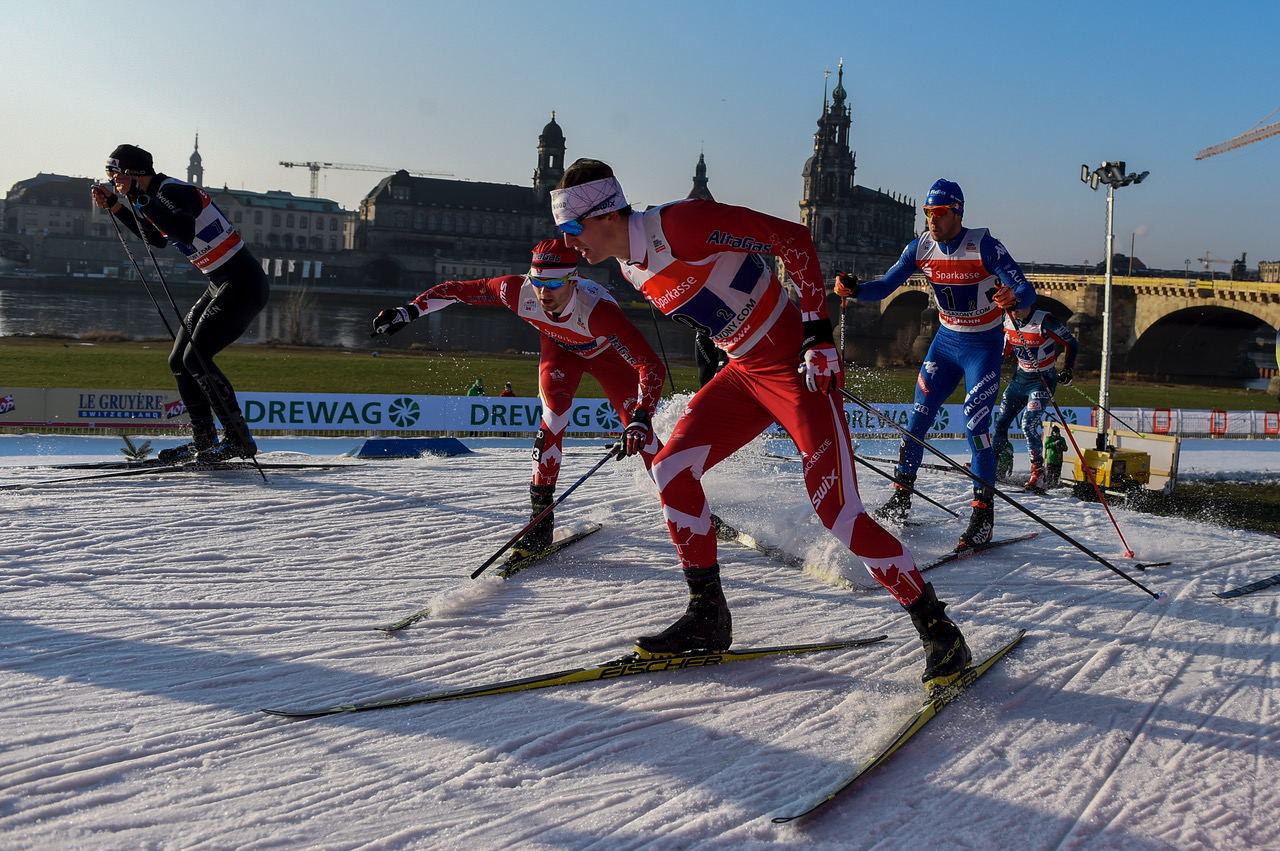
    American Andy Newell (2) chasing Italy II’s Stefan Zelger (in blue) during the first semifinal of the men’s 6 x 1.2 k freestyle team sprint at the World Cup in Dresden, Germany. (Photo: Fischer/NordicFocus)

    Previously, Newell had tagged Lustgarten in fourth at the first exchange, then Newell found himself back in 10th and almost 2 seconds back after his second leg.

    “Ben and I tried to ski up toward the front half of the pack but had a small crash on our second tag,” Newell explained.

    “The [second] handoff wasn’t clean but I got Newell just in time,” Lustgarten, of the Craftsbury Green Racing Project, recalled in an in-person interview with FasterSkier. “But there is so much happening and I obviously don’t have that much experience in this event, so it was just like a learning experience and trying to ski well. … On my last lap, Klæbo and Pellegrino went by and I am not really at that level yet so I didn’t really expect anything. I just tried to go as hard as I could.

    “I haven’t done a team sprint in eight years maybe, so it was a whole new kind of experience,” Lustgarten explained. “And obviously all these guys are so fast and strong that it was just an insane event.”

    Canada’s second team of Antoine Briand (Pierre-Harvey National Training Centre) and Dominique Moncion-Groulx (Alberta World Cup Academy) finished 13th in the first semifinal, 26.20 seconds out of first. Notably, Moncion-Groulx skied the fastest second leg of the race to bring them from 12th after the first exchange to sixth.

    The World Cup has two more weekends of racing before the Olympics, with all-classic races next weekend in Planica, Slovenia (classic sprint and 10/15 k classic individual starts), followed by freestyle races in Seefeld, Austria, on Jan. 27-28 (skate sprints and 10/15 k freestyle mass starts).

    Bjornsen said he was unsure whether he’d race next weekend in Planica, potentially opting for a training block before the Olympics instead.

    “I still have to talk to [U.S .SKi Team Head Coach Chris] Grover about which races I’m going to start at the Olympics and so if it looks like I’ll have a full schedule at the Olympics then I’ll try to do a training block,” Bjornsen said.

    Hamilton wrote that he was planning on racing the classic sprint in Planica, and was headed to Ramsau, Austria, with his teammates for a couple days of training first.

    According to Thompson, the four Canadians that raced in Dresden were also on their way to Ramsau, Austria, where they’ll train until Tuesday and then continue on to Planica.

    Results: Semifinals | Final

  • Sunday Rundown: U.S. 3rd in Dresden Team Sprint; Crawford 4th in Mass Start

    Sunday Rundown: U.S. 3rd in Dresden Team Sprint; Crawford 4th in Mass Start

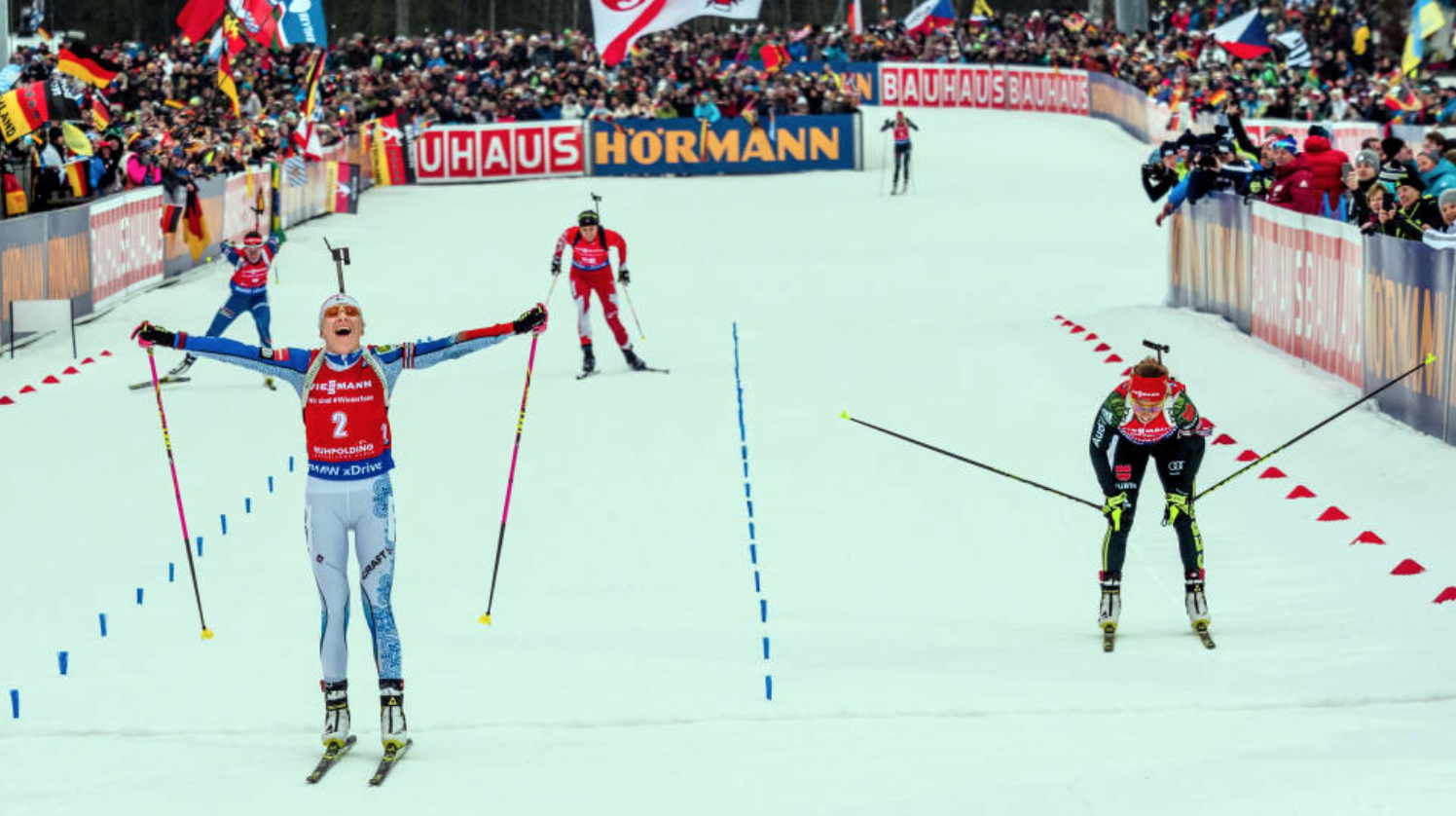
    Kaisa Makarainen of Finland celebrates winning the women’s 12.5 k mass start in Ruhpolding, Germany, as Laura Dahlmeier (Germany) is second, Veronica Vitkova (Czech Republic) third, and Rosanna Crawford (Canada) fourth. (Photo: IBU/Biathlonworld)

    IBU Biathlon World Cup (Ruhpolding, Germany): 12.5/15 k mass starts

    Kaisa Makarainen of Finland took her first win of the season and will start next weekend with the overall World Cup leader’s bib after she outsprinted Germany’s Laura Dahlmeier by 0.8 seconds to claim the win in the 12.5 k mass start. In a tight race for third, Veronica Vitkova of the Czech Republic edged out Rosanna Crawford of Canada for the final spot on the podium; the pair crossed the line 4.6 and 5.2 seconds behind Makarainen. The podium finishers all had two penalties apiece while Crawford shot clean, repeating the 20-for-20 effort that netted her third place and her first-ever podium in the 15 k individual earlier this week. Germany’s Denise Herrmann was sixth, +16.7 seconds, despite four missed targets.

    In the men’s 15 k mass start, Norway’s Johannes Thingnes Bø took a win over France’s Martin Fourcade as the pair continue their running battle this season. Bø had one penalty to Fourcade’s two, although that penalty came in the last shooting stage to make things interesting – Fourcade, whose penalties had come in the prior shooting stage, closed to within 4.5 seconds by the finish, but was unable to beat the Norwegian. Antonin Guigonnat, one of the newest members of the French World Cup team, shot 20-for-20 to claim third place and his second podium of the season. In an exciting race, the top nine men all finished within 15 seconds of one another. The sole U.S. entry, Tim Burke, was in the top 15 for much of the race before missing two shots in the final standing shooting stage and finishing 21st, +1:30.2

    Results: women | men

    ***

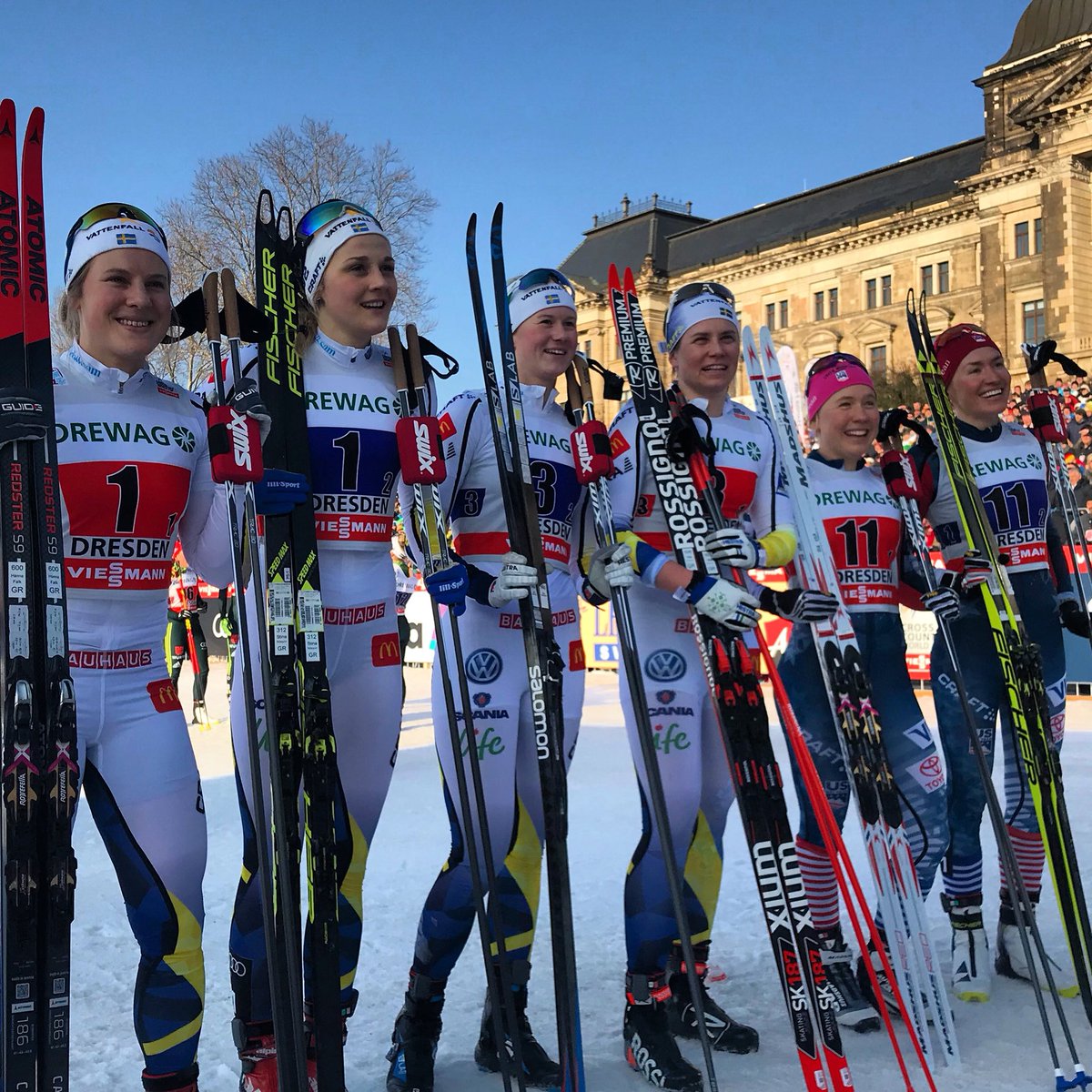
    The women’s 6 x 1.2 k freestyle team sprint podium at Sunday’s World Cup in Dresden, Germany, with Sweden II’s Maja Dahlqvist and Ida Ingemarsdotter in first (c), Sweden I’s Hanna Falk and Stina Nilsson in second (l), and USA I’s Ida Sargent and Sophie Caldwell in third (r). (Photo: FIS Cross Country/Twitter)

    FIS Cross Country World Cup (Dresden, Germany): 6 x 1.2 k freestyle team sprint

    Women’s report

    Men’s report

    For the second-straight day in Dresden, Sophie Caldwell notched third place and was nearly second with U.S. teammate Ida Sargent on Sunday in the World Cup women’s 1.2-kilometer freestyle team sprint.

    The race ended in a three-way fight for first, which Sweden II’s anchor Maja Dahlqvist took by 0.16 seconds over Sweden I’s Stina Nilsson. While the two lunged for the line, Caldwell came on strong to give them a run as well, finishing just 0.23 seconds back in third (after being in a photo finish for second).

    Earlier in the day, Sargent and Caldwell had won the second semifinal to advance to the 10-team final. The U.S. Ski Team’s second team, Caitlin Patterson and Kikkan Randall, finished second in that heat, just 0.11 seconds back and advanced as well.

    Sweden I won the first semifinal with Hanna Falk (Saturday’s individual skate-sprint winner) and Nilsson. Sweden II finished 0.17 back in second with Ida Ingemarsdotter and Dahlqvist.

    In the final, Sweden II’s Ida Ingemarsdotter led through her first two legs before tagging Dahlqvist in third with one lap to go. Meanwhile, Sargent tagged Caldwell in fourth, 0.9 seconds back. On the final lap, with Switzerland, the two Swedish teams, and USA I’s Caldwell skiing together up front, they dropped Switzerland’s Laurien van der Graaff before the finish and went all out for first.

    Dahlqvist took it for Sweden II in 13:33.4, Sweden I placed second and USA I third. The same duo of Caldwell and Sargent placed third in the pre-Olympic freestyle team sprint last year in PyeongChang, South Korea. There, Sargent also placed third in a classic sprint for her first World Cup podium. Sunday marked Caldwell’s fourth individual World Cup podium (sixth including team events).

    USA II was up to sixth after Randall’s first leg, just 0.5 seconds out of first, and remained 1.8 seconds behind the leaders with two laps to go. On the second-to-last leg, Patterson tagged Randall in ninth, and Randall anchored them to eighth (+7.95).

    Germany I finished fourth (+2.11) with Hanna Kolb and Sandra Ringwald, Slovenia was fifth (+4.46) with Alenka Cebasek and Vesna Fabjan, Germany II was sixth (+4.62) with Katharina Hennig and Elisabeth Schicho, and Switzerland seventh (+5.09) with Nadine Fähndrich and van der Graaff.

    The men’s 6 x 1.2 k freestyle team sprint podium at Sunday’s World Cup in Dresden, Germany, with Italy’s Dietmar Nöckler and Federico Pellegrino in first (c), Sweden’s Emil Jönsson and Teodor Peterson in second (l) and Russia’s Andrey Krasnov and Gleb Retivykh in third (r). (Photo: FIS Cross Country/Twitter)

    In the men’s race, Norway’s Johannes Høsflot Klæbo teamed up with Kasper Stadaas, and the two won their semifinal by 0.26 seconds over Italy’s Dietmar Nöckler and Saturday’s winner Federico Pellegrino. The U.S. men’s first team of Erik Bjornsen and Simi Hamilton advanced to the final as the last lucky loser in the second semifinal, where they placed fourth, 0.85 seconds behind Russia I’s Andrey Krasnov and Gleb Retivykh in first. Sweden I (Emil Jönsson and Teodor Peterson) and Sweden II (Johan Häggström and Karl-Johan Westberg) also advanced in second and third in that heat.

    In the final, which included Great Britain for the first time in team-sprint history (after James Clugnet and Andrew Young clinched the last lucky loser spot in the first semifinal in sixth place), Stadaas set a fast pace on the opening 1.2 k loop. He tagged Klæbo in first, 0.3 seconds ahead of Sweden I, while the U.S. hung in contention 0.9 seconds back in fifth.

    Norway continued to lead until Stadaas’s second lap, where Russia’s Krasnov came through the third exchange first, 0.1 ahead of Switzerland’s Jovian Hediger in second. Stadaas tagged Klæbo in fourth, 0.5 seconds back, and Klæbo predictably recovered the lead on the next lap.

    After he gave Stadaas a 1.3-second lead at the fourth exchange, Stadaas initially ran with it and extended it significantly. But he ran out of steam on the second half of his last loop and dropped to 10th (last place), 3.7 seconds out of first by the final exchange.

    There, Jönsson tagged Peterson in first, 0.9 seconds ahead of Hediger in second. Bjornsen had brought the U.S. to third, 2 seconds back, after leading the chase group in second as they reeled in Stadaas.

    On the final lap, Pellegrino came on strong in the last few hundred meters, just as he had done in Saturday’s individual sprint, to take the win for Italy in 12:18.3. Peterson anchored Sweden I to second place, 1 second back, and Russia’s Retivykh took third (+1.2), just ahead of Switzerland’s Roman Schaad in fourth (+1.4).

    Hamilton suffered a nasty crash in the middle of the group just before the finish and crossed the line in eighth (+14.2).

    Klæbo finished fifth for Norway (+1.9), with Sweden II in sixth (+1.9). Italy II (Stefan Zelger and Giacomo Gabrielli) followed in seventh (+7.3), Great Britain placed ninth (+14.6), and Switzerland II (Erwan Käser and Roman Furger) 10th (+20.9).

    This is the last team sprint before a freestyle team sprint is contested at the 2018 PyeongChang Olympics.

    Results: 

    Women’s semifinals | Women’s final

    Men’s semifinals | Men’s final

  • Caldwell Third in Dresden City Sprint; Falk Gets First Win Since 2010

    Caldwell Third in Dresden City Sprint; Falk Gets First Win Since 2010

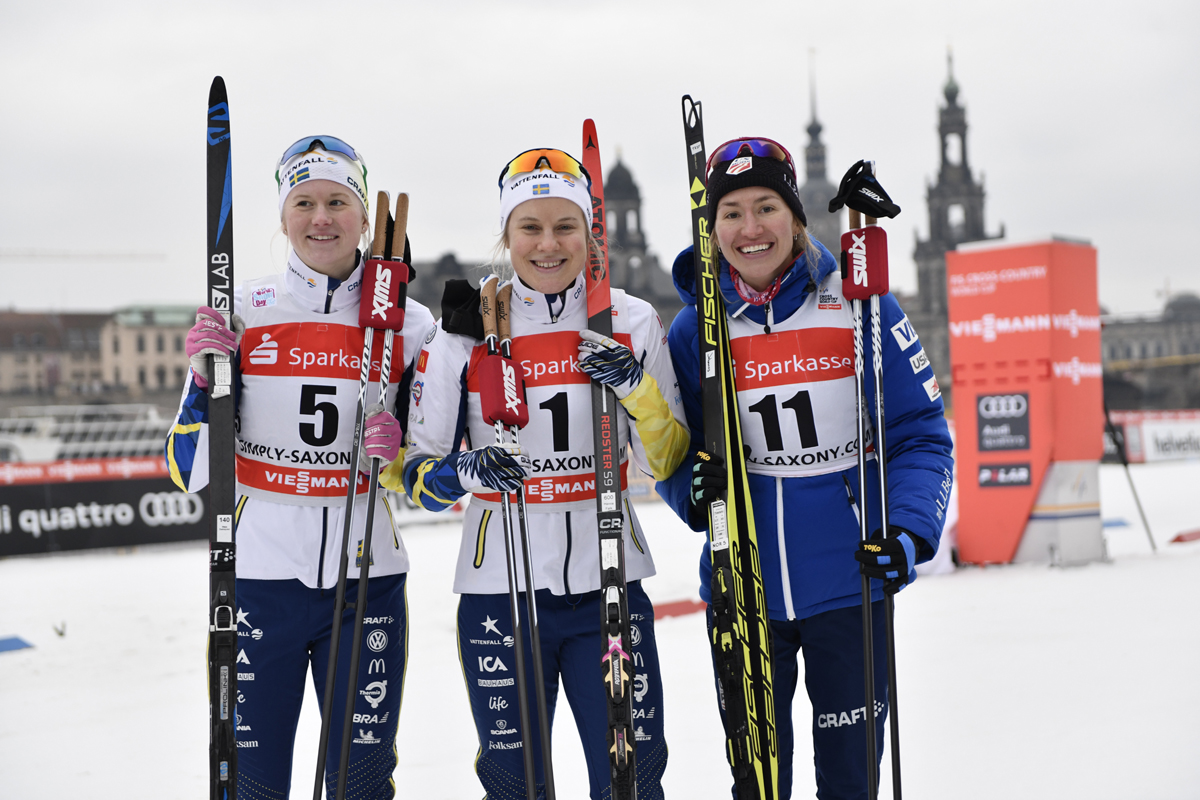
    The women’s freestyle sprint podium on Saturday at the World Cup in Dresden, Germany, with Sweden’s Hanna Falk (c) and Maja Dahlqvist (l) in first and second, and American Sophie Caldwell (r) in third. (Photo: Fischer/Nordic Focus)

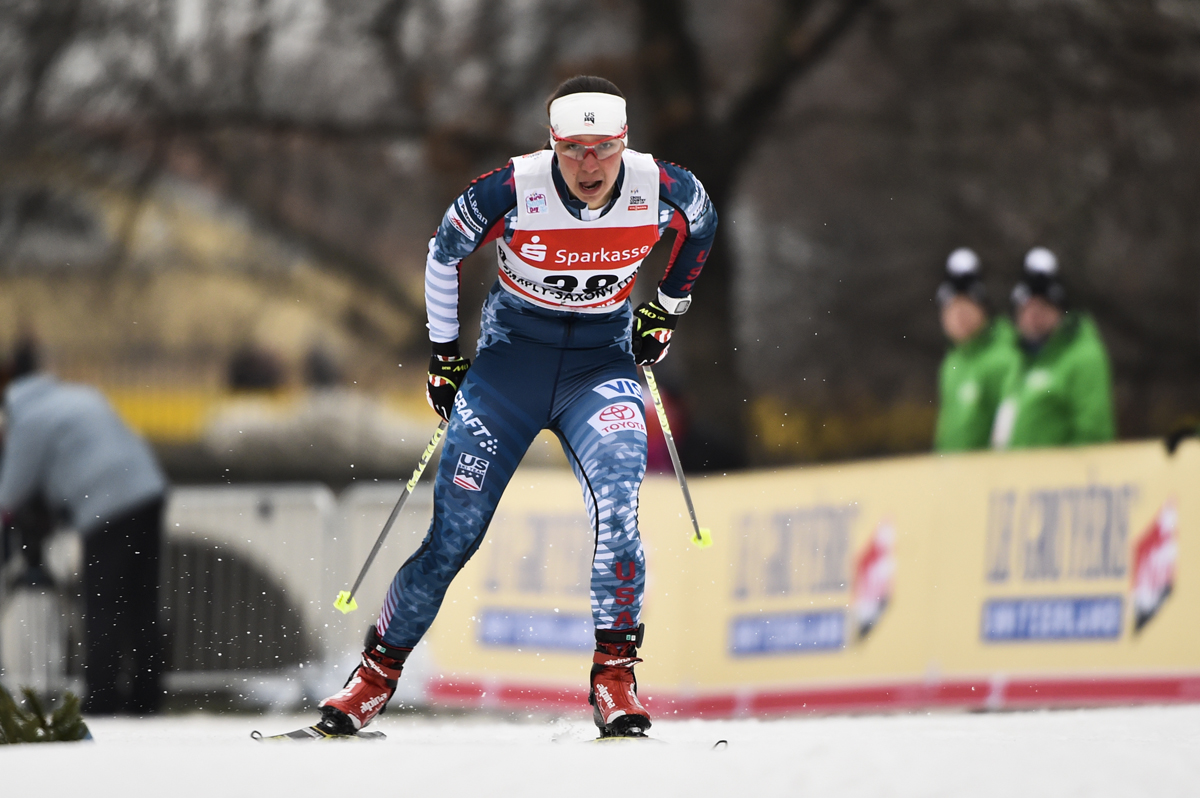
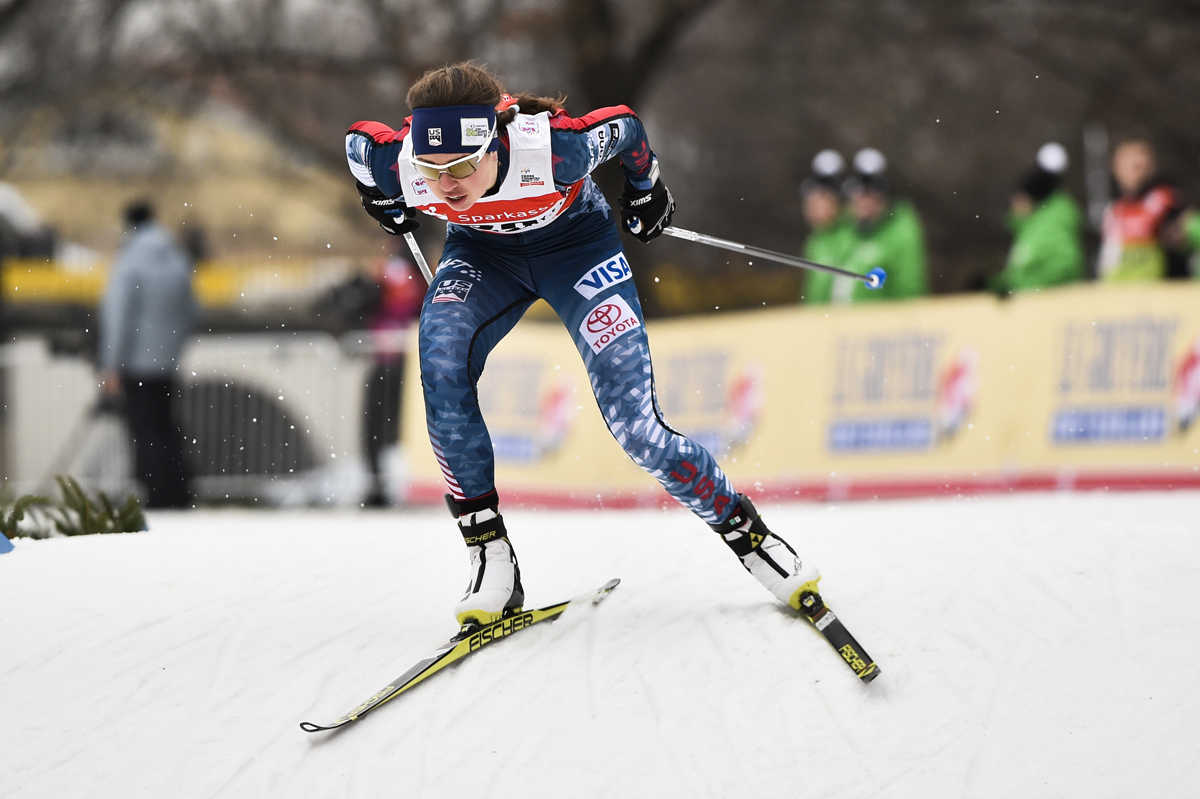
    In Sophie Caldwell’s quarterfinal heat of the World Cup skate sprint in Dresden, Germany, she led from start nearly to finish. In the final 200 meters she was passed by Sweden’s Hanna Falk, but won a photo finish for second place and advanced to the semifinals.

    In that quarterfinal heat, the U.S. Ski Team member had finished just 0.24 seconds behind Sweden’s Falk.

    As the racing got even tighter in the semifinals and final, it became more difficult to shoot off the starting line and into first place. Caldwell spent much of those heats boxed in the middle or even the back of her six-woman heats, partly on purpose, but advanced to the final as a “lucky loser” anyway.

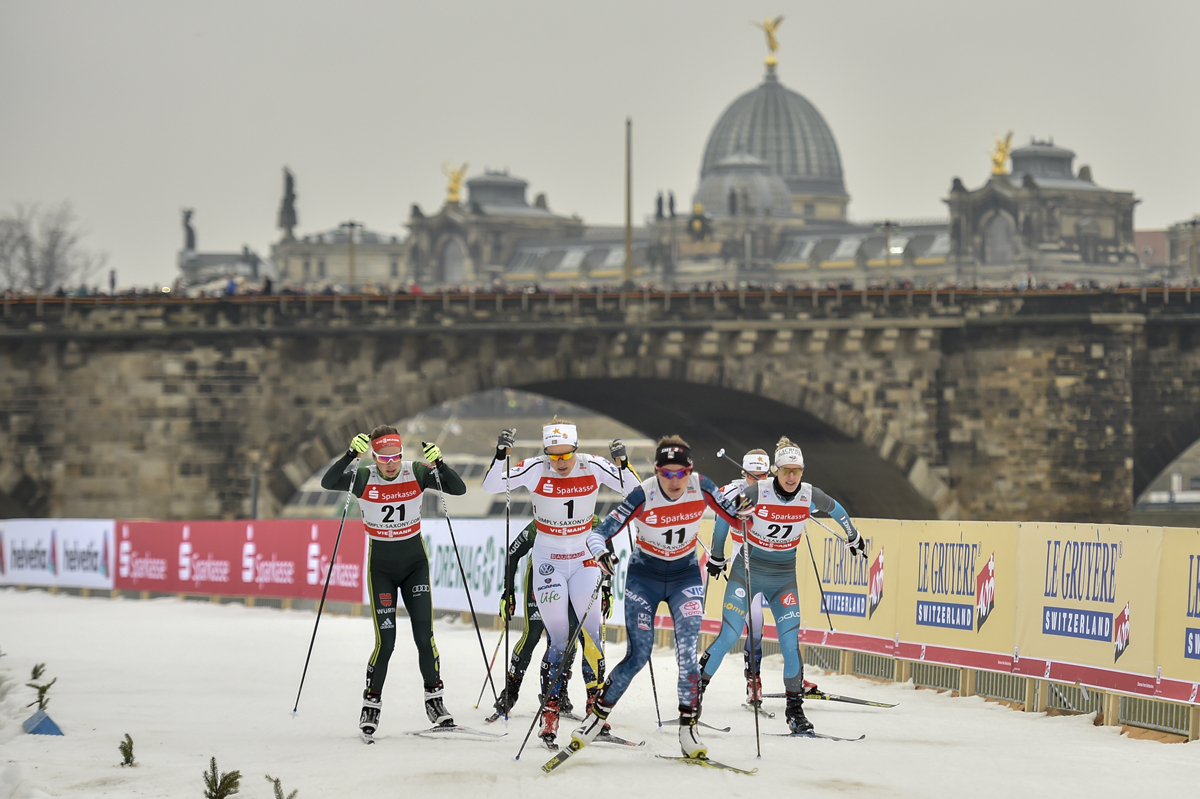
    American Sophie Caldwell (11) leads Sweden’s Hanna Falk (1), Germany’s Hanna Kolb (21), France’s Aurore Jean (27), and others during their 1.2 k freestyle sprint quarterfinal on Saturday at the World Cup in Dresden, Germany. (Photo: Fischer/NordicFocus)

    “Sophie really executed the way she wanted to all day,” U.S. Ski Team Head Coach Chris Grover said. “She was in control of her quarterfinal, and then when she got to the semifinal, she purposely wanted to relax a little bit… same thing in the final. She was not going to, like, burn a match early. She was going to relax, be in the draft, save a little bit of energy early, and look to make a move.”

    By the end of the final, despite skiing from the back instead of the front, Caldwell’s margin to Falk was almost the same as it had been in the quarterfinal, this time 0.30 seconds.

    Falk took the win while Caldwell finished third, earning her second podium of the year.

    “It was pretty frantic, and in the final I didn’t have a great start,” Caldwell said. “I found myself in the back and it’s easy to waste a lot of energy being in the back and trying to move up, so I tried to be patient and pick people off when I could. But you also kind of have to capitalize on those opportunities when they come, so I just tried to be patient and pick people off. There was a fall that I dodged, which worked to my advantage, and so I am really happy with it.”

    The crash belonged to Sweden’s Stina Nilsson, the favorite to win the final even though Falk had the fastest qualifying time. Near the end of the race loop Nilsson tripped and went down, with Caldwell and Switzerland’s Laurien van der Graaf splitting to go around her, one of each side.

    “The crash happened right in front of me,” Caldwell said in a U.S. Ski & Snowboard press release. “But I managed to avoid it and then put in a big push to maintain contact with the leaders.”

    That liberated Caldwell from the back of the field, although she still had work to do to get near the front. From the beginning of the heat, Falk, Nilsson, and Swedish teammates Anna Dyvik and Maja Dahlqvist had controlled the pace.

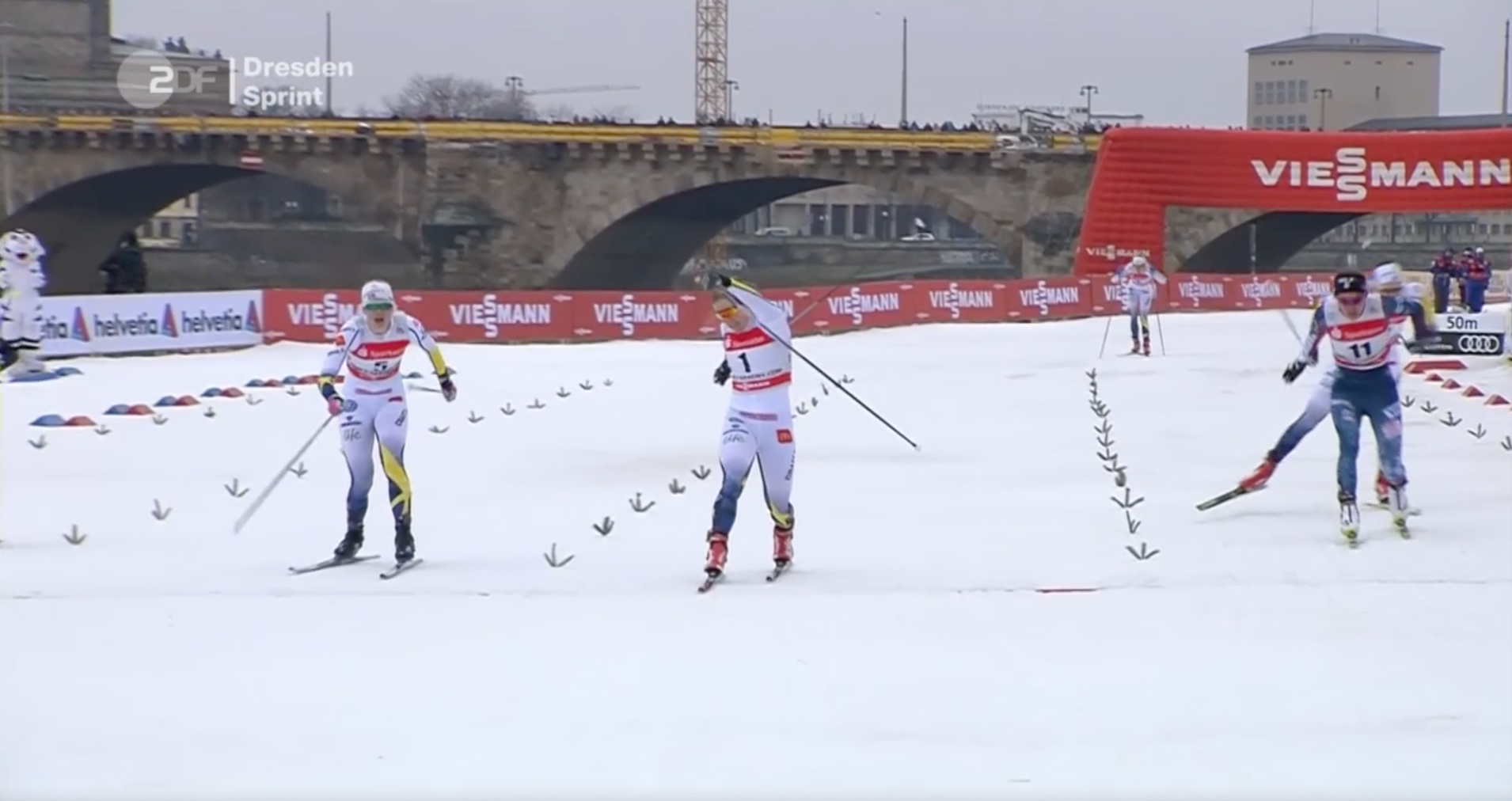
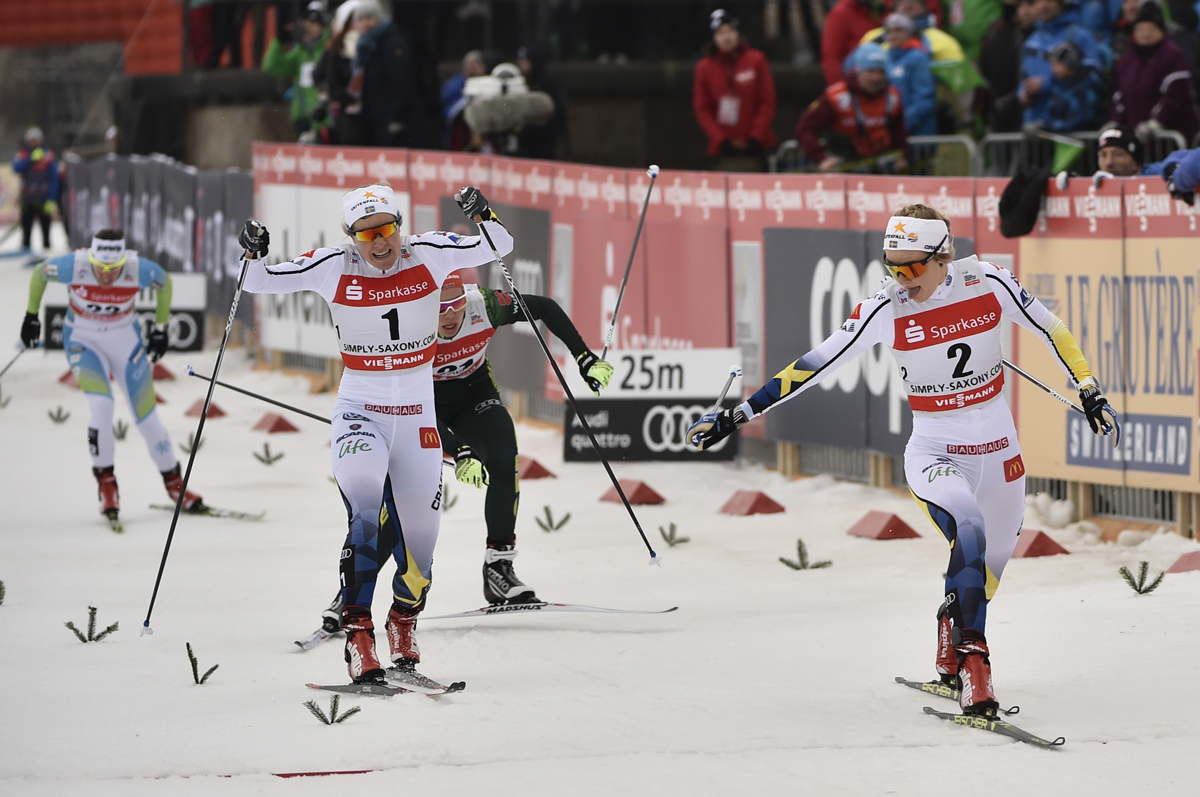
    Sweden’s Hanna Falk (1) edges her teammate Maja Dahlqvist (l) and American Sophie Caldwell (r) in the women’s 1.2 k freestyle sprint final on Saturday at the World Cup in Dresden, Germany. (Screenshot: ZDF broadcast)

    As the meters ticked down to the finish, Caldwell finally was able inch towards the lead.

    “Where she ended up making that move, under the bridge, was a targeted strategy of hers,” Grover said.

    Coming into the finish, everyone except Nilsson was still in it, and the five women all crossed the line within 0.68 seconds of one another. Falk, though, managed to stay clear of the pack and take her first win since 2010.

    “I think I was a little unfocused in the start in the semifinal, so in the final I really tried to focus on the start,” she said in a finish-line interview with FIS’s Jeff Ellis. “Then I took the front, and it was just to push hard… I really like this kind of city sprint. It was a good day for me. I have all my family and fans from Ulricehamn here cheering for me here, so it was a good day.”

    Dahlqvist claimed second (0.23), van der Graaf fourth (+0.58), and Dyvik fifth.

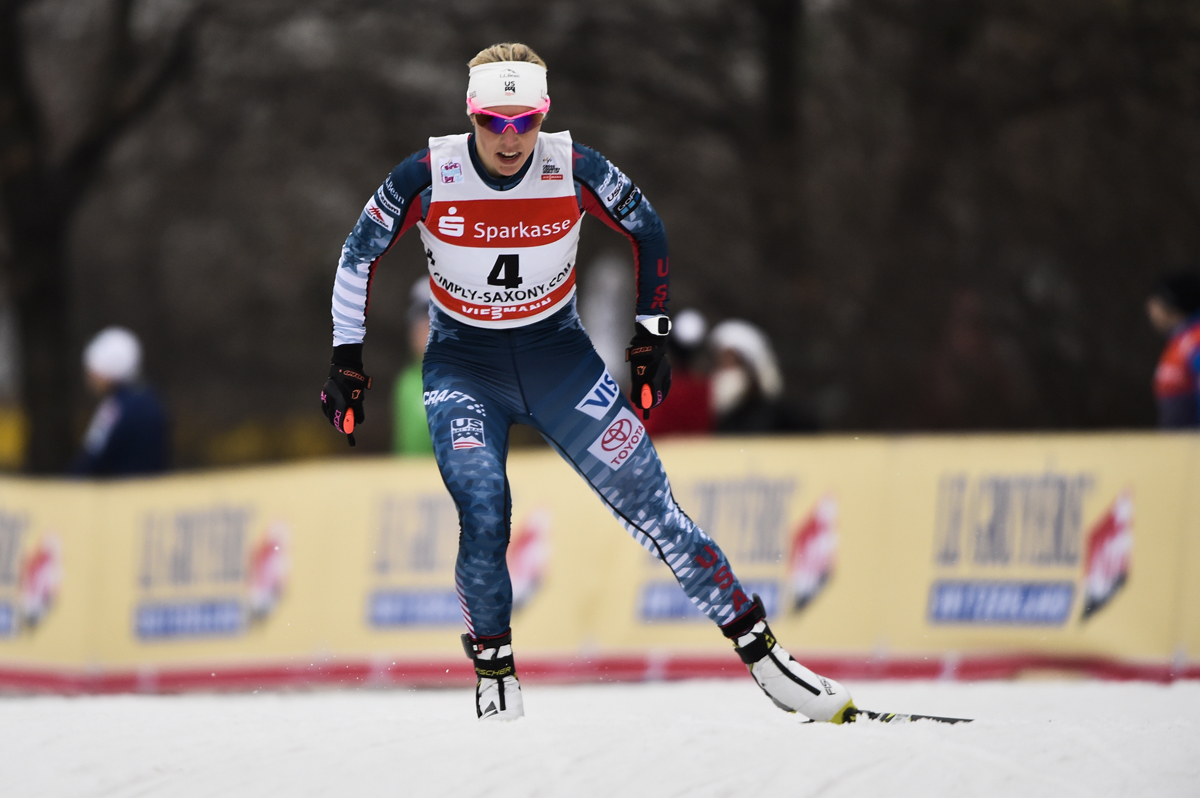
    Sophie Caldwell’s last podium came just two weeks ago, where she finished second in the 1.5 k sprint in Lenzerheide, Switzerland. (Photo: Fischer/NordicFocus)

    While pursuing a completely different strategy from Falk in the final, Caldwell proved that there are many ways to the right position, as long as you play your cards right.

    “I am really psyched to be here,” Caldwell said. “ I’ve never had great results in Period 1 in the past, so I was really happy to have made the semifinals in all three of the sprints. I considered it a really strong start, but I was left wanting more.”

    She is following up a second-place finish in the skate sprint in Lenzerheide, Switzerland, which kicked off the Tour de Ski. But Caldwell fell ill partway through the Tour, and didn’t start the (later-canceled) classic sprint in Oberstdorf, Germany.

    “I woke up sick the morning of the sprint in Oberstdorf, so I was sick for a week,” she explained. “I am actually still clearing things out, but energy-wise I felt good the past few days. Today was going kind of be a test to see how I felt, and I guess I was well rested. It felt good.”

    She is now third in the Sprint Cup behind Nilsson and Norway’s Maiken Caspersen Falla, who did not race in Dresden.

    Sweden’s Stina Nilsson (2) winning the second semifinal just ahead of her teammates Hanna Falk (1) and Maja Dahlqvist (not shown) and American Sophie Caldwell (not shown). Dahlqvist placed second, Caldwell third and Falk fourth in that heat. (Photo: Fischer/NordicFocus)

    City sprints aren’t so unusual; they have been held in Drammen, Norway, for many years straight, with other venues like Stockholm, Dusseldorf, Milan, and Quebec City coming and going from the schedule.

    But even for a city sprint, this course was particularly flat, short, and fast, which played to some athletes’ strengths and left others just trying to do their best to get by.

    “It was a really funny course a lot different than anything we have ever done — by far the shortest I have ever done and flattest,” Caldwell said.

    Her American teammate Ida Sargent qualified in 14th position, a new experience on such a course.

    “It’s a weird course,” she said. “It’s fast and flat. Not at all my favorite kind of sprint race. I just went into it looking at it as a challenge and an opportunity to improve on some of the things that are not really my strengths. So I’m pretty psyched with the qualifier to be right up there, on a course where I feel like a year or two ago I definitely wouldn’t have qualified on. That was exciting.”

    Like Caldwell, Sargent led out her quarterfinal heat. And like Caldwell, she got swept up at the end of it, with her competitors using a small uphill and a subsequent downhill to shoot into the finishing straights. She couldn’t hang on to the top two and finished fourth in the heat, 0.43 seconds behind Sweden’s Ida Ingemarsdotter.

    That put her 17th on the day.

    “Coming into the finish, it was pretty fast and I wasn’t quite ready for that,” she said. “I should have switched to V2 sooner, and I felt like it was all over the place. So I’m kind of kicking myself.”

    “Ida had a great start, took control, skiing how she wanted to ski, just ran out of gas at the end,” Grover said. “And I think it was a course where there’s no rest, it’s continuous effort – if V2’ing hard, V2 alternate-ing hard, if that isn’t your deal, then you could run out of gas at the end.”

    Both Sargent and Caldwell thought it was important to start well on this course, even though in the semifinal and final Caldwell managed to succeed without ever leading.

    “It’s really narrow and hard to pass,” Caldwell said. “It was pretty easy to sense when people were coming up, so I think people were guarding their space. That made it even harder to pass. When I was leading my quarterfinal I got to do some of that, and then when I wasn’t leading it was frustrating sometimes — you would see people bouncing around out there trying to make moves.”

    “There’s room to move up, but it’s definitely big decisive moves,” Sargent agreed. “I just got out fast [in the quarterfinal] and tried to stay in my rhythm at the beginning. I could feel the others coming up and I would just try to increase the pace whenever I could feel someone coming up so I could keep control.”

    Kikkan Randall (U.S. Ski Team) racing to 34th in the 1.2 k freestyle sprint qualifier on Saturday at the World Cup in Dresden, Germany. (Photo: Fischer/NordicFocus)

    Also starting for the U.S., Kikkan Randall narrowly missed qualifying for the quarterfinals in 34th, 6.57 seconds behind Falk’s time and 0.6 seconds behind 30th-place Giulia Stuerz of Italy.

    Randall, Caldwell, and Sargent are now looking forward to the Olympic Games, which begin in less than a month. Sargent sealed her qualification with that 17th-place finish, as she is now ranked 13th in the Sprint Cup, well within the top-50 designation required by the U.S. Ski Team.

    “I am looking forward to the Olympics,” Caldwell said in a post-race press conference. “It has been a strong year for me, and especially for my whole team. We are going to compete as a team to win the first medal for the U.S. women in Olympics, and I am proud to be on the team.”

    Julia Kern (U.S. Ski Team/Stratton Mountain School) racing to 38th in the women’s 1.2 k freestyle sprint qualifier at the World Cup in Dresden, Germany. (Photo: Fischer/NordicFocus)

    Julia Kern finished 38th (+7.78) and Caitlin Patterson 40th (+8.56).

    “We had an uncharacteristically poor qualification,” Grover said. “I have a feeling it was a combination of things… Just over two minutes for women and men a minute fifty, I think that might have been a little bit of a shock to the system. I couldn’t tell if our group was a little flat, or [this race is] just so uncharacteristic, something that we don’t really prepare for because it’s that much more on the anaerobic side instead of a mix of aerobic and anaerobic like we’re used to for a sprint.

    “Anyway, to have Erik Bjornsen just miss the qualification, to have Kikkan just miss the qualification, to have the four athletes who did go in not have the best qualifications, something was a little bit missing,” he concluded.

    In Sunday’s team sprint, Sargent and Caldwell will team up, with Randall and Patterson forming the second U.S. team in a field of 20 entries.

    No Canadian women competed in Dresden.

    Results: Women’s qualifier | Women’s heats

    — Gabby Naranja and Ian Tovell contributed

    Caitlin Patterson (Craftsbury Green Racing Project) racing to 40th in the women’s freestyle sprint qualifier at the World Cup in Dresden, Germany. (Photo: Fischer/NordicFocus)
  • The Grandkids Will Love This: Pellegrino Beats Klæbo in Dresden; Hamilton 10th, Locke 15th

    The Grandkids Will Love This: Pellegrino Beats Klæbo in Dresden; Hamilton 10th, Locke 15th

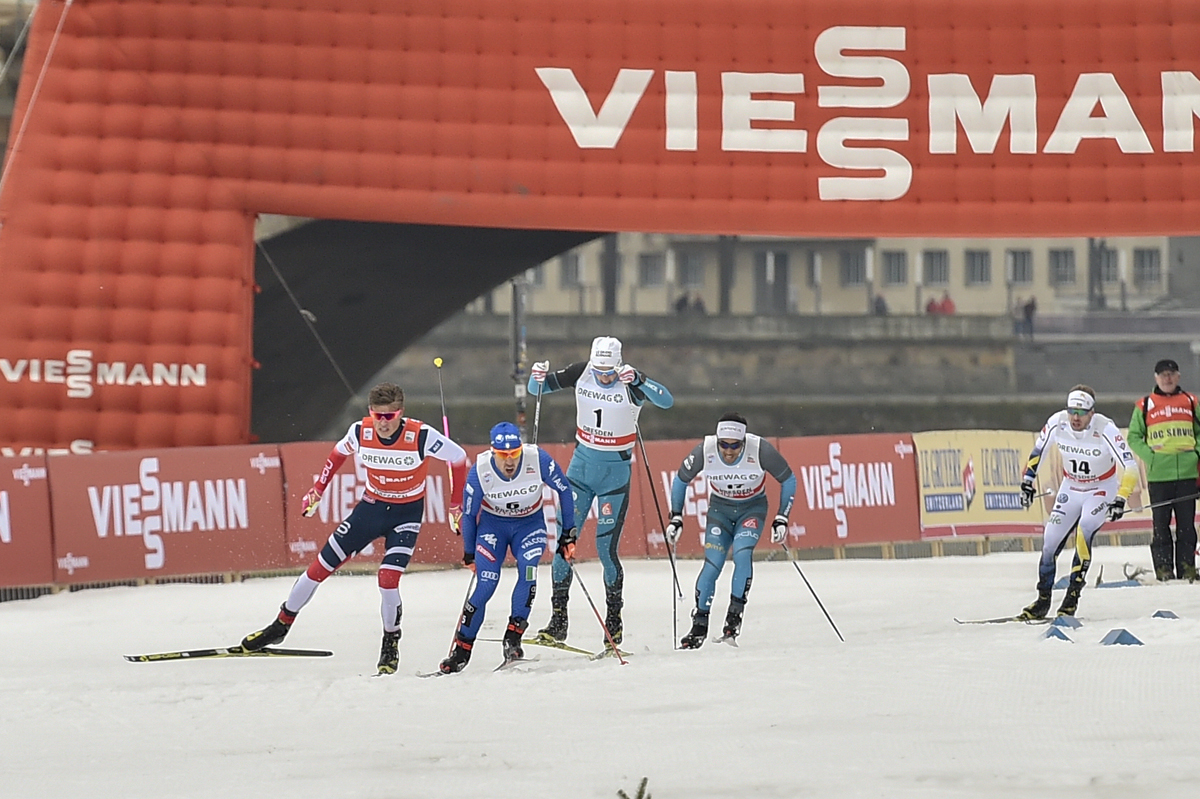
    Italy’s Federico Pellegrino (5) getting a ski tip ahead of Norway’s Johannes Høsflot Klæbo (l) for the men’s freestyle sprint final win on Saturday at the World Cup in Dresden, Germany. France’s Lucas Chanavat (1) placed third for the second-straight World Cup sprint, another Frenchman Richard Jouve (second from r) placed fourth, Sweden’s Emil Jönsson (second from l) was fifth, and Norway’s Even Northug (behind) took sixth after breaking a pole out of the start. (Photo: Fischer/Nordic Focus)

    How do you beat Norway’s Johannes Høsflot Klæbo at his competition-crushing game? Take him by surprise with minimal time to recover. Italy’s Federico Pellegrino did just that on the last uphill rise of the 1.2-kilometer sprint course on Saturday in Dresden, Germany.

    Dresden, a historic city in eastern Germany, debuted its brand-new course along the Elbe River on manmade snow amid damp conditions and temperatures above freezing throughout the day. Pellegrino had done what he needed to advance through the rounds, clocking the first-fastest time in the qualifier, 2.9 seconds behind France’s Lucas Chanavat in first, then placing second in his quarterfinal and third in the first semifinal. Klæbo won that semi by 0.16 seconds over Chanavat in second and 0.3 seconds ahead of Pellegrino in third. With a fast-enough time, Pellegrino moved on to the final, where he met the 21-year-old Klæbo again.

    “I knew that at the beginning of the race, I’m becoming a little bit old so the younger Klæbo and Chanavat were faster than me,” Pellegrino, 27, said of the final in a post-race interview with the International Ski Federation (FIS). “So I just had to wait, but I wanted to attack in the longer race to the finish line.”

    The race from his point of attack might have seemed like an eternity, but in actuality, it was about 500 meters before the finish. Klæbo and Chanavat had burst out of the start at lightning speed, skiing “shoulder to shoulder,” as Chanavat later said in a press conference, and slightly gapping the four skiers behind them — one of which was Pellegrino.

    While Klæbo pushed the pace up front, Pellegrino kept the two leaders close, skiing just a couple strides back. France’s second man in the final, Richard Jouve slotted into fourth behind him and Sweden’s Emil Jönsson — in his first final in a year — followed in fifth. Behind them, Norway’s Even Northug (Petter Northug’s 22-year-old brother) worked to fasten a new pole after breaking his on the starting gate. That took him out of the race from the gun.

    Chanavat attempted to get ahead of Klæbo on a tight righthand corner, but Klæbo held the inside line and his position. Coming out of that corner, Pellegrino latched on to Chanavat and brought the rest of the group with him. Shadowing the two leaders’ every move, Pellegrino accelerated just before the final rise, taking just three V2 pushes to get to the top.

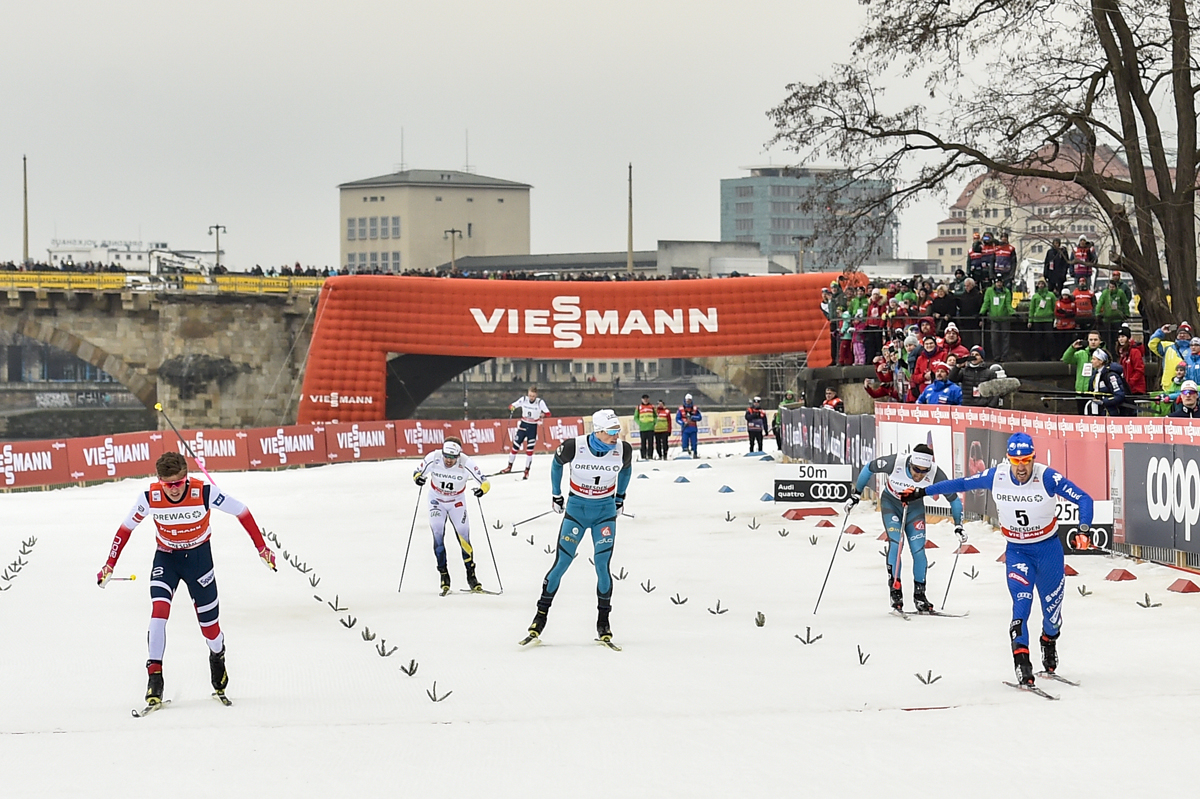
    Norway’s Johannes Høsflot Klæbo (l) and Italy’s Federico Pellegrino (second from l) jockey for position just before the finish of the men’s freestyle sprint final at the World Cup in Dresden, Germany, while France’s Lucas Chanavat (1) and Richard Jouve chase, followed by Sweden’s Emil Jönsson (14). (Photo: Fischer/NordicFocus)

    Even with Klæbo, the Italian took another push to move ahead and left Klæbo chasing. With about 75 meters to go, they began their all-out showdown to the finish, side by side, with Pellegrino staying just ahead to cross the line first in 1:52.77 minutes. Klæbo was just 0.18 seconds back in second and Chanavat 0.98 seconds behind in third.

    “When I will have grandchildren this will be the story I am going to tell them, that I beat Johannes,” Pellegrino said, according to a FIS press release.

    It was his first World Cup victory in nearly a year since winning a freestyle sprint in Falun, Sweden, late last January, and his 10th career individual World Cup win.

    “Klæbo is a really good guy because if he wanted to he could stop me,” Pellegrino told FIS. “… He tried to stay stay quiet to let me go … he’s really good to continue to win.”

    In the four sprints Klæbo’s contested this season, Saturday marked his first loss (he did not compete in the Tour de Ski, opting for a training block instead and racing at Norwegian nationals in Vang, Norway, where he won the classic sprint).

    “It was a tough one,” Klæbo said of Saturday’s final. “Me and Chanavat was trying to go pretty hard from the start of the final, and I think both of us went a little bit too hard. … I’m satisfied with second place here but I have to do something else to beat him next time.”

    Two seasons ago, Pellegrino was the overall Sprint World Cup champion. Last season, it was Klæbo as both the U23 and Sprint World Cup Champion.

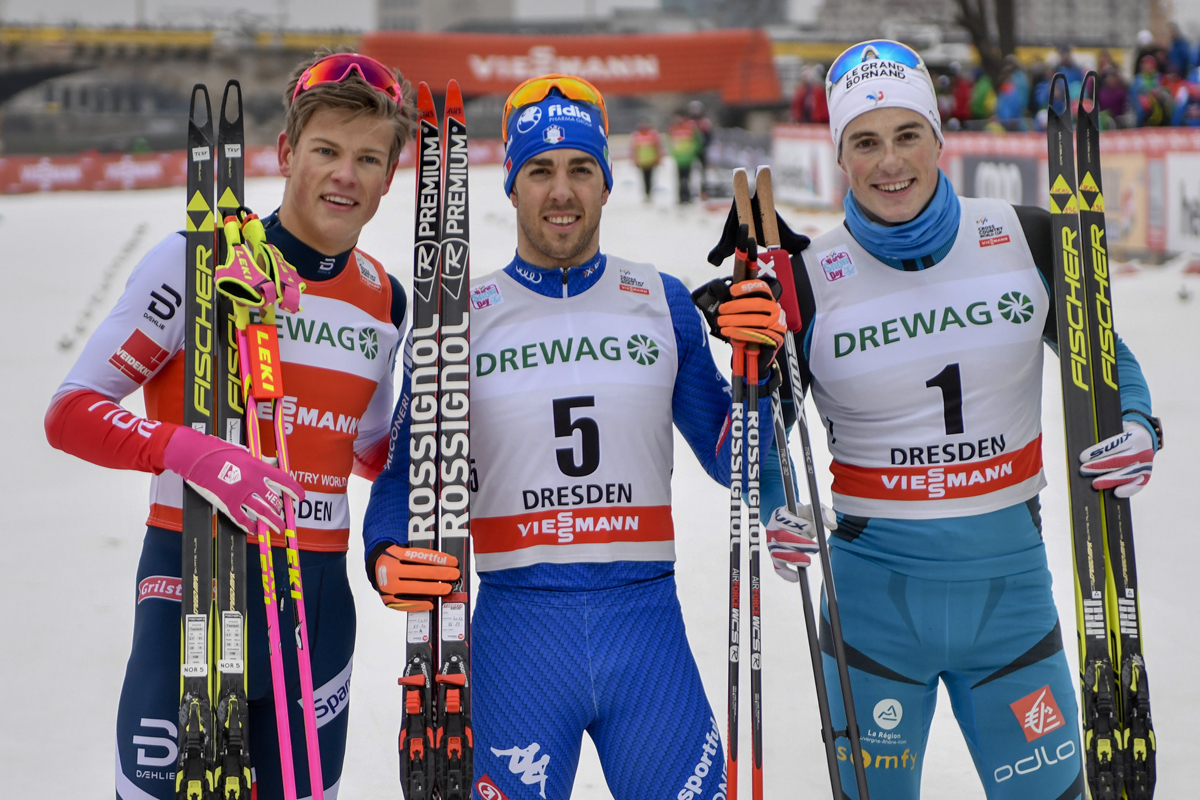
    The men’s freestyle sprint podium on Saturday at the World Cup in Dresden, Germany, with Italy’s Federico Pellegrino (c) in first, Norway’s Johannes Høsflot Klæbo (l) in second, and France’s Lucas Chanavat (r) in third. (Photo: Fischer/NordicFocus)

    “I always try to do my best; if the best means the victory it’s great,” Pellegrino said, according to FIS. “It was a really good show. I prefer courses with more hills. Yesterday I changed the way I was thinking about the race.”

    “He was clever,” Klæbo said in an interview with NRK. “He skied like this in the semi and quarterfinal. Our strategies differed slightly.”

    While Pellegrino kept himself in contention in the heats by skiing from behind, Klæbo did as he usually does, by leading with a pace few, if anyone else, could match. Klæbo qualified second, 0.15 seconds off Chanavat’s top qualifying time of 1:50.42, then won his quarterfinal by a clear-cut margin of 0.6 seconds over Switzerland’s Roman Schaad. Chanavat won his quarterfinal by 0.12 seconds over Pellegrino, then hung with Klæbo once again in the semifinal.

    At the last World Cup sprint in Lenzerheide, Switzerland, the first stage of the Tour de Ski, Chanavat placed third in the skate sprint.

    “I did my best and I competed to try to get the victory today, but I was a lot focused on Johannes,” Chanavat, 23, said at the press conference. “So I was surprised when Pellegrino came pretty strong on the side in the race.”

    He added that the gap between him and Klæbo is getting closer. “So I’ll try to keep it shorter,” Chanavat said.

    Jouve finished 0.25 seconds off the podium in fourth, 0.98 seconds behind Pellegrino, Jönsson finished fifth (+2.36), and Northug sixth (+12.04).

    Hamilton 10th, Locke 15th

    American Simi Hamilton made it to the semifinals and finished the day in 10th overall after placing fifth in the second semi, 0.38 seconds behind Jönsson in first. That heat ended in a three-way photo finish for first, which Jönsson took ahead of Northug (+0.01) and Jouve (+0.04). Those three men advanced to the final, but Hamilton and Norway’s fourth-place finisher in that semifinal, Pål Trøan Aune (+0.23) did not.

    American Simi Hamilton (front) leads Germany’s Sebastian Eisenlauer during their quarterfinal of the men’s 1.2 k freestyle sprint at the World Cup in Dresden, Germany. (Photo: Fischer/NordicFocus)

    Before that, Hamilton had qualified in 15th and finished second to Norway’s Fredrik Riseth in his quarterfinal.

    “It was a really cool venue, great course,” Hamilton told FasterSkier in person after the race. “But it was really tight the whole way around so it was hard. My starts aren’t that good right now and so my quarter, I was basically trying to start as fast as I could and I still was second or third out of the blocks, so I wasn’t feeling super confident after that.”

    Going into the semifinals, he decided not to worry about his start and concentrate on moving up later in the course.

    “What ended up happening around that corner, I just couldn’t get around anyone,” Hamilton recalled. “Every time you get an opportunity to make a move, it gets shut down almost immediately, so that was really frustrating, but I was happy with how my body is feeling right now, and it’s fun to get into the heats.

    “I am always way more comfortable skiing towards the back of the pack and then making a definite move somewhere on the course, so unfortunately for me like this course doesn’t favor doing that too well,” he continued. “You can’t afford to ski at the back and then pass four five people, not enough room or time.”

    He added that he enjoyed how different the Dresden course was in comparison to other, much hillier World Cup terrain.

    “I think the only super-short flat course we race like this was in Milan [Italy] years ago, so its fun just doing something different,” he said. “The crowd is awesome here.”

    U.S. Ski Team Head Coach Chris Grover observed that Hamilton was at a disadvantage trying to move up from behind on Dresden’s course.

    “He made it work in the quarterfinal,” Grover told FasterSkier. “He’s so good when he gets that opening to go. I think we saw in the semifinal that he would be starting to go and then get blocked. And again after the corner, started to go, and got blocked. And under the bridge, started to go, and then got blocked. It’s nobody’s fault, nobody obstructed him or anything like that, it’s just not a course with many passing options. The guys are so well-matched, in a semifinal or final it becomes that much harder. So he’s a little bit frustrated, but I think he’s in good shape.”

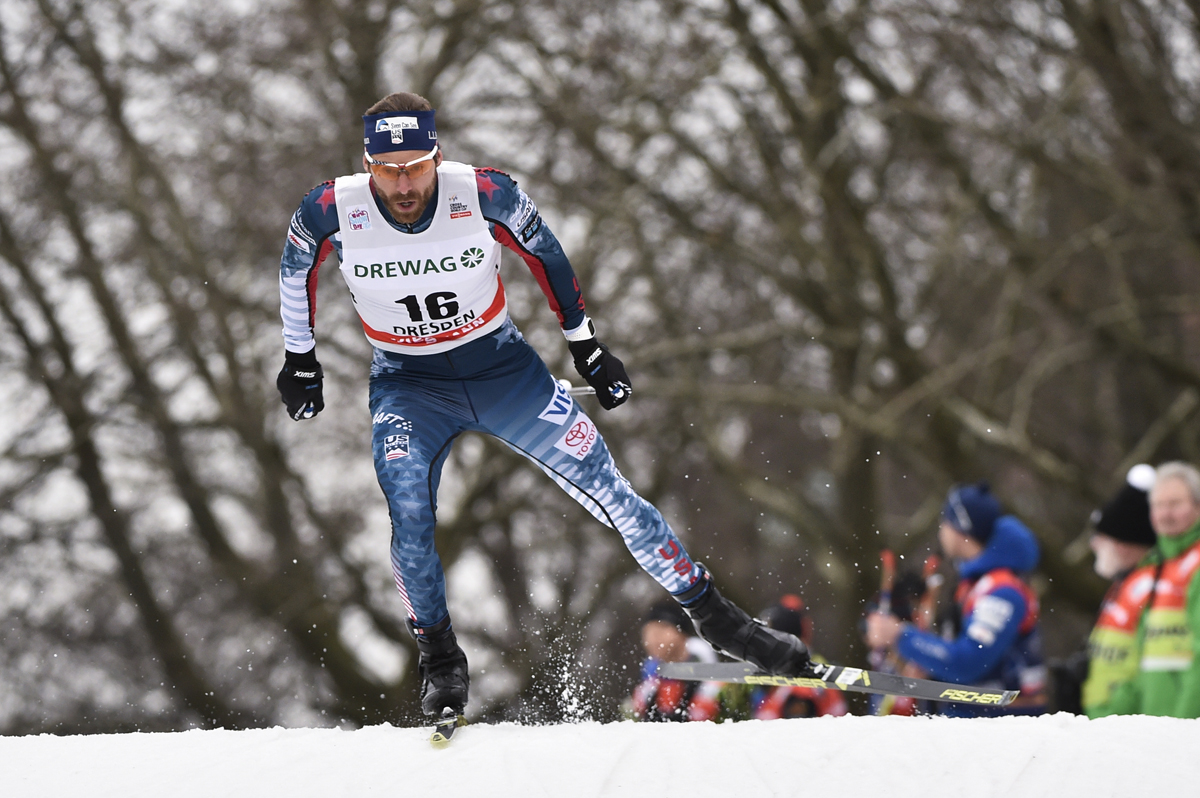
    Andy Newell (U.S. Ski Team) racing to 18th in the men’s freestyle sprint qualifier at the World Cup in Dresden, Germany. He went on to finish sixth in his quarterfinal for 27th overall. (Photo: Fischer/NordicFocus)

    Two Americans qualified for the heats in the top 30, with Andy Newell finishing 18th in that preliminary round, but Grover noted the U.S. team’s qualifiers overall were “uncharacteristically poor”.

    “To have Erik Bjornsen just miss the qualification, to have Kikkan [Randall] just miss the qualification, to have the four athletes who did go in not have the best qualifications, something was a little bit missing,” he said.

    (Bjornsen placed 32nd and Randall 34th in their respective men’s and women’s qualifiers. Bjornsen was 0.23 seconds out of 30th.)

    Newell’s run ended in the quarterfinal, after he initially took the lead, ahead of Canada’s Julien Locke, but slipped to sixth on the second half of the course.

    “Andy didn’t have the best start, but he got himself to first and he was able to take the best line,” Grover reflected.

    He wasn’t sure why Newell then dropped to the back of the group, and Newell wrote in an email that he wasn’t sure what happened, either.

    “Felt like I was able to accelerate to the front well but then managed to get swarmed before the last little bump and then it was extremely tough to pass before the finish,” Newell wrote. “I should know better than to let myself get stuck in the middle… on narrow tracks like this if you get stuck in the middle with guys on either side you can’t get a full push and thats how you get swarmed, bad tactics on my part.”

    “Tomorrow should be fun, fast, and wild,” he added of Sunday’s freestyle team sprint. “Hopefully I’ll be able to be more aggressive tomorrow 🙂 Looking forward to it.”

    Julien Locke (Canadian U25 Team/Black Jack) racing to 16th in the men’s freestyle sprint qualifier at the World Cup in Dresden, Germany. He went on to place third in his quarterfinal for 15th overall, his best World Cup result. (Photo: Cross Country Canada/NordicFocus)

    He finished his quarterfinal in sixth, 1.54 seconds behind Northug in first, for 27th overall. Meanwhile Locke hung with Northug and Jouve up front and finished third, 0.62 seconds out of first and just 0.18 seconds out of second.

    While second place in that heat would have put him in the semifinals, 15th overall was still a career best for Locke, of the Canadian U25 Team and Black Jack Ski Club. Last March at World Cup Finals in Quebec, he placed 20th in the freestyle sprint. And just over a week ago at the NorAm Olympic trials in Mont Sainte-Anne (MSA), Quebec, Locke, 24, won the classic sprint final, but missed out on a potential Olympic spot by one place after qualifying second (the tiebreaker) behind Russell Kennedy (Team R.A.D.).

    The individual top 30 was the second of Locke’s career. Fresh off of competing in Canada, he arrived in Dresden a day and a half ago.

    “… A little bit of a tight schedule, but body feels great, and super-fun course out there with all these spectators,” Locke told FasterSkier after. “And yeah, short, very short. It was close to 1.1 [kilometers] and definitely the shortest sprint race I have ever done.”

    “I was prepared to hit it hard here and I was hoping for sure to get into the heats and then get into the rounds,” he added. “I don’t like getting knocked out, but I am content with how today went.”

    Bob Thompson (NTDC Thunder Bay) racing to 50th in the men’s freestyle sprint qualifier at the World Cup in Dresden, Germany. (Photo: Fischer/NordicFocus)

    Three other Canadian men met the Cross Country Canada (CCC) selection criteria for Dresden, where Bob Thompson (NTDC Thunder Bay) finished 50th in the qualifier (+8.67), Dominique Moncion-Groulx (Alberta World Cup Academy) 59th (+9.99) and Antoine Briand (Pierre-Harvey National Training Centre) 60th (+10.12).

    (Note: CCC High Performance Director Thomas Holland explained in an email that Briand was added as the fourth man, based on the U23 selection list, after Kennedy had to relinquish his starts in Dresden due to illness.)

    For the U.S., Period 2 SuperTour leader Ben Lustgarten (Craftsbury Green Racing Project) finished 49th (+8.64) out of 67 men.

    “I thought I skied well — usually this stuff is my weakness,” Lustgarten said after. “It’s like icy and slushy so usually when it’s like that skate skiing, I get off balance, but I was like trying really hard to stay focused and ski big. I only got bogged down a little bit on the big hill, but … I was only nine seconds out of first, so I think that is really good. I am really happy with that.”

    The U.S. and Canada each have two teams entered for Sunday’s freestyle team sprint on the same course in Dresden, with Bjornsen and Hamilton (United States I), Newell and Lustgarten (U.S. II), Thompson and Locke (Canada I), and Briand and Moncoin-Groulx (Canada II).

    “It’s going to be wild out there,” Lustgarten said. “[The Dresden organizers] pulled it off; they had to shorten the course a little bit because they didn’t have enough snow … but it was good. It’s the shortest sprint I have ever done in my life by far.”

    Results: Men’s qualifier | Men’s heats

  • Saturday Rundown: Dresden, Ruhpolding, Kaiser Maximilian Lauf

    Saturday Rundown: Dresden, Ruhpolding, Kaiser Maximilian Lauf

    The women’s freestyle sprint podium on Saturday at the World Cup in Dresden, Germany, with Sweden’s Hanna Falk (c) and Maja Dahlqvist (l) in first and second, and American Sophie Caldwell (r) in third. (Photo: FIS Cross Country/Twitter)

    FIS Cross Country World Cup (Dresden, Germany): Freestyle sprints

    Women’s report

    Men’s report

    For her second-straight World Cup sprint, Sophie Caldwell of the U.S. Ski Team reached the podium in the women’s 1.2-kilometer freestyle sprint on Saturday in Dresden, Germany.

    Caldwell placed third in the final behind Sweden’s Hanna Falk, who won it in 2:11.02 minutes, and Maja Dahlqvist, also of Sweden, who placed second (+0.23). Caldwell and Dahlqvist both lunged in a photo finish for second, which Dahlqvist took by 0.07 seconds.

    Also in the final, which included four Swedes, Switzerland’s Laurien van der Graaff finished fourth (+0.58), and Sweden’s Anna Dyvik followed in fifth (+0.68) and Stina Nilsson sixth (+7.56) after tripping.

    Falk started the day by winning the women’s qualifier in 2:06.34, by just 0.02 seconds over Nilsson in second. Caldwell qualified 11th (+2.02). and another American Ida Sargent made it into the heats in 14th (+2.44). Kikkan Randall missed the top 30 by 0.6 seconds in 34th (+6.57), Julia Kern placed 38th (+7.78), and Caitlin Patterson, of the Craftsbury Green Racing Project (CGRP), was 40th (+8.56) out of 49 women in the qualifying round.

    Sargent finished fourth in her quarterfinal, 043 seconds behind Sweden’s Ida Ingemarsdotter in first, to finish the day in 17th overall.

    For Caldwell, who went on to advance in second in her quarterfinal and third in her semifinal, the podium came after she finished second in the last World Cup skate sprint (the first stage of the Tour de Ski) on Dec. 31 in Lenzerheide, Switzerland.

    Her boyfriend and fellow U.S. Ski Team member Simi Hamilton came close to reaching the men’s 1.2 k sprint final on Saturday after qualifying in 15th then placing second in his quarterfinal and fifth in the second semifinal, 0.38 seconds behind Sweden’s Emil Jönsson in first.

    France’s Lucas Chanavat won the qualifier in 1:50.42, 0.15 seconds ahead of Norway’s Johannes Høsflot Klæbo in second. Hamilton was 4.32 seconds back in the qualifier, and his U.S. teammate Andy Newell also qualified in 18th (+4.91). Erik Bjornsen missed qualifying by 0.23 seconds in 32nd (+6.15) and Ben Lustgarten (CGRP) finished 49th (+8.64) out of 67 men.

    The women’s freestyle sprint podium on Saturday at the World Cup in Dresden, Germany, with Italy’s Federico Pellegrino (c) in first, Norway’s Johannes Høsflot Klæbo (l) in second, and France’s Lucas Chanavat (r) in third. (Photo: FIS Cross Country/Twitter)

    While Hamilton’s day ended in the semifinals, putting him 10th overall (and Newell finished sixth in his quarterfinal to place 27th overall), Italy’s Federico Pellegrino timed his attack perfectly in the final, challenging Klæbo for the win down the finishing stretch. The Italian took it by 0.18 seconds in 1:52.77, Klæbo placed second and Chanavat third (+0.98).

    France and Norway had two men in the final, with France’s Richard Jouve placing fourth (+1.23), Sweden’s Jönsson taking fifth (+2.36) for his best individual World Cup result since December 2016. Norway’s Even Northug finished sixth (+12.04) after breaking his pole out of the start.

    Canada’s Julien Locke of the National U25 Team and Black Jack Ski Club had a career-best day, finishing 15th overall. He qualified 16th (+4.61) then placed third in his quarterfinal, crossing the line just 1 second behind Norway’s Fredrik Riseth, who won that heat. Hamilton was second in that quarterfinal, 0.67 seconds back.

    Also for Canada, Bob Thompson (NTDC Thunder Bay) finished 50th in the qualifier (+8.67), Dominique Moncion-Groulx (Alberta World Cup Academy) was 59th (+9.99) and Antoine Briand (Pierre-Harvey National Training Centre) 60th (+10.12).

    Results:

    Women’s qualifier | Women’s heats

    Men’s qualifier | Men’s heats

    ***

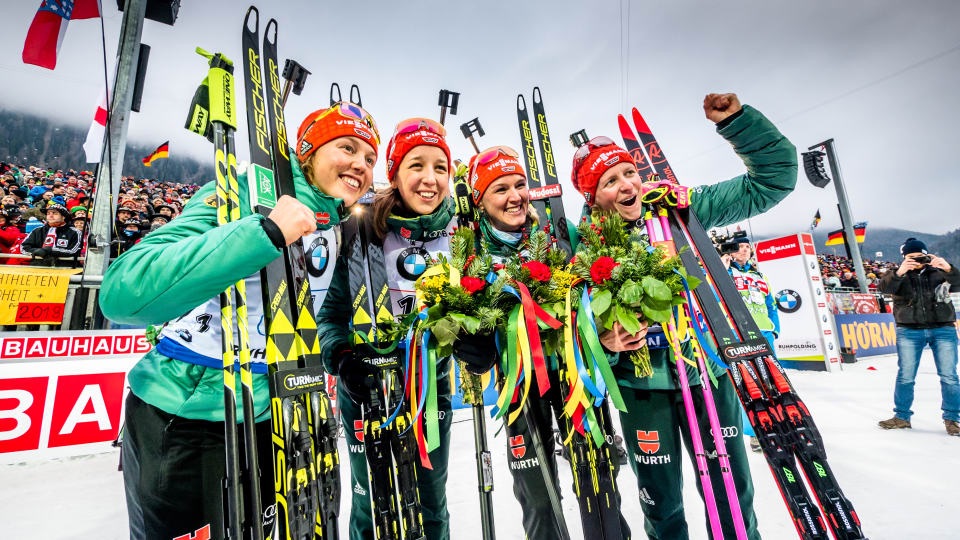
    Germany’s Laura Dahlmeier, Franziska Preuss, Denise Herrmann and Franziska Hildebrand (left to right) celebrating their win in the women’s 4×6-kilometer relay at the 2018 IBU World Cup in Ruhpolding, Germany. (Photo: IBU/Biathlonworld)

    IBU World Cup (Ruhpolding, Germany): Women’s relay

    The teams from Germany and Italy dueled for the top position all race in Saturday’s 4 x 6-kilometer women’s relay at the IBU World Cup in Ruhpolding, Germany. Cheered on by some 20,000 home-crowd fans, Germany’s anchor Laura Dahlmeier stayed on the ski tails of Italy’s Federica Sanfilippo after the last shooting stage, then passed her before the last major climb and held a narrow lead around the rest of the course to cross the finish line first in a time of 1:08:47.0 hours, with Italy 2.9 seconds behind. German had a team total of zero penalties and nine spares.

    “It’s incredibly fun to win in front of this audience here today,” Dahlmeier told German broadcaster ZDF in an interview right after the race, according to a translation. “I think this will boost our whole team morale. We showed today that we are a team to be reckoned with in relays. It was just a nice race.”

    Germany with Franziska Preuss, Denise Herrmann, Franziska Hildebrand, and Dahlmeier was never more than 30 seconds behind the pace, even though Hildebrand temporarily fell back from leading the field to tagging off to Dahlmeier in fourth position.

    “My race held all kinds of surprises today,” Hildebrand told ZDF with a laugh. “It started with a fall on an icy patch 100 meters after it began… Then I dropped my pole, also had to exchange the replacement one, and then three spares [in prone] to avoid the penalty. Today everything conspired in my race.”

    Italy with Lisa Vittozzi, Dorothea Wierer (coming off a victory in the individual race on Thursday), Nicole Gontier and Sanfilippo had the best shooting performance of the day, with no penalty and just three spares.

    “That last loop with Laura was really tough,” Sanfilippo said in the press conference. “I gave my best, I tried all for my team. I knew that I can be strong on the last loop. I tried to attack, but Laura was a little bit stronger. But I am also really happy that we finished in second place, I think that was really important for our team.”

    Sweden with Linn Persson, Mona Brorsson, Anna Magnusson and anchor Jenny Öberg was third, 17.2 seconds back, with no penalty and five spares. Brorsson and Öberg managed to move the team up to the podium positions, for the second one in a row following a third place from Oberhof, Germany, a week ago. Before that, the Swedish women’s team had been on a six-year hiatus from those lofty positions.

    “It’s cool to be on the podium again,” Persson said in the press conference.

    “This is like our second home and there were a lot of Swedes here, so we had big support during the race on the tracks,” Brorsson added.” That was an advantage for us.”

    Just a few seconds off the podium, Norway with Synnøve Solemdal, Tiril Eckhoff, Ingrid Landmark Tandrevold and Marte Olsbu was fourth (+23.1, with no penalty and nine spares), with Olsbu outsprinting Poland’s anchor Weronika Nowakowska on the finish stretch (+24.5, with no penalty and five spares). For both teams it was their best relay result of the season so far.

    Switzerland with the three sisters Elisa, Selina and Aita Gasparin reinforced by Lena Häcki surprisingly led the race at the third exchange after Selina had moved them in front, but her youngest sister Aita could not hold that position, falling back with a penalty lap in the last standing stage to finish eighth (+1:37.1, with one penalty and 11 spares).

    Biathlon Canada’s team of Emma Lunder, Julia Ransom, Sarah Beaudry, and Rosanna Crawford started the race with a setback after Lunder incurred a penalty in her prone stage, leaving the range in 23rd position at the end of the field and already almost a minute behind the leader. She managed to limit the gap with a clean standing stage to exchange still in 23rd position and 1:47 back.

    Taking over Ransom then remained clean in both stages to move the team up to 17th, tagging off 2:14 behind. Beaudry only required one spare in her prone stage (0+1, 0+0) to improve to the 12th position even making up 3 seconds to the leaders.

    Then Crawford, fresh off her first career podium in the individual race on Thursday, managed to also shoot clean in both stages and overtook the teams from Slovakia and Ukraine while further decreasing the gap to finish the race in 10th position, 1:56.7 back, with one penalty and just four spares.

    “Things were a bit softer and slushy today compared to the individual, but nothing too bad,” Crawford commented on the conditions in an email to FasterSkier. “There was quite a bit of wind on the range, which I think was tricking people, the wind flags weren’t showing much but I had to make 6 left correction during zero [target practice].”

    “Today was a solid showing from our team,” she added regarding their result. “Everyone cleaned standing, I think we can be really happy of this race, and take some real confidence going into the Olympic relay.”

    Previously this season Canada had finished the relay in Oberhof, also Germany, in 14th position, and the first one in Hochfilzen, Austria, in ninth.

    For US Biathlon with Susan Dunklee, Clare Egan, Emily Dreissigacker, and Joanne Reid, it was the first women’s relay of the year after missing out on the first two races of the season in this discipline.

    Thus starting at the very end of the field, veteran Dunklee moved up through the pack and got through the prone stage with one spare. But then she had to fight against a penalty lap in her standing stage requiring all three spare rounds, leaving the range in 12th position. With the fastest course time on the opening leg, she managed to slightly decrease the gap to 21.6 seconds and made up three positions to exchange in ninth place.

    Egan missed the first two shots in her prone stage, but hit the targets with her spares leaving the range over a minute back. She followed that up by cleaning her standing stage and left the range 1:29.5 back, then only lost five more seconds on the last loop to exchange in 14th.

    Dreissigacker also needed just one spare in her prone shooting, but then incurred two penalties in her standing stage, doubling the gap and falling back to 19th position at the exchange and 3:51 back.

    Anchor Reid needed three spares on her leg (0+2, 0+1) and managed to still overtake the teams from China and Finland to finish 17th, 4:57.7 behind Germany, with two penalties and 13 spares overall.

    “Finally we had a full team and raced a relay!” Dunklee wrote on Instagram. “Competing on a foreign continent has its challenges.”

    Results

    ***

    Ski Classics (Seefeld, Austria): 60 k Kaiser Maximilian Lauf

    The men’s podium at the Kaiser Maximilian Lauf 60 k Ski Classics marathon in Seefeld, Austria, with Norway’s Tord Asle Gjerdalen (c) in first, Sweden’s Andreas Holmberg (l) second, and Russia’s Ilya Chernousov (r) third. (Photo: Visma Ski Classics)

    At the third Ski Classics event of the 2017/2018 season, the 60-kilometer Kaiser Maximilian Lauf on Saturday in Seefeld, Sweden’s Britta Johansson Norgren (Lager 157 Ski Team) and Norway’s Tord Asle Gjerdalen (Team Santander) took the women’s and men’s victories, respectively.

    Johansson Norgren and Japan’s Masako Ishida (Team Koteng) broke away shortly after the start. The two went back and forth for a while until Johannson Norgren gapped Ishida in the Leutasch valley. While Ishida was caught by a chase pack with Sara Lindborg (Team Serneke), Kari Vikhagen Gjeitnes (Santander) and Lina Korsgren (Åre Ski Team), she reined Johansson Norgren back in on the long climbs after the valley. Ultimately, Johansson Norgren took the win in 2:49:16.0 hours, while Lindborg claimed second, 37.5 seconds back. Ishida finished third (+58.9), Gjeitnes placed fourth (+1:40.7) after injuring her ankle about 2 k before the finish, and Korsgren fifth (+2:05.1).

    The women’s podium at the Kaiser Maximilian Lauf 60 k Ski Classics marathon in Seefeld, Austria, with Sweden’s Britta Johansson Norgren (c) in first, Sweden’s Sara Lindborg (l) second, and Japan’s Masako Ishida (r) third. (Photo: Visma Ski Classics)

    “It was my plan to go full speed from the beginning,” Johansson Norgren said, according to a Ski Classics press release. “I knew Ishida will go fast in the climbs, but I felt strong from the beginning. It was really hard skiing alone in the valley, and when Ishida caught me up, I wasn’t sure if I could win the race. But the last part of the course was perfect for me and I had no problems securing the victory today.”

    The Leutasch valley was the turning point of the men’s race as well, where Vinjar Skogsholm (Team Parkettpartner) and Andreas Holmberg (Team Serneke) broke away from the pack and had built a 90-second gap on the chase group as they left the valley. There on the first climb out of the valley, Holmberg pushed the pace and dropped Skogsholm, while Gjerdalen and Ilya Chernousov (Bauer Ski Team) worked to catch Holmberg up front. They caught him 3 k before the finish and Gjerdalen was first across the finish line in 2:27:49 hours, 14.8 seconds ahead of Holmberg in second.

    Chernousov finished third (+32.0), Ermil Vokuev (Russian Marathon Team) was fourth (+1:07.6), and Anton Karlsson (Lager 157) fifth (+1:08.2).

    “I didn’t like the fact that we gave too much leeway for Holmberg and Skogsholm,” Gjerdalen said, according to the press release. “I’m happy that Ilya helped me in our attempt to catch up with Holmberg, but I wasn’t really sure if we were going to make it. You never know how the other person is feeling in the front, what kind of skis he has and what goes on in his mind. But I managed to win today and it feels great to be back on the top.”

    In the overall “Champion” standings, Nordgren leads with 450 points, 110 ahead of Lindborg in second. Gjerdalen is first in the men’s champion standings with 330 points, 50 points ahead of Morten Eide Pedersen in second.

    The Ski Classics tour moves to Zuoz, Switzerland, next weekend for the 65 k La Diagonela.

    Results