From the FasterSkier archive — posts syndicated from athletes’ and coaches’ own blogs between 2004 and 2012, kept online as published. Current coverage is at fasterskier.com.

Tag: Drew Goldsack

  • Goldsack Hangs Up Skis, Headed to Miami

    Goldsack Hangs Up Skis, Headed to Miami

    Drew Goldsack laughs when he thinks about his elementary school days in Alberta, when Royal Canadian Mounted Police officers would come to class and proclaim that they hadn’t drawn their gun in 30 years.

    A couple of decades later, Goldsack, who retired from skiing on Wednesday at age 30, saw a different side of law enforcement firsthand while visiting Miami. With a new career on the horizon, he’ll likely see more of southern Florida.

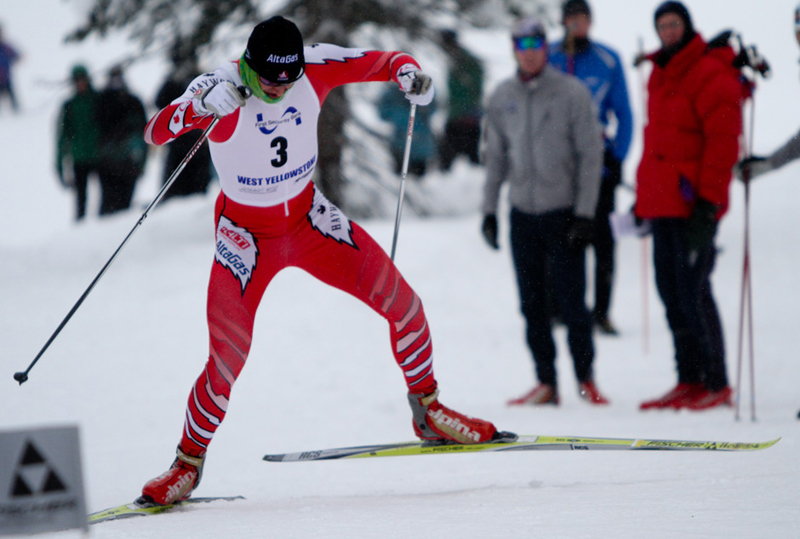
    Drew Goldsack starting out the 10 k classic interval start at Canadian Ski Nationals on March 19 in Mont Sainte-Anne, Quebec. Goldsack went on to place 14th and had a best result of seventh at this year’s nationals in the skate sprint.

    The two-time Olympian and former Canadian National Ski Team member witnessed a day-in-the-life of the Miami PD through a longtime friend and cop, Bill Erfurth, who was a technical advisor for Bad Boys II. Before Erfurth retired from the police force and fully committed to filmmaking, he invited Goldsack on some of his shifts.

    “The first time I rode along with Bill, I was in the car with him for like 10 minutes and he already had his gun drawn and was tackling guys in the streets,” Goldsack said in a phone interview from Canmore, Alberta. “It was just chaos. It was a little bit different world, that’s for sure.”

    It was entirely unlike his experiences in Canmore, where Goldsack, who turns 31 in August, spent most of his years skiing and training with the Rocky Mountain Racers. A year after graduating high school, he made the junior-national team, and by 2002, was racing with the big dogs on the national squad.

    Goldsack spent more than a decade competing at the international level, making it to three World Championships and two Olympics, and tallied several top-10s on the world circuit. In December, he notched a personal-best World Cup result of fifth in the team sprint with Lenny Valjas. Just over a month later, he crashed in a NorAm sprint final, suffering a concussion and shoulder injury.

    With his rotator cuff still plaguing him this spring, Goldsack decided to reevaluate his career. He hadn’t really considered retiring until then, but his inability to train at full strength paired with the fact that he was losing his carded status in Canada – and the money that went with it – made him weigh his options.

    “It’s been a tough decision,” he said. “Even the last race of the season, I was still thinking I was going to race this year, but it’s been a lot of small things.”

    Whistler, crash, NorAm
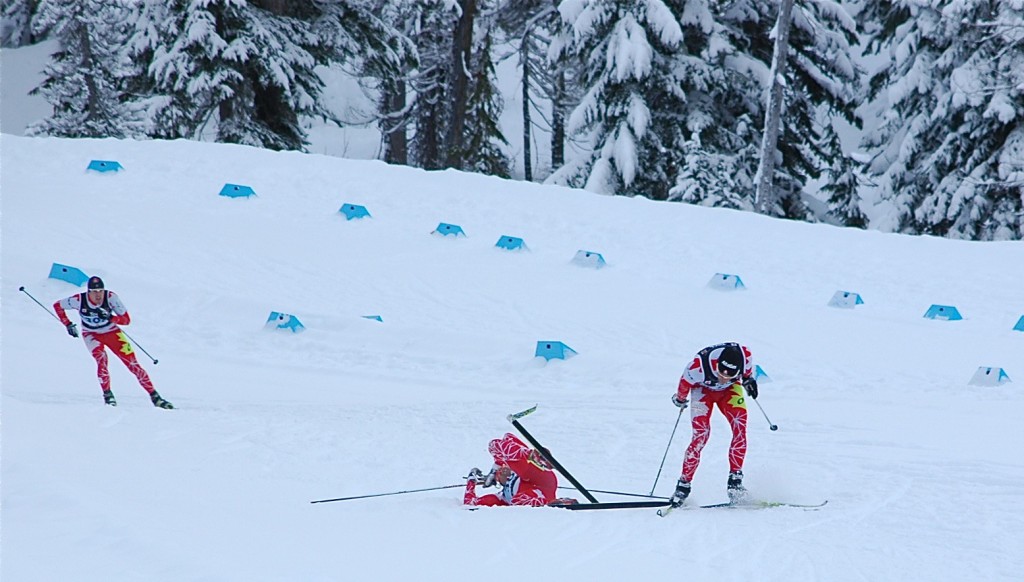
    Goldsack (c) after hard crash just before the finish of the NorAm freestyle sprints in Whistler, British Columbia, on Jan. 14. He broke his ski, suffered a mild concussion and pulled his rotator cuff, and was sidelined for nearly three weeks. (Photo courtesy of Angus Cockney)

    A Senior Development Team member last year, Goldsack needed to jump up to the international level this season to remain carded and continue receiving funding. Allowed about 10 years to do so, a few of which Goldsack spent at the top tier before foot surgery in 2009 bumped him back down, he simply ran out of time.

    “It’s a little bit ironic that this year was actually one of my best results ever with the fifth place in the World Cup in Dusseldorf with Len,” he said. “It’s a nice way to leave things, but it’s weird to think about because it’s also the year that I decided to retire, so it’s mixed feelings leaving that behind.”

    While Goldsack contemplated his future, Erfurth, who regularly visits Canmore, offered to make him an associate producer of his Miami-based company, Modern City Entertainment. Goldsack had been joining conference calls for the last month and a half to test the waters, and decided now was as good a time as any to accept.

    “It was a really good opportunity and something that I felt that may not necessarily be there in a year’s time so I decided to jump at it,” he said.

    On Monday, Goldsack leaves for Miami for a few weeks, and this fall, his name will be on a new documentary, Heroes Behind the Badge, which sheds light on the lives of U.S. law-enforcement officers. He described the project as powerful and said his ride-along experiences with Erfurth were what connected him to it.

    “It’s almost impossible for me to explain to someone, especially someone from Canada, what it was that he did on a daily basis,” Goldsack said. “He actually worked on the [2003] movie Bad Boys II with Jerry Bruckheimer and Michael Bay …  A lot of that movie is based on Bill’s unit, TNT, which is the Tactical Narcotics Team. They use that name in the movie and it seems like, that’s Hollywood, those are crazy stories, but a lot of it is based very closely on fact and truth and things that actually happened.”

    According to Goldsack, Erfurth also worked with Bruckheimer on the T.V. series, CSI Miami, and started a company of his own a few years ago. He has since produced two feature-length films, one of which is called Canvas and stars Joe Pantoliano from The Sopranos and Academy Award winner Marcia Gay Harden.

    While Goldsack is excited about working in the film industry – and continuing to live mainly in Canmore while doing so – he was also dabbling in business as an assistant distributor for Stoneham Ski Apparel. He agreed to help his friend and former teammate, Dave Nighbor, expand the brand in Canada and will be heading the company’s efforts out West.

    For Goldsack, it was a great way to stay involved with the ski community. Describing the product as “edgy and cool,” he said Stoneham already had clothing and headwear contracts, respectively, with the Alberta World Cup Academy and Alpine Canada.

    “It’s funny because I think a lot of people have plans for their future, but also growing up as a skier and athlete, you learn pretty quick that it’s almost impossible to plan for your future, definitively anyways,” Goldsack said.

    At this point, he was interested in learning more about producing movies and might consider going back to school to study something related. Or he might not, he said.

    “I think I’m kind of the attitude of seeing what happens, see where things go,” Goldsack said.

    While he wasn’t interested in coaching professionally, he envisioned himself helping as a volunteer, especially at local ski clubs. Regardless, he plans to stay involved with the sport in some capacity because that’s where most of his friends are.

    “It seems like it was yesterday when I was new to the team and with the original group with Devon [Kershaw] and George [Grey] and Chris [Jeffries] and those guys,” Goldsack said. “It’s pretty crazy that’s it’s been over 10 years now with the national team. It’s sad too. It’s hard to think about moving on and not being with the team.”

    Regardless, nothing will detract from his memories on the World Cup, at two Olympics and with the national team.

    “Being at a home Olympics [in Vancouver] is something I’ll certainly never forget,” he said. “Just the support from the home crowd and being a part of the energy and excitement of the Olympic team that was the best Olympic team ever for Canada, those are memories that I’ll have forever.

    “All the good times with my teammates are the big ones,” he added. “Results are good memories, but I think a lot of my best memories are all the laughs we’ve had and just the times hanging out on the road.”
  • After Concussion, Goldsack Ready for Another Shot

    After Concussion, Goldsack Ready for Another Shot

    Whistler, crash, NorAm
    Drew Goldsack (center) after hard crash just before the finish of the NorAm freestyle sprints in Whistler, British Columbia, on Jan. 14. He broke his ski, suffered a mild concussion and pulled his rotator cuff, and was sidelined for nearly three weeks. Photo courtesy of Angus Cockney.

    When you start skiing at 5 and stay in the game for 25 years, odds are you’re bound to experience injury. Two-time Olympian Drew Goldsack has seen his share of setbacks, including a serious foot injury that required surgery in 2009.

    Seven or eight years ago, the Canadian Senior Development Team member said he crashed particularly hard on his mountain bike, hitting his head and blacking out on the spot. Goldsack eventually came to and realized he had a concussion, and while he felt fine, he never regained memory of several hours after the incident.

    That crash aside, Goldsack’s tumble nearly three weeks ago in Whistler, British Columbia, was worse. In his second day back on the NorAm circuit after racing World Cups and battling sickness over the holidays, the 30-year-old was primed for the freestyle sprint. He put down the third-fastest qualifying team and rolled to the A-final, where all went well until the last stretch.

    Coming off the final downhill in incredibly soft and snowy conditions, Goldsack felt another skier fall beside him. Before he knew what was happening, Goldsack said he cartwheeled several times and believed he landed on his back. His head smacked the ground and right shoulder jerked back under his body weight, and he suddenly sat up, dazed and confused. Looking down, he realized his favorite skis were ruined with one completely shattered above the binding.

    “Some people in the stadium said they could actually hear the impact of me hitting the ground,” Goldsack said in a phone interview from Ottawa. “So not a typical cross-country crash, that’s for sure.”

    Drew Goldsack (l) chases fellow Senior Development Team member Brent McMurtry (center) and Phil Widmer of the Alberta World Cup Academy in the NorAm freestyle sprint at Whistler, British Columbia, on Jan. 14. Photo courtesy of Angus Cockney.

    Frustrated with the situation on the whole – Goldsack had been trying to win the sprint for a trip back to Europe  – the sixth-place finisher carried on with his afternoon. He figured his adrenaline must have numbed the effects of the fall, the hardest one he had experienced in a ski race.

    “It wasn’t until I got back to the hotel that I started feeling really tired and had a bad headache that I starting realizing how bad it was,” he said.

    Doctors determined he had a mild concussion, and for a week, Goldsack stayed off his skis. On Wednesday, two days before he was set to resume racing at the NorAm mini tour in Cantley, Quebec, the Alberta native completed his first hard intensity workout since the crash.

    It wasn’t long, but he felt good, and most importantly, showed no symptoms. Team doctors had closely monitored his recovery, making him scale back when he experienced dizzy spells to ensure he was 100 percent in training. Once in a while, Goldsack said he felt off balance and especially car sick, but it didn’t happen while skiing.

    As far as he could tell, the only thing holding him back for the upcoming mini tour was his shoulder. After his headaches eased, Goldsack realized the severity of his shoulder injury. He had pulled his rotator cuff and likely bruised the cartilage around it.

    “Of course I went skiing right away after the crash,” he said. “That’s been also part of the concern. Nothing’s torn so I’m going to tough that out.”

    On Friday, the Rocky Mountain Racers skier will put his body to the test in the freestyle sprints at the Eastern Canadian Championships. After missing the Western Canadian Championships in Canmore, Alberta, Goldsack said he was mostly expecting a solid race effort.

    “I’m hoping I can get in at least a good sprint,” he said. “It would be nice to start things off with a good race and a good result.”

    Two months ago, Goldsack hit a career high, placing fifth in the team sprint with fellow Canadian Lenny Valjas in Düsseldorf, Germany. He returned home to Canmore almost immediately after and planned to race the NorAm opener at Sovereign Lake in British Columbia, but came down sick.

    He spent two weeks recovering at the end of December and said it wasn’t a bad thing. Heading into the third set of NorAm races in Whistler, he was at full strength and hoping to make the Canadian OPA/Scandinavian Cup tours and contend for the NorAm sprint lead.

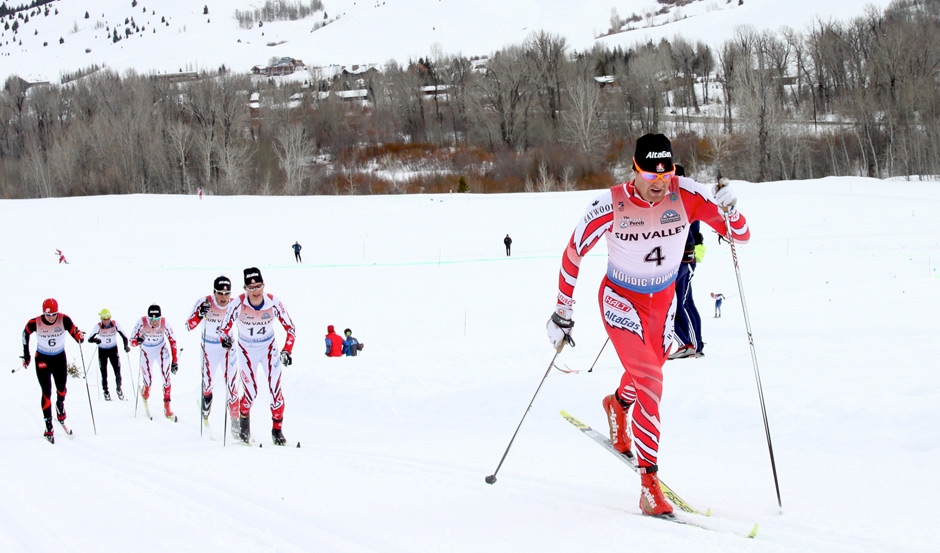
    Goldsack on the attack in the 15 k mass start at the 2011 SuperTour Finals in Sun Valley, where he placed second.

    “It was a good opportunity to get back over to Europe for racing,” he said. “It’s crazy how fast things change.”

    Driven to continue racing by numerous World Cup experiences, especially his most recent, Goldsack said it was becoming increasingly hard to deal with injuries, sicknesses and setbacks later in his career. Over the years, he faced a variety of obstacles, many of which were out of his control. They were always hard to take, he said.

    “It’s tougher now because I feel like I’m coming to the end of my career,” he said. “It’s the question that you ask yourself, ‘How much longer do you keep going?’ At this point, I enjoy racing and still have the desire to train and race so see how things go. I’m used to dealing with adversity; as you get later in your career it gets harder to justify what you’re doing.”

    So far, this season has proved particularly trying for Goldsack.

    “It’s been a real rough season for me,” he said. “I don’t really know what to think of it because on one hand I’ve had a personal-best season on the World Cup and on the other it’s been a disaster.

    “Things were getting better and heading in the right direction and this has been setback after setback,” he added. “A lot of it’s been soul searching. Every cliché in the book has been thrown my way from coaches and friends.”

    A high-level racer for the last 12 years, he heard most of them before. Regardless, Goldsack hoped for a bright spot in the season or rebound of some sort. At the very least, he’d love to get his broken ski fixed. He sent a photo to Fischer to see if it could be salvaged and was waiting to hear back.

    “That was almost the hardest thing to take,” Goldsack said of realizing the damage to his skis, which carried him to numerous NorAm podiums over the last four or five years. “[They were] the skis I wore in Düsseldorf and the skis I probably skied on 90 percent of the time so they’ll be tough to replace.”

  • Close But Not Enough as Newell, Kershaw Eliminated in Quarterfinals

    Close But Not Enough as Newell, Kershaw Eliminated in Quarterfinals

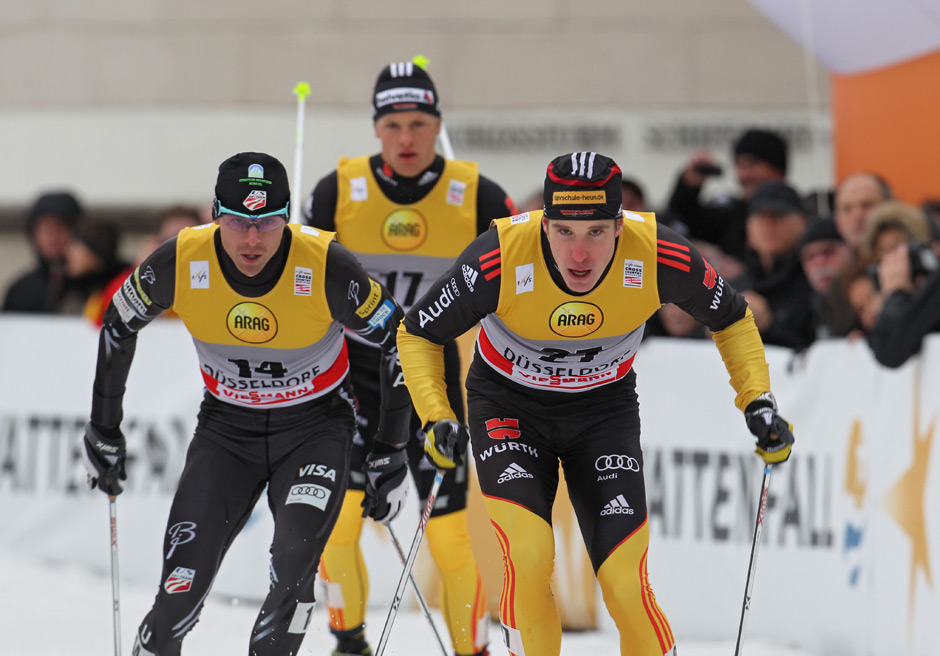
    Andy Newell (USA) follows Daniel Huen (GER) in the quarterfinals. (Photo: Fischer/NordicFocus)

    It was a big day for the two North American teams in Dusseldorf, Germany, with Kikkan Randall taking the victory for the United States, and Chandra Crawford just missing out on the podium and finishing fourth for Canada.

    There was plenty of other action out there for ski fans from the west side of the Atlantic. In addition to Randall and Crawford, nine North American skiers took to the streets of Dusseldorf for the fast and furious skate sprint qualifier.

    On the men’s side veterans Andy Newell (USA) and Devon Kershaw (CAN) both qualified for the heats, with Newell in 14th and Kershaw just behind in 15th.

    Newell was 3.64 seconds behind top-qualifier Paal Golberg (NOR) with Kershaw just .08 seconds behind the American.

    “I felt decent today and was comfortable in qualification, feeling like I was going fast enough but also controlled, and recovered well afterward,” Newell wrote to FasterSkier in an email following the race.

    Newell described the course as “slower in some places, faster in others,” and overall, “fun.”

    After qualification, Kershaw told FasterSkier that he felt good “which was a surprise.” Kershaw had been in Livigno, Italy, training “a ton,” and flew in the night before the race.

    The weather was blustery and rainy, “kinda gnarly,” according to Newell. But the American sprinter said it cleared a little as the heats got under way, and “the snow got real fast.”

    Newell matched up with eventual silver medalist for the day Alexei Petukhov (RUS), Norwegians Anders Gloerrsen and Tomas Northug as well as two lesser-known Germans.

    Potential disaster struck on the lone hill on the first lap of the two-lap race. Another skier stepped on Newell’s pole, snapping the shaft. But the speed dropped as the group moved into one of the hairpin corners, allowing Newell to quickly get a replacement pole without losing much ground.

    He wasted no time in aggressively moving back up into second, and tailed Petukhov down into the lanes for the final sprint. The Russian was well in control, but Northug sat right on Newell’s heels and the two staged a drag race to advance. Northug got the upper hand with a lung at the line, besting Newell in a photo finish.

    While Newell was obviously disappointed not to advance, he was pleased with his skiing and fitness.

    “The good new is that I felt pretty comfortable and fast today, it just didn’t work out,” he said.

    Last season, Newell struggled to advance out of the quarterfinals. In two sprints this year, the end result has been the same, but both times he has missed out by mere inches, and has looked strong throughout the races.

    Newell ended up 16th on the day.

    Newell moves into second behind eventual second place finisher Alexei Petukhov (RUS) in the quarterfinals. (Photo: Fischer/NordicFocus)

    Kershaw couldn’t pass up the opportunity to mix it up on the banks of the Rhine, and the chance to grab some World Cup points. Most of the top distance skiers skipped the weekend in order to train.

    In the third heat with Teodor Peterson (SWE), the winner of last weekend’s classic sprint in Finland, Nikita “I’m not a Femme” Kriukov (RUS) and Federico “Water Boy” Pellegrino (ITA) among others, Kershaw had trouble getting position out of the start.

    The narrow twisty course makes passing difficult, and openings are few. Kershaw made a bold move coming through the lap, taking the outside lane down the straightaway. But with the field five-across, he couldn’t get ahead before the corner. So far on the outside, he dropped to the back of the pack around the curve

    The Canadian, who won the freestyle sprint in the 2011 Tour de Ski, did not give up, and staged a late charge on the homestretch. He was moving up, but the line came too quickly, and it was off to the airport and back to Livigno with an 18th place finish.

    Drew Goldsack and Lenny Valjas also competed for Canada, placing 41st and 42nd respectively.

    Just .14 seconds apart, the two men were seven seconds of the top qualifying time of 2:54.99.

    The result was a bit of a letdown for the 23-year-old Valjas. A predilection for flatter skate courses (as demonstrated in the Drammen World Cup last year where he placed 9th), and his 5th in the Kuusamo sprint last weekend made the towering Canadian a good bet to qualify for the heats.

    “It didn’t feel that good,” Valjas said in the mixed zone following qualification. “No snap, I just wasn’t really feeling it out there. It was hard to balance, I was falling back on my hills a bit, and it just didn’t feel good.”

    While Goldsack was less likely to qualify than Valjas, he wasn’t thrilled with his day.

    After the race he tweeted simply “I was expecting better today.”

    Skyler Davis, racing in his first World Cup was the final North American in the race. The 19-year-old placed last in the 71-skeir field, 17.81 seconds off the qualifying pace.

    Not only was this Davis’ first World Cup, it was his first race of the year after limited on-snow time.

    “I haven’t done any intensity in about two weeks due to traveling and scheduling,” Davis said after the race. “So I felt very flat. But more so the snow speed was high which I generally love… but due to the fact I’ve only had about 5 or 6 days on snow made it feel more awkward then fun.”

    Davis was unconcerned by his last place finish saying “getting last sucks, but emotionally I don’t feel like I got last today. I can only can go up!”

    He also noted the day was a good learning experience—just having the opportunity “to soak it all up.”

    All the North American men, with the exception of Kershaw, will have another opportunity tomorrow. Goldsack and Valjas pair up to contest the first heat of Sunday’s team sprint, while Newell and Davis make up a US Ski Team/Stratton Mountain School duo in the second semi.

    Simi Hamilton (USA) continues to struggle with illness and did not start today.

    Men’s Results

    Complete Race Report

    Alex Matthews and Kieran Jones contributed reporting

  • World Cup Preview: Canada Looks to Top Last Season, With A Target On Their Back

    Alex Harvey (R) and Devon Kershaw (L) celebrating their World Championships gold.

    It will be hard to top Devon Kershaw and Alex Harvey’s gold-medal performance at World Championships last winter, but Canadian National Ski Team head coach Justin Wadsworth has every intention of racing even better this winter. With a Senior World Cup Team and new convergence program for the Development Team, there are lot of athletes representing Canada to keep track of. Here’s who you need to watch for on the World Cup — and thanks to the neon maple leaf on their new One Way uniforms, they’ll be easy to spot:

    Devon Kershaw

    In a recent interview that aired in Sweden, Kershaw recalled waking up the morning before the sprint relay in Oslo. “The first words out of [Alex Harvey’s] mouth were, ‘How does it feel to know that, by the end of today, we will be World Champions?’ And I threw a pillow at him,” said Kershaw.

    Though his younger teammate may be cockier, Kershaw was 8th in the overall World Cup standings last year. In addition to his new gold medal, he also won the sprint in Toblach, Italy, and podiumed twice in Germany a few weeks earlier. Though he got off to a rocky start in Bruksvallarna, Sweden, Kershaw will both be a contender in the Tour de Ski and in the hunt for the Crystal Globe.

    Alex Harvey

    Though his part in Canada’s World Champion sprint relay with Devon Kershaw stands out in his career, his impressive 5th in the prestigious 50 k is not to be overlooked; he could be a force to reckon with in the distance events as well as the sprints.

    He took a break from World Cups last winter to briefly enter—and win—one last U23 race in Estonia, but Harvey is no longer a junior. Keep tabs on his progress in the overall World Cup standings throughout the winter, because he could be in the running (he was 10th last year). Harvey is already off to a strong start with a 10th-place finish in Bruksvallarna .

    Ivan Babikov

    Ivan Babikov.

    Though he can be a slow starter, once Babikov gets up to speed he consistently produces top-10 finishes on the World Cup. One of his more notable results from last season was finishing 8th in the Lahti, Finland 20 k pursuit. In a time trial on snow in Canmore just prior to leaving for Europe, Wadsworth said Babikov was skiing “the best I’ve ever seen him ski,” and is confident that the work they’ve put in to get him out of the gate faster will pay off.

    Len Valjas

    His strength is in sprinting (in his second year on the World Cup circuit last season, he was 9th in the Drammen, Norway sprint), but Valjas had one of his “best distance races of his career” last weekend in Bruksvallarna, Sweden with an 18th in the 15 k freestyle in a field that contained Northug, Magnificat and other big names. “We’re gonna try to get Lenny into some distance races [more],” said Wadsworth. “we feel that’s important.”

    Chandra Crawford

    Chandra Crawford.

    The leader of the women’s squad. With Olympic gold from Torino in her trophy case, and a history of injury problems now behind her, she seemed to struggle last year.  But she still has considerable speed; one of her best races last season was skiing with Dasha Gaiazova to 3rd in the team sprint in Dusseldorf, Germany. Crawford has traditionally excelled at city sprints such as Dusseldorf – with a city sprint in Milan, Italy, and Moscow, Russia, also on the schedule this year, she could make noise.

    Wadsworth said that, in a recent on-snow sprint time trial in Canmore, she won handily and looked good.

    Perianne Jones

    Currently the Canadian Continental Cup leader, Jones was 12th in the city sprints in Stockholm, Sweden last season, and was tapped at World Championships for the team sprint, where she ended up helping the Canucks to 6th.

    At the season opener in Bruksvallarna on Saturday, she skied to 20th, a notable showing given that she, too, has traditionally had stronger results in sprints. Though the shorter races will continue to be her focus, Jones said, “Many of the best sprinters in the world are all strong distance skiers too so you got to do them.”

    Dasha Gaiazova

    She picked up her first World Cup medal last season with Crawford in the Dusseldorf team sprint, and teamed up with Jones at World Championships for 6th in the same event. Though her status as the sole member of Cross Country Canada’s Senior Team put her camp participation in flux in the off-season, Wadsworth said she’ll be traveling and racing with the team this winter “just like normal.”

    Alysson Marshall

    In her first World Cup outside of Canmore last winter, she finished 33rd in the Otepaa, Estonia classic sprint. Only 22 years old last year, she also notched two top-20s at U23s. She’s benefitting from the convergence trip program this winter and getting some Period 1 World Cup starts. In the team’s Canmore time trial prior to leaving for Europe, Wadsworth said she looked just as strong as the senior women, and could be tapped for a team sprint if she’s skiing strong.

    Graham Nishikawa

    Nishikawa. (Photo: Erik Wickström)

    With seven victories on the Haywood NorAm circuit in 2010-2011, the Continental Cup leader also broke into the top-30 on the World Cup with a 27th in Falun, Sweden in the 15 k. He could be a contender for the fourth spot on Canada’s relays, which is up for grabs with only three obvious distance leaders (Kershaw, Harvey and Babikov).

    He was unhappy with a 45th in Bruksvallarna — “The first race after travel is always tough…I am happy just to be racing, but definitely looking for another step up” — he seems to be on track for a full rebound from a dislocated shoulder in August.


    Kevin Sandau

    As a U23 last season, Sandau knows how to get things done on the international stage: he was 5th in the 15 k at U23s. In North American competition, he was an impressive 2nd in the 50 k behind Kris Freeman at U.S. distance nationals in Sun Valley last spring. Currently only Babikov is a distance-specialist on the Canadian World Cup Team; Sandau could be on the rise this season to join him as a distance standout for the Canucks, and is another potential relay team option if he’s skiing fast in the first few World Cups.

    Drew Goldsack

    Goldsack is a bit of a wild card. Despite being a two-time Olympian, a foot injury in 2008 has relegated Goldsack to mainly North American races for the past few years. He competed in Vancouver in 2010, but other than a 40th-place showing in the sprint there, he doesn’t have recent World Cup results to indicate where he could be headed against major international competition. At Bruksvallarna, his first trip to Europe since 2008, he was 82nd in a 164-man field.

    Canada's Gallivaere relay team last November: Gray, Babikov, Harvey, Kershaw

    With the cards all laid out, what could you expect from the Canadians this winter? Wadsworth isn’t afraid to make predictions: “In the overall World Cup, for Devon and Alex, a top-five is a doable goal for this year,” he said. “I think for everyone on our World Cup team the goal is a podium at least once.” With Harvey, Kershaw, Crawford and Gaiazova currently in the FIS Red Group, Wadsworth’s goal is to bring the remaining three athletes on his senior team—Jones, Valjas and Babikov—into that top-30 list as well.

    Taking a look at the strengths of the entire team, Canada stands out as a little sprinter-heavy, especially on the women’s side. With more World Cup weekends starting off with a sprint on the first day than ever before, this could work to their advantage. Athletes will be able to race in their preferred discipline with fresh legs, but also get more distance experience on the second day without having to worry about fatigue for the sprints.

    As with most teams this season, the Tour de Ski will also “for sure” be a more prominent focus, said Wadsworth. Harvey, Kershaw and Babikov will stay in Switzerland over Christmas to prepare for the nine-stage event. In last season’s Tour, Kershaw and Harvey ended up 7th and 10th respectively, while Babikov finished the final stage in 21st overall.

    L-R: Perianne Jones, Chandra Crawford and Alysson Marshall (Photo: Devon Kershaw and Len Valjas).

    Wadsworth is also looking to rack up strong showings in relays and team sprints. The first relay of the year is this Sunday in Sjusjøen, Norway, and after the three obvious choices, the fourth man this weekend will likely be Nishikawa. Down the road, that leg could be anybody—“It could be the Continental Cup leader, it could be a convergence athlete, it could be Lenny if he’s coming into distance more,” said Wadsworth.

    All eyes will be on the Canadian men this year for the team sprints, but the Harvey-Kershaw duo won’t make an appearance at the first one in Dusseldorf, Germany. Wadsworth thinks Goldsack and Valjas will be the strongest option to carry the mantle until the second team sprint in Milan, Italy.

    The women will have the roster to fill their two-team quota in Dusseldorf, and has plenty of options. “It won’t be an easy decision; it never is to pick a sprint relay team,” said Wadsworth, alluding to his choice to leave Crawford out at World Championships and put Jones in. But after their third-place showing in Dusseldorf last winter, the women will be just as worth watching as the men this season.

    “It’ll be exciting to see how it goes,” said Wadsworth.

  • Mini-Tour Madness; NorAm Circuit Returns to Just Two in 2011-2012

    Last winter, the Canadian NorAm series embraced the mini-tour concept with open arms. With four events over the course of the season, athletes, coaches, race organizers and fans alike had the opportunity to experience the new race format, which has become a significant part of the World Cup circuit.

    Hosted at four separate locations – Rossland, B.C., Orford, Quebec, Nakkertok, Quebec, and Kelowna, B.C., the mini-tours were spread out—both geographically, with two in the East and two in the West, and across the season. This gave Canadian (and American) athletes a unique opportunity to hone their skills in the multi-stage race format.

    And as with any new experience, there were highs and lows.

    This season, Cross Country Canada (CCC) has reduced the number of multi-stage races down to just two – one at Western Canadian Championships in Canmore, Alberta, and one at Eastern Canadian Championships, at Nakkertok Ski Club in Ottawa, Ontario.

    Graham Nishikawa (AWCA) in action during the NorAm in Rossland B.C. (Photo: Brad Jones)

    Excitement

    Without a doubt, mini-tours make for great competition—athletes, coaches, fans, and race organizers alike agreed on that point. The NorAm series was close – especially on the men’s side, with Drew Goldsack and Graham Nishikawa of the Alberta World Cup Academy (AWCA) going toe-to-toe for the entire season in a tight competition for the World Cup slot, which is awarded to the winner.

    “I really like the mini-tour concept,” said Nishikawa, the eventual winner, in an interview this past winter. “It makes for very exciting racing on the final day.”

    “It was tight battle [for the NorAm title],” said CCC Events Coordinator Dave Dyer in an interview with FasterSkier. “The opportunity to garner an FIS regional quota spot for the World Cup also makes a huge difference.”

    While the battle between Goldsack and Nishikawa came down to the final race, the womens’ competition featured much less drama. Perianne Jones took the lead early in the season, and never relinquished it despite not racing either mini-tour in Eastern Canada, and heading onto the World Cup for the last three weekends of racing.

    Internationally Relevant

    The inclusion of mini-tours on the domestic circuit also lines up with international trends in cross-country skiing. The International Ski Federation (FIS) has made the mini-tour format a staple on the World Cup, with two events bookending season.

    If the domestic calendar reflects the latest in FIS trends, then national-level athletes get the experience at home that they will need abroad.

    “Great to see the CCC events committee respond to the evolution of international trends,” wrote Chris Jeffries, an AWCA coach,in an e-mail to FasterSkier this spring.

    Perianne Jones during the World Cup sprint qualifier in Drammen, Norway

    Organization

    Jeffries also emphasized that organization played a crucial role in making the mini-tours successful.

    “Day three in Rossland [first mini-tour of the season] was a perfect schedule, and a model of how all distance events should be run at future NorAms,” he wrote.

    Jeffries was impressed with the attention that Rossland tour organizers paid to details such as wax-testing areas, and timing of races in order to allow service staff to provide the best possible support.

    “Overall, I think our domestic circuit is continuing to develop, and venues that have hosted events regularly in the past continue to improve and professionalize their product,” he wrote.

    Dyer agreed that the event in Rossland, hosted by the Black Jack Ski Club, was well-run, and felt that of the four, had the greatest success in terms of producing results and using the available technology effectively.

    Number of Events

    However, as with any new initiative, there were a few growing pains.

    First and foremost among complaints was the sheer number of mini-tours on the calendar. In a space of 17 days, spanning the end of January and the beginning of February, athletes chasing NorAm points were expected to race  9 times in three separate mini-tours—a total that evokes the eight-stage Tour de Ski.

    For Jeffries and the AWCA, who contested all three events, crossing the country three times in that short period of time was stressful, and as a result, skiers and staff were stretched.

    “Athletes were mentally and physically exhausted afterwards, and compromised the end of their seasons due to health and recovery and compromised training,” Jeffries wrote.

    There were also many race formats, but a startling lack of one specifically – mass starts. In four weekends of mini-tour racing, there were zero true mass start events, something Jeffries felt was detrimental to the NorAm series.

    Division of Points and Money

    With well over 50% of the NorAm points awarded during the season coming in mini-tour events, it was difficult to do well in the overall standings if you have one bad race in a three-race weekend, as the outcome of one day affects the others.

    For Jeffries, it comes down to prize money as well. “The prize money needs to increase,” he wrote, “particularly for the race winner and top three.”

    Jeffries felt that the added expense of crossing the country multiple times in pursuit of the lone World Cup spot justified a higher purse.

    However, according to Dyer, CCC had invested a further $8000 dollars of prize money into the NorAm series last year as a result of the mini-tour format.

    Dyer explained that the NorAm circuit rewards up to the top five athletes in individual races with cash prizes, which reduces the amount available for the winner.

    “It’s always a little bit of a balance,” he said, “Do you reward just the top best, or try to spread the money a little more?”

    However, Dyer did agree that considering the amount of travel, costs for athletes rose more than he anticipated.

    “When we put the schedule together, I didn’t feel that athletes would be engaged both east and west as they were, which is good, and we’ve learned from that.”

    Drew Goldsack during the 15 k skate at Soverign Lake Nordic on the NorAm circuit in 2011

    Organizational Difficulties

    Setting up these new race types put unexpected demands on race organizers, who have never experienced the variety of formats. It forced many into new timing situations, such as dealing with the distribution of bonus seconds, and correctly organizing handicap starts.

    “The timing and data software was not totally fine tuned for this type of event,” said Pierre Millette, organizer of the Eastern Canadian Championships, held in Cantley, Quebec. However, he felt the results posted were “decent.”

    Millette said the organizing committee was concerned about the mini-tour, as they had never held a sprint in the current format, or a handicap-start event. Additionally, the designation of the race as a FIS sanctioned event increased the pressure and unfamiliar territory, but Millette said he was still happy to run the tour.

    Number of Races

    There are only 7 race weekends on the NorAm calendar, and with 4 of them being mini-tours, the mini-tour was the rule, rather than the exception this past winter.

    The mini-tour is designed to be a special event, different from a regular race weekend, something with a somewhat higher profile. And as Jeffries explained, “too much of something no longer makes it special.”

    On the World Cup, which boasts 11 race weekends, not including the Tour de Ski or World Championships, there are two mini-tours. The second weekend of racing in Kuusamo, Finland, featured a tour, and the final race weekend of the season, the World Cup Final, in Sweden was a mini-tour.

    Pierre Millette voiced a similar opinion to Jeffries. “We would be happy to host it again but there is probably too much mini-tours in the calendar” he wrote.

    “The mini-tour should be only once in the East part of the country and once in the West part too and
    preferably during Easterns and Westerns. These events are the most important one after Nationals.”

    In an interview with FasterSkier earlier this spring, Emily Nishikawa (AWCA), who finished second in the NorAm womens rankings voiced a similar expression, “I only did two,” she said, “but that was a great number.”

    It seems like CCC has listened to athletes and coaches, releasing a 2011-2012 schedule, with just two mini-tours on the schedule—Eastern and Western Canadian Championships will both be run in the three-race format.

    As well, according to Dave Dyer, the calendar has addressed the issue of travel, streamlining the series so there are always at least two race weekends in a row in close geographic proximity, before moving across the country.

    CCC Athlete Rep Greg Kilroy was positive regarding the schedule in a recent interview with FasterSkier – “I think the events and management committee did a great job responding to the concerns athletes and coaches had about last season,” he said.

    “Anything that was brought to me by an athlete, the other members of the board were aware of, and was addressed.”

    “Ultimately the setup of races [this year] makes it a lot more feasible for teams, because travel is so much easier,” said Kilroy.

    Editor’s Note: This article originally stated that the Telemark Ski Club organized the Rossland, B.C. mini-tour. This was incorrect. The Rossland mini-tour was host by the Black Jack Ski Club. Telemark hosted the Kelowna event.

  • Canadians Select World Cup and Senior Development Teams

    Canadians Select World Cup and Senior Development Teams

    With Cross Country Canada (CCC) announcing selections for the Canadian World Cup and Senior Development Team last week, the Canucks are loading up for another season.

    There were no surprises on the World Cup Team, as six of the seven have been part of the squad in the past. The one new addition, Len Valjas, is no shocker, because ‘Big Tall Lenny’, as he has been nicknamed by his teammates, tore up the World Cup circuit this season, and earned himself FasterSkier’s Rookie of the Year award.

    Despite the retirement of George Grey, the World Cup Team has a serious amount of talent. And after his team provided plenty of fireworks last season, including a World Championship gold medal and two top-10s in the Tour de Ski, Head Coach Justin Wadsworth isn’t shying away from talking up the potential.

    “We’re looking for top three for both Alex [Harvey] and Devon [Kershaw] in the Tour de Ski, and think Ivan can get back in top 10,” he said in a recent interview with FasterSkier.

    Likewise, he is hoping to have two men in the top five of the World Cup Overall.

    “If we do that, the number of World Cup victories and podiums will come up, possibly to around 10 podiums,” he said. “All three women are capable of a podium on any given day as well.”

    “It’s an exciting time,” he said. “When I look back at where this team was this time last year we are already so far ahead…both in planning and in shape-wise. I’m really excited and I think our goals are absolutely attainable.”

    Kershaw and Harvey celebrate their World Championship gold medal

    While the World Cup team selections were routine, the Senior Development Team saw some controversial choices.

    The biggest absence is Phil Widmer, a 28 year old Albertan who earned himself a spot on Canada’s World Championship team in 2011.

    Goldsack winning the SuperTour skate sprint in West Yellowstone.

    At the same time, Drew Goldsack and Graham Nishikawa were included. While both athletes were undoubtedly the cream of the crop domestically, internationally their success was slim – especially Goldsack.

    At 30-years-old, Goldsack did not contest a single event outside of North America during the 2010-2011 season. Nishikawa earned himself start spots in the last two World Cup weekends, and finished in the top 30 just once, squeaking into 27th spot in the final race of the World Cup season.

    Wadsworth acknowledged that the decision to exclude Widmer was not easy, calling “the hardest decision we had to make,” but stating that it ultimately it came down to improvement.

    “We look for improvement at whatever level that skier was at. Both Drew [Goldsack] and [Graham] Nishikawa had improved domestically – they dominated the domestic scene. Phil had one international result where he scored World Cup points, which wasn’t an improvement from the past,” said Wadsworth.

    Widmer’s one result? An 18th place finish in Davos, Switzerland, where he qualified for World Championships.

    Wadsworth explained that last season Widmer was “on the bubble” and that because he was a much stronger skate skier than classic skier, they were looking for him to mature into more of an all-around athlete, including big improvements in classic. But those improvements never materialized, leaving Widmer on the outside.

    “We invest a tremendous amount of money in athletes, and if they’re stagnating, we have to make a hard decision,” said Wadsworth, “It’s just especially hard with Phil, because he’s a talented skier and a super nice guy.”

    Killick racing in November

    Wadsworth emphasized Goldsack’s evolution from a sprinter to a more all-around skier as a key component to his re-nomination to the team, despite his lack of international results. Goldsack’s intense competition with Nishikawa for the NorAm lead saw him record his best results ever on the domestic scene, as he stood on the podium a whopping nine times, having success in all race formats.

    The other surprise is the departure of Brittney Webster. Once considered the next big thing in Canadian skiing, Webster saw her results take a significant hit this season. However, according to Wadsworth, Webster was still nominated to the team, but opted to decline her spot.

    FasterSkier has attempted to contact Webster throughout the winter and spring, but she has not returned multiple requests for an interview.

    When asked about Webster’s decision, Wadsworth refused to elaborate, citing a lack of details at the time.

    With the budget remaining the same in 2011-2012 as in the previous year, the number of athletes on the World Cup Team remains unchanged. However, the Senior Development Team will have a few modifications to its structure and execution.

    All Senior Development Team athletes will now be part of one of Canada’s four Development Centers. Last year, Senior Development Team coach Eric de Nys oversaw three athletes (Perianne Jones, Graham Killick and Stefan Kuhn) who had no Development Center affiliation.

    According to Wadsworth, this frees up de Nys for greater support and logistics for the World Cup Team, negating the need to hire an additional coach for the World Cup squad, a position CCC had advertised for during the winter.

    Wadsworth also felt it made for a “real structured and clean development system” whereby athletes would flow from clubs to the development center’s to the World Cup team.

    “I have real confidence in our coaches to develop those athletes,” he said.

    Chandra Crawford leads the Canadian women's team

    Having a clear cut hierarchy was something Wadsworth favors; “Now, either you’re on the World Cup team or you aren’t,” he said.

    The move eliminates any grey area to the National Team system, as last season there was some confusion over whether somebody like Graham Killick was receiving the same level of support as Devon Kershaw, but as far as Wadsworth is concerned, that has been erased.

    As a result, communication between the National Team (including Wadsworth and de Nys) and the Development Centers have been stepped up, which Wadsworth feels will give the centers the best chance to develop athletes into World Cup contenders.

    Wadsworth also mentioned that last winter there was a lack of clear logistical support for those Senior Development Team athletes who were racing and training domestically without a training center affiliation. While the Callahan Valley Training Center (CVTC) did step in to provide waxing services, having each athlete associated with a training center year-round makes it easier to provide the support.

    Both the Senior Development Team and World Cup Team have begun training, and the Alberta World Cup Academy (AWCA) is in the midst of an on-snow training camp at Sovereign Lake Nordic Club.

    World Cup Team
    Head Coach: Justin Wadsworth
    Coaches: Eric de Nys, Louis Bouchard

    Ivan Babikov – Foothills Nordic Ski Club
    Chandra Crawford – Canmore Nordic Ski Club
    Dasha Gaiazova – Rocky Mountain Racers
    Alex Harvey – Club Nordique de Mont-Saint Anne
    Perianne Jones – Nakkertok Ski Club
    Devon Kershaw – Ona Wa Su
    Len Valjas – Team Hardwood

    Senior Development Team
    Coaches: Louis Bouchard (CNEPH), Mike Cavaliere (AWCA), Eric Bailey (NDC-TB)

    Jesse Cockney – Foothills Nordic Ski Club – AWCA
    Drew Goldsack – Rocky Mountain Racers – AWCA
    Graeme Killick – Banff Ski Runners – AWCA
    Alysson Marshall – Larch Hill – AWCA
    Brent McMurtry – Foothills Nordic Ski Club – CNEPH
    Emily Nishikawa – Whitehorse – AWCA
    Graham Nishikawa – Whitehorse – AWCA
    Kevin Sandau – Foothills Nordic Ski Club – AWCA
    Michael Somppi – Lappe Nordic – Thunder Bay NDC
    Frederic Touchette – Club Nordique de Mont-Saint Anne – CNEPH

    Junior Team

    Dahria Beatty – Whitehorse
    Olivia Bouffard-Nesbitt – Club de ski de fond Fondeurs- Laurentides – CVTC
    Raphael Couturier – Commission de ski nordique Skibec – CNEPH
    Janelle Greer – Whitehorse – AWCA
    Zach Holland – Banff Ski Runners – AWCA
    Knute Johnsgaard – Whitehorse – CNEPH
    Maya Macissac- Jones – Rocky Mountain Racers
    Alex Mahoney – Rocky Mountain Ski Racers
    Camille Pepin – Club Nordique M.S.A.
    Rebecca Reid – Black Jack Nordic – AWCA
    Geoffrey Richards – Black Jack Nordic – CVTC
    Martin Schrama – Banff Ski Runners – CVTC
    Sébastien Townsend – Club Nakkertok Nordique
    Alexis Turgeon – Club de ski de fond Skinouk
    Michelle Workun-Hill – Club Nakkertok Nordique

    Para-Nordic World Cup Team
    Head Coach: Robin McKeever

    Mark Arendz – Foothills Nordic
    Jody Barber – Bulkley Valley Ski Club
    Colette Bourgonje – Snobuddy Ski Club
    Chris Klebl – Lifesport
    Brian McKeever – Foothills Nordic Ski Club
    Robin McKeever (guide) – Foothills Nordic Ski Club
    Erik Carleton (guide) – Rocky Mountain Racers

    Para-Nordic Development Team
    Coaches: Pierre Pomerleau, Robin McKeever

    Sébastien Fortier – Skibec/Hus-ski

  • Freeman Takes Mass Start Victory Despite Late Fade

    Freeman Takes Mass Start Victory Despite Late Fade

    Kris Freeman opening a gap on the chase pack during the SuperTour Final 15km classic mass start in Sun Valley.

    Kikkan Randall was supposed to be the one to ski away from the field in Wednesday’s mass start classic race.

    In the women’s 10 k, she did. But so did her fellow U.S. Ski Team member Kris Freeman in the men’s 15 k—and in even more impressive fashion.

    After a mid-race cash sprint at the five kilometer-mark began splintering the field, Freeman flat-out broke it with a counterattack, distancing a five-strong chase group that included, at the time, Canadians Kevin Sandau, Brent McMurtry, and Drew Goldsack, and Americans Noah Hoffman and Tad Elliott.

    Noah Hoffman leading driving the train.

    The gap went out fast, at one point reaching 26 seconds, before escalating blood sugar in the latter part of the race slowed Freeman down, costing him what his coach, Zach Caldwell estimated was half a minute. But he still held off the challengers by a comfortable margin, ultimately topping Goldsack (AWCA/CNST) by 14 seconds, and Sandau by 17.

    “It was a good performance. I wish I could have put a little bit more time on today…but I’m not upset,” Freeman said.

    There certainly was no reason for Freeman to be alarmed, given the way he skied on Wednesday.

    He started in the front row of the field of 130—which made for a lengthy train on the first lap—and didn’t budge from that position as the pace ramped up at the 5-kilometer mark, as the men flew towards a mid-race cash sprint known as a prime.
    The primes came at the lap at five and 10 kilometers, and another two times at the top of the big climb, around 7.5 k and 12.5 k. The first person to reach each of those spots received $100.

    The primes are designed to animate the race, and animate they did. Goldsack took the first one, thanks to a pair of skis that were running so well he was able to slingshot to the lead from eighth place.

    After that, Goldsack said that he knew right away that Freeman was going to make him pay for the effort. But Goldsack still couldn’t do anything about it, and neither could anybody else, and the field stretched out immediately.

    Goldsack on the attack.

    “I knew that I wanted to make the pace hurt right after the prime,” Freeman said. “I was going for it, but half-heartedly, kind of hoping the rest of the guys would go for it, and then I could really hurt ’em right afterwards.”

    Hoffman (USST) said he managed to stick with Freeman through much of the second lap, after the prime, but he was gapped on a downhill.

    Like on Tuesday, the light in Sun Valley was flat as a pancake, making it very difficult to see the surface of the snow, and the borders of the trail. Organizers spray-painted the edges of the downhill corners with neon-green, but it still wasn’t enough for Hoffman to stay in contact.

    “I was right behind him over the top of the far hill on the course. I couldn’t see anything and just stumbled out of the track a couple of times, and almost fell over,” Hoffman said. “He put like 15 meters on me, and that was the end of it.”

    Indeed, Freeman was off. Coming back towards the lap, he drilled it heading up the course’s biggest, steepest climb and into the second prime, then put it into overdrive as he headed out on his last of three laps. His lead grew from 10 seconds to 26 seconds in the space of just a few kilometers, and he still looked controlled.

    “I felt really good for a time,” he said.

    At this point, the question was not whether Freeman would win, but by how much. It looked like he was on his way to taking a full minute from the men’s field, and seizing control of the overall mini-tour lead—especially with Simi Hamilton (USST/SVSEF), already 50 seconds off the pace.

    But on the last lap, lactate began filling Freeman’s body unexpectedly—a product of rising blood sugar.

    As a type 1 diabetic, Freeman’s body can’t regulate its own blood sugar; instead, he relies on periodic injections of synthetic insulin to keep it at acceptable levels.

    It’s a balancing act—too much insulin will leave Freeman with plummeting blood sugar, which impairs him cognitively and can leave him weak. Too little, though, and his blood sugar will rise—which, for a reason that’s still unknown to him, causes his lactate levels to spike correspondingly.

    Freeman leading early.

    Of course, Freeman has worked out protocols for insulin dosing, so that he knows how much he needs for different kinds of races—more for shorter, faster efforts like 15 k’s, and less for longer, slower ones, like last Saturday’s 50 k. But there are always variables—and for some reason, racing high up, like in Sun Valley, causes Freeman’s body to react differently.

    “It’s a trend that when I have highs in a race, it tends to be at altitude,” he said.

    On Wednesday, that was the case. He finished at a blood sugar level of 270, which is far above the ideal level of 100—and that caused him, as he put it, to “lactate up” on the last lap.

    “I felt like what I saw was the Kris Freeman with high sugar,” said Caldwell, his coach. “What we’ve definitely seen is sugars up in that range, and around 300, being a real detriment to his performance, and I think we saw a little bit of that today.”

    As Freeman started to suffer, the competition behind him began heating up among the chase group. On the third lap, they started taking back some time—more due to the fact that they were trading attacks than it was that they were particularly organized.

    “The pace definitely raised a lot. I wouldn’t say it was working together necessarily, but everyone [was] going hard, so naturally, it was raising the speed, for sure,” Goldsack said.

    The composition of the chase group remained largely the same through the last half of the race, after Freeman made his break; Graeme Killick (AWCA/CNST) was the only one to bridge his way up from farther back in the field.

    Hoffman led for much of the last lap—he said he wanted to try to break the group up. But his efforts were unsuccessful, and it was Goldsack that launched a late attack on the course’s biggest climb in the final few kilometers, gapping the rest of the men.

    “I knew that’s where it was going to be won and lost, so [I] was able to pick up the pace just slightly, and it was enough to get away from the other guys,” he said.

    Behind, Hoffman, McMurtry, Elliott, and Sandau were left to fight for the final podium position—and the five bonus seconds for the overall that went with it.

    Those first two were in good position just behind Sandau (AWCA/CNST) as they crested the last small climb before the homestretch, but then, they crashed, and it took 10 seconds to get extricated.

    “Somehow we got tangled, and it was like we were weaved together. On the snow, I was like trying to crawl with my elbows and knees trying to get away, like, completely stuck,” McMurtry said. “It would have been third, fourth, and fifth between Kevin, Noah, and I.”

    It was the second half of a double-whammy for McMurtry (CNST), who had already broken one of his poles as he headed out on the last lap. Instead of gunning for those last bonus seconds, he was left fighting for sixth place, with Sandau, Killick, and Elliott receiving a gift of two free spots.

    “I thought it was going to be a bit tighter in the finish,” Sandau said. “I got a bit lucky there.”

    Thanks to Wednesday’s win, Freeman took over the lead in the overall standings of the SuperTour Finals mini-tour, with two stages to go.

    He has a 30-second edge over Goldsack, and 44 over Elliott (CXC), which seems to leave him as the favorite. But Goldsack is clearly cooking right now after suffering from illness earlier this year, and he should fare well in Friday’s classic sprint.

    “He’s been good all year in distance and sprinting,” said Mike Cavaliere, one of Goldsack’s coaches. “Since he’s been sick for so long, I was just worried that he might not have the fitness to go the last three or four k [on Wednesday], but he was great.”

    Freeman is no sprinter, though he has fared well domestically, and said he is going to start Friday’s race “with the intention of winning it.” But if he somehow exits in the quarterfinals, and Goldsack cracks the podium again, it could make for an interesting race in Saturday’s hill climb up Dollar Mountain.

    “[Goldsack] will be pretty motivated if he has a good sprint race on Friday,” Cavaliere said.

    Results (PDF)

    SuperTour Finals Standings (PDF) – Women’s and Men’s standings. Scroll down for men.


  • Holy Hamilton! SVSEF Skier Convincing in Prologue Win

    Holy Hamilton! SVSEF Skier Convincing in Prologue Win

    Simi Hamilton (SVSEF/USST) skiing to the win in Tuesday's prologue in Sun Valley, with his coach Travis Jones in the background.

    In Tuesday’s 3.3 k prologue in Sun Valley, the top-seeded men started last. So it wasn’t that much of a surprise when Simi Hamilton finished his race with a big lead—there were 42 of the continent’s strongest skiers still to come.

    The surprising thing was what happened next.

    One by one, each of those 42 men came to the finish line and failed to touch Hamilton’s time. Andy Newell: 18 seconds down. Leif Zimmermann and Lars Flora: 22 seconds down. Kris Freeman, the very last starter: nine seconds down.

    When the snow settled, Hamilton was left standing with a big win, in the first race of the four-stage SuperTour Finals mini-tour.

    Freeman was closest, with Tad Elliott in third, another second back, but neither had a chance against the white-hot Hamilton.

    Kris Freeman (USST) wrapping up his race.

    “I think my effort was a top 30 on the World Cup,” Freeman said. “[Hamilton’s] effort would have been top 15. So, I think he had a great day—it was good to see.”

    Hamilton’s win came on his home course—at least, ostensibly. He has been racing for Sun Valley’s Olympic Development Team (ODT) for the last two years, but with so much travel during the competition season, he had never set foot on the Lake Creek Trails in winter.

    “Yesterday was actually my first day I’ve ever skied out here,” he said. “We’ve done some bounding intervals out here…so I know the topography well.”

    On Tuesday, there’s no doubt that helped, because the Sun Valley staff used that topography to lay out a race course that could best be described as spicy.

    A promenade loop took the athletes through some flat and rolling terrain for about a kilometer, before doubling back in a hairpin turn and heading straight up a steep climb on a trail called Hammer.

    The ensuing descent spat out into a tight, righthand corner that was very tricky. It was cloudy in Sun Valley on Tuesday, and the resulting flat light made it hard to see icy patches, as well as the borders of the trail.

    With the massive climb sucking the strength from skiers’ legs, the corner became legitimately treacherous, and plenty of top men had some white-knuckle moments.

    “You just couldn’t see the contour of the snow, and then just with shaky, lactated-up legs—that’s what makes it the hardest,” said Drew Goldsack (AWCA/CNST), who finished fourth. “In training, it’s not bad, but when your legs can barely hold you up, it’s pretty challenging.”

    Hamilton, though, is one of the quickest and smoothest skiers on the planet, and he thrives on tight turns and technical courses, according to Travis Jones, his coach at the ODT.

    “It definitely puts a premium on athleticism, a course like this,” Jones said.

    Hamilton has demonstrated that athleticism numerous times in sprint races, but the question heading into the prologue

    Tad Elliott (CXC) on the course's last climb.

    was whether it would hold up for 3.3 kilometers. It certainly didn’t hurt that the snow was slick and icy—Hamilton’s winning time was less than eight minutes—but he has also been working to improve his endurance.

    Hamilton does well up high, too, which helped on the Lake Creek Trails, at 6,000 feet.

    “He’s from Aspen—the guy grew up at 8,000 feet,” Jones said. “He knows how to ski altitude.”

    At the top of Hammer, Hamilton was more than five seconds clear of the entire field, with the exception of Elliott, who was dead even. But in his first-ever prologue, Elliott had gone out a little bit harder.

    “I tried to pace it well, and then things were going so good, I was like, ‘oh, I’m going for it!’” he said.

    Hamilton, on the other hand, skied a more measured pace on the first half of the course, which he said allowed him to ratchet things up on the climb.

    “I was able to come into the hill section with some energy left, and not too much lactate in my legs. “I definitely came into the last 500 meters pretty spent, which I think is a good sign, but I think I paced it pretty well.”

    When he crossed the line, Hamilton said he knew he’d had a good day. But there were still 40 skiers to come before he’d learn how it would stack up. The race was seeded by distance points, and Hamilton’s aren’t that strong.

    Instead of standing around and chewing his nails for 20 minutes, Hamilton disappeared into the woods for his cool-down, emerging to the news that he had laid a bona-fide beating on the rest of the field.

    “I knew it had gone well, and I had a pretty fast time, but I didn’t know what to expect, in terms of all those guys coming in,” he said. “It was a nice surprise coming back.”

    Hamilton again.

    Freeman said that his race was the best prologue out of the three he’d skied this season, but Hamilton, he said, was a notch above him on Tuesday.

    Freeman acknowledged that there might have been one portion of the course that he could have skied a bit harder, but as to whether he could have found an extra 10 seconds somewhere, the answer was simple: “No.”

    “I paced it pretty well—if I gave the time away anywhere, it was probably on the first flatter section,” he said. “I can’t complain—Simi was just faster today.”

    Thanks to his victory, Hamilton earned 15 bonus seconds that will be subtracted from his overall mini-tour time; he’ll don the yellow bib of overall race leader in the next race, on Wednesday morning.

    That event is a 15 k classic mass-start—not exactly Hamilton’s strong suit. On the other hand, he has been distance racing well over the last month—and while Tuesday’s result is no guarantee he can go the full 15 kilometers with the leaders, it certainly isn’t a bad indicator.

    “I’m definitely super-psyched for it. I’m not sure how much of a sign it is for the distance races,” he said. “But I’ll come out tomorrow ready to fight.”


  • Sun Valley Mini-Tour to Wrap Up 2011 SuperTour, Season

    Sun Valley Mini-Tour to Wrap Up 2011 SuperTour, Season

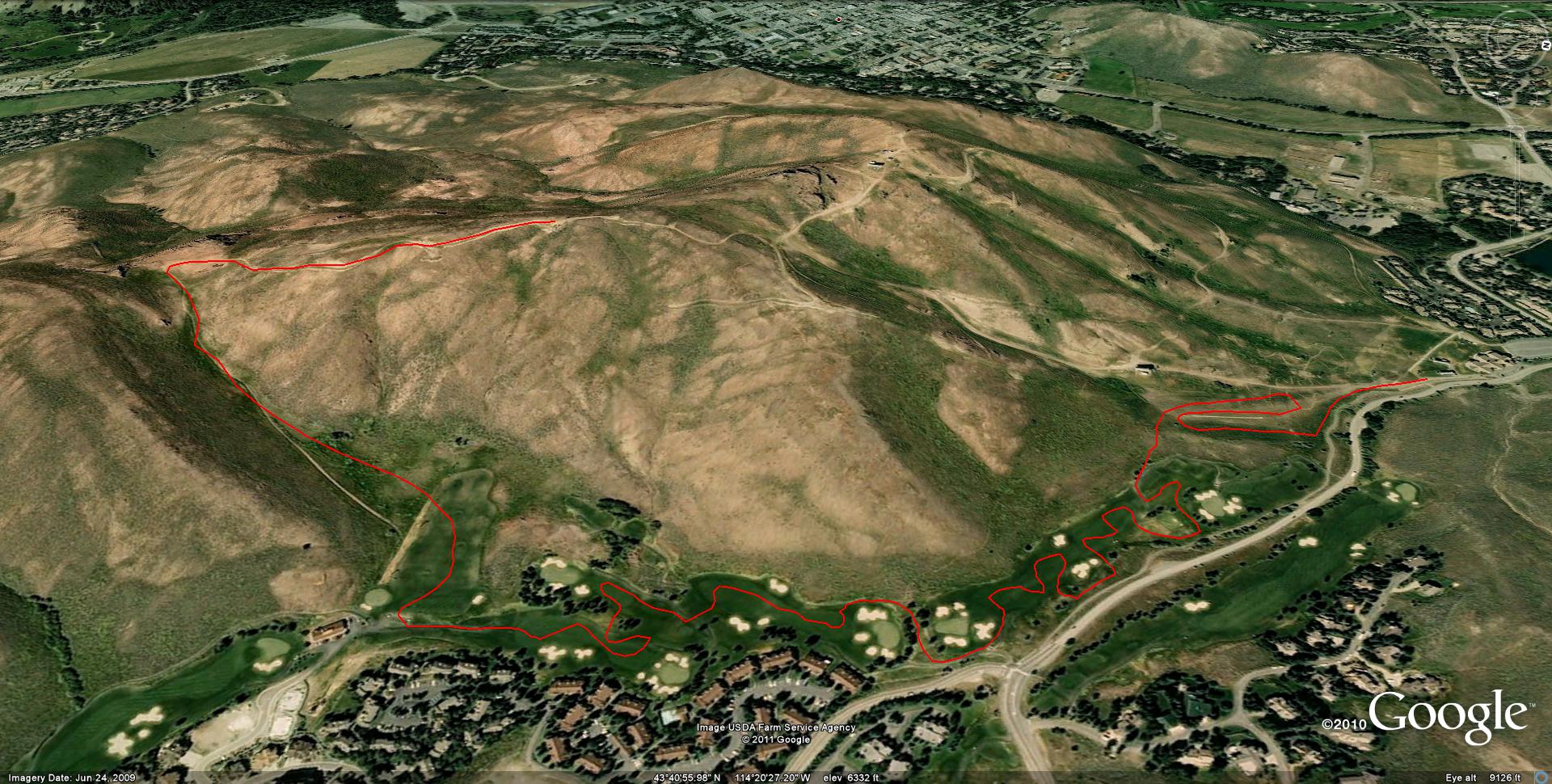
    A rough map of the hill climb course in Sun Valley. Photo courtesy of svsef.org

    The cross-country ski season’s last stand begins on Tuesday, when the final domestic races of the year kick off in Sun Valley, ID.

    The mini-tour known as the SuperTour Finals will start with a 3.3/2.8 k freestyle prologue on a stout course, followed by three more races in four more days. The winner of both the men’s and women’s overall will be the first competitor to arrive atop a ridge on Dollar Mountain, a local alpine ski area.

    More than 220 athletes from all across the U.S. and Canada have arrived in Idaho, headlined by national team members from both countries.

    They’ll be contesting a race format originally modeled on the Tour de France, and which was first adopted on the international level, in the form of the Tour de Ski, in 2007. Over the last few years, the concept has migrated to lower levels, with the first modern-style mini-tour in the U.S. held in northern Maine last March.

    Kikkan Randall racing at least year's SuperTour Finals mini-tour in Fort Kent, ME. (That's German Nicole Fessel's suit.)

    That race included three stages: a mass-start distance race, a sprint, and a hill climb. This year’s adds the prologue but preserves the order of the rest of the events: the mass-start 15/10 k classic race is on the second day, followed by the sprint and the 5 k hill climb.

    Top finishers in the first three stages are awarded bonus seconds, which are subtracted from each athlete’s overall time. In the prologue and mass-start, those bonuses are 15, 10, and five seconds for the three podium places, while the 30 best sprinters can earn up to 60 seconds for first place, and one second for 30th.

    In the hill climb, the racer with the lowest combined time from the previous races starts first, with the rest of the field following, one-by-one, with handicaps based on their own finishes.

    The idea behind the varied distances and bonuses is to provide athletes with different strengths with a shot at the overall. Sprinters can rack up extra seconds in the shorter races, while those with slower-twitch muscles can make up time in the mass-start and hill climb.

    That’s the idea. In practice, it has played out differently—at least at the international level. At the Tour de Ski, pure sprinters have never come close to an overall victory.

    Domestically, the waters are a little muddier. In Maine last year, Kikkan Randall took a decisive victory, winning the final hill climb by more than a minute. But on the men’s side, the race came down to a single second between Andy Newell and Ivan Babikov—who are, respectively, the epitomes of a pure sprinter and a pure distance skier. Canada has held four tours this season, with the winners coming from all walks of physiological background.

    In Sun Valley, one thing is clear: a Randall repeat is essentially a lock. She’s undoubtedly the best sprinter of all the women, and her win in Sunday’s 30 k classic shows that she’s the class of the field in longer distances as well.

    If she has a bad day, it’s possible that Randall could be relegated to second or third in a single event—or even miss the top 10 if she crashes out of the sprint. But with four different stages, any isolated miscues or snafus should come out in the wash. Randall fans, you can start staking out your lawn chairs at the top of Dollar Mountain now.

    On the men’s side, after last year’s mini-tour, it’s tempting to predict another battle between sprinters like Newell, Simi

    Ivan Babikov in the wrong lane at the finish of last year's mass-start classic race at SuperTour Finals in northern Maine. (He should have been on the other side of the fence.)

    Hamilton, and Stefan Kuhn, and those oriented towards longer races, like Kris Freeman.

    But before prognosticating, it’s important to remember that in 2010 in Maine, Newell had a few advantages that may have allowed him keep pace with Babikov. First was a blunder by the Canadian in the mass-start race in Madawaska, in which Babikov missed a turn-off for the finish and went from first to fifth, losing about 30 seconds in the process.

    Second, that mass-start was held on a course that was essentially an ice-luge—conditions were very fast. With a relatively flat profile there, the distance skiers didn’t get much of an opportunity to put time into the sprinters.

    In Sun Valley, however, the mass-start is tougher, with some big climbs, and sprinters who falter early could lose time very quickly—especially with the altitude.

    “That 15 k course is hard enough, and high enough, that there’s going to be some people cracking out there,” Freeman said. “I think that if someone skis away from the 15 k, they’re going to win the tour.”

    The prologue is no cakewalk, either, with a massive, Idaho-sized climb halfway through. But it’s not a long race—at just 3.3 kilometers for the men, it’s unlikely that big gaps will form there. At the World Cup finals two weeks ago, Freeman put just 19 seconds into Newell on a course that was the same length, and at least as hard.

    The hill climb is also tough, too, with one stretch that packs in 450 vertical feet of climbing in roughly 500 meters, according to Rick Kapala, who’s the chief of competition in Sun Valley. But again, at five kilometers, it’s short enough that a well-paced effort from a sprinter could be enough to preserve even a smaller gap.

    The question seems to be whether the advantages that accrue to the sprinters in the third stage are enough to offset the damage that gets done in the other three races. Given that Freeman and other strong distance skiers like Lars Flora can often be competitive into the semis and even the finals of domestic sprints, it’s unlikely those advantages will be all that large.

    There are a few sprinters entered, though, with the fitness to hang in the 15 k—namely, Canadians Kuhn and Drew Goldsack. Newell could, too, though he’s been far from consistent in his distance racing this season. And Hamilton raced well in a 10 k in Europe earlier this month.

    “I’m feeling rested and recovered,” he said Monday, “but, I think this time of year, especially for me, can always kind of be hit or miss. My speed for the sprint is hopefully still right up there—we’ll see how the distance races go.”

    Link to start lists for prologue.

  • Canadian National Championships – Contending Men

    The 2011 Haywood Canadian National Championships began Saturday, and the drive to crown the next Canadian national champion starts now!

    Held in the Canadian ski mecca of Canmore, Alberta, the premiere event in Canadian skiing features seven days of intense junior and senior racing action.

    The racing opens with a Team Sprint on Saturday, March 12, followed by a middle-distance freestyle on Sunday, March 13. The athletes then enjoy a day of rest, and the racing resumes with an individual classic race Tuesday, March 14. The classic sprint is separated onto two days – the Open categories classic sprint Wednesday, March 15, and junior categories classic sprint Thursday, March 16. Finally the Championships conclude with long-distance freestyle mass start races on Saturday, March 18.

    Canadian racing is at an all-time high, and correspondingly, the fields will be some of the deepest in the country in recent memory. While newly minted World Champions and Canadian National Ski Team (CNST) members Devon Kershaw and Alex Harvey are attending the late-season World Cup races, there is still plenty of Canadian World Cup-level talent racing.

    Additional athletes missing include the Alberta World Cup Academy’s (AWCA) Graham Nishikawa, who has the NorAm World Cup slot for the spring World Cup tour, and possibly CNST member Ivan Babikov, who is on the verge of cracking the top 50 in World Cup rankings, the level which is required to participate in the World Cup Final.

    FasterSkier provides a brief preview of the men in action who may be vying for the aggregate title of Canadian National Champion.

    Veterans

    Multiple-Olympian and World Cup medalist George Grey (CNST) is the biggest name in action, and when he is at or near the top of his game, there are very few men in Canada who can match him, at least in the distance events. Grey has not been at his best this season, but if he can recapture some of the form he had during the Vancouver Olympics, he will be almost untouchable.

    Following Grey, Stefan Kuhn (CNST) has also returned from Europe, and considers the Nationals a home race, as he lives in Canmore. It may also be his last National Championship ever – the 31 year old veteran has hinted at retirement via Twitter. Kuhn has two events he excels at – middle distance classic racing, and classic sprinting, so be assured he will be in the mix.

    After losing a tight battle on the NorAm circuit for the NorAm World Cup spot to Graham Nishikawa, Drew Goldsack (AWCA) will be back aiming for top results as well. The two-time Olympian has proved himself capable as an all-around skier this season, but the classic sprint suits him best. He has suffered through bouts of illness during the season, and his most recent result is not encouraging, as he failed to finish the Eastern Canadian Championships mini-tour.

    Phil Widmer, racing out of the Pierre Harvey National Development Center (CNEPH), has been an impressive skate sprinter thus far this season, most notably finishing 18th at a World Cup sprint in Davos. However, outside of that, Widmer has struggled, as his top result in a domestic distance race is 27th in the 15 k freestyle at the NorAm in Thunder Bay, Ontario.

    Young Guns

    Graeme Killick (CNST), who put on a show at the 2010 Canadian Nationals by winning two races, has thus far had a disappointing season, but remains a strong classic skier. Killick is aiming for a couple of podiums, and is targeting Tuesday’s 15 k classic as his big event.

    Likewise, Brent McMurtry (CNEPH) has been up and down on the result sheet over the course of the season. In a recent e-mail to FasterSkier, McMurtry described himself as “run down” heading into the early World Cup period, but has focused on recovery, and is feeling back in top form.

    But McMurtry has additional OPA Cup experience, and has the advantage of knowing the trails well, as he is a native of Calgary, Alberta, and has skied extensively at the Canmore Nordic Center. However, McMurtry acknowledges he isn’t the only one with home-course advantage, as most of the top men either live full time in Canmore, or have spent a significant amount of time skiing on the trails at the Nordic Center.

    Surprisingly, Nationals will be only the second set of races in Canada this year for McMurtry, so there is little indication of how he will stack up. But McMurtry is aiming high – he stated his first goal of the Championships is to win a race outright.

    Perhaps the best young skier attending is one Len Valjas (CNEPH), who with a 15th place at World Championships and a top 10 result at the World Cup in Drammen, has turned into an impressive World Cup sprinter. Valjas is planning on racing the World Cup in Lahti, Finland, but will be returning to Canada in time to contend the individual start classic race on Tuesday, and most worryingly for everyone else, the classic sprint on Wednesday.

    Dark Horse Talent

    Kevin Sandau (AWCA) has been one of the hottest Canadian skiers following Christmas, at least in distance skiing. Sandau finished fifth at U-23 World Championships 15 k freestyle, and then crossed the line 24th place in the pursuit. After returning to Canada, Sandau kept the ball rolling, finishing 2nd at the Eastern Canadian Championships mini-tour.

    Likewise, Jesse Cockney (AWCA) has emerged as an impressive U-23 skier, excelling in sprints. While he freely admits to struggling in the qualifying round, Cockney has the speed to go the distance over the course of the day, which he proved with a 6th place finish at U-23 World Championships in Estonia earlier this year.

    Mike Somppi of the National Development Center Thunder Bay (NDC-TB) has also become a very solid skier, earning three podiums at the NorAm level, as well as finishing 14th in the 15 k freestyle at U-23 Championships.

    Finally, David Greer (CNEPH) started the season off slowly, but has finished in the top five a handful of times on the NorAm circuit, and also skied to an impressive 14th place at Swiss National Championships. His distance skiing has improved over the course of the season to the point where he could easily pull off a surprise.

    While the overall aggregate should be George Grey’s to lose, the level of male skiing in Canada at the moment means that it is anything but a lock. It is entirely possible a different skier could win each race, and the variety of race formats mean that no one athlete has a significant advantage.

    Canadian National Championships kicks off Sunday, with a 10 k freestyle individual start race.

  • Jones, Goldsack Win Western Canadian Championship NorAm Mini-Tour

    If Drew Goldsack and Graham Nishikawa were not already familiar with each other, they should be by now.

    That’s because the two Alberta World Cup Academy (AWCA) athletes are locked in a tight battle over the top spot in the NorAm rankings – and the battle became even closer after this weekend, as Goldsack won the NorAm mini-tour in Kelowna, B.C.

    Goldsack, also a member of the Canadian National Ski Team (CNST) emerged victorious Sunday, as he narrowly beat Nishikawa to the line by .3 of a second in the 15 k freestyle handicap start event. Brian McKeever, who is Canada’s premiere Para-Nordic athlete, and also a great able-bodied skier, finished third, 1:00.9 back of Goldsack.

    It was a sloppy day in Kelowna – fresh snow had fallen, and the race was a bit of a slog through deep powder.

    Goldsack started with a 15 second lead over Nishikawa, but the conditions severely affected the race.

    “It was snowing pretty heavy when we started,” said Goldsack in an interview with FasterSkier. “It was tough out front.”

    Shortly after the start, Nishikawa reeled in Stefan Kuhn (CNST), and then around 4 k in the two connected with Goldsack.

    At that point, Goldsack tried to keep the lead and gap Nishikawa, but the snow prevented him from making any head way. Goldsack then settled in for the sprint finish against Kuhn and Nishikawa. At around 5 k, Nishikawa and Goldsack skied away from Kuhn, turning it into a two-man race.

    Goldsack and Nishikawa then skied together, until Nishikawa launched a big attack on the last hard climb.

    “He [Nishikawa] tried to break me,” said Goldsack. “Luckily I was able to hang on.”

    Goldsack did more than hang on – in what he described as a “crazy long” finishing stretch, Goldsack pulled away from Nishikawa for the win.

    The win sets up both skiers for a furious finish in Ottawa, Ontario, next weekend, as they contest the final NorAm race on the circuit to determine the World Cup start slots for the spring World Cup events.

    Next weekend offers a big challenge – the three days of racing culminate with a 30 k event.

    “It’ll be a challenge for sure,” Goldsack said. “30 k is not exactly my strength.”

    And if you wanted to know who Goldsack would have put his considerable prize money on in the Super Bowl following his big win this weeked

    “Before the game started, the Green Bay Packers, but right now, the Pittsburgh Steelers,” he said, part-way through the third quarter on Sunday evening.

    Jones Dominates Field

    Perianne Jones (CNST) had nowhere near the challenge that Goldsack had. She started by herself, and skied the two-loop 10 k freestyle course all by herself.

    Jones crossed the line 2 minutes and 27.8 seconds ahead of Maya MacIsaac-Jones of the Rocky Mountain Racers (RMR), while Andrea Dupont (RMR) narrowly lost out on the second step of the podium, finishing 2 minutes and 29 seconds back of Jones.

    While Perianne Jones put on an impressive performance, the fact that no other National Team women were present does put a bit of a damper on her win.

    For MacIsaac-Jones, however, finishing second in a NorAm event is a huge. She is just 15 years old, and finishing high up the NorAm rankings is a sign of good things to come.

    Perianne Jones now switches her focus from domestic racing to World Championships – she departs Wednesday, February 9th, for Europe, where she will train in Lillehammer, Norway, and then contend the World Cup event in Drammen, Norway, before moving on to Oslo for the Championships.

    Open Women Final Mini-Tour Standings

    Open Men Final Mini-Tour Standings

  • Jones Makes it Two; Kuhn Wins Tight Haywood NorAm

    Perianne Jones is now two for two.

    The Canadian National Ski Team (CNST) member and Vancouver Olympian put on a powerhouse display of classic skiing Saturday morning, winning the 2.7 k classic event on the second day of racing at Western Canadian Championships in Kelowna, B.C.

    Jones won the second race in the mini-tour by a little over 20 seconds, an amount almost unheard of in such a short event. Andrea Dupont  of the Rocky Mountain Racers (RMR) finished second, while Sarah Daitch of Forth Smith Ski Club finished third, 24.1 seconds back of Jones, but just ahead of junior sensation Maya MacIsaac-Jones, who finished fourth.

    “I really don’t know what happened,” Perianne Jones said in a post-race interview with FasterSkier. “I got one split that put me six seconds ahead, but I guess I must have just kept the pace high.”

    The day itself was tough for classic skiing. Temperatures hovered around 0 degrees Celsius, and the course featured some tough hills both in the shade and in the sun, meaning everyone had some difficulty with getting grip.

    “There was lots of herring-bone,” said Jones. “The hills were pretty soft.”

    Jones will start the 10 k freestyle handicap start Sunday with a big lead over the other women, and intends to go for the win from the gun.

    “I’m going to have to ski it like it’s an individual start race and see how it goes,” she said.

    While Jones posted a large gap for the victory, in Open Men it was the complete opposite.

    The men raced a 3.5 k classic course with some difficult hills, and as tends to happen in prologues, the finish times were extremely tight.

    Jones’ team mate Stefan Kuhn (CNST) edged out Drew Goldsack (AWCA/CNST) by just 1.3 seconds for the win, while Graham Nishikawa (AWCA) finished 2.2 seconds back of Kuhn to fill out the podium.

    “It was good to get the win today,” Kuhn said in an interview with FasterSkier following his race.

    Kuhn, who is focusing mainly on World Championships, was especially happy to get the win because he had been putting in some big volume hours, and wasn’t sure how his body would respond.

    “The goal is to be fast at World Championships, so I’m doing my normal sort of training to peak for it,” he said.

    And Kuhn was fast in notoriously difficult event – the prologue. Racing an event as short as the prologue is tricky – for most elite athletes, it has been a long time since they have raced such quick races.

    “They’re a really hard distance to ski,” said Jones. “They hurt a lot – it was a lot easier when I was a midget.”

    Kuhn, however, counts it among his favorite events – especially when it’s classic.

    “As a sprinter who also likes short-distance events, it suits me well,” he said. “It’s extremely hard, but I really like it.”

    The one notable absence on the results list from the day was George Grey (CNST), who according to Kuhn woke up “not quite feeling 100%,” and opted out of racing to play it safe for upcoming World Championships.

    Kuhn will start the 15 k freestyle pursuit race Sunday second, behind Goldsack. Kuhn wasn’t originally planning on starting at all, as his body was not feeling great, but he felt that his form is strong enough that he will attempt to contend.

    However, he doesn’t have high hopes – he considers skate-skiing his weaker discipline, and the 15 k freestyle is one of his least favorite race types.

    “I’m going to try and ski tactically and see how long I can hang on to Nish,” he said. “Realistically, I’m going to be fighting for third place, maybe with [Brian] McKeever, who seems to be moving through the field strongly.”

    The 10/15 k freestyle handicap start races will cap off the NorAm mini-tour on Sunday.

    The start list has not yet been released for tomorrow, but as soon as it is available, a link will be posted.

    Men’s 3.5 k Classic Prologue Results

    Women’s 2.7 k Classic Prologue Results

  • Goldsack, Jones Sprint to Victory in Western Canadian NorAm Action

    Drew Goldsack must be getting good at mini-tour racing; he’s on his third one this season.

    Last weekend, the Canadian National Ski Team (CNST) member who trains with the Alberta World Cup Academy (AWCA) tackled a Haywood NorAm mini-tour event in Orford, Quebec, finishing second. This weekend, Goldsack began another mini-tour, with a freestyle sprint in Kelowna, B.C. on Friday.

    After posting the fastest qualifying time on the day, Goldsack stormed through the rounds on his way to the A-Final, where he lined up against the fastest domestic racers in the country.

    The A-Final was stacked with domestic racing experience – Graham Nishikawa (AWCA), Stefan Kuhn (CNST), George Grey (CNST), Para-Nordic legend Brian McKeever, and young gun Matthew Wylie (Banff Ski Runners) joined Goldsack on the start line.

    With so many top racers, it was battle from the gun. Nishikawa attacked around a quarter of the way through the race, and only Goldsack was able to respond immediately. But as the group headed back down towards the stadium, the others made contact.

    Goldsack was able to squeak by Nishikawa, and in the melee that followed, Wylie made a surprise move to come from fifth all the way up to second place.

    Kuhn rounded out the podium in third, followed by Nishikawa, Grey, and McKeever.

    In an interview with FasterSkier, Goldsack said the course “skied fairly tough,” in part due to the long flat 200 meter finish stretch.

    After playing second fiddle to Nishikawa during the NorAm mini-tour last weekend in Orford, Goldsack was happy to be back on top.

    “It was nice to be back on top,” he said, “For me sprinting is the go-to discipline, so it was good to get the win.”

    Goldsack is still trying to bounce back from illness which sidelined him during the Thunder Bay NorAm, and although he feels his shape has rebounded, there is still room for improvement.

    “I didn’t feel one hundred percent – I was hurting a little more than I would expect at some points,” he said.

    “One less day of recovery makes it tough,” said Goldsack. “It’s a hectic schedule, because even if you’re racing a prologue, it still makes for a long weekend.”

    And Goldsack’s work is far from over – he and Nishikawa are in the midst of tight battle for the NorAm FIS World Cup quota spot for the spring World Cups.

    After finishing the mini-tour in Kelowna, both Goldsack and Nishikawa will head to Gatineau, Quebec, to contest the final NorAm mini-tour of the season.

    Meanwhile, in open women, Perianne Jones (CNST) made sure she held on to her top spot in the overall NorAm rankings, as she won the qualifier, then led the A-Final from start to finish for the win.

    Jones finished ahead of Sarah Daitch, who made her first stop on the NorAm podium this season, and Andrea Dupont of the Rocky Mountain Racers (RMR), while juniors Rebecca Reid (AWCA), Dahria Beatty (Yukon Ski Team) and Suzanne Stevenson (Foothills Nordic) rounded out the A-Final.

    “[Andrea] Dupont and [Sarah] Daitch were close – I could feel them behind me,” said Jones.

    “It was really hard to get away from them – I just went for it from the gun, and tried to get away, but never managed to pull away.”

    Jones described the sprint course as “really hard,” in a post-race interview with FasterSkier, but surprisingly not because of any particularly large hills. The 1.3 k course featured mostly gradual uphills, followed by a gradual downhill section into the finish.

    “On the way back down it was a working downhill,” she said. “My legs felt really tired – there was no rest anywhere on the course.”

    While Jones was the clear favorite on the day after qualifying, fellow CNST member Chandra Crawford looked to be her strongest competition on the start list.

    However, Crawford felt ill before she even started, and after qualifying, opted to pull out of the race. She ended up qualifying third, but rather than race the heats, booked herself a flight back to Canmore, Alberta, to rest.

    “It would have been fun to race her, if she had been healthy,” Jones said, “but going home is the smart thing to do.”

    “The whole trip would be more fun if she weren’t sick – now I’m the only woman on the team here!”

    Haywood NorAm racing continues tomorrow with prologue events for both the men and women.

    Open Women Full Sprint Results

    Open Men Full Sprint Results

  • Nishikawa Continues to Roll; Stephen Back on Top in Haywood NorAm

    A snowy day at the Haywood NorAm mini-tour in Orford, Quebec, made the tracks a little bit slippery for the 7.5/10 k classic individual start races, but Graham Nishikawa of the Alberta World Cup Academy (AWCA) didn’t let the precipitation get in the way of his second NorAm victory in two days.

    After a big fifteen second win during Friday’s 4 k classic prologue, Nishikawa upped the ante on Saturday, winning the 10 k classic individual start by 22.5 seconds over his nearest competitor, Drew Goldsack, of the AWCA and the Canadian National Ski Team (CNST). Goldsack’s fellow CNST member Stefan Kuhn finished third, 30.5 seconds back of Nishikawa.

    However, after the top three, the gaps grew large, as David Greer of the Pierre Harvey National Training Center (CNEPH) was fourth, but almost a full minute back of the leader.

    Goldsack, who fell victim to illness during the NorAm in Thunder Bay, Ontario, and is still bouncing back, struggled during the prologue Friday.

    “It was kind of an odd prologue – it was very flat,” Goldsack said in an interview with FasterSkier. “I haven’t done a whole lot of intensity, and I was feeling it by the end.”

    However, Saturday provided a bit of a lift for Goldsack. “It was a little better than yesterday,” he said, “I’m racing myself back into shape here.”

    Meanwhile, the third place finisher on the day, Stefan Kuhn, who currently sits second in the mini-tour, struggled with fatigue.

    “I had a tough day, starting to feel the long hours of the last two weeks of training,” he said via Twitter.

    In the overall standings, the two wins and corresponding time gaps have given Nishikawa a big lead – and when you factor in the additional 15 bonus seconds he received for winning the prologue Friday, he will be tough to beat.

    The only two athletes within reach are Kuhn and Goldsack – according to Goldsack, he hopes they will be able to work together to chase down Nishikawa during the 15 k freestyle handicap start race Sunday. However, Goldsack acknowledged that it would be a challenge, especially with Nishikawa’s current racing form.

    While official start lists are not yet available, according to FasterSkier calculations, Nishikawa will start roughly 39 seconds ahead of Kuhn during the handicap start on Sunday, while Goldsack will be another 10 seconds back.

    The only American in contention is Tim Reynolds of the Craftsbury Green Racing Project (CGRP). Reynolds collected 5 bonus seconds during the prologue Friday, but his 7th place finish in the 10 k classic puts him nearly 2 minutes back of the leader.

    The other notable result of the day was Donald Farley, who took the Master Men’s 16 k classic by almost 3 minutes. Farley, a veteran of two Olympic Games (Nagano, Japan in 1998 and Salt Lake City, US in 2002), is now 40 years old, and according to his FIS profile, has not raced a high-level race since 2003.

    Redemption for Stephen

    After a surprising fourth place finish on Friday, U.S. Ski Team’s Liz Stephen bounced back Saturday to claim the win in the 7.5 k classic race.

    Stephen out-classed her nearest competitor, Canadian National Ski Team (CNST) member Brittney Webster by 15.4 seconds, making back some of the ground Stephen had lost on Friday.

    Michelle Workun-Hill, who stood on the top step of the NorAm podium for the first time Friday finished 39.7 seconds back of Stephen Saturday.

    As for Stephen’s fourth place in the prologue, she took the result in stride, considering the course and situation.

    “The course (flat, with a lot of double-poling, and short) doesn’t really suit the kind of skier I am,” she said in an interview with FasterSkier.

    However, she was enthusiastic about the course Saturday, and it showed, as she cruised around the 3-loop 7.5 k.

    “I even ended up skiing with Brittney Webster for a little bit at the end, which was fun,” she said.

    Despite snowy tracks on Saturday morning, Stephen had “bomber” skis, waxed by the Maine Winter Sports Center. And those skis helped her back atop the podium.

    “I have been struggling a little bit getting my classic technique down,” she said, “Today felt good technique-wise.”

    Stephen, who leaves for Norway on Tuesday in order to prepare for World Championships headed up to Orford just to get a little extra racing in. After U.S. Nationals she came down with a little bit of a cold, and has been recovering, as well as starting to put in some more volume in preparation for the Championships.

    After factoring in Friday’s bonus seconds, where Workun-Hill received 15, Webster 10, and Stephen’s fourth place garnered her nothing, the top three women are close.

    According to FasterSkier’s rough calculations, Stephen and Webster will start at almost even, while Workun-Hill will be 12 seconds back.

    As soon as official start lists become available, they will be posted.

    Open Women Results

    Open Men Results

    Open Men Start List

    Open Women Start List

  • Gaiazova, Grey win Pursuit at Canadian NorAm

    Dasha Gaiazova racing in the Canmore World Cup in February 2010. Photo, Win Goodbody.

    While the athletes at the US Senior Nationals were nearly undone by balmy weather last week, the racers vying for spots on the Canadian World Championship team were struggling to keep their bodies warm and their skis moving in Thunder Bay. Temperatures plummeting toward the negative 20 C made for gritty snow and tough racing.

    “It was a little cold today, but I think we all survived,” Dasha Gaiazova of Banff, Alberta, said to FasterSkier after winning the women’s 15K pursuit.

    Despite the cold snow, Gaiazova said her skis had amazing glide, and found herself pulling away from the field just out of the gate. She thinks that was a big contributor to the overall success.

    “My teammate Perianne Jones and I had a gap on the field already a few hundred meters from the start, which was pretty surprising. I kind of expected everyone to be together on the downhill from the start. But we definitely had good boards today,” Gaiazova said.

    Gaiazova polished off the 7.5K+7.5K pursuit course in 48:31.6. That left a gap of almost 10 seconds down to Brooke Gosling (Calgary) in second place (48:41.0), while Jones (Almonte, Ontario) finished third in 48:46.

    Gaiazova, who considers herself a sprint specialist, was happy to snag one of the berths to the distance races at the upcoming 2011 World Championships in Oslo. The distance events are her biggest challenge.

    “The biggest challenge was pacing myself for 15K. It was definitely a long one for me,” said Gaiazova, who is looking forward to Saturday’s sprint race. “I know how to pace myself for 1K,” she said.

    And while Gaiazova was stoked to secure a spot on the Worlds team, the 27-year-old also excited to race on Canadian soil.

    “I was looking forward to doing some racing in Canada. It was good. It’s nice to race in Canada once in a while. It’s nice to come home, see old teammates and race in a friendly relaxing atmosphere for a change,” she said, noting that she spent most of the early race season in Europe and is headed back across the pond after this weekend.

    George Grey leading his teammate Ivan Babikov in the skate leg of the 30k pursuit in Vancouver, 2010.

    Thriller from start to finish

    In the men’s 30K pursuit, George Grey of Rossland, British Columbia, snagged the top of the podium by a photo finish margin.

    Grey entered the transition in seventh place, but fought his way up to the front of the pack and duked it out with Graham Nishikawa (Whitehorse, BC) to the bitter end. But experience before youth, and the 31-year-old Grey was a hair faster, nailing the win in 1:18:41.0 while Nishikawa logged 1:18:41.4.

    “It was awfully tight and very technical out there today,” Grey said in a press release after the race. “I don’t really have my shape but I think my experience put me in the front in the end.”

    Drew Goldsack of Red Deer, Alberta, was claimed the last spot on the podium, clocking in at 1:18:44.7.

    Excited to get the Tour skiers back

    Grey explained that his fitness is not where he wants to be, and that it has been challenging to get workouts done lately. Now, with the ticket to Oslo taken care of, Grey is looking forward to preparing for the Championships in the end of February. He is excited to have Alex Harvey, Devon Kershaw and the rest of the Canadians back from the Tour de Ski, and welcomes the opportunity to train with them leading up to the Worlds. However, they have a job to finish in Central Europe, and Grey still has a couple of races on the dock in Thunder Bay before then.

    Saturday, the Nor-Ams continue with sprints, while Sunday features distance skate events.

    U23 and World Juniors trials

    Thursday’s races also served as trials for the Canadian U23 World Championship team and the Junior World Championship team. Kevin Sandau, of Canmore, Alta., was the top under-23 male, while Emily Nishikawa was the fastest under-23 woman. Heidi Widmer, of Banff, Alta., won the junior women’s 10-kilometer pursuit race with a time of 32:38.8. Andy Shields, of Thunder Bay, Ont., won the junior men’s 20-kilometer pursuit with a time of 55:15.1.

    Complete women’s results here:

    Complete men’s results here:

  • Thumbs Up For Mini-Tour Format

    Thumbs Up For Mini-Tour Format

    After the Nor-Am mini-tour in Rossland, British Columbia, last weekend, racers from both sides of the border raved about the event as an exciting change of pace where all racers – sprinters and distance skiers alike – have a fair chance to fight for the overall title. Contributing to the positive reviews was the excellent job that the organizers and volunteers put down to make it fun, fair and entertaining.

    Stefan Kuhn (Canmore Nordic) takes the victory over fellow Canadian Drew Goldsack (Rocky Mountain Racers). Photo: Rob Whitney.

    “I love the mini-tour – fun to watch and great to ski in. It adds a lot of excitement for us racers and a great challenge as well. I don’t know if you can do anything much better. The Rossland ski community had done a great job organizing and made a 3-day race series go very smoothly and was lots of fun,” Stefan Kuhn (NTS) said in an email to FasterSkier. The overall men’s tour winner also thought the sprints were factored fairly into the overall results.

    “You get a 60-second bonus if you win and down from there, and that is a lot,” Kuhn said.

    The overall women’s winner, Jessie Diggins (CXC) also enjoyed the format.

    “I think the mini-tour was really fun. The way it was set up made the last day pretty exciting since you knew exactly where you were in terms of the overall tour standings during the race,” Diggins said in an email to FasterSkier.

    On the World Cup, some European racers have complained that a mini-tour is not worth the effort for sprint specialists. That was not an issue for the Nor-Am racers that FasterSkier spoke with. If anything, Diggins thinks the sprints may have been weighted a little too heavily, though it was not a problem for her.

    “Because the 5km skate was so fast, the girls who weren’t sprinters weren’t given as much of a chance for the overall tour,” Diggins said.

    Good mix of sprint and distance

    “I really enjoyed the mini-tour format. I think it’s a great way to give both sprinters and distance skiers a chance to mix it up together,” Drew Goldsack (NTS) said in an email to FasterSkier. Going into the event, Goldsack was a bit concerned about the sprints being given too much emphasis. But in practice, he thought the concept worked out fairly for all.

    “On paper I thought that the sprint was maybe weighted too heavily but…it actually worked out perfectly. I think it was partly due to the fact that we had distance skiers sprinting better than usual and sprinters skiing distance better than usual, but it worked out well and made for some exciting racing.”

    Goldsack, who was third overall, had one single complaint.

    “The only thing I’d like to see better is the prize money; it seemed a little chincey for three hard days of racing. $700.00 for the win isn’t bad, but $400.00 for second and $250.00 for third place seems a bit low to me,” Goldsack said.

    Great format but keep it reasonable

    Brooks racing in Rossland (Photo: Rob Whitney)

    Holly Brooks (APUNSC) thinks the mini-tour format is both entertaining and fair, especially on the Nor-Am circuit where there are fewer specialists than on the World Cup. She also thinks the bonuses for the sprints helped even out any discrepancies.

    “Especially in the women’s field, the sprinters and the distance racers are the same people anyway, and the bonuses awarded for the sprints were huge, so I think the format was fair. I think on the World Cup there is more of a difference because the racers are more specialized,” Brooks said to FasterSkier.

    “We train so hard all year and make so many sacrifices. We train to race, and this is it. For me, this was a good intensity block before nationals. There were good interesting courses, and you have to be really versatile with this format that includes sprint, skate and classic,” Brooks said, but added that she doesn’t want organizers to go bananas with the concept just because the first one was a hit.

    “I hope they keep mixing it into the schedule, but I wouldn’t like to see all race weekends turn into mini-tours,” Brooks said, noting that one or two of them per year could be a reasonable amount.

    “Mini-tours are hard on both racers and organizers. There are more logistics and it’s easy to make mistakes, and it makes it complicated for everyone,” she said.

    Just a good, hard weekend

    “Overall I think the mini-tour format is really good. I wished they had them at the start of my career. I have always enjoyed racing different formats and distances,” Lars Flora (APUNSC) said. The only thing he would like more of was hills, even on the last day.

    “The time bonuses seem to play out fairly between sprint and distance racing. The only thing I would change is adding a hill climb at the end of Sunday’s race. It would have been fun to finish with a classic hill climb,” Flora said.

    Caitlin Compton (CXC) also thoroughly enjoyed the Rossland experience, both for the variety and for the rigor. For Compton, the mini-tour was also an opportunity to test her own limits.

    “I knew that Saturday’s 5K skate would be my better event, but I also wanted to see how my fitness was through the entire weekend. I was pleased to find that my energy and quickness was still there (on Sunday), if not higher than the days before,” Compton said, noting that Diggins had reserves nobody else could match.

    Mixed feelings on the World Cup

    US Ski Team’s Kikkan Randall, who is on the FIS Athlete Commission for cross-country skiing, said in an interview with FasterSkier earlier this season that she has mixed feelings about the mini-tour concept. On one hand, Randall likes the idea of cross-country capitalizing on the increased TV-viewership that comes with these tour type events. On the flip side, Randall is concerned that by adding the overall time component and with each individual stage only worth half World Cup points, the sprint race is being devalued. She is also skeptical to adding a longer event weekend to the early World Cup season.

    “I also feel that with an already packed ‘Period I’ racing schedule, it is better to have two races instead of three this early in the year to allow for a little more training during the week and thus better longevity through the season,” Randall said.

    Among the Norwegians, some of the sprinters left Kuusamo after the opening sprint event of the “Tour de Opening” in November. Ola Vigen Hattestad and Kuusamo sprint winner John Kristian Dahl were among those who left early. Dahl dislikes the mini-tour, and was happy to explain why.

    “We get more points for regular WC sprint races than we do here, there is a packed schedule with a lot of races before the end of the year, and we have important races in Düsseldorf (GER) already next weekend. To do three races here takes an incredible toll (on the racers), and it seems a little oddly placed,” Dahl said to the Norwegian TV station NRK.

    The mini-tour in Kuusamo consisted of three competitions. Sprint on Friday, individual start classic on Saturday and pursuit/handicap start skate on Sunday. Only the overall winners will be listed as World Cup winners for the event. The sprint winners were awarded only 50 points compared to the normal 100 points.

    “It’s no secret that the mini-tour robs some of the status from the sprinters. For me as a sprint specialist, this is not great,” said Ola Vigen Hattestad.

    According to Vegard Ulvang, the Cross-Country Committee Chairman, this year the mini-tour is a test-event and it will be evaluated in the spring as to whether to make the Kuusamo “Tour de Opening” a permanent part of the World Cup calendar.

    As for the Nor-Am mini-tour, it seems like the athletes are giving the format a thumbs up, at least after the Rossland experience last weekend.

  • With Win in Rossland, Kuhn Scores One for the Sprinters

    With Win in Rossland, Kuhn Scores One for the Sprinters

    Stefan Kuhn (Canadian National Ski Team) bests his teammate George Grey in the lunge that decided the overall victory in the Rossland Nor-Am mini-tour on Sunday. Photos courtesy of Rob Whitney.

    One of the intentions of the tour format introduced to elite-level cross-country ski racing in the past few years is to allow sprinters and distance specialists to compete on a level playing field.

    That balance hasn’t been achieved yet at the World Cup level: None of the winners of the four editions of the Tour de Ski, men’s or women’s, have been pure sprinters.

    But in this weekend’s three-stage mini-tour held in Rossland, BC, organizers couldn’t have scripted the finish any better, at least on the men’s side.

    In Sunday’s 15 k classic race in Rossland, BC—the last of the stages—the whole event came down to a duel in the final meters between two Canadian national team members: speedster Stefan Kuhn and slow-twitch stalwart George Grey. After following Grey’s path through fresh powder for much of the race, Kuhn had just enough gas in the tank to come around and snag the victory on the homestretch. Score one for the sprinters.

    “Stef came on hard, managed to ski right up behind [Grey[, pop out, and get by him in the last few meters to the line,” said Drew Goldsack (AWCA/Canadian National B-team), who, as the third-place finisher, probably had the best perspective of the battle for the top spot.

    As a stronger sprinter, Kuhn wasn’t supposed to have a chance in Sunday’s race, which was handicapped based on the results of the two previous stages—a sprint and an interval-start

    APU's James Southam leads a pack of chasers.

    skate race.

    Sunday’s seed list had Grey heading out first, with an advantage of a half-second over Goldsack, and an extra 3.5 seconds over APU’s Lars Flora.

    Grey was fresh off a top-35 finish on the World Cup in Switzerland last weekend, and Flora has been skiing the lights out on the domestic circuit. Kuhn started fourth, nearly 15 seconds behind the lead pack, which should have put him out of contention.

    But the weather had other plans. A few inches of fresh powder had filled the tracks between the women’s race and the men’s race, which Grey said ruined his plans to push the pace from the gun.

    “Due to the snowy conditions, it was next to impossible to make any time off the front,” he wrote in an e-mail. “Instead, plowing the snow allowed others to gain time and the leaders to suffer.”

    Goldsack said that he was “hammering” for the first two or three kilometers of the race to keep any chasers from catching up. But his efforts were for naught, as Kuhn, Jesse Cockney (AWCA) and Mikey Sinnott (SVSEF) all came gliding up to the lead group from around a corner.

    “It felt like you were going crazy hard at the front, and then just zone three behind,” Goldsack said.

    Grey made a hard effort to try to break things open in the closing kilometers, creating a gap of nearly 10 seconds over Kuhn and Goldsack. But according to Grey, Kuhn caught up on the final downhill into the finish, where he took the win with a lunge.

    Flora was fourth, ten seconds behind, while fifth- and sixth-placed Cockney and Sinnott ended up a little farther back—23 and 45 seconds behind, respectively.

    For his overall win, Kuhn received $700, plus an extra $175 for posting the fastest elapsed time in Sunday’s stage.

    Add Kuhn’s victory to that of Andy Newell’s last spring in the SuperTour Finals in northern Maine, and sprinters now hold a two-nothing advantage over the distance skiers in stage races on North American soil.

    Kieran Jones and Inge Scheve contributed reporting.

    Grey and Goldsack lead out the pursuit start.

  • Flora Continues Resurgence in Rossland, Edges Grey

    Flora Continues Resurgence in Rossland, Edges Grey

    Men's Podium – 1st – Lars Flora, 2nd – George Grey, 3rd – Drew Goldsack (Photo: Rob Whitney)

    Veteran Lars Flora (APU) posted his first win of an already-successful 2011 season, capturing the top spot in the men’s 10km skate in the second day of the Rossland NorAm mini-tour.

    Flora edged Canadian World Cup skier George Grey by 2.1 seconds on a fast 5km loop, while fellow Canadian Drew Goldsack was third, +6.9.

    With a winning time of just under 22 minutes, Flora thinks it may have been his fastest 10k ever.

    “I knew it was going to be really fast so I went really hard right from the start,” Flora wrote in an email.

    Flora (Photo: Rob Whitney)

    Flora ranked third at the halfway point, but just five seconds separated the top-5. He accelerated from there, and was able to open up a lead.

    “I got to about 7.5km, and my lactate was building so the last two and a half kilometers was just hang on and hope I could get to the finish line,” Flora said.

    Due to the fast conditions, the top-26 skiers were all within a minute, and only ten seconds separated seventh and sixteenth places.

    Flora described the conditions as “perfect,” and the grooming top-notch.

    “It was the type of snow that you put your ski down and it goes exactly where you want it to go,” he said.

    Grey, recently back from the World Cup in Europe, didn’t have quite enough to get Flora.

    “I was getting splits off Drew [Goldsack] and Lars [Flora], then just off Lars; 1 behind, 2 behind, 6 behind, then 2 behind,” he said.

    He also would have preferred a bit more terrain.

    “The course was close to being a great course, but they need one more big hill,” Grey said. “For me it was a bit too flat, I need some more hills.”

    Flora concurred, saying “It [the course] skied a little easier than I thought it would have.  A lot of V2ing out there – I guess I did a little bit more V1 the second lap because of fatigue, but it was pretty fast and easy… the course that is.”

    Sunday’s 15km classic pursuit should be plenty exciting with Grey holding an inconsequential .4 second lead on Goldsack. And with Flora just 4.2 seconds out, the fight for the podium should be hotly contested.

    Grey is a big fan of the mini-tour format, as it is becoming more common on the World Cup, and is excellent for spectators, while Flora has been personally excited for some time.

    “I have been looking forward to doing these races since last spring,” Flora said. “I think this format suits me well.”

    Men’s 10km freestyle – complete results

    Men’s Rossland Mini-Tour – current standings

    — Matt Voisin contributed reporting

  • Kuhn Edges Teammates in Rossland Mini-Tour Sprint, and Punches His Ticket to Oslo

    Kuhn Edges Teammates in Rossland Mini-Tour Sprint, and Punches His Ticket to Oslo

    Stefan Kuhn (CAN) racing in Rovaniemi, Finland, earlier this season.

    So far this year, Drew Goldsack has been tearing it up on the NorAm sprint circuit.

    Goldsack, a member of Canada’s senior development team, had won every sprint he entered coming into this weekend’s mini-tour in Rossland, British Columbia. But while he had proven that he was the North American not on the World Cup circuit, he hadn’t had the chance to test himself against his teammates in Europe.

    Until now.

    On Friday, Goldsack was joined by fellow senior development team members Phil Widmer and Stefan Kuhn, fresh off the plane from Europe, as well as senior World Cup team member George Grey.

    And in the end, Goldsack wasn’t able to keep his win streak alive. It was Kuhn, instead, who won both the qualifying round and the final, continuing a string of strong performances which included a top-30 result in the World Cup sprint in Kuusamo, Finland.

    In qualifying, Kuhn led a Canadian sweep of the top five places. He was followed by Widmer, Goldsack, Grey, and Team Hardwood’s Harry Seaton. Mikey Sinnott of the Sun Valley Ski Education Foundation (SVSEF) was the top American in the early round, finishing 6th.

    Seaton was the only one of those men who didn’t make the final. He ended up 30th, replaced instead by Alaska Pacific University’s Lars Flora.

    Over the course of the heats, Kuhn developed a strategy which he used to great effect in the final: after sitting tight on the minute-long uphill which began the course, he used some of the downhills as a slingshot and flew by his competitors into the finishing stretch.

    “I thought, well, that worked perfectly, so I’ll just try to use it again in the final,” Kuhn told FasterSkier in an interview.

    And once again, it worked perfectly. Goldsack finished second, followed by Grey, Flora, Widmer, and Sinnott.

    For Kuhn, the victory had two bonuses attached to it. The first was 60 bonus seconds in the overall tour, which continues with a 10 k skate on Saturday before concluding with a 15 k classic pursuit on Sunday.

    “I’m not a big distance skater, so I’ll see what happens tomorrow,” he told FasterSkier in an interview. “I like my chances in the 15 k classic. It’s a distance that I’m pretty good at. But one of our distance skiers had a good sprint day, George Grey, he was third – so I didn’t gain a whole lot of seconds on him.”

    The second bonus is that today’s sprint was being used as a winner-takes-all selector for Canada’s World Championship team. There are multiple criteria being used to pick the team, but one of them is a victory either here today or in Thunder Bay on January 6th. Since Kuhn won’t be in the World Cup red group and didn’t ski to a top-20 result in Europe, which are two of the other qualification criteria, his win here punched his ticket to Oslo in February.

    Kuhn expressed his excitement on Twitter, saying, “Exciting day here in Rossland… with this I get to head to Oslo! Pretty pumped!”

    While the selections are far from official, several other Canadians have achieved the qualifying criteria. Chandra Crawford, Devon Kershaw, Alex Harvey, Lenny Valjas, and Phil Widmer have all skied to top-20 results on the World Cup so far, and Perianne Jones was the top Canadian in the women’s race today.

    While Kuhn has the lead in the mini-tour right now, tomorrow should change the standings quite a bit. As he said, he only gained eight bonus seconds over George Grey, traditionally a distance specialist, and Lars Flora, another distance skier, only gained four fewer bonus seconds than Grey.

    In addition, Kuhn said that the Americans, who weren’t as much of a force today, would be stronger tomorrow.

    “They’re really good skaters,” he told FasterSkier. “I definitely see some of them pushing the top five, and maybe the podium. After seeing last week, the Americans are skating really well, so they’re definitely a threat to the top.

    “It would be nice to see a Canadian on top of the podium,” he concluded.

    Full results: heats / qualification

  • Goldsack Dominates Domestic Sprinting; Faces Big Challenge in Rossland

    Goldsack Dominates Domestic Sprinting; Faces Big Challenge in Rossland

    Drew Goldsack has proven conclusively that he is the fastest sprinter in North America. The former Canadian National Ski Team (CNST) member and current Alberta World Cup Academy (AWCA) has won every domestic sprint race he has entered, and heads into the NorAm mini-tour this weekend in Rossland B.C. as a legitimate threat to win the entire event.

    Goldsack winning the SuperTour skate sprint in West Yellowstone.

    While Goldsack seems to have a leg up on the Americans in the sprint arena, he has yet hit his stride in distance  events finishing 9th in the 10 k classic SuperTour event, and 5th in the 15 k freestyle last Sunday, despite feeling confident in his distance skiing ability.

    “I’ve been happy overall with my [distance] shape,” Goldsack said in a phone interview with FasterSkier. Despite feeling good, he has a had some unfortunate luck in the two major distance races he has contended.

    In West Yellowstone he struggled with equipment, breaking a pole. The 15 k freestyle last Sunday at Sovereign Lake Nordic Center didn’t suit his strengths. “I’m more of a power, fast-twitch kind of guy, and the soft conditions aren’t my favorite,” Goldsack said, “I tried to ski smooth and soft, but the sprinter legs were suffering.”

    Goldsack and his Canadian teammates had the better of their American counterparts in the NorAm sprint race last Saturday, as the Americans were shut out of the podium, and only one finished in the top six. Conversely, the distance race was ruled by the Americans, as the Canadians finished with only two in the top seven.

    “I think we’re in different places with our training,” said Goldsack of the national results breakdown.  “Everyone here [in Canada] is focusing on our sprinting because of sprint trials this weekend.”

    After struggling with injuries in the past, which limited his training, Goldsack has now been completely injury free for the entire training year. “Without adequate training, it has been hard to get a good winter in,” he said. “I’m feeling a lot better than I have in the last couple of years.”

    That training has come from a new program as well. Goldsack was offered a spot on the Canadian National Development Team (or B Team), but opted to join the Alberta World Cup Academy instead.

    “It’s nice to have a new environment,” he said, “It’s been great – the support is outstanding!”

    The support, especially for domestic racing, has been a major positive factor. Goldsack has a dedicated wax and coaching staff at the AWCA, while the B Team members currently racing domesticlly (Perianne Jones and Graham Killick) have been attached to the Callahan Valley Training Center (CVTC), and have less support.

    At 30, Goldsack is the most experienced racer on the team, and has taken advantage of being challenged by the younger team members. “It’s been nice training with a young energetic group,” he said.

    Racing the 15k NorAm last weekend. (Photo: Rob Whitney)

    Also, Goldsack is now being coached by a former teammate, Chris Jefferies, who is the assistant coach of the AWCA. Jefferies and Goldsack spent several years on the CNST together, which now makes for an interesting dynamic, according to Goldsack.

    “It was a little bit strange at first, but now it’s really great,” Goldsack said, “He [Jefferies] is fresh from racing, and as a coach he can relate to athletes well. He knows exactly what it’s like to be training, and be tired.”

    Goldsack also works closely with AWCA head coach Mike Cavaliere.

    Goldsack, along with most of Canada’s top skiers now head to Rossland, B.C. for a mini-tour weekend, in which the sprint race is a qualifier for the Canadian World Championship team.

    As a sprint selection race for World Championships, after showing he is in good form so far early this season, there is plenty of pressure on Goldsack to perform. He will also face some new competition – Stefan Kuhn (CNST), Phil Widmer (CNEPH) and George Grey (CNST) have returned from Europe to contest the event.