From the FasterSkier archive — posts syndicated from athletes’ and coaches’ own blogs between 2004 and 2012, kept online as published. Current coverage is at fasterskier.com.
Dublin School, an intentionally small 9-12 co-ed college preparatory boarding school located in beautiful, rural southwestern N.H., seeks a Mathematics Teacher and Nordic Coach to join our community.
As a residential boarding school, employees are expected to fill multiple roles. The successful candidate for this position would be expected to teach four sections of mathematics, coach Nordic in the winter, and perform dorm duty and serve a regular rotation on a duty team. Dublin is looking for a candidate with a passion for mathematics and integrated science education.
Dublin’s 160 students are required to participate in a range of competitive athletic and other afternoon activities. These include alpine skiing, basketball, crew, cross country running, dance, equestrian, lacrosse, mountain biking, Nordic skiing, sailing, snowboarding, soccer, tennis, and ultimate. We have particular strength in endurance athletics.
Situated in the highest village in New England with perfect weather and landscape for training, Dublin has the resources to support every level of athlete. We have over 15 miles of trails on our 400-acre campus including the first high school Nordic ski course in the world to receive a certificate of homologation from The International Ski Federation (FIS) allowing Dublin to host international Nordic ski events. With over 600 feet of vertical gain on campus, our trails can create any level of challenge for biking, running and skiing.
Cross-country skiing has enjoyed a renaissance at Dublin School with the team growing to over 30 student-athletes. The Boys’and Girls’ Team won the Lakes Region Championships in 2017 and the Boys’ were 2017 New England Champions as well. Our fully homologated Nordic Center is one of the most enjoyable and exciting ski venues in the east. The trails reach 1800 feet above sea level, face north, and receive and retain significant snowfall.
The School recently completed a brand new Outing Club that has ski storage, waxing rooms, a ski lodge, and a new trail to the Nordic Center from the front door. When not out skiing the trails, running up Mount Monadnock or roller skiing by lakes on the beautiful back-roads of southern New Hampshire, the team uses the Whitney gymnasium for strength and circuit training.
Benefits: As a residential school, Dublin School is committed to attracting and retaining the highest quality faculty and staff through a substantial compensation plan, including competitive salary, TIAA-CREF retirement benefits, full medical coverage and optional dental, life insurance and long-term disability, on-campus housing and tuition remission to Dublin students of faculty/staff members.
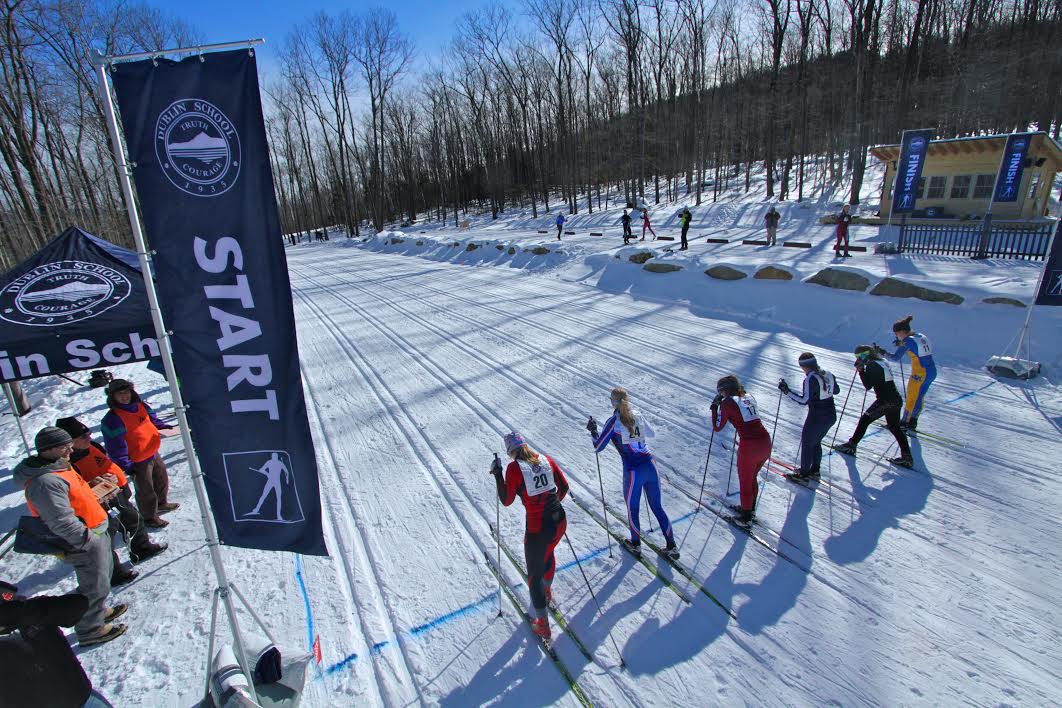
A race starting on the Dublin School nordic center’s new course last winter. (Photo: William H. Gnade Photography)
Note: In addition to the Dublin School, at least one other private school in New Hampshire has FIS-homologated trails. Proctor Academy, with 360 students in Andover, N.H., built FIS-approved trails (also designed by John Morton) two years ago. Proctor has two FIS-homologated loops of 2.5 k and snowmaking on 1.4 k.
***
Does a secondary school need an International Ski Federation (FIS)-sanctioned race course? Perhaps not, but that’s what skiers can expect when they go to New Hampshire’s Dublin School for the 2016/2017 ski season. The Dublin School, a private high school in southern New Hampshire, has a brand-new, FIS-homologated 5-kilometer loop, designed by John Morton, and it claims it’s the first high school in the world to receive the FIS homologation distinction.
Founded in 1935 by Paul and Nancy Lehmann, the Dublin School had unusual criteria. For location, according to the school’s website, “the site must be on the east side of hilly land at a considerable elevation,” and “There should be ample inexpensive, undeveloped, forested land and/or fields available for ultimate purchase and expansion.”
Michael Lehmann, the founders’ son, wrote in an email to FasterSkier that cross-country skiing was “an important sport the school” from the mid 1940s until the 1960s. Nathaniel “Buddy” Bates coached Lehmann when he was a senior at the Dublin School in the ’50s.
When Nathaniel’s son, Brad Bates, became Dublin’s new head of school and nordic ski coach in 2008, nordic had been an intramural sport for at least two decades. The only interscholastic ski competition was alpine.
After graduating from Dartmouth, Bates taught and coached rowing at a school in Delaware, where skiing was harder to come by. From there, he moved to Aspen, Colo., and became a high-school assistant principal, where, he “[reconnected] with skiing with a vengeance and got my own two kids into skiing,” he wrote. By coincidence, Noah Hoffman was a student at Aspen High when Bates worked there – although Bates didn’t coach there.
Upon his hiring as Dublin’s headmaster, Bates was instructed by Lehmann to hire a trail designer and build the best loop possible, Bates explained. So he reached out to his former Dartmouth coach, John Morton.
Tradition and the Future
Lehmann and his sister owned 82 acres of north-facing land adjacent to 27 acres owned by the Dublin School. With an upper elevation of 1,800 feet and significant terrain changes, “The slopes of the hill are steep enough for interesting and challenging Cross Country skiing. So, this was a perfect place to create the Nordic center,” Lehmann wrote in an email. They donated the land to the Dublin School.
“Both my sister and I consider outdoor sports to be very important for young people. What could be better than a sport which is in fresh air and sunshine, is fun, develops strength and stamina, and where there is the opportunity for competition?” Lehmann continued. “As this was a blank and very suitable piece of land, why not create the best trail system, one which could achieve FIS homologation?”
“What could be better than a sport which is in fresh air and sunshine, is fun, develops strength and stamina, and where there is the opportunity for competition?” — Michael Lehmann, on donating 82 acres to New Hampshire’s Dublin School for FIS-homologated ski trails
“We have 800 vertical feet on our campus,” Bates said in a phone interview.
The new 5 k loop connects with the school’s pre-existing trail system, which included 7 k of race trails (opened in January 2014) and 20 k of older trails. The new 5 k loop received a “C classification” from FIS, meaning it’s approved for classic mass starts and freestyle individual-start races.
“We may one day expand the stadium. It’s just the stadium area that’s the main issue,” Bates added.
Bates wanted a trail system “that would be first and foremost fun to ski and that would get junior skiers excited.” He also wanted a course that would be fair.
“As a ski racer, I was on congested trails. It wasn’t obvious then, but now it’s obvious,” he said.
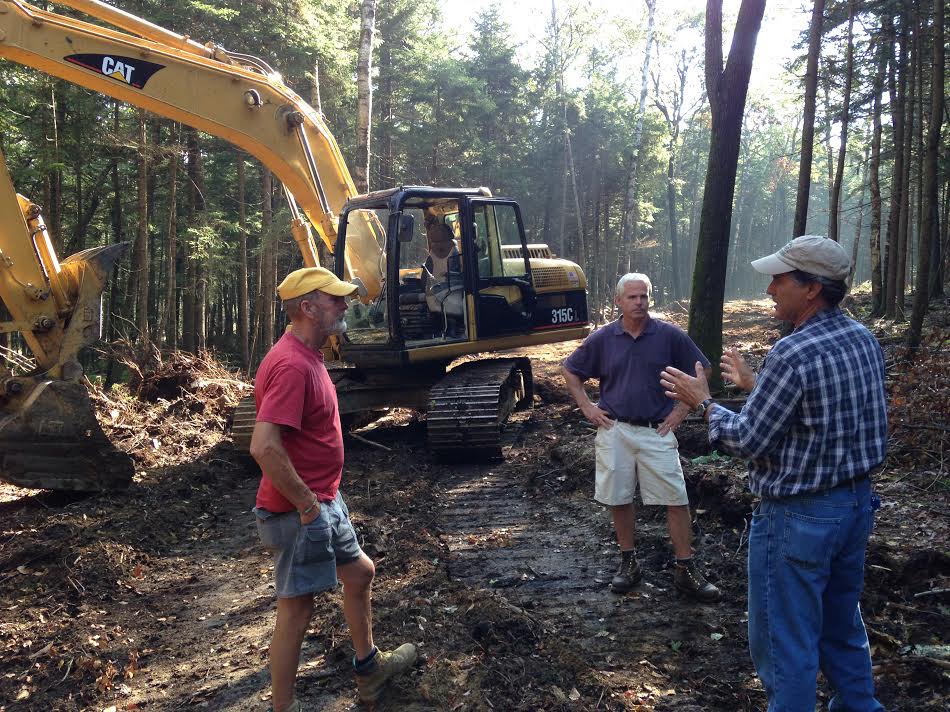
Owning their own excavator helped the Dublin School keep its construction costs down. (From left to right: excavator operator Bob Miles, project manager Andy Hungerford and trail designer John Morton. (Photo: Brad Bates/Dublin School)
He wanted the feel of a good race course while also making it practical for a race jury. One example: part of the reason the Dublin course isn’t homologated for a freestyle mass start is a bottleneck near the start.
“How the finish line works, turns out of the start, how downhills heading into quick abrupt uphills affect race fairness was all new to me,” Bates said. “The thought is that once we have the personnel and the infrastructure we can host major races here.”
Although Morton explained he tries to keep in touch with the skiers he coached during his 11 years at Dartmouth, he had lost touch with Bates and was glad to receive his email about developing the Dublin trails.
Regarding the trail design, Morton wrote, “Finding the required climbs was less of a concern than locating a potential start/finish area, which requires a level opening of at least 150 meters by about 50 meters. If you are working generally with a hillside, as we were in Dublin, it is ideal if the start/finish can be located somewhere near the middle of the available elevation gain. We were fortunate to find a modest natural shelf that provided just enough space for the start/finish, mid-way up the hill.”
While Bates mentioned a potential bottleneck that would preclude a freestyle mass start, Morton also looked at tree cutting. He explained that a homologated freestyle mass start course requires rolling terrain, including climbs that are 9 meters wide on the uphills and 6 meters wide in descents.
“[It’s] difficult for me to advocate cutting that kind of a swath through the trees of rural southern NH (for example), simply to comply with World Cup standards,” Morton wrote. “On the positive side, any skier who trains or competes on the Dublin School’s homologated race course, and goes on to compete internationally, will not be surprised by the competition venues he or she encounters… elsewhere in the world.”
Lehmann believes that homologation would enable students to train on courses similar to what they’d find at regional and national competitions. He wrote that Dublin School would bid for an Eastern Cup event once it had developed a sufficient volunteer base. Its student body is approximately 150 for grades 9 through 12, according to its website.
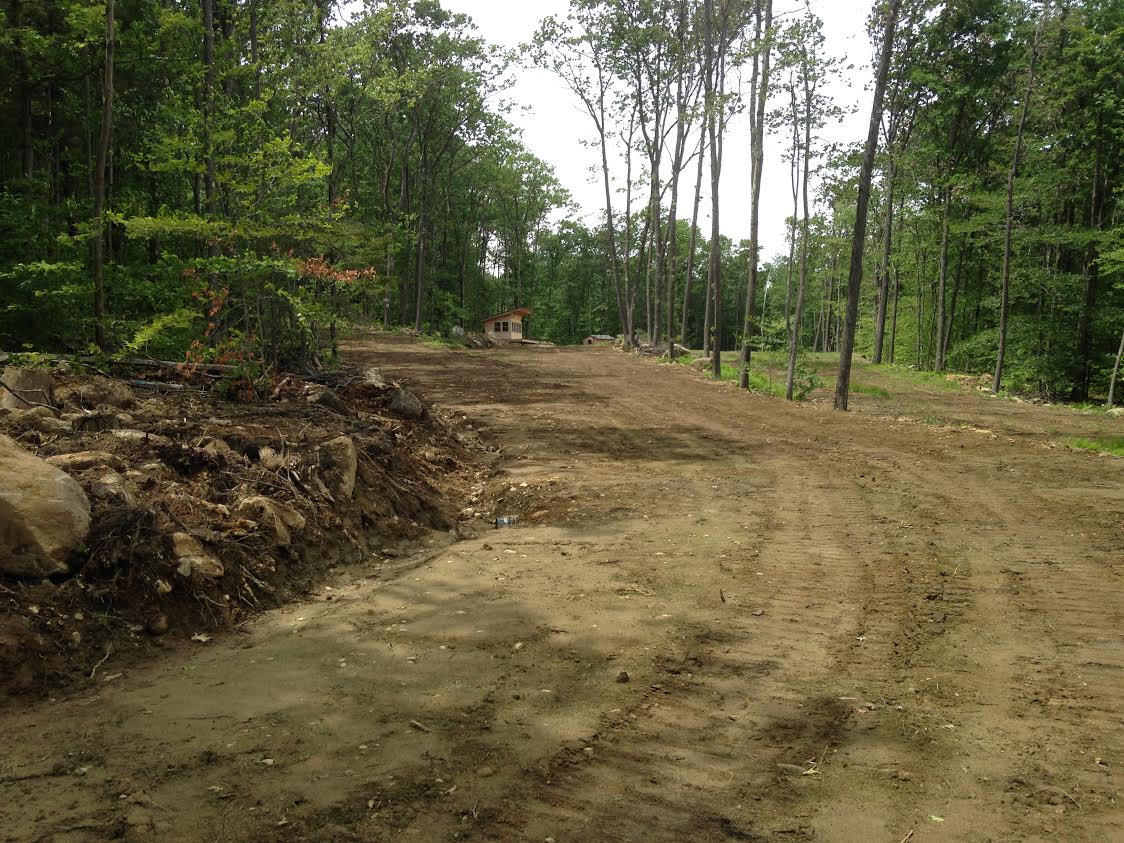
The construction of a homologated ski trail at the Dublin School in Dublin, N.H., this summer. (Photo: Brad Bates/Dublin School)
In addition to the new race loop, the Dublin School developed three additional kilometers of track that are not homologated. The total cost to build 8 k of trails, a yurt and a timing shed was under $250,000, Bates said.
In a continuing response to warm northeast winters, the Dublin School also installed snowmaking on a 1 k loop on the lower part of its campus. Intended for training and sprint races, Bates expects this loop to be fully solar-powered. He characterized it as a testing ground to determine whether it would be feasible to put snowmaking in on the FIS loop.
“People on the board made [snowmaking] a personal project,” Bates said.
“FIS homologation prequalifies Dublin to host national and international events where athletes hope to earn FIS points and qualify for the US National Team,” Bates stated on the school’s website. “For us, however, we are just happy to have such a fun and technical venue for our skiers to learn and enjoy the sport of skiing…”
According to Lehmann, the school created the Dublin XC Ski Club, “which attracts local skiers, many of whom [are] not otherwise connected to the School.”
The nordic center is open to the public when conditions are safe for skiing, except for when it is used for regional or school events.
Bates added, “Everyone is welcome to ski the trail system so long as they sign an online waiver. However, “The snowmaking loop will be reserved for school families and the local club we helped start, Dublin XC.”
“In Brad Bates, we could see a Head of School who would enthusiastically drive the re-introduction of Cross Country skiing – and he has done so!” Lehmann wrote.
“It is … heartwarming for me to see my former skiers passing along their love for the sport to another generation,” Morton said.
Targeted at high school aged skiers, to give them the opportunity to train and excel as a group, while learning the latest techniques, drills and philosophies.
Activities:
Roller skiing
Norwegian hill bounding with poles
Ski specific proprioception drills
Running
Optional road and mt. biking
Lake swimming at the boat house
Mt. Monadnock hike
Evening lecture series : A Yearly Training Plan ; Diet and Nutrition
This 3 day, 2 night camp will be hosted on the beautiful Dublin School campus, taking advantage of its newly refurbished weight room/endurance center; its on-campus ski hill, XC ski, running and mt. bike trails; it’s soccer fields; and miles of quiet dirt and paved roads. Each day will be organized to maximize training, technique and give the athletes all the information and experience they need to help them on their way to qualifying for J2 Championships, New England High School Championships, and beyond!
Coaches:
Michael Silitch is the head boys’ coach at the Dublin School and helped lead of his students to National Championships and J2 Championships this year. Having spent the last 12 years in coaching, guiding and training in Switzerland and France, he returned to the US last year with his wife to coach at Dublin. Pat Casey is the head coach at Holderness School. He is a former U.S. Ski Team coach, as well as a former coach at the Sun Valley Ski Education Foundation. Pat has worked with some of the best skiers in the world; he has a wealth of knowledge and is our technique guru for the camp.
Pricing:
Boarding option, $225, including lodging (2 nights), meals (3 lunches, 2 dinners, 2 breakfasts), transportation during camp, coaching. Day option, $175, including all meals; $145, including lunches.
To Register contact Michael Silitch: msilitch@dublinschool.org