Tag: Duncan Douglas

  • FasterSkier’s 12 Days of FBD Christmas: Day 12

    FasterSkier’s 12 Days of FBD Christmas: Day 12

    Editor’s note: This is it — the final installment of the 12-day holiday gift guide, authored by the one and only “FBD”, our gear-review guru. See also: Day 1 | Day 2 | Day 3 | Day 4 | Day 5 Day 6 | Day | Day 8 | Day 9 | Day 10 | Day 11

    ***

    Day 12: Masters World Cup Total World Domination Package

    Day Twelve. We made it. Wow. Sure, we lost a few along the way, good men (and women, though most women were likely smart enough to not set foot on this sinking ship in the first place)

    Taking a journey with 12 Days of FBD writing is like going on a poorly captained cruise ship (though thankfully with much, much less diarrhea and WAY fewer fat people). Come aboard, we’ve been expecting you.

    As a quick aside, I bartended at Smullin’s rehearsal dinner, so I naturally wore a name tag that read, “Isaac,” and YES, I sure as hell did the “double gun” finger point all night. I am frickin’ awesome.

    So as we are pulling into port, thanks to the steady hand of Captain Stubing, the compassion of Julie McCoy, and the vision and brilliance of yours truly, I am pleased to report that all of your relationship issues have been solved and life is good. That’s what happened every week on The Love Boat and it’s what is going to happen here. We’re going to end this wonderful series but going back to where we started, racing.

    In Day 1 (yes, I know, that seems like a long, long time ago, doesn’t it?), we focused on recovery. Why? (Let’s all say it together) You don’t get fast from doing hard workouts, you get fast by recovering from hard workouts. What is probably the hardest of all workouts? Racing. So we’re going to come full circle and finish up by talking about racing, more specifically, Master Blaster Worlds (MBW). I know, I know, they have some super-serious, long, fancy name, but to all of us “in the know,” they are Master Blaster Worlds. And this year they just so happen to be in the good ol’ U.S. of A.

    So one of my many goodbye gifts to you (there have been so many, as I view each of my written words as a gift to you. I told you I was a ‘giver.’), is that I (with the help of my latest Cracker Jack crew) am going to get you styled out for MBWs. If you don’t have all of the race gear, race clothing, casual clothing, recovery tools, and every other piece of equipment, software, or soft goods that you could even possibly need by now, well then God help you, as I don’t know if it would have been possible for me to write any more on any of these topics. At one point a few days ago I even got a call from the Internet, asking me to delete some of my earlier columns, because the Internet had run out of room.

    This means that you can’t possibly need anything else to wear, so what else could you need? Wax, that’s what. Wait a minute, wait a minute FBD, didn’t you that kook Caldwell yell at you about wax a few days ago? Yes, he did, and all of that yelling is still as applicable today as the day it was yelled, and I’m going to call that ‘good general ski wax knowledge,’ but since no one loves you like I do, I also going to go one step further and also bring in another panel of experts to talk about their years of experience training on racing on the exact MBW course.

    Take it from someone who has spent a lot of time in World Cup wax cabins, nothing beats local knowledge. There’s a reason why we send techs to World Championship and Olympic venues a year or two or THREE in advance, to start testing waxes. Can you imagine if you had over 40 years of experience testing in one particular venue under your belt? Well, you don’t need to imagine it, because that’s what I’m bringing to you here today, along with a few hard good recommendations as well.

    As I did was Zach and Nathan in Day 7, I am stepping back a bit and letting Matt Liebsch and the crew at Pioneer Midwest take the controls here, so full disclosure, I have not tested all of these products. These are the recommendations of Pioneer Midwest, written by Pioneer Midwest, not me, so if you have crappy skis at MBW and U R so PO’d that it’s a BFD, HU ML at PM ASAP 2 say FU.

    I also feel compelled to give credit where credit is due — the phrase, “Total World Domination, (TWD)” or at least in the context that it is used here, was created by Duncan Douglas, a.k.a., Jacked Up Old Man. If you don’t know Duncan, well, you are missing out. “TWD” is Duncan’s approach to each and every workout, from his early days as an Olympic biathlete, to whatever the hell insane 9 hours of activity he did last night, that’s just how JUOM rolls. He is my hero.

    Recommendations from Matt Liebsch/Pioneer Midwest below:

    ***

    Under $29
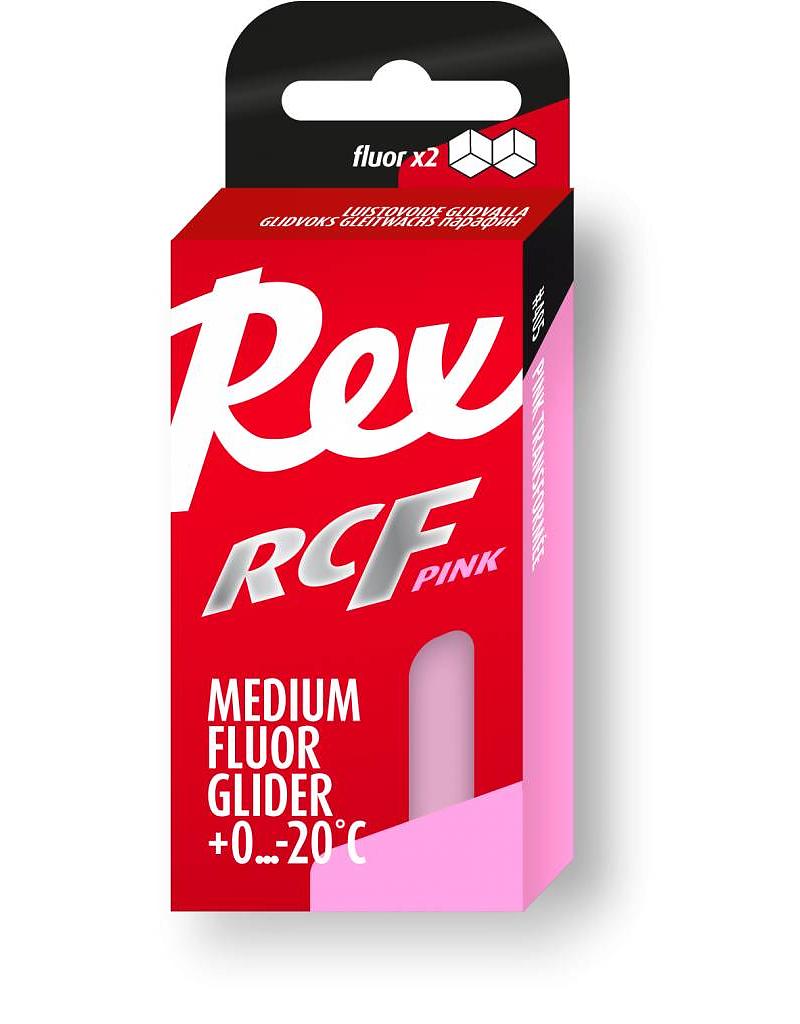
    RCF Pink

    Rex RCF Pink: Pioneer Midwest pick for under $29

    This pink block of wax is hard and medium-fluorinated, which is great for all the manmade snow at Wirth Park. Your waxing strategy needs to be built upon a solid base that will resist abrasion from granular snow, which is exactly the type of conditions present at Wirth Park the past few years. RCF Pink is a go to wax for World Cup technicians because World Cup races are regularly held on courses with manmade snow. This is a great wax for Wirth as long as the snow is not brand new. Patrick Moore is an awesome dude and one of the best techs on the World Cup… he shows how to apply this hard stuff in this video.
    $19.95 at Pioneer Midwest


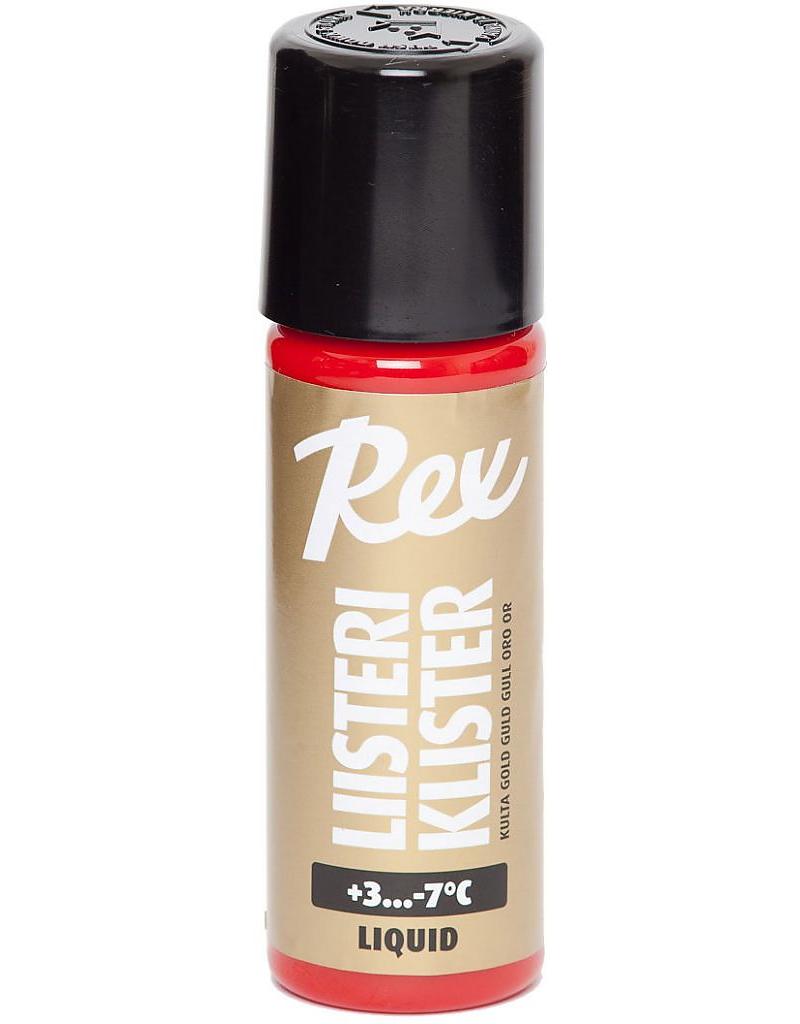
    Rex Liquid Klisters

    Rex Liquid Klister (Gold): Pioneer Midwest pick for under $29

    Thin to win right?! Well that is easier said when working with klister. Rex has some new liquid klisters that apply easily with a sponge applicator. They are incredibly easy to use while keeping the layer of klister thin and mess free. No more klister running off the tails of your skis. We have found Rex Base Klister a workable solution in many conditions at Wirth as a base-kick option and the Rex Gold… that stuff is just the best on artificial snow.

    $14.95 at Pioneer Midwest


    ***

    $30 – $99

    Rex Hydrex

    Rex Hydrex Gel: Pioneer Midwest pick for $30-$99

    Whenever I have great success classic skiing at Wirth Park it seems to involve me using Rex Hydrex.

    This is a gliding wax used to cover kicking waxes. If you are on klister, it generally speeds things up without sacrificing kick, but make sure to always test it on your warmup skis before shot-gunning it. It works awesome as a treatment for skin skis or zero skis.  Also, in warm temps it can be used on the gliding zones as well and I know for a fact it has seen high-level success at the World Cup both as a covering wax for kick and as a glide top coat.
    $84.95 at Pioneer Midwest


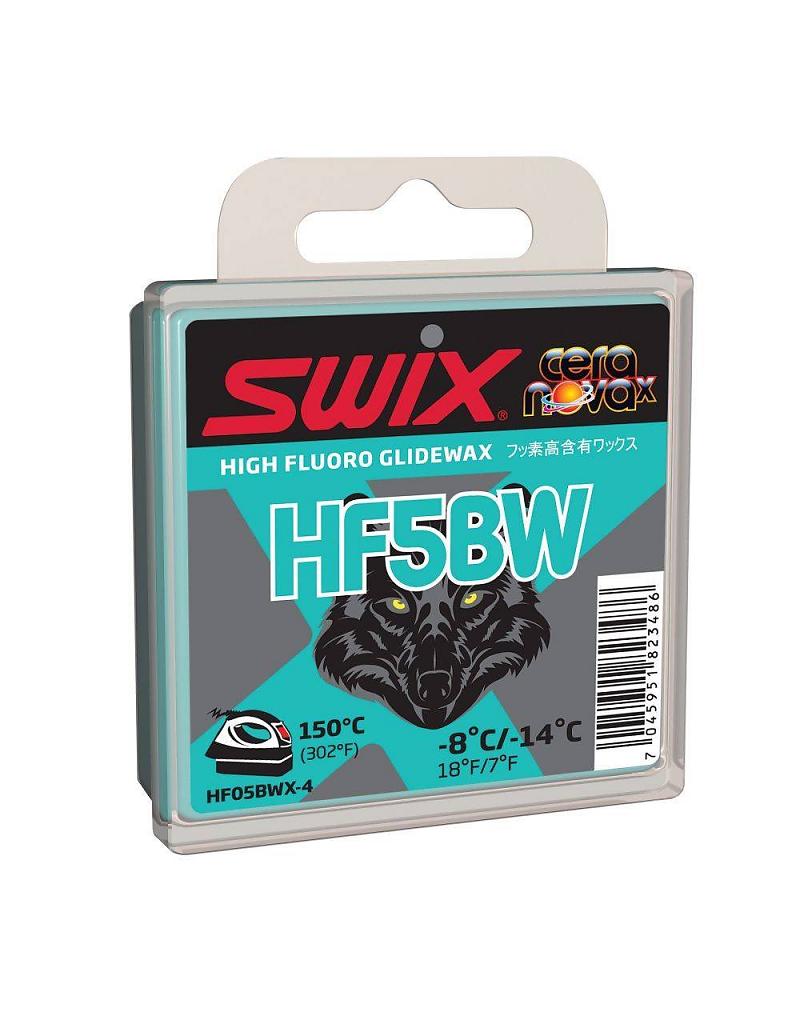
    Swix HF5BW

    HF5BWX Black Wolf: Pioneer Midwest pick for $30-$99

    This is a go-to race paraffin for Wirth Park when they don’t have natural snow (most of the time). The workable temp range is huge for this wax at Wirth: 10 F to 35 F+. Most years they have mixed dirty artificial snow and HF5BW is near unbeatable in standard (unfortunately standard) Wirth snow conditions. If there is no new snow in sight, use this. The other standby that shines under these conditions is Rex RCF Pink.

    $77.95 at Pioneer Midwest


    Start MF10

    Start Medium Fluor Glider MF10 Green: Pioneer Midwest pick for $30-$99

    Natural snow in Minneapolis in January means only one thing … it is freakin’ cold. My #1 tested cold natural snow race base wax for the Twin Cities is Start MF10. I have tried to beat it for years; Start HF10 comes close as do a lot of things, but if you are looking for something that works all the time and does not cost a fortune, you cannot miss with this wax in super-cold squeaky natural snow conditions. Make sure you have a cold profile ski and a super-cold grind…. I like our SC0. Check out our stone-grinding services.

    $43.95 at Pioneer Midwest

    World Cup Waxing Service

    Masters World Cup Waxing Service: Pioneer Midwest pick for $30-$99

    Want to leave the waxing supplies at home for World Masters and have us take care of it all for you? We have been skiing at Wirth Park for over 20 years. We know what works and more importantly we know what does not work. Whenever I have traveled the country and world I have had great success getting wax support and grind support from the locals because they know what works the best. Pioneer Midwest will be and are your local experts. Let us take care of your skis for you and we will prepare them for whatever the weather and Wirth Park throws at us for World Masters.

    $85 at Pioneer Midwest

    Editor’s note: Also offered by other retailers, like Boulder Nordic Sport (1 pair of skis | 2 pair of skis)

    ***


    $100 – $299
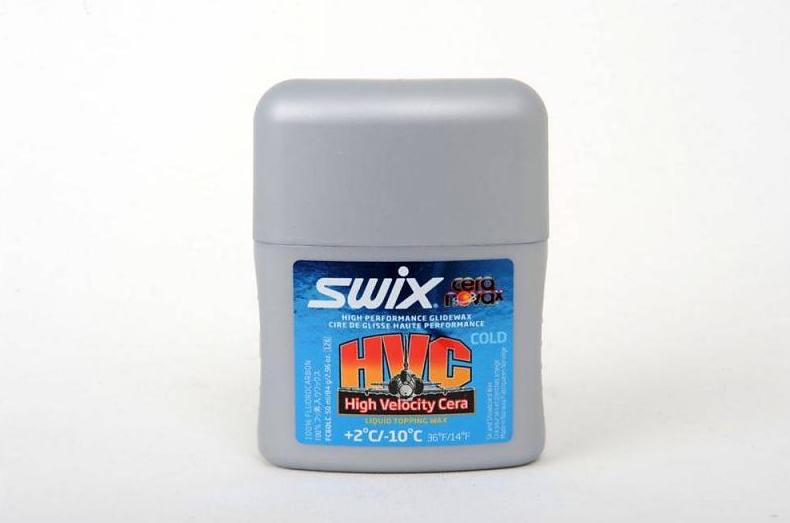
    Swix HVC Cold and Warm

    Swix HVC Cold: Pioneer Midwest pick for $100-$299

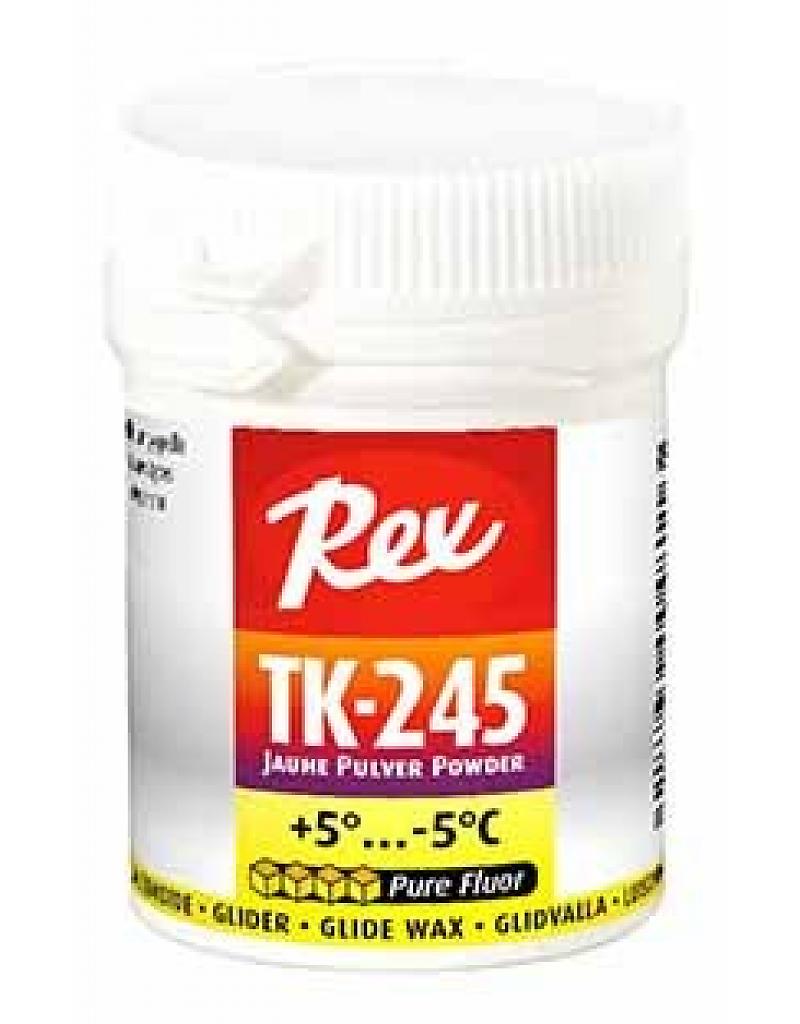
    Speed without having to think about it. The Swix HVC liquids are super easy and extraordinarily fast on the artificial snow at Wirth Park. Again, I have tested a boatload of liquid waxes at Wirth and these are always near the top. I qualified top 6 in a SuperTour sprint qualifier a few years ago at Wirth on HVC and that is outstanding considering my history of sprinting. When the conditions are below 25 F and artificial snow, we use the cold version, and when warmer than 25 F, we use the warm version. This stuff is super easy to use, wipe on, let dry 3 minutes or longer, go race. An application of Swix HVC can last upwards of 15 km. But careful in mixed new snow as they can be a liability, but when skiing on old snow grab the appropriate Swix HVC and go for it. The other staple liquid to try if the snow gets a little dirtier from heavy use is Rex Ruka.
    $139.95 at Pioneer Midwest


    Rex TK-245

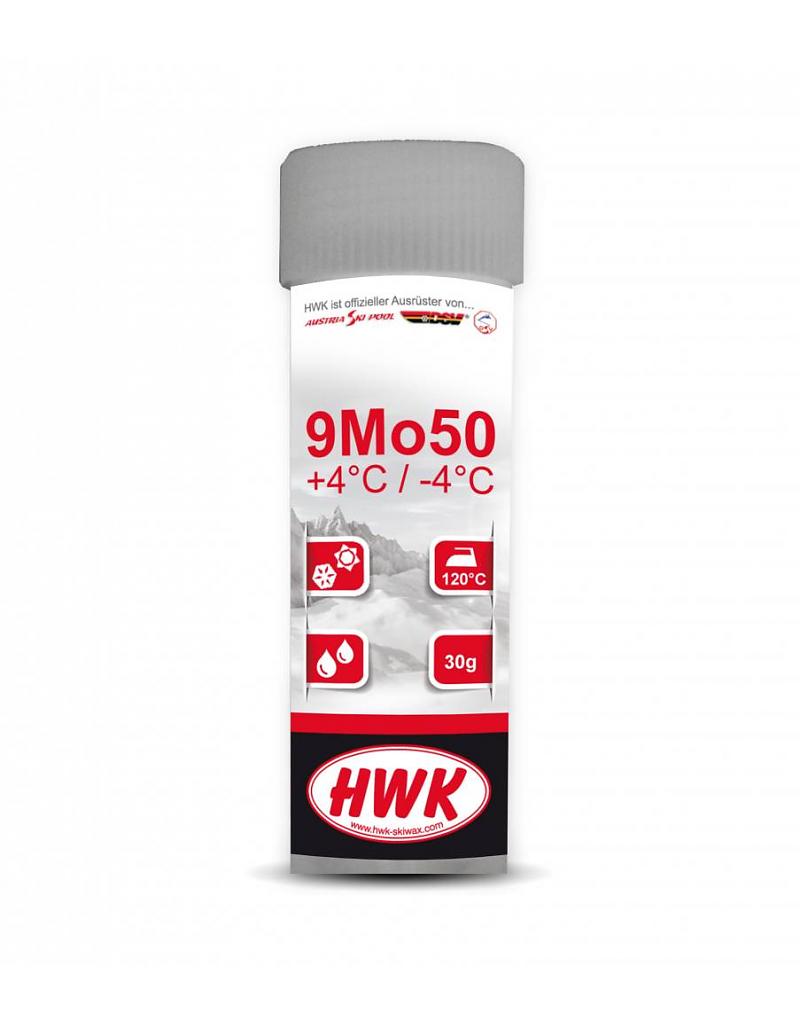
    Rex TK-245 Fluoro Powder: Pioneer Midwest pick for $100-$299

    If I had to shotgun one powder for warm weather racing above 20 F, this would be it. This wax has a Birkie win under its belt and it has been a no-brainer choice on the World Cup for years. It runs very well at Wirth Park. The other powder that always seems to be in the mix at Wirth in the artificial snow is Toko Red 2.0.
    $144.95 at Pioneer Midwest


    HWK 90mo50

    HWK Fluor Stick 9Mo50: Pioneer Midwest pick for $100-$299

    Wet and dirty snow at Wirth Park seems to happen more often than we would like. The HWK guys are always testing on the WC biathlon circuit and they race and test on wet, dirty, artificial snow all the time. This was my top coat at the Birkie 2 years ago and I have won a few SuperTour races at Wirth Park on this wax. It is easy to apply and a no-brainer in wet/dirty Minneapolis city snow if we get those conditions.

    $108.95 at Pioneer Midwest


    Swix Triac 2.5 Poles

    Swix Triac 2.5 Poles: Pioneer Midwest pick for $100-$299

    Want a top level pole without having to spend $500? This is your ticket. We have a lot of Triac 2.5 poles on closeout and it is the same shaft as the new $500 Triac 3.0. The difference is the strap and if you are keen on watching a lot of World Cup racing you may have noticed many of the best skiers in the world were using the 2.5 pole even after the 3.0 was released. Why? Well the traditional strap/grip with some real estate to rest your thumb is very nice at a cost of only a few grams. Plus we think the graphics on the 2.5 are better.

    $299 at Pioneer Midwest

    ***

    Over $300

    Race Skin Skis

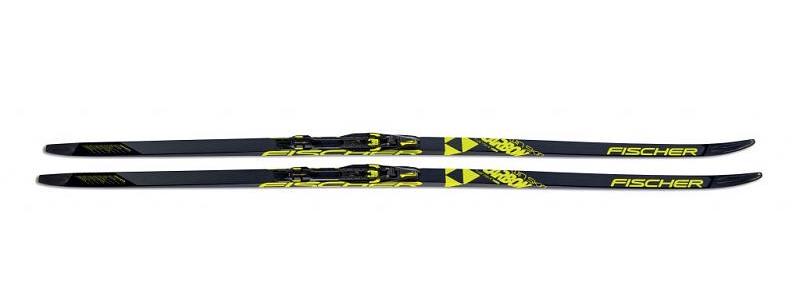
    Fischer Twin Skin Carbon skis: Pioneer Midwest pick for over $300

    Panic waxing, no more. Yes, a perfectly waxed classic ski with the perfect application will outperform a no-wax ski most of the time. But how often does that happen?! Even Norway screws up the kick wax — look what happened at Ruka this year. Klæbo won the men’s World Cup distance classic race on no-wax skis. Wouldn’t it be nice to have a backup race classic ski for when you or your wax tech miss the kick wax and you have no kick or too much kick and you start panic-mode 15 minutes before your race start? Think about how great it could be if you have a rocket-fast skin ski with bomber kick, covered in Rex Hydrex waiting in case of panic. We stock every major brand of racing skins, just drop us a line if you want to order some anti-panic skis. Check out our Ski Request services.

    Skin skis starting at $149.95 at Pioneer Midwest

    ***

    Conclusion

    This is me again, FBD.

    As we are winding this down, questions continue to roll in as to how I managed to get all of these amazing reviews done, not only so amazingly well, but also so amazingly fast. Part of my secret I shared the other day with this very insightful video, and part of it derives from my scrupulous attention to detail and a work ethic that I learned from Hunter S. Thompson.

    For anyone unfamiliar with his legendary schedule, I strong encourage you to carefully review this and adapt to your life, as necessary.
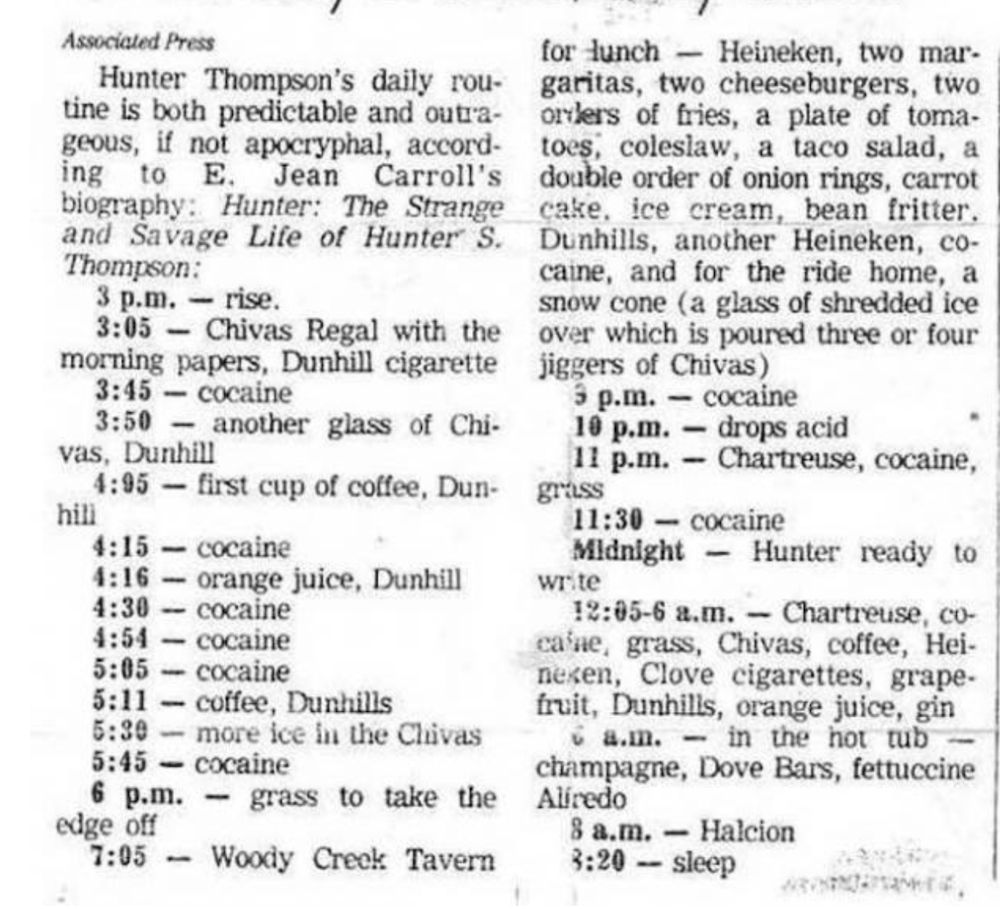
    In reality, my own schedule is quite similar. First off, I applaud Mr. Thompson for getting a full 8 hours of sleep each “night,” as every good athlete knows that recovery is the key to success. Well done, Hunter. I choose to follow this lead wherever possible, with only a slight 14-hour shift in the prescribed bedtime (Wow, Hunter and I sure used the word ‘prescribed’ in a very different sense, huh?).

    Regarding diet, this is also another key pillar to success to all athletes and one small area in which Mr. Thompson and I deviate slightly. My food profile is a little more centered around fresh fruits and vegetables and a little less centered around cocaine and cigarettes, but I think we’re really splitting hairs here. Can starting the day with three lines of blow and a Marlboro Red really be all that different than a kale smoothie and a quinoa/egg white omlette? I think most doctors will tell you no.

    Apparently he and I also share a love for pasta, orange juice and Dove bars, so I have to believe that I am well on my way. To where? Who knows, but I do know one thing, it’s not here.

    Wait, perhaps that a bit too dramatic — I am neither quitting, nor being fired (at least not to the best of my knowledge, but I suppose that could change at any moment), but this does mark the end of 12 Days of FBD and what a ride it has been.

    I hope everyone has enjoyed reading this work as much as I have enjoyed writing it and I would most certainly be amiss if I didn’t pay a huge thanks to my evil, corporate overlords at FasterSkier who give me a TREMENDOUS amount of room to run and support me completely in what assuredly is the most “colorful” gear review out there.

    In particular, I want to say an extra special thanks to my editor, Alex Kochon. Despite the fact that the word “cochon” is French for pig, Alex is anything but that. This may come as a huge surprise to all of you, but I can be exceedingly difficult to work with — I submit 7,000 word reviews on even the simplest of topics and I have a deep emotional attachment to each and every one of those words. From my perspective, the removal of even one of my carefully chosen locutions results is such a devastating seismic shift that the newly butchered text takes on a completely different dimension, one with potentially earth-destroying consequences. In addition to this unbreakable ionic bond I have to each and every carefully chosen and very precise phase, I also have a flair for the melodramatic. And I am also quite needy. No, really, it’s true. I’m not sure, but I think I also complain a lot. However, I do know that a lot of people complain about me, so in my mind, those two kind of balance out.

    Combine all of this with the fact that I regularly submit work at well past midnight and hopefully it is evident how key a role Alex played in this process. She is a smart, calm, caring person and truly a joy to work with each day, as always manages to quickly and efficiently format and post my work, thankfully usually only with a minimum of edits. Her professionalism is unrivaled, as are her talents (this is the case for most of the FS staff, with the notable exceptions of Albert and Kentch, who are terrible, terrible hacks). This team has some of my biggest fans and the feeling is most certainly mutual.

    We do need to teach Alex a lesson though, so when you see her on the tracks, the street, or in the grocery store, please ask her to tell you the third fictional name that she removed from my rant about the oh-so-annoying trends in child naming. Not only is it “family friendly”, but it is also hilarious. And she took this from you. You have been robbed. Now she must pay. So ask. And ask. And ask. If she says no, ask her again.

    So as I prepare to sign off, I sincerely hope that these columns were of some assistance, albeit minor. Whether I somehow managed to provide you a good holiday gift idea idea or even if these rambling diatribes just helped you kill a few minutes at work and stick it to The Man, it doesn’t really matter. It’s not important if you read each and every column, hanging on every work, skimmed a few when you were stuck in an airport with absolutely nothing else to do, or just looked at it for the funny pictures, if you got even one things out of all of this, that’s all that matters.

    Hopefully the biggest thing that you did get out of the columns is my hope that everyone realizes that we’re all in this life together. Clean air and clean water shouldn’t be a partisan issue. It just should not. Everyone on the planet deserves access to land not choked with pollution and a safe place to raise their families. We’re at a cross-roads in this country on many of these issues and hopefully enough people will realize the seriousness of these problems and get involved before it is too late.
    Science!

    So get involved. Pay attention (not just to the signs for baggage claim, but everything in the world around you. Even if a problem isn’t in your backyard, you should still care). Vote. Demand more of your politicians and yourself. We created all of these problems and it is up to us to fix them. But let’s not just fix them, let’s also fix our approach: thoughtful, rational discourse is our only way out, so let’s all hope we can find this, as soon. Facts are nothing to be feared, they are our salvation. Science isn’t always perfect, but it’s the best tool that we have, so it should not be feared, scorned, suppressed, or redacted, it should be embraced.

    Finally, even though I took a lot of cheap shots at people, places, and institutions in the past 12 days, it was all done in good fun and with nothing but the best of intentions, (except for you, American Airlines, you truly suck, that was a legal carry-on bag that you made me check it. And I haven’t forgotten about it.)  This is a wonderful sport and a wonderful community, so on behalf of the entire FasterSkier team, I’d like to wish everyone a very happy, sexy and snowy holiday. Be kind. Be aware. Be awesome.

    See you out there.

    FBD, Over and Out.
  • Climb to the Castle Archive: Top Results from the Last 10 Years

    Climb to the Castle Archive: Top Results from the Last 10 Years

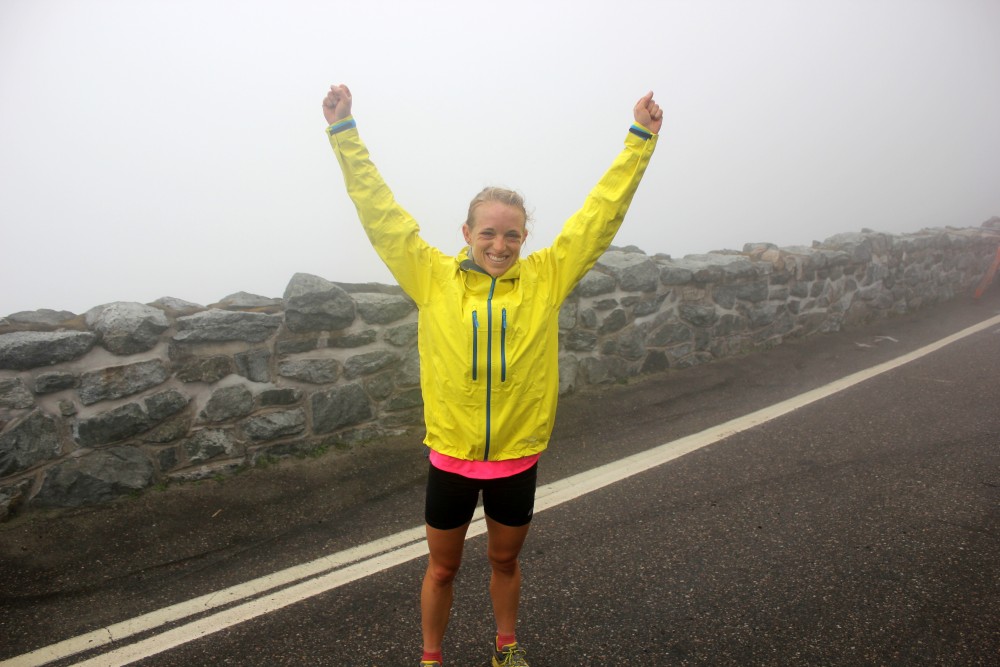
    Liz Stephen celebrates her win and new course record at the 2014 Climb to the Castle. Stephen clocked her fastest time and fifth win at Whiteface Mountain despite a strong headwind and exhaustion at the end of the U.S. Ski Team's training camp in Lake Placid, N.Y.
    Liz Stephen celebrating her win and new course record at the 2014 Climb to the Castle. Stephen has the most women’s wins in 10 years of the Climb, winning five of those races, and also holds the women’s course record.

    For the last decade, the Climb to the Castle has been a fall staple in northeastern New York. It’s been a circled on the calendars of the U.S. Ski Team and US Biathlon national team almost every year since its inception and attracts 75 to 100 no-joke skiers to Wilmington (near Lake Placid, N.Y.) each year.

    Following the 10th annual rollerski race up Whiteface Mountain’s toll road, a five-mile grind with an average 8 percent grade, we thought it would be worth looking at course records and some of the climb’s legendary winners.

    ***

    Most wins: Liz Stephen (5), Duncan Douglas (3)

    Course records: Duncan Douglas (34:56.6) 2007, Liz Stephen (41:50) 2014

    ***

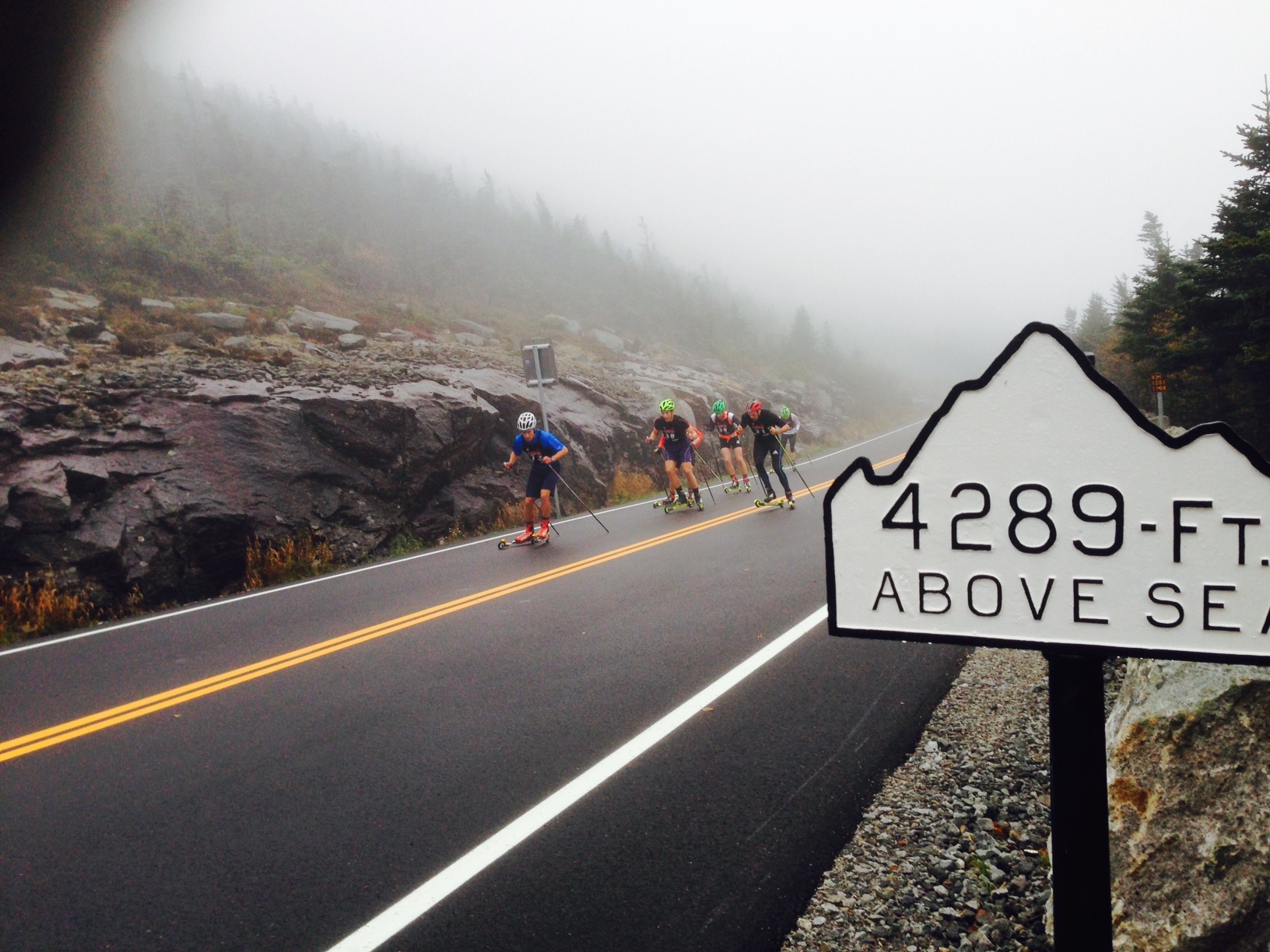
    Paddy Caldwell (black shirt, yellow helmet) of the U.S. Ski Team D-team and SMST2 Team chases Rogan Brown (l) around mile four of five in  Sunday’s Climb to the Castle up Whiteface Mountain in Wilmington, N.Y. Caldwell won the race, followed by biathletes Russell Currier and Tim Burke in second and third, respectively. Brown (SVSEF) placed fourth and Kyle Bratrud (CXC) was fifth. (Photo: Tim Cowan)
    Paddy Caldwell (black shirt, yellow helmet) of the U.S. Ski Team D-team and SMST2 Team chases Rogan Brown (l) around mile four at the 2015 Climb to the Castle. Caldwell won the race, followed by biathletes Russell Currier and Tim Burke in second and third, respectively. Brown (SVSEF) placed fourth and Kyle Bratrud (CXC) was fifth. (Photo: Tim Cowan)

    2007:

    Date: Oct. 13

    Notes: sunny/cold; 25 degrees F

    Men’s top 3:

    1. Duncan Douglas (34:56.6)
    2. Kris Freeman (37:09.1)
    3. Noah Hoffman (38:38.9)

    Women’s top 3:

    1. Liz Stephen (47:22.9)
    2. Morgan Arritola (47:48.8)
    3. Dorcas Wonsavage (49:12.7)

    Complete results


    2008:

    Date: Oct. 6

    Notes: *Shortened course; athletes did not reach summit because of snow.

    Men:

    1. Duncan Douglas (32:26.44*)
    2. Kris Freeman (34:22.90*)
    3. Noah Hoffman (36:56.87*)

    Women:

    1. Caitlin Compton (45:19.91*)
    2. Morgan Arritola (45:27.89*)
    3. Liz Stephen (45:52.83*)

    Results: Men | Women

    Video


    2009: 

    Date: Oct. 7

    Men:

    1. Taylor Fletcher (39:11.54)
    2. Nick Hendrickson (39:25.40)
    3. Kris Freeman (39:49.97)

    Women:

    1. Morgan Arritola (50:54.85)
    2. Liz Stephen (51:09.57)
    3. Ida Sargent (51:23.85)

    Results: Men | Women

    Report | Video


    2010: 

    Date: Oct. 8

    Notes: Clear weather

    Men:

    1. Kris Freeman (38:37)
    2. Noah Hoffman (39:16)
    3. Ben Sim (40:32)

    Women:

    1. Laura Spector (46:58)
    2. Morgan Arritola (48:02)
    3. Liz Stephen (48:43)

    Results: Men | Women

    Women’s report | Men’s video


    2011:

    Date: Sept. 17

    Men:

    1. Kris Freeman (36:18)
    2. Tim Burke (36:29)
    3. Noah Hoffman (37:03)

    Women:

    1. Liz Stephen (44:50)
    2. Ida Sargent (46:14)
    3. Tara Geraghty-Moats (47:43)

    Results: Men | Women

    Womens’ report | Men’s report | Video | Photos


    2012: 

    Date: Sept. 15

    Men:

    1. Tad Elliott (39:28)
    2. Pat O’Brien (39:38)
    3. Julian Dorais (39:46)

    Women:

    1. Liz Stephen (43:33)
    2. Jessie Diggins (48:38)
    3. Ida Sargent (48:55)

    Results: Men | Women

    Women’s report | Men’s report | Notes & Quotes


    2013:

    Date: Sept. 15

    Men:

    1. Tim Burke (37:13)
    2. Simi Hamilton (39:59)
    3. Karl Nygren (40:04)

    Women:

    1. Liz Stephen (42:04)
    2. Caitlin Gregg (45:21)
    3. Ida Sargent (47:19)

    Results: Men | Women

    Report


    2014:

    Date: Sept. 6

    Men:

    1. Tim Burke (38:19)
    2. Russell Currier (39:02)
    3. Welly Ramsey (40:01)

    Women:

    1. Liz Stephen (41:50)
    2. Caitlin Gregg (45:25)
    3. Katharine Ogden (48:12)

    Results: Men | Women

    Report


    2015: 

    Date: Sept. 20

    Men:

    1. Patrick Caldwell (37:05.2)
    2. Russell Currier (37:10.2)
    3. Tim Burke (37:16.7)

    Women:

    1. Mary Rose (45:15.1)
    2. Annelies Cook (45:47.1)
    3. Hannah Dreissigacker (47:21.0)

    Results: Men | Women

    Report


    2016:

    Date: Sept. 18

    Men:

    1. Duncan Douglas (37:15.6)
    2. Russell Currier (37:23.9)
    3. Paul Schommer (40:18.2)

    Women:

    1. Hannah Rieders (55:03.1)
    2. Anna Lehmann (55:18.8)
    3. Madeline Rieders (56:26.4)

    Results: Men | Women

    Report

  • Win #3 for Duncan Douglas, Hannah Rieders Top Woman at Wide-Open Climb to the Castle

    Win #3 for Duncan Douglas, Hannah Rieders Top Woman at Wide-Open Climb to the Castle

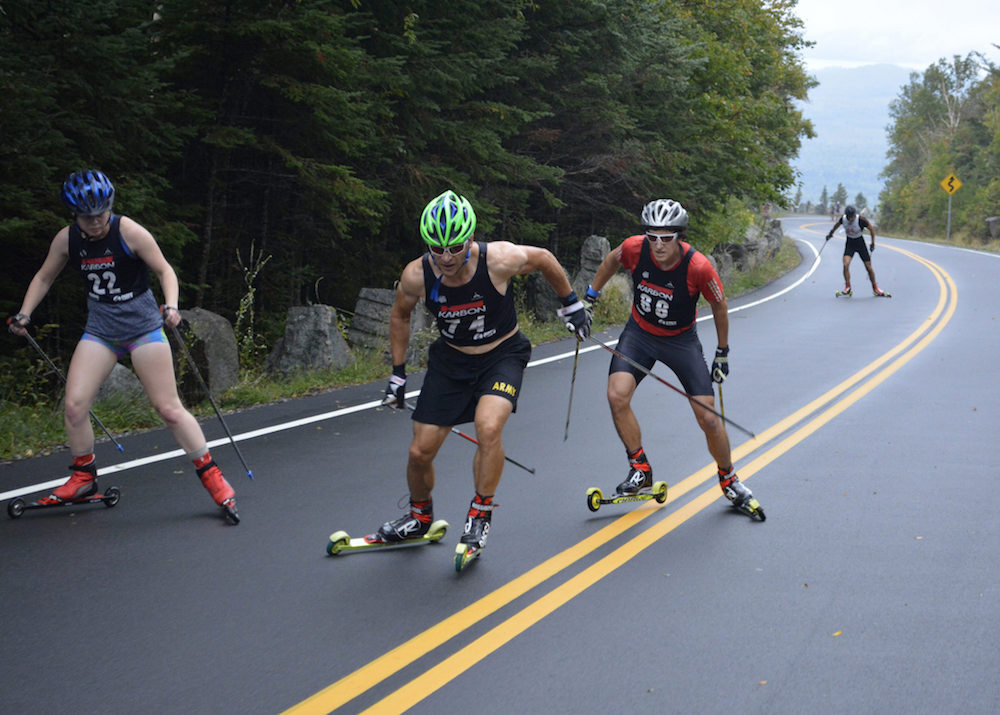
    Duncan Douglas (74) leads biathletes Russell Currier (in red) and Paul Schommer (behind) in Sunday's Climb to the Castle rollerski race up Whiteface Mountain. Douglas held off Currier by eight seconds for his third victory in four times racing the Climb and Schommer finished third. (Photo: NYSEF/Flickr)
    Duncan Douglas (74) leads biathletes Russell Currier (in red) and Paul Schommer (back right) in Sunday’s Climb to the Castle rollerski race up Whiteface Mountain, while Clarkson’s Jenevieve Broadwell (22) looks on. Douglas held off Currier by eight seconds for his third victory in four times racing the Climb and Schommer finished third. (Photo: NYSEF/Flickr)

    (Note: This article has been updated to include comments from third-place finisher Paul Schommer and NYSEF’s cross-country head coach Margaret Maher.)

    WILMINGTON, N.Y. — Four appearances and three wins is an enviable record. On Sunday, 50-year-old Robert Duncan Douglas, the “Jacked Up Old Man” from Honeoye Falls, N.Y., won his third Climb to the Castle (C2C) rollerski race, a five-mile freestyle hill climb up the Whiteface Memorial Highway.

    Douglas previously won the race in 2007 and 2008, with a personal-best time of 34 minutes, 56.6 seconds in 2007 (he was 2 1/2 minutes faster on a shortened course in 2008, when racers were unable to reach the summit because of snow). 

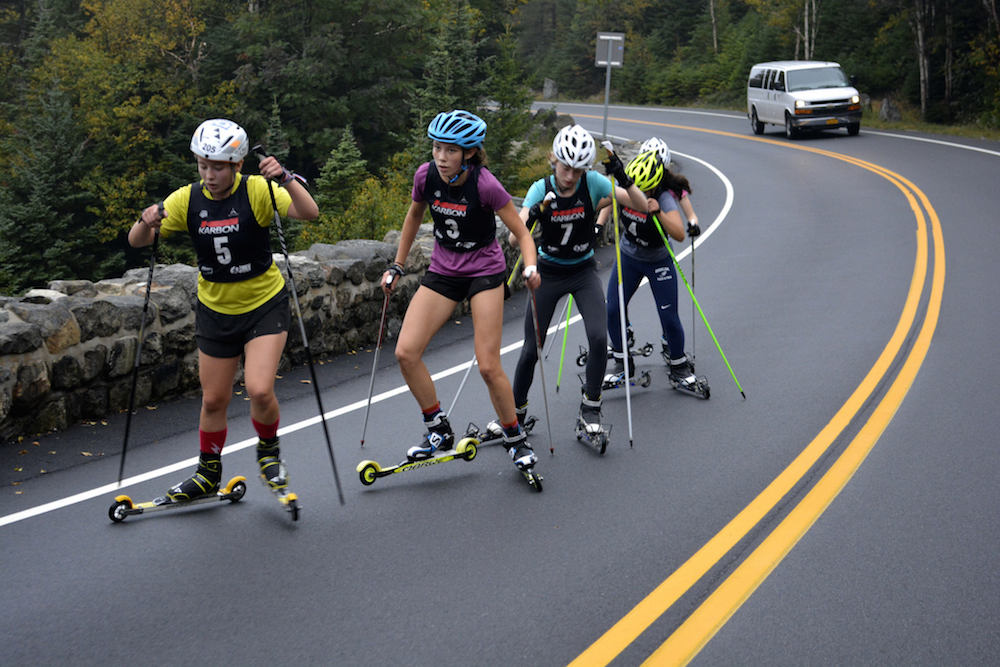
    St. Lawrence's Jackie Garso (5) leads Stratton's Anna Lehmann (3) and CSU's Hannah Rieders (7), Gabby Vandendries (4), and Madeline Rieders (in back)  during the women's Climb to the Castle rollerski race up Whiteface Mountain on Sunday in Wilmington, N.Y. (Photo: NYSEF/Flickr)
    St. Lawrence’s Jackie Garso (5) leads Stratton’s Anna Lehmann (3), and CSU’s Hannah Rieders (7), Gabby Vandendries (4) and Madeline Rieders (in back) during the women’s Climb to the Castle rollerski race up Whiteface Mountain on Sunday in Wilmington, N.Y. (Photo: NYSEF/Flickr)

    Hannah Rieders, a 17-year-old Cambridge Sports Union (CSU) skier whose initial goal was an age-group podium, won her first C2C, on the race’s 10th anniversary.

    Finishing in 37:15.6 this year, Douglas was 8.3 seconds ahead of runner-up Russell Currier, a biathlete who trains with the Outdoor Sports Institute in Maine. Paul Schommer, a senior member of US Biathlon’s National Development Group, placed third overall, 3:02.6 minutes behind Douglas.

    Rieders, a high-school senior from Wellesley, Mass., was the first woman across the line in 55:03.1. She beat Anna Lehmann, a ninth grader representing the Stratton Mountain School (SMS), by 15.7 seconds, and Rieders’s twin, Madeline (also of CSU), finished 1:23.3 minutes back in third.

    “I kind of thought maybe Anna would beat me,” Hannah Rieders said in a post-race interview. “At the start, I just wanted to pace it well. I stayed behind other people for the first three miles.”

    Overnight rain left the road damp. At the toll-booth start in Wilmington, temperatures hovered around 65 degrees under cloudy skies, with sultry humidity. Low clouds at the start turned dense up high near the summit. Unless you were really close to skiers in front of you, it was hard to gauge how far up the road they were, and how much energy one should expend to attack.

    (Story continues below)

    With the U.S. Ski Team wrapping up its New Zealand training camp in New Zealand, and thin representation from elite biathletes, the race was wide open.

    Margaret Maher, head coach of the New York Ski Educational Foundation (NYSEF) cross-country program, explained in an email that she learned in April that the U.S. Ski Team would not be comping to Lake Placid for its usual dryland camp this year. To accommodate the US Biathlon team, she originally scheduled this year’s Climb for next weekend, Sept. 25, but that date conflicted with other races NYSEF’s skiers planned on competing in.

    Maher had to move the race up one week in order for her athletes to attend. Regardless, 85 athletes registered this year, which was on par with the “73-108 athletes” that the race has previously attracted.

    Of the top-five female finishers on Sunday, four were under the age of 18, and Lehmann is a U16. With Jackie Garso (St. Lawrence University) placing fourth and Gabby Vandendries (CSU) finishing fifth, CSU had three in the top five.

    “First time [at C2C] for all three girls,” CSU coach Rob Bradlee wrote in an email. “All three also ran Mt. Washington for the first time in June. Tough kids! I don’t have them do any special prep for this race. Their regular six-days-per-week training clearly is enough to get them ready. All three are very hard workers and have been training hard all summer. I think their results show that.”

    Hannah Rieders explained that five women formed the lead pack. Around mile three, the eventual top three broke away.  They skied together until mile four, “then I went ahead,” Rieders said.

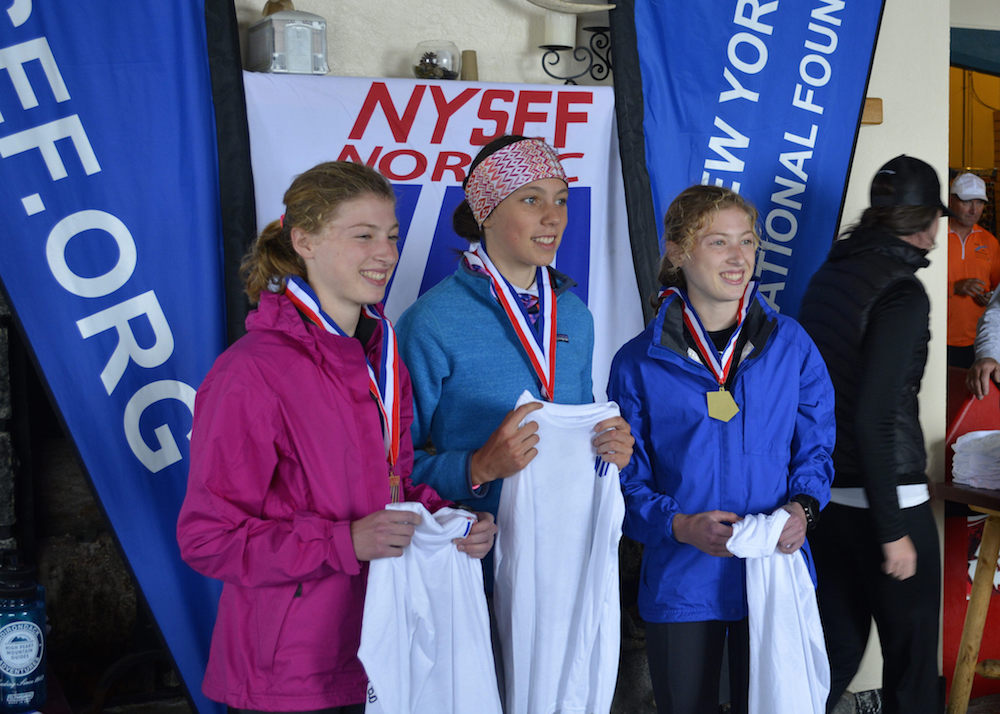
    The women's podium at the 10th Climb to the Castle rollerski race up Whiteface Mountain's Memorial Highway on Sunday in Wilmington, N.Y. With all of the top five under 18, Hannah Rieders (CSU) placed first, Anna Lehmann (SMS) was second, and Madeleine Rieders (CSU) was third. (Photo: NYSEF/Flickr)
    The women’s podium at the 10th Climb to the Castle rollerski race up Whiteface Mountain’s Memorial Highway on Sunday in Wilmington, N.Y. With all of the top five under 18, Hannah Rieders (CSU) placed first, Anna Lehmann (SMS) was second, and Madeleine Rieders (CSU) was third. (Photo: NYSEF/Flickr)

    Madeline Rieders said she skied in the pack until mile three, then pulled away with Hannah and Lehmann. While she lost contact with them on the road, which has an average grade of 8 percent, she maintained a steady gap to the finish and held off fourth place by 50 seconds.

    For the men, it was down to three from the start, according to Currier.

    “Paul, Duncan and I all took turns leading,” he wrote in an email.

    “I’m in better shape this year, but not rollerski shape,” Douglas said.

    For most of the summer, Douglas focused on bike racing, winning his 50-59 age group and placing 25th overall at the Leadville Trail 100 mountain-bike race. He said he just started rollerskiing two weeks before the Climb.

    Douglas, a two-time Olympian who will be 51 in November, had a simple race plan. “Go out, ski hard, have fun,” he reflected.

    For most of the race, Douglas skied with Currier. He dropped Currier once, but the 29-year-old former national-team biathlete regained contact. Douglas said that at the Lake Placid corner – a hard left where the grade eases and one can transition to V2 strides – he broke away to the finish.

    “Once the flat section towards the end started, I wasn’t able to match Duncan’s speed,” Currier wrote. “He was never very far out but enough to make a difference at that point in the race.”

    Of his race, Currier described it as “a solid effort. I really tried to use good technique. For a race that’s nothing but uphill, there’s not much else you can do.”

    In an email, Schommer explained this was his first Climb to the Castle.

    “I went into it with an open mind, knowing that if I killed myself in the first half the second half would be a death march,” the 24-year-old Wisconsin native wrote. “I would say it went decent for me as I was able to stay pretty strong most of the way, despite losing Russell and Duncan about 1.5 miles into the race.”

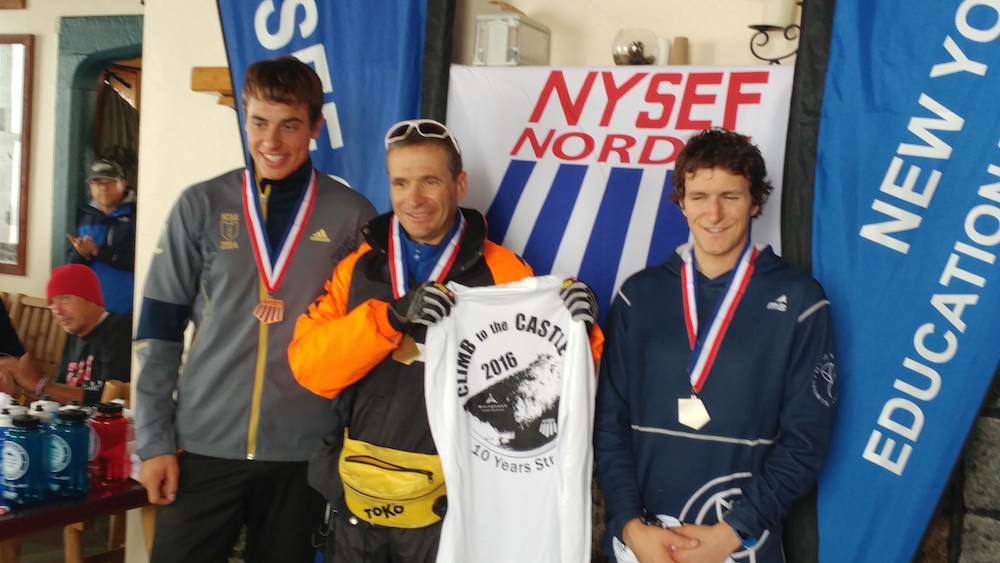
    The men's podium at the 10th annual Climb to the Castle rollerski race up Whiteface Mountain's Memorial Highway on Sunday in Wilmington, N.Y. Duncan Douglas (c) won, Russell Currier of the Outdoor Sports Institute (r) placed second and Paul Schommer (USBA National Development Group) was third. (Photo: Peter Minde)
    The men’s podium at the 10th Climb to the Castle rollerski race up Whiteface Mountain’s Memorial Highway on Sunday in Wilmington, N.Y. Duncan Douglas (c) won, Russell Currier of the Outdoor Sports Institute (r) placed second and US Biathlon development skier Paul Schommer (l) was third. (Photo: Peter Minde)

    Is the Climb to the Castle a data point for winter fitness?

    “It’s a good, effective workout, really good training,” Currier explained, adding that he didn’t think it was a good indicator of fitness in December or February.

    “I was really happy with how it turned out,” said Adam Glueck, a Ford Sayre U18 skier who finished seventh (+7:52.4) in his first C2C. “I didn’t want to go too hard out of the start. I followed some friends and threw in some double pole to rest my legs.”

    Glueck skied in a small group he eventually lost contact with about halfway through.

    “I managed to catch them on the V2 straight [the Lake Placid corner]. After that, my friend Henry McGrew [eighth overall] was right behind me,” he said. “I had to push hard through the headwind [the last 500 meters] to beat him. I was basically in agony for the last three or four minutes.”

    Agony and clouds: good metaphors for the Climb to the Castle. When athletes returned to the base, the sun was breaking out.

    Results: Men | Women

    Photo gallery

  • Duncan Douglas: Old, Jacked and Still Skiing Strong

    Duncan Douglas: Old, Jacked and Still Skiing Strong

    Duncan Douglas
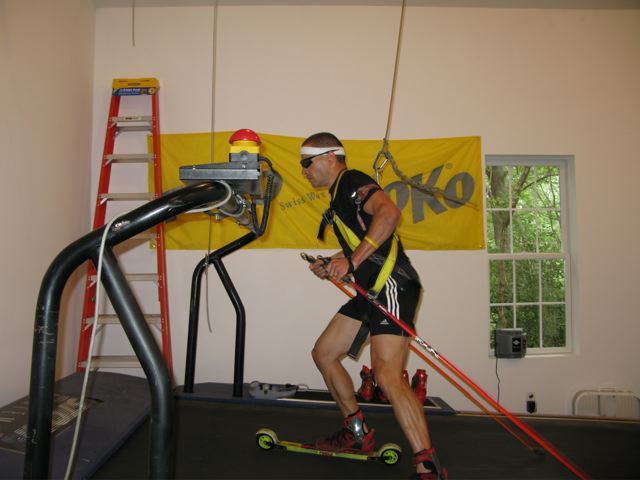
    Duncan Douglas rollerskiing on his treadmill in Honeoye Falls, NY. Photo courtesy of Duncan Douglas.

    There is only one thing that I really know about Duncan.  Duncan truly enjoys punishing himself through endurance activity more than any other human that I know. Training is his drug of choice and he is a serious addict. – Tim Burke

    Utter the name “Duncan Douglas” to anyone who knows anything about skiing, and you are guaranteed to elicit one of three responses: (1) dismissive incredulity, (2) respectful awe, or (3) idolizing hero-worship. If you hadn’t heard of the two-time Olympic biathlete before 2007, when he beat Kris Freeman to win the first Climb to the Castle on custom V2s, you certainly did in the ensuing uproar over wheel speed limitations.

    For all the US ski community at large presumes to know about Douglas, there seems to be a general consensus there’s something about him—like what really motivates an ex-Olympian past his prime to try to prove that you can be fast and old—that can’t quite be pinned down. His is a rare enigma in a sport that keeps tabs on everybody’s business. This is perhaps why, at the height of its internet glory, Jacked Up Old Man got a few thousand hits a month. How that compares to regular FasterSkier blog traffic is proprietary information, but suffice it to say that for an anesthesiologist from Upstate New York, that’s pretty impressive.

    Jacked Up Old Man, that legendary persona that captivated young and old ski fans alike, has now all but disappeared from the blogosphere. The Vancouver Olympics, which he was unabashedly shooting for, have come and gone without him. But at the age of 45, Douglas shows no signs of stopping.

    When the idea for a story on Douglas came up during a FasterSkier planning meeting, I leapt at the chance to write it. As a native on Honeoye Falls, NY, where Douglas now lives, I’d grown up hearing about his latest athletic insanity from my high school ski coach, his good friend Bernie Gardner. Stories of some ex-Olympian biking up the Whiteface Mountain toll road five times in one morning were somehow supposed to goad us all into training harder for our next league meet.

    And so the assignment was mine. What began as a simple workout piece turned into a full-on profile, as it became apparent that a brief account of Douglas on his rollerski treadmill couldn’t really do him justice. Nevermind what this guy does to get in shape, the real question is: why?

    It is a testament to the infectiousness of Douglas’s enthusiasm for training that he convinced me to wake up before dawn for a strength workout when we had already planned a rollerski later that day. I got the impression over the phone that the treadmill demo I’d been hoping for was not going to be possible, but a roller-board session at 5:00 a.m. seemed like a good substitute for hardcore. So, we agreed to meet at ‘Area 143,’ the small barn in his backyard that houses his workout equipment.

    Douglas had already started the circuit when I arrived the next morning: 50 reps on the roller-board, a minute of plyos, and 20 reps with an ab wheel. Repeat.

    “You might want to do only twenty of these,” he said, stepping down from an original model of the VasaTrainer. Instead of being positioned flat on one’s stomach to muscle up the slide, like most trainers I’d seen before, Douglas’s version allowed for a pretty close approximation of an upright double pole. It looked painful.

    “I’ve gotten off the roller-board wagon. Normally I like to do a workout like this three or four times a week. After a few months of that, I can go out on rollerskis and double pole like it’s nothing,” he said in between sets.

    With a seemingly limitless tolerance for pain and general exhaustion, “nothing” for Douglas probably qualifies as excruciating for others. Never mind the fact that he races 30 to 40 times a year; he’s on call up to three times a week as an anesthesiologist at Rochester General Hospital and could be asked to leave his family at a moment’s notice for deployment as a National Guardsman.

    Duncan Douglas racing
    Douglas racing this winter. Courtesy photo.

    When I asked Tim Burke, a 2006 and 2010 Olympian who lives and trains out of Lake Placid, NY, to describe his fellow biathlete, this is what he wrote: “Duncan once told me that when he was training full time, he would go for a three hour run and if his average heart rate was not high enough when he finished, he would simply drink a coffee and a coke and do the run again. Another time, he was telling me how much he trained when he was my age. So I asked him, ‘Did you ever train over 1000 hours in a year?’ He simply replied, ‘Try 2000.’ If anyone else told me these stories, I would simply cry bullshit, but Duncan is crazy enough that you just never really know.”

    This was the difficult thing about interviewing Douglas: it was hard to know when he was being serious, and when he was simply saying something for pure shock value, and probably laughing to himself while I tried to figure out whether he was joking or not. He’s so fit now you have to wonder: maybe he really did train 2000 hours a year when he was on the biathlon team.

    According to the man who taught Douglas to ski at St. Lawrence University, he’s always attacked life with unwavering intensity. Robert Axtell, who retired from coaching at St. Lawrence in 2008, recalled Douglas’s first ski race at Tupper Lake.

    “I was still racing quite a bit at the time,” said Axtell. “Duncan didn’t really know what to do, so I said to him, ‘Just follow me, and when you get ready to go, go.’ It was a mass start in a big field, and I was going along pretty good. I looked behind me for Duncan—he wasn’t there. I looked ahead, and there he was going up the hill. He ended up winning his first race.”

    Douglas was at St. Lawrence for less than two years, and in that time qualified for NCAAs. Despite his brief time as college racer, he always maintained a strong relationship with his coach. Douglas lived with Axtell for a time, and would ski at night in the lit loop behind Axtell’s house.

    With a seemingly insatiable appetite for self-inflicted pain and suffering, it would seem that Douglas would have been a difficult athlete to reign in. But Axtell said that the young Douglas was perfectly coachable, willing to learn and listen.

    “He does what’s best for Duncan,” explained Axtell. “I think maybe people will think he won’t listen; he’s had coaches in the past he kind of balked at…but years ago he was really eager to learn and get ahead.”

    “There might be times when he over trains,” Axtell conceded. “But he’s the type of person who can get by on very little rest; he’s just a high energy individual.”

    This was my training partner for three separate workouts on a Monday in August. Our morning strength session was, predictably, excruciating. Within the first ten reps on the VasaTrainer my arms were screaming. I could tell my triceps were going to make me pay for thinking I could keep up.

    “Right now I’ll do 15 to 20 sets of these, but eventually I’ll get up to 30,” said Douglas in between exercises. I decided it would be best for me not to bother counting how many sets it took for me to decide to start rolling tape instead.

    Extreme muscle soreness didn’t set in until the next day, however, so I was still ready to tackle our rollerski scheduled for that afternoon. We met at the site of local club Rochester Nordic Racing’s (RNR) afternoon practice. I arrived earlier than Douglas to tag along for a warm-up with the RNR juniors. Upon hearing who would be stopping by later, head coach Jason Hettenbaugh told his athletes, “Keep an eye out: if you’re lucky, you might spot a Jacked Up Old Man on the road!”

    Most of Douglas’s fan base might be over the age of 40, but you wouldn’t know it from the reactions this announcement elicited from the 20 or so high school kids around me. Five years after I’d graduated high school, Douglas was still being held up as the epitome of no-excuses dedication for local juniors. No more Olympics to ostensibly train for? No matter. “I’m just happy to get out there now,” he said after he arrived and we started an easy skate rollerski past farm fields.

    At the December 2009 Mt. Itasca US Olympic Trial selection races in Coleraine, MN, which served as a pre-qualifier for a shot at the last few places on the Vancouver biathlon team, Douglas finished ninth in his best three out of five races. The US Biathlon Association ended up taking the top four guys from that event to IBU Cup races in Altenberg, Germany, where the last few spots on the Vancouver biathlon team were contested. After Mt. Itasca, Douglas took to his blog to talk about coming up short of his goal.

    “Yes, I would’ve been thrilled to race in another Olympics and would not have tried if it wasn’t possible. The truth of the matter is that I just love training and racing,” he wrote.

    Setting such a lofty goal for himself simply let him get away with the sheer volume of training that he would love to dedicate to the pursuit of athletic excellence all the time, Olympics or no. With a wife, four kids, and a demanding job, Douglas recognized that being an athlete was now a more selfish endeavor than when he was younger.

    It was partly out of the need for an efficient way to fit in quality training that first prompted Douglas to purchase the piece of training equipment normally reserved for physiological testing labs. With few training partners and no coach but himself, Douglas set out make his comeback with a tool that let him rollerski in the dark before and after work.

    “I used to rollerski around here in the dark with my headlamp, but that got to be too dangerous,” he explained.

    He obtained the used Skatemill three years ago from the Netherlands, where it originated. His particular machine was a demo model in its previous life, and the company sent a technician to Douglas’s house to help him set it up. He had to rework the electricity coming to the barn so that it could handle the voltage the treadmill required. With the small shooting range he has set up in his backyard just outside the barn, he can combine rollerski workouts with target practice, simulating a winter race as best as possible.

    “It was cheaper than building a rollerski loop,” he said.

    The treadmill, it turned out, was perfectly operational, so back to The 143 we went after our rollerski, this time with my brother, Steve, in tow. After a quick safety briefing (“hit this red button to turn it off”), Douglas strapped into the harness and slowly brought the treadmill to speed. Skiing with it set to a 10% grade, he settled into an easy V2 near the front of the platform.

    Though I’d prepared for the real thing by watching a few YouTube videos of Douglas on the treadmill, I was still struck by its sheer size. It was like being in some sort of NASA virtual-reality lab, only here we were mapping out the limits of an addiction to endurance sport, and the lengths to which a person would go to achieve a goal. There was nothing virtual about it.

    When it was my turn to buckle into the harness, I was a little nervous. I started off without poles, to give myself a chance to get used to the feel of the belt moving under the skis. Surprisingly, rollerskiing on the treadmill was more like skiing on snow than on asphalt. It was easier to balance on one ski and let the belt freely move under my feet more. Of course, if I lost my balance for a split second here I’d end up flying off the back. At least asphalt stops moving if you fall.

    After adding poles and experimenting with V1 and V2 for a few minutes, I decided I’d had enough for one day. Douglas is just as busy as ever, after all, and it was time to let him have dinner and get back to his family.

    Before I’d tagged along for this series of workouts with Douglas, I had my theories as to why he held the attention of the ski world. I assumed it had something to do with his dedication to this sport beyond all reason.

    But in spending a few hours with him, I realized there was more to it than that. I was honestly inspired when I drove away from his house that evening. If Douglas, with more than enough distractions in his life to make him surrender his aspirations of being a world class athlete, could find a way to still be competitive with skiers 20 years his junior, then what the hell was my excuse? True, I probably couldn’t afford my own rollerski treadmill, but my day spent trying to keep up with a jacked up old man made me realize that it actually wasn’t that hard. Painful, maybe, but all it really took was a commitment to a goal and the decision to try and meet it no matter what. A healthy enjoyment of punishing yourself certainly didn’t hurt either.

    Correction: We originally stated the Robert Axtell retired as the head coach at St. Lawrence University in 2008. While he was the head coach from 1963 to 1973, he was an assistant when he returned to the program from 2001 to 2008. Ethan Townshend has been the St. Lawrence head coach since 2003. We apologize for the mistake.

  • Olympians Ready for Ski to the Clouds

    Pinkham Notch, NH— On Sunday March 8, 2009, Great Glen Trails will host Ski to the Clouds: North America’s Toughest 10k presented by Maxiglide. This year’s race will feature Olympians and last year’s champions.

    In 2008, Olympians and top college skiers took on the challenge of Ski to the Clouds, and the same is true in 2009. Last year’s overall winner and 2006 Olympian, Justin Freeman of New Hampton, NH and The Factory Team will return to defend his title. Kelsey Allen of NENSC and Franconia, NH, 2008’s women’s champion, will also return to defend her title.

    Other top athletes scheduled to race include: 1998 Olympian Marc Gilbertson of Rossignol and Hyde Park, VT; 1992 and 1994 Olympic biathlete Duncan Douglas from Honeoye Falls, NY, representing the New York Ski Educational Foundation; and current U.S. Biathlon team member and Army World Class Athlete Program racer Jesse Downs of Jericho Center, VT.

    Last year was also the first year of the race’s new incarnation, which included 4k of racing on the trail system at Great Glen Trails before the climb up the Mt. Washington Auto Road. The 2009 race will be contested on the same 10-kilometer course making it the toughest 10k in North America. The race will finish at the site of the historic Halfway House on the Mt. Washington Auto Road, just below 4000 feet above sea level. Ski to the Clouds is true freestyle event: skiers can use either skating or classic technique in this mass start race. There will not be separate categories for each discipline.

    Thanks to generous support from Maxiglide, Ski to the Clouds will offer prize money for the top performers. With a total prize purse of $1400, cash prizes will be awarded to the fastest male and female competitors and to the fastest male and female over the age of 40. Great Glen Trails will also offer a prize raffle.

    For more information and to register for Ski to the Clouds, go to www.SkiToTheClouds.com.

    Great Glen Trails is open daily for cross country skiing and snowshoeing with 40km. SnowCoach tours up the Mt. Washington Auto Road are also running daily. Complete details and snow conditions available at 603.466.2333 or www.GreatGlenTrails.com.

    Ski to the Clouds